Gabriel Metsu. Part 1 – Early life and The Letter

A Hunter Getting Dressed after Bathing by Gabriel Metsu (c.1654)

In A Hunter Getting Dressed after Bathing (above), Gabriel Metsu depicted himself as a nobleman and hunter, but of course the unusual twist to the depiction was the fact that he depicted himself in an a full-length, un-idealized, naturalistic nude pose.

If I was asked who was my favourite artist or what was my favourite artistic era, I would probably choose one of the 17th century Dutch Golden Age painters.  To be more precise, I would almost certainly choose an artists who painted genre scenes, all of which I find quite fascinating. Nowadays the most well known and most popular Dutch Golden Age painter is almost certainly, Johannes Vermeer.  However, for the next two blogs, I am going to feature some of my favourite works by a contemporary of Vermeer, and who during their lifetime was by far the more popular.  Let me introduce you to Gabriel Metsu.

Gabriel Metsu was the son of the Flemish painter Jacques Metsu, and Jacomijntje Garniers.  Jacques Metsu besides being a painter was also believed to be a tapestry designer or cartoon painter.  A cartoon being a full size drawing made for the purpose of transferring a design to a painting or tapestry or other large work.  Records show that Jacques came from “Belle in Flanders” which is now Bailleul, a small town in French Flanders close to the France-Belgium border. Jacques Metsu married his first wife, Maeyken, who died in 1619 without giving him any children.  He married his second wife, Machtelt Dircx the following year and the couple went on to have four children, but only the first child, Jacob, survived childhood, the others probably succumbed to the plague which  swept through the region in 1624 and which also claimed the life of Machtelt.

Jacomijntje Garnier’s family came from Ypres but by 1608 when she was eighteen years of age she was living with her family in Amsterdam.  It was in this year that she became betrothed to her first husband, Abraham Lefoutere, a citizen of Antwerp.  His profession was given as a teacher but some records show him as an innkeeper.  The couple had four children, Philips, Sara, Marytgen and Abraham who died in infancy. Her husband, Abraham, died in 1614 and soon after Jacomijntje remarried.  Her second husband was Willem Fermout but he too died at a young age in 1624

Jacomijntje Garnier moved, with her three children, to Leiden and there she met Jacques Metsu and the couple were married in November 1625.  In 1629 she became pregnant with Gabriel but sadly her husband, Jacques died in the March of that year, eight months before Gabriel was born, some time between the end of November and the middle of December 1629.  Jacomijntje’s occupation around this time was given as a midwife.  Gabriel Metsu, along with his step-brother and two step-sisters from his mother’s first marriage, were brought up by her alone, until, in 1636, when Gabriel was six years old, she married her fourth husband, Cornelis Gerritsz. Bontecraey, who then became their stepfather   Bontecraey was a wealthy captain and owner of a barge and two houses in Leiden.  He died in 1649 making Jacomijntje a widow for the fourth time.  She died two years later in 1651.

  There are few hard facts with regards Gabriel Metsu’s early artistic training and teenage years.  However it is believed he could have helped in the workshop of Claes Pietersz de Grebber, a silversmith.   Because Gabriel Metsu’s earliest work, which is still in existence, entitled Ecce Homo, which he completed around the late 1640’s was a religious one,  it is believed that his early artistic tuition must have come from a history painter.  It maybe just a coincidence, but his employer’s son, Anthonie de Grebber, who Metsu must have known, was a history painter and maybe he gave Gabriel some of his first artistic tuition.   In 1644, when just fifteen years of age, Gabriel Metsu joined a  group of local artists, and even at  such an early age, his name was entered in the membership rolls as a “painter.”  Other larger Dutch cities such as Gouda and Haarlem had their own painters’ guild, Guild of Saint Luke, and it was mandatory that artists were members of these guilds in order to sell their wares.  Leiden, up until March 10th 1648, had no such guild but on that date the Leidse Sint Lucasgilde (Leiden Guild of St Luke) was founded by Gerard Dou and Abraham Lambertsz van den Tempel.  Six days after its formation Gabriel Metsu, aged 18,  became a member.

I will continue Gabriel Metsu’s life story in my next blog but for today I want to feature two of his most famous works, two narrative pendants, Man Writing a Letter and its companion piece Woman Reading a Letter, both of which were completed around 1666 and now hang in the National Art Gallery of Ireland in Dublin.  Dutch artists were the first to make the private letter a central focus in genre scenes.
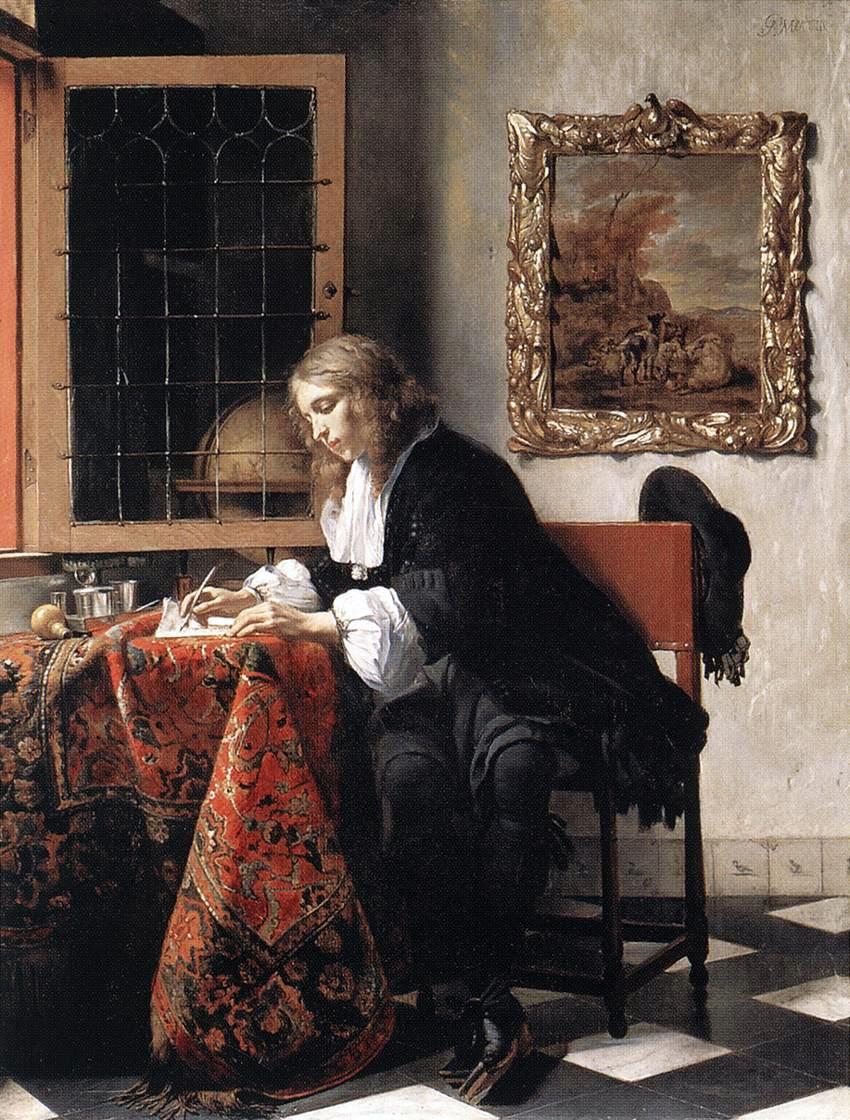
Man writing a Letter by Gabriel Metsu  (c. 1664-1666)
Man writing a Letter by Gabriel Metsu
(c. 1664-1666)

The setting for the painting, Man Reading a Letter, is a study.  The scene is bathed in sunlight.  We see a young, fine-looking man, with long blonde curls, sitting at a table, pen in hand.  He is finely dressed in a black velvet jacket and the white of his shirt and neckerchief are lit up by the sunlight, which streams through the open window in front of him and reflects off the light-coloured back wall.   His hat is precariously balanced on the back of his chair.  He is quietly contemplating the words he wants to write to the woman he loves.  The sunlight highlights him.  He is at centre stage of this work and the sunlight acts as a spotlight.  If this is indeed a love letter he is writing then he must be careful with his words.  He cannot countenance a misunderstanding caused by what he has written.  Look at the resolute expression on his face.  He is totally lost in thought knowing the importance of the words he uses.  They have to say exactly what he wants them to say.  He must avoid ambiguity.  The missive must be perfect.

Observe his opulent surroundings.  The floor is made up of smooth black and white marble slabs, a sure indication that the owner of this house is wealthy.   Everything points to this being a room belonging to a well-to-do person.  We can tell this by some of the furnishings on view.   The table at which he writes the letter is covered with a finely detailed expensive Oriental rug or table tapestry.  Behind him we see a landscape painting in an expensive heavily carved gilt Baroque frame. To his right, partially hidden by the opened window frame we see a globe.  The globe appeared in many Dutch paintings of the time and is almost certainly a reminder of the Dutch Golden Age when the country was one of the leaders in exploration and trade with the far corners of the world.

Woman Reading a Letter by Gabriel Metsu  (c. 1664-1666)
Woman Reading a Letter by Gabriel Metsu
(c. 1664-1666)

The companion work to this painting is Woman Reading a Letter.  The Metsu’s pendants, when seen together, combine to become a set of narrative works in which we see the man writing to the woman and the woman reading his letter.  In this second work by Metsu, we see the lady sitting in the corner on a wooden zoldertje platform in a marble-floored hall.  She is wearing a long pink skirt, and her yellow top is trimmed with ermine, which is a sure sign of wealth.   A pillow rests on her knees, which has been used as a support whilst sewing.  Her sewing has been cast aside when the maidservant brought in a letter for her.  In her excitement at receiving the letter she has dropped her thimble which we see lying on the floor.    The letter obviously means a lot to her.  She is totally absorbed by what he has written.  Look how she tilts the letter at an angle as she thoughtfully reads it.  Maybe it could be that she needs the sunlight which is streaming through the window to illuminate the words, making them easier for her to read or maybe she is shielding the contents from her maidservant.  The painting is full of symbolism which adds intrigue to the painting.  With this being one of a pair of paintings we know that the man has written the letter to her, which she is now reading but what is the relationship between the man and the woman?  Look at the woman’s forehead. The hairline is receding and to achieve that it could be that some of her hair had been plucked or the forehead shaved giving a higher forehead, which was the fashion of the day.  Look more closely and one can see a single curl of hair at the centre of the forehead and this usually signified that the lady was engaged.

The inclusion of the dog is a symbol of fidelity and one presumes its inclusion probably signifies the woman’s faithfulness. According to some art historians and iconographers, a cast-off shoe, one of which we see on the floor, has erotic connotations.  I find that a slight stretch of their imagination but I suppose their line of thought is that lovers hastily cast of shoes in their rush to make love.  It is interesting to look at the maidservant who stands next to her mistress.  Because of her lowly status in the household she has been depicted in a drab brown dress although a little colour has been added with the blue of her apron.  Under her left arms she has a bucket with two arrows scribed on it.  Could this once again symbolise that love is in the air and these are Cupid’s arrows.  To me they look more like the arrows one used to see on the back of prisoners’ jackets in 1930’s movies.  She also holds in her left hand an envelope.  There is a word on the envelope which I cannot quite read although it seems to start with the letter “M”.  I read somewhere that the word is “Metsu” but until I stand before the original work I will not be sure.  Hopefully I will get to Dublin next month and have a closer look.

The maidservant is drawing back the green curtain, which is hanging from a rod, and which is covering a framed painting on the back wall.  Covers over paintings were not unusual as it was a means of preventing sunlight from falling on them causing them to fade.  The subject of the painting is a seascape in which we see two sailing ship battering their way through a storm. Is the subject of the painting symbolic?  There are two theories about this.  One is that the woman’s betrothed is a seafarer and the other is that the ship struggling in a storm symbolises the romantic struggles ahead for the two lovers.  Also on the wall is a mirror which is in a plain black frame, the colour of which I read symbolised a warning against narcissism and lewdness, but like the abandoned shoe I remain unconvinced with that theory.

As I said earlier, both the paintings are housed in the National Gallery of Ireland, part of the Beit Collection which is housed in the .  The paintings were owned by Sir Alfred Beit and his wife, Lady Beit.  Sir Alfred Beit was a British Conservative politician, philanthropist, art lover, and honorary Irish citizen.  He donated the two paintings I have featured today along with fifteen other masterpieces to the National Gallery of Ireland in 1987, whilst the other major art works remained at their home, Russborough House, which was once described as the most beautiful house in Ireland.   Sir Alfred and Lady Beit bought Russborough House in 1952 to house their art collection and in 1976 established the Alfred Beit Foundation to manage the property. Beit died in 1994 but Lady Beit remained in residence until her own death in 2005.  Due to a number of armed robberies and thefts of some of the paintings, which fortunately were recovered, the Foundation agreed to move them to the National Gallery of Ireland for safekeeping.

In my next blog I will complete the life story of Gabriel Metsu and feature some more of his paintings.

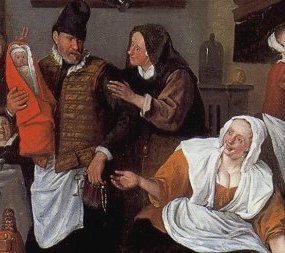
Celebrating the Birth by Jan Steen

Celebrating the Birth by Jan Steen (1664)

I do my best to feature paintings by artists that people may not have come across before and I try not to feature the same artist too many times but sometimes I cannot help but revisit works by my favourite artists and today is no exception.  My Daily Art Display featured painting today is entitled Celebrating the Birth by Jan Steen which he completed in 1664.  I have showcased work by this artist three times before.  On February 16th 2011 we looked at a work entitled In Luxury, Look Out.  On April 27th 2011, I featured his painting The Effects of Intemperance and finally on August 26th 2011, I gave you The Life of Man so if you like today’s work why not go and have a look at some other of Jan Steen’s paintings.

Before us we have a simple scene of a couple celebrating the birth of their child, or do we?  In fact there is more to this painting than a simple celebration of the birth of a baby.  Look closely at the painting and see what is odd about the Steen’s depiction of the event and see if you can work out what is happening in the scene.  I will give you a hint.  Look at the man who stands behind the baby and the baby’s father.  Before I reveal the secret about the painting let me first tell you a little about the artist, Jan Steen.

Jan Havickszoon Steen was born in the Dutch town of Leiden in 1626.  He, like his artistic contemporary, Rembrandt, attended the local Latin School of Leiden. And a year later in 1646 he enrolled at the University of Leiden.  His professional artistic training started the following year and came from the German-born, Dutch Golden Age painter, Nicolaes Knupfer.  It is thought that he also could have studied with Adriaen van Ostade and it was this artist’s low-life genre work which was to influence Jan Steen’s early works.  At the age of twenty-two Steen along with his artist friend Gabriel Metsu and a number of local painters founded the painters’ Guild of St Luke of Leiden.

In 1648, Jan Steen moved to The Hague and worked as an assistant at the workshop of the celebrated landscape painter, Jan van Goyen.  Van Goyen was, like Jan Steen, born in Leiden.  He had moved from Leiden to The Hague in 1631 where he set up his workshop.  Steen was not only employed by van Goyen but was also taken in by van Goyen’s family and lived with him, his wife Annetie and their daughters.     Jan Steen became very friendly with Margriet, one of van Goyen’s daughters and they married in 1649 and the couple went on to have eight children.  Steen’s association with his father-in-law lasted until 1654.

In 1654 he and his family moved to Delft where he ran a brewery which his father had rented for him.  It was called De Roscam (The Curry Comb) but although Steen had a great artistic talent his business acumen was sadly lacking and the brewery failed.  In 1657 he went to live in Warmond,  a town close to Leiden and it was here that he met and became friends with the artist, Frans van Mieris.  Frans van Mieris was a painter of genre scenes which depicted the habits and actions of the wealthier classes.  It was this type of art by van Mieris and the works of Te Borch that weaned Steen off his low-life genre paintings and influenced him to paint more elegant genre scenes.  Jan Steen left Haarlem in 1660 and moved back to Haarlem where he stayed for the next ten years.  In 1669, near the end of this stay his wife died and the following year his father passed away.  After his father’s death in 1670 Jan returned once again to Leiden where he remained for the rest of his life.  He remarried that year and his second wife, Maria van Egmont,  gave Jan two children.

For the Dutch people, the year 1672 became known as the rampjaar(disaster year) as this was the year that saw the start of the Franco-Dutch War and the Third Anglo Dutch War, which culminated in the defeat of the Dutch States Army and large swathes of the Republic was conquered by the invading troops.   Because of these wars the art market collapsed and Steen needed another source of income so in 1673 he opened a tavern. His work in the tavern meant that his artistic output diminished in his later years.

Jan Steen died on New Year’s Day 1679 in Leiden

And so let us go back to the featured painting.  Have you worked out the “sub-plot” depicted in this painting yet?  Steen is best known for his humorous genre scenes, warm hearted and animated works in which he treats life as a vast comedy of manners and this work of his is no different.  We are looking at a lying-in room.  Whenever the lady of the house was about to give birth, one of the rooms was set aside for this purpose. The lying-in room was used for the actual delivery, and later to receive visitors.  The birth of a child was, as it is now, a cause for celebration.  It is greeted with both happiness and pride and in the 17th century in the case of the birth of a son, it became even more of a celebration for economic reasons as a son would often carry on his father’s business and would inherit the family possessions.

In this painting Steen has depicted a group of revellers celebrating the birth of a child.  One can imagine the elated atmosphere within the room with all its merriment and drinking.  The majority of people in the room are women as men, including the father, were considered inappropriate interlopers in this female sanctuary.  The mother is in the left background of the painting lying in her bed being fed some broth.  Another woman sits at the end of the bed drinking to excess.     The others present will probably be female relatives, maidservants and the midwife.  Normally one would expect, as in most works of art depicting such an event, that the mother of the newborn baby would be the main focus of attention.  However Steen has made the proud father the main focus of this painting.  However he is not the only man in the painting.  Look at the figure behind the baby.  We see another man as he is about to creep out of the room.  Actually it is a self-portrait of the artist himself.  It was not simply to break tradition to see the two men in the painting but Steen wanted to convey a little information about what has happened and to the nature of the husband and wife’s relationship.

Sign of the cuckold

Look more carefully and you will see something which was not visible until the painting was cleaned in 1983.  The man leaving the room has made a cheeky two-fingered gesture above the baby’s head.     This gesture can be seen by all those in the room except the proud father.   From the young man’s gesture, Steen has made us aware that the ‘father’ has been made a cuckold. The gesture illustrates the tradition of “cuckold’s horns, and that the horns, visible to all but the man himself, will grow on the head of a man whose wife has been unfaithful. The proud father stands right of centre having been presented with his child.  His pride on the birth of his child is plain to see.  He is totally unaware of the ridicule and stands before us, puffed up, beaming with pride as he shows off his child.  Nobody seems shocked by this audacious gesture which tells us that everyone in the room appears to know what the man does not: that the child is not his..  There are other sexually symbolic inclusions in Steen’s painting to suggest not just sexual impropriety but implying the husband was impotent, such as the bed warming pan, which lays prominently on the floor in the foreground.  The warming pan reminds us of the adage, the only warmth in the marriage bed is the warming pan.   In the right foreground we see broken egg shells scattered on the floor and again this is a reminder that the phrase, cracking eggs into a pan, was a contemporary euphemism for sexual intercourse.

The demand for money

Steen has been very unkind with his depiction of the father in this portrait.  We see him wearing an apron and carrying keys like a housekeeper would do, thus implying a lowering of his status in the household.   We also see the old midwife at his shoulder demanding money for her services and to the right of the man, sat on a stool, is a maid with her hand out, seemingly demanding payment for making the celebratory broth.  Steen’s final degrading of the man is his depiction of the limp and ineffectual sausage hanging by the fireplace which does not need me to explain the connotation of such an inclusion!!

There is a moralistic point to the painting.   It is a warning tale of what happens when an older man marries a much younger woman.   In a way Steen has no qualms about depicting the man as a cuckold.  Maybe the modern saying of there’s no fool like an old fool has its roots way back in time.

A Merry Company at Table by Hendrick Pot

A Merry Company at Table by Hendrick Pot (c.1630)

Two paintings today; one by the artist and one of the artist himself.  One of the pleasures I get from my blog is that besides discovering new artists and their paintings, I acquire an insight with regards the history and traditions of various countries , most of which I had little previous knowledge.  Maybe I should have concentrated more during my history lessons at school.   Recently I have featured Flemish artists and I looked briefly at Dutch and Flemish history during the time of Spanish occupation and rule.  Today, I am looking at a painting by the Dutch painter Hendrick Pot and exploring the world of the schutterij.  Don’t you know what the shutterij is or are?   Neither did I until I researched a painting by Pot but before I reveal the answer let me give you a brief biography of the artist himself.

Hendrick Gerritsz Pot was born in Haarlem around 1585.  His early artistic training was with Karl van Mander.  We probably know Karl van Mander not so much as an artist but for his writings.  He has often been termed the Dutch Vasari for his book entitled Schilderboek, published in 1604, which to this day, remains the main source for information on Northern European painters of the 1400s and 1500s and contains valuable original material about his Italian contemporaries.  He had arrived in Haarlem in 1583 and set up an informal academy with the Dutch engraver and painter, Hendrick Goltzius.  At this Academy, van Mander taught and developed the Haarlem Mannerist style.   Other artists who were trained by van Mander at his studio included Frans Hals.
In 1620 he was commissioned to do two paintings relating to William I of Orange, often referred to as William the Silent, who was one of the key leaders of the Dutch revolt against Spanish rule.  He was assassinated in 1584.  One of the paintings, entitled the Glorification of Willem I, was acquired by the city of Haarlem whilst the other entitled the Deathbed of Willem I was housed in the town hall of Delft.   In1630 Pot became Dean of the Haarlem Guild of St Luke.   He travelled to the court of Charles I in London in 1632 where he was employed as the court portraitist and during his one year sojourn at the court completed portraits of Charles I and his wife Queen Henrietta Maria.

In 1633 he returned he returned to Holland.  Many of Pot’s lucrative commissions were to paint group portraits of the local militias, known as schutterij.  So now you know – schutterij is the Dutch term for militia.  They were a voluntary city guard whose prime objective was to protect their town or city from attack and also to act in case of a fire breaking out within the town.   They were simply a defensive military support system for the local civic authority. The officers of the schutterij came from wealthy backgrounds and were appointed by the city magistrates. The captain of each group was normally a very wealthy inhabitant of the district, and the group’s ensign was a wealthy young bachelor and he could be recognised in the group portraits as the man wearing exceptionally fine clothes.   There was a special kudos to being a member of the schutterij as it often led to one being appointed to an important position within the town council.

At the time when the leaders of an individual schutterij stepped down or passed away and their replacements were sworn in, a local artist was commissioned to paint a new group portrait of the members. These group portraits were known as schuttersstukken and they often had the setting of a banquet which was held to welcome in the new leaders.     The artist commissioned to carry out the painting had a complex job on his hands.  This is not as it would be now when a photographer would get the group to stand as one and after a few minor adjustments shoot the film.  In the case of schuttersstukken the artist would paint each member separately so that each individual portrait within the group was as accurate as possible.  As a member of this militia, if one wanted to be included in the group portrait, one had to pay for the privilege and how much you paid the artist and your rank within the militia, would depend on where he positioned you within the group!  As I said before it was a very lucrative commission and there was a lot of competition for the right to carry out the group portrait.  Probably one of the most famous of the schuttersstukken was Rembrandt’s The Night Watch.   One thing that would help an aspiring artist to gain the painting commission was if he was a member of a schutterij.   Hendrick Pot was a lieutenant in a schutterij and that was the advantage he had over many of the other applicants.

The Banquet of the Officers of the St George Militia Company by Frans Hals

This leads me to my second painting of the day which is entitled The Banquet of the Officers of the St George Militia Company which Frans Hals painted around 1639 and included in the work is none other than Hendrick Pot with his militia sash who is seated at a table on the far right of the gathering, reading a book.

In 1648 Pot moved from Haarlem and went to live in Amsterdam.  In his later years he concentrated on small single figure portraiture.  He died in Amsterdam in 1657, aged 72.

My main featured painting is one Hendrick Pot completed around1630 and is entitled A Merry Company at a Table.   It is now housed in the Wallace Collection in London.   It is a genre piece.  The definition of a genre piece is a work of art  which affords a pictorial representation, painted  in any of the various media and one that represent scenes or events from everyday life, such as markets, domestic settings, interiors, parties, inn scenes, and street scenes. Some of the genre pieces are realistic, some imagined, whilst others are romanticized by the artist. This type of painting was particularly popular in seventeenth century Netherlands, but the term “genre” was not applied at the time;  instead, paintings were divided into more specific categories, such as ‘merry company’ scenes (conversatie), ‘little fire’ scenes (brandje) or ‘bordello scenes’ (bordeeltje).   My featured painting today falls into the latter category, a bordeeltje.  So why do we believe what we are looking at is a bordello?  Although the painting is not littered by scantily dressed females and lusting men the artist has given us some subtle hints as to what we are looking at.  On the floor there is a discarded rapier, lute and in the foreground, a dog.  These symbolise the disarming power of love and carnal desire.  Look to the left of the painting and in the doorway one sees an old woman carefully watching her girls as they enchant and flirt with the soldiers.  The men and women seated around the table make music together which is a common euphemism for making love and they play cards and smoke which were looked upon as the two great vices of the time.

Look to the extreme right of the painting.  Look at the cavalier with his back to the chimney breast, who stares out at us.  He gives us a knowing look as if to say “you know what is going on here, don’t you?”  The background solely consist of a drab muted coloured wall broken up only by the presence of a mirror.  Why do you think Pot added a mirror to this scene?  Could he be asking us to look into it, see our own reflection and examine our own behaviour, before we audaciously condemn the women and the men we see before us in the brothel?

I have always liked these Dutch and Flemish genre pieces.  There is often a moralistic tale being told.  The scene is often up for interpretation and we look carefully for any signs of symbolism.  I enjoy looking closely at the individuals and try to guess what is going on in their minds.  Fortunately there are so many of them in our art galleries and museums and I am never disappointed by what I see.

Enjoy !

Winter Scene by Isack van Ostade

Winter Scene by Isack von Ostade (c.1646)

Over the next two blogs I am going to take a look at two Flemish artists who besides being highly talented were brothers.   They were the van Ostade brothers.  Today I am going to feature Isack, who was the lesser known of the two, maybe because he only lived to the age of twenty-eight.

Isack van Ostade was born in Haarlem in 1621.  He was a Dutch landscape and genre painter.  Genre paintings were ones depicting scenes of daily life and were particularly popular in 17th century Holland.  Isack and his brother Adriaen, who was eleven years older, were the sons of Jan Hendricx Ostade, a weaver from the town of Ostade, close to the city of Eindhoven.  Despite being born in Haarlem both he and his brother took the name “van Ostade” as their family name.  Isack studied painting under the guidance of his elder brother until he was almost twenty-one years of age at which time he independently set up his artistic business.  He started off painting subjects similar to his brother and his work was always viewed as not as accomplished as the works of Adriaen van Ostade.  Realising this, Isack decided to stop painting the genre scenes and concentrate more on landscape work in the fashion of Salomon van Ruysdael, the Dutch Golden Age landscape artist.

In his earlier paintings the figures were the key feature but in his later works his landscape becomes increasingly significant.  His change to landscape painting paid off and this coupled with his skill at figure painting ensured the popularity of his winter scenes in which we would see groups of animated people in wintery landscape settings.  These winter scenes like my featured painting today, Winter Scene, were his speciality.  He painted this picture around 1645 and it now hangs in the National Gallery in London.  It is quite similar to the painting, Winter Landscape with Wooden Bridge which another Dutch painter, Philips Wouwerman completed fifteen years later.

The painting we see before us is beautifully picturesque and we view the scene from low down which allows us to see the old rickety wooden bridge outlined against a silvery grey winter sky with its dark snow bearing cloud approaching the area.  The scene is populated by peasants.  Some, like the youngsters, are enjoying themselves sledging and skating on the frozen river whilst others, the adults, are hard at work as we see the man encouraging his old white horse to drag the laden cart up the riverbank and we watch old man as he slowly climbs the steps of the bridge, his back straining under his load of firewood.   

Sadly fewer than three dozen winter landscapes of Isack van Ostade are known today.  He died in 1649 at the early age of twenty-eight.  He had few, if any, pupils yet his influence on the succeeding generation of Haarlem painters was great and the likes of Philips Wouwerman  owed a lot to this young man.

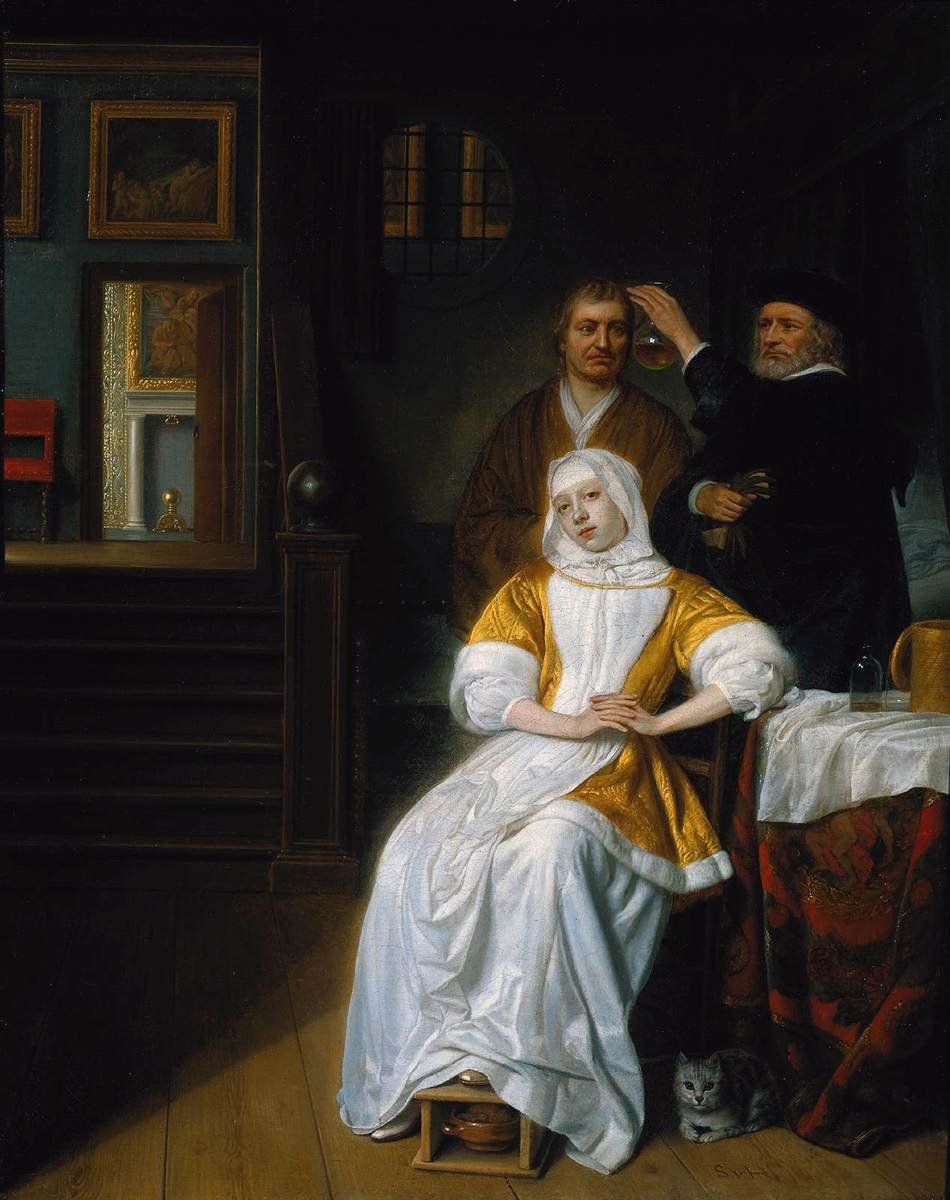
The Anaemic Lady by Samuel van Hoogstraten

The Anaemic Lady by Samuel van Hoogstraten (c.1667)

As promised a while back, today I am going feature another painting by the Dutch artist Samuel van Hoogstraten and at the same time have a look at his life story.

Samuel Dirksz van Hoogstraten was born in Dordrecht, Holland in 1627.  He was the eldest of seven children.  His parents were Dirck van Hoogstraten, a silversmith and painter, and Maeiken de Conink.   He came from an artisan background.  His grandfather Hans was registered as a member of the Antwerp St Luke’s Guild, an association for painters and many of his mother’s ancestors were gold and silversmiths by trade.  The line of work the van Hoogstratens were in was a highly paid and one of the most prestigious of occupations.  In the late 16th century, the van Hoogstratens and the de Coninks moved from Antwerp to Dordrecht for a combination of religious, political and economic reasons.   Samuel’s grandparents and those of his wife-to-be were Mennonites, who had lived in Antwerp and because of their religious beliefs had had to escape persecution by the catholic Spanish rulers of the Spanish Netherlands

At the age of three, Samuel and his family moved to The Hague and his father Dirck enrolled in the local painters’ guild.  In 1640, Samuel’s maternal grandfather died and left his mother a sizeable inheritance as well as his house and business.  The family sold their house in The Hague, at a considerable profit, and returned to Dordrecht where they moved into the grandfather’s much larger house.  This was probably not before time as by then the family group had grown and now consisted of Samuel’s parents and seven children.  The family continued with the family’s silversmiths business.  Sadly, within a year of the move, Samuel’s father also died, leaving his mother to bring up the family single-handedly and at the same time persevere with the family business.     

From the age of seven Samuel van Hoogstraten had showed an interest in art and was taught the basics of drawing and the technique of engraving by his father.  In 1678 he wrote what is now considered as one of the most impressive painting treatises to be published in the Netherlands in the seventeenth century entitled Inleyding tot de Hooge Schoole der Schilderkonst (Introduction to the Academy of Painting) and in it he talked about his early love of art and his decision to become a painter despite some opposition from his uncle, his guardian.  He wrote:

“…I remember very well how when my father died my guardian advised me with gentle counsel to give up the art of painting and with pleasant words recommend another profession which seemed to him more secure.  And though I was not yet fourteen years old, I felt as if he wanted to take away my happiness and condemn me to slavery…”

Samuel achieved his wish to study to become a painter, for shortly after his father’s death, he moved to Amsterdam and entered the school of Rembrandt.   When he had completed his apprenticeship at Rembrandt’s studio, Samuel van Hoogstraten became an official Master and Painter.   It is only in some of his earlier works that the influence of his teacher can be seen.  In his later years during the 1660’s and early 1670’s he concentrated on genre paintings of domestic households as is the case with today’s featured work of art.  He was a man of many talents.  As well as being an accomplished artist, he was an expert in etchings and engravings, a gifted poet and writer and in 1656 when he was almost thirty years of age he married, went to live in Dordt, a suburb of Dordrecht, and became director of the local mint.  Samuel van Hoogstraten died in Dordrecht in 1678 aged 51.

My Daily Art Display featured painting today is entitled The Anaemic Lady which Samuel van Hoogstraten completed around 1667 and can now be seen at the Rijksmuseum in Amsterdam.  The setting is a room in a house.  It appears to be a wealthy household judging by the sumptuous furnishings, gilt leather wall hangings and the paintings on the wall.  Before us is a pale faced woman, head slightly tilted to one side, reclining passively,  if somewhat lethargically in her chair, with her hands clasped before her.   It is a mysterious scene and we immediately wonder what is happening in the painting.  Although the woman has a sickly pallor we are not sure what ails her but there are clues.  Behind her we see two men.  One is a doctor holding up a flask of the woman’s urine to the light in order to determine whether she is in fact pregnant.   The other man, perhaps her husband, perhaps her lover, looks on with great apprehension at the bottle and maybe he fears the result of the examination. So what is the story behind this scene?  There are a couple of helpful hints in the painting.  Look at the naked figures, part of the design of the tablecloth and then look at the painting above the door which depicts an image of Venus, the goddess of love.  More importantly, look on the floor by the woman’s feet.  We see a cat.  Why would the artist add a cat to the painting?  Was it just a sign of domesticity and the family pet?   We should however remember that the cat was a medieval symbol of lust and in this painting its presence may represent illicit love.   This is not simply a cat stretched out on the floor but one which has trapped a mouse between its paws and maybe we should interpret that as reflecting the fact that maybe the man and the woman have, like the mouse, been caught and trapped by one moment of passion?

Does that sound a little farfetched?  Well here is a further twist to the story of the painting.  What you are looking at now is the painting after its restoration in 1989.  During the restoration work an overpainting was discovered.  Prior to the restoration work there was neither the mouse between the cat’s paws nor a second man in the painting.  The work just depicted a doctor treating a woman who was ill and the family pet lay lovingly at her feet.  There was now no hint of pregnancy, or entrapment.    It was thought that some time during the 19th century both the mouse and the man were painted out.  The reason for this overpainting is believed to be because it was not considered genteel or proper to refer to an unwelcome pregnancy or hint at its consequences.   

I will let you decide whether this is simply a scene of domesticity and whether the cat and mouse is just a load of nonsense, but if so, why overpaint the mouse and the second man?

The Effects of Intemperance by Jan Steen

The Effects of Intemperance by Jan Steen (c.1665)

I have featured many paintings, mainly by Dutch or Flemish artists, which try and have an embedded moral message in their works of art.  Often it is about the dangers of drinking too much, which is a subject painters from our present time may find very topical.   My Daily Art Display today features one such 17th century painting entitled The Effects of Intemperance by the Dutch painter Jan Steen.

Jan Havickszoon Steen was born in 1626 in Leiden a town in the Netherlands and was a contemporary of the great Rembrandt van Rijn.  He received his artistic education from the German painter of the Dutch Golden Age, Niclaes Knupfer who gained a reputation for his historical and figurative scenes of Utrecht.  At the age of twenty-two Steen joined the Saint Lukes Guild of Painters in Leiden.  Steen then moved to The Hague where he lodged in the household of the prolific landscape painter Jan van Goyen.  Soon after, he married Margriet, the daughter of van Goyen.  Jan and his father-in-law worked together closely for the next five years.  Then he moved and went to live in Warmond and later Haarlem.  His wife died in 1669 and his father-in-law passed away a year later.  Steen returned to Leiden re-married and had two children and remained there until his death in 1679 at the age of  53.
So back to today’s featured painting which is a pictorial moral tale of the dangers of insobriety.  The painting illustrates well the Dutch proverb “De Wijn is een spotter” translated means: Wine is a mocker, in other words wine (or drinking it in excess) will make a fool of you.  Although we see the children misbehaving the onus of guilt is placed squarely on the shoulders of the adults.

The main character of the painting is a woman who we see sitting slumped on the steps of her house sleeping off the effects of having drunk too much alcohol.  The overturned flagon of wine lies on the floor and despite the noise and antics of the children she doesn’t wake.   She is being portrayed as the neglectful mother.  She is totally unaware of what is happening around her.  However, she is no peasant.  Look at her clothes.  These are not ragged and threadbare.  The fur-trimmed jacket, in fact, looks both expensive and stylish.  Maybe the moral of the tale is that an excess of alcohol can affect rich and poor alike.  Her comatose state is going to cause a disaster as we see that her lit pipe is just about to slide from her fingers on to her dress.  The hem of her dress rests perilously close to the rim of the small clay brazier by her side which she has been using to keep her pipe alight and soon her clothes will surely catch fire.  It should also be remembered that at this time in the Netherlands most houses were of wood construction and fire had become a great hazard of life for those living in these dwellings.

The child behind her is stealthily filching the purse from the pocket of her dress, watching her carefully in case she stirs.  Again we are reminded of the Dutch proverb which states “opportunity makes the thief”.  This painting, in some ways,  mirrors Pieter Bruegel’s Netherlandish Proverbs but on a smaller scale.    Look at the girl kneeling in front of the comatose woman. Maybe it is her eldest daughter.  She is offering the parrot a drink of wine from a glass.  The girl looks unsteady and her face is flushed.   Maybe she too has imbibed to excess.  Are we being reminded that the sins of the mother will be passed on to the child?

Next to the mother we see a boy clutching a bunch of roses.  He is throwing them to the pig which is busy snuffling around the legs of the woman in search of food.  We know of the biblical proverb “ Nether caste ye youre pearles before swine”  meaning that it is a worthless gesture of offering items of quality to those who aren’t cultured enough to appreciate them.  However the Dutch proverb doesn’t talk about pearls but instead – rose buds.  So what we are seeing in the painting is the rose-strewn pig, which simply symbolises how people waste what they have.

To the right of the mother we see three small children feeding a meat pie to the cat.  Again, this is highlighting the folly of waste.  It is interesting to note what is hanging above the drunken woman’s head.  It is a basket, in which there is a pair of crutches and a birch.  This is to be a reminder of what happens if you throw money away and mismanage your finances.  The crutch is a reminder of life as a beggar and the birch is a salutary warning of what happens if you are hauled to court because of bad debts.  Look back at My Daily Art Display of February 16th and Jan Steen’s painting entitled In Luxury, Look Out,  in which  the artist had depicted a similar scenario and the same moral tale that is being depicted by the artist in today’s painting.  In it we can see the same basket hanging above the miscreant.

Take a look at the background on the right hand side of the painting.  Here we see a man, maybe the husband of the drunken woman, sitting in the garden on a bench with a buxom young serving wench on his knee.  He is oblivious to what is going on around him and prefers to carouse with the young girl.

The Dutch painter and biographer of artists from the Dutch Golden Age, Arnold Houbraken, wrote about Jan Steen, recording that the household of Steen himself was both “riotous and disorganised” and that Steen, not being able to bring in enough money from his paintings ran an inn but Houbraken cynically pointed out that Steen’s best customer was himself!  However maybe the facts do not bear out the biographer’s assertions for Steen completed over 1400 pictures in a span of 30 years,  so could he possibly have had time to waste by drinking in his inn?  In yesterdays offering I spoke about artists liking to incorporate their own image into their paintings and Steen was no different.  He would even add his wife’s image into some of his bawdy pub scenes and she, rather than being flattered by her inclusion, would claim that her husband was always showing her as a “horny tart, a matchmaker or a drunken whore”!  It could be that she was the model for the drunken woman in today’s painting.

The chaos which reigns in this painting is similar to the themes in many of his household scenes and “a Steen household” is a Dutch phrase which means a household which is a badly managed and in total chaos.