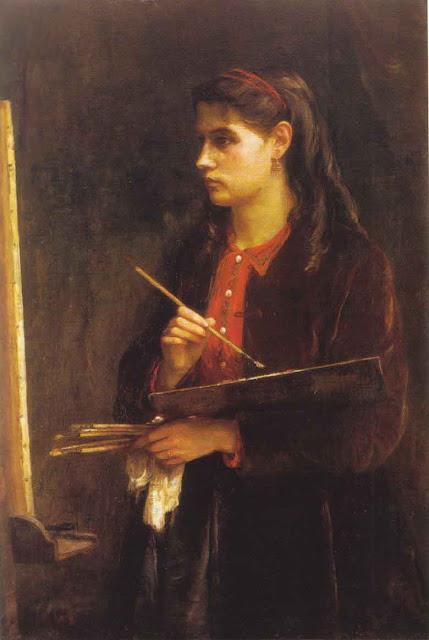
Berthe Morisot by Edma Morisot

Berthe Morisot by Edma Morisot (1865)

For the next few blogs I want to look at the life and works of Berthe Marie Pauline Morisot and some of the paintings other artists have done of her.  As I told you in my last offering I visited the Musée Marmottan Monet last week whilst in Paris and they were currently staging a retrospective of her work.  I have already featured one of her works, Le Bercau (The Cradle) in My Daily Art Display of August 10th 2011 and briefly told you about her life.  Today I am going to look again at her early life and feature a painting, not by the artist herself,  but a stunningly portrait of her, painted by her sister, Edma.

The world of French art between 1839 and 1841 was surely blessed as it was in that two-year period that the world witnessed the birth of four of the greatest French artists.  Paul Cezanne was born in January 1839, Claude Monet was born in November 1840 and Berthe Morisot and Pierre-Auguste Renoir were born in January and February 1841 respectively.  Berthe Morisot was born in Bourges, a city in central France.  She had distant roots in French art as she was an indirect and distant descendent on her father’s side of none other than the French Rococo painter Jean-Honoré Fragonard and the French 18th century female painter, Marguerite Gérard.  Berthe was one of four children.  She had two sisters, Marie-Elizabeth Yves born in 1838, known simply as Yves and Marie Edma Caroline born in 1839, known simply as Edma.  She also had a younger brother, Tiburce, born in1848.  Berthe was brought up in a successful and financially secure household.  Her mother was Marie-Cornélie Thomas, who came from a family of high level government officials, chief treasurers and paymasters of the province.   Her father was Edmé-Tiburce Morisot, who was an architectural graduate and who at the age of twenty-six founded an architectural journal.  However the venture collapsed when his co-founders absconded with all the money and left Tiburce to face the creditors.  He eventually had to hurriedly leave town, leaving all his furniture and possessions to his landlord in lieu of rent, and fled to Greece.  A year later in 1835 he returned to France penniless but his good looks and charm won him the hand of Marie-Cornélie in marriage.  She was sixteen years old and he was thirteen years older.   Marie’s father, who was the personnel director at the Ministry of Finance, managed to arrange employment for Tiburce Morisot as subprefect at the city of Yssingeaux, in the Haute-Loire region.  Tiburce worked hard and soon impressed his employers.  Promotions followed and at the time of his daughter Berthe’s birth, he was the prefect of the Department of Cher, the monarch’s chief administrator for the entire province.

In 1848 when Berthe was just seven years of age, because of the Third French Revolution which eventually led to the creation of the French Second Republic, Berthe’s father decided to move his family from Bourges to the Parisian suburb of Passy.   When Berthe was aged sixteen years of age, her mother, Marie-Cornélie Morisot decided to enrol her three daughters in private drawing classes.  At that time the prestigious École des Beaux-Arts would not admit female students and maintained that sexist doctrine until the last few years of the nineteenth century.  The sisters’ first tutor was Geoffroy-Alphonse Chocarne who taught the girls the fundamentals of drawing.  Yves love of art waned quickly and she gave up on her art tuition after a few months leaving just Edma and Berthe to carry on with their artistic studies.

Edma and Berthe then enrolled to study with Joseph Guichard, who had once been a student of Ingres and now lived in the same street in Passy as the Morisot family.  Guichard taught the girls all about classical art in the academic tradition.  He was there tutor from 1857 and 1860 and in 1858 Berthe registered as a copyist at the Louvre.  It was under the guidance of Guichard that Berthe Morisot first experimented in oil painting.  En plein-air,  painting outdoors in natural light,  became very important to the Impressionist painters and those from the Barbizon School and the two girls told Guichard that they wanted to learn more about that technique and so, in 1863, in consultation with Jean-Baptiste Camille Corot, a leader of the Barbizon School of painters it was arranged that the girls would study under Achille Oudinot, the French landscape painter.  In the spring of 1864 after seven years of intensive artistic training Berthe and Edma Morisot were admitted to the official Salon.  Berthe would exhibit at the Salon regularly and Edma would until her marriage in 1869 at which time she virtually gave up painting.

It is said that behind every great woman, there is another woman, often a close relative.  In nineteenth century England we saw it with the likes of the talented Bronte sisters who had each other for constructive critical support.  Although Morisot’s upbringing in a wealthy household bears no resemblance to the upbringing of the Bronte sisters,what she did have in her formative years, similar to the Bronte sisters, was the luxury of having a very loyal and supportive sister.  Standing unwaveringly behind Berthe was her sister Edma.  The sisters’ artistic collaboration came to an end in 1869, when Edma married her husband, Adolphe Pontillon, a naval officer.  In some ways Edma regretted the end of their artistic partnership and the close friendship which came with it.  They kept in contact by letter and in one Edma wrote:

“…I am often with you in thought, dear Berthe.  I’m in your studio and I like to slip away, if only for a quarter of an hour, to breathe that atmosphere that we shared for many years…”
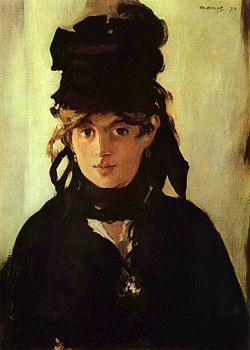
Berthe Morisot with a Bouquet of Violets by Édouard Manet (1872)

And so I come to today’s featured painting.  There have been many portraits painted of Berthe Morisot , probably the best known being the one of her entitled, Berthe Morisot with a Bouquet of Violets which was painted by her brother-in-law, Édouard Manet in 1872 and which is housed in the Musée d’Orsay.  I have always thought that his has made her look rather dowdy, so today I have featured one of my two favourite portraits of the artist.  This one is simply entitled Berthe Morisot and was painted by her sister Edma in 1865 and is held in a private collection.  This beautiful portrait in some ways bears out the close relationship between the sisters and reveals the shared interest both had in painting.  In this work Edma has depicted her sister Berthe holding her palette and brush concentrating earnestly at the picture she is painting.  Look how well Edma has captured the intensity in Berthe’s expression.  Our eyes are immediately drawn to the face of Berthe, which is bathed in light and which contrasts well with the darkened background and also echoes the whites of the side of the canvas and the rag she holds.  This painting of Berthe Morisot depicts her indisputable beauty which often other portraits fail to achieve.  This is indeed a portrait of an extremely delightful young woman in her mid-twenties and one I fell in love with when I first saw it.

The Artist’s Studio, Rue de La Condamine by Frédéric Bazille

The Artist’s Studio, Rue de La Condamine by Frédéric Bazille

quem di diligunt, adolescens moritur

Whom the gods love, die young.”

The aphorism comes from the Roman playwright Plautus, who flourished around the end of the 3rd century and actually based his story on a Greek legend about a mother and her two sons.   The point of bringing up this saying is that it unhappily could refer to my featured artist of the day, who was so talented and yet was taken from us at such a young age by war.

Jean Frédéric Bazille was born in Montpellier in 1841.  His father was a senator and the head of an affluent and cultured middle-class Protestant family.    In Montpellier, Jean became acquainted with a friend of his father, a local art collector Alfred Bruyas.  Bruyas was a close friend of Gustave Courbet and he owned a large number of expensive paintings by Millet, Corot, Eugène Delacroix and many by his friend Courbet.  Young Frédéric Bazille was fascinated and inspired by the collection and this was the start of his love affair with art. He loved to paint and sketch but his father told him that if he wanted to continue with his art he had to agree to continue with his medical studies. He agreed to his father’s terms and in 1860 he started studying art.

 In 1862 he moved north to Paris to continue with his medical studies but spent most of his time sketching and painting.  Later that year he joined the studio of Charles Gleyre, the Swiss artist.  It was whilst there that he met and became friends with fellow aspiring artists, Monet, Renoir, Sisley and Whistler.   Gleyre’s studio closed the following year and Bazille decided to leave Paris and follow his friends whilst he waited on the results of his medical exams.

During his journeys around Normandy with Monet  in 1864 they stopped off at Honfleur, which was at that time a special meeting place for the en plein air painters.   It was here that he met up with Monet’s friends, the French marine and landscape painter, Eugene Boudin and the Dutch landscape and seascape painter, Johan Jongkind.  These two artists would later be instrumental in the development of Impressionism.    In the autumn of 1864 Bazille returned with Monet to Chaillyen-Bière, near Fontainebleau.  It was around this time that he finds out that he had  failed his medical exams but fortunately for him, his father did not press him to re-sit them and instead allowed his son to concentrate solely on his artistic career.  In 1865 he put forward two of his paintings to the Paris Salon, Young Girl at the Piano and Still-life with Fish.  Annoyingly for him only his still-life was accepted for the exhibition by the Salon jury.

Bazille and Camille (Study for Déjeuner sur l'Herbe) 1865

Monet, who had a competitive streak, knew about Édouard Manet’s work  Déjeuner sur l’herbe (See My Daily Art Display December 23rd) and knew of the masses of publicity it had received (not all good of course!) when it was exhibited at the 1863 Salon des Refusés.  In the spring of 1865, he decided that he too would embark on his own version of Déjeuner sur l’herbe.   This idea of figure painting in the open air was a new venture for Monet.  He began sketches for his new large-scale painting (4metres x 6 metres) which he planned to finish back in his Paris studio.  The reason for huge size for the proposed work was mainly down to Monet being inspired by Courbet’s recent large scale paintings.   The figures in Monet’s painting were life-sized.  It was almost a group of portraits set in a landscape.  Bazille and Monet’s girlfriend Camille posed for part of this work.  This preparatory oil painting of the two of them exists entitled Bazille and Camille (Study for “Déjeuner sur l’Herbe”) and can be seen at the National Gallery of Art in Washington.  However, only fragments of Monet’s completed grand scale painting survive.   Monet left it with a landlord to cover a debt, and it was ruined by moisture and neglect.  At the same time Bazille himself completed a painting The Pink Dress, which was part of the study for Monet’s open-air mammoth portrait/landscape. 

Bazille having come from a wealthy family never had any financial problems unlike his newly found artist friends and he would often help them out by sharing his studio with them and providing them with artistic materials when they couldn’t afford to buy them.   He actually bought some of Monet’s paintings, including a large work entitled Women in the Garden,  just because the artist needed money.  His friendship with the soon-to-be Impressionists was recorded in a series of paintings he did one of which was set in his Paris studio where they would all meet and it is this work which is My Daily Art Display’s featured painting of the day. 

At the outbreak of the Franco-Prussian war in August 1870, Bazille enlisted in the Zouave, which was the title given to certain light infantry regiments of the French army.  His friends had all tried to dissuade him from this patriotic gesture but to no avail.   In a battle close to the village of Beaune-la-Rolande, his commanding officer had been killed and he took control of his men leading an assault on the Prussian position.  He was hit twice by enemy fire and died on the battlefield.  His death on November 28th 1870 was just a few days before his twenty-ninth birthday.    His father was devastated by the news and a week later came north from Montpellier to the scene of the battle and took his son’s body back home for burial.

Today I am giving you The Artist’s Studio in the Rue de La Condamine, which Frederic Bazille completed in 1870, the same year he went off to fight and die for his country.  The painting currently hangs in the Musée d’Orsay.   One can imagine a group of friends nowadays doing the same as Bazille has done  – recording for posterity a gathering of companions in a photograph but of course in Bazille’s day,  it had to be a sketch or a painting.   The setting for the painting is Bazille’s studio at 9 rue de la Condamine, which he shared with Renoir from the beginning of 1868 until May 1870.   Some of Bazille’s works  are scattered around the room.  To the left, on the wall, we have his Fisherman with a Net and his painting entitled La Toilette can be seen hanging just above the white sofa.  The small still-life above the head of the piano player is a still life by Monet which Bazille had bought in order to support his friend.   We see three men standing at an easel discussing the painting on display.  The man with the hat standing in the middle is Édouard Manet and behind him we think is Monet.  The tall man to the right of the easel, palette in hand, is Bazille himself.  On the staircase is the journalist, writer and art critic, Emile Zola, who is in discussion with Renoir, who is seated below the staircase.  At the piano is Bazille’s musician friend Edmond Maitre.  The National Gallery at Washington houses a portrait of Maitre by Frédéric Bazille.

Frédéric Bazille was considered to be the most gifted of the soon-to-become Impressionists and, if he had lived, he might well have become one of the leaders of that group.  Camille Pissarro described him as one of the most gifted among us.

The Dead Christ with Angels by Édouard Manet

The Dead Christ with Angels by Édouard Manet (1864)

Today, My Daily Art Display returns to the French painter of contemporary urban life and who was a leading figure in the shift from Realism to Impressionism and was looked upon as one of the founding fathers of Modernism.  So many –“isms” !   We have seen examples of these three -isms before but let me just do a recap of the meaning of these terms.

Realism was prevalent in the mid to late nineteenth century and this movement believed that painters should represent the world exactly as it was, even if it was at the expense of some artistic and social principles.  It was looked upon at the time as very controversial and often the works were viewed as being morally wrong and wicked because they challenged and broke the conventional standards of what was termed “good taste”.

Impressionism had its origins in France between 1860 and 1900 and soon spread to other western countries.   In a way it was, in some ways, a rejection of Academicism which promoted the Classical ideals of beauty and artistic perfection and which had a stringent hierarchy within the visual arts favouring the grand narrative and historical paintings.  The Impressionist painters and Impressionism wanted nothing to do with such Academic traditions but preferred to emphasise an accurate depiction of light in its changing qualities and looking how light changed with the time of day.  They would often paint outdoors (en plein air).   The Impressionist style of painting can be typified by its attention on the common impression produced by a scene or object and the way the artists tended to use unmixed primary colors and small brushstrokes in order to imitate real reflected light.

Finally Modernism, which was a very broad movement that also began around the latter years of the nineteenth century, and was a type of art that reflected modern times and did not keep looking back at times past.  The Modernist artists believed that the modern world they lived in was fundamentally different to what had gone before and that art needed renew itself and move on.  It was all about the artist’s vision of the future.

My featured artist today is Édouard Manet.  He was born in Paris in 1832 and was brought up in a wealthy, upper class household.  He was the eldest son of Auguste Manet, a judge and the Chief of Staff at the Ministry of Justice and Eugénie-Desirée Fournier, the daughter of a diplomat and goddaughter of Charles Bernadotte, the Swedish crown prince.  His father had hoped that young Édouard would follow him into the legal profession.  However even though he was well educated, Manet did not particularly shine academically but he did show a predisposition toward drawing and the arts.  In 1844, aged twelve years old, he enrolled at the College Rollin, a secondary school where he became friends with Antonin Proust, who would, in the future, become the French Minister of Fine Arts.   It was also around this time that Manet’s uncle, Charles Fournier, encouraged his enjoyment of the arts and the two of them along with Antonin Proust, would go on trips to the Louvre.

Manet had set his heart on going to sea and twice sat the entrance exam to a naval training school but in both cases failed.  He did however manage, with help from his father, to get a trip on the training ship Guadeloupe voyaging to Rio in 1848 and returning home in June the following year.   His father had by this time given up any hope of his son entering the legal profession and acquiesced to his son’s desire to become an artist.   For a six-year period, beginning in1850, Manet studies in the studios of Thomas Couture the Academic and History painter.  His relationship with his master was very strained and they would frequently clash.  It was around this time that he registers as a copyist at the Louvre and studies the works of the old masters, such as Velazquez and Goya.  Although impressed with their paintings, he believed that his works should reflect the ideas and ideals of the present time and not like theirs, keep harking back to the past.   Manet was a great friend and constant companion of Charles Beaudelaire, the great poet and art critic who was credited with coining the term modernité to designate the brief short-lived experience of life in an urban metropolis and he believed that art must be held accountable to capture the experience.  His advice to Manet about his art was that he should depict a contemporary realism, and had to become “le peintre de la vie moderne.

The year 1852 was the start of a change for Paris and Parisiennes as the great modernization of the city started on the direct orders of Napoleon III, under the supervision of Baron Georges- Eugène Haussmann.  The infrastructure often going back to medieval times had become inadequate, roads were too narrow and buildings were becoming unsafe.  In the great renovation programme, streets were widened and lengthened, houses pulled down to make way for new ones, shop fronts replaced.  All this work was labour-intensive and thousands of jobs were created people poured into the city from the outlying countryside to gain employment.  The whole of the social and cultural life of Paris changed with such a migration of labour.  Paris became one of the most beautiful and culturally progressive cities in the world and it was this modernity that Manet wanted to record in his works of art.

I will leave Manet’s biography at this point in his life and will conclude it in a later blog but for today I want to look at one of his earlier paintings entitled The Dead Christ with Angels, which he completed in 1864 and which can now be found at the Metropolitan Museum of Art in New York.  This was the first of a number of paintings by Manet that had religious subject matter. The biennial and later, annual Parisian Salons were considered the most expedient way for an artist to make himself known to the public, and Manet submitted paintings to Salon juries throughout his career.  He submitted today’s featured painting in 1864 exhibition.

The inscription indicates Manet’s source, but the passage he cited describes Mary Magdalene finding Christ’s tomb empty except for the two angels whereas his painting shows the two angels with Christ.  If that wasn’t bad enough Manet realised, albeit too late, when the painting was already on its way to the 1864 Salon Exhibition that he had made an even greater mistake with regards the accuracy of the biblical tale he had depicted.   Can you spot it?

In his painting he has painted the wound on the left side of Christ and not, as convention would have it, on his right side.   He immediately contacted his friend Baudelaire and told him of this error, and his friend advised him to correct the position of the wound in the painting before the exhibition opening.  He warned Manet that if he didn’t then his critics would have a field day, adding, “take care not to give the malicious something to laugh at.”   Manet’s submissions to the Salon of 1864 were again condemned by critics, for his painting of Christ and the Angels as they put it showed “a lack of decorum”.   The critics further denounced the work for its realistic touches, such as the cadaverous body of Christ and the seemingly human angels.  They argued that the painting totally lacked any sense of spirituality; the figure of the battered Christ was said to more closely resemble the body of a dead coal miner than the son of God.

Manet did not repaint the wound, and as Beaudelaire had foreseen, the critics derided his error. Only the writer, Émile Zola, gave the painting the respect it deserved.  Zola felt that Manet’s intention was to emphasize the reality of the corpse, even though he called attention to its holiness by including a halo.

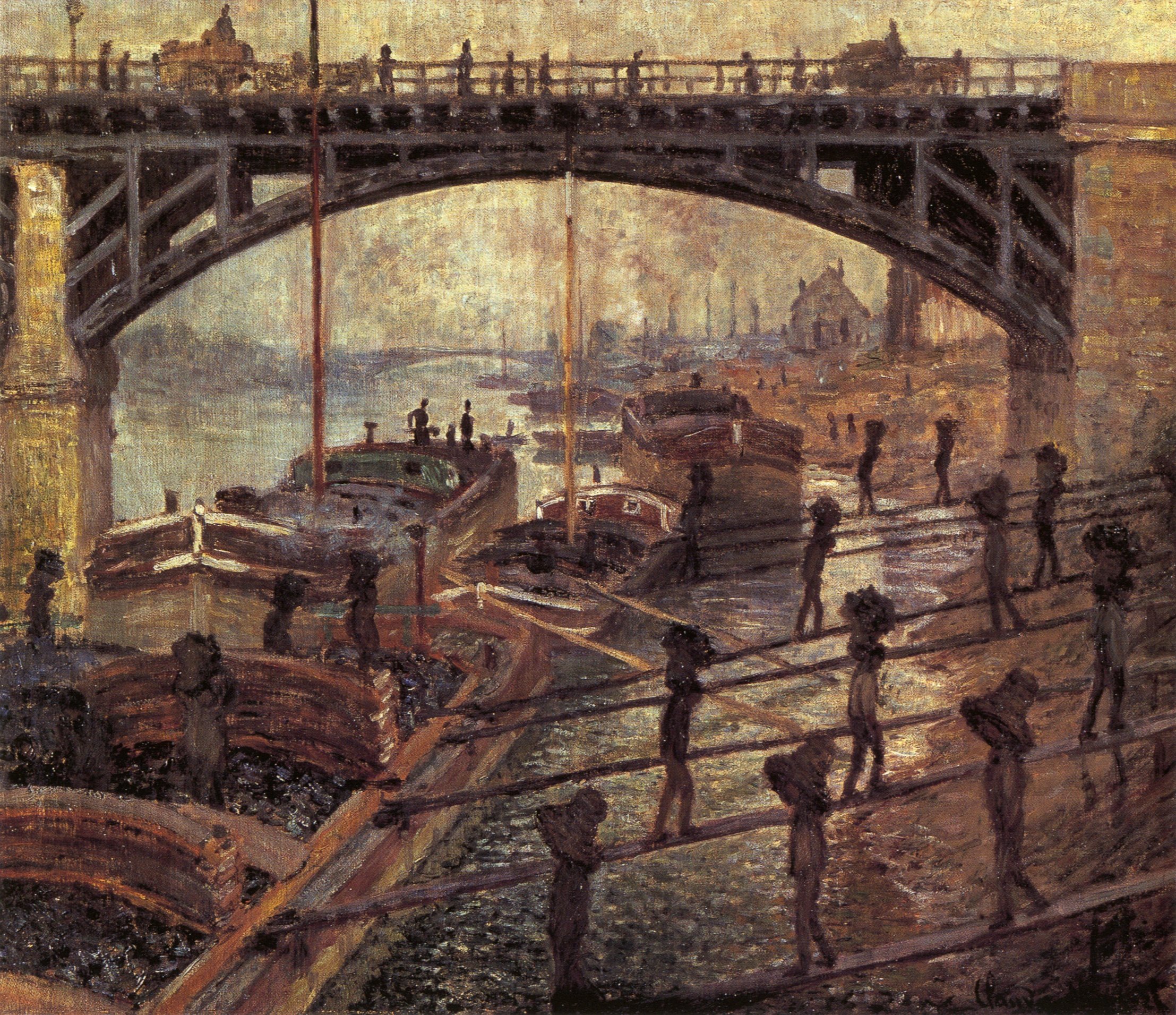
Les Charbonniers by Claude Monet

Les Charbonniers by Claude Monet (c.1875)

When I think of Impressionism and Impressionist paintings I think of light airy scenes.  I think of lily ponds and flowering arches at Givenchy.  I think of colourful young things boating on the mirror-like waters of the Seine.  I think of people sitting on the banks of the Seine staring out at blue cloudless skies.  I think of fashionable people promenading along the Grand Jatte in gorgeous sunlight.  I associate Impressionism and the paintings associated with that particular “–ism” as being light, colourful and full of smiling faces on the people as they relax from the rigours of their working lives.

That all changed when I came across the work of the Impressionist, Caillebotte and his Floor Scrapers (see August 3rd).  Today, I am featuring another darker and more sombre painting by one of the greatest Impressionist painters of all time, Claude Monet.  He painted today’s painting in 1875 when he was thirty five years old and living at Argenteuil.  It is entitled Les Charbonniers (The Coalmen) or sometimes referred to as Les déchargeurs de charbon (Men unloading coal).

Before us is a view of the docks at the Quai de Clichy, a little downriver from Paris.  Framed at the top of the painting in the background, we can just make out through the haze, the broad arch of the Pont de Clichy railway bridge, one which Monet would have crossed many times as he took the train from Argenteuil to Paris.   It is also a bridge which he featured in a number of his paintings.  Horses and carts can be seen crossing the nearer bridge, the Pont d’Asnières.  These carts will transport the coal from the quayside to nearby factories, the chimneys of which we can just make out in the distance as they pump out their smoky pollutants.   Also on the bridge we see a few pedestrians gazing down at the unloading operation.

It is a dark and atmospheric picture.  We do not have the brightness of a summer’s day.  It is a dull grey wintery day with a smoke-filled sky.  We see the men struggling with their heavy bags of coal perched on their shoulders as they struggle up the narrow wooden ramps between ship and quay over the murky waters of the Seine, balancing like tightrope walkers on a high wire.  The wooden walkways bend ominously under the strain of man and his load.  We can just imagine the ominous groaning and creaking of the wood as it takes the strain.  Hour upon hour these men will trudge mechanically back and forth until all the coal has been discharged from the boat.  This is a labour intensive operation.  Les charbonniers have an unenviable job with its physical strain on the body coupled with the inhalation of coal dust into their lungs.  In the holds of the vessel itself we see men filling baskets with coal ready for the charbonniers to take them ashore.  These men will probably not live to an old age.  Unfortunately for them, the invention of quayside cranes and cargo escalators had yet to be realised.  This discharge of the coal from the boat would be a long operation, as fully loaded, the coal barge could probably transport about 300 tons of coal, which could take anything up to two weeks to manually unload.

The sailing barge has probably brought its cargo of coal from the mines in Belgium and Northern France along the Canal de Saint-Quentin which connects the rivers Oise, Escaut and Somme.  The canal, a great feat of engineering, was opened by Napoleon Bonaparte in 1810.

The painting by Monet is simply a depiction of urban life and he might not have intended it as a political treatise with regards the conditions suffered by some working class people.  However the artist has given the painting a dark and solemn ambience which emphasizes the plight of some of the lowest paid workers.  This work was one of 29 works Monet presented in the fourth Impressionist exhibition.

Portrait of Jacobus Blauw by Jacques-Louis David

Portrait of Jacobus Blauw by Jacques-Louis David (1795)

The artist and the subject of this painting had one thing in common – they were both revolutionaries.  The artist Jacques-Louis David was both an artistic and political revolutionary.

Artistically, David was a revolutionary in as much he condemned the French Royal Academy and its standards and the way it functioned.  In the 1780’s, he continually voiced his disapproval of the rule-bound world of the Academy and Academicism.  His art was different to that which had been so fashionable since the start of the eighteenth century and which was termed Rococo.  Rococo was a light-hearted and often gently erotic artistic style which was well suited to the excesses of the royal regime prior to the Revolution.  David’ style of painting became free of Rococo mannerisms and developed a heroic style which was heavily influenced by his study of antique sculptures during his time in Rome.   His style was to become known as Neoclassicism and harked back to the Classical past which could be looked upon as a means to understanding the contemporary world.  This Neoclassical art tended towards a high moral seriousness and was in complete contrast to the frivolity of Rococo art which was condemned by the French Revolutionists.

Politically, David was an active sympathiser of the French Revolution and he served on various committees and even voted for the execution of Louis XVI.   Artistically he was looked upon as the foremost painter of the Revolution.    As with many of the revolutionaries of that time, life was good for them, as long as the people they supported remained powerful.  In David’s case he was a great friend and supporter of Maximillien Robespiere, one of the most influential figures of the French revolution and a leading light in the period which was commonly known as the Reign of Terror.    However, after the fall of Robespierre and his execution in 1794, David was imprisoned.  He was released on the plea of his wife, who had previously divorced him because of his Revolutionary sympathies; she being a Royalist.  The couple remarried two years later.

The sitter for this painting was Jacobus Blauw.  Blauw, albeit a respectable middle-class man, was also a revolutionary and one of the leaders of the Dutch Patriots.  He went on to be a judge, politician and diplomat..  He was a political envoy from the Netherlands who had rebelled against the feudal relationship with Prince William of Orange and had asked France to assist in the overthrow of the government.

Although David made his name with large heroic narrative pictures on themes from antiquity, some of his finest works are portraits of contemporaries and todays featured painting is a good example.  David has managed to bring authentic realism to this severe composition.  When the French army invaded the Netherlands, Blauw was sent to Paris as Ministre Plénipotentiare (envoy) of the new Batavian Republic to negotiate a peace settlement with the French and get them to recognise the new republic.

David has made interesting use of contrasting colour.  We have a pale grey background, a red chair and a pink cloth lying on the table as well as the turquoise coloured table covering itself.  We see Blauw in a half-length portrait seated at a table writing an official document.  The paper on the table before him is inscribed:

J. BLAUW, minister Plénipotenttiaire aux Etats Généraux des provinces unies.

Blauw sits upright at the table with his short-cropped powdered hair and this contrasts in style to the powdered wigs which were fashionable with the aristocracy of the time.  He has a lively expression on his face as he looks up at us with quill in hand almost as if we have interrupted him as he writes his letter.  This supposed interruption of course gives the artist the chance to paint Blauw in a full-face view.   He is dressed simply, which is befitting a republican.  His blue coat is of a plain design and around his neck he has a soft white cravat.  The brass buttons of his coat glisten with a hint of red as the light falls upon them.   It is probably difficult to see it in the attached picture but if you look closely you will see that the artist has inscribed his name “L.DAVID  4” in the folds of Blauw’s brown coat which seems to have slipped off the back of the chair.  The “4” refers to the date, year four of the French Revolution, i.e. 1795.
Bluaw was delighted with the portrait and in his letter to David he expresses his satisfaction:

“..Mes voeux sont enfin satisfaits, mon cher David.  Vous m’avez fait revivre sur la toile..”

(My wishes were finally satisfied, my dear David. You made me live again on the canvas)

The sitter obviously knew the artist for the letter continues:

“…j’ai voulu posséder un de vos chefs d’oeuvre, et j’ai voulu plus encor avoir dans ce portrait un monument éternel de mon étroite liaison avec le premier peintre de l’Europe..”

(I wanted to own one of your masterpieces, and I wanted to have more in this portrait an eternal monument of my close association with the first painter of Europe)

We must believe that Blauw was aware of David’s revolutionary activities and that will have won the admiration of a fellow revolutionary.  The two had another thing in common; they both suffered for their great causes.

I love this portrait.  I love the way Blauw is portrayed – dignified and assertive.  He is almost too beautiful to be a man.  The way David has portrayed his sitter lends us to believe that the artist respected him and that there was a bond between the two men, a kind of reverence between fellow revolutionaries.

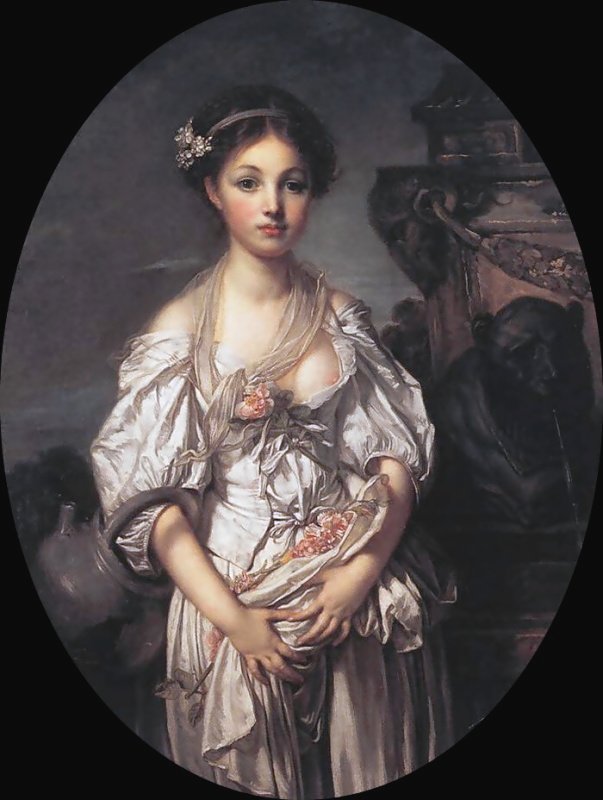
The Broken Pitcher by Jean-Baptiste Greuze

The Broken Jug by Jean-Baptiste Greuze (1771)

This is my second painting featuring the artist Jean-Baptiste Greuze, the first being on June 28th.  However today’s painting is very different in comparison to my first offering.

Greuze was born in Tournus, a Burgundian town on the banks of the River Saône in 1725, the sixth of nine children.  He came from a prosperous middle-class background and studied painting in Lyon in the late 1740’s under the successful portrait painter, Charles Grandon.   At the age of twenty-five, Greuze moved to Paris where he entered the Royal Academy as a student.  During this period he developed a style of painting which was described as Sentimental art or Sentimentality.     I believe we could define sentimentality as an emotional disposition that idealizes its object for the sake of emotional gratification and that it is inherently corrupt because it is grounded in cognitive and moral error. Sentimental art can thus be defined as art that, whether or not by design, evokes a sentimental response.

Greuze was accepted as an Associate member of the Academy after he submitted three of his paintings A Father Reading the Bible to His Family, the Blindman Deceived and The Sleeping Schoolboy.    These three works were about life amongst working class folk and were moralising pictorial stories and, in some ways, are reminiscent of the works by William Hogarth some two decades earlier.  It was Hogarth’s genre of art that depicted scenes from the lives of ordinary citizens and which were calculated to teach a moral lesson.

Greuze was pleased to have achieved admission to the prestigious Academy but he wanted more.  He wanted to be recognised as a historical painter.  From the 17th century, Art Academies of Europe had formalised a hierarchy of figurative art and the French Académie royale de peinture et de sculpturehad a central role in this listing.  According to them this was the hierarchical order, with the most prestigious at the top:

History Painting

(including narrative religious mythological and allegorical subjects)

Portrait Painting

Genre painting

 or scenes of everyday life

Landscape

Animal painting

Still Life


In 1789 he put forward his work, Septimius Severus Reproaching Caracalla, as a history painting but it was rejected by the Academy as they considered him to be a “mere genre painter”.    The Academy did not consider his works fell into the category of historical paintings and this rebuff so annoyed Greuze that he refused to submit any more of his works for the Academy’s exhibitions.  The fact that the Academy downgraded his works did not in any way affect their popularity with the public who couldn’t get enough of these “sentimental” paintings and the sale of his works continued strongly.  In fact, the sales of his works were so popular that the money kept pouring in and so Greuze had no more need to exhibit his works at the Academy.

During the late eighteenth century in France, Rococo art thrived and the likes of Fragonard, Watteau and Boucher had almost taken over the French art scene.  It was all the rage with its mythological and allegorical themes in pastoral settings and its elegant and sometimes sensuous depictions of aristocratic frivolity.  At the time, this brand of light-hearted, and now and again erotic works, were much in demand with wealthy patrons.  So in some ways the French art world received a shock when Greuze’s pompously moralising rural dramas on canvas countered the frivolity of the artificial world of Rococo art.

The majority of Greuze’s later works consisted of titillating paintings of young girls.  His paintings contained thinly disguised sexual suggestions under the surface appearance of over-sentimental innocence.  My Daily Art Display featured painting today entitled The Broken Jug is a classic example of this style of art.  In the picture we see a three-quarter length portrait of a young girl.  She has blue eyes, light hair, pink cheeks, very red lips, and her dress is white. She still exudes the innocence of childhood but we need to look closer at this portrait.   How old do you think she is?  Look closely at her facial expression.  What can you read into it?  Do you think she looks serious?  Do you think there is a slight look of alarm in her eyes?  Is there a look of sadness in her expression?  What has happened?

Look at the way she is dressed.  It looks as if it was a special dress for a special occasion, look at the flowers in her hair, maybe she has just returned from a party, but why are her dress and her appearance so dishevelled?  On her arm she carries a pitcher which is broken but she has not discarded it.  She clings lovingly to it.  It must have been a prized possession of hers and maybe she hopes to be able to remedy the break.  How did it break?  Was she running away from something and tripped, breaking the pitcher, which may explain her dishevelled appearance.  Maybe her worry is based on how she is going to explain away the breaking of the pitcher to her parents and pleading that it was a simple accident and beyond her control.  Is it as simple as this?

Let me suggest another possibility to this story.   I am not convinced this is all about a broken pitcher.  Let us consider an alternative theory.  Look at her dishevelled appearance.  Look at her silk scarf adorned with a rose which has lost some of its petals.  See how the scarf has been dragged down and is now no longer wrapped around her slender neck.  Look how the top of her dress has been pulled down exposing her left breast and nipple.  Look how she struggles to gather up flowers in the folds of her dress.  Has she been involved in a struggle with a lover and the tryst has got out of hand?   Is her beloved broken pitcher just an allegory and this is not about a broken jug at all but it is about her broken hymen and the loss of her virginity and the fear of telling her parents what has happened?

Could The Broken Pitcher by Jean-Baptiste Greuze be alluding to loss of virginity or am I reading something into this painting which does not exist?