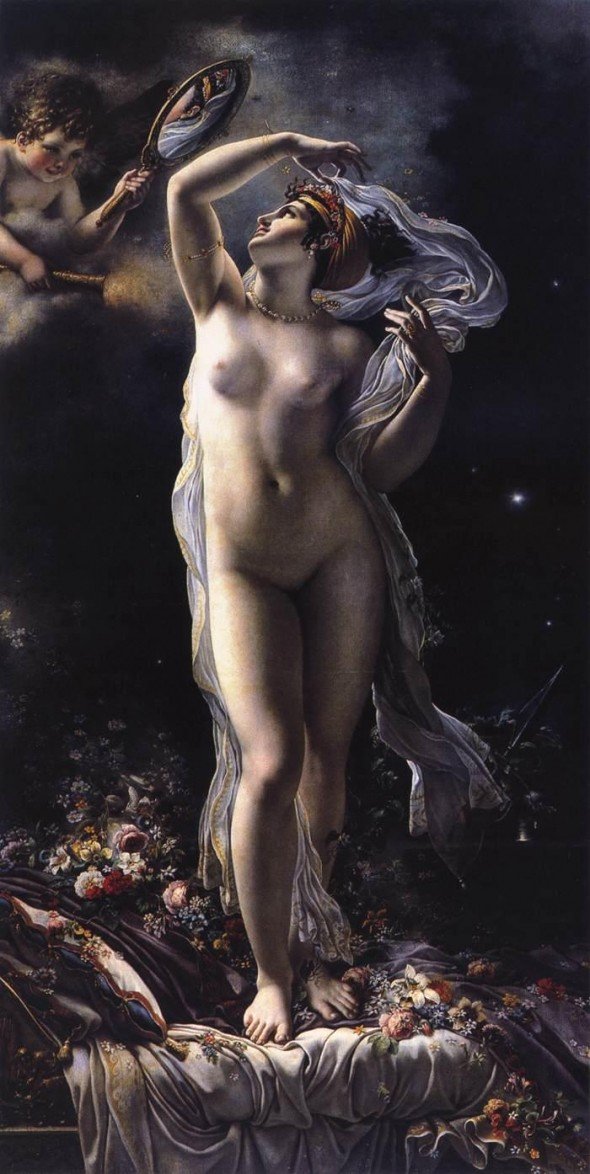
Mademoiselle Lange as Danaë and Mademoiselle Lange as Venus by Anne-Louis Girodet

Mademoiselle Lange as Danaë by Anne-Louis Girodet (1798)

My Daily Art Display today has the slight whiff of scandal about it, or to be more precise, about the sitter for the painting.  It is a tale of two paintings, a disgruntled sitter and a furious artist.   The title of today’s featured works are Mademoiselle Lange as Danaë and Mademoiselle Lange as Venus and the artist who painted both these rather erotic works in 1799 was the French painter and illustrator, Anne-Louis Girodet de Roucy-Trisson but more commonly known as Anne-Louis Girodet.  Here was an artist whose works straddled the rationalism of Neoclassicism and the flights of fantasy associated with Romanticism.

Girodet was born in Montargis, a small town some 100 kilometres south of Paris in 1767.   He had an unhappy start to life with both his parents dying when he was young and he then came under the guardianship of Doctor Trioson who took care of his well-being and education.  Later Girodet would add the surname of his guardian to his own in recognition to everything the doctor had done for him when he was young.  There is a train of thought that the good doctor was actually Girodet’s natural father.   Initially Girodet studied to become an architect and had a desire to follow a military career but finally he decided that the life of an artist was for him.

He studied with Jacques-Louis David and in 1789 was awarded the Prix de Rome by the Royale de Peinture et de Sculpture and with that came the scholarship to travel to Italy and stay at the Academy of France in Rome.  Girodet remained in Rome for five years.

He returned to Paris in 1793 and concentrated on portraiture and was well known for his glorifying portraits of Napoleon Bonaparte.  One of his best known and most controversial portraits is one of the painting I am featuring today.  He also spent a lot of time doing illustrations for books.  In 1815 his erstwhile guardian Doctor Trioson died and Girodet inherited a fortune and for the rest of his life he spent little time painting and concentrated on writing poetry.  Girodet died in Paris in 1824, aged 57.

So that was a little bit about the artist and now to delve into the much more colourful life of the sitter of this painting, Anne Françoise Elisabeth Lange.  She was born in Genoa in 1772.  Her mother and father were both musicians who with their company of players, travelled throughout Europe performing in musical shows.  The young Anne Françoise soon became a young child performer.  At the age of sixteen she made her first performance at the famous Comédie-Francais as a pensionnaire, and five years later she was promoted to the position of a sociétaire.  It is an interesting theatrical hierarchy.  A pensionnaire is promoted to a societaire by a decree of the Ministry of Culture, from names put forward by the general administrator of the Comédie-Française.  Once one has achieved the rank of a sociétaire, an actor automatically becomes a member of the Société des Comédiens-Français and receives a share of the profits plus they also receive a number of shares in the Société to which he or she is contractually linked.

Triumph followed triumph in her rolls and soon she became a notable performer in Paris.  The turning point came in 1793 when she appeared in a play which had Royalist connotations and as Paris was in the clutch of the Revolution anything alluding to royalty or the monarchy was taboo and the theatre was shut down and the play’s author and the actors were arrested.  She spent two periods incarceration and narrowly escaped the guillotine thanks to having friends in “high places”.

Elisabeth Lange bore a daughter, Anne-Elisabeth Palmayre  to her wealthy lover, Hoppé, a wealthy banker from Hamburg and two years later bore a son to another lover, Michel-Jean Simons, a Belgian supplier to the French army, whom she later married, after which her acting career virtually came to an end.  Disaster struck Simms’ business and he was ruined almost leaving the family destitute.  Michel-Jean Simons died at the family’s Swiss home in 1810 and his wife Elisabeth Lange died six years later in Florence.

Mademoiselle Lange as Venus by Anne-Louis Girodet (1798)

Miss Lange was both very talented and extremely beautiful.  She had approached the artist, Girodet, to paint her portrait.  He duly obliged and depicted her as Venus, in which she held the pose seen in depictions of the Birth of Venus but in this painting it is Cupid who holds the mirror up to Venus for her to study her reflection.  He exhibited the painting at the 1798 Salon exhibition but the sitter was horrified by her depiction and demanded that Girodet should remove it from the exhibition and from public view.  Furthermore she refused to pay Girodet the agreed amount for the painting.  The artist was furious and in an act of revenge took the painting out of the exhibition, removed it from its frame and ripped it up.  He then sent the pieces to Mademoiselle Lange.  However his revenge was not complete as he decided to paint another portrait of Elisabeth Lange but this time showing her in a very unfavourable light.  He rushed off a satirical painting of Mademoiselle Lange as Danaë  in just a few days.   Eighteenth-century artists sometimes portrayed people as mythological characters to highlight their virtues but this time Girodet wanted to highlight Mademoiselle Lange’s vices.   Danaë was one of the mortals loved by the Greek god Zeus, who transformed himself into a shower of gold and fell upon her. Girodet shows Miss Lange as a prostitute greedily catching and gathering the gold coins in a sheet.   In the painting Girodet has featured a turkey with peacock feathers wearing a wedding ring, symbolizing her final lover and husband Michel-Jean Simons whom she married for his fortune, and to the bottom right we have a bizarre mask with the features of another of her lovers, Lord Lieuthraud, with a gold piece stuck in one of its eye sockets.  Look at the mirror she holds.  It is cracked and this symbolises her inability to see herself as she is, or how Girodet saw her – vain, adulterous and avaricious.

This painting is now at the Minneapolis Institute of Arts.

Le Bercau (The Cradle) by Berthe Morisot

Le Bercau (The Cradle) by Berthe Morisot (1872)

Today I am returning to the Impressionists.  For most people, if they were asked to reel off the names of Impressionist artists, the likes of Monet, Cezanne, Degas, Renior and Pissarro would easily trip off the tongue.   With a little more contemplation the names of Sisley and Caillebotte may come to mind.  Of course looking at the list they have, besides Impressionists, one thing in common – they are all men.  However the Impressionist painters were not all men.  They had three talented female artists amongst their ranks and this triumvirate was called le trios grandes dames by the French art critic and historian, Gustave Geffroy, in his book Histoire de l’Impresssionnisme, La Vie artistique.

There was Marie Bracqemond who exhibited at three of the eight great annual Impressionist exhibitions in Paris.  There was the American-born Mary Cassatt who spent most of her adult life in Paris and exhibited at four of the Impressionist exhibitions, which were held in Paris between 1874 and 1886.  Then finally there was Berthe Morisot, who is my featured artist of the day, and who exhibited her work at all except one of the eight Exhibitions and that was because she was giving birth to her daughter.  She was not just a token female of the art group; she was one of the great organisers and a leading light of the Impressionist group.   Morisot and Cassatt are also thought of as the most important female painters of the nineteenth century.  The art world up to this time was dominated by male artists and even now there is a patronising attitude to 19th century female artists that they were “followers” of their contemporary male painters instead of giving them the credit they deserve.  Even today when Impressionist works by Morisot and Cassatt are not looked upon and judged on their own merit but are instead compared to the works of their mail contemporaries, such as Degas and Manet.   Female artists in those days were also hamstrung by convention in which they were not supposed to draw or paint nudes.  The role of women in those days was simple – look after their men folk and have their babies and if the woman wanted to draw or paint then this was looked on as a mere hobby and not a career option.  However along came Berthe Morisot, a very independent person and a free spirit, whose desire to become an artist was supported by her family.  She also had another thing going for her – she was an extremely beautiful woman.

Berthe Marie Pauline Morisot was born in 1841 in Bourges in central France.  Her family were very successful and wealthy.   Her father Edme Tiburce Morisot had studied art at the Ecole de Beaux- Arts, but eventually gave up the idea of becoming a full-time painter and instead became a prominent government official.   He married his sixteen year-old bride Marie Cornelie Thomas in 1835 and they had four children.  Berthe was the youngest of three sisters, the other two being Marie Edma Caroline and Marie Elizabeth Yves and she had a younger brother Tiburce.

She and her sisters Edma and Yves set their hearts on being painters and their family were very supportive. It was an artistic family with Berthe’s grandfather, Jean-Honoré Fragonard being one of the greatest Rococo painters of his time. Their parents arranged art lessons for them but soon Yves lost interest in art and dropped out of the lessons.  In 1857 Berthe and her sister Edma studied drawing under Geoffery-Alphonse Chocrane.  A year later they studied under the tutelage of Joseph-Benoît Guichard and he would take them to the Louvre where they copied the paintings of the Masters and that year they were registered with the museum as copyists.   It was around about 1861 that the two sisters, whilst working in the Louvre, met another young painter, Edouard Manet and this was to prove to be the start of a very long friendship.   From 1862 to 1868 Morisot studied art under the guidance of the French landscape and figure painter Camille Corot who taught her the finer arts of landscape painting and the en plein air method of painting.  It was during this time that she became friends with an Impressionist painter Henri Fantin-Latour, whose speciality was still life paintings incorporating flowers.

The two Manet brothers, Edouard and Eugène and the two Morisot sisters, Berthe and Edma became very close friends and it was through Berthe Morisot that Edouard Manet was introduced to the other Impressionist painters.  It is also believed that it was through Morisot that Manet embarked on the en plein air method of painting.  Edouard Manet used Morisot as a model on a number of occasions and the portrait of Berthe Morisot we see the most is one done by Manet, entitled Berthe Morisot with a Bouquet of Violets.  Berthe Morisot was not just a talented artist, she was also extremely beautiful.  She and Manet were leading lights of the Impressionist Movement and it was she and Camille Pissarro who were the most consistent exhibitors at the eight Impressionist Exhibitions.  In 1874 and Manet became her brother-in-law when Berthe married Eugène Manet.   Four years later she gave birth to a daughter, Julie.

Édouard Manet is seen as the most important single influence on the development of her artistic style.  Over time the Master/Pupil status of Manet and Morisot changed to the point when they were looked upon as equals and Morisot developed her own style.   Morisot was by this time becoming a successful artist and had her first works; two landscape paintings, exhibited at the Paris Salon in 1864 at the age of twenty-three.  She continued to exhibit her works there for the next ten years.

Morisot’s paintings focused on everyday life and often reflected the cultural restrictions experienced by females in the nineteenth century.  Her works of art, like today’s painting, often concentrated on simple domestic scenes and in her works she would utilise family friends or relatives as models.  Her works were set in many different locations such as in the garden, besides the river but there was a constant theme, that of the joys of family life.  She battled against the two prejudices which were levelled against her art – her gender and her wealth.  Being a female, social convention would not allow her to paint nudes or men and thus she had to concentrate on landscapes and paintings of women and children.   Coming from a wealthy family and having financial stability left her open to the charge that she was merely a dilettante whose art was just a hobby.

Eugène Manet, her husband, died in 1892 and three years later Berthe Morisot died of pneumonia in 1854. at the age of 54 and was buried in the Cimetière de Passy, Paris.

The painting today, Le Bercau (The Cradle) was painted by Berthe Morisot in 1872.  In the picture we see a mother looking at a baby who lies asleep in a crib.  Morisot’s sister Edma was the model for the woman and the baby asleep in the crib was Edma’s daughter Blanche.  This painting was the first of her many works which featured motherhood and the everyday life of contemporary women, which was her most favourite subject for her works of art.

There are some interesting things about how mother and child are depicted by Morisot.  Look how the left hand of the mother mirrors the left hand of the baby in the way that it touches her face.  There is a diagonal line in the painting running from the baby’s arm through to the mother’s arm almost like an attachment between mother and child.  The diagonal continues with the way the artist has added a fold in the wispy curtain in the background.    There is a great sense of intimacy between mother and child as she looks down lovingly at the infant having carefully drawn back the net curtain to get a better view of her beautiful child.  We, on the other hand,  are just allowed to see the baby through the mesh of the curtain.  The painting reflects the love between mother and child.  She is positioned by the crib to be able to comfort the baby if she should wake.  This is an extremely moving painting.  Its depiction of the look of endearment on the mother’s face and the peaceful look on the baby’s sleeping face is superb.  It is very touching but I believe the painting as a whole avoids over-romanticizing the subject or making it mawkish.

The painting was exhibited at the first Impressionist Exhibition at Félix Nadar’s photographic studio at Boulevard des Capucines in 1874 and she was the first woman to exhibit with the group.  This has always been looked upon as one of Morisot’s finest paintings.  The painting remained in the Morisot family until 1930 when it was sold to the Louvre where it remained until it was transferred to the Musée d’Orsay, where it hangs today.

I will finish with the words of her brother-in-law, the artist Manet, who said of Morisot:

“…This woman’s work is exceptional. Too bad she’s not a man….”

One final bit of trivia – on her death certificate under the heading “Profession” the entry simply stated “No Profession”.  Why ?  Simply because she was a woman !


The Bellelli Family by Edgar Degas

The Bellelli Family by Edgar Degas

Today, My Daily Art Display looks at a painting by a French Impressionist painter who, to me, is synonymous with paintings and sculptures of young ballet dancers.  His name is Edgar Degas who was actually born Hilaire-Germain Edgar De Gas in 1834.  He was in the forefront of the Impressionism movement although he preferred to be labelled as a realist painter.  He worked on today’s featured painting between 1858 and 1867.  It is entitled Family Portrait or The Bellelli Portrait and is a masterpiece of Degas’ youth.  It is a deeply insightful family portrait, in which we observe four people, two adults and two children who are the family Bellelli.

Degas had a traditional École des Beaux-arts education in Paris and in 1856 travelled to Italy to continue his studies and the following year visited his grandfather, Hilaire Degas, in Naples.  He also spent time in Rome where he set about copying the work of the Renaissance Masters.  In 1858 he received an invitation from his aunt, Laura Bellelli, née De Gas, to visit her and her family in Florence and at the same time to take the opportunity to study the paintings in the city’s prestigious gallery, the Uffizi.  He jumped at the chance and so went to stay with the family.  The head of the household was Laura’s husband, Gennaro, who had been a political journalist as well as a fervent supporter and good friend of Camillo Benso, Count of Cavour, a leading figure in the movement towards Italian Unification.  When in 1854 the revolution against the Austrians failed, Gennaro was forced to flee from Italy to escape persecution by the Austrians over his participation in the failed uprising.  He first went and lived in exile in Paris but later returned to Florence.

Degas did not get on well with Gennaro and only remained at their rented house until the arrival of his cousins who had remained in Naples following the death of Degas’ grandfather, Hilaire.  Degas’ could sense the tension between Gennaro and his aunt Laura who once she confided in Degas about her relationship with her husband and her uncertain future saying:

“…my husband is “immensely disagreeable and dishonest… Living with Gennaro, whose detestable nature you know and who has no serious occupation, shall soon lead me to the grave….”

Part of the problem was that this exile in Florence separated her from her family back in Naples and to make matters worse, Laura was once again pregnant.  It is thought that the constant tension between her and her husband led to the death of the child in infancy and this tragic loss only added to the bitterness between husband and wife.  It was with this lack of domestic happiness in mind that Degas started this family portrait.

Before us we see the four members of the Bellelli family, Gennaro, his wife Laura, the sister of Degas’ father, and their daughters Giulia and Giovanna.  It is known that Degas made many sketches of the family before returning to Paris to work on the painting.

We see Laura dressed in mourning for the recent death of her father, and Degas’ grandfather, Hilaire, and in the background we can see a framed portrait of him.  Looking closely at how Degas has depicted his aunt.  We see a very dignified woman with a very stern countenance.  She stands upright as if posing for an official picture.  She coldly averts her gaze away from her husband. Her right hand rests protectively on the shoulder of her elder and favourite daughter, Giovanna.   Degas’ two young cousins are depicted with their mother, and are also dressed in mourning, in their black dresses and white pinafores. Giulia half sits on a small chair at the centre of the painting, arms akimbo, as she looks towards her father and in some ways forms a link between the two estranged adults.  Degas was very taken with his cousins describing them:

“….The elder one was in fact a little beauty. The younger one, on the other hand, was smart as can be and kind as an angel. I am painting them in mourning dress and small white aprons, which suit them very well…I would like to express a certain natural grace together with a nobility that I don’t know how to define….”

Note how Degas has positioned the husband and wife far apart in the painting, which was probably an acknowledgement of the tension between the couple and how the two had drifted apart.  There is no feeling of togetherness about the family.    The father sits in an armchair at his desk next to the fireplace, where he had been reading or writing a letter.   He has his back to us but his head is turned towards his daughter.  He appears unmoved and uncaring, showing little interest in what is going on around him.    His body is framed by a mantelpiece on which we see an ornate clock, some plates and a candlestick.  Over the mantelpiece there hangs a large mirror and in the mirror we see reflections of the room which in some way open up the space and fills it with more light.  We see reflections in the mirror of a curtained window, a chandelier and a framed painting.

It is interesting to look at how Degas has seemed to separate the husband from the rest of the family by a vertical separation formed by the leg of the table, the candlestick and the vertical side of the fireplace and mirror.   Just behind his chair, on the floor, we catch a glimpse of the family’s pet dog.  The drawing which we can see hanging on the wall behind Laura is a portrait of the recently deceased Hilaire Degas, which his grandson had drawn.  It is more than likely that Degas positioned this small picture where he did so as to give a sense of connection between the various generations of the Degas family.

Laura must have been appalled that Degas had to stay in a household, which exuded such unhappiness.   It is believed that Laura married Gennaro in desperation because her father had not been satisfied with any of her previous suitors and she was still unmarried at the “ripe old age” of 28.   She was extremely unhappy in her marriage and once shared her misgivings with Degas.   According to the American biographer and art historian, Theodore Reff, who wrote about a letter from Laura to her nephew, in his book , Degas: The Artist’s Mind .   In the letter she wrote:

 “…You must be very happy to be with your family again, instead of being in the presence of a sad face like mine and a disagreeable one like my husband’s…”

 It is thought that this family portrait was not to be a gift to the family but a work of art which he wanted to exhibit at the Paris Salon.  Whether he ever did that is uncertain but many believe he put it forward for exhibition at the Salon in 1867.  Degas kept hold of the painting until 1913 when he gave it to his art dealer, Paul Durand-Ruel, for him to sell.  In 1918 it was sold to the Musée du Luxembourg, Paris  and later the painting was moved to the newly opened Musée d’Orsay where it can now be found.

One should remember that this is not a photograph in which one can detect the mood of the sitters.  This is a painting by an artist who has the ability to paint the demeanour of his sitters in whatever way he chooses.  So this painting is how Degas views the family life of the Bellelli family.  How close it is to realism is known only by Degas and the Bellelli family.  So it is up to you  to decide whether Laura was a stern and disillusioned matriarch and whether Gennaro was the disinterested and curmudgeonly.

The Execution of Lady Jane Grey by Paul Delaroche

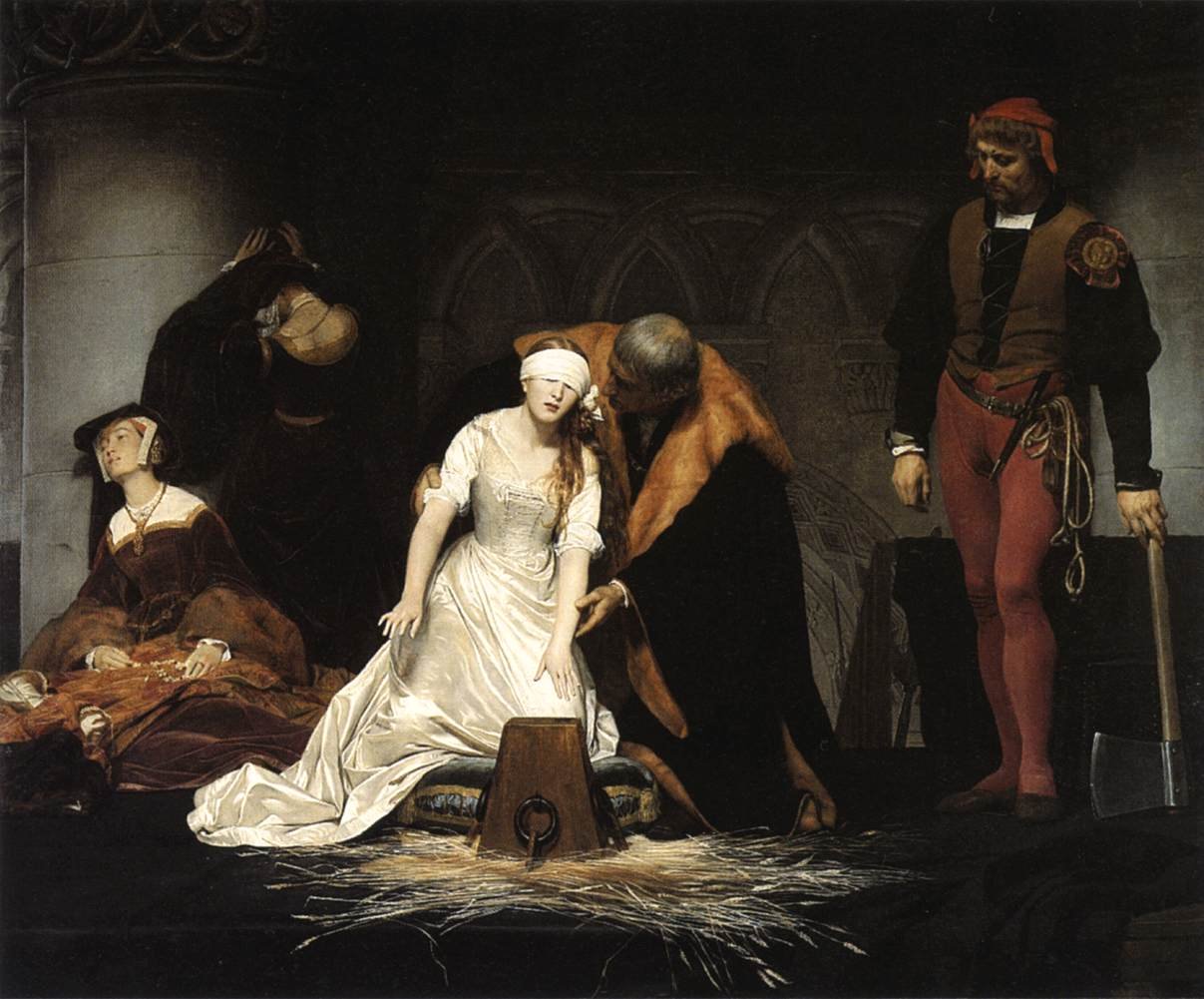
The Execution of Lady Jane Grey by Paul Delaroche (1833)

My Daily Art Display today is all about a 19th century French painter and a 16th century Queen of England, who reigned for just nine days.  The painter in question is the French Academic painter Hippolyte Delaroche, better known as Paul Delaroche, who was to become one of the most popular History painters of his time.  He was brought up in a wealthy household and began his artistic career under Antoine-Jean Gros, the French History and neoclassical painter, famous for his life-size historical paintings.

Delaroche exhibited his first painting at the age of twenty-five and it was at this exhibition he met and became friends of Théodore Géricault and Eugene Delacroix.  These three artists were to form the great triumvirate of Parisian historical painters.  The historical works of Delaroche exuded drama which was so popular with the French people.  His paintings depicted historical events which occurred in his homeland and portrayed great characters in French history such as Joan of Arc (Joan of Arc in Prison), Napoleon,  Napoleon abdicating at Fontainbleau (1845) and Marie Antoinette (Marie Antoinette leaving the Convention after her sentence) as well as historical events which took place across the Channel in England such as Elizabeth I,  Death of Queen Elizabeth (1828),  the execution of Archbishop Laud, Strafford Led to Execution (1836) and The Execution of Lady Jane Grey (1833), today’s featured painting.

Louise Vernet

On June 30th I featured a painting by Claude-Joseph Vernet and looked at the Vernet artistic family tree.  A person on the lower branch of the tree was the artist’s grandson Horace Vernet and it was his young daughter, Louise, whom Delaroche married.  Anne Elizabeth Louise Vernet, some seventeen years his junior was to become the love of his life and Delaroche went on to paint many portraits of her, including Head of an Angel (1835).  Tragically, in 1845, Louise died of a fever at the age of thirty-one and Delaroche never recovered from his loss.  He made a beautiful but haunting graphite sketch of his dead wife entitled Louise Vernet on her deathbed  (1845),  which is now housed at the Walters Art Museum in Baltimore.  It is a wonderfully poignant drawing in which we see Louise laying blissfully in profile.  The pale skin and her lifeless body signifying she has died and although her body had suffered the ravages of fever,  Delaroche’s portrait offers us nothing but an angelic beauty.

The paintings of Delaroche were soon turned into reproductive prints which allowed his great works, which had been exhibited at the Paris Salon, to be circulated internationally.  Delaroche died in Paris in 1856

Today’s featured painting is entitled The Execution of Lady Jane Grey which he completed in 1833.  The Execution of Lady Jane Grey, which is depicted in this work of art, occurred almost three hundred years earlier.  It was first exhibited at the Paris Salon in 1834 where it caused a sensation.  It is very large oil on canvas painting almost 250cms x 300cms.  During the 1820’s and 1830’s in France,  a kind of “Anglo-mania” swept the country and this interest in English history had, in part, been fuelled by the novels of Sir Walter Scott and his tales of the battles and conflicts between Roundheads and Cavaliers during the Civil War,  which in some ways mirrored what happened during the violent and turbulent times of the French Revolution.  The setting for the painting is the morning of February 12th 1554.   The painting depicts the last moments in the life of the seventeen-year old Jane Grey, who was the great granddaughter of Henry VII and who was proclaimed Queen of England upon the death of young King Edward VI, a Protestant like herself.  She was young, intelligent and a political pawn whose destiny was out of her control and her reign only lasted for nine days in 1553.  Due to the plotting of the followers of Henry VIII’s Catholic daughter, Mary Tudor, she was convicted of high treason and sentenced to death in the Tower of London.

The painting has a few historical inaccuracies as we know that Lady Jane Grey was actually executed outdoors on Tower Green and not inside a chamber of the Tower of London.  She was also not dressed in a white satin dress along with the depicted whalebone corset and for a beheading her hair would not have been allowed to fall to her waist but instead would have been tucked up high above the head.  However let us not quibble about historical accuracy and rather just let us feast our eyes on this very dramatic painting.

In the painting we have five figures.  The central character of the painting is the tragic figure of the blindfolded Lady Jane Grey, in her under garments, who has just knelt down on a cushion behind the block where soon her neck will rest.  On either side of the block we see iron rings to which her wrists will be bound.   Look how she gropes with her outstretched arms, her hands in front of her, trying to locate the wooden block.  She is being gently guided to the executioner’s block by the elderly Lieutenant of the Tower, who at the time, was Sir John Brydges.  We get the feeling that he feels sadness for the young girl’s plight and his attentiveness and concern as depicted by Delaroche adds more pathos to the painting.  His hulking figure attired in a black coat, lined with orange-brown fur, looms over her and is a perfect contrast to the white attire of his charge ,which would soon be splattered with her blood.  Her sad figure with its golden-red hair is being illuminated from above.  It is a very dark painting with the exception of this lighting, which highlights the young girl and is in some way like a spotlight on a dark stage focusing light on an actor.   To the left we see two of her ladies-in-waiting, beside themselves with grief.  One, who is so distraught, has slumped to the floor, her eyes closed, her head turned away from her mistress.  She is clutching the outer garments of her mistress.  The other, who cannot bear to witness the execution weeps uncontrollably.  Her hands are above her head, grasping the grey column.  Her face is pressed hard against the stony structure.  The executioner stands in his blood-red hose to the right, the fingers of his left hand loosely holding the handle of the axe.   A pile of straw painted in the finest of detail, lies before the executioner’s block, in readiness to catch and soak up the victim’s blood.  Look how the artist has cleverly painted the straw which looks like it is almost falling out of the painting.  We can almost imagine that by leaning forward we could pull out a piece.

As we look at the painting we experience a myriad of feelings – horror of what is about to happen, compassion and pity for the fate of the young girl, despair that such a thing could take place in a civilised society.  The way Delaroche has painted the scene makes us feel that we are there, standing in front of the victim.  We are actual witnesses at the execution.   We are simply voyeurs who cannot change history.  We cannot prevent the neck of the young girl being severed by the executioner’s axe.  It is interesting to note how none of the five figures in the painting look towards us.  They are not aware of our presence.

Whether the painting is factually inaccurate does not lessen its greatness nor does it any way diminish the standing of the artistic genius who has created a work that tugs at our emotions.

A Storm with a Shipwreck by Claude-Joseph Vernet

A Storm with a Shipwreck by Claude-Joseph Vernet (1754)

I spent the last couple of days in London and whilst there visited a couple of art displays.  Unfortunately, with previous commitments tying up my time on one day I had a limited exposure to the beautiful world of art.  I normally would have spent some time at the National Gallery or one of the Tates but because I had only a short period and because I wanted to visit the Royal Academy Summer Exhibition I decided I had to limit myself to one gallery and so I decided to go somewhere new.  It was for these reasons I ended up on the steps of the Wallace Collection and although my time was restricted, I was completely blown-away by the art on display.  This is a beautiful jewel in the art crown of London, just a few minutes’ walk from the great Emporiums of M&S and Selfridges and everybody who visits London should visit this gallery and savour the magnificent art they have on display.

My Daily Art Display today features one of the many works of art I saw at the gallery.  It is entitled A Storm with a Shipwreck and was painted in 1754 by Claude-Joseph Vernet.  The Vernet family tree reads like a “Who’s Who” of distinguished French painters.  The head of the family was Antoine Vernet (1689-1753) was a prosperous artisan painter in Avignon and to whom many decorated coach panels are attributed. He had four sons, all of whom were painters, Claude Joseph,  Jean-Antoine,  Antoine-Francois and Antoine Ignatius.  He was grandfather to the artist Antoine-Charles Joseph, known as Carle Vernet and great grandfather to the painter Horace Vernet.  Of his three sons, Claude-Joseph Vernet (1714-89) earned a reputation throughout Europe as a great landscape and marine artist, receiving the commission from Louis XV for the series of paintings, Ports of France.   Jean-Antoine Vernet (1716-1755) also painted seascapes, and (Antoine-) Francois Vernet (1730-79) was a decorative painter.  Jean-Antoine Vernet had a son, Louis Francois, who along with Antoine-Francois’s son, Joseph Vernet the Younger, were both active sculptors in Paris.  Today’s featured artist Claude-Joseph Vernet had a son Carle who followed in his father’s footsteps and became known for his pictures of horses and battle scenes, though his achievement was overshadowed not only by his father’s but by that of his son Horace Vernet, a prolific and highly successful painter, especially of battle scenes. The Vernet family was connected by marriage to several other notable French artists, Carle becoming father-in-law of Hippolyte Lecomte and Horace that of Paul Delaroche; Carle’s sister Emilie married the architect Jean-Francois-Thérese Chalgrin.

When I saw today’s painting of a shipwreck at sea I was immediately transported back in time to my days at sea and the many horrendous storms I had to endure.  However this seascape also reminded me of the many times we had to bring our small vessel into the Portuguese port of Oporto.  The flow of water along the river Duoro, which is controlled by dams in the river high up in the Spanish mountains, ends its 727kms journey as it forces its way through the town of Oporto before pouring itself out into the Atlantic Ocean.  For many years the flow had not been strong enough to clear the sandbank and silting at the river mouth and the passage from ocean to river was a hazardous dog-leg, which was made even more difficult with the Atlantic rollers buffeting the stern of vessels as they headed for the narrow channel entrance.  I will always remember the tension on the bridge of the vessel as we tried to steer a course through the narrow entrance along the winding channel, hampered by following seas buffeting the stern of vessel making the ship slew from side to side.  Tension was further heightened as one looked at the sandbank which almost completely straddled the entrance and perched on top of it was a wreck of a ship which had failed to successfully navigate its way through the narrow entrance.  This was almost forty years ago and I am sure things have changed.

Vernet had just returned to France in 1753 after spending the previous twenty years in Italy.   Madame de Pompadour’s brother, the Marquis de Marigny, when he had been appointed Surintendant des bâtiments (Cultural Minister) under Louis XV, commissioned Vernet to paint a series of views for the crown of the major French ports.   Vernet had just started his first commission in Marseilles in 1754 when Marginy commissioned today’s work.    Vernet loved the sea and seascapes but his most favourite subject was his dramatic portrayal of shipwrecks and all the emotions that went hand in hand with such disasters.

As we look at the painting we see a dreadful storm and shipwreck scene.  Torrential rain is pouring down on the battered remains of the wrecked ship and its hapless survivors.   The white-crested seas push the broken ship further onto the jagged rocks.  In the background, we can see another ship which is being unmercifully tossed about on the stormy sea but remains out of harm’s way.  In the foreground we see survivors just about clinging to life as they lie on the rocks.   Some are being helped to drag themselves out of the stormy waters and onto the slippery rocks to escape the jaws of certain death.  To the right we see a fort perched on a rocky outcrop.  A tree with its roots embedded in the rocks clings perilously to its elevated position in the face of gale-force winds.  Along the walls leading up to the fort, we see spectators looking down on the unfolding drama.

Some of the survivors

Like a number of his paintings, Vermet has cleverly utilised the effects of light in order to create visual excitement.  He has cleverly contrasted the darkness of the sea and the rocks with the blue sky which is emerging from behind the black storm clouds.   Venet’s figure drawing and his mastery of the portrayal of human emotions through gestures was his forte and you need to stand close up to the painting to take in the minutiae of the details

The Raft of Medusa by Théodore Géricault

The Raft of Medusa by Théodore Géricault (1819)

My Daily Art Display today features one of the most moving paintings I have come across and what makes it even more remarkable is that it is based on a true story.  The massive oil on canvas painting is entitled The Raft of Medusa and was painted by the French Romantic painter, Théodore Géricault in 1819.  Before I look at the painting let me go through the actual events which this painting is based upon.

The story begins on June 17, 1816 with the new Bourbon government of France dispatching the frigates Medusa, Loire and Echo and the brig Argus to officially receive the British handover of the port of Saint-Louis in Senegal to France.  The British who having helped to re-establish the French monarchy, wanted to demonstrate their support for Louis XVIII, and decided to hand over to him this strategic trading port on the West African coast.  The French naval frigate, Medusa was to carry 365 crew and passengers, including the Senegal’s governor-designate, Colonel Julien-Désire Schmaltz, from Port de Rochefort on the island of Aix on France’s west coast, to Senegal via Tenerife.

The captain of the Medusa was Vicomte Hugues Duroy de Chaumereys, who at the age of 53 had spent most of his career behind a desk at customs offices and had never been in command of a ship, in fact had hardly sailed on a ship for twenty years.  However,  the old adage “it’s who you know and not what you know” was applicable in his being put in command of the fleet as he had many Royalist connections.  The governor-designate Schmaltz wanted to reach St Louis as soon as possible and persuaded the captain to set a course close to the shore line in order to save time.  Things went badly almost from the start of the voyage when a young cabin boy was lost over the side.  Captain Chaumereys also had problems with both his passengers and crew alike, spending long periods arguing with them

The Medusa was a fast vessel and in fact much faster than the other vessels in the group and soon pulled ahead of them which was to be a contributing factor in the forthcoming disaster and terrible loss of life.  On July 2nd, for some reason, whether due to poor navigation skills or lack of attention the Medusa, was many miles off course and  ran aground on the Arguin Banks, which lie off the west coast of Mauritania, despite perfect weather conditions and calm seas.  The grounding ripped a hole in the hull of the Medusa and after surveying the damage it was deemed un-repairable and terminal.  Couple this factor along with deteriorating weather conditions and the crew had no choice but to abandon the vessel.  The Medusa had some lifeboats but they would hold only 150 people and so it was decided to construct a raft to house the rest

The crew then set to work making a raft from parts of the Medusa’s decking and masts.  When completed the raft measured 65 feet by 23 feet and was towed behind two of the ship’s lifeboats.  In all, one hundred and fifty people, including one woman, boarded the raft.  However with such weight the raft became almost submerged and it was decided to jettison some of the food.  After doing this the deck of the raft settled in the water with what they believed to be a suitable clearance above the sea surface.  The lifeboats towing their raft set off from the crippled Medusa but the weight of the raft was becoming problematic.  The only propulsion of this raft was from the rowing power of the men in the lifeboats which was towing it,as the raft had no oars, no sails and no navigational aids.

For some unknown reason, whether it be that the people on the raft decided that their lives would be safer if they disengaged from the lifeboats or whether those in the lifeboat believed that the raft was jeopardising their safety, the towing line was severed and the raft was set free, some four miles off the coast of Mauretania.  By the second day, three of the passengers had committed suicide and that following night the store of rum aboard the raft was broached and in a drunken insurrection by the soldiers against their officers, mayhem ensued.  By daylight the next day the number of people alive on the raft had more than halved to sixty.  Food had run out and the survivors resorted to eating the corpses.

On July 1th 1816, after 13 days adrift, the raft by pure chance was rescued by the Argus, as no specific search effort was made by the French for the raft.   At this time only 15 men were still alive; the others had been killed or thrown overboard by their comrades,  Some had died of starvation, and some had thrown themselves into the sea in despair.

The whole episode was a disaster, not only to those who sailed on the Medusa but for the French government and when the ship’s surgeon Savigny submitted a report on the incident, it was leaked to an anti-government newspaper, the Journal des débats,  which caused outrage.  The French government had tried hard to suppress the details.  The French nation was horrified.  The event became an international scandal, partly because of the human disaster and partly because the disaster was generally attributed to the incompetence of the French captain, whom people believed was acting under the authority of the recently restored French monarchy.  However in reality, King Louis XVIII had no say in the captain’s appointment, since, then as now, monarchs were not directly involved in appointments made to vessels like a naval frigate.   Captain de Chamereys was found to blame for the incident and was court-martialed.

This painting by Géricault was his first major work of art and is now housed in the Louvre in Paris.    What strikes you first when you stand in front of this painting is its enormous size, measuring 16 feet by 24 feet.  We, the viewers, are dwarfed by its enormity, which gives the painting more power.  Strangely enough nobody commissioned the work but the artist believed that the incident he was portraying would generate great interest from the public and in so doing he believed his career would take off.   Géricault spent much time in preparing for this painting doing numerous sketches.  He interviewed the ship’s doctor, Henri Savigny and the ship’s geographer, Alexander Corréard  and he even constructed a detailed scale model of the raft.  He would have models pose on his constructed raft .  His friend, the artist Delacroix, modelled for the figure in the foreground, with face turned downward and one arm outstretched.  His young assistant Louis-Alexis Jamar modelled nude for the dead man in the foreground, who is about to slip into the sea.  In his desire to depict accurately the bodies of the survivors and the dead he made many visits to morgues and hospitals noting details with regards the texture and colouring of flesh on live bodies and corpses.  Géricault had been correct in his assessment that the painting would prove popular if somewhat controversial.  It appeared in the 1819 Paris Salon and for the artist it launched his career and, although it was partly a history painting, it was looked upon as the beginning of the Romantic Movement in French painting.

The painting portrays the moment in time when the survivors on board the raft spot the approaching ship, Argus, which can just be seen on the whitened horizon.  It is at this very point in time that the survivors realise that they are about to be rescued.  An African crewman, said to be Jean Charles, can be seen standing on a cask waiving his shirt to attract the crew of the Argus.  This portrayal of a negro at the pinnacle of the painting was probably down to Géricault’s abolitionist’s sympathies.  The majority of the figures depicted in this enormous painting are life-size and the bodies of the men in the foreground are almost twice life-size.  Their closeness to the edge of the canvas  makes us almost believe we are just a step away from the raft itself.  The raft has suffered from the battering it endured in the rough seas and is barely afloat.  The painting is dark and sombre which Géricault chose to suggest the torment and agony of the survivors.

In some ways it is an idealised painting as in actuality, there are more people shown on the raft than were found by the Argus and at the time of the rescue of the castaways, the sea was recorded as being calm and the weather settled.  However to add feeling to the painting he has allowed the seas to be whipped up high in a frenzy of surf under blackened storm clouds.  One must also query the fact that some of the men seem so “muscled” and somewhat healthy despite having starved for such a length of time and barely kept alive.  It is a combination of history painting, recording the story of the men’s plight and a painting of the Romanticism genre.

There is a moody darkness about the painting.  There is a strong diagonal surge from the bottom left of the painting to the top right.  Our eyes move along the diagonal from viewing the despondent man with his head in hand in the bottom left to the man arm waving his shirt in the upper right.  As we stare in disbelief at the scene in front of us, we sympathise with the plight of these men.

Géricault must have been fully aware when he submitted the work to the Paris Salon that it would prove controversial as the demise of the Medusa and terrible loss of life was blamed on the Bourbon government and so whether the painting was acclaimed or condemned depended a a great deal on whether the viewer was pro or anti Bourbon.