In an earlier blog (November 14th) I looked at the life of Courbet and his painting The Artist’s Studio. If you have just arrived at today’s blog it would be worth going to the earlier one to read about Courbet’s life and his artistic principles. I mentioned in that earlier blog that when he had tried to get his three large painting into the Paris Exposition Universelle of 1855 they were rejected because of their size. My Daily Art Display featured painting today entitled A Burial at Ornans was one of the three. This work was even bigger than the The Artist’s Studio, and measures 3.1metres by 6.6 metres and was completed by Courbet in 1850. Both paintings are housed at the Musée d’Orsay.
Gustave Courbet was born in Ornans in 1819 and this huge painting depicts the funeral of his great uncle at the town in September 1848. The depiction of the funeral and the laying to rest of the dead is unlike the usual way it would have been portrayed in Romantic or Academic art, where we would expect to see angels of the Lord carrying the soul of the deceased heavenwards. Gustave Courbet was a realist painter. In fact he was in the forefront of the Realism art movement, which was a grouping of artists who believed that they should represent the world as it is even if that meant breaking with artistic and social conventions. Realist artists painted everyday characters and situations all in a true-to-life manner. These artists wanted to rid art of the theatrical drama, lofty subjects and the classical style and in its place they wanted to depict more everyday commonplace themes. Courbet was once asked to incorporate angels in a painting he was doing of a church. He rejected the request saying:
“….I have never seen angels. Show me an angel and I will paint one… “
The Innocent gaze
This realist art we see before us is exactly as Courbet would want. It is a funeral scene, warts and all. It is an unflattering yet dignified scene, but more importantly to Courbet, it is a realistic scene. There is a stillness and serenity of what we see before us. There is no attempt to glorify the setting with a grandiloquent and ostentatious depiction of descending angels with God seated on a throne in the clouds above. In the foreground there is an open grave awaiting the coffin. The funeral procession approaches from the left. In the procession we see the pallbearers slowly following the priest and altar boys as they close in on the gaping hole in the ground and the gravedigger, who is on bended knee by the grave. The figures in red are officials of the church, who assisted at religious functions. If you look closely at the edge of the grave, you can just make out a skull which presumably was exhumed when the grave was dug out. The mourners fill the middle ground of the painting. Grief-stricken women, with handkerchiefs fending off their tears, circle the grave. It is interesting to note that Courbet did not use models for this scene, which would have been the norm in historical narrative paintings. Instead he used actual villagers who were at the ceremony, including his sister and mother, and this again highlights his desire for realism. This is not an en plein air painting for the depiction of the people was done in his studio at Ornans. Look how Courbet has depicted the young at this event.
Girl peeking at grave
See how the young altar boy, who is standing behind the priest, stares up at one of the pallbearer. Courbet has managed to perfectly capture the look of innocence in the boy’s face. Cast your eyes to the right foreground of the painting and see if you can spot the face of a small girl who is peeking out at the grave. We just see her face. The rest of her is almost lost amongst a sea of black clothing. Look at the way Courbet has kept the heads of the mourners and officials level with the tops of the cliffs and the land in the background. Observe how only the crucifix reaches reaches above that level into the pale sky, as it is held aloft by an attendant. Just a coincident or has a little piece symbolism crept into Courbet’s work?
In Sarah Faunce’s biography of Courbet she talked about the reception this painting received from the public and critics. She wrote:
“….In Paris the Burial was judged as a work that had thrust itself into the grand tradition of history painting, like an upstart in dirty boots crashing a genteel party, and in terms of that tradition it was of course found wanting…”
The critics seemed to miss the histrionics and exaggerated gestures of grief they had been used to seeing depicted in great historical funeral paintings of the past. They thought this painting was ugly and presumably missed the beauty of angels, puti and the presence of the figure of God sitting aloft awaiting a new entrant to his kingdom. Another aspect of the painting which disturbed the critics was the fact that Courbet painted this huge work, similar in size to grand historical paintings of the past, centred, in their opinion, on a subject of little consequence – a burial of a family member. As far as the sophisticated Parisians were concerned paintings of rural folk should be confined to small works of art and they were very critical of Courbet’s decision to afford these folk such a large space of canvas. The fact that he did was looked upon as a radical act. However Courbet said of the painting “it was the debut of my principles”. For the critics, if an artist was going to paint such an enormous work, then they expected the subject to be an idealized grand narrative and not just an ordinary every day event.
I end today with two quotes from the artist on his artistic upbringing and his pursuit of Realism and what he tried to achieve.
“…I have studied, apart from any preconceived system and without biases, the art of the ancients and the moderns. I have no more wished to imitate the one than to copy the other; nor was it my intention, moreover, to attain the useless goal of art for art’s sake. No! I simply wanted to draw forth from a complete knowledge of tradition the reasoned and independent understanding of my own individuality…”
“…To know in order to be capable, that was my idea. To be able to translate the customs, idea, the appearances of my epoch according to my own appreciation of it [to be not only a painter but a man,] in a word to create living art, that is my goal…”
And finally his hope for how he would be remembered…………….
“…When I am dead, let it be said of me: ‘He belonged to no school, to no church, to no institution, to no academy, least of all to any regime except the regime of liberty…”
Jean-Desiré-Gustave Courbet was born in Ornans, a rugged area in the Franche-Comté region close to the France-Swiss border in 1819. His father Règis Courbet and his mother, Sylvie were landowners, who owned a vineyard in Flagey, ten miles outside of Ornans. They were a prosperous family but despite that Courbet’s parents held left of centre, anti-monarchist views. This was probably a long held passion as his mother’s father had fought in the French Revolution. At the age of twelve he attended a seminary in Ornans and it was during his time there that, according to his friend and art critic, Jules-Antoine Castagny, he came up before the priest to confess his sins and to have them forgiven. According to Jack Lindsay in his biography of the artist, Gustave Courbet: His Life and Art
“…The sins he revealed to his confessor so monstrously exceeded, in number and in kind, the iniquities appropriate to his tender age that nobody was willing to give him absolution…These successive rejections began to affect his reputation…To make sure he had forgotten nothing, Courbet had compiled a list of all the sins it would have been possible to commit, from the most trifling peccadillo to the darkest of crimes…”
This was an early sign of Courbet’s rebellious nature which would remain with him for the rest of his life. When he was eighteen years of age his father arranged for Gustave to attend the Collège Royal at Besançon to study law. At the same time he attended lessons at the Académie and studied painting under the tutelage of Charles-Antoine Flageoulet, who had once been a pupil of the great neo-classical artist Jacques-Louis David. Courbet left Besançon and moved to Paris. His father still believed that this move was to further his legal studies but Gustave had other ideas. Whilst there, he became great friends with Francois Bonvin, the French realist painter and the two would frequent the Louvre and study the Masters. He also attended the atelier of Steuben and Hesse on the Île de La Cité. He set about a series of self portraits in the 1840’s, one of which, Self portrait with Black Dog, he submitted to the Salon Exhibition of 1844 and was accepted while the rest of his submissions did not pass the jury’s scrutiny. This was the start of a long running battle Courbet was to have with the Salon’s juries and lead to many vociferous comments by the artist against what he believed was the Salon jurists’ petty vindictiveness against himself.
The following three years saw Courbet travelling around Belgium and Holland. His art was very popular in the Low Countries and he had built himself a large wealthy international clientele. It was through these connections that his fame as an artist spread throughout Europe. Courbet was in the forefront of the Realism art movement, a grouping of artists who believed that artist should represent the world as it is even if that meant breaking with artistic and social conventions. Realist artists painted everyday characters and situations all in a true-to-life manner. These artists wanted to rid art of the theatrical drama, lofty subjects and the classical style and in its place they wanted to depict more everyday commonplace themes. Realism was starting to be popular not only in art but in literature. Strictly speaking realism in literature denoted a particular kind of subject matter, especially the representation of middle-class life. In literature, like in art, realism was a reaction against romanticism. Realists focused their attention, in the main, on the immediate, the here and now, the specific action, and its verifiable consequence.
Courbet used to meet his fellow realists in the Brasserie Andler, which was only a few steps away from his studio at 28 rue Hautefeuille in Paris. He would rub shoulders with writers such as Champfleury and Proudhon and the poet Beaudelaire. Max Buchon, his old school friend from Ornans would also be there. Fellow artists, such as the caricaturist and painter Honoré Daumier and Alexandre Décamps were also regulars who congregated at the brasserie. Courbet had carved himself a leading role within this group of Realists. The biographer Jack Lindsay quoted in his book Gustave Courbet his life and art, the words of the 19th century French journalist and writer Alfred Delvau, who described Courbet’s role within this circle of friends and his realist philosophy, saying:
“….And in this temple of Realism, where M. Courbet was then the sovereign pontiff and M. Champfleury the cardinal officiating, there were then, as the public of boozers, students, and wood engravers understood, only realists and non-realists…”
Courbet’s many pictures of peasants and scenes of everyday life established him as the leading figure of the realist movement of the mid nineteenth century. He was an outspoken opponent of the French government and it was during the short lived Paris Commune that he took part in the destruction of the Vendôme Column in 1871 during the uprising in Paris which followed after France was defeated in the Franco-Prussian War. Courbet expressed his reasoning for the removal of the Vendome column, saying:
“…In as much as the Vendôme Column is a monument devoid of all artistic value, tending to perpetuate by its expression the ideas of war and conquest of the past imperial dynasty, which are reproved by a republican nation’s sentiment, citizen Courbet expresses the wish that the National Defense government will authorise him to disassemble this column…”
The uprising was chiefly caused by the disaster of the war and the growing discontent among French workers. For Courbet the Column was totally devoid of artistic value but more importantly he was against what it stood for. For his part in the pulling down of the column he was sentenced on 2 September 1871 by a Versailles court martial to six months in prison and a fine of 500 francs. In 1877 the estimated cost of rebuilding the Vendome was finally established as being 323,091 francs and 68 centimes. Courbet was told he must pay for it to be rebuilt and he was to pay a fine in yearly installments of 10,000 francs for the next 33 years meaning the final payment would be when he had reached the age of 91. On July 23rd, 1873 Courbet, through the assistance of a few friends, fled France for Switzerland as he could not, nor did not want to pay his fines. On December 31st 1877, in La Tour de Peilz in Switzerland where he was living in exile, a day before the payment of the first installment was due, Courbet died, aged 58, of a liver disease probably due to his bouts of heavy drinking,
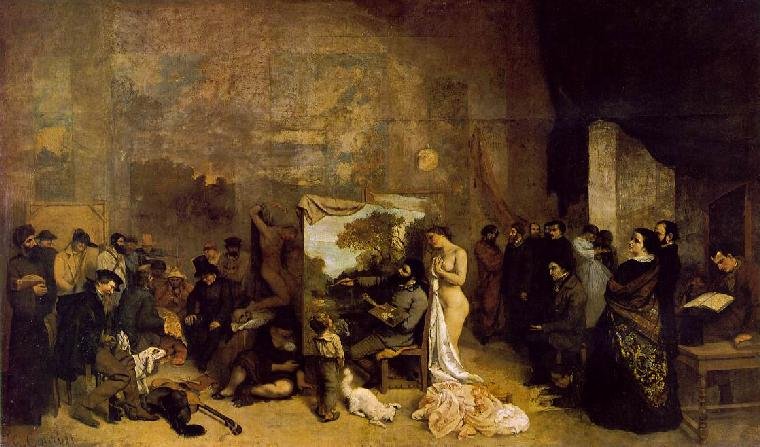
In My Daily Art Display today I have featured one of Courbet’s greatest painting entitled The Artist’s Studio which he completed in 1855 and which had a secondary title: A Real Allegory of a Seven Year Phase in my Artistic and Moral Life. It was an enormous painting, 3.61 metres tall and almost 5.98 metres wide and can be seen in the Musée d’Orsay in Paris. Courbet submitted this painting with thirteen others to the Exposition Universelle of 1855. The Exposition Universelle was an International Exhibition held on the Champs Elysées in Paris from May to November in that year. This Paris exhibition came four years after London had held their Great Exhibition of 1851. To Courbet’s horror, three of his paintings were rejected on the grounds that they were far too big for the exhibition as space was restricted. One of these was today’s featured painting and one of the others was his mammoth work, A Burial at Ornans, which was 3.14metres tall and 6.63 metres wide. However Courbet was not to be denied and decided to withdraw all his paintings and with the help of his patron Alfred Bruyas set up a rival exhibition with forty of his works in a rented hall next door to the official exhibition, which he called The Pavilion of Realism. It did not prove to be a great success as attendances and sales were poor and many just came out of curiosity, but for fellow artists, Courbet’s gesture was inspirational and his standing in the artistic community rose. He was now acclaimed as a hero of the French avant-garde and an inspiration to the young up and coming artists. In some ways this alternate exhibition running alongside the official exhibition was a forerunner of the Salon de Refusés, which came into being as an alternative to the Salon exhibitions in Paris in 1863 and again in 1874 during the Imressionist era.
The work before us today was looked upon as an allegory of Courbet’s life as a painter and the various figures depicted are allegorical representations of various influences on his life. So who are all the people? In some ways the work is a kind of triptych with three distinct sections. On the left hand side of the painting are various figures from the different levels of French society. To my mind the left hand side includes things and people Courbet disliked and sums up what he believes was wrong with society, such as religion and poverty, while on the right of the painting he has presented us with things and people he holds dear.
Let us first look at the grouping on the left hand side of the painting. On the ground sprawled beside the canvas sits the figure of a starving peasant. More than likely Courbet is depicting an Irish peasant, as the Great Irish Famine had taken place only a few years earlier. To the left of the peasant there are several other figures. This strange grouping appears to include a priest, a prostitute, a grave digger and a merchant. In the far left of the painting we see the standing figure of a Jewish Rabbi and seated on a chair before him is a hunter with several dogs. This depiction of this man is quite interesting as it is thought by use of x-ray analysis that the figure of the man was added later and was not mentioned in Courbet’s letter to Champfleury when he wrote about the details of the work. So what was so important to cause this late addition. Art historians would have us believe that he is an allegory of the then current French Emperor, Napoleon III. He has been identified as such because of his famous hunting dogs and also by his twirled moustache which he was famous for. So why place the French ruler on the left side of the painting? The answer probably lies in Courbet’s early upbringing in an anti-monarchist household and Courbet’s inherent dislike of the emperor. It was Courbet’s belief that Napoleon III was no better than a thief having stolen the country from its people. In the centre of the work, behind Courbet’s landscape canvas we see a nude male model, on the floor we see a guitar, dagger and hat, and on the table a skull. These were all accoutrements of traditional academic art which Courbet loathed.
In the middle, taking centre stage and thus the centre of our attention, we see the realist artist himself sitting before his easel working on a landscape. He has placed himself as the main focus of the painting and maybe it was his way of projecting himself as the leader of the Realist movement. Behind Courbet, and being ignored by him, is a nude model, which symbolises academic art tradition which Courbet disliked so much. Standing in front of Courbet, looking totally mesmerised by what Courbet is doing, is a small boy. It is believed that Courbet included the boy as a symbol of the innocent eye of the artist but of course the mesmeric admiration of the boy for what Courbet has painted may just be something artists crave. By the boys feet there is a white cat.
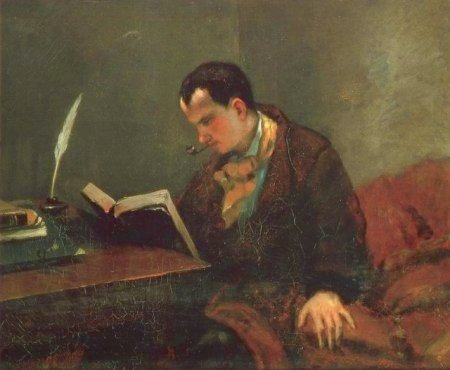
Beudelaire by Gustave Courbet (1848)
On the right of the painting is another group of people. This grouping is a selection of his friends, associates and admirers. It is possible to identify some of these figures. The man standing and looking across to the left hand side, with a beard, is Alfred Bruyas a long-time patron of Courbet. Standing behind him, facing us, is Pierre-Joseph Proudhon, politician and socialist philosopher and another friend of the artist. Moving away from those two and towards the foreground we see a man seated. This is the French novelist Jules Husson, whose non de plume was Champfleury and who was a greater supporter of Courbet’s realist art. The man at the extreme right of the painting, reading a book, is the French poet Beaudelaire and we know that Courbet’s depiction of him is from a portrait he did of him seven years earlier. Beaudelaire at the time had a quadroon (mixed race) mistress and Courbet had included her in the painting just to the left of Beaudelaire (as we look at him) but Beaudelaire was not happy with her inclusion and persuaded Courbet to paint her out of the scene. The presence of Beaudelaire’s mistress was only discovered recently when the painting was cleaned and x-rayed. Standing quite prominently in the group, in front of Beaudelaire, is a well dressed bourgeoisie lady with a brown-patterned shawl and her companion. Art historians have not come to a definitive agreement as to who they are but one theory is that it is Christine Ungher and her husband François Sabatier, another of Courbet’s patrons. Notwithstanding what art historians believed to be the message of the painting Courbet expressed his thought process behind what he had achieved with this magnificent work in a letter to Champfleury. He wrote:
“….It’s the whole world coming to me to be painted, on the right are all the shareholders, by that I mean friends, fellow workers and art lovers. On the left is the other world of everyday life: the masses, wretchedness, poverty, wealth, the exploited and the exploiters, people who make a living from death…”.
During Édouard Manet’s life he was great friends with the writer Charles Beaudelaire, the French poet, philosopher and art critic, and from around 1855 they became constant companions with the two of them frequently going off on sketching trips. It was an important friendship for Manet, as during the times his work was being harshly criticised, Beaudelaire was very supportive of him. Lois Hyslop the American author and Beaudelaire specialist wrote about this supportive role in her 1980 book Beaudelaire, Man of His Time, and she quoted his comments with regards Manet:
“…Manet has great talent, a talent which will stand the test of time. But he has a weak character. He seems to me crushed and stunned by shock…”
Beaudelaire believed in modernité in art and in his book, The Painter of Modern Life and Other Essays, he stressed the importance of it saying that it was very important that art must be held accountable to capture the modern experience. He wrote:
“…By modernity I mean the transitory, the fugitive, the contingent which make up one half of art, the other being the eternal and the immutable…”
His advice to Manet was that his art should depict a contemporary realism and that Manet should become le peintre de la vie moderne .
Today I am returning to the French artist Édouard Manet and looking at another of his paintings. It is a painting of modern life and modern Paris and would no doubt have pleased his friend, Beaudelaire. The painting is simply entitled The Railway which he started in 1872 and completed the following year. It now hangs in the National Gallery of Art in Washington. This was the only painting by Manet that was accepted by the Salon jury for their 1874 exhibition. In some ways it is an unusual painting and we struggle to understand what it is all about and Manet never revealed his thoughts behind the work. So let us take a look at the image and see if we can understand Manet’s thought process as he put brush to canvas.
Gare Saint Lazare and Pont de l'Europe (c.1868)
To start on this journey of exploration I suppose we need to say what we see. Let us first let us take in the setting of the scene. It is an urban landscape of Paris in the late 19th century. Why did Manet choose this scene and what was its significance? This was the area around the newly built Gare Saint Nazare which was completed in 1837 and this area, along with the Pont de l’Europe, which straddled the railway tracks was an area of unparalleled importance for representing the changing face of modern life in Paris brought about by the redevelopment scheme of Baron Haussmann. It was an area which was depicted many times by the Impressionist artists like Monet, Caillebotte and Jean Beruad. The view we see is from the garden of the rue de Rome apartment house of Manet’s artist friend Alphonse Hirsch. The painting is almost dominated by the black metal railings which boldly run the full width of the painting, creating a foreground and a background to the work and at the same time and in some ways acts to force the two females out towards us. The black railings form a hard, lattice-work and it is in contrast to the pure white steam behind it. There is an abundance of contrast in this painting with its sharp edges and soft dissolves. The small girl, with her back to us, almost seems as if she is using the railings as stage curtains which she draws open to get a better view of the rail tracks and the feverish movement of the trains below. In contrast, the older female just leans back against them and shows little interest in what is happening behind her. She has seen it all before. To the right, on the other side of the railings, low down we can see a signal box, above which we can just make out a white pillar which is part of the Pont de l’Europe, which was inaugurated in 1868. The Saint-Lazare station, which is out of picture, is further to the right.
Across from the railway tracks and in the background on the upper left of the painting, just behind the woman’s head, we see the buildings on the rue de Saint-Pétersbourg and the probable reason for this inclusion is we are actually looking at the door and window of 4 rue de Saint-Pétersbourg , which was formerly a fencing hall, but from 1872 to 1878, it was Manet’s studio. Most of the central background behind the railings has been masked by a cloud of steam and smoke which has wafted upwards from a passing locomotive and now hangs in the air.
On our side of the railings and close up to us we have the life sized figures of a young women and a young girl. We are connected to them by their nearness, but is there a connection between the two of them? Are they mother and daughter, or sisters, or governess and charge? I think at this early stage in our investigation we have hit a brick wall as there is nothing to tell us about this relationship. However there is certain disconnect between the two. They face in different directions, almost a Janus-like scenario.
The woman wears a long dark blue dress with large round white buttons and full lace cuffs. Cradled in her lap we see a small dog, which is often termed due to its size, a lap dog. She is holding an opened book which she has been reading and tucked partly under her right arm is a closed fan. Her long hair which is auburn in colour hangs loosely down and rests on her shoulders. The lack of styling to her hair gives me to believe that she may be just out of her teenage years and yet, the covering of her arms, unlike the young girl next to her, would indicate a sense of decorum attributable to adulthood. On top of her head she wears a tall bonnet crested with a floral design. For jewellery she has gold-like earrings and a bracelet and wears a thin black ribbon around her neck. She stares thoughtfully out at us. It is an ambiguous unwavering stare and in some ways a similar look to the one the lady gave us in Manet’s painting Olympia. Is she trying to engage with us?
The model Manet used for this depiction is once again Victorine Louise Meurent, a painter and famous artist’s model. We have seen her before in Manet’s controversial masterpieces, Le déjeuner sur l’herbe(The Luncheon on the Grass) which I featured inMy Daily Art Display of August 2nd and Olympia (My Daily Art Display Oct 12th). This was to be her last sitting for Manet for it was around this time that she started taking painting lessons. She wanted to concentrate on an academic style of painting which was anathema to Manet and their relationship fell apart.
Let us now look at the young girl. The model used for this young girl was the daughter of Albert Hirsch, Manet’s friend. She has her back to us and we see her peering between the railings at the activity below – the passing of a steam train. It is somewhat strange that her right arm and shoulder are missing which is in direct contrast to her left arm which is stretched outwards as her hand grips the black metal railing. Her attire reinforces her young age as we see she is not condemned by late 19th century convention to have long sleeves to her dress. Her bluish/silver dress with the large bow is depicted in an unusual fashion. It balloons outwards which either means a rush of upward air has caused it to billow or she has retained what is termed “puppy fat”. Her hairstyle belies her age as it is swept up in an adult fashion and tied by a similar black ribbon worn by the woman.
So what did the critics make of Manet’s painting which was his largest en plein air work, up until then, that he ever painted measuring 93cms x 114cms. Alas once again a hostile reception from the critics greeted Manet’s work. One said the painting should be renamed:
Two sufferers from incurable Manet-mania watch the cars go by, through the bars of a madhouse
Those who visited the exhibition were baffled by the work. Critics said that the painting was incoherent and the painting quality was poor. Unfortunately, few failed to recognise that this was a painting which symbolised modernity. His friend Beaudelaire would have been proud of him but alas he died seven years before the painting was exhibited.
A Sunday Afternoon on the Island of La Grande Jatte by Georges Seurat (1884-86)
Today I am starting My Daily Art Display blog by introducing you to some new “isms” which have a connection with what is to follow. They are Post-Impressionism, Neo-Impressionism, Pointillism and Divisionism and they all are connected in some way to today’s featured artist George Seurat.
By now you will have read many of my blogs that cover the works of the Impressionists such as Monet, Renoir, Degas and Caillebotte and so by now you are familiar with the term Impressionism. Post Impressionism was a style of painting that grew out of Impressionism or maybe we could say it was a style of painting which was a reaction against Impressionism. The three main artists who were central to this new group of painters and who were termed Post Impressionists were Gaugin, Van Gogh and Cézanne. Gaugin retained the intense light and colour of the Impressionists but discarded the idea of painting from nature. He was totally against naturalism, where artists depict nature just as it is, and in its place he wanted his works to have more inventive subject matter and he also liked to experiment with colour. On the other hand Van Gogh continued to paint from nature but developed a highly personal use of colour and brushwork which openly expressed his own expressive response to a subject. Cézanne kept faith with the Impressionist’s principle of painting from nature but his works came across with a greater energy and vitality.
Today I am going to look at Neo-Impressionism and Neo-Impressionist artists who were a distinct group of painters within the Impressionist movement and in some ways formed a transition period between the Impressionists and the Post Impressionists. The two leading figures of this trend were Georges Seurat and Paul Signac and they wanted to have a more scientific approach on how light was depicted in their paintings. Their works were characterised by the use of a technique known as Divisionism or Pointillism. Divisionism, also sometimes known as Chromolumanarism, was a method of painting in which colour effects were achieved by applying small areas of dots of pure unmixed colours on the canvas so that an observer standing at an appropriate distance from the painting (suggested distance for best effect was three times the diagonal measurement of the work) the dots would appear to react together giving a greater luminosity and brilliance than if the same colours had been mixed together before putting them on the canvas. What these artists wanted to achieve was that the observer of the painting combines the colours, which are in the form of dots, optically instead of the artist pre-mixing them on a palette before putting them on the canvas.
Pointillism comes from the term peinture au point, which was used by the French art critic Félix Fénéon, when he described today featured painting by Seurat. It can be defined specifically as the use of dots of paint and does not necessarily focus on the separation of colors. Divisionism refers mainly to the underlying theory, pointillism describes the actual painting technique associated with the likes of Seurat, Signac and to a lesser extent Pissarro. Pointillism is related to Divisionism which is a more technical variant of the method. Divisionism is concerned with color theory, whereas pointillism is more focused on the specific style of brushwork used to apply the paint.
Enough is enough !!!! I don’t want to get too bogged down with “isms” and their meanings and I am sure that there are many people out there who can give a much more expansive explanation of the differences between Divisionism and Pointillism . My Daily Art Display today features what many believe is Georges-Pierre Seurat’s greatest work. It is entitled A Sunday Afternoon on the Island of La Grand Jatte. It was the one of the first painting to be executed entirely in the Pointillist technique and the first to include a great many people playing a major role. It caused a sensation when it was exhibited at the eighth and final Impressionist Exhibition in 1886. It is thought that it was possibly intended as a pendant to Seurat’s other work, Bathers at Asnière, which I will look at in a later blog.
He started the work in 1884 and did not complete it until 1886. He spent two years making over sixty preparatory pencil and ink drawings, conté crayon studies and oil sketches on panel for this work. He would alter the grouping of people, the number of people within a group and where each group or individual were positioned until he was satisfied that he had achieved the perfect balance. There was a smaller version of the painting which can be found in the Metropolitan Museum of Art in New York. There is also a version of the scene without the people which was once in the private collection of Mrs John Hay Whitney. This painting we see today is massive in size measuring 207cms high by 308cms wide (almost 7ft tall and 10ft wide) and since 1924 has been housed in the Art Institute of Chicago. Seurat completed the final version of this painting in his small Paris studio.
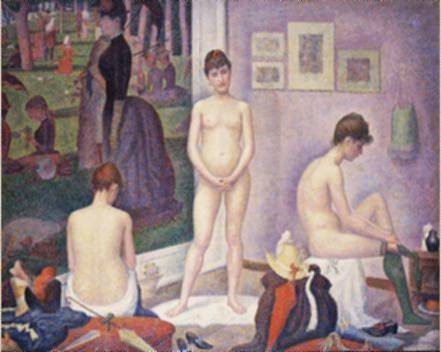
The Models by Seurat (1886-88)
In 1888, Seurat also completed another painting which was entitled The Models using his pointillism technique, and which depicts models in his studio. Included in the painting is a section of La Grande Jatte and art historians believe that by doing this painting, he was showing the world that this technique of Pointillism worked just as well for indoor scenes as outdoor ones.
The Île de la Grande Jatte is a small island in the River Seine, downriver from La Défense. It is about 2 kilometers long and just 200 metres wide at its widest point. At one time it was reduced to being an industrial site but now has public gardens and houses. Living on the island are approximately 4000 inhabitants. However in the days of Seurat it was a pastoral retreat where Parisians could come at weekends from their claustrophobic city existence and soak up the quiet and peace of this little idyll.
Before us we see Seurat’s idealized version of the Grand Jatte omitting both the cafés and restaurants and the nearby ugly shipyard and factories. In the painting we see members of different social classes out for a stroll along the Grand Jatte by the side of the Seine. The figures, shown mainly in profile or frontal position, have a peculiar formal and artificial feel to them. As we look at the painting head-on, there seems to be a definite elongation of some of the people although I believe if you stand at a certain angle to the painting this is minimised. Seurat would sketch individual groups or single characters and then return to his studio to decide if and where each group should be placed on the canvas. He sketched people of different classes in society to give the idea that all types of people enjoyed promenading along La Grande Jatte. Look at the trio in the right foreground. Here we have the a man wearing a top hat and holding a cane who is more than likely from the upper classes of Paris society. The man with the muscular arms, lying back with a cap on his head, smoking the pipe is probably a working-class boatman and finally we have the young genteel lady of an indeterminate class. An unusual trio and who, although physically close in the painting, would be unlikely to have a closeness in that present-day society. The faces of the people in the painting show little personality. There is something very impersonal about them. We must presume that this was a deliberate ploy by Seurat who seemingly did not want the painting to be sullied by observers of the painting trying to interpret facial expressions. I don’t believe the artist ever intended this to be in any way a moralistic statement about the French culture and classes at the time. However, some would disagree. Art historians like to interpret every painting and seek symbolic depictions within a work so let us have a look at a few that have been thrown up for consideration with regards this work of art.
In the left middle ground we see a lady dressed in gold and orange fishing in the river. I suppose there is nothing strange about that albeit she is hardly dressed as a woman who was to go out on a fishing expedition. Well consider what the French word is to fish – it is pêcher and some have suggested that Seurat has made a play on the word as the French word to sin is pécher. So is Seurat secretly identifying her as a prostitute. Again look at the woman in the right foreground accompanying the gentleman. Look what she is holding in her left hand – a monkey on a leash. That is certainly an unusual pet to take for a walk. So why did Seurat include a monkey. One possible reason is that a female monkey in French is une singesse. The symbolists would have us believe that a monkey is a symbol of licentiousness and that is why the French slang for prostitute is singesse. So again I ask the question is Seurat trying to tell us by symbolism that this woman is a prostitute who is out for a stroll with her client?
It is interesting to note and it is not shown in my attached picture, that later Seurat painted the border using parallel red, orange and blue dashes and dots. He varied the combination of colours in different parts of this border in order to accentuate the adjacent colours in the painting itself. Maybe if you go to see the painting in Chicago you can let me know if Seurat’s idea with this border really works.
Finally, I came across a poem about this painting which I was going to add to the blog but it was too long so instead I have added the URL where you can find it. It is:
As promised yesterday my blog today carries on looking at the life of Camille Pissarro and one of his later paintings.
In 1872 Pissarro returned to Pontoise, where he once again set up home. His friendship with Cézanne was re-established and Pissarro mentored his friend in the technique of painting “patiently from nature”. Cézanne was to later to comment about his relationship with Pissarro and how his mentoring made him change his artistic style saying:
“…As for old Pissarro, he was a father to me, a man to consult and something like the good Lord…”
Pissarro was determined to create an alternative to the Salon. He wanted a society of artists who would work together and become a type of cooperative. It took almost four years to achieve his aim . Artists petitioned for a new Salon des Refusés in 1867, and again in 1872. Both requests were denied and so during the latter part of 1873, Pissarro along with Monet, Sisley and Renoir organized the Société Anonyme Coopérative des Artistes Peintres, Sculpteurs, Graveurs (“Cooperative and Anonymous Association of Painters, Sculptors, and Engravers”). Its purpose was to exhibit their works of art independently. They soon had fellow artists like Cezanne, Berthe Morisot and Degas interested in the scheme and all agreed to boycott participation in the Salon in 1874 and exhibit only at their exhibition. The exhibition took place in January 1874 at the studio of Gaspard-Félix Tournachon , known as Nadar, in the Boulevard des Capucines and this exhibition of their work was later to become known as the First Impressionist Exhibition. Works in this exhibition included five paintings from Pissarro. The names of the other artists who exhibited works in this exhibition reads like a Who’s Who” of famous artists. Included in the exhibition were works by Monet, Renoir, Guillaumin, Béliard, Sisley, Cézanne, Degas and Morisot. This First Impressionist Exhibition was not received favourably by the critics and Pissarro was disheartened by their criticism. He wrote to the art critic Théodore Duret, who was sympathetic to the Impressionist cause, expressing his disappointment with the adverse criticism:
“…Our exhibition goes well. It is a success. The critics destroy us and accuse us of not having studied; I am returning to my work, it is better than reading the reviews…”
So why did the majority of art critics hate the works on show? One should remember that the critics were brought up on the art of the Salon with its accepted works portraying religious, historical any mythological settings and so the paintings put forward by the Impressionists, including Pissarro, depicted commonplace street life and people busying themselves in their daily routine and was considered by the critics as both facile and some even went further by declaring them vulgar. The critics considered a lot of the Impressionist works as being “unfinished” in comparison to the works seen at the Salon. They commented that the way the brushstrokes of the Impressionists works were visible which, to their mind, meant it had been done in haste and often completed in a solitary sitting. In comparison they praised the Salon painters who to them were the “real” artists and who spent hour after hour carefully perfecting each part of their works.
The year of this First Impressionist Exhibition in 1874 proved a bad year for Pissarro. His artworks were not selling and he had to endure a personal tragedy with his nine year old daughter Jeanne dying the week the exhibition opened. However, Pissarro stuck to his belief in the Impressionist movement and exhibited no fewer than twelve works in their second exhibition in 1876. Three years on the Impressionist grouping was starting to fall apart with Renoir, Sisley and Cézanne having left. There was also now a split amongst the remainder of the group with Degas on one side who wanted to bring in new artists and Caillebotte and Pissarro on the other who wanted to maintain the status quo. Degas also laid down the rule for the Impressionist group that any artist putting forward work to the Salon could not enter work in that year’s Impressionist exhibition. This was a major dilemma for some of the group who believed that to become a respected artist and command a good price for their works they had to exhibit at the Salon.
The possible break-up of the Impressionists that had worried Pissarro showed itself in the sixth and seventh exhibitions with few of the initial contributors putting forward works for inclusion. Pissarro continued to support the Impressionist Exhibitions, refusing to enter works at the Salon and in fact contributed to all eight Impressionist Exhibitions. Times were still difficult for Pissarro and the collapse of the French economy at the start of the 1880’s made it even more difficult for him to sell his work. In 1884 he moved from Pontoise to the small village of Eragny sur Epte which lies north east of Paris. It was whilst living here that he met the artists Georges Seurat and Paul Signac and he became a convert to their new approach to art which was known as Neo-Impressionism. I will go more into Neo-Impressionism movement and the related “–isms” of pointillism and divisionism, both of which are relevant to Neo-Impressionism, when I feature the works of George Seurat.
By the time of the eighth and last Impressionist Exhibition in 1886 there was an apparent lack of harmony among the remaining Impressionist artists, and the work of the Neo-Impressionists was shown separately from that of the others. It was noticeable that both Monet and Renoir were absent from this last exhibition. Seurat showed his now famous, and very large work entitled A Sunday on La Grande Jatte which he had just completed and which dominated the room. The room also contained Pissarro’s own Neo-Impressionist submissions which consisted of nine oil paintings, as well as gouaches, pastels, and etchings.
Pissarro’s love affair with Neo-Impressionism was short lived and in 1889 he began to move away from the style, believing that it made it “impossible to be true to my sensations and consequently to render life and movement”. Impressionism at this point in time had run its course. Pissarro carried on painting city scenes although his erstwhile colleagues Renoir, Sisley and Monet had abandoned such subjects. Pissarro completed a number of works featuring the streets of Paris and the Gare Saint Lazare.
In his latter years Pissarro suffered from a recurring eye infection that prevented him from his en plein air work and any outdoor scenes he wanted to paint he did so whilst sitting by windows of hotel rooms he stayed at, always making sure he had a top floor room with a good view. He carried on doing this when he toured around the northern French towns of Rouen, Dieppe and Le Havre and also when he made trips to London. Pissarro died in Paris in 1903, aged 73. He was buried along with the other greats of French art, music and literature in the Père Lachaise Cemetery.
Camille’s descendents followed his path in the art world. His granddaughter, the daughter of his son Lucien, Orovida Pissarro is a painter in her own right. His great-grandson, Joachim Pissarro, is former Head Curator of Drawing and Painting at the Museum of Modern Art in New York and is now a professor in Hunter College’s Art Department. His great-granddaughter, Lélia, is an artist who lives in London.
My daily Art Display featured work of art today by Camille Pissaro is a painting he completed in 1875 entitled The Pond at Montfoucault. In 1859, a few years after arriving in Paris, Pissarro, whilst attending the Académie Suisse, met some aspiring artists who would become very famous, such as Monet and Cézanne. He also became great friends with a lesser known painter, Ludovic Piette. Piette often exhibited at the Paris Salon in the 1860’s and also some of his paintings were shown at the Third Impressionist Exhibition of 1877. Piette’s home was in the small village of Montfoucault, which lies on the border between Normandy and Brittany. Pissarro went to stay with Piette on a number of occasions and when the Franco-Prussian war broke out Pissarro and his family left their home and took refuge with Piette before crossing the Channel to England.
It was later in 1874 when Pissarro had come to Montfoucault to try and relax and get over the stress and disappointment of the First Impressionist Exhibition that he started to paint some local country scenes. He especially liked to depict female workers engaged in their daily duties and this is what we see in today’s painting. Before us we see a female herding some cattle by the pond which lay on Piette’s property. Pissarro enjoyed his visits to Montfoucault and he wrote to Theodore Duret, the French journalist, author and art critic about his work but you can sense an uneasiness and doubt in his mind about his art. He wrote:
“…I haven’t worked badly here. I have been tackling figures and animals. I have several genre pictures. I am rather chary about going in for a branch of art in which first-rate artists have so distinguished themselves. It is a very bold thing to do and I am afraid of making a complete failure of it…”
There is a beautiful tranquillity about this painting and one can see how an artist like Pissarro would have liked basing himself in this area.
Two Women Chatting by the Sea by Camille Pissarro (1856)
Jacob Abraham Camille Pissarro was born to Abraham Gabriel Pissarro and Rachel Pissarro (née Manzano-Pomié ) in 1830 on the island of St Thomas in the Danish West Indies, now known as the US Virgin Islands. His father, a Sephardic Jew, held French nationality, but was of Portuguese descent. He originally came to the Caribbean to sort out the business affairs of his uncle who had recently died. He ended up staying in St Thomas, took over the running of the dry store business and married his late uncle’s widow, Rachel. This found no favour with the small local Jewish community, maybe because he had married his late uncle’s wife or maybe because his new wife and Camille’s mother, was a native Creole, a Dominican of Spanish descent, and not of the Jewish faith. Camille and his siblings because of this were excluded from the Jewish school on the island and had to attend the all-black primary school.
Pissarro’s father and mother went on to have four children. Camille was the third son and he and his parents and siblings lived a comfortable existence in a large and spacious apartment over the family shop on Dronnigens Gade, the main street, of Charlotte Amalie, the capital of St Thomas. At the age of twelve, so as to ensure he had a good education, Camille was sent to France to attend a boarding school in Passy, a small town in a district of Paris , on the right bank of the Seine. It was whilst studying in Paris that the young Camille developed a love for art and would often visit the Louvre. After five years studying in France, Camille Pissarro returned home to Saint Thomas where his father was hoping he would enter the family business. However the young Pissarro was unimpressed at having to act as a cargo clerk at the harbour and had other ideas for his future. During his time at the harbour he would spend most of his time sketching. It was whilst sketching one day that he met Fritz Melbye, a Danish marine painter who was also living on St Thomas. He liked the enthusiasm Pissarro had for sketching and painting and he began to mentor him and eventually persuaded him that he should become a full time artist. Pissarro was delighted and much to his father’s chagrin in 1852 gave up the family job and went off with Melbye to Venezuela where the two of them based themselves in Caracas and stayed for two years sketching and painting landscapes and village scenes. Pissarro once reflected on his decision to leave his comfortable home and his position in the family business saying:
“…I abandoned all I had and bolted to Caracas to get clear of the bondage of bourgeois life…”
In 1854, he returned home to Saint Thomas and his parents realised that any attempt to persuade the son to settle down would be fruitless and so they gave him their blessing to seek his fortune as an artist and the following year he left Saint Thomas for the last time and went to live in Paris. He went initially to stay with the French branch of his family who gave him financial support, in order to have him follow a more serious artistic training.
His first position was to act as an assistant to his friend Fritz Melbye’s brother and Danish artist, Anton. In 1856 he attended private art classes at the École des Beaux-Arts and at the age of thirty-one registered as a copyist at the Louvre. He was influenced in his early days in Paris by the likes of Courbet, Corot, Millet and Daubigny. He also attended the prestigious Académie Suisse which was an art establishment in Paris. The Swiss Academy did not offer courses, but provided the aspiring young artists with models made it possible for them to study nudes together, and in this way helped the usually poverty-stricken young painters who found the price of a model being too high for a sole artist. It was also a great meeting place for the young artists to discuss their work and their personal ideas. It was here that he met the future Impressionists Claude Monet, Armand Guillaumin and Paul Cézanne and through them was introduced to the likes of Renoir and Sisley.
Even though now living in Paris his early paintings were of the Caribbean and he was still influenced by Anton Melbye to such an extent his early exhibits at the Paris Salon bore the signature “Pupil of A. Melbye” a moniker he used until 1866. Studying at the Academies was not all together to Pissarro’s liking and he railed against having to work in the traditional and prescribed manner set down by these institutions and having to follow the official line when it came down to getting works exhibited in their official exhibitions. He felt that their official standards were subduing his creativity and he decided to look elsewhere for help and inspiration which he eventually found when he was being tutored by Camille Corot. It was their mutual love of rural scenes which endeared Corot to Pissarro and it was Corot that first introduced Pissarro to the technique of outdoor painting, en plein air. Pissarro would spend much time around the countryside on the outskirts of Paris. He would make many painting trips around Montmorency and Pontoise building up his landscape portfolio.
A few years after he had arrived in Paris his parents left their business in Saint Thomas leaving the running of it to their manager and moved to Paris. They hired a maidservant by the name of Julie Vellay, the daughter of a Burgundian wine producer. Camille struck up a relationship with Julie in 1860 and she was to become the love of his life and his constant companion. In 1863, following a miscarriage the previous year, they had their first child, Lucien. Just over a year later their daughter Jeanne was born.
The style of Pissarro’s works with their natural settings did not now find favour with the Salon juries and the pretence of grandeur the Salon jurists required in works if they were to be allowed into the Salon exhibitions. A turning point came in 1863 when all the works by Pissarro and his like-minded contemporaries such as Monet, Cézanne and Guillaumin where rejected for the forthcoming exhibition by the Salon jury. According to the author, Ross King, in his book, The Judgement of Paris, only 2217 out of 5000 paintings were accepted into the Paris Salon exhibition by the Salon jury. The French ruler at the time Emperor Napoleon III voiced concern at the time for this wholesale refusal to allow so many works enter the official Salon exhibition and decreed that the rejected painters could have their works hung in an annex the regular Salon, the Salon des Refusés (Exhibition of Rejects). He wanted the public to judge the works which had been rebuffed by the Salon jurists. Artists who had their works hung in the 1863 Salon des Refusés exhibition included Pissarro, Manet, Whistler and Cézanne.
The Franco-Prussian War broke out in 1870 and Pissarro moved his family to Norwood on the outskirts of London and it was here he met the Paris art dealer, Paul Durand-Ruel, a man who would, from then on, organise the sale of Pissarro’s works. It was also the art dealer that reacquainted Pissarro with Monet and the two French artists spent their time in London studying the work of the great landscape painters, Turner and Constable. It was in 1871 whilst still in London that Pissarro married his lover Julie Vellay who was expecting their third child. That year, after the war had ended, he and his family returned to their home in Louveciennes and much to his horror most of the works in his studio, which he had completed in the previous twenty years, had been destroyed by the invading Prussian soldiers.
I will leave Pissarro’s life story at this point and conclude it in my next blog but for today I want to end by looking at one of Pissarro’s early paintings. My Daily Art Display featured oil on canvas painting is entitled Two Women Chatting by the Sea which he completed in 1856 around the time he left his homeland for the final time. The painting had been owned by Mr and Mrs Paul Mellon, the late American philanthropist and his wife and was given to the National Gallery of Art in Washington in 1985. Unfortunately, according to their website it is not currently on view. It is amazing the high percentage of paintings that all large museums have in their vaults, waiting their turn to go on display. It is just a shame that there is not more wall space available for us to see these hidden gems.
My Daily Art Display today continues with the life of Édouard Manet. Yesterday we had reached 1864 the year when he exhibited his work entitled The Dead Christ with Angels at the Paris Salon and for which he was heavily criticised. So did Manet, after the criticism and ridicule of his 1864 painting, submit a less contentious work the following season in 1865? The answer is simply a resounding NO. He entered two paintings into the 1865 Salon and in fact one of the paintings entitled Olympia, was one he had completed two years earlier and it was this one which caused an even greater furore with both the public and critics alike. The fact that Manet had completed the painting two years earlier but had not exhibited it makes one wonder whether Manet himself had doubts about the wisdom of launching such a contentious painting on the Parisian public. His concern was well founded as it was considered the most shocking of all the works exhibited that year. Olympia by Manet is My Daily Art Display featured painting today.
Before us we see an almost nude woman lying on a bed with a pink orchid tucked behind her left ear. At the end of the bed, by the naked woman’s feet, we can just make out a small black cat. In fact the inclusion of the small furry animal often had people naming the painting, Venus with a Cat. The model for the painting was Victorine Meurent. Victorine was also, besides being a famous model for painters, an artist in her own right and one who exhibited a number of works at the prestigious Paris Salon. Ironically in 1876, one of her paintings was included in the Salon’s juried exhibition (exhibitions at which the works of art are only displayed if selected by a jury) and the painting which Manet put forward for selection was rejected.
The subject of the oil on canvas painting caused a sensation. So what shocked the critics? Was it the nudity? If that was the case, then why, as surely paintings of nudes were quite common at that time. The problem was not the nudity but the fact that the critics believed the naked woman that Manet had depicted could be identified as a demi-mondaine. These were ladies who had a reputation of enjoying an extravagant lifestyle of fine food and clothes, all of which had been achieved because of the steady income they made in cash and gifts from their various lovers. In other words she was identified as a high-class prostitute and the Parisian public was very uncomfortable with the scale of prostitution in their city.
Venus of Urbino by Titian
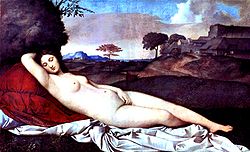
There can be no doubt that Manet’s inspiration for this painting came from Titian’s Venus of Urbino and Giorgione’s Sleeping (Dresden) Venus (see My Daily Art Display for Feb 15th). Maybe Manet wanted to update and be more innovative with his “Olympia”. Not all critics condemned his effort. A few praised him for his “bold step into modernism”. However there are differences in the way Manet has portrayed his woman in comparison with Titian’s Venus and it is these differences which led to the outcry.
Sleeping (Dresden) Venus by Giorgione
The contention that Manet’s woman was merely a high class prostitute was brought about by the way she wore an orchid in her hair, her pearl earrings, her bracelet, and her expensive oriental shawl on which her body rests, all of which gave rise to the belief that her wealth was gained from the “service” she offered her lovers. Her skin is bright white in colour and there is a severe shift from light to shadow in this painting. Look how she stares towards us with her black eyes. This is not a demure gaze. It is a challenging, contemptuous and provoking look, in some ways daring us to find fault with her appearance. Her hand is placed over her vulva and in a way she is saying that this is only to be had by the men she chooses. It is in some way a signal that she will choose who she will bed. Around her neck she wears a narrow black ribbon which when contrasted with the paleness of her neck adds sensuality to her pose. Her upswept hair held in place by the orchid adds to the eroticism. Her slipper is half on and half off her foot in a slovenly fashion.
Her black servant, Laure, stands by her side. She is attired in the typical fashion servants of a courtesan would dress. She is holding a bouquet of flowers which the naked woman seems to ignore. They are probably a gift from a lover who may have just arrived. Maybe her eyes are not on us but on the door through which her lover is about to emerge.
As I said earlier we have the strange black cat sitting on the end of the bed. In Titian’s Venus of Urbino he had included a dog which symbolized fidelity and added a kind of gentility to the scene. Manet would have none of this sentimentality and added his black cat which because of its habits was taken as a symbol of laziness, lust and prostitution. A coincidence? Or did Manet know exactly what he was doing when he include the animal in his painting?
The painting when exhibited was one which the observer either loved or hated. There were no half-measures. The painting could not be ignored. The critics labeled it immoral and vulgar and his friend Antonin Beaudelaire commented that the picture had created such anger that it was in danger of being destroyed by an over-zealous and offended observer. In 1890 the French government acquired the painting with a public subscription, which had been organized by Claude Monet, and it now hangs in the Musée d’Orsay in Paris.
I will let you decide whether what you see before you is Venus, an old-style Titian-like goddess or a nineteenth century Venus whose name was Olympia. Maybe you prefer to simply believe Manet has depicted a high class prostitute awaiting her next client but whatever you decide I think you will agree that it is a fine work of art.
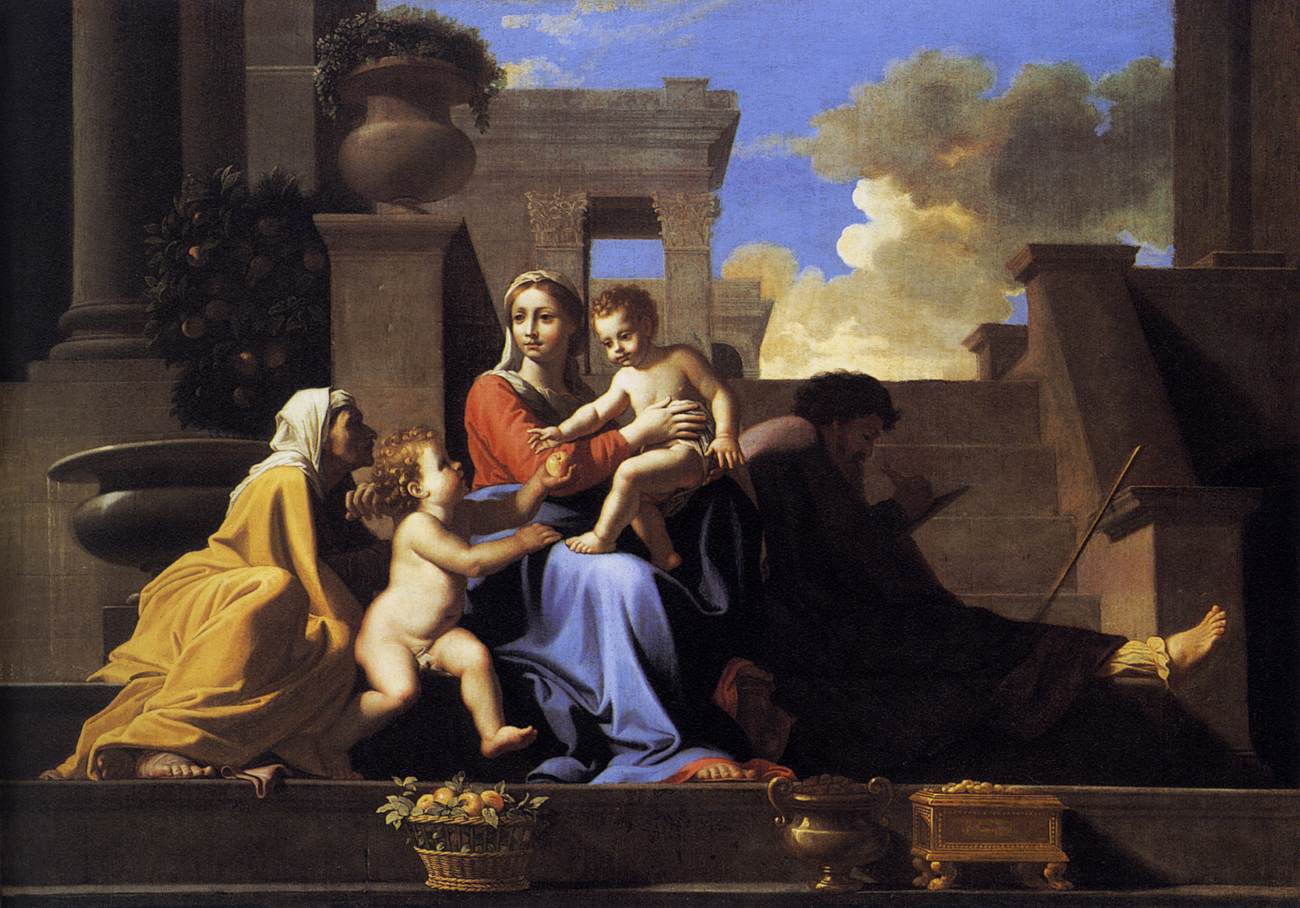
Madonna on the Steps by Poussin (National Gallery of Art,Washington) 1648
“..Poussin is without question one of the greatest of all French painters whose influence on the development of European Art from the 17th Century onwards cannot be overstated. Like Titian before him and his contemporaries Caravaggio and Velazquez, he developed a personal, innovative and highly rigorous style of outstanding originality. His work has been deeply influential on generations of artists up to the present day…”
Richard Knight, International Co-Head of Old Masters and 19th Century Art at Christie’s
My Daily Art Display today once again features a work, in fact two works, by the great French classical painter, Nicolas Poussin. The two paintings in question are both entitled Holy Family on the Steps or sometimes referred to Madonna of the Steps and both were completed in 1648. The painting is considered a masterpiece of 17th-century art and the pinnacle of the artists refined classical style. One is housed in the Washington Gallery of Art and the other in the Cleveland Museum of Art. They are similar paintings but the Washington version looks somewhat lighter in colour. The big issue was which gallery had the original and which gallery had the copy. The painting which is in the Cleveland collection and was purchased in 1981. X-radiographs, published in 1982, proved that it was the original of the two versions, the other in the National Gallery of Art, Washington must then be the copy. Up until then, the Washington picture was thought by some art historians to be the original. The Washington Gallery was far from pleased with the adjudication and in 1994 Earl Powell III, Director of the National Gallery of Art, Washington, DC, was embroiled in controversy when he delayed the public acknowledgement that the Museum’s Madonna on the Steps” by Poussin was no longer thought by scholars to be by the master. It should be said that Anthony Blunt the British historian, art expert and an authority on the works of Poussin believed that the Washington painting was the original.
However notwithstanding who is right and who is wrong the painting dating from Poussin’s mature period is a beautiful work of art. The arrangement of the figures harks back to works by the High Renaissance artists such as Raphael Sanzio and Andrea del Sarto. The painting is a merging of the Classical, with its architecture and the Christian with its religious theme. The figures are placed in a triangular format with the heads of Mary and the Christ Child at its apex. Before us, we see, seated on the steps, Mary, holding the Christ Child, Saint Elizabeth holding her son John the Baptist and seated behind them, Joseph. Poussin has included some symbolic features to the painting. To the left of the seated figures we see an urn overflowing with water which is symbolic of the stream of life and the passing of time and our inevitable death. Behind the urn we have an orange tree which is regarded as a symbol of purity, chastity and generosity and is often depicted in paintings of the Virgin Mary. On top of the walled side of the staircase we have a myrtle bush which has been, since early times, used as the symbol of love. In Roman mythology the myrtle was considered sacred to Venus, the goddess of love.
At the front of the painting, on a lower step we see the gifts Mary has received from the three Magi at the time of the birth of the Christ child. Usually when the Christ Child holds an apple it is symbolizes the fruit of salvation. There is also a connection with Christ and Adam going back to the passage from the Song of Solomon (2:3):
“…As the apple tree among the trees of the wood, so is my beloved among the sons. I sat down under his shadow with great delight, and his fruit was sweet to my taste…”
The passage has been interpreted as an allusion to Christ. As Christ is the new Adam, so, in tradition the Virgin Mary is the new Eve and for this reason an apple being placed in the hands of Mary, symbolises salvation.
Joseph sits on the steps behind Mary. He is almost completely lost in the shadows. By Joseph’s foot we see a measuring stick which in some ways indicates that Joseph was not just a humble carpenter but more of an artisan. The steps which they are all resting on can be interpreted as the stairway to heaven and the light of God is shining brightly above the summit of the steps. There are actually a number of light sources in this painting which cast various shadows.
The Martyrdom of Saint Erasmus by Nicolas Poussin (1629)
Today My Daily Art Display looks again at an artist who many believe was the greatest French painter and the leader and dominant inspiration of the classical tradition in French painting. His name is Nicolas Poussin.
Poussin was born of a noble but impoverished peasant family in Les Andelys, small town in Normandy in 1594. In his youth he studied Latin, and this was to have great influence in his future works of art. In his late teenage years he met an artist, Quentin Vartin, who had come to Les Andelys to carry out a church commission. It was then that Poussin showed the visiting artist some of his artistic work who then agreed to give the youngster some artistic tuition. In 1612 Poussin left Les Andelys and went to Paris and studied art at the studios of the Flemish portrait painter Ferdinand Elle and the French painter George Lallemand. French art and the way it was taught and learnt by young aspiring artists had yet to change and apprenticeships with established artists was still the only way young men would learn to become painters. It would soon change in France when academic training for up and coming artists would supplant this old system. It was not until 1648 that the Académie royale de peinture et de sculpture was founded by Cardinal Mazarin. The purpose of this academy was to professionalize the artists working for the French court and give them a stamp of approval.
Around 1623 Poussin met Giovanni Battista Marino in Paris. Marino was court poet to Marie de Medici at Lyon. The poet was very impressed with Poussin’s work and urged him to travel to Rome to widen his artistic experience. Poussin had already made two unsuccessful attempts to go to the Eternal City but in 1624, aged thirty, he made it to Rome and initially lodged with the French painter, Simon Vouet. Life in the city proved difficult as Poussin was always short of money. However he was befriended by Cassino dal Pozzo, a wealthy antiquarian and secretary to Cardinal Francesco Barberini, who were both to become Poussin’s earliest patrons. It was in 1628 that Poussin received two major commissions; the first was from Barberini, for a pair of large history paintings, The Death of Germanicus and TheDestruction of the Temple at Jerusalem. The paintings were well received. The following year a commission from the Vatican for an altarpiece resulted in The Martyrdom of Saint Erasmus which is My Daily Art Display featured painting today. The work was not greeted with universal acclaim in fact it was a comparative failure with the art critics of Rome. It could well have been the fact that Poussin was French and that the Italians did not take to his attempt to compete with the Italian masters of the Baroque style on their own ground. After this Poussin ceased competing for large public commissions and would paint only for private patrons and even then would confine his work to formats which were seldom larger than five feet in length.
In 1630 he became ill. It is believed that he contracted venereal disease. He was taken to the house of his friend Jacques Dughet, whose daughter Anna Maria cared for him. Poussin and Anna Maria married in 1630 but the couple never had any children. Anna’s brother, Gaspard Dughet studied art as a pupil of Poussin and was later to take Poussin’s surname as his own.
By now news of his achievements filtered back to his home country and the court of Louis XIII and the powerful Cardinal Richelieu. He was summoned by the court to return and reluctantly he had to acquiesce to the royal command and in 1640 he returned to Paris. He was offered commissions for types of work he was not used to nor really competent to carry out, including the decoration of the Grande Galérie of the Louvre palace. Worse still, the works he did complete did not bring forth the admiration he had anticipated, so annoyed at the lack of acclaim, he left Paris in 1642 and returned to Rome. Ironically after his death, Poussin’s style of painting was accepted and acknowledged and in the late seventeenth century it was glorified by the French Academy.
Poussin was never a well man and his health started to decline more rapidly when he was in his mid fifties and with it came problems with his hands which suffered from ever worsening tremors. In his later paintings one could detect the unsteadiness of his hand. He died in Rome in 1665 aged seventy-one and was buried in the church of San Lorenzo in Lucina, his wife having predeceased him.
And so to today’s painting, The Martyrdom of Saint Erasmus, which Poussin completed in 1629. Nicolas Poussin’s altarpiece depicting the Martyrdom of St. Erasmus was commissioned in 1628 for the for the altar of the right transept of Saint Peter’s Basilica, the Chapel of St. Erasmus, in which relics of the Saint are preserved. It was part of the ongoing decoration of the great basilica. The commission had been initially given to Pietro da Cortona but was then assigned to Poussin in 1628 who used the preparatory sketches of Cortona’s as a basis for the work. Poussin was probably obliged to produce not only a preliminary compositional drawing but also a painted modello, a model, to give his patrons a clear idea of his intentions
In the painting of Saint Erasmus, also known by his Italian name, Saint Elmo, we see the subject in the foreground. He was the bishop of Formiae, Campagna, Italy, and suffered martyrdom in 303 AD, during Diocletian’s persecution of the Christians. The setting is a public square. The painting shows the almost naked Erasmus being disembowelled. To the left of him we see a priest dressed in white robes talking to Erasmus and pointing upwards to the statue of Hercules, a pagan idol that Erasmus had refused to worship and which resulted in his martyrdom. In the left mid ground we see a Roman soldier on horseback who is overseeing the execution. It is a horrific and gruesome scene. We see Erasmus’ executioner, dressed in a red loin cloth, extracting the intestines of the martyr who is still alive, and they are being fed on to what looks like the rollers of a ship’s windlass, which is being slowly turned. Above we see two angels descending, one of who is carrying a palm and crown which are the symbols of martyrdom.
The painting remained in the basilica until the eighteenth century at which time it was replaced by a copy in mosaic and the original transferred to the pontifical palace of the Quirinal. It was then taken to Paris in 1797 following the Treaty of Tolentino between France and the Papal States during the French Revolutionary Wars. It returned to Italy in 1820 and it became part of the Vatican Art Collection of Pius VI.
Let me end this blog with two pieces of trivia. When a blue light appears at mastheads of ships before and after a storm, the seamen took it as a sign of Erasmus’s protection. This phenomenon is known as “St. Elmo’s fire”. Erasmus is also appealed to when suffering from stomach cramps and colic. This probably comes about due to the way the saint met his death!
For another of Poussin’s paintings, Rinaldo and Armida, look at my blog of March 8th.
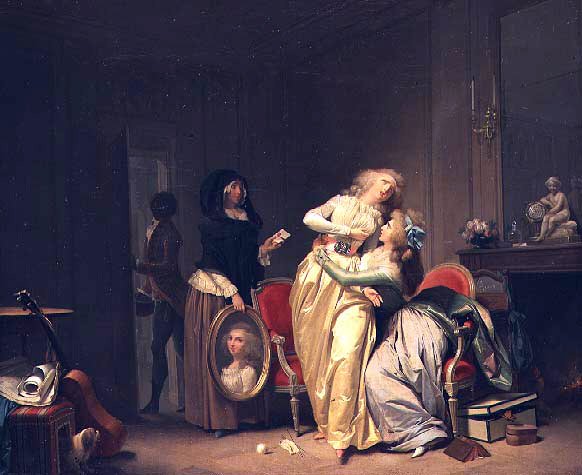
The Sorrows of Love by Louis-Léopold Boilly (1790)
After three days of struggling with a small electronic notebook and the vagaries of foreign WiFi to publish my blogs I am back home to the comfort of my own PC and a fast WiFi. In just over two months time we are off to Hong Kong and Australia for three weeks and I dare not think about how I am going to cope with trying to publish the blog but time will tell.
Today, My Daily Art Display is featuring a new painter to my blog. He is the French portraitist and genre painter Louis-Léopold Boilly. Boilly was born in La Bassée, a small town in the Nord department of Northern France, not far from Lille, in 1761. He was brought up in a simple household, his father being a wood-carver. He was a self-taught painter and started to turn out works when he was still only twelve years of age. He showed some of his drawings and paintings to the local Augustinian friars and so impressed by them that in 1777, the bishop of Arras extended an invitation to Boilly to come and study in his bishopric. The young Boilly painted prolifically producing more than three hundred small works of portraiture during that period.
In 1787 Boilly, now a much admired and renowned artist, moved to Paris but these were troubled times in the capital city with the start of the French Revolution. His early works dwelt for the most part on amorous and moralizing subjects. My Daily Art Display painting today entitled The Sorrows of Love, completed in 1790, is like many of his works of that period. In the late 1790’s, after specializing in interior genre scenes, Boilly decided to switch to depictions of urban life and this gave us the chance, through his works, to witness life in Paris during that time. Apart from the artistic merit of his compositions, he offers us a direct, candid view of Paris and the customs of its people. His paintings were often awash with figures. His paintings were often humorous and in a way displayed Boilly’s droll appreciation of Parisian urban life.
Throughout his career, Boilly was respected as a fine portraitist and received many commissions from the middle classes and the famous. He had also made a name for himself as an artist who liked to paint somewhat titillating images, which were, at the time, very popular with patrons, who took their pleasures by enjoying the roguish side of life. Boilly first encountered problems with his works in 1794, when one of his paintings, Lovers and the Escaped Bird, was considered more than just erotic but that it was termed obscene by the Committee of Public Safety and that the “crime” carried the penalty of a prison sentence as well as a very large fine. He only escaped incarceration, when members of the Committee, on searching his studio, discovered more patriotic works, such as The Triumph of Marat, and that was enough to release the errant artist. After this brush with officialdom, Boilly quickly toned-down his works.
In 1833 he was decorated as a chevalier of the nation’s highest order, the Legiond’Honneur. Boilly died in Paris in 1845, aged 83 and his long life spanned the times when his country and his life was ruled by the royal monarchy of Louis XVI, the French Revolution, the Napoleonic Empire and the restoration of the Bourbon monarchy.
Today’s featured wok by Boilly is entitled The Sorrows of Love and in it we see a young lady being supported by her confidante. She exhibits an exaggerated and shocked demeanour. Her overstated affectation of grief reminds one of the demeanours of an actor hamming up a part in a play. So what has brought on this distress expressed in the most dramatic way by the lady? Look at the maid, wearing the black cowl. In one hand she has an unopened letter which she offers the distraught woman. It is not the content of the letter that is upsetting the lady as she recognises her own handwriting on the cover. It is an unopened love letter being returned to her from her lover, who no longer reciprocates her love. Not only is her love letter returned but in the maid’s right hand we can see that she is holding a head and shoulder portrait of the lady herself, which one presumes she gave to the man in her life, but tragically for her, this too is being returned as unwanted. One must presume that the colour of the maid’s cowl is not just a coincidence and it is probably symbolic of the death of the love affair between her mistress and her lover. The ending of the affair has occurred in a brutal fashion. No letter of explanation, just a return of what is no longer wanted.
The Suitor’s Gift is in the same tradition of bourgeois genre scenes, which examine the many sides of love. These works were greatly sought after by the public and collectors alike, and it seems probable, therefore, that the present work was completed to satisfy a taste for these subtle, yet highly charged scenes. Before us we can witness Boilly’s skill at capturing the split-second of a seemingly every-day episode, whilst filling the scene with inner feeling, subtlety and mystery.








 my daily art display