Although I could write numerous blogs about Berthe Morisot and her works, this is not a Berthe Morisot site and therefore after today’s offering I will drag myself away from this talented artist and head for pastures new. However today I want to focus on Berthe Morisot, her husband and her daughter and have a look at a couple of her paintings which portray the happy family.
As I wrote in my last blog, in 1868, Berthe Morisot had been introduced to Édouard Manet by Henri Fantin-Latour whilst she was working as a copyist at the Louvre. Over time the Morisot and the Manet family became close friends and would exchange visits to each other’s houses and during this time Berthe became acquainted with Édouard Manet’s brothers, Gusatve and Eugène.
When her sister Edma married Adolphe Pontillon in 1869 she moved to Lorient and gave up painting. For her, and despite having exhibited at four Salons, she considered her marriage was far more important than any thoughts she may have had of an artistic career. She was determined to channel all her energy into her marriage, playing the role of a supporting wife to her naval officer husband and being a loving and devoted mother to their children. On the other hand, Berthe on her marriage to Eugène Manet in December 1874 was adamant that the change in her marital status would not affect her art. She continued to paint as prolifically as before and kept signing her works in her maiden name. In many ways she was fortunate that Eugène’s attitude to her work was one of support and often when Berthe set off on painting trips he would accompany her and dabble a little in art himself by making a few sketches. Berthe was also fortunate not to have any money worries and this allowed her to pursue her artistic career without being anxious about where the next centime was coming from.
Eugène Manet on the Isle of Wight by Berthe Morisot (1875)
My Daily Art Display featured painting today, which is housed in the Musée Marmottan Monet in Paris, is entitled Eugène Manet on the Isle of Wight and is one which Berthe Morisot completed in 1875 when she and her husband spent the summer in Cowes on the Isle of Wight on their honeymoon. This, at the time, was a favoured holiday destination for the English high society. They visited the town of Rye several times before they moved on to London. Whilst on the Isle of Wight Berthe spent most of her time painting. Often she and Eugène would be seen leaving their lodgings carrying easels and paint boxes which they would position at some site of natural beauty and spend the day recording the beauty of the island. Often Berthe would set up her easel in their hotel room and paint what they could see from their window. Today’s work is an example of just that. She managed to persuade Eugène, with some difficulty, to pose for her looking out of the window. She wrote to Edma about the problems of getting her husband to pose, saying:
“…I began something in the sitting room with Eugène; poor Eugène is taking your place; but he is a much less accommodating model; he’s quickly had enough…”
The view from the window is of the port of Cowes but the painting is all about her husband Eugène Manet and the little cottage garden in front of the residence. It is interesting to observe how Morisot has painted the window panes and the gauze curtains to convey transparency. The flowers in the garden and the potted plants on the window sill add a dash of colour but in the main Morisot has used muted greys, blacks and blues in her work. There is a grid-like structure to the painting with the vertical and horizontal lines of the window frame, window sill and garden fencing as well as Eugène’s boater. Apparently Morisot found it quite difficult to paint this kind of picture and found the task both frustrating and in some ways depressing. This again is an example of Morisot’s perfectionism and the problems inherent in that state of mind. She wrote to Edma about the work saying:
“…The view from my window is very pretty to see, very ugly to paint; views from above are almost always incomprehensible; the upshot is that I am not doing very much, and the little I do looks frightful…”
Eugène Manet and His Daughter in the Garden by Berthe Morisot (1883)
In November 1878, almost four years after Eugène and Berthe married, Berthe gave birth to a daughter, Julie, who was to be their one and only child. Berthe featured her daughter prominently in many of her future paintings as did her sisters and family members. I particularly like the painting she did in 1883, entitled Eugène Manet and His Daughter in the Garden. The setting is the garden on the Bougival estate where they were staying that summer. Unlike some of her works which also featured her husband and daughter, this painting depicts a more private world of Eugène and Julie. Eugène is dressed casually in an artist’s smock with a straw hat atop his head. Julie, dressed in her light blue summer dress, sits by the pond watching her tiny red sailing boat drifting on the water. There is no sign of their house in the painting but the natural setting enhances the loving father/daughter relationship. Morisot had always intended the painting to be a private family work and no doubt for that very reason she never exhibited it during her lifetime. It was not seen by the public until 1896, a year after her death. The work was one of her daughter’s particular favourites, as Julie commented on the scene with her father saying:
“..he gazes with a father’s eyes on the little blonde girl in a white dress who is intent on getting boats to move around the pond…”
I will now leave the life and paintings of Morisot for a little while but will undoubtedly return to showcase some of her other beautiful work at a later date. If you are interested in Berthe Morisot and her life I suggest you read Berthe Morisot by Anne Higonnet, which gives a fascinating insight into Berthe Morisot’s life, her family and the people she mixes with. It is a great read.
For my blog today I am not showcasing an artist or a painting but a small museum , the Musée Marmottan Monet, which I visited last week when I was in Paris and I hope that for any of you who are intending to visit the French capital and want to take in some of its artistic heritage you will make time to visit this museum. I can assure you that you will not be disappointed. The museum is situated at 2 rue Louis Boilly in the vibrant and colourful 16th arondissement and is easy to get to as there are two nearby Metro stations, La Muette and Ranelagh.
I have often advocated that when one goes to London one should not always head for the major art galleries such as the National Gallery or the two Tate galleries as they are so big that one has no hope of seeing everything in one session and trying to often means that you skimp on the time each painting deserves. A better plan of action if your time is limited is to go and visit one of the smaller galleries. In London one has the Wallace Collection, the Courtauld Gallery and the Dulwich Picture Gallery, to mention just a few. So to practice what I preach, when I was in Paris last week I didn’t revisit the Louvre or the Musée d’Orsay, instead I visited, for the first time, the Musée Marmottan Monet and it was unquestionably a most worthwhile visit.
The building was originally constructed as a hunting lodge for the Duke of Valmy and a few years later was sold to Jules Marmottan which on his death along with all his belongings was bequeathed to his son Paul. Paul Marmottan later built a small pavilion in the courtyard as the original building was too small to house all of his paintings, furniture and bronzes. Paul Marmottan bequeathed his home and collection to the Académie des Beaux-Arts, which opened up the house and collection as the Museum Marmottan in 1934.
If you like the work of the Impressionists and in particular the works of Claude Monet then look no further as this museum houses the largest collection of Monet’s work in the world and this is partly due to the fact that Monet’s youngest son Michel donated his father’s paintings from Giverny to the museum. The building originally had two floors, the ground floor and an upper floor but to exhibit all the works they had to build a large underground room. A number of bequests to the museum over the years have filled the building with beautiful and priceless art treasures.
The Duhem Collection was bequeathed to the museum by the daughter of the French painter, Henri Duhem. These included works by Boudin, Caillebotte, Corot, Gaugin, Monet and Renoir. In 1980 an amazing group of illuminations spanning the 13th to 16th century was donated to the museum by Daniel Wildenstein. The collection is exceptional for both the quantity and quality of the works. There are over three hundred miniatures. In 1996 the museum received an extraordinary donation from Annie Rouart. Her husband was Denis Rouart, the grandson of Berthe Morisot and Eugène Manet. Among the paintings given to the museum by Annie Rouart were masterpieces by Degas, Manet, Monet and Renoir and of course works by the famous female Impressionist Berthe Morisot.
Berthe Morisot Exhibition
For those of you who love the work of Berthe Morisot, and I include myself in that particular fan club, there is currently running a brilliant exhibition of her work. It is housed in the basement. It opened on March 8th and runs until July 1st 2012. It presents the first major retrospective of the work of Berthe Morisot to be held in Paris for almost half a century. One hundred and fifty paintings, pastels, watercolours and drawings in red chalk and charcoal, from museums and private collections all over the world, retrace the career of the Impressionist movement’s best-known woman painter. Works which have been selected for the exhibition cover the whole of Berthe Morisot’s artistic career, from her earliest works around 1860, to her untimely death at the age of 54, in 1895. In my next few blogs I will feature a few of the many paintings I saw when I walked around the museum.
Today I am featuring a work by the French painter and printmaker, Jean-Édouard Vuillard. Vuillard was born in 1868 in Cuiseaux, a commune in the region of Bourgogne in eastern France. His father was a retired sea captain and his mother a seamstress. When he was nine years old the family moved to Paris where his mother established a dressmaking workshop in their apartment. In1883, when Édouard was fifteen years old his father died. Following the death of his father Édouard received a scholarship so that he could continue with his secondary education at the Lycée Condorcet. It was here that he met and became friends with another aspiring artist, Ker Xavier Roussel. Vuillard left the school the following year and he and Roussel continued their artistic education at the studio of Diogène Maillart, which was formerly the studio of Eugene Delacroix.
In 1887, at the age of nineteen, Vuillard finally managed to be accepted at the Ecole des Beaux-Arts. He had tried twice before but on each occasion failed to pass the entrance exam. In 1889 he enrolled at the Académie Julian where he met Maurice Denis, Pierre Bonnard, Paul Ranson and Paul Sérusier. It was Vuillard along with this group of young art students that formed the artistic grouping which came to be known as Les Nabis. The French term nabi refers to a person inspired to speak the word of God and is clearly related to the Hebrew term for prophet (nebia) and the Arabic term for prophet (nábi) . The actual term was first used by the poet Henri Cazalis who drew a parallel between the way these painters aimed to revitalize painting (as prophets of modern art) and the way the ancient prophets had rejuvenated Israel.
In 1898 Vuillard set off on his European travels, visiting Venice and Florence and the following year made a trip to London. In 1890 Vuillard put forward some of his paintings for the 1890 Salon. He was both devastated and angered by the rejection of his works by the Salon jurists and vowed never to put forward any of his future works for Salon consideration. Until the turn of the century Vuillard worked in theatrical circles, illustrating theatre programmes for the Théâtre Libre and even helped to set up the Théâtre de l’Oeuvre , with Aurélien Lugné-Poë which presented the work of the young French Symbolist playwrights and introducing major foreign dramas. Vuillard continued to illustrate theatre programmes and design and paint theatrical settings. In 1901 Vuillard had some of his works exhibited at the Salon des Indépendents and two years later put forward some paintings for the Salon d’Automne, an exhibition staged as a reaction to the conservative policies of the official Paris Salon.
Vuillard continued to live with his widowed mother and did so until her death in 1928. A large number of his paintings had domestic themes or depictions of dressmaking scenes which would be set in the rooms of their house. Often in these works Vuillard and his fellow Nabi painter, Pierre Bonnard, used domestic interior scenes as a setting for their paintings. They were at pains to depict these domestic interiors with all their warmth, comfort and tranquil seclusion. This type of subject matter became known as Intimism. These paintings were marked by a gentle humor, and were finished in the subtle variety of soft, blurred colours. The works would capture the light and atmosphere of the occasion but unlike Impressionism they would often embellish and distort the natural colour so as to communicate mood. Many of his portraiture also retained the sense of Intimism with its calm domesticity. Vuillard continued to receive numerous commissions from private patrons to paint portraits and decorative works as well as frescoes for public buildings. These commissions for public paintings included the decorations in the foyer of the Théâtre des Champs-Élysées and murals in the Palais de Chaillot and in the League of Nations in Geneva. In his later years Vuillard concentrated on portraiture.
Jean-Édouard Vuillard died in La Baule, in the Loire-Atlantique department in western France, in 1940, aged 71.
My Daily Art Display’s featured oil on canvas painting is entitled Le Corsage Rayé, which Vuillard completed in 1895 and can now be seen in the Collection of Mr and Mrs Paul Mellon at the National Gallery of Art in Washington. The work was one of a set of five paintings, known as The Album, based on household subjects, and commissioned by the Polish-born lawyer, journalist and art collector, Thadée Natanson, the publisher and co-founder of an artistic and literary journal called La Revue Blanche. He was also a champion of Vuillard’s art and he and his wife were close friends of the artist. The set of oil paintings were depictions of deep-coloured and richly textured interior scenes of varying formats, representing young bourgeois women engaged in simple domestic activities. The set were to hang in the various rooms of Natanson’s Paris apartment. In the case of this work it shows a woman arranging flowers. The woman who modeled for this work is almost certainly Natanson’s wife, the concert pianist, Misia Godebska.
The woman dominates the painting with her puffed sleeved vintage dress in red and white stripes. No doubt the many years Vuillard watched his mother complete dresses in her studio aided him in the depiction of the woman’s clothing. The woman we see before us is arranging flowers in a vase. It is interesting to note that Vuillard has depicted the flowers not with an explosion of colour but has portrayed them with dull earthy colours. This reason for this one presumes is so that they do not in any way detract from the clothing of the woman which Vuillard wants to be the focus of our attention. Behind the woman we see another woman, dressed in what looks like a red uniform and is probably one of the woman’s servants. Although this is a simple scene of domesticity the presence of the servant in some ways heightens the status of Misia.
Le Corsage Rayé by Picasso
I end this entry by mentioning Picasso. There are two reasons for this. Firstly, Picasso made a drawing in 1949 entitled Le Corsage Rayé and his lithographer, Fernand Mourlot had the image recreated in a 300 copy edition. I thought you would like to compare it with today’s featured work. The second reason for mentioning Picasso as my next two entries will feature works by the artist and although I am not a fan of his later works I am fascinated by some of his earlier paintings and enthralled by the early part of his life.
The paintings were sold at auction by Thadée Natanson in 1908, several years after he and his wife Misia were divorced.
My next blog will be about four days away as I am about to embark on my annual pilgrimage to Paris and soak up the atmosphere of the French capital and hopefully take in a gallery visit. I am also hoping, depending on the weather, to visit La Maison Fournaise (see My Daily Art Display August 2nd 2011) and Giverny.
Madame Hector France (Portrait of H.F.) by Henri Edmond Cross (1891)
Today I want to look at the life of Delacroix and a couple of his paintings. However I am not talking about Eugène Delacroix but the artist Henri-Edmond-Joseph Delacroix who was born in Douai a commune in the Nord département in Northern France, in 1856, some fifty-eight years after the great French Romantic painter.
Henri-Edmond-Joseph Delacroix was the only surviving child of a French father, Alcide Delacroix and a British mother, Fanny Woollett. The family moved to Lille when Henri was nine years of age. He showed an interest in drawing when he was young and his parents sent him to Carolus-Duran, the Lille painter, for private drawing and painting lessons when he was just ten years of age. He was encouraged as a youth to develop his artistic talent by his father’s widowed cousin, Dr Auguste Soins, who paid for much of Henri’s artistic training. He spent a short time in Paris when he was nineteen, studying under the tutelage of the French realist painter, François Bonvin before returning to Lille. In 1878 he enrolled on a three-year course at the Écoles Académiques de Dessin et d’Architecture in Lille and studied under the painter, Alphonse Colas. Three years later he returned to Paris and studied in the atelier of Émile Dupont-Zipcy.
Henri began exhibiting his work in 1881 but so that he and his work would not be confused with the late romantic artist Henri-Eugène Delacroix he decided to change his name to “Henri Cross” which was a reduced English version of his surname (croix). In 1886 he changed the signature on his paintings to Henri Edmond Cross so that there would be no confusion between him and the glass paste sculptor Henri Cros. Henri Cross’ artwork changed in 1883 after travelling south to Provence and meeting up with Claude Monet. His early works which had been mainly realist portraiture and still-life works had been predominately dark in colour but suddenly it all changed and his paintings took on the lighter colours and tones of the Impressionists.
The following year, 1884, was a milestone in French art. Up until then any artist wanting to progress in their chosen career relied completely on having their works exhibited at the Paris Salon and for that to happen they had to submit their paintings to the Salon jurists to see if they considered their works good enough to be exhibited. The jurists were, at this time, increasingly conservative in their views of what art was acceptable and were not receptive to the works proffered by the Impressionist artists whose works had moved away from the traditional academic style. The Impressionists would often have their paintings rejected by the Salon jurists or if they did manage to have a paintings accepted it would be hung in such a way that it was almost hidden from view. In 1863 the jurists rejected a surprisingly high percentage of paintings and this caused a furore amongst the “discarded” artists.
The following summer a number of these disgruntled artists, such as Seurat, Signac, Albert Dubois-Pillet, Odilon Redon and today’s featured painter, Henri Cross, got together and formed the Société des Artistes Indépendants (Society of Independent Artists) and based the society on the premise sans jury ni récompense, (No jury nor awards). They held their own inaugural exhibition, Salon des Indépendants, in May 1884 and Henri Cross exhibited some of his paintings. In 1888 he visits the Cote d’Azur for the first time and paints in Eze and Nice and it is in this year that he meets Irma Clare, the subject of today’s paintings. In 1891 he became Vice-President of the Society. He had by this time become one of the leading figures of the Neo-Impressionism movement.
Henri Cross’ health was poor and he suffered badly from rheumatism. He decided to move to the warmer climes of the South of France. He initially settled in a rented house in Cabasson, near Le Lavandou, but later went to live in Saint-Clair, a small hamlet just outside of St Tropez, where he stayed for the rest of his life, except for his two visits to Italy, when he journeyed to Tuscany and Umbria in 1903 and 1908 and his trips to Paris to the annual Salon des Indépendants. Paul Signac followed him south the next year and settled in St Tropez. It was during this period that Cross was introduced to the revolutionary artist, Henri Matisse. Henri Cross’ close working relationship with Paul Signac, led to him being introduced to the artistic technique, known as pointillism. Pointillism is the methodical and scientific technique which juxtaposed small dots of pure colour together to maximize luminosity. The dots appear to intermingle and blend in the observer’s eye.
My Daily Art Display featured painting today was completed by Henri Cross in 1891 and is housed in the Musée d’Orsay. It is entitled Madame Hector France (Portrait of H.F.) and is a fine example of the artist’s use of the pointillism technique with its screen of small regular dots over a densely painted ground. Henri Cross exhibited the work at the Salon de la Société des Artistes Indépendants in 1891 and was looked upon as his first major work which adopted the Neo-Impressionist style.
The subject of this impressive portrait is Irma Clare the wife of Hector France, a novelist who was best known for his 1886 French language collection of tales about European adventurers and veiled temptresses, under the marvellous title Musk, Hashish and Blood. Irma appears to be on a terrace, having just escaped from a dazzling soiree which is the source of light emanating from the right. This is almost a life-size portrait of the lady and the light of the summer’s night is suggested through the sparkling glow of the lamps which hang from the tree branches in the background. It is a conventional society portrait. Irma is adorned with the most sumptuous and elegant gown. Wearing this full length gown she almost gives us the impression that she is gliding elegantly across the painting. Her hair sparkles and its colouring almost merges with the night air which surrounds her
In the foreground we have a mottled pink and white rhododendron which, along with the way the artist has depicted the chair at an angle and the receding floor tiles, gives the painting added depth. As we have seen in paintings I have featured by Monet and other Impressionists, the Japanese influence had taken hold in late nineteenth century France and it is more than likely that the floral display we see in this painting comes from the influence of Japanese prints which were all the rage in France as does the frieze of white Japanese fans we see in the middle-ground.
In May 1893, two years after the painting was exhibited, Mrs Hector France became Mrs Henri Edmond Cross, the wife of the artist. For some people the coupling of the two was a coupling of opposites. He was looked upon as a secretive man who was always serious whereas Irma was seen as more frivolous, high-spirited and somewhat shallow. They lived in Saint-Clair and one of their neighbours was the Belgian Neo-Impressionist painter, Théo van Rysselberghe and his wife Maria. She was unequivocally critical of Irma. In the biography Henri-Edmond Cross: études et l’oeuvres sur papier by Françoise Baligand, Raphaël Dupouy, and Claire Maingon, she is quoted as describing Irma as “petty, base of nature and an idle gourmand”. This was not the universal opinion of her as others such as the French artist and friend of the couple, Charles Angrand, found Irma very hospitable and during the latter part of Henri Cross’ life, a very caring person as far as her husband was concerned.
Portrait of Madame Cross by Henri Edmond Cross (1901)
Once settled and living around St Tropez, Henri Cross turned more and more to landscape painting using vivid colours but he would still complete the occasional portrait of his beloved wife as was the case in 1901 when he completed the work entitled Portrait of Madame Cross, seated in the garden, looking slightly older, bedecked in a large hat and a floral gown. This painting is also housed at the Musée d’Orsay.
By 1907 Henri Cross’ health deteriorated. His eyesight was being affected by the eye disease iritis and his arthritis was becoming more debilitating. In 1909 whilst visiting Paris he was diagnosed as suffering from terminal cancer. He returned home to Saint-Clair and died in May 1910 aged 54. Henri Cross is buried in Le Lavandou.
Who should be my next featured artist and what the next featured painting should be are the decisions I have to make each day. Often I will make my choice when I flick through one of my art books or maybe I will be inspired by an artist or painting I have seen on one of my gallery visits but often or not the decision will come from research I have made into a previous painting. My Daily Art Display featured artist and painting today comes from a little bit of all those. In my last blog I looked at Manet’s Music at the Tuileries Gardens and listed a number of Manet’s friends the artist had added into his work. One of these was the floral painter Henri Fantin-Latour. Last week when I was wandering around the National Gallery in London I stood before one of his non-floral paintings entitled Mr and Mrs Edwin Edwards and my curiosity was immediately pricked. Who were Mr and Mrs Edwards and why should this French artist paint the portraits of this English couple? I knew then that sooner or later I had to feature this painting in one of my blogs and do some research into the background behind the work and the sitters. So come with me on this journey of discovery and find out more about this couple.
Edwin Edwards was born in the small market town of Framlington in the heart of the Suffolk countryside in 1823. He was the youngest of four sons of Charles Edwards and Mary Kersey. He was educated at Dedham in Essex and went on to study law. He became a legal practitioner in the admiralty and prerogative courts attaining the impressive position of King’s Proctor and Examiner of the Courts of Civil Law and the High Court of Admiralty. When he was twenty-four he published a book entitled A treatise on the jurisdiction of the High Court of Admiralty of England. In 1852 he married Elizabeth Ruth Escombe. The couple had no children. Despite having a busy and lucrative legal career Edwin Edwards had a great love for art and in 1861, aged thirty-eight years of age and with support from his wife, he decided to forego his legal career and become a full time artist.
Edwin Edwards had started painting using the medium of watercolours but later moved on to oil painting. However his real love was etching and he had been influenced by the French artist and etcher Alphonse Legros. He installed a press at his house in Sunbury, where his wife Ruth became skilled at printing. During the 1860s and 70s their home was a meeting place for French and British painters and etchers. It was whilst he was in Paris to arrange for the printing of his first plates that he was introduced to Henri Fantin-Latour by the English painter Matthew White Ridley. Edwards and Fantin-Latour soon became great friends and the French artist would visit London and stay with the Edwards family in their Sudbury home. Edwin Edwards and his wife bought many of Henri Fantin-Latour’s flower paintings, and found other buyers among their wealthy circle of friends thus securing the French artist a regular and steady income. Between 1864 and 1896 Fantin-Latour painted over 800 floral portraits, and almost all were purchased in England.
Molesey Lock by Edwin Edwards (1861)
In 1861 Edwards made an etching trip along the River Thames with James McNeil Whistler, Fantin-Latour and Whistler’s brother-in-law, Francis Seymour Hayden, an English surgeon, who later dedicated his life to etching and printmaking and it was during this trip that Edwin Edwards completed a portrait of Whistler sketching, seated, at Molesey lock. In all, Edwards completed over three hundred and fifty etchings consisting of scenes of the Thames at Sunbury, English cathedral cities, the wild Cornish coast, and countryside scenes in Suffolk, many of which are now housed in the Fitzwilliam Museum, Cambridge. He also published a three-volume work entitled ‘Old Inns of England,’ which were illustrated with a number of his etchings.
From 1861 until his death in 1879, aged 56, he was a prolific exhibitor of his work. He exhibited fifty four works at the Royal Academy and over a hundred of his works at various other exhibitions.
My Daily Art Display featured painting is simply entitled Mr and Mrs Edwin Edwards by Henri Faintin-Latour. The painting belongs to the Tate but is presently on loan to the National Gallery, London. When Fantin-Latour first visited and stayed with Edwards and his wife in 1861 he began a portrait of Mrs Edwards but did not finish it until three years later when he again stayed with the couple. It was not until the end of 1874 that Fantin-Latour embarked on the double portrait of Edwin Edwards and his wife and the couple visited his Paris studio for the formal sittings. He wrote to Edwards and said that he intended to portray him, seated at a table in his studio, etching. The background would have a number of canvases on the wall and that his wife would be portrayed standing behind him, overseeing his work, like a “guardian angel, the inspiring Muse”. In reality the painting was much simpler than Fantin-Latour had originally envisaged. The background as you see is plain and not adorned with other paintings. Instead of being depicted etching, Edwin Edwards is seen seated at an angle with his left arm resting on a folio of prints whilst studying an etching he holds in his right hand. Mrs Edwards as was Fantin-Latour’s original idea stands behind her husband. Does she look like a guardian angel? It is hard to interpret her mood. It seems one of aloofness and displeasure and seems somewhat unhappy with the situation. I think she actually dominates the double portrait and would some up her appearance as “she who must be obeyed” !!!!!!!!!!!!!!
Henri Fantin-Latour exhibited the work in the Paris Salon of 1875 and it gained a second class medal. This award was very beneficial to Fantin-Latour because from then on he was termed by the Paris Salon as hors concours, which meant that in future, any exhibits he put forward for inclusion at future Salon exhibitions did not have to first be passed by the Salon jury.
In my last blog I looked at the painting Afternoon at the Tuileries Garden by Adolph Menzel which he completed in 1867. He had visited Paris that year and attended the second Exposition Universelle and it was during this stay that he completed a number of sketches of the Tuileries Gardens. On returning to his home in Berlin he completed this work. When it was exhibited, he pointed out that the painting was all done from his memory of the times when he walked around the Gardens watching the weekend promenading of the bourgeois. However, there is a train of thought that believes his work was not just based on his memories but was very much influenced by a painting he saw, when in Paris, by Édouard Manet, which was completed in 1862 entitled Music in the Tuileries Gardens. This is My Daily Art Display featured work today and I will let you decide whether Manet’s painting had any bearing on Menzel’s work.
Music in the TuileriesGarden,s like the Menzel work, hangs, in the National Gallery, London. The work depicts a fashionable Parisian crowd promenading and socialising in the Gardens as they listen to music played by a band, albeit Manet has not included the musicians in the painting. The Jardin des Tuileries lies between the Louvre and the Place de la Concorde, and it was the favourite place for people to idle away their leisure time. The way in which people spent their free time in the capital became one of Manet’s favourite subjects for his paintings. Manet’s close friend going back to his childhood, Antonin Proust, the politician and journalist, often recalled the many times he witnessed Manet walking along the Parisian boulevards in search of interesting aspects of city life, which he could depict in his paintings. Manet and his companion, the poet, Charles Beaudelaire, could often be seen in the afternoons, strolling through the Tuileries Gardens, a favoured gathering place for the beau monde, who wanted “to see and be seen”. Manet completed numerous sketches of these “beautiful people” as well as the working nannies, who were spending a pleasant afternoon with their little charges.
This was Manet’s first major work on this theme. The Tuileries Gardens were created for Catherine de Medici who, on the death of her husband King Henry II of France, decided to move her home to the Louvre Palace. She then had built a separate new palace with gardens modelled after the gardens of her native Florence. These were the Tuileries Gardens and were opened to the public in 1667 and became a public park following the French Revolution. As we look at the people in the scene we can imagine the enjoyment they were having whilst they socialised and listened to the music. Leisure time and recreational activities such as listening to music in a park on a Sunday afternoon was all part of this newly quoted term, modernity.
Manet's manMenzel's man
Menzel’s work is far more detailed than Manet’s painting. If we compare the two works there are some similarities but Menzel also maintained some differences. Both depict families enjoying their leisure time. Look at foreground and slightly right of centre of today’s painting by Manet. There is a man with the top hat bending down in conversation with a lady. He is almost the same character, in the same pose leaning against a tree, we saw yesterday in Menzel’s work. The theme of both paintings is similar – bourgeois Parisians at leisure but as I have just said there are also some differences in the two works. Menzel’s depiction of what is happening is somewhat more realistic.
Manet's childrenMenzel's children
In his work we saw children in the foreground playing with a bucket and spades but they are not dressed in their “Sunday best” clothes and look somewhat dirtied by their playing on the ground. Now compare that with the children in Manet’s painting. They too have buckets and spades but these children, like their adult counterparts , are dressed in their best clothes and are behaving much more demurely. Also in Menzel’s work we witnessed a small child being dragged off screeching by a woman, probably her mother. We also saw dogs skirmishing but in Manet’s work there is no such unsavoury incidents happening, which would otherwise shatter the beautiful tranquillity of the scene.
Manet has included the portraits of many of his friends into the lively social gathering, some of whom are fellow artists. Manet has painted himself at the far left of the painting partly hidden by the figure of Comte Albert de Balleroy, the wildlife artist, seen here holding a walking stick, who shared a studio with Manet. Another artist also included is Henri Fantin-Latour, best known for his flower paintings. Manet has added portraits of his brother Eugène, who was the husband of the Impressionist painter, Berthe Morissot. Several cultural figures of the time are featured in the painting such as the French poets Baudelaire and Théopile Gautier and the travel writer Baron Taylor. Other intellectuals who have found their way into the painting are the art critic Champfleury and the bearded sculptor Zacharie Astruc who sits at the table and behind him stands the journalist Aurélien Scholl. Two women sit facing us in the foreground. The younger of the two, on the left, is Madame Lejosne, the wife of the Commandant in whose house Manet met Baudelaire and the fledgling painter Frederic Bazille. The other lady is Heminie d’Alcain, the wife of Jacques Offenbach. Offenbach is the bespectacled man with a moustache who sits in front of a tree to the right of centre of the middle ground, between Eugène Manet and the painter, Charles Monginot who we see doffing his hat to a lady .
Menzel’s work was far more detailed and with his painting your eyes darted from place to place surveying different incidents. In some ways this painting, by Manet, as did Cezanne’s Large Bathers ( My Daily Art Display March 13th))have an “unfinished” look about them but this is all to do with their style of painting. So what did the critics think of this work by Manet when it was first exhibited in 1863? It received very mixed reviews. On one hand, many of the artists who were soon to be known as the Impressionists, like Claude Monet and Frederic Bazille, were delighted with Manet’s depiction of the Parisian scene. However the conservatives among the art critics were less than complimentary. Paul Mantz, the art historian and art critic, who would later become Director General of Fine Arts and a member of Supreme Council of Fine Arts was particularly ruthless in his condemnation stating that Manet’s composition struck him as being disorganised and formless, while the broken play of light that animates its surface with such an eloquently restless quality roused him to declare that “this is not colour, but the caricature of colour”.
I have had a number of comments added to the Large Bathers blog strongly disagreeing with my assertion that Cezanne’s work had an unfinished look to it and therefore I will not dare comment about the finish of this work. Emile Zola explained the “unfinished” look of Manet’s painting, countering such criticism, saying:
“…You are to imagine a crowd of people, a hundred characters perhaps, moving about in the sunlight under the trees in the Tuileries; every character is simply a blot of colour, hardly given form at all, and the details are only lines and black dots. If I had been there I should have asked the amateur [observer of the painting] to move away to a respectful distance; he would then have seen that the patches of colour were alive, that the crowd was speaking, and that the picture was one of the characteristic productions of the artist, the one picture in fact in which he had most loyally obeyed his eyes and his temperament…”
As with most of the Impressionist works of art, the best view you get is if you stand back from the work to see its exquisiteness. Close up one just sees brushstrokes but at a distance one discovers the true beauty of the work.
So which painting do you like best, the one by Adolph Menzel or the one by Édouard Manet?
The Large Bathers by Cézanne (1907) Philadelphia Museum of Art
Paul Cezanne was born on January 19, 1839, in Aix-en-Provence. His father, Louis Auguste Cézanne was the co-founder of a banking firm and Cézanne was brought up in a wealthy and prosperous environment which eventually, on his mother’s death in 1897, resulted in him receiving a large inheritance. When he was thirteen years of age Paul Cézanne entered the Collège Bourbon, where he met and became friends with Émile Zola. This friendship was important for both of them; for with their youthful romanticism they always pictured themselves having successful careers in the art world of Paris and as we now know their dreams turned to reality with Cézanne becoming a highly successful painter and Zola a highly successful writer. Throughout his life Cézanne would look back on his childhood and teenage years in Aix when he and his friends would spend many heady sunlit days soaking up the Provencal climate as they would go down for a swim in the nearby Arc River. Maybe with that in mind, it is not surprising that Cézanne would recall those days pictorially, completing almost two hundred works featuring people, both male and female, bathing, sometimes in groups, sometimes singly, nearly all with landscape backgrounds.
The featured painting in My Daily Art Display today is one of his three larger works entitled The Bathers and sometimes referred to Large Bathers (Les Grandes Baigneuses) so as to distinguish it from some of his smaller works on the same theme. This painting is housed in the Philadelphia Museum of Art. The other two large works can be found in the National Gallery, London and the Barnes Foundation, Merion, Pennsylvania. It is thought that Cézanne worked on all three paintings simultaneously. All three were completed during the last ten years of Cézanne’s life and in some ways characterise his move towards abstraction. This can be seen in the way the faces of the bathers are without any definition and their bodies seem to merge with the landscape. Look at how Cézanne has depicted the angle of the back of the figure on the left which runs parallel to the tree. It is almost as if he or she is part of the landscape. I say “he or she” as are we sure of the sex of these bathers? There is little or no narrative to the painting, nothing to interpret, no symbolism although we must wonder a little as to who the two figures are that are seen on the other side of the river and why did the artist add in the swimmer who breaks the surface of the river as he swims past the naked gathering.
This work of art, which Cézanne started in 1897, was not completed until 1906, the year of his death and is looked upon as one of his greatest works. It was the last of the three large works to be completed. The painting of female nude figures in a pastoral setting had been done many times before by artists such as Titian and Nicolas Poussin, but their works often harked back to classical mythology, such as the depiction of the goddess Diane and her handmaidens, but in this work by Cézanne there is no mythological connotation. The figures stemmed from Cézanne’s own imagination and possibly things he remembered from childhood and not from actual observation of models.
The women in some way exude a “goddess-like” aura and almost appear to be on a stage with the trees on either side forming a theatrical proscenium arch. The bathers seem totally relaxed. There is a definite calmness about Cézanne’s depiction of this river bank scene. As we look at the painting our eyes focus on three triangular structures. The two triangular formations made by the groups of naked bathers on each side of the foreground and the central larger triangular structure formed by the leaning trees on each side and the horizontal of the blue-coloured river forming the base of the triangle. The blue of the river splits the two bands of ochre coloured earth on either side.
Le Nu au Musée du Louvre by Armand Silvestre
These three works featuring the bathers are thought to have been Cezanne’s final delving into the nude figure and his desire to associate human oneness with nature. We know that Cezanne had a fascination with the depiction of the nude and would use photographs to aid his depictions. The young French artist Francis Jourdain recounts the tale in his 1950 book Cézanne in which he visited Cézanne at his studio in 1904 and was shocked to discover that Cézanne owned a small art book, entitled Le Nu au Musée du Louvre, which consisted of photographic illustrations of nudes. Jourdain was shocked by it and described it as an affreux albumjadis à Paris dans un kiosk des boulevards, (an awful album once bought in a kiosk in Paris boulevards). The publication contained photographs of paintings and sculptures of nudes from Ancient Greek times up to the modern times. Le Nu au Musée du Louvre was written by Armand Silvestre in 1891. He had who also had written a five volume work, Le Nu au Salon. He justified his work saying that it was to highlight the beauty of the feminine nude.
Cézanne would have wanted this book as it was literally a gold mine of images of the nude female figure and of course unlike live models who would constantly have wanted to move and grumble about having to sit still, the photographs were static and uncomplaining! The professor of Art History, Theodore Reff, in his 1958 Harvard dissertation, Studies in the Drawings of Cézanne summed up Cezanne’s positive attitude to the use of nude photographs against the use of actual nude models:
“… [Unlike the models, the photographs] never moved or grew tired and more important, they never confronted him with the easily disturbing eroticism of the flesh. Assimilated to an ideal aesthetic world of canvas or marble, they were neutralised and approachable…”
Of course the main disadvantage was that the photographs were of a single view but along with Cézanne’s sketches, the photographs served both as models of ideal beauty and as an aide-memoire for him when he represented the nude figure in natural settings as we see in today’s featured work.
When I look at today’s featured painting I cannot help but think it is like a preliminary sketch for a later completed painting. There are many primed areas of unpainted canvas which show up as white patches. Look closely at the figure in the foreground on the extreme right. Are we looking at a pair of arms or are we looking at the backs of slightly bent legs? To my mind we are seeing the long arms of the figure which only just shroud remnants of earlier legs. Look also at the face of the woman seated on the ground in the left foreground. She has no face at all. .
Although some would disagree, I believe this is an unfinished work, “completed” in the year he died. Other say that Cézanne is asking us to use our imagination as to what is going on and does not want to spoon feed us with what we would term a “completed work”. I prefer to go along with the Philadelphia Museum of Art’s description of their painting:
“…the painting has the feel of an unanswered question; a testament to the “anxiety” Picasso famously declared it to be the source of his great interest in Cézanne. The artist left unresolved the startling contrast between the lushly painted landscape and the stiffly drawn, expressionless faces…”
Picasso once referred to Cézanne as “my one and only master” and in his youth the young Spanish painter was believed to have carried a gun, waving it half-seriously at anyone who annoyed him, particularly anyone insulting the memory of Cézanne. “One more word,” he would say, “and I fire.”
At first the three large Bathers canvases were not hailed by the public as masterpieces but Cézanne’s fellow contemporary artists saw the greatness in these last works of the genius. Matisse commented:
“At critical moments in my artistic adventure it gave me courage; I drew from it my faith and endurance.”
Cézanne had been out painting in fields near to his home and had been caught in a torrential downpour which soaked him to the skin. He headed home but collapsed and had to be rescued by a passing motorist. The next day, he got up to carry on with his painting but later on he collapsed once again. The girl who had been modelling for him called for help and he was put to bed, which he never left it again. Cezanne died of pneumonia on October 22nd 1906, aged 67.
On his death the painting I have featured today was bought from Cézanne’s son by Ambroise Vollard. Vollard was one of the most important dealers and art collectors in French contemporary art at the beginning of the twentieth century and someone who championed the cause of the then unknown artists such as Cézanne, Renoir, Gaugin and Van Gogh. It became part of the collection of the Philadelphia Museum of Art in 1983.
Finished or unfinished that I will leave you to decide but nevertheless it is looked upon as one of the great masterpieces of art.
Manao tupapau -The Spirit of the Dead Keep Watch by Gaugin (1892)
Paul Gaugin – Part 3 (Conclusion)
Today I am concluding my look at the life of Paul Gaugin. My earlier blogs on February 23rd and February 25th looked at the early and middle part of Gaugin’s life and should probably be read before you begin today’s offering.
We had reached 1887 and left Gaugin desperately wanting to leave France and head for Panama where he believed he would be able to lead a worry-free lifestyle. He and his artist friend Charles Laval set sail in April of that year and before reaching Colon in Panama the ship weighed anchor off the island of Martinique. They eventually arrived at Colon and Gaugin was disappointed not only with the area but also that his plea to his brother-in-law for financial assistance was turned down. Gaugin and Laval now had insufficient money to return to their newly chosen destination, Martinique. It was then imperative that they found the funds from another source to pay for their proposed sea passage and so they worked on the construction of the Panama Canal. The French had made the first attempt to construct a sea-level canal in 1880 under the leadership of Ferdinand de Lesseps who had been involved in the construction of the Suez Canal some twenty five years earlier. Gaugin and Laval finally accrued enough money for their trip to Martinique in June. The Gods however didn’t look favourably on the two intrepid artists for whilst on the island of Martinique both Gaugin and Laval were extremely ill suffering from bouts of malaria and dysentery. The pair returned to Paris in November 1887. Despite his illness during his sojourn on Martinique, Gaugin believed his short time on the island was a defining moment in his life. He wrote enthusiastically about it in a letter to his wife, Mette, in February 1888:
“…you must remember that I have a dual nature, the Indian and the sensitive civilised man. The latter has disappeared [since my departure], which permits the former to take the lead…. the sensitive man has disappeared, which permits the Indian to forge resolutely ahead…”
Although he did not complete many paintings whilst at Martinique due to illness, what he brought back to Paris was remarkable and well received. Gaugin lodged once again with the Schuffenecker family in Paris and struck up a friendship with Theo van Gogh, who worked as an art dealer for his family business at the Goupil Gallery. Theo took on Gaugin on the strength of these Martinique works of art. Theo’s brother Vincent van Gogh invited Gaugin to join him in Arles so that together they could set up and artistic colony and art institution which Vincent termed “A Studio in the South”. Gaugin was disinclined to join Van Gogh on this project but Theo paid him to go to Arles to keep an eye on his brother. In October 1888 Gaugin travelled south to Arles and stayed with Vincent van Gogh in the Yellow House. The two artists were incompatible and within two months, and after many violent arguments, Gaugin left Vincent and returned to the Schuffenecker household in Paris. Of his disagreements with van Gogh, Gaugin wrote in a letter that December to a fellow artist, Émile Bernard:
“….Vincent and I don’t agree on much, and especially not on painting….. He is romantic, whereas I, I am more inclined to a primitive state…”
Van Gogh and Gaugin had a different philosophy to their art. Van Gogh liked to have the subject he was painting in front of him whilst Gaugin preferred to paint from visions in his mind. Once again we see Gaugin talking about his alter ego, that of him being the primitive man.
By 1889 the curse of wanderlust struck Gaugin again and this was heightened by his visit to the Exposition Universelle, the World Fair held in Paris that year. Within the exhibition there were many stands highlighting the beauty and opportunities of the overseas French colonies. Gaugin believed he could set off for one of these far-flung territories along with some of his artistic friends and set up a Studio of the Tropics. Initially Gaugin favoured going to the French colony of Tonkin, which is now part of Vietnam or maybe go to Madagascar but finally he decided on Tahiti. Another reason for Gaugin to leave France could well have been that his preferred art dealer, Theo van Gogh, who had managed to sell many of his works, suffered a mental breakdown and died suddenly in January 1891 and with him went Gaugin’s main source of income.
In March 1891 Gaugin finally had agreement with the French government to sponsor his trip to Tahiti and in return for a reduced cost of the sea passage, he would record the customs, landscape and people in his paintings of the French colony. Before he set sail he went to Copenhagen to see his wife and children and unbeknown to him at the time, it would be the last time he sees them. Gaugin set off from Marseille on April 1st and arrived in the Tahitian port of Papeete on June 9th. The Tahiti that Gaugin finds was not the Tahiti he had envisaged. This was not the land of plenty which the Exposition Universal had described. Tahiti was a down-at-heel French colony and Gaugin believed the native Tahitians had been ruined by missionary zeal. What he had expected to see just did not exist.
His first works after he settled in Papeete were portraits of Tahitian women demurely dressed in their “Sunday-best” clothes but the demand from France was paintings of the pure full-blooded naked primitive native women. They neither wanted to see depictions of the missionary-converted women, nor did they want to see the mixed race women, the product of their parents’ relationship with passing sailors. Gaugin decided that if he was to find the true spirit of Tahiti he must move out of the colonial capital of Papeete and so along with his young mistress he went to Mataiea and away from the colonial influence of the capital. He now felt much happier and in a letter to George-Daniel de Montfeid, the French artist, art collector and biographer of Gaugin, he wrote:
“…I am now living the life of a savage, walking around naked except for the essentials that women don’t like to see (or so they say)…”
Gaugin remained in Tahiti but his lack of money and hand-to-mouth existence was affecting his health and he became depressed and hankered to return to France but the Governor of the Island refused to let him leave. In the spring of 1893, he sent a number of his Tahitian paintings to de Montfreid to be exhibited and sold. In the autumn of 1893 he finally managed to leave the island and returned to Paris where he fully expected to be acclaimed a hero for all the Tahitian works of art he had sent home. His works were exhibited at the Durand-Ruel Gallery in Paris and although they were well received by critics, sales were disappointing.
In the spring of 1894 he revisits Pont Aven with his very young Javanese mistress. Gaugin had returned to this artist colony, not as a respectable gentleman artist but as the uncouth primitive savage, a persona which he had developed during his Tahitian stay. His constant fornication with very young and under-age girls earned him a certain notoriety and his heavy drinking bouts often lead to fights with the locals and on one occasion his ankle was shattered causing him to be laid up for more than half a year. In early 1895 he received his come-uppance for his unrestrained debauchery over the years when he was diagnosed as having contracted syphilis. He is completely disillusioned with France and he sold as many of his paintings as he could and left the shores of France for the last time and headed back to Tahiti.
Life back in Tahiti was not kind to the ageing artist. To his great disgust, the country had become more modern. His health was slowly but steadily deteriorating due to the onset of the symptoms of syphilis. His financial situation worsened and in 1897 he suffered a series of heart attacks. He also received the sad news from his wife Mette that his daughter Aline had died of pneumonia in Copenhagen, at the age of 20. In the early months of 1898, in a moment of complete despair, he went into the mountains and attempted to kill himself with arsenic. It does not kill him but badly damaged his internal organs and he had to be often hospitalised to stabilise his condition. More bad news from home was to follow as his third and favourite child, Clovis, died in 1900 aged just 21.
In 1902 he moves from Tahiti to Atuona on Hiva-Oa in the remote Marquesas Islands where he died the following year of syphilitic heart failure, just a few weeks short of his fifty-fifth birthday.
My Daily Art Display featured oil on burlap painting today was completed by Gaugin in 1892 during his first stay in Tahiti and is entitled Manao tupapau -The Spirit of the Dead Watching and is housed at the Albright-Knox Art Gallery in Buffalo, New York. Manao tupapau is the spirit of the dead. The painting is a mass of colour, the yellow blanket, the black and gold valance and the phosphorescent greenish sparks on the violet background, which exaggerate the creepy atmosphere. This is a highly atmospheric and sensuous scene, full of mystery and foreboding. Fear emanates from the painting. Gaugin explained his thought process when he painted this picture:
“…I have made a nude of a young girl… who is a Maori. These people traditionally fear the spirits of the dead… I must explain this fear with as few of the time-honoured literary devices as possible… there are a few flowers in the background but… as they only exist in the girl’s imagination… I make them like sparks… finally I have made the ghost just a plain little woman, for this girl… can only picture the spirits of the dead as looking like the person who has died…”
Gauguin in choosing the face-down pose of the young naked girl knew it could be highly problematic when it was seen by the French public and of course it was these very people who would be the potential buyers of his art. He must have been fully aware that his depiction of the young girl would strongly hint at lovemaking, which had just occurred or was about to happen. It is interesting to note that very few paintings up until then depicted the naked body of a woman lying down. The one well-known exception was probably the Reclining Girl by François Boucher (My Daily Art Display, May 30th 2011). Not to be detracted from his desire for that pose Gaugin probably then decided to incorporate the “spirit of the dead” theme with the fear that came with it, so as to add some gravitas to the work.
We need to understand the thought process of the Tahitians when it came to life and death. The Tahitians divide their day into two halves: daylight, or ao, and darkness, or po. With po they associate the tupapaus, and therefore they fear the night. The tupapaus are the Tahitian personifications of the spirits of death. For the Tahitians they are a genuine and permanent threat to them and they associate them with the darkness of night. The Tahitians are so afraid of them that they never go out of their homes at night without a light, and even with a light they never venture out alone. They always keep their homes lit at night, so as to ward off the tupapaus.
Before us we see a young dark-skinned Tahitian female as she lies naked, face down on her stomach on top of a bed with a stray tendril of her jet-black hair lying across the pillow. She is probably in her early teens, Gaugin’s age of choice for his mistresses. She exudes an abundance of sexuality. Her body retains some of the “puppy fat” of a young female. There is firmness to her limbs and buttocks and a definite seductiveness about her pose, which of course was all in the mind of the artist. Her body is stiff as if she dare not move an inch for fear of the repercussion of so doing, although one can imagine that inwardly she is shuddering with fear. She is terrified by the presence of the hooded spirit of death with its averted phosphorescent-coloured eye, which we see sitting crouched at the foot of the bed. For the young girl, death was not a strange occurrence as European ships and the sailors brought to the island diseases such as smallpox, dysentery, scarlet fever and tuberculosis for which Tahitians had little or no immunity. Add to this the weapons the sailors brought with them to the island to ttrade for food and which provided the natives with a much more effective killing machine during local rival confrontations. She has witnessed death through disease and local confrontations many times over and by his depiction of this scene and despite its exotic colouring, Gaugin is, in a way, commenting on the fragility of Tahitian life.
It is as if the spirit is keeping a vigil at the foot of the bed. Maybe the girl believes the spirit has come to take her to the “next world”. Native Polynesians believed that the phosphorescence of the light was the spirits of the dead. The hag-like spirit with bulbous lips is seen in profile and the face and eye reminds me of Ancient Egyptian drawings of women. The hand of the evil spirit lies menacingly on the bed. In this case the spirit is the embodiment of an old woman dressed in a black shawl but for the frightened girl she is probably the embodiment of a dead relative who may have come for her. In his 1901 book entitled Noa Noa: The Tahiti Journal of Paul Gauguin, Gaugin recalled the incident. He had just returned home unexpectedly late one night. The room was in darkness. He struck a match and saw his wife, Tehura……
“…immobile, naked, lying face downward on the bed with the eyes inordinately large with fear . . . Might she not with her frightened face take me for one of the demons and spectres of the Tupapaus, with which the legends of her race people sleepless nights?…”
It is a remarkable painting and for me the story behind it adds to its appeal.
That ends my look at Gaugin and his life and I wonder what you think of him as a man and as an artist. The two are quite different. Such differences between the personality of a person and the quality of what he or she produces have always existed and still do nowadays. So should we just take in and enjoy what Gaugin has produced and put to the back of our minds his way of life and his proclivity for sex with under-age girls or is that just too difficult? By compartmentalising Gaugin’s lifestyle and Gaugin’s art work, are we simply justifying the unjustifiable?
In my last blog I gave you a brief outline of Gaugin’s life up until April 1871 when Gauguin, having completed his military service, returned to his late mother’s home in St Cloud, only to find it had been destroyed during the year-long (July 1870 – May 1871) Franco-Prussian War. He then moved back to Paris and takes an apartment close to where his former guardian Gustave Arosa lives with his family. In 1872, through Arosa’s business connections with the owner of a stockbroker firm, Paul Bertin, Gaugin becomes a bookkeeper for the company.
The Schuffenecker Family by Paul Gaugin (1889)
It is whilst working here that Gauguin meets the part-time artist and his co-worker, Émile Schuffenecker, who joined the firm a few months earlier. The friendship grew and they used to spend time in the Louvre studying the paintings of the Old Masters. In December that year Gustave Arosa introduces Gauguin to a Danish woman Mette-Sophie Gad. Mette was a judge’s daughter and formerly a governess to the children of a Danish Minister of State and she was in Paris with a friend to improve her cultural education. Gaugin and Mette married in Paris in November 1873 and they became great friends with Emile Schuffenecker and his wife, Louise. The Schuffeneckers who married seven years later in 1880 had two children, a daughter Jeanne born in 1882 and a son, named Paul after Gaugin, was born in 1884. Gaugin and Mette’s first child, Emile (named after their friend Schuffenecker), was born in September 1874. The couple at this time were experiencing a good standard of living derived from Gaugin’s earnings at the financial brokerage.
Mette Gad (Madame Gaugin) in an Evening Dress by Gaugin (1884)
Gauguin love of art blossomed, thanks mainly to two people. Firstly from his former guardian Gustave Arosa who had, along with his brother, managed to build up an impressive collection of paintings from the likes of Gustave Courbet, Jean-Baptiste-Camille Corot, Eugène Delacroix and Jean-François Millet and it was Arosa who introduced Gaugin to Camille Pissarro who would occasionally tutor him. The other person who encouraged Gaugin to paint was his friend and work colleague Émile Schuffenecker and the two of them would often go off on Sundays on painting trips. The pair also spent the occasional evening at the life classes at the art school, Académie Colorossi. To give one an idea of how quickly Gaugin learnt the art of painting, it should be noted that in 1876, within four years of starting to paint, Gaugin had a landscape Under the Tree Canopy at Viroflay accepted at that year’s Salon. There was also a family connection with art as Mette’s sister Ingeborg had married the Norweigan painter Fritz Thaulow and when he and Gaugin got together they would discuss painting and Thaulow would offer critical advice to Gaugin about his works of art.
At the start of 1877, Gauguin decided to leave Paul Bertin’s stockbrokerage firm and move to André Bourdon’s bank. The job at the bank was better for Gaugin as it had regular business hours which meant that he could set aside regular periods for his painting. Financially life was still good. He received a regular salary from the bank and he had been very successful with his speculations on the Paris stock market. Gaugin and his wife moved house and went to live to Vaugirard, a suburb in the south west of Paris, where they rented rooms in a property owned by the sculptor, Jules Bouillot and one of their neighbours was Jean-Paul Aubé.
In 1877 Gaugin’s daughter Aline was born and the following year there is an upturn in Gaugin’s financial situation as share prices rise and bank bonuses roll in. Gaugin spends this money on buying contemporary art by the likes of Camille Pissarro and some of the other Impressionist painters. In 1879 Gaugin is invited by Pissarro and Degas to exhibit some of his work at the Fourth Impressionist Exhibition. That same year, Gaugin’s second son, Clovis, is born. Life is good for Gaugin and his wife. They wanted for nothing. They are happily married; he is earning good money at the bank and is exhibiting more of his paintings at the Impressionist Exhibitions. In April 1881 his third son Jean-René is born.
However, as in life, all good things come to an end. For Gaugin the end came in January 1882, for it was then that the Paris Bourse (French stockmarket) crashed. It caused the worst crisis in the French economy in the nineteenth century. The crash was triggered by the collapse of l’Union Générale Bank that month. Around a quarter of the brokerage firms on the Bourse were on the brink of collapse and Gaugin lost most of his money he had riding on the stock market. Now it was decision time for Gaugin; should he get out of the once lucrative world of finance altogether and concentrate on his art but by taking this course of action he risked the wrath of his wife? That was his dilemma and despite having an ever expanding family to support (his fifth child Paul, often known as Pola was born in December 1883), he decided to turn his back on finance and commerce and become a full-time artist. In January 1884 on the advice of Pissarro, Gaugin, now with little of his savings left and very little income coming in from the sale of his paintings, moved his family from Paris to Rouen where the cost of living was less than in the capital. Sales of his work were slow and he has to sell off some of his much loved art collection. This life of poverty did not go down well with his wife Mette and the couple were constantly arguing and their marriage started to unravel.
In the summer of 1884 Mette had had enough of their impoverished lifestyle and along with the children sailed off to Copenhagen to be with her parents She does return to Gaugin in Rouen and tells him that she has secured a position teaching French to Danish children but told him there was a great opportunity for him to sell his art work in Copenhagen as the Danes are showing an interest in Impressionism art. In November 1884, Gaugin reluctantly joined his family and his in-laws, the Gad family, in Copenhagen and works for a while as a tarpaulin salesman for Dillies & Cie. on a commission-only basis. Whereas his wife is very happy to be back home, he is extremely unhappy. He could not speak the language, hated the job which he found demeaning and which got in the way of his one true love – his art. However he persisted with his painting and in January 1885 wrote a somewhat upbeat letter to Shuffenecker in which he said:
“.. Here [in Copenhagen], I am more than ever tormented by art and although I have to worry about money and look for business, nothing can deter me…”
To make things worse the exhibition of his art work at the Academy of Art in Copenhagen proved to be a failure and is shut down after just five days. Although he managed to paint a little he could not keep down a job and bring in money for his family and his attitude did not please his in-laws. To Gaugin, his wife and her parents were holding him back and so in June 1885, he decided that enough was enough and returns to Paris with his favourite child, his second son Clovis. Art historians have often discussed Gaugin’s split from his wife and many would have you believe it was not so much that he abandoned his wife but more the case that she threw him out. Whatever the situation was Gaugin when he arrives back in Paris arranges to have six year old Clovis live with his sister Marie who is now married to a Chilean businessman Juan Uribe. Between the years of 1883 and 1886, due to the many upheavals in his life, Gaugin paints very little. In the summer of 1886, thanks to some financial assistance from his sister, his son Clovis attends a boarding school, leaving Gaugin free to travel to Pont-Aven, a picturesque Breton village and a centre for a community of artists. He is happy here and is soon looked up to by his fellow artists. In a letter to his wife in July 1886, Gaugin wrote:
“… I am respected as the best painter in Pont-Aven, although that does not put any more money in my pocket…”
Gaugin fell in love with Brittany and the Breton way of life. He lived for five months in the Pension Gloanec boarding house and struck up a friendship with the artists Charles Laval and Émile Bernard before returning to Paris in the autumn of that year.
Gaugin is unhappy with life in Paris and has once again developed a wanderlust, maybe brought on by his days in the navy, and once again the desire to get out of the capital city and travel kicks in, as he explained in a letter to his wife Mette in January 1887:
“…what I want above all is to leave Paris which is a wasteland for a poor man… I am going to Panama to live the life of a native. I know a little island called Tabogas a league off panama; it is virtually uninhabited, free and very fertile. I shall take my paints and brushes and reinvigorate myself far from the company of men…”
I am wondering whether Gaugin occasionally feels pangs of guilt about leaving his wife in Copenhagen as in a letter to her in February 1887, he writes to her and tries to justify his departure and tries to get her to look on the bright side of their separation:
“…You are in your house, comfortably furnished, surrounded by your children, doing a tough job but one that you enjoy, you see people, and as you like the company of women and your compatriots you must be satisfied sometimes. You enjoy the comforts of married life without being bothered bya husband. What more do you want other than more money, like many others…”
I once again break off this life story of Gaugin at a point in his life when he looks forward to leaving France and enjoying a worry-free lifestyle in the Caribbean and Central America. Was his journey a success and did it bring him the all that he desired. I will tell you in the next blog.
The Swineherd, Britanny by Gaugin (1888)
One of the paintings Gaugin completed during his stay in Pont Avon was entitled The Swineherd, Britanny which he completed in 1888 and now hangs in the Los Angeles County Museum of Art.
This colourful work of art is much more realistic than his later works in the way the artists divides the various areas of the canvas. There is a definite foreground in which we see the swineherd with his pigs. There is a middle-ground partly separated from the foreground by a long low stone wall. In the mid-ground there is the small village with its tall spired-church and a collection of houses and cottages with their black-tiled roofs. There is a definite background in which we see the blue sky over rolling hills with its patchwork-quilt like fields.
The Vision after the Sermon (Jacob and the Angel) by Gaugin (1888)
The featured artist in My Daily Art Display blog today is the much loved French post-impressionist painter Paul Gauguin. This is the first time I have featured a painting by the artist which I am sure is very remiss of me. I have spent a great deal of time researching Gaugin’s life. There are numerous books and articles about his life and what I found strange is that they don’t all agree on some of the lesser known facts. I have tried to bring together the masses of information I have discovered about the great man and I have made an informed guess as to which is the true version of some of the things that happened to him. My collated version of his life is a little too long to put into one blog so over the next few weeks I will serialise the fascinating tale of his life and on each occasion include one of his major works. So let me start at the beginning…………………………
Aline Gaugin, mother of Paul Gaugin
Eugène Henri Paul Gauguin was born in Paris in June 1848. His father, Pierre Guillaume Clovis Gaugin was a radical French journalist working as an editor for the liberal-leaning, anti-Bonapartist National newspaper. His mother was Aline Maria Chazal, who was half French and half Peruvian Creole and who like her husband had strong political convictions. Paul Gaugin was the youngest of the couple’s two children, and their only son. Gaugin’s maternal grandmother, who lived in Peru, was Flora Tristan. She was the daughter of a Peruvian nobleman, and came from a very powerful and wealthy Peruvian dynasty. She was a socialist writer and activist and also one of the founders of modern feminism.
In 1848 Louis-Napoleon Bonaparte came to power which caused a great deal of political unrest. It ended in a coup d’état and revolution in 1851 and the dissolution of the French Assembly along with the imposition of Napoleon III on his people. Gaugin’s father held strong political against Napoleon III and he frequently expressed such opinions in newspaper articles. In August 1849 because of the political turmoil, he and his family fled Paris and headed for Peru with the idea of setting up a newspaper in Lima. Gaugin’s father, Clovis, suffered a sudden heart attack during the voyage and died, aged 35, leaving Paul, his mother and sister Marie to fend for themselves. They lived for four years in Lima with Paul’s great-uncle and his family. Gaugin’s mother sought protection and help for her family from the powerful and wealthy Don Pio Tristan Moscoso, the head of their extended family, who had family connections with the president of the country.
Despite the Gaguins sharing the exclusive and wealthy lifestyle of the Moscosos in Lima, when an opportunity arose to return home to France at the end of 1854, Aline seized it. She was well aware that her presidential cousin was losing political power and that Don Pio’s promises to leave her a comfortable legacy might come to nothing. Gaugin’s mother Aline decided that her best opportunities of an independent life lay in Europe. Around this time she had also received word that her late husband’s father, Guilliame Gaugin, a retired merchant and widower, who was close to death, wanted to make his only grandchildren, Paul and Marie, his heirs. Aline Gaugin realised that her future and that of her family now lay not in Peru but back in France.
In 1855 Aline, Marie and Paul Gaugin returned to Orléans, and went to live with their paternal grandfather. While living there Paul and Marie attend an Orléans boarding school as day students. Their grandfather Guillaume died within months of their return to France, and it was also around this time that Aline’s great-uncle, Don Pio de Tristan Moscoso, died in Peru. In 1859, Paul Gauguin enrols in the Petit Séminaire de la Chapelle-Saint-Mesmin, which was one of the top boarding schools located a few miles outside of Orléans, where he completed his education over the next three years. His mother leaves Orléans and moves to Paris, and her children live with her there while on school breaks. With the money she has received in her father-in-law’s will and because she was a trained dressmaker, she opens her own dressmaking business on the rue de la Chaussée in Paris in 1861. Aline Gaugin falls ill in 1865 and retires to the Parisian countryside of St Cloud, a western suburb of Paris. It is whilst living here that she meets and is befriended by a Parisian financier, Gustave Arosa, a wealthy Jewish businessman of Spanish descent who has his summer residence near to her home.
After his spell at the boarding school in Orléans, Paul Gaugin attends the Loriol private school in Paris where he prepares for the very demanding École Navale’s entrance examination. It is probably at this juncture in Gaugin’s life that he receives his first artistic training as part of the exam is to be able to draw from plaster casts and live models as well as technical drawing and map making. He doesn’t succeed in the exams but in December 1865, aged 17, Gaugin is accepted as a pilotin (officer cadet) in the merchant marine and his first positioni is on the vessel Luzitano which plied its trade between Le Havre and South America and Martinique. He eventually reaches the rank of second lieutenant at the age of eighteen. His mother Aline dies in July 1867 aged 42 whilst her son is away and in her will she entrusts Paul Gaugin and his sister Marie to the guardianship of Gustave Arosa. Gaugin’s arrives back in Le Havre in December 1867 and he leaves the ship. In January 1868, Gauguin joins the French navy to fulfil his military service requirement and in that March becomes a sailor third-class aboard the vessel, Jérôme-Napoléon in Cherbourg. At the start of the Franco-Prussian War in July 1870, Gaugin serves in the French Naval campaigns in the Mediterranean and North Sea.
In April 1871 Gauguin completes his military service and returns to his late mother’s home in St Cloud, only to find it has been destroyed during the Franco-Prussian War. He then moves back to Paris and takes an apartment near to where his former guardian Gustave Arosa lives with his family.
Jacob Wrestling with the Angel by Gustave Doré (1855)
I will leave Gaugin’s life story at this point in time, 1871, and look at My Daily Art Display’s featured painting which Gaugin completed in 1888. It is entitled La Vision après le Sermon (La Lutte de Jacob avec l’Ange)[The Vision After the Sermon (Jacob wrestling with the Angel]. It can now be found in Edinburgh, hanging in the National Gallery of Scotland which purchased the painting in 1925 for a mere £1150. The depiction of Jacob battling the angel had been depicted in paintings and murals before. Rembrandt painted the scene in 1659 and Eugène Delacroix painted a mural of the scene in 1861 which can be seen in the Church of St-Sulpice in Paris, which of course has received thousands of visitors since the church was featured in the book The Da Vinci Code. Works of art concerning the subject were also painted by Gustave Doré in 1855 and Gustave Moreau in 1878. The latter two could well have been seen by Gaugin.
The painting before us by Gauguin has no identifiable light source and it is dominated by heavily-outlined flat areas of pure and contrasting colours. The perspective Gaugin uses is sharp and by doing this he forces us to look at the paintings background and Jacob’s tussle with the angel. The grass instead of being green is red.
The Plum Garden in Kameido by Hiroshige (1857)
A tree lying across the painting, bottom right to top left creates a strong diagonal as it dissects the painting, separating the real world from the imaginary one. At the time of this painting France was being flooded with all things Japanese and it is thought that the way the tree dissects the painting in Gaugin’s work is something he may have seen in the woodblock print of The Plum Garden in Kameido by the Japanese artist Ando Hiroshige. To the left of the tree we see a solitary cow and a group of Breton women wearing their traditional headdresses. Each design of headdress denotes the ladies class, marital status, standing in society as well as which part of the area the woman comes from. The women have emerged from a church service and on the far right of the painting is the priest who has just delivered the sermon. On the other side of the tree we have the imaginary world created in the minds of the people after hearing the priest’s sermon about Jacob’s struggle with the Angel.
Here we see Jacob wrestling the angel and it is thought that Gaugin’s portrayal of the pair wrestling could have been based on one of the Japanese artist, Katsushika Hokusai’s prints of sumo wrestlers in his 1888 publication The Manga. The story of Jacob and the Angel comes from the Book of Genesis, Chapter 32, in which we are told that Jacob is frantically trying to prove to the angel that he has repented for his sins and will not allow the Angel to leave until he has been successful.
This painting is all about what Gaugin believes the women will be thinking on leaving the church after hearing the priest’s sermon. Gaugin loved the simple faith of the peasants and their spiritualism. He believed that art should be about the inner meaning of the subjects, and not necessarily about their obvious outward appearance. He explains his thoughts about this painting in a letter he wrote to Vincent van Gogh in September 1888.
“…I have just painted a religious picture, very clumsily; but it interested me and I like it. I wanted to give it to the church of Pont-Aven. Naturally they don’t want it. A group of Breton women are praying, their costumes a very intense black. The bonnets a very luminous yellowy-white….. An apple tree cuts across the canvas, dark purple with its foliage drawn in masses like emerald green clouds with greenish yellow chinks of sunlight. The ground (pure vermilion). In the church it darkens and becomes a browny red. The angel is dressed in violent ultramarine blue and Jacob in bottle green. The angel’s wings pure chrome yellow. The angel’s hair chrome and the feet flesh orange…”
Gaugin offered the painting to the local curé of the church in Nizon, Pont Aven but he was horrified by the depicted scene and declined the offering!

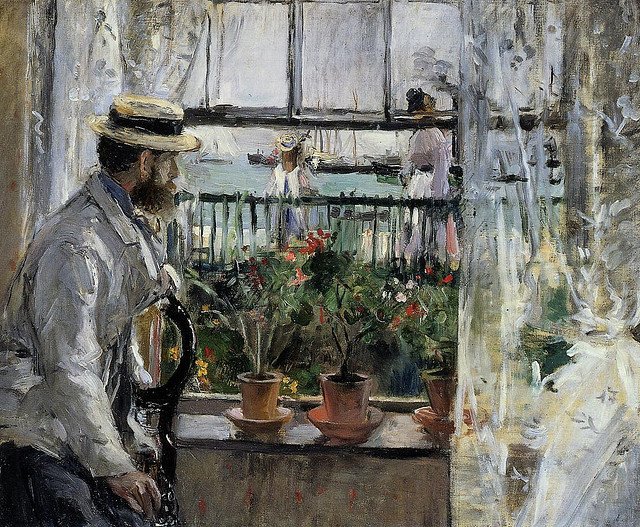


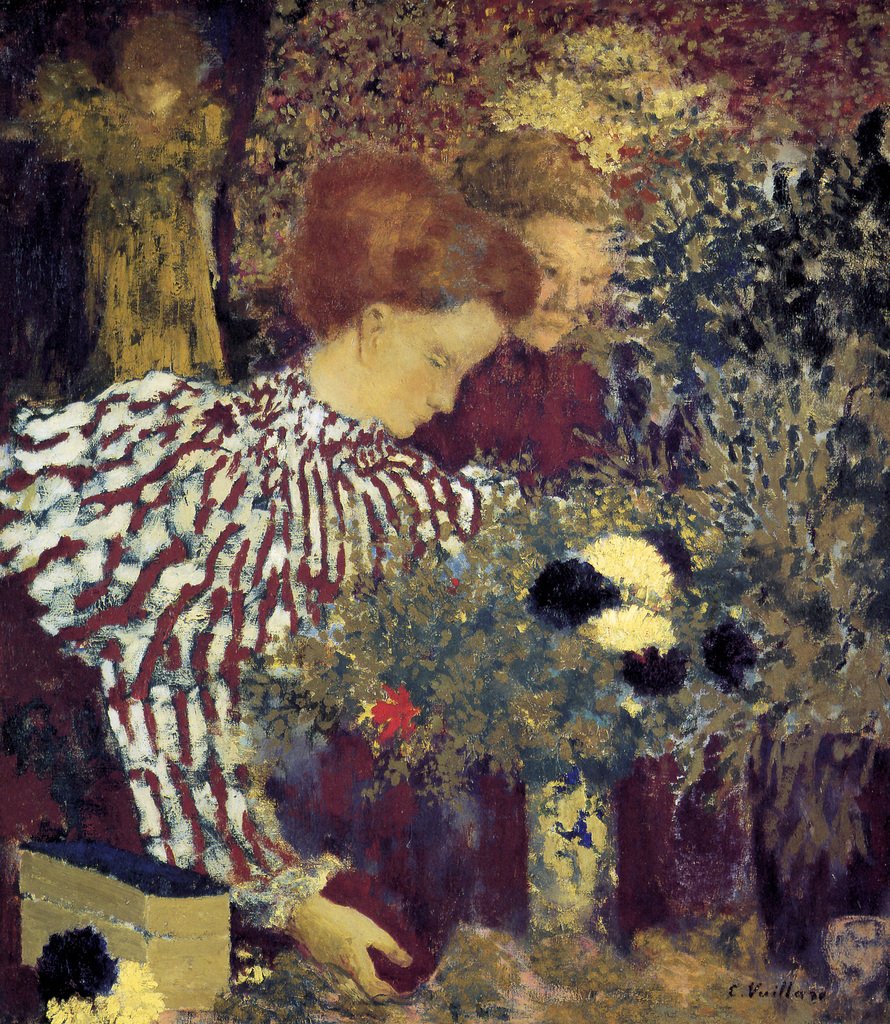
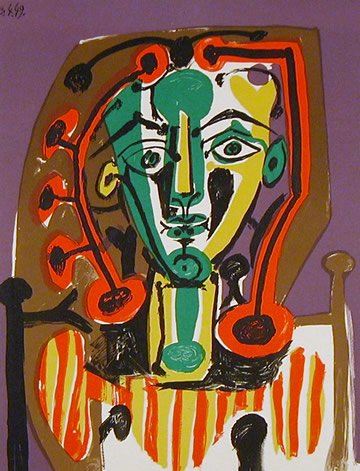

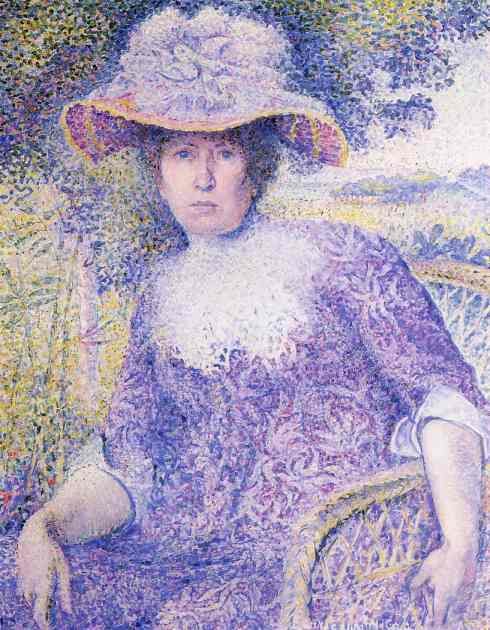

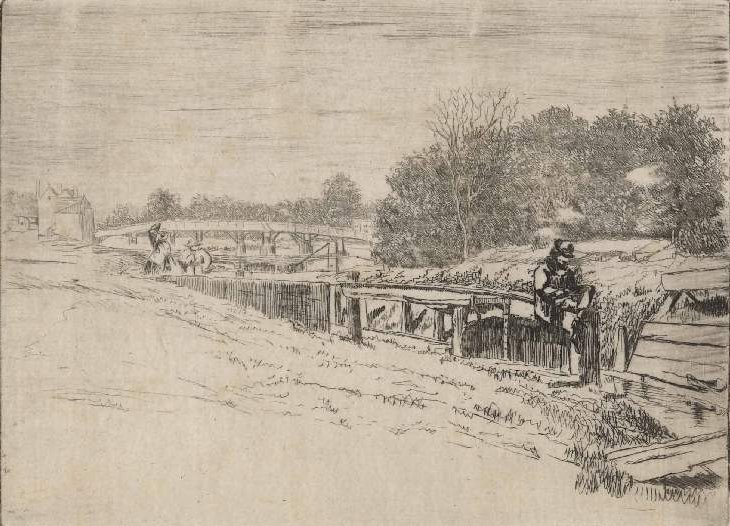
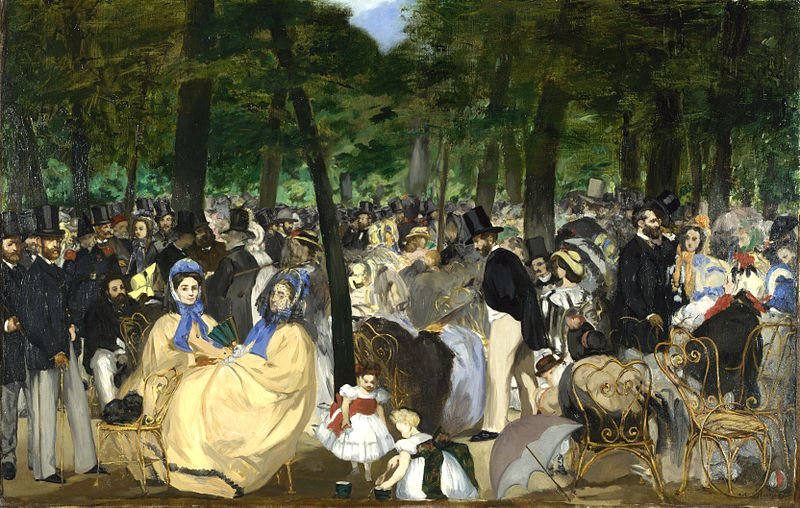
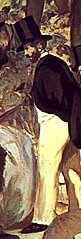
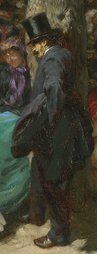
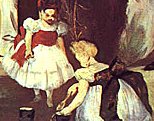
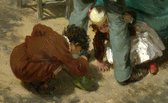

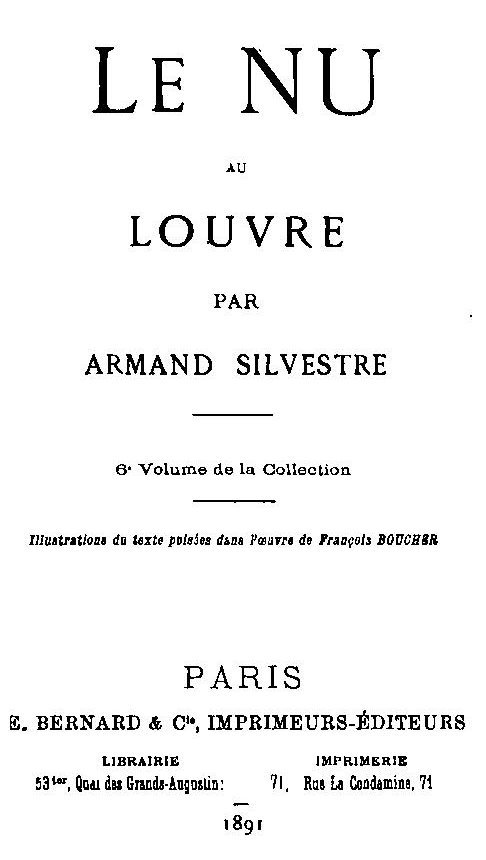


 my daily art display