Winter Scene by Joos de Momper

Winter Scene by Joos de Momper (c.1630)

“…Why, sir, Claude for air and Gaspar for composition and sentiment; you may walk in Claude’s pictures and count the miles. But there are two painters whose merit the world does not yet know, who will not fail hereafter to be highly valued, Cuyp and Mompers…”

Richard Wilson

In an earlier blog about the Welsh landscape painter, Richard Wilson, I told you how he believed that although the landscape works of Claude Lorrain and Gaspar Dughet were lauded, he spoke about the, as yet, unknown talents of Aelbert Cuyp and Joos de Momper and so I thought it was time to take a look at the life of Joos de Momper the Younger and one of his greatest works.

Joos de Momper also known as Josse de Momper was born in 1564 in Antwerp.  He was just one of an outstanding artistic dynasty.  His great grandfather, Jan de Momper I,  was a painter in Bruges; his son, and our featured artist’s grandfather, Josse de Momper I, was also known as an artist and dealer who moved from Bruges to Antwerp, where his son, and Joos’ father,  Bartolomeus de Momper , inherited both occupations, as well as being an engraver. Bartholomeus’s sons Josse de Momper II and Jan de Momper II were both landscape painters, but Josse the younger, today’s featured painter, was the exceptional artist of the family.

He received his initial artistic training under the guidance of his father, Bartholomäus de Momper.   In 1581, when he was seventeen years of age, de Momper’s father, who was at that time Dean of the Antwerp painters’ guild, The Guild of St Luke, enrolled him as a vrijmeester (master) into that association.   It is believed that around this time Joos travelled to Italy.  Records show that an artist in Treviso, Lodewijk Toeput, was his teacher .  Another reason for believing that the young artist had visited Italy is that so many of his paintings featured mountain scenes and as he spent most of his life in Antwerp, to have such a knowledge of mountains, almost certainly meant that he had at one time crossed the Alps into Italy.   So did he go to Italy?   A further clue to whether de Mompers was ever in Italy came in 1985  when the frescoes in the church of San Vitale in Rome, previously attributed to Paul Bril, were attributed to Joos de Momper the Younger.

Records show that in 1590, the twenty-six year old artist was back in Antwerp as it was in this year and in this city that he married Elisabeth Gobyn.  The couple had ten children.  The painting dynasty was to continue with two of the  couples’ sons, Gaspard and Philips both becoming notable artists.  Gaspard de Momper and Philips de Momper I,  both became painters although little is known of their work, except that Philips executed the figures in some of his father’s paintings; he also spent some years in Rome, where he had travelled with Jan Breughel the Younger

 In 1594 De Momper collaborated with two other Flemish painters Adam van Noort and Tobias Vwerhaecht as well as the Flemish architect Cornelis Floris on the decorative programme to celebrate the entry of the Archduke Ernest into Antwerp.   Shortly after this de Momper was invited to become one of the Archduke’s court painters, a position he took up at the court of the Archduke and Archduchess Albert and Isabel Clara Eugenia, the sovereign rulers of the Spanish Netherlands. In 1611, de Momper was made Dean of the Guild of St Luke in Anterp.

Most of de Momper’s paintings, like the one we are going to look at today, featured landscapes and his work was very well received. His landscapes were sometimes topographically accurate whilst others would be idealised fantasy ones, but all sold well.    His work was highly regarded and he is considered to be the most important Flemish landscape artrist of his time.  The timeline of great Flemish painters puts him coming after Pieter Bruegel, whose works greatly influenced him, and before Peter Paul Rubens.  

My Daily Art Display today features a painting simply entitled Winter Landscape and was painted by Joos de Momper the Younger around 1630 and can now be seen in the North Carolina Museum of Art.  This is a winterscape with a number of figures,  which were believed to have been painted, not by de Momper, but by Pieter Bruegel’s son Jan.  I love this work as it is so “busy”.  Besides the beauty of the landscape in winter we have a dozen people depicted carrying on with their daily duties.  Pieter Brueghel the Elder’s influence is clearly evident in this winter landscape.    Joos de Momper was known for his use of Mannerist colors in many of his landscapes, but in the more realistic pictorial representations, such as today’s painting, he used more natural colors.   Momper’s has managed to deliver a scene with such aesthetic appeal. 

Woman by cart

In this village landscape before us, the houses and people, which in his mountain landscapes were mere accessories, are now in some way the main focus of our attention.   Look at the woman in red who stands by the cart.  Look how the artist has depicted her struggling and straining with an arched back to lift the barrel on to the cart.  Look how her face is reddened by the physical effort.  To the right of her we see a mother and two children in a line.  The mother is carrying a bundle of firewood on her head whilst her son tags behind with a token few sticks of kindling.  Following up at the rear is the young daughter, with her arms outstretched shrieking, as she is being left behind.

Man with baskets

It is a scene full of activity and I love to cast my eyes around the painting to discover what is happening.  At the barn we see a man repairing a cart whilst the white horse stands passively to the side.  In the left midground we see a man bent over surveying what looks like two large wicker baskets.  I am not sure what he is doing but whatever is going through his mind, he seems fascinated by them.  Besides the people in the painting, look at the way the artist has elegantly painted the trees which have shed their leaves and which stand tall and unbowed in this cold but still winter’s day.

In the background on the right we have the nearby town.  It is separated from our main scene by a river, the water of which seems partly frozen over.  Fishermen are at the river trying to catch something for their meal in the small parts that have yet to be frozen. 

Town and bridge

The way to the town is accessed by a small wooden bridge and we see a man with his dogs making his way over it and heading into town..

I hope you have enjoyed this painting and thanks to Richard Wilson, I have discovered a new Flemish artist and one day I will return to him and look at another of his works.

Finally my thanks go to Universal Pops’ Photostream on Flickr for the details of the painting.  His photographic site is quite amazing and well worth a visit.
http://www.flickr.com/photos/universalpops/

King Edward VI by William Scrots

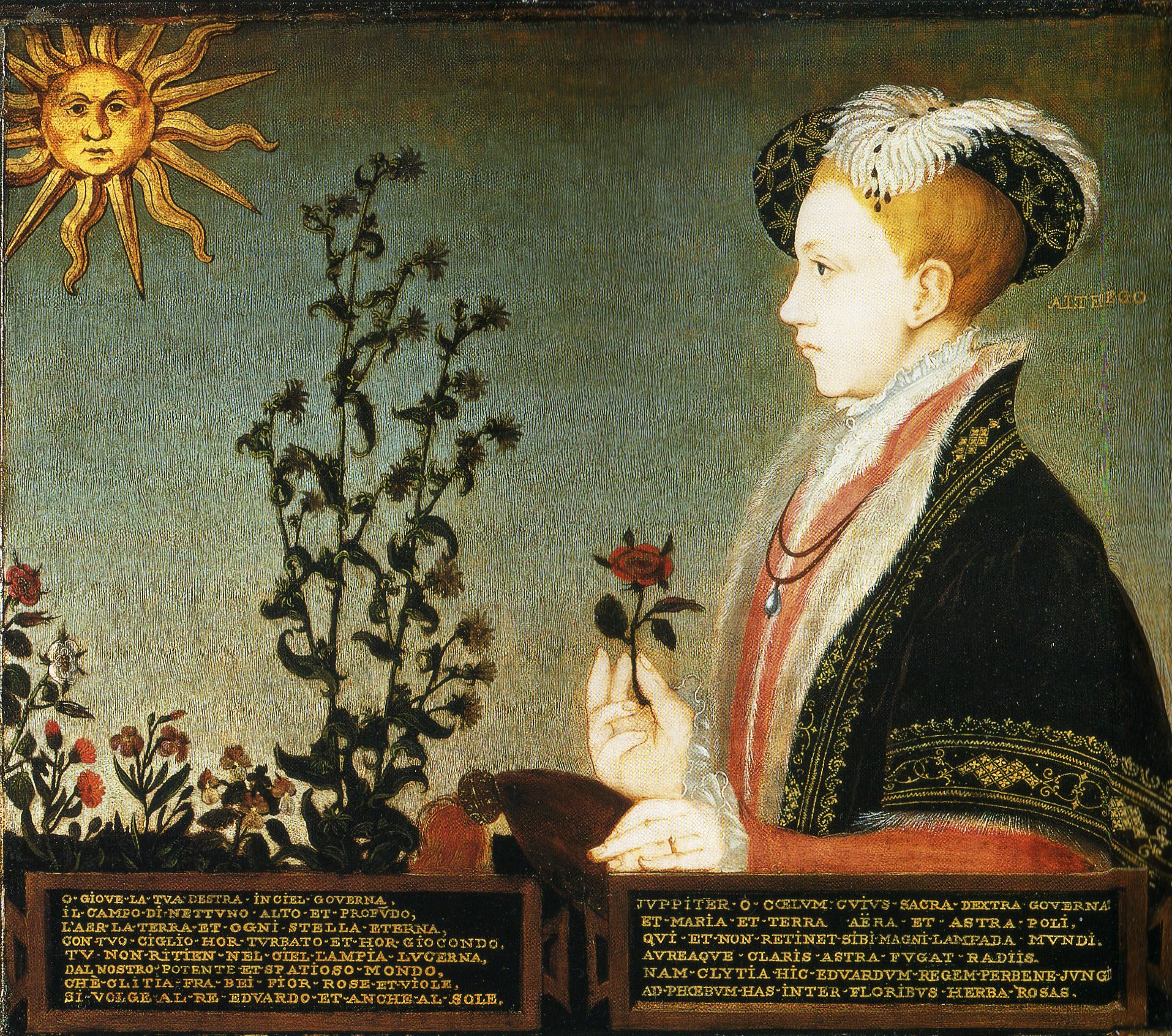
King Edward VI by William Scrots (c.1550)

Let me start  by tantalising you and declaring that today My Daly Art Display is about three people, a young English king who came to the throne aged nine and died six years later, a Netherlandish portrait painter who became the King’s painter and finally a former chairman of an English Premier League football club.   Has that wetted your appetite to read on?

The king in question, who we see in the painting, was King Edward VI, the son of Henry VIII and his third wife, Jane Seymour.  Edward was born in October 1537 just over nine years before his father died and the crown passed to him.  Although he was the first son of Henry he was the third child of the monarch.  Henry VIII’s first child was Mary, born in 1516, whose mother was his first wife, Catherine of Aragon.  His second child was his daughter Elizabeth, born in 1533, his mother being Henry’s second wife Anne Boleyn.  However Henry didn’t want a girl to succeed him so he got Parliament to pass three Succession Acts, the First Succession to the Crown Act of 1534 disbarred Mary becoming Queen of England on the grounds that she was a bastard leaving the yet unborn Elizabeth the true successor.  However in 1536 with the execution of Anne Boleyn, the mother of Elizabeth, Elizabeth was declared also to be a bastard and Henry’s parliament passed the Second Succession to the Crown Act of 1536 which barred her from succeeding him to the throne of England.  At this time Henry had no heir although he had just married his third wife Jane Seymour and Edward had yet to be conceived.  In 1543 it all changed again when Henry had his Parliament pass a Third Act of Succession which made his son Edward the legitimate successor to his throne with Mary and Elizabeth reinstated as second and third in line.  Henry VIII died four years later and the nine year old Edward became King Edward VI.  His reign lasted just six years as at the age of fifteen he contracted tuberculosis and died.

The second person involved in this painting was the painter himself, William Scrots.  Little is known of his early life but he came to light as the court painter to Mary of Habsburg, the Regent of Netherlands in 1537.  We also know that Scrots travelled to England around 1545 where the following year he became the court painter of Henry VIII in succession to Hans Holbein.  It is believed that his annual salary for this position was £62. 10 shillings, double what Holbein had been receiving.  After Henry’s death in 1547 he remained as court painter to the young Edward.  Scrots painted a number of portraits of Edward VI, one of which is today’s featured painting.

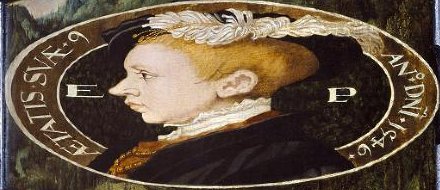
Anamorphic portrait of Edward VI by William Scrots

It is interesting to note that Scrots painted an anamorphic profile of Edward VI, which is a painting which looks totally distorted unless viewed from a certain angle when what is depicted becomes clear.   His predecessor Holbein had painted The Ambassadorsin 1533, in which he included a distorted shape of a skull lying diagonally across the bottom of the painting and which can only be recognised as such if viewing it from a very acute angle.

Anamorphic portrait as seen from an acute angle

My Daily Art Display featured oil on panel painting is simply entitled King Edward VI and Scrots is thought to have painted it around 1540.  It is an unusual portrayal of the monarch as it is one in which the sitter is seen in profile.  It is awash with detailed iconography.  We see in the painting both a red and white rose which symbolised the Houses of Lancaster and York respectively, the two great English dynasties, which were united by Edward’s grandfather, Henry VII.   The Latin inscription below the portrait speaks of Phoebus, the sun, and Clytia, the sunflower, both of whom feature in Ovid’s Metamorphoses. Ovid relates how Apollo turned the Princess Clytia into a sunflower as punishment for exposing his romance with her sister Leucothea.  Look at the sunflowers in the painting.  Normally they would turn and face the sun but in this portrait they have their “backs” to the sun and face the boy-king, which was probably meant to symbolise the power and influence of the young man.  It is believed the portrait was commissioned by the Stanhope family who were related to Edward’s uncle and chief minister, Edward Seymour who was for a time also the Lord Protector.  The painting remained in the Stanhope family until 2004.

And so to the third person connected to this painting, the former Premier League football chairman.  As I have just said the painting remained in the Stanhope family for over four hundred and fifty years until 2004 when it was auctioned by Sothebys.  This painting was considered to be one of the most significant sixteenth-century paintings ever to have come up for sale.  It was purchased for £700,000  by the Peter Moores Foundation for Compton Verney.  Sir Peter Moores is a British businessman, art collector and philanthropist, a former chairman of the Liverpool-based Littlewoods football poolsand retailing business in the UK and was briefly the Chairman of Everton Football Club.

So there you have it – a fascinating oil on panel painting, a tale of three men;  a boy-king, an artist and an ex football chairman.   What more could you ask for?

The Effects of Intemperance by Jan Steen

The Effects of Intemperance by Jan Steen (c.1665)

I have featured many paintings, mainly by Dutch or Flemish artists, which try and have an embedded moral message in their works of art.  Often it is about the dangers of drinking too much, which is a subject painters from our present time may find very topical.   My Daily Art Display today features one such 17th century painting entitled The Effects of Intemperance by the Dutch painter Jan Steen.

Jan Havickszoon Steen was born in 1626 in Leiden a town in the Netherlands and was a contemporary of the great Rembrandt van Rijn.  He received his artistic education from the German painter of the Dutch Golden Age, Niclaes Knupfer who gained a reputation for his historical and figurative scenes of Utrecht.  At the age of twenty-two Steen joined the Saint Lukes Guild of Painters in Leiden.  Steen then moved to The Hague where he lodged in the household of the prolific landscape painter Jan van Goyen.  Soon after, he married Margriet, the daughter of van Goyen.  Jan and his father-in-law worked together closely for the next five years.  Then he moved and went to live in Warmond and later Haarlem.  His wife died in 1669 and his father-in-law passed away a year later.  Steen returned to Leiden re-married and had two children and remained there until his death in 1679 at the age of  53.
So back to today’s featured painting which is a pictorial moral tale of the dangers of insobriety.  The painting illustrates well the Dutch proverb “De Wijn is een spotter” translated means: Wine is a mocker, in other words wine (or drinking it in excess) will make a fool of you.  Although we see the children misbehaving the onus of guilt is placed squarely on the shoulders of the adults.

The main character of the painting is a woman who we see sitting slumped on the steps of her house sleeping off the effects of having drunk too much alcohol.  The overturned flagon of wine lies on the floor and despite the noise and antics of the children she doesn’t wake.   She is being portrayed as the neglectful mother.  She is totally unaware of what is happening around her.  However, she is no peasant.  Look at her clothes.  These are not ragged and threadbare.  The fur-trimmed jacket, in fact, looks both expensive and stylish.  Maybe the moral of the tale is that an excess of alcohol can affect rich and poor alike.  Her comatose state is going to cause a disaster as we see that her lit pipe is just about to slide from her fingers on to her dress.  The hem of her dress rests perilously close to the rim of the small clay brazier by her side which she has been using to keep her pipe alight and soon her clothes will surely catch fire.  It should also be remembered that at this time in the Netherlands most houses were of wood construction and fire had become a great hazard of life for those living in these dwellings.

The child behind her is stealthily filching the purse from the pocket of her dress, watching her carefully in case she stirs.  Again we are reminded of the Dutch proverb which states “opportunity makes the thief”.  This painting, in some ways,  mirrors Pieter Bruegel’s Netherlandish Proverbs but on a smaller scale.    Look at the girl kneeling in front of the comatose woman. Maybe it is her eldest daughter.  She is offering the parrot a drink of wine from a glass.  The girl looks unsteady and her face is flushed.   Maybe she too has imbibed to excess.  Are we being reminded that the sins of the mother will be passed on to the child?

Next to the mother we see a boy clutching a bunch of roses.  He is throwing them to the pig which is busy snuffling around the legs of the woman in search of food.  We know of the biblical proverb “ Nether caste ye youre pearles before swine”  meaning that it is a worthless gesture of offering items of quality to those who aren’t cultured enough to appreciate them.  However the Dutch proverb doesn’t talk about pearls but instead – rose buds.  So what we are seeing in the painting is the rose-strewn pig, which simply symbolises how people waste what they have.

To the right of the mother we see three small children feeding a meat pie to the cat.  Again, this is highlighting the folly of waste.  It is interesting to note what is hanging above the drunken woman’s head.  It is a basket, in which there is a pair of crutches and a birch.  This is to be a reminder of what happens if you throw money away and mismanage your finances.  The crutch is a reminder of life as a beggar and the birch is a salutary warning of what happens if you are hauled to court because of bad debts.  Look back at My Daily Art Display of February 16th and Jan Steen’s painting entitled In Luxury, Look Out,  in which  the artist had depicted a similar scenario and the same moral tale that is being depicted by the artist in today’s painting.  In it we can see the same basket hanging above the miscreant.

Take a look at the background on the right hand side of the painting.  Here we see a man, maybe the husband of the drunken woman, sitting in the garden on a bench with a buxom young serving wench on his knee.  He is oblivious to what is going on around him and prefers to carouse with the young girl.

The Dutch painter and biographer of artists from the Dutch Golden Age, Arnold Houbraken, wrote about Jan Steen, recording that the household of Steen himself was both “riotous and disorganised” and that Steen, not being able to bring in enough money from his paintings ran an inn but Houbraken cynically pointed out that Steen’s best customer was himself!  However maybe the facts do not bear out the biographer’s assertions for Steen completed over 1400 pictures in a span of 30 years,  so could he possibly have had time to waste by drinking in his inn?  In yesterdays offering I spoke about artists liking to incorporate their own image into their paintings and Steen was no different.  He would even add his wife’s image into some of his bawdy pub scenes and she, rather than being flattered by her inclusion, would claim that her husband was always showing her as a “horny tart, a matchmaker or a drunken whore”!  It could be that she was the model for the drunken woman in today’s painting.

The chaos which reigns in this painting is similar to the themes in many of his household scenes and “a Steen household” is a Dutch phrase which means a household which is a badly managed and in total chaos.