Élisabeth-Louise Vigée Le Brun and Marie Antoinette

Marie-Antoinette of Austria, Queen of France
by Élisabeth Vigée Le Brun (1778)

I had intended this blog to be the concluding look at the life and some of the works of Élisabeth-Louise Vigée Le Brun but instead I am just concentrating this blog on a couple of the portraits Élisabeth did of the Queen consort Marie Antoinette and look at Élisabeth’s life up to her forced exile from France.  My next blog will conclude Élisabeth’s life story.

At the end of my last blog we had reached 1775 and Élisabeth’s step father had retired from his jewellery business and the family had moved to an apartment in a large property, Hotel de Lubert, which was situated on the rue de Clery.    The Hotel de Lubert was also where the painter and art dealer Jean-Baptiste Pierre Le Brun had his gallery.  Soon after settling into her new home, Élisabeth took a great interest in the beautiful masterpieces which filled Le Brun’s apartment and gallery.   She recalled this time in her memoirs saying:

“…I was enchanted at an opportunity of first-hand acquaintance with these works by great masters.  Monsieur Lebrun was so obliging as to lend me, for purposes of copying, some of his handsomest and most valuable paintings. Thus I owed him the best lessons I could conceivably have obtained…”

Six months after moving in to her new home Le Brun proposed marriage to Élisabeth.   She was not physically attracted to him but was concerned about her family’s financial future, hated living with her stepfather and after much persuasion from her mother, who believed Le Brun was very rich, agreed to Le Brun’s proposal.  Even on her wedding day on January 11th 1776, Élisabeth had her doubts about the wisdom of her decision for she later wrote:

“…So little, however, did I feel inclined to sacrifice my liberty that, even on my way to church, I kept saying to myself, “Shall I say yes, or shall I say no?” Alas! I said yes, and in so doing exchanged present troubles for others…”

Élisabeth’s fears were soon borne out for although she termed her husband as being “agreeable” he had one great character flaw – he was an inveterate gambler and soon his money and that which Élisabeth earned from her commissions was frittered away.  However before the money had run out, Élisabeth and her husband bought the Hotel de Lubert in 1779, and her Salons, which she held there became one of Paris’ most fashionable pre-revolutionary venues for artists and the literati.  Two years later, on February 12th 1780, her only child Jeanne Julie Louise was born.   In 1781 she and her husband left Paris and journeyed to Flanders and the Netherlands and it was during this trip that she saw some of the works by the great Flemish Masters and these paintings inspired her to try new painting techniques. During their time in Flanders she carried out various portraiture commissions for some of the nobility, including the Prince of Nassau.

It was back in the year 1779 that Élisabeth first painted a portrait of Marie-Antoinette, Louis XVI’s queen consort.  It was at a time when the lady had reached the pinnacle of her beauty.  In her memoirs Élisabeth described Marie-Antoinette:

“…Marie Antoinette was tall and admirably built, being somewhat stout, but not excessively so. Her arms were superb, her hands small and perfectly formed, and her feet charming. She had the best walk of any woman in France, carrying her head erect with a dignity that stamped her queen in the midst of her whole court, her majestic mien, however, not in the least diminishing the sweetness and amiability of her face. To anyone who has not seen the Queen it is difficult to get an idea of all the graces and all the nobility combined in her person. Her features were not regular; she had inherited that long and narrow oval peculiar to the Austrian nation. Her eyes were not large; in colour they were almost blue, and they were at the same time merry and kind. Her nose was slender and pretty, and her mouth not too large, though her lips were rather thick. But the most remarkable thing about her face was the splendour of her complexion. I never have seen one so brilliant and brilliant is the word, for her skin was so transparent that it bore no umber in the painting. Neither could I render the real effect of it as I wished. I had no colours to paint such freshness, such delicate tints, which were hers alone, and which I had never seen in any other woman…”

Both the artist and sitter formed a relaxed friendship and in her first portrait (above) the queen is depicted with a large basket, wearing a satin dress, and holding a rose in her hand. The painting was to be a gift for Marie-Antoinette’s brother, Emperor Joseph II, the Holy Roman Emperor, and a further two copies were made, one of which she gave to the Empress Catherine II of Russia, the other she would keep for her own apartments at Versailles.  In all, Élisabeth painted more than thirty portraits of the queen over a nine year period

Élisabeth’s friendship with Marie-Antoinette and her royal patronage served her well as in 1783,  her name had been put forward by Joseph Vernet for election to France’s Académie Royale de Peinture et de Sculpture.   As her morceau de réception (reception piece) she submitted an allegorical history painting entitled La Paix qui ramène l’Abondance (Peace Bringing Back Prosperity).  She also submitted a number of her portraits. The Académie however did not categorise her work within the academy categories of either portraiture or history.  Her application for admission was opposed on the grounds that her husband was an art dealer, but because of Élisabeth’s powerful royal patronage, the Académie officials were overruled by an order from Louis XVI.  It is thought that Marie Antoinette put considerable pressure on her husband on behalf of her painter friend.

Having royal patronage and being great friends with Marie-Antoinette was a boon when the Royalty was loved by its people but once the people turned against Louis XVI and his queen, as happened during the French Revolution, then any friends the royal couple had were equally detested and at risk from the mob.  Attacks on Élisabeth Vigée Le Brun’s character had started back in late 1783 when the newspapers wrote stories about an alleged affairs she had with the Finance Minister, Charles Alexandre, Vicomte de Calonne, the Comte de Vaudreuil and the painter François Menageot.  The rumours persisted and it all came to a head in 1789 when fictitious correspondence between Élisabeth and Calonne was published in the spring.  Rumours about her lavish lifestyle abounded, even though they were not altogether true.  She was now starting to realise that having close connections to the monarchy, which she had once considered to be advantageous, was becoming a dangerous liability.
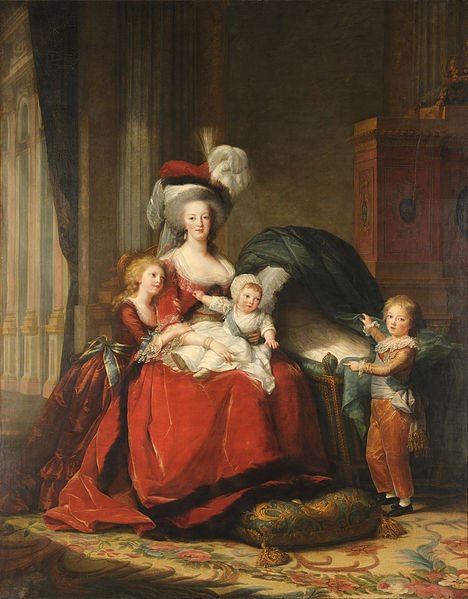
Marie Antoinette and her Children
by Élisabeth Vigé Le Brun (1788)

Élisabeth Vigée Le Brun’s last portrait of Marie-Antoinette was completed in 1788 and entitled Marie Antoinette and her Children.  The setting is a bedroom or a private chamber within the Royal palace.  Marie Antoinette is seated with her feet on a cushion.  This depiction of her posture symbolizes her status and high position in society.  She has a young infant on her lap and her son and daughter are either side of her.  In the painting we see her son, Louis-Joseph, Le Dauphin, standing to the right. Louis-Joseph suffered from bad health all his young life with the onset of early symptoms of tuberculosis and he died of consumption in 1789, a few months before his eighth birthday.   On the Queen’s lap sits Louis-Charles, Duc de Normandie, who on the death of his elder brother, became the second Dauphin. Following the guillotining of his father Louis XVI,  he became known as Louis XVII. This young boy was imprisoned in The Temple, a medieval Parisian fortress prison, where he died in 1795, aged ten, probably from malnutrition but rumour also has it that he was murdered.  Standing on the Queen’s right is Marie Therese Charlotte de France, Madame Royale.  She was Marie-Antoinette’s eldest child.  She too was imprisoned in The Temple but was the only member of the Royal family to survive the ordeal.  She remained a prisoner for over a year but Austria arranged for her release in a prisoner-exchange on the eve of her seventeenth birthday, in December 1795.  In the painting we can also see depicted an infant’s cradle which Louis-Joseph points to and lifts the covers showing it as being empty.  This empty cradle is a reference to Princess Sophie, Marie Antoinette’s other daughter, who was born in 1786 and died of convulsions two weeks before her first birthday.  This very poignant painting still hangs at Versailles.

On the night of October 6th 1789, following the invasion of Versailles by Parisian mobs and the arrest of the royal family, Élisabeth Vigée Le Brun left the mayhem of Paris with her daughter and governess in a public coach and headed for Italy.  She had hoped to return to France in the near future when the situation had settled down but in fact she never set foot back in France for twelve years.

My next blog will look at the latter part of Élisabeth’s life and I will regale you with my tale of infidelity which was the reason for featuring Élisabeth-Louise Vigée Le Brun in the first place !!


Self Portraiture by Élisabeth-Louise Vigée Le Brun

Over the next two blogs I want to introduce you to and look at the life of one of the finest 18th century French female portraitist, Élisabeth-Louise Vigée Le Brun.  In my initial blog about her I want to examine her early life and show you three of her self portraits and in the following blog I will conclude her life story and tell you about her friendship with Marie-Antoinette, her exile from the land of her birth and relate how I was once again unfaithful having been seduced by a new beauty !  Sounds interesting ?

Self Portrait in a Straw Hat (age 22)
by Élisabeth-Louise Vigée Le Brun (1782)

Today’s artist was born Élisabeth-Louise Vigée in April 1755 on the rue Coquilliere in Paris, just six months before another baby girl was born in the palace of Emperors of Austria in Vienna, a priveleged child, who would become the queen of the French nation and also play a large part in Élisabeth’s life.  That Viennese baby was Marie-Antoinette.   But let me return to Élisabeth.  Élisabeth was the daughter of Louis Vigée, a portraitist and professor at the Academie de Saint Luc .  Her mother, Jeanne Maissin was a hairdresser by trade.  At the age of 3 months, she was sent to a small farm near Épernon, where she was looked after by relatives.  She stayed with them until she was six years old.  Following this, she attended the convent school, Couvent de la Trinite in the Faubourg Saint Antoine district of Paris, as a pensionnaire, (a boarder) where she remained until she was twelve years old.  It was here that she first displayed her young talent for drawing and painting.  In her memoirs she wrote about her time at the boarding school, her love of drawing and the trouble it often got her into but also the pleasure her father had in her interest in art.  She wrote:

“….During that time I scrawled on everything at all seasons; my copy-books, and even my schoolmates’, I decorated with marginal drawings of heads, some full-face, others in profile; on the walls of the dormitory I drew faces and landscapes with coloured chalks. So it may easily be imagined how often I was condemned to bread and water. I made use of my leisure moments outdoors in tracing any figures on the ground that happened to come into my head. At seven or eight, I remember, I made a picture by lamplight of a man with a beard, which I have kept until this very day. When my father saw it he went into transports of joy, exclaiming, “You will be a painter, child, if ever there was one!…”

On returning to live at home on a permanent basis, her father gave Élisabeth her first drawing lessons when she was allowed to attend his drawing classes which he gave to students in his studio.  Sadly his tuition did not last long as Louis Vigée died on May 9 1767 in his apartment on the rue de Clery.   To lose her father at the age of twelve was a traumatic experience for Élisabeth and she recalled the moment:

“…I had spent one happy year at home when my father fell ill. After two months of suffering all hope of  his recovery was  abandoned. When he felt his last moments approaching, he declared a wish to see my brother and myself. We went close to his bedside, weeping bitterly. His face was terribly altered; his eyes and his features, usually so full of animation, were quite without expression, for the pallor and the chill of death were already upon him. We took his icy hand and covered it with kisses and tears. He made a last effort and sat up to give us his blessing. “Be happy, my children,” was all he said. An hour later our poor father had ceased to live…”

Self Portrait with her Daughter (Maternal tenderness)
by Élisabeth-Louise Vigée Le Brun (1786)

Élizabeth’s father had, on his death, left the family penniless and his widow had to find ways of clearing their debts and pay for her son’s schooling and it is with that in mind that, in December of that same year, 1767, she married a wealthy jeweller, Jacques François Le Sevre and the family moved to an apartment on the rue Saint Honore facing the Palais Royal.    However any thoughts she had that her rich husband would solve the family’s financial problems were soon dashed as he turned out to be miserly with his money and just provided the bare minimum for his wife and her son.  Élisabeth, by this time, had been earning her own money from commissions but was made to hand it over to her step-father for him to use as he saw fit.

Élisabeth began taking drawing lessons with her friend Blaise Bocquet from the history painter and Academician, Gabriel Briard, who had a studio in the Louvre.  During her training she copied the paintings of the Old Masters at the Louvre and the Palais-Royal, which housed the magnificent Orléans art collection, and during this period she encountered the French artist, Claude Joseph Vernet.  He would often give her artistic advice and encourage her and more importantly introduced her to prospective important and wealthy patrons.  She also met the Abbé Arnault, of the French Academy.  She later described him as a man of strong imaginative gifts, with a passion for literature and the arts and recalled how his conversation enriched her with ideas.     It was the studying of the Old Masters’ paintings which furthered her knowledge of anatomy, perspective, and the other important aspects of history painting which she was not allowed to formally study, simply because of her gender.  She spent a great deal of time copying the heads in some of the pictures by Rubens, Rembrandt and Van Dyck, as well as several heads of girls in paintings by Jean-Baptiste Greuze.  She was a great admirer of Greuze’s portraiture because, from them, she learnt about his use of  the demi-tints when portraying flesh colouring.

By this time Élisabeth had decided that her future lay in her art and she would strive to become a successful painter.  However her choice of career was problematic simply because she was a female.  As a female, she was excluded from formal academic training and artistic competitions and this factor alone gave her a distinct disadvantage in comparison to the training afforded to her male contemporaries.  At this time in France, the most prestigious type of painting was history painting but to achieve a reputation as a great history painter one had to undergo an all-embracing formal artistic education into the likes of the technique of painting the nude male and how to best arrange figures within a painting for it to be accepted as an acceptable narrative work.  However for reasons of modesty, females were not allowed to paint nude males and so as this formal training was not yet available to aspiring female artists, they had to settle for painting portraits, landscapes and genre works.  She now decided to specialise in portraiture.

Self Portrait with Daughter (à la Grecque)
by Élisabeth-Louise Vigée Le Brun (1789)

In 1774, aged nineteen, Élizabeth applied to join the Academy of Saint Luke where her father had taught. She was accepted and that year she exhibited several of her works at their Salon.  Her portraiture and the way in which she depicted her sitters in a flattering manner was very popular and much in demand.  In 1775 she married a wealthy art dealer and amateur painter, Jean-Baptiste-Pierre Le Brun.  The marriage was a marriage of convenience orchestrated by her mother.  Five years later, the couple had their only child, Jeanne Julie Louise, born on February 12th 1780.  It was not a love match, but more of a mutually-beneficial pact that benefitted them both.  .  Her husband marketed her work and endorsed her artistic career while also profiting from her artistic output.  It worked well and the couple became quite affluent and lived a luxurious lifestyle, which allowed them to mix socially with the highest circles of society. Soon Élisabeth and her husband would hold fashionable soirées at their home.  Their guests included artists, writers, and important members of Parisian society.  In 1776 she finally managed to achieve her ultimate aim.  She secured her first royal commission when she was asked to paint a series of portraits of King Louis XVI’s brother, the Comte de Provence.  Before long she even caught the attention of the king and queen themselves and Élisabeth was summoned to the court in 1778 to paint her first portrait of the Marie Antoinette. Marie Antoinette had had her portrait painted by many artists but neither she nor her mother, Marie-Thérèse were ever fully satisfied with the results.  However, they both approved of Élisabeth’s depiction which, although it admirably conveys her royal status, it was actually much more simplified and natural than most of the earlier official portraits of the queen.  This portrait marked the start of a close relationship between Élisabeth and Marie-Antoinette.  This relationship greatly enhanced the reputation of the artist and led to many wealthy commissions. Louis XVI was equally impressed by her artistic work and in Wendy Slatkin’s book, Women Artists in History, she quotes Louis XVI’s comments about Élisabeth and her work:

“…I know nothing about painting, but you have made me love it…”

Élisabeth was a devoted royalist and idolized Marie Antoinette and the rest of the royal family.  It was however this close friendship with Marie-Antoinette which was to alter the course of her life.

Portrait of Susan Lumsden by Rubens

I have included three self portraits in this intial blog about the artist Élisabeth-Louise Vigée Le Brun.   The first one entitled Self Portrait with Straw Hat was completed in 1782 and is held in a Swiss private collection.  Élisabeth exhibited this work at the 1783 Académie royale de peinture et de sculpture (Royal Academy of Painting and Sculpture), Paris.  Of this painting the artist wrote:

“…I was so delighted and inspired by Rubens’ Le Chapeau de Paille that I completed a self portrait whilst in Brussels in an effort to achieve the same effect.  I painted myself wearing a straw hat with a feather and a garland of wild flowers and holding a palette in one hand...”

For a more comprehensive look at Rubens’ Le Chapeau de Paille, also known as Portrait of Susanna Lunden go to My Daily Art Display of March 11th 2011.

Lady Hervey and her Daughter by Angelika Kauffmann

The second self portrait I have featured was completed by Élisabeth in 1786 and is entitled  Madame Vigée-Le Brun and Her Daughter, Jeanne-Lucie, known as Julie (1718–1819).  The painting is thought to have been inspired by a work by Angelika Kaufmann, entitled Lady Hervey and her Daughter which depicted Elizabeth Drummond, Lady Hervey and her daughter Elizabeth Catherine Caroline Hervey later to become The Honourable Mrs Charles Rose Ellis.  The work by Vigée Le Brun is one of maternal tenderness and is somewhat reminiscent of the sentimental pictures of Jean-Baptiste Greuze which Élisabeth had studied in her younger days.


The third portrait in this blog is entitled Madame Vigée-Le Brun et sa fille, Jeanne-Lucie-Louise, dite Julie (Madame Vigée-Le Brun and her daughter Jeanne-Lucie-Louise, known as Julie) and is often referred to as Self Portrait with Daughter (à la Grecque).  It is currently housed at the Louvre in Paris.

Bringing in the Maple Sugar by Grandma Moses

Bringing in the Maple Sugar by Grandma Moses (1939)

Grandma Moses – Part 2

This is the second part of my story about Grandma Moses and if you have just alighted on this page, you should go back to my last blog in which I looked at her early life.

I ended my last blog about Grandma Moses in the year 1927.  This was the year when her husband of almost forty years, Thomas Salmon Moses, died and Anna May Robertson Moses became a sixty-seven year old widow.  Following her husband’s death, she remained on her Mount Nebo farmstead along with her youngest son Hugh, who took over the running of the farm along with his wife Dorothy.  One of Grandma Moses’ other daughters, Anna, lived close by in the town of Bennington with her husband Frank, who was her first cousin, and their two children Walter and Thomas.   Anna had contracted tuberculosis and had become very ill.  Grandma Moses spent a lot of time with her and her family taking care of her two grandchildren.  Anna Moses died in 1933 and Grandma Moses stayed on at their Bennington home for the next two years looking after her son-in-law and his children.  This arrangement continued until 1935, at which time Frank Moses remarried and Grandma Moses was then able to return to her home.

Over those past years Grandma Moses found more time to carry on with her embroidery and needlepoint work.  Once when her sister Celestia came to Mount Nebo for a visit she saw some of her sister’s work and suggested that she should concentrate more on painting rather than embroidery.  This advice, together with the fact that Grandma Moses was suffering badly from arthritis of the hands, persuaded her to heed her sister’s advice and she began to concentrate all her artistic efforts, not in yarn but in oils.

I ended my last blog by mentioning Grandma Moses “big break” as far as her artistic opportunities were concerned.   This came in 1938 when her daughter-in-law, Dorothy persuaded her to let her take some of her embroidered work and painted pictures down to the Woman’s Exchange in the W.D. Thomas drugstore in Hoosick Falls and it was at this point that fate stepped in and took a hand,  for passing through the town during his Easter vacation was Louis Calder, a New York amateur art collector and engineer.  He spotted Grandma Moses’ works displayed in the drugstore window, priced between $3 and $5 and he bought them all.  He then enquired about the artist of his recent acquisitions and went to visit her.  He then bought a further ten of her works.

Louis Calder returned to New York and tried to interest people in Grandma Moses’ works.  There was little interest.  Somewhat despondent Calder had virtually given up hope of re-selling his newly bought acquisitions.  However the following year, 1939, he got to hear about an exhibition being held in the Members Room of the city’s Museum of Modern Art that was to open on October 18th and run for a month.  The exhibition was to be entitled Contemporary Unknown American Painters.  Calder went to the organiser of the show, Sidney Janis and showed him the works of Grandma Moses which he had just bought the previous year.   Janis agreed to exhibit three of the paintings, Home,  Maple Sugar Days and The First Automobile.   None of the paintings sold but Calder was not disheartened and contacted Grandma Moses urging her to produce further works for him.

In the meantime Louis Calder went on searching for prospective buyers for the paintings.  It was at the end of 1939 that he heard of a new gallery, Galerie St Etienne, which had recently been opened by Otto Kallir on Manhattan’s West 57th Street.   In 1938, Otto Kallir, then known as Otto Nierenstein, was one of Vienna’s most prominent Jewish art dealers but had fled the Nazi regime and emigrated to the United States.  He then, in 1939, established his gallery and helped to introduce Expressionism to America.   Later in the 1940’s and 1950’s, Kallir would give numerous important Austrian and German modernists, including Gustav Klimt, Oskar Kokoschka, Alfred Kubin, Paula Modersohn-Becker and Egon Schiele their first American exhibitions in his gallery.   Otto Kallir was known to be interested in folk art and primitive art and so Louis Calder arranged for him to see some of Grandma Moses’ art work.

One of the paintings which Kallir really liked was entitled Bringing in the Maple Sugar and it is this painting which I have featured in My Daily Art Display blog today.   Grandma Moses completed the work in 1839 and it depicts a sugaring-off scene in which people are collecting sap from the maple trees.  It is a winter scene set in a snow-covered clearing and we can see people busying themselves with the task in hand of collecting the precious tree sap to be used in making maple syrup.  Once the sap is collected in the buckets it is carried over and poured into kettles which dangle over fires.  Besides the hard-working adults in the scene, Grandma Moses has added the figures of children happily playing in the snow and waiting for some maple syrup candy which is being prepared by a man on the left who is busily stirring the pot.   To the right of the picture we can see a horse-driven sleigh loaded with timber which will be used to keep the fires burning.  In the left mid-ground we see a team of oxen approaching, pulling their sleigh full of wood.  It is a painting full of activity but what impressed Kallir most of all was not the way the artist had painted the figures, which he considered rather clumsy, but the way she had painted the landscape background.  He commented that although he believed Grandma Moses had never heard of any rules of perspective, she had managed to achieve an impression of depth in the way she had depicted the tall bare trees in the foreground to smaller ones in the background and the clearly outlined larger figures in the foreground to the smaller, hazy-detailed figures in the background.   He also liked how she had almost merged the smoke which billowed and rose from the chimney of the hut and the bluish gray sky of an early morning in winter.  For Kallir it was Grandma Moses’ ability to convey a true atmosphere and a oneness with nature that appealed to him.

Otto Kallir agreed to exhibit Grandma Moses’ works in a “one-man show” at his gallery.  It opened on October 9th 1940 and was entitled What a Farm Wife Painted and consisted of thirty-three of her paintings and one of her embroidered works.  The New York Times of October 8th previewed the exhibition and part of the article read:

“…Mrs Anna May Robertson Moses, known to the countryside around Greenwich, New York, as Grandma Moses, began painting three years ago, when she was approaching 80…”

From that day on Anna Mary Robertson Moses became known as Grandma Moses.

The Old Hoosick Bridge by Grandma Moses

The Old Hoosick Bridge by Grandma Moses (1847)

For the last few blogs I have been looking at the lives of artists who were taken from us at a very young age, and in very sad circumstances.   I looked at the lives and works of the French artist Fréderic Bazille and the English painter Brian Hatton both of whom gave up their lives for their country on the battlefield at the age of twenty-nine and in my last two blogs I showcased the life and work of the German Expressionist Paula Modersohn-Becker who died suddenly after giving birth to her first and only child at the young and tender age of thirty-one.  The three painters promised so much and we were cruelly robbed of their artistic talents.  For my next three blogs I wanted to lift spirits and talk about an artist who did not die young, in fact lived to the age of 101.  She is probably far better known in her native America than in the rest of the world.  Let me introduce you to Anna Mary Robertson Moses who became better known as Grandma Moses, the most famous of American naive painters.  Naive art is defined as art produced in more or less sophisticated societies but lacking or rejecting conventional expertise in representational skills.  It is art that is often typified by a childlike simplicity in the subjects it depicts and in its methodology.   There is often a lack of perspective, with objects being depicted the same size notwithstanding whether they are in the foreground or background.  Again, there is no diminishment in detail or strength of colour between objects in the foreground and the background.  There is a simplicity about this type of art and it has become ever more popular.

Anna Mary Robertson was born on September 7th 1860, on a farm in Greenwich, upstate New York.  She was the third of ten children born to Russell King Robertson, a flax grower, and Margaret Shannahan.    She had a simple and happy early life and she recalled those happy days some eighty-five years later in an autobiographical sketch of her early life which she wrote in 1945:

“…I Anna Mary Robertson was born back in the green meadow and wild woods, on a Farm in washington, Co., in the year of 1860, Sept 7, of Scotch Irish Paternal ancestry.   Here I spent my life with mother Father and Sisters and Brothers, those were my Happy days, free from care or worry, helping mother, rocking Sisters cradle taking sewing lessons from mother sporting with my Brothers, making rafts to float over the mill-pond, Roam the wild woods gathering Flowers, and building air castles…”

Her schooling was limited.  She attended a one-room schoolhouse with her brothers and sisters.  She said that schooling was just confined to three months in the summer and three months in the winter but few young girls went to school in the winter as it was so cold and they did not have enough warm clothing.   When she was twelve years of age, she left home and for the next fifteen years she earned a living as a “hired girl”, working at neighbourhood farms.  The work was often hard but she recounted how she benefited from the experience:

“….I left home to earn my own living as then was called a hired girl.   This was a grand education for me, in cooking, House Keeping, in moralizeing and mingleing with the outside world…”

Anna Mary Robertson
the bride (1887)

She spent time living with the Whitesides family who she liked and they looked upon her as one of their own.  They were an elderly couple, devout Presbyterians and every Sunday she would drive them to church in their horse and carriage.  The wife, who was an invalid, was quite ill and Anna for three years cared for her.   When she died she stayed and looked after the husband and his nephew and wife moved in to run the farm.  Anna stayed until Mr Whiteside died and after that just drifted away from the neighbourhood still working as a “hired girl”.

Thomas Salomon Moses
the bridegroom (1887)

In 1887, at the age of 27, she married Thomas Salmon Moses, a farmer by occupation, and the couple left the area for North Carolina, where they were going to run a horse ranch.  However they never made it to North Carolina as once they arrived in Staunton Virginnia, they were offered the chance to run a farm.  The farm had lost all its coloured workers after the war and people were desperate to employ others to fill their places They accepted the offer and lived there for a year before moving on to live and work on a six hundred acre dairy farm.  She wrote about her life there:

“… Here I commenced to make Butter in pound prints and ship to the White Sulphur Springs, W, Va.   I also made potato chips, which was a novelty in tho days, this we continued for several years…”

She gave birth to ten children, five of whom died in infancy. In a letter she looked back at that time with the birth and death of her children, writing:

“… Here our ten children were Born and there I left five little graves in that beautiful Shenadoah Valley…”

She, along with her husband and their five surviving children, Winona, Forrest, Lloyd, Anna and Hugh, left Virginia at the end of 1905 and moved north to the hamlet of Eagle Bridge in Rensselaer County, New York State which was not far from her birthplace.  The couple bought a farm, which was known locally as Mount Nebo, named after Moses’ biblical resting place and went into the dairy business, selling milk.  Over the years one of her daughters, Anna, got married and left home and two of her sons, Forrest and Lloyd, went to live on a farm which they had bought themselves.   In 1927 Anna’s husband Thomas died and their youngest son Hugh and his wife Dorothy took over the running of the farm.  Anna Mary Moses was then sixty-seven years of age.

You may find it strange that up to this point in my account of Anna’s life I have never mentioned her art.  I haven’t mentioned drawing lessons or her desire to be an artist.  The reason is quite simple – art never became a serious part of her life although her father, whol liked to draw,  would give her and her brothers paper and he would like to watch them all draw pictures and she would often colour her drawings using grape juice or juice from other berries.  However with all her work as a “hired girl” and later as a young wife she never had time on her hands to continue with her painting.  However, soon after her husband died  and she was becoming too fragile to carry on with her housework, she needed something to occupy her time, as she wrote in her autobiographical sketch:

“…Here Jan 15, 1927, my Husband died, my youngest son and wife taking over the farm,

Leaving me unoccupied, I had to do something, so took up painting pictures in worsted, then in oil…”

The Old Hoosick Bridge 1818
Embroidery by Grandma Moses

My Daily Art Display featured painting today is entitled The Old Hoosick Bridge which Grandma Moses painted in 1947.  The reason for featuring this work, although she painted it when she was 87 years of age, was that she had in her early days depicted a similar scene, but as a work of embroidery, which was entitled, The Old Hoosick Bridge, 1818. (above)   Initially Anna started making pictures out of worsted wool which she designed herself and were awash with very bright colours.  This scene was typical of her early works which were from memories of her early childhood and as a farmer’s wife.  The old covered bridges were landmarks in her early days but at the time she painted this picture the bridge had well gone.

In my next blog I will continue with her life story and recall how she got her big “break” as far as her art was concerned.

Self Portrait on her Sixth Wedding Anniversary by Paula Modersohn-Becker

Self Portrait on her Sixth Wedding Anniversary
by Paula Modersohn-Becker (1906)

My blog today concludes my look at the life of the German Expressionist painter, Paula Becker, later to become Paula Modersohn-Becker.   For her early life you should first read my last blog.

As I told you in that last blog, Paula moved to Worpswede and joined the other artists in 1898.   The artist colony provided her with a lot of inspiration.  She was influenced by resident artists such as Heinrich Vogeler, whose house, the Barkenhoff, was the centre of the artistic community.   She became great friends with the young sculptor Clara Westhoff and the poet Rainer Rilke, who in 1901 would marry Clara.  She also struck up a friendship with the young German painter Otto Modersohn and his wife Helene.  Otto and Helene Schröder had married in 1897 and their daughter Elsbeth was born the following year.

Paula quickly found her own artistic style, painting pictures of withdrawn farm children and elderly ladies whom she painted in poorhouses (see previous blog).   Paula from the outset had loved the peace and tranquillity at Worpswede but being still young, for remember, she was only twenty-two when she arrived at the artist colony, she still hankered after the excitement of city life.  So after more than twelve months at Worpswede she decided to head for the then art capital of the world – Paris.   She left Germany on December 31st 1899, the last day of the nineteenth century.   After settling in Paris she wrote a letter to her mother, in which she commented about the change of scene:

“…I see these Paris trips as a positive addition to the slightly one-sided life I lead here……………After 10 quiet months in Worpswede, I feel that immersing myself in a foreign city with all of its stimuli is something really essential for my life…”

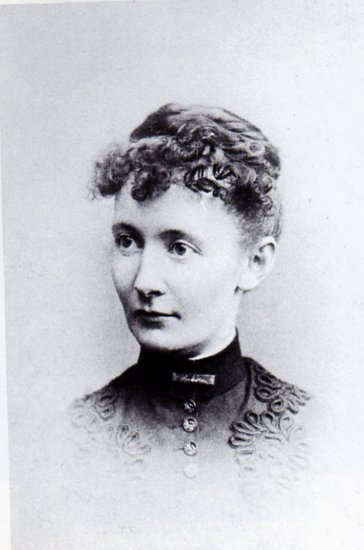
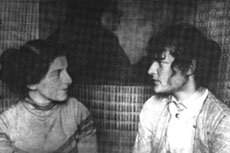
Clara Westhoff and Paula Modersohn-Becker

Paula was not alone in Paris as her friend, the sculptor from Worpswede, Clara Westhoff, had moved there the previous year hoping to study under August Rodin.     At first, life in Paris was difficult for Paula.  She lived in a small cramped attic room but she still embraced life in Paris with great enthusiasm and was determined to avail herself of an education in the arts, a thing which was still denied to women in Germany at the time.  Whilst in the French capital, Paula Becker studied at both the Académie Colarossi and the École des Beaux-Arts, and made numerous visits to the Louvre, all the time taking pleasure in absorbing the artistic life of the city. Through her friend Clara, she met and got to know sculptor Auguste Rodin. She made many visits to contemporary exhibitions and was deeply impressed by the works of the Post-Impressionists especially Paul Cézanne, Vincent van Gogh and Paul Gauguin.  She was also influenced by the strong colours used by the Fauve artists and the Realism style of Jean-François Millet.

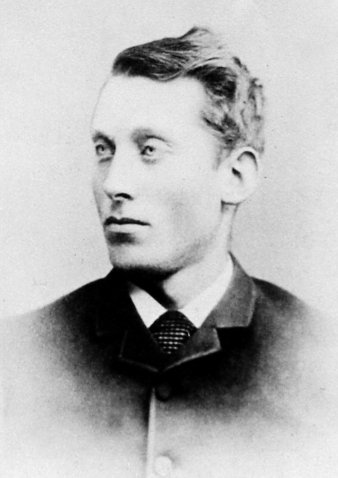
Otto Modersohn and Paula Becker

From April to November of 1900, Paris hosted a World Fair, known as the Exposition Universelle.  The reason for this great event was to celebrate the achievements of the past century and to accelerate development into the next.  Paula invited Otto Modersohn, who was still at Worpswede, to come with his wife and daughter and see the great exposition.  Otto Modersohn arrived in Paris in June along with another Worpswede artist, Fritz Overbeck, but he had had to leave his wife behind as she was unwell, suffering from tuberculosis.  Tragically she died whilst her husband was still in Paris.  He immediately returned to Worpswede to look after his one year old daughter.  Paula also returned to Worpswede and during the following year she and Otto Modersohn married and Paula became stepmother to his daughter, Elsbeth.

Paula could not settle back in Worpswede and was determined that she would have to return to Paris if she was to become a serious painter.   Her husband was very unhappy with her decision to leave him despite her promising to return to Worpswede on frequent visits.  So although married, she abandoned her husband, despite his protestations, and returned to Paris.  On arriving in Paris she recorded her thoughts about what the future held for her:

“…Now I have left Otto Modersohn, I stand between my old life and my new one. What will happen in my new life? And how shall I develop in my new life? Everything must happen now…”

These long periods living away from Otto put pressure on their marriage and after a few years the marriage was all but over and they continued to live separate lives.  In 1907 she returned to Otto in Worpswede and it appeared that the two had reconciled.   Paula became pregnant and bore a child, a daughter Mathilde.  Mathilde (Tillie) Modersohn was born on November 2nd 1907.  Otto and Paula were delighted with their new arrival but their joy was short lived as less than three weeks later, on November 20th 2007, Paula Modersohn-Becker died from a post-natal embolism.  She was just thirty-one years of age. Sadly, that same month Paula’s mother died of a heart attack.

My Daily Art Display’s featured painting today is one Paula completed in Paris in May 1906.  It is entitled Self Portrait on her Sixth Wedding Anniversary.  It is an unusual study as one needs to remember that at the time she painted this picture, she was not pregnant.  On the contrary, she had been reported as saying that, at that time in her life, she was not ready to have children and certainly not a child with Otto!  So why did she depict herself “with child”?  I do not know the answer to that but I read one article the other day in which the author states:

“….Paula was not pregnant in this painting The painting, then, is a metaphor for how she felt about herself as a young artist: fecund, ripe, able for the first time in her life to create and paint freely in the manner that she wished. What she is about to give birth to is not a child but her mature, independent, artistic self…”

I will let you make your own mind up as to why she would want to depict herself as being pregnant.

In the painting, she has portrayed herself with the distended stomach of a pregnant woman but her breasts are small and pert and lack the fullness one associates with pregnancy.  It is a life-size portrayal, measuring 101cms x 70cms.  She stands before us, naked to the waist.  Her eyes are level with ours.  She stares out at us with her large brown eyes. Her auburn hair is parted in the centre and swept up into a chignon.    She half smiles.  Her expression is one of self-confidence.   She appears unabashed by her nakedness as she tilts her head to one side in a questioning gesture.  Her only clothing is a white cloth skirt which is loosely tied around her hips below her distended belly.  Her large hands lie above and below her belly.  It is as if she is framing and showcasing her pregnancy.  Around her neck, and lying between her breasts, is a necklace made up of lozenge-shaped amber coloured beads, which subtly glow against her pale skin.

There is a Gauginesque Tahitian look about the painting.   It is an unusual and a complex self portrait which she painted on the occasion of her sixth wedding anniversary to Otto Modersohn and we know that, at this time, their marriage was well and truly on the rocks and maybe that is why she signed the painting “PB” for Paula Becker, her maiden name and left out “Modersohn” her married name.

Almost a year after her death, Rainer Maria Rilke, the poet and husband of her friend Clara Westhoff wrote the poem Requiem for a Friend in memory of Paula. The poem itself is too long to add to this blog but I have attached the website URL below if you would like to read the full translation of this very moving poem.

http://www.paratheatrical.com/requiemtext.html

Her daughter Tillie, who died in 1998, aged 91, founded the Paula Modersohn-Becker-Foundation (Paula Modersohn-Becker-Stiftung) in 1978.  The Paula-Modersohn-Becker Museum in Bremen has the distinction of being the first museum devoted to the work of a female painter. Early in the 20th century, the patron and merchant Ludwig Roselius amassed a collection of the artist’s major works and this along with works from the Paula Modersohn-Becker Foundation bear out her importance as a pioneer of modern painting.

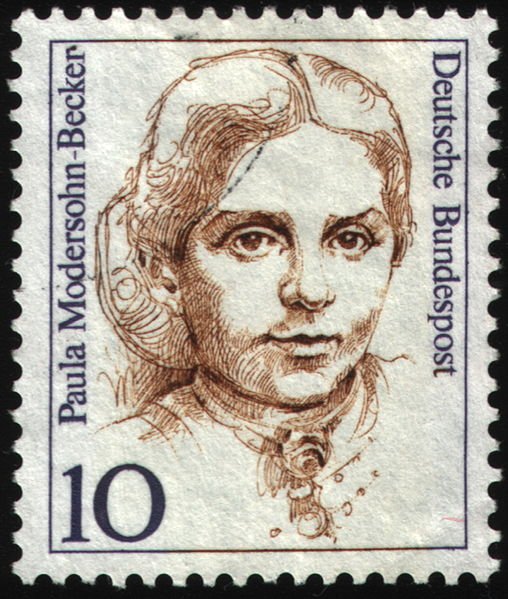
German Commorative stamp

In 1988 a stamp with the portrait of Paula Modersohn-Becker was issued in the series Women in German History by the German

The Forerunner by Eleanor Fortescue-Brickdale

The Forerunner by Eleanor Fortescue-Brickdale (1920)

Today I am going to continue looking at the life of Eleanor Fortescue-Brickdale and feature another of her paintings.   Whilst most of the Pre-Raphaelite Brotherhood continued to be household names even though it was more than a century after their deaths, not all those who followed in their footsteps are as well recognised today as they were at the height of their fame.

When Eleanor was growing up she would have been aware of the art of the Pre-Raphaelite Brotherhood as there were still commemorative exhibitions and books being published about their work.   There is no doubt that even at that early age the publicity surrounding the art work of the Pre-Raphaelite Brotherhood would have influenced Eleanor.   She was a painter, who continued the Pre-Raphaelite tradition, reworking romantic and moralising medieval subjects in naturalistic and often intense colour and elaborates detail.

In my last blog I had reached 1895 and Eleanor had just been accepted at the Royal Academy Schools in London having previously studied art at St John’s Wood School.   Whilst attending the Royal Academy School she met Byam Shaw and their friendship and working relationship endured for almost twenty-five years until his untimely death, aged forty-six in 1919.  Byam Shaw was a painter, decorator and illustrator, who was the same age as Eleanor, and had been born in Madras in 1872.   Byam was to become a big influence on her artistic work and like Eleanor he had been commissioned to do numerous pen and ink drawings and watercolours for books.

Whilst at the art school, Eleanor Fortescue-Brickdale won a £40 prize in 1896 for her design for the decoration of a public building and, the following year, she made her debut with a black and white work in the RA’s exclusive Summer Exhibition.  Following this success she progressed to colour illustrative work and by the end of the century she was making a name for herself as a painter with oils which she began exhibiting at the Royal Academy and in my last blog I featured the first oil painting she had exhibited there, entitled The Pale Complexion of True Love.  In 1899 she received a commission for a number of watercolours from Charles Dowdeswell who with his brother, Charles, were art dealers who owned the Dowdeswell and Dowdeswell art gallery in New Bond Street, London.   She completed the commission in 1901 by producing forty-five watercolours and her work was shown at the Dowedswell gallery under the Shakespearean title Such Stuff as Dreams are Made of.  The press greeted the exhibition as a spectacular success and her work was immediately likened to that of the Pre-Raphaelite Brotherhood painters of the 1850’s.  In the June 1901 issue of The Artist, her exhibition was reviewed:

“…Rarely, if ever has a woman painter made a great reputation as quickly and as thoroughly as Miss Eleanor Fortescue-Brickdale, whose series of watercolour drawings has, during last month, drawn the whole of artistic London to the Dowdeswell Galleries……She combines great technical skill with extremely felicitous, quaint imagination and rare poetic feeling…. [This exhibition] should be sufficient to secure her a leading position among the women artists of this country…”

All but two of her works were sold and with the money she received she acquired her own studio in Holland Park, in west London, which was the home of many artists.   This was to be her artistic base for the rest of her life.  She had been living at home with her sister Kate and her mother Sarah.  Her father had been killed in a climbing accident in the Alps in 1894.  In 1908 Eleanor, her mother and sister moved house and went to live in West Kensington where she would remain for the next thirty years.  Her mother died the following year.

Her name as an artist was indelibly made after the Dowdeswell exhibition and numerous journals and newspapers wrote about her and her work.  In 1905, despite the large number of painting commissions she received, she decided to take up teaching art and, along with her old artistic friends Byam Shaw and Rex Vicat Cole, taught one day a week at the art school of King’s College for Women. By 1909 these three were looked upon and advertised as leading the art courses at the college.  However the following year Cole and Shaw were disillusioned with the teaching at the college and, along with Eleanor, they left.  They set up their own art school known as the Byam Shaw School of Art.  Shaw and Cole were the joint principals and Eleanor Fortescue-Brickdale was in charge of the Watercolour and Composition sections.    In 2003, this school of drawing and painting was integrated with Central Saint Martins, but maintained its individual title and teaching approach.

Eleanor carried on with her work as an illustrator of books and was never short of commissions.  She was a hard and diligent worker.  Maybe she worked too hard as in the early 1920’s she was struck down with a long and unexplained illness which prevented her working and affected her eyesight.  It was this problem with her eyesight that made her concentrate on larger works rather than the finely detailed watercolours in which she had specialised.  The appearance of her works at various exhibitions started to decrease and it was during this time that she made a number of glass designs which were seen in churches around the country, and which no doubt mirrored the stained-glass work of the Pre-Raphaelite painter Burne-Jones.  One such window, which she designed in 1928, was for the Bristol church of All Saints’ Clifton commemorated the passing of her brother John in 1921.

Eleanor Fortescue-Brickdale remained artistically active well into her sixties although she bemoaned the fact that in her mind, Pre-Raphaelitism was no longer wanted.  In 1938, aged sixty-six she suffered a stroke which put an end to her art.  She died seven years later in March 1945, aged 73.

For my featured painting today I have chosen a work by Eleanor Fortescue-Brickdale which I saw last week at the Lady Lever Museum exhibition of her work.  It was a painting which immediately caught my eye and I was curious to know what it was all about.  The work, which she completed in 1920, is entitled The Forerunner and has the subtitle:  Leonardo da Vinci showing a model of his flying machine to Ludovico Sforza, Duke of Milan, and his Court.

The Forerunner title derives from a novel entitled The Romance of Leonardo Da Vinci: The Forerunner by Dmitry Merezhkovsky and was a fictional tale about the conflicted life of Leonardo da Vinci: genius on the one hand,  counterbalanced by the pagan world, in conflict with the fanatical religious climate in which he lived.

The painting is set in the court of Ludovico Sforza, the Duke of Milan and depicts Leonardo, the artist, theoretician, designer and scientist, demonstrating his model flying machine to his patrons Ludovico Sforza and his wife, Beatrice d’ Este.   In the painting, Beatrice d’ Este is seated on the left and appears totally indifferent to Leonardo’s presentation.  On the other side of Leonardo stands the Duke.  He seems bemused and somewhat sceptical of what Leonardo is showing him and what he is being told.   Leonardo had a troubled relationship with his patron Ludovico Sforza.   The Duke had rubbished many of Leonardo’s ideas and on occasions failed to pay Leonardo for his commissioned work.  There was also little love lost between Leonardo and the Duchess, Beatrice d’ Este, as she was angry with the artist for painting a portrait of her husband’s mistress, Cecilia Gallerani, a painting, which we know as Lady with an Ermine.  In this painting Fortescue-Brickdale has included Cecilia in the painting standing next to the seated duchess and to her left is the Duchess of Albano.  Positioned behind the seated duchess, in a hooded monk’s habit, is Girolamo Savanarola, a much feared Dominican friar and preacher who was known for his prophecies of civic glory and calls for Christian renewal. He denounced clerical corruption, despotic rule and the exploitation of the poor.  In a way his addition to the painting is a reminder of his and the Church’s antagonism towards scientific advancement.  Savonarola was to become very powerful in Florence after the fall of the Medici family in 1494.  For all those in the painting who doubted the wisdom of Leonardo’s new invention there was one avid believer.   In the centre of the painting, with his back to us, Eleanor Fortescue-Brickdale has added the small figure of a boy who looks up at Leonardo, mesmerised by what the great man holds in his hands.  The boy is Ludovico’s son Cesare.

It is a sumptuous painting measuring just 60cms high and 122 cms long.  Brickdale’s interest in the subject reflects her enthusiasm for Renaissance art and her fascination with Leonardo da Vinci.   Another possible explanation for the choice of the theme of this painting could be due to Eleanor having personal connections with Charles Rolls the aviator and the fact that she had always shown an interest in aeroplane technology.

The painting was bought by Lord Leverhulme in 1920.  In the Walker Art Gallery in Liverpool there is a preliminary watercolour study for ‘The Forerunner’ .

The Pale Complexion of True Love by Eleanor Fortescue-Brickdale

The Pale Complexion of True Love
by Eleanor Fortescue-Brickdale (1898)

Today I want to look at the life of Pre-Raphaelite painter, Mary Eleanor Fortescue-Brickdale, who was born thirty-four years after the original seven English Pre-Raphaelites painters formed an artistic group, known as the Pre-Raphaelite Brotherhood, whose aim it was to reject classicism and return to the vibrant colours and complex details of earlier Italian and Flemish art. But while the Brothers were starting to go their own way artistically and the Brotherhood was heading for extinction, their ideas were not.

When I visited the Pre-Raphaelites: Victorian Avant-Garde at the Tate Britain a week ago I was struck by just the few paintings on display which had been painted by women.  There were a couple of watercolours by Dante Rossetti’s model and mistress, Elizabeth Siddall.  There were some early photographs taken by Julia Margaret Cameron and some embroidery by Jane Burden who later became Mrs Jane Morris, but little else from any other female Pre-Raphaelite painters.  So it was very pleasing to find that a local art gallery, not too far from me, The Lady Lever Gallery in Port Sunlight, Wirral had just put on a small exhibition of work by a feminine Pre-Raphaelite painter entitled A Pre- Raphaelite Journey which showcased the art of Mary Eleanor Fortescue-Brickdale.  In my next couple of blogs I want to look at the life of this gifted female artist and feature some of her paintings.

Mary Eleanor Fortescue-Brickdale was born in the prosperous London suburb of Upper Norwood, Surrey in 1872.   She was brought up in an affluent household which, besides the family, also housed four live-in servants and a governess.  Eleanor was the youngest of five children.  Her father Matthew was a Lincoln Inn’s barrister who had married Sarah Anna Lloyd, the daughter of a judge from Bristol.   At this juncture in Victorian England, parents expected their sons to prosper at school and go onto university, after which they would secure well paid, high status professions.  Daughters were not expected to achieve any great academic status but would harness all their efforts into securing a “good” marriage.  Mary Eleanor Fortescue-Brickdale’s two brothers achieved all that was expected of them.  Both Charles and John Fortescue-Brickdale graduated from Oxford University, following which Charles, like his father became a lawyer and John followed a career in medicine.  Of the three daughters, Anne had died at the age of six leaving Eleanor and Kate to fulfill their parents’ plans of finding themselves “good” husbands.  However, unlike their brothers, they were not to realize their parent’s wishes as neither married.

The Fortescue-Brickdale family had tentative ties to the world of art with Eleanor’s father being a fellow Oxford university student of John Ruskin and later Eleanor’s brother Charles, who was an amateur artist, would attend Ruskin’s lectures at Oxford.  Eleanor had originally shown an interest in painting and drawing but merely as a pastime.  As she grew older, she began to take art more seriously and consider it as a possible future profession.  In 1889, aged seventeen, Eleanor enrolled at the Crystal Palace School of Art, Science and Literature.  It was not considered a prestigious art school and did not have any famous painters on the staff but it was close to where Eleanor lived and so was deemed fit for purpose.  The school was open to both boys and girls but the science classes were only for young men whilst the art classes were solely for young women.  The only mingling of the sexes occurred in the music classes.

In 1894, tragedy was to strike the Fortescue-Brickdale family with Eleanor’s father being killed whilst climbing in the Swiss Alps.  Eleanor having gained a basic knowledge of art and artistic techniques whilst at the Crystal Palace School of Art, realised that to become a professional artist she needed to attend a much more professionally run art establishment and in the mid 1890’s she enrolled at the St John’s Wood Art School.  The aim of this school was to train students for the Royal Academy Schools and it was very successful at this, as between 1880 and 1895, 250 out of 394 students admitted to the Royal Academy had come from St John’s Wood Art School and furthermore, of the 86 prizes awarded to students by the Royal Academy, 62 had been ex-pupils of St John’s Wood Art School.   To achieve entry to the Royal Academy Schools as a probationer one had to submit certain prescribed pieces of work.  If the submitted works were considered acceptable, the candidate then had to endure a three month probationary period before being allowed on to a full-time course.   In January 1895, on her third attempt to become a probationer, Eleanor was admitted.  Despite the initial problems of being accepted as a probationer, her work during her probationary period was looked upon as being so good that she was allowed to embark on a full-time course after just three weeks.

Eleanor managed to cover the costs of her first year at the Academy by selling some of her work which she used to work on before and after attending the Academy School.  Although this was a financially good option for her,  it made her days very long.  Two years later in 1897 she was awarded a prize for her design work and the recognition she received for this led to a number of commissions, including one from her brother Charles’ legal practice, and one for illustrating a book entitled A Cotswold Village, which was written by her brother-in-law, J Arthur Gibbs.  Soon she became one of the most visible female artists of her time.  One must remember that Eleanor was a single woman, had not gone to a public school instead had been home educated, did not go to university and so lacked the opportunity in later life to cultivate connections with ex students.  The one thing that was going for her was the sector of society in which she grew up.  Their neighbourhood family friends included well-to-do bankers and lawyers, landed families who had houses in town, all of which needed decorating and acquiring paintings to hang on their walls.  These were people with disposal incomes.  They were also readers of upper-class publications such as Country Life and The Ladies Field and Eleanor managed to find work at these magazines using her well-loved artistic design skills.  She contributed illustrations to these magazines for over ten years and from people seeing and admiring her work she began to build up a sizeable patronage

In 1898 she had her first major work of art entitled The Pale Complexion of True Love accepted for the Royal Academy Exhibition of that year.  This is my featured painting of the day.  The title of the work is taken from Act 3 Scene IV of Shakespeare’s pastoral comedy, As You Like It, when the elderly shepherd, Corin speaks of the shepherd, Silvius’ unrequited love for the shepherdess, Phebe:

“…If you will see a pageant truly play’d,
Between the pale complexion of true love
And the red glow of scorn and proud disdain,
Go hence a little and I shall conduct you,
If you will mark it…”

The first thing that strikes you with this painting is the sumptuous red of the lady’s gown.  It is interesting how the artist has used such a bright spectrum of colours.  To many people, the Pre-Raphaelite painters use of bright colours is too garish and lacks subtlety.  To others it is this vibrancy of colour which enhances the work.   I will let you decide which camp you find yourself in.

In my next blog I will continue the life story of Eleanor Fotrtescue-Brickdale and look at another of her paintings.

The Sharples Family

My Daily Art Display today is not about a single painting but about a talented artistic family of English portrait painters.  This was a veritable dynasty of artists of the highest quality.  The head of the family was James Sharples who was born in Lancashire around 1751.  Originally his family had intended that James should study for the Catholic priesthood and he was sent to France for his initial training.   The theological path that his parents had wanted him to follow was not for James and he returned to England.    Instead James followed his chosen profession, that of an artist. At the age of twenty-eight, whilst living in Cambridge, he had four of his pictures accepted for the 1779 Royal Academy Exhibition.  Two years later he moved to Bath where he set himself up as a portrait painter and art teacher.

He and his first wife had a son, George.  Little is known of him but it is thought he could have also been an artist as in the 1815 Royal Academy Exhibition there was a painting by a “G Sharples of London”.  With his second wife James fathered a second son, Felix who eventually came to live with James and his third wife Ellen Wallace.  Ellen Wallace, who was of French extraction, lived in Bath and came from a Quaker family.   She was born in 1769 and was eighteen years younger than James.  They had met whilst she was attending one of his art classes.   James and Ellen Sharples married in 1787 and went on to have two children of their own, James Jnr. born in 1788 and Rolinda born in 1793, both of whom became artists.

George Washington by James Sharples (1796)

Around 1794 James, his wife Ellen and the three children, James, Felix and Rolinda set off for America.  It is thought that James believed that in America it would be possible to make a good living by painting portraits of the leading American figures of the time.  The sea voyage did not go to plan as their ship, according to Ellen Sharples’ diaries, was captured by a French privateer and James and the family were taken to Brest where they were kept prisoners for seven months.  The following year they were eventually released and continued on with their voyage to America, and eventually arrived in New York.   Sharples started working in New York and Philadelphia, which was the then seat of government and a place full of eminent people, including local and national politicians.  It is known that in the execution of his work Sharples  made us of an instrument known as a physiognotrace.  This was a device which was designed to trace a person’s profile in the form of a silhouette.

Slowly but surely, Sharples built up commissions for his portraiture.  The whole family then embarked on a painting tour of New England picking up lucrative commissions which often entailed making reasonably priced copies of his original portraits of American political leaders, such as George Washington, Thomas Jefferson, James Madison and John Adams.   Around 1797 when the family was living in Philadelphia, Ellen Sharples  began to draw portraits professionally.   At this time, there was a  great demand for reasonably priced copies and Ellen’s career of copying her husband’s original portraits on commission flourished and she could command virtually the same price for her miniatures as her husband charged for his mini-portraits. It was not just the mother and father who had artistic talents as their three children under their parents’ tutelage soon became accomplished artists in their own right and were soon able to contribute work for the family business.  Portraiture in America at that time was highly competitive not only because of home-grown American artists but more so from European painters who, like Sharples, had travelled to America in search of their fortune.   This intense competition made it necessary for artists to travel and look for clients rather than wait at home for clients to come knocking upon their doors.   James Sharples often had to drag his family from place to place in search of commissions.

James and Ellen Sharples soon built up reputations as talented portraitists who concentrated on small scale pastel portraits and whose work was in great demand and slowly but surely they became financially secure.  James Sharples died of heart trouble in 1811, aged 60 and Ellen and her two children, James and Rolinda returned to England.  Felix Sharples, who was at this time twenty-five years old, chose to stay in America, working as a portrait artist, where he died in 1830 aged 44.

Charles and Catherine Darwin by Ellen Sharples (1816)

Ellen, along with James and Rolinda settled down in Clifton, just outside Bristol and the three of them set up a family business producing small-scale pastel portraits for clients. Rolinda Sharples began to work in oils and she moved away from being a miniaturist and ventured into the highly competitive world of full-scale portraiture and history paintings depicting groups of people.  Rolinda was elected an honorary member of the Society of British Artists in 1927 and was one of the first female artists to attempt multi-figure compositions, which formed part of the pictorial historical records of the time.

The Stoppage of The Bank by Rolinda Sharples (1831)

The painting above entitled The Stoppage of the Bank by Rolinda Sharples was completed in 1831.   The background to this painting relates to the happenings in 1825 when England had just recovered from the Napoleonic Wars and the country’s economy started to boom.   In the euphoria of this boom, even the most clear-headed of  bankers made risky loans ( a familiar story ??).  The bubble burst in April 1825 and the stock market crashed.   By the autumn a number of country banks had failed causing panic.   It was a financial catastrophe, which led to widespread ruin and misery for the unfortunate people who had all their capital invested in the failed banks.  This is the setting, which Rolinda Sharples illustrates in her painting.   The scene before us takes place in a fictional street, called Guinea Street but which had a great similarity to the real Corn Street in Bristol.   On the right of the painting is a bank whose closure is causing shock and consternation to the people waiting outside attempting to get their money.  Behind, we see the famous Dutch House which stood on the corner of Wine Street and High Street until destroyed in the Blitz. The church in the centre background is All Saints Church.  Rolinda Sharples used some artistic licence when she placed the church in that position, one presumes it was for artistic effect.

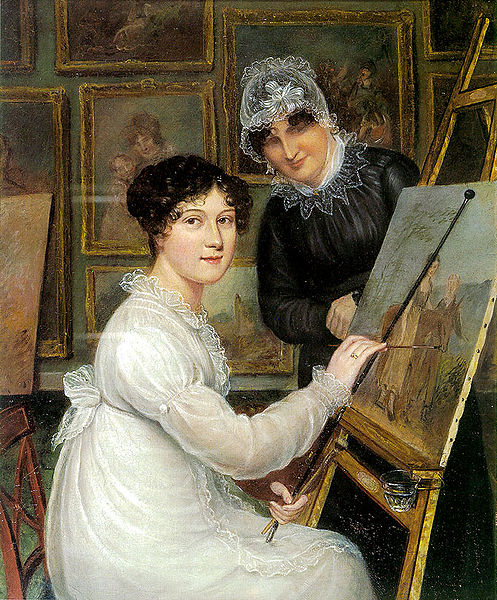
The Artist and her Mother by Rolinda Sharples (c.1820)

Both Rolinda and her brother James predeceased their mother.  Rolinda died of breast cancer in 1838, just forty-five years of age and James Jr. died of tuberculosis in 1839.  Ellen Sharples, the last of the Sharples family, died in 1849 aged 80.

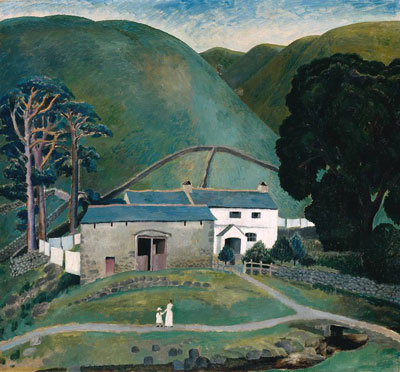
Farm at Watendlath by Dora Carrington

Farm at Watendlath by Dora Carrington (1921)

It often occurs that I stumble across and interesting subject for My Daily Art Display when I am researching another artist.  I came across today’s featured artist when I was delving into the life story of Mark Gertler and his painting Gilbert Cannan and his Mill in my last blog.  I should probably state up front that today’s blog is more about the artist and her fascinating social life than her featured painting.

Dora de Houghton Carrington was born in Hereford in 1893.  She was the second of the two daughters and fourth of the five children of Samuel Carrington and his wife, Charlotte de Houghton.  In 1902, aged 9, the family moved to Bedford and Dora attended the local girl’s high school.  The school’s ethos at the time was that the pupils should concentrate their studies on the Arts such as music and art with a healthy amount of sport thrown in rather than the normal but more commonplace subjects.  Dora showed an aptitude for drawing and her teachers persuaded her parents to pay for her to attend extra drawing classes in the afternoons.  One’s childhood often shapes the way we are in later life and the author Vanessa Curtis wrote about Dora’s differing relationship she had with her mother and father:

“…Although Carrington adored and revered her father, sketching him almost obsessively, she did not admire her fussy, martyr-like mother, who crammed the house with ornaments and devoted herself to charity work and religious causes….”

It is quite obvious that Dora’s mother had a suffocating influence on her children, especially her daughter.  Dora’s brother, Nicholas wrote of his mother extreme views on sex and  religion:

“..The first was extreme prudishness. Any mention of sex or the common bodily functions was unthinkable. We were not even expected to know that a woman was pregnant. Even a word like confined was kept to a whisper. The second was church-going and behaviour on Sunday. We all came to hate the whole atmosphere of a Sunday morning. The special clothes, the carrying of prayer books, the kneeling, standing and murmuring of litanies…”

In 1910, aged 17, she enrolled at the Slade School of Fine Art in London. There can be no doubt that once Dora Carrington was free of her home life and the puritanical views of her domineering mother, she rebelled.  She cut her hair to a bob which gave her a somewhat androgynous appearance. She entered into many intense and sometimes sexual relationships both with women and homosexual and heterosexual men.   She also decided that she wanted to be known simply by her father’s surname, “Carrington”.   Carrington fared well at the Slade and won several awards for her work.  One of her fellow students was Mark Gertler, who was totally besotted with Carrington and it was through him that Carrington met Lady Ottoline Morrell, the “society queen” and he introduced Carrington to the Bloomsbury Group, a group of writers, intellectuals, philosophers and artists.    Lady Ottoline and her husband Philip had a house in Bloomsbury, Central London and a country house in Garsington, Oxford where they would hold weekend parties for their friends, many of whom, like Stanley Spencer, Gertler and Carrington were aspiring artists.

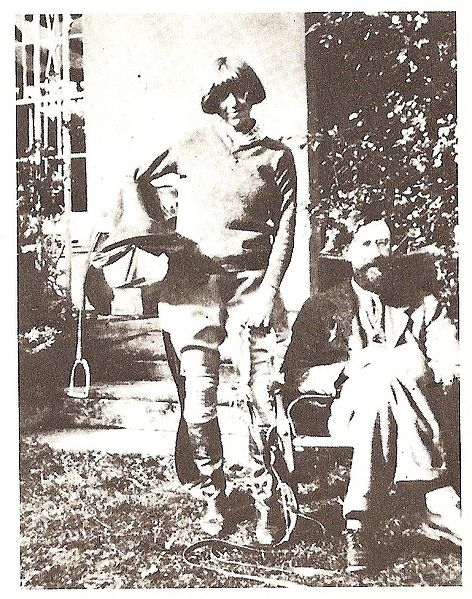
Carrington and Lytton Strachey

The Morrells were prominent pacifists and during World War I they invited conscientious objectors, such as the artist Duncan Grant and the writers Clive Bell and Lytton Strachey to take refuge at Garsington.  Carrington met Strachey, a writer and founder member of the Bloomsbury Group in 1915. Strachey was a homosexual but this did not stop Carrington falling in love with him.  This was a love that was to last almost twenty years.  Gertler felt no threat from Carrington’s love for the openly gay Strachey but in 1917 when Strachey bought a house and Carrington moved in with him, Gertler was devastated and realised that his love for Carrington was irrevocably unrequited and doomed.

Lytton Strachey and Ralph Partridge

Carrington’s father died in 1918 leaving her a small inheritance that allowed her to feel more independent.  That same year, Carrington was introduced to Ralph Partridge, a friend of her brother Noel.  Partridge like many men before him was besotted with Carrington, even though he was aware of Carrington’s love and devotion to Lytton Strachey.  Despite this knowledge, and knowing that Carrington would never give up Strachey, he married her in 1921 and along with Lytton Strachey, they bought and moved into Ham Spray House just outside the town of Hungerford.  It was here that they spent the rest of their lives.  It was a happy period for Carrington who carried on with her artwork and looking after the two men in her life.  Unfortunately, over time, Strachey suffered frequent bouts of illness and had to be cared for by Carrington.

Frances Partridge née Marshall

In 1926 Ralph Partridge started an affair with Frances Marshall, a writer friend and member of the Bloomsbury Group and went to live with her in London. His marriage with Carrington was all but over, but never in the eyes of the law.  Partridge did however still visit her most weekends.   Carringotn in the meantime had a number of extra-marital affairs with both males and females.  The most famous being her affair with Gerald Brenan, an army man and friend of her husband.  She also had a tempestuous love affair with Henrietta Bingham, the daughter of the American ambassador in London

In 1931 Strachey became seriously ill with stomach trouble and the doctors could not decide as to what was causing the illness.  By the end of that year doctors had given up hope of curing him.  In a fit of deep despair at the thought of losing her beloved friend she attempted to kill herself but was saved by her husband Partridge.  For the next month she watched as Strachey moved slowly towards death.  In January 1932 the end came for Strachey and, following an autopsy, it was discovered that he had been suffering from stomach cancer.  Carrington was devastated and her friends tried to rally round to support her but it was to no avail as in March 1932 she shot herself with a gun she had borrowed from a neighbour.  Her husband found her just before she died.  She died just a fortnight before her thirty-ninth birthday.

The painting I am featuring today entitled Farm at Watendlath was completed by Carrington in 1921. Newly-wed Carrington and her husband along with Lytton Strachey and some of their artist friends spent a summer holiday here that year.   One of their holiday companions was her future lover and friend of her husband, Gerald Brenan.  She would often return to spend other painting holidays around this area and she and her friends were frequent visitors to the farm which is near to Keswick in the Lake District.  The house we see in the painting faces Watendlath Beck, which flows from Watendlath Tarn into Derwentwater. A stuffed stag hanging inside was known as ‘Mr Wordsworth’  The two female figures we see in the painting are unknown and it has been suggested by some art historians that this depiction of female figures, dwarfed by a fertile and undulating landscape, relates to the artist’s sense of being overwhelmed by her own womanhood.  However, I find that interpretation hard to believe.

Her life story, in many ways, is tinged with sadness.  Her relationship with Lytton Strachey could not have fulfilled all her dreams and she would have constantly have had to compromise.  Yet, I am sure she had times of great joy and maybe we should look at this painting and remember that at the time she painted this, she had just married and she was at a place she loved with companions whose company she enjoyed and who in return where devoted to her.

The painting which can be found at the Tate Gallery London was presented to that establishment by her brother Noel Carrington in 1987.

Still Life with Flowers and Fruit by Rachel Ruysch

Still Life with Flowers and Fruit by Rachael Ruysch (1703)

My Daily Art Display moves into unfamiliar territory on two counts.  My featured artist is a woman and up to now, I have showcased only a few paintings by women and secondly the work is a still-life painting, a genre which I have rarely selected for my daily blog.  I marvel at the intricacy of the painting and I have no doubt that the detailed work which goes into still-life paintings is equal if not greater than in other painting genres.

My featured artist today is the Dutch artist Rachel Ruysch.  Art historians who have studied the art of the Dutch Golden Age have placed her in the top three female artists of that period.  The other two being and Maria van Oosterwijk, another specialist in flower still-life paintings and Judith Leyster, the genre painter who painted a few portraits and who also produced a single still life work. Ruysch  is widely looked upon as the most talented female in the history of still-lifes of flowers and fruits and among the greatest exponents of either sex of this genre.  True praise indeed!!

 Rachel was born in The Hague in 1664.  She came from a wealthy family and was one of twelve children.  Her mother was the daughter of Pieter Post, a Dutch painter of landscapes and battle scenes, before becoming a talented classical-style architect.  Her father Frederick Ruysch, a talented amateur painter was also a renowned Dutch botanist and anatomist.  He accepted a professorship in Amsterdam and so when Rachel was just three years old the family all moved there.    Her father was an expert in anatomical preservation and the creation of dioramas,  three-dimensional full-size or miniature models, sometimes enclosed in a glass showcase, and which would house human parts which had first been preserved and embalmed in liquor balsamicum.   Rachel took an interest in her father’s work and would often help him to decorate the collection with flowers, fishes, seashells and the delicate body parts with lace.  With his trained scientific eye, Rachel’s father was able to observe and record nature with a high degree of accuracy, and it was a talent that he inspired in his daughter. This talent was to greatly influence her works of art in the future, for her still-life floral paintings would be characterized by realism.  Another reason for Rachel’s love of plants and flowers was that she and her family lived in a district of Amsterdam called Bloemgracht, which means “flower canal”. This area was of great natural beauty and was a favourite place of artists

In 1679, at the age of fifteen she had developed a love for art and was exceptionally talented even at that young age.  Recognising his daughter’s artistic aptitude, her father arranged an apprenticeship for her with William van Aelst, a renowned painter, who specialized in still-life works with flowers or game.  Van Aelst, who moved to Amsterdam in 1657, was famous for creating elaborate still-life paintings that featured spiralling compositions and avoided the convention of symmetrical arrangements of depicted bouquets.  Van Aelst taught her the necessary skill of composing a bouquet in a vase but in his less formal manner that produced a much more realistic and tangible effect. In their more realistic works, some flowers and leaves were allowed to droop over the sides of vases, while others were revealed from the back, and by so doing, produced a more rounded shape. Later in her artistic journey, Ruysch would build upon van Aelst’s compositional innovations and this would instil a vitality into her paintings.

Rachel remained a pupil of his until his death four years later in 1683.  Her earliest art works started to appear around 1680 and by the time she was eighteen years of age in 1682 she was producing a number of independently signed paintings and her successful artistic career had just begun.

 In 1693, aged twenty nine she married the lace dealer and portrait painter, Juriaen Pool.  The couple moved to The Hague where they both enrolled in the city’s Guild of St Luke, the professional artists’ organization which regulated the sales and handled the promotion of the artists’ works.  By all accounts their marriage was a happy one and the couple went on to have ten children.  Even though, as she claimed, she essentially raised her children on her own, her life of domesticity and all the chores that went with it coincided with her most creative artistic period. Her large family seemed in no way to get in the way of the quality of her work

In 1708, both Rachel and her husband were invited to Dusseldorf, where they became court painters to the Elector Palatine of Bavaria, Johann Wilhelm.   This proved to be a very successful period in their lives and they remained there and worked for him until his death in 1716, at which time they returned to Holland.  Flower painting emerged as part of the Baroque movement and was especially popular in the late 17th century.   The reason for its popular emergence was the increase in the number of more affluent merchants and middle classes, as well as the growing interest in plants that resulted from the developing science of botany.  It was also around this time in northern Europe, especially Holland, that there was a marked increase in the importation of many new and exotic plants. The Dutch had developed a wide variety of flowers and gardening became increasingly popular. Often, gardeners would commission artists to paint pictures of their best or rarest flowers.

In light of her situation, she was fairly productive throughout her lifetime. She finished her final painting in 1747, when she was 83. By the time she died, she had produced more than 250 pictures, an average of about five pictures a year, which was a considerable number of works for someone creating flower paintings in painstaking detail.

Rachel Ruysch had to overcome two problems which were common in the artistic world of northern Europe at the time.  Firstly she had to overcome the fact that she was a woman and artistic painting was considered a male province.  Secondly, during this period, art was divided into two categories – “greater” and “lesser”.  Into the “greater” category one found paintings of religious and historical themes and compartmentalised in the “lesser” category were portraits, landscapes and still-lifes.  It was this “lesser” category which was deemed fit for female artists.  Women artists who painted were considered to be just painting as a hobby and were completely incapable of artistic genius. However Rachel Ruysch triumphed and became a highly regarded artist who made her mark in the male world of the Dutch Old Masters, becoming one of the greatest flower painters in either gender.

Ruysch died in 1750 at age 86, and during her lifetime she gained widespread fame, and her artistic works were highly valued.   Despite the fact that flower paintings today is still  considered as a lesser form of artistic expression, Ruysch’s reputation as a great painter remains intact.   During the 20th century, there was great interest in her works and her paintings are still featured in major exhibitions in Europe.  She is thought to have produced over 250 paintings in her life but only about 100 are known to still exist, and most of these are in museums or private collections. When any of her paintings do come up for sale they make headlines. In France her 1710 painting Still Life of Fruit with a Birds Nest and Insects went for the equivalent of $508,000.

My Daily Art Display painting by Rachel Ruysch is entitled Still Life with Flowers and Fruit, which she painted in 1703.  This painting, which measures 85cms x 68cms, has an opulent arrangement of flowers and fruit but could never have existed in nature as the various flower specimens and fruit blossomed and bore fruit in different seasons.  This blossoming was simply a figment of the artist’s imagination.  There is a technical perfection about this painting which had come from Rachel’s extensive botanical training.  The painting now hangs in the Akademie der bildenden Künste, in Vienna