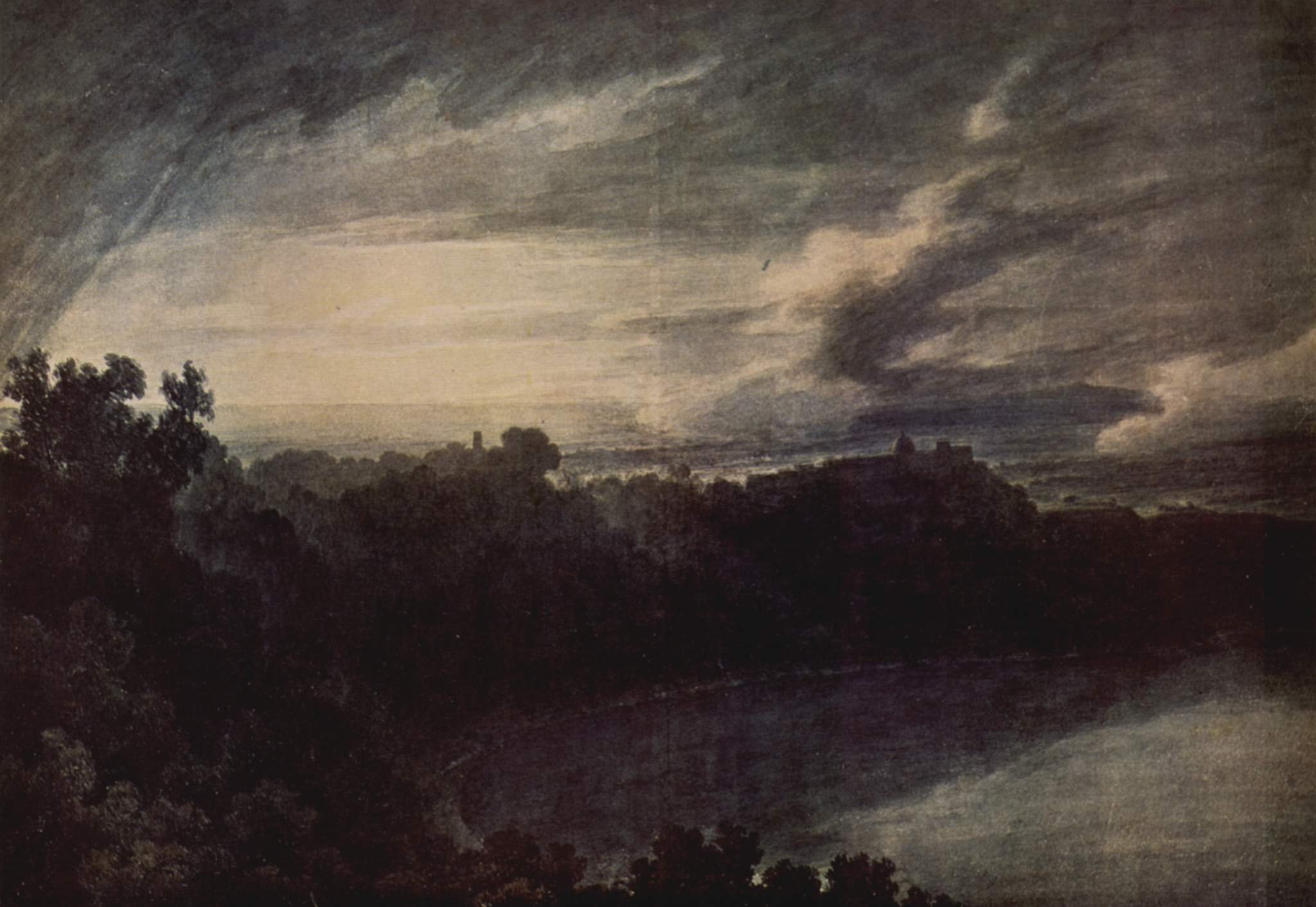
A Moonlight Effect by Paul Sandby

Landscape painting became the most inventive form of art in Britain during the late eighteenth and early nineteenth century.  Traditionally, paintings of the British landscape had been a way of showing off magnificent country houses, and were often commissioned by wealthy landowners to show off their estates and wealth.  However in the late eighteenth century the landscape became the subject of a more poetic vision. There was a growth in the urban middle-class and for them landscape art provided a romantic ideal of the landscape as the source of timeless values which could be enjoyed by anyone.  Landscape paintings were now being viewed as portraying idyllic places of rest and solace.  Landscape art in the 18th century did however have its detractors.  The Swiss-born artist Henry Fuseli, when once lecturing his art students, identified landscape art as a low branch of painting.  He described it:

“…the tame delineation of a given spot;   what is commonly called Views is  little more than topography; ….a kind of map-work”……”

My featured artist today would not have agreed with Fuseli’s description, as he was one of England’s great landscape artists.  His name is Paul Sandby.  Sandby was born in Nottingham in 1731.  His father Thomas was a framework knitter and he had a brother, also named Thomas, who was ten years older than him.  The boys had a comfortable upbringing and it is thought that they both received drawing tuition from Thomas Peat, a Nottingham-based land surveyor.  Both boys showed great aptitude and in 1747 Paul, then aged sixteen, left Nottingham to take up employment as a military draughtsman.  After the Battle of Culloden the English felt the need to map the Scottish landscape with detailed records of forts and castles and Paul Sandby was involved in the survey and from his office at Edinburgh Castle, where he worked as a mapmaker, he developed his landscape drawing technique.

After his work in Scotland he went on to paint much of Britain. In 1752, he, along with his brother, took up a post producing landscapes of the royal estates at Windsor.   Importantly in 1770, he travelled through Wales and was one of the first artists to paint landscapes of that country.  He popularised the area by not just exhibiting paintings but widely circulating printed images and developing an innovative print method, aquatint, a variant of etching, which echoes the washes of watercolour rather than relying on pure lines.   He returned to Wales in 1773 and toured the south of the country along with Sir Joseph Banks, the naturalist and botanist.  This sketching trip resulted in the 1775 publication of XII Views in South Wales.  A further twelve views were added the following year.

In 1757, Sandby  married Anne Stogden.   In 1768, the same year as his election as a Royal Academician, he was appointed chief drawing master to the Royal Military Academy at Woolwich, a position he held for over thirty years,.  His son Thomas Paul was eventually to succeed him in that post.

 Unfortunately for Sandby the public fell out of love with his fresh and uncomplicated natural style of paintings, which he embraced, and he was ultimately forced to petition the Royal Academy for financial support to supplement his modest pension. He died in 1809, his obituary describing him as the ‘father of modern landscape-painting in watercolours’.  He is buried in St George’s Burial Ground London.

Gainsborough praised Sandby as one of the first artists to paint what he termed “real views”, ones which were topographically accurate as opposed to idealised compositions.  There was a large gap between the topography and the ideal landscapes.  The topographer accurately recorded what he saw whereas the ideal landscape artist manipulatesd his landscape for aesthetic ends.  Paul Sandby endeavoured to bridge that gap.  He kept faith with his topographical skills but managed to bring expression and sensitivity to his work.  He did this by carefully choosing the viewpoint for the composition.  He also liked to incorporate realistic human figures in his works.  Throughout his career Sandby only ever used the medium of watercolour.

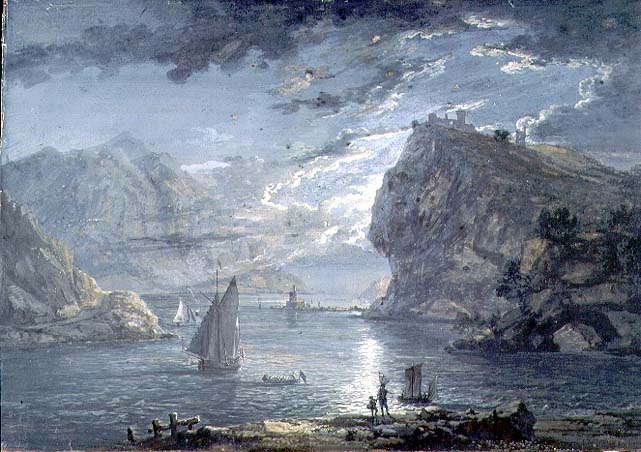
My Daily Art Display featured painting today is entitled A Moonlight Effect which Paul Sandby completed around 1790 and which can be found in the Nottingham City Museums and Galleries.  This is one of a number of paintings Sandby completed which depicted a place or a building as seen by moonlight.  In the 1770’s the early romantic painters, such as Joseph Wright of Derby and William Hodges, had taken a special interest in the portrayal of moonlight effects; and the image of the moon and of moonlight became one of the great romantic images.  For the romantic artist, who saw himself as alienated from society, the moon was often seen as an image of constancy and hope in a changing world, and it adequately depicted that longing and yearning or an unattainable perfection which lies at the heart of romanticism.

I love this painting with its silvery moonlight. 

Maybe you will have noticed that My Daily Art Display has not quite been a “daily” offering recently.  The reason for that is not because I am losing interest or having difficulty to find yet another painting, albeit it is getting harder.  The reason is that I have been trying to build up a reserve stockpile of blogs for when I am away on holiday in case I don’t have the time to research and compose a blog.  Today we are setting off to Hong Kong and Australia for a three-week break.  I am hoping I will still have access to the internet when I am away so that I can send out one of my “reserve” blogs, at least every other day.  I am hoping to take in a couple of art galleries when I am away and I am looking forward to seeing the depth of art on offer.


The Night of Enitharmon’s Joy by William Blake

The Night of Enitharmon’s Joy by William Blake (1794)

Today I am once again dipping my toe into the strange world of William Blake the 18th century painter, printer, book illustrator and poet.  I went through his life story in a couple of my earlier blogs (October 30th and November 1st) and if you haven’t read them I urge you to go to them now before you read about this painting as it may just give you a better understanding as to why an artist would depict such weird but wonderful scenes.  My Daily Art Display featured painting today has three titles.  It is usually known as The Night of Enitharmon’s Joy but is often referred to as The Triple Hecate or simply The Hecate.   It is a colour print finished in ink and watercolour on paper.   

If, like me, you have never heard of Enitharmon or Hecate, let me take you into Blake’s strange world of mythopoeia, his own fictional mythology.  We are all used to hearing tales of Greek and Roman mythology but William Blake made up his own mythology with its own characters.   I suppose he can be compared with Tolkien and his stories of Middle Earth or C S Lewis and his tales of Narnia.   For Blake, who all his life experienced visions of heavenly bodies whom he would communicate with, his mythological characters were real.

Enitharmon is a major female character in William Blake’s mythology and she plays a major role in some of his prophetic books.   In this work Blake portrays her as an androgynous Hecate, one with a combination of male and female characteristics, as can be seen in this coloured print.   Hecate is the goddess of witchcraft and you may have come across her in Shakespeare’s Macbeth.  She appeared to the three witches in the play, as they sat around their bubbling cauldron, she came to them demanding to know why she has been excluded from their meetings with Macbeth.   To William Blake she represents female domination and sexual restraints that limit the artistic imagination.  After her birth, Enitharmon asserts that women will rule the world, with Man being given Love and Women being given Pride. This would create within men a fear of female dominance that would in turn bring them under control of the females.

Do you remember the famous lines spoken by the three witches in Macbeth as they surrounded the cauldron?

“Fillet of a fenny snake,
In the cauldron boil and bake;
Eye of newt and toe of frog,
Wool of bat and tongue of dog,
Adder’s fork and blind-worm’s sting,
Lizard’s leg and owlet’s wing,
For a charm of powerful trouble,
Like a hell-broth boil and bubble.”

It is therefore not a coincidence that in Blake’s print we can see a frog or a toad, a bat and a snake?  The Night of Enitharmon’s Joy is a large colour print and is plate 5 of Europe, a book written by Blake in 1794 which has the opening line:

“..Now comes the night of Enitharmon’s joy!..”

 In the book, Enitharmon sets the trap of false religion which dominated Europe, for eighteen hundred years between the time of Christ’s birth and the French Revolution.  The night of Enitharmon’s joy is when she establishes her Woman’s World with its false religion of chastity and vengeance.   Blake used pen and ink to give strong outlines to the figures, and to draw locks of hair, the bat, and the donkey’s mane and rough coat. The owl has eyes which have been highlighted with a bright opaque red wash.  The figures have been given form and roundness by washes of intense but transparent colour.   The sky is dark as are the lichen-covered rocks in the left of the work.  A strange-looking evil winged spectre hovers above Enitharmon’s head as a large donkey to the left nibbles on what little vegetation can be found amongst the rocks.

This is yet another weird work by Blake and once again I hesitate to think what was constantly going through his mind as he conjured up these images.

Maria Bicknell, Mrs John Constable by John Constable

Maria Bicknall by John Constable (1816)

In My Daily Art Display blog yesterday I looked at the early life of John Constable,  up to the point in his life when at twenty-three years of age he was still hell-bent to become an artist.     Today I am going to conclude the story of his life and look at another of his paintings.  

In 1799,  Constable had finally convinced his father to let him pursue art and he enrols in the Royal Academy School as a probationer.  Although he finds inspiration in paintings by Peter Paul Rubens, Thomas Gainsborough, Claude Lorrain and Annibale Carracci, he becomes very homesick and yearns for the beautiful countryside of his Sussex home.  He is also becoming very disheartened with the way the Royal Academy, at that time, disdainfully viewed landscape art.  Landscape art was his passion but unfortunately for him, it was not held in high regard by the Academy, who only valued history painting and portraiture.  Whilst he attended the Academy he met Turner but the two never forged a friendship.

In 1802 Constable exhibited his first painting at the Royal Academy.  His landscape works were unfortunately not the traditional heavenly landscapes which depicted biblical or mythological stories, which were in vogue at the time, and so were not popular with the buying public.  His depictions of the countryside were far more realistic than those of the very popular Gainsborough and Claude.  If anything, his style was more akin to that of the Dutch landscape painters, such as Jacob van Ruysdael.   Constable fervently believed that landscape art was to be a true study and reflection of nature and that idealized landscapes, which had been painted from the artist’s own imagination were, in some ways, dishonest.  He left the Royal Academy in 1802 and was offered the position of drawing master at Great Marlow Military College, but he turned down the offer, which horrified the then master of the Royal Academy, Benjamin West, who told Constable in no uncertain terms that his refusal would probably mean the end of his artistic career.  However Constable was not deterred and chose to stay on his chosen course – that of a landscape artist.  Constable returned to East Bergholt.

In 1800, when he was aged twenty-four and whilst he was at home in East Bergholt, he had become friendly with a young girl who was some twelve years younger than him.  Her name was Maria Bicknell.  Now almost ten years later in 1809, John is aged thirty-three and Maria is twenty-one years of age and their relationship changed.  Slowly but surely, this one-time childhood friendship developed into a much more serious relationship and the two fell deeply in love.  Seven years later, in 1816,  the couple decided to get engaged but this was strongly opposed by Maria’s parents and her grandfather, Dr. Rhudde who was the rector of East Bergholt.  Both Maria’s father, Charles Bicknell, who held the prominent position as solicitor to the Admiralty, and her grandfather did not want her to be married to a penniless artist and they also believed that Constable and his family were socially inferior to them and not fit in-laws.  To force home their disquiet about such a proposed liaison they told Maria that she would be disinherited if she married Constable.  Constable’s parents Golding and Ann Constable, while somewhat sympathetic to the desires of their son, could also see no future in the proposed marriage as they would not in the position to financially support the couple and even Maria herself pointed out to Constable that if he was to succeed as an artist he did not want the distraction of a wife and the financial implications of such a match.  For the next seven years the couple were often parted and sometimes forbidden even to write to one another, but throughout their long, frustrating courtship they remained loyal to each other

The situation changed in 1816 when both Golding and Ann Constable died and Constable inherits a fifth of the family business.   Now with some money behind him and the fact that their daughter Maria is twenty-eight years old, her parents reluctantly agree to let her marry Constable.  John and Maria marry in that October at St Martin-in-the Fields, London and the two of them tour the south coast of England on honeymoon. 

Constable struggled to sell his paintings and it was not until 1819 that Constable made his first big sale, which was for his painting entitled The White Horse.  This sale spurred him on and it led to what are known as his “six footers”, a series of six large scale paintings, which included The Hay Wain and Stratford Lock.  The Hay Wain was exhibited at the Royal Academy in 1821 and was seen by the great French Romantic artist Théodore Géricault who on his return to Paris spread the word about Constable and his painting.   Three years later, the painting is bought by the art dealer John Arrowsmith and it is exhibited at the Paris Salon of 1824 where it wins a gold medal.

Four years on and it is 1828 and that January Maria gives birth to their seventh child.  Sadly that same year she falls ill and after a prolonged illness dies that November of tuberculosis, at the young age of forty-one.  Constable is devastated by his loss and in a letter to his elder brother Golding he wrote:

“….hourly do I feel the loss of my departed Angel—God only knows how my children will be brought up…the face of the World is totally changed to me…”

In his book, Memoirs of the Life of John Constable, Charles Leslie wrote that after the death of his wife, Constable was always dressed in black and was “a prey to melancholy and anxious thoughts”.  Constable had to, from then on, look after his seven children singlehandedly.    

The financial situation of his having to bring up all his children should not have been too burdensome as shortly before her death, Maria’s father had died, leaving her £20,000.  However Constable, instead of safeguarding this new wealth, speculated disastrously with this money.  A large proportion of the money was invested in the engraving of his landscape works which he believed would easily pay for themselves but he was sadly mistaken and the money raised did not cover the expenditure.

At the age of  fifty-two he was elected to the Royal Academy and two years later in 1831 was appointed Visitor at the Royal Academy, a part time teaching post which proved to be very successful and extremely fulfilling.  He regularly lectured on landscape art and once again regaled how works should depict real scenes and not idealized fantasies.  It is interesting to note that although he was not always happy with the art education he received at the Royal Academy thirty years earlier, one of the constant themes of his lectures was the way he praised the establishment calling it the “cradle of British Art” and he stated that no great artist was ever self-taught.

Constable died in 1837 a couple of months short of his sixty-first birthday and was buried besides his beloved Maria in the graveyard of St John-at-Hampstead in London.  Later the couple would be joined in the family tomb by two of their sons, John Charles Constable and Charles Golding Constable

My Daily Art Display featured painting today is not one of his famous “six-footers” but a beautiful painting of his wife which he completed a few months before they married in 1816.  On completing the portrait Constable wrote to his wife:

“…I would not be without your portrait for the world the sight of it soon calms my spirit under all trouble…”

Constable is primarily known for his beautiful landscape paintings but he was also an accomplished portraitist and before us we see his depiction of the woman he deeply loved.  What greater love could an artist bestow on his wife than to paint her portrait?  The marriage only lasted twelve years but one should remember that he had known and loved the young girl for sixteen years before they had been allowed to become man and wife.

The painting hangs at the Tate Britain Gallery in London.

.

Dedham Vale and The Vale of Dedham by John Constable

My Daily Art Display today features two paintings by the same artist, with almost the same titles, but completed twenty six years apart.  The artist is one of the greatest landscape painters of England.  His name is John Constable.  Before we look at the two works of art let me give you a potted history of his life.

John Constable was born in East Bergholt, a small village on the River Stour in Suffolk in 1776, the fourth of six children.  His descendents were farmers and his father Golding Constable was an affluent corn merchant who owned considerable amounts of property in the area.  He owned water mills at Flatford and Dedham, two windmills in East Bergholt and even a small ship The Telegraph, which was moored at Mistley, North Essex, and which he used to transport his grain to London.  It was in East Bergholt that two years before John Constable was born his father built himself a large house and lived there with his wife Ann Constable (née Watts), whom he married in 1748.  The couple had six children, three sons, Golding, John and Abram and three daughters, Ann, Martha and Mary.

John Constable was fortunate with his upbringing, being afforded all the advantages of a wealthy family.  His education consisted of a short spell at a boarding school in Lavenham, which proved far too strict, then followed a period at the local day school in Dedham.  John had always enjoyed sketching and this love of this was helped by the local plumber, John Dunthorne, who would take the young boy out on sketching trips around the nearby area. 

As is the case in many life stories of artists, this desire of his son to become an artist did not go down well with his father who believed artists rarely made much money and instead had wanted John to study for a career in the church.  However this, because of his grades, proved to be a forlorn hope.  After that his father decided that John should come into his corn merchant business.  Although John was the second son, his elder brother Golding was mentally handicapped and could not take an active part in the family business and so John was the obvious choice as the future successor.  John did go into the family business but lasted just a year, at which time his younger brother, Abram, was of the age and had the will to become an active member of his father’s business.

The real turning point for John as far as art was concerned came when he was nineteen years old and he and his mother went to visit neighbours.   At this get-together John was introduced to Sir George Beaumont, an amateur artist and wealthy art collector.  Beaumont used to carry around with him, in a specially made wooden box, the latest paintings he had acquired and the day Constable met him he had with him his newly acquired Claude Lorrain painting Hagar and the Angel.  John Constable could not get over its beauty and was totally in awe of the way Claude had depicted the landscape.  The two art lovers spent much time that day discussing art and the works of Claude and the likes of the English landscape artists, John Cozens, and Thomas Girtin.  Sir George Beaumont was very impressed by young Constable’s enthusiasm and knowledge of art.  Constable knew then that he wanted to be a full time artist.  During a visit to Middlesex he met John Thomas Smith, the painter and engraver, later known as Antiquity Smith, because of the book he wrote, Antiquities of London and its Environs.   It was Smith who taught Constable the basic techniques of painting but warned him of the financial drawbacks of becoming a full-time artist.  In 1798 Constable met Joseph Farrington, who had once been a pupil of Richard Wilson.  Farrington goes on to teach Constable the techniques of this great Welsh landscape painter.

Fortunately in 1799, his father relented on his stance about his son studying art and as he now had his other son, Abram, to assist him,  he gave John some money and arranged for him to go London where he enrolled as a probationer at the Royal Academy School.  John was very homesick missing the beautiful countryside of his home and was disillusioned with the continuous copying of the old Masters.  To make things worse he realised that landscape art, which was what he loved, was not held in high regard by the Academy, who only held in high esteem history painting and portraiture.

I am going to conclude the story of Constable’s life at this juncture in his life, aged twenty-three still hell-bent to become an artist but unhappy with his start at the Royal Academy schools.  My next blog will conclude his life story, the tale of his love for a woman and the problems he had with her family but now I want to look at today’s two featured landscape paintings.

In 1802, at the age of twenty-six John Constable completed his first major work entitled Dedham Vale which is now in the Victoria and Albert Museum in London.  This, like most of Constable’s paintings, was a scene from the area around the Stour Valley.  I started off this blog by saying that Constable was one of the greatest landscape painters of England but maybe his accolade should be that he was the greatest landscape painter of the Stour Valley and Suffolk as he rarely travelled to other parts of Britain, let alone Europe,  unlike other landscape artists, who would travel extensively painting the beauty of the likes of the Lake District or Wales or the Roman Campagna. 

Dedham Vale by John Constable (1802)

Dedham Vale was painted by Constable in 1802 and now hangs in the Victoria and Albert Museum in London.  The scene we see before our eyes is one of complete tranquility.  Sadly for many, including Constable, it was also the start of a period of change in Britain and even in that area with the onset of  creeping industrialization,  such peace and serenity would soon be a thing of the past.  Even Constable’s beloved Stour valley would be home to the hubbub of a textile manufacturing area. 

We see before us, looking down from Gun Hill in the east, a flattish landscape of Dedham Vale pierced with a number of small waterways, some of which are natural, others man-made.  The lower reaches of the River Stour is in the middle ground of the painting and it can be seen wending its way eastwards towards the sea.   In the central background we see the gothic tower of Dedham Church and the village of Dedham and further back in the hazy distance we can just make out the town of Harwich.

The Vale of Dedham by John Constable (1828)

Twenty six years later in 1828 he returned to this scene for his last major painting of the Stour Valley entitled The Vale of Dedham, which is now housed in the National Gallery of Scotland in Edinburgh.  Maybe the fact that he returned to this scene so many years later is testament to his love for the area.  This later painting of the same view has some subtle differences.  The meandering river heading towards Dedham has got wider and now has a bridge across it.  In the foreground the old stump of the tree is sprouting some new saplings and by drawing our eye to it our attention focuses on the distant landscape.  However what was a more contentious addition to the scene was Constable’s inclusion of a gypsy mother nursing her child besides a fire.  Critics said that the addition did not add to the landscape and the inclusion was just the artist’s way of making the scene more picturesque.  However Charles Rhyne, Professor Emeritus, Art History at Reed College, Oregon,  wrote in his book Studies in the History of Art,  when discussing Constable’s landscapes, that according to an ordnance survey map,  a well was located in this area, and that this would have made it a natural camping site for gypsies.

Graham Reynolds, the art historian and author, also talked about the controversial inclusion of the gypsy in the painting.  In his book about Constable, he pointed out that gypsies were frequently to be seen in East Anglia and that the inclusion of this detail did not infringe Constable’s rule that only actual or probable figures should appear in his landscape paintings. By including the gypsy mother and child in this painting, he said that Constable enlivened the image, with the gypsy’s red cloak providing a contrast to the green of the vegetation.  It should be remembered that Suffolk had been affected by the agricultural depression and social unrest during the 1820s, and the inclusion of the gypsy in the painting may reflect the instability of rural life at this time and Constable’s sympathy with the cause of ordinary people.   Note how the gypsy is wearing a bright red shawl or coat.  Constable always believed that even the smallest touch of bright red in a painting highlighted and animated the green of the surroundings and he often used this technique in his other paintings.  Maybe that is another reason for the inclusion of the gypsy.

This second painting of Dedham Vale was well received by the Royal Academy when Constable exhibited it in 1828 under the title of Landscape.  Six years later he exhibited it again, this time at the British Institution under a different title.  This time he called it The Stour Valley.  People loved it and art critic of the The Morning Post (March 10th 1834) wrote:

“…..We must consider this picture as one of the best which we remember to have seen from Mr. Constable’s pencil. It is a work of great power both of colour and light and shade, and is executed with considerable freedom and dexterity of execution…” 

Which version did you prefer?

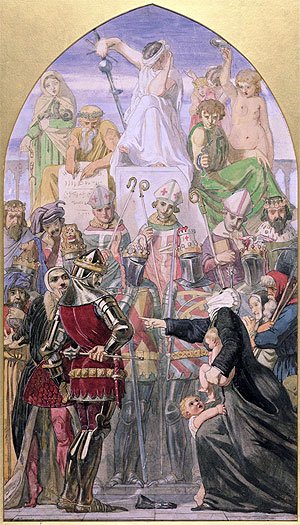
Spirit of Justice by Ford Madox Brown

Spirit of Justice by Ford Madox Brown (1845)
I am returning to the artist Ford Madox Brown and for My Daily Art Display today I am taking a look at one of his earliest works, which he completed in 1845 when he was twenty four years of age, and which is entitled Study for Spirit of Justice.  Before I look in detail at the painting and the reason why the artist painted the picture let me go over with you the early life of the artist and his ancestors.  Much of the information regarding Ford Madox Brown’s family tree comes from a biographical volume written by his grandson, Ford Hueffer, later known as Ford Madox Ford, entitled Ford Madox Brown, a record of his life and works, which was published in 1896.  I also have to acknowledge the work The Ancestry and Families of Ford Madox Brownby W.D.Padden,  a professor of English Literature at the University of Kansas. Ford Madox Brown’s  paternal grandfather, John Brown, was the son of a common labourer and an active member of the Seceders, a strict Scottish sect, linked to the United Secession Church,  which followed the 18th century Secession movement from the Church of Scotland, and which later became the United Presbyterian Church of Scotland.  He, like his father, followed the strict doctrines of the sect but that all changed when he went to the University of St Andrews in Edinburgh and he began to see the failures and flaws of some of the sect’s doctrines.   After his university studies Ford Madox Brown’s grandfather became a doctor and was also the author of many medical books as well as holding down the position as a university lecturer.  He appears to have been a very colourful character as it was reported that during his lectures he would take vigorous mouthfuls of a mixture of whiskey and laudanum in order to achieve a suitable degree of inspiration.  Doctor Brown married Ford Madox Brown’s grandmother, Euphemia, in 1765 and the couple went on to have twelve children of whom eight survived the father. Ford Brown, Ford Madox Brown’s father, was born in 1780.  He became a purser in the Royal Navy in 1800 and remained sea-going in the military for fourteen years before taking a shore-based post.  A year later in April 1815, Ford Brown married Caroline Madox.  Caroline was the daughter of Tristram Maries Madox, who was a member of Her Majesty’s Bodyguard of the Honourable Corps of Gentlemen at Arms.  Their role was to act as guards or attendants to the sovereign on state occasions.   Biographical notes on the couple state that they lived on the continent “for reasons of thrift”.  Their first child, a daughter Eliza Coffin Brown was born in 1819 and two years later on April 16th 1821 their first son Ford Madox Brown was born in Calais.  Ford Madox Brown’s father had to retire from the Royal Navy in 1834 following a stroke.  Ford Madox Brown’s mother died in Calais in 1839 when the artist was nineteen years old and his sister died the following year aged just twenty one.

Ford Madox Brown and his family had moved around the continent quite a lot, probably due to the nature of his father’s work and he received his formal art education at various academies.  In Bruges he studied under the Belgian neo-classicist painter Albert Gregorious, and later was a student of the Flemish painter Pieter van Hanselaer at Ghent both of whom were former pupils of Jacques-Louis David.   From Ghent he went to study in Antwerp for three years where his teacher was Gustav Wappers, the leader of the Belgian Romantic School.  The standard of his art education was high and more importantly to his family, much cheaper than if he had studied in Paris.   In 1840 after the deaths of his mother and sister, he and his father moved to Paris.  His father died there in 1842 and was buried at Montmarte.

So to My Daily Art Display’s featured painting.  In London, the old Houses of Parliament had been destroyed by fire in 1834 and a new Houses of Parliament at Westminster were built. Competitions were held for appropriate designs (‘cartoons’), with a number of leading artists commissioned to take part.   To organise and oversee this project, a Royal Commission had been appointed in 1841, the President of which was Queen Victoria’s new consort Prince Albert.   In all there were three annual competitions and Ford Madox Brown decided to enter a work for the third and final one in 1845.  The competition rules were that each artist would submit a full sized cartoon (preparatory drawing) with specimens of fresco or other techniques suitable for murals.  The design of their submitted work had to be scenes from British History or Literature or personifications of abstract representations of Religion, Justice and the Spirit of Chivalry.

Before us we see the Study for Spirit and Justice, a pencil, watercolour and bodycolour work, the preparatory drawing of which he submitted to the adjudicators of the competition.  It measured 5 meters x 3meters which was to be the actual size of the mural if it was selected.  His reasoning behind his submission was that it reflected patriotism and it highlighted his sympathy with the oppressed.  In it we see Anglo Saxons defeated by foreign invaders and abused by a rich baron.  In the foreground we have a lone grieving widow, clutching her baby with another of her youngsters holding on to her skirt.  To the right of her, we see her parents who are unable to help her.  She is appealing to Justice against the oppression of the wicked but powerful Baron.  We see the baron on the left in his armour with his deceitful advisor whispering advice.  Above them are more armed barons who are there to administer justice and further back we have the bishops and peers who represent the Lords Spiritual and the Lords Temporal and who are an allegorical representation of the House of Lords.    At the top of the painting we see the blindfolded woman – Justice.  To her right we have the figures of Mercy and Erudition and to her left we have Truth and Wisdom.

Ford Madox Brown’s submission did not win a prize but nevertheless it was well received by the artistic community,  both artists and critics alike,  and a picture of his cartoon actually appeared in the competition catalogue.  Benjamin Robert Haydon, the English historical painter and writer was dismissive of the result of the competition stating:

“…The only bit of fresco fit to look at is by Ford Madox Brown.  It is a figure of “Justice” and exquisite as far as that figure goes…”

The young Dante Gabriel Rossetti loved the work and cut out the picture from the catalogue and had hung in his room.

It is an interesting work and one which would have looked good on one of the walls of the Houses of Parliament, but sadly it was not to be.

The Ghost of a Flea by William Blake

The Ghost of a Flea by Wiliam Blake (c.1820)

In my previous blog I left off the story of William Blake with him still living in London.  Today I will conclude the short biography of the great man.

 In 1800, Blake moved to a cottage at Felpham in Sussex and began to work on illustrations to go with the poetry of the poet William Hayley.  It was during his time in Felpham that Blake began to write his epic poem, Milton: a Poem and it was the preface to this work which includes a poem:

And did those feet in ancient time.
Walk upon England’s mountains green:
And was the holy Lamb of God,
On Englands pleasant pastures seen!

And did the Countenance Divine,
Shine forth upon our clouded hills?
And was Jerusalem builded here,
Among these dark Satanic Mills?

Bring me my Bow of burning gold;
Bring me my Arrows of desire:
Bring me my Spear: O clouds unfold!
Bring me my Chariot of fire!

I will not cease from Mental Fight,
Nor shall my Sword sleep in my hand:
Till we have built Jerusalem,
In Englands green & pleasant Land

The poem later became the words for the anthem, Jerusalem which was set to music quite emotively by the composer Hubert Parry in 1916.

Blake had always been radical and had, on a number of occasions, fell foul of authority.  His most serious run-in with the law came in 1803 when he and a drunken soldier, John Schofield, who was part of a troop which was billeted at the local pub.  The soldier had strayed into Blake’s cottage garden and the two had a physical altercation during which Schofield alleged that Blake had verbally damned King George III.  Blake was charged with voicing seditious and treasonous words against the monarch.  Blake on the other hand contested that the charges were a “fabricated perjury”.  A pre-trial hearing at the local quarter sessions in Petchworth found sufficient evidence to send Blake to stand trial in Chichester in the January of the following year but fortunately for the artist the jury found him not guilty.

In 1804 he left his Sussex home and returned to London where in the following years he was to illustrate many books including Milton’s Paradise Lost as well as illustrative work for bibles. Blake showed work at the exhibition of the Associated Painters in Water-Colours  in 1812 and exhibited some pictures at the Royal Academy of Arts, but these works were greeted with silence.  In 1809 and 1810 he organised a retrospective exhibition of his work in rooms above his brother’s hosiery shop in London.  The exhibition gave him the chance to show his Canterbury Illustrations, which were a set of illustrations he had done for Chaucer’s Canterbury Tales, along with some of his other works.  To accompany the exhibition he put together a prospectus, entitled Descriptive Catalogue,   which described and explained the works on display. 

The Descriptive Catalogue

His exhibition was not a success and only a few people saw the exhibits.  The journalist and art critic Robert Hunt wrote about the exhibits and the accompanying catalogue.   Of the display, Hunt said the pictures were “wretched” and of the write-up of them in the catalogue he said Blake’s words were “a farrago of nonsense, unintelligibleness and egregious vanity”.  It is interesting to note that the Descriptive Catalogue which received such bad reviews is now looked upon as a brilliant analysis of Chaucer’s work.   Robert Hunt concluded his review by saying that in his opinion Blake was “an unfortunate lunatic whose personal inoffensiveness secures him from confinement”.  More devastating reviews followed and Blake was shattered and began to withdraw more and more from public life.

Later in his life Blake began to sell a great number of his works, particularly his Bible illustrations, to Thomas Butts, his most important patron who saw Blake more as a friend than a man whose work held artistic merit; this was typical of the opinions held of Blake throughout his life.  The largest Blake collection ever formed, was assembled by Thomas Butts probably between 1799 and  1810, and between 1820 and  1827. It consisted of over 200 biblical temperas and watercolors, Milton illustrations, color-print drawings, illuminated books, illustrated books, and engravings.

 In 1818 Blake is introduced to the English landscape painter John Linnell who became one of his best friends and ardent patrons.  It was Linnell who gave Blake the two largest commissions he ever received for single series of designs.  He paid £150 for drawings and engravings of The Inventions to the Book of Job.  In 1826, the year before Blake’s death Linnell commissioned him to produce etchings and watercolours illustrating Dante’s Divine Comedy.  Although he never lived to complete the commission, the illustrations he produced of the poem were not viewed merely as accompanying works, but rather they were considered to be a critical revision of Dante’s masterpiece.  There was in his pictures a commentary on the particular spiritual and moral aspects of Dante’s text.

Blake died in August 1827.  According to the biography, Blake by Peter Ackroyd, on the day of his death, Blake worked tirelessly on Linnell’s Dante series commission. Completely exhausted, he stopped working and turned to his wife, who was in tears by his bedside. Looking at her, Blake said, “Stay Kate! Keep just as you are – I will draw your portrait – for you have ever been an angel to me.”  Having completed this portrait which is now lost, Blake laid down his tools and began to sing hymns and verses.  At six that evening, after promising his wife that he would be with her always, Blake died.

Throughout his life Blake spoke about visions he had.  They started at the age of four and carried on throughout his life.  These visions were often connected to beautiful religious themes and imagery, and probably inspired him to paint his spiritual works and God and Christianity were at the heart of all his writings.  He stuck to the belief that in some way he had been instructed to create his art works by the Archangels and that the works he completed were read and looked at by these heavenly bodies.

His attitude to life, his visions and his works leads one to believe that he was bordering on insanity and William Wordsworth said of him:

“…There was no doubt that this poor man was mad, but there is something in the madness of this man which interests me more than the sanity of Lord Byron and Walter Scott…”

My Daily Art Display featured picture is entitled The Ghost of a Flea by William Blake, which he completed in 1820 and in some ways highlights how disturbed his mind was at this time.  It is a tempera heightened with gold on mahogany
support and is quite small measuring just 21cms x 16 cms.  The work can be seen at Tate Britain in London but unfortunately has degraded quite badly mainly due to the technique Blake used to create the work.

William Blake had been introduced to John Varley, an English watercolourist,  by his friend and patron John Linnell in 1818.  Varley was some thirty years Blake’s junior but notwithstanding this age difference, he and Blake became great friends and soon became one of Blake’s circle of admirers who had called themselves The Ancients.  As Varley believed strongly in astrology,  he was attracted to Blake’s visionary tales of heaven and angels and how he was able to converse with these heavenly creatures.  Blake would often call on Varley and the latter was energized by the spiritual portraits that Blake drew when they were together.  Often late in the evening when Blake was at Varley’s home they would take part in séances at which Varley would summon a long-dead historical person or mythological creature, describe his vision to Blake, who would quickly sketch it.  It was at one such séance in 1819 that Blake conjured up an image of a flea.  In George Bentley’s book The Stranger from Paradise, A Biography of William Blake, he quotes Varley’s account of what happened that evening:

“…As I was anxious to make the most correct investigation in my power, of the truth of these visions, on hearing of this spiritual apparition of a Flea, I asked him if he could draw for me the resemblance of what he saw: he instantly said, ‘I see him now before me.’ I therefore gave him paper and a pencil with which he drew the portrait… I felt convinced by his mode of proceeding, that he had a real image before him, for he left off, and began on another part of the paper, to make a separate drawing of the mouth of the Flea, which the spirit having opened, he was prevented from proceeding with the first sketch, till he had closed it…”

The imagery and Blake’s imagination which conjured up such a horrific image of the creature is both awesome and terrifying.  The flea depicted in this work is monstrous in size and muscular in body.  Its long voracious tongue slithers out from its mouth to lap up blood from the acorn-shaped bowl which is held in its left hand.  Its right hand is behind its back and the fingers of the hand grasp a thorn.  It appears part human, part reptilian and in the picture it moves from right to left past a set of heavy stage-like curtains as if on a stage.  Look at the upper part of the body.  Blake has given the creature a thick neck and a small scaly head with bulging and staring eyes.  It reminds me of a head of a gargoyle and one has to remember that Blake in his early days was sent around the Gothic churches of London to sketch and it could be some of the Gothic carvings he saw stuck in his mind.

On the back of the panel are the words:

“…The Vision of the Spirit that inhabits the body of a Flea, and which appeared to the late Mr. Blake, the Designer of the vignettes for Blair Grave and the Book of Job. The Visions first appeared to him in my presence, and after wards till he had finished this picture. The Flea drew blood on this…”

John Varley bought the work from William Blake in 1820 and in 1892 it was sold on to Graham Robertson, the William Blake collector for £10.50 at a Sotheby’s auction.   Graham Robertson’s collection of works by William Blake was  recognised as the most distinguished in existence. His purchases of the group of masterpieces had mainly come from the Butts family who were descendent of Blake’s friend and patron, Thomas Butts.  Robertson lent the work to the Tate in 1913 and eventually donated it to the gallery in 1948.

There is no doubt that this is an unsettling picture, dark in tone and yet has some shimmering golden tints.  There is no doubt that Blake, albeit looked upon as a genius, had throughout his life a very disturbed mind and one has to wonder whether the visions he constantly talked about were a comfort to him or gave him a nightmarish existence.

Nebuchadnezzar by William Blake

My Daily Art Display today looks at the life and works of one of England’s most controversial artists.  He was not just an artist, illustrator and printer, he was also a renowned poet.  The controversial nature of this person derives from what he drew and wrote about and his beliefs.  My featured artist today is William Blake, the writer of prophetic works which are termed works of mythopoeia.  Mythopoeia is the act of making or creating mythologies.   In the case of Blake, they are stories of artificial mythology, which he himself created, such as Vala and The Four Zoahs where he would introduce us to characters with the strangest names, such as Enitharmon, Albion and Urizen.  I suppose to draw a present day parallel to his type of work we should think of Tolkien’s Middle Earth sagas or C S Lewis’s tales of Narnia.   What is probably a little bit more bizarre and daunting about William Blake was that from a very early age he believed in visions and told people about his regular sightings of angels and other heavenly bodies which he was able to communicate with.

  I have put together a short biography of the man and split over this and my next blog.  There have been numerous books written about him and when you read them you will see that he trod a very fine line between sanity and insanity.  He was never vigorously condemned during his lifetime by the Church or by his contemporaries.  The reason being it was probably due to him being looked upon as a harmless eccentric who had few followers and therefore his beliefs would never gain hold and therefore never pose a threat.

Catherine Wright Armitage married her first husband, Thomas Armitage, a hosier, in 1746.  Catherine and her husband had one son, also named Thomas, but he died in 1751, when he was just five years of age.   Ten months after the death of her son, Catherine’s husband died.  The following year, 1752, Catherine married James Blake.  They were to have seven children, the third of whom, William, was born in 1757.  William Blake was to grow up to become one of the great English poets and painters and an influential figure in the history of both the poetry and visual arts of the Romantic Age. 

William Blake did not receive any formal education but he received home tuition from his mother.  In 1867 at the age of ten he attended William Shipley’s Academy in the Strand where he received drawing lessons from Henry Pars.  Historians would have us believe that both his mother and father were Dissenters, members of a religious body who have, for one reason or another, separated from the Established Church.  They were members of the Moravian Church and later fervent followers of the teachings of Emanuel Swedenborg.  Blake had a strong religious upbringing.  Even at the early age of four Blake would tell his parents about the visions of God and angels he had experienced.  His strict religious background would influence Blake for the rest of his life and was to be an inspirational stimulant for his artwork in the future.

Just before his fifteenth birthday William Blake was indentured for seven years as an apprentice to James Basire, engraver to the Royal Society of Antiquaries.  He spent a lot of his time during his apprenticeship copying images from the Gothic churches in London as well as Westminster Abbey and this time in his life was to prove  inspirational to the young artist and would shape his future artistic style. Again, as was the case when he was a young child, he would talk about religious visions he had whilst working amongst the religious icons.

 In 1779 on completion of his apprenticeship he became a professional engraver and he enrolled at the Royal Academy Schools at Somerset House as an engraver.  He exhibited his first work, a watercolour entitled The Earl of Goodwin, at the Academy the following year.  Although he exhibited further works during the 80’s and 90’s, he turned against the establishment denouncing it as a fraud.  In 1780 hegoes to  work for the radical publisher Joseph Johnson carrying out commercial engravings.  He was to have a long association with Johnson and through him would meet the likes of the Swiss artist, Henry Fuseli, the writer and feminist Mary Wollstonecraft and the American revolutionary Thomas Paine.   It was during that time that Blake became involved in the Gordon Riots, an anti-Catholic protest which lead to wide spread rioting and looting in London.  That year he was also arrested as a French spy when he and some fellow artists were on a sketching trip by boat on the River Medway.   It took the pleas from members of the Royal Academy to get them all released.

In 1782, aged 25, William Blake married Catherine Boucher, who was the daughter of a market gardener.  She was five years his junior and illiterate.  We know this as their wedding certificate still exists and she signed her name with an “X”.    They set up home in Leicester Fields in London close to where sir Joshua Reynolds, the President of the Royal Academy lived and William taught her to read and write as well as the art of engraving.   In this same year, Blake’s father dies and leaves his son a small inheritance which enables him to go into partnership with a fellow Basire apprentice, James Parker, and together they set up a print shop.  However the collaboration does not last long and the partnership breaks up after a year. Blake’s younger brother Robert comes to live with William and helps him in the print shop.  Two years later in 1784, Robert falls ill and despite the loving and constant attention given to him by his older brother,  he dies.

William Blake is very affected by the death of his brother and in his biography of Blake, entitled Life and Works of William Blake, Alexander Gilchrist quotes the artist’s words :

“…I converse daily & hourly in the Spirit & See him in my remembrance in the regions of my Imagination.  I hear his advice & even now write from his Dictate…” 

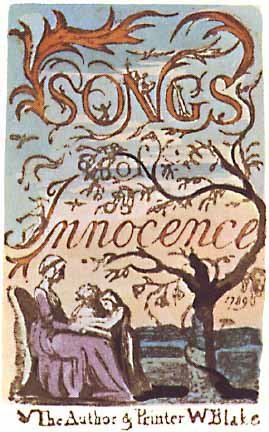
Songs of Innocence

In 1789 Blake set about producing an illuminated book of his poems entitled Songs of Innocence. The poems and artwork were reproduced by copperplate engraving and coloured with washes by hand.  Five years later in 1794 he bound these poems with a set of twenty-six new poems in a volume entitled Songs of Innocence and of Experience Showing the Two Contrary States of the Human Soul.

I will leave off the biography of William Blake at this point in his life just before he moves away from London and will conclude his life story in my next blog.

Nebuchadnezzar (The Tate Britain version) by William Blake (1795)

For My Daly Art Display today I am featuring the colour monotype print by William Blake entitled Nebuchadnezzar.  This comes from Blake’s Large Colour Prints collection. This collection of Blake’s twelve large colour prints, which he first designed and completed in 1795, are now considered to be his greatest works as a pictorial artist. Their inspirational imagery and the printmaking technique Blake used to create them evolved out of his illuminated books of 1790-95.   It is thought that Blake drew an outline of the design on the printing matrix, painted on it areas of gum- or glue-based pigments, and then printed individual impressions on damp paper in his rolling press.  It is thought that then Blake and his wife Catherine added ink and watercolour to the impressions.   There were no more than three impressions of any one of the twelve designs in existence. The one we see before us today was reprinted around 1805 and there was added more hand outlining and tinting to the original impression.  In all there were four copies of this work.  One can be found in the Tate Britain, one in the Museum of Fine Arts, Boston and one in the Minneapolis Institute of Arts.  The fourth copy is missing.

So what is the picture all about?  The bible tells the story of Nebuchadnezzar in book of Daniel (4:33) stating:

“…The same hour was the thing fulfilled upon Nebuchadnezzar: and he was driven from men, and did eat grass as oxen, and his body was wet with the dew of heaven, till his hairs were grown like eagles’ feathers, and his nails like birds’ claws…”

Blake’s biographer, Alexander Gilchrist, wrote in his book of 1880 entitled The Life and Works of William Blake , describing what we are looking at as:

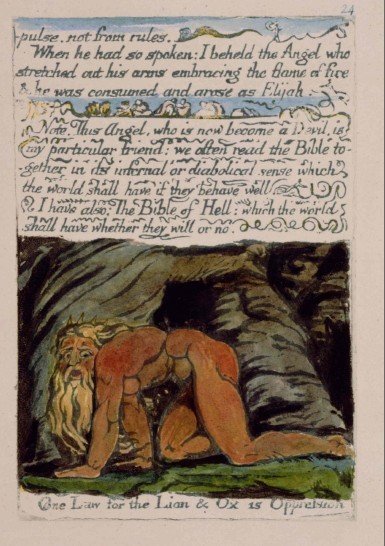
 “…“the mad king crawling like a hunted beast into a den among the rocks; his tangled golden beard sweeping the ground, his nails like vultures’ talons, and his wild eyes full of sullen terror. The powerful frame is losing semblance of humanity, and is bestial in its rough growth of hair, reptile in the toad-like markings and spottings of the skin, which takes on unnatural hues of green, blue, and russet…”]

Nebuchadnezzar from the Marriage of Heaven and Hell (1790-93)

The original depiction of Nebuchadnezzar by Blake dates back to plate number 24 of his book The Marriage of Heaven and Hell which he created between 1790 and 1793 and which was a series of texts and illustrations which expressed Blake’s own intensely personal romantic and revolutionary beliefs. The book was published as printed sheets from etched plates and contained a mixture of prose, poetry, and illustrations.

Welcome to the strange world of William Blake.

Lake of Albano and Castel Gandolfo by John Robert Cozens

Lake of Albano and Castel Gandolfo by John Robert Cozens (1777)

About the watercolours produced by today’s featured artist, the Swiss-born painter Henri Fuseli wrote:

“…they are creations of an enchanted eye drawn with an enchanted hand…”

The great English landscape artist, John Constable,  wrote of him saying he was:

“…the greatest genius that ever touched landscape…”

So who was this celebrated artist who was so revered by his fellow painters?  His name was John Robert Cozens.  He was born in London in 1752.  He received his initial artistic training from his father, Alexandra Cozens, the Russian-born watercolour landscape artist who was mostly employed in teaching and was drawing-master at Eton school from 1763 to 1768 and also  gave lessons to the Prince of Wales.  He allegedly was the natural son of Peter the Great.  He and his wife Juliet Cozens (née Pine) had one son, John and a daughter Juliet.

John Robert Cozens was, for the most, an en plein air painter and would often go off on sketching tours of Suffolk.  In 1772 he toured the Peak District area continually sketching the rugged landscape.  It was in that same year that he moved to live in Bath where his uncle Robert Pine, the English portrait and historical painter also lived.  In 1776 he exhibited his first oil painting at the Royal Academy and it was well received by the critics. He made his first trip to Europe in 1776, accompanied by Payne Knight.  Knight was a colourful character.  He was a classical scholar and connoisseur, who was best known for his theories of picturesque beauty.  He was later to become a Member of Parliament and he was also a member of the Dilettante Society or Dilettanti which was a society of noblemen and scholars which sponsored the study of ancient Greek and Roman art and the creation of new work in the classical style and it was through his auspices that Cozens made it to Italy. 

During the next eighteen months Cozens toured around the Italian countryside visiting Tivoli, Naples as well as the volcanic lakes of the Alban Hills, which lie twenty kilometers south of Rome.  During his time in this area he made sketches which he would eventually turn into some of the greatest watercolour landscapes ever seen.  His artwork incorporated the classicism of the greats such as Claude, Gaspar Dughet and Nicolas Poussin.  He remained in Rome until April 1779 at which time he returned to England and Bath where he remained for three years.  During this sojourn he set about converting the numerous sketches and drawings he had made on his Italian trip into watercolours, as by this time he had numerous wealthy patrons, who could not get enough of his work as they realised that not only were they things of beauty but also a solid investment for the future.  In May 1782 Cozens, along with a party of companion travelers made up of doctors, teachers, musicians along with a number of servants set off for another journey of discovery to Italy.

The following year Cozens returned to England and set up home in London where he set about producing more watercolours for his various patrons based on what he had seen and recorded during his recent visit.  Whilst living in the capital he took the opportunity to go on sketching trips around the local area and sketched and painted many scenes of the likes of Richmond Hill, and Greenwich and Windsor Parks as well as Thames river scenes.  He was so inundated with commissions from patrons that he never had time to put forward paintings to the Royal Academy exhibitions.

Sadly, like many gifted people, Cozens suffered from bouts of depression, probably caused by his unending and burdening search for artistic perfection.  His health was further affected by a bout of malaria which he had contracted during his Italian visit in 1782.   In 1794, aged just forty-two, his mental health had deteriorated and he had a mental breakdown and was placed under the care of a Doctor Thomas Monro, a physician at the Bethlehem Hospital, better known as Bedlam.   Unable to paint, Cozens and his family faced financial ruin and had to be rescued with the help of patrons and friends.  John Robert Cozens died four years later at the age of forty-five and was buried in London on New Year’s Day 1798.

Whilst Cozens was in the care of his physician Thomas Monro the doctor had access to some of Cozens’ sketches and he employed both Turner and Thomas Girtin to copy them.  The two young aspiring artists were greatly influenced by Cozens’ work.   Cozens was an expert when it came to the painting of trees and in 1789 he published a set of works entitled Delineations of the General Character of Forest Trees.  He submitted it to the Royal Academy but they rejected it saying that it was judged as being “not proper art”.

My Daily Art Display featured watercolour over pencil work today is entitled Lake of Albano and Castel Gandolfo which Cozens completed in 1777.   This little gem measures just 43cms x 62cms.   It depicts a large panorama of a menacing sky over the darkening hills surrounding Lake Albano, a small volcanic crater lake in the Alban hills of Lazio and the small hill-top town of Castel Gandolfo. There is a solemn grandeur about this work, a sense of vastness as well as an underlying tranquility.  I think there is also an air of mystery to the setting and maybe we are meant to look at it and use our imagination as to what it would be like to stand high above the lake at sunset.  

The work itself which was owned by Professor Ian Craft a fertility doctor, who bought it for £198,500 in 1991.  It went under the hammer at a Sotheby’s auction last year with a catalogue estimate of £500,000 – £700,000.   It finally went to David Thomson, the Third Baron of Fleet, and Canadian media magnet for £2.4 million.  That price represented not just a significant return on investment for the vendor but also a dramatic new high for a work by Cozens.  It easily surpassed the artist’s previous record of £240,000 for Cetara, Gulf of Salerno, Italy at Christie’s in November 2004.  It was also a record, not just for the artist, but for any 18th-century British watercolour.

A huge amount for David Thomson to spend on a work of art ?   Actually minutes earlier he had paid a record £109,250 for a rare drawing entitled Villa Borghese by Richard Wilson, the influential landscape artist I featured recently.  

Who said money cannot buy you happiness?

The Irish Girl and The English Boy by Ford Madox Brown

Manchester Art Gallery exhibition

The other day I went to Manchester to see the Ford Madox Brown exhibition at the Manchester Art Gallery.  The exhibition opened on September 24th and runs until January 29th 2012 and I strongly recommend you make the effort to visit the city and take in this superb show which displays 140 public and private works from this talented 19th century painter.  I have already  featured two of Ford Madox Brown’s paintings, The Last of England (June 15th) and Manfred on the Jungfrau (July 21st), the former I saw when I visited the Birmingham Art Gallery and the latter which I had hoped to view when I went to Manchester a few months ago had been withdrawn from the gallery for some restoration work prior to this new exhibition.   Both of these works are on show at the current Manchester Exhibition.

I will, in the coming months, review more of Ford Madox Brown’s works,  which I saw at the exhibition, but I need to space them out a little otherwise I will be accused of featuring one artist too often.

Like most people, I had seen many of Ford Madox Brown’s paintings before, in books or on the internet, but what I had not realized was that he had completed many portraits of which a number were on display at the exhibition.  However, there is nothing more true than the saying “you cannot please all the people all the time” for as I researched today’s blog and was still buoyed up with my admiration for Brown’s portraits,  I came across the Daily Telegraph’s art critic’s, Alastair Smart, view of the exhibition and his assessment of some of the paintings, especially his portraiture.  He wrote:

“…Despite the show’s claims to the contrary, Brown’s portraits and biblical dramas aren’t up to much either: his figures are just too awkward in facial gesture, one toothy contortion after another…”

How disappointing to read that when I was still so enthused with what I had seen.  I loved his small portraits.  I did get some consolation however when I re-read the opening line of his article which stated quite bluntly:

“….First, a confession: I utterly loathe the Pre-Raphaelites. Oh, what a mawkish, melodramatic and clichéd bunch…”

The journalist did however go on to qualify his bold statement by saying that he realized Ford Madox Brown was not a member of the Pre-Raphaelite Brotherhood but countered that by telling us that he did have a close association with the three founder members.  Guilty by association ?  Having said all that I will not be deflected from my proposed look at two of Brown’s small portraits, which I loved, even if the knowledgeable art critic disliked them. 

The Irish Girl by Ford Madox Brown (1860)

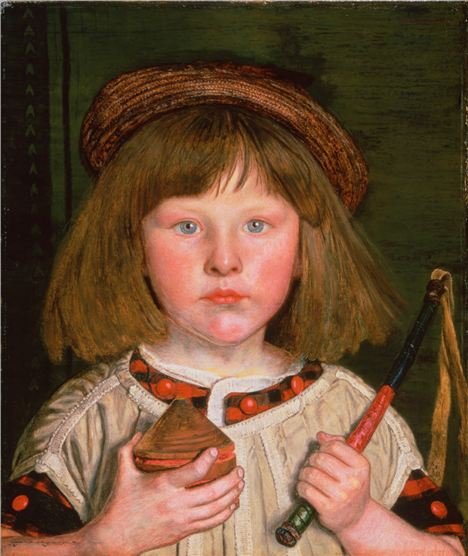
For My Daily Art Display today I am featuring two portraits, The Irish Girl and The English Boy as they were hung next to each other at the exhibition and in some ways they are connected.  It was the coming together of these “two old friends”, who were separated forty-seven years ago.  The man, who commissioned the paintings, was a Leeds stockbroker called Thomas Edward Plint, who was a patron of Ford Madox Brown, and an important Pre Raphaelite art collector.  In 1850, he had commissioned Brown to paint Work, and out of that commission came the painting, The Irish Girl, which also happens to be featured on all the exhibition publicity material.  To my mind this is a beautiful and haunting painting.  This small (almost 28cms square) oil on canvas work was completed by Brown in 1860 and is normally to be found exhibited at the Yale Centre of British Art.  The Yale Center for British Art, which is in New Haven, Connecticut, is a public art museum and research institute for the study of British art and culture. It was presented to Yale University by Paul Mellon who was in the Class of 1929 at Yale.  The Centre houses the largest collection of British art outside the United Kingdom.

In comparison to the portrait of the young English boy the young girl looks slightly nervous and somewhat troubled.  She has real beauty.  There is nothing idealized about this portrait.  Her haunting loveliness is plain to see and yet the difference between her and the English boy could not be starker.  Unlike the boy, she looks worldly–wise.  Her jet black hair, her dazzling brown eyes and her painted red lips are all part of her exquisiteness.   She has tilted her head a little to one side and her eyes focus on something off to the side.  When Ford Madox Brown was looking for Irish models for his painting Work he came across this young girl selling oranges and couldn’t pass up the opportunity to paint her portrait.   We see the fingers of her hand appearing from inside her red paisley shawl which is tightly wrapped around her and the colour of which complements the colour of her lips.  Between her fingers, she is gently holding a sprig of cornflowers. 

The English Boy by Ford Madox Brown (1860)

The portrait which hung next to the Irish Girl was entitled The English Boy and was the companion piece to the Irish Girl.  In this case the young child depicted was no stranger to Brown.  It was his five year old son, Oliver, and this too was painted in 1860.  It is slightly larger than the Irish Girl, measuring 39cms x 33cms.  This portrait is owned by the Manchester Art Gallery, which acquired it in 1932.  Although a companion piece to the Irish Girl they couldn’t be more different.  In this portrait,  the young child stares straight at us with a self-assured gaze.   It is a deadpan expression and we wonder what is going through his mind.   His cheeks are slightly flushed and this colouring in some way matches the red shawl and lips of the Irish Girl.   He wears a white smock over a red checked dress and on top of his head, sitting at a slightly jaunty angle, is a brown straw hat.  In his hands he clutches on tightly to the popular child’s toys of the time, a top and whip.  The way in which he holds the toys in some way reminds us of royal paintings where the subject holds a sceptre and orb.

Despite what our knowledgeable journalist would have us believe I don’t find these portraits in any way awkward in facial gesture.  I find them to be simply fascinating studies of two young children.

The Exhibition Stare Case, Somerset House by Thomas Rowlandson

The Exhibition Stare Case, Somerset House by Thomas Rowlandson (c. 1800)

My Daily Art Display today is something different from the usual paintings I feature.  It is a print by the English artist and caricaturist, Thomas Rowlandson.  In some ways it reminds me of what is termed the “saucy” seaside postcards which were extremely popular twenty or thirty years ago and are still sold at seaside resorts in Britain.

Rowlandson was born in London in 1756.  His father was a successful local merchant.  It is said that Thomas Rowlandson learnt to draw before he learnt to write.  He was so enthralled in drawing that his early years were solely spent in drawing.  He attended Eton and after that enrolled to study art at the Royal Academy.

In 1772, at the age of sixteen he travelled to Paris where he remained for two years, during which time he was a student at a drawing school in Paris.  After his stay in France he returned to London and opened a studio in Wardour Street from where he sold his portraits.    At this early point in his artistic career he was looked upon as being somebody who would become a great portrait painter.  He had been awarded the Silver Medal by the Royal Academy in both 1777 and 1778 and was becoming known as a very fine watercolour portrait painter. In the 1780s Rowlandson’s output of his portraiture decreased and he concentrated most of his time on drawings.  These were much in demand and he had a lot of his work published in journals such as the English Review and The Poetical Magazine.   Rowlandson found another means of earning money; that of illustrating novels and many of the great novelists of the time, like Henry Fielding and Oliver Goldsmith had him produce illustrations for their famous works of literature. He also di d illustrations for Tobias George Smollett, whose radical books resulted in him being sent to prison for libel.  Some of Rowlandson’s political cartoons also got him in trouble and he was accused by his critics of being “coarse and indelicate”.
 However fate was to take a hand in changing his future life and lifestyle with the death of his French aunt and the inheritance of £7000 he received.  This was an exceptionally large sum of money at this time and unfortunately Rowlandson could not handle being wealthy and within a short time had gambled it all away and had become penniless.

Rowlandson needed to earn some money but instead of concentrating on his watercolour portraits he, because of his friendship with the great political satirist, James Gillray, decided to concentrate his artistic efforts on socially satirical caricatures.  There was a good market for such works at the time and he was aware that this was an excellent way to improve his finances.  Rowlandson preferred to use watercolours for his caricatures and he was so successful with what he produced that for the rest of his life he had no need to revert to watercolour portraiture.  His trademark for his caricatures was the lecherous old man and the buxom female and accompanying the picture he would add a title or the odd line of prose or verse which enlightened the viewer as to what the caricature was all about (if it was ever needed!).  The caricatures were often moralistic and were in some ways like the moralistic paintings of Hogarth.   Whereas the great caricaturists of Rowlandson’s time such as James Gillray and George Cruickshank concentrated mainly on political cartoons Rowlandson favoured the socio-cultural caricatures and their satirized morals. Although some of his caricatures were criticised for being crude and unseemly, this was nothing compared to the criticism he received for his erotic prints and woodcuts which even today would be met with censorship for their pornographic nature.  Rowlandson by any standards lived a hard lifestyle and eventually this was the cause of prolonged illnesses in later life.  He died in 1827 aged 71.

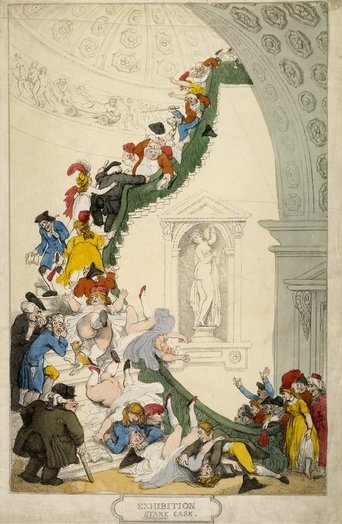
My Daily Art Display today features the caricature print entitled The Exhibition Stare Case, Somerset House which Thomas Rowlandson completed around 1800.  This print is based on a drawing which Rowlandson made earlier.   In his print he points fun at the people attending the art exhibition and the male penchant for caring more about the “living” pictures that provide additional, or even preferred, entertainment to the works on display at the Exhibition.  Look at the facial expression on the lecherous old men ogle the elegant ladies who have tumbled haplesslydown the staircase, limbs akimbo and tender parts exposed. It is interesting to note how Rowlandson has depicted the under-dress of the women.  He shows them wearing stockings but not much more beneath those gauzy muslins.  So are we to believe that females of that era wore few or no under-garments or is it Rowlandson’s way of adding a touch of erotica to his work.  

The setting for this work is the Royal Academy of Art, which was founded in 1768 and housed in Pall Mall, and then Old Somerset House before it moved to New Somerset House in 1780.  It remained there for almost ninety years when in 1868 it transferred to its present site, Burlington House, on Piccadilly.  The title of the work is a pun on the word stare (as in looking fixedly) and stair (part of a staircase) and the artist is poking fun at the people who have come to see the works exhibited at the Royal Academy exhibition.  In Rowlandson’s mind there were two kinds of viewers who came to Somerset House: those who wanted to see the paintings and sculptures, and those who came to ogle the ladies whose legs and ankles were exposed walking up those prominent stairs.  Of course with such lack of attention to what they are doing the inevitable accident happens as people trip over one another and fall down the stairs in a domino effect.  The print shows the large ornate staircase which leads to the Great Room at Somerset House.  This was a steep and winding staircase and at times when the Royal Academy was well attended it would have been difficult to negotiate a safe passage up and down it. 

In the alcove at the bottom of the staircase we have a statue of Venus.  This is a later print of Rowlandson’s work as in the original instead of the statue of Venus, there was just an urn.

Dian Kriz, the American art historian’s book “‘Stare Cases’: Engendering the Public’s Two Bodies at the Royal Academy of Arts.”  and in Art on the Line: The Royal Academy Exhibitions at Somerset House, 1780-1836 recounts a number of comments regarding the Exhibitions made in the reviews of the RA exhibitions at the time.  One commented on the exhibitions and the attendees describing it:

” …. as a place where art and female bodies vied for the male gaze…”

She quotes the Morning Post of May 3rd 1875 and its view on the visitors:

“…“there are two descriptions of persons who visit the Royal Academy some perambulate the rooms to view the heads others remain at the bottom of the stairs to contemplate the legs…”

Finally in the World, Fashionable Advertiser of May 8th 1787 it notes:

“….“Exhibitions are now the rage and though some may have more merit, yet certainly none has so much attraction as that at Somerset House; for, besides the exhibition of pictures living and inanimate, there is the raree-show [peep show] of neat ancles up the stair-case which is not less inviting…”

One can see that Rowlandson could well have got the idea for his caricature from these press releases.   What I love about this painting is that all the people are different.  They are all doing different things and it is a joy to scan each individual closely to see the facial expression and their role in the picture.  Look how absorbed they are in what is going on around them.  Note the lecherous looks on the faces of the old men as they gaze at the disheveled attire of the falling and fallen females.

When I was researching the works of Thomas Rowlandson I was astounded at the sexual nature of some of his caricatures.  I have talked on a number of occasions about the fine line in paintings between what is considered sensuous and what is considered erotic.  With some of Rowlandson’s caricatures there is a very fine line between what is erotic and what is pornographic.  I think that if ever there was an exhibition of his works the media would have a field day on discussing whether some of his works should be censored.  I will leave you to look at some of these works on the internet and decide for yourself.  Erotic/pornographic cartoons and caricatures of course are not just a thing of the past as in the present time we have the Japanese Hentai comics and Japanese Anime (animation).