Girl with a White Dog by Lucian Freud

Girl with a White Dog by Lucian Freud (1950-51)

A few days ago I visited my two children in London and went on a few gallery visits.  I had managed to get tickets for my daughter and myself for the David Hockney Exhibition at the Royal Academy which was really a great experience and one which everybody should try and get to.  I will feature a painting from the exhibition later this week.  The other exhibition I had wanted to see and which had just opened was an exhibition of Lucian Freud’s Portraits which was being held at the National Portrait Gallery.  Unfortunately I could not get a ticket for the days I was in the capital so I have booked to go next month.  Today I am going to look at one of my favourite paintings of his entitled Girl with a White Dog, which he completed in 1951.  First let me tell you a little about Lucian’s early life and that of the sitter for this painting, his first wife, Kathleen Garman and look back on the famous, or maybe I should say, infamous Garman sisters.

Lucian Freud, who is the grandson of Sigmund Freud, the pioneer of psychoanalysis, was born in Berlin in 1922.  His father, Ernst Freud, an Austrian Jew, was an architect and his mother Lucie (née Brach) was the daughter of a grain merchant.  On the rise to power of Adolf Hitler in Germany in 1933, Lucian and his parents moved to Britain and lived in a house in St John’s Wood, London.  During his school years, he attended Dartington Hall Boarding School in Totnes Devon.    This was, at the time, an unusual seat of education.  It was a very progressive establishment in which there was a minimum of formal classroom activity and the children learnt by involvement in estate activities. From there he attended the Bryanston Independent School in Dorset.

In 1939 he became a British national and that year he enrolled at the Central School of Art and Design, which fifty years later would merge with the St Martins School of Art and become, as we know it today, the Central Saint Martins College of Arts and Design, which is widely regarded as one of the leading Art and Design institutions in the world.  His stay at the college was only brief as he moved on to the Cedric Morris’ East Anglican School of Painting and Drawing in Dedham.  This was a far more radical establishment which gave free rein to its students.  The school was destroyed by fire and a new location for the school was established in Benton End on the outskirts of Hadleigh in the county of Sussex.

Lucian Freud served as a merchant seaman in an Atlantic convoy in 1941 before being invalided out of service in 1942.  From 1942 to 1943 he attended Goldsmiths, University of London, an establishment which specialises in the arts, humanities and social sciences.  At the age of 24, Freud began his European travels, painting in France and Greece.  Some of his early work had already been published in the Horizon arts magazine and in 1944 the Alex Reid & Lefevre Gallery in London staged the first solo exhibition of his paintings.

In 1948 Lucian married Kitty Garman, the subject of today’s featured painting.   Kitty was the second illegitimate child of the distinguished British sculptor, Jacob Epstein’s and his lover Kathleen Garman.  Jacob Epstein and his wife Margaret (née Dunlop) did not have any children of their own but they looked after a young girl, Peggy Jean, the product of Jacob Epstein’s earlier affair with Dorothy (Meum) Lindsell Stewart.  Margaret Epstein and the young girl lived across London with Jacob, while Kathleen Garman lived with her younger sister, Helen, in an unheated studio in Bloomsbury and her and Jacob’s infant son, Theo.    Margaret Epstein was aware of her husband’s affair with Kathleen Garman and despite her husband’s numerous previous affairs with women which never lasted, she felt threatened by Kathleen.  She realised that Kathleen was more than a lover, she was almost a  parallel wife. From the beginning, Mrs Epstein disliked her intensely, realising  that she would be her greatest rival.   It came to a head in 1923 when according to Cressida Connolly in her book The Rare and the Beautiful: The Lives of the Garmans:

“…Mrs Epstein took Kathleen into a room and locked the door before producing a pearl-handled pistol from under her capacious skirts… and shot her. The bullet hit Kathleen just to the right of her left shoulder blade, whereupon Mrs Epstein panicked and ran out of the room, leaving the bloodied Kathleen to stagger out into the street alone…”

Jacob Epstein visited Kathleen in hospital and paid her medical bills. The bullet wound to her shoulder left  a large scar and Kathleen Garman was never afterwards able to wear sleeve-less dresses. To protect the reputation of Jacob Epstein, Kathleen Garman refused to press charges against his wife.

Despite this incident and the pleadings of his wife, Epstein refused to give up Kathleen, who remained in her one-room London studio as Epstein’s lover and bore him three illegitimate children; a son, Theo, in 1924, and two daughters,  Kitty in 1926 and Esther in 1929.  Epstein had another affair with one of his students, Isabel Nicholas, and this resulted in the birth of a son Jackie in 1934.  Isabel gave up her son to the Epsteins and he was also looked after by Margaret Epstein.   Kathleen Garman never knew about Epstein’s parallel affair with Isabel or about the boy Jackie until several years later.

The cramped conditions of the studio Kathleen Garman was living in proved unsuitable for bringing up young children and Kitty was sent to live with her maternal grandmother, Margaret (née Magill), in Herefordshire.  Esther, the youngest daughter was later dispatched to a family friend.   Kitty Garman stayed on with her grandmother Margaret when the household moved to South Harting, Sussex, and only went back to live with her mother in London when she was in her late teens.  She then enrolled at the Central School of Arts and Crafts to study painting under Bernard Meninsky. According to Kitty, her mother was constantly critical of her artistic efforts. Kitty recalled her mother’s attitude:

 “…I think she wanted her daughters to excel, but she didn’t want us to succeed, because she had to be the queen.   I was frightened of her because of her temper and she did say searingly sarcastic things…”

In 1949, Epstein’s wife, Margaret fractured her skull in a fall on the steps of her home and died.  This allowed Kathleen Garman to move into Epstein’s home in Hyde Park Gate.

By the early 1950’s Kitty Garman’s marriage to Lucian was in trouble and it ended abruptly after the artist’s affair with the society girl and writer Lady Caroline Blackwood was exposed.        Kitty Garman’s marriage to Lucian Freud ended in divorce in 1952 and Lady Caroline Blackwood became his second wife in 1957.  Shortly after the ending of her marriage to Lucian, Kitty was at a party where she met Wynne Godley, and economist, whom she married in 1955.

Lucian Michael Freud died aged 89 on July 20th 2011.  His first wife and sitter for today’s painting, Kathleen (Kitty) Eleonara Wishart (née Godley, née Freud) died aged 74 on January 11th 2011.

Kitty Garman, a brunette, was by all accounts, hauntingly beautiful and the subject of many paintings.  My Daily Art Display featured painting today is entitled Girl with a White Dog which Lucian Freud commenced in 1950 and  completed in 1951.  When not lent out to external exhibitions this work of art resides at the Tate Britain Gallery, London.  This is the last of the series of portraits of his first wife, Kitty, which Freud had started at the end of the 1940’s.  Kitty had given birth to Lucian and her first child, Annie in 1948 and their second child Annabel was born in 1952, the year the painting was purchased by the Tate.

One can only marvel at the way Freud has handled the contrast of the fabrics and textures.  On the one hand we have the smooth white hairs of the dog and on the other hand we have the fuller texture of the yellow dressing gown, which contrasts also with the smoothness of the  striped silk bedspread on which she sits.    In the painting we see Kitty Garman sitting curled up on what looks like a low settee dressed in a dressing gown with its long plaited and tasselled tie.   Lying next to her, with its head in her lap, is one of a pair of white bull terriers the couple were given as a wedding present.  Look at the wonderful amount of detail Freud has put into his depiction of the dog.  He would often use animals in his compositions and often they would feature both pet and owner.

Kitty left hand hangs down and her fingers rest on the settee and on one of the fingers  we can see her wedding ring.   Her right hand is pressed against the bathrobe, cupping her left breast.  Her right arm is strategically placed under her right breast with her wrist adding to its uplift and fullness.  Her expression is difficult to translate.  She seems somewhat frightened and concerned about something.  Her eyes are large and staring.  In some ways we feel a little uncomfortable when we look at her.  Her brow is narrow which adds to her look of anxiety and sadness.  It could well be that Freud’s liaison with Caroline Blackwood at the time of this painting was taking a toll on Kitty.  Is her look one of calmness or one of desolation?  I will let you decide.
Hush and Hushed by Frank Holl

Hush by Frank Holl (1877)

I get great pleasure in “discovering” new artists.  Today I am going to look at the life of an artist I had never previously heard of and maybe he is somebody that you have never come across before.  In My Daily Art Display today I am going to look at two paintings by the English Victorian social realist painter and portraitist Frank Holl, entitled Hush and Hushed.

Frank Montague Holl was born in Kentish Town, London in 1845.  His father, Francis, was a well-known engraver and Academician.  His grandfather, William Holl, was also an engraver.  He was brought up in a political household.  His family were staunch Socialists and from an early age Holl was taught that he had a duty in life to transform society and improve it for the common people.   He started his schooling at the Heath Mount School in Hampstead and at the age of fifteen he enrolled as a probationer at the Royal Academy Schools.  He proved to be an exceptional student but much to the dismay of his tutors, Holl liked to add a touch of political content to his works of art.  At the age of seventeen he won a silver medal for his work and the following year was awarded a gold medal and a travel scholarship for his painting entitled The Lord gave, and the Lord hath taken away.  It was a painting that depicted a family bereavement and when it was exhibited at the Royal Academy in 1869, the then monarch, Queen Victoria attempted to buy the painting it but the original purchaser refused to sell it.  Two years later Holl painted another painting on the same theme entitled No Tidings from the Sea and on this occasion Queen Victoria purchased it for a 100 guineas.   Holl set off on his travel scholarship to Italy but the journey lasted only two months, at which time he wrote to the Royal Academy saying that he wanted to return home and concentrate on his social realism paintings based on the lower working-class life in England.

Holl started exhibiting his work in 1864 when he was nineteen years of age and from 1869 onwards he was a regular contributor to the Academy Exhibitions. Many of these works were depicting the plight of the less fortunate and their pitiful existence, such as No Tidings from the Sea (1871) and Leaving Home (1873).  When he completed his studies in 1869 he was employed by William Luson Thomas, a successful artist, wood engraver and social reformer, who had just founded a new weekly illustrated newspaper, called The Graphic, and was looking for a number of talented artists to illustrate it.  For the following five years, Holl produced a series of pictures that were used to illustrate stories in the magazine. Among his fellow workers were Luke Fildes (see The Doctor – My Daily Art Display, May 17th 2011) and Hubert von Herkomer (see Hard Times, My Daily Art Display July 25th 2011), who like him believed passionately in the cause for political and social change.  Often they would turn the engravings, which they had fashioned for the pages of The Graphic, into oil paintings.  These depictions of the real life lead by the “under-class” of the nation lead them to become known as the Social Realist Movement.  Although we may look upon these depictions of poverty as a welcome wake-up call to the nation, they were badly received by the Victorian establishment at the time.  They viewed the works as being disloyal.  The establishment and many of the people who had never suffered poverty wanted to turn a blind-eye to the suffering of the less fortunate.  Their motto was “out of sight, out of mind” and frowned upon these upstart young artists who wanted to drag the social differences which existed into the public forum.

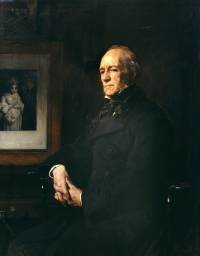
Samuel Cousins by Frank Holl (1879)

In 1879 Frank Holl had a breakthrough in his artistic career when he completed a portrait of his neighbor, the English mezzotint engraver, Samuel Cousins.  The critics loved it.  One wrote in a national newspaper:

“…Mr Frank Holl’s portrait of the renowned engraver Samuel Cousins R.A. is a superb work, glowing,  for all the austerity of its execution, with animation and intelligence…”

In another newspaper the art critic commented:

“…Mr Frank Holl’s half-length, seated of Mr Samuel Cousins, the engraver is one of the portraits of the year and does the young artist infinite credit…”

So was Samuel Cousins delighted with the finished work?  Actually, he wasn’t, saying, with an open show of vanity, that the painter had added to his years, and had made him appear too old.  However notwithstanding the sitter’s comments the painting lead to numerous lucrative commissions from wealthy patrons.  From that day on till the end of his life, Frank Holl never had to search out work, work searched him out.  His portraiture was mainly of men, often ones who were very famous such as Gladstone and Joseph Chamberlain.

In 1888 having sent a number of his paintings to the Royal Academy for their Summer Exhibition he travelled to Spain.  He had decided to spend a short period in Madrid and visit the Prado where he could study the works of the great Spanish master, Velasquez.  Shortly after returning home he suffered at heart attack and died suddenly on July 31st 1888, aged just 43.  His fame as an portrait artist lead to much work, in fact too much work, none of which he ever turned down.  Holl continually tried to find time to paint his social realist paintings as well as his lucrative portraiture work but to do this he found himself working every day of the week.  He once told his wife of the strain he was under, saying:

“…Hunger for work is always on me, and it is when I cannot satisfy this hunger that I get so worn out. If only I could banish my tormenting conscience for work; but that never lets me alone, and if I do nothing I feel of no use…”

After his death his daughter commented that her father continually suffered from the nervous strain of working with such distinguished men and that this strain, in her mind, contributed to her father’s premature death.

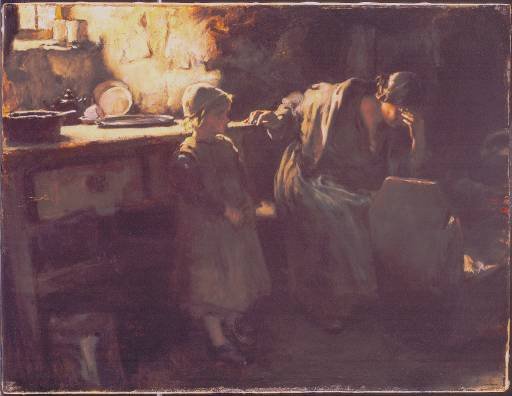
Hushed by Frank Holl (1877)

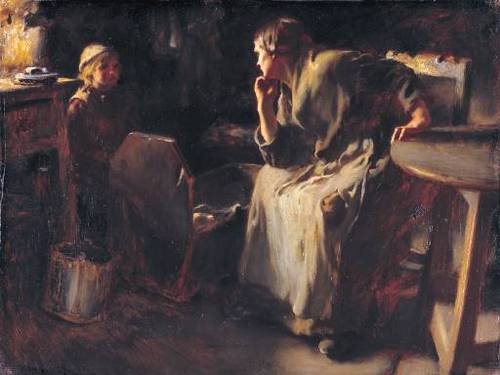
Today’s pair of paintings entitled Hush and Hushed were completed by Frank Holl in 1877 and are now housed in the Tate Britain Gallery in London.

The setting for the two paintings is a room in a small dwelling.  It is a solemn setting and the somber colours used by Holl enhance the bleak and depressing mood.  One can tell by the sparse decor and bare walls that the occupants have little money.  The lives of such people was a constant source for Holl’s artistic works.  In the first of these paintings entitled Hush, we see before us a mother tenderly bending over the cradle of her sick child.   There is a distinct look of concern and apprehension in her face.  Whilst she looks into the cradle,  she whispers to her other child, who stands close by, to be quiet so as not wake the infant who has finally gone to sleep.  The young boy looks equally anxious about the situation.   It is a typical homely scene and there is no hint of what is to follow in the companion work, Hushed.

This second work is a follow-up scene in the same room and this time we see the devastated mother gazing sorrowfully into the empty cradle where once the baby had been but had now sadly passed away.   We see the mother with her hand covering her face in a sign of grief.  Her other child leans against a cupboard with his hands clasped in front of him.   He looks at his grieving mother but has no idea what to do to console her.

These are extremely moving works of art and in a way Holl has handled them without resorting to sentimentality.  The paintings were meant for people to understand the problems faced by those who were imprisoned by poverty and suffered the fates that accompanied such financial destitution. Infant mortality was high in 19th century and it is estimated 1 in 5 children died before their fifth birthday. Infant mortality had always been high and much of it could be because of the lack of sanitation and general hygiene especially amongst the poor. However in those days, the well-off were not immune to such early deaths, as it was also a period when consumption and cholera accounted for many young deaths.

Home from the Sea by Arthur Hughes

Home from the Sea by Arthur Hughes (1862)

For my work of art today, I am crossing the Channel from France and featuring an English Victorian artist who was associated with the Pre-Raphaelite Brotherhood.  His name is Arthur Hughes and he was born in London in 1832, the son of Edward and Amy Hughes.  When he was six years of age he attended the Archbishop Tenison’s Grammar School and it was here that he showed the first signs of his artistic talent.  In 1846, aged fourteen he enrolled in the School of Design at Somerset House where he studied under Alfred Stevens.  From there he enrolled in the Antique Schools at the Royal Academy and whilst a student there won a silver medal for a “Drawing from an Antique” competition.  In 1850 he exhibited his first work entitled Musidora, at the Royal Academy.  It was also in this year that he first encountered Alexander Munro, Ford Madox Brown and Dante Rossetti, all artists of the Pre-Raphaelite Brotherhood.  Hughes was soon converted to Pre-Raphaelitism adopting many of their ideas in his own work.  Hughes was also greatly influenced by the works of John Everett Millais although he never met him until two years later, in 1852, when they were both exhibiting paintings at the Academy with the same title, Ophelia !  The year 1850 was to prove a very significant year for Arthur Hughes for another reason – he met and fell in love with a woman, Tryphena Foord and eventually in 1855 they married.  It was a very long courtship period of over five years between their first meeting to their nuptials.  During this time Hughes completed many paintings which were both romantic but wistful, both sad but tender and the tone of these works could well have been as a result of his long wait to get married.  Tryphena was the model for many of his  paintings.  The couple had a long and happy life together and went on to have six children, two of whom are present in today’s featured work.  Many of his pictures were of ordinary scenes of life. They were painted with great delicacy and feeling and were often in greens and mauves.

In 1857 he joined in on a joint commission with Edward Burne-Jones, Rossetti, William Morris and others to paint murals on the walls of the Oxford Union Debating Hall which is now the Library.  It was this commission that influenced much of Hughes’ later works and can be seen by the way he softened his colours and added a mystical overtone similar to that seen in the works of Dante Rossetti.   Many of his subsequent works featured Arthurian legends and religious themes.  Besides his time spent on his paintings he also worked on book illustrations for many writers and poets including Keats, Tennyson, Christina Rossetti and Thomas Hughes whose  famous book was Tom Brown’s School Days.  Arthur Hughes was one of the leading illustrators of his time.  He also worked as an art examiner in London and later taught art at the Working Men’s College

He died in London in December 1915, almost a recluse.  During his lifetime he produced over seven hundred paintings and drawings and almost eight hundred book illustrations.  Friends of his would tell you that his main attributes were his modesty and self-effacement.  Like all of us, he had many disappointing times during his life.  He suffered a number of ill-merited rejections at the Royal Academy and despite all his artistic accomplishments, he was disappointed to never having been elected an Associate of the Royal Academy.  He is now regarded as being the best of the younger Pre-Raphaelite followers.

Study for A Mother's Grave by Arthur Hughes

My featured painting today is a very poignant one and is entitled Home from the Sea which he finally completed in 1862 and exhibited at the Academy the following year.  He actually started it six years earlier and the original title of the painting when first exhibited in 1857 was  A Mother’s Grave.   It is known, because of the existence of a study for the original work,  that in the original painting there was just the figure of the boy kneeling over his mother’s grave.   However, there was much criticism over the way Hughes had painted the boy and so he re-worked the painting, adding the figure of the girl.

The painting is set in the graveyard of the Old Chingford Church, Essex.  In the background we see the white walls of the church reflecting the brightness of the sun.  It is not however the church that our eyes immediately focus on but the figures in the foreground which are in shadow.  Before us we have a young sailor boy who has just returned home from a voyage at sea only to find out that his mother has died whilst he was away.  His hat and belongings, wrapped in a knapsack lie abandoned on the ground.  Kneeling besides him we see a girl, possibly his sister, also mourning the death of their mother.

The depiction of the girl was posed for by his daughter Tryphena.   She wears a  black funerary outfit.  Her facial expression is one of pain over her loss.  She kneels on the ground with her hands folded in front of her.  Her eyes are downcast and in some ways her mourning is both constrained  and controlled, possibly because she did not want to further add to the sadness of the boy who has prostrated himself on the ground.

We cannot see the facial expression of the young sailor boy who is still in his uniform. However, we see his hands are clasped in prayer as he prays for the soul of his mother.  This is not just a story of a boy’s loss of a parent but there are things in the painting which symbolise the transience of life and all things ephemeral, like the dog roses and the dandelion seeds as well as the spiders web which is wet with dew, and which can be seen in the tree branches above the girl’s head.  The sense of loss is also highlighted again by Hughes for if we look towards the church in the background we see a ewe searching desperately for her lamb which is hidden from her view by a tombstone.

The painting was exhibited at the Royal Academy in 1863 with the present title of Home from the Sea.  One cannot but be moved by this churchyard scene full of pathos as we empathize with the children’s suffering at their loss.

The painting itself, as well as the preliminary study, can be found at the Ashmolean Museum, Oxford.

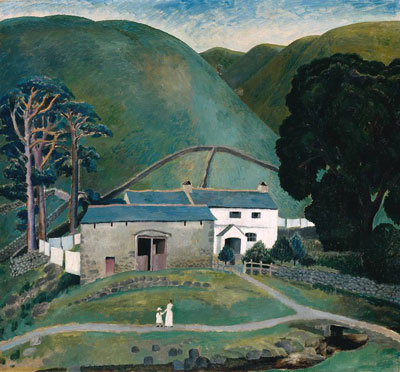
Farm at Watendlath by Dora Carrington

Farm at Watendlath by Dora Carrington (1921)

It often occurs that I stumble across and interesting subject for My Daily Art Display when I am researching another artist.  I came across today’s featured artist when I was delving into the life story of Mark Gertler and his painting Gilbert Cannan and his Mill in my last blog.  I should probably state up front that today’s blog is more about the artist and her fascinating social life than her featured painting.

Dora de Houghton Carrington was born in Hereford in 1893.  She was the second of the two daughters and fourth of the five children of Samuel Carrington and his wife, Charlotte de Houghton.  In 1902, aged 9, the family moved to Bedford and Dora attended the local girl’s high school.  The school’s ethos at the time was that the pupils should concentrate their studies on the Arts such as music and art with a healthy amount of sport thrown in rather than the normal but more commonplace subjects.  Dora showed an aptitude for drawing and her teachers persuaded her parents to pay for her to attend extra drawing classes in the afternoons.  One’s childhood often shapes the way we are in later life and the author Vanessa Curtis wrote about Dora’s differing relationship she had with her mother and father:

“…Although Carrington adored and revered her father, sketching him almost obsessively, she did not admire her fussy, martyr-like mother, who crammed the house with ornaments and devoted herself to charity work and religious causes….”

It is quite obvious that Dora’s mother had a suffocating influence on her children, especially her daughter.  Dora’s brother, Nicholas wrote of his mother extreme views on sex and  religion:

“..The first was extreme prudishness. Any mention of sex or the common bodily functions was unthinkable. We were not even expected to know that a woman was pregnant. Even a word like confined was kept to a whisper. The second was church-going and behaviour on Sunday. We all came to hate the whole atmosphere of a Sunday morning. The special clothes, the carrying of prayer books, the kneeling, standing and murmuring of litanies…”

In 1910, aged 17, she enrolled at the Slade School of Fine Art in London. There can be no doubt that once Dora Carrington was free of her home life and the puritanical views of her domineering mother, she rebelled.  She cut her hair to a bob which gave her a somewhat androgynous appearance. She entered into many intense and sometimes sexual relationships both with women and homosexual and heterosexual men.   She also decided that she wanted to be known simply by her father’s surname, “Carrington”.   Carrington fared well at the Slade and won several awards for her work.  One of her fellow students was Mark Gertler, who was totally besotted with Carrington and it was through him that Carrington met Lady Ottoline Morrell, the “society queen” and he introduced Carrington to the Bloomsbury Group, a group of writers, intellectuals, philosophers and artists.    Lady Ottoline and her husband Philip had a house in Bloomsbury, Central London and a country house in Garsington, Oxford where they would hold weekend parties for their friends, many of whom, like Stanley Spencer, Gertler and Carrington were aspiring artists.

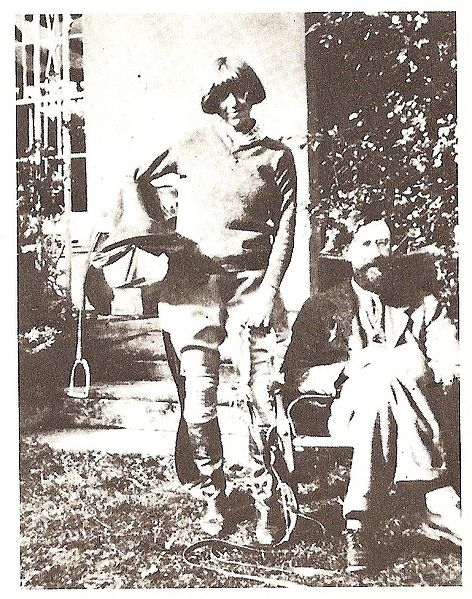
Carrington and Lytton Strachey

The Morrells were prominent pacifists and during World War I they invited conscientious objectors, such as the artist Duncan Grant and the writers Clive Bell and Lytton Strachey to take refuge at Garsington.  Carrington met Strachey, a writer and founder member of the Bloomsbury Group in 1915. Strachey was a homosexual but this did not stop Carrington falling in love with him.  This was a love that was to last almost twenty years.  Gertler felt no threat from Carrington’s love for the openly gay Strachey but in 1917 when Strachey bought a house and Carrington moved in with him, Gertler was devastated and realised that his love for Carrington was irrevocably unrequited and doomed.

Lytton Strachey and Ralph Partridge

Carrington’s father died in 1918 leaving her a small inheritance that allowed her to feel more independent.  That same year, Carrington was introduced to Ralph Partridge, a friend of her brother Noel.  Partridge like many men before him was besotted with Carrington, even though he was aware of Carrington’s love and devotion to Lytton Strachey.  Despite this knowledge, and knowing that Carrington would never give up Strachey, he married her in 1921 and along with Lytton Strachey, they bought and moved into Ham Spray House just outside the town of Hungerford.  It was here that they spent the rest of their lives.  It was a happy period for Carrington who carried on with her artwork and looking after the two men in her life.  Unfortunately, over time, Strachey suffered frequent bouts of illness and had to be cared for by Carrington.

Frances Partridge née Marshall

In 1926 Ralph Partridge started an affair with Frances Marshall, a writer friend and member of the Bloomsbury Group and went to live with her in London. His marriage with Carrington was all but over, but never in the eyes of the law.  Partridge did however still visit her most weekends.   Carringotn in the meantime had a number of extra-marital affairs with both males and females.  The most famous being her affair with Gerald Brenan, an army man and friend of her husband.  She also had a tempestuous love affair with Henrietta Bingham, the daughter of the American ambassador in London

In 1931 Strachey became seriously ill with stomach trouble and the doctors could not decide as to what was causing the illness.  By the end of that year doctors had given up hope of curing him.  In a fit of deep despair at the thought of losing her beloved friend she attempted to kill herself but was saved by her husband Partridge.  For the next month she watched as Strachey moved slowly towards death.  In January 1932 the end came for Strachey and, following an autopsy, it was discovered that he had been suffering from stomach cancer.  Carrington was devastated and her friends tried to rally round to support her but it was to no avail as in March 1932 she shot herself with a gun she had borrowed from a neighbour.  Her husband found her just before she died.  She died just a fortnight before her thirty-ninth birthday.

The painting I am featuring today entitled Farm at Watendlath was completed by Carrington in 1921. Newly-wed Carrington and her husband along with Lytton Strachey and some of their artist friends spent a summer holiday here that year.   One of their holiday companions was her future lover and friend of her husband, Gerald Brenan.  She would often return to spend other painting holidays around this area and she and her friends were frequent visitors to the farm which is near to Keswick in the Lake District.  The house we see in the painting faces Watendlath Beck, which flows from Watendlath Tarn into Derwentwater. A stuffed stag hanging inside was known as ‘Mr Wordsworth’  The two female figures we see in the painting are unknown and it has been suggested by some art historians that this depiction of female figures, dwarfed by a fertile and undulating landscape, relates to the artist’s sense of being overwhelmed by her own womanhood.  However, I find that interpretation hard to believe.

Her life story, in many ways, is tinged with sadness.  Her relationship with Lytton Strachey could not have fulfilled all her dreams and she would have constantly have had to compromise.  Yet, I am sure she had times of great joy and maybe we should look at this painting and remember that at the time she painted this, she had just married and she was at a place she loved with companions whose company she enjoyed and who in return where devoted to her.

The painting which can be found at the Tate Gallery London was presented to that establishment by her brother Noel Carrington in 1987.

Gilbert Cannan and his Mill by Mark Gertler

Gilbert Cannan at his Mill by Mark Gertler (c.1916)

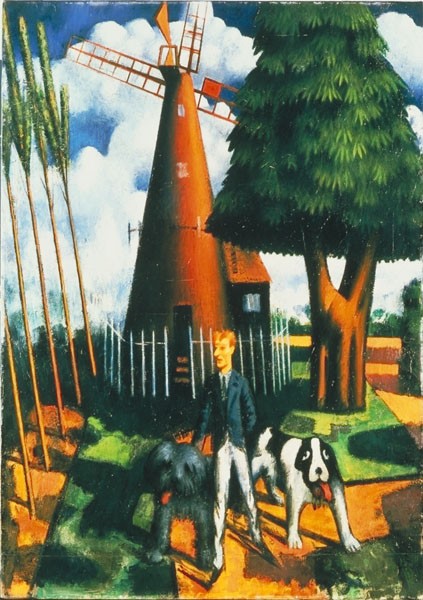
My Daily Art Display today is all about the artist and the person who is the subject of the painting.  The artist who painted today’s featured painting was Mark Gertler and the painting which he completed in 1916 is entitled Gilbert Cannan and his Mill.

Marks Gertler was born in Spitalfields, London in 1891.  He was the youngest of five children born to Jewish immigrants from Poland, Louis Gentler and Kate Berenbaum.  He had two older brothers and two older sisters.   At the age of one, his father took the family to his mother’s native city, Przemyśl in south-east Poland where they worked as innkeepers.  The business failed and one night in 1893, in desperation, Gertler’s father Louis, without telling anyone, left them all and went off to America to search for work.  He eventually sent word to his wife telling her that once he was settled she was to bring the children to live with him there.  It never happened as all his hopes of making a fortune ended in failure.  Louis Gertler returned to Britain, and had his family join him in London in 1896.  It was at this time that his son’s Polish name “Markz” was changed to Mark.

From a very early age Mark Gertler showed a talent for drawing. His first formal artistic tuition came when he enrolled in art classes at Regent Street Polytechnic in London.   Unfortunately because of the family’s dire financial circumstances he had to leave the course after just a year to try and earn some money as an apprentice with a stained glass maker.  However he still maintained his art tuition, attending evening classes at the Polytechnic.  In 1908 he entered a national art competition and was awarded third place.  Buoyed up with that success, but knowing the cost of art training, he applied for a scholarship from the Jewish Education Aid Society.  His application was successful and in 1908, aged seventeen, he enrolled on a three year course at the Slade School of Art.  It was whilst on this course that he met Paul Nash, Stanley Spencer and Charles Nevinson, all of whom would be leading artists in the twentieth century.  Whilst studying at the Slade, Gertler also met the aspiring painter Dora Carrington, the daughter of a Liverpool merchant.  Gertler fell in love with her and pursued her relentlessly for many years.  The story of his brief love affair with Dora was featured in the 1995 biographical film Carrington.  Unfortunately for Gertler his love was unrequited and at one point in this tempestuous relationship he threatened to commit suicide.

Gertler was fortunate enough , in these early days, to be patronized by Lady Ottoline Morrell, the English aristocrat and society hostess and it was through her that Gertler became acquainted with the Bloomsbury Group. He was also introduced to Walter Sickert, who at the time was the leader of the Camden Town Group. With all these new artistic and society connections it was not long before he was enjoying great success as a painter of society portraits.  Unfortunately Gertler had a very abrasive manner and was extremely temperamental.  This did not go down well with his clients and his popularity and that of his paintings waned sharply causing him some financial problems.

In 1914 Gertler visited the writer and the subject of today’s painting, Gilbert Cannan, who lived with his wife in their converted windmill at Cholesbury, Hertfordshire. They became great friends and over the next two years Gertler would be a regular visitor to the mill along with the likes of the writers Katherine Mansfield and D.H.Lawrence  The latter would feature Gertler as the sculptor Loerke in his celebrated novel Women in Love.  It was during one of his early visits that Gertler started his painting which he later entitled Gilbert Cannan and his Mill.

In 1920 when he was just twenty-nine years of age he was diagnosed with tuberculosis and this ailment resulted in many long stays in various sanatoriums.  Around this time, when his artistic career was in decline, he taught part-time at Westminster School of Art.  Gertler’s life began to unravel in the 1930’s.  A war with Germany was brewing.  His mother, whom he was very close to, had died.  The once love of his life Dora Carrington had committed suicide in 1933.    His exhibition at London’s Lefevre Gallery was ridiculed by the critics.  In 1936, no doubt as a result of these personal and professional setbacks, he attempted to commit suicide but failed.   Three years later, in 1939, aged forty-eight, he succeeded in ending his life by gassing himself at his studio in Hampstead.

The subject of today’s painting, as I have said was Gertler’s friend Gilbert Cannan.  Cannan, a novelist, was born in Manchester in 1884 of Scottish ancestry.  He was well educated studying at Manchester Grammar School and King’s College Cambridge.  After receiving his university degree he went into the legal profession.  This profession was not for him and after a brief dabble into the world of theatrics he turned all his efforts to writing.  He worked as a secretary to the Scottish author and dramatist J M Barrie who created the famous character Peter Pan.  Over time, Gilbert Cannan and Barrie’s wife Mary became lovers.  James Barrie and his wife were divorced in 1909 and the following year Mary Barrie and Cannan were married.

In the years before the First World War Gilbert Cannan became friendly with the Bloomsbury Group, a group of writers, intellectuals, philosophers and artists who, throughout the 20th century, held informal discussions in Bloomsbury, London,.   The group would also congregate at Cannan’s home which from 1916 was a converted mill at Cholesbury in Hertfordshire and it was during this time that he met Dora Carrington and Mark Gertler.  The mill we see in the painting was Cannan’s home and was a favourite place for his intellectual circle to meet.

The painting is a full-length portrait of Gilbert Cannan standing in front of the mill with his two dogs.  The large black dog on the right hand side of Cannan is a Newfoundland dog called Luath.  To the left hand side of Cannan is his large black and white St Bernard dog Porthos.  Porthos was originally owned by J.M.Barrie and was used as a model for the dog Nana, dog which served as the Darling children’s nurse in J.M.Barrie’s famous book, Peter Pan, or The Boy Who Wouldn’t Grow Up.

What is interesting and somewhat quirky about this painting is Gertler’s use of geometrical shapes such as cones and triangles.  This can be seen in the shape of the windmill and the foliage of the large tree to the right of it.  Even the way Cannan and his two dogs are portrayed has a triangular shape to it as does the way the tall poplar trees on the left of the work lean to the left against the side of the painting. This was a reflection of Gertler’s interest in the contemporary art which was popular at the time.  The bright colours used by Gertler were not realistic and reflects the anti-naturalistic modern style of the era.

I think I am drawn to this painting purely for its eccentricity and nonconformity and the way Gertler has added vibrancy to the work with his use of unrealistic colouring.  The painting can be seen at the Ashmolean Museum in Oxford and as I have said on a number of occasions you must add a visit to this wonderful establishment on your “to do” list.

On the Brink by Alfred Elmore

On the Brink by Alfred Elmore (1865)

Today I am featuring a work of narrative art.  Narrative art is one that tells a story and has been very popular in Western art.  It often depicts stories from the Bible, mythological tales and legends and were often pictorial recordings of great moments in history.  In the seventeenth century we began to see such narrative works in the paintings of subjects from everyday life, which were known as genre paintings.  They originated in the main in Holland with scenes of peasant life and drinking scenes in taverns.  In England in the sixteenth century the artist William Hogarth invented the Modern Moral Subject paintings which brilliantly brought to our attention and lampooned the manners and morals in his day.  I featured a set of these paintings in My Daily Art Display (May 4th to May 9th 2011).  Before I talk about today’s painting, I will briefly tell you a little about the life of Alfred Elmore.  In the meantime, I want you to look at the painting and see if you can surmise what is going on and why the artist chose the title of On the Brink.

Today featured work is a Victorian narrative painting by English painter of Irish birth, Alfred Elmore.  Elmore was a Victorian history and genre painter, who was born in Cork in Southern Ireland.  His father, John Richard Elmore was a retired surgeon from the British Army.   His family moved to London and Alfred attended the Royal Academy Schools in 1832.  Whilst at the Academy he briefly associated with a group of fellow art students who had just formed a sketching society which they called The Clique.  It was described as the first group of British artists to combine for greater strength and to announce that the great backward-looking tradition of the Academy was not relevant to the requirements of contemporary art.

In the late 1830’s Elmore studied at French atelier and then from 1840 to 1844 travelled extensively through Europe visiting Munich Venice, Bologna, and Florence and spent two years in Rome.  In 1844 he exhibited his work entitled Rienzi in the Forum at the Royal Academy and this led to him becoming an Associate of the Royal Academy (ARA) the following year.  He became a Royal Academician in 1857.  Elmore painted a number of literary subjects, especially depicting scenes from the plays of Shakespeare but many of his later works were historical narrative works, some of which were wholly anti-Catholic in spirit.  Elmore’s reputation was at its height in the 1850’s but he suffered a lapse into comparative obscurity during the latter portion of his life.  He died of cancer in 1881, aged sixty-five.

And so I return to today’s painting entitled On the Brink which Alfred Elmore painted in 1865 and was probably his best known work.  It is termed a moral genre painting which may give you a clue to what is happening in the painted scene.  What do you make of the title of the painting?  Have you any idea why Elmore would give the work such a name?  I suppose to discover the answers to these questions one has to first identify what we are looking at.  We are standing outside a house and looking through an open window into a room which is the venue for some sort of gaming.  A man leans out of the window and is talking to an unhappy-looking woman who is seated outside.  That is the scene and the man and the woman are the main characters.

This painting, which was exhibited at the Royal Academy in London in 1865, clearly embellishes the concerns Victorian people had about gambling, especially when it involved young women. The artist has created a striking sense of depth within the painting. There is a great contrast in the colours used for the interior and the exterior.   In the foreground we have the outside tranquillity and paleness of the moonlight which contrasts with the dazzling red and gold gaudiness of the hustle and bustle going on inside the room.   Look at the garish colours of the gaming room.  The red wallpaper is lit by a chandelier and candles, which are reflected in gilt mirrors around the walls. A throng of people lean over a gaming table, totally absorbed in the action, which contrasts with the sorrowful state of the woman in the foreground. If we look to the left background we can see a curtained-archway which leads to another well-lit gaming room full of people.  We are almost certain we know the setting for this painting for there is a one word inscription, Homburg, on the reverse of the canvas.  In 1842, the German town of Bad Homburg had a casino and spa and had attracted a wealthy and cosmopolitan clientele to its gaming tables, of which many were British.

The woman with a decision to make.

The young woman, we see before us, sits unhappily outside in the darkness of the evening. Her figure is illuminated by the white light coming from the moon. We can only see one side of her face which is deathly white whilst the other side is hidden in the darkness of the night.  Her clothes are of a rich quality and the height of fashion.  Our first clue as to what the painting is all about is the empty purse which dangles from her right hand and a torn gaming card which lies discarded at her feet. From these clues we now know why she is in such a state – she has lost all her money at the gaming tables which we can see through the open window behind her.

The seducer

Still we haven’t reconciled the title of the painting but if we look at the shadowy figure of a man leaning out of the window talking to her all will be resolved.  His figure, apart from his hands, is neither illuminated by the light from the room nor the moonlight.  The way the young man is depicted, almost devil-like, adds a certain air of foreboding and menace and we feel that he is not a good companion for this lady.  It is interesting to see how the artist compares this mismatch with the couple in the middle ground.  They are standing in the room directly behind the shadowy figure and face each other in a loving stance.

The title of the painting can be understood a little better if we look at the flowers which are next to the woman.  There are two types of flower.  One is a white lily which symbolises purity whilst the other is the purple passion flower.  In the Punch magazine in the May of the year the painting was exhibited, an anonymous poet had written, about the scene and what we were looking at:

E’s [for] Mr. Elmore. She’s tempted to sin;
She’s fair. Will the lily or the passion flower win?

According to the poet’s understanding of the painting, it was all about the choice faced by the unfortunate young female who had just gambled away all her money and was now being propositioned by an unseemly man.   The question she is on the brink of answering is, should she retain her virtue and face the consequences of her new found poverty, or does she earn the money she needs to repay her debts by submitting to the proposition of the young man who is offering money for her body.  As we look at her she is “on the brink” of making her decision.  So we now know that the title of the painting derives from the situation in which a young woman s ‘on the brink’ of responding to the blandishments of a seducer, who is depicted as a Satan-like figure, luridly bathed in red light, and whispering corrupting thoughts in her ear.

There were a number of Victorian paintings which depicted “fallen women” and I will look at another in a few days time.  This one by Elmore, which he exhibited at the Royal Academy in 1865, was to greatly enhance his reputation as a Victorian artist.

The painting is presently housed in the Fitzwilliam Museum, Cambridge.

Hogarth’s Studio in 1739 by Edward Matthew Ward

Hogarth’s Studio in 1739 by Edward Matthew Ward

One of the unexpected pleasures I get when I visit an art gallery to see a specific exhibition is that having observed the exhibition I always like to walk around and see the paintings in the gallery’s permanent collection and it is then that you unearth some gems.  When I visited the York Art Gallery to take in the William Etty exhibition I gave myself time to have a look at some of the gallery’s other paintings and it also gave me a reason to escape the clutches of the semi-naked live art performer (see My Daily Art Display of December 12th).  It was during this perusal of the works that I came across a painting by Edward Matthew Ward and it is his painting entitled Hogarth’s Studio in 1739 that I am featuring in today’s edition of My Daily Art Display.

Edward Matthew Ward was born in Pimlico, London in 1816 and has been classified as an English narrative painter.  Narrative paintings are an art form that tell a story. This is a long tradition in the world of art and probably dates back to the time of the ancient Egyptians. Popular trends in narrative painting have included history paintings which incorporates the likes of biblical, mythological, and historical themes and which were popular during the period of the Renaissance to the 18th century.  We have already seen in earlier blogs of mine the moralizing story series of William Hogarth’s  Marriage à la Mode ; and then in the 19th-century the narrative art turned more towards anecdotal and sentimental narratives, usually depicting domestic scenes.  In narrative paintings of the 19th century, the title became an important part of the artwork, often explaining the message.

Edward Ward’s parents encouraged his early interest in art and he was sent to a number of art schools, including that of John Cawse, the portraitist and history painter.   Ward was a very talented artist even at an early age and even  won an award from the Society of Arts at the age of 14.  At the age of eighteen he exhibited his first work at the Royal Academy and the following year, 1835, he enrolled as a student at the Royal Academy Schools.  At the age of twenty he set off from England and went to Rome where he remained for three years and it was whilst he was there that he achieved another artistic award.  This time it was a silver medal presented to him by the Rome Academy of St Luke for his work entitled Cimbaue and Giotto, which he sent back to London and which was exhibited in the 1839 R.A. exhibition. 

He returned to England in 1839 but on the way back Ward visited Munich to learn the technique of modern fresco painting.  The reason behind that was that he wanted to take part in the competition to decorate the Palace of Westminster.  In London, the old Houses of Parliament had been destroyed by fire in 1834 and the new Houses of Parliament at Westminster were built. Competitions were held for appropriate designs (‘cartoons’), with a number of leading artists commissioned to take part.   To organise and oversee this project, a Royal Commission had been appointed in 1841, the President of which was Queen Victoria’s new consort Prince Albert.   In all there were three annual competitions.  The competition rules were that each artist would submit a full sized cartoon (preparatory drawing) with specimens of fresco or other techniques suitable for murals.  The design of their submitted work had to be scenes from British History or Literature or personifications of abstract representations of Religion, Justice and the Spirit of Chivalry.  Ward submitted his cartoon entitled Boadicea in the 1843 competition, but it was unsuccessful.  However nine years later, in 1852, mainly because of his much admired historical works, he was commissioned to produce eight pictures for the corridors of the Palace of Westminster, on subjects drawn from the English Civil War.   These were to depict parallel episodes on the two sides in the Civil War.  Ward’s paintings depicted the opposed figures, as if confronting one another, across the corridor.  By now Ward’s work was becoming very popular and he was never short of commissions.

In 1843, the twenty-seven year old Ward met Henrietta Ward the eleven year old daughter of George Raphael Ward, the artist and printmaker and Mary Webb Ward the miniaturist.  Henrietta was besotted with Ward and despite the great age difference they eloped, with the help of Ward’s friend the author Wilkie Collins, and married in 1848 when she was just sixteen years of age.  Henrietta’s parents were devastated and angered by this turn of events and her mother never forgave her and in fact, disinherited her.  The couple went on to have eight children, one of whom, a son, Leslie, was later to become a portraitist and well-known caricaturist and cartoonist, who had many of his works printed in magazines, such as Vanity Fair.  Henrietta although kept busy with her large brood of children was also a noted historical painter and her paintings of children, for which she used her own as models, were also very popular.

Edward Ward was very much influenced by the work of the English narrative artist William Hogarth and during the 1860’s he would mimic Hogarth’s style in his works which depicted incidents from British history.  Ward’s life changed dramatically in the late 1870’s when he started to suffer from a painful and debilitating illness which caused him to have prolonged bouts of depression.  In January 1879, aged 62, Edward Matthew Ward committed suicide.

The featured painting in My Daily Art Display today is entitled Hogarth’s Studio in 1739.  Edward Ward completed this oil on canvas work in 1863.  The setting for this painting, as the title implies, is the studio of the great English painter William Hogarth.   Hogarth’s completed portrait of Captain Thomas Coram is seen on display.  Coram was a philanthropic sea captain who had established the Foundling Hospital in London, in 1741.  It was a children’s home established for the “education and maintenance of exposed and deserted young children.”  Although the word “hospital” is in the title of the painting, the establishment itself was not a medical facility.  It simply indicated that it was a place of “hospitality” to those children who had fallen on hard times.  The Foundling’s Hospital had a number of artistic connections.  William Hogarth, who was childless, had a long association with the Hospital and was a founding Governor. It was he who designed the children’s uniforms and the establishment’s coat of arms and Hogarth and his wife Jane fostered foundling children. Hogarth also decided to set up a permanent art exhibition in the new buildings, and encouraged other artists to produce work for the hospital. Many of Hogarth’s contemporaries, such as Gainsborough, Reynolds, Richard Wilson and Francis Hayman gave works to the establishment.

We see numerous children in the painting.   All in their best clothes having come from the Foundling Hospital to Hogarth’s studio, to see the painting.  To the left of the painting we see Hogarth’s wife, Jane standing at the table, slicing up the fruit cake.  The little boy standing by Mrs. Hogarth has no time for the painting which is on display; all he is concerned about are the cakes!  Hiding behind the painting we see the artist Hogarth and the subject of the work, Thomas Coram.   Look at the little girl who stands in front of the portrait peering up hesitantly at it, as if it is the real Captain Coram.  Another girl wearing a red-hooded cloak sits to the right of the painting.  She, we must presume, is crippled and unable to stand for long periods of time as her crutches lie on the floor next to her.  The girl to her right dressed in a sumptuous blue dress animatedly tells her all about the painting.  Take time and look at the wonderful facial expressions of the children.  I love how the artist has incorporated a multi-paneled window in the background and through it we catch a glimpse of a garden.  On the floor we see a globe and a book which Hogarth has used in his painting of the seafarer presumably symbolizing Coram’s travels and knowledge.

It is a beautiful painting and but for my visit to the Etty exhibition in the York Art Gallery, I may never have set eyes on the work.

Youth on the Prow, and Pleasure at the Helm by William Etty

Youth on the Prow, and Pleasure at the Helm' by William Etty. (1832)

In my last blog I told you about the William Etty art exhibition in York, entitled “William Etty: Art and Controversy and I ended his biography around 1807 at which time he had enrolled at the Royal Academy Schools where he studied under Henry Fuseli and received some private tuition from Sir Thomas Lawrence, a painter who influenced Etty’s early works.  So to continue with his life story…….

 In 1816 he made his first trip abroad and visited both Paris and Florence.  Here he studied the works of the Italian masters and soon he became a great follower and admirer of their art.  The subjects of his paintings are mainly classical and mythological, commonly depicting female nudes.

Six years later he made a longer European journey and spent a lot of time in Venice where he studied the Venetian masters and it was during this time he began to master the use of colour which can be seen throughout his paintings.  The sensual nature of his paintings scandalized the Victorian public of the day and Etty was often accused of being indecent.   Nineteenth century art was expected to elevate the mind of the viewer by offering a pure untainted vision of female beauty.  However Etty’s portrayal of flesh was seen as too life-like and sensuous.  His Diploma Piece Sleeping Nymph and Satyrs which he submitted to the Royal Academy following his election to Royal Academician in 1828 was criticized by the then Professor of Painting who described it as:

“…Objectionable and offensive with just a veneer of respectability…”

Etty however, was not deterred by the criticism as on the death of his uncle and wealthy benefactor in 1809 he had suddenly become financially independent and was able to choose his own subjects for his paintings and not be worried about the tongue lashings he regularly received from the art critics of the day.  He spent most of his later life living in London but would regularly escape the pressures of the city and go back to the tranquillity of his birthplace and the rural areas of Givendale and Pocklington where he was brought up.  It was during these times that he was inspired to paint completely different subjects and although he will probably just be remembered for his grand classical and mythological canvasses, and particularly for his paintings of nudes, he painted many small works of the Yorkshire landscapes and portraits of his friends and relatives.

In 1848, when his health started to deteriorate, he left London and returned to York.  His crowning glory came just before his death, when there was a major exhibition of his work at the Society of Arts in London, when 133 of his paintings were displayed.  Etty died a year later, in 1849 aged 62.  His remains are buried in the grounds of the nearby St. Olaves Church, York.  Unlike many artists, Etty did not die in poverty and left a considerable fortune of £17,000.

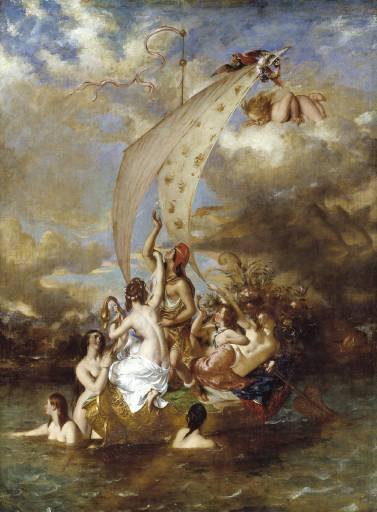
My Daily Art Display feature painting today is entitled Youth on the Prow, and Pleasure at the Helm, which he completed in 1832 and which, when not out on tour, is normally hung in the Tate Britain Gallery in London.  The title of the painting comes from a line from the 1757 Pindaric Ode by Thomas Gray entitled The Bard.

Fair laughs the morn and soft the zephyr blows,

While proudly riding o’er the azure realm

In gallant trim the gilded vessel goes;

Youth on the prow, and Pleasure at the helm;

Regardless of the sweeping whirlwind’s sway,

That, hushed in grim repose, expects his evening prey

This poem fascinated many Romantics of the time, like Etty, and he illustrates the line in the poem in this work of his.  Paying no attention to the rocking of the golden-prowed boat caused by the Zephyr’s sweeping whirlwind, the almost naked women, in a pyramidic formation, clamber to reach upwards, snatching at the “bubbles of pleasure as they float away.

Etty himself described the subject of the work in a letter to the art dealer C.W.Wass:

“…The view I took of it as a general allegory of Human Life, its empty vain pleasures – if not founded on the laws of Him who is the Rock of Ages…”

Art historians tend to believe the painting which shows the young women playing at catching bubbles despite the onset of a storm is all about Youth in its careless pursuit of pleasure is heedless of impending doom.

According to Leonard Robinson in his book, William Etty, the life and art, the painting was bought by Robert Vernon in 1832.  Later that year Vernon bought John Constable’s work, Valley Farm.  To house this new acquisition Vernon decided to move Etty’s painting to another position and replace it with Constable’s work.  Constable on hearing this wrote to his friend and fellow painter Charles Leslie:

“…My picture is to go into the place – where Etty’s bumboat is at present – his picture with its precious freight is to be brought down nearer to the nose…”

Vernon bequeathed the painting to the National gallery in 1847 and later in 1949 it was transferred to the Tate gallery in London.

As I walked around the main exhibition gallery the majority of the paintings by Etty all included nudes, mainly women but some men and I can see how nineteenth century people were shocked by the works.  Of course, for us today who are used to seeing semi-clad or naked women in our daily newspapers and television we are not shocked by the works of Etty and look with some amusement on the puritanical values of the Victorians.  Now we tend to concentrate on the beauty of his painted figures.  So does nothing shock us these days?   I would have said nothing shocks me any more with regards nudity and yet when I stepped from the exhibition gallery to the next door gallery there was a live art performance by an almost naked woman who cavorted and shouted at the few people who had been brave enough to sit on a chair at the edge of her “stage”.  Did I take my seat?  No, as there seemed to be an element of audience participation I just didn’t have the courage to place myself face to face with the naked female performer.   So maybe I can understand how the Victorian people were shocked by what they saw and maybe in another hundred years people will marvel at why I didn’t have the courage to go face to face with my almost naked female live art performer!

Candaules, King of Lydia, Shews his Wife by Stealth to Gyges, One of his Ministers, As She Goes to Bed by William Etty

Candaules, King of Lydia, Shews his Wife by Stealth to Gyges, One of his Ministers, As She Goes to Bed by William Etty.(1820)

A couple of weeks ago I travelled to York and visited the city’s art gallery which had a long-running exhibition of the works of William Etty.  William Etty was born and died in the city and therefore he is the pride and joy of the city’s artistic community.  However as we will see in this blog, Etty’s work was often very controversial.

William Etty’s father, Matthew, was a miller and his mother, Esther Calverley, was the sister of the Squire of Hayton,   Matthew was aged 28 and Esther just 17 when they fell in love in Hayton and then quickly married at All Saints Church, Pocklington, in July 1771. But Esther’s brother was highly disapproving of his young sister’s marriage, and as lord of the manor, who owned both the mill and the milling rights in Hayton, he promptly ejected Matthew and his new wife from the mill, which was their home, and the newlyweds were ‘run out of town’.

They moved to Pocklington and set up a bakery business, but it did not take off, which may have been due to the wider influence in Pocklington of the squire. The young couple moved briefly to Easington, then made a final switch to York, where their bakery was more successful and Etty’s father again took up flour milling. Alhough they were never particularly well off they produced a large family of ten children, born between 1772 and 1793.

William Etty was born in York in 1787, and grew up in the family bakery. He spent some years at a Pocklington boarding school but in 1798, aged eleven, his father arranged a seven year apprenticeship as a printer at the works of the Hull Packet newspaper.  Etty had shown an interest in art in his teenage years and fortunately, through the encouragement and financial support of his wealthy uncle, a successful London gold-lace merchant, he was later able to pursue a career as a painter.  His uncle invited Etty to London in 1806 and the following year, aged twenty, he enrolled at the Royal Academy Schools where he studied under Henry Fuseli and received some private tuition from Sir Thomas Lawrence, a painter who influenced Etty’s early works.  During this time he would visit the National Gallery in London and study the works of the old masters, especially the Italian masters of the Renaissance.  During his time at the Royal Academy he would take part in the Life classes and continued with those studies well after he had became an Academician and well after he had completed all the courses.  It was obvious that William Etty was fascinated by the male and female body and its portrayal.  I will end Etty’s biography here and conclude it in my next blog.

My Daily Art Display today is entitled Candaules, King of Lydia, Shews his Wife by Stealth to Gyges, One of his Ministers, As She Goes to Bed and was painted by Etty in 1820.  The work is based on a story from The Histories of Herodotus, one of the most influential works of history in Western literature.   The nine-volume work was written between 450BC to 420BC and records ancient traditions, politics, geography, and clashes of various cultures that were known around the Mediterranean and Western Asia at that time.  In the first volume there is the story of King Candaules who according to the tale bragged of his wife’s incredible beauty to his favourite bodyguard Gyges. “It appears you don’t believe me when I tell you how lovely my wife is,” said Candaules. “A man always believes his eyes better than his ears; so do as I tell you – contrive to see her naked.”

Gyges refused; he did not want to dishonour the Queen by seeing her nude body.   He also feared what the King might do to him if he did accept.  However Candaules was insistent and Gyges had no choice but to obey. Candaules detailed a plan by which Gyges would hide behind a door in the royal bedroom to observe the Queen disrobing before bed. Gyges would then leave the room while the Queen’s back was turned.  That night, the plan was executed. However, the Queen saw Gyges as he left the room, and recognized immediately that she had been betrayed and shamed by her own husband. She silently swore to have her revenge, and began to arrange her own plan. The next day, the Queen summoned Gyges to her chamber. Although he thought nothing of the routine request, she confronted him immediately with her knowledge of his misdeed and her husband’s. “One of you must die,” she declared. “Either my husband, the author of this wicked plot; or you, who have outraged propriety by seeing me naked.”  Gyges pleaded with the Queen not to force him to make this choice. She was relentless, and eventually he chose to betray the King so that he should live.

The Queen prepared for Gyges to kill Candaules by the same manner in which she was shamed. Gyges hid behind the door of the bedroom chamber with a knife provided by the Queen, and killed him in his sleep. Gyges married the Queen and became King, and father to the Memnad Dynasty.

Before us we have a scene from the start of the tale in which we see Gyges creeping stealthily into the bedroom to catch a glimpse of the naked queen.

Looking through comments made by art critics of the day I came across one who described the subject of the painting as:

“ an undeniably disagreeable, not to say objectionable subject…”

Other reviewers called it

“…offensive, reprobate and a disgraceful story with debase sensuality…”

So what do you think?  Beautiful or distasteful?

Showing at Tattersalls by Robert Polhill Bevan

Showing at Tattersalls by Robert Bevan (1919)

The Camden Town Group was a group of English Post-Impressionist artists who were active between 1911 and 1913.  This hallowed group included Lucien Pissarro, the son of the French Impressionist, Camille Pissarro, Wyndham Lewis, Walter Sickert, Augustus John and today’s featured artist, just to name a few.  Their meeting place was usually at the Camden Town studio of the Munich-born painter, Walter Sickert, a leading light in the transition between Impressionism and Modernism.  My Daily Art Display featured artist of the day is Robert Polhill Bevan.

Bevan was born in Hove, near Brighton in 1865.  He was the fourth of six children of Richard Alexander Bevan and Laura Maria Polhill.  He was originally trained as an artist under Arthur Pearce.   As well as being a drawing teacher, Pearce had worked as an illustrator and had exhibited at the Royal Academy.  Later he would join the Royal Doulton pottery company where he became their chief designer.  When Bevan was twenty-three years of age he attended the Westminster School of Art and was tutored by the painter, Fred Brown, who would later move to the Slade School of Art and teach the likes of Augustus John and Wyndham Lewis.  After this initial training Bevan moved to Paris and studied art at the Académie Julian where he met some aspiring French artists, such as Édouard Villiers, Pierre Bonnard and Paul Sérusier and became great friends with another English artist, Eric Forbes-Robertson.  Whilst living in France Bevan and Forbes-Robertson visited the artist colony at Pont-Aven in Britanny.  Bevan was to visit this area many times over the years and became friends with Paul Gaugin and Renoir and art historians believe that judging from some of his early works he may have come into contact with Van Gogh. He returned to England in 1894 and settled in Exmoor, in the south-west of the country.  Three years later he met the Polish artist Stanislawa de Karlowska when he attended the wedding of his close friend Eric Forbes-Robertson in Jersey. At the end of 1897 Bevan and de Karlowska married in Warsaw where her parents lived and owned extensive land in the heart of the country.  Throughout the couples lifetime they would return there each summer to visit.  It was during his long summer stays in Poland that Bevan produced his most colourful paintings.  The influence of his friend Gaugin can be seen in these early works.   Their first child, Edith Halina, was born at the end of the following year.   Bevan and his wife left Devon in 1900 and moved to London and Stanislawa gave birth to their second child, a son Robert Alexander in 1901. In 1905 Bevan held his first solo exhibition but it did not receive the great acclaim he had hoped for from the art critics of the time and few of his paintings were sold.  Although very disheartened with the outcome of the exhibition he held his second exhibition three years later in 1908 and some of his paintings on display were in the pointillist style of Seurat and Signac, the first time he had used that technique.  (See My Daily Art Displays of October 21st and November 9th).  That year he exhibited five of his paintings at the first Allied Artists’ Association exhibition.  This organisation had been formed by a London journalist and art critic for The Sunday Times, and early champion of English Modern Art, Frank Rutter.  His main aim was to promote Modernist Art in Britain.  Artists could exhibit their works without them having to first be subjected to a selection jury, unlike the Royal Academy Exhibition.   It was an association very similar to one that was set up in Paris in the summer of 1884, called the Salon des Indépendants, another non-juried organisation, and which was, in some ways, in direct competition with the Paris Salon which like the Royal Academy had a jury to select paintings that were allowed to be shown. Soon after his exhibition he was invited to join the group of artists formed by Walter Sickert, entitled the Fitzroy Street Group and out of this group was spawned in 1911 The Camden Town Group.  In John Yeats social history book about The Camden Town Artists, he writes that Sickert advised Bevan about what subjects he should depict in his works.  Sickert told him:

 “…paint what really interests you and look around and see the beauty of everyday things…”

After this advice Bevan went off and completed a series of works depicting the horse cab trade in London and its steady but inevitable decline.  After this Bevan concentrated on pictorially recording what went on at horse sales, especially the ones which were held at Tattersall’s and it is one of those works which is My Daily Art Display featured painting for today.  The Camden Town Group relied on the goodwill of Arthur Clifton who ran the Carfax Gallery in London for he put on the groups exhibitions but after three exhibitions which failed to get critical acclaim and left many paintings unsold, Clifton declined to hold any more of their displays in his gallery although he would give space to some of the artists from the group.  This marked the beginning of the end for the Camden Town Group.

Robert Bevan continued painting.  His works often depicted London scenes or scenes of the countryside where he spent most of his summers.   Prior to the First World War he would spend the summers in his wife’s homeland of Poland but later they took their summer vacations around Devon and Somerset.

Bevan died in London in 1925, aged 60.  In 2008, the Tate put on a major retrospective exhibition of the Camden Town Group.

My Daily Art Display painting today is entitled Showing at Tattersalls and was painted by Robert Bevan in 1919.  Tattersalls is the major auctioneer of race horses in Great Britain and Eire.  It dates back to 1766 and was founded by Richard Tattersall who had once been stud groom to the second Duke of Kingston.  Originally it had been situated close to Hyde Park Corner in London but now is located in Newmarket, the home of horse racing.

I love this painting.  It is simple and yet pleasing to the eye.  Before us we see two horses being paraded in front of potential buyers.  We are there.  We are being allowed to watch the goings-on at the stables.  The figures themselves mostly have their backs to us which allows Bevan to do away with carefully crafted facial expressions and their long clothing gives them a straight up-and-down appearance.  Bevan has spent time in the detail of the horses and their musculature and the sinews are in harmony with the animals’ movements.  The chestnut horse stands out well against the red door of the building and the blue-tinted horse, similar to the colour of the coats of the handlers, contrasts well against the yellow coloured building.  This backdrop of the yellow-coloured buildings looks like the stables which are attached to the yard and adds lightness to the work.

The simplicity of this painting is charming and as I look at it I feel the urge to step forward into the arena before me and enjoy the thrill of the auction preview.  I came across this painting when I recently visited the Ashmolean Museum in Oxford.  I had gone there to view the Claude Lorrain exhibition and was absolutely staggered by what was on display at this museum.  Its collections of paintings were exceptional and I do urge everybody to try and visit it.  You will not be disappointed.

Finally I must pay tribute to a website from which I got a lot of information about the painting itself and have done my best not to plagiarise it too much.  The author of the blog, unlike me, is an artist and her interpretation of her painting is excellent.  It is a wonderful blog and well worth a visit.  It is called personalinterpretations and the website address is:

http://personalinterpretations.wordpress.com/

Her piece on this painting was in her blog of August 18th.