Suffolk Artists. Part 2.

This is the second part of my blog which focuses on lesser-known artists that had a connection with the English county of Suffolk.

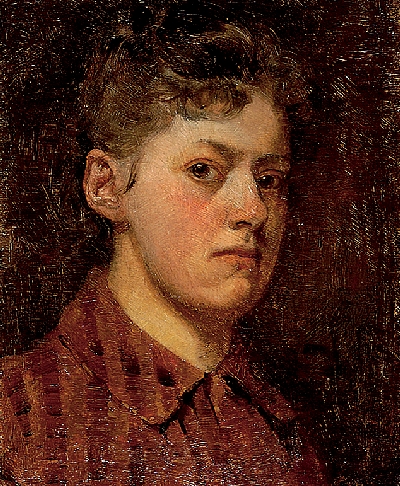
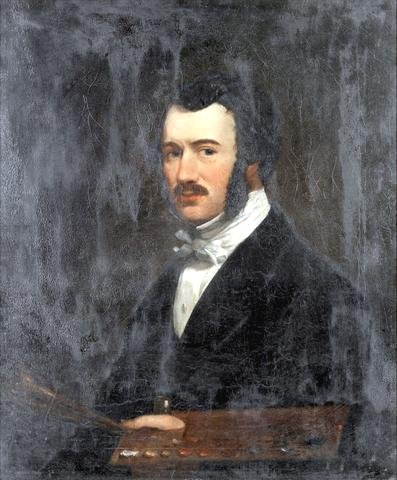
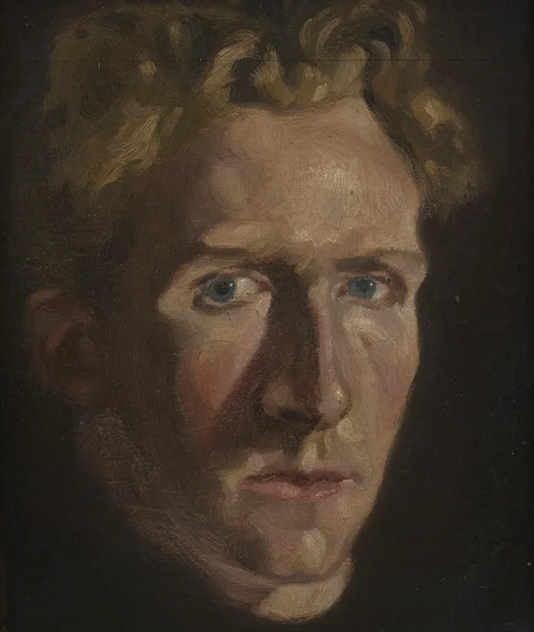
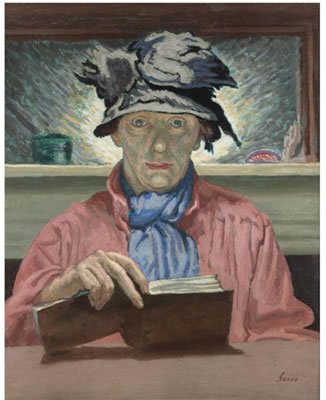
Rose Mead’s self portrait (c.1900)

Emma Rose Mead, known as Rose Mead, was born at 15 Hatter Street, Bury St Edmund’s, Suffolk on December 4th 1867.  She was the youngest of eight children, having six brothers and two sisters of Samuel Mead, a master house plumber, glazier and decorator who employed several men, and his wife Emma Mead, née Smith, who married at St James’s Church, Bury St Edmund’s July 1846.  
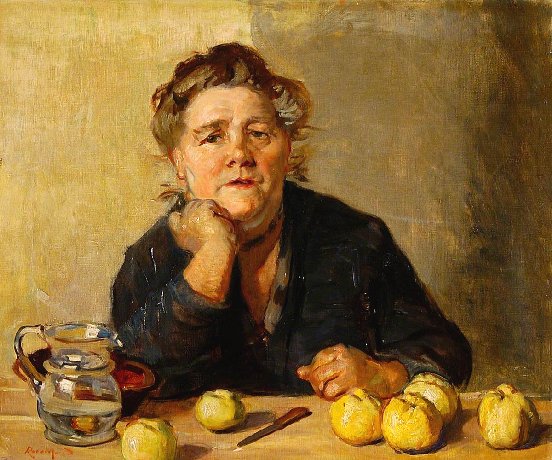
Barbara Stone in the Kitchen by Rose Mead (c.1930). One of Rose Mead’s her best known pictures, was of Barbara Stone who was Rose’s home help

Rose attended the local school for girls. studied at Bury St Edmunds Science and Art Classes from where in 1884, she passed her art examinations and the next year she transferred to the Lincoln School of Art and soon began to exhibit at the Bury St Edmunds and West Suffolk Fine Art Society.  Later she went to live with her older brother, Arthur, a bank clerk, in Leatherhead, Surrey and attended the Westminster School in London. Her stay at the college was short-lived as she was called back home to care for her dying father. After his death in May 1895, she spent a year in Paris with her friend Helen Margaret Spanton, an artist and suffragette.  Whilst living in the French capital Rose continued her art studies at the Académie Delécluse where she became great friends with another English artist, Beatrice How. During her stay in Paris, she had one of her pastel portraits exhibited at the Paris Salon and it was again exhibited at the Royal Academy the following year.
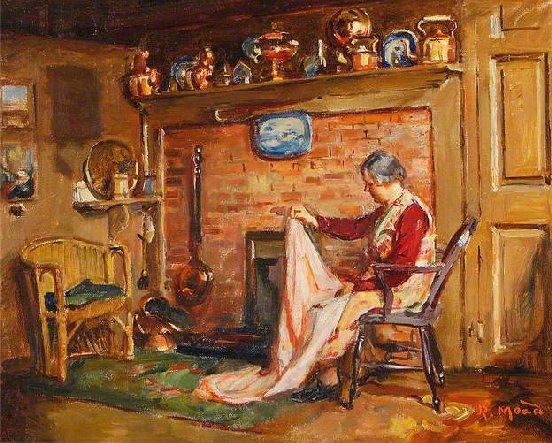
Interior of the Athnaeum Kitchen by Rose Mead (1933)

Rose returned to London in 1896 but this stay was interrupted once again in 1897 when her mother fell in and she was summoned to Bury St Edmunds to her mother’s Crown Street home to look after her.  This was to be her permanent place of residence.  Her mother died in 1919. In her later years she lived at St Edmund’s Hotel on Angel Hill and, one day, when she failed to return to the hotel, on investigation Rose was found in the hallway of her Crown Street studio from a fall downstairs and she died from a fractured skull on 28 March 1946, aged 78.  Rose never married.

The second artist I am featuring in this blog is Edwin Thomas Johns who was born in the Suffolk port town of Ipswich on December 26th 1882.  Edwin was the youngest of five children of William Johns and his wife Isabella Elvira Johns née Wardle.  Edwin had four older siblings, three sisters and one brother, Elvira Isabella, Lavinia, Ellen and William.  Edwin’s art tuition began when he attended the Ipswich School of Art.
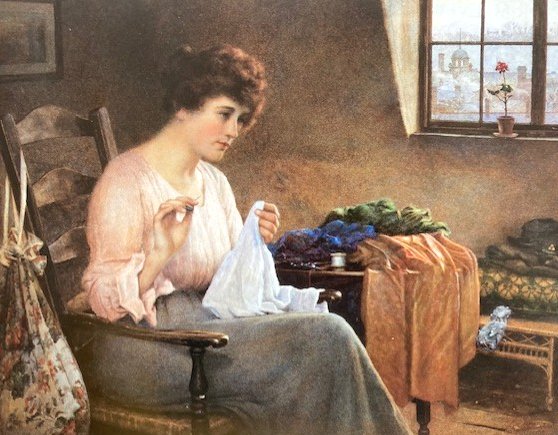
Memories by Edwin Thomas Johns (1929)

Edwin attended the Ipswich School of Art under the headmaster, William Thompson Griffiths.  In 1877 Edwin was articled to James Butterworth, a company of architects on Museum Street, Ipswich.  When Butterworth retired Edwin completed his articles with William Cotman Eade and later became his assistant.  Then the company was renamed Eade & Johns until 1912, when Eade retired and Edwin Johns carried on his own company based in Lower Brook Street, Ipswich.  He was a founder of the Suffolk Association of Architects and became its first President. In 1921, his nephew Martin Johns Slater joined the business, which subsequently operated under the name Johns & Slater until Edwin retired in 1933.
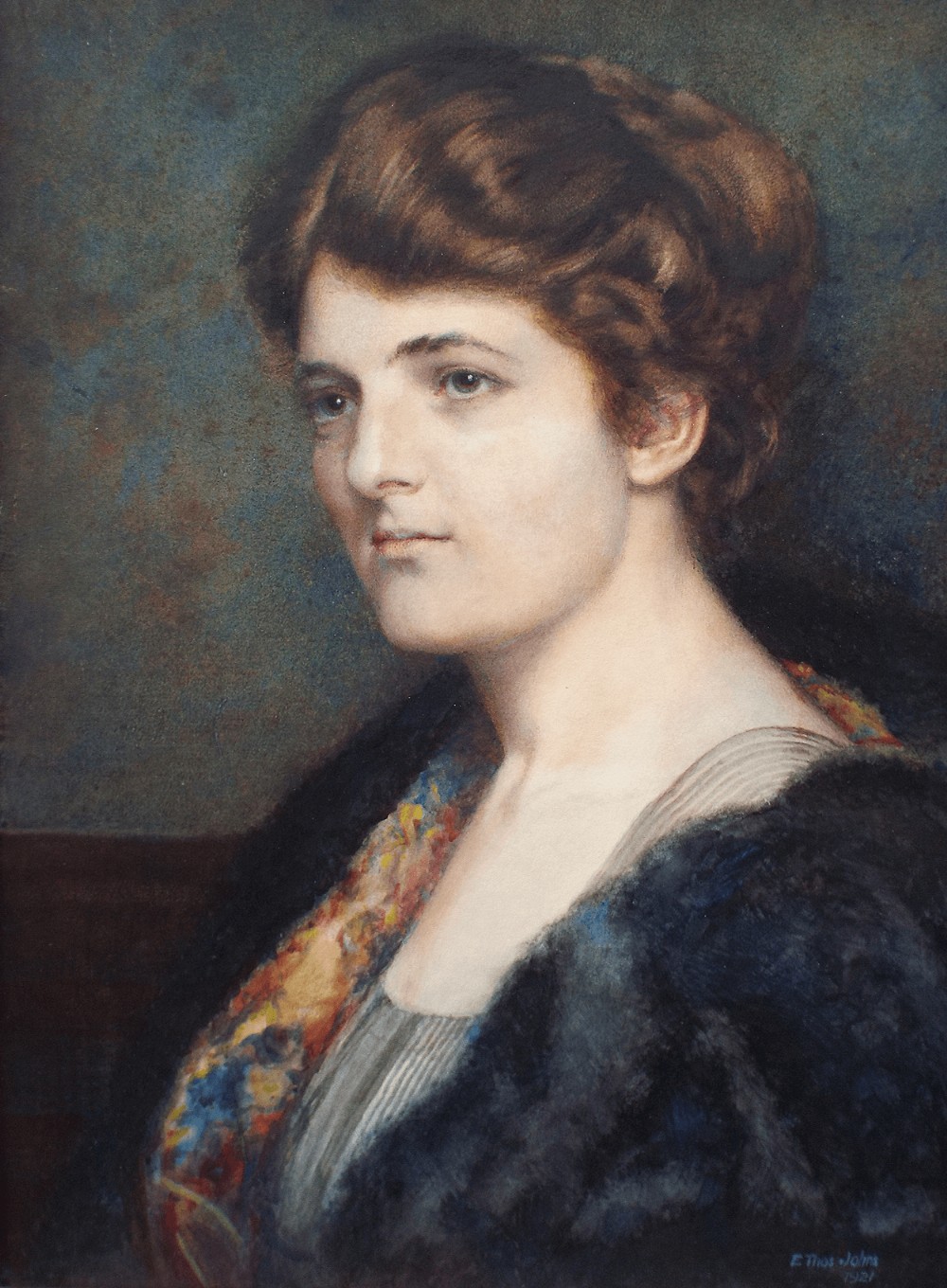
Portrait of a Lady by Edwin Thomas Johns

Edwin Johns was also an accomplished watercolour artist and painting became his main interest later in his life.  He was a life member and regular annual exhibitor at the Ipswich Fine Art Club which he first joined in 1887 and remained a member until his death in 1947.  At one time he held the office of Club secretary and Club president. He also exhibited at the Royal Academy with several of the works also being shown at Ipswich.
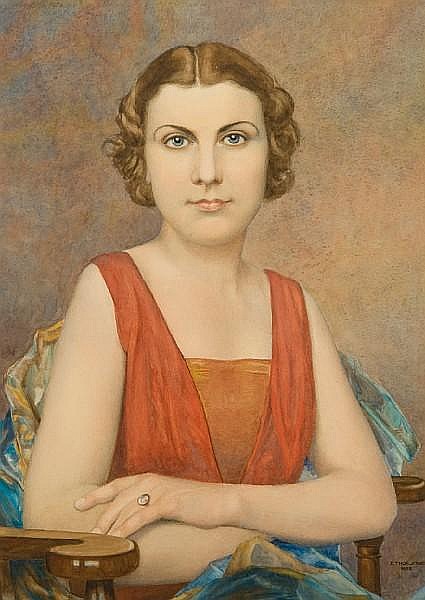
Portrait of a lady with cropped hair, in red dress by Edwin Thomas Johns (1938)

He married at the Congregational Chapel, Redhill on March 29th 1893  His bride was Janet Eliza Prentice.  The couple had no children.   Edwin Thomas Johns died at his home in Ipswich on November 11th 1947, aged 84.

Thomas Smythe was born on November 14th 1825 to James Smyth, a banker, and his wife Sarah Harriet Smythe (née Skitter}.  Thomas was fifteen years younger than his brother, the artist Edward Robert Smythe, whom I wrote about in Part 1.  It is thought that Thomas went to school run by Charles and Elizabeth Watson at Berners Street, Ipswich.
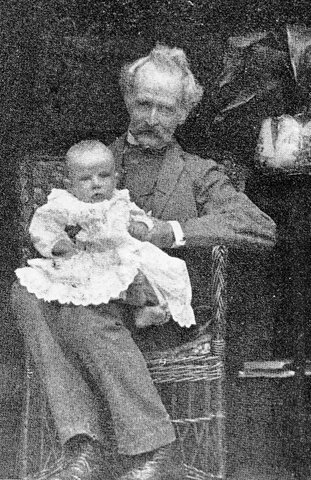
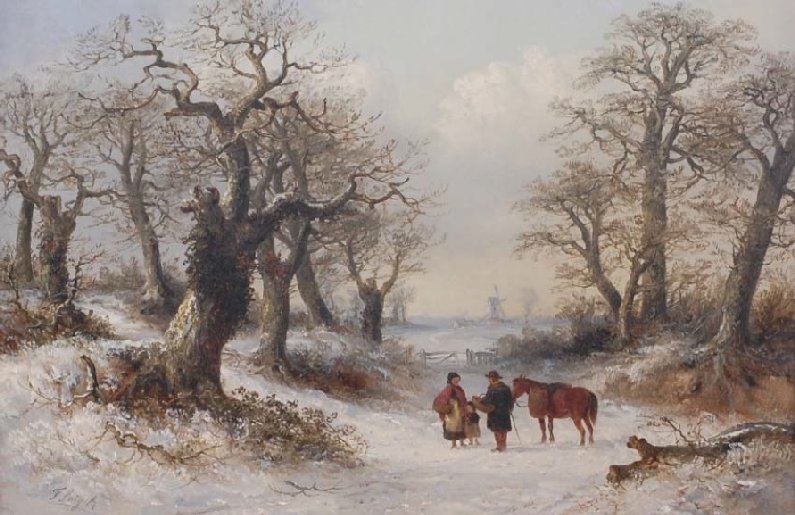
Figures in Winter Landscape with Windmill beyond by Thomas Smythe
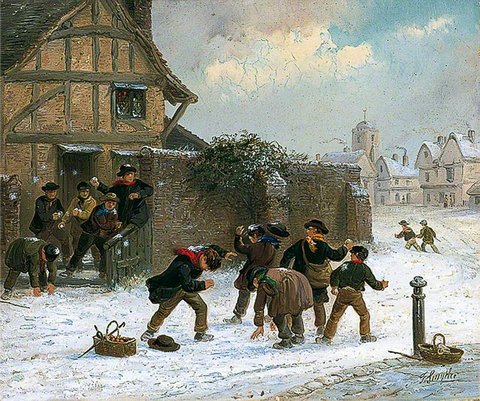
Children Snowballing by Thomas Smythe (c.1900)

Thomas worked alongside his brother from around 1846, until 1851 when Edward Robert Smythe left for the Lancaashire town of Bury.  It was then that Thomas set up on his own as a landscape and animal painter in Brook Street, Ipswich.  In 1850, Thomas married twenty-one-year-old Miss Pearse from Ipswich.  They went on to have five children, Thomas the eldest child became an artist but sadly died in a cycling accident when he was nineteen.  Ernest their second son was also an artist and became a book illustrator in London until he emigrated to America. Their son Robert emigrated to Canada.
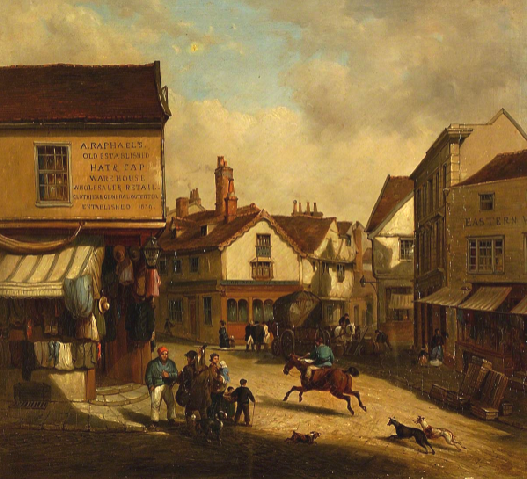
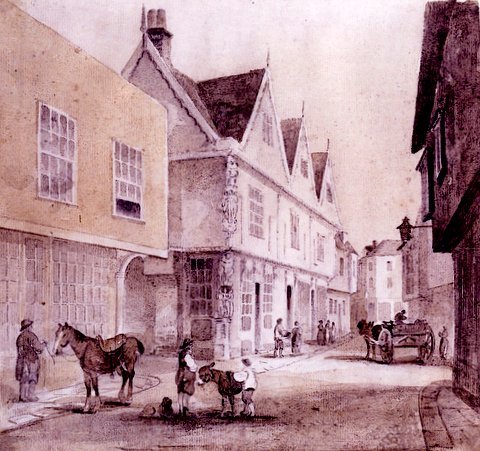
Angel Corner, Fore Street by Thomas Smythe (c.1850)

Thomas Smythe exhibited several oil paintings at the Suffolk Fine Arts Association exhibition in August 1850 which was held at the New Lecture Hall at the Ipswich Mechanics’ Institute. Around 1899 Thomas Smythe went to live, with his son Ernest, in London but died after a short illness, at the home of his son-in-law Frank Brown, at Heathfield, Ipswich on May 15th 1906, aged 81. His wife Jane died at Ipswich in 1919, aged 76

A more well-known Suffolk artist was Frederick George Cotman. Frederick George Cotman was born at 186 Wykes Bishop Street, Ipswich on August 14th 1850.  He was the youngest child of Henry Edmund Cotman, a former silk mercer of Norwich, and his wife Maria Taylor who married at St Andrew’s Church, Norwich in January 1842. Henry Cotman was a younger brother of Norwich School’s more famous artist John Sell Cotman.  Frederick Cotman had two brothers, Henry Edmund and Thomas William and a sister Marguerite.
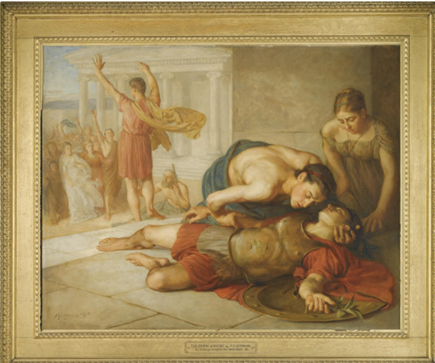
The Death of Eucles by Frederick Cotman (1873)

In 1866, aged sixteen, Frederick attended the Ipswich School of Art  and his first work was exhibited in 1867 at the Eastern Counties Working Classes Industrial Exhibition at Norwich, where he won a prize medal.  In 1868, he enrolled as a student at the Royal Academy Schools and his ability as a draughtsman and painter in oils and watercolours, was rewarded with four silver and in 1873 a gold medal for his painting, The Death of Eucles, which can now be seen displayed at the Ipswich Town Hall.
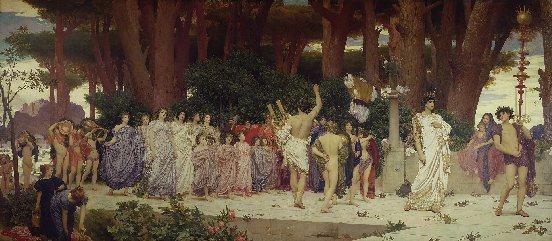
The Daphnephoria, by Frederick Leighton (c.1874-76)

At the RA Schools two of Cotman’s tutors were Frederick Leighton and the miniature and portrait painter Henry Tamworth Wells.  Leighton employed Cotman to help paint The Daphnephoria in 1876,  a composition of thirty-six figure which depicted the festival in ancient Thebes to celebrate a victory over the Aeolians. It was held every ninth year in honour of Apollo; at head of procession a pole is carried bearing several copper globes, the largest representing the sun or Apollo, the next largest the moon and the small globes the stars and planets.
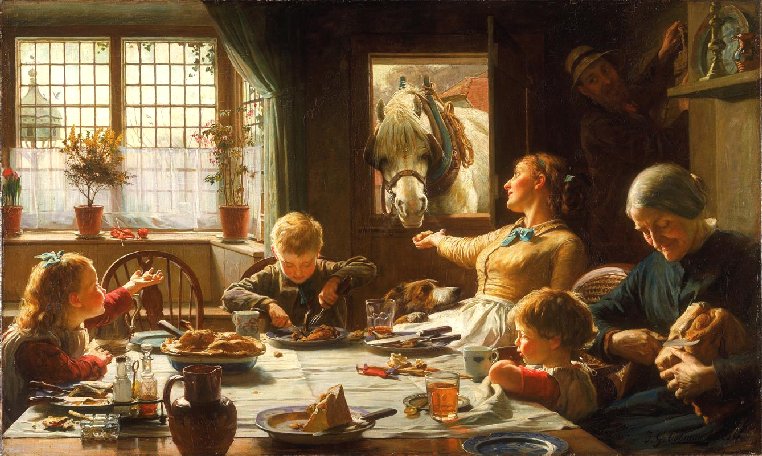
One of the Family by Frederick George Cotman (1880)
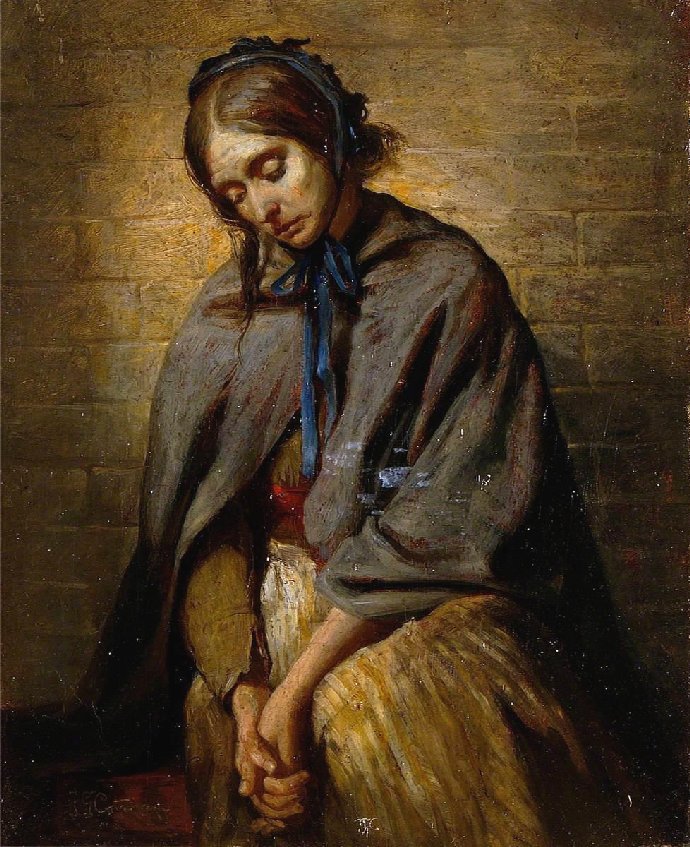
The Widow by Frederick George Cotman (1880)

Cotman became recognised as a London society portrait painter, and such paintings could fetch a fee of three hundred guineas.  He also completed many homely genre scenes. Cotman was elected a member of both the Royal Institute of Painters In Water Colours and the Royal Institute of Oil Painters, and his paintings graced the walls of the Royal Academy, the Royal Society of British Artists; Royal Institute of Painters in Water Colours; Agnew & Sons Gallery; the Dudley Gallery; Dowdeswell Gallery; Fine Art Society; Grosvenor Gallery all in London, the Walker Art Gallery in Liverpool; Manchester City Art Gallery; the Royal Glasgow Institute of the Fine Arts and the Royal Scottish Academy.

Alderman William Groom by Frederick George Cotman (1903) 

Frederick married at St Mary Abbots, Kensington, London on March 30th 1875.  His wife was a Scottish girl, Ann Barclay Grahame, who was the daughter of Barron Grahame, of Morphie, Aberdeenshire.  It was also in 1875 that Frederick became a founder member of the Ipswich Fine Art Club.  In 1891, Frederick with his wife and six children were living at Widmere Common, Burnham, Buckinghamshire but in 1897 he moved to Lowestoft, Suffolk to enjoy his favourite sport of yachting.  Frederick George Cotman died at Quilter Road, Felixstowe on July 16th 1920, a month before his seventieth birthday.   He was buried in Old Felixstowe churchyard. His wife died in 1936, aged 86.

Henry George Todd was born at 27 St John’s Street, Bury St Edmund’s on January 20th 1847.  He was the son of George Todd, who plied his trade as a decorative artist and signwriter, and his wife Sophia Todd (née Spencer). Henry attended a school at Bury St Edmund’s and later Henry was apprenticed to his father and trained in decorating, gilding and signwriting. At the age of 18, Henry enrolled in an art school and due to his excellent work he went on to enrol at the South Kensington Schools, which is now known as the Royal College of Art.
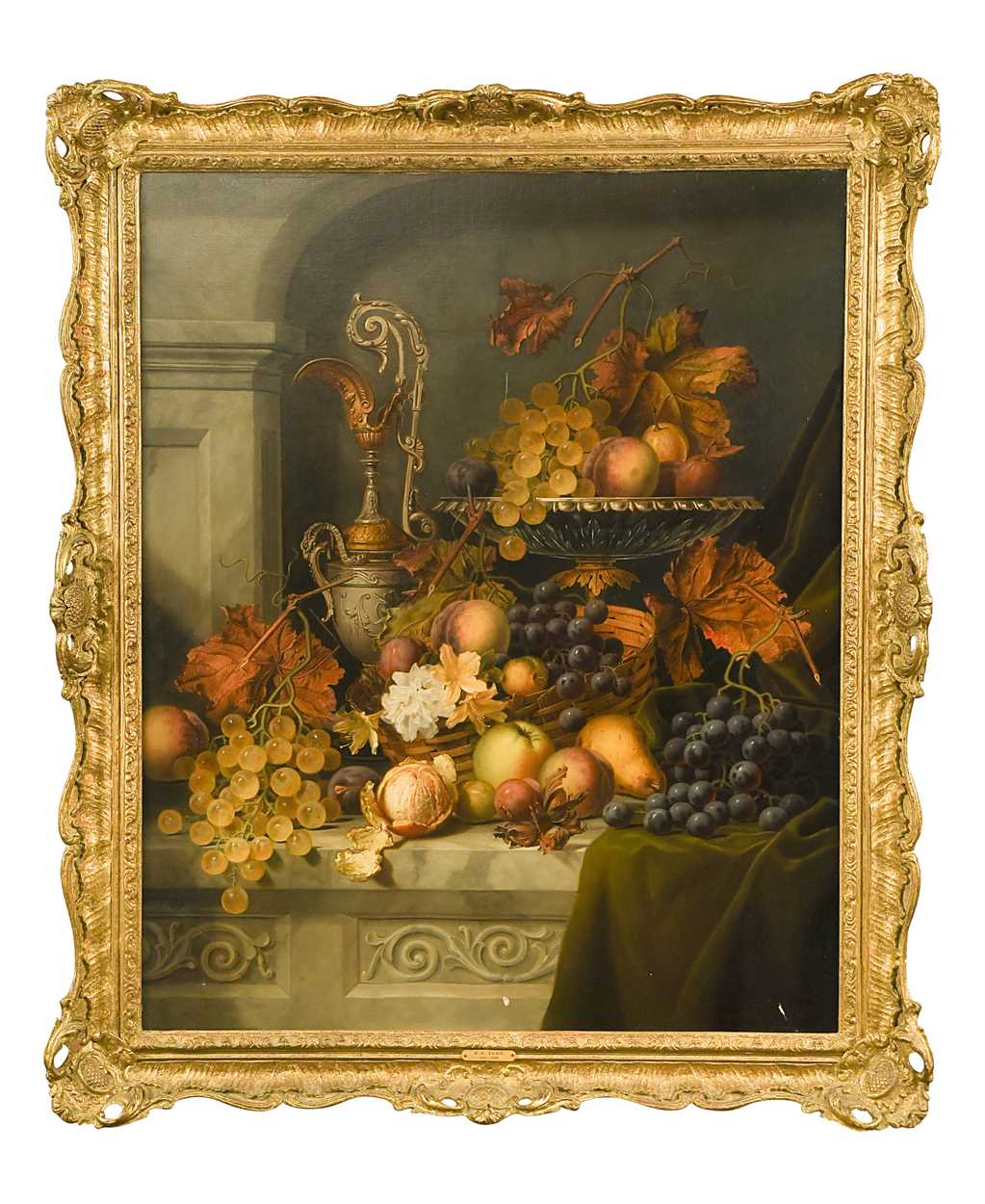
Still life with Fruit and a Ewer on a Stone Ledge by Henry George Todd
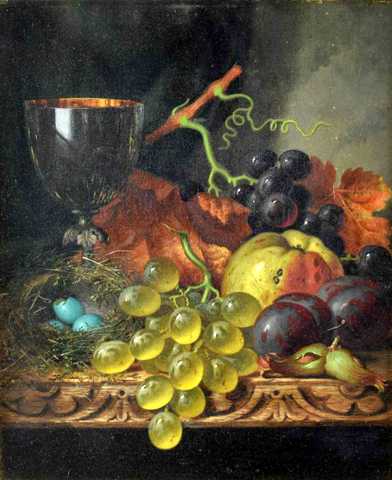
Still life by Henry George Todd

Later both he and his father exhibited their works in the Todd’s St Andrew’s Street North shop. Around 1874, twenty-seven-year-old Henry moved to Ipswich and got a job with Alfred Stearn & Son, which was then the most important decorating company in the town, working in design, decoration, and gilding, being commissioned by local traders for their shopfronts which were considered by many as works of art.
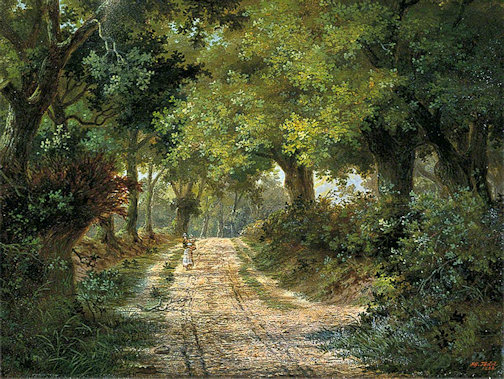
Gainsborough Lane, Ipswich by Henry George Todd

Although Henry was working full time at the business, he still found time to paint.  His favoured genres were his still life pictures and Suffolk landscapes.   Henry Todd married 21-year-old Ellen Lucy Quinton of Ipswich and the couple went on to have five children; Ada Ellen who was born in 1874, George William in 1875, Eva Spencer in 1876 and Arthur John in 1880, sadly their 16-month-old daughter, Kate Sophia died in 1882.  He joined the Ipswich Fine Art Club in 1885 and became largely famous for his still-life and his aptitude to paint grapes.
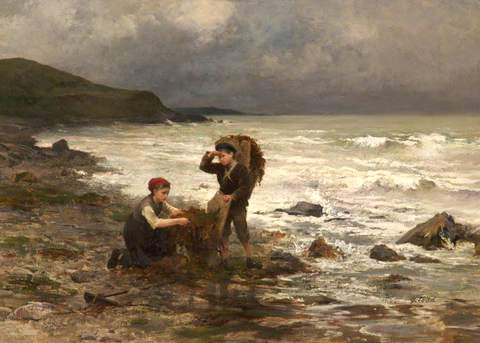
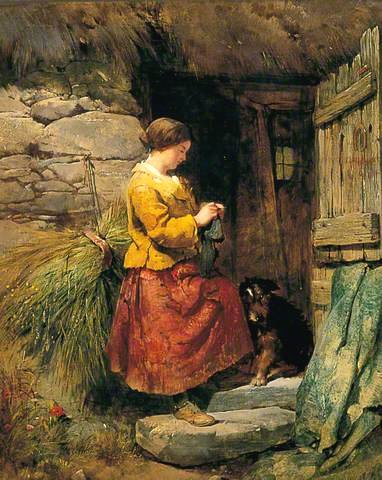
Seaweed Gatherers by Henry George Todd

Todd exhibited at many shows including one painting at the Royal Academy also displayed his work at the Suffolk Street Gallery of the Royal Society of British Artists, and the Dudley Gallery.   Henry George Todd died in Croft Street, Ipswich on June 30th 1898, aged 51 and was buried in Ipswich cemetery five days later.


Once again the information for Part 2 of the Suffolk Artists was gleaned from two excellent websites;

Suffolk Artists

East Anglia Art Centre

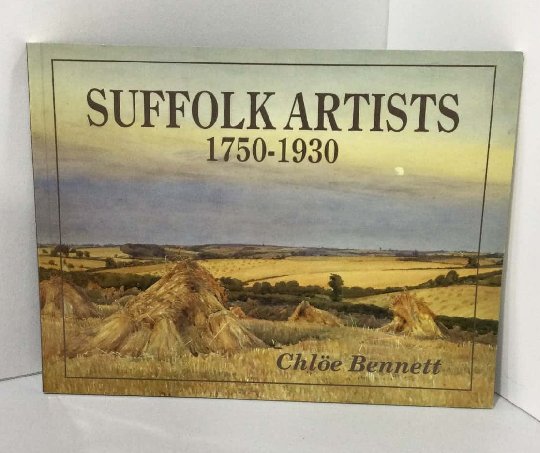
and also the book by Chloe Bennett entitled Suffolk Artists (1750-1930).
Suffolk Artists. Part 1.

Britain had a number of locations favoured by artists.  There was Newlyn in the south-west and Snowdonia in North Wales to mention just two.  In the next two blogs I want to look at artists who were born or worked in the south-east county of Suffolk during the late eighteent6h century to the early twentieth century.  I am not focusing on the renowned artists such as Gainsbouough, Constable and Cotman but will be looking at the life and works of painters that you may not have heard of but their works of art depict the beauty of this area of England.

My first “lesser known”artist from Suffolk is George Frost.  He was baptised at Barrow, Suffolk on February 21st 1745, and was the son of George Frost a builder at Ousden, Suffolk, and his wife Thomasin.

The Common Quay, Ipswich by George Frost (1820)

Asssembly Rooms, Tavern Street Ipswich by George Frost (c.1800) Pen and ink with grey and buff washes over pencil.

  George began his career working in his father’s business but later secured a position in the office of the Blue Coach Company in Upper Brook Street, Ipswich, where he continued until his retirement in 1813. Working there involved multiple jobs such as dispatching the coaches, the buying in of hay, straw, oats, etc., paying wages of the workers, and looking after the company’s horses and coaches, while his wife also helped in the office. Once his office work was concluded for the day Frost would leave and would go out and about for the remainder of the day and ikndulge in his love of painting.  George had a natural talent for drawing and he painted topographical watercolours of Ipswich but later began sketching the countryside around the Suffolk town in pencil and black chalk.  He became acquainted with John Constable probably through his work at the coach office and by around 1800, the two artists sketched amicably together along the banks of the River Orwell. Frost often visited London and it is thought that he had been dealing in paintings.  He died after a lingering illness, on June 28th 1821, aged 77, and is buried at St Matthew’s Church, Ipswich.

Thomas Churchyard was the only son of a Melton butcher and grazier. Following his education at Denham Grammer School he was articled to a local solicitor. He became a country lawyer in Woodbridge in 1822 and lived in the Suffolk town but his enduring love was for painting and he completed hundreds of watercolours and oils.

Country House in a landscape, probably Shrubland Hall by Thomas Churchyard Inscribed verso ‘Emma’, with a pencil sketch of landscape verso.

Churchyard also formed a friendship with the poets Bernard Barton and Edward Fitzgerald and the group became known as the “wits of Woodbridge”. Besides painting, he was  a lifelong avid art collector and, on his death, his estate included works by Gainsborough, Constable and Crome.  Churchyard’s work is held in the Tate Gallery, The British Museum, the V & A and the Ashmolean.

Shortly before his death Churchyard was careful to inscribe each of his most prestigious works in his studio with the names of his seven daughters. On the reverse of the “Country House” painting there is the inscription “Emma” who was Churchyard’s second daughter. Why ?

He is recorded to have said at the time:

 “…My dears, there will not be any money for you when I die, but I will leave you my paintings, which one day will be worth more than any money I could ever have hoped to have made…”.

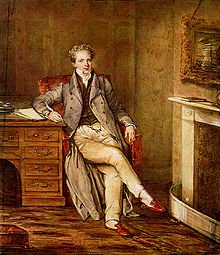
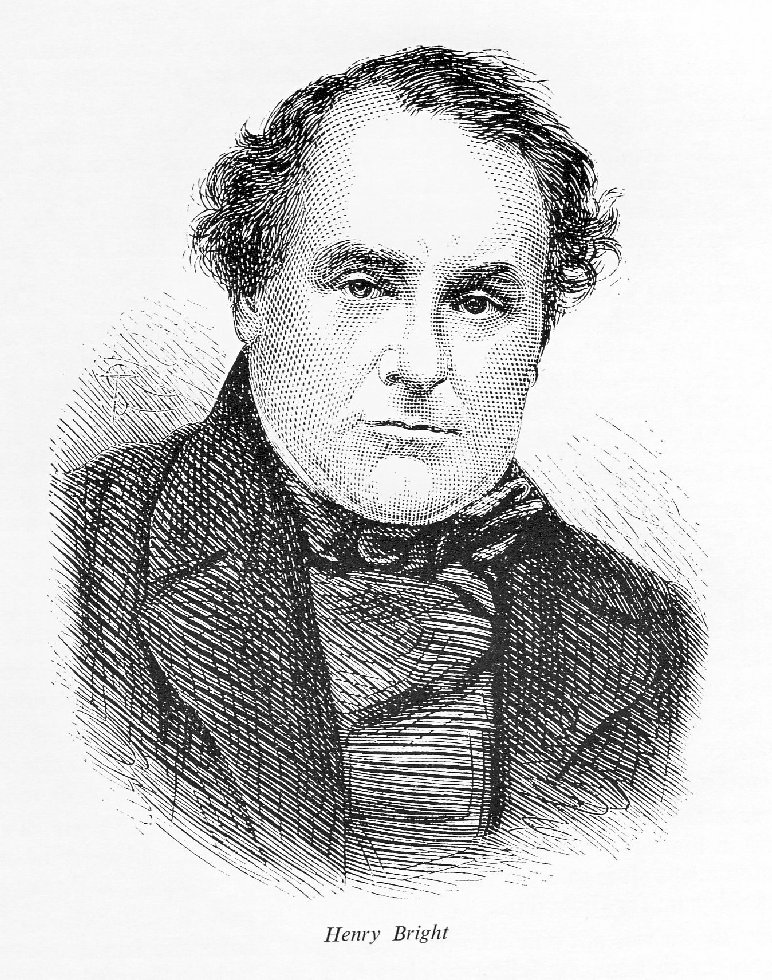
Henry Bright was a well-known English landscape painter connected with the Norwich School of painters.  He was born at the family home, also his father’s business premises, on June 5th 1810 in Saxmundham, Suffolk.  Henry was the third son and one of nine children of Jerome Bright, a clockmaker, and Susannah Denny, of Alburgh in Norfolk, who were married on June 28th 1790.

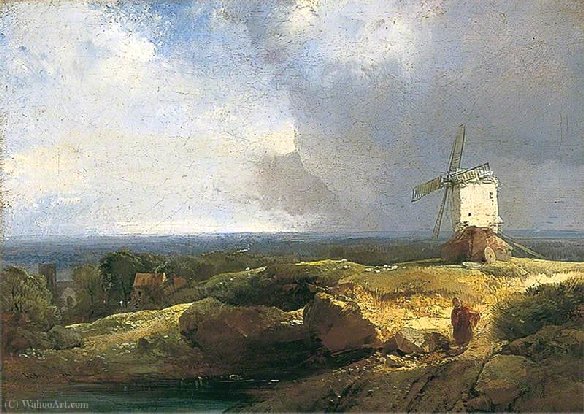
Landscape with Windmill by Henry Bright (1841)

 Henry attended a School for Young Gentlemen in North Entrance Saxmundham.  As a teenager he was indentured as a chemist’s apprentice in Woodbridge and later was transferred to Norwich and to Paul Squires’ chemist and soda water manufacturer who was also a keen collector of art, and it was he who introduced Bright into the local artistic circles. Later Bright became a dispenser at the Norfolk and Norwich hospital

On the Broads by Henry Bright (1833)

Having always loved sketching Henry Bright was determined to become an artist, and fortunately managed to persuade his parents to let him transfer his indentures to artist Alfred Stannard of Norwich and he became a member of The Norwich Society of Artists. Henry married Eliza Brightly at Saxmundham parish church on May 8th 1833.  She was the youngest daughter of the late Alfred Brightly, a liquor merchant, of New York, North America and granddaughter of Thomas Brightly, a Saxmundham farmer.  The couple went on to have two sons, who both died in childhood, and two daughters. In 1836, Bright and his family moved to Paddington, London where he lived for some twenty years, subsequently moving to Grove Cottage, Great Ealing and exhibiting in London.  He sold his second Royal Academy exhibit to Queen Victoria, which ensured a following among the metropolitan elite, only returning to Saxmundham after the death of his wife at Ealing in 1848.

The Colttage Door by Henry Bright (1864)

Bright earned up to £2,000 per annum from his many royal and aristocratic pupils, including the Landgravine of Hesse-Homburg, the Grand Duchess Marie of Russia, and many local Suffolk artists as well as publishing chromolithographs and drawing books, such was his reputation that he gave his name to Bright’s Superior Coloured Crayons and his testimonials included Winsor & Newton’s Moist Water Colours.

Landwade Castle by Henry Bright

Bright was a natural draughtsman and his watercolours, typically of open skies and landscapes, have considerable freedom, freshness, and richness of colour; he also made many drawings in chalk or pastel of old and picturesque buildings. He remained active in East Anglia and was vice-president of the Suffolk Fine Arts Association. After living at various addresses, in October 1870, Bright returned to Ipswich, living at the house of his niece, where he died after months of illness on September 21st  1873, aged 59 and was buried in Ipswich cemetery five days later. At the time of his death, he was said to have enough commissions to last him for ten or twelve years.

Edward Robert Smythe was an English painter of rustic landscapes and an exhibitor at London’s Royal Academy.  He was born at Berners Street, Ipswich in 1810 and baptised St Nicholas Church, Ipswich on 10 February 1815.  He was the son of James Smyth and his wife Sarah Harriet née Skitter who married at Norwich on June 14th 1811.  James was an accountant with bankers Bacon, Cobbold, Rodwell, Durningham & Cobbold in Tavern Street, Ipswich who added a final ‘e’ to his surname.

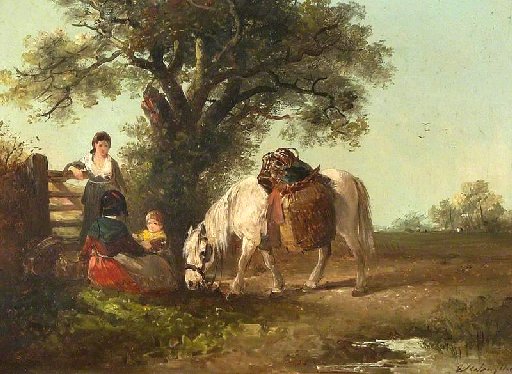
Two Women, Child and Pony by Edward Robert Smythe

Edward, from an early age, had a strong interest in drawing and loved to  sketch views of the Suffolk coastline. He quickly became looked upon as a very talented artist and was soon elected to the Ipswich Society of Artists and opened his own studio at the ‘Old Shire Hall’.

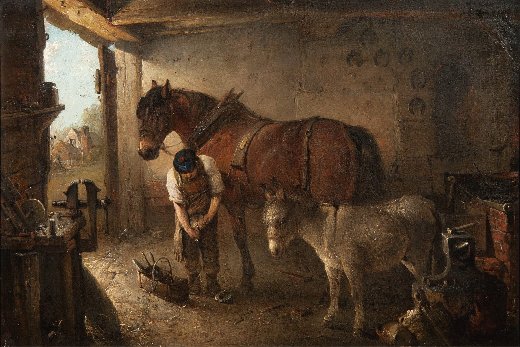
 A Farrier Shoeing a Plough Horse with a Donkey in a Forge Interior by Edward Smythe (1899)

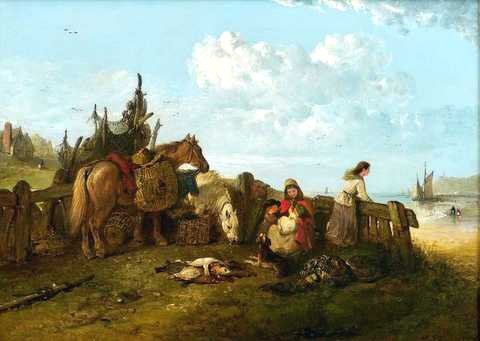
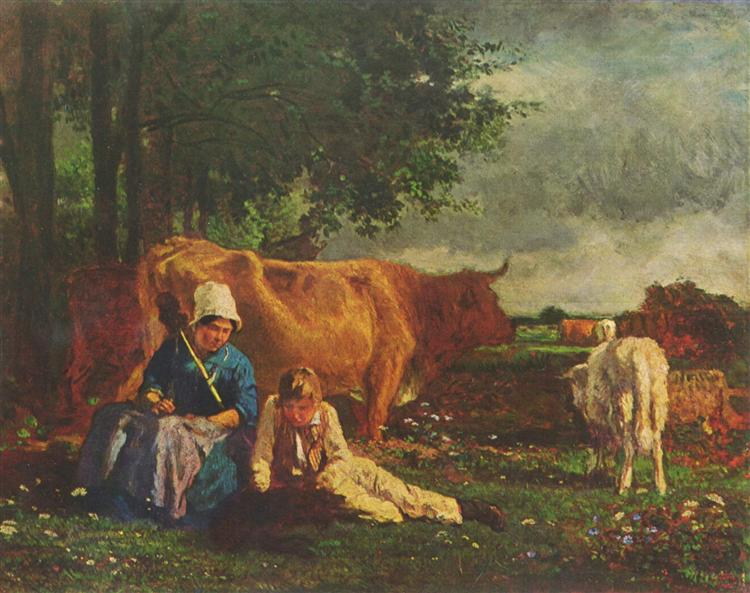
In the early 19th century, Ipswich was still mainly an agricultural area but this all changed with the arrival of industrialisation which gradually eroded its rustic charms. Edward Smythe was an artist with a deep connection to nature, and left Norfolk for Bury, Lancashire, in 1851, which had managed to safeguard its agricultural roots.  His landscape and figurative works concentrated upon his personal view of the world and was influenced by both the uncomplicated endeavour of rural communities and the gnarled beauty of the Suffolk countryside. His depictions featured what was termed ‘rugged realism’ of his local neighbourhoods such as the leaning timber-framed cottages, overgrown foliage, weary cattle groups, and dog-eared inn-dwellers. Rarely does a tree grow straight in his rustic rose-tinted utopia.

Fisherfolk besides the Sea by Edward Robert Smythe

About 1840, he moved back to Norfolk and the city of Norwich where he joined the Norwich School of Painters.  On March 15th 1848 he married Ellen Burman a resident of Ipswich and it was here in 1849 that they had their first child, Edward Robert, jun.  On September 13th 1850, now living in the Suffolk village of Elmswell, he was declared insolvent.  By 1861, he and his wife had further children born at Bury St Edmund’s, Francis (Frank) Rowland in 1852, Ellen Kate in 1854 and Mary Emily in 1856, and their daughter Louisa Jane, who died on 7 April 7th 1861, aged 3 years and 7 months.  In 1879 whilst living in Bury St. Edmonds his wife died aged 52. Two years after the death of his wife Edward went to live in Ipswich with his married daughter Ellen Kate.  Edward Robert Smythe died in Ipswich on, July 5th 1899, aged 88, and was buried in Ipswich cemetery three days later.

John Duvall was born in the Kent seaside town of Margate on September 3rd 1815. He was a nineteenth century English artist who painted landscapes, sporting and rustic subjects. He moved to the Suffolk port town of Ipswich in 1852 where he set up his studio in the Butter Market and began to teach drawing. Although he started off as a portrait painter, the number of portrait commissions declined due to the advent of photography and so he decided to start to focus on painting horses and some of his depictions of the animals provided illustrations for the Suffolk Horse Society’s Stud Book.

The Suffolk Show at Christchurch Park by John Duvall (1869)

In his 1869 painting, The Suffolk Show at Christchurch Park John Duvall depicts Colonel Barlow in the centre foreground with his prize-winning Suffolk Punch Dalesman. Next to him is his son, Eustace, while his groom Chapman is riding Topstall. The artist has included himself in the depiction, lying on the ground smoking a pipe with a sketch of a horse lying on the ground behind him. Duvall’s son has also been depicted. He is the one on the left of the two men under the tree on the far left of the painting.

John Moore was born in the Suffolk town of Woodbridge on May 16th 1920 and was baptised in February 1821.  Woodbridge was a hotbed of local artistic movements, with poets and painters regularly to be seen about the town. Woodbridge was influenced by the local artist/lawyer, Thomas Churchyard, known as the lawyer painter, who would often forego his business duties for painting trips and John Moore’s early works were testament to this inspiration.

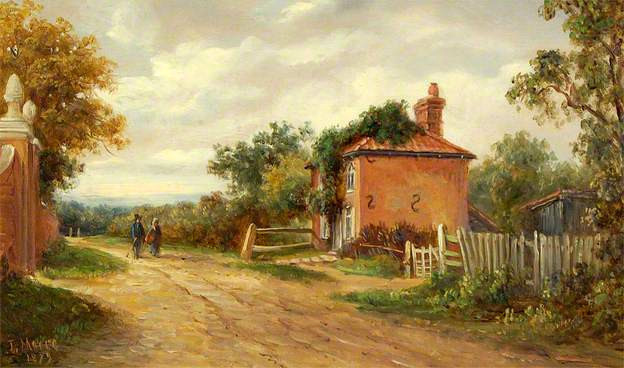
Old Park Road, Ipswich by John Moore (1879)

John Moore became a professional artist after pursuing an early career as a decorator and producer of specialist decorative effects, and these trades left him with a thorough understanding of painting techniques. The experience enabled him to paint quickly and confidently, his smooth touch of the brush displaying skills only matched by a handful of far more famous artists.  By the time the Ipswich Fine Art Club’s exhibitions commenced in 1875 his works were very sought after, appearing as a prolific exhibitor almost every year at these exhibitions until he died. Some local newspaper critics compared him to Turner and Clarkson Stanfield, the premier marine painters of his day.

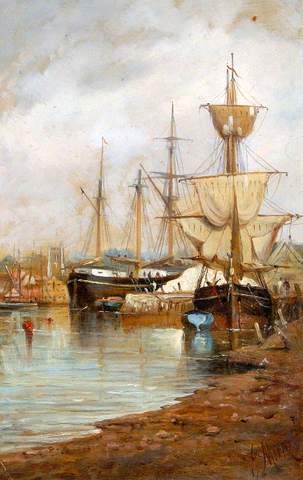
Ships in Ipswich Dock by John Moore

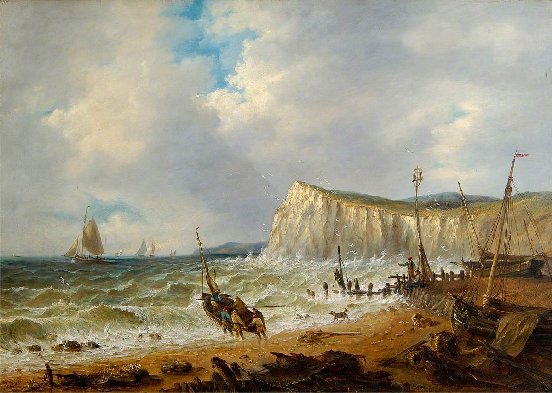
​Northumberland Coast Scene by John Moore

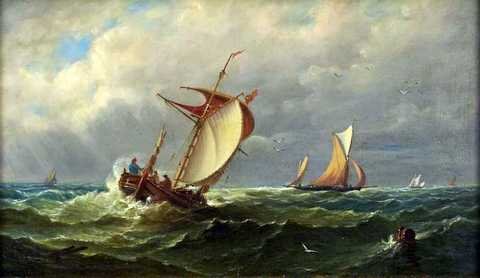
According to his accounts in 1877 he travelled to Scotland to carry out a commission for the Cobbold family. Art exhibitions featuring his work were displayed at the Ipswich Art Club between 1877 and 1882. Many of these paintings depictied scenes of Northumberland. Oten they focused on dramatic depictions of shipwrecks and fisherman battling against rough seas.

Fishing Boats in a Swell By John Moore

John Moore’s first wife, Caroline, died in 1877 and his second wife, Harriet, died in 1901.  Having outlived his two wives; he moved from Suffolk to the neighbouring county of Norfolk and the town of Diss where he spent the final few years of his life at the home of his friend George Scolding where he died on 8 April 1902, aged 82 and was buried in Ipswich cemetery.

…….to be continued.


Information for this blog was gained from the following websites:

East AnglianTraditional Art Centre

Suffolk Artists

Also from a book I found in a Brighton second-hand bookshop by Chloe Bennett entitled Suffolk Artists (1750-1930).

Mark (Max) Gertler. Part 1.

Max Gertler by Lady Ottoline Morrell vintage snapshot print, 1917. © National Portrait Gallery, London

My featured artist today is Markz Gertler. He was one of the most prominent artists of his generation and an early member of the New English Art Club, elected in 1912. He was a painter of figures, portraits and still-life.  Markz was born on December 9th 1891 at 16 Gun Street, Spitalfields, London.   He was the youngest of five children born to Austrian-Jewish immigrants from Poland, Louis Gentler and Kate (Golda) Berenbaum.  Markz had to elder brothers, Harry and Jacob, known as Jack and two elder sisters, Deborah and Sophie. 

Dorset Street, Spitalfields (c.1910)

By the 19th century, most of the area’s around Spitalfields had traditional industries, including silk weaving, but they had moved elsewhere, although the area still produced some textiles.  This decline of the local industry destroyed Spitalfields and it became a poverty-stricken, overpopulated area with little work. The grand houses which had been built by the Huguenots were turned into slums, and the area became unsafe. By the late 19th century, many people considered the place the most criminal in London.

The Rabbi and his Grandchild by Mark Gertler (1913)

The following year after Markz was born, 1892, because of the terrible economic downturn in the area, the family moved back to Markz’s mother’s native city of Przemyśl in Galicia, which at the time was part of the Austro-Hungarian Empire but now is situated in south-eastern Poland close to the Ukraine border. Life for the family was little better here as Max’s father worked as an innkeeper but this failed and now the family were financially desperate.  It could have been that his father felt guilty about not being able to support his family but one night in 1893, Gertler’s father Louis, without telling anyone, left his family destitute and on the brink of starvation, and went off to America to search for work.  Much later he contacted his wife to say that once he got established in America, he would send for them and all would be well.  It never happened as all his hopes of making a fortune in America ended in failure. 

Whitechapel High Street (1905)

Following yet another business failure Louis Gertler left America and returned to England and the London borough of Whitechapel, the heart of London’s Jewish quarter.  He set himself up as a furrier and in 1896 he arranged for his family to join him.  Once in England, his son’s first name was changed from the Polish Markz to Mark.

Portrait of Mark Gertler by John Currie (1913)

Gertler spent his early formative years in Whitechapel, London, a poor Jewish community, and attended nearby schools in Settles Street and Deal Street between 1897 and 1906.  He displayed a gifted artistic talent even as a young child and was said to have been motivated by pavement artists, advertising posters, and it was the autobiography of the great English painter William Powell Frith, which made Max determined to become a professional artist. In 1906, at the age of fifteen, on leaving school so as to earn some money for his family Mark (known as Max) became an apprentice at the stained-glass company Clayton and Ball.  He hated working there and rarely spoke of  the experience in later years.  During this time, he would attend evening classes at the Regent Street Polytechnic but in 1907 he had to drop out of college due to his family’s perilous finances.  In 1908, Max was placed third in a national art competition and then realised that he could become a great artist.  In 1908 Gerter met the artist, William Rothenstein. After seeing Max’s work Rothenstein wrote to Max’s father:

“…It is never easy to prophesy regarding the future of an artist but I do sincerely believe that your son has gifts of a high order, and that if he will cultivate them with love and care, that you will one day have reason to be proud of him. I believe that a good artist is a very noble man, and it is worth while giving up many things which men consider very important, for others which we think still more so. From the little I could see of the character of your son, I have faith in him and I hope and believe he will make the best possible use of the opportunities I gather you are going to be generous enough to give him…”

However, knowing the cost of studying art and that the family would be ununable to pay his tuition fees he became downhearted.

Portrait of a Girl by Mark Gertler (1912)

Having the money to pay for tuition fees, he needed a sponsor to put him forward to the prestigious Slade School of Fine Art.  This he received with a recommendation from William Rothenstein, an English painter, printmaker, draughtsman, lecturer, and writer on art who lived in the affluent London borough of Hampstead and who held a number of soirées which often included many well-known artists and some young and up and coming ones, such as Mark.  Mark Gertler entered the Slade in 1908   and studied there for three years.  He was the first and youngest Jewish working-class student of his generation to do so.

In her 1989 biography A Life of Dora Carrington: 1893-1932 Gretchen Gerzina, wrote about Max Gertler’s arrival at the Slade, writing:

“…At the Slade, Mark was at first something of a misfit. He had started school late in life and had left it at the age of fourteen. His hair was short and his clothes were different. Most of all, however, the other students found him too serious and too intense. He was extremely handsome, with huge dark eyes, pale skin, and a thin body, and he was both solemn and passionate about his art. Only at the polytechnic had he finally been introduced to museums and systematic schooling in the history of art, including the old masters. When he first arrived at the Slade at seventeen, he had the fervour of a convert who has surmounted great obstacles for his religion. In contrast, his fellow students seemed privileged and rather frivolous. Yet his early opinions of them were not untouched by envy…”

Still Life by Mark Gertler

After a little time at the Slade, Max made friends with a group of very talented students all of whom would become famous artists, such as C.R.W. Nevinson, an English figure and landscape painter, etcher and lithographer, who was one of the most famous war artists of the First World War, Stanley Spencer, John S. Currie, Maxwell Gordon Lightfoot, Edward Wadsworth, Adrian Allinson and painter and draughtsman Rudolph Ihlee. This group became known as the Coster Gang because as writer David Boyd Haycock put it, they mostly wore black jerseys, scarlet mufflers and black caps or hats like the costermongers who sold fruit and vegetables from carts in the street.

Vanessa Bell’s Friday Club exhibition at the Alpine Club Gallery

In 1910, whilst he was still an art student at the Slade, Max began exhibiting some of his paintings at Vanessa Bell’s Friday Club.  Vanessa Bell was an English painter and interior designer, a member of the Bloomsbury Group and the sister of Virginia Woolf.  The idea for the Friday Club was inspired by her earlier involvements of café life in Paris. It was her wish to create a similar atmosphere, and the Friday Club held its first meeting in the summer of 1905 and that November the Club held its first exhibition.   From 1910 until 1918, the Friday Club was based at the Alpine Club.

………to be continued.


Once again much of the information was gleaned from various Wikipedia sites but also these excellent websites:

Ben Uri Research Unit

Art UK

A Crisis of Brilliance

Spartacus Educational

George Edward Handel Lucas

My story today about an artist is a sad one. It is a tale of rags to riches and back to rags. My featured artist is George Edward Handel Lucas who because of artistic ability at a very young age was labelled by some as an artistic genius.

E G Handel Lucas self portrait painted on is 26th birthday (1887)

It all began at No.87 Church Street in Croydon on May 4th 1861 when George Edward Handel Lucas was born. He was the fifth child. His father, Edwin Newton Lucas, was a tailor and men’s outfitter by trade and had his shop on London Road. In 1875 the shop closed and his father ran his business from home. His father’s love of classical music, especially the works of George Frederick Handel led to his son’s middle name. This love of music led to his father’s second job, as for two evenings a week, he gave singing lessons at is house, in order to boost his income.

Autumn and Winter by EG Handel Lucas (1879)

Despite his business and his music tuition the large family found it difficult to make ends meet. In 1868, Handel Lucas was enrolled at Whitgift Middle School, which at that time provided education from the age of seven to fourteen for sons of the poor of the parish. Handel Lucas loved drawing and painting from an early age and at the age of fourteen he exhibited at the Royal Society of British Artists. He was the youngest person to have ever achieved that. Lucas left full-time schooling at the age of fourteen. He set himself up in a studio in a lean-to at his family’s Church Street home and could now finally concentrate on his art.

A Bird’s Nest and Flowers on a Mossy Bank by EG Handel Lucas (1879)

Handel Lucas’ favoured art genre was floral painting and still life. He would spend hours on his depiction of the minutiae of the flowers. Slowly his work became known and from the money he accumulated from their sale he would fund his artistic training. Lucas studied life drawing in the evenings at Heatherley School of Fine Art and for a short time studied at the St John’s Wood Art School.

Roses from the Vicerage (1877)

In 1877, eighteen-year-old Lucas completed his painting entitled Roses from the Vicarage and he submitted it to the Royal Academy annual exhibition where it was sold on the opening day. The price realised was £30 which is the equivalent of £4500 in today’s money. Three years later, in December 1880, a reviewer wrote, in relation to the work that Lucas had exhibited at the Royal Academy:

“…I am not surprised to find that the critics are praising the works of that young artist, Mr. E. G. H. Lucas. I was certain when his `Roses’ was in the Royal Academy three years ago… that time was only needed for him to come to the front…”

Smarting from a Hard Hit by EG Handel Lucas

Lucas’ artistic output was small due to the time it took him to complete a painting.  His attention to detail was such that his completed works rarely took less than six months to complete and in many cases, very much longer.  He exhibited his work regularly from 1879 to 1891 at the Royal Academy annual exhibitions and often his work was positioned “on the line”, a rare privilege for an “outsider”. His work received many complimentary reviews in the press with one art critic stating:

“…Mr Handel Lucas… possesses in a more marked degree than any still life painter I have met with, that genius which a great writer has informed us is an infinite capacity for taking pains..”

“While the Cat’s Away the Mice will Play” by EG Handel Lucas (1881)

Soon he and his artwork became well known.   Although his still life floral works took him so long to complete they sold well, he decided to concentrate on figurative painting.  Although this was an idea which would increase his output he also knew there was still a demand for his floral paintings and such commissions brought in the money and were far more popular in comparison to his figurative works.  It was all about supply and demand.

In 1895, Lucas married Clare Mary Stunell and they went on to have two daughters, Elsie Cecil Lucas born in 1899 and Marie Newton Lucas in 1900.  These new additions added pressure on the family finances and the time he spent looking after his wife and children resulted on his output being as little as only two or three major paintings a year, and this in turn meant that their family income fell.

The artwork of Lucas with all its great attention to detail was adored by English art lovers in the last decade of the 1800s but at the beginning of the twentieth century the genre began to fall out of favour with the British public’s interest switching to Impressionism. Sales of Lucas’ work dwindled.

The Pears Annual

One light at the end of the tunnel for Lucas at this time was that the Pears Soap Company wanted to buy some of his paintings which they sought to incorporate in their well-liked annuals. Eventually they bought three of his paintings.

The Cause of Many Troubles by EG Handel Lucas (1903)

His painting entitled The Cause of Many Troubles was bought by Pears in 1903 and was published in 1906. It depicts such things as playing cards, dice, a tombola, a picture of a racehorse and a flagon of beer. All items reminded us of gambling and the imbibing of alcohol and the perils of such pastimes. A further reminder of what these “hobbies” could lead to was the pistol affixed to the wall, which some mired in gambling debts, believed was the only way out. The Pears Soap Company paid Lucas £106 for the painting (around £15,000 in today’s money). It was an extraordinary amount.

Some of Life’s Pleasures by EG Handel Lucas (c.1908)

The second painting the Pears Soap Company bought from Lucas was one entitled Of Such is the Kingdom of Heaven and they paid him another substantial amount, £150 and yet it was never used in their publications. The third of Lucas’ works they bought was his painting, Some of Life’s Pleasures and it could well have been the antidote for his The Cause of Many Troubles painting for this was all about harmless and fulfilling pastimes such as painting, reading and playing a musical instrument. This painting appeared in the Pears Annual in 1909. The company bought it for £81 a considerably lesser amount that the previous two purchases had achieved. Lucas had no recourse but to accept this lower amount as he was desperate to clear his debts.

View from Pompeii over the Gulf of Naples to Capri. by EG Handel Lucas (1888)

Lucas became desperate with worry with regards his mounting debts and lack of sales. In 1908, it just became too much for him and he suffered a nervous breakdown. To reduce costs the family left Croydon and moved to Brighton. It was here that Lucas and two local photographers set up a new photographic project and started a company called The Handeltype Syndicate Company and Lucas filed a patent for their new photographic process. Sadly for Lucas, after twelve months, their company failed and the three men, together with friends and family who had financially backed them, lost all their money.

Foes in the Guise of Friends by EG Handel Lucas (1913)

Another of Lucas’ paintings which advocated temperance and warned of the perils of drinking was his 1913 painting entitled Foes in the Guise of Friends. The painting’s title says it all. It was this painting that had not been completed and was unsold and had been used as a bargaining tool by Lucas with his landlady who had been demanding money for the rent. He had no money, the landlady didnt want the painting and the family were evicted.

Haymaking by EG Handel Lucas

Finally, Lucas found work in the south London district of Streatham where he and his family went to live. His friend asked him to design Christmas cards for his Christmas card business. Lucas never lost his love of photography and a printing process called Handelchrome which he invented. It involved transferring a photograph onto glass and painting it from behind and he intended to use this technique as an aid for his portrait work. Sadly, this invention like many of Lucas’ ideas came to nought and he struggled to match his income and his expenditure.

Two Vases of Flowers by EG Handel Lucas

In the 1920s Lucas completed a number of paintings but he was unable to achieve prices for them that he had done thirty years earlier.

The Stolen Nest by EG Handel Lucas (1927)

He did however have one success when he was commissioned to provide a number of paintings which were then used as illustrations for the Brooke Bond Tea calendar, one of which was entitled The Stolen Nest which was published in the 1929 calendar. It is set on the banks of the River Wandle, a right-bank tributary of the River Thames in south London.

Portrait of Jesse Ward by EG Lucas (1927)

One of his best portraits was of the founder of The Croydon Advertiser, Jesse Ward.

In 1936, Lucas received the devastating news that his wife had been knocked down and injured in a road traffic accident. He suffered a fatal heart attack and died on April 4th 1936, aged 74.


I will end this blog about Edward George Handel Lucas with the words of an art critic in the 1890s when he described Lucas’ art as:

“…When the present and succeeding generations have passed away, this little gem of the painter’s art will survive to prove that one man in Croydon, at least, knew how to paint, and could unite patent toil with Heaven Born genius…”


The majority of information for this blog came from an article written by David Morgan for the Inside Croydon website in December 2023.

Cyril & Renske Mann. Part 5.

― Pablo Neruda, 100 Love Sonnets


In April 1960, four months after Renske met Cyril, he was admitted to the Royal Free Hospital to have an operation on his perforated stomach ulcer. Renske wrote Cyril a letter to say that she was missing him and expressing her love for him. Note that even after being with him since January that year she still addressed him as “Mr Mann”.

Dear Mr Mann

How dreadful that I can’t come to see you tonight. You don’t like the evenings in hospital, do you? Well, I don’t like the evenings in Bevin Court. Why? Because 108 Bevin Court is not complete when you are not here. You are so much my man in body and soul that I simply cannot do without you.

When I am writing to you, and from time to time, I am looking at your paintings, I feel you are so near to me. I love you Mr Mann. I want to tell you over and over again I love you and I pray that i will be your woman for all your life. I realize that I have not much to offer you; no beauty, no money, only my love and I hope one day to prove to you that my love is worth more than beauty or money. You have everything I always wanted: you are an artist, you are my husband, you are my friend, my love, everything. When you leave hospital I will ask for a day off. I will stuff the flat with flowers for you.…..

Cyril and Renske (c.1962)

Life in the 60s was all about Cyril and Renske themselves and they were almost oblivious to what was going on around them. They were aware of their limited finances and spending on food was minimal. Cyril cooked and managed the menus. Renske went out to work. If there was a positive to Cyril’s stomach ulcers it was that they prevented him consuming large amounts of alcohol. Once he had recovered from his stomach operation he was once again able to consume alcohol and sadly, after excessive imbibing his mood would often blacken and change to one of being boorish and confrontational. If this alcohol consumption also coincided with his decision to miss taking his anti-psychotic pills then often hell broke loose.

Allotments with Stormy Sky, Walthamstow by Cyril Mann (1967)

Their small cramped council flat accommodation at 108 Bevin Court was not conducive to painting especially when using large canvases and so, after four years, in 1966, they moved. Renske had always wanted to live in a house and so with great determination and frugality they managed to save enough money for a deposit on a small house at 97 Lynmouth Road in Walthamstow, a town in the London Borough of Waltham Forest, around seven and a half miles (12 km) northeast of Central London. It was a semi-derelict Victorian cottage which cost £2,750.

Cyril and Renske’s home at 97 Lynmouth Road in Walthamstow.

Their savings for the house was boosted by money given to them by Cyril’s long term sponsor, Erica Marx. The house cost £2700 and they had to find a deposit of £700 which was their maximum budget. They struggled to get a mortgage as in those days the income of a wife was not looked upon as viable long-term earnings. However, Cyril was managing to sell his work and had a good credit score and they were finally given a mortgage. Finally, they managed to buy the small house and with it the luxury of having their own small bedroom.  The house came with two bedrooms but the larger second bedroom was designated as one were Cyril could store all his painting paraphernalia.   Renske said that the fact that we could exit the house into the small garden was something she had previously only dreamed about after having to suffer living in the claustrophobic atmosphere of a top-floor flat in Bevin Court.

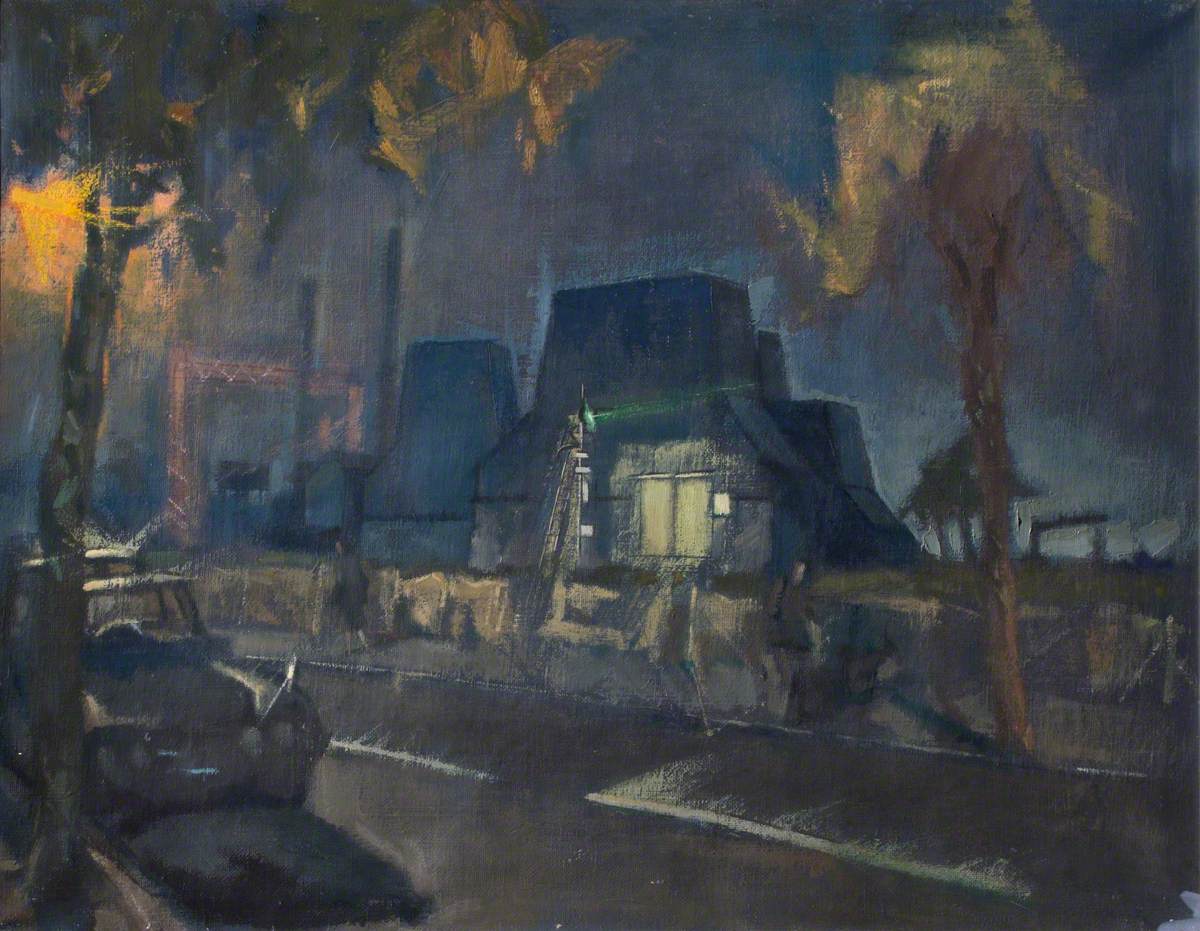
Gas Cooling Towers

Gas Cooling Towers by Cyril Mann

A new location gave Cyril new opportunities to paint local scenes. Cyril was mesmerised by the massive wooden gas cooling towers which towered above the modern skyline and he would go out in all weather conditions to capture the iconic building.

The Boiling Fowl by Cyril Mann (1963)

One of the first visitors to their Lynmouth Road house was a Canadian actor and TV-game host, Ronan O’Casey and his British actress wife, Louie Ramsey.  They had come to see Cyril’s paintings. He fell in love with Cyril’s semi-abstract rendition of a boiling fowl. Renske recounted how they could not believe their luck when he bought it and the couple took it home with them.  Cyril liked to recount the story about how months later he and Renske were invited to a dinner party in O’Casey’s smart and chic flat in Hampstead. O’Casey pointed to the painting he had bought from them and hilariously announced that he now has Cyril’s cock on his wall.  Renske remembered thinking that it would have been better if O’Casey had purchased one of Cyril’s flower painting !!

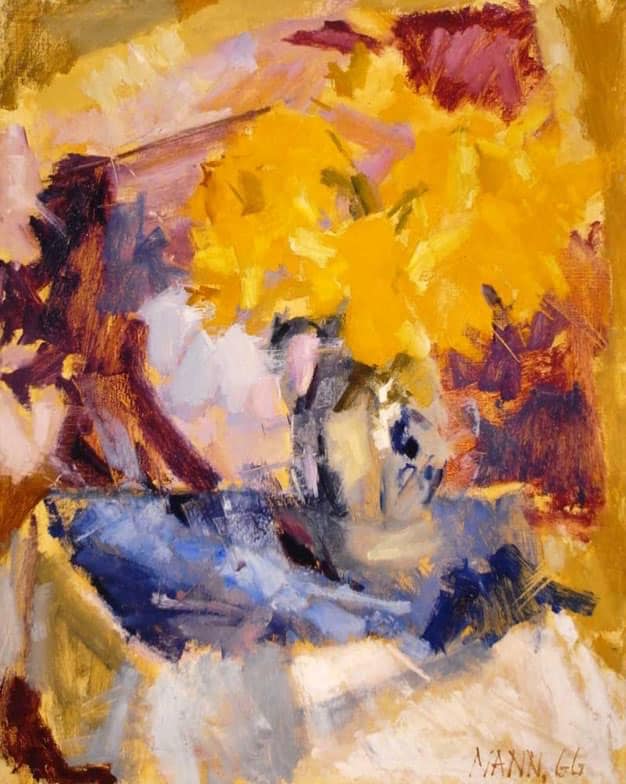
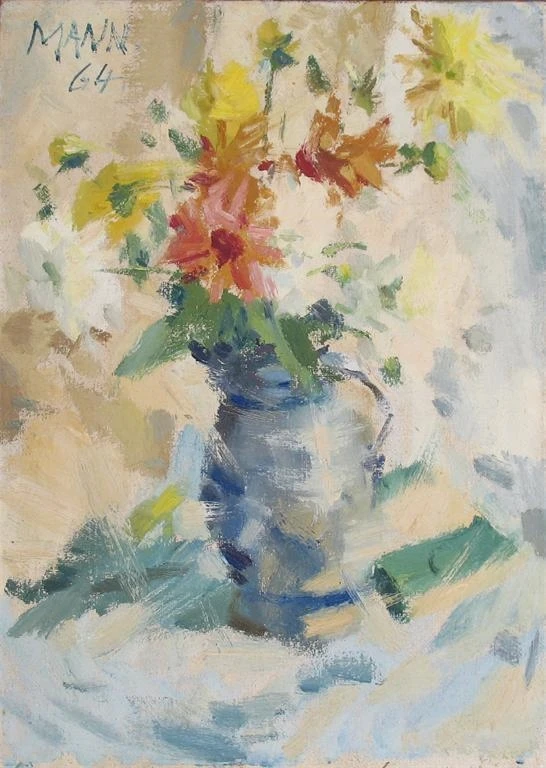
Daffodils in a Brown Jug by Cyril Mann (1958)

The problem that arose from the purchase of the Lynmouth Road house in Walthamstow was that it was not quite habitable and so they had to also retain the Bevin Court flat and, so for a time, were paying rent on Bevin Court and a mortgage on the Walthamstow house. Cyril and Renske were given a grant to refurbish their new home and he and one of his ex-students set about renovating the property. They installed a canary-coloured bathroom suite, built units for the kitchen and laid quarry tiles on the floor. Cyril set about the tasks with great gusto and Renske said that her husband’s skills as a carpenter, bricklayer and decorator were amazing. Cyril was a great handyman, like his builder father and grandfather.

Christ Church Spitalfields seen across bombsites from Scrutton St by Cyril Mann

Renske loved her new home as it had a small garden with an apple tree and raspberry canes. To make ends meet, Renske began to work full-time. She had completed twelve months of temping at the advertising agency in their PR department and now became an assistant with a proper permanent job.  More importantly, Cyril began to boost her self-confidence and told her that she could achieve anything she put her mind to. Renske basked in Cyril’s confidence in her and deep down began to believe in herself. Although Dutch, she could write in English and began to put together articles on art which she submitted to art magazines and had them accepted. Soon she was getting paid for her submissions. This was indeed a happy time in Renske’s life. Cyril continued to stay at home and paint whilst Renske went out to work. He always had a meal waiting for her after she returned home from work. 

Sunlit Daffodils in a Blue Jug by Cyril Mann (1966)

On November 5th 1968 Amanda Mann was born.  She was Cyril Mann’s second child but the first born to Renske.  Cyril had been faithful to the promise he made to Renske that he would give her a baby whenever she felt the time was right.  The decision to have the baby was a maternal versus financial one as Renske knew that as the breadwinner it would mean a great financial sacrifice even though their finances had improved.  For Cyril it would also be a sacrifice as he was fifty-seven years old and had already brought up one child, Sylvia. 

Baby Amanda

However once Amanda was born, she was lavished with kindness and love by both her mother and father.  Cyril would walk the streets of Walthamstow and the local market with baby Amanda in her second-hand pram, all the time being admired by the stallholders.  Renske recalled that once when he returned home with Amanda, on lifting her out of her pram, he found a hoard of silver coins which the stallholders had surreptitiously slid under the blankets of the pram.  They later told Cyril that it was lucky to touch a baby’s head with silver.  Cyril could not believe such generosity existed and was moved to tears.   Having just given birth to their baby, Renske had very little bed rest as there was no such thing as maternity leave in those days and so for financial reasons, she had to return to work.

Cyril Mann with his daughter, Amanda.

Although the Walthamstow house was much roomier than Bevin Court it still just had one large bedroom and one small bedroom and Cyril had taken over the larger one for his art studio, leaving him and Renske to sleep in the smaller bedroom while Amanda slept on the landing in her pram.  Renske’s career in PR had rapidly progressed and she was beginning to earn a substantial wage and this upward turn in the family finances meant that late in 1969, Cyril, Renske and one-year-old Amanda moved a few miles down the road from their Walthamstow house and went to live in their newly purchased house in Leyton. 

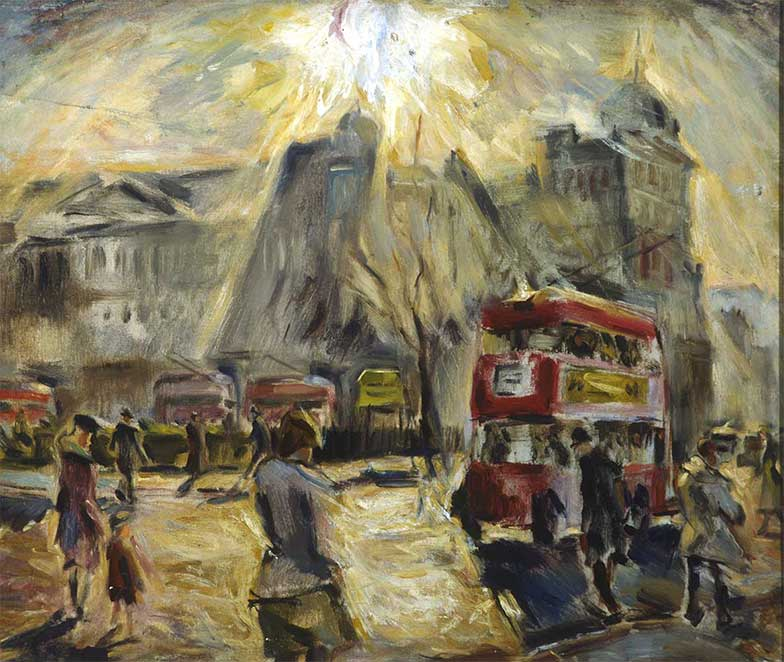
Trolley Bus, Finsbury Park by Cyril Mann (c.1948)

This new residence at 23 Goldsmith Road, Leyton was a five-bedroom house with a 100ft garden and had all the studio space Cyril could dream of. Cyril would spend hours walking through the nearby Walthamstow Forest.

Walking through the forest

It was coming up to Cyril and Renske’s twentieth anniversary of their first meeting but relations between them had reached an all-time low.  Eventually things between Cyril and Renske got to a point when she could no longer bear the sadness of this total breakdown of their relationship and she knew she had to leave him.  Amanda, who was eleven years old had been safeguarded from this parental breakdown as she was at boarding school in Eastbourne having achieved an open scholarship.

Tubby Isaacs Shellfish Stall by Cyril Mann (c.1955)

One night in early December 1979, after a particularly heated and nasty argument Renske became physically scared of Cyril and made the momentous decision to leave him and, whilst he slept, she slipped out of the house and away, like his first wife, Mary had done some twenty-nine years earlier.  Renske went to stay with friends, who were horrified to see Renske in such a fragile mental and physical state.  She returned to Cyril for a visit just before Christmas but knew she would not remain with him.  She was shocked to see how he had deteriorated both physically and mentally.  At the short meeting she promised Cyril that she would continue to support him financially and that he could see Amanda whenever he wanted, providing his mental state was conducive to such a father/young daughter meeting. He pleaded with Renske to stay with him and was devastated when she refused.

Roses with Books by Cyril Mann (c.1971)

Renske along with Amanda travelled to the Netherlands to see her parents and returned early in the New Year.  On arriving back in London, Renske contacted one of Cyril’s neighbours in Leyton to find out how he was coping.  She was told that he had suffered a second and more serious heart attack and had been rushed to the local Whipps Cross hospital where he had been lying in a week-long coma.  Renske rushed to his bedside but he was still unconscious.  She held his hand as he took his last breath and quietly passed away peacefully, aged 68.  It was January 7th 1980, almost twenty years to the day that the middle-aged English artist met the beautiful young Dutch East Indies woman.

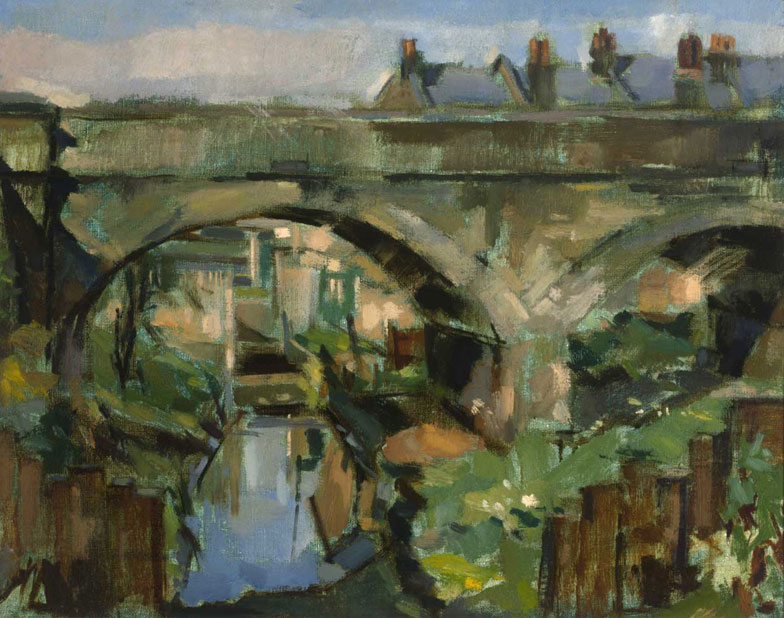
Railway Bridge over the Culvert, Walthamstow by Cyril Mann (c.1967)

I have spent many many hours putting together these five blogs on Cyril and Renske Mann. It has not simply been a look at the many paintings Cyril Mann completed during his lifetime.  It has been a long literary voyage looking at the lives of the middle-aged English painter and the beautiful young woman who remarkably dedicated her life to him.  It was not smooth sailing for either of them and I found myself wondering how they remained together for so long.  Why did Renske put up with a man who on many occasions had treated her badly. How did she manage to live with this middle-aged man who had suffered mentally for most of his life?  What made her fall passionately in love with an irritable, short-tempered impecunious artist who was thirty years her senior?  So many questions. 

Cyril and Renske during a visit to her family in Dordrecht. Her mother, Nina van Slooten on the far left along with an uncle and aunt.

Another question is why did Cyril continually crave recognition for his art and yet abuse those who could have given him such acknowledgement?  One of Cyril Mann’s favourite artists was Vincent van Gogh and he drew parallels with his life with that of the Dutch painter.  Both had great belief in their art, both in a way believed their skill as a painter was at genius level.  Neither received recognition during their lifetimes and both were embittered at their treatment.  As years passed and without the recognition, he believed he deserved, Cyril became unstable, frequently volatile and increasingly disillusioned by the unpardonable mistreatment he received from the artistic world.

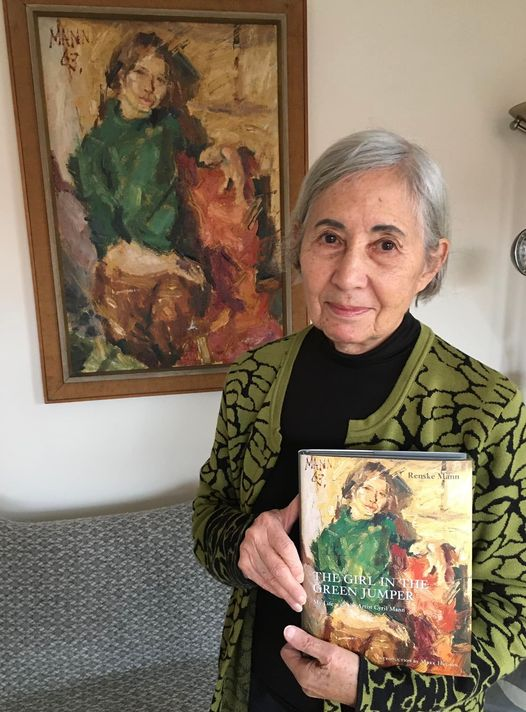
Renske, who is alive and well, knows the answers to these conundrums and maybe she lets us into the secrets in her book, Girl in the Green Jumper, which I urge you to read.  What struck me most was the comment she made to Cyril at the start of their relationship that she would make him famous.  She had seen the talent and beauty of this middle-aged man and in a way, she was confident of her ability to mould him into the man she believed would be successful and with such success he would lead a much happier life.  After reading the account of her life, we know that she never quite succeeded in her aim.

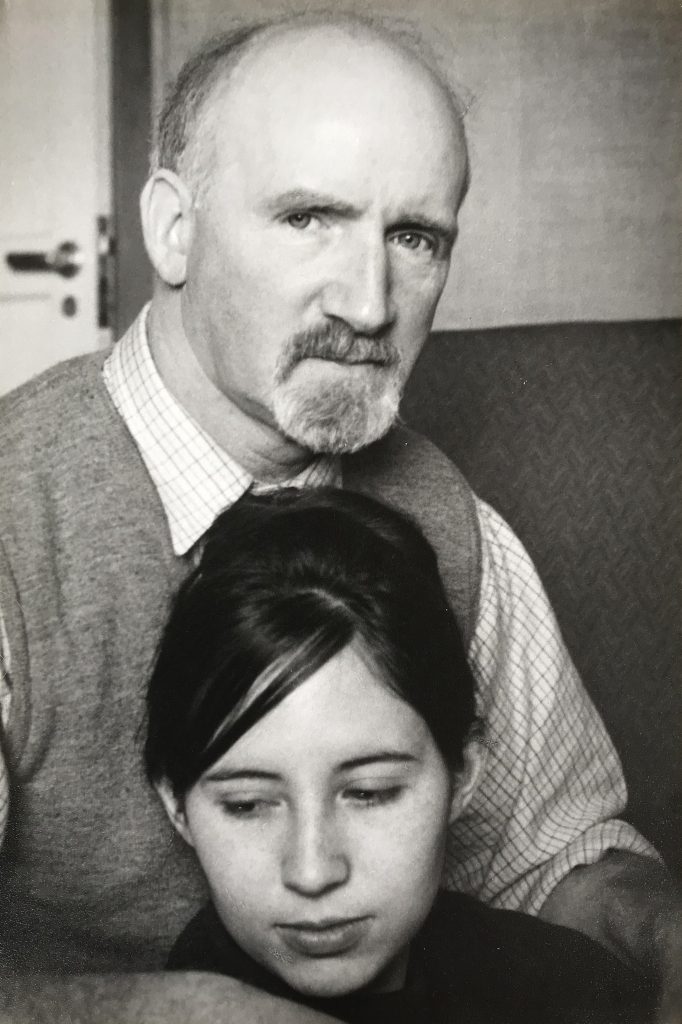
Cyril and Renske in the 1960s.

What did Cyril take from his intense relationship with Renske?  I think the answer lies in a letter which Renske found in their house in Leyton shortly after his death.  Cyril had written:

My Dear Love,

I received your letter this morning and was afraid to open it for I was so filled with foreboding, which was justified on reading its contents.  When I saw the word solicitor, I knew my last bit of hope was gone.  I am not going to get upset for it won’t do me any good – harm in fact.

This in a way will be my last letter to you.  I do love you, Renske (oh Sweetheart) and always shall.  You can cease to love but you will never get rid of mine.  In all my pictures the evidence is there and will remain for people to see and realize.  You have been a dear and wonderful wife, giving me all and putting me first always.  I have been aware of it and have never taken it for granted.  Thank you for everything and all the happiness that went with it.  I shall always been grateful.  I am not bitter or angry even though you have truly broken my heart.

Every day I realize more the reason for taking the step you have.  It couldn’t have been easy of you but I now see that it was necessary and that you were really unhappy at home with me and had to take the final step.  So, love, don’t please feel guilty or self-reproachful for there is no need.  In all things I want is for you to be happy and to realize yourself and live fully.  You’ve done your twenty years chores on me.  Now think of yourself.  You’ve earned it.  So I say God Bless, take care of yourself.  Remember my heart and any help you may need is yours to call upon at any time…

There can be no doubt that Renske gained a lot of solace from his last words.  It gave her the will and the courage to live and continually bring his works to the attention of the public. 

Marion Matthews and Renske Mann (September 2022)

Renske, with Cyril’s encouragement, cleared her educational gaps by passing A-levels and then taking an Open University degree. Her PR career blossomed going from strength to strength.  She took on the role of director of Scholl, the international footcare-to-footwear company.  After Cyril’s death, Renske and her current partner, journalist Marion Mathews, converted a derelict dairy in Holland Park into an art gallery. They operated the venture as a charity, and she and Marion ran the Gallery on a charitable basis for 10 years, until 1993.  Their aim was to help unknown, but gifted artists like Cyril so as to reach that first difficult step on the exhibition ladder.  Now aged 84, Renske Mann continues to write articles and give talks on her late husband, Cyril, and his paintings, using skills acquired during her time as a PR executive. Her writings on social media attract thousands of followers and admirers.

Renske, you should be very proud of what you achieved.


It would not have been possible for me to put together all five blogs about the artist, Cyril Mann, without information gleaned from a number of sources:

The comprehensive biography of Cyril Mann, The Sun is God by John Russell Taylor

At the presentation of the Islington People’s Green Plaque in September 2013 : Renske Mann,her daughter Amanda next to her along with (far left) Islington Borough Counsellor Catherine West, elected Labour MP in 2015 and on the far right John Russell Taylor, art critic for The Times, who wrote Cyril’s monograph, The Sun is God.

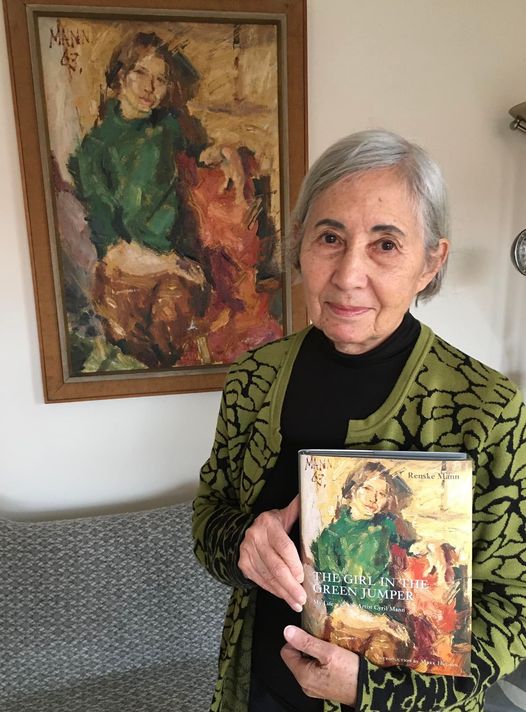
The intimate autobiography of her and Cyril Mann’s life by his second wife Renske, entitled The Girl in the Green Jumper.

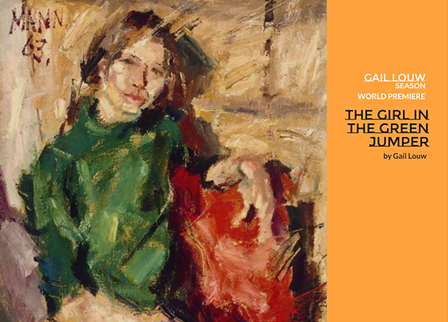
This autobiography has now been turned into a play which receives its World Premiere on Wednesday March 13th 2024 at the Playground Theatre, London, 8 Latimer Rd, London W10 6RQ.

Finally, and most importantly I owe many thanks to Renske Mann herself who provided me with information and photographs appertaining to her and her late husband Cyril.

Piano Nobile Gallery London for information and pictures.

Cyril and Renske Mann. Part 4.

Renske Mann from her book, The Girl in the Green Jumper

Renske was overjoyed by Cyril’s words. Although she didn’t believe his words were utterances of flattery and just simple facts, nevertheless the words made her happy and made her love him even more.

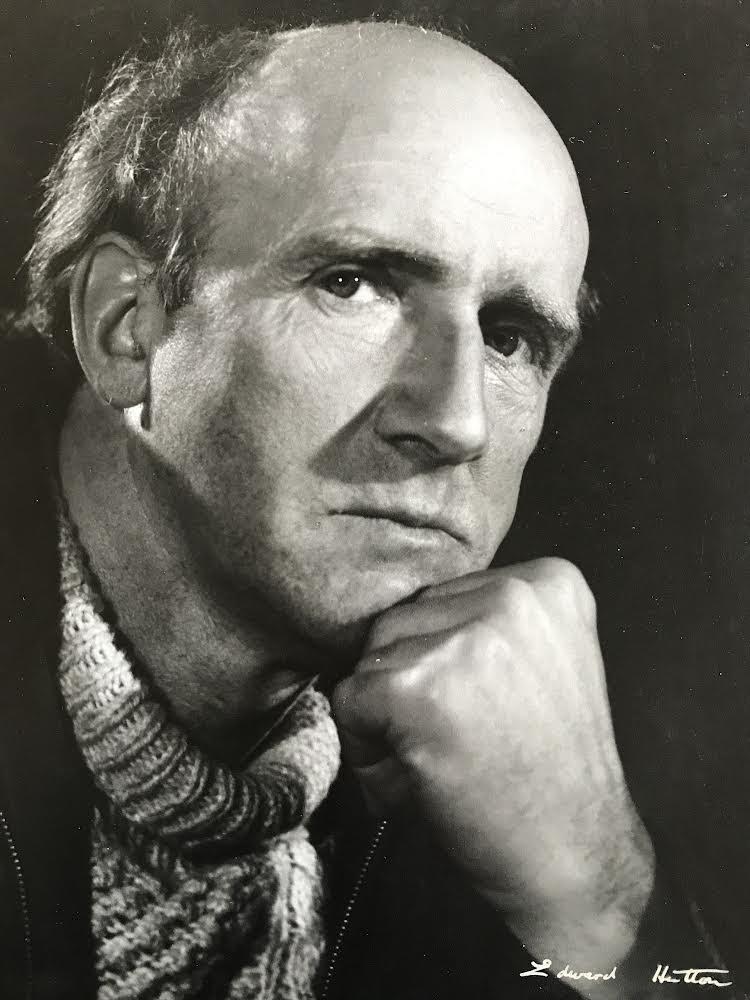
Cyril Mann (1960). Photograph by Edward Hutton.

Throughout his career Cyril painted many portraits, self-portraits and in the 1960s Cyril Mann completed a number of nude depictions using Renske as his model. 
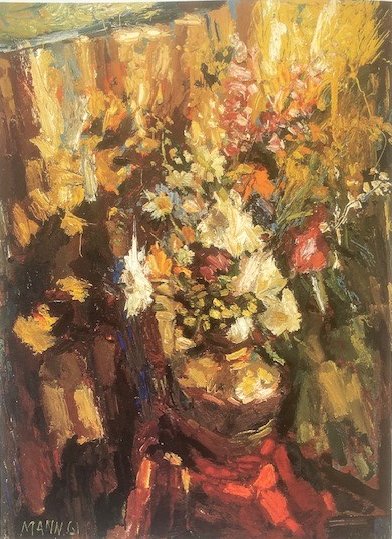
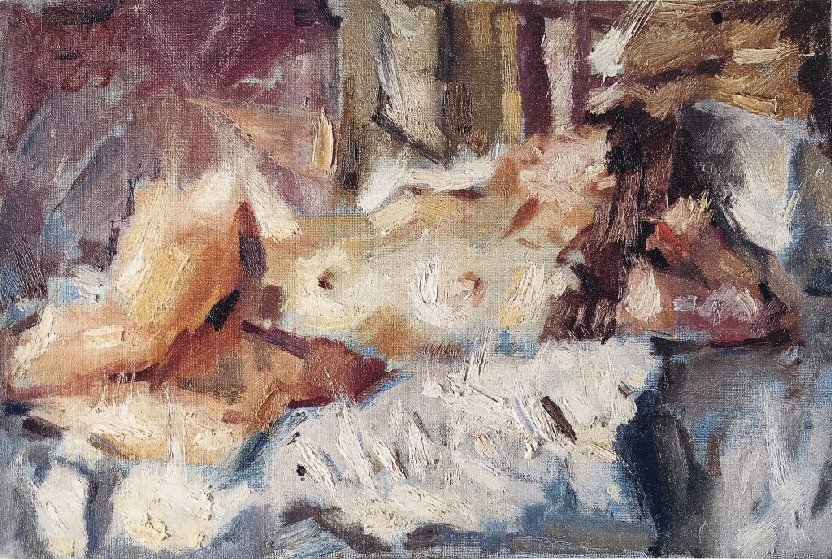
Ecstasy by Cyril Mann (1963)

One such nude portrait, using her as a model, was completed in 1963 and entitled Ecstasy.  Renske remembers the morning he began this work. In her book, The Girl in the Green Jumper, she describes the setting:

“…Cyril mostly painted in the morning.  The minute he drew the curtains he knew when the weather was set to last.  As the sun rose, it cast shadows from the Crittall windows [steel framed windows] across my nude body on our single bed.  He stared at me, grunting and squinting ‘Stay put and take a comfortable pose’ he ordered.  I knew by then that there was no such thing: every pose would turn into agony in time…”

It was not just about her body or pose it was also about the sunlight streaming through the window. It was of the utmost importance to Cyril to capture the dynamic effects of the rays of the sun as they bounced off every surface, from walls on to Renske’s body and back.  He was like a man possessed.  Tables and chairs had to be moved out to make a working space.  He would shuffle around the tight spaces never lifting the gaze from Renske’s body.  She moved to get comfortable on the bed and started to doze off only to be woken abruptly by Cyril who rudely told her “not to go fucking asleep”.  Throughout painting Renske said he would not stop talking, all the while explaining what he was doing.  He was adamant that he had to block in the light areas first as they were more important, not the mid-tones or darks.  Cyril compared Renske to the RA models he had once used saying:

“…Models at the RA haven’t a clue.  They just sit on a chair.  Students have to group around a podium.  If you are in the wrong spot, you’re fucked.  At least you know how to make your body look interesting…”

Cyril had been introduced to the famous English television personality, Denis Norden, who on seeing the painting told Cyril that he should give it the title Ecstasy. Cyril and Renske had hoped that Norden would buy the painting but he didn’t but their mutual friend, Peter Davis, who had introduced Denis Norden to them suggested they just give Norden the painting for nothing as the celebrity owning one of Cyril’s paintings would be added kudos. However Cyril was appalled by the suggestion and simply said ‘to hell with that’.

Modern Venus (c.1963)

One morning Cyril Mann came into the bedroom where is wife, naked, had just risen from bed.. He flings back the curtains and the sunlight streams in, illuminating her. He screamed at her not to move and at the same time drags into the room a large canvas and starts to paint her portrait.  She remembers that her shadow was cast against the wall as she rose from the vey messy jumble of bedclothes strewn on the bed. She is standing facing him with her left arm above her head which in that posture soon becomes numb. She balanced by standing one foot in front. Their blue alarm clock on their round bedside table glistens in the sun. He told her that she was a Modern Venus. Not rising from a seashell but from the sheets and blankets. The painting Modern Venus is complete.

Reclining Nude in Sunlight by Cyril Mann (1962)

In Reclining Nude in Sunlight, Cyril Mann omits detail as he just wants to depict and render light as a dynamic force. He used large hog’s-hair paintbrushes so that he could rapidly cover the canvas, and so focus on the light and how the sunlight fell and reflected on Renske’s nude body as it swiftly crossed their room.

Golden Torso by Cyril Mann (1961)

Golden Torso was completed in 1961 and when the author and art critic John Berger saw it he immediately recommended it for the Granada TV Art Collection which was recognised as probably having the third best corporate collection in Britain. Unfortunately for Berger the painting had already been snapped up by another collector and Berger reluctantly chooses another picture for his sponsor.

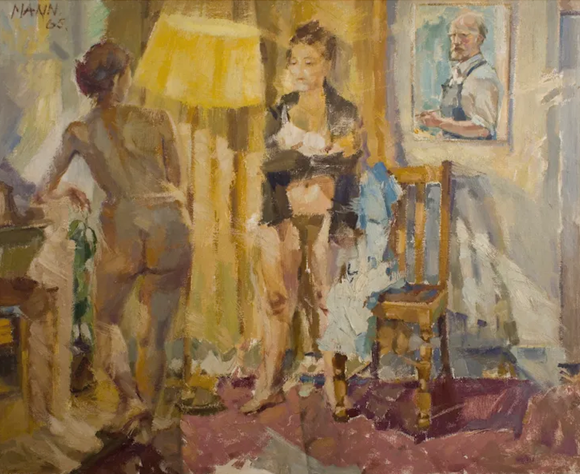
Self portrait with Double Nude by Cyril Mann (1965)

Probably the best-known portraits Cyril completed of Renske was The Girl in the Green Jumper, one with her fully clothed.  His self-portrait can be seen in the background, hanging on the wall.

The Girl in the Green Jumper by Cyril Mann (1963)

In the painting, The Girl in the Green Jumper, we see Renske perched on the narrow wooden armrest of their red chair, which she recalled made sitting still very difficult and painful, much to Cyril’s annoyance. She said that posing for Cyril required a good deal of concentration and willpower. The depiction came about when Cyril was admiring the green of her jumper which he commented looked so much more intense, seen against the red upholstery of their newly-purchased G-Plan suite. Renske, like many, queried whether it is a portrait or a study of sunlight blazing on to her through the window, striking her face and bouncing all over the room. She commented to her husband that her hands were just fingerless smears of paint but he replied that that was true abstraction. Abstraction he said was “to leave out” and abstract art is not actually abstract at all and should be better termed as “non-figurative”.

Amanda Mann has followed in her father Cyril Mann’s footsteps and is now also a talented artist. Here Amanda is seen with the painting that inspired her mother Renske Mann’s memoir “The Girl In The Green Jumper: My life with Cyril Mann”.

Cyril Mann, besides the nude depictions of his wife and self-portraits, completed many portraits of his family and friends which highlight what, he as a talented portrait artist, could produce. There is no doubt that he could have been a wealthy portrait painter. Alas he only rarely painted portraits of people outside the family as he said he could not accept portraiture commissions where he was supposed to flatter his sitter, which he believed was often the prerequisite for being given the commission.

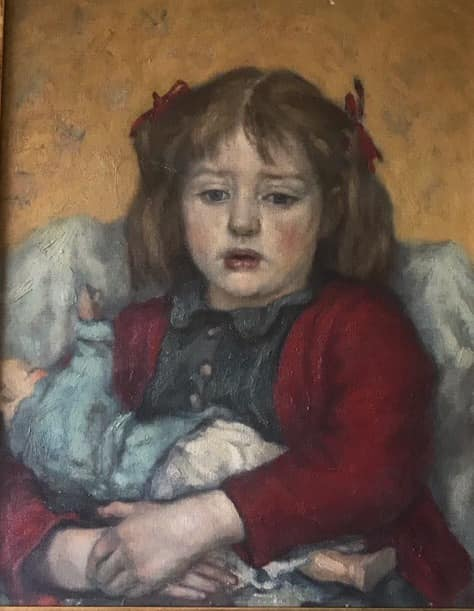
Portrait of Sylvia, aged 3, tearfully clutching her doll, by Cyril Mann (1943)

Sylvia, Cyril’s first daughter, would recount on a number of occasion the memory of sitting for her father for the portrait. She said the agony and boredom of sitting still for hours, clutching the doll still haunted her.

Portrait of Sylvia, by Cyril Mann (c.1957)                  Collection Gideon Dewhirst (Sylvia’s son and Cyril’s grandson)

Cyril Mann with his portrait of Sylvia Mann.

It is hard to judge the mood of the sitter. Sylvia was then aged seventeen and it was the time prior to her attending Keele University. It seems she is somewhat lost in her own thoughts. The depiction shows her holding a book, signifying her love of literature. After university she would go on to become a published author, poet and playwright. Sylvia died in 2006.

Amanda, aged 4, with Doll by Cyril Mann (1973)

Cyril and Renske’s four year old daughter, Amanda, was posed sitting on a chair holding her doll. It was a similar depiction to Cyril’s portrait of his first-born daughter, Sylvia, which he completed in 1943, also with a doll.

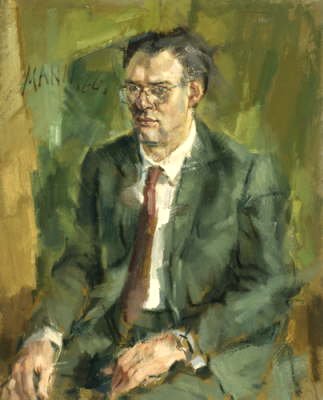
Portrait of David Hardisty by Cyril Mann (1966)

David Hardisty was a young lawyer working as a patent agent. He had seen and fell in love with one of Cyril’s floral paintings which were on display at the Rawinski Gallery in London. Hardisty, who had recently married, could not afford the £300 price tag. Not to be deterred he went to Bevin Court to ask Cyril if he could buy the painting in fifteen £20 instalments. Cyril agreed and during the following years David bought more of Cyril’s paintings. In the portrait, sunlight once again takes precedence over form in Cyril’s rendering. It plays across David’s features and on his suit, tie and hands. Time must have been at a premium for Cyril as the portrait was completed in only six two-hour sittings.

My Student, Vic Singh by Cyril Mann (1962)

When Renske went to the art class in December 1959 and met Cyril Mann for the frst time, one of his students that evening was Vic Singh. whom Renske remembered as being an extremely handsome young man,. His mother was Austrian and his father was an Indian politician. Singh went on to become a photographer. One day he called around to Bevin Court and Cyril persuaded him to pose for a portrait. He agreed and posed, one foot raised with his elbow resting across his knee while stretching one arm towards the bookcase in order to maintain his balance. He was exhausted by the time Cyril had completed the portrait.

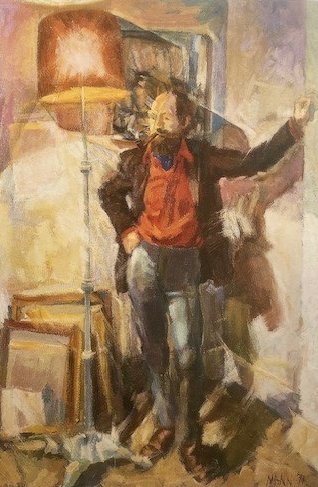
Portrait of Ernest Groome (1971)

In 1960, Renske, like her husband, began to worry about the lack of sales of his paintings and suggested he took some of his work to Hyde Park Corner where many artists hung their work on the railings. Cyril was horrified with this idea saying that serious artists would not dream of hawking their wares in such a way. Renske, however, said that if he wouldn’t do it, she would. She arrived at Hyde Park Corner and found some spaces on the railings where she could hang Cyril’s artwork but she had forgotten to bring string or hooks to complete her task. She was rescued by a young Irishman, Ernest Groome, an aspiring young artist who had been working as a touring pub entertainer. He managed to find hooks and string and he and Renske hung Cyril’s paintings on the railings. 

Cyril first painted Ernest Groome’s portrait in 1961 shortly after the Hyde Park Corner meeting and ten years later completed another portrait of Groome. In this portrait Groome is in Renske and Cyril’s home. The red shade of the standard lamp picks up the colour of his shirt, casting a strong solid shadow against the wall behind him.

Self portrait by Cyril Mann

Cyril left behind many self-portraits which capture his many moods.

Self-Portrait with Hat by Cyril Mann (c.1968)

It is a very worried-looking Cyril Man who stares out at us in his 1968 Self-Portrait with Hat. He seems to have the cares of the world on his shoulders. It is 1968 and Renske is pregnant with her daughter Amanda, Renske, whose job was bringing financial stability to the household, was having to give up her job to have the baby. How were they going to cope? Could Cyril sell more of his work? All of these and many more questions were probably racing around Cyril’s head at the time of the self-portrait.

Self-Portrait with a Brush by Cyril Mann (1966)

The most controversial self-portrait came in 1978 under the title Ecce Homo. Ecce homo, meaning “behold the man” are, according to the Gospel of St John, the Latin words used by Pontius Pilate when he presented a scourged Jesus, bound and crowned with thorns, to a hostile crowd shortly before his Crucifixion. 

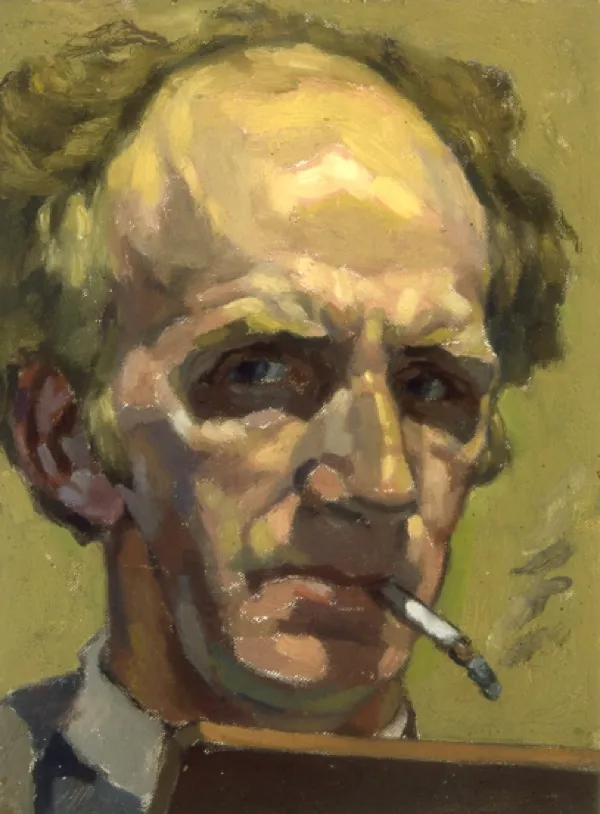
Ecce Homo by Cyril Mann (1978)

Ecce Homo was one of last self-portraits painted by Cyril Mann. He died a year later. His state of mind, at the time he painted his own portrait, was unstable but there was also a sense of defiance about this depiction. A sense that he was master of his own destiny. It is in a way a mirror of his great creative energy which throughout his life shone brightly and was never dimmed by his detractors.  Having given up smoking on doctor’s orders he had reverted to that habit and the portrait shows him defiantly holding a cigarette. It was another way of showing that he, and he alone, would make decisions about himself.  His rebellious posture and the title he gave the work was his way of reasoning that he, like Christ, had been persecuted and in a way crucified by art critics and gallery owners. He adamantly believed that the reason he never achieved the success he deserved during his life was due to others and not himself.   In the background, we see flanking him two earlier self-portraits and their positioning symbolises the thieves crucified on either side of Christ.

……. to be continued.


It would not have been possible for me to put together this and following blogs about the artist, Cyril Mann, without information gleaned from a number of sources:

The comprehensive biography of Cyril Mann, The Sun is God by John Russell Taylor

Renske Mann with her book The Girl in the Green Jumper, My life with the artist Cyril Mann

The intimate autobiography of Cyril Mann’s life by his second wife Renske, entitled The Girl in the Green Jumper.

Renske Mann and Natalie Ava Nasr, the lady playing the role of Renske in the play.

Peter Tate who plays Cyril Mann, Christian Holder, director of the play and Natalie Ava Nasr, who plays Renske in the play The Girl in the Green Jumper.

This autobiography has now been turned into a play which receives its World Premiere on Wednesday March 13th at the Playground Theatre, London, 8 Latimer Rd, London W10 6RQ. It runs until March 24th.

Finally, and most importantly I owe many thanks to Renske Mann herself who provided me with information and photographs appertaining to her late husband Cyril.

Piano Nobile Gallery London for information and pictures.

Cyril and Renske Mann. Part 3.

“…The very first moment I beheld him, my heart was irrevocably gone…”

– Jane Austen

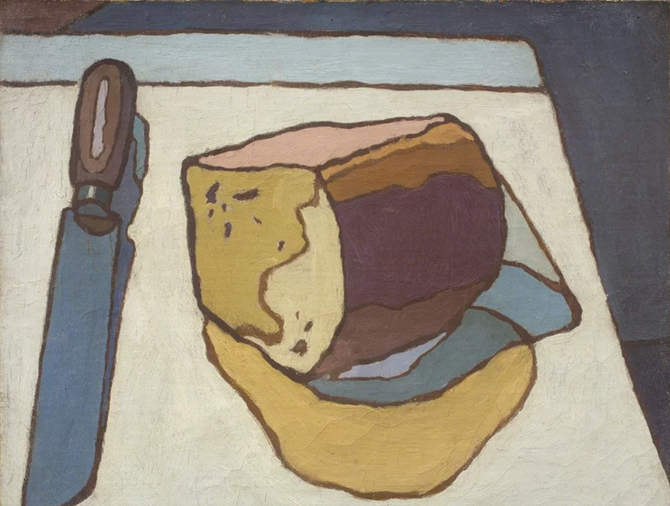
Bread and Knife by Cyril Mann (c.1955)

Still Life of Bottle and Jug by Cyril Mann (c.1955)

In the mid-1950s Cyril Mann’s painting style changed and he entered what was known as his solid shadow period.  This was a complete change of style for him in comparison to his earlier works which had concentrated on the effects of direct sunlight and yet light came into play with these “shadow” works. They concentrated on shadows that were seen below objects when viewed under an overhead light source. In 2018 the Piano Nobile Gallery in London put on an exhibition of Cyril Mann’s work entitled The Solid Shadow Paintings.  The gallery wrote about the works on display:

…Undertaken between 1951 and 1957, Mann’s solid shadow paintings were a dazzling interjection in the subdued art world of fifties Britain. This was his most original period and it stands as his lasting contribution to the history of twentieth-century painting.  It is an explosive programme of work, representing ordinary objects with boldly outlined shadows and bright, sometimes luminous colour. A dazzling interjection in the subdued art world of fifties Britain, these works have never been displayed together and the exhibition offers an exciting insight into the artist’s radiant formal language…

After Mary walked out on Cyril in the middle of the night with her their daughter Sylvia, he had to fend for himself.  Fortunately for Cyril, his daughter maintained contact with him and visited him regularly.  Sylvia, who was a year younger than Renske, won a scholarship to the City of London School for Girls . After successfully completed her schooling she left London, aged eighteen, and went to Keele University to read English Literature and French.  Whilst there, Sylvia also took on some temping work to supplement her student grant.  Cyril was very proud of his daughter and what she had achieved although he had to admit they had, at times, a tempestuous relationship and he found her quite difficult at times.  On occasions, it would appear that Sylvia also found her relationship with her father equally problematic.  Renske got to know Sylvia and often said that she was everything she should have loved to have been herself: tall, a head taller than Cyril and Renske, blonde and beautiful. She also had Cyril’s violet-blue eyes and sensitive mouth and in some ways, Renske often felt pangs of jealousy.

Self portrait by Cyril Mann (1956)

Cyril struggled to survive financially as the sale of his paintings were not going well although this could have been more down to his obstinacy and the cantankerous ways he treated dealers and galleries, rather than the quality of his paintings. 

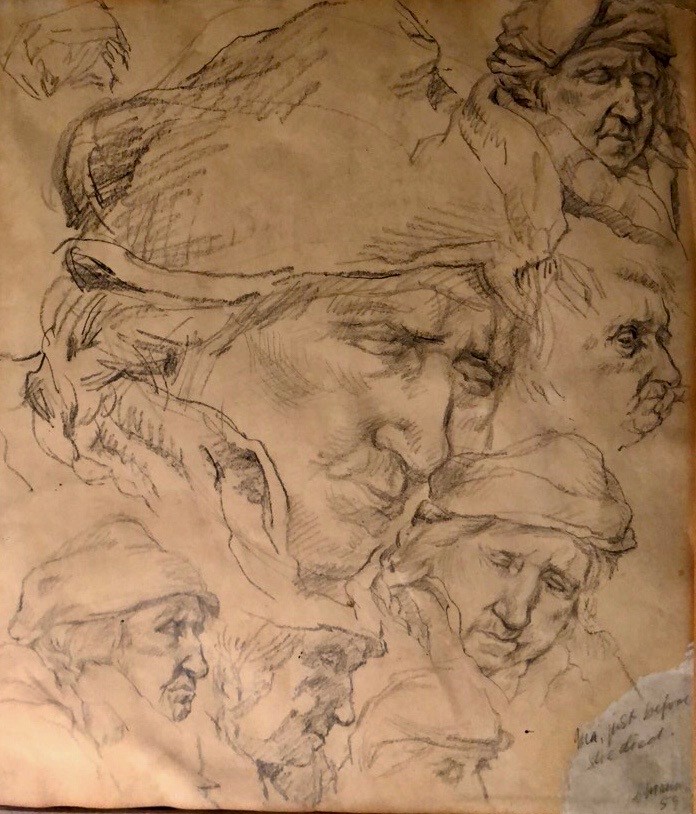
Ma, Just before she died by Cyril Mann

The years 1958 and 1959 proved to be a distressing time for Cyril Mann.  He had been suffering a great deal of pain and was seriously ill with stomach ulcers.  The discomfort had made him stop painting and teaching and the final straw to this misery was the death of his mother whom he had visited whilst she was in a Nottingham nursing home.  He had made a number of facial sketches of his mother in 1959 during her last days. She had outlived her husband, her daughter and two of her three sons.

Cyril and Renske

Things changed for Cyril at the end of 1959 when on the evening of December 18th Renske van Slooten came into his life.  Renske first met Cyril Mann at the Kingsway Day College in Holborn, London, where he was teaching students.  Her “boyfriend” and dancing partner at the time, who knew she was interested in art, took her to meet his former art teacher.  Renske remembers the moment well and, in her book, The Girl in the Green Jumper, she recalls that first sight of the artist:

“…As I stood on tiptoe peering through the window, I could see Cyril with his back to me, slumped at his desk in front of his students with their easels and drawing boards.  His hair, what there was of it was long and unkempt.  He wore a crumpled tweed jacket with leather elbow patches.  He wasn’t tall a bit over five foot at most.  To me, barely out of my teens and recently arrived from Holland, he looked old, at least fifty.  Yet before I’d even seen his face, I felt drawn to him…”

She also distinctly remembered the park warden’s prediction of meeting and marrying an “old” artist. At that first sighting of Cyril in his art class she was totally captivated by him.  Renske says of her first impression of Cyril:

“…A strange feeling came over me. This was it! I remembered the park warden’s prediction. I was mesmerised. I saw his hair was too long, his tweed jacket with leather elbow patches was tatty, he looked worn out, depressed. Didn’t take any notice of me.  I couldn’t care less what he looked like and how scruffy he was. I was attracted to him, not because he was older, but because I’m always attracted to people who are unusually gifted. And I sensed that he was…”

Cyril Mann painting in a small room in Bevin Court

After that first meeting, Cyril and Renske set up a date for the following evening. She was buoyed by the thought of being in the company of a professional artist.  Cyril was almost half an hour late at the rendezvous admitting he had fallen asleep whilst reading a book.  Fortunately for him Renske had waited patiently for him.  Cyril invited her back to his flat to look at some of his artwork.  At this time, he was renting a top-floor flat in a council housing block at Bevin Court in Islington.  Totally captivated by both Cyril and his painting, Renske admits she paid little attention to the flat itself, which was overflowing with his paintings, books and sculptures.  Renske remembers the artwork as being quite small, dark and gloomy and yet she says that they were among the most beautiful she had ever seen.  She told him that some reminded her of works by Turner.  He was delighted at that assertion as he looked upon the English artists as one of his great heroes.

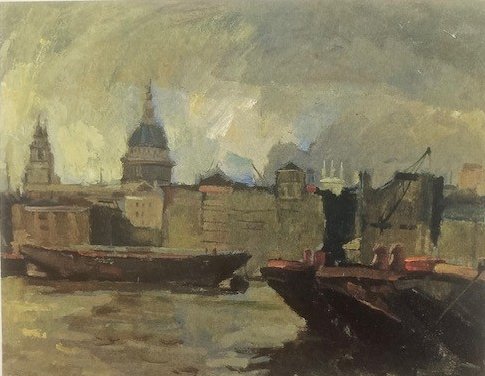
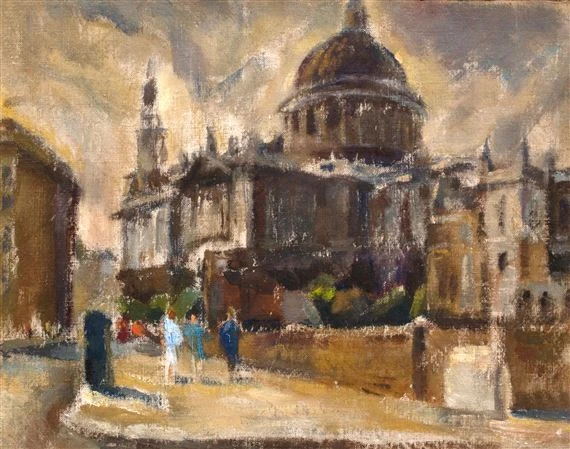
St Paul’s from Bankside by Cyril Mann (c.1952)

One of the paintings which she really liked was his work entitled St Paul’s from Bankside.  It depicted the dome of St Paul’s looming above the rooftops from across the River Thames.  Nowadays at this point on the Thames, the Millenium Bridge spans the river besides the Tate Modern.  Renske said that at first glance at the work, she thought it was a monochrome depiction but on closer inspection she could see that the greys were shot through with blue, yellow and warm pink.  Cyril told her that the city should be viewed on a grey day. He went on to assert:

“…One day people will recognise my qualities as an artist purely on the strength of my ability to perceive greys in their infinite variety…”

It was this assertion that one day he would be acclaimed a great artist that would haunt him all his life as he never felt recognised as a truly great painter.

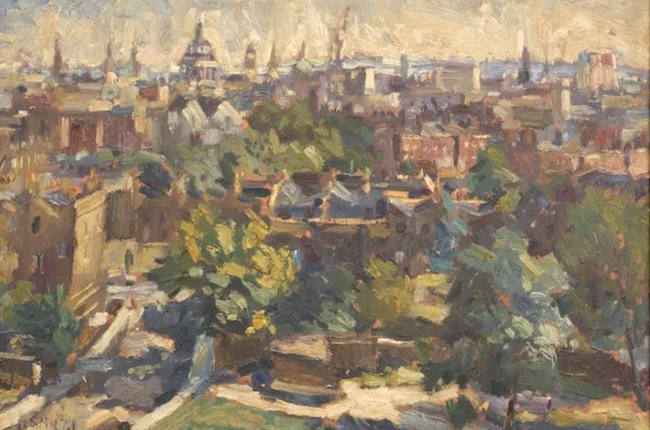
St Paul’s by Cyril Mann (1948)

It is interesting to compare the 1952 painting with the one he completed in 1948. The latter was painted in his favoured style at the time that of facing the sun and concentrating on the effect of direct sunlight. The view is from Moor Lane which dominates the foreground in which we see four people walking along the pavement, to the side of which is a low wall. A fifth figure crosses the road. Over the other side of the wall is a vast empty space, the result of heavy wartime bombings. In the midground we see multi storey buildings, churches and to the right, the familiar outline of St Paul’s Cathedral.

St Paul’s from Bevin Court by Cyril Mann (1961)

Another of Cyril Mann’s cityscapes featuring St Paul’s cathedral was his painting entitled St Paul’s from Bevin Court. 

A month had passed since their first meeting and Renske and Cyril were happy about how things were progressing.  Renske, however, was not happy with her communal living at the YWCA and told Cyril she needed another place to live.  He made a few suggestions, including sharing a flat with his ex-girlfriend, but Renske came straight out and asked if she could live with Cyril in his flat !   The problem was that Cyril’s home was a one-bed flat and he slept on a single bed in a room that was full of paintings, easels and other artistic paraphernalia. Renske was not put off by this and said that as they were both small, they could both sleep in the bed.  For Renske, it was nothing to be ashamed of, although her work colleagues at the Dutch-owned company, when they were told, were scandalised,  Scandalised that she was living with a man, scandalised that she was living with a married man twenty-eight years older than her and that his daughter, Sylvia, was only a year younger than her, and scandalised that she was living in a poor and rough council estate. 

Renske and Cyril Mann in the mid 1960s

However, Renske was passionately in love with “her” artist and was not going to listen to subtle and not-so-subtle warnings about what she had done.  News of Renske’s situation of living with a married man got back to her boss who contacted the Dutch embassy in London and asked that her parents be informed about their daughter’s living and romantic situation.  Her father and mother were horrified and she was summoned home.  She was still not twenty-one and therefore, by Dutch law, she remained under their control.  Despite their protestations Renske declared that she would marry Cyril with or without their permission.  One can just imagine the thoughts that were going through the parents’ heads having been told that she intended to marry a man who was a year older than Renske’s own mother.  What her parents failed to realise that it was not the older man who was grooming their young daughter, it was their young daughter who was the prime mover in forging this relationship.  Renske returned to London and moved in with Cyril.  She wanted to marry him but could not as he was still married to his first wife, Mary !

Having lived apart for ten years, the marriage between Cyril and his first wife Mary ended in divorce on August 24th 1960 and eight days later, on September 1st, one week after Renske’s twenty-first birthday, Cyril and Renske were married.

Mixed Flowers by Cyril Mann (1961)

Cyril had suffered stomach ulcers for years and had had to endure constant stomach pains after every meal which had weakened him and caused bouts of ill temper.  One day in April 1960, whilst out walking alone, he collapsed in the street and was rushed to the Royal Free Hospital where he underwent an emergency operation for a perforated stomach ulcer.  Following the operation and probably due to the pressures of having to earn a living from his teaching and the need to sell his artwork, both of which he was unable to do due to his physical illness, he suffered a serious mental breakdown.  Renske was upset by Cyril’s physical and mental decline and set about remedying the situation by putting Cyril’s life back on an even keel.  She believed that Cyril was not able to cope with having to teach, which he hated, and paint and so she maintained her job and became the breadwinner.  For Cyril this financial support from Renske liberated him from the drudgery of having to teach and the necessity of providing money to put food on the table.  After release from hospital Cyril went to convalesce at the Artists’ Rest Home in Rickmansworth, a town in south-west Hertfordshire, where he was allocated a comfortable room, painting facilities and three good meals a day.

Studio Corner by Cyril Mann (1961)

His operation had left Cyril pain-free and he went back to his painting with a noted added gusto, but all was not well.  Renske remembers one horrendous evening when a hyped-up Cyril had decided he was going to design, what he termed, “the greatest mural the world had ever seen”.  She had been sleeping badly and was desperate to go to bed but Cyril refused to let her sleep and demanded that she helped him plan this great mural, an extensive paper plan of which had been tacked to the carpeted floor of their bedroom/living room.  He flew into a rage when Renske just wanted to lay down and sleep and demanded she helped him.  It finally got too much for her and she, determined to have an uninterrupted sleep, took some tranquilizers and sleeping pills and collapsed on the bed.  The next thing she remembered was waking up in hospital.  When she had collapsed, Cyril couldn’t shake her awake, and so he called an ambulance. 

Cyril with black eye

The ambulance arrived along with some police. Cyril demanded that he should accompany her to the hospital in the ambulance but they refused him.  He was furious and lost control, attacking both the ambulance staff and the police and for his troubles received a black eye but worse still another ambulance was summoned and after consultation with a psychiatric nurse, he ordered him to be sectioned, taken to a mental unit, placed in a straitjacket, and then taken to a padded cell.  His passport photograph taken days after the incident shows Cyril with a black eye after his altercation with the ambulance men.

Interior with Red Chair by Cyril Mann (c.1961)

After a fortnight’s detention at the psychiatric hospital, Cyril was allowed home, heavily sedated, and having had to promise to take his medication every day.  Cyril was unhappy with the terms of his release as he believed the medication would threaten his libido.  Besides doing that, he asserted that the pills would also affect his creative artistic thoughts and to counteract this he unilaterally began to reduce the amount of medication he had been prescribed.  As often is the case, to raise spirits Renske decided to perform a deep-clean of the flat and buy some new furniture, including a garishly bright red upholstered chairs which Cyril loved and said that the new additions inspired him.

………..to be continued.


It would not have been possible for me to put together this and following blogs about the artist, Cyril Mann, without information gleaned from a number of sources:

The comprehensive biography of Cyril Mann, The Sun is God by John Russell Taylor

Renske Mann with her book The Girl in the Green Jumper, My life with the artist Cyril Mann

The intimate autobiography of Cyril Mann’s life by his second wife Renske, entitled The Girl in the Green Jumper.

This autobiography has now been turned into a play which receives its World Premiere on Wednesday March 13th at the Playground Theatre, London, 8 Latimer Rd, London W10 6RQ.

Finally, and most importantly I owe many thanks to Renske Mann herself who provided me with information and photographs appertaining to her late husband Cyril.

Piano Nobile Gallery London for information and pictures.

Cyril and Renske Mann. Part 2.

The previous blog ended in the autumn of 1935 with Cyril Mann entering the Royal Academy Schools where he received thorough academic training and a chance to meet fellow ambitious young artists.  Whilst a student there he remained in contact with Bernard Clarke, the chaplain at the Paddington Toc H.  His initial gratitude with being able to study at the school, and have his tuition paid for by his benefactor, Erica Marx, faded a little over the three years he was there as his appreciation turned to the feeling that he was entitled to what the world had on offer and what he had received was rightfully his just desserts.  It was this sense that the world owed him which would last throughout his lifetime and often upset others.  It was this sense of negativity to anything that had benefited him which would blight his life.  The RA Schools stuck to the doctrine of most leading academies of art throughout Europe to savour and teach traditional academic values and skills and dismiss artistic modernity.  However, Cyril, not agreeing with that premise, did agree that he had received a solid technical foundation in painting and drawing. 

Rainy Skyline, Paris by Cyril Mann (c.1938)

It was during his time at the RA Schools that Cyril decided to call into the nearby tea shop on Piccadilly and was served by a young woman, Mary Jervis-Read.  Besides her work at the café, she was also in a school in Regent Street, studying to become an art teacher.  She was described as being pretty, seemingly fragile and yet had an inherent strength of character which certainly fascinated Cyril.  Nothing seemed to come from this initial meeting although contact details were exchanged.  In 1938, Cyril had completed three years at the RA Schools and decided to leave and follow the example of many young British art students – go to Paris to study art at one of the many ateliers.   Fortunately for him, his sponsor, Erica Marx, was still prepared to fund his studies in France,

Park Scene, Paris by Cyril Mann (c.1938)

Cyril Mann arrived in Paris and took a room at the Hôtel de France in the Rue de la Sorbonne and enrolled part-time at the Académie de la Grande Chaumière in the Montparnasse district of the city.  Here he came under the tutelage of the Scottish Colourist, John Duncan (J.D.) Fergusson.  For Cyril, studying art in Paris, was like artistic freedom.  Freedom, he believed, from the numbing academic approach served up by the RA Schools.  One of the few close friends Cyril made at the RA Schools, was Guy Roddon, who came over to Paris to see his friend, stayed at Cyril’s hotel. Cyril gave him a tour of the capital and “taught” him how to survive on a few centimes.  They ate at one of Cyril’s favourite workers’ restaurants in St Germain where he said they could eat a hearty meal for hardly any money.  Alas, he was to regret his choice of venues as he came down with a severe bout of food poisoning.  That debilitating illness made Cyril consider his Paris location and lifestyle and so moved out of the putid centre of the French capital and settle for a more salubrious area near the Porte d’Orléans in the city’s 14th Arrondissement. 

Political Rally, Paris by Cyril Mann (1938)

Another visitor for Cyril was the young waitress who had caught his eye in the London tearoom where she worked.  She too was enamoured with the young artist.  Cyril and Guy would regularly meet with a group of international students and would spend many an evening and into the night discussing art.  At this time Cyril had become almost fixated with the works of Turner and how the English Master had depicted the sun and how the effects of direct sunlight had on the subjects of his paintings. 

Place de la Concorde by Cyril Mann (c.1937)

In his 1937 painting, Place de la Concorde, Cyril Mann has once again completed a depiction whilst facing the sun. People are mere silhouetts seen a against a fountain. This method of painting, facing the sun, was one of Mann’s early favourite styles and can be seen in many of his early works.

Pont Neuf, Paris by Cyril Mann (1937)

Another of Cyril’s paintings, Pont Neuf, Paris, which depicted the famous Parisian bridge against a blazing sun backdrop was one he considered to be his first masterpiece.

Cyril and Guy went on a short holiday to Montbazon, five miles south of Tours, a commune on the River Indre, a tributary of the Loire.  It was a rural area and whereas Guy Roddon favoured the views of the landscape, it was obvious that Cyril preferred urban depictions for his paintings and rural beauty never had an emotional impact on him. On occasions when Cyril had depicted trees in his paintings they would be overshadowed by urban elements.   However, although the bustling city of Paris offered Cyril a plentiful opportunity for his depictions, he seemed to be more interested in depicting the effect of the sunlight on the buildings and yet it was maybe more than this.  It appeared to be that Cyril was more interested in the sun itself.

Cyril Mann, on leave from the army,his wife Mary and their daughter Sylvia (1941)

In the early months of 1939, war brewing in Europe and Cyril decided to return to London where Mary Jervis-Read was waiting for him.   By the outbreak of World War II in September 1939 Cyril, once again out of work, and Mary, were living together in what could be termed a loving but hand-to-mouth existence but despite all the financial hardship and future uncertainty, the couple married and the next year their daughter Sylvia was born..

The Red Letter Box by Cyril Mann (c.1949)

Before the birth of his dauhter Cyril received his call-up papers and assigned to the Royal Engineers but was turned down for overseas active service due to him suffering from “hammer-toes”, a deformity of the muscles and ligaments and due to this he was never put on active service but instead served with the Royal Artillery in the anti-aircraft defence on the South Coast of England.  His time in the army affected his relationship with his daughter and wife and it also did not give him time to paint.  His return to painting only came in 1946 when he was demobbed.

All his life Cyril was a difficult man to live with.  He frequently had temper tantrums and people around him were very careful what they said to him so as to avoid such “explosions”.  It was not only his friends that witnessed these outbursts, but his wife Mary was also wary of her husband’s fits of temper.  Cyril’s outbursts often centred around his frustration at not being recognised as a great artist.  One cause for discord was that Mary wanted another child but Cyril did not as she was the family breadwinner and he reckoned that they could not afford a new addition to the family.  Sadly, Mary did become pregnant but suffered a miscarriage.  The relationship between Cyril and Mary came to a head in 1950 when she left him, walking out in the middle of the night and taking with her their ten-year-old daughter, Sylvia.  Mary commented on the inevitable break-up:

“…To live with Cyril you had to love him very much.  I suppose that in the end I didn’t love him enough.  But maybe no one could have done…”

Although Mary’s relationship with Cyril was over, his daughter remained fond of him despite and continued to visit him after he and her mother had gone their separate ways.

Bombsites around Spitalfields, London by Cyril Mann

Bombsite around Paul Street by Cyril Mann

The depictions painted by Cyril after the war were surprising.  Many of his paintings featured the devastation of properties during the Blitz.  For some reason Cyril believed that these would be sort after by the public but he had overestimated people’s desire to be reminded about the hellfire they had lived through often resulting in the death of their relatives.  One example of this was his painting, Bombsites around Spitalfields and another was his gouache on brown paper painting entitled Bombsites around Paul Street, an area which was heavily bombed and where the present Barbican is now situated.

Renske’s parents on their wedding day (June 1937)

Due to the rumblings of war in Europe, Cyril Mann had returned from Paris in the early part of 1939 and he and Mary were reunited. That same year, almost seven and a half thousand miles away from London, another woman, who was to play a major role in Cyril’s life, was born.  She was Renske van Slooten, the daughter of a Jewish-Dutch father, Maximiiaan, a civil engineer and his Dutch-Indonesian wife, Nini, who before raising a family, was a newspaper journalist.  Renske was born in the university town of Bandung, Java on August 24th 1939 and was brought up in a well-to-do family lifestyle in a beautiful house, with servants and luxury cars. 

Renske and Bastiaan with their mother Nini.

She had a older brother Bastiaan who had been born the previous year.  All this good living and happy lifestyle came to a shuddering end on February 28th 1942 when the Japanese forces invaded the island.

Baby Renske

Renske’s father was an officer in the army and was captured and taken prisoner and transported to Burma where he was forced to work on the notorious Burma railway and for three years the family had lost contact with him, fearing the worst.  Renske along with her mother and brother were unceremoniously evicted from their palatial home by the occupying forces and went to stay with their grandmother where they remained until the end of the war in 1945.   Renske’s father eventually returned home.  He was very ill and emaciated, so much so, he was barely recognisable and he too was horrified to see the state my brother and I were in, also emaciated, with swollen stomachs brought on by malnutrition and beriberi.   The family moved from Bandung to Java’s capital Batavia (now Jakarta) to try and start a new life but in 1949 The forces of the Indonesian Liberation Movement fought an independence battle with the Dutch-backed government which eventually led to the Dutch relinquishing the country and eventually Dr Sukrano became the first president.  One of the president’s first edicts was that all Dutch-Indonesians must choose between remaining in the country and giving up their Dutch passports or being expelled from their homeland, taking nothing with them.  Renske’s parents chose the latter.

MS Skipjack

In 1950 Renske, her family including her grandmother, left Java on the Sibajak, which was once a luxury liner that had been converted into a troop ship. Her mother was eight months pregnant with her third child, Adriaan. Between 1945 and 1950 the Netherlands Government required the Sibajak as well as other Dutch Liners to be utilised to evacuate their citizens and other people from their threatened colony and also to transport troops to the various theatres of war on the other side of the globe. It was a horrific voyage and Renske remembers her mother being sick during the whole voyage. The ship was over-full with refugees escaping Sukrano’s regime.

The family landed in Rotterdam and travelled to The Hague where Renske’s father had secured some emergency accommodation. On August 24th 1950, a month after their arrival in The Netherlands and eleven years, to the day, after the birth of Renske, her brother Adriaan was born. 

Cyril Mann painting en plein air

Renske’s father’s Bandung civil engineering degree was not recognised in The Netherlands and so he had to return to university in Delft to gain a second engineering degree.  Renske’s mother was struggling with running the household as she couldn’t cook or organise housekeeping, all of which had been carried out by their servants back in Java.  What was worse for the family was the racism they encountered.  The Netherlands had suffered under the five-year Nazi occupation.  There were food and housing shortages and now five years after the war had ended three hundred thousand “dark-skinned” penniless refugees had been given sanctuary in this country.

Cyril Mann setting up his exhibition at the Park Row Gallery of the Midland Group of Artistsand Designers in 1953

Things did improve for Renske and her family.  Her father was appointed a lecturer in mechanical engineering at the local technical college and the family received a legacy on the sudden death of Renske’s wealthy Jewish grandmother with which her father purchased a semi-detached house in an upmarket suburb.  In October 1953 there was another addition to the family with the birth of Francisca.   After completing a torrid time at primary school where she was bullied, Renske managed, after some private coaching, to gain entrance to an all-girls grammar school where she gained good results in her final exams in maths and four foreign languages.  Then came a dividing of opinions on her future between Renske and her parents.  She wanted to go to art college but they demanded that she took a paying job and contribute to the family finances. This did not please fifteen-year-old Renske who vividly remembers an incident shortly after hearing of her parents’ plans for her:

“…I was walking around a park in my home town of Dordrecht, when the Park warden came up to me and asked why I looked sad. I told him: my parents won’t let me go to art school. I have to learn shorthand typing.’ The park warden replied: ‘I’m psychic, and I tell you that you’ll have all the art in your life you could want. You’ll marry an artist. You’ll know him the minute you see him. In fact, I see him standing behind you.’  A few minutes later, the park warden again: ‘No, that can’t be him… he’s  too old. That must be his father. He’ll look after you for the rest of your life…”

The family Renske left behind in Holland when she went to London.      Mother Nini van Slooten, Francisca born in 1953, Adriaan born in 1950 and Bastiaan her elder brother and father, Max van Slooten.

And so at the age of sixteen she was enrolled at a secretarial college to learn shorthand and on securing her first secretarial job, her mother took half of her take-home pay, which made her aggrieved and, in her mind, poor. Renske intensely disliked living in Dordrecht and was delighted to leave there and travel to London where she arrived in July 1959, a month before her twentieth birthday. She received no opposition from her parents with regard so her travel plans and maybe her departure ended the clashes between her and her mother and father. In her own words Renske explained:

“…I think my parents were relieved to see the back of me, and I don’t blame them in retrospect. I was not the perfect daughter, sulky and bored, frequent boyfriend trouble and never falling for the right prospect. Lacking ambition myself, badly educated with frequent spells without any schooling due to the war and later independence struggles, nobody had any expectations of me (including myself)…”

Renske, aged 19, just before she went to London

On arriving in the English capital, Renske had to secure a secretarial position but she was well qualified as she was competent in Dutch, French and English shorthand as well as being fluent in them.  She soon found work with a salary four times greater than she was receiving in the Netherlands.  She stayed in the local YWCA and soon struck up friendships with the other girls who were from many different countries.  It was not all work and no play for Renske and one day a young Cypriot asked her out to go with him to a dance at the Hammersmith Palais in West London. As he got to know her he realised that she, like him, had a love of art and he offered to take her to one of his art evening classes he used to attend and so meet his former teacher. She agreed, they went and he introduced her to his art teacher – Cyril Mann.

……. to be continued.


It would not have been possible for me to put together this and following blogs about the artist, Cyril Mann, without information gleaned from a number of sources:

The comprehensive biography of Cyril Mann, The Sun is God by John Russell Taylor

Renske Mann with her book The Girl in the Green Jumper, My life with the artist Cyril Mann

The intimate autobiography of Cyril Mann’s life by his second wife Renske, entitled The Girl in the Green Jumper.

This autobiography has now been turned into a play which receives its World Premiere on Wednesday March 13th at the Playground Theatre, London, 8 Latimer Rd, London W10 6RQU

Finally, and most importantly I owe many thanks to Renske Mann herself who provided me with information and photographs appertaining to her late husband Cyril.

Piano Nobile Gallery London for information and pictures.

Cyril and Renske Mann. Part 1.

No man succeeds without a good woman behind him. Wife or mother, if it is both, he is twice blessed indeed.

Harold MacMillan

In many of my blogs I have related the story of a husband and wife who had both been artists but after the marriage and after the birth of the children one has had to give up their career as an artist to look after their spouse and children and that caring role always seems to land at the feet of the wife, who then dedicates her life to her artist husband or partner.  The next few blogs are going to look at the lives of a great British artist and the support and love he received from his young wife which allowed him to become a well-known painter.  This is not simply a tale about an artist, it is about the resilience of his young wife and how she battled his moods and supported him through times of his severe depression. Please settle back and join me as I explore the lives of the English artist Cyril Mann and his beautiful young wife, Renske.

My earliest self-portrait by Cyril Mann (1937)

To start this journey, one must look at Cyril’s upbringing and, as one knows, a person is often affected or moulded by their early life experiences.  Cyril’s father was William Aloysius Mann who was brought up in a reputable middle-class Nottingham family environment.  He was the third child of four, having an elder sister and brother, Annie and Will and a younger brother Austen.  Like most parents Cyril’s grandparents were hopeful that their four children would make good in life.  Their aspirations for Cyril’s father turned to despair when the only job he could secure was one of a bricklayer, which they considered to be a menial profession and somewhat below the family’s social status.  If that was not bad enough, Cyril’s father became romantically entangled with a local working-class woman, Gertrude Nellie Burrows, whom his parents believed was not good enough for their son.  In a pointed slight to her, they would refer to her as Gertie, when she was better known as Nellie.

William and Gertrude Mann’s circumstances became worse when he became unemployed and so, to seek work, the family left Nottingham and moved to London.  Their son Cyril was born in Paddington, London on May 28th 1911.  At the outbreak of the First World War in 1914 William Mann was conscripted into the army and was shipped off to fight on the Western Front.  In 1918, after many years of witnessing the horrors of war, he was honourably discharged as “shell shocked”. 

Saxondale Psychiatric Hospital

The war had taken the toll on William’s mental health and he would never be the same again.  On returning to civilian life, the family returned to Nottingham and William was committed to the Saxondale Hospital in Sneiton, the city’s psychiatric hospital.  Cyril’s father would remain there until his death in 1938 but during his twenty years of incarceration he would make a number of escapes !

Times were hard for Gertrude who had to try and survive on her husband’s small war pension and bring up four children.  Unlike her husband who had been lazy, untrustworthy and very often easily distracted, his wife was the total opposite.  She was resilient, down-to-earth and strongminded when it came to bringing up her young family.  One does not know for sure how the children were affected by the family circumstances but going on public transport to collect their father from the asylum for his home leave on public holidays must have affected them psychologically.

The children did survive their early childhood.  Cyril’s brothers Austen and Will proved to be musical with Austen winning a scholarship to the Royal College of Music but never got to go there as he was diagnosed as being partially deaf.  Cyril’s father, before going off to war, was also musical and had been an accomplished violinist.  Cyril’s paternal grandfather had been a talented amateur artist who had had his work exhibited at the Nottingham Castle Art Museum.  Cyril developed his own artistic flair when young and was always top in his art class at school.  He was so talented that at the age of twelve, he won an art scholarship to Nottingham School of Art and his mother had to get special dispensation to take him out of regular school as he was under fourteen years of age. 

One of Constant Troyon’s paintings featuring cattle (Pastoral Scene c.1860)

In later years Cyril talked about his early interest in art and how he had been impressed at seeing one of Constant Troyon’s paintings of cattle.

Dark Satanic Mills by Cyril Mann (1925)

One of Cyril’s early paintings that still exists is entitled Dark Satanic Mills which he completed in 1925, when he was just fourteen years of age. The painting depicts a park in the foreground and a dark threatening-looking factory in the background with thick black smoke issuing from its chimneys.  In the midground we see figures enjoying park life.  It is an extraordinary landscape work for someone so young.  Cyril’s mother needed financial support from her children to supplement her husband’s pension and so she had to withdraw Cyril from the Art College and install him in a paying-job that would bolster the household finances. Cyril must have been upset at being taken away from the art school but took an exam to join Boots the Chemist as a clerk.  He failed and this must have come as a surprise to his mother as her son had always excelled at regular school and one has to wonder whether Cyril had deliberately failed as he hated the thought of a job as a clerk when he wanted to continue with his art.  However, and probably much to his annoyance, he did eventually work as a clerk until he was sixteen.

Sixteen-year-old Cyril Mann prior to moving to Canada (c.1927)

In 1927, aged sixteen, Cyril’s life changed.  His mother Nellie had always been a religious person and had insisted that her children attended the High Anglican Church and Cyril, for a time, was an altar boy.  In a way, and in the mind of his mother, this churchgoing brought to the family an air of respectability and sophistication and, in her mind, it was a way to gain social progression and an elevated status.  Cyril at this time became very friendly with a local priest who offered to accompany him to Canada, all expenses paid, so that he may “enter” the church and become a young missionary. 

Fishermen, Canada by Cyril Mann (1929)

It took little time for young Cyril to acquiesce to the priest’s request.  It was probably a combination of the thought of adventure similar to what he had seen in the Boy’s Own Paper, youthful religious zeal and the thought of freeing himself from his controlling mother.  Having reached Canada, it was not long before Cyril began to question his decision about serving God as a missionary and he and the priest parted company.

Eighteen-year-old Cyril Mann in Canada (Winter 1929)

Cyril then tried out many jobs – a miner, a logger, a travelling salesman and ended up as a printer in British Columbia on the Canadian side of the Alaskan border. 

Cyril Mann, artist at work in Canada (c.1930)

He was now living in the midst of beautifully spectacular landscapes – a landscape artist’s paradise, and soon he began to sketch and paint the breathtaking views. 

Canada- Mountainscape by Cyril Mann (c.1931)

Panning for Gold by Cyril Mann (c.1929)

In Canada at that time, the prevailing influence in Canadian art was the artwork of the Group of Seven.  The Group of Seven also known as the Algonquin School was a group of Canadian landscape painters from 1920 to 1933.  The original members were Franklin Carmichael, Lawren Harris, A. Y. Jackson, Frank Johnston, Arthur Lismer, J. E. H. MacDonald, and Frederick Varley.  They believed that a distinct Canadian art could be developed through direct contact with nature, the Group is best known for its paintings inspired by the Canadian landscape and they initiated the first major Canadian national art movement.  Their artwork was highly colourful and often depicted Autumn and Winter scenes, and they believed that the power of the light from the sun was to be recorded in their work.

Six of the Group of Seven, plus their friend Barker Fairley, in 1920. From left to right: Frederick Varley, A. Y. Jackson, Lawren Harris, Barker Fairley, Frank Johnston, Arthur Lismer, and J. E. H. MacDonald. It was taken at The Arts and Letters Club of Toronto.

Cyril Mann was impressed and influenced by the work of the Group of Seven along wth one of their associates, Tom Thomson and in 1932 he visited a Group of Seven exhibition in Vancouver and met one of the group, Arthur Lismer who was then working as a lecturer. 

Old Pine, McGregor Bay by Arthur Lismer (c.1929)

Arthur Lismer had been born in Sheffield, England in 1885 and had emigrated to Canada in 1911.  Lismer advised Cyril that if he wanted to become a professional artist he should return to England and access the best artistic tuition available, Cyril saw the sense in the advice and in early 1933 he returned to his homeland. 

A Mann family outing in Skegness. Cyril on the far right whilst his mother Gertrude is in the middle, Cyril’s older sister Annie is second from the left next to her husband. The other two men are thought to be Gertrude’s brother Austenon her left and Cyril’s younger brother Austen wearing the white clothes. on her right. 

Nottingham Houses by Cyril Mann (c.1933)                  Cyril has depicted his mother tending the garden

After landing in England, he travelled to the family home in Nottingham.  To his surprise he wasn’t greeted with a hearty welcome from his mother, instead she was very critical about his physical appearance.  Cyril was both upset and very annoyed by his mother’s authoritarian manner which he had had to endure through childhood and, there and then, decided his future home would not be with his family in Nottingham but instead he would head south to the English capital. 

Maida Vale Canal by Cyril Mann (c.1934)

Arriving in London in 1933, during the Great Depression, Cyril the young aspiring artist, despite finding it impossible to find a job carried on with his watercolour painting depicting various loacations around Paddington and around the Little Venice canal in Maida Vale, while he he took time off from his paintingnto to join the ever-lengthening dole queues.  He found and rented a cheap apartment in Paddington, close to where he was born, and endured the degradation of poor living standards and little money for sustenance.  With not having employment he had plenty of free time which he partly filled with painting local scenes using watercolours.  Having left school at the age of twelve he realised he had missed a lot and he now developed an unquenchable thirst for knowledge.  He was a regular visitor at the local libraries and was always willing to engage in conversation with those he encountered so that his knowledge of the world would be broadened and because of his current circumstances, he soon gained an interest in left-wing politics. 

Mountain Landscape by Cyril Mann

Having said this, Cyril never joined any official political group but a group he did join was the Toc H Group.  The Toc H Group was an international Christian movement whose name was derived from Talbot House, a soldiers’ rest and recreation centre at Poperinghe, Belgium. Its aim was to promote Christianity and look after young soldiers who were returning to civilian life.  Each branch of the Toc H had a chaplain to look after the spiritual needs of its members.  During the Depression Toc H looked after the many civilians hit by unemployment and, as one of the many people without a job, Cyril came to be one of those who regularly met at the Paddington Toc H in a canal boatmen’s’ club room.  Here he could talk to people, which must have been a Godsend for the young man who was out of work and lived alone.  The new young chaplain who arrived at the Paddington Toc H in 1935 was Oliver Fielding Clarke, known to everybody as “Bernie”.  The chairman of the association asked Clarke to keep a close eye on Cyril, whom he described as “out of work, practically a communist and sometimes pretty blunt with others”.  Shortly after receiving that “task” Clarke met Cyril and was completely captivated by the young aspiring painter.  In Clarke’s 1970 autobiography Unfinished Conflict, he remembers his conversations with Cyril Mann:

“…I have had many friends and a good deal of the first part of my ministry was given to young men, but few if any of them did more for me than Cyril.  We would spend hours and hours together in the evenings and he never spared himself for me.  In the early days he had been a [alter] server so that he was not in the least awed by parsons and he also knew how to challenge, or perhaps blister is a more accurate word, a parson’s conscience.  I used to get back to Liddon House in the small hours of the morning feeling almost as if we had been engaged in physical combat.  Cyril pulverised capitalism and the Church for being its running- dog.  He tore to shreds any suggestions that milk-and-water Christian Socialism was the answer and we argued hotly about the existence of God and the nature of morality…  All this was interspersed by talk about his art, when he would show me what he had been drawing or painting and what he was looking for as an artist….Both of us thoroughly enjoyed those long evenings; but they did not work in the way that had been expected.  Cyril did not move further away from Communism nor nearer to the Church.  Instead, I became more and more critical of the Church and increasingly convinced of the truth contained in the teachings of Karl Marx…”

St Pauls by Cyril Mann

It is quite clear from this description that Cyril Mann was an outspoken person with strongly held views which he stuck to notwithstanding the views of others.  It is also obvious he had a great self-belief but it could be levied against him that he was aggressively antagonistic to those who did not share his views and it was this latter characteristic which would become a problem for him in later life.

Despite their fiery discussions and the intransigence of Cyril, Bernie Clarke did not give up on him and decided to call in favours from friends in order to get Cyril into employment.  The chairman of the Paddington branch of the Toc H arranged for a place at the Royal Academy Schools be made available to Cyril and a friend of Clarke, the twenty-five-year-old daughter of a rich German businessman, Erica Marx, who was a poet, philanthropist and loved art saw the artistic potential of Cyril and set up a trust fund for him to finance his time at the art school.  She would remain a lifelong friend and supporter of his and would often buy his paintings.

Dahlias by Cyril Mann

The first half of the 1930s had been a rollercoaster ride for Cyril Mann.  Out of work unable to feed himself and yet came through it all and entered the Royal Academy Schools in the Autumn of 1935. The lives of his family back in Nottingham had also been a rollercoaster ride caused by tragedy.  Cyril’s elder brother Will died in a lift accident in the Midland hotel in Nottingham where he worked and his younger brother Austen drowned in a river whilst out swimming.  His death was witnessed by his wife and two young children who thought his violent thrashing in the water was him playing.

In 1935, now at the Royal Academy Schools, Cyril Mann had taken the first step in becoming a professional artist.

……….to be continued


It would not have been possible for me to put together this and following blogs about the artist, Cyril Mann, without information gleaned from a number of sources:

The comprehensive biography of Cyril Mann, The Sun is God by John Russell Taylor

Renske Mann with her book The Girl in the Green Jumper, My life with the artist Cyril Mann. 

This intimate autobiography of her life with Cyril Mann by his second wife Renske, entitled The Girl in the Green Jumpe was a beautifully written story of her life and love for her husnband.

This autobiography has now been turned into a play which receives its World Premiere on Wednesday March 13th at the Playground Theatre, London, 8 Latimer Rd, London W10 6RQU.

The Piano Nobile, a London art gallery which was established by Dr Robert Travers in 1985. The gallery plays an active role in the market for twentieth-century British and international art and has held exhibitions of Cyril Mann’s art.

Finally, and most importantly, I owe many thanks to Renske Mann herself who provided me with information and photographs appertaining to herself and her late husband Cyril.

Laura Sylvia Gosse

Laura Sylvia Gosse (1881-1968)

For a number of years now, probably for centuries, many female artists have been discounted as hobby-painters or painting because art for many was like playing the piano, a social grace that every young woman should achieve.  It is even more annoying when a man and a woman work side by side and yet it is the reputation of the male artist that is remembered.  An example of this is looking at two Camden Town Group artists, one a founder, the other on the periphary as it was an all-male domain.  I am sure you have heard of Walter Sickert but what about his friend and contemporary, Laura Sylvia Gosse.  Sylvia who ?  Let me set the record straight.

The Artist’s Mother by Laura Sylvia Gosse

Sylvia Gosse was actually born Laura Sylvia Gosse but was always known by her Christian name, Sylvia.  She was born in London on February 14th 1881, the youngest of three children.  She had an elder sister, Teresa Emily and an elder brother, Philip Henry.  

Edmund Gosse by John Singer Sargent

Her father, Edmund Gosse was a poet, literary critic and librarian of the House of Lords.  Her mother was Ellen Gosse (née Epps), an artist in the Pre-Raphaelite circle who had studied under Ford Madox Brown, and whose sister, Laura Theresa, an aspiring artist, had married Lawrence Alma-Tadema.

Fountains at Pernes Les Fountaines, Provence by Laura Sylvia Gosse

Sylvia’s family home in Delamere Terrace was in the London borough of Paddington, and was always inundated with people from both the art and literary world with visitors such as the great writers of the time, such as Henry James, Thomas Hardy, Robert Louis Stevenson and Rudyard Kipling.  In early childhood, Sylvia loved to paint and draw and her favourite subject being her pets. At the age of thirteen, Gosse went to an art school in France, where she stayed for three years and she recounted that it was there that she felt she belonged.  She returned to England and studied at the St John’s Wood School of Art.  In 1906, aged fifteen, she enrolled at the Royal Academy Schools.

The Gossip by Laura Sylvia Gosse

One of the frequent visitors at the Grosse household was the artist Walter Sickert and it was during one of his visits that he began talking to Sylvia and looked at her artwork.  He was captivated by her work and obvious artistic talent and suggested she learn the art of etching.  Sylvia began to attend Sickert’s evening classes at the Westminster School of Art and in 1909 went as a pupil to his new art school, which he ran with Madeline Knox at 209 Hampstead Road, London.  Sickert’s dual role with Knox at the art school ended when Knox resigned following Sickert’s illness, and having had to run the school singlehandedly.  Sickert approached Sylvia Gosse, his pupil, to see if she would accept the position as associate director. 

Rowlandson House – Sunset by Walter Sickert (1911)

Walter Sickert rented Rowlandson House in Camden Town from 1910–14, during his time with the Camden Town Group. This summertime depiction of the building looks north up Hampstead Road from the back garden, the time of day nearing twilight, which Sickert has indicated by daubs of pink and mauve in the pale sky. The trees in the far background form the edge of Mornington Crescent Gardens. 

Walter Sickert by Sylvia Gosse (1923-25)

Sylvia was made co-director of the Rowlandson House School but did this position alongside Sickert put them on an equal footing?  As a woman in an artistic world which did not always value them, it became clear during her time at Rowlandson House, that her relationship with the Camden Town Group which she was ineligible to join, being a female, despite Sickert being its leader, was not even-handed.  According to Kathleen Fisher, Gosse’s biographer and friend, who wrote Conversations with Sylvia. Sylvia Gosse – Painter, 1881-1968, Sylvia Gosse taught the less-able students at Rowlandson House, as Sickert would grow bored and impatient and dismiss them. The School became known as the Sickert and Gosse School of Painting and Etching.  Silvia served as co-principal from 1910 until it closed in 1914 and during that period, she taught some of the classes and took over responsibility for the practical organisation and finances.  Sylvia Gosse had an independent income, and without her financial backing the school would have closed much sooner.

The school which Gosse and Sickert jointly ran until 1914 when it closed. During those years, Gosse’s own painting career also began to progress. Sylvia Gosse could be described as being slightly introverted (or was she just shy?) and was not known as a very sociable person.  One of her pupils, Marjorie Lilly recalled Sylvia, saying:

“…she might appear at Number 15 [Fitzroy Street] on At Home days, but rarely; being very shy, she always chose the most inconspicuous corner she could find, looking harassed and hunted, and hardly spoke…”

Despite this she was always very supportive of her fellow artists and completely dedicated to Sickert.

Chateau Dieppe by Layra Sylvia Gosse (c.1925)

La Place Saint Jacques by Laura Sylvia Gosse (c.1920)

Grande patisserie, Place Nationale, Dieppe, France by Laura Sylvia Gosse (1930)

Walter Sickert had always loved visiting France and would regularly travel to the Normandy coastal town of Dieppe.  Sylvia often accompanied Sickert on his travels, notably when he stayed in Dieppe, and she had a small cottage near his home.  Many of her paintings featured the French town.

Envermeu, France by Laura Sylvia Gosse (c.1920s)

The small town of Envermeu which lies ten kilometres east of Dieppe also featured in many of Sylvia’s paintings.

The Seamstress by Laura Sylvia Gosse

Many of the paintings of the Camden Town group focused on the subject of ordinary life, which often concentrated on the life of the poor and dispossessed, and how their life was one of boredom and squalor.  Gosse tended to focus more on the hard-working women, such as the seamstress and the printer.

The Printer by Laura Sylvia Gosse (c.1915)

Sylvia’s painting, The Printer, which she completed around 1915 shows a woman labouring at a press.

The Nurse by Laura Sylvia Gosse

In her painting, The Nurse, we see her approaching her patient.  In this depiction, we see her as she is reflected in a mirror above the sickbed.  This is not a depiction that beautifies the nursing profession it is simply one that shows us an unglamorous workaday appearance of a nurse tending the sick.

Mrs Alexandra Russell by Laura Sylvia Gosse

During the 1920s and 1930s Sylvia’s paintings were on display at many of best-known commercial galleries. She was elected to the Royal Society of British Artists in 1930 and continued to support Sickert loyally until his death in 1942.

In 1951 Sylvia bought a bungalow in Ore, a large village in the urban area of Hastings, in the county of East Sussex.  It was here that she planned to spend her last days painting, but alas, she suffered from cataracts, which made painting and sketching increasingly problematic.  However, it was her belief that every painter should die with a brush in their hand, so despite her severely reduced vision, she still managed to visit exhibitions and help inspire young artists. She died in the Buchanan Hospital, Hastings on June 6th 1968 at the age of 87.