Lady and Gentleman on Horseback by Aelbert Cuyp

Lady and Gentleman on Horseback by Aelbert Cuyp (c.1655)

Over time I suppose one gets to like different artists and different paintings and one’s favourites constantly change.  For me however,  I have always loved the work of Aelbert Cuyp and along with Pieter Bruegel the Elder, I would have him constantly in my top five favourite artists.  I love his landscapes (see March 12th) and his riverscapes (see Feb 8th) but for My Daily Art Display today I have chosen one of his portraits, entitled Lady and Gentleman on Horseback which he painted around 1655.

Aelbert Jacobsz Cuyp was born in Dordrecht in 1620. His father was Jacob Gerritsz Cuyp, a successful portrait painter in the city and his mother was Aertken Cornelisdr van Cooten.  Aelbert was unquestionably raised up in an artistic environment with his grandfather Gerrit Cuyp being an eminent glass painter and his uncle’s step brother Benjamin Gerritsz Cuyp was a well known painter of religious, peasants and tavern scenes.  It was his father who gave Aelbert his earliest artistic tuition.  Although Dordrecht was not known for being an important artistic centre, it was a wealthy city and proud of being the oldest city and principal city of Holland and of great mercantile importance.     Aelbert used to assist his father in his studio by supplying landscape backgrounds for portrait commissions.  It is uncertain whether Cuyp had ever been an apprentice of a landscape painter, but he soon abandoned his father’s style and subject matter and turned almost exclusively to landscapes and riverscapes.  He would only occasionally paint portraits in his mature period.

Aelbert, despite branching off on his own as a painter, continued to assist his father right up to the time of his father’s death in 1652.  It is thought that the landscape works of Jan van Goyen, which were known to Cuyp, may have been instrumental in his artistic style as were the works of the Utrecht painter Jan Both.  Cuyp also followed the example of Jan van Goyen in the way he travelled throughout Holland sketching and gaining inspiration for future works.

In 1658, aged thirty eight, he married Cornelia Bosman, a wealthy widow of Johan van de Corput, a naval officer and member of an important Dordrecht family.  Cornelia had three children from her previous marriage.  Following his marriage, Cuyp appears to have painted less frequently, and stopped painting altogether years before his death due to his civic and religious responsibilities he had assumed after his marriage.  He was very wealthy and there were no financial pressures on him to produce paintings for sale.    He was listed in the register of the dead on 7 November 1691, and buried in the Augustinian Church at Dordrecht.

Today’s work of art, Lady and Gentleman on Horseback, highlights the popularity of the Dutch patrician pastime of hunting in the second half of the seventeenth century and many similar paintings exist.  This is a large oil on canvas work measuring 123cms x 172cms and depicts a man and a woman, probably husband and wife, on horseback setting off for the hunt.   There have been many names put forward as to the identity of the sitters, the most popular being that the man is Adriaen Stevensz Snouck and the lady his wife, Erkenraad Berk.  The lady’s father, Matthijs, was an important patron of Aelbert Cuyp, which may account for the prominence in the painting of his daughter in her gorgeous blue dress, who we see sitting resplendently on the back of a white horse with its brilliant red and gold saddlecloth.   The couple had just married and it could well be that Cuyp was commissioned to paint this to commemorate the happy event.

The landscape in the background is filled with light, typical of the popular Italianate style of the time.  We see a building in the background which is more than likely a fanciful evocation of an ancient fortified chateau which Cuyp may have seen on his travels.   The two hunters have their dogs with them.  There are two types of dog on this hunt, the turfters which were used to track and follow the scent of deer and greyhounds, which we see in the middle-ground of the painting, being controlled by an attendant and which run after the deer and bring them to bay.

X-Ray Image of painting

When this painting was x-rayed there were some interesting differences to the finished article.  The man originally wore a hat and his hair was much shorter and was seen lying on his shoulders.  His attire was different.  He had originally been painted in a military tunic and cape which were adorned with braids and buttons that in all likelihood were golden in colour.  It was also thought that the overall colour of the man’s clothing was a brilliant red rather than drab brown we see in today’s painting.   If we look at the woman we see that originally she wore a hat which was of a different shape to the one she is wearing now and originally the hat had feathers at the back of it.  Her dress was more loosely fitting and cascaded down the right flank of her horse.  Such changes to the painting must mean that the patrons were dissatisfied with the original composition and the fact that there was more going on in the original painting probably was viewed as being too distracting from the formal character of the double portrait and thus had to be revised.
A Stormy Landscape by Meindert Hobbema

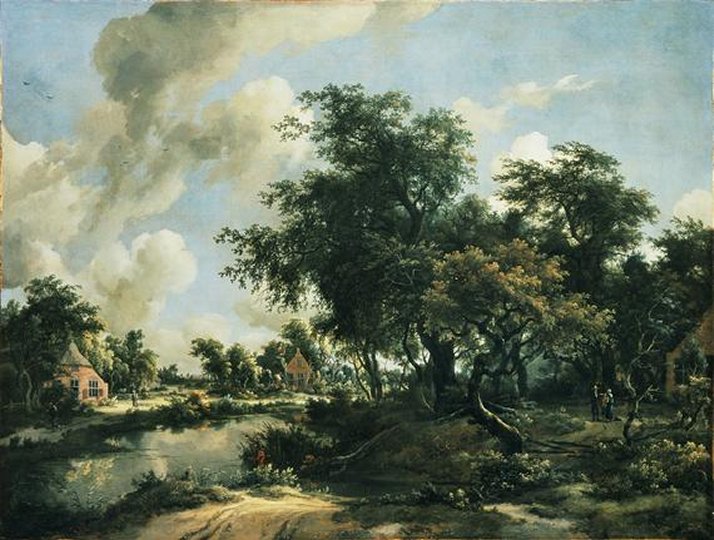
A Stormy Landscape by Hobbema (1663-5)

Meindert Hobbema was thought to have been born in 1638 in Amsterdam but there are varied opinions on this fact.  The name “Hobbema” was his own invention as his father’s name was Lubbert Meyndert.  He was the great landscape painter of the Dutch Golden Age.   The Dutch Golden age was that period in Dutch history which spanned the 17th century, at the time of, and following the Eighty Years War, which encompassed the struggle for Dutch independence. The newly formed Dutch Republic became the most prosperous nation in Europe, and led European trade, science, and art. The northern Netherlandish provinces that formed part of the new state had customarily been less significant as artistic centres in comparison with the Flemish cities in the south.  The war caused tremendous disruption and resulted in the break with the old monarchist and Catholic cultural traditions.  As a result, Dutch art needed to reinvent itself entirely, a task in which it was very largely successful and this re-birth was known as the Dutch Golden Age.

We know that Hobbema was active as an artist in Amsterdam and that he was a pupil of the great landscape painter Jacob van Ruisdael.  Some of Hobbema’s work showed a distinct similarity to his master’s work and as Ruisdael’s paintings were in great demand, a number of Hobbema’s works were passed off as being works of his master.  Strangely enough, in years to come when Hobbema’s flair as an artist and his artistic gift was established, the reverse would happen.

Hobbema married Eelije Vinck in 1668 who had been his serving maid.  One of the witnesses at the ceremony was Jacob Ruisdael.  The couple went on to have four children.   It was about this time that Hobbema started to work for the Customs & Excise in Amsterdam supervising the weighing and measuring of imported wine.  This was his full time job and from then on his artistic endeavours were reserved for his spare time.  The output of his paintings from then on decreased and was somewhat erratic.   In 1704 Eeltije died, and was buried in the pauper section of the Leiden cemetery at Amsterdam. Hobbema himself survived till December 1709, and he too was buried in a pauper’s grave in Amsterdam. It was a depressing fact of life that both van Ruisdael and Hobbema, looked upon as the two greatest Dutch landscape painters of the era, both died in poverty.  Like the two great Dutch painters Hals and Rembrandt some fifty years earlier, despite the demand for their works and the sale of their paintings, they too died penniless.   This sad fact has to be put down to either they let their paintings go too cheaply or simply their financial mismanagement which was brought on by them living a life they could not afford and as a result it was to prove to be their undoing.   

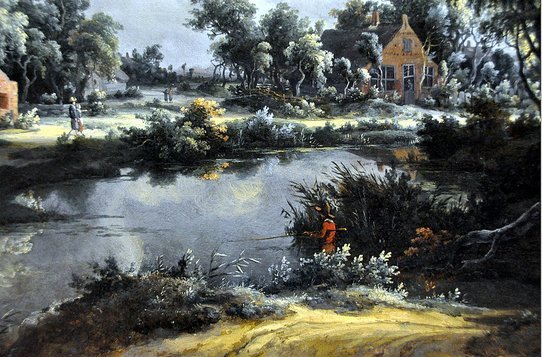
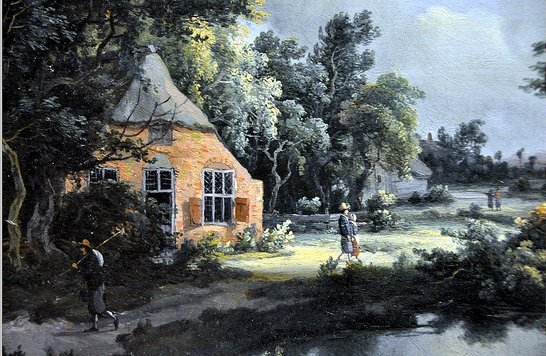
The Cottages and the passing walkers

Hobbema was a master painter when it came to painting woods and hedges, or mills and pools. This talent was derived from his life in the countryside, where day after day he might study the branching and foliage of trees, cottages and mills, under every variety of light, in every shade of transparency, during the various seasons.    His paintings had a characteristic rich texture to them.  Today’s featured painting entitled A Stormy Landscape, which he completed in 1665, is a prime example of his extraordinary talent as a landscape painter.  In it we can see his love of creating woodland scenes with various shaped trees which in turn gave him the opportunity to show off his talent in depicting illuminated clearings and patches of light randomly placed amongst the shaded areas caused by the massive trees and dense foliage.

The Fisherman

In the foreground we have a fisherman with his line cast in the rippling waters of the river.  In total there are nine figures dotted around the rural scene, all quite small but put there by the artist for a specific reason, that of directing our eyes through the landscape.  There is no urgency in the movement of the water which adds to the tranquillity of the scene. To the man’s right we have a family strolling through the woods.  Across the river stand two cottages nestling under the cover of the large trees.  More people out for a stroll can be seen on that side of the river.   The heavy clouds shown to the left of the painting warn us of a storm approaching but this appears to be of little concern to our fisherman or the walkers.

This is a beautifully crafted work of art and one of Meindert Hobbema’s masterpieces. It has a soothing quality to it.  It is the type of picture you should look at when you feel stressed as its calm depiction of a country scene counteracts the stress of city life.  It has a calming effect and in some ways standing in front of it offers you a chance to relax.   Life alas can be hectic and I believe this painting offers one the perfect foil to our sometime chaotic existence.

The Effects of Intemperance by Jan Steen

The Effects of Intemperance by Jan Steen (c.1665)

I have featured many paintings, mainly by Dutch or Flemish artists, which try and have an embedded moral message in their works of art.  Often it is about the dangers of drinking too much, which is a subject painters from our present time may find very topical.   My Daily Art Display today features one such 17th century painting entitled The Effects of Intemperance by the Dutch painter Jan Steen.

Jan Havickszoon Steen was born in 1626 in Leiden a town in the Netherlands and was a contemporary of the great Rembrandt van Rijn.  He received his artistic education from the German painter of the Dutch Golden Age, Niclaes Knupfer who gained a reputation for his historical and figurative scenes of Utrecht.  At the age of twenty-two Steen joined the Saint Lukes Guild of Painters in Leiden.  Steen then moved to The Hague where he lodged in the household of the prolific landscape painter Jan van Goyen.  Soon after, he married Margriet, the daughter of van Goyen.  Jan and his father-in-law worked together closely for the next five years.  Then he moved and went to live in Warmond and later Haarlem.  His wife died in 1669 and his father-in-law passed away a year later.  Steen returned to Leiden re-married and had two children and remained there until his death in 1679 at the age of  53.
So back to today’s featured painting which is a pictorial moral tale of the dangers of insobriety.  The painting illustrates well the Dutch proverb “De Wijn is een spotter” translated means: Wine is a mocker, in other words wine (or drinking it in excess) will make a fool of you.  Although we see the children misbehaving the onus of guilt is placed squarely on the shoulders of the adults.

The main character of the painting is a woman who we see sitting slumped on the steps of her house sleeping off the effects of having drunk too much alcohol.  The overturned flagon of wine lies on the floor and despite the noise and antics of the children she doesn’t wake.   She is being portrayed as the neglectful mother.  She is totally unaware of what is happening around her.  However, she is no peasant.  Look at her clothes.  These are not ragged and threadbare.  The fur-trimmed jacket, in fact, looks both expensive and stylish.  Maybe the moral of the tale is that an excess of alcohol can affect rich and poor alike.  Her comatose state is going to cause a disaster as we see that her lit pipe is just about to slide from her fingers on to her dress.  The hem of her dress rests perilously close to the rim of the small clay brazier by her side which she has been using to keep her pipe alight and soon her clothes will surely catch fire.  It should also be remembered that at this time in the Netherlands most houses were of wood construction and fire had become a great hazard of life for those living in these dwellings.

The child behind her is stealthily filching the purse from the pocket of her dress, watching her carefully in case she stirs.  Again we are reminded of the Dutch proverb which states “opportunity makes the thief”.  This painting, in some ways,  mirrors Pieter Bruegel’s Netherlandish Proverbs but on a smaller scale.    Look at the girl kneeling in front of the comatose woman. Maybe it is her eldest daughter.  She is offering the parrot a drink of wine from a glass.  The girl looks unsteady and her face is flushed.   Maybe she too has imbibed to excess.  Are we being reminded that the sins of the mother will be passed on to the child?

Next to the mother we see a boy clutching a bunch of roses.  He is throwing them to the pig which is busy snuffling around the legs of the woman in search of food.  We know of the biblical proverb “ Nether caste ye youre pearles before swine”  meaning that it is a worthless gesture of offering items of quality to those who aren’t cultured enough to appreciate them.  However the Dutch proverb doesn’t talk about pearls but instead – rose buds.  So what we are seeing in the painting is the rose-strewn pig, which simply symbolises how people waste what they have.

To the right of the mother we see three small children feeding a meat pie to the cat.  Again, this is highlighting the folly of waste.  It is interesting to note what is hanging above the drunken woman’s head.  It is a basket, in which there is a pair of crutches and a birch.  This is to be a reminder of what happens if you throw money away and mismanage your finances.  The crutch is a reminder of life as a beggar and the birch is a salutary warning of what happens if you are hauled to court because of bad debts.  Look back at My Daily Art Display of February 16th and Jan Steen’s painting entitled In Luxury, Look Out,  in which  the artist had depicted a similar scenario and the same moral tale that is being depicted by the artist in today’s painting.  In it we can see the same basket hanging above the miscreant.

Take a look at the background on the right hand side of the painting.  Here we see a man, maybe the husband of the drunken woman, sitting in the garden on a bench with a buxom young serving wench on his knee.  He is oblivious to what is going on around him and prefers to carouse with the young girl.

The Dutch painter and biographer of artists from the Dutch Golden Age, Arnold Houbraken, wrote about Jan Steen, recording that the household of Steen himself was both “riotous and disorganised” and that Steen, not being able to bring in enough money from his paintings ran an inn but Houbraken cynically pointed out that Steen’s best customer was himself!  However maybe the facts do not bear out the biographer’s assertions for Steen completed over 1400 pictures in a span of 30 years,  so could he possibly have had time to waste by drinking in his inn?  In yesterdays offering I spoke about artists liking to incorporate their own image into their paintings and Steen was no different.  He would even add his wife’s image into some of his bawdy pub scenes and she, rather than being flattered by her inclusion, would claim that her husband was always showing her as a “horny tart, a matchmaker or a drunken whore”!  It could be that she was the model for the drunken woman in today’s painting.

The chaos which reigns in this painting is similar to the themes in many of his household scenes and “a Steen household” is a Dutch phrase which means a household which is a badly managed and in total chaos.

The Jewish Cemetery by Jacob van Ruisdael

The Jewish Cemetery by Jacob van Ruisdael (c.1660)

When I come to think about the painting I am going to use for My Daily Art Display I like to try and find one by an artist I haven’t featured before.  I also like to showcase an artist I had not heard of previously so that when I research his or her life it is a learning curve for me.  Today, however My Daily Art Display is a three-fold repeat which limits what I can say, without being accused of repeating myself.

 Firstly I have offered you a painting by Jan van Ruisdael before (January 9th) but I will not apologise for that as he is an amazing painter and has completed many superb works of art.   Secondly, the painting today is a Vanitas-type painting, a type of painting, which I talked about when I offered you the Still Life of Food and Drink by Willem Heda on February 11th, and lastly this painting resembles in many ways the painting by Arnold Böcklin which I gave you on January 5th.  Having said all that, I have to tell you that when I was looking through some art books for my next presentation I was immediately taken aback by the strength of this painting and the aura that emanates from it.

My Daily Art Display today is The Jewish Cemetery by Jacob van Ruisdael which he completed around 1660 and now hangs in the Gemäldegalerie Alter Meister in Dresden with a larger version in the Detroit Institute of Arts.  This is a Vanitas genre painting, which is a type of painting that depicts an object or collection of objects symbolizing the brevity of life and the transience of all earthly pleasures and achievements.  In other words it is a painting which reminds us that we are not immortal and notwithstanding how rich or powerful we are –  we will all die sooner or later.

There is a definite melancholic and depressing feeling about this painting.  There is also that sense of foreboding which was present in Arthur Böcklin Island of the Dead which I gave you on January 5th.  The ruins, the graves and the dark skies set the mood of the painting.  Ruisdael had this uncanny talent to be able create such feelings in how and what he depicts.   This is a painting of the Portugeuse-Jewish Cemetery at Ouderkerk on the Amstel River close to Amsterdam, however to be absolutely accurate, I must tell you that only some of the elements in the painting actually exist such as the three large tombs shown in the mid-ground, but that’s about it !  

The backdrop to the cemetery bears no similarity to the place at Ouderkerk.  There are no ruins overlooking the actual cemetery.  The ruins Ruisdael painted were the remains of the Egmond Castle which is situated near Alkmaar some thirty miles away.   There is no river running through the cemetery but Ruysdael just used it to portray the fact that the water like time rushes away from us.  The landscape, the river and the “added-in” ruins were just figments of Ruysdael’s imagination but one has to admit they do lend themselves well to the atmosphere he wanted to project.   

The three large tombs in the middle ground, which immediately catch one’s eye, the dead beech tree in the right foreground and the broken tree trunk overhanging the fast flowing river all indicate allegorically the fast approach of death.  However, Ruisdael does offer us a glimmer of hope in the way we can see a shaft of light penetrating the black clouds.  We can also see a rainbow and if we look carefully there are signs of flourishing growth amongst the dead trees, so he is telling us there may be a better life still to come after death.   Art historians have interpreted this painting simply as a reminder that man lives in a transient world and that despite being beset by sinful temptations there is always hope for salvation and deliverance.

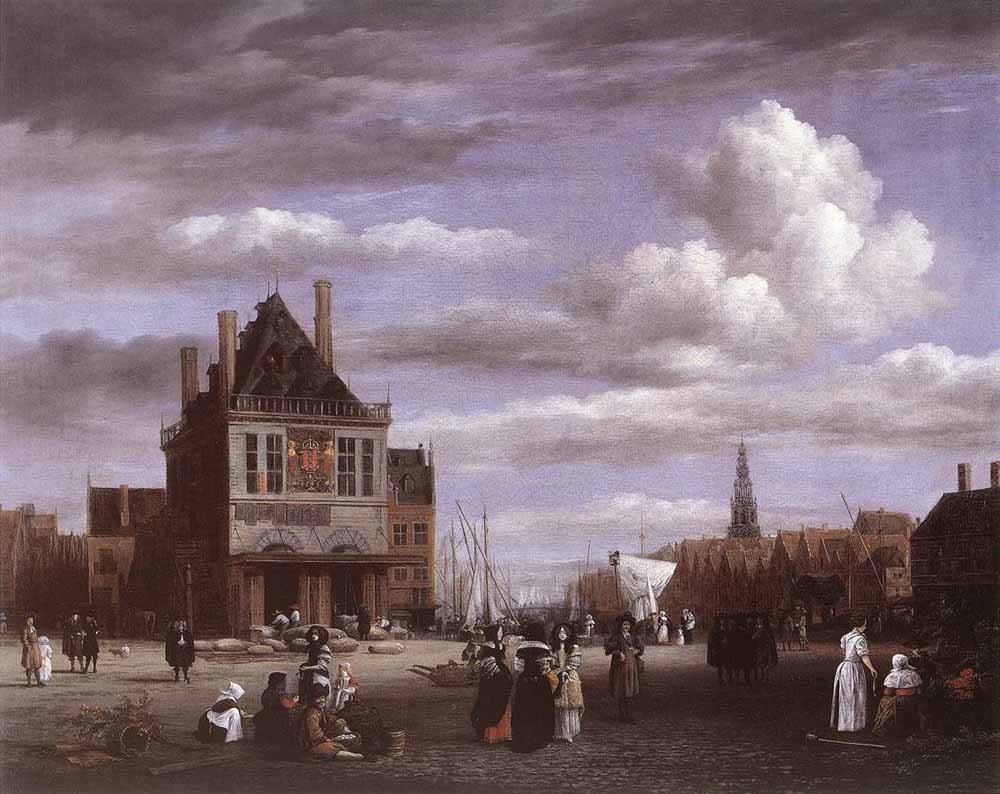
Dam Square in Amsterdam by Jacob van Ruisdael

Dam Square Amsterdam by Jacob van Ruisdael (1670)

Today, Jacob van Ruisdael is my featured artist in My Daily Art Display.   He was born in Haarlem in 1628 and was brought up in an artistic household.  His father, Isaak van Ruysdael and his uncle, Salomon van Ruysdael were both landscape painters.  Little is known about Jacob’s early artistic training but it is thought that his father probably taught him with guidance from his uncle.  At the age of twenty he was admitted as a member of the Guild of St Luke in Haarlem.  The Guild of Saint Luke was the most common name for a city guild for painters and other artists especially in the Low Countries.   They were named in honor of the Evangelist Luke, who was the patron saint of artists.

Unfortunately during his lifetime Jacob van Ruisdael’s artistic talent was not appreciated and by all accounts he led a poverty-stricken existence.  At the age of fifty three the Haarlem council was petitioned for his admission into the town’s almshouse.  He died in Amsterdam a year later in 1682 and his body was brought back to be buried in Haarlem

Jacob van Ruisdael travelled considerably during his lifetime but seldom went outside his own country.   He was a prolific painter with over seven hundred paintings and a hundred drawings attributed to him.  His great love was to paint countryside scenes showing fields of corn and windmills as well as woodland scenes.  He was also a renowned painter of trees and their foliage.    Another favourite subject of his was seascapes and the neighbouring dune lands.  He also liked to paint waterfalls based on the work of Allart van Everdingen, the Dutch painter, who had travelled extensively in Scandinavia.

Today’s painting, The Dam Square in Amsterdam, completed in 1670 is neither a landscape nor a seascape.  The subject is Dam Square in Amsterdam, a place which he was very familiar with as he lived on the south side of the square at this time.   The square was dominated by the old Amsterdam municipal weighbridge and one can see several bales of goods under the canopy waiting to be weighed.   On the right of the building one can see the Damark with its sailing boats and the tower of Oude Kerk.  In the foreground of the painting there are a large number of figures.  It is not thought that Ruisdael actually painted these as he was not an established figure specialist.  Experts believe they may have been painted by the Rotterdam artist Gerard van Battem.  The pale light from the left of the painting casting long shadows across the square suggests that it is daybreak.

 His artistic works although not fully appreciated during his lifetime have since his death been highly praised and he is now often considered the greatest Dutch landscape painter of all time.