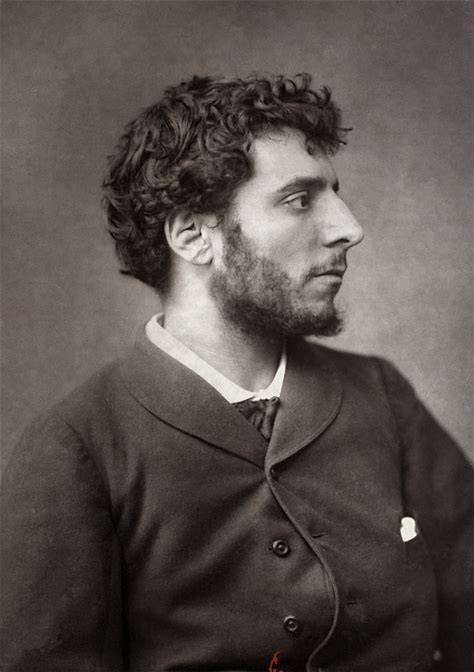
Henri-Jean Guillaume Martin.

Henri Martin in 1882

The artist whose life and works I am looking at today is the Post-Impressionist painter Henri-Jean Guillaume “Henri” Martin.  He was born on August 5th, 1860, at 127 Grande-Rue Saint-Michel in Toulouse.  His father was a French cabinet maker, and his mother was of Italian descent.
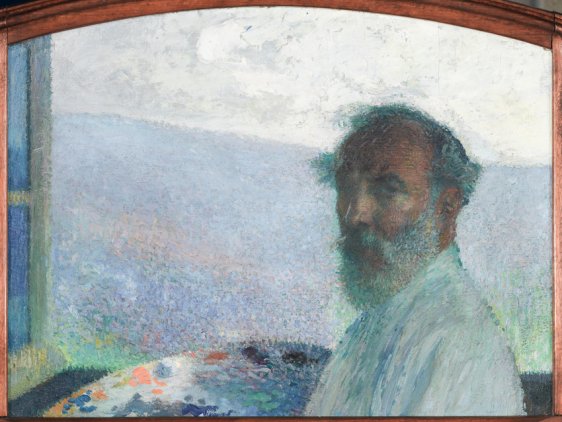
Self portrait by Henri Martin (1910)

The self-portrait hangs in the Musée d’Orsay and their commentary on this work is:

“…In this self-portrait dated just after 1910, Henri Martin makes reference to both the new techniques introduced by the Neo-Impressionists and to the grand pictorial tradition. Thus, there are many borrowings from a re-reading of the past, starting with the arched shape of the painting. This recalls basket-handle arches typical of the Middle Ages.
The palette the artist is holding clearly has an expressive role, symbolising his profession. Martin explicitly quotes primitive painting. Finally, it follows in a long tradition of interior portraits.
On the other hand, the technique of this painting links this work with Neo-Impressionism. By adopting the division of colours, Martin tries to capture the vibrating light of the south of France. He uses dots and stripes of colour, placed close together on an already thick layer, recalling a technique much favoured by Albert Dubois-Pillet, one of the founders of the movement.
Applied to a rigorous but fluid drawing style and to a skilful but seemingly quite natural composition, this technique which surprised in 1884 and shocked in 1886, in 1912 found itself, in this painting, harmoniously integrated into the great French pictorial tradition…”
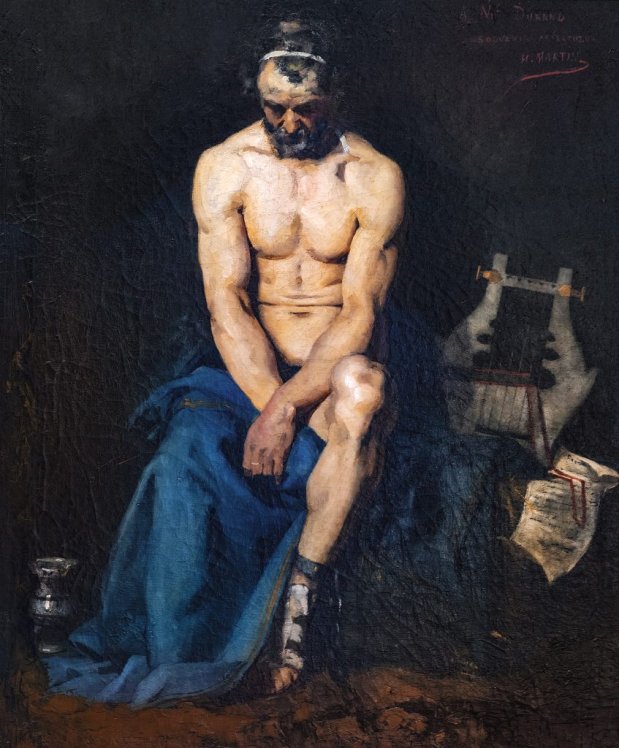
Orephée by Henri Martin (1878) One of Martin’s early mythological work inspired by the tragic Greek figure Orpheus.

Henri Martin, after completing his schooling, managed to persuade his father to permit him to study to become an artist. His artistic career began in 1877 at the Toulouse School of the Fine Arts, where his tutor was Jules Garipuy, a French painter and educator who would later become director of the city’s Beaux-Arts Academy in 1885.

Les Bords de la Garonne, le poète, by Henri Martin (1906)

In 1879, Martin moved to Paris and where, with the help of a municipal scholarship, he was able to study in Jean-Paul Laurens’s studio.
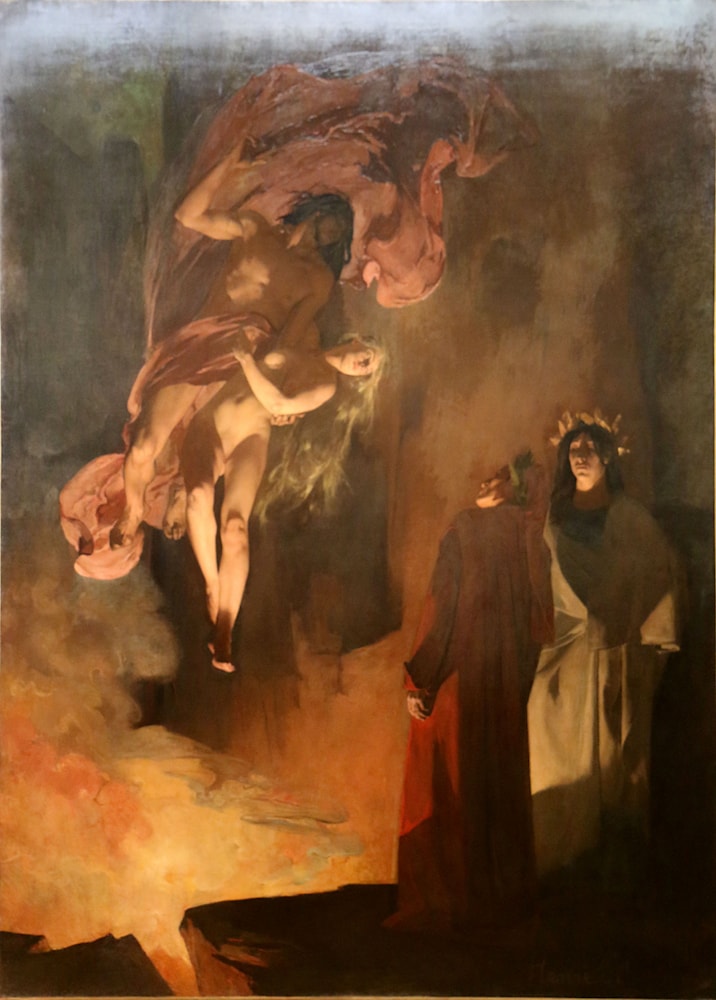
Paolo Malatesta et Francesca da Rimini aux enfers by Henri Martin

Four years later, in 1883, he received his first medal at the Paris Salon for his painting, Paolo Malatesta et Francesca da Rimini aux enfers.   The depiction comes from a character in The Divine Comedy by Danti Aligheri.   Francesca da Rimini was a contemporary of Dante Alighieri and he used her as a character in his book The Divine Comedy. The Lord of Rimini was at war with Francesca’s father Guido I da Polenta of Ravenna, and so to broker peace between the two families, Francesca was married to the Lord’s cripple son Giovanni Malatesta. It wasn’t a match made in heaven. Francesca ended up having a long-standing affair with Giovanni’s brother Paolo, who was also married. That all ended when Giovanni walked in on Francesca and Paolo and killed them both. In The Divine Comedy, Dante and Virgil enter the second circle of hell (the circle for the lustful) to find Francesca and Paolo swirling in a whirlwind.
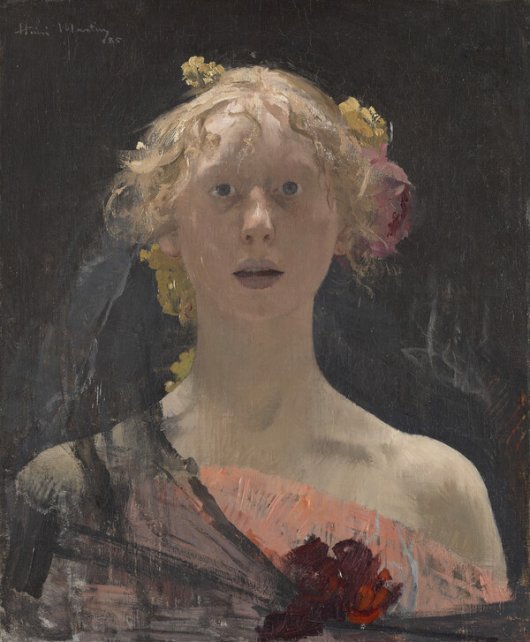
Berenice by Henri Martin (1889)

Whilst he had been studying at the School of Fine Arts in Toulouse, he met fellow student Marie-Charlotte Barbaroux, whom he married in 1881. It was thought that Barbaroux modelled for her husband’s mesmeric 1889 painting entitled Berenice.  The depiction of the woman was based upon a short story by the American author Edgar Allan Poe which was first published in 1835.  The story tells of  Egaeus, the narrator, who falls in love with his beautiful cousin Berenice. She suffers from a mysterious debilitating illness, causing her to fall into a trance-like state. As Berenice’s health deteriorates, Egaeus develops intense obsessions, focusing latterly on her teeth. The girl eventually dies and Egaeus is grief-stricken. He visits her grave, as if in a dream, and later discovers her extracted teeth in a box beside him. Henri Martin appears to have been inspired by this passage from Berenice:

‘…The forehead was high, and very pale … and the once jet-black hair fell partially over it, and overshadowed the hollow temples with innumerable ringlets, now of a vivid yellow, and jarring discordantly … with the reigning melancholy of her countenance…”
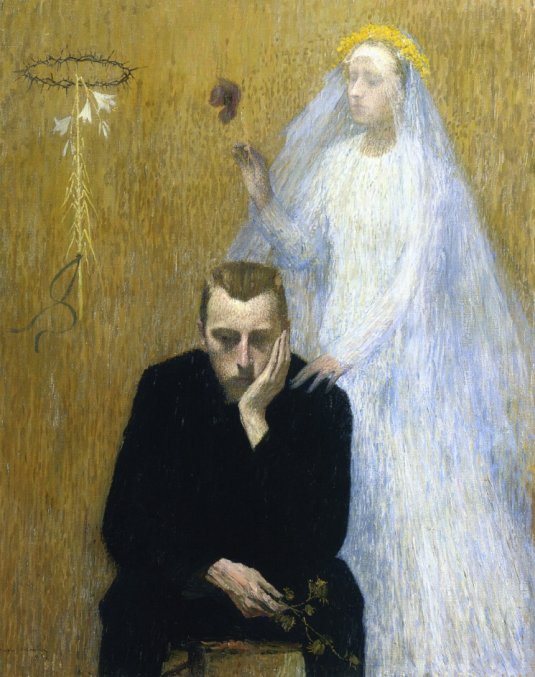
Mystic Scene by Henri Martin (1895)

In 1885, the year after he won his first medal at the Paris Salon, Martin was awarded a travel scholarship for his painting, Titans Scaling the Sky. The scholarship allowed him to travel to Italy and tour the country, where he was able to study the work of the Italian Masters as well as works by some of  his contemporaries such as the French symbolist painter Edmond Aman-Jean and the French painter and printmaker, Ernest Joseph Laurent, a well regarded figure in the academic art establishment, known for his large-scale historical and religious paintings. 
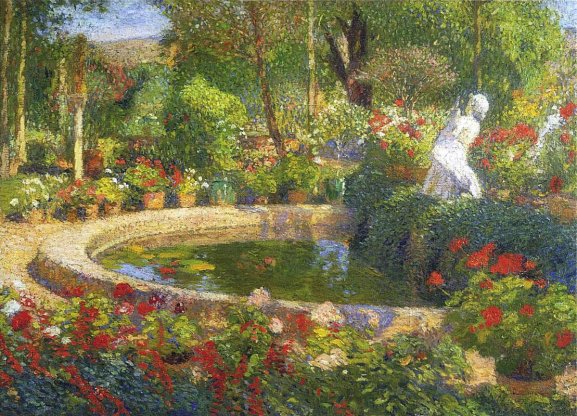
Le Marquayrol at Labastide-du-Vert by Henri Martin (1905)

Once Henri Martin had left the world of academia, he became interested in Neo-Impressionism but in a more casual style. His style was close to the divisionism of Seurat.  When he was in Italy Martin developed his own particular style, known as Divisionism, which is an artistic technique characterized by the separation of colours into individual dots or patches that interact optically.  It formed the technical basis for Neo-Impressionism.   The difference between divisionism and pointalism is that whereas the term divisionism refers to this separation of colour and its optical effects, the term pointillism refers specifically to the technique of applying dots. Henri Martin’s method was typically softer, less rigid, and more intuitive. He used divided brushstrokes – often short, comma-like marks rather than precise dots as seen in the works of Seurat.  Henri Martin was awarded the Gold Medal for a work he submitted to the Paris Salon in 1889.  The art critics identified it as pointillism.  Also in 1889 Martin became a member of the Legion of Honor.   He was commissioned to execute some important frescoes in the Paris city hall in 1895, and the new huge building of the Capitol of Toulouse.   

Fête de la Fédération au Champs de Mars, le 14 juillet 1790 by Henri Martin

In 1900 at the the Exposition Universelle of 1900 in Paris he was awarded the Grand Prix for his work, Fête de la Fédération au Champs de Mars, le 14 juillet 1790, which is now housed in the Musée des Augustins in Toulouse. It depicts the celebration of the centenary of the French Revolution and this work brought him considerable public and critical attention.
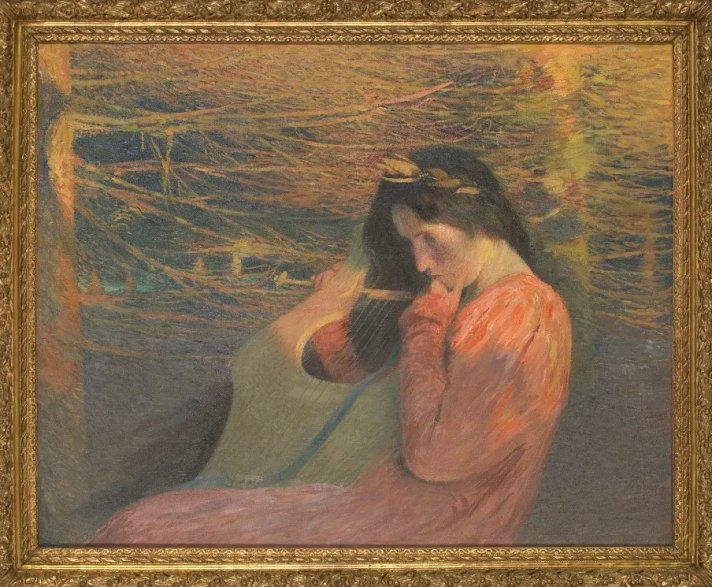
The Muse by Henri Martin (c.1896) The painting was presented at the Salon of the Société des Artistes Français in Paris in 1898.

His journey around Italy opened Martin’s eyes to a new way of painting. Prior to his trip his artwork conformed to the old Classicism style, a style which held a high respect for a classical period, classical antiquity in the Western tradition.  Maybe he was swayed by the clear bright light of the skies in Italy which he encountered.  The change of style could also be due to the influence of the artwork of the Italian Primitives.  In the mid-19th century, the term Primitive Art, was primarily applied to 14th and 15th century Italian and Flemish art, which at the time of Henri Martin, was appreciated for what was looked upon as its simplicity, sincerity, and expressive power which awoke in Martin intense poetic sentiments which he would  bring to his newly found style of painting. A more poetic approach to his painting style.
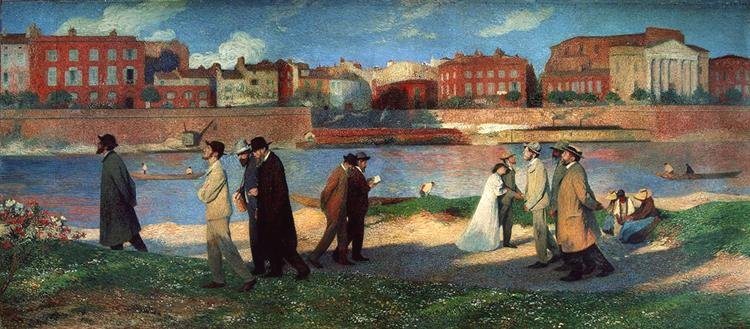
Banks of the Garonne by Henri Martin
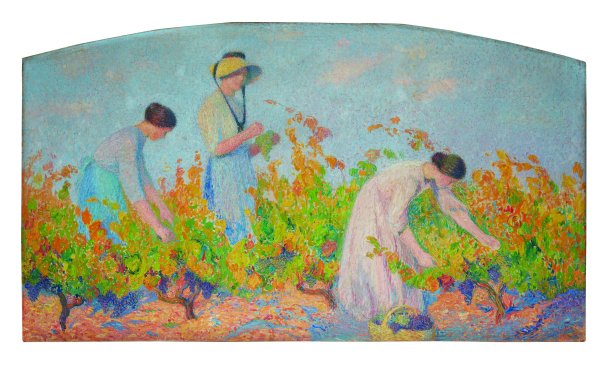
Les Vendangeuses  (The Grape Pickers) by Henri Martin (1920)

A painting by Henri Martin entitled, Les Vendangeuses  (The Grape Pickers) came up for auction at Christies in April 2021 and sold for EUR 218,750.  It was a work commissioned by Martin’s doctor, Dr. Henri Tissier, and remained on the wall of his Art Deco salon for a hundred years.  The Tissier’s home was located on Boulevard Raspail, in the 6th arrondissement of Paris.  It was a true Art Deco architectural jewel and had been built by Léon Tissier (Henri’s brother) in 1913.  Henri Martin, who was also the Tissier’s neighbour. Dr. Tissier and his wife were close to many artists, including the sculptor Bouchard and the interior designer Henri Bellery-Desfontaines.   Both contributed to the decoration of the Tissier’s apartment, whose exceptional furniture was presented at the 1900 Universal Exhibition in Paris.  Les Vendangeuses, which Henri Martin completed in 1921, is a depiction of a tranquil, bright rural scene showing women picking grapes.  It is a remarkable example of Henri Martin’s refreshing approach to pointillism.  It is a work with strong post-impressionist accents and is also a tribute to the artist’s native land and a pledge of the friendship that bound him to the Tissier couple.
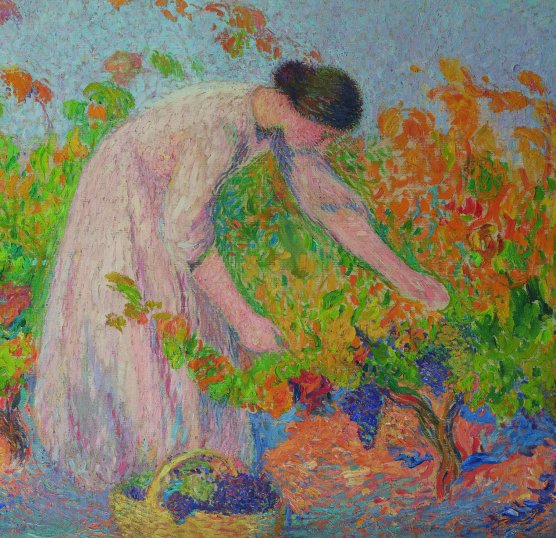
It is thought that the woman to the right dressed in a pale pink dress that contrasts with the blue of the other clothes, stands out particularly and could well represent Marie-Charlotte Barbaroux, Martin’s wife.
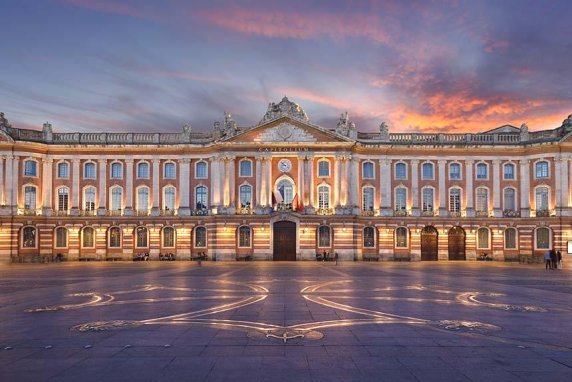
The Capitole of Toulouse

In Toulouse there is no Mairie, but rather a majestic Capitole. An emblematic building which is home to the town hall, a theatre and rooms of state. On the first floor, there are magnificent reception rooms that are decorated with art including ten giant canvases by Henri Martin and, notably, the Salle des Illustres where his paintings retrace the history of Toulouse.
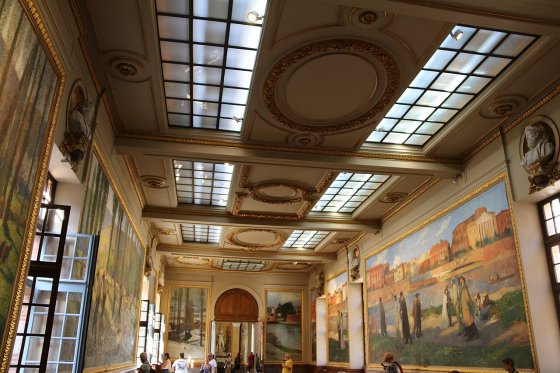
Salle Henri Martin, Capitole de Toulouse.
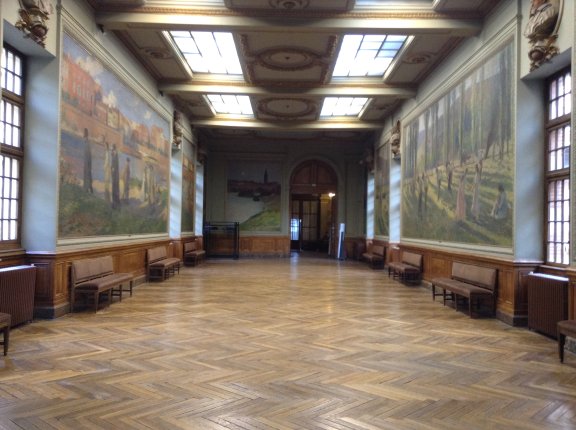
Salle Henri Martin, Capitole de Toulouse.
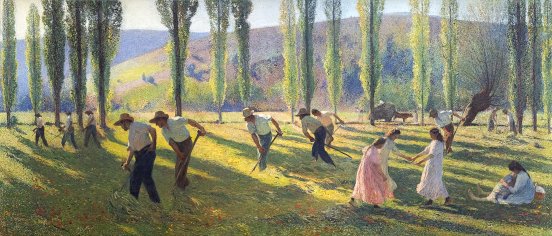
 L’été ou les faucheurs (Summer or The Reapers) by Henri Martin (1903) In the Henri Martin Hall, The Capitole Toulouse.

Henri Martin completed many prestigious public commissions, which can be found at the Capitol of Toulouse, the prefecture of the Lot in Cahors, the Sorbonne in 1908, the Paris City Hall, a cabinet of the Élysée in 1908, the Council of State in 1914-1922, the Town Hall of the Fifth arrondissement in 1935.
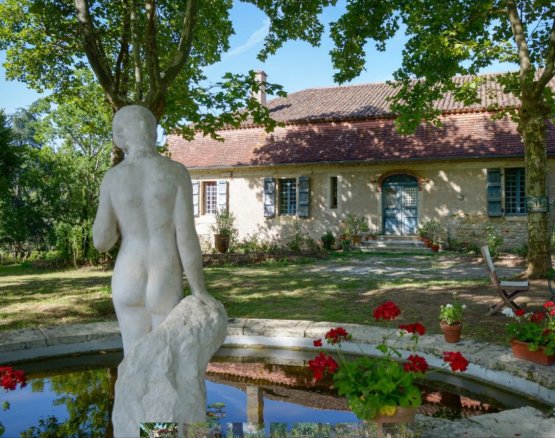
Henri Martin’s final home at Domaine de Marquayrol at Labastide-du-Vert

Henri Martin was quite an introvert and later in life began to hate living in Paris and hanker after a return to his beloved south-west France.  He moved away from the French capital around 1900 and after a number of years trying to find the perfect place to live, settled on a house, the Domaine de Marquayrol, which overlooked the village of  Labastide-du-Vert, a commune in the Lot department in the Occitania region in Southwestern France. near to the town of Cahors.
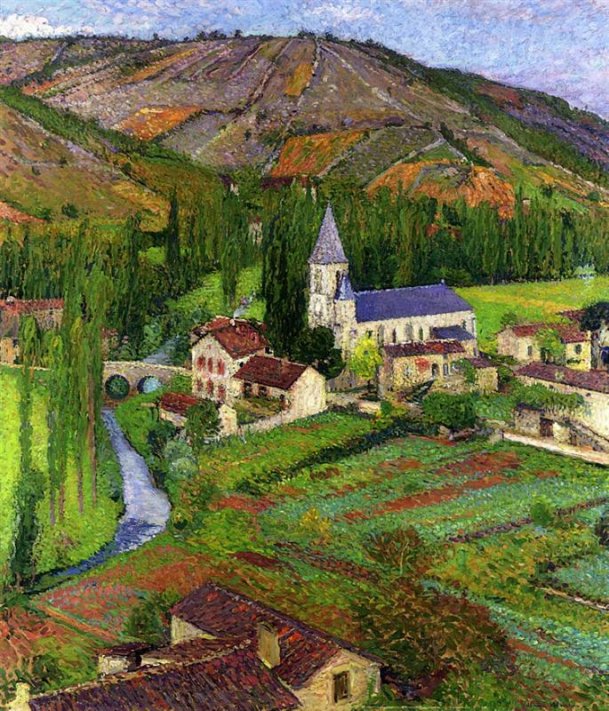
The Church at Labastide by Henri Martin (1920)
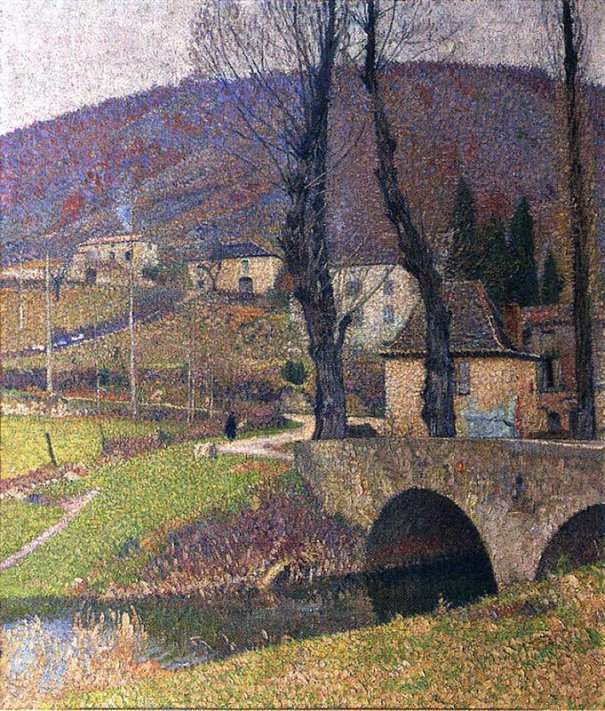
Labastide du vert village by Henri Martin

It was an area of great natural beauty, a region characterized by rolling hills, vineyards, and the winding Lot River valley. Marquayrol became his primary residence and his artistic sanctuary for the rest of his life. He lived there with his wife, Marie-Charlotte Barbaroux, and their four sons Many art historians believe that Martin performed some of his best work in this new tranquil environment. His mature output depicted tranquil landscapes and village scenes and these canvases, which were rich in soft light and rhythmic brushwork, remain the trademark of his oeuvre.

 Henri Martin died at Labastide-du-Vert on November 12th, 1943, aged 83.


Below are some of the websites I used to get information for this blog:

France info

Le Monde

Outre Journal

Arthive

ArtFund

NICEARTGALLERY

The Dining Room by Paul Signac

The Dining Room by Paul Signac (c.1887)

On October 21st,  I looked at a work by the Neo-Impressionist painter Georges Seurat, which had been completed by him using the technique known as Pointillism or Divisionism.   For a brief explanation of those terms, please go and look at that earlier blog.  Today I want to look at a work by his contemporary and friend Paul Signac.

Paul Victor Jules Signac was born in Paris in 1863 and came from a prosperous family of shopkeepers.  Originally he trained to become an architect but at the age of eighteen, after visiting a Claude Monet Exhibition, he decided to set off on an artistic career and learn the technique of en plein air painting.  His earliest known works were landscapes or still-lifes and one can see in them an Impressionist influence, especially the works of Monet and Alfred Sisley.  At the age of twenty he was tutored by the Prix de Rome winner Emile-Jean-Baptiste Bin.  In 1884 he became a founder member of the Société des Artistes Indépendants and their Salon des Indépendants.   The Salon des Indépendants was an annual exhibition which started in 1884 and was held in Paris by the Société des Artistes Indépendants.  It was set up in direct competition to the Paris Salon.   Many artists as well as the public became increasingly unhappy with the rigid and exclusive jurist-based selection policies of the official Salon.  Just over twenty years earlier, in 1863 the first Salon des Refusés had been held for innovative artists whose works had been rejected by the official Salon.  The Société des Artistes Indépendants which Signac co-founded had the motto “Sans jury ni récompense” which meant “no jury, no awards”.  One of the other co-founders of this society was Georges Seurat and it was he who introduced the principles of Divisionism and the theory of colours to his friend Signac.

Signac, up until then, had been following the Impressionist style of painting but he became fascinated with Seurat’s technique, known as Pointillism.    He then decided to experiment with this newly acquired technique of scientifically juxtaposing small dots of pure color on the canvas which combined and blended them in the viewer’s eye instead of the artist blending the colours on a palette before putting the combination on to the canvas.  Signac was fascinated with this technique and was tireless in his attempts to convert others to Seurat’s methods. In 1885 Signac met Camille Pissarro, whom he introduced to Seurat. Pissarro realised that this technique was the answer to his desire to have a rational style and so adopted it with great fervour.  Pissarro, against the wishes of the other Impressionists, invited Signac to participate in their eighth and last Impressionist Exhibition in 1886.

Signac loved to sail and a large number of his paintings featured the French coast and its harbours.  He would progressively sail further afield, visiting various ports in the Mediterranean as well as the Dutch coast to the north.  During the summers he would head south to the Côte d’Azur and St Tropez where he had bought himself a house in 1892.  He would always return from his voyages with numerous sketches of the places he had visited and then back in his studio, turn them into beautifully coloured canvases that are carefully worked out in small, mosaic-like squares of colour, and which were quite different from the tiny, variegated dots previously used by Seurat.

He became friends with Vincent van Gogh and the two would spend time in Van Gogh’s Parisian home and his summer hide-away in Arles. From the mid-1880s Signac exhibited regularly. Apart from the Salon des Indépendants, in which he figured every year, he showed at the last Impressionist Exhibition (1886) at the invitation of Pissarro.   It was not until he was almost forty years of age that he had his first one-man exhibition which was held at the Paris gallery owned by Siegfried Bing.  However like his Neo-Impressionist friends he received little public acclaim for the first 20 years of his career.  On Seurat’s death in 1891, Paul Signac became the leader of the Neo-Impressionists

Signac was a great inspiration to the young and up-and-coming painters such as Henri Matisse and André Derian.  It was his support that played a vital role in the evolution of Fauvism.   Fauvism was the short-lived and loose group of early twentieth-century Modern artists whose works emphasised the artistic qualities of strong colour more than the representational or realistic values of the Impressionist painters.  Signac became president of the annual Salon des Independants in 1908 and retained that position until his death.   As such, Signac encouraged and supported younger artists such as Matisse by allowing their works and the controversial works of the Fauves and the Cubists to be exhibited.

Signac died in Paris in 1935, aged seventy-two.

My Daily Art Display featured oil on white primed canvas painting today is not one of Signac’s landscape or seascape although it does highlight the unusual Divisionism technique.  It is entitled Dining Room and was completed in 1887 and exhibited at the Paris Salon des Indépendants in 1887 that year.  It now hangs in the Rijksmuseum Kröller-Müller, in Otterlo, Netherlands.  Before us we see three people, a man and a woman seated at a table and a maidservant.  Although the setting looks like it has all the accoutrements of a well-to-do bourgeois household, the dining room is actually that of Signac’s family, and before us we have Signac’s mother, grandfather and housekeeper.   The room is lit from behind with light emanating from a window on the rear wall.  This illuminates the subjects vividly and creates silhouettes and strong contrasts of light and shade.  It gives a strong structure to the composition.  See how Signac has highlighted areas of the painting by the use of barely tinted yellowish whites.  The seated characters are rather wooden-like.  They sit at the lunch table in stony silence.  There appears to be no communication between Signac’s grandfather and mother and the setting is devoid of anecdote.  There is a stiffness of what we see before us.  There is a frozen solemnity about the scene and this may have been Signac’s way of pictorially criticising the strict and ritualistic sombreness of middle-class meal times.

I am not sure I like the Divisionism technique used in Signac’s indoor scenes.  I think it works much better in his coastal landscape works.  There is no doubt about it that it was a clever technique but it is just not for me.

Sunday Afternoon on the Island of La Grande Jatte by Georges Seurat

A Sunday Afternoon on the Island of La Grande Jatte by Georges Seurat (1884-86)

Today I am starting My Daily Art Display blog by introducing you to some new “isms” which have a connection with what is to follow.  They are Post-Impressionism, Neo-Impressionism, Pointillism and Divisionism and they all are connected in some way to today’s featured artist George Seurat.

By now you will have read many of my blogs that cover the works of the Impressionists such as Monet, Renoir, Degas and Caillebotte and so by now you are familiar with the term Impressionism.  Post Impressionism was a style of painting that grew out of Impressionism or maybe we could say it was a style of painting which was a reaction against Impressionism. The three main artists who were central to this new group of painters and who were termed Post Impressionists were Gaugin, Van Gogh and Cézanne.   Gaugin retained the intense light and colour of the Impressionists but discarded the idea of painting from nature.  He was totally against naturalism, where artists depict nature just as it is, and in its place he wanted his works to have more inventive subject matter and he also liked to experiment with colour.   On the other hand Van Gogh continued to paint from nature but developed a highly personal use of colour and brushwork which openly expressed his own expressive response to a subject.  Cézanne kept faith with the Impressionist’s principle of painting from nature but his works came across with a greater energy and vitality.

Today I am going to look at Neo-Impressionism and Neo-Impressionist artists who were a distinct group of painters within the Impressionist movement and in some ways formed a transition period between the Impressionists and the Post Impressionists.  The two leading figures of this trend were Georges Seurat and Paul Signac and they wanted to have a more scientific approach on how light was depicted in their paintings.  Their works were characterised by the use of a technique known as Divisionism or Pointillism.  Divisionism, also sometimes known as Chromolumanarism, was a method of painting in which colour effects were achieved by applying small areas of dots of pure unmixed colours on the canvas so that  an observer standing at an appropriate distance from the painting (suggested distance for best effect was three times the diagonal measurement of the work) the dots would appear to react together giving a greater luminosity and brilliance than if the same colours had been mixed together before putting them on the canvas. What these artists wanted to achieve was that the observer of the painting combines the colours, which are in the form of dots, optically instead of the artist pre-mixing them on a palette before putting them on the canvas.

Pointillism comes from the term peinture au point, which was used by the French art critic Félix Fénéon, when he described today featured painting by Seurat.   It can be defined specifically as the use of dots of paint and does not necessarily focus on the separation of colors.  Divisionism refers mainly to the underlying theory, pointillism describes the actual painting technique associated with the likes of Seurat, Signac and to a lesser extent Pissarro. Pointillism is related to Divisionism which is a more technical variant of the method. Divisionism is concerned with color theory, whereas pointillism is more focused on the specific style of brushwork used to apply the paint.

Enough is enough !!!!  I don’t want to get too bogged down with “isms” and their meanings and I am sure that there are many people out there who can give a much more expansive explanation of the differences between Divisionism and Pointillism .   My Daily Art Display today features what many believe is Georges-Pierre  Seurat’s greatest work.  It is entitled A Sunday Afternoon on the Island of La Grand Jatte.  It was the one of the first painting to be executed entirely in the Pointillist technique and the first to include a great many people playing a major role.   It caused a sensation when it was exhibited at the eighth and final Impressionist Exhibition in 1886.  It is thought that it was possibly intended as a pendant to Seurat’s other work, Bathers at Asnière,  which I will look at in a later blog.

He started the work in 1884 and did not complete it until 1886.  He spent two years making over sixty preparatory pencil and ink drawings, conté crayon studies and oil sketches on panel for this work.  He would alter the grouping of people, the number of people within a group and where each group or individual were positioned until he was satisfied that he had achieved the perfect balance.  There was a smaller version of the painting which can be found in the Metropolitan Museum of Art in New York.  There is also a version of the scene without the people which was once in the private collection of Mrs John Hay Whitney.   This painting we see today is massive in size measuring 207cms high by 308cms wide (almost 7ft tall and 10ft wide) and since 1924 has been housed in the Art Institute of Chicago.  Seurat completed the final version of this painting in his small Paris studio.

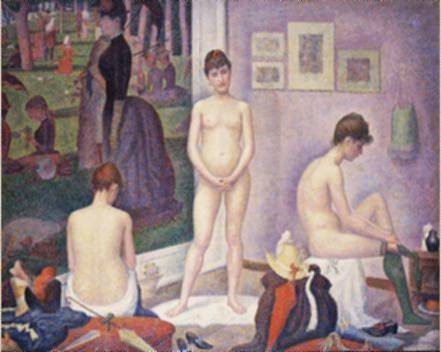
The Models by Seurat (1886-88)

In 1888, Seurat also completed another painting which was entitled The Models  using his pointillism technique, and which depicts models in his studio.  Included in the painting is a section of La Grande Jatte and art historians believe that by doing this painting, he was showing the world that this technique of Pointillism worked just as well for indoor scenes as outdoor ones.

The Île de la Grande Jatte is a small island in the River Seine, downriver from La Défense.  It is about 2 kilometers long and just 200 metres wide at its widest point.  At one time it was reduced to being an industrial site but now has public gardens and houses.   Living on the island are approximately 4000 inhabitants.  However in the days of Seurat it was a pastoral retreat where Parisians could come at weekends from their claustrophobic city existence and soak up the quiet and peace of this little idyll.

Before us we see Seurat’s idealized version of the Grand Jatte omitting both the cafés and restaurants and the nearby ugly shipyard and factories.  In the painting we see members of different social classes out for a stroll along the Grand Jatte by the side of the Seine.  The figures, shown mainly in profile or frontal position, have a peculiar formal and artificial feel to them.  As we look at the painting head-on, there seems to be a definite elongation of some of the people although I believe if you stand at a certain angle to the painting this is minimised.  Seurat would sketch individual groups or single characters and then return to his studio to decide if and where each group should be placed on the canvas.  He sketched people of different classes in society to give the idea that all types of people enjoyed promenading along La Grande Jatte.   Look at the trio in the right foreground.  Here we have the a man wearing a top hat and holding a cane who is more than likely from the upper classes of Paris society.  The man with the muscular arms, lying back with a cap on his head, smoking the pipe is probably a working-class boatman and finally we have the young genteel lady of an indeterminate class.  An unusual trio and who, although physically close in the painting, would be unlikely to have a closeness in that present-day society.  The faces of the people in the painting show little personality.  There is something very impersonal about them.  We must presume that this was a deliberate ploy by Seurat who seemingly did not want the painting to be sullied by observers of the painting trying to interpret facial expressions.  I don’t believe the artist ever intended this to be in any way a moralistic statement about the French culture and classes at the time. However, some would disagree.   Art historians like to interpret every painting and seek symbolic depictions within a work so let us have a look at a few that have been thrown up for consideration with regards this work of art.

In the left middle ground we see a lady dressed in gold and orange fishing in the river.  I suppose there is nothing strange about that albeit she is hardly dressed as a woman who was to go out on a fishing expedition.  Well consider what the French word is to fish – it is pêcher and some have suggested that Seurat has made a play on the word as the French word to sin is pécher.  So is Seurat secretly identifying her as a prostitute.  Again look at the woman in the right foreground accompanying the gentleman.  Look what she is holding in her left hand – a monkey on a leash.  That is certainly an unusual pet to take for a walk.   So why did Seurat include a monkey.  One possible reason is that a female monkey in French is une singesse.  The symbolists would have us believe that a monkey is a symbol of licentiousness and that is why the French slang for prostitute is singesse.  So again I ask the question is Seurat trying to tell us by symbolism that this woman is a prostitute who is out for a stroll with her client?

It is interesting to note and it is not shown in my attached picture, that later Seurat painted the border using parallel red, orange and blue dashes and dots.  He varied the combination of colours in different parts of this border in order to accentuate the adjacent colours in the painting itself.  Maybe if you go to see the painting in Chicago you can let me know if Seurat’s idea with this border really works.

Finally, I came across a poem about this painting which I was going to add to the blog but it was too long so instead I have added the URL where you can find it.  It is:

http://www.lamaquinadeltiempo.com/algode/delmore2.htm