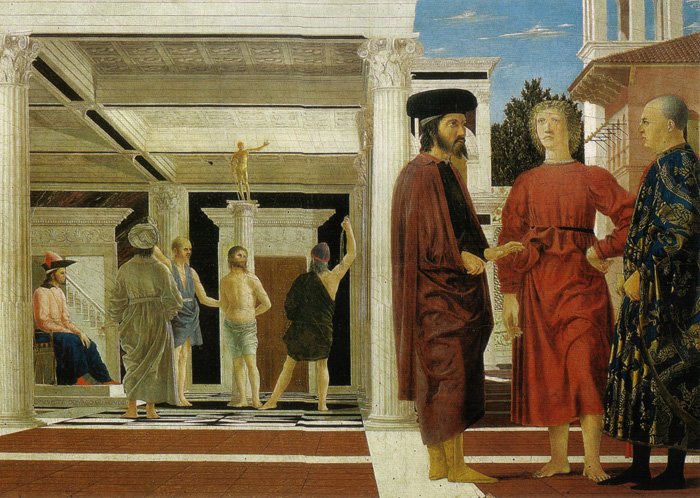
Flagellation of Christ by Piero della Francesca

The Flagellation of Christ by Piero della Francesca (c.1460)

My Daily Art Display today has me in a quandary.  When I choose a painting for the day I have to spend a number of hours researching the artist, the painting and the subject of the painting and then try and collate all I have discovered into a meaningful and yet not too verbose blog.  Sometimes I struggle to find the information I need from the hundreds of art books I have hoarded, the internet and the local library.  On other occasions, like today, I was overwhelmed by the vast amount of information there was with regards the work of art and now I have the difficult task of trying to filter out what I don’t need.  In this case, I also have to contend with the many varied and conflicting interpretations of what we are actually looking at.  The one thing which is common to all that I have read about the work of art is the praise upon praise which has been heaped on it and yet when I look at it, I struggle to appreciate or understand its so-called “greatness”.  However I will let you decide and if you want to comment and tell me that like Kenneth Clarke, the art historian, who declared it to be the “Greatest Small Painting in the World”,  you also believe it to be one of the greatest paintings of all time, then tell me why you think that.

Before I talk about the painting, let me first look at the life of this Early Renaissance painter and mathematician, Piero della Francesca.   Yes, you read that correctly – mathematician, for as well as being a revered painter, he is now looked upon as the greatest mathematician of the 1400’s.   Piero was born in 1415 in the town of Borgo Santo Sepolcro, now Sansepolcro, eighty kilometres east of Florence.  His father Benedetto de’ Franceschi was a tradesman and his mother was Romana di Perino da Monterchi.  At an early age he began his artistic apprenticeship and at the age of fourteen he and another apprentice, Domenico Veneziano worked on frescoes for the Sant’ Egidio Church in Florence.  It was during this time spent in Florence that Piero would have probably come into contact with the great Florentine artists of the time such as Fra Angelico, Mantegna and the architect, Brunelleschi.

Records show that Piero had returned home to San Sepolcro by 1442 and three years later had received a large commission from the Compagnia della Misericordia, a confraternity of Borgo San Sepolcro, for a polyptych as an altarpiece for the local church, Church of the Misericordia,.  The confratentiy had asked Piero to complete the work in three years, setting the anticipated completion date as 1445.  Piero however did not feel constrained by this suggested timeline and any way he had many other projects on the go at the time and in the end did not complete the altarpiece until 1462, some seventeen years late!

Piero della Francesca travelled widely around Italy completing commissions for frescoes including some papal work in Rome.  At the age of fifty-four he moved to Urbino, where for almost the next twenty years he worked for Count Federico III da Montefeltro, the Lord of Urbino (see My Daily Art Display for March 23rd).  It was during his stay at Urbino that he completed today’s featured work, The Flagellation of Christ, somewhere between 1455 and 1460. 

In his later years, around 1482, Piero della Francesca was living in Rimini where he had a studio.  As he grew older he had given up painting, the artist biographer Vasari put this down to his failing eyesight but this has since been contradicted because it is known that he wrote and completed a mathematical treatise in 1485, when he was seventy years of age.  It could be that his love of mathematics had overtaken his love of painting.  He died in 1492, aged seventy seven at his home in San Sepolcro.

 The Flagellation of Christ is an oil on panel painting and one of the most famous paintings completed by Piero della Francesca.  It is one he painted during his first visit to Urbino.  Look closely at the painting.  The setting is the portico of Pontius Pilate’s palace in Jerusalem.  Are we looking at one scene divided into an outdoor and indoor location or are the two scenes we observe, depictions of two different times?    The latter is a popular theory.  It is generally agreed that the inner depiction of the flagellation is set at the time of Christ but the outdoor setting in the right foreground, with the three men, is set in the fifteenth century.  One pictorial argument favouring the time separation of the two scenes is that the background scene is illuminated from the right whilst the outdoor scene with the three men is illuminated from the left.

The whole scene is dominated by architecture with a stunning use of perspective which adds a sense of realism and manages to draw our eyes towards the small figure of Christ despite the fact that the actual flagellation takes place in an open gallery in the middle ground of the work.   Also in the flagellation scene, we have Pontius Pilate seated on the left and possibly King Herod with his back to us.   In the foreground on the right hand side we see three figures, who appear not to be paying any attention to what is happening behind them. So who are all the various people featured in the painting?  It would be great if there was a clear cut answer to that question but different experts have different ideas and so I had better offer you a few alternatives and let you pick which one sounds the most probable to you.

One theory put forward about the reason for the commissioning of this work is that that the painting was an attempt to favour the reconciliation between the two Christian churches, of the East and of the West, because of an impending attack by the Turks on Constantinople. Both the presence of the character in the centre, dressed after Greek fashion, and an inscription on the frame convenerunt in unum would seem to support this interpretation.

We know that the painting was commissioned by the then Duke of Urbino, Federico da Montefeltro.  The conventional interpretation of this painting and the one which is still upheld in Urbino as the true interpretation of the work, is that the three men in the right foreground of the painting are, in the centre, the Duke of Urbino, Oddo Antonio da Montefeltro, the predecessor of Federico, the commissioner of the work, and is flanked, on each side by his advisors, Manfredo dei Pio and Tommaso di Guido dell, Agnello.    All three were dead.  Oddo Antonio was assassinated a few months after coming to power because of the unpopularity of his laws and his advisors suffered a similar fate.  Another interpretation is that Oddo Antonio is in the centre and the characters either side of him were his assassins, Serafini and Riccardelli.  A third suggestion is that this is simply a dynastic painting commissioned by Federico in which he has his three predecessors depicted.

There are more possibilities and books and treatises have been written about the painting with various suggestions as to the identity of each of the characters  but I will leave it there and if you want to look deeper into the interpretation of the painting, do so and I will be interested to see what you find out.  So back to my original question which still puzzles me; why is this painting by Piero della Francesca look on as being “a great work”?    Is it the artistic quality of the painting or is it the mathematical quality of the perspective which has art historians tell us it is a gem?

Rebecca and Eleazar at the Well by Giovanni Battista Piazzetta

Rebecca and Elizear at the Well by Giovanni Battista Piazzetta (c.1740)

Today I am returning to Italy for My Daily Art Display painting.  It is a painting based on a biblical tale and one that features the work of the Venetian rococo painter of religious subjects, Giovanni Battista Piazzetta.  Piazzetta was born in Venice in 1682.   His father, Giacomo was a sculptor, and he gave his son his first artistic tuition, concentrating on wood sculpture.  Starting in 1697, at the age of fifteen Giovanni started studying painting under the auspices of the painter Antonio Molinari, an Italian artist of the Baroque era of Venice. Later in his early twenties he went to Bologna and studied under Giuseppe Mari Crespi, another Baroque painter, who was part of the Bolognese School of painting.   The Bolognese School of painting thrived in this capital city of Emilia Romagna during the 16th and 17th centuries and was considered the equal of Florence and Rome as the perceived centre of Italian painting.   It was probably Crespi who persuaded Piazzetta to take up genre subjects.   Piazzetta remained in Bologna for two years and was influenced by the works of another Bolognese artist, Giovanni Francesco Barbieri, who was the cross-eyed painter and who was better known by his nickname, Guernico, which in Italian means ‘squinter’!  Guernico was renowned for his religious paintings and altarpieces, with their rich colours and dramatic storytelling and his influence can be seen in some of Piazzetta’s own religious works.  Today’s featured painting is a great example of this aspect of his work.

Piazzetta returned to Venice in 1710 but struggled somewhat to get commissions in comparison with his artistic contemporary, Sebastiano Ricci and the young “newcomer on the block” Giovanni Tiepolo,  who had both begun to corner the market with their popular late Baroque/Rococo works.  However Piazzetta supplemented his income by illustrating books. His presentation drawings, portraits, and character heads, usually made in charcoal or white chalk, were also in wide demand from discerning collectors. He was a slow worker, and often painted the same subject several times with subtle modifications.  He was a perfectionist.  In 1750 Piazzetta became the first director of the newly founded Venice Academy of Fine Arts, which was established by the Senate and included courses of Academy Figure, Portrait, Landscape and Sculpture.  He devoted himself in the last few years of his life to teaching and although never wealthy he was always admired for his art work.   He died in Venice on April 28, 1754, aged 72.

My Daily Art Display featured painting today is by Piazzetta and is entitled Rebecca and Eleazar at the Well.  He completed this oil on canvas painting around 1740 and was one I saw when I visited the Brera Gallery in Milan.  As I said at the beginning, this painting is based on the Old Testament story in the Book of Genesis, (Chapter24).  For those of you are unfamiliar with the story let me give you a précis of the biblical tale.

Abraham who was  well advanced in years, had a son named Isaac and wanted to find a good wife for him.  He spoke to his trusted servant Eleazar and said:

“…Put your hand under my thigh, that I may make you swear by the Lord, the God of heaven and God of the earth, that you will not take a wife for my son from the daughters of the Canaanites, among whom I dwell, but will go to my country and to my kindred, and take a wife for my son Isaac…”

The servant Eleazar was concerned that the woman he chose for Abraham’s son would not want to come back with him and asked why he could not choose a local girl instead, but Abraham would have none of that idea and eased the mind of his servant:

“ … The servant said to him, ‘Perhaps the woman may not be willing to follow me to this land. Must I then take your son back to the land from which you came?’   Abraham said to him, ‘See to it that you do not take my son back there.  The Lord, the God of heaven, who took me from my father’s house and from the land of my kindred, and who spoke to me and swore to me, ‘To your offspring I will give this land,’ he will send his angel before you, and you shall take a wife for my son from there.  But if the woman is not willing to follow you, then you will be free from this oath of mine; only you must not take my son back there.”  So the servant put his hand under the thigh of Abraham his master and swore to him concerning this matter…”

And so Eleazar set off on his quest and he later relates the meeting with Rebekah:

“…Then the servant took ten of his master’s camels and departed, taking all sorts of choice gifts from his master; and he arose and went to Mesopotamia to the city of Nahor.  And he made the camels kneel down outside the city by the well of water at the time of evening, the time when women go out to draw water…”

So Eleazar had reached the well but was now concerned about how he would decide which woman he should choose for the wife-to-be of Isaac:   

 “…And he said, “O Lord, God of my master Abraham, please grant me success today and show steadfast love to my master Abraham.  Behold, I am standing by the spring of water, and the daughters of the men of the city are coming out to draw water. Let the young woman to whom I shall say, ‘Please let down your jar that I may drink,’ and who shall say, ‘Drink, and I will water your camels’—let her be the one whom you have appointed for your servant Isaac. By this I shall know that you have shown steadfast love to my master.”

 Before he had finished speaking, behold, Rebekah, who was born to Bethuel the son of Milcah, the wife of Nahor, Abraham’s brother, came out with her water jar on her shoulder. The young woman was very attractive in appearance, a maiden whom no man had known…”

 Then Rebecca’s brother and mother came to Eleazar, who was standing at the well:

 “…Then Laban and Bethuel answered and said, “The thing has come from the Lord; we cannot speak to you bad or good.  Behold, Rebekah is before you; take her and go, and let her be the wife of your master’s son, as the Lord has spoken.”    When Abraham’s servant heard their words, he bowed himself to the earth before the Lord.  And the servant brought out jewelry of silver and of gold, and garments, and gave them to Rebekah. He also gave to her brother and to her mother costly ornaments…”

 So it is at this point of the story that we can now look at today’s painting in which Piazzetta pictorially displays the meeting at the well of Eleazar, Abraham’s servant and messenger and Rebekah (Rebecca), Isaac’s future wife.  The characters in the painting are dressed in fashionable eighteenth century clothes.  Eleazar, dressed in brown with a rose-coloured sash around his waist, holds the jewellery which he is offering to Rebecca who clutches to her side a pitcher of water.   She looks slightly taken aback at the offering.  The half-figure composition painted with a light and luminous palette could almost be a pastoral scene with the cattle, camel and a dog squeezed into the left of the painting.

This meeting between Eleazar and Rebecca was the subject of many paintings including ones by Tiepolo, Poussin and Murillo.  However of the ones I have looked at I believe the painting by Giovanni Battista Piazzetta is the best.

The Martyrdom of Saint Erasmus by Nicolas Poussin

The Martyrdom of Saint Erasmus by Nicolas Poussin (1629)

Today My Daily Art Display looks again at an artist who many believe was the greatest French painter and the leader and dominant inspiration of the classical tradition in French painting.  His name is Nicolas Poussin. 

 Poussin was born of a noble but impoverished peasant family in Les Andelys, small town in Normandy in 1594.  In his youth he studied Latin, and this was to have great influence in his future works of art.  In his late teenage years he met an artist, Quentin Vartin, who had come to Les Andelys to carry out a church commission.  It was then that Poussin showed the visiting artist some of his artistic work who then agreed to give the youngster some artistic tuition.  In 1612 Poussin left Les Andelys and went to Paris and studied art at the studios of the Flemish portrait painter Ferdinand Elle and the French painter George Lallemand.  French art and the way it was taught and learnt by young aspiring artists had yet to change and apprenticeships with established artists was still the only way young men would learn to become painters.  It would soon change in France when academic training for up and coming artists would supplant this old system.  It was not until 1648 that the Académie royale de peinture et de sculpture was founded by Cardinal Mazarin.  The purpose of this academy was to professionalize the artists working for the French court and give them a stamp of approval.

Around 1623 Poussin met Giovanni Battista Marino in Paris.  Marino was court poet to Marie de Medici at Lyon.  The poet was very impressed with Poussin’s work and urged him to travel to Rome to widen his artistic experience.  Poussin had already made two unsuccessful attempts to go to the Eternal City but in 1624, aged thirty, he made it to Rome and initially lodged with the French painter, Simon Vouet.  Life in the city proved difficult as Poussin was always short of money.  However he was befriended by Cassino dal Pozzo, a wealthy antiquarian and secretary to Cardinal Francesco Barberini, who were both to become Poussin’s earliest patrons.  It was in 1628 that Poussin received two major commissions; the first was from Barberini, for a pair of large history paintings, The Death of Germanicus and The Destruction of the Temple at Jerusalem.  The paintings were well received.  The following year a commission from the Vatican for an altarpiece resulted in The Martyrdom of Saint Erasmus which is My Daily Art Display featured painting today.   The work was not greeted with universal acclaim in fact it was a comparative failure with the art critics of Rome.   It could well have been the fact that Poussin was French and that the Italians did not take to his attempt to compete with the Italian masters of the Baroque style on their own ground.   After this Poussin ceased competing for large public commissions and would paint only for private patrons and even then would confine his work to formats which were seldom larger than five feet in length.   

In 1630 he became ill.  It is believed that he contracted venereal disease.  He was taken to the house of his friend Jacques Dughet, whose daughter Anna Maria cared for him.  Poussin and Anna Maria married in 1630 but the couple never had any children.   Anna’s brother, Gaspard Dughet studied art as a pupil of Poussin and was later to take Poussin’s surname as his own.

By now news of his achievements filtered back to his home country and the court of Louis XIII and the powerful Cardinal Richelieu.  He was summoned by the court to return and reluctantly he had to acquiesce to the royal command and in 1640 he returned to Paris.  He was offered commissions for types of work he was not used to nor really competent to carry out, including the decoration of the Grande Galérie of the Louvre palace.  Worse still, the works he did complete did not bring forth the admiration he had anticipated, so annoyed at the lack of acclaim, he left Paris in 1642 and returned to Rome.   Ironically after his death, Poussin’s style of painting was accepted and acknowledged and in the late seventeenth century it was glorified by the French Academy.

Poussin was never a well man and his health started to decline more rapidly when he was in his mid fifties and with it came problems with his hands which suffered from ever worsening tremors.    In his later paintings one could detect the unsteadiness of his hand. He died in Rome in 1665 aged seventy-one and was buried in the church of San Lorenzo in Lucina, his wife having predeceased him.

And so to today’s painting, The Martyrdom of Saint Erasmus, which Poussin completed in 1629.  Nicolas Poussin’s altarpiece depicting the Martyrdom of St. Erasmus was commissioned in 1628 for the for the altar of the right transept of Saint Peter’s Basilica, the Chapel of St. Erasmus, in which relics of the Saint are preserved.  It was part of the ongoing decoration of the great basilica.  The commission had been initially given to Pietro da Cortona but was then assigned to Poussin in 1628 who used the preparatory sketches of Cortona’s as a basis for the work.  Poussin was probably obliged to produce not only a preliminary compositional drawing but also a painted modello, a model, to give his patrons a clear idea of his intentions

In the painting of Saint Erasmus, also known by his Italian name, Saint Elmo, we see the subject in the foreground.   He was the bishop of Formiae, Campagna, Italy, and suffered martyrdom in 303 AD, during Diocletian’s persecution of the Christians.  The setting is a public square.  The painting shows the almost naked Erasmus being disembowelled.   To the left of him we see a priest dressed in white robes talking to Erasmus and pointing upwards to the statue of Hercules, a pagan idol that Erasmus had refused to worship and which resulted in his martyrdom.  In the left mid ground we see a Roman soldier on horseback who is overseeing the execution.  It is a horrific and gruesome scene.  We see Erasmus’ executioner, dressed in a red loin cloth, extracting the intestines of the martyr who is still alive, and they are being fed on to what looks like the rollers of a ship’s windlass, which is being slowly turned.  Above we see two angels descending, one of who is carrying a palm and crown which are the symbols of martyrdom.   

The painting remained in the basilica until the eighteenth century at which time it was replaced by a copy in mosaic and the original transferred to the pontifical palace of the Quirinal. It was then taken to Paris in 1797 following the Treaty of Tolentino between France and the Papal States during the French Revolutionary Wars.  It returned to Italy in 1820 and it became part of the Vatican Art Collection of Pius VI.

Let me end this blog with two pieces of trivia.   When a blue light appears at mastheads of ships before and after a storm, the seamen took it as a sign of Erasmus’s protection.   This phenomenon is known as “St. Elmo’s fire”.    Erasmus is also appealed to when suffering from stomach cramps and colic. This probably comes about due to the way the saint met his death!

For another of Poussin’s paintings, Rinaldo and Armida, look at my blog of March 8th.

The Exhibition Stare Case, Somerset House by Thomas Rowlandson

The Exhibition Stare Case, Somerset House by Thomas Rowlandson (c. 1800)

My Daily Art Display today is something different from the usual paintings I feature.  It is a print by the English artist and caricaturist, Thomas Rowlandson.  In some ways it reminds me of what is termed the “saucy” seaside postcards which were extremely popular twenty or thirty years ago and are still sold at seaside resorts in Britain.

Rowlandson was born in London in 1756.  His father was a successful local merchant.  It is said that Thomas Rowlandson learnt to draw before he learnt to write.  He was so enthralled in drawing that his early years were solely spent in drawing.  He attended Eton and after that enrolled to study art at the Royal Academy.

In 1772, at the age of sixteen he travelled to Paris where he remained for two years, during which time he was a student at a drawing school in Paris.  After his stay in France he returned to London and opened a studio in Wardour Street from where he sold his portraits.    At this early point in his artistic career he was looked upon as being somebody who would become a great portrait painter.  He had been awarded the Silver Medal by the Royal Academy in both 1777 and 1778 and was becoming known as a very fine watercolour portrait painter. In the 1780s Rowlandson’s output of his portraiture decreased and he concentrated most of his time on drawings.  These were much in demand and he had a lot of his work published in journals such as the English Review and The Poetical Magazine.   Rowlandson found another means of earning money; that of illustrating novels and many of the great novelists of the time, like Henry Fielding and Oliver Goldsmith had him produce illustrations for their famous works of literature. He also di d illustrations for Tobias George Smollett, whose radical books resulted in him being sent to prison for libel.  Some of Rowlandson’s political cartoons also got him in trouble and he was accused by his critics of being “coarse and indelicate”.
 However fate was to take a hand in changing his future life and lifestyle with the death of his French aunt and the inheritance of £7000 he received.  This was an exceptionally large sum of money at this time and unfortunately Rowlandson could not handle being wealthy and within a short time had gambled it all away and had become penniless.

Rowlandson needed to earn some money but instead of concentrating on his watercolour portraits he, because of his friendship with the great political satirist, James Gillray, decided to concentrate his artistic efforts on socially satirical caricatures.  There was a good market for such works at the time and he was aware that this was an excellent way to improve his finances.  Rowlandson preferred to use watercolours for his caricatures and he was so successful with what he produced that for the rest of his life he had no need to revert to watercolour portraiture.  His trademark for his caricatures was the lecherous old man and the buxom female and accompanying the picture he would add a title or the odd line of prose or verse which enlightened the viewer as to what the caricature was all about (if it was ever needed!).  The caricatures were often moralistic and were in some ways like the moralistic paintings of Hogarth.   Whereas the great caricaturists of Rowlandson’s time such as James Gillray and George Cruickshank concentrated mainly on political cartoons Rowlandson favoured the socio-cultural caricatures and their satirized morals. Although some of his caricatures were criticised for being crude and unseemly, this was nothing compared to the criticism he received for his erotic prints and woodcuts which even today would be met with censorship for their pornographic nature.  Rowlandson by any standards lived a hard lifestyle and eventually this was the cause of prolonged illnesses in later life.  He died in 1827 aged 71.

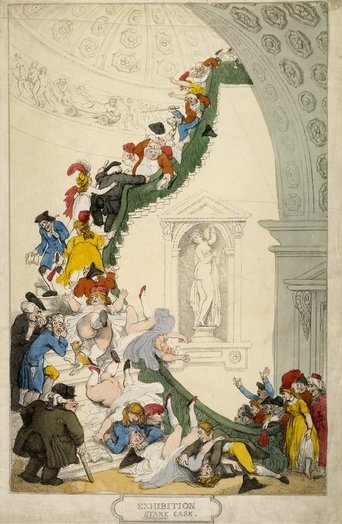
My Daily Art Display today features the caricature print entitled The Exhibition Stare Case, Somerset House which Thomas Rowlandson completed around 1800.  This print is based on a drawing which Rowlandson made earlier.   In his print he points fun at the people attending the art exhibition and the male penchant for caring more about the “living” pictures that provide additional, or even preferred, entertainment to the works on display at the Exhibition.  Look at the facial expression on the lecherous old men ogle the elegant ladies who have tumbled haplesslydown the staircase, limbs akimbo and tender parts exposed. It is interesting to note how Rowlandson has depicted the under-dress of the women.  He shows them wearing stockings but not much more beneath those gauzy muslins.  So are we to believe that females of that era wore few or no under-garments or is it Rowlandson’s way of adding a touch of erotica to his work.  

The setting for this work is the Royal Academy of Art, which was founded in 1768 and housed in Pall Mall, and then Old Somerset House before it moved to New Somerset House in 1780.  It remained there for almost ninety years when in 1868 it transferred to its present site, Burlington House, on Piccadilly.  The title of the work is a pun on the word stare (as in looking fixedly) and stair (part of a staircase) and the artist is poking fun at the people who have come to see the works exhibited at the Royal Academy exhibition.  In Rowlandson’s mind there were two kinds of viewers who came to Somerset House: those who wanted to see the paintings and sculptures, and those who came to ogle the ladies whose legs and ankles were exposed walking up those prominent stairs.  Of course with such lack of attention to what they are doing the inevitable accident happens as people trip over one another and fall down the stairs in a domino effect.  The print shows the large ornate staircase which leads to the Great Room at Somerset House.  This was a steep and winding staircase and at times when the Royal Academy was well attended it would have been difficult to negotiate a safe passage up and down it. 

In the alcove at the bottom of the staircase we have a statue of Venus.  This is a later print of Rowlandson’s work as in the original instead of the statue of Venus, there was just an urn.

Dian Kriz, the American art historian’s book “‘Stare Cases’: Engendering the Public’s Two Bodies at the Royal Academy of Arts.”  and in Art on the Line: The Royal Academy Exhibitions at Somerset House, 1780-1836 recounts a number of comments regarding the Exhibitions made in the reviews of the RA exhibitions at the time.  One commented on the exhibitions and the attendees describing it:

” …. as a place where art and female bodies vied for the male gaze…”

She quotes the Morning Post of May 3rd 1875 and its view on the visitors:

“…“there are two descriptions of persons who visit the Royal Academy some perambulate the rooms to view the heads others remain at the bottom of the stairs to contemplate the legs…”

Finally in the World, Fashionable Advertiser of May 8th 1787 it notes:

“….“Exhibitions are now the rage and though some may have more merit, yet certainly none has so much attraction as that at Somerset House; for, besides the exhibition of pictures living and inanimate, there is the raree-show [peep show] of neat ancles up the stair-case which is not less inviting…”

One can see that Rowlandson could well have got the idea for his caricature from these press releases.   What I love about this painting is that all the people are different.  They are all doing different things and it is a joy to scan each individual closely to see the facial expression and their role in the picture.  Look how absorbed they are in what is going on around them.  Note the lecherous looks on the faces of the old men as they gaze at the disheveled attire of the falling and fallen females.

When I was researching the works of Thomas Rowlandson I was astounded at the sexual nature of some of his caricatures.  I have talked on a number of occasions about the fine line in paintings between what is considered sensuous and what is considered erotic.  With some of Rowlandson’s caricatures there is a very fine line between what is erotic and what is pornographic.  I think that if ever there was an exhibition of his works the media would have a field day on discussing whether some of his works should be censored.  I will leave you to look at some of these works on the internet and decide for yourself.  Erotic/pornographic cartoons and caricatures of course are not just a thing of the past as in the present time we have the Japanese Hentai comics and Japanese Anime (animation).

Miss Murray by Sir Thomas Lawrence

Miss Murray by Sir Thomas Lawrence

My Daily Art Display looks at a work by one of the greatest English portrait painters.  His name was Thomas Lawrence, later to become Sir Thomas Lawrence.   He was born in Bristol in 1769.  His father, also called Thomas, was a supervisor of excise and his mother Lucy was the daughter of a clergyman.  His mother had an amazing number of children – sixteen in all, albeit only five survived infancy.  It was around the time that Thomas was born that his father decided to give up his government job and become an innkeeper.  The initial move into running an inn failed and when Thomas was four years of age his father moved the whole family to the Wiltshire market town of Devizes and tried again at being a successful landlord of an inn.  The inn named the Black Bear was on the main route between London and Bath and was ideally situated to catch the London gentry who were on route to Bath in order to take the healing waters.

The father’s business acumen was lacking and he soon ran into debt and it was left to young Thomas to help with the family finances by selling his pastel portraits.  When Thomas was ten, his father was declared bankrupt and the family moved to Bath.  There was now more pressure on the young boy to stabilise the family’s finances through the sale of his portraits.  He concentrated on oval portraits measuring 3ocms x 25cm and he was able to charge three guineas for each half length portrait.   In 1787 Thomas Lawrence moved to London and in a very short time established his reputation as a portrait painter in oils.   It was primarily the portraiture of Britain’s growing aristocracy which was in great demand and Lawrence was able to command high fees for his work and it was into this aristocratic world that Lawrence was accepted.      In 1790, he received his first royal commission when he was asked to paint a portrait of Queen Charlotte, the wife of King George III.  The following year, aged just twenty two, he became an associate of the Royal Academy and three years later a full member of that society.  In 1792, Sir Joshua Reynolds the great English portrait artist, friend and mentor to Thomas Lawrence, died and this opened royal doors for his protégé.  George III, who had been delighted with Lawrence’s portrait of his wife, Queen Charlotte, appointed Thomas Lawrence as the Principal Court painter. He retained that position under the monarchy of George IV.   Lawrence was knighted in 1815 and five years later became the President of the Royal Academy.

So business was good for Lawrence the sale of his portraits went well and he could command higher and higher fees for the commissions he received and so he was rich.   Well, in fact no, he wasn’t wealthy and on a number of occasions was nearly bankrupt and only staved off financial disaster with help from friends and patrons.  So where did all the money go?  Lawrence was bemused by his lack of money, commenting:

“…I have never been extravagant nor profligate in the use of money. Neither gaming, horses, curricles, expensive entertainments, nor secret sources of ruin from vulgar licentiousness have swept it from me…”

Many biographers have sought the reason for his financial mess and it is now generally accepted that Thomas Lawrence could not handle his finances, rarely kept accounts and he spent a lot of money building up a collection of Old Master drawings.  He was also very generous when it came to his family – probably too generous.

Apart from financial problems he was also very unlucky in love.  He had come in contact with the well-known London stage actress Sarah Siddons and he became entangled with her two daughters, Maria and Sally.  He fell in love first with Sally, then transferred his affections on to her sister Maria, then broke with Maria and turned back to Sally again. Both the sisters had fragile health; Maria died in 1798, on her deathbed extracting a promise from her sister never to marry Lawrence.  Sally kept her promise and refused to see Lawrence again, dying in 1803. But Lawrence continued on friendly terms with their mother and painted several portraits of her.   Lawrence never married.  Sir Thomas Lawrence died in 1830, aged 60 and was the most fashionable portrait painter in Europe

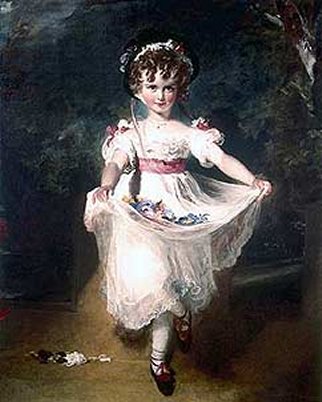
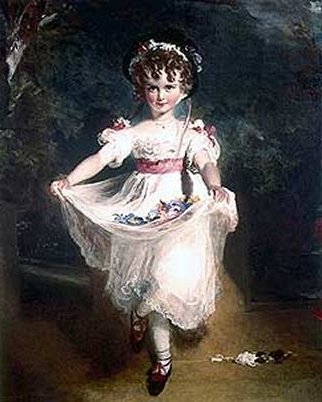
My Daily Art Display today is a delightful portrait which Sir Thomas Lawrence completed in 1826, entitled Miss Murray, which can be found at Kenwood House in London.  It is an unusual portrait considering the wealthy and famous people he had painted.  The painting was commissioned by Sir George Murray, the Scottish soldier and politician, who fought with General Wellington in the Peninsular Wars.  Louise Georgina Murray was his daughter and was also the goddaughter of the Duke of Wellington.  The young girl dances towards us beribboned and utterly bewitching.  She reminds me of the very young girls we see in present day American child beauty pageants, all dressed up adult-like, performing little dances for their doting audience.  She is just like Shirley Temple.   We seem to be looking up at her from below as if she is performing her dance on a stage and we are merely part of her audience.  Lawrence has undoubtedly captured the little girl’s beauty whilst she was still young.  Lawrence realised that his portrait had in some ways captured a certain moment in her life, a moment of child-like innocence and beauty which would undoubtedly change.  He commented on this very fact to her father, writing:

“…All I can do will be to snatch this fleeting beauty and expression so singular in the child before the change takes place that some few months may bring…”

How many times have we looked back on our children’s photographs when they were young and wondered how things change so much over time?  Lawrence and undoubtedly Sir George Murray knew that the sweet innocence of the child as she proudly shows off her dress and performs her dance would inevitably change.

So what of little Miss Murray, what became of her?    In 1843, aged twenty-one, she married Captain Henry George Boyce, a grandson of the 1st Duke of Marlborough who sadly died in Rome, five years after they were married.  Louisa Georgina Augusta Anne Murray remained a widow for forty three years, dying in 1891 in the Italian coastal town of Bordighera.

Mirror image ?

As I said at the start of this blog, the painting can be found in Kenwood House, London which I believe is near to Hampstead Heath.  I have never been there and thus have never stood in front of the painting but when I was researching the work I came across two “versions” of the painting, the one you see at the begining, with the girl looking slightly to her left and the sprig of flowers on the floor on the left side of the painting and the other picture of the painting (on the right) I came across in another art history book which had the girl turning slightly to her right and the flowers were on the floor to the right of the painting.  One book must have had a mirror-image of the real painting but which is correct?  Next time you visit the gallery please let me know !

Card Players in a Sunlit Room by Pieter de Hooch

Card Players in a Sunlit Room by Pieter de Hooch (1658)

Today My Daily Art Display returns to the Netherlands for its featured artist.  Today I am looking at a painting by the 17th century Dutch Golden Age artist Pieter de Hooch.   He was a contemporary of the great Jan Vermeer and there are some similarities between their works which we will look at later.

Pieter de Hooch was born in 1629 in Rotterdam, just three years before the birth of Vermeer.  He was the eldest of five children.  His father Hendricksz de Hooch was a bricklayer whilst his mother Annetge Pieters was a midwife.  Pieter studied art in Haarlem at the studio of Nicolaes Pieterszoon Berchem, the prolific Dutch Golden Age landscape painter.  His earliest employment was with Justus de la Grange a linen merchant and art collector where he acted as servant and general helper and it is thought that he paid for his board and lodgings by giving la Grange paintings some of his paintings, which was often the way aspiring artists managed to survive.  De Hooch went with la Grange on many of his business trips throughout Holland, including the town of Delft where he moved to temporarily in 1652, and on a more permanent basis in 1654 and 1655 during which time he joined the Guild of St Luke, the painters’ guild in Delft.

In 1654, whilst living in Delft, he married Jannetje van der Burch and the couple went on to have seven children.  In Delft he came under the influence of two of the town’s greatest painters, Carel Fabritius and Nicolaes Maes.  In the 1640’s, these two artists were originators  of the Delft School, a group of mid-17th century Dutch Golden Age painters named after its main base, the town of Delft.   It is best known for genre painting, such as images of domestic life, views of households, church interiors, courtyards, squares and the streets of the city.  The Delft School of painting in the 1650’s would number as its members the great Jan Vermeer and today’s featured artist.

Pieter de Hooch’s work at this time, both in style and subject matter, was in many ways similar to the paintings of Vermeer, who was still  living in Delft at that time.  De Hooch’s paintings, like Vermeer’s, were small works and though he sometimes painted open-air scenes and tavern genres he preferred painting two or three figures occupied with their normal daily duties and often shown in a sober interior interrupted only by the streaming in of radiant light from outside which, if by magic, transforms the scene.  At this time, the family unit was central to an increasing middle-class Dutch society, and de Hooch’s main characters in his works include friends, families and maids.  The world we see depicted in his paintings are glimpses of life seen unobtrusively through open doors and windows.  His works, which showed the simple life of the local inhabitants, were free of sentimentality and moralising.  Art historians believe that this period in Delft saw de Hoochcomplete his greatest works and that the artist was at this time at the height of his artistic powers.

In 1661, when Pieter de Hooch was thirty-two, he and his family moved on to Amsterdam.  De Hooch’s decision to leave Delft was undoubtedly brought on by the expectation of a larger market for his paintings in the flourishing and prosperous commercial centre of Amsterdam. It was here that he found a wealthier, more ambitious clientele, and the artwork they required was not of homely family scenes but paintings depicting extravagantly dressed people in contrived luxurious surroundings, such as country villas with palatial halls and their sumptuous marble interiors.  The patrons also wanted their paintings to be on a much large scale than he had tended to do in Delft.

In 1667 life took a turn for the worse for Pieter de Hooch.  His wife died leaving him, aged just 38, to bring up their large family.  Her death hit him hard and he struggled to cope with bringing up his young children.  Art critics believe that his struggle to survive affected his work.  His mental and physical health deteriorated and he died in 1684 in an Amsterdam mental asylum.  He was aged just 55.

The featured painting today is entitled Card Players in a Sunlit Room which he completed around 1658 whilst still living in Delft.  The finished work remained in Holland for almost one hundred and seventy years until it was bought by Lord Farnborough for King George IV of England in 1827.   It is now housed in the Royal Collection in London.  Before us we have two men and a woman sat at a table playing cards with another male onlooker standing besides the woman, pipe in hand, surveying the card game.  The mood of the painting is one of calmness.  There is an air of contemplation among the players.  This is not an animated scene, the participants are restrained.  The work is quite detailed in the way de Hooch has depicted the playing cards, the raised glass in the man’s hand and the broken pipe on the floor in the right foreground.  We fix our eyes on the fragments of the pipe on the floor and the five of spades playing card and cannot help but wonder why the artist has included them in the painting.  Was there some symbolism to its inclusion?  Should we look to interpret the existence of the abandoned pipe fragments and the single card on the floor or I wonder if the artist just wanted to get us to do what we are doing right now – trying to solve a mystery, when none exists!

One aspect of this painting which we have seen before in some of his other works is the setting of an inner room with an open door letting us see out into a much brighter exterior.  Observe the way de Hooch depicts the light flooding in from the sunlit courtyard in the middle ground of the painting, through the doorway into the interior, lighting up some parts of the room and some of the card players, whilst other parts are cast in shadow.    It is if de Hooch wants to showcase his skill in how he handles light as it falls over different surfaces.  Look how he has depicted the effect the sunlight has on the translucent curtains and the small panes of glass in the windows.  Again see how de Hooch has allowed the light streaming in through the door play on the card players, and by so doing, defining the form of their figures.

The paintings of Pieter de Hooch often exhibited a sophisticated and delicate treatment of light which was very similar to what we see in many of Jan Vermeer’s works, who as I said earlier, lived in Delft at the same time as de Hooch.  Art historians in the nineteenth century had originally assumed that Vermeer had been influenced by de Hooch’s work, but the opposite is now being seriously considered.

The Sorrows of Love by Louis-Léopold Boilly

The Sorrows of Love by Louis-Léopold Boilly (1790)

After three days of struggling with a small electronic notebook and the vagaries of foreign WiFi to publish my blogs I am back home to the comfort of my own PC and a fast WiFi.  In just over two months time we are off to Hong Kong and Australia for three weeks and I dare not think about how I am going to cope with trying to publish the blog but time will tell.

Today, My Daily Art Display is featuring a new painter to my blog.  He is the French portraitist and genre painter Louis-Léopold Boilly.  Boilly was born in La Bassée, a small town in the Nord department of Northern France, not far from Lille, in 1761.  He was brought up in a simple household, his father being a wood-carver.  He was a self-taught painter and started to turn out works when he was still only twelve years of age.  He showed some of his drawings and paintings to the local Augustinian friars and so impressed by them that in 1777, the bishop of Arras extended an invitation to Boilly to come and study in his bishopric.  The young Boilly painted prolifically producing more than three hundred small works of portraiture during that period.

In 1787 Boilly, now a much admired and renowned artist, moved to Paris but these were troubled times in the capital city with the start of the French Revolution.  His early works dwelt for the most part on amorous and moralizing subjects.   My Daily Art Display painting today entitled The Sorrows of Love, completed in 1790, is like many of his works of that period.    In the late 1790’s, after specializing in interior genre scenes, Boilly decided to switch to depictions of urban life and this gave us the chance, through his works, to witness life in Paris during that time.   Apart from the artistic merit of his compositions, he offers us a direct, candid view of Paris and the customs of its people.  His paintings were often awash with figures.  His paintings were often humorous and in a way displayed Boilly’s droll appreciation of Parisian urban life.

Throughout his career, Boilly was respected as a fine portraitist and received many commissions from the middle classes and the famous.   He had also made a name for himself as an artist who liked to paint somewhat titillating images, which were, at the time, very popular with patrons, who took their pleasures by enjoying the roguish side of life.  Boilly first encountered problems with his works in 1794, when one of his paintings, Lovers and the Escaped Bird,  was considered more than just erotic but that it was termed obscene by the Committee of Public Safety and that  the “crime” carried the penalty of a prison sentence as well as a very large fine.  He only escaped incarceration, when members of the Committee, on searching his studio, discovered more patriotic works, such as The Triumph of Marat, and that was enough to release the errant artist.  After this brush with officialdom, Boilly quickly toned-down his works.

In 1833 he was decorated as a chevalier of the nation’s highest order, the Legiond’Honneur.  Boilly died in Paris in 1845, aged 83 and his long life spanned the times when his country and his life was ruled by the royal monarchy of Louis XVI, the French Revolution, the Napoleonic Empire and the restoration of the Bourbon monarchy.

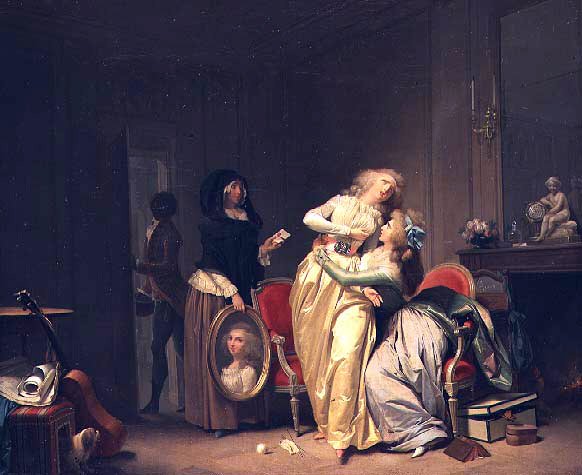
Today’s featured wok by Boilly is entitled The Sorrows of Love and in it we see a young lady being supported by her confidante.  She exhibits an exaggerated and shocked demeanour.  Her overstated affectation of grief reminds one of the demeanours of an actor hamming up a part in a play.  So what has brought on this distress expressed in the most dramatic way by the lady?  Look at the maid, wearing the black cowl.  In one hand she has an unopened letter which she offers the distraught woman.  It is not the content of the letter that is upsetting the lady as she recognises her own handwriting on the cover.  It is an unopened love letter being returned to her from her lover, who no longer reciprocates her love.  Not only is her love letter returned but in the maid’s right hand we can see that she is holding a head and shoulder portrait of the lady herself, which one presumes she gave to the man in her life, but tragically for her, this too is being returned as unwanted.   One must presume that the colour of the maid’s cowl is not just a coincidence and it is probably symbolic of the death of the love affair between her mistress and her lover.  The ending of the affair has occurred in a brutal fashion.  No letter of explanation, just a return of what is no longer wanted.

The Suitor’s Gift is in the same tradition of bourgeois genre scenes, which examine the many sides of love.  These works were greatly sought after by the public and collectors alike, and it seems probable, therefore, that the present work was completed to satisfy a taste for these subtle, yet highly charged scenes.  Before us we can witness Boilly’s skill at capturing the split-second of a seemingly every-day episode, whilst filling the scene with inner feeling, subtlety and mystery.

Self Portrait by Tommaso Minardi

Self Portrait by Tommaso Minardi (1807)

From a French Modernist painter I am moving to an Italian Romantic painter.  Today I am featuring Tommaso Minardi and looking at his painting entitled Self Portrait, which he painted in 1807.

Tommaso Minardi was born in Faenza in 1787, an Italian city some fifty kilometres south-east of Bologna.  As a teenager he studied art and design at a private school, as a pupil of Giuseppi Zauli.  Minardi was granted an annual stipend by Count Virgilio Cavina of Faenza and in addition, he received financial assistance in the form of a stipend, from the Congregazione di S Gregorio of Faenza.  Thanks to this five year stipend from his patron, Minardi, who was not yet sixteen years of age, moved to Rome to continue his artistic studies.  The terms of this five year grant were such that the young man had to send one completed work of art back to Faenza each year.   His paintings Socrates and Alcibiades and Supper at Emmaus were two of his works he sent back to his patron in Faenza.  At the age of twenty-three he entered a painting into an annual competition run by the Bologna Academy of Fine Arts and he won and his reward was financial stability for the next three years.

Whilst in Rome he studied art but was also employed by the painter and engraver Giuseppe Longhi, who was an exponent of Neoclassicism and for his employer he did reproduction drawings of Michelangelo’s Last Judgement in the Sistine Chapel.  

In his thirties Minardi began to teach art and in 1819 he was appointed director of the Academy of Fine Arts in Perugia.  Three years later he became professor of drawing at the Accademia di San Luca in Rome, a position he held for over thirty-five years.  Besides his own painting and teaching, Minardi began to take an interest in local politics and he spent much of his time working tirelessly for the protection and restoration of the capital city’s great heritage.  Tommaso Minari died in Rome in 1871, aged eighty-three.

My Daily Art Display’s featured painting today entitled Self Portrait depicts the artist himself, sitting on a matress which is on the floor.  He is wrapped in a coat in what looks like a very unassuming room.   The room we see him in is termed a mansard room but is known more commonly as an attic room with its sloping ceiling.  It is a typical student-type apartment at the top of a very large house.  On the back wall of the room we can just make out a painting and besides the bed is a bookcase crammed with books and papers.  More books and documents can be seen strewn on a desk to the right of the painting.  The room is lit up from two sources, light streaming in through windows on either side.  On a cabinet to the artist’s left is a human skull and on the floor in the left foreground there is skull of an animal.  What are we to make of this?  What was Minardi’s symbolic reasoning for including these two items?   Was the human skull to have the meaning related to Vanitas paintings, that human life passes quickly and we are but mere mortals, or is it just a  theatrical prop used by the artist to induce a feeling of melancholia into the work.  Are we meant to sympathise with this depiction of him, a poor, sad young art student in his small cramped abode, clutching a heavy coat around his body for warmth.  Is this a depiction of a poor young artist struggling for recognition, and desperate to attain financial security?  Remember Minardi was only twenty years old when he painted this work and had yet to become a successful artist.  So maybe this is how the artist viewed his current “lot in life” – life as a bohemian student in his dingy top floor attic room in the Eternal city.

I wonder whether this paining in any way inspired the French novelist and poet, Henri Murger, when he wrote a work published in 1851 entitled  Scènes de la vie de bohème and which was later used by the librettists Luigi Illica and Giuseppe Giacosa for Puccini’s 1896 opera La Bohème.  Was our struggling artist, Tommaso Minardi, in today’s painting the forerunner of the struggling painter Marcello, in La Bohème ?

I like the painting for its emotive qualities and I am heartened by the fact that Minardi did eventually make good and went on to live a prosperous life.

Interior at Nice by Henri Matisse

Interior at Nice by Henri Matisse (1920)

Yesterday I managed, with great difficulty to get away My Daily Art Display blog regarding Carl Philipp Fohr.  The difficulty was due to my present location, a hotel in Nice, where I am using their Wifi.   I was given the choice to let Internet provider, Orange, regulate the internet site so as to prevent me accessing “inappropriate material” or going for a “free –for-all”.   As an upstanding citizen, I chose the censored route but found myself barred from accessing my own site to publish a new blog.  I then had to re-think my strategy and agree to be open to all uncensored access in order to access my blog !!!!.  With my agreeing to a lack of censorship by Orange France I made it to my site but I am still wondering why my blog is grouped with the “XXX sites” – maybe the nude paintings has “done for me”!!!!

So by that introduction, you can gather I am not at home in North Wales enjoying this year’s summer with its torrential rain and gale force winds.  My wife Kathy had decided to desert me and go off to Tuscany with her friends who were all celebrating  60th birthdays and I was left all alone.    I had thought of remaining at home,  à la Cinderella and look after our Bed & Breakfast establishment but as I had a lull in bookings for three days, I decided to head off to one of my favourite destinations – Nice, in the south of France, for a few days of sun and good food.  Whilst I was here I thought I would look around some of the local art galleries.  I have been here numerous times but as you know, I am not a great Modern Art follower so I avoided their excellent Modern Art Gallery and instead I headed for the first time to the Henri Matisse Gallery at Cimiez, about five miles inland, and it was for that reason that I decided to make My Daily Art Display Today all about the great French Modernist painter, Henri Matisse.

Henri-Emile-Benoit Matisse was born in Le Cateau-Cambrésis, in France in 1869.  His early days were spent in Bohain-en-Vermandois , in Picardy, where his parents owned a florists.  At the age of eighteen he went to Paris to study law and after he had achieved his qualifications returned to his home town to work as a court administrator.  It was not until he was twenty years of age that he took up painting and that was when he was at home recovering from appendicitis and his mother gave him some artist’s materials so as to occupy his time whilst recuperating.  That small gift from his mother changed his life and much to the chagrin of his father, who wanted him to carry on in the legal profession, Matisse gave up law and went to Paris to study art at the Académie Julien where he studied under the great French painter William-Adolphe Bouguereau at the Académie Julian and later at the Académie des Beaux Arts under Gustave Moreau.  With his initial training he became competent in painting still-lifes and landscapes.   Matisse was influenced greatly by the French Masters, like Chardin, who was his favourite and the Rococo painters Poussin and Watteau as well as some of the new modern artists like Manet.

In 1896 and again in 1897, Matisse visited the painter John Peter Russell, an Australian Impressionist painter who had studied art in London and Paris, where one of his fellow students was Toulouse-Lautrec, and who had also become friends with both Monet and Vincent van Gogh.   Russell was an extremely wealthy man who, after his studies in Paris, moved to Brittany and settled at Belle-Île-en-Mer a small island off the coast where he established an artist’s colony.

Matisee fathered a daughter Margueritte with his lover and model, Caroline Joblau, in 1894.  Four years later he married, not to Caroline, but to Amelie Parayre who with Matisee brought up his daughter.  The couple went on to have two sons, Jean in 1899 and Pierre, born a year later.  Matisee and his bride honeymooned in London on the recommendation of the French Impressionist, Camille Pissaro and whilst there he combined his honeymoon with the chance to study the paintings of Turner.

In 1917, aged 48, Matisse came to Nice to recover from a bad bout of bronchitis.  He loved the town and said of it:

“….I decided never to leave Nice, and remained there nearly my entire existence…”

Of the town of Cimiez, where the Matisse Museum I visited is situated about five miles inland from the coast, Matisse said of it:

“…Most people come here for the light and the picturesque.  I am from Northern France;  what struck me were the great flashes of colour in January and the luminous daylight…”

Of the ambience of Nice and the pleasure it brought him, Matisse said:

“…When I realized I would see that light every morning I could not believe my happiness…”

Henri Matisse died in Nice in 1954, a month short of his eighty fifth birthday and was buried in the cemetery at Cimiez.   

The painting I have chosen was not at the Matisse Museum in Nice which I visited today but hangs in the Art Institute in Chicago and is entitled Interior at Nice, which he painted in 1920 and which I thought would be an appropriate choice as he, like me, loved the town.  Matisse used a very vertical canvas for this painting. He accentuated this with the window curtain coming from the very top of the canvas down to below the middle.  Matisse played with the perspective of the picture to give more excitement. We are looking down on the furniture in the foreground almost as if we were positioned high in the air.  The floor in this painting is almost a copy of the floor in his 1919 work “The Artist and his Model“, which hangs in the National Gallery of Canada in Ottawa.   Both are done in the same style and colour, but give a totally different feeling to each painting.  In today’s painting the warm floor serves as a  refuge against the dark cool of a winter’s evening outside.  In “The Artist and his Model“, the hue of the red floor is needed for added drama against all the other colours containing the same value and in some way heightened the feeling we got as we looked at the naked model posing for the artist.

So what was my impression of the Matisse Museum and the paintings and drawings which were being exhibited?  The obvious answer is that if you were a Matisse fan you would be pleased with what was on offer and how it was exhibited.  I went there with an open mind.  I went there determined to rid myself of any preconceived ideas as I had not been a lover of his work.  Over the years I have, when I see art that baffles me in its simplicity, educated myself to comment (just to myself) that “I don’t like it” and steer away from the crass comment “ a child of six could have done that”.  Maybe whether I liked what I saw can be answered by saying that as a hoarder of exhibition catalogues I left the museum without buying anything – please forgive me Henri !!!

Ideal Landscape near Rocca Canterana by Carl Philipp Fohr

Ideal Landscape near Rocca Canterana by Carl Philipp Fohr

My Daily Art Display today looks again at a German painter who was born at the end of the 18th century and is acknowledged as one of the most significant landscape painters of German Romanticism.  His name is Carl Philipp Fohr.

Fohr was born in Heidelberg in 1795.   His first art tuition was under the tutelage of Carl Rottmann, the genre and veduta painter, when he was aged thirteen.  It is said that when Fohr was fifteen years old the Darmstadt Court Councillor, Georg Wilhelm Issel, discovered him sketching at Stift Neuberg near Heidelberg and it was because of that and because Issel recognised the young man’s artistic potential, the following year Issel invited Fohr to come to Darmstadt and he provided him with both encouragement and financial support to continue with his artistic studies.   From 1813 Fohr received a number of commissions for paintings for the Grand Duchess Wilhelmina of Hesse, and it was for her that Fohr produced the Sketchbook of the Neckar Region, which consisted of a collection of watercolours of views and historical subjects of the region and a year later produced a similar sketchbook of the Baden area.  Such was the quality of his work that Fohr received an annual pension of 500 guilders from the Grand Princess. 

In 1815 Fohr became a student of landscape painting at the Kunstakademie in Munich, and it was here that his breakthrough into an independent and original drawing style came about.   He only remained at the Academy for a year as in 1816 he decided to embark on a walking adventure through Northern Italy which was to eventually take him to Rome.   It was whilst there that he came in contact with the group of artists, known as the Nazarene Brotherhood.  The brotherhood’s original members were six Vienna Academy students, four of whom, Friedrich Overbeck, Franz Pforr, Ludwig Vogel, and Johann Konrad Hottinger, moved to Rome in 1810, where they occupied the abandoned monastery of Sant’Isidoro.   Later they were joined by Peter von Cornelius, Wilhelm von Schadow, and others who at various times were associated with the movement.   The Nazarenes believed that all art should serve a moral or religious purpose; they admired painters of the late Middle Ages and early Renaissance and rejected most subsequent painting which were beloved by the European academies, believing that it abandoned religious ideals in favour of artistic virtuosity. They also thought that the mechanical routine of the academy system could be avoided by a return to the more intimate teaching situation of the medieval workshop.   For this reason, they worked and lived together in an almost monastic existence.    So where did the name, Nazarenes, come from?   Actually it was a derisory nickname they acquired because of their affectation of biblical style of hair and dress. The main aim of the Nazarenes was to revive the medieval art of fresco painting.   Fortune looked down favourably on the group as they received two important commissions to carry out the fresco decoration of the Casa Bartholdy in 1816 and a year later to carry out similar work in the Casino Massimo in Rome and their beautifully skilled work on the two projects brought their work to international attention.   However by the time the second project had been completed the Nazarene Brotherhood had all but disbanded.  The legacy of this group was that of honest expression of deeply felt ideals and it was to have an important influence on subsequent movements, particularly the English Pre-Raphaelites of the mid-19th century.

So where did Fohr go next for inspiration?   Sadly, Fohr’s life ended in tragic circumstances when in 1818, at the young age of twenty-three he drowned whilst swimming in the River Tiber.  Even sadder was the fact that his legacy to the world was only five oil paintings.

Today’s featured painting is The Ideal Landscape near Rocca Canterana and is one of Fohr’s best-known paintings, which he completed in 1818, the year of his death.   The painting shows a rocky pastoral landscape in the central mountains of Italy.  In the foreground, we can see a path which winds past craggy rocks and old, gnarled trees.   On this path we see a country girl dressed in some sort of festive costume.  In her arms she carries a young child, whilst hand in hand with another child, who is balancing a jug on her head.   If you look to the right middle-ground, under the trees, we can see a group of pilgrims who are heading towards a distant and illuminated valley.  The woman and children have just been passed by two shepherds who are heading for what Fohr has depicted as a peaceful, hilly region rimmed by steep mountains.

This painting is so like the old Arcadian landscape paintings of the past, which emerged in the Renaissance and which were inspirational to later artists who wanted to depict a “paradise on earth” theme to their works.  Fohr’ paradise on earth is emphasised by his inclusion of the pilgrims which alludes to the Christian Heaven.   The people in Fohr’s painting, who we see wandering around the landscape symbolise the journey we have to make on this earth before we die and  Fohr, in a way, is trying to remind us of the transience of all earthly things and the journey into the future, which some believe is the true goal and reason for human existence.

The picture in some ways is very simplistic but I hope you like it.