Girl with a White Dog by Lucian Freud

Girl with a White Dog by Lucian Freud (1950-51)

A few days ago I visited my two children in London and went on a few gallery visits.  I had managed to get tickets for my daughter and myself for the David Hockney Exhibition at the Royal Academy which was really a great experience and one which everybody should try and get to.  I will feature a painting from the exhibition later this week.  The other exhibition I had wanted to see and which had just opened was an exhibition of Lucian Freud’s Portraits which was being held at the National Portrait Gallery.  Unfortunately I could not get a ticket for the days I was in the capital so I have booked to go next month.  Today I am going to look at one of my favourite paintings of his entitled Girl with a White Dog, which he completed in 1951.  First let me tell you a little about Lucian’s early life and that of the sitter for this painting, his first wife, Kathleen Garman and look back on the famous, or maybe I should say, infamous Garman sisters.

Lucian Freud, who is the grandson of Sigmund Freud, the pioneer of psychoanalysis, was born in Berlin in 1922.  His father, Ernst Freud, an Austrian Jew, was an architect and his mother Lucie (née Brach) was the daughter of a grain merchant.  On the rise to power of Adolf Hitler in Germany in 1933, Lucian and his parents moved to Britain and lived in a house in St John’s Wood, London.  During his school years, he attended Dartington Hall Boarding School in Totnes Devon.    This was, at the time, an unusual seat of education.  It was a very progressive establishment in which there was a minimum of formal classroom activity and the children learnt by involvement in estate activities. From there he attended the Bryanston Independent School in Dorset.

In 1939 he became a British national and that year he enrolled at the Central School of Art and Design, which fifty years later would merge with the St Martins School of Art and become, as we know it today, the Central Saint Martins College of Arts and Design, which is widely regarded as one of the leading Art and Design institutions in the world.  His stay at the college was only brief as he moved on to the Cedric Morris’ East Anglican School of Painting and Drawing in Dedham.  This was a far more radical establishment which gave free rein to its students.  The school was destroyed by fire and a new location for the school was established in Benton End on the outskirts of Hadleigh in the county of Sussex.

Lucian Freud served as a merchant seaman in an Atlantic convoy in 1941 before being invalided out of service in 1942.  From 1942 to 1943 he attended Goldsmiths, University of London, an establishment which specialises in the arts, humanities and social sciences.  At the age of 24, Freud began his European travels, painting in France and Greece.  Some of his early work had already been published in the Horizon arts magazine and in 1944 the Alex Reid & Lefevre Gallery in London staged the first solo exhibition of his paintings.

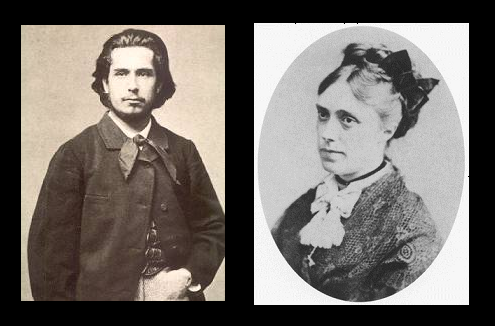
In 1948 Lucian married Kitty Garman, the subject of today’s featured painting.   Kitty was the second illegitimate child of the distinguished British sculptor, Jacob Epstein’s and his lover Kathleen Garman.  Jacob Epstein and his wife Margaret (née Dunlop) did not have any children of their own but they looked after a young girl, Peggy Jean, the product of Jacob Epstein’s earlier affair with Dorothy (Meum) Lindsell Stewart.  Margaret Epstein and the young girl lived across London with Jacob, while Kathleen Garman lived with her younger sister, Helen, in an unheated studio in Bloomsbury and her and Jacob’s infant son, Theo.    Margaret Epstein was aware of her husband’s affair with Kathleen Garman and despite her husband’s numerous previous affairs with women which never lasted, she felt threatened by Kathleen.  She realised that Kathleen was more than a lover, she was almost a  parallel wife. From the beginning, Mrs Epstein disliked her intensely, realising  that she would be her greatest rival.   It came to a head in 1923 when according to Cressida Connolly in her book The Rare and the Beautiful: The Lives of the Garmans:

“…Mrs Epstein took Kathleen into a room and locked the door before producing a pearl-handled pistol from under her capacious skirts… and shot her. The bullet hit Kathleen just to the right of her left shoulder blade, whereupon Mrs Epstein panicked and ran out of the room, leaving the bloodied Kathleen to stagger out into the street alone…”

Jacob Epstein visited Kathleen in hospital and paid her medical bills. The bullet wound to her shoulder left  a large scar and Kathleen Garman was never afterwards able to wear sleeve-less dresses. To protect the reputation of Jacob Epstein, Kathleen Garman refused to press charges against his wife.

Despite this incident and the pleadings of his wife, Epstein refused to give up Kathleen, who remained in her one-room London studio as Epstein’s lover and bore him three illegitimate children; a son, Theo, in 1924, and two daughters,  Kitty in 1926 and Esther in 1929.  Epstein had another affair with one of his students, Isabel Nicholas, and this resulted in the birth of a son Jackie in 1934.  Isabel gave up her son to the Epsteins and he was also looked after by Margaret Epstein.   Kathleen Garman never knew about Epstein’s parallel affair with Isabel or about the boy Jackie until several years later.

The cramped conditions of the studio Kathleen Garman was living in proved unsuitable for bringing up young children and Kitty was sent to live with her maternal grandmother, Margaret (née Magill), in Herefordshire.  Esther, the youngest daughter was later dispatched to a family friend.   Kitty Garman stayed on with her grandmother Margaret when the household moved to South Harting, Sussex, and only went back to live with her mother in London when she was in her late teens.  She then enrolled at the Central School of Arts and Crafts to study painting under Bernard Meninsky. According to Kitty, her mother was constantly critical of her artistic efforts. Kitty recalled her mother’s attitude:

 “…I think she wanted her daughters to excel, but she didn’t want us to succeed, because she had to be the queen.   I was frightened of her because of her temper and she did say searingly sarcastic things…”

In 1949, Epstein’s wife, Margaret fractured her skull in a fall on the steps of her home and died.  This allowed Kathleen Garman to move into Epstein’s home in Hyde Park Gate.

By the early 1950’s Kitty Garman’s marriage to Lucian was in trouble and it ended abruptly after the artist’s affair with the society girl and writer Lady Caroline Blackwood was exposed.        Kitty Garman’s marriage to Lucian Freud ended in divorce in 1952 and Lady Caroline Blackwood became his second wife in 1957.  Shortly after the ending of her marriage to Lucian, Kitty was at a party where she met Wynne Godley, and economist, whom she married in 1955.

Lucian Michael Freud died aged 89 on July 20th 2011.  His first wife and sitter for today’s painting, Kathleen (Kitty) Eleonara Wishart (née Godley, née Freud) died aged 74 on January 11th 2011.

Kitty Garman, a brunette, was by all accounts, hauntingly beautiful and the subject of many paintings.  My Daily Art Display featured painting today is entitled Girl with a White Dog which Lucian Freud commenced in 1950 and  completed in 1951.  When not lent out to external exhibitions this work of art resides at the Tate Britain Gallery, London.  This is the last of the series of portraits of his first wife, Kitty, which Freud had started at the end of the 1940’s.  Kitty had given birth to Lucian and her first child, Annie in 1948 and their second child Annabel was born in 1952, the year the painting was purchased by the Tate.

One can only marvel at the way Freud has handled the contrast of the fabrics and textures.  On the one hand we have the smooth white hairs of the dog and on the other hand we have the fuller texture of the yellow dressing gown, which contrasts also with the smoothness of the  striped silk bedspread on which she sits.    In the painting we see Kitty Garman sitting curled up on what looks like a low settee dressed in a dressing gown with its long plaited and tasselled tie.   Lying next to her, with its head in her lap, is one of a pair of white bull terriers the couple were given as a wedding present.  Look at the wonderful amount of detail Freud has put into his depiction of the dog.  He would often use animals in his compositions and often they would feature both pet and owner.

Kitty left hand hangs down and her fingers rest on the settee and on one of the fingers  we can see her wedding ring.   Her right hand is pressed against the bathrobe, cupping her left breast.  Her right arm is strategically placed under her right breast with her wrist adding to its uplift and fullness.  Her expression is difficult to translate.  She seems somewhat frightened and concerned about something.  Her eyes are large and staring.  In some ways we feel a little uncomfortable when we look at her.  Her brow is narrow which adds to her look of anxiety and sadness.  It could well be that Freud’s liaison with Caroline Blackwood at the time of this painting was taking a toll on Kitty.  Is her look one of calmness or one of desolation?  I will let you decide.

The Monk by George Inness

The Monk by George Inness (1873)

For my artist today I had decided to cross the Atlantic and look at the work of an American painter.   I have always liked the beautiful landscape works of the Hudson River School artists and so I dipped into my book, which featured these painters and came up with George Inness.  I particularly liked his superb and beautiful painting entitled Our Old Mill, which I had considered for today’s offering.  It was only when I was researching his life and his works of art that I came across a hauntingly beautiful work of his entitled The Monk.  It had little to do with the landscapes along the Hudson River but it was just too good to ignore.  So today my featured artist is an American who was famous for his American landscapes, but you will just have to forgive me for abandoning those works.  However I am sure that My Daily Art Display featured painting today will impress you.

George Inness was born in Newburgh, New York in 1825.  He came from a very large family being the fifth of thirteen children of John William Inness, a farmer, and Clarissa Baldwin.   In 1829 when George was just five years old the family moved to Newark, New Jersey.  Inness began his artistic education at the age of fourteen when he received tuition from an itinerant artist, John Jesse Barker.  Later he would work as a map engraver in New York and during the summer of 1843,  he studied under the French painter, who had recently arrived from France, Régis-François Gignoux.  From this he developed a great interest in art and enrolled at the National Academy of Design, where Gignoux taught, and the following year he exhibited his first work at the Academy.  This was to be the beginning of a great partnership between the artist and the Academy.

In 1848 he opened his first studio in New York and he received his first commission.  The following year he married Delia Miller but sadly she passed away a few months later.   In 1850, at the age of twenty-five Inness marries Elizabeth Abigail Hart and the couple go on to have six children.  The patronage of Ogden Haggerty allowed him to take a trip to Italy where he was able to paint and study the work of the great Italian masters.  Once there, he fell in love with the beautiful Italian landscape.  In all, he spent fifteen months in Rome and took the opportunity to study the works of the great landscape artists such as Claude Lorrain and Nicolas Poussin.  Whilst in Rome he rented a studio, which was in the same building as the American painter and portrait artist William Page who had arrived in the Italian capital two years earlier.

In 1853 Inness moved to Paris and began studying the work and technique of the French Barbizon landscape painters and soon Inness became the leading American exponent of the Barbizon-style of painting. His main influence was the work of The French painter, Pierre Étienne Théodore Rousseau, which totally captivated him. The Barbizon-style of painting, which uses loose brushwork and places an emphasis on mood, became part of the artist’s tools to create the luminous and atmospheric landscapes that eventually established Inness’ trademark.  A year after the couple settled in Paris, their son George Junior was born.  He would later become a leading landscape painter.

During the 1850’s, Inness received a lucrative commission from the Delaware, Lackawanna and Western Railroads.  The train operator wanted him to record and portray the progress of DLWRR’s growth in early Industrial America. George Inness and his family settled in the small town of Medfield, a suburb of Boston, where they remained for five years.  It was during this time that Inness completed what art critics believed were some of his best paintings.   In 1864, he was on the move once again.  The family moved to the town of Eagleswood in New Jersey where he taught art.   He made many trips to Europe, especially France and Italy where he lived between 1870 and 1874 before he returned to America and settled in Montclair, New Jersey.

In 1894 he and his family made a trip to Europe, visiting Paris, Munich and Baden-Baden before arriving in Scotland where on August 3rd he and his son visited the famous beauty spot of Bridge of Allan.  In Adrienne Baxter Bell’s biography of Inness entitled, George Inness and the Visionary Landscape she recounts the time as described by Inness’ son:

“…My father threw up his hands into the air and exclaimed ‘My God oh, how beautiful!’ fell to the ground and died minutes later….”

George Inness died aged 69.  His funeral was held at the National Academy of Design in New York City and he was buried in West Orange, New Jersey.

George Inness painted today’s featured work, entitled The Monk, in 1873.  Without doubt this can only be described as a haunting work and one of his best paintings.  The setting of the painting is thought to be a secluded corner of the Villa Barberini, which is near the pope’s summer residence of Castel Gandolfo and lies a little distance south of Rome.  Just to the right of centre in the foreground we see the small figure of a cowled monk, holding a staff, as he walks within the walled garden.  He is diminutive in comparison to the tall stone wall behind him and further back, the cluster of tall slender pine trees that we see in the middle distance.   Inness often painted just the odd figure in his landscapes.  In most cases they would be solitary figures with a degree of anonymity.  Look how Inness has portrayed the pine trees with their unusual shaped branches.  They stand out so well against the brilliant yellow-ochre sky.  The bright yellow light also filters between the slim branches which rise vertically to support the tree canopies.

I like this panting.  I like the evocative nature of the depiction of the lone monk.  I suppose it is his white cowl which gives the painting a ghostly feel. The painting can be found in the Addison Gallery of American Art, at the Phillips Academy, Andover, Massachusetts.  The Phillips Academy is unique among secondary schools in the United States in as much as it is home to two museums, each of which is dedicated to educating and enriching its student community while also serving as a resource to the general public.

Hush and Hushed by Frank Holl

Hush by Frank Holl (1877)

I get great pleasure in “discovering” new artists.  Today I am going to look at the life of an artist I had never previously heard of and maybe he is somebody that you have never come across before.  In My Daily Art Display today I am going to look at two paintings by the English Victorian social realist painter and portraitist Frank Holl, entitled Hush and Hushed.

Frank Montague Holl was born in Kentish Town, London in 1845.  His father, Francis, was a well-known engraver and Academician.  His grandfather, William Holl, was also an engraver.  He was brought up in a political household.  His family were staunch Socialists and from an early age Holl was taught that he had a duty in life to transform society and improve it for the common people.   He started his schooling at the Heath Mount School in Hampstead and at the age of fifteen he enrolled as a probationer at the Royal Academy Schools.  He proved to be an exceptional student but much to the dismay of his tutors, Holl liked to add a touch of political content to his works of art.  At the age of seventeen he won a silver medal for his work and the following year was awarded a gold medal and a travel scholarship for his painting entitled The Lord gave, and the Lord hath taken away.  It was a painting that depicted a family bereavement and when it was exhibited at the Royal Academy in 1869, the then monarch, Queen Victoria attempted to buy the painting it but the original purchaser refused to sell it.  Two years later Holl painted another painting on the same theme entitled No Tidings from the Sea and on this occasion Queen Victoria purchased it for a 100 guineas.   Holl set off on his travel scholarship to Italy but the journey lasted only two months, at which time he wrote to the Royal Academy saying that he wanted to return home and concentrate on his social realism paintings based on the lower working-class life in England.

Holl started exhibiting his work in 1864 when he was nineteen years of age and from 1869 onwards he was a regular contributor to the Academy Exhibitions. Many of these works were depicting the plight of the less fortunate and their pitiful existence, such as No Tidings from the Sea (1871) and Leaving Home (1873).  When he completed his studies in 1869 he was employed by William Luson Thomas, a successful artist, wood engraver and social reformer, who had just founded a new weekly illustrated newspaper, called The Graphic, and was looking for a number of talented artists to illustrate it.  For the following five years, Holl produced a series of pictures that were used to illustrate stories in the magazine. Among his fellow workers were Luke Fildes (see The Doctor – My Daily Art Display, May 17th 2011) and Hubert von Herkomer (see Hard Times, My Daily Art Display July 25th 2011), who like him believed passionately in the cause for political and social change.  Often they would turn the engravings, which they had fashioned for the pages of The Graphic, into oil paintings.  These depictions of the real life lead by the “under-class” of the nation lead them to become known as the Social Realist Movement.  Although we may look upon these depictions of poverty as a welcome wake-up call to the nation, they were badly received by the Victorian establishment at the time.  They viewed the works as being disloyal.  The establishment and many of the people who had never suffered poverty wanted to turn a blind-eye to the suffering of the less fortunate.  Their motto was “out of sight, out of mind” and frowned upon these upstart young artists who wanted to drag the social differences which existed into the public forum.

Samuel Cousins by Frank Holl (1879)

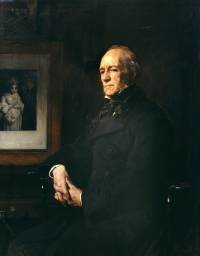
In 1879 Frank Holl had a breakthrough in his artistic career when he completed a portrait of his neighbor, the English mezzotint engraver, Samuel Cousins.  The critics loved it.  One wrote in a national newspaper:

“…Mr Frank Holl’s portrait of the renowned engraver Samuel Cousins R.A. is a superb work, glowing,  for all the austerity of its execution, with animation and intelligence…”

In another newspaper the art critic commented:

“…Mr Frank Holl’s half-length, seated of Mr Samuel Cousins, the engraver is one of the portraits of the year and does the young artist infinite credit…”

So was Samuel Cousins delighted with the finished work?  Actually, he wasn’t, saying, with an open show of vanity, that the painter had added to his years, and had made him appear too old.  However notwithstanding the sitter’s comments the painting lead to numerous lucrative commissions from wealthy patrons.  From that day on till the end of his life, Frank Holl never had to search out work, work searched him out.  His portraiture was mainly of men, often ones who were very famous such as Gladstone and Joseph Chamberlain.

In 1888 having sent a number of his paintings to the Royal Academy for their Summer Exhibition he travelled to Spain.  He had decided to spend a short period in Madrid and visit the Prado where he could study the works of the great Spanish master, Velasquez.  Shortly after returning home he suffered at heart attack and died suddenly on July 31st 1888, aged just 43.  His fame as an portrait artist lead to much work, in fact too much work, none of which he ever turned down.  Holl continually tried to find time to paint his social realist paintings as well as his lucrative portraiture work but to do this he found himself working every day of the week.  He once told his wife of the strain he was under, saying:

“…Hunger for work is always on me, and it is when I cannot satisfy this hunger that I get so worn out. If only I could banish my tormenting conscience for work; but that never lets me alone, and if I do nothing I feel of no use…”

After his death his daughter commented that her father continually suffered from the nervous strain of working with such distinguished men and that this strain, in her mind, contributed to her father’s premature death.

Hushed by Frank Holl (1877)

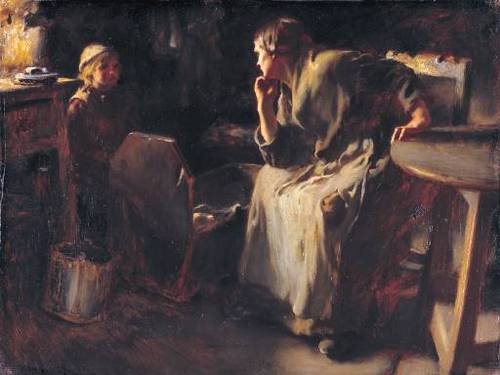
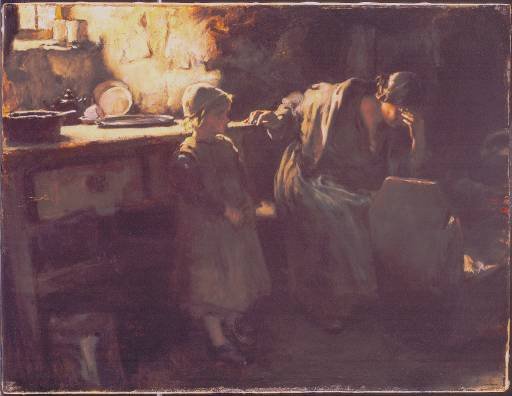
Today’s pair of paintings entitled Hush and Hushed were completed by Frank Holl in 1877 and are now housed in the Tate Britain Gallery in London.

The setting for the two paintings is a room in a small dwelling.  It is a solemn setting and the somber colours used by Holl enhance the bleak and depressing mood.  One can tell by the sparse decor and bare walls that the occupants have little money.  The lives of such people was a constant source for Holl’s artistic works.  In the first of these paintings entitled Hush, we see before us a mother tenderly bending over the cradle of her sick child.   There is a distinct look of concern and apprehension in her face.  Whilst she looks into the cradle,  she whispers to her other child, who stands close by, to be quiet so as not wake the infant who has finally gone to sleep.  The young boy looks equally anxious about the situation.   It is a typical homely scene and there is no hint of what is to follow in the companion work, Hushed.

This second work is a follow-up scene in the same room and this time we see the devastated mother gazing sorrowfully into the empty cradle where once the baby had been but had now sadly passed away.   We see the mother with her hand covering her face in a sign of grief.  Her other child leans against a cupboard with his hands clasped in front of him.   He looks at his grieving mother but has no idea what to do to console her.

These are extremely moving works of art and in a way Holl has handled them without resorting to sentimentality.  The paintings were meant for people to understand the problems faced by those who were imprisoned by poverty and suffered the fates that accompanied such financial destitution. Infant mortality was high in 19th century and it is estimated 1 in 5 children died before their fifth birthday. Infant mortality had always been high and much of it could be because of the lack of sanitation and general hygiene especially amongst the poor. However in those days, the well-off were not immune to such early deaths, as it was also a period when consumption and cholera accounted for many young deaths.

The Potato Eaters by Vincent van Gogh

The Potato Eaters by Vincent van Gogh (1885)

In past blogs I have featured Dutch and Flemish paintings depicting jolly peasants as they happily amuse themselves at work or at play.  I can think of many paintings by the likes of the Bruegels, Jan Steen and Adriaen van Ostade which gave us the rosy cheeks of the well-fed peasants and maybe we were lulled into the thought that a peasant’s life wasn’t too bad and maybe one which may have suited us.  Today I am going to feature a painting which looks at the reality of peasant life.  It is a fine example of naturalism in art, which was a type of art that depicts realistic objects and people in their natural settings.  In most cases, naturalism depicts characters in situations over which they have little or no control and where they appear to be at the mercy of powers outside themselves.  Artists who practiced naturalism in their art wanted to ensure that their depictions of life were done with absolute honesty.  Their artwork was to have almost photographic accuracy rather than simply an artist’s interpretation of what was before them.  Naturalist painters often concentrated on the life of the lower working classes and in many works of art we see that the people portrayed have little or no control of their destiny.

My painting today is not from an artist who is famous for his depiction of peasant life, nor is it an artist who is renowned for his somber-coloured works which categorises today’s featured work.  In fact, quite the contrary, today’s artist is known for his bright yellows and blues and the magical swirls of his brush-strokes, none of which can be seen in today’s painting.   Today’s artist is Vincent van Gogh and My Daily Art Display featured work today is entitled The Potato Eaters which he completed in 1885.  This painting by Van Gogh is now looked upon as his first masterpiece and it was his hope that it would establish his status as an artist.

One should remember that as far as art was concerned van Gogh was a late starter.  When he was young, like most children, he would enjoy drawing but he never seriously considered taking up painting as a career.  However, through some of his uncles who were art dealers, Vincent became immersed in the world of art.  However it was not until 1879, when he was almost twenty-seven years old, and living in the village of Cuesmes, in the coal mining district of the Borinage that he became progressively more interested in the people and scenes around him and began to create a pictorial record of his time there and it was around this time that his brother Theo’s encouraged him to take up art in earnest.

A peasant woman by van Gogh

Five years on, at the age of thirty-two, he painted today’s featured picture and this was at a time when he had only just mastered the art of painting.   It makes it all the more amazing that he would take on such a large project so early on in his artistic career.   Just remember what he had to achieve.  He had to paint five figures and make each one look natural and because he had decided the light source was to be central he had the difficult task of achieving the effect such light would have on the room and the figures.

Preliminary sketch for The Potato Eaters

As a prelude to this painting he made many studies of each of the peasants, some in charcoal, and others in oil.

The painting is naturalistic.  It depicts a truthful representation of the peasants and where they live.  It is both realistic and naturalistic.  The peasants are as they are.  This painting highlights the sad reality of a peasant existence.  There has been no exaggeration by the artist in the way he has painted them in order to gain certain effects although it is said that he carefully chose the people to model for his painting so as to illustrate them at their purest and most primitive, as representing the ancient, traditional values of rural life.  Of his choice of models, he wrote to his brother Theo:

“..I’ve tried to bring out the idea that these people eating potatoes by the light of their lamp have dug the earth with the self-same hands they are now putting into the dish, and it thus suggests manual labour and a meal honestly earned…”

The painting before us depicts a dark room which is only illuminated by the oil lamp which is hanging from the beams of the ceiling.   It is a very dark painting which has been achieved by the artist’s use of murky colours.   The ceiling is low and one imagines that it allows little headroom for the peasants.  It is a tiny space and van Gogh’s use of colour has highlighted its shabbiness.  The murkiness allows us to understand the oppressive nature of their life.     It is not hard to imagine the sort of life the peasants lead in these damp and clammy squalid surroundings.

The whole of the painting is monochromatic, in other words van Gogh has just used shades of a limited number of colours.  The colours he has used are mainly dark and dull such as black and brown and this adds to the morose and moody feel to the painting.   In contrast to the dark room the faces of the peasants sitting around the table are illuminated by the oil lamp and shine out brightly enabling us to explore their emotions.  There is symmetry about the way van Gogh has arranged the people around the table.  A man and a woman sit on either side of the table framing another man and woman who are seated behind the table

The faces of the peasants are sunburnt from the hours they have worked in the fields under the unforgiving sun during the summer months.  Five people sit around a square table eating potatoes; three are men, two are women.      We look at them eating baked potatoes from a potato tray as the woman on the far right of the painting is pouring a black liquid, maybe coffee, from a teapot into the cups on the table.   They are clothed in thick garments to keep the cold out, once the sun has gone down and the wind scurries across the low-lying fields.  Their heads are all covered with either caps or kerchiefs.

Look at the way van Gogh has depicted their facial features.  They have thick lips, protruding cheekbones and low, flat foreheads. Their mouths and cheekbones look almost larger than life.   The male and the female on the left of the painting have bulging eyes and this gives them a look of people lacking intelligence.  Their eyes, in some way, are blank and unseeing and it is difficult to imagine what is going on in their minds.  Look at their faces.  How would you describe their expressions?  To me they are solemn expressions.  The people do not exude an air of happiness or contentment.  Their facial expressions look almost as if they are very wary of each other.  There does not seem to be a close and loving connection between those who are sharing a meal.  There is no sense of communication between the diners.  They are wide-eyed and their thoughts seem to be in a place far from the dingy room.

When we look at this painting we are not seeing the fat ruddy faced peasants of the Bruegels.  These are not the jolly peasants we are used to seeing in paintings such as The Peasant Dance by Pieter Brueghel the Elder (My Daily Art Display, March 27th 2011).  Look carefully at the physical characteristics of the people we see before us.  They have protruding features.  Observe the way Van Gogh has clearly depicted their hands and fingers.  They are gnarled and wizened.  These are coarse working hands and these very fingers will have scratched and dug at the soil to free-up the potatoes they now hold and eat.  This is naturalism at its best.  In this painting, Van Gogh has cleverly and effectively portrayed the poor and harsh lives the peasants had to endure.  Van Gogh defended the way in which he depicted the peasants saying:

“…..if people prefer to see them with a sugar coating, let them. I personally believe that it is better in the long run to paint them vulgar as they are than to give them a conventional charm…”

The artist again defended his depiction of the people in the painting saying that it was a “real peasant painting” and in a letter to his brother Theo, he wrote:

“…I wanted to convey the idea that the people eating potatoes by the light of an oil lamp used the same hands with which they take food from the plate to work the land that they have toiled with their hands – that they have earned their food by honest means. One sees a kind of wild animal, male and female, all over the countryside, black, drab and scorched by the sun, bound to the soil which they dig and work with obstinate resolve; they speak with a single voice, and when they rise to their feet they reveal human faces, and they are indeed human. At night they retreat into caves where they live on black bread, water and roots; they spare others the effort of sowing, tilling and harvesting in order to live, and should therefore not want of the bread they have sown…”

To my mind although this may not be considered as a loving portrayal of peasants, it is probably a true one.  Gone are the smiling ruddy faced people one saw in many of the 16th and 17th century Dutch genre scenes.  There is nothing in this painting to suggest there is much fun in the life of these peasant workers.  A contemporary of van Gogh was the French painter Jean-François Millet, who was one of the founders of the Barbizon School in rural France and he was noted for his scenes of peasant farmers and was part of the naturalism and realism movements in France.  Millet had studied the peasant classes and would often depict them as coarse-looking, uncultivated people who led a feral existence.

Van Gogh defended his portrayal of the peasants insisting that he had never intended to malign them. As far as he was concerned he was simply painting them as typical of country people but maybe this notion should be questioned as a friend of van Gogh asserted that when the artist came to choose his models, he made a point of selecting ‘the ugliest of them’.

Vincent sent the painting to his brother to be exhibited at the Salon but Theo never did put it forward to the Salon juries, nor did he show it to the very influential art dealer of the time, Paul Durand-Rule, as Vincent had hoped.  Later Vincent sent a lithographic version of the painting to his good and close friend, the aristocratic artist, Anthon van Rappard.    Vincent was horrified and angered when he received a letter back from van Rappard, in which he declared the painting “a violence to nature”.  Those harsh words were to end their five year friendship and van Gogh and van Rappard never spoke to each other again.

The Potato Eaters now hangs in the Van Gogh Museum in Amsterdam.

Home from the Sea by Arthur Hughes

Home from the Sea by Arthur Hughes (1862)

For my work of art today, I am crossing the Channel from France and featuring an English Victorian artist who was associated with the Pre-Raphaelite Brotherhood.  His name is Arthur Hughes and he was born in London in 1832, the son of Edward and Amy Hughes.  When he was six years of age he attended the Archbishop Tenison’s Grammar School and it was here that he showed the first signs of his artistic talent.  In 1846, aged fourteen he enrolled in the School of Design at Somerset House where he studied under Alfred Stevens.  From there he enrolled in the Antique Schools at the Royal Academy and whilst a student there won a silver medal for a “Drawing from an Antique” competition.  In 1850 he exhibited his first work entitled Musidora, at the Royal Academy.  It was also in this year that he first encountered Alexander Munro, Ford Madox Brown and Dante Rossetti, all artists of the Pre-Raphaelite Brotherhood.  Hughes was soon converted to Pre-Raphaelitism adopting many of their ideas in his own work.  Hughes was also greatly influenced by the works of John Everett Millais although he never met him until two years later, in 1852, when they were both exhibiting paintings at the Academy with the same title, Ophelia !  The year 1850 was to prove a very significant year for Arthur Hughes for another reason – he met and fell in love with a woman, Tryphena Foord and eventually in 1855 they married.  It was a very long courtship period of over five years between their first meeting to their nuptials.  During this time Hughes completed many paintings which were both romantic but wistful, both sad but tender and the tone of these works could well have been as a result of his long wait to get married.  Tryphena was the model for many of his  paintings.  The couple had a long and happy life together and went on to have six children, two of whom are present in today’s featured work.  Many of his pictures were of ordinary scenes of life. They were painted with great delicacy and feeling and were often in greens and mauves.

In 1857 he joined in on a joint commission with Edward Burne-Jones, Rossetti, William Morris and others to paint murals on the walls of the Oxford Union Debating Hall which is now the Library.  It was this commission that influenced much of Hughes’ later works and can be seen by the way he softened his colours and added a mystical overtone similar to that seen in the works of Dante Rossetti.   Many of his subsequent works featured Arthurian legends and religious themes.  Besides his time spent on his paintings he also worked on book illustrations for many writers and poets including Keats, Tennyson, Christina Rossetti and Thomas Hughes whose  famous book was Tom Brown’s School Days.  Arthur Hughes was one of the leading illustrators of his time.  He also worked as an art examiner in London and later taught art at the Working Men’s College

He died in London in December 1915, almost a recluse.  During his lifetime he produced over seven hundred paintings and drawings and almost eight hundred book illustrations.  Friends of his would tell you that his main attributes were his modesty and self-effacement.  Like all of us, he had many disappointing times during his life.  He suffered a number of ill-merited rejections at the Royal Academy and despite all his artistic accomplishments, he was disappointed to never having been elected an Associate of the Royal Academy.  He is now regarded as being the best of the younger Pre-Raphaelite followers.

Study for A Mother's Grave by Arthur Hughes

My featured painting today is a very poignant one and is entitled Home from the Sea which he finally completed in 1862 and exhibited at the Academy the following year.  He actually started it six years earlier and the original title of the painting when first exhibited in 1857 was  A Mother’s Grave.   It is known, because of the existence of a study for the original work,  that in the original painting there was just the figure of the boy kneeling over his mother’s grave.   However, there was much criticism over the way Hughes had painted the boy and so he re-worked the painting, adding the figure of the girl.

The painting is set in the graveyard of the Old Chingford Church, Essex.  In the background we see the white walls of the church reflecting the brightness of the sun.  It is not however the church that our eyes immediately focus on but the figures in the foreground which are in shadow.  Before us we have a young sailor boy who has just returned home from a voyage at sea only to find out that his mother has died whilst he was away.  His hat and belongings, wrapped in a knapsack lie abandoned on the ground.  Kneeling besides him we see a girl, possibly his sister, also mourning the death of their mother.

The depiction of the girl was posed for by his daughter Tryphena.   She wears a  black funerary outfit.  Her facial expression is one of pain over her loss.  She kneels on the ground with her hands folded in front of her.  Her eyes are downcast and in some ways her mourning is both constrained  and controlled, possibly because she did not want to further add to the sadness of the boy who has prostrated himself on the ground.

We cannot see the facial expression of the young sailor boy who is still in his uniform. However, we see his hands are clasped in prayer as he prays for the soul of his mother.  This is not just a story of a boy’s loss of a parent but there are things in the painting which symbolise the transience of life and all things ephemeral, like the dog roses and the dandelion seeds as well as the spiders web which is wet with dew, and which can be seen in the tree branches above the girl’s head.  The sense of loss is also highlighted again by Hughes for if we look towards the church in the background we see a ewe searching desperately for her lamb which is hidden from her view by a tombstone.

The painting was exhibited at the Royal Academy in 1863 with the present title of Home from the Sea.  One cannot but be moved by this churchyard scene full of pathos as we empathize with the children’s suffering at their loss.

The painting itself, as well as the preliminary study, can be found at the Ashmolean Museum, Oxford.

Un atelier aux Batignolles (A Studio at Les Batignolles) by Henri Fantin-Latour

Un atelier aux Batignolles (A Studio at Les Batignolles)

Today I am looking at a work of art by the French painter, Henri Fantin-Latour, or to give him his full name, Ignace-Henri-Jean-Théodore Fantin-Latour.  The family was of Italian ancestry and the “Fantin” part of the name came from the fact that some of the ancestors hailed from the southern Italian town of San-Fantino.  In the 17th century, a Jean Fantin added “Latour” to the name of Fantin.

Henri was born in Grenoble in 1836.  His father, Theodore Fantin-Latour, originally from Metz, was a society portraitist painter.   In 1841 the family moved to Paris.  Having shown a liking for drawing at an early age, he received his initial artistic training from his father.  Then at the age of fourteen, he enrolled on a three-year course at the École de Dessin of the French artist and drawing instructor, Lecoq de Boisbaudran.  Following this, he spent a short time at the École des Beaux-Arts in Paris.  During his art student days he spent most of his time at the Louvre copying the painting of the old Masters as well as making many visits to the Musée de Luxembourg to study and copy the works of Eugene Delacroix.  In 1861, after he graduated from the art schools he worked for a time at the atelier of Gustave Courbet and supported himself by earning money as a copyist.

During his time copying paintings at the Louvre he came across and became friends with a number of the future Impressionists, such as Edgar Degas, Édouard Manet and Berthe Morisot.   In 1858, he struck up a special friendship with the American-born artist James Whistler and along with French-born English painter Alphonse Legros he founded the art group known as the Société des Trois.   Whistler, who had moved to London, invited Henri over for a visit which he accepted and through the good auspices of his two friends Whistler and Legros he was introduced to the art world of London.  This was the first of many trips to London made by Fantin-Latour.  One very important introduction whilst there was to Edwin Edwards, who had trained as a lawyer but also practiced as an artist and etcher.  He acted as Henri Fantin-Latour’s agent in England and found him many buyers for his floral paintings as well as a number of patrons.

Henri Fantin-Latour had started painting a number of works of art featuring floral still-lifes and these were well received in London although strangely enough never popular in France during his lifetime.  Henri Fantin-Latour exhibited a number of his works at the Paris Salon in 1861 and 1862  and later in 1863, at the Salon des Refusés, and  he exhibited regularly at the London Royal Academy.  Although he had been close friends to a number of the Impressionists, he never put up any of his paintings for their eight Impressionist Exhibitions.  The reason for that decision was probably due to the fact that although he counted them as friends, he disagreed with their artistic theories and philosophy.  His artistic style was more conservative.

Henri-Fantin Latour will always be remembered for his luxurious floral paintings but he was an artist who painted many group portraits and it through these works that we get an insight into the friendship between the now-famous artists, poets, musicians and writers of that era.  During his time as an artist he also completed no fewer than twenty three self-portraits.

In 1875, aged thirty nine, Henri Fantin-Latour married a fellow painter, Victoria Dubourg and the couple spent their summers at the country estate of his in-laws at Buré.  In 1879 Henri Fantin-Latour was awarded the Legion d’Honneur medal.  Henri Fantin Latour died in 1904, aged 68 and was buried in the Cimetière du Montparnasse in Paris.

The painting I am featuring today was not one of Fantin-Latour’s beautiful floral works of art but instead I am going to look at one of his group portraits. It is very like a painting I featured in My Daily Art Display on November 10th 2011 entitled Bazille’s Studio; rue de la Condamine by Frédéric Bazille, who also actually appears in today’s painting.

My painting today is entitled Un atelier aux Batignolles (A Studio at Les Batignolles) and he completed it in 1870.  Batignolles is part of the 17th arondissement of the city of Paris.  At the time of Fantin-Latour, this was a cultural hive of activity and served as a base for young painters such as Édouard Manet and many of his artist friends who, because of the locality, became known as Le groupe des Batignolles.  The painting today is a kind of “who’s who” of that group.   It is more than just that.  In some ways it is Henri Fantin-Latour paying homage to his friend Manet.

We are in the atelier of Édouard Manet and we see him sitting at his easel. He concentrates on the man sitting in the other chair, the subject of his painting, Zacharie Astruc.  Astruc was a painter, poet, sculptor and art critic who had rallied to support the likes of Courbet and Manet and the Impressionist group of painters when they were constantly being criticized.   Standing around and watching the artist at work are some of his friends.  At the far left of the painting, seen standing directly behind Manet is the German painter Otto Schölderer.  Next to him, wearing a hat, is Auguste Renoir.  Further to the right of the painting and almost in the background, are Emile Zola, the writer who also championed the cause of the Impressionists in their struggle with the Salon and its condemnation of this new grouping of artists, Edmond Maître another supporter of the Impressionist painters and who was, at the time, a civil servant at the town hall.  Almost hidden in the corner of the painting is Claude Monet.   Standing tall and upright behind the chair with a full beard is the twenty-six year old, Frédéric Bazille, who two months after this painting was completed was killed in the Franco-Prussian War.  There is a  formal air to this group portrait.  The men are all dressed in somber dark suits and their expressions are serious and unsmiling.   All these young artists had suffered at the hands of the art critics of the day.  They and their paintings were accused as being frivolous and contrary to what the art establishment was used to.  It is possibly for that reason that Henri Fantin-Latour decided to depict the gathering so formally and with an air of respectability.  Could this desire to show how these young artists had not completely put the antique traditions of the Academics of the Salon behind them be the reason why the artist has included a statuette of Minerva on the table at the left of the painting?  In my last blog regarding Monet and Camille Doncieux I mentioned that all things Japanese were the rage in Paris and France in the late nineteenth century.  Look how Fantin-Latour has positioned a Japanese stoneware vase next top Minerva in the painting.

This work by Henri Fantin-Latour is almost a historical painting.  It records for us a time in history when these characters were leaving their mark.  Each one of them is posing for posterity.  Zola once wrote about the struggle these artists had to endure and the way in which Édouard Manet tried to rally them when they became dispirited.  He wrote:
“…Around the painter so disparaged by the public has grown up a common front of painters and writers who claim him as a master…”

Henri Fantin-Latour put forward the painting to be exhibited at the 1870 Salon  The painting was accepted and he was awarded a  medal by the salon for this work of art.  In spite of his close relationship with the Impressionist painters he never followed their artistic techniques.  He remained a traditionalist and remained faithful to that traditional technique. In the latter part of his career he painted less and concentrated on lithography.

Did you wonder whether Manet was actually painting a picture of Zacharie Astruc as depicted in today’s featured work?  Who knows, but coincidentally, Manet did complete a portrait of Astruc four years earlier in 1866, which now hangs at the Kunsthalle in Bremen………………….

Portrait of Zacharie Astruc by Manet (1866)

Camille Doncieux and Claude Monet (Part 2)

Claude Monet and Camille Doncieux

In my last blog I looked at the first meeting of Camille Doncieux and Monet.  It occurred in 1865 when Frédéric Bazille, a good friend of the twenty-five year old Monet, introduced him to Camille Doncieux who was still in her teens.  Camille, who was of humble origins, worked as an artist’s model.  Monet soon made her his number one model and shortly afterwards the two became lovers. The couple, because of the poor sales of Monet’s works of art, lived in depressing poverty.   Today I complete the story of Camille and Monet and look at a few more paintings the artist completed depicting Camille.

From the 1860’s till the end of that century, France was in love with all things Japanese.  This Japonisme as it was called had inspired both artists and the public.  Monet was not immune from this trend which swept his country.  Besides his art, he had two other hobbies.  He loved gardening and he loved to collect Japanese art, especially the Japanese woodblock prints.   In all he had built up a collection of over two hundred of these.  He had also accumulated a number of Japanese fans, kimonos and screens, some of which can still be seen at his house in Giverny.

 The most palpable and undeniable proof of Monet being influenced by the art and culture of Japan is his oil on canvas painting, Madame Monet en Costume Japonais (La Japonaise), which he completed in 1875 and which currently hangs in the Boston Museum of Fine Arts. This work was in complete contrast to his earlier works.   Large-scale figure paintings had usually been looked upon as a major challenge for an artist.  Camille is depicted dressed in an elaborate kimono, holding a Japanese fan in her hand.   It is interesting to note that Camille is wearing a blond wig so as to emphasize her Western identity. Her kimono is sumptuously embroidered and the background is adorned with numerous Japanese fans. These accoutrements could, at the time, be bought for a few centimes in many of the Parisian shops and even the larger department stores had exclusive sections for all things Japanese.

In the painting Camille’s pose is of a conventional style and it is believed that Monet did this so as to enhance the chance of selling the work.   Because of this, there is a somewhat loss of spontaneity about it.  The scene looks very contrived.   However the brilliance of the colours he used is breathtaking.   Monet exhibited this work at the Second Impressionist Exhibition in 1876, where it attracted much attention.  Maybe Monet was saddened and felt somewhat guilty by the compromise he had made with this work solely to make it more attractive to potential buyers.  He later described it as “trash” and “a concession to the popular taste of its time”.

On June 28th 1870, Camille and Claude were married in a civil ceremony performed at the town hall of the eighth arrondissement of Paris. The French painter Gustave Courbet was one of the witnesses. Although Camille’s parents were present at the ceremony, Monet’s family were horrified by their son’s choice of partner and would not accept Camille Doncieux as their daughter in law, nor would they acknowledge their grandchild, Jean-Armand-Claude who had been born in August 1867.   Monet’s parents even tried to bribe their son into leaving his wife with the threat of their allowance to him being stopped if he continued the liaison.  However Monet chose his wife over money and refused to abandon Camille and Jean.   As a result, his allowance was cut off and his financial situation worsened and the three of them suffered extreme financial hardship, sometimes unable to afford food and often unable to afford paint.   He carried this burden for many years, and struggled greatly with poverty and the stress caused by Camille’s poor health, and his inability to pay for her medical care.   After the wedding and just before the start of the Franco-Prussian War the family travelled to London and Zaandam before returning to France and setting up home in Argenteuil, a town to the west of Paris.

Camille Holding a Posy of Violets by Monet 1877

In 1876, Camille Monet fell ill with what is believed to have been the beginnings of cervical cancer.   In Monet’s 1877 painting Camille Holding a Posy of Violets, which he completed that year, one can see the toll the disease has had on her health. Her face looks pale and haggard.  She looks tired and older. It was around this time that Monet received a commission from a patron Ernest Hoschedé and for a short time his finances took a turn for the better.  However in 1877 all this changed when Hoschedé went bankrupt and his art collection was auctioned off. This was a blow to the Impressionists, whom Hoschedé had supported,  and especially Monet.   The bankrupted Hoschedé and his family moved to a house in Vétheuil with Monet, Camille and Jean. However Ernest Hoschedé spent most of his time in Paris before fleeing to Belgium to avoid his creditors.   There soon followed speculation that Monet may have been carrying on an affair with Alice Hoschedé.    Some art historians have translated the look on Camille’s face in this painting as one of disgust with her husband and his liaison with Alice Hoschedé.  This was the last painting Monet did of Camille whilst she was alive.

Camille on her Deathbed by Monet (1879)

On March 17th 1878, Camille gave birth to her second son, Michel.  The birth of Michel further weakened Camille.   Over the next twelve months Camille’s health deteriorated and on August 31 1879, a priest was called to the house to administer the last rites and to sanction her marriage to Monet, although they had been married in a civil ceremony nine years earlier.   Camille’s death on September 5th 1879 devastated Monet. She was just thirty-two years of age.   Monet painted a picture of his wife on her death bed and the work can be seen at the Musée d’Orsay.  Monet remembered the time well writing to a friend telling him of his urge to paint that last portrait of Camille:

“…I caught myself watching her tragic forehead, almost mechanically observing the sequence of changing colours that death was imposing on her rigid face. Blue, yellow, grey and so on… my reflexes compelled me to take unconscious action in spite of myself…”

Monet included lots of blue and gray in this painting, as well as yellow,orange and red and in some people’s opinion the use of these colours made the painting too light. Light, coming from the right hand side, shines on the face of his deceased wife.   We do not get a very clear view of Camille although we can just make out her face and that she is wearing a shroud.

After Camille Monet’s death in 1879, Monet and Alice along with the children from the two respective families continued living together at Poissy and later Giverny. Ernest Hoschedé died in 1891, and, in 1892, Alice and Claude Monet were married.   Little is known about Camille Doncieux Monet mainly because Monet’s alleged mistress and second wife, Alice Hoschedé, was so jealous of Camille that she demanded that all photographs, mementos and letters between Monet and Camille were destroyed.  She was determined that Camille’s very existence was denied.

Why did she hate Camille so much?    Maybe she realised that Camille Doncieux was the one and only true love of Claude Monet.

Claude and Camille by Stephanie Cowell

If you would like to read a fictional account of the relationship between Camille Doncieux and Claude Monet then I suggest you read:

Claude and Camille: A novel on Monet by Stephanie Cowell

Camille Doncieux and Claude Monet

My next two blogs deal not with a particular painting but with the subject of a series of paintings completed lovingly by one artist.  The subject is Camille-Léonie Doncieux, who was the beloved model, mistress and wife of Claude Monet.  In 1861, Monet had enlisted as a soldier in the Chasseurs d’Afrique regiment and spent two years in Algeria.  His military life came to an end in 1863 because he had fallen ill with fever.  He went back to Paris where he studied at the atelier of the Swiss artist Charles Gleyre and it was during this time that he met up with the artists Sisley, Bazille and Renoir, who would later join together with others and become known as the Impressionists..

Camille Doncieux was born in 1846 and met the impoverished but talented painter, Claude Monet, for the first time in 1865 when she was just eighteen years of age.  She came from an ordinary unprivileged background.  She fell in love with him, leaving her home to live with the talented 25-year-old painter who struggled to sell his work. People called her La Monette.  Everyone she met fell under her spell.   It was recorded that she was a ravishingly good-looking girl with dark hair, very graceful, full of charm and kindness.  Monet, her future husband, was struck by her beauty and described her eyes as being wonderful.    It was not long after they met that she began modeling for him and soon became his favourite model.  His professional interest in her soon became personal and the two soon became lovers.   The first time we come across Camille in a painting by Monet was in a study for his ill-fated work Déjeuner sur l’Herbe.

Study for Le Déjeuner sur l'Herbe (1865/6)

In 1863, Édouard Manet had exhibited his painting Déjeuner sur l’Herbe at the Salon des Refusés (see My Daily Art Display, December 23rd 2010).   The critics and public were shocked by the work and Manet’s depiction of a nude woman seated with a pair of clothed men in a landscape setting.    Monet, who was known for his competitive streak decided to paint his own version of Déjeuner sur l’Herbe in the spring of 1865. This audacious venture would culminate in putting it forward for an exhibition at the Salon of 1866.  Following outdoor studies he made in the Forest of Fontainebleau, he immediately headed back to his nearby studio at Chaillyen-Bière and started to make preparatory sketches for what would be his mammoth canvas measuring an unbelievable 4.5 metres x 6 metres.  In one of his preparatory sketches, which he did in oil entitled Bazille and Camille (study for Déjeuner sur l’Herbe) we see Camille Doncieux and Monet’s fellow artist friend Frédéric Bazille.   Ultimately the painting was not a success. Monet was unable to finish it in time for the 1866 Salon and eventually abandoned the work. He left it, rolled up, with his landlord as part payment for rent he owed but it became damp and all that now remains are fragments of the work and some preparatory studies. The experience did, however, contribute to Monet’s realisation that to portray the brief moment in time, he would have to work on a much smaller scale.

La Femme à la Robe Verte by Monet (1866)

The next time we see Camille is in a painting Monet exhibited in the 1866 Salon.  The work was entitled Camille or Woman in a Green Dress and now hangs in the Kunsthalle, in Bremen.  After his disastrous attempt to emulate Manet with his painting of Déjeuner sur l’Herbe this work of his gained him critical acclaim.  Rumour had it that in his rush to meet the Salon deadline he completed the work in four days but one must doubt that assertion.  It is not strictly a portrait of Camille.  It is all about the dress.  She was simply his model for the painting.  The first thing which strikes one as we look at the work is the colour of the promenade dress which had probably been borrowed for the occasion.  Monet loved colour and the green he has used is awesome.  It dominates the painting and even detracts from the woman herself.  This is not about Camille but on the dress she wears and how it hangs.  The painting reminds one of a photograph out of a fashion shoot for a fashion magazine when the clothes are the important thing and not the model.  Look how the background is undefined.  It is simply plain and dark.  Monet had decided that nothing should deflect our gaze from the woman and her dress.  I like how Camille is just raising her right hand towards her face as if the picture has captured her just about to do something, a fleeting gesture, and we are left guessing as to what.  Maybe she is adjusting the ribbon of her bonnet.  The painting was accepted by the Salon jury and hung in their 1866 exhibition.    It was an immediate hit with both the art critics of the time and the public and the Paris newspapers called Camille the Parisian Queen.

One amusing anecdote about this painting was the story that Monet’s signature on the painting had been mistaken by many viewers for that of Manet, who had entered the Salon to a chorus of acclaim for his supposed work.  Monet told this story to the newspaper Le Temps:

“….imagine the consternation when he discovered that the picture about which he was being congratulated was actually by me !   The saddest part of all was that on leaving the Salon he came across a group which included Bazille and me.  ‘How goes it?’ one of them asked.  ‘Awful,’ replied Manet, ‘I am disgusted.  I have been complimented on a painting which is not mine’…….”

Camille au Petit Chien by Monet (1866)

That same year Monet produced a hauntingly beautiful and intimate portrait of his lover entitled Camille with a Little Dog, which is in a private collection.  We see Camille sitting side-on to us in quite a formal pose.  This is one of the few paintings of her by Monet that looks closely at her.  Once again as was the case in the Woman in a Green Dress, the background is plain and dark and in no way serves as a reason for taking our eyes off Camille.  We are not to be distracted from her beauty.  This painting is all about Camille.  It is interesting how Monet has painted the figure of the dog simply by thick brush strokes.  At a distance it looks like a dog but if you stand close up to the painting you can see it is just a mass of brush strokes.  However Monet has not treated the painting of Camille’s face with the same quick thick strokes of his brush.  She has been painted with delicate precision.  Monet did not want to depict the love of his life with hastily swishes of a brush. He took pains in her appearance.  This was a labour of love.

Luncheon by Monet (1868)

In 1867 Monet’s lover Camille gave birth to their son Jean.  A year later, during the winter of 1868, Monet started on his painting entitled Luncheon, which can be seen at the Städelsches Kunstinstitut in Franfurt.   This family, which now included their son Jean, were staying in Étretat at the house of a patron, where Monet had taken refuge from his Parisian creditors and critics.  It is a large highly detailed oil on canvas painting measuring 230cms x 150cms.   It is simplistic in its subject.  Before us we have sitting at the dining table Camille and her blonde-haired son.  She looks lovingly at him whilst he seems to only have eyes for the food.  A visitor stands with her back to the window and the maidservant is seen leaving the room.  A place is set out ready for her husband to join her at the meal table.  Look how Monet has painted a number of items overlapping the surfaces they are resting on.  On the table we have the loaf of bread, the newspaper and the serviette  all hanging over the cloth which Monet has depicted as being somewhat creased.  In the background we have two books overlapping the edge of the table.  All this in some ways adds to the realism of the painting.  Sunlight pours through the large window to the left of the painting and bathes the well-stocked table in light and by doing so brings it to life.  Monet submitted the painting to the 1870 Salon jury but it was rejected.  Four years later he included the work in the First Impressionist Exhibition in 1874.

to be concluded tomorrow………………………………

The Stoning of Stephen by Adam Elsheimer (c.1604)

The Stoning of Saint Stephen by Adam Elsheimer (c.1604)

Today I am staying with the religious theme and I am also looking at another painting which is housed at the National Gallery of Scotland in Edinburgh.  My featured painting today is entitled The Stoning of Stephen by Adam Elsheimer.

Adam Elsheimer was born in Frankfurt-am-Main, Germany in 1578.  He was the son of a tailor and one of ten children.  His initial training as an artist was under the tutelage of Philipp Uffenbach, the German painter and etcher.  It is thought that in those early days he may have also been influenced by the works of the Dutch painter, Gillis van Coninxloo, as his early works show signs of the way the Dutch artist depicted forest scenes.  Coninxloo, at the time, was living in the nearby Frankenthal region having had to flee his native country in order to avoid religious persecution.

In 1598, after his initial artistic training in Frankfurt, Elsheimer travelled to Munich and from there headed south into Italy.  He initially settled in Venice and it is thought that whilst there he worked as an assistant to Hans Rottenhammer, a German painter who specialized in highly finished small scale paintings.  Rottenhammer was a master craftsman who was known for his highly-finished cabinet paintings on copper, depicting religious and mythological subjects, which were a mix of both German and Italian fundamentals of design and technique.  The term cabinet paintings was used to describe small works of art, which are usually no larger than two feet square but in many cases are much smaller. The name is especially used for paintings that depict full-length figures painted on a small scale, as opposed to a head painted nearly life-size, and these works of art are painted very precisely and with great delicacy. From the 1600’s onwards wealthy collectors of art would keep cabinet paintings in locked cabinets, hence the name, or sometimes they would be on show in a relatively small and private room in a house, to which only those with whom the house owners were on especially intimate terms would be admitted.  Elsheimer learnt a great deal from Rottenhammer in the time they were together. Most of Elsheimer’s works were cabinet paintings painted on copper plates. He was particularly admired for his use of diverse sources of illumination.  Using copper as his “canvas” meant that his pictures remained of small dimensions. But copper was an excellent medium on which to paint. It meant that Elsheimer was able to include more than fifty figures on this miniature-like plate. Copper also allowed him to put on paint in very fine and delicate strokes and by doing so the detail could be both intricate and decorative. He also took advantage of the medium to select and use very brilliant colours.

In the spring of 1600 Elsheimer moved to Rome and it was here, through his contact with Hans Rottenhammer that he met and became friends with the Flemish landscape painter, Paul Bril.  Soon Elsheimer built up a friendship with a number of artists who were working in the Italian capital at the time, such as Rubens and David Teniers the Elder.  The artistic work carried out by Elsheimer was noted in the Schilder-Boeck, which was written by the art historian Karel van Mander  in 1604.  In it van Mander praised the artist but described him as slow-working and making few drawings.    It was this small output that led to Elsheimer’s financial ruin.

In 1606, Elsheimer married Carola Antonia Stuarda da Francoforte, a lady of Scottish ancestry and a fellow Frankfurter, and in 1609 they had a son. The son was not mentioned in a census a year later, which could have been because he died as an infant or possibly because he had been put out to a wet nurse.  His wife had been the recent widow of the artist Nicolas de Breul.  In 1606, Elsheimer was admitted to the Academia di San Luca, the Roman painters’ guild.  He was a very religious man and converted to Catholicism in 1608.   In spite of his fame and talents, he appears to have both lived and impoverished life and died penniless.

Despite his reputation for being an influential artist of his time he was a perfectionist and he dwelled for ages over a single work.  This led to him being unable to finish enough pieces to actually make a living.  This perfectionist trait along with frequent bouts of depression which stopped him working combined to reduce his artistic output.  Elsheimer, despite having a talent that inspired Rembrandt and Peter Paul Rubens, and in spite of his fame and obvious talents, lived and died in difficult financial circumstances.  In his latter days he had set up a partnership with a wealthy etcher, Count Hendrick Goudt to complete a number of works but he was unable to fulfil his part of the contract with his partner.  Worse still, he had also borrowed a sum of money from his partner but was unable to repay him and was thrown into a debtor’s prison, where he died in 1610, aged 32.   Sadly, he only painted for a period of about thirteen years and only twenty-seven pictures are attributed to him.

Rubens, who owned a couple of Elsheimer’s paintings, wrote of him saying:

“…..he had no equal in small figures, landscapes, and in many other subjects. …one could have expected things from him that one has never seen before and never will see….”

And on news of his Elsheimer’s death Rubens wrote to a friend:

“…Surely, after such a loss, our entire profession ought to clothe itself in mourning.  It will not easily succeed in replacing him………….. For myself, I have never felt my heart more profoundly pierced by grief than at the news…”

Contemporaries described him as an extraordinary artist who “invented a style of small sceneries, landscapes, and other curiosities”.

The painting today is based on the New Testament story of the martyrdom of Saint Stephen.  The scene is set in Acts 7: 55-60

“…..But Stephen, full of the Holy Spirit, looked up to heaven and saw the glory of God, and Jesus standing at the right hand of God   “Look,” he said, “I see heaven open and the Son of Man standing at the right hand of God.”


 At this they covered their ears and, yelling at the top of their voices, they all rushed at him, dragged him out of the city and began to stone him. Meanwhile, the witnesses laid their coats at the feet of a young man named Saul.

 While they were stoning him, Stephen prayed, “Lord Jesus, receive my spirit.”  Then he fell on his knees and cried out, “Lord, do not hold this sin against them.” When he had said this, he fell asleep…”.

Elsheimer’s painting on copper is entitled The Stoning of Stephen which he completed around 1604 and which can now be seen in the National Gallery of Scotland in Edinburgh.  St Stephen was one of the first seven deacons of the Christian Church appointed by the Apostles and also its first Christian martyr.  His fervent preaching had incurred the hostility of the Jewish authorities who accused him of blasphemy and he was sentenced to be stoned to death outside the walls of Jerusalem.

The painting before us shows the point in time just before Stephen’s execution.  He has sunk to his knees.   There is a gentle naivety about his expression.  He actually seems surprised with what is about to happen to him.  He is open-mouthed uttering his last words to God asking him to receive his spirit. His tormentors with their arms held aloft clutch large stones which they are about to rain down on the ill-fated Stephen. It is at this time that he is said to have experienced a vision of heaven and a beam of intense light  penetrated the clouds and shines down on the kneeling saint almost like a spotlight focuses on an actor on a stage.  Stephen is dressed in the robes of a deacon, and angels tumble towards him bearing the palm fronds of martyrdom and a laurel crown.

It is a small work of art measuring just 35cms x 29cms (14 inches x 11 inches).   It is an extremely colourful work and the artist has magically depicted the beams of light, emanating from the heavens at the top left of the painting, and falling on the head of the martyr.  The painting is divided into three diverse areas with diagonals creating clear tonal contrasts.  This effect is known as chiaroscuro.  To the left and right, the painting is in shadow.  On the left-hand side we see a man on horseback presiding over the execution.  This is Saul of Tarsus, who would himself late convert to Christianity and become the future Saint Paul.  On the right-hand side, also in shadow, we see some Roaman soldiers, one of whom is on horseback, and a gathering group of spectators.  The middle section is illuminated, and in this section we see Stephen and his young executioners.

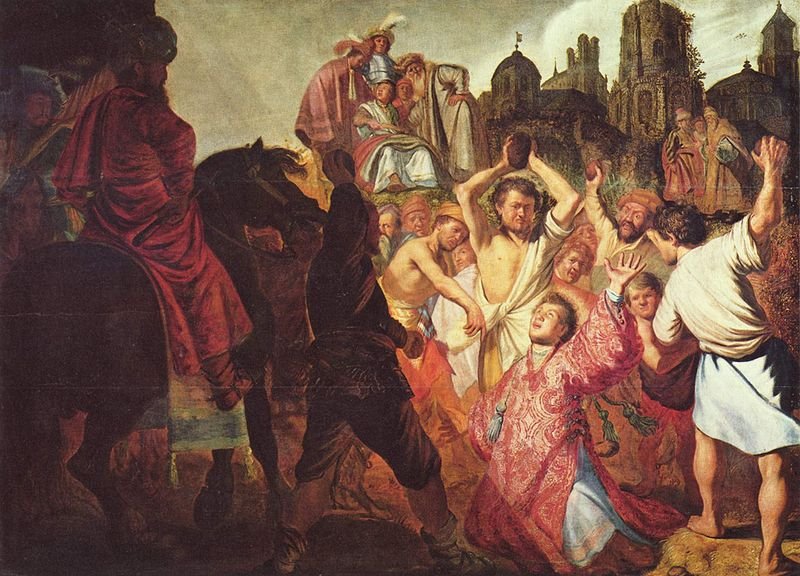
The Stoning of Stephen by Rembrandt (1625)

Rembrandt’s first dated work is entitled The Stoning of St Stephen, which he completed in 1625 at the age of 19, and appears to be a response to Elsheimer’s painting of the subject.  The same chiaroscuro effect can also be seen in his version of the painting.

For me, besides the exquisite colouring and the astonishing amount of detail  Elsheimer has brought to this painting, I love the magical Italianate landscape which forms the background.  Elsheimer’s delicate portrayal of the trees and the Roman ruins exudes such a beautiful and enchanting quality. I would have loved this work of art to have been on a much larger scale but then maybe some of the enchantment would have been lost.

The Flemish landscape artist Paul Bril, who befriended Elsheimer, may have, at one time, owned this painting.

Christ in the House of Martha and Mary by Johannes Vermeer

Christ in the House of Martha and Mary by Johannes Vermeer (c.1655)

Once again, as promised in my last blog, I am returning to a painting depicting the two biblical sisters Mary and Martha.  The setting for this painting is their meeting with Christ at their home, which unlike the setting and the story behind Cagnacci’s painting Martha Rebuking Mary for her Vanity which I featured in yesterday’s blog; this meeting was recorded in the Bible.  In Luke 10:38-39 it states:

“…As Jesus and his disciples were on their way, he came to a village where a woman named Martha opened her home to him.  She had a sister called Mary, who sat at the Lord’s feet listening to what he said.  

The depiction of this meeting has been painted by many artists, such as Tintoretto in 1580, Diego Velázquez in 1618, and Rubens who painted a similar scene in 1628 but moved the setting to an outdoor terrace.  Christ at Home with Martha and Mary was painted by Joachim Beuckelaer, a kitchen scene, but from which we learnt about the rivalry between Mary and Martha.  A similar kitchen scene was depicted in the late 16th century painting entitled Christ in the House of Mary and Martha by Vincenzo Campi.  In these last two paintings Martha is depicted working hard in the kitchen whilst Mary is sitting at the feet of Christ listening to what he had to say.  The tension between the two women as highlighted in these paintings was recorded in the Book of Luke 10:40-42:

“….But Martha was distracted by all the preparations that had to be made. She came to him and asked, “Lord, don’t you care that my sister has left me to do the work by myself?  Tell her to help me!”      “Martha, Martha,” the Lord answered, “you are worried and upset about many things,  but few things are needed—or indeed only one Mary has chosen what is better, and it will not be taken away from her…”

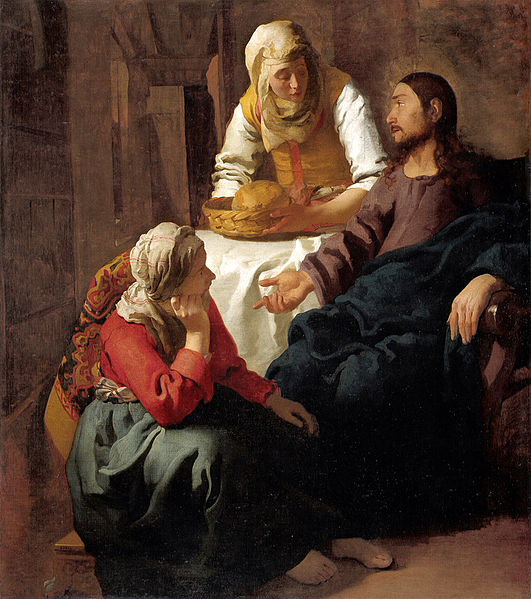
However the painting I am featuring today depicts Mary and Martha in seemingly perfect harmony as they listen to the words of Christ.  The painting is by the great Dutch Master, Johannes Vermeer and is entitled Christ in the House of Martha and Mary and hangs in the National Gallery of Scotland in Edinburgh.  He completed the work around 1655 and it is believed to be one of his earliest surviving paintings, coming some ten years before his more famous works, such as Girl with a Pearl Earringwhich he completed in 1665.    It is also thought to be one of his largest paintings, measuring 160 cm × 142 cm (63 in × 56 in) and this probably means it was painted for a specific commission.  The fact that the work is so large and has a very dark backdrop, unlike most of Vermeer’s later works it may not have been accredited to Vermeer but for his recognisable signature on the stool which Mary sits upon.

Christ in the House of Martha and Mary by Erasmus Quellinus the Younger (1650)

There is a certain similarity with the way Vermeer has painted the folds in Christ’s robe with the 1650  painting  Christ in the House of Martha and Mary by the Flemish artist Erasmus Quellinus the Younger (Musée des Beaux-Arts, Valenciennes) and one that Vermeer may have actually seen as his father, Reynier Jansz,  was an art dealer.

Before us we have the three figures, named in the title of the painting, in a kind of triangular formation almost filling the canvas.  The background is sombre and somewhat dark which ensures that we are not distracted from the three figures depicted in the work.  Our viewpoint is from the bottom left of the painting which leads art historians to believe that this could have been intended for an altarpiece which would have been above eye level.

Christ is seated, looking very relaxed.  There is a soft glow emanating from his head and this ensures that he is seen as the main figure of the three.  He wears a dark blue robe over a brown undergarment.  It is an unusual shade of blue and not the ultramarine that we see in later works by Vermeer.  The right arm of Christ stretches out as he points towards Mary.  At the same time he focuses his attention on Martha.  Our attention is immediately drawn to his outstretched arm as the colour of his skin and the brown sleeve of his undergarment stand out against the pure white of the table cloth.

Mary sits on the floor at the feet of Christ, her head resting on her hand.  She looks lovingly at Christ hanging on his every word.  Of the three she is by far the most exquisite.  Vermeer has painted her lovingly and may have been sympathetic with her contemplative nature.  Mary’s positioning in the painting at the feet of Christ is somewhat controversial as that place was usually taken up by one of Christ’s disciples and in those days for a teacher to accept a female as a disciple was unheard of.

Martha stands at Christ’s right-hand side  and we see her placing a loaf of bread on the table whilst at the same time leaning slightly forward listening to his words.  Her eyes are downcast and yet her eyebrows are raised in a questioning gesture.  She looks somewhat saddened and dissatisfied with something.  Could it be she is not happy with Christ’s support of Mary’s contemplative role?   There is a hint of a pout in her expression, which could hark back to the conflict between the two females.   All looks tranquil and peaceful in Martha and Mary’s house but I wonder if the fact that Martha is bringing in the food whilst Mary just sits and listens to the words of Christ harkens back to the different roles the women play in the household and the discord between the two sisters is caused by such differing roles.  Maybe we are at a point in time that Christ is explaining to Martha that although she is the “worker” of the household who is serving up the bread which she may just have baked, Mary’s role as a contemplative disciple is equally as important. This is more forcibly portrayed in other works of art.  I am sure there are many theologians who have looked in to the relationship between the two sisters but the general consensus is that Martha is the more aggressive and work-like female whereas Mary is the more quiet and contemplative woman.

Much has been written about the two females and it has been interesting to study the various paintings featuring the two sisters and by doing so trying to read the mind of the artist and figure out what he or she is trying to tell us about the women.