Alfred Sisley. Part 3 – the latter years.

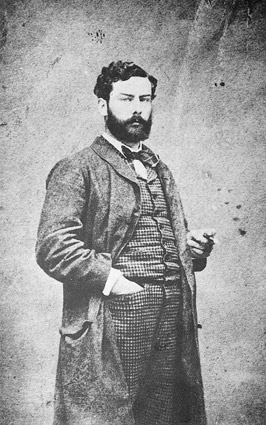
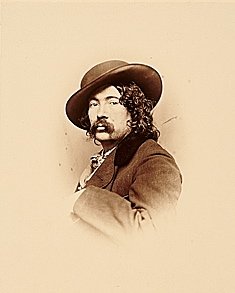
1882 photograph of Alfred Sisley

Alfred Sisley returned to France late on October 18th, 1874 after his four-month summer holiday spent in London. Sisley had been living in the town of Louveciennes since 1872 but in the winter of that year, Sisley and his family moved to 2 avenue de l’Abreuvoir in Marly-le-Roi, a commune in the Île-de-France region, in north-central France, located in the western suburbs of Paris, 18 kilometres from the centre of Paris.
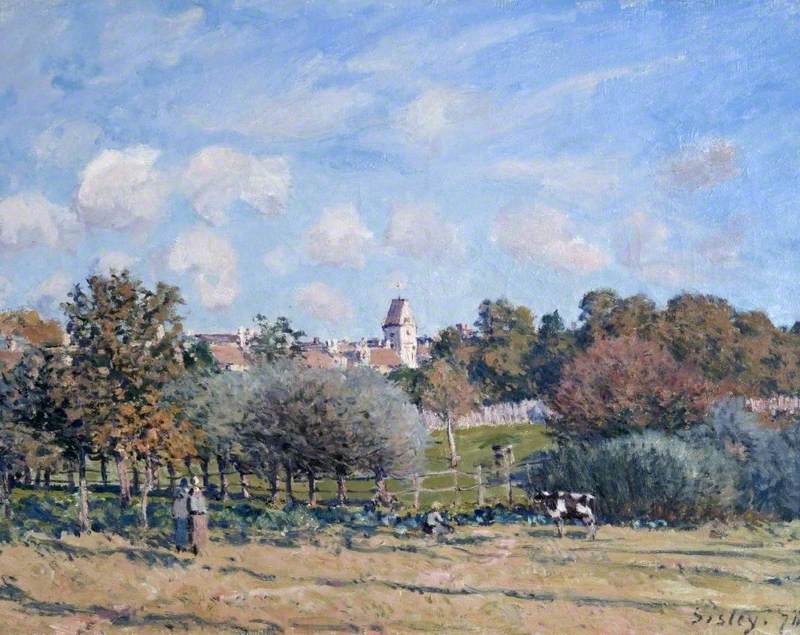
The Church at Noisy-le-Roi: Autumn by-Alfred Sisley (1874).

Many art historians believe that during the time Sisley lived in Marly-le-Roi between 1875 and 1880, he produced his finest works.  In the late autumn of 1874 Sisley completed a work featuring the town of Noisy-le-Roi which lay about 4 kilometres south-west of Marly-le-Roi. It was entitled The Church at Noisy-le-Roi: Autumn. In some ways, it is an unusually constructed work. The subject of the painting, the church has been placed in the mid-ground and there is no visual access to it from the foreground. Our view towards it through the foreground landscape is restricted by the fence line and a number of squat trees. The painting was exhibited at the Hôtel Drouot in Paris on 24 March 1875 along with works by Renoir, Monet, and Morisot. It was purchased by Paul Durand Ruel and submitted to the Salon jurists in 1876 but was turned down. The painting was sold on a number of occasions including an 8500 francs sale to Baron Henri de Rothschild in 1899. It was later bought by Sir William Burrell, a Scottish shipping merchant and philanthropist, who in 1944 gave it to the City of Glasgow Corporation. The one proviso was that this work and the whole of his collection was to be housed in a building far enough from the city centre so that the works could be shown to their greatest advantage, and to avoid the damaging effects of air pollution at the time.
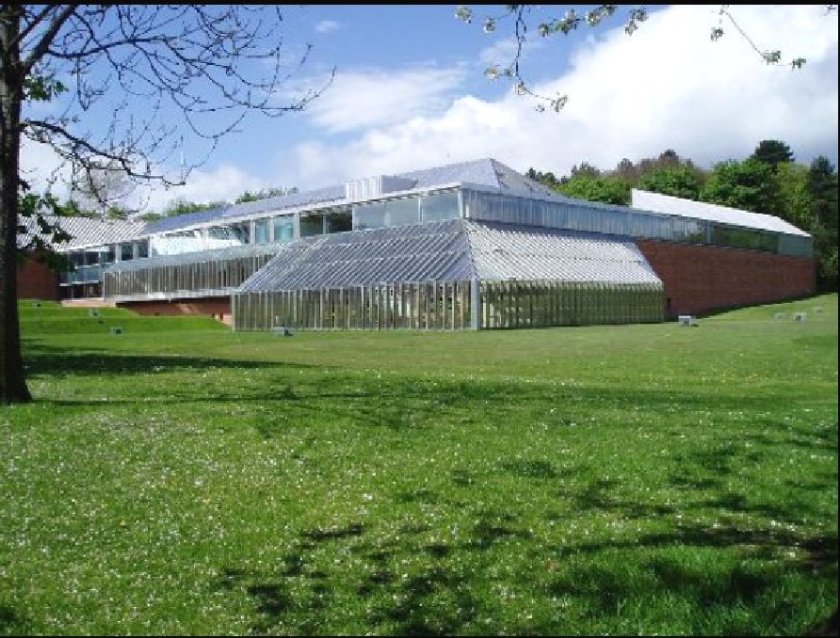
The Burrell Collection at Pollok Park, Glasgow

It took the trustees more than 20 years trying to find a suitable resting place for Burrell’s collection, one which met all the criteria set out in the Trust Deed. A venue was finally found in 1967 when the Pollok Estate was given to the city of Glasgow. The Trustees also had to waive certain terms of the deed which allowed the current site, in Pollok Park to be used. The park was only three miles from the city centre but within the city boundaries.  

La barque pendant l’inondation by Alfred Sisley (1876)

In December 1872 Sisley had painted four pictures showing floods at Port-Marly. In 1876 there was another flood and Sisley executed seven paintings as documentary evidence of its different stages, from the first rise in water level to the return of the river to its normal course. Being well settled in Marly-le-Roi, Sisley was there to witness the great floods of 1876. In March that year, the Seine burst its banks and flooded many of the riverside villages and towns including the neighbouring village of Port-Marly. In his 1876 painting, La barque pendant l’inondation (Boat in the Flood) he depicts a wine merchant’s house, À St Nicolas, which almost looks like it is resting on the mirrored surface of the flood waters. The artist produced six paintings of this event. He cleverly captured the great expanse of water with moving reflections that transformed the peaceful house of a wine merchant into something mysterious and poetic. Sisley’s viewing point gave him an oblique-angled view of the scene which meant that the wine-merchant’s shop becomes the predominant feature of the work and Sisley has been able to depict architectural aspects of the building, especially the upper section. The light colour tones are offset by the black pigment used for the window openings giving a sharp contrast between light and dark. The industrialist, Ernest Hoschedé, originally owned the painting.  He was one of the first major supporter of the Impressionists’ art. His wife Alice became Monet’s second wife. A year after Hoschedé bought the painting his business collapsed and he became bankrupt. The painting was later sold by Durand-Ruel to the wealthy art collector, Comte Isaac de Camondo who had amassed a large number of works by the French Impressionists. He bequeathed this work and a number of other paintings from his collection to The Louvre in 1908, three years before his death. The painting was transferred to its current home, Musée d’Orsay, in 1986.

The Flood at Port-Marly by Alfred Sisley (1876)

The work we see above, The Flood at Port-Marly is housed in the Carmen Thyssen-Bornemisza Collection in Madrid. In the painting we see the rue de Paris in Port-Marly. On the right, behind the trees, we can see the overflowing River Seine. The sky is littered by wind-swept clouds which scurry across the sky. Sisley was able to give a marked emphasis to the movement of the clouds through the use of a low horizon line. We can see the road and how the water has flooded the pavements. The sun has reappeared and the water level is starting to recede, which allowed Sisley to set up his easel in the middle of the street and once again return to the use of a central perspective which can be found in many of his paintings. This technique derives from the classical tradition of French landscape painting. In September 1876, shortly after Sisley had concluded his series on the floods at Port-Marly, Stéphane Mallarmé, a French poet and critic, published an article on the Impressionist artists in the London magazine The Art Monthly Review. He said of Sisley:

“…He captures the fleeting effects of light. He observes a passing cloud and seems to depict it in its flight. The crisp air goes through the canvas and the foliage stirs and shivers…”
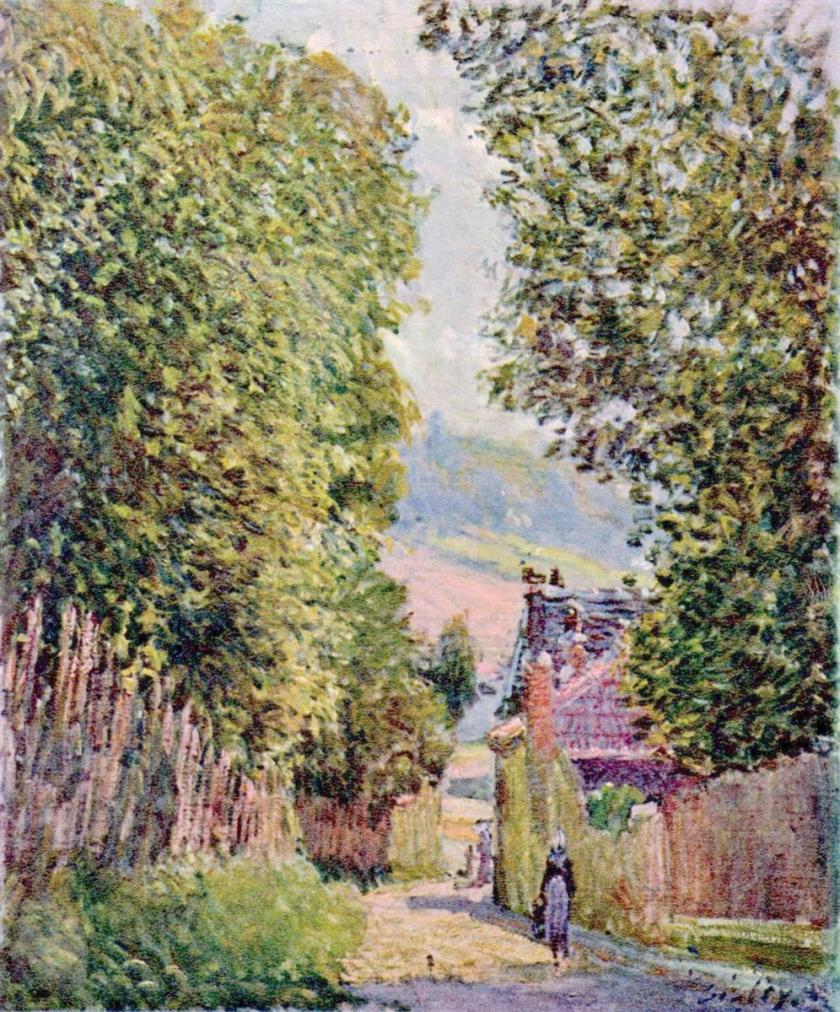
A Street in Louveciennes by Alfred Sisley (1878)

Sisley’s relationship with the Impressionists can be gauged by a set of statistics. At the first exhibition in 1874, Sisley exhibited five paintings, in the second exhibition in 1876 he had eight paintings displayed and in the third Impressionist Exhibition seventeen of his works were displayed. He did not exhibit any of his paintings at the fourth, fifth or sixth shows. So why? It is thought that two of the reasons could have been the lack of critical acclaim and success at the first three exhibitions but maybe more importantly there was a fragile sense of unity and some tension between the painters at these joint exhibitions. The fourth, fifth and sixth exhibitions were dominated by Degas and the works on show tended to be figure painting rather than landscape painting so this could also be a reason for Sisley backing away. There were few Impressionist artists that had a foot both in the figurative and landscape camps but Pissarro was the one exception and he exhibited at all eight of the Impressionist exhibitions. Sisley was also aware that he had to sell more works and become more well known to dealers and so turned back to the Salon. In a letter to the French journalist, author, and art critic, Théodore Duret Sisley wrote:

“…I am tired of vegetating, as I have been doing for so long. The moment has come for me to make a decision. It is true our exhibitions have served to make us money and in this have been useful to me, but I believe we must not isolate ourselves too long. We are still far from the moment we shall be able to do without the prestige attached to official exhibitions. I am therefore determined to submit to the Salon…”

A Turn of the River Loing, Summer by Alfred Sisley (1896)

Following the third Impressionist exhibition Sisley tried to get his works accepted by the Paris Salon jurists but failed. In October 1878 Sisley left Marly and moved to avenue de Bellevue in Sèvres, a town in the southwestern suburbs of Paris. Sisley’s finances were deteriorating fast. His paintings only sold for small amounts. He was borrowing money so that he and his wife were able to survive and, to make things worse, some of the lenders were demanding repayment of his debts. In 1880 Sisley could no longer afford to live in Sèvres and moved his family to Moret-sur-Loing, a town south of Paris on the edge of the Forest of Fontainebleau.
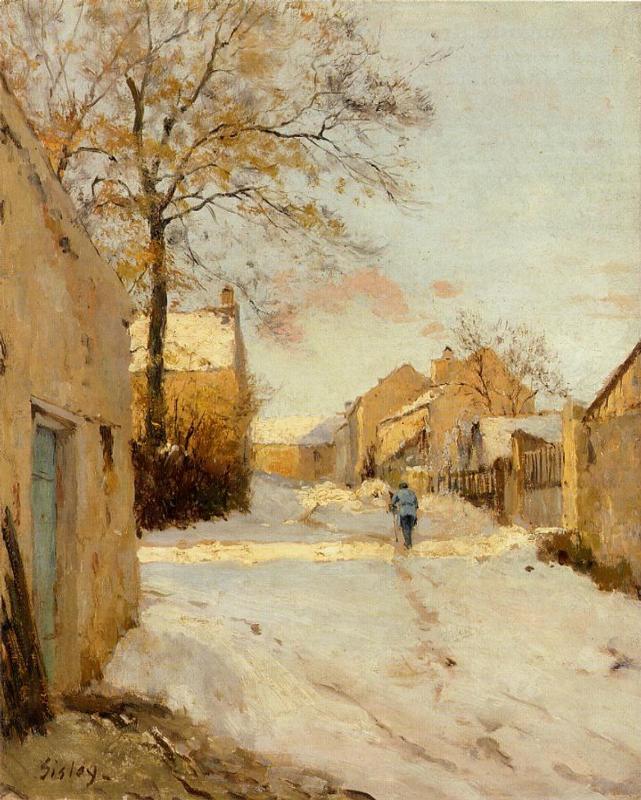
A Village Street in Winter, by Alfred Sisley (1893)

Paul Durand-Ruel kept buying paintings from the Impressionists and having them exhibited at various exhibitions and then hopefully selling them on for a profit. However, around the late part of the 1870’s the sale of his paintings was much lower in comparison to the number he had purchased and so he had to source some finance to cover his future buying plans. He turned to Jules Feder, the head of the Union Générale bank in Paris and an important early collector of Impressionist art. In 1880, Feder advanced a great deal of money to Paul Durand-Ruel, enabling the dealer to resume purchasing work from the Impressionists. Immediately upon receiving Jules Feder’s support Durand-Ruel acquired thirty-six paintings from Sisley. This all changed in February 1882 when Union Générale bank collapsed which, in turn, brought about the collapse of the French Stock Exchange, and triggered a general recession, and Jules Feder, the head of the bank, was ruined and because of that Durand-Ruel had to pay the banker back all the money that he had advanced him. Durand-Ruel, with no money to buy further Impressionist paintings, resulted in an extremely uncertain few years for the artists whom Durand-Ruel had supported, particularly Sisley… For the next several years Durand-Ruel was unable to advance money to the Impressionist painters he had always generously supported, and those works he did buy were at much reduced prices and because of this, Sisley was especially hard-pressed to make ends meet.
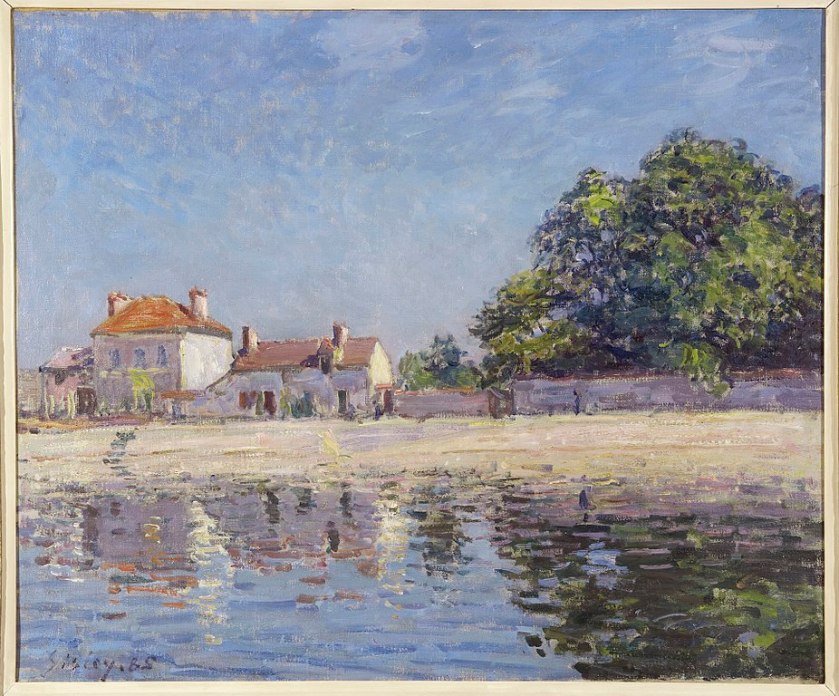
Bords du Loing, Saint-Mammes (The River Loing at Saint-Mammes) by Alfred Sisley (1885)

Things were changing for Sisley. Paul Durand-Ruel purchased his last painting by Sisley, Saint-Mamme’s from the River Loing, for 200 francs in February 1886. The Impressionists were starting to go their own ways. Renoir and Monet had gained public recognition whereas Sisley had not. This must have hurt Sisley and according to John Rewald in his 1961 book, The History of Impressionism, Sisley had become suspicious and sulky not even seeing his old companions anymore. The French art critic of the time, Arsène Alexandre wrote:

“…he [Sisley] added to his woes by creating imaginary ones for himself. He was irritable, discontented, agitated…..He became utterly miserable and found life increasingly difficult…”
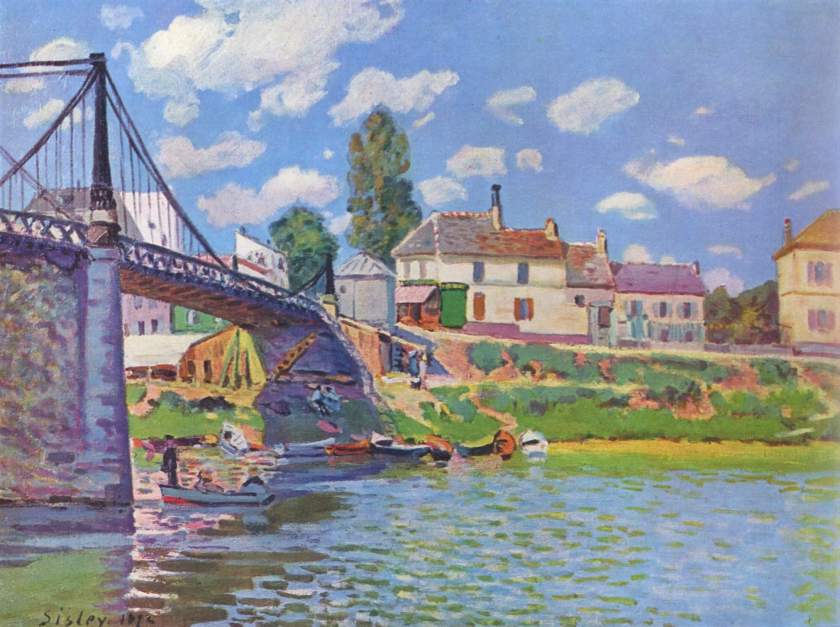
Bridge at Villeneuve la Garenne by Alfred Sisley (1872)

Whereas Monet and Pissarro came back into Paul Durand-Ruel’s fold, Sisley refused. Durand-Ruel and his sons had bounced back and in the 1890’s once again had a successful network of connections in Europe and America who bought from the company. Probably due to his state of depression, Sisley ignored the opportunity to return to Durand-Ruel and benefit from the sales of his work. It was the beginning of the end. Sisley’s wife Eugénie died of cancer in October 1898. Sisley, who was ill himself, did not attend the funeral. He had been attending a doctor for five months but in November 1898 he suffered a massive haemorrhage and his health was deteriorating rapidly. Sisley died of cancer on January 29th 1899, aged 59. Sisley was buried on February 1st 1899 at the cemetery in Moret attended by his children and fellow artists such as Monet, Renoir, and Tavernier.
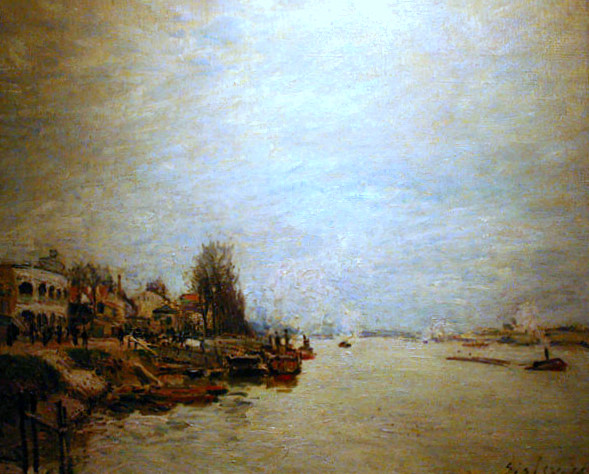
Dawn by, Alfred Sisley, (1878)

Sisley had been in the process of gaining French citizenship before he died, but on his death. remained an English citizen. His son Pierre settled his estate. According to records at Dammarie-les-Lys, the regional archives for Seine-et-Marne, Sisley’s legacy to his children comprised of his wardrobe, worth 50 francs, furniture worth 950 francs and money obtained from his paintings worth 115,640 francs, making it a total of 116,640 francs, equivalent to £4,665.

The Seine at Port Marly with Piles of Sand by Alfred Sisley (1875)

I end this blog with the words of Monet who, a week before Sisley’s death, wrote about Sisley to his friend Gustave Geffroy, the French journalist, art critic, historian, and novelist:

“…Sisley is said to be extremely ill. He is truly a great artist and I believe he is as great a master as any who have ever lived. I looked at some of his works again, which have a rare breadth of vision and beauty, especially one of a flood, which is a masterpiece…”
Alfred Sisley. Part 2 – London and Paul Durand-Ruel

Alfred Sisley by Renoir (1876)

The year is 1870 and on July 19th France had declared war on Prussia. The war went badly for France and the siege of the Paris ended in an armistice on January 28th 1871. It was a crushing defeat for the French and for the Parisians three months of further violence and bloodshed was to follow from March to May of that year with the uprising known as the Paris Commune. Alfred Sisley lost everything that he owned at his apartment in Bougival. Like so many others, his house was looted and destroyed by the occupying forces. As mentioned in the previous blog, worse was to follow as in 1871 his father’s business collapsed and his father became bankrupt and later died penniless. Alfred Sisley had now to rely on the sale of is paintings for he and his family to survive. Artists needed a way to exhibit and sell their works and at one time the Paris Salon was the only and the way to do that and that depended on their work being accepted by the Salon jurists, but then came the art dealers with their private galleries and this meant the artists did not have to rely on the Salon to market their work.

Enter Paul Durand-Ruel who was to play a part in Alfred Sisley’s life in the 1870’s. Durand-Ruel was born in Paris, on October 31st, 1831, the son of shopkeepers Jean Durand and Marie Ruel. It was in their shop that they allowed famous artists to display their paintings and sketches. In the 1840’s, their shop soon became a regular rendezvous for artists and collectors alike, so much so that Jean Durand decided to turn their shop into an art gallery. Their seventeen-year-old son, Paul, joined the family business in 1848. It must have been an exciting time for the young man as he was sent all over Europe to seek out new artists and sell their paintings. In the mid-nineteenth century, his father’s gallery specialized in paintings produced by the landscape artists of the Barbizon School, such as Corot. Paul Durand-Ruel knowledge of art grew and in 1863 he was acknowledged as the firm’s resident art expert. Following the death of his father in 1865, Paul Durand-Ruel took over the business.
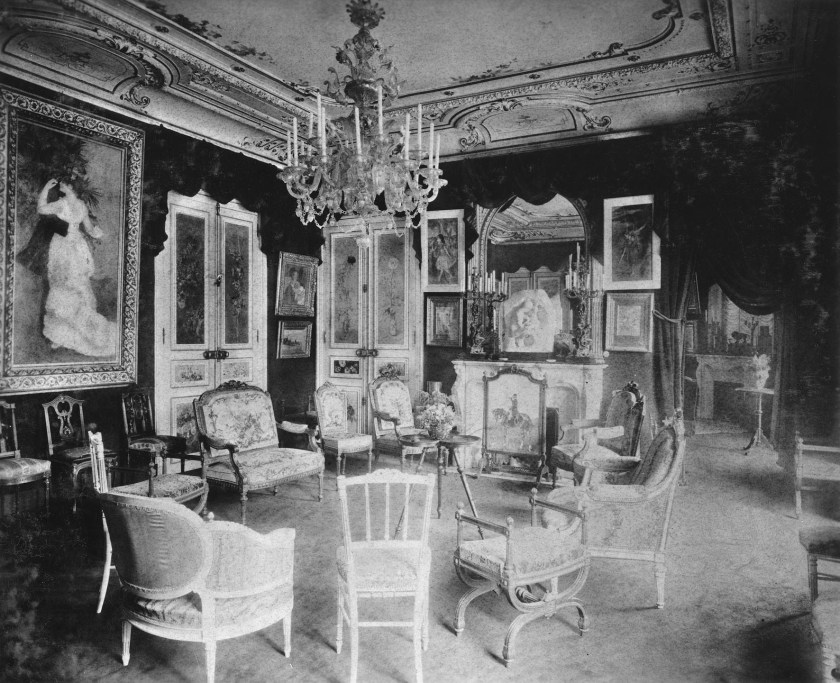
Photograph of  Paul Durand-Ruel’s grand salon at Rue de Rome . Paris, with ‘Dance in the City’ by Renoir

During the Franco-Prussian War Durand-Ruel left Paris and escaped to London. It was in the English capital that he met up with a number of exiled French artists including Charles-François Daubigny, Claude Monet, and Camille Pissarro. Paul set up his own London art gallery at 168 New Bond Street and in December 1870, he staged the first of ten Annual Exhibitions of the Society of French Artists.  Soon Durand-Ruel became acquainted with their works and through them met their fellow artists.

Paul Durand-Ruel by Renoir (1910)

Paul Durand-Ruel returned to Paris, and there, he secured Impressionism’s place in history through tireless promotion across Europe and the United States and enthusiastic Americans ensured its success. Durand-Ruel discovered, promoted, protected, advocated, and finally exported the work of Sisley, Renoir, Monet, Degas, and Pissarro. Of al the art dealers, he was by far the most committed to their art. He invested in it at a time when all they had to show were refusals and derision at their efforts. It was an interesting relationship between Durand-Ruel and the artists. It was almost a one-way association. He offered them passionate and financial support, the painters repaid him with the only thing they had: their loyalty, which in a way, counted for nothing since he was almost the only dealer who wanted their work. Often, he would over-pay for their finished paintings so as to keep their prices up, but he was rarely able to sell it on. He admitted he was not a good businessman and once said that if he had died when he was in his mid-fifties, he would have died penniless. This was mainly due to the Paris Bourse crash of 1882 which was the worst crisis in the French economy in the nineteenth century. Durand-Ruel was forced to repay the money he had borrowed from Jules Feder, 0ne of the struggling directors of the ill-fated l’Union Générale bank, which eventually collapsed. It was a bank established by Catholic grandees in 1876 to compete with the famous German-Jewish Rothschild bankers.

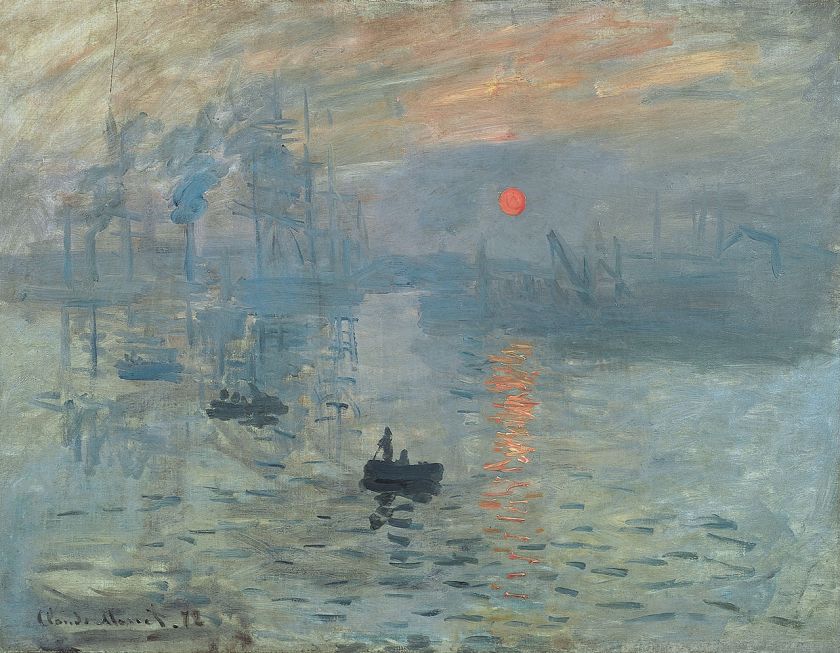
Claude Monet, Impression, soleil levant (Impression, Sunrise), 1872,

However, everything changed for Durand-Ruel around 1892 when he succeeded in establishing the market for Impressionism in the United States. The first official French Impressionist exhibition in the United States opened at New York City’s American Art Association from April to May, 1886, and later, in 1887, it moved to the New York City’s National Academy of Design with additional works of art. Of the American buying public Durand-Ruel is quoted as saying:

“…Without America, I would have been lost, ruined, after having bought so many Monets and Renoirs. The two exhibitions there in 1886 saved me. The American public bought moderately . . . but thanks to that public, Monet and Renoir were enabled to live and after that the French public followed suit…”

In 1887, Paul Durand-Ruel opened a New York City gallery at 297 Fifth Avenue named Durand-Ruel & Sons; two years later, in September 1889, it moved to 315 Fifth Avenue, and finally, in 1894, to 398 Fifth Avenue. The gallery was managed by his three sons, Charles, Joseph, and Georges.

Alfred Sisley may not have lived to share the American public’s recognition enjoyed by the likes of Renoir, Monet and Degas but they still liked his atmospheric landscapes which were shown at many of the American exhibitions and were part of many private collections before 1914.

In July 1874, Sisley made a return trip to London with his friend the famous French Opéra-Comique singer, Jean-Baptiste Faure, an avid collector of Impressionist paintings. Faure bankrolled their trip by buying six of Sisley’s works. The pair stayed initially in South Kensington before moving to Hampton Court. Hampton Court was a popular leisure resort with good accessibility to central London. In that year Sisley completed a painting depicting part of the bridge joining Hampton Court with the small village of East Molesey on the south side of the river Thames. It was entitled Une Auberge à Hampton Court (Hampton Court Bridge: The Castle Inn). The Castle Inn, which some believe could have been where the pair were staying, is the focal point of the painting. The relaxed leisurely feeling is depicted by the elegantly clothed figure as he saunters down the road towards us. Sisley has overpainted the light grey ground with bright tones. Look how Sisley has emphasised the broad gravel street by placing his figures to the very edge of it and by doing this he has established a broad vacant zone directly in front of us.

The Bridge at Hampton Court, Alfred Sisley, (1874)

Another work painted by Sisley in 1874 featured the opposite end of the bridge at Hampton Court and is entitled Hampton Court Bridge: The Mitre Inn. The bridge in the painting was the third one on this site having been built in 1865. This was replaced by the current bridge, constructed of reinforced concrete, faced with red bricks and white Portland Stone, in 1933. The inn is the red brick building on the left. There was an inn at each end of the bridge. On the south end was the Castle Inn (previous painting) and on the north end there stood the Mitre Inn. In this painting we once again see the depiction of part of the cast iron bridge which spanned the Thames at Hampton Court and it is thought that Sisley painted this view whilst on the terrace of the Castle Inn.

Regatta at Hampton Court, by Alfred Sisley (1874),

This viewpoint was used by him for his painting, Regatta at Hampton Court. The large trees on the left and centre of the painting hide the entrance to Hampton Court, one of the royal palaces.

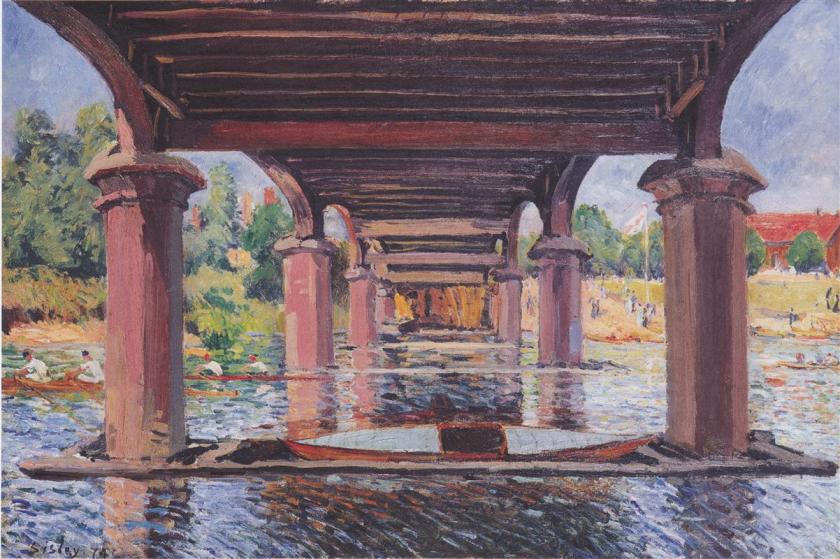
Under the bridge at Hampton Court, Alfred Sisley (1874)

By far one of the quirkiest paintings of the bridge by Sisley was his work entitled Under Hampton Court Bridge. The dramatic depiction is painted from beneath the cast iron and brick bridge and the view between the avenue of bridge piers is of the far riverbank and a pair of rowing boats.

Three paintings of the Hampton Court bridge by Sisley, a bridge which was not known for its beauty, with one commentator of the time asserting that

“…it was one of the ugliest bridges in England, and a flagrant eyesore and disfigurement both to the river and to Hampton Court…” 

However, for Sisley it was a structure worthy of his time and effort.

..………………to be concluded

Alfred Sisley. Part 1: The early years.

1882 photograph of Alfred Sisley

The artist I am looking at today is not one of my “unknown” painters I often showcase. This artist is well known and his works are in collections all around the world. Today’s featured painter is Alfred Sisley.

Felicity and William Sisley, Alfred’s parents.

Alfred Sisley was born on October 30th 1839 at 19 rue des Trois Bornes which was in what was then the 4th arrondissement of Paris. He was the son of the British couple, William Sisley, and Felicity Sisley (née Sell) and although born in France, he retained his British citizenship. Little is known about his siblings. Some articles say he was one of four children, others say he just had one older sibling who died young. Alfred’s maternal ancestors came from the English county of Kent and were said to have been smugglers and tradesmen. His parents were affluent. His father owned a silk exportation business which he had established in 1839. Little is known about Sisley’s schooling except to say in the Spring of 1857, when he was almost eighteen years old, his father sent him to London to learn how to embark on a career in commerce. It is clear that Sisley had neither an aptitude for, nor a love of, commerce. However, the upside for young Alfred was that being in London he was able to visit museums and exhibitions and began to fall in love with the works of Gainsborough, Turner and Constable as well as the Dutch and Flemish artists, such as Hobbema and Ruisdael, which he saw at the National Gallery.

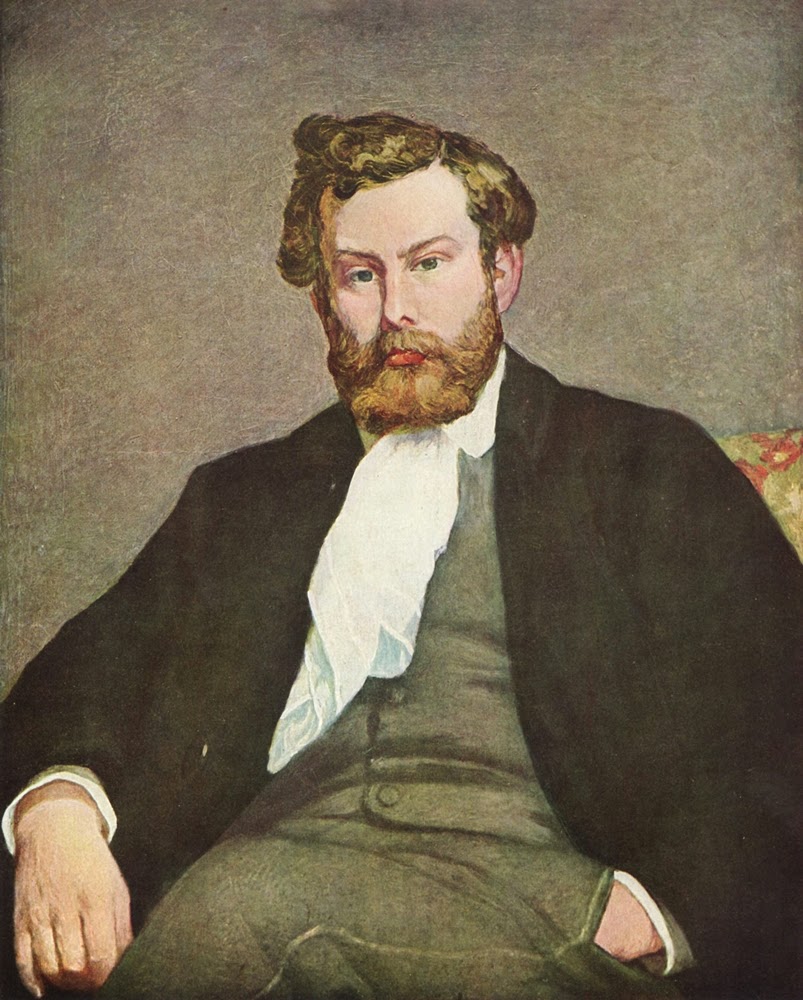
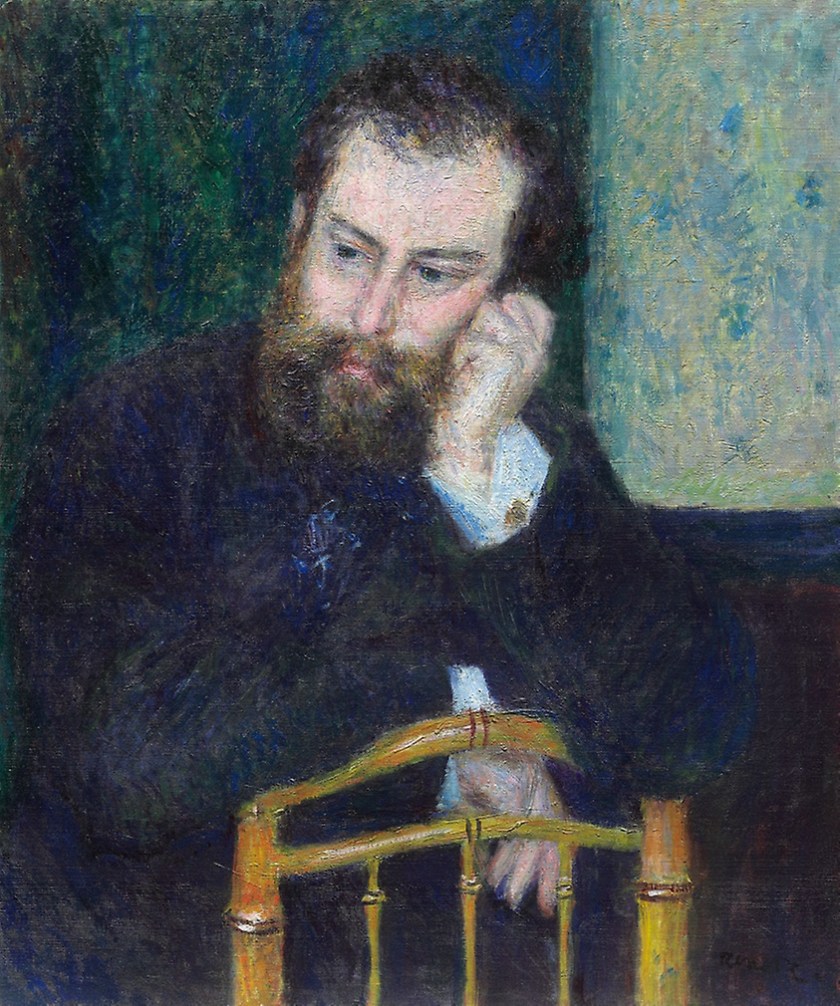
Portrait of Alfred Sisley by Pierre-Auguste Renoir (ca. 1875)

In 1860 Sisley returned home to Paris. Whether his father realised that his son lacked the ability to follow in his footsteps as a tradesman or whether Sisley had bombarded his father with his desire to become an artist, will never be known, but in 1860, Alfred Sisley began studying at the Paris École des Beaux-Arts within the atelier of Swiss artist Marc-Charles-Gabriel Gleyre. Many famous French artists had passed through Gleyere’s studio, such as Claude Monet, Pierre-Auguste Renoir, Frédéric Bazille, James Abbott McNeill Whistler, and Auguste Toulmouche.

Sisley, like his friend Renoir and Monet, left the atelier Gleyre around 1864 when it closed and they decided to move to the rural area of Fontainebleau and the small town of Barbizon. Sisley worked in Chailly-en-Bière and later in Marlotte near Fontainebleau. Renoir recalled the days spent with Sisley. In a letter to the art critic Adolphe Tavernier, Renoir wrote:

“…When I was young, I would take my paintbox and a shirt, Sisley and I would leave Fontainebleau and walked until we reached a village. Sometimes we did not come back until we had run out of money about a week later…”

The Inn of Mother Anthony by Renoir (1866)

Renoir had been sharing Sisley’s Paris studio since July 1865 and in February 1866 the two of them along with Renoir’s friend, the artist Jules Le Coeur set out to walk across the Forest of Fontainebleau passing through the villages of Milly and Courances on their way to Marlotte, a village on the southern edge of the Fontainebleau Forest, close to the River Loing. Renoir immortalised the group in his 1866 painting The Inn of Mère Anthony. In the depiction we see that Renoir has had his friends, Le Coeur, Sisley, Mère Anthony and her daughter pose for the painting in the main room of the inn at Marlotte.

Rue de village à Marlotte (Village Street in Marlotte) by Alfred Sisley (1866). Albright-Knox Art Gallery, Buffalo, New York

One of many paintings completed by Sisley around this time was entitled Village Street in Marlotte. The painting portrays a solitary figure chopping wood. A sombre palette of greens, browns, and grey-blues underscores an overall feeling of isolation. Unlike many of his contemporaries, Sisley seldom travelled and did not feel compelled to depict urban life, industrialization, and the more dramatic aspects of nature, contenting himself with painting the world close at hand.

Women going to the Woods by Alfred Sisley (1866)

Another work by Sisley was entitled Women going to the Woods and depicts three elderly women wrapped up against the cold who are setting out to the forest, probably to collect firewood and is a reminder that people were reliant on the forest for their existence. Both of Sisley paintings were exhibited at the 1866 Paris Salon.

Sisley and his Wife by Renoir (1868)

In 1866 Sisley met a thirty-two-year-old florist named Marie-Louise Eugénie Adelaide Lescouezec. According to Renoir she seemed “exceedingly well bred.” Little is known about her upbringing but reports have it that her family’s financial hardships forced her to become an artist’s model, which often had an unsavoury connotation. Yet another account tells of her early life being difficult after her father, an officer, was killed in a duel when she was a young girl. None of this affected in any way Sisley’s love for her and he was to remain devoted to her until her death in 1898.   On June 17th 1868, a year after they met, the couple’s son Pierre was born, followed by a daughter, Jeanne-Adèle, on January 29th 1869. Renoir painted the couple the year they were married.  She was dressed in a bright-coloured red and yellow gown.

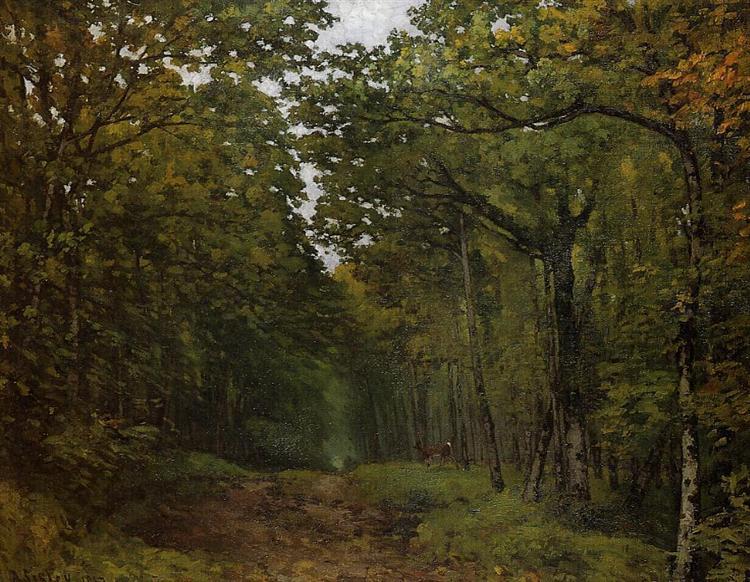
Avenue of Chestnut Trees near La Celle-Saint-Cloud by Alfred Sisley (1867)

At the 1868 Salon, Sisley had just one of his paintings exhibited. It was his Avenue of Chestnut Trees near La Celle-Saint-Cloud which he had completed the previous year. It was a large painting (96 x 122cms) and depicts a verdant view through a densely wooded part of the forest, six kilometres west of the village of La-Celle-Saint-Cloud, located in the western suburbs of Paris, 15 kms from the centre. This was the third time Sisley had depicted the forest in his painting. There had been two earlier works of differing sizes, both entitled Avenue of Chestnut Trees at La-Celle-Saint-Cloud, which he completed in 1865. The forest was very popular with Parisians who wanted to briefly escape city life. Look how Sisley has used a shifting range of greens and browns to bring the picture to life. Note the clever way he has used dappled brushwork on the trunks of the trees. Look how we are led through the avenue of trees which propels us back, penetrating the depth of the canvas. If you look closely at Sisley’s work you will notice a solitary deer on the right mid-ground almost lost from view camouflaged by the dark tree trunks. So why the solitary deer? It could well have something to do with having the painting accepted into the Salon by the jurists. Landscape paintings had an inferior position in the hierarchy of pictorial-subject matter by the art establishment, so maybe Sisley realised that a connection with the monarchy would stand him in good stead of having the Salon jury accept the work as his depiction was of the royal hunting grounds of Napoleon III.

The Avenue at Middelharnis by Meindert Hobbema, (1689)

This view down a majestic avenue of trees harks back to paintings Sisley may have seen whilst in London, such as one of his favourite artist’s works, The Avenue at Middelharnis, by Hobbema which hangs in the National Gallery.

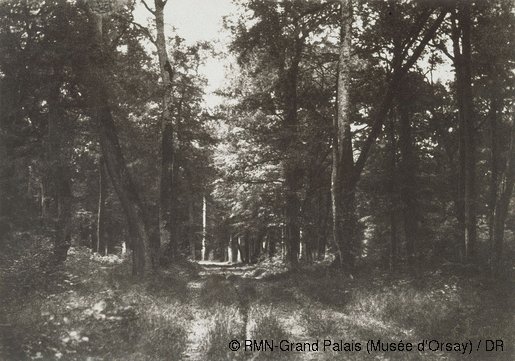
Forest of Fontainebleau, undergrowth at Bas-Bréau by Gustave LeGray (1852) Albumen print from a waxed paper negative

Another work which may have influenced him and which he had probably seen at Musée d’Orsay, was Gustave LeGray’s 1855 photograph Forêt de Fontainebleau, sous-bois au Bas-Bréau [Forest of Fontainebleau, undergrowth at Bas-Bréau]. LeGray had received a commission from the committee for historic monuments to photograph the most noteworthy monuments in France and in 1852 and again in 1857 he produced two large collections of photographs of the Forest of Fontainebleau. It is reported that during his walks around Bas-Bréau, in the heart of the forest, LeGray would place his camera right in the middle of the path, at the exact place where he had been struck by the light shimmering through the foliage and he used the line of the path, in this rich composition, to draw the eye towards the clearing where the tree trunks are bathed in light. In this way he produced the image of a site that was very popular with painters. The depiction is all about the forest. There are no human or animal presence to disturb the natural spectacle.

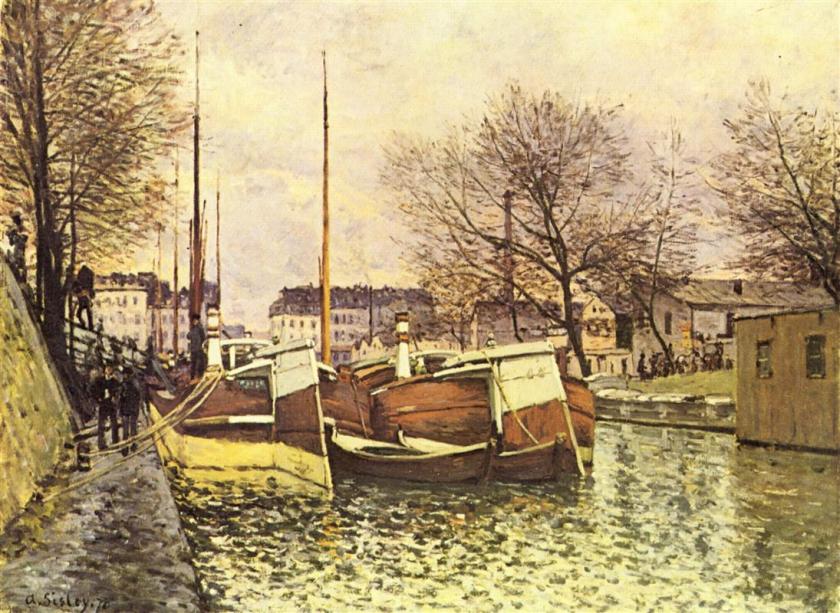
Barges on the Canal Saint Martin in Paris by Alfred Sisley (1870)

Of all the Impressionist, Sisley was the one who loved the countryside the most and liked to paint rural scenes. He was not an urban painter and only completed a smaller number of works which focused on Paris and the Parisian scene favoured by the likes of Renoir and Monet. Indeed, of the very few paintings directly inspired by the French capital, some were depictions of the Canal Saint-Martin in the north-east of the city. It is a 4.6 km long canal in Paris, with nine locks, connecting the Canal de l’Ourcq to the River Seine. Originally built to supply the city with fresh water to support a growing population and help avoid diseases such as dysentery and cholera while also supplying fountains and allowing the streets to be cleaned. Construction of the canal started in 1802 and was completed in 1825. The canal was also used to supply Paris with grain, building materials and other goods, carried on canal boats. It formed part of a continuous network of waterways extending across the city connecting the upper and lower parts of the Seine. One of Sisley’s painting featuring the waterway was his 1870 painting Barges on the Canal Saint-Martin.

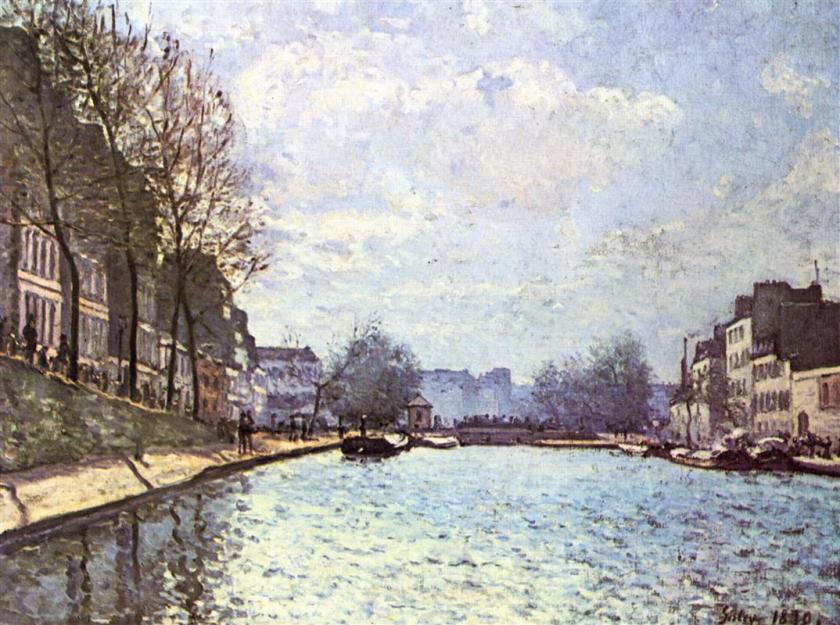
A similar work was his 1870 painting Vue du Canal Sint-Martin, which is housed at the Musée d’Orsay. Whereas other artists like Monet and Renoir

The Canal St Martin by Alfred Sisley (1870)

focused on the beauty of the French capital with its spacious sunlit boulevards created by Napoleon III and Baron Haussmann and the newly built apartment blocks. For artists like Renoir and Monet urban life was all about wealth and leisure. For Sisley it was about toil and poverty. He wanted to concentrate on the reality of Paris and life in the capital and not just the picturesque but idealised version of the metropolis and so he focused on the working quays of the Canal Saint-Martin. In the painting we see a wide stretch of the Canal St Martin near the Bassin de la Villette. On either side of the canal, houses and warehouses overlook the waterway and in the central midground is one of the locks. Further back and in the direction of central Paris buildings appear through the haze. Looking at his depiction we know there is a strong breeze which stirs up the water and the time of day deduced by looking at the length of the shadows made by the trees in the water, it must have been around midday. What is also important about Sisley’s painting is the way he has depicted the cloud formations and the nature of the light and its reflections on the water. He captures the moment with his use of a silvery palette of blues and greys, constantly thickening the paint for the highlights on the water. It would be one of the trademarks of his work as an Impressionist.

Alfred Sisley’s finances at this time were said to be at best, perilous and he often had to turn to friends and family for loans. Things were to get worse with the outbreak of the Franco-Prussian war in 1870. From September 1870 to January 1871, the French capital was besieged by Prussian forces and one of the dire consequences for Sisley was that his father’s business collapsed and William Sisley was financially ruined. His father lost everything and died shortly thereafter. Alfred’s money stream from his father was over. Sisley’s sole means of support became the sale of his works. 

..……….to be continued

Melchior d’Hondecoeter

Melchior d’Hondecoeter

Having a grandfather, father, and brother-in-law, who are accomplished artists must be a great benefit when considering your future occupation. My featured artist had all three as role models and therefore there is no surprise that he too became a renowned artist. The artist I am talking about today is the seventeenth century Dutch painter, Melchior d’Hondecoeter, who was born in Utrecht around the early months of 1636. Hondecoeter was known for his bird studies and in particular for the realistic portrayal of these beautiful creatures. Initially he painted seascapes but around 1660 he concentrated on depictions featuring colourful and often exotic birds. The settings for his paintings were varied. Sometimes it was a farmyard, other times it would be a country park or the courtyard of a palatial residence. Nearly all the works had an interesting background, often lush landscapes enhanced by the odd architectural feature. This type of work was in great demand at the time and his paintings adorned the large rooms of wealthy Amsterdam merchants’ houses and some were even purchased by William III for his palaces. It is said that Hondecoeter kept his own poultry yard at his house, but he also made visits to the country residences of his patrons where he could study more exotic species and perfect settings.

Hunting Trophies by Melchior d’Hondecoeter (1682)

But first let me talk a little about his antecedents who were to play an important part in forming his life. His paternal grandfather was the painter, Gillis d’Hondecoeter who was born into a Protestant family in Antwerp around 1580. A year after his birth, the Northern Netherlands, renounced the rule of the King of Spain with the declaration of Independence, Acte van Verlatinghe (Act of Abjuration), and as a result, Antwerp became even more engaged in the rebellion against the rule of Habsburg Spain. Antwerp was laid siege by Catholic Spanish forces for twelve months and it is thought that around 1582 Gillis and his family had to flee the city and move the safer protestant town of Delft. It is recorded that Gillis married on September 22nd 1602. His bride was Maritgen (Mayken) Ghysbrechts van Heemskerk who had come from the Dutch municipality of Rhenen. At this time Gillis was already living in Utrecht. A year later the couple moved to Amsterdam and it was here that Gillis remained until his death in October 1638.

Baptism of the Moorish Chamberlain by Gillis d’Hondecoeter

One of Gillis d’Hondecoete best known paintings is The Baptism of the Moorish Chamberlain. It is a forest landscape work. The landscape is used as background, the trees serving as the wings of the setting. The depiction is based on a theme taken from the Acts of the Apostles (8: 26-40) which tells the story of Philip the Evangelist who converts and baptises the eunuch who was the chief treasurer to the Queen of Ethiopia. It all came about on the road, when Philip falls in with the Moorish chamberlain who was returning from a pilgrimage to Jerusalem. The story goes that Moor had been reading the Book of Isaiah in his carriage but does not understand the content. Philip offers to explain it to him and, using the Old Testament, he preaches the teaching of Christ. Arriving at a stream, the chamberlain requests to be baptised.

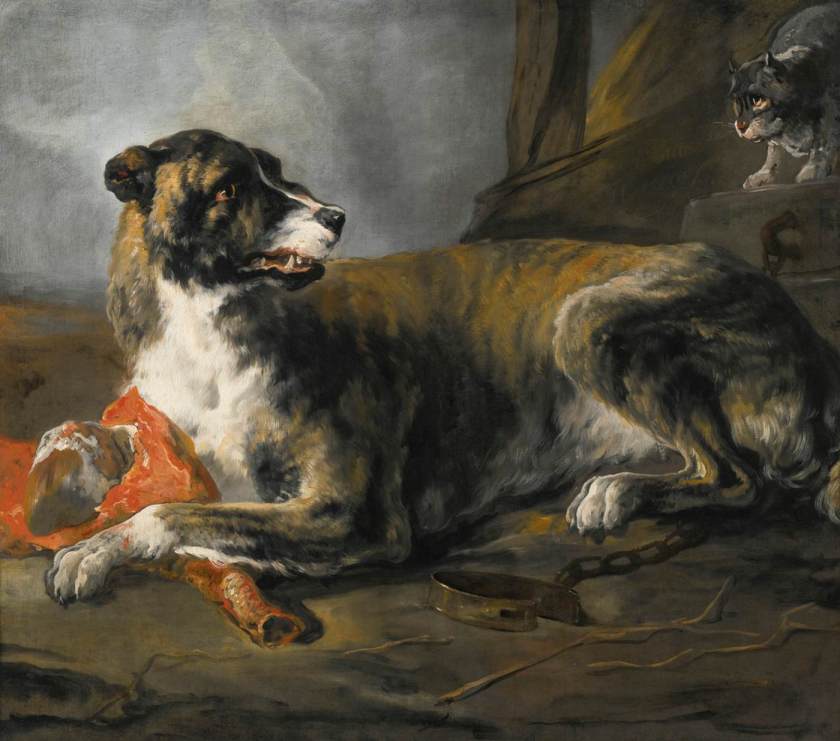
Hound with a Joint of Meat and a Cat Looking On by Jan Baptiste Weenix

Gillis and his wife went on to have nine children including Melchior’s father Gijsbert d’Hondecoeter and a daughter, Josintje d’Hondecoeter. Josintje married the painter Jan Baptiste Weenix in 1639. His father, Jan Weenix, was Melchior’s cousin and also a well-known artist. It is easy to understand that Melchior d’Hondecoete was brought up in an artistic household and as you will see much of his artwork was similar to that of his family.

Fowl on a Riverbank by Gijsbert d’ Hondecoeter (1651)

Gijsbert d’Hondecoeter, primarily a painter of barnyard fowl, became a member of the Guild of St. Luke in Utrecht in 1629. He initially taught his son Melchior but in 1653, when his son was in his late teens, he died and Melchior’s artistic tuition was taken over by his brother-in-law, Jan Baptist Weenix.

Poultry Yard by Melchior d’Hondecoeter

Arnold Houbraken, also a 17th century painter, but best known as a biographer of Dutch Golden Age painters, was told by Jan Weenix that Melchior was an extremely religious youth, continually absorbed in prayer, so much so that his mother and uncle wondered whether they should have him trained as a minister rather than as a painter. Melchior worked as an artist in Utrecht and became a member of the Confrerie Pictura and its head in October 1654

The Raven Robbed of the Feathers He Wore to Adorn Himself by Melchior d’Hondecoeter (1671)

Records show that in August 1658, twenty-two-year-old Melchior was working in The Hague and had become a member of the local Confrerie Pictura, an artist’s society which had been formed in 1656. Normally, it would have been expected that as a professional artist, Melchior would have become a member of the town’s well established association, The Guild of St Luke, but he decided on aligning himself with the Confreirie Pictura which had been set up by 48 dissatisfied painters who had left the local Guild. Melchior became chief of this painters’ fraternity in 1662.  In 1663, Melchior d’Hondecoeter married Susanne Tradel, a thirty-year-old woman from Amsterdam and the couple had two children, Jacob and Isabel, baptized in 1666 and 1668. The couple, as well as his sister-in-laws, lived on the street which ran alongside the Lauriergracht canal, which housed many artists and art dealers. It is believed that Hondecoeter spent much time in his garden or drinking in the tavern in the Jordaan, possibly being overwhelmed by the household of women. He later moved to Leliegracht which was close to his favoured drinking haunt on the Jordaan

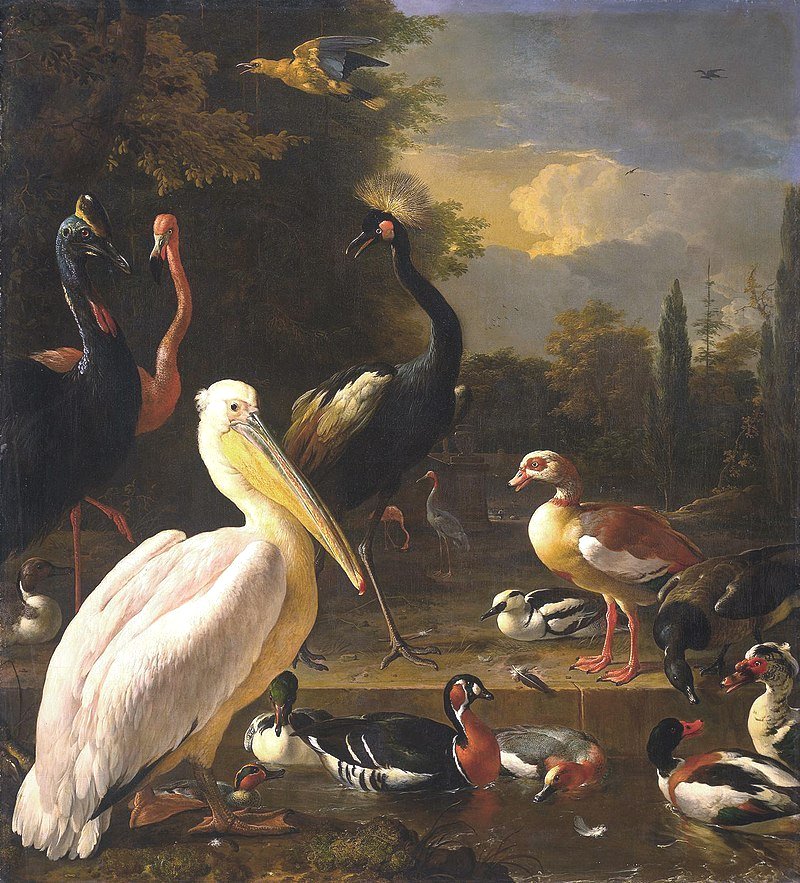
A Pelican and Other Birds Near a Pool (The Floating Feather) by Melchior d’Hondecoeter (1680)

One of Melchior’s most famous works was his painting entitled A Pelican and Other Birds Near a Pool but is often referred to as The Floating Feather which he completed around 1680. The shortened title is because of the feather we see floating in the pond in the foreground. The work was commissioned by the Stadholder William III of Orange for his Het Loon Palace in Apledoorn. It must have been a great honour for Hondecoeter to receive such a commission from the country’s ruler. The painting depicts a pelican in the foreground, a cassowary behind it at the left, and a flamingo and a black crowned crane. In the foreground various water birds congregate in and around a basin, and a feather floats on the water’s surface. Paintings like this were admired by wealthy merchants of Amsterdam, and by William III, who had works by Melchior at three of his palaces. Hondecoeter’s murals and large paintings were ideal for merchants’ large country houses and the depiction of birds was very popular at the time.

The Menagerie by Melchior d’Hondecoeter.

Another painting which was bought by William III for his palace at Het Loo was his work entitled The Menagerie. It depicts two squirrel monkeys from Central America, two white sulphur-crested cockatoos from Australia, a grey parrot from Africa and a purple-naped lory, from Indonesia, on a chain at the lower left of the painting. In this painting, Hondecoeter combined these creatures and several other colourful exotic birds. The finished painting was given to William III and was hung above the door of the king’s private apartment.

A Pelican and other Exotic Birds in a Park by Melchior d’Hondecoeter (1655-1660)

Hondecoeter completed a similar depiction in his painting A Pelican and other exotic birds in a park, and in the birds we see before us, there are some similarities, such as: the birds on the water, the group of exotic birds, the pelican, and the famous floating feather. Other features are also similar, such as the background landscape and the Muscovy duck in the centre foreground. In this work, new species of birds have been added on the far side of the pool and a Moluccan cockatoo can be seen in the tree on the left. It is thought that Melchior completed this work sometime between 1655 and 1660.

A Park with Swan and Other Birds by Melchoir d’ Hondecoeter

The National Museum Wales has a painting by Melchior d’Hondecoete. It is entitled A Park with Swan and Other Birds. The setting is a country house park with fowl before a fountain and an ornamental terrace with statues and figures. In the depiction we see European birds as well as a peacock, a North American turkey and an African crowned crane in front of a fountain on an ornamental terrace The painting is one of six by the artist which once hung in the London home of Emily Charlotte, a daughter of Welsh landowner, industrialist and Liberal politician, C.R.M. Talbot of Margam Abbey and Penrice Castle. This type of painting was often used to decorate the country houses of wealthy Dutch patrons.

Dead Birds by Melchior d’Hondecoeter (mid 1660’s) Wallace Collection, London.

In 1692, his wife died and Melchior went to live in the house of his daughter Isabel on the Warmoesstraat, one of the oldest streets in the city. Melchior d’Hondecoete died, aged 59, in Amsterdam on April 3rd 1695, and was buried in the Westerkerk. He left his daughter with substantial debts.

Oswald Achenbach

Portrait of Oswald Achenbach by Ludwig des Coudres. (1847.)

In Dusseldorf, on February 2nd 1827, Christine Achenbach gave birth to her fifth child, her son Oswald. His father, Hermann, was a man-of-all-trades, a one-time manager of a metal factory, a beer brewer, an innkeeper and finally a bookkeeper. Oswald was destined, like his brother Andreas, who was almost twelve years older than him, to become one of the great nineteenth century German landscape artists and an important representative of the Dusseldorf School of Painting. Their painting style was so alike that they were often jokingly referred to them as the Alpha and Omega of landscape painting.

Fishermen with the Bay of Naples and Vesuvius beyond by Oswald Achenbach (1877)

When Oswald was still a young child the family moved to Munich where he attended primary school. During Oswald’s early childhood, the family moved to Munich where he attended primary school for a short period. In 1835, the family moved back to Dusseldorf and Oswald followed the artistic path of his brother and was enrolled in the elementary class of the Kunstakademie Düsseldorf (Dusseldorf Art Academy). In fact, he should not have passed the entrance criteria for the school as its rules laid down a minimum entry age of twelve. However, he was given a place and remained there until 1841. There is no record of why the academy relaxed the age criteria but it could well have been that they recognised a budding artist who had probably received some artistic tuition from Andreas. All that is known about his six years at the academy is gleaned from his sketchbooks which were full of nature sketches from the area around the city.

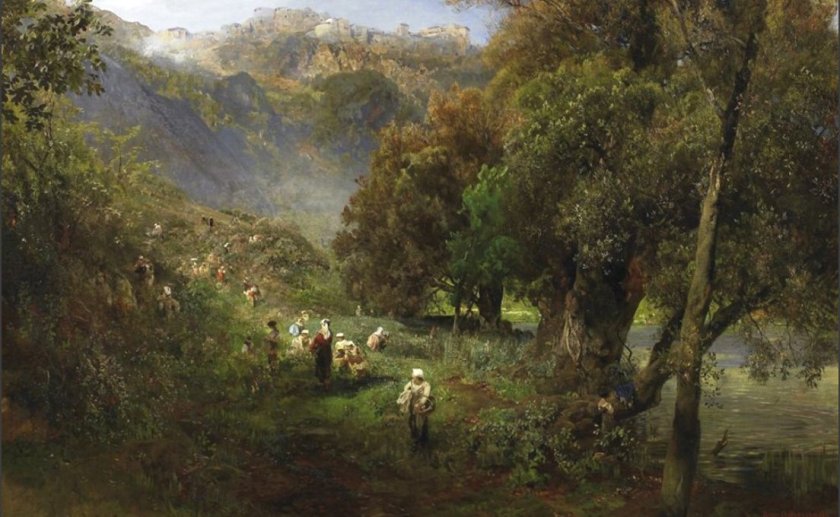
Summer Landscape on the Banks of the Alban Lake by Oswald Achenbach

There is no certainty as to why Oswald left the Academy at the age of fourteen but it is thought that he was unhappy with the very demanding Academy teaching. It was not just the Dusseldorf Academy which had their rigid formal academic training, the same was happening in all the European Art Academies and all fought hard to maintain their formal approach. Where the Academies held the ‘whip hand’ was the fact that they organized the big art exhibitions, at which artists were primarily able to sell their work. Artists who dared oppose the Academic style were unable to have their works exhibited, which meant their opportunity to sell their paintings was curtailed. However, artists were not prepared to bow to such pressure and soon began to make their feelings known.

Via Appia with the Tomb of Caecilia by Oswald Achenbach

After leaving the Academy, Oswald Achenbach joined two associations: the Verein der Düsseldorfer Künstler zur gegenseitigen Unterstützung und Hilfe (association of Düsseldorf artists for their mutual support and aid) and like his brother, the Malkasten, which was founded on 11 August 1848 with Andreas Achenbach as one of the original signatories of the founding document. These Associations jointly staged plays, organized music evenings and staged exhibitions. At many of these events, Oswald took an active part, directing, playing or staging plays. He was a staunch supporter of the Malkasten and remained a member until the end of his life.

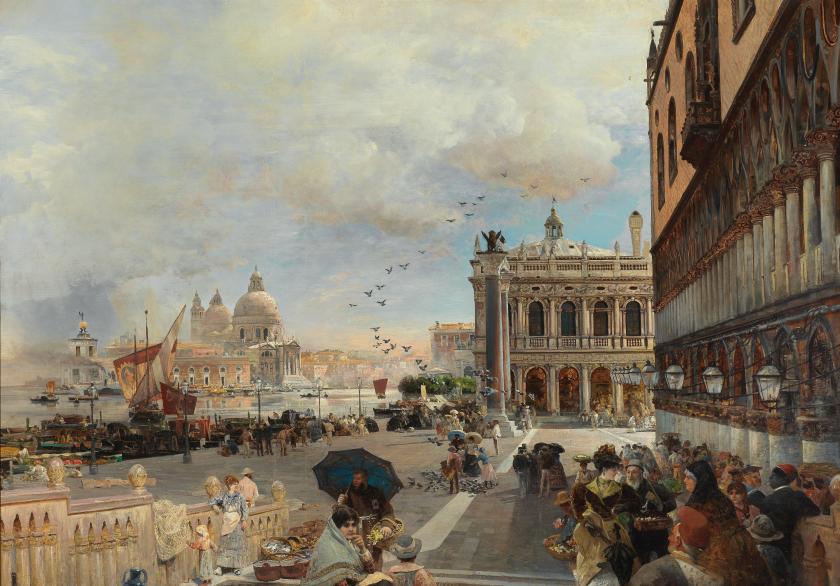
Venice, a view of the Piazzetta, with the Biblioteca Marciana, Santa Maria della Salute and the Dogana, by Oswald Achenbach

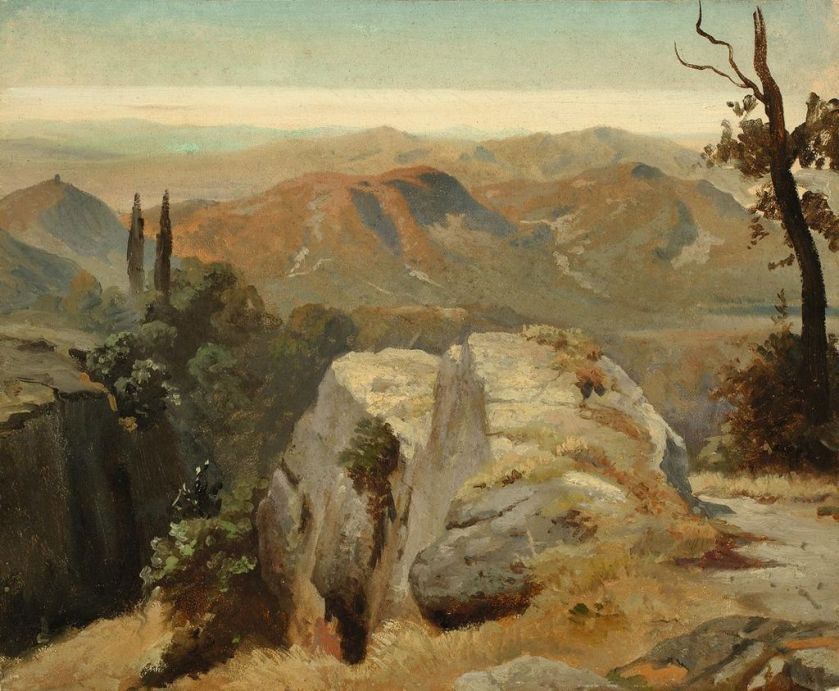
In 1843, sixteen-year-old Oswald Achenbach began a prolonged journey of discovery which lasted several months. He travelled through Upper Bavaria and the North Tyrol of Austria, and arrived in Northern Italy, all the time sketching the landscapes he encountered. He returned to Italy on many occasions and Oswald is best remembered for his Italian landscape works. Despite Oswald’s dislike of how art was taught at the Dusseldorf Academy, the subject matter and the techniques he employed in his early landscape works were heavily influenced by the ideas being taught at the art academies of the time. Art historians confirm that the influence of Johann Wilhelm Schirmer, a tutor at the Dusseldorf Academy and Carl Rottman, the German landscape painter who completed many Italian landscape works, can be seen in Oswald Achenbach’s paintings. In Oswald Achenbach oil studies for his paintings during his Italian travels, he adhered very closely to the nature of the landscape and concentrated on the details of the typical Italian vegetation. In his early works, he showed less interest in architectural motifs and any figures in his depictions played a much smaller role than they would in his later, more mature work.

Evening by Oswald Achenbach (1854). Royal Collection, Windsor Palace.

Around 1847, Oswald received a commission to contribute some lithographs of his paintings, sketches, and other works for the satirical journals, Düsseldorf Monathefte and the Düsseldorf Monatsalbum. These journals were published by Heinrich Arnz, a well-known bookseller and printer who co-owned the Arnz & Co. with his brother Josef. Heinrich had a son, Albert, five years younger than Oswald. He was an artist who, like Oswald, studied at the Dusseldorf Academie and would often accompany him on some of his Italian trips. Heinrich Arnz also had a daughter, Julie, the same age as Oswald Achenbach and after a brief courtship the pair became engaged in 1848, and three years later, the couple married on May 3rd 1851. Between 1852 and 1857 the couple had four daughters, followed by a son in 1861. Their son, Benno von Achenbach, went on to become the founder of the carriage driving system named after him. In 1906 he became head of the Neuer Marstall in Berlin, which housed the Royal equerry, horses and carriages of Imperial Germany and in 1909, William II awarded him the hereditary nobility for his services to equestrian sport.

Not now having any connections with the Dusseldorf Academy, Oswald Achenbach had problems in trying to exhibit and sell his artwork. However, in 1850 he found an outlet in the form of the newly founded Düsseldorf gallery of Eduard Schulte. The gallery exhibited the works of artists who were independent of the Academy and as such, played an essential role in Achenbach’s early economic success. The Eduard Schulte gallery became one of the leading German galleries and later expanded, opening galleries in Berlin and Cologne.

Morning by Oswald Achenbach (1854). Royal Collection, Windsor Castle.

Whether by mutual consent or just fate but the two landscape painting brothers Oswald and Andreas seemed to choose different areas of Europe to depict in their paintings. The older brother Andreas although a large amount of his work was focused on seascapes and maritime depictions, he preferred his landscapes to focus upon the countryside of Northern Europe and Scandinavia, whereas Oswald preferred to produce depictions of Southern Europe, especially Italy.

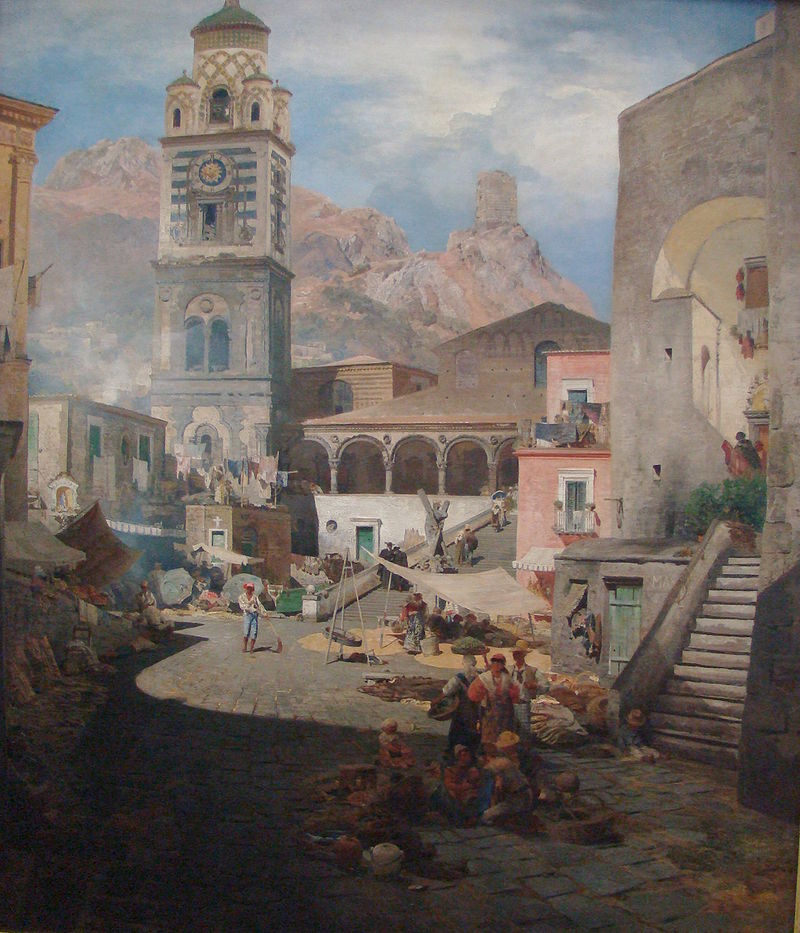
Market Square in Amalfi by Oswald Achenbach (1876)

Oswald’s first major painting venture to Italy came in the summer of 1850. His companion for the adventure was Albert Flam, a German landscape painter, who had been taught by Andreas Achenbach and, like the Achenbach brothers, had been a student at the Dusseldorf Academy. They travelled to the French Cote d’Azur seaside town of Nice and then crossed over the Franco-Italian border to Genoa, the capital of the Italian region of Liguria and then they journeyed north to Rome. The pair went off on daily sketching expeditions to the Roman Campagna which was so popular with earlier landscape artists who were inspired by its beauty. Rome was a great place for artists to meet each other and during his stay in Rome Oswald met many including the Swiss Symbolist painter, Arnold Böcklin, Ludwig Thiersch, the German painter known for his mythological and religious subjects and especially his ecclesiastical art, and the landscape painter, Heinrich Dreber with whom he spent a long time in Olevano Romano, a commune which lies about 45 kilometres east of Rome. All artists tackle landscape painting differently and Ludwig Thiersch commented on how his friends differed. He said that Dreber drew elaborate pencil sketches, Böcklin simply let himself experience the environment and recorded relatively little in his sketchbook, while Achenbach and Flamm both painted oil studies outdoors. For Oswald Achenbach it was all about colour and achieving the correct tone by layering the paint. Form and the distribution of light and shadow was also very important to him, but less so was detailed topographical accuracy.

Study from Upper Italy, 1845, oil on paper mounted on cardboard. This study was made during Achenbach’s 1845 trip to Northern Italy.

By the start of the 1850’s, Achenbach’s paintings were well-known internationally. In 1852, aged 25, the Art Academy in Amsterdam had admitted him as a member. More fame came his way when several of his works were displayed at the Exposition Universelle of 1855 in Paris, all of which were praised by the art critics and the public alike. In 1859, he received a gold medal at that year’s Salon Exhibition in Paris. In 1861 he was granted an honorary membership to the St Petersburg Academy and in 1862 he was bestowed membership of the Art Academy of Rotterdam.

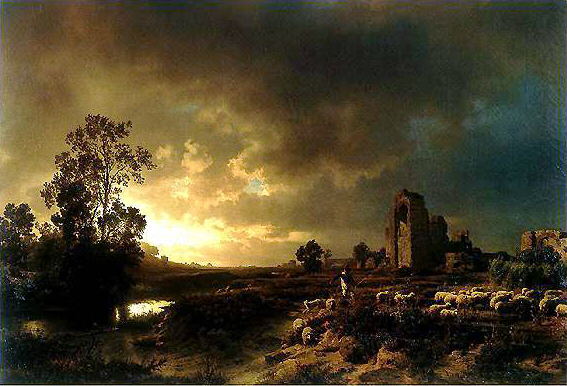
The Evening Mood in Campagna by Oswald Achenbach (1850.)

Despite leaving the Academy due to his opposition to the Academy’s method of teaching art, in March 1863, Achenbach became the Professor for Landscape Painting at the Düsseldorf Academy. This was a great honour and it signified an elevation in his social standing as well as financial security. It would also look to be a volte-face to his earlier opposition but the reason for him accepting the post could have been due to the departure of the director of the academy, Friedrich Schadow, four years earlier and the fact there had been conciliation between the Academy and the independent artists.  The title, Knight of the Legion of Honour, was bestowed on Oswald by Napoleon III in 1863. Many more international honours followed. Oswald Achenbach continued to have his work exhibited at the Salon between 1863 and 1868

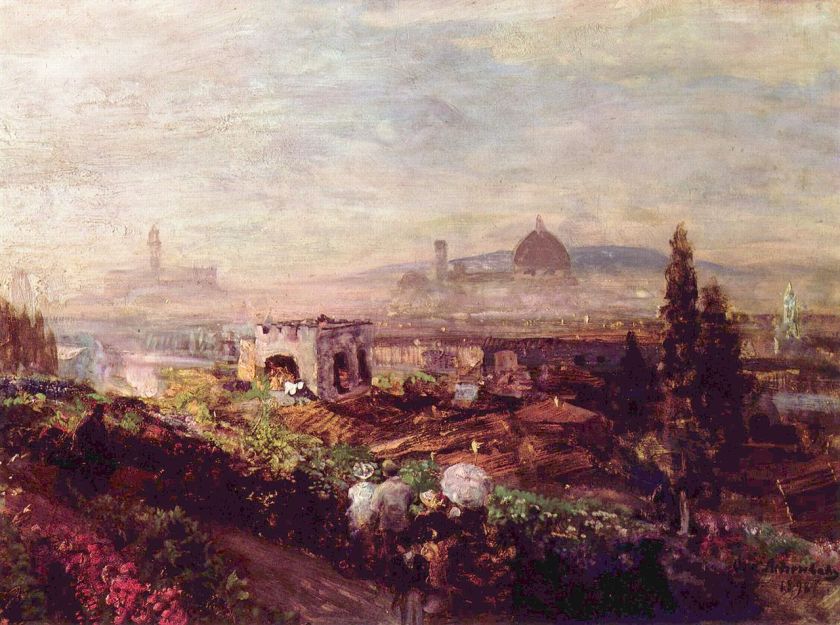
View of Florence by Oswald Achenbach (1898)

In the following years, Achenbach continued to make more trips and his last major trip was to Italy. It began in the early summer of 1882 and he visited Florence, Rome, Naples, and Sorrento. In 1884 and 1895 he took trips to Northern Italy. He had planned a trip in 1897 to Florence but cancelled it due to illness.

Oswald Achenbach died in Düsseldorf on February 1st 1905, one day before his 78th birthday. He was buried in the city’s North Cemetery.

Andreas Achenbach


Professor Andreas Achenbach on his 70th birthday by Heinrich von Angeli

When I looked at the life of the Hudson River School painter, James McDougal Hart, I talked about his time at the Dusseldorf Academy and how the Dusseldorf School of painting influenced him. The style of the Dusseldorf School of painting is characterised by its finely detailed, often overstated, and fanciful landscapes that more often than not have some kind of religious or symbolic stories depicted via these landscapes. The leading artists and members of the Dusseldorf style of painting reinforced the need for plein air painting, so that the artist could capture the true nature before returning to their studios and remaking more accurate visual conditions in their work.

Coastal landscape with city view by Anders Achenbach (1875)

The Dusseldorf School of painting principal period was one from 1826 to 1859 when German painter Friedrich Wilhelm von Schadow was the school’s director. He had been professor at the prestigious Berlin Academy of the Arts, and in 1826 he was made director of the Düsseldorf Academy of the Arts, which he reoriented towards the production of Christian art. Twelve-years-old, Andreas Achenbach, is thought to have been one of von Schadow’s earliest pupils at the Dusseldorf Academy. Let me introduce you to this artist, the German landscape and seascape painter in the Romantic style.

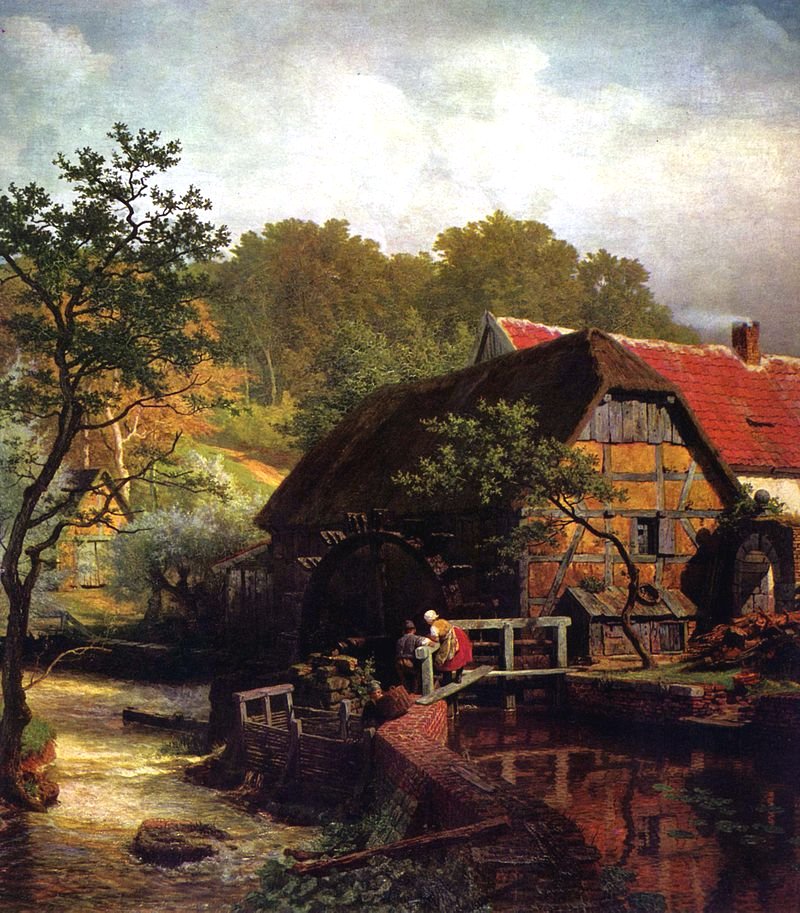
Watermill in Westphalia, (1863) by Andreas Achenbach (1847), The Walters Art Museum

Andreas was born on September 29th, 1815 in the Northern Hesse town of Kassel, Germany. He was one of ten children born to Hermann Achenbach and Christine (née Zülch). His father Hermann was a merchant. In 1816 he took over the management of a metal factory in Mannheim. Two years later, in 1818, he moved his family to St. Petersburg, where the father wanted to set up a new venture, that of his own factory, the money for this project emanated from his wife’s “dowry”. Whilst in St Petersburg young Andreas received his first lessons in drawing in a girls’ school. He excelled and his teacher is said to have certified that six-year-old Andreas ‘could already do everything’. His father’s venture failed and, in 1823, he was forced to take his family back to Germany and settle down in the small Rhine Province town of Elberfeld. where family members of the father lived. Andreas’ father then began to earn a living, working as a beer and vinegar brewer and took ownership of an inn, The Black Wallfish, at Jägerhofstraße 34. It became a regular for visiting artists.

On February 2nd, 1827 Christine Achenbach gave birth to her fifth child, a son Oswald who would, in later years, become as greater an artist as his brother Andreas.

Die alte Akademie in Düsseldorf by Andreas Achenbach (1829)

Andreas began his formal academic training, in 1827, at the age of twelve, when he enrolled at the Kunstakademie Düsseldorf under Wilhelm Schadow, Heinrich Christoph Kolbe and Carl Friedrich Schäffer. At an exhibition of the Kunstverein für der Rheinlande und Westfalen, which Schadow had co-founded, fourteen-year-old Andreas Achenbach achieved his first major success by being not only the youngest artist with a painting at the exhibition but also that one of his paintings, the painting Die alte Akademie in Düsseldorf, was sold. The setting of the painting was a view from a window in his parents’ apartment in the house Burgplatz 152. It was an unusual subject for Andreas to choose, considering what he had been taught at the Academy. The depiction is a simple restrained cityscape and such “reality” was deemed to be too banal and unartistic at the Academy, which under the leadership of Schadow was dominated by idealistic concepts. It is thought that this work resulted in Achenbach’s name being omitted from the Academy’s list of artists and not appearing until the winter term of 1830/1.

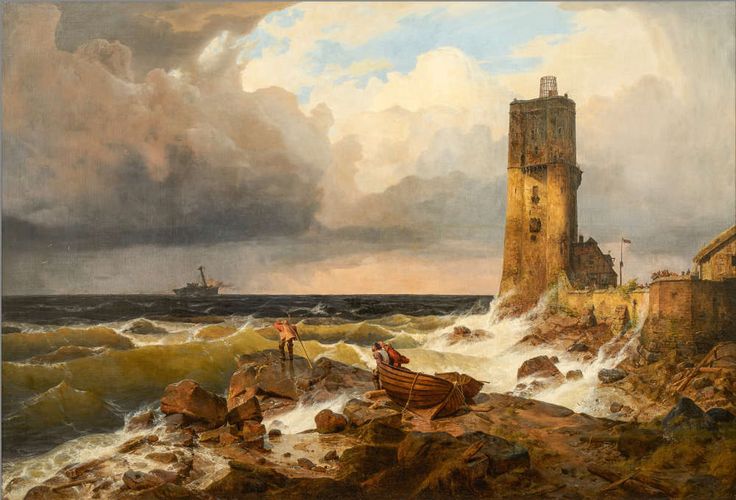
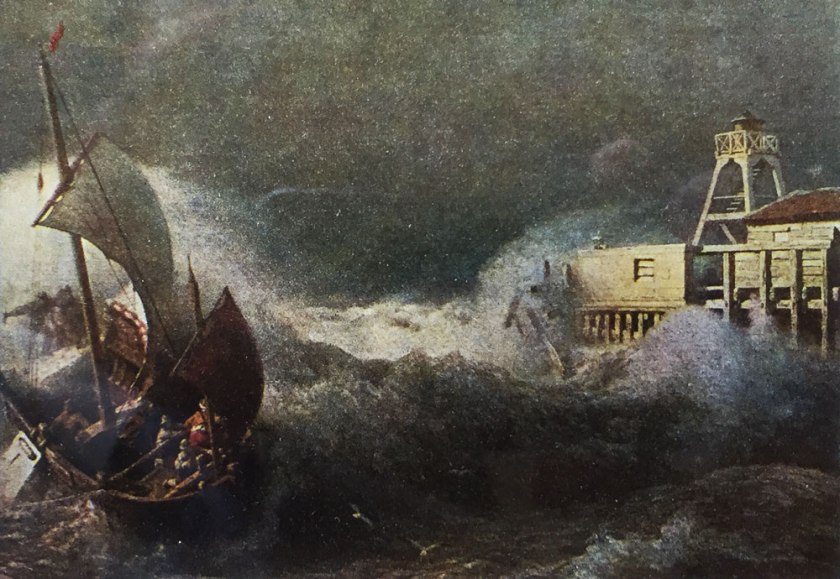
Große Marine mit Leuchtturm by Andreas Achenbach (1836)

In 1832 and 1833 he took an extended study trip with his father to Rotterdam, Scheveningen, Amsterdam and Riga. The journey of discovery gave him the ideal opportunity to study Dutch and Flemish landscape painting. The works of the seventeenth-century Dutch landscape painters Jacob Isaackszoon Ruisdael and Allaert van Everdingen were to particularly influence his art. Achenbach, as well as painting landscapes also painted seascapes, often depicting terrific storms and it is thought that the stories he heard from his family regarding their treacherous 1818 journey to St Petersburg remained in his mind for many years. His artistic breakthrough came at the 1836 General German Art Exhibition in Cologne at which his painting Großer Marine mit Lighthouse, was on show and up for sale. It was bought by the Prussian governor in the Rhine Province, Frederick of Prussia.

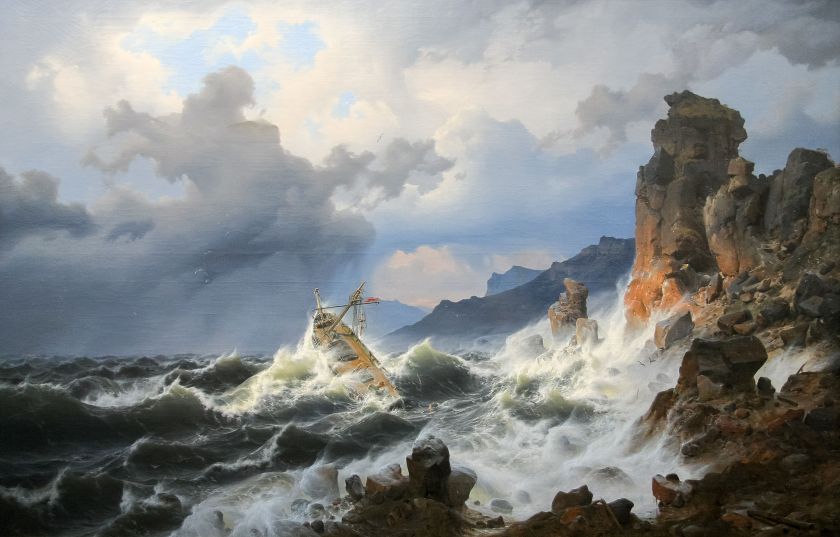
Storm on the sea at the Norwegian coast by Andreas Achenbach (1837) Städel Museum

Following his trips with his father, Andreas Achenbach made many painting trips on his own. In 1835 he made a major trip to Denmark, Norway, and Sweden. And the following year he journeyed to the Bavarian Alps and the Austrian Tyrol. After his tour of Bavaria and the Tyrol, he left Dusseldorf and settled in Frankfurt and, thanks to the assistance of his friend, the German history painter, Alfred Rethel, he was able to open a studio at the Städelsche Kunstinstitut. Despite having his own studio in Frankfurt, Andreas continued with his periodic travels. He returned to Scandinavia in 1839 taking a painting tour of Norway.

Clearing Up—Coast of Sicily by Andreas Achenbach (1847), The Walters Art Museum

He also took more trips to Italy during the period from 1843 to 1845 when he stayed in the Campagna and spent time on the Isle of Capri. and often returned to Scandinavia, often accompanied by his artist brother, Oswald. Ostend was a popular destination for the two brothers.

Hildesheim by Andreas Achenbach (1875)

In 1846 Andreas returned to Dusseldorf and lived on the Flinger Steinweg, a then prosperous middle-class area of the city. He took over the running of his father’s brewery and inn. His father, despite being sixty-three, was glad to hand the business to his son so he could concentrate on being a freelance accountant. Andreas became a member of a number of artistic associations and was one of the founders of the newly formed Künstlerverein Malkasten (Artists’ Association Malkasten), often referred to as The Paint Box, which still exists today. He, together with other wealthy patrons, provided for the purchase of the former Estate of the Jacobi family in Pempelfort and its expansion as a permanent centre of the association, using considerable funds of his own. Andreas wholeheartedly immersed himself in Dusseldorf’s artistic life.

Maximilian Achenbach (Max Alvary)

In 1848 Andreas Achenbach married Marie Louise Hubertine Catharine Lichtschlag and the couple went on to have five children, three daughters, Lucia, Karoline, and Helena and two sons, Gregor, and Maximilian. Maximilian studied to be an architect at Aachen university and graduated in 1871. After working as an architect for a few years, and against the will of his father, he gave up his architectural career, married, and began his vocal studies in Milan and Frankfurt. He took his stage name, Max Alvary. so as not to offend his father and compromise his father’s business. Later Maximilian moved to Weimar and performed at the court opera, where he was very successful. He later appeared at the Metropolitan Opera House in New York and Covent Garden Opera House in London.

Storm by Andreas Achenbach (1898)

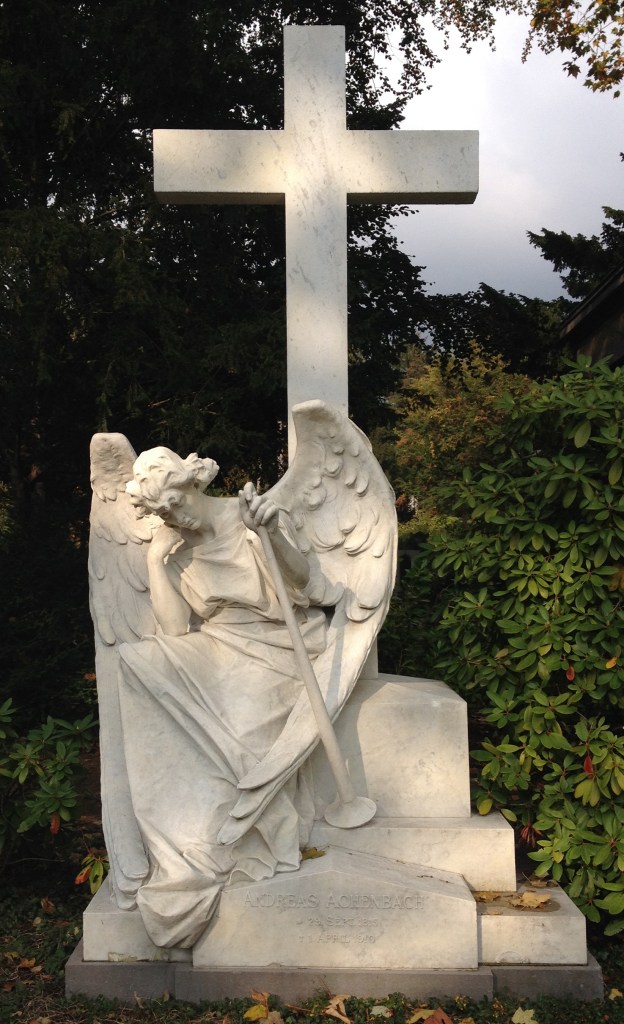
In 1848 Achenbach was awarded the Belgian Order of Leopold. In 1853, he was made an honorary member of the Pennsylvania Academy of the Fine Arts, In 1861 the Order of St. Stanislaus, and in 1862 the Accademia di Belle Arti di Brera in Milan. More honours followed and in 1878 he was awarded the Commander’s Cross 2nd Class of the Royal Norwegian Order of Saint Olav. On 24 January 1881 he was admitted to the Prussian Order of Pour le Merite for Science and the Arts. In 1885 he became an honorary citizen of Düsseldorf, in whose northern cemetery he received an honorary grave, designed by the sculptor Karl Janssen.

Honorary grave of Andreas Achenbach with mourning angel of Karl Janssen, North Cemetery Düsseldorf

Andreas Achenbach died on April 1st 1910, aged 94. He was laid to rest in the Malkasten-Haus, where there was an opportunity to say goodbye to him for several days. The people of Düsseldorf queued to pay their last respects. The funeral procession moved off from the Paint Box heading to Achenbach’s final resting place at Dusseldorf’s North Cemetery and it was commented in the local media that it was akin to a state funeral of a prince.

In my next blog I will look at the life and works of Andreas’ brother, Oswald Achenbach.

Hudson River School – The Hart Family

Part 3.  Julie Hart

“…Mrs. Julie Hart Beers Kempson became the only woman artist of the century to specialize in landscape. It is perhaps not surprising to find so few women landscapists, since the rigors of painting outdoors and the unseemliness of women engaging in this activity during the Victorian era acted as a deterrent…”

William H. Gerdts,
Women Artists of America 1707-1964 (Newark: Newark Museum, 1965)

The above extract is from the article in the 1965 Newark Museum catalogue Women artists of America, 1707-1964 that accompanied the exhibition.  It was written by the American art historian and former professor of Art History at the City University of New York Graduate Center, William Gerdts.

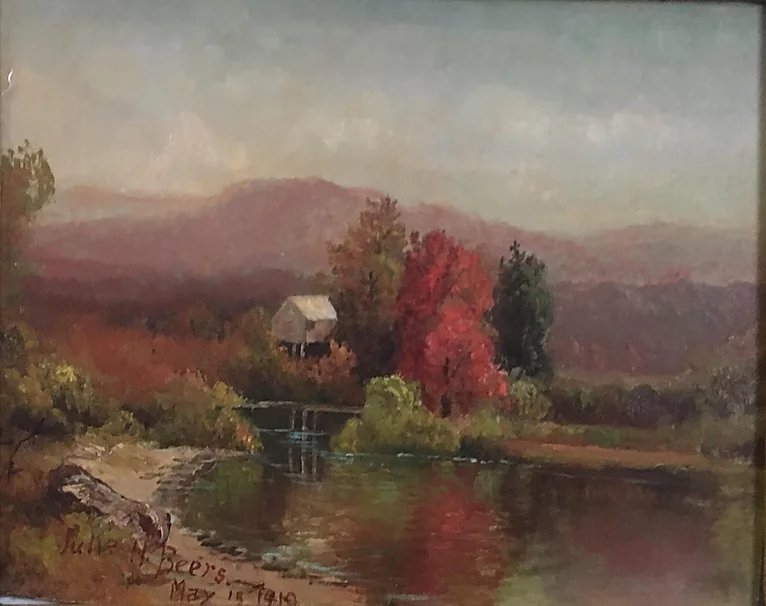
Cabin in Autumn, Upper Hudson Valley by Julie Hart Beers (1910)

In my final blog regarding the artistically talented siblings of the American Hart family I want to look at the life and work of the youngest child of James and Marion Hart, Scottish immigrants who had settled in Albany, N.Y., in 1831. Julie Hart was born in 1835, in Pittsfield, Massachusetts, and was the only one of her siblings to have been born in America. She, as we have seen in the two previous blogs, had two talented artists as brothers, William Hart and James McDougal Hart. The world of Fine Art in America, in the nineteenth century, was a male-dominated institution. There were female painters but they were looked upon purely as hobbyists rather than being serious professional painters. It was believed by many men that women had better things to do than paint professionally – raising children, keeping house and looking after their hard-working husbands. Most art academies didn’t admit women, and neither did the art societies that linked artists with patrons, which was a prerequisite to the financial success of an aspiring artist. So, in the early part of the nineteenth century, women artists signed their work with just a first initial and a surname so as to conceal their gender, thus hoping that their ability as an artist would not be downgraded once the sex of the artist was known. For women to succeed in the world of Fine Art they needed both their family and/or financial backing to launch them professionally. Often, they were the sisters, daughters and wives of better-known male artist. There was no formal training for women at art institutions so once again they relied on family members or friends to help develop their talent. Julia Hart was fortunate enough to have her two elder brothers, who were aligned with the Hudson River School of art, to teach and mentor her and so, as a teenager, she became interested in plein air landscape painting.  She was one of very few professional women landscape painters in nineteenth-century America

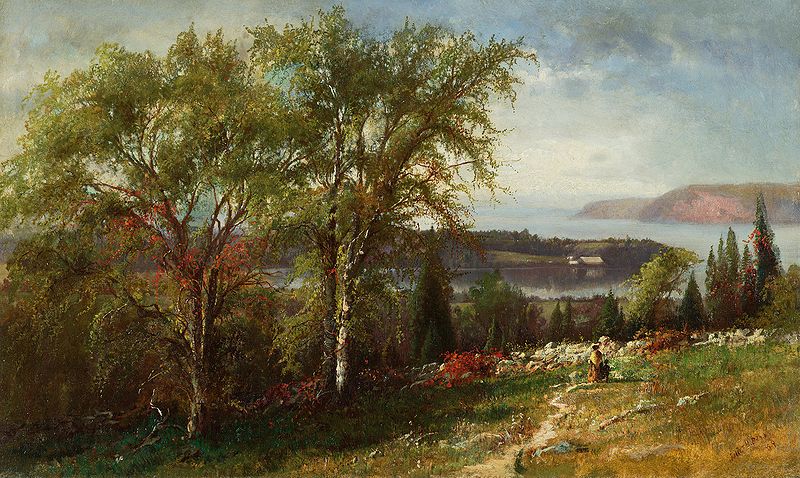
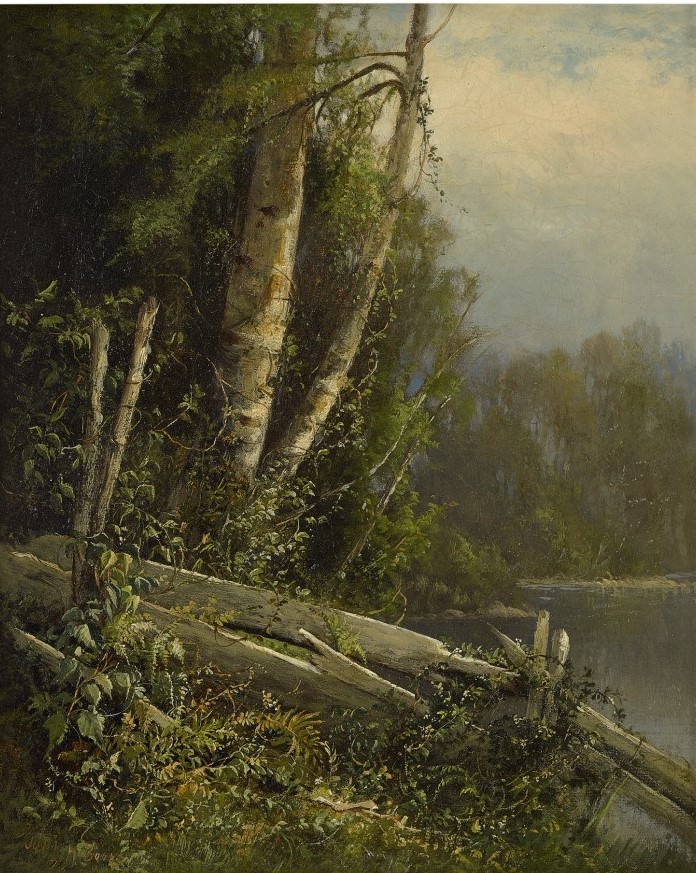
The Old Birch Tree by Julia Hart Beers (1876)

In 1865 the American Civil War had ended and the Reconstruction had begun. Americans unfettered by the trials of war were once again relishing the joys of tourism and travel. They would often explore the great landscapes. One such area was the banks of the Hudson River which had started its 319-mile journey from the Adirondacks towards its outflow between Manhattan and Jersey City. It was the upper reaches including the Adirondacks, Catskills and White Mountains which tempted both tourists and artists alike. The artists, who were looked upon as being part of the Hudson River School, wanted to capture the beauty on canvas and the tourists wanted pictorial mementos of their journeys. These areas of beauty were often steep-sided hills and mountains and for female artists who came to the region for some plein air sketching and painting, they had to overcome the challenge of decorous dressing versus suitable attire for their arduous painting trips. These women ventured on their own or alongside male relatives into the wilderness, painting the breath-taking scenery that inspired America’s first art movement. Julie Hart was one of those women.

Hudson River at Croton Point by Julie Hart Beers (1869)

Julie Beers married in 1853, when she was eighteen years old. Her husband, also a painter, was Marion Beers. Marion, like Julie’s brothers, helped teach his wife artistic techniques which were to serve her well in the future. In the mid 1850’s Julie, like her two brothers, relocated to New York city and set up a studio. Since her marriage, Julie signed all her paintings “Julie H Beers
It is thought that Julie’s first exhibition was held at the National Academy of Design (NAD) in 1867, following which she had her paintings exhibited at the NAD annual exhibitions in each of the following twelve years. She also exhibited at the Boston Athenaeum in 1867 and 1868 and at the Pennsylvania Academy of Fine Arts in 1868.

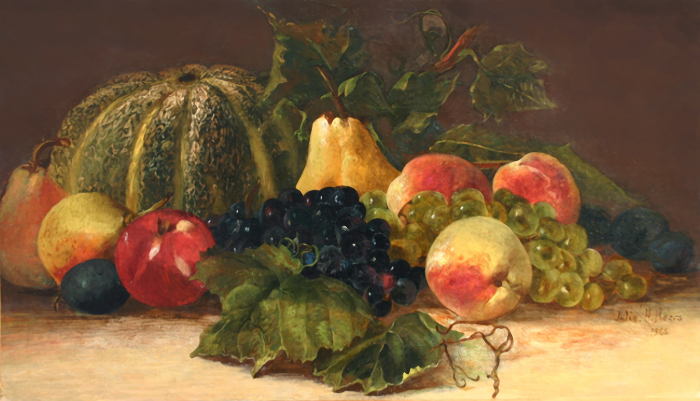
Still Life with Fruit by Julie Hart Beers (1866)

Besides being a renowned landscape painter Julie was also a talented still life artist as can be seen by her 1866 painting Still life with Fruit.

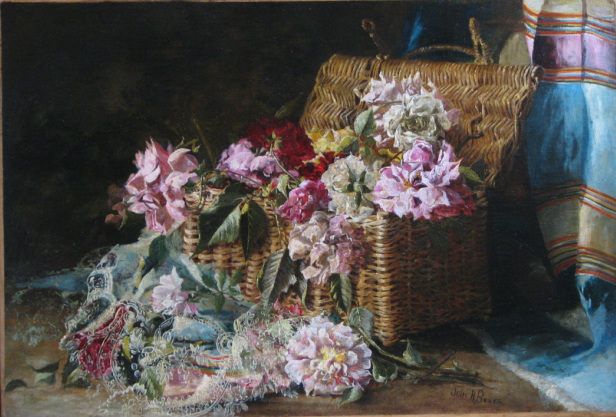
Basket of Roses by Julie Hart Beers (ca. 1860’s).

Another of her still life paintings, completed around the same time was entitled Basket of Roses.

Cabin by the Forest by Julie H Beers

Her husband, Marion Beers died in 1876 and the following year Julie married Peter Kempson and the newly-weds moved to Metuchen in New Jersey.  Julie Hart Beers Kempson proved that women landscape painters were the equal of men, despite the harshness of painting en plein air in the wild and often barely accessible landscapes along the Hudson River.  Sadly her paintings did not receive affair and objective assessment during her lifetime and she was not truly valued in her own time, but notwithstanding that transgression, her talent and dedication as an artist which not only produced outstanding works of art, but also led the way for the female landscapists who would follow her.

A Quiet Pond by Julie Hart Beers (1873)

I will end this blog as I started it, with a quotation.  This one is from Jennifer Krieger, Managing Partner at Hawthorne Fine Art in New York City. Her article entitled Women Artists of the Hudson River School formed part of the catalogue which accompanies the 2010 exhibition, Remember the Ladies: Women of the Hudson River School, which was held at Cedar Grove, The Thomas Cole National Historic Site, Catskill, New York. She wrote about the trials and tribulations of female artists and their struggle to carry out plein air painting in remote areas of the Hudson River valleys. She wrote:

“…These artists managed to make their way through vast, unexplored stretches of the American landscape and to shimmy up trees (for better views) in spite of their long skirts. Rather than complain about all that society had placed in their way…… [They] were all intent on honoring the beauty of the natural world they had experienced so directly. Rather than to complain about all that society had placed in their way, women artists pushed forward to accomplish their goals. As a result of their determination, our own cultural topography has been immeasurably enriched…”

A Hudson River Scene by Julie H Beers

Julie Hart Beers Kempson demonstrated that women landscape painters were the equal of men, even given the hardships of painting outdoors.  While largely undervalued in her own time, her talent and dedication not only produced outstanding works of art, but also broke important ground for the female landscapists who would follow her.

Hudson River School – The Hart family.

Part 2 – James McDougal Hart and family.

James McDougal Hart

The Hudson River School, as it has come to be termed, was founded by the painter Thomas Cole around 1825. Cole believed that nature manifested to man the mind of the Creator and saw the artist as a prophet. The Hudson River School was so named because its proponents showed a fondness for depicting the scenery to be found in the countryside bordering the Hudson River. James McDougal Hart, like his brother William and his sister, Julie, were looked upon as second generation exponents of this type of landscape painting.

James McDougal Hart (1828-1901)

James McDougal Hart was born on May 10th 1828 in the East Ayrshire town of Kilmarnock. His father James was a schoolteacher and he and his wife took passage on the SS Camillus with their seven children and emigrated to America, landing in New York on February 12th 1830. After landing on American shore, the family located to Albany in upstate New York.

After completing his education, James, like his brother William before him, became an apprentice to a local sign and carriage maker and was employed to paint landscape scenes on carriage doors and banners. In 1851 James left America and travelled to Germany, visiting Munich, Leipzig and Dusseldorf, where he enrolled for a short period at the Dusseldorf Art Academy. Being a student at the Academy he was influenced by the Düsseldorf school of painting, which was a name given to a group of painters who taught or studied at the Academy during the 1830s and 1840s, a period when the Academy was directed by the Romantic painter Wilhelm von Schadow. The Dusseldorf School is typified by its keenly detailed yet imaginary landscapes, often with religious or allegorical stories set in the landscapes and he was a great believer in plein air painting and the use of a palette with comparatively subdued colours.

The Old Homestead by James McDougal Hart (1862)

The Düsseldorf School had a significant influence on the Hudson River School in the United States, and many prominent Americans trained at the Düsseldorf Academy such as George Caleb Bingham, Worthington Whittredge, and Richard Caton Woodville. Strangely, one of the great Hudson River painters, Albert Bierstadt, applied but was not accepted.

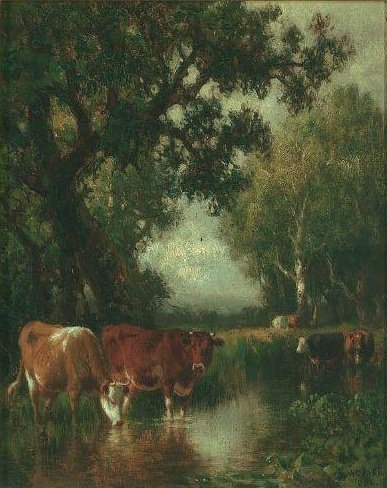
Cows Watering by James McDougal Hart

James Hart returned to Albany around 1853 and opened a studio where he painted and gave painting lessons. In 1857 he moved to New York City and he and his brother William opened up a studio. James became an associate member of the National Academy of Design in 1857 and a full member in 1859.

The Puzzle by Marie Theresa Gorsuch Hart

James Hart married fellow painter Marie Theresa Gorsuch in 1866 and the couple went on to have five children, three sons Robert Gorsuch Hart, William Gorsuch Hart and William Howard Hart and two daughters, Mary Theresa Hart and Letitia Bonnet Hart. Three of the siblings became artists in their own right.

Portrait of Adeline Pond Adams Seated in an Interior by William Howard Hart (1891)

William Howard Hart became a landscape and portrait painter. He studied in New York with J. Alden Weir at the Art Students League. Later, in the 1890’s, he went to Paris and studied under Gustave Boulanger and Jules Lefebvre at the Academy Julian.

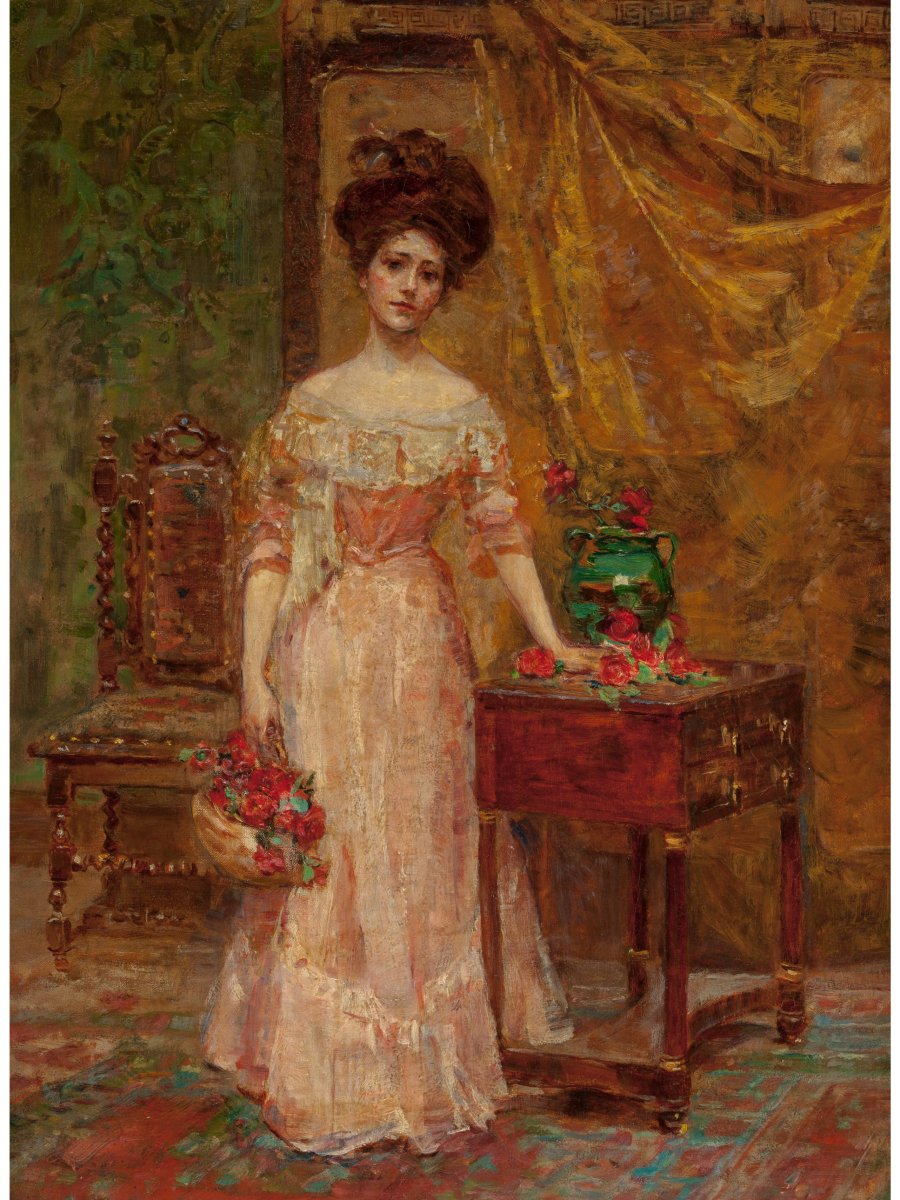
The Basket of Roses by Letitia Bonnet Hart

Letitia Bonnet Hart, who became a painter known for her portrait and figure painting, was born in 1867. She exhibited in twenty-eight annual exhibitions from 1885 to 1914, including at the Woman’s Building at the 1893 World’s Columbian Exposition in Chicago. In 1901 she exhibited in the Pan American Exposition in Buffalo, New York and three years later, in 1904, her work was shown in the Louisiana Purchase Exposition in St. Louis,. She and her sister Mary Theresa Hart, shared a studio in NYC and later she went to live in Lakesville, CT.

The Puzzle by Marie Theresa Gorsuch Hart

Marie Theresa Hart was born in 1872 in Brooklyn, New York and studied with her father as well as with Edgar Melville Ward, the American genre painter, at the National Academy of Design. Between 1889 and 1895, she was enrolled in antique and life classes at the Academy and won several awards. She was best known for her floral painting and illustrations of violets and was also an accomplished portrait artist and art teacher.


The Coming Storm by James McDougal Hart

One of James Hart’s favourite subjects was cattle, and this can be seen by his painting entitled The Coming Storm, where he depicted them huddled under trees, during a period of stormy weather.

Picnic on the Hudson by James McDougal Hart

The mid 1860’s was a time of wealth for some Americans. The Civil War had ended in 1865. The North in 1865 was an extremely prosperous region. Its economy had boomed during the war, bringing economic growth to both the factories and the farms. Since the war had been fought almost entirely on Southern soil, the North did not have to face the task of rebuilding. Men involved in transportation made large profits from the movement of supplies for the Union troops during the Civil War. The world of property development also created many wealthy people. It was known as the Gilded Age and was an era that occurred during the late 19th century, from the 1870s to about 1900. The Gilded Age was an era of rapid economic growth, especially in the Northern United States and the Western United States.

A Mid Summers Idyll by James McDougal Hart (1868)

James Hart later moved to Brooklyn and in the 1870s, he and his brother, William, opened studios in Keene Valley, NY, in the heart of the Adirondacks. For artists like James Hart and his brother William there was plenty of commissions to be had. The wealthy industrialists, now the nouveau riche of the post-Civil War society especially wanted to acquire works which depicted serene and relaxing rural scenes, scenes of picturesque tranquillity and they were eager to spend their money on such paintings as well as other paraphernalia of culture which they believed would allow them to become part of the cultured elite. The American author Sinclair Hamilton summed it up, observing:

“…both Hart brothers painted in a language intelligible for the artistically illiterate…”

James McDougal Hart Oil Painting – Hudson River Landscape

James went on to exhibit at the annual exhibitions of the National Academy, and also at the Pennsylvania Academy of Fine Arts, the Boston Athenaeum, the Centennial Exhibition in Philadelphia, the Boston Art Club, and at the Paris Expositions of 1867 and 1878.

Autumn Landscape by James McDougal Hart (1867)

James McDougal Hart died on October 24, 1901, aged 73. Like his brother William, he is buried at the Green-Wood Cemetery, Brooklyn, New York. Even if one cares little today for the style of painting carried out by James and William Hart, one is able to benefit a better understanding of the era in general, and of its fascination with the Hudson River School painters, through a study of their art work. . The paintings of James MacDougal Hart can be found in several public collections including the Metropolitan Museum of Art and the Brooklyn Museum.

Hudson River School – The Hart family.

Part 1. William Hart

“…Go first to Nature to learn to paint landscape, and when you shall have earnt to imitate her, you may then study the pictures of great artists with benefit . . . I would urge on any young student in landscape painting, the importance of painting direct from Nature as soon as he shall have acquired the first rudiments of Art…”

Asher Durand, a leading Hudson River School painter.
Letters on Landscape Painting (1855)

The Hudson River School painters produced the most richly colourful and remarkable landscape works of the 19th century. However, the term “Hudson River School” was a judgemental term used by European critics who were used to, and preferred, the revered realism of the French Barbizon School. The Hudson River paintings celebrated and honoured the rugged beauty of the American landscape. The works effectively communicated the natural grandeur of what was termed the New World. The paintings did not just depict scenes of the Hudson River Valley, but also depicted scenes from the Catskills, Adirondacks, White Mountains, the Maritimes, the American West and South and the second-generation painters even captured the beauty of their Canadian neighbour. In earlier blogs I have looked at the life and works of many of the Hudson River painters such as Frederick Church, Asher Durand and the man looked upon as the founder of the movement, Thomas Cole. In my next three blogs I am going to look at the members of a family whose art followed the concepts of this art movement. Let me introduce you to three members, siblings, of the Hart family.

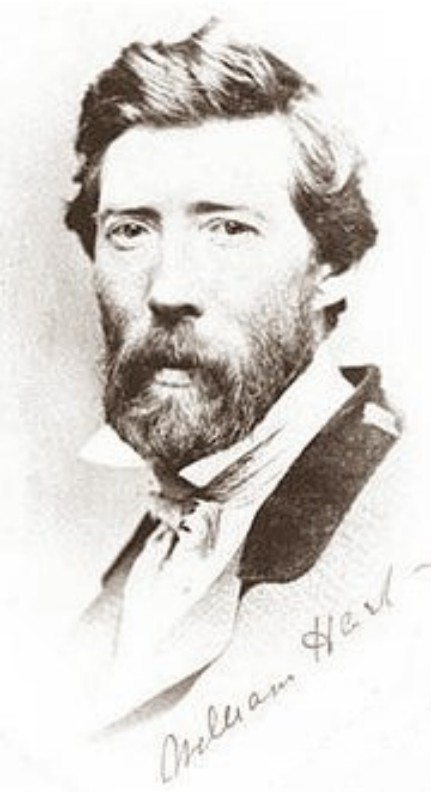
James Hart and Marion Robertson lived in Scotland and the couple married on July 16th 1811, and they went on to have ten children. Of these, William Hart was born in Paisley, Scotland on March 31st 1823 and James McDougal Hart was born five years later on May 10th 1828. In 1830 James and Marion Hart and their seven children sailed for America, arriving in New York on February 12th aboard the SS Camillus.  They later settled in Albany in up-state New York. At the time of their sea voyage, James was twenty-one months old and William was just a few months away from his seventh birthday. On December 28th 1834, their youngest child, a daughter, Julia Fenn Hart was born. She was the only child of the family to be born in America. Julia later changed the spelling of her name to Julie and dropped the middle name, Fenn, entirely.
William Hart
William Hart’s signature

If you read about William Hart you will see his name is often given as “William M Hart” or “William McDougal Hart” but some say the middle name “McDougal” was his brother’s middle name and not his.  I have no idea of the correct name so I will just refer to him as William Hart.  Above is a signature from one of his paintings and he has signed it “Wm” with the small letter “m” underlined which I believe is a shortened version of William and not the initial of a middle name.  William’s artistic ability was all self-taught. He was apprenticed to a decorative painter in Albany, New York and worked in the local township of Troy. He was employed to paint coach panels and window shades with depictions of landscapes. Later William decided to set himself up as a portrait painter and travelled in search of commissions and spent several years in and around Michigan but returned to Albany in 1845 because of ill health and a paucity of business opportunities.
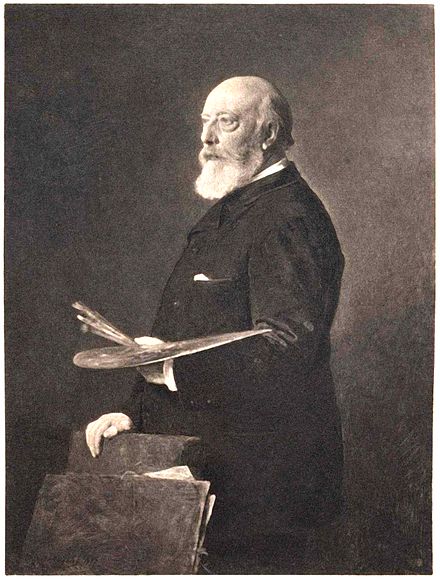
First Sketch from Nature by William Hart (1845)

To give some idea of the artistry of William Hart, one only has to look at one of his first landscape works. It is a prime example of his talent at using oil paints plein air which required a special talent. Prior to 1841, when collapsible paint tubes revolutionized plein air painting, pigments had to be mixed and blended by hand, and then carefully sealed in leather bladder bags for transport. It was a time-consuming and problematic task. However, William Hart probably was able to buy the collapsible tubes. The work was entitled First Sketch from Nature and this oil on canvas work was completed in 1845, by the twenty-two year old. On the reverse of the canvas is inscribed the words:

“…My first sketch from Nature in Oil Wm. Hart 1845 Normanskill near Albany N.Y…”

Wordsworth Manor (White Moss House near Grasmere) by William Hart, (1852,) Albany Institute of History and Art

His first art works were exhibited at the National Academy of Design in New York in 1848. Having gained the financial assistance of a patron, Doctor Ormsby, William Hart went abroad in 1849. He spent three years travelling around both England, but mainly his native Scotland before returning to Albany in 1852.

A Quiet Nook by William Hart (1885)

In the following year he took up residence in New York and at this time, all his art was focused on landscape painting and many would include studies of cattle. Cattle were a popular decorative addition in Hudson River School art, and many of the artists from that group included them in at least some of their landscapes. The inclusion of the animals was looked upon as being symbolic of man’s cordial rapport with nature.

Mount Madison from Shelburne by William Hart (1871)

In 1854, he opened up his own studio in the Tenth Street Studio Building, situated at 51 West 10th Street between Fifth and Sixth Avenues in Manhattan. It was the first modern facility in the city designed solely to serve the needs of artists. It became the centre of the New York art world for the remainder of the 19th century. In its initial years, Winslow Homer took a studio there, as did Edward Lamson Henry, and many of the artists of the Hudson River School, including Frederic Church, Lockwood de Forest and Albert Bierstadt.

Harvest Scene – Valley of the Delaware by William Hart (1868)

William soon became one of the most popular landscape artists of the late nineteenth century. He was elected an associate of the National Academy of Design in 1854 and an academician in 1858. On July 15th that same year William and his wife, Jennette had their first child, a daughter, Jessie.

Cows Drinking at a Pool by William Hart (1886)

William Hart was a founder of the Brooklyn Academy of Design and seven years later, in 1865, he became its first president. William Hart exhibited his work on a regular basis throughout the mid 1870’s in particular at the Brooklyn Art Association. He was also one of the eleven founding members of the American Watercolour Society, which was formed at a meeting at the Gilbert Burling’s studio in the New York University Building on December 5th 1866 and Hart was its president from 1870 to 1873. It is interesting to note that although the Society wished to keep the quality of its membership high, many of the top artists of the time were reluctant to join the new Society because women had been allowed membership.

White Pine, Shokan, Ulster County, New York by William Hart (1859)

William Hart also painted in watercolours and his 1860 watercolour and pencil on paper work entitled White Pine, Shokan, Ulster County, New York is a fine example of his work. It is a depiction of a white pine tree.  Few works can surpass the immediacy and spontaneity of William Hart’s watercolour of a stately white pine tree, which he observed whilst visiting Shokan, New York, which lies on the eastern edge of the Catskill Mountains. Hart frequently went on long sketching trips and travelled throughout the Hudson River valley. He even went as far away as Maine and Lake Superior. As a talented draughtsman he experimented with different media and diverse styles. William Hart completed close to four hundred drawings and watercolours which in 2004 were donated to the Albany Institute and from looking at the collection one can see his love of nature and his determination to depict it accurately.

Naponock (Naponoch) Scenery, Ulster County, New York by William Hart (1883)

William Hart was also known for his remarkable etchings. In 1883 the Art Department of the New England Manufacturers’ and Mechanics’ Institute, Boston, held an important exhibition of contemporary American art. The 731 works on view were mainly American drawings and etchings one of which William M. Hart’s etching, Naponock (Naponoch) Scenery, Ulster County, New York.

Scene at Napanoch by William Hart (1883)

That same year Hart completed an oil painting depicting the same area which also included the obligatory cattle. It was simply entitled Scene at Naponock and can be found in the Metropolitan Museum of Art in New York, a direct bequest from Hart’s daughter, Jessie Hart White.

William Hart died at Mount Vernon, New York, in June, 1894, aged 71 and was buried at Green-Wood Cemetery, Brooklyn, New York.

Léon-Augustin Lhermitte.

The artist I am looking at today is the French painter Léon-Augustin Lhermitte. I suppose his work could be categorised by three artistic terms: Naturalism, Realism and Ruralism, as he will probably be remembered for his paintings depicting peasant farmers and their families at work in the fields. However, as you will find out, there were more strings to his bow.

Léon-Augustin Lhermitte

Léon-Augustin Lhermitte was the only son of a local schoolmaster. He was born on July 31, 1844 in Mont-Saint-Père, a commune in the Aisne department in Hauts-de-France in north-eastern France, which lies about eighty kilometres north east of the French capital. The village was close to Chateau Thierry, a farming region close to the Champagne region around Rheims. This rural setting was to provide a wealth of ideas, inspiration, and realist subject matter throughout the artist’s life. As a young boy he enjoyed drawing and liked to copy art works he saw in popular illustrated magazines.  He liked to look at books which had illustrations by earlier French painters, such as the Realists. Lhermitte’s father encouraged his son’s artistic hobby by encouraging him to sketch. Léon’s talent quickly became apparent to others. His father, proud of his son’s talent, presented his drawings to Count Alexandre Colonna-Walewski, who, at the time, was minister at the École des Beaux-Arts. Walewski was so impressed by the young man’s artistic ability that he offered him a scholarship of 600 francs and arranged for him to enrol in the École Impériale de Dessin in the studio of Horace Lecoq de Boisboudran. It was here Lhermitte was able to learn about his tutor’s unusual drawing method, which emphasised memorization.

Horace Lecoq de Boisbaudran

Horace Lecoq de Boisbaudran was born in Paris. In 1819 he was admitted to the École des Beaux-Arts and exhibited at the Salon in 1831 and 1840. Later he became a professor at the academy. He taught drawing at l’École spéciale de dessin et de mathématiques, which was better known simply as the Petite École and now known as the École nationale supérieure des arts décoratifs. He wrote many books regarding drawing techniques including The Training of the Memory in Art and the Education of the Artist, and The Education of The Scenic Memory and The Training of the Artist. He influenced many great artists such as Rodin, Henri Fantin-Latour and Whistler to mention but a few. Lecoq Boisbaudran developed in his pupils a method of training memory. His students were required to copy progressively complex shapes (starting with straight lines and rectangles) and objects before drawing them from memory. The outcomes were then subjected to rigorous comparison with the model and mistakes corrected, over and over again, if necessary. Eventually, the students graduated to making careful analyses of masterpieces in the Louvre and then drawing them from memory when back in the studio. Horace Lecoq de Boisbaudrand theories had a profound effect on Lhermitte. From what Lhermitte learnt from his tutor, he was able to view a scene, notably a landscape scene, and then more fully execute the painting back in his studio. Whilst working at Horace Lecoq de Boisbaudran’s studio Lhermitte became friends with fellow artists, Jean Charles Cazin, Alphonse Legros and Fantin-Latour.

La têtée ou La jeune mère by Léon-Augustin Lhermitte (1901)

After attending the École Impériale, Lhermitte moved to Paris and shared an apartment with some of his friends. With the financial help Lhermitte had received from Count Walewski he enrolled at the École des Beaux-Arts and attended the 1863 Salon des Refusés. Although he was receiving tuition in painting at the École des Beaux-Arts his debut at the Salon was not one of his coloured paintings but a charcoal drawing, Les Bords de la Marne près Alfort (The Banks of the Marne near Alfort), which harked back to his days of draughtsmanship at the École de Dessin. In 1864 his painting, Violets in a Glass, Shells, Screen was shown at the Salon.

The Carpenter’s Workshop by Léon-Augustin Lhermitte (Charcoal on tinted paper)

In 1869 Lhermitte visited London for the first time and whilst there he met Alphonse Legros, a former pupil at the École Impériale de Dessin and he, like Lhermitte, had studied under Horace Lecoq de Boisbaudran. Lhermitte returned for a second visit in 1871 and it was then that Legros recommended him as an illustrator for Art in the Collections of England Drawn by E. Lie. More importantly, Legros introduced him to the art dealer Durand-Ruel, who following their meeting, agreed to sell several of his drawings. Later, in 1873 Durand-Ruel arranged for some of Lhermitte’s monochrome pictures to be shown at the Dudley Gallery for the first of the annual Black and White exhibitions and following that, Lhermitte became a regular participant.

Procession near Ploumanach by Léon-Augustin Lhermitte

In 1874 he received his first medal, third-class, at that year’s for three of his works, Le Benedicite (The Benedictine), Le Bateau (The Boat), Une Rue de Saint-Cyr (A Road in Saint-Cyr). It was in the summer of 1874 that Lhermitte decided to spend time in Brittany and soon he became fascinated with Breton culture, their celebrations, and the way the people, especially women, dressed in their Breton clothes. He enjoyed his time in the region, so much so, he returned there on numerous occasions during the next five years. It was a productive time for Lhermitte and he produced numerous depictions of Breton life.

Léon Augustin Lhermitte, An Elderly Peasant Woman, c. 1878

As well as producing colourful scenes of peasants in the fields he never lost his ability to draw with charcoal and one of his best loved is entitled An Elderly Peasant Woman which he completed around 1878 and now hangs in the National Gallery of Art in Washington. Lhermitte’s technique is quoted as: charcoal with black chalk, with stumping, scraping erasing and wetting, on wove paper. It is a dignified portrait of a humble person. His sitter has experienced a hard and rugged life as can be seen by her weather-beaten face and her crinkled but she has endured all the hardship. By his depiction of the woman, Lhermitte asks us not to feel sorry for her but admire her fortitude.

Market Day At Villenauxe La Grande by Léon-Augustin  Lhermitte

In a letter, dated February 4th 1883, to his friend the Dutch painter and draughtsman, Anthon van Rappard, , Vincent van Gogh commented on the talent of Lhermitte. He wrote:

“…Something else — the boss of Black and White may be someone neither you nor I know. In reviews of exhibitions I see mention made of the work of Lhermitte, a Frenchman who does scenes from the life of fishermen in Brittany. It’s said of him that ‘he is the Millet and Jules Breton in Black and White’, and his name crops up again and again. I’d like to be able to see something by him, and have recently written about him to my brother, who has given me very good information several times in the past…”

La Vendange à Mont-Saint-Père by Léon-Augustin Lhermitte (1876)

In 1876, inspired by the wine making traditions of Champagne, Lhermitte completed La Vendange à Mont-Saint-Père which was exhibited at that year’s Paris Salon. It was a large, highly finished works showing amazing detail and observation. Throughout the 1870’s Lhermitte’s reputation continued to blossom as a painter in the realist tradition of Courbet. Such was his reputation that Edgar Degas wrote in his diary that he intended to ask Lhermitte to exhibit at the 4th Impressionist Exhibition in 1879 but it never happened.

Other prizes and honours came to Lhermitte throughout his long career, including the Grand Prix at the Exposition Universelle, 1889, the Diplome d’honneur, Dresden, 1890, and the Legion of Honour. He was also a founding member of the Société Nationale des Beaux-Arts.

La Fenaison (Haymaking) by Léon-Augustin Lhermitte (1908)

The subject matter of Lhermitte’s paintings rarely strayed from depictions of the peasants and rural life which he remembered from his youth. Without doubt, the most overwhelming influence upon his work was certainly the French Realist painter, Jean François Millet who, like Lhermitte, was equally skilled with pastel as with oil.

The Gleaners by Léon-Augustin Lhermitte (1887)

During the 1880’s Lhermitte embarked on a series of monumental works of rural life, influenced by two of his contemporaries, Jean-François Millet and Jules Breton. In this series of paintings he created beautiful light-filled works which mirrored Millet’s theme and reinforcing the self-esteem of peasant life and the splendour of the French rural landscape in the face of the invasion of modern technology. Lhermitte added realism and careful detail to his rural depictions and this would serve him well, stretching into the 1920’s.

Harvest by Léon-Augustin Lhermitte (1874) Musee des Beaux-Arts, Carcassonne,

In the 1914 book, Le Livre d’Or des Peintres Exposants (The Golden Book of Exhibiting Painters), there was a passage extoling the virtues of Lhermitte’s work:

“…All of his rustic scenes are full of observation and naturalness, executed in a manner which is less and less rugged, and a technique that gains in suppleness. The artist has now discovered his own easy and definitive way of expressing himself and appears in full possession of a subject, which he treats with ease and without weakness. He is the painter of the field worker and rustic landscapes, the theatre of his work. In this genre, he shows a true vision of personages and of the things that surround them…”

Laveuses au lavoir by Léon-Augustin Lhermitte

And again, Van Gogh wrote about Lhermitte:

“…If every month Le Monde Illustré published one of his compositions…it would be a great pleasure for me to be able to follow it. It is certain that for years I have not seen anything as beautiful as this scene by Lhermitte…I am too preoccupied by Lhermitte this evening to be able to talk of other things…”

A Rest from the Harvest by Léon-Augustin Lhermitte

Lhermitte exhibited his work at the Salon on a regular basis and his paintings became sought-after items. Despite that, Lhermitte was not satisfied with his success and strived for more recognition. He believed he just had to complete a work which would help him attain the level of success he craved for.

The Tavern Interior by Léon-Augustin Lhermitte (1881)

As a regular exhibitor at the Salon, Lhermitte’s paintings had become increasingly sought after, though, in his mind, he had not yet attained the level of success that he desired. He wanted to complete a work that would solidify his success and this came in the form of a series of several large-scale paintings portraying the life and people of his native village of Mont-Saint-Pierre. In 1881 he completed The Tavern Interior. This painting was the first piece in Lhermitte’s grand manner series. Before us, we see a long brown table around which gather a few men watching a woman pouring liquor.

Le Père Casimir

The main figure is the man sitting at the right of the long table who is wearing a white shirt and brown pants, holding a spade in his left hand and in his right hand he holds a glass demanding a refill.. This is the peasant hero created by Lhermitte, known as Le Pére Casimir. It is believed that the painting was in fact based on a real figure, an old peasant named Casimir Dehan. Le Pére Casimir is one of the most important themes in Lhermitte’s grand manner series.  Lhermitte depicts the old man with the spade in hand wearing torn and soiled clothing, and thus the artist reveals the status of the working class and the reality of their utter poverty. The weather-beaten face and complexion indicate the long hours spent in the fields with their laborious work, and yet the man’s bulky figure and his upright sitting posture with a spade in hand indicates his heroic temperament.

Paying the Harvesters by Léon-Augustin Lhermitte (1882)

In 1882, his masterpiece La Paye des Moissonneurs (Paying of the Harvesters) was shown at that year’s Salon and it achieved great acclaim from the critics. Thereafter followed numerous commissions. The painting was bought by the French State and housed in the Luxembourg Museum before being transferred to the Hotel de Ville at Chateau-Thierry. It is a classic example of Naturalism in the way Lhermitte accurately depicted the hard-nosed view of life in rural communities.

La Leçon de Claude Bernard by Léon-Augustin Lhermitte (1889)

Lhermitte received a commission in 1886 to paint a large group portrait featuring Claude Bernard, a French physician and physiologist, which would then be hung at the Sorbonne. The painting is entitled La Leçon de Claude Bernard and depicts him in his Laboratory at the Colle de France. He completed the painting in 1889 and was exhibited at that year’s Salon.

Paysannes et Vaches Devant le Village de Mont-Saint-Père, by Léon-Augustin Lhermitte (c.1887) Charcoal on paper.

In 1888 he was approached by Andre Theuriet, the French poet and novelist, who asked him to provide illustrations for his new book, La Vie Rustique. This was a major commission and Lhermitte was able to use the many drawings of peasant life he had already completed. In the introduction the author wrote:
“…We propose to trace the grand acts of the rustic drama: the soaring, the labour, the hay-making, the harvest, and the vintage; we wanted to describe the solitude of the farm, the business of the village life, the pleasures of Sunday, and the preoccupations of the weekdays …”

Andre Theuriat’s words sum up the art of Léon Lhermitte and his position in French art of the late 19th century.

Lhermitte was a founding member of the Societe Nationale des Beaux-Arts in 1890. In 1894 he was made an officer of the Legion d’honneur.
Lhermitte was elected to fill Jacques Henner’s chair in painting at the Institut in 1905. He kept exhibiting his paintings in the first decades of the 20th century, but many critics looked upon him and his works as a relic of a bygone era. However, his style undoubtedly had an influence on Socialist Realism.in later years.  In the last twenty years of his life he worked much more in pastel, with his skill as a draughtsman ever in evidence. He went on to produce some sensitive portraits and peasant scenes which were reminiscent of his earlier and more powerful depictions, ones that van Gogh had cited as “an ideal”.

Léon Augustin Lhermitte died in Paris, on July 28th 1925, three days before his eighty-first birthday.