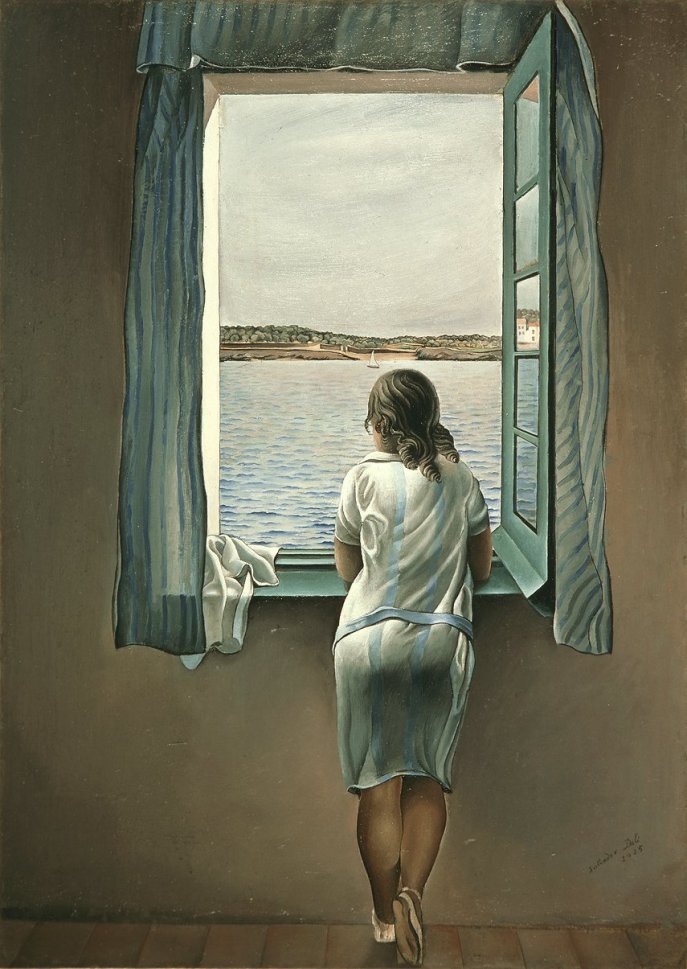
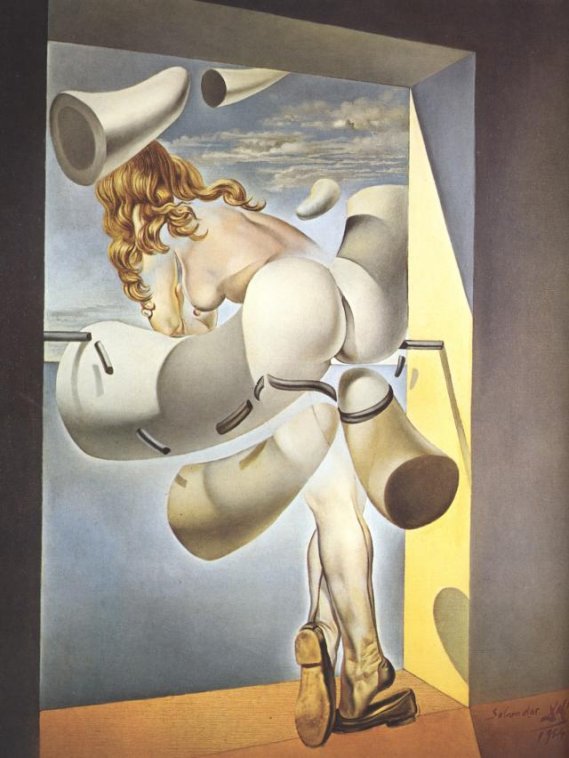
Figure at a Window by Dali (1925) and Young Virgin Autosodomized by her Own Chastity by Dali (1954)

Figure at a Window by Dali (1925)

My blog today looks at two paintings by the same artist, completed twenty-nine years apart.  There is an obvious a similarity about the works and yet they could not be more different.   As a non-painter, it is this difference in style which intrigues me.   The artist in question is Salvador Domingo Felipe Jacinto Dalí i Domènech, better known simply as Dali.

Dali was born in 1904 in Figueres, a Spanish Catalonian town close to the border with France.  He was born into a middle-class background.  His father, Salvador Dalí i Cusí, was a lawyer and notary and a fierce Catalan federalist.  His mother was Felipa Domenech Ferrés, a demure and pretty Barcelona girl, two years younger than her husband.   Felipa’s mother had been a talented craftsman, who had run a long-standing family establishment that specialized in making objets d’art.  Felipa Domenech before her marriage to Dali’s father in 1900 used to help her mother in the workshop and developed a considerable skill as a designer of `artistic objects’.    She was deft with her fingers, and was accomplished in drawing.  She would spend time fashioning delicate wax figurines out of coloured candles which was a source of amusement to her son.

It has been recorded that young Dali was both an intelligent and a precocious child.  His father was a strict disciplinarian and, thankfully for Dali, this was countered by the love he received from his mother, who often indulged her young son in his artwork and his many eccentricities.  This coddling of her son was probably partly due to her fear that she would lose him to illness as she did her first son.  It was not just his mother who spoilt him as he was the centre of attention of his maternal grandmother, Maria Ana Ferrés and his aunt Catalin.  His mother doted on him and at the first sign of illness he was allowed to take to his bed.  In her controversial book about her brother entitled Salvador Dali, Seen through the eyes of his sister,  Dali’s sister wrote how her mother only rarely let young Salvador out of her sight and would often sit by his bedside for hours at night as he slept for if he awoke and found himself alone, he would cause quite a commotion.   However his father’s relationship with his son was quite different.  He would never tolerate his son’s so-called eccentricities and often punished him.   Dali would often turn to his mother for affection after being chastised by his father and this would further annoy his father who looked upon Dali’s closeness to his mother as a kind of threat to the affection she gave to him, her husband and in consequence the father-son relationship deteriorated.  I am sure psychologists would consider this triangle of affection to have caused some of Dali’s future mental turmoil.

Dalí had had an older brother who was born nine months before him.  He had also been named Salvador but had died of gastroenteritis in infancy, just nine months before the artist was born.  The naming of their second son the same as their deceased son (as was the case with Vincent van Gogh and his deceased elder brother) may have played on Dali’s mind and he once recounted the story of the time, when he was just five years old, that his parents took him to the grave of his older brother and told him he was his brother’s reincarnation. Dali later wrote of this event and of his dead brother, saying:

“…[we] resembled each other like two drops of water, but we had different reflections.  ” He ” was probably a first version of myself, but conceived too much in the absolute…”

In 1908 his sister Ana Maria was born and it is her who features in the first of today’s paintings.  Dali started school at the age of four, attending the Escuela Pública (public school) in Figueres.   This was not the local Catholic school which he could have attended but his father who held an anti-Catholic sentiment decided to send him to the local state school.   Dalí had an aversion to school life, found concentrating during lessons very difficult and he spent most of his time daydreaming.  This lack of attention to his school work and his seemingly lack of progress with his academic work after the first year annoyed his father and caused him to have a re-think about his son’s schooling.  He eventually decided to have his son transferred to a private Catholic school, one run by the brothers of the French La Salle order,  where all of his classes were taught in French. This had a profound effect on Dali’s future life as although at home he spoke Catalan, he had been taught Spanish at that early school.  With his transfer to this new French speaking school, French was to become the language that he would use during his artistic career.  Dali was still not happy with life at school, maybe because he was bullied but also to him, being confined in a small classroom, which he looked upon as a kind of gaol, was very claustrophobic.

What Dali liked was the school holidays when the family would spend time together in the seaside town of Cadaqués, where his father had been born and where the family had a small holiday house.  It was during these long summer holiday periods that he felt free from the constraints of school life, free to paint and draw pictures of his family and his beloved Catalan coastline and it was whilst holidaying at Cadaqués that he met the artist, Ramón Pichot, who was a family friend .  Pichot was an artist who painted mostly in the style of the Impressionists, but more importantly to Dali, Pichot also liked to experiment with some styles of the Catalan avant-garde.

On February 6th 1921 Dali’s mother Felipa died of breast cancer.  The death of his mother hit the sixteen year old Dali very hard.  It was a very traumatic time in his life.  He described the time as:

“…the worst blow of my life.  I worshipped her;   she was unique….. Weeping and with clenched teeth I swore that with all the power of the holy light which would one day circle my glorious name I would rescue my mother from death and from fate…”

Dali’s father quickly married his deceased wife’s sister Catalin who had already been living with the family for the past eleven years.

Ramón Pichot continued to mentor Dali during his youth and it was he who managed to persuade Dali’s father to let his son leave school and enrol at the San Fernando Academy of Art in Madrid.  In the autumn of 1922, Dali along with his father and sister travelled to Madrid and Dali sat a gruelling six day entrance examination which comprised of the candidates having to prepare drawings of a classical sculpture.  Dali passed the exam and aged 18,  he became a student at the Academy.   Life at the Academy was so different to life at school and Dali revelled in the freedom of self-expression.   Whilst there he made a number of friends including Federico García Lorca, who would become one of Spain’s leading poets and dramatists  and Luis Buñuel, who became an international film maker and film director half a century later.   Whilst at the Academy Dalí experimented with a number of painting styles, mainly avant- garde, such as Cubism, Futurism and Purism, which he studied through reading articles and studying reproductions in art journals. Dali started exhibiting his work in galleries in Barcelona and Madrid and was allowed two solo exhibitions.  He would also exhibit work at exhibitions with other Catalan modernists. His work was greeted with acclaim which boosted his confidence.  He believed that he was progressing steadily in the art world but he believed such progression was, in a way, being nullified by the type of artistic tuition he was receiving at the Academy.  He felt that neither the tutors nor the art syllabus was sufficiently challenging enough.   His dissatisfaction led to him often criticising and openly challenging the authorities at the Academy which eventually lead to him being asked to leave in 1926.

I will leave Dali’s life story at this point to concentrate on the first of my two featured paintings, entitled Figure at a Window, which Dali completed in 1925.   The painting is not one which we would immediately attribute to Dali.  Like many of his early works it features two of Dali’s favourite depictions – the Catalan coastline and a member of his family.    This early work by Dali, completed when he was twenty-one years of age, is one of Dali’s best known and most important early oil on canvas works.  Dali used his sister Ana Maria as his model.  She would remain the artist’s only female model until his beloved Gala came along in 1929.   Salvador’s relationship with his sister was very close, even more so when their mother died in 1921 and in some ways she took over the role of the mother who had to constantly cope with the ever discontented son.    The work we see is the height of tranquility.  This serene and peaceful feeling one gets when one studies the work is a result of Dali use of the predominant colours of light blues and lavenders.   There is a stress-free intimacy about the painting, which would soon disappear from his works.  We cannot see the face of the girl.  She has her back to us as she leans against the sill of the open window.  She gazes out at the bay at Cadaques, the seaside resort much loved by Dali.   This viewpoint, while lending the picture an air of intrigue, ensures that the viewer’s eye is drawn, like the girl’s, to the landscape ahead.

Girl from Ampurdam by Dali (1926)

Although this is simply a painting of his sister looking out of a window with a view across a stretch of water, there is something about the way he has depicted the girl and the way she is dressed which adds a modicum of sensuality to the painting.  The clothes Ana Maria wears cling tightly against her and one cannot help but notice the way the tight fitting dress accentuates the swell of her buttocks.  It is interesting to note that a year later Dali painted The Girl of Ampurdam in which we once again see the rear view of a girl, standing in a provocative pose which again accentuates the curvature of the cheeks of her bottom.  It is not certain whether Ana Maria was the model for this painting but once again we can be in no doubt as to the part of the female anatomy that appealed to Dali the most !   Ana Maria commented about the way in which Dali portrayed her and also incorporated the Catalan landscape:

“…During the hours I served him as model, I never tired of looking at the landscape which already, and forever, formed part of me. He always painted me near a window. And my eyes had time to take in all the smallest details….”

Young Virgin Autosodomized by her Own Chastity by Dali (1954)

And now to the second painting, which although in complete contrast to the first, I am sure you can recognise a certain similarity.  In this second work, which has the bizarre and somewhat tasteless title, Young Virgin Autosodomized by her Own Chastity, the tranquillity and the innocent peacefulness of the first painting is nowhere to be seen.   Why would an artist suddenly change the atmosphere of the painting?  Why would he want to depict the violation of the female, who held a similar pose to the one in the earlier painting, which had been modelled by his sister?

For the answer to that maybe we need to consider a couple of books, one an autobiography and one a biography.  In 1942 Dali published his autobiography entitled, The Secret Life of Salvador Dalí  and seven years later in 1949 his sister, Ana Maria published her own biography of her brother, Salvador Dali as Seen by his sister.   Unfortunately Dali’s autobiography was a somewhat sanitised version of his life story and was quite different to the way in which his sister viewed him in her book.   Dali was horrified by Ana Maria’s version of his life and the way in which he lived it.  He felt it cast him in an unflattering light and viewed her words as a blatant betrayal and sadly his perceived view of her disloyalty led to the total collapse of their relationship.   So incensed was he by this betrayal by his sister that in 1954 he decided to paint another version of his 1925 Figure at the Window which had featured her.  He called his new painting Young Virgin Autosodomized by her Own Chastity.  The figure of the young woman was, according to Robert Descharnes 2002 Dali biography, Dalí, L’héritage infernal, based upon a photograph published in a 1930’s pornographic magazine.

In the painting we once again have a rear view of a woman who is looking out over a stretch of water  at a distant landscape.  She is depicted leaning over a rail with horned shaped objects being pointed at her. One of these horns has positioned itself as the one which will sodomize her. These horned shaped objects are phallic-like in shape.  So what do the horns symbolise?  According to one of his biographers, the rhinoceros horns in the painting were symbolic and that  a rhinoceros is a very forceful animal as well as a very dangerous one.  The one thing about a rhinoceros, though, is that they do not attack unless provoked. This adds another element to the painting. Is it that Dali was provoked by his sister’s autobiography to paint this work?   If the woman is being sodomized, is it because she brought it upon herself?    The railing, which she is bent over and which is shattered by one of the larger phallic horns, symbolizes a chastity belt and its destruction symbolizes the destruction of her chastity.
One would wonder who would want to own such a disturbing painting.   However we do know who owned it up until February 2003 at which time he sold it at Sotheby’s London auction.   It was none other than Hugh Heffner who had, on behalf of Playboy Enterprises, sold it for two million pounds.  It had been hanging in the entryway to the dining room of the Great Hall in his Playboy Mansion in Los Angeles.

 I am not sure it is the kind of painting I would like to have hanging in the dining room of our Bed & Breakfast establishment.

Kees van Dongen, his life, his family and his art

Portrait of Guus Preitinger by Kees van Dongen (1910)

Last Thursday I embarked on my monthly pilgrimage to London to visit a couple of art galleries and take a look at two new art exhibitions and it was during those visits that I found a few paintings which I will include in my forthcoming blogs.  Two of my featured paintings today were not in a specific exhibition but were in the permanent collection of The Courtauld Gallery, which is a veritable gem when it comes to medium sized galleries and one you should put on your “to visit” list the next time you are in the capital.  Today I am highlighting some works by the Fauvist Kees van Dongen, which feature his wife and daughter.

Cornelis Theodorus Marie van Dongen, better known as Kees van Dongen, was born in January 1877 at Delfshaven, which is now a suburb of Rotterdam.    At the end of 1892, he enrolled as a student on a five-year course at the Akademie voor Beeldende Kunsten (Academy of Visual Arts) in Rotterdam, now known as the Willem de Kooning Academy, named in memory of the famous Dutch artist Willem de Kooning.    As a student he also needed to earn some money and so he carried out some illustrative work for the local newspaper, Rotterdamsche Nieuwsblad.  His own artistic work in these early days was greatly influenced by the Dutch artist, Rembrandt and many of his works displayed the dark tones of the great Dutch master.

It was whilst he was at this Academy that he became very friendly with another art student, Juliana Augusta “Guus” Preitinger.  Guus had been born in Cologne but early in her life the whole family had relocated to Rotterdam and eventually they all became Dutch citizens.  She revealed a great aptitude for drawing in her childhood years and her family supported and encouraged this artistic talent and had her enrol at the Academy.  On completion of their studies, Kees and Guus decided to move from The Netherlands and seek their fortune in the European capital of art, Paris.  Guus went off to Paris first in search of employment and Kees followed in 1899.   Shortly after arriving in Paris van Dongen met Félix Fénéon, the art critic and Parisian anarchist who had become a great supporter of a new group of French artists lead by Georges Seurat, whom he had christened, Neo-Impressionists.  Van Dongen and Fénénon became great and long lasting friends.

Between 1900 and late 1903, van Dongen did very little painting, probably due to financial difficulties. Through the good offices of Théophile Steinlen, a Swiss-born French Art Nouveau painter and printmaker, who worked for the satirical papers of the day,  L’Assiette au beurre, Le Rire, L’Indiscret and Le Frou-Frou , he managed to get some work for van Dongen on these periodicals and with the money van Dongen earned as an illustrator he managed to set up house with Guus Preitinger.

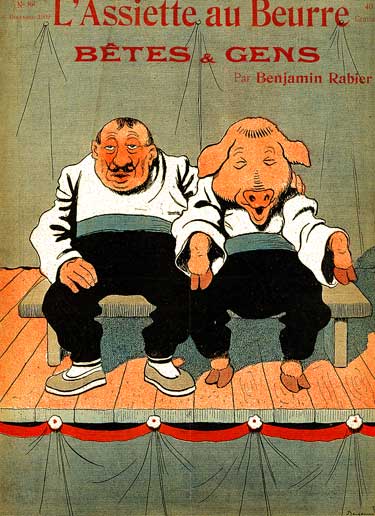
L'Assiette au Beurre magazine cover of 1902
L’Assiette au Beurre magazine cover of 1902

Van Dongen’s began to take an interest in the social and political affairs of Paris.  He especially took a great interest in the environment and lifestyle of the city’s prostitutes and courtesans.   He spent a lot of his time producing illustrations for political and social publications especially the journal L’Assiette au beurre, which was the most remarkable and resilient of cartoon journals of social protest in France during the first decade of the twentieth century.  It was a journal which looked at things such as the corruption of politicians and the country’s violence against the poor and the downtrodden.   Van Dongen illustrated an entire issue of L’Assiette au beurre (dated 26 October 1901) which was devoted to the subject of prostitution from the perspective of the conditions of the prostitutes and the tone of the edition indicated their belief that prostitution in contemporary Paris was a phenomenon symptomatic of the degeneration of the bourgeoisie.

In June 1901, Kees van Dongen and Guus Preitinger married.  Their first child, a son, was born that December but died when only two days old.    In 1904, Kees van Dongen was sponsored by Paul Signac and Maximilien Luce, to exhibit at the Salon des Indépendants and in that same year he had a major breakthrough with his art when he was granted gallery space at Ambroise Vollard’s establishment.  Vollard, one of the major art dealers in Paris, was a champion of avant-garde art and allowed van Dongen to show almost a hundred of his works, most of which were his early works depicting scenes from Holland, the Normandy coast and Paris.  The following year, van Dongen exhibited two of his works at the Salon des Indépendants, and at the infamous 1905 Salon d’Automne exhibition.  The Salon d’Automne was founded two years earlier by a group of artists and poets that included Renoir, Eugène Carrière, Georges Rouault and Édouard Vuillard, under the leadership of the Belgian architect, Frantz Jourdain.   They set up their Salon in direct competition to the conservatism of the official Paris Salon and the Salon des Independents and welcomed any artist who wished to join.   The decision on what would be allowed into their exhibition was, like the Paris Salon, to be decided by their own jury, which was selected by drawing straws from the new group’s membership, and it was their intention to give the decorative arts the same respect accorded the fine arts.   Their 1905 exhibition, which included the two works by van Dongen, was probably their best known for it was at this show that one of the visitors was the art critic Louis Vauxcelles, who on entering a room set aside for paintings by Matisse, Vlaminck, Albert Marquet, André Derrain and van Dongen, he commented on the “violence” of their works and their uninhibited use of pure non-naturalistic colours.   Seeing a traditional sculpture uncomfortably situated in this room amidst these hotly coloured paintings, Louis Vauxcelles joked to Matisse that it was like “a Donatello among the fauves [wild beasts]”. This group of painters was from that day on known as the Fauves and Fauvism as such was born.

In April 1905 Kees van Dongen and his wife Guus had a daughter whom they named Augusta but would always be known as Dolly.   The family moved to the Montmatre district which was a favourite haunt of the artistic community.   They moved into an apartment in the somewhat dark and squalid building on the heights of Montmatre, nicknamed Le Bateau Lavoir.  Pablo Picasso  and his companion Fernande Olivier had a studio next to theirs and the two artists became close friends.   Fernande Olivier referred to the strong ties between the two artists and their respective entourages in her memoirs Picasso and His Friends and In Love with Picasso.    In the latter she recalled how Picasso loved Kees and Guus’ daughter Dolly.  She wrote:

“…Pablo loved little Gusie and played with her without getting bored, she could get him do whatever she wanted. I didn‘t know at the time that he could take so much pleasure in being with children. We would have liked to have a child, but as this wish was never realized, we had to be content with the little Van Dongen…”

Fernande Olivier by Kees van Dongen (1905)

It was whilst living here that Picasso painted his famous Les Demoiselles d’Avignon.   Many other artists moved into the apartment block and  it soon became a meeting place for all the contemporary artists of the time. Although the paintings by van Dongen continued to show the power and passion of Fauvism, by 1907 most of the other Fauvists had moved on and had begun to explore new styles.  Van Dongen produced a series of portraits of Picasso’s “lover” Fernande in a wide range of styles, and she established herself as his preferred model, alongside his wife Guus.   His painting at this time was turning increasingly to women, and the often erotic depictions were out of step with the time, and would often provoke a somewhat prudish reaction

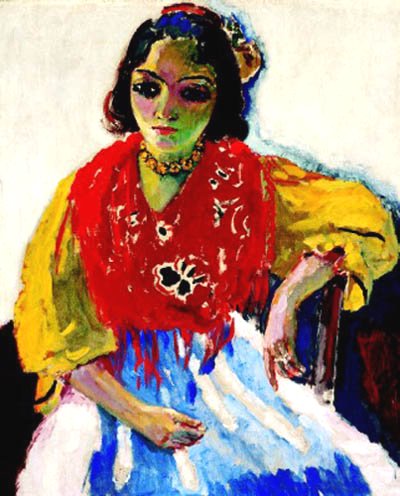
Gypsy by Kees van Dongen (1911)

In 1907 van Dongen had met the German Expressionist  Max Pechstein who was visiting the French capital.   Pechstein was one of the most prominent artists of German Expressionism. He was hailed by some of his contemporaries as the leading member of the Dresden-based Die Brücke group.  Their meeting led in 1908 to Van Dongen being invited to exhibit alongside the group.   His works went on to influence a number of its members.  In the winter of 1910-1911 van Dongen visited Spain and Morocco. This was his first time he had been able to observe, first-hand, Moorish architecture, with its palaces and the mosques with their fascinating minarets, the contrast of dark passages and dazzling white walls baked by a scorching sun. What fascinated Van Dongen was the look of the Andalusian people, the movement of the bodies of the flamenco dancers as they danced to the wild rhythms of their tambourines and the colours of the flower-embroidered Manila shawls.  After his travels, an exhibition of his works was held at the Galerie Bernheim Jeune in June 1911 under the title Hollande, Paris, Espagne, Maroc and this further established the reputation of the works which were influenced by his travels through the southern lands.

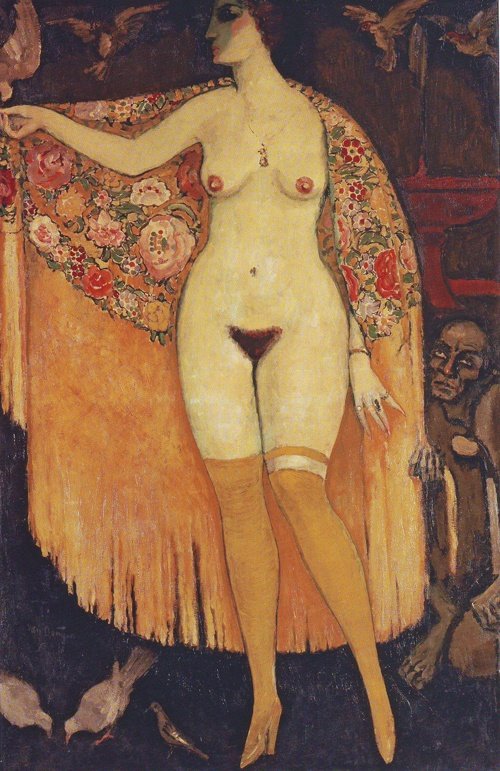
Tableau by Kees van Dongen (1913)

It was around this time van Dongen began to develop a reputation as a socialite.  He often hosted masquerade parties at his new home, which was an apartment in Montparnasse.  His lifestyle and his art was the talk of the Paris fashionista. His paintings now often depicted licentious nudes and other such erotic subjects, which often caused uproar among critics and admirers alike. One such painting was a nude portrait of his wife Guus which he completed in 1913 and was entitled Tableau (also known as The Beggar of Love or Nude with Manila Shawl).  The figure crouching on the floor to the right is of Kees who is admiring and bowing before the beauty of his wife.   He exhibited the work at the 1913  Salon d’Automne and the work was considered so scandalous and immoral that the police removed it from the gallery.  Van Dongen condemned its removal saying:

“…For all those who look with their ears, here is a completely naked woman. You are prudish, but I tell you that our sexes are organs that are as amusing as brains, and if the sex was found in the face, in place of the nose (which could have happened), where would prudishness be then? Shamelessness is really a virtue, like the lack of respect for many respectable things…” 

Portrait de Mme Jasmy by Kees van Dongen (1916)

In 1914, Guus took her daughter Dolly to Rotterdam for the summer to see their families. However the outbreak of World War I prevented them from returning to Kees in Paris until 1918.   In 1917, Kees van Dongen, whilst living alone in Paris, started a relationship with a married socialite, the fashion director  Léa Alvin also known as Jasmy Jacob.   She proved to be the conduit between van Dongen and the upper classes and through her introductions, came numerous portraiture commissions.  When Guus and Dolly returned to Paris it was not long before Guus heard rumours about her husband’s infidelity.  This proved to be the final straw in the break-up of their marriage and they eventually divorced in 1921.   Guus Preitinger died in 1946.

In 1926 he was awarded the Legion of Honour and the following year the Order of the Crown of Belgium.  In 1929 van Dongen became a French citizen.  He and his art, were the toast of French society.  He cut an ostentatious and colourful figure in Paris. His lifestyle was full of controversy and his extravagant nightly studio parties were attended by film stars, masqued politicians and artists.   He spent most of his time completing portraiture commissions.   He was the typical society artist who lived a bohemian lifestyle and who brought added colour and excitement to the Parisian upper classes.  He was only too well aware how to please his female sitters, saying:

“…The essential thing is to elongate the women and especially to make them slim. After that it just remains to enlarge their jewels. They are ravished……….Painting is the most beautiful of lies…”

His success as a society portraitist enhanced his reputation as an artist with the French bourgeoisie, especially the society women, and his numerous commissions allowed him to live a carefree and affluent lifestyle.

In 1938 he met Marie-Claire Huguen, who two years later bore him a son, Jean Marie.  At that time van Dongen was 63 years old !!   The couple finally married in 1953, and this new second family gave van Dongen new purpose, a new life. He carried on working on his portraiture work which was much in demand and he also continued with his illustrative work for books by the likes of Voltaire, Proust and Kipling.  The latter years of his life was spent with his family in Monaco where he died at home in 1968 at the age of 91.

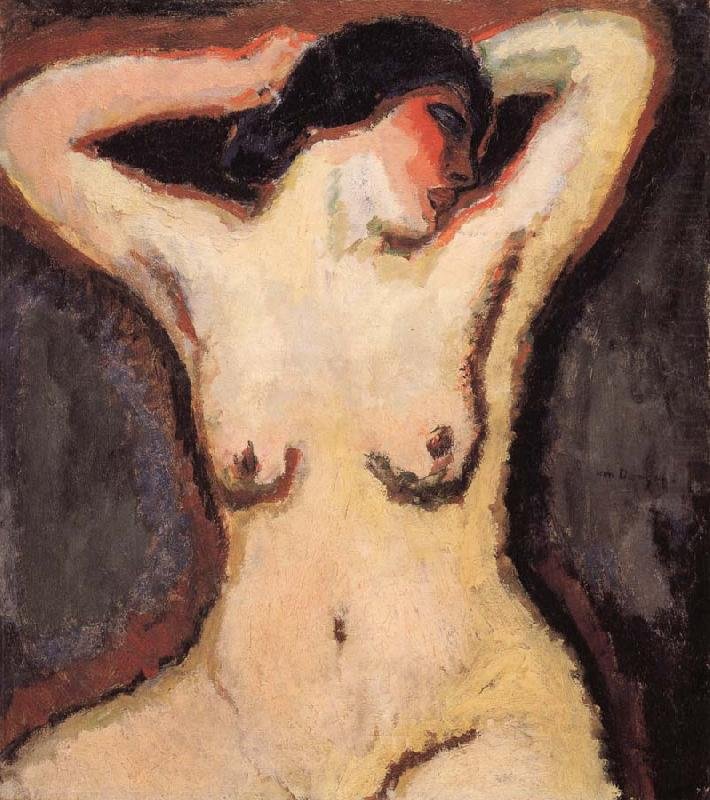
The Torso or The Idol by Kees van Dongen (1905)

One of the paintings by Kees van Dongen, which  I saw at London’s Courtauld Gallery was entitled Torso, sometimes known as The Idol, which he completed in 1905 and was one of two portraits of his wife, Guus Preitinger,  which he exhibited at that year’s Salon d’Automne.    It is a large and somewhat “in your face” painting.  There is an overt sexuality about this work.  It is a depiction of complete sexual abandonment.   Guus lies back with her hands behind her head.  Her arms form two triangles of space either side of her head.  The curvature of her arms mirrors the curvature of her hips in the lower half of the work.   Prominently depicted in the very centre of the painting are her nipples.  It is if the artist wants them to have pride of place.  Van Dongen has used various shades of red and pink to depict the flushed cheeks of her face.  Could it be she was embarrassed by the artist, her husband’s, gaze as he painted her image?   Her pale body is set off dramatically against the heavy black and brown lines which he has used to outline her torso and her breasts.  The paleness contrasts with the dark background.  I found it a rather disturbing painting.  It did not have the beauty of many depictions of the female nude I have seen before.   There was something very rough, almost unpleasant about the full-frontal depiction and in some ways this diminished the sense of eroticism.  In my opinion, the female body in this painting has not been put on a pedestal for us to adore its beauty.  That is just my opinion and I am sure many of you will beg to differ.  However, when I stood in front of this work, it had the same affect on me as when I stood before many of Egon Schiele’s nude or semi nude portraits.
Portrait of Dolly by Kees van Dongen (c.1912)

One of Kees van Dongen’s favourite models for his paintings was his daughter Dolly and she appears in many of his portraits.  In the one at the Courtauld Gallery she is probably just seven years old.  This a portrait of a child, his young daughter but by the way she is given an open pose, and the way he has given her red cheeks, painted lips and large eyes, there is something of an adult feel to the painting.

I came across a couple of fascinating videos on the internet, one of which was a sub-titled interview with van Dongen’s daughter Dolly, aged 82, made in 1987 in which she talks about her father and his paintings.  I am sure you will find it interesting.

 http://www.arttube.nl/en/video/Boijmans/Dolly#.UTWlQ6KeMsJ

Zinaida Serebriakova – Part 2.

My blog today continues with a look at the life of the Russian painter, Zinaida Serebriakova.  At the end of my last entry I told you that she and her family’s life had been turned upside down by the onset of the October Bolshevik Revolution in 1917.  Lenin, who was the leader of the Bolsheviks, wanted to keep the peasant classes on his side so when he made his attempt to overthrow the provisional Russian government, he ensured the neutrality of the peasants by offering them land, owned by the aristocracy.  The Revolution saw the riches, property and lands owned by the aristocratic classes being taken from them by the Bolsheviks and redistributed to the peasants.   That October, Serebriakova had been living at her family estate of Neskuchnoye when the Bolshevik forces descended upon her and her family.  When it was all over the reserves of Neskuchnoye had been plundered and the family was left without food.   Zinaida was left with nothing – no income, no husband, for he had been dragged off by the Bolsheviks and jailed and would die of typhus, which he contracted during incarceration, two years later.  Notwithstanding the fact that she was penniless and had no means to earn money, she was responsible for the upbringing of her four children as well as having to care for her widowed mother.    Zinaida was forced to give up oil painting in favour of the less expensive techniques of charcoal and pencil sketching

Zinaida eventually managed to get some work at the Kharkov Archaeological Museum, where she made pencil drawings of the exhibits.   In December 1920 she and her family went to live with her grandfather who had an apartment in Petrograd.    Petrograd had formerly been known as St Petersburg but when World War I broke out in August 1914 it was decided to change the name of the Russian capital from the Germanic  St. Petersburg to the more Russian equivalent, Petrograd.  It was not until 1991, with the collapse of the Soviet Union, that the city reverted back to the name of St Petersburg.   Because of a Bolshevik dictate which stated that all inhabitants of private apartments had to share their living space with other people, Zinaida found herself sharing her lodgings with artists from the Moscow Art Theatre.

In Ballet Dressing Room (Big Ballerinas) by Zinaida Serebriakova (1922)

Serebriakova’s work during this period focused on theatre life. It was around this time that her daughter Tatyana became interested in ballet and her mother managed to get her enrolled at the prestigious ballet school of the Imperial Mariinsky Theatre, the home of the Russian Ballet, where Zinaida’s uncle, Alexander Benois was the scenic director.   Much of Zinaida’s time was absorbed by the theatre and she produced a series of exquisite pastels on the balletic life at the theatre.  Many of her works showed young ballerinas in their dressing room preparing to go on stage.

In 1924 Zinaida Serebriakova got the offer of work in Paris and with some financial help from her uncle Alexander Benois, she left St Petersburg and headed to the French capital, leaving behind her four children with her ailing mother.  A few years later Zinaida managed to bring her son Alexander and her daughter Katya to live with her in Paris but her son Yevgenyi and her daughter Tatiana had to remain in Russia with their grandmother, and it was not until 1960 that she was able to have Tatiana visit her in Paris.

Zinaida was now one of many Russian exiles living in Paris who could not return to her homeland.   She earned a living by painting society portraits. Her children also often featured in her work, and her daughter often posed in the nude.   She also painted other female models, reclining in her studio with patterned wraps and decorative drapes. These works were of a very informal nature and often highly erotic.  According to her daughter Ekaterina these nude studies were probably the most intimate images of the female body in Russian art.   She later wrote:

“…The female nude was mother’s favourite subject. While she was in Russia young peasant women would pose for her. In Paris her friends would come over to her studio, drink a cup of tea, then they would stay and pose for her. They were not the professional models that you might find in Montparnasse and maybe this is the reason why they are so natural and graceful…”

Sleeping Nude (Katya).by Zinaida Serebriakova (1934)

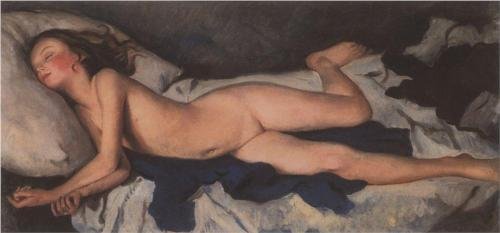
Zinaida completed one of her best known nude studies of her daughter, Ekaterina, in 1934, entitled Sleeping Nude (Katya).  It was a veritable masterpiece which is similar in imagery to the sleeping Venuses of the Venetian masters, the nymphs of Boucher and the bathers of Cabanel and Renoir.  In this work, Zinaida does not offer us some anonymous heroine from Greek mythological tales but presents us with an innocent young girl, who lies before us, totally relaxed, her cheeks flushed from sleep.  It is so natural and it is even more endearing knowing that the model for this painting was her twenty-two year old daughter, Katya who had modelled for her mother for the previous fifteen years.

Sleeping Girl in the Blue (Katyusha on a Blanket)by Zinaida Serebriakova (1923)
Sleeping Girl in the Blue (Katyusha on a Blanket)
by Zinaida Serebriakova (1923)

In 1923, before Zinaida left for Paris she had painted a nude study of the then ten-year old Katya, entitled Sleeping Girl in the Blue (Katyusha on a Blanket), in which we see her young daughter, in all her innocence, sprawled across a blue blanket.

Zinaida’s uncle Alexander Benois, an artist, art critic and co-founder of the art magazine and movement Mir iskusstva (World of Art), commented on the way his niece had portrayed her naked young women.  He wrote:

“…[Her nude studies were] not by a generalised sensuality but by something specific, which we recognise from our literature, from our music, from our personal experiences. This is truly the flesh of our flesh. Here is that grace, that comfortable languor, that cosy, domesticated side to Eros – all of which are actually more alluring, more subtle and sometimes more perfidious, more dangerous than what Gauguin found on Tahiti and in search of which blasé Europeans left their pampered life at home and set off in the footsteps of Pierre Loti, across the whole of the white, yellow and black world…”

Zinaida Serebriakova’s nudes were always dignified, self-assured and classically beautiful.  She created the most sensual and intimate images of the female body in the Russian art and remained true to the Neo-Romantic tradition and her classical training.  At an exhibition of Russian art at the Midi Fair in Brussels in 1928, people noted Serebriakova’s ‘nude’ oeuvre and it was here that she met the industrialist, the Belgian nobleman, Baron de Brouwer.   So impressed was he with her work that he became her patron and commissioned her to paint portraits of his family.

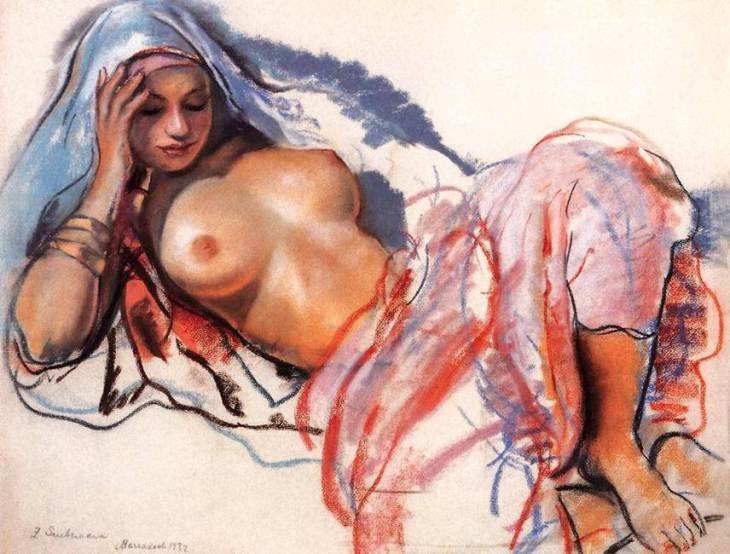
Reclining woman (Etude de femme hadija) Marakech by Zinaida Serebriakova (1932)

De Brouwer also financed her painting trip to Morocco where he owned a plantation.  Zinaida set off for North Africa on her own and fell in love with the colour and light Morocco afforded her.  The baron had wanted her to bring back paintings of the area and its people.  He had also said that he had wanted to some nude studies of the Arab women but Zinaiad found this very difficult to achieve.  She wrote:

“…He (Brouwer) wants nude paintings of the lovely native women, but it’s a fantasy hardly worth dreaming about – even in their veils which cover everything but their eyes nobody will pose for me. There is no question of a nude…”

However she did return with many paintings of the area and the Arab and Berber women, some of whom she had even managed, with much haggling and offers of financial rewards, to get some to pose in the nude but it was difficult.  She wrote of this time:

“…As soon as you sit to draw the women walk away – Arabs don’t wish to be drawn, so they immediately close up their shops or charge up to 10 or 20 francs for tea an hour!…”

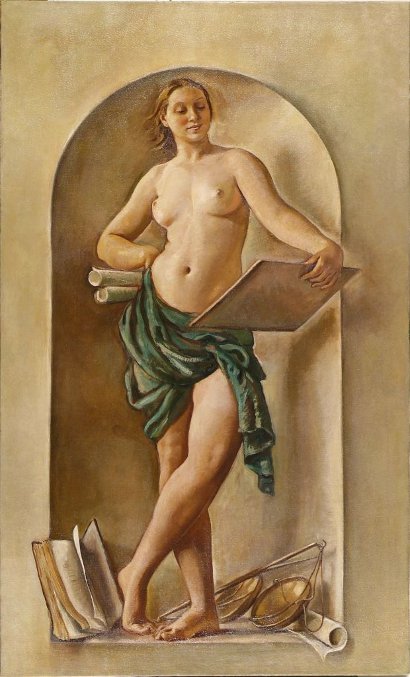
De Brouwer was delighted with the works Zinaida brought back from North Africa, so much so, that he commissioned her to paint a series of murals for his villa Manoir du Relais in Pommeroeul near Mons, in Belgium.  Zinaida customized the theme of this mural series to that which appealed to her patron.  The baron had a love of classical art, which of course was ideal for somebody like Zinaida who had a talent for painting portraits of the naked human form.  She set about the commission and decided to paint four separate vertical panels each displaying a standing nude,  each with their allegorical attributes which in some way would mirror the leisure activities and talents of de Brouwer.

Jurisprudence by Zinaida Serebriakova (1937-8)

One of the figures would be Jurisprudence, which would represent the baron’s career as a lawyer.  A second would be Flora, which would symbolize his passion for gardening, his plantations and his love of flowers.   Light, would be another figure which referred to his role as a director of power and gas plants and finally Art which would embody his interest and patronage of the arts.  For Zinaida there could only be one possible candidate for the role of model for the four nudes, which would be depicted on the four vertical panels.  It was to be her daughter Katya.  Her stance in each panel was to be different turning slightly for each depiction.  A further two large horizontal panels (145cms x 710cms) were also created and these depicted four maps in cartouches.  Zinaida left the painting of these to her son, Alexander, and these were of Flanders, Morocco, India and Patagonia. Next to the maps Zinaida had added half-seated female nudes which were initially intended to represent the four seasons, but she later changed their titles to the countries represented on the maps they adorned. Years later, Zinaida wrote about this commission:

“…The assignment was to paint decorative geographical maps in the 18th-century style, single-tined (my son did the maps); and I painted in the corners of the maps, against that background, the images of the ‘four seasons’ (summer with a sheaf, spring with flowers, etc.), and four figures standing in ‘niches’ on another wall. I painted all this in Paris and, unfortunately, did not see how all this looked on the walls, because the house was not quite ready yet, and the residents were yet to move in … during the war the area was a battlefront, and de Brouwer’s summer house was destroyed…”

Even more pleasing to Zinaida’s was the comments by her artist brother Yevgeni Lanceray, who on seeing photographs of the paintings wrote to her:

“…I love them..You have exactly that which others around you do not – an understanding of composition. The panels are excellent in the simplicity of their execution, completeness of shape, and so monumental and decorative. You completely understand the form of objects. Particularly difficult, I think, is the panel Jurisprudence… It is especially elegant and richly executed. In everything is simplicity and parsimony, so to speak, of decoration and attributes. I envy you your ease, your flexibility, and how broad and accomplished is your representation of the body…”

Nadezhda Tregub of the Tretyakov Gallery in Moscow wrote about the four nude figures:

“…These murals can be considered entirely cosmopolitan works: they were accomplished on a commission from Belgium, by an artist from Russia who worked in France, and who drew on the major achievements of all European art…”

Sadly the baron and his wife did not have much time to enjoy the murals which were completed in 1937/8 as both died during the Second World War, and it was also thought that their house had also been destroyed. In fact this assumption was incorrect as the house remained standing and even changed ownership a number of times. The murals also remained untouched for over 70 years, but curiously the owners did not recognise the work as being done by Zinaida.  They thought they had been executed by an unknown Flemmish artist.

In 1966 a large exhibition of Zinaida Serebryakova’s works was mounted in Moscow, Leningrad and Kiev and the critics loved what they saw.  In September of the following year Zinaida died in Paris, at the age of eighty-two. She was buried in the Sainte-Geneviève-des-Bois Russian Orthodox cemetery in Paris.  The cemetery is a burial place for more than 10,000 Russian emigrants, including the celebrated ballet dancer, Rudolf Nureyev.

The Scottish Colourists, Part 4 – George Leslie Hunter

Cottage, near Largo by G.L.Hunter  (c.1920)
Cottage, near Largo by G.L.Hunter (c.1920)

In my blog today I conclude my look at the group of early twentieth century Scottish artists, who would later be grouped together and known as the Scottish Colourists.  The fourth member of this group was George Leslie Hunter.   Hunter was born in Rothesay, a town on the west coast Scottish Isle of Bute, in 1877.  He was the youngest of five children, born to William Hunter, a chemist by trade and his wife, Jeanie Hunter (née Stewart).  His initial schooling was at Rothesay Academy.  In February 1892, Hunter’s elder sister Catherine died and this was followed shortly after with the death of his elder brother.  Both iwho were in their early twenties were thought to have died from an influenza pandemic which had been sweeping the country.  Although his mother and father had been toying with the idea of emigrating, these tragic events were the final push they needed to leave Scotland and in September that year they set sail for California via New York to start a new life.  The family arrived in California where Hunter’s father bought an orange farm east of Los Angeles.  George enjoyed life in America and spent most of his time sketching and enjoying the favourable Californian climate.   He did not undertake formal art training, and was largely self-taught.  When he was nineteen years of age he managed to get work as an illustrator for some local magazines.  The father’s farming venture lasted just eight years before Hunter’s parents decided to return home to Scotland.  However George, who had developed a love of art, was enjoying life in America so much that he decided not to return with his parents but instead decided to stay on and in 1900 he moved to San Francisco where he became part of the Bohemian lifestyle of the Californian city.   The following year he had some of his artwork exhibited at the California Society of Artists exhibition.

To earn money Hunter illustrated work for the Californian magazines, Overland Monthly and the Sunset magazine.  The latter was a promotional journal for Southern Pacific Transportation Company, designed to combat all the negative publicity regarding the “Wild West” life in California. In 1904 Hunter went to New York with friends and then on to Paris and it was whilst in the French capital that Hunter took up oil painting and became determined to become a professional artist.  On his return to California in 1905, he started to build up a large collection of his work which he intended to exhibit at his first solo exhibition which was to be held at the Mark Hopkins Institute the following year.  However tragedy struck in the form of the great Californian earthquake in April 1906 which devastated San Francisco and destroyed his studio and most of his artwork.

Fruit and Flowers on a Draped Table by G.L.Hunter (1919)

Hunter returned to Glasgow and rejoined his mother.  He continued his self-education as a painter and carried earning a living as an illustrator.  Many of his initial oil paintings were of the still life genre.  He liked to experiment with these works, revelled in the use of colour and often would incorporate the technique used by the Dutch still-life masters, such as Willem Kalf, Jan Davidsz de Heem and the great Willem van Aelst.

Still Life with Nautilus Cup by William Kalf (1662)

These still life painters often composed their colourful depiction of floral and fruit arrangements with a drab and dark background to afford the greatest contrast.  They used the chiaroscuro technique to dramatic effect and for Kalf it was his delightful way in which he  combined in his paintings humble objects such as simple kitchen utensils with luxurious objects such as crystal glassware and exquisite silverware.    Hunter would probably have seen examples of the Dutch masters in the museums of Glasgow and would have found them inspirational for his work.   Although this may be construed as “copying” by Hunter and could be looked upon as a form of plagiarism, in fact it was not, for he was simply studying the great works of art and taking what he had seen back into his own works.

Hunter met fellow Colourist, Samuel Peploe, through mutual friends, the artists, Edward Archibald Taylor and his wife Jessie Marion King when he was in Paris in 1910 but it was over a decade later before the two became close friends.  Hunter’s professional artistic career really started in 1913 when he was fortunate to be introduced to Alexander Reid, an influential Glasgow art dealer.  That year he held his first solo exhibition in Glasgow at Reid’s gallery.   Three years later, in 1916, Hunter exhibits more work at the gallery and later showed at the Royal Glasgow Institute of Fine Arts.  The review of the exhibition in the March edition of the Bailie newspaper commented on Hunter’s work:

“…He has three of four examples of still life that are superlatively strong…. they show a mastery of form and colour that takes one back to the triumphs of the Dutchmen…”

It was through exhibitions like these that Hunter connected with a group of affluent collectors who would continue to buy his works of art over the next fifteen years.

Portrait of Alexnder Reid by Vincent van Gogh (1887)

During the post-First World War days, Hunter became influenced more and more by the works of the modern French painters he had seen whilst visiting Paris, in particular Matisse, Cezanne and van Gogh.   In 1922 he went on an extended tour of Europe, visiting the French Riviera, Florence and Venice.  Glasgow art dealer Alex Reid and Parisian gallery owner, Ettienne Bignou, were developing a business relationship around this time and decided to stage an exhibition of the works of Peploe, Cadell and Hunter, entitled Les Peintres De l’Ecosse Moderne at the Galerie Barbazanges in June 1924.  Following this Hunter held a joint exhibition the next year with Peploe and Cadell at the Leicester Galleries in London.

Provencal Landscape by George Leslie Hunter (c.1929)

During the period between 1924 and 1927 Hunter carried out a lot of his work in Fife and around Loch Lomond.  Whether it was due to the cold climate of Scotland or just his desire for the chance to savour the bright light and warm weather in southern France,  he became restless and left Scotland and based himself in the small Provencal village of Sainte-Paul-de-Vence.  From there he would set off on daily sketching trips around the many picturesque Provencal villages.  Most of the paintings he completed were sent back to Alex Reid in Glasgow for him to sell.  In 1929 he made the trip to New York for his exhibition at the Ferargil Galleries, which was critically acclaimed as an outstanding success.  From New York he returned to France but in November 1929 he suffered a breakdown and his health began to deteriorate and he is forced to return to Glasgow where he was looked after by his sister.

Reflections, Balloch by George Leslie Hunter (1930)

During the last couple years of his life Hunter concentrated once again on painting scenes around Loch Lomond and the village of Balloch which is situated at the southern tip of the loch.  He had painted scenes in this area five years earlier but now his later works show a greater clarity and are unfussy in composition.  In his work, entitled Reflections, Balloch, Hunter has concentrated the main focus of the work on the sparkle of light and reflections on the surface of the loch.  Many of these later works featuring the loch also incorporated houseboats and this series of paintings has been acknowledged as some of his best. His fellow colourist Samuel Peploe praised it at this time, saying:

“…that is Hunter at his best, and it is as fine as any Matisse…”

In 1931 Hunter travelled to Paris for the last time so as to be present at the highly successful exhibition Les Peintres Ecossais from which the French government bought a landscape of Loch Lomond for their national collection.  Buoyed by the success of the exhibition, of which he played a leading part, he began to make tentative plans to move from Scotland and go to live in London.  His spirits were high, he believed his luck had changed and he viewed the future with great optimism.  He was quoted at the time as saying:

“…I have been kicking at the door so long and at last it is beginning to open…”

Sadly before he could savour what he believed would be the start of a new life, he died in a Glasgow nursing home in December 1951, aged just 54.

This is my final blog about the four Scottish Colourists.  It cannot be emphasised enough the importance France played in their art.  In the book Scottish Colourists 1900-1930, one of the authors, Elizabeth Cumming, a lecturer at Edinburgh College of Art, commented on this fact, writing:

“…Without their French contacts and experience, none of the Scottish Colourists would have developed their art as we know it.  For all, visiting and living in France invested their ideas with a new vision.  For Cadell, it meant developing an empathy with stylistic sophistication.  For Hunter, visiting the south of France especially injected light airiness into his landscapes.  For Peploe, two years of life in Paris opened a door to the intellectual possibilities within traditional subjects.  And for Fergusson, living in France for far longer than any of the others, it became the crux of his existence…”


The Scottish Colourists, Part 3 – John Duncan Fergusson

Self-portrait by J.D.Fergusson (1902)

Today I am looking at the third member of the Scottish Colourist group and possibly the most well-known, John Duncan Fergusson, who was born in March 1874 in Leith, a town which is often known as the port of Edinburgh.  He was the eldest of four children of John Fergusson, a spirit merchant and Christina, his mother.  He attended the Royal High School, Edinburgh and Blair Lodge School in Linlithgow.  Following this, in 1892, Fergusson attended the Edinburgh University Medical School to study medicine with the intention of becoming a naval surgeon.  However his lack of application to his studies resulted in him leaving after just two years, at which time, he decided on a complete volte-face and decided to study art at the city’s Trustees Academy School of Art.  Once again, Fergusson did not last long studying at this academy for he left stating that he found it too difficult to reconcile  what he considered to be, their old fashioned and inflexible teaching methods and their rigid curriculum which had been set in stone.   He left the art school and decided to set himself up in his own studio in Picardy Place, Edinburgh and simply teach himself how to paint.

Fergusson knew of the work of the Glasgow Boys and decided to do as they had done, go and study art in Paris which was, at the time, looked upon as the art capital of the world.  In 1895, aged twenty, he enrolled in the life-classes at Académie Colarossi and revelled in the lifestyle of his fellow artists and the whole Paris café society scene.   Fergusson enthusiastically adopted the lifestyle of a Bohemian artist, mixing with the likes of Picasso and Matisse and he could often be seen frequenting the legendary cafés of the time, such as, Le Pre-Catalan Restaurant, the Cage Harcourt and the La Closerie des Lilas and it was in these places, surrounded by his artist acquaintances that he drew so much of his inspiration.   He easily settled into this unrestrictive café society of the Left Bank.  He was surrounded by the work of the Impressionists and would visit the public and private galleries such as Salle Caillebotte at the Musée du Luxembourg, where their works were on display.   Fergusson loved the French capital and for the next ten years spent his summers in Paris and the rest of the time in Edinburgh, where he had established a close productive working relationship with fellow Scottish Colourist, Samuel Peploe.   In 1897 Fergusson exhibited some of his work at the Royal Glasgow Institute of Fine Arts and the following year, spent time in central France, painting at the artists’ colony of Grez-sur-Loing, a small commune seventy kilometres south of Paris.   This River Loing setting often featured in the works of Alfred Sisley.  In 1899 Fergusson decided to go to Morocco and follow in the footsteps of Arthur Melville, the Scottish painter, who was famed for his Orientalist works, and who is now looked upon as being one of the most powerful influences in the contemporary art of his day.

Mademoiselle Dryden by J.D.Fergusson (1908)

It was during a painting trip at the seaside resort of Paris-Plage, in the summer of 1907 that Fergusson met two American ladies, Anne Estelle Rice and Elizabeth Dryden.   Elizabeth Dryden was an American writer and critic who had been sent to Paris in 1905 by her employer, the Philadelphia department store magnate, Lewis Rodman Wanamaker, to write fashion reviews for his Philadelphia department store trade magazine.   These reviews would then be illustrated by her friend Anne Estelle Rice, who was a sculptor and artist and who had worked as an illustrator on a number of magazines.   Both women featured in a number of paintings by Fergusson and he became great friends with them and Anne Estelle Rice later became Fergusson’s mistress.  In his 1908 painting of Elizabeth Dryden entitled Mademoiselle Dryden, Fergusson has depicted her clad not in the latest fashion but wearing a simple red scarf to keep out the chill with a painter’s smock worn loosely around her shoulders.

Rhythm by J.D. Fergusson (1911)

After his fully clothed portraits of Rice and Dryden it is quipped that from then on all his sitters had to remove their clothes and be in a state of undress!  In 1910, the English writer and critic, John Middleton Murray visited Fergusson’s Edinburgh studio.  He was about to launch a new literary, arts and critical review magazine.

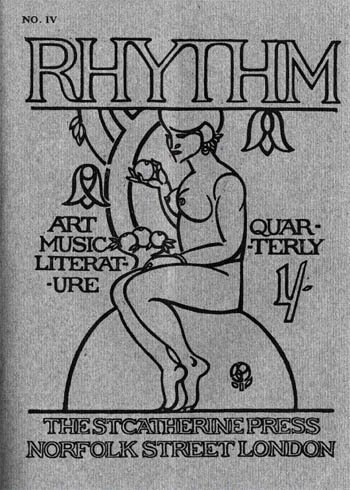
Rhythm magazine cover

Murray wanted to name the magazine after one of Fergusson’s paintings and have a drawing of it on the front cover.   Fergusson’s painting of a female nude was entitled Rhythm and that became the magazine’s title.  The cover of the magazine was elephant grey with Fergusson’s strong image of a naked woman sitting under a tree with an apple in her hand printed on it in black ink.  Fergusson became its art editor and through his many contacts in the art world was able to persuade artists such as Derrain, Picasso, and Delauny to provide illustrations for the magazine.  Anne Estelle Rice was also a regular contributor to the periodical.

Fergusson loved life in France and all the opportunities it afforded him to paint.  In the summers Fergusson would go on holiday and would often meet up with Peploe and his family in Brittany or Cassis in the south of France and for a short time Fergusson lived at Cap d’Antibes.

On his return to Paris he accepted the position as teacher at the Académie de la Palette and set up his studio in Montparnasse.  Fergusson was very happy with life at this time.  His long term partner Margaret Morris, whom he met in 1913, quoted Fergusson’s words describing his satisfaction with his Montparnasse studio and life in general in her 1974 book,  The Art of J.D.Fergusson:

“… [it was] comfortable, modern and healthy.   My concierge most sympathetic.  Life was as it should be and I was very happy.  The Dome, so to speak, round the corner; L’Avenue quite near; the Concert Rouge not far away – I was very much interested in music; the Luxembourg Gardens to sketch in; Colarossi’s class if I wanted to work from the model.  In short everything a young painter could want…”

Fergusson had met the dancer, choreographer, Margaret Morris in 1913.   She is now recognised for her pioneering work in modern dance.  She ran a dance school in London and that year had taken her dance troupe to Paris to dance at the Marigny Theatre on the Champs Elysees.  Fergusson and Morris later married and he became Art Director of all her MMM (Margaret Morris Movement) schools.  Fergusson and Morris were to remain together for almost fifty years.  The two built up a collection of friends from the literary greats of the time such as the novelist and playwright John Galsworthy, the Irish playwright George Bernard Shaw, the American ex-pat poet, Ezra Pound and the English writer and painter Wyndham Lewis.  Fergusson now had two homes and two distinct lives.  He had his base in Paris and the painting trips to the south of the country and he had the chance to stay with friends back in Britain, whether it was Samuel Peploe and his family in Edinburgh or his new friend Margaret Morris in London.

Christmas Time in the South of France by J.D.Fergusson (1922)

With the outbreak of the First World War he returned to Britain and, for the next four years, had to suffer the financial hardship brought about by the lack of sales of his work during the period of conflict.  After the war, he set up his own studio in London and this remained his base for the next ten years.  He exhibited his work on a regular basis and in 1928 he had four major exhibitions: in Chicago, London, Glasgow and New York.  In 1929, he along with Margaret Morris, returned to his beloved France and he set up his studio near the Parc de Montsouris, in Paris,  but always in the summers they made the trek south to live at Cap d’Antibes.  In 1939, at the start of the Second World War, Fergusson and Morris return to Britain and set up home in Glasgow and it was here that Fergusson spent the last years of his life.

Throughout his life Fergusson had rebelled against formal academic art and he now found himself a slightly beleaguered figure, who was neither a part of the academic fold nor was he welcomed by the Royal Scottish Academy.   Fergusson and his wife, Margaret Morris were leading lights in the Glasgow artistic scene and Fergusson did have his followers as many much younger artists were drawn to him and his art.  In 1940, he decided to form the New Art Club, and out of this emerged the New Scottish Group of painters of which he was the first president.

John Duncan Fergusson died in Glasgow in 1961, aged 87.   Throughout his life, whether he lived and worked in Paris, Antibes, London or Glasgow, his art was infused by his rebellious and independent nature.  He always maintained his belief in freedom of expression and his fervent commitment to a modern, non-academic art world.  He was a lover of colour which was summed up by a quote from him, recorded in William MacLellan’s 1943 book entitled J. D. Fergusson, Modem Scottish Painting.  Fergusson was quoted as saying:

“…Everyone in Scotland should refuse to have anything to do with black or dirty and dingy colours, and insist on clean colours in everything.   I remember when I was young any colour was considered a sign of vulgarity. Greys and blacks were the only colours for people of taste and refinement. Good pictures had to be black, grey, brown or drab. Well! let’s forget it, and insist on things in Scotland being of colour that makes for and associates itself with light, hopefulness, health and happiness…”

The Scottish Colourists – Part 2, Francis Cadell

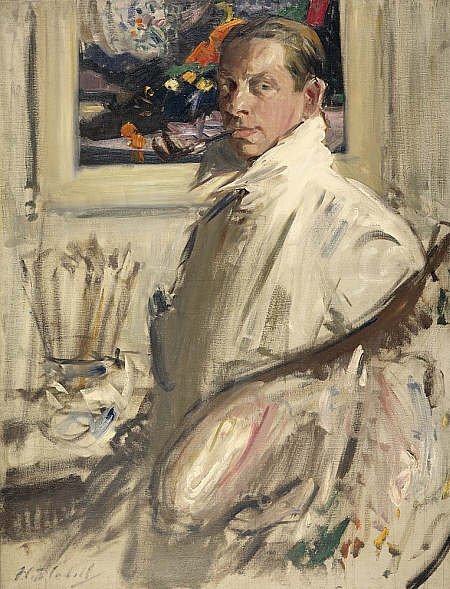
Self Portrait by Francis Cadell (c.1914)

In my last blog, I introduced you to the four painters who would later become known as the Scottish Colourists.  In that first blog I looked at the life of Samuel Peploe and today I am concentrating on the life and works of another member of the group, Francis Campbell Boileau Cadell.   Cadell was born in Edinburgh in April 1883.  His father was Francis Cadell, an Edinburgh surgeon and his mother was Mary Boileau, a lady of French extraction.  His sister was Jean Cadell,  who would later become a well-known character actress.   As a boy, Cadell showed an aptitude for drawing and was educated at the Edinburgh Academy where he studied art.  When he was sixteen years of age and had completed his studies, on the advice of the Scottish landscape and figure painter, Arthur Melville, who was also the godfather to Cadell’s younger brother, Cadell went to Paris, chaperoned by his mother,  in order to study art at the Académie Julian.   He remained at the Academy for three years, during which time his exposure to the works of French artists of the time was to have an intense and enduring effect on his paintings.   During his first year at the Academy he was delighted to have one of his watercolours accepted for exhibiting at that year’s Paris Salon.  Whilst he was studying in the French capital he met one of the other Scottish Colourists, Samuel Peploe, and the two soon became friends.  The artwork of Peploe, who was twelve years his senior, was to prove to be a great influence on his work.

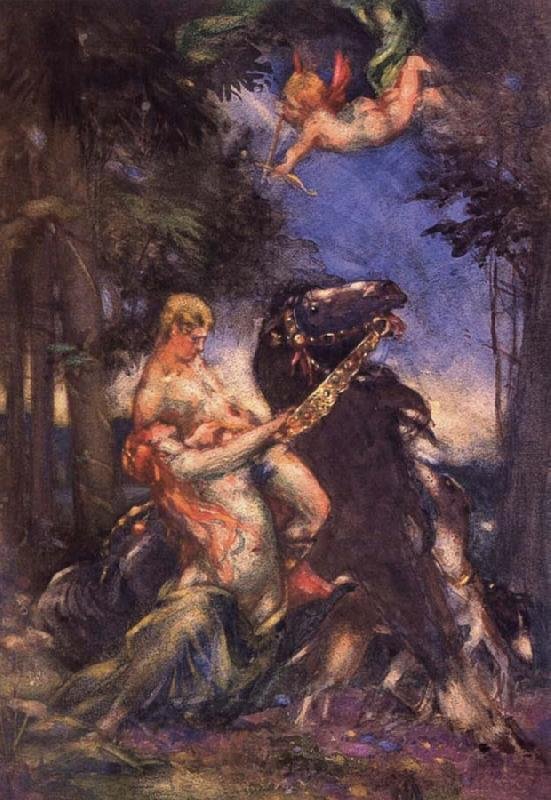
Mythical Scene by Francis Cadell (c.1907)

Cadell returns to Scotland in 1902 and, for the first time, exhibited work at the Royal Scottish Academy.  The genre of his works was varied.  He painted portraits as well as landscapes and also dabbled with mythical subjects, such as his work entitled Mythical Scene which he completed around 1907.  In 1906 he and his family moved to Munich and the following year he enrolled at the Akademie der Bildenden Künste in Munich.  A year later, in 1908, his mother died and the family returned home to Edinburgh.  That year, Cadell held his first one-man show at the gallery of the Edinburgh picture dealers, Doig, Wilson and Wheatley.  Cadell remained in Edinburgh until 1914, with just a brief time away on a painting trip to Venice, a city, which provided him with the ideal setting for his natural aptitude as a colourist.  Cadell loved everything about Edinburgh and was impressed by the city’s buildings.  He loved the beautiful architecture and the sumptuous interiors of some of the houses.  He was also very much in love with the stylishness and sophistication of its people and wanted to be part of that world.  In 1909, having established himself within Edinburgh society as a colourful, witty and entertaining host, he moved his studio to Great George Street and it was within the lavish interior of his residence that he held his regular soirées and entertained the “beautiful people” of Edinburgh.

Many of his paintings, which he completed in his Edinburgh studio before the war and during the 1920’s, often featured elegant female sitters with the backdrop, the interior of his impressive studio and these works were to become some of his best loved.  Cadell spent much time over the decoration and furnishing of his residence and before the war and throughout the 1920s, most of the paintings that he made at home centred on depictions of his studios or arrangements of elegant female models or still life objects within them. The works of the immediate pre-war period conjure up a sense of the refined lifestyle of Edinburgh’s upper-class, depicted with a palette which brightened as the war approached.

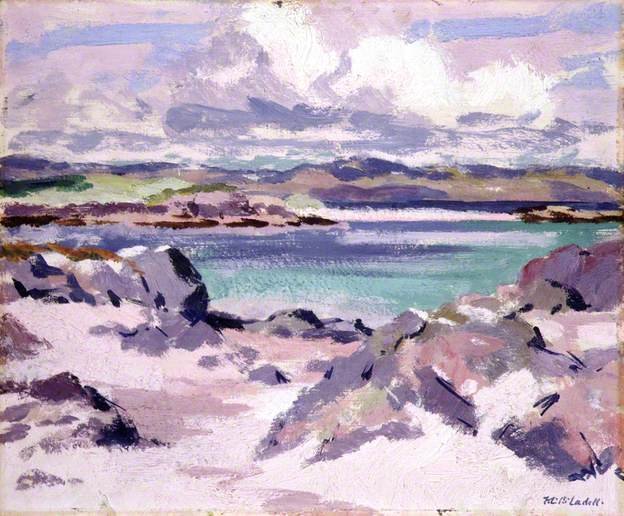
Iona by Francis Cadell

In 1912, Cadell made his first visit to the small Western Isle of Iona and fell in love with the beauty of the wild landscape.  He found it an ideal place for painting because of the light, the colours of the white sand beaches and blue skies, and Iona’s geological diversity resulting in differing coloured rock formations.  The rapid changing weather conditions around this area meant an en plein air artist had to work swiftly, but it was all worthwhile as the numerous stunning views provided plenty of incentive for keen artists.   The island of Iona is low-lying and this results in the light reflected from the surrounding sea intensifying the colour of the water as well as the green of its pastureland.  However, Cadell was of the opinion that any artist with any real sense of colour could only paint in Scotland during the summer and so he chose to work on Iona during the summer months, usually en plein air, and he would remain in Edinburgh and work in his studio during the darker days of spring and early autumn.   A fine example of his Iona paintings highlighting the differing colours of the sea, rocks and sand was completed by him in 1920 and simply entitled Iona.  After the First World War, Cadell would make annual pilgrimages to the island.   He was not the only artist at the time to be drawn to the beauty of this Inner Hebridean Island as it attracted many other artists, including the Scottish Colourists, Peploe and Fergusson, and the Scottish landscape artist, John MacLauchlin Milne.  In 1912 Cadell founded the Society of Eight.  This was a group of like-minded artists, who rejected the artistic establishment of the day and, whose work was characterised by the use of bright colours.

In 1914 he applied to join the army but was turned down on medical grounds so for the next few months he took work on a farm as a labourer with the intention of improving his physical condition and fitness.   All the exercise must have worked for in 1915 he re-applied to join the army and this time he was accepted and became a member of the 9th Argyll, 9th Royal Scots and the Sutherland Highlanders.

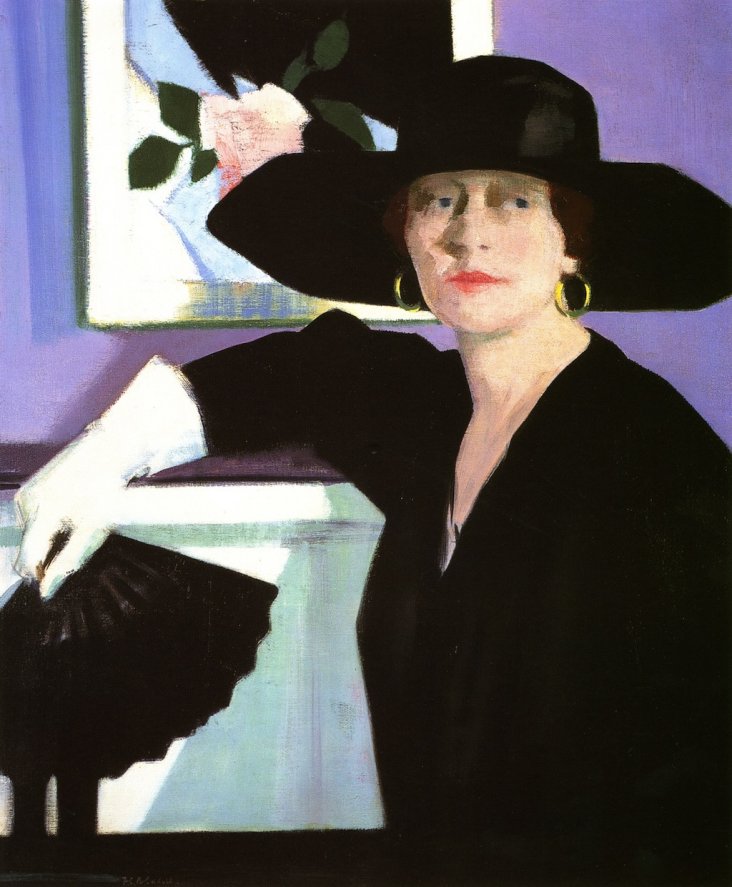
Portrait of a Lady in Black by Francis Cadell

In 1921 Cadell completed one of his most popular works entitled Portrait of a Lady in Black.  The sitter for this painting was his long-time muse, the enigmatic and mysterious, Miss Bethia Don Wauchope, who over a period of fifteen years, posed for twenty five paintings by Peploe and Cadell.   In this work the setting is almost certainly the artist’s Ainslie Place studio in Edinburgh which Cadell had moved to the previous year.   Miss Bethia Don Wauchope was a wealthy heiress of independent means.   Little is known about Cadell’s muse accept that she was the eldest of four daughters, who never married and her father was Sir John Don-Wauchope, chairman of the Board of Education and Board of Lunacy.  There is no doubt that she loved the thought of being immortalised in paintings.   This was one of Cadell’s favourite works and we know he loved to work with Bethia  as he went on to create a series of paintings with the theme ‘Lady in a Black Hat’, which included, Black Hat, Miss Don Wauchope, The Black Hat and  in 1925 (Lady in Black) and 1926 (Interior, the Orange Blind).

The Harbour, Cassis by Francis Cadell (1924)

In 1923 Cadell embarked on a painting trip to the beautiful small seaside town of Cassis, on the French Mediterranean coast. The following year he produced some of his most radiant Colourist works while staying with fellow Colourist, Peploe.   One of the works he painted there in 1923/4 was entitled The Harbour, Cassis and cleverly reflects the harsh Mediterranean light and the effect it has the surrounding buildings.  Here the sun is so intense and the colours more vibrant.  It is truly an artist’s paradise.  (I was fortunate to visit this idyllic place a few years ago and was amazed by its charm and beauty).

Like most good things in life – they seem to have to end, and for Francis Cadell his lavish lifestyle in Edinburgh, which we saw reflected in many of his paintings of elegant women and opulent interiors,  came to an end with the decline of the art market during the economic downturn of the late 1920s.  Cadell, who had led a somewhat pampered and indulgent way of life was, like many others, badly affected financially and he was forced to sell part of his multi-storeyed Ainslie Place property.  Things deteriorated further in the early 1930’s and sales of his works dwindled and he was even forced to move to a less expensive and salubrious residence.

In 1935 he was elected a member of the Royal Society of Watercolours and the following year he was made an Academician of the Royal Scottish Academy.   Sadly, by 1936, his health was starting to decline and the following year, 1937, Cadell died, aged 54, the cause being given as cancer and cirrhosis of the liver.

The Scottish Colourists – Part 1, S.J.Peploe

Self-portrait by S.J.Peploe (c.1900)

It has often been the case that artists have been compartmentalised into groups which is then given an elaborate name.  The name is, more often or not, one which has not been made up by them but has come from an external source.  We know that Monet, Renoir, Degas and Sisley, to name just a few, did not sit around a French café table and come up with the name Impressionists for their group.  In fact the name Impressionists came from Louis Leroy, the art critic, journalist and some time contributor to the illustrated Parisian newspaper, Le Charivari.   In 1874, he had gone along to an exhibition of works by a group of artists which was being held at the photographer Nadar’s studio in the French capital.  The group of painters called themselves the Société anonyme des peintres, sculpteurs et graveurs, (The Anonymous society of painters, sculptors and engravers).  One of the paintings being exhibited was Claude Monet’s 1872 work entitled Impression: Soleil levant (Impression: Sunrise).  The title of Leroy’s review, in the April 27th edition of le Charivari, Exhibition of Impressionists, was taken directly from the title of Monet’s work.  Leroy’s review took the form of a fictional dialogue between two people who were viewing the exhibits with a measure of cynicism and disbelief at what they saw.     Commenting on Monet’s work one said:

 “…Impression I was certain of it. I was just telling myself that, since I was impressed, there had to be some impression in it — and what freedom, what ease of workmanship!   A preliminary drawing for a wallpaper pattern is more finished than this seascape…”

Another example of this naming of a group of artists by somebody from outside the circle was that of the Fauves   The Fauves were a small group of artists who in the early 1900’s burst onto the French art scene with their wild, vibrant style that shocked their critics.  The name of the group was not thought up by the artists of the group such as Matisse, Derrain or Vlaminck but the term came from the influential but acerbic French art critic, Louis Vauxcelles, who first gave the group of painters the name les Fauves (the wild beasts).  The name came from a comment he made when he went to see the 1905 Salon d’Automne exhibition.  Their paintings were on display in the same room as a classical sculpture by Donatello.  Vauxcelles decried their offerings in comparison to the classical sculpture by saying that the sculpture was Donatello parmi les fauves (Donatello amongst wild beasts).

 In my next couple of blogs I am going to look at the works of four Scottish painters who were influenced by the French Impressionists and Fauvists and who exhibited their works in the early part of the twentieth century. It was not until almost twenty years later, in 1948, that the four painters were grouped together under the name “The Scottish Colourists” by the director of the Kelvingrove Gallery in Glasgow, Dr. Tom Honeyman, by which time three of the four painters were dead.  The four artists, often referred to by just the initials of their Christian names and their surnames, were Francis Campbell Boileau (F.C.B.) Cadell, Samuel John (S.J.) Peploe, John Duncan (J.D.) Fergusson and George Leslie (G.L.) Hunter.  This group of painters took up the mantle of Scottish art previously held by the group of Scottish painters, known as the Glasgow Boys, in the last decade of the nineteenth century.

S.J. Peploe, the eldest of the four, was born in Edinburgh in 1871.  He was the son of Robert Luff Peploe, an assistant secretary of the Commercial Bank of Scotland and his second wife, Anne.  He was educated at the Collegiate School in Edinburgh.  He was undecided as to what future path he should take and after finishing at school.  At one time he thought a military career was the career he wanted.  Then he considered a career in the church and ended up with a position as an apprentice in the Edinburgh legal firm of Scott & Glover.  He was unhappy in that work and decided to become an artist and in 1891 enrols at the Edinburgh School of Art.  Three years later Peploe heads for Paris to broaden his artistic education, where he lodges with another Scottish artist who was studying in Paris, the Aberdeen–born painter, Robert Brough who had been a fellow student with Peploe in Edinburgh.  In 1894 Peploe begins his studies at L’Académie Julian under the French Academic painter, William Bouguereau and at L’Académie Colarossi.  In 1895 Peploe visited Holland and is fascinated by the works of Frans Hals and brought back a number of reproductions of the Dutch artist’s works which he puts on the walls of his lodgings.

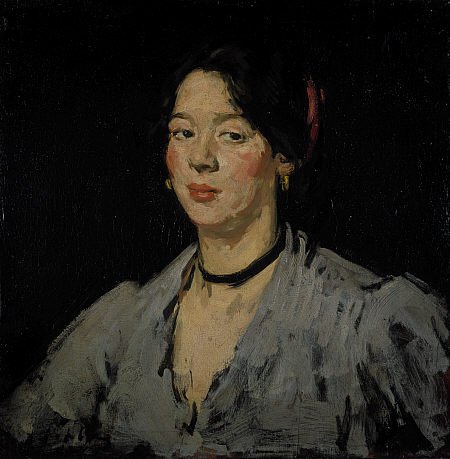
The Green Blouse by Samuel Peploe (c. 1904)

One of Peploe’s works which shows the influence of Frans Hals was a painting Peploe completed around 1904 entitled The Green Blouse.  The sitter for this portrait was Jeannie Blyth, a gypsy flower seller.  Peploe had used this teenager on a number of occasions.  It is thought that her dark colouring and total “at ease” attitude, as a sitter, made her the perfect model.

In 1895 Peploe returns to Scotland and takes up lodgings there and acquires a studio in Edinburgh.  He enrols in the Royal Scottish Academy life classes and went on to be awarded the Maclaine Watters medal for winning the RSA Art Prize.   The following year he exhibits work at both the Royal Scottish Academy in Edinburgh and the Royal Glasgow Institute of Fine Arts.  Besides these two great artistic establishments there were other chances for up-and-coming new artists to exhibit their works.  One such place was the private gallery of the Edinburgh fine art dealers, Aitken Dott & Son who afforded Peploe his first solo exhibition in 1903.  Later, the other three Scottish Colourists would have solo exhibitions at this establishment.   In the summer of 1905 Peploe and fellow Scottish Colourist, Fergusson travel to Brittany on a painting trip and carry on their artistic tour taking in the sights of Dieppe, Paris and Paris-Plage.

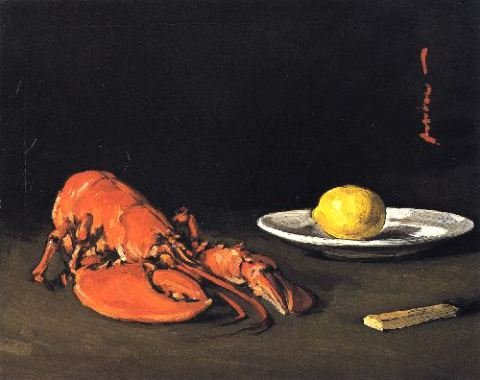
The Lobster by S.J.Peploe (c.1903)

It was around this time that Peploe started to paint still-lifes.  Peploe spent large amount time in the preparation for his still-life works even though the subject matter itself was not complicated.  His brother in law Frederick Porter wrote about Peploe’s obsession with his detailed preliminaries before starting painting and his struggle for perfection.  He wrote:

“… All his still lifes were carefully arranged and considered before he put them on canvas.  When this was done – it often took several days to accomplish – he seemed to have absorbed everything necessary for transmitting them to canvas.   The result was a canvas covered without any apparent effort.   If a certain touch was wrong it was soon obliterated by the palette knife.  The whole canvas had to be finished in one painting so as to preserve complete continuity.  If, in his judgement, it was not right then the whole painting was scrapped and painted again…”

The Lobster was one of Peploe’s still life paintings which he completed around 1903 and in this work there is a sense of drama in the way he has contrasted the strongly coloured objects against a dark background.  Look at the unusual way Peploe has included his vertical signature in the right hand side of the painting.  In some ways it looks like a vertical column of Japanese script and the colour scheme used, red, yellow and black as well as the sheen of the work affords it an effect which is very like the Japanese lacquer-work.  A few blogs ago, I talked about how all things Japanese had become very popular in the late nineteenth century in Europe.  This “craze” known as Japonisme was also becoming popular in Britain, and due to the Japonisme works of Whistler, it was influencing many artists including painters from Scotland, such as the Glasgow Boys and the Scottish Colourists.

In 1910 Peploe married Margaret Makay and the couple moved to Paris.  His son Willy was born that year.  He remained in France and carries on with his painting.  In June 1912 Peploe moves his family from Paris and takes up residence in Edinburgh and in 1914 his second son, Denis is born.   In 1917 after a number of solo exhibitions he is elected an Associate of the Royal Scottish Academy and ten years later is elected as a member of the Royal Scottish Academy.  In 1928 he has an exhibition in New York at the Kraushaar Galleries.  In 1933, as well as continuing with his own painting, he taught the advanced life-class students at Edinburgh College.

 Samuel John (S.J.) Peploe died in October 1935, aged 64.

In my next blog I will look at the life of Francis Campbell Boileau Cadell, another of the Scottish Colourists.

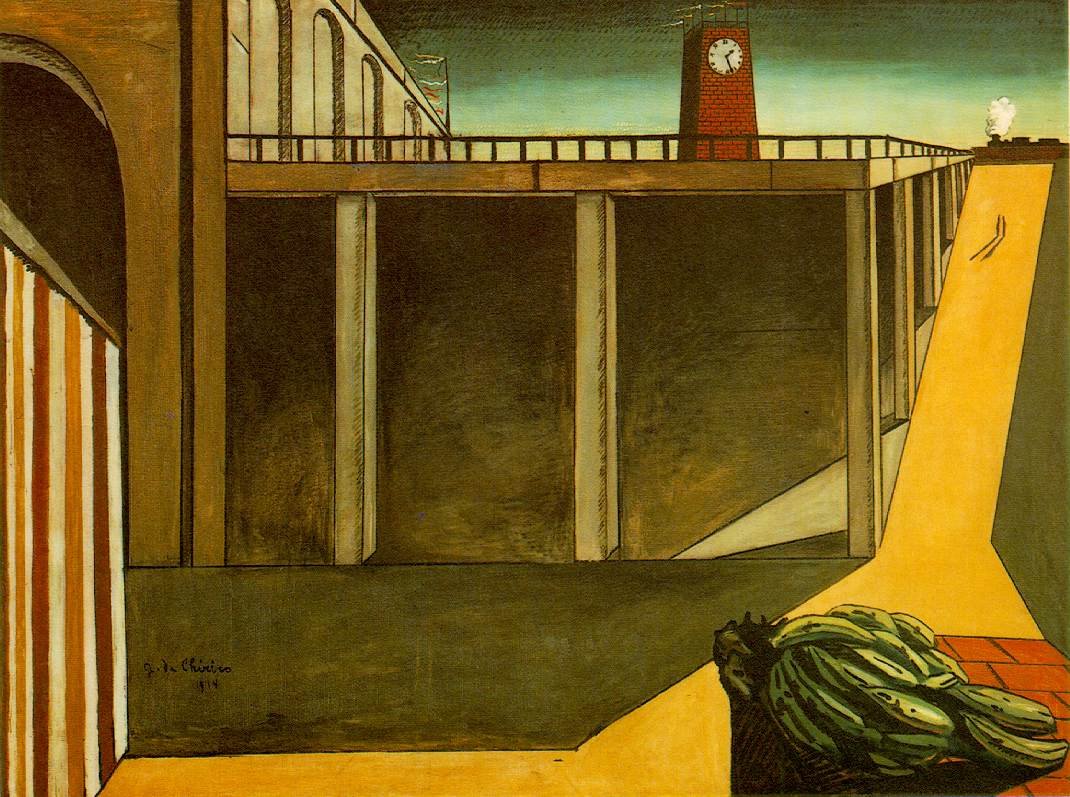
Gare Montparnasse, (The Melancholy of Departure) by Giorgio de Chirico

Gare Montparnasse, (The Melancholy of Departure) by Giorgio de Chirico (1914)

“…One must embrace all forms of art…”

With those words from the lecturer who gives us weekly Art History talks still ringing in my ears when I dared query the relevance of Surrealism, Abstract and Performance Art, I will, for his sake, attempt to seduce you with a modicum of Pittura Metafisica and talk about the life of its founder and main proponent and leave you to decide whether you can embrace my tutor’s concept.

Pittura Metafisica or Metaphysical Art was a movement formed by the Italian painter, writer and theatre designer, Giorgio de Chirico and is a term applied to his work in the early twentieth century and to the work of his friend Carlo Carrà.  So in a few words, what is Metaphysical Art?   It is a depiction of dream-like things with sharp contrasts of light and shadow which sometimes gives the impression of being slightly threatening and has a mysterious quality. There is often a feeling of neoclassicism about the works and in many instances there is a mood of depressing purposelessness and a scary-type remoteness of a world alienated from man and, by the way the artist has arranged completely unrelated objects in the work, has somehow created a secret, often magical meaning to the work with their recognizable iconography and their illusory depictions with their subverted one-point perspective.  Often within the paintings, regularly of types of architecture found in Mediterranean cities, one would see classical statues or what look like tailor’s mannequins or expressionless human beings.  To this was often added inanimate objects such as coloured toys, geometrical instruments, fruit and small realistic paintings.

Giorgio de Chirico was the elder son, born in Vólos, Greece in 1888, of Italian parents.  His mother was Gemma Cervetto,  a noblewoman of Genoese origin and his father, Evaristo, was from Sicily.  He had a brother Andrea, who was two years his junior, and the two would remain close friends and confidants until the death of their mother in 1936 at which time, they started to drift apart.  The parents had moved from Tuscany and were living in Greece as his father was an engineer who was involved in the overseeing of the construction of the Greek railway system in Thessaly.  Giorgio and his brother  had early parental encouragement to take an interest in art and in the stories from Greek mythology and this latter was probably made somewhat easier by the fact that de Chirico’s home town of Vólos was built on the area which was once the site of the ancient port of Ioclos, which was were Jason boarded his ship Argo accompanied by the Argonauts as they set sail in their quest to find the Golden Fleece.  De Chirico’s childhood health was not good and it is recorded that he suffered from numerous bouts of stomach disorders which could well be the reason for his ever increasing bouts of melancholy which would, in later life, turn towards a more serious form of depression and lead him to having a fairly jaundiced view of life.  His initial artistic training came at the age of seven when his father arranged for him to have drawing lessons from a Swiss painter, Emile Gilleron, who taught his young charge the fundamentals of drawing.  De Chirico completed and signed his first work, a depiction of a galloping horse, at the age of seven, which was acquired by the Austrian-Hungarian Consulate General in Vólos.  In 1899, his father moved the family from Vólos to Athens.

In 1903, at the age of fifteen, Giorgio attended the Athens Polytechnic, which at the time was both an engineering school and the Academy of Fine Art. Here he studied drawing and painting and received tuition from, amongst others, Georgios Roilos and Konstantinos Bolonakis, who were the most important and influential Greek painters of the late 19th-early 20th century.  De Chirico’s father died in 1905 and this event is thought to have been a contributing factor to Giorgio’s failure in his final Academy exams that same year.   In the autumn of the following year, the family left Greece and went to live in Munich where Giorgio enrolled at the Munich Academy of Fine Arts.    It was during de Chirico’s eighteen month tenure at the Academy that he came across and was influenced by the artistic works of the Swiss Symbolist painter, Arnold Böcklin and the bizarre works of the German Symbolist painter and sculptor, Max Klinger.   It is thought that their art was one of the reasons why de Chirico began to reject naturalism and instead concentrate on more illusionary and imaginary subjects for his paintings.   He was also influenced by the literary works of the German philosophers, Schopenhauer, Weininger and Frederick Nietzsche.  It was Nietzsche who tried to persuade artists of the time to “refute reality”.

In March 1910, de Chirico left Germany and travelled to Milan to rejoin his mother.  He stayed there for six months before moving on to Florence the following year.  Whilst staying in the Tuscan city he studied the works of the great thirteenth century Florentine painter and architect Giotto de Bordone.   It was whilst in Florence that de Chirico began a series of works known as his Metaphysical Town Square paintings, which depicted deserted public squares with sombre monolithic arches which cast giant dark shadows.  The first painting in the series which he completed in 1910 was entitled The Enigma of an Autumn Afternoon and the idea came to him after he spent an afternoon wandering around the Piazza Santa Croce in Florence.  He recalled that time and what he experienced on that day and explained his painting by saying:

“…One clear autumn afternoon I was sitting on a bench in the middle of the Piazza Santa Croce in Florence. It was of course not the first time I had seen this square…The whole world, down to the marble of the buildings and fountains, seemed to me to be convalescent…Then I had the strange impression I was looking at these things for the first time, and the composition of my picture came to my mind’s eye. Now each time I look at that painting I see that moment. Nevertheless the moment is an enigma to me, for it is inexplicable…”

In July 1911 he and his mother left Florence and headed for Paris where his brother Andrea was living but on his way they stopped off for a few days at Turin.  De Chirico liked Turin and was intensely stimulated by what he saw in that city and often referred to the city’s architecture, with all its archways and piazzas, as the ‘metaphysical aspect’ of Turin, something which would shape his art in the future.  De Chirico arrived in the French capital that same month, joining his brother Andrea and it was through him that Giorgio de Chirico was introduced to Pierre Laprade who held the powerful position as one of the jurists at the Salon d’Automne.  De Chirico managed to get three of his works exhibited at that 1912 Salon and in 1913 exhibited paintings at the Salon des Indépendants, one of which he sold.  Soon his works became popular and he was introduced to the Parisian art dealer, Paul Guillaume with whom he signed a contract to produce more works for sale.  At the time, Guillaume Apollinaire, who was looked upon as the apostle of modern art, noticed de Chirico’s canvases and the two met at one of Apollinaire’s soirées.  Apollinaire was the first person to coin the term metaphysical to de Chirico’s art in an article he wrote for the left-wing French newspaper,  L’Intransigeant.  It was also through Apollinaire that Giorgio de Chirico and his brother, Andrea met Pablo Picasso and the Fauvist painter, André Derain.  Apollinaire showed great interest in the Giorgio’s work and soon became a great supporter of the artist introducing his work to the late Surrealist painters such as Max Ernst, Salvador Dalí, Giorgio Morandi, and René Magritte.  The Surrealists were influenced by his paintings but de Chirico had a love-hate relationship with them and when his style changed he was criticised by the Surrealists and he turned on them referring to them as “the leaders of modernistic imbecility.”

At the outbreak of the First World War in 1914, de Chirico decided to leave Paris and return to Florence.  In June 1915, de Chirico and his brother were conscripted into the Italian army and sent to join their regiment in Ferrara.  In 1917, he suffered a mental breakdown and was admitted to the town’s military hospital.  It was whilst at the hospital that he met the artist Carlo Carrà and together they decided to launch the art movement la scuola metafisica (Metaphysical Painting movement).  When the war ended in 1918, the two artists set out the basic theories of the Pittura Metafisica and de Chirico published their ideas in the form of articles for the magazine Valori Plastici, a newly founded Rome-based magazine which focused on the aesthetic ideals and metaphysical artwork. The articles focused on his belief that there should be a return to traditional methods and iconography.  Although their Metaphysical Painting movement and ideas influenced the Surrealist painters of the time, the movement was short-lived and ended shortly after the two founders, de Chirico and Carrà fell out in 1919.

 From 1918 de Chirico’s work was exhibited extensively in Europe.  He returned to Paris in November 1924 but he no longer had the support from his friend Apollinaire who had died six years earlier.  This time during his stay in the French capital he became friends with the surrealist painters Max Ernst, René Magritte, Yves Tanguy and Salvador Dalí. In 1929, Giorgio de Chirico married the Russian ballet dancer Raissa Gurievich Kroll and he worked with the Russian Ballet company of Sergei Diaghlev and during the next six months designed scenery and costumes for them. His first marriage ended in 1930 and he remarried that same year to another Russian émigré Isabella Pakswer.  This second marriage lasted for the rest of his life. In that year he also published an autobiographic novel Hebdomeros, Le peintre et son génie chez l’ecrivain.  In August 1935 he moved to New York, buoyed by the success of his earlier exhibitions in the city.  He remained there until January 1938 and then headed back to Italy eventually settling down in Rome.  Giorgio de Chirico died in Rome in 1978, aged 90.

The featured painting by de Chirico I am featuring today is entitled Gare Montparnasse, (The Melancholy of Departure), which he completed in 1914 just before he left France for Italy.  It is a classical example of his early work.  The setting for the work is the Paris station Gare Montparnasse and we see the long shadows and deep colors of early evening.  It is a dream-like, somewhat nightmarish depiction and some art historians believe that the subject of the painting coincided with a period of acute homesickness experienced by de Chirico whose overwhelming and all-consuming thought was to leave Paris, board a train and return to Italy.  One can only conjecture on some items he has included in the work and one can only ask questions which remain unanswered about other objects.  In many of de Chirico’s works, including this one, a steam train is featured and this could well be due to his early memories of his father, the railway engineer, and his fascination with rail transportation.  The painting is strange in many ways.  Look at how the smoke from the steam train rises vertically and yet the flags on the clock tower and the building to the left flutter furiously in a wind coming from right to left.  Was there a reason for this inconsistency?   There is absolutely no perspective in the way the artist has depicted the yellow road on which we see two figures and yet to the left of the road there is a structure which visibly recedes into the distance.  So why apply the laws of perspective to one element of the painting and not the other?  The strangest part of this painting is the inclusion of a large bunch of bananas in the right foreground of the painting.  This is not the first time such an object has been incorporated into his paintings, but what is the significance of this fruit with a French railway station?  I am sure art historians have had a field day postulating on the meaning!

I will leave you to decide whether you can take on board my art lecturer’s advice to “embrace all forms of art”.  For me his advice is a little hard to swallow!

Rocky Seascape with Shipwreck by Clakson Frederick Stanfield

Rocky Seascape with Shipwreck by Clarkson Frederick Stanfield

In my last blog I featured a painting of a lighthouse by Edward Hopper and talked about how these structures over the years had helped seafarers find their way around coasts and enabled them to safely navigate treacherous waters.  However sadly for some they were not enough to prevent maritime disasters and all too often ships would, because of mechanical failure, horrendous weather conditions or human error, suffer the indignity of being grounded on rocks.  I remember all too well an Atlantic port we used to sail into, which had a very tricky entrance to it and was often pounded by the ferocious ocean waves.  As a stark reminder as to the care in which the entrance had to be approached there was an abandoned wreck of a ship on the sandbank at the mouth of the river entrance,  which did not quite make it and which was being gradually eaten away by sea and wind erosion.  I often thought, as I helped to steer the ship along the curving channel with a ferocious following sea lifting the ship’s stern in all directions, what must have been going through the minds of the people on the bridge of that abandoned ship that day, as they realised they were not going to make it safely into the tranquillity and safety of the harbour.  So today I have decided to feature a painting of a shipwreck by one of the great Victorian artists, Clarkson Frederick Stanfield.  Although there is a majestic beauty about this seascape, there is also a sense of sadness as I look at the plight of the sailors.

 The artist who painted today’s featured work is Clarkson Frederick Stanfield, who was born at the end of 1793 in Sunderland, England.   He was the youngest of five children.  His parents were James Field Stanfield and Mary Hoad.   His father was born in Dublin and initially trained for the priesthood in France, but abandoned his “calling” and returned to Liverpool and became a merchant seaman.  He sailed on a ship which was engaged in the slave trade and after his experience on the slave ship, which he described as “a floating dungeon”, he quit the life at sea, came ashore and became both an actor and playwright and an energetic supporter of the campaign to abolish the slave trade.   It is documented that he was the first ordinary seaman involved in the slave trade to write about its horrors.  In 1788 he wrote vividly describing his experiences on the voyage from Liverpool to Benin in West Africa and it was published as a series of letters addressed to Stanfield’s friend and a leading anti-slavery campaigner, the Reverend Thomas Clarkson.  It was from him that young Stanfield received his Christian name.  Clarkson Stanfield’s mother, Mary, who was both an actress and artist, taught painting and must have instilled the love of drawing into her son but sadly she died when he was just seven years old.  His father remarried to Maria Kell, a year later.

 In 1806, Clarkson Stanfield worked as an apprentice to a heraldic and coach painter in Edinburgh but left that employment two years later and, at the tender age of fifteen, decided to go off to sea and joined a small coal-carrying merchant vessel.  Four years later in 1812 he was press-ganged into the Royal Navy.  For some reason, during his stint in the navy he used the alias “Roderick Bland”.  Whilst in the Navy, Stanfield managed to keep his hand in artistically by painting theatre scenery for some naval productions as well as some painting and sketches.   In December 1814 he fell from the rigging of a naval vessel he was working on and had to be discharged from the Navy as being “unfit for duty”.    The following year he returned to sea on a merchant navy ship and sailed to China.  After returning home on leave, he had every intention of carrying on with his sea-going career but for some reason it never materialised.

 It was now 1816 and he found himself without a job and needing to earn some money and so he reverted back to his artistic work and managed to get employment at London’s Royalty theatre as a scene painter.  Soon after working in the theatre he met Mary Hutchinson whom he married in 1818 and the couple went on to have two children, a son, Clarkson William and a daughter, Mary Elizabeth.  Within a month of the birth of her daughter Mary Hutchinson died.   Clarkson Stanfield married again in 1824.  This time his wife was Rebecca Adcock and they went on to have ten children, eight sons and two daughters.  His second son from this marriage, George Clarkson Stanfield, was a pupil of his father, and painted the same type of subjects.

Clarkson Stanfield continued to work in various London and Edinburgh theatres and he gained a reputation as one of the finest scene painters in the land.   The Times reviewed his work in December 1827 stating:

  “…When our memory glances back a few years and we compare in “the mind’s eye”, the dingy, filthy scenery which was exhibited here – trees, like inverted mops, of a brick-dust hue – buildings generally at war with perspective – water as opaque as the surrounding rocks, and clouds not a bit more transparent – when we compare these things with what we now see, the alteration strikes us as nearly miraculous. This is mainly owing to Mr. Stanfield. To the effective execution of the duties belonging to the scenic department, he brought every necessary qualification – a knowledge of light and shade which enabled him to give to his scenes great transparency and a ready and judicious taste for composition, whether landscape, architecture or coast, but more especially for the last…”

 Despite most of his time being taken up working in the theatres he never gave up his painting of pictures.  He first exhibited some of his seascape work in 1820, and was immediately recognised as a marine painter of great promise.   When the Society of British Artists was founded in 1823, he was one of the founder members and later in 1829 became its President.  It was also in that year that he submitted his first painting to the Royal Academy, of which he was elected Associate of the Royal Academy and a Royal Academician in 1832 and 1835 respectively.  He loved to exhibit his work and, in all, he exhibited over a hundred works at the Royal Academy, and forty-nine at the British Institution from 1844 to 1867.

 In late 1834 he resigned as scene painter for Drury Lane and from then on devoted most of his time to his own paintings.   His output included works in both oil and watercolour and he specialised in shipping, coastal and river scenes.  Sadness struck the Clarkson household in 1838 when his eldest son from his second marriage, Harry, died just short of his twelfth birthday.  It was a terrible blow to Stanfield and many believe that his turning to the Roman Catholic religion was partly down to his search for solace and inner peace after his son’s death.    He made a number of European trips taking in Holland, France and Italy and while travelling, he would build up a large and extensive collection of sketches.  During this period, he completed many paintings depicting views of Venice and Dutch river scenes.

 During the last decade of his life he was beset with poor health. His rheumatism and bad leg often prevented him from going out of his house and the pain was so intense that for long periods he was unable to work.   He died in Hampstead, London in May 1867 aged 73.  One of his last visitors to call on him the day he died was his great friend Charles Dickens who he had met thirty years earlier.  After Clarkson Stanfield died, Dickens wrote of him, paying this glowing tribute:

 “…He was the soul of frankness, generosity and simplicity.  The most genial, the most affectionate, the most loving and the most lovable of men. Success had never for an instant spoiled him . . . He had been a sailor once; and all the best characteristics that are popularly attributed to sailors, being his, and being in him refined by the influence of his Art, formed a whole not likely to be often seen…”

The depth of friendship between Dickens and Stanfield can also be seen in a passage from a letter Dickens sent to Stanfield’s son, George shortly after his father’s death.  He wrote:

“…No one of your father’s friends can ever have loved him more dearly than I always did, or can have better known the worth of his noble character…”

The featured painting today is entitled Rocky Seascape with Shipwreck which is held at the Glasgow Museum.   In it we see dark storm clouds above the ferocious seas which are buffeting the large stricken sailing ship which has grounded on the rocks at the foot of a steep cliff, atop of which is a fort.  This structure could have been at the mouth of the river, which lead inland to the safety of a port.   A smaller sailing boat stands off from the stricken vessel,  probably trying to assist any sailors who are adrift in the choppy seas.  In the foreground we see two sailors desperately clinging on to what looks like the remnants of a sinking boat which may have once belonged to the large grounded vessel.  One of the sailors hangs on to the mast and is struggling to keep out of the water.   Three men perched on the rocks in the foreground are trying to pull this small boat towards them to give the unfortunate sailors a chance to leap onto the rock.  A woman also stands nervously on the rock, her hands covering her eyes, not daring to view the attempted rescue.  Maybe one of the men in peril is her husband or son.  A man kneels on the rock in front of her peering down at the stricken seaman, probably shouting words of encouragement.

The sea, in many ways, is something to fear and I have spent many times on ships which have been battered unmercifully by huge seas during ferocious storms and I end this blog with a quote from Joseph Conrad’s book The Mirror of the Sea in which he wrote:

“…The sea has never been friendly to man.  At most it has been the accomplice of human restlessness…”

Lighthouses and Buildings, Portland Head, Cape Elizabeth, Maine by Edward Hopper

Lighthouse and Buildings, Portland Head, Cape Eizabeth, Maine by Edward Hopper (1927)

The Lighthouse
by Becky Jennings

The mighty lighthouse stands secure,
Undaunted by the restless sea;
Ravaged by the changing tides
And buffeted by winds blown free.

Yet, it sheds its beacon straight and true,
Unfaltering in the bleakest night,
Guiding every passing ship
Uncertain of the course that’s right.

May we be diligent and true,
Dedicated to the right
And like the stalwart lighthouse stand
A beacon in the darkest night.

Having spent my early working life on ships travelling around the world I have an affinity for lighthouses which would often signal landfall after many days and sometimes weeks without seeing land.   There is something very majestic and imperious, dare I say, even romantic about lighthouses as they rise skyward on rocky headlands guiding ships  carrying seafarers homeward bound to the arms of their loved ones.

Time magazine cover  December 24th 1956
Time magazine cover
December 24th 1956

Today I am featuring a beautiful watercolour featuring a lighthouse by one of my favourite American artists, Edward Hopper.   Although he was not alone in depicting lighthouses in his paintings, nevertheless Hopper was one of the few artists who made the tall structures the focus of his compositions and by doing so gave them an iconic presence.  For Hopper, lighthouses were majestic architectural structures and things of beauty.  His name was synonymous with depictions of lighthouses so much so that when Time magazine did a story about his life in their 1956 Christmas issue, the James Chapin portrait of Hopper on the cover included a lighthouse in the background.

During the early days of his career  Hopper would often spend the summers in Cape Elizabeth, Maine, and he had become fascinated with lighthouses and went on to depict these tall structures in several media.   It was in the summer of 1927 that he painted the watercolour depicting the Portland Head Light entitled Lighthouses and Buildings, Portland Head, Cape Elizabeth, Maine which I am featuring today.  The painting resides in the Museum of Fine Arts, Boston.  This lighthouse was the first one to be built in the state of Maine, which at the time was still part of Massachusetts.  It sits on the headland overlooking the main shipping route for vessels, which are approaching from the south, prior to entering Portland harbour.   Up until this time there were no lighthouses on this part of the coast and the local merchants continually petitioned that one should be built so as to avoid ships and their cargoes being lost due to going on the rocks whilst approaching the busy port.   In 1787, two more people were killed when a vessel went aground on Bangs Island (now known as Cushing Island) close to Portland Head and this disaster and loss of life resulted in George Washington authorising the building of a lighthouse on the headland so as to avert any further shipping disasters.  Washington arranged that the lighthouse was to be built by two local Portland stonemasons Jonathan Bryant and John Nichols.  As the State was not awash with money he stipulated that the materials used to build the lighthouse should be “taken from the fields and shores, which could be handled nicely when hauled by oxen on a drag”.  The tower was built of rubble stone and Washington set a deadline for the build telling the two masons that he wanted it completed within four years.  It is interesting to note that the original plans for the build was for a fifty-eight foot tall structure but on completion it was realised that, at that height, the light would not be seen by ships approaching from the south and so the tower had to be raised to a height of seventy-two feet.  The tower was completed during 1790 and first lit January 10, 1791.

Portland Head   Lighthouse (as seen today)
Portland Head
Lighthouse
(as seen today)

Hopper’s watercolour of the Portland Head lighthouse is one of the most picturesque, and by far the most reproduced of his works.  In the painting we see the lighthouse and to the right are the lighthouse keeper’s house and garage which, as the light is now fully automated and does not need the presence of a lighthouse keeper, since 1992 has become the Portland Head Light Museum.  Hopper decided to use some artistic licence in his depiction of the lighthouse and the surrounding area for he omitted from his watercolour a number of fences and paths which he believed would detract from the finished work.   It is interesting to note the limited palette used by Hopper for this work which enhances it.  He used light blue for the sky and a darker blue for the ocean.  The roofs of the buildings are of a reddish-brown and the grass in the foreground is gold and light green.

 In Edward Rowe Snow’s book The Lighthouses of New England, he described the lighthouse and its surroundings as:

“…Portland Head and its light seem to symbolize the state of Maine – rocky coast, breaking waves, sparkling water and clear, pure sea air…”

Gail Levin, art critic and author of the Hopper biography, Edward Hopper, An Intimate Biography, suggests that there was a personal and physical relationship between Hopper and lighthouses.  She wrote:

“…He [Hopper] was nearly six feet five inches tall and perhaps felt a special affinity to this genre of architecture, which like him, stood apart from the rest of the world…”

 Other art critics look upon Hopper’s passion for lighthouses as an architectural manifestation of the theme of loneliness which can be found in much of Hopper’s art.

 I started this blog with a poem written about lighthouses and I conclude today with a longer one on that same subject, written by the famous American poet, Henry Wadsworth Longfellow.

The Lighthouse

The rocky ledge runs far into the sea,
and on its outer point, some miles away,
the lighthouse lifts its massive masonry,
A pillar of fire by night, of cloud by day.

Even at this distance I can see the tides,
Upheaving, break unheard along its base,
A speechless wrath, that rises and subsides
in the white tip and tremor of the face.

And as the evening darkens, lo! how bright,
through the deep purple of the twilight air,
Beams forth the sudden radiance of its light,
with strange, unearthly splendor in the glare!

No one alone: from each projecting cape
And perilous reef along the ocean’s verge,
Starts into life a dim, gigantic shape,
Holding its lantern o’er the restless surge.

Like the great giant Christopher it stands
Upon the brink of the tempestuous wave,
Wading far out among the rocks and sands,
The night o’er taken mariner to save.

And the great ships sail outward and return
Bending and bowing o’er the billowy swells,
And ever joyful, as they see it burn
They wave their silent welcome and farewells.

They come forth from the darkness, and their sails
Gleam for a moment only in the blaze,
And eager faces, as the light unveils
Gaze at the tower, and vanish while they gaze.

The mariner remembers when a child,
on his first voyage, he saw it fade and sink
And when returning from adventures wild,
He saw it rise again o’er ocean’s brink.

Steadfast, serene, immovable, the same,
Year after year, through all the silent night
Burns on forevermore that quenchless flame,
Shines on that inextinguishable light!

It sees the ocean to its bosom clasp
The rocks and sea-sand with the kiss of peace:
It sees the wild winds lift it in their grasp,
And hold it up, and shake it like a fleece.

The startled waves leap over it; the storm
Smites it with all the scourges of the rain,
And steadily against its solid form
press the great shoulders of the hurricane.

The sea-bird wheeling round it, with the din
of wings and winds and solitary cries,
Blinded and maddened by the light within,
Dashes himself against the glare, and dies.

A new Prometheus, chained upon the rock,
Still grasping in his hand the fire of love,
it does not hear the cry, nor heed the shock,
but hails the mariner with words of love.

Sail on!” it says: “sail on, ye stately ships!”
And with your floating bridge the ocean span;
Be mine to guard this light from all eclipse.
Be yours to bring man nearer unto man.