Félix Vallotton. Part 1- The early years and portraiture

Self portrait by Félix Vallotton (1897)

The artist whose paintings I am looking at in this blog is the Swiss-born artist and printmaker Félix Edouard Vallotton.

Vallatton was born in Lausanne, on the shores of Lake Geneva, in December 1865, three days before the New Year. His parents  and grandparents hailed from the little town of Vallorbe in the Swiss canton of Vaud.   His family’s social status was given as conservative middle class.  Félix’s father, Adrien owned a chandlery and grocery shop and would later branch out as a chocolatier and own and run a chocolate factory.   Félix and his older brother Paul lived at the family’s home in Lausanne, situated in the centre of town in the small town hall square, the Place de la Pelouse.  Family memories of the young Félix Vallatton told of him being a very delicate and sensitive child and because of this and the presence of the smallpox epidemics, which had ravaged Europe, he was probably cosseted by his family.  Félix, as a young boy enjoyed to draw and paint and besides his normal scholastic subjects, he attended evening classes for drawing.

Self portrait by Félix Vallotton (1885)

In 1882, at the age of sixteen, having completed his school education, he persuaded his father to take him to Paris so that he could learn more about painting and drawing.  He had passed the entrance exam to the École des Beaux Arts but decided that he would prefer to attend the Académie Julian because of its teaching of real art and naturalism.  His father managed to have his son enrol at the prestigious academy, which at the time had the most respected art tutors.  Félix was to study under three great French figure painters, Jules Joseph Lefebvre, Guillaume Bougereau and Gustave Boulanger.  As a student he was known to be hard working but very reclusive.  His tutors looked upon him as a model student and had great hopes that he would win the Prix de Rome prize as the outstanding student of the year.  For young Vallotton life was not all fun and games and monotony had begun to set in, even at this early stage.  He wrote to his brother Paul;

“…So far I have not seen much apart from some museums.  The botanical gardens, which did not make much impression on me, one or two theatres, which I visited with father, the Pantheon, which is magnificent and which affords a marvellous view on a fine day.  Every day I follow the very same route and see the very same things…”

In an early letter to his brother there is a hint of lack of self-confidence when he tells his brother how things are developing academically.  He wrote:

“…The professor is pleased with me, but I am not pleased with myself and sometimes feel sad……My heart sinks when I think of what I am about to study and realise that I am nothing compared with the great artists who startled the world at the age of fifteen…”

Vallotton may not be confident in his own ability but one of his tutor’s assessment of him was quite different.  Lefebvre told Vallotton’s father that:

‘…Monsieur, I hold your son in high esteem, and have only had occasion to compliment him up to now.  I think that, if I had such a son, I would not be worried about his future at all and would unhesitatingly be prepared, with the bounds of possibility, To make sacrifices over and over again, in order to help him…”

Lefebvre ended the conversation with a prediction:

“…I am so interested now in those who are prepared to work – your son is one of those and I repeat he will bring you fame…”

People who suffer from lack of self confidence, often need somebody to be there to boost their morale and Vallotton had that in the person of Charles Maurin, a fellow student at the Académie Julian, albeit eight years his senior.  Vallotton and Maurin became friends and part of a letter from Maurin to the younger Vallotton highlights the elder artist’s moral support.  He wrote to Vallotton:

“…Whatever you lack it is certainly not artistic flair.  It is rather some quality of character (please allow me to mention this to you).  (I would like you to be as open with me).  From your last letter it emerges that you lack strong will and you are creating difficulties for yourself.   But that is not the case.  You do have willpower but it does not manifest itself…”

Life as an art student in the big city was a struggle for Vallotton.  He had constantly to turn to his father for money to pay for lodgings, to buy food and pay for models.  He tried to find some work to help his financial situation but it was never enough.  In 1888 Felix wrote to his parents bemoaning his lot in life and one can sense an air of depression

“…I practically never go out.  I work from seven in the morning until five in the afternoon.  This has not produced any great results so far, everything must work out soon…”

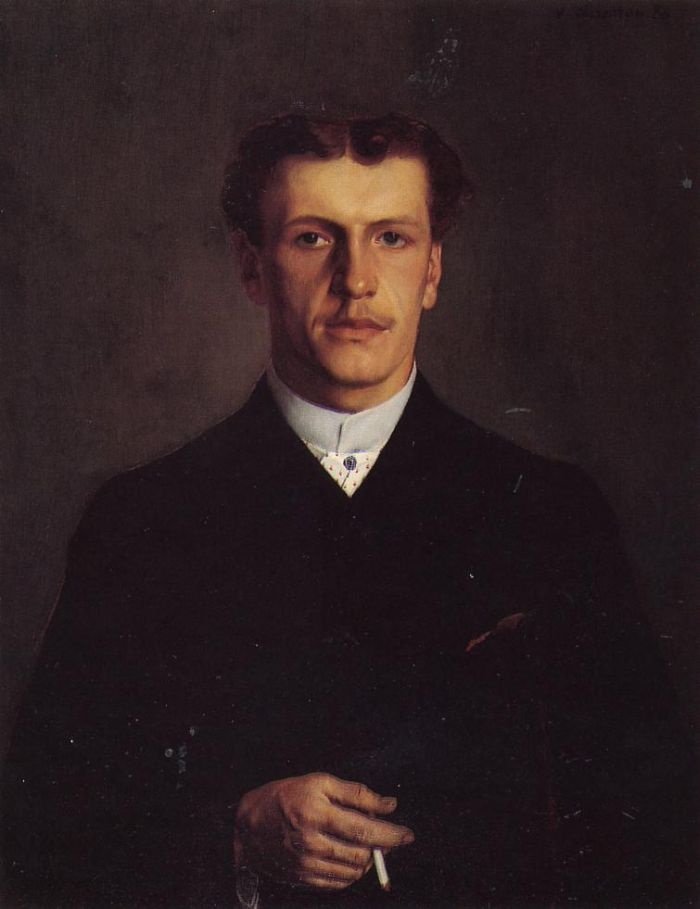
Portrait of Monsieur Ursenbach by Félix Vallotton (1885)

In 1885, at the age of nineteen, Vallotton’s luck changed.  It was due to his portrait of one of his neighbours, Monsieur Ursenbach, a mathematician and Mormon.  That year, he submitted the Portrait of Mr Ursenbach to the Salon jury and with his former tutor, Jules Lefebvre, one of the jurists, the work was accepted and subsequently displayed.   It is an interesting work.  The setting for the portrait is the sitter’s colourless and featureless room.  Ursenbach can be seen sitting in his armchair in a stiffly upright pose, looking uncomfortable with a stern expression on his face.  His hands rest steadily upon his knees as he stares off to the left of the painting.  It is this unusual demeanour of Ursenbach which probably caught the eye of visitors to the Salon exhibition.  Critics were divided on its merits but for Vallatton himself when he later listed all his paintings in chronological order, this was the first on the list.

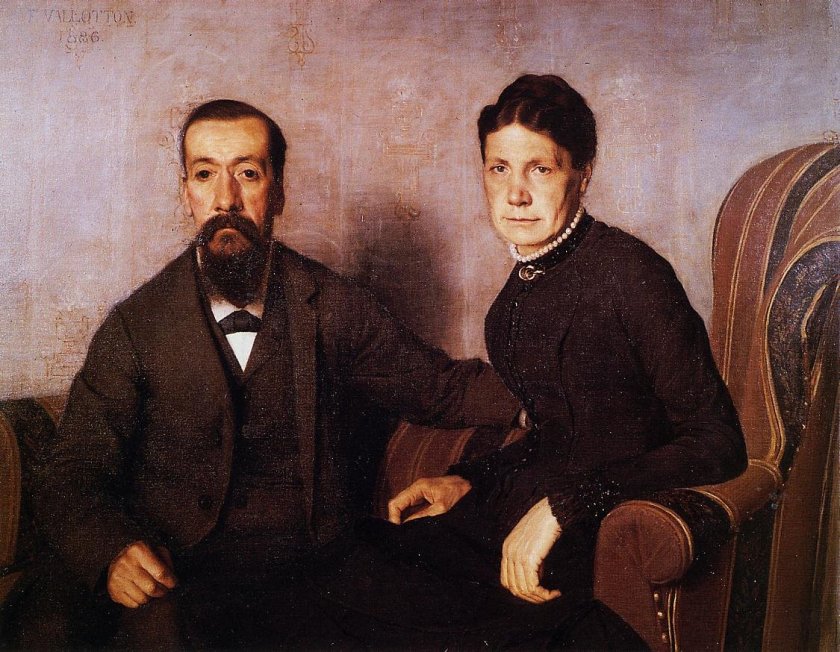
The Artist`s Parents by Félix Vallotton (1886)

Like many portrait artists before him, the young artist completed many portraits of his own family members.  His family portraits, such as the 1886 one of his parents, The Artist`s Parents,  featuring Alexis and Mathilde, were tender and showed the closeness he was to his parents.

Paul Vallotton by Félix Vallotton (1886)

In the same year that he completed the portrait of his parents he completed a portrait of his brother Paul.

Self portrait by Félix Vallotton (1891)

Over the years, he also painted many self portraits and one of my favourites is his 1891 painting, Mon portrait.  Portraiture was a way Vallotton began to earn money and he completed many commissions in Paris and back in his home town of Lausanne.  Many of his Paris commissions were attained through his Swiss ex-patriot friends who were living in the French capital.  One such friend and fellow student was the Swiss artist, Ernest Bieler and it was he who persuaded the artist and close acquaintance, Auguste de Molins, to write a letter of introduction on behalf of Vallotton to Renoir and Degas.  De Molins had known the Impressionists as he had exhibited works at the First Impressionist Exhibition.  In his letter to Degas, de Molins wrote:

“…My protégé is absolutely alone in Paris without any connections at all apart from his contacts at the studio, which is far from enough to satisfy his intellectual needs.  The studio is all very well, but there comes a time when close relations with a master are somewhat more important even far more important…”

Vallotton never used the letters of introduction.

Felix Jasinski in His Printmaking Studio - Felix Vallotton (1887)
Felix Jasinski in His Printmaking Studio – Felix Vallotton (1887)

In 1886 Vallotton met Felix Jasinski, an engraver and painted his portrait, entitled Felix Jasinski in His Printmaking Studio.  Jasinski went on to teach Vallotton all about the art of engraving and the two would work together on many projects.   Vallotton’s own catalogue of works began to list his engravings from 1887 and according to a letter to his parents in late 1889 he told them that he had begun to work on commissions for a publisher.  Money was to be made through his engraving work and by 1891 the amount of wood engravings completed by Vallatton was almost more that the number of paintings he had completed.

The Port of Pully by Félix Vallotton (1891)

His early works were not restricted to portraiture. Vallotton, being Swiss-born, loved to paint landscapes featuring the mountains and views of his homeland, especially around Lausanne and Lake Geneva.  Often they were for commissions given to him by Swiss people but often he would keep them for himself.  In 1891 he completed a painting, Port of Pully, one of the eastern suburbs of the city of Lausanne.  The painting depicts the lake front  located on the shores of Lake Geneva.

Outskirts of Lausanne by Félix Vallotton (1893)

Another beautiful landscape work by Vallotton was completed in 1893 and was entitled Outskirts of Lausanne.  In the painting we view Lake Geneva from a meadow.  The yellow and greens of the foreground are in contrast to the still blue water of the lake in the background.  There is an air of tranquillity about this depiction.  One can imagine sitting in the meadow, which is bathed in sunlight, and just relaxing and leaving the cares of the world behind.

The reason for me writing a couple of blogs about Félix Vallotton was that I was fascinated by the heading of a 2007 article in The Guardian newspaper by Julian Barnes which shouted out:

Better with their clothes on

The neglected, enigmatic Swiss artist Félix Vallotton was a fine painter of still lifes, landscapes and portraits. Shame about his dreadful nudes, writes Julian Barnes.

and so in my next blog I will continue with Vallotton’s life story and look at more of his paintings including some of his “dreadful nudes” !!!

Much of the material I have used for this blog came from an excellent book entitled Félix Vallotton by Nathalia Brodskia, an art historian attached to the hermitage Museum, St Petersburg.

Federico Zandomeneghi – the Italian Impressionist

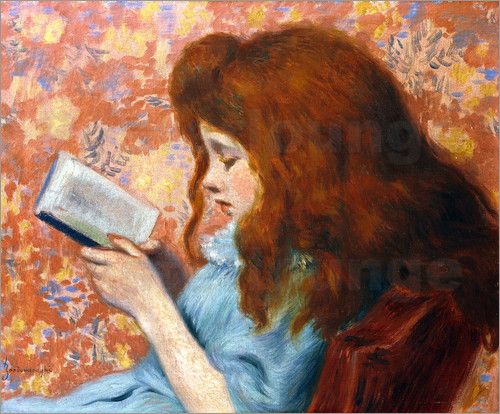
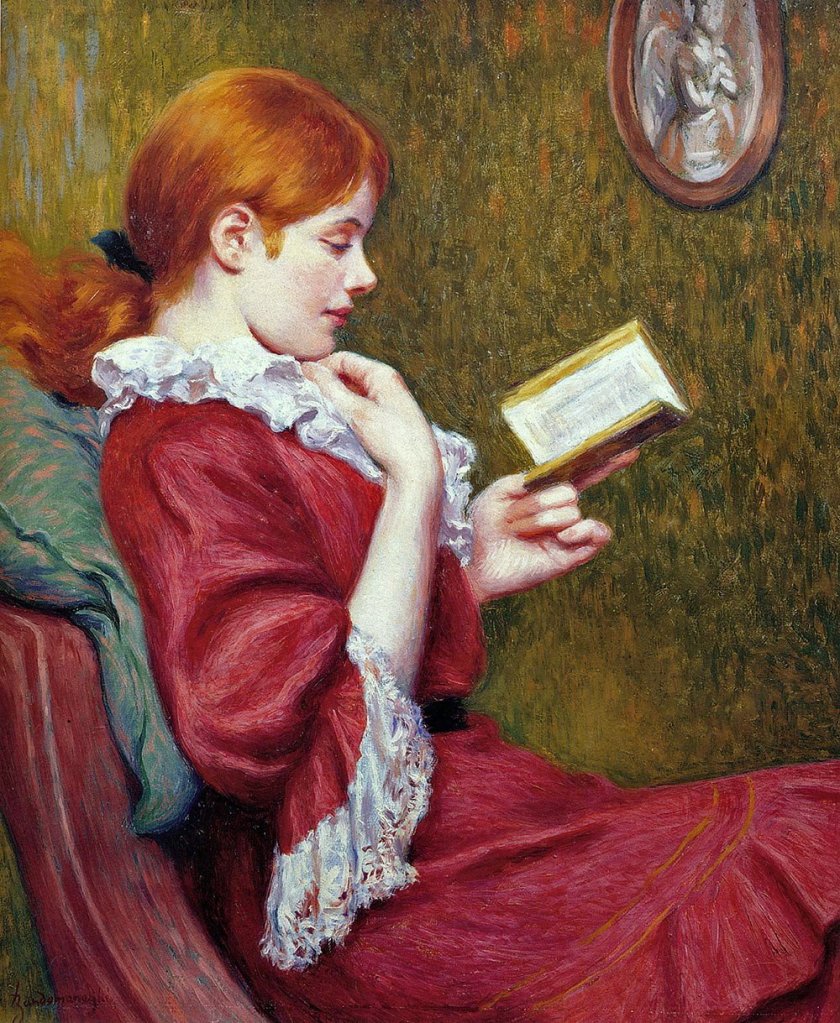
Lesendes Mädchen (Girl reading) by Federico Zandomeneghi (c.1900)

When I was in Germany, just before Christmas, I bought myself a desk calendar which gave you a new painting every day.  I was fascinated by today’s picture of a young girl reading entitled Lesendes Mädchen (Girl Reading) by Federico Zandomeneghi.  I had never heard of the artist and thought it would be interesting to look at his life and his some of his beautiful works of art. He would become known for his many pastel portraits of ladies and children.

Federico Zandomeneghi

Federico Zandomeneghi was born in Venice in June 1841. He came from a family line of sculptors.  Pietro, his father, was a neoclassical sculptor as was his grandfather Luigi but unlike his father and grandfather Federico, and much to their annoyance, he favoured painting to sculpture.  In 1856, at the age of fifteen, he enrolled on a painting course at the Academia di Belle Arti in Venice and then later studied at the Accademia di Belle Arti di Brera in Milan, where he studied under the neoclassical-style painter Giralamo Michelangelo Grigoletti and Pompeo Marino Molmenti.  Venice was under Austrian rule when Napoleon was defeated in 1814 and it became part of the Austrian held Kingdom of Lombardy-Venetia.   Venice was firmly under the control of Austria and as such the Venetian citizens were conscripted into the army.  To escape conscription, Federico fled his city in 1859 and went to Pavia, where he enrolled at the university.  In 1860, when he was nineteen years of age, he joined the military forces of Guiseppe Garibaldi as one of the volunteers in The Expedition of the Thousand, part of the Risorgimento, the push for Italian unification.  As a Venetian this was looked upon as a kind of treachery. His flight from Venice in 162 to Florence to avoid conscription resulted him being charged, in absentia, with desertion.

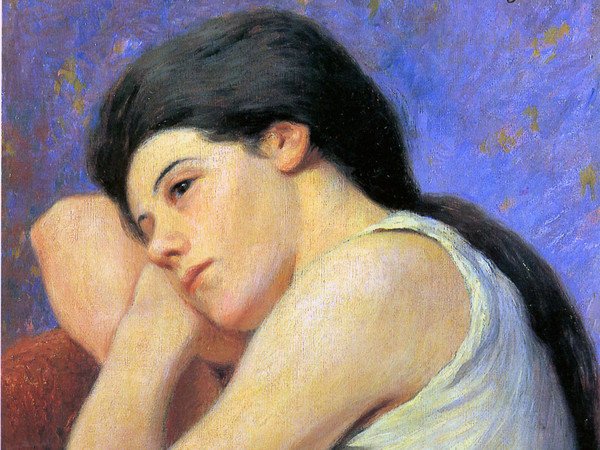
Femme qui reve by Federico Zandomeneghi,

As a young aspiring artist Federico wanted to mix with other artists in the Tuscan city and by doing so assimilate their views of art.  One of the favoured meeting places for the artists was the Caffè Michelangelo .  It was here that the Macchiaioli met.  The Macchiaioli, which literally means patch-  or spot-makers, was a  group of rebellious Italian artists based in Tuscany during the second half of the 19th century and was formed more than ten years before the French Impressionists came onto the scene.  They rebelled against academic artistic training and many art historians believe they brought about a breath of fresh air into Italian painting.  They ignored the type of painting which was popular at the time such as Neoclassicism and Romanticism.  They were looked upon as the founders of modern Italian painting.  The Macchiaioli believed that areas of light and shadow, or macchie were the most important parts of a painting and when Italian artists spoke of macchia they were talking about the sparkling quality of a drawing or painting.

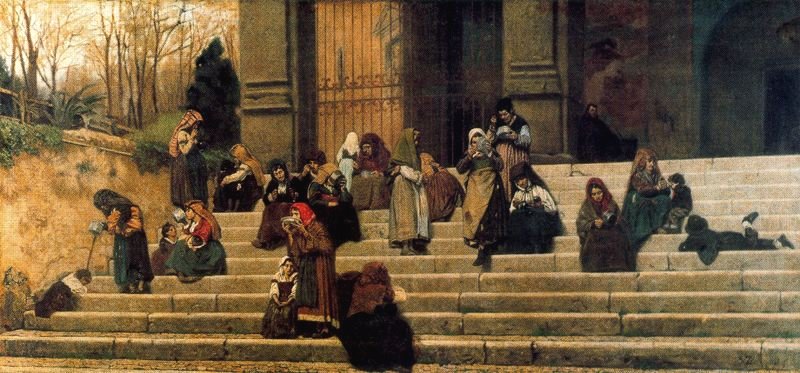
The Poor on the Steps of Ara Coeli in Rome by Federico Zandomeneghi (1872)

The Poor on the Steps of Ara Coeli in Rome by Zandomeneghi is now housed at the Pinaconteca Brera in Milan.  It is a fine example of verismo the nineteenth century Italian painting style and was a style frequently used by the Macchiaioli.  It is a style of painting we would term as realism.  It features a group of poor people, men, women and children sitting on the steps of Santa Maria in Aracoeli (St. Mary of the Altar of Heaven), one the oldest basilicas in Rome.   

——————————————————————–

There was a strong connection with French art as many of the Macchiaioli were influenced by the French artists such as Courbet and Corot who belonged to the Barbizon School as well as other nineteenth century plein air painters whose works the Macchiaioli artists were able to see when they visited the French capital.  En plein air painting was at that time a ground breaking method of painting but its proponents believed that it allowed for a new vibrancy and naturalness in the reproduction of light which would have been lost if the painting had been carried out in a studio.   Some of the members of the Macchiaioli, like Federico, had fought alongside Garibaldi in his effort to attain Italian unification.  Many of the works of the Macchiaioli featured grand battles scenes of the Risorgimento as well as landscapes and genre paintings featuring both the bourgeoisie and peasants.

Palazzo Pretorio in Florence by Federico Zandomeneghi (1865)

Another painting completed by Zandomeneghi whilst he was living in Florence is one of my favourites.  It is entitled Palazzo Pretorio and was completed in 1865.  It can now be found in the Museo d’Arte Moderna, Ca’ Pesaro, Venice.   The work of art was exhibited that year in the rooms of the Società Veneta Promotrice (Venetian Promoter of Fine Arts) which was based in Palazzo Mocenigo at San Benedetto.   The depiction of light and shade we see in the painting was strongly influenced by the Macchiaioli artists of Florence.

————————————————————–

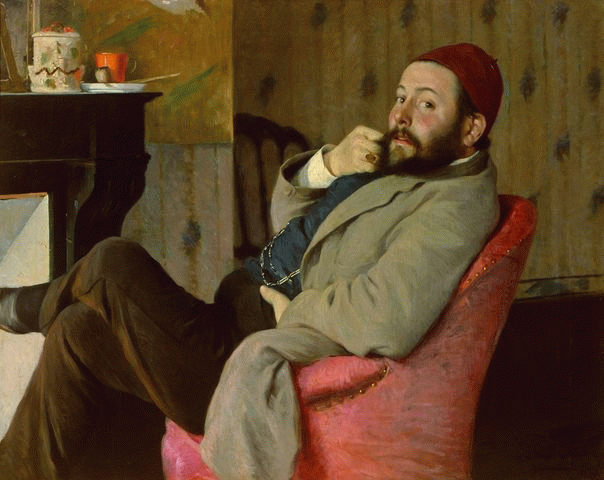
Diego Martelli by Federico Zandomeneghi (1879)

Whilst in Florence and through his association with the Macchiaioli artists, Federico Zandomeneghi met the Italian art critic Diego Martelli.  Martelli was a great supporter of the painters of the Macchiaioli and would often invite them up to his large Tuscan estate in Castiglioncello which was an ideal setting for their en plein air painting sessions.  Martelli wrote fervently about realism in art and favoured the works of Gustave Courbet as well as the plein air artists of the Barbizon School.    He made a number of trips to Paris and its thought that he persuaded Zandomeneghi to leave Florence and go to live in the French capital.  Through their correspondence Zandomeneghi introduced Martelli to the works of the Impressionists so much so that it is said that Martelli was one of the first and leading supporters of Impressionism in Italy.

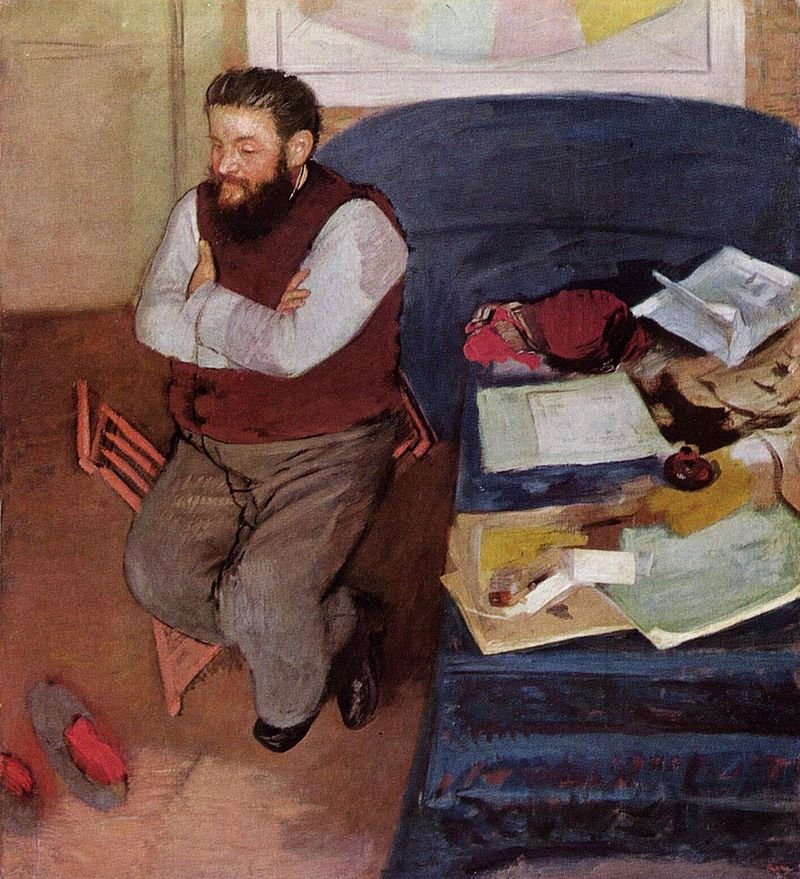
Portrait of Diego Martelli by Edgar Degas (1879)

Like Zandomeneghi, Martelli became good friends with Degas who painted his portrait in 1879.  The Degas portrait is unusual in as much as the sitter is viewed from above which is somewhat unflattering as it accentuates the corpulence of Martelli.  We see Martelli sitting unsteadily on a small stool.  To his left is a table, scattered on which are numerous objects belonging to the sitter.  The addition of these items was a trademark of Degas’ portraits as he felt it told viewers more about the subject of the portrait.  The painting is now housed in the Scottish National Gallery.

The Good Book by Federico Zandomeneghi (1897)

In 1874, Federico, now thirty-three years of age, moved to the art capital of Europe, Paris, and little did he know then, he would never return to his Italian homeland.  On his arrival in Paris, as was the case when he arrived in Florence, he wanted to immerse himself into the life of an artist and mix with the artists of Montmartre.   To be an artist in the French capital at this time was a chance to witness the birth of what would later be termed by the art critic, Louis Leroy, as Impressionism.

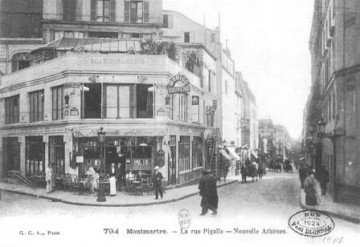
Café de la Nouvelle-Athènes on Place Pigalle

The year 1874 was the year of the Impressionist’s first annual exhibition in Paris.  Federico would often frequent the Café de la Nouvelle-Athènes on Place Pigalle.  It was here that he first met and befriended Edgar Degas, who was seven years his senior.    It is said that we are often drawn to people who have the same characteristics and the same looks upon life and as such Degas and Federico Zandomeneghi were well matched.  Both were recalcitrant and often boorish and this similarity of behaviour ensured they would remain life-long friends!  Although great friends with Degas, Federico was more influenced by the works of Renoir and Mary Cassatt and the way they portrayed women in their art work.  This was to lead to many of his works featuring females going about with their daily chores or being immersed in reading.  Zandomeneghi liked to portray through his artwork, and like that of the Impressionists, the elegant high society of the French capital but his paintings were not imitations of the Impressionists’ works.  He had his own inimitable style.

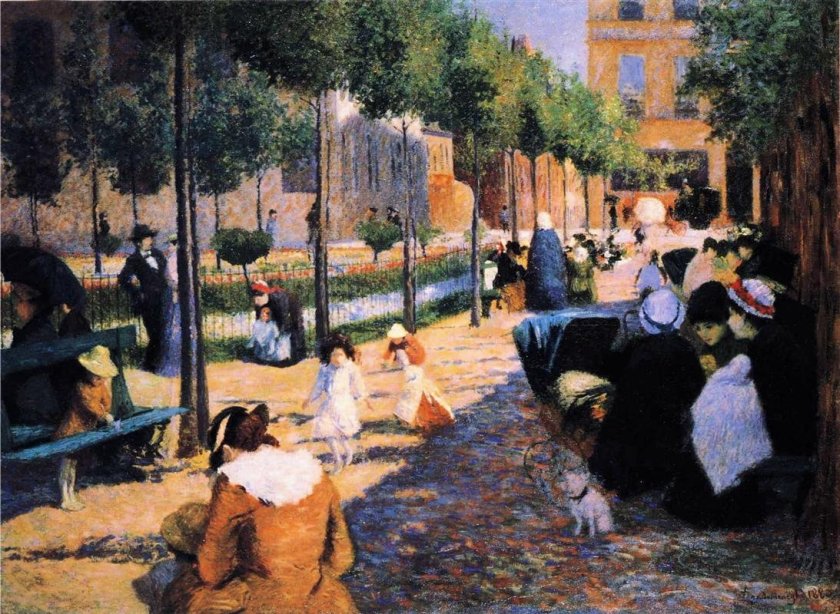
Place d'Anvers, Paris by Federico Zandomeneghi (1880)
Place d’Anvers, Paris by Federico Zandomeneghi (1880)

The Impressionists had by 1879 held three annual exhibitions and Degas persuaded Federico to exhibit some of his work at the fourth annual exhibition at the Avenue de l’Opéra, during the months of April and May in 1879.  Besides Federico there were three other “first appearances” exhibiting at the Fourth Impressionist Exhibition, the husband and wife Impressionists Félix and Marie Braquemond  and Paul Gaugin.  Federico went on to exhibit at the fifth (1880), sixth (1881) and the eighth and final exhibition in 1886.  To sell one’s work one has to have a good dealer and through the good auspices of his Impressionist friends Federico was taken on by the gallery owner and art dealer, Paul Durand-Ruel who acted as his sole agent.   It was this Parisian art dealer who changed the fortunes of Federico when he exhibited the Italian artist’s work in America.   In the 1890’s, having had to supplement his income from the sale of his paintings by providing illustrations for Paris fashion magazine, once his work was seen in America he was inundated with commissions.  It was around this time that Federico changed the medium in which he worked, now favouring in pastels.

Conversazione interessante by Federioco Zandomeneghi (1895)

Zandomeneghi will always be remembered for his female portraiture.  He seemed to concentrate his depictions of women who were mothers going about their everyday life.  He often liked to show in his paintings the ease in which women interacted with each other.  There was a warmth about his pictorial depiction of females and this may be because of the way he was influenced by the works of Berthe Morisot and Mary Cassatt.  Enrico Piceni,  the Italian writer and art critic who wrote a biography about Zandomeneghi and who, in 1984, wrote a book entitled Three Italian friends of the impressionists : Boldini, De Nittis, Zandomeneghi, wrote of Zandomeneghi’s work:

“…Zandomeneghi knows how to differentiate himself from his closest colleagues, Degas and Renoir, by surpassing the glossy and even fierce chronicle style of the first thanks to adding a warm and affectionate emotional involvement in the subject, and by transferring the deification of the ideal woman typical of the second in a more bourgeois reality interwoven with truth but able to transform a simple story in a tremor of poetry…”

A good example of the way Zandomeneghi depicted a close relationship between two women is in his 1895 work entitled Conversazione interessante (Interesting Conversation).  Before us, we see two women locked in conversation.  There is a gentleness about the scene.  There is no wild animation.  We feel drawn into the scene as a friend who is being admitted into their private world.  Both women are wearing light fashionable wide-sleeved shirts which were all the fashion in the 1890’s.    This painting highlights the beautiful technique Federico was to often use.  There is a lightness of touch and the artist demonstrates an amazing insight in the way he portrays the mood of the sitters.  The two women in the painting are totally absorbed in their conversation.  Their hands touch. They only have eyes for each other in this intimate and yet non-sexual depiction.   The art critic and writer Francesca Dini in her 1989 book,   Zandomeneghi, la vita e le opera, wrote of this work:

“…Conversazione interessante (Interesting Conversation), is among the most famous works produced by the Venetian painter at the beginning of his relationship with Durand-Ruel. The brilliance and chromatic refinement of the composition are emphasized by the balance of the scene and the richness of the materials chosen for the dresses of two young women, who are wearing light shirts with wide sleeves ‘double sboffo’, very fashionable in the last decade of the century. The provenance of the painting is notable as it belonged, among others, to the greatest admirers and collectors of paintings by the artist…”

Federico Zandomeneghi died in Paris on the last day of 1917, aged seventy-six.  It was not until 1914, three years before his death, that he was given his first one-man show which was at the Venice Biennale of that year in his native country.

There were so many paintings by Zandometeghi I could have showcased but I have just chosen some of my favourites but I hope you will search out more of his works.

Howard Terpning – the painter of the Native Americans

Self portrait by Howard Terpning

After four blogs featuring the French painter Balthus, which looked at some of his controversial paintings, I thought I would present you with a less contentious artist.  Today’s blog is all about an American artist whose later work is centred around what is termed on TV as the Wild West.  You will see that his forte was his paintings featuring Native American Indian and their way of life, which often led him to be known as “The storyteller of Native Americans”.  Let me introduce you to Howard Terpning.

The Family Home by Howard Terpning

Before us is a depiction of a Native American family outside of their  tipi, part of a Blackfoot camp.  The base or skirt of the tipi is painted with symbols which referred to the mountains around where they lived as well as symbols representing Father Sky, which along with Mother Earth, were common characters in the creation myth.  They were looked upon as kind of religious symbols which protected those who lived in the tipi and somehow guaranteed them happiness and prosperity in the future.  Designs at the tops of the painted tipi represented the upper limit of the physical world, here a blue stripe for the sky and a red strip for life. The middle band could one day contain pictographs of war exploits or symbols that the family found important or lucky.

————————————————————————————–

Terpning was born in November 1927 in Oak Park, Illinois, a suburb of Chicago.  His father worked on the North Western railroad and his mother was an interior decorator.  Even as a young boy he wanted to be an illustrative artist although, and as many young boys of his age, he also hankered after a career in the US Air force as a pilot, a “calling” his brother Jack actually fulfilled as a B-24 bomber pilot but who was sadly killed during World War II.  As a teenager Howard Terpning became enthralled with the Wild West and the Native Americans.  This interest was fired up after a Colorado summer camp, close to Durango, which he attended along with his cousin.

Journey to the Medicine Wheel, by Howard Terpning

This painting is all about the healing power of the Medicine Wheel , sometimes referred to as the Sacred Hoop, and before us in the painting, we see a Plains Indian family offering up a sacrifice to this very sacred place.   It was the Native American belief that the Four Cardinal Directions (North, East, South and West) are linked to great Powers, or intelligent forces, whose energy (or Medicine) can be harnessed. The directions can be charted on this circular map, the Medicine Wheel, which could enable one to come into alignment with these spiritual powers and absorb something of them.  Each Native American tribe interpreted the Medicine Wheel differently.

——————————————————————————–

In 1945, when Terpning reached the age of seventeen, he enlisted in the Marine Corps and was posted to China as an infantryman where he remained for nine months.  When he left the Marines in 1947 he wanted to enrol at the Chicago Academy of Fine Arts.  The cost of his art course was paid courtesy of the Servicemen’s Readjustment Act, more commonly known as the G.I. Bill, which was a law that provided a range of benefits, including vocational education, for returning World War II veterans.  It proved difficult for Terpning to gain access to the Academy as, like other educational establishments, they were oversubscribed due to the large number of returning veterans.   However, through the good auspices of his father’s friend and neighbour, Harold Mundstock, an illustrator, he was granted a place at the academy and it was here that he studied life drawing and painting.  He graduated from the Chicago Academy of Fine Art in 1948 and in 1949 attended the American Academy of Fine Art.

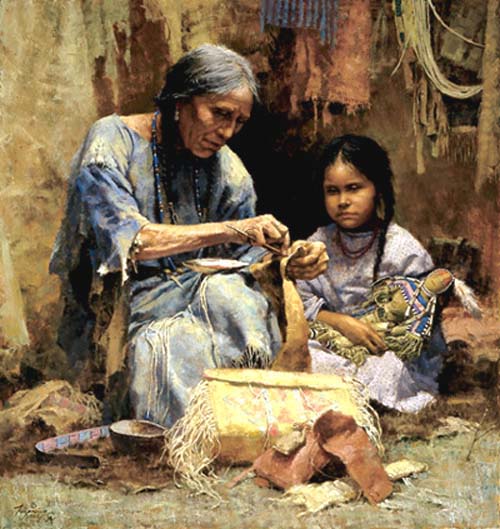
The Teachings of My Grandmother by Howard Terpning

In the painting, The Teachings of My Grandmother, Howard Terpning depicts the Native American people buit like many of his works, it was not focused on their battle with the “white man” but concentrated on the lifestyle of the Native Americans.  In this painting he examines the way the young children were nurtured and taught and the importance of passing on such knowledge which would ensure a better future.  Young females of the tribe learnt to cook and make clothes whilst the training given to the young boys concentrated on hunting and building them into warriors who one day may be called upon to protect their village.  Before us we a six year old Blackfoot girl, who clutches her doll as she concentrates on watching what her grandmother is doing. 

———————————————————————————-

On completion of his time at the Chicago Academy of Fine Arts and the American Academy of Art, Terpning decided to seek employment in New York but after several days of visiting various art studios without any success, the disappointed young man returned to Chicago.  Once again, his father’s friend Harold Munstock intervened and introduced him to the foremost illustrator of his time, Haddon (Sunny) Sundblom.  Sundlom is best remembered for his work for the Coca Cola Company which commissioned him in 1931 to create a wholesome version of Father Christmas.  Sundholm was described as arguably the most famous advertising icon in history and the American author, Roger T Reed wrote of him:

“….  ‘More than any artist including Norman Rockwell, Sundblom defined the American Dream in pictures, proved by his work for virtually the entire Fortune 500’. I think it’s important to remember that ‘Sunny’ was about a lot more than Santa…”

Sundblom saw some of Terpning’s work and recognised the talent of this young artist and in 1950; he employed him as an apprentice in his Chicago studio.  His starting wage was a princely sum of thirty-five dollars per week!  Life as an apprentice was difficult to start with as all Terpning did was to be at the beck and call of his bosses, running errands, building crates and cleaning their paint brushes.  However, he did what was asked of him and after eighteen months he was able to work on his own first commission.  He remained in the Chicago for five years, before moving to an art studio in Milwaukee in 1955.  It was during these years in the mid West that he started to paint pictures depicting farmers, their farm equipment and life on the farm.

Gone with the Wind film poster by Howard Terpning

Three years later, in 1958, he returned to New York, the first city where he first unsuccessfully tried, a decade earlier, to gain artistic work.  However this time he managed to land a job with Stephens Bionde de Chico, a leading Chicago studio.  In 1961 he painted the first of over 80 movie posters, The Guns of Navarone.  Later he would produce film posters for such films as  The Sand Pebbles, The War Wagon, Gone With The Wind (reissue), Ice Station Zebra, Doctor Zhivago, Cleopatra, Grand Prix, 55 Days at Peking and Lawrence of Arabia.  He carried on creating illustrating film poster illustrations until the mid 1970’s.

By 1962, he was working as a freelance artist and had his own studio and agent who set about finding him commissions.   As a result, Terpning was able to work from his home studio eliminating the long commute into NYC.  During this time, his output of illustrations was phenomenal.

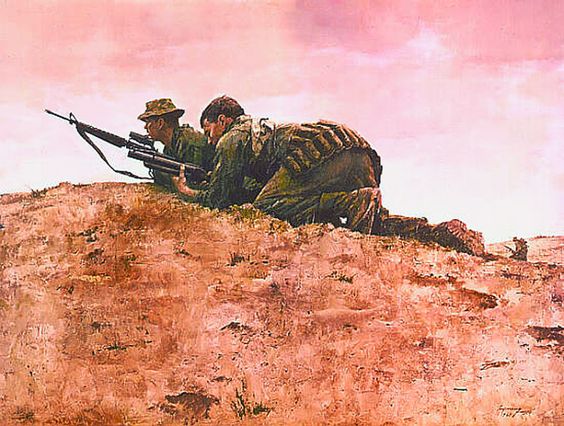
Moving Up Marines South of Hoi An, South Vietnam, 1968, by Howard Terpning

In 1967 Terpning was approached by the Marine Corps to join the The Combat Art Program run by Colonel Raymond Henri who had gathered together a number  of Marine and civilian artists and illustrators and sent them to Southeast Asia to record on canvas the events of the war.  Terpning agreed and was sent to the battle front with the temporary rank of Major where he was given freedom to go out on patrol with the marines, be on a medivac helicopter which picked up the wounded troops and by doing this, seek out material for his paintings.  He stayed in Vietnam for six months.  In all he completed six paintings featuring the Marines at war which now can be seen at the Marine Corps Museum in Washington DC.  During his six month stay in Vietnam not only did he witness the bravery of the American troops he witnessed the suffering of the Vietnamese civilians and developed empathy for their plight.  A decade on this empathy for the downtrodden would be transferred to the lot of the Native Americans at the hands of the white settlers and prospectors who wanted their lands.

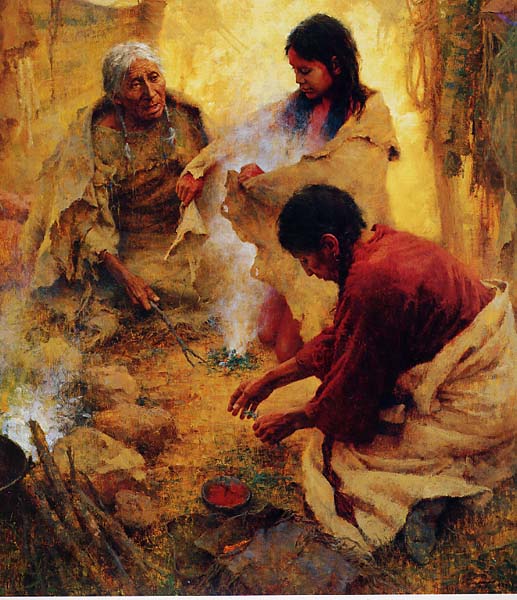
Passing into Womanhood by Howard Terpning

Another of Terpning’s paintings which focused on the transition of Native American children to adulthood can be seen in his work, Passing into Womanhood.  The picture looks at the rite of passage of a young Cheyenne girl, who is taking part in a ceremony which announces her coming into puberty.  The Cheyenne had the tradition that they would reveal to the rest of the people in the camp the fact that the girl had reached the age that signified the passage in her life  when she moves from being a child to life as a woman.  This initiation ceremony was normally carried out by the girl’s grandmother

There are three women in the painting.  To the left, we see the white haired grandmother and to her right is the young girl with her hair combed out of the normal braids.  She wraps her nakedness in a robe.   In the foreground is a woman  mixing up a red dye which she would later daub onto the naked body of the young girl.  On the floor of the tipi, before the young girl, there is a smouldering fire onto which has been sprinkled with  sweetgrass, juniper needles, and white sage.  The young girl leans towards the smoking fire, opening her robe so the rising smoke from the incense would pass about and over her body. Following the conclusion of the ceremony, she and her grandmother would leave their home lodge, and the young girl would then stay in a smaller one for a period of four days.

——————————————————————————–

Terpning worked as a very successful commercial artist for twenty-five years, seventeen of which were in New York City. His work as a commercial artist was varied.  Besides his numerous movie posters, he worked on advertisements, book illustration and illustrations for articles in prestigious magazines such as Reader’s Digest, Good Housekeeping, Newsweek, and Time.   The work as a commercial artist was financially rewarding but became less rewarding as time passed.  In the summer of 1974, Terpning then forty-seven years of age, took a three month break from his commercial work and spent the time painting.  He completed three works of art including one for his daughter Susan – a portrait of  Gall, the great Sioux chief and warrior who took part in the Battle of Little Bighorn.  Terpning revelled in this new found freedom of being his own boss and painting whatever he liked.  He sent the completed canvases to Troy’s Gallery in Scottsdale, Arizona, which sold them in January 1975.  He began to sell his artwork and soon realised he could survive financially on the sale of his paintings.  He completed all his commercial artwork commissions and finally retired from the business in 1976.  His plan was to concentrate on his own art and decided that through his paintings he would narrate the story of the nineteenth century Native Americans.  Over the next forty years he produced almost five hundred beautiful works of art including charcoal drawings which featured the free spirited tribes of the Great Plains of America who struggled to survive the hardships of nature and the avarice of mankind.  These were paintings full of emotion.  Terpning, through his paintings, weaved a story.  He himself described his work and what he wanted to achieve, saying:

“…I am trying to tell the story of the Plains people, and in my art I have always been a storyteller – I just do that naturally – so the two come together.  I respect the way they lived – the horse culture and the buffalo people.  It was an exciting period in our history.  There is an awful lot about them we could have learned from if we had the sense to do it…”

Comanche Spoilers by Howard Terpning

In his painting,  Comanche Spoilers, Terpning recounts the story of an uprising of  the Comanche which when adding up the number of warriors to the number of women and children  involved, came to almost a thousand people.   The incident happened in August 1840 when this large horde of people moved south off the Plains towards the Gulf of Mexico.  On their journey south they pillaged ranches and settlements.  Once they had loaded all their horses up with pilfered goods they headed back north to the Plains.

In the painting, we see the Comanche returning home with all the goods they had stolen.  Warriors are seen holding ladies umbrellas, which they had stolen,  above their heads to shade them from the sun.  Others wore stove pipe hats and ribbons which had all been stolen.   Their return journey was halted when they met resistance from a large group of Texans who overwhelmed them, killing many and scattering the rest.

—————————————————————————–

In 1977 Terpning moved to Arizona in an attempt to document Native American culture and the America West and in 1979 he was elected to the National Academy of Western Art and the Cowboy Artists of America.

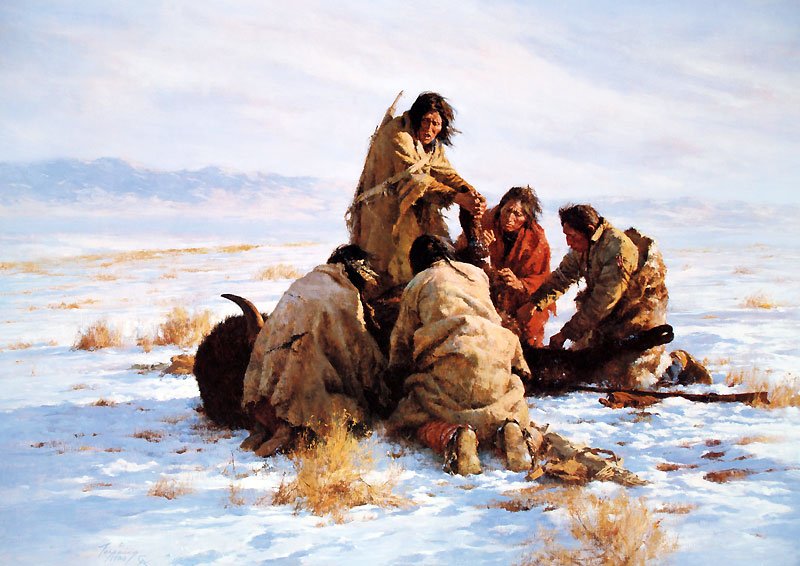
The Last Buffalo by Howard Terpning

The depletion in numbers of the Plains people was due to a number of factors but one of the most  telling factors was lack of available food on the Plains.   Buffalo and bison meat was their main source of food but there was only so many to go around and when white hunters began their slaughter of the buffalo, they were bringing an end not only to the buffalo population but also the Plains people as well.  Besides the buffalo meat, the bones of the dead animals were also used by the Plains people for tools and weapons.  In this work, entitled The Last Buffalo, we see a small hunting party which has just killed a bison.  Strangely, there is no sign of their horses.

———————————————————————————–

In Tulsa, Oklahoma there is the The Thomas Gilcrease Institute of American History and Art, which is commonly referred to as the Gilcrease Museum.  It houses the world’s largest and most comprehensive collection of art and artifacts of the American West, including an unparalleled collection of Native American art and material.  Its former director, Fred Myers said of Terpning and his art featuring the Native Americans:

“…Terpning is simply the best and best-known artist doing Western subjects at this point… He is among a very small group of painters of the West in the late 20th century whose art will still be hanging in museums and appreciated a hundred years from now…”

Proud Men by Howard Terpning

My final painting I am showcasing is one entitled Proud Men and in his book Plains People: The Art of Howard Terpning, the author Howard Hedgpeth hailed the Plains people, writing:

“…They followed the warrior’s way.  They were proud prairie horsemen with an appetite for honour and the visceral thrill of danger. They looked death in the face and fought on, emboldened by bravery and the armour of their medicine. They rode for revenge but would fight too for no other reason than to plumb the depth of their courage. There was blood on the prairie where they passed by, and women wailed in the lodges of their enemies…”

Balthus. Part 4. Setsuko and the latter days

The two sons of Balthus, Stanislaus and Thadée, edited a book in which they put together letters that their father had written.  The book was entitled Correspondance amoureuse avec Antoinette de Watteville 1928-1937 which was published in 2001.  One of the letters, dated August 31st 1933 was a letter from Balthus to his father in which he told of his worries about people analysing his work too much and how he tried to ensure that his depictions did not open up the possibility of various interpretations.  He wrote:

 “…The horrible danger for me, though, is to fall into the trap of becoming anecdotal, but it won’t happen…”

The Golden Days by Balthus (1944-46)

However, a painting he completed in 1946, entitled The Golden Days, received many interpretations which probably annoyed the artist.  The work of art can be seen in the Hirshhorn Museum, part of the Smithsonian Institution, Washington, DC.    So, should one just look at the painting and not try to guess what was in the mind of Balthus when he painted this picture?  Before us is a good looking teenage girl slumped contentedly on a small chaise longue. In her left hand she holds a white hand mirror.  The mirror is bathed in light from the window behind her.  She studies her own reflection.  As we have seen in many of Balthus’ paintings her legs are spread wide apart and her short skirt has ridden up exposing her thighs.  Her bodice lies open and has slipped off her right shoulder.  Around her neck we see a pearl necklace.  On her feet is a pair of white slippers.  Behind her there is a wooden table upon which is a white bowl.  In the background there is a roaring fire being tended to by a man who is stripped to the waist.  So, do we take the painting at face value as Balthus says we should do, or do we start to interpret what we see before us?  That’s your choice but I would like to quote a passage in an art essay written by Andre Pijet about the works of Balthus and, in particular, his interpretation of The Golden Days.  He was adamant that Balthus’ paintings need to be decoded and by doing so it would reveal the meaning of each element.   Pijet wrote:

“…The artwork shows a young girl stretched comfortably on a small sofa and she is preoccupied by looking at the reflection of herself in the white mirror, which she keeps in her left hand. The mirror symbolizes the world, life, femininity, love, and vanity. The pearl necklace on her neck refers to the virginity, health, perfection, and preciousness. The right hand hung down looks as it is suspended in the air. Her torso is partly uncovered suggesting a delicate touch of feminine coquetry. The girl’s legs are spread in provocative invitation of sexual curiosity. Together, the white slippers on her feet, the white mirror and the white pillow behind her head as well as the white bowl on the table completed with the white light projected from the window situated in the back symbolize the innocent purity of the young female beauty. The entire room is divided by the two sources of light. The white light coming from the window on the left is mixed with the red reflections projected by the chimney. Both these lights blend together exactly in the area of the girl’s spread legs suggesting the boundaries between the innocence and the sexual initiation. The sofa itself has a shape of the hiking shoe suggesting that the young beauty is on her way approaching the sexual fire of her first erotic experience. The man on the right is preparing the ground for her erotic enlightenment by warming up the room. On the left side of the chimney, a small statue with phallic forms is standing. Just beside the sculpture the log tongs are leaning against the chimney surface. The log tongs have the shape of female crotch as well as the form of infant what symbolize the process of future maternity. The chimney itself suggests the female sexual organs and the small in posture man working hard to keep the fire on representing symbolically the process of sexual intercourse. The man with his right hand covered with the white glow is touching the chimney that suggests clearly the act of defloration. The massive quantities of symbolic information, which is easily readable after close examination of all elements of the painting, refer to the passage of time from the childhood to the adolescence and the first encounter with sexuality…”

It is interesting to note that Sabine Rewald, the foremost exponent on Balthus and his art, in her book Balthus: Cats and Girls, which was published in conjunction with the 2013 Balthus exhibition at the Metropolitan Museum of Art in New York, never tried to interpret this work of art.

The sitter for this painting was fourteen year old Odile Bugnon and in an interview with Sabine Rewald in 1986, the now married Odile Emery, said that her family of farmers leased the farmstead, part of the Le Guinzet estate outside of Fribourg, from the baron de Cholet and Balthus had been commissioned to paint a portrait of the baron and his two daughters.  On one of his last visits Balthus saw Odile playing with some of the baron’s children.  He asked if she would like to pose for him.  She agreed and Balthus then attained permission from her mother.  When she arrived for her sitting Balthus was horrified to see that her mother had taken her to the hairdressers and dressed her up in a pretty dress and black slippers and stockings.   Balthus was appalled by the transformation and got Odile to change into the clothes we now see in and carefully posed her in the depiction we now see before us.

Although we see Odile’s right hand flopped downwards and her fingers pointing towards the floor, in his original version, those fingers were stroking a cat, which was later over-painted shown above.  Odile remembers the setting and the pose she was told to take by Balthus.  She remembered the roaring fire but said there was no man tending it.   As Balthus never completed the work until after he had moved to Villa Diodati in Coligny a small town outside of Geneva in October 1945, Odile never saw the finished work.

Whilst living in Fribourg, Antoinette gave birth to their first son, Stanislas, in October 1942 and in February 1944 their second son Thadée was born.  In March 1946 having spent the previous six months in Coligny Balthus and his family ended their Swiss exile and returned to Paris.

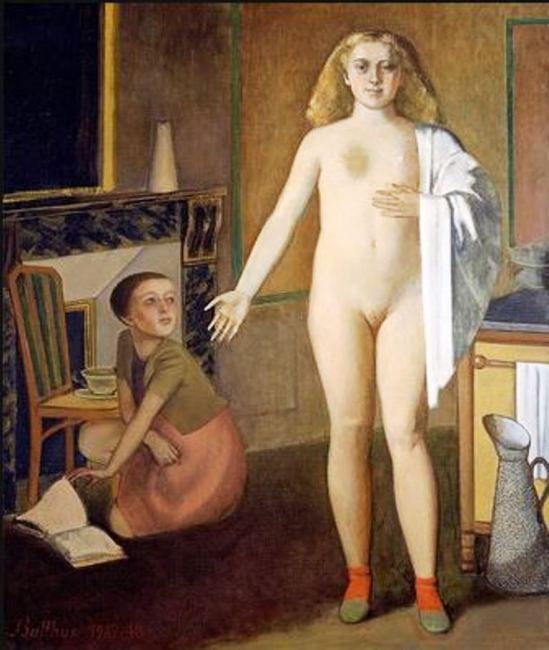
The Room by Balthus (1948)

On returning to his Paris studio at 3 cours de Rohan,  he worked on his large painting 190 x 160cms (75 x 63in.), which was entitled The Room.  He started the work in 1947 and completed it a year later.  It is a painting of contrasts.  What is the setting?  If we look to the left, we see a fire and an ornate mirror, so maybe it is the salon but if we look to the right we see a cooking stove, a towel rack and a speckled water pitcher, so is it the kitchen?  Maybe it is a forerunner of a “kitchen diner” !  The two characters depicted in the work are completely dissimilar. Kneeling on the floor and resting her elbow on a chair is a plainly dressed girl who had been reading a book, which lies open on the floor.  She is looking up at the other woman, a colossal nude.  This woman has long reddish blonde hair and a very thickset body.   She has a white towel draped over left shoulder and arm like a cape.  The open palm of her right hand points towards her kneeling companion in a gesture of an introduction.  What is the relationship between the two figures?  Are they mistress and servant?

Madonna della Misericordia by Piero della Francesca (1462)

Some art historians have said that the stance and size of the nude woman reminds them of the 1462 religious work by Piero della Misericordia, entitled Polyptych of the Misericordia.  The centre panel of this polyptych showed a very large depiction of the Madonna surrounded by a number of much smaller, in size, followers.  Balthus who spent time in Italy in 1926 copying paintings may have come across this religious work, which is housed in the Pinacoteca Communale in Sansepolcro, a town some 70 kilometres east of Siena.

In 1947 Antoinette left Paris with her two sons who were aged three and five.  Balthus had decided that his marriage to Antoinette was at an end and their best course of action was to amicably separate.  However, it was almost twenty years later before the couple divorced.

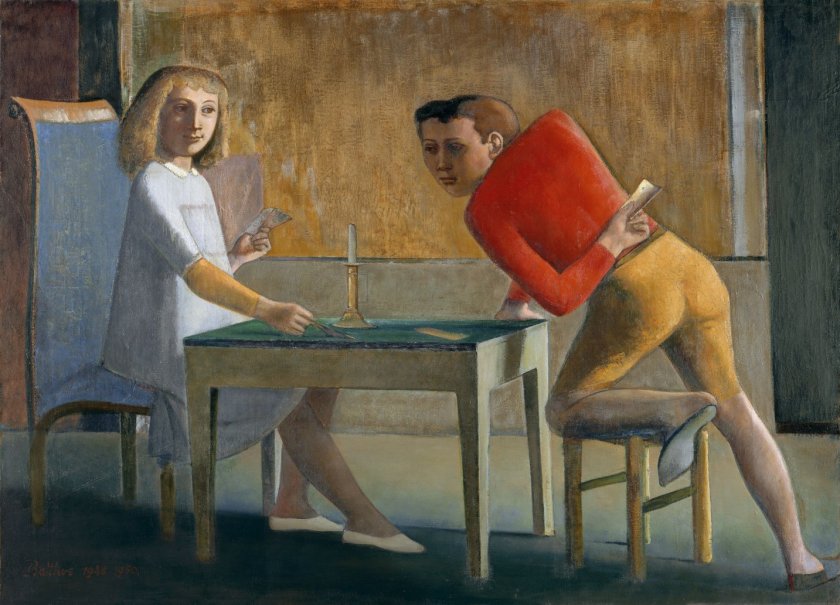
The Card Players by Balthus (1950)

In 1950 Balthus completed another painting depicting the game of cards.  This time he has shown two players, a girl and a young man.  The painting is simply entitled The Card Players and is housed in the Museo Thyssen-Bornemisza in Madrid.  The setting is an unadorned dark room.  The painting depicts two youngsters, a boy and a girl, playing cards at a table on which a candlestick stands. The room is lit up by light which emanates from the right-hand side of the room and which illuminates various objects and, in some way, seems to add to the mystery of the picture.  We get the impression from the smile on the girl’s face that she is winning and the boy is losing despite his attempt to cheat, as seen by the card hidden behind his back.  The depiction of the boy by Balthus is unusual as we see him both in a frontal and profile view.

In January 1949 Balthus’ father Erich died.   Balthus spent a lot of time in the early 1950’s designing theatrical sets and costumes for plays, operas and ballets.  In 1961 having achieved so much in theatre work he was appointed director of the Académie de France in Rome by his close friend André Malraux, the French Minister of Cultural Affairs.  Balthus was to remain in that post and live in Rome until 1977.

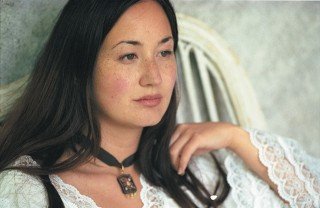
Setsuko in 1991
Setsuko in 1991

In 1962 Malraux asked Balthus to go to Japan as France’s official “ambassador of art” in order to organize a major exhibition of Japanese art to be held in Paris.  During that visit he met Setsuko Ideta, a nineteen year old, first-year student at the Tokyo Sophia Jesuit research University.  She was the same age as his first son Stanislaus!  Setsuko served as the English translator to the Balthus’ group who were touring the temples in Kyoto.

Setsuko remembered her first meeting with Balthus:

“…We met we spoke, they quarrelled…”

Balthus told her he was 50.  But as Setsaku said, it was not true, he was 54.   It has to be remembered Balthus was a Leap Year child, born on February 29th.  The German poet Rainer Maria Rilke, who had an affair with Balthus’ mother, told Balthus that having a leap-year birthday meant he’d slipped through a crack in time, into a “kingdom independent of all the changes we undergo”, and so Balthus liked to divide his real age by four, so allowing himself to admit to being 50 was somewhat of a compromise!  In his book Balthus: A Biography, the author, Nicholas Fox Weber described Setsuko:

“…Setsuko was the embodiment of much that he cherished: female beauty, youthful vitality,piercing intelligence and the charms and diffidence of the Orient…”

Countess Setsuko Klossowska de Rola

Setsuko was steeped in her Japanese heritage and came from the Samurai family of Kyushu.  She was poised and confident.  Balthus and Setsuko were married on October 3rd 1967.  Balthus and his first wife, Antoinette, were divorced in 1966 after twenty years of separation.

Balthus' daughter Harumi
Balthus’ daughter Harumi

In September 1969, Balthus’ mother Baldine died in Paris, aged 83.  In April 1973 Setsuko gave birth to a daughter, Harumi.  In 1977, Balthus  leaves the position of director of the Académie de France and after living sixteen years at the Villa Medici in Rome, he moves back to Switzerland.  Balthus had served two terms as director and was reluctant to leave the Italian capital but at that time there were many high profile kidnappings and he and his wife believed they may one day become targets and so it was the time to leave Balthus’ beloved Rome.

Balthus with his wife, Setsuko, their daughter, Harumi, and granddaughters at the Grand Chalet in Rossinière

Balthus, Setsuko and their four year old daughter Harumi went to live in Le Grand Chalet at Rossinière.  It was a magnificent building.  It was the largest known all-wooden structure of its kind in Europe, it was built between 1752 and 1756 by Jean-David Henchoz.

It was to remain Balthus’ home until he died there in August 2001, aged 93.  Balthus had been taken ill but left the hospital the night before he died to see once more his large chalet at Rossinière.  The funeral was held in the Swiss village of Rossinière, and was attended by a number of high-profile guests, including Prince Sadruddin Aga Khan, the supermodel Elle McPherson and Bono. The French and Italian governments also sent representatives.  After the ceremony in the village church, two horses pulled a carriage with the coffin draped in black. The artist was buried at the foot of a hill on a plot owned by the Balthus Foundation, some 300 metres from the chalet.      The Irish singer Bono, who was Harumi’s godfather sang at Balthus’ funeral.

Love him and his artwork or hate him for his use of young girls as models, I have found his life story fascinating and can understand why he was one of France’s most famous twentieth century artists.

Balthus – Part 2 – Young girls and controversy

Self Portrait by Balthus (1940)

In my second part of my look at the life and works of Balthus I am going concentrate on his depiction of pubescent girls which were to shock both the public and critics alike when they first exhibited in 1934 at the Galerie Pierre in Paris.  I have in some earlier blogs discussed what is, to some, termed as beautiful erotic art whilst others look upon the depictions as unacceptable and pornographic.  Those paintings by the likes of Egon Schiele and Lucien Freud were depictions of adult female models but in the case of Balthus’ paintings the models he was using were pre-pubescent girls.  I leave it to each person to decide whether the depiction of these young girls was simply the work of an artist and therefore as art, was acceptable or whether there was something very offensive and disturbing about the paintings.  Everybody is entitled to their own opinion.

I need to remind you that the depiction of young girls naked or semi-naked in paintings is not just something that interested Balthus.  Many other well known artists used young girls as models and portrayed them in their works of art.

Little Girl by Otto Dix

There was Otto Dix, the German painter, and often talked about as the most important painter of the Neue Sachlichkeit, which was an artistic style in Germany in the 1920 which set out to confront Expressionism.  It was looked on as being a return to unsentimental reality and one which concentrated on the objective world, unlike Expressionism which was more abstract, romantic, and idealistic.  His 1922 painting Little Girl in front of Curtain, which can now be seen at the Minneapolis Institute of Art, was judged to have flown in the face of morality.  This painting of a young naked girl is portrayed in a realistic style, maybe too realistic as it details the blue veins of her body.  She looks emaciated and she stares past us with a haunted expression. Her childhood is probably a thing of the past as, sadly, is her innocence.  A pink flower clings to the curtain behind her, and in her hair we see a bright red bow.   The artist himself once said:

“…I will either become notorious or famous…”

This painting probably allowed Otto Dix to achieve his first goal.

Puberty by Edvard Munch (1894)

The great Norwegian painter, Edvard Munch, who is best known for his paintings entitled Scream, also produced a painting in 1894 featuring a pre-teen naked girl.  The painting which was entitled Puberty depicts a young pubescent girl, nude, sitting with her legs together.  There is an air of shyness about her and this could be that at her age she is starting to become aware of the changes to her body.

Standing nude young girl 2 by Egon Schiele (c.1911)

The celebrated Austrian Expressionist artist Egon Schiele who, at the time,  was living with his lover, Valerie Neuzil, in the small country town of Neulengbach, close to Vienna.  This was a quiet suburban setting full of retired officers and snooping neighbours.  Schiele was arrested in April 1912 on suspicion of showing erotic drawings to young children who posed for him, of touching the children while he drew them and of kidnapping one of the young girls who frequented his studio.  Some of the charges were dropped and he spent three days in jail.  A year earlier he produced the work entitled Standing Nude Young Girl 2.

The reason that I featured these three paintings was not that I considered them any sort of justification for Bathus’ portrayal of young girls but simply to point out that many artists have painted scantily-clad or naked young girls.

Balthus had been earning money with his portraiture, mainly of older society women, and he was very discontented with this.  He actually hated this type of work calling his finished portraits, “his monsters”.  In October 1935 Balthus moves to a new and larger studio at 3 cour de Rohan.  Just three blocks away was the rue de Seine and it was at No. 34 that the Blanchard family lived, mother, father who worked as a waiter in a nearby bistro, daughter Thérèse and son Hubert who was two years older than his sister.  When Balthus first caught sight of Thérèse she was just eleven years of age and having approached the family Thérèse agreed to model for him.  She was not a beautiful girl but she appealed to Balthus.

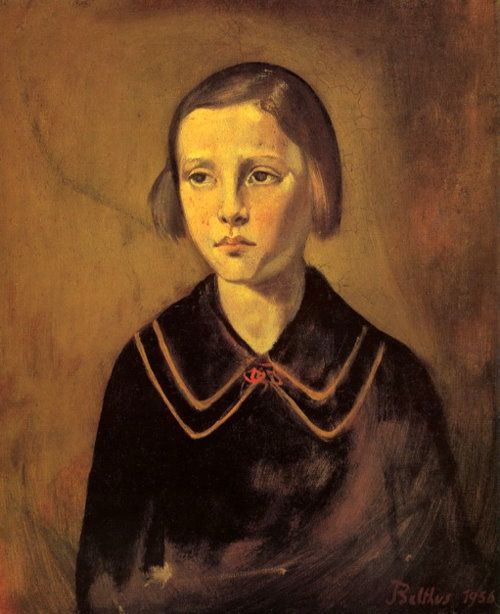
Thérèse by Balthus (1936)

The first painting Balthus completed of Thérèse Blanchard was in 1936 and was simply entitled Thérèse.  Balthus would go on to use her as a model more than any other person.  In this work, Balthus has captured her moody and serious look and it was that aspect of her that attracted Balthus to his young model.  Her dark dress seems to go hand in hand with her mood and it is just the bright red piping on the collar of the dress which manages to liven up the portrait

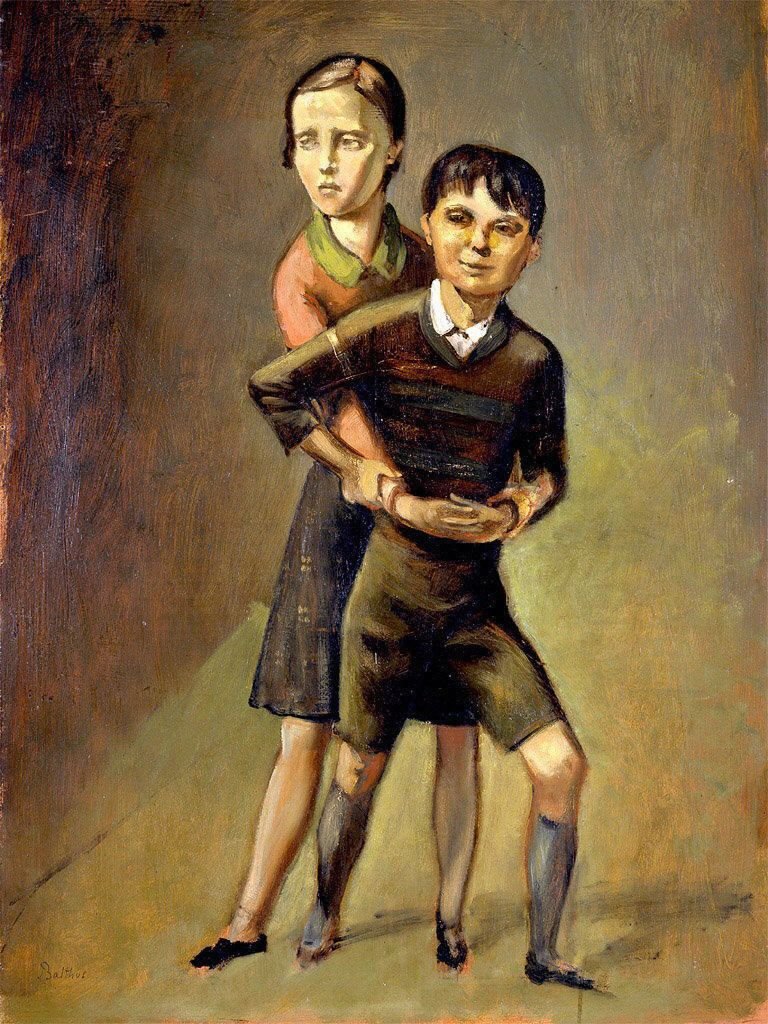
Brother and Sister by Balthus (1936)

In that same year Balthus completed a painting of Thérèse and Hubert entitled Brother and Sister.  Once again Balthus has portrayed Thérèse’s expression as moody and sullen in contrast to the smiling happy face of her brother.  Thérèse’s arms are wrapped round the waist of her brother, not as a sign of sibling affection, but as she was trying to make him stand still for Balthus.  Their clothes are very plain.  Hubert seems to be wearing the attire of a schoolboy whilst his sister is wearing a simple plaid skirt and a red sweater with a green collar.

The Blanchard children by Balthus (1937)

In 1937 the two Blanchard siblings appear in a painting by Balthus entitled The Blanchard Children.  Thérèse is now twelve years old and her brother is fourteen years of age.  The setting is Balthus’ studio and one notices there are no childlike accoutrements such as toys, pens or books.  It is a very stark depiction.  This was not an oversight by Balthus but his belief that the starkness would intensify the dramatic effect of the picture.  If we look under the table, we can see a bag of coal sat in the corner. Why would Balthus add this?  The answer maybe that Balthus, whilst living in Germany, remembered what happened on the eve of the Feast of St Nicholas on December 5th when children put their shoes out in the hopes of some sweets in the morning.  The story goes that, St. Nicholas does not travel on his own but with his companion, Black Peter, who places coal in the shoes of the children who had been naughty !

Wuthering Heights illustration by Balthus

The strange posture of the two children is probably based on an illustration Balthus produced for Emily Bronte’s 1847 novel Wuthering Heights.  The illustration relates to Heathcliffe, partly kneeling on the chair, turning towards Cathy who is on her hands and knees partly under the table, writing her diary.  The painting was given to Balthus’ friend Picasso.

Thérèse with Cat by Balthus (1937)

The first controversial painting Balthus did with Thérèse as his model was completed in 1937 and entitled Thérèse with Cat.  It was a small work measuring 88 x 77cms (34 x 31 in).  Here once again we see the un-smiling Thérèse seeming to look at something behind us.  She looks slightly dishevelled with one sock down to her ankle and one sleeve pushed up her arm.  The red and the turquoise colour of her clothes stand out against the dark background.   Her left leg is raised and her foot rests on a stool and this pose means that her white underpants are visible to the viewer.  She has been asked to pose in a certain way and by the look of her expression she is well aware of how the artist looks at her.  A large cat lies on the floor next to Thérèse.  It appears to be the same cat that appeared with Balthus in the painting King of the Cats (see previous blog).  The painting is now housed in The Art Institute of Chicago.

The Victim by Balthus (1939 - 1946)
The Victim by Balthus (1939 – 1946)

One of his best known works is one he started just before the onset of World War II but was not completed until March 1946.  It was entitled The Victim. It was one of his largest paintings measuring 132 x 218 cms (52 x 86in) and it was because of that size of it that he had to leave it in his Paris studio when he and his wife, Antoinette, at the onset of war, moved to Champrovent in Savoie which had not been occupied by the Germans.  They later moved to Switzerland to live with Antoinette’s parents and did not return to his Paris studio until March 1946.  We see a life-sized ashen body of a naked woman lying on a white sheet which covers a low bedstead.  Is she merely asleep or is she dead?  Does the title answer the question?  The title comes from a novella written by Balthus’ friend, the writer Pierre Jean Jouve.  His 1935 book La Scène capitale contained two novellas, La Victime and Dans les années profondes.

Below the bedstead and in the right foreground of the painting we can just make out a knife lying on the dark floor, the blade of which points directly to her heart.  Although, through the painting’s title we gather that the girl is dead, there is no sign of a wound on her body and neither blood on her body nor on the knife.  Was she strangled?  So it is up to us to decide whether the girl is dead or simply in a trance but we must remember that Balthus started to paint this before war broke out and only concluded it a year after the end of the war and the atrocities of war would be fresh in the artist’s mind.  Another question is, who sat for this painting and the answer is in some doubt.  The shape of the girls face and the cut of her hair leads many to believe it is Thérèse Blanchard, the only doubt being that she had never before posed nude for Balthus

Thérèse Dreaming by Balthus (1938)

A year later (1938) Balthus completed Thérèse Dreaming, another but similar painting to to Thérèse and the Cat, again featuring the now thirteen year old Thérèse.  The setting is once again his studio and we see her sitting before us in a similar pose.  This is a much bigger painting, measuring 150 x 130cms (59 x 51 in).  This time he added a striped wallpaper (which did not exist in his studio) as a background and this time we can see the additional still life of a vase and a canister on a table.  The cat is once again part of the picture and we see it at the side of Thérèse lapping up some of its milk.  In the previous painting Thérèse was looking almost towards us but in this painting but in this work she has looked away, with her eyes closed, as if enjoying a daydream.  Thérèse’s clothes are unadorned and unfussy.  As Sabine Rewald wrote in her book Balthus Cats and Girls :

“…she appears the epitome of dormant sexuality.  Her white lace-trimmed slip surrounds her legs like a paper cornucopia wrapped around a bunch of flowers.  The cat lapping milk from a saucer serves as another tongue in cheek erotic metaphor…”

Since 1998 the painting has been housed in the Metropolitan Museum of Art in New York as part of the Jacques and Natasha Gelman Collection.

The Guitar Lesson by Balthus (1934)

By far the most controversial and notorious painting by Balthus was one he completed in 1934 entitled The Guitar Lesson.  It is a merging of sex and violence which shocked those who saw it.  It is an encounter between a dominating and tyrannical women, who is the music teacher, in her early twenties, and a young girl, her student, thought to be about twelve years old. The music lesson has been halted.  A guitar lies on the floor and the woman has thrown the girl across her lap and pulled her black dress up over her waist.  The fingers of the teacher’s left hand dig into the upper part of the girl’s inner thigh.  It is as if the teacher is strumming a human guitar.  The girl lies there, naked from her navel to her knees.  The lower parts of her legs are covered by white socks.  The music teacher has grabbed a chunk of the young girl’s long hair and is yanking her head downwards.   To save herself from falling and in an attempt to alleviate the pain caused by her hair being pulled, the girl has grabbed the collar of the music teacher’s grey dress which uncovers the woman’s full right breast.  Her nipple juts out which indicates to us that the teacher is sexually aroused by what she is doing.

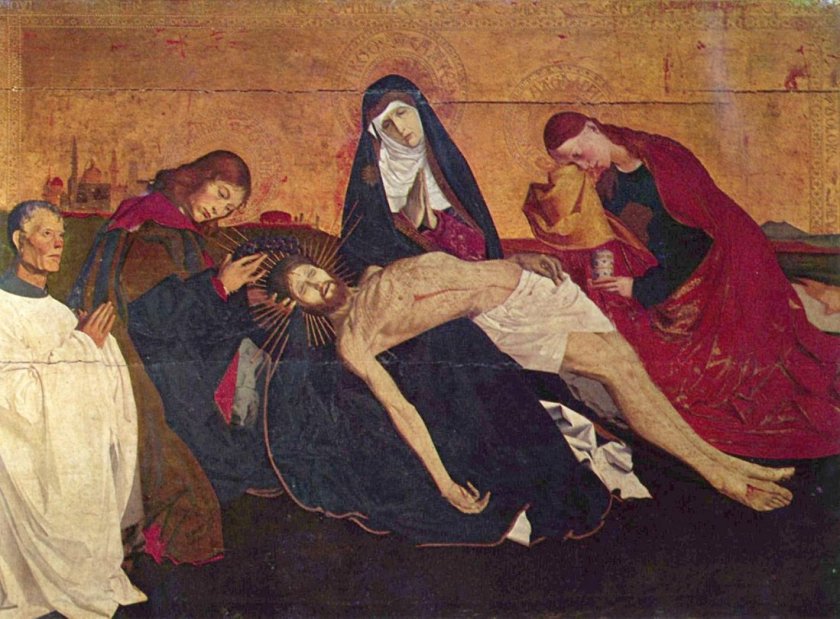
Pietà of Villeneuve-lès-Avignon by Enguerrand Quarton (c.1860)

The positioning of the girl lying across the thighs of the teacher has often been likened to the 1455 painting Balthus must have seen in the Louvre, Pietà of Villeneuve-les-Avignon by  Enguerrand Quarton.

Portrait der Schwester des Künstlers (Baladine Klossowski) by Eugen Spiro (1902)

The girl who posed for The Guitar Lesson was Laurence Bataille, the daughter of a concierge.  She would come to Balthus’ studio with her mother who acted as her chaperone.  The striped wallpaper background and the grey dress of the music teacher were the same as we see in Baladine Klossowski 1902 portrait by her older brother Eugen Spiro.  It was first shown at  Balthus’ one man exhibition in April 1934 at the Galerie Pierre in Paris.   The gallery owner, Pierre Loeb, and Balthus decided that the painting should be placed in the back room of the gallery, but covered up, so that it, in fact, became a “peep show” for a select “priveleged” number of visitors.  The provenance of the painting is quite interesting. It was bought by James Thrall Soby, an American author, critic and patron of the arts, in 1938.  He had intended to exhibit along with his other paintings at the Hartford’s Wadsworth Atheneum in Connecticut but because of the controversial nature of the painting it remained unseen in the museum vaults.  Soby realised that there was no point in owning a painting that could never be exhibited and so, in 1945, he exchanged it with the Chilean surrealist artist, Roberto Matta Echaurren, for one of his paintings.  Roberto Matta Echaurren’ wife Patricia left him and married Pierre Matisse but one of the things she took with her was this painting.  Pierre Matisse, the youngest child of  Henri Matisse owned a gallery in New York and the painting remained hidden away in the vaults.  In 1977, it appeared for a month at Pierre Matisse’s 57th Street gallery in New York. It was a sensation and the press reviews referred to the painting and the art critics of the various newspapers and magazines wrote about it but said that they could not show the painting as it would shock the readers.   After the one month long show it was never exhibited again.

When the 1977 exhibition closed the gallery offered it to New York’s Museum of Modern Art.  It was accepted by the museum but it was not put on show instead it was kept hidden away for five years in the basement.  In 1982 the Chairman of the Board of the MOMA, Blanchette Rockefeller, the wife of John D Rockefeller III, saw it at a small presentation of the works of art given to the MOMA by Pierre Matisse.  She was horrified by Balthus’ depiction terming it sacrilegious and obscene and demanded that it was returned to the Pierre Matisse Gallery immediately.  The Pierre Matisse gallery took it back and then sold it in 1984 to the film director, Mike Nichols. In the late 1980’s he sold it to the Thomas Ammann Gallery in Zurich.  They sold it on to an unknown wealthy private collector who I saw in one newspaper report, was the late Stavros Niarchos.  On his death in 1996 the painting became the property of his heirs.

In my next blog I will take a last look at the life of Balthus and share with you some more of his artworkwork.

—————————————————————————

Besides information about the life of Balthus and his art gleaned from the internet I have relied heavily on two books which I can highly recommend.

Firstly,  there is an excellent book  entitled Balthus Cats and Girls by the foremost expert on Balthus, Sabine Rewald.

Secondly, a very thick tome by Nicholas Fox Weber entitled Balthus, A Biography.


Balthus. Part 1. Mitsou and the King of the Cats

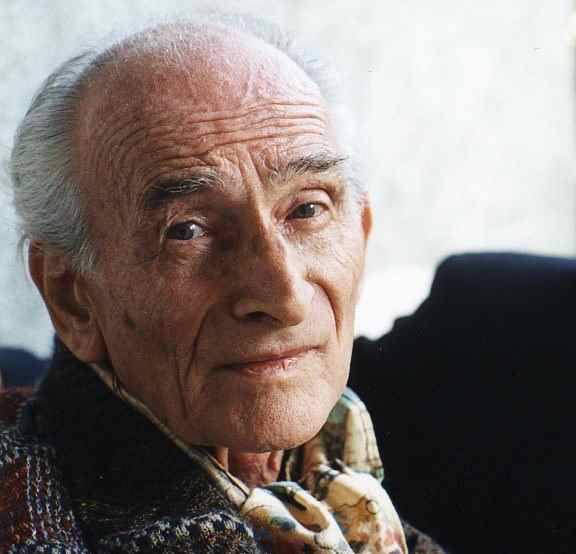
Balthus aged 88
Balthus aged 88

In my next few blogs, I am looking at the life and art of the French born painter Balthasar Klossowski de Rola, more simply known as Balthus.   Some of his artwork shocked the world and I have to warn you that some of his paintings you may find disturbing, and have often been termed offensive and disgusting.  These will appear in Part 2.

So what do we know about Balthus’ life?  The answer is “very little” and that is exactly how the artist wanted it to be.  As far as his life story was concerned, he wanted to preserve his anonymity, so much so, when negotiating with the Tate Modern, which was about to launch a retrospective of his work in 1968, he sent the curator of the exhibition a telegram which read:

“..NO BIOGRAPHICAL DETAILS.  BEGIN:  BALTHUS IS A PAINTER OF WHOM NOTHING IS KNOWN.  NOW LET US LOOK AT THE PICTURES.  REGARDS.  B…”

Balthus was born in Paris at the end of February 1908.  His father Erich Klossowski was a noted German historian and painter, who had come from a family which belonged to Polish nobility, and whose coat of arms was known as the Rola, which was used by a number of szlachta families.  The szlachta was a legally institutional privileged noble class and Balthus added the title “de Rola” to his name.  Balthus’ mother was Elisabeth Dorothea Spiro, but as a painter, used the name Baladine Klossowska.  She gave birth to two sons, Pierre in 1905 and Balthus in 1908.  Pierre went on to become a much heralded writer and philosopher.  Balthus and his family lived in rue Boissonade in Paris’ 14th arrondissement.  He and his brother had a privileged upbringing as his parents were part of the cultural elite in Paris and would entertain many of the cultural icons of the time such as the French writer and playwright, Jean Cocteau, André Gide, the Nobel prizewinning writer, and the French painter, Pierre Bonnard.  The family, who held German citizenship, along with Balthus’ uncle, the painter, Eugen Spiro, had to move out of Paris at the onset of World War I and they travelled to Berlin where Balthus’ father worked at the Lessing theatre as a stage and costume designer.

In 1917, Balthus’ mother and father separated and she took her sons, Pierre and Balthus, away from Berlin and set up home in Berne.  Later she and her two sons move to Conches, a small town just south of Geneva, and stayed with friends before renting a two-room apartment in rue Pré-Jerôme in 1920.  Balthus, as a child loved to draw and it was in 1919, whilst living in Conches, that, at the age of eleven, he produced a book of forty graphite and ink drawings.  The drawings were based on the experiences he had, when he fell in love with a stray cat which he called Mitsou and through his drawings he tells of his happiness derived from his feline friend and the sadness of losing his new friend.  It was in 1919 when Balthus’ mother Elisabeth first met Rainer Maria Rilke in Geneva.  He was a writer and poet.  They quickly became lovers, a relationship which lasted until he died of leukaemia in December 1926.  It was an unusual relationship as Rilke said he needed his own space when he worked and so the couple did not live together on a permanent basis.

Mitsou
Mitsou

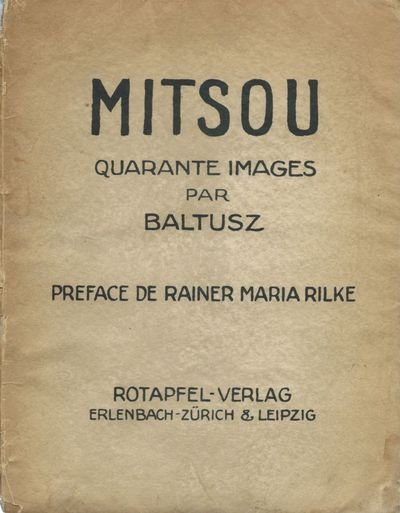
On one of Rilke’s visits to the Klossowski home to see Elizabeth he saw the Mitsou drawings  done by her son, Balthus,  and was he was so impressed by them that  he offered to write the preface for the book and arranged for it to be printed in 1921 under the title Mitsou, Quarante images (Mitsou, Forty Images).  The set of forty drawings were an animated tale of how he found a cat on a park bench.

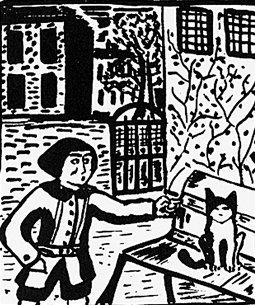
Finding the cat
Finding the cat

In the opening drawing of the set we see the boy tentatively leaning towards the cat making sure he doesn’t scare it off.  Look how Balthus has given the boy an air of astonishment as he looks at the cat, by shaping the mouth, raising the thick eyebrows and the angling the chin.  In complete contrast, the cat looks out at us in a statuesque sphinx-like way, totally unfazed by the boy’s approach.  Although the story is about him and the cat, Balthus has added other elements to the drawing.  The setting is a courtyard which is separated from a house by a wall and a gate.  He has also included vines climbing up the wall as a backdrop.

Losing the cat
Losing the cat

From this time on, Balthus love of cats was shown by the number of times he depicted felines in his artwork.  Drawing number 40 of Mitsou, the last one of the set, depicts Balthus crying when he realises the cat has run off and his feline friend has gone forever.
 In the summer of 1919 the family spend time in the picturesque Swiss village of Beatenberg which lies between the Bernese Alps and the still blue waters of Lake Thun.  It is whilst here that Balthus works as an assistant to the painter, Margrit Bey.  For next four summers Balthus and his family would return to Beatenberg and work alongside Margrit.  Between 1919 and 1921, during their stay in Conches both Balthus and his brother study at the College Calvin in Geneva.  For Balthus, the years between 1919 and 1921 were some of the best times he ever had and he was always pleased to recall those days

Rilke and Elisabeth Klossowska at Chateau Muzot (1923)

His mother was in love with Rilke and he was devoted to her.   Balthus also bonded with Rilke and he received nothing but compliments for his artwork from the writer.  To Balthus, Rilke was almost a surrogate father.

In April 1921 Baladine and her two sons move back to Berlin and go to live with her brother Eugen and later stay with her sister, Gina Trebicky.  Elisabeth had some of her paintings accepted for an exhibition of female artists at Galerie Fleckhtheim in Berlin and it is at this time that she is persuaded to change her name as an artist to Baladine.

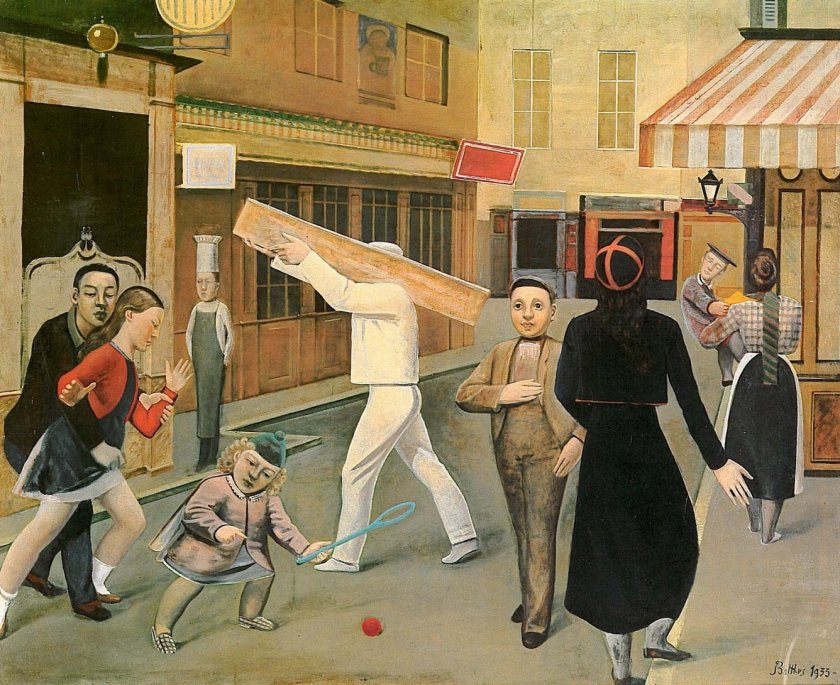
In 1934, Balthus produced his first large scale painting entitled The Street.  It measured 195 x 240cm (77 x 94 ins).  He had already painted another version of this five years earlier, just before he journeyed to Morocco but some of the characters had changed.  The setting in both works is the rue Bourbon-le Château.

The Street by Balthus (1929)

In this earlier version, seen above in black and white, we see a grandfather figure in top hat and topcoat holding firmly onto two young children as they cross the road.  The boy, in shorts, wears a hat with a pom-pom whilst the young girl dressed in a skirt and flowered hat.  In the later version this trio has been replaced by two other characters, which caused the outrage!

The Street by Balthus (1933)

The 1934 version was one of a number of his works of the time which shocked the audience at Balthus’ first solo exhibition which was held in the Galerie Pierre in Paris.  The people in the street seemed to have stopped and are frozen in mid-flow, almost trance-like.   For this work Balthus retained the baker, the workman crossing the road with a plank of wood on his shoulder along with the woman carrying a young child, albeit now looking like a little man.   In this version we also have a young girl, racquet in hand, chasing a ball across the street. Again although possessing the height of a child she seems to be more like a small woman.   Balthus was questioned about that but he simply refused to elaborate more than saying “she is simply a little girl”.  The same boy, as seen in the first version, is still strolling haughtily towards us but is set back slightly in comparison to the first version.  However the major change is the inclusion of the two figures in the left foreground.  These two replace the elderly gentleman and the two young children.  The man tries to grope the girl as she passes him by and she raises her arm maybe in shock or maybe to strike her assailant.

Pierre Loeb the owner of Galerie Pierre said that having looked at the painting described it as a scene of anguished phantoms sleepwalking in a strange dreamlike state.  Balthus believed Loeb’s comments were nonsensical and although Loeb exhibited Balthus’ art in his gallery bringing him to the notice of the public, Balthus loathed him and termed him a “typical outsider who lacked true vision of what really mattered to painters”.

The painting was bought from Galerie Pierre in 1937 by James Thrall Soby, an American author, critic and patron of the arts.  However the painting was so controversial and so many of his friends disliked the sexual connotation that Soby wrote to Balthus in 1955 and asked him to retouch the gesture of the figures on the left.  Soby was surprised when Balthus agreed and wrote:

“…I used to like shocking people, but now it bores me…”

When Soby died in 1979 this painting was bequeathed to the Museum of Modern Art in New York.

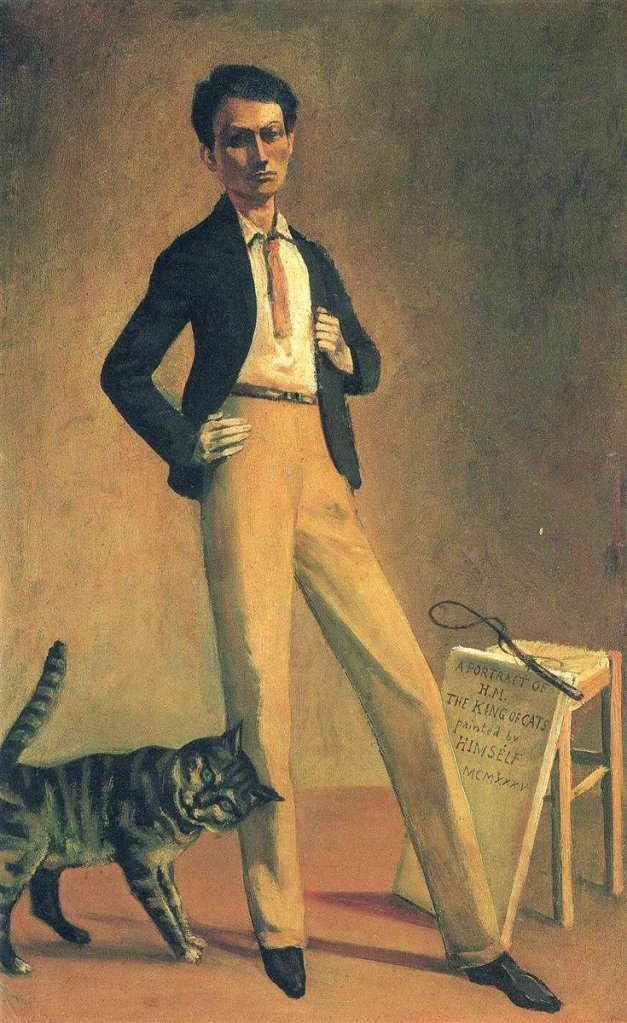
The King of the Cats by Balthus (1935)

I am concluding this first part of my look at the life and art of Balthazar Klossowski by showing you the painting, the title of which the artist gave himself.  This is just one of three self portraits completed by Balthus.  The title of the 1935 painting was King of the Cats. Balthus was twenty-seven years of age when he painted this work.  It was painted in his Paris studio in rue Furstenberg.  The studio, which he bought in May 1933 was a fifth floor attic room  It was also the first property he ever purchased and  he remained here until October 1935.
Balthus had always had a love of cats and in this work we see him standing in a somewhat arrogant and aloof pose, with his beloved cat lovingly rubbing itself against his leg.  Because the view of the artist is seen from below it elongates him and adds to his imperious stance.  He is dressed in saffron pants, white shirt and red tie and a black jacket.  On his feet is a pair of pointed black shoes.  On the floor, to his left, is a stone slab leaning against a high stool with the inscription:

A PORTRAIT OF

H.M.

THE KING OF THE CATS

Painted by

HIMSELF

MCMXXXV

Balthus has added a little humour to the painting by placing a lion tamer’s whip on top of the stool !

It was in that year that Balthus started to sign his letters “King of the Cats”, the first being a letter, written in January 1935, to his soon to be wife, Antoinette de Watteville.

There is an air of self confidence about the figure and this has been put down to 1935 being a good year for him after the turbulent times of 1934 when his first one-man exhibition at the Galerie Pierre, featuring many depictions of pre-teen girls in erotic poses,  scandalised the critics and public alike.  The fall out over these paintings made Balthus give up painting for almost a year.

In the second part of my look at Balthus I will focus on the paintings which caused such a furore when exhibited in Galerie Pierre in Paris.

Besides information about Balthus and his art gleaned from the internet I have relied heavily on two excellent books which I can highly recommend.

Sabine Rewald, Curator for Modern Art, Dept. Of Modern and Contemporary Art at The Metropolitan Museum of Art.
Sabine Rewald, Curator for Modern Art, Dept. Of Modern and Contemporary Art at The Metropolitan Museum of Art standing next to Balthus painting entitled Thérèse

First there is the book Balthus Cats and Girls by the foremost expert on Balthus, Sabine Rewald.

Secondly, a very thick tome by Nicholas Fox Weber entitled Balthus, A Biography.

Arnold Böcklin. Part 3 – The latter years. Portraiture and Symbolism

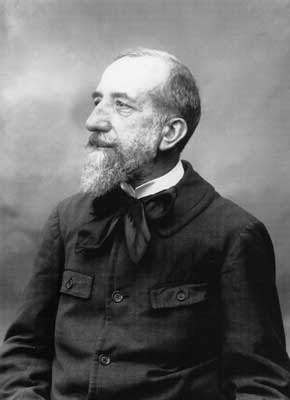
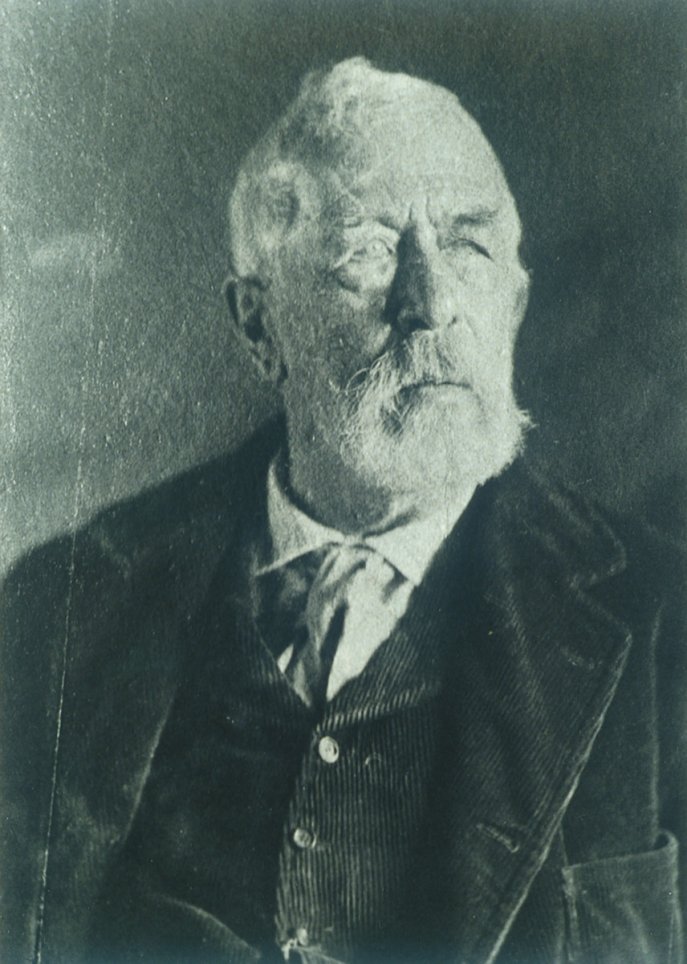
Photo of Arnold Böcklin (1900) aged 73

In my final part of the Arnold Böcklin story I want to look at his portraiture and some of his more evocative Symbolist works.  He completed many self portraits, two of which I have shown you at the start of the last couple of blogs.  His portraits also included ones of his second wife, Angela Rosa Lorenza Pasucci and their daughter Clara.

Portrait of Angela Böcklin as muse by Arnold Böcklin (1863)

In the first blog about Arnold Böcklin I mentioned his two wives.  He married Louise Schmidt in 1850 but she died a year later and then in June 1853, Böcklin married his second wife, a seventeen year old Italian girl, the daughter of a papal guard, Angela Rosa Lorenza Pasucci and she featured in a number of his works of art.  One such portrait was entitled Portrait of Angela Böcklin as a Muse which he completed in 1863.

Mrs Böcklin with Black Veil by Arnold Böcklin (1863)

Böcklin completed another portrait of his wife that year entitled Mrs Böcklin with Black Veil.  This was a more sombre depiction of his wife.  It was painted when she was twenty-seven years of age.  It is only a small oil on canvas work within the stretcher frame just measuring 19 x 14 cms.  This was a painting he completed for himself.  There is a certain intimacy about the work.  The artists depicts his wife with a black veil on her head and this veil serves the purpose of being a frame for his wife’s face, the colour of which is in contrast to the simple olive green background.  Angela Böcklin seems to be very thoughtful, even slightly sad.  Maybe she is in mourning for we know she and Arnold had fourteen children but only eight of them survived him.   We take it for granted that we will die before our children but in the nineteenth century that was not always the case, in fact the opposite was often true, and although it was a common occurrence for children to die young we should never underestimate its tragic consequences.
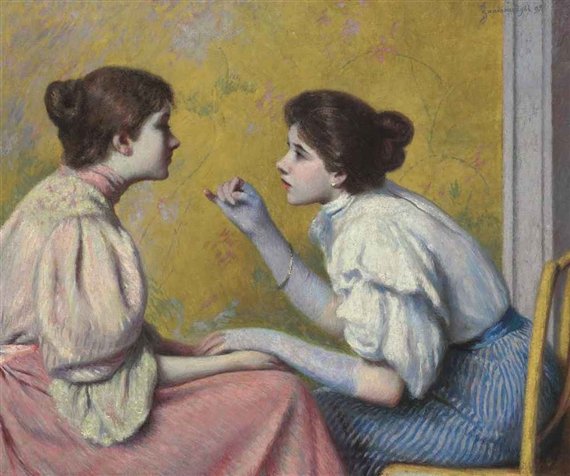
Portrait of Clara Böcklin by Arnold Böcklin (1872)

In 1872 he completed one of a number of portraits of his daughter Clara.

Portrait of Clara Böcklin by Arnold Böcklin (1876)

In 1876, when she was twenty-one years of age, Böcklin painted another portrait of her.   It was also in this year that Clara married the sculptor, Peter Bruckmann.

Böcklin became somewhat fixated by death and this is borne out with his evocative painting Die Toteninsel, which I talked about in the previous blog.  This preoccupation, which could have been because of the loss of his children, was clearly seen in yet another of his self portraits, which he completed in 1872, shortly after the death of his young daughter, and was entitled Self Portrait with Death as a Fiddler.  It was completed whilst Böcklin was in Munich having just travelled back from Italy. It was in Italy that Böcklin began to add symbols into his paintings in order to suggest ideas.  The interesting thing about Symbolism in art is that we can each come to our own conclusions about what we see in a painting and unless the artist has spoken about the painting then we have as much right to postulate about an artist’s reasoning behind their work as the next person.  So having looked at the work, what do you make of it?  Let me make a few suggestions about what I think may have been in Böcklin’s mind when he put brush to canvas.

Self portrait with Death as the Fiddler by Arnold Böcklin (1872)

We can see that Arnold has portrayed himself with painting brush in one hand whilst the thumb of his other hand is hooked through the hole in the palette securing a piece of cloth.  However what is more interesting is the inclusion of the skeleton playing the fiddle in the background.   The question I pose is – what was Böcklin thinking about when he decided to include the skeleton?    We know that most paintings, which include a skull or skeleton, are Vanitas paintings.  A vanitas painting contains an object or a collection of objects which symbolise the inevitability of death and the transience of life.  Such paintings urge the viewer to consider mortality and to repent !  So, Böcklin’s inclusion of a skeleton is a reminder to him that he cannot take life for granted and that there is a very fine line between life and death.

Look at the juxtaposition of the artist and the skeleton.   Look how the skeleton appears to be whispering something in Böcklin’s ear and the artist in the painting turns his head slightly and leans back to listen.   He is staring out of the painting, but not at us.  He is staring out but his full attention is on what the skeleton is saying.   Maybe the skeleton is telling the artist something about his future?  Look also at the fiddle that the skeleton is playing.  It has only one string left.  Why paint the fiddle with just one string?   Is this something to do with the length of time Böcklin has on this earth?  Is it that at birth the violin had all four strings but, as time progressed, string after string broke and so, at the time of death, there are no strings?

The painting can now be seen at the Alte Nationalgalerie in Berlin.

Naiads at Play by Arnold Böcklin (c.1862)

Other subjects that appeared in Böcklin’s paintings during his last period of creativity were the Naiads and Nereids or sea and water nymphs often referred to as female spirits of sea waters.  The next painting I am showcasing is entitled Naiads at Play which Böcklin completed around 1862 and now hangs in the Kunstmuseum Basel.  Böcklin’s biographer, Henri Mendelssohn described the painting, writing:

“…It fairly bubbles over with fun and merriment.  The scene represents a rock in the ocean, over which the waves dash in foam, tossing white spray high into the air.  Clinging fast to the wet rock face are the gleaming forms of naiads, their tails shining like jewels in the seething waters, as the waves dash, one on top of another, so do the creatures of the sea chase each other in their frolic, darting here and diving there, and tumbling heels over head from the rock into the ocean beneath, whose roar almost drowns their shrill laughter.  All is life and movement.  The sputtering triton and the luckless baby, holding in his convulsive clasp the prize he has captured, a little fish, rank among the inimitable creations of Böcklin’s art…”

Marie Joseph Robert Anatole, Comte de Montesquiou-Fézensac, a French Symbolist poet and art collector of the time, described Böcklin’s work, writing:

“…”This is the most astonishing of all Böcklin’s representations of the sea. The water gleams with hues as violent as those reflected by the Faraglioni, the red rocks which, seen from Capri, mirror their purple shadows in the blue waves. One of the naiads, with her back turned to us, seems to set the water on fire with the brilliancy of her orange-coloured hair, while all the naiads’ tails, wet and glistening, glow with the gorgeous hues of butterflies’ wings or the petals of brilliant flowers…”

Looking at the work one can understand the comments.  It is as if you were there, feeling the energy and almost feeling the spray on your face.  From this mythical subject, Böcklin has almost turned it into reality, such was his skill.

Plague by Arnold Böcklin (1898)

Another painting by the Swiss symbolist Böcklin which illustrates his fascination with nightmares, the plague and death was one he completed in 1898 entitled Plague.  It is a tempera on wood painting, which is now hanging in the Kunstmuseum Basel.   In the painting the setting is the street of a medieval town and we see the grim-faced Death, scythe in hand, riding a winged creature, which spews out miasma.  The colours Böcklin used in this painting are black and dull browns for the clothes of many of the inhabitants who desperately throw themselves out of the path of Death and shades of pale green which is often associated with death and putrefaction.  The one detail which is devoid of drab colours is that of the clothes worn by the woman in the foreground who lies across the body of the woman who has suffered at the hands of Death.  Her gold-embroidered red cloak signifies that she comes from a wealthy household and the painting reinforces the fact that Death takes both rich and poor.  The plague had ravished Europe throughout the 14th to 17th centuries.  It knew no boundaries of class or wealth.

Ruggiero and Angelica by Arnold Böcklin (c.1874)

Around 1874 Böcklin completed a painting entitled Roger and Angelica.  It can now be seen in the Nationalgalerie in Berlin. The scene, Roger rescuing of Angelica, is based on the 1532 epic romantic poem, Orlando Furioso by Ludivico Ariosto, which is all about the conflict between the Christians and the Saracens.  The painting depicts the main character, Ruggerio (Roger), a Saracen warrior, coming to the rescue of Angelica, the daughter of a king of Cathay.  She is chained to a rock on the shoreline and is about to be killed by the sea monster, the giant turquoise orc, which has wrapped itself around the helpless Angelica.  In the background we see Roger arriving astride his horse.  The battle with the orc is ended when Roger dazzles the sea monster with his shield allowing him the chance to place a magic ring on the finger of Angelica which protects her whilst he undoes the bonds which were tying her to the tree.

Grave of Arnold BöcklinArnold Böcklin moved around Europe, living in Munich, Florence and the small Swiss town of Hottingen which was close to Zurich but from 1892 onwards he settled down near Florence in the town of  San Domenico.  To mark his seventieth birthday a retrospective of his work was held in Basel, Berlin and Hamburg.  Böcklin died of tuberculosis, aged 73, in Fiesole, a small town northeast of Florence, in January 1902 and is buried in the Cimitero Evangelico degli Allori in southern Florence.

In my next blog I will be looking at the work of an artist who was known as the king of the cats as many of his paintings had an obligatory cat in the depiction.  However he was probably more remembered by his erotic paintings which featured pre pubescent girls in all manner of provocative poses.  In this day and age many of his works would struggle to be exhibited because of the age of his models.

Arnold Böcklin. Part 2 – Die Toteninsel

Self Portrait by Arnold Böcklin (1885)

As I said in my previous blog there was a distinct change in the subject and style of Böcklin’s art in the middle of the nineteenth century.   Gone were the realist and naturalist landscape works which concentrated on the beauty of nature; depictions which included very few things, such as people or animals, which he believed would detract from nature’s magnificence.  Around 1854 Böcklin’s paintings began to become idealised with mythological connotations.  My original intention had been to look at the life and works of Böcklin in two parts.  Firstly, his early landscape paintings and secondly, his later symbolist paintings.  However I decided that his most famous painting, Die Toteninsel, should have a blog of its own.

Arnold Böcklin left Italy in 1857 and returned to Basel and the following year he accepted a commission to paint the dining hall of the merchant and Royal Hanoverian Consul, Karl  Wedekind in Hannover.  Wedekind also went on to purchase some of Böcklin’s paintings.  Financial and health issues began to blight Böcklin’s life around this time.  However his financial problems were to change when he and his family moved to Munich where he exhibited a number of his paintings at the Munich Kusnstverein.   It proved to be a tremendous success.  Fourteen of his paintings were purchased by Friedrich Graf von Schack, the Munich art collector, who also offered him the position of Professor of Landscape Painting at the newly founded Kunstschule in Weimar.  After completing four years of teaching art, Böcklin had managed to save some money, enough to return to his beloved Italy in 1862.

Isle of the Dead (Basel version) by Arnold Brocklin (1880)
Isle of the Dead (Kunstmuseum Basel, First version) by Arnold Brocklin (1880)

I now come to the painting by Böcklin which is his most famous and most talked about work of art, Die Toteninsel (Isle of the Dead).   According to Franz Zelger in his 1991 book, Arnold Böcklin: Die Toteninsel, Selbstheroisierung und Abgesang der abendländischen Kultur, the subject for this haunting composition came about in 1880 when  Böcklin received a commission to paint a “picture for dreaming”.

The commission came from Marie Berna, an American-born widow of a German diplomat, Georg von Berna, who had died of diphtheria in 1865. She was to later marry Count Waldermar von Oriola in 1880 and became Countess of Oriola.

 It all came about when she visited Böcklin’s studio in Florence.  Whilst at his studio she saw an unfinished first version of this evocative painting which is now housed in the Kunstmuseum Basel. This first version is an oil on canvas painting measuring 110 x 156cms, which was commissioned by Alexander Günther.  The title of the painting seems to have changed over time but Böcklin, on completion of the first version sent a letter to Gunther and wrote:

“…Endlich ist die Toteninsel soweit fertig, dass ich glaube, sie werde einigermaßen den Eindruck machen…”

(finally with the Toteninsel finished I think it will make quite the impression).

Isle of the Dead (Metropolitan Musum New York, Second version) by Arnold Böcklin (1880)
Isle of the Dead (Metropolitan Museum New York. Second version) by Arnold Böcklin (1880)

Marie Berna was fascinated by what she termed a dream image and immediately commissioned Böcklin to paint a version of this work.   Marie told Böcklin that it would be a painting in memory of her late husband and also be a “a picture for dreaming”.  She even made a special request that Böcklin should include in the work, besides the solitary figure who is rowing the boat, a draped coffin and a shrouded female figure standing up in the boat. Böcklin must have been persuaded that the additions Marie Berna had asked for would enhance the painting because he also added the shrouded female and draped coffin to the first version.  Although, to receive a commission was good news, Böcklin’s health, both physical and mental, was deteriorating.  His inability to have full use of his painting arm had lessened and that in itself caused him to have bouts of deep depression.

So what caused Böcklin to paint such a sombre picture, such as the Isle of the Dead?  Maybe the answer lies in a 1909 book his son, Carlo, co-wrote with Ferdinand Runkel, entitled Neben meiner Kunst. Flugstudien, Briefe und Persönliches von und über Arnold Böcklin.  His son wrote about his father’s physical and mental health at the time and the effort needed for him to carry on painting:

“…In the summer of 1880, the master’s painful afflictions precipitated a serious nervous depression. His lack of interest in working had been joined by fatigue and such a deep melancholy that those around him were seriously concerned about him. All manner of means were vainly sought to alleviate his bodily torments. …….. His heart and nerves had been adversely affected by an ample dose of salicylic acid that had become necessary. …..… As the last resort, his worried spouse hit upon the idea of a change of air, and Böcklin, who had always been a wanderer and derived his best artistic inspiration from the countryside, took up this idea with rapidly reviving spirits. In the company of (his pupil) Friedrich Albert Schmidt, he travelled to Ischia, the delightful island off the coast of Naples, in July, and sought the assuagement of his pains under the gleaming sun of the most beautiful summer sky and in the blue waves of the gulf. However, he was still with little hope on his departure, a downtrodden victim of his sufferings, and his final gloomy words to his wife were: “You will see me again in Florence either healthy or not at all.” …… Böcklin’s depressive mood at the time (was) so strong that, in his endless hours of agony, he seems often to have toyed with and considered the idea of taking his own life. The pain alone would not have disheartened this powerful man, but the rheumatic inflammation of his joints had also stricken his right shoulder, and, with his creative hand, with whose dexterity a new world had been created, Böcklin was only able to guide the brush in great pain and with great effort…”

Böcklin sent a letter to Marie Berna on June 29th 1880, in which he wrote:

“…The picture Die Gräberinsel (The Isle of Tombs) was dispatched to you last Wednesday. You will be able to dream yourself into the realm of the Shades until you believe you feel the soft, warm breeze that wrinkles the sea. Until you will shy from breaking the solemn silence with a spoken word….”

In this second version of the painting, which was given to Marie Berna, we see the figure of the widow dressed in white accompanying her husband’s draped coffin.  The boat heads towards a rocky isle with its high cliffs, into which are carved tomb chambers.  This second version, given to Marie Berna, was an oil on wood painting and slightly smaller than the first version, measuring 29 x 48in (74 x 122cms).  It was bought by the Metropolitan Museum of Art in New York in 1926

Isle of the Dead (Alte Nationalgalerie, Berlin. Third version) by Arnold Böcklin (1883)

Because of the success of the first two versions, Böcklin’s art dealer Fritz Gurlitt managed to persuade him to paint three more versions of Die Toteninsel but this time the suggestion was made that the sky should be much lighter.

Initials A B on the Isle of the Dead (Third version) by Arnold Böcklin (1883)

If you look closely at the outer edge of the high rock on the right of the third version of the painting, you will see Böcklin’s initials, “A B”, over the lintel of the burial chamber. It is interesting to note that the provenance of this painting shows Gurlitt sold the painting in 1933 to one of Böcklin’s admirers – Adolph Hitler.  He had the painting hung at the Berghof in Obersalzburg and later moved it to the Reich Chancellery in Berlin.  This version is now housed at the Alte Nationalgalerie in Berlin.

Black and white photograph of the fourth version of Die Toteninsel (1844)

Böcklin painted the fourth version in 1884.  This work of art was bought by the entrepreneur and avid art collector Baron Heinrich Thyssen, the second son of the German industrialist August Thyssen, and it was kept in one of his banks.  Unfortunately it was destroyed during a World War II bombing raid and all that can be seen of this fourth version is a black-and-white photograph.

Die Toteninsel (Fifth version, Leipzig) by Arnold Bôcklin (1886)
Die Toteninsel (Museum der Bildenden Künste Leipzig. Fifth version) by Arnold Bôcklin (1886)

The fifth version of Böcklin’s painting, completed in 1886 resides at the Museum der Bildenden Künste in Leipzig.

In my third and final blog about Arnold Böcklin I will look at some of his portraiture as well as his Symbollst paintings.  Symbolism was a late 19th-century movement and thrived throughout Europe between 1886 and 1900 in almost every area of the arts. It began with literature, poetry and the theatre and later flourished in music and visual art.  There was a definite connection between Symbolism in art and Pre-Raphaelite and Romanticism and in some ways it was viewed as an antidote to realism and naturalism in which the artist sought to capture exactly what was before them, warts and all.  Symbolists, on the other hand try to find a profound reality from within their imagination, their dreams, and even their unconscious.  From being compartmentalised as being a realist landscape painter, Böcklin, because of his later works of art, was looked upon as a Symbolist.  In my final blog about Arnold Böcklin I will look at some of these works.

Arnold Böcklin. Part 1 – early years and landscape painting

Self Portrait by Arnold Bocklin (1862)

Paintings can elicit all kinds of feelings from the observer.  Some of the realist and critical realist paintings elicit a feeling of sadness and guilt.  Some paintings extract from us a sense of fear, whilst others bring forth a feeling of wonderment when we look upon a beautiful landscape or the portrait of a beautiful woman.  The artist I am featuring in my next two blogs produced a painting, which, to me, was one of the most haunting and evocative paintings I had ever seen.  The artist is the Swiss-born painter, Arnold Böcklin and the painting was entitled Die Toteninsel (Isle of the Dead).  He completed five versions of the work between 1880 and 1886.  I will look at this work in the second part of this blog.

Another reason for looking at some of the works by Böcklin is because I just returned from a three-day trip to Munich and instead of visiting the city’s major galleries such as the Pinakothek der Moderne and the  Alte Pinakothek, I headed for the Schack Gallery which houses a notable collection illustrating the development of German painting in the 19th century. The history of the gallery is that its founder, Count Adolf Friedrich von Schack, was a generous patron of the arts, purchasing and commissioning numerous works by many leading 19th-century German painters including Moritz von Schwind, Carl Spitzweg, Franz von Lenbach, and the Swiss born artist, Arnold Böcklin. Von Schack’s collection now forms part of the Bavarian State Collection.  This small gallery is a little gem and has an amazing collection of copies of works by the likes of Titian by German painters.

Ruined Castle by Arnold Böcklin (1847)

Arnold Böcklin was born in October 1827 in Basel.  In 1841, aged 14, Böcklin went to art school at the Zeichenschule Basel, which was run by the painter, Ludwig Adam Kelterborn.   A Zeichenschule was a drawing school where pupils were given the technical and artistic training of Craft Trade Association  His father was Christian Frederick Böcklin, who worked in the silk trade and his mother was Ursula Lippe.  In 1845, Böcklin, aged 18, studied art for two years at the Düsseldorf Academy under Johann Wilhelm Schirmer, the German historical landscape painter.  Böcklin initially painted landscapes and one of his early works was entitled Ruined Castle which he painted in 1847 and which is now housed in the Nationalgalerie, Berlin.

Das Hünengrab by Arnold Böcklin (1847)

Another atmospheric landscape work Böcklin completed in 1846 was one entitled Das Hünengrab (Megalithic Grave).

Böcklin excelled in his studies during his time at the Düsseldorf Academy and he was sent off on painting trips to Belgium with his friend and fellow student Rudolph Koller, where he was tasked with copying paintings by the Flemish and Dutch masters which were housed in museums in Antwerp and Brussels.  One of his favourite painters was said to be Peter Paul Rubens.  He returned home to Basel and then went to Geneva where he worked alongside the Swiss painter Alexandre Calame, a landscape artist, who specialised in Alpine scenes.

From Basel he set off on another painting trip, this time to Paris, where he remained for several months, sharing an apartment with his friend and fellow artist, Rudolf Koller.  Whilst here, he busied himself copying works of the Old Masters and some of his contemporaries, which were held in the Louvre.   He was influenced by the works of Thomas Couture and the landscapes of Jean-Baptiste-Camille-Corot.   However the year was 1848 and Paris was not the safest place to be because of the February and June revolutions and so Böcklin left the French capital.

After a short spell of military service Böcklin got married.  His bride was Luise Schmidt but sadly she died before their first wedding anniversary.  In February 1850, heartbroken following the death of his wife, Böcklin travelled to Rome.  It was here that he was befriended by the Dresden-born artist Heinrich Franz-Dreber who introduced him to a group of German artists living in Rome, who called themselves the Tugenbund   (the League of Virtue).  He also became friends with Oswald Achenbach, who at the time was looked upon as one of the leading European landscape painters and Anselm Feuerbach, the German Neoclassical painter.

Landscape from the Alban Hills by Arnold Böcklin (1851)

During his stay in Italy, Böcklin would spend the summers with some of his fellow artists in the Alban Hills, some forty-five kilometres east of the Italian capital, and it was there that they set up home in the village of Olevano.  One of Böcklin’s first painting he completed in Italy was Landscape from the Allban Hills which he completed in 1851.  This work of art is now housed in the Staatliche Kunsthalle in Karlsruhe.

Roman Landscape (Römische Landschaft) by Arnold Böcklin (1852)

The following year, 1852, Böcklin produced another landscape painting featuring the Roman Campagna.  It was entitled Römische Landschaft (Roman Landscape), which can now be seen at the Brooklyn Museum.   Unlike some of his contemporary landscape artists, who had sketched and painted views of the Roman countryside, Böcklin overcame the urge to add famous landmarks.  He believed that such an addition detracted from flora and fauna and it was his intention to enhance the view of nature.  This painting was a simple landscape work with a small figure of a woman, seen in the middle ground, undressing prior to going for a swim in the pool.  She is just a mere white dot in the painting which gives viewers an idea of the enormity of nature with its huge old trees and cloud-filled sky.  He wanted his painting to be all about details of the foliage and rock formations.  It is believed that earlier studies for this painting included more than one bather and a satyr but Böcklin decided that these extra figures detracted from the “message” and so he painted over them.  Böcklin wanted viewers to understand the immenseness of nature and how light and shade can alter tonal qualities .

In 1853, three years after arriving in Rome, Böcklin married for the second time.  His second wife was a young Italian woman, Angela Rosa Lorenza Pasucci, the daughter of a papal guard.  The couple went on to have fourteen children.

Böcklin changed his style of painting in the mid 1850’s when he began to include themes from Classical mythology and whereas his painting before concentrated on what he had seen they began to be about what he imagined.  Some believe that there was another reason for this change of style – money, or lack of money.  Böcklin needed to sell more of his paintings to survive and so he had to focus on what travellers passing through Rome wanted to see in his works.  These travellers wanted to buy paintings featuring Classical Roman sites.

Pan in the Reeds by Arnold Böcklin (1858)

In 1859 Böcklin was in Munich and exhibiting some of his works at the Munich Kunstverein.   It proved to be a great success for Böcklin as one of the works which he had completed the previous year, his second version of Pan im Schilf  (Pan in the Reeds), was bought by King Maximillian II, the ruler of Bavaria.  Fourteen of his other paintings were purchased by Friedrich Graf von Schack, the Munich art collector.   Furthermore, in 1860, through the auspices of von Schack,  Böcklin was offered the post of Professor of Landscape Painting at the newly founded Kunstschule in Weimar

In my next blog about Arnold Böcklin I will look at the paintings he completed later in his life which designated him as a Symbolist painter.  Symbolism is defined as an art genre characterised by a rejection of direct, literal representation in favour of evocation and suggestion.  Symbolism produced imaginary dream worlds populated with mystifying figures from biblical stories and Greek mythology as well as unbelievable, often monstrous, creatures.

Vasily Perov. Part 2 – portraiture and humour

Self-Portrait (1851)

In my last blog I looked at Perov’s early life and his artwork which is often categorised as critical realism because of the way his paintings  focused on the peasants and how they had been let down by the Church, its clergy and the State.  For one of these works he was awarded the Gold Medal by the St Petersburg Imperial Academy of Arts and also a scholarship for him to travel to Europe and study European art.  He went to Paris where he spent a considerable amount of time but once again his art focused on poverty, this time, poverty in France.  Perov was now moving away from his anti-clerical depictions, and his barbed narrative works which poured scorn on the Church.  He now wanted to concentrate on the poor themselves and left the observer to decide on the reason for the poverty.

Savoyard by Vasily Perov (1863)

One of his most famous paintings, which he completed whilst in France, was one entitled Savoyard which he finished in 1863.  In Perov’s painting we see a young boy sat slumped on some stone steps.  The absence of any movement allows us to focus on the child without any distractions.  The child is asleep.  His feet stick out in front of him and this allows us to see the tattered hems of his trousers and because of the way is feet rest on the pavement we are given a view of the soles of his shoes, which are holed.  The painting itself is made up of dark sombre tones of smoky blue, green and grey.

Street Beggar by Gavarni

It is thought that Perov’s painting was influenced by the work of Paul Gavarni, a French engraver, who had his illustrations published in a collection of London sketches, featuring life in London at the time.  The sketches and accompanying illustrations were first published as a magazine series in 1848 and later they were collected in one volume, edited by essayist and journalist Albert Smith, which was first published in Paris, in 1862, a year before Perov’s arrival in the French capital.  It was entitled Londres et les Anglais.  One of the sketches was the Street Beggar and its thought that Perov had this in mind when he worked on the Savoyard.

Perov’s arrival in Paris in 1863 coincided with a great upheaval in French art.  The Hanging jury at that year’s Salon had been ruthless in their choice of paintings which could be admitted.  Those which were cast aside were ones deemed to have not been of the quality or type they wanted.  That year, the jury had been more ruthless than they had been in the past, rejecting two-thirds of paintings.  This resulted in vociferous protests from the artists who had had their works rejected.  It was so bad that Napoleon III stepped into the argument and placated the disgruntled artists by offering them a separate exhibition for their rejected works.  It became known as the Salon de Refusés (Exhibition of rejects) and that year this exhibition exhibited works by Pissarro, Fantin-Latour, Cezanne and included Manet’s Dejeuner sur l’herbe and Whistler’s Symphony in White,no. 1. 

The Arrival of the Governess at a Merchant's House by Vasily Perov (1866)
The Arrival of the Governess at a Merchant’s House by Vasily Perov (1866)

Perov returned home early from his European tour in 1865 and in 1866 produced a wonderful painting entitled The Arrival of the Governess at a Merchant’s House.  This was a move away from his focus on poverty and more to do with the fate of women.  In the painting we see a governess standing before the master of the house, a merchant who is to be her new employer.  This painting depicts the awkward encounter between the governess, who has probably graduated from a school for governesses, where they are taught to act like nobility, and the merchant who has no noble blood and is the face of the nouveau riche.   She presents herself well. She clutches a letter of introduction in her hands. She oozes an air of timidity and subservience, which is a trait that would be required if she was to become a member of the household.  However her demure stance with head bent down is befitting that of a lady.  She stands before, not only the master of the house, a bloated man, but behind him stands his family.  The children of the family are to be her pupils and by the looks of them she was going to be in for a difficult time.  The master of the house and his three children are dressed elegantly and the furnishings we see are fine and elegant and are part of merchant’s plan that they be elevated in status from mere merchants to something approaching nobility. Perov has changed the subject of his biting satire from the clergy of the Church to the oppressive merchant classes and the poor treatment they bestow on their employees.

Troika by Vasily Perov (1866)

The painting was purchased by thirty-four year old Pavel Tretyakov, a Russian businessman, patron of art, avid art collector, and philanthropist who gave his name to the Tretyakov Gallery in Moscow.   This work along with his Troika painting earned Perov the title of Academician.

Wanderer by Vasily Perov (1870)

In the late 1860’s Perov began to concentrate on portraiture, initially of peasants and the title Wanderer was given to three of his works which featured peasants, all different and yet all emotive in their own way, one of which is shown above.  As Perov travelled around he came across a variety of fascinating characters and he was able present them on canvas and highlight their individualism and their way of life.

Portrait of the Author Feodor Dostoyevsky by Vasily Perov (1872)

In the early 1870’s Perov’s portraiture focused on cultural greats of Russia but it is interesting to note in these next two paintings they were totally devoid of any background accoutrements which would have added a sense of vanity in the sitter.  In 1872 he completed the Portrait of Dostoyevsky, a the Russian novelist, short story writer, essayist, journalist and philosopher. It was Dostoyevsky’s literary works which influenced Perov in the way they explored human psychology in the troubled political, social, and spiritual atmosphere in Russia during the 19th-century.

Portrait of the Playwright Alexander Ostrovsky by Vasily Perov (1871)

And in 1871 he finished his Portrait of Alexander Ostrovsky, a Russian playwright who was generally thought to have been the greatest writer of the Russian realistic period, which existed against the background social and political problems.  It started in the 1840’s under the rule of Nicholas I and lasted through to the end of the nineteenth century.   The painting is now housed in the Tretyakov Gallery, Moscow.

Old Parents Visiting the Grave of Their Son by Vasily Perov (1874)

In all his genre works he always managed to tug at your heart strings with his moving depictions.  Another of his heart-rending scenes was completed in 1874 and was entitled Old Parents Visiting the Grave of their Son.  It is said that nobody should suffer the agony of burying their children and in this work we feel the loss of the mother and father as they stand, heads bowed, at the side of the son’s grave.  This painting, like many of his other works, are to be found at the Tretyakov Gallery in Moscow.

Having received his academician’s degree in 1867, Perov went on in 1871 to gain the position of professor at Moscow School of Painting, Sculpture and Architecture.   It was through Perov’s teaching at Moscow School of Painting, Sculpture and Architecture that he managed to influence and nurture the young aspiring artists in his charge.  Many of the great Russian artists had been taught by him or were influenced by his style of painting

Amateur by Vasily Perov (1862)

As always I have the dilemma of which paintings to show you and which ones to leave out.  I just hope the blog will get you to search the internet for more of his works.   My final offering is one that features Perov’s sense of humour.  It is in complete contrast to his works which looked at poverty and the impoverished existence of the peasant classes.   It is a painting entitled Amateur which he completed in 1862.  It is both humorous and fascinating.   Before us we see a man slouched in a chair, chewing on the end of his maulstick, eyes narrowed as he looks at his work.  His wife stands beside him holding a baby.  She too is closely examining the canvas.    From the way the man is dressed along with the background details of the room we gather that this is an upper-middle class couple.  Another give away to the man’s social status is the way Perov has depicted him.  Well dressed, highly polished shoes and overweight.  Perov’s depiction of this man is similar to the master of the household, the merchant, whom he depicted in The Arrival of the Governess at a Merchant’s House- overweight, through all the food he had been able to buy and eat, whereas in most cases Perov portrayed the poor peasants as thin undernourished people.

Vasily Grigorevich Perov died of tuberculosis  in Kuzminki Village which is now part of Moscow and was laid to rest at Donskoe Cemetery.  He was fifty-eight years old.