Theodore Robinson. Part 2 – Naturalism, Realism and Giverny

Theodore Robinson

……………………Theodore Robinson returned with some of his fellow students to the Fontainebleu Forest in the summer of 1878 to carry on with their en plein air painting but probably the highlight for Robinson that September was his trip to Italy with his fellow École des Beaux-Arts student Kenyon Cox.  They visited Turin, Milan, Verona and Bologna on their way to Venice.  In his 1986 book, An American Art Student in Paris, The Letters of Kenyon Cox 1877-1882, H.Wayne Morgan quotes from a letter Cox sent to his family after he had returned to France on December 15th 1878 and from it we have an insight into the physical health of his erstwhile fellow traveller, Robinson.  Cox wrote:

“…Robinson has come back from Venice very much used up.  He caught some sort of fever there and was sick for some days in a little German hotel, waiting for money to leave with, confined to his bed, unable to eat anything…….and almost afraid he should get out alive.   He is very thin and feeble, but I hope if he takes care of himself and lives better he will come around…”

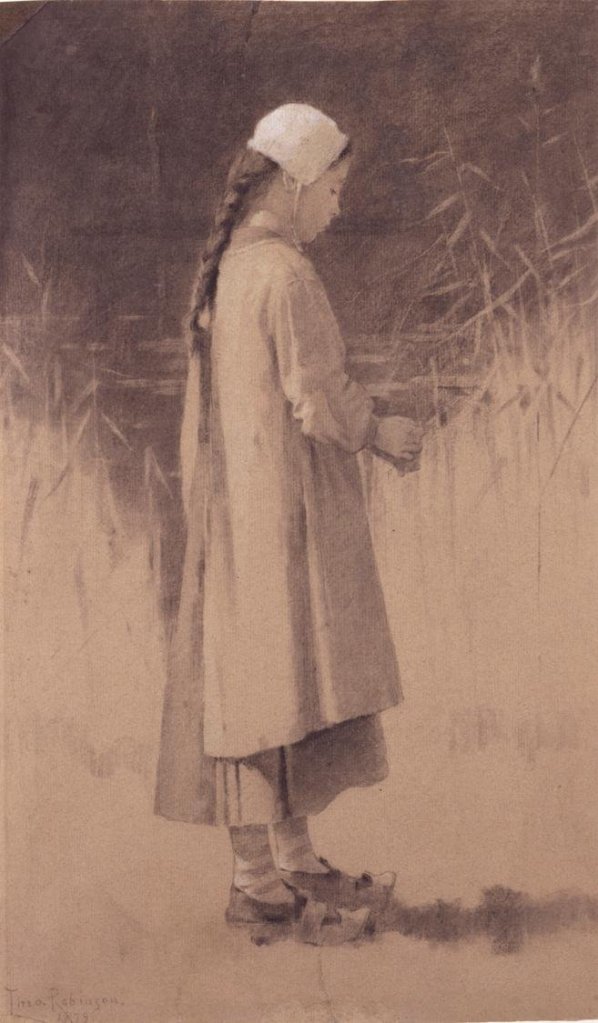
Suzette (Peasant Girl) by Theodore Robinson (1879)

Robinson left Europe and returned to New York in late 1879 and rented a studio on Broadway hoping to establish himself as a professional artist but his financial situation became dire and he had to close his studio and return to his family in Evansville where he would paint local scenes but also dabbled with illustrative work.  One such illustration, Suzette, appeared in the August 31st 1880 issue of the Harper’s Young People magazine  in conjunction with a children’s story Viola’s Sketch.   The original black chalk drawing with white heightening, on grayish blue paper, mounted on board can be found at the Chrysler Museum of Art in Norfolk, Va.   It depicts an outdoor scene with a young girl, turned to the right, in a humble frock intent on sewing.  Her hair is styled in a long braid and she stands in wooden shoes, looking downward wistfully at her work.  The simple depiction of this guileless peasant girl probably harks back at Robinson’s academic training in Paris and the rustic genre imagery we have seen in the works of Jean-François Millet

However, Robinson’s life was at a low point, both physically and mentally as indicated in letters he sent to his friends.  One such friend was Will Low a fellow student at Carolus-Duran’s atelier in Paris.  In his 1908 book, A Chronicle of Friendship, Low wrote that on hearing of his friend’s predicament he had to:

“…extricate Robinson from the surroundings where….he was fast relapsing into a vegetable state…”

And so, Low arranged for Robinson to take a teaching position in New York at Mrs Sylvanus Reed’s Boarding and Day School for Young Ladies, a latter day finishing school for young women.  In May 1881 Robinson was elected to the Society of American Artists and following the short spell of teaching he began to work for the muralist and stained-glass window maker John La Farge.  He and his friend Will Lowe worked on a La Farge commission from Cornelius Vanderbilt to decorate his New York 5th Avenue home and following this they worked on Vanderbilt’s Tarrytown residence on the Hudson River.  Robinson then went on to work for the decorative painting company run by Prentice Treadwell and he works on architectural decorations in Boston, Albany and on decorations for the Metropolitan Opera House in New York as well as commissions for the well-heeled nouveau-riche industrialists.

Daisy Field, Nantucket by Theodore Robinson (1882)

In May 1881 Robinson’s mother died and he returned briefly to Evansville to be with his family but returned to New York that August.   During these periods of employment Robinson still carried on with his own paintings and spent time in the summer travelling around New York State, Vermont and made painting trips to Nantucket with fellow artists in the summer of 1882 painting local island life.

Nantucket by Theodore Robinson (1882)

Theodore Robinson spent the summer of 1882 on Nantucket Island and produced several paintings based on local scenes, including the one above.  The depiction of the rider and his mount at rest under the tree is a depiction of tranquillity and serenity.  In the distance, on the horizon, we can just make out the sea which lends itself to the belief that the setting was somewhere on the New England coast, probably Nantucket Island.  The painting can now be found at the Columbus Museum in Columbus, Georgia.

Flower of Memory by Theodore Robinson (1881)

He completed a beautiful work in 1881 entitled Flower of Memory which is a romantic (if somewhat schmaltzy) depiction of a young lady in an Empire dress, standing alone in a garden.  This sort of depiction was very popular with folk in America at this time and could well have epitomised the figures he was painting as a decorative artist for the La Farge and Treadwell commissions.

A Poacher by Theodore Robinson (1884)

However, Robinson’s art was not dominated by cloying sentimentality in his depictions as he was very much a believer in the realism portrayed in works such as those by Winslow Homer on of his favourite painters.  This is borne out when we look at his 1984 work, The Poacher.

French Impressionism had permeated towards America and Impressionist paintings had started to become sought-after items.  The influential Parisian art dealer, Paul Durand-Ruel had organised a large exhibition of works of Manet, Monet, Pissaro  and Renoir in Boston in September 1883.  So just as Impressionism was arriving on the American shores in the Spring of 1884, Theodore Robinson, who had saved enough money to buy himself a sea passage, left the country to return to France where he would remain for the next eight years with just the occasional visits back to New York.  During his stay in France he would also make trips Belgium and Holland where he would take in the Flemish and Dutch art scene.

By the end of the 1870’s the leading exponent of the style of art known as Naturalism, which is the depiction of realistic objects in a natural setting, was Jules Bastien-Lepage.  When Robinson arrived in France in 1884 the popularity and standing of Lepage was escalating, and his works of art were in great demand, a fact that Robinson must have been well aware of and there is no doubt that Lepage’s works influenced Robinson.   Lepage’s popularity and the sale of his artwork increased even more in December 1884 when he tragically died of stomach cancer at the young age of forty-four and this adulation culminated in 1885 with a retrospective of his paintings at the Hotel de Chimay in Paris which proved to be a runaway success.

Le petit Colporteur endormi (The little sleeping pedlar) by Bastien-LePage

Often Lepage’s works depicted rural peasants and urban labourers  and these detailed portrayals lacked sentimentality and yet brought home to the observer an honest if somewhat blunt snapshot of the life of the less well-off. Such was their popularity they appeared regularly at the Salon  exhibitions.

In 1886 Robinson’s good friend Will Low along with his wife arrived in Paris and Robinson was there to greet them as they alighted from the train at Gare St. Lazaire.  Such was his friendship with Low that for the next twelve months he lived with them at their rented accommodation on Rue Vernier in the Paris suburb of Neuilly-sur-Seine.   Robinson’s work during his time in France was diverse.  There was the sentimentality of works like Flower of Memory which as I said earlier probably originated from his time of painting mural decorations for La Farge and Treadwell.  There was his landscape work which derived from his en plein air painting at the Fontainebleau Forest during his summer breaks from the Paris Academy and finally there was his interest in genre painting and the depiction of peasants and urban dwellers at work or at home which he became interested in during his trips to Flanders and the Netherlands.

A Cobbler of Old Paris by Theodore Robinson (1885)

His 1885 painting A Cobbler in Old Paris is a prime example of Robinson’s look at urban life.  The focal point for the work is the woman who leans in through the open window to talk to the cobbler.  One should almost look at this work as a part still life painting with the cobblers workbench littered with still life objects, the tools of his trade, as is the wall in the background filled with the racks of shoes.  This type of scene of tranquil everyday life was popular in Victorian times and Robinson completed many similar works.

Young Girl with Dog by Theodore Robinson (1886)

In his 1886 painting, Young Girl with Dog, Robinson has preserved Bastien-Lepage’s method of honestly and frankly portraying an un-idealized figure seen in a landscape.   There is also an American source of inspiration that would have been well-known to Robinson. This small vertical format containing the standing figure illuminated under a dappled light is evocative of a series of watercolours produced by Winslow Homer in the summer of 1878 when he was invited to stay at Houghton Farm in upstate New York, the home of his patron Lawson Valentine.

Weary by Winslow Homer (1878)

One such work by Homer was entitled Weary.  Robinson was not only an early admirer of Homer’s watercolours, but it is rumoured that he purchased one of the watercolours in 1894.  Robinson first visited Giverny, a small Norman village, which was situated on the banks of the River Seine halfway between Paris and Rouen in 1885 when he and a friend of Claude Monet, Monsieur De Conchy visited the French painter. Claude Monet had moved there in 1883 with his two young sons Jean and Michel.   Pierre Toulgouat who was a descendent of Monet, wrote of the time in his 1948 book, Skylights in Normandy:

“…in 1885, his [Monet’s] friend, De Conchy came to visit him, accompanied by the young American painter, Theodore Robinson – and Robinson, particularly, was to remain a faithful Givernois, until his death, painting there when he could and writing longingly of it when he had to be away…”

In June of 1886 Robinson was in Paris and managed to visit Monet’s work at the Fifth International Exhibition of the Impressionists at the Galerie Georges Petit and came away captivated by Monet’s works especially their colour and luminosity

Portrait of Madame Baudy by Theodore Robinson (1888)

In June 1887 Robinson moved out of Paris and went to live in Giverny. He moved into rooms at the newly-opened Hotel Baudy, which lay in the centre of the village and was run by Angélina Baudy.  Giverny and the surrounding area, for Theodore Robinson, was all about the simplicity of the landscape, the colours and the light and he would love to go off and explore and paint.  He loved everything about the area.  He loved the hills and fields, the old buildings, the people and the animals and would immerse himself in the area painting as much as he could in the ever changing conditions of light and weather.

Valley of the Seine, Giverny by Theodore Robinson (1887)

A fine example of this is his 1887 painting Valley of the Seine in which we see a minute figure in white which somehow secures a pattern of one horizontal and several diagonals that contain and depict several hillside swaths of yellow and grey, and a triangle of blue sky. For his portrayal of the countryside Robinson has used muted earthen colours, ones that he would use in many of his later paintings.

La Vachère (The Cowherd) by Theodore Robinson (1888)

During his stay around the Giverny area Robinson depicted many of the residents of the area.  Most of his paintings featured women at work, sometimes seen gathering wood and fruit sometimes tending the farm animals or doing the laundry.  An example of this is his large 1888 painting entitled La Vachère (The Cowherd) 219 x 152cms (86 x 60 ins) which is housed in the Baltimore Museum of Art.  Before us we see a young woman and a cow both surrounded by foliage that glistens in the reflected light.  Look how Robinson has cleverly left an opening between the trees in way of the girl’s head.  It enhances the young woman’s profile and frames her face as well as adding depth to the depiction.  The addition of the cow into the depiction is almost as if the animal is vying for supremacy in the painting but it is completely ignored by the girl.

In The Grove by Theodore Robinson (c.1888)

One strange thing about this painting is that shortly after he completed the work Robinson painted the same woman in the same setting but without the cow!  Maybe he thought the animal detracted from the beauty of the female. The picture, which is much smaller, is entitled In the Grove and is also part of the Baltimore Museum of Art’s collection.

In my final look at Theodore Robinson’s life in the next blog, I will look closer at his relationship with Claude Monet and showcase more of his later works.
Theodore Robinson. Part 1 – the early years of the American Impressionist

Theodore Robinson

When we think of Impressionism and Impressionist painters we immediately think of French artists and if I was to ask you to name a few French Impressionist painters, I guess you wouldn’t have a problem and the names of Monet, Sisley, Renoir, Bazille, Pissaro and Cézanne would easily roll off your tongue.  However, if I was to ask you to cite some famous American Impressionists I guess the names of Mary Cassatt and John Singer Sargent would come immediately to mind, some may even suggest William Merritt Chase or John Henry Twachtman but, especially if you were not an American, it would become a struggle to think of the names of any other American Impressionist.  In my blog today I am looking at the life and work of one of the first American Impressionists, Theodore Robinson, albeit he is not the best known.  Lovell Birge Harrison, the American genre and landscape painter, teacher, and writer and prominent practitioner and advocate of Tonalism wrote about Robinson in a 1916 article in Century Magazine, saying:

“…The one who always stands out most vividly in my own mind …[is] Theodore Robinson, who is now taking his place beside Inness, Wyant, and Winslow Homer as one of our American old masters…”

Self Portrait by Theodore Robinson (c.1887)

Robinson was one of the most skilful and gifted American artists of the nineteenth century. He said he always knew he would become an artist and once said of himself that perhaps he was born to make sketches.  His accomplishments as an artist take on an even greater meaning considering that he was a man who would have to battle all his life against poor physical health.

Harbour Scene by Theodore Robinson (1876)

Theodore Pierson Robinson was born on July 3rd 1852 in the small northern Vermont town of Irasburg which lies twenty-five miles south of the US-Canada border.  He was the third of six children of Elijah and Ellen Brown Robinson.  Sadly, his two sisters and one of his brothers died in childhood, leaving just Theodore and his two brothers Hamline and John.  In 1843, his father, who had worked on the family farm in Jamaica, trained to become a minster in the Methodist congregation but due to ill health had to give up the ministry and he became a shopkeeper opening is own clothing store.

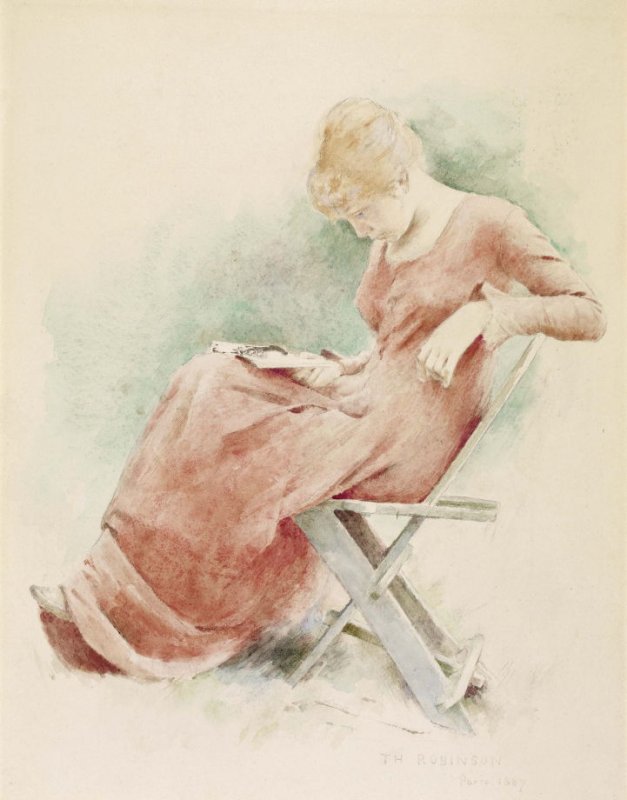
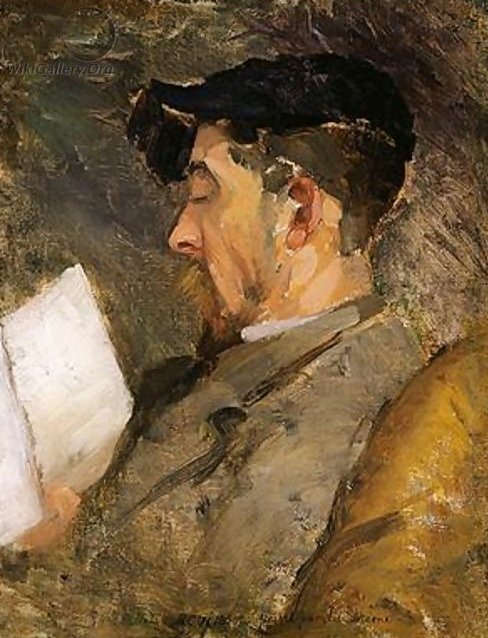
Young Woman Reading by Theodore Robinson (1887)

In 1855, whilst still a very young child, Theodore and his family moved from Vermont and went to live in the small town of Barry, Illinois and two years later they moved again, this time to Evansville, southern Wisconsin, another small town that was first settled in the 1830s by New Englanders who were attracted to the area by its unspoiled wooded landscapes.  Another reason for the move to the countryside of Wisconsin was because of Theodore’s health.  As a young child, he had developed asthma which had weakened him and would trouble him for the rest of his life.  He enrolled at the local seminary where his artistic talent was first noted, winning  prizes for penmanship.   He would also often sketch portraits of friends and family as well as the parishioners who came to the local Methodist church.

In 1869, aged 17, after he had completed regular schooling, and because of his burgeoning artistic talent,  along with his mother’s dogged perseverance, he enrolled as a student at the Art Institute of Chicago.  Unfortunately, he did not stay there long as his asthma worsened, a chronic condition that he had suffered with since childhood, and so it was decided that he should move away from polluted air of city life and move to the cleaner drier mountain air of Denver, Colorado.  It must have done the trick for a few years later, he did return to Evansville where he carried on with his portraiture work which he would sell and with the money he earned he would put it aside for his art college fund.  In 1874 he moved to New York where he enrolled at the National Academy of Design.   This establishment was founded in 1825 by a group of artists including Samuel F. B. Morse, Asher B. Durand, Thomas Cole, Martin E. Thompson, all students of the American Academy of Fine Arts, who had grown increasingly impatient with the constraints of the Academy, and in 1825 they had left to found the National Academy of Design. The idea for its existence was said to be

“…to promote the fine arts in America through instruction and exhibition…”

On the Housatonic River Connecticut by Theodore Robinson (1877)

Whilst there, Robinson studied under Lemuel Everett Wilmarth and when not at the Academy would spend hours sketching in nearby Central Park.  We have seen with many of the European academies, the narrow and rigid academic training in art was not for everybody with some aspiring young artists wanting more freedom with regards what was being taught and how it was being taught.  As far as Robinson and several his fellow students were concerned there was a two-fold problem with the American Academy of Fine Art.   Firstly, the Academy was run by a group of older artists who were landscape painters and concentrated on teaching that artistic genre despite many of the students, including Robinson, wanting more emphasis on figurative painting.  Secondly, the students believed that their prospects to exhibit, and ultimately sell their work, was being limited by the Academy.  Another reason could have been that in 1874 the Academy temporarily suspended activities.  Rumours flew around that the establishment was in financial trouble and so its students felt they had nowhere to turn and wondered about their future.  In 1875, this dissatisfaction and confusion about the future lead Wilmarth, along with a group of his students, including Robinson, to form the Art Students League. This Art Students League met and held its classes in a small rented space over a shop at the corner of Fifth Avenue and 16th Street.  It was so small a space that a daily schedule of studio instruction had to be organised, with women studying in the afternoon and men at night. However, this alternative organisation allowed these painters a greater influence on their curriculum and would also allow them greater access to exhibition space.

Suzette (also known as Peasant Girl) by Theodore Robinson (1879)

Theodore Robinson fulfilled one of his artistic goals two years later in 1876 when he went to study art in Paris, a city looked upon at the time as the centre of the world of art.  Most American art students during the second half of the nineteenth century viewed their study in New York as a stopping-off point on their artistic journey before they headed to Europe.   The first art tutor Robinson studied with in Paris was the French painter, August Carolus-Duran, whose studio was in the Boulevard Montparnasse.  Carolus-Duran was renowned for his elegant portrayal of members of French high society and people travelled from far and wide to become one of his sitters.

Portrait of Mrs Astor by August Carolus-Duran (1890)

Carolus-Duran was probably well known to artists in America for his 1890 portrait of the American banker’s wife, Caroline Webster Schermerhorn Astor, the doyenne of American high society in the latter half of the 19th century, who maintained the stance of “old money” in the face of changing times and values when the nouveau riche were coming to the fore.   Also, studying under Carolus-Duran, at that time, were John Singer Sargent, the landscape and genre painter Carroll Beckwith and the muralist and author Will Hicock Low.   It was Low who recalled being with Theodore Robinson at that time in Carolus-Duran’s atelier, when he wrote in his 1908 book A Chronicle of Friendship, 1873-1900:

“…Among the new arrivals one year was Theodore Robinson, who, timidly, with due respect for my two years experience in Paris student life, sought my acquaintance… Frail, with a husky, asthmatic voice and a laugh that shook his meager sides and yet hardly made itself heard, yet blessed with as keen a sense of humor as anyone I have ever known, Robinson was received at once into our little circle. At first he seemed almost negative, so quietly he took his place among us, but once the shell of diffidence was pierced few of the men had thought as much or as independently…”

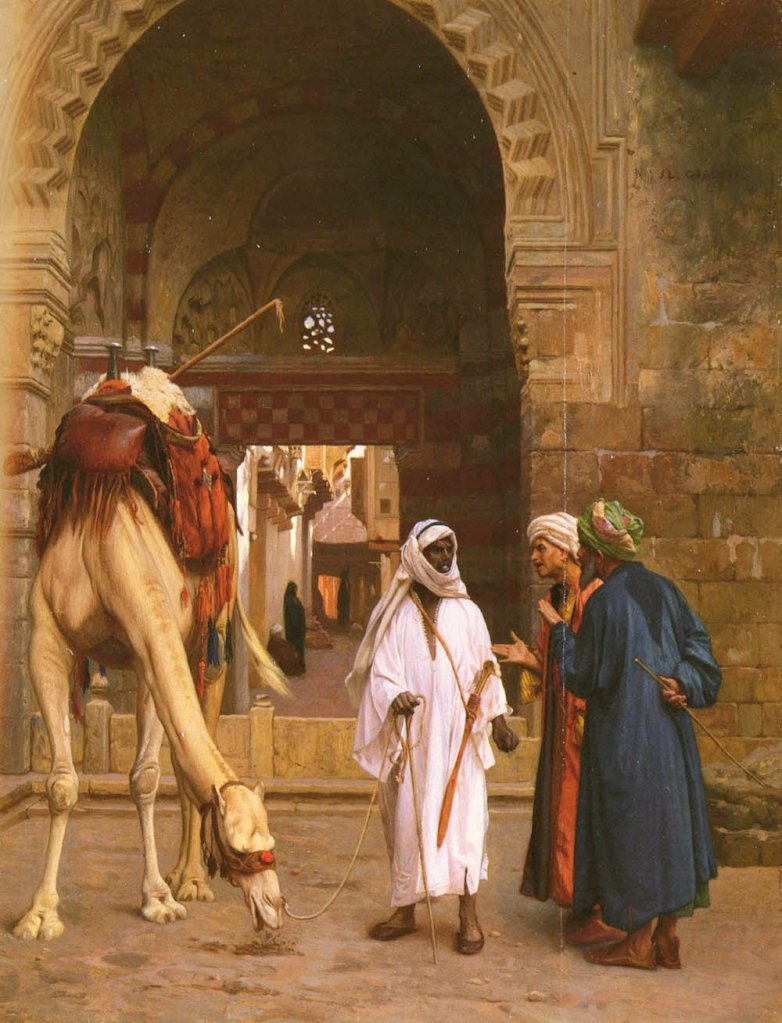
Arabs Arguing by Jean-Leon Gérome

Theodore Robinson was only with Carolus-Duran for a short time and rumour has it that they did not agree on some aspects of the artistic training,  Robinson moved on and became a student at the École des Beaux-Arts, and a pupil at the atelier of the French painter and sculptor, Jean-Léon Gérome, an artist, who had always been a great believer and follower of the painting style known as Academicism, a style of painting and sculpture produced under the influence of European academies of art. Gérome was noted for his portraiture and his history paintings which often featured Arabian scenes, which was known as Orientalism, and was an art genre of Academic art, popular in the nineteenth century which represented the Middle East.  The fact that Robinson was accepted into this atelier is testament to his artistic ability as it was the most admired studio and the one that most American students wanted to attend.

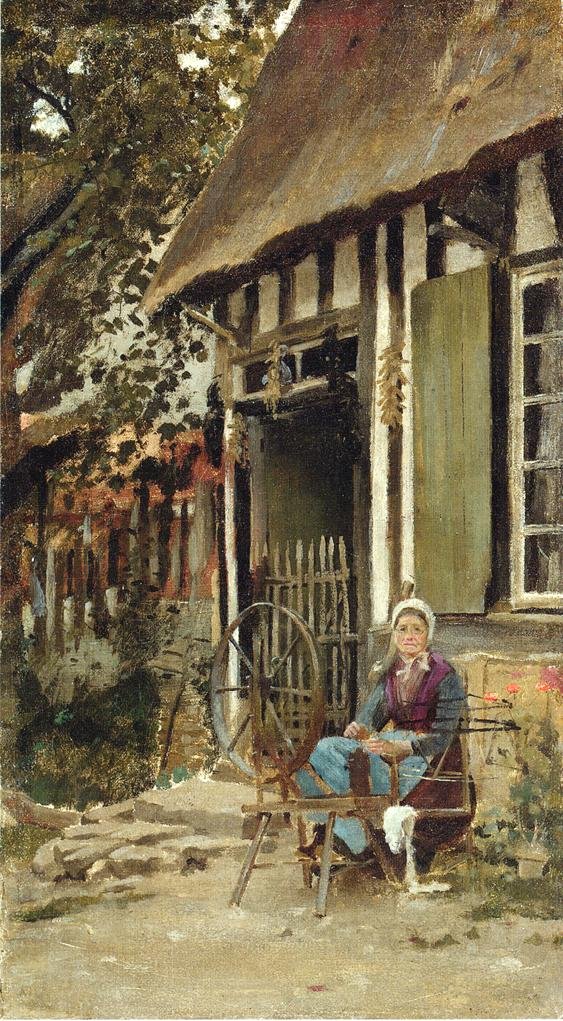
Spinning by Theodore Robinson

In 1877 Theodore Robinson achieved another of his artistic goals, one which every art student strived for; he had a painting, Une Jeune Fille, accepted at that year’s Salon. One can only imagine how delighted he was to get his painting hung at the Salon.  In a letter to his mother he wrote of his joy:

“…My picture is accepted and I tremble with joy…”

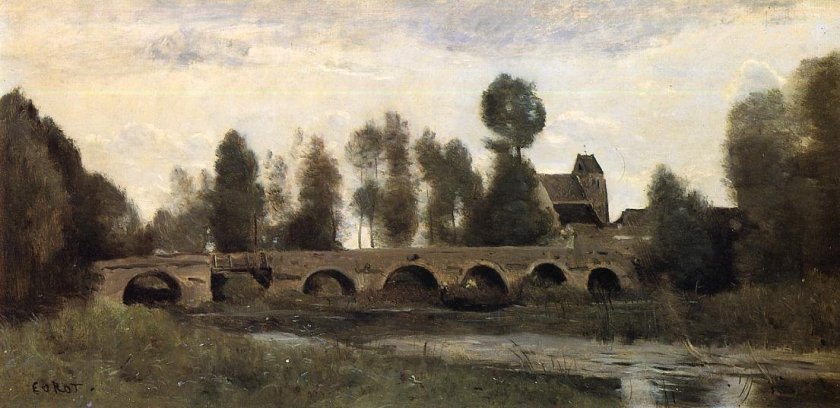
The Bridge at Grèz-sur-Loing by Corot (c.1860)

Robinson went on to exhibit his works at five more Salons during the 1880’s.  Following the time spent on his Salon entry and its inclusion at the 1877 Salon, Robinson decided to take a break from his studies and head out of the city and delve into the nearby countryside around Fontainebleau.  He and some of his fellow artists, Will Low, Birge Harrison and Walter Launt Palmer travelled to the village of Grèz which was on the banks of the River Loing on the southern edge of the Forest of Fontainebleau, some fifteen kilometres south of Barbizon.  At the time, this was an area that was awash with artist colonies such as those at Barbizon, Grèz-sur-Loing, Montigny-sur-Loing and Thomery but at this time, Grèz was the most popular with artists who wanted to spend the day painting en plein air and the evening spent talking about art.  This popular idyll was described in the book Theodore Robinson’s La Debacle, 1892: an American Artist in France by Betsy Kathryn Koeninger, in which she quotes the words of the Scottish painter John Lavery, a student at the Académie Julien who stayed in the village in the early 1880’s.   He described the ambience of the village and its surroundings:

“…a pleasant place surrounded by large fields of white and yellow water lilies and poplars and willows. There was also the much-painted bridge… a ruined castle and an ancient church… [and] Madame Chevillon’s Inn with its long garden down to the water’s edge where guests could sit in bathing dress to eat after a swim or a sail in a skiff…”

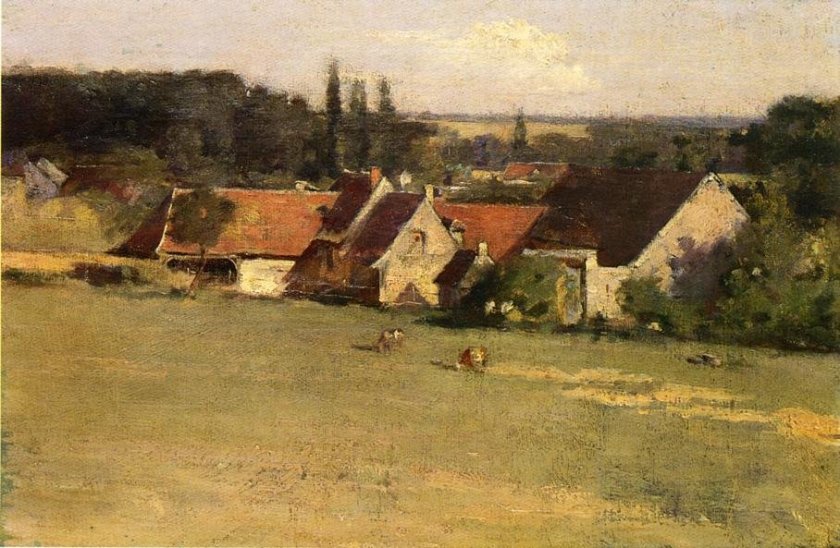
Farmhouse at Grèz by Theodore Robinson

Robinson’s friend and colleague from the Academy, Birge Harrison, who had travelled to Grèz with him and remembers him, wrote an article in the December 1916 edition of the Century Magazine, entitled With Stevenson in Grèz.  He wrote:

“…Robinson was far from handsome in the classic sense. An enormous head, with goggle-eyes and a whopper-jaw, was balanced on a frail body by means of a neck of extreme tenuity; and stooping shoulders, with a long, slouching gait, did not add anything of grace or of beauty to his general appearance.” It was not Robinson’s physical prowess that interested Harrison, but his strength of character. “[Out] of those goggle-eyes shone the courage of a Bayard, and in their depths brooded the soul of a poet and dreamer, while his whole person radiated a delightful and ineffable sense of humor…”

Another visitor to Grèz that summer was the writer Robert Louis Stevenson and he and Theodore Robinson immediately became good friends.

Once summer was over Robinson returned to Paris and his studies at Gérome’s studio and to copying the paintings of the Masters at the Louvre.  The climate in Paris during that winter was harsh and Robinson, a poverty-stricken artist, lived in poor conditions and suffered with colds and asthma attacks, all of which affected his work and he wrote to his mother:

“…When I’ve taken cold and cough all night my work is greatly interfered with not to mention the inconvenience it causes…”

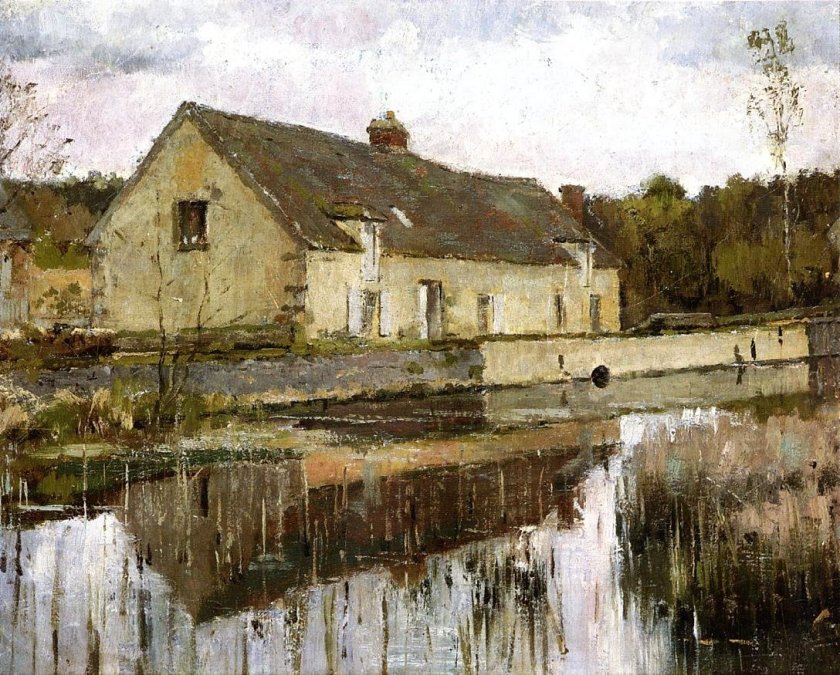
On the Canal by Theodore Robinson

In 1878, Robinson decided to send one of his paintings to the Society of American Artists first exhibition.  The group had been founded the previous year by artists of attending the National Academy of Design which they believed did not satisfactorily meet their needs, and was far too conservative in its thinking.  This was the same reasoning behind the formation of the Art Students League which Robinson helped Wilmarth to organise in 1875.  The Society of American Artists was very valuable to those American artists who, having studied art in European cities, were returning home but discovered that there were inadequate prospects to exhibit their work. Robinson became a regular contributor to their annual exhibitions.

In my next blog I will be looking more at Theodore Robinson’s life and a very important and influential friendship he had with his French neighbour.

————————————————————————————–

Apart from the usual internet sources I found many details about Theodore Robinson’s life in an essay written  for the catalogue of the Theodore Robinson exhibition held at Owen Gallery, New York in March 2000 by the American writer and art curator, D. Scott Atkinson.

Jean-Baptiste Pillement

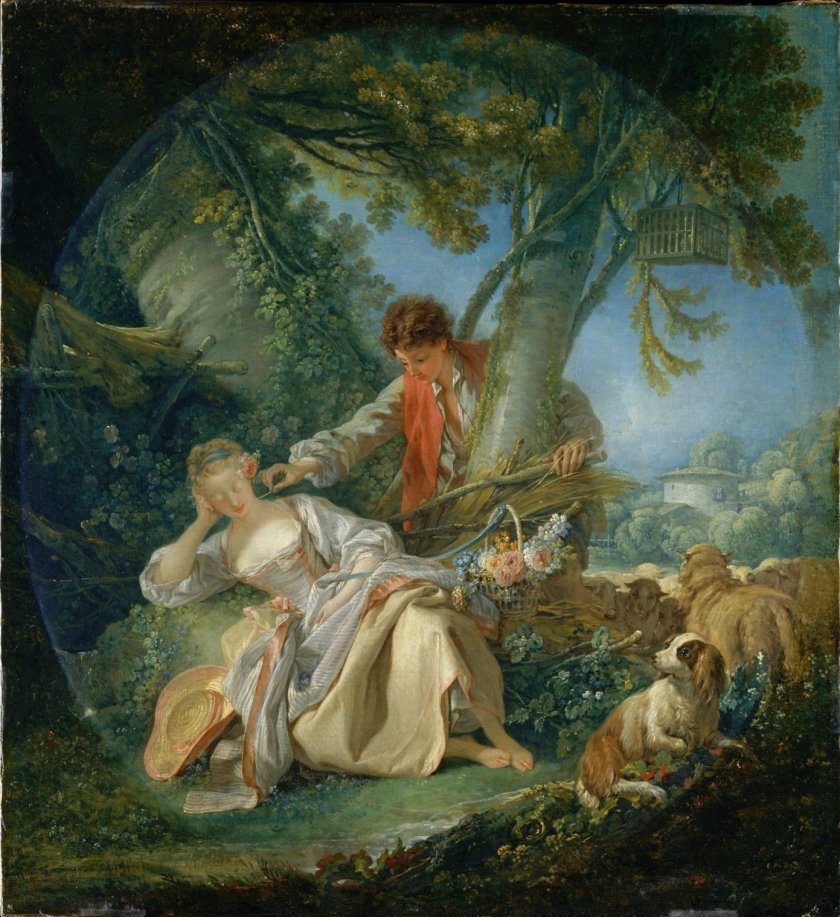
The Interrupted Sleep by Francois Boucher (1750)

Louis XIV, known as the Sun King died in 1715, at the age of seventy-seven after reigning for seventy-two years.  He had outlived all his legitimate children and two of his eldest grandchildren so his crown passed to his youngest grandchild, Louis Duke of Anjou, who became Louis XV at the age of five (the same age his grandfather was when he became Louis XIV) and his kingdom was ruled by his maternal great-uncle, Philippe II, Duke of Orléans as Regent of France, until Louis reached maturity in 1723.  The Duke of Orléans had a passion for beauty and cheerfulness and he tried to dismantle the godliness enforced by Louis XIV at his sumptuous home in Versailles. Following numerous wars under the previous monarch, France turned away from these imperial aspirations and instead, concentrated on more personal, and enjoyable pastimes. With this more relaxed political life and the letting-up of private morals, the change was mirrored by a new style in art, one that was intimate, decorative, and often erotic.  It was the era of Rococo.

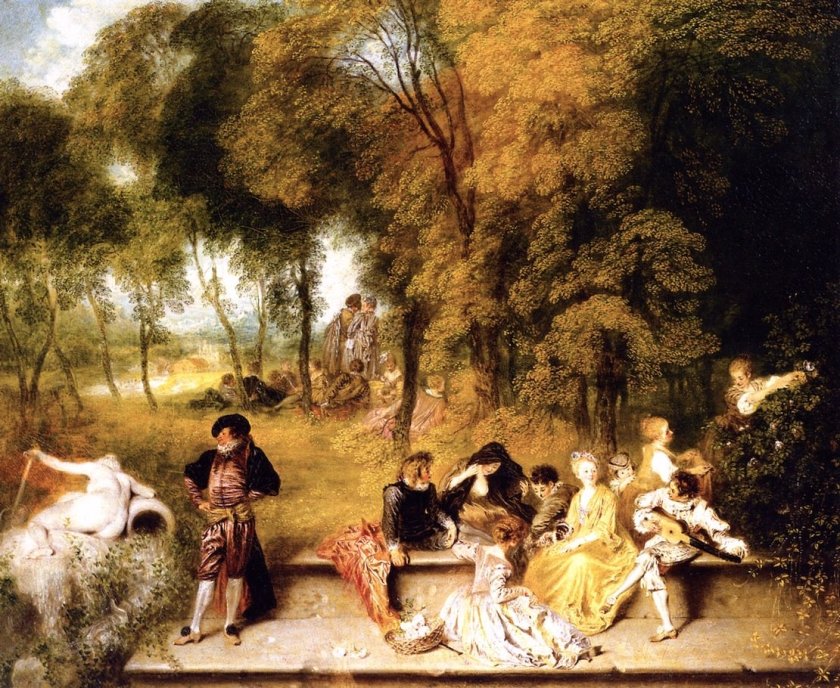
Meeting in the Open Air by Jean-Antoine Watteau (c.1719)

Members of the new royal court began to decorate their sophisticated homes in a lighter, more delicate manner. This new style which came into being around the start of the 18th century has been known since the last century as “rococo,” from the French word, rocaille, for rock and shell garden ornamentation. The rococo style emphasized pastel colours, sinuous curves, and patterns based on flowers, vines, and shells. Artists moved away from depictions of lofty grandiloquence and instead focused on the pleasures of both colour and light, and also moved away from depictions of momentous religious and historical subjects and concentrated more on informal, friendly and relaxed mythological scenes as well as  joyous views of daily life, and elegant sophisticated portraiture.  When we think about rococo art we think of Jean-Antoine Watteau, François Boucher and Jean-Honoré Fragonard but today I am looking at the life and works of a lesser known rococo artist, Jean-Baptiste Pillement.

The Gardens of Benfica by Jean-Baptiste Pillement (1785)

Jean-Baptiste Pillement was born in Lyon, France on May 24th 1728.  He received his first artistic training as a teenager from the French painter, Daniel Sarrabat in Lyon.  The training he received gave him an excellent foundation in the Rococo style of genre painting which had become so popular through the works of Jean-Antoine Watteau and François Boucher.  In 1743, aged fifteen, Pillement moved from his home town to Paris where he was taken on as a design apprentice at the Manafacture des Gobelins, a tapestry factory, which is best known as a royal factory supplying the court of the French monarchs.   In 1745 he left Paris and travelled to Spain and remained there for five years. He spent those years moving from city to city earning money sometimes as a designer other times as a painter.

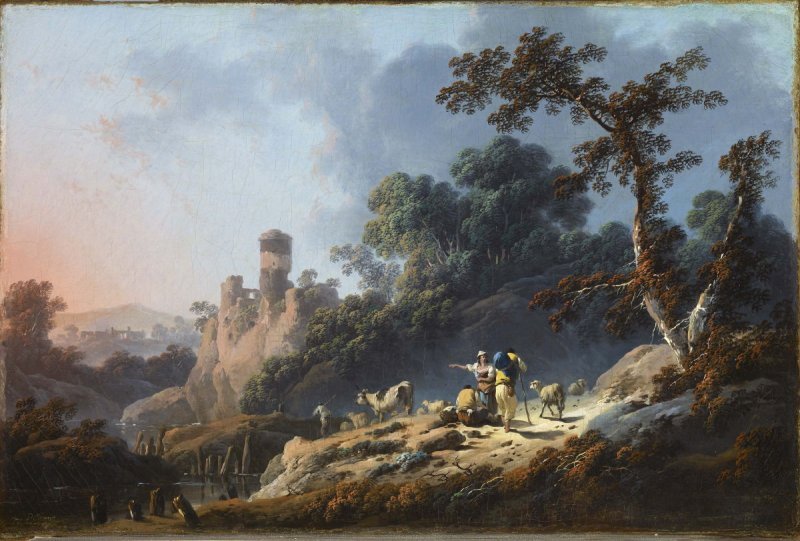
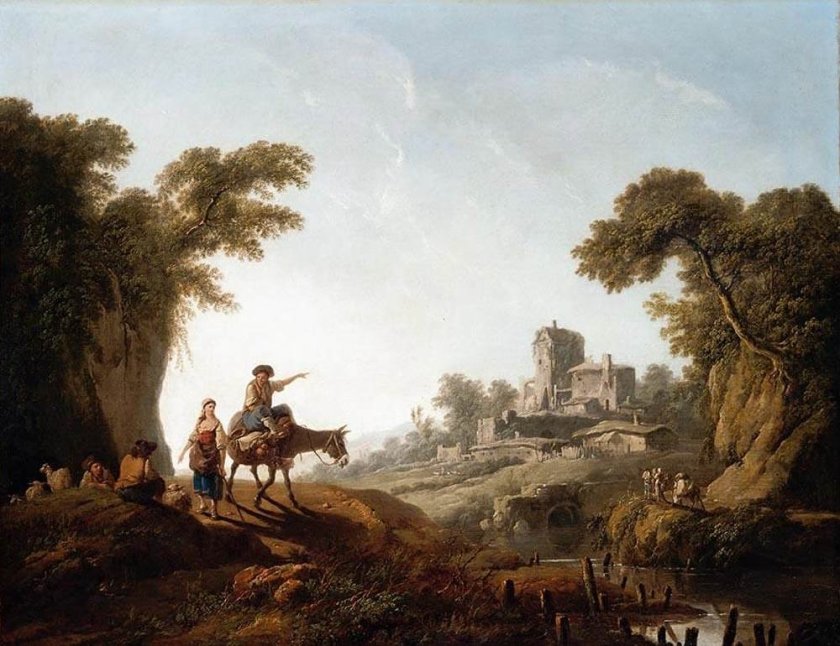
Landscape with Travelers and a Ruin by Jean-Baptiste Pillement
Landscape with Travelers and a Ruin
by Jean-Baptiste Pillement

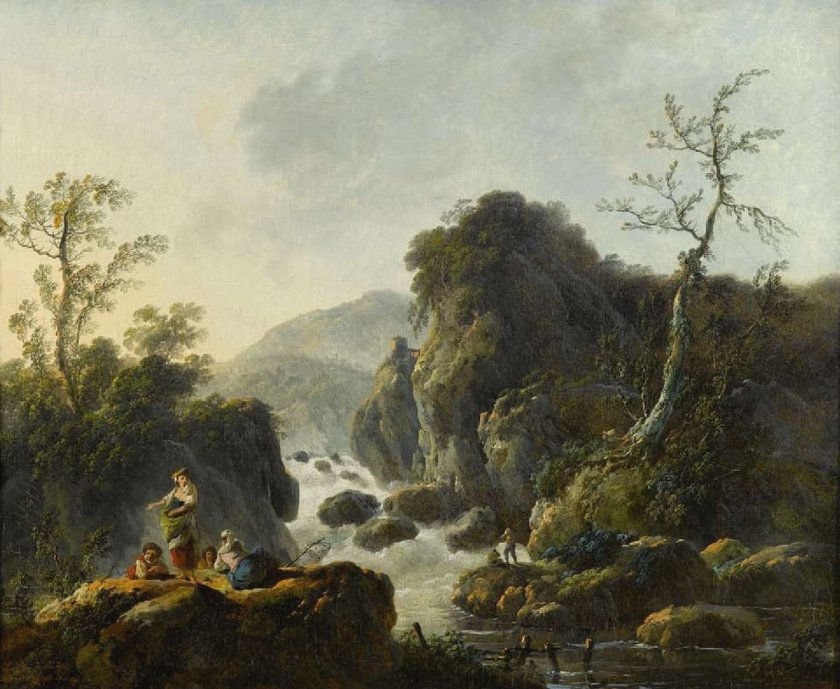
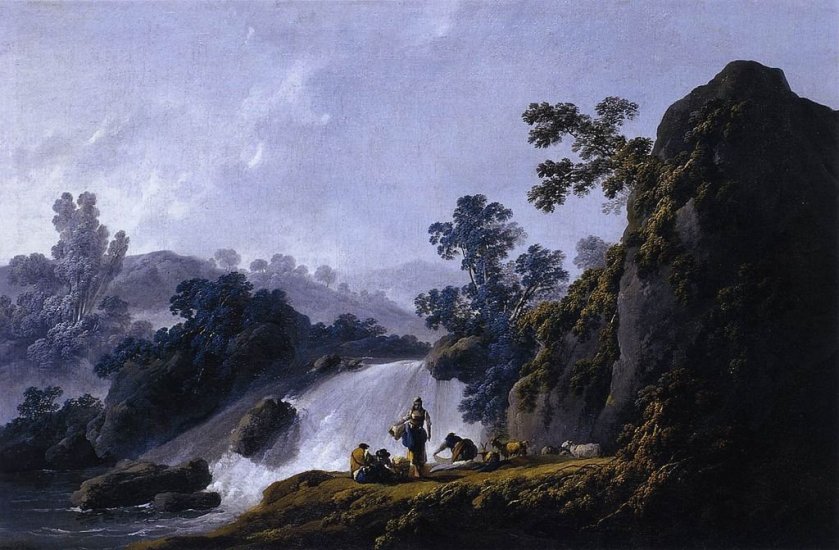
One recurring theme depicted in his paintings was that of rugged landscapes, shepherds with their flocks of sheep and goats cross fast flowing streams by way of rickety bridges, on either side of the cascading water we see lush green vegetation all of which was bathed in the golden glow of sunlight.

In 1750, after five years in Spain, the twenty-two-year-old Pillement journeyed to Lisbon where he was to remain for four years.  In 1754 Pillement left the Iberian Peninsula and travelled to London.  The favoured artistic genre of the English at that time was landscape painting and this meant that Pillement’s Rococo-style of romanticised landscape art was in much demand.  One of the popular artists at that time whose work was to influence Pillement was Nicolaes Berchem, the highly regarded and prolific Dutch Golden Age painter who painted numerous works depicting pastoral landscapes in the seventeenth century.

Landscape with a waterfall and the Temple of the Sibyl at Tivoli by Nicolaes Berchem

Berchem was part of the second generation of “Dutch Italianate landscape” painters who had travelled to Italy to take in the romanticism of the country and who would later return home to the Netherlands with sketchbooks full of drawings of classical ruins and pastoral imagery. Like Pillement, a century later, Berchem’s works were based on the Arcadian landscapes of the French painter Claude Lorrain which would typically depict shepherds grazing their flocks among Classical ruins, bathed in a golden sunlit haze.

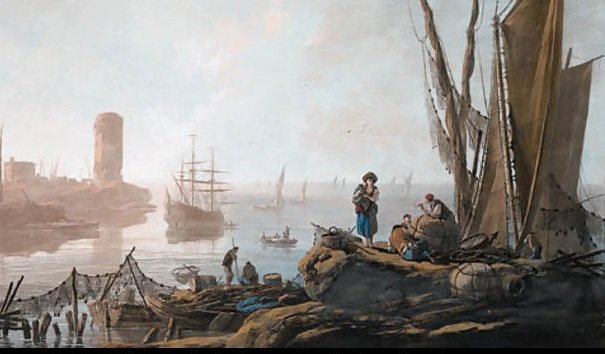
The Mouth of the River Tagus by Jean-Baptiste Pillement

During his sojourn in the English capital he became friends with the English actor, playwright, theatre manager and producer David Garrick and his wife, the dancer, Eva Maria Weigel.  Garrick had become quite wealthy through his acting and this allowed he and his wife to buy a palatial estate in Richmond-on-Thames which became known as Garrick’s Villa.  Eva Marie Weigel became an art collector and furnished the house with paintings, many of which were by Jean-Baptiste Pillement.

A Mountainous River Landscape by Jean-Baptiste Pillement

In 1763, Pillement was once again on the move, this time leaving London and travelling to Vienna.  His reputation as a successful painter gave him the opportunity to move in royal circles and was employed at the Imperial Court of Maria Theresa and Francis I.

Chinoiserie by Jean-Baptiste Pillement

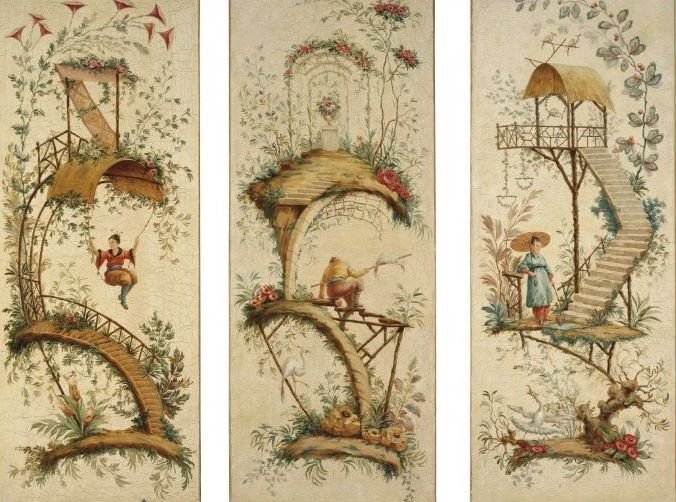
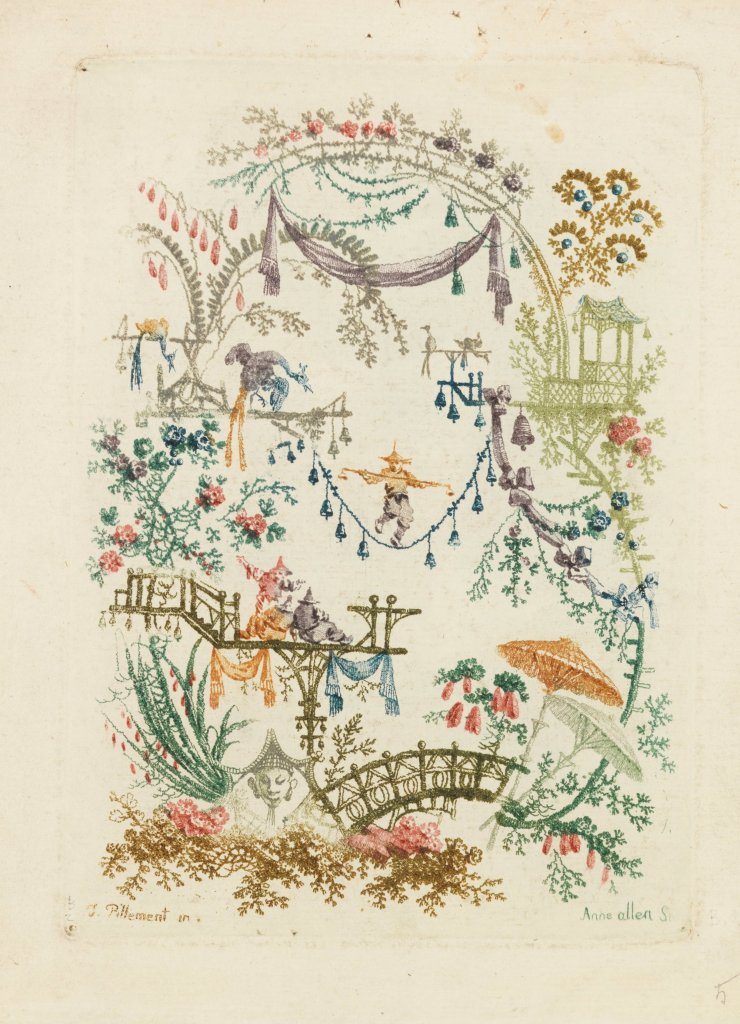
In the eighteenth century, prints of designs was the foremost way of spreading information. They were often published monthly and were collected into folios or volumes, and people could order them by subscription. There was a massive demand throughout Europe, for these prints.   Pillement, whilst living in England, soon realised that the fashion there was the same as that in France, and, at the time, was the love of chinoiseries.  It was around 1764 that Pillement, according to his memoirs, had discovered a new method of printing on silk with fast colours.   Pillement’s illustrations were a blend of fanciful birds, flora & fauna, incorporating large human figures and chinoiserie.  The word, chinoiserie came from the French word Chinois, meaning “Chinese” and is a European version and simulation of Chinese and East Asian artistic traditions, especially in the field of decorative arts.  It first became popular during the 17th century and this trend was further commercialised in the 18th century with the boom in trade with China and East Asia.   The chinoiserie style is associated with the Rococo style with its cheerfulness, its concentration on materials, and often depicts times of great pleasure and leisure time.

One of Jean Baptiste Pillement's Ornamental Design for the book Nouvelle suite de cahiers chinois a l'usage des Dessinateurs et des peintres.
One of Jean Baptiste Pillement’s Ornamental Design for the book Nouvelle suite de cahiers chinois a l’usage des Dessinateurs et des peintres.

These beautiful and intricate designs were used by engravers and decorators not only on porcelain and pottery, but also on textiles, wallpaper and silver. Pillement published many albums, of these illustrations, the most famous being Œùvre de fleurs, ornements, cartouches, figures et sujets chinois which was published in 1776.

After Vienna, Pillement’s next stop, in 1765, was Poland and the city of Warsaw where he once again worked for the royal court of the Polish king, Stanislaw II, who commissioned him to decorate the Royal Castle in Warsaw and the nearby Ujazdowski Castle.

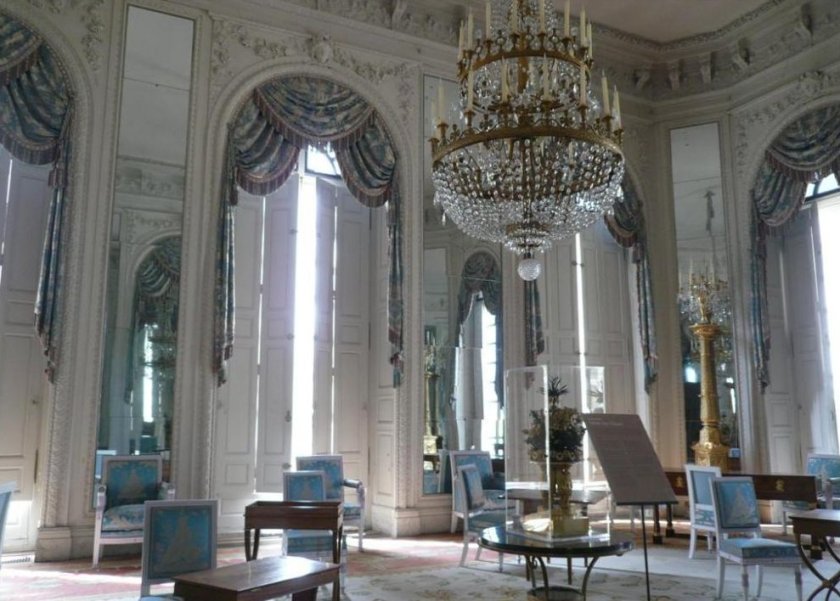
Inside Le petit Trianon

Pillement was forever on the move.  He worked in Saint Petersburg, the Piedmont, Milan, Rome and Venice as well as returning to his homeland where he was employed by Marie Antoinette to furnish the Petit Trianon, a small château located on the grounds of the Palace of Versailles which was built between 1762 and 1768 during the reign of Louis XV.   Its purpose was to house Louis XV’s long-term mistress, Madame de Pompadour, who sadly died four years before its completion.  However, all was not lost, as the Petit Trianon was subsequently occupied by her successor, Madame du Barry. When Louis XV died in 1774 he was succeeded by his son Louis-Auguste who became Louis XVI and when he came to the throne he gave the Petit Trianon to his wife Marie Antoinette whom he had married in 1770 when he was just fifteen years of age, the same age as his bride. In 1778 Pillement was nominated Court Painter to Queen Marie Antoinette, in which capacity he provided paintings for the Petit Trianon at Versailles.

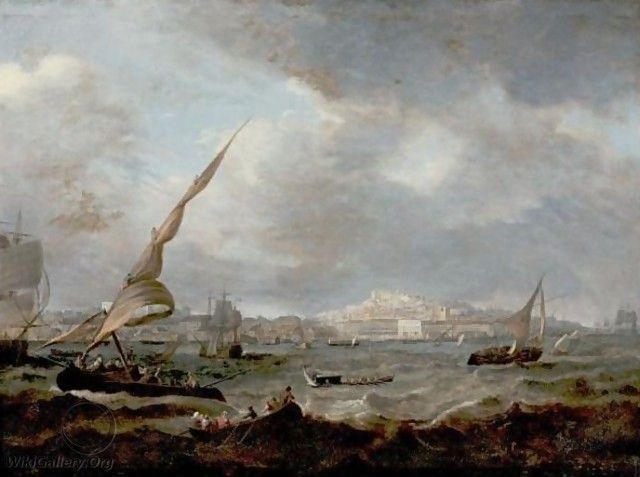
A View of Lisbon by Jean-Baptiste Pillement

During the 1780’s Pillement was living once again on the Iberian Peninsula where he completed many of his most treasured works of art.  In Portugal, he became one of that country’s leading landscape and marine artists. He was also named Court Painter to Queen Maria I and King Pedro III, at last accepting the honour and pension that he had declined when he lived and worked in the country some thirty-five years earlier. It was during this second stay that he also gained a reputation as one of Portugal’s finest teachers of art.

Landscape with Washerwomen by Jean-Baptiste Pillement (1792)

He eventually returned to France in 1789 but instead of returning to Paris  he settled in a small town of Pézenas, in the Val d’Hérault in the Languedoc region.  In 1800, aged 72, he returned to his birthplace, Lyon, where he continued to paint.  On September 1st 1801 the First Consul, Napoleon Bonaparte signed a famous decree, Decree of 14 Fructidor, the so-called Chaptal Decree, named after the famous chemist Jean-Antoine Chaptal, who was the minister for the interior from 1800–04.  The decree offered the fifteen newly founded museums the art treasures which had been captured from “the enemies of the Republic”.  In the main, these were post-Revolution confiscations effected in France, but also included artwork which had been seized elsewhere in Europe by the Republican and, later, Napoleonic armies. In Lyon, in 1801, the founding of the Musée des Beaux-Arts Lyon. The institution also fulfilled local aspirations, such as recalling the city’s prestigious Roman past and furnishing models for the silk industry, which was in crisis at that time.  And at the beginning of 1803, the Louvre Museum began to send a total of 110 paintings to be housed in the Musée des Beaux-Arts Lyon.  Jean-Baptiste Pillement was employed at the museum to give art lessons which he continued doing for the rest of his life.

Fête Champêtre black chalk drawing by Jean-Baptiste Pillement
Fête Champêtre
black chalk drawing by Jean-Baptiste Pillement

Pillement achieved success not only as a landscape painter but was also one of the most influential decorators of the eighteenth century. His chinoiseries, arabesques and flower paintings providing elegant leitmotives for furniture makers, tapestry weavers, and particularly when he returned late in life to the south of France, he did much work for the silk industry of Lyon (Manufacture de Soie et des Indiennes), where he ended his distinguished career.

River Landscape by Jean-Baptiste Pellement

Jean-Baptiste Pillement died in Lyon in 1808, aged 80.  He will be remembered for his exquisite and delicate landscapes, but most of all for his engravings done after his drawings, and their influence in spreading the Rococo style and particularly the taste for chinoiserie throughout Europe.

In Maria Gordon-Smith’s 2006 book, Pillement, she commented:

“…the name Jean Pillement can evoke visions of Arcadian landscapes, luminous seascapes, and highly polished pastels and drawings. To the cognoscenti of decorative arts, Pillement is recalled as having been the most prolific and successful master of Rococo fantasy of his time. His designs were adopted by countless leading artistic manufactories, and their charm has never waned…”

Louis-Léopold Boilly

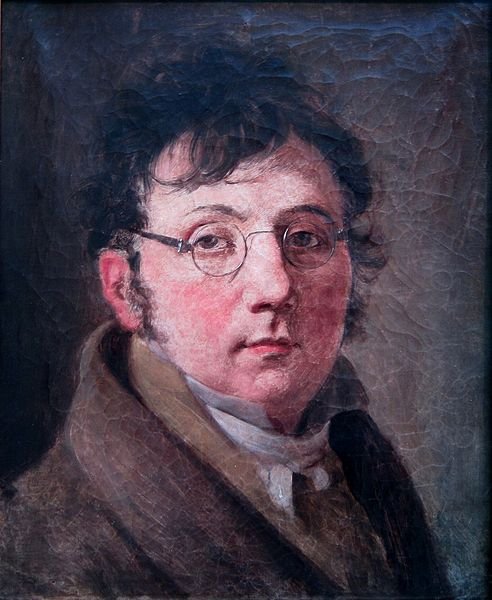
Self-portrait by Léopold Boilly (1805)

My artist today is the prolific late eighteenth century French painter Louis-Léopold Boilly, who was best known for his genre scenes featuring life in the French capital during the French Revolution and the French Empire. He is also renowned for his revolutionary use of lithography.

Boilly was born on July 5th 1761 in La Bassée, a commune in the Nord department of northern France, sixty kilometres south-east of Calais.  His father was wood carver and it was he, who gave Léopold his first lessons in art, and soon during his early teens young Boilly was producing many good works of art, a fact that came to the attention of the Austin friars at the monastery in Douai, a town close to his home. By 1774, word of Boilly’s artistic talent reached the bishop of Arras, Monseigneur Louis François Marc Hilaire de Conzié, who offered him a place to live and paint in Arras.

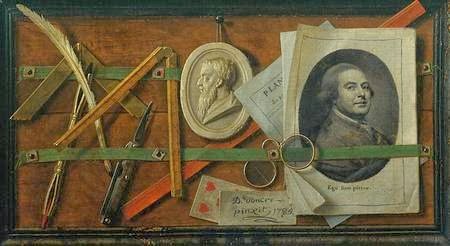
Also around this time, living and working in Arras, was the Flemish-born artist Guillaume-Dominique-Jacques Doncre, who made a living from painting portraits of the members of the Conseil of Arras and members of the local aristocracy but who also specialised in trompe-l’oeil paintings.  It is thought that maybe Léopold Boilly studied under Doncre as the young artist developed a liking for trompe l’oeil works.
A trompe l'oeil by Dominique Doncre
A trompe l’oeil by Dominique Doncre

Trompe l’oeil, (French for “deceive the eye) is a style of painting invented by the ancient Greeks whereby the artist creates an illusion of space often showing apparently three dimensional objects and spaces in a way which the eye accepts as realism in the context of their surroundings.  It was particularly popular in the 17th and 18th centuries with the Low Countries and Northern France.  This trompe l’oeil by Dominique Doncre, above was completed in 1785.  At first sight it looks like a collection of items set out randomly on his “noticeboard”.  Two horizontal straps seem to be holding the items in place including what looks like an engraved page featuring the artist himself and we know it is Doncre as the words “ego sum pictor (I am the painter) are beneath the portrait.  On a card below the pair of spectacles, he has also signed and dated the painting.  It is a simple work with no hidden message.

A trompe-l'oeil by Léopold Boilly
A trompe-l’oeil by Léopold Boilly

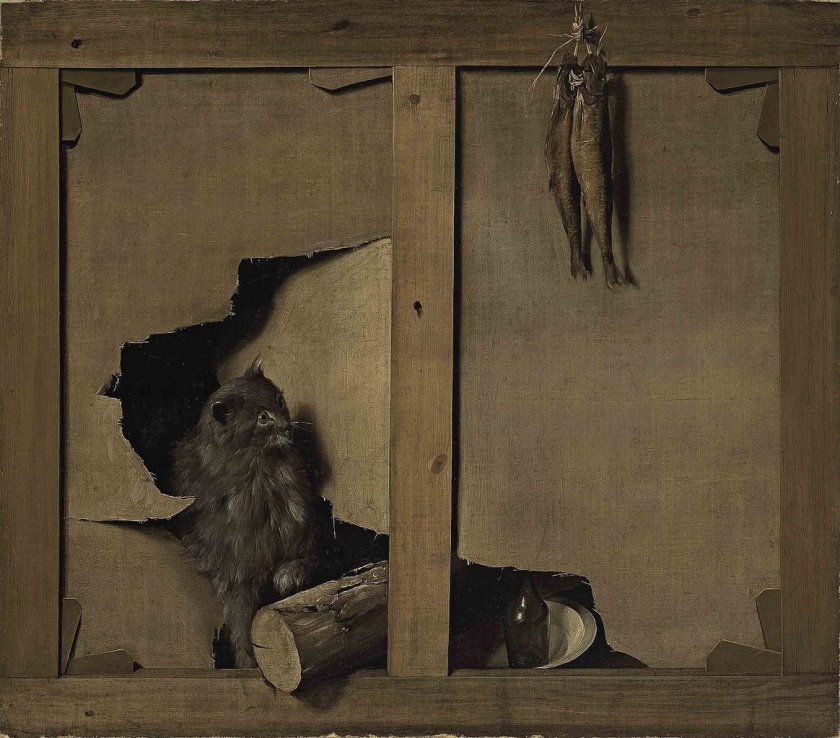
Léopold Boilly completed several trompe l’oeil paintings of his own and my favourite is one with a cat gazing through a hole in the canvas caused by a log which has pierced it.  On the top bottom of which are fish hanging from the stretcher.

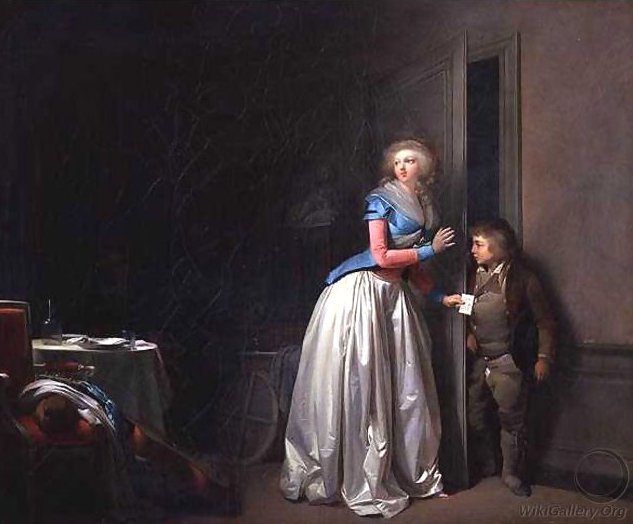
The Visit received by Louis-Léopold Boilly (1789)
La Visite reçue (The Visit received) by Louis-Léopold Boilly (1789)

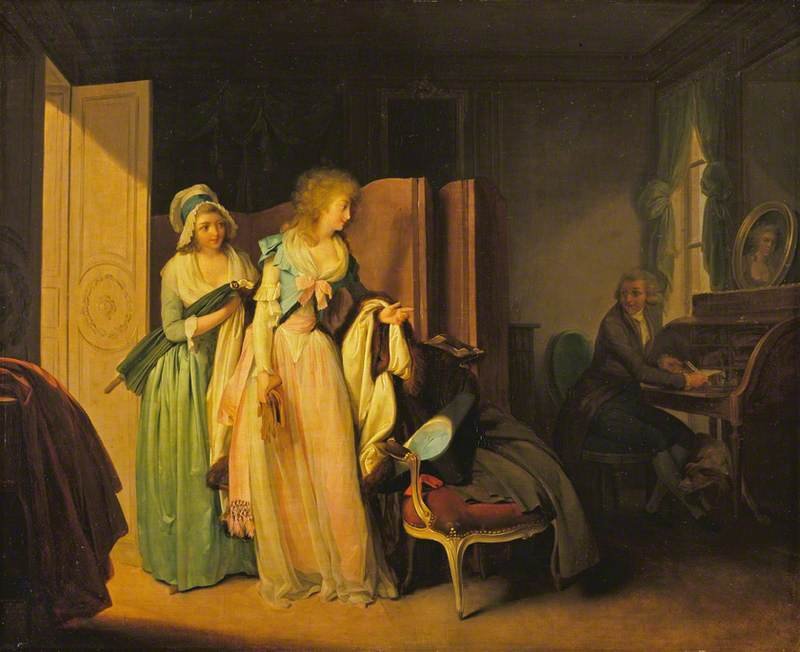
In 1785, aged twenty-four, Boilly went to live in Paris and there, two years later, he married Marie-Madeleine Desligne, the daughter of a merchant of Arras. In 1787 Boilly received a lucrative commission. The nobleman and lawyer, Antoine Joseph François Xavier Calvet de Lapalun had decided to refurbish his family residence in Avignon and he was advised by one of his former clients to incorporate an art collection into the re-modelling of the large house and at the same time arranged for his friend a number of  introductions with some of the most influential Parisian art dealers who would be able tosell him the finest works of art.  One of the artists chosen to provide works for the residence was Léopold Boilly.  The former client, the Marquis Alexandre de Tulle de Villefranche, gave Calvet de Laupin a present of two of Boilly’s works, La Visite reçue and La Visite rendue.  Calvet de Laupin was so pleased with the works that he commissioned Boilly to complete a further nine genre paintings of the same ilk.

The Visit Returned by Louis-Léopold Boilly (1787)
La Visite rendue (The Visit Returned) by Louis-Léopold Boilly (1787)

All eleven genre works featured the many facets of love, all of which are set in an upper-middle class milieu.  The people depicted in the various scenes look as if they are actors appearing in a stage play.  These were not, unlike Hogarth’s Marriage à la Mode, an eleven-episode story.  Each were simply variations on the theme of love and left the viewer to decide what was happening in the painting.   The setting of the two works I have included had been dictated to Boilly by Tulle de Villefranche while Calvet de Lapalun himself described the settings he wanted for the final seven works.
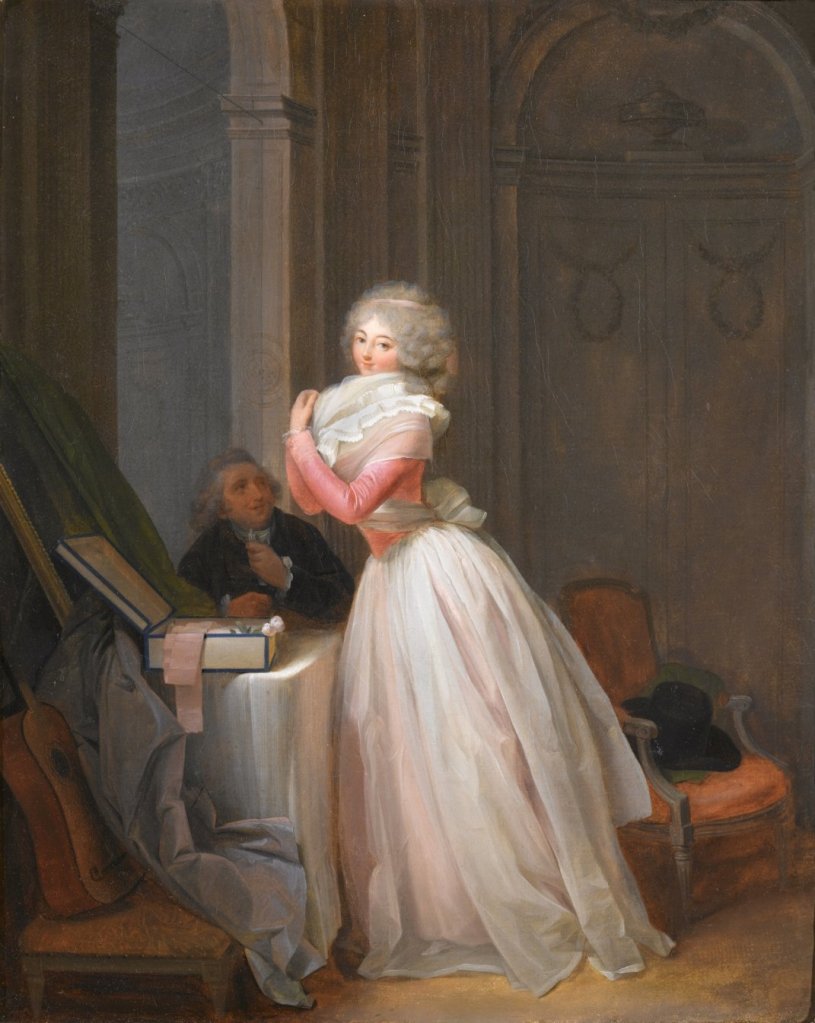
The Suitor's Gift by Louis-Léopold Boilly (1790)
The Suitor’s Gift by Louis-Léopold Boilly (1790)

In 1790 Boilly completed a work entitled The Suitor’s Gift.  In it we see a beautiful, elegantly dressed young woman looking out at us knowingly as she receives the attentions of a suitor. He is obviously a very generous suitor for on the table in front of the young woman we see a luxurious gift box which lies open. It had been lovingly wrapped, as we see several strands of pink ribbon lying over the side which had once secured the gift.  In the box and resting on the front edge of it are two white roses and this presumably symbolises the young lady’s innocence and adolescence. The young woman’s face is flushed and it is this and her full and rounded cheeks that suggests she is very young, certainly in comparison to her much older suitor.

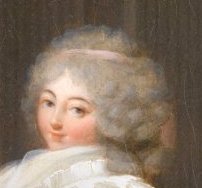
The knowing look
The knowing look

Her hair is worn loosely and is softly curled with a pink ribbon tied around the crown of her head. Her clothes are elegant and lady-like.  She is attired in a graceful pink corseted gown over which is a thin gauze overskirt, which still allows us to see the colour of the gown.  She stares out at us and by doing so turns away from her suitor.  Is it coyness we are witnessing or is she taking in what she has just been given.  Maybe she is deciding whether the gift meets with her expectations.

Her prospective beau, whom we can just make out in the background shadows, crouches down at the side of the table.  Is he kneeling in a kind of devout reverence?  Look at his expression.  It is one of a man who is keenly awaiting to find out whether his gift had been well received by the young woman.  It would appear by the way his left hand is grasping a crucifix which he wears around his neck that he is looking for divine help in his quest to please the lady. From the demeanour of the pair we get a feel for the relationship.  Look how the woman smiles.  It is a knowing smile.  She knows she has the upper hand in this partnership.  Maybe it is this thought that makes us revise our opinion of her.  Maybe she is not as innocent and vulnerable as we first thought.  At first sight we felt a little pity for her being pestered by an elderly man but maybe it is he whom we should be pitying for it seems she may well play him for a fool!

Boilly’s reputation as an artist who artistically recorded contemporary life in the French capital steadily grew and by often having his paintings on display at various exhibitions he ensured the public would not forget him.  Boilly began exhibiting his work at the Salon in 1791, which was the first year it was open to all artists, previously the exhibition was only open to the work of recent graduates of the École des Beaux-Arts but control of the Salon was taken away from the Academy by the National Assembly, which ordered the exhibition opened to all artists.

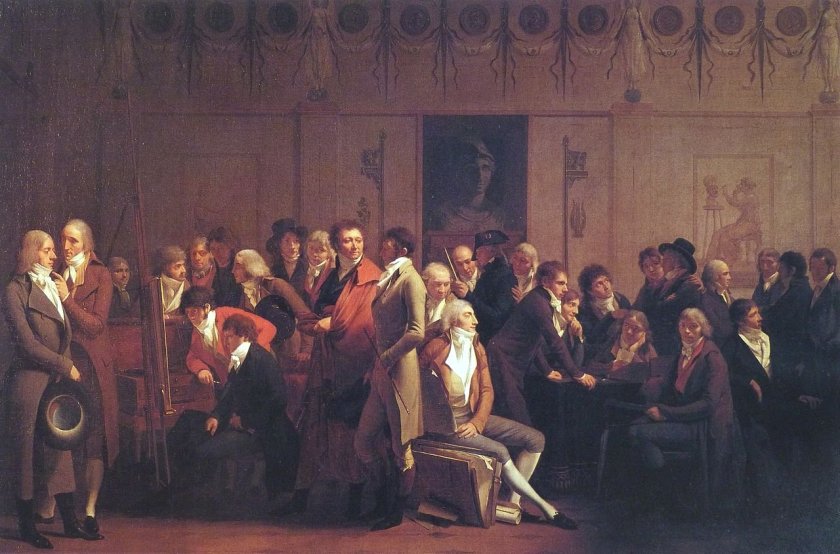
Gathering of Artists in the Studio of Isabey by Louis-Léopold Boilly (1798)

In 1798 Boilly put forward his painting Gathering of Artists in the Studio of Isabey for exhibition at that year’s Salon.  This genre of multi-figure or group portraits was popular with many Dutch and British artists and in this work of fiction, Boilly has imagined what it would have been like if all the young aspiring artists of the time had met up at the studio of his contemporary the French artist Jean-Baptiste Isabey, who we see dressed in red standing behind the man sitting at the easel.  The studio’s classical decoration is the work of architects Percier and Fontaine whom we see depicted standing on the left.

Arrival of the Stagecoach by Louis-Léopold Boilly (1803)

Boilly regularly exhibited at the Salon until 1824 and he received a gold medal at the Salon of 1804 for his painting Arrival of the Stagecoach.  The work depicts a major event in Parisian life – the daily arrival of a stagecoach in the crowded courtyard of the Messageries in rue Montmartre (which is now Rue Notre-Dame-des-Victoires).  This was a place where stagecoaches converged from all over France and Europe in the early 19th century. In the painting, we see the stagecoach is in the parking space reserved for coaches coming from northern France and Belgium, indicated by the inscription on the wall.

This is an interesting study of Parisian life.  Boilly has depicted a throng of people some of whom are waiting to board the stagecoach.  By their attire, we can see the various social classes.  At the centre of the painting we see a bourgeois being welcomed by his wife; on the left-hand side, we see a soldier with his arm around a flower seller or maybe she is a maid from the local hostelry, who by the way she is ignoring him, has only eyes for the well-dressed military officer with the plumed hat to her left.  Unfortunately for her, he is totally disinterested in her. There is still one passenger, an elderly lady, sitting in the coach.  Maybe she is awaiting assistance to help her debark, maybe someone was supposed to be there to meet her but has not arrived.

The young delivery men can be seen on top of and at the side of the coach helping to unload packages which have been brought in by the coach.  We see another by the side of the military officer almost brought to his knees by the weight of the case he is carrying on his shoulder.  He was a portefaix, an old term for a porter.   These workers were known as gagne-deniers, unskilled workers, often peasants from the countryside who have come to the city to earn a living and often were paid a mere pittance.   Now look at the characters on the far right of the painting. The man is the epitome of elegance albeit bordering on being a dandy. The lady with him has a pug on a leash, which was at the time the height of fashion. The little girl standing with them has turned her back on them and seems totally disinterested in the adult conversation.

Boilly continually showed an interest in the bustling life of Paris and in this work and others he highlighted the developing role of transport in the early 19th century with the Napoleonic wars and the development of capitalism. This painting which describes an everyday urban event, a scene which falls within the domain of genre painting which, at the time and in view of the Paris Salon academicians was considered inferior to history painting.  Despite that, the work won the gold medal at the Salon in 1804 and was ultimately acquired by the Louvre in 1845.

The Triumph of Marat by Louis-Léopold Boilly (1794)

Boilly was thirty-three at the height of the Reign of Terror period during the French Revolution in 1794.  He was a half-hearted supporter of the Revolution, and that year he was denounced to the Société Républicaine des Arts by a fellow artist, the Jacobin fanatic Jean-Baptiste Wicar, for having painted “obscene works revolting to republican morality.”  He was condemned by the Committee of Public Safety for these erotic undertones and for the frivolity of his work as well as his penchant for depicting the bourgeois in his early paintings. He was saved from literally a “fate worse than death” when his accusers searched his home and found his overtly flattering painting of Jean-Paul Marat, Triumph of Marat, the rabble-rousing radical journalist and politician and hero of the Revolution.  Although Boilly survived the incident, his wife died during these anxious times.  Boilly remarried in 1795.

The Movings by Louis-Léopold Boilly (1822)

In 1822 Boilly completed a painting entitled The Movings which highlighted the plight of the poor.  In the painting, we see several families, who were unable to pay rent, and so were forced to move out of their homes with their belongings and travel the streets of Paris in search of new shelter. The painting depicts a palpable tension of a social drama and Boilly has created this by adding the opposing constituents in the setting.  In the left background, we see the mirage-like image of the church of Santa Maria dei Miracoli in Rome. Most of the figures in the work appear to be moving away from the Roman church. However, the owners of the front wagon, possibly a lowly and poor family that appears to have come from outside the city in search of work, move towards the distant mirage of the church and it is this connection that suggests that the arriving family’s search for a better financial future will prove futile, as well-paid job opportunities, like the church, are just an illusion.  This was how Boilly saw life at that juncture of time.

Recueil de Grimacers (Collection of Grimacers) by Louis-Léopold Boilly

Boilly was not only a fine artist but he was also a fine businessman and all through his career, he could change his artistic style to coincide with what was popular at the time with the public and made money by selling engraved reproductions of his genre paintings.  One of the strangest form of his art was his depiction of grimacers.  Grimacer is the French word meaning “to pull a face” and it fascinated Boilly, who produced many amusing works focused on the grimacers.   The lithograph above,  Les Amateurs de Tableaux (Lovers of Paintings) is part of his collection Recueil de Grimacers (Collection of Grimacers).  In the painting, we see several grotesque looking characters, open-mouthed, brows furrowed as they concentrate on a small painting, some peering through monocles and spectacles.  It was thought that Boilly was poking fun at the so-called “amateur art connoisseurs”.

Les Grimaces by Louis-Léopold Boilly (1823)

In other similar works, the artist made many studies of facial expressions and the result was humorous but often cruel caricatures of contemporary society.  In his lithograph, Les Grimacers, he even included himself (top left)

The Artist's Wife by Louis-Léopold Boilly (c.1799)
The Artist’s Wife by Louis-Léopold Boilly (c.1799)

Boilly was a talented portrait artist and received many lucrative commissions for his portraits.  It is said that he completed more than five thousand portraits during his lifetime.  One of my favourites is one he completed around 1799 entitled The Artist’s Wife in His Studio, which featured his wife.

In the 1820’s Boilly was one of the first French artists to experiment with lithography to reproduce his paintings.  He last exhibited at the Salon in 1824 and in the spring of 1828 he sold his collection of Dutch, Flemish, and French paintings and decorative objects, as well as thirty-seven of his own paintings. The monarchy of Louis-Philippe awarded him the cross of the Légion d’honneur in 1833. He died in Paris on January 4th 1845 aged eighty-four.  His youngest son, Alphonse Boilly was a professional engraver who apprenticed in New York.

Gerda Gottlieb and Einar Wegener

Gerda and Einar
Gerda and Einar

The artist I am looking at today was unknown to me.  The more I read about her the more I realise I should have been aware of her especially after the recent publicity.  Howeve,r so that I am not cast alone as the “unknowledgeable one” I wonder how many of you have heard of Gerda Marie Fredrikke Gottlieb.  Well, have you?   I am not going to totally give away why you, like me, should have known her until a little later in the blog.  Today’s blog is not just about her but also about her first husband Einar Wegener.

Gerda Wegener (née Gottlieb)
Gerda Wegener (1886 – 1940)

Gerda Marie Fredrikke Gottlieb was born on March 15th 1886 in the small rural town of Hammelev in the eastern part of central Jutland. She was the daughter of Emil Gottlieb, a clergyman in the Catholic Church and Justine Gottlieb (née Osterberg). Although she had three other siblings they all died before adulthood.  Life as the daughter of a clergyman was a very conservative one.  Probably, because of her father’s profession, the family moved around the country.  Whilst still a child the family moved the short distance south from Hammelev to the coastal town of Grenaa and later to the central Jutland town of Hobro.

Gerda showed a love of art and an unusual artistic talent at a young age and began to receive some local artistic training. In 1903, when she was seventeen years of age, and had completed her schooling, she managed, after a lot of cajoling, to have her parents agree to allow her to carry on with her art studies and enrol at the newly opened women’s college at the Royal Danish Academy of Fine Arts in Copenhagen.  Gerda proved to be a very talented student and in 1904 some of her work was exhibited in the Kunsthal Charlottenborg which is the official gallery of the Royal Danish Academy of Art.  It was at this artistic academy that fate was going to change her life for it was here that she met and fell in love with a fellow Academy student Einar Wegener.

Einar Wegener
Einar Wegener

Einar Mogens Andreas Wegener was born a male (important to note!) on December 28th 1882 in the small Danish town, Vejle, which is situated in the southeast of the Jutland Peninsula and lies at the head of Vejle Fjord.  He was the youngest of four children. By all accounts Einar was a precocious child who, like Gerda, showed an early artistic talent. He trained as a painter at the Vejle Technical School, and on graduating in 1902 enrolled at the Royal Academy of Art in Copenhagen.

Capri, Italy by Einar Wegener (c.1920)

In his own works Einar Wegener often painted landscapes from the place where he came from, and later scenes from the countryside in France. Einar Wegener received Neuhausens prize in 1907 and exhibited at Kunstnernes Efteraarsudstilling (the Artists Fall Exhibition), Vejle Art Museum and in the Saloon and Salon d’Automme in Paris . These two aspiring young artists would often paint together although their interest in art differed.

Landscape by Einar Wegener (1908)

Einar liked to paint landscapes whereas Gerda preferred illustrative work, the type she would have seen in fashion magazines.  Her main influences derived from her love of French eighteenth century Rococo art depicting well dressed women in luxurious and colourful clothes painted by the great French artists of that time such as Jean-Antoine Watteau, Francois Boucher, and Jean-Honoré Fragonard.  Having a love of illustrative work she also admired the work of a contemporary of hers, the British Victorian illustrator Aubrey Beardsley

The Morning Dream, an illustration by Aubrey Beardsley

Beardsley, a major figure in Aestheticism and Art Nouveau, was influenced by the pre-Raphaelite painter and illustrator, Edward Burne-Jones and the woodcuts of the Ukiyo-e movement in Japanese art.  He had a distinctive style contrasting the subtle use of line with bold masses of black.  Many of his illustrations were classed as decadent and as an author he wrote an erotic novel, Under the Hill, and illustrated it with pornographic pictures.

Costumes Parisiens - illustration by Gerda Wegener (1914)
Costumes Parisiens – illustration by Gerda Wegener (1914)

Gerda Weneger had a refined and decadent character style, inspired by the English illustrator and her paintings split the views of the critic and public, some of who were excited with her work whilst it offended others, believing it to be simply pornographic. However in a lot of her erotic work Wegener often ensured that the ladies depicted had a disarming and somewhat enchanting twinkle in their eyes which countered the possible pornographic nature of the work. There is a distinct sense of fun and joie de vivre in Wegener’s work.

Lesbian illustration by Gerda Wegener

Gerda now lived in a bohemian area of Copenhagen populated by actors and dancers as well as artists her early works often depicted long-limbed heavily made-up, colourfully dressed exuberant females who were full of joie de vivre rather than art’s normal depictions of somewhat lifeless women.  In some way this could have been her challenge to the art establishment’s depiction of women, even challenging society’s concepts of women and challenge the standards of the time. Her book and magazine illustrations included ones which focused on high fashion and which were acceptable and loved by the public but she also produced illustrations featuring lesbianism and erotica which were often frowned upon my many parts of society.  There was a belief that Gerda herself was a lesbian.

Lili Elbe (1926)
Lili Elbe (1926)

Although I had never heard of Gerda and Einar Wegener they have become well-known not for their art but his sexuality which was brought to life in the 2016 biographical romantic film, The Danish Girl, which was based on the fictional book, of the same name, written in 2000 by David Ebershoff.    The book and the film also derived their information from a 1931 book about Einar.   The biography of Einar Wegener (Lili Elbe) was published in Denmark in 1931 under the title Fra mand til kvinde (From Man to Woman).  This was actually an autobiography edited by Niels Hoyer (real name Ernst Ludwig Hathom Jacobson) who had put together many manuscripts and letters after Lili’s death.  So when did the problematic sexuality of Einar first surface?  The Danish Girl film and book probably over simplified the beginnings of Einar’s doubt about his own sexuality but they refer to the day when he was asked to pose for his wife.  He described the occasion:

“…About this time Grete painted the portrait of the then popular actress in Copenhagen, Anna Larsen. One day Anna was unable to attend the appointed sitting. On the telephone she asked Grete, who was somewhat vexed: ‘Cannot Andreas pose as a model for the lower part of the picture? His legs and feet are as pretty as mine…”

Einar was very reluctant but Gerda finally persuaded him.   When Anna turned up unexpectedly at their studio she was very impressed with Einar’s portrayal of her and nicknamed him Lili.  On seeing (Einar, whose middle name was Andreas), she reportedly said:

 “…You know, Andreas, you were certainly a girl in a former existence, or else Nature has made a mistake with you this time…”

Two Cocottes with Hats (Gerda and Lili) by Gerda Wegener

Gerda was so pleased with Einar as a female model she persuaded him to model for her on a number of future occasions.  Wegener’s fashion industry paintings featured beautiful women dressed in chic attire, one of the most popular of which was a captivating lady with a stylish short bob, full lips, and haunting almond-shaped brown eyes. Who would have believed that this exquisite beauty was her husband, Einar, who posed as her fashion model while donning women’s clothing. It was through these experiences that her husband Einar came to realize his true gender identity and began living his life as a woman. Einar’s sexuality became even more complicated when he and Gerda would go to parties as two females and often Gerda would introduce Lili Elba as Einar’s sister.

Gerda and Einar married in 1905 whilst they were still students at the Academy.  She was nineteen and he was twenty-two.

Portrait of Ellen von Kohl by Gerda Wegener

In 1907, Gerda completed a portrait entitled Portrait of Ellen von Kohl but although as we look at it now you will be surprised to know it caused quite a controversy and sparked the Peasant Painter Feud which was a national debate covered in the pages of the Danish newspaper Politiken.  It was all about ‘distasteful’ paintings of excess, (the smouldering look of Ellen von Kohl was seen as being too lascivious!) for the favoured norm at the time was for realism favoured representations of ‘ordinary people in the countryside’. The debate became so heated that the portrait was rejected by both the Kunsthal Charlottenborg, which was the official gallery of the Royal Danish Academy of Art, and also the Den Frie gallery, which was founded by the Association of Danish Artists, in protest against the admission requirements for the Kunsthal Charlottenborg.

Lili Elbe by Gerda Wegener

Gerda completed her art course at the Academy in 1907 and once again fate was going to play a part in her future as in 1908, soon after leaving the Academy she entered and won a drawing competition organised by the leading Danish broadsheet newspaper Politiken. It was competition to draw ‘Copenhagen Woman’.  The newspaper was so pleased by her winning entry that they offered her a job as a regular contributor and soon she established herself as a capable cartoonist and illustrator.  This was just the start of her career as the recognition launched her into the fashion magazine industry and soon she became a leading illustrator of women’s high fashion in the Art Deco style of the time

Although the bohemian quarter of Copenhagen, where the couple lived, had a somewhat laissez-faire attitude towards life, the pair eventually moved to the more liberal Paris and soon Gerda and Einar began to live as two women.  In the French capital, Gerda was able to further her art career and, some would have us believe that she became a more active lesbian.

Lili and Gerda by Gerda Wegener

Besides posing as a woman for his wife’s paintings, Einar only dressed as Lili and was a tremendous hit on the bourgeois Parisian scene, with all its decadence, art, and sex. It soon became common knowledge that Lili and Einar were the same person but for Einar he had the satisfaction in knowing he would not be ridiculed.

Lili Elbe by Gerda Wegener

Sadly for Einar simply dressing as a woman was not enough and he was suffering mental torment as Lili slowly took over his life.  For him, Einar was slowly dying and Lili was taking control.  Einar viewed himself as an artist but, as his alter-ego Lili, he viewed things very differently.  He described Lili as:

 “…thoughtless, flighty, very superficially-minded woman”, prone to fits of weeping and barely able to speak in front of powerful men…”

Illustration by Gerda Wegener for the magazine La Baionette

Life in Paris was good for Gerda who found success as a portrait painter, fashion illustrator and caricaturist and received many commissions for illustrations from La Vie Parisienne, a French weekly magazine founded in Paris in 1863, Le Rire, the successful humour magazine, La Baïonnette, the magazine which started a few years after Gerda and Einar moved to Paris, as well as the elite Journal des Dames et des Modes, a favourite of artists, intellectuals, and high societyHer success guaranteed a degree of fame and soon she was the primary breadwinner of the couple.

Self portrait by Gerda Wegener

Andrea Rygg Karberg, art historian and curator at ARKEN Museum of Modern Art in Denmark has no doubt about the artistic ability of Gerda Wegener, saying:

“…Gerda was a pioneer who spent two decades as part of the Parisian art scene and revolutionised the way women are portrayed in art.  Throughout history, paintings of beautiful women were done by men.  Women were typically seen through the male gaze. But Gerda changed all that because she painted strong, beautiful women with admiration and identification – as conscious subjects rather than objects…”

Café by Gerda Wegener

With her new lesbian lifestyle in the avant-garde French capital, Gerda Wegener’s art became considerably more racy and scandalous. In addition to her fashion world portraiture that was featured in many fashion magazines, Wegener completed paintings featuring nude women often depicted in erotic, some would say lewd, poses. These paintings were termed “lesbian erotica,” and were published in art books, the most notorious being the Adventures of Casanova.  Some of these risqué paintings were exhibited publicly and the erotic nature and lesbian theme of the works often led to a public outcry.  Far from being taken aback by such vociferous criticism of her work by sections of the public, Gerda revelled in the notoriety.

Illustration by Gerda Wegener

The phrase “there is no such thing as bad publicity” may be correct as far as the sale of her work but for Gerda there was a price to pay.  Christian X, the King of Denmark, became aware of Gerda’s marriage to Einar Wegener when he, Lili Elba, had legally become a woman, and so the king declared their marriage invalid in October 1930. Maybe the time had come to an end for Gerda and Einar’s marriage anyway but in 1930 following the annulment, the couple parted ways amicably.

Femme a la Rose by Gerda Wegener

Gerda Wegener following the end of her marriage to Einar married an Italian military officer, Major Fernando Porta, and the couple went to live in Morocco. She continued to paint and would sign her paintings as ‘Gerda Wegener Porta’. The marriage was not a happy one and did not last long with couple divorcing in 1936.

Indian couple seated on a balcony by Gerda Wegener Porta

She returned to Denmark in 1938, but by then, her paintings and illustrations were no longer in demand and sadly Gerda just managed to eke out a meagre living by painting and selling postcards.  She managed to exhibit her work one last time in 1939.  She had no children and her latter years were spent alone in relative obscurity and with the loneliness came her reliance on alcohol.  Gerda Wegener died on July 28th 1940 in Frederiksburg, Denmark aged 54, a few months after the German army marched into Denmark.  She was buried alone at Solbjerg Park cemetery in Copenhagen.

Einar Wegener / Lili Elbe (1882 - 1931)
Einar Wegener / Lili Elbe
(1882 – 1931)

Einar Wegener continually struggled with his sexuality and believed that Lili Elba was his true self.  It was no longer enough to dress as a woman, he believed that the only way to be at peace with himself was to undergo revolutionary sex reassignment surgery and for that he had to travel to Germany.  In 1930 he attended Dr Ludwig Levy-Lenz clinic in Berlin where he was castrated and had his penis surgically removed.  The following year, 1931, he underwent further surgery, vaginoplasty, which was a procedure that results in the construction of the vagina.  Sadly for Einar these surgical procedures were carried out at a time before antibiotics and he died in Dresden of an infection on September 13th 1931, aged 48.

Eugène Galien-Lalou – the painter of Paris

Eugene Galien-Lalou (1920)
Eugène Galien-Laloue (1920)

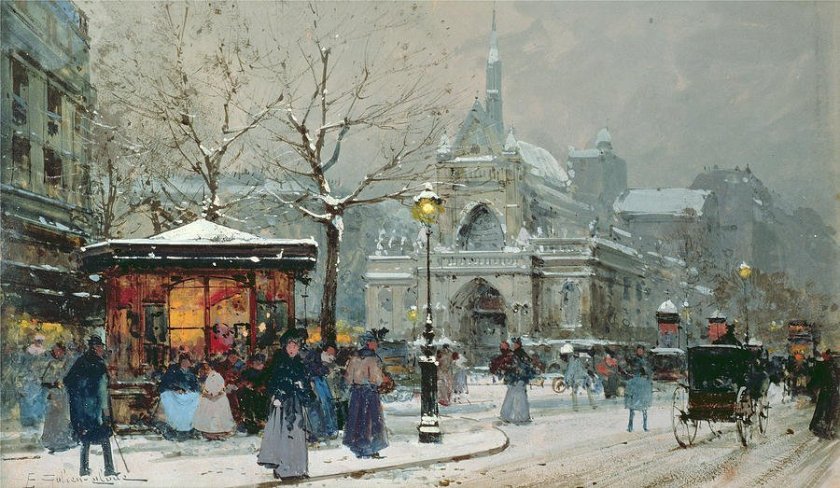
La Belle Époque, which literally means “Beautiful Age” is a name given in France to the period from the end of the Franco-Prussian War in 1871 and the start of World War I in 1914. So why was this termed a beautiful age?   Probably the reason for naming this period thus was because, for the middle and upper classes in France, the standards of living and security increased in comparison with the dark days that went before.  The devastation and death toll of the Franco-Prussian War and the short-lived but bloody battles of the Paris Commune were over.  Napoleon III’s period of power had ended and a Third Republic was declared.  It was a period free of wars affecting France.  It was a period of economic affluence and an era of many new innovations both cultural and technological.  For many it was a good time which needed to be savoured.  My artist today is one who lived and painted during this time and his Parisian street scenes of the time depicted an opulence which many, but the poorer classes, could enjoy. Let me introduce you to the French painter Eugène Galien-Laloue.  He was a consummate draughtsman.  His depictions of fin-de-siècle Paris architecture was of an amazing standard and yet he was not just a cityscape painter as he was equally adept with his landscape work in which he brought to life the rural French countryside.

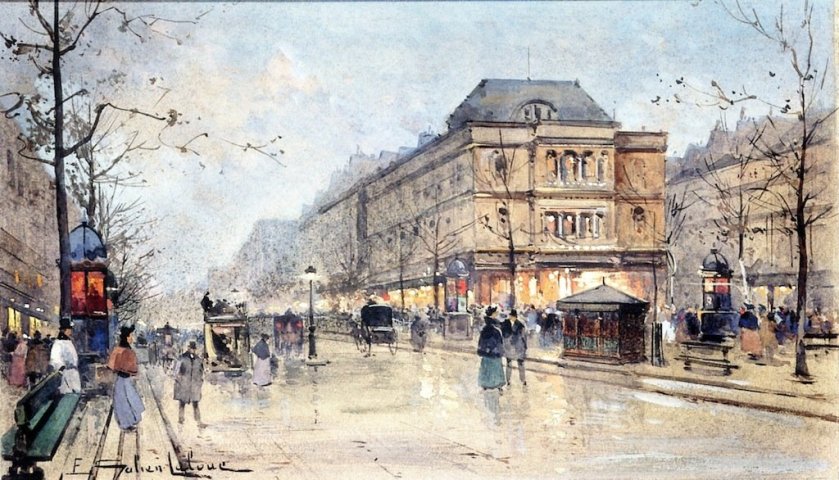
Paris Street in Autumn by Eugene Galien-Lalou
Paris Street in Autumn by Eugène Galien-Lalou

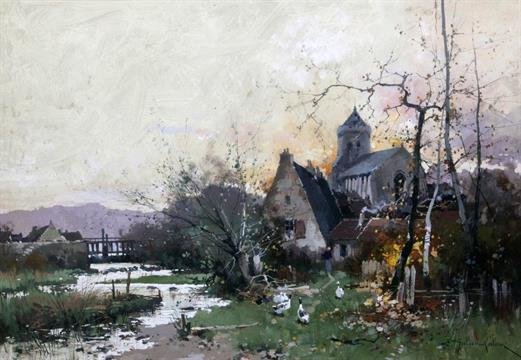
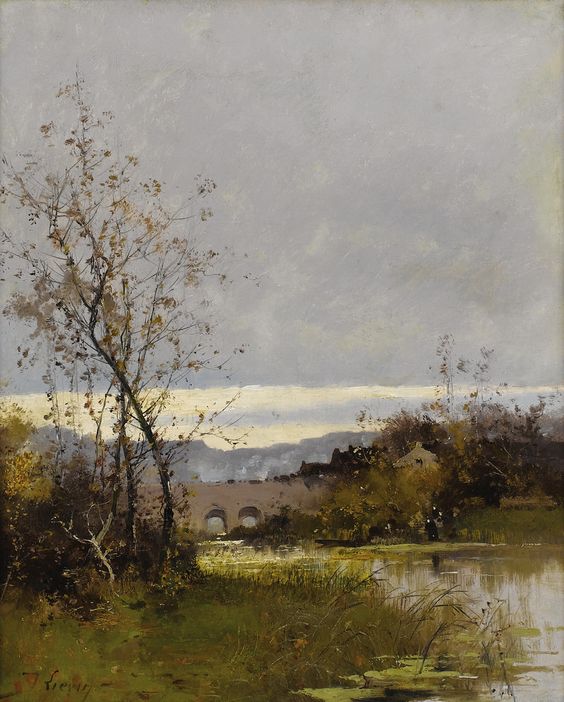
In his tiny gouaches Galien-Laloue rendered every detail of fin-de-siècle Parisian architecture with absolute precision, but in his landscape works he was more attuned to the painterly tradition of the Barbizon School and the Impressionists, recording life in the rural French countryside in light-filled canvasses.  Galien-Laloue painted with great delicacy a wide variety of subjects.    Eugene

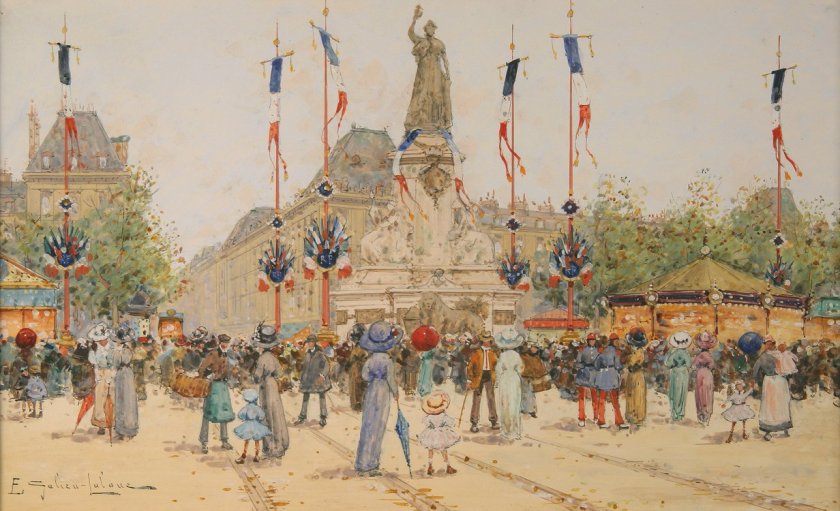
Un 14 Juillet, Place de la Republique by Eugène Galien-Lalou

Eugène Galien-Laloue was born in Montmartre, Paris, on December 11th 1854, almost a year after his father, Charles Laloue, an artist and set designer, married Eugène’s mother, Endoxi Lambert in December 1853.  Eugène was the eldest of nine children and the large family lived on Rue Leonie in the Montmartre, which at the time was an artistic community where many of the Parisian artists and freethinkers lived.  Eugène, even as a child, demonstrated his artistic ability and almost certainly his early training from his father, who liked to paint, and being a set designer was a talented draftsman.  Charles Laloue died suddenly in 1869 when Eugène was fifteen years old and the family, which only just made ends meet when he was alive, struggled to survive financially.  Eugène, was forced to leave school so that he could find work and help his family and his mother secured him a job as an assistant to a notary.

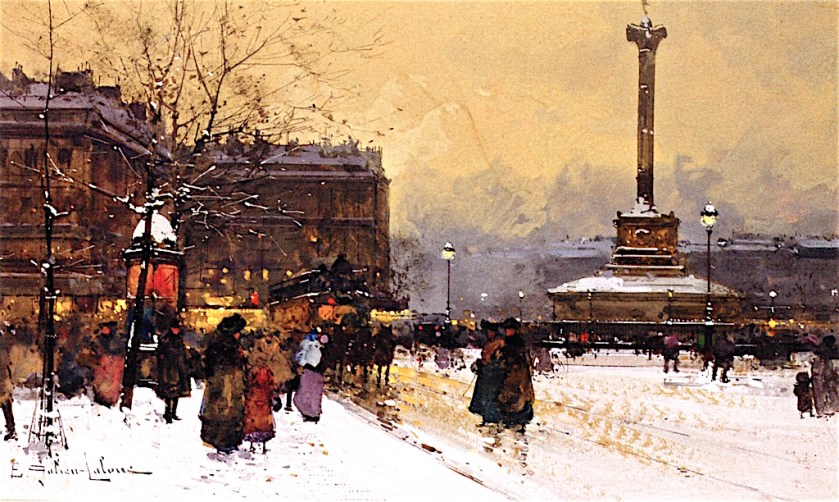
Place de Bastille by Eugène Galien-Laloue

In 1871, aged seventeen, filled with a sense of patriotism and nationalism, Eugène joined the army but to do so he had to lie about his age.  The war with Prussia was a short but deadly affair which France lost.  Fortunately, Eugène came through the bloody war unscathed and once the war ended he left the army and returned to civilian life.  His one aim in life was now to become a professional artist.  For an aspiring artist in Paris there was just one course one had to take to reach that ultimate goal.  One had to become a member of the prestigious L’Académie des Beaux-Arts, which was looked upon as the hub of the Parisian art world.  Some of the artists of this French Academy also served on the jury that selected paintings for the well-respected Salon de Peinture et de Sculpture, held at the Palais de l’Industrie on the Champs-Élysées, at which more than a thousand artists and sculptors had their works of art and sculptures displayed.  Unlike today there were only a small limited number of galleries where artists could show their work and so gaining access to the Salon was crucial for their success as painters and getting approval from the Salon hanging jurists was critical.

Flower Marketby by Eugène Galien-Laloue
Flower Market by by Eugène Galien-Laloue

In order to be nominated to the French Academy, an artist followed a well-tread course of instruction.  Students attended either the official school, the École des Beaux-Arts de Paris, or if they or their parents were affluent, received instruction in the private atelier of an established artist, often one who had connections with luminaries of the Salon.  Academic learning in the nineteenth century to become an artist was not an easy process.  The tuition was laborious albeit meticulous and it started off with the students learning draughtsmanship by copying engravings and sketching Roman and Greek sculpture, which was known as “working from the antique,” which translated, meant sketching black and white tonal studies from classical marble statuary or casts.  If the student had mastered that task, then the tutor would allow them to progress to the next phase of learning.  Advancement from one phase of instruction to another was based on the aspiring young artist mastering what they had been taught.  Progression was not based on an indiscriminate period of instruction.   They would then move on to drawing nude models using just graphite or charcoal.

Théatre de la Ville byby Eugène Galien-Laloue
Théâtre de la Ville by Eugène Galien-Laloue

Following several years of drawing the young artists would begin to paint.  This would be carried out under the direction of a time-honoured master and, when he believed his scholars to be ready, they would be allowed to submit their work to the Salon.  Having been trained by an established and well-respected painter would count for a great deal with the Salon’s jurists.  Not only did the jurists control which paintings would be exhibited they also decided on the placement of the paintings on the monumental and crowded wall of works.  A good placing of an artist’s painting (at eye level) ensured that they would be noticed by the buying public.  In the days of Eugène Galien-Laloue the Academy favoured large figurative works and looked on painting landscapes as a mere hobby one did when holidaying in the many artist colonies!

Illustrated railway poster of the time

Records do not show whether Eugène attended the Academie des Beaux-Arts or any other academy, such as L’Academie Julian but when one of his works appeared at the Salon it was noted in the catalogue that he was artistically trained by his uncle, Charles Laloue, but of course this was also the name of his father, so maybe there was some confusion as to who did train Eugène.  In life, everybody needs a good break, a stroke of luck, and for Eugène it was the seemingly unbounded industrial enlargement of La Belle Epoque and one aspect of this was rapidly developing rail network which was growing westward from Paris. Eugène was hired as an illustrator for the French railways, the Chemins de Fer de l’Ouest.  The Compaigne de l’Ouest was formed in 1855 through the merger of several smaller railways operating in the western suburbs of Paris, largely serving Normandy and Brittany. Destinations served included London and Jersey (through ports in Normandy and Brittany), as well as Rouen, Dieppe, Saint-Germain, Mont St. Michel, Mers-les-Bains, Treport, and other outlying places.   Illustrators, like Eugene, were employed to illustrate the sights that awaited passengers on their rail journeys and these were used to seduce potential passengers to find out more about what lay at the end of the line.  To carry out his job as a railway company illustrator Eugène had to travel to all these “exotic” places out West and sketch the rural landscape along the way.

En Normandie by Eugène Galien-Laloue

Eugene exhibited his work for the first time in 1876 at the Museum of Reims, where his work Le quai aux fleurs par la neige (Flower Market Along the Seine Under the Snow) was shown. The following year he exhibited for the first time at the annual Parisian Salon, showing En Normandie (In Normandy) as well as two other gouaches. He preferred executing gouaches since they were less time consuming as his oils and, in fact,  brought comparable prices.

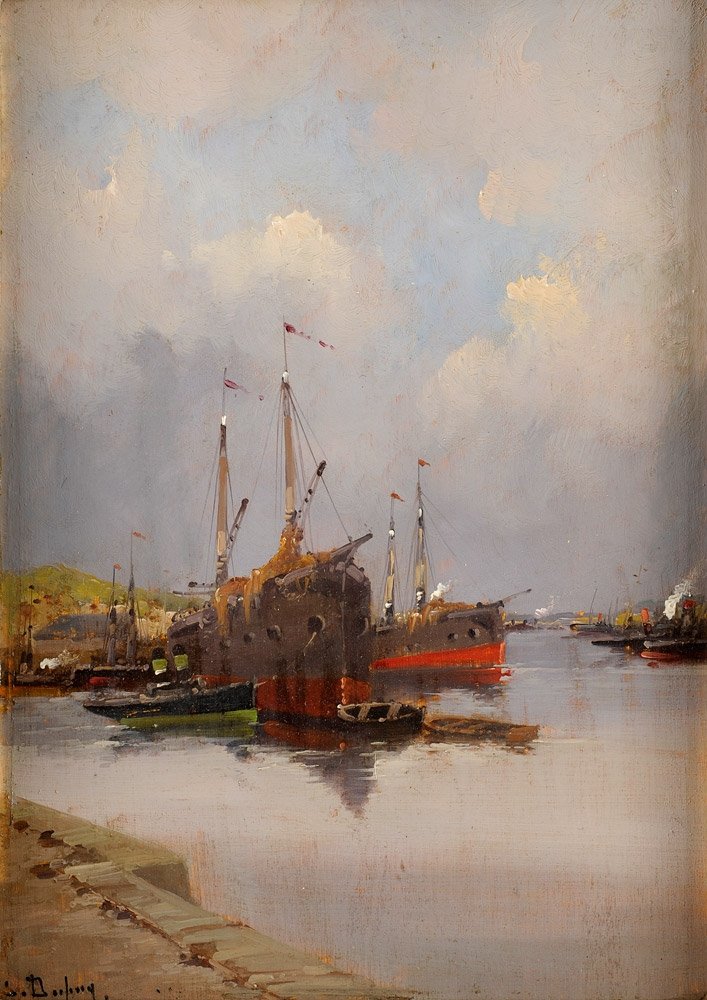
Harbour Scene by Eugène Galien-Lalou

After some time, Eugène Galien-Laloue decided to become self-employed and set himself up in his own Paris studio in rue de Clignancourt.  He spent a lot of his time alone which did not seem to bother him.  Acquaintances described him as a loner, an introvert, who was never happier than when he was working alone in his studio or sitting quietly managing his business.  Modern city life with all its gaiety did not appeal to him.  Maybe he became somewhat crotchety as it was said of him that he was a loner and someone who did not suffer fools gladly, and because of this characteristic people found it very difficult to befriend him.

The French Art Expert, Noe Willer, who was author of Galien-Laloue’s catalogue raisonné wrote of this aspect of Galien-Laloue’s character:

“…He was not eccentric but always conservative, practically a royalist.  He was obsessed with his painting.  In his private life he found simplicity alluring: he married three sisters, one after the other (beginning with the youngest and ending with the oldest).  They had all lived next door to him.  He lived a monastic life.  All worldly pursuits, games, alcohol, the pleasure of the flesh were not for him. Riding his bicycle to places in Paris to paint was his only physical exercise…”

View of the Grands Boulevards by Eugène Galien-Lalou

The cityscape of Paris was changing rapidly during Eugène Galien-Laloue lifetime.  It all began around the 1830’s when Parisians were complaining about the condition of their city.  The city was overcrowded.   The streets with their open sewers were narrow and dark.  Paris had become a very dangerous and unhealthy environment to live in and the people were not happy with the government.  A whiff of revolution was once again in the air.  Tampering with the problem was not helping and so Napoleon III, in 1854, and his interior minister brought in Georges Eugène Haussmann, known as Baron Haussmann, to oversee the “rebuilding” of the city.  He had the slums torn down and the narrow streets were turned into wide avenues.  Large parks were created as were small villages on the periphery of the city.  A new theatre was built and the Paris Garnier opera house was completed in 1875.  The cit,y after many years of change, became a desirable place to live and it was this revitalisation of Paris which became the subject of the many Belle Epoque artists such as Eugène Galien-Laloue.

Summer Landscape with River by Eugène Galien-Laloue

These Belle Epoque artists were pleased to depict the reality of the newly refurbished French capital with its cafés, parks and buildings.   More importantly this now beautiful city was a magnet to tourists, visitors from Great Britain and the United States came to Paris while they were partaking of the “Grand Tour” and  Galien-Laloue had a ready market for his work which concentrated on depictions of the city.  These depictions were just the treasured mementos the American tourists wanted to take home with them for it is known that many of Galien-Lalou’s cityscapes made their way across the Atlantic and into the collections of wealthy Americans from New York, Boston and Chicago.

La Madeleine sous la neige by Eugene Galien-Laloue
La Madeleine sous la neige by Eugène Galien-Laloue

One of Galien-Laloue’s favourite subjects was, L’église Sainte-Marie-Madeleine; less formally known as La Madeleine.  This Roman Catholic church, looking more like a Roman temple, occupies a commanding position in the 8th arrondissement of Paris and was originally designed as a temple to the glory of Napoleon’s army.  Galien-Lalou depicted the building and the area surrounding it in both summer with the flower markets brightening up the grey buildings and in winter with snow on the ground and people rushing to get to the warmth of their destinations.

River in Normandy by Eugène Galien-Laloue

In complete contrast, many people, who moved from the countryside in search of work and went to live in the bustling and noisy city, hankered after a more tranquil life in the countryside they had left behind and wished to be reminded of their rural idyll of the past.  Paintings depicting rural landscapes became popular and Galien-Laloue and the Barbizon painters of the time filled the void in the market for those people who wanted a landscape painting to remind them of the peaceful serenity of nature they had left behind.  Galien-Laloue had cornered both markets – Parisian street scenes and his rural landscape works which he made when he journeyed around the roads and villages of the Ile-de-France Region and the riverside views along the tree-lined banks of the rivers Seine and Marne.

In the early 1900’s Eugène and his family left the city of Paris and went to live at Fontainebleau, a town fifty kilometres south east of Paris which is surrounded by a large and scenic forest.  Eugène now fifty years of age was probably drawn to this area because of its beautiful and quiet environ and the slower pace of life such an idyll afforded.

Snow Scene in Paris by Eugène Galien-Lalou

In 1904 he once again put forward a painting which was exhibited at that year’s Salon.  It had been fifteen years since Galien-Laloue had exhibited at the annual Salon due partly to the politics of the Salon and maybe because his sales were so good that he no longer needed the Salon to be a sales vehicle. World War I broke out in August 1914 and the ever-patriotic Galien-Laloue put himself forward to fight for his country but, at that time, he was sixty years of age and he was considered too old for military duty.

Eugène Galien-Laloue married three times which in itself is not unusual but the extraordinary thing was that his three wives were sisters.  He married Flore Bardin in the 1880’s and they had one child, a son, Fernand.  She died in 1887 and five years later he married her elder sister Ernestine.  This second marriage lasted thirty-three years until she died in 1925.  They had a daughter Flore.  A short time after the death of his second wife he married for a third time this time to another of the Bardin sisters, Claire.  Claire died in 1933 and Eugène, now almost eighty years of age, moved back to Paris to live with his daughter Flore, her husband and his grandchildren.

Sortie La Théatre by Eugene Galien-Laloue
Sortie La Théâtre by Eugène Galien-Laloue

Galien-Laloue never stopped painting but his output of pictures decreased.  Despite living with his family, he became even more introverted and lived a rather solitude lifestyle.  When the German army moved towards Paris in 1940, the family left their city home and went to their summer residence in their country at Chérence in Val d’Oise.  During this flight from the French capital Eugène broke his arm which curtailed his ability to paint.

Eugène Galien-Laloue died at Chérence on April 18th 1941, aged 86.

Many of his paintings also bore other names such as “L.Dupuy”, “Juliany”, “E.Galiany”, “Lievin” and “Dumoutier”.  The reason for this is thought to be that he had a sales exclusivity contract with certain galleries that gave them the exclusive right to sell all his works and so to get around this he may have decided to sell some of his works under a different name !   So why those pseudonyms?   J. Lievin’ was the name of a soldier he met during the Franco-Prussian war, ‘E. Galiany’ is an Italianized version of his own names, and ‘L. Dupuy’ was the name of a neighbour, Dupuy Léon.  Although he signed the paintings, very few of them showed a date and art historians have found it difficult to actually date them.

Hendrik Willem Mesdag. Part 3. Bomschuiten, Storms and Panorama Mesdag

Hendrik Willem Mesdag by Hendrik Johannes Haverman

Following his visit to the Frisian island of Nordeney in the summer of 1868, Hendrik Mesdag would dedicate the rest of artistic life to seascapes and maritime paintings.  He and his wife Sientje had moved back to The Hague in 1869, a town which was a short distance from the coastal district of Scheveningen which offered him the perfect situation for his seascape paintings.

Beached Bomschuiten by Moonlight by Hendrik Mesdag

Scheveningen, at the time of Mesdag, was a small fishing village which has since grown to become one of the most popular beach destinations of The Netherlands. In the 16th century the village of Scheveningen had less than 900 inhabitants whose livelihood was dependent on fishing.   In the 19th century the main fishery was focussed on the catch of the herring. These were the golden times for the Scheveningen’s fishing industry but by the end of the 19th century the fishery almost ended since few young folk of Scheveningen followed in their fathers’ footsteps in becoming fishermen.

The Scheveningen Fishing Fleet putting to Sea in Hevay Weather by Hendrik Mesdag

One of the main features in Mesdag’s seascape depictions was the fishermen and their flat-bottomed boats known as bomschuiten on the beaches at Scheveningen.  When Mesdag went to live in The Hague, there was no harbour for the fishing boats and they would have to rest on the beach and the fishermen would simply pull them on and off the shore.  To get them into the sea for the next fishing trip was quite a complex and unusual affair which I saw explained in a write-up on the Gallery Rob Kattenburg website.

“…At about six feet from the water’s edge a heavy anchor is placed in the sea with a smaller anchor fixed to the same cable to prevent the large anchor from what is known as ‘crabbing’ – that is, sliding over the bottom – when the boat is being launched. At a short distance from the vessel an even smaller anchor is fixed to the cable. The youngest anchorman, with the anchor over his shoulder, walks into the sea up to his neck and then drops the anchor. Only after this has been done are the fishermen carried one by one by the so-called carriers or swimmers and set down on a ladder placed at the stern of the vessel. Then the carriers themselves climb on board. A complete crew numbered nine men. Then the anchor cable is wound round a primitive wooden windlass and the handspikes are inserted. Simultaneously with each rolling wave the crew strains to pull the cable in and thus draw the ship out to sea until they reach deep water. At some distance from the coast the sail is hoisted and the boat sets off for the fishing grounds…”

After the Storm of 1894 by Hendrik Mesdag (1894)

The low lying Dutch coastline was often battered by storms, one of the worst being in 1470 when it destroyed the church and half the houses.  The village was again hit by storms in 1570, 1775, 1825, 1860, 1881, and 1894, the latter being the most devastating.  At that time a safe harbour had yet to be built and as usual the fishing fleet of the flat-bottomed bomschuiten had been pulled up on the beach. They were devastated by the ferocity of the storm and most were smashed to pieces and this devastation was captured in Henrik Mesdag’s painting After the Storm 1894.  After this last storm, the villagers decided to build a harbour. Once the harbour had been constructed in 1904, more modern fishing boats replaced the bomschuiten.

Fishing Boats and Fisher-folk on the Beach of Scheveningen by Hendrik Mesdag (1872)

The painting Hendrik Mesdag was probably best known for was his panorama painting which became known as Panorama Mesdag.  I remember when I travelled to Venice many years ago, and visited the Gallerie dell’Academia I came across the enormous painting by Veronese entitled The Feast in the House of Levi.  I could not believe how big it was – it measured 18ft high and 42ft in width.  However, this fades into insignificance if you compare it to the size of Hendrik Mesdag’s Panorama which is 46ft high and 394ft in circumference (14m x 120m).  Trust me, seeing is believing!

London Panorama by Robert Barker (1792)

Panorama paintings had existed prior to Mesdag’s effort.  A panorama or panoramic painting is a massive work of art, which depicts a wide and all-encompassing view of a subject.  But what is a panorama? The word was coined by the Irish painter Robert Barker, the inventor of the visual panorama, by merging the Greek for pan, “all,” + orama, “that which is seen.” They could be depictions of a battle, historical event or a landscape and were very popular in the nineteenth century, a time before television or the cinema. The Irish artist, Robert Barker experimented with the idea of representing nature at a single glance.  Barker was born at Kells, County Meath, in 1739. He set himself up as an artist in Dublin but was never very successful and eventually left Ireland and settled in Edinburgh, where once again he set himself up as a painter of portraits and as a miniature painter. If not a great painter, Barker was certainly a great inventor and devised a mechanical system of perspective which he taught. One day when atop Calton Hill, one of Edinburgh’s main hills set right in the city centre he had the idea of a panorama painting of the city below and in 1787, helped by his twelve-year old son, Henry, he made drawings of a half-circle view from the hill and later in his studio completed his picture in water-colour and took it to London where sadly, it was not well received.  However, Barker believed in his project and completed a whole-circle view of Edinburgh twenty-five feet in diameter. He went on to exhibit the work in the Archer’s Hall at Holyrood and afterwards in the Assembly Rooms in George Street. Later in 1788 he exhibited the work in a large room in the Haymarket, London.  Barker went on to complete many more panorama paintings.

Panorama Mesdag with Sientje sitting under white parasol

In Belgium panoramas became very popular and Hendrik Mesdag received a commission from a Belgian panorama society, Societé Anonyme du Panorama Maritime de la Haye to paint a maritime panorama.  They wanted the panorama, without borders, to be centred around the Seinpostduine, which at the time was the highest sand dune in Scheveningen and was in danger of being excavated to make room for a café-restaurant.

Panorama Mesdag - view of Scheveningen
Panorama Mesdag (detail) – view of Scheveningen

Mesdag accepted the commission believing it to be a great opportunity to depict his beloved picturesque coastal village of Scheveningen and so, he went about enlisting the help of a few artist friends from The Hague School.  He invited George Hendrik Breitner, a young art student from The Hague Academy, whose task it was to sketch the village of Scheveningen, Théophile de Bock, a friend of van Gogh, was tasked to paint the sky and the dunes and the small contribution of Bernard Blommers was the painting of a fisherwoman and her child who are looking out to sea.  Another contributor to this massive project was Mesdag’s wife Sientje, who he depicted in the painting sitting down with her easel under a white parasol.   Mesdag set to work on the panorama in March 1881 building a sixteen-cornered building on Zeestraat in The Hague.  It incorporated a 14-metre-high structure on which Mesdag could paint his work

panorama_mesdag_3
Panorama Mesdag (detail) showing Cavalry exercising the horses on Scheveningen Beach

Mesdag and his team of painters made numerous sketches of the town and the surrounding coast and slowly over the next four and a half months the panorama evolved.  Mesdag was well satisfied with the finished result.  He believed the painting gave an overwhelming impression of nature.  Many believe he was influenced by his training at the hands of Willem Roelofs who had stressed the importance of reality painting.  Roelofs had told Mesdag on many occasions to “paint reality and nothing but reality”.

Panorama Mesdag Gallery

The museum housing the panorama was opened to the public on August 1st 1881 but after five years it went bankrupt.  Mesdag, who was concerned as to the fate of his panoramic painting, bought the museum, and kept it open despite it losing money year on year.   Vincent van Gogh, an early visitor to Panorama Mesdag,  in a letter to his brother Theo, dated August 26th 1881, wrote about the panorama:

“…then I saw Mesdag’s panorama with him [Théophile de Bock], that’s a work for which one must have the utmost respect.  It put me in mind of what Bürger or Thoré, I think, said about Rembrandt’s Anatomy Lesson. That painting’s only fault is not to have any faults…”

Panorama Mesdag Viewing Gallery

I visited Panorama Mesdag at the beginning of December and it was truly an amazing experience.  You enter the building, past the obligatory shop and into two small rooms which house some of Mesdag and his wife’s paintings.  You then follow a corridor upwards through a dimly lit long passage which opens out to what looks a circular observation gallery surrounded by the enormous painting.  The observation gallery has a circular walk way with rails all around it which you can lean against as you scan the painting.  As you stand on the gallery platform, the painting is 14 metres away from you and between you and the painting is sand and various items of flotsam, abandoned fishing nets and marram grasses which make it seem that you are standing on top of a sand dune looking down to the sea on one side and the village on the opposite side.  This addition of sand and bits of driftwood make the whole experience more realistic.

The museum housing the panorama was opened to the public on August 1st 1881 but after five years it went bankrupt.  Mesdag, who was concerned as to the fate of his panoramic painting, bought the museum, and kept it open despite it losing money year on year.

In his later years Mesdag received many honours. In 1889, he was elected chairman of Pulchri Studio Painters’ Society, the society he joined twenty years earlier, and remained in that post until 1907. He received the royal distinction of Officer in the Order of Oranje-Nassau in 1894.  In February 1901 Mesdag is promoted to Commander of the Order of the Dutch Lion.

50th wedding anniversary of Hendrik Mesdag and Sientje Mesdag-van Houten in the Pulchri Studio
50th wedding anniversary of Hendrik Mesdag and Sientje Mesdag-van Houten in the Pulchri Studio (1906)

In March 1909 his beloved Sientje died, aged 74.  Two years later in 1911, Hendrik Mesdag was taken seriously ill and although he recovered, his health slowly deteriorated.  Hendrik Willem Mesdag died in The Hague in July 1915, aged 84.

I end with a quote from the author, Frederick W Morton who wrote an article in the May 1903 edition of the American art journal, Brush and Pencil .  He wrote about Mesdag’s seascapes:

“…Other artists have painted more witchery into their canvases, more tenseness and terror.  A Mesdag has not the glint of colour one finds in a Clays or the awful meaning one reads in Homer.  On the contrary, many of his canvases are rather heavy in tone and are works calculated to inspire quiet contemplation rather than to excite nervous.  But he is a great marine-painter because he thoroughly knows his subject – he has sat by it, brooded over it, studied it in its every phase – and by straightforward methods, without the trick of palette or adventitious accessories, has sought to make and has succeeded in making his canvases convey the same impression to the spectator that the ocean conveyed to him…”

It is very difficult to describe the Panorama Mesdag experience but if you go to YouTube and type in “panorama mesdag” there are a number of videos showing you this wonderful painting.

Hendrik Willem Mesdag. Part 2 – his wife, Sientje Mesdag van Houten.

Sientje Mesdag van Houten (c.1905)

My blog today is somewhat shorter than usual as I decided to concentrate solely on the life and works of Hendrik Mesdag’s wife Sientje van Houten, an artist in her own right and not just “Mrs Mesdag, wife of the marine painter Hendrik Mesdag”.

Hendrik Willem Mesdag married Sientje van Houten in April 1856 and seven years later in September 1863 their only child, Klaas was born.  In June 1864, her father Derk, a wealthy Groningen timber merchant, died and left her a substantial inheritance which she realised in 1866.    This change in her financial situation allowed Hendrik to leave his father’s bank where he had been working for sixteen years and concentrate on his painting and eventually become a professional artist.  He even managed to have one of his paintings, which had been accepted at the 1870 Salon, awarded a gold medal.

Sientje van Houten-Mesdag in her studio (c.1903)
Sientje Mesdag van Houten in her studio (c.1903)

Sientje had accompanied her husband when he went to stay in Brussels to study under Willem Roelofs.  Their house in Rue Van de Weyer was often the focal point for Dutch and Belgian painters, and it could well have been the conversations on art at these soirées that  stimulated Sientje’s mind and enhanced her artistic talent. She, like her husband, not only received instruction from Roelofs but also from Hendrik’s cousin the professional artist, Laurens Alma-Tadema.

Winter Scene by Johannes Christiaan d'Arnaud Gerkens (1875)
Winter Scene by Johannes Christiaan d’Arnaud Gerkens (1875)

She accompanied her husband when he spent the summer of 1866 at the Oosterbeek artist colony and again in the summer of 1868 on the island of Nordeney where she, like Hendrik, spent time painting and sketching seascapes.   The couple moved to The Hague in 1869, where they lived in a house on Anna Paulownastraat and later in a house on Laan van Meerdervoort.  Her husband, who wanted to concentrate on seascapes, later hired a studio room facing the sea at the Villa Elba in Scheveningen where he and Sientje would spend hours painting and sketching. In order to improve her artistic proficiency, Sientje took drawing lessons from their family friend and painter Christian d’Arnaud Gerkens.

Head of a Dog by Sientje van Houten (1875)
Head of a Dog by Sientje Mesdag van Houten (1875)

Life could not have been better for Hendrick Mesdag and his wife Sientje and yet fate would play a fateful trick on the couple.  On September 24th 1871, tragedy struck when their beloved eight-year-old son Klaas, died of diphtheria.  It must have been a devastating time for Hendrik and Sientje.  Who knows whether Sientje wanted to totally immerse herself into something which would deaden the pain of loss but following the death of Klaas, she devoted all her time painting.  She had been in contact with art from an early age through both her father, who had a modest art collection, which she and her siblings would have seen and of course she had lived with her husband and watched him paint.

Still Life with Yellow Roses by Sientje van Houten Medag
Still Life with Yellow Roses by Sientje Mesdag van Houten

At first, Sientje concentrated on landscape painting and would often leave home and go on painting trips in the Scheveningen dunes with her friend and artist, Harriet Lido who was constantly giving her artistic advice.     Sientje Mesdag-van Houten initially focused on landscape painting and travelled to areas such as Drenthe, Overijssel and the Veluwe region in Gelderland. Besides her love of landscape painting she also liked to paint still lifes.  Over the years, she became increasingly accomplished as an artist and her self-confidence grew to such an extent that she began to submit her paintings to national exhibitions in Europe and America and was happy to partake in group exhibitions held by the Dutch Drawing Society and the Pulchri Studio.  Her husband was also a member of the Pulchri Studio and on a number of occasions both husband and wife exhibited together.  She was also the president of Our Club, a meeting place for cultured women. Mesdag-van Houten kept in touch with other women painters and dedicated herself to the cause of the ‘poor female artist’ and became the leading light and mentor for many young aspiring female artists who would gather at her studio for advice on their artwork

Sheep Barn hidden behind Ancient Oaks by Sientje van Houten Medag
Sheep Barn hidden behind Ancient Oaks by Sientje Mesdag van Houten

She was in close contact with many art dealers and her paintings were sought after by their clients, especially her still lifes.  In 1881 she helped her husband paint the amazing 1680 square metres panoramic painting of Scheveningen which has become known as Panorama Mesdag, but more about this work in the next blog.  Her painting entitled Cottages at Sunset and Heath near Ede was well received at the 1889 Paris Exposition and was awarded a bronze medal.

Camelias in Vase by Sientje van Houten Mesdag
Camelias in Vase by Sientje Mesdag van Houten

Sientje, like her husband Henrik, were avid collectors of art and eventually amassed almost three hundred and fifty works of art as well as objet d’arts, porcelain and artefacts from Holland and Asia.   Their favourites were works by the French Barbizon School artists.  This massive collection dated back to the time she had gone to live with her husband in Brussels whilst he was receiving artistic instruction from Willem Roelofs.  Their joint collection grew to such a size that in 1887 they had a museum built next to their house in Laan van Meerdervoort in The Hague.  In 1903 Sientje and Hendrik donated the collection and the museum to the Dutch state, since which time it has been called The Mesdag Collection and having visited it a few weeks ago I can assure you  it is well worth a visit.

Farm and creek with boat by Sientje van Houten Mesdag
Farm and creek with boat by Sientje Mesdag van Houten

In 1904, Sientje Mesdag-van Houten celebrated her seventieth birthday at the art society, Pictura, and during the celebration they announced that they would name a room in their new building after her. The Pulchri Studio also mounted a retrospective exhibition of her work. For many years Sientje had been simply referred to as Hendrik Mesdag’s wife but in an interview she was very forthright about how she should be remembered, as noted by the interviewer who stated:

“…Despite her marriage to a renowned marine painter, she does not wish to go down in art history as Mesdag’s wife, but as an independent “heroine of art” who follows her own path and seeks recognition for her original artistic convictions…”

Sientje and Hendrik Mesdag

Sientje van Houten continued to paint all her life.  She died on March 20th 1909, aged 74 and she was buried at the Oud Eik and Duinen Cemetery in The Hague, where later her husband Hendrik and her brother the liberal politician Samuel van Houten would also be interred.  There is no doubt that in her day, she was one of the best known and well regarded female artist.  Sadly, despite her protestations, soon after she died her standing in the art world declined and she was once again viewed as “the wife of Hendrik Mesdag, the marine painter”.  There was however a renewed interest in her life and oeuvre in 1989 when art historians discovered more information regarding her life and artwork.

In my final blog about Hendrik Mesdag I will be focusing on his seascapes and his love of Scheveningen.

Hendrick Willem Mesdag. Part 1 – The early years, family and influences

Hendrik Willem Mesdag

If you are a young aspiring artist I wonder what your dreams are.  You obviously hope that your painterly skills will improve over the following years.  Maybe you dream that your love of painting could become your main livelihood but for that to happen maybe it needs some sort of financial breakthrough.  Perhaps you hope that one day you could also afford to build up a collection of paintings created by well-known artists and that your collection grows to such an extent that you house them in your own museum.   An impossible dream?  The artist I am looking at today achieved all this, so sometimes what you wish for does come true.

Hendrik Mesdag at work in his studio

Hendrik Willem Mesdag was born in Groningen on February 23rd 1831.  His father Klaas, who originally was a grain merchant, later became a very successful stockbroker and banker, and was also active in politics, but maybe more importantly, for the future path of his sons Hendrick and Taco, he was an art collector, amateur painter and draughtsman.   Hendrick’s mother was Johanna Wilhelmina van Giffen, who came from a wealthy family of silversmiths.  Sadly, she died at the age of 35, when Hendrik was just four years old.  Hendrik had an elder brother Taco who was born in 1829, a younger brother Gilles, born in 1832 and a sister, Ellegonda, who was born in 1827.  His cousin was the renowned painter Lawrence Alma-Tadema and the two men and their wives would remain friends throughout their lives.  As schoolchildren, both Hendrick and his older brother Taco showed and early artistic talent and their father decided to send them for some artistic training.  They both received drawing lessons from the Dutch painter, Cornelis Bernardus Buys who had also tutored Jozef Israels and later received drawing tuition from the Dutch painter and photographer, Johannes Hinderikus Egenberger.  However, for Hendrik, once he left school at the age of nineteen, art became just an enjoyable pastime, as he believed that his future, like that of his father, lay in banking.  Hendrik Mesdag joined his father’s bank where he remained for the next sixteen years.

Hendrik and Sientja (1906)

On April 23rd 1856, when Hendrik was twenty-five years old, he married Sina (often known as Sientja) van Houten, who was three years his junior.  Her father, Derk van Houten, was a wealthy timber merchant who owned a large sawmill just outside Groningen.  She was the eldest of seven children brought up by a wealthy family, and she, like her husband, would become a painter later in life.  Hendrik’s love of art during his days as a banker did not diminish, in fact in August 1861 he enrolled as a pupil at the Academie Minerva, a Dutch art school based in Groningen.  On September 25th 1863 Sientje gave birth to their son Nicolaas, who was called Klaas.

In 1864, a year after she gave birth to her son, her father died and left her an inheritance which she finally received in 1866, the size of which was enough to allow her husband Hendrik to give up his job in his father’s bank and concentrate on his painting. You may wonder what Hendrik’s father thought of his son’s decision to quit the world of banking and take up a more hazardous life as an artist.  Maybe that can be answered by a passage in a letter he wrote to his son on October 9th 1868:

“…Keep up the good work and fulfil if possible my hope that you will someday become a true artist…”

In the Spring of 1866, Hendrik wrote to his cousin Laurence Tadema-Alma asking for some help with his desire to become a professional artist:

“…‘I’m 35 years old. I’ve a wife and child. I’ve been trained for business, but am not cut out for it. I’m a painter; help me…”

Tadema-Alma arranged a tutor for Mesdag.  He was Willem Roelofs, the Dutch painter, water-colourist, etcher, lithographer, and draughtsman and was one of the forerunners of the Dutch Revival art and one of the founders of the art society known as The Hague Pulchri Studio.  Roelofs agreed to train Mesdag but he didn’t come cheaply.  Roelofs wrote of his tuition agreement saying:

“…‘In the autumn (September) I’m expecting a new pupil, a cousin of Tadema, Mr Mesdag from Groningen. The 1,200 francs His Honour gives me is nothing to sniff…”


Roelofs wrote from Brussels to Mesdag on May 27th 1866 to tell him he looked forward to tutoring him:

“…As I’ve already told Alma-Tadema, nothing would give me greater pleasure than helping you with your study of landscape, and I hope to be able to stimulate you to make progress in our art…”

Woodcutters by Hendrik Mesdag (c.1866)

Before starting his tuition, Hendrik Mesdag took his wife Sientja on a short break to Oosterbeek, a small village on the outskirts of Veluwe in eastern Netherlands which was famed for its beautiful landscapes. At that time, Oosterbeek was the site of one of the first Dutch artist’s colonies. The artists there were followers of the French Barbizon naturalist tradition, and it attracted painters, such as landscape painter Johannes Warnardus Bilders, who was one of the the first to settle there and they were inspired by the open air and were able to capture the fluctuations of light. Bilders soon became an inspiration to many other painters who flocked to the region.  This would have been an ideal place for Mesdag to practice his en plein air painting.  Mesdag wrote Roelofs in May 1866, to tell him about his Oosterbeek plans.  Roelofs heartily approved of Mesdag’s plan to spend the summer making sketches directly from nature, and replied to his letter:

“…since, if you were here, I could advise you to do nothing better…”

After his summer sojourn in Oosterbeek, Mesdag and his wife and child move to Brussels in September 1866 where he began his three-year studies under Roelofs.

We know a little of the initial training and advice Mesdag was given by Roelofs as in the 1996 edition of the Van Gogh Museum Journal there is a quote from the van Houten archives of the dbnl (digitale bibliotheek de Nederlandse lettern) in which Roelofs advice to Mesdag is quoted:

“…Try and rid yourself of all so-called manner and, in a word, try and imitate nature with feeling, but without thinking about others’ work. Paint studies of parts, a bit of land for instance, a stand of trees or something of the kind, but always in such a way that it can be grasped in connection with the entire landscape […]. – These studies [are] in order to become acquainted with nature bit by bit. – Further studies of a whole, preferably very simple subjects. – A meadow with the horizon and a bit of sky […]. Paint all these studies not so you can bring home something beautiful […] but for yourself…”

Interior with Staircase by Hendrik Mesdag (1868)

Willem Roelofs was a great follower of the Barbizon School and the Barbizon artists whose paintings faithfully reproduced nature in their depictions.  Roelofs wanted Mesdag to go away and paint depictions of his own surroundings.  There was nothing to be fanciful about the depictions.  Roelof just wanted Mesdag to paint realistic depictions of his everyday life and what was happening around him.  One example was his 1868 painting Interior with Staircase.

Interior with Wife and Child by Hendrik Mesdag (1868)

Another early work by Mesdag was entitled Interior with Wife and Child which was also completed in 1868.

Fate again played a hand in the course of the artistic life of Mesdag for in the summer of 1868 he and his family went to Norderney for a holiday.  Norderney is one of the German East Frisian islands off the North Sea coast.  For Mesdag it was a veritable epiphany, for it was here that Mesdag discovered his love of the sea and seascapes and when he returned to Brussels he began to collect paintings which depicted the sea and it was from this time that he decided that he wanted to become a seascape artist. Mesdag became fascinated by the sea itself.  He was enthralled by the constantly changing shape of the waves and his sketches of the sea were testament to the realism of his art.  He constantly strived to improve his depictions of the sea and the waves and how they were constantly changing and in an interview for the De Nieuwste Courant in March 1901 he was quoted as saying:

“…at home I had spent an entire winter fumbling at a work; it was a coastline, but very naively painted. Then I said to myself: “You have to have the sea in front of you, everyday, to live with it, otherwise all this will come to nothing…”

Near the Lighthouse by Hendrik Mesdag (1873)

It was probably then that he knew that he had to live by the sea.  Mesdag completed his three-year study course with Roelofs in Brussels in 1869 and the family moved to The Hague where he knew that there would be an abundance of sea views at the nearby coastal village of Scheveningen.  Hendrik also gained admission to The Hague’s Pulchri Studio Painters’ Society.   The society had been formed in 1847 because of mounting dissatisfaction among the young artists in The Hague who complained about there being little or no opportunities for training in art and developing their artistic skills and so the Pulchri Studio was established.  It was also to be an artistic talking-shop where artists could exchange views and ideas.

Mesdag had completed some seascapes but felt they were not good enough to exhibit and so spent hour after hour trying to perfect his depiction of the sea and elements of landscape paintings.  In another letter, dated June 1869, to his friend Verwée he talked about the pleasure it had brought him to be near to the coast, despite the sometime inclement weather:

“…Nature is so beautiful here, but the weather has been awful so far…”

Les Brisant de la Mer du Nord by Hendrick Mesdag (1870)

For an aspiring artist, the one thing which would enhance their reputation was to have one of their paintings exhibited at the Paris Salon.  Mesdag failed to get any work exhibited at the 1869 Salon and so was very hesitant in deciding to try again the following year. It was only in March 1870 that he made up his mind to exhibit two paintings, one of which was to be ‘la grande marine’ entitled Les Brisants de la Mere du Nord and the other was Journée d’hiver à Schéveningue.   He sent both entries to the Paris Salon via Brussels, where his friend, Verwée saw them at a local art dealer’s gallery.   Verwée was unconvinced by the Journée d’hiver à Schéveningue, but thought the large seascape, Les Brisant, was excellent and this approbation pleased Mesdag.

Mesdag not only had his two paintings accepted but, to the surprise of many, was later awarded the gold medla for Les Brisant. The painting marked the start of Hendrik’s illustrious career as a seascape painter and this work is now considered as the first masterworks of The Hague School.  Mesdag started on this beautiful work in November 1869 as he mentioned in a letter to his good friend Alfred Jacques Verwée, a Belgian painter who was known for his depictions of animals, landscapes, and seascapes.  In the letter, dated November 15th 1869, Hendrik wrote to Verwée, as quoted in the 1989 book by Johan Poort, Hendrik Willem Mesdag (1831-1915): Oeuvrecatalogus:

“…Impressed by one of those bad days, I have painted over that large marine painting you saw. It is now much improved…”

Hotel Rauch
Hotel Rauch on Scheveningen beach front

The inspiration for this work was the North Sea at Scheveningen which was a short distance from The Hague where he lived.  So that he could spend an unlimited time at the coast, he rented a room in the Villa Elba which had a view of the sea.  Later he would move to the Hotel Rauch, located at the Scheveningen beach. Until his death in 1915, Mesdag visited the sea frequently to seek inspiration for his paintings. From his room he could observe the sea in every weather condition.

Les Brisant is a painting with a broad format, measuring 90cms x 181cms.  It is painted from a low point of view as if the artist sat or stood on the beach at the waterline with their brushes and easel, albeit we see nothing of the shore and yet through the change in tone of the colour we can see the change in depth of the water.   This low vista causes the horizon we see depicted just below the vertical centre of the work.  The one thing these two aspects achieve is it allowed Mesdag to ensure that the breakers fully stood out in this seascape. In the midground, just below the horizon we see the crest of the waves being caught by the wind.  We can tell that the depiction is during a period of adverse weather as the sky is both grey and stormy.  There are no humans in the depiction and yet if we look closely at the central foreground we see a piece of driftwood being battered towards the shore by the ferocity of the sea.  Look also to the central horizon and we can just make out a small ship battling the seas and struggling to survive.  These two elements bring home the ferocity of nature and the brutal nature of the sea that claimed so many of the lives of the fishermen of Scheveningen.

The Wave by Gustave Courbet (1869)
The Stormy Sea (The Wave) by Gustave Courbet (1869)

One knows that Mesdag was seduced by the view of the sea but what made him choose this motif for his painting?  Some believe that he was aware of the painting, The Stormy Sea (The Wave) by Gustave Courbet which the French painter completed whilst staying at Etreat and which he submitted to the Salon in September 1869 and received rave reviews around the world and maybe Mesdag realised that concentrating on the waves and sea would bring him similar acclaim, which we know was correct, as his submission gained a medal at the Salon.

In my next blog I will be looking at more of Hendrik Mesdag’s seascape works often featuring Scheveningen and their fishing folk.  It was this genre that Mesdag was mainly known for.   I will also look at the paintings done by his wife Sientje and look at the amazing and spectacular Scheveningen Panorama which Mesdag, with the help of his wife and a few friends completed and which measures an incredible 14 metres x 114 metres !!!!!

Adriaen van de Velde. Part 2 – beachscapes and landscapes

In my second blog on the seventeenth century Dutch artist, Adriaen van de Velde I want to look at his landscape and beachscape paintings.

The Beach at Scheveningen by Adriaen van de Velde (1658)

Probably his best-known beachscape work is his 1658 painting entitled The Beach at Scheveningen which can be found in the Staatliche Museen, in Kassel, Germany and is looked upon as one of the outstanding works of the Dutch Golden Age.  Scheveningen is a district of The Hague.  It was a fishing village at the time of the painting and it was not until the early nineteenth century that it became a seaside bathing resort.

Of the painting and Adriaen van de Velde, the eminent Dutch art historian Horst Gerson wrote in a 1953 article in the Burlington Magazine, quoting from the eighteenth century German art historian Gustav Waagen’s 1860 book, Handbook of painting.  The German, Flemish and Dutch Schools:

…At the age of nineteen he was already in this department one of the greatest masters that ever lived; the picture dated 1658, in the Kassel Gallery, displaying a tender feeling for nature, a mastery of drawing and a delicacy of chiaroscuro and harmony which are truly astonishing…”

 The setting is a bright but windy summers day on a wide sandy beach which is populated by several visitors who have come to take in the bracing sea air.  In the centre foreground, we see a well-dressed young couple, who are probably on a day trip to the seaside.  To their right we see a group of children playing in a large puddle of water, the remnants of the previous high water.  To the left perched on a hill is a church with its tall steeple, beneath which we see a rider on a horse galloping parallel to the line of dunes.  A covered wagon slowly trundles along the tide line.  Towards the right foreground, we see a group of fishermen, with their trouser legs rolled up, preparing to go into the water with their nets but the most unusual character is the one in the extreme right of the work.  Take a look at him.  His trouser legs are also rolled up.  Is he yet another fisherman or somebody who just wants to paddle and feel the sea caressing his feet.  His hands are clasped casually behind his back.  He is lost in thought as he looks out to sea. Maybe he was once a seafarer and is now remembering those times.

The Beach at Scheveningen by Simon de Vlieger (1633)

Depictions of the Scheveningen beach were often seen in paintings by other Dutch artists such as one of Adriaen van de Velde’s tutors, Simon de Vlieger’s 1633 in his work The Beach at Scheveningen.

Painting before restoration

Another work entitled View of Scheveningen Sands painted by Hendrick van Anthonissen in 1641, featuring the same beach, has a very interesting story attached to it. The Fitzwilliam Museum in Cambridge has owned the work since it was bequeathed to them by amateur artist and clergyman Edward Kerrich in 1873.  By chance, the painting came to the Hamilton Kerr Institute, a division of the museum, renowned for paintings research and conservation, because the Dutch Golden Age gallery of the museum was being renovated.

View of Schevningen Sands by Hendrick van Anthonissen (1641)

The varnish coating on the painting had yellowed and become unsightly.   Initially, what appeared strange to the museum experts about the depiction was why were the people clustered at the sea edge and on the dunes above, on a cold wintry day staring at the tide line.  What were they looking at?  There then followed a long discussion among the experts of the museum about the potential risk of damaging the painting if and when they removed the varnish and some of the over-painting.  However, it was agreed to let the conservator, Shan Kuang, proceed to remove the overpainting, using a scalpel and solvents, working on tiny areas at a time,  under a microscope.  She then discovered that there appeared to be a man standing in mid-air, next to what looked like a sail from a boat.   After more of the over-painting was removed they realised the man was not standing in mid-air but on the back of an enormous whale which had beached in the shallows and what at first was thought to be a sail was in fact the whale’s large dorsal fin.

Carriage on the Beach at Scheveningen by Adriaen van de Velde (1660)

There is another Scheveningen beach painting by Adriaen van de Velde in the Louvre entitled Carriage on the Beach at Scheveningen.  This was completed in 1660 and is yet another of his works featuring the popular Dutch seaside resort.  In the painting we can see an imposing carriage making its way along the beach at Scheveningen.  The carriage is being directed by a man in a blue uniform, who sits astride the lead white horse, whilst the driver, who sits atop the carriage, is seen cracking his whip. There is a bit of humour added to this work as we see one of the valets, who is also bedecked in blue livery, running after two hunting dogs, which are happily playing on the sand. It is thought that the carriage was that of William, the young sovereign Prince of Orange, who would later become William III of England (William of Orange).  The tide is out, and we see local villagers walking along the beach.  Children are playing and, in the right foreground, we see a man carrying a large net, coming back from fishing. The composition, which is mainly made up of horizontals, is split by the vertical of the boat mast and the church steeple.  Sunlight comes diagonally from the left of the depiction, illuminating the white horses and casting long shadows of the people and carriage on the sand .  This soft golden light is probably due to the influence of the Dutch Italianate painters of the time such as Jan Both, Karel Dujardin and Nicolaes Berchem who had all stayed in Italy.  They had travelled extensively around the country and had adopted the style of landscape painting that they found there, and then incorporated Italian models and motifs into their own works.  Every detail in the painting has been meticulously drawn by the artist and it was his ability to draw characters that made him popular with other artists of the time who needed figures added to their landscapes or beachscapes – staffage!
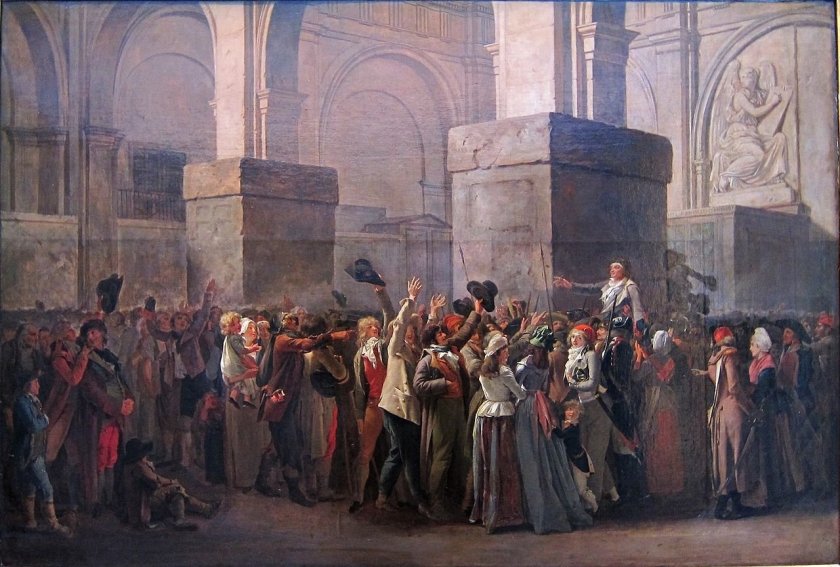
Panoramic Landscape with a Horseman and a Post Wagon by Adriaen van de Velde (1661)

However, Adriaen van de Velde is probably best known for his landscape paintings.  His painting, Panoramic Summer Landscape with a Horseman and a Post Wagon, which he completed in 1661 was described by Wolfgang Stechow, the German American art critic, pianist, and violinist, as being:

“…a landscape of such serene beauty and golden softness that its comparison with a Mozart melody will not, the writer hopes, be dismissed as farfetched…”

The setting is a late summer afternoon.  In the work, we see a man astride a horse being given directions.  Man and horse are bathed in sunlight as is the field with its four sheaves of wheat.  Cast in shadow, we also see a woman with child on her back and one by her side and a shepherd who is looking after his small flock of sheep.  In the right middle ground, also in shadow, is a small village on the edge of an expanse of water, with its church and tall steeple.

A River Scene by Salomon van Ruysdael

This type of composition we see before us with a tall tree on one side was dubbed by Wolfgang Stechow as being of a “one-wing composition” pattern which had been favoured by Salomon van Ruysdael.  It is a type of composition in which the large tree in some way acts as an introduction to the viewer to gaze at the panoramic view in the rest of the depiction.  Ruysdael’s landscapes would often have a single tall tree or a group of them to one side of his landscape paintings.  In this painting, van de Velde has counter-balanced the mass of leaves atop the tree on the left with the dense clouds on the right.

Departure for the Hunt by Adriaen van de Velde (1662)

A painting by Adriaen van de Velde which has elements of a landscape painting but is populated by many figures is entitled Departure for the Hunt, which he completed in 1662.  In all. there are sixteen human figures, eight horses and twenty-three dogs.  However, most are hidden in shadow and only the couple on the left, the man astride the horse blowing the hunting horn and the groom tending the rider-less white horse are illuminated by sunlight.   The painting was last publicly exhibited at the Royal Academy of Arts in London in 1952.  One of the reviewers of the exhibition was Horst Gerson wrote about it in the Burlington Magazine.  He remarked:

“…The well-to-do English collector of the eighteenth century loved to possess a good Adriaen van de Velde with his Wouwermans and Aert van der Neer.  The brilliant colours and the refined technique of these artists appealed to the cultivated taste of the upper-class…”

The "haves" and "have-nots"
The “haves” and “have-nots”

It is a highly colourful depiction and we are prompted to look at the detail of the work with its many figures.  We see beggars in the bottom left of the work trying to cajole the well-dressed couple into helping them financially.  This combination of the two beggars and the wealthy beautifully adorned couple makes us aware of the “haves and the have nots”.  To the right in the foreground we see the amusing scene of one of the dog handlers struggling manfully to control his charges.  It seems he is losing the battle.

 There are so many more paintings I could have included but I though this is just a “taster” to whet your appetite and persuade you to research more of his works.  If you live in London the Dulwich Picture Gallery is exhibiting a collection of his works until January 15th 2017 and I hope to visit there before it closes.  A book which accompanies the exhibition, Adriaen van de Velde, Dutch Master of Landscape was my main source for this blog.
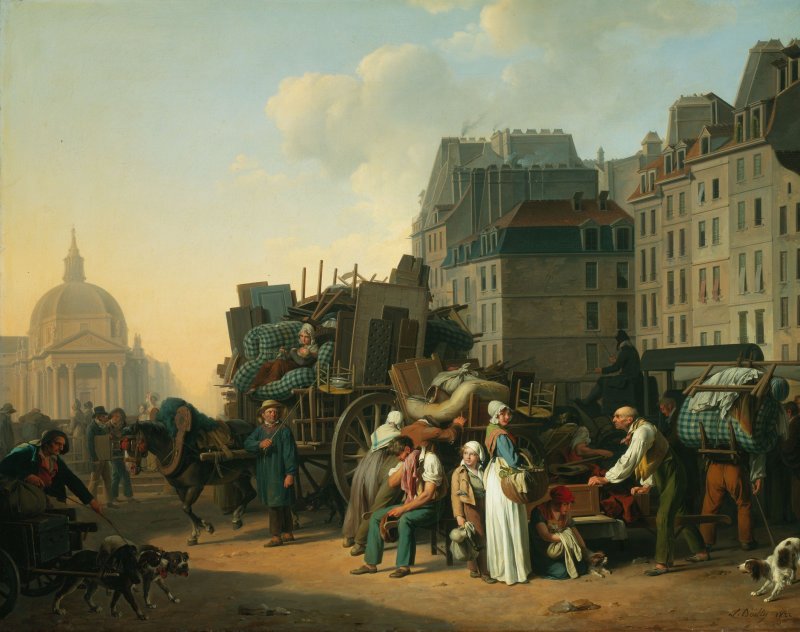
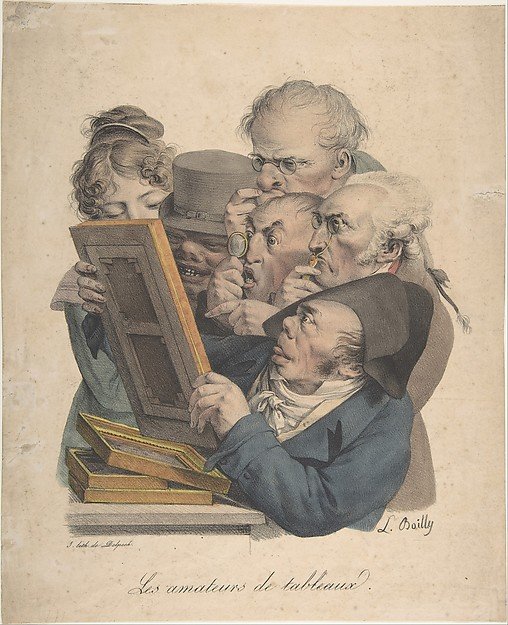
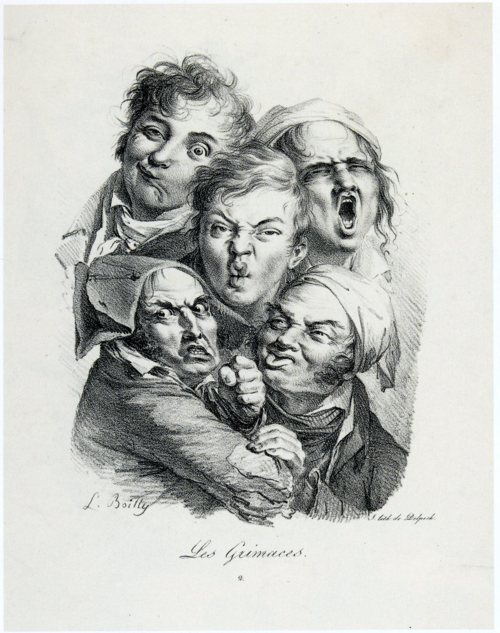
Tomorrow I am off on a three day trip to The Hague to visit the Gemeentemuseum and the Alice Neel Exhibition and see the works of the American artist whom I extensively covered in six blogs a month or so ago and whilst in the Dutch city I hope to visit some other art galleries and feast my eyes on some beautiful Dutch and Flemish seventeenth century art.