Rupert Bunny

Rupert Bunny

In my last blog, I looked at the life and works of the Australian painter Agnes Goodsir, who had spent a large part of her life in Paris.  Today I am showcasing another Australian artist, Rupert Bunny, who also spent many years in the French capital and was one of the most successful expatriate Australian artists of his generation.

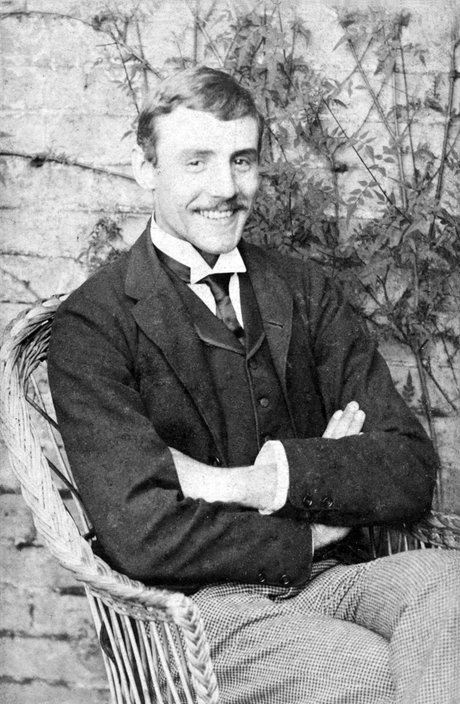
Self portrait by Rupert Bunny (c.1920)

Rupert Charles Wulsten Bunny was born in St Kilda, Melbourne on September 29th 1864.  Rupert was the third son of a English-born, Eton educated, Brice Frederick Bunny.  His father had studied law and was called to the Bar in 1844, becoming a talented equity barrister in London.  The news of the discovery of gold in the 1850s in New South Wales and Victoria whetted Brice’s appetite and in October 1852 he arrived on Australian soil intending to make a quick fortune before returning to London.  However neither of his plans materialised, as after six months of prospecting he had nothing to show. However, the one bit of luck he had was when he emigrated to Australia he brought with him all his law books and so, after his failed prospecting period, he went to Melbourne and resurrected his legal career in October 1853.  In June 1856 Rupert Bunny’s father married German-born Maria Hedwig Dorothea Wulsten, who had followed him to Australia. They set up home in St Kilda, where he was active in the Municipal Council.  In 1873 Brice Bunny was appointed an acting County Court judge but his health started to deteriorate and he had to resign from the legal profession.  He died on 2 June 1885 at St Kilda, Victoria, leaving three sons, one of them a barrister, and three daughters. His wife, Rupert’s mother, died in 1902.

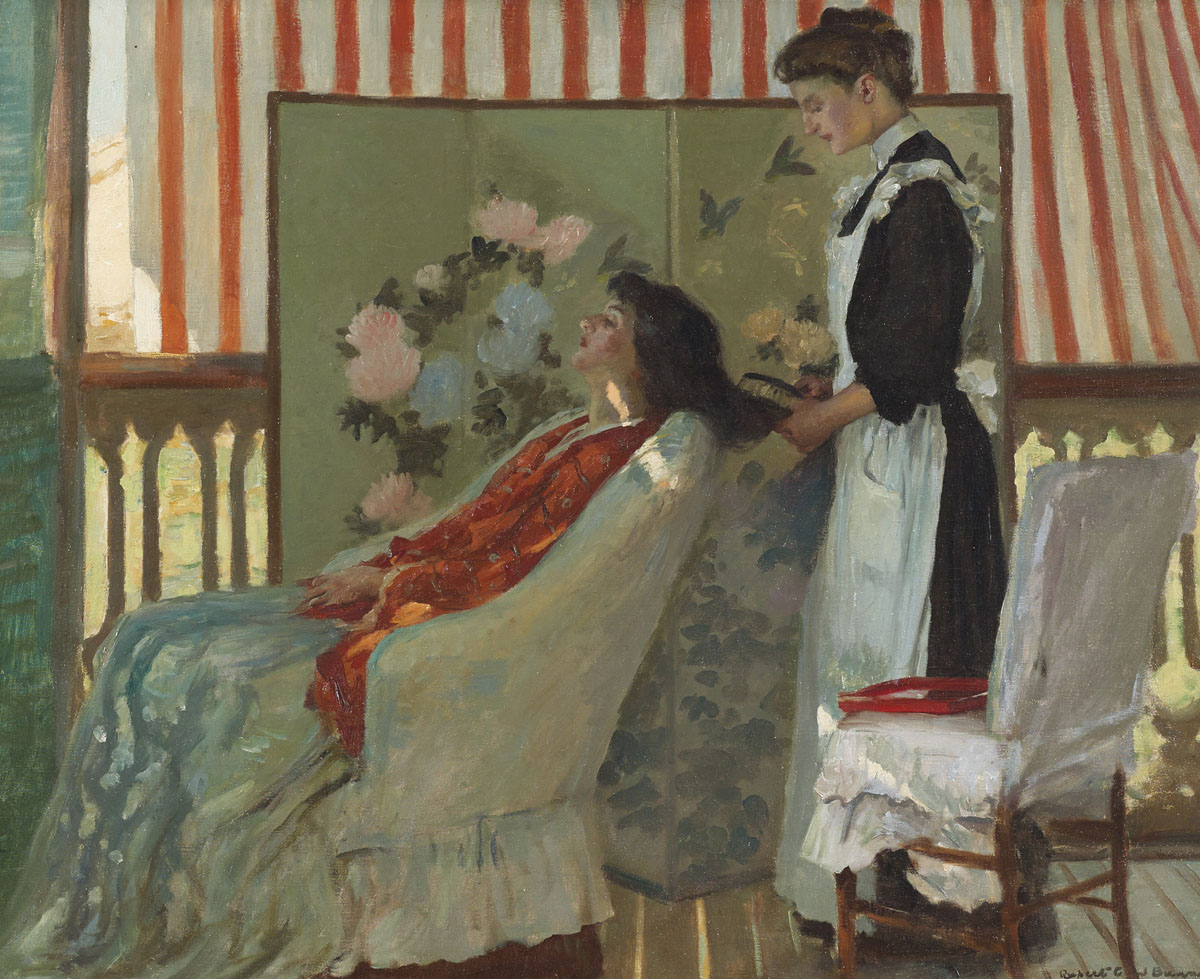
Hair Drying by Rupert Bunny (c.1908)

Rupert Bunny had three sisters, Alice and Annette who were five and two years older than him and Hilda who was three years younger.  He also had two older brothers, Herman and George and a younger brother Brice. Rupert attended the Alma Road Grammar School in St Kilda, and later the Hutchins School in Hobart.  In 1881 he enrolled at the University of Melbourne where he studied civil engineering.  He was not happy with the course and abandoned it.  At one time he decided he wanted to become an actor, but this future path was abruptly blocked by his parents.  Maybe as a compromise between his desires and those of his parents, he settled for joining the National Gallery Schools under British-born Oswald Rose Campbell and Irish-born George Frederick Folingsby, who was the director of the National Gallery and master in the School of Art.  Whilst there he became friends with his fellow students including Frederick McCubbin, E. Phillips Fox and Louis Abrahams.

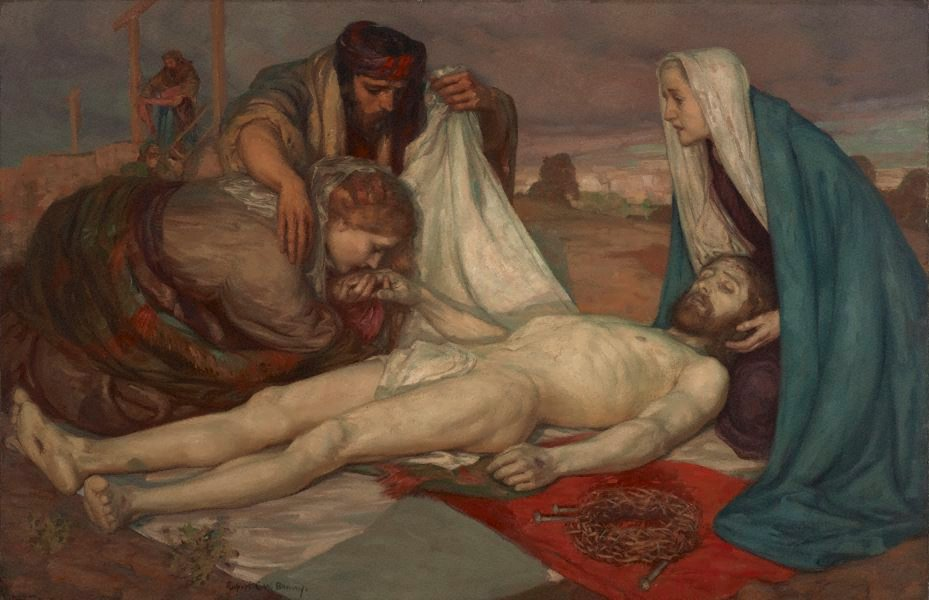
The Descent from the Cross by Rupert Bunny (1898)

The painting was hung at the 1898 Royal Academy in London

In 1884, at the age of twenty, Rupert Bunny left Australia and went to London.  Once in the English capital he enrolled at St Johns Wood Art School where one of his tutors was the English painter, Philip Calderon. Two years later, in 1886, he left England and headed for Paris to study under Jean-Paul Laurens in his studio at the Académie Julian. He left Laurens in 1886 and went to study at the Académie Colarossi where he studied under the French painter, Pierre Paul Léon Glaize.  His studies here made him an accomplished academic history painting – paintings on a large scale, with complex compositions based on mythological, historical and biblical subjects, and the depictions would characteristically contain multiple figures. From 1888, now in Paris, Bunny exhibited at the Parisian Salon de la Société des Artistes Français (Old Salon).

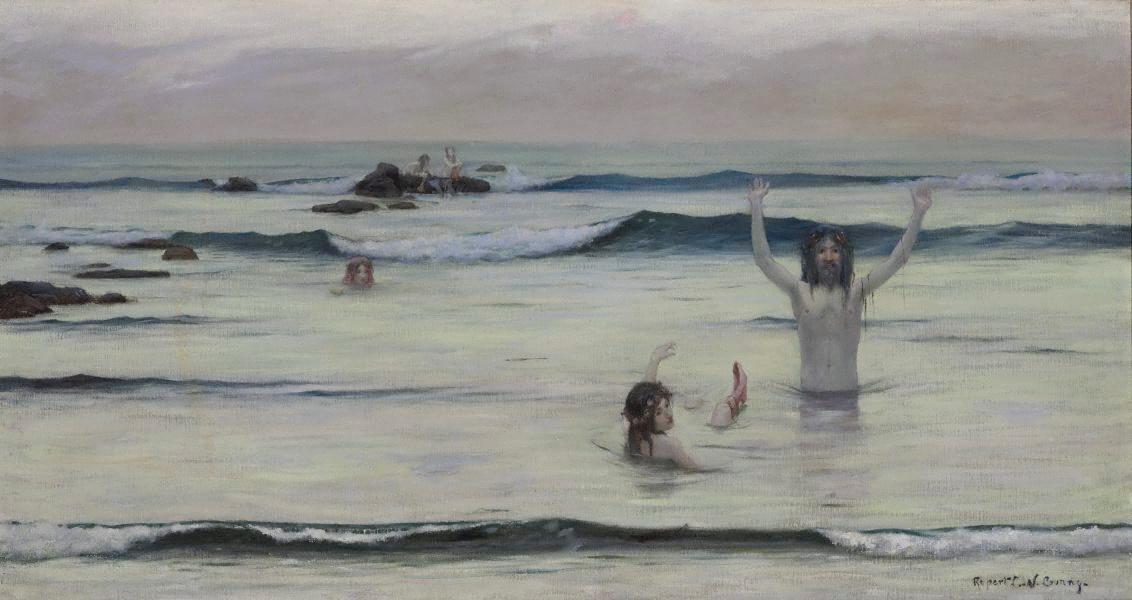
The Tritons by Rupert Bunny (1890)

During the late 1880s he produced a series of large-scale, delicately coloured sea idylls peopled with mythological and pagan creatures including mer-folk. Having a German mother, Rupert remembered the German myths and legends. Bunny often drew inspiration from the German myths and legends that she would read to him and characters from these often appeared in his depictions.  These stories were balanced by his father telling his son tales from the bible and Greek and Roman mythology.  One such painting was entitled The Tritons which Bunny completed in 1890. The painting was exhibited in Paris at the Old Salon in 1890, and it was the first painting by an Australian to receive an honourable mention at the event. The painting depicts a group of tritons, who were legendary creatures that lived both on land and at sea.  They are enjoying a lazy moment in their calm surroundings.  Rupert Bunny, in this work, lays before us some of the features which would become characteristics of his work, such as an attraction he had for mythological subjects and the depiction of the mystery and glamour within an intimate setting. Look how he has expertly shaped a twilight atmosphere by the use of subtle colour schemes, as is the case where the pale blue, silvery ocean and pink-toned sky are quietly reflected in the flesh tones of the figures.

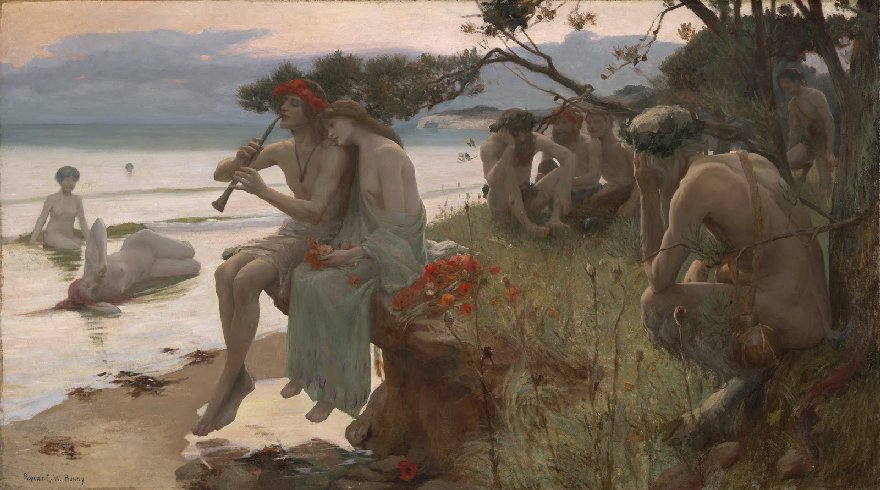
Pastoral by Rupert Bunny (1893)

His 1893 painting entitled Pastoral is a good example of the large-scale mythological works Bunny painted during his early years in France.  The painting is an allegory about the life-changing power of music. Before us we see youths and pagan beings who are all mesmerised by the strains of the pipes and soothed into a state of heightened consciousness.  The figures we see in the painting are contemporary youths and Rupert used their inclusion to show that Arcadia was not something we read about in days gone by but a state of mind.  There is a dream-like quality about the depiction and note the inclusion of vermillion poppies, a flower which symbolised sleep.

Madame Melba by Rupert Bunny (1902)

Rupert Bunny, besides being a great artist, was also a talented pianist and composer.   The love of all things musical probably persuaded him to paint a number of portraits of the Australian soprano, Dame Nellie Melba.  She had, during the latter days of the nineteenth century, moved to Europe to cement a career as a professional singer.  Rupert’s portrait of her entitled Madame Melba was completed around 1902.  Rupert had known her since the 1880s.  The painting, once completed, hung in the singer’s London home.  Later, she presented it to Her Majesty’s Theatre in Melbourne.  The National Gallery of Victoria bought the painting in 1980 and later it was loaned to Government House in Melbourne Victoria.

Percy Grainger by Rupert Bunny (1904)

Bunny created portraits of a number of Europe-based Australian musicians and performers.  He was commissioned, by twenty-two-years-old Australian pianist and composer, Percy Grainger, to paint his portrait in the early days of his professional musical career.  Grainger became acquainted with Bunny through Nellie Melba. Whilst living in London Rupert Bunny attended gatherings at Grainger’s rooms at King’s Road where the guests would sing many of Grainger’s compositions.  In this portrait, the young musician is portrayed as a relaxed young gentleman in the tradition of what was termed the ‘swagger’ portrait, which aptly reflected Grainger’s own ambitions. In Grainger’s left hand is a sheet of music, a conscious reference to Grainger’s celebrated career.

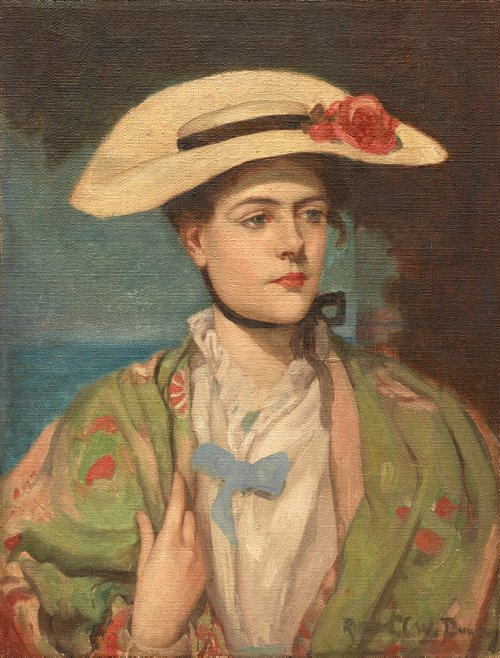
Portrait of the Artist’s Wife by Rupert Bunny (c.1895)

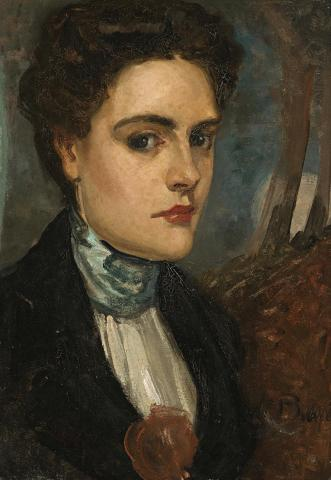
Portrait of the Artist’s Wife, Jeanne Morel by Rupert Bunny (1902)

In 1892, Rupert Bunny met his future wife, Jeanne Heloise Morel who was a fellow art student.  It was love at first sight as Bunny was bowled over by her beauty.  John Longstaff, a fellow Australian painter who was living in Paris, remembers the first meeting between Rupert and Jeanne, saying:

“…I remember … the very night they met, and how he fell in love with her at first sight.  She was a regular Dresden china girl with a deliciously tip-titled nose…”

The meeting was to prove a turning point in Rupert’s life, not just with the romance which followed, but by his change in his artistic style.  A colleague of Bunny commented:

“…  Jeanne changed not only Bunny’s life but also his art, which now focused on subjects in which beautiful women played the central role, with Jeanne as his favourite model…”

Rupert Bunny was influenced by Morel and she became his favourite model who featured in his depictions of the idyllic and leisured lifestyle of the Belle Epoque. Her graceful form and sensuous features were seen in many of his works, embodying Bunny’s feminine ideal. Bunny was also greatly influenced by the English Pre-Raphaelite painters such as John Everett Millais.

 Portrait of Mlle Morel by Rupert Bunny (1895)

 Portrait of Mlle Morel by Rupert Bunny, which he completed in 1895, is the first, major full-length portrait by Bunny of Morel. It is a tender depiction of his then girlfriend that he painted and was submitted and accepted into the Paris Salon that year.  It was a painting which marked the turning point of Rupert Bunny’s art from the Allegorical to the Belle Époque.

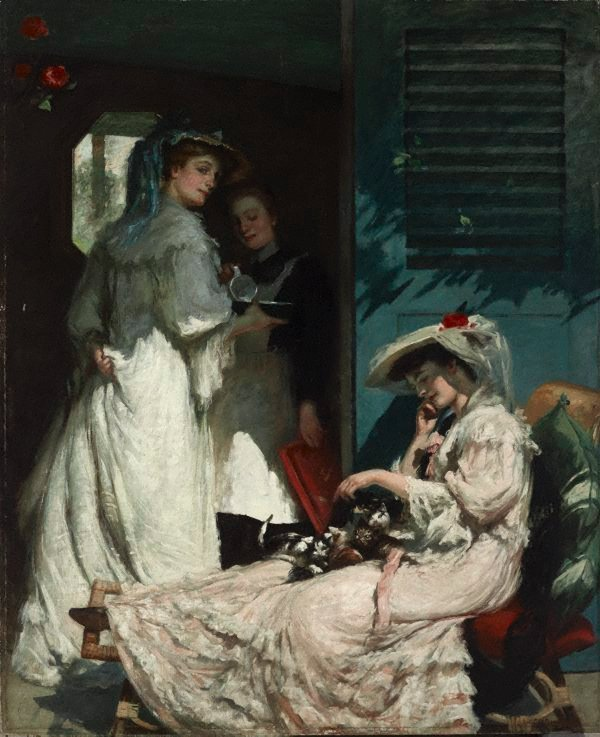
A Summer Morning by Rupert Bunny (1905)

Jeanne Heloise Morel was born on July 29th 1871 in Paris.  Her mother was Marguerite Morel, an unmarried servant. Her father, who was never named on the birth certificate, was said by Jeanne to be Eugénie François Morel, who served as an officer in the French Navy.  Jeanne received training in Fine Arts at the Orphanage of Arts at 96 rue de Vannes in Paris.  In 1884, when she was thirteen-years-old, Jeanne made her public debut at the Société des Artistes and subsequently exhibited at the Société Nationale des Beaux-Arts, working in oils.  Jeanne-Heloise Morel married Rupert Bunny in London in March 1902.

Dolce Far Niente (Sweet Idleness) by Rupert Bunny (c.1897)

The painting’s title means sweet idleness or the sweetness of doing nothing. Rupert Bunny would paint numerous similarly composed works featuring  groups of women relaxing, dreaming, dressing or undressing close by expanses of water.  The French art critic Gustave Geffroy was a great believer in Rupert Bunny and loved his work, Dolce Far Niente and in a review of the Salon of 1897 at which the painting was exhibited, he wrote:

“…To discover the promises and creations of newcomers, it is necessary to research, to go to canvases attracted by a soft radiance, a quiet force, a secret charm….I like the poetry of Dolce Far Nniente by Mr Bunny [of] women with graceful bodies, and beautiful and instinctive faces, who dream by the sea…”

Gustave Geffroy was a great advocate of Bunny’s work for the next three decades and in a 1917 review he wrote:

“He is a brilliant and spirited artist…at one and the same time, a realist and a visionary, an observer of truth and a poet of the world of dreams…”

Endormies by Rupert Bunny (c.1904)

Rupert Bunny’s 1904 painting entitled Endormies (Sleepy) portrays two female figures at the water’s edge relaxing and lost in a world of dreams. Rupert modelled the sleeping figure once again on his wife Jeanne Morel.  Her elegant and sensuous physical qualities enhanced many of his paintings.  In this depiction the artist has included a rose by the side of one of the sleeping women.  The rose was a traditional symbol of love and sensuous power.  The white swans we see in the background symbolise the attributes of grace and beauty. Rupert, like many artists also used the motif of a small dog, which often signifies marital fidelity.  In this painting Rupert has placed the animal sleeping at the feet of his mistress.

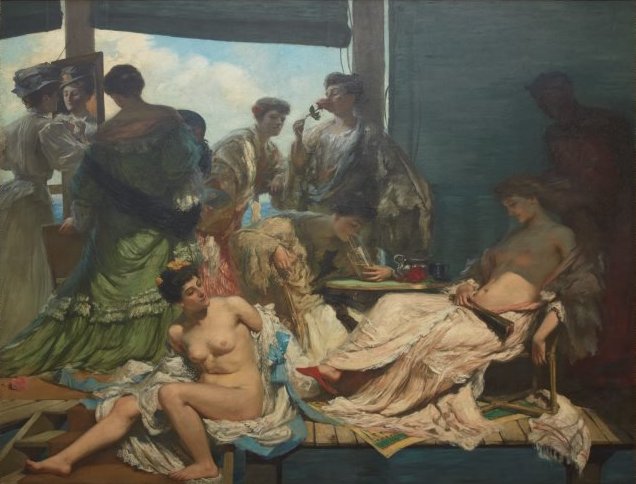
Summer Time by Rupert Bunny (1907)

In all Rupert Bunny’s depictions of his wife Jeanne and her friends there was an aura of beauty and elegance.  The clothes which adorned the females were typified in their fashionable trimmings and reflected the stylishness of the apparently endless summers that was La Belle Époque. The public loved these works of art and they became the most commercially and critically successful works of his career. Rupert Bunny’s 1907 work entitled Summer Time splendidly validates his skill as a draughtsman and his consummate treatment of large-scale works such as this one which measures 250 x 300 cms. It was exhibited at that year’s Paris Salon. It was his most ambitious work.

in situ at the Art Gallery of New South Wales

The painting depicts a spirit of leisure and sensuality as we observe seven voluptuous women relaxing inside a bathhouse on the Seine. It is a floating swimming pool sealed off from public view where women could bathe modestly. We see 0ne of the women is undressing preparing to climb down into the water while another female, on the left of the painting, is getting dressed before she emerges into public view.

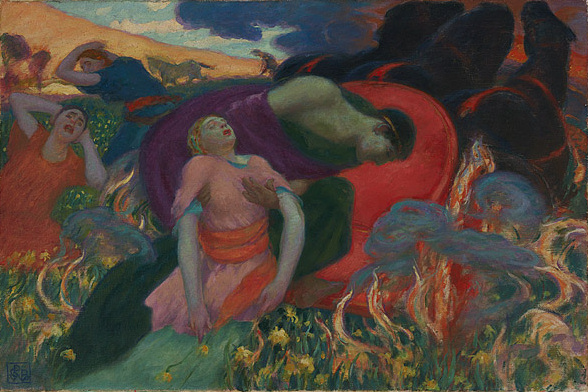
The Rape of Persephone by Rupert Bunny (1913)

Rupert Bunny was never afraid to shy away from changing his artistic style.  He had a refreshing willingness to keep reinventing himself and during his life, he simply kept an eye on what was the most fashionable style, so that his popularity would not wane.  Of the painting, The Rape of Persephone, one art critic, George Bell, described it as:

“…a glorious riot of colour from the finest imaginative Australia has produced…”

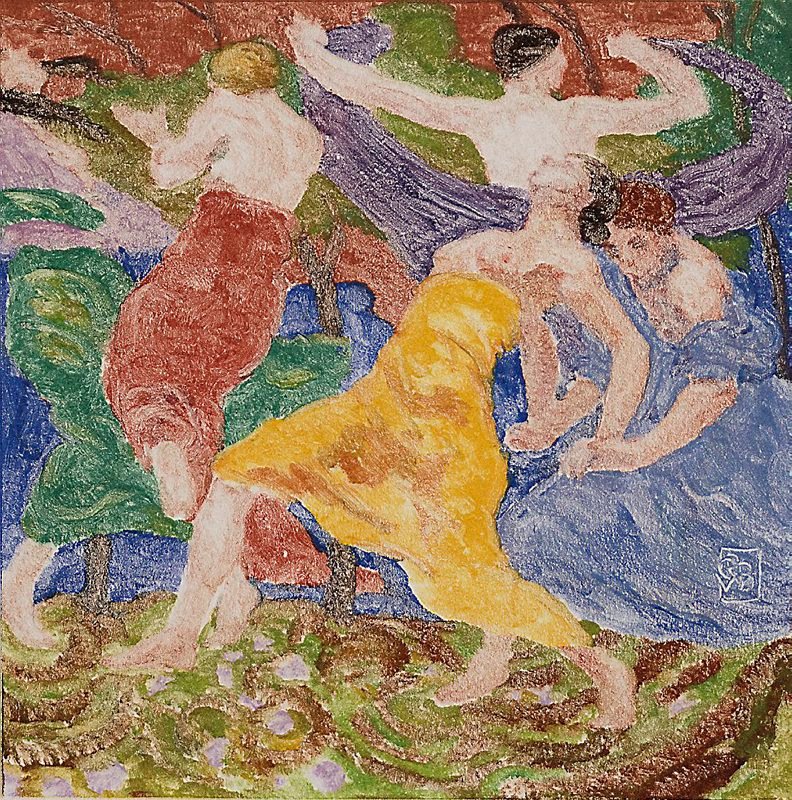
Fresque by Rupert Bunny (1921)

Rupert Bunny moved through successive styles and was strongly influenced by British pre-Raphaelites French primitives, symbolists and Post-Impressionists.  He was particularly influenced by Matisse and his love of Sergei Diaghilev’s Ballet Russes, an itinerant ballet company begun in Paris that performed throughout Europe between 1909 and 1929. 

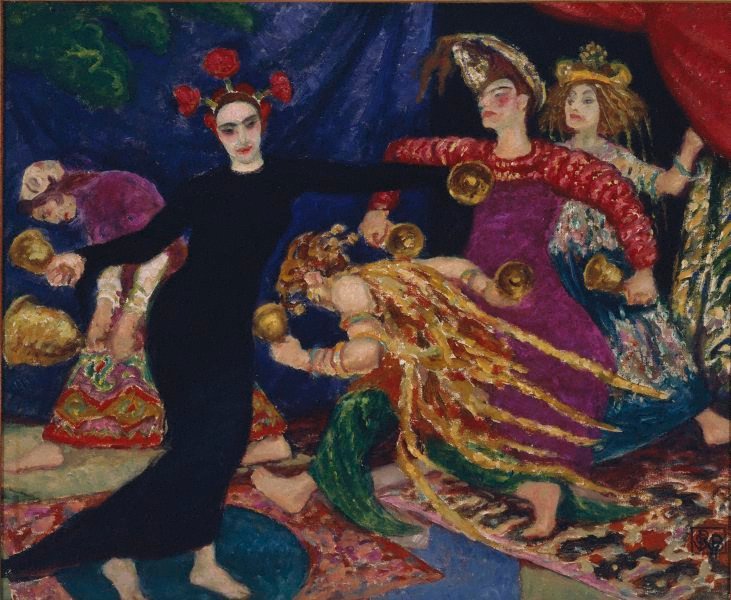
Salome by Rupert Bunny (c.1919)

The paintings of Rupert Bunny around this time began to be ones of heightened colour and abstracted, rhythmical forms.

In 1933, Bunny returned to live in Melbourne where he continued to paint until his mid-70s. He died on May 25th 1947, aged 82.  Rupert’s forte was his ability to change with the times and he was always open to new artistic influences.  Throughout his life he had always been motivated when it came to his painting. He never tired of experimenting with colour combinations and was never afraid to take risks. He was a master colourist.

Much has been written about Rupert Bunny and this blog has just scratched at the surface of his life but I hope it will tempt you into reading more about this great Australian painter.

.

Agnes Goodsir

The subject of my blog today is the Australian portrait and still life painter Agnes Noyes Goodsir. 

Agnes Goodsir was born in Portland, in South-west Victoria, Australia, on June 18th 1864, and was the second daughter and fifth of the eleven children of David James Cook Goodsir, who held the post of Commissioner of Customs at Melbourne, and Elizabeth Archer, née Tomlins.  Goodsir enjoyed painting and sketching and concentrated on still life works.  She started formal art training at the Bendigo School of Mines around 1898.  Her tutor was the painter and educator, Arthur Thomas Woodward.  Woodward was born in Birmingham, England, and had received his art education at the Birmingham School of Art where Edward Richard Taylor was headmaster and one of his tutors.   Later he attended the South Kensington Art Schools, in London where he was a gold medallist. He emigrated to Victoria, Australia and in 1894 he was appointed Head of the School of Art and Design at the Bendigo School of Mines.  He was an excellent educator who was aware of the trends in European fine arts and introduced methods and syllabi based on it, including en plein air art classes and life drawing, thus offering the opportunity for his students to move to France, immerse themselves in French culture and enroll at French academies, where they would be able to study art internationally.  Agnes Goodsir was open to the idea of travelling to France and in 1899, aged thirty-five, she decided to increase her knowledge of art by moving half way round the world to Paris but to achieve that goal she needed money. This was achieved when a one-woman show of her paintings was held in Bendigo.  Sufficient money was raised by the sale of her work and in 1900 she set sail for France.

Self portrait by Agnes Goodsir (1900)

This self-portrait by Agnes Goodsir is hanging in the National Portrait Gallery in Canberra.   It is dated 1900, around the time Agnes arrived in Paris.  It is a beautiful oil on canvas work.  It combines a formal representation with a dark sobriety that Goodsir presumably believed brought gravitas to the depiction.  At the time of the portrait Agnes would have been studying at Académie Delécluse and the Académie Julian and this could be the reason for this academic-styled depiction with its dark background providing an appropriate backdrop and contrast with the artist’s pearly features and beautifully depicted draped hand.  This signaled the starting point of her illustrious artistic career in France. 

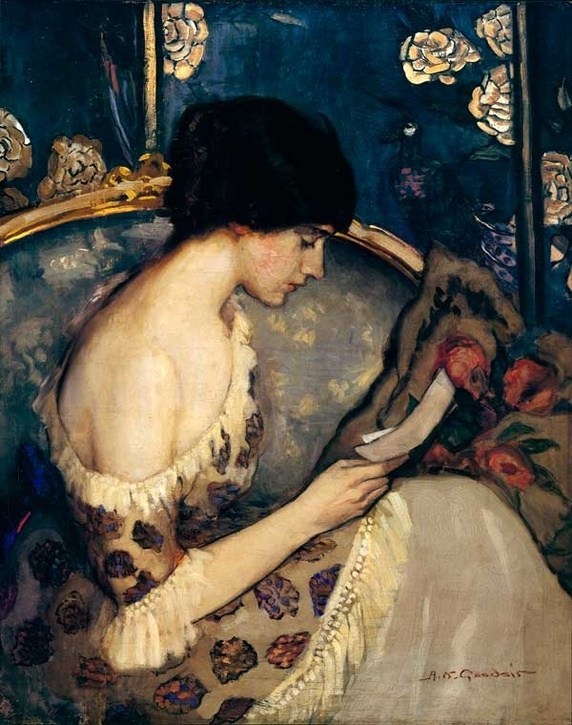
The Letter by Agnes Goodsir (1926)

On arrival in the French capital Agnes enrolled at the Académie Delacluse, an atelier-style art school founded in the late 19th century and named after its founder, the painter Auguste Joseph Delécluse.  Later she would take courses at the Académie Julian, under Jean-Paul Laurens, where she was twice placed first in Composition, the Académie de la Grande Chaumière where she won the 1904 silver medal for portraiture, and finally the Académie Colarossi.  Agnes made a number of visits to London and at the outbreak of the First World War she left Paris and went back to London.   While in London during the war, Agnes became close friends with Bernard Roelvink and his American wife Rachel. Rachel later divorced Roelvink and she reverted to her maiden name, Mrs Rachel Dunn, but to her friends she was known by her nickname ‘Cherry’.

A Letter from the Front by Agnes Goodsir (1914)

Once the Great War had ended Agnes and her beloved companion and muse, Cherry, left the English capital and moved to Paris where they set up home in an apartment at 18 rue de l’Odéon, which is in the sixth arrondissement of Paris on the Left Bank of the Seine, a short walk from the Luxembourg Gardens.  Agnes’ work was well received on both sides of the Channel and exhibited at the New Salon, the Salon des Indépendants and the Société Nationale des Beaux-Arts in Paris.

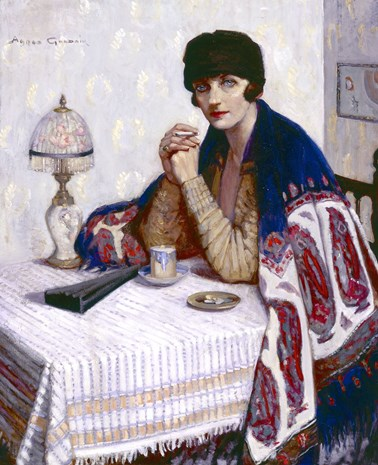
Girl with a Cigarette by Agnes Goodsir (1925)

Paris in the 1920s was the centre of artistic activity, with writers, artists, performers and musicians from all around the world gathering together. Paris’ 6th arrondissement where Agnes and Rachel lived was in the heart of the “action” and was referred to as the Latin Quarter.  One of Agnes’ famous portraits of Rachel, which she completed in 1925, was entitled Girl with a Cigarette. Rachel is stylishly dressed, with a colourful wrap and chic accessories. It is the archetypal depiction of a 1920s flapper seen enjoying her coffee and cigarette.  She is both self-assured and relaxed within the cafe environment.

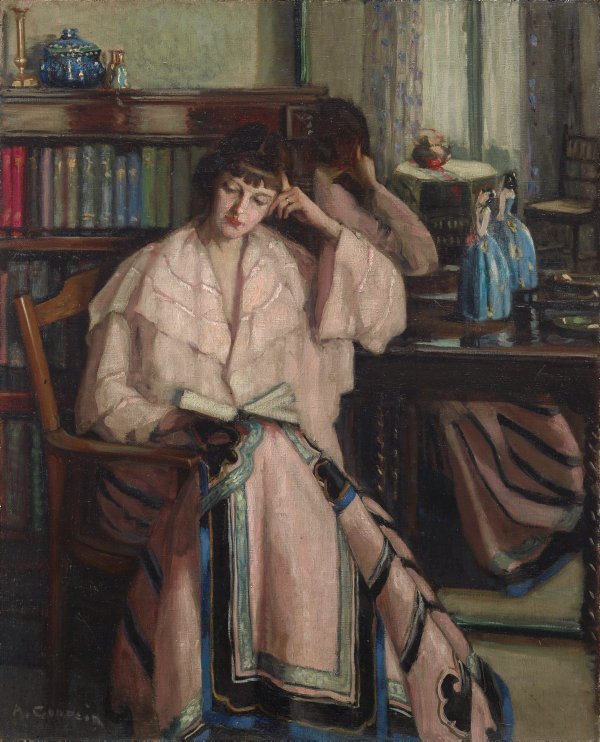
The Chinese Skirt by Agnes Goodsir (1933)

Agnes Goodsir and Rachel Dunn lived together  in Paris,  and Goodsir  often depicted Dunn as  the  unflinching  liberated  and trendy  woman that she undoubtedly was.  Once again in her 1933 painting The Chinese Skirt, like many of Goodsir’s works, the subject of the portrait is her lover, Rachel Dunn.  In this painting we see Rachel adorned in an elegant and fashionable Chinese-inspired skirt. To the right of her, on a table, are two ceramic figures the colour of which is echoed in the blue embroidery of her skirt, a couple of books in the bookcase seen in the background and the pot sitting atop this piece of furniture.

The Australian newspaper, The Australasian  newspaper described Goodsir’s work at the time as being:

“…a galaxy of beautiful, and even more beautiful women, doing feminine things: taking morning tea, posing before a mirror, reading, wearing blue hats or Chineseshawls…”

The Parisienne by Agnes Goodsir (c.1924)

Goodsir lived in Paris with Rachel during the period between the two World Wars.  France, like other participating countries of the Great War, had lost so many men in the fighting and with this lost generation of men the social life in the French capital was more a feminine affair, and the city between wars was a place for innovative women.  Paris was also a place for lesbian couples to live their lives publicly and in peace.  The Parisienne depicts Cherry in a modernist style. She is seen in masculine attire, wearing a cloche hat and high collar which encloses her face. Her hands are relaxed in lap, with a cigarette evoking an air of self-confidence and independence.

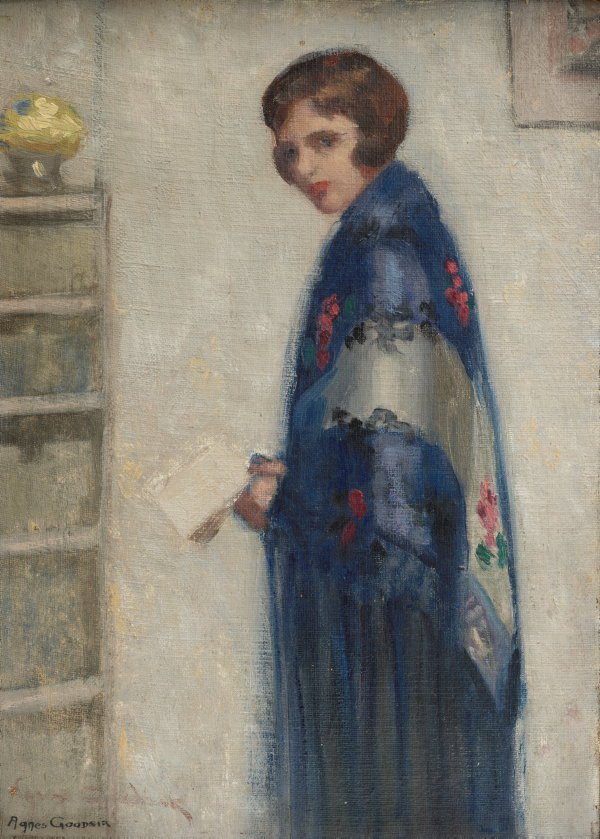
The Hungarian Shawl by Agnes Goodsir (c.1927)

Following a period of spending time in England, Agnes and Rachel settled down in their rue de l’Odéon apartment in Paris. Agnes painted subjects of the domestic interior of their apartment like a series of still life compositions, continually rearranging views of her everyday life, and often using them as a means to explore the expressive potential of colour combinations. Dunn repeatedly featured as Goodsir’s model, imaged in states of repose and gowned in flamboyant dress creating a sense of a domestic theatre that hovers between pretence and realism.  In her 1927 painting entitled The Hungarian Shawl it is all about colour.  The background is almost bare and uncluttered allowing us to concentrate on the figure.  It is all about the patterns on the shawl’s silky fabric design set against an almost monochromatic background. The depiction is instilled with the diffused interior light and almost resembles a small sketch-like work but at the same time conjures up a luminous sense of colour.

 Agnes Goodsir (left) and Rachel Dunn (aka Cherry) (second from left) at Valerie en Caix, c. 1930

In 1926, Goodsir was made a member of France’s Société Nationale des Beaux Arts, one of few Australians to receive the honour.

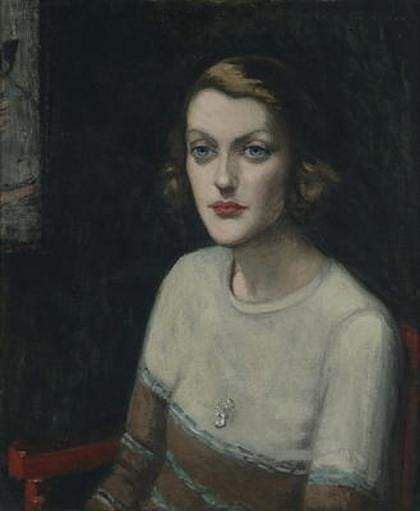
Portrait of Sunday Baillieu Quinn, Paris by Agnes Goodsir (1929)

Although Agnes Goodsir’s lifestyle was looked upon, during her lifetime, as being somewhat controversial, it was nothing compared to the colourful lifestyle of the sitter of a portrait Agnes completed in 1929.  The painting was entitled Portrait of Sunday Baillieu Quinn, Paris.  Sunday Reed who was born Lelda Sunday Baillieu in Melbourne on October 15th 1905,  who later with her second husband, became patrons of the arts and established in Bulleen, a suburb of Melbourne, the Heide Museum of Modern Art, also simply known as Heide .  She was the third of four children of Arthur Sydney Baillieu and Ethel Mary Baillieu (née Ham) and was a member of the very affluent Melbourne’s Baillieu family and the niece of William Baillieu, one of Australia’s richest men. She was the third of four children and after being home-schooled from a young age by a governess, completed her education at the prestigious boarding school, St Catherine’s School in Toorak.  In 1924 she accompanied her family to England, where she was presented at court during the débutante season. In 1926, when she was twenty-one, she married an American, Leonard Quinn and the couple left Australia and visited England and France.  In 1929, around about the time of the portrait Lelda, she was diagnosed with gonorrhoea and had to endure several operations including a hysterectomy which left her unable to bear children and causing deafness in her right ear.  Shortly afterwards, her husband deserted her in England and her father and brother had to travel to London to bring her home. By the end of the year the couple were divorced.  

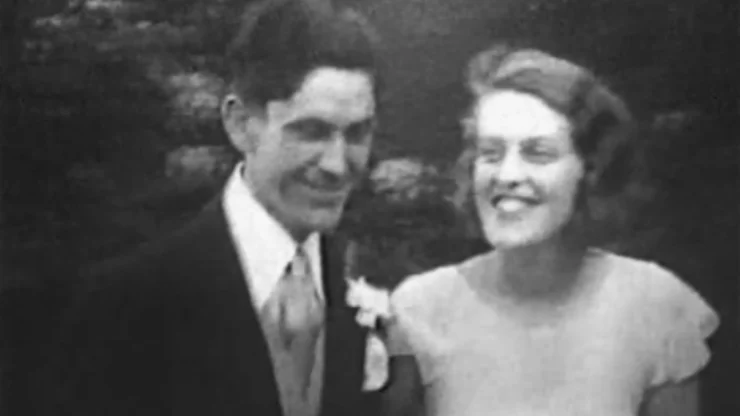
John and Sunday Reed on their wedding day in 1932.

Whilst still convalescing in late 1930, Lelda met her second husband, lawyer John Harford Reed at a tennis party.  Despite the difficulty of obtaining a divorce, powerful family influence and connections prevailed and Sunday’s divorce was finalised in June 1931. She and Reid married in January 1932 in a civil ceremony.  In 1934 John Reid and his wife bought a former dairy farm on the Yarra River at Bulleen, Victoria, which became known as “Heide”.  The couple lived on the property until their deaths in 1981, a short time after, the property had become the Heide Museum of Modern Art.

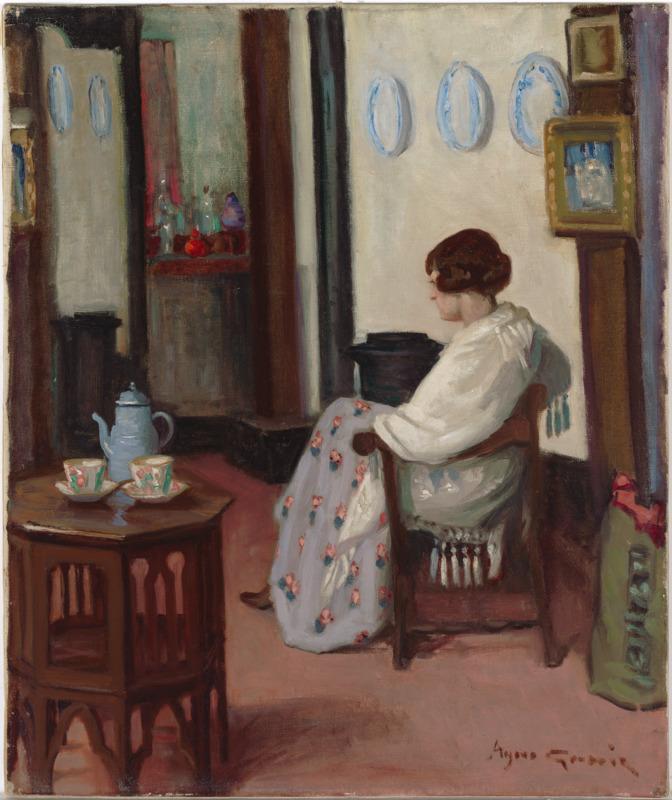
In the Latin Quarter Studio by Agnes Goodsir (c.1922)

Goodsir’s reputation as a great portrait artist, coupled with her social connections, allowed her to complete portrait commissions of many famous people such as the Australian author and journalist Banjo Patterson, English actress, Ellen Terry, Mussolini, Tolstoy and the Australian soprano, Dame Nellie Melba.  Despite those portraits of famous people Agnes Goodsir will be remembered for her portraits featuring Rachel Dunn.

In a Paris Studio by Agnes Goodsir (1926)

Although Goodsir was fond of her Australian birthplace, it was Paris that she loved and where she would spend her final days with Rachel. Agnes Goodsir died in Paris on August 11th 1939, aged 75. All of Agnes’s paintings were left to Rachel. Rachel sent forty of her painting to Agnes’s family in Australia and others to Australian galleries. The Goodsir Scholarship of the Bendigo Art Gallery, one of Australia’s oldest and largest regional art gallery, is named in memory of her. Rachel died in 1950 and was buried in the same grave as her constant companion in a cemetery on the outside Paris.

Hans Makart Revisited

Self Portrait by Hans Makart (1878)

The artist I am looking at today, and had written about in 2013, was one who was revered by many of the art critics of the time and yet hated by others, who baulked at his general lack of interest in factual accuracy in his depictions and for disparaging important episodes in history by including unwarranted female nudity in his paintings.    It would appear that he refused to tone down his flamboyant lifestyle and was known as much for the outrageous society parties he held in his studio as for his works of art.  Let me introduce you to the Austrian painter, Hans Makart.

Mirabell Palace and Gardens, Salzburg

“Hans” Johann Evangelist Ferdinand Apolinaris Makart was born to Johann Makart and Maria Katharina Rüssemayr in Salzburg on May 28th, 1840. His father, an amateur painter, worked as the chamberlain of the Mirabell Palace, which was the home of the powerful Prince-Archbishop. Few facts are known about the early years of Makart, but because of his father’s job, it is thought that he grew up surrounded by the Neoclassical grandeur of this magnificent palace and its extensive Baroque gardens.  It is more than likely that living amongst the splendour of the palace with its luxurious furnishings influenced young Makart who would later in life indulge in the excesses of extravagance and ornamentation as depicted in his artwork as well as his work as a designer and decorator.

The Valkyrie by Hans Makart (1877)

It seems likely that his father, having failed as an artist, urged his young son to take up painting and to endeavour to succeed where he had been unsuccessful.  Sadly, in 1849, Hans Makart’s father died shortly after his son had celebrated his tenth birthday. A year after his father’s death the family moved to Vienna and Makart went to study painting under the Austrian painter, Johan Fischbach, at the Academy of Fine Arts, a public art school in Vienna. Living in Vienna, Makart immersed himself into the worldly life of the great capital, where the women were beautiful and elegant, where dress was held of paramount importance, and where Society balls and entertainments went on through the greater part of the year. In the midst of living such a life, the world Makart witnessed was seen on its brightest most appealing side, and as a young man his ideas were developed into a passion for beauty. From his time and experiences of life in Vienna, Makart could never paint a woman unless she was adorned in the most sumptuous clothes, and he could never help depicting the female with the grace and beauty that distinguished the ladies of the Austrian capital.

Die Japanerin by Hans Makart (1870)

However, Makart’s time at the Academy did not go well and as I have recounted many times in previous blogs, he, like many young aspiring painters, could not accept the precise structure and order of the Academy, as far as the teaching methodology and the type of artwork which those in charge celebrated. He was impatient to escape the endless routine of art school drawing. It was not for him and his stay at the Academy ended in 1851 when he was dismissed after only one year.  Those in authority at the Academy gave the reason for his dismissal as his lack of natural talent.  It could well have been that Makart’s love of intense colour, movement, and sensuality, a style which was similar to that of Titian or Rubens was unacceptable to the Academy hierarchy who wanted students to follow a more sombre, well-ordered classicism that still dictated academic art at the time.  Makart would develop his own recognisable style but that would be ten years in the future.

Die Liebesbrief (The Love Letter) by Hans Makart

Makart believed in himself and was completely impervious to criticism, whether it be his artistic style or his decadent lifestyle.  He was a rebel and proud of it.  He left Vienna and travelled to Munich where the next two years passed without him receiving any formal artistic tuition.  Makart became aware that he needed to learn the technique of his business — the mechanical side of it, so to speak — in short, to learn to paint and for that to happen he needed a good tutor. 

Sarah Bernhardt by Hans Makart (1881)

In 1853, Makart enrolled in the Munich Academy where he was tutored by the German realist painter Karl von Piloty, who was noted for his historical subjects, and recognised as the foremost representative of the realistic school in Germany.

Moderne Amoretten (Modern Cupids) by Hans Makart (1868)

In 1864, after studying under Piloty for some years, twenty-four-year-old Makart left Munich.  His confidence in his ability had been heightened during the years under the guidance of Piloty.  He was now full of self-confidence. During this early period, he perfected his highly decorative style. Makart also journeyed to London, Paris and Rome visiting all the major art galleries. In 1868, while he was staying in the Italian capital, Makart was invited to submit a piece for the opening of the Austria Artists’ Society in Vienna. Makart sent over his colossal three-part work Modern Cupids, along with painstaking instructions on how it should be displayed. All three paintings were bought by the Count Johann Palffy, who became one of Makart’s regular patrons. 

Dame mit Federhut in Rückenansicht (Lady with Feather Hat from Behind) by Hans Makart (1875)

It has to be said that Makart was neither totally impressed by Raphael’s Madonnas which he saw in Rome, nor was he moved by the gilded glories that crown the virgin martyrs, and there can be no doubt that the Italian capital failed to fire his soul.  However, when he moved to Venice all that was to change. It was the art he witnessed in that city that fired his imagination and would influence him for the rest of his life.  Makart had always been a devoted colourist and in Venice he witnessed the colourful works of Veronese, Titian and Tintoretto. These three Italian (Venetian) Masters were to be his mentors.  To him, they were inspirational.

Hans Makart’s Studio in Vienna

Makart’s artistic achievements came to be noticed by the Emperor of Austria, Franz Joseph who, in 1869, summoned him to work in Vienna.  Buoyed up by this prestigious support, Makart requested set of lavish apartments.  That request was denied but instead the Emperor arranged for Makart to be given a studio which had been converted from a disused foundry. Far from being disheartened, Makart transformed this industrial space into the plush, decadent heart of Viennese society. It was not just his art which was colourful.  His lifestyle was equally flamboyant and rich in vibrancy.  His studio, in the Ring-Strasse, at the heart of Vienna, was resplendent.  It was transformed into a ballroom-like space and decorated in lustrous colours.  It was here that he depicted females adorned in beautiful satin gowns in shimmering satin tones.  In his studio he surrounded himself with richly ornamented German chests of the Renaissance, Chinese idols, Greek terracotta, Smyrna carpets and old Italian and Netherlandish pictures mingling beside antique and medieval weapons.  The walls of his studio were covered with splendid vessels, weapons, sculpture and costumes. Makart turned his hand to interior design, costume design, furniture design and soft-decoration, and his studio overflowed with statues, flowers, fine fabrics, and music. It acted thus as the perfect artistic backdrop for his models – largely nude women – who were also welcomed into his high-society circle.

The Espousals of Catterina Cornaro by Hans Makart (c.1873)

A good example of Makart’s large colourful paintings is his work entitled  The  Espousals  of  Catterina  Cornaro, (Venice pays tribute to Caterina Cornaro), which he completed around 1873.  Caterina Cornaro was the last monarch of the Kingdom of Cyprus, also holding the titles of the Queen of Jerusalem and Armenia. She had been engaged by proxy to the King of Cyprus, James II Lusignan, since 1468, when she was just fourteen years old, and at the same time she was declared the daughter of the Republic of Venice. It was not until 1472 that she went to Cyprus for her wedding.  The painting depicts representatives from  Cyprus  and  Venice,  of  dignified  men, of  procurators  of  St.  Mark, of women in foreign garb of  bright colour,  who  crowd  round  their  young  mistress,  the  queen  of the  feast,  rejoicing,  amid  the  splendid  architecture  of  the piazza.  Sadly the marriage did not last long as eight months after the ceremony.  James died and according to his will Catherine, who was carrying his child, became regent.  Caterina’s son James died under suspicious circumstances in 1474 before his first birthday.

Death of Cleopatra by Hans Makart (1876)

Around 1875 Makart completed some paintings depicting the death of Cleopatra.  They both portray Cleopatra, the legendary queen of Egypt, contemplating suicide. The Roman Emperor Octavian’s forces had fought their way into Alexandria, and knowing that her country had fallen, Cleopatra withdrew to her tomb with her closest attendants, Iras and Charmion.  In one of the paintings, we see Cleopatra reclining on a bed of fabrics, semi-nude and wearing jewelry and her crown. To her left, one of her servants weeps, whilst just below the queen another has already died. A brazier burns on the left-hand side.

Death of Cleopatra by Hans Makart (1875)

In both paintings the asp is menacingly depicted.  It is a thin, black form with a tiny wisp of a tongue, and stands out against Cleopatra’s breast.  This adds a sense of eroticism, and danger to the painting which reminds us of the line from Shakespeare’s play, Anthony and Cleopatra:

“…The stroke of death is as a lover’s pinch, which hurts and is desired…”

There is a sensuous decadence about Makart’s depiction of Cleopatra’s naked, bejeweled body and the way his use of chiaroscuro picks out the stark whiteness of Cleopatra’s body, as if she were spot-lit on a stage.

Das Schlafende Schneewittchen (The Sleeping Snow White) by Hans Makart (1872)

Makart’s life in Vienna enabled him to immerse himself into the worldly life of the great Austrian capital, a city where the women were beautiful and elegantly dressed and where Society balls and entertainments are held throughout the greater part of the year. In the midst of living such a life, the world the painter witnessed was seen on its brightest side, and consequently, as a young man his ideas were developed into a passion for beauty.

The Dream after the Ball by Hans Makart

In 1878, Makart took a post as a professor at the Viennese Academy in 1878.  This was the very same institution which had expelled him for lack of artistic talent in the late 1850s. Two years later, he became the institution’s head of a particular school for historical painting, a position he held until he died. It was during this time that Makart, as teacher, met Klimt, one of his students. Klimt had an important role in continuing Makart’s legacy after his death. In addition to his position as a professor, Makart’s work kept him well-off and well-known. Even the negative comments regarding his art appeared to simply inspire him to strive more.

Statue of Hans Makart in Vienna City Park (“Stadtpark”)

Hans Makart died on October 3rd 1884, aged 44. He was buried in the Wiener Zentralfriedhof in Vienna. Makart influenced many painters who followed him, the most notable being Gustav Klimt, who is said to have idolized him. It can be seen in Klimt’s early style which is based in historicism and has clear similarities to Makart’s paintings. Jugendstil, the Austrian Art Nouveau, of which Klimt was a part and it has been suggested that primacy of sexual symbolism in Jugendstil artworks were influenced by the sensuality in many of Makart’s paintings.

Eppo Doeve

Eppo Doeve

After my blog on Anton Pieck the other week, I received a comment from Barbara Matthias, who asked me to look at the life and work of another Dutch painter, Eppo Doeve.  Having never heard of him, I was intrigued.  I managed to scrape together some information about his life and works of art he had completed, so here is a blog on the twentieth century painter and cartoonist.

Aardappeleters (Potato Eaters) by Eppo Doeve

Jozef Ferdinand (Eppo) Doeve was born on July 2nd 1907 in Bandung, the capital city of the Indonesian province of West Java in the Dutch East Indies.  He was the eldest child of a civil servant, Justin Theodorus Doeve and his wife Helena Rosina Kepel and he had four sisters. Both parents were of mixed European and Indian blood.  Eppie, as Doeve was called at home, went to a Catholic School run by the Ursuline Sisters and then later went through the local secondary education system.   Once Doeve had been awarded his diploma, he was allowed to make some trips through the Dutch East Indies. Because of his parents, Eppi developed a love and interest for plants and flowers and this made him choose to study agronomy in the Netherlands.  Agronomy is the science and technology of producing and using plants by agriculture for food, fuel, fibre, chemicals, recreation, or land conservation .  Of his dream for his future Doeve said:

“… I wanted to be a tea planter, somewhere near Garoet, there is nothing more delicious imaginable, isn’t there?…” 

A portrait of the actor Louis van Gasteren Senior by Eppo Doeve (1944)

Besides his love of plants and flowers, Doeve was a multi-talented child and was very artistic from an early age. He played various instruments and could draw well. He was also very humble and did not consider himself very special, despite the fact that he received painting commissions whilst he was still young but he still looked upon drawing and playing music as hobbies and, not being in any way, future professions.

Winston Churchill by Eppo Doeve

When Doeve was twenty he attended the Landbouwhoogeschool (Agricultural science college) in Wageningen in The Netherlands. He enjoyed student life and would contribute drawings to the monthly college magazine, Wagenische Studentencorps.  His love of music was also sated at the college as he was very busy with the jazz band of the association. All his plans and aspirations ended in the early 1930s after the tea market in India collapsed and it was a turning point in his life and his future plans had to be revisited.

Fisherwoman in Regional Costume by Eppo Doeve (1968)

Above all, Doeve wanted to stay in The Netherlands and not return to the Dutch East Indies, to do this he had to find a way to achieve that goal.  He realised that his drawing ability may be the secret to a new life.  He had already earned some money at the Amsterdam advertising agency De LaMar Advertising Company and was able to work regularly at the agency from 1932 onwards. Doeve went from there to other advertising companies and publishers, such as De Groene Amsterdammer, an independent Dutch weekly news magazine published in Amsterdam, and later he moved to the large publishing house, Haagsche Post. In the 1930s Doeve also worked on the Belgian magazine Radiobode, which listed radio programmes.   The magazine was first published in 1931 and had a circulation of approximately 20,000 copies. His graphic work for the Radiobode was loved and became collectables and was praised by such contemporary luminaries such as the young and up-and-coming illustrator, Fiep Westendorp, and one of Doeve’s young colleagues, Marten Toonder, a Dutch comic strip creator, born in Rotterdam and who became the most successful comic artist in the Netherlands

In 1953, Doeve became an even more famous Dutchman when he provided the sketch of Hugo de Groot,  the Dutch diplomat, lawyer, theologian and jurist, for the new 10 Guilden banknote.

1940 issue of Radio Bode with Eppo Doeve’s graphics for the Paul Vlaanderen series

In the 100th issue of Aether, the magazine about the history of broadcasting and phonography, published in July 2011, there is a drawing by Doeve with an article about radio plays. It is a drawing for the well-known AVRO radio play Paul Vlaanderen.  Paul Vlaanderen was the name of the fictional Dutch detective and was based on the novelist, Francis Durbridge’s character Paul Temple, who was a fictional detective in a long-running English radio serial, which first broadcast in 1938.

One of the many advert posters for Heineken Beer designed by Eppo Doeve

Doeve became skilled at every form of graphic art, without having had a formal education. He was commissioned to illustrate commercials, stage sets, book illustrations, and just simple paintings.   Doeve mastered them all.  One of his colleagues, Alexander Pola, commented:

“…He could do everything he wanted, and wanted everything he could…”

For the Dutch weekly magazine, Elseviers Weekblad, he submitted articles, illustrations and political prints.  In addition, he regularly appeared on television. After years of being called J.F. Doeve in the press, he was then referred to by his nickname Eppo.

Portrait of Tinnie van der Elzen by Eppo Doeve (1940)

Eppo Doeve was also a fine portrait artist as can be seen in his 1940 work entitled Portrait of Eugenia Henriette Maria (Tinnie) van der Elzen.  She was Doeve’s first wife, the daughter of a well-to-do family in Arnhem, whom he married in July 1934.  In the background, a landscape is visible in which the castle of Cannenburgh (Vaassen) can be identified.

Poster for Eppo Doeve Retrospective

This painting was exhibited during the retrospective exhibition Eppo Doeve Terug in Wageningen in 2019. Doeve painted the portrait in the typical ‘magisch realisme‘ (magic realism) style of the late 1930’s, an artistic genre in which realistic narrative and naturalistic technique are combined with surreal elements of dream or fantasy.

Portrait of the artist André van der Burght at the age of 63 by Eppo Doeve

Jozef Ferdinand (Eppo) Doeve died on June 11th 1981, aged 73. After his death, piles of beautiful drawings were discovered in his studio.

Eppo Doeve in his studio (August 1954)

The studio was a chaotic mess and many sketches were found behind the heater and at the bottom of the cupboards, almost as if he had hidden them.

Zdenka Rosalina Augusta Braunerová

In my blog today I am looking at the life and works of the nineteenth century Czech painter, Zdenka Rosalina Augusta Braunerová. Her views and lifestyle influenced many painters and writers, many of whom were her friends. She became a patron of many artists, but she also supported folk art, especially in Moravian Slovakia and Horňácko. She was graceful and educated, and also extremely talented. She decided to devote her whole life to painting and graphics and never regretted it. She almost married several times and yet died unmarried. The life of this girl from a good family was unconventional, but definitely interesting.

A Bend in the Vlatava River by Zdenka Braunerová

Zdenka was born in Prague on April 9th 1858 and was baptized as Zdislava Rosalina Augusta.  She was born into a wealthy family and was the last of four children of the well-known Czech politician and prominent lawyer, František August Brauner and his wife Augusta, née Neumannová She had two older brothers, Vladamir and Bohuslav and an older sister, Anna.  Zdenka showed interest in drawing and painting since her childhood, when she spent long hours in her children’s room, where she spent hours painting. She was encouraged to paint by her mother, who was herself an amateur painter and who came from an old noble family. 

View at Brod by Amálie Mánesová,

Zdenka’s parents further encouraged their daughters interest in art and sent Zdenka to study with Amálie Mánesová, a talented landscape artist who ran a private painting school for ladies and girls from aristocratic and bourgeois families. This early art education, like the teaching of young children to play a musical instrument, was common for children in families of similar status at that time. It was part of the fashionable manner in which young girls became young ladies. Zdenka loved to paint and draw so much so that her normal schoolwork suffered and she received mediocre grades for her school work.  Notwithstanding this deterioration of her exam results, Zdenka pressed on with her art tuition at a girls’ college, where the director was the prominent Czech painter, Soběslav Hipplolyt Pinkas.

One of her tutors was Antonin Chitussi, a Czech Impressionist landscape and cityscape painter, and he was unclear as to whether painting to Zdenka was merely a hobby and not a future profession and, in truth, Zdenka was also undecided as to whether painting or her singing would become a future pathway. Antonín Chittussi was not only one of her first art teachers, he was her first love and during her time with him she devoted herself mainly to landscape painting. Chittussi introduced her to the technical secrets of drawing and painting, urging her to diligence, study nature and the right choice of motifs. Zdenka wanted to move the relationship with Chittussi to another level, that of an equal union of two independent artists who would inspire each other.  This was a step too far for Chittussi and the relationship died.

Following the the death of her father in 1880, Zdeňka began attending the Académie Colarossi in Paris.  Here her teacher was Francoise Courtoise, with whom she concentrated mainly on figurative and historical painting.

Élémir Bourges and the two Brauner sisters – 1883

After her sister Anne’s marriage to the French writer Élémir Bourges, Zdenka adapted her lifestyle to her future profession as a painter. She often travelled between Paris and Prague, still attending the Colarossi School and at the same time wanting to be close to her mother back home in Prague.

Julius Zeyer

Another of her many relationships came three years later with a young poet, Julius Zeyer, an artist seventeen years her junior, but maybe because of the age difference, this was not a long-lasting liaison. Another reason according to some historians, was that Julius Zeyer was homosexual and his relationship with the very attractive Zdenka remained only platonic.

Vilém Mrštík

In the spring of 1894 in Oslavany, the thirty-one-year-old Czech playwright and literary critic Vilém Mrštík met thirty-six-year-old Zdenka Braunerová.  She was five years older than him, which was somewhat strange as previously Vilém only had relationships with much younger women.  Mrštík actually perceived her as an old lady describing her as:

 “…An interesting person, she has enough of the world, enough of Prague, and with all the fire a lady approaching old virginity, but still strong and with the lush decoration of the former beauty…”

Brauner was equally scathing about Mrštík either, saying:

“….He is not pretty. The nose is plebeian, the eyes small, black, short-sighted with a stud, and the mouth with strong lips…”

Landscape near Tabor by Zdenka Braunerová.

Suprisingly, a relationship developed between them.  It was not an even relationship as Zdenka was cautious at first and only considered friendship. But Mrštík, fell in love with Zdenka and the “friendship” developed into a love affair.  The well-educated Brauner was probably attracted to Mrštík by his goodness, earthiness and often violent reactions. She tended to choose men who were painful, complex, and depressed.  Zdenka had a habit of wanting to protect, educate and form men in her own way.  She was manipulative and looked upon men as being people she could mould into her perfect person.  This was not the basis of a long-lasting relationship and was doomed.  However, she thought Mrštík would be different.  Mrštík was not the intellectual type and unlike her, did not discuss art passionately. He was an earthy Moravian. To Zdenka, he even seemed naïve but this trait endeared him to her but the relationship was doomed. 

St Lawrence on Petrin Hill by Zdenka Braunerova

In early 1896, Mrštík even began to talk about marriage and Zdenka agreed but they broke up in March 1897, just before the wedding, . They finally separated. Mrštík was convinced that he had fallen in love with an idea and not the woman. He became very bitter with the break-up and in an ungentlemanly way he said various unpleasant things about Zdenka – about her overripe old virginity and few talents in the intimate area.  Zdenka, in turn, stated that his writing to be inferior. It was not an edifying ending to the affair

VEČERNÍ KRAJINA by Zdenka Braunerova

Although having attended the private Collarossi Academy, she was not satisfied with the tuition and returned to her homeland. Zdenka was still extremely interested and found inspiration in French art, but still retained the patriotism for her country. The more time she spent in Paris the more she missed her homeland.  In Paris, with her sense of patriotism, she would dance in Czech costume and  sang Czech national songs, and by doing so, she would move closer to the Czech culture and art. This love of her homeland inspired many French artists and helped forge lasting friendships there.  One such artist who was swayed by Zdenka’s love of her homeland was Auguste Rodin who visited Bohemia and Moravia at her invitation in 1905. 

Brauner’s Mill in Solutions

Zdenka often spent time working in a studio in Solutions, a small town, west of Prague.  Her studio was in the so-called Brauner’s mill.

Zdenka Braunerová lived in Prague’s Lesser Town in Všehrdova Street. She died there on May 23rd 1934, aged 76, and is buried in the Vyšehrad cemetery.

Holger Drachmann

The Artist, the Poet, the Lover of Women.

Holger Drachmann

The subject of this week’s blog is the nineteenth century Danish poet, dramatist and painter Holger Drachmann. Holger Henrik Herholdt Drachmann was born on October 9th, 1846 in Copenhagen. He was the son of Andreas Drachmann and his wife Vilhelmine.  Holger was one of five children, having an older sister, Erna and three younger sisters, Mimi, Johanne and Harriet.

Andreas Drachmann

His father. Andreas, initially trained as a barber whilst studying for his medical exams. In 1831 he was an assistant to a surgeon in the Danish navy and eventually passed his exams to become a surgeon in 1836.  He left the navy in 1845 and became a physician at Langgaard’s orthopaedic institute and in  1859 he founded the first institute of medical gymnastics in Copenhagen.

Coastal party north of Årsdale, by Holger Drachmann (1869.)

In March 1857, when Holger was ten years old, his mother Vilhelmine died.  She was just thirty-six years old.  Once he completed his schooling in 1865 he went to University where he remained for three years.  He then transferred to the Academy of Fine Arts and studied under Carl Frederik Sørensen, a noted marine painter and soon Holger developed a love for that painting genre.  Art was a great love of Holger but around this time he developed another love, a love of literature. 

View of the island of Maïre west of the Goudes district, Marseille by Holger Drachmann

This painting above is thought to have been painted by Holger during his voyage around the Mediterranean in 1867.

Rocky Coast by Holger Drachmann

The beauty and ferocity of the sea is captured in Drachmann’s painting entitled Rocky Coast. It depicts the unstoppable waves of the blue-green sea crashing violently against a towering rock formation in the foreground of the painting.  To the left, we see heavy grey storm clouds.  It is a depiction which is devoid of figures and one’s focus is simply concentrating on the violent force of nature.  There is nothing noted as to the location of the scene but during his lifetime he visited many places, such as the Orkney Isles, and Norway, with their rocky coasts and archipelagos or it could have been locations in Newfoundland or Nova Scotia, places he visited during his long trip to North America.

Våde ovn, Bornholm. by Holger Drachmann

To further his interest in marine painting, Holger went to stay on the island of Bornholm.  This Danish island is located in the Baltic Sea, to the east of mainland Denmark, and south of Sweden.  It was here he painted a number of seascapes. One of his Bornholm paintings depicted Vade Ovn, a notable rock or group of rocks attached to the underlying bedrock. It is a grotto, part of the area known as Helligdomsklipperne.

A wreck hut on Skagen’s beach by Holger Drachmann

The Skagen artists’ colony is now as famous as the ones at Barbizon or Newlyn and Holger Drachmann was an important figure in the history of the Skagen artists’ colony, for it was he, who first arrived there in 1872 together with Norwegian Frits Thaulow, and he then persuaded many artists to go there with him during the following years. He fell in love with the area with its  breath-taking nature and the simple life it afforded people.

View from Knippelsbro with the Sugar Factory by Holger Drachmann
Fishing boats in Stormy Weather by Holger Drachmann

Besides his love of painting and fame as an artist, Holger Drachmann had two other great loves. He had the love of literature and poetry and was a renowned poet. He was part of the Scandinavian Modern Breakthrough Movement which was a movement of naturalism and which debated the literature of Scandinavia, which replaced romanticism near the end of the 19th century.

Georg Brandes

Around 1870, Drachmann became motivated by the writings of the Danish critic and scholar Georg Brandes, who had greatly influenced Scandinavian and European literature.  It was a time when art became secondary to literature in Drachmann’s life.  He had travelled quite extensively around England, Scotland, France Spain and Italy and had started a habit of sending accounts of his travels to the Danish newspapers. 

Digte (Poems)

Drachmann made his debut in 1872 as a prose writer with the collection With Coal and ChalkIn and that same year he had a book of his poems entitled Digte (Poems) published. He also joined the group of young Radical writers who were also followers of Brandes.  For Drachmann it was a time of contemplation and soul searching as to whether painting or writing would be his prime driving force. Drachmann established his position as the greatest poet of the Danish modern movement of his time with such collections as Dæmpede Melodier (1875; “Muted Melodies”), Sange ved Havet (“Songs by the Sea”) and Venezia (both 1877), and Ranker og Roser (1879; “Weeds and Roses”). The prose Derovre fra Grænsen (1877; “From Over the Border”) and the verse fairy tale Prinsessen og det Halve Kongerige (1878; “The Princess and Half the Kingdom”), demonstrated a patriotic and romantic trend that brought him into conflict with the Brandes group.   Drachmann was one of the most popular Danish poets of modern time though much of his work is now forgotten. He unites modern rebellionist attitudes and a really romantic view of women and history. 

Kristian Zahrtmann – Portrait of Vilhelmine Erichsen (1867)

Earlier I said that Drachmann had two great loves other than his art. He loved writing and poetry as I have just recorded but his other great love was women !

Whilst on the island of Bornholm in 1869, Holger Drachmann met his first wife Vilhelmine Charlotte Erichsen, She had been a good friend and muse for both Drachmann and another artist, Kristian Zahrtmann who was also living on Bornholm and who had painted her portrait when she was fourteen-years-old.   Zahrtmann was besotted with the young girl who modelled for him.  In a letter in 1868 to his friend and fellow artist August Jerndorff ,  he wrote:

“…I have had a young girl of mine of mine painting who interests me greatly. An adorable child – she is 16 years old – cannot be seen; After all, she is at an unfortunate age for most people, to which is added an extraordinary height and width, a short neck and stooped posture, but these are flaws that only all the more accentuate her beauty. A more regular face is unthinkable- – Her hair and eyes are almost black, her mouth bulging, and the pale yellow color, with its vexing and the utterly regular, narrow eyebrows, becomes so southern and melancholic dreamy that I can be so seized by it that the brush shakes in my hand. She herself does not know that she is beautiful, on the contrary, I think that she considers the yellow-laden color hideous, and at all she knows very little, both of knowledge and of what life is and gives…”

Marie Henriques (on the left) and Eva Drachmann painting, probably at the Art School for Women in Copenhagen, (c.1900)

But three years later, in 1869, when she was seventeen, Vilhelmine fell in love with twenty-three-year-old Drachmann and they got engaged.  Two years later, on November 3rd 1871 Holger and nineteen-year-old Vilhelmine married  in Gentofte Sogn, København.  To be able to marry Vilhelmine had to lie about her age, declaring that she was twenty-one.   Holger was twenty-five years old and so did not need her parents’ permission for the marriage.  On November 4th 1874 they had a daughter, Eva, but at the end of that year, they separated and finally divorced in 1878. It was a bad-tempered divorce and in a fit of rage Vilhelmine destroyed all correspondence and manuscripts from Holger that she possessed. Eva Drachmann wrote about her mother and father in her 1953 book Vilhelmine, my mother:

“…They divorced after 4 years of marriage. As the poet’s muse, Vilhelmine had entered into a cohabitation of whose seriousness and difficulties none of them had the slightest concept. Of the two, she was the largest child. She didn’t have time to grow up before it was all over. As an old woman, she reflected on how fateful the disaster came………. After all, in childhood and growing up, she had done nothing useful – nothing but dream…”

Eva Drachmann married for the first time in 1899 and the ceremony was held in a local manor house as the parish priest of the local Flade Church, refused to marry the couple in the parish church, citing Eve’s father’s godless lifestyle.

Polly Culmsee

Around 1866, three years before he met his first wife, Vilhelmine, Holger Drachmann had struck up a friendship with Valdemar Culmsee, the son of Frederick Culmsee, the owner of the Havreholm Paper Mill on the Danish island of Zealand.  It was during a visit to their home in 1866 that he met Emmy Culmsee, Valdemar’s twelve-year-old sister and her older sister Polly who was sixteen. Polly had later married Charles Thalbitzer and had two children with him but around the time Holger Drachmann and his wife had separated in 1874 she had a relationship with Holger and had his child, Agnes Gerda.  Polly eventually divorced her husband and she and Holger left Denmark for Sweden because of the social scandal they had created in Copenhagen.  They intended to be married in Paris when Drachmann was legally divorced from his wife. Now living in the Swedish town of Lund, Polly fell ill and Drachmann took her to a local doctor, Alphons Theorin, and sought his help with the care of Polly. Bizarrely, Polly transferred her affection from Holger to the doctor who in turn fell passionately in love with his patient which created yet another scandal as the doctor abandoned his wife and their three children and ran off with Polly to the central Swedish town of Sveg, where he managed to arrange a position as a provincial doctor.

Emmy Culmsee

The bizarre story of Holger Drachmann love life does not end there.  Polly’s younger sister Emmy had moved with her parents to Kristiania, where she stayed until she travelled to Hamburg in 1876 to study languages and it was in this German city that she once again met Holger.  He told her he was devastated by a relationship break-up and she was very comforting.  However he failed to impart to her that the relationship had been with her married sister, Polly. On finding out about the involvement of her sister she broke off with Holger and settled into a life as a German language teacher.  However, in 1878 whilst on holiday in Hamburg, out of the blue, she received a call from Copenhagen from Holger Drachmann’s married sister Erna Juel-Hansen. She told Emmy that Holger had suffered a breakdown when Polly left him.  Emmy went to Copenhagen and cared for Holger and nursed him back to full health.  Emmy and Holger married and they adopted his and Polly’s daughter, Agnes Gerda.  Emmy and Holger went on to have four more children of their own. 

Amanda Jensine Nielsen (Edith)

Sadly in 1887 Holger, for whatever reason, began an affair with Amanda Jensine Nielsen a cabaret artist in Copenhagen, despite the fact that he was married and twice her age.  He and Amanda became lovers and he would refer to her as Edith.  He even mentioned her in his 1890 novel Forskrevet, a depiction of Denmark in 1880 and the then political dispute between Right and Left, as well as the cultural dispute between citizen and bohemian

Holger Drachmann by Peder Severin Kroyer

Eventually Holger grew tired of his affair with Edith and moved on to another young actress.  His many scandalous affairs with his “muses” were often the fuel of his inspiration.  On his deathbed he said that his two biggest muses were Vilhelmine and Edith.

Drachmanns Hus in Skagen

Holger Drachmann died in Copenhagen on January 14th 1908, aged 61.   He is buried in the sand dunes at Grenen, near Skagen and following his death his Skagen home, Drachmanns Hus, became a museum.

Rudolph von Alt

Self-portrait (1890)

The focus of my blog today is to look at the life and work of the nineteenth century Austrian painter Rudolph Ritter von Alt.  The word “Ritter”is used as a title of nobility in German-speaking areas.  It translates approximately to the British designation “Sir”, denoting a Knight.  It is not a first or middle name of the person.  The artist was born Rudolph Alt and used the title of a Ritter after he gained nobility in 1889.

View from the Artist’s Studio in Alservorstadt toward Dornbach by Jakob Alt (1836)

Rudolph was born in Vienna on August 28th 1812.  His father, Jakob Alt, the son of a carpenter, was a German landscape painter and lithographer who was born in Frankfurt am Main in 1789 where he received his first artistic tuition and later moved to Vienna where he enrolled at the city’s Academy of Fine Arts.  Jakob Alt travelled through Austria and Italy, hiking through the Austrian Alps, all the while painting scenes of beauty. He also depicted many scenes of the neighbourhood along the River Danube and in the city of Vienna.

Room of Archduke Ludwig Victor in the Hofburg, Vienna by Franz Alt (1861)

Rudolph Alt had a younger brother, Franz, who was nine years his junior and who also became a famed Austrian landscape painter. His work can be seen in the collection of the Metropolitan Museum of Art, the Cooper Hewitt Museum (Smithsonian), the Albertina Museum, the Museum of Fine Arts, Budapest and other international collections.

The Dachstein Mountain from Lower Lake Gosau by Rudolphe von Alt (1838)

Rudolphe, like his father before him, went on many hiking-trips through the Austrian Alps and northern Italy and fell in love with the spectacular landscapes he witnessed.

View of the Strada Nuova against the Giardini Pubblici in Venice by Rudolph von Alt (1834)

 In 1833, he travelled to Venice where he pictorially recorded his visit. He was inspired by the city of Venice and took the opportunity to visit neighbouring areas as well as the Italian capital, where he completed a number of architectural paintings

The Capitol in Rome by Rudolphe von Alt (1835)

Rudolphe von Alt was a talented watercolourist and during his journeys around Italy he completed many watercolours featuring various Italian cities.

Port of Santa Lucia, Naples by Rudolphe von Alt (1935)

In 1830, five years before he took the throne, Emperor Ferdinand I of Austria started to develop a plan which entailed the commissioning of paintings depicting the most beautiful views of the Austrian Empire. Jakob Alt, and his eldest son, Rudolf were two of the commissioned artists and between them they painted about one hundred and seventy of the three hundred completed works.  The project came to an end in 1849 a year after Ferdinand abdicated.

The Josef square in Vienna by Rudolphe von Alt (1831)
The St. Stephen’s Cathedral in Vienna by Rudolphe von Alt (1831)
View of Salzburg by Rudolpe von Alt (1831)

Der Hohe Markt in Wien  by Rudolphe von Alt (1836)

Rudolphe’s watercolour depictions of interiors of wealthy patrons’ residences brought him more recognition from the Austrian public

Interior at Palais Windischgrätz in Renngasse in Vienna by Rudolphe von Alt (1848)

Salon in the Apartment of Count Lanckoroński in Vienna by Rudolphe von Alt (1881)

The library in the Palais Dumba by Rudolphe von Alt (1877)
The Blue Drawing Room at the Valtice Palace by Rudolphe von Alt (1845)

The grandeur of the interior of many palaces was captured by Rudolphe in his magnificent watercolour paintings. Originally the Gothic Valtice palace was founded in the 12th century by the bishops of Passau and in 1530 Valtice became the place of residence of the princely family of Liechtenstein, one of the wealthiest families in Europe. 

Drawing Room at the Rasumofsky Palace by Rudolphe von Alt (1836)

A less formal room was captured by Rudolphe von Alt in his 1836 watercolour entitled Drawing Room at the Rasumofsky Palace. The palace was commissioned by Prince Andrey Razumovsky  as a Neoclassic embassy which would be worthy of the representative of the Russian Tsar, Alexander I. It was built at the prince’s own expense on Landstraße, close to the centre of Vienna. Razumovsky then filled the rooms of the palace with antiquities and modern works of art.

The Staircase of the State Opera Thatre, Budapest by Rudolphe von Alt (1873)

A large number of Rudolphe von Alt’s paintings are held in the Princely House of Liechtenstein collections in Vaduz, Liechtenstein and Vienna.  The Princely House of Liechtenstein is one of the oldest noble lineages in Europe being first mentioned in the twelfth century.  The Princely House of Liechtenstein is one of the oldest still extant noble lineages in Europe. The first documented bearer of this name was a Hugo von Liechtenstein, mentioned in archival sources dating to between 1120 and 1143.

View from the Klausen Valley to Modling Castle by Rudolphe von Alt (1827)

The family’s art collection had its beginnings in the sixteenth century and has been influenced over time by the varying interests of individual princes.  The collection has been assembled over several centuries, and now the Collections of the Prince von und zu Liechtenstein are one of the most important private art collections in the world, containing around 1,600 paintings with masterpieces ranging from the early Renaissance to the second half of the nineteenth century, including works by Lukas Cranach the Elder, Quentin Massys, Raphael, Peter Paul Rubens, Anthony van Dyck, Frans Hals, Rembrandt, Ferdinand Georg Waldmüller, Friedrich von Amerling and Hans Makart and today’s artist, Rudolphe von Alt,

Organ Base by Master Anton Pilgram in St Stephen’s Cathedral, Vienna by Rudolphe von Alt (1876)

Alt demonstrated a remarkable talent for expressing certain peculiarities in nature. He managed to paint nature authentically by focusing on the different hues of sky, the colour-tone of the air and the vegetation.

Ansicht von Jägerndorf mit ländlicher Staffage by Rudolphe von Alt

His later works were more Impressionistic in style but maybe above all von Alt will be remembered for his exquisite architectural and indoor scenes, genres that made him famous in Vienna.

Alservorstadt, Vienna

Rudolphe Ritter von Alt died in Vienna on March 12th 1905, aged 92. Most of his paintings are held by various museums in Vienna.

Carl and Karin Larsson. Part 1.

My blog today focuses on the lives and works of a very talented nineteenth century Swedish couple, Carl and Karin Larsson, a couple whose upbringing was so different.

Self Portrait by Carl Larsson (1895)

Carl Olof Larsson was born on May 28th 1853 in the Stockholm town of  Gamla stan, which literally translates to “old town” but is now known as Staden mellan broarna (“The Town between the Bridges”) as its geographical position is an island, Stadtsholman, which is dissected by two bridges, the Centralbron and, the  Skeppsbron. Carl was brought up in an impoverished household and by all accounts, he led a wretched childhood.  More can be gleaned of Carl’s terrible early existence when you read Renate Puvogel’s 1994 biography of Larsson in which she talks about his and his mother’s terrible existence at the hands of Carl’s father:

“…His mother was thrown out of the house, together with Carl and his brother Johan; after enduring a series of temporary dwellings, the family moved into Grev Magnigränd No. 7 (later No. 5) in what was then Ladugårdsplan, present-day Östermalm…”.

November by Carl Larsson (1882)

Carl Larsson’s father had changed jobs many times. He worked as a casual labourer, sailed as a stoker on a ship, and during this time he also managed to lose the lease to a nearby mill. Ironically, years later, he was employed at that same mill as a lowly grain carrier. Carl Larsson, in his autobiography. Jag, portrayed his father as a loveless man lacking self-control; he said that he drank, ranted and raved, and incurred the lifelong hatred of his son after once declaring to Carl that he cursed the day that his son was born. In contrast, Carl’s mother worked long hours as a laundress to provide for her family.

Car Larsson’s autobiography, Jag

In his autobiography, Jag, Larsson wrote about his childhood home in Stockholm’s Old Town . Misery was his overwhelming memory of those early years. He talked about dirt and rats swarming the spaces between mattresses thrown to the floor. Such conditions were conducive to the outbreak of cholera, which broke out in Stockholm in 1866. In his world as a child, the word ‘home’ did not have positive connotations, it meant something rather like a camp where one could not dream of privacy or comfort. Carl related how he often went hungry, and how he was physically drained by having to help with heavy chores such as carrying water, chopping wood and shoveling snow. 

Old Sundborn Church by Carl Larsson (1895)

His salvation came when he was thirteen-years-old and his teacher at the school for the poor was impressed by Carl’s drawing skills, and advised his mother to have their son apply to the preparatory school of the Royal Swedish Academy of Arts.  He was accepted but the first years there were a trial for the young boy who was both withdrawn, shy and suffered from an inferiority complex. In 1869, at the age of sixteen, he moved up to the lowest department of the Art Academy itself.   There Larsson personality changed.  He became more confident and more outgoing and even became a central figure in student life.

The Old Man and New Trees by Carl Larsson (1883)

In his early days at the Academy Carl earned his first medal in nude drawing. He also worked as a caricaturist for the humorous paper Kasper and as a graphic artist for the newspaper Ny Illustrerad Tidning and from the earnings he made from this work he was able to help his parents financially for many years. Once he had graduated from the Academy, Carl travelled to Paris for he believed it was there that he could improve his academic painting. Carl went back and forth between Paris and Sweden for many years. 

Garden in Grez by Carl Larsson (1883)

He remained in Paris for many years working hard but with little success.  Larsson was reluctant to align himself with the Impressionist movement and like many of his Swedish compatriots, who were living in the French capital, he shunned this radical artistic movement of change which was all the rage in Paris.  As well as receiving some commissions Larsson illustrated books, among which were Hans Christian Andersen’s fairy tales and August Strindberg’s, Svenska folket and helg och söcken [The Swedish People]). It was never enough to make him financially sound. Carl continued to work tirelessly whilst in Paris but to no great avail and he was often short of money.

Wilhelmina Holmgren by Carl Larsson (1876)

Carl had many romantic trysts during this period and for a time he lived with Wilhelmina Holmgren whose portrait he painted in 1876.  Sadly she died giving birth to their second child, and soon after, both their children had passed.  The situation at the time had a traumatic effect on Larsson who sank into deep depression and for a time he contemplated suicide.

Portrait of Carl Skånberg by Carl Larsson (1878)

In 1878 Carl Larsson completed a portrait of Carl Skånberg, a fellow Academy student who had also moved to Paris.  Carl submitted the portrait to the Salon that year but unfortunately it was hung so high up on the wall of the Salon that it was hard to see ! During his period in Paris he spent two summers in Barbizon with the en plein air painters but in 1882 he moved to another artist colony, Grez-sur-Loing.

Karin Larsson (née Bergöö) aged 23.

On October 3rd 1859, when Carl was just a six year-old child, a hundred miles to the west of Stockholm, the birthplace of Carl Larsson, a girl, Karin, was born, the daughter of Adolf Bergöö, who was a successful businessman and his wife, Hilda Sahlqvist. Although born in Örebro Karin grew up in Hallsberg, a town to the south, where her father ran a trading house and he soon became one of the leading citizens of the town. Unlike Carl’s upbringing Karin was brought up in a family which had no financial problems and she had a happy childhood. At the age of twelve, Karin was sent to Stockholm where she divided her time between the French School and courses at slöjdskolan (a craft school). Following a few years of study, she transferred to the Royal Swedish Academy of Fine Arts in 1877. The Academy had only been open to female students since 1864.

Still Life with Fruit and Tankard, 1877 painting by Karin Bergöö

Karin Larsson started at the Fruntimmers (womens) department, where the teaching was completely separate from that of her male students.  Although a woman training to be an artist was possible, females wanting to paint were looked upon as just wanting to have a skill that would help in their search for a husband. 

Grez-sur-Loing

In 1882, twenty-three-year-old Karin Larsson, along with some of her fellow artist students, including the talented Impressionist, Julia Beck, travelled to Paris and enrolled in the Académie Colarossi. During the summer break, like many other Swedish painters and writers, they travelled to the artist colony Grez-sur-Loing, seventy kilometres south of Paris.  The first overseas artists to arrive at the small village were the Americans, English, Scots and Irish. Then, during the 1880s most of the artists were Scandinavians and just before the turn of the century the Japanese arrived to found the Japanese impressionist movement at Grez. The central part of the village is criss-crossed by meandering streets and much of the town looks the same as it did over 100 years ago. The village is off the beaten track, built on the river that runs leisurely underneath the imposing leafy trees. Grez-sur-Loing is no longer just a farming community, it is a small village which has the unmistakable charm of the late 18th and early 19th century French countryside. It was here that she met Carl Larsson, who was something of a “leader” of the artistic fraternity. Life that summer in Grez for Karin was an artistic highlight and she and Carl Larsson worked side by side, often depicting similar motifs. 

Mère Mort by Karin Bergöö (1882)

One of Karen’s best paintings at the time was a watercolour entitled Mère Morot which she completed in 1882.

October (The Pumpkins) by Carl Larsson (1882)

One of the works Carl Larsson produced that year whilst at the Colony was entitled The Pumpkins, some time referred to as October.

Carl and Karin Larsson

Whilst living at Gez-sur-Loing, Carl and Karin’s friendship intensified and the couple fell in love.  It was noted that Carl became a much happier man and that his paintings became more colourful.  Carl never held himself to be a great catch for Karin in fact on asking her father for her hand in marriage, he wrote to him saying that he was not somebody special but that given time he would prove himself to be a good husband.  Karin’s father was impressed with Carl saying that he was a man in the fullest sense of the word and would be pleased to have him as his son-in-law.  It is an insight into the couple’s future when Karin wrote to Carl saying that she looked forward to marrying him and giving up painting.  This sounds like she had given in to possible future emancipation but it is believed that she was signalling a different artistic route she intended to take once married.  She was going to concentrate on interior design and using her creative spirit.  A talent which we will see in the next part of the blog, came to fruition.  In the autumn of 1882 Carl and Karin married.

Jag by Carl Larsson

To end this first part of Carl and Karin’s story I wanted to go back to his autobiography entitled Jag which translates simply to “I”. He completed it two days before he died but it was never published in full until 1969 ! Why ???

After his death, Carl’s autobiography was read by his wife Karin and the book publisher and friend of the family, Karl Otto Bonnier.  The words they read shocked them and they were stunned by what Carl had revealed about his life. In the book he had written quite unabashed about his pre-marital love affairs and that he had lived together and had two children with Wilhelmina Holmgren.  He also recounted the tale with regards his favoured model, Gabrielle, and her beauty and the time she had screamed in rage and accused him of being a seducer when he had told her that he had found the right one (Karin).  Karin and the publisher decided that the autobiography should not be made available to the public.  However, in late 1931, twelve years after Carl’s death and four years after Karin’s passing the publishing house, Bonniers, decided to publish a redacted (sanitised?) version of Carl’s autobiography and it was not until 1969, fifty years after his death, that the full unabridged version was released.

In the next part of the story of Carl and Kari Larsson I will look at Carl’s later more colourful works of art and the couples life back in Sweden in their beautiful home which Karin added so much beauty to.

Abram Yefimovich Arkhipov and the Peredvizhniki.

In past blogs about Russian artists I talked about an artistic group known as the Peredvizhniki, often referred to as The Wanderers or The Itinerants and the artist I am looking at today was also a member of this group.  The Wanderers gave a voice to Russian art for the first time in the country’s history. Their art answered the people’s search for solutions to their country’s problems. Many of these artists completed works which were parodies of Russian life and were, through their depictions, critical political statements about the Russian ruling class.   Russian art critics had voiced their concern with regards the state of Russian art stating that it was devoid of any originality.  They wanted artists to focus more on native themes rather than concentrating on what they termed “cosmopolitan garb”. 

In 1863 a group of fourteen students, led by Ivan Kramskoi, who were studying at the Imperial Academy of Arts in Saint Petersburg found the rules of the Academy too limiting.  They also believed their tutors were too conservative and so decided to take a stand.  They believed art should be available to all people and, as many could not visit the grand city galleries, they would take their art to the people. They formed Артель художников, the Petersburg Cooperative of Artists (Artel of Artists).  The society resolutely maintained independence from Russian state support and took their art, which depicted the contemporary life of the people from Moscow and Saint Petersburg, to the provinces.  In 1870, this organization was succeeded by the Peredvizhniki.   The Wanderers established a new social artistry that depicted the lower classes and highlighted the issues surrounding social injustices. Of the aims of the Group, Kramskoi believed that their paintings should, as well as being beautiful, be both wise and educational.  Among the movements leading members were Ilya Repin, Ivan Shishkin, Konstantin Makovsky, Vasily Perov and Vasily Polenov.

Abram Arkhipov; Portrait by Ilya Repin

Today’s artist under the spotlight is Abram Yefimovich Arkhipov who was also a member of the group.  Abram was born Abram Efimov[ich] Pyrikov on August 15th 1862, the son of Efim Nikitich and Arina Fedorovna Pyrikovs.  He was raised in an impoverished household in the small and remote village of Yegorovo, in the Ryazan province, two hundred kilometres south-east of Moscow.  He would later adopt the surname “Arkhipov” in honour of his great-grandfather, Arkhip Rodionovich.

Winter by Abram Yefimovich Arkhipov

Abram showed an interest in art when he was a young boy at the village school.  However, the only artistic tuition Abram received whilst at home was from traveling icon painters, one of whom, Zaykov, who had connections with the Moscow School of Painting, which was formed by the 1865 merger of a private art college, established in Moscow in 1832 and the Palace School of Architecture, which had been established in 1749.  It was one of the largest educational institutions in Russia. Zaykov was impressed by the Abram’s artistic talent and encouraged him to enter the School. His parents were proud of him and offered him great encouragement to continue with his love art.  In 1877, despite being impoverished peasants they managed to collect enough money to send him to study at the School of Art, Sculpture and Architecture in Moscow.


Sunset over a Winter Landscape by Abram Yefimovich Arkhipov

Abram was accepted at the School in 1877 and he studied there for five years. Here he studied alongside future greats in Russian art such as Ryabushkin, Kasatkin and Nesterov and he was tutored by the leading painters of the time, Vasily Perov, Makovsky, Polenov and Savrasov.  Arkhipov left the Moscow School and in 1884 transferred to the Academy of Arts in St. Petersburg. Here he was academically successful and some of his paintings were selected for permanent storage at the Academy’s Museum. 

Village Iconographer by Abram Yefimovich Arkhipov

Something, however, was not right and Abram broke off his studies at the St Petersburg Academy and in 1887 returned to study at the Moscow School of Art, Sculpture and Architecture . The reason for his sudden departure from St Petersburg is not fully known but it is thought that he was discouraged by the Academy’s strict way of teaching art.  However, the reason could have been more mundane, and he simply had no financial means to continue his studies in St Petersburg.

Sick Woman by Abram Arkhipov (1885)

Arkhipov had completed a painting entitled Sick Woman in 1885 and two years later at the Moscow School’s student’s exhibition he exhibited it.  It depicts two women in a dark and dank interior.  The artist’s mother sits with her head dejectedly inclined, her eyes fixed at one point,  Next to her sitting on a straw-filled bed is her neighbour who had come to pay the sick woman a visit. She too has the same dimmed sorrowful look in her eyes The postures of the two women, with their tired, unhappy faces is a depiction of their humility, despondency and misery. The only uplifting aspect to this painting is the sunlight, emanating through the open door.  Maybe Arkhipov wanted to remind us that happiness and beauty do exist somewhere. It is a work that gives out both quiet sadness and an air of deep compassion for human suffering.  The painting proved to be a major breakthrough in Archipov’s life as the work was bought directly from the student exhibition by Pavel Tretyakov, the art collector and owner of the Tretyakov Gallery in Moscow.

On The River Volga by Abram Arkhipov (1889)

Once Abram had completed his studies, he decided to embark on a painting trip with some of his former students, along the River Volga.  From this journey he completed a number of paintings like his 1889 work, On the Volga. It proved to be a successful fusion of a genre scene and lyrical landscape.

Along the River Oka by Abram Arkhipov

A similar river scene which Arkhipov painted at that time was Along the River Oka. It depicts a barge floating along the river filled with weary peasants, who seem lost in thought. It should not just be taken on face value as a river scene as it is a story about impoverished people who are capable of enduring a great deal without losing their strength and resoluteness. It is both a declaration of the beauty of Russian nature, with its blue horizons, the spring flooding of its rivers, and its streams of sunlight. Arkhipov has used a subdued colour scheme which is in accord with the general mood of the painting. His artistic style has changed. Compared to the careful detail of his early works, his style has become more free, expansive and passionate.  Of the painting, the Russian art critic Vladamir Stasov wrote:

“…The whole picture is painted in sunlight and this can be felt in every patch of light and shade, and in the overall wonderful impressions among the people on the barge, the four women—idle, tired, despondent, sitting in silence on their bundles—are portrayed with magnificent realism…”

In the Evening by Abram Yefimovich Arkhipov

The work earned Arkhipov membership of the Society for Traveling Art Exhibitions in 1890.  He was now one of the Peredvizhniki.  It was the largest art association of the second half of the nineteenth century and their exhibitions were held in Russian cities such as Riga, Kiev, Kharkov, and Odessa. Its objectives was three-fold:
Delivery to the inhabitants of the provinces the possibility of contacts with Russian art

Development and love of the arts in society

Making it easier for artists to sell their works.

Radonitsa (Before the Church Service) by Abram Yefimovich Arkhipov (1892)

Many of Arkhipov’s paintings were juxtapositions of landscape and genre works such as his 1892 painting entitled Radonitsa or Waiting for Church in which we see a large group of peasants sitting on the floor outside a church waiting for the doors to open and the service begin, but this is not just any service, this is Radonitsa.  Radonitsa is a universal church day when relatives and friends of the deceased celebrate the commemoration of those who have died.  In the Russian Orthodox Church it is this commemoration of the departed which is observed on the second Tuesday of Easter.  The word derives from the Slavic word radost meaning joy and so it is not looked upon a s a mournful day but one of joyful remembrance.  It is the Christian belief that lies behind this joy, is the remembrance of the resurrection of Jesus and the joy and hope it brings to all.

The Ice is Gone by Abram Yefimovich Arkhipov (1895)

Another of Arkhipov’s paintings which is a mixture of genre and landscape is his 1895 work entitled The Ice is Gone.  The painting depicts the connection between nature and the peasants. In a way, it is like the previous work.  It is a celebration.  The celebration is because the Spring has finally arrived and the ice on the rivers has melted and once more the peasants can use the flowing rivers to their advantage.

Women Labourers at the Iron Foundry by Abram Yefimovich Arkhipov (1896)

Many of Arkhipov’s paintings depicted the harsh plight of female peasant workers and their brutal working environment.  One such work was his 1896 painting entitled Women Labourers at the Iron Foundry in which we see two women sitting outside the foundry in the relentless hot sun, trying to relax from their physical labour.  Black smoke rises against a backdrop of low, wooden workshops.

The plight of the female worker was again highlighted in two paintings by Akhipov entitled Washer Women which he completed 1899.  One hangs in the Tretyakov Gallery in Moscow and one in the State Russian Museum in St Petersburg. They were based on a series of studies Abram made of life in the wash-house and are depicted in the muted colours associated with Realism paintings.  We see the bent backs of prematurely aged women, toiling amid the steam and heat of their workplace.

Washer Women by Abram Yefimovich Arkhipov (1899)

Washer Women by Abram Yefimovich Arkhipov (1899)

In one work he depicts many peasant women working to clean the village’s laundry. For an accurate portrayal, Abram visited many washhouses making sketches always keen to find figures which would enhance his final work.  Eventually he found his “perfect” model and rearranged the depiction around her.  She was an elderly woman whom we see on the left of the second work, sitting hunched over, totally exhausted. All the women look defeated and overcome by their physical efforts.  These two works by Arkhipov’s highlight the plight of woman who had to work in such harsh, almost inhuman conditions just to earn some money to feed their families.  Again, like his other Reailist paintings he has used muted colours, the works only lit up by the light coming in from the small window at the rear, which shows up the steam coming up from under their hands as they wash the clothing. Many of the details stay the same in both works, for example, their hair being tightly tied back and the same women appearing in the background of both paintings. The women are all hard at work in the upper painting, whereas the lower work focuses on the elderly woman talking a break.

Arkhipov’s paintings are brutally realistic and are important pieces in history revealing much about the conditions in the USSR during this time by showing the truth behind the closed doors of the washhouses. The opportunity for women to get better and less arduous jobs was just not available to them.

Northern Village by Abram Yefimovich Arkhipov (1902)
In the North by Abram Yefimovich Arkhipov !903)

In 1902 Arkhipov took the first of a number of trips to the White Sea and from the sketches he made during these journeys he produced two memorable landscape works. A Northern Village in 1902 and In the North in 1903.  They signalled a move away from Realism works and a move towards the landscape genre of paintings.

Around 1903 came the formation of the Union of Russian Artists which was the coming together of former Peredvizhniki members and those who had been part of the World of Art, an artistic movement inspired by an art magazine which served as its manifesto de facto, which was a major influence on the Russians who helped revolutionize European art during the first decade of the 20th century.  Arkhipov became one of its founding member in 1903.

Around 1903 came the formation of the Union of Russian Artists which was the coming together of former Peredvizhniki members and those who had been part of the World of Art. The Union of Russian Artists lasted until their exhibition in 1910 when due to a split between St. Petersburg and Moscow artists due to harsh words and denouncements of the paintings by various factions.  Arkhipov decided that he had had enough of the constant bickering and resigned.

The Visit (also known as On a Visit; A Festive Spring Day) by Abram Yefimovich Arkhipov (1915)

Following his resignation from the group he reverted to his favoured painting style, that of genre painting and the depiction of peasants. However, the muted coloured realist paintings soon gave way to a more colourful Impressionist style as seen by his 1915 work entitled The Visit (also known as On a Visit; A Festive Spring Day)

The Tea Party by Abram Yefimovich Arkhipov (1919)

Another highly colourful painting was his 1919 work entitled The Tea Party.

Around 1920, Arkhipov became interested in the genre of psychological portraiture.  Psychological portraiture is when an artist tries for something more than a simple physical representation of the sitter but tries to reflectand depice the character of the portrayed person. In essence the painter is endeavouring to capture a range of the sitter’s emotions in fractions of a second or for the finished work to tell us more about the personality of the person in a single image.

A Girl with a Jug by Abram Yefimovich Arkhipov (1927)

Arkhipov painted an unusual series of portraits of peasant women and girls from the Ryazan and Nizhny Novgorod regions. They are all dressed in bright national costumes. with embroidered  scarves and beads. Painted with broad lively strokes, the paintings are marked by their decorative nature and buoyant colours, with rich reds and pinks predominating. The most famous of his portraits is his 1927 painting entitled Girl with a Jug. It depicts a Russian woman dressed in an orange top, a bright red bottom, an apron with a bright pattern.  In her hands she holds a bright blue cup and a jug of milk.  The dark background, painted by the artist, sets off the girl.  Her figure is hidden from us by the wide sleeves and a skirt.  She smiles confidently as she looks out at us with an affectionate countenance.  The painting is a mass of colour and yet Arkhipov seems to also focus on the inner beauty of the woman which he believes is a window into the Russian soul, strong and yet truthful, open-minded, and generous.  In this colourful cycle of painting female peasants, Arkhipov has loosened the shackles of his gloomy realist depictions and his shown us a different side to his art.

Young Girl by Abram Yefimovich Arkhipov (1920)

In 1924 Arkhipov joined the Association of Artists of Revolutionary Russia, and in 1927, to mark his fortieth year as an artist, he was among the first artist who was awarded the title of *People’s Artist of the Russian Republic*.

Abram Yefimovich Arkhipov died in Moscow on September 25th, 1930 aged 68.

Fausto Zonaro

My featured artist today is the Italian painter who was best known for his Realist-style works.  He is Fausto Zonaro.

Self Portrait by Fausto Zonaro

Fausto Zonaro was born on September 18th 1854 in Masi a township in the Province of Padua in the Italian region of Veneto, located about 70 kilometres southwest of Venice and about 45 kilometres southwest of Padua.  At the time of Zonaro’s birth, the area was under Austrian control.  He was the eldest of six children to Maurizio Zonaro and his wife, Elisabetta Bertoncin.  Maurizio was a builder which nowadays would refer to as a mason and like all fathers he had hoped to pass on his profession to his son Fausto.  However, Fausto had, as a young boy, developed a love of drawing and sketching.  His father was impressed by his twelve-year-old’s artistic skill so much so that he had him enrolled at the Technical Institute of Lendinara, a town 12 km from Masi and so everyday Fausto would set off on this long journey, often barefooted with his shoes slung around his neck so as to preserve the soles.  He achieved great things at the school and his artistic talent blossomed.  From there, through the patronage of a Paduan noblewoman, Stefania Omboni, who was a leading light of the cultural and social life of the city, and who encouraged young artists, Fausto was able to enrol at the famous Cignaroli Academy in Verona, which was one of the oldest Art Academies in the world and it was listed as one of the five Accademie Storiche d’Italia (Italian Historic Academies).  The director of the Academy was the Italian artist, Napoleon Nani.

Venice under the Snow by Fausto Zonaro (c.1888)

After completing his studies at the Academy, Fausto moved to Venice where he opened up his own studio on Palazzo Pesaro, on the Grand Canal, and it was here that he painted both small landscape works which were favoured by the visiting tourists and larger works featuring daily life of the people of the city. 

Una Via di Napoli by Fausto Zonaro (c.1884)

He actively displayed works in exhibition in Naples, Turin and Rome and gained the respect of the art critics. He painted mainly genre works in oil and watercolour.

The Port of Naples by Fausto Zonaro (c.1888)

Whilst living in Venice Zonaro met Duke Paolo Camerini, who became not only his close friend of a lifetime, but also one of his most generous patrons.  One of Zonaro’s commissions from Camerini was for a series of paintings which would adorn the walls of a living room in the duke’s luxurious villa, the Piazzola sul Brenta, which nowadays is known as Simes-Contarini. 

Villa Contarini as it looks nowadays

The series of thirty pastel works, which took Zonaro from 1887 to 1889 to complete, included views of Naples and surrounding places: alleys and streets of the city, one of Mt. Vesuvius, and many depicting local flora.  They were set in the walls of the room and framed by plaster decorations that act as real frames.

Fausto Zonaro: Young Girl Carrying a Pumpkin, (1889)

Competition with other painters to sell their works of art was very difficult and the market for his work, despite its quality, was highly unstable and competition was ruthless.  In the years between 1885 and 1888 Zonaro wandered between Venice and Naples, without a specific plan for his future.  At the time he simply declared:

“…It was a hard and adverse period. Time passed without a trace. The cities and places where I stopped to paint left no imprint on my memory. My experiences of those times are just a confused and indistinct memory as if, instead of living them, I had only dreamed of them. But the impressions I got from these trips were like the colours I imagined on my palette…”.

Il Bagno by Fausto Zonaro

In 1888, Fausto Zonaro was living in Paris which was, at that time, the world centre for Impressionism and he met with many of the “masters” of this painting style.   For the next twelve months he settled into a concentrated study of art in an attempt to refine his artistic techniques.  Fausto’s paintings were a mishmash of various styles.  He leant towards both Impressionism, albeit a rather superficial Impressionism, which permitted him to quickly complete the sketches all of which were conducted outdoors  There was also a more nineteenth Italian style, detailed and full of colours, which Zonaro did not hesitate to use in his large works or in many of his works he created in the studio. He was fascinated with the study of light, which will he increasingly perfected over the years and which made the name Fausto Zonaro synonymous with a painter of life and light.

Mia Moglie Elisa (My wife Elisa) by Fausto Zonaro (c.1891)

But life was to change for Fausto. Changes that made him focus more on his future. Among the other students who attended the school of Palazzo Pesaro was a young woman, a daughter of an engineer from Belluno, Elisabetta Pante. Fausto and Elisa became great friends and constant companions.

Elisabetta Pante by Fausto Zonaro (1889)

Zonaro was a great reader of books especially those extoling the virtues of travel and his favourite book at the time was Edmondo De Amicis book entitled Constantinople

Current edition of book.

It was a non-fiction travel book published in 1877 which was a best-seller.  Fausto and Elisabetta decided that travelling to Constantinople and living there for a period of time would lead to an exciting future. It would be the perfect opportunity to search for new inspirations and new places to explore.

Mare di Grecia by Fausto Zonaro

Elisa(betta) left Venice first.  She travelled to Constantinople, to an unknown city, on her own without any fear for her safety despite being a single lady.  She had a teaching diploma and with the help of the Royal Italian Embassy of Italy began to initiate a network of relationship with the art community which would help Fausto.  Whilst she awaited the arrival of Fausto she busied herself with teaching children sketching and the Italian language.   She also arranged to rent two small wooden buildings, in the ancient district of Pera, now known as Beyoglu, the economic district and home to all the European Embassies.  One building for herself and one for Fausto when he finally arrived in Turkey.

Istanbul by Fausto Zonaro

Fausto Zonaro soon followed Elisa leaving Venice for Constantinople. During his sea passage he never missed the opportunity to paint depictions of the stop-over ports such as Ancona, Bari, Corfu, Patras, and Athens.

Fountain of Anadoluhisarı by Fausto Zonaro (c.1893)

When Fausto Zonaro finally arrived at Constantinople he could not believe the beauty of the place and its people.  All art was forgotten for the first few weeks after his arrival as he immersed himself into the city and its people.  He soon realised that the light and the atmosphere he experienced whilst living in Italy did not compare to the light and atmosphere he was now experiencing in Turkey and he felt challenged to depict these changes in his paintings.  One of the places he visited was Anadoluhisarı, a medieval Ottoman fortress in Constantinople.

Istanbul by Fausto Zonaro

His initial paintings were avidly bought by tourists visiting the great Turkish city.  Scenes featuring the daily life of the Turkish people were favourite subjects of tourists and traders in art.  However, the money Fausto earned from the sale of his artwork had to be supplemented by Elisa’s earnings.

On the Göksu Deresi (showing Zonaro’s wife Elisabetta) by Fausto Zonaro

Fausto and Elisabetta’s friendship turned to love and in 1892, a year after their arrival in the Turkish city, Fausto and Elisa married and that same year their first child, a son, Fausto Junior, was born.  Elisa was also the very important conduit between Fausto and the Western and Eastern aristocracy which led to many painting commissions.  Elisa realised that for her husband’s work to be sold at good prices he needed a sales and marketing strategy.  She took on the mantle of his publicist and realised that photography would be the medium they would use to sell Fausto’s work.  She and their son travelled to Paris to study photography.

The Embarkation by Fausto Zonaro

Elisa returned to Constantinople, equipped with cameras, acids, films, and tanks used for the development of the photographs.  She then takes many photographs of Fausto’s artwork and sends them to the major art newspapers in the world. The media was excited with what they received and the popular German journal, the Illustrirte Zeitung in Leipzig used a photograph of Fausto Zonaro’s painting, The Auctioneer on its front cover.  This was excellent publicity for Zonaro as the newspaper was read in the living rooms of all the European Embassies in Constantinople, and soon many foreign ambassadors became interested in his work.  Portraiture and landscape commissions flowed in.  The Ambassador of Russia, Alexander Nelidov, even provided Fausto with a hall in the Russian Embassy where he would open a painting school which was attended by a good part of the Western aristocracy present in Constantinople such as Ambassadors, noblewomen, and ladies of the upper bourgeoisie even members of the Sultan’s court.

Imperial Regiment of Ertogrul on the Galata Bridge by Fausto Zonaro (1896)

Alexsandr Nelidov helped Zonaro in another but very important way when he presented him to the Turkish ruler,  Sultan Abdul Hamid II, when Zonaro’s showed him his latest painting entitled the Imperial Regiment of Ertogrul on the Galata Bridge which he had completed in 1896. The painting depicts the Ertogrul Cavalry Regiment, the Imperial Guard, dressed in their smart dark blue coats, pants and tarbush or ‘fez’ was the basis of the Ottoman uniform for 40 years.  Zonaro had made many preliminary sketches of the troops before combining them into this large painting which is awash with detail.  The regiment was named after Ertuğrul Bey who was the father of Osman I the founder of the Ottoman Empire. 

Mehmed II at the Siege of Constantinopole by Fausto Zonaro

Mehmed II Entering Constantinople by Fausto Zonaro

The Sultan then commissioned a series of paintings from Zonaro depicting events in the life of the 15th-century Ottoman sultan, Mehmed II. Zonaro was proud of the fact that as court painter he had followed earlier great painters who held that position, such as Gentile Bellini.  Life in Constantinople came to an end in 1909 following the Young Turk Revolution, which wished to see Abdul Hamid’s regime dismantled and reintroduce the Constitution.  The deposal of the sultan ended the position of court painter and Zonaro was out of work.

Galata Bridge Istanbul by Fausto Zonaro

Zonaro, and his wife left Turkey and moved to Italy where they settled down in San Remo.  Zonaro started to rebuild his life and organises exhibitions throughout Liguria and the French Riviera.  The subject of his later works was the Italian and French Rivieras as well as depictions of Constantinople and the Bosphorus which reminded him of happier times.  In 1920 Zonaro and his wife Elisabetta separated and he went to live with his daughter, Yolanda.  

A Young Woman by Fausto Zonaro

Fausto Zonaro died on July 19th 1929 two months before his seventy-fifth birthday.  He was buried in the Foce Cemetery in Sanremo. On his gravestone, beneath an Ottoman tughra, it states that Zonaro was the court painter of the Ottoman Empire