Saint Francis in Meditation by Francisco de Zurbarán

Saint Francis in Meditation by Francisco de Zurbaran (1635-9)

Francisco de Zubarán was a Spanish painter whose painting genre was that of religious works depicting monks, nuns, saints and martyrs.  He was also a popular still-life painter.  He was an artist who was renowned for his use of chiaroscuro, a form of art which is characterised by strong and bold contrasts between light and dark, which affected the whole composition.  It was for this use of chiaroscuro that he was known as the Spanish Caravaggio, named after the Italian Master and his use of the technique to dramatic effect.

Francisco was born in Fuente de Cantos in Extremadura in 1598.  As a child he liked to draw images in charcoal and at the age of sixteen his father sent him to Seville to train as an artist.  It was whilst he was a student that he took up Caravaggio’s realistic use of chiaroscuro and tenebrism, a style of painting using a very pronounced chiaroscuro in which there are violent contrasts of light and dark and in fact the darkness becomes a dominating feature of the image.  Because of Caravaggio’s frequent use of tenebrism in his paintings the word Caravaggism or Caravaggesque tenebrism are often used synonymously for the term.

My Daily Art Display for today is a perfect example of this style used by Zurbarán.  It is a painting he completed in 1639 entitled Saint Francis in Meditation.  It is not what you would expect of a painting of a saint. It is one of the most bleak and gravest of Zurbarán’s paintings of saints.   To me, there is an air of menace about the work of art.  It is a matter of conjecture as to whether it was the artist’s idea or that of the people who commissioned the painting, to make the work dark and sinister.   It has to be remembered that at the time Zurbarán painted this picture several monastic orders in Spain had gone out and challenged both painters and sculptors to bring more life to the religious figures in their works and by doing so the religious orders believed that viewers would be inspired to imitate the saints they came across in art.  The viewers were coming face to face with their religious heroes.  In those days many Spanish artists studied the polychromatic wooden sculptures by the likes of of Martínez Montañés, Gregorio Fernández, Juan de Mesa, Pedro de Mena and Alonso Cano and by doing so were able to add an austere realism to their paintings.  In fact many of the young Spanish artists, including Zurbarán and the young Velazquez, learned how to paint the surfaces of these sculptures as part of their artistic training.

Let us now look more closely at the portrait of Saint Francis.  The background is plain and dark adding to the intensity of the painting.  Nothing is allowed to detract from this solitary figure at prayer.  We see him on his knees.  It is a lifesize portrait.  As he clasps a skull to his chest,  the artist would have us believe that he is meditating on the subject of death.   Such meditation on death was looked upon, especially by the Jesuits, as a religious exercise,  as it was considered to be the probable point of union with the ultimate truth.  Saints contemplating skulls was often seen in Spanish and Italian paintings in the early 17th century.  Saint Francis is lost in meditation and does not see us, the viewers,  as we stare in at him. 

We cannot see his face clearly as although there is light eminating from the left hand side, his face is almost in darkness due to the deep shadow cast  from his cowl.  We can barely make out his eyes and so we are deprived of his facial expression.  Actually there is a similarity to the eye-sockets of the upturned skull he is holding and what we can make of the eyes of the saint.  Just a coincidence ?  We can just make out his mouth.  His lips are parted as he utters the words of his prayer.

Look at his habit.  It is patched and well worn and looks to be made from a coarse  material, which would not afford the wearer any comfort.  It is held together by a dark brown knotted rope.  See how the light falls on the threadbare part around the elbow.  Zurbarán is reminding us of the Saints vows of poverty.  We are also to believe that this is a ‘working man’ by the way the artist has shown his hands and his dirty fingernails.

This is both a moving and disturbing painting but, at the same time, one I will make sure to go and see the next time I visit the National Gallery in London.  This abrasive style of Zurbarán made him very popular in the mid sixteenth century but then along came another artist from Seville with a much gentler and softer style of painting which then became more fashionable.  The artist was Bartolomé Esteban Murillo and his rise to fame and fortune was in direct contrast to Zurbarán’s fall from favour and his last days were spent in poverty.  Like life in general, I suppose one should clasp hold of the good times as you never know when they are about to end.

Mr and Mrs Andrews by Thomas Gainsborough

Mr and Mrs Andrews by Thomas Gainsborough (c.1750)

Have you ever thought that you might like to have your portrait painted by an artist?  Maybe just you or maybe you and your partner.  How do you visualise your pose and the setting for this great work of art?   What do you want to portray to the viewers about yourself and your partner.  Obviously you want to be seen in the best light and bring out all your beauty but how will you get the artist to communicate to us, the viewer,  your status and wealth?  Should the background of this portrait be just a simple plain coloured background so that it in no way detracts from your presence in the painting.  You of course will wear the most expensive clothes to give the air of wealth whether it is true or not.  Maybe you will be a little more daring and have your prized possession in the background of your portrait.  You could be painted standing by your expensive car or you could stand in front of your house but of course if your house is of little value then it may detract from your image, for remember even though the camera may never lie, the artist and his paintbrush can certainly mask the truth.

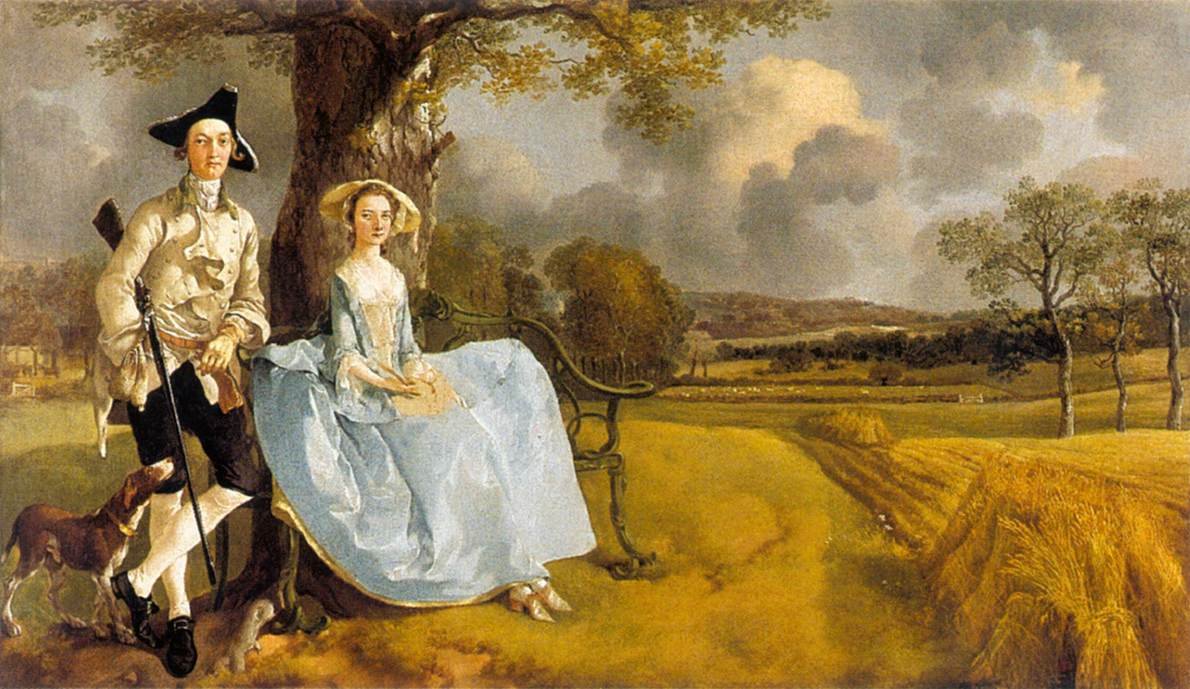
So that brings me nicely to today’s My Daily Art Display which is a portrait of a wealthy couple on their huge estate.  The portrait is simply entitled Mr and Mrs Andrews and was painted by the great English landscape and portrait Thomas Gainsborough in 1749.  This was one of Gainsborough’s earliest portraits.  The subjects of the painting are the English country squire, Robert Andrews and his wife Frances Mary, née Carter who he had married a year earlier and this work by Gainsborough was commissioned to celebrate the marriage.    Both bride and bridegroom came from wealthy families.  Robert’s family owned land on the Essex-Sussex border around the town of Bulmer.  Frances was the daughter of William Carter a wealthy cloth merchant who owned a large estate in the parish of Bulmer and the joining in matrimony of the two meant the coming together of two large estates.  This is a portrait, which not only celebrates the coming together of the young lovers, but demonstrates that this union has brought about the considerable wealth of property they now jointly owned.

This delightful portrait of the pair posing on their country estate in the summer sunshine is full of charm.  The church in the background is St Peter’s, Sudbury, and the tower to the left is that of Lavenham church. The gold and green of their fertile fields and their well-kept estate is beautifully painted.  It is interesting to note that this type of portraiture was known as “outdoor conversation pieces”.  The term was given to portraits showing two or more full length figures engaged in conversation or other polite social activity and were generally part of a domestic or landscape painting.  This idea of having a country scene as a backdrop to a portrait probably came from the French and their fêtes galantes, which was a French term used to describe a type of painting which first came to prominence with Antoine Watteau but unlike outdoor conversation pieces, they normally featured fictional characters.

Let us now have a close look at the painting.  The first thing that strikes me is that although it is a portrait, the landscape take up more than half of the space of this oil on canvas painting.  Maybe the couple wanted to subtly highlight their wealth by having their vast estate featured as a backdrop to their portrait.  This you must remember is not an idealistic landscape concocted to enhance the painting.  This is the real thing.  This is their own estate which was a joining together of the two lands of their parents.  This vast estate was now a celebration of their union.

Robert Andrews stands straight.  His faithful gun-dog at his side looking lovingly up at his Master.   There is an air of relaxed nonchalance about his pose.  He looks to have “not a care in the world”.  His hand is in his pocket but even so it is a somewhat formal pose.  His frock-coat is unbuttoned at the top and by the way he holds his hunting gun under his arm, is to have us believe he has just returned from a shoot.  He is, by depiction, one of the landed gentry and the way he is at ease shows he is happy to show off his good fortune and his possessions, namely his large estate and of course, his wife.  We can have no doubt of his standing in society.  His character and future are like the well established oak tree which they shelter under – solid.  It is easy for us to understand that his wife will want for nothing

The genteel Mrs Andrews sits primly next to her husband on an ornate Rococo-style bench.  She was about eighteen at the time of this portrait.  She is dressed in her finest clothes and her demeanour, like that of her husband, oozes wealth and respectability.  She, in some ways, appears doll-like in her bright blue hooped skirt and pointed silver-coloured shoes.  I am sure the couple didn’t pose for the artist in the fields of their estate and this painting is likely to have been carried out in the artist’s studio and Gainsborough may have used tailor’s dummies to hang their clothes on and then later gone out to study the landscape of their estate.  Still I am sure the couple were happy with this work of art and it would have pleased them to see how it portrays them and their land.  There has been some conjecture as to whether the original intention was to have Mrs Andrews hold a book or maybe a brace of pheasants which her husband had just shot as there seems to be a space on her lap left unfilled.  It was also surmised that the space was left empty in order that, at a later date, one of her children may have been added, sitting on her lap.

So the couple had everything.  Sadly however, after giving her husband nine children, Mary Andrews died at the relatively young age of forty-eight.  Robert Andrews went on to re-marry and lived a long life surviving to the good old age of eighty.  They now rest together, side by side, in the graveyard of Saint Andrews in Bulmer.

The Four Elements: Fire by Joachim Beuckelaer

The Four Elements: Fire by Joachim Beuckelaer

My Daily Art Display offering for today is the fourth and final painting in Joachim Beuckelaer’s set of pictures, which he painted in 1569-1570 entitled The Four Elements.   Today’s painting is entitled The Four Elements: Fire.  The Ancient Greeks believed that the cosmos was made up of four elements, namely, Earth, Air, Fire and Water and thus the reasoning behind the artist’s four-picture set.   The painting today moves away from the market stalls where we saw women buying vegetables, poultry and fish and that were featured in the previous three works of art.  Instead, today we move to a kitchen scene in which the produce that has been bought at the various market stalls will be cooked.  To do the cooking one needs fire, hence the subtitle to this painting.

This painting, like the other three was completed in Beuckelaer’s studio for an Italian patron.  This genre of painting was very popular with the local populace.  The abundance of food in the paintings did not mirror life in the Netherlands at the time as the locals lived under the oppressive regime of the Duke of Alba, a Spanish general who was the governor of the Spanish Netherlands and who was renowned for his cruelty and atrocities against the Flemish and Dutch people.

We look at the kitchen scene from a slightly elevated position.  This is a busy kitchen.   Probably more than just busy, I think it borders on disarray, almost chaos by the look at the tumbling kitchen bowls in the centre of the composition.   Whilst the women are hard at work, the only male in the picture, who is probably a servant or steward drinks to excess and if not careful will end up in the fire!  The two women with him seem less than amused at his antics.  Beuckelaer’s forte is his still life paintings.  Look carefully at the produce.  See how he has exquisitely painted the various dead poultry and the sides of ham.  No detail has been spared.  Look at the way he has painted the earthenware kitchen utensils, some glistening in the sunlight which streams through the kitchen window.

On the floor we can see mussel shells.  These sometimes have erotic connotations when seen in paintings.  However there may be another meaning to the scattering of these shells in the kitchen scene.  The Dutch Golden Age painter of allegories, Adriaen van de Venne said that because mussels stay in their shells they “can be compared to the blessed women-folk who speak modestly and virtuously and always look after their household.   So maybe Beuckelaer’s inclusion of the shells on the floor was a tribute to the hard working women in his kitchen scene.

Jesus at the house of Martha and Mary

Finally if you look through the door on the left-hand side, you can see another kitchen scene.  This is the Biblical story which Beuckelaer has introduced into each of his four paintings.  This scene is set in the kitchen of the house of Mary and her sister Martha in which we see Jesus who has come to visit them.  The story according to the Bible is that Martha complains to Jesus that although she is working hard in the kitchen, all Mary does is stand around listening to his words.  Jesus reproached her saying that Mary’s contemplation was in fact a more important form of her work.

This biblical story was often told to servants in the sixteenth century with sole purpose of stopping them complaining about the amount of servile work they had to carry out.  I am not sure that this “parable” would find much favour in present day workers!

So now you have seen all four paintings in The Four Elements set.  Some may think the colours rather garish and the scenes at the produce stalls and in the kitchen somewhat chaotic but this painting genre was very popular at the time of Beuckelaer and to be honest I find them both fascinating and of great quality.

The Four Elements: Air by Joachim Beuckelaer

The Four Elements: Air by Joachim Beucklaer (1570)

Over the last few days I have featured the set of four paintings by the Flemish artist Joachim Beuckelaer entitled The Four Elements.  On the first day the painting was subtitled “Water” and yesterday the subtitle of the painting was “Earth”.  Today I am featuring the third painting of the set with the subtitle “Air”  which was painted in 1570.

In the “Water” painting we were shown a fish market and the connection with the Element of Water was that of the habitat of the food.  The same went for the “Earth” painting when we saw the fruits and vegetables of the earth.  Today with the subject “Air” we are treated to the sight of the “food” which occupies the air above ground, namely birds, fowl and rabbits.  We are also treated to the sight of products which come indirectly from the land such as eggs and cheeses.  We are at a poultry market and there is an abundance of food on offer.  During Beuckelaer’s lifetime he painted numerous “market scenes” and at that time the art market was flooded with such a genre.  Unfortunately for the artist once the art market became saturated with such paintings their value declined and the real value of Beuckelaer’s work did not become apparent until after his death.

In the painting we see the rosy-cheeked stall holder sitting alongside the produce.  It is a well-stocked market stall with a variety of dead fowl and small birds.  We can also see inside a green wicker cage some live hens.  The man at the stall, wearing the leather jerkin, has hold of a hen by its feet having just taken it out of the cage to show it to a would-be purchaser.  To the left we observe a well dressed woman.  She too is holding a hen in her right hand whilst her left hand rests atop a copper flagon which may contain milk or wine.

In the central background we see a road leading to the sea with a small cargo boat just setting sail with the crewman starting to hoist the sails.  On the quay we can just make out some barrels which have been off-loaded from the craft.

The Prodigal Son

So where is the Biblical story, which the artist is known to have incorporated into each of the four paintings?   In this painting it is not as obvious.  If however you concentrate on this road leading to the sea you will spot on the left hand side just behind some baskets of produce a man and a woman.  She has her hand on his arm greeting him.  He is leaning backwards against her, almost slumped.  This was the Biblical addition of the painting by Beuckelaer, symbolising the Prodigal Son returning home.  To me it seems as if he is inebriated and has just about made back home!

Once again we have before us a very colourful painting, full of activity.  I get great pleasure looking around the painting at the various charactyers and their expressions and try and work out what is happening and what the artist had in his mind as he put paintbrush to canvas.

To get a much better view of this painting I suggest you try the National Gallery Website (below) and then you can zoom in on aspects of the painting.  The website is:

http://www.nationalgallery.org.uk/paintings/joachim-beuckelaer-the-four-elements-air

The Four Elements: Earth by Joachim Beuckelaer

The Four Elements Earth by Joachim Beuckelaer (1569)

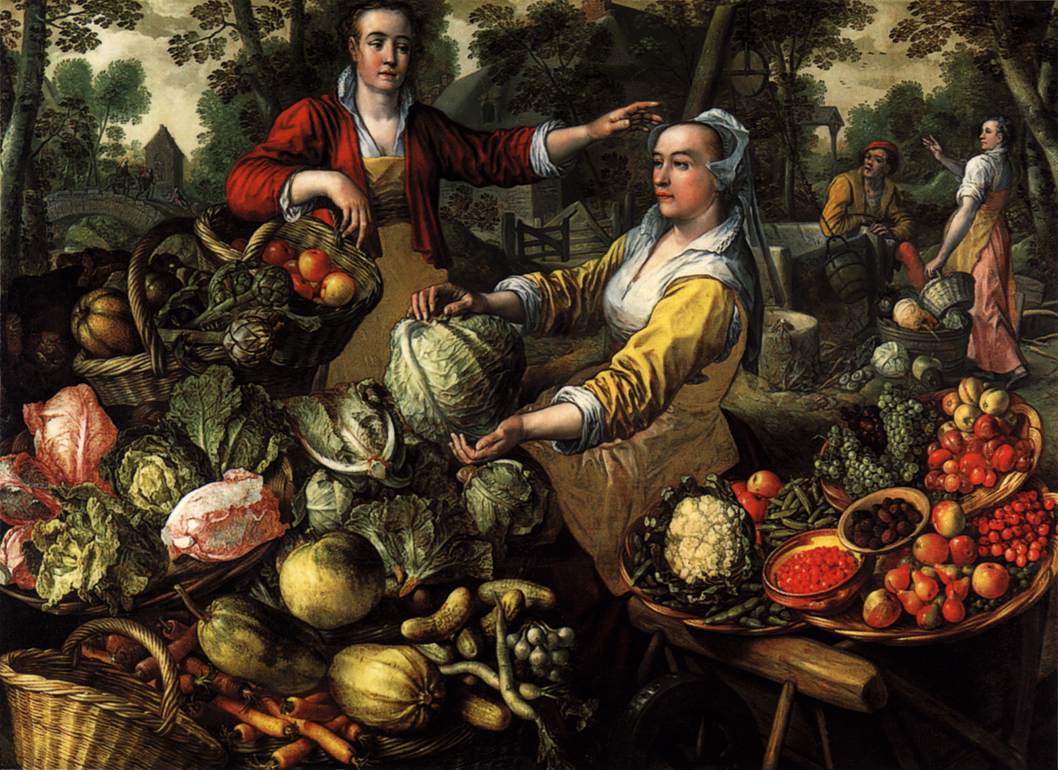
Today I am featuring the second of a set of four paintings entitled The Four Elements.  This painting completed by Joachim Buckelaer in 1569 is entitled The Four Elements: Earth.  In this painting we are again standing in front of a market stall.   This time the scene is set in the countryside, outside a large thatched-roof farmhouse, and before us we can see laid out an abundance of fruit and vegetables, symbolising “Earth” as this is where the produce has come from.  It was common practice in Dutch and Flemish paintings of the 16th and 17th century to symbolise the Elements by reference to the natural world.  Although I have not attempted to count them, I believe there are sixteen different varieties of fruit and vegetables on display in the painting.  The painter has used some “artistic licence” when he painted the various fruit and vegetables as not all would be available at the same time of year and of course there was no such thing as refrigeration in the seventeenth century.  It is truly a depiction of a “land of plenty” where there is no place for hunger.

The spectrum of colours used by the artist has enhanced the painting.  The fruit is painted with such realism.  They look so succulent and they lay there tilted slightly towards us to give us an even better view of everything and tempt us to try some of the produce.   You almost want to move forward and pick a grape or sample a mulberry.  All seems so mouth-watering which is a testament to the artist’s great ability to paint still-life subjects.

It is difficult to decide who are the buyers and who are the sellers in the painting.  Before us, we have the two young females in their colourful attire.  The lady in the red jacket with her sleeves rolled up has rosy cheeks which has probably come from working outside so much.  The lady with the lace cap and yellow sleeved dress would seem to be dressed slightly better than the others and may hold the position of head cook in a wealthy household who has come down to choose the best produce for the ingredients needed for the meals she is about to prepare.  I love the way the way Beuckelaer depicts the vegetables tumbling from her hands.  It makes you almost want to rush forward and catch the errant cabbage before it hits the ground.  To the right of the main figures we see a young man and woman by a well and one wonders if they are the stall holders who use the water from the well to wash the fruit before putting it on display.  The man stares out at us with his elbow on the edge of the well as he takes a rest.

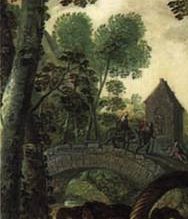
Mary and Joseph crossing the bridge.

Once again the artist has included a scene from the bible into the painting.  Look to the left background and you can see in the distance, a small arched bridge, on which Mary and Joseph are crossing.  Joseph leads the way on foot guiding the mule on which sits Mary with the infant Jesus and is a portrayal of the Holy Family’s Flight into Egypt to avoid the clutches of King Herod.

I love this painting and I love how Beuckelaer has painted the produce.  It is so life-like.  The colours he has used enhance the painting and make it look so real.

The Four Elements: Water by Joachim Beuckelaer

The Four Elements: Water by Joachim Beuckelaer (1569)

Over the next four days I want to show you a set of four paintings by the Flemish painter Joachim Beuckelaer.  His favoured painting genres were still lifes and market and kitchen scenes.  Beuckelaer was born in Antwerp in 1533 and was the nephew of Pieter Aertsen the Dutch historical painter whom he trained under.  By his late twenties Beucklaer was a master painter in his own right although a number of his paintings were based on themes used by Aertsen, the general opinion was that the standard of the former pupil’s work was greater than that of his master.  Both Aersten and Beuckelaer were renowned for their paintings depicting scenes from inside a kitchen and of scenes at the market both of which always included many still-life depictions of food.  As is the case of my featured paintings over the following days, Beuckelaer would also include a relevant biblical subject within the painting of domestic life and maybe it was intention to compare the stress of physical life on this earth and spiritual life.  It is interesting to note that the religious subject in each painting is consigned to the background of each work of art.
The set of paintings I am featuring over the next few days is entitled The Four Elements,  which Beuckelaer painted between 1569 and 1570 and they take as their theme the four classical elements of Earth,  Water,  Air and Fire.  It is thought that the set of paintings  were destined for an Italian patron.
Today I am featuring The Four Elements: Water, which was completed by Beuckelaer in 1569.  Here in front of us is a scene at a fish market.  The artist has depicted twelve different identifiable varieties of fish.  Some art historians believe that the twelve represent the twelve disciples.  It is thought that he was the first painter to depict the market fish stalls at Antwerp.  Before us we gaze at the stall holders and we start to feel a little uncomfortable with the way they stare out at us.  The older lady to the left has a resigned expression on her face as if it is “just another day selling fish”.  She is not smiling.  She looks tired as she holds out the tray of fish for us to examine.  The man to the right, who maybe her son, rests his right hand on a trestle table as he proudly shows us the underbelly of a large fish.  It is interesting to look at the left background and see how Beuckelaer has used steep perspective in the way he depicts the bustling street going off into the distance.

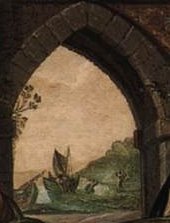
However what is more fascinating and in some ways more bizarre is what we see though the central arch in the background.  This is not part of the landscape to the rear of the fish market but is in fact a scene from the bible.  It is the time when Christ appeared to the disciples.  This was the third sighting of Christ since the Resurrection and the scene is based on the Gospel by Luke 5: 1-11, in which we are told that Jesus told the despondent fishermen, including Simon Peter, who were washing their nets after a fruitless days fishing, to “put out to the deep water and once again let down their nets”.  Peter questioned the merit of this advice but did so and they caught innumerable fish and this has been referred to as the Miracle of the Fishermen.

This is a picture, which has a wonderful array of colours , fascinating characters and  along with the other three works makes for a beautiful set of paintings.

The Effects of Intemperance by Jan Steen

The Effects of Intemperance by Jan Steen (c.1665)

I have featured many paintings, mainly by Dutch or Flemish artists, which try and have an embedded moral message in their works of art.  Often it is about the dangers of drinking too much, which is a subject painters from our present time may find very topical.   My Daily Art Display today features one such 17th century painting entitled The Effects of Intemperance by the Dutch painter Jan Steen.

Jan Havickszoon Steen was born in 1626 in Leiden a town in the Netherlands and was a contemporary of the great Rembrandt van Rijn.  He received his artistic education from the German painter of the Dutch Golden Age, Niclaes Knupfer who gained a reputation for his historical and figurative scenes of Utrecht.  At the age of twenty-two Steen joined the Saint Lukes Guild of Painters in Leiden.  Steen then moved to The Hague where he lodged in the household of the prolific landscape painter Jan van Goyen.  Soon after, he married Margriet, the daughter of van Goyen.  Jan and his father-in-law worked together closely for the next five years.  Then he moved and went to live in Warmond and later Haarlem.  His wife died in 1669 and his father-in-law passed away a year later.  Steen returned to Leiden re-married and had two children and remained there until his death in 1679 at the age of  53.
So back to today’s featured painting which is a pictorial moral tale of the dangers of insobriety.  The painting illustrates well the Dutch proverb “De Wijn is een spotter” translated means: Wine is a mocker, in other words wine (or drinking it in excess) will make a fool of you.  Although we see the children misbehaving the onus of guilt is placed squarely on the shoulders of the adults.

The main character of the painting is a woman who we see sitting slumped on the steps of her house sleeping off the effects of having drunk too much alcohol.  The overturned flagon of wine lies on the floor and despite the noise and antics of the children she doesn’t wake.   She is being portrayed as the neglectful mother.  She is totally unaware of what is happening around her.  However, she is no peasant.  Look at her clothes.  These are not ragged and threadbare.  The fur-trimmed jacket, in fact, looks both expensive and stylish.  Maybe the moral of the tale is that an excess of alcohol can affect rich and poor alike.  Her comatose state is going to cause a disaster as we see that her lit pipe is just about to slide from her fingers on to her dress.  The hem of her dress rests perilously close to the rim of the small clay brazier by her side which she has been using to keep her pipe alight and soon her clothes will surely catch fire.  It should also be remembered that at this time in the Netherlands most houses were of wood construction and fire had become a great hazard of life for those living in these dwellings.

The child behind her is stealthily filching the purse from the pocket of her dress, watching her carefully in case she stirs.  Again we are reminded of the Dutch proverb which states “opportunity makes the thief”.  This painting, in some ways,  mirrors Pieter Bruegel’s Netherlandish Proverbs but on a smaller scale.    Look at the girl kneeling in front of the comatose woman. Maybe it is her eldest daughter.  She is offering the parrot a drink of wine from a glass.  The girl looks unsteady and her face is flushed.   Maybe she too has imbibed to excess.  Are we being reminded that the sins of the mother will be passed on to the child?

Next to the mother we see a boy clutching a bunch of roses.  He is throwing them to the pig which is busy snuffling around the legs of the woman in search of food.  We know of the biblical proverb “ Nether caste ye youre pearles before swine”  meaning that it is a worthless gesture of offering items of quality to those who aren’t cultured enough to appreciate them.  However the Dutch proverb doesn’t talk about pearls but instead – rose buds.  So what we are seeing in the painting is the rose-strewn pig, which simply symbolises how people waste what they have.

To the right of the mother we see three small children feeding a meat pie to the cat.  Again, this is highlighting the folly of waste.  It is interesting to note what is hanging above the drunken woman’s head.  It is a basket, in which there is a pair of crutches and a birch.  This is to be a reminder of what happens if you throw money away and mismanage your finances.  The crutch is a reminder of life as a beggar and the birch is a salutary warning of what happens if you are hauled to court because of bad debts.  Look back at My Daily Art Display of February 16th and Jan Steen’s painting entitled In Luxury, Look Out,  in which  the artist had depicted a similar scenario and the same moral tale that is being depicted by the artist in today’s painting.  In it we can see the same basket hanging above the miscreant.

Take a look at the background on the right hand side of the painting.  Here we see a man, maybe the husband of the drunken woman, sitting in the garden on a bench with a buxom young serving wench on his knee.  He is oblivious to what is going on around him and prefers to carouse with the young girl.

The Dutch painter and biographer of artists from the Dutch Golden Age, Arnold Houbraken, wrote about Jan Steen, recording that the household of Steen himself was both “riotous and disorganised” and that Steen, not being able to bring in enough money from his paintings ran an inn but Houbraken cynically pointed out that Steen’s best customer was himself!  However maybe the facts do not bear out the biographer’s assertions for Steen completed over 1400 pictures in a span of 30 years,  so could he possibly have had time to waste by drinking in his inn?  In yesterdays offering I spoke about artists liking to incorporate their own image into their paintings and Steen was no different.  He would even add his wife’s image into some of his bawdy pub scenes and she, rather than being flattered by her inclusion, would claim that her husband was always showing her as a “horny tart, a matchmaker or a drunken whore”!  It could be that she was the model for the drunken woman in today’s painting.

The chaos which reigns in this painting is similar to the themes in many of his household scenes and “a Steen household” is a Dutch phrase which means a household which is a badly managed and in total chaos.

Nymphs by a Fountain by Sir Peter Lely

Nymphs by a Fountain by Sir Peter Lely (c.1650)

Peter Lely, a Dutch Baroque painter, was born in Soest, a town in North Rhine-Westphalia, in 1618.  He was actually born with the name Pieter van der Faes.  His mother Abigael van Vliet came from a wealthy Utrecht family and his father Johan van der Faes was a captain in the forces of Baron Walraven van Gent, which served the Elector of Brandenburg and which was stationed in Soest.  Pieter became known as “Lely” which is the Dutch word for lily as on the facade of his father’s house in The Hague was a heraldic lily.  From an early age Peter studied painting under the tutelage of Pieter de Greber and at the age of nineteen became a member of the Guild of St Luke in Haarlem where he had gone to live and work.

At the age of twenty-three Lely left the Netherlands for England and arrived in London around 1642.  He originally focused his works of art on landscapes and history painting but he turned to portraiture as there was a great demand for this painting genre and he soon built up a reputation as a great portraitist.  His commissions came from the likes of Charles I and later Cromwell but the height of artistic career came during the reign of Charles II when he became the king’s official painter and painted many of the royal courtiers and their mistresses in a style, which art historians termed a “Baroque swagger”.  In 1661 the king awarded him a stipend of two hundred pounds a year.  He dominated the portraiture scene from the mid seventeenth century until his death.  Eight years later in 1689 he was knighted but sadly a year later he died at the age of 71.  It was said that he was found slumped before his easel with his palette still in his hand having been working on a portrait of the Duchess of Somerset.

Sir Peter Lily as well as being an artist was also an art collector which during his lifetime was valued at over ten thousand pounds.  His collection was immense having started it once he had arrived in England.  After he died is collection was sold.  Amongst the prized collection were works by Veronese, Titian, Giorgione, Reni, Rubens and Frans Hals, just to mention but a few.

My Daily Art Display for today is one of his mythology paintings which were usually set in Arcadian landscapes.  It is a very erotic painting and is probably his most famous non-portrait work.  It is entitled Nymphs by a Fountain which he completed around 1650, the year after King Charles I was executed  I saw this painting when I visited the Dulwich Picture Gallery in London.  It is set in late evening time and in it we see a group of female figures in various states of undress grouped together at the foot of a fountain with its sculpture of a dolphin and putti.  It is a woodland setting, bathed in warm evening sunlight, surrounded by long shadows.  But who are these semi-clad females?  Nobody seems able to pin the scene down to a mythological episode.  So why are they lying by the fountain?  Are they supposed to be asleep?  Too many unanswered questions but maybe there is very little point in seeking answers.  Maybe this is not a painting that needs interpretation.  Maybe we shouldn’t look for hidden symbolism and just take it on face value.  It could well be that, as far as the artist was concerned, it was just an excuse to paint female nudity. 

The figures in the painting have not been romanticised.  The females have dishevelled hair as they are seen lying on discarded silk dresses and white linen shifts  Lely has painted the females, not as perfect body forms, but with, what one would term, “slight imperfections”.  The nymph in the lower left of the painting has a somewhat plump stomach.  The one at the front with her back to us has dirty feet whilst the breasts of the nymph lying on her back to the left of the fountain have flattened with their own eight. This is no portrayal of sculptured beauties with skins of marble.  These are not idealised beauties and yet there is sensuousness about the way they are depicted.  Is this merely an erotic painting which has no hidden meaning and is thus, just for the voyeur who enjoys looking at, and is aroused by, this genre of art?

The Martyrdom of the Ten Thousand by Albrecht Dürer

The Martyrdom of the Ten Thousand by Albrecht Dürer (1508)

This picture fascinated me.  It is a very disturbing work of art.    It was full of everything going on and one could spend ages looking at all the details of the scene.  I love this type of painting.  I love discovering new things every time I gaze at it.  I am starting to think that maybe instead of looking at Old Masters I should concentrate on “Where’s Waldo” pictures – only kidding !

The painting in My Daily Art Display is entitled The Martyrdom of Ten Thousand by Albrecht Dürer, which he painted in 1508 and it can now be found in the Kunsthistoriches Museum in Vienna.  This was an altarpiece commissioned by the Elector of Saxony Frederick the Wise for the chamber of relics in his Wittenberg castle chapel.  Frederick is said to have owned relics from the actual massacre and kept them in this chapel.  He displayed them annually until Martin Luther prohibited the practice.

The scene is based on a story from Jacobus de Voragine’s collection of stories about the saints entitled Legenda aurea or Golden Legend.  The legend in question is the massacre of ten thousand men by the Persian King Saporat.  According to the legend the Roman Emperors Hadrian and Antonius marched at the head of a large army on a campaign to Asia Minor to suppress the revolt of the Gadarenes and the people of the Euphrates region.   However the battle didn’t go well and all fled except nine thousand soldiers. These had been converted to Christianity after angels appeared to them, promising victory.  Buoyed up with that knowledge the nine thousand soldiers attacked and completely routed the enemy.  When the two emperors heard of this great victory they sent for the men, telling them to come home and join in the sacrafices of thanksgiving to the gods.  The men refused to return and worship “false gods”.  The emperors enraged by their disobedience asked the five kings, rulers of this area, to help in bringing back the “converts”.  The kings gathered up a huge army and the converts were trapped on Mount Arafat.  Their safe passage home was guaranteed providing they denied their faith.  However they refused and were stoned but according to the legend the stones just rebounded against their persecutors.   At seeing this miracle another thousand soldiers deserted the attacking hordes and joined the nine thousand converts.  It was at this point the emperors ordered every one of the ten thousand men to be crucified.

The Artist and friend

So let us now look at this fascinating painting in which Durer has depicted the killing of these ten thousand converts.  If you look carefully at the centre of the picture you will see two men dressed in black.  On the right we have Dürer himself holding a stick attached to which is a note which reads:

This work was done in the year 1508 by Albrecht Dürer, German

Next to him stands his friend Konrad Celtis, the German Renaissance humanist and scholar who actually died before the painting was completed.  Maybe his inclusion was Dürer’s memorial tribute to his friend.  It always fascinates me to see how many artists paint themselves into their own pictures, often part of crowd scenes.  It is a little bit like Alfred Hitchcock who always appeared for a few seconds in his own films.

The Oriental Potentate

If you look in the foreground on the right-hand side you can see one of the kings of Euphrates who had been called in by the two Roman emperors to suppress the “rebellion”.   He is resplendent in his blue cloak and white turban which makes him stand out from the others.  Art historians believe that Dürer’s  portrayal of the oriental potentate was a reference to the threat of a Turkish invasion into Europe, since fifty years earlier, Constantinople had been captured and people were concerned that the marauding armies may move further westward.

The killings

There is a savagery to this painting as we see the converts being systematically killed, some by crucifixion whilst others are being thrown off high cliffs.  In the foreground to the left, we can see one blindfolded man about to be decapitated.  On the ground we see a decapitated head.  In the centre foreground we see a man with his foot on the chest of a convert about to drive a stake through his heart.  It is all very grizzly.

Men being led to their deaths

 To the right of the middle-ground we see a line of men, some naked, tied together in a line being marched up the mountain where they would eventually be thrown off the cliffs to their death.  To the left of the line we see a man with a heavy boulder held above his head about to hurl it downwards on to the skull of a hapless convert.

It is a veritable bloodbath of a picture and the details may make you feel uncomfortable but the detail and the colours make this one of my favourite paintings.


The Death of Cleopatra by Guido Cagnacci

The Death of Cleopatra by Guido Cagnacci (1660)

 My Daily Art Display today features not one but two paintings.  Both are by the same artist Guido Cagnacci and both have the same theme, namely, the death of Cleopatra. 

Guido Cagnacci was an Italian painter of the late Baroque period belonging to the Bolognese School which rivalled Florence and Rome as centres of painting.    He was born in 1601 in  Santarcangelo di Romagna, a town in the province of Rimini  where he spent the early part of his life.  Later, he spent time in Rome where he met fellow artists Simon Vouet, Guernico and was a pupil of Guido Reni.  It is also believed that during this time he may also have studied under an ageing Ludovicio Carracci.  He moved back east to Venice in 1650 and started to paint very sensual scenes with seductive, half-naked girls as his subject.  These erotic paintings were very popular and much sought after by collectors at the time and his popularity spread .  In 1658 he journeyed to Vienna where he gained the patronage of Emperor Leopold I and that was his ticket to fame and riches.  His later paintings featured semi-naked women as Lucretia, Cleopatra and even Mary Magdalene.

The painting above entitled The Death of Cleopatra was completed by him in 1660 and now hangs in the Brera Gallery in Milan.   This painting is charged with sensuality and we see Cleopatra slumped in an upright chair, naked down to the waist.  She has been bitten by the asp which we see trapped between the arm of the chair and her right arm.   Her eyes are almost closed as she drifts towards unconciousness.  Her head has fallen back against the red leather of the chair.  The curls of her golden hair reach down to her shoulder.  Even at the point of death she retains her beauty.  Her facial expression is one of tranquility and not one contorted with pain.  In her final moments she loses none of her radiance.

Death of Cleopatra by Cagnacci (1658)

The second painting by Cagnacci which I am featuring entitled The Death of Cleopatra was painted two years before the first one I featured.  It was completed around 1658 and now hangs in the Kunsthistoriches Museum in Vienna.

In this painting we see Cleopatra, not alone, but with six of her handmaidens.  Look at the contrast between Cleopatra and her handmaidens.  See how Cagnacci has shown the realism of the weeping servants.  The faces of some are contorted with anguish whilst others just dissolve into tears for the plight of their mistress.   The handmaiden in the left  foreground points towards the snake, said to be an asp,  and like the woman next to her holds up her other hand to shield herself from any attack from the creature.  But look at Cleopatra.  Cagnacci has once again painted her half slumped in the chair this time with her head fallen to one side.   Once again we see the small snake trapped between the arm of the chair and her arm.  Maybe the squeezing of the snake’s body has caused it to strike.   Again as was the case in the first painting, Cleopatra seems at peace with the world and once again there are no facial expressions which would lead us to believe that her death had been in any way painful.

It is that very last point about the peaceful look on Cleopatra’s face that brings me to an interesting point of view made by the German historian and author of a best-seller entitled Cleopatra,  Christoph Schäfer, who has researched the death of Cleopatra caused by the snake.   He has looked back at historical texts and one report, written about 200 years after Cleopatra’s death, stated that Cleopatra died a quiet and peaceful death, and this is exactly how Cagnacci has portrayed the victim in both his paintings, which does not correlate with death by asp bite – a  long, painful and disfiguring way to go.

Schäfer’s other findings have also destroyed our long-held beliefs re the 2000 year-old legend of the Queens death,  for he also highlights the fact that the story of Cleopatra, which we are used to, is highly unlikely.  His examination of ancient texts in Alexandria revealed that Egyptians knew a lot about poisons, and one papyrus reported that Cleopatra tested these poisons on herself.  He also states that Cleopatra died in the middle of an Egyptian summer, so temperatures would most likely have been too high for an asp to stay still enough to bite.  Of course in our two paintings Cagnacci has shown the snake trapped under her arm and unable to wriggle free!   Having discussed his thoughts with a toxicologist, Schäfer concluded that the most likely method of death was a drug combination of opium, wolfsbane and hemlock, which was known at that time to induce a painless death.

I will end here and let you decide how Cleopatra died,  but do not let the different theories detract from these two beautiful paintings