The Five Children of Charles I by Sir Anthony van Dyck

The Five Children of Charles I by Sir Anthony van Dyck (1637)

Antoon van Dyck, or as we better know him, Anthony van Dyck, was born in Antwerp in 1599.   He came from a wealthy Flemish family, his father being an affluent silk merchant, and whether it was because of his prosperous upbringing or his inherent artistic talent, even at a young age it was recorded that he was, besides being very gifted, an extremely precocious boy.  He studied art under Hendrick van Balen, the Flemish Baroque painter, who also tutored up and coming artists such as Frans Snyders and Jan and Peter Bruegel the Younger.  He started producing quality works of art at the age of fifteen and three years later was accepted into the Guild of St Luke, the Antwerp painter’s guild as a free master.   At the age of eighteen he became chief assistant to the great Rubens whom he stayed with for three years during which time he continued the output of his own paintings and slowly but surely enhanced his own reputation.  Rubens said on a number of occasions that van Dyck was the most talented artist he had ever trained.

In 1620 he was invited to England to work for the then monarch King James I of England (King James VI of Scotland), who had been told that the young van Dyck was in the employment of the master, Peter Paul Rubens, and that the young man’s talent and works were exceptional and were almost on par with the great master himself.  During his stay in London, van Dyck came across works of Titian which were part of the art collection of the Earl of Arundel, one of the king’s courtiers.  Van Dyck remained in London for six months before returning home.  At the end of 1621 he moved to Italy and stayed there for six years studying the works of the Italian masters whilst visiting many of the Italian art capitals such as Rome and Genoa. It was whilst in Italy that van Dyck developed and perfected his skill as a portraitist.

In 1627 van Dyck once again returned to his birthplace, Antwerp but was only to stay there for one year before accepting an invitation to return to London by the new English monarch, Charles I, who had acceded to the throne two years earlier.   King Charles was one of the greatest art collectors of all the English monarchs amassing an unbelievable collection of works of the great masters, some of which had been purchased and brought to England by his agents with the help of van Dyck,  who also sent the monarch some of his own paintings.  Charles loved art and would invite the artists such as Gentileschi and Rubens to his court where he would commission new works.

In 1632 van Dyck returned to London where he joined the royal court, received a house as well as a country retreat, a monetary retainer and was knighted.  He soon became the favourite painter of King Charles and his wife Queen Henrietta Maria and over the years carried out numerous portraits of the couple and their family and it is around this time, actually 1637, that van Dyck completed today’s featured painting.

My Daily Art Display today is Sir Anthony van Dycks’ painting entitled The Five Eldest Children of Charles I.    When one looks at a painting of a male sitter one often describes it as a handsome and debonair portrayal of a man and if the sitter is a female, one often terms it as a beautiful and attractive portrayal of the lady.  However, the portraits of children and animals can often be termed differently and one of the favourite descriptions is “cute”, and this certainly sums up today’s portrayal of the monarch’s children and their large pet dog.

Queen Henrietta Maria, a catholic, was the youngest daughter of King Henry IV of France and she gave birth to nine children, two of which were stillborn.  At the time of van Dyck’s painting the royal couple had five children, Charles, Mary, James, Elizabeth and Anne.  Today’s painting is hailed as one of the greatest group portraits of all time.  The children are portrayed as children and not as was often the norm, tiny adults.   We have in the centre with his arm resting on the family pet mastiff, Charles who would become King Charles II.   Van Dyck has surprisingly afforded him an unusual air of authority for one so young.  He looks out at us with a thoughtful countenance.  The very large dog sitting calmly by his side adds even more gravitas to the young boy, the future King Charles II.

To his right we see two children standing side on to us.  Their look is somewhat shy and demure as they gaze out at us. The taller of the two on the far left is the six year old Mary, Princess Royal, whilst although looking like her little sister, is in fact her younger brother James who would later become King James II of England.

Elizabeth and Anne

On the opposite side of the painting we see a young girl cradling a baby, with the small spaniel at her feet.  This is the two year old Princess Elizabeth and the baby, who had been born that year, is Princess Anne.   The round, somewhat chubby rosy cheeks of the pair, contrasts well with their linen white caps and the string of pearls around Elizabeth’s neck.  Tragically neither Elizabeth nor Anne lived long.   Elizabeth, after the fall from power of her father during the two Civil Wars, spent her last eight years held as a prisoner of Parliament.  She died of tuberculosis aged 14, a year after her father’s execution.  Her mother always maintained that she had died of a broken heart caused by the untimely death of her father.    Baby Anne died aged 3, and like her sister, the cause of death was tuberculosis.

Above the seated girl we have an exquisite still life behind which we see a far-off landscape which was often a trademark of van Dyck’s portraits.    There is a tranquil elegance about this painting.  The children seem contented, even happy and thus it is sad to realise that twelve years on from the completion of this family portrait, their happy family life would be shattered with the premature death of Elizabeth and the execution for treason of their father, Charles I.

So what do you think of the painting?   The nineteenth-century Scottish portrait painter Sir David Wilkie was in no doubt with regards its quality describing it thus:

 “……the simplicity of inexperience shows them in most engaging contrast with the power of their rank and station, and like the infantas of Velasquez, unite all the demure stateliness of the court, with the perfect artlessness of childhood….”

Eastward Ho and Home Again by Henry Nelson O’Neil

Today I am offering you two paintings by Victorian painter Henry Nelson O’Neil.   The reason for the joint display is that the works are connected and the story behind them is intertwined.

O’Neil was born in Russia to English parents in 1817.  He returned to England at the age of six and when he was nineteen years of age studied at the Royal Academy Schools.He was a historical painter, that is to say the subject matter in most of O’Neil’s paintings depicted a momentous moment in history.  At one time, the genre of  history painting was traditionally regarded as the highest form of Western painting and the works would fit into the most esteemed position in the pecking order of painting genres.   These historical works were thought of as corresponding to the epic in literature.

In the 1840’s O’Neil was a co-founder of The Clique, which was a group of like-minded young artists, based around the St John’s Wood area of London, who regularly met to peruse each other’s works and offer their own critiques.  The coming together of this group was in some ways an act of rebellion against the Royal Academy and in what they saw as its imposition of artistic restrictions.  This group wanted to add more realism to their work.  They wanted their works to have greater emotional intensity which at the time was frowned upon by the Academy establishment.   I had already mentioned this group when I looked at a painting by Richard Dadd (June 29th) another co-founder of The Clique.  This group of artists denounced the Pre-Raphaelite Brotherhood and their works and O’Neil was the most vociferous in his opposition to their art.  As with most things, The Clique eventually broke up but Henry O’Neil still believed in its principles and he continued to embrace highly emotional scenes in his works and this can be seen clearly in my two featured paintings today.

Eastward Ho by Henry O'Neil (1857)

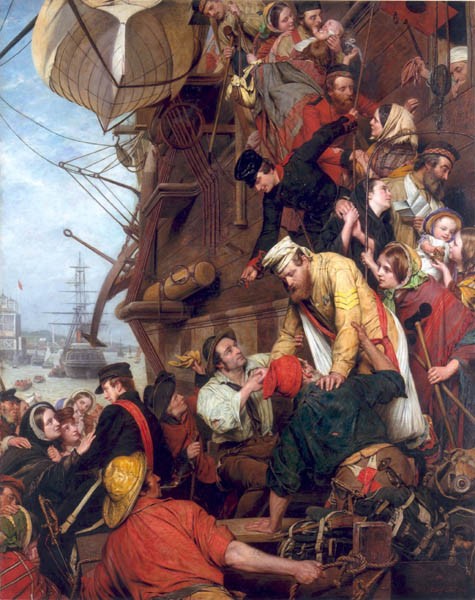
The two works I am featuring today in My Daily Art Display are entitled Eastward Ho and Home Again.  The first was painted by O’Neil in 1857 and the latter completed the following year.  Eastward Ho focuses on the embarkation of British troops on a ship at Gravesend on their way to India to fight in the First War of Independence, known as the Indian Mutiny.    For the British people this was a just war and brought about a fierce feeling of patriotism amongst the people, who were shocked by India’s challenge to British rule and British supremacy on the sub-continent.  Sadly as in most conflict the populace are whipped up into a frenzy of righteousness by the media of the day and the young men and now young women on both sides go off to fight with a sense of belief that theirs is a just cause, their God is on their side and anyway it will all be over soon and it will be other people who will be killed, not them.  In this case they were fighting for their Empire.   The painting however was well received with the Illustrated London News describing the work and its popularity as:

“….a national epic. No wonder it is so popular that such crowds assemble around it, scanning every feature of the various actors, till at last they begin to imagine themselves present at, and participators in, the scene…”

The newspaper of the day, The Times, put it:

“….Hope and aspiration are busy among these departing soldiers, and if mothers and wives, and sisters and sweethearts, go down the side sorrowing, it is a sorrow in which there is no despair, and no stain of sin and frailty…..”

In the first painting, we see the soldiers boarding the ship bound for India and their loved ones bidding them emotional farewells.  It is a poignant scene for despite the bravado and sense of duty of the young men going off to fight their just cause with nothing but a rousing sense of duty, we observe their loved ones who are going to be left behind reluctantly letting their fighting men’s fingers slip from their grasp as they move down the gang plank.  For the men we can only see in their faces optimism and patriotism whilst in the faces of the women we see fear and a sense of foreboding.

Home Again by Henry O'Neil (1858)

O’Neil buoyed up by the success of Eastward Ho decided to work on a “follow-up” painting depicting the return of some of the fighting men to their loved ones a year on.  The soldiers are seen going down the gangway of their troop ship.  The main character appears to be the bearded soldier in khaki uniform with his Kilmarnock “pork-pie” cap under a white cotton Havelock, which was worn to afford the wearer’s neck protection from the blazinga nd merciless Indian sun.

However at this juncture not all the men returned and for many wives and girlfriends there was nobody to wait for on the quayside.  Sadly as we are only too aware of in our present time, some young fighting men who return are not the same men, physically or mentally, as those who went out, once full of optimism.   Although O’Neil wanted to be faithful to his beliefs of Realism painting he knew that for the painting to be well received he had to concentrate on the joyous return of the fortunate ones and play down the sadness of the bereaved and the portrayal of the badly injured.  He was applauded for the painting’s lack of, what the media termed,  overemotional sentimentality.  The Times of the day commented:

“…..The crowd round the picture delight to spell out the many stories it includes – its joyous reunitings, its agonies of bereavement; the latter kept judiciously down…..”

O’Neil’s follow-up work was another outstanding success and it was taken on tour around the country and it was estimated that almost sixty thousand people went to see it.  In 1860 the two paintings were exhibited side by side in Piccadilly, London where viewers had to pay six pence to view the two works.  Numerous prints of the two paintings were made and sold.

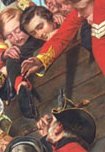
What fascinates me about the two paintings is that O’Neil has deliberately depicted some of the same people in both works.  Below I have highlighted two examples of this.  Maybe if you look closer you will find more examples of this.

The injured soldier being helped down the gangway (above left) and his wife waving him off (above right)

In another example below, the Chelsea Pensioner on the gangway waving goodbye to his son (below left) and again waving to him from the quay as he returns safely back home (below  right).

The paintings are beautiful examples of O’Neil’s work no matter what we think of his portrayal of war and those who go off to fight and I love the comparison between the emotions shown in the two works – joyous optimism that the men off to fight for their country against the somewhat muted return with its relief and sadness.

O’Neil fared well as an artist and managed to have almost a hundred paintings accepted into exhibitions at the Royal Academy, an establishment, although as a member of The Clique, he once criticised.   He was made an Associate of the Academy two years after exhibiting these two featured paintings.  O’Neil died in 1880 aged 63.

In some ways it is sad to note that nothing has changed in 150 years.  At the onset of battle campaigns the media focus on the adventure of war but now thankfully, despite the wishes of various governments,  they are not adverse to recording the devastating affect such wars have on individuakls and their families.

Mother and Child by the Sea by Johan Christian Dahl

Mother and Child by the Sea by Johan Christian Dahl (1840)

You would be forgiven for thinking today’s painting is by Caspar David Friedrich as it has all the hallmarks of similar paintings by the German Romantic painter.  My Daily Art Display today is in fact a painting by Johan Christian Dahl, who was the leading Norwegian landscape painter of his time.  The work is entitled Mother and Child by the Sea which he completed in 1840.

Dahl was born in Bergen Norway in 1788, son of a fisherman.  He studied art at school and thanks to a group of wealthy Bergen citizens who sponsored him and gave him funds, he was able to travel to the Danish capital, Copenhagen, where, at the age of twenty-three, he enrolled at the Royal Danish Academy of Fine Arts. Seven years later, in 1818, Dahl left Copenhagen for a European tour of the major art centres in Germany and Italy.  He never forgot his homeland and made many journeys back to Norway where he made many sketches of the country’s rugged landscape.  In 1824 he became professor at the Dresden Academy of Fine Arts.  Whilst living in Dresden he became part of a celebrated artistic circle which included Casper David Friedrich and with these fellow artists shaped the era of German Romantic painting which began in the second half of the 18th century.  Friedrich and Dahl when they first met immediately hit it off and they became great friends.  Friedrich helped Dahl find lodgings and buy canvas and paint.  When Dahl moved into the house where Friedrich lived, they became even closer friends. They were godfathers to each other’s children, they sent paintings together to the various exhibitions, and when one had visitors, these were taken to see the works of the other. The two friends were regarded as the typical pair of complementary artists, Friedrich was the idealist painter and Dahl the naturalist painter, but both truly committed to Romanticism. They were considered a pair to such an extent that they were always mentioned together in the exhibition reviews and people tended to order companion pieces from them.  They had differing artistic techniques.   Dahl would start his subject directly on to canvas, composed from the various drawings and studies scattered around him, at great speed and with his studio full of visitors. Friedrich began his painting only after days of meditation when the entire scene stood clearly before his inner eye. He then worked in successive thin glazes, in order to have the whole composition visible at every stage in the process. Friedrich preferred an empty studio where nothing distracted his contemplation, and when he was painting the sky in his landscapes, nobody dared to speak to him.

Johan Dahl had quite a sad personal life.  He first married in 1820 and they had four children but sadly his wife, Emilie, died giving birth to their son, Siegwald in 1827.  In 1829 his son Alfred and daughter Marie died of scarlet fever.  He remarried in January 1830 to one of his art students, Amalie von Basserwitz, but she too died in childbirth that December.  This left Dahl, with the help of his housekeeper, to bring up his two children from his first marriage, Siegwald and Caroline.   Dahl, himself, died in Dresden in 1857, aged 69.  Over seventy years later his remains where brought back to his Norwegian homeland and buried in the cemetery of St Jacob’s church in Bergen.

The painting today was Dahl’s second version of the scene and was completed the same year as his great friend Casper David Friedrich died and in some way may have been Dahl’s tribute to the German Romantic artist   It depicts a woman with her child standing on a rocky coastal landscape pointing to a boat out at sea.  The scene is illuminated by moonlight.  Dahl, like many artists during the Romantic period, painted a number of pictures with moonlight over water and of this setting he once wrote:

“…The special thing I have succeeded in doing in this piece is the faint light cast by the moon over all the scenery, a peace that is spread all over the area, which makes it solemn and beautiful. The light in the clouds, the moon, the reflections in the water, in short a certain dimness that predominates it, if I dare say it, which must both be and not be, and shows that it is night…”

The mother and child await the arrival of the boat and the homecoming of the child’s father, one of the two figures we can just make out on the deck of the craft, which moves towards them across the glassy calm sea.  It is a tranquil night.  The moon peeks through an opening of the clouds, lighting up a patch of the otherwise dark sea causing a pearlescent shimmer over the water.  There is an air of optimism about this painting as the moon lights up the scene and we see the excitement of the child at his father’s safe return.  There is a magical feel to this work of art.

Found Drowned by George Frederic Watts

Found Drowned by George Frederic Watts (c.1850)

For the second consecutive day I want to present a painting to you which has a connection with a poem.  My Daily Art Display painting today is entitled Found Drowned and was painted by the Victorian painter George Frederic Watts in 1850.  It is almost certain that the idea for the painting came from Watts having read The Bridge of Sighs, the poem written by Thomas Hood just before his death in 1845.

Watts was born in London in 1817 and his Christian names came from the fact that he was born on the composer, George Frederic Handel’s birthday.  He was brought up in an impoverished household, did not attend school, being taught at home by his father.  Despite these early setbacks in life, he achieved acceptance into the Royal Academy when he was eighteen years of age.  In 1843 he won first prize in an artistic competition to design a mural for the Houses of Parliament and although this never came to fruition, the monetary value of the prize enabled him to travel to Italy.  He remained in Italy until 1847 at which time he returned to London.

On his return to London he made the acquaintance of Henry Prinseps, an amateur artist and director of the East India Company, along with his circle of friends and in 1850, Prinseps, his wife Sara, along with some of her sisters and Watts obtained a twenty-one year lease on Little Holland House which belonged to Henry Fox, 4th Baron Holland, and a friend of Watts.  The house, not only became a place for them to all live and entertain their friends, but it gave Watts a studio for his painting.

In 1864 Watts painted portraits of the Terry sisters, Kate Terry and her famous actress sister Ellen Terry.  Watts was besotted by Ellen and despite the fact that she was still a little way short of seventeen years of age and he was thirty years her senior, they married.  The marriage was doomed to failure and a year after the marriage she eloped with her lover forcing Watts to sue for divorce.

In the early 1870’s when the lease ran out on the Little Holland House, Watts acquired another house in London and also one in Freshwater on the Isle of Wight.  In 1877 his divorce with Ellen Terry finally came through and nine years later at the age of 69 Watts re-married, this time his bride was Mary Fraser-Tytler,  a Scottish designer and social reformer, some thirty-three years his junior!   In 1891 he bought land in Guilford, Surrey and they named the establishment Limnerslease, which was a combination of the words “limner” meaning artist and “leasen” meaning glean and by it they had built the Watts Gallery which was a museum dedicated to his work.  It was the first and only remaining purpose-built gallery in Britain devoted to a single artist.  It eventually opened in April 1904, shortly before the death of Watts.

So that is the story of today’s artist and so now let us study his poignant painting and understand why he should depict such a heart-rending scene.  When Watts returned to London from Italy he was traumatized by the extremes of riches and poverty that he could see all about him.  It moved him and he realised that through his art he could bring home the inequalities of life.

The background of the painting is the London skyline and we are viewing it from under Waterloo Bridge and in the distance we can just make out Hungeford Suspension Bridge.  Waterloo Bridge had been a common place for suicides with people throwing themselves off the structure into the Thames.  In the foreground Watts has painted a “fallen woman”, a reasonably common subject in Victorian paintings.  She has drowned and been washed up on the shores of the Thames. Was it an accident or had life proved just too much for her to bear?  In those days, female suicides caused by adulterous relationships or financial hardship, which then led to prostitution, were not uncommon happenings.   Her body is lit up and is in stark comparison to the darkened background.  Her dress still floats in the murky polluted waters.  She is lying on her back with her arms stretched out in a cruciform adding religious symbolism to the picture.  In her left hand she is clutching hold of a chain, attached to which is a heart-shaped locket and this again makes us believe that unrequited love may have had some bearing on the situation.  In the night sky we see a very bright pin-point of light which could be a star of the planet Venus and Watts probably added this as a symbol of hope that maybe there will be a better after-life for the dead woman.  Look at the young woman’s face.  It appears calm.  Maybe at last she is at peace with herself.

It is interesting to note that the title of the painting Found Drowned was legal phraseology often used by coroners when there is no conclusive evidence of suicide, such as a note, and thus the coroner’s report avoids the stigma attached to suicides, which would automatically rule out a Christian Burial.

I end today’s blog with the Thomas Hood’s poem Bridge of Sighs which it is believed was the basis of Watts’ painting.  Read it through and then look at the painting and see if you agree that there is a connection between the two.

One more Unfortunate,
Weary of breath,
Rashly importunate,
Gone to her death!

Take her up tenderly,
Lift her with care;
Fashion’d so slenderly
Young, and so fair!

Look at her garments
Clinging like cerements;
Whilst the wave constantly
Drips from her clothing;
Take her up instantly,
Loving, not loathing.

Touch her not scornfully;
Think of her mournfully,
Gently and humanly;
Not of the stains of her,
All that remains of her
Now is pure womanly.

Make no deep scrutiny
Into her mutiny
Rash and undutiful:
Past all dishonour,
Death has left on her
Only the beautiful.

Still, for all slips of hers,
One of Eve’s family—
Wipe those poor lips of hers
Oozing so clammily.

Loop up her tresses
Escaped from the comb,
Her fair auburn tresses;
Whilst wonderment guesses
Where was her home?

Who was her father?
Who was her mother?
Had she a sister?
Had she a brother?
Or was there a dearer one
Still, and a nearer one
Yet, than all other?

Alas! for the rarity
Of Christian charity
Under the sun!
O, it was pitiful!

Near a whole city full,
Home she had none.

Sisterly, brotherly,
Fatherly, motherly
Feelings had changed:
Love, by harsh evidence,
Thrown from its eminence;
Even God’s providence
Seeming estranged.

Where the lamps quiver
So far in the river,
With many a light
From window and casement,
From garret to basement,
She stood, with amazement,
Houseless by night.

The bleak wind of March
Made her tremble and shiver;
But not the dark arch,
Or the black flowing river:
Mad from life’s history,
Glad to death’s mystery,
Swift to be hurl’d—
Anywhere, anywhere
Out of the world!

In she plunged boldly—
No matter how coldly
The rough river ran—
Over the brink of it,
Picture it—think of it,
Dissolute Man!
Lave in it, drink of it,
Then, if you can!

Take her up tenderly,
Lift her with care;
Fashion’d so slenderly,
Young, and so fair!

Ere her limbs frigidly
Stiffen too rigidly,
Decently, kindly,
Smooth and compose them;
And her eyes, close them,
Staring so blindly!

Dreadfully staring
Thro’ muddy impurity,
As when with the daring
Last look of despairing
Fix’d on futurity.

Perishing gloomily,
Spurr’d by contumely,
Cold inhumanity,
Burning insanity,
Into her rest.—
Cross her hands humbly
As if praying dumbly,
Over her breast!

Owning her weakness,
Her evil behaviour,
And leaving, with meekness,
Her sins to her Saviour!

The Bard by John Martin

The Bard by John Martin (1817)

My Daily Art Display today looks at a painting and the poem which inspired the work of art.   The artist who painted the picture was the English Romantic painter John Martin and his work which I am featuring today is entitled The Bard which he completed in 1817.

Martin was born in 1789 in the small Northumbrian village of Haydon Bridge which lies close to Hexham.  He was the youngest of thirteen children.  He attended the local school an although he showed a talent for drawing was not academically gifted.   In 1804, his father arranged for him to become an apprentice coach painter in Newcastle in order for him to learn the art of heraldic painting but John was not happy with the work and this, coupled with problems with wages, resulted in the cancelation of Martin’s  indentures.   His father then arranged for him to be tutored by Boniface Musso, an artist who had come to the country from Italy.  In 1806 John Martin moved from Northumbria to London with Boniface Musso and his son Charles, who a few years later sets himself up in the china and glass business and employed John Martin.  Not long after however, the business of selling painted china fell out of fashion and Musso’s business failed.

John Martin moves out of the Musso household in 1809 when he marries Susan Garrett.  The following year John submits a painting of a water nymph entitled Clytie, to the Royal Academy but it is rejected.   In 1811 he was delighted when he has his painting A Landscape Composition accepted.  The following year, by which time he has become a full-time artist, he managed to get a second painting exhibited at the prestigious establishment entitled Sadak in Search of the Waters of Oblivion and it eventually sells for 50 guineas to the Member of Parliament and  Governor of the Bank of England, William Manning.    Many of his works of this time were large in size depicting grand biblical scenes.  During this period many people made the Grand Tour of the Middle East and the Holy Land and so Martin’s paintings became very fashionable.

The year 1813 was to prove a very sad and traumatic year for John Martin with both his mother and father as well as his grandmother and one of his sons, Fenwick, dying.  His painting continued after a period of mourning and still his subjects were mainly biblical and the enormous canvases often depicted scenes of apocalyptic death and destruction.  In 1814 there is another addition to his family with the birth of his fourth child, sadly however that same year his second son, John, dies.  More bad luck was to befall the artist as he submits another painting of a water nymph for inclusion at the Royal Academy but whilst it was waiting to be hung another artist, whilst touching up his painting,  accidentally spills some dark restorative varnish over it and his work is ruined.

Joshua Commanding the Sun to Stand Still upon Gibeon by John Martin (1816)

In 1816 his fifth child Zenobia is born and in that year he exhibits his masterpiece Joshua Commanding the Sun to Stand Still upon Gibeon and once again Martin’s obsession with depicting Old Testament scenes.  For the first time we see Martin, instead of depicting a solitary figure in his biblical scene,  has filled the location with a multitude of little figures both Palestinian and Isrealites, whilst the spear-brandishing figure of Joshua takes centre stage.

And so to 1817 and the year John Martin painted today’s featured painting, The Bard.  I was drawn to this work as it has a connection with the Conwy Valley, where I live and I like its connection to a poem, with the same name, written by by Thomas Gray in 1755.  In the poem Gray narrates the story of King Edward I of England and his conquest of Wales in the late 13th century.   Following his victory over the Welsh Edward decided that all the bards, the professional poets, could be dangerous if they were allowed to spread the story of the bygone power of the Welsh people as this may incite the defeated Welsh to rise up against their English masters.

Edward ordered the Bards to be slaughtered and the painting depicts the fate of the last surviving bard who has been chased by Edward’s troops and who has climbed a precipice above a swirling river.  He stands aloft cursing the English troops, who having left their castle, are in pursuit of their quarry .  The castle, based on the one at Harlech, we see perched on rocks in the left middle-ground.  In the left foreground we see Edward’s riders with banners unfurled as they rush along the valley side like a swarm of ants.  On the top of the cliff on the opposite side of the fast flowing river we observe the bard, cursing his pursuers before throwing himself off the ledge and plunging to his death.

The painting is an example of sublime landscape style, which was very popular at the time, in which the landscapes feature craggy mountains, similar to those seen in the Alps, instead of softer rounded ones.  Waterfalls and trees seem taller than in actuality and there is a certain savagery about the depiction of the vistas.  I leave you to look at this amazing painting and read extracts from Gray’s poem, The Bard.

“Ruin seize thee, ruthless King!
Confusion on thy banners wait!
Tho’ fanned by Conquest’s crimson wing,
They mock the air with idle state.
Helm, nor hauberk’s twisted mail,
Nor e’en thy virtues, Tyrant, shall avail
To save thy secret soul from nightly fears,
From Cambria’s curse, from Cambria’s tears!”
Such were the sounds that o’er the crested pride
Of the first Edward scattered wild dismay,
As down the steep of Snowdon’s shaggy side
He wound with toilsome march his long array.
Stout Glo’ster stood aghast in speechless trance:
“To arms!” cried Mortimer, and couched his quiv’ring lance.

On a rock, whose haughty brow
Frowns o’er cold Conway’s foaming flood,
Robed in the sable garb of woe
With haggard eyes the Poet stood;
(Loose his beard and hoary hair
Streamed like a meteor to the troubled air)
And with a master’s hand, and prophet’s fire,
Struck the deep sorrows of his lyre.
“Hark, how each giant-oak and desert-cave
Sighs to the torrent’s awful voice beneath!
O’er thee, O King! their hundred arms they wave,
Revenge on thee in hoarser murmurs breathe;
Vocal no more, since Cambria’s fatal day,
To high-born Hoel’s harp, or soft Llewellyn’s lay.


Enough for me: with joy I see
The diff’rent doom our fates assign.
Be thine Despair and sceptred Care;
To triumph and to die are mine.”
He spoke, and headlong from the mountain’s height
Deep in the roaring tide he plunged to endless night.

Sir Joseph Banks by Benjamin West

Sir Joseph Banks by Benjamin West (1773)

My Daily Art Display today features two celebrated men, one the American artist, Benjamin West and the other his English sitter, the naturalist and botanist Sir Joseph Banks.

Benjamin West was born in Springfield Pennsylvania in 1738.  He came from a large family, being the tenth child.  His father was an innkeeper and ran different inns during Benjamin’s early life.  Being one of such a large family he had to look after himself a lot of the time, had little formal education and as far as his art was concerned he told his biographer, John Galt,  that he was taught how to make paint by the native Indians.  During his teenage years he began to paint, mainly portraits.  The provost of the College of Philadelphia, Doctor William Smith saw one of his works and was so impressed, he offered the twenty year old West an education which up to then had been sadly lacking but maybe more importantly he offered West the chance to meet members of the affluent society of Pennsylvania and in some cases, ones with political connections.

In 1760 these newly-found connections were to prove fortuitous as with the help of financial support from William Allen, a very wealthy merchant and mayor of Philadelphia, he travelled to Italy where he spent time copying the works of the Italian Masters such as Titian and Raphael.  Three years later he moved from Italy to England where he established himself as a portrait painter.  His works were well received and he soon built up a rich cliental including the prestigious patronage of the monarch, King George III, who appointed West the court’s historical painter.  He retained the monarch’s patronage until the turn of the century.   Whilst in England he met the great English portraitist, Sir Joshua Reynolds, and together, with the help of the monarch, founded the Royal Academy of Arts in 1768.  Reynolds was made the inaugural president and West became the second president of the Academy in 1792, a position he held until 1802.  Four years later he became Academy president again and retained that position until his death in 1820 aged 82.

The sitter for today’s portrait was Sir Joseph Banks.  Born in 1773 in London, Banks was to become the outstanding botanist of his generation.   The son of a Lincolnshire country squire and Member of Parliament, he unlike Benjamin West, received the best education possible passing through the finest educational establishments such as Eton, Harrow and Christ College, Oxford.  On the death of his father, Joseph Banks inherited the family estate of Revesby Abbey in Lincolnshire.  He had always retained his interest in science and botany and soon he began to move in the top scientific circles of London.  In 1776 he became a member of the Royal Society of London for Improving Natural Knowledge, better known simply as the Royal Society.   He was to hold the position of president of the Society from 1778 until his death.  He became a scientific adviser to King George III and through this managed to persuade the monarch to fund expeditions to the “new territories”.  In 1768 Banks was made the leading scientist on Captain James Cook’s first expedition which lasted three years, journeying to the southern hemisphere on HMS Endeavour.  On his return home from this epic voyage he was received by the public as a “returning hero” and many portraits were made of the “man of the moment” including one by Reynolds and one by today’s featured artist.

Joseph Banks by Sir Joshua Reynolds (1773)

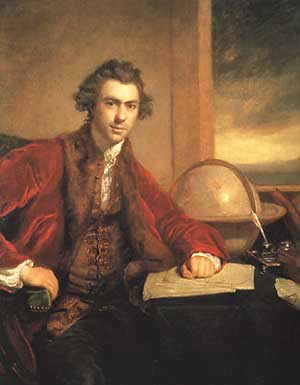
My Daily Art Display’s featured painting is the portrait painted of our hero by Benjamin West in 1773, simply entitled, Sir Joseph Banks.  His depiction of Banks differed somewhat from the Reynold’s portrait, which was completed the same year.  In Reynolds’ portrait we see the well-groomed and charming explorer and botanist smiling at us.  He is completely at ease, sitting forward in his armchair, with his arm resting on a table strewn with pages of a letter, quill pen and ink stand and a freestanding globe.

Benjamin West’s work is a full length portrait of Banks standing amongst a selection of artefacts that the explorer had brought back home.  He is wrapped in a Tahitian cape and by him is a native headdress, a paddle from a canoe and a carved fighting staff.  If we look down at his feet we can a Polynesian adze, which was a tool used for carving and smoothing wood and by it are pages of a notebook which was a reference to the myriad of notes Banks made during his expedition with regards to all the flora and fauna he had come across during the three-year journey of discovery around the South Pacific territories.  The painting with its accoutrements even has a hint of the American Wild West, which of course the artist, West, would have seen in paintings back home.  There is also a classical element to this picture with its column and tied-back curtain in the background.  West may have picked up this type of detail when he was studying works of art during his Italian sojourn.

So there you have it, two men of completely differing backgrounds, upbringing and education, Benjamin West the artist and Joseph Banks the explorer, both of whom went on to head up prestigious London societies, and were connected through this painting and their dealings with King George III of England.

The Souvenir by Jean-Honoré Fragonard

The Souvenir by Jean-Honoré Fragonard (1778)

My Daily Art Display featured artist of the day is Jean-Honoré Fragonard, the French painter whose scenes of frivolity and gallantry are the finest examples of the Rococo spirit.  The Rococo style of art was characterised by lightness, grace, playfulness and intimacy and emerged out of France around the beginning of the 18th century and in the following century spread throughout Europe.  The actual word rococo is thought to have been used disapprovingly by a pupil of Jacques-Louis David, who ridiculed the taste which was in vogue in the mid-18th century.  He combined the artistic genres of rocaille, which prospered in the mid 16th century and was applied to works that depicted fancy rock-work and shell-work, and barocco (baroque) genre.

Fragonard was a pupil of Jean-Baptiste Chardin for a short time and later studied under the French pastoral painter Francois Boucher.   He went on to win the Prix de Rome in 1752 which eventually allowed him to travel to Italy where he remained between 1756 and 1761.  Whilst in Italy he developed a high admiration for the works of the artist Giambattista Tiepolo.  During his travels around the Italian countryside he made many drawings of the Italian landscape.  He was particularly taken with the Villa d’Este, which was situated at Tivoli near Rome and its Italian Renaissance gardens, parts of which were to feature in many of his future paintings.

In 1765 he became a member of the Académie in Paris with his historical picture in the Grand Manner entitled Coroesus Sacrificing himself to Save Callirhoe.   By 1767 his style had changed and his works became more erotic.  One example of this I featured in My Daily Art Display of March 29th when I gave you his beautiful work entitled The Swing, which is now housed in the Wallace Collection in London.    In 1769 Fragonard married Marie-Anne Gérard who was a miniaturist and history painter.  Marie-Anne’s sister Marguerite Gérard, studied under Fragonard and was to become one of the greatest French female artists.  Fragonard and his wife had a daughter, Rosalie, two years later and she was often used as a model in her father’s paintings.  The following year his son, Alexandre-Évariste, was born and he would also go on to be a talented painter and sculptor.

After his marriage, he also painted children and family scenes. His works were now almost all painted for private commissions from his wealthy private patrons.  One such patron was Louis XV’s mistress, the beautiful Madame du Barry.   For her he painted a set of four pictures entitled The Progress of Love, and art historians believe they were his greatest masterpieces.  Sadly these paintings in his usual light-hearted Rococo style were, by 1773, the year he completed them, not looked on as being in vogue and they were returned to him.   The appetite for Rococo works had almost died and with that Fragonard’s commissions began to dry up and he tried his hand at the “in vogue” Neoclassicism style but he was never able to replicate his Rococo achievements with this new style.  Disheartened with the new turn of events, Fragonard left Paris in 1773 and went journeying around Europe visiting Austria Italy and Germany before returning home the following year.

His reliance on wealthy patrons, often members of Louis’s cour,t took a major blow with the onset of the French Revolution.  Fragonard lost their patronage and in many cases his patrons lost their lives.  As he was associated, through patronage, with the rich and noble he decided it was best to move with his family away from Paris and the bloody revolution and he went to Grasse, a commune in the south of the country where he was given shelter by his friend Alexander Maubert.  He eventually returned to Paris and through the auspices of the Neoclassical painter, Jaques-Louis David, a staunch and important supporter of the French Revolution, got Fragonard a position at the newly-opened Louvre.   David had been helped by Fragonard when he was a young and struggling painter and it had been time to return the favour.

Fragonard could never achieve the heights he reached during the Rococo period and died, virtually penniless, of a stroke in 1806 at the age of 74.

My featured painting today by Jean-Honoré Fragonard is entitled The Souvenir, which he completed in 1778.  In the painting we see a young girl carving something on the trunk of a tree.  According to the 1792 sale catalogue, the girl is Jean-Jacques Rousseau’s heroine Julie whom he wrote about in his novel of the same name, although its original title was Lettres de deux amans habitans d’une petite ville au pied des Alpes (“Letters from two lovers living in a small town at the foot of the Alps”).  The figure of the girl which we see in profile is framed by the arching branches of the large tree.  Her hair is decorated with pink ribbons and we see her upper body silhouetted against a white-grey sky.

The young girl has just received a letter from her lover which we see lying on the ground.  So delighted with its contents and so besotted by her lover, she is carving his initials into the bark of the tree.  By her side, sitting on a pedestal, which bears the artist’s name, is her pet spaniel, a symbol of fidelity.  Her dog watches her intensely as her knife digs into the bark.  There is an enchanting innocence about the girl and we wonder how the relationship with her lover will progress.  Will their true love for each other triumph or will her innocent trust in true love end in sorrow?   Fragonard has painted her sumptuous pink and white dress with great skill.  Look how he has carefully and meticulously painted the folds of the satin material with all its different shading.

This is quite a small painting measuring a mere 25cms x 19cms but it is delightful and a thoroughly captivating work by the French master of Rococo spirit and who was once described as “the fragrant essence of the 18th century”.  The painting by Fragonard mirrors the French literary and social happening of the eighteenth century known as sensibilité, which reached its peak between 1760 and the French Revolution.  It was de rigueur for paintings to depict softer emotions of love, pity, sympathy and grief, a type of emotional sensitivity.

Although we are fully aware that Rococo art is in some ways a false impression of what life was like for the majority,  do we not sometimes want to dream about what a perfect life would have been like rather than be bombarded by reality with Social Realist art, which constantly reminds us of poverty and suffering?

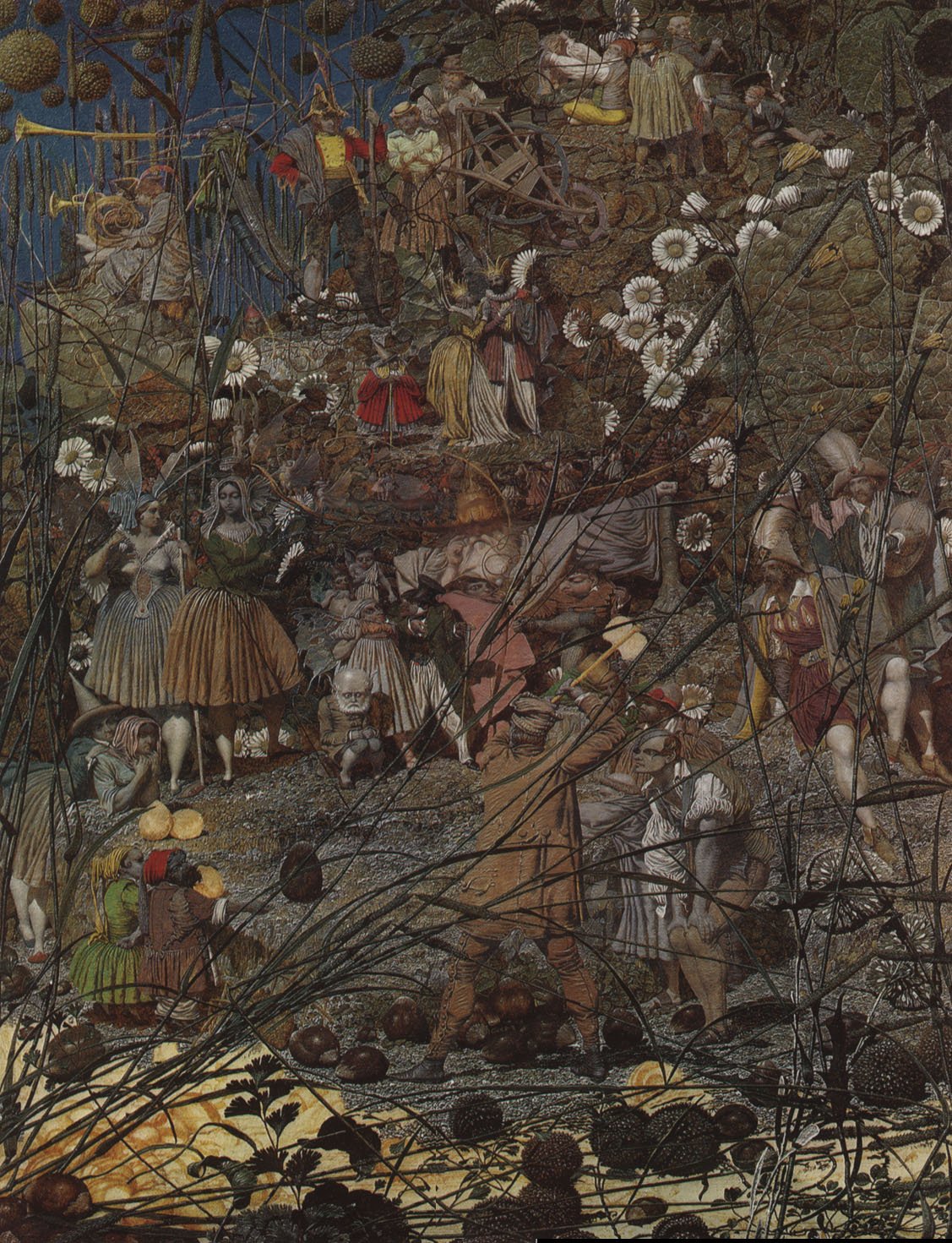
The Fairy Feller’s Master-Stroke by Richard Dadd

The Fairy Feller's Master-Stroke by Richard Dadd (1855-1864)

My Daily Art Display featured painting today is a very strange one.  It is Bosch-like in its depiction and I find it fascinating, part of the fascination coming from the story that comes with it.  The painting is entitled The Fairy Feller’s Master-Stroke and it was completed in 1864 by the English artist of the Victorian era, Richard Dadd, and now hangs in the Tate Britain.

The story of the life of the artist is quite a sad one.  Richard Dadd was born in 1817 in Chatham, Kent, fourth of seven children.  He attended The King’s School at Rochester and developed a love for Shakespeare and the Classics while at the same time beginning to display an artistic talent.  In 1834 his family moved to London and three years later Dadd gained admission to the Royal Academy of Arts.  Whilst there he won three silver medals for his draughtsmanship and during his first year began exhibiting some of his works.  It was whilst at this artistic establishment that he and six of his fellow art students founded an artistic group known as The Clique.  The group would have regular meetings, often in Dadd’s rooms,  at which they would show off their latest works.  In some ways The Clique was characterised by their rejection of “academic” high art in favour of genre painting. They held the belief that art was for the people and should therefore be judged by the people and not by its conformity to academic ideals.

In 1842, when Dadd was twenty-five, he travelled with his patron, Sir Thomas Phillips, on a Grand Tour of Europe and the Middle East. They travelled through Italy and Venice before journeying through Greece, Turkey.  They continued on through Syria by mule and finally arrived in Egypt where they travelled by boat along the Nile.   It was at this time that Dadd’s health started to deteriorate due to a combination of exhaustion and sun-stroke and he was starting to suffer with blinding headaches.  The two returned home the following year but on the return journey Dadd had begun to become disorientated and delusional and increasingly violent towards his patron.  The pair split up in Paris and Dadd returned to London.

Nowadays, Dadd would have been diagnosed as suffering from manic-depression which stemmed back from his time in the Nile Valley when he first became delusional and had a fixated fascination with Egyptian Gods and in particular Osiris.   Dadd had become convinced that he was being called upon by divine forces, such as Osiris to do battle with the Devil.  In Allderidge’s biography of Richard Dadd he quotes Dadd’s own words regarding the subject:

“….On my return from travel, I was roused to a consideration of subjects which I had previously never dreamed of, or thought about, connected with self; and I had such ideas that, had I spoken of them openly, I must, if answered in the world’s fashion, have been told I was unreasonable. I concealed, of course, these secret admonitions. I knew not whence they came, although I could not question their propriety, nor could I separate myself from what appeared my fate. My religious opinions varied and do vary from the vulgar; I was inclined to fall in with the views of the ancients, and to regard the substitution of modern ideas thereon as not for the better. These and the like, coupled with an idea of a descent from the Egyptian god Osiris…”

Dadd was now living back in London but his mental illness worsened so much so his father called in specialist to examine his son.  The specialist came to the undeniable conclusion that Dadd “was not of sound mind” and that he should be institutionalised.  However his father wanted time to think about this and decided to accompany his son on a trip out to Cobham which he believed would help his son.  The trip proved to be a disaster and culminated in Richard Dadd killing his father with a knife and a razor.   Dadd then hurriedly left the scene and went to Dover and took a ferry to Calais.  The body of Robert Dadd was found the next day.

Dadd travelled from Calais to Paris by coach and during this trip he attacked a fellow passenger and tried to cut his throat.  He was arrested and on searching him the French police found a handwritten list of people “who must die” and topping this list was the name of his father.  Dadd was brought out of the Clermont asylum where he had been incarcerated and sent back to England where he was to stand trial for the murder of his father.  He pleaded guilty to the charge and the case never came to trial.  Dadd, who was just twenty-seven years of age, was sentenced to be placed “in a place of permanent safety” at the Bethlem Hospital in the criminal lunatic department and there he remained for twenty years.  In 1884 he was transferred to Broadmoor high-security psychiatric hospital where he died two years later in 1886

It was whilst Dadd was in Bethlem psychiatric hospital that he completed today’s featured painting.  Maybe now having read about his tortured mind and his incarceration you can understand what made an artist paint such a strange picture.  The work was commissioned by George Hayden, the Steward of Bethlem Hospital, who asked Dadd to paint him a “fairy painting”, a popular genre at the time.  It took Dadd nine years to complete, what is considered to be his greatest work.    It is an elaborate picture painted meticulously.  It lacks any kind of horizon and in some ways resembles a tapestry.  It is awash with strange little figures most of who are concentrating on the central figure, the fairy woodsman who is the “fairy feller” in the title of the painting as he brings his axe down on a hazelnut.   This is a painting one can return to many times and see different aspects which were not spotted before.

So what does it all mean?  Who are all those characters Dadd has lovingly painted?  Dadd decided to compose a poem in which he described all the character in the hope that it would add meaning to his work.  He called the poem Elimination of a Picture & its subject–called The Feller’s Master Stroke and from it we are supposed to derive that nothing is random about the figures shown.  Every character has a roll to play.

The poem describes the action of the fairy woodsman:

fay woodman holds aloft the axe
Whose double edge virtue now they tax
To do it singly & make single double
Featly & neatly–equal without trouble.

And once the hazelnut has been split asunder,  the two halves would be used to build a chariot for his queen, Queen Mab:

She is the fairies’ midwife, and she comes
In shape no bigger than an agate stone
On the forefinger of an alderman,
Drawn with a team of little atomies
Athwart men’s noses as they lie asleep:
Her wagon spokes made of long spinners’ legs,
The cover, of the wings of grasshoppers;
Her traces, of the smallest spider’s web;
Her collars, of the moonshine’s watery beams;
Her whip, of cricket’s bone; the lash, of film;
Her wagoner, a small gray-coated gnat,
Not half so big as a round little worm
Prick’d from the lazy finger of a maid;
Her chariot is an empty hazelnut,
Made by the joiner squirrel or old grub,
Time out o’ mind the fairies’ coachmakers.
And in this state she gallops night by night
Through lovers’ brains, and then they dream of love. . . .

The painting is fascinating with its large cast of characters which we see amongst the clutter of nuts and berries, and the tangle of grass and stems in the foreground.  Is it just a piece of madness painted by a madman – probably yes, but the we only need to look at works by Hieronymus Bosch and Dali and wonder at the state of their minds when he puts brush to canvas.

The Father’s Curse and The Punished Son by Jean-Baptiste Greuze

The Father’s Curse and The Punished Son by Greuze

My Daily Art Display today looks at a work by the French painter Jean-Baptiste Greuze.  His work was praised by the French philosopher and writer Denis Diderot who claimed that Greuze’s paintings were, as he succinctly put it, “morality in paint” and as such represented the highest ideal of painting in his day.  So who was this moralistic painter?

Jean-Baptiste Greuze was born in Tournus, a Burgundian town on the banks of the River Saône in 1725.  He came from prosperous middle-class family and studied painting in Lyon in the late 1740’s under the successful portrait painter, Charles Grandon.  Around 1750 Greuze moved to Paris where he entered the Royal Academy as a student.  It was whilst there that he developed a style of painting which was described as Sentimental art, but more about that later.  He was accepted as an Associate member of the Academy after he submitted three of his paintings A Father Reading the Bible to His Family, The Blindman Deceived and The Sleeping Schoolboy.    These moralising pictorial stories, which in some ways remind me of the works by William Hogarth some two decades earlier, were about life amongst working class folk.  It was this genre of art which depicted scenes from the lives of ordinary citizens and which were calculated to teach a moral lesson –  that would be Greuze’s trademark for the rest of his life.

Although Greuze was happy to be admitted to the Academy on the strength of his three genre paintings he strived to be accepted as a history painter which, in thiose days, was considered a higher rank of art.  However the Academy did not look favourably on his attempts at history paintings and this rebuff so annoyed Greuze that he refused to submit any more of his works for the Academy’s exhibitions.  Fortunately for Greuze the public liked his “sentimental” paintings and the sale of his works continued strongly, which meant he had no more need to exhibit his works at the Academy.

During the late eighteenth century in France, Rococo art had almost taken over the French art scene.  It was all the rage with its mythological and allegorical themes in pastoral settings and its elegant and sometimes sensuous depictions of aristocratic frivolity.  At this time this brand of light-hearted, and now and again erotic works, were much in demand with wealthy patrons.  So in some ways the French art world received a shock when Greuze’s pompously moralising rural dramas on canvas countered the frivolity of the artificial world of Rococo art.

The featured painting today is entitled The Father’s Curse and The Punished Son which Greuze completed in 1778.  The first thing that strikes one with the characters depicted at the bedside scene is their staged posturing.  This was another trademark of Greuze, the way in which his characters were shown in dramatic poses that had once been reserved for grander historical and religious subjects.  It reminds me somewhat of watching an amateur dramatic performance were all the actions of the amateur players seem so “over the top” and comically exaggerated.

The setting of today’s painting is the final part of a tragic tale.  The beginning of this saga was when a son decided to abandon the family home and join the army despite the pleadings of his father, mother and siblings who need him to financially support the family.  Not having been swayed by their entreaties he left.  Now the scene is set with his homecoming.  However, it is not a joyous celebration of the return of the prodigal son.  Before us in the bed we see his ageing father who has just died and his family are all congregated around the death bed, inconsolable.  Look at the exaggerated poses of the family members as they pour out their grief.   In the right foreground we see the son who has returned to his home wounded.  He is stooped and remorseful, racked with guilt, having returned too late to be with his father before he died and he can see by the state of the home that the family have little money and of course we see him, head in hand, realising it was all his fault.

The increasing significance of the middle class, and of middle-class morality, also played a part in the success of Greuze’s painting genre.   His paintings seemed to preach the ordinary virtues of the simple life.   It was a call to the return of honesty in the way we dealt with life.   Surprisingly, the unconcealed melodrama of his pictorial sermonising was not found offensive, and visitors to the Salons were moved and often openly wept in front of his paintings.   The intellectuals of the day were generally opposed to rococo art style and considered its style decadent, and in turn looked upon Greuze as “the painter of virtue, the rescuer of corrupted morality.”   Greuze’s fashion for simplicity and his portrayal of ordinary people infiltrated even the highest circles of society, and engravings of Greuze’s work were popular with all classes of society.

Greuze’s reputation declined towards the end of his life and through the early part of the 19th century but briefly revived after 1850, when 18th-century painting returned to favour.   The advent of modernism in the early decades of the 20th century totally obliterated Greuze’s reputation.

Greuze survived the French Revolution but his fame did not. He died in Paris on March 21, 1805, in poverty and obscurity.

Portrait of Andrea Odoni by Lorenzo Lotto

Portrait of Andrea Odoni by Lorenzo Lotto (1527)

The featured artist in My Daily Art Display today is Lorenzo Lotto. He was born in Venice around 1480 and although little is known of his early life we but we know that he was greatly influenced by the works of Bellini. He was an artist of the High Renaissance period but there are signs in his work, such as unusual posing of his figures and some distortions in their body shape that he was a follower of the transitional stage leading to the Mannerism genre of art.

One knows that Lotto moved from Venice to Treviso around 1503. This move of his may have been due to the intense artistic competition in Venice with the likes of Giorgione and Titian and he may have believed he would fare better in the affluent town of Treviso. It was while here that he met the bishop, Bernardino de’ Rossi, who became his patron. After a few years spent here he moved to the Marche region of Italy and eventually ended up in Rome in 1508 where the pope, Julius II, commissioned some of his work. He carried on his nomadic lifestyle, travelling around Italy before finally returning to Venice in 1525. Here he took up residence at the Dominican monastery but his stay was cut short after a conflict with one of the brethren. By 1554 he was partially blind and he became a lay brother at a monastery at Loreto where he eventually died.

This nomadic and restless lifestyle of his mirrored his temperament which was said to be an existence of constant anxiety and change which made him a difficult person to get on with. His painting styles differed enormously. He was a keen observer of people. He is probably best known for his portraiture but in most of his portraits he conveyed a mood of psychological turmoil which was probably a mirror-image of his own mindset. His works of art often focused on religious works and he completed many altarpieces.

My Daily Art Display featured painting of the day is Lotto’s work entitled Portrait of Andrea Odoni which he completed in 1527 just two years after returning to Venice after his long self-exile from the city. .   The portrait has fittingly been described as one of the finest and most impressive of all of Lotto’s portraits and a calculated challenge to Titian’s supremacy in the field. So who was Andrea Odoni?    Odoni was an extremely successful Venetian merchant and collector of antiquities who lived in a grand house in Fondamenta del Gaffero in the district of Santa Croce.  The son of a wealthy recent Milanese immigrant to the city, Andrea Odoni was an important member of Venetian society.   He built upon the collection which he had inherited from his uncle, Francesco Zio, to become a renowned collector of paintings, sculpture, antique vases, coins, gems and natural history specimens. This portrait by Lotto was hung in Odoni’s bedroom alongside religious and profane paintings: a reclining nude by Savoldo, and paintings by Palma Vecchio and Titian.  His residence also contained an unusual combination of ancient and modern statues, with ‘mutilated and lacerated antique marble heads and other figures’.    The poet and satirist, Pietro Aretino, once wrote to Odoni in which he said that he believed Odoni had managed to re-create Rome in Venice.  However there was a subtle rebuke for the collector, as then Aretino went on to describe the splendours of the house in a tone that suggests it overstepped the boundaries of Venetian decorum.

In some ways it is an unusual portrait as it is in “landscape” orientation rather than the usual “portrait” orientation but this was to enable the artist to include some of Odoni’s collected antiquities.  As in a number of portraits the sitter likes to be depicted in a way that it will inform the viewers a little about himself or herself.  Where sitters want to highlight their wealth, the painting is adorned with the most sumptuous and expensive room decorations and the sitter is bedecked in the most magnificent fineries.  Odoni wanted people to look at his portrait and realise his passion for collecting antiquities.  However, it is amusing to read that with the exception of the bust of Hadrian, none of the antiques on show actually belonged to him and were probably plaster cast versions of the originals and were probably owned by Lotto.

Look at Odoni’s hand gestures.   His left hand clasps a small gold cross and presses it against his heart.  Is this simply a gesture signifying his heartfelt sincerity?  Is he merely indicating to us that he is an honest God-fearing man and that from his mouth will only come truthful utterings?  Maybe there is another reason behind the portrayal of him touching the cross to his heart.  It has been suggested that for Odoni, the true religion of Christianity, represented by the golden cross, will always take primacy over Nature and the pagan gods of antiquity, as indicated by the statuette of Diana and the busts of the other classical figures such as Hercules and Venus.

Look how his full beard and hair form a frame around his face.  Is it purely coincidental that the marble bust of the Emperor Hadrian we see in the foreground, peering from beneath the green table cloth, has a similar countenance?   Did Odoni ask the artist Lotto to position the bust in a prominent position in the painting so that we would make this comparison?  On the table we see a book, some medals and some coins.

In our sitters right hand he lovingly cradles the statuette of the Roman goddess Diana (the Greek goddess Artemis) of Ephesus with her body covered with breasts symbolising fertility.  She is the fertility goddess from classical mythology.  Is it meant as an offering to us?  What is the meaning of his gesture?

Odoni, sitting before us in his dark robe trimmed with fur in some way looks like a ringmaster at a circus with all the busts and statues surrounding him like his performers.   He appears as somebody very comfortable with his surroundings and maybe he is challenging us to “make what we will” of everything that we see before us.   In some ways this complex portrait has a sombre feel to it and by Odoni’s expression I am not convinced, despite his wealth, that we are looking at a particularly happy and contented man.