The Reader of Novels by Antoine Wiertz

The Reader of Novels by Antoine Wiertz (1853)

In recent posts I have looked at the works of William Etty, which featured nudity and the controversy they caused.  I have also recently looked at works by William Blake the subjects of which caused many to question his mental stability.  Today I am going to look at a work by a Belgian Romantic artist and sculptor whose works also caused some controversy and whose mental state was also questioned.  He was looked upon as one of the great eccentrics in the history of art.  His name is Antoine Joseph Wiertz and I was requested to look at his very unusual painting entitled La Liseuse de Romans (The Reader of Novels) which he completed in 1853.

Wiertz was born in Dinant, Belgium in 1806.  At the age of fourteen, having shown a modicum of artistic talent, he enrolled at the Antwerp Art Academy.  Here he studied under Guillaume-Jacques Herreyns, the Flemish painter who was considered the last of the school of Rubens and Mathieu Ignace van Bree, the Belgian painter and sculptor.   Having come from a relatively poor family environment Wiertz was fortunate to receive an annual stipend from King William I of Netherlands through the good auspices of Wiertz’s protector, the politician, Pierre-Joseph de Paul de Maibe.

In 1829, aged twenty-three Wiertz moved to Paris where he stayed for three years and spent a great deal of his time studying the old masters at the Louvre.   It was whilst in the French capital that he also came into contact with the French Romantic painters, such as Théodore Géricault and it was through him that Wiertz began to appreciate and admire the works of the Flemish master, Pieter Paul Rubens.  Wiertz idolised Rubens. 

Having come second with his entry in the 1828 Grand Concours for the Belgian Prix de Rome, organised by the Royal Academy of Fine Arts, Antwerp, he tried again in 1832.  This time Wiertz’s efforts proved successful and he was awarded the cherished Prix de Rome prize which came with an annual bursary and the chance to stay at the Palazzo Mancini in Rome for three to five years and all the costs of this stay were paid for by Belgian State.

Wiertz travelled to Rome in 1834 and stayed for three years.  Here he studied the works of Michelangelo and Raphael.   It was also during that time that his artistic leaning changed.  He virtually abandoned his landscape works and his paintings which depicted life in the Italian capital and focused on Roman and Greek mythological subjects.  In 1836 he completed one of his major works entitled Les Grecs et les Troyens se disputant le corps de Patrocle (The Greeks and the Trojans Contesting the Body of Patroclus) in which  he portrays a scene from Homer’s book, Iliad.  The way he depicted the musculature of the men vying for the body of Patroculus won great favour with the art critics and this painting was to prove a turning point in Wiertz’s career.  It was a somewhat violent scene and it was said that children on looking at the painting ran from it in horror.

 Wiertz returned to Belgium in 1837 and set up home with his mother in Liège.  Buoyed by the success of this painting when exhibited in Rome he sent it to Paris to be included in the 1838 Salon but it was received too late and was included in the following year’s exhibition.  However, much to his annoyance the painting was not placed in a favourable position in the Salon and it went unnoticed by the public, worse still it did not receive the plaudits from the French art critics and was criticised in the French press.  Wiertz was devastated by the treatment his painting received and never forgave the French for this snub.

Following on from this debacle, Wiertz’s artistic style changed and the subjects of his works became somewhat more excessive.  Tragedy struck in 1844 when his mother died and Wiertz was badly affected by her death.  He left Liège the following year and went to live in Brussels where he remained until his death.  In 1850, just twenty years after the formation of Belgium, the new Belgian government was in search of national idols and so when Wiertz, who had become famous in the country for his massive works of art, offered them to the State in return for them building him a huge comfortable and well lit studio.  His offer was accepted and the government agreed to display his works in the building during and after his lifetime.  They also agreed that the works would never be moved, loaned or placed in storage, but should remain “invariably fixed” to the walls of the studio Belgium had built for him.

Wiertz died in his studio in 1865, aged fifty-nine.   His remains were embalmed in accordance with Ancient Egyptian burial rites and buried in a vault in the municipal cemetery of Ixelles.  Wiertz was an artist with an arrogance which bordered almost on madness and which convinced not only his contemporaries but also himself of his own genius.

The painting featured in today’s My Daily Art Display is entitled La Liseuse de Romans (The Reader of Novels) which he completed in 1853 and is housed in the Wiertz Museum in Brussels.  When I was asked to feature this painting, I investigated the artist and the painting thinking there would have been a lot written about the elements of symbolism in the painting and that many art historians would have written their interpretation of what is before us.  However I was wrong as despite hours of research I can find little written about this work of art.  I was tempted to discard this blog entry because of the this lack of information but because the painting fascinates me I thought maybe if I published the blog somebody may come up with some background to it.

I suppose the first thing I should do to try and fathom out what is happening in the scene is to state what I see before me.   We see before us a naked woman lying on her back with her thighs slightly parted holding a book above her head to allow her to read it.  Next to her is a mirror which reflects her nudity.  Besides her on the bed are more books and we can see someone or something in the act of either placing a book on the bed or about to remove one.

I get the impression that the woman is enjoying what she is reading.  Dare I suggest that the book is in some way titillating her and maybe the contents of the book are of a sexual nature?  Look closely at the figure, which is surreptitiously moving his hand towards the books on the bed.   Am I imagining that he has “horn like” structures on his head?  Am I to conclude that this is actually a satyr and that he is supplying the woman with books of a sexual nature which she is finding so arousing?  Are we looking at a scene of temptation and corruption?

I do apologise for not having any firm answers as to what is going on in the painting but then again we must remember that they would only be opinions and interpretations by third parties and who is to say they are correct in their assumptions.  So what is your opinion on what we are looking at in today’s featured painting?

Lot and his Daughters by Artemisia Gentileschi


Lot and His Daughters by Artemisia Gentileschi (C.1640)

The other day I was asked a question about a painting and the painting within that painting and it was whilst researching into the answer I came across My Daily Art Display’s featured painting of today.  My Daily Art Display painting today is entitled Lot and his Daughters by Artemisia Gentileschi.  I had previously featured a painting with the same title by Lucas Cranach the Elder back on August 20th and there are numerous similar works by other Renaissance artists who have depicted the biblical scene including Orazio Gentileschi, the father of today’s featured painter.

Artemisia Gentileschi was born in 1593 in her parents’ home on Via Ripetta, near S. Giacomo degli Incurabili, a church dedicated to St James the Great, in the Corso near Piazza del Popolo. She was the first born of five children of the Tuscan painter Orazio Gentileschi, then 30, and Prudentia Montone Gentileschi, who was then just 18 years old.   The Gentileschi family always lived in the artists’ quarter between Piazza del Popolo and Piazza di Spagna, in the Campo Marzio, Latin for the Field of Mars and the nearby church of Sta. Maria del Popolo, which was built in 1520 and contains works by Raphael, Bernini and Caravaggio.  Artemisia’s mother died in childbirth aged 30 when Artemisia was just twelve years of age and she was brought up by her father.  Artemisia studied painting in her father’s workshop and accounts of her early life tell of how she was a far better student than her brothers who were also being trained as artists by their father.  Her father introduced her to the Roman artists of the time including the great Michelangelo Merisi da Caravaggio.

Much of Orazio Gentileschi’s work was influenced by Caravaggio and in turn Artemisia’s style of painting in her early artistic days was also inspired by him.  The one main difference between the painting styles of father and daughter was that Orazio’s works were idealized, her paintings were more naturalistic in nature.  Artemisia was indebted to her father in the way he supported her artistic ambitions as at that time women were not considered to be intelligent enough to be an artist and her artistic talent, which was plain to see even in those early days, was heavily criticised by her male counterparts who were jealous of her artistic gift.  Artemisia was not to be put down and fought for her right to become an artist and her determined and unwavering attitude eventually gained her the respect she deserved and ultimately it gained her justifiable credit for her work.

She produced her first major work at the age of seventeen.  It was Susanna e i Vecchioni (Susan and the Elders) which she completed in 1610.  This biblical subject was another which had been, and was to be painted many times over.  However Artemisia’s painting shows how she incorporated the realism of Caravaggio into the work and is one of the few Susanna paintings showing the actual sexual assault of the two Elders as a traumatic event.

Two years later an incident occurred which was to change the course of Artemisia’s life.  Her father was working on a commission for Pope Paul V inside the Pallavicini Rospigliosi Palace along with fellow painters, one of whom was the Florentine artist,  Agostino Tassi.  Orazio got on well with his fellow worker and contracted him to tutor his daughter privately. It was during this tutelage that Tassi raped Artemisia. At the time she was nineteen years of age.  Instead of reporting the incident to her father she said nothing and continued to have sexual relations with her mentor, as Tassi had managed to placate her by promising her marriage.   Tassi however, had other ideas and broke off the liaison citing her unfaithfulness with another lover as the reason for the end of the relationship.   It was at this point that Artemisia’s father pressed rape charges and Tassi was arrested and put on trial for rape and for the theft of a painting from Orazio’s workshop.

The trial lasted several months and is well documented and the transcripts of the trial still exist.   The case followed a similar pattern that is familiar nowadays with the defendant maintaining that his victim had not been a virgin but was a willing lover and in fact had had many lovers and was an insatiable “whore”.  The assertion that Artemisia was not a virgin was the crucial issue and it has to be remembered that the fact that Artemisia had maintained that she had been a virgin prior to the rape was the only reason the courts would countenance a trial.  However she had to undergo the embarrassment of a number of  thorough gynaecological examinations by midwives to determine whether she had been “deflowered” recently or a long time ago and she even underwent intense questioning sometimes being tortured using a sibille, a type of thumbscrews, for the officials to come to a decision about the charges she had laid against Tassi.  Tassi denied ever having had sexual relations with the virginal Artemisia and brought many witnesses to testify that she was “an insatiable whore.”   During the court case, it came to light that Tassi had previously been imprisoned for having an affair with his sister-in-law and had planned to kill his wife.   Unfortunately for Tassi, a witness was produced who recounted how he had heard Tassi boasting about raping Artemisia.  Tassi was found guilty and sentenced to one year’s imprisonment.

A month after the trial ended, her father arranged for Artemisia to marry a Florentine artist, Pietro Antonio di Vicenzo Stiattesi and soon after the couple moved home to Florence.  Soon after the trial, Artemisia Gentileschi painted Judith Slaying Holofernes .  The painting is remarkable not only for its technical proficiency, but for the original way in which Gentileschi portrays Judith, who had long been a popular subject for art.  A year after moving to Florence, Artemisia gave birth to their daughter Prudentia.  In all they had four sons and the one daughter but it was only Prudentia who survived childhood.  She and her husband worked at the Academy of Design, and Artemisia became an official member there in 1616.  This was an extraordinary tribute to be paid to a woman of her day and this almost certainly came through the good auspices of her Florentine patron, the Grand Duke Cosimo II of the powerful Medici family.   It was during her time in Florence, that he commissioned a number of  paintings from her and soon betters her husband’s reputation.  Artemisia Gentileschi remained in Florence producing works for Cosimo II until his death in 1621 at which time she returned to Rome.

The following year her husband is charged with assaulting one of a group of Spaniards, who were outside their home serenading Artemisia. By 1623, her husband is no longer listed as being a household member and it appears that they have separated permanently. Artemisia continued to live in Rome until about 1627,when she moved to Venice.  A year later she was in Naples, living with her daughters and servants.  Always in search of new patrons she finally found one, King Charles I of England who was an art-collecting monarch and who surrounded himself with many continental artists including Artemisia’s father Orazio.  Her patronage ended suddenly with the outbreak of the English Civil War and the execution of her patron Charles.  Artemisia returned to Naples where she spent the rest of her life.  She died in there in 1654, aged 61.

Although the story about Lot’s wife being turned into a pillar of salt when she disobeyed God by looking back at the burning cities of Sodom and Gomorrah is very well known and told to children who receive bible studies or religious education, the follow-up biblical tale about Lot being plied with wine until he was drunk by his daughters, who then seduce him, and have a sexual relationship with him in order to have children is for obvious reasons often left off the religious curriculum in schools, or at least I can say, with hand on heart, it wasn’t mentioned during my religious lessons.

The Bible passage Genesis (19: 30-38) sets the scene:

30 Lot and his two daughters left Zoar and settled in the mountains, for he was afraid to stay in Zoar. He and his two daughters lived in a cave. 31 One day the older daughter said to the younger, “Our father is old, and there is no man around here to give us children—as is the custom all over the earth. 32 Let’s get our father to drink wine and then sleep with him and preserve our family line through our father.”

33 That night they got their father to drink wine, and the older daughter went in and slept with him. He was not aware of it when she lay down or when she got up.

34 The next day the older daughter said to the younger, “Last night I slept with my father. Let’s get him to drink wine again tonight, and you go in and sleep with him so we can preserve our family line through our father.” 35 So they got their father to drink wine that night also, and the younger daughter went in and slept with him. Again he was not aware of it when she lay down or when she got up.

36 So both of Lot’s daughters became pregnant by their father. 37 The older daughter had a son, and she named him Moab; he is the father of the Moabites of today. 38 The younger daughter also had a son, and she named him Ben-Ammi ; he is the father of the Ammonites of today.

Artemisia Gentileschi painted the subject in the 1640’s at the height of the Baroque era.  In the painting she elected to portray the scene of wining and dining prior to the first seduction.  Lot sits between his two daughters at the entrance to their cave.   In the left background, far behind them, the city burns, and in the middle distance Lot’s wife is frozen into a Baroque statue, her arms outstretched in terror. The three main figures are intricately interlocked by a system of rhyming arms and legs.   Three prominent arms take us across the painting from left to right in a slowly falling rhythm: the daughter’s arm on the wine jug rhymes strongly with Lot’s lower arm which in turn intersects with a third arm that curves gently down to the tabletop. This strong physical  linking, with its relationship to the wine jug, wine glass and bread, has set the scene and in some ways incriminates the father and daughters in the incest which follows.  In this portrayal of the scene unlike others the artist has not depicted Lot as somebody who is so drunk that he is incapable of knowing what is happening and thus unable to thwart the incest.  He is not shown as a passive victim of the affair.  Artemisia has portrayed all three members of the family as having an active role of what is about to happen.  The girls are virgins, a state which will soon change.

The daughter to the right of the painting is well highlighted and one must suppose that she is the elder daughter and the first to seduce her father.   Look at the colours of the girls’ clothing; blue, white and gold.  We have the rich blue which is the colour often used in the portrayal of the Virgin Mary.  We have the white which symbolises virginal innocence and we have gold which is symbolic of purity and preciousness.  The elder daughter twists round, almost contorted, to look at her father.  One end of the rich blue fabric snakes between her thighs whilst the other end lies close to the thighs of her father.  Is that just coincidental or are we to believe that maybe Artemisia has placed the sash between the daughter’s thighs as an indication that this is exactly where her father will position himself during their sexual act?  Again, are we reading too much into the painting if we compare the bread which is on the table as having had its outer skin violently broken and its fresh interior exposed to the light with the act of the virgin being deflowered?  Another strange departure from the biblical tale is the action of the father.  In the Bible we are told that the daughters plied their father with drink so he became drunk and did not know what was about to happen, but look closely at the picture.  The daughter with the wine is on the left and the father is passing his wine glass to the daughter on the right as if he is plying her with wine and not the other way around.  Look at his facial expression.  What do you read into it?  Is it a look of a man who is becoming befuddled and not in control of the situation or is this the look of a man who is beginning to enjoy himself and is encouraging his elder daughter to imbibe and  take pleasure in what is happening?  Is this another way in which Artemisia is implicating him in the sexual acts which were to follow?  Is Artemisia trying to tell us that the man is not without guilt?  So the question you must ask yourself as you look at this painting is whether the artist is portraying Lot as almost a lecherous old man or one that is being hoodwinked by the daughters?  If you believe the former, as a lot of feminists do, why did Artemisia portray him that way?  Had her being raped altered her view of men and thus she would not have us believe Lot was just an old man being hoodwinked by his daughters?  Remember also that her artistic career and her eventual fame did not come easily as she was thwarted throughout her life – by whom?  Men !!!!

Many questions and some controversial answers.   I will let you form your own conclusions.

Just a little addition to the original blog:

The sibille was a long cord which was wound round the base of each finger then the palms of two hands were tied together, palm to palm, at the wrists.   Then the cord was threaded around each pair of fingers.  A large wooden screw is then attached and turned so the cord tightens digging into the flesh, cutting it and eventually it would cut down to the bone.  The pain would have been excruciating.

Portrait of Jacobus Blauw by Jacques-Louis David

Portrait of Jacobus Blauw by Jacques-Louis David (1795)

The artist and the subject of this painting had one thing in common – they were both revolutionaries.  The artist Jacques-Louis David was both an artistic and political revolutionary.

Artistically, David was a revolutionary in as much he condemned the French Royal Academy and its standards and the way it functioned.  In the 1780’s, he continually voiced his disapproval of the rule-bound world of the Academy and Academicism.  His art was different to that which had been so fashionable since the start of the eighteenth century and which was termed Rococo.  Rococo was a light-hearted and often gently erotic artistic style which was well suited to the excesses of the royal regime prior to the Revolution.  David’ style of painting became free of Rococo mannerisms and developed a heroic style which was heavily influenced by his study of antique sculptures during his time in Rome.   His style was to become known as Neoclassicism and harked back to the Classical past which could be looked upon as a means to understanding the contemporary world.  This Neoclassical art tended towards a high moral seriousness and was in complete contrast to the frivolity of Rococo art which was condemned by the French Revolutionists.

Politically, David was an active sympathiser of the French Revolution and he served on various committees and even voted for the execution of Louis XVI.   Artistically he was looked upon as the foremost painter of the Revolution.    As with many of the revolutionaries of that time, life was good for them, as long as the people they supported remained powerful.  In David’s case he was a great friend and supporter of Maximillien Robespiere, one of the most influential figures of the French revolution and a leading light in the period which was commonly known as the Reign of Terror.    However, after the fall of Robespierre and his execution in 1794, David was imprisoned.  He was released on the plea of his wife, who had previously divorced him because of his Revolutionary sympathies; she being a Royalist.  The couple remarried two years later.

The sitter for this painting was Jacobus Blauw.  Blauw, albeit a respectable middle-class man, was also a revolutionary and one of the leaders of the Dutch Patriots.  He went on to be a judge, politician and diplomat..  He was a political envoy from the Netherlands who had rebelled against the feudal relationship with Prince William of Orange and had asked France to assist in the overthrow of the government.

Although David made his name with large heroic narrative pictures on themes from antiquity, some of his finest works are portraits of contemporaries and todays featured painting is a good example.  David has managed to bring authentic realism to this severe composition.  When the French army invaded the Netherlands, Blauw was sent to Paris as Ministre Plénipotentiare (envoy) of the new Batavian Republic to negotiate a peace settlement with the French and get them to recognise the new republic.

David has made interesting use of contrasting colour.  We have a pale grey background, a red chair and a pink cloth lying on the table as well as the turquoise coloured table covering itself.  We see Blauw in a half-length portrait seated at a table writing an official document.  The paper on the table before him is inscribed:

J. BLAUW, minister Plénipotenttiaire aux Etats Généraux des provinces unies.

Blauw sits upright at the table with his short-cropped powdered hair and this contrasts in style to the powdered wigs which were fashionable with the aristocracy of the time.  He has a lively expression on his face as he looks up at us with quill in hand almost as if we have interrupted him as he writes his letter.  This supposed interruption of course gives the artist the chance to paint Blauw in a full-face view.   He is dressed simply, which is befitting a republican.  His blue coat is of a plain design and around his neck he has a soft white cravat.  The brass buttons of his coat glisten with a hint of red as the light falls upon them.   It is probably difficult to see it in the attached picture but if you look closely you will see that the artist has inscribed his name “L.DAVID  4” in the folds of Blauw’s brown coat which seems to have slipped off the back of the chair.  The “4” refers to the date, year four of the French Revolution, i.e. 1795.
Bluaw was delighted with the portrait and in his letter to David he expresses his satisfaction:

“..Mes voeux sont enfin satisfaits, mon cher David.  Vous m’avez fait revivre sur la toile..”

(My wishes were finally satisfied, my dear David. You made me live again on the canvas)

The sitter obviously knew the artist for the letter continues:

“…j’ai voulu posséder un de vos chefs d’oeuvre, et j’ai voulu plus encor avoir dans ce portrait un monument éternel de mon étroite liaison avec le premier peintre de l’Europe..”

(I wanted to own one of your masterpieces, and I wanted to have more in this portrait an eternal monument of my close association with the first painter of Europe)

We must believe that Blauw was aware of David’s revolutionary activities and that will have won the admiration of a fellow revolutionary.  The two had another thing in common; they both suffered for their great causes.

I love this portrait.  I love the way Blauw is portrayed – dignified and assertive.  He is almost too beautiful to be a man.  The way David has portrayed his sitter lends us to believe that the artist respected him and that there was a bond between the two men, a kind of reverence between fellow revolutionaries.

Gassed by John Singer Sargent

Gassed by John Singer Sargent (1918)

My Daily Art Display painting for today follows the theme of yesterday’s offering.  Once again I am featuring a painting which highlights the savagery of war.  This is another realistic depiction of the horrors of war which are often badly received by people who prefer to just see depictions of glorious victories, heroic acts and the happy return of our fighting men.  Sadly these kinds of pictures give one a false impression of the reality of war and it is sad to think that some of us want to close our eyes to what a war really is about and the terrifying effect it has on those who have to fight for somebody’s cause.   My painting today is entitled Gassed and is by the American artist John Singer Sargent which depicts the horrors of the trench fighting in the First World War.  It is a massive painting measuring 231cms high and 611 cms wide (91 inches x 240 inches) and can be seen in the Imperial War Museum in London.

John Singer Sargent was an American painter.  His parents were Americans but he was actually born in Florence where the family had moved to as an aid to his mother’s health.   The family travelled extensively throughout Europe.   Sargent loved his country yet he spent most of his life in Europe.   He became one of the most celebrated portraitists of his time but at the very height of his fame as a portrait painter he decided to devote full time to landscape painting, water colours and public art.

In the early days he was schooled as a French artist, and was greatly influenced by the Impressionist movement, the Spanish master Velazquez, the Dutch master Frans Hals, and his art tutor, the French painter, Carolus-Duran.   He was the toast of Paris until the scandal of his Madame X painting at the 1884 Salon.    Sargent painted the portrait of Madame Pierre Gautreau, entitled Madame X, wearing a very risqué off the shoulder gown. It was also shockingly low-cut. Her mother asked him to withdraw the painting but he refused. Although, now it is acclaimed as his best work of art, it scandalised Paris society and he was widely criticised in Paris art circles for being improper. Sargent found the criticism unjustified and at the age of 28 he left Paris disillusioned by the incident and the fall off of sales of his paintings and moved to London where he remained for the rest of his life.  It was here that he reached the pinnacle of his fame.  It was thought that to have one’s portrait painted by Sargent was to have it painted by the best portraitist of the time.

In some ways it is disappointing to realise that as an artist he has sometimes been dismissed as he was never looked upon as being radical or a trend setter.  He was an artist who worked within known and accepted styles. He was a prolific painter, painting over 2000 watercolours. He was a very successful portraitist but labelled portraiture as “a pimp’s profession” and in 1907 he announced that he would paint “no more mugs” and with a few exceptions kept to his word. His new love was to paint landscape watercolours.

So today’s featured painting was very different to his normal works.  It is a scene Sargent witnessed in August 1918 at Le Bac du Sud on the road between the French towns of Arras and Doullens in the Somme area of Northern France.  We see a line of nine soldiers, blinded by mustard gas, being helped along a boarded path by two orderlies towards a medical station.  The medical post is out of sight to the right of the scene but we can make out the guy ropes which support the tent-like structure.   The line of men who struggle to make their way towards the tent are silhouetted against the golden sunset sky.  In the left background we can just make out some bivouacs and to the right we see another line of wounded men being led towards the medical facility.  The foreground of the painting is littered with the wounded lying at rest, many with their heads bandaged.

The setting of the painting reminds me of the war poem dealing with the horrors of mustard gas in the World War 1 trenches.  It was entitled Dulce et Decorum Est and was composed by the Great War poet Wilfred Owen:

Bent double, like old beggars under sacks,
Knock-kneed, coughing like hags, we cursed through sludge,
Till on the haunting flares we turned our backs,
And towards our distant rest began to trudge.
Men marched asleep. Many had lost their boots,
But limped on, blood-shod. All went lame, all blind;
Drunk with fatigue; deaf even to the hoots
Of gas-shells dropping softly behind.

Gas! Gas! Quick, boys! An ecstasy of fumbling,
Fitting the clumsy helmets just in time,
But someone still was yelling out and stumbling
And floundering like a man in fire or lime.
Dim through the misty panes and thick green light,
As under a green sea, I saw him drowning.
In all my dreams, before my helpless sight,
He plunges at me, guttering, choking, drowning.

If in some smothering dreams, you too could pace
Behind the wagon that we flung him in.
And watch the white eyes writhing in his face,
His hanging face, like a devil’s sick of sin;
If you could hear, at every jolt, the blood
Come gargling from the froth-corrupted lungs,
Obscene as cancer, bitter as the cud
Of vile, incurable sores on innocent tongues,
My friend, you would not tell with such high zest
To children ardent for some desperate glory,
The old Lie: Dulce et decorum est
Pro patria mori.

Dulce et Decorum est, the title of the poem, are the first words of a Latin saying taken from an ode by Horace:

Dulce et decorum est pro patria mori:
mors et fugacem persequitur virum
nec parcit inbellis iuventae
poplitibus timidove tergo.

“How sweet and fitting it is to die for one’s country:
Death pursues the man who flees,
spares not the hamstrings or cowardly backs
Of battle-shy youths.”

 The full saying ends the poem:

Dulce et decorum est pro patria mori

(It is sweet and right to die for your country).

In other words, it is a wonderful and great honour to fight and die for your country.    Sadly as the young men sang joyfully as they marched towards the trenches in Northern France, little did they know of their impending fate.  Ironically, for many people of the time who supported Britain and France’s war against the Germans the words had specific relevance.  The first line of Owen’s poem is inscribed on the wall of the chapel of the Royal Military Academy of Sandhurst.

Woman in Front of a Mirror by Christoffer Wilhelm Eckersberg

Woman in Front of a Mirror by Christoffer Eckersberg (1841)

Before I embarked on My Daily Art Display blog, I could reel off a list of my favourite artists, all of who would be familiar names to you,  but now, over the last six months I have added many new artists and paintings to my ever-growing favourite list.  I think I have said this before in a previous preamble but one of the joys of the blog for me is to discover artists and their paintings which have previously been unknown to me.  Today I want to look at a painting from a Danish artist who was to become one of his country’s  greatest painters  and was sometimes referred to as The Father of Danish Painting. 

My featured artist today is Christoffer Wilhelm Eckersberg who was born in 1783 in Bläkroga, a small Danish town in southern Jutland.  His lived with his mother,  Ingeborg Nielsdatter and his father, Henrik who was a carpenter and house painter.  Christoffer studied as a painter during his youth under Jes Jessen the portraitist and at the age of seventeen became an apprentice to the painter, Josiah Jensen.

His one aim during his training was to one day be accepted into the Royal Danish Academy of Art in Copenhagen, the leading artistic establishment of Denmark, which was inaugurated in 1754.  Throughout his early training he had put together a portfolio of his work and that along with some money given to him by local people he set off in 1803 for Copenhagen.  The Academy was impressed by his work, so much so that he was accepted into the Academy without having to pay a fee.  Here he studied neoclassical and history painting under Nicolai Abildgaard.  His relationship with Abildgaard was fraught and the two often clashed and it was probably this which accounted for the fact he never achieved the ultimate Academic honour, the Gold Medal, until 1809, after the death of his tutor, Abildgaard.   Along with the Gold Medal along  came a travel stipend but such money was  held back until 1812.

In 1810 he somewhat reluctantly married Christine Rebecca Hyssing, who had borne him a son, Erling, in 1808 and who Christoffer wanted to legitimise.  During his artistic roaming through Europe he lived in Paris in 1811 and 1812 and studied under the great neoclassicist painter Jaques-Louis David and the work he undertook then improved his expertise in painting the human form. The following year he left France and visited Florence and Rome where he stayed until 1816.  During his time in Italy he learnt the skills as a history painter and a landscape artist.  As we may have guessed, the reason for marrying his wife just to legitimise their child is not the best basis for a sound marriage and this coupled with his prolonged journeys abroad without his family led to the inevitable – the breakdown of his marriage to Christina and their divorce was finalised in 1816 with him still out the country.

Christoffer returned to Copenhagen in 1816 at a time when Denmark was still reeling from defeat in the Napoleonic Wars but this juncture in the country’s history was looked upon as a time of rejuvenation and a cultural revival and it was believed to be the beginning of the Golden Age of Danish art.   In 1817 he was admitted as a member of the Royal Academy and was elected a professor of the establishment the following year, a position he held until his death.  In 1817 he married Elisabeth Juel, who was the daughter of Jens Juel, a portrait painter and one of his fellow professors at the Academy.    During their ten year marriage they had four children.  Elisabeth Juel died in 1827 and in 1828 Christoffer Eckersberg married her sister, Susanne and the couple had several children.  Christoffer became Director of the Academy from 1827 to 1829.

As Christoffer aged his eyesight deteriorated and he was forced to give up his painting.  In 1853, he was struck down by the great cholera epidemic which swept through the country and died in Copenhagen aged 70,.  He will always be remembered as the most influential teacher in the history of Danish art and for this he will always be known as the “father of Danish painting”.

My Daily Art Display for today is Eckerberg’s  Morgentoilette or sometimes known as  Woman in Front of a Mirror which he painted in 1841.  It was while he was professor at the Royal Academy in Copenhagen that he conducted classes in life drawing and painting from the nude model, male and female.  This painting reminds me of one I saw the other day by Frederic Leighton entitled Psamathe, which I will feature later in the week.  This painting by Eckersberg, to me, emphasises the argument that a female body partly clothed  is far more erotic and sensuous in comparison to complete nudity, such as we see in Egon Schiele’s paintings.  The woman has her back to us and we see in the mirror the reflection of her face and her upper chest, just revealing a small amount of cleavage.   She stands before us with a towel slung loosely around her waist but letting us view the swell of her hips and the upper curvature of her buttocks.  Her body is like polished marble.  Our eyes move upwards from the towel and we observe the slimness of her waist and the well defined muscles of her back.  Her hair, which is tied back in a bob, is held by her right hand.  This upward positioning of her right arm allows us to look upon the sensuous curve of her shoulders and neck.  In the mirror we can just catch a glimpse of her face which  appears flushed.  Maybe she is embarrassed by the pose and the gaze of the artist or maybe it is because she realises that in times to come we will be staring at her beauty.

The Finding of Moses by Sir Lawrence Alma-Tadema

The Finding of Moses by Lawrence Alma-Tadema (1904)

My featured painter today is Sir Lawrence Alma-Tadema.  He was born Laurens Alma Tadema in 1836 in Dronrijp, a small West Frisian village in Northern Netherlands.  His father Pieter was the village notary and his mother,  Hinke Brouwer, the half sister of Pieter’s first wife.  To further his career and receive greater remuneration as a notary in a large town, Pieter moved his family to Leeuwarden.  The following year, when Laurens was only four years of age, his father died leaving his mother to bring up five young children.

His mother, who enjoyed art, decided that Laurens and his siblings should all have drawing lessons and she hired in a drawing master to teach the children.   His mother although pleased with Laurens’ artistic ability, wanted him to follow in the footsteps of his late father and study to become a lawyer.  Unfortunately, when he was fifteen years old he became seriously ill with consumption and his chance of survival seemed slight.  He spent months resting and recuperating at home and during this time he carried on with his art work.  Slowly but surely Laurens  regained his health and in 1852 abandoned any idea of a legal career and enrolled at the Royal Academy of Fine Arts in Antwerp, where he studied the works of the early Dutch and Flemish masters under the tutelage of the foremost Belgian Romantic painter of the time, Gustave Wappers.  Laurens’ art work flourished and he won a number of awards during his four years at the Academy.  In his last year at the Academy he began to work closely with Jan de Taeye, one of the professors , who oversaw courses on history and costumes of earlier periods and it was he who introduced Laurens to the world of the Merovingians.

Throughout his life Laurens Alma Tadema was fascinated by all things to do with the Merovingians, who ruled over the territory known as Francia and which roughly corresponded to ancient Gaul from the mid sixth to mid eighth century.  The Merovingian themes, for Laurens, were his favourite subject for his paintings and drawings up to the mid-1860s.     It is perhaps in this series of his paintings that we find the artist moved by the innermost feeling and the strongest mood of romance. However Laurens discovered that Merovingian subjects did not have a wide international charm, so he eventually replaced these themes to that of life in Ancient Egypt that were more popular with the buying public.

In 1858 he joined the studio of the Belgium artist and printmaker Henri Leys and it was whilst here that he, with help from Leys, completed his first major work entitled The Education of the children of Clovis which was exhibited at the Artistic Congress in Antwerp to great acclaim in 1861.  This painting and the sensation it created launched Laurens’ career and the work itself was purchased and given to King Leopold of Belgium.

The year 1863 turned out to be a very traumatic year for Alma-Tadema.  His mother passed away in the January and in the following September, he married Marie-Pauline Gressin, the daughter of Eugene Gressin, a journalist who had family ties to the Belgium nobility.  The couple spent their honeymoon in Italy, visiting the great art centres of Florence and Rome.  They also visited Naples and whilst there went to the ruins of the ancient city of Pompeii.  Laurens was fascinated by Pompeii and it was to become the inspiration for many of his later works.

The following year, 1864, Laurens was to meet a man who was to have a great influence on the rest of his artistic life.  He was Ernest Gambart, the Belgian-born English art publisher and dealer who dominated the London art world in the mid nineteenth century.  Gambart was very impressed with the art work of the young Alma-Tadema and commissioned twenty-four paintings from him, three of which he arranged to have exhibited in London.  Lauren’s career had by now taken off and his paintings were in great demand and his artistic standing had risen immensely to such a degree that in 1865 for his services to Art, he was named a knight of the Order of Leopold, the highest honour in Belgium.

He and his wife had three children, a son and two daughters but their only son died of smallpox at the tender age of six months.  Sadly his marriage lasted only six years as Marie-Pauline who had continual health problems died in 1869 of smallpox at the young age of thirty-two.  Laurens was devastated, became very depressed, and gave up all his art work for four months.  His sister Atje came to live with him so as to look after his children.   The health of Alma-Tadema was poor and on the advice of his art dealer friend Ernest Gambart, he travelled to England to seek medical advice.  Whilst in London Alma-Tadema was invited to the house of the Pre-Raphaelite painter Ford Madox Brown and it was there that he first met the seventeen year old would-be artist Laura Theresa Epps.  For Laurens, it was love at first sight.

Alma-Tadema returned home to Belgium.  However for a number of reasons he decided to relocate to London, where he was to spend the rest of his life.  The Franco-Prussian War had just started on the continent, his mentor Gambert believed he had a much more lucrative future if he established himself in London and of course Laurens could not forget his “young love”, Laura Epps and so he, Atje and the children went to live in London.  Once in London he quickly regained contact with Laura and offered to give her painting lessons.  It was at one of these lessons that Laurens proposed to Laura and after waiting a year, demanded by her father who had been concerned with the sixteen year age difference of the couple, they married in 1871.

As Gambert had predicted Alma-Tadema’s art work was a great success in London and soon he became one of the highest paid and wealthiest artists of his time.    Through his art work Alma-Tadema lived a prosperous life in Regent’s Park, London.  He became a Royal Academician, which to Laurens was his greatest achievement and was knighted.  In 1909 Alma-Tadema’s wife Laura died aged fifty-seven.  The artist was distraught that he had now out-lived both his wives.   Three years later in 1912, during a trip with his daughter Anna to the Kaiserhof Spa in the German town of Wiesbaden to undergo treatment for stomach ulcers, he became ill and died aged 76.  He was buried in the crypt of Saint Paul’s Cathedral in London.

However like many things his style of art, which had once been so popular had started to wane and during the last years of his life had completely gone out of fashion with the rise of Post-Impressionism and Cubism.  He became the forgotten man and it was not until the 1960’s that his art has become better appreciated and there was a revival of interest in Victorian paintings and Victorian art.

My Daily Art Display for today is the very large oil on canvas painting by Alma-Tadema entitled The Finding of Moses.  Maybe the painting does not follow true biblical lines; it is still a painstakingly painted account of an Old Testament scene.   The artist had travelled to Egypt in 1902 as guest of Sir John Aird to attend the opening of the Aswan Dam, which Aird’s company had just built.   Winston Churchill was another member of the party. Sir John commissioned the picture for £5,250, and Alma-Tadema worked on the canvas for two years.  He completed the work in 1904 and it depicts the Pharoah’s daughter in all her regal finery carried aloft by bare-chested slaves on mosaic-covered carrying poles while her olive-skinned handmaidens with their glossy dark braids and the fairer skinned strawberry blondes hoist the baby Moses in his lotus-edged carrying basket so that his new “mother” can gaze down at him.   She is at the centre of the painting and one reason for that maybe the fact that it was Aird’s own daughter who modeled for the Pharaoh’s daughter.   In her left hand she holds an ostrich feather fan and lotus leaves to keep her cool whilst in her right hand she holds a fox-tailed flail to ward off the flies.

The painting is awash with people and this allowed the artist to feature many of figures he had included in some of his earlier paintings.  It is amusing to note that according to Percy Standing’s biography of the artist, Alma-Tadema’s wife on seeing the painting commented that the infant Moses was two years old, and therefore need no longer be carried !

To have some idea of how his art work gained in value it is interesting to follow the provenance of this work.  Originally sold for £5,250 it failed to reach its reserve price at a Christie’s  auction in 1960, the highest bid being a mere £252!  Things changed and at the New York auction house, Christies in 1995 it was sold for £1.75 million, which, at that time, was a record for a Victorian painting.  However in November 2010 it once again came up for auction at Sotheby’s in New York with a pre-sale estimate of between $3 and $5 million.  After an eight minute battle between two telephone bidders it was sold for $35,922,500!!!!!!!!!!!!!!!

February Fill Dyke by Benjamin Williams Leader

February Fill Dyke by Benjamin Williams Leader (1881)

My Daily Art Display returns to landscape painting but remains with English Victorian artists for the third day running.  My featured artist today is Benjamin Williams Leader who was to become one of the most acclaimed Victorian landscape painters during his lifetime.   He was born in Worcester in 1831 and he was the eldest of eleven children.  His father, Edward Leader Williams was a civil engineer and staunch non-conformist whilst his mother Sarah Whiting was a Quaker.  However after the two of them married in an Anglican church the Quaker establishment disowned them.     Benjamin was actually born as Benjamin Williams but in 1857 he added the surname, Leader, which was his father’s middle name, to distinguish himself from the rest of the Williams clan.

His father Edward was a keen amateur artist and was on friendly terms with John Constable.  Benjamin would often accompany his father on his painting expeditions along the Severn valley and soon he developed a love of art.  He attended the Royal Grammar School in Worcester and when he completed his schooling in 1845 was apprenticed as a draughtsman in his father’s engineering office.  However Benjamin never gave up his fondness for apinting and drawing and after many discussions with his father he was allowed to leave the world of engineering and follow his love of art.  His father gave his son one year to prove himself artistically.  Benjamin enrolled at the Worcester School of Design and one year later had achieved the position of “probationer” at the Royal Academy Schools.  A year on, and quite exceptionally for a first year student, he exhibited his first painting, Cottage Children Blowing Bubbles, which was bought by an American.  From then on he exhibited in every Summer Exhibition of the Royal Academy up until 1922 when he had reached the fine old age of 91.

Leader married fellow artist Mary Eastlake in 1876.  She was an artist whose subject speciality was flowers.  She came from an artistic background being the grand-niece of Sir Charles Locke Eastlake who was President of the Royal Academy between 1850 until his death in 1865.  The marriage of the couple did not find favour with her family as Benjamin Leader was twenty-two years older than their daughter and whereas the Eastlake family came from a long line of Plymouth gentry, Benjamin’s family where  mere “trades people”.  However as is often the case, the noble Eastlake family had seen better financial days whereas Benjamin Leader, with the sale of his many paintings,  was financially sound.  They did marry and went on to have six children, one of whom Benjamin Eastlake Leader, became an artist but was sadly killed in action during the First World War.

Leader spent most of time painting landscape scenes of his beloved Worcestershire and the Severn Valley and in Lewis Lusk’s The Works of B.W.Leader, R.A. which was published in The Art Journal of 1901, Leader was quoted as saying:

“…The subjects of my pictures are mostly English.  I have painted in Switzerland, Scotland and a great deal of North Wales, but I prefer our English home scenes.  Riversides at evening time, country lanes and commons and the village church are subjects that I love and am never tired of painting…”

It was the Summer Exhibition of 1881 at the Royal Academy that Leader exhibited today’s featured work, February Fill the Dyke and it was highly commended.  The Art Journal of the day commented:

“…title and picture suit one another well.  The characteristics of the kind of weather which gives the epithet of “fill dyke” to the month of February are most truthfully depicted in the overflowing ponds and splashy roads and the pale, streaked evening sky.  It is a thoroughly English landscape…”

And so to today’s featured painting which is a beautiful landscape painting with the unusual title February Fill Dyke by Benjamin William Leader.  I was intrigued by the title of the painting, which I discovered comes from an old country rhyme:

February fill the dyke,
Be it black or be it white;
But if it be white,
It’s the better to like

It means that the ditches get filled in February either with mud or with snow.  The first thing which struck me about this painting was its realism.  This was not an Italianate landscape painting with the sun glinting on a beautiful landscape.  This is a painting of the fields in Leader’s native Worcestershire.  The wet ground is being warmed slightly by the late winter’s sun.  Leader has humanised the scene by adding a couple of children and their dog heading home through pools of water on the muddy path.  Ahead of them, the farmer stands at the gate and we can see a woman in front of the cottage busily collecting firewood.

This is what we see when we go for a walk in the countryside on a wet winter’s day.  Before us we have what appears to be a cold and somewhat miserable end to a winter’s day.  Darkness is rapidly approaching and it is time to get back indoors to the safety of our home and the warmth of an open fire and maybe a hot scented bath which will banish the lingering thoughts of what lies outside.  It is a type of day in which the cold and dampness moves stealthily into one’s bones adding to our aches and pains.  Yet having said all that  is this not truly a beautiful painting?  Maybe it is the type of painting you enjoy looking at when you are sitting cosily in the warmth of your house

I do like landscape paintings even more so if they replicate an actual view.  I do understand and appreciate idealised landscapes where an artist has put together various pieces of landscapes he likes, to finish with his idea of a perfect landscape.  What I am not very fond of is a painting of a landscape which seems to bear no resemblance to the scene it is supposed to be portraying.  I am not an artist and have never had the ability to draw anything that one would recognise so I suppose I shouldn’t criticise but we all have the right to freedom of speech so I will exercise my right.  I watched a documentary the other day which was about landscape painting and we were with this artist who was in a field painting a scene with a mountain in the background.   When he finished it we saw his work which was depicting what we had all been looking at but the landscape we had seen was not on the artist’s canvas .  I wonder whether he read my thoughts as he said that his painting was not necessarily a true reflection of what we and he were looking at but it was the view that was conjured up in his mind at the time.  I am not sure I can go along with that thought process but maybe for any of you artists out there you will understand what he was saying.  However if he had given me the painting to hang on my wall I would have no idea what it was all about!

Automat by Edward Hopper

Automat by Edward Hopper (1927)

“All the lonely people, where do they all belong? “

I am sure the words from the Beatles song Eleanor Rigby are known by most people.  Loneliness can be a terrible burden to have to bear and its often associated with the impersonality of a large city, which although teeming with people, they seem to remain as strangers, whereas within small village communities there is a sense of camaraderie and friendliness which ensures that with a minimum of effort your loneliness can be banished. 

 My Daily Art Display featured painting for today is entitled Automat by the American artist Edward Hopper, which he completed in 1927.  His theme of loneliness and the loneliness of city life was a constant theme in a number of his paintings.  Look back to My Daily Art Display of January 23rd when I featured his famous work entitled Nighthawks. 

In today’s painting we see a woman, with her cloche hat pulled low down over her forehead, staring into her coffee cup as she sits by herself, in what Hopper terms as an Automat.  I have to admit I had never heard of this term before  but I believe they were what we would now call fast food outlets,  which served simple food or drinks,  and which were served by coin-operated and bill-operated vending machines but I guess the machines have been removed an there is waitress service nowadays.   There is a starkness about the setting, almost but not quite minimalist.  Like the scene in Nighthawks there are just windows but no doors on view, giving a slight sense of entrapment.  Her look of preoccupation would suggest she may be, for some reason unknown to us, mentally entrapped.

The woman we see before us is pensive, her eyes are downcast and to my mind she seems a little sad.  She is well dressed with her warm winter coat with its fur collar and cuffs.  She wears makeup so maybe she is on her way for an evening out or looking how dark it is outside, maybe she is on her way back home.  Of course we are not really sure whether she is on her own or whether the empty chair at her table is for somebody else.  Maybe she is awaiting her companion or is her despondency due to the companion’s non-arrival.

Another strange thing about the woman is that she has only one glove on.  Could it be that this café is not only a lonely place but also a cold one and the one glove is all she wanted to remove so that she could hold the cup and yet still retain some warmth?  The dark window takes up a lot of space in the painting and its darkness adds to the atmosphere of the painting.  It is pitch-black outside and, along with the way the woman is dressed, gives us the feeling that this scene takes place on a cold autumn or winter night.  There is no sign of life outside, no people, no lights from other buildings and no headlights from cars.  This lack of outside lights works well and allows just the penetration of the blackness by the reflection of the café lights to be more effective and in so doing adds to the feeling of isolation. Does Hopper want to liken the woman’s mood and her life to this view of the window – dark with little going on in it?  She is in the middle of a deserted town which adds to the sense of her isolation and solitude.  Note how Hopper has painted the woman’s legs.  The brightness of his colouring of them draws our eyes to them even though they are under the table.  It adds a little bit of overt sensuality to the painting and makes us wonder how such a woman could feel sad and lonely.  We are now concerned about her vulnerability.  Is her pensiveness also due to her feeling vulnerable as she sits alone in this café?

Time Magazine, August 1995

Hopper’s painting and ones of a similar theme are linked with the perception of urban alienation, which by definition is the state of being withdrawn or isolated from the urban world, as through indifference or disaffection.  It is interesting to note that in August 1995 Time magazine used this painting on its front cover with its lead article dedicated to stress, anxiety and depression.

Loneliness is often the central subject matter in Hopper’s art. The people he depicts look as though they are far from the comfort and reassurance of home. We see clues as to their isolation in the way they stand reading a letter beside a hotel bed or drinking in a bar. They stare out of the window of a moving train or read a book in a hotel lobby. Their faces often have the look of vulnerability and introspection. They look like they may have just been jilted or have just broken up with someone. They often seem to be mentally searching for something or someone and have been cast adrift in transient settings. His paintings are often set at night, as this adds to the mood and evocatively all we see through the window is darkness.

Yet despite this bleakness we witness in Hopper’s paintings, they are not themselves bleak to look at – perhaps because they allow us, the viewer, to witness some of the artist’s grief and disappointments, and from that we feel less personally persecuted and beset by them.  It is as if we suddenly realise we are not the only person to feel sad or depressed, for isn’t it true that sometimes a sad book consoles us more when we feel sad.  Maybe we just need to realise we are not alone in our sufferings. 

In some ways Hopper has challenged us to make up our own mind about the story behind the painting.  There is no action going on to give us any clues.  Maybe the story we come up with will depend on our own state of mind.  If we are happy, we may well believe that the woman is thinking about the coming to the café of her beloved.  If we ourselves are feeling lonely and slightly depressed then maybe we empathize with the woman and share her isolation and vulnerability.  So what is to be?  What is your take on the scene in the painting?  Maybe it is at times like this, when we look at the painting and we perceive the loneliness and unhappiness of the woman that we should take time to be grateful for what we have.  Maybe we should not always desire something else.  Maybe we should want what we have.

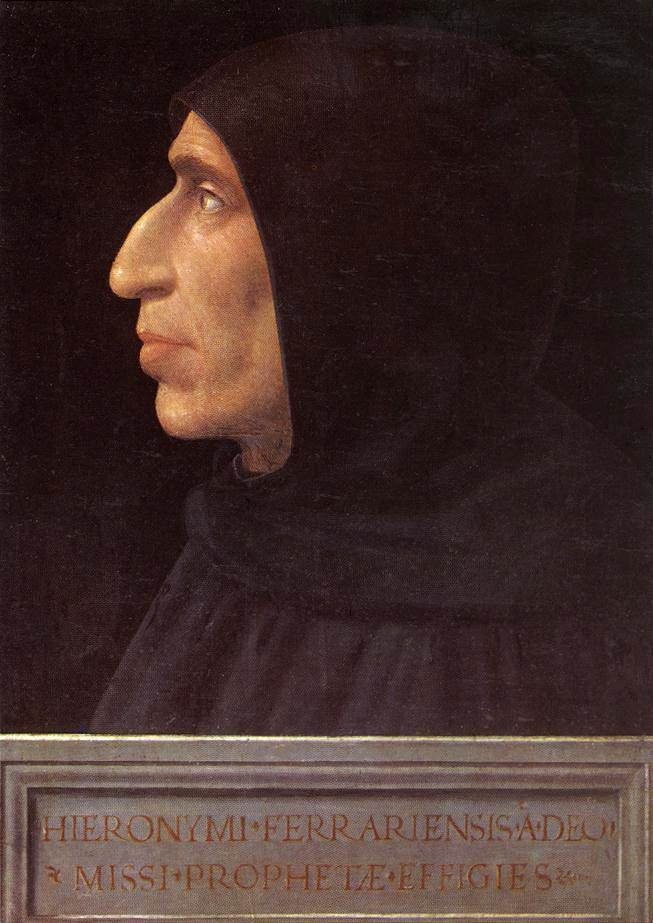
Portrait of Savonarola by Fra Bartolomeo

Portrait of Girolamo Savonarola by Fra Bartolomeo (c.1498)

Baccio della Porta was nicknamed as such due to his house being near the Porta (“Gate”) San Pier Gattolini.  He would be later known as Fra Bartolomeo.  He was born in Savignano di Prato, a town in Tuscany in 1472.  As a teenager he worked in the workshop of Cosimo Rosselli, the Florentine painter.  Besides being a gifted artist and one of the most accomplished painters of the Italian Renaissance, Fra Bartolomeo was a very religious man and it was said that he spent as many hours praying as he did painting.  The Renaissance scholar John Van Dyke even went further calling him a religionist, a person addicted to religion in other words, a religious zealot.

During his late twenties Fra Bartolomeo became a follower of Girolamo Savonarola the fierce and passionate Dominican friar, who vehemently preached against the moral corruption of much of the clergy at the time.  He arrived in Florence in 1481 having been sent there by his order in Bologna to “go out and preach”.  Initially his sermons were met with little enthusiasm but over time his following grew.  By 1491, Savonarola stood before massive crowds with a fiery and fervent enthusiasm. He spoke to the masses and what he told them quickly earned him massive influence over all who heard him.  By this time printing had been introduced in Florence  and Savonarola was one of the first figures to use printing to spread political and religious propaganda.  It was not just the common peasant but artists, writers and members of the aristocracy who listened to this great orator and was swayed by what he preached.   For many, he was a prophet and what he uttered were words which came directly from God.  Savonarola loathed some of the religious art of the time with its eroticized Virgin Marys and the smirking putti such as could be seen in the works of Raphael.    Savonarola was opposed to the humanist trend which had become popular.  He hated poetry, literature, perfume, non religious art or anything that was vaguely “fun”.  Savonarola once stated:

“They have built up a new Church after their own patter. Go to Rome and see! In the mansions of the great prelates there is no concern save for poetry and the oratorical art. Go thither and see!” 

He persuaded painters and their patrons to burn and destroy all artworks that did not conform to his strict code of morality. This edict was listened to by many and the result was that thousands of the greatest Florentine masterpieces ever created by some of the giants of renaissance art were tossed into his notorious Bonfire of the Vanities in February 1497.

In 1492 the death of two of the most powerful men of the time and sworn enemies of Savonarola died within three months of each other.  In April, Lorenzo de Medici, the ruler of Florence and once patron of Savonarola died and in July that same year came the death of Pope Innocent VIII.  This immediately caused a power vacuum and in 1494 after Charles VIII of France invaded Florence and overthrew the Medicis, Savonarola emerged as the new ruler of the city of Florence.  His rule was one of total morality and he criminalized gambling and the wearing of decadent clothing.  For him the epidemic of syphilis, which was a growing scourge on the country, was God’s way of punishing the sexual transgressors and he condemned homosexuals and adulterers to death.

At the beginning Savonarola had the majority of the populace on his side and he became even more powerful but slowly and surely the Florentine people tired of his religious zeal and his ever more puritanical laws.  His laws were also beginning to affect trade and the once prosperous Florence was having financial difficulties.  Things became worse for Savonarola who on May 13, 1497, was excommunicated by Pope Alexander VI and the next year, 1498, Pope Alexander demanded his arrest and execution.  A crowd attacked the Convent of San Marco and Savonarola was captured.  He was charged with heresy, uttering false prophecies and sedition.  He was tortured for several days but would never renounce his words.  He stood trial, was found guilty and hung from a high cross and burnt alive.  His era was over and shortly afterwards normal Florentine life returned with the artists and Florentine art once again flourishing.

Fra Bartolomeo painted Portrait of Savonarola just before the Dominican friar was executed in 1498.  The head and shoulder portrait of the hooded monk is painted against a black background.  His unwavering look is stern and one feels that this was a man who held views, the dilution of which he would not countenance.  The portrait lacks any human warmth and for that reason one must believe that it is not only a good physical likeness but one which encapsulates Savonarola’s mental state.  The Latin inscription on the panel below the portrait proves that the monk was considered to be a prophet:

Portrait of the prophet Jerome of Ferrara, sent by God.”

The twenty-six year old Baccio della Porta was greatly distressed by the execution of Savonarola and two years later in 1500 he gave up painting all together and took his monastic vows and assumed the name Fra Bartolomeo.  He moved into the convent of Saint Marco in Florence.  It was not until 1504, with the authorization of the prior, did he resume painting and he dedicated the rest of his life to painting religious studies.  By 1508, Leonardo da Vinci, Raphael and Michelangelo had all left the city of Florence and Fra Bartolomeo became the leading painter of Florence.

Feast in the House of Simon by Bernado Strozzi

Feast in the House of Simon by Bernardo Strozzi (c.1630)

Whilst I was wandering around the narrow streets of Venice, crossing over the many quaint little bridges I had a sort of plan of what I wanted to see.  I had to have a look St Mark’s square and cross the Rialto Bridge but I also had two artistic destinations I wanted to visit.  First was the Basilica of Santa Maria della Salute which was the church at the heart of yesterday’s blog but most of all I wanted to visit the Accademia Galleries which houses a collection of the best works of art by Venetian painters.  I finally found the building and I was luck as apparently it was “Cultural Week” and the entrance fee had been waived.  The first room I entered was full of what they termed “The Primatives” and was a large collection of late 14th century and early 15th century altarpieces.

It was when I went into the other rooms that I was taken aback by the paintings.  It was simply breathtaking.    It was the sheer size of them which was overwhelming.  In all the galleries around the world which I have visited, I have never seen such a large collection of gigantic paintings.   Some, including the painting I am featuring today, were in excess of 7 meters in width and there was the Veronese painting Feast in the House of Levi which was in excess of 13 meters in width and almost 6 meters high.   These large paintings simply overpowered you and you sat before them in total shock.  You could only imagine how long the artists had taken to paint them.  One room just had the complete nine painting cycle of the Legend of St Ursula, the fourth I featured in My Daily Art Display on March 22nd.  As each of the nine was so big I spent almost an hour following the tale of St Ursula and studying all the marvelous detail laid out on each canvas.  It was a remarkable experience.  The final room I went through on my way to the exit had amongst its collection the famous and very beautiful Tempest by Giorgione which I featured on March 4th.  This is a lovely painting much smaller than the mammoths I had been admiring earlier but still a gem. I was completely spellbound by this gallery visit and I suggest you add this gallery to your “must visit” list.  You will not be disappointed.

Back to today’s offering in My Daily Art Display.  It was one I saw during my visit.  I could have picked so many from the wonderful collection but for today I have chosen a painting by Bernard Strozzi entitled Feast in the House of Simon which he completed around 1630.

The painting was acquired by the gallery in 1911 and comes from the chapel of Palazzo Gorleri in Genoa.  It is thought that it was painted for the parlour of the Santa Maria in Passione monastery at Diano, Genoa.  The story behind the painting is from the New Testament:

“…When Jesus was on his travels to preach, a Pharisee called Simon invited him to a meal.
When Jesus arrived at the Pharisee’s house and took his place at table, suddenly a woman came in, who had a bad name in the town. She had heard he was dining with the Pharisee and had brought with her an alabaster jar of ointment. She waited behind him at his feet, weeping, and her tears fell on his feet, and she wiped them away with her hair; then she covered his feet with kisses and anointed them with the ointment.
After this scene, Simon the Pharisee wondered whether Jesus was really the prophet everyone told he was, because surely Jesus would have seen that this woman had a bad name and would not have let her touch him. But Jesus retorted with a parable and he showed the difference of welcoming he had received from Simon as compared to the welcome of the woman. Simon had poured no water over Jesus’ feet and Simon had not anointed Jesus’ head.
Jesus said: “For this reason I tell you, Simon, that her sins, many as they are, have been forgiven her, because she has shown such great love. It is someone who is forgiven little who shows little love”. Then he said to the woman: “Your sins are forgiven…..”

The artist has distributed the various characters around the painting, not randomly but with care so as to tell various parts of the story behind the painting.  There is so much going on within the painting which as you know is what fascinates me.  We see Mary Magdalene kneeling at the feet of Christ with her porcelain urn of water in preparation to her washing the feet of Christ.   There is also humour in the painting.  Look how the man behind Christ’s right shoulder is remonstrating with the dog which is about to attack the cat.  It appears the cat has managed to escape the clutches of the dog by jumping upon the table much to the displeasure of a young servant, who has raised a stick and is just about to whack the cat away.  The banquet table lies diagonally across the painting.  Our eyes fix on Jesus who is vociferously defending Mary Magdalene whilst Simon is seen half getting out of his chair as he stares on incredulously at the sight of Mary at the feet of Jesus.  There is a splendor of colour which brings the painting alive.  Look at the servant carrying the tray of fruit – see how he is lit up by the bright background of the sky.

This is an awesome painting and I can only hope that like me, one day you will be able to stand before it and absorb its beauty.