
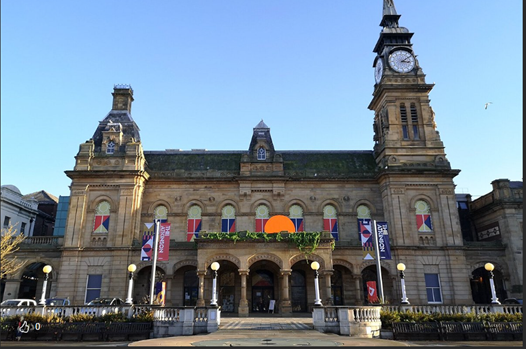
The Atkinson Gallery, Southport
Art galleries or Museums of Art come in various shapes and sizes from the gigantic multi-room edifices such as London’s National Gallery, Paris’ Louvre and Madrid’s Prado, to small one-room private galleries. The former is awash with works which would take you days to properly study them all, whilst the latter often contain less than fifty paintings and you are sometimes hard-pressed to see a work you like.
A couple of days ago I visited Southport on the Merseyside coast, a seaside resort which is close to where I was born and lived for most of my life and yet I had never visited the town’s art gallery. There was something about the site’s publicity I found off-putting. You see, it was a multi-faceted building; part museum, part library, part café, part children’s playroom, part theatre, part bar, part locals selling their art and crafts etc etc., and yet there was only a small shop/theatre ticket office which had no literature on the permanent collection and as I feared, the room set aside for works of fine art was small. However the works of art in the permanent collection, numbering about fifty, were excellent and for that reason I can recommend you visit their permanent collection. Today’s blog is about some of these fine works. There were a number of paintings, presumably on loan, which belonged to the Harris Museum and Art Gallery in the nearby town, Preston, which had been closed whilst undergoing renovations.

A Golden Dream by Thomas Cooper Gotch (1895)
Thomas Cooper Gotch was an English painter and book illustrator. He studied art in London and Antwerp before he married and studied in Paris with his wife, Caroline, a fellow artist, and when they returned to England, initially his works depicted the lives of Newlyn fisherfolk but after a visit to Italy his style changed and he began painting Symbolist images conjuring up dreamlike idylls of Arcadian innocence, in a Pre-Raphaelite romantic style. Gotch exhibited A Golden Dream for the 1895 opening of the Newlyn Art Gallery.
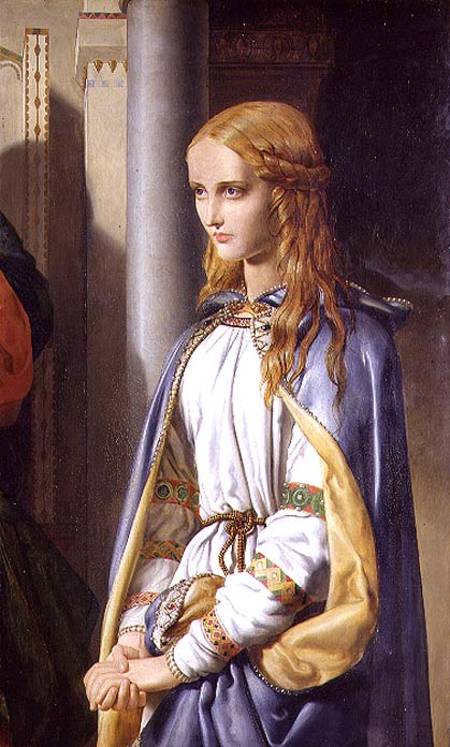
Cordelia Disinherited by John Rogers Herbert (1850)
The subject of John Rogers Herbert’s painting is Cordelia, a fictional character in William Shakespeare’s tragic play King Lear. Cordelia, along with her sisters, Goneril and Regen are the three daughters of King Lear. After her elderly father offers her the opportunity to profess her love for him in return for one-third of the land in his kingdom, she, unlike her two sisters, refuses. Lear banishes Cordelia from the kingdom and disinherits her. Cordelia is depicted as a saintly figure. She looks impassive and wears blue and white clothes which remind us of depictions of the Virgin Mary. Herbert painting is a detail from a large fresco commissioned for the Houses of Parliament.

The Orphan of the Temple by Edward Matthew Ward (1875)
On the face of it, we are simply looking at an elegant young lady painting en plein air. The title of the painting does not offer us a clue as to what is going on in the depiction ! However, if I tell you that the young lady painting is Marie Thérèse Charlotte, the eldest daughter of Louis XVI and Marie Antoinette you will realise that this painting depicts a little piece of French history. In a brief synopsis of Marie Thérèse Charlotte life : she was the daughter of Louis XVI, king of France and Marie Antoinette. She was educated at French was imprisoned with her family in the Temple, originally a fortified monastery of the Templars and later a royal prison, in 1792. Her mother and father were guillotined in 1793 although she was unaware of their fate at the time. She was released from prison in 1795 and four years later married the Duke of Angoulême. Later she lived in exile with her uncle Louis XVIII in various European countries. The painting clearly contrasts the innocence of the young woman, dressed in white, with her gaoler who stands in the background.
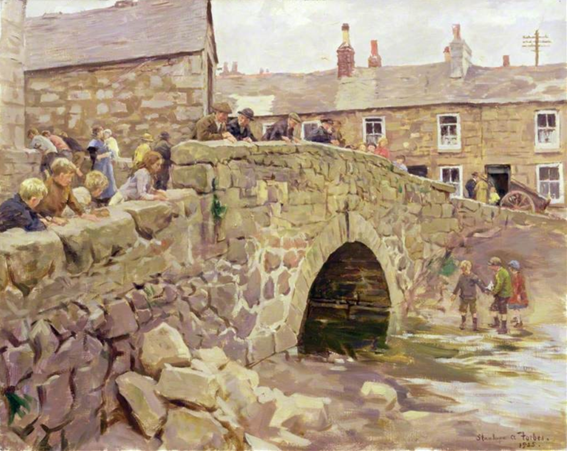
On the Bridge by Stanhope Forbes (1925)
Stanhope Alexander Forbes was a British artist and a founding member of the influential Newlyn School of painters. He was often referred to as the father of the Newlyn School. This is the second time Stanhope Forbes painted this scene. The first was in 1888. The old bridge we see in the painting is in the Cornish village of Street-an-Nowan, in the lower part of the fishing town of Newlyn.
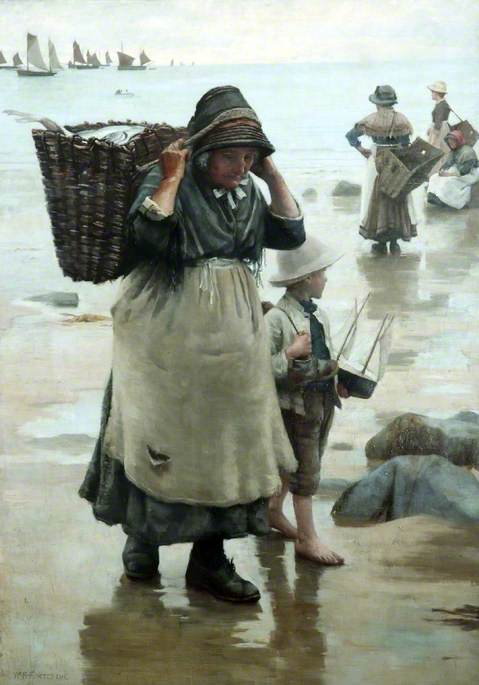
The Fish Fag by William Banks Fortescue (1888)
Fortescue was also one of the Newlyn School’s many Birmingham-born artists. He began his career as an engineering designer but later trained as an artist. He studied art in Paris, and later travelled around Europe, reaching Venice in 1884. On his return he exhibited many of his works depicting Venetian scenes at the Royal Birmingham Society of Artists. Fortescue went to live in the Cornish fishing town of Newlyn around 1885 and took lodgings in a house which also included Stanhope Forbes as another lodger. This work by Fortescue was painted in the style of Stanhope Forbes and as is the case with this work, he used local people to model for his paintings. The painting’s title Fish Fag is the term used for “Fishwife” and she would be in charge of cleaning the fish prior to them being sold. Prior to the men setting sail in their boats the Fish Fags would also be tasked with baiting the hooks. The little boy holding the toy boat and walking alongside the woman has probably been added by the artist implying that one day he will experience life as a fisherman.
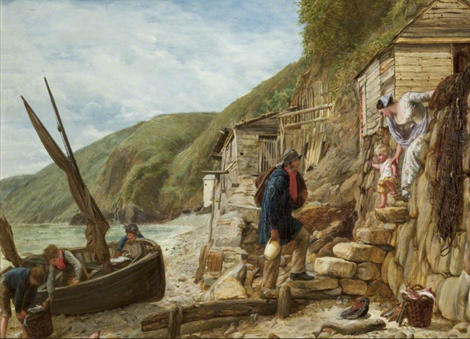
Welcome, Bonny Boat! The Fisherman’s Return (Scene at Clovelly, North Devon) by James Clark Hook (1856)
The life of a fisherman is a precarious one, even in the present day but more so in the nineteenth century. Catching fish to feed the family was a necessity and sometimes the fisherfolk heading out to sea to bring home food and to eke out a living sometimes meant taking risks which often resulted in dire consequences. James Clarke Hook RA., an English painter and etcher of marine, genre, historical scenes, and landscapes, was born in London in November 1819. Initially his favoured painting genre was history painting but then he turned his attention to genre depictions in rural landscapes. He made several trips to Devon and the fishing village of Clovelly which in Devon stimulated him to adopt coastal scenes as his main motif but it was more than just depictions of the sea and boats as he incorporated figures into his paintings in order to highlight the hardship and rewards of life by the sea. He completed so many of this type of depiction that his coastal paintings were soon dubbed “Hookscapes”. In this painting we see a returning fisherman being greeted by his family, all of who are relieved to see him back safely.
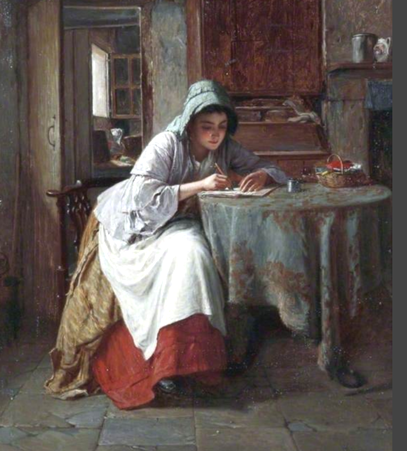
Katy’s Letter by Haynes King (1875)
Haynes King was an English genre painter, who was born in Barbados in December 1831. He came to London when he was twenty-three and became a student at Leigh’s later known as Heatherley’s Academy in Newman Street, London. In 1857 he exhibited some of his paintings for the first time at the Society of British Artists, of which he was elected a member in 1864 ; many of his works appeared at its exhibitions, and forty-eight were shown at the Royal Academy between 1860 and 1904. He painted interiors, landscapes, and coastal scenes with figures. The motif in this painting centres around the letter which the young woman is reading. The action of reading a letter was depicted in many paintings and became very popular. The popularity of such a motif is probably because we are subconsciously being asked to imagine what was in the letter. Good news or bad news? We then put together in our minds a cover story both past and future for this young woman due to what she is reading !
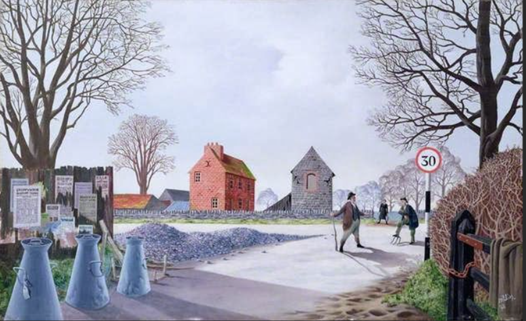
The Argument by Tristram Hillier (1943)
Tristram Paul Hillier was an English surrealist painter and a member of the Unit One group led by Paul Nash . He was born on April 11th 1905 in Beijing, China, and was the youngest of the four children of Edward Guy Hillier, a banker and diplomat, and Ada Everett. He attended Downside, an independent boarding school. He later went to Christ’s College, Cambridge and later in 1926, the Slade, where his tutors included Henry Tonks. From the Slade he travelled to Paris and studied for two years under André Lhote, and also at the Atelier Colarossi. Whilst in Paris he mixed with many members of the Surrealist movement and was particularly influenced by Giorgio de Chirico and Max Ernst. He lived in France until 1940, but travelled extensively; he remained a surrealist painter throughout his life. His painting style is unique to him and if you look at some of his other paintings you will recognise similar characteristics.
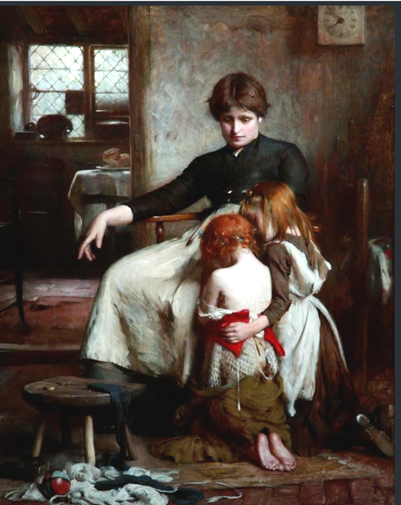
The Children’s Prayer by Arthur Hacker (1888)
There were a number of paintings on show with religious connotations. One such work was Children’s Prayer by the English painter Arthur Hacker. Hacker was born in St. Pancras, Middlesex in September 1858. In 1876, aged eighteen, he enrolled on a four-year course at the Royal Academy. From there he went to Paris where he studied at the atelier of Léon Bonnat. He became a member of the Royal Society of Portrait painters in 1894. His paintings were shown at the Royal Academy on two occasions, in 1878 and 1910. It was also in 1910 that he was elected as a Royal Academician. He travelled to France, Italy, Spain and Morocco., and of the RA in 1910. Hacker was most known for painting religious scenes and portraits.
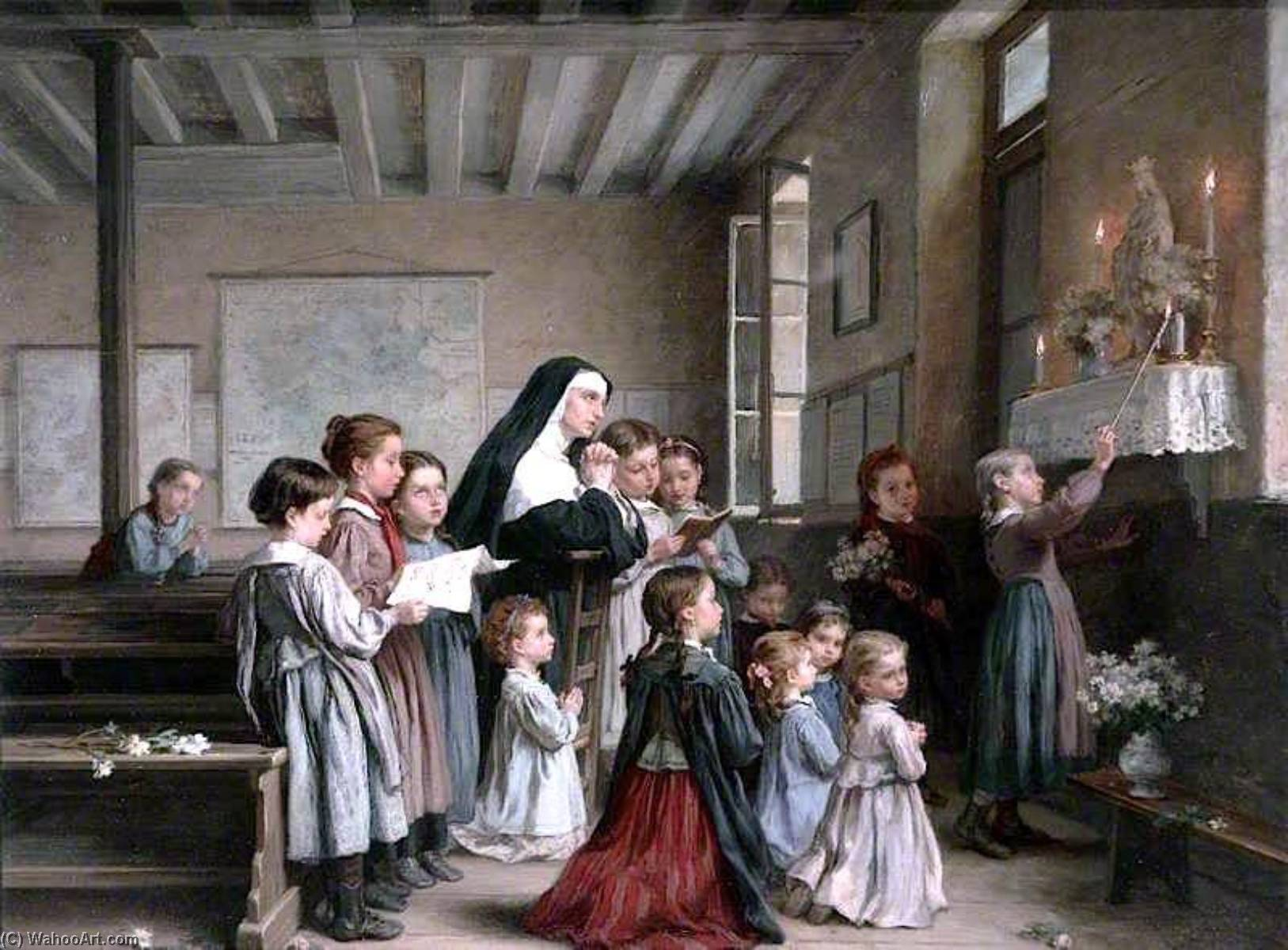
La Prière du Matin (Morning Prayer) by André-Henri Dargelas (c.1860)
André Henri Dargelas, a French painter of the realist movement, was born in Bordeaux on October 11th 1828. In his twenties, his paintings became very popular in England due to the positive assessment of his work made by the English art critic, John Ruskin, who liked Dargelas’ sentimental vision as seen in many of his paintings. In 1857 he began to exhibit his work at the Paris Salon and the motifs of his paintings were influenced by the very popular eighteenth century French artist, Jean Siméon Chardin.
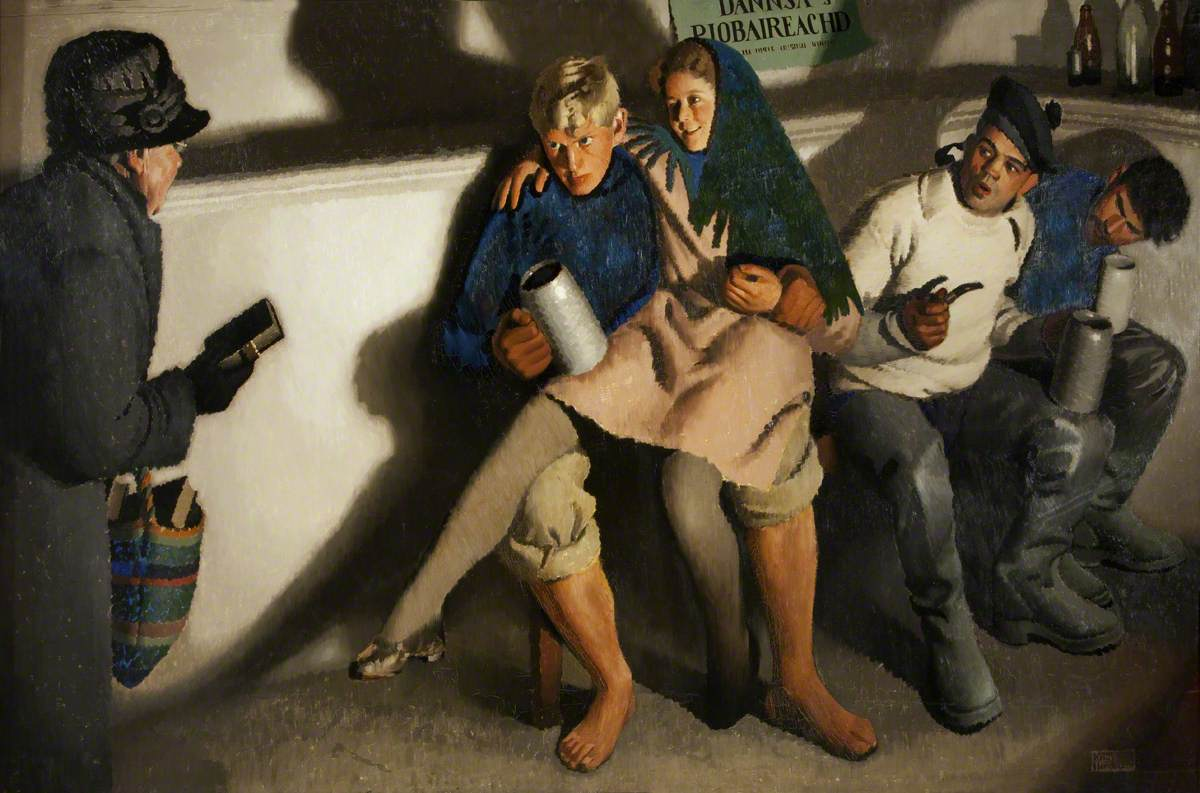
The Word by Keith Henderson (1931)
The above painting is more modern in comparison to those I have showcased earlier and some would say a more realistic view on religious trends and differing views of the old and young on the subject of religious worship. The Word was completed by Keith Henderson in 1931. Keith Henderson was a Scottish painter born in Aberdeenshire in April 1883. He was one of three children born to George MacDonald Henderson, a barrister at Lincoln’s Inn, and Constance Helen, née Keith. He attended Orme Square School in London before being admitted to Marlborough College, a prestigious Wiltshire public school. He then studied at the Slade School of Art before moving to Paris and studying art at the Académie de la Grande Chaumière. During the First World War he served as a Captain with the Royal Wiltshire Yeomanry where he spent time in the trenches acting as a war artist. He recorded his time on the Western Front in a book, Letters to Helen: Impressions of an Artist on the Western Front, which included several of his illustrations. During the 1930s Henderson returned to Scotland to live on the Isle of Barra in the Outer Hebrides where his paintings at the time depicted village life. He was forty-eight when he completed The Word which depicts an old lady seen distributing free bibles coming across a group of young revellers who have just come out of the local pub. They seem to be little interested in her offer. The depiction harks back to Victorian moralistic paintings.

By the Waters of Babylon we sat down and wept by William Etty (1832)
“…By the rivers of Babylon, there we sat down, yea, we wept, when we remembered Zion.
We hanged our harps upon the willows in the midst thereof.
For there they that carried us away captive required of us a song; and they that wasted us required of us mirth, saying, Sing us one of the songs of Zion.
How shall we sing the Lord’s song in a strange land?…”
My final painting in this blog also has religious associations as it illustrates a passage from the tragic 137th psalm of the Book of Psalms in the Tanakh, the Jewish bible. The painting by William Etty, By the Waters of Babylon depicts the biblical story of the Israelites’ captivity in Babylon. The psalm is a communal lament about remembering Zion, and yearning for Jerusalem while dwelling in exile during the Babylonian captivity. The psalm reflects the yearning of the exiles for Jerusalem as well as hatred for the Holy City’s enemies. In Etty’s painting the lyre can be seen hanging from the tree. William Etty was an English artist best known for his history paintings containing nude figures. He was the first significant British painter of nudes and still lifes and in this “religious” painting the three women depicted are in a state of undress.


 my daily art display