
O Templo do Tempo

For many of you who have visited the National Gallery in London, you will be aware of the daily lunchtime lectures. These often come in the form of one of the gallery curators/educators talking about one of the paintings, which is part of the gallery’s permanent collection. In some instances, on the day you will be advised of the painting featuring that day’s talk and where to find it. Chairs are then arranged around the painting and at the prescribed time the talk begins. They are well worth half an hour of one’s time. The reason I mention this is that the painting mentioned in this blog was one that was being talked about when I first attended one of these lunchtime sessions. It was Michelangelo Merisi da Caravaggio’s 1601 work, Supper at Emmaus, which is based on a biblical tale quoted in Luke 24:30-31:
“…When he was at the table with them, he took the bread and blessed and broke it and gave it to them. And their eyes were opened, and they recognized him. And he vanished from their sight…”
Caravaggio’s large work (141 x 196cms; 56 x 77 ins.) depicts the moment when the resurrected, but incognito Jesus, reveals himself to two of his disciples as they sat down to eat. Standing to the left of Christ is the innkeeper, who has served up the food. On the left, with his back to us, is Luke in his torn clothes and to the right is Cleopas. Attached to the coat worn by Cleopas is the scallop shell denoting that he is a pilgrim. The setting for the painting is the interior of a village inn, in the small town of Emmaus, which lies close to Jerusalem. In the painting, we see Christ reaching out his hand, in his renowned gesture, to bless the meal and at it is at this point that Luke and Cleopas suddenly realise that they are with the risen Christ and it is at this juncture of time that Caravaggio has strived to capture in his work. With the work being so large, the figures within it are life-sized.
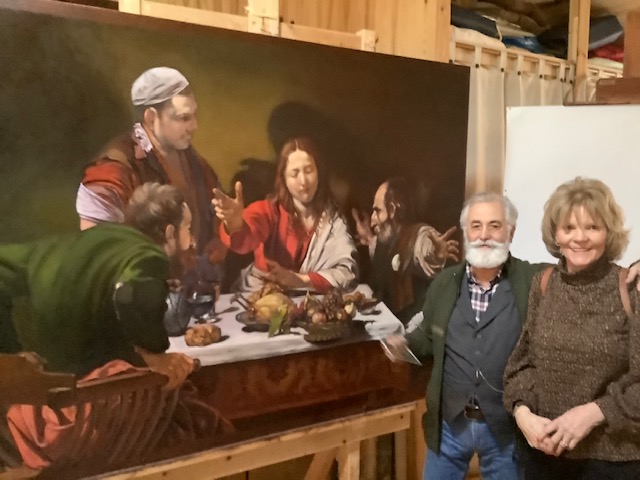
However, the blog is more than just this painting but more about a lucky happening. I had just flown into the Algarve in southern Portugal and picked up a copy of the local newspaper and saw a full-page article about a local painter António Villares Pires who had just completed a full-size copy of the work. I decided to go and see it, which was at his studio in the town of Silves. The name of his workshop/studio is O Templo do Tempo (The Temple of Time). I contacted him and arranged a visit.
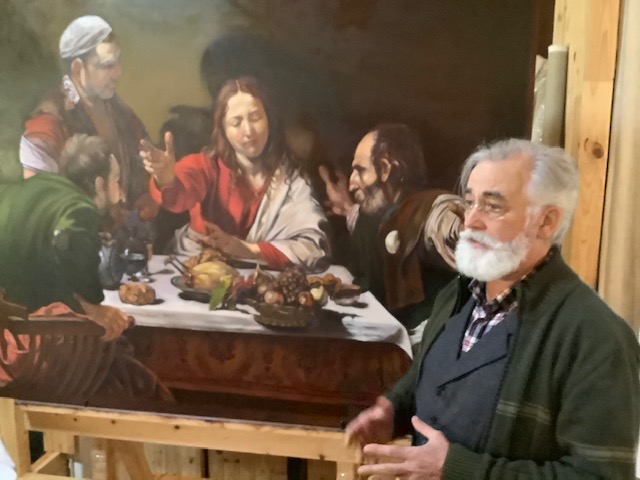 António was born in Porto in a neighbourhood which was populated by many artists and it was with him mixing in their company that he fell in love with art. He studied art at university and achieved a degree in Fine Arts. He later taught art and eventually became a professional artist. He moved to the Algarve in 2009 and founded his studio in Silves, which backs on to the Silves railway station. He says that the name he gave the studio, O Templo do Tempo, is his perception of art because he always felt that when something is truly art, it belongs to the past, present, and future – art, he says, is timeless.
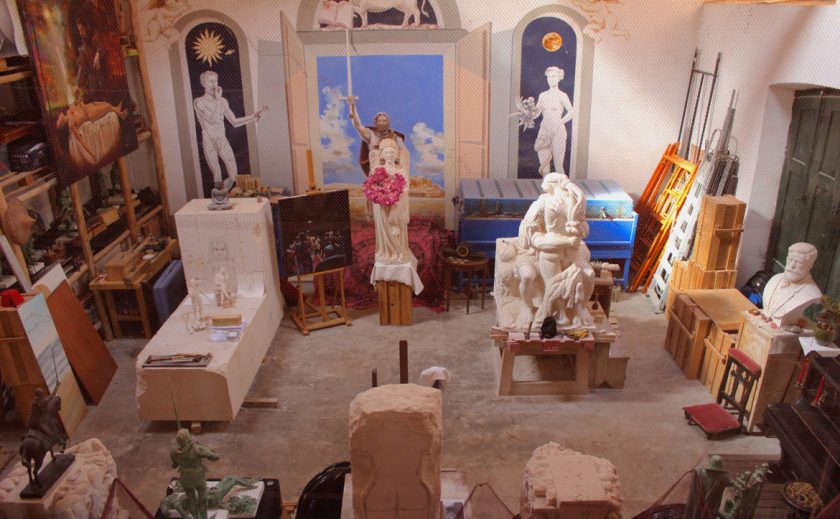
His studio is full of his artwork and sculptures he is working on or are completed in the last decade. Despite being busy with many commissions he has dedicated the last six months to his “Caravaggio Project”. António loves and is in awe of Caravaggio’s style of painting and the way in which the Italian painter portrayed human beings in both a physically and emotionally realistic manner, often centered on a melodramatically dark background, which is often lit up by a single source of light.
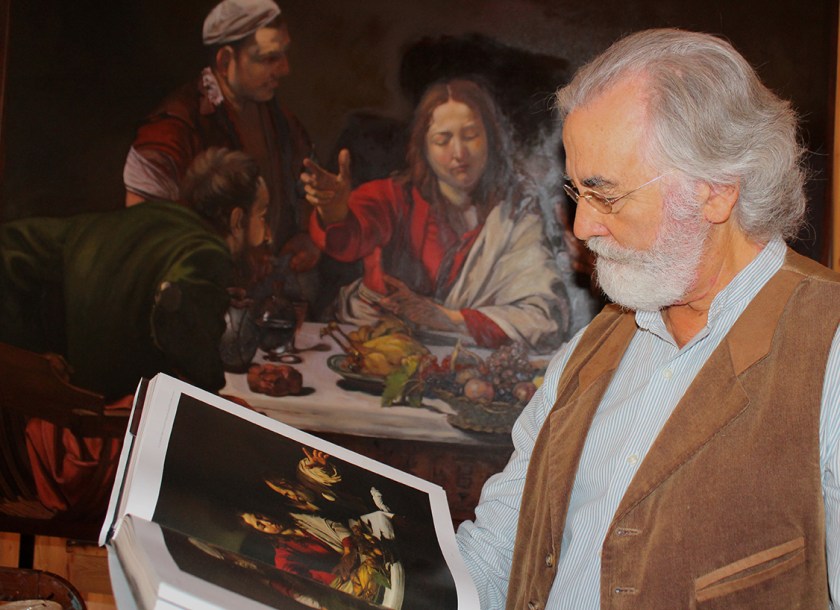
Antonio says that it was the first time he painted in this style and the experience was a journey he wanted to fulfill in order to get into the mind of Caravaggio. He wanted to get to know the artist. His studio has two levels and it is in the mezzanine that almost all the space is dedicated to his Supper at Emmaus painting.
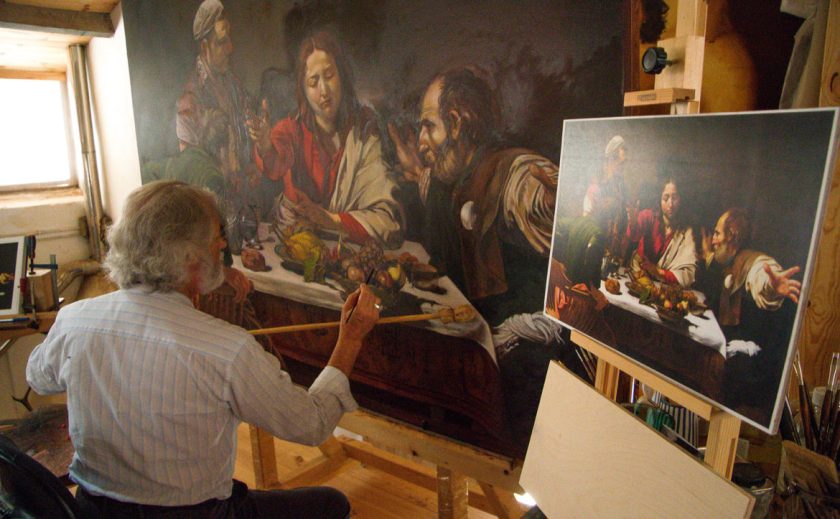
The painting, which he completed the day before we arrived, has the exact same measurements of the original and is flanked by photographs of the original National Gallery version of the painting as well as a large array of paints. It was on the mezzanine that Antonio spent up to six hours a day for the last six months creating his work. One would think he would tire of this same routine day in, day out, but he says that he loved it more each day. He returned to the National Gallery for the second time last November (his first visit was thirty years ago) and stood in front of the massive painting making notes, becoming aware of subtle changes he may have to make to his version.
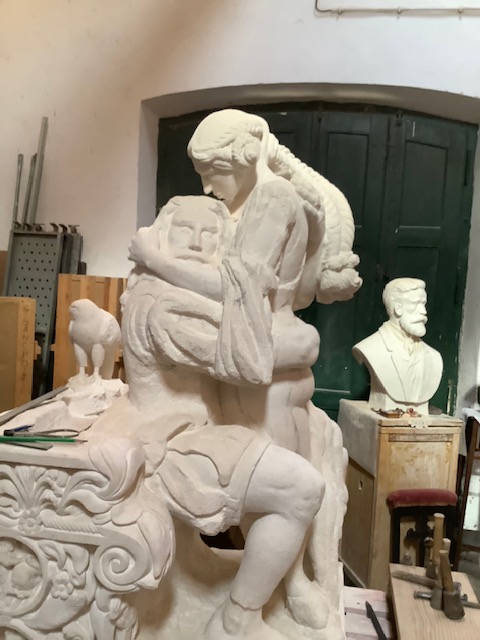
Like Caravaggio’s work, Antonio’s copy is created in oils and he has made every effort to make his painting match every last detail of the original. For me, the painting looks identical to the original I saw in London. So why choose to copy this work? Antonio says that for him the Caravaggio work is an extraordinary painting with a lot of soul and humanity. When I talked to him about it his eyes lit up. He was truly in love with the work.
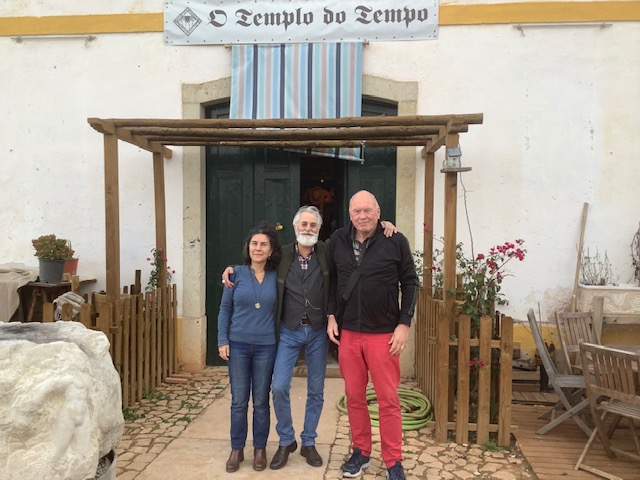
He says he will return to London to see if and how he can get his work officially certified. Once certified, he will sell it as his own work. I asked if he would be sad to let it go. He said he would but before it left him, he would make a full-sized colour copy that he could keep. He says that he will create more pieces of art in the style of Caravaggio. Antonio has been painting for more than fifty years but says that when he is painting in the style of Caravaggio he feels he is twenty-eight again. For him his studio, O Templo do Tempo, is more than just a large storeroom for his work, it is a creative sanctuary, which he has poured his heart into. This is simply, his life.
The full article about O Templo do Tempo was written by Cameron Cobb and appeared in the January 9th, 2020 edition of the Algarve Resident and the December/January edition of the Essential Algarve magazine.


 The Casa de Iberoamérica, House of Ibero-America in Cadiz is located in the 18th-century building on Concepción Arenal Street on the edge of the Old Town of Cadiz. It was once the building that housed the Royal Prison. The foundation stone for the building was laid in 1794 but it was not completed until 1836. The buildings remained a prison until 1966 when it was abandoned. Subsequently, it was decided to use it as a courthouse thus preventing it from becoming a crumbling ruin. In 2006 the building was returned to the City Council, and in January 2011 it became the Casa de Iberoamérica.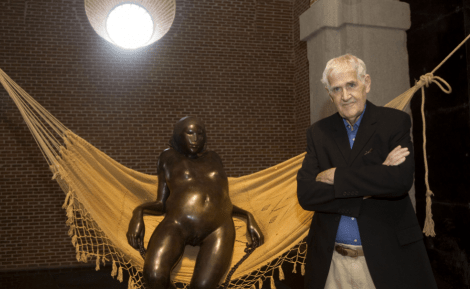
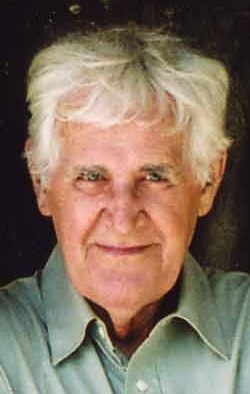
 In 1948, Zitman settled in the northern Venezuelan coastal town of Coro, where he found employment as a technical draftsman for a construction company. In that same year, he married a Dutch lady, Vera Roos, whom he had first met in The Netherlands. The couple went on to have three children, Berend, Lourens and Barbara. Much of his free time was spent painting and creating sculptures. Later, in 1949, he moved to the city of Caracas, and the following year, he found work as a furniture designer at a factory of which he later became the manager. In 1951, he was awarded the National Sculpture Prize. In 1955 he was hired by the Faculty of Architecture and Urbanism of the Universidad Central de Venezuela to teach courses in decoration, drawing, watercolour and gouache, which was then combined into a design workshop.
 In 1958, he exhibited a collection of drawings and paintings at the Museum of Contemporary Art of Caracas. That year, he decided to give up his life as a businessman and concentrate on his art and sculpture and moved with his family to the island of Grenada, where he dedicated himself completely to painting and began to affirm his style in sculpting.
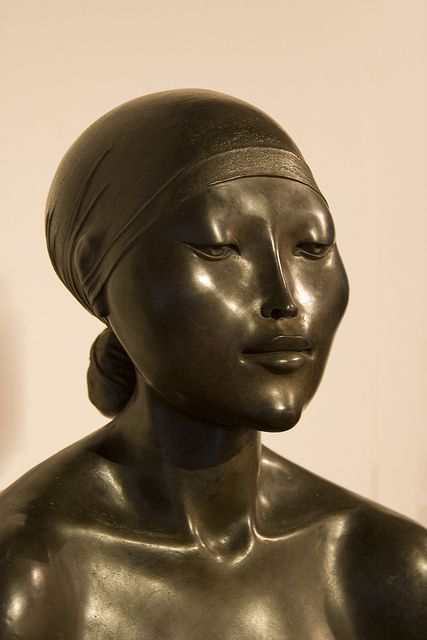 In 1961 he took part in an exhibition of Gropper Gallery in Boston. He returned to Holland, and studied foundry techniques with Pieter Starrevelt, in Amersfort, and then went back to Caracas where he was given the post as a design professor at the Architecture School of the Central University of Venezuela. In 1964 he converted an old sugar cane mill, known as a trapiche into his residence and workshop, in Caracas’ Hacienda de la Trinidad.
 In 1970, Zitman met Dina Viery, a Russian immigrant, and French art dealer, art collector and one time a model for the French painter and sculptor Astride Maillol whom she met in 1934. Viery was a great friend of Maillol during the last ten years of his life and when he died she helped establish the Musée Maillol art museum in Paris. From then on, Zitman dedicated himself exclusively to sculpture. More exhibitions of his work followed in Venezuela, France, Switzerland, the Netherlands, the United States, Japan and other countries, earning a host of national and international awards.
 Zitman died on 10 January 2016 at the age of 89. Zitman earned numerous national and international awards for his work and in 2005 he was decorated with the Knight of the Order of the Netherlands Lion.
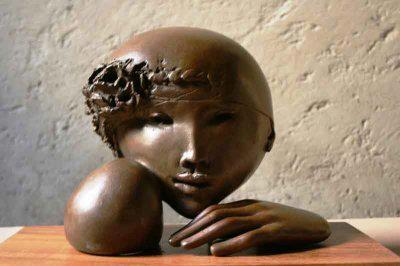 I will leave you with a recent write-up from the Diario de Cádiz, a Spanish-language newspaper published in Cadiz, regarding the Cornelis Zitman’s permanent exhibition at the Casa de Iberoamérica in Cadiz:
 my daily art display