The Annunciation by Dante Gabriel Rossetti

The Annunciation by Rossetti (1850)

My Daily Art Display today is, like my last offering, another painting depicting a scene from the Bible.   The scene is The Annunciation and has featured in paintings by many of the Renaissance Masters.  However this painting by the Pre-Raphaelite artist Dante Rossetti has some subtle differences from these earlier works by the likes of Fra Angelico, Raphaello Santi, El Greco, van Eyck and Botticelli.

The story of the Annunciation is probably known by most and it is documented in the bible in the book of Luke (1: 26-38)

26 In the sixth month of Elizabeth’s pregnancy, God sent the angel Gabriel to Nazareth, a town in Galilee, 27 to a virgin pledged to be married to a man named Joseph, a descendant of David. The virgin’s name was Mary. 28 The angel went to her and said, “Greetings, you who are highly favoured! The Lord is with you.”

29 Mary was greatly troubled at his words and wondered what kind of greeting this might be. 30 But the angel said to her, “Do not be afraid, Mary; you have found favour with God. 31 You will conceive and give birth to a son, and you are to call him Jesus. 32 He will be great and will be called the Son of the Most High. The Lord God will give him the throne of his father David, 33 and he will reign over Jacob’s descendants forever; his kingdom will never end.”

34 “How will this be,” Mary asked the angel, “since I am a virgin?”

35 The angel answered, “The Holy Spirit will come on you, and the power of the Most High will overshadow you. So the holy one to be born will be called[a] the Son of God. 36 Even Elizabeth your relative is going to have a child in her old age, and she who was said to be unable to conceive is in her sixth month. 37 For no word from God will ever fail.”

38 “I am the Lord’s servant,” Mary answered. “May your word to me be fulfilled.” Then the angel left her.

The painting I am featuring today is entitled The Annunciation which Rossetti painted in 1850.  That was not its original title given to it by the artist, Gabriel Rossetti.  He had originally decided to call the painting Ecce Ancilla Domini meaning “behold the handmaid of the Lord” but at the last moment changed his mind.  In the painting, Rossetti has just used the three primary colours, red, blue and yellow along with white.  The use of these colours by the artist is symbolic.  We have white for feminine purity, blue for the Virgin Mary, red for the Passion of Christ and yellow or gold which symbolises holiness.   There are other things in the painting which are symbolic.   The Angel Gabriel holds a lily and in the foreground we see a red cloth on to which we can see that Mary has embroidered white lilies.  Maybe this signifies the young girl’s decision to live a very pure life.
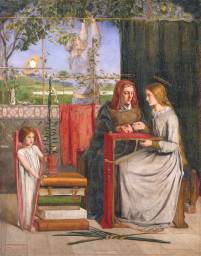
The Girlhood of Mary Virgin by Rossetti (1849)

Mary and her mother, St Anne, can be seen embroidering that very cloth in Rossetti’s painting The Girlhood of Mary Virgin which he painted a year earlier.   Lilies symbolize purity, chastity, and innocence and white lilies represent the purity of the Virgin Mary.  In most paintings of the Annunciation we see the Angel Gabriel presenting Mary with a white lily when he announced to her that she would give birth to the Son of God.

The setting Rossetti has given this scene is very unusual.  In Renaissance paintings of The Annunciation we look at settings which are sumptuous.  Tapestries and heavy velvet curtains often abound.  Light frequently can be seen entering the scene through exquisite stained glass windows lighting up elaborate furnishings and floor coverings.  Rossetti chose not to go down that line.  As we look upon the scene the first thing that strikes us is the claustrophobic compactness of Mary’s room.  It could almost be termed minimalistic in its accoutrements.  Look at the window opening on the back wall.  There was no attempt by Rossetti to give a feeling of depth to this painting by depicting a town somewhere in the far distance.  The window opening is plain and uncovered and through it we just see part of a solitary tree against a blue sky, the colour of which mirrors that of the colour of the screen at the end of Mary’s bed.

In most depictions of this scene we see Mary dressed in blue robes quietly and in some cases joyously receiving the news that she will give birth to the Christ child.  However Rossetti has depicted Mary’s mood differently.  We see Mary dressed in a white shift dress shrinking back from the Angel Gabriel.  Rossetti has added the colour blue which is associated with the Virgin Mary in the form of a blue cloth screen hanging behind her.

Rossetti has also included a dove which embodies the Holy Spirit.  He has depicted the golden-haired Angel Gabriel without wings, which was the norm for Annunciation paintings.  Gabriel’s face is in shade and his facial features are almost hidden from us.    He can be seen in this painting hovering just above the floor with flames all around his feet.  I wonder if I am just imagining it but it looks as if he is pointing the lily stem at Mary’s womb.  It is little wonder that the combination of his words and this action make the young girl almost cower and recoil against her bedroom wall.

Take a while and look at Mary’s expression.  How do you read Rossetti’s depiction of this young woman?  Look at her facial expression.  This is not one of acquiescence or pleasure.  This is a look almost of horror at what she has just been told.    This terrified look adds a great deal of power to Rossetti’s  painting.  Mary herself in Rossetti’s painting looks much younger than we are used to seeing in similar scenes.  She exudes a youthful beauty but only seems to be a mere adolescent with her long un-brushed auburn hair contrasting sharply with her white dress.  She is painfully thin and her hesitance and sad look tinged with fear endears her to us.  We can empathize with her situation.  Rossetti through this painting wants us to put ourselves in the position of Mary at hearing the news of what has been mapped out as her future.  The various Christian religions would have us believe that Mary has been honoured by being chosen as the future Mother of God but Rossetti is asking us to consider carefully whether this young girl, Mary, has been given a wonderful opportunity or whether her life has been saddled with an onerous responsibility.  You need to study her face and decide for yourself.  The model for Mary was Christina Rossetti, the poet, and the artist’s sister

I believe a number of the “standard” Annunciation paintings were meant to inspire us to lead a “good” life and for that reason we see the Virgin Mary delighted to be given the role as Mother of God.  The “standard” depiction of Mary with her happy smiling face leads us to believe that leading a pure and holy life will give us similar pleasure.  However Rossetti’s depiction of the Annunciation questions Mary’s happiness to accept her future role in life.  It is a role that will take away many of the pleasures a young girl would be looking forward to enjoying as she enters adulthood.

I suppose how you look at the painting and how you interpret what you see will depend on your religious belief.
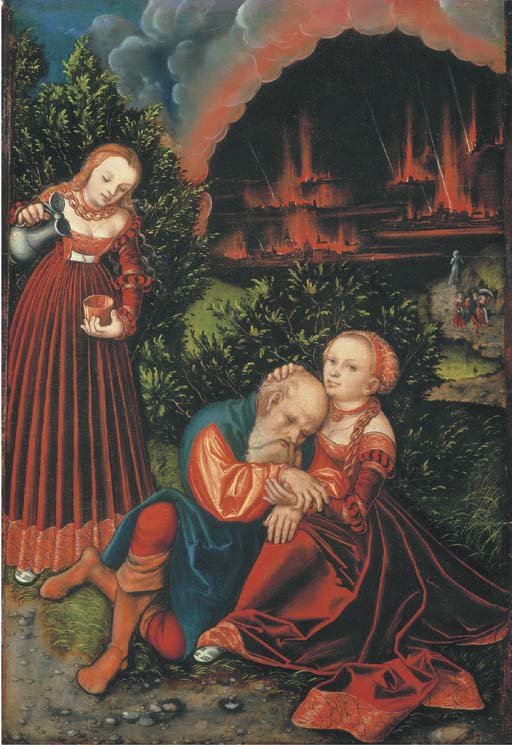
Lot and his Daughters by Lucas Cranach the Elder

Lot and his Daughters by Lucas Cranach the Elder (C.1530)

My Daily Art Display today starts with a passage from the Bible.  It is from the book of Genesis (19: 30-38) and tells the story of Lot and his two daughters who we see in the painting above, entitled Lot and his Daughters which was painted by the great German Renaissance painter,  Lucas Cranach the Elder around 1530.  The Bible passage sets the scene:

30 Lot and his two daughters left Zoar and settled in the mountains, for he was afraid to stay in Zoar. He and his two daughters lived in a cave. 31 One day the older daughter said to the younger, “Our father is old, and there is no man around here to give us children—as is the custom all over the earth. 32 Let’s get our father to drink wine and then sleep with him and preserve our family line through our father.”

33 That night they got their father to drink wine, and the older daughter went in and slept with him. He was not aware of it when she lay down or when she got up.

34 The next day the older daughter said to the younger, “Last night I slept with my father. Let’s get him to drink wine again tonight, and you go in and sleep with him so we can preserve our family line through our father.” 35 So they got their father to drink wine that night also, and the younger daughter went in and slept with him. Again he was not aware of it when she lay down or when she got up.

36 So both of Lot’s daughters became pregnant by their father. 37 The older daughter had a son, and she named him Moab; he is the father of the Moabites of today. 38 The younger daughter also had a son, and she named him Ben-Ammi ; he is the father of the Ammonites of today.

Not being a reader of the Bible, nor being particularly religious, I was surprised to read the passage from Genesis, as on first seeing the painting, which is housed at Compton Verney in Warwickshire, I believed it to be simply a picture of two girls, one comforting a tired-looking old man whilst the other was bringing him something to drink.

It is known that Lucas Cranach the Elder painted this Old Testament subject on  at least four occasions and many other artists have depicted this same story in their paintings.  The early part of Chapter 19 of Genesis relates the story of how God destroyed the two cities of Sodom and Gomorrah, which are shown in flames in the background of the painting.  To save the righteous people of the two cities, God sent down two angels to lead Lot, his wife Edith, his nephew Abraham and his family away from the doomed cities.  The two angels warned Lot that they should quickly escape but nobody should look back on the burning cities but as we know Lot’s wife did and was turned into a pillar of salt and we see the grey pillar of salt in the right middle-ground of the painting.

In the foreground we have Lot on one knee his arms resting on the knees of one of his daughters, who rests her hand on his head, trying to console him after the loss of his wife.  As the biblical tale tells us the daughters, Pheiné and Thamma, fearing that with the destruction of all the people of the city they will not have the chance to bear children and their father will thus never have a male heir.  With that in mind they decide that their father should make them pregnant and so on two consecutive nights they got Lot drunk and had him make love to them.  The daughters became pregnant and each had a son, Moab and Benammi.

This is really a story of two females taking decisions about their own destiny rather than leaving it to a male to decide what should happen to them and their lives.  Stories of female domination over men were very popular in the late Middle Ages and could not only be seen in paintings, but could be read about in literature, and words of songs and plays of the time.

I am a great fan of both Cranach the Elder and his son Lucas Cranach the Younger and find their paintings

Dance of Death by Bernt Notke

Dance of Death by Bernt Notke (1463-66)

Often when I research a painting for my Daily Art Display I am amazed by the complexity of the history of the painting or the biography of the artist and I find myself being sucked deeper and deeper into the story behind the work of art.  The deeper I go the more I realize how difficult it will be to précis what I have found so that the blog does not become too boring and burdensome.  My featured work of art today is an example of this complexity but, to be honest, the more complex a painting becomes the more interested I become and the more I need to dig deeper into the story.  I hope that the story behind My Daily Art Display today does not cross the line which separates intrigue and tedium.

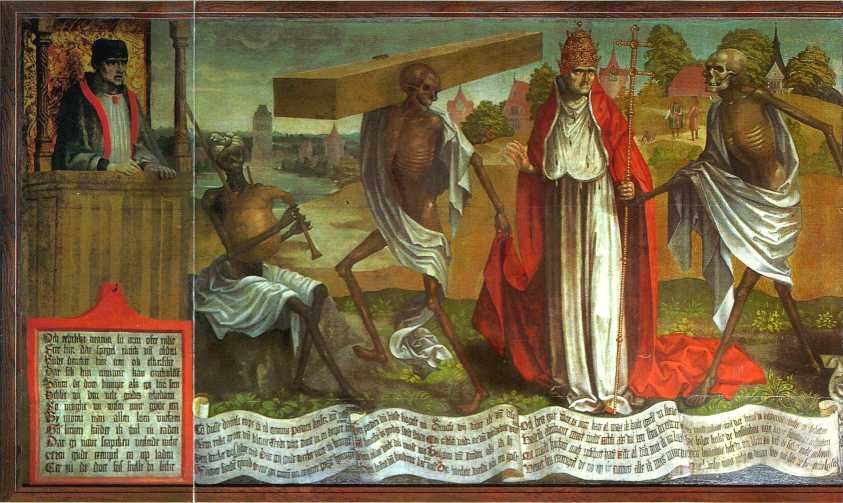
My featured artist today is Bernt Notke.  He was born around 1435 in Lassan, the German town near to the Baltic Sea coast, close to the border with Poland.  He was a painter, sculptor and woodcarver and was considered to be one of the most important exponents of his work in the whole of Northern Europe during his lifetime.  Today I am looking at his enormous tempera on linen Dance of Death frieze which he completed in 1466 and part of which can be seen in Tallinn at the St Nicholas Church Art Museum of Estonia.

Dance of Death paintings were quite common in the late Medieval times up to the beginning of the 16th century and they were painted to remind people that no matter how rich or poor they were, or no matter how powerful they were, death would take them all.  In those days,  epidemics, such as the Black Death, were both recurrent and numerous and they would kill millions of people.  The Hundred Years War between 1337 and 1453 alone claimed three million lives.  The devastation caused by such events enabled people to understand only too well the meaning of these paintings.  They were artistic expressions of the everyday fears of people with the subject of death.  The character “Death” in these works was viewed not as a destroyer but as a messenger of God summoning his people to the world beyond the grave.

The title Dance of Death varied slightly from country to country.  For example, it was known as Danse Macabre in France, Danza de la Muerte in Spain and Totentanz in German but all had the same meaning.  We have come across this type of thing before when we have looked at Vanitas paintings.  Vanitas being the Latin word for emptiness and corresponds in this case more to the word “meaningless” – the meaningless of earthly life.  Vanitas works were to be a stark reminder to us of the transience of life and the inevitability of death. Such paintings would usually incorporate objects which would in some way remind us of death such as a skull or skeleton, or an almost burnt-out candle, watches or hour glasses which symbolized time passing and in still life vanitas paintings rotting food could also be used as a symbol of decay.

Normally the Dance of Death paintings or frescoes were painted on the walls of cloisters or on walls within some churches.  In general we would see Death depicted as an emaciated corpse or skeleton paired with a person from a particular social class as they carry out their dance of death.  Below each pair there would be a verse, the first part of which would be spoken by Death addressing his victim often in cynical and sarcastic terms.  This is then followed by the victims reply as he or she begs for their life.

The join between two fragments of the painting

In the featured work today we see just the surviving part of Notke’s Dance of Death.  His original work was 30 metres in length but this only remaining fragment is only 7.5 metres in length.  The fragment  can be viewed today at the church museum in Tallinn and actually comprises of two pieces, one 6.4 metres long and a much smaller piece approximately 1.15metres long which incorporates the king, and which were joined together in 1843.  However if you look carefully at the join you can see that the background doesn’t run smoothly from one side to another nor does the hand of the devil attach itself to any part of the body of the king, so is there something missing or is it a case that the joining of the two pieces was not carried out correctly?   Further restoration work on this painting was carried out in Moscow in 1962.

Preacher, Musician and Pope

In the painting, we see on the far left the preacher in his pulpit reprimanding his congregation.  Next to the pulpit we see “death” seated playing what looks like bagpipes and I must say in this case “death” looks a little like ET !    Why the bagpipes?   The thought behind this is that bagpipes are known to be able to “wake the dead”.   The inclusion of this musician does add to the sense of macabre and of course he is the musician who will play as the characters to the right of him perform the Dance of Death.    Moving to the right we see another figure of “death” balancing a coffin on his shoulder with his right hand,  whilst at the same time his left hand grasps the clothing of the pope as he begins to lead him in the dance.   To the right of the pope we observe  another figure of “death”.  His right hand is grasping the left wrist of the pope whilst his left hand, which is behind him, holds the Emperor’s wrist.  This interconnection between earthly figures and the figures of “death” continues along the line as they start to dance.  In the surviving part of the painting we have five people facing out at us.  They are the pope, the empress, the emperor, the cardinal and the king and between each we see “death” in the form of a skeleton.

Empress and Cardinal with verses

As I stated earlier, in Dance of Death works a two part verse is often written below each character.  The first part of the eight-line verse is made up of words from the living person begging for his or her life and the second part is the eight-line reply from Death, the last line of which being and introduction to the next mortal along the chain.  An example of this is the verse below the Empress which when translated is:

I know, Death means me!
I was never terrified so greatly!
I thought he was not in his right mind,
after all, I am young and also an empress.
I thought I had a lot of power,
I had not thought of him
or that anybody could do something against me.
Oh, let me live on, this I implore you!

And Death replies:

Empress, highly presumptuous,
methinks you have forgotten me.
Fall in! It is now time.
You thought I should let you off?
No way! And were you ever so much,
You must participate in this play,
And you others, everybody —
Hold on! Follow me, Mr Cardinal!

The Cardinal now says his piece:

Have mercy on me, Lord, [when it] shall happen.
I can in no way escape it.
[When] I look in front or behind me,
I feel Death by me at all times.
What will the high rank avail me
[the rank] that I had? I must leave it
and become more unworthy at once
than an unclean, stinking dog.

And Death replies:

You were in status equal to
an apostle of God on earth,
in order to strengthen the Christian belief
with words and other good works.
But you have, with great haughtiness,
been riding your high horse.
Therefore you most mourn so much more now!
Now step here in front you too, Mr King!

And so it goes on along the line of mortals, all wanting to plead their case only to be refused by the inflexibility of Death.

On display in the St Nicholas’s Church art Museum in Tallinn

I would love to go and see this painting and sad to say I was in Tallinn about six years ago but knew nothing about this great work of art.  If you ever go to Tallinn make sure you add this painting to your “must

The Miraculous Draught of the Fishes by Konrad Witz

The Miraculous Draught of the Fishes by Konrad Witz (1444)

From yesterday’s late nineteenth century Swedish painter Sven Richard Bergh I am going back in time, almost five centuries, for today’s featured artist.  My Daily Art Display today looks at an exquisite painting by the 15th century German-born early Renaissance artist Konrad Witz.

Witz was born in Rottweil is now a german town some fifty kilometres north of the Swiss border and is part of the federal state of Baden-Württemburg, in south-west Germany    It was, at the time when Witz was born in 1400, a freie Reichsstadt (Free Imperial City) and formally ruled by the Emperor of the Holy Roman Empire until 1463.  At that time the town joined the Swiss Confederation where it remained until 1802 and the onset of the Napoleonic Wars when it reverted to part of the Wurttemburg dukedom.  Witz although born in Germany always considered himself to be Swiss.

Through historical records we know that a certain “Master Konrad of Rottweil” joined the painter’s guild in Basle in 1434 and in the same year Witz was granted citizenship of Basle, the Swiss town along with the city of Geneva where Witz spent most of his life.  His style of painting lends one to believe that at some time he received training in the Flemish and Netherlandish painting styles.  Witz is noted as one of the first painters to incorporate realistic landscapes into religious paintings, an example of which we will see in today’s featured painting.

My Daily Art Display featured work today is part of an altarpiece by Konrad Witz entitled The Miraculous Draught of the Fishes which he completed in 1444 two years before he died.  Art historians believe that this beautiful work is amongst the high points of Early Renaissance painting.  Because of hinge marks on the frame of the painting, we know it to be the left exterior wing of the altarpiece commissioned by Bishop Francois de Mies for the high altar of the chapel of Notre Dame des Maccabées of the Cathedral of Saint Peter in Geneva, which belongs to the Swiss Reformed Church.  The right hand exterior wing depicted the release of St Peter from prison but sadly the central panel is lost.   The interior wings of the triptych depict, on one side, the Adoration of the Magi and on the other Saint Peter’s presentation of the donor, Bishop Francois to the Virgin and Child.  Fortunately the wings survived the Protestant Iconoclasm, the collective name for the destruction of catholic churches and possessions which had been raging in Europe since the early sixteenth century and hit Geneva in 1535.  During this Protestant Iconoclasm, hundreds of catholic churches, chapels, abbeys and cloisters in the Netherlands were totally destroyed by rampaging Protestant mobs along with all their contents such as, altars, icons, chalices, paintings, and church books.  The painting is signed and dated 1444 on the original lower frame.

It is by far the most famous of Witz’s works and is sometimes looked upon as the first “real” landscape painting, a painting in which one can recognise a certain landscape as compared with “an idealised landscape” where it is a composite of many places morphed into one idealised picture.  In today’s painting we are standing on the north-west shore of Lac Lehman (Lake Geneva), near Geneva and looking across to the south-east.  We can see the Saleve mountains in the background and included in the scene is the recognisable peak of Mont Blanc.  In the middle ground on the right we can see a pointed jetty and across the water is the staccato line of a breakwater.  Although Witz has given us a true landscape the characters and the scene before us are an amalgam of ideas and the exact subject of the painting is somewhat blurred.

Although the landscape has been identified as Lake Geneva the figures in the painting are all part of biblical stories which obviously took place in the Holy Land.   One reason for this could be that Witz met with his sponsor of the altar, the Bishop of Geneva, François de Mies, during the Ecumenical Council held in Basle.  It was at this Council that it was decided to the elect Amadeus VIII of Savoy to the throne Pontifical under the name of Felix V.   He was to become the last of the Antipopes.  It could be reasoned that by transposing geographically the biblical scene to the land of the pontiff was therefore more of political move that an artistic impulse.

There are three biblical stories going on within this one painting.  Firstly, we have the man who was to become the first pope, Saint Peter, unsuccessfully trying to walk on water.  (Matthew 14:22-26).  Secondly we see Saint Peter, this time in the boat with some of his fellow disciples, fishing which reminds us of the parable of the fishes (Luke 5:1-11).   Lastly, the painting reminds us of the story of the resurrected Christ on the shores of the sea of Tiberius appearing to his disciples as they were in a boat fishing.

This is a beautifully executed painting.  Remember that this is an early 15th century painting.  Look how the artist has skilfully depicted the water with its reflected shadows of the buildings and jettylook at the mirrored reflections of the people in the boat.  Observe the transparency of the water in the foreground as we see the legs of Saint Peter splayed apart as he walks in the shallows having failed to master the “walking upon the water”.

This oil on panel work of art could be seen at Musée d’Art Histoire in Geveva.  I say “could” as it has been taken down for some restoration work to be carried out upon it and will not be re-hung until March 2012.

Feast of the Rose Garlands by Albrecht Dürer

Feast of the Rose Garlands by Albrecht Dürer ( 1506)

My Daily Art Display today features a painting by an artist who is hailed as the one of the greatest painters of the Late Gothic and Early Renaissance period.  He was the Nuremburg painter Albrecht Dürer.  Today’s painting is entitled Feast of the Rose Garlands and was completed by Dürer in 1506 and now hangs in the National Gallery in Prague at the Sternberg Palace.  In France, this painting is known as La Vierge de la fête du rosaire (The Virgin of the Feast of the Rosary).   The work of art is considered to be a milestone piece in the transition between the late 15th century Gothic/Medievalism and the start of the 16th century Renaissance.

Dürer had returned to Italy for the second time in 1505 and the following year settled in Venice.   He was approached by some German merchants from the emigrant German community who had settled around the commercial centre of Venice, known as Fondaco dei Tedeschi.  They wanted a single panel altarpiece for their chapel in the Church of San Bartolomeo.  The people who commissioned the painting were very precise as to what should be depicted in the altarpiece.  It was to be the gathering of the Brotherhood of the Rosary, an association founded in Strasbourg in 1474 by the German priest Jakob Sprenger and a source of worship for the German citizens who lived in Venice.   The painting is highly colourful and littered with various people, so let me introduce you to some of the characters Dürer included in his work, probably under instruction of the commissioners of the painting.  The preparatory work for the panel took Dürer three months to complete and comprised of twenty-one pen and ink preliminary sketches which followed the Venetian painting tradition.  Besides these, Dürer completed a number of small drawings of the characters he was going to incorporate into the work, some of whom were real whilst others were imaginary.

The central figure in the painting is the Virgin Mary, who is enthroned in a field,  holding the Christ child.  The positioning of the Virgin and Child along with her worshipers outdoors probably has to do with Dürer’s fascination with Italian Humanism, which emphasized the importance of humans in the natural world and this painting is similar to other Humanistic paintings of saints and humans seen occupying similar landscapes.  Above the Virgin we can see two flying angels who hold aloft a highly ornate royal crown adorned with clusters of pearls and other gems.  The back of the throne is covered with a green drape and an ornate badachin, a canopy, which is held aloft by a ribbon held by two flying Bellini-like cherubim.  At the feet of the Virgin we can see another angel playing the lute.  The Virgin is in the process of handing out rose garlands to two sets of worshippers which approach her from opposite sides in two symmetrical rows.

To the left are representatives of the clergy with the Pope at their head, while on the right are the representatives of secular power.  The religious worshipper on the left of the painting are led by a kneeling Pope Sixtus IV, his papal tiara on the ground by his side,  and his inclusion in the painting probably stemmed from the fact that he had approved of the German Brotherhood of the Rosary in 1474.  He is about to be crowned by the Christ child.

The procession of lay worshippers on the right is led by the German emperor-designate Maximillian I, with his imperial crown by his side, who is being crowned by the Virgin Mary herself.  These two men were the looked upon as the supreme authorities of the Catholic world.   To the left of the Virgin Mary we see Saint Dominic of Guzman, the Spanish cleric and founder of the Dominicans in 1216 and the Confraternity of the Rosary in 1218.  In the painting, along with a number of angels he is handing out crowns of flowers to the faithful, as a symbolic blessing.   Amongst the religious grouping on the left of the painting we have the patriarch of Venice, Antonio Soriana, hands clasped before him.  Next to him Dürer has painted Burkard von Speyer, who was at the time of the painting, the chaplain of the church of San Bartolomeo.

The Artist

If we look across to the right hand side of the painting we see a typical German Alpine landscape in the background and the line of lay people who wait to pay homage to the Virgin and child.  However one of the first people our eyes alight upon is the artist himself.   Dürer often liked to include himself within crowd scenes of his paintings (look back at the featured Dürer painting, The Martyrdom of the Ten Thousand, on April 25th).  Here we see him, standing before a tree, framed by long blonde hair, dressed in a heavy luxurious fur cloak with hooped sleeves, which immediately makes him stand out amongst the other people in the painting.  Look how he is the only one of the many characters to look directly out at us.   He can be seen holding a cartouche, or oblong scroll, in his hand.  On the scroll are the words:

EXEGIT QUINQUE MESTRI SPATIO ALBERTUS DURER GERMANUS MDVI.

(`Albrecht Dürer, a German, produced it within the span of five months. 1506.’)

By him are Leonhard Vilt of Regensburg, a printer who lived in the city and who founded the Brotherhood of the Rosary in Venice and further towards the foreground in the far right of the painting we have Hieronymus of Augsburg who was the architect and building master and who holds a builder’s square denoting his profession.  It was he who designed the new Fondaco dei Tedeschi after the original building of 1228 had been completely destroyed by fire.

This altarpiece remained in the church of San Bartolomeo in Venice until 1606.   It was then acquired, after long negotiations, for 900 ducats by the Holy Roman Emperor Rudolph II. Archive records show it took four men to bring the packaged painting to the emperor’s residence in Prague.   Hidden away during the invasion of the Swedish troops, the painting which had already been badly damaged was returned to its “home” in 1635.  It underwent the first of many restorations in 1662, all of which instead of enhancing the work, damaged it even further.    In 1782, it was sold in an auction for one florin.   Over the years it was bought by various art collectors and was finally purchased by the Czechoslovakian state in 1930.

This colourful work by Dürer is in the great Venetian artistic tradition with its colour blending achieving deep and rich reds, blues and greens and maybe was the perfect answer to his many critics who had earlier stated that although there was no doubting Durer’s ability to produce magnificent engravings and woodcuts, he lacked the ability to handle colours and produce a fine painting.   The painting was well received and it drew crowds of visitors from all over Europe.   At the time, it was looked upon as one of the artistic highlights of Venice and Dürer’s status as master of Renaissance painting was incontrovertible.

Portrait of a Young Man by Petrus Christus

Portrait of a Young Man by Petrus Christus (c.1460)

I suppose I lay myself open to criticism by the way I jump from one genre of painting to another or from one period to another but all I am trying to achieve is to offer you up as many art genres as possible and by so doing open up the world of art to you.   There are many web blogs which concentrate on one particular art genre and maybe when you have decided what particular type of painting you like you can then find a website or blog which solely concentrates on that genre.  However for me, my love of art is not centred on one particular genre.  I love being able to dip in and out of painting types and by doing so I am able to discover real gems.  Yesterday, I featured a twentieth-century American artist and his city landscape today I am going back in time to the fifteenth century and looking at a portrait by a Netherlandish painter.  My featured artist today is Petrus Christus and My Daily Art Display is his oil on oak painting entitled Portrait of a Young Man which he completed around 1460 and which now can be seen in the National Gallery of London.

Petrus Christus was born around 1410 in what is now known as Baarle-Hertog and lies on the Belgium side of the Belgium-Netherland’s border.  Little is known of his early life until 1444 when he was noted as being an active painter in the city of Bruges.  It is thought that earlier he could have been a student of Jan van Eyck and on van Eyck’s death in 1441, Christus took over his workshop and completed some of his master’s work, but this is purely speculation and has yet to be irrefutably proven.  One argument against this turn of events is that it is known that Christus did not receive his Bruges citizenship until 1444, which is three years after van Eyck’s death.  Had he been a pupil of, and working for, van Eyck at the time of his death in 1441, he would automatically have received his Bruges ‘citizenship then.  So the question of whether Christus was a pupil of, or a successor to, remains unanswered.  However, having said all that, the one thing which is certain is that as an artist he was influenced by the work of van Eyck and made many copies of his works and became van Eyck’s successor.

And so, to today’s painting.  We see in front of us a young man holding an open prayer book looking towards the right of the picture, which lends us to believe that this is probably the left hand part of a devotional diptych and that the missing right-hand part of the diptych may have been a picture of the Virgin Mary. 

The Veronica

Over the man’s left shoulder, we can see on the wall an illuminated parchment showing an image of a revered icon known as the veronica, and a prayer.  The words of the prayer Salve sancta facies, “Hail, Holy Face”, which was a prayer to the face of Christ imprinted miraculously on Veronica’s veil.  .   The veronica according to legend bears the likeness of the face of Jesus Christ and comes from the Latin word “vera” meaning ‘truth’ and “icon” meaning ‘image’ and therefore the Veil of Veronica, simply known as The Veronica was regarded in the Middle Ages as the true image of Jesus’ face.  These illuminated manuscripts were very popular at this time as indulgences could be gained by reciting the prayer whilst looking at the face of Christ.

Look how Christus has painstakingly painted the minute details of this illuminated parchment.  It is amazing.  See how he has illustrated the curling up of the bottom right hand corner of the parchment as it comes away from its wooden backing.  The parchment has been fixed to the wood with metal pins which have been pressed through a narrow red ribbon which acts as a colourful border to the sacred parchment. 

To the left of the picture we see a stone arch way which has been decorated with carved stone statuettes.  On the outer side we have two statuettes, one of a prophet and the other a sibyl or prophetess, who foretold of the coming of Christ.  On the inner side of the arch we have the stone sculpture of John the Baptist who also foretold the coming of Christ.  Below his carved figure there is an empty plinth and one wonders what statuette had been intended for that space.

Purse

The artists has skilfully illustrated the folds in the young man’s long red cloak with its fur trim and I particularly like the elaborate design of the money pouch with the metal purse bar which can be seen under the right arm of the figure.

This is a truly remarkable painting.

The Appearance of Christ to the People by Alexander Ivanov

The Appearance of Christ before the People by Alexander Ivanov (1837-57)

How would you feel if you had spent almost half of your life on one painting and then after all that effort it was not well received?   This is what happened to Alexander Ivanov and his monumental painting The Appearance of Christ to the People.  This oil on canvas work measures 540cms x 750cms (18ft x 24ft 6ins).   Ivanov started on the painting in 1837 and did not complete and exhibit it in St Petersburg until 1858.  This is My Daily Art Display featured painting for today.

Alexander Andreyevich Ivanov was born in St. Petersburg in 1806.  He studied art at the St Petersburg Imperial Academy of Arts under his father, the painter Andrei Ivanov.  At the age of twenty-five he went to live in Rome where he studied the arts of the classical world.   Coincidentally Ivanov was a contemporary of the Scottish painter William Dyce whom I featured yesterday and like Dyce when Ivanov was in Rome he became friends with Friedrich Overbeck, a German painter and leading member of the Nazarenes.  The Nazarenes were a group of young and idealistic German painters of the early nineteenth century who believed that art should serve a religious or moral purpose.  The name Nazarenes was given to them facetiously because of their devout way of life and the propensity to wear their hair in biblical hairstyles.  It was because of this friendship and exchange of views with the Nazarenes that Ivanov concentrated on religious paintings.

One of hundreds of preliminary sketches

Ivanov’s fame is inseparable from this great masterpiece of his,  which I am featuring today.  The finished painting is based on hundreds of preparatory studies he made over twenty years, many of which are gems in themselves and are considered by art historians as masterpieces in their own right.  This painting and about 300 preparatory sketches are housed in Moscow’s Tretyakov Gallery.  Art critics believe that the preparatory sketches reveal greater expressiveness and psychological depth than the finished painting itself. 

 Ivanov believed the Gospels to be historical rather than religious and therefore considered that the subject of this painting to be more historical than religious.  The scene is set on the banks of the River Jordan and is based on the Gospel of Matthew 3:13-16:

“…Then Jesus came from Galilee to the Jordan to John, to be baptized by him.  John would have prevented him, saying, ‘I need to be baptized by you, and do you come to me?’  But Jesus answered him, ‘Let it be so now, for thus it is fitting for us to fulfil all righteousness.’ Then he consented.  And when Jesus was baptized, immediately he went up from the water, and behold, the heavens were opened to him, and he saw the Spirit of God descending like a dove and coming to rest on him;  and behold, a voice from heaven said, ‘This is my beloved Son, with whom I am well pleased.’…”

In the middle ground we see the solitary figure of Christ on a rocky mound approaching the gathering.  Behind him in the background is a wide plain and the distant mountains.  His figure is small in comparison to the others but nevertheless stands out because of it being a lone figure.  In the foreground of the picture there are a number of male figures of varying ages, some of whom are already undressed waiting to be baptised.  The main figure with his wavy black hair,  dressed in his animal skin under a long cloak is John the Baptist, with a crosier in his left hand.  He raises his hands aloft and gestures towards the approaching solitary figure of Christ.

John the Baptist

To the left there are a group of disciples who will soon move on and spread the word of the Lord.  To the right we have the Pharisees and scribes who unbendingly reject the Truth.  In the centre of the group the artist has painted a haggard old man struggling to his feet buoyed by the words of John the Baptist.     

This is a beautiful painting, full of colour and meticulous detail.  In 1858, Alexander Ivanov went with his beloved painting to St Petersburg where it was exhibited. Its lukewarm reception must have been heartbreaking for Ivanov.  He died a few months later of cholera aged 52 not knowing that some years after his death his work of art would be hailed, by the likes of Ilya Repin, the most celebrated Russian painter of his day, as “the greatest work in the whole world, by a genius born in Russia”.

Saint Francis in Meditation by Francisco de Zurbarán

Saint Francis in Meditation by Francisco de Zurbaran (1635-9)

Francisco de Zubarán was a Spanish painter whose painting genre was that of religious works depicting monks, nuns, saints and martyrs.  He was also a popular still-life painter.  He was an artist who was renowned for his use of chiaroscuro, a form of art which is characterised by strong and bold contrasts between light and dark, which affected the whole composition.  It was for this use of chiaroscuro that he was known as the Spanish Caravaggio, named after the Italian Master and his use of the technique to dramatic effect.

Francisco was born in Fuente de Cantos in Extremadura in 1598.  As a child he liked to draw images in charcoal and at the age of sixteen his father sent him to Seville to train as an artist.  It was whilst he was a student that he took up Caravaggio’s realistic use of chiaroscuro and tenebrism, a style of painting using a very pronounced chiaroscuro in which there are violent contrasts of light and dark and in fact the darkness becomes a dominating feature of the image.  Because of Caravaggio’s frequent use of tenebrism in his paintings the word Caravaggism or Caravaggesque tenebrism are often used synonymously for the term.

My Daily Art Display for today is a perfect example of this style used by Zurbarán.  It is a painting he completed in 1639 entitled Saint Francis in Meditation.  It is not what you would expect of a painting of a saint. It is one of the most bleak and gravest of Zurbarán’s paintings of saints.   To me, there is an air of menace about the work of art.  It is a matter of conjecture as to whether it was the artist’s idea or that of the people who commissioned the painting, to make the work dark and sinister.   It has to be remembered that at the time Zurbarán painted this picture several monastic orders in Spain had gone out and challenged both painters and sculptors to bring more life to the religious figures in their works and by doing so the religious orders believed that viewers would be inspired to imitate the saints they came across in art.  The viewers were coming face to face with their religious heroes.  In those days many Spanish artists studied the polychromatic wooden sculptures by the likes of of Martínez Montañés, Gregorio Fernández, Juan de Mesa, Pedro de Mena and Alonso Cano and by doing so were able to add an austere realism to their paintings.  In fact many of the young Spanish artists, including Zurbarán and the young Velazquez, learned how to paint the surfaces of these sculptures as part of their artistic training.

Let us now look more closely at the portrait of Saint Francis.  The background is plain and dark adding to the intensity of the painting.  Nothing is allowed to detract from this solitary figure at prayer.  We see him on his knees.  It is a lifesize portrait.  As he clasps a skull to his chest,  the artist would have us believe that he is meditating on the subject of death.   Such meditation on death was looked upon, especially by the Jesuits, as a religious exercise,  as it was considered to be the probable point of union with the ultimate truth.  Saints contemplating skulls was often seen in Spanish and Italian paintings in the early 17th century.  Saint Francis is lost in meditation and does not see us, the viewers,  as we stare in at him. 

We cannot see his face clearly as although there is light eminating from the left hand side, his face is almost in darkness due to the deep shadow cast  from his cowl.  We can barely make out his eyes and so we are deprived of his facial expression.  Actually there is a similarity to the eye-sockets of the upturned skull he is holding and what we can make of the eyes of the saint.  Just a coincidence ?  We can just make out his mouth.  His lips are parted as he utters the words of his prayer.

Look at his habit.  It is patched and well worn and looks to be made from a coarse  material, which would not afford the wearer any comfort.  It is held together by a dark brown knotted rope.  See how the light falls on the threadbare part around the elbow.  Zurbarán is reminding us of the Saints vows of poverty.  We are also to believe that this is a ‘working man’ by the way the artist has shown his hands and his dirty fingernails.

This is both a moving and disturbing painting but, at the same time, one I will make sure to go and see the next time I visit the National Gallery in London.  This abrasive style of Zurbarán made him very popular in the mid sixteenth century but then along came another artist from Seville with a much gentler and softer style of painting which then became more fashionable.  The artist was Bartolomé Esteban Murillo and his rise to fame and fortune was in direct contrast to Zurbarán’s fall from favour and his last days were spent in poverty.  Like life in general, I suppose one should clasp hold of the good times as you never know when they are about to end.

The Ecstasy of Mary Magdalen by Peter Paul Rubens

The Ecstasy of Mary Magdalene by Peter Paul Rubens (c.1620)

My Daily Art Display offers up a painting currently in the Palais des Beaux Arts in Lille.  It is an oil on canvas painting entitled The Ecstasy of Mary Magdalene by Peter Paul Rubens.  Rubens completed this work around 1620 as an altarpiece for the Church of the Recollets in Ghent.  Art historians now believeg that this painting by the Rubens was done as they put it “perhaps with some help from assistants”.

The subject of the painting is Saint Mary Magdalen, in ecstasy, being supported by two angels.  Rubens’s  inspiration for this painting came from Jacques de Voragine’s  book of the saints entitled Légende dorée (The Golden Legend) in which is written:

“… The saint, desiring to contemplate celestial things, withdrew into a mountain cave which had been prepared by the angels’ hands and there she remained for thirty years unknown to everyone……each day, the angels lifted her into the skies and for an hour she heard the music; after which, replete with this delicious meal, redescended into her cave, and had not the slightest need of body aliments….”

The setting for the painting is a rocky ledge at the mouth of a cave.  Rubens conveys a deep mysticism in this painting.  Look at the expression on Mary Magdalene’s face.  Her eyes are slightly open but appear somewhat lifeless.  Her face and upper body have been lit-up by a shaft of light.  She appears to be in a trance-like state.  Her face and body are as pale as white marble.  Rubens has beautifully and skilfully painted the folds of her white robe which clings tightly to her body.  The robe has partly fallen away from her upper body exposing her left breast.  Her body is in a state of collapse and the angel on the left supports her as he looks down at her face with an expression of concern for her well-being.  The angel to the right supports her wrist as he looks upwards in awe at the divine shaft of light which has penetrated the mouth of the cave.   The art historian Baudouin points out that the ecstasy which transfigures Mary Magdalene is surprisingly reminiscent of the detailed descriptions that the Spanish saint, Teresa of Avila, wrote about in her biography entitled Vida.  She recounted her experiences at the height of her moments of mystical union and wrote:

“…While it [the soul] thus searches its God, it experiences, amidst the deepest and sweetest delights, an almost total collapse, a sort of fainting fit which gradually takes away one’s breath and all one’s bodily strength….”

This is a beautifully painted picture and the skilled portrayal of the three characters with their varied expressions by Rubens, is superb.

The Adoration of the Kings by Jan Gossaert

The Adoration of the Kings by Jan Gossaert (c.1515)

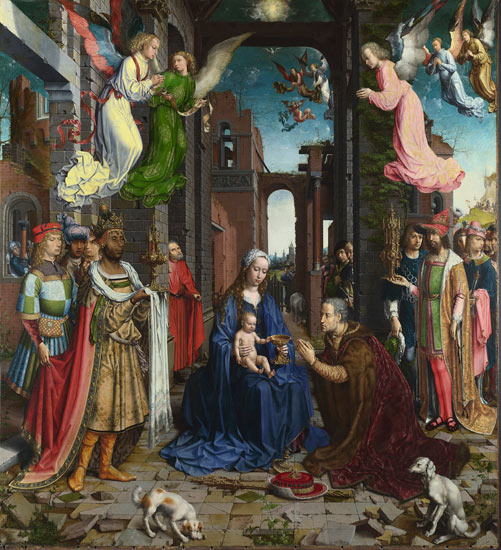
I ended My Daily Art Display yesterday by promising you a feature on what I believed the best painting in the Gossaert exhibition at the National Gallery, London.  I was three quarters of the way around the exhibition when I entered a small room and hanging on one wall was the magnificent work of art by Gossaert entitled The Adoration of the Kings.  This oil on wood painting was completed around 1515 after his return from Rome.  It is a very large painting measuring 177cms x 161cms.  It is part of the National Gallery’s permanent collection.  It is one of Gossaert’s largest works of art It is truly breath-taking.  I stood in front of it for a full five minutes mesmerized much to the annoyance of my fellow visitors.  There was so much going on within the picture and thus so much to take in. 

The picture is thought to have been the altarpiece of the Lady Chapel of Saint Adrian’s,  Geraardsbergen (Grammont) a town near Brussels  The patron who commissioned the painting was thought to be Daniel van Boechout, the Lord of Boelare, a well-connected nobleman.  The many figures in the painting have rigidity about them and all are colourfully dressed.  The multitude of colours and tones are what strikes your eye when you first stand in front of the painting.  The rich fabrics of the very fashionable clothes are gloriously depicted.  The backdrop which we can see through the colonnades is laid out with tiny towers and steeples

Let us take a look at some of the detail.  There are approximately thirty figures depicted in this elaborate and highly colourful painting.  These are grouped within an ornate architectural structure which adds a sense of depth to the picture.   Gossaert was master of this type of presentation.  The once palatial buildings are now in ruins.  The stones and brickwork are  chipped and overgrown with plants and small trees.  The frieze above the Virgin bears a relief of naked dancing putti which also appears on four of the pillar capitals.  They probably represent the pleasures of innocence.   

Conversion of Saint Eustace by Durer


The floor is made up of slabs and coloured stones arranged in geometrical patterns but it is chipped and broken and weeds can be seen growing between the stones.  Two dogs have been added to the foreground.  Art historians believe that the dog in the right foreground is copied directly from Durer’s famous engraving of the miraculous conversion of Saint Eustace, dated 1500/01.

Baby Jesus with gold coin

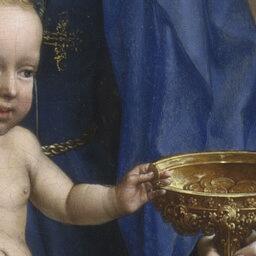
Centrally positioned in the painting is the Virgin Mary with the baby Jesus sitting on her knee.  Kneeling in front of them is the eldest king, Caspar, with a wart on his left cheek.  He is offering his gift, a gold chalice containing gold coins.  The baby with his hand outstretched takes one of the coins. The lid of the chalice which lies on the floor next to his hat and golden sceptre bears his name.   The second king, Melchior, stands behind Caspar.  He is dressed in a green patterned doublet over which is his gold patterned coat lined with ermine.  He carries the frankincense in a highly decorative golden container.  Behind him stand four attendants.   The third king is Balthasar, and this is one of the earliest known depictions of a black man in western art.   He approaches Mary from the left of the painting.  He carries a highly ornate vessel, which contains his gift of myrrh.  His elaborate hat which incorporates a crown is inscribed with his name, BALTAZAR, and also has on it the artist’s signature.  The artist’s signature also appears on the neck ornament of Balthazar’s black attendant.    

Gossaert himself ???

Behind him are his three attendants.  If we look at the middle-ground, just behind Mary, we can see Saint Joseph, dressed in a red robe, leaning on his staff.  To the right of him we can just make out the head of an ox which peers out of a doorway and if you look closely between the Virgin Mary and King Caspar you can just make out the ass munching on weeds. Between the ox and Saint Joseph we see two men looking over a dilapidated fence.  Some believe that the man on the left is Gossaert himself.   Above all these earthly beings hover nine angels all dressed in various coloured shot fabrics.  On the hillside behind Melchior’s retinue, we can just make out the angel announcing Christ’s birth to the shepherds

The colours Gossaert uses in this painting are so rich and varied and his attention to detail of every aspect of this picture gives the impression that the artist was trying to push his powers of invention and artistry to their very limits.  The painting shown above and any others I have come across in catalogues or on the internet do not give you any idea of the true beauty of this work of art and I urge you to try and visit the Gossaert exhibition even if it is just to stand in front of this painting and absorb the beauty of this sumptuously painted work of art.

I will leave you with not my words of praise for the artist but the words of the the person who is the curator of this exhibition.  Of the Gossaert exhibition she says:

“When I stand in a room full of his paintings, the sheer quality of the work is overwhelming.  His technique is extraordinary: the way he paints textures, so you feel every strand of fur, every hair. He is undoubtedly one of the giants.”

Finally, have a look at the website below where you can use the viewer to move around the painting and zoom in on all the details.

http://www.nationalgallery.org.uk/paintings/research/jan-gossaert-the-adoration-of-the-kings-introduction