John William Godward. Part 1 – Early life and works and the notorious Pettigrew sisters.

Beauty is in the eye of the beholder

Observing things of beauty is one of the pleasures of life and in my blog today I am looking at the life of an artist who constantly depicted feminine beauty in his paintings.  My featured artist is the Victorian Neo-classicism painter John William Godward.    Victorian Neoclassicism was a British style of historical painting inspired by the art and architecture of Classical Greece and Rome.  During the 19th century, ever more Europeans made the “Grand Tour” to the Mediterranean lands. For them, the highlight of the journey was visiting the ancient ruins of Italy and Greece and learning about the exotic cultures of the past, and it was this fascination which led to the rise of Classicism in Britain.  Godward’s portrayals of female beauty was not merely “things of beauty” but of classical beauty which during his early days was very popular with the public.

William Godward (1801-1893),
John William Godward’s paternal grandfather

John William Godward was born on August 9th, 1861.  He was the eldest of five children of John Godward and Sarah Eborall.  John’s father and the artist’s grandfather, William Godward, had been involved in the life assurance business and his grandfather had become quite wealthy through some wise investments in the Great Northern Railways which had been formed in 1846.  John Godward Snr., the artist’s father, followed in his father’s footsteps and worked   as an investment clerk for The Law Life Assurance Society at Fleet Street in London’s financial district.  On the death of his father, John Godward Snr. inherited a sizeable amount of money and he and his wife Sarah, whom he married in June 1859, lived a comfortable life in their home in Bridge Road West which was then in the ashionable London district of Battersea.  They lived an “upright” and were devout followers of the High Church of England.
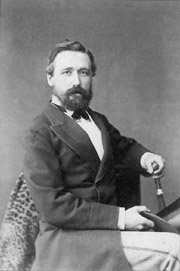
John Godward (1836-1904)
John William Godward’s father

Sarah Eborall, John Godward Snr’s twenty-six-year-old wife, gave birth to their first child on August 9th 1861 at their Battersea home. The baby was christened that October and given the names John and William after his father and paternal grandfather. Two years later in December 1863 their second child, Alfred was born.   In 1864 the family moved from Battersea to Peterborough Terrace, Fulham, later renamed Harwood Terrace.  Fulham at the time, and unlike today,  was a rural area with its farms and market gardens.  In February 1866 Sarah gave birth to her third child, a daughter, Mary Frederica, who was known affectionately as “Nin”.  With a growing family John Snr, Sarah and their three children moved to larger rented premises in Peterborough Villas, close to their previous home.

Two further children were born, Edmund Theodore, known as Ted, in November 1869 and their youngest, Charles Arthur, in June 1872.  The Godward family was now complete with five children and the size of the family probably dictated that they needed larger accommodation and somewhere around 1872 they all moved to Dorset Road Wimbledon

Little is known about John William Godward’s schooling but as his family were well-off middle-class parents he may have been enrolled at one of the many private schools in the Wimbledon area. It is thought that he developed a love of drawing during his schooldays.  He was brought up in a very strict household in which maternal and paternal love was in short supply.  Both his parents were very controlling and John William had few friends.  His father, a devout Christian and church-goer, was both strict and puritanical and expected his word to be law and as far as he was concerned all his sons would, on leaving school, follow in his footsteps into the business world and, in particular, into the world of insurance and banking.  Whereas John William’s three brothers, Alfred, Edmund, and Charles happily entered the world of insurance much to their father’s delight, John William Godward, his eldest son proved, in his mother and father’s eyes, to be a disappointing failure who although forced, at the age of eighteen, into working as an insurance clerk with his father, hated every minute of this alien world of finance.

Dora by John William Godward (1887)
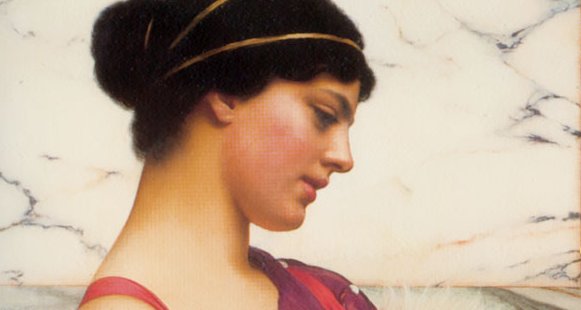
Study of a model, possibly Hetty Pettigrew

John Godward probably realised that his son was not going to remain in the insurance profession and because of his son’s propensity for art, decided that rather than let him idle his time as a fine artist he would arrange for him to study architecture and design.  In the eyes of his parents, an architect had a more acceptable and honourable ring to it than that of an artist.  Between 1879 and 1881, his father arranged for his son to study under William Hoff Wontner, a distinguished architect and designer and friend of the family, in the evenings whilst retaining his day job as an insurance clerk. John William Godward worked alongside Wontner’s son William Clarke Wontner, who was also interested in fine art and exhibited some of his portraiture at the Royal Academy exhibitions.  William Clarke Wontner soon became a popular portrait painter who received many commissions from patrons for landscapes and murals to decorate interiors of their homes. One can imagine that the youthful John William Godward was inspired by his friend’s blossoming career in fine art and was more than ever determined to follow a similar path.  The two men would remain good friends for the years that followed.  The other bonus in working in Wontner’s architecture office was that Godward was able to develop his skills in prospective and drawing of architectural marble elements which would feature in his later paintings.  In 1881 William Hoff Wontner died but his son carried on training the twenty-year-old, Godward and it is almost certain that Wontner’s success as an artist further intensified Godward’s desire to paint for a living, a decision which would cause havoc with his relationship with his mother and father.

Portrait of Mary Perkinton Godward by John William Godward (1881)

One of the earliest works completed by John William Godward was a small watercolour portrait (4.5 x 3.25 inches) of his paternal grandmother, Mary Perkinton Godward.  She had died in 1866 when the artist was just five years old and so it is thought that he used a family photograph to complete the work.
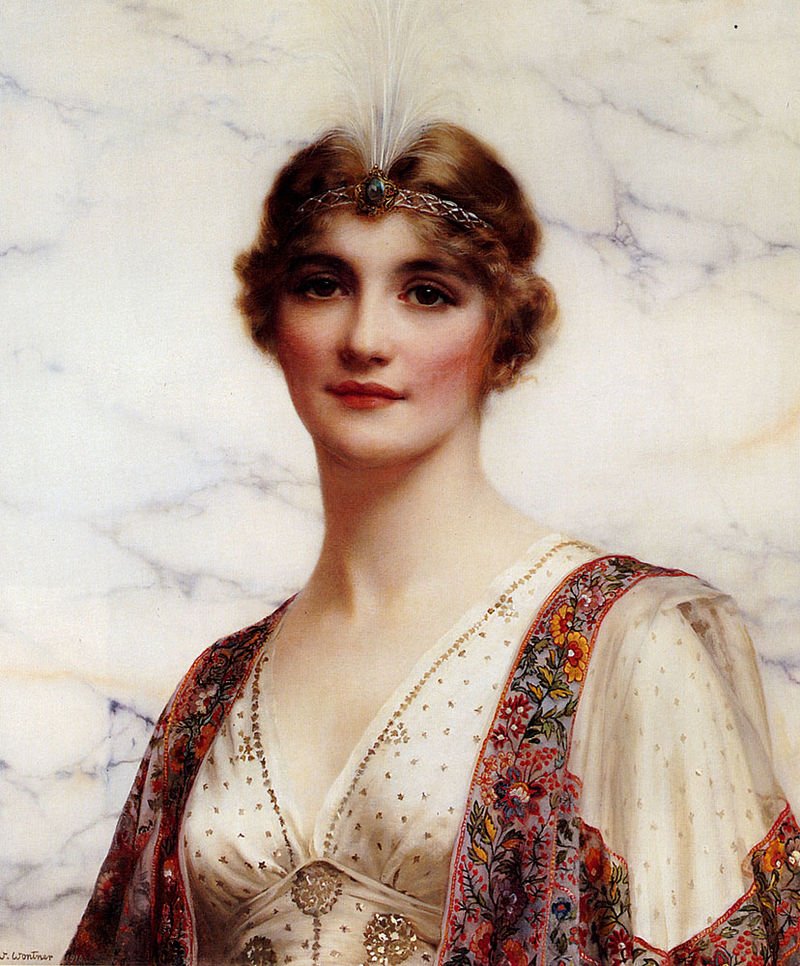
The Fair Persian by William Clarke Wonter (1916)

There is some doubt as to if, when and where John William Godward received formal artistic training.   Knowing his family’s vehement opposition to their son becoming a professional fine artist he is unlikely to have had his family’s backing to enrol at the likes of the Royal Academy of Art School and in fact there is no record of him attending any of their full-time courses.  However, we do know that in 1885, his friend and erstwhile mentor William Clarke Wontner taught at the prestigious St John’s Wood Art School, a feeder school to the RA School, and it may be that Godward also attended this establishment.  We also know that some of the visiting artists to this art school were Lawrence Alma-Tadema, Frederick Leighton, and Sir Edward John Poynter whose art certainly influenced Godward.
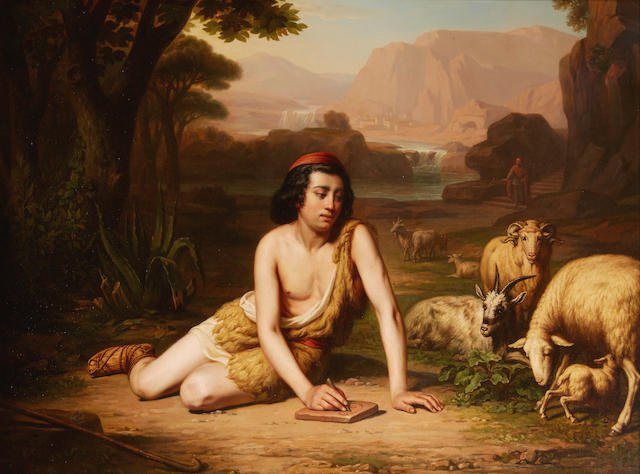
Giotto Drawing from Nature by John William Godward (c.1885)

Another reason to believe that Godward was receiving some formal training was a painting he completed around this time entitled Giotto Drawing on a Tablet which depicts the Italian artist, Giotto di Bondone, as a young shepherd drawing sheep.  The depiction is based on a passage from Giorgo Vasari’s1550 book, Le Vite de’ più eccellenti pittori, scultori, ed architettori (Lives of the Most Eminent Painters, Sculptors, and Architects), which recounts that Giotto was a shepherd boy, a merry and intelligent child who was loved by all who knew him. The great Florentine painter Cimabue, one of the two most highly renowned painters of Tuscany, discovered Giotto drawing pictures of his sheep on a rock. The depiction was so lifelike that Cimabue approached Giotto and asked if he could take him on as an apprentice.

Godward’s painting bore all the hallmarks of a “diploma piece” – a work of art which had to be submitted for critical assessment by tutors and it had to have the major genre elements taught in the art schools of the day.  It had a figure, a group of animals and a landscape, all of which were mandatory elements in order to demonstrate an artist’s technical expertise.  Having said all that, there are no definitive records of John William Godward attending any local art colleges.

Portrait of Mary Frederica ‘Nin’ Godward by John William Godward (1883)

Another early work by Godward was an 1883 portrait of his sister, entitled, Portrait of Mary Frederica “Nin” Godward.  The artist has depicted his sister shoulder-length in profile to the left. This was Godward’s first known oil painting.
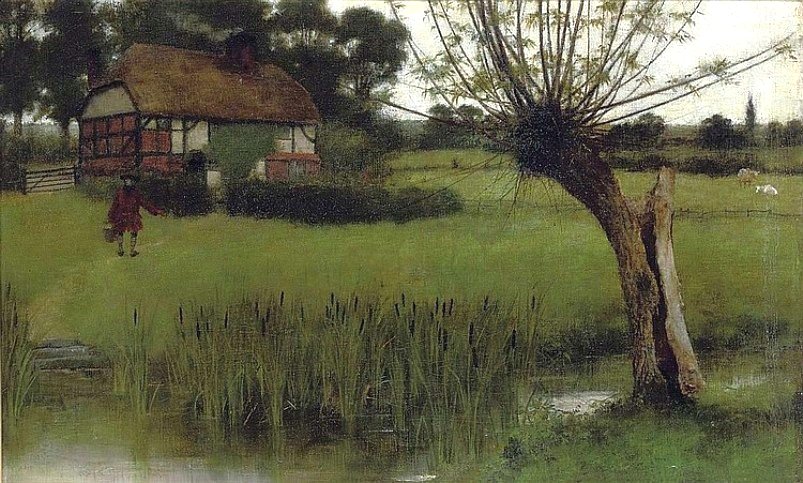
Country House in the 18th Century by John William Godward (1883)

Godward’s 1883 painting Country House in the 18th Century shows his early style, so dissimilar to the Neo-classical paintings we now associate with him.  It is so different in style that it may just have been a copy Godward made of another artist’s work

What every artist needs at one time or another is a good model.  Artists’ models often worked for more than one artist and the best were in high demand.  Enter the Sisters Pettigrew.  On the death of her husband William Pettigrew, a cork cutter, and because of the dire need to feed her thirteen children, his widow Harriet Davies took the advice of her artist son that three of his sisters, Lilly, Harriet and Rose, all with their masses of hair and exotic looks  would make ideal Pre-Raphaelite artist’s models, and so in 1884, she took them to London where they became an instant hit with many artists such as John Everett Millais, Fredrick Lord Leighton, William Holman Hunt, Edward Burne-Jones, James McNeill Whistler and John William Godward.  Rose Pettigrew wrote about the experience six decades later:

“…every great artist of the land” was clamouring for one of the “Beautiful Miss Pettigrew’s” to pose…”
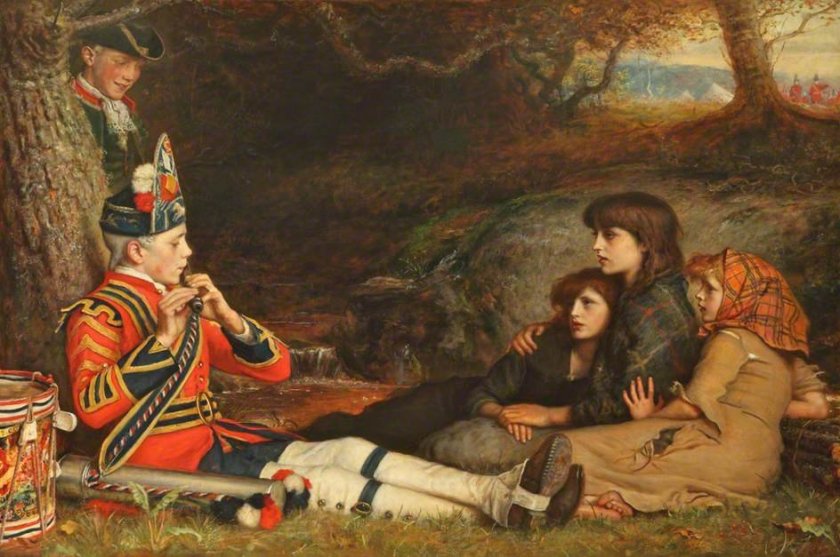
An Idyll of 1745 by John Evetett Millais (1884)

Their first time the girls appeared as artist’s models was when John Everett Millais used all three sisters in his 1884 painting, An Idyll of 1745, which depicts three young girls listening to the music played by a young British fifer.  Behind the fifer is a Loyal volunteer, seemingly enjoying the moment.  In the background is a British Army camp, likely where the fifer and volunteer came from.  From what the artist’s son said the three young girls were almost more trouble than they were worth, saying:

“…more trouble than any [models] he ever had to deal with. They were three little gypsies … and with the characteristic carelessness of their race, they just came when they liked, and only smiled benignly when lectured on their lack of punctuality…”
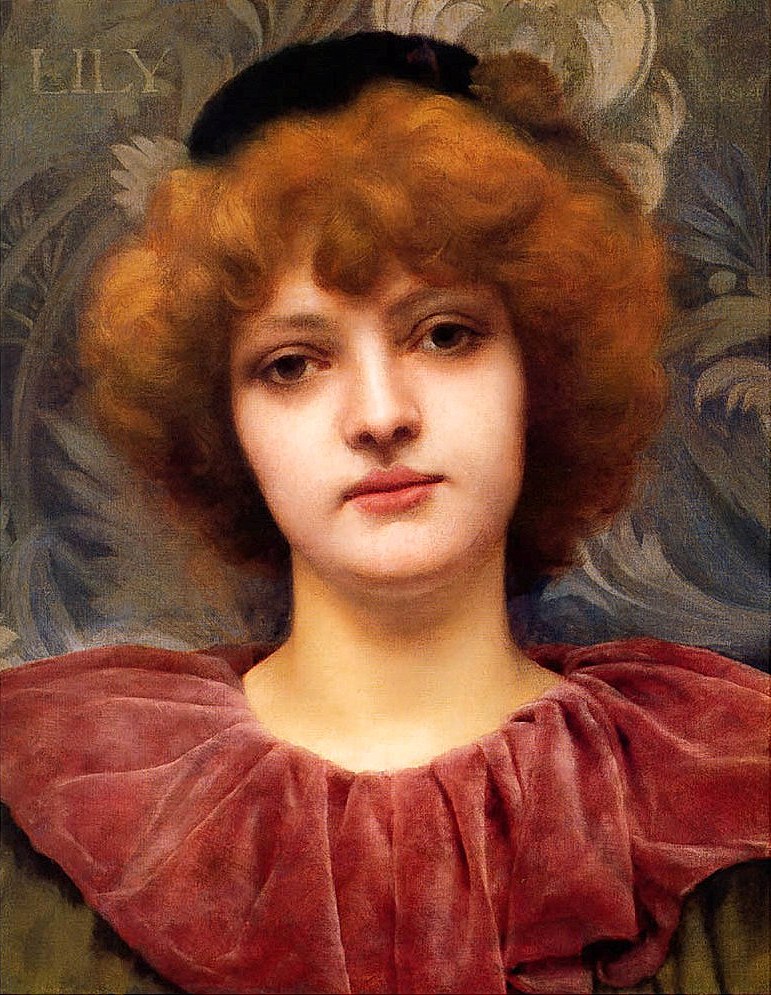
Portrait of Lily Pettigrew by John Wilson Godward (1887)

John William Godward completed a portrait of the beautiful seventeen-year old Lily Pettigrew in 1887.  She was the most beautiful of the three as her sister later wrote:

“…My sister Lily was lovely. She had [the] most beautiful curly red gold hair, violet eyes, a beautiful mouth, classic nose and beautifully shaped face, long neck, well set, and a most exquisite figure; in fact, she was perfection…”
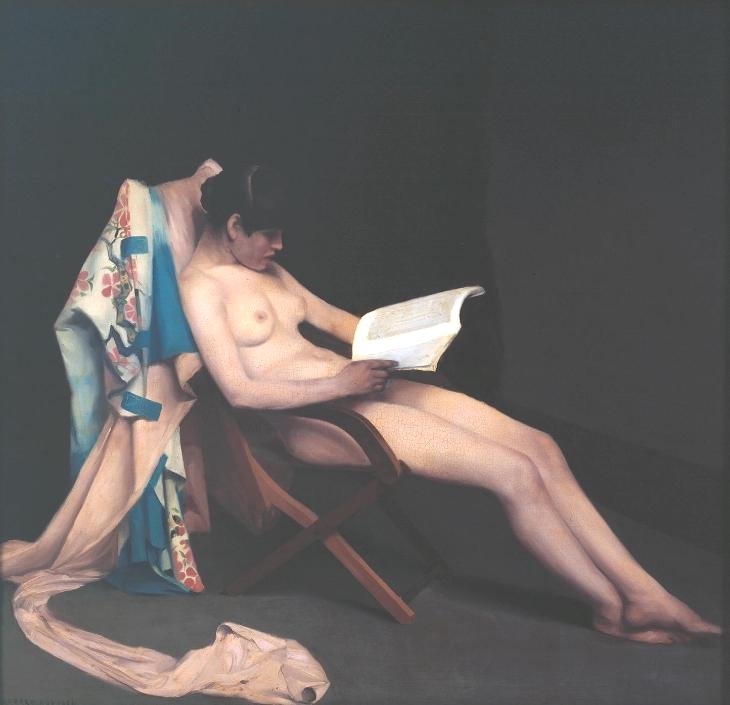
The Reading Girl by Théodore Rousseau (1887)

Nineteen year old Harriet (Hetty) Pettigrew featured in Théodore Roussel’s famous 1887 painting The Reading Girl.  Look what a fine model she is in the natural way she relaxes and seems so comfortable, naked in front of the artist.  Hetty had met Roussel in 1884 and from becoming his model, then, despite Roussel being married, became his mistress and gave birth to their daughter, Iris around 1900.   When Roussel’s wife died, instead of legalising his relationship with Hetty and their child, he married Ethel Melville, the widow of the Scottish watercolour painter, Arthur Melville. Once Roussel re-married in 1914, Hetty never sat for him again. Their close bond was over.
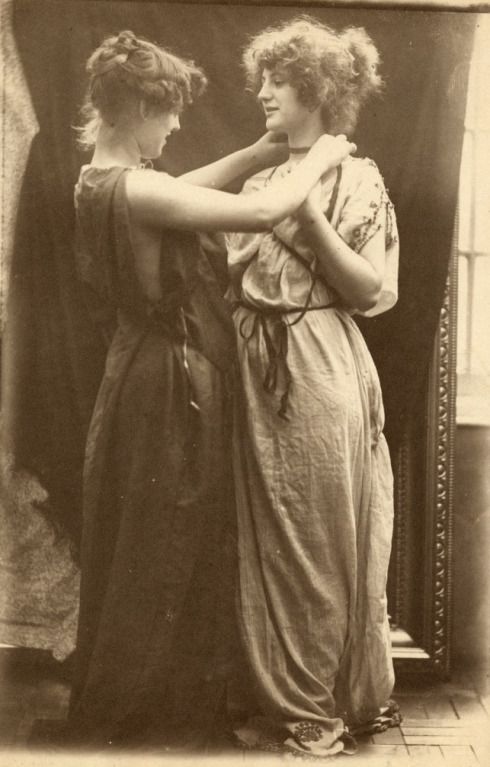
Lily and Hetty Pettigrew (Photographer: Edward Linley Sambourne)

The Pettigrew sisters are also thought to have introduced Godward to other artists who were members of the Royal Society of British Artists.  The Society had been founded in 1823 but had grown very little in its first fifty years of existence due to financial problems but then it came into its own around 1886 when its president was James McNeil Whistler.  Whistler wanted to inject some life into the Society by encouraging it to accept new young artists such as Godward, who for the next three years showed works at their exhibition.  Whistler’s tenure at the Royal Society of British Artists lasted only two years when he was asked to stand down.  Godward, however, was eventually elected as a member of the Society in 1890.

In 1887 Godward had his painting entitled The Yellow Turban accepted at the Royal Academy Summer Exhibition.  This of course was a great moment for the twenty-six-year-old artist and it was probably, begrudgingly, the first thing about their son’s desire to be a painter that pleased his parents’ middle-class values.  Whether their son was happy, mattered little to them.  His achievement or lack of it was everything in their eyes. Initially they hoped he would follow the family tradition and work in the insurance business.  They even “allowed” him to study art with Wontner in the evenings providing he stayed with the insurance company and there was even a hope he would, through his association with Wontner, enter the prestigious world of architecture.  Their dreams for their son were later lowered to believe he may become, as a last resort, a teacher of art – anything than have to suffer the ignominy of having their son become a penniless artist.

For Godward he was reaching a crossroad in his life.  He was twenty six years of age, still living at home with his parents who could not and would not share and support his ambition to become an artist.  He must have felt the overpowering parental pressure and for this reason suffered mentally.  He needed to break free but what price would he have to pay for this freedom?

……………..to be continued


Most of the information for this and my next blog about John William Godward came from a 1998 book by Vern Grosvenor Swanson entitled J.W.Godward: the Eclipse of Classicism.
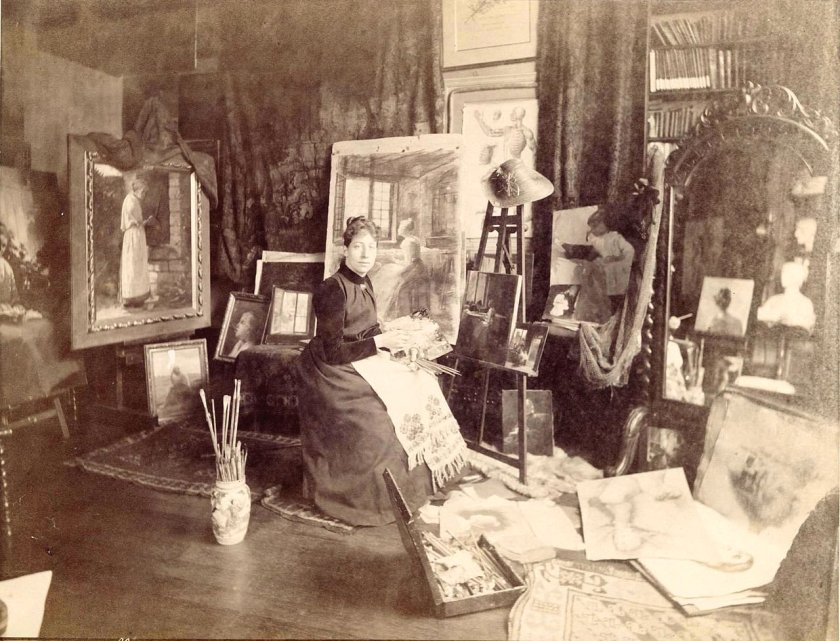


Anna Elizabeth Klumpke. – Her talented siblings and Rosa Bonheur

Anna Elizabeth Klumpke in her studio

Anna Elizabeth Klumpke was born in San Francisco on October 28th 1856.   She was the elderst daughter of a German-born father, John Gerald Klumpke and his American wife Dorothea Matilda Klumpke (née Tolle). Her father was born in February 1825 in Suttrup, a small north-west German town in the state of Lower Saxony.   Anna’s father was  hard-working German immigrant who was raised in New Orleans where he attended college and spent some time studying medicine and other professional courses.   In August 1850 with news of the Californian Gold Rush he left Louisiana and headed for California where he was registered as one of the early territorial pioneers.

With the discovery of gold the population in 1848 of San Francisco which had started off as a small Spanish mission nestled in the coastal dunes, was less than one thousand but the following year it had soared to twenty-five thousand. San Francisco boomed and law and order became a serious problem, so much so that the San Francisco Committee of Vigilance was formed in 1851 in response to widespread crime and corruption in the municipal government. This vigilante organisation, which John Klumpke joined, provided an extra layer of legal intervention to counteract the rising wave of crime. John Klumpke’s life as a prospector didn’t last long and the money he made prospecting was sank into real estate which he bought and sold and soon became a very well respected and very wealthy San Francisco citizen.

Portrait de mon père by Anna Elizabeth Klumpke (1888)

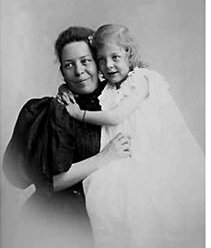
Dorothea Mathilde Tolle was born in New York on March 21, 1835. In 1853, at the age of eighteen, she accompanied her older sister who travelled to San Francisco to be reunited with her husband who had set up a gunsmith business in the town.  Shortly after arriving in San Francisco, Dorothea met her future husband John Klumpke and the couple were married on October 28th 1855.  The couple went on to have seven children.  There were five daughters, Anna Elizabeth was born in 1856, followed by Augusta Maria in 1859, Dorothea in 1861, Mathilde in 1863 and Julia in 1870 and two sons John Wilhelm and George Frederick in 1868.

Augusta and her daughter Yvonne

Before I look closer at the life of the painter Anna Elizabeth Klumpke it is interesting to note that all her siblings were great achievers.  Augusta Maria, the second born child, formerly a science student in Lausanne, went to Paris in 1877 to study medicine, and in 1882 became an extern and in 1887 became the first woman in France to be appointed interne des hôpitaux. She studied under Jules Déjerine, a celebrated French neurologist and later in 1888 the two married and had a daughter Yvonne.   In 1914, Augusta was elected the first female president of the French Neurological Society.

Dorpthea Klumpke Roberts

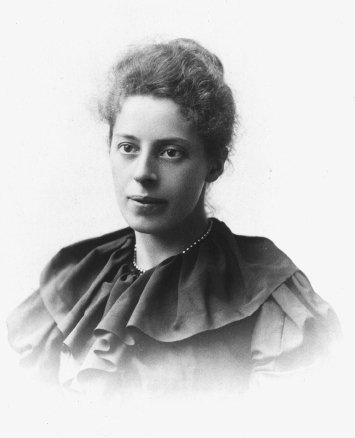
Dorothea Klumpke was the youngest child of John and Dorothea Klumpke.  She initially studied music at the University of Paris but later became interested in astronomy. In 1886, she received her bachelor’s degree and seven years later, in 1893,  she was awarded her doctorate and in between she took up a post at the Paris Observatory. Her work consisted of measuring star positions, astrophotography, which is a specialized type of photography for recording photos of astronomical objects and large areas of the night sky.  She eventually became Director of the Bureau of Measurements at the Paris Observatory and was elected a Chevalier de la Légion d’Honneur.   She married the Welsh astronomer and astrophysicist,  Dr. Isaac Roberts.

Both the fourth-born child, Mathilda Klumpke, and the youngest child Julia, took music lessons at the Paris conservatory.  Mathilda became a talented pianist who married Harry Milton Dalton, an American lawyer from Cincinnati, and they had three children.   Sadly Mathilda died young in 1893, from diphteria while caring for her sick children.   She was just thirty years of age.

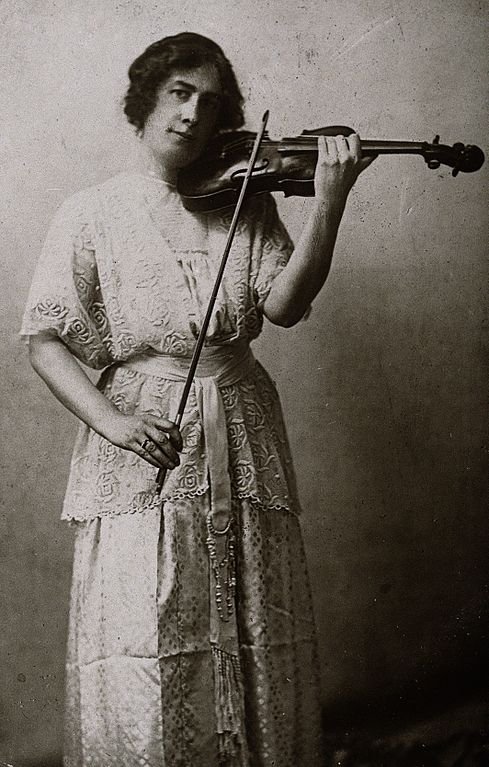
Miss Julia Klumpke, playing the violin

Julia Klumpke, the youngest family member who was born in 1870, was a student at Lycée Fénelon, which in 1883 became the first high school of young girls of Paris.  Julia studied the violin and subsequently taught the violin to students at the Spartanbourg Girls College, South Carolina.

The fifth child, and the only son to survive infancy, John William Klumpke, was mostly educated in Paris in the heart of the Quartier Latin just across from the Sorbonne at Lycée Louis-le-Grand which was a prestigious secondary school founded in 1563 as the Collège de Clermont, but was renamed in King Louis XIV of France’s honour after he extended his direct patronage to it in 1682.  Later John returned to America where he became an engineer.

Having said all that, this blog is all about the eldest daughter Anna Elizabeth Klumpke but I thought it would be of interest for you to see what a set of very gifted siblings she had and one wonders whether that pressurised her to succeed.

Anna Elizabeth Klumpke

Anna Elizabeth Klumpke was the eldest of John Dorothea’s children, born on August 22nd 1856.  Her early life proved traumatic as in the early months of 1860 when she was three and a half years old she had a fall and fractured her femur.  Less than eighteen months after this accident she fell again and this resulted in osteomyelitis with purulent knee arthritis and this condition would leave her with a limp for the rest of her life. Her parents sought medical help in America but to no avail and they decided that the best course of treatment was to be found in Europe and so, in 1886, her mother and aunt took Anna Elizabeth and her three sisters and travelled by boat to a specialist, Professor Néalton, in Paris and later to Berlin to consult with Professor Langenbeck where she would remain at his clinic for eighteen months with much time spent taking the healing waters of the local thermal baths.

Elizabeth Cady Stanton by Anna Elizbeth Stanton (1889)
American suffragist, social activist, abolitionist, and leading figure of the early women’s rights movement

Anna’s three sisters went to school in Berlin whilst she, due to her physical condition and medical treatment, received private lessons.  She thrived educationally taking lessons in German, French and music.  Eventually Anna’s mother and her sisters returned to San Francisco somewhat disappointed that Anna’s hoped-for cure never materialised.  Back in California, Anna and her siblings attended the local school but because of their father’s wealth also had home tutoring in music, dance and German.

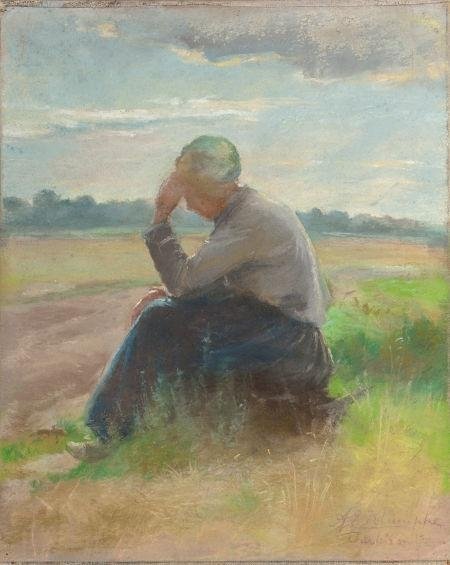
A Moment’s Rest, Barbizon by Anna Elizabeth Klumpke (1891)

The disappointment of Anna’s mother over the failure to cure her daughter’s physical disability was not the only complication which arose from her long stay in Europe separated from her husband. Despite the birth of two further children, John and George Frederick in 1868, although the latter died before his first birthday, and Julia in 1870, the estrangement of husband and wife led to the break-up of the marriage and she requested and won legal separation and later a divorce, along with custody of all the children.  Anna’s mother decided on a clean break from both her husband and America and in April 1871 took all the children, including eight month-old Julia, to Germany to live with her cousin in the town of Gottingen where Anna, who at the time was fifteen years old and thirteen year old Augusta, enrolled at a boarding school in Bad Canstatt, a town close to Stuttgart.  In 1873 after the legal ramifications of the separation were concluded and divorce granted, Dorothea took her six children and went to live in Lausanne.

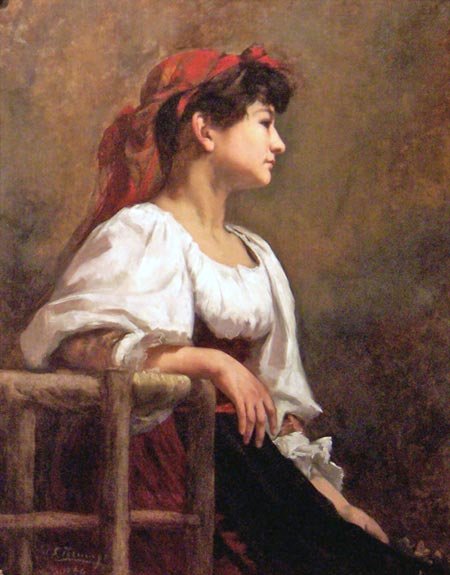
Portrait of a Seated Woman Anna Elizabeth Klumpke (1886)

All the children, with the exception of Anna, attended various schools in Lausanne but Anna studied at home, and as she showed an interest in painting she was enrolled in a course of drawing lessons.  In 1876 Anna’s mother was faced with the prospect of losing her two eldest children to further education colleges away from Lausanne but a friend advised her that Paris would be an ideal place to live as it would offer Anna a chance to further her career as an artist in a well-respected atelier de peinture and at the same time offer Augusta the chance to continue her interest in medicine at the prestigious medical faculty of the Sorbonne.  There would also be numerous good Parisian schools for the other children and so with her decision made to relocate to the French capital Dorothea Klumpke went to Paris and met with the secretary of the Faculty of Medicine and the secretary of the Faculty of Sciences at the Sorbonne to assess the colleges for Augusta and had a meeting with the artistic director of Académie Julian with regards to enrolling Anna.  Dorothea also met with heads of various secondary schools to discuss the schooling of her other children and by October 1876 an apartment had been rented and all the children were attending various schools and colleges.

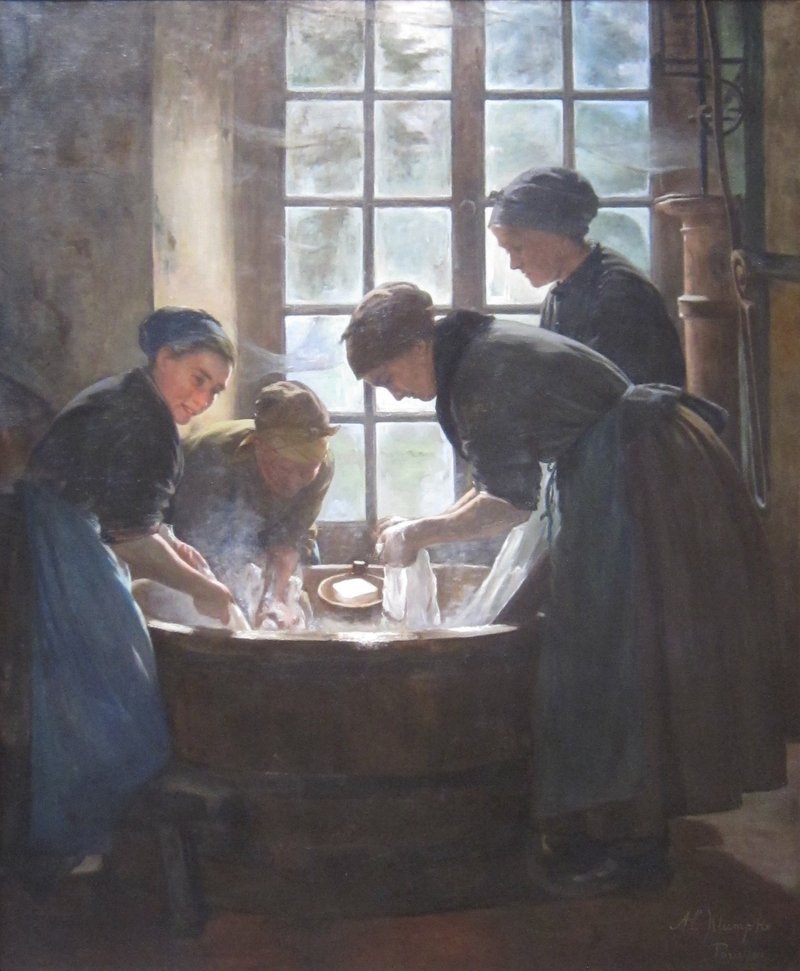
In the Wash-House by Anna Elizabeth Klumpke (1888)

Anna Klumpke enrolled at the Académie Julian in 1883 and was the pupil of Tony Robert Fleury, Felix de Vuillefroy, William Adolphe Bouguereau and Jules Lefebvre.  In 1884, whilst still at the Academy, she exhibited for the first time at the Paris Salon.  She excelled at the academy and won a number of awards including one for the outstanding student of the year with her painting entitled An Eccentric.  She also won the silver medal at the Versailles Exhibition.  She became the first woman to win the Temple gold medal at the Pennsylvania Academy of Fine Arts.  This prestigious art prize was awarded for the best oil painting by an American artist shown at the Pennsylvania Academy of the Fine Arts’s annual exhibition.  She also won the bronze medal at the 1889 Universal Exhibition.  She was a regular contributor to the exhibitions at the Salon des Artistes Français.

Catinou Knitting by Anna Elizabeth Klumpke

One of her well known painting is a large one entitled Catinou Knitting which she exhibited at the Salon of 1887 and is now housed at the Brenau University in Gainesville, Georgia. Anna returned to the United States and taught in Boston for a few years.

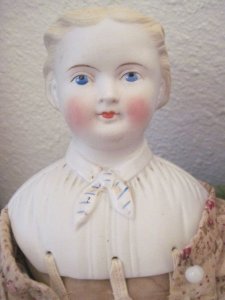
Antique German Kling Parian Bisque Rosa Bonheur Doll

One of the greatest influences on Anna Klumpke’s was the French artist Rosa Bonheur, an animalière, (painter of animals) known for her artistic realism.  Anna’s interest in Bonheur probably goes back to her childhood when as a young girl she was given a doll, known as a “Rosa” Doll.  Rosa Dolls were made in the image of Rosa Bonheur, who had become a famous artist and from early childhood Anna was fascinated with the career of this French painter.  She first met Rosa in 1887 when she was employed as a translator by an American art collector who was interested in buying some of Bonheur’s artwork.

Rosa Bonheur by Anna Elizabeth Klumpke

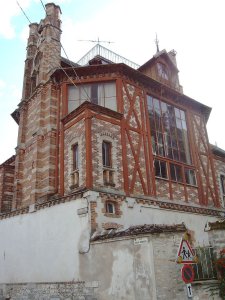
Ten years later, in 1897 Anna wrote to Rosa Bonheur asking permission to paint her portrait. The two women met for the second time on June 16, 1898 at Rosa’s residence, the Chateau de By at Thomery on the edge of Fontainebleau Forest, which the artist had bought for herself in 1859 when she was at the height of her popularity.  Despite the thirty-four year difference in age between Rosa and Anna, they soon became great friends. While Klumpke worked on her first portrait of Bonheur, the two women became close friends and one month later Bonheur asked Anna to join her in both a personal and professional partnership, Anna agreed and the two women signed a formal arrangement to cement their working and personal arrangement in August 1898. Bonheur agreed to build a studio for Anna at By and in return Anna agreed to paint portraits of Bonheur and to write Rosa’s biography.  Controversially, as far as her relatives were concerned, Bonheur changed her will and made Klumpke her sole heir. Bonheur used her last will and testament to force legal recognition of her right to transfer her property to another woman.  Anna, I am sure, brought a great deal of happiness to Rosa who had been devastated by the death of her lover and long-time companion Nathalie Micas in 1895.  Nine months after Anna and Rosa formalised their arrangement Rosa Bonheur died on May 25, 1899, aged seventy-seven.

Rosa Bonheur by Anna Elizabeth Klumpke (1898)

Klumpke painted three important portraits of Bonheur. The first, from 1898, depicted the artist at an easel wearing the men’s clothes for which she had secured a license from the French government. The second portrait, from 1899, depicted Bonheur seated, holding her dog on her lap. Klumpke kept the third portrait of Bonheur, painted posthumously in 1902, for the Musée de l’Atelier de Rosa Bonheur that she established at By, near Fountainebleau, in 1904.

After Bonheur’s death, Klumpke devoted herself to researching the biography Bonheur had asked her to write. It was published in 1908 with the title Rosa Bonheur, sa vie et son oeuvre.  It is a merger of biography and autobiography. Anna Klumpke combined her own memories with Bonheur’s first-person account.  In the book Anna, Bonheur’s lover and chosen portraitist, tells how she came to meet and fall in love with Bonheur but of course it is Bonheur’s account of her own life story, and delves into such subjects as gender formation, institutional changes in the art world, governmental intervention in the arts, the social and legal regulation of dress codes, and the perceived transgressive nature of female sexual companionship in a repressive society.

Rosa Bonheur’s atelier in Château de By , Thomery

Klumpke continued to paint and exhibit her works in both Paris and the United States, and set up many projects in the name of Rosa Bonheur.   In 1914,  she established l’Hôpital de Rosa Bonheur at By, where she nursed wounded soldiers until World War I and sometime later, she established the Rosa Bonheur Memorial Art School for Women Painters and Sculptors at By and continued to exhibit both her work as well as Bonheur’s on both continents.

Among the Lilies by Anna Elizabeth Klumpke (1909)

Anna Klumpke was awarded the Legion of Honor by the French government in 1936. During the 1930s, she returned to San Francisco where she painted landscapes and portraits.  She died in 1942 at the age of 86 and her ashes were entombed alongside Bonheur’s and those of Nathalie Micas in Père Lachaise cemetery three years later.

Anna Elizabeth Klumpke never married, maybe because her career meant everything to her but also because she chose a committed relationship with another woman, and by doing so she defied all the late Victorian expectation of women. Her artistic work was a visual testament of her life and times, and included the joyous but brief time she loved and lived with Rosa Bonheur.

Louis-Léopold Boilly

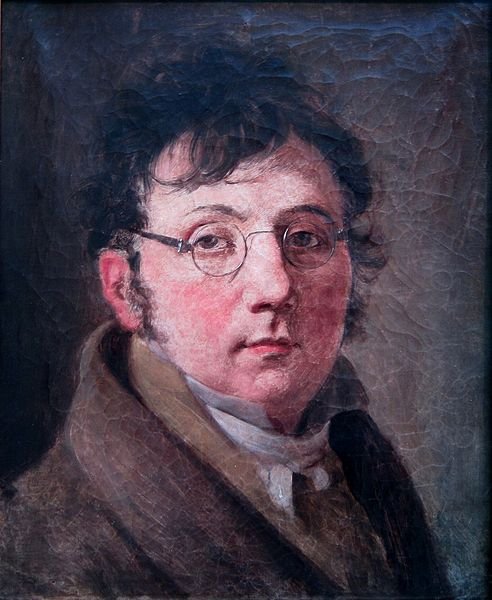
Self-portrait by Léopold Boilly (1805)

My artist today is the prolific late eighteenth century French painter Louis-Léopold Boilly, who was best known for his genre scenes featuring life in the French capital during the French Revolution and the French Empire. He is also renowned for his revolutionary use of lithography.

Boilly was born on July 5th 1761 in La Bassée, a commune in the Nord department of northern France, sixty kilometres south-east of Calais.  His father was wood carver and it was he, who gave Léopold his first lessons in art, and soon during his early teens young Boilly was producing many good works of art, a fact that came to the attention of the Austin friars at the monastery in Douai, a town close to his home. By 1774, word of Boilly’s artistic talent reached the bishop of Arras, Monseigneur Louis François Marc Hilaire de Conzié, who offered him a place to live and paint in Arras.

Also around this time, living and working in Arras, was the Flemish-born artist Guillaume-Dominique-Jacques Doncre, who made a living from painting portraits of the members of the Conseil of Arras and members of the local aristocracy but who also specialised in trompe-l’oeil paintings.  It is thought that maybe Léopold Boilly studied under Doncre as the young artist developed a liking for trompe l’oeil works.

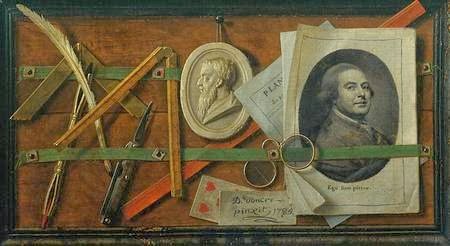
A trompe l'oeil by Dominique Doncre
A trompe l’oeil by Dominique Doncre

Trompe l’oeil, (French for “deceive the eye) is a style of painting invented by the ancient Greeks whereby the artist creates an illusion of space often showing apparently three dimensional objects and spaces in a way which the eye accepts as realism in the context of their surroundings.  It was particularly popular in the 17th and 18th centuries with the Low Countries and Northern France.  This trompe l’oeil by Dominique Doncre, above was completed in 1785.  At first sight it looks like a collection of items set out randomly on his “noticeboard”.  Two horizontal straps seem to be holding the items in place including what looks like an engraved page featuring the artist himself and we know it is Doncre as the words “ego sum pictor (I am the painter) are beneath the portrait.  On a card below the pair of spectacles, he has also signed and dated the painting.  It is a simple work with no hidden message.

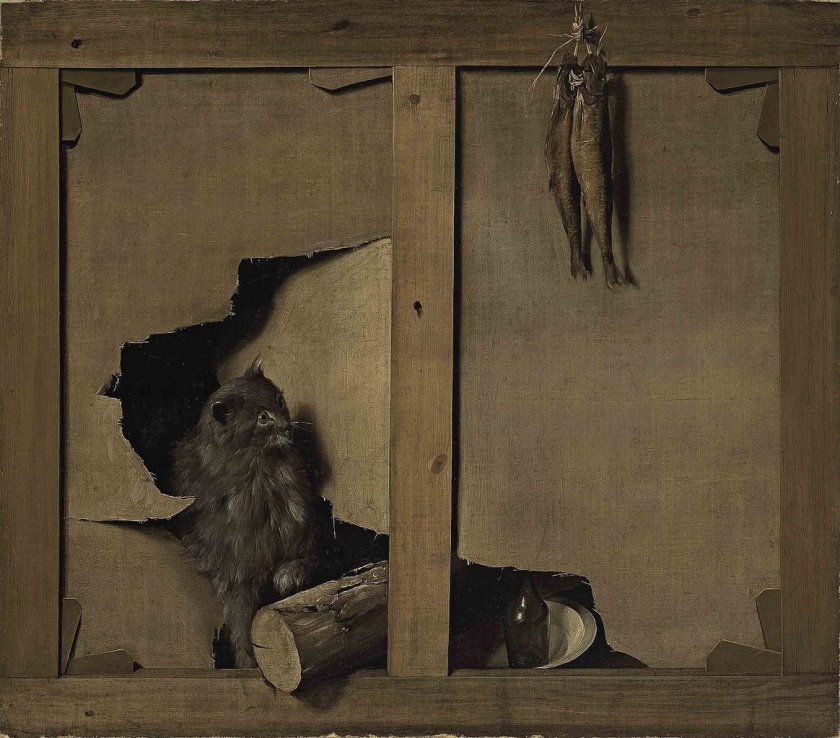
A trompe-l'oeil by Léopold Boilly
A trompe-l’oeil by Léopold Boilly

Léopold Boilly completed several trompe l’oeil paintings of his own and my favourite is one with a cat gazing through a hole in the canvas caused by a log which has pierced it.  On the top bottom of which are fish hanging from the stretcher.

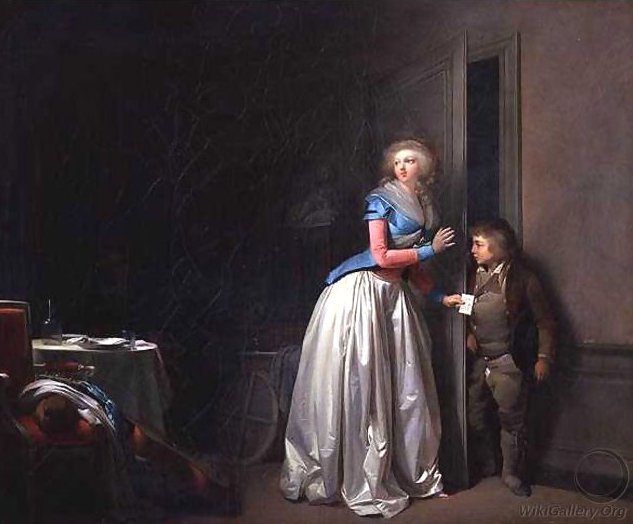
The Visit received by Louis-Léopold Boilly (1789)
La Visite reçue (The Visit received) by Louis-Léopold Boilly (1789)

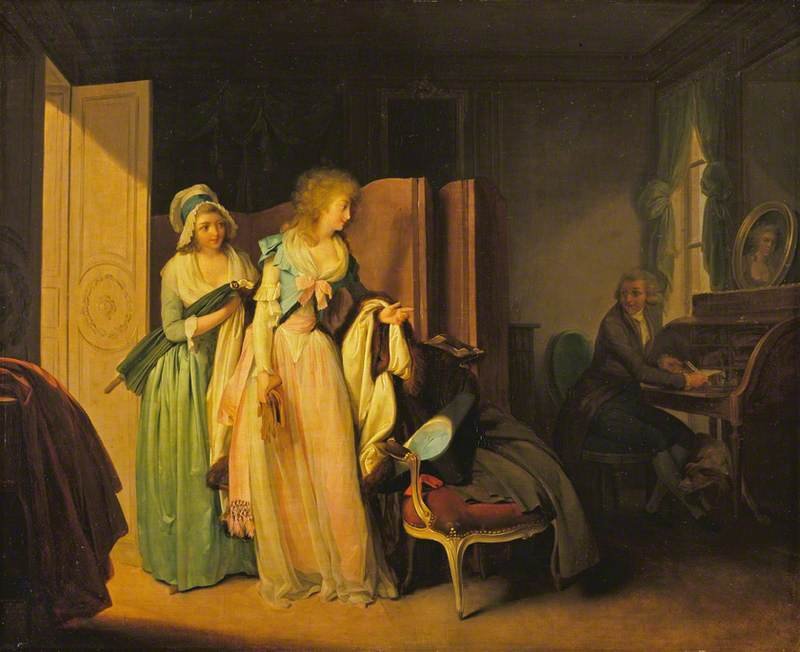
In 1785, aged twenty-four, Boilly went to live in Paris and there, two years later, he married Marie-Madeleine Desligne, the daughter of a merchant of Arras. In 1787 Boilly received a lucrative commission. The nobleman and lawyer, Antoine Joseph François Xavier Calvet de Lapalun had decided to refurbish his family residence in Avignon and he was advised by one of his former clients to incorporate an art collection into the re-modelling of the large house and at the same time arranged for his friend a number of  introductions with some of the most influential Parisian art dealers who would be able tosell him the finest works of art.  One of the artists chosen to provide works for the residence was Léopold Boilly.  The former client, the Marquis Alexandre de Tulle de Villefranche, gave Calvet de Laupin a present of two of Boilly’s works, La Visite reçue and La Visite rendue.  Calvet de Laupin was so pleased with the works that he commissioned Boilly to complete a further nine genre paintings of the same ilk.

The Visit Returned by Louis-Léopold Boilly (1787)
La Visite rendue (The Visit Returned) by Louis-Léopold Boilly (1787)

All eleven genre works featured the many facets of love, all of which are set in an upper-middle class milieu.  The people depicted in the various scenes look as if they are actors appearing in a stage play.  These were not, unlike Hogarth’s Marriage à la Mode, an eleven-episode story.  Each were simply variations on the theme of love and left the viewer to decide what was happening in the painting.   The setting of the two works I have included had been dictated to Boilly by Tulle de Villefranche while Calvet de Lapalun himself described the settings he wanted for the final seven works.

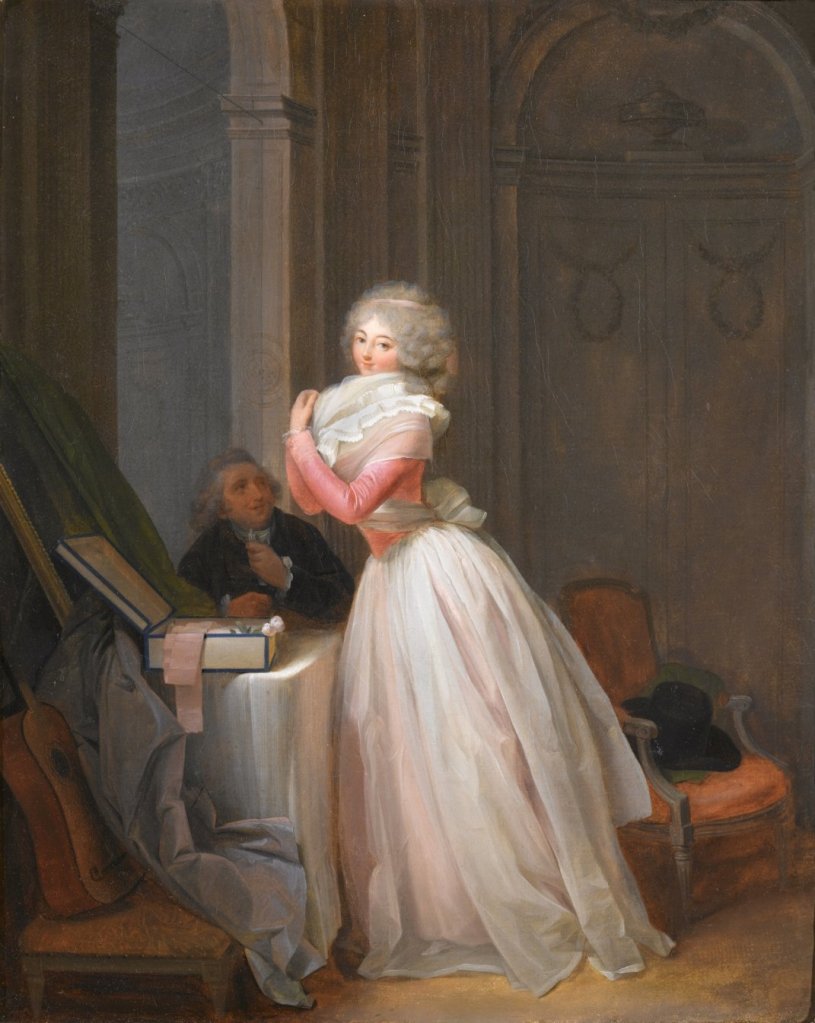
The Suitor's Gift by Louis-Léopold Boilly (1790)
The Suitor’s Gift by Louis-Léopold Boilly (1790)

In 1790 Boilly completed a work entitled The Suitor’s Gift.  In it we see a beautiful, elegantly dressed young woman looking out at us knowingly as she receives the attentions of a suitor. He is obviously a very generous suitor for on the table in front of the young woman we see a luxurious gift box which lies open. It had been lovingly wrapped, as we see several strands of pink ribbon lying over the side which had once secured the gift.  In the box and resting on the front edge of it are two white roses and this presumably symbolises the young lady’s innocence and adolescence. The young woman’s face is flushed and it is this and her full and rounded cheeks that suggests she is very young, certainly in comparison to her much older suitor.

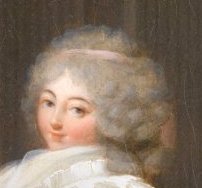
The knowing look
The knowing look

Her hair is worn loosely and is softly curled with a pink ribbon tied around the crown of her head. Her clothes are elegant and lady-like.  She is attired in a graceful pink corseted gown over which is a thin gauze overskirt, which still allows us to see the colour of the gown.  She stares out at us and by doing so turns away from her suitor.  Is it coyness we are witnessing or is she taking in what she has just been given.  Maybe she is deciding whether the gift meets with her expectations.

Her prospective beau, whom we can just make out in the background shadows, crouches down at the side of the table.  Is he kneeling in a kind of devout reverence?  Look at his expression.  It is one of a man who is keenly awaiting to find out whether his gift had been well received by the young woman.  It would appear by the way his left hand is grasping a crucifix which he wears around his neck that he is looking for divine help in his quest to please the lady. From the demeanour of the pair we get a feel for the relationship.  Look how the woman smiles.  It is a knowing smile.  She knows she has the upper hand in this partnership.  Maybe it is this thought that makes us revise our opinion of her.  Maybe she is not as innocent and vulnerable as we first thought.  At first sight we felt a little pity for her being pestered by an elderly man but maybe it is he whom we should be pitying for it seems she may well play him for a fool!

Boilly’s reputation as an artist who artistically recorded contemporary life in the French capital steadily grew and by often having his paintings on display at various exhibitions he ensured the public would not forget him.  Boilly began exhibiting his work at the Salon in 1791, which was the first year it was open to all artists, previously the exhibition was only open to the work of recent graduates of the École des Beaux-Arts but control of the Salon was taken away from the Academy by the National Assembly, which ordered the exhibition opened to all artists.

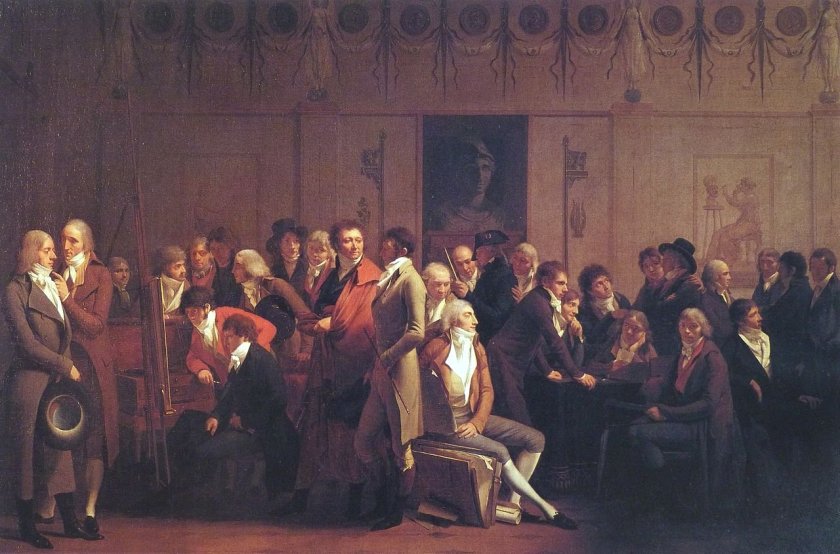
Gathering of Artists in the Studio of Isabey by Louis-Léopold Boilly (1798)

In 1798 Boilly put forward his painting Gathering of Artists in the Studio of Isabey for exhibition at that year’s Salon.  This genre of multi-figure or group portraits was popular with many Dutch and British artists and in this work of fiction, Boilly has imagined what it would have been like if all the young aspiring artists of the time had met up at the studio of his contemporary the French artist Jean-Baptiste Isabey, who we see dressed in red standing behind the man sitting at the easel.  The studio’s classical decoration is the work of architects Percier and Fontaine whom we see depicted standing on the left.

Arrival of the Stagecoach by Louis-Léopold Boilly (1803)

Boilly regularly exhibited at the Salon until 1824 and he received a gold medal at the Salon of 1804 for his painting Arrival of the Stagecoach.  The work depicts a major event in Parisian life – the daily arrival of a stagecoach in the crowded courtyard of the Messageries in rue Montmartre (which is now Rue Notre-Dame-des-Victoires).  This was a place where stagecoaches converged from all over France and Europe in the early 19th century. In the painting, we see the stagecoach is in the parking space reserved for coaches coming from northern France and Belgium, indicated by the inscription on the wall.

This is an interesting study of Parisian life.  Boilly has depicted a throng of people some of whom are waiting to board the stagecoach.  By their attire, we can see the various social classes.  At the centre of the painting we see a bourgeois being welcomed by his wife; on the left-hand side, we see a soldier with his arm around a flower seller or maybe she is a maid from the local hostelry, who by the way she is ignoring him, has only eyes for the well-dressed military officer with the plumed hat to her left.  Unfortunately for her, he is totally disinterested in her. There is still one passenger, an elderly lady, sitting in the coach.  Maybe she is awaiting assistance to help her debark, maybe someone was supposed to be there to meet her but has not arrived.

The young delivery men can be seen on top of and at the side of the coach helping to unload packages which have been brought in by the coach.  We see another by the side of the military officer almost brought to his knees by the weight of the case he is carrying on his shoulder.  He was a portefaix, an old term for a porter.   These workers were known as gagne-deniers, unskilled workers, often peasants from the countryside who have come to the city to earn a living and often were paid a mere pittance.   Now look at the characters on the far right of the painting. The man is the epitome of elegance albeit bordering on being a dandy. The lady with him has a pug on a leash, which was at the time the height of fashion. The little girl standing with them has turned her back on them and seems totally disinterested in the adult conversation.

Boilly continually showed an interest in the bustling life of Paris and in this work and others he highlighted the developing role of transport in the early 19th century with the Napoleonic wars and the development of capitalism. This painting which describes an everyday urban event, a scene which falls within the domain of genre painting which, at the time and in view of the Paris Salon academicians was considered inferior to history painting.  Despite that, the work won the gold medal at the Salon in 1804 and was ultimately acquired by the Louvre in 1845.

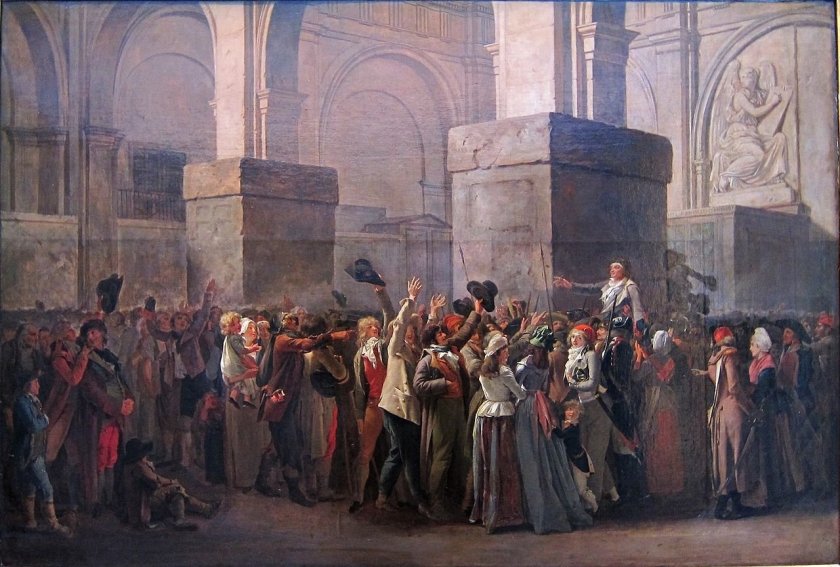
The Triumph of Marat by Louis-Léopold Boilly (1794)

Boilly was thirty-three at the height of the Reign of Terror period during the French Revolution in 1794.  He was a half-hearted supporter of the Revolution, and that year he was denounced to the Société Républicaine des Arts by a fellow artist, the Jacobin fanatic Jean-Baptiste Wicar, for having painted “obscene works revolting to republican morality.”  He was condemned by the Committee of Public Safety for these erotic undertones and for the frivolity of his work as well as his penchant for depicting the bourgeois in his early paintings. He was saved from literally a “fate worse than death” when his accusers searched his home and found his overtly flattering painting of Jean-Paul Marat, Triumph of Marat, the rabble-rousing radical journalist and politician and hero of the Revolution.  Although Boilly survived the incident, his wife died during these anxious times.  Boilly remarried in 1795.

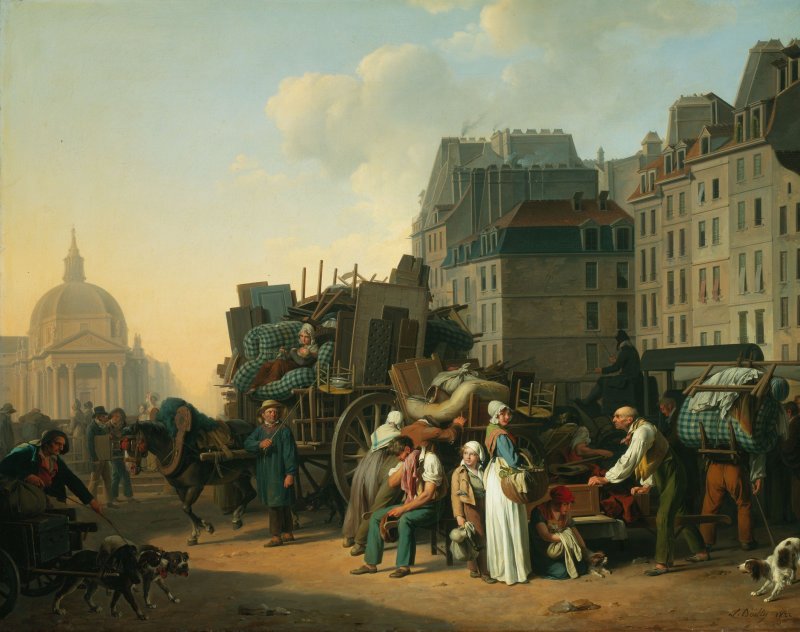
The Movings by Louis-Léopold Boilly (1822)

In 1822 Boilly completed a painting entitled The Movings which highlighted the plight of the poor.  In the painting, we see several families, who were unable to pay rent, and so were forced to move out of their homes with their belongings and travel the streets of Paris in search of new shelter. The painting depicts a palpable tension of a social drama and Boilly has created this by adding the opposing constituents in the setting.  In the left background, we see the mirage-like image of the church of Santa Maria dei Miracoli in Rome. Most of the figures in the work appear to be moving away from the Roman church. However, the owners of the front wagon, possibly a lowly and poor family that appears to have come from outside the city in search of work, move towards the distant mirage of the church and it is this connection that suggests that the arriving family’s search for a better financial future will prove futile, as well-paid job opportunities, like the church, are just an illusion.  This was how Boilly saw life at that juncture of time.

Recueil de Grimacers (Collection of Grimacers) by Louis-Léopold Boilly

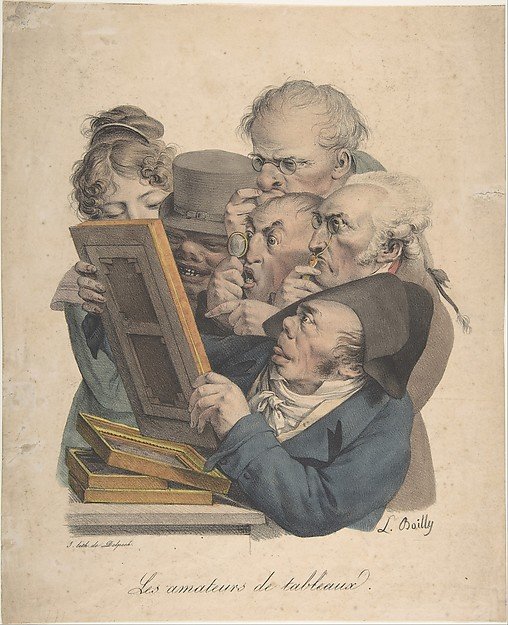
Boilly was not only a fine artist but he was also a fine businessman and all through his career, he could change his artistic style to coincide with what was popular at the time with the public and made money by selling engraved reproductions of his genre paintings.  One of the strangest form of his art was his depiction of grimacers.  Grimacer is the French word meaning “to pull a face” and it fascinated Boilly, who produced many amusing works focused on the grimacers.   The lithograph above,  Les Amateurs de Tableaux (Lovers of Paintings) is part of his collection Recueil de Grimacers (Collection of Grimacers).  In the painting, we see several grotesque looking characters, open-mouthed, brows furrowed as they concentrate on a small painting, some peering through monocles and spectacles.  It was thought that Boilly was poking fun at the so-called “amateur art connoisseurs”.

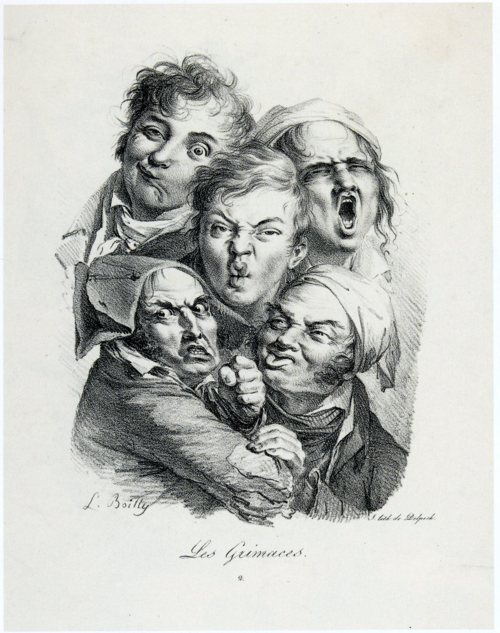
Les Grimaces by Louis-Léopold Boilly (1823)

In other similar works, the artist made many studies of facial expressions and the result was humorous but often cruel caricatures of contemporary society.  In his lithograph, Les Grimacers, he even included himself (top left)

The Artist's Wife by Louis-Léopold Boilly (c.1799)
The Artist’s Wife by Louis-Léopold Boilly (c.1799)

Boilly was a talented portrait artist and received many lucrative commissions for his portraits.  It is said that he completed more than five thousand portraits during his lifetime.  One of my favourites is one he completed around 1799 entitled The Artist’s Wife in His Studio, which featured his wife.

In the 1820’s Boilly was one of the first French artists to experiment with lithography to reproduce his paintings.  He last exhibited at the Salon in 1824 and in the spring of 1828 he sold his collection of Dutch, Flemish, and French paintings and decorative objects, as well as thirty-seven of his own paintings. The monarchy of Louis-Philippe awarded him the cross of the Légion d’honneur in 1833. He died in Paris on January 4th 1845 aged eighty-four.  His youngest son, Alphonse Boilly was a professional engraver who apprenticed in New York.

Alice Neel. Part 6. The latter years

 Alice Neel (1900-1984)
Alice Neel
(1900-1984)

Alice Neel had been receiving money for her involvement with the Works Project Administration (WPA).  The WPA was the largest and most ambitious American New Deal agency, employing millions of unemployed people, mostly unskilled men, to carry out public works projects.  The WPA employed musicians, artists, writers, actors and directors in large arts, drama, media, and literacy projects.  At its height in 1936, this federal project, the Federal Art Project employed over 5,300 artists. The Arts Service Division created illustrations and posters for the WPA writers, musicians, and theatres. However, with the onset of World War II, mass unemployment ended as millions of men joined the services and so President Roosevelt decided that there was no longer a need for such a national relief programme and the WPA was closed down at the end of 1942.  Alice was out of work and had then to turn to the state for public assistance which she kept drawing on for the next decade.

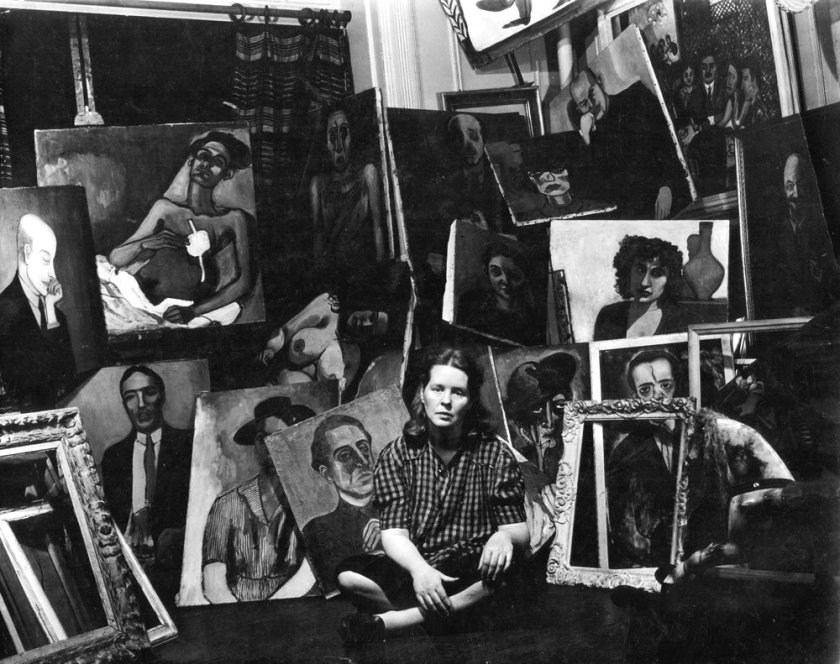
Photograph of Alice Neel sitting before her paintings which was used in the inviation to the exhibition

In March 1944 Alice held a solo exhibition at the New York Pinacotheca Gallery run by Rose Fried.  This was her first solo exhibition since 1938.  There were twenty-four of her works on display. The exhibition received mixed reviews.  An article in the prestigious art magazine, ArtNews, described her work:

“…Neel’s paintings at Pinacotheca have a kind of deliberate hideousness which make them hard to take even for persons who admire her creative independence … Nor does the intentional gaucherie of her figures lend them added expression. However, this is plainly serious, thoughtful work and in the one instance of The Walk, it comes off extremely well…”

As Bob Dylan once said The Times They are a-changin and this was the point in time that Alice Neel found herself.  After the 1944 Alice Neel’s retrospective exhibition at the Pinacotheca, gallery director Rose Fried never showed anything with a figure in it.  According to Neel, Rose had become a pure abstractionist and the works that Alice produced were no longer wanted.  The art world was changing; it had almost completely turned its back on Social Realism which had been the art form that had made Neel’s work so popular in the 1930’s.  So, Alice had to change but as another famous lady politician once said, “this lady is not for turning” and Alice likewise would not change her artistic style to suit others. In an interview with Eleanor Munro for her 1979 book Originals, American Women Artists, Neel is quoted as saying:

“…I never followed any school.  I never imitated any artist.  I never did any of that…”

Sam and Hartley By Alice Neel

For Alice Neel, she knew what she wanted to paint and nobody or nothing was going to alter her artistic desires even though New York was now awash with European émigré artists who were leaders in the world of Cubism, Dadaism and Surrealism such as Max Ernst, André Breton, Marcel Duchamp and Salvador Dali, all of who had fled across the Atlantic to avoid the rise of Nazism.  Alfred Barr had founded the MOMA and in October 1942, millionaire, Peggy Guggenheim, who was married to Max Ernst, had arrived in New York from war-torn Europe had opened a new gallery/museum.   It was called The Art of This Century Gallery.  The Art of This Century Gallery was situated at 30 West 57th Street in Manhattan and occupied two commercial spaces on the seventh floor of a building that was part of the midtown arts district which included the Museum of Modern Art, and three of the four galleries were dedicated to Cubist and Abstract art, Surrealism and Kinetic art, with only the fourth, the front room, being a commercial gallery.

During the 1950’s Alice Neel was kept under surveillance by the FBI.  In a memo from their Miami office based on a 1954 letter sent to them by an informant they concluded that Alice Neel was:

“…a muddled romantic, Bohemian type Communist idealist who will carry out loyally the Communist sympathiser type of assignment, including illegal work if ordered to do so…”

Their file on her and her activities remained open until the early 1960’s.

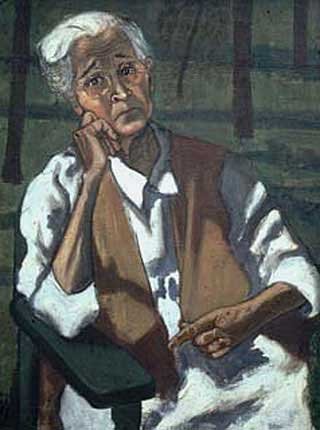
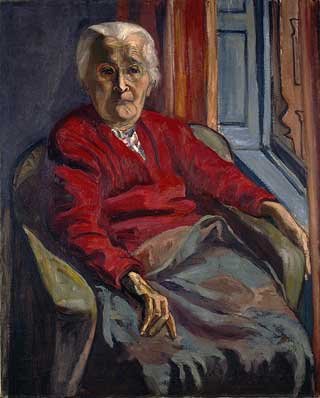
My Mother by Alice Neel (1952)

In March 1953, Alice’s mother comes to live with her in her Spanish Harlem apartment.  Sadly a year later Alice snr. aged 86, died from complications brought on by a broken hip.  For Alice, this was yet another traumatic moment in her life  She had always had to battle with depression and the death of her mother triggered the onset of the debilitating malaise for the next few years.  Physically she put on weight and sought the comfort of alcohol.

Alice often complained that she could not get any gallery space for her works of art.  She painted prolifically but still wanted to exhibit them.  The problem was that her genre of art had lost its appeal with the public.  She was going through a difficult period with mental health issues and was attending therapy sessions with a psychologist, Dr Anthony Sterrett.  He spent time with her trying to make her become more self-confident and self-assertive and it was he who persuaded Alice to contact Frank O’Hara to see if he would sit for her.  O’Hara was an American writer poet and art critic who was working as a reviewer for the prestigious art magazine, Artnews, and who, in 1960 was Assistant Curator of Painting and Sculpture Exhibitions for the Museum of Modern Art.  This position at the MOMA made him a prominent figure in New York City’s art world. He was looked upon as a leading figure in the New York School, which was an informal group of artists, writers and musicians who drew inspiration from jazz, surrealism, abstract expressionism, action painting and contemporary avant-garde art movements.

Frank O'Hara by Alice Neel (1960)
Frank O’Hara by Alice Neel (1960)

Alice completed two portraits of O’Hara in 1960 and they were looked upon as her breakthrough works.  In the painting, Frank O’Hara, Alice has beautifully and faithfully captured his distinguishing and unique profile.  The side view is hawk-like which is softened slightly by the bunch of lilac behind his head.

Frank O'Hara No.2 by Alice Neel (1960)
Frank O’Hara No.2 by Alice Neel (1960)

In stark contrast, the second portrait, Frank O’Hara No.2 is a more shocking depiction of the man.  Our eyes are immediately drawn to his bad teeth, which looked like tombstones, his sharp nose and somewhat wild eyes.  To be brutally honest, at first, he comes over as being ugly, even, dare I say, repulsive, but there is a vulnerability about Neel’s depiction of him.

Six years later, in the early morning hours of July 24, 1966, O’Hara was struck by a jeep on the Fire Island beach, after the beach taxi in which he had been riding with a group of friends broke down in the dark.  He died the following day.

Kate Millett by Alice Neel (1970)

In America, the 60’s was dominated by the Civil Rights movement and the Vietnam War with its protests which swept the country.  It was also a time when the second wave of the modern feminist movement emerged.  It was a time when there was the growing cry for equal opportunity for women and it soon became one which could not be ignored.   Enter Katherine Murray “Kate” Millett, best known as Kate Millett.  She was an American feminist writer, educator, artist, and activist. She attended Oxford University and was the first American woman to be awarded a postgraduate degree with first-class honours by St. Hilda’s.  She is probably best known for her ground-breaking 1970 book Sexual Politics, which was her doctoral dissertation at Columbia University.

Time magazine cover
Time magazine cover

This book became a bible for feminism and feminist protest was such a hot topic that in August 1970, Time magazine decided that Kate would be the face of the feminist movement and therefore should appear on the cover of their magazine.  Millet was unimpressed by the way she was heralded as the embodiment of the movement and refused to pose for a painting by Alice Neel which would be used for the cover.  She believed that no one person could presume to represent the objectives of the feminist movement.  Time magazine was not to be put off by her refusal and instead asked Neel to complete the portrait, using a photograph.  After the publication of the magazine Alice Neel and her art was always linked with the feminist movement but as Alice once quipped, she had been a feminist before there was feminism!

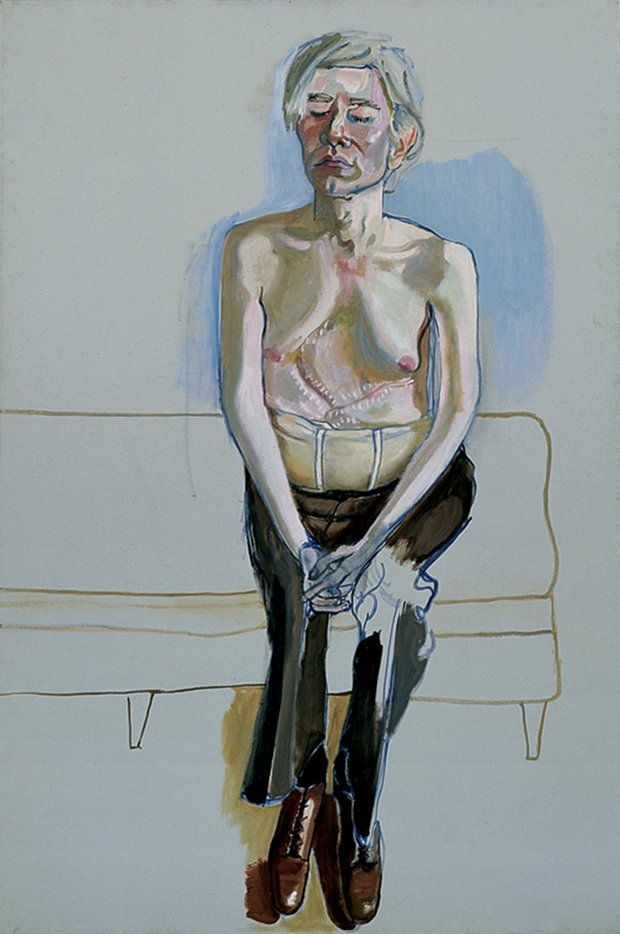
Andy Warhol by Alice Neel (1970)

The year 1970 was also the year that Alice Neel painted one of her most famous works, a depiction of Andy Warhol.  The painting can be found at the Whitney Museum of American Art, New York and rather than me trying to describe the painting I have reproduced the words of the museum’s audio-guide which was put together by Trevor Fairbrother, an independent curator and writer:

“…It’s an interesting year for both of these artists. Alice Neel was seventy years old when she painted it, and in a sense, was just hitting her stride as an important American realist. She’d had an incredible career since the thirties, but she hadn’t really had much recognition until the wave of feminist interest in the arts in the sixties. And suddenly she was a forebear for a whole new generation of feminist artists and writers.  The late sixties were much harder on Warhol. He’d been shot two years before Neel painted this portrait—an attempted assassination by a member of his artistic circle. In posing shirtless for Neel, he exposes the corset that he was required to wear for the rest of his life. He also bares his aging body, his chest sagging so that he almost appears to have breasts.  She shows him—I think it’s this kind of essence of loneliness and vulnerability, but at the same time I think she knows that he knows that everybody is looking at him. He was very much invested in famous artists. He wanted to be a kind of brand-name Pop artist, and he certainly is that now, long after his death. He, Warhol, in a sense is rising to her challenge to sit for her, to be painted and to take his clothes off. And so, in a sense, he’s doing a brave thing, but he’s also―he’s getting through it by shutting his eyes and being very focused internally.  I think part of the soulfulness of this picture is the fact that it might seem unfinished. I wouldn’t say it’s unfinished. I think she decided she had what she needed, and she stopped where she was ready to stop. The picture doesn’t need more…” 

Fame came to Alice Neel late in life and she believed she had the right to bask in the glory.  Her son Hartley recounted his mother’s feelings about this sudden fame:

“…She felt it was something she deserved.  She basked in it.  She really enjoyed it.  When we were young, she struggled, waiting around for some critic to review her work, up or down.  All of the sudden they were saying good things about her.  Her paintings were on the walls, and people were buying her work.  It was all different.  She wasn’t bitter.  She had a very upbeat attitude toward the whole thing…”

Self-portrait by Alice Neel (1980)

On October 14th 1980 at the Harald Reed Gallery on East 78th Street in New York a benefit dinner for the Third Street Music School Settlement was being held at which was the debut of an art exhibition entitled Selected 20th Century American Self Portraits, one of which was Alice Neel’s nude self-portrait which she had begun five years earlier.

She looks out at us completely oblivious or unconcerned about what we are thinking about why an eighty-year-old woman would want to depict herself naked.  Does she feel vulnerable?  There is no sign of that in her facial expression, in fact Neel’s steely gaze rivets us.  She exudes an air of self-confidence, despite her less than picture-perfect body.  We see her sitting regally in an upholstered chair with its hard vertical-striped arms which tend to accentuate her yielding and bounteous rolls of flesh.   It is a “warts and all” portrait.   She does not hide the visible signs of aging.  Instead she has decided to reveal herself with characteristic truthfulness and somewhat defencelessness. Yet there is also a sense of pride in this depiction.  In her right hand she holds a paintbrush whilst her left hand grasps a rag and, as we see no easel or canvas in the depiction, the two serve as artistic elements. The only personal accessory depicted is the presence of her eyeglasses which may have been added by her to remind us of her frailty and that she has passed her prime.

The painting was of course controversial and caused a stir but it also was testament that it was an audacious work by an artist who at the time was at the top of her form.  The other unusual aspect of this work was that beside a few pencil-sketched self-portraits, it was her first self-portrait painting.  The painting now resides at the National Portrait Gallery, Washington.

Loneliness by Alice Neel (1970)

In 1970 Alice completed a work entitled Loneliness, which she ironically referred to as a “self-portrait”.  It was about this time that her younger son Hartley had married Ginny and moved to Massachusetts.

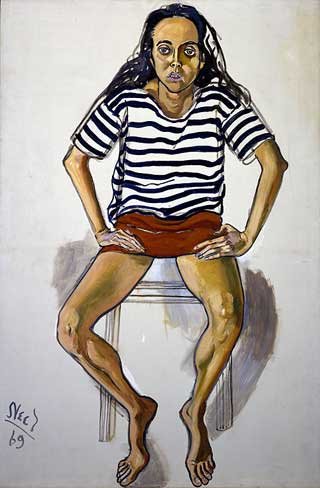
Ginny in a Striped Shirt by Alice Neel (1969)

Throughout her life Alice continued with her portraits of her family.  Her future daughter-in-law, Hartley’s wife, Ginny featured in her 1969 work, Ginny in a Striped Shirt.  Ginny was a feminist who looked upon Alice as a role model and they became good friends even before she became involved with Hartley.

Pregnant Woman by Alice Neel (1971)

Her other daughter-in-law, Nancy, Richard’s wife and Alice’s assistant during the last two decades of her life, was depicted in Alice’s 1971 painting, Pregnant Woman.  In the work, we see an image of her husband looming in the background.

In 1980 Alice Neel’s physical health takes a turn for the worse and after a series of tests it is decided that she had to be fitted with a pacemaker to regulate her heart rate. Four years later in 1984, during a routine visit to the Massachusetts General Hospital to have her pacemaker checked, X-rays indicate that she has advanced colon cancer which has already spread to her liver. She immediately undergoes surgery and afterwards returns to Vermont to stay with Hartley, Ginny and their children while she recuperates.

From the Spring to the Summer of 1984 she returns to New York and Spring Lake. With the help of her son and his wife, Richard and Nancy, and despite her rapidly deteriorating health, she continues with her busy schedule including an appearance on the Johnny Carson Show

Among her many commitments, interviews for the ArtNews article continue, and, on June 19th, she makes a second appearance on ‘The Tonight Show’ during which she insists that Johnny Carson visit her in New York to sit for a portrait. In July, she had to receive chemotherapy which further weakened her.  Despite her weakened condition, she continues to paint.

Alice Neel died in her Upper West Side Manhattan apartment on October 13th 1984 surrounded by her family and was buried in a private burial ceremony at a cemetery near her studio in Vermont.  On February 7th 1985, a memorial service for her is held at the Whitney Museum of American Art.

My look at the life and works of Alice Neel has been a long journey stretching over six blogs and yet I know I have missed so much out about her life and because she was a prolific artist I know I have only scratched at the surface with regards her works of art.  I have been careful not to be judgemental with regards her lifestyle which probably added to her problems but she had a difficult and often sad life which often was beyond her endurance.  She however always wanted to do her own thing and I leave you with one of her quotes:

“…”I had a very hard life, and I paid the price for it, but I did as I wanted,” Miss Neel said then. ”I’m a high-powered person…”  

– – – – – – – – – – – – – – – – – – – – – – – – – – – – – –

I have used numerous internet sources to put together this and the other blogs on the life and art of Alice Neel and I am currently reading a fascinating book about the artist by Phoebe Hoban entitled Alice Neel: The Art of Not Sitting Pretty. It is a very interesting read and one I can highly recommend.

Alice Neel’s art is being shown at several exhibitions in America but there are also a series of exhibitions of her work travelling around Europe at the current time including one I am due to visit next month:

Gemeentemuseum, Den Haag, Holland

(November 5th, 2016 – February 12th 2017)

Alice Neel. Part 5. Sam Brody, the new man in her life, family portraits and “he said, she said”

It is almost five weeks since I published Alice Neel.  Part 4 and the reason for the delay was not my lost interest in the subject but having to suffer the trauma of house moving!

– – – – – – – – – – – – – – – – – – – – – – – – – –

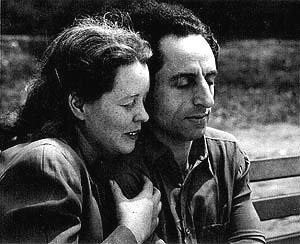
Alice Neel and Sam Brody (1940)

The year was 1940 and another man entered Alice Neel’s life.  He was the photographer and film critic Sam Brody.  Brody was born in London on New Year’s Day 1907.  His parents were Abraham and Sophie Brodetsky (later shortened to Brody).  He was raised by Russian Jewish parents who had immigrated to America in 1920, via Paris and London when Sam was thirteen years old.  His father was a journeyman tailor who eked out a living in various sweatshops and he and his family struggled financially and maybe because of this lifestyle Brody’s father was a great believer of Marxism, a philosophy he would pass on to his son who would cling to those beliefs for the rest of his life.

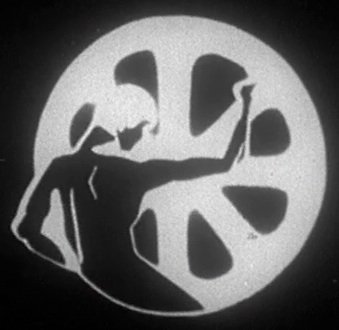
The Workers Film and Photo League

Sam Brody was a founding member of the Workers Film and Photo League (WFPL) which was an organization of filmmakers, photographers and writers which began in 1931 dedicated to using film and photography for social change and presenting, in a documentary-format, the Great Depression from a Marxist perspective. These documentaries focused on the burning issues of the time such as the U.S. Labour Movement, the National Hunger marches of 1931 and 1932 and the Bonus March 1932. Much of the output was not for general release was shown more at Communist Party and trade union events.  There was also a philanthropic aspect to the work of the WFPL organisation as they joined up with Workers International Relief group to show their films at fund raising events.

Sam, Snow (How like Winter) by Alice Neel (1945)

It was in January 1940 that Alice Neel met Sam Brody at a Works Progress Administration (WPA) meeting.  Alice was introduced to him by her friend, the sculptor, Blanche Angel, who told her that Brody was an excellent photographer and would be an ideal choice to take some photos of her new son, Richard. This was just two months after her lover and father of her new-born child, José Negron had walked out the family home.  According to Alice Neel, there was an immediate magnetism between her and Brody (not corroborated by Brody!) and she was very forthright in her 1959 interview with the photographer, Jonathan Brand about him and how she had attracted him:

“…He was such a show off, such and intellectual.  He came home with me that night.  And of course he fell in love with me immediately.  He was very gallant when he fell in love.  He brought me flowers, and he came every day.  He told me he had divorced his wife because she had an affair with a travelling salesman…”

Sadly for Alice, the last fact was not true.  However, a few weeks after their initial meeting Brody moved into Alice and her son’s East 107th Street New York apartment.  Although José, the father of Alice’s son had moved out he kept returning for visits in order to give Alice some money and during his visits, as Brody would angrily term it, he would “serenade” her with his guitar.  Brody’s anger with José relationship with Alice may seem reasonable to many but for the fact that he had lied to Alice with regards his marital status.  Brody had married a Russian woman Claire Gebiner in 1927 and the couple had two children, a son Julian and a daughter Mady.  Even when Brody moved in with Alice he would visit Claire and his family every afternoon.  For a long time neither Alice nor Claire knew of each other’s existence!

Sam and Hartley by Alice Neel

Alice was drawn to Sam Brody as she considered him to be an intellectual and believed in his fight for worker’s rights and his support for the downtrodden.  On the other hand, she soon realised that Brody had a fiery temperament and the two would have many fierce and passionate arguments which turned into unbridled screaming matches.  Ironically, despite Brody “two-timing” Alice and Claire, he was jealous of Alice’s previous relationships with the likes of John Rothschild and her previous lover and father of her child, José Negron and it was said that Brody and Rothschild had come to blows.  What is more sinister about Brody’s relationship with Alice was that he took out his jealousy on Alice’s son Richard whom he derived a violent dislike.  In the documentary Alice Neel, Richard Neel recalled this violence:

“…He used to kick me under the table all the time.  He kicked me under the table and one time I screwed up enough courage to say ‘Stop kicking me under the table’.  Well she [Alice] had to go out that evening and he beat me up.  He really did………. It was intermittent but it was physical violence and it was directed at Alice and it was certainly directed at me…”

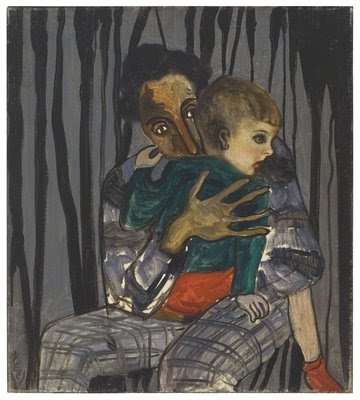
Sam and Richard by Alice Neel (1940)

Neel who was painfully aware of the treatment of her son by Brody painted a very moving picture of the two entitled Sam and Richard in 1940.  In the work we see a venomous looking Sam tightly grasping the terrified Richard.  Richard almost became blind due to dietary deficiencies when he was one-year old and this must have added to his pain.

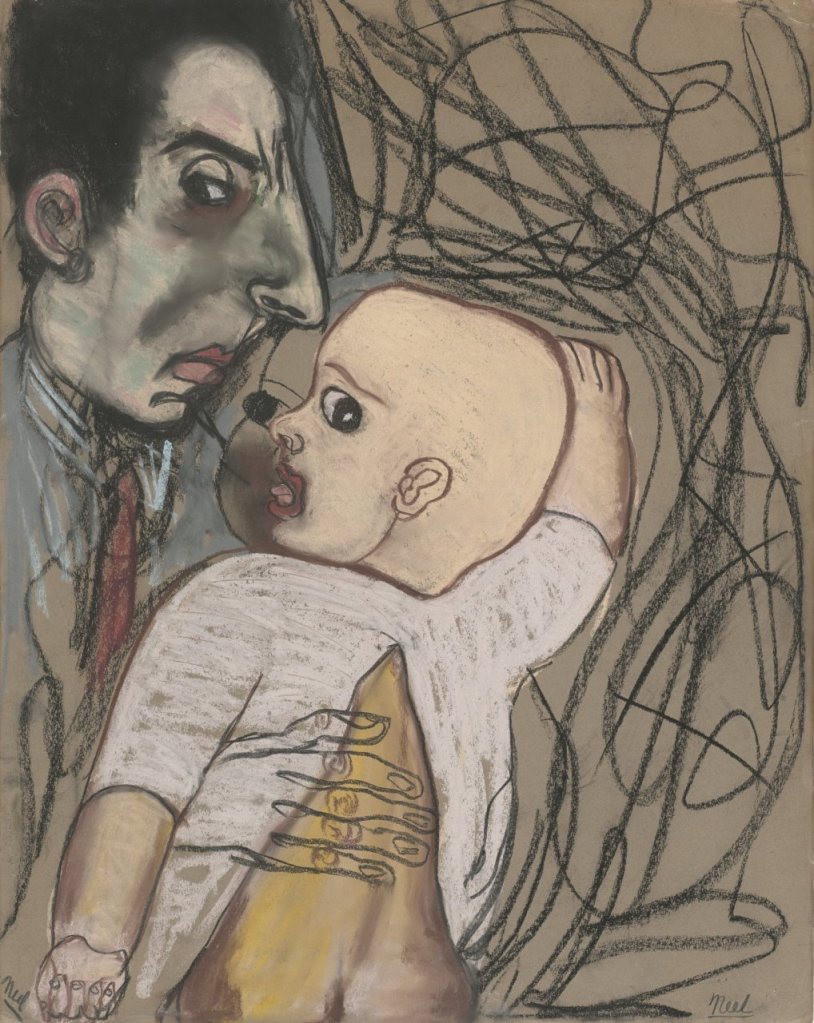
In January 1941 Alice became pregnant with Sam Brody’s child and on September 3rd a son, Hartley Stockton Neel was born.  The joy of this birth was tempered by the fact that soon after the event Brody’s wife Claire caught sight of her husband wheeling the pram and lovingly lifting Hartley out of the carriage.  Claire, as one can imagine, was devastated.  Not only was her husband two-timing her but he had a child with another woman.

Phillip Bonosky, the writer and friend of Alice,  wrote about Sam Brody in his journal and described him and his behaviour towards Alice’s children:

“…A Jew…. who is obviously a pathological case of some sort.  I met both the boys [Richard and Hartley].  The eldest one [Richard] is almost totally blind as a result of a dietary deficiency when he was just one year or so old.  The youngest boy’s father [Brody] who seems to flit about the country pounces down on them from time to time and while he is there, he tortures and abuses the eldest child and showers psychopathic affection on the younger one, his own.  Alice herself is torn by her feelings for and against him and doesn’t know what to do…”

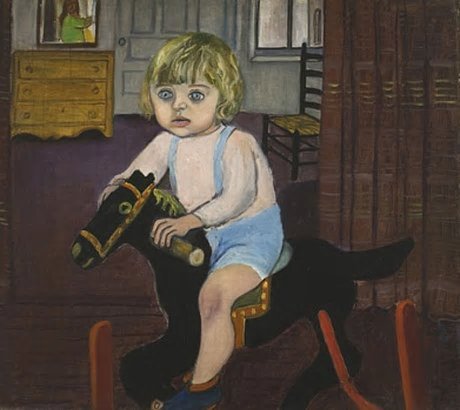
Hartley on the Rocking Horse by Alice Neel (1943)

Hartley featured in a number of his mother’s paintings.  In a 1943 painting Hartley on the Rocking Horse we see her younger son on a rocking horse. Look at his facial expression.  Is it one of joy to be astride the horse?  I rather think his wide-eyed facial expression is not one of delight but more one of fear that he may fall off and he may have had to be coaxed to stay on the “beast”.  If you look carefully at the mirror in the background you will see that the artist has added a mirror-reflection of herself.

Richard at Age Five by Alice Neel (1946)

Two years later in 1945 Neel painted a portrait of her five-year old son, Richard entitled Richard Age Five. His troubled upbringing can be seen in the demeanour of the youngster.  Look carefully at the depiction.  See how he clings to the back of the chair.  Look at his wide-eyed expression.  There is a vulnerability about the child and knowing the background of his upbringing and his bad relationship with his mother’s lover, Brody, we can sympathise with what he had to endure.

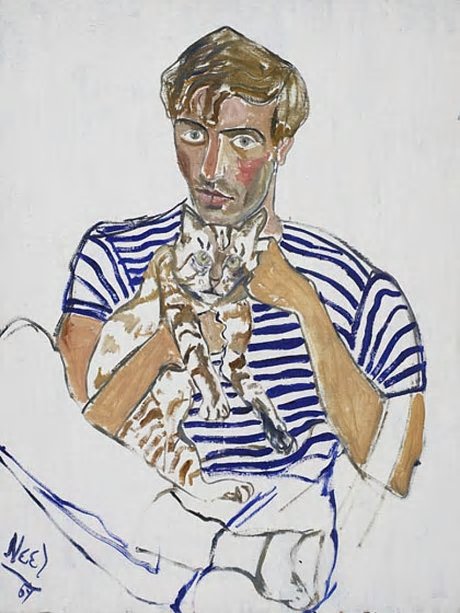
Hartley with a Cat by Alice Neel (1967)

Twenty-five-year-old Hartley appeared in another work painted by his mother in 1967 entitled Hartley with a Cat.

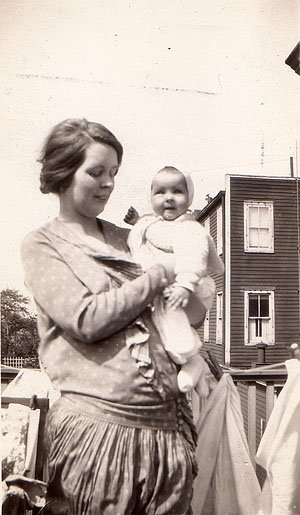
Alice Neel holding her daughter Santillana (1927)

Alice gave birth to four children.  Her first-born child Santillana died of diphtheria just days before her first birthday and never featured in any of Alice’s paintings although there is a 1927 photographs of her and her mother.

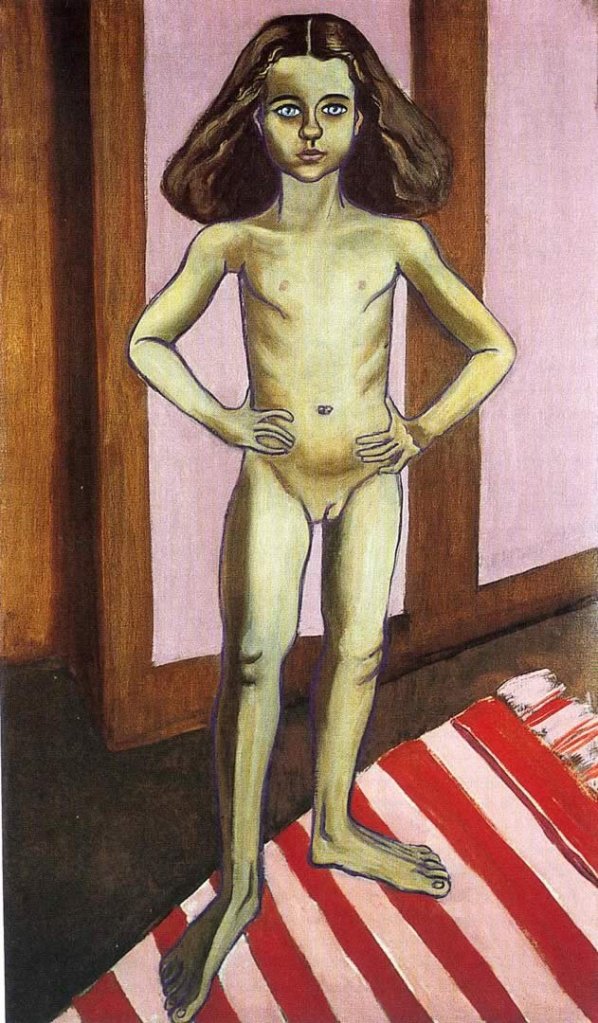
Isabetta by Alice Neel (1934)

Her second born child Isabetta, who was born in 1928, featured in just one painting by Neel and this 1934 work is a controversial depiction of the six-year old.  For those of you who have not read the early blogs on Alice Neel, Alice and her Cuban husband Carlos Enriquez had Isabetta in November 1928 but soon after Carlos took his daughter to live with his family in Cuba and Alice, who had a major mental breakdown and was hospitalised never regained custody of her daughter.  Neel was rarely given access to her daughter except on one occasion in 1934 when mother and daughter were together long enough to paint the most extraordinary and, some would say, scandalous portrait. The little girl stands naked with her hands planted firmly on her hips in what looks like a rebellious pose, one that makes it clear that despite what is offered to her to stand still, she is having none of it.  Isabetta defiantly focuses her fierce blue gaze fixes on her mother almost as if she is questioning why should she stand before her naked.  Look out the artist has depicted her child’s hands.  The fingers are claw-like giving the child a more sinister air.  What was going through Alice Neel’s mind when she painted this portrait?   I struggle to understand why a mother would depict her daughter in such a fashion.  Only she knows.

It is obvious to all mothers the trauma the loss of her child affected Alice but we should not discount the trauma the child suffered with the loss of her mother.  Did she feel abandoned?  Isabetta and her mother met once more when she was ten years old.  It was not a good visit maybe because Alice was heavily pregnant with Richard and Alice and Isabetta never bonded.  There were to be many traumatic times in Isabetta’s life including, when she was eighteen years old, her proposed nuptials were called off by her fiancé’s parents, two weeks before the wedding.  Maybe the separation from her mother and other setbacks she had to endure stayed with her all her life as in 1982, aged 54, she committed suicide. Her mother, Alice, was to die two years later.

Two Girls in Spanish Harlem by Alice Neel (1941)

Whilst living in the Spanish Harlem district of New York Alice painted many studies of the inhabitants such as her 1941 double portrait of two young girls, Carmen and Hilda entitled Two Girls in Spanish Harlem (Carmen and Hilda) which was a beautiful example of her artistic ability.

Spanish Family by Alice Neel (1943)

I particularly like her 1943 painting entitled Spanish Family which depicts a mother and her three children.  Look how Neel has portrayed the facial expressions of the four characters.  Words are not needed to express how they all feel.  None are smiling.  The mother looks despondent and we get a feel of what life must have been like for her during those hard times.

Fire Escape by Alice Neel (1948)

A 1948 painting by Neel, entitled Fire Escape, deviated from her normal figurative work and shows a tenement building close to where she lived.

Dead Father by Alice Neel (1946)

On May 3rd 1946 Alice Neel’s father, George, died, aged eighty-two and the day following the funeral in Colwyn Alice painted his portrait, Dead Father. In Patricia Hills book Alice Neel, she quotes Alice talking about the painting:

“…He was a good and kind man and his head still looked noble.  I didn’t set out to memorize him, because I was too affected.  But the image printed itself…”

My Mother by Alice Neel (1946)

That same year Alice completed a painting of her newly-widowed mother.

My Mother by Alice Neel (1952)

Six years later, in 1952, she completed another depiction of her mother, Alice snr.

In the title of this blog I added “he said, she said”.  The reason for this is that most of the information I got for these blogs about Alice Neel came from the book Alice Neel.  The Art of Not Sitting Pretty by Phoebe Hoban and during my delving into the many internet sites about the artist I came across one by David Brody who was the son of Sam Brody and Sondra Herrera whom he married after his liaison with Alice Neel ended in 1958.  He was unhappy with what Phoebe Hoban had written about his father and for the sake of being even-handed I thought you should have a look at what he wrote:

http://www.sambrody.com/hoban.html

In my next blog I will take a final look at the paintings and life of this great American figurative artist.


Christoffer Wilhelm Eckersberg. Part 3. Patrons and portraiture

In May 1816, Christoffer Eckersberg left Rome and headed home to Copenhagen.  During his homeward journey he stopped off at Dresden where he met up with the German Romantic painter, Casper David Friedrich.  Eckersberg finally arrived back in Copenhagen in August 1816.  His reputation as a leading painter of his time was all he could have wished for and soon commissions were rolling in.  Probably the most prestigious of these was a commission to paint four large works for the Throne Chamber of the magnificent baroque palace of Christiansborg which showed scenes from the history of the House of Oldenburg.  This commission earned him the nomenclature of “court painter”.

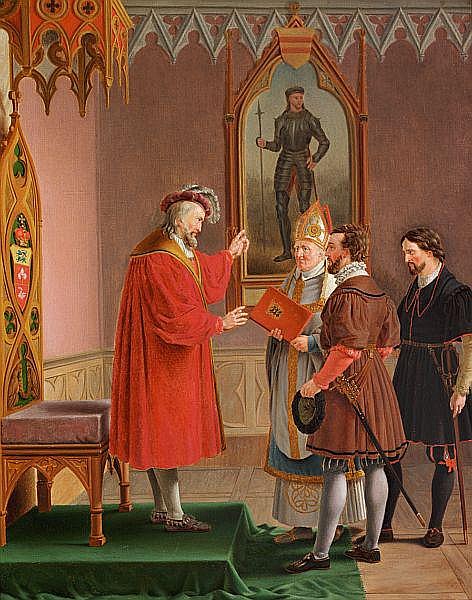
Duke Adolf declines the offer to be Danish king by Christoffer Eckersberg (1821) (43 x 39cms) Private collection
Duke Adolf declines the offer to be Danish king by Christoffer Eckersberg (1821)
(43 x 39cms)
Private collection

One of these works was Duke Adolf declining the offer to be King of Denmark which he completed in 1819.  The story behind this event is that in January 1448, King Christopher of Denmark, Sweden and Norway died suddenly and had no natural heirs. His death resulted in the break-up of the union of the three kingdoms, with Denmark and Sweden going their separate ways. Denmark had now to find a successor to the vacant Danish throne and so the Council of the Realm turned to to Duke Adolphus of Schleswig, as he was the most prominent feudal lord of Danish dominions. However Adolphus, who by that time was forty-seven years old and childless, declined the offer but instead supported the candidacy of his sister’s son, the Count Christian of Oldenburg.  Christian was elected King Christian I of Denmark and his coronation followed a year later in October 1449. In the painting we see Duke Adolphus declining the offer as he points to the portrait of his nephew, Christian, which is hanging on the wall in the background.

Mendel Levin Nathanson by Christoffer Eckersberg (1819) (32 x 28cms) Museum of National History at Fredericksborg Castle
Mendel Levin Nathanson by Christoffer Eckersberg (1819)
(32 x 28cms)
Museum of National History at Fredericksborg Castle

In October 1817 Eckersberg became a member of the Royal Academy of Fine Arts.  This allowed him to apply for any position as professor at the Model School of Charlottenborg, which was the home of the Royal Danish Academy of Fine Arts.  Whilst Eckersberg had been travelling around Europe he had been funded by a number of patrons and on his return home he decide to repay their generosity by completing portraits of them and their family.  One of Eckersberg’s most important and generous benefactors was Mendel Levin Nathanson.   He had arrived in Copenhagen aged twelve as a poor Jewish immigrant.  Nathanson rose to become a wealthy Danish merchant, editor, and economist who from an early age established himself in business.  At the age of twenty-six he became associated with the large Copenhagen banking firm of Meyer & Trier.  He was also a leading patron of the arts.   He was an author of books on economics as well as the country’s mercantile history but was probably best known for his advocacy of the Jewish cause. Nathanson was editor of the Berlingske Tidende one of the big three national newspapers from 1838 to 1858 and from 1865 to 1866.  Eckersberg completed the portrait of Nathanson in 1819.

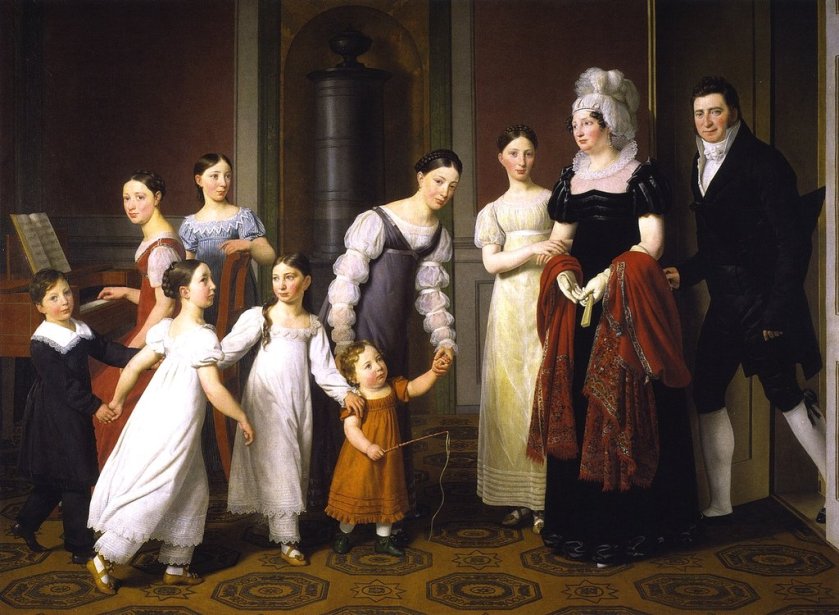
The Nathanson Family by Christoffer Eckersberg (1818) (126 x 173cms) Statens Museum for Kunst, Copenhagen
The Nathanson Family by Christoffer Eckersberg (1818)
(126 x 173cms)
Statens Museum for Kunst, Copenhagen

Another of Nathanson’s commissions for Eckersberg was to get the artist to complete a group family portrait, a task he completed in 1818.  The depiction was of Nathanson, his wife and their eight children.  It was simply entitled The Nathanson Family and the portrait was the most densely peopled and involved work ever attempted by Eckersberg.  Nathanson was quite specific about what he wanted the painting to reveal about himself and his family.  It was to be a depiction which would tell of his affluence and status in the country.

The Nathanson Family (Preliminary sketch) by Christoffer Eckersberg (1818)

Eckersberg’s original idea, as seen in a preliminary sketch, was to depict the whole family dancing, highlighting a close and harmonious family connection,  a family who enjoyed each other’s company but this idea failed to satisfy Nathanson.  For Nathanson the depiction must depict a family of stature and wealth.  It was paramount to depict his own prominent position in Danish society as a merchant and an integrated Jew.  He again spoke to Eckersberg to remind him how he wanted the family to be depicted.   The family members in the finished painting are shown, in a line, blatantly parading themselves before us in a stage-like manner.  On the left hand side the depiction focuses on the private life of the children, at play, dancing and one daughter is seen playing the piano.  The children’s activity is interrupted by the arrival home of Nathanson and his wife from an audience with the Queen having enjoyed the family tradition of some royal entertainment.  There is a sartorial elegance about the velvet-like clothing Nathanson and his wife are wearing and this of course brings home to the viewer of the painting the social and financial class of the couple.  The whole scene is a juxtaposition of two visual aspects of Nathanson’s life – the loving husband and father with his happy children and the successful businessman who has access to the Royal Court.  In the portrait Nathanson stares out at us inviting us into his house to witness all that belongs to him.  His wife stands next to him, somewhat aloof, as the children, who have  interrupted their playing to run and greet her.

Bella and Hanna. Mendel Levin Nathanson's Elder Daughters by Christoffer Eckersberg (1820) (125 x 85cms) Statens Museum for Kunst in Copenhagen
Bella and Hanna. Mendel Levin Nathanson’s Elder Daughters by Christoffer Eckersberg (1820)
(125 x 85cms)
Statens Museum for Kunst in Copenhagen

In 1820 Eckersberg completed another portrait for Nathanson.  This time it is one depicting his two daughters, Bella and Hanna.   For many artists who have been asked to complete a portrait the decision as to how the sitter should be portrayed is a question which has to be carefully answered.  Should it be an en face depiction or a profile depiction?  In this work Eckersberg has solved the problem by having the daughter, who is standing, portrayed en face whilst the seated daughter is shown in profile.   Although it would not be that unusual to see the likeness of the two daughters in this case, could it be that Eckersberg has emphasized the similarities to such a degree that it almost looks as it is the portrait of a single person seen from two different angles.  On the table we see a parrot in a cage.  Is this just an additional ornamentation which lacks meaning?  Actually many believe it is symbolic and that it is all about the two young ladies who are at an age when marriage is on the horizon whilst other believe there is a definite similarity between the shape of the cage and the shape of the girls’ faces

Hans Christian Ørsted by Christoffer Eckersberg (1822) (53 x 43cms) Danish Museum of Science and Technology, Helsingør
Hans Christian Ørsted by Christoffer Eckersberg (1822)
(53 x 43cms)
Danish Museum of Science and Technology, Helsingør

Another of Eckersberg’s interesting portraits is Hans Christian Ørsted which he  completed in 1822.  It is a medium sized head and shoulder portrait which can now be found at the Danish Museum of Science and Technology in the eastern Danish town of Helsingør.  This is a good example of Eckersberg’s ability as a portraitist as to how he precisely and truthfully depicts his sitter.  It is a realistically accurate depiction of the man, as confirmed by his wife. The depiction of Ørsted facial expression is one of contemplation which concurs with the views that Ørsted was a great “thinker”.  Other than that expression on Ørsted’s face, it disregards the modus operandi of many portrait artists past and present who feel the need to incorporate into the portrait their perceived notion of the sitter’s psychological persona and by doing so they are happy to lose some of the physical accuracy of the person.   I know I am in the minority when I say, that for me, a portrait needs to be real and recognisable.   I am often told that as I am not an artist I do not understand portraiture !

Hans Christian Ørsted was an acclaimed international scientist born in 1777 who made the discovery that electric currents created magnetic fields which would later be known as Ørsted’s Law.  Eckersberg tells us more about the man, not by the way he “adjusts” the portrait but by using the tried and trusted method of including items in the portrait which relate to the man.  In his hand we see Ørsted holding a metal Chladni plate on which is sprinkled powder.  The powder has now formed a pattern on the surface of it, which is the result of a violin bow,  which can be seen on the table in the left foreground, being scraped against the edge of the plate.  The catalogue raisoneé of Eckersberg works does not indicate any payment for the portrait and it was probably a gift from Eckersberg to Ørsted as the two endured a long friendship after they had met in Paris years earlier.

Portrait of Bertel Thorvaldsen wearing the habit and Insignia of the San Luca Academy by Christoffer Eckersberg (1814) (91 x 74cms) The Royal Danish Academy of Fine Arts
Portrait of Bertel Thorvaldsen wearing the habit and Insignia of the San Luca Academy by Christoffer Eckersberg (1814)
(91 x 74cms)
The Royal Danish Academy of Fine Arts

When Eckersberg stayed in Rome we know he stayed in a lodging house which also accommodated the great Danish sculptor Bertel Thorvaldsen and the two became good friends.  One of Eckersberg’s most famous and inspired portraits, which he completed in 1814, was of Thorvladsen.  It was entitled Portrait of Bertel Thorvaldsen wearing the habit and Insignia of the San Luca Academy.  At the time, Thorvaldsen was regarded as the most important sculptor in Rome and in 1804 he became a member of the Florence Academy of Art and a year later a member of the Danish Art Academy.  In this portrait, we see Thorvaldsen bedecked in the official robes of the Academia di San Luca in Rome, of which he had been a member since 1808. This prestigious academy was founded in 1577 and as such  is among the oldest academies in Europe with its roots being traced to the first statutes written in 1478 for the guild of painters named Compagnia di San Lucca. The robes we see Thorvaldsen wearing provide the portrait with the nuance of an artist who is continuing the work of a long Roman tradition.  There is no doubt that the message we can take from the way Eckersberg depicted his friend is the artist’s great admiration for the sculptor and all that he had achieved.  Eckersberg, like many admirers of Thorvaldsen, looked upon him as a visionary and the artist has tried to capture that aspect in the sculptor’s contemplative facial expression.  Such admiration for Thorvaldsen’s work can be seen by the way Eckersberg has included Thorvaldsen’s most famous piece of sculpture, the Alexander Frieze, which can be seen in the background.  Eckersberg was so happy with the finished portrait that he sent it to Denmark as a gift to the Copenhagen Academy.  This generous gesture probably had a more ulterior motive, that of proving of his artistic ability to the academicians.

The Double Portrait of Count Preben Bille-Braheand his second wife Johanne Caroline neé FalbeZ by Christoffer Eckersberg (1817) (61 x 50cms) Ny Carlsberg Glyptotek
The Double Portrait of Count Preben Bille-Braheand his second wife Johanne Caroline neé FalbeZ by Christoffer Eckersberg (1817)
(61 x 50cms)
Ny Carlsberg Glyptotek

Eckersberg’s many portraits were not just of male sitters.  Portraiture was a great way of making money and many commissions came to him when he returned to Copenhagen.  The next painting I am showcasing is The Double Portrait of Count Preben Bille-Braheand his second wife Johanne Caroline neé Falbe which he completed in 1817 and is now housed in the Ny Carlsberg Glyptotek in Copenhagen.  Eckersberg had been awarded the Academy’s Gold Medal in 1809 and with it came funds to cover the cost of European travel.  However the money did not become available to him until 1812 but he wanted to set off to Paris immediately and so had to turn to some wealthy sponsors to lend him the money he needed to start his journey.  One such benefactor was Count Preben Bille-Brahe, a wealthy Danish landowner.  On his return to Copenhagen Eckersberg repaid Count Preben Bille-Brahe’s generous support for his European journey by painting a double portrait of the count and his second wife, Double Portrait of Count Preben Billie-Brahe and his Second Wife, Johanne Caroline, neé Falbe.  Although their social status was to be part of the aristocracy, Eckersberg has managed a more commonplace depiction of the couple, which he used when he depicted the middle-class in his portraiture, enhancing the view that they were just real people.  Having said that, the male sitter with the ruddy cheeks looks resplendent in his brown tailcoat, the buff waistcoat with its lower fastening unbuttoned.

Jesus and the Little Children by Christoffer Eckersberg (c. 1810) Altarpiece for the Home Church at Funen
Jesus and the Little Children by Christoffer Eckersberg (c. 1810)
Altarpiece for the Home Church at Funen

Eckersberg had met Count Preben Bille-Brahe in 1810 during the first part of his European journey to Paris.  He stopped off at his benefactor’s estate on the island of Funen and received a commission from Count Preben Bille-Brahe to create an altarpiece for the Home Church which was part of the estate.  Eckersberg completed the painting for the altar whilst in Paris.  It was a biblical scene entitled Jesus and the Little Children.

Home Church Funen
The interior of Home Church Funen

In my fourth look at the life and work of Christoffer Wilhelm Eckersberg I will concentrate on some of his female portraiture and his large number of nude paintings.

Samuel Palmer Part 1. The Early years, portraiture and the rural idyll

The Prospect by Samuel Palmer (1881)

My featured artist today is one of the great English landscape painters, draughtsmen and etcher of the nineteenth century.  He was a major player in the art of Romanticism.  His landscape works were special, conjured up by his inventive and far-sighted imagination.   There was a magical feel about his work.  Palmer was not just an ordinary every day painter; his works were poetical and he himself, through his art, seemed to have the ability of a mystical seer. Let me introduce you to Samuel Palmer.
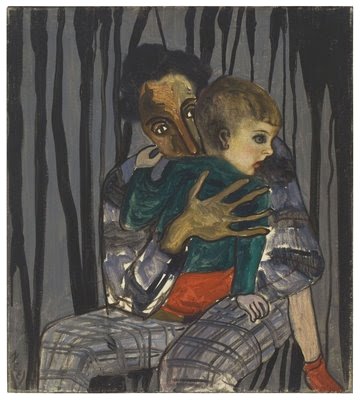
At the time of Samuel Palmer’s birth there was a worrying tension brought on by conflict.  It was a troubling time.  It was a time of tumult in Europe.  Sixteen years earlier France had been affected by the storming of the Bastille and the fall of the rich and the nobility of the ancient regime.  Initially, there was probably a delighted sense of schadenfreude in the minds of many in England, including the “establishment” at the fall from grace of what they perceived was the cruel and greedy French aristocracy but soon that enthusiasm dwindled with the thought that such revolutionary behaviour may cross the English Channel.  In 1793, twelve years before Samuel was born France declared war on Britain, a war which would last more than two decades.  Although the battlefields were not in England Napoleon Bonaparte used another weapon against the British by blockading European ports and by so doing deprive Britain of lucrative trade.  The war however proved fortuitous to Samuel’s family who were hatters and hats were in great demand since the government, to add to their much needed war chest, had imposed a hair powder tax and this ended the era when elegantly puffed and powdered coiffures which were once de rigueur, now could not be afforded.  The fashion was now for the “topper”, the nickname given to top hats.

Portrait of Samuel Palmer by Henry Walter (1819)

Samuel’s father, also named Samuel, had set forth to study to become a surgeon but his squeamish nature put an end to that dream and he ended up in his father, Christopher Palmer’s, millinery business.  Samuel Snr. was somewhat of a dreamer and this along with his love of books led him to forego the safe and lucrative job as a hatter to set himself up as a bookseller.  This decision did not go down well with his family as the trade of a bookseller seemed a lowly trade not fit for a “gentleman”.  Samuel Snr. was, besides being a dreamer, a very determined person and cared little about status and the financial position of his family.

Samuel Palmer Snr. met and fell in love with Martha Giles and they married in October 1803.  Samuel Palmer, their first child, was born in Newington, London on winter Sunday morning, on January 27th 1805.  The couple lived in Surrey Square in Newington, which at the start of the nineteenth century, was a semi rural area populated with lush gardens, fields and orchards.  It was a haven for those who loved the countryside; a love young Samuel would have all his life.  It was a time when survival at birth was somewhat of a lottery with a third of babies not surviving to see their first birthday and amongst the poor and deprived the survival rate would drop even further.  However Samuel Palmer was lucky in as much as he was born into a prosperous middle-class family.

Early Morning by Samuel Palmer (1825) Pen and ink and wash, mixed with gum arabic, varnished,
Early Morning by Samuel Palmer (1825)
Pen and ink and wash, mixed with gum arabic, varnished,

Samuel was not a healthy child and his mother and grandmother would often take him to the Georgian seaside resort of Margate in the hope that sea air would improve his health.  This once fishing town was a favourite of Turner.  It was during his boyhood stays in Margate that he would listen to his grandmother’s tales of ghosts and restless spirits who wandered around the town.  Stories of such apparitions would remain with Samuel and would interest him all his life.  His mother’s continued concern about her son’s physical health led her to employ a live-in nurse, Mary Ward, who set about improving his health by improving his diet.   It was also this lady who was to have such an influence on the young boy.  Unlike most servants who were illiterate Mary was well read with the Bible and Jacob Tonson’s pocket illustrated book of Milton’s poems being her favourites.  She, like Samuel’s father, loved books and would often read Milton’s poems to Samuel.  When Mary died she bequeathed the book of poems to Samuel who would carry it round with him wherever he went.  Of Milton’s poems, Samuel wrote:

“…I am never in a “lull about Milton”…….nor can tell how many times I have read his poems… He never tires….I do believe his stanzas will be read in heaven…”

Samuel gained a brother in 1810 with the birth of William, who was to be the only other surviving child of Samuel Snr. and Martha.  Samuel Palmer did not have many boyhood friends as he was more than satisfied to immerse himself in his books, including works by Dickens, which featured the English capital.  It was a trait, which delighted his father.  Samuel would often go for walks on Dulwich Common with either his father or his nurse during which they would often read to him as they strolled the countryside.  His love for reading and the joy books brought him can be seen in one of his letters (The Letters of Samuel Palmer – Raymond Lister, 1974) in which he wrote:

“…There is nothing like books of all things sold incomparably the cheapest, of all pleasures the least palling, they take up little room, keep quiet when they are not wanted and, when taken up, bring us face to face with the choicest men who ever lived at their choicest moments…”

Samuel, maybe because of his poor health, tried to avoid the necessity of going into the heart of London with all its pollution from coal fires and the often dank fogs emanating from the Thames.  He was a lover of the countryside and being of poor health abhorred the polluted city life.

In May 1817, at the age of eleven, Samuel was sent to Merchant Taylors’ public school.  This was a prestigious institution founded back in 1561 but for Samuel it was a nightmare.  Samuel who had been cosseted by both his mother and nurse and had a quiet solitary home life, which suited his nature, suddenly was thrust into a maelstrom of lively and loud boys in which a pale-faced asthmatic boy fared badly.  Samuel disliked the public school system with all it entailed and in another of his letters he wrote:

“…the fag crawls to be kicked, and, in his turn, kicks the fag who crawls to him………it perfectly represents and so admirably prepares for the requirement of public life for what is statesmanship but successful crawling and kicking….”

His time at Merchant Taylors lasted only six months as his pleading to come back home was answered in the Autumn of 1817.

The death of Samuel’s mother in 1818 came as a harsh blow to her thirteen year old son.  He struggled to cope with the loss and shed many tears.  The loss of his mother came at the same time as he and his father considered what career he should follow.  Samuel favoured becoming an author.  He had already written some prose and poetry and although the latter never attained the quality required to have them published his stylistic prose gave him hope of a fulfilling career.  However it was not to be as his father believed, because of his son’s early talents as a draughtsman that the visual arts should be the career his son should follow.  The family’s decision that Samuel should follow a career in art was thought to have been down to a belief that it was what his mother would have liked her son to do.

Entrance of the Meuse: Orange-Merchant on the Bar, Going to Pieces; Brill Church bearing S. E. by S., Masensluys E. by S. by J W Turner (1819)

The family employed William Wate, a run-of-the-mill landscape artist, to tutor Samuel.  In 1819, when Samuel was just fourteen, he made his first visit to the Royal Academy Summer Exhibition.  He was amazed by the colour in Turner’s painting of the Entrance of the Meuse and fascinated by Turner’s Liber Studiorum, a series of his landscape and seascape compositions which were published as prints in etching and mezzotint, has been once described as perhaps comprising of ‘the pith of all that is best in his life and work’.

At this time Palmer was just a developing artist who was still learning the basic skills of art through Wate’s tuition.

Samuel Palmer a Self-Portrait (1826)

I recently attended a portraiture workshop at which the guest artist and presenter talked about how the portrait he would produce would not necessarily be a photographic image of the sitter but how he envisaged the model.  With those words still in my head I gaze at Samuel Palmer’s self portrait which he completed around 1826 when he was twenty years of age.  Is this how he envisioned himself?  There is something quite disturbing about this self-portrait.  Palmer gazes directly towards us but it is a blank stare as if he is looking through us.  The question that immediately springs to mind is what is he thinking about.  What is going on in his mind as he looks into the mirror?   It is not an image one would associate with an aspiring artist who is looking forward to the future.  What is troubling him?  Look at his physical appearance.  He has not readied himself for the painting.  It is more of a “this is who I am, take it or leave it” stance.  He is unshaved.  His thick hair looks uncared for.  The collar of his shirt is crooked but he knows all this as he puts brush to canvas.  Maybe he wants us to disregard his physical appearance and concentrate on what could be on his mind.  We are looking at the face of a troubled dreamer.  We are looking at a man whose vivid imagination would influence his art and those who view some of his imaginative paintings will be transported into a magical world which in her book Mysterious Wilderness, The Life and Work of Samuel Palmer, the author Rachel Campbell-Johnston describes the artist and some of his works:

“…It is a place in which magical shines through the material, in which nature and heaven are intertwined, in which God in all his mildness blesses man’s harvests and the darkness of night can be innocent and day.  This is not the haunt of any workaday painter.  It is the home of the artist as mystic and seer and poet…”

The Shearers by Samuel Palmer (1834)

One of his best known works is The Shearers which he completed in 1835.  It is a painting which is rich in colour.  There is the juxtaposition of golden sparkling light and gloomy shadow.  I have already said the Palmer was looked upon as a seer and this painting was his vision of paradise.  Raymond Lister in his book, Catalogue Raisonné of the works of Samuel Palmer describes the work and a similar one entitled The Sleeping Shepherd which uses the same setting of the entrance to the barn we see in the above work:

“…A group of richly textured and abundantly coloured paintings of this period includes some of Palmer’s greatest and most attractive work. Such work reached its ultimate expression in The Shearers and The Sleeping Shepherd…”

Geoffrey Grigson, in his 1960 book Samuel Palmer’s Valley of Vision, wrote of the work:

“…Great richness of technique was used to realise The Shearers. In this Palmer combined oil and tempera so as to render every nuance of texture from the light on the distant hills and in the sky to the detailed depiction, almost Dutch in its realism, of the group of implements on the right. There is also an advance in the drawing of the figures, the shearers and their helpers; rarely if ever before this had Palmer portrayed figures so convincingly in movement…”

The setting of the painting is the great barn,  the doors of which are open and we look out at the scene before us.  The doors and the roof beam in some way form a frame for the painting.  A group of six people work in the shade of the trees outside the barn, three men and three women can be seen in the mid-ground.  The men are in the process of shearing the sheep whilst the women collect and bag the wool.  In the background we see an expanse of rolling hills which are lit up by the rays of the sun which light up the beautiful countryside.  Samuel Palmer never forgot his walks with his father over the hills and through the fields of Dulwich.   The idea for the painting must have been in his mind years earlier because he once wrote about his plans for depicting such a scene:

“…A group of different sex and age reaping, might be shewn in the foreground going down a walk in the field toward the above cottage island, and over the distant line that bounds this golden sea might peep up elysian hills, the little hills of David, or the hills of Dulwich or rather the visions of a better country which the Dulwich fields shew will to all true poets…”

Still life detail
Still life detail

In a way the painting is not just a rural landscape scene but part is also a still-life work in the way Palmer has painted the farming equipment inside the barn which we see on the right hand side along with a wide brimmed straw hat which the artist’s son, Alfred, said was one of his father’s most cherished possessions and an item which would appear in many of Samuel Palmer’s works.

In my next blog I will continue to look at the life of Samuel Palmer and explore the help he received from the landscape artist and portraitist John Linnell and  how he was so influenced by William Blake, the poet and painter who was an influential figure in the history of the poetry and visual arts of the Romantic Age.

Félix Vallotton. Part 1- The early years and portraiture

Self portrait by Félix Vallotton (1897)

The artist whose paintings I am looking at in this blog is the Swiss-born artist and printmaker Félix Edouard Vallotton.

Vallatton was born in Lausanne, on the shores of Lake Geneva, in December 1865, three days before the New Year. His parents  and grandparents hailed from the little town of Vallorbe in the Swiss canton of Vaud.   His family’s social status was given as conservative middle class.  Félix’s father, Adrien owned a chandlery and grocery shop and would later branch out as a chocolatier and own and run a chocolate factory.   Félix and his older brother Paul lived at the family’s home in Lausanne, situated in the centre of town in the small town hall square, the Place de la Pelouse.  Family memories of the young Félix Vallatton told of him being a very delicate and sensitive child and because of this and the presence of the smallpox epidemics, which had ravaged Europe, he was probably cosseted by his family.  Félix, as a young boy enjoyed to draw and paint and besides his normal scholastic subjects, he attended evening classes for drawing.

Self portrait by Félix Vallotton (1885)

In 1882, at the age of sixteen, having completed his school education, he persuaded his father to take him to Paris so that he could learn more about painting and drawing.  He had passed the entrance exam to the École des Beaux Arts but decided that he would prefer to attend the Académie Julian because of its teaching of real art and naturalism.  His father managed to have his son enrol at the prestigious academy, which at the time had the most respected art tutors.  Félix was to study under three great French figure painters, Jules Joseph Lefebvre, Guillaume Bougereau and Gustave Boulanger.  As a student he was known to be hard working but very reclusive.  His tutors looked upon him as a model student and had great hopes that he would win the Prix de Rome prize as the outstanding student of the year.  For young Vallotton life was not all fun and games and monotony had begun to set in, even at this early stage.  He wrote to his brother Paul;

“…So far I have not seen much apart from some museums.  The botanical gardens, which did not make much impression on me, one or two theatres, which I visited with father, the Pantheon, which is magnificent and which affords a marvellous view on a fine day.  Every day I follow the very same route and see the very same things…”

In an early letter to his brother there is a hint of lack of self-confidence when he tells his brother how things are developing academically.  He wrote:

“…The professor is pleased with me, but I am not pleased with myself and sometimes feel sad……My heart sinks when I think of what I am about to study and realise that I am nothing compared with the great artists who startled the world at the age of fifteen…”

Vallotton may not be confident in his own ability but one of his tutor’s assessment of him was quite different.  Lefebvre told Vallotton’s father that:

‘…Monsieur, I hold your son in high esteem, and have only had occasion to compliment him up to now.  I think that, if I had such a son, I would not be worried about his future at all and would unhesitatingly be prepared, with the bounds of possibility, To make sacrifices over and over again, in order to help him…”

Lefebvre ended the conversation with a prediction:

“…I am so interested now in those who are prepared to work – your son is one of those and I repeat he will bring you fame…”

People who suffer from lack of self confidence, often need somebody to be there to boost their morale and Vallotton had that in the person of Charles Maurin, a fellow student at the Académie Julian, albeit eight years his senior.  Vallotton and Maurin became friends and part of a letter from Maurin to the younger Vallotton highlights the elder artist’s moral support.  He wrote to Vallotton:

“…Whatever you lack it is certainly not artistic flair.  It is rather some quality of character (please allow me to mention this to you).  (I would like you to be as open with me).  From your last letter it emerges that you lack strong will and you are creating difficulties for yourself.   But that is not the case.  You do have willpower but it does not manifest itself…”

Life as an art student in the big city was a struggle for Vallotton.  He had constantly to turn to his father for money to pay for lodgings, to buy food and pay for models.  He tried to find some work to help his financial situation but it was never enough.  In 1888 Felix wrote to his parents bemoaning his lot in life and one can sense an air of depression

“…I practically never go out.  I work from seven in the morning until five in the afternoon.  This has not produced any great results so far, everything must work out soon…”

Portrait of Monsieur Ursenbach by Félix Vallotton (1885)

In 1885, at the age of nineteen, Vallotton’s luck changed.  It was due to his portrait of one of his neighbours, Monsieur Ursenbach, a mathematician and Mormon.  That year, he submitted the Portrait of Mr Ursenbach to the Salon jury and with his former tutor, Jules Lefebvre, one of the jurists, the work was accepted and subsequently displayed.   It is an interesting work.  The setting for the portrait is the sitter’s colourless and featureless room.  Ursenbach can be seen sitting in his armchair in a stiffly upright pose, looking uncomfortable with a stern expression on his face.  His hands rest steadily upon his knees as he stares off to the left of the painting.  It is this unusual demeanour of Ursenbach which probably caught the eye of visitors to the Salon exhibition.  Critics were divided on its merits but for Vallatton himself when he later listed all his paintings in chronological order, this was the first on the list.

The Artist`s Parents by Félix Vallotton (1886)

Like many portrait artists before him, the young artist completed many portraits of his own family members.  His family portraits, such as the 1886 one of his parents, The Artist`s Parents,  featuring Alexis and Mathilde, were tender and showed the closeness he was to his parents.

Paul Vallotton by Félix Vallotton (1886)

In the same year that he completed the portrait of his parents he completed a portrait of his brother Paul.

Self portrait by Félix Vallotton (1891)

Over the years, he also painted many self portraits and one of my favourites is his 1891 painting, Mon portrait.  Portraiture was a way Vallotton began to earn money and he completed many commissions in Paris and back in his home town of Lausanne.  Many of his Paris commissions were attained through his Swiss ex-patriot friends who were living in the French capital.  One such friend and fellow student was the Swiss artist, Ernest Bieler and it was he who persuaded the artist and close acquaintance, Auguste de Molins, to write a letter of introduction on behalf of Vallotton to Renoir and Degas.  De Molins had known the Impressionists as he had exhibited works at the First Impressionist Exhibition.  In his letter to Degas, de Molins wrote:

“…My protégé is absolutely alone in Paris without any connections at all apart from his contacts at the studio, which is far from enough to satisfy his intellectual needs.  The studio is all very well, but there comes a time when close relations with a master are somewhat more important even far more important…”

Vallotton never used the letters of introduction.

Felix Jasinski in His Printmaking Studio - Felix Vallotton (1887)
Felix Jasinski in His Printmaking Studio – Felix Vallotton (1887)

In 1886 Vallotton met Felix Jasinski, an engraver and painted his portrait, entitled Felix Jasinski in His Printmaking Studio.  Jasinski went on to teach Vallotton all about the art of engraving and the two would work together on many projects.   Vallotton’s own catalogue of works began to list his engravings from 1887 and according to a letter to his parents in late 1889 he told them that he had begun to work on commissions for a publisher.  Money was to be made through his engraving work and by 1891 the amount of wood engravings completed by Vallatton was almost more that the number of paintings he had completed.

The Port of Pully by Félix Vallotton (1891)

His early works were not restricted to portraiture. Vallotton, being Swiss-born, loved to paint landscapes featuring the mountains and views of his homeland, especially around Lausanne and Lake Geneva.  Often they were for commissions given to him by Swiss people but often he would keep them for himself.  In 1891 he completed a painting, Port of Pully, one of the eastern suburbs of the city of Lausanne.  The painting depicts the lake front  located on the shores of Lake Geneva.

Outskirts of Lausanne by Félix Vallotton (1893)

Another beautiful landscape work by Vallotton was completed in 1893 and was entitled Outskirts of Lausanne.  In the painting we view Lake Geneva from a meadow.  The yellow and greens of the foreground are in contrast to the still blue water of the lake in the background.  There is an air of tranquillity about this depiction.  One can imagine sitting in the meadow, which is bathed in sunlight, and just relaxing and leaving the cares of the world behind.

The reason for me writing a couple of blogs about Félix Vallotton was that I was fascinated by the heading of a 2007 article in The Guardian newspaper by Julian Barnes which shouted out:

Better with their clothes on

The neglected, enigmatic Swiss artist Félix Vallotton was a fine painter of still lifes, landscapes and portraits. Shame about his dreadful nudes, writes Julian Barnes.

and so in my next blog I will continue with Vallotton’s life story and look at more of his paintings including some of his “dreadful nudes” !!!

Much of the material I have used for this blog came from an excellent book entitled Félix Vallotton by Nathalia Brodskia, an art historian attached to the hermitage Museum, St Petersburg.

Federico Zandomeneghi – the Italian Impressionist

Lesendes Mädchen (Girl reading) by Federico Zandomeneghi (c.1900)

When I was in Germany, just before Christmas, I bought myself a desk calendar which gave you a new painting every day.  I was fascinated by today’s picture of a young girl reading entitled Lesendes Mädchen (Girl Reading) by Federico Zandomeneghi.  I had never heard of the artist and thought it would be interesting to look at his life and his some of his beautiful works of art. He would become known for his many pastel portraits of ladies and children.

Federico Zandomeneghi

Federico Zandomeneghi was born in Venice in June 1841. He came from a family line of sculptors.  Pietro, his father, was a neoclassical sculptor as was his grandfather Luigi but unlike his father and grandfather Federico, and much to their annoyance, he favoured painting to sculpture.  In 1856, at the age of fifteen, he enrolled on a painting course at the Academia di Belle Arti in Venice and then later studied at the Accademia di Belle Arti di Brera in Milan, where he studied under the neoclassical-style painter Giralamo Michelangelo Grigoletti and Pompeo Marino Molmenti.  Venice was under Austrian rule when Napoleon was defeated in 1814 and it became part of the Austrian held Kingdom of Lombardy-Venetia.   Venice was firmly under the control of Austria and as such the Venetian citizens were conscripted into the army.  To escape conscription, Federico fled his city in 1859 and went to Pavia, where he enrolled at the university.  In 1860, when he was nineteen years of age, he joined the military forces of Guiseppe Garibaldi as one of the volunteers in The Expedition of the Thousand, part of the Risorgimento, the push for Italian unification.  As a Venetian this was looked upon as a kind of treachery. His flight from Venice in 162 to Florence to avoid conscription resulted him being charged, in absentia, with desertion.

Femme qui reve by Federico Zandomeneghi,

As a young aspiring artist Federico wanted to mix with other artists in the Tuscan city and by doing so assimilate their views of art.  One of the favoured meeting places for the artists was the Caffè Michelangelo .  It was here that the Macchiaioli met.  The Macchiaioli, which literally means patch-  or spot-makers, was a  group of rebellious Italian artists based in Tuscany during the second half of the 19th century and was formed more than ten years before the French Impressionists came onto the scene.  They rebelled against academic artistic training and many art historians believe they brought about a breath of fresh air into Italian painting.  They ignored the type of painting which was popular at the time such as Neoclassicism and Romanticism.  They were looked upon as the founders of modern Italian painting.  The Macchiaioli believed that areas of light and shadow, or macchie were the most important parts of a painting and when Italian artists spoke of macchia they were talking about the sparkling quality of a drawing or painting.
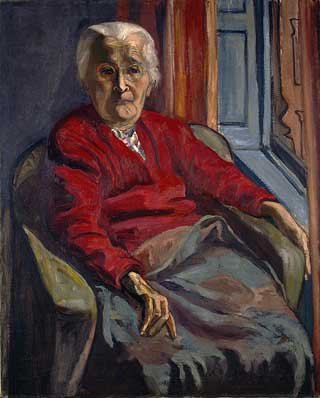
The Poor on the Steps of Ara Coeli in Rome by Federico Zandomeneghi (1872)

The Poor on the Steps of Ara Coeli in Rome by Zandomeneghi is now housed at the Pinaconteca Brera in Milan.  It is a fine example of verismo the nineteenth century Italian painting style and was a style frequently used by the Macchiaioli.  It is a style of painting we would term as realism.  It features a group of poor people, men, women and children sitting on the steps of Santa Maria in Aracoeli (St. Mary of the Altar of Heaven), one the oldest basilicas in Rome.   

——————————————————————–

There was a strong connection with French art as many of the Macchiaioli were influenced by the French artists such as Courbet and Corot who belonged to the Barbizon School as well as other nineteenth century plein air painters whose works the Macchiaioli artists were able to see when they visited the French capital.  En plein air painting was at that time a ground breaking method of painting but its proponents believed that it allowed for a new vibrancy and naturalness in the reproduction of light which would have been lost if the painting had been carried out in a studio.   Some of the members of the Macchiaioli, like Federico, had fought alongside Garibaldi in his effort to attain Italian unification.  Many of the works of the Macchiaioli featured grand battles scenes of the Risorgimento as well as landscapes and genre paintings featuring both the bourgeoisie and peasants.

Palazzo Pretorio in Florence by Federico Zandomeneghi (1865)

Another painting completed by Zandomeneghi whilst he was living in Florence is one of my favourites.  It is entitled Palazzo Pretorio and was completed in 1865.  It can now be found in the Museo d’Arte Moderna, Ca’ Pesaro, Venice.   The work of art was exhibited that year in the rooms of the Società Veneta Promotrice (Venetian Promoter of Fine Arts) which was based in Palazzo Mocenigo at San Benedetto.   The depiction of light and shade we see in the painting was strongly influenced by the Macchiaioli artists of Florence.

————————————————————–

Diego Martelli by Federico Zandomeneghi (1879)

Whilst in Florence and through his association with the Macchiaioli artists, Federico Zandomeneghi met the Italian art critic Diego Martelli.  Martelli was a great supporter of the painters of the Macchiaioli and would often invite them up to his large Tuscan estate in Castiglioncello which was an ideal setting for their en plein air painting sessions.  Martelli wrote fervently about realism in art and favoured the works of Gustave Courbet as well as the plein air artists of the Barbizon School.    He made a number of trips to Paris and its thought that he persuaded Zandomeneghi to leave Florence and go to live in the French capital.  Through their correspondence Zandomeneghi introduced Martelli to the works of the Impressionists so much so that it is said that Martelli was one of the first and leading supporters of Impressionism in Italy.

Portrait of Diego Martelli by Edgar Degas (1879)

Like Zandomeneghi, Martelli became good friends with Degas who painted his portrait in 1879.  The Degas portrait is unusual in as much as the sitter is viewed from above which is somewhat unflattering as it accentuates the corpulence of Martelli.  We see Martelli sitting unsteadily on a small stool.  To his left is a table, scattered on which are numerous objects belonging to the sitter.  The addition of these items was a trademark of Degas’ portraits as he felt it told viewers more about the subject of the portrait.  The painting is now housed in the Scottish National Gallery.

The Good Book by Federico Zandomeneghi (1897)

In 1874, Federico, now thirty-three years of age, moved to the art capital of Europe, Paris, and little did he know then, he would never return to his Italian homeland.  On his arrival in Paris, as was the case when he arrived in Florence, he wanted to immerse himself into the life of an artist and mix with the artists of Montmartre.   To be an artist in the French capital at this time was a chance to witness the birth of what would later be termed by the art critic, Louis Leroy, as Impressionism.
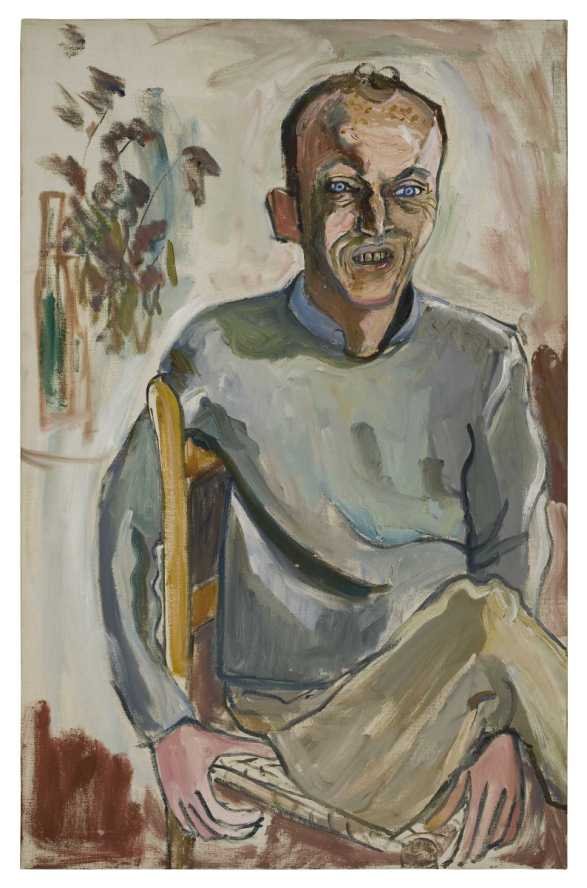
Café de la Nouvelle-Athènes on Place Pigalle

The year 1874 was the year of the Impressionist’s first annual exhibition in Paris.  Federico would often frequent the Café de la Nouvelle-Athènes on Place Pigalle.  It was here that he first met and befriended Edgar Degas, who was seven years his senior.    It is said that we are often drawn to people who have the same characteristics and the same looks upon life and as such Degas and Federico Zandomeneghi were well matched.  Both were recalcitrant and often boorish and this similarity of behaviour ensured they would remain life-long friends!  Although great friends with Degas, Federico was more influenced by the works of Renoir and Mary Cassatt and the way they portrayed women in their art work.  This was to lead to many of his works featuring females going about with their daily chores or being immersed in reading.  Zandomeneghi liked to portray through his artwork, and like that of the Impressionists, the elegant high society of the French capital but his paintings were not imitations of the Impressionists’ works.  He had his own inimitable style.

Place d'Anvers, Paris by Federico Zandomeneghi (1880)
Place d’Anvers, Paris by Federico Zandomeneghi (1880)

The Impressionists had by 1879 held three annual exhibitions and Degas persuaded Federico to exhibit some of his work at the fourth annual exhibition at the Avenue de l’Opéra, during the months of April and May in 1879.  Besides Federico there were three other “first appearances” exhibiting at the Fourth Impressionist Exhibition, the husband and wife Impressionists Félix and Marie Braquemond  and Paul Gaugin.  Federico went on to exhibit at the fifth (1880), sixth (1881) and the eighth and final exhibition in 1886.  To sell one’s work one has to have a good dealer and through the good auspices of his Impressionist friends Federico was taken on by the gallery owner and art dealer, Paul Durand-Ruel who acted as his sole agent.   It was this Parisian art dealer who changed the fortunes of Federico when he exhibited the Italian artist’s work in America.   In the 1890’s, having had to supplement his income from the sale of his paintings by providing illustrations for Paris fashion magazine, once his work was seen in America he was inundated with commissions.  It was around this time that Federico changed the medium in which he worked, now favouring in pastels.

Conversazione interessante by Federioco Zandomeneghi (1895)

Zandomeneghi will always be remembered for his female portraiture.  He seemed to concentrate his depictions of women who were mothers going about their everyday life.  He often liked to show in his paintings the ease in which women interacted with each other.  There was a warmth about his pictorial depiction of females and this may be because of the way he was influenced by the works of Berthe Morisot and Mary Cassatt.  Enrico Piceni,  the Italian writer and art critic who wrote a biography about Zandomeneghi and who, in 1984, wrote a book entitled Three Italian friends of the impressionists : Boldini, De Nittis, Zandomeneghi, wrote of Zandomeneghi’s work:

“…Zandomeneghi knows how to differentiate himself from his closest colleagues, Degas and Renoir, by surpassing the glossy and even fierce chronicle style of the first thanks to adding a warm and affectionate emotional involvement in the subject, and by transferring the deification of the ideal woman typical of the second in a more bourgeois reality interwoven with truth but able to transform a simple story in a tremor of poetry…”

A good example of the way Zandomeneghi depicted a close relationship between two women is in his 1895 work entitled Conversazione interessante (Interesting Conversation).  Before us, we see two women locked in conversation.  There is a gentleness about the scene.  There is no wild animation.  We feel drawn into the scene as a friend who is being admitted into their private world.  Both women are wearing light fashionable wide-sleeved shirts which were all the fashion in the 1890’s.    This painting highlights the beautiful technique Federico was to often use.  There is a lightness of touch and the artist demonstrates an amazing insight in the way he portrays the mood of the sitters.  The two women in the painting are totally absorbed in their conversation.  Their hands touch. They only have eyes for each other in this intimate and yet non-sexual depiction.   The art critic and writer Francesca Dini in her 1989 book,   Zandomeneghi, la vita e le opera, wrote of this work:

“…Conversazione interessante (Interesting Conversation), is among the most famous works produced by the Venetian painter at the beginning of his relationship with Durand-Ruel. The brilliance and chromatic refinement of the composition are emphasized by the balance of the scene and the richness of the materials chosen for the dresses of two young women, who are wearing light shirts with wide sleeves ‘double sboffo’, very fashionable in the last decade of the century. The provenance of the painting is notable as it belonged, among others, to the greatest admirers and collectors of paintings by the artist…”

Federico Zandomeneghi died in Paris on the last day of 1917, aged seventy-six.  It was not until 1914, three years before his death, that he was given his first one-man show which was at the Venice Biennale of that year in his native country.

There were so many paintings by Zandometeghi I could have showcased but I have just chosen some of my favourites but I hope you will search out more of his works.

Vasily Perov. Part 2 – portraiture and humour

Self-Portrait (1851)

In my last blog I looked at Perov’s early life and his artwork which is often categorised as critical realism because of the way his paintings  focused on the peasants and how they had been let down by the Church, its clergy and the State.  For one of these works he was awarded the Gold Medal by the St Petersburg Imperial Academy of Arts and also a scholarship for him to travel to Europe and study European art.  He went to Paris where he spent a considerable amount of time but once again his art focused on poverty, this time, poverty in France.  Perov was now moving away from his anti-clerical depictions, and his barbed narrative works which poured scorn on the Church.  He now wanted to concentrate on the poor themselves and left the observer to decide on the reason for the poverty.

Savoyard by Vasily Perov (1863)

One of his most famous paintings, which he completed whilst in France, was one entitled Savoyard which he finished in 1863.  In Perov’s painting we see a young boy sat slumped on some stone steps.  The absence of any movement allows us to focus on the child without any distractions.  The child is asleep.  His feet stick out in front of him and this allows us to see the tattered hems of his trousers and because of the way is feet rest on the pavement we are given a view of the soles of his shoes, which are holed.  The painting itself is made up of dark sombre tones of smoky blue, green and grey.

Street Beggar by Gavarni

It is thought that Perov’s painting was influenced by the work of Paul Gavarni, a French engraver, who had his illustrations published in a collection of London sketches, featuring life in London at the time.  The sketches and accompanying illustrations were first published as a magazine series in 1848 and later they were collected in one volume, edited by essayist and journalist Albert Smith, which was first published in Paris, in 1862, a year before Perov’s arrival in the French capital.  It was entitled Londres et les Anglais.  One of the sketches was the Street Beggar and its thought that Perov had this in mind when he worked on the Savoyard.

Perov’s arrival in Paris in 1863 coincided with a great upheaval in French art.  The Hanging jury at that year’s Salon had been ruthless in their choice of paintings which could be admitted.  Those which were cast aside were ones deemed to have not been of the quality or type they wanted.  That year, the jury had been more ruthless than they had been in the past, rejecting two-thirds of paintings.  This resulted in vociferous protests from the artists who had had their works rejected.  It was so bad that Napoleon III stepped into the argument and placated the disgruntled artists by offering them a separate exhibition for their rejected works.  It became known as the Salon de Refusés (Exhibition of rejects) and that year this exhibition exhibited works by Pissarro, Fantin-Latour, Cezanne and included Manet’s Dejeuner sur l’herbe and Whistler’s Symphony in White,no. 1. 

The Arrival of the Governess at a Merchant's House by Vasily Perov (1866)
The Arrival of the Governess at a Merchant’s House by Vasily Perov (1866)

Perov returned home early from his European tour in 1865 and in 1866 produced a wonderful painting entitled The Arrival of the Governess at a Merchant’s House.  This was a move away from his focus on poverty and more to do with the fate of women.  In the painting we see a governess standing before the master of the house, a merchant who is to be her new employer.  This painting depicts the awkward encounter between the governess, who has probably graduated from a school for governesses, where they are taught to act like nobility, and the merchant who has no noble blood and is the face of the nouveau riche.   She presents herself well. She clutches a letter of introduction in her hands. She oozes an air of timidity and subservience, which is a trait that would be required if she was to become a member of the household.  However her demure stance with head bent down is befitting that of a lady.  She stands before, not only the master of the house, a bloated man, but behind him stands his family.  The children of the family are to be her pupils and by the looks of them she was going to be in for a difficult time.  The master of the house and his three children are dressed elegantly and the furnishings we see are fine and elegant and are part of merchant’s plan that they be elevated in status from mere merchants to something approaching nobility. Perov has changed the subject of his biting satire from the clergy of the Church to the oppressive merchant classes and the poor treatment they bestow on their employees.

Troika by Vasily Perov (1866)

The painting was purchased by thirty-four year old Pavel Tretyakov, a Russian businessman, patron of art, avid art collector, and philanthropist who gave his name to the Tretyakov Gallery in Moscow.   This work along with his Troika painting earned Perov the title of Academician.

Wanderer by Vasily Perov (1870)

In the late 1860’s Perov began to concentrate on portraiture, initially of peasants and the title Wanderer was given to three of his works which featured peasants, all different and yet all emotive in their own way, one of which is shown above.  As Perov travelled around he came across a variety of fascinating characters and he was able present them on canvas and highlight their individualism and their way of life.

Portrait of the Author Feodor Dostoyevsky by Vasily Perov (1872)

In the early 1870’s Perov’s portraiture focused on cultural greats of Russia but it is interesting to note in these next two paintings they were totally devoid of any background accoutrements which would have added a sense of vanity in the sitter.  In 1872 he completed the Portrait of Dostoyevsky, a the Russian novelist, short story writer, essayist, journalist and philosopher. It was Dostoyevsky’s literary works which influenced Perov in the way they explored human psychology in the troubled political, social, and spiritual atmosphere in Russia during the 19th-century.

Portrait of the Playwright Alexander Ostrovsky by Vasily Perov (1871)

And in 1871 he finished his Portrait of Alexander Ostrovsky, a Russian playwright who was generally thought to have been the greatest writer of the Russian realistic period, which existed against the background social and political problems.  It started in the 1840’s under the rule of Nicholas I and lasted through to the end of the nineteenth century.   The painting is now housed in the Tretyakov Gallery, Moscow.

Old Parents Visiting the Grave of Their Son by Vasily Perov (1874)

In all his genre works he always managed to tug at your heart strings with his moving depictions.  Another of his heart-rending scenes was completed in 1874 and was entitled Old Parents Visiting the Grave of their Son.  It is said that nobody should suffer the agony of burying their children and in this work we feel the loss of the mother and father as they stand, heads bowed, at the side of the son’s grave.  This painting, like many of his other works, are to be found at the Tretyakov Gallery in Moscow.

Having received his academician’s degree in 1867, Perov went on in 1871 to gain the position of professor at Moscow School of Painting, Sculpture and Architecture.   It was through Perov’s teaching at Moscow School of Painting, Sculpture and Architecture that he managed to influence and nurture the young aspiring artists in his charge.  Many of the great Russian artists had been taught by him or were influenced by his style of painting

Amateur by Vasily Perov (1862)

As always I have the dilemma of which paintings to show you and which ones to leave out.  I just hope the blog will get you to search the internet for more of his works.   My final offering is one that features Perov’s sense of humour.  It is in complete contrast to his works which looked at poverty and the impoverished existence of the peasant classes.   It is a painting entitled Amateur which he completed in 1862.  It is both humorous and fascinating.   Before us we see a man slouched in a chair, chewing on the end of his maulstick, eyes narrowed as he looks at his work.  His wife stands beside him holding a baby.  She too is closely examining the canvas.    From the way the man is dressed along with the background details of the room we gather that this is an upper-middle class couple.  Another give away to the man’s social status is the way Perov has depicted him.  Well dressed, highly polished shoes and overweight.  Perov’s depiction of this man is similar to the master of the household, the merchant, whom he depicted in The Arrival of the Governess at a Merchant’s House- overweight, through all the food he had been able to buy and eat, whereas in most cases Perov portrayed the poor peasants as thin undernourished people.
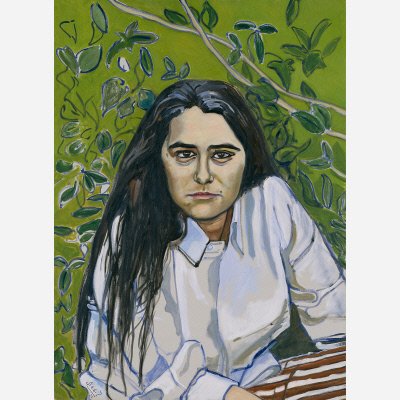
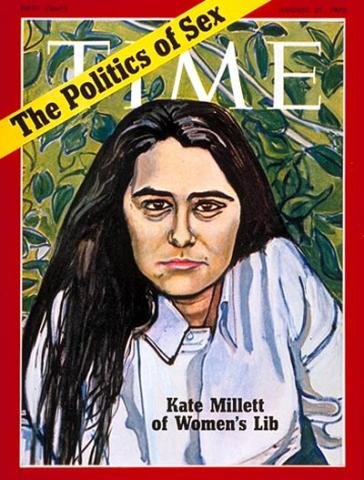
Vasily Grigorevich Perov died of tuberculosis  in Kuzminki Village which is now part of Moscow and was laid to rest at Donskoe Cemetery.  He was fifty-eight years old.