The Bellelli Family by Edgar Degas

The Bellelli Family by Edgar Degas

Today, My Daily Art Display looks at a painting by a French Impressionist painter who, to me, is synonymous with paintings and sculptures of young ballet dancers.  His name is Edgar Degas who was actually born Hilaire-Germain Edgar De Gas in 1834.  He was in the forefront of the Impressionism movement although he preferred to be labelled as a realist painter.  He worked on today’s featured painting between 1858 and 1867.  It is entitled Family Portrait or The Bellelli Portrait and is a masterpiece of Degas’ youth.  It is a deeply insightful family portrait, in which we observe four people, two adults and two children who are the family Bellelli.

Degas had a traditional École des Beaux-arts education in Paris and in 1856 travelled to Italy to continue his studies and the following year visited his grandfather, Hilaire Degas, in Naples.  He also spent time in Rome where he set about copying the work of the Renaissance Masters.  In 1858 he received an invitation from his aunt, Laura Bellelli, née De Gas, to visit her and her family in Florence and at the same time to take the opportunity to study the paintings in the city’s prestigious gallery, the Uffizi.  He jumped at the chance and so went to stay with the family.  The head of the household was Laura’s husband, Gennaro, who had been a political journalist as well as a fervent supporter and good friend of Camillo Benso, Count of Cavour, a leading figure in the movement towards Italian Unification.  When in 1854 the revolution against the Austrians failed, Gennaro was forced to flee from Italy to escape persecution by the Austrians over his participation in the failed uprising.  He first went and lived in exile in Paris but later returned to Florence.

Degas did not get on well with Gennaro and only remained at their rented house until the arrival of his cousins who had remained in Naples following the death of Degas’ grandfather, Hilaire.  Degas’ could sense the tension between Gennaro and his aunt Laura who once she confided in Degas about her relationship with her husband and her uncertain future saying:

“…my husband is “immensely disagreeable and dishonest… Living with Gennaro, whose detestable nature you know and who has no serious occupation, shall soon lead me to the grave….”

Part of the problem was that this exile in Florence separated her from her family back in Naples and to make matters worse, Laura was once again pregnant.  It is thought that the constant tension between her and her husband led to the death of the child in infancy and this tragic loss only added to the bitterness between husband and wife.  It was with this lack of domestic happiness in mind that Degas started this family portrait.

Before us we see the four members of the Bellelli family, Gennaro, his wife Laura, the sister of Degas’ father, and their daughters Giulia and Giovanna.  It is known that Degas made many sketches of the family before returning to Paris to work on the painting.

We see Laura dressed in mourning for the recent death of her father, and Degas’ grandfather, Hilaire, and in the background we can see a framed portrait of him.  Looking closely at how Degas has depicted his aunt.  We see a very dignified woman with a very stern countenance.  She stands upright as if posing for an official picture.  She coldly averts her gaze away from her husband. Her right hand rests protectively on the shoulder of her elder and favourite daughter, Giovanna.   Degas’ two young cousins are depicted with their mother, and are also dressed in mourning, in their black dresses and white pinafores. Giulia half sits on a small chair at the centre of the painting, arms akimbo, as she looks towards her father and in some ways forms a link between the two estranged adults.  Degas was very taken with his cousins describing them:

“….The elder one was in fact a little beauty. The younger one, on the other hand, was smart as can be and kind as an angel. I am painting them in mourning dress and small white aprons, which suit them very well…I would like to express a certain natural grace together with a nobility that I don’t know how to define….”

Note how Degas has positioned the husband and wife far apart in the painting, which was probably an acknowledgement of the tension between the couple and how the two had drifted apart.  There is no feeling of togetherness about the family.    The father sits in an armchair at his desk next to the fireplace, where he had been reading or writing a letter.   He has his back to us but his head is turned towards his daughter.  He appears unmoved and uncaring, showing little interest in what is going on around him.    His body is framed by a mantelpiece on which we see an ornate clock, some plates and a candlestick.  Over the mantelpiece there hangs a large mirror and in the mirror we see reflections of the room which in some way open up the space and fills it with more light.  We see reflections in the mirror of a curtained window, a chandelier and a framed painting.

It is interesting to look at how Degas has seemed to separate the husband from the rest of the family by a vertical separation formed by the leg of the table, the candlestick and the vertical side of the fireplace and mirror.   Just behind his chair, on the floor, we catch a glimpse of the family’s pet dog.  The drawing which we can see hanging on the wall behind Laura is a portrait of the recently deceased Hilaire Degas, which his grandson had drawn.  It is more than likely that Degas positioned this small picture where he did so as to give a sense of connection between the various generations of the Degas family.

Laura must have been appalled that Degas had to stay in a household, which exuded such unhappiness.   It is believed that Laura married Gennaro in desperation because her father had not been satisfied with any of her previous suitors and she was still unmarried at the “ripe old age” of 28.   She was extremely unhappy in her marriage and once shared her misgivings with Degas.   According to the American biographer and art historian, Theodore Reff, who wrote about a letter from Laura to her nephew, in his book , Degas: The Artist’s Mind .   In the letter she wrote:

 “…You must be very happy to be with your family again, instead of being in the presence of a sad face like mine and a disagreeable one like my husband’s…”

 It is thought that this family portrait was not to be a gift to the family but a work of art which he wanted to exhibit at the Paris Salon.  Whether he ever did that is uncertain but many believe he put it forward for exhibition at the Salon in 1867.  Degas kept hold of the painting until 1913 when he gave it to his art dealer, Paul Durand-Ruel, for him to sell.  In 1918 it was sold to the Musée du Luxembourg, Paris  and later the painting was moved to the newly opened Musée d’Orsay where it can now be found.

One should remember that this is not a photograph in which one can detect the mood of the sitters.  This is a painting by an artist who has the ability to paint the demeanour of his sitters in whatever way he chooses.  So this painting is how Degas views the family life of the Bellelli family.  How close it is to realism is known only by Degas and the Bellelli family.  So it is up to you  to decide whether Laura was a stern and disillusioned matriarch and whether Gennaro was the disinterested and curmudgeonly.

Lady and Gentleman on Horseback by Aelbert Cuyp

Lady and Gentleman on Horseback by Aelbert Cuyp (c.1655)

Over time I suppose one gets to like different artists and different paintings and one’s favourites constantly change.  For me however,  I have always loved the work of Aelbert Cuyp and along with Pieter Bruegel the Elder, I would have him constantly in my top five favourite artists.  I love his landscapes (see March 12th) and his riverscapes (see Feb 8th) but for My Daily Art Display today I have chosen one of his portraits, entitled Lady and Gentleman on Horseback which he painted around 1655.

Aelbert Jacobsz Cuyp was born in Dordrecht in 1620. His father was Jacob Gerritsz Cuyp, a successful portrait painter in the city and his mother was Aertken Cornelisdr van Cooten.  Aelbert was unquestionably raised up in an artistic environment with his grandfather Gerrit Cuyp being an eminent glass painter and his uncle’s step brother Benjamin Gerritsz Cuyp was a well known painter of religious, peasants and tavern scenes.  It was his father who gave Aelbert his earliest artistic tuition.  Although Dordrecht was not known for being an important artistic centre, it was a wealthy city and proud of being the oldest city and principal city of Holland and of great mercantile importance.     Aelbert used to assist his father in his studio by supplying landscape backgrounds for portrait commissions.  It is uncertain whether Cuyp had ever been an apprentice of a landscape painter, but he soon abandoned his father’s style and subject matter and turned almost exclusively to landscapes and riverscapes.  He would only occasionally paint portraits in his mature period.

Aelbert, despite branching off on his own as a painter, continued to assist his father right up to the time of his father’s death in 1652.  It is thought that the landscape works of Jan van Goyen, which were known to Cuyp, may have been instrumental in his artistic style as were the works of the Utrecht painter Jan Both.  Cuyp also followed the example of Jan van Goyen in the way he travelled throughout Holland sketching and gaining inspiration for future works.

In 1658, aged thirty eight, he married Cornelia Bosman, a wealthy widow of Johan van de Corput, a naval officer and member of an important Dordrecht family.  Cornelia had three children from her previous marriage.  Following his marriage, Cuyp appears to have painted less frequently, and stopped painting altogether years before his death due to his civic and religious responsibilities he had assumed after his marriage.  He was very wealthy and there were no financial pressures on him to produce paintings for sale.    He was listed in the register of the dead on 7 November 1691, and buried in the Augustinian Church at Dordrecht.

Today’s work of art, Lady and Gentleman on Horseback, highlights the popularity of the Dutch patrician pastime of hunting in the second half of the seventeenth century and many similar paintings exist.  This is a large oil on canvas work measuring 123cms x 172cms and depicts a man and a woman, probably husband and wife, on horseback setting off for the hunt.   There have been many names put forward as to the identity of the sitters, the most popular being that the man is Adriaen Stevensz Snouck and the lady his wife, Erkenraad Berk.  The lady’s father, Matthijs, was an important patron of Aelbert Cuyp, which may account for the prominence in the painting of his daughter in her gorgeous blue dress, who we see sitting resplendently on the back of a white horse with its brilliant red and gold saddlecloth.   The couple had just married and it could well be that Cuyp was commissioned to paint this to commemorate the happy event.

The landscape in the background is filled with light, typical of the popular Italianate style of the time.  We see a building in the background which is more than likely a fanciful evocation of an ancient fortified chateau which Cuyp may have seen on his travels.   The two hunters have their dogs with them.  There are two types of dog on this hunt, the turfters which were used to track and follow the scent of deer and greyhounds, which we see in the middle-ground of the painting, being controlled by an attendant and which run after the deer and bring them to bay.

X-Ray Image of painting

When this painting was x-rayed there were some interesting differences to the finished article.  The man originally wore a hat and his hair was much shorter and was seen lying on his shoulders.  His attire was different.  He had originally been painted in a military tunic and cape which were adorned with braids and buttons that in all likelihood were golden in colour.  It was also thought that the overall colour of the man’s clothing was a brilliant red rather than drab brown we see in today’s painting.   If we look at the woman we see that originally she wore a hat which was of a different shape to the one she is wearing now and originally the hat had feathers at the back of it.  Her dress was more loosely fitting and cascaded down the right flank of her horse.  Such changes to the painting must mean that the patrons were dissatisfied with the original composition and the fact that there was more going on in the original painting probably was viewed as being too distracting from the formal character of the double portrait and thus had to be revised.

Double Nude Portrait by Sir Stanley Spencer

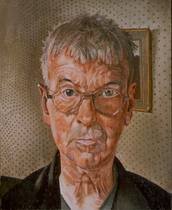
A few days ago I watched a television programme which looked at twentieth century British artists and My Daily Art Display today looks at one of the paintings which the programme highlighted.  It was a work of art by Sir Stanley Spencer, completed in 1937 and is entitled the Double Nude Portrait, sometimes known as Leg of Mutton Nude, for reasons we will look at later   I like this painting for its honesty but also because of the story behind it.  It is a story of three people: Spencer and his two wives.  In a way, it is a story about love, infatuation, lust and how bad decisions can change lives.

Stanley Spencer

Stanley Spencer was born in 1891 in Cookham, Berkshire, a small village on the River Thames, situated west of London.  Spencer loved Cookham and was to spend most of his life living in this idyllic spot.  He started his art studies at the age of seventeen when he attended the Slade School of Art, which was part of the University College, London, and where he remained for four years.  The First World War intervened and Spencer joined the Royal Army Medical Corps in 1915 and from there he transferred to the Berkshire Regiment the following year.  He witnessed the savage conflict in Macedonia but he physically survived the war although mentally scarred by the horrors he encountered whilst in active service.  Sadly, when he returned to Cookham after the war he learnt that his brother Sydney had been killed in the war three months earlier.

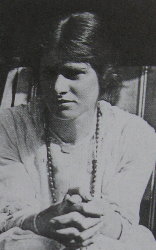
Hilda Carline

Whilst Stanley Spencer attended the Slade School of art he became friendly with a fellow student, Sydney Carline who was one of three children of the British painter and illustrator George Carline.  Sydney had two younger artistic siblings, a brother, Richard and a sister Hilda.  Although George Carline actively encouraged his two sons to become artists he never encouraged his daughter to follow the same path and she idled her time at home in Oxford.  Eventually when she was twenty-four her father arranged for her to go to a London art school in Hampstead, which was run by Percyval Tudor-Hart.  Such was her artistic progress that five years later, in 1918, aged twenty-nine, she also was admitted to the Slade School of Art.   It was around this time that Sydney met Hilda when he was invited to a Carline family meal in 1919.  Spencer was immediately smitten by the lovely Hilda and recalled that first meeting saying:

‘…As she came towards me … with the soup, I thought how extraordinary she looked … I could feel my true self in that extraordinary person….I felt she had the same mental attitude to things as I had. I saw myself in that extraordinary person. I saw life with her…..’

Within a few weeks of that first meeting Spencer wrote to Hilda asking to buy one of her paintings.  He wrote:

‘…there is something heavenly in it and the more I look at it, the more I love it..”.

There followed a quite tempestuous courtship, their relationship had its ups and downs and had to withstand many heated arguments.  Having said that, the couple spent a lot of time painting together and Spencer was very complimentary about her artistic talent.  Hilda Carline went on to exhibit many of her works at the Royal Academy and the New English Art Club, an artists’ society, a society which was founded in 1886 in reaction against the conservatism of the Royal Academy.

In 1925 Hilda Carline and Stanley Spencer married at Wangford in North Suffolk, a place which was well known to Hilda as during the First World War she was stationed there as a Land Girl.  By the end of the year Hilda had given birth to a baby girl, Shirin.  During the next few years the couple moved around southern England until January 1932, at which time Stanley could afford to buy Lindworth, a comfortable residence in the centre of Cookham, with its tennis court and large garden.  This was solely his choice as his wife would have preferred to live in central London to be close to the centre of the art world as well as being close to her widowed mother who still lived in Hampstead.  For Stanley, returning to Cookham gave him the chance to recapture the early inspirational ecstasies which he called Cookham-feelings.   Of this special feeling, and of his day in this idyllic setting, he once wrote:

“.. We swim and look at the bank over the rushes.  I swim right in the pathway of the sunlight.  I go home to breakfast thinking as I go of the beautiful wholeness of the day.  During the morning I am visited, and walk about being that visitation.  Now everything seems more definite and to put on a new meaning and freshness.  In the afternoon I set out my work and begin my picture.  I leave off at dusk, fully delighted with the spiritual labour I have done…”

So Stanley Spencer is delighted with his life and Hilda, his wife, is reasonably happy, so what could possibly go wrong with this idyllic lifestyle?   Sadly Stanley like many of us didn’t appreciate what he had.

Patricia Preece

Enter the third person in this story – Patricia Preece.  Patricia had, along with her artist friend and lesbian lover, Dorothy Hepworth, moved to the village of Cookham.  It was in 1929, when Patricia working in the local High Street café first met Stanley Spencer.   Stanley, Hilda and their daughter Shirin, who were visiting the village, came in to the café for lunch.  After a conversation about their love for art Spencer invited the two women to visit the Spencer-Carline house parties and picnics and where she was often courted by Hilda’s brother Richard Carline.  Spencer and Preece had, besides their art, another thing in common, their love of Cookham.  This was in complete contrast to Hilda’s feelings for the village, a situation which saddened her husband.

The relationship between Spencer and Hilda and Patricia Preece started off well, in fact for the first three years they were best of friends and in 1933 Stanley Spencer and Patricia went off together on an artistic assignment in Switzerland with Hilda’s blessing. Richard Carline’s devotion to Patricia ended when he belatedly realised the truth about her relationship with her live-in lover Dorothy.  Patricia now turned her attentions to Stanley Spencer, not for amorous reasons but for the reason of his extensive art world contacts which would help her and Dorothy with their artistic careers and also because she, who was comparatively poor, knew that Stanley was a wealthy man.  Patricia’s financial situation worsened when the knitwear business of the Hepworth family, from which Dorothy received great financial remuneration, went bankrupt.  By 1934, the life of the two women had reached crisis point, their Cookham home was about to be repossessed and they had no money to pay every-day bills.

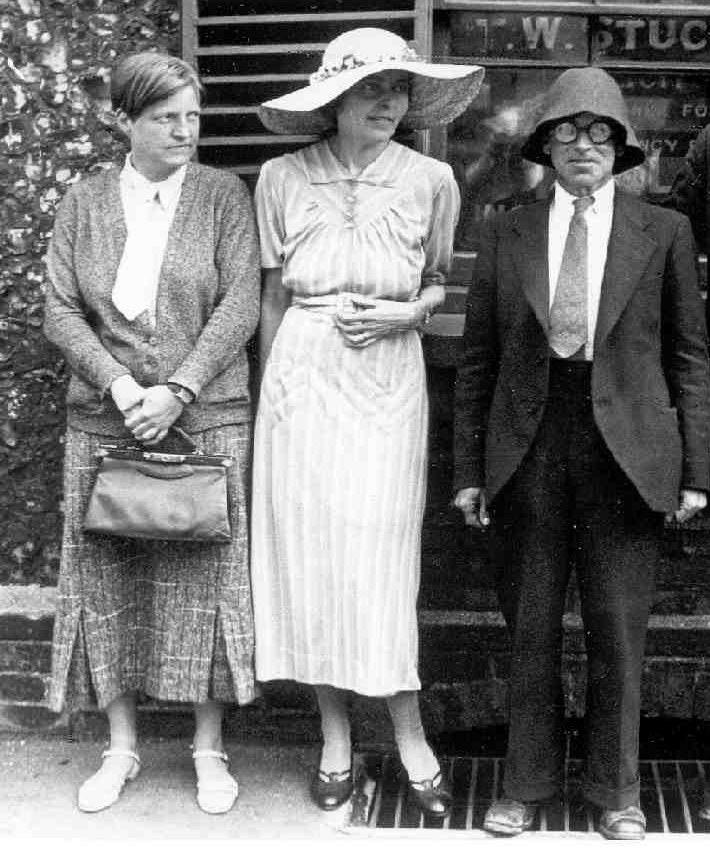
From l to r.  Hepworth, Preece and Spencer
From l. to r. Hepworth, Preece and Spencer

Stanley Spencer rode to the women’s rescue by suggesting they came to live with Hilda and him.  Hilda was having none of her husband’s rescue plan.  She also became very concerned by her husband’s closer than ever relationship with Patricia.  She took comfort by leaving Cookham for periods of time along with her daughters, going to stay with her mother.  Her absence from the family home was all that Patricia needed to get closer to Stanley.  They would visit each other’s houses even though Patricia’s lover Dorothy was not best pleased with this blossoming relationship.  Stanley and Patricia sadly had different agendas.  For Patricia, Stanley Spencer’s money and contacts were of prime importance whereas for Spencer there was a sexual desire.

Hilda initially fought to save their marriage.   However, when her brother George became seriously ill towards the end of 1932, she went to London to be with him. By 1934, she knew that she could no longer stay with her husband and moved to London.  Spencer became more and more obsessed with the flirtatious Preece, and he showered her with gifts. She persuaded him to divorce his first wife and to sign his house over to her. Patricia Preece married Spencer in 1937 and they were supposed to go on honeymoon in Cornwall.  Preece and Dorothy  went on ahead and in fact Spencer never joined them, remaining in Cookham to finish a painting.  Hilda went to Cookham and, finding a warm welcome from Spencer, spent the night with him. Spencer proposed a ménage à trois with her and Patricia but Hilda would not accept being his mistress, having once been his wife. Preece was shocked by this turn of events and refused thereafter to have sexual relations with him.

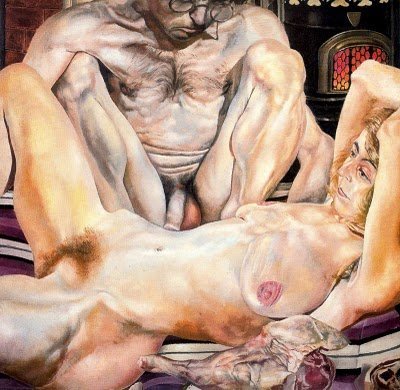
Double Nude Portrait by Sir Stanley Spencer (1937)

So that is the story of the three people and now let us look at the painting which Spencer completed in 1937, the year of his second marriage.  It is a stark and explicit painting of the artist and his second wife Patricia Preece.  It was painted at a time when Spencer realised the mistake he had made leaving his first wife Hilda and marrying this femme fatale.  Look at the forlorn depiction he gave himself as he squats before his uncaring wife.  His skin tone is a dull grey.  We are not looking at a man of great virility.  Whereas artists in the past have portrayed themselves or their sitters as virile and glamorous, we see in front of us an unidealized vision of a man.  He stares down at the breasts of his wife but he is not aroused.  Look at his flaccid penis which presumably alludes to his lack of virility and the non-consummation of his marriage.  Look how Spencer has depicted Preece.  She lays there, legs apart with a vacant look on her face.  She does not look at Spencer.  She exudes an air of disinterest.  Spencer’s depiction of his wife acknowledges her rejection of him.  There is no eye contact.  The bodies are not touching.  There is a total disconnect between husband and wife.  You know the marriage is doomed.   There are two other interesting objects in the painting.  Firstly in the foreground we have a leg of mutton (hence the alternative title of the painting) and in the background we have a lit gas fire.  We can presume that the cold leg of mutton somehow symbolises the coldness of his wife as she lies in front of him and it is in contrast to the heat from the fire which is the only thing in the painting which is going to give warmth to the artist.

Would you say the painting is erotic?  Does it have the eroticism of a Schiele painting?  To me, the painting is sexual but not erotic.  It is an honest painting and tinged with sadness.  Should we be sad for the artist or should we simply look upon him as somebody who has rightly got his just deserts?  Could things get any worse for Spencer?  Well, actually the answer to that is yes.

Preece being a gold-digger and Spencer being besotted and somewhat foolish was persuaded to sign his house and financial affairs over to Preece who never left her lover Hepworth.  It is also thought that she had some leverage over Spencer and threatened to expose him and his erotic paintings unless he agreed to the financial terms.   There was no acceptance in the 1930’s for such sexual works.  Patricia  eventually evicted Spencer from the house, and would not grant him a divorce, but continued to receive payments from him. After he was knighted in 1959, she insisted on being styled Lady Spencer and claimed a pension as his widow. Spencer’s fear of being exposed by Preece over his erotic paintings made him keep today’s painting under his bed where it remained until he died.  Spencer lived to regret leaving his first wife and constantly wrote to her and occasionally visited her and their two children.

Sir Stanley Spencer died in 1959, aged 68.  Hilda Carline died in 1950 aged  61.  Patricia Preece died in 1966 aged 72.  Wendy Hepworth died in 1978, aged 80.

Head of a Girl by Jan van Scorel

Head of a Young Girl by Jan van Scorel (c.1530-35)

As I have written in previous blogs, I am always pleased to discover a “new” artist, one that I had never come across before even though they may have been well known to many of you.  Today I have just such an artist.

I have always loved landscape paintings above all other genres of art but I am slowly coming to appreciate more and more a well executed portrait.  Today I have such a portrait.

I am always enchanted by a painting of a beautiful face such as the painting by Gerald Brockhurst, entitled Jeunesse Dorée (May 16th).  Today I have such a painting.

My Daily Art Display today is a painting by the Dutch painter Jan Van Scorel entitled simply Head of a Girl.

Jan van Sorel was born in 1495 in the small village of Schoorl, which lies 8kms north west of Alkmaar.   Like many people of the time his surname is derived from the name of his birthplace.  It is thought that he started his artistic journey of discovery in Haarlem studying under the likes of  Pieter Gerritsz van Roestraten, the Dutch Golden Age painter and Cornelis Buys also known as the Master of Alkmaar.  It is also known that around the end of 1518, when he was in his early twenties, he studied under Jan Gossaert in Utrecht and was probably through Gossaert’s recommendation that van Scorel began travelling through Europe.  He journeyed south from the Netherlands heading towards Italy, stopping off in a number of German towns including Nuremburg, where he met and stayed with Albrecht Dürer, before crossing the Alps into Austria.  Historical records show that he was registered in Venice between 1518 and 1522.  It was whilst he lived in Venice that he came across the works of Gorgione which were to have a great influence on his artistic career.

He left Venice with a group of Dutch pilgrims and set off on a pilgrimage passing through Malta, Rhodes and Cyprus before arriving at Holy Land and visiting Jerusalem and Bethlehem.  His Holy Land experiences were to feature in many of his later paintings.  Returning from the Holy Lands he headed for Rome and in 1522, aged twenty-seven,  he became the painter to the Vatican under the rule of Pope Adrian VI, the Dutch pontiff, who was a native of Utrecht, and who himself sat for a portrait by van Scorel.  He also became the curator of the vast collection of papal antiquities in the Belvedere and this allowed him to see the Vatican’s artistic treasures including the works of Michelangelo and Raphael and through this van Scorel gained great inspiration from their works of art.   In 1524 van Scorel returned to his homeland and settled in Utrecht where he remained for the rest of his life and where he continued to paint and teach art.  One of his students was the great Dutch artist Maarten van Heemskerck who is famous for his religious works and portraits.  Van Scorel died in Utrecht in 1562, aged 67.

Van Scorel was a highly educated man.  He spoke many languages and was not only a painter; he was also skilled as an engineer and architect.  His journey to Italy was to become an essential ritual for the next generation of Dutch and Flemish artists and their coming into contact with the Mannerist circles in Rome and Florence allowed them to introduce the style in their own country.  Van Scorel was considered by many as the artist who introduced High Italian Renaissance art to the Netherlands and was considered to be the leading Netherlandish Romanist of the time.  Romanism was the style of painting of a group of Netherlandish artists in the late 15th and early 16th century who began to visit Italy and started to incorporate Renaissance influences in their work. The greatest proponent of this style of art was Jan Gossaert.   The influence of Michelangelo and Raphael showed in their works in the way they would use classical imagery such as mythological scenes and nudes.

Four years after van Scorel’s death came The Iconoclasm, the Dutch name being Beeldenstorm, which literally translated means “storm of icons” and is the collective name for the destruction of catholic churches and possessions which had been raging in Europe for the past forty years but only came to Utrecht and the rest of the Netherlands between August and October 1566.   During this Protestant Beeldenstorm, hundreds of catholic churches, chapels, abbeys and cloisters in the Netherlands were totally destroyed by rampaging Protestant mobs along with all their contents such as, altars, icons,  chalices, paintings,and church books.  Unfortunately during this turbulent time of religious fanaticism, a large number of Van Scorel’s works were destroyed.  The Beeldenstorm marked the beginning of the revolution against the Spanish forces, which had occupied the Netherlnads and the Catholic Church which had asserted its authority over its people.

Unfortunately I have little to tell you about the painting itself.  Head of a Girl was painted by Jan van Scorel between 1530 and 1535 and now hangs in the Kunsthistoriches Museum in Vienna.  Before us we see just the head and neck of the girl.  She fills the painting and the plain background helps us to concentrate on her face.  There is no symbolism associated with this painting.  Nothing needs to be interpreted.  The title of the painting speaks for itself.  What you see is what you have – the face of a lovely young girl.  Her dark almond-shaped eyes avert our gaze as she peers to her left.  The light comes from her right hand side and the left side of her face is in shade.  She has a small mouth with full red lips.  Her red hair is plaited on top of her head.  I am taken by her gentle expression of contemplation.   I can almost detect a hint of sorrow in her gaze or maybe it is a look of acquiescence.  All in all, this young woman, whoever she may be, is truly beautiful and deserves to be in My Daily Art Display.

Portrait of Two Friends by Pontormo

Portrait of Two Friends by Pontormo (c.1524)

Today My Daily Art Display focuses on a double portrait by Jacopo Carrucci, the Italian Mannerist painter, who was better known simply as Pontormo, the name of the town in Italy where he was born.  I featured one of his paintings on January 14th.  The painting entitled Portrait of Two Friends was completed by Pontormo around 1524.  Today, I am not just offering you a painting but I am attempting to unravel the mystery of the painting or to be more precise, the small piece of paper which is held by one of the men depicted in the portrait.

Look closely at the painting.  It is quite a dark painting with the two men sombrely dressed, almost all in black, standing against a plain grey background.  Light coming from the left illuminates the two faces and the hands belonging to the man on the left who holds up and points to a page of writing.    This older man on the left is side-on to us but still manages to look at us.  His gaze is not as forceful as that of the younger man and he seems to be quite pensive and preoccupied with a myriad of thoughts.  The younger of the two men stands on the right and looks out at us.  His is a strangely challenging and intense gaze.

Page of writing

When you look at this painting what are the first questions you want answering?  I am assuming you want to know who the two men are but I wager, you also want to know even more about what is written on the piece of paper and what does it have to do with the two men.    Maybe you are also wondering why the artist would have portrayed one of the men pointing to the writing on the piece of painting.  What is so important about the Latin words we see on the unfolded sheet?

If you look at the writing closely you will just be able to make out that the last written word on the paper is the Latin word Amicitia, which means “friendship”.  Actually the text comes from the Roman statesman and author Marcus Tulius Cicero’s treatise on friendship entitled Laelius de Amicitia or simply Amicitia.   So now you know where it came from but what is written?  A translation of the words on the paper is:

“…In short, all other objects of desire are each, for the most part, adapted to a single end – riches for spending; influence for honour; public office for freedom for reputation; pleasures for sensual enjoyment and health for freedom from pain and full use of the bodily functions; but friendship embraces innumerable ends; turn where you will it is ever at your side; no barrier shuts it out; it is never untimely and never in the way.  Therefore we do not use the proverbial “fire and water” on more occasions than we use friendship…”

Cicero was writing about his own understanding of friendship in a way that would have meaning to people who read the book in later years.  The author considers the meaning of friendship.   He itemises which  qualities make for a good friendship and at the same time clarifies what characteristics illustrate a bad friend, and it provides examples from his personal life. Throughout the book, Cicero stresses the importance of virtue in friendship and how a friendship cannot be a true one without such a quality.   The work is written in dialogue form.   The participants in this dialogue chosen by Cicero are Gaius Laelius who was a close friend  of his and Laelius’s two sons-in-law, Gaius Fannius and Quintus Mucius Scaevola.   So now we have a translation of the Latin words on the paper and we know a little more about the book they came from but we still do not know what it has to do with our two men in the painting.  To answer that question one needs to delve into Vasari’s The Lives of the Artists in which the author writes:

“…Pontormo portrayed two of his close friends in a single picture: one was the son-in-law of Beruccio Bicchieraio and another, whose name is also unknown to me…”

That might not exactly tell us who the two men are but we do know that Pontormo at one time worked at the studios run by his tutor and master, Andrea del Sarto and that del Sarto had a friend Domenico di Jacopo who was a glassmaker by trade and because of that was nicknamed Bicchieraio (Italian for glassmaker).  Maybe it is a leap of imagination too far,  but let us remember that the Latin words on the piece of paper were from a dialogue between a father and his two sons-in-law and we now know that one of the sitters in today’s painting was a son-in-law of Becuccio Bicchierario.  Furthermore, we know he had a second son-in-law and thus we may be able to deduce that the two men looking out at us are the husbands of two of Bicchieraio’s daughters, who probably Pontormo came across through his association with his old master, Andrea del Sarto.  It is also probable that the glassmaker commissioned Pontormo to paint the two men in his daughters’ lives and by adding the piece of written paper he was drawing a parallel to Cicero’s Amicitia and the requirements for true friendship which he hoped would be in place between his daughters and their husbands..

So there you have the solution to the mystery of the painting, or do you?  Well notwithstanding my step by step reasoning for what we see in today’s work and whether you believe my reasoning.   I believe it to be a classical study and that little bit of paper, to me, adds a little spice to the offering.

The Five Children of Charles I by Sir Anthony van Dyck

The Five Children of Charles I by Sir Anthony van Dyck (1637)

Antoon van Dyck, or as we better know him, Anthony van Dyck, was born in Antwerp in 1599.   He came from a wealthy Flemish family, his father being an affluent silk merchant, and whether it was because of his prosperous upbringing or his inherent artistic talent, even at a young age it was recorded that he was, besides being very gifted, an extremely precocious boy.  He studied art under Hendrick van Balen, the Flemish Baroque painter, who also tutored up and coming artists such as Frans Snyders and Jan and Peter Bruegel the Younger.  He started producing quality works of art at the age of fifteen and three years later was accepted into the Guild of St Luke, the Antwerp painter’s guild as a free master.   At the age of eighteen he became chief assistant to the great Rubens whom he stayed with for three years during which time he continued the output of his own paintings and slowly but surely enhanced his own reputation.  Rubens said on a number of occasions that van Dyck was the most talented artist he had ever trained.

In 1620 he was invited to England to work for the then monarch King James I of England (King James VI of Scotland), who had been told that the young van Dyck was in the employment of the master, Peter Paul Rubens, and that the young man’s talent and works were exceptional and were almost on par with the great master himself.  During his stay in London, van Dyck came across works of Titian which were part of the art collection of the Earl of Arundel, one of the king’s courtiers.  Van Dyck remained in London for six months before returning home.  At the end of 1621 he moved to Italy and stayed there for six years studying the works of the Italian masters whilst visiting many of the Italian art capitals such as Rome and Genoa. It was whilst in Italy that van Dyck developed and perfected his skill as a portraitist.

In 1627 van Dyck once again returned to his birthplace, Antwerp but was only to stay there for one year before accepting an invitation to return to London by the new English monarch, Charles I, who had acceded to the throne two years earlier.   King Charles was one of the greatest art collectors of all the English monarchs amassing an unbelievable collection of works of the great masters, some of which had been purchased and brought to England by his agents with the help of van Dyck,  who also sent the monarch some of his own paintings.  Charles loved art and would invite the artists such as Gentileschi and Rubens to his court where he would commission new works.

In 1632 van Dyck returned to London where he joined the royal court, received a house as well as a country retreat, a monetary retainer and was knighted.  He soon became the favourite painter of King Charles and his wife Queen Henrietta Maria and over the years carried out numerous portraits of the couple and their family and it is around this time, actually 1637, that van Dyck completed today’s featured painting.

My Daily Art Display today is Sir Anthony van Dycks’ painting entitled The Five Eldest Children of Charles I.    When one looks at a painting of a male sitter one often describes it as a handsome and debonair portrayal of a man and if the sitter is a female, one often terms it as a beautiful and attractive portrayal of the lady.  However, the portraits of children and animals can often be termed differently and one of the favourite descriptions is “cute”, and this certainly sums up today’s portrayal of the monarch’s children and their large pet dog.

Queen Henrietta Maria, a catholic, was the youngest daughter of King Henry IV of France and she gave birth to nine children, two of which were stillborn.  At the time of van Dyck’s painting the royal couple had five children, Charles, Mary, James, Elizabeth and Anne.  Today’s painting is hailed as one of the greatest group portraits of all time.  The children are portrayed as children and not as was often the norm, tiny adults.   We have in the centre with his arm resting on the family pet mastiff, Charles who would become King Charles II.   Van Dyck has surprisingly afforded him an unusual air of authority for one so young.  He looks out at us with a thoughtful countenance.  The very large dog sitting calmly by his side adds even more gravitas to the young boy, the future King Charles II.

To his right we see two children standing side on to us.  Their look is somewhat shy and demure as they gaze out at us. The taller of the two on the far left is the six year old Mary, Princess Royal, whilst although looking like her little sister, is in fact her younger brother James who would later become King James II of England.

Elizabeth and Anne

On the opposite side of the painting we see a young girl cradling a baby, with the small spaniel at her feet.  This is the two year old Princess Elizabeth and the baby, who had been born that year, is Princess Anne.   The round, somewhat chubby rosy cheeks of the pair, contrasts well with their linen white caps and the string of pearls around Elizabeth’s neck.  Tragically neither Elizabeth nor Anne lived long.   Elizabeth, after the fall from power of her father during the two Civil Wars, spent her last eight years held as a prisoner of Parliament.  She died of tuberculosis aged 14, a year after her father’s execution.  Her mother always maintained that she had died of a broken heart caused by the untimely death of her father.    Baby Anne died aged 3, and like her sister, the cause of death was tuberculosis.

Above the seated girl we have an exquisite still life behind which we see a far-off landscape which was often a trademark of van Dyck’s portraits.    There is a tranquil elegance about this painting.  The children seem contented, even happy and thus it is sad to realise that twelve years on from the completion of this family portrait, their happy family life would be shattered with the premature death of Elizabeth and the execution for treason of their father, Charles I.

So what do you think of the painting?   The nineteenth-century Scottish portrait painter Sir David Wilkie was in no doubt with regards its quality describing it thus:

 “……the simplicity of inexperience shows them in most engaging contrast with the power of their rank and station, and like the infantas of Velasquez, unite all the demure stateliness of the court, with the perfect artlessness of childhood….”

Sir Joseph Banks by Benjamin West

Sir Joseph Banks by Benjamin West (1773)

My Daily Art Display today features two celebrated men, one the American artist, Benjamin West and the other his English sitter, the naturalist and botanist Sir Joseph Banks.

Benjamin West was born in Springfield Pennsylvania in 1738.  He came from a large family, being the tenth child.  His father was an innkeeper and ran different inns during Benjamin’s early life.  Being one of such a large family he had to look after himself a lot of the time, had little formal education and as far as his art was concerned he told his biographer, John Galt,  that he was taught how to make paint by the native Indians.  During his teenage years he began to paint, mainly portraits.  The provost of the College of Philadelphia, Doctor William Smith saw one of his works and was so impressed, he offered the twenty year old West an education which up to then had been sadly lacking but maybe more importantly he offered West the chance to meet members of the affluent society of Pennsylvania and in some cases, ones with political connections.

In 1760 these newly-found connections were to prove fortuitous as with the help of financial support from William Allen, a very wealthy merchant and mayor of Philadelphia, he travelled to Italy where he spent time copying the works of the Italian Masters such as Titian and Raphael.  Three years later he moved from Italy to England where he established himself as a portrait painter.  His works were well received and he soon built up a rich cliental including the prestigious patronage of the monarch, King George III, who appointed West the court’s historical painter.  He retained the monarch’s patronage until the turn of the century.   Whilst in England he met the great English portraitist, Sir Joshua Reynolds, and together, with the help of the monarch, founded the Royal Academy of Arts in 1768.  Reynolds was made the inaugural president and West became the second president of the Academy in 1792, a position he held until 1802.  Four years later he became Academy president again and retained that position until his death in 1820 aged 82.

The sitter for today’s portrait was Sir Joseph Banks.  Born in 1773 in London, Banks was to become the outstanding botanist of his generation.   The son of a Lincolnshire country squire and Member of Parliament, he unlike Benjamin West, received the best education possible passing through the finest educational establishments such as Eton, Harrow and Christ College, Oxford.  On the death of his father, Joseph Banks inherited the family estate of Revesby Abbey in Lincolnshire.  He had always retained his interest in science and botany and soon he began to move in the top scientific circles of London.  In 1776 he became a member of the Royal Society of London for Improving Natural Knowledge, better known simply as the Royal Society.   He was to hold the position of president of the Society from 1778 until his death.  He became a scientific adviser to King George III and through this managed to persuade the monarch to fund expeditions to the “new territories”.  In 1768 Banks was made the leading scientist on Captain James Cook’s first expedition which lasted three years, journeying to the southern hemisphere on HMS Endeavour.  On his return home from this epic voyage he was received by the public as a “returning hero” and many portraits were made of the “man of the moment” including one by Reynolds and one by today’s featured artist.

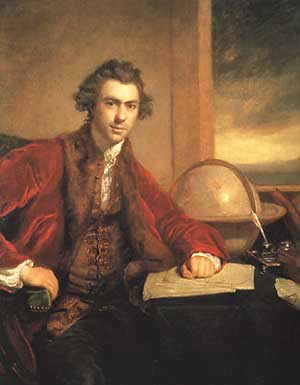
Joseph Banks by Sir Joshua Reynolds (1773)

My Daily Art Display’s featured painting is the portrait painted of our hero by Benjamin West in 1773, simply entitled, Sir Joseph Banks.  His depiction of Banks differed somewhat from the Reynold’s portrait, which was completed the same year.  In Reynolds’ portrait we see the well-groomed and charming explorer and botanist smiling at us.  He is completely at ease, sitting forward in his armchair, with his arm resting on a table strewn with pages of a letter, quill pen and ink stand and a freestanding globe.

Benjamin West’s work is a full length portrait of Banks standing amongst a selection of artefacts that the explorer had brought back home.  He is wrapped in a Tahitian cape and by him is a native headdress, a paddle from a canoe and a carved fighting staff.  If we look down at his feet we can a Polynesian adze, which was a tool used for carving and smoothing wood and by it are pages of a notebook which was a reference to the myriad of notes Banks made during his expedition with regards to all the flora and fauna he had come across during the three-year journey of discovery around the South Pacific territories.  The painting with its accoutrements even has a hint of the American Wild West, which of course the artist, West, would have seen in paintings back home.  There is also a classical element to this picture with its column and tied-back curtain in the background.  West may have picked up this type of detail when he was studying works of art during his Italian sojourn.

So there you have it, two men of completely differing backgrounds, upbringing and education, Benjamin West the artist and Joseph Banks the explorer, both of whom went on to head up prestigious London societies, and were connected through this painting and their dealings with King George III of England.

Portrait of Andrea Odoni by Lorenzo Lotto

Portrait of Andrea Odoni by Lorenzo Lotto (1527)

The featured artist in My Daily Art Display today is Lorenzo Lotto. He was born in Venice around 1480 and although little is known of his early life we but we know that he was greatly influenced by the works of Bellini. He was an artist of the High Renaissance period but there are signs in his work, such as unusual posing of his figures and some distortions in their body shape that he was a follower of the transitional stage leading to the Mannerism genre of art.

One knows that Lotto moved from Venice to Treviso around 1503. This move of his may have been due to the intense artistic competition in Venice with the likes of Giorgione and Titian and he may have believed he would fare better in the affluent town of Treviso. It was while here that he met the bishop, Bernardino de’ Rossi, who became his patron. After a few years spent here he moved to the Marche region of Italy and eventually ended up in Rome in 1508 where the pope, Julius II, commissioned some of his work. He carried on his nomadic lifestyle, travelling around Italy before finally returning to Venice in 1525. Here he took up residence at the Dominican monastery but his stay was cut short after a conflict with one of the brethren. By 1554 he was partially blind and he became a lay brother at a monastery at Loreto where he eventually died.

This nomadic and restless lifestyle of his mirrored his temperament which was said to be an existence of constant anxiety and change which made him a difficult person to get on with. His painting styles differed enormously. He was a keen observer of people. He is probably best known for his portraiture but in most of his portraits he conveyed a mood of psychological turmoil which was probably a mirror-image of his own mindset. His works of art often focused on religious works and he completed many altarpieces.

My Daily Art Display featured painting of the day is Lotto’s work entitled Portrait of Andrea Odoni which he completed in 1527 just two years after returning to Venice after his long self-exile from the city. .   The portrait has fittingly been described as one of the finest and most impressive of all of Lotto’s portraits and a calculated challenge to Titian’s supremacy in the field. So who was Andrea Odoni?    Odoni was an extremely successful Venetian merchant and collector of antiquities who lived in a grand house in Fondamenta del Gaffero in the district of Santa Croce.  The son of a wealthy recent Milanese immigrant to the city, Andrea Odoni was an important member of Venetian society.   He built upon the collection which he had inherited from his uncle, Francesco Zio, to become a renowned collector of paintings, sculpture, antique vases, coins, gems and natural history specimens. This portrait by Lotto was hung in Odoni’s bedroom alongside religious and profane paintings: a reclining nude by Savoldo, and paintings by Palma Vecchio and Titian.  His residence also contained an unusual combination of ancient and modern statues, with ‘mutilated and lacerated antique marble heads and other figures’.    The poet and satirist, Pietro Aretino, once wrote to Odoni in which he said that he believed Odoni had managed to re-create Rome in Venice.  However there was a subtle rebuke for the collector, as then Aretino went on to describe the splendours of the house in a tone that suggests it overstepped the boundaries of Venetian decorum.

In some ways it is an unusual portrait as it is in “landscape” orientation rather than the usual “portrait” orientation but this was to enable the artist to include some of Odoni’s collected antiquities.  As in a number of portraits the sitter likes to be depicted in a way that it will inform the viewers a little about himself or herself.  Where sitters want to highlight their wealth, the painting is adorned with the most sumptuous and expensive room decorations and the sitter is bedecked in the most magnificent fineries.  Odoni wanted people to look at his portrait and realise his passion for collecting antiquities.  However, it is amusing to read that with the exception of the bust of Hadrian, none of the antiques on show actually belonged to him and were probably plaster cast versions of the originals and were probably owned by Lotto.

Look at Odoni’s hand gestures.   His left hand clasps a small gold cross and presses it against his heart.  Is this simply a gesture signifying his heartfelt sincerity?  Is he merely indicating to us that he is an honest God-fearing man and that from his mouth will only come truthful utterings?  Maybe there is another reason behind the portrayal of him touching the cross to his heart.  It has been suggested that for Odoni, the true religion of Christianity, represented by the golden cross, will always take primacy over Nature and the pagan gods of antiquity, as indicated by the statuette of Diana and the busts of the other classical figures such as Hercules and Venus.

Look how his full beard and hair form a frame around his face.  Is it purely coincidental that the marble bust of the Emperor Hadrian we see in the foreground, peering from beneath the green table cloth, has a similar countenance?   Did Odoni ask the artist Lotto to position the bust in a prominent position in the painting so that we would make this comparison?  On the table we see a book, some medals and some coins.

In our sitters right hand he lovingly cradles the statuette of the Roman goddess Diana (the Greek goddess Artemis) of Ephesus with her body covered with breasts symbolising fertility.  She is the fertility goddess from classical mythology.  Is it meant as an offering to us?  What is the meaning of his gesture?

Odoni, sitting before us in his dark robe trimmed with fur in some way looks like a ringmaster at a circus with all the busts and statues surrounding him like his performers.   He appears as somebody very comfortable with his surroundings and maybe he is challenging us to “make what we will” of everything that we see before us.   In some ways this complex portrait has a sombre feel to it and by Odoni’s expression I am not convinced, despite his wealth, that we are looking at a particularly happy and contented man.

Mary Neville, Baroness Dacre by Hans Eworth

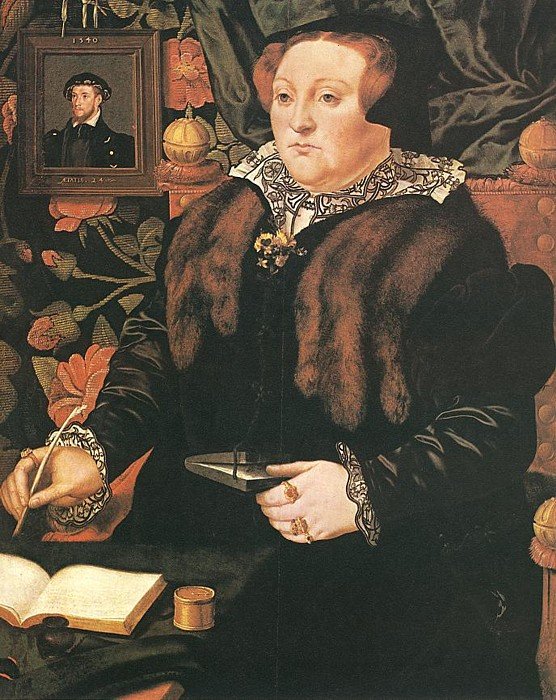
Mary Neville, Baroness Dacre by Hans Eworth (c.1555-1558)

My Daily Art Display today is a story of three people, the artist the woman who sat for her portrait and the man shown in a picture within the painting.  The featured artist today is the sixteenth century Flemish painter, Hans Eworth (Ewouts), who spent most of his artistic life in England.  The lady in the painting is Mary Fiennes, Baroness Dacre and the young man in a picture within the picture is her late husband, Thomas Fiennes, 9th Baron of Dacre.

Before I tell you the story of the painting let me linger awhile and talk about the artist himself.  Hans Eworth was born in or around Antwerp.  His date of birth is believed to be between 1520 and 1525.  Little is known about his early upbringing but the English art historian and one-time director of the National Portrait Gallery in London, Sir Lionel Cust, in his 1913 essays to the Walpole Society, draws a connection between Hans Eworth and a “Jan Euworts” who was known to have been a member of the Guild of St Luke in Antwerp in 1540.  In Karen Hearn’s short biography of Eworth published in 2000 and  according to Julius Friedrich’s in his book published in 1891, De Secte Der Loisten of Antwerpsche Libertijnen, 1525-1545, a Janne Ewouts and Claes Ewouts, painter and mercer (dealer in textile fabrics and fine cloths) were “expelled” from catholic Antwerp for heresy in the summer of 1544.  They lost their homes and property but were very lucky not to have lost their lives as the punishment in those days for heresy was ane extremely painful execution.

Eworth, like thousands of others fleeing Flanders because of its religious persecution, settled in London.   He continued painting and it is believed that one of his most important patrons was Queen Mary I (Mary Tudor) of whom he did many portraits of the monarch between 1554, the year after she was crowned queen and the year of her death 1558.  He was a prolific portrait painter but only about thirty of his paintings survive.  He was also known for his decorative painting and set designs for masques and pageants at the court of Queen Mary and her successor, Queen Elizabeth I.  He continued his artistic work until his death in London in 1574

The painting featured today is his portrait painting which he completed around 1558, entitled Mary Neville, Baroness Dacre.    She was the daughter of George Nevill, 5th Baron Beragvenny and his third wife Mary.  She married the English aristocrat Thomas Fiennes, and on his father’s death in 1528 became the next in line for his grandfather’s title who was the 8th Baron of Dacre.  He eventually became 9th Baron of Dacre in 1534 on the death of his grandfather and as well as the title,  inherited the family home of Hestmonceux Castle in Sussex.  The couple were married two years later in 1536 and went on to have three children, the eldest, Thomas who died of the plague at the age of 15, Gregory and Margaret.

That is not the end of thestory of their lives but let us now look at Eworth’s portrait of Mary and by doing so we will discover what happened to the family.  In front of us we have Mary sitting up straight in a richly upholstered chair with its red velvet back and arms.  This alone was symbolic of the sitter’s wealth.  She is dressed in a black gown which has a beaver collar and puffed sleeves.  Her dress is of satin and the collar and cuffs of her chemise are ornately embroidered.   It is Blackwork Embroidery, which was popular during the Tudor times.  It was often termed “Spanish work” because it was thought that Henry VIII’s first wife, Catherine of Aragon brought many such embroidered works with her from Spain.

In her right hand she holds a quill pen hovering over the pages of a notebook which lies upon a green-baize covered table.  In her left hand we see a partly opened notebook in which we can see some hand-written words.  On the table we see other implements used in those days for writing, the pot of ink and an ornate golden sand-shaker with a clock motif.   The Tudors dealt with a large black wet inky mistake soaking its way into a thick layer of paper by sprinkling clean sand onto the text to soak up the ink. The inky sand could then be flicked away from the paper, and any residual stain removed by gently scraping it off with a knife.

If you look at the flowers at her breast you will note they are a mix of forget-me-nots, rosemary, violas and pinks.  Forget-me-nots symbolise true love and memories and Rosemary which is often included in funeral wreaths symbolising remembrance and in wedding bouquets as a symbol for fidelity. It’s said that if you touch a lover with a sprig of rosemary, they’ll be faithful!    Violas often symbolise melancholy and pinks are symbolic of marriage.

So why the use of these symbols in the portrait by the artist?  Maybe the answer lies to the background to the left where we see, against a floral tapestry, a framed portrait of her late husband.  The inscription on the top part of the frame is “1540”, the date of the portrait and inscribed on the bottom “ÆTATIS. 2 4”,  which means “at the age of 24”.   So, what does it all mean?  Why did she want the picture of her young husband included in the portrait?  Why was he not with her?

The answer is simple but sad.  On 30 April 1541 Dacre along with a party of gentlemen including his brother-in-law went to poach on the neighbouring estate lands of Sir Nicholas Pelham of Laughton.    During the “adventure” the party were discovered by some of the servants of Sir Nicholas, one of whom was the gamekeeper, John Busbrig.   The meeting of adversaries went from verbal abuse to a fight during which Busbrig was fatally wounded and subsequently Dacre, although he did not strike the fatal blow and in fact was in another part of the estate at the time was held responsible for the death and along with several others was charged with murder.   Dacre originally entered a plea of not guilty but was later persuaded to change it to guilty and throw himself upon the King’s mercy in the hope of a reprieve.  However his strategy failed and he was hanged at Tyburn on 29 June 1541.

An account of the execution was reported in the Hall’s Chronicle, a periodical of the time, simply stating:-

“…….he was led on foot between the two sheriffs of London from the Tower through the city to Tyburn where he was strangled as common murderers are and his body buried in the church of St Sepulchre ….”.

Not only did her husband lose his life but the family lost their hereditary title and had their lands forfeited which left them destitute.  Despite numerous protestations from his widow it was not until ten years later in 1558 when Elizabeth I came to the throne that the hereditary title was restored to the family and Gregory, her second son was made 10th Baron Dacre.

Maybe the sumptuousness of her clothes and the splendour of the backdrop to this portrait suggest that almost ten years have passed since the execution of her husband and the forfeiture of the property and maybe life had become better for the widow.  In fact, in the same year her husband was executed, the widow managed to obtain an Act of Parliament in order to provide a dower for her from out of her late husband's estates.  A dower was a provision accorded by law to a wife for her support in the event that she should survive her husband (i.e., become a widow).  In her case the dower handed down to her by the Act of Parliament stated:

“.....the said Mary for the relief of her and her children &c is contented & pleased that it be enacted by His Highnes with the assent of this present parliament, & by authority of the same, that the said Mary Fynes shall possess & enjoy for the term of her natural life, from Michaelmas last past, the Manors of Burham & Codham co. Kent-of Fromquinton & Belchwell co. Dorset, of Nashall co. Essex, & all their rights & privileges &c. the said attainder....”

Courtesy of http://www.tudorplace.com.ar/


Mary Neville married twice more and had six children by her third husband.

Portraits of Johann the Steadfast and Johann Friedrich the Magnanimous by Lucas Cranach the Elder

Portraits of Johann the Steadfast and Johann Friedrich the Magnanimous by Lucas Cranach the Elder (1509)

My Daily Art Display featured artist today is the German Renaissance painter and designer of woodcuts, Lucas Cranach the Elder.  He was born in Kronach a small German town in Upper Franconia, Bavaria in 1472.  His adopted surname was a derivation of the name of his birthplace, which was a quite usual practice at the time.  His father who had the unusual name of Hans Maler, the surname being the German word for “painter”.   In those days it was also not uncommon for a person’s surname to have no connection with ancestors but to do with the person’s profession.  Lucas Cranach’s father was indeed an artist, hence his surname.  Little is known of Cranach’s early life or fledgling artistic training except that one of his tutor commented that Cranach had displayed his artistic talents whilst a teenager.   It is recorded that Cranach arrived in Vienna in 1501 and stayed until 1504.  It was during this period that he completed many of his earliest works such as The Crucifixion (1503) and Portrait Doctor Johann Stephan Reuss’s (1503).  These and his other artistic works captured the attention of Duke Friedrich III, Elector of Saxony, known as Frederick the Wise who, in 1505, employed Cranach as a court painter at the palace of Wittenberg and although he took on private commissions, Cranach remained as court painter almost to the end of his life.

In 1508 Cranach married Barbara Brengbier and they were to have six children, four daughters and two sons.  The most famous of the children was Lucas the Younger who went on to become a well known artist in his own right.  At the court Cranach, along with other artists such as Dürer and Burgkmair painted many altarpieces for the castle church.  In 1509 Cranach temporarily left the court at Wittenberg and went to the Netherlands and painted the portrait of Emperor Maximilian I and his eight year old young grandson Charles who would later become Emperor Charles V.

It is interesting to note that up until this time Lucas Cranach the Elder always signed his works with his initials “L C” but in 1508 the Elector of Saxony, Frederick the Wise knighted him and awarded him the coat of arms of a winged serpent as an emblem which, from that time on, superseded or was added to his initials on his paintings.

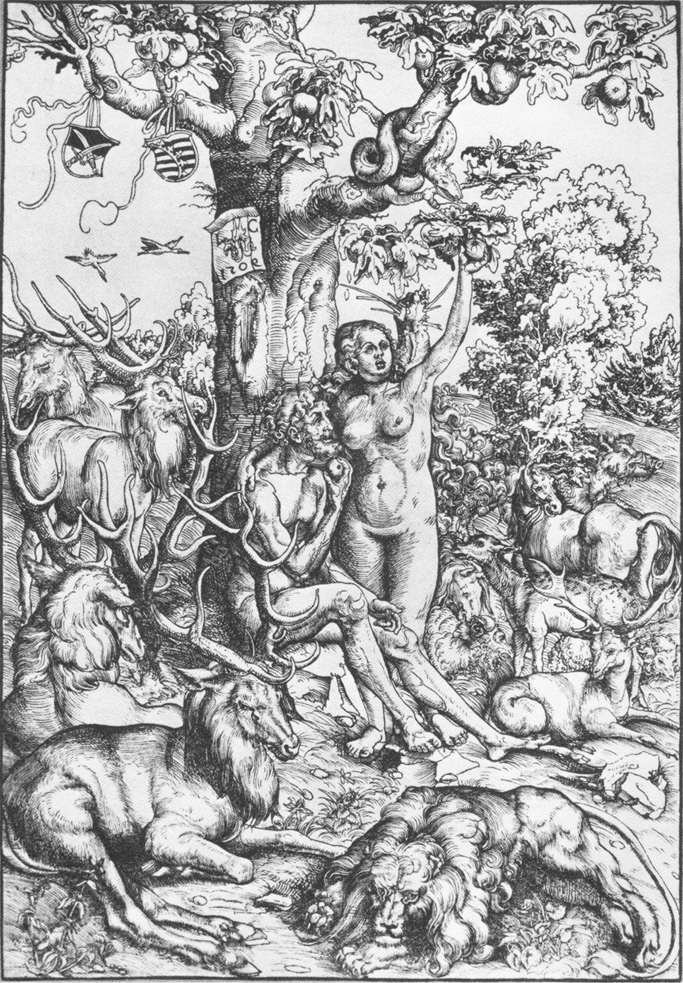
Adam and Eve - woodcarving by Cranach

An example of this can be seen in his woodcarving of Adam and Eve which he completed in 1509.

Signature with Serpent logo

Look at the note on the tree showing Cranach’s initials as well as the winged serpent.  The coats of arms hanging from the branch to the left of the trunk are those of the Elector of Saxony

Cranach was a friend of Martin Luther, and his art expresses much of the character and emotion of the German Reformation. Cranach, through many of his paintings and engravings, championed the Protestant cause. His portraits of Protestant leaders, including the many portraits of Luther and Duke Henry of Saxony are solemn and thoughtful and painstakingly drawn.   At this time Cranach had a large workshop and worked with great speed.  His output of paintings and woodcuts was immense.

He died in Weimar, in 1553 aged 81.   Cranach’s sons, Lucas and were both artists, but the only one to achieve distinction was Lucas Cranach the Younger, who was his father’s pupil and often his assistant. His oldest son Hans Cranach was also a promising artist but died prematurely.

Johann the Steadfast

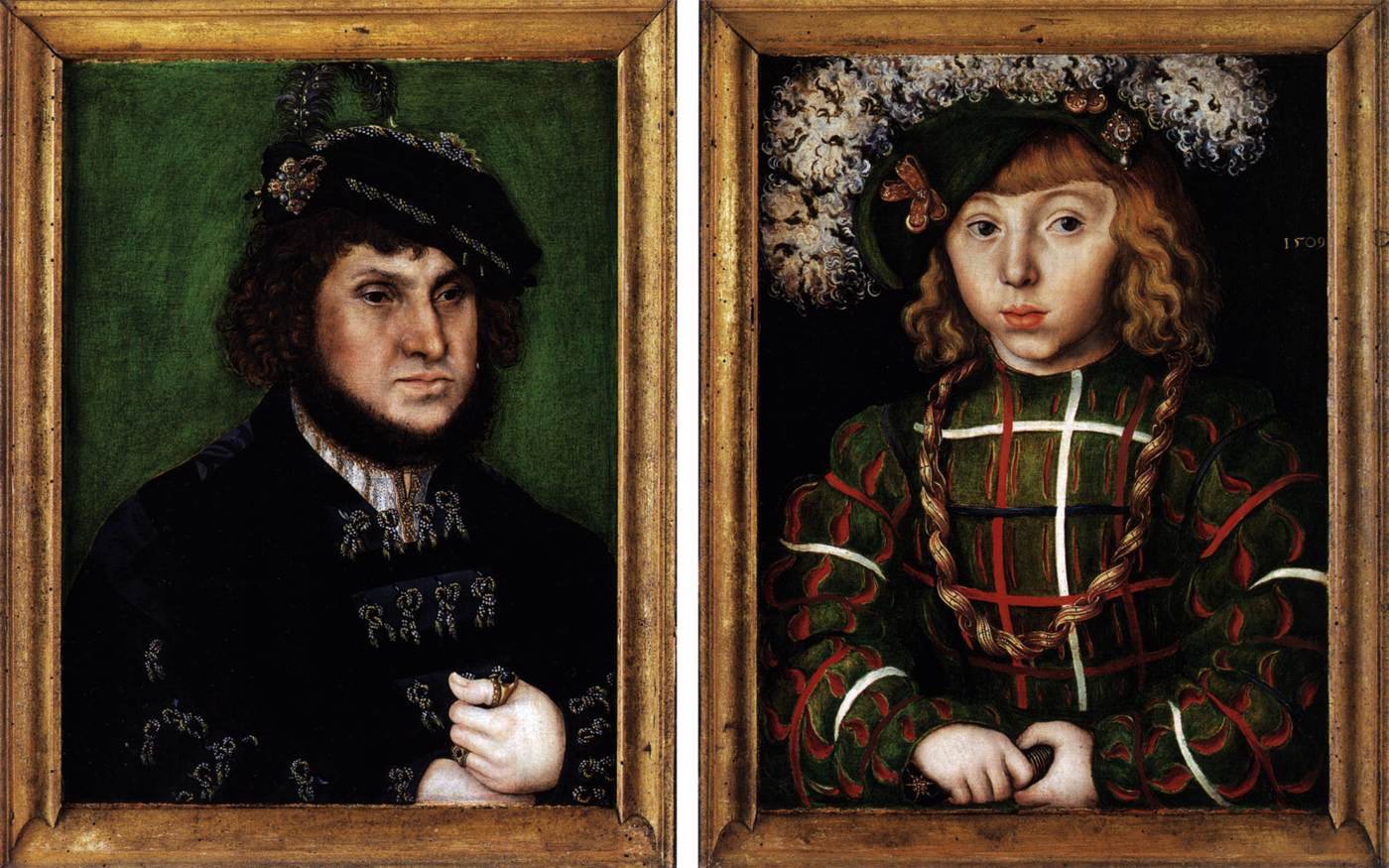
My Daily Art Display featured painting today is a diptych, which is a picture or other work of art consisting of two equal-sized parts, facing one another like the pages of a book.  It is entitled Portraits of Johann the Steadfast and Johann Friedrich the Magnanimous which he painted in 1509.  They are usually small in size and hinged together.  This one was painted by Lucas Cranach the Elder in 1531.   It consists of two portraits.  On the left hand panel of the diptych we have a portrait of Johann the Steadfast who was the Elector of Saxony following the death of Frederick the Wise in 1525.  On the right hand side we have a portrait of Johann Friedrich the Magnanimous the eldest son of Johann the Steadfast and who became Elector of Saxony on the death of his father in 1533.  Cranach was the court painter during the time both of these men were in power.

Looking at the left hand portrait of Johann the Steadfast we see him against a dark green background wearing a black coat with some sort of grey patterning.  On his head he has a black hat highlighted with small pearl ornaments.

Johann Friedrich the Magnanimous

On the right hand panel we see the portrait of the six-year old, fair-haired boy, Johann Friedrich.  Note how Cranach has reversed the colours in comparison to the left hand panel.  Where we had a man in black with a green background, in this right hand panel, we have the young lad dressed in a green doublet with bands of red and white in what almost looks like a “tartan pattern” against a black background.  The “slashed doublet” which was very fashionable in the first half of the 16th century reveals the red of the shirt which he wears underneath it.  He too wears a hat, green in colour to match the doublet, on which are ornamental brooches and atop of which are multi-coloured ostrich plumes.  In his hands we see him clutching hold of the golden pommel of a sword with his still-chubby little fingers.

It is unusual to see two men in a diptych which would normally hold portraits of a man and his wife.  However there is some degree of poignancy about this coupling of father and son as the father lost his wife a couple of weeks after she gave birth to the young boy so we are looking at a widowed father and his motherless son.