Mark (Max) Gertler. Part 2.

Mark Gertler

Gertler had now settled into life at the Slade art academy.  One of his fellow students, C.R.W Nevinson  summed up life at the Slade when he and Gertler were students there saying it was full with a crowd of men such as I have never seen before or since..  As far as his thoughts on Gertler, he once wrote that Max was the genius of the place… and the most serious, single-minded artist he had ever come across.   Gertler was considered the best draughtsman to study at the Slade since Augustus John. Another student, Paul Nash, said that Gertler riding high “upon the crest of the wave”.

Still life with a Bottle of Benedictine by Mark Gertler

In 1910 a new seventeen-year-old student arrived at the Slade Academy of Art who was to add a little “spice” to the lives of Gertler and some of the other students.   Dora de Houghton Carrington, who after joing the Slade, became known simply by her surname, Carrington, as she considered Dora to be vulgar and sentimental. Gertler and C.R.W. Nevinson both became closely attached to Carrington and according to Michael J. K. Walsh 2002 biography, C. R. W. Nevinson: The Cult of Violence, he wrote about that impossible situation:

“…What he (Nevinson) was not aware of was that Carrington was also conversing, writing and meeting with Gertler in a similar fashion, and the latter was beginning to want to rid himself of competition for her affections. For Gertler the friendship would be complicated by sexual frustration while Carrington had no particular desire to become romantically involved with either man…”

This was unfortunate as Gertler and Nevinson had become great friends.  Gertler wrote to his sponsor, William Rothenstein saying:

“…My chief friend and pal is young Nevinson, a very, very nice chap. I am awfully fond of him. I am so happy when I am out with him. He invites me down to dinners and then we go on Hampstead Heath talking of the future…”

In Michael J. K. Walsh’s biography of Nevinson, Hanging a Rebel: The Life of C.R.W. Nevinson, he wrote:

“…Together they studied at the British Museum, met in the Café Royal, dined at the Nevinson household, went on short holidays and discussed art at length. Independently of each other too, they wrote of the value of their friendship and of the mutual respect they held for each other as artists…”

C.R.W. Nevinson, himself, wrote of his friendship with Gertler in his 1937 autobiography, Paint and Prejudice:

 “…I am proud and glad to say that both my parents were extremely fond of him.” Henry Nevinson recalled: “Gertler came to supper, very successful, with admirable naive stories of his behaviour in rich houses and at a dinner given him by a portrait club, how he asked to begin because he was hungry…”

Gertler pursued Carrington for a number of years, and they had a brief sexual relationship during the years of the First World War.

Portrait of a Girl ( Gertler’s Sister, Sophie) by Mark Gertler (1908-1911)

As is the case for many young aspiring portrait artists, Gertler, before he painted commissioned works, began by painting portraits of family members. One of his most frequent depictions was of his mother.

The Artist’s Mother by Mark Gertler (1913)

In this painting of his mother Golda Gertler has depicted her as a peasant with huge, working hands. He called the portrait ‘barbaric and symbolic’, explaining that it was meant to show ‘suffering and a life that has known hardship’.

The Artist’s Mother by Mark Gertler (1911)

Gertler once wrote rather disparagingly about his sitter:

“… “I am painting a portrait of my mother. She sits bent on a chair, deep in thought. Her large hands are lying heavily and wearily in her lap. The whole suggests suffering and a life that has known hardship. It is barbaric and symbolic. Where is the prettiness! Where! Where! …”

Portrait of the Artist’s Mother by Max Gertler (1924)

This was the final portrait Gertler’s mother.  In this work there is no hint of sentimentality or the personality which came to the fore in his earlier portraits of her.  It is a depiction of dominance and authority.  The art critics of the time highly praised it.  Gertler loved the finished portrait and whether he was concerned that it would be bought and taken from him, it made him put a price of £200 on it in the hope that this would put off buyers.  It didn’t work as it was bought for the full asking price, which was the highest price any of his works fetched during his lifetime !

Portrait of the Artist’s Family, a Playful Scene by Mark Gertler (1911)

Gertler completed many more paintings of his family.  One such was his Portrait of the Artist’s Family, a Playful Scene which he completed in 1911. It depicts a room in the  family’s Spital Square house with his two brothers Harry and Jack watching their sister tickling their mother who has fallen asleep in her chair.

Still Life with Bowl, Spoon and Apples by Mark Gertler (1913)

Mark Gertler, like many young artists, was interested in new art trends, some of which he may be able to experiment with.   In November 1910 an influential exhibition opened at London’s Grafton Rooms entitled Manet and the Post-Impressionists curated by Roger Fry, which introduced the work of artists such as Cézanne, Gauguin, Van Gogh, and Picasso, to English art lovers.  Despite some derogative remarks from well-known critics, Gertler found the exhibition amazing and began to experiment with brighter colours and flatter styles.  In 1913 Gertler completed his painting, Still Life with Bowl, Spoon and Apples which displayed the influence of Cezanne

The Pond by Mark Gertler (1917)

The influence of Cézanne on his work, can also be seen in his 1917 work The Pond.  In this depiction we see the branch of a tree extends like an arm pointing to the silvery pond which can be seen in the mid-distance, created from a patchwork of overlaid paint strokes. Gertler uses an abstract arrangement of colours to capture the lush greenness of this quiet spot, emulating the dappled effect of light and colour reflecting on the still surface of the pond.  He has created a sense of depth in the way he has built up his painting with blocks of colour, which creates the impression of standing beneath the tree, overlooking the scene. 

Garsington Manor and Gardens

The painting was completed by Gertler whilst he was staying at Garsington Manor, the Oxfordshire residence of renowned literary and artistic patron Lady Ottoline Morrell.   It is believed that the painting, The Pond, was based on the fish pond at Garsington. At the outbreak of the First World War, Gertler was one of many artists and writers associated with the Bloomsbury Circle invited to Garsington Manor. Many were conscientious objectors who worked on the estate.

The Jewish Family by Mark Gertler (1913)

In 1912 Mark Gertler moved from the family home into the top-floor attic studio of 32 Elder Street, Spitalfields, which he shared with his brother Harry and Harry’s wife, and was just around the corner from the family home. Gertler remained deeply attached to home, family and the vital Jewish culture of his native Spitalfields/Whitechapel area of London’s East End, and this can be seen in his 1913 painting The Jewish Family.  It was a depiction of a family of four of differing generations and could well be based on his own family members. The painting was bought by Edward Marsh, a scholar and influential art collector, who became a patron of Gertler.  Sir Edward Marsh through the Contemporary Art Society bequeathed the painting to the Tate, London in 1954.

Around this time Mark Gertler became good friends with the writer Gilbert Cannan who based the title character of his 1916 novel Mendel, A Story of Youth, directly on intimate conversations he had with Gertler who talked about his early life and his relationship with C. R. W. Nevinson and Carrington.   “Mendel” being the Yiddish given name of Gertler.

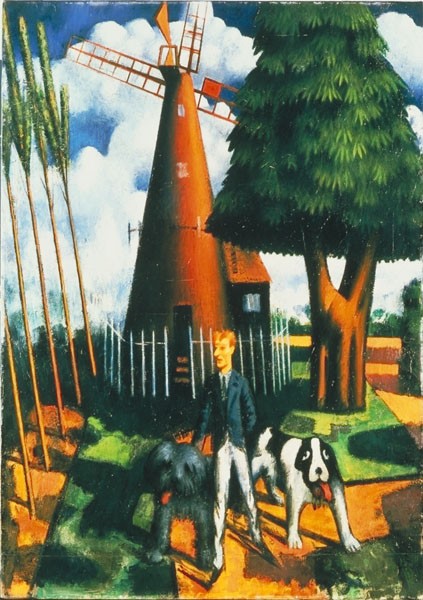
Gilbert Cannan at his Mill by Mark Gertler (1916)

Mark Gertler’s friendship with Gilbert Cannan flourished and in 1914 he went to stay with the writer and his wife, Mary, in their Hertfordshire home, a converted windmill, at Cholesbury.  Cannan had been employed as a secretary by J. M. Barrie, the Scottish novelist and playwright, best remembered as the creator of Peter Pan. A relationship developed in 1909 between Cannan and Barrie’s wife Mary Ansell, a former actress, who felt ignored by her husband.  Although attempts were made by her husband to save their marriage they were divorced and she and Cannan were married in 1910.  Mark became a regular visitor at Cannan and Mary’s windmill house and it is thought that he began making preliminary sketches during his early visits and completed his painting Gilbert Cannan at his Mill in 1916.  It depicts Cannan with his dogs, Luath and Sammy.  Cannan’s wife Mary owned Luath, and he had been the model for Nana, the Newfoundland dog in Peter Pan. Sadly the relationship of Cannan and Gertler declined after 1916, mainly because of Cannan’s increasingly unstable behaviour.

Merry-go-Round by Mark Gertler (1916)

 At the outbreak of the First World War in 1914 there was a call to arms and Max applied for military service but was rejected on the grounds of his ‘Austrian’ parentage.  In 1918 he again applied but was  then later, after being called up in 1918, excused active service on the grounds of ill health which fortunately for Max avoided being forced to publicly declare his pacifist convictions, which were instead pictorially articulated in his 1916 anti-war painting entitled Merry-Go-Round.. Is this simply a painting of a carousel and people enjoying themselves or is there something more we should get from the depiction.  The Painting is part of the Tate Britain’s collection and was begun in May 1916 when Gertler wrote to Lytton Strachey about it:

“… ‘I am working very hard on a large and very unsaleable picture of “Merry-Go-Round…”‘

Max completed it the following autumn. Merry-Go-Round depicts men in uniform with their girlfriends close by their side.  Maybe it was the last time they had to enjoy life before they were sent to Europe to fight for King and Country.  But all is not well as the facial expression on the men is not one of joyfulness that such rides would inspire.  The faces are fixed in what looks like a cry for help.  Like the ride itself, which is unstoppable, probably too is their fate on the fields of war. When it was exhibited, it was looked upon by many critics as one of the most important war painting.  The writer, D. H. Lawrence, wrote to Gertler:

“…I have just seen your terrible and dreadful picture Merry-go-round. This is the first picture you have painted: it is the best modern picture I have seen: I think it is great and true. But it is horrible and terrifying. If they tell you it is obscene, they will say truly. You have made a real and ultimate revelation. I think this picture is your arrival…”

In an interview in 2021, Jeannette Gertler, Mark’s niece talked about the Merry-go-Round painting and she told the interviewer:

“…It was very controversial, not popular. People were annoyed about it and it was slated so much because it was making fun of the war. Making fun of the soldiers going around and around, achieving nothing. They thought it was very naughty of him to do that. Dispiriting. But he was opening their eyes. Really he was…”

On being asked what the Gertler’s family made of the painting Jeannette said:

“…They didn’t mind, Mark was their golden boy, their star, but other people were very annoyed about him making fun of the war. The boys were all pacifists you see. The family, they’d had enough trauma, as Jewish émigrés you know…”

Queen of Sheba by Mark Gertler (1922)

In 1920, Gertler was diagnosed with tuberculosis and was forced to enter a sanatorium.  He would have to attend these medical facilities on a number of occasions during the 1920s and 1930s. These health issues created an unsettling period for Gertler but he decided to go to Paris and returned home full of ideas.

Mandolinist by Mark Gertler (1934)

He was inspired by the great French painter Renoir, who was a leading painter in the development of the Impressionist style.  Gertler especially liked Renoir’s figurative paintings and on returning to London he began to focus on female portraits and nudes, and would sometimes combine figures with elaborate, colourful still lifes.  The 1920’s was to become his commercially most successful decade.

The Violist by Mark Gertler (1912)

Two of Gertler’s preliminary Studies for The Violinist (1912)

Continuing with musical depictions I come to Gertler’s famous 1912 figurative painting entitled The Violinist but, referred to in a letter by Gertler, as The Musical Girl, which he started whilst attending the Slade Art School. He created preliminary pencil head sketches before he completed two oil on panel versions of The Violinist.  The completed painting shown above is the second version.   We do not know the name of the sitter but we do know she was a music student and a friend of Gertler’s family.  Gertler was obviously taken by her distinctive looks with her striking, crop-haired, grey-eyed female who obviously captured his imagination.  His sitter wears a loose, open-necked, vivid purple blouse.  The vibrant colours of her clothing and background are perfectly balanced against the luminous skin tones. It is not the clothes we focus on but her face and her downward-looking eyes with their delicate lids relating closely to the earlier pencil study for the work.  The painting was sold for GBP 542,000, the most paid for a Gertler painting. The top preliminary study sold for GDP 62,500.

Talmadic Discussion by Mark Gertler

It was around 1925 that Mark Gertler met Marjorie Greatorex Hodgkinson who had begun studying at the Slade under Henry Tonks in 1921. That same year Gertler was admitted to Mundesley Sanatorium in Norfolk, and Marjorie’s visits to him and her caring nature seemed to boost his health.  He and Marjorie married in 1930 and their son Luke was born two years later.

Sales of Gertler’s paintings declined during the 1930s but despite their poverty, the Gertlers maintained a busy social life while Mark’s work continued with the still lifes, portraits and monumental nudes such as the Mandolinist.  Sadly, Gertler suffered from long bouts of depression, and other forms of ill-health.  Max’s marriage to Marjorie suffered because of his poor physical and mental health and by the mid-1930s, despite his efforts to improve matters, the marriage had deteriorated and Gertler’s mental health worsened and he became suicidal.

The Basket of Fruit by Mark Gertler

His mental decline was also part caused by the death of his close friends; the writers Katherine Mansfield in 1923 and D. H. Lawrence to tuberculosis in 1930.  Mark’s friend, and once a fellow student of his at the Slade, Dora Carrington, committed suicide in 1932, two months after her close friend, Lyllton Strachey’s death.  That same year Mark Gertler’s mother died.  Gertler went on painting trips to Europe to help his moods but this didn’t work and to make things worse many art critics began to slate his work.

Self portrait with Fishing Cap by Mark Gertler

Gertler’s final exhibition, held at the Lefévre Gallery in May 1939, failed to attract visitors and he sold only three works. Not long after, on June 23rd 1939, Mark Gertler gassed himself in his Highgate studio. He was buried four days later in Willesden United Synagogue Cemetery.


Once again information for this blog came from ma ny Wikipedia sites but also from these excellent websites:

Ben Uri Research Unit

Art UK

A Crisis of Brilliance

Spartacus Educational

Fine Art Society

New English Art Club

Glyn Vivian Gallery

Christies

Mark (Max) Gertler. Part 1.

Max Gertler by Lady Ottoline Morrell vintage snapshot print, 1917. © National Portrait Gallery, London

My featured artist today is Markz Gertler. He was one of the most prominent artists of his generation and an early member of the New English Art Club, elected in 1912. He was a painter of figures, portraits and still-life.  Markz was born on December 9th 1891 at 16 Gun Street, Spitalfields, London.   He was the youngest of five children born to Austrian-Jewish immigrants from Poland, Louis Gentler and Kate (Golda) Berenbaum.  Markz had to elder brothers, Harry and Jacob, known as Jack and two elder sisters, Deborah and Sophie. 

Dorset Street, Spitalfields (c.1910)

By the 19th century, most of the area’s around Spitalfields had traditional industries, including silk weaving, but they had moved elsewhere, although the area still produced some textiles.  This decline of the local industry destroyed Spitalfields and it became a poverty-stricken, overpopulated area with little work. The grand houses which had been built by the Huguenots were turned into slums, and the area became unsafe. By the late 19th century, many people considered the place the most criminal in London.

The Rabbi and his Grandchild by Mark Gertler (1913)

The following year after Markz was born, 1892, because of the terrible economic downturn in the area, the family moved back to Markz’s mother’s native city of Przemyśl in Galicia, which at the time was part of the Austro-Hungarian Empire but now is situated in south-eastern Poland close to the Ukraine border. Life for the family was little better here as Max’s father worked as an innkeeper but this failed and now the family were financially desperate.  It could have been that his father felt guilty about not being able to support his family but one night in 1893, Gertler’s father Louis, without telling anyone, left his family destitute and on the brink of starvation, and went off to America to search for work.  Much later he contacted his wife to say that once he got established in America, he would send for them and all would be well.  It never happened as all his hopes of making a fortune in America ended in failure. 

Whitechapel High Street (1905)

Following yet another business failure Louis Gertler left America and returned to England and the London borough of Whitechapel, the heart of London’s Jewish quarter.  He set himself up as a furrier and in 1896 he arranged for his family to join him.  Once in England, his son’s first name was changed from the Polish Markz to Mark.

Portrait of Mark Gertler by John Currie (1913)

Gertler spent his early formative years in Whitechapel, London, a poor Jewish community, and attended nearby schools in Settles Street and Deal Street between 1897 and 1906.  He displayed a gifted artistic talent even as a young child and was said to have been motivated by pavement artists, advertising posters, and it was the autobiography of the great English painter William Powell Frith, which made Max determined to become a professional artist. In 1906, at the age of fifteen, on leaving school so as to earn some money for his family Mark (known as Max) became an apprentice at the stained-glass company Clayton and Ball.  He hated working there and rarely spoke of  the experience in later years.  During this time, he would attend evening classes at the Regent Street Polytechnic but in 1907 he had to drop out of college due to his family’s perilous finances.  In 1908, Max was placed third in a national art competition and then realised that he could become a great artist.  In 1908 Gerter met the artist, William Rothenstein. After seeing Max’s work Rothenstein wrote to Max’s father:

“…It is never easy to prophesy regarding the future of an artist but I do sincerely believe that your son has gifts of a high order, and that if he will cultivate them with love and care, that you will one day have reason to be proud of him. I believe that a good artist is a very noble man, and it is worth while giving up many things which men consider very important, for others which we think still more so. From the little I could see of the character of your son, I have faith in him and I hope and believe he will make the best possible use of the opportunities I gather you are going to be generous enough to give him…”

However, knowing the cost of studying art and that the family would be ununable to pay his tuition fees he became downhearted.

Portrait of a Girl by Mark Gertler (1912)

Having the money to pay for tuition fees, he needed a sponsor to put him forward to the prestigious Slade School of Fine Art.  This he received with a recommendation from William Rothenstein, an English painter, printmaker, draughtsman, lecturer, and writer on art who lived in the affluent London borough of Hampstead and who held a number of soirées which often included many well-known artists and some young and up and coming ones, such as Mark.  Mark Gertler entered the Slade in 1908   and studied there for three years.  He was the first and youngest Jewish working-class student of his generation to do so.

In her 1989 biography A Life of Dora Carrington: 1893-1932 Gretchen Gerzina, wrote about Max Gertler’s arrival at the Slade, writing:

“…At the Slade, Mark was at first something of a misfit. He had started school late in life and had left it at the age of fourteen. His hair was short and his clothes were different. Most of all, however, the other students found him too serious and too intense. He was extremely handsome, with huge dark eyes, pale skin, and a thin body, and he was both solemn and passionate about his art. Only at the polytechnic had he finally been introduced to museums and systematic schooling in the history of art, including the old masters. When he first arrived at the Slade at seventeen, he had the fervour of a convert who has surmounted great obstacles for his religion. In contrast, his fellow students seemed privileged and rather frivolous. Yet his early opinions of them were not untouched by envy…”

Still Life by Mark Gertler

After a little time at the Slade, Max made friends with a group of very talented students all of whom would become famous artists, such as C.R.W. Nevinson, an English figure and landscape painter, etcher and lithographer, who was one of the most famous war artists of the First World War, Stanley Spencer, John S. Currie, Maxwell Gordon Lightfoot, Edward Wadsworth, Adrian Allinson and painter and draughtsman Rudolph Ihlee. This group became known as the Coster Gang because as writer David Boyd Haycock put it, they mostly wore black jerseys, scarlet mufflers and black caps or hats like the costermongers who sold fruit and vegetables from carts in the street.

Vanessa Bell’s Friday Club exhibition at the Alpine Club Gallery

In 1910, whilst he was still an art student at the Slade, Max began exhibiting some of his paintings at Vanessa Bell’s Friday Club.  Vanessa Bell was an English painter and interior designer, a member of the Bloomsbury Group and the sister of Virginia Woolf.  The idea for the Friday Club was inspired by her earlier involvements of café life in Paris. It was her wish to create a similar atmosphere, and the Friday Club held its first meeting in the summer of 1905 and that November the Club held its first exhibition.   From 1910 until 1918, the Friday Club was based at the Alpine Club.

………to be continued.


Once again much of the information was gleaned from various Wikipedia sites but also these excellent websites:
Ben Uri Research Unit

Art UK

A Crisis of Brilliance

Spartacus Educational

Christopher Richard Wynne Nevinson the war artist

     Self Portrait  by C.R.W Nevinson
Self Portrait
by C.R.W Nevinson

The newspapers and television are awash with articles and documentaries with regards the First World War and so, over the next two blogs, I thought I would take this opportunity to look at one of the best known British war artist, many of whose paintings featured the Great War. His name is Christopher Richard Wynne Nevinson, but is often referred to as C.R.W. Nevinson, and was known to his friends as Richard.

Nevinson was the son of Henry Nevinson, who was a British war correspondent during the Second Boer War and the First World War. His father was a fierce and radical campaigning journalist who, through the might of his pen, fought to end slavery in Western Africa. He was also a suffragist, and along with the left-wing writers, Henry Brailsford, Max Eastman and Lawrence Housman founded the Men’s League for Women’s Suffrage society in 1907. In 1884 he had married Margaret Nevinson an activist in the campaign for women’s rights and in Hampstead, London in August 1889 she gave birth to their only child, Christopher Richard Wynne Nevinson. An insight into his early childhood can be gleaned from a book written by Frank Rutter in 1935 entitled Art in my time and in it he talks about Nevinson and his parents. He wrote:

“…Nevinson was the child of parents who had singularly noble ideas, who were markedly progressive and humane in their habit of thought… Nevinson started life with a pre-natal tendency to revolt against injustice, cruelty and oppression…”

He also commented on how tied up Nevinson’s parents were in their campaigning and quotes young Nevinson as being somewhat critical of his mother’s lack of time for him. Later, Nevinson wrote of his mother:

“…If my mother does happen to be in for a meal she is so engrossed in other things that she hardly hears and certainly never takes in a word I say.”

Nevinson’s parents were so wrapped up in their own agendas it was bound to affect the early life of their son and for young Nevinson, who after a period in kindergarten, at the age of seven, worse was to come as his parents decided to send him away from home to a boarding school. For a child who just wanted his parents to spend time with him it was the worst possible outcome and he hated the school and was soon in trouble. In his 1935 autobiography, Paint and Prejudice, he wrote about his time as a boarder:

“…In due time I went to a large school, a ghastly place from which I was rapidly removed as I had some sort of breakdown owing to being publicly flogged, at the age of seven, for giving away some stamps which I believed to be my own. I was not only described as a thief but as a fence. From this moment I developed a shyness which later on became almost a disease. During my sufferings under injustice a conflict was born in me, and my secret life began…”

If school life was bad enough, life at home did not improve. His father’s strong pro-Boer utterances during the Second Boer War became well known and disliked and his son was tarred by this same brush of loathing and would be treated like an outcast by his young contemporaries.

In 1903, Nevinson was sent to Uppingham School. The school was strong in its teaching of engineering and art. However he described the time at Uppingham as a débâcle. At first the school seemed acceptable to the fourteen year old but things deteriorated for the teenager as probably due to his earlier school experiences he did not make friends easily and was singled out by both staff and fellow pupils and he wrote of his horrific experiences at the hands of older students:

“…”I had no wish to go to any such school at all, but nevertheless Uppingham did seem to be the best. Since then I have often wondered what the worst was like. No qualms of mine gave me an inkling of the horrors I was to undergo. Bad feeding, adolescence – always a dangerous period for the male – and the brutality and bestiality in the dormitories, made life a hell on earth. An apathy settled on me. I withered. I learned nothing. I did nothing. I was kicked, hounded, canned, flogged, hairbrushed, morning, noon and night. The more I suffered the less I cared…”

Normality finally came into his life when he left Uppingham School and enrolled at St John’s Wood School of Art where he would train to pass the exams required for entry to the Royal Academy Schools. Nevinson summed up this move in his autobiography in a simple sentence:

“…From Uppingham I went straight to heaven…”

Life at the art school was so different in comparison to his previous schools and Nevinson began to come out of his shell and this could well have been helped by the fact that he was now in the company of female students. He recalled the happy days of socialising with the girls and acknowledged that he himself was changing:

“…My shyness went, and I spent a good deal of my time with Philippa Preston, a lovely creature who was later to marry Maurice Elvey. There were others, blondes and brunettes. There were wild dances, student rags as they were called… and various excursions with exquisite students, young girls and earnest boys; shouting too much, laughing too often…”

However it was not the Royal Academy Schools for Nevinson as he had been influenced by the works of Augustus John who, along with his sister, Gwen, had been students at the Slade School and so, in 1909, aged twenty, Nevinson entered the Slade School. Most of his friends from St John’s Wood School of Art progressed on to the Royal Academy School and so Nevinson arrived at the Slade knowing nobody. After an initial nervousness and an uncertainty about his choice of artistic direction he settled in and made a number of friends. In his class were aspiring artists such as Mark Gertler, Adrian Allinson, Edward Wadsworth, Rudolf Ihlee and Stanley Spencer. This group of young artistic friends were known as the Coster Gang because they dressed in black jerseys with scarlet mufflers and atop their heads they would wear a black cap or hat similar to those worn by costermongers, the street sellers of fruit and vegetables.

Dora CarringtonIn 1910 a new student joined the Slade. She was Dora Carrington. In Michael Walsh’s 2002 biography on Nevinson which looked at his energetic early career he wrote of Nevinson and Carrington’s relationship:

“…Nevinson’s infatuation with Dora Carrington became progressively more acute. In Carrington he had met his match, not only in intellect and in personality, but also in that she could be as obtuse as he could… The friendship was always confused, faltering between brotherly affection and unfulfilled love affair, rooted in Nevinson’s reluctance to trust strangers and her notorious desire to remain unattached…”

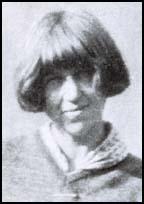
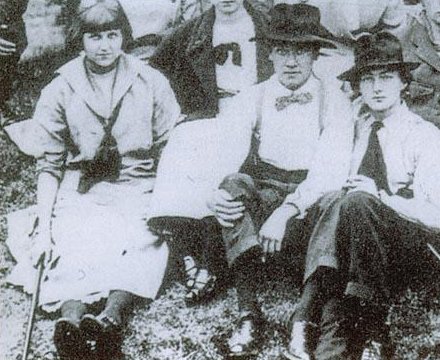
Dora Carrington, CRW Nevinson and Mark Gertler during their time at the Slade School

With this fascination with Dora came a major problem. Dora had another great admirer and he was Nevinson’s best friend, Mark Gertler. Gertler and Nevinson had spent much time together after classes and a bond between them ensued. Michael Walsh in his 2002 biography of Nevinson, C. R. W. Nevinson: The Cult of Violence, wrote about this close friendship:

“…Together they studied at the British Museum, met in the Café Royal, dined at the Nevinson household, went on short holidays and discussed art at length. Independently of each other too, they wrote of the value of their friendship and of the mutual respect they held for each other as artists…”

However they had both fallen in love with Dora Carrington and in a way she destroyed the friendship between the two men. Nevinson after some tentative efforts to move his relationship from a close platonic one to something more was spurned by Carrington and she began to distance herself from him.  Nevinson was devastated at this turn of events and wrote to her:

“…I am now without a friend in the whole world except you…. I cannot give you up, you have put a reason into my life and I am through you slowly winning back my self-respect. I did feel so useless so futile before I devoted my life to you.”

Nevinson also realised that his attempt to become Carrington’s lover ended his friendship with Gertler. Gertler was in love with Carrington and now Nevinson, once his closest friend, had now become a rival for Carrington’s affections. Something had to give and Gertler wrote to Nevinson:

“…I am writing here to tell you that our friendship must end from now, my sole reason being that I am in love with Carrington and I have reason to believe that you are so too. Therefore, much as I have tried to overlook it, I have come to the conclusion that rivals, and rivals in love, cannot be friends. You must know that ever since you brought Carrington to my studio my love for her has been steadily increasing. You might also remember that many times, when you asked me down to dinner. I refused to come. Jealously was the cause of it. Whenever you told me that you had been kissing her, you could have knocked me down with a feather, so faint was I. Whenever you saw me depressed of late, when we were all out together, it wasn’t boredom as I pretended but love…”

The romantic hopes of both Nevinson and Gertler were spurned by Carrington and the two men paid an enormous price because of their infatuation with their fellow student. The price was the ending of their own close and once fulfilling friendship.

Nevinson left the Slade School in the summer of 1912 and travelled to Paris, a place he had visited on a number of occasions with his mother. It was in the French capital that he met and became friends with Gino Severiniand Filippo Marinetti, an Italian poet and editor, the founder of the Futurist movement. Futurism was originally an Italian movement which was characterised by its belligerent celebration of modern technology and city life and energetically showed contempt for Western Art traditions. Nevinson was excited with these futurist ideas and he and Marinetti co-wrote the English Futurist manifesto Vital English Art, in June 1914 edition of English newspaper, The Observer.

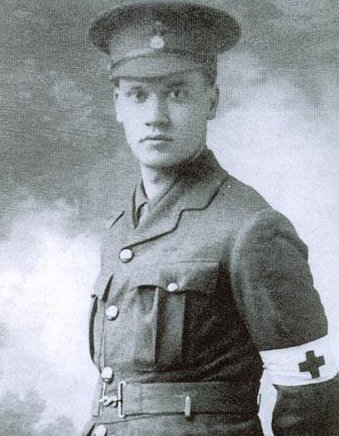
Nevinson in his Red Cross uniform

On the outbreak of the First World War, Nevinson, who was a fervent pacifist, refused to become involved in combat duties, and volunteered instead to work for the Red Cross. Nevinson joined the Friends Ambulance Unit, which was a voluntary ambulance service founded by some young members of the Quakers. It was independent of the Quakers’ organisation and mainly run by registered conscientious objectors. Later, between November 1914 and January 2015, Nevinson served as a volunteer ambulance driver. However his time in the ambulance service as driver, stretcher bearer and hospital orderly ended in January 1915 when he had to return to home due to ill health.

The brutality of the war stimulated him and on his return home in January 1915 he wrote an article for the Daily Express about this artistic stimulation:

“…All artists should go to the front to strengthen their art by a worship of physical and moral courage and a fearless desire of adventure, risk and daring and free themselves from the canker of professors, archaeologists, cicerones, antiquaries and beauty worshippers…”

I will leave Nevinson’s life story at this juncture and return to it in my next blog. I now want to feature three of his war paintings which were to make him famous and which depicted life and the brutality of the First World War. It was during his period convalescing that he started on a series of works based on his own experiences and incidents he witnessed whilst at the Western Front in France.

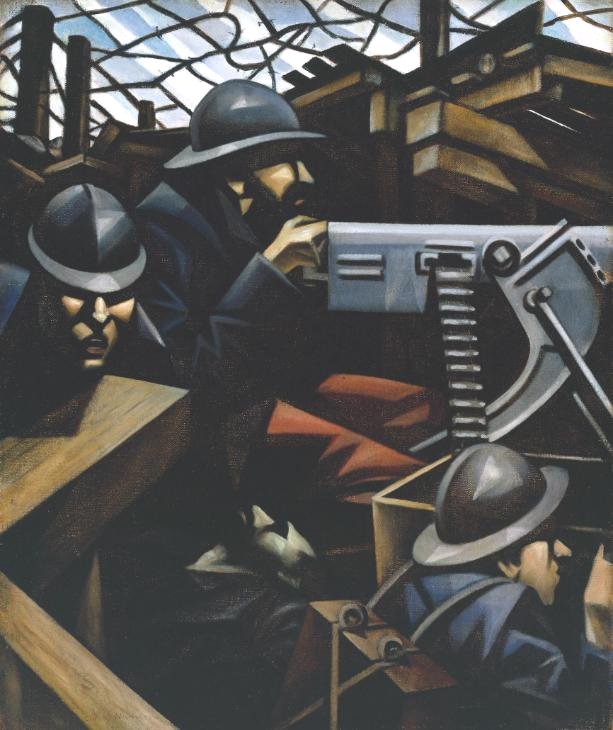
          La Mitrailleuse  by C.R.W. Nevinson (1915)
La Mitrailleuse
by C.R.W. Nevinson (1915)

One such work was entitled La Mitrailleuse (The machine gun), which he completed in 1915. The work is a depiction of a French machine-gunner and two of his comrades in a battle trench. It is amazing how Nevinson has portrayed the soldiers simply as a series of angular planes and has kept the colours to various tones of grey. There is something mechanical about the men. He has de-humanized them. The angularity of their facial expressions and the dark colouring around their eyes transforms them into fierce-looking individuals who seem to lack any trace of humanity. The machine gun, which is the title of the painting, is gripped by the gunner. The belt of bullets hangs from the machine ready to be spat out and mercilessly cut down the enemy. Of the painting Walter Sickert, the Camden Town Group painter described the painting as:

“…the most authoritative and concentrated utterance on the war in the history of painting…”

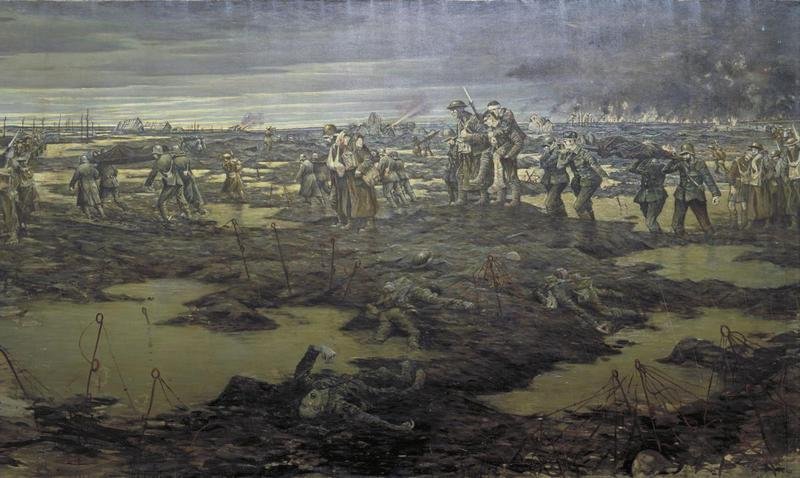
The Harvesting of the Battle by C R W Nevinson (1915)
Harvest of Battle by C R W Nevinson (1915)

The second painting I am featuring is entitled Harvest of Battle, which can be found at the Imperial War Museum, London. In this work we observe the deadly aftermath of battle. The battleground is sodden. Large pools of water formed by craters made by exploding shells abound making life that much worse, if that was possible. We see a long line of soldiers trudging from right to left across the wet ground. Many are wounded with bandaged limbs and some of the able-bodied are carrying or helping their wounded comrades to return to a place of safety at the rear of the battle lines. For many it was to be their last battle and they are now just corpses. In the central foreground we see a skeletal-like corpse lying on his back and even in death, his left arm is still raised in a claw-like fashion, a gesture of pleading for help, whether it be from his comrades or God himself, but it was to no avail.    In the right background we see flashes of artillery fire. The idea for this depiction came to Nevinson when he and another officer visited Passchendaele, close to the town of Ypres, the scene of many battles during the First World War. He wrote about his experience in his autobiography:

“…We arrived at Ypres, and while he went to the Officers’ Club I wandered on up towards the Salient and obtained notes and rough sketches for my painting, ‘Harvest of Battle…”

In a letter Nevinson wrote in 1919 to Alfred Yockney from the Ministry of Information he described what he saw:

“…A typical scene after an offensive at dawn. Walking wounded, prisoners and stretcher cases are making their way to the rear through the water- logged country of Flanders. By now the Infantry have advanced behind the creeping barrage on the right, only leaving the dead, mud, & wire; but their former positions are now occupied by the Artillery. The enemy is sending up SOS signals and once more these shattered men will be subjected to counter-battery fire. British aeroplanes are spotting hostile positions…”

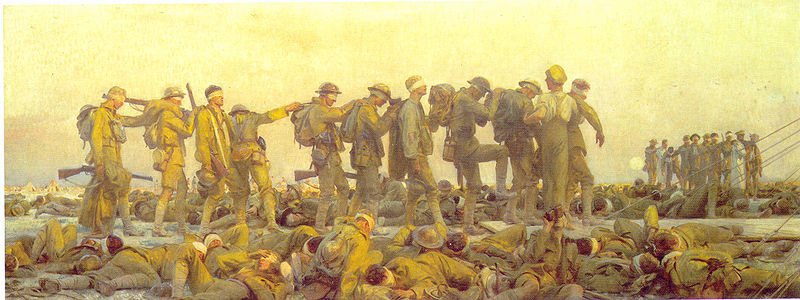
           Gassed  by John Singer Sargent             (c.1919)
Gassed
by John Singer Sargent
(c.1919)

It is a sad and moving painting and reminds me of a work by James Singer Sargent, entitled Gassed, which I featured in My Daily Art Display on July 10th 2011. That work also depicted a line of wounded soldiers, blinded by mustard gas, trudging towards their field hospital.

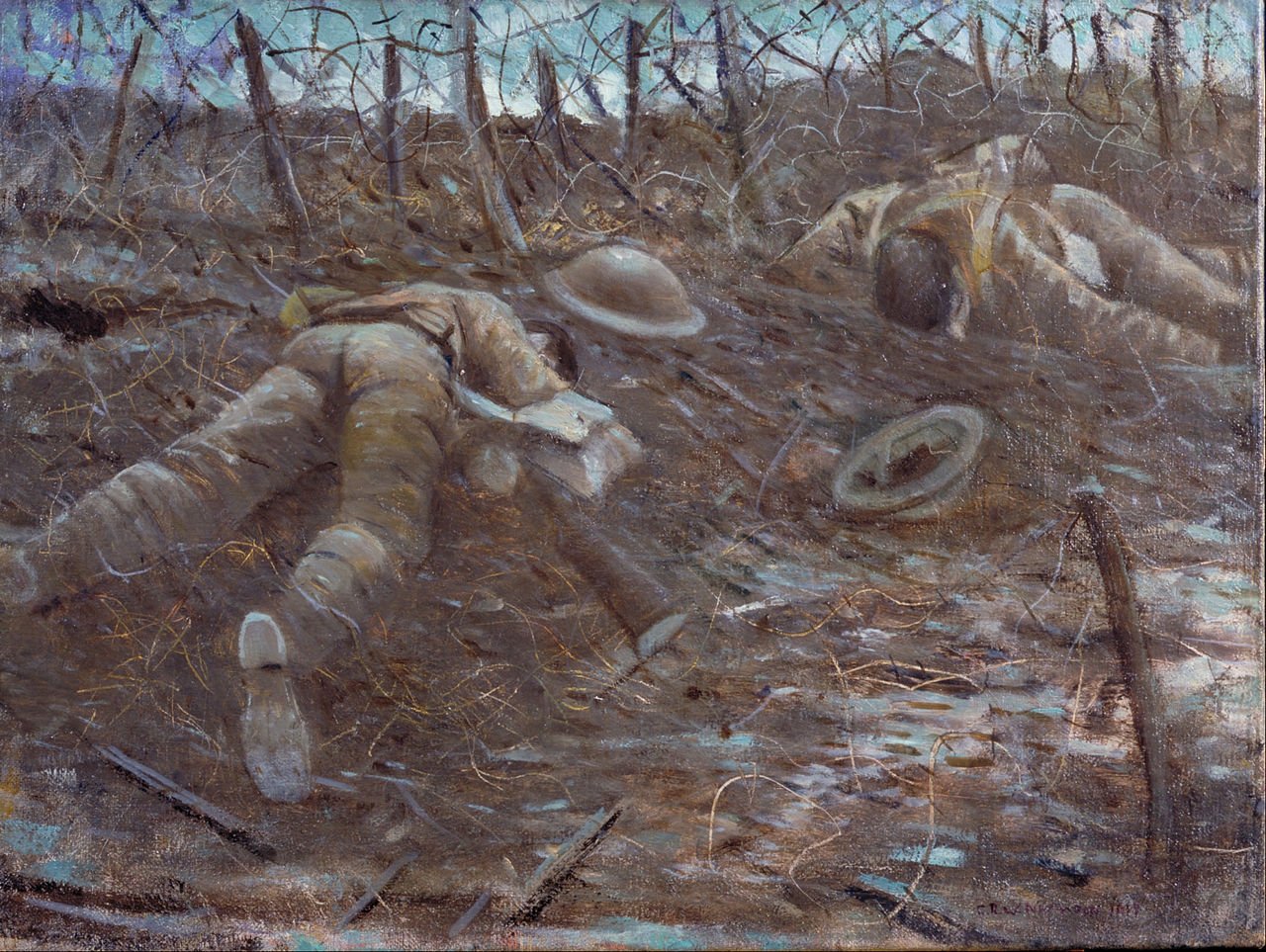
Paths of Glory  by C.R.W. Nevinson (c.1917)
Paths of Glory
by C.R.W. Nevinson (c.1917)

My final offering is another war painting by Nevinson which depicts the horrors of war. It is entitled Paths of Glory and was completed by him around 1917. In the painting we see the corpses of two dead British soldiers lying face down in the mud among barbed wire. They have been left behind and their bodies are awaiting collection, identification and then their nearest and dearest will be informed of their fate. Besides them lie their helmets and rifles now no longer any use to them. Nevinson chose the title for his work, a quote from Thomas Gray’s famous poem Elegy Written in a Country Church-Yard

The boast of heraldry, the pomp of power,
And all that beauty, all that wealth e’er gave,
Awaits alike th’ inevitable hour:-
The paths of glory lead but to the grave.

There is of course a  difference in the circumstances of death between Gray’s corpses who lay buried and at peace in a church graveyard and Nevinson’s corpses which lay abandoned on the battlefield.

Nevinson’s depiction of the two dead soldiers lying abandoned in a foreign field was just too much for the British Board of Censors, for the war was still raging in France and scenes like this would have a terrible affect on the morale of English people and so they did not want the work exhibited at the Leicester Galleries in Leicester Square, London. Nevinson rebelled and included the painting in the exhibition but placed a wide brown strip of paper across the work with word “censored” written upon it. The establishment was very unhappy by Nevinson’s apparent disregard of their dictate and he was publicly reprimanded, firstly for exhibiting a “censored” work and for the audacity of writing the word “censored” across the brown strip. As always, there is no such thing as bad publicity and the notoriety he gained from his audacious behaviour brought him to the attention of the public. The painting was bought by the Leicester Galleries.

In my next blog I will conclude Nevinson’s life story and look at some of his non-war paintings which first attracted me to him.

—————————————————————————–

Most of the information and facts  for this blog came from books which I have mentioned as well as the excellent Spartacus Educational website.

Gilbert Cannan and his Mill by Mark Gertler

Gilbert Cannan at his Mill by Mark Gertler (c.1916)

My Daily Art Display today is all about the artist and the person who is the subject of the painting.  The artist who painted today’s featured painting was Mark Gertler and the painting which he completed in 1916 is entitled Gilbert Cannan and his Mill.

Marks Gertler was born in Spitalfields, London in 1891.  He was the youngest of five children born to Jewish immigrants from Poland, Louis Gentler and Kate Berenbaum.  He had two older brothers and two older sisters.   At the age of one, his father took the family to his mother’s native city, Przemyśl in south-east Poland where they worked as innkeepers.  The business failed and one night in 1893, in desperation, Gertler’s father Louis, without telling anyone, left them all and went off to America to search for work.  He eventually sent word to his wife telling her that once he was settled she was to bring the children to live with him there.  It never happened as all his hopes of making a fortune ended in failure.  Louis Gertler returned to Britain, and had his family join him in London in 1896.  It was at this time that his son’s Polish name “Markz” was changed to Mark.

From a very early age Mark Gertler showed a talent for drawing. His first formal artistic tuition came when he enrolled in art classes at Regent Street Polytechnic in London.   Unfortunately because of the family’s dire financial circumstances he had to leave the course after just a year to try and earn some money as an apprentice with a stained glass maker.  However he still maintained his art tuition, attending evening classes at the Polytechnic.  In 1908 he entered a national art competition and was awarded third place.  Buoyed up with that success, but knowing the cost of art training, he applied for a scholarship from the Jewish Education Aid Society.  His application was successful and in 1908, aged seventeen, he enrolled on a three year course at the Slade School of Art.  It was whilst on this course that he met Paul Nash, Stanley Spencer and Charles Nevinson, all of whom would be leading artists in the twentieth century.  Whilst studying at the Slade, Gertler also met the aspiring painter Dora Carrington, the daughter of a Liverpool merchant.  Gertler fell in love with her and pursued her relentlessly for many years.  The story of his brief love affair with Dora was featured in the 1995 biographical film Carrington.  Unfortunately for Gertler his love was unrequited and at one point in this tempestuous relationship he threatened to commit suicide.

Gertler was fortunate enough , in these early days, to be patronized by Lady Ottoline Morrell, the English aristocrat and society hostess and it was through her that Gertler became acquainted with the Bloomsbury Group. He was also introduced to Walter Sickert, who at the time was the leader of the Camden Town Group. With all these new artistic and society connections it was not long before he was enjoying great success as a painter of society portraits.  Unfortunately Gertler had a very abrasive manner and was extremely temperamental.  This did not go down well with his clients and his popularity and that of his paintings waned sharply causing him some financial problems.

In 1914 Gertler visited the writer and the subject of today’s painting, Gilbert Cannan, who lived with his wife in their converted windmill at Cholesbury, Hertfordshire. They became great friends and over the next two years Gertler would be a regular visitor to the mill along with the likes of the writers Katherine Mansfield and D.H.Lawrence  The latter would feature Gertler as the sculptor Loerke in his celebrated novel Women in Love.  It was during one of his early visits that Gertler started his painting which he later entitled Gilbert Cannan and his Mill.

In 1920 when he was just twenty-nine years of age he was diagnosed with tuberculosis and this ailment resulted in many long stays in various sanatoriums.  Around this time, when his artistic career was in decline, he taught part-time at Westminster School of Art.  Gertler’s life began to unravel in the 1930’s.  A war with Germany was brewing.  His mother, whom he was very close to, had died.  The once love of his life Dora Carrington had committed suicide in 1933.    His exhibition at London’s Lefevre Gallery was ridiculed by the critics.  In 1936, no doubt as a result of these personal and professional setbacks, he attempted to commit suicide but failed.   Three years later, in 1939, aged forty-eight, he succeeded in ending his life by gassing himself at his studio in Hampstead.

The subject of today’s painting, as I have said was Gertler’s friend Gilbert Cannan.  Cannan, a novelist, was born in Manchester in 1884 of Scottish ancestry.  He was well educated studying at Manchester Grammar School and King’s College Cambridge.  After receiving his university degree he went into the legal profession.  This profession was not for him and after a brief dabble into the world of theatrics he turned all his efforts to writing.  He worked as a secretary to the Scottish author and dramatist J M Barrie who created the famous character Peter Pan.  Over time, Gilbert Cannan and Barrie’s wife Mary became lovers.  James Barrie and his wife were divorced in 1909 and the following year Mary Barrie and Cannan were married.

In the years before the First World War Gilbert Cannan became friendly with the Bloomsbury Group, a group of writers, intellectuals, philosophers and artists who, throughout the 20th century, held informal discussions in Bloomsbury, London,.   The group would also congregate at Cannan’s home which from 1916 was a converted mill at Cholesbury in Hertfordshire and it was during this time that he met Dora Carrington and Mark Gertler.  The mill we see in the painting was Cannan’s home and was a favourite place for his intellectual circle to meet.

The painting is a full-length portrait of Gilbert Cannan standing in front of the mill with his two dogs.  The large black dog on the right hand side of Cannan is a Newfoundland dog called Luath.  To the left hand side of Cannan is his large black and white St Bernard dog Porthos.  Porthos was originally owned by J.M.Barrie and was used as a model for the dog Nana, dog which served as the Darling children’s nurse in J.M.Barrie’s famous book, Peter Pan, or The Boy Who Wouldn’t Grow Up.

What is interesting and somewhat quirky about this painting is Gertler’s use of geometrical shapes such as cones and triangles.  This can be seen in the shape of the windmill and the foliage of the large tree to the right of it.  Even the way Cannan and his two dogs are portrayed has a triangular shape to it as does the way the tall poplar trees on the left of the work lean to the left against the side of the painting. This was a reflection of Gertler’s interest in the contemporary art which was popular at the time.  The bright colours used by Gertler were not realistic and reflects the anti-naturalistic modern style of the era.

I think I am drawn to this painting purely for its eccentricity and nonconformity and the way Gertler has added vibrancy to the work with his use of unrealistic colouring.  The painting can be seen at the Ashmolean Museum in Oxford and as I have said on a number of occasions you must add a visit to this wonderful establishment on your “to do” list.