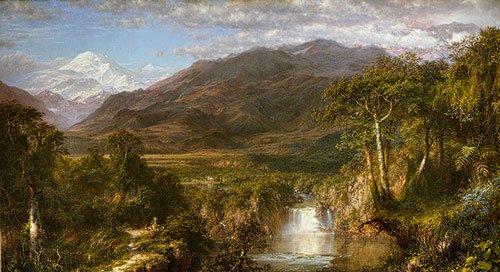
Isaac Levitan. Part 2 – The later years

Portrait of Anton Chekhov by Isaac Levitan (1886)

Anton Chekhov, the writer and physician, was born in January 1860.  He was the third of six children and was brought up in the coastal town of Taganrog which lay on the north shore of the Sea of Azov in southern Russia.  In 1876, when he was sixteen years old his father, Pavel, was in the process of building a new house but ran out of money and was mired in a huge debt.  Rather than face the prospect of languishing in a debtors prison he escaped the town and moved to Moscow where his elder sons, Alexander and Nikolai were studying. Alexander was attending Moscow University and Nikolai was an art student at the Moscow School of Painting, Sculpture and Architecture.  Anton Chekhov remained behind in Taganrog to finish his studies at the local secondary school and was also charged with the task of selling the family’s possessions.  It was not until three years later in 1879 that Anton Chekhov joined the family in Moscow.

Anton Chekhov enrolled at the Moscow State Medical University and it was shortly after arriving in Moscow that he was introduced to Isaac Levitan by his brother Nikolai who was a fellow student of Levitan at the Moscow School of Painting.  Anton Chekhov was just eight months older than Levitan and the close friendship between the two great men of the Russian Arts steadily grew and it would last until the end of their lives.  This was a coming together of two Masters of Russian literature and the visual arts, and this close camaraderie led to a close style in the way the two considered and dealt with artistic challenges, so much so that their names are often quoted side by side both in specialized literature and popular writings.
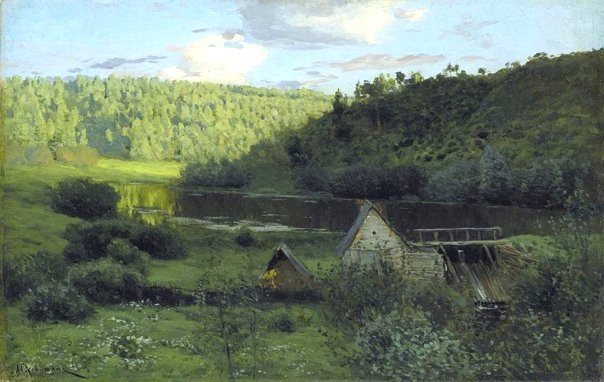
The Watermill, Sunset by Isaac Levitan (1880)

Levitan completed a beautiful but small landscape painting, The Watermill, Sunset.  It measured just 33cms x 52cms.  He painted this work in the summer of 1880 when he was spending time in the small riverside town of Plyos on the banks of the mighty Volga River.  Levitan loved the area and this period could be looked upon as one of the happiest times of his life. His friend Anton Chekhov said that when his artist friend and he were in Plyos he could detect a smile on Isaac’s face.  Sadly, because of family tragedies and his unending fight against poverty, Levitan rarely smiled and was often the victim of melancholia.

Isaac Levitan had developed a great love of nature which almost certainly originated from his time at the Moscow School of Painting and the time he spent with one of his tutors, the Russian landscape painter, Alexei Savrasov.  Savrasov was one of the most eminent of all 19th century Russian landscape artists and was renowned for his lyrical style and melancholic works of art.  He was looked upon as the creator of the lyrical landscape style.

In all, Levitan painted this view three times.  The first, which we see above, is housed in the Tretyakov Gallery in Moscow, and the other two, which were painted later, form part of two private Russian collections.  The scene is set at sunset and the mill is in shadow whilst the forest, on the opposite side of the river in the background is bathed in evening sunlight.  The light slants in from the right illuminating the far bank.  It is the ending of the day and although the blue skies suggest otherwise, the location will soon be cast in darkness.  In the foreground, the focal point is the wooden mill and the small rickety bridge which crosses over the small waterfall, the water of which powers the mill.  In many of Levitan’s paintings he depicts small bridges crossing over water along with jetties which often had boats moored to them.

Levitan’s moody landscapes and the artists and poets who had influenced this style of art were commented upon by Alexandre Benois in his 1916 book, The Russian School of Painting.  He wrote:

“…He brought to a summation that which Vasiliev, Savrasov and Polenov had foretold.  Levitan discovered the peculiar charm of Russian landscape “moods”; he found a distinctive style to Russian landscape art which would have been distinguished illustrations to the poetry of Pushkin, Koltzov, Gogol, Turgenyev and Tyutchev.  He rendered the inexplicable charm of our humble poverty, the shoreless breadth of our virginal expanses, the festal sadness of the Russian autumn, and the enigmatic call of the Russian spring.  There are no human beings in his paintings, but they are permeated with a deep emotion which floods the human heart…”

To supplement his income Levitan gave private painting lessons and he collaborated with the Chekhov brothers on the illustrated magazine “Moscow”.  Levitan also spent time spent time on the popular Russian magazines, “Raduga” (Rainbow) in1883) and “Volna” (Wave) in 1884, where he worked on graphics and lithographs for the publications.  He also collaborated with illustrations for Mikhail Fabritsius’ guide book, The Kremlin in Moscow.  During the summers of the mid and late 1880’s Levitan spent much of his time with the Chekhov family, who had a summer residence on the Babkino estate close to the banks of the Istra River.   The estate was owned by Alexsei Kiselev and he and his wife Marila would entertain artists and writers at their many soirees.  Levitan eventually moved into the Chekhovs home and set up his own studio.   One painting he completed in 1886, whilst staying with the Chekhovs was The Istra River.

In the Crimean Mountains by Isaac Levitan (1886)

His impoverished upbringing during which he often had no idea where or when his next meal would come from combined with the stress of being an artist trying to eke out a living had affected his health and he was diagnosed as having a degenerative heart disease and advised to move to a warmer climate further to the south of the country and so in late March 1886 Isaac Levitan visited the Crimea for the first time.  It was here that he completed more than sixty sketches and paintings during his two months sojourn including one entitled In the Crimean Mountains which depicted an area around the town of Feodosiya, in eastern Crimea.  It is a painting which manages to capture the bright sun and the intense heat of the mountainous setting.  Levitan exhibited all the sketches he had completed whilst staying in the Crimea at the Moscow Society of Art Lovers (MSAL).  All were purchased and with that success came financial stability for Isaac Levitan.

Evening on the Volga by Isaac Levitan (1888)

Between 1887 and 1890 Levitan would travel far and wide spending the long summer months in small towns along the Volga River, such as Plës (Plyos) and Vasil’sursk and two of his paintings of that time, Evening on the Volga (1888) and Evening: The Golden Plyos (1889) depicted the beauty of the river and the townships, which were situated on the banks of the great waterway, during the hours of sunset.

Evening: Golden Ples by Isaac Levitan (1889)

Levitan painted the Volga River scenes in various weather and light conditions and by doing so was able to convey associated moods.  The Volga series established Levitan as the painter of the landscape of mood and his style became popular with other Moscow landscape artists of the time.
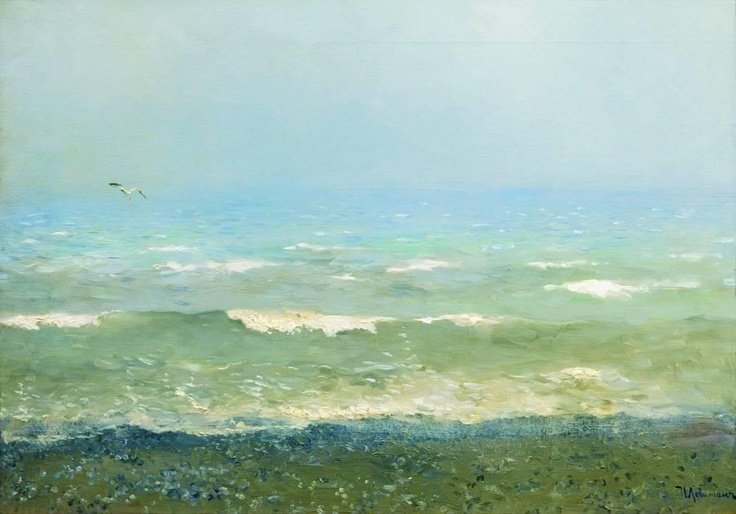
The Mediterranean Coast by Isaac Levitan (1890)

Levitan realised that much could be learnt from European artists and so, in March 1890, he embarked on a tour visiting Berlin and Paris and the Cote d’Azur towns of Nice and Menton.  From his visit to the south of France, he completed a work entitled The Mediterranean Coast which is a truly beautiful depiction of the multi-coloured sea and the pebbled shoreline.  He went on to Italy and visited Venice and Florence, Germany and Switzerland.  However Levitan was a true Russian and despite the lure of the artistic life in the European capitals he preferred to return to his homeland.

In March 1891 Isaac Levitan became a member of the Society of Travelling Art Exhibitions, and by the end of the year, displayed ten of his paintings at a Moscow Society of Art Lovers (MSAL) exhibition. His exhibits met with unreserved acclaim from both his fellow artists and the public.

Quiet Abode, The Silent Monastery by Isaac Levitan (1890)

Another of Levitan’s works of art I really like was completed in 1890, ten years after The Watermill painting, and was entitled Quiet Abode, The Silent Monastery.  The monastery in question is the Krivooserski Monastery which is close to the river town of Yuryevets, located at the confluence of the Unzha and the Volga Rivers, some 350 kilometres north east of Moscow.   Levitan had visited the area in the summer of 1890.  In the painting we see the monastery in the background nestled amongst the high trees with just the ornate cupolas peaking above the tree canopy.   In the foreground we can see a curved rickety wooden-planked bridge which traverses the slow-flowing river.  The surface of the river shimmers in the sunlight.  Look how beautifully Levitan has depicted the reflection of the monastery and the trees in this still expanse of water.

Anton Chekhov was so impressed with his friend’s painting that he introduced it into his 1895 novel, Three Years, in which he had the heroine of the story, Yulia Sergeievna, visit an Easter Week art exhibition and stand in front of what he described as

“…a small landscape… In the foreground was a stream, over it a little wooden bridge...”

Above the Eternal Peace by Isdaac Levitan (1894)

One of the most haunting works by Levitan was his painting entitled Above the Eternal Peace which he completed in 1894.  The first thing that strikes you about this evocative work is it is the depiction of an endless landscape.  In the background we have a beautiful depiction of threatening heavy grey clouds which are  intermingled with fluffy white ones, all of which are reflected on to the still waters of the lake below.  In the foreground, sitting isolated on a verdant promontory which juts into the lake, is a small church with its gleaming silver cupola.  Behind the church is the graveyard.  It is separated from the church by some birch trees which have been bent over by strong winds.  The graveyard looks abandoned and is rather overgrown and some of the crosses have lean over from the constant force of a strong wind which raced unhindered across the exposed promontory.  The picture was painted on the shore of Lake Udomlia in Tver province, 250 kilometres north of Moscow.

Vladimirka by Isaac Levitan (1892)

My final offering is another haunting work of art, not for its pictorial depiction but because where and what it is being depicted.   It was a depiction of a well-trodden road which led convicts towards their penal colonies in Siberia.  The painting is entitled The Vladimirka Road and Levitan completed it in 1892.  The Vladimir Highway familiarly known as the Vladimirka was a 190-kilometre road which went from Moscow to Vladimir and Nizhny Novgorod, Siberia in the east.  Siberia was at this time the customary place of exile, and this road depicted in the painting saw an endless movement of prisoners in shackles being marched from Moscow to the Siberian penal colonies.  Levitan’s work of art is not just another landscape painting it is a combination of his realistic vision with a message.  Before us is a somewhat desolate landscape but the point of the painting is to remind people, who look at the depiction, of the traumatic history of the road.  It was about exile but it was not just about the exile of prisoners to Siberia.  Levitan himself probably reflected on his own life at the time as in 1892 through to the beginning of 1893, by order of the Moscow governor-general, the Grand Duke Sergei Alexandrovich, about 20,000 Jews were deported from Moscow.  Isaac Levitan was among those forced from his home and this expulsion because of his religion had traumatised him.

Everything about the painting reflects his troubled mind.  Levitan has depicted the sky and the fields in dull and rather uninviting tones.  Before us we have a flat and almost lifeless landscape with just the odd trees in the background.  There is little or no vegetation and the path has been almost reduced to gravel due to the thousands of prisoners who had been marched along it over the years.   Look at the colours he has used.  Instead of bright greens and yellows he has gone for dull browns and lacklustre darker greens. The sky is grey with no hint of blue to uplift the painting.  There is no sign of the sun which would have brightened the landscape but that was not the intention of the artist.  There are no people depicted as he and many other realistic landscape artists believed the inclusion of people into a landscape painting  detracted from the surroundings.  Most of Levitan’s landscapes are without people.  This work of art was termed a mood landscape in which the artist has transferred his mood into the way he depicts the scene.  There is nothing uplifting about the view.  There is nothing in the scene that would raise one’s spirits but that is just as Levitan wanted it to be.  It was Levitan’s way of depicting hopelessness.  It was the historical hopelessness of those who trudged their way to what would simply be slave labour.  It was his own feeling of despair at his plight as a persecuted Jew.

To put a more uplifting spirit to this road the Bolsheviks, post-Russian Revolution, renamed it Shosse Entuziastov (“Enthusiasts’ Highway”) and many years later it became known as the Volga Motorway.

In March 1894 Levitan moved to the Tver Region, and later to Gorki.  His health was deteriorating and by 1895 the degenerative heart disease which had been diagnosed ten years earlier was making life more difficult for Levitan.  He was in constant pain and had little energy.  His physical ailment triggered mental health issues in the form of depression and it was known that on a number of occasions he attempted to end his life.  The only thing which gave him happiness was his love of nature.  In 1897, he had become world-renowned as a landscape painter and  he was elected to the Imperial Academy of Arts  and in 1898 he was named the head of the Landscape Studio at his alma mater, the Moscow School of Painting.

The Lake by Isaac Levitan (1890)

Levitan spent the last year of his life at Chekhov’s home in the Crimea.  Even though Levitan was aware that he was dying his last works were ones of brightness of colour.  An example of this is one which remained unfinished at the time of his death in 1890.  It was entitled The Lake although Levitan called it Rus’.  It is believed that he labelled the work thus as he believed the painting reflect ed tranquillity and the eternal beauty of Russian nature and embodied all that was good about his homeland –  its landscape, its people and its history.

Portrait of Isaac Levitan by Valentin Serov (1883)

In 1898 Levitan was given the title of academic of landscape painting. He still taught in the Moscow College of Art, Sculpture and Architecture. His paintings were constantly on display at Russia-wide exhibitions, at International exhibitions in Munich and the World Exhibition in Paris. He became internationally famous. His health started failing, his heart disease progressing quickly. He went abroad for some last-ditch medical treatment but any slight improvement was short lived.   Isaac Levitan completed over a thousand paintings, during his short life.  He died on 22 June 1900, just forty years of age. Levitan never married and had no children.   He was buried in the Jewish cemetery at Dorogomilovo, Moscow.   In April 1941 Levitan’s remains were moved to the Novodevichy Cemetery, close to the grave of his friend Anton Chekhov.

In August 2008 in the village of Eliseikovo, Petushinsky District near Vladimir – the Levitan House of Landscape was opened. Isaac Levitan first came to this area in May 1891, on invitation of the historian Vassily Kluchevsky, who had a summer home by the Peksha River. In 1892, Levitan returned, but on this occasion it was not from choice as it was the time when the Russian authorities banished Jews from Moscow.  The great Russain opera singer and friend of Levitan, Fyodor Shalyapin, spoke of the art of his friend:

“…It has brought me to realization that the most important thing in art is this feeling, this spirit, this prophetic word that sets people’s hearts on fire. And this prophetic word can be expressed not only in speech and gesture but also in line and colour…”

Isaac Levitan. Part 1, His early life and paintings

Self portrait by Isaac Levitan (1880)

From the portraiture and the religious works of the 16th century Italian painter Giovanni Battista Moroni I am moving in a completely different direction.  I am focusing on the Russian Empire and one of, if not the greatest Russian landscape painter of the nineteenth century.  Today let me introduce you to Isaac Levitan.

Portrait of Isaac Levitan by Valentin Serov (1883)

Isaac Ilyich Levitan was born in August 1860 in the small schetl of Kibart.  A schetl is a small settlement with a large Jewish population.    Kibart was close to the border town of Verzhbolovo, and was then part of what was known as Russian Poland.  The town is now part of Lithuania and is known as Virbalis.  Levitan was one of four children who was born into an intellectual working class Jewish family.  His father, Elyashiv Levitan, was a language teacher, teaching French and German at the nearby school in Kowno (now Kaunus, Lithuania) He alaso supplemented his pay as a teacher by acting as a translator for a French building company, which was constructing a nearby bridge over the Lieponio River for the St. Petersburg to Warsaw railway.  Elyashiv spent a lot of his free time educating his children at home.  Both Isaac’s mother and father were interested in art and so, when their son and his brother Axel also showed an interest in it, they were only too pleased to nurture their children’s love of drawing and painting.

Landscape on the Volga by Isaac Levitan (1878)

In the Spring of 1870 the family moved to Moscow and the following year his older brother Axel enrolled at the Moscow College of Art, Sculpture and Architecture, which was one of the largest educational institutions in Russia.  Two years later, in September 1873, Isaac also registered as a pupil at the college to study art.  His initial artistic training concentrated on copying but, after a year, he moved on to a class which focused on nature and art and soon he was embroiled in the genre of landscape painting, which was later to make him famous.  He had first-class teachers at the college, including the landscape painters, Alexi Savrasov, the head of the landscape department, his successor, Vasily Polenov and the Realist painter Vasily Perov, who was the founder of the Peredvizhniki often known as The Wanderers or The Itinerants, who were a group of Russian realist painters who in protest at academic restrictions formed an artists’ cooperative.  The group later evolved into the Society for Travelling Art Exhibitions.

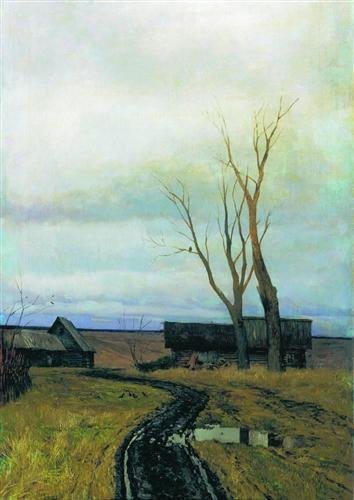
Autumn Road in a Village by Isaac Levitan (1877)

Isaac loved the challenge of landscape painting and was greatly influenced by the landscape work of the Barbizon painters as well as the work of the French realist painter Camile Corot.  Things were proceeding well for Isaac until 1875 when, at the age of fifteen, tragedy struck with the death of his mother and in 1877, after contracting typhus and having endured a long illness during which time he could not earn money, his father died.  Now Isaac was without financial support.  He had neither money to pay the college fees nor the money to live.  He was asked to leave the college due to non-payment of his tuition fees but was rescued by the kindness of friends who gave him the money so that he could continue studying and later, thanks to the College Council who appreciated his talent, the tuition fees were waived and furthermore they awarded him a small bursary.

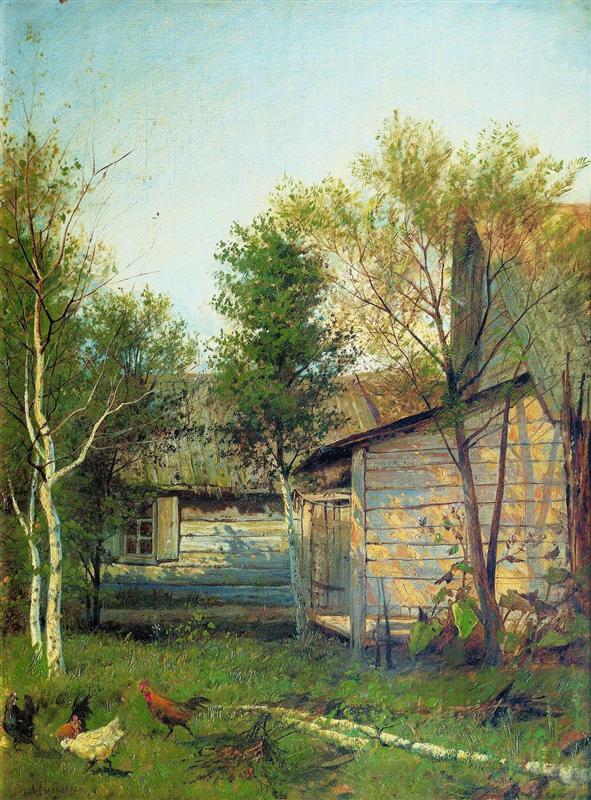
A Sunny Day, Spring by Isaac Levitan (1876)

In 1877, the year that his father died, the fifth Travelling Art Exhibition was held at the Moscow College of Art.  Isaac Levitan submitted two of his works with great hopes of a medal.  He had completed one of the works, Solnechnyi den Vesna (A Sunny Day, Spring) the previous year, whilst his other entry, Vecher (Evening) had been completed in 1877.  Levitan was disappointed in the judges’ decision.  He didn’t receive a medal for either work but was granted a diploma which allowed him to become an art teacher.

The year 1879 proved to be a year of turmoil and triumph for nineteen year old Levitan.  The turmoil occurred on the morning of April 20, 1879; Tsar Alexander II was attacked by a thirty-three year old former student, Alexander Soloviev, as he walked towards the Square of the Guards Staff.  The result of this assassination attempt was a crackdown on groups of people who were believed to be a threat to the Tsar.  The government issued an edict that there would be a mass deportation of Jews from the big cities of the Russian Empire.  This meant that Isaac’s family were forced to move out of the centre of Moscow to the eastern suburb of Saltykovka. Later that year, due to pressure on the local government officials by art lovers, Isaac Levitan was allowed to return to the city.

Autumn Day, Sokolniki, by Isaac Levitan (1879)

The triumph came that December, when Isaac entered his painting, Osenniy den Sokolniki (Autumn Day, Sokolniki) in the second students’ exhibition.  Levitan liked to paint views of different settings in the Moscow area. Considered to be one of the best works of this period is his poignant work entitled Autumn Day, Sokolniki, which he completed in 1879.   The painting reveals to us Levitan’s belief in the connection between nature and human feelings.  The painting is a depiction of a grey-clouded autumn sky and one can imagine the rustling sound of the wind through the trees causing the dying leaves to fall to the ground.  The path which disappears into the distance is the focal point of the painting.  It is empty with the exception of a woman dressed in black, who strolls towards us.

This work of art by Levitan was his reminder of his joy of walking along the forest path of his beloved Sokolniki Park.  The park lies to the northeast of the city and was so named because of its connection with falconry which took place there and was the favourite sport of members of the royal court (sokol is the Russian word for falcon).  This work of art received great revues and the following year it was purchased by the art collector and philanthropist, Pavel Tretyakov, the founder of the famous Tretyakov Gallery in Moscow.  This marked the initial public recognition of Isaac Levitan and his art.  The painting can now be seen at the Tretyakov Gallery in Moscow.

It was around the end of the 1870’s that Isaac Levitan met the writer Anton Chekhov.  The meeting came about as Anton’s brother, Nikolai, was a fellow student of Levitan at the Moscow College of Art.  This was to be a friendship which lasted all Levitan’s life.

In my next blog I will continue looking at the life of Isaac Levitan and feature some of his most important later works.

Joachim Patinir – the early landscape artist.

Joachim Patinir  c.1480 -1524
Joachim Patinir
c.1480 -1524

When I visit local art galleries around my neighbourhood they are packed with landscape works from various local artists.  As it is Wales a few sheep and the odd shepherd are “thrown in” as a prerequisite for Welsh landscape paintings.  My featured artist today was one of the earliest landscape painters and although his paintings often incorporated religious themes which were commonplace in northern Renaissance art, his forte was his splendid detailed, visually fascinating landscapes.   He is considered one of the first modern landscape specialists. Let me introduce you to the great sixteenth century Flemish landscape painter Joachim Patinir (often referred to as Patenier) of whose style the English art historian Kenneth Clarke described as:

“…the first painter to make landscapes more important than his figures…”

So how well thought of as an artist was this sixteenth century painter? Felipe de Guevara was a sixteenth century Spanish humanist, art writer, patron of the arts and a connoisseur of Netherlandish painting and in his manuscript of 1560, which two hundred years later, was published in book form, Comentarios de la pintura, he wrote that he regarded Patinir as on being par with the great Netherlandish painters Jan van Eyck and Rogier van der Weyden.  Praise indeed!  So who was this man who achieved such great standing?

In all biographies the opening paragraph usually contains a date of birth and it is at this point, with this artist, that one hits a brick wall as his actual date of birth is unknown and his birth date, which often varies from book to book, is somewhat of an educated guess.

According to the 1521 diary of Albrecht Dürer, who described Patinir as the good painter of landscapes there was, at that time, a portrait of Patinir as a man in his forties and that would then put Joachim Patinir’s birth date somewhere around 1480.  If Patinir’s birth date is uncertain so is his birthplace albeit the consensus of opinion is that he was born in either the town of Dinant or the nearby village of Bouvignes on the River Meuse.  It is interesting to note that Dinant is situated at a point on the River Meuse where the river cuts deeply into the western Condroz plateau.  The town lies in a steep sided valley sandwiched between the rock face and the river and the spectacular landscape around this town came to influence Patinir in his landscape works.

The first concrete facts we have of him was that he was serving an apprenticeship in the Antwerp Guild of Painters in 1515, a city in which he was to live all his life.  During his time he met and worked with other great Netherlandish artists of the time such as Gérard David, Hieronymus Bosch, Quentin Matsys

The Temptation of St Anthony by Joachim Patinir  (c. 1520-24)
The Temptation of St Anthony by Joachim Patinir (c. 1520-24)

My first offering of Patinir’s work is one entitled Landscape with the Temptation of Saint Anthony Abbot which he completed somewhere between 1520 and 1524 was one of the few paintings which was signed by the artist. The painting now resides at the Museo Nacional del Prado. This work of art was not a solo effort by him, but a collaboration with Quentin Matsys, who painted the figures, which we see in the foreground.  St Anthony, who had given up his worldly possessions and devoted himself to a contemplative life, is depicted sitting on the ground.  He is surrounded by temptation in the form of three courtesans who try to seduce him.  One of the women holds out an apple which symbolises temptation reminding us of the story of Adam and Eve in the Garden of Eden.  A demon-like monkey pulls at his clothes.   Lying on the ground we see a discarded rosary symbolising the possible abandonment of faith.  Although our eyes are initially drawn to the large figures in the foreground and as we try to work out what is going on, they soon move to take in the wondrous landscape in the middle ground and background which is a setting for various events in the life of the saint. Cast your eyes to the central middle ground and one can make out Anthony and his hut which is under attack by an army of demons.  To the right of that scene we see St. Anthony sitting at the water’s edge of a lake on which is the royal barge carrying the queen and her ladies-in-waiting, some of whom are naked; all part of a seduction scene.  The rocky landscape and the river hark back to the geography of his birthplace.  The painting was acquired by the Spanish king, Philip II in 1566 and was hung in the Escorial Palace.

Landscape with St Jerome by Joachim Patinir (c. 1517)

Patinir often incorporated hermit-style life depiction in his landscape works.  This was a very popular subject in Northern European devotional works of art. This next painting focuses on these two elements.  It is his Landscape with St Jerome painting, which he completed around 1517, and which also can be found in the Prado in Madrid.  The work combines an extensive landscape background, with its vibrantly coloured and decidedly naturalistic vista, with the tale of Saint Jerome.  In this work we see the moment in time when Saint Jerome, seen huddled under a rocky outcrop, removes the thorn from the paw of the lion.  Patinir’s depiction of the saint is not as we would expect to observe him.   Jerome, who was a cardinal in the Catholic Church and eminent theological scholar, was often depicted alone, dressed in his red ceremonial robes, studiously at work in his room.  However, in this work Jerome is dressed in the rags of a hermit living outside his battered wooden shelter.  As was the case in the first painting I featured, our eyes soon leave Jerome and the lion and focus on the way Patinir has beautifully depicted, in great detail, the landscape which surrounds the saint. Perched on rocky plateau is a monastery, supposedly a depiction of the one at Bethlehem where Jerome once worked.   The painting seems to have three well defined colour patterns.  The foreground is the darkest made up of various tones of brown and black depicting Jerome’s shelter attached to the high and dark rocky outcrop.  The middle ground is full of green of differing shades from the dark greens of the tree foliage to the lighter greens of the fields further away which surround a small village.  The background is predominantly lighter with blues and greys depicting the sea and the far-off mountains although to the left we see the black clouds of an approaching storm.  This change in colours from the darkness of the foreground to the lightness of the background creates perspective in the work.  Once again the high craggy outcrops hark back to the geography of his birthplace, Dinant which nestled snugly between the high rocky cliffs which protruded out towards the River Meuse.

Charon crossing the River Styx by Joachim Patinir (1524)

My third offering is fundamentally a landscape work and yet this has a mythological connotation.  It is entitled Charon Crossing the River Styx and was completed by Patinir around 1524.  Again, like the two previous works, it can be found in Madrid’s Prado museum.  This is not a devotional work and was probably originally commissioned by a wealthy merchant and scholarly connoisseur who was also an avid art collector.  The painting is divided into three vertical parts, the centre of which is the River Styx and the outer parts represent the banks on either side of this great mythological waterway.   The River Styx was one of the five rivers that separated the world of the living from the world of the dead. In Greek mythology, it was written that the River Styx wound around Hades nine times. The name of the river derives from the Greek word stugein which means hate, and so, Styx, was the river of hate. To the left of the river is the swamp-like and rugged bank of Paradise and to the right of the river is that of Hell

Charon and the Soul
Charon and the Soul

Our eyes immediately home in on the sandy-coloured boat and its occupants which are midway between the two banks.  The boatman is Charon, the old ferry man who ferries the dead onto the underworld, and we see him crossing the river Styx towards the underworld, where the dragon-tailed three-headed dog, Cerebus, stands guard, allowing all souls to enter but none to leave. We can see Cerebus curled up in his lair at the entrance to the gates of Hell, which is depicted in the right background of the painting, burning brightly.

The Angel pointing the way

Along with Charon in the boat is the soul of a recently deceased person. The soul is looking around and has to decide on to which bank it wants to disembark.  If you look carefully at the left bank you will notice an angel perched on a mound pointing towards another waterway and another land.  This water is the Fountain of Life and it is part of Paradise.  We can see peacocks and ravens on this land and these symbolise Resurrection and Redemption.  The angel is canvassing that this should be the soul’s land of choice.  Now, if we look on the right bank that also seems to be calm and peaceful with birds flying around the trees.  Cerebus is out of sight but on the ground near the foot of the trees is a small monkey which is a symbol of the devil and that for the soul in the boat should be warning enough.  Unfortunately, looking at the way Charon is steering the boat, the soul has made the wrong choice!  The background story is interesting but for me the beauty of this work is not the characters in it but the artist’s depiction of the landscape.

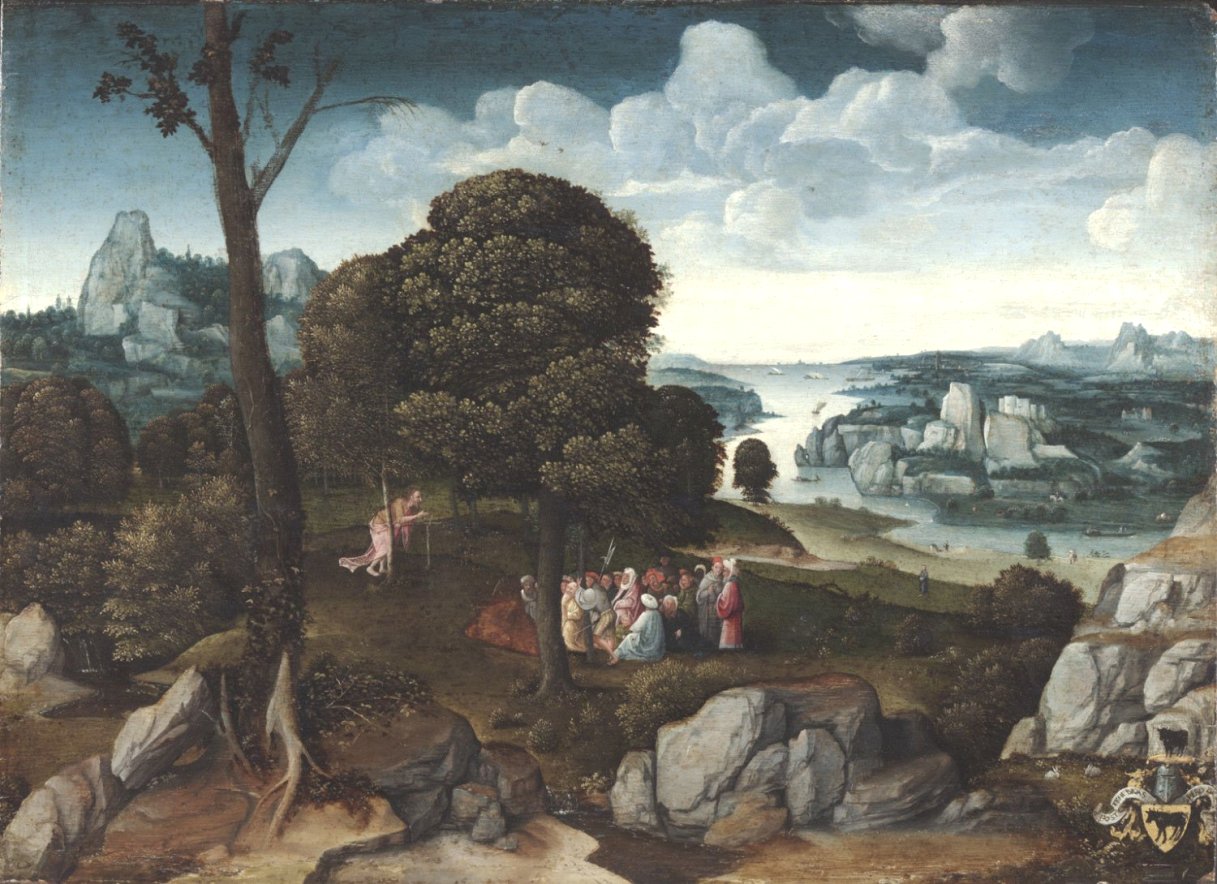
Landscape with Saint John the Baptist Preaching by Joachim Patinir

My fourth and final offering of works by Joachim Patinir is entitled Landscape with Saint John the Baptist Preaching and one version of this work can be found in the Musées Royaux des Beaux-Arts de Belgique – Brussels, but the one below is from the collection of  the Philadelphia Museum of Art and in the lower right hand corner of this version we see a crest.   It is the crest of the wealthy Rem family and it could well be the wealthy merchant, Lucas Rem, the sixteenth century Augsburg merchant and art collector had this version painted for himself and had the family crest added to it.

Landscape with Saint John the Baptist Preaching by Joachim Patinir with the Rem Crest

In the painting, we have a bird’s eye view of St John the Baptist preaching to a group of followers but what I like most about the painting is the beautifully depicted imaginary landscape which acts as a backdrop to the religious scene,   Once again it crosses my mind that the religious story plays a secondary role to Patinir’s depiction of the landscape.  Once again we see a similar landscape to that in his other works – tall rocky outcrops closely bordering on to a river, which because of the religious nuance of the painting could have represented the River Jordan and on the left bank, although not clear in this picture, is a depiction of the baptism of Christ, in the Jordan river, by John the Baptist.

We observe St John, bent over, leaning heavily against a sturdy branch of a tree.  It is almost as if he is leaning against a lectern or pulpit rail as he looks down upon his followers who sit entranced by his words.  In the foreground to the left of the painting we see a tree which is dying around which is a vine.   This is thought to allude to the Tree of Knowledge in the Garden of Eden which withered and died once Adam had taken a bite of the apple offered to him by Eve.  According to legend, the tree eventually came back to life once Jesus Christ had died on the cross and in so doing, had atoned for the sins of the world.

Both John the Baptist and his audience are in the shade as the bright light we see lighting up the meandering river, which wends its way towards the horizon, is incapable of penetrating the thick tree canopy above the group.  As was the case in the earlier painting, Patinir has used different colour combinations to craft perspective.  Dark browns and greens in the foreground around the people gradually change to lighter greens of the banks of the river and then in the distance lighter blues and greys become the dominant colours.

Bayard Rock, Dinant
Bayard Rock, Dinant

There is a fascinating delicacy about Patinir’s landscape work and as I have said before this favoured landscape depiction of the artist probably stemmed from what he remembers of his birthplace around Dinant and the rock structure there known as the Bayard Rock, which looms above the town and the River Meuse.

In German, Patinir would be classified as a painter of Weltlandschaft which translated means world landscape.  The Weltlandschaft painters completed works depicting panoramic landscapes as seen from a high viewpoint.  These works of art typically included mountains and lowlands, water, and buildings. As in Patinir’s works, the subject of each painting is usually a Biblical or historical narrative, but the figures included in the work are secondary to their surroundings and they were often made-to-order by secular patrons.  The landscapes in these works were not geographically accurate.  In her 2005 book, Seventeenth-century Art and Architecture, Anne Sutherland Harris, a professor of Art History, describes this form of art:

“…They were imaginary compilations of the most appealing and spectacular aspects of European geography, assembled for the delight of the wealthy armchair traveller…”

So again I ask – was Patinir a religious painter who liked to add a landscape background to his work or was he a landscape painter who liked to add, or get somebody else to add, figures appertaining to religious and mythological stories?  Perhaps his friend Albrecht Dürer had the answer to this conundrum when he described his friend as:

“…der gute Landschaftmaler…

(the good painter of landscapes)

Jan Siberechts English Country Houses and Landscapes

My Daily Art Display today continues examining the life of the seventeenth century Flemish painter Jan Siberechts and taking a look at some of the paintings he completed after he moved his home to England.  In my previous blog I talked about Siberechts’ early landscape paintings which followed the style of the Dutch Italianate artists of the time.  Then, in the early 1660’s, he worked on a number of paintings depicting Flemish rural life and the life of the peasant community.

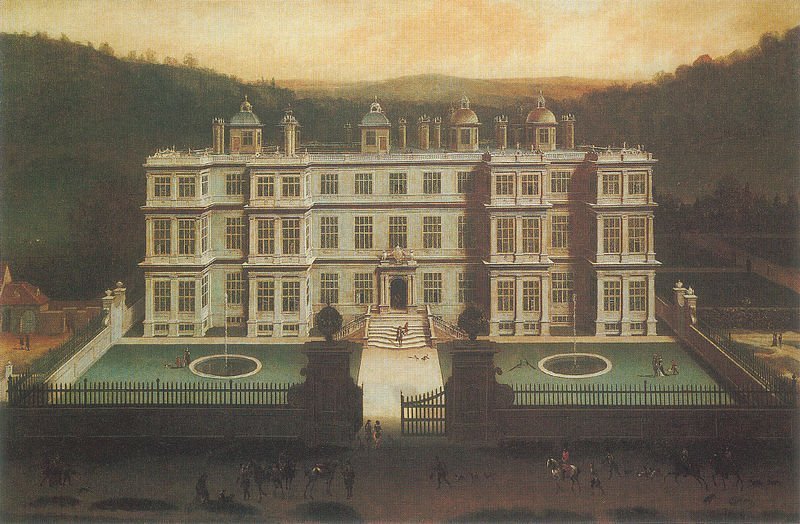
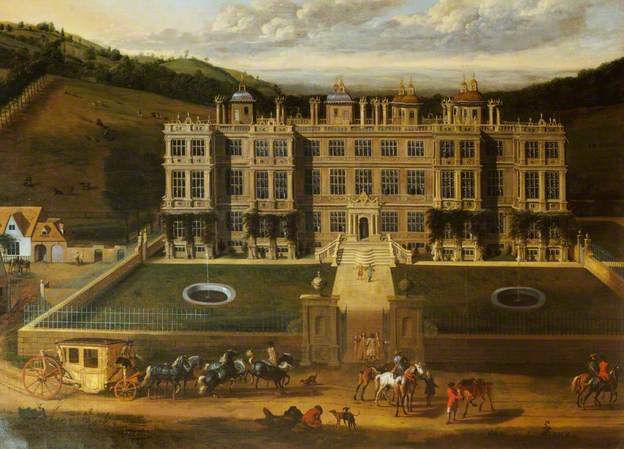
View of Longleat by Jan Siberechts (1675)

In 1672, at the age of forty-five, Siberechts’ life changed.   Two years earlier, George Villiers, the second Duke of Buckingham, whilst on business in the southern Netherlands came across some of Siberechts’ work.  He was so enamoured by what he saw that he invited the artist to come to England and help decorate his Italianate mansion, Cliveden, which was situated on the bank River Thames near the town of Windsor and which he had built six years earlier.  Jan Siberechts agreed to move home to England and became just one of the hundreds of Dutch and Flemish artists who came to Britain in the seventeenth century to ply their trade.

View of Longleat by Jan Siberechts (1678)

Siberechts’ work at Cliveden enhanced his reputation in England as a talented artist and his birds-eye views of stately homes became much sought after.  His recognised artistic ability and his connection with Villiers, led him to be awarded numerous painting commissions from the aristocracy and he was often referred to as being the “father of British landscape painting.

Wollaton Hall and Park by Jan Siberechts (1695)

These aristocratic commissions from around England were often for paintings of their stately homes.  One such example was his 1695 work entitled Wollaton Hall and Park which was in Nottinghamshire and the home of Thomas Willoughby, 1st Baron Middleton.  Another commission in 1694 was for a painting of Chatsworth, the Derbyshire country house of William Cavendish, the 1st Duke of Devonshire.

Siberechts received a commission in 1675 from Thomas Thynne.  The painting, entitled View of Longleat, depicted his stately home.   The work still hangs in the house.  Three years later Siberechts completed another painting of the building and this is now part of the Government Art Collection.   These depictions of country houses and country estates were very popular with their aristocratic owners and Siberechts was inundated with similar commissions.   In the foreground of this painting we see the aristocratic owners along with their horses, portrayed as huntsmen readying themselves for the hunt.

Another example of this type of work by Jan Siberechts is his 1696 topographical landscape painting entitled View of a House and its Estate in Belsize, Middlesex which he completed in 1696.   In the painting we see a birds-eye view of the The Grove, the house and estate of Sir Francis Pemberton, a leading figure of the English judiciary.  He, along with his wife and seven children, lived there until his death in 1697 just one year after Siberechts had completed the work.   Pemberton had bought the neighbouring Dorchester House and its estate around 1688.  He then demolished that house to make way for his extensive vegetable gardens and orchards.  The all-embracing gardens can be seen surrounding the manor house in Siberechts’ painting.

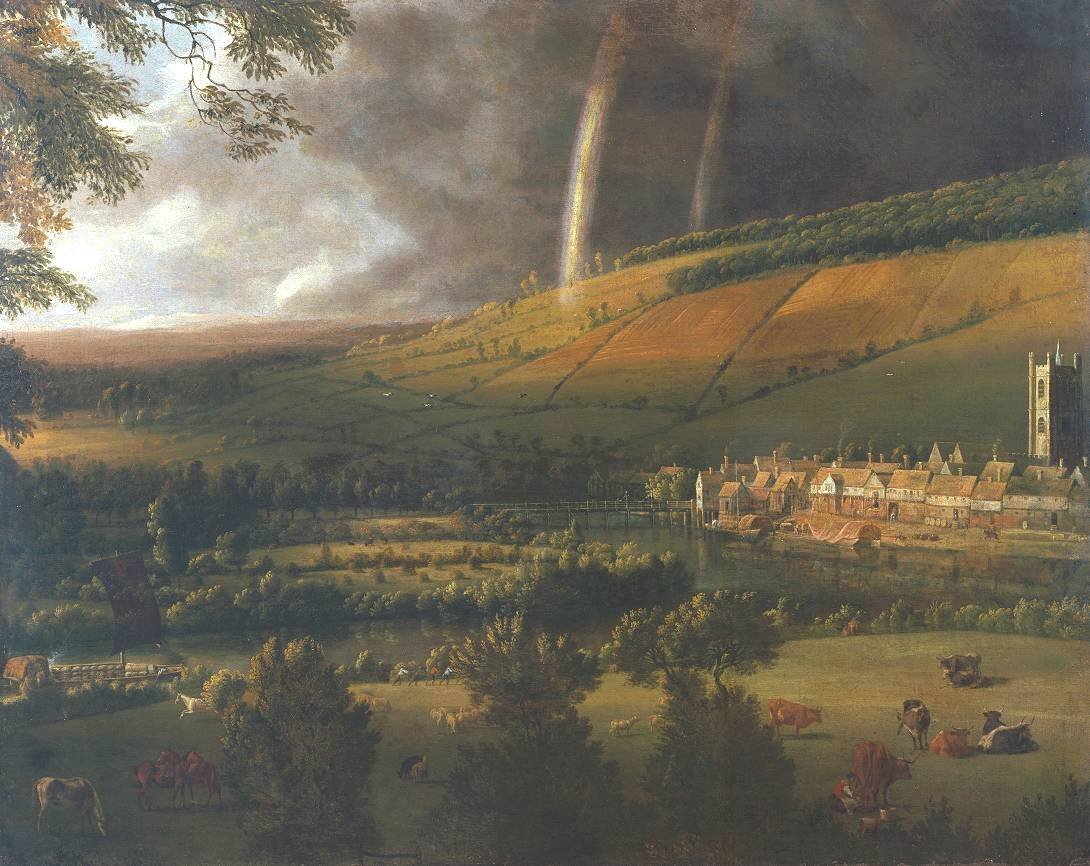
Landscape with Rainbow, Henley-on-Thames by Jan Siberechts (c.1690)

Jan Siberechts spent a good deal of time travelling around the English countryside fulfilling commissions to paint palatial residences.  Such paintings were interspersed with works featuring hunting scenes and views of the rural landscape.  My last offerings today are also from the 1690’s when Siberechts completed a series of five landscape paintings featuring the town of Henley and the Thames Valley.    There is no record of who commissioned the works but it could well have been one of the many rich merchants who owned land around the town of Henley.     The works were different to his earlier ones featuring stately homes for in this series Siberechts concentrated on the landscape of the area with its pastureland and woods and also included views of the River Thames and the boats which plied their trade along this busy waterway.  One of the best known of these, entitled Landscape with Rainbow, Henley-on-Thames, can be seen at Tate Britain.  It is a beautifully crafted painting.   In the foreground we have cattle and horses grazing in pastureland which slopes down towards the tree-lined banks of the River Thames.  On the left we can see a laden barge, piled high on deck with its cargo, being manoeuvred along the waterway by four men in the field, who laboriously drag the floating hulk towards the warehouses of Henley.  To the right of the painting we see the busy little town of Henley-on-Thames with its high-towered 13th century church, St Mary the Virgin, rising amidst the dwelling places.  The church still stands today.  The background to the right is filled with rising hills, more pastureland and the occasional woods above which are a double rainbow and a dark and threatening rain cloud which is emptying its contents on the fields below.  In the left background of the painting the view has opened up more and we catch a glimpse of the distant hills.

Henley from the Wargrave Road by Jan Siberechts (1698)

Another painting in the series was Siberechts 1698 work entitled Henley from the Wargrave Road which hangs in its own room in the Henley Gallery of the River & Rowing Museum, Mill Meadows in Oxfordshire.  This work is a veritable masterpiece which is in a way a historical record of the time depicting the life of the town, its surrounding countryside, and the importance of the commercial trade using the river.  Siberechts has depicted the 17th century buildings of Henley with its old wooden bridge with stone flood arches, the Church and the mill on the river.  In the foreground we can see farm workers busy haymaking in the riverside meadows and a cart fully loaded with hay heading down the country lane towards the town of Henley.  It is interesting to look back at the paintings of Jan Siberechts which I have featured in my last two blogs.  They are so different.  There is a certain simplicity and charm to his 1660’s rural life works but his artistic talent cannot be denied when we study some of his later works which he completed during his days in England.

Jan Siberechts died in London in 1703, aged 76.


The Pastoral Scenes of Jan Siberechts

The Ford by Jan Sieberechts (1672) Szépmûvészeti Múzeum, Budapest
The Ford by Jan Sieberechts (1672)
Szépmûvészeti Múzeum, Budapest

My Daily Art Display today features the 17th century Flemish painter, Jan Siberechts.  I will also look at some of Siberechts works and look how his style of painting changed during his lifetime.  In today’s blog I will concentrate on his rural life paintings and in my next blog I will look at how his painting style changed when he went to England. 

Jan Siberechts was born into a family of artists in Antwerp in January 1627, first training with his father, who was a sculptor.  Little is known of his early life and upbringing except to say that in 1648, at the age of twenty-one, he became a master in the Guild of St Luke in Antwerp and four years later, in 1652, he married.   Siberechts’ early works, up until around 1660, were mainly landscapes which were heavily influenced by the Dutch Italianates.  The Dutch Italianates were a group of seventeenth-century Dutch artists who painted landscapes of Italy.  Many of these painters had travelled to and lived in Italy whilst others who had never made the journey to Italy were simply stimulated by the works of those who did.   Many young Dutch painters made the arduous journey, often by foot, over the Alps to Italy, whereas others travelled by sea. The favourite destination for these intrepid travellers was usually Rome, but some journeyed to Venice, and a few to Genoa. 

Many of these artists would make copious sketches during their sojourn in Italy and in the case of those who crossed the Alps on foot, they would pictorially record their arduous journey through the breathtaking mountain passes and then, once they arrived back home to their studios, they would produce this Italianate art.  Such works of art, which were extremely popular with the Dutch and were in great demand in what was then a booming Dutch art market. These Dutch Italianate painters enthused over the golden light of Mediterranean skies which they encountered in Italy.   The countryside around Rome (campagna) was a constant source of inspiration and featured in many of the works of the Dutch Italianates.   Some of the leading Dutch Italianate painters during the lifetime of Siberechts were artists, such as Nicolaes Berchem, Jan Both, Karel du Jardin, and Jan Weenix.  Because Siberechts’ early works reveal the influence of the Dutch Italianates some art historians believe that he may have made the journey to Italy but there is no firm proof of this assertion.   Many believe Siberechts remained in Antwerp until 1672 at which time he accepted an invitation to travel to England and so it could be that he was simply influenced by the finished works of the Dutch Italianate painters which were offered up for sale in Antwerp.  

Shepherdess by Jan Siberechts (1660's) Hermitage, Saint Petersburg, Russia
Shepherdess by Jan Siberechts (1660’s)
Hermitage, Saint Petersburg, Russia

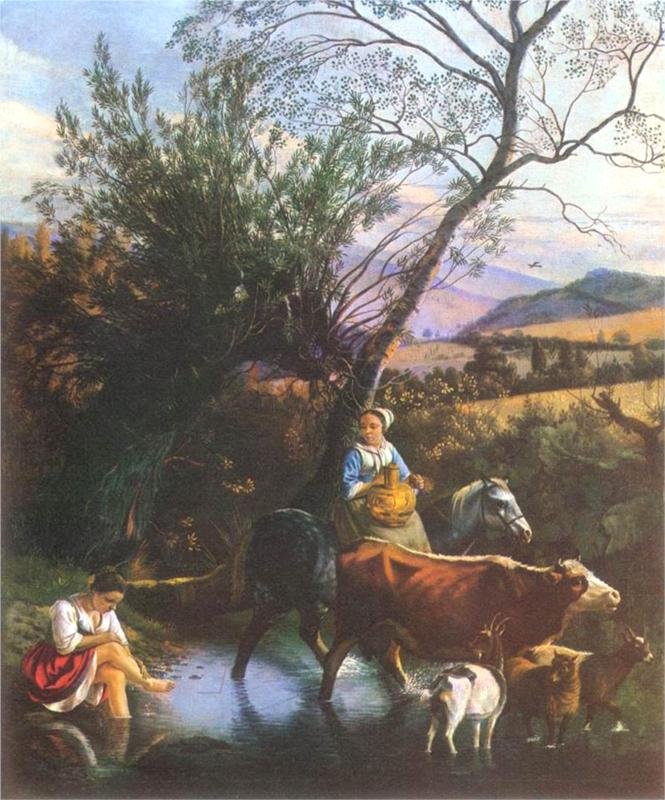
Siberechts style changed around 1661 when he became interested in depicting scenes from the Flemish countryside and the rustic life of the peasants.  His initial landscape work with its occasional small figures changed and, in his work now, the figures in his landscape settings were larger and took on a paramount importance. 

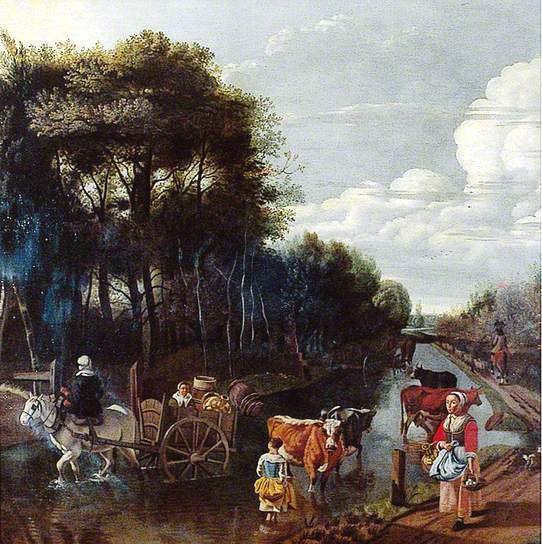
Landscape with a Road, a Cart and Figures by Jan Siberechts Norfolk Museums & Archaeology Service (Norwich Castle Museum & Art Gallery)
Landscape with a Road, a Cart and Figures by Jan Siberechts
Norfolk Museums & Archaeology Service (Norwich Castle Museum & Art Gallery)

Often the countryside scenes depicted in these paintings incorporated country roads which had been partly flooded forming fords and peasant women going about their daily routine, carrying goods, such as hay or vegetables, to or from market, often by horse and cart.  In other paintings we see the women tending to their livestock along a river bank.  

The Wager by Jan Siberechts (1665) Koninklijk Museum voor Schone Kunsten, Antwerp
The Wager by Jan Siberechts (1665)
Koninklijk Museum voor Schone Kunsten, Antwerp

In Siberechts’ countryside depictions his female figures were much larger than corresponding figures in most paintings of this genre. The female figures we see in Siberechts’ paintings are not willowy, weak women but strong robust females who were quite able to hold their own against their men-folk when it came to working on the farm.  The presence of water in Siberechts’ scenes gave him the chance to show off his artistic ability of depicting reflections on the water surface and the glittering of the light on moving water.  The inclusion of water into his peasant scenes also gave Siberechts an excuse for showing us a sensual glimpse of bare female thighs as they washed and cooled down their bare legs in the fords or streams.  The colours Siberechts used in these landscape works were often quite similar.  He would utilise whites, reds and yellows for the clothes of the women and these colours would contrast against the various greens he used to depict surrounding plants and vegetation.  Often there would be no background as such to these paintings as the dense foliage in the middle ground obscured our view of any background. 

I like these works.  There is a certain quaintness about them.  As you will see in my next blog the paintings Siberecht did whilst in England couldnt be more different.

The Mancorbo Canal in the Picos de Europa by Carlos de Haes (1876)

The Mancorbo Canal in the Picos de Europe by Carlos de Haes (1876)

My Daily Art Display blog today incorporates the two things I enjoy most in art; landscape paintings and discovering a painter I had, up till now, never heard of.   Today I am featuring the nineteenth century Belgian born Spanish landscape painter Carlos de Haes.

Carlos de Haes was born in Brussels in January 1826.  He was born into a dynasty of merchants and financiers and was the eldest of seven children.  When he was nine years old his family moved to Malaga where he grew up and went to school. His initial artistic training was under the tutelage of Luis de la Cruz y Ríos, the Spanish miniaturist painter, who had once been the court painter of King Ferdinand VII.    In 1850, at the age of twenty-four, he returned to Belgium and studied for five years under the Belgian landscape painter Joseph Quineaux.  It was the influence of Quineaux which drew de Haes into the world of landscape painting and sketching and painting en plein air.  During his five year stay in Brussels he managed to travel to France, Holland and Germany constantly sketching the varied landscapes he came across.  It was also around this time that he became interested in the works of the contemporary Realist artists.    In 1855 after completing his art course he returned to Spain and went to live in Madrid and became a naturalised Spaniard.   In 1856 he put forward a number of his landscape works for exhibition in Madrid’s Exposición Nacional, where they were very well received.   The following year, 1857, at the age of thirty-one, Carlos de Haes won the competition for the chair of landscape painting at theReal Academia de Bellas Artes de San Fernando (Royal Academyof Fine Arts of San Fernando), with his work entitled Royal Palace from the Casa de Campo.  The Academy was an establishment which would half a century later be home to the likes of Dalí and Picasso.   In 1861 de Haes was made Académico de mérito. 

During his tenure at the Academy, de Haes set about putting together a set of regulations for his students governing landscape painting and rules for future landscape competitions.  He was insistent that his students mastered the art of en plein air sketching and painting instead of just producing historical landscapes which they had conjured up in the studio.  This, he believed prevented the true study of nature, and he asserted that the en plein air aspect was of paramount importance when contemplating a landscape work.   Haes encouraged his students to interpret nature directly and by working out in the open he insisted that they understood how the changing light changed how they viewed the vegetation and the terrain.  He did however countenance using the studio to fine tune the painting and make final adjustments.  Haes’ insistence that his students should produce a truthful depiction of the landscape, captured by painting en plein air, points towards his interest in the new Realism form of art, which claimed that artists should represent the world as it was, even if it meant breaking artistic and social conventions.   

During the next ten years Haes spent most of his time painting landscapes which featured the Spanish Pyrenees and the Guadarama mountains in central Spain.  One of his students who accompanied him on his sketching journeys was Aureliano Berruete who would become one of the foremost Spanish painters.

Carlos de Haes became ill in 1890 and died in Madrid in 1898.  He bequeathed his mostly small-format paintings to his pupils, who gave them to Spanish museums, the majority of which are now housed in the Casón del Buen Retiro, part of the Prado Museum in Madrid.

My featured painting today by Carlos de Haes was one which I saw when I recently visited the Prado in Madrid.  It was completed by him in 1876, although the preparatory sketch for the work was dated in situ in 1874.  It was exhibited at that the 1876 National Exhibition in Madrid and was subsequently purchased by the Spanish state.  Carlos de Haes had been travelling with Aureliano Berruete around the wild and rugged Cantabrian rural area of Liébana when they came across this spectacular view.   The oil on canvas painting, measuring 168cms x 123cms is entitled The Mancorbo Canal in the Picos de EuropeThe Picos de Europa is a range of mountains 20 km inland from the northern coast of Spain and this landscape painting by de Haes depicts the awesome and craggy vista of the mountain range which was one of Carlos de Haes’ favourite type of spectacular and breathtaking views.   At the bottom of the painting, although it somewhat difficult to pick them out, there are three cows and their herder.

I stood before this beautiful painting and was awestruck by its beauty and its realistic quality.  So, if you ever make it to the Prado be sure to find this work.

Frederic Edwin Church, Part 2

For those of you who have just landed on this page I suggest you go back to my previous blog which looks at Frederic Church’s early life and talks a little about his exhibition at the National Gallery, London which I visited last week.

Our Banner in the Sky by Frederic Edwin Church (1861)

Another beautiful and moving historical painting by Frederic Church which was on display at the exhibition and which I found very moving was a small oil painting entitled Our Banner in the Sky which Frederic Church completed in 1861.  I stood before this work, fascinated by the way in which Church had cleverly depicted the image of the Stars and Stripes American flag in tatters against an amazing daybreak landscape with its red and white bands of clouds.  Church had painted this shortly after the attack on Fort Sumter by General Beauregard and his Confederate troops in January 1861 , which signalled the start of the American Civil War, which tragically went on to cost so many American lives.   In the work we see a bare and tall tree slightly leaning over, which acts as a flagpole for the flag which blends in with the early morning sky.  In it, we see the North Star depicted through a patch of blue sky.  Church has cleverly managed to create a highly patriotic scene which in some ways connects the American landscape with the Northern cause.  It was a heartfelt cry for unity which sadly was not listened to. It was such a popular work that the Manhattan art dealer, Goupil & Co. commissioned Church to produce a chromolithograph of the work and, within a few months, hundreds of copies were bought up by the public.

Isabel Carnes Church by Frederic Church (1860)

It was during the New York exhibition of his Andes painting that Frederic Church met Isabel Carnes.  In 1860 just three months before his marriage to Isabel, Church bought some 126 acres of farmland, close to the towns of Hudson and Catskill and situated on a south sloping hill, overlooking the Hudson River.  He was familiar with this site as he had visited the area whilst on a painting trip with Thomas Cole in 1845.   As he still lived in New York, this new acquisition would be the family country get-away.   Church employed the foremost architect of the time, Richard Morris Hunt, to construct a cottage and design this ferme ornée.  The term means an ‘ornamented farm’, and describes a country estate laid out partly according to aesthetic principles and partly for farming.  Church and his wife referred to the small cottgae on the estate as their Cosy Cottage and it was surrounded by gardens and orchards and Church even had a section of marshland drained so as to build his own expansive ten acre lake.  Over time he bought up more of the adjoining land and eventually his estate encompassed 250 acres.

Fern Walk, Jamaica by Frederic Church (1865)

He and his wife lead a settled and happy life and he spent most of his time tending to his farm but his happiness was shattered in March 1865 when both his young children contracted diphtheria and died a week apart.  In an attempt to counteract the intense grief suffered after their children’s death, he and his wife along with some friends travelled to Jamaica where, for five months, Frederic immersed himself in a painting frenzy whilst his wife collected numerous species of ferns which she would later bring back home and which would form part of her fern garden.  Isabel’s interest in ferns and Frederic’s love of depicting nature in his painting were combined in his 1865 work entitled Fern Walk, Jamaica in which Church depicts a narrow path winding through luxuriant plants and ferns.  The shades of greens and browns which he used in depicting the native flora is breathtaking.  Frederic Church loved his stay in Jamaica.  He loved sketching plein air in the tropical light and, on his return to America, would often encourage other landscape artists to venture on painting trips to the Caribbean island.  In a letter he wrote to the landscape artist, Charles de Wolf Bramwell, he extolled the Fern Walk area of the island, writing:

“…the vegetation, next to that on the Magdalena River, the finest I ever saw –– The ferns, especially in the region known as Fern Walk — excelled every place…”

Ed Deir, Petra Jordan by Frederic Church (1868)

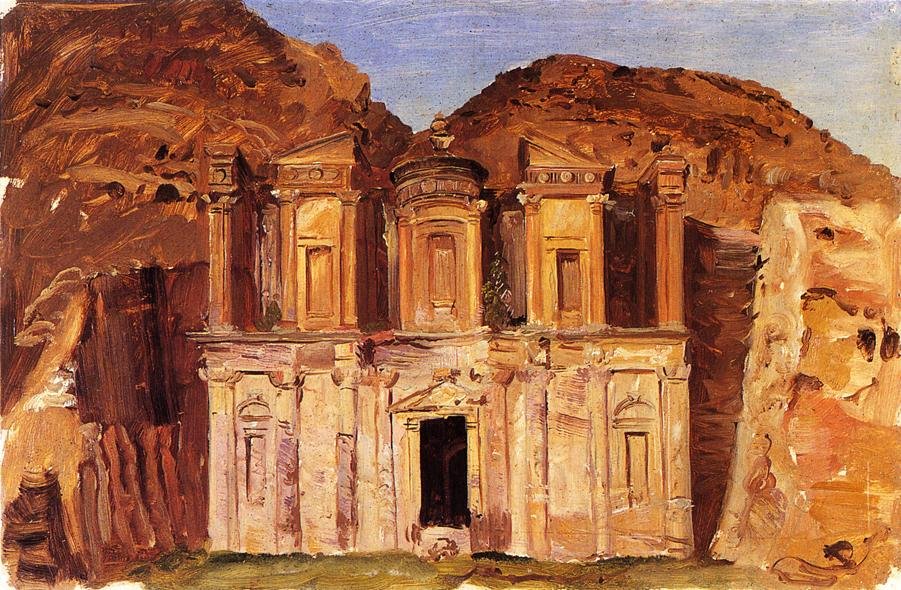
The couple returned home from Jamaica and in 1866 Isabel Church gave birth to a son, Frederic Junior.   The following year Frederic and Isabel, along with their son and Isabel’s mother, set off on a two-year long journey of Europe and the Holy Land.   They visited Jerusalem and from there headed to Jordan where Church, after an arduous ten day journey by mule, arrived at the ancient city of Petra.  During the long trip Church continually sketched and painted.  It was a trip which was fraught with danger from not only local bandits, but from the native porters which were helping Church’s party get to their destination.  These Arabs were very superstitious about his sketching but were eventually won over by his skill.  He finally arrived at Petra and made the long climb up above the city to the monastery of Ed Deir, which in the first century AD was a Nabatean temple.   Frederic Church completed his beautiful oil and graphite painting entitled Ed Dier, Petra, Jordan,   Unbelievable at it may sound but Church completed the work in just one sitting, in 1868.

Königsee by Frederic Church (1868)

From the Holy Land, Frederic Church returned to Europe visiting Rome and Athens and also the Bavarian Alpine region, Switzerland and Austria which had always been a popular venue for landscape painters.  Church was drawn to this area as he was always searching for beautiful vistas to paint.   He liked the area as he believed there was a marked similarity between the geography of the area and that of the rugged American landscapes which he knew so well.  In July 1868 he visited the Königsee, the beautiful Upper Bavarian lake which nestles amongst steep-sided cliffs.  Sheltered from the weather,  the surface of the lake is often mirror-like reflecting the surrounding mountains.   He completed a beautiful work entitled Königsee that month and it is a poignant reminder to me of the times I have visited the lake and stood in awe before it, mesmerised by its beauty.

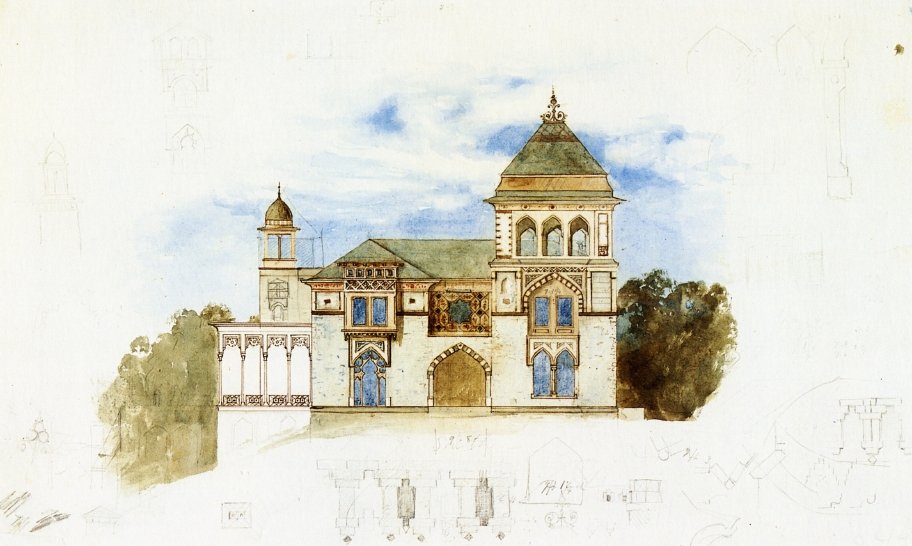
South West Facade of Olana by Frederic Church (1870)
South West Facade of Olana
A watercolour by Frederic Church (1870)

Frederic Church in 1867 was becoming homesick and wanted to return to America and his country estate.  Since he bought it seven years earlier he had been constantly planning the landscape design for the land and the architectural design for a large house on the top of the hill.  Richard Morris Hunt, his architect, had submitted plans for a large French chateau-style house and Church had liked the idea and agreed to the design.   However having returned from his tour of the Levant and studied the architecture of the area, he changed his mind.  He decided to discharge Hunt and take on the British-born American architect and landscape designer Calvert Vaux who was based in Manhattan and had in 1858, along with Frank Law Olmstead had won a design competition to improve and expand New York’s Central Park.

Olana Historic Site
Olana Historic Site

Frederic Church and Vaux worked on the plans for the design of the house which was to be the centrepiece of  Church’s estate, which he and his wife Isabel named Olana after a fortress-treasure house in ancient Persia which like Church’s estate also overlooked a river valley.  The building project was completed in 1872.

As Church got older he spent more and more time on his farm and concentrated his time running the estate.  From the 1870’s onwards Church suffered badly from rheumatoid arthritis which badly affected his right arm curtailing much of his art work although he did teach himself to paint with his left hand.  Frederic Church died in 1900, aged 74 and is buried in Spring Grove Cemetery in Hartford, Connecticut.

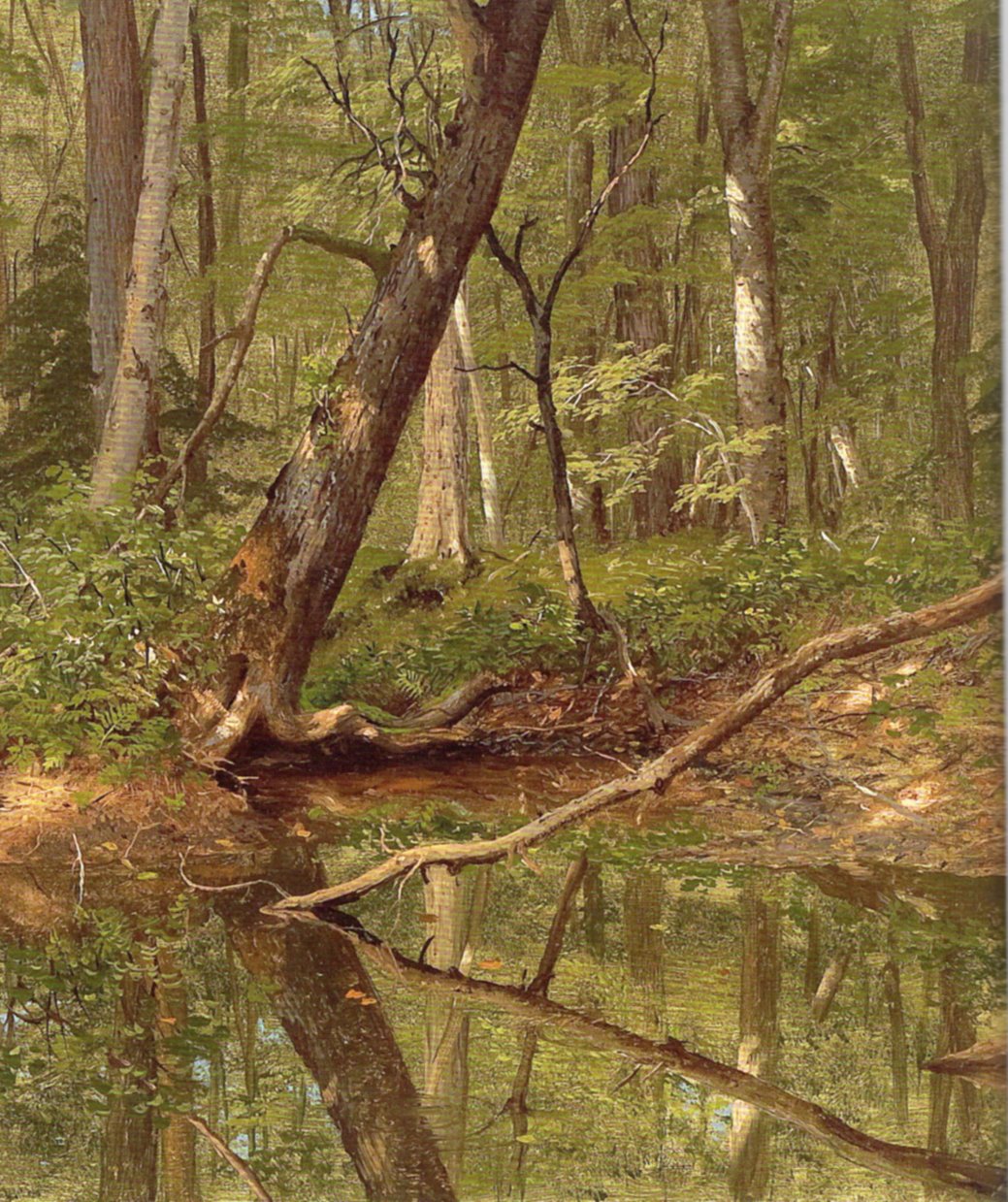
Forest Pool by Frederic Church (1860)

I will finish this blog with a look at the painting by Frederic Church, which most impressed me at the exhibition.  It is entitled Forest Pool and was completed by Frederic Church around 1860.  It was almost the first work I came across as I entered the exhibition room and I had to keep coming back to it in order to savour its beauty.   I stood before it and could not believe the quality of the painting.  Such beautifully drawn details.  Such beautiful colour and tones.  The work was a close-up view of a dense forest and a small forest pool.   Every square inch of the work is covered in rich shades of green and brown and although it was a study for a larger painting, it seems as if it is a finished work.  The artist has delightfully depicted the tranquillity of the forest scene with the calm surface of the pond offering up reflections of the trees and their branches and spots of sunlight.  If you look closely at the upper middle part of the composition you will just be able to make out a hint of blue sky which is otherwise blocked by the screen of trees.

The Frederic Church exhibition at the National Gallery is worth going to see for this painting alone.

Frederic Edwin Church, Part 1

Last weekend I spent a two day break in London attending the christening of my grandson and pottering around a couple of galleries visiting their current exhibitions.   I had tickets for the Boccacio exhibition at the National Gallery and whilst there I decided to call in to their small but excellent Frederic Church exhibition, Through American Eyes: Frederic Church and the Landscape Oil Sketch, which is running until April 28th.   It was a veritable gem of a show and as the publicity stated,

 “…[ it was an invitation to] step into a world of wild natural phenomena with the landscape oil sketches of celebrated American landscape painter, Frederic Church…

 It is a free-to-enter exhibition and one you should try and visit.   I want to dedicate the next two blogs to the nineteenth century American painter Frederic Church, and look at some of his paintings, some of which were at the exhibition.  Church was a master of the plein-air oil sketch and I ask you to accompany me on a journey looking at his life and sampling some of his exquisite artistic gems.

Frederic Church was born in Hartford, the state capital of Connecticut, in May 1826.  He came from a privileged background.  His father, Joseph, who came from a very prosperous family, was a jeweller, silversmith and a Hartford insurance adjuster and the Church household lived an affluent lifestyle.  Frederic, who was brought up in a devout Protestant Congregationalist household, showed a propensity for art whilst at school and through a family neighbour, Daniel Wadsworth, was fortunate enough to be introduced to Thomas Cole, the English-born American landscape artist, who is regarded as the founder of the Hudson River School.  Thomas Cole, who up until then had never taken a pupil under his wing, agreed to take Frederic on as his pupil.   Frederic studied under Thomas Cole in his Catskill studio between 1844 and 1846 during which time he and his tutor would go off on painting trips to the Catskill Mountains and the Berkshires, a highland region in western Massachusetts, west of the Connecticut and lower Westfield Rivers .

Hooker and Company journeying through the Wilderness in 1636  from Plymouth to Hartford by Frederic Church (1846)
Hooker and Company journeying through the Wilderness in 1636 from Plymouth to Hartford
by Frederic Church (1846)

Frederic flourished under Cole’s guidance and, within a year, he had his painting, a scene from early New England history, Hooker and Company journeying through the Wilderness in 1636 from Plymouth to Hartford shown at New York’s National Academy of Design annual exhibition.  The scene recounts the June 1636 journey made by the prominent Puritan religious leader, Reverend Thomas Hooker as he left the Boston area with one hundred men, women, and children and set out for the Connecticut valley. The group traveled over one hundred miles through the wilderness and reached their destination in early July. Many members of the Hooker party settled in Hartford, while some located to nearby Wethersfield and Windsor, and others traveled north and settled Springfield, Massachusetts.    It was through this painting that Church combined his love for ancient landscapes with an acknowledgement of his cultural origins.  The following year Church was elected as the youngest Associate of the National Academy of Design and was promoted to Academician the following year.  That year he sold his first major oil painting to the Wadsworth Atheneum in Hartford, an art museum which had been founded by Daniel Wadsworth.

 After completing his apprenticeship with Cole, Frederic Church moved to New York and set up his own studio in a space which he rented in the Art-Union Building, which was at the centre of the city’s art world, and he began to teach art.   During the spring and autumn months he would leave the city and set out on painting trips throughout New England, particularly Vermont.  Over the months he would build up a large collection of sketches of the beautiful scenery he witnessed, which he would then bring back to his New York studio and during the dark and cold months of winter he would convert them into beautiful landscape paintings.    His landscape artistry was much admired and his landscape works featuring New York and New England vistas sold well.  Frederic Church’s landscape paintings differed from the moral and religious allegorical ones which had been the hallmark of his tutor, Thomas Cole’s landscape works,  for Church wanted to concentrate on the true beauty of nature.  His depictions of storms, sunsets and waterfalls in the Catskill Mountains encapsulated the beauty and spirituality of the American wilderness.  It could well be the case that Frederic Church had read the words of the great English art critic John Ruskin who laid out his ideas of what a young artist should seek to achieve in their landscape works.  Ruskin wrote:

 “…For young artists nothing ought to be tolerated but simple bona fide imitation of nature….. Their duty is neither to choose, nor compose, nor imagine, nor experimentalize; but to be humble and earnest in following the steps of nature, and tracing the finger of God…”

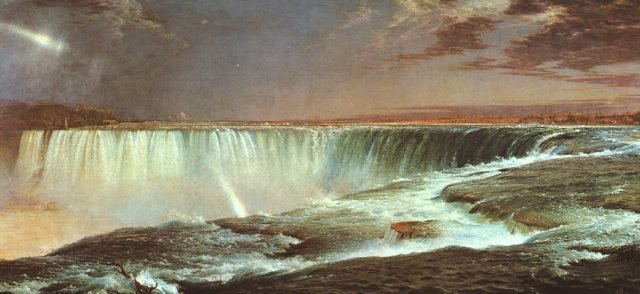
Niagara by Frederic Church (1857)

During a two year period, 1854 to 1856, Frederic Church travelled extensively visiting Nova Scotia, and journeying throughout Maine, New Hampshire, and Vermont, and it was around this time that he visited the Niagara Falls.   The Falls, by this time, had become a great tourist attraction and a favourite destination for artists.  Whilst at the Falls he completed a number of oil sketches which he would utilise when he painted his large-scale works of the Falls in 1857 and 1867.   Frederic Church’s great breakthrough came when, in 1857, he exhibited his painting Niagara It was a large work measuring 107cms x 230cms (see My Daily Art Display Sept 9th 2011) and it visually stunned all who saw it.   Without doubt, the late 1850’s were the high point of Church’s career.  Artistic triumph followed artistic triumph.

 Frederic Church had, like many others,  become fascinated with the translated writings of the celebrated Prussian naturalist and explorer Alexander von Humboldt, which were based on his five-year expedition in the New World at the start of the nineteenth century.  It was in one of his works, Kosmos  that Von Humboldt implored artists to travel and paint equatorial South America.   In 1853, along with his friend, the young entrepreneur Cyrus West Field, who had financed the trip, Church set off on the first of two expeditions following Humboldt’s footsteps, chiefly in Colombia;  the second trip, in 1857, in company with the American Creole landscape painter, Louis Remy Mignot.   Together, the artists travelled from Panama to Ecuador, where they spent 10 weeks painting village and mountain scenes.

The Heart of the Andes by Frederic Church (1859)

From his trips to South and Central America, Frederic Church amassed a large collection of sketches from which, on his return home, he completed large and spectacular oil paintings.  One of these works was his ten-foot wide work entitled The Heart of the Andes which he completed in 1859.   This elaborate and highly structured painting was his most ambitious work.  In this painting Church managed to depict the variety of earthly life as seen by the lush green foreground.   The painting took pride of place in a New York exhibition, housed in an elaborate window-like frame and illuminated in a darkened room by concealed skylights.  Can you just imagine what nineteenth century viewers made of this extraordinary painting exhibited in such an extraordinary setting?   People thronged to see the painting and it was estimated that more than twelve thousand people visited the exhibition in three weeks and were happy to part with a quarter each to see it.  For that admission fee, the public were provided with opera glasses so that they could examine the painting in detail.  The painting was then shipped to England where once again people flocked to see it.  Church eventually sold it for $10,000, at that time the highest price ever paid for a work by a living American artist.

Iceberg Flotante by Frederic Church (1859)

In 1859 Church took a voyage north along the coast of Newfoundland and Labrador in search of icebergs.  On this trip he was accompanied by the Reverend Louis L. Noble, an author who was to write about their trip together in his 1861 book, After Icebergs with a Painter: A Summer Voyage to Labrador and Around Newfoundland.  During their voyage of discovery Frederic Church and Noble would hire a boat to take them up close to these awe-inspiring floating icebergs to allow Church to sketch these remarkable and majestic floating white giants.  Frederic Church managed to capture the breath-taking beauty of these white giants in a number of his paintings, one of which was his work entitled Iceberg Flotante which he completed in 1859

The Icebergs by Frederic Church (1861)

I particularly like his 1861 painting entitled The Icebergs, in the foreground of which we see a broken masthead lying cross-like on the ice.  Not only is this a beautiful landscape work but it is a kind of historical painting as the inclusion of the masthead is a reference to the tragic loss of Sir John Franklin’s doomed British expedition party which had been attempting to cross the last un-navigated section of the North-West Passage in 1847.  Sadly, the two ships of the expedition became icebound in Victoria Strait, close to King William Island in the Canadian Arctic.  Despite the British Admiralty’s sending numerous search parties to find the ships, the entire expedition party, including Franklin himself and his 128 men, was lost.

……………………………………………….to be continued in my next blog.

The Naples Series by Thomas Jones

Buildings in Naples by Thomas Jones (1782)

To start My Daily Art Display blog today I want to first look at the fascinating happening which occurred during the late seventeenth century to early eighteenth century and which was known as the Grand Tour.   It was a journey which would see travellers visit places such as Paris, Venice, Florence and culminate with the arrival at the cultural Mecca which was Rome, where they would visit the sites of ancient ruins such as the Forum and the Coliseum.  It was also to be a journey of artistic enlightenment.  The seasoned 18th century British traveller, Charles Thompson, put it succinctly when he extolled the virtue of the Grand Tour and the expectation of what would be savoured by the Grand Tourists:

 “…being impatiently desirous of viewing a country so famous in history, which once gave laws to the world; which is at present the greatest school of music and painting, contains the noblest productions of statuary and architecture, and abounds with cabinets of rarities, and collections of all kinds of antiquities…”

For some, such as artists and art scholars, it was a chance to revel in the art history of past times.  For others who were “art virgins” they would be accompanied by teachers who would give them an understanding of art and architecture.  For most it was a chance to return home with souvenirs and the ability to regale tales about their journey at fashionable dinner parties.   It was a sort of “gap year finishing school” for young gentlemen.  They would receive an all-round full cultural education.   There would be opportunities for them to hone their dancing and fencing skills and polish up on their foreign languages.  For the travellers on the Grand Tour, and it was usually young men who made the trip as the journey would be physically demanding, there were a few prerequisites.  They had to be wealthy as the Tour would last many months, even years, and the cost of their travel plus that of any accompanying teachers had to be paid for as well as the cost of the many souvenirs they would accumulate during the journey which would enhance the family’s collection back home.  By souvenirs, I am not talking about a plastic effigy of a famous building, but a landscape painting from a great artist of the time or a piece of antiquity that the dealer had probably pillaged from one of the many historical sites.  This then meant that most of the travellers came from the privileged classes.  It would have been expected that the traveller would also have a thorough grounding in Greek and Latin literature although they would often be accompanied by their tutors and have been taught the basics en route.

Like you and I, when we go on holiday we like to bring back mementos of our travels but more importantly we want to bring back photos of the places we visited and people we were with or whom we met.  Of course in the Grand Tour days of the 17th and 18th century there were no cameras to record the Tourists’ travels and so artists benefited from the patronage of Grand Tourists eager to procure mementos of their travels.   Some Grand Tourists even invited artists from home to accompany them throughout their travels, and by so doing, they could orchestrate exactly what scenes they wanted painting, whether it be ancient ruins or grand palaces, or people, who were part of their party, or just interesting people they met have met en route.

It is with this long preamble that I move closer to my featured artist.  I attended a talk at a small local museum last week which was all about a very rich and privileged young man, Sir Watkin Williams Wynn, 4th Baronet, who set forth at the age of 19, on his Grand Tour in 1768.  He returned home the following year and the total cost of his tour, including all the items he had purchased, came to £8643 and to put this into context a very good annual wage at the time was considered to be £100.  The year Sir Watkins Williams Wynn had his twenty-first birthday he asked the fashionable landscape painter, Richard Wilson, to become artist-in-residence at the Wynstay estate and Wynn had a large pavilion erected which overlooked the River Dee so as to allow Richard Wilson to paint the beautiful scenes featuring the Welsh hills which could be seen in the distance.

I am sorry to drag you through this sort of “seven degrees of separation” formula but trust me, I am getting closer to my featured artist.  Just hang in there a little longer !  My featured artist today is not Richard Wilson but one of his pupils, Thomas Jones who spent some time in Italy and who completed a series of unusual (for that time) paintings of the city.  It was a copy of one of these works which I saw as I walked around the Sir Watkins Williams Wynn’s Grand Tour exhibition which I found fascinating and as it was such an unusual depiction for its time, I had to find out more about the painter, hence today’s blog.

Thomas Jones was born at Trefonnen, a small township in the Radnorshire parish of Cefnllys in 1742.  He was the second of sixteen children, seven of whom died in childhood, to Thomas and Hannah Jones.  His father was a land owner in Trefonnen and his wife inherited a house and an estate at Pencerrig, near Builith Wells, where the family went to live.  Thomas Jones went to school at Christ College, Brecon when he was eleven years old and it was here he developed his love for pictures and drawing.  In 1758, at the age of sixteen he moved to one of Dr. Daniel William’s schools at Llanfyllin in Montgomeryshire, where he was taught by the well-known master Jenkin Jenkins.  The following year Thomas Jones was accepted as a student at Jesus College, Oxford.  The fees for attending Oxford University were funded by Jones’ maternal uncle, John Hope,  who believed that a university education would lead to his nephew entering the church.  His stay at the university was cut short with the death of his uncle at the end of 1761 and Thomas Jones decided that his future did not lie in religion nor a life at sea which was often a chosen profession for the younger sons of the landed gentry.  He believed his future was in art.

Buildings in Naples with the North-East Side by Thomas Jones (1782)

In November 1761, Thomas Jones left Wales and moved to London where he enrolled at the William Shipley’s Drawing School.  This was an establishment named after the great artist and social reformer, William Shipley, who some years earlier had founded a London arts society that would become The Royal Society of Arts, or to give it its full name, the Royal Society for the encouragement of Arts, Manufactures & Commerce, (RSA).  It was at this school that Jones was taught by the draughtsman and drawing tutor Henry Pars.    During this period in London, Jones also attended the St Martin’s Lane Academy where he studied life drawing.  Reluctantly he realised that his ability at painting figures was not good enough and he decided to concentrate on landscape painting.  All he needed now was a good landscape painter to tutor him.  As far as Thomas Jones was concerned, the best landscape painter of the time was his fellow countryman, the Welsh landscape painter, Richard Wilson.   Wilson, who is now considered the father of British landscape painting,  had himself started off studying to become a portraitist in London but had switched to the landscape genre of painting on the advice of the Italian painter, Francesco Zuccarelli, whom he met whilst living and working in Italy between 1750 and 1757.

In March 1763 Thomas Jones managed to persuade Richard Wilson to take him on as a student.  Wilson agreed to tutor him for two years for a fee of fifty guineas.  Once his tuition period with Wilson was over, he dedicated the next ten years to landscape painting in Wales and around London.  In 1765 Jones began to submit some of his works to the Society of Artists exhibitions.  This society would eventually become the Royal Academy.   In the late 1760’s a change in style in his landscape work could be detected.  At this time he began to adopt what we now term the “grand manner” by which we mean his landscape works incorporated mythological scenes or scenes from history or literature à la Claude Lorrain.   As Jones was not an accomplished figure painter he often relied on the help and collaboration from artists such as John Hamilton Mortimer, who was a British figure and landscape painter and known for his romantic paintings set in Italy.  Thomas Jones had by 1776 exhausted all his commissions and the sales of his work were falling so he decided that September to embark on his keenly anticipated journey to Italy.  He first visited and settled in Rome and stayed there for two years carrying out a number of lucrative commissions, often for wealthy English men who were on their Grand Tour.  His reputation as a landscape artist grew and he was part of the city’s hectic cosmopolitan art-scene. Following a dispute over commission with an art dealer he decided to leave the Eternal city in September 1778 and travel south to the capital of the Kingdom of the two Sicilies, Naples.  His first stay in the city lasted five months before he returned to Rome.  It was during his sojourn in Rome that he met a Danish widow called Maria Moncke who became his lover, although for the sake of respectability he always referred to her as his “maid servant”.  The couple moved back to Naples in April 1779, where Jones believed there was more scope for painting commissions.   Later, Maria gave birth to two daughters in Naples, Anna Maria in 1780 and Elizabetha in 1781.

In Naples, Jones found lodgings in a house close to the harbour which had the advantage of having a roof terrace opposite the Dogana Del Sale. It is from this very vantage-point, and from the window of his studio that he made a set of small beautifully, highly finished oil studies of the neighbouring buildings and it is these cityscape views I am featuring today. At first glance they may seem mundane and just uninteresting views from out of his window, but I love them.  They are so different to his other works and those of many artists of that time, so much so, I felt I had to make them known to you.   These works were done by Jones for his own pleasure and were never intended for exhibition or sale. However, today they are looked upon as some of the most ground-breaking pictures of their time.   In some ways they have a modern look about them.  They could have been contemporary cityscapes but remember, he painted these works almost two hundred and fifty years ago.  It was this Naples series, which he completed just before his return to Britain in 1783, on which Thomas Jones’ modern reputation is based.

The Cappella Nuova outside the Porta di Chiaia, Naples, by Thomas Jones (1782)

The Cappella Nova outside the Porte did Chiai, Naples was a small oil on hand-made laid paper, measuring just 20cms x 23cms which Thomas Jones painted in May 1782.  In his diary/memoirs of May 12th 1782 he wrote about the new lodging he had temporarily moved into and from where he painted this work:

“…The Room which I was in possession of at the Convent, was large and commodious for such a place, and as it was on the ground floor and vaulted above, very cool and pleasant at this Season of the Year – The only window it had, looked into a Small Garden, and over a part of the Suburbs, particularly the Capella nuova, another Convent, the Porta di Chaja, Palace of Villa Franca, and part of the Hill of Pusilippo, with the Castle of S. Elmo & convent of S. Martini &c all of which Objects, I did not omit making finished of in Oil upon primed paper…”

This compelling view was painted from the roof terrace of the artist’s lodgings opposite the Dogana del Sale in Naples. It shows a rooftop view of the city, but the painting is dominated by the humble Neapolitan house opposite – the real subject of this work.

Jones has captured in minute detail the texture of the crumbling wall, the half-shuttered windows and doorway, all bathed in sunlight. This is one of a number of oil sketches that surfaced on the art market in 1954 and completely changed Jones’s reputation. The sketches are characterized by their humble subjects and compositional cropping, and it is this which give them a startlingly modern appearance. These works show the artist painting his daily surroundings. They were not for exhibition or sale, but simply personal works, made for his own enjoyment.  Today they are prized as some of the most innovative pictures of their time.

A Wall in Naples by Thomas Jones (1782)

Another small oil sketch Thomas Jones completed in 1782 was entitled A Wall in Naples, which measured just 11.2cm x 15.8cm.  It is about the size of a postcard and is dwarfed by larger works in the room in which it hangs in the National Gallery of London.   It is a strange work which just depicts a decaying expanse of late 18th century Neapolitan house wall, broken up by a closed wooden balcony door, a glazed and dust covered window which allows us no view of the interior.  There is a short washing line hanging over the balcony, on which there seems to hang various coloured items of undergarments.  The wall we see before us almost blocks out the entire view, except for a small rectangle of blue sky in the top right of the painting.  One can only wonder what made Thomas Jones depict such an uninspiring view and one can understand why this work like the others were simply for his own edification and would never, in the artist’s mind, be destined for an exhibition.   We can only wonder why Jones chose this wall for his painting.  Was it because of the various textures of the pitted and pock-marked surface or maybe its decrepit state having been battered by weather appealed to him.    What are the square holes dotted around the surface of the wall?   Are they places where once there had been beams which had supported floors?

During the same year Thomas Jones painted his Naples series he received news that his father had died and so feeling slightly homesick, he decided the following year to end his six year stay in Italy and return by ship to England with his lover Maria and their two daughters.  On returning to London in November 1783, he was horrified to discover that much of his possessions and paintings he had left behind in London had been destroyed or ruined by damp.  Jones once again set about painting but now as he was receiving an annual income from his father’s estate, he did not need the money from the sale of his works and his artistic output slowly decreased.

Since returning to England, he made a number of journeys back to Wales and the Pencerrig estate where he was brought up and which was now owned by his elder brother, Major John Jones.  In 1787 his brother died and having no descendents the estate passed to Thomas Jones.  Thomas eventually married Maria in September 1789 in London.  By all accounts the decision to marry his lover and “maid servant” was not solely his decision for it is believed that his mother “laid down the law”.  Thomas Jones painted less and less in the latter years of his life as so much time was taken up looking after his beloved Pencerrig estate.  In 1791 he was elected High Sheriff of Radnorshire.  Thomas Jones died in 1803 and was buried at the family chapel at Caebach, Llandrindod Wells

His autobiography, Memoirs of Thomas Jones of Penkerrig, went unpublished until 1951 but it is now recognised as an valuable source of information on the 18th-century art world.

Classical Greek Landscape with Girls Sacrificing Their Hair to Diana on the Bank of a River by Pierre-Henri de Valenciennes

Classical Greek Landscape with Girls Sacrificing Their Hair to Diana on the Bank of a River by Pierre-Henri de Valenciennes (1790)

As an artist, he has been spoken of as the father of French Neoclassical landscape painting and an artist, who was for landscape painting what Jaques-Louis David was for history painting, so how can I ignore this eminent and much honoured French painter.

My featured artist today is Pierre-Henri de Valenciennes, who was born in Toulouse in 1750.   He studied at the Academy of Painting, Sculpture and Architecture of Toulouse, under the tutelage of the local history painter and pastelist, Jean-Baptiste Despax, an artist who had spent much of his life in the decoration of churches and monasteries in and around the French city.  It is probably from him that Valenciennes became familiar with the iconography of conventional classical and biblical subjects.  Another of Valenciennes’ early teachers was the miniaturist, Guillaume Gabriel Bouton.

When Valenciennes was nineteen years of age his work came to the attention of Mathias Du Bourg, a prominent and wealthy Toulouse lawyer, merchant and councillor at the Toulouse parliament, who became his patron.  In 1769 Du Bourg invited Valenciennes to accompany him on a trip to Rome where he stayed for two years before returning home.  At the end of that year, 1771, Valenciennes went to live in Paris and, through the recommendation of Du Bourg, managed to get himself a placement in the studio of Gabriel-François Doyen, who at the time was one of the leading French history painters.  Another person Du Bourg introduced Valenciennes to was Etienne-François, comte de Stainville, Duc de Choiseul, a French military officer, diplomat and statesman who became another of Valenciennes’ patrons.  Valenciennes would often spend time at the country estate of his new patron and soon developed an interest in the native landscape.

In 1777, Valenciennes made another trip to Italy and this time remained there for almost eight years.  He travelled extensively around what was then termed the Kingdom of the two Sicilies, which was the largest of the Italian States, prior to Italian unification and extended south of Rome and included the island of Sicily.  Valenciennes also found great pleasure in journeying around the campagna, the low-lying area which surrounds Rome.  He did return once to Paris in 1781 where he met and received tuition from Claude-Joseph Vernet.   Vernet strongly urged him to work en plein air.  In 1787, Valenciennes applied to become a member of the Académie Royale and following a short probationary period and the submission of his reception piece, a historical and imaginary landscape work entitled Cicero Uncovering the Tomb of Archimedes, he was accepted into the hallowed institution.   His painting was one of two Salon works which he had accepted at the Paris Salon that year.  From this first submission to the Paris Salon, Valenciennes would exhibit annually, large landscape works there until 1819, the year of his death.  Valenciennes quickly established his reputation at the Salon as a painter of paysage historique (historical landscapes inspired by mythology and Greek antiquity). These large-scale works which represented imaginary visions of the classical past, earned Valenciennes the title, “the David of landscape.”

Once he established himself at the Academy, he opened his own studio in 1796.  At this time, the European Academies believed in a strict hierarchy in figurative art, which had originally been postulated for painting in 16th century Italy and which still held good two centuries later. The hierarchy was:

History painting which also included works which had narrative religious mythological and allegorical subjects

Portrait painting

Genre painting which were scenes of everyday life

Landscape painting and cityscapes and cityscape

Animal painting

Still life painting

Many artists would not accept the Academy’s hierarchal approach and would invent new genres and by doing so, raised the lower subjects to the importance of history painting. Joshua Reynolds, the English portraitist, achieved this by inventing the portraiture style that was known as the Grand Manner in which his works flattered his sitters by likening them to mythological characters.   The French artist, Jean-Antoine Watteau invented a genre that was known as fetes gallants in which he would depict scenes of courtly amusements which took place in Arcadian setting.  These often had a poetic and allegorical quality, which, as such, were considered to elevate them within the hierarchy.  Valenciennes, like many landscape artists before him such as Nicolas Poussin and Claude Lorrain, endeavoured to elevate the status of their landscape work by incorporating mythological figures into their works.

Claude had ennobled his paintings of the Roman countryside by adding biblical and classical narrative references and by doing this enforced an idealized vision of balance and harmony on the world before him. This emphasis on timeless landscapes augmented with historical vignettes could be seen in Valenciennes’ large salon landscape paintings.  Valenciennes was adamant that the status of landscape painting should be elevated.  In his efforts to see this through he put out a famous treatise entitled Élémens de perspective pratique à l’usage des artistes (Reflections and Advice to a Student on Painting, Particularly on Landscape) in which he gave landscape painting the full practical and theoretical examination it was due but which up until then had been denied.  This work remained the most influential treatise on landscape painting for decades to come.   Things did change in the nineteenth century France with French landscape painting undergoing a remarkable transformation from a minor genre, rooted in classical traditions, to a primary vehicle for artistic experimentation.

In 1812 Valenciennes was appointed Professor of Perspective at the École Impérial ses Beaux-Arts, a position he held for the next four years.  During his time at the art school he managed to nurture an up and coming set of French landscape artists, such as Nicolas Bertin, Achille Michalon and Jean-Baptiste Deperthes.  In 1816 the Académie even encouraged Valenciennes’ favoured painting genre, paysage historique (historical landscape painting), by presenting a special Prix de Rome award for the best landscape painting.   Much to Valenciennes’ delight the first winner of the award went to Michallon, one of his students.

Pierre-Henri de Valenciennes died in Paris in 1819, aged 68 and is buried in the Parisian Père Lachaise Cemetery.

My featured work today by Valenciennes is one he completed in 1790 and exhibited at the Salon the following year along with six other landscape paintings.  It is entitled Classical Greek Landscape with Girls Sacrificing Their Hair to Diana on the Bank of a River.

When young girls wanted to marry, they were asked to lay their personal belongings of their virginity on an altar to Artemis (Diana). They were such things as toys, dolls, and locks of hair. This represented their transition from childhood to adulthood closing the door of the domain of the virgin goddess forever.  In ancient times, hair, and the way it was worn, identified class and status. Young girls and unmarried women wore their hair long and loose but once they were married it was coiled upon their heads; prostitutes and women of easy morals coifed their hair in elaborate ringlets and curls. The girls’ short hair now identified them as virgins dedicated to perpetual chastity in the image of Diana, with a consequential curtailment of fertility.  When he painted this picture in 1790, Valenciennes was at the height of his artistic career and had already established himself as the master of the paysage historique genre.

In the foreground of this work we can see a small lake.  To the right of the lake there is a marble statue of the goddess Diana, under a leafy arbour, holding her bow with a small stag standing by her side.   On the far side of the lake we can see a circular altar, which looks very much like the base of a large column.  Around this altar we see three young women.  On the altar we can see hair that two have laid down as a sacrifice to Diana whilst we see the third woman in the process of cutting off locks of her hair.  In the middle ground we can just make out two other women standing in an open sunlit plain pointing towards a stream on the left middle ground where we can just make out more women who are in the process of drying their washed clothes on a large stony outcrop.  The building behind the plain is a circular fort along with its high stone walls which divide the composition into two diverse zones.

On the other side of the walls of the fort, to the left, we can see a range of desolate and infertile hills extending into the distance. The Temple of the Sibyl can also be seen atop a mountainous outcropping at left of composition.  If we look closely at the hinterland and beyond, on the other side of the wall, we can make out a number of impressive buildings which extend across the plain.  In this beautiful landscape painting, the viewer’s eyes quickly pass over the small figures shown in the foreground and are lifted to the expansive and idyllic natural space that stretches into the distance.   Even the statue of the goddess directs her attention to the landscape. So even though Valenciennes has added a touch of mythology to his work he seemed more interested in the natural landscape which he hopes will occupy most of our gazes.

The painting is housed at the Mount Holyoke College Art Museum in South Hadley, Massachusetts which was founded in 1876 and was one of the first collegiate museums in the United States.