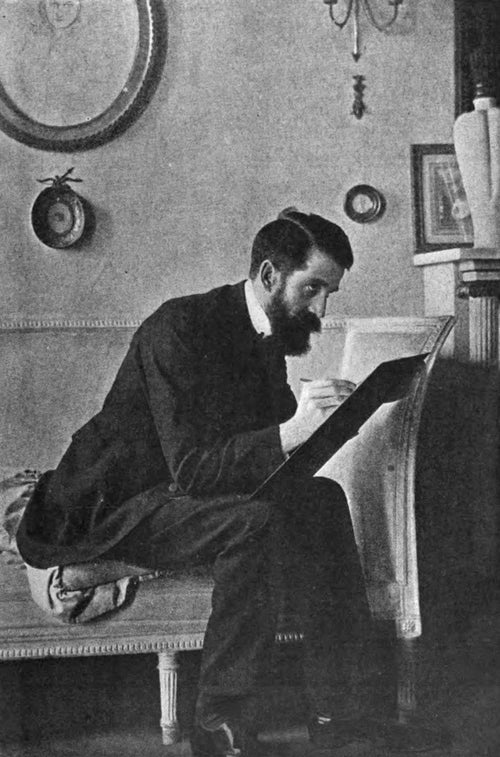
Paul César Helleu and Alice Guérin.

Paul César Helleu

At the end of my previous blog about the French artist Léon Bonnat, I talked about how he had bequeathed most of his art collection and the majority of his work to the local Bayonne museum and how the town named the Museum after him and yet it is now known as the Musée Bonnat-Helleu.. So who is “Helleu”?
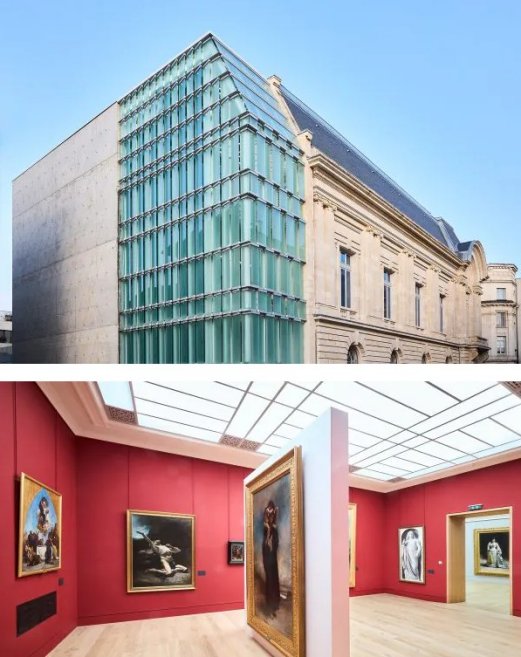
Musée Bonnat-Helleu, Bayonne

The donation of Paulette Howard-Johnston, the youngest child of Paul and Alice Helleu made the museum one of the places of reference for the works of Paul César Helleu from 1988 onwards. It houses his works thanks to his daughter’s donation, as well as the donations and bequests of Paulette Howard-Johnston’s nieces, Éliane Orosdi and Ghislaine de Kermaingant,  when in 2009, she died.  In her will,  the Bonnat Museum was designated as the heir to her collection of more than 300 new pieces.  In 2011, the museum closed its doors for a major renovation, while thanks to this last bequest made by the Helleu family, the museum became the Musée Bonnat-Helleu.
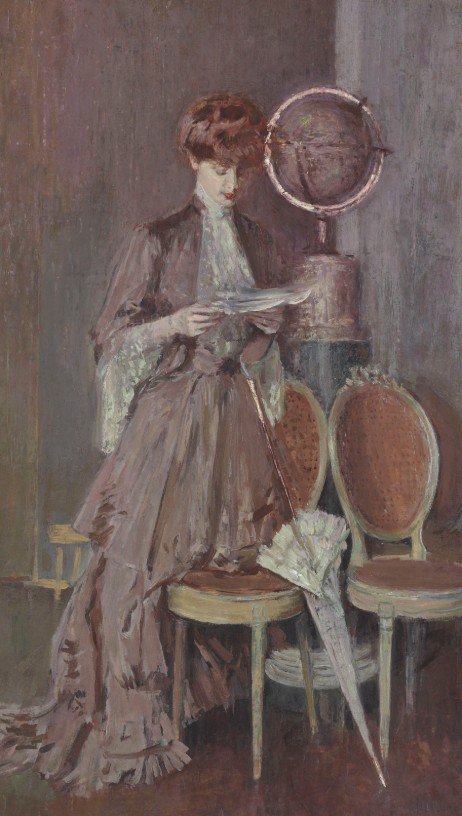
Portrait of Madame Helleu reading by Paul César Helleu

Paul César Helleu was born on December 11th, 1859, in the Brittany town of Vannes.  His mother, Marie Esther Guiot and his father, César Helleu, who was a customs receiver, were married in 1855 and had two sons Paul and his elder brother Édouard.   Paul took an interest in art when he was young. Following the death of his father when Paul was just a teenager, he decided he wanted to further his art studies by going to live in Paris.  His widowed mother was against this idea but Paul persisted and travelled to Paris to continue his schooling at the Lycée Chantal.  In 1876, at the age of sixteen Paul graduated and was admitted to the École des Beaux-Arts, at the atelier of Jean Leon Gerome, where he began his formal academic training in art.
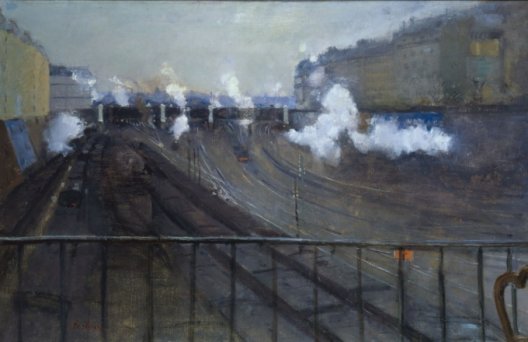
The Saint Lazare Train Station by Paul César Helleu (1885)

It was also in the Spring of 1876 that Helleu attended the Second Impressionist Exhibition at the Durand-Ruel Gallery in Paris. A total of nineteen artists participated in the exhibition, including prominent figures such as:  Degas, Monet. Morisot and Gustave Caillebot. Whilst in Paris,   Helleu made the acquaintance of John Singer Sargent, James McNeill Whistler, and Claude Monet. He was struck by their modern, bold alla  prima artistic technique, which was an approach to painting that involved applying layers of paint, also known as wet-on-wet, and completing a painting in a single sitting. This meant working with wet paint and not letting the layers dry, before applying the next layer. In Italian, the phrase alla prima translates to “at first attempt”.  Helleu was also impressed with their plein air style of painting.
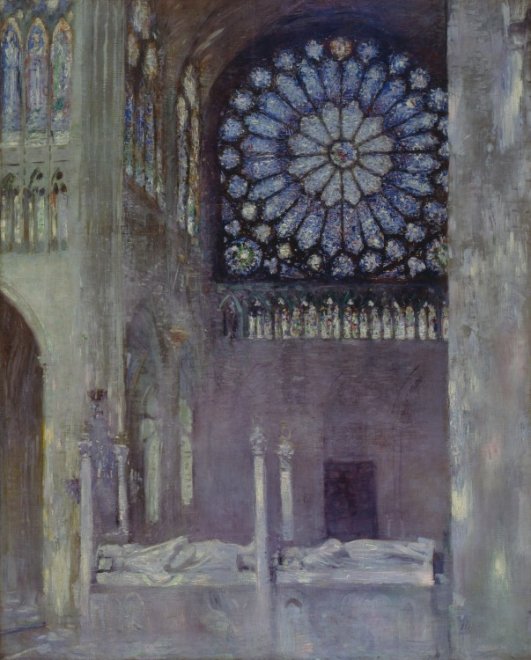
The Interior of the Abbey Church of Saint Denis by Paul César Helleu (c 1891)

Following graduation, Helleu found employment at the prestigious faience (earthenware) workshop, Joseph-Théodore Deck Ceramique Française.  Joseph-Théodore Deck was a 19th-century French potter, and an important figure in late 19th-century art pottery.  In 1856 he established his own earthenware workshop and began to experiment with styles from Islamic pottery, and particularly the Iznik style.  At the time Paul César Helleu joined the workshop, Japonisme, the popularity and influence of Japanese art and design following the forced reopening of foreign trade with Japan in 1858 was all the rage. Helleu created decorations for dishes.
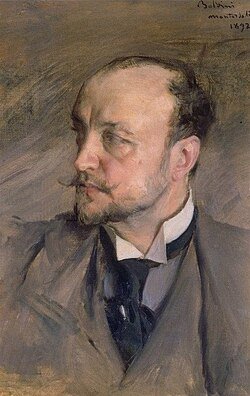
Giovanni Boldini self portrait (1892)
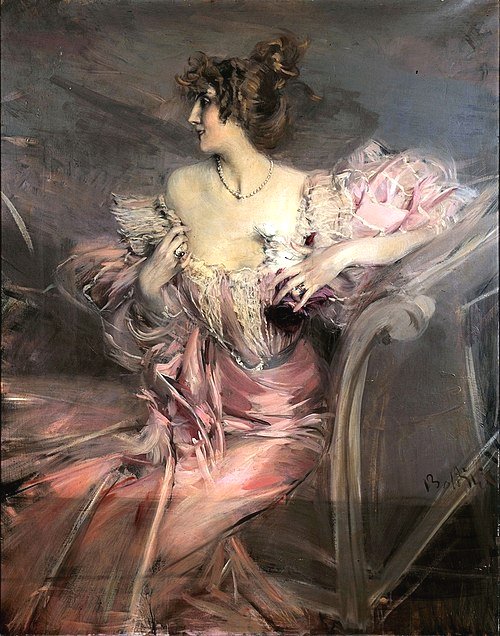
Portrait of Marthe de Florian, a French demi-mondaine and socialite,  by Giovanni Boldini (1898)

Around this time, Helleu met Giovanni Boldini, an Italian genre and portrait painter who lived and worked in Paris.   His portraiture focused on all the grandes dames of Paris, and for them to have their portrait painted by Boldini was looked upon as the crowning event of the social season. Boldini became a friend and mentor to Helleu, and his style of painting had a great influence on his artwork. The other great influence for Helleu was his friendship with John Singer Sargent, often referred to as the leader of “posh portraiture” in Britain, that majorly encouraged Helleu. Helleu even sold his first painting to Sargent. 

Portrait de Madame Chéruit by Paul César Helleu (1898) Madeleine Chéruit was a French fashion designer. She was among the foremost couturiers of her generation, and one of the first women to control a major French fashion house.

This time in Helleu’s life coincided with France’s Belle Époque era. The term, Belle Époque, literally means “Beautiful Age” and was a name given in France to the period between the end of the Franco-Prussian War in 1871 up to to the start of World War I in 1914. During those forty plus years of peace, the living standards for the upper and middle classes increased, (albeit the lower classes did not benefit in the same way, or to anywhere near the same extent).  It was the well-off who termed the phrase Belle Epoque labelling it a golden age in comparison to the humiliations that came with the Prussian invasion and what was to come, the devastation and occupation of the First World War.
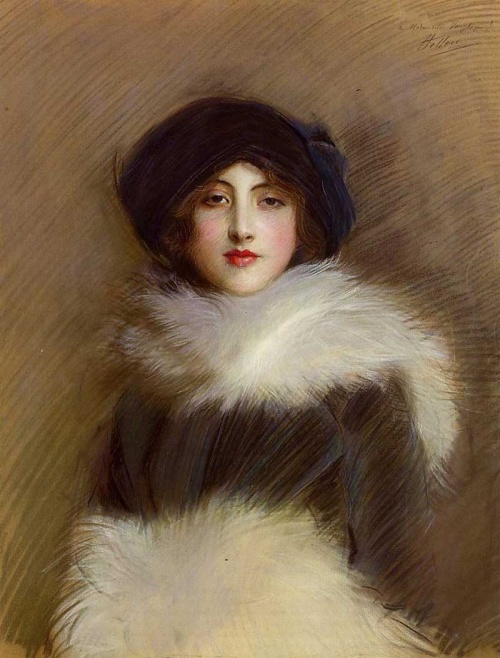
Mademoiselle Vaughan by Paul César Helleu (1905)

It was a time of booming progress and prosperity in Europe, with Paris the centre of the fast-flowing changes in economics, technology, and the arts. However, as the name denotes, beauty was a key element of this prosperous period.  The upper-class patrons would often commission artists to paint their portrait or one of a family member, in a luxurious and extravagant manner highlighting both their beauty and wealth.  The finished portraits heightened an artist’s reputation, ensuring more clients for the artists.

Alice Helleu by Paul César Helleu (1885)

This blog is not only about Paul César Helleu but also his muse, lover, and later his wife, Alice Louis-Guérin. Helleu met Alice in 1884 when her mother asked him to paint a portrait of her fourteen-year-old daughter, Alice. At the age of twenty-four, Helleu appears to have fallen in love with her during this first meeting.   Alice remained the artist’s favourite model throughout his life and she was also a muse for many other artists.  Her beauty and sophistication also helped introduce her husband into the elite circle of artists, writers and society figures of the French capital.  The Count de Montesquiou, who was a noted dandy and one of the leading figures in the artist’s group of friends, described her appearance as

“…La multiforme Alice, dont la rose chevelure illumine de son reflet tant de miroirs de cuivre…”

 (‘The multifaceted Alice, whose rosy hair illuminates so many copper mirrors with its reflection.’)
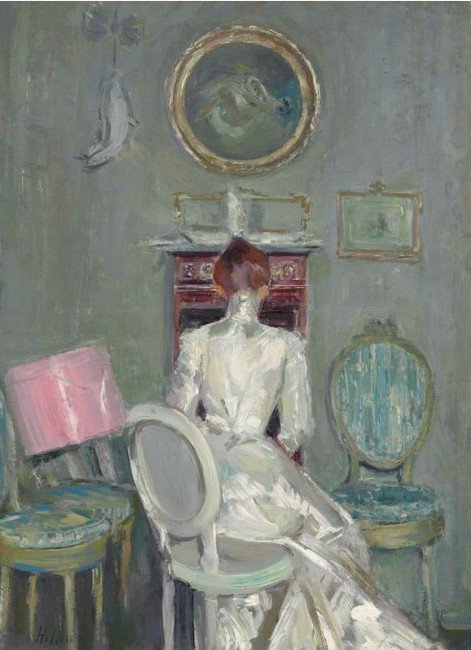
Madame Helleu à son bureau by Paul César Helleu.

Helleu often avoided standard conventional rules of portrait composition, and would frequently depict his sitters from behind – standing before a mirror, or sitting at a desk, as was the case of his painting entitled Madame Helleu à son bureau. Note the porcelain koi carp hanging in the upper left corner which was an example of Japonisme which was all the rage in Paris at the time.   The desk depicted in the painting and which appears in numerous works by Helleu is still in the artist’s family.  The painting hanging above it is Boldini’s Leda and the Swan.
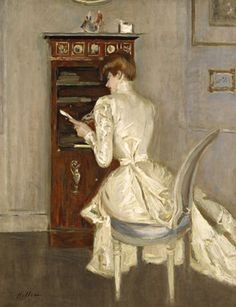
Madame Helleu assise à son bureau dans le salon de l’atelier de l’artiste, capturant une scène intérieure intime avec une élégance raffinée. (Madame Helleu seated at her desk in the artist’s studio salon, capturing an intimate interior scene with refined elegance.)

His painting entitled Mrs. Helleu sitting at her desk in the artist’s studio living room confirms Paul and Alice Helleu were had superb taste and these portraits depict Alice seated at a secrétaire in the couple’s drawing room of their Paris apartment, into which they moved in 1888. I suppose these two paintings cannot be considered as portraits in the conventional sense of the word, but rather as interior still life works, in which the furniture and surroundings are as vital as the sitter.
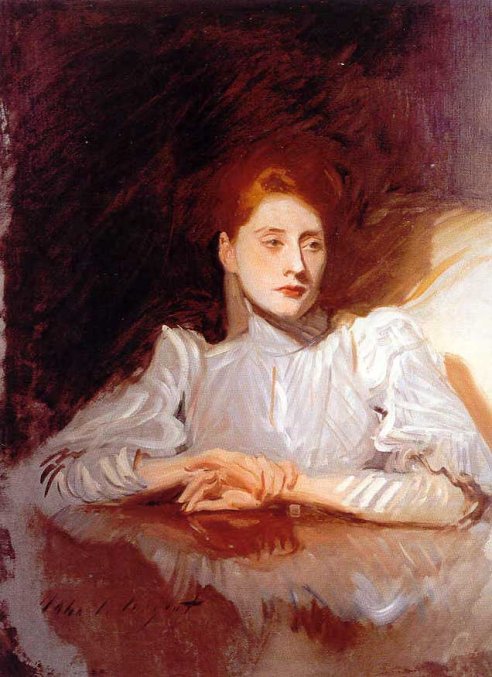
Madame Helleu by John Singer Sargent (1889)

Alice Guérin was depicted in a number of paintings by Paul Helleu’s friend John Singer Sargent.
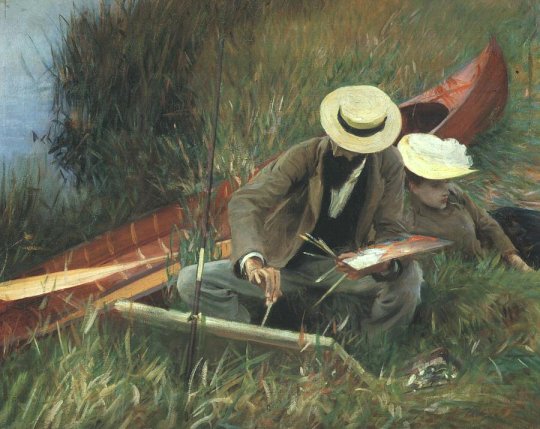
Paul Helleu Sketching with his Wife by John Singer Sargent (1889)

In his 1889 painting, Paul Helleu Sketching with his Wife, Sargent depicts a tranquil outdoor scene, portraying the French artist Paul Helleu engaged in the act of sketching. Alongside him, sits his wife Alice who appears happy and relaxed.  The figures of husband and wife are set against a lush, natural environment that suggests a calm and comforting ambiance. Sargent’s painting also manages to capture their fashionable clothing with Paul wearing a formal suit and Alice attired in an elegant dress.  Both wear wide-brimmed hats that both provide shade and stylishly adorn their heads.
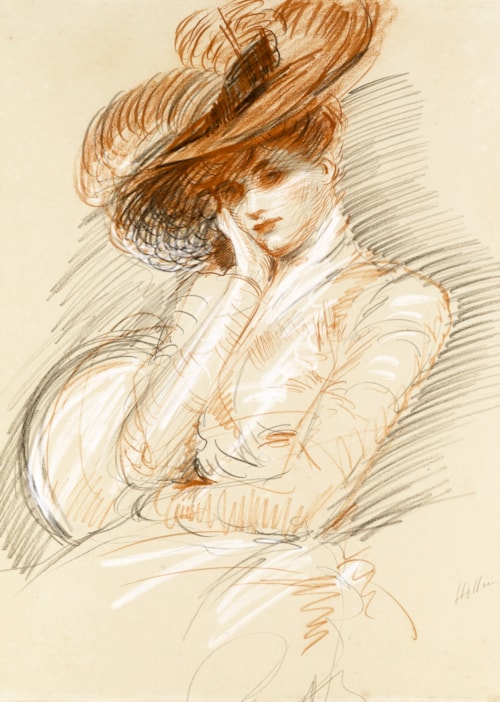
Portrait of Artist’s Wife by Paul César Helleu

Paul Helleu was one of Sargent’s closest friends.  Initially, they had met in Paris in 1878.  Paul was 18 years old and Sargent 22. Sargent’s artistic career had already taken off, and he was becoming known to the public as a great portraiture artist and was receiving many commissions for his work. However, on the other hand, Helleu was selling little of his work, and because of this, he was suffering from depression.  Paul Helleu was financially strapped with hardly enough money to even eat and had to leave his studies in art due to lack of funds.  Sargent, got to hear about the plight of his friend and visited him at his studio and although he never alluded to his friend’s dire financial difficulties, Sargent selected one of Helleu’s paintings, and commended it for its artistic merits. Helleu was so flattered that the successful Sargent would think so kindly of his work that he offered to give it to him.  The story goes that Sargent responded to Helleu’s offer, saying:

“…I shall gladly accept, Helleu, but not as a gift. I sell my own pictures, and I know what they cost me by the time they are out of my hand. I should never enjoy this pastel if I hadn’t paid you a fair and honest price for it…”

He paid Helleu one thousand francs for the painting.  Helleu never forgot Sargent’s generosity and moral support and later, when Sargent was suffering from depression after the death of his father, Paul and Alice Helleu went to stay with him in England.
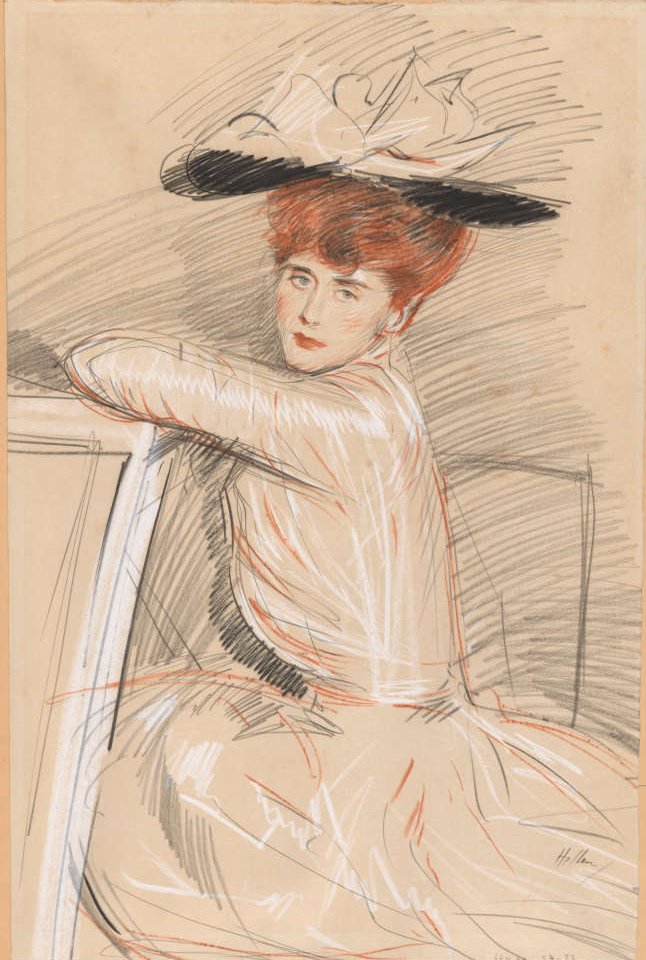
Portrait of Madame Helleu by Paul César Helleu.

Paul César Helleu and Alice Louis-Guérin married, two years after their first encounter, on July 29th, 1886, at Neuilly sur Seine.  She was two months away from her seventeenth birthday and Paul was twenty-six years old.  They went on to have four children, Hélène in 1887, Jean in 1894, Alice in 1896 and Paulette in 1904.
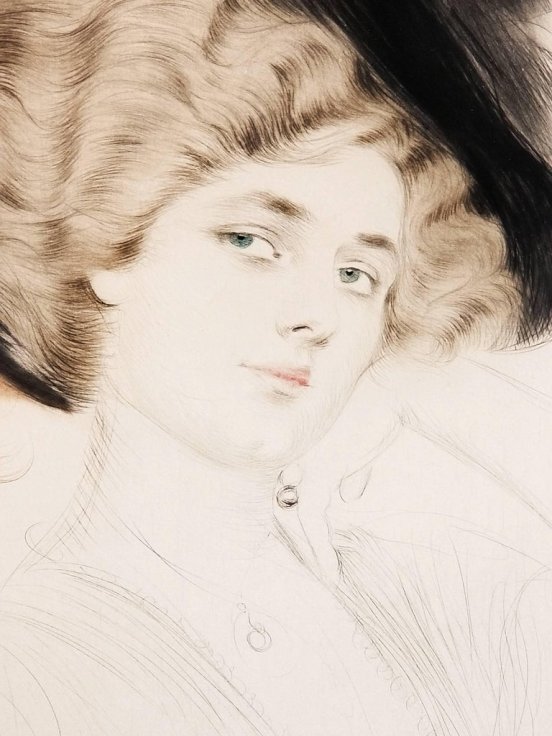
Details of Femme aux chapeau – Drypoint by Paul Helleu
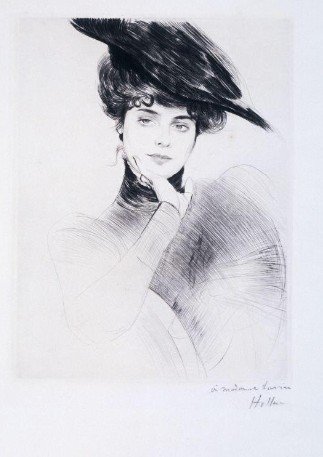
Drypoint Portrait of a Young Woman wearing a Hat by Paul César Helleu (c.1900)

It is believed that during a trip to London in 1885 Helleu once again met Whistler who introduced him to James Tissot a French society painter, illustrator, and caricaturist who was living in the English capital.  It was this established artist who taught Helleu the unique medium of etching.  Helleu became fascinated by drypoint etching.  Drypoint is a printing technique in which the printmaker scratches the lines on the printing plate with a sharp pointed tool. The printmaker holds the tool like a pencil and pushes the excess metal to either side of the furrow. It is this curl of rough metal, known as the ‘burr’, that gives the drypoint print its character. The ink is held in the burr as well as in the furrow and gives the edges of the printed line a soft, blurred quality. In Helleu’s work (above) the burr on the woman’s choker gives it a very velvety look.  Over the course of his career, Helleu produced more than 2,000 drypoint prints and he quickly mastered this technique, using the same flair with his stylus as he demonstrated with pastels.  It was the brilliance of his drypoint etchings that ensured Helleu’s place as one of the greats of the Belle Epoque, and he journeyed to Britain and America, and his artworks boosted his fame across both sides of the Atlantic.
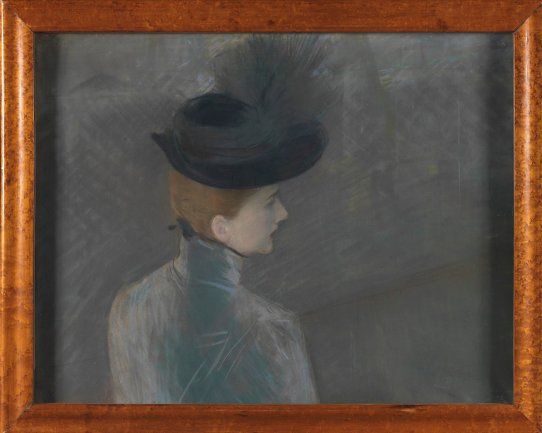
Alice au chapeau noir by Paul César Helleu

Helleu and his wife had made many friends in Paris including Countess Greffulhe, a French socialite, known as a renowned beauty and queen of the salons of the Faubourg Saint-Germain which allowed Helleu to successfully expand his career as a portrait artist to elegant women in the highest ranks of Paris society
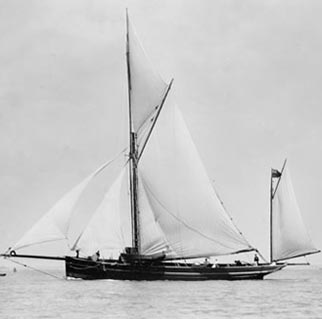
Paul Helleu’s yacht Étoile

Paul Helleu, wife Alice and baby daughter Paulette on L’Étoile (c.1904)

In 1904, Helleu was awarded the Légion d’honneur by the French president, Émile Loubet, and became one of the most celebrated artists of the Edwardian era in both Paris and London. He was an honorary member in important beaux-arts societies, including the Société Nationale des Beaux-Arts and the International Society of Painters, Sculptors, and Engravers, headed by Auguste Rodin. 
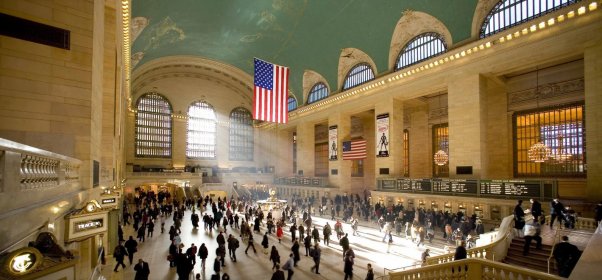
New York City’s Grand Central Terminal.

During his second trip to the United States in 1912, Helleu was awarded the commission to design the ceiling decoration in New York City’s Grand Central Terminal. Helleu decided on a mural of a blue-green night sky covered by the starry signs of the zodiac that cross the Milky Way.

Paul César Helleu (1859-1927)

Helleu made his last trip to New York in 1920 for an exhibition of his work, but he realized that the Belle Époque era was over. He sadly realised that he had lost touch with that vibrant era.   Shortly after his return to France, he destroyed nearly all of his copper plates.   While planning for a new exhibition with Jean-Louis Forain, a French Impressionist painter and printmaker, Helleu died of peritonitis following surgery in Paris, on March 23rd, 1927 at age 67.


Information needed for this blog came from Wikipedia and Facebook plus the following websites:
Brave Fine Art

Contessa Gallery

Stephen Ongpin Fine Art

John Singer Sargent Virtual Gallery

Sotheby’s

Edward Darley Boit and his Daughters

Edward Darley Boit

For this blog I am reverting to my early modus operandi when I concentrated the blog on one painting, rather than, as I do nowadays, focus on the artist(s). Having said that, the blog revolves around two American artists, one who is rightly categorised as one of the great nineteenth century painters and the other, who is less well-known, is now almost forgotten.   One is the artist who painted the work and the other is the father of the four girls who are depicted in the painting.  The artist was John Singer Sargent, the  American expatriate painter, considered the leading portraitist of his generation  and the father  of the girls depicted in the work  is Edward Darley Boit, a watercolour painter from Boston.  The work of art I am featuring is entitled The Daughters of Edward Darley Boit, which was originally titled Portraits d’enfants.

John Singer Sargent – Self-Portrait (1906) 

Edward Darley Boit Jnr., known as Ned, was born in 1840.  His father, also Edward Darley Boit, was a Harvard-educated lawyer and his wife was Jane Parkinson Hubbard whom he married in 1839.  Jane’s family, the Hubbards, were an old New England family who owned sugar plantations in British Guyana.  The couple had three sons, Edward (Ned), Robert (Bob) and John and two daughters, Jane and Elizabeth.  His son, Edwards Darley Boit Jnr. studied at the Boston Latin school and then Harvard where he graduated in 1863.  From there he went on to study at Harvard Law School.

Mrs Edward Darley Boit(Mary Louisa Cushing) by John Singer Sargent (1887)

Edward’s love of legal matters soon waned despite his aptitude in his legal studies.  However it was his love of art which came to the fore in his life but it was not just art that was to enter his life.  There was a woman who would take a leading role in the life of Edward (Ned) Darley Boit junior.  She was Mary Louisa Cushing, known simply as Isa, who was part of the upper-class Bostonian Society.  Her great uncle was Thomas Handasyd Perkins hailed from a wealthy Boston Brahmin family and was an American merchant, slave trader, smuggler, philanthropist and early patron of the Arts. Isa’s father, John Hubbard, worked for his uncle’s merchant’s businesses in China.  He returned to America in 1831, a very wealthy man and a very eligible bachelor.  Isa’s father met and fell in love with her mother, Jane Parkinson, and the couple married in 1839.  In 1840, they moved to their Bellmont estate in Watertown, Massachusetts.  They had five children, four sons and one daughter, Mary Louisa (Isa).  Isa was brought up in a wealthy household and wanted for nothing.

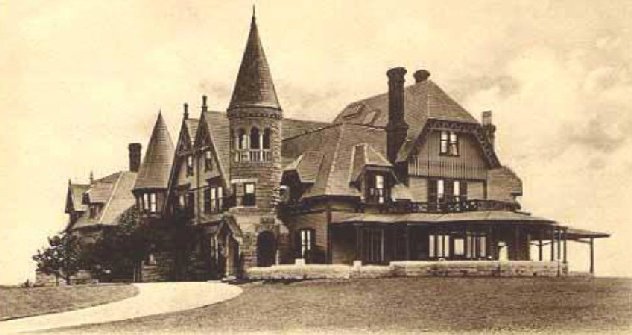
Edward and Isa’s summer home, The Rocks

Despite her wealthy upbringing, tragedy was to strike Isa in 1862 when she was still only sixteen years old.  In April of that year her father died, aged 75 and less than two months later, in early July her mother Mary Louisa Cushing died.  She was 63.  Isa went live with her elder brother Ned who acted as her legal guardian. On June 16th 1864, with the American Civil War still raging, twenty-four-year-old Edward Darley Boit, who was still studying law and was exempt military service, and seventeen-year-old Isabel Louisa Cushing married in an Episcopal ceremony at Christ Church in Harvard Square, Boston.  It was a sumptuous, no-expense spared affair.  The young couple split their time between Boston and Newport, Rhode Island where they had their summer house built.  It was known as The Rocks, and was situated above Bailey Beach and just along from Isa’s brother, Robert’s home.

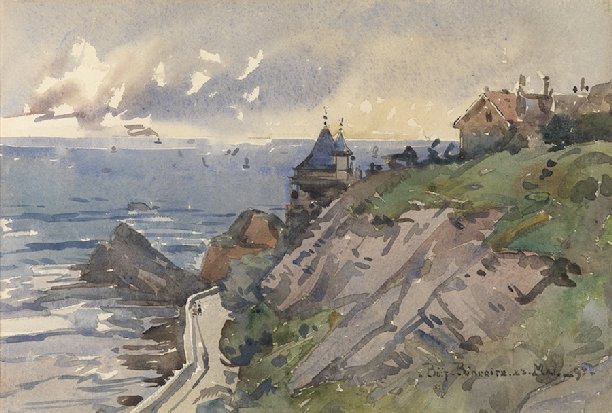
Biarritz by Edward Darley Boit

In April 1865 Isa Boit gave birth to their first child, named Edward after his father but was known as Neddie.  The following year Edward Darley Boit was admitted to the Massachusetts Bar and once again Isa was pregnant.  That summer Edward Boit, his pregnant wife and their son travelled to Europe visiting Dublin, Paris, Rome before returning to the French capital.  Throughout the European journeys Edward was continually visiting the major city art galleries and absorbing as much as the European art as he could.  In the Autumn of 1886 they returned to London where Isa gave birth to their second child, a son called John.  Neither Isa nor John were well following a problematic birth but their travels continued and they returned to Paris, their favourite city, in mid-December 1866.  However Edward wanted to once again visit Italy to study the works of the Italian Renaissance Masters and so Edward, Isa, Neddie and baby John went to Rome visiting Genoa and Florence en-route.  Five month old baby John was became very ill and never recovered his health. He died in March 1867 and was buried in the Protestant Cemetery in Rome.  Edward, Isa and Neddie returned to Boston where Edward resumed his legal career.

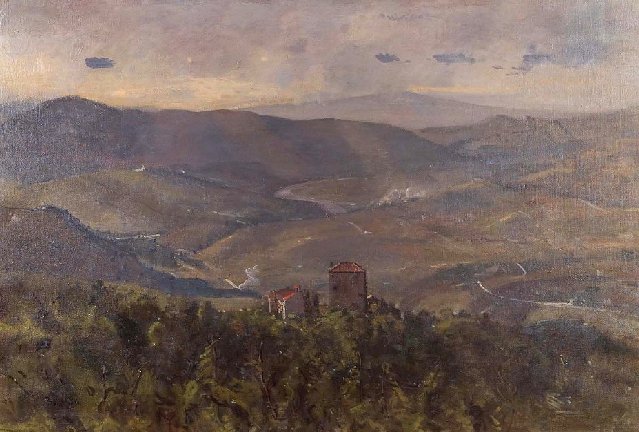
Italian Landscape by Edward Darley Boit

Edward Boit visited an art exhibition at Boston’s Soule and Ward gallery and for him it was a magical visit and he was overwhelmed by the landscape work of Jean-Baptiste-Camille Corot and how the French painter had managed to capture the light, air and atmosphere in his works.  It was an epiphany for Boit who there and then decided that he would give up law and become a painter and furthermore he and the family would leave America and live in Paris.  Edward’s wife Isa supported him both passionately and financially having received a sizeable inheritance from her late parents.  Isa preferred life in Paris to that of life in Boston. 

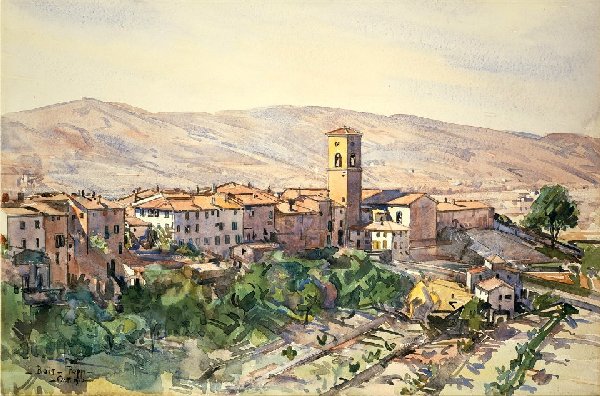
Poppi in the Casentino, Tuscany by Edward Darley Boit

Whilst in Newport Rhode Island, the size of the Boit family had  increased.  A daughter, Florence, was born on May 6th 1868 and a second daughter, Jane, was born on January 17th  1870.  There was one major problem to the Paris relocation plans.  Their eldest son, now five-years-old, suffered from severe mental retardation and was now living in a “home”.  Edward and Isa had a heartbreaking decision to make as to whether to stay in Boston to be near him, albeit he didnt recognise them and could not communicate or leave their son behind when they emigrated to Paris.  After a lot of soul searching they decided to relocate the family and leave Neddie behind in the specialist home. In the Autumn of 1871, Boit gave up his conventional legal life, and the couple sold their Newport home and moved to Europe with the family, visiting Italy first then travelling around the French countryside before arriving at their ultimate destination, Paris.  One of the first things Boit picked up about French art was the way they cared less for detail and concentrated on overall effect liberation.  Edward Boit and his family split their time between Paris and Rome and enjoyed all that French and Italian society had to offer.  Among the close friends they met were the author,  Henry James and the young artist Frederic Crowninshield both of whom had connections with Boston.  In 1876 Boit decided to make Paris his base and had rented a studio at 139 boulevard Montparnasse in the city’s Left Bank artist quarters.  At the start of his Parisian residency he began to be tutored by the French landscape artist François-Louis Français, who himself had been a pupil of Corot, one of Boit’s favourite painters.

Avenue de Friedland, Paris.

In 1874 the Boit family increased with the birth of a third daughter, Mary Louisa on June 5th in Paris and eighteen months later on November 15th 1878 a fourth daughter, Julia, was born in the northern Paris suburb of Soissy.  Edward and Isa decided that it was now time to return to America for a long stay so as to introduce their daughters to their uncles and grandparents and in mid-June 1879 they, along with European governesses and nurses, boarded SS Bothnia for the Atlantic sea passage.  Great celebrations followed their arrival and Edward’s parents looked forward to Edward and his family remaining over the winter months in Boston, but their hopes were dashed when Edward outlined his plans to return to Paris. The voyage back to France took place in early October 1879. On arriving back in Paris they took a large apartment on the avenue de Friedland, a large boulevard that radiated out from the Place d’Etoile,

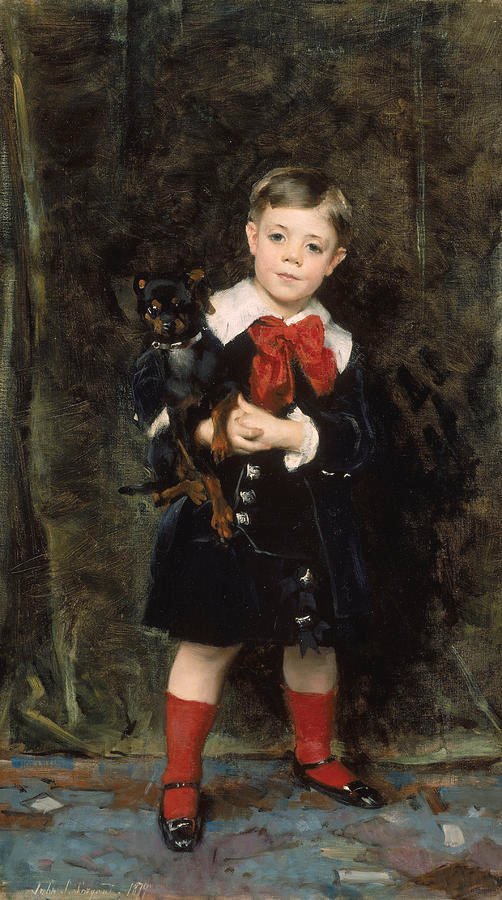
Portrait of Robert de Cévrieux with his Pet Dog by John Singer Sargent

There is some doubt as to when Edward and Isa Boit met the artist, John Singer Sargent but it is thought most likely it was in Paris in the late 1870s during one of the many artistic soirees that the Boits and Sargent frequented.  Another possible reason was the meeting came about through the auspices of Edward Boit’s teacher, François-Louis Français, whose close friend was Carolas-Duran, one of Singer Sargent’s tutor.   Sargent was an expert portraitist and a third of them were commissions to paint children.  An example of one such painting is Sargent’s 1879 Portrait of Robert de Cévrieux with his Pet Dog.  We see him standing on an oriental rug in front of a curtained backdrop.

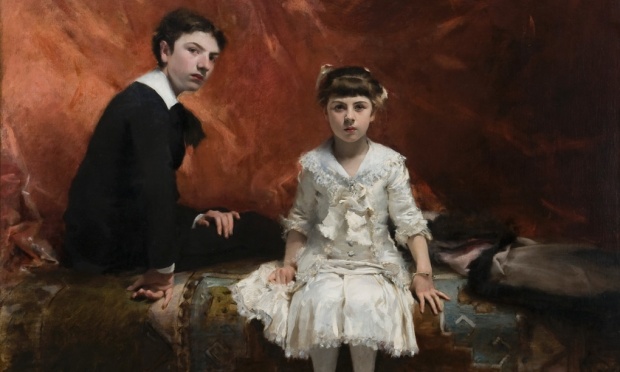
Portrait of Edouard and Marie-Loise Pailleron by John Singer Sargent (1881)

Another child portrait by Sargent was a commission from one of Sargent’s earliest patrons, Edouard Pailleron, the French poet and dramatist.  Sargent had completed a portrait of Edouard and his wife in 1879 and two years later,  a portrait of Edouard’s two children, sixteen-years-old Edouard and his younger sister, Marie-Louise, which was exhibited at the 1881 Salon.  The children’s portrait was time consuming and Marie-Louise, later recorded that there were eighty-three sitting for this painting which might explain why the subjects seem strangely remote from the artist.

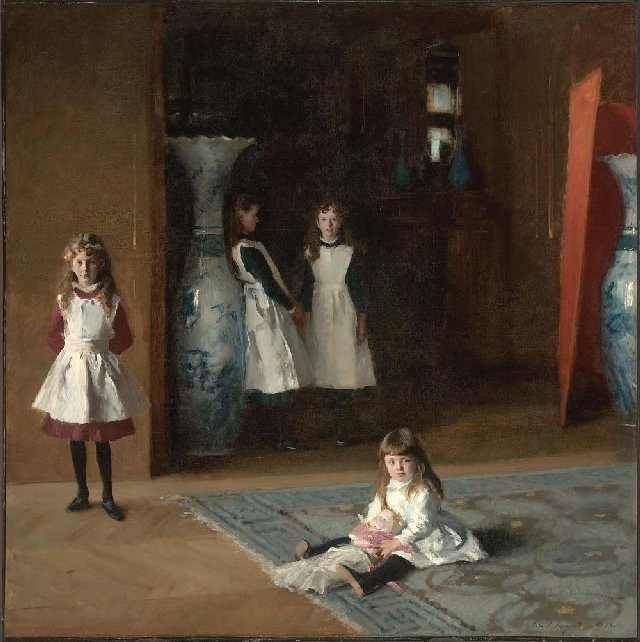
The Daughters of Edward Darley Boit by John Singer Sargent (1882)

The painting I am concentrating on in this blog, The Daughters of Edward Darley Boit, is one that Sargent started on in October 1882 after he returned to Paris from Italy.  He completed the work in December, a mere two months later. This was a great achievement as the painting was so large (225 x 255 cms) 87.6 inches square. Sargent titled the painting Portraits of Children and it was then shown at Georges Petit’s Exposition de la Société Internationale and the following year at the Salon.    It is an unusual depiction in as far as, that besides the four girls and two large vases, the location seems empty, even stark.  This would be completely different to the real Boit household which was known to be full of furnishings which they had collected on their travels over the years.  The stylistic interior tastes of the Boits is not reflected in this portrait with the exception of the vases.  Maybe Edward and Isa first approached Sargent tasking him to paint a traditional portrait of their four daughters but subsequently they may have acceded to Sargent’s decision to make the depiction part portraiture and part an interior genre painting.

Mary Louisa (Isa) Boit

The setting for this portrait is one of the rooms in the family’s spacious apartment, possibly the foyer.  Edward and Isa had moved into the apartment on the avenue de Friedland, a large boulevard that radiated out from the Place d’Etoile, Their elegant residence was situated in the eighth arrondissement, a luxurious neighbourhood much preferred by wealthy Americans.  They had lived there since 1879 when they had arrived back from a summer in Newport, Rhode Island.  It was to be home to the Boits until 1886.

Julia Overing Boit

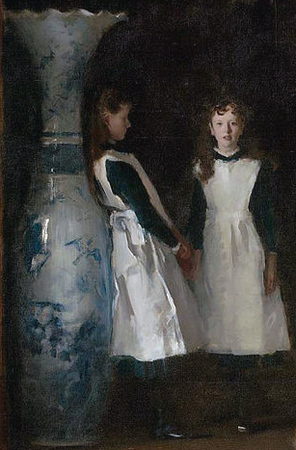
In the painting, the light comes from the left. The two older daughters are shielded from it by the recessed enclave they stand in, a position which they have found for their uneasy refuge. All the girls wear white pinafores, which gives Sargent the opportunity to show off his absolute mastery of a full range of tones created by the folds and creases in the pinafores. It was a dark shadowy space in which Sargent then positioned the Boits’ four daughters.   The youngest daughter, four-year-old Julia sits on the floor, eight-year-old Mary Louisa stands at the left midground of the painting whilst the two older daughters, Jane, aged twelve, and Florence, fourteen, stand in the background, partially obscured by shadow. 

Painting with the vases at the Museum of Fine Arts, Boston.

Besides the four girls the other striking feature of the painting is the inclusion of the two tall vases.  These were not Sargent’s props but two Japanese vases owned by the Boits, which Sargent faithfully depicted, although he subdued the colour allowing the girls to be the more important.  The vases, like their owners, criss-crossed the Atlantic more than a dozen times and only suffered minor damage to their rims.  They were six feet tall giants, the tops of which flared into scalloped ripples of porcelain.  The size of them dwarfed the girls.  They were made in Arita, Japan an area famous for its porcelain, which in the late nineteenth century was specifically made for export to the West. The two oversize Japanese porcelain vases depicted in the work were, along with the painting, also donated by the Boit family to the Boston Museum of Fine Arts and are exhibited beside Sargent’s painting.

Florence Dumaresq and Jane Hubbard Boit

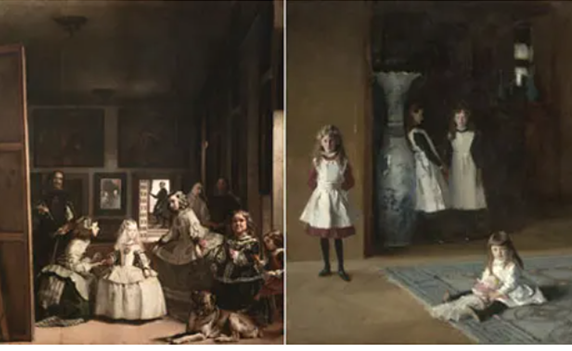
The painting by Sargent is not a conventional group portrait as Sargent has positioned the four girls individually.  There is no connection between the siblings.   The two older sisters are placed in the semi-shade in the background while the youngest is centre stage in the foreground holding her doll and the other girl is standing alone off to the left.  Each of the girls is presented individually, but the features of the two older girls are obscured, by the darkness of the background.  The presence of empty space, and the isolation of the figures all add to the sense of quiet anxiousness. Florence with her back to the vase comes over as being independent and refuses to participate at all and Jane, facing us, is left unsure whether to side with her big sister or to emerge from the shadows and face the artist.

Las Meninas by Velazquez (1656)

Many art historians have likened the position of the girls with way Velazquez set up the figures in his painting, Las Meninas, the famous portrait of the young Spanish infanta with her maids in a great shadowed room.  Sargent had studied and copied this work during his 1879 visit to the Prado in Madrid. 

A composite image of Las Meninas by Diego Rodriguez de Silva y Velazquez and The Daughters of Edward Darley Boit by John Singer Sargent. 

The relationship between these two works was considered so noteworthy that the Museum of Fine Arts in Boston who owned the Boit family portrait loaned it to the Museo del Prado in 2010, so that the paintings could be exhibited together for the first time. 

Malcolm Rogers, the director of Boston’s Museum of Fine Arts at the time of the loan, when asked about the similarity of the two works of art stated;

“…These two great paintings have never been together in one room before……It is Sargent’s greatest painting, one of the great paintings of childhood and for it to hang side by side with arguably the world’s greatest portrait of childhood has to be a historic and iconic moment. I think people will be very moved…”

When the Daughters of Edward Darley Boit was first exhibited in 1883, the depiction of the children was the subject of much discussion. Many art critics were confounded as to why the children were so isolated from each other and also why is one in profile and almost indistinct?  Again Malcolm Rogers postulated:

“…The Boit daughters is just one of those paintings that moves people because of its beauty, but also its mystery.  You don’t quite know what these four girls are thinking; it opens up your own imagination. It’s got a little bit of sadness, a little bit of happiness, a little bit of childishness, great beauty. It is a very intriguing work…”

I will end this blog with a brief summary of what happened to the family. Isa, Edwards wife, was taken ill in the summer of 1894 and by the Autumn she had suffered from increasing paralysis of her limbs and both her heart and lungs began to fail. She died in Dinard, France on September 29th 1894 aged forty-eight and was buried in Paris, the city she loved so much. Edward refused to return to Boston in deference to Isa who had hated living in the American city.

In Biarritz, in the summer of 1895, Edward became re-aquainted with a young girl, Florence McCarty Little, who he had first met in Boston and was a firend of his twenty-one year-old daughter Isa. To everybody’s shock and his daughters’ horror Edward and Florence became very close and and they announced their impending marriage. Florence was thirty-six years younger than Edward.

Edward Darley Boit and F lorence set June 1896 for the marriage ceremony but it was postponed until October. His four daughters were sent back to Boston to stay with their aunt, Jane Boit Hunnewell in Wellesley. Edward’s brother Bob tried to dissuade his brother from marrying such a young girl saying that he was acting like a selfish, infatuated, silly school-boy and that he was appalled by his brother’s “abandonment” of his children. His daughters’ cousin Mary Boit returned to Paris with the four girls in October and wrote about the atmosphere at her cousins’ home:

“…I think he seems quite pre-occupied and now we are over hereUncle Ned says he is going to marry Florence Little next month. Well it is a very strange thing and I am more sorry for the girls than anything. poor dears, it seems so queer to look at Uncle Ned then think he is in love with somebody my age…”

Edward Darley with his sons, Julian and Edward.

The marriage finally took place in Biarritz on January 5th 1897 and on June 21st 1900 Florence gave birth to their first child, a son, Julian. Two years later, on April 12th 1902 she gave birth to their second son, Edward. Sadly, two weeks after the birth of Edward, Florence contracted a fever and died on April 24th, aged 25. Edward Darley Boit died of arteriosclerosis in Rome on April 21st 1915, three weeks before his 75th birthday.

None of the four daughters, depicted in the painting, married. The eldest, Florence Dumaresq died in 1919, aged 51. The second born daughter, Jane Hubbard Boit had suffered a nervous breakdown and never completely recovered. Her father was concerned that she would end up in a mental asylum like his first-born, Neddie. She improved and in fact, went to live on her own in a Paris apartment. She died in New York State in November 1955, aged 85. Mary Louisa Boit, the girl who stood alone on the left of Sargent’s painting, and who was looked upon as the prettiest of the four girls, died in New York in June 1945, aged 71.

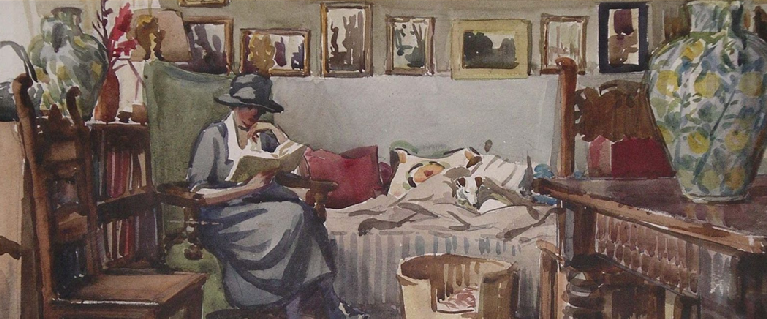
Woman in Blue, Apartment in Paris by Julia Overing Boit (1921)

The youngest aughter, Julia Overing Boit, became a talented watercolour painter and often her letters contained small watercolour sketches. Her work was exhibited in many exhibitions and in March 1929 at the Copley Gallery in Boston, sixty-six of her watercolours were exhibited. She died in February 1969, aged 91.


Most of the information for this blog came from an excellent book which I bought from Amazon. It is entitled Sargent’s Daughters, The biography of a portrait, by Erica E Hirshler. If you would like a greater in-depth read about the Boit family and the painting, this is a must-have book.

Museu Calouste Gulbenkian, Lisbon: 19th century gems – Part 2.

This is my last blog relating to Museu Calouste Gulbenkian and the paintings to be found in the Founder’ Collection and I have saved the best till last ! I wanted to take another look at the 19th century collection and choose some of my favourites and explore paintings in other museums which have a connection to those in the Lisbon museum.

The Reading by Henri Fantin-Latour (1870)

Henri Fantin-Latour  was a prolific artist and completed many works including a number of portraits. In his 1870 work, The Reading, we have a dual portrait of two women in a domestic setting, both seated and one of them is depicted reading. The theme of reading was the subject of several of his well-known works. The painting is an example of intimism, a French term applied to paintings and drawings of quiet domestic scenes. It is an every-day scene with a sense of sober realism. It also introduces the observer into his favourite themes, poetic and dreamlike domestic environment with vaguely melancholic undertones. The lady on the left is Victoria Dubourg, a fellow painter whom he met at the Louvre whilst she was copying old masters. She became his wife in 1875.

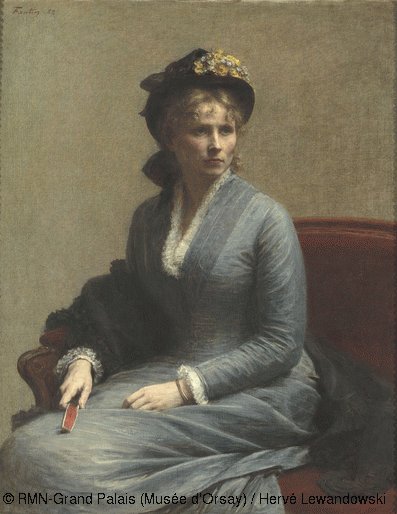
Charlotte Dubourg by Henri Fantin-Latour (1882)  Musée d’Orsay

Across from her, on the right of the depiction, is her sister Charlotte Dubourg.  Charlotte Dubourg featured in a number of Henri Fantin-Latour’s paintings. This frequent collaboration between artist and muse gave rise to the speculation that Fantin-Latour was fascinated by Charlotte’s mysterious beauty and that there was an unspoken understanding between Fantin-Latour and his sister-in-law, maybe even more!

Two Sisters by Henri Fantin-Latour (1859)

A similar double portrait in an interior setting can be seen at the St Louis Art Museum. This painting was entitled Two Sisters and Fantin-Latour completed the work in 1859 when he was just twenty-two years old. Once again, we have a depiction of two young women in the intimate setting of their home. This double portrait shows the two younger sisters of the painter; Marie reads on the right while Nathalie embroiders on the left. Once again, the interior painting is comprised of subdued grey and brown tones which is counterbalanced by the colourful yarns on the embroidery table. There is also seems to be a disconnect between the two sisters. Had the artist intentionally depicted it in that way ? Natalie, instead of concentrating on her embroidery, has an unsettled expression on her face. Something is troubling her. It could be that her brother, through his depiction of her expression, is hinting about her depressive illness which would soon confine her to a mental institution for the rest of her life.

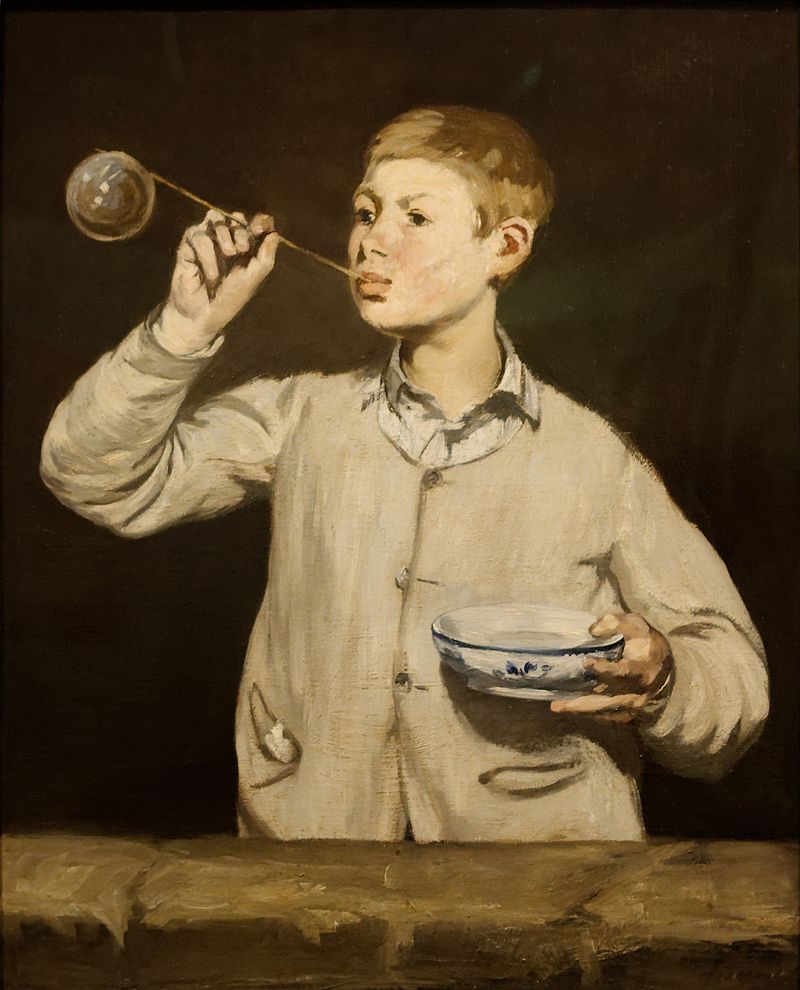
Boy Blowing Bubbles by Edouard Manet (1867)

The definition of a Vanitas painting is one that contains a single item, but more frequently, collections of symbolic objects, which remind us of the inevitability of death as well as the transience and vanity of earthly achievements and pleasures. For many artists it was a way to encourage the viewer to consider their own mortality and atone for their transgressions. The next painting I am going to talk about is classified as a Vanitas work but does not have the usual skull or fluttering candle which are often associated with the passing of life in such works. What it does have is a large bubble which is being blown by a young boy. It is the fact that as beautiful as the bubble may appear it will soon burst and the beauty will be forgotten. The painting is entitled Boy Blowing Bubble and it was painted by the French artist, Édouard Manet in 1867. It is now in the Calouste Gulbenkian Museum in Lisbon, which acquired it via André Weil in New York November 1943.

Soap Bubbles by Thomas Couture (1859) Metropolitan Museum of Art, New York

In 1850, Manet enrolled at the rue Laval studio of Thomas Couture and remained one of his students for six years. It could have been his tutor’s 1859 painting entitled Soap Bubbles which gave Manet the idea for this painting.

Portrait de Léon Leenhoff by Édouard Manet (1868).(Musée national, Stockholm)

The painting by Manet was one of a series which featured his illegitimate son Léon Koelin-Leenhoff. Suzanne Leenhoff, a Dutch-born pianist, had been employed as a music tutor for Édouard and his younger brothers Eugène and Gustave. Léon Koelin-Leenhoff was born on January 29th, 1852, the son of Suzanne Leenhoff.  His birth certificate stated Suzanne as his mother and “Koella” as his father. The man named as Koella has never been traced and it is widely believed that Édouard was the boy’s father whilst some even point the finger at Édouard’s father, Auguste, Suzanne’s employer. Léon Koelin-Leenhoff was baptised in 1855 and became known as Suzanne’s younger brother. Édouard’s father, Auguste, died in 1862 and in October 1863 Suzanne and Édouard married. Léon featured in a number of Manet’s paintings.

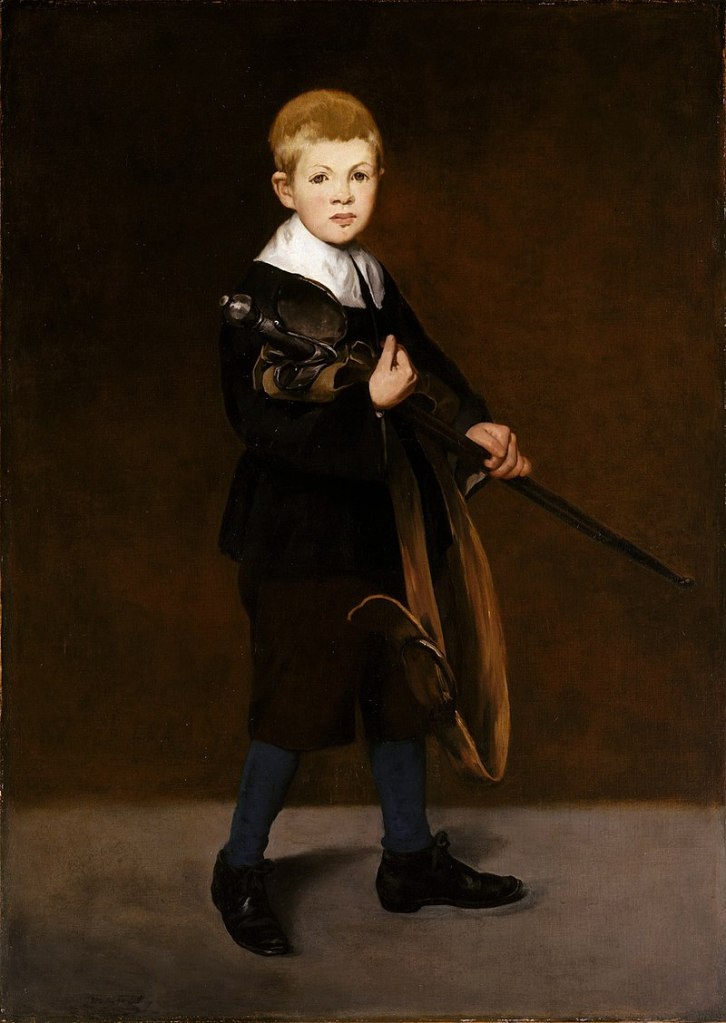
Boy Carrying a Sword by Édouard Manet (1861) Metropolitan Museum of Art, New York

In 1861, Manet’s employed Suzanne’s nine year old son, Léon Leenhoff , for his painting Boy Carrying a Sword. He posed in a 17th-century Spanish infant costume, holding a full-sized sword and sword belt. The work can now be found at the Metropolitan Museum of Art in New York.

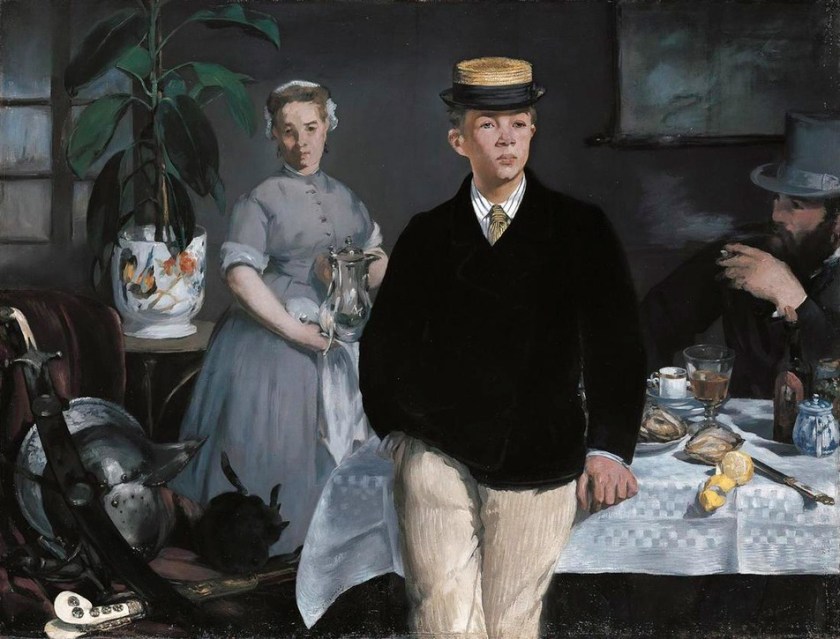
Le déjeuner dans l’atelier (Luncheon in the Studio) by Édouard Manet (1868)

Six years later, in 1868, Léon Leenhoff, now sixteen years of age, appeared in Manet’s painting entitled Le déjeuner dans l’atelier (Luncheon in the Studio). In the summer of 1868 Manet travelled to Boulogne-sur-Mer for his summer vacation, where he worked on this painting. Luncheon in the Studio was staged in the dining room of Manet’s rented house. The title of the painting almost hides the fact that it is a portrait of Léon Koélla Leenhoff. Léon is clearly the main character as he stands “centre stage” in the foreground, leaning against the table. The depiction of Leon is quite interesting. Manet has depicted him as the modern type of dandy, whose self-image plays between arrogance and aloneness. Elegantly dressed in a velvet jacket, confident of his superiority, cool with an air of indifference, he stands with his back to the others. He even avoids eye contact with us and so has an air of aloofness. But is that a fair reading of his character? Maybe his blasé expression hides a hint of sadness.  Behind him we see an older man smoking, seated at the table enjoying a coffee and a digestif, and a woman preparing to serve hot drinks. At one time they were thought to have been Manet and his wife Suzanne but this assertion has since been overturned and the figures are now thought to have been servants. The painting is awash with still-life depictions, such as the weapons on the armchair on the left, a colourful pot of plants on the table in the background and the table with a plethora of food and tableware. The still-life accoutrements we see before us, in particular the partially peeled lemon and the placement of the knife over the table edge were reminiscent of Dutch still-life works of two centuries earlier. The painting is part of the Neue Pinakothek in Munich.

The Break-Up of the Ice by Claude Monet (1880)

There were a number of Monet paintings in the Founder’s Collection but one I especially liked was entitled The Break-up of the Ice.  France, like most of Europe suffered one of the coldest winters on record in the latter months of 1879.  Monet had been living in Vétheuil, a commune on the banks of the Seine, some sixty kilometres from the French capital from 1878 to 1881 along with his wife, Camille Doncieux and their two sons, Jean and Michel.  They also shared their house with their friends, the Hoschedé family. During that period Monet completed more than one hundred and fifty paintings of the area. The winter of 1879 was so severe that even Monet found working outdoors almost unbearable. However, in early December, a sudden rise in temperature caused the ice on the Seine to crack. Alice Hoschedé, the wife of Monet’s friends, who along with her children were living in Monet’s house, described the resulting thaw as terrifying, as half the melted snow slid down from the hills onto the village. It was at this time that Monet painted scene after scene as the ice floes broke on the river and one of these works was The Break-up of the Ice, which he completed in 1880. In this grim and dismal landscape we see the thawing of the ice on the River Seine in January 1880.

Vetheuil in Winter by Monet (1879) Frick Collection, New York

It is one of a series of eighteen paintings by Monet at this location depicting the severity of the winter. His works were portrayals of the icy beauty of this wintry landscape. These paintings of ice floes chart Monet’s early fascination with capturing the same motif under differing conditions of light and at different times of day. Some, like the Lisbon painting, focused on the ferociousness of the weather and how it can devastate nature as depicted in the fallen trees, while others focused on the beauty of the winter landscape. Monet must have witnessed first-hand the devastation when the frozen Seine river thawed, dislodging large ice floes that inundated the countryside and damaged bridges The finished painting was almost certainly completed in Monet’s studio after having completed a number of plein-air sketches. Look at the simplicity of the depiction of the ice flows using a series of short brushstrokes.

The Break-up of the Ice (La Débâcle or Les Glaçons) by Claude Monet (1880) University of Michigan Museum of Art.

An example of a more peaceful winter landscape at the same spot was also completed in 1880 and was also entitled The Break-up of the Ice and this painting can be found at the University of Michigan Museum of Art. In this painting a sweeping winter river scene opens up from the foreground and sweeps away towards the left. Ice floes dot the river surface and snowy hills frame trees that stand along the riverbank in the middle distance. The palette of this painting is restricted to mauves, blues, greens, and whites.

Lady and Child asleep in a Punt under the Willows by John Singer Sargent (1887)

John Singer Sargent moved from Paris to London in the summer of 1885 as he was struggling to attract patrons, and so he turned to his friends and family for portrait commissions. Singer Sargent may have been introduced to the cousins Robert and Peter Harrison by Alma Strettell as she was a close friend of Sargent and, in 1877, he had illustrated her book, Spanish and Italian Folk Songs. Robert Harrison, a stockbroker and musical connoisseur had married Helen Smith, a daughter of a wealthy Tyneside businessman and politician and the couple went to live Shiplake Court, in the affluent London district of Henley-on-Thames. The Harrisons, like many of Sargent’s patrons, formed part of the high society of late Victorian Britain. Amongst the Gulbenkian’s Founder’s Collection there was an 1887 painting by John Singer Sargent entitled Lady and Child Asleep in a Punt under the Willows. In the summer of 1887 Sargent was invited by his friends Robert and Helen Harrison to spend the season at Shiplake Court. In the painting we see the sleepy figures of Helen Harrison and her son Cecil lying in a punt, under the shade of a willow tree. They are being gently lulled by the movement of a barge which had just passed by. This work is Impressionist in style. Sargent’s Impressionist period came about in the late 1880’s. The painting falls into the category dolce far niente which means the sweetness of doing nothing, a pleasant relaxation in carefree idleness which describes many of his works between 1887 and 1889.

A Backwater at Henley by John Singer Sargent (1880) Baltimore Museum of Art

Another similar work by Singer Sargent is his 1880 painting entitled A Backwater at Henley which is housed at the Baltimore Museum of Art.

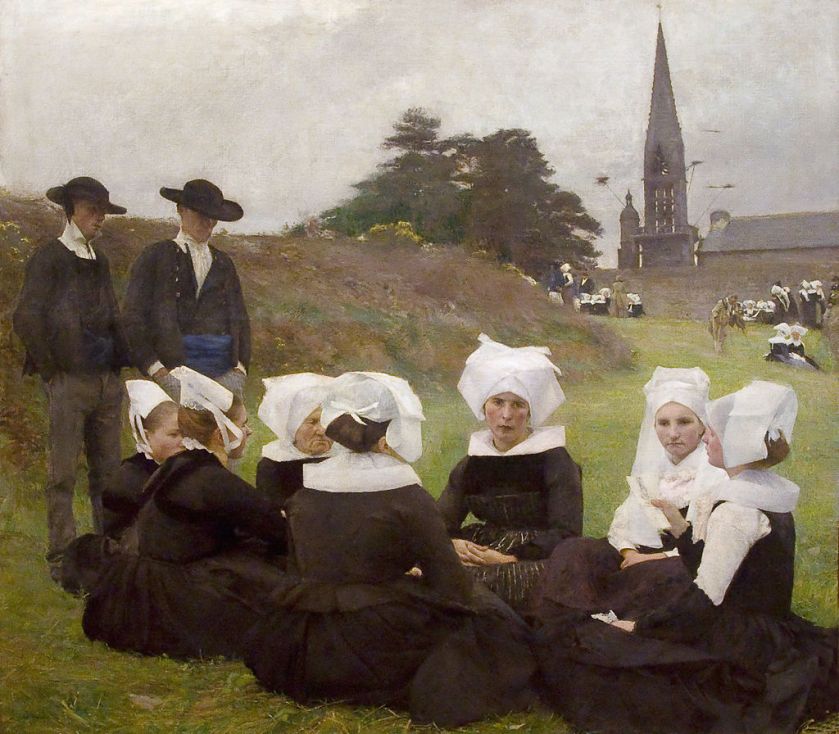
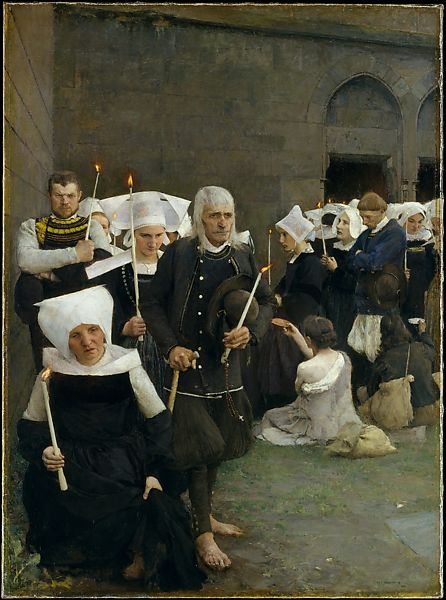
Les Bretonnes au Pardon by Pascal Dagnan-Bouveret, (1887)

The last painting I am showcasing that hangs in the Founder’s Collection is Les Bretonnes au Pardon (Breton Women at a Pardon). It is a fine example of Naturalism in which subjects were connected with the minutely detailed description of urban and rural life. It was an art form which was very popular in the late 1880’s and this work achieved great success for the artist at the 1889 Salon. When I saw this work, I thought it was by Gaugin but in fact the artist, who painted it in 1887, was the French painter, Pascal Dagnan-Bouveret. It is a beautifully crafted depiction of a rural tradition, but what also fascinated me was, what is or was a Pardon? The depiction is termed ethnographic, meaning it is relating to the scientific description of peoples and cultures with their customs, habits, and mutual differences. 

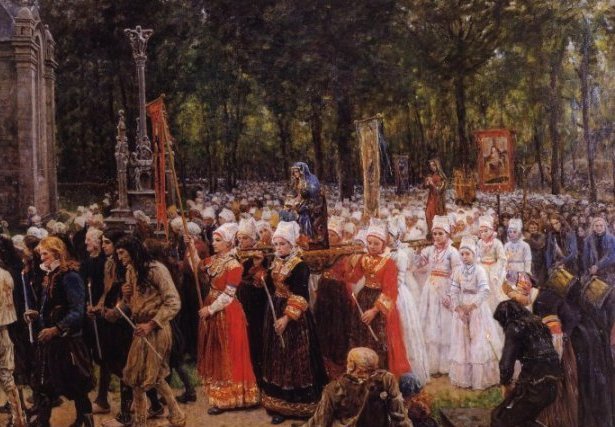
The Pardon at Kergoat, portrayed by Jules Breton (1891) Musée des Beaux-Arts Quimper.                The pardon at the Chapel of Kergoat in Quéméneven was one of the most popular pardons because of the virtues of the waters from the nearby fountain. People came from all over Cornouaille, as shown by the presence of people from the Bigouden area. The artist, overawed by the number of beggars and the fervour of the pilgrims, conveys the movement of this procession as it goes around the monumental chapel.

The word “Pardon”, coming from the Latin verb perdonare, to forgive, and is a Breton form of pilgrimage and one of the most traditional expressions of popular Catholicism in Western Brittany.  It dates back to the conversion of the country by the Celtic monks, It is a penitential ceremony. A Pardon occurs on the feast of the patron saint of a church or chapel, at which an indulgence is granted. There are five distinct kinds of Pardons in Brittany: St. Yves at Tréguier – the Pardon of the poor; Our Lady of Rumengol – the Pardon of the singers; St. Jean-du-Doigt – the Pardon of fire; St. Ronan – the Pardon of the mountain; and St. Anne de la Palude – the Pardon of the sea and they all occur between Easter and Michaelmas, a period between March and October. Pilgrims arrive at these Breton Pardon ceremonies dressed in their best costumes which is probably why they make ideal subjects for artists. The day is spent in prayer and after a religious service a great procession takes place around the church. The Pardon in Brittany has practically remained unchanged for over two hundred years. The ceremony is not one focused on feasting or revelry but one focused on veneration where young and old connect with God and his saints in prayer. Brittany at the time was a favourite location for artists such as Paul Gaugain,
Léon Augustin Lhermitte, Jules Adolphe Aimé Louis Breton and Émile Bernard who were beguiled by the family rituals of the local peasants.

The Pardon in Brittany by Pascal Dragnan-Bouveret (1886) Metropolitan Museum of Art, New York.

It is known that Dagnan-Bouveret used photographs he had taken at the ceremony in the Finistère town of Rumengol in 1886 as an aid to his finished works. He also used portraits he had made of some of his models.
Pascal Dagnan-Bouveret completed a number of paintings featuring “The Pardon” one of which, The Pardon in Brittany, which is a truly amazing, almost photrealistic depiction of the ceremony. This painting is housed at the Metropolitan Museum of Art in New York.  Before us we see penitents wearing traditional regional dress proceeding with an air of solemnity as they joylessly parade around a church. Some of the pilgrims go barefoot or kneel in an expression of remorse. What is quite interesting is that on the reverse of the canvas were drawings of his wife which the artist later used for the young woman in the foreground. When the picture was shown at the 1887 Salon and the 1889 Paris Exposition Universelle, it was hailed a great success by art critics saying they were astounded by its meticulous details. This is almost certainly down to the artist’s use of photographs to help him with the work.

That was final look at the paintings of the Founder’s Collection at the Museu Calouste Gulbenkian in Lisbon.  If we ever have the travel restrictions lifted and you find yourself in the Portugeuse capital make sure you pay this museum a visit.  You will not be disappointed.

Anders Zorn. Part 3

Anders Zorn

Some biographers have maintained that Zorn’s personality was somewhat loud and garish and it is that personal trait which can often be seen in the animated, broad sweeping distinctive brushstrokes of his works. By the beginning of the 1880s Zorn had acquired a self-assured style, and with his popular artwork, he was on an artistic journey. As in so many instances in the early life of aspiring artists, who were being academically trained, Zorn’s view on how art should be taught ended with him having disagreements with the director of the Royal Academy of Fine Art regarding the strict curriculum and in January 1881, after a final divergence of opinion with the Academy’s director regarding the school’s authoritarian and inflexible curriculum, Zorn decided to resign. Zorn, by this time, had built up a strong set of student followers and many followed his lead and also left the Academy.

Une Première (The First Time) by Anders Zorn (1888)

Having had great success with his painting such as his gouache painting, Une Première, which won him a Gold Medal at the Exposition Universelle in Paris in 1889, his standing as a plein air artist soared. There was nothing new about an artist depicting a nude with a backdrop of nature but Zorn’s depictions were quite different to those academic artists who liked to have a mythological theme in their works, full of nymphs prancing through forests and fields!

The Hinds by Anders Zorn (1908)

The nudes in Zorn’s paintings were depicted differently. There was a realism about his subjects. The naked women were simply depicted as healthy, ordinary Nordic women who were merely part of nature. A good example of this is his 1908 painting entitled The Hinds.

In Wikstrom’s Studio by Anders Zorn (1889)

One of his most beautiful works featuring a female nude is his 1889 painting entitled In Wikströms Studio. At this time Zorn and his wife Emma were living in Montmartre where he had his studio. He and his wife often entertained intellectuals and artists, especially artists from Scandinavia, who,  like him, had decided to ply their trade in the French capital.   One such artist was the Finnish sculptor, Emil Wikström, and he and Zorn became close friends. The two men shared a fascination for the female nude and the search for the perfect body to paint or sculpt and the two men would often use the same models for their work. The painting, as the title suggests, was painted by Zorn at Wikström studio. The young woman, a veritable beauty with luxuriant red hair and an almost golden skin tone, is seen standing next to a yet-to-be-completed image and is in the process of undressing prior to posing for the artist. There is a sense of unhappiness about the scene as if we believe the young woman has been forced into taking her clothes off. There is also a feeling that we are simply voyeurs and in a way, we are simply spying on the woman unbeknown to her, which adds a touch of both censure and hint of eroticism to the work.   Despite her seemingly unaware that she is being watched, we feel that we are standing before the work unable to move, gazing at the woman in total silence in case she detects us.

Zorn was contented with his standard of work and a quote published in Société des Peintres-Graveurs: printmaking, 1889–1897 quoted Zorn:

“…I never spent much time thinking about others’ art. I felt that if I wanted to become something, then I had to go after nature with all my interest and energy, seek what I loved about it, and desire to steal its secret and beauty. I was entitled to become as great as anyone else, and in that branch of art so commanded by me, watercolour painting, I considered myself to have already surpassed all predecessors and contemporaries…”

Self portrait with Model by Anders Zorn (1896)

Anders Zorn in the latter years of the nineteenth century continued with his favoured motifs, portraits including his own self-portraits and nude paintings of women. One such work, entitled Self-portrait with Model, which he completed in 1896, is a juxtaposition of his two favoured motifs. In the work, we see Zorn resting in front of his easel, smoking a cigarette as he takes a short break from his work. His partly dressed model is seen lying slumped in the background. Her eyes are fixed upon him and it is this gaze, which gives us a slight feeling of tension between artist and sitter.   An etching derived from this painting was completed by Zorn in 1899 and can be seen at the Isabella Gardner Museum in Boston.

Self-portrait in a wolfskin by Anders Zorn (1915)

In the early 1900s, Anders Zorn continued with his portraiture and one exceptional example was his Self-portrait in Wolfskin in oils, which he completed in 1915.

A Toast in the Idun Society by Anders Zorn (1892)

Another work of portraiture that is worth a mention is Zorn’s meticulous work entitled A Toast in the Idun Society, which is housed in the National Museum of Stockholm. In this work, we see Harald Wieselgren, an influential intellectual, portrayed as the animated and scholarly speaker. In 1862, Wieselgren was the founder of the Idun Society and throughout his life, he was a leading figure in the Society. The male Idun Society was known for its closed bourgeois atmosphere. Wieselgren was a writer, a librarian at the Royal Library, and for several decades a driving force of the Idun society. This cultural association for men still survives today and since 1885 there has been a female equivalent Society known as Nya Idun.

Skerikulla (Skeri Girl) by Anders Zorn (1912)

Undoubtedly, Zorn was best known for his paintings but his etchings were extremely popular in their own right. It is said that his etchings realised higher prices than Rembrandts during his lifetime. In total, he completed almost 300 etchings, many of which were associated with his oil and watercolour works. One such is his 1912 etching entitled Skerikulla. The word Skerikulla means “Skeri girl” in the local Mora dialect, which was spoken by Zorn.  Zorn’s model for this work was a local girl, Emma Andersson, and Zorn has portrayed her as a happy young woman with a beaming smile. There is a feeling of energy about her demeanour, which we see in the middle of a laugh. It is a tender depiction. Later that year, Zorn also completed an oil painting of Emma.

Girl with a Cigarette II by Anders Zorn (1891)

Another exquisite etching is his 1891 one entitled Girl with a Cigarette II. Such simplicity, such perfection.   There are a number of versions of this etching. One can be found at the Met in New York while another is housed in the Art Institute of Chicago.

We often compare portraiture when we consider the talent of various portrait artists. I wonder if portrait artists ever compare their talent against that of fellow portraitists. I consider this possibility having just read an anecdote on The ARTery website with regards the portraiture of Zorn and that of his contemporary John Singer Sargent.

Mrs Walter Bacon (Virginia Purdy Barker) by John Singer Sargent (1896)

The story goes that in 1897, Edward Rathbone Bacon, a powerful American railway magnate, challenged Anders Zorn to come up with a superior portrait of his sister-in-law, Virginia Purdy, that John Singer Sargent had painted in 1896. The Sargent portrait had Mrs. Walter Rathbone Bacon standing, in a Spanish gown, leaning against a wall.   Sargent’s painting is housed at the Biltmore Estate in Asheville, North Carolina.

Mrs. Walter Rathbone Bacon (Virginia Purdy Barker) by Anders Zorn (1897)

Zorn took up the challenge but chose a more intimate slant. Virginia sat for Zorn in 1897, during one of his visits to America. We see the lady seated indoors wearing a satin gown. It is a masterpiece of fluid brushwork and soft colour harmonies. He depicted his sitter in a moment of unpretentious elegance, as she hugs her collie dog.

So which was the better?   Who won the wager? Well, according to Zorn’s memoirs (!) Sargent, on seeing Zorn’s painting at the Paris Salon in 1897, conceded that Zorn’s work was the winner.   However what should be taken from this story is the glimpse into the competitive rivalry between two of the great portraitists of their time as they both strived for portrait commissions from the same slice of American Gilded Age high society in the 1880s with its lavishness and high spending elites.

Night Effect by Anders Zorn (1895)

A woman features in another work by Zorn. It is his Night Effect work, which he painted in 1895 and depicts a night time scene featuring a life-sized portrait of a young woman. She is wearing a red dress, (which one believes implies she is engaged in prostitution) and can be seen leaning against a tree, possibly suffering from an excess of alcohol. It is a life-sized depiction measuring 160 x 106cms (63 x 42ins).

Statue of Gustav Vasa by Anders Zorn atop a hill in the town of Mora

When Zorn grew up, his interest in art was more to do with his love of sculpture before he concentrated on his painting. Maybe the combination of his love of sculpture and his love for his country resulted in one of his most famous creations, the statue of King Gustav Vasa, which Zorn created and was unveiled in 1903 in Zorn’s birthplace and home in the central Swedish county of Dalarna and the town of Mora. Gustav Eriksson of the Vasa noble family was later known as Gustav Vasa. He travelled to the province of Dalarna to rally the peasantry to fight against King Christian II of Denmark, the ruler of the Kalmar Union, a confederation of three countries, Denmark, Norway, and Sweden. In 1523, Gustav Vasa made an impassioned speech to the men of Mora urging them to stand with him against the forces of the Kalmar Union. Gustav lead the rebel movement and his triumphant entry into Stockholm in June 1523 was followed by Sweden’s final secession from the Kalmar Union which was dissolved on June 6th, 1523 and Gustav became King Gustav I of Sweden.

House, garden and fountain – the sculpture “Morgonbad” (Morning bath) – of the Swedish artist Anders Zorn. Mora, Sweden.

Zorn also sculpted a number of portraits and smaller statues, among them is one known as Morning Bath which he completed in 1909.  It is a figure of a girl who holds a sponge in her hands from which a fountain spouts and is situated in front of the home where Zorn used to live.

The King of Sweden, King Oscar II by Anders Zorn (1898)

Anders Zorn used the popularity of his art to fund many charities. One example of this was the holding of a small exhibition featuring thirty-five of his works at the Artists Association in Stockholm in the Spring of 1918. The sale of his works at the end of the exhibition raised 12,642 Swedish Krona, which he donated to the Swedish Red Cross. In May that year, he donated twenty thousand Swedish krona to Västmanlands Dalanation.   Västmanlands-Dala nation, usually referred to simply as V-Dala, is one of the 13 “Student Nations” at Uppsala University, in Sweden. The “nation”, was intended for students from the provinces of Dalarna and Vastmanland, the former being the area of Zorn’s homeland. On June 6th, 1918, Zorn became Knight Commander of the Northern Pole Star order, first class.   The Order of the Polar Star is a Swedish order of chivalry which was created by King Frederick in 1748 and was a reward for Swedish and foreign “civic merits, for devotion to duty, for science, literary, learned and useful works and for new and beneficial institutions”.

Sommarnöje, by Anders Zorn (1886).

Sweden’s most expensive painting ever; sold at 26 million sek on June 3rd, 2010.

During the summer of 1920, Zorn spent much time sailing around the Stockholm archipelago and spending many nights celebrating on the island of Sandheim. However, Zorn was not well and was in constant pain and could not paint during that summer. After the summer sailing was over he returned to Mora, a tired and ailing man.
 Zorn was rushed to hospital in August 1920 for emergency abdominal treatment and was operated on at Mora hospital. Sadly Zorn had contracted blood poisoning in the lower abdomen and died on August 22nd, 1920, aged 60.

The Zorn Collections, or Zornsamlingarna, is a Swedish state museum, located in Mora,

Zorn’s wife Emma lived another twenty-two years, dying on January 4th, 1942. To honour the memory of her husband, she had worked to create a museum, which opened in 1939. She completed the existing collection by re-purchasing a number of paintings that he had sold and at the same time, she continued the philanthropic work that she and her husband had initiated.

Anders Zorn’s atelier at his house, Zorngården in Mora

The popularity of Anders Zorn’s art during his lifetime made him very wealthy and, over a number of years, he bought the art of his contemporaries and amassed a considerable collection. In their joint will, Anders and Emma Zorn donated their entire holdings to the Swedish State, including their home, Zorngården, which still remains today much as it was at the time of Emma Zorn’s death in 1942.


As usual much of the information I gleaned for the three blogs on Anders Zorn came from many internet websites but one of which is well worth looking at if you want a full and concise biography of this great Swedish artist.  The website is:

http://www.alsing.com/zorn_eng/index.html


John Singer Sargent and Virginie Amélie Avegno Gautreau

In my last blog I featured a painting by Theodore Roussel entitled The Reading Girl which was at the time both controversial and newsworthy, only going to prove the old adage that there is no such thing as bad publicity.  My blog today follows a similar theme, a controversial painting which had major repercussions on the artist and his career.

Self portrait by John Singer Sargent (1907)

My featured artist is John Singer Sargent.   He came from a very wealthy family.   His grandfather was Winthrop Sargent IV, who had descended from one of the oldest colonial families.  Due to a failed merchant-shipping business in Gloucester, Massachusetts, he moved his family to Philadelphia.  It was in that city that John Singer Sargent’s father, Fitzwilliam Sargent became an eye surgeon.  In 1850, Fitzwilliam Sargent married Mary Newbold Singer who was the daughter of a successful local merchant. In 1853 Mary gave birth to their first child, a daughter, who sadly died a year later.   Sargent’s mother suffered a nervous breakdown after the death of her daughter and her husband decided that it would be better for his wife’s health to move away from Philadelphia and the sad memories and take up residency in Europe.  Initially Sargent’s father’s idea was for he and his wife to stay in Europe just a short time until she was better but their life away from America extended and soon they became expatriates.  He and his wife based themselves in Paris but they would often travel and stay in Florence, Rome, or Nice in the winters and in the summers they would journey to the Alps were the climate was much cooler and more pleasant.   Their son John was born in January 1856 whilst they were in Florence.

Because of the nomadic lifestyle of the family and because of his determination not to stay in school, John Singer Sargent did not receive formal schooling and was taught at home by his father and mother.  He proved to be an excellent pupil excelling in languages and the arts.  Art played a great part in his early life as his mother was a talented amateur artist and his father was a talented medical illustrator.  Following more additions to the family and because his wife wanted to remain in Europe, John Singer Sargent’s father eventually resigned his post at the Willis Eye Hospital in Philadelphia and acquiesced to his wife’s wishes for the family to remain in Europe.

John Singer Sargent soon developed a love of art and his father had him enrol at the Accademia di Bella Arti in Florence during the winter of 1873/4.  In 1876, at the age of eighteen, Sargent passed the entrance exam to the École des Beaux-Arts in Paris.  Here he studied anatomy and perspective and spent time in the Paris museums copying the works of art of the masters. In those early days at the art academy Sargent was schooled as a French artist.  It was the era of French Impressionism and he was greatly influenced by the work of the Impressionist movement.  He was also a lover of the works of art by the Spanish painter, Velazquez and the Dutch master Frans Hals.

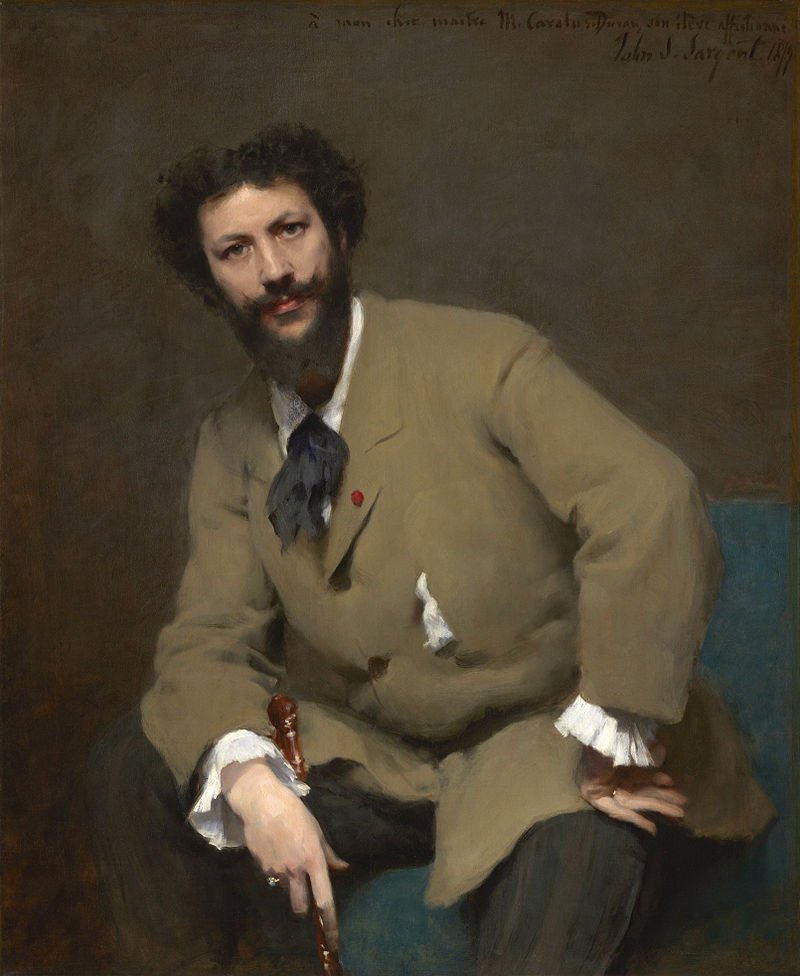
Portrait of Carolus-Duran by John Singer Sargent (1879)

However nearer to home he was inspired by his art tutor, the French painter, Carolus-Duran, a portrait of whom he completed in 1879.     John Singer Sargent’s reputation as a great artist and portraitist grew rapidly and in Paris he was the toast of artistic circles.  Everything he did was loved by the critics and the public.  The Parisians loved him.  He could do no wrong.  Well actually he could and did and through one painting, a portrait of a lady, his fall from grace was rapid and final and caused him to exile himself from Paris and France and take refuge in England.  So what happened?  The answer to this question is examined in this very blog.

The lady whose portrait caused such a stir was Virginie Amélie Avegno Gautreau.  Virginie Amélie Avegno was born in New Orleans in January 1859.  She was the daughter of a white Creole family.  Her father was Major Anatole Placide Avengo, a Confederate army soldier and her mother was Marie Virginie de Ternant who came from a wealthy Louisiana plantation owning family.  Her father was killed during the American Civil War at the Battle of Shiloh in 1862.  Five years later in 1867 her widowed mother took her eight year old daughter to live and be educated in Paris and as a teenager was introduced into high French society.

Virginie Amélie Avegno blossomed into a beautiful woman.  She was a pale-skinned brunette.  She was renowned for her great beauty and was accepted into Parisian society circles.  She dazzled all who met her with her exquisite clothing and undeniable beauty.  She mastered the art of make-up to enhance her looks and was known for her heavy use of chalky lavender powder which was dusted on her face and body affording her a very distinctive pallor.  Her beauty was unique.  She had a long nose which was somewhat longer than the accepted norm, her forehead was also too high and yet these physical characteristics never detracted from her hourglass figure and the seductive way she would walk when entering a room of people.

In his 2011 book The Greater Journey: Americans in Paris, David McCullough quotes an American art student named Edward Simmons who wrote about seeing Virginie and how the sight of her was unforgettable:

“…She walked as Virgil speaks of a goddess—sliding—and seemed to take no steps. Her head and neck undulated like that of a young doe, and something about her gave you the impression of infinite proportion, infinite grace, and infinite balance. Every artist wanted to make her in marble or paint…”

As always beauty as well as bringing out admirers, brings about jealousy and many of her detractors labelled her an arriviste, one who has attained a high position but has not attained general acceptance or respect.  I suppose we would liken her to one of the nouveau-riche looked down on by the “old establishment rich”

A mother’s most fervent wish is to see her daughters marry successfully which often translates into having their daughters marry a wealthy man.  Virginie’s mother must have been well pleased when her daughter married a wealthy French banker, Pierre Gautreau, and her daughter now had two of the greatest assets of life, beauty and a wealthy husband who held a great status in Parisian society.

John Singer Sargent met Virginie Gautreau at a social gathering around 1881.  He was smitten by her beauty and elegance; some say he soon became obsessed with her.  Having met her he wanted just one thing from life – to paint her portrait and have it exhibited at the Paris Salon so all could admire “his lady”.  Sargent had been inundated with portraiture commissions but on this occasion it was he who approached his desired sitter to ask if she would acquiesce to become the subject of his portrait.  Sargent realised that Gautreau was both part of high class Paris society and a renowned beauty and thus a portrait of her by him at the Salon would bring great kudos and he probably realised that if he portrayed her seductively it would cause a sensation similar to Manet’s Olympia at the 1865 Salon.  Sargent had unfortunately not realised how sensational it would turn out.

Watercolour figure study of Madame Gautreau  by John Singer Sargent (c.1883) Harvard Art Museum
Watercolour figure study of Madame Gautreau
by John Singer Sargent (c.1883)
Harvard Art Museum

After some help from colleagues Sargent persuaded Virginie Amélie Avegno Gautreau to sit for him.  For months on end he would complete many line drawings of her head in profile.  He would complete studies of her in pencil and watercolour, sometimes simply relaxing on a chaise-longue in a low-cut evening dress or depicted her in oil painting sketches drinking a champagne toast. In the summer of 1883, he stayed at the Gautreaus’ country estate in Brittany but admitted to his friend the writer, Vernon Lee, that he was still struggling to do justice to this un-paintable beauty.  He was also now having doubts as to whether it would be accepted into the 1884 Salon by the Salon jury.

In the winter of 1883, Sargent moved his Paris residence which had been on the Left Bank to a new studio across the Seine in the fashionable Parc Monceau neighbourhood and it was here that he completed his full-length portrait of Gautreau.  It was a nerve-wracking time for Sargent as he had suffered a loss of self-confidence in his artistic ability in respect to the depiction of his beloved beauty.  Despite his worries, the painting was finally completed in 1884 and the Salon jury accepted it into the 1884 Salon. This was the sixth year in a row that the Salon had accepted works by Sargent. Before the Salon opened there was already a frenzied excitement about the portrait.  Gautreau had talked wildly and incessantly to her friends and acquaintances about the painting, even though she had never seen the finished work.

Madam *** by John Singer Sargent as exhibited at 1884 Salon
Madam *** by John Singer Sargent
as exhibited at 1884 Salon

In the painting, Gautreau is seen dressed in a long black satin skirt with its sultry low-cut black velvet bodice.  Against the deep black of the dress and the plain dark background, the deathly blue-white of her powdered skin was even more eccentric and noticeable.   Her shoulders are bare with the exception of two narrow jewelled straps. Gautreau posture is one in which both her shoulders are held back, her body faces us and yet her head is angled to the left, which fully highlights her stunning profile.   Her left arm rests on her hip with her hand gripping the material of her dress.   Her right hangs down in a twisted manner s her fingers grasp the top of the table.  The result of this distorted pose was to create tension in the neck and arm but it also highlighted the subject’s graceful curves.   Her hair is pinned up high on her head atop of which is a tiara.  Sargent must have “designed” this un-natural pose presumably because he believed it brought a haughty sensuality to his sitter, for remember, besides wanting to do justice to his sitter’s beauty he also wanted this work to have a sensational affect when it was exhibited.  It was probably this thought of sensationalism that made him make the cardinal error which was to damn him.   During one of Gautreau’s sittings the thin strap of her dress had slipped from her right shoulder and as she was about to re-adjust it when Sargent told her to leave it down it was and he decided to make the portrait even more sultry by portraying Gautreau’s right shoulder bare.  The die was cast and the painting with the strapless shoulder went on exhibition under the title Portrait of Madame *** although most Parisians were aware that it was the portrait of Virginie Amélie Avegno Gautreau.

Even though the Salon had just opened the picture was condemned for what was termed the sitters’ “flagrant insufficiency” of clothing.  Little was said about the other aspects of the work, it was all about the seductive pose and dress (or undress) of the sitter.  The Paris public could not stop talking about Sargent’s portrait of Gautreau.  It was fast becoming a scandal of epic proportions.  The painting received many critical reviews.  Some objected to the portrait on the grounds that they disliked Madame Gautreau’s décolletage, others criticised what they termed the repulsive colour of her skin.  Few however were less harsh and stated that they liked the modern approach to the portrait and congratulated Sargent on is courageous approach.  It is difficult to understand the furore over the suggestiveness of the black dress when paintings of nudes littered the walls of the Salon but of course they would normally have biblical or mythological connotations to them which made blatant nudity acceptable.  Maybe it was the haughty pose of the arriviste with her heavily powdered features which was too much for the critics and public alike. Gautreau herself was humiliated by the whole affair and her mother, Madame Avegno, who was also horrified with publicity surrounding the portrait, demanded Sargent remove it from the Salon. He defended the portrait, telling the irate mother that it was a truthful likeness of the pose of her daughter and the clothes she wore.

John Singer Sargent in his studio with with his painting Madame X

Sargent had scandalised Paris society and he was widely criticised in Paris art circles for being improper.  For Sargent the criticism of the work and of him as an artist was almost impossible to bear.  He had been living and working in Paris for ten years and during that period he had received nothing but praise for his work and the commissions had poured in on the back of such praise.  The criticism of the portrait went beyond a simple poor review.  He was being mocked by the Paris public for what he later stated was the best painting he had ever completed.  For him the work was a true masterpiece but it would take a long time before the world acknowledged that fact.  Sargent hung the work first in his Paris studio and later in his studio in London and from 1905 onwards he allowed it to be seen at various international exhibitions.

Madame X by John Singer Sargent (c.1884) with the position of the strap of dress altered
Madame X by John Singer Sargent (c.1884)
with the position of the strap of dress altered

Sargent repainted the fallen strap on Guitreau’s right shoulder, re-titled it Madame X and eventually sold the work to the Metropolitan Museum of Art in New York in 1916 where it is housed today.  An unfinished second version of the same pose is in the Tate Gallery London.

Sargent found the criticism unjustified and shortly after the 1884 Salon, in the May, at the age of 28, he left Paris disillusioned by the incident and disappointed by the fall off of sales of his paintings and moved to London where he remained for the rest of his life England.  Although his long-term career as a portraitist in France was over, he once again thrived artistically in the English capital and some say that it was here that he reached the pinnacle of his fame.  In those days to have you portrait done by Sargent was looked upon as having it painted by the best portraitist of the time.

John Singer Sargent      (1856 - 1925)
John Singer Sargent
(1856 – 1925)

He died in London in 1925, aged 69.

Gassed by John Singer Sargent

Gassed by John Singer Sargent (1918)

My Daily Art Display painting for today follows the theme of yesterday’s offering.  Once again I am featuring a painting which highlights the savagery of war.  This is another realistic depiction of the horrors of war which are often badly received by people who prefer to just see depictions of glorious victories, heroic acts and the happy return of our fighting men.  Sadly these kinds of pictures give one a false impression of the reality of war and it is sad to think that some of us want to close our eyes to what a war really is about and the terrifying effect it has on those who have to fight for somebody’s cause.   My painting today is entitled Gassed and is by the American artist John Singer Sargent which depicts the horrors of the trench fighting in the First World War.  It is a massive painting measuring 231cms high and 611 cms wide (91 inches x 240 inches) and can be seen in the Imperial War Museum in London.

John Singer Sargent was an American painter.  His parents were Americans but he was actually born in Florence where the family had moved to as an aid to his mother’s health.   The family travelled extensively throughout Europe.   Sargent loved his country yet he spent most of his life in Europe.   He became one of the most celebrated portraitists of his time but at the very height of his fame as a portrait painter he decided to devote full time to landscape painting, water colours and public art.

In the early days he was schooled as a French artist, and was greatly influenced by the Impressionist movement, the Spanish master Velazquez, the Dutch master Frans Hals, and his art tutor, the French painter, Carolus-Duran.   He was the toast of Paris until the scandal of his Madame X painting at the 1884 Salon.    Sargent painted the portrait of Madame Pierre Gautreau, entitled Madame X, wearing a very risqué off the shoulder gown. It was also shockingly low-cut. Her mother asked him to withdraw the painting but he refused. Although, now it is acclaimed as his best work of art, it scandalised Paris society and he was widely criticised in Paris art circles for being improper. Sargent found the criticism unjustified and at the age of 28 he left Paris disillusioned by the incident and the fall off of sales of his paintings and moved to London where he remained for the rest of his life.  It was here that he reached the pinnacle of his fame.  It was thought that to have one’s portrait painted by Sargent was to have it painted by the best portraitist of the time.

In some ways it is disappointing to realise that as an artist he has sometimes been dismissed as he was never looked upon as being radical or a trend setter.  He was an artist who worked within known and accepted styles. He was a prolific painter, painting over 2000 watercolours. He was a very successful portraitist but labelled portraiture as “a pimp’s profession” and in 1907 he announced that he would paint “no more mugs” and with a few exceptions kept to his word. His new love was to paint landscape watercolours.

So today’s featured painting was very different to his normal works.  It is a scene Sargent witnessed in August 1918 at Le Bac du Sud on the road between the French towns of Arras and Doullens in the Somme area of Northern France.  We see a line of nine soldiers, blinded by mustard gas, being helped along a boarded path by two orderlies towards a medical station.  The medical post is out of sight to the right of the scene but we can make out the guy ropes which support the tent-like structure.   The line of men who struggle to make their way towards the tent are silhouetted against the golden sunset sky.  In the left background we can just make out some bivouacs and to the right we see another line of wounded men being led towards the medical facility.  The foreground of the painting is littered with the wounded lying at rest, many with their heads bandaged.

The setting of the painting reminds me of the war poem dealing with the horrors of mustard gas in the World War 1 trenches.  It was entitled Dulce et Decorum Est and was composed by the Great War poet Wilfred Owen:

Bent double, like old beggars under sacks,
Knock-kneed, coughing like hags, we cursed through sludge,
Till on the haunting flares we turned our backs,
And towards our distant rest began to trudge.
Men marched asleep. Many had lost their boots,
But limped on, blood-shod. All went lame, all blind;
Drunk with fatigue; deaf even to the hoots
Of gas-shells dropping softly behind.

Gas! Gas! Quick, boys! An ecstasy of fumbling,
Fitting the clumsy helmets just in time,
But someone still was yelling out and stumbling
And floundering like a man in fire or lime.
Dim through the misty panes and thick green light,
As under a green sea, I saw him drowning.
In all my dreams, before my helpless sight,
He plunges at me, guttering, choking, drowning.

If in some smothering dreams, you too could pace
Behind the wagon that we flung him in.
And watch the white eyes writhing in his face,
His hanging face, like a devil’s sick of sin;
If you could hear, at every jolt, the blood
Come gargling from the froth-corrupted lungs,
Obscene as cancer, bitter as the cud
Of vile, incurable sores on innocent tongues,
My friend, you would not tell with such high zest
To children ardent for some desperate glory,
The old Lie: Dulce et decorum est
Pro patria mori.

Dulce et Decorum est, the title of the poem, are the first words of a Latin saying taken from an ode by Horace:

Dulce et decorum est pro patria mori:
mors et fugacem persequitur virum
nec parcit inbellis iuventae
poplitibus timidove tergo.

“How sweet and fitting it is to die for one’s country:
Death pursues the man who flees,
spares not the hamstrings or cowardly backs
Of battle-shy youths.”

 The full saying ends the poem:

Dulce et decorum est pro patria mori

(It is sweet and right to die for your country).

In other words, it is a wonderful and great honour to fight and die for your country.    Sadly as the young men sang joyfully as they marched towards the trenches in Northern France, little did they know of their impending fate.  Ironically, for many people of the time who supported Britain and France’s war against the Germans the words had specific relevance.  The first line of Owen’s poem is inscribed on the wall of the chapel of the Royal Military Academy of Sandhurst.

Paul Helleu Sketching with his Wife by John Singer Sargent

Paul Helleu Sketching with his Wife by John Singer Sargent (1894)

My Daily Art Display today is a tale of two artists who were very close friends.  One is the great American Impressionist John Singer Sargent, the other is the French painter Paul César Helleu.  Today’s work of art is a picture by the American artist Sargent of the French painter Paul César Helleu and his wife Alice Guérin.

John Singer Sargent was to become a leading portrait painter of his era.  His family were extremely wealthy, his father, Fitz William, being an eye surgeon in Philadelphia.  Sadly Sargent’s mother, Mary (née Singer) suffered a nervous breakdown after the death of her daughter and to aid her recovery her husband decided that his wife and their family should go to Europe to allow Mary to convalesce. 

Whilst in Europe, they travelled extensively.  John Singer Sargent was born in 1856 whilst his parents lived in Florence and his sister Mary was born there a year later.  After much discussion and to please his wife John’s father reluctantly relinquished his post at the Philadelphia hospital and remained in Italy were they led an unassuming lifestyle relying on a small inheritance and what savings they had managed to accrue. 

John Singer Sargent proved to be a rebellious child who would not take to formal schooling and so was taught by his parents.  His mother was a good amateur artist and she soon got John interested in that subject.  His parents must have provided him with a good education as by his late teens he was fluent in French, Italian and German and accomplished in art, music and literature.  No doubt the extensive travelling of European countries by the family improved his education.

In 1876, at the age of eighteen, Sargent passed the entrance exam to the École des Beaux-Arts in Paris.  Here he studied anatomy and perspective and spent time in the Paris museums copying the works of art of the masters.  It was whilst studying at the Art Academy that he met and became close friends with a young French artist, four years his junior, Paul César Helleu.  Whereas Sargent was having success with the sale of his paintings and was having no trouble in securing commissions, Helleu was becoming very despondent and disheartened, finding sales of his works difficult to come by and he was struggling to make needs meet.  Sargent, on hearing that Helleu was at the point of giving up his career as an artist, visited his friend on the pretext of looking at the young Frenchman’s work.  He congratulated his friend on the standard of his work and asked to buy one.  Helleu was delighted but told Sargent he must have the painting of his choice as a gift as it was not right to charge his friend.  Sargent replied to this offer saying:

 “I shall gladly accept, Helleu, but not as a gift. I sell my own pictures, and I know what they cost me by the time they are out of my hand. I should never enjoy this pastel if I hadn’t paid you a fair and honest price for it.”

He gave his friend a thousand-franc note for the painting.  Can you imagine how Helleu felt on receiving such a large sum of money for one of his paintings ?

In 1884 Sargent painted the portrait of Madame Pierre Gautreau, entitled Madame X, wearing a very risqué off the shoulder gown.  It was also shockingly low-cut.  Her mother asked him to withdraw the painting but he refused.  Although, now it is acclaimed as his best work of art, it scandalised Paris society and he was widely criticised in Paris art circles for being improper.  Sargent found the criticism unjustified and at the age of 28 he left Paris disillusioned by the incident and the fall off of sales of his paintings and moved to London where he remained for the rest of his life England.  He died there in 1925, aged 71.

My Daily Art Display painting today is entitled Paul Helleu Sketching with his Wife which he completed in 1889 and is in the Brooklyn Museum, New York.  It is difficult to put a name on Sargent’s genre of painting.   He was a prolific painter, painting over 2000 watercolours.  He was a very successful portraitist but labelled portraiture as “a pimp’s profession” and in 1907 he announced that he would paint “no more mugs” and with a few exceptions kept to his word.   He loved to paint landscape watercolours.  Today’s painting of his is very much in the characteristic style of Impressionism.