Minerva Expelling the Vices from the Garden of Virtue by Andrea Mantegna

Minerva Expelling the Vices from the Garden of Virtue by Andrea Mantegna (1502)

Nowadays,  whenever we switch on the television, we are bombarded by property shows and house renovations programmes, all wanting to know what our ideal house would be and suggesting how we should utilise the interior space of our dream home.  Questions are posed such as, should we have a gymnasium or a pool room or an office?  In 15th century Italy, the wealthy had similar things to ponder over and one of the popular ideas in those days was to incorporate a room in your residence, which would act as a private study or a meeting place for your intellectual friends.  However having the space for such a room was only one part of the dilemma.  The house owner then had to furnish it in such a way so as to impress their guests.  Sounds familiar?

In the 15th century Italy the fashionable thing to do was to have a studiolo, which was a type of private study, which would be set aside for intellectual activities.  Isabella d’Este, the Marchesa of Mantua, one of the leading women of the Italian Renaissance was a major cultural figure of that time and a patron of the arts.  In 1490, she decided to create a studiolo in a tower of the Castello di San Giorgio and she commissioned Andrea Mantagna to paint two canvases to hang in the room entitled Parnassus and Minerva which she would have positioned opposite each other in the study.  Her biographer wrote:

“…It was Isabella’s dream to make this Studiolo a place of retreat from the world, where she could enjoy the pleasures of solitude or the company of a few chosen friends, surrounded by beautiful paintings and exquisite works of art….. In this sanctuary from which the cares and the noise of the outer world were banished, it was Isabella’s dream that the walls should be adorned with paintings giving expression to her ideals of culture and disposing the mind to pure and noble thoughts…”

My Daily Art Display today is the second of these works of art by Andrea Mantegna entitled Minerva Expelling the Vices from the Garden of Virtue which he completed in 1502.  The artist was in his seventies at this time and would live just another four years after he completed the works of art. 

Clouds with faces

The painting is full of anecdotal detail and the story is not so much historical but allegorical.  On the left of the picture we have the Greek goddess of wisdom, Pallas Athena, (who was known to the Romans as Minerva), spear in hand, as she rushes towards and drives away the various malformed monstrous Vices in order to re-establish the reign and rule of Virtue, who we see imprisoned in the olive tree on the far left.  
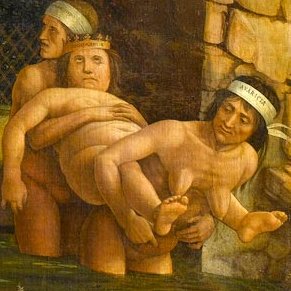
The three Vices, Avarice, Ingratitude and Ignorance

If you look at the far right of the painting you can see the Vices, Avarice and Ingratitude carrying off to the swamp-like pool the fat, stupid Ignorance, who is wearing a crown.  The painting is full of bizarre and weird entities.  Clouds with faces, talking trees and anthropomorphic monkeys are just some of the creepy items on display in this painting.  In the sky on the right hand side we have the three theological virtues, Faith, Hope and Charity.  They had been driven out previously by the depravities which had been occupying garden and now return.  The fourth Virtue, Prudence, is walled up inside the stone structure on the far right of the painting and only a white fluttering banner reflects her cry of help.

It is not the sort of painting I would like hung in my study.  I think I would prefer a beautiful landscape but again this painting would be sure to fuel the conversation of one’s guests as they study the multi-faceted composition.

The Madonna of the Long Neck by Parmigianino

Madonna with the Long Neck by Parmigianino (1534)

Two days ago (March 16th) I gave you what I thought was a very strange painting entitled Child with Doll by Henri Rousseau.  The depiction of the child was odd and the proportions of the figure just didn’t look right.  The figures in today’s painting have similar unusual proportions but in my mind there is still an element of beauty about the figures.  The title of today’s painting actually derives from such artistic distortions.  The picture painted in 1534 by the Italian Mannerist artist, Parmigianino is entitled Madonna with the Long Neck, and hangs in the wonderful Uffizi Gallery in Florence.  Before we look at the painting in detail I think we need to understand a little about Mannerism and Mannerist artists.

Around the 1520’s in Italy, art in many ways had reached its peak of excellence.  It was the time of the great High Renaissance painters Leonardo da Vinci, Michelangelo Buonaroti, Titian and Raphael Santi.  It was believed by many that the works of these four giants of art could never be bettered.  Their paintings combined splendour and harmony with correctness.  Although few would disagree with this appraisal of their work, think how it affected a young up-and-coming artist of the time to be told that no matter how hard they tried, their work would never come up to the standard of those that went before them.  Would you be disappointed and disheartened by that appraisal of your future?  Would that just make you want to give up your artistic career?  For many aspiring artists at that time that is what they did – gave up their dreams but for others they decided to imitate the works of the great High Renaissance artists.  They looked at the musculature of the figures in some of Michelangelo’s paintings and copied the figures in to their works and as Gombrich wrote in his book The Story of Art:

“….Michelangelo had loved to draw nudes in complicated attitudes – well, if that was the right thing to do, they would copy his nudes, and put them into their pictures whether they fitted or not.  The result was slightly ludicrous – the sacred scenes from the Bible were crowded out by what appeared to be a training team of young athletes….”

 Others searched for a way to overcome the situation they found themselves in.  They knew that art would eventually move on and they decided they must be part of that future.  They realised that they would never be able to improve on the works of the Renaissance Masters and for them to become great artists and have their works of art become popular they needed to change their painting style.  Something had to be different about their work if it was to achieve greatness.  They looked at how they would depict people in their paintings.  They played round with how their figures posed within a scene.  Often figures would be distorted into almost impossible poses.  Sometimes they would disregard the true physical proportions of their figures, frequently elongating them. They did not believe their paintings had to exhibit balance or harmony, which was of great importance to the High Renaissance artists.  These mid 16th century Italian artists believed they could be the new future of art and were known as the Mannerists.  The art produced by these Mannerist painters was not loved by all.  Many critics suggested that this art genre was simply characterised by its artificiality, superficiality and exaggeration.  One could sum up Mannerism by saying it is a style in art and originating in Italy as a reaction against the equilibrium of form and proportions characteristic of the High Renaissance. However, the term Mannerism, to some people, rather than be thought of a style, is just the era in Italian art, sandwiched between the High Renaissance period which began around 1490 and ending circa 1527 and the arrival of the Baroque period of art circa 1600.  Art critics and writers have varied views on what they believe Mannerism to be and in his 1957 book entitled Mannerism, John Shearman, the author, wrote:

“…This book will have at least one feature in common with all those already published on Mannerism; it will appear to describe something quite different from what all the rest describe…”

And so to our picture today, which was painted by the great Mannerist artist Girolamo Francesco Mari Mazzola, more commonly known a Parmigianino which translated means “the little one from Parma”, his birthplace.  Today’s work of art is his painting, Madonna with the Long Neck.   This was his crowning masterpiece.  He commenced working on the painting in 1534 for the church Santa Maria dei Servi at Parma.  However at this time of his life the artist became fascinated with alchemy and all the magic that goes with it and this obsession resulted in his art commissions being neglected and on his death six years later this painting was still incomplete.

The revealed body of the Madonna

 As we look at this painting, the title is self explanatory.  The painting depicts the Virgin Mary dressed in luxurious robes.  On her lap is the baby Jesus.  To the left we see a group of angels and to the right of the Madonna, in the background we see the diminutive figure of the prophet, Saint Jerome, almost naked standing before a vertical column, holding an unfurled scroll.  This tiny figure of St Jerome is in marked contrast and completely out of proportion with the overbearingly large figure of the Madonna.

If we look closely at the Madonna we can see that her physical features have been distorted by elongation.  Look at the length of her neck, hands, fingers and feet, all of which are too long.  Look at the lower half of her body.  This seems to be far too wide.  Are all those features part of the Mannerism concept?  Some art critics would have us believe that the elongated length of her neck has religious significance and harks back to medieval hymns and litanies to the Virgin Mary which compares her neck to a great ivory tower or column (is that why we have a white column in the background of the painting?) and that the architectural reference to the column furthered her symbolic role as representing the Church.  But if this was the reasoning behind the long neck what was the reasoning behind the elongation of her hands, fingers and feet?   Another strange aspect to the painting of the Virgin Mary is there is a sensuousness about her pose and her clothing which is very unusual in Madonna portraits.   Look how the fingers on her right hand touch her breast.  Look how the almost transparent greyish garment lies against her breast and how the cloth hangs against her nipple.  See how her fingers almost point towards her breast and nipple as if guiding our eyes to what we should observe.  Look at how the cloth gathers tightly against her stomach and how we can clearly see her navel.  Parmagianino’s Madonna has elaborately curled hair which is decorated by pearls and frames her exquisite and beautiful face.  The robes she is wearing are sumptuous and cascading.   This is a very unusual portrayal of the Mother of Christ.  This is more a portrait of a (then) present day beauty.  She has the beauty of a Raphael Madonna but incorporates, some would say, “suffers from”, the elongation at the hands of a Mannerist painter.

Now look at the baby Jesus who rests on his mother’s lap.   The baby is not being lovingly cradled as it is in the more normal depictions.  His elongated figure just lies across her lap and we wonder if he will slide to the floor.  Look closely at the figure.  Is the baby alive and asleep or are we looking at a dead body with his lifeless arm hanging downwards.     Are we looking at a lifeless body lying across the thighs of the Virgin Mary similar to the dead Christ’s portrayal in the familiar Pietà figures?  Why has the artist given the baby a deathly-grey pallor?  Again look at the face.  Do you think this is the face of a baby or an older infant or are we being tricked into believing that the child is older because of his elongated features?

The sensuous quality of the angel


The group of six angels are crammed into the left hand side of the painting.  The artist, being a true Mannerist, made no attempt to balance the painting by having them split into equal numbers on either side of the Madonna and Child.  If you think I have counted up the number of angels incorrectly and can only see five, I believe the face of the “unfinished” angel is just below the right elbow of the Madonna.  Earlier I talked about the sensuousness of the artist’s depiction of the Madonna, this time I again have to draw your attention to the sensual depiction of the angels, particularly the angel standing at the front. Look at the way her silky gown is cut high exposing her upper thigh.  Note how the toes of the elongated left leg of the baby press the skin of the angel’s upper thigh.  It is almost acting as a pointer to where our eyes should look.  This is similar to the Madonna’s fingers and where they direct our gaze, which I mentioned earlier.  Was this just coincidental and am I making too much of it?  Did the artist intend to add an element of eroticism into this “sacred” painting which was to hang in a church?  Look at the vase which this angel at the front carries.  Although my picture doesn’t show it so clearly, there is a cross on it which was thought to be a reference to the future fate and coming Passion of Christ and the Crucifixion.

As I said at the beginning, this painting was unfinished at the time of Parmigianino’s death.  The sixth angel has not been completed. nor has most of the upper right background.   Look carefully at the feet of Saint Jerome, the man who is holding the scroll.  Just to the right of his feet are another pair of feet which presumably was to be the start of another figure !   The capital of the single column (the crown) is missing.  Was that just because the painting is unfinished or did the artist paint it as such to make the comparison of the Madonna’s elongated neck and this single smooth column more tenable.  If we prefer the “unfinished” reasoning then maybe we should also consider that it is quite possible that this was to be one of a number of columns, which would be shown in the background if the artist had completed the work.

There are so many unanswered questions for you to ponder upon.  All in all, this is a strange painting but this should not detract from its magnificence.  This is now looked upon as one of Parmigianino’s greatest works of art.

Pope Julius II by Raphael

Pope Julius II by Raphael Sanzio (1512)

Giuliano della Rovere was born in 1443 in Liguria, Italy.  He came from a noble, but poor family.  He received his schooling from his uncle Francesco who was a member of the Franciscan Order.   In 1471 Francesco became Pope Sixtus IV and was able to further the career of his nephew. At the end of 1471, he made the twenty-eight year old Giuliano a cardinal priest in Rome and this post afforded him many beneficiaries from which he built himself a considerable income.  His uncle died in 1484.  Giuliano was not in the position to become pope himself but his sizeable wealth allowed him to bribe the papal electors so as to have the weak but now indebted Cardinal Cibo made Pope Innocent VIII.  This newly elected pope was merely a puppet of Giuliano for the ensuing eight years.  When Pope Innocent VIII died, Giuliano made his move to become the next pope but during the eight years of being the power behind the late pope he had made enemies of many of the other cardinals and for them it was “pay-back time”.  They ignored Giuliano’s candidacy and instead in 1492 voted in his enemy Cardinal Rodrigo Borgia as Pope Alexander VI.  Giuliano was devastated at being overlooked and fearing for his life fled the country and journeyed to France where he remained until Pope Alexander VI died in 1503.  Once again Giuliano was overlooked when it came to vote in a new pope and the cardinals elected Pius II, who was ill at the time and died twenty-six days after becoming the new pontiff.  Giuliano della Rovere sensed that his time had come at last and with the help of much bribery and promises of high office he persuaded the cardinals to vote for him at the papal elections and so in 1503 Giuliano della Rovere became Pope Julius II.

Unlike the papacy of today in the fifteenth and sixteenth centuries the office of the pope had great temporal power and Julius II, known as “The Fearsome Pope” was a war-like pope who wanted the Papal States to become stronger, more powerful and for it to extend its control and by so doing, enlarging the papal rule.  With his powerful army he recaptured the lands of Romagna and Perugia and brought them under his control.  In 1509 his forces defeated the might of Venice.  Next he turned to ousting the French from Italian lands with the help of the Holy League, an alliance he formed for the purpose of expelling the forces of Louis XII of France from Italy and thereby consolidating his papal power.   Venice, the Swiss cantons, Ferdinand II of Aragón, Henry VIII of England, and Holy Roman Emperor Maximilian I were the chief members of the League.   The Swiss, who did most of the fighting, routed the French at Novara in 1513, but in the same year Julius II died and the league fell apart. Two years after his death the France re-established the French in Lombardy

One of the most important legacies Pope Julius II left was as a patron of the arts.  He persuaded, some historians would say bullied, Michelangelo into re-painting the Sistine Chapel.  It was Julius II who commissioned Raphael to paint four rooms in the Vatican, now known as Stanza di Raffaello and it was Julius who hired the Italian architect Donato Bramante to design and build an impressive new basilica in place of the old Basilica of St Peters , which sadly Pope Julius II never saw completed.
My Daily Art Display today is an oil on panel portrait of Pope Julius II painted by Raphael Sanzio in 1512, two years before the pontiff’s death.  It is an awe-inspiring work of art.  The pontiff doesn’t look at us.  His look is somewhat downcast and there is a definite melancholia about his demeanour.  It is as if he didn’t want to sit for his portrait.  We are almost dismissed by his dejected expression as if he wants desperately to be left alone.  Is this a realistic expression or just Raphael’s slightly unkind take on the pontiff’s mood?  According to the biographer and artist Giorgio Vasari, the contemporaries of the pope found the portrait

“….so true and lifelike that the portrait caused all who saw it to tremble as if it had been the living man himself…”

To be fair, the pontiff was sixty eight years of age and maybe at that age we are all allowed to look grumpy !  There is a feeling that the pope is just too despondent to speak, even too dispirited to look you in the eye.  Maybe he believed he had cause to be downhearted as it was around this time, 1511, that he learnt that Bologna had seceded from the Papal States.  At this loss, he grew a beard as a token of his mortification, which was also an ancient form of mourning.  He let this soft milky-white beard grow and did not shave it off until a year later.

The pontiff sits before us in an armchair on which is carved his own personal emblem, the acorn.  Julius’s family name was della Rovere which is the Italian word for oak.  Raphael has not positioned the pope “face-on” as was the norm for portraits of enthroned rulers of that time.  Raphael has captured in this painting an ageing man with a lined face and its sagging flesh.  Raphael however has given it colour and radiance.  The fingers of his hands bear emerald and ruby rings.  His right hand grips a white handkerchief giving an air of private compassion whilst his left hand grips the arm of the chair.  The white ruched fabric of his robe cascade and billow over his knees and hide his frail body.    We are not approaching the portrait as mere commoners about to kneel before our religious master.   We approach an elderly man from the side as if we are coming up to an elderly relative.   The pope is not wearing his ceremonial triple-crown hat.  He just wears his simple red fur-trimmed cap.

This painting of the somewhat frail and bearded leader of men makes us forget that he was, years earlier, a leader, who rode into battle with his troops.  His fragility belies that image we have of that fierce figurehead.  This was once a powerful man, someone to be reckoned with and  of whom Michelangelo said that on their falling out “he could feel the rope around his neck”.   When we look at this man we know we are in the presence of somebody special, someone who exudes unquestionable authority.  Raphael gave this old man a demeanour, which despite the ravages of time, makes us believe we are in the presence of greatness.

Lamentation of the Dead Christ by Andrea Mantegna

Lamentation of the Dead Christ by Andrea Mantegna (c.1490)

My Daily Art Display today focuses on a painting, the subject of which has many similarities to the Hans Holbein painting The Body of the Dead Christ in the Tomb by Hans Holbein, which was My Daily Art Display of the day on February 20th.  Today’s painting is entitled Lamentation of the Dead Christ and was painted by Andrea Mantegna around 1490.

Andrea Mantegna was born in Isola di Carturo a small village close to Padua which was then within the Republic of Venice.  His father, Biagio, was a carpenter.  When he was eleven years of age he started an apprenticeship with Francesco Squarcione, an Italian painter from Padua.   His school was very popular at the time and over a hundred painters passed through the school.  Padua at the time was looked upon as a great place to be if you were and aspiring artist and the likes of Uccello, Lippi and Donatello spent time in the city.  Mantegna stayed with his tutor for six years.

Mantegna’s first work of art was an altarpiece for the church of Santa Sofia in 1448.  Although he gained a great reputation as an artist and was admired by many, he left Padua and spent most of his life in Verona, Mantua and Rome where he carried on with his paintings.  In 1460 he entered the service of Ludovico Il Gonzaga the Marquis of Mantua as his court artist.  This engagement earned Mantegna a great deal of money which was a sign of the high regard in which his work was held.  Whilst employed by Gonzaga he completed many fresco paintings of the Gonzaga family.

Today’s painting of the Lamentation of the Dead Christ was completed around 1490.  It is one of very few oil on canvas paintings of the period.  It is an almost monochromatic vision of Christ.  The painting has a limited amount of tonal colouring, mainly pink, grey and golden-brown.   The setting of the painting seems to be a morgue-like and claustrophobic space with its cold dark walls.  This poorly lit space intensifies the paleness of the body. 

Feet of Chirst

The forceful image is of the body of Christ laid out on a stark and granulated marble slab.  Mantegna has toyed with the rules of perspective making the head large, whereas if the rules of perspective had been adhered to then the head would be much smaller than the feet.  There is an intense foreshortening of the body which makes it appear heavy and enlarged.   

Christ’s suffering, before death, is plain to see.  Mantegna has given us an unusual vantage point.   It places the observer at the feet of the subject and by doing so, adds to one’s sense of empathy. It could almost be described as a gruesome sight.  The face of Christ is lined.  His head of wavy hair rests upon a pink satin pillow.  The wounds seen on the back of his hands are like torn paper, as is the horizontal cut in his side made by the spear. It is almost blasphemous, as here Christ has not risen from the dead and he is like us mortals.  In the foreground are the feet of Christ each with dried puncture marks made by the crucifixion nails.  Look at the skill in which Mantegna has painted the folds of the shroud.

The Mourners


At the left we have three mourners, Mary, Saint John and perhaps slightly hidden by the other two mourners, Mary Magdalene.  Their tear-stained faces are distorted in grief.  These contorted facial features derive from the masks of classical tragedy.  One cannot help but be moved by their expressions.

Compare this painting with Holbein’s The Body of the Dead Christ in the Tomb and see which you think is the most moving.

The Miracle of St Mark Freeing the Slave by Tintoretto

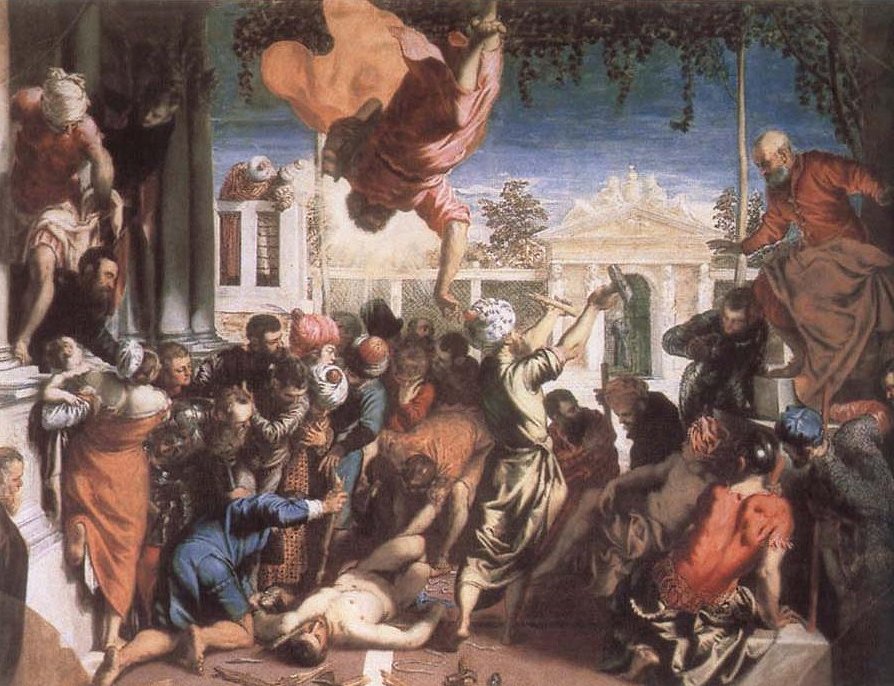
The Miracle of St Mark Freeing the Slave (1548)

So do you know who is Jacopo Comin ?   Have you heard of Jacopo Robusti ?  Jacopo Comin was born in Venice in 1518.  His father, Giovanni, was a weaver and dyer of cloth, who fought in the War of the League of Cambrai, which was part of the Italian Wars involving, France, the Papal States and Venice.  He put up such a stubborn and robust defence of the gates of Padua that his son, in his youth, became known as Jacopo Robusti.  However the father’s profession, dyer or tintore, gave Jacopo the name we know him by now.  Being the small son of the tintore he was given the nickname “little dyer” or Tintoretto.

Tintoretto was the eldest of twenty one children !   He was always interested in drawing and painting even from an early age.  Although he was to become, along with Bonifacio Veronese, the most successful of Venetian painters after the death of Titian, little is known of his early life although it is thought that he was at one time one of Titian’s pupils.  A lot of his artistic ability was self-taught.  His works were made to be spectacular, in size and quality to attract attention and his style was continuously imaginative.  His output of art works was prolific as he retained a large entourage of assistants. According to his contemporary and biographer, Carlo Ridolfi, the Italian artist and art historian, Tintoretto had inscribed on the wall of his workshop the motto: 

                    “The drawing of Michelangelo and the colour of Titian

These were his idols and  but his drawings were more emotive than those of Michaelangelo and he tried to synthesize the drawings of Michelangelo and the colouring of his old master Titian, but he used more sombre colours than those used by Titian.  For his phenomenal energy in painting he was termed Il Furioso.

His early works were signed “JACOBUS” followed by a drawing of a wheel, which was the symbol of the Dyers Guild, identifying himself as “Jacobus the Dyer’s son”    His first work, and My Daily Art Display painting today, was exhibited in 1548 and entitled The Miracle of St Mark Freeing the Slave.  It was this painting that launched Tintoretto’s career and made him an overnight sensation.   This enormous oil on canvas painting measures 415cms x 541cms (almost 12ft x 18ft).   He painted it at the age of thirty and it was to be the painting which made his reputation.  In this work of art we see Tintoretto’s use of foreshortening, which is a technique for creating the appearance that the object of a drawing is extending into space by shortening the lines with which that object is drawn.  He had an unusual way of coming to a decision about light and shading for his paintings.  He would create wax models and arrange them on a stage and then by training the light from spotlights on them he could see the effects the light would have on them and the shadows they would form.

This painting was one of four pictures he was commissioned to paint in the Scuola di San Marco.  The painting represents the legend of a Christian slave who was condemned by his master to have his legs broken and his eyes put out for worshipping the relics of Saint Mark, the patron saint of Venice, in defiance of his master’s wishes but was saved by the miraculous intervention of the saint who shattered the bone-breaking and blinding implements which were about to be used on the slave.  The naked slave lies face up in a stone courtyard, his torso twisted and his face turned toward the viewer.  His “owner” the slave’s master, dressed in black can be seen leaning into the center from a balcony on the left side of the canvas.   Saint Mark appears high up in the centre of the painting winging down from heaven to save the slave signifying that the latter should not be punished for his faithfulness.  His sharply foreshortened figure is shown in swirling orange and pink robes.  Surrounding the main characters are a myriad of people above and to the sides, more than twenty five in all,  pages, maids, servants etc. Those on the right hand side lean back as they look on whilst those on the left lean in to get a better view of the impending torture and killing.    The artist’s positioning of the figures around the slave and their disposition draws the eye of the observer to what they are all looking at – the slave and his miraculous rescue.  The way in which Tintoretto has depicted the varied reactions of these on-lookers is compelling.  His use of light and shadow add to the mood and aura.  But the most striking is the image of Saint Mark as the divine saviour as he descends.  

It is difficult to summarize the painting.  I believe it to be, in some ways, unsettling but thought-provoking.  Tintoretto’s use of “arrested motion” of the groups of onlookers adds to the aura of the painting.  The omission of a landscape makes us concentrate on the main scene.  The atmosphere of the painting is characterized by sudden and strong contrasts of light and shade.

The Tempest by Giorgione

The Tempest by Giorgione (1506-1508)

I wonder what you, as an observer, do when you stand in front of a painting.   What is it, about the painting, that makes it interesting for you?  Is “interesting” a word you would use when describing your feelings about a work of art?   As far as art is concerned, I guess we are all different and we all have various reasons for liking or disliking something, whether it is a painting or a sculpture, whether it is a piece of modern visual art or it is a Baroque painting.  I like certain types of paintings and dislike others.  I am not an artist and have no artistic background but I reserve the right to say what I like and I may even have the temerity to explain what I don’t like and discuss my reasons even if it exposes my naivety of art.   I have very little knowledge of artistic techniques but find it very interesting to read about them.  However besides the beauty of the actual paintings, what fascinates me most of all is the interpretation of paintings and the symbolism of certain objects within a painting.

My Daily Art Display today is The Tempest by Giorgione and along with the likes of The Arnolfini Portrait , the interpretation of this painting has been written about by many and commented upon in numerous blogs.  It was completed circa 1508 and can now be found hanging in the Gallerie dell’ Accademia in Venice.  What I find intriguing is that some of the interpreters of the painting are convinced that their assumptions are correct.   To my mind, there are a number of problems when one is being dogmatic in an interpretation of a painting.  Firstly, saying one’s theories are correct, by definition automatically discounts the theories of others as being incorrect.  Secondly, unless the artist, long since dead, has written about his or her painting or told somebody verbally about the meaning of their work of art then nobody can be absolutely sure that they are correctly interpreting the mind of the artist as he painted his picture.  Maybe interpreters of paintings should be less rigid about their interpretations.   Surely we should be allowed to look at a painting and put our own interpretation on what we believe was going through the artist’s mind when he was at the design stage of his or her painting.

I am not going to give you my interpretation of the painting for it would probably be just a combination of the various ones on offer from the “experts”.   Why don’t you study the painting yourself and then read the links I have added at the bottom of this blog which give detailed if opposing interpretations and work out what you believe to be the most credible one.  However first, to aid your thoughts, let me quickly go over what we see and what we don’t sees in the painting !   

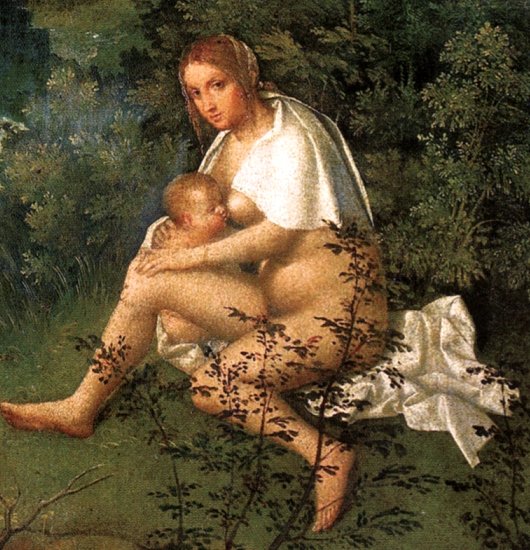
Giorgione's woman and child

There are three humans in the painting.  On the right in the foreground is a woman almost naked except for a white cloth which she and the baby are sitting upon, the end of which is wrapped around both her shoulders.   She and the baby are sitting on the bank of a small narrow stream.  Sitting on the ground next to her right thigh is a baby suckling on her left breast.  The woman gazes out at us. 

X-Ray of The Tempest

Across the narrow stream on the opposite bank stands a young man.  He is looking across the stream but his gaze does not focus on the woman and baby.  What and who is he –  soldier, shepherd,  gypsy?  Do you think he looks out of place in the picture?  You may be correct as it is believed that Giorgione added him to the picture later.  This is known because an X-Ray of the painting reveals a pentimenti (underpainting) and in the place now occupied by the man, there was a nude woman sitting on the bank of the stream bathing her feet.

Just to the right of the man there is a broken column.  What is the significance of that?   In the middle-ground one can see a bridge over the widening river.  In one of the discussions attached  there is talk of a man crossing the bridge but from the internet copies of the painting and the X-Ray of the painting I cannot detect anybody crossing the bridge – but then my eyesight leaves a lot to be desired !.  To the right of the bridge is a building atop of which sits a large white bird.  What is the significance of the bird?  In the background we see a town above which storm clouds have gathered and there is a flash of lightening.

So make what you will of the painting and take a look at the weblinks I have attached below.  These are blogs of people who have seriously analysed the painting and come up with their interpretation.  However if you go to the end of the blogs you will see the comments from people who have read the blogs and in some cases have completely opposite views to the blogger’s interpretation.   They offer counter-interpretations.  It makes quite amusing reading for how can you politely state that you believe the proposed interpretation is wrong ! 

 Enjoy !!!!!

Blog – The Perplexed Palette

http://www.ginacolliasuzuki.com/the_perplexed_palette/2011/01/the-tempest-by-giorgione.html

Blog – Three Pipe Problem

http://www.3pipe.net/2010/07/unravelling-giorgiones-tempest-zcz.html

An Essay – this is not for the faint hearted as it a very wordy and highly technical thesis

http://www.thefreelibrary.com/Giorgione’s+Tempest,+studiolo+culture,+and+the+Renaissance+Lucretius…-a0102659361

A Man with a Quilted Sleeve by Titian

A Man with Quilted Sleeve by Titian (c.1510)

My Daily Art Display today is the oil on canvas painting entitled  Portrait of a Man, sometimes known as A Man with a Quilted Sleeve, painted around 1510 by Titian and which now hangs in the National Gallery, London.  There is some doubt as to the identity of the figure in the portrait.  Some art historians would have us believe that it is a portrait of Ludovico Aristo, the Italian poet whilst others believe it to be a portrait of a member of the noble and very wealthy Barbarigo family of Venice, who were early patrons of the young artist.  It is also possible that it is an early self portrait of the artist himself,  as in those days a number of Renaissance artists used the genre of self portraiture as a means by which their standing in the art world could be enhanced.

 As was the case of many of Titian’s portraits, the artist had the ability of giving his subject a flattering and dignified appearance.  The sitter looks directly out at us.   How would you describe the sitter’s expression?    There is an air of self-confidence and determination in his thoughtful gaze, which is enhanced by the relaxed and calm manner of his posture. Is there a tinge of arrogance in the way he gazes out at us?   He is almost but not quite smiling.  There is nonchalance in his expression.  Baldassare Castiglione, the Italian courtier, diplomat and famous Renaissance author wrote a book about Courtiers and the way they dress and their manners and he sums up the way grace and courtesy will triumph and be the hallmark of a refined man.  Maybe the expression on Titian’s Man with the Quilted Sleeve follows Castiglione’s rule that encapsulates the secret of the class of a refined man, for the author wrote:

 “…In so far as one may, flee affectation as if it were a sheer and treacherous precipice; and perhaps to propose a new idea, employ in all things a certain casual unconcern that will disguise artfulness and demonstrate what is done and said to be done effortlessly, as if giving the matter no thought…”

 This concept of “casual unconcern” became a guiding principal in painting in the 16th century. 

Note the stone parapet on which the subject’s arm rests.  If you look carefully one can see the artist’s monogram, “  T   V  ”  (Tiziano Vecellio) carved into to it.   This addition of a parapet or balustrade was a favoured convention of Venetian painters, which gives a separation between the observer’s space and the space occupied by the subject of the painting.  In this case, the parapet also acts as a hard textural contrast to the softness of the blue sleeve. 

The prominence of the man in the painting is enhanced by the plain and dark background.  Blue is the predominant colour of the man’s clothes and this gives the painting both a feeling of restraint and coolness.  What detail strikes you first with this painting?   Is it the man’s face and his facial expression or maybe it is the full, quilted blue sleeve in the foreground that captures your attention?  In tomorrow’s offering I will look at Jan van Eyck’s painting Man in a Turban and again the question is raised as to what we focus on, -the sitter’s face or the bright red turban?  However, the one thing that is outstanding about this portrait is the detail of that blue satin sleeve.  It is beautifully painted.  One almost feels that by reaching out one could touch the expensive fabric and smooth down the folds.  One is being shown quality material at its best.  Look carefully how the artist has painted the stitching of the satin in such great detail.  Note also how the artist shows a billowing effect of the soft quilted puffed-sleeve with its many folds. 

It is an enigmatic painting and the more times one looks at it, the more one discovers.  It is a veritable gem.


Portrait of Francesco Giamberti San Gallo, Musician and Portrait of Giuliano da San Gallo, Architect by Piero di Cosimo

Yesterday I offered you a painting by Piero di Cosimo and most of My Daily Art Display was taken up with the story behind the painting and the painting itself without touching on the life of the artist.  Today, to make amends, I am giving you not just one painting by Cosimo but two portraitures ,but first, just a little about the artist himself.

Piero di Cosimo, also known as Piero di Lorenzo was born in Florence in 1462.  His father Lorenzo was a goldsmith.  He was apprenticed to the artist Cosimo Rosseli, his godfather and a painter of the Quattrocento, which takes in the artistic styles and cultural events of the 15th century. It was from Rosseli that Piero di Lorenzo derived his more common name “Cosimo”.   In 1481 Pope Sixtus summoned Rosseli to Rome where he was commissioned to decorate part of the Sistine Chapel.   Rosseli took Cosimo with him and he helped Rosseli with the fresco of the Sermon on the Mount, painting the background landscape.

In Rome Cosimo developed a love for the Renaissance painting genre completing many works appertaining to Greek Mythology, one of which was showcased yesterday in My Daily Art Display.   He is best known for his idiosyncratic paintings featuring fanciful mythological inventions in a world inhabited by satyr, centaurs and primitive men.  He was a superb painter of animals and a master of portraiture as one can see by today’s paintings.

Cosimo was an eccentric.  He was a solitary person, a loner, who preferred his own company.  He didn’t like people to see him at work and would lock himself away for days on end.  He was untidy and his studio rooms were dirty but he seemed oblivious to the chaotic circumstances of his life. He also had an irrational fear of fire and rarely cooked his food and he was terrified of thunderstorms.  Piero di Cosimo died of the plague in 1522, aged sixty.

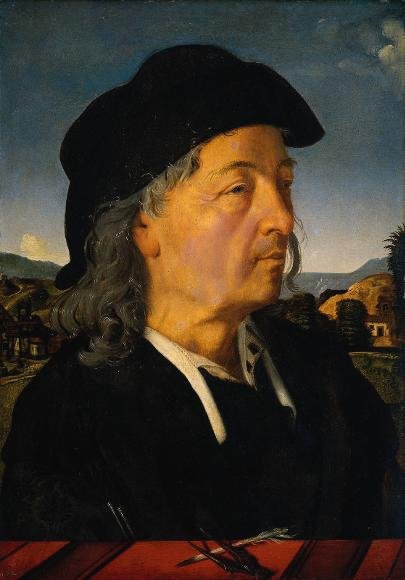
Portrait of Francesco Giamberti San Gallo, Musician (1482)

My Daily Art Display today is paired portraits painted by Cosimo.  Portraits featuring two people at that time were usually male and female and often man and wife.   This set of paired portraits is a rare example of a portrait pair featuring two men, actually father and son, from different generations.    They are the only surviving portraits, which have been irrefutably accepted as being the work of Cosimo.   Both are wood panel paintings, one is entitled Portrait of Giuliano da San Gallo, Architect  (the son) and the other is Francesco Giamberti San Gallo, Musician  (the father), a cabinet maker, architect and musician in the service of Cosimo de Medici family.  The name “San Gallo” was added later to the family name “Giamberti”.  The name derived from the Porta San Gallo, one of the gates of the city of Florence, near which the Giamberti family had their house.

Portrait of Giuliano da San Gallo, Architect (1482)


Portrait of Giuliano da San Gallo, Architect  by Cosimo was completed in 1482.  This highly successful architect and master builder to Lorenzo de’ Medici, the Florentine ruler, stands at a balustrade, turned three-quarters towards the observer.  On the balustrade are the tools of his architectural trade, namely a compass and a quill.  In the background there is an undulating Tuscan landscape which abuts a mountain range.  His appearance is formal and dignified.  He looks self-confident and somewhat aloof.  Note the detail reproduction of the cloth on the upper part of his sleeve.  Note also the effort Cosimo has put in with regards his appearance, the wrinkles around the eyes and the silvery tints in his graying hair.

Francesco Giamberti San Gallo, Musician belongs, like the other portrait, belongs to the Rijksmuseum in Amsterdam but has been loaned out to the National Gallery in London.  The painting was completed circa 1482 and was commissioned by the son Giuliano on the death of his father in 1480, the intention being that it would form a portraiture pair with his own earlier portrait carried out by Cosimo.  The father is painted in profile which gives a clear outline of the face offset against the background.   This clear-cut portrait shows an old man with sunken cheeks.  He is formally dressed which makes some art historians believe that the father had already died and the portrait was based on the death mask of the father.  His face has signs of light gray stubble and we can see the veins on his temple and his ear lobe.  His ear is almost bent double by the weight of his hat.  As was the case in the son’s portrait the father is side on to a balustrade on which are the “tools of the father’s trade” – not the tools of a cabinet maker or architect but the “tools” of a musician – a sheet of music for Francesco Giamberti often composed music for the Medicis on special occasions.

The two paintings are outstanding in the way the faces contrast sharply against the background landscape and sky.  Note the silken cover on the balustrade of both portraits.  Observe how the pattern of the striped silken fabric seems to run continuously through both portraits.  It is thought that after Cosimo completed the portrait of the father, Francesco along with the tools of his trade he went back to the portrait of the son, Giuliano and added this ornamentation and his “tools of the trade” to his portrait in order to achieve a commonality between the two paintings .  So why did Giuliano commission the painting of his father?  Was it for him to remember him or is it as some art historians postulate that it was to enhance his own reputation by emphasising his own intellectual heritage and thus improving his own standing as an architect.  Maybe that is an unjustified and a cynical view of the situation.  You must decide !

A Satyr Mourning over a Nymph by Piero di Cosimo

A Satyr Mourning over a Nymph by Piero di Cosimo (c.1495)

Let me tell you a story.  It is about love and loss.  It is a tale by the Roman poet Ovid concerning two people, Cephalus, a beautiful youth and his beautiful young wife Procris.  The story goes…………………

Cephalus was a beautiful youth and fond of manly sports. He would rise before the dawn to pursue the chase. Aurora saw him when she first looked forth, fell in love with him, and stole him away. But Cephalus was just married to a charming wife whom he devotedly loved. Her name was Procris. She was a favourite of Diana, the goddess of hunting, who had given her a dog which could outrun every rival and a javelin which would never fail of its mark; and Procris gave these presents to her husband. Cephalus was so happy in his wife that he resisted all the entreaties of Aurora, and she finally dismissed him in displeasure, saying, “Go, ungrateful mortal, keep your wife, whom, if I am not much mistaken, you will one day be very sorry you ever saw again.”

Cephalus returned, and was as happy as ever in his wife and his woodland sports. Now it happened some angry deity had sent a ravenous fox to annoy the country; and the hunters turned out in great strength to capture it. Their efforts were all in vain; no dog could run it down; and at last they came to Cephalus to borrow his famous dog, whose name was Lelaps. No sooner was the dog let loose than he darted off, quicker than the eye could follow him. If they had not seen his footprints in the sand they would have thought he flew. Cephalus and others stood on a hill and saw the race. The fox tried every art; he ran in a circle and turned on his track, the dog close upon him, with open jaws, snapping at his heels, but biting only air. Cephalus was about to use his javelin when, suddenly he saw both dog and game stop instantly. The heavenly powers, who had given both, were not willing that either should conquer. In the very attitude of life and action they were turned to stone. So lifelike and natural did they look, you would have thought, as you looked at them, that one was going to bark, the other to leap forward.

Cephalus, though he had lost his dog, still continued to take delight in the chase. He would go out at early morning, ranging the woods and hills unaccompanied by any one, needing no help, for his javelin was a sure weapon in all cases. Fatigued with hunting, when the sun got high he would seek a shady nook where a cool stream flowed, and, stretched on the grass, with his garments thrown aside, would enjoy the breeze. Sometimes he would say aloud, “Come, sweet breeze, come and fan my breast, come and allay the heat that burns me.” Someone passing by one day heard him talking in this way to the air, and foolishly believing that he was talking to some maiden, went and told the secret to Procris, Cephalus’s wife. Love is credulous. Procris, at the sudden shock, fainted away. Presently recovering, she said, “It cannot be true; I will not believe it unless I myself am a witness to it.” So she waited, with anxious heart, till the next morning, when Cephalus went to hunt as usual. Then she stole out after him and concealed herself in the place where the informer directed her. Cephalus came, as he was wont when tired with sport, and stretched himself on the green bank, saying, “Come, sweet breeze, come and fan me; you know how I love you! You make the groves and my solitary rambles delightful.” He was running on in this way when he heard, or thought he heard, a sound as of a sob in the bushes. Supposing it some wild animal, he threw his javelin at the spot. A cry from his beloved Procris told him that the weapon had too surely met its mark. He rushed to the place and found her bleeding and, with sinking strength, endeavouring to draw forth from the wound the javelin, her own gift. Cephalus raised her from the earth, strove to staunch the blood, and called her to revive and not to leave him miserable, to reproach himself with her death. She opened her feeble eyes and forced herself to utter these few words: “I implore you, if you have ever loved me, if I have ever deserved kindness at your hands, my husband, grant me this last request; do not marry that odious Breeze!” This disclosed the whole mystery: but alas! what advantage to disclose it now? She died; but her face wore a calm expression, and she looked pityingly and forgivingly on her husband when he made her understand the truth.

Our featured artist today is the Italian Renaissance painter Piero di Cosimo and the work of art I am featuring is his panel painting based on the Ovid story of Procris and Cephalus and the subsequent 1486 play by Niccolò da Correggio.   The title of his unsigned painting which he completed around 1495 has often changed.  Since the nineteenth century it was known as Morte di Procri (The Death of Procris) but the National Gallery in London which is the home of the painting has rejected this title and since 1951 has catalogued it as either A Mythological Subject or A Satyr Mourning over a Nymph.

Notwithstanding the uncertainty of the title this painting, it was to become one of Cosimo’s most successful and popular works.  . It is a very long painting measuring 185cms in length and is only 65cms high which makes one believe that this could have been for the front of a cassone, a bridal chest, or as the subject of the painting is about love, maybe it was to hang in a bridal chamber.

Dogs and pelican

The painting shows a satyr mourning over the lifeless body of a young woman who has suffered wounds to her hand, wrist and throat.  At her feet sits a sad and mournful dog with its head slightly bowed.  Maybe Cosimo intended the dog to be an image of Laelaps but of course in Ovid’s tale, he had been turned into stone by Zeus before the death of Procris.  In the background one can see a river which could possibly represent one of the three rivers of the Underworld.   

At the water’s edge one can see other creatures – three more dogs and in the water a pelican can be seen with wings flapping.   Art historians point out the many irregularities with Cosimo’s painting, if it was supposed to be a retelling of the Ovid tale, as in that, there was no satyr , albeit he appears as the fateful annoyance in Correggio’s play.  It was the husband Cephalus that finds his dead wife and he is nowhere to be seen in the painting. Neither is the spear which killed Procris and the positioning of the wounds on her body do not coincide with what one would expect from a death by the spear’s penetration. 

Maybe this is just a lot of nit-picking and one should instead, concentrate on this amazing scene captured wonderfully by Cosimo.


Afternoon in the Alps by Giovanni Segantini

Afternoon in the Alps by Giovanni Segantini (1893)

Giovanni Segantini was born in 1858 in Arco in the autonomous province of Trentino, Italy.  He had a troubled upbringing with his mother dying when he was just five years old and two years later he was abandoned by his father.  He was a delicate but imaginative child who was influenced by his early surroundings.  As an orphan he was brought up in a reform school where he was taught the trade of a cobbler.   He remained at the institution until the age of  fifteen.  He also spent some of his early childhood herding sheep in the high Alpine pastureland and whilst there he started sketching his surrounding areas.  After a nomadic lifestyle in and around the Arco area he spent some time working for his step-brother in his grocery store.  In 1874, after he had accumulated a little money he travelled to Milan where he settled down and attended art classes at the Brera.  After some time he was able to earn a living by teaching art and selling some of his own portraiture.  He met and married Luigia Bugatti in 1877 and the couple had four children.

His first painting was entitled The Choir of Sant Antonio and it was commended by local art lovers for its authoritative quality. The family moved to Pusiano, Brianza, an area in the foothills of the Italian Alps in 1880.  He was now back in an area geographically similar to his birthplace.  He was happy here and settled down to studying the surrounding area and painting life in the mountains.  In 1886 he left his family and went to live in Savognin in the Swiss canton of Graubünden where he remained until 1894.  He died of peritonitis in 1889 at the age of 31 at Schafberg near Pontresina whilst completing his last work of art entitled Alpentriptychon.

My Daily Art Display today is Seganti’s painting entitled Afternoon in the Alps, an oil on canvas work he completed in 1893.   The painting depicts a shepherdess with her flock of sheep in a high Alpine pasture.  She leans her back against a misshapen and gnarled tree trunk, her straw bonnet tilted forward to protect her eyes from the strong mountain sunlight.  We cannot see her eyes, which may be closed as she takes a well-earned nap.  In one hand she grasps her herding stick whilst the fingers of the other hand lay limply downwards encouraging one of her flock to believe it may be holding a morsel of food.  The rest of the flock search furiously for what little vegetation is on offer.  Note how almost every blade of grass of this pasture has been painted separately.  It is not the lush green grass of a clover-filled lowland meadow that would have been found further down the mountain but a more yellowy, burnt scrubland interspersed with rocks an area which, in winter, would be permanently covered with snow and during summer months is open to the burning effects of the sun.