Winter Harmony by John Henry Twachtman

Winter Harmony by John Twachtman (C.1890-1900)

When we hear the word Impressionism we immediately think of French painters such as Monet, Renoir, Cassatt, Degas et al, but how much do we know about American Impressionists and their works?  How did the Impressionism Movement become important for a time in America?  To find the answer, we probably have to go back to the mid-nineteenth century as it was after the Civil War ended in 1865 that America developed a healthy economy and this was never more so than in the North where many of the victors, who had made their fortunes from the war, had become extremely wealthy.  As is the case nowadays, it is often not just enough to be wealthy, one had to flaunt one’s wealth.   The newly wealthy Americans wanted not just to be recognised as rich, they also craved to be looked upon as sophisticated which didn’t automatically go hand-in-hand with wealth.  So the rich Americans sat in their large magnificent houses and realised that it wasn’t enough to just have a large building, they realised that what they filled their homes with could help in their quest for sophistication and what could be more sophisticated than having their house filled with European art and furnishings.  American artists soon realised that European style art was a saleable commodity and many crossed the Atlantic to Europe, especially Paris, to study the latest artistic techniques.

It was also around this time in Paris that French Impressionism was born.  Impressionist art was a style in which the artist captured the image of an object as someone would see it if they just caught a glimpse of it. Their paintings were full of colour and, in the main, the paintings depicted outdoor scenes. There was a wonderful brightness and vibrancy about the works of the Impressionists.  The images we saw on their canvases were without detail but were painted in bold colours.   In the 1870’s there were already two American painters who had been seduced by the Impressionist style of art and were considered great exponents of this style.  They were Mary Cassatt and the Italian-born son of American ex-patriots, John Singer Sargent.

During the mid-1880s, French Impressionist art became very popular with American collectors who began to appreciate this new style, and more American artists realised that they had to take on board this new phenomenon.   Soon, exhibitions of Impressionist works were held in American cities and the paintings sold well.

Today I am going to look at a work of a less well known Impressionist, the American painter, John Henry Twachtman.  John Twachtman was born in Cincinnati in 1853.  His parents, Frederick Twachtman and his mother Sophie Dröge were German immigrants who had arrived in the country in the late 1840’s.  His father had many different jobs including being a policeman, a storekeeper and a cabinetmaker but his most lucrative work was as a window-shade decorator at the Breneman Brothers factory, and when his son, John, was fourteen years of age he joined his father in the business,  as well as attending classes at the Ohio Mechanics Institute.  John developed a love for art and persuaded his parents to allow him to enrol for a part-time course at the McMicken School of Design in Cincinnati and this is when he met and was mentored by an already successful American realist artist, Frank Duveneck who invited Twachtman to share his studio in Cincinnati.

In 1875, when he was twenty-four years of age, he and Duveneck, who was just five years his senior, travelled to Europe to study European art.  First stop was Munich where Twachtman studied for two years at the city’s Royal Academy of Fine Art tutored by the German genre and landscape painter, Ludwig von Löfftz.  This artistic establishment was a long-standing center of artistic excellence and was one which attracted increasing numbers of aspiring American artists.   From there he, Duveneck and another American student attending the Academy, William Merritt Chase, travelled to Venice in the spring of 1877 and spent much of their time painting en plein air.

Twachtman returned to America in 1878 and for a brief time taught at the Women’s’ Art Association in Cincinnati. He also joined the Cincinnati Etching Club where he became friendly with Martha Scudder, a Cincinnati artist and daughter of a local physician.    Martha had studied at the School of Design and also in Europe, and had, on a number of occasions, exhibited her work.   In 1880, Twachtman married, Martha Scudder.  Soon after she married she gave up her artistic career and simply devoted herself to bringing up her family.  John and Martha had two children: a son, J. Alden Twachtman, who was born in March 1882 and went on to became a painter and architect and a daughter, Marjorie, who was born in Paris in 1884.    In 1880 John and Martha left America on honeymoon and went to Europe and Bavaria where Twachtman helped out as an art teacher in Duveneck’s school.  Twachtman tired of the Munich style’s painting especially its lack of draughtsmanship and so he upped roots and moved to Paris, where in 1883 he enrolled at the Académie Julian, where he studied under Gustave Boulanger, the French figure painter who was renowned for his classical and Orientalist subjects.  Another of his tutors was the French figure painter, Jules-Joseph Lefebvre.

Twachtman returned to the United States in 1887 and remained there for the rest of his life settling in Connecticut where he established an informal art school at Holly House, a boarding house for artists at Cos Cob, a small fishing village near Greenwich.  This became a magnet for young aspiring artists, who came and were taught by Twachtman.  Ten years later in 1897, Twachtman along with Childe Hassan and J Alden Weir became founder members of a group known as the Ten American Painters generally known as The Ten.  This group was considered to be a sort of Academy of American Impressionists who had broken away from the more conservative Society of American Artists.  From 1899 onwards, although living on his farm in Greenwich, Twachtman spent most of his last summers in Gloucester, Massachusetts and it was here that he died suddenly of a brain aneurysm in 1902, aged 49.

The painting by John Twachtman, which I am featuring today, is one of his many winter landscapes.  This one is entitled Winter Harmony and was completed by the artist in the last decade of the nineteenth century.  It now hangs in the National Gallery of Art in Washington.  The painting features a pool on the artist’s property and was to be depicted in a number of his works.

Peasant Girl Lighting a Fire. Frost, by Camille Pissarro

Peasant Girl Lighting a Fire. Frost by Camille Pissarro (1888)

My Daily Art Display’s featured painting today is entitled Peasant Girl Lighting a Fire. Frost, which was painted by Camille Pissarro in 1888 and can now be found in the Musée d’Orsay in Paris.  At this time Pissarro was still a leading light of the Impressionist movement, a movement he had helped to form.   However it was two years prior to this work that Pissarro began to become interested in the experimental work of young artists, who had adopted the fragmented brushstroke technique which Georges Seurat and Paul Signac were trying out, known as pointillism , a technique Pissarro used in parts of this painting.  For a more in depth look at pointillism see My Daily Art Display October 21st 2011 for a painting by Georges Seurat and November 29th 2011 for a painting by Paul Signac. Pissarro had been introduced to Seurat and Signac in 1885 and in the following years he began to work in the pointillist style which had then been adopted by the Neo-Impressionists.  By the time Pissarro was in his sixties he found that this pointillism technique too restricting and in the last ten years of his life he returned to a purer Impressionist style.
Camille Pissarro was fifty-eight years of age when he completed today’s featured work of art.  Ten years earlier his style of painting was such that he would portray nature in his landscapes by a myriad of smaller comma-like brushstrokes built up on the surface of the canvas such as his 1877 work, The Red Roofs (see My Daily Art Display of November 30th 2010).  Pissarro was concerned that these works lacked clarity and so he decided to change the way he worked.  He spent time working in collaboration with Degas, who was, of all the Impressionists, a great believer and advocate of figure painting and the primacy of the human figure at the expense of landscape background.  It was maybe the views of Degas that led to Pissarro to complete some works in which the human being(s) took pride of place in the painting, as is the case with today’s featured work.

The painting depicts two peasant girls working in a field in a cold and frosty winter morning and we see one of them tending a fire.  Pissarro often painted peasant women at work.  Two fine examples of this are his 1881 work entitled Girl with a Stick and the 1893 painting entitled Woman with a Green Shawl.  His portrayal of peasants received some criticism for copying the ideas of Jean-François Millet but Pissarro firmly contested such a notion.  However in general art critics looked upon his works as true representations of peasant life.  Look at the beautiful way in which Pissarro has depicted the landscape.  At the time of this painting Pissarro was extremely interested in the pointillism technique of Seurat and Signac and he used this method to present us with a sumptuous backdrop to the two girls.  The painting has a light and airy feel to it and there is a subtle delicate nature to the work.  The work was painted in Eragny just north-west of Paris where Pissarro and his family lived for a time.

In the far distance we can see the low hills topped by irregular spaced bushy trees.  In the middle ground, we observe grazing cows in the meadow, a line of poplar trees at the foot of the hills and possibly a hidden stream running horizontally across the mid ground.   Notwithstanding the backdrop, the focus of the painting is on the two girls in the foreground, who almost appear to stand next to us.  The scene is lit up by the sun, somewhere out of sight, to the left, which throws off long blue shadows across the field.  It is a wintry sun and still low in the sky, hence the long shadow of the girl in the foreground, which disappears off the painting to the right.    Although it emits light, the sun gives off little warmth and so our two young workers are wrapped up well.  The temperature is even colder due to the wind chill factor.  Look how the girls skirt and the smoke from her small fire are blown horizontally by the wind which comes from the left of the painting.  One can imagine how cold it is with the driving wind on a wintry day. We almost shiver as we look at this work of art.

The girls are both well wrapped up against the morning’s wintry chill.  The girl on the right, who seems no more than a child, is warming her hands by the fire.  She wears a blue dress and a thick dark brown coat.  She has a dark woolen hat on her head which is pulled down to protect her ears from the icy wind.   The older girl, who is closest to us and because of her height, is the main focus of our attention.  She has taken a branch from the pile behind her, and is about to break it up and add it to the fire.  She wears a pink skirt with a blue apron.  She too has protected her head, wearing a white scarf tied beneath her chin.  Her final layer of protection is a pink and white shawl from which emerge long black sleeves of her dress.

The colour combinations Pissarro uses to achieve the colour we see is fascinating.  The girls pink dress is made up of a combination of yellow, blue and pink.  The green grass of the meadow is achieved by using a combination green, blue, yellow, pink and white.  The only orange Pissarro used was for the flames of the fire.

Pissarro fled the traumas of the Franco-Prussian War in 1871 and, like Monet, went to live in London.   It was whilst in London that he saw a number of paintings by Turner.  Pissarro later commented on Turner’s works and was amazed by the way Turner succeeded in conveying the snow’s whiteness, not just by the use of white alone but by combining a host of multi-coloured strokes, dabbed in, one against the other, which when looked at from a distance, created the desired effect.  It is in this painting that Pissarro has, without the actual presence of snow, managed to give us a crystalline frost of a cold winter’s morning encapsulated in an aura of diamond blue.

Une loge aux Italiens (A Box at the Theatre des Italiens) by Eva Gonzalès

Une loge aux Italiens (A Box at the Theatre des Italiens) by Eva Gonzalès (1874)

I had intended this offering to be my previous blog but when I researched into today’s featured artist and her painting I saw there was a connection between this work of hers and a similar one completed by Renoir in that same year.  My Daily Art Display featured artist today is Eva Gonzalès and the work I want to look at is entitled Une loge aux Italiens (A Box at the Theatre des Italiens) which she completed in 1874.

Eva Gonzalès was born in Paris in 1849.  Her father was the novelist and playwright, Emmanuel Gonzalès, a Spaniard but naturalised French.  Her mother was a Belgian musician.  From her childhood she was immersed in the literary world as her parents house was often used as a meeting place for critics and writers.

Eva began her artistic career in 1865, at the age of sixteen, when she began to study art.  Initially she studied under Charles Joshua Chaplin, the French society portraitist, who ran art classes specifically for women in his atelier and who, the following year, would teach the American female artist Mary Cassatt.

Portrait of Eva Gonzalès by Manet

Just before her twentieth birthday in 1869 she became a pupil of Édouard Manet and also used to model for him and many of the other Impressionist artists.  It was whilst at his studio that she met Berthe Morisot who was also working with Manet and posing for some of his works.  There would seem to have been an intense  rivalry between the two females.  According to Anne Higonnet’s book Berthe Morisot, Morisot wrote to her sister about Gonzalès and Manet’s attitude towards her saying:

“… Manet preaches at me and offers me the inevitable Mlle Gonzalès as an example; she has bearing, perseverance, she knows how to carry something through, whereas I am not capable of anything.   In the meantime, he begins her portrait again for the twenty-fifth time; she poses every day, and every evening her head is washed out with black soap.  Now that’s encouraging when you ask people to model…”

Repose by Édouard Manet

One can easily detect Berthe Morisot’s jealousy of Eva Gonzalès in that passage.  The painting referred to by Berthe Morisot was entitled Portrait of Eva Gonzalès which Manet was working on and which he exhibited in the 1870 Salon.  It is now housed at the National Gallery, London.  At the same time that he was painting the portrait of Eva Gonzalès he was also painting a work entitled Repose which was a portrait of Morisot and which he also exhibited at the 1870 Salon, as almost a companion piece.  This portrait of Morisot can be seen in the Rhode Island School of Design, Museum of Art, Providence, Rhode Island.  As you can see by the passage above, Morisot was annoyed by Manet’s painting of Gonzalès.   What rankled Morisot the most was probably how Manet had portrayed the two young ladies.    So what could have annoyed Morisot about Manet’s depiction of her?  Look at the two paintings.  Both young women, both wear similar clothing, both have been portrayed as young and pretty but the one big difference is that Morisot is depicted half laying back on the sofa in what one could describe as a languid and idle pose whereas Eva is portrayed as a budding artist actively at work.   What also should be kept in mind is that Morisot did not look upon herself as merely a “pupil” of Manet.  For Morisot,  her relationship with Manet was almost as equals rather than master and pupil.  In her relationship with Manet, she was also much more forceful and self-confident than Gonzalès, who was more of a willing disciple of Manet and who would put up with Manet’s abrupt manner,  whilst continually absorbing his teaching.   Of course there was another significant difference between the two young women – age!   Eva was more than eight years younger than Morisot.

Unlike Morisot, but like her mentor Manet, Eva Gonzalès decided not to exhibit any of her work at the controversial Impressionist Exhibitions but she has always been grouped with them because of her painting style.   However, she did regularly have her work shown at the annual Salon exhibitions in the 1870’s.  Her works received mixed comments.  The critics who were supporters of the Impressionist artist liked her work.

Portrait of Jeanne Gonzalès in Profile by Eva Gonzalès

In 1869 Eva married Henri Charles Guérard, an etcher, lithographer  and printmaker, who was a close friend and sometime-model for Édouard Manet and who modelled for some of his wife’s paintings along with his sister-in-law Jeanne (La femme en rose, Jeanne Gonzelès).  In 1883, a month after her 34th birthday, she gave birth to a son, John.  Sadly, her life was cut short when she died following complications of childbirth.  It was believed to have been Puerperal Fever.    Her death came just six days after the death of her one-time mentor Édourad Manet.   Two years after her death a retrospective of Gonzalès’ work was held at the Salons de La Vie Moderne in Paris where over eighty of her paintings were put on display.

Five years later, in 1888, Henri-Charles Guérard  married Eva’s younger sister, Jeanne Gonzalès, also an artist.   My featured painting by Eva Gonzalès is entitled Une loge aux Italiens (A Box at the Theatre des Italiens) and you can obviously see the similarity between her painting and my previous offering entitled La Loge by Pierre-Auguste Renoir.  I decided to feature his first and then let you compare her painting with his.

As I discussed in my last blog, the auditorium of a  theatre and especially the theatre box were fashionable places for an exchange of society chit-chat and gave the theatregoers the opportunity to be seen at their best.  The subject of the theatre and theatre goers was a subject frequently chosen by the Impressionists, such as Cassatt and Degas but probably the most celebrated of this genre was Renoir’s La Loge (The Theatre Box) and it is interesting to compare it with this work by Eva Gonzalès which she completed in the same year, 1874.  This painting by Gonzalès was submitted to the Salon jurists for inclusion in the 1874 Salon but was refused.   Eva Gonzalès then made some changes to the painting and five years later submitted it to the 1879 Salon and this time it was accepted.  The critics loved the work.

There are some similarities to this painting of hers and that of her former tutor Édouard Manet in the way she, like him, chose to paint a modern-day subject and the way her painting, like some of his, shows a total contrast between the light colours of the clothing of the subject and the pale creamy skin of the female and the dark background.   In stark contrast to the dark velvet edge of the box , we see her white-gloved hand with its gold bracelet casually resting along it.   There is also an uncanny similarity between the bouquet of flowers that rests on the edge of the theatre box to the left of the woman in Gonzalès’ painting and the bouquet of flowers which Manet depicted in his painting, Olympia (see My Daily Art Display October 12th 2011).  The two people who were sitters for Eva’s painting were her husband, Henri Guérard and her sister Jeanne who as I said before was to become Henri’s second wife.

As was the case in Renoir’s painting we are left to our own devices as to what is going on within the theatre box. We need to make up our own minds as to what the relationship is between the man and the woman and to their social standing in society.  There is little symbolism to help us interpret the scene.  We just have to use our own imagination and sometimes that adds to the joy os looking at a work of art.

La Loge by Pierre-Auguste Renoir

La Loge by Renoir (1874)

Today’s featured work of art was not my original intended offering.  That sounds somewhat strange but actually there is logic to my decision.  I was researching a painting when I came across today’s work and there seemed, at least in my mind, a good reason to offer you today’s painting before I showcased my original work.

The French word La Loge in the context of a theatre means the theatre box and it has been the subject of a number of paintings.  Today I want to look at La Loge by Pierre-Auguste Renoir which he completed in 1874 and now hangs at The Courtauld Gallery in London.  Today this work of art by the Impressionist painter is looked upon as one of the most significant works of the Impressionist movement.  At the time of this painting it was estimated that over 200,000 theatre tickets were sold every week in Paris.  However, going to a Parisian theatre in the nineteenth century was not just about taking in the latest plays by the likes of Victor Hugo or Alexandre Dumas or the less formal vaudeville shows which were also very popular at the time, it was about being seen by other theatregoers.  Men would accompany and flaunt their wives or lovers.  Proud fathers would show off their daughters and “out-of-towners” would take the opportunity of dressing up and sample the Parisian lifestyle.   It was an almost indoor form of promenading, which was the leisurely walking in public places dressed in one’s finery and carried out as a social activity.  Attending  the theatre was a chance to showcase one’s most expensive clothes and accoutrements as well as parading one’s latest beau.  What could be more satisfying than to flaunt one’s wealth or one’s new lover?  It was a question of seeing and being seen and going to the theatre dominated the cultural life of the city.  As well as seeing actors on the theatre stage the theatregoers were actually quietly performing on their own  social stage.

Being seen

The way Renoir has depicted the scene in the theatre box sums up this attitude.  We see a lady and gentleman seated in their box.  Take a look at their demeanour.  Are they depicted as locked in concentration at what is happening on the stage below?  No they are not.  The lady stares out at us with her gloved hand holding her opera glasses and resting it on the lavish velvet frontage of the box whilst her other hand clasps a black fan and a white lace handkerchief in her lap.  Protocol of the day demanded that ladies must wear gloves on formal occasions.

Her face is now not hidden from view by her opera glasses.  She is revealing her face to all who may wish to gaze at her.   So how would you describe her?  Is there a delicate elegance about her or does she look rather brash.  She is without doubt beautiful and has little trepidation about letting people admire her from afar.  She wears a lavish dress, one she has probably saved for this very outing.  This is her tenue de premiere or opening-night attire.  Her costume would often be referred to as a robe à la polonaise or polonaise which was popular in the late eighteenth century and saw a was revival a hundred years later in the 1870’s.  It consisted of a fitted overdress which extended into long panels over an underskirt.  The magic of Renoir’s painting is that from a far one can see the three dimensional form of the dress with all its folds and yet up close it was just a series of brushstrokes.  It is almost magical the way the artist has painted this work.

The elegant dress oozes a sense of wealth but that is not the only thing which advertises the financial situation of the couple.   The style of the dress also oozes the ladies sensuality.  Note the position of the rose which immediately draws our eyes to the décolletage which emphasizes her cleavage. The low-cut neckline was a popular feature of evening gowns of that era.   Another rose placed in her hair once again draws our eyes to her simple but elegant coiffure.

Look at her neck and the pearl necklace she is wearing.  Also we can just make out a pair of diamond earrings dangling from her ears and if we look at the hand which holds her opera glasses we note a gold bracelet around her slender wrist.  The wealth is there for us to see but more importantly it is there for the other theatregoers to note.

This is a summation of the “seen and being seen” philosophy.  She is wanting to be seen in all her finery whilst he is concentrating on seeing.  Renoir used one of his regular models, Nini Lopez, as the model for the lady.

Seeing

The sitter for her male companion in the theatre box was Edmund Renoir, the brother of the artist.  He, like the lady, is dressed elegantly in his formal clothes.  Renoir has depicted him wearing a white shirt with a starched cravat, black trousers and gold cufflinks.  His attire, which is typical of that of the wealthy male theatregoer also exudes a sense of affluence but its plainness and subdued colour allows the more colourful female to be the centre of attention.

The aspect of this painting which we cannot be sure about and I will leave you to decide is whether we are seeing a husband and wife out for an evening at the theatre or are we looking a wealthy man accompanied by an elegantly dressed courtesan.  Can we deduce the truth from looking at the painting but beware of falling into the trap of being too judgemental !!!

Renoir exhibited this painting in the First Impressionist Exhibition which was held in the former studio of the photographer Nadar at 35 boulevard des Capucines in Paris on April 15, 1874.  This work, which gives us an insight into Parisian life in the late nineteenth century, is now hailed as a masterpiece of art and one of the most significant works of the Impressionist movement.  At the time it was exhibited it helped establish the reputation of Renoir.  The painting gives us an insight into life in the French capital during the late nineteenth century.

Camille Doncieux and Claude Monet

My next two blogs deal not with a particular painting but with the subject of a series of paintings completed lovingly by one artist.  The subject is Camille-Léonie Doncieux, who was the beloved model, mistress and wife of Claude Monet.  In 1861, Monet had enlisted as a soldier in the Chasseurs d’Afrique regiment and spent two years in Algeria.  His military life came to an end in 1863 because he had fallen ill with fever.  He went back to Paris where he studied at the atelier of the Swiss artist Charles Gleyre and it was during this time that he met up with the artists Sisley, Bazille and Renoir, who would later join together with others and become known as the Impressionists..

Camille Doncieux was born in 1846 and met the impoverished but talented painter, Claude Monet, for the first time in 1865 when she was just eighteen years of age.  She came from an ordinary unprivileged background.  She fell in love with him, leaving her home to live with the talented 25-year-old painter who struggled to sell his work. People called her La Monette.  Everyone she met fell under her spell.   It was recorded that she was a ravishingly good-looking girl with dark hair, very graceful, full of charm and kindness.  Monet, her future husband, was struck by her beauty and described her eyes as being wonderful.    It was not long after they met that she began modeling for him and soon became his favourite model.  His professional interest in her soon became personal and the two soon became lovers.   The first time we come across Camille in a painting by Monet was in a study for his ill-fated work Déjeuner sur l’Herbe.

Study for Le Déjeuner sur l'Herbe (1865/6)

In 1863, Édouard Manet had exhibited his painting Déjeuner sur l’Herbe at the Salon des Refusés (see My Daily Art Display, December 23rd 2010).   The critics and public were shocked by the work and Manet’s depiction of a nude woman seated with a pair of clothed men in a landscape setting.    Monet, who was known for his competitive streak decided to paint his own version of Déjeuner sur l’Herbe in the spring of 1865. This audacious venture would culminate in putting it forward for an exhibition at the Salon of 1866.  Following outdoor studies he made in the Forest of Fontainebleau, he immediately headed back to his nearby studio at Chaillyen-Bière and started to make preparatory sketches for what would be his mammoth canvas measuring an unbelievable 4.5 metres x 6 metres.  In one of his preparatory sketches, which he did in oil entitled Bazille and Camille (study for Déjeuner sur l’Herbe) we see Camille Doncieux and Monet’s fellow artist friend Frédéric Bazille.   Ultimately the painting was not a success. Monet was unable to finish it in time for the 1866 Salon and eventually abandoned the work. He left it, rolled up, with his landlord as part payment for rent he owed but it became damp and all that now remains are fragments of the work and some preparatory studies. The experience did, however, contribute to Monet’s realisation that to portray the brief moment in time, he would have to work on a much smaller scale.

La Femme à la Robe Verte by Monet (1866)

The next time we see Camille is in a painting Monet exhibited in the 1866 Salon.  The work was entitled Camille or Woman in a Green Dress and now hangs in the Kunsthalle, in Bremen.  After his disastrous attempt to emulate Manet with his painting of Déjeuner sur l’Herbe this work of his gained him critical acclaim.  Rumour had it that in his rush to meet the Salon deadline he completed the work in four days but one must doubt that assertion.  It is not strictly a portrait of Camille.  It is all about the dress.  She was simply his model for the painting.  The first thing which strikes one as we look at the work is the colour of the promenade dress which had probably been borrowed for the occasion.  Monet loved colour and the green he has used is awesome.  It dominates the painting and even detracts from the woman herself.  This is not about Camille but on the dress she wears and how it hangs.  The painting reminds one of a photograph out of a fashion shoot for a fashion magazine when the clothes are the important thing and not the model.  Look how the background is undefined.  It is simply plain and dark.  Monet had decided that nothing should deflect our gaze from the woman and her dress.  I like how Camille is just raising her right hand towards her face as if the picture has captured her just about to do something, a fleeting gesture, and we are left guessing as to what.  Maybe she is adjusting the ribbon of her bonnet.  The painting was accepted by the Salon jury and hung in their 1866 exhibition.    It was an immediate hit with both the art critics of the time and the public and the Paris newspapers called Camille the Parisian Queen.

One amusing anecdote about this painting was the story that Monet’s signature on the painting had been mistaken by many viewers for that of Manet, who had entered the Salon to a chorus of acclaim for his supposed work.  Monet told this story to the newspaper Le Temps:

“….imagine the consternation when he discovered that the picture about which he was being congratulated was actually by me !   The saddest part of all was that on leaving the Salon he came across a group which included Bazille and me.  ‘How goes it?’ one of them asked.  ‘Awful,’ replied Manet, ‘I am disgusted.  I have been complimented on a painting which is not mine’…….”

Camille au Petit Chien by Monet (1866)

That same year Monet produced a hauntingly beautiful and intimate portrait of his lover entitled Camille with a Little Dog, which is in a private collection.  We see Camille sitting side-on to us in quite a formal pose.  This is one of the few paintings of her by Monet that looks closely at her.  Once again as was the case in the Woman in a Green Dress, the background is plain and dark and in no way serves as a reason for taking our eyes off Camille.  We are not to be distracted from her beauty.  This painting is all about Camille.  It is interesting how Monet has painted the figure of the dog simply by thick brush strokes.  At a distance it looks like a dog but if you stand close up to the painting you can see it is just a mass of brush strokes.  However Monet has not treated the painting of Camille’s face with the same quick thick strokes of his brush.  She has been painted with delicate precision.  Monet did not want to depict the love of his life with hastily swishes of a brush. He took pains in her appearance.  This was a labour of love.

Luncheon by Monet (1868)

In 1867 Monet’s lover Camille gave birth to their son Jean.  A year later, during the winter of 1868, Monet started on his painting entitled Luncheon, which can be seen at the Städelsches Kunstinstitut in Franfurt.   This family, which now included their son Jean, were staying in Étretat at the house of a patron, where Monet had taken refuge from his Parisian creditors and critics.  It is a large highly detailed oil on canvas painting measuring 230cms x 150cms.   It is simplistic in its subject.  Before us we have sitting at the dining table Camille and her blonde-haired son.  She looks lovingly at him whilst he seems to only have eyes for the food.  A visitor stands with her back to the window and the maidservant is seen leaving the room.  A place is set out ready for her husband to join her at the meal table.  Look how Monet has painted a number of items overlapping the surfaces they are resting on.  On the table we have the loaf of bread, the newspaper and the serviette  all hanging over the cloth which Monet has depicted as being somewhat creased.  In the background we have two books overlapping the edge of the table.  All this in some ways adds to the realism of the painting.  Sunlight pours through the large window to the left of the painting and bathes the well-stocked table in light and by doing so brings it to life.  Monet submitted the painting to the 1870 Salon jury but it was rejected.  Four years later he included the work in the First Impressionist Exhibition in 1874.

to be concluded tomorrow………………………………

Étretat by Various artists

There are many subjects depicted by artists in their paintings which are the same.  One only has to think of religious paintings and the likes of the pietà or the deposition or even the crucifixion itself to see how numerous artists choose the same subject for their works of art.  It is also reasonably common for one artist to paint many versions of the same subject.  Think of how many times Vincent van Gogh painted his Sunflowers.  The last blog I did featured a painting of Bentheim Castle by Jacob van Ruisdael and I told you that he had actually painted the subject no fewer than fifteen times.  Today I am going to focus on geological structure that many artists have used in their paintings and I will let you compare them and see what you think.  First let me show you the location as you would see it today.

Cliffs and The Pinnacle at Étretat

The place is Étretat which is situated in the Haute-Normandie region of Northern France.  The town itself is about twenty miles north-east of Le Havre but it is not the town which claims the fame and which has always fascinated artists but its cliffs.  The single beach of Étretat is separated from the town by a sea-wall promenade and lies between two well-known cliffs.  To the east of the town lies the Amont Cliff and to the west lies the Aval cliff with its huge arch, Porte d’Aval,  cut through the chalk structure.   Slightly offshore of the Porte d’Aval stands the solitary needle rock known as L’Aiguille.    During the late nineteenth century this area of Normandy was very popular with Parisian families and with this popularity it soon became a very fashionable place to visit.

In 1868, Claude Monet lived at Étretat with Camille Doncieux,  whom he was to marry two years later.  He revisited the town on a number of occasions in the 1880’s so as to work on a number of paintings depicting the cliffs and sea.   Étretat had already been painted by both Delacroix and Courbet and in fact Monet owned a Delacroix watercolour of the area.. When Monet visited Étretat in 1883 he had planned to create his own Normandy seascapes, saying:

“I reckon on doing a big canvas on the cliff of Étretat, although it’s terribly audacious of me to do that after Courbet who did it so well, but I’ll try to do it differently.”

Because of the increasing popularity of the area with holidaymakers, Monet sensed that there would be a good market for paintings depicting this area. The area had everything, magnificent cliff structures from the top of which one had spectacular views of the sea, which sometimes had a mirror-like calm sheen about it, whilst on other times it exhibited a terrible unforgiving  ferocity as it crashed on to the foot of the cliffs, biting away at the base of the massive chalk structures

During the 1880s, Monet rediscovered the Normandy coast and visited the area many times so as to draw by the sea. He was fascinated by its dramatic cliffs and rock arches and was constantly looking for somewhere with outstanding natural beauty and a place where he could observe the effects of natural light on the sea and on the chalk and limestone cliffs.  He would move from one position to another continually looking for the best natural lighting of the cliffs and the sea. His search for the perfect light on the sea and the perfect position from where it could be seen was of paramount importance.  He once said:

“…I know that to really paint the sea it has to be seen every day at any hour and from the same spot to know its life at this very spot ; that’s why I’m repeating the same subjects up to four and even six times…”

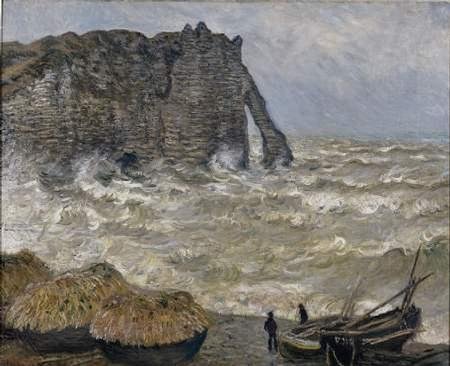
Stormy Sea at Étretat by Claude Monet (1883)

In 1883 Monet completed a work entitled Stormy Sea in Étretat, which is now housed in the Musée des Beaux-Arts in Lyon.  The painting is set on a winter day and we can see is being whipped up by gale force winds.  It is believed that Monet worked on this painting as he sat at the window of his hotel room.  What a wonderful depiction of the ferocity of the sea with the white curls of the surf atop the waves.  In the foreground we have the beach on which we see five boats.  Three of which are filled with what looks like thatch whilst the other two on the right seemed to have been abandoned and show signs that they have had to endure a battering in the waves.  Two men, stand by the boats, looking out on the rough seas.  To the left we have the cliffs and the Porte d’Aval,  above which we have the storm and rain clouds rushing towards the land.

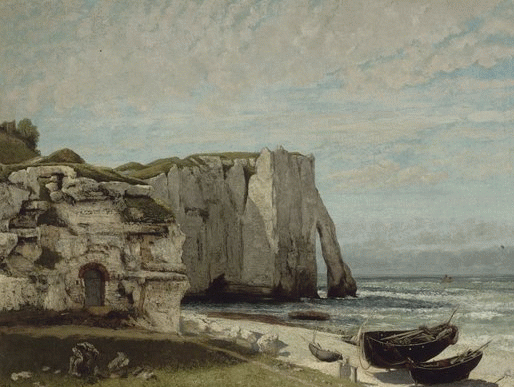
The Étretat Cliffs after the Storm by Gustave Courbet (1870)

The next painting I am featuring is one which depicts a similar view but is a work which depicts the time after a storm.  The title is La falaise d’Étretat après l’orage [The Etretat Cliffs after the Storm] and was completed by Gustave Courbet in 1870.  Courbet visited Étretat that summer and stayed in a house by the sea which was tucked against the Aval cliffs to the left of the bay.  He painted a number of versions of this scene but the one you see above is housed at the Musée d’Orsay in Paris.  Courbet like other artists was attracted to this area not only because of the breathtaking geological structures but because of the quality of natural light and the clarity of the air.  The composition of the sea, the land with its cliffs and rocks and the sky is well balanced.  Courbet had sent the painting for exhibition at the Paris Salon in 1870 where it was well received and Courbet’s reputation as a painter was enhanced.  Of the painting, the art critic and Courbet’s friend, Jules Antoine Castagnary, marvelled at the beauty of his friend’s work and described the elements of the work, speaking of:

 “…the free, joyous air which circulates in the canvas and envelops the details…”

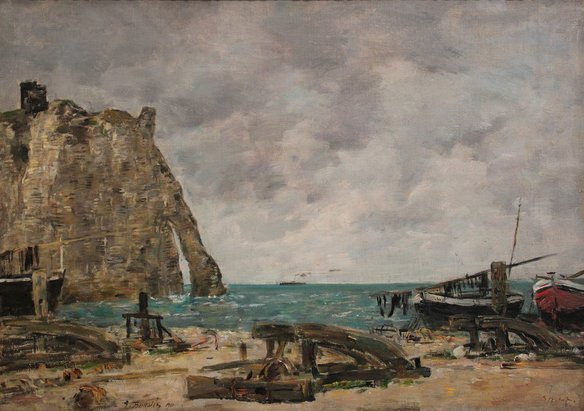
Beach at Etretat by Eugène-Louis Boudin (1890)

Another artist to depict this area in his painting was Eugène-Louis Boudin who in 1890 completed his work entitled Beach at Étretat.  Here we are looking at the scene from a vantage point similar to the previous works.  On the beach we once again see abandoned fishing boats which have been ravaged by the wind and sea.  Sails can be seen hanging from mast boom, shredded by the ferocity of a previous storm and probably act as a warning to the men as they contemplate a return to the fishing grounds.  In the distance we can just make out a steamship passing westward.

Étretat, Laundresses on the Beach, Low Tide by Eugène Bourdin (1892)

Two years later in 1892, Boudin, a noted marine painter, completed a very interesting depicting the beach at Étretat entitled Etretat, Laundresses on the Beach, Low Tide which is held in a private collectionThe setting is the same but the tide has retreated into the distance.  We are left with the brown and green of the rocks which have briefly lost their watery covering.  The breathtaking rock structure of the cliffs is not the focus of our attention in this work.  Before us we have a large group of women who have come down to the beach to do their washing.  It is a veritable hive of activity.

The Manneporte near Étretat by Monet (1886)

For my final painting I am returning to one painted by Monet in 1886 of the Manneporte, a spectacular rock structure just to the west of Étretat and the Aval cliffs.   It is entitled Manneporte (Étretat) and can now be found in the Metroploitan Museum of Art in New York.   This was one of nearly twenty views of the beach at Étretat and the spectacular rock formations such as the Porte d’Aval, Porte d’Amont and the Manneporte which rise upwards on along the coastline that Monet painted. In this painting Monet has captured the way the sunlight strikes the Manneporte, this beautiful natural wonder.  The reason for Monet painting so many pictures of the same scene was that he wanted to capture the changing light at different times of the day and during differing weather conditions

The writer Guy de Maupassant wrote his eyewitness account of Monet at Étretat.

“…The artist walked along the beach, followed by children carrying five or six canvases representing the same subject at different times of the day and with different effects. He took them up and put them aside by turns according to changes in the sky and shadows…”

One can so well imagine that scene.

The Artist’s Studio, Rue de La Condamine by Frédéric Bazille

The Artist’s Studio, Rue de La Condamine by Frédéric Bazille

quem di diligunt, adolescens moritur

Whom the gods love, die young.”

The aphorism comes from the Roman playwright Plautus, who flourished around the end of the 3rd century and actually based his story on a Greek legend about a mother and her two sons.   The point of bringing up this saying is that it unhappily could refer to my featured artist of the day, who was so talented and yet was taken from us at such a young age by war.

Jean Frédéric Bazille was born in Montpellier in 1841.  His father was a senator and the head of an affluent and cultured middle-class Protestant family.    In Montpellier, Jean became acquainted with a friend of his father, a local art collector Alfred Bruyas.  Bruyas was a close friend of Gustave Courbet and he owned a large number of expensive paintings by Millet, Corot, Eugène Delacroix and many by his friend Courbet.  Young Frédéric Bazille was fascinated and inspired by the collection and this was the start of his love affair with art. He loved to paint and sketch but his father told him that if he wanted to continue with his art he had to agree to continue with his medical studies. He agreed to his father’s terms and in 1860 he started studying art.

 In 1862 he moved north to Paris to continue with his medical studies but spent most of his time sketching and painting.  Later that year he joined the studio of Charles Gleyre, the Swiss artist.  It was whilst there that he met and became friends with fellow aspiring artists, Monet, Renoir, Sisley and Whistler.   Gleyre’s studio closed the following year and Bazille decided to leave Paris and follow his friends whilst he waited on the results of his medical exams.

During his journeys around Normandy with Monet  in 1864 they stopped off at Honfleur, which was at that time a special meeting place for the en plein air painters.   It was here that he met up with Monet’s friends, the French marine and landscape painter, Eugene Boudin and the Dutch landscape and seascape painter, Johan Jongkind.  These two artists would later be instrumental in the development of Impressionism.    In the autumn of 1864 Bazille returned with Monet to Chaillyen-Bière, near Fontainebleau.  It was around this time that he finds out that he had  failed his medical exams but fortunately for him, his father did not press him to re-sit them and instead allowed his son to concentrate solely on his artistic career.  In 1865 he put forward two of his paintings to the Paris Salon, Young Girl at the Piano and Still-life with Fish.  Annoyingly for him only his still-life was accepted for the exhibition by the Salon jury.

Bazille and Camille (Study for Déjeuner sur l'Herbe) 1865

Monet, who had a competitive streak, knew about Édouard Manet’s work  Déjeuner sur l’herbe (See My Daily Art Display December 23rd) and knew of the masses of publicity it had received (not all good of course!) when it was exhibited at the 1863 Salon des Refusés.  In the spring of 1865, he decided that he too would embark on his own version of Déjeuner sur l’herbe.   This idea of figure painting in the open air was a new venture for Monet.  He began sketches for his new large-scale painting (4metres x 6 metres) which he planned to finish back in his Paris studio.  The reason for huge size for the proposed work was mainly down to Monet being inspired by Courbet’s recent large scale paintings.   The figures in Monet’s painting were life-sized.  It was almost a group of portraits set in a landscape.  Bazille and Monet’s girlfriend Camille posed for part of this work.  This preparatory oil painting of the two of them exists entitled Bazille and Camille (Study for “Déjeuner sur l’Herbe”) and can be seen at the National Gallery of Art in Washington.  However, only fragments of Monet’s completed grand scale painting survive.   Monet left it with a landlord to cover a debt, and it was ruined by moisture and neglect.  At the same time Bazille himself completed a painting The Pink Dress, which was part of the study for Monet’s open-air mammoth portrait/landscape. 

Bazille having come from a wealthy family never had any financial problems unlike his newly found artist friends and he would often help them out by sharing his studio with them and providing them with artistic materials when they couldn’t afford to buy them.   He actually bought some of Monet’s paintings, including a large work entitled Women in the Garden,  just because the artist needed money.  His friendship with the soon-to-be Impressionists was recorded in a series of paintings he did one of which was set in his Paris studio where they would all meet and it is this work which is My Daily Art Display’s featured painting of the day. 

At the outbreak of the Franco-Prussian war in August 1870, Bazille enlisted in the Zouave, which was the title given to certain light infantry regiments of the French army.  His friends had all tried to dissuade him from this patriotic gesture but to no avail.   In a battle close to the village of Beaune-la-Rolande, his commanding officer had been killed and he took control of his men leading an assault on the Prussian position.  He was hit twice by enemy fire and died on the battlefield.  His death on November 28th 1870 was just a few days before his twenty-ninth birthday.    His father was devastated by the news and a week later came north from Montpellier to the scene of the battle and took his son’s body back home for burial.

Today I am giving you The Artist’s Studio in the Rue de La Condamine, which Frederic Bazille completed in 1870, the same year he went off to fight and die for his country.  The painting currently hangs in the Musée d’Orsay.   One can imagine a group of friends nowadays doing the same as Bazille has done  – recording for posterity a gathering of companions in a photograph but of course in Bazille’s day,  it had to be a sketch or a painting.   The setting for the painting is Bazille’s studio at 9 rue de la Condamine, which he shared with Renoir from the beginning of 1868 until May 1870.   Some of Bazille’s works  are scattered around the room.  To the left, on the wall, we have his Fisherman with a Net and his painting entitled La Toilette can be seen hanging just above the white sofa.  The small still-life above the head of the piano player is a still life by Monet which Bazille had bought in order to support his friend.   We see three men standing at an easel discussing the painting on display.  The man with the hat standing in the middle is Édouard Manet and behind him we think is Monet.  The tall man to the right of the easel, palette in hand, is Bazille himself.  On the staircase is the journalist, writer and art critic, Emile Zola, who is in discussion with Renoir, who is seated below the staircase.  At the piano is Bazille’s musician friend Edmond Maitre.  The National Gallery at Washington houses a portrait of Maitre by Frédéric Bazille.

Frédéric Bazille was considered to be the most gifted of the soon-to-become Impressionists and, if he had lived, he might well have become one of the leaders of that group.  Camille Pissarro described him as one of the most gifted among us.

Sunday Afternoon on the Island of La Grande Jatte by Georges Seurat

A Sunday Afternoon on the Island of La Grande Jatte by Georges Seurat (1884-86)

Today I am starting My Daily Art Display blog by introducing you to some new “isms” which have a connection with what is to follow.  They are Post-Impressionism, Neo-Impressionism, Pointillism and Divisionism and they all are connected in some way to today’s featured artist George Seurat.

By now you will have read many of my blogs that cover the works of the Impressionists such as Monet, Renoir, Degas and Caillebotte and so by now you are familiar with the term Impressionism.  Post Impressionism was a style of painting that grew out of Impressionism or maybe we could say it was a style of painting which was a reaction against Impressionism. The three main artists who were central to this new group of painters and who were termed Post Impressionists were Gaugin, Van Gogh and Cézanne.   Gaugin retained the intense light and colour of the Impressionists but discarded the idea of painting from nature.  He was totally against naturalism, where artists depict nature just as it is, and in its place he wanted his works to have more inventive subject matter and he also liked to experiment with colour.   On the other hand Van Gogh continued to paint from nature but developed a highly personal use of colour and brushwork which openly expressed his own expressive response to a subject.  Cézanne kept faith with the Impressionist’s principle of painting from nature but his works came across with a greater energy and vitality.

Today I am going to look at Neo-Impressionism and Neo-Impressionist artists who were a distinct group of painters within the Impressionist movement and in some ways formed a transition period between the Impressionists and the Post Impressionists.  The two leading figures of this trend were Georges Seurat and Paul Signac and they wanted to have a more scientific approach on how light was depicted in their paintings.  Their works were characterised by the use of a technique known as Divisionism or Pointillism.  Divisionism, also sometimes known as Chromolumanarism, was a method of painting in which colour effects were achieved by applying small areas of dots of pure unmixed colours on the canvas so that  an observer standing at an appropriate distance from the painting (suggested distance for best effect was three times the diagonal measurement of the work) the dots would appear to react together giving a greater luminosity and brilliance than if the same colours had been mixed together before putting them on the canvas. What these artists wanted to achieve was that the observer of the painting combines the colours, which are in the form of dots, optically instead of the artist pre-mixing them on a palette before putting them on the canvas.

Pointillism comes from the term peinture au point, which was used by the French art critic Félix Fénéon, when he described today featured painting by Seurat.   It can be defined specifically as the use of dots of paint and does not necessarily focus on the separation of colors.  Divisionism refers mainly to the underlying theory, pointillism describes the actual painting technique associated with the likes of Seurat, Signac and to a lesser extent Pissarro. Pointillism is related to Divisionism which is a more technical variant of the method. Divisionism is concerned with color theory, whereas pointillism is more focused on the specific style of brushwork used to apply the paint.

Enough is enough !!!!  I don’t want to get too bogged down with “isms” and their meanings and I am sure that there are many people out there who can give a much more expansive explanation of the differences between Divisionism and Pointillism .   My Daily Art Display today features what many believe is Georges-Pierre  Seurat’s greatest work.  It is entitled A Sunday Afternoon on the Island of La Grand Jatte.  It was the one of the first painting to be executed entirely in the Pointillist technique and the first to include a great many people playing a major role.   It caused a sensation when it was exhibited at the eighth and final Impressionist Exhibition in 1886.  It is thought that it was possibly intended as a pendant to Seurat’s other work, Bathers at Asnière,  which I will look at in a later blog.

He started the work in 1884 and did not complete it until 1886.  He spent two years making over sixty preparatory pencil and ink drawings, conté crayon studies and oil sketches on panel for this work.  He would alter the grouping of people, the number of people within a group and where each group or individual were positioned until he was satisfied that he had achieved the perfect balance.  There was a smaller version of the painting which can be found in the Metropolitan Museum of Art in New York.  There is also a version of the scene without the people which was once in the private collection of Mrs John Hay Whitney.   This painting we see today is massive in size measuring 207cms high by 308cms wide (almost 7ft tall and 10ft wide) and since 1924 has been housed in the Art Institute of Chicago.  Seurat completed the final version of this painting in his small Paris studio.

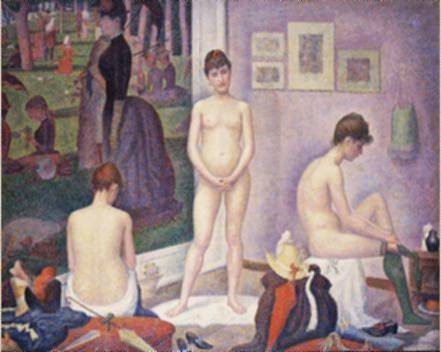
The Models by Seurat (1886-88)

In 1888, Seurat also completed another painting which was entitled The Models  using his pointillism technique, and which depicts models in his studio.  Included in the painting is a section of La Grande Jatte and art historians believe that by doing this painting, he was showing the world that this technique of Pointillism worked just as well for indoor scenes as outdoor ones.

The Île de la Grande Jatte is a small island in the River Seine, downriver from La Défense.  It is about 2 kilometers long and just 200 metres wide at its widest point.  At one time it was reduced to being an industrial site but now has public gardens and houses.   Living on the island are approximately 4000 inhabitants.  However in the days of Seurat it was a pastoral retreat where Parisians could come at weekends from their claustrophobic city existence and soak up the quiet and peace of this little idyll.

Before us we see Seurat’s idealized version of the Grand Jatte omitting both the cafés and restaurants and the nearby ugly shipyard and factories.  In the painting we see members of different social classes out for a stroll along the Grand Jatte by the side of the Seine.  The figures, shown mainly in profile or frontal position, have a peculiar formal and artificial feel to them.  As we look at the painting head-on, there seems to be a definite elongation of some of the people although I believe if you stand at a certain angle to the painting this is minimised.  Seurat would sketch individual groups or single characters and then return to his studio to decide if and where each group should be placed on the canvas.  He sketched people of different classes in society to give the idea that all types of people enjoyed promenading along La Grande Jatte.   Look at the trio in the right foreground.  Here we have the a man wearing a top hat and holding a cane who is more than likely from the upper classes of Paris society.  The man with the muscular arms, lying back with a cap on his head, smoking the pipe is probably a working-class boatman and finally we have the young genteel lady of an indeterminate class.  An unusual trio and who, although physically close in the painting, would be unlikely to have a closeness in that present-day society.  The faces of the people in the painting show little personality.  There is something very impersonal about them.  We must presume that this was a deliberate ploy by Seurat who seemingly did not want the painting to be sullied by observers of the painting trying to interpret facial expressions.  I don’t believe the artist ever intended this to be in any way a moralistic statement about the French culture and classes at the time. However, some would disagree.   Art historians like to interpret every painting and seek symbolic depictions within a work so let us have a look at a few that have been thrown up for consideration with regards this work of art.

In the left middle ground we see a lady dressed in gold and orange fishing in the river.  I suppose there is nothing strange about that albeit she is hardly dressed as a woman who was to go out on a fishing expedition.  Well consider what the French word is to fish – it is pêcher and some have suggested that Seurat has made a play on the word as the French word to sin is pécher.  So is Seurat secretly identifying her as a prostitute.  Again look at the woman in the right foreground accompanying the gentleman.  Look what she is holding in her left hand – a monkey on a leash.  That is certainly an unusual pet to take for a walk.   So why did Seurat include a monkey.  One possible reason is that a female monkey in French is une singesse.  The symbolists would have us believe that a monkey is a symbol of licentiousness and that is why the French slang for prostitute is singesse.  So again I ask the question is Seurat trying to tell us by symbolism that this woman is a prostitute who is out for a stroll with her client?

It is interesting to note and it is not shown in my attached picture, that later Seurat painted the border using parallel red, orange and blue dashes and dots.  He varied the combination of colours in different parts of this border in order to accentuate the adjacent colours in the painting itself.  Maybe if you go to see the painting in Chicago you can let me know if Seurat’s idea with this border really works.

Finally, I came across a poem about this painting which I was going to add to the blog but it was too long so instead I have added the URL where you can find it.  It is:

http://www.lamaquinadeltiempo.com/algode/delmore2.htm

The Pond at Montfoucault by Camille Pissarro

The Pond at Montfoucault by Camille Pissarro

As promised yesterday my blog today carries on looking at the life of Camille Pissarro and one of his later paintings.

In 1872 Pissarro returned to Pontoise, where he once again set up home.   His friendship with Cézanne was re-established and Pissarro mentored his friend in the technique of painting “patiently from nature”.   Cézanne was to later to comment about his relationship with Pissarro and how his mentoring made him change his artistic style saying:

“…As for old Pissarro, he was a father to me, a man to consult and something like the good Lord…”

Pissarro was determined to create an alternative to the Salon.  He wanted a society of artists who would work together and become a type of cooperative.  It took almost four years to achieve his aim .   Artists petitioned for a new Salon des Refusés in 1867, and again in 1872.  Both requests were denied and so during the latter part of 1873, Pissarro along with Monet, Sisley and Renoir organized the Société Anonyme Coopérative des Artistes Peintres, Sculpteurs, Graveurs (“Cooperative and Anonymous Association of Painters, Sculptors, and Engravers”).  Its purpose was to exhibit their works of art independently.   They soon had fellow artists like Cezanne, Berthe Morisot and Degas interested in the scheme and all agreed to boycott participation in the Salon in 1874 and exhibit only at their exhibition.  The exhibition took place in January 1874 at the studio of Gaspard-Félix Tournachon , known as Nadar,  in the Boulevard des Capucines and this exhibition of their work was later to become known as the First Impressionist Exhibition.  Works in this exhibition included five paintings from Pissarro.  The names of the other artists who exhibited works in this exhibition reads like a Who’s Who” of famous artists.  Included in the exhibition were works by Monet, Renoir, Guillaumin, Béliard, Sisley, Cézanne, Degas and Morisot.  This First Impressionist Exhibition was not received favourably by the critics and Pissarro was disheartened by their criticism.  He wrote to the art critic Théodore Duret, who was sympathetic to the Impressionist cause, expressing his disappointment with the adverse criticism:

“…Our exhibition goes well. It is a success. The critics destroy us and accuse us of not having studied; I am returning to my work, it is better than reading the reviews…”

So why did the majority of art critics hate the works on show?    One should remember that the critics were brought up on the art of the Salon with its accepted works portraying religious, historical any mythological settings and so the paintings put forward by the Impressionists, including Pissarro, depicted commonplace street life and people busying themselves in their daily routine and was considered by the critics as both facile and some even went further by declaring them vulgar.  The critics considered a lot of the Impressionist works as being “unfinished” in comparison to the works seen at the Salon.  They commented that the way the brushstrokes of the Impressionists works were visible which, to their mind,  meant it had been done in haste and often completed in a solitary sitting.  In comparison they praised the Salon painters who to them were the “real” artists and who spent hour after hour carefully perfecting each part of their works.

The year of this First Impressionist Exhibition in 1874 proved a bad year for Pissarro.  His artworks were not selling and he had to endure a personal tragedy with his nine year old daughter Jeanne dying the week the exhibition opened.  However,  Pissarro stuck to his belief in the Impressionist movement and exhibited no fewer than twelve works in their second exhibition in 1876.  Three years on the Impressionist grouping was starting to fall apart with Renoir, Sisley and Cézanne having left.  There was also now a split amongst the remainder of the group with Degas on one side who wanted to bring in new artists and Caillebotte and Pissarro on the other who wanted to maintain the status quo.  Degas also laid down the rule for the Impressionist group that any artist putting forward work to the Salon could not enter work in that year’s Impressionist exhibition.  This was a major dilemma for some of the group who believed that to become a respected artist and command a good price for their works they had to exhibit at the Salon.

The possible break-up of the Impressionists that had worried Pissarro showed itself in the sixth and seventh exhibitions with few of the initial contributors putting forward works for inclusion.  Pissarro continued to support the Impressionist Exhibitions, refusing to enter works at the Salon and in fact contributed to all eight Impressionist Exhibitions.  Times were still difficult for Pissarro and the collapse of the French economy at the start of the 1880’s  made it even more difficult for him to sell his work.   In 1884 he moved from Pontoise to the small village of Eragny sur Epte which lies north east of Paris.  It was whilst living here that he met the artists Georges Seurat and Paul Signac and he became a convert to their new approach to art which was known as Neo-Impressionism.  I will go more into Neo-Impressionism movement and the related “–isms” of pointillism and divisionism, both of which are relevant to Neo-Impressionism, when I feature the works of George Seurat.

By the time of the eighth and last Impressionist Exhibition in 1886 there was an apparent lack of harmony among the remaining Impressionist artists, and the work of the Neo-Impressionists was shown separately from that of the others.   It was noticeable that both Monet and Renoir were absent from this last exhibition.   Seurat showed his now famous, and very large work entitled A Sunday on La Grande Jatte which he had just completed and  which dominated the room.  The room also contained Pissarro’s own Neo-Impressionist submissions which consisted of nine oil paintings,  as well as gouaches, pastels, and etchings.

Pissarro’s love affair with Neo-Impressionism was short lived and in 1889 he began to move away from the style, believing that it made it “impossible to be true to my sensations and consequently to render life and movement”.  Impressionism at this point in time had run its course.   Pissarro carried on painting city scenes although his erstwhile colleagues Renoir, Sisley and Monet had abandoned such subjects.  Pissarro completed a number of works featuring the streets of Paris and the Gare Saint Lazare.

In his latter years Pissarro suffered from a recurring eye infection that prevented him from his en plein air work and any outdoor scenes he wanted to paint he did so whilst sitting by windows of hotel rooms he stayed at, always making sure he had a top floor room with a good view.  He carried on doing this when he toured around the northern French towns of Rouen, Dieppe and Le Havre  and also when he made trips to London.  Pissarro died in Paris in 1903, aged 73.  He was buried along with the other greats of French art, music and literature in the Père Lachaise Cemetery.

Camille’s descendents followed his path in the art world.   His granddaughter, the daughter of his son Lucien,  Orovida Pissarro is a painter in her own right.  His great-grandson, Joachim Pissarro, is former Head Curator of Drawing and Painting at the Museum of Modern Art in New York and is now a professor in Hunter College’s Art Department.  His great-granddaughter, Lélia, is an artist who lives in London.

My daily Art Display featured work of art today by Camille Pissaro is a painting he completed in 1875 entitled The Pond at Montfoucault.   In 1859, a few years after arriving in Paris, Pissarro,  whilst attending the Académie Suisse,  met some aspiring artists who would become very famous, such as Monet and Cézanne.  He also became great friends with a lesser known painter, Ludovic Piette.  Piette often exhibited at the Paris Salon  in the 1860’s and also some of his paintings were shown at the Third Impressionist Exhibition of 1877.  Piette’s home was in the small village of Montfoucault, which lies on the border between Normandy and Brittany.   Pissarro went to stay with Piette on a number of occasions and when the Franco-Prussian war broke out Pissarro and his family left their home and took refuge with Piette before crossing the Channel to England.

It was later in 1874 when Pissarro had come to Montfoucault to try and relax and get over the stress and disappointment of the First Impressionist Exhibition that he started to paint some local country scenes.  He especially liked to depict female workers engaged in their daily duties and this is what we see in today’s painting.  Before us we see a female herding  some cattle by the pond which lay on Piette’s property.  Pissarro enjoyed his visits to Montfoucault and he wrote to Theodore Duret, the French journalist, author and art critic about his work but you can sense an uneasiness and doubt in his mind about his art.  He wrote:

“…I haven’t worked badly here.  I have been tackling figures and animals.  I have several genre pictures.  I am rather chary about going in for a branch of art in which first-rate artists have so distinguished themselves.  It is a very bold thing to do and I am afraid of making a complete failure of it…”

There is a beautiful tranquillity about this painting and one can see how an artist like Pissarro would have liked basing himself in this area.

Two Women Chatting by the Sea by Camille Pissarro

Two Women Chatting by the Sea by Camille Pissarro (1856)

Jacob Abraham Camille Pissarro was born to Abraham Gabriel Pissarro and Rachel Pissarro (née Manzano-Pomié ) in 1830 on the island of St Thomas in the Danish West Indies, now known as the US Virgin Islands.  His father, a Sephardic Jew, held French nationality, but was of Portuguese descent.  He originally came to the Caribbean to sort out the business affairs of his uncle who had recently died.  He ended up staying in St Thomas, took over the running of the dry store business and married his late uncle’s widow, Rachel.   This found no favour with the small local Jewish community, maybe because he had married his late uncle’s wife or maybe because his new wife and Camille’s mother,  was a native Creole, a Dominican of Spanish descent, and not of the Jewish faith.  Camille and his siblings because of this were excluded from the Jewish school on the island and had to attend the all-black primary school.

Pissarro’s father and mother went on to have four children.  Camille was the third son and he and his parents and siblings lived a comfortable existence in a large and spacious apartment over the family shop on Dronnigens Gade, the main street, of Charlotte Amalie, the capital of St Thomas.    At the age of twelve, so as to ensure he had a good education, Camille was sent to France to attend a boarding school in Passy, a small town in a district of Paris , on the right bank of the Seine.  It was whilst studying in Paris that the young Camille developed a love for art and would often visit the Louvre.  After five years studying in France,  Camille Pissarro returned home to Saint Thomas where his father was hoping he would enter the family business.  However the young Pissarro was unimpressed at having to act as a cargo clerk at the harbour and had other ideas for his future.  During his time at the harbour he would spend most of his time sketching.  It was whilst sketching one day that he met Fritz Melbye, a Danish marine painter who was also living on St Thomas.  He liked the enthusiasm Pissarro had for sketching and painting and he began to mentor him and eventually persuaded him that he should become a full time artist.  Pissarro was delighted and much to his father’s chagrin in 1852 gave up the family job and went off with Melbye to Venezuela where the two of them based themselves in Caracas and stayed for two years sketching and painting landscapes and village scenes.  Pissarro once reflected on his decision to leave his comfortable home and his position in the family business saying:

“…I abandoned all I had and bolted to Caracas to get clear of the bondage of bourgeois life…”

In 1854, he returned home to Saint Thomas and his parents realised that any attempt to persuade the son to settle down would be fruitless and so they gave him their blessing to seek his fortune as an artist and the following year he left Saint Thomas for the last time and went to live in Paris.  He went initially to stay with the French branch of his family who gave him financial support, in order to have him follow a more serious artistic training.

His first position was to act as an assistant to his friend Fritz Melbye’s brother and Danish artist, Anton.  In 1856 he attended private art classes at the École des Beaux-Arts and at the age of thirty-one registered as a copyist at the Louvre.  He was influenced in his early days in Paris by the likes of Courbet, Corot, Millet and Daubigny.  He also attended the prestigious Académie Suisse which was an art establishment in Paris.  The Swiss Academy did not offer courses, but provided the aspiring young artists with models made it possible for them to study nudes together, and in this way helped the usually poverty-stricken young painters who found the price of a model being too high for a sole artist.  It was also a great meeting place for the young artists to discuss their work and their personal ideas.   It was here that he met the future Impressionists Claude Monet, Armand Guillaumin and Paul Cézanne and through them was introduced to the likes of Renoir and Sisley.

Even though now living in Paris his early paintings were of the Caribbean and he was still influenced by Anton Melbye to such an extent his early exhibits at the Paris Salon bore the signature “Pupil of A. Melbye”  a moniker he used until 1866.  Studying at the Academies was not all together to Pissarro’s liking and he railed against having to work in the traditional and prescribed manner set down by these institutions and having to follow the official line when it came down to getting works exhibited in their official exhibitions.  He felt that their official standards were subduing his creativity and he decided to look elsewhere for help and inspiration which he eventually found when he was being tutored by Camille Corot.  It was their mutual love of rural scenes which endeared Corot to Pissarro and it was Corot that first introduced Pissarro to the technique of outdoor painting, en plein air.  Pissarro would spend much time around the countryside on the outskirts of Paris.  He would make many painting trips around Montmorency and Pontoise building up his landscape portfolio.

A few years after he had arrived in Paris his parents left their business in Saint Thomas leaving the running of it to their manager and moved to Paris.  They hired a maidservant by the name of Julie Vellay, the daughter of a Burgundian wine producer.   Camille struck up a relationship with Julie in 1860 and she was to become the love of his life and his constant companion.  In 1863, following a miscarriage the previous year, they had their first child, Lucien.  Just over a year later their daughter Jeanne was born.

The style of Pissarro’s works with their natural settings did not now find favour with the Salon juries and the pretence of grandeur the Salon jurists required in works if they were to be allowed into the Salon exhibitions.  A turning point came in 1863 when all the works by Pissarro and his like-minded contemporaries such as Monet, Cézanne and Guillaumin where rejected for the forthcoming exhibition by the Salon jury.  According to the author, Ross King, in his book, The Judgement of Paris, only 2217 out of 5000 paintings were accepted into the Paris Salon exhibition by the Salon jury.  The French ruler at the time Emperor Napoleon III voiced concern at the time for this wholesale refusal to allow so many works enter the official Salon exhibition and decreed that the rejected painters could have their works hung in an annex the regular Salon, the Salon des Refusés (Exhibition of Rejects).  He wanted the public to judge the works which had been rebuffed by the Salon jurists.   Artists who had their works hung in the 1863 Salon des Refusés exhibition included Pissarro, Manet, Whistler and Cézanne.

The Franco-Prussian War broke out in 1870 and Pissarro moved his family to Norwood on the outskirts of London and it was here he met the Paris art dealer, Paul Durand-Ruel, a man who would, from then on, organise the sale of Pissarro’s works.  It was also the art dealer that reacquainted Pissarro with Monet and the two French artists spent their time in London studying the work of the great landscape painters, Turner and Constable.  It was in 1871 whilst still in London that Pissarro married his lover Julie Vellay who was expecting their third child.   That year, after the war had ended, he and his family returned to their home in Louveciennes and much to his horror most of the works in his studio, which he had completed in the previous twenty years, had been destroyed by the invading Prussian soldiers.

I will leave Pissarro’s life story at this point and conclude it in my next blog but for today I want to end by looking at one of Pissarro’s early paintings.  My Daily Art Display featured oil on canvas painting is entitled Two Women Chatting by the Sea which he completed in 1856 around the time he left his homeland for the final time.  The painting had been owned by Mr and Mrs Paul Mellon, the late American philanthropist and his wife and was given to the National Gallery of Art in Washington in 1985.  Unfortunately,  according to their website it is not currently on view.  It is amazing the high percentage of paintings that all large museums have in their vaults, waiting their turn to go on display.  It is just a shame that there is not more wall space available for us to see these hidden gems.