New Hope Artist Colony. Part 2.

The second artist I am looking at who was an early member of the New Hope Artists Colony was Edward Redfield

Edward Willis Redfield

Edward Willis Redfield was born on December 18th 1869 in Bridgeville, Delaware, before moving to Philadelphia as a young child. He was the youngest son of Bradley Redfield, who owned plant nurseries and sold fruit and flowers, and Frances Gale Phillips. He had two older brothers, Eugene and Elma, an older sister Ada and a younger sister May. Even at the age of seven he showed a love and talent for art and aged seven he exhibited a drawing of a cow in a competition for school children at the Centennial Exposition in 1876. From an early age, he studied at the Spring Garden Institute and the Franklin Institute and continued to show artistic talent. It was Redfield’s aim to be accepted into the Pennsylvania Academy, so in preparation for studying there, he received training from a commercial artist, Henry Rolfe. In 1887 Edward’s dream came true when he was accepted on a two-year course at the Pennsylvania Academy of the Fine Arts in Philadelphia. At the Academy his tutors were Thomas Anshutz, James Kelly and Thomas Hovenden. Anshutz, like Thomas Eakins, focused on an intense study of the nude as well as on human anatomy. While a student at the Academy Redfield met Robert Henri, who would later become an important American painter and educator and he and Henri became lifelong friends with  Henri often spedingt weekends at the Redfield home.

Village of Equihen, France by Edward Willis Redfield (1908)

Once he had completed his studies at the Academy in 1889, he approached his father for financial support for his proposde trip to study art in Paris. Redfield’s father agreed to send his son fifty dollars per month to finance a period of study in Europe and so Redfield left for Paris with the sculptor and former fellow student, Charles Grafly and they met up with Robert Henri in the French capital. Redfield and Henri attended classes at the Julian Academy, a school which provided art tuition to foreigners who had difficulty gaining entrance to the Ecole des Beaux-Arts. His instructors there were William Adolphe Bouguereau, one of the leading and best-known French academic painters and Tony Robert-Fleury. .Whilst residing in France Redfield became influenced by the work of the Impressionist painters Claude Monet, Camille Pissarro, and the Norwegian artist Fritz Thaulow.

Hotel Deligant in Bois-le-Roi-Brolles

It was while he was living in France that Redfield met Elise Devin Deligant, the daughter of the innkeeper of the Hotel Deligant in the village of Bois-le-Roi, a French commune located on the edge of the forest of Fontainebleau and along the Seine, 6km from Fontainebleau and 60km from Paris. The village inn became a meeting place for Redfield, Henri, Grafly, and they attracted other young artists who would come and the enlarged group would have long discussions about art and aesthetics. It was winter at the inn and Redfield became captivated by local snow scenes. Originally Redfield had set his heart on becoming a portrait artist but he abandoned this idea and decided to concentrate on landscape painting. He stated the reason for his decision:

“…With landscape, if I make it good enough, there are many who will appreciate it. Portrait painting must please the subject as a general thing – or no pay! It’s a hired man’s job…”

Canal en Hiver by Edward Willis Redfield

Many of those artists who used to meet at the inn submitted works to the Paris Salon of 1891. Redfield sent his painting entitled Canal en Hiver, one of his first winter snow scenes and it was accepted.

Redfield left France in 1892 to return to America where his one-man exhibition was being staged in Boston. The following year, 1893, Redfield returned to London where he married Elise Deligant. Sadly their first child died and this tragic event caused his wife to suffer from bouts of depression and mental illness, all her life. However, the couple went on to have five children, three sons, Laurent, Horace and George and two daughters, Louise and Frances.

1898 Historical Map of Center Bridge and Hendrick Island. Red arrow marks position of Redfield’s house.

On returning to America Redfield and his wife settled in Glenside, Pennsylvania but in 1898 they relocated to a home he had renovated in the Pennsylvania town of Center Bridge which was situated alongside the Delaware River towpath and several miles north of New Hope. They purchased a property that was situated between the Delaware River and the Delaware Canal in Center Bridge. The property included an island in the river, known then as Hendrick Island, where his father lived and farmed.

Center Bridge by Edward Willis Redfield (1926)

Redfield was one of the first painters to move to the area and is thought to have been a co-founder of the artist colony at New Hope along with William Langson Lathrop, who had taken up residence in New Hope that same year. Soon after settling in Center Bridge, Redfield began to produce a series of local snow scenes and soon his name became synonymous with the painter of the winter landscapes. Redfield completed his painting entitled Center Bridge in 1904 and it depicts a view of Redfield’s home town from a nearby hill. As expected the scene has changed nowadays since woods and new neighborhoods have grown over these hills. This painting is currently at The Art Institute of Chicago.

The Burning of Center Bridge” by Edward Willis Redfield

The large covered bridge across the river seen on the right of the picture no longer exists as it burned down in 1923 and was captured in Redfield’s painting entitled The Burning of Center Bridge.

New Hope by Edward Willis Redfield (1926)

Redfield’s works were, unlike many of his contemporary landscape painters, monumental in size, in contrast to the often-small sentimental works of the earlier nineteenth-century American landscape painters. He was a fast painter, as he had been taught in his early days, and often completed his 50 x 56 inch winter snow scenes, en plein air, in often harsh freezing conditions, in eight hours. Redfield stated:

“…What I wanted to do was to go outdoors and capture the look of a scene, whether it was a brook or a bridge, as it looked on a certain day…”

Redfield described his modus operandi for the plein air painting sessions saying that he would start by walking to his designated site often trudging through slush and snow with his gear weighing fifty pounds and his huge canvas balanced on his head. He said that he would start with almost no under-drawing and finish his painting in a single session using small brushes to cover the entire canvas with thick paint.

The Rock Garden, Monhegan Island, Maine by Edward Willis Redfield (1928)

Beginning in 1902 the Redfield family spent their summers at Booth Bay Harbor, Maine, due to the generosity of Dr. Samuel Woodward, who financed these annual vacations. In June 1903 the Redfields invited Robert Henri and his wife to spend part of their summer with them. During their stay Henri and Redfield sailed around the neighbouring islands constantly searching out suitable subject matter for their paintings. Henri was especially impressed by the beauty of Monhegan Island, an island in the Gulf of Maine. Redfield’s many paintings depicting New Hope landscapes were now supplemented with Maine seascapes. Other works would focus on the flora found on Monhegan Island, Maine. The Rock Garden, Monhegan Island, Maine by Edward Redfield is a study of peace and tranquillity during a warm summer’s afternoon painted in vibrant colours. In this painting Redfield builds up the paint with multiple layers of thick pigment, creating a rich impasto texture. The lively brushstrokes create a dynamic cross-hatching effect and a pattern of colour that brings the scene to life. In the foreground the vividly coloured and rigorously painted flower beds provide a dynamic contrast to the austere New England clapboard houses. A winding path runs diagonally through the scene, providing a sense of spatial recession to a distant shore. The painting sold for USD 750,000 at a 2015 Christies auction. Redfield was awarded the N. Howard Heinz Prize of $500 for The Rock Garden, Monhegan Island, Maine in 1928 at the Grand Central Art Galleries, New York. Redfield, like Henri, fell in love with the beauty of Monhegen Island so much so that he eventually purchased a house at Boothbay harbour and from then on spent nearly every summer vacation around the area.

Fleecydale Road by Edward Willis Redfield

Redfield completed his painting entitled Fleecydale Road in 1930. This road starts in the town of Lumberville on the Delaware River and ends in Carversville. Lumberville was once the home of another covered bridge across the river which was later replaced with a metal bridge that was restricted to pedestrian traffic. It connected walkers to a state park on the New Jersey side. This picture can be seen at the Michener Art Museum in Doylestown, PA.

Winter Reflections by Edward Willis Redfield (1935)

Another snow scene by Redfield was his 1935 painting, Winter Reflections. The painting depicts a view of the buildings in New Hope near the railroad station. The buildings backed on to the canal and you are still able to stand at this very spot on the towpath. New Hope’s railroad station is now just a tourist attraction which provides short rides on an old steam train. The painting is part of the collection of the Brandywine River Museum of Art in Chadds Ford, Pennsylvania.

The Mill in Winter by Edward Willis Redfield (1921)

Another winter scene painting by Redfield was his The Mill In Winter which he completed in 1921. In the Redfield archive papers it was referred to as the Centreville Mill. Centreville was a small crossroads between New Hope and Doylestown but has since disappeared as such as an officially named location. This painting is at the National Gallery of Art in Washington DC.

Spring in the Harbour by Edward Willis Redfield (c.1927)

As Redfield’s international reputation increased, many young artists were attracted to New Hope as according to James Alterman in his book, New Hope for American Art, Redfield was a great inspiration and an iconic role model, and his work is among the most widely recognized of the Pennsylvania Impressionists.

Sadly, in later years, Redfield became disappointed with his early work. In 1947, the year his wife died, he burned a large number of his early works which he considered to be sub-standard. In 1953, at the age of 84, he gave up painting altogether. Redfield talked about his decision saying:

“…I was outside one day. My insteps started hurting. It was very windy and I had a hard time keeping my easel up. So I quit. The main reason though, was that I wasn’t good as I had been, and I didn’t want to be putting my name on an “old man’s stuff,” just to keep going…”

Redfield died on October 19, 1965. Today his paintings are in many major museums, including the Metropolitan Museum of Art in New York City and the Smithsonian American Art Museum in Washington, DC.

…..to be concluded.


Information for this blog came from numerous sources including:

New Hope Colony Foundation of the Arts

Edward Redfield – Champion of Winter’s Timeless and Seductive Beauty

Hollis Taggart Galleries

New Hope Artist Colony. Part 1.

In my last blog about the American Impressionist, M Elizabeth Price, I mentioned the New Hope Artist Colony and this name has cropped up in other of my blogs so I thought I would give you a more in-depth look at this artist colony and how it all began and the three artists who were part of its foundation.

William Langson Lathrop, Edward Willis Redfield and Daniel Garber

Dr. George Morley Marshall

The New Hope Artist’s Colony can be traced back to 1896 when a Philadelphia surgeon and laryngologist Dr. George Morley Marshall acquired the hamlet of Phillips’ Mill in Solebury Township, Pennsylvania from the Betts Family. The grist mill, originally built in 1756 by Aaron Phillips, was ideally positioned to serve the many surrounding family farms.

Four generations of the Phillips family ground locally-farmed grain until 1889, when the property was sold and the mill fell into disuse. The property included a grist mill with water rights and glen, a dam, a pond, the Primrose Creek and a 40-foot waterfall which fed the mill race to run the two waterwheels. The buildings which surrounded the mill soon became residences for summer tenants, including the new school of Impressionist landscape painters, who used the outbuildings as studios to capture the natural beauty of Solebury and its environs.

William Langson Lathrop – self portrait

In 1897, Dr. Marshall contacted his boyhood friend, the well-known landscape artist William Langson Lathrop, inviting him to come to New Hope to paint the magnificent landscapes which bordered Phillips Mill.

Ely’s Bridge by William Langson Lathrop

William Langson Lathrop was an American Impressionist landscape painter. He was born in Painesville, Ohio, a small town on the shores of Lake Erie, on March 29th 1859. It was on this vast lake that William learnt to sail, a hobby he would enjoy for the rest of his life and ultimately, was to be the death of him.

A Pennsylvania Farm by William Langson Lathrop

Once he had completed his formal education, Lathrop began his art career in New York City. He was largely self-taught until he traveled to New York for a brief period of study with William Merritt Chase at the Art Students League. In the early 1880’s Lathrop secured a job as a graphic artist with Charles Parsons at Harper’s Magazine but he found that the small amount of money he earned was barely enough to live on. In the 1880s he travelled to England, France and Holland and it was during his stay in the English city of Oxford that Lathrop met, and in 1888, married his wife, Annie Sarah Burt. They had five children, three daughters, Nancy, Elizabeth and Ellen and two sons Joseph and Julian. Lathrop returned to America with little money, depressed at the way his artistic journey had stalled and he decided to give up art as a profession. After several years of struggle and failure, his friends back home persuaded him to return to his art and try the medium of watercolour. Lathrop finally found fame as a painter when, with one his works, he won the prestigious Evans Prize at the American Watercolor Society’s annual exhibition in 1896.  More importantly, he received a fulsome review in The New York Times, and, buoyed by this success, Lathrop embarked on the re-launch of his artistic career. In 1902 he was elected to the National Academy of Design.

Landscape by William Langson Lathrop (1915)

Having received Dr. Marshall’s invitation to visit the New Hope area, Lathrop, along with his wife Annie Sarah and their three children, Nancy, Joseph and Julian, travelled to New Hope where they rented the miller’s house which once belonged to Aaron Phillips on Marshall’s property. William Lathrop would later buy the property together with the surrounding four acres of farmland.

Twilight after the Storm by William Langson Lathrop

Lathrop’s wife Annie became a beloved figure in the New Hope Arts community and she would host afternoon teas on a Sunday on the lawn of their home besides the canal. These Sunday afternoon tea parties featured lively discussion of aesthetic, philosophical, and political issues, and visitors to these teas would love to sample a feast of homemade sandwiches, jams, beverages, and pastries. Lathrop’s wife, Annie, was a gifted cook and an affable host who took a genuine interest in the students’ well-being. Annie would attend their every need, housing, feeding, and encouraging them in a warmly maternal fashion. Martha Candler Cheney, a writer on the arts, wrote about these Sunday afternoon events:

“…Sunday afternoons, the Lathrops’ lawn was a collecting place at tea-time and someone remembered nostalgically only the other day how the fine, almost lost art of conversation flourished there…”

Spring Landscape by William Langson Lathrop (c.1915)

It was Lathrop’s reputation as an artist and a teacher that attracted other artists such as Edward Redfield. Daniel Garber and Charles Rosen to come to New Hope and form the group known as the Pennsylvania Impressionists. Lathrop was often called the “dean” of the New Hope art colony, and regularly welcomed students into his home at Phillips Mill. Unlike some of his colleagues, he preferred to work in the studio, rather than outdoors, which distinguished him from other artists in the group. Known primarily as a tonalist, Lathrop created rustic, simplified landscapes with a muted palette.

Montauk by William Langson Lathrop (1938)

William Langson Lathrop’s loved sailing and always had a boat.

Wiliam Langson Lathrop and his boat The Widget

William Langson Lathrop’s greatest love besides his art was sailing and in 1927 Lathrop hand-built a wooden boat in his backyard and named it The Widge which would become the love of his life. He completed and launched it into the Delaware River in 1930. It subsequently became his painting studio. Lathrop, being a competent sailor, would take the boat on trips along the eastern seaboard of America during the summer months. A companion on one of these trips was Albert Einstein, who was teaching at Princeton. 

On September 21, 1938, whilst Lathrop was sailing his boat around eastern Mountauk Point in Long Island he received word of an approaching hurricane. He was miles away from a safe harbour and so decided to ride out the storm in a secluded bay. The boat survived the hurricane-whipped seas but Lathrop’s body was recovered along the shoreline a month later. It is thought that he had suffered a heart attack and been washed overboard. After his death, a painting, entitled Montauk, dated September 21, 1938 was discovered in the boat’s cabin, proving that until his poignant final moments, Lathrop drew inspiration from the sea.

His good friend and fellow Bucks County artist, Henry B Snell wrote:

“…He had no fear of meeting death as he did — facing one of nature’s greatest manifestations. I know he died as he would have wanted to…”

William Langso Lathrop was buried in Solebury Friends Graveyard, Solebury, Bucks County, Pennsylvania.

………to be continued.


Important information for this and subsequent blogs regarding the New Hope Artists Colony came from an assorted websites, some of which were:

New Hope Colony Foundation of the Arts

Google Arts and Culture

Solebury

Diversions – A Meandering Journey through the World of Art

Mitchener Art Museum, Doylestown PA.

Mary Elizabeth Price

Mary Elizabeth Price

Mary Elizabeth Price, sometimes simply known as M. Elizabeth Price, was born on March 1st 1877 near the town of Martinsburg, West Virginia. Her parents, Reuben Moore Price and Caroline Cooper Paxson Price were Quakers, who lived in Shenandoah, Virginia. She was one of five children, having a sister, Alice Price, and three brothers, Frederick Newlin Price, Rueben Moore Price and Carroll Price. During her early days she lived in Virginnia but the family moved to the Shenandoah Valley and later to New Hope, Pennsylvania where she grew up.

Pennsylvania Museum and School of Industrial Art, Philadelphia. 

Art classrooms at the Pennsylvania Museum and School of Industrial Art, (c. 1891)

According to the Friends Intelligencer and Journal, Elizabeth graduated from her Literary Course at the Friends’ Central School in 1896, aged nineteen, and she enrolled at the Pennsylvania Museum and School of Industrial Art, a museum and teaching institution which later split into the Philadelphia Museum of Art and University of the Arts.

Pennsylvania Academy of the Fine Arts building

In 1904, having completed her course, she enrolled at the Pennsylvania Academy of the Fine Arts and studied under Hugh Breckenridge an artist and educator who advocated the artistic movements from impressionism to modernism. Another of her tutors was Daniel Garber, an American Impressionist landscape painter and member of the art colony at New Hope, Pennsylvania. Elizabeth also took private art lessons from William Langson Lathrop, an American Impressionist landscape painter and who founded the art colony in New Hope, Pennsylvania, where he was an influential founder of Pennsylvania Impressionism.

Picking Flowers by M Elizabeth Price (1916)

In 1917 Elizabeth moved to New York and took part in the “Baby Art School,” which was a pioneering programme funded by Mrs. Harry Payne Whitney (Gertrude Vanderbilt) and previously known as the Neighbourhood Art School of the Greenwich House. Children from nearby public schools were taught the fine arts of drawing, painting, sculpting, pottery, and wood carving. This idea was so successful that Carnegie Institute of Technology in Pittsburgh asked Elizabeth to stage an exhibition of the children’s work in the winter of 1919-1920, in conjunction with an art education campaign for teachers and supervisors in art.

Delphinium Pattern by M Elizabeth Price (1933)

When looking at Elizabeth Price’s work, her floral painting are the ones that are best remembered. She often painted on wooden panels coated with a mixture of gesso and red clay. Then, gold or silver leaf was applied over that, followed by the painted image in oils. One example of this is her 1933 painting entitled Delphinium Pattern.

Summer Bouquet by M Elizabeth Price (c.1933)

Another such work was Summer Bouquet which she completed around 1933.

Elizabeth Price joined a group of female artists known as the Philadelphia Ten. This group exhibited together between 1917 and 1945, at first annually in Philadelphia and later, with traveling exhibitions at major museums and galleries on the east coast and in the Midwest. All the members had studied art in the schools of Philadelphia, most having been graduate students at the Philadelphia School of Design for Women (now Moore College of Art and Design). The aim of the group was to move beyond the perception that they were merely hobbyists, as they were commonly viewed in the early 20th century, and be accepted as professional artists. Price regularly exhibited with the group from 1921 until their last exhibition in 1945.

Pumpkinseed Cottage on the bank of the Delaware Canal

Elizabeth, having been brought up on a farmstead in a rural area around Martinsburg, West Virginnia, had always hoped to one day leave the hustle and bustle of New York city life and return to the quieter countryside. Around 1927 she had finished her teaching contract in New York and decided it was time to make that move. She had fallen in love with Bucks County and the area around the town of New Hope and took up residence in an old stone house on the banks of the Delaware Canal. Her house was known as Pumpkinseed Cottage due to its bold yellow colour and diminutive size. She spent much of her time in her home with its studio. She also had a garden where she grew irises, mallows, peonies, lilies, delphiniums, poppies, hollyhocks, and gladioliflowers which often provided her the focus of her many floral paintings. She loved living here and said of it:

“…When I first saw the original cottage it was painted such a vivid yellow that I instinctively thought of a pumpkin; and it was so small that I named it Pumpkin Seed more in derision than anything else. But the quaintness of the name grew on us so that we’ve learned to love it…”

Christmas Card by M. Elizabeth Price. Inside Reads: Christmas Greetings! Card of her studio in the “Pumpkinseed” she and her brother, Fredric Newlin Price, occupied on the Canal Bank – near Rabbit Run Bridge, New Hope, Pennsylvania

She remained living here for the rest of her life with her brother, Fredric Newlin Price, who owned a house, farm, and property in the New Hope area. Whilst living here, she took the opportunity to give talks on art to the New Hope Women’s Club, where she often exhibited her works of art and at the same time encouraged and inspired local artists.

Cheerful Barge 269 by M Elizabeth Price

Although Elizabeth may be best remembered for her floral art works she painted many other genres. One such painting was entitled Cheerful Barge 269, which depicts a bright orange barge sliding by the canal waters on a sunny day. In the painting we see the blue water of the canal seemingly covered by fallen leaves from the trees along the canal banks but in fact what we see on the water is the reflection of the leaves which remain on the overhanging trees. In the foreground we can see sets of stones, alongside a wooden building, which create a path along the canal bank. Strangely, at the bottom right of the painting, we see a single tall red flower, and wonder what made the artist depict such a solitary item.

Bucks County Landscape by M Elizabeth Price

A Country Lane by M Elizabeth Price

Many of her paintings were inspired by what she saw during her walks in the surrounding countryside.

57th Street Window by M Elizabeth Price

Back when she was living and teaching in New York she produced her urban landscape work entitled 57th Street Window.

Bathing in Yardley, Pennsylvania by M Elizabeth Price

Pennsylvania Impressionism, which the artwork of Elizabeth Price emulated, was an American Impressionist movement of the first half of the 20th century. It was characterised by an interest in the quality of colour, light, and the time of day. It was centred in and around Bucks County, Pennsylvania, and particularly the town of New Hope. The movement is sometimes referred to as the “New Hope School” or the “Pennsylvania School” of landscape painting. It all began when landscape artist, William Langson Lathrop moved to New Hope in 1898 and founded a summer art school. The mill town, New Hope, was located along the Delaware River, about forty miles from Philadelphia and seventy miles from Manhattan. It was a landscape artist’s paradise with its spectacular rolling hills, the picturesque river, its tributaries, and the Delaware Canal. An example of this is her painting, Bathing in Yardley, which is a riverside town about 10 miles southeast of New Hope.

Frederick Price, M. Elizabeth Price, Rae Bredin and Alice Price Bredin aboard ship.

M. Elizabeth Price was an untiring promoter of the arts and shared her passion with her talented siblings. One brother, Frederic Newlin Price, owned the successful Ferargil Art Gallery in New York City; another brother, R. Moore Price, was an art dealer and an accomplished frame maker, while his wife, Elizabeth Freedley Price, was a painter; and her brother-in-law, Rae Sloan Bredin, was a member of the New Hope Group. M. Elizabeth Price distinguished herself for her development of women’s and children’s involvement in the arts.

Mary Elizabeth Price died in Trenton, New Jersey on February 19th, 1965 at Mercer Hospital. At the time of her death, she was a member of the Solebury Friends Meeting and, at the age of 87, had been the last living of the Price children. She was survived by her nieces and nephews. Elizabeth Price was buried in the Solebury Friends Meeting House cemetery, Bucks County, Pennsylvania.


Information for this blog was sourced from

Hellenica World

Art Now and Then

Invaluable

Michener Museum

Jean-Baptiste Armand Guillaumin

Jean-Baptiste Armand Guillaumin, the French impressionist painter and lithographer, was born on February 16th 1841 in Paris.  He was brought up in a working-class family, the grandson of Jean Joseph Guillaumin who was a notary by trade.  He was sent to school in Moulins, where his family came from, and this period in central France, made him take note of the beautiful surroundings and the mountainous landscape which stimulated his interest in art and it was also in Moulins that he first met Eugéne Murer, a pastry chef, author, self-taught painter and collector of impressionist paintings, who became his life-long friend.

Farms in Janville by Armand Guillaumin (1878)

By 1857, at the age of sixteen, Guillaumin returned to Paris and began working as a clerk in his uncle’s lingerie shop awhile also studying art under the sculptor Louis Caillouet.  His interest in art and the time he spent studying it caused friction with his family and he left to hold a position in the French government railways. He then continued his art training at the Académie Suisse where he trained to draw from the models, in the mornings and evenings.  It was here that he first met with Courbet, and began more lasting friendships with painters such as Cézanne, Pissarro and Francisco Oller, a Puerto Rican Impressionist painter.

Garden in Janville in June by Armand Guillaumin (1886)

Now friendly with the artists associated with the Anonymous Society of Painters, Sculptors, Engravers, (later dubbed The Impressionists) he was able to exhibit with them at the first Salon des Refusés in 1863 and their first joint Impressionist Exhibitions in 1874 at the former studio of the photographer Nadar (at 35 Boulevard des Capucines) in Paris, and in total he submitted work to six of their eight annual exhibitions.  Still young, the art critics of the time judged him to be an accomplished draughtsman who completed amazing mature compositions.  He developed connections with Emile Zola and his circle of friends and was greatly influenced by the artwork of Manet and Courbet.

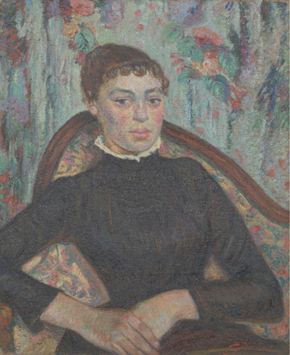
Portrait of a Young Woman by Armand Guillaumin (1876)

One of the problems Guillaumin soon encountered was financial as he had no private income to turn to and so he had to continue holding down a job to survive.  This situation was further exacerbated with the advent of the Franco-Prussian War in 1870.  Once the War and the Paris Commune fighting had ended there was some hope for Guillaumin who had managed to have himself included with the popular Impressionist movement.  Guillaumin and fellow Impressionist, Cézanne had met up with Dr Paul-Ferdinand Gachet, a French physician most famous for treating the painter Vincent van Gogh during his last weeks in Auvers-sur-Oise, and he bought a number of their works.  Guillaumin also sold a number of his works to his friend, Eugéne Murer who had recently established a successful café in Paris. Guillaumin and Cézanne began sharing a studio but both found themselves in precarious financial positions despite the sales of their work to Gachet and Murer who continued to be close friends of the pair.

Cottages in a Landscape by Armand Guillaumin (1896)

At the start of the 1880s the Impressionist group was beginning to break apart and it split into two camps.  One headed by Pissarro and the other by Degas.  Gaugin had vociferously supported Pissarro and he had allied himself with Guillaumin.  Although not initially supportive of the Impressionist group having misgivings about what its intentions were, Renoir and Monet joined the Impressionist Exhibition of 1882 with Guillaumin, Gauguin and Pissarro as well as Sisley, Morisot, Vignon and Caillebotte.  However, Degas was noticeably absent.

Moulins en Hollandee by Armand Guillaumin (1904)

It was somewhat surprising that Paul Gaugin, known for his irrational behaviour towards his fellow painters, continued to befriend Guillaumin and keep him in the Impressionist group despite its continued disintegration.  It was through Gaugin, that Guillaumin met many new young artists who had arrived on the Paris art scene such as the Symbolist painter, Odile Redon, and the Pointillists, Georges Seurat and Paul Signac. In the mid 1880s Guillaumin’ s studio had become a meeting place for the young group of painters.  By 1885, new styles of painting had come to the fore and this resulted in further rifts between the old guard of Impressionism resulting in the disintegration of the Impressionist Group. The other factor for the break-up of the Group was its leading man, Gaugin, became more and more temperamental and intolerant and was destroying the Movement from the inside.  Guillaumin decided it was time for him to exit the movement which he had been part of from the very start.  Guillaumin’s reputation had grown over the last decade and Paul Adam wrote in La Revue Contemporaine:

“…I was not aware of any other painter who has so correctly noted the corresponding values of the lights of the firmament and of the ground…. their unification in colour appears to be perfect…”

Again, Felix Feneon, the French art critic, gallery director, and writer reiterated this, writing about the same show Immense Skies and commented on Guillaumin’s work:

“… superheated skies where clouds jostle each other in a battle of greens and purples, of mauves and of yellows…”

Vue de Port by Armand Guillaumin (1880)

t was in 1886 that Guillaumin married.  His wife was his cousin Marie-Joséphine Charreton, a schoolteacher, who was able to support him financially.  They settled down at 13 quai d’Anjou in the Saint-Sulpice area of the 6th arrondissement of Paris. It had previously been the studio of the painter Charles-François Daubigny. Guillaumin’s relationship with Pissarro eventually ended with the latter beginning to concentrate on experimentation with pointillism while Guillaumin became progressively interested in romantic art. Guillaumin’s relationship with Gaugin also in due course ended as the latter being constantly away on his travels.

Agay Bay by Armand Guillaumin (1910)

From 1875 to 1880, Guillaumin was a frequent guest of Dr Gachet at Auvers, at a time when he was travelling in that area searching for views of the rural scenery of the Yonne valley to paint and, later, the Creuse valley and the countryside around the farming village of Crozant, where he spent most of his life. Around 1887 Guillaumin became a good friend and mentor to Vincent Van Gogh, who was twelve years his junior. Vincent’s letter to fellow painter Ermil Bernard in December 1887 shows how highly he thought of Guillaumin:

“… I believe that, as a man, Guillaumin has sounder ideas than the others [the Impressionists], and that if we were all like him we’d produce more good things and would have less time and inclination to be at each other’s throats.

Again in a letter to his brother Theo in June 1888, Van Gogh writes about a visit he made to Guillaumin’s house and how he was inspired by him:

“…Wasn’t it pleasant at Guillaumin’s last winter — finding the landing and even the stairs, not to mention the studio — chock-full of canvases? You understand since then that I have a certain ambition, not about the number of canvases, but that these canvases as a whole should, after all, represent a real labour on your part as well as mine…”

Neige by Armand Guillaumin (1876)

In the last decade of the nineteenth century Guillaumin’s circle of artist friends was dwindling.  Vincent van Gogh died in July 1890 and his brother Theo, the art dealer, died in the January of the following year.  Gaugin and Cézanne had left Paris and Guillaumin and Pissarro’s views on art had diverged so much that their friendship had gradually faded.  Despite all this Guillaumin’s life was to change rapidly when won he won the sum of 100,000 francs (about 400,000 euros in today’s money) in a state lottery.  This completely changed his life.  He no longer had to rely on commissions.  He no longer had to exude a subservience towards patrons.  He was now able to paint what he liked and strive for his own artistic goals.

Caves Prunal near Pontgibaud by Armand Guillaumin

With this newly found wealth Guillaumin set off travelling around France capturing on his canvases the beautiful views of the countryside, mountains and the coast, often during sunrise and sunset.  His continuous journeying around was brought to an end with the onset of The Great War of 1914.  Once the war came to an end he once again set off on his travels but by then he was seventy-seven and he, like his artistic output, was declining.   In 1926 a retrospective exhibition was held at the Salon d’Automne.  He died at the Chateau de Grignon in Orly, Val-de-Marne, just south of Paris, on June 26th 1927 aged 86. He was the last survivor of the Impressionist Group.

Crozant, Solitude by Armand Guillaumin (1915)

Guillaumin’s paintings are renowned  for their intense colours and can be found in major museums around the world. Most of all he is best remembered for his landscapes of Paris, the Creuse département, and the area around Les Adrets-de-l’Estérel near the Mediterranean coast in the Provence-Alpes-Côte d’Azur region of France. Guillaumin became known as the leader of the École de Crozant, a disparate group of painters who came to portray the landscape in the region of the Creuse around the village of Crozant.

Paysage à Crozant (1917)

One such depiction is entitled Landscape in Crozant, is part of the Art Institute of Chicago collection.

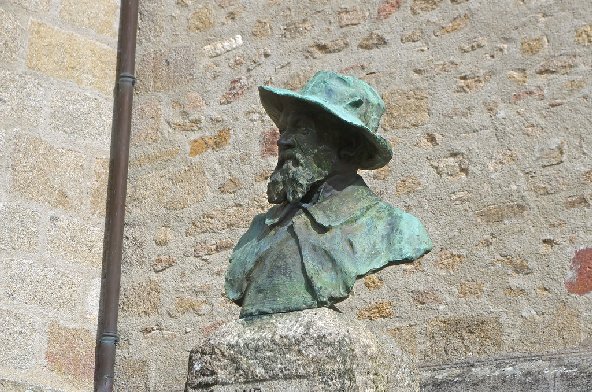
His bust is in the square near the village church in Crozant.

Adrien-Jean Le Mayeur de Merprès.

This blog is the second one requested by Barbara Matthias, a reader of my blogs, who had actually met the artist, and, like the previous one about Rudolf Bonnet, it is about the life and artwork of a painter who spent the latter half  of his life on the Indonesian island of Bali.  Let me introduce you to Adrien-Jean Le Mayeur de Merprès, a self-declared impressionist.

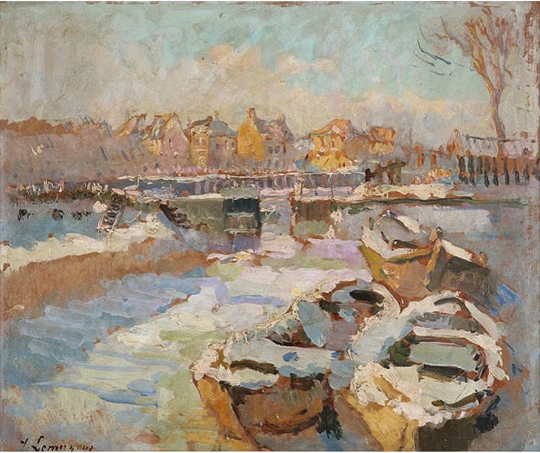
City view with boats in the canal by Adrien-Jean Le Mayeur de Merprès

Le Mayeur was born on February 9th 1880 in Ixelles, a municipality of Brussels which lies to the south-east of the Belgium capital.  He was the youngest of two brothers born to Andrien Le Mayeur De Merpres, a marine artist, and his wife Louise Di Bosch. During his early years Jean studied painting with the French artist, Ernest Blanc-Garin as well as being tutored by his father.  His father wanted his son to receive an all-round education and had him enrol at the Polytechnic College of The Université Libre de Bruxeles, where he studied Architecture and Civil Engineering.  However much to the horror of his family, Jean decided to forego all that he had learnt at the polytechnic and pursue his love of painting and his favoured genre of landscape painting in the Impressionistic style, depicting Belgian landscapes in hazy hues.

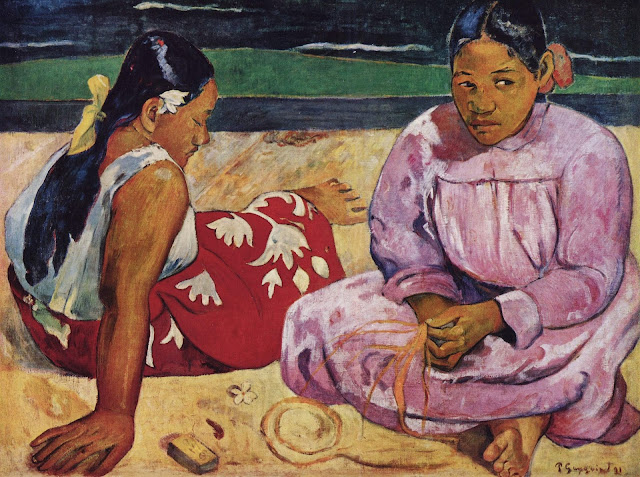
Tahitian Women on the Beach Gaugin’s Tahitian painting (1891)

In 1914, now in his thirties, with the outbreak in Europe of the Great War, Jean was enlisted as a war-time painter and photographer.  During the conflict he was affectedly badly by the carnage of the war and this could have been one of the reasons why he decided to leave Western “civilisation” and find solace in the exotic worlds which he had seen in the works of the French post-impressionist artist Paul Gauguin.

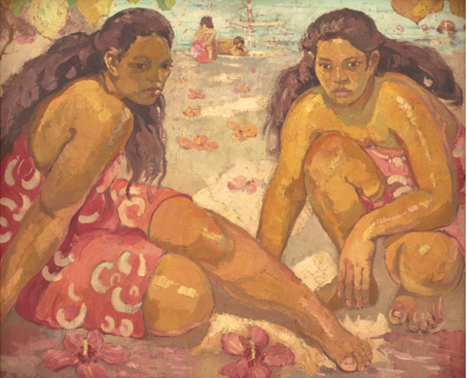
 Two Women on the Beach, Tahiti, by Adrien-Jean Le Mayeur de Merprès

Jean had also acquired an insatiable appetite for travel.   In the early 1920s he visited Italy, North Africa, India, Cambodia, Burma, Madagascar and Turkey, all the time transferring his thoughts and what he saw onto canvas.  In a way these extensive travels were Jean’s way of searching for paradise and like Paul Gaugin, who had visited the Pacific island of Tahiti in June 1891, he too arrived on the Pacific island in 1929.  Jean Le Mayeur was disappointed with Tahiti as it was now far more commercialised than it was in Gaugin’s day and so Jean discounted Tahiti as being the promised land and instead decide to travel to south-east Asia and in 1932 he embarked on his first voyage to the “island of the Gods”, Bali.

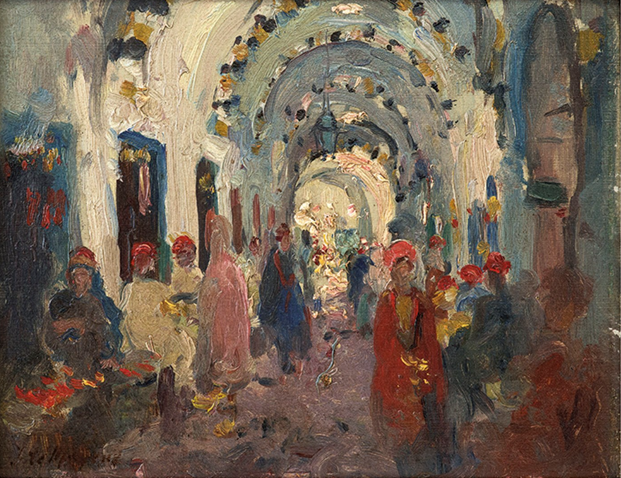
An Arab Market by Adrien-Jean Le Mayeur de Merprès

After a long sea passage,   Le Majeur arrived at Singaraja, a port town in northern Bali.  From there he travelled south and rented a house in Banjar Kelandis, close to the northern part of Denpasar, the island’s main town. He was captivated by the Balinese people’s traditional way of life, the temple ceremonies and the local dances such as Legong, which is a form of Balinese dance that is characterized by intricate finger movements, complicated footwork, and expressive gestures and facial expressions.  For Le Mayeur, Bali was an ideal place to paint because of its light, colour and the exquisiteness of the surroundings in what was still a quite an unspoilt island.

Harbour of St Tropez by Adrien-Jean Le Mayeur de Merprès

From his love of watching the Legong dancers Le Majeur met a beautiful fifteen-year-old Legong performer, Ni Nyoman Pollok and he persuaded her to model for his paintings. In 1933 he had put together a collection of work featuring Ni Pollok, which he took to Singapore for an exhibition.  The exhibition was a great success and it resulted in him being more widely known.  On returning from Singapore, Le Mayeur purchased a plot of land at Sanur beach, a coastal stretch east of Denpasar in southeast Bali.  There, he built a house, which was also his studio and a beautiful garden. It was here that Ni Pollok along with her two friends worked every day as his models.

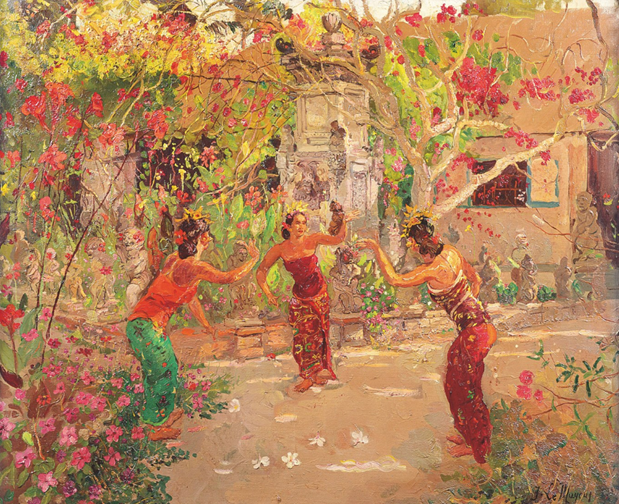
Three Dancers in the Garden by Le Mayeur by Adrien-Jean Le Mayeur de Merprès

In his painting entitled Three Dancers in the Garden we see three graceful dancers.  The setting of the depiction is in the garden in front of the house Le Mayeur and his wife Ni Pollok built on the beach of Sanur. Almost the whole of the background is taken up by the white house with its thatched roof and blue and white window shutters. 

Their house at Sanur was depicted on a number of occasions by Le Mayeur.  In one of his letters to a friend he recounts his love for the property:

“…I’ve evidently made all things serviceable to my art. All my actions have but one purpose: facilitating my work…”

 In another, he talks about how he is inspired by the house:

“…you will understand my paintings wherever you may see them, for everything in this little paradise which I created for myself was made to be painted”…”

Again, in yet another letter he writes about his love for the garden:

“…I organized my home exactly as I liked it. I intended to surround myself with nothing but beauty.  I planted a mass of bougainvillea, frangipani, hibiscus and all around the cottage I put groups of intertwining plants. I built little temples, completely made of white coral, dug little ponds in which the reflections of all the Gods of Hindu mythology can be seen among the sacred lotus flowers. The two temples are surrounded by approximately two hundred of these little sculptures, which have integrated with the flowers whose silhouettes are drawn on the purple and pink tropic skies…”

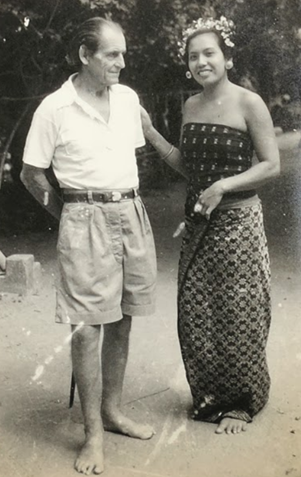
Le Mayeur and Ni Pollok

It is fair to say that Le Mayeur was smitten by the beauty of the island and the beauty of Ni Pollok. His original intention had been that he would just stay on the island for eight months but as that time came to an end he took the decision to remain in Bali for the rest of his life. After three years working together, in 1935, Le Mayeur and Ni Pollok got married. Le Mayeur kept on painting with his wife and her friends as his models during their married life. During the Japanese occupation of the Dutch East Indies in 1942, Le Mayeur was put under house arrest by the Japanese authorities.

Around the Lotus Pond by Adrien-Jean Le Mayeur de Merprès

Many of Le Mayeur’s paintings depicted scenes in and around their house.  The subjects were varied such as women at leisure on a daybed in the interior of the house; women weavers at the loom; women on the veranda or women dancing on a terrace; women in front of the house or in the garden picking flowers or making offerings but one of his favourite depictions was of women dancing around the lotus pond in his garden.  In this painting, Around the Lotus Pond, which Le Mayeur completed in the 1950s, we see the pond around which are six young women picking flowers.  It is thought that Ni Pollock posed for all the women.  Le Mayeur strived to make his paintings colourful and in this work the hues of red, purple, orange and pink dominate the painting and are in contrast with the darker colour of the pond and its water which we see in the lower left of the picture.

Ni Pollok with a friend enjoying the Afternoon Sun

by Adrien-Jean Le Mayeur de Merprès

During the war, tourism had totally disappeared but at the cessation of hostilities tourism to the island slowly returned.  The island’s tourists would often visit and look around Le Mayeur’s home and studio in Sanur and took the opportunity to buy his artwork.   Returning home with their purchasers enabled Le Mayeur’s works of art to become part of many collections. Although Bali was undoubtedly a scenic paradise, one of the downsides of living on the island was the possibility of contracting malaria and le Mayeur often suffered from bouts of the disease which weakened him.  A riding accident in 1948, resulted in the then sixty-eight years old artist to suffer a broken leg from a fall from his horse, Gypsy, and after that incident, probably because of his age, he never ever really recovered and had always, from then on, to use a cane when walking.  In 1951 the aging artist was attacked by a group of robbers and thanks to the effort of his wife Ni Pollok, they managed to fight off the intruders.  However Le Majeur received a large stab wound in the shoulder during the attack. Five years later he suffered with a hernia. Despite all these negative happenings, Le Mayeur managed to keep focused on his work and maybe the highly colourful works he produced radiated the sunny side of his and Ni Pollok’s life.
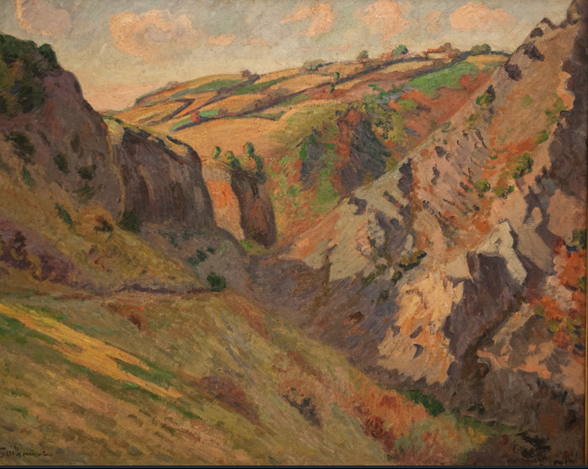
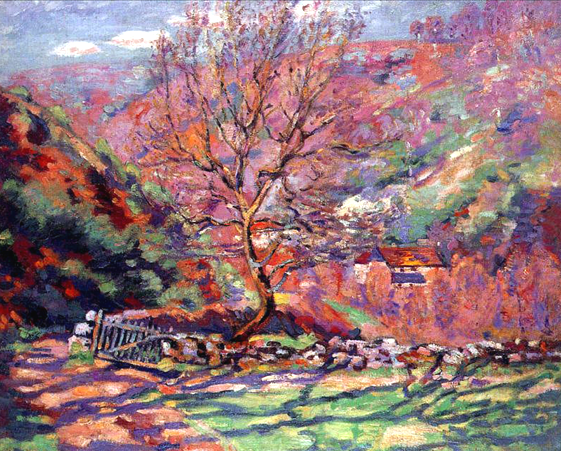
Five women on the Beach by Adrien-Jean Le Mayeur de Merprès

In 1958, seventy-year-old Le Mayeur had to travel to Brussels with his wife for treatment for cancer of his ear. Sadly, the illness was diagnosed as being terminal and the painter died on May 31st, 1958, aged 78. and was buried in Ixelles, Brussels. Ni Pollok later married an Italian physician who was living on the island but like many foreigners, during the troubles in Indonesia, he had his residence permit revoked and was obliged to leave the country. Ni Pollok stayed behind on Bali.

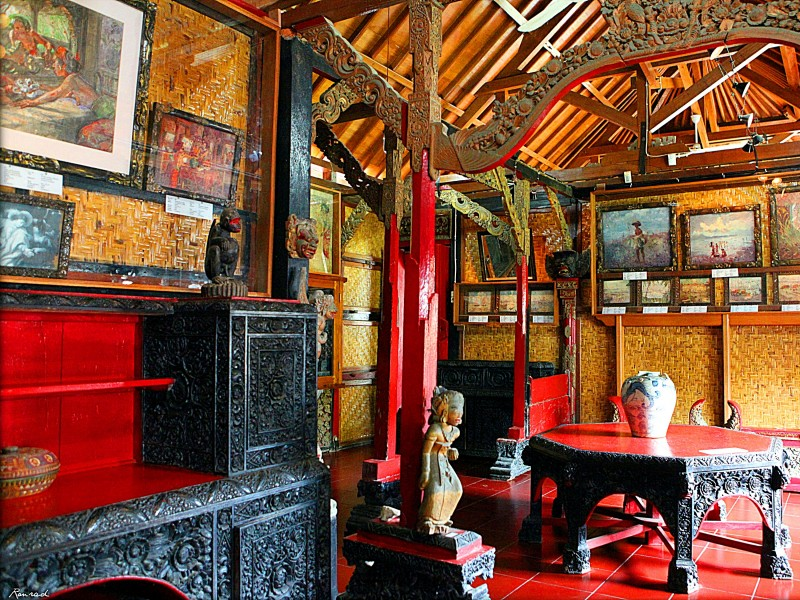
A room in Le Mayeur’s house, now a museum, in Sanur

The will of Le Mayeur had stated that Ni Pollok was allowed to live in the house in Sanur and she resided there up to her death in 1985. Subsequently, the house and its contents, including a hundred paintings by Le Mayeur, were then donated to the Indonesian government and the house was converted into a museum.

Alfred Sisley Revisited

The villages of the Seine and its tributaries

Sisley went tirelessly in search of motifs along the Seine and its tributaries, he looked no further. He concentrated on views of village streets, or of interesting groups of buildings, he would be drawn to an old stone bridge, the kind of subject that had fascinated painters since Corot. In what many would dismiss as unprepossessing patches of gardens or meadows, landscapes on the outskirts of towns or along river banks, Sisley could often discover the most arresting colour or light effects.

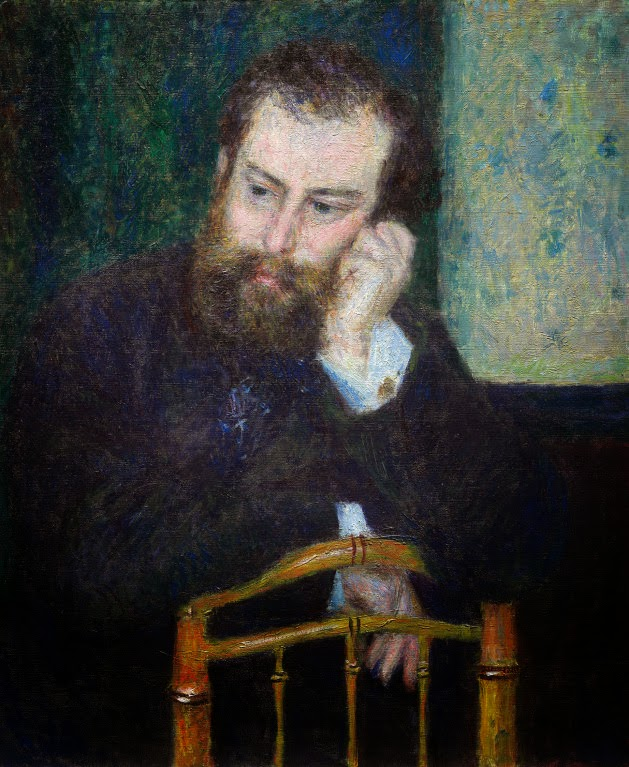
Alfred Sisley by Renoir (1876)

In 1866, Sisley began a relationship with Eugenie Lesouezec and shortly thereafter the couple had two children: a son, Pierre, in 1867 and daughter, Jeanne in 1869.  Although they remained together until Eugenie’s death in 1898, they didn’t marry until August 5, 1897.  In 1870, the Franco-Prussian War began and this precipitated the failure of Sisley’s father’s silk business which ended in his father’s bankruptcy and the financial devastation hastened his death.   Sisley had relied heavily on his father’s financial support because of the low prices being offered for his artwork, and this revenue stream had come to an end.

Louveciennes, above Marly by Alfred Sisley (1873)

To manage his financial difficulties and to avoid the Prussian War, Sisley gave up his home in Paris and moved to the countryside and the town of Louveciennes, a village west of Paris.  It is said that during the summer of 1871, Sisley, Renoir and Pissarro had watched Paris burn during the Prussian siege of the capital city. In his painting Louveciennes, above Marly, Sisley has depicted the view from Louveciennes, down over the forest and the riverside town of Marly.

Louveciennes: View of the Sèvrees Road by Alfred Sisley (1873)

Another of Sisley’s works featuring Louveciennes is his 1873 painting entitled Louveciennes: View of the Sèvres Road. It is a classic example of a perspective road which we see narrowing into the distance. He used this technique in many of his works as it allowed him to give movement to his depiction while also giving a feeling of space.

The Avenue at Middleharnis Meindert Hobbema (1689}

It is thought that Sisley’s depiction may have been influenced by Meindert Hobbema’s 1689 landscape painting, The Avenue at Middleharnis, which he would have seen at the National Gallery when he visited London.

Place du Chenil à Marly, effet de neige by Alfred Sisley (1876)

Two years later, in October 1874, after his four-month summer holiday spent in London, Sisley and his family moved to 2 avenue de l’Abreuvoir in Marly-le-Roi, a commune in the Île-de-France region, in north-central France, located in the western suburbs of Paris, 18 kilometres from the centre of the French capital. The two following winters were especially harsh with temperatures below zero and frequent heavy snowfall. I particularly like Sisley’s 1876 painting entitled Place du Chenil at Marly, and the depiction of snow. There is an eerie stillness about the depiction of the town’s main square which since Sisley’s time has been renamed Place du Général-de-Gaulle. We see that a heavy snowfall has occurred and the town has been covered by a thick blanket of snow. Look at how Sisley has depicted the snow. It is not just coloured white but a subtle blending of blues, greens, creams and greys. There is nothing spectacular about the scene but it is just a timeless realistic rendition. Place du Chenil in Marly, Snow Effect is now located in Musée des Beaux-Arts de Rouen which is an art museum in Normandy, France. It was given to Musée des Beaux-Arts de Rouen by François Depeaux, a French art collector, industrialist and patron. He gave the painting to the museum in 1909, just over 100 years after the Musée des Beaux-Arts de Rouen was built.

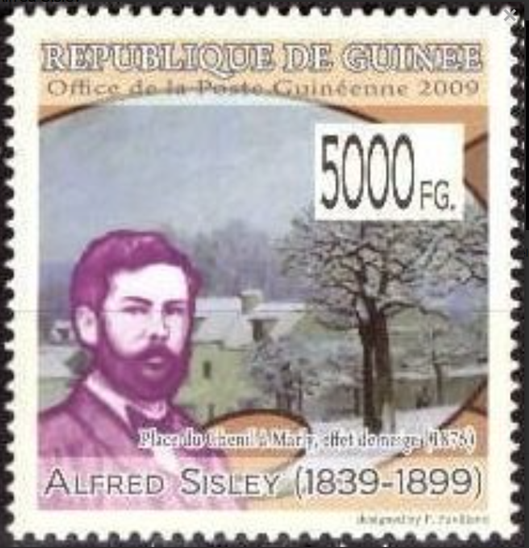
Postage stamp issued in 2009

Commemorative postage stamp issued by Republic of Guinea on October 1st 2009 depicted Sisley’s painting Place du Chenil à Marly, effet de neige.

Village by the Seine (Villeneuve-La-Garenne) by Alfred Sisley (1874)

The Villeneuve-la-Garenne painting depicts the village on the River Seine, a commune in the northern suburbs of Paris, which lies less than ten kilometres from centre of the French capital. In 1872 Alfred Sisley created his painting depicting the small village entitled Village by the Seine (Villeneuve-La-Garenne). After visiting the small village, Sisley was inspired by what he saw and was determined to produce a work so that he could share the beauty of the place.  The depiction oozes tranquillity.  The two trees in the foreground act as if they were theatre curtains on either side of a stage.  In this work Sisley has managed to encapsulate the beauty of nature.
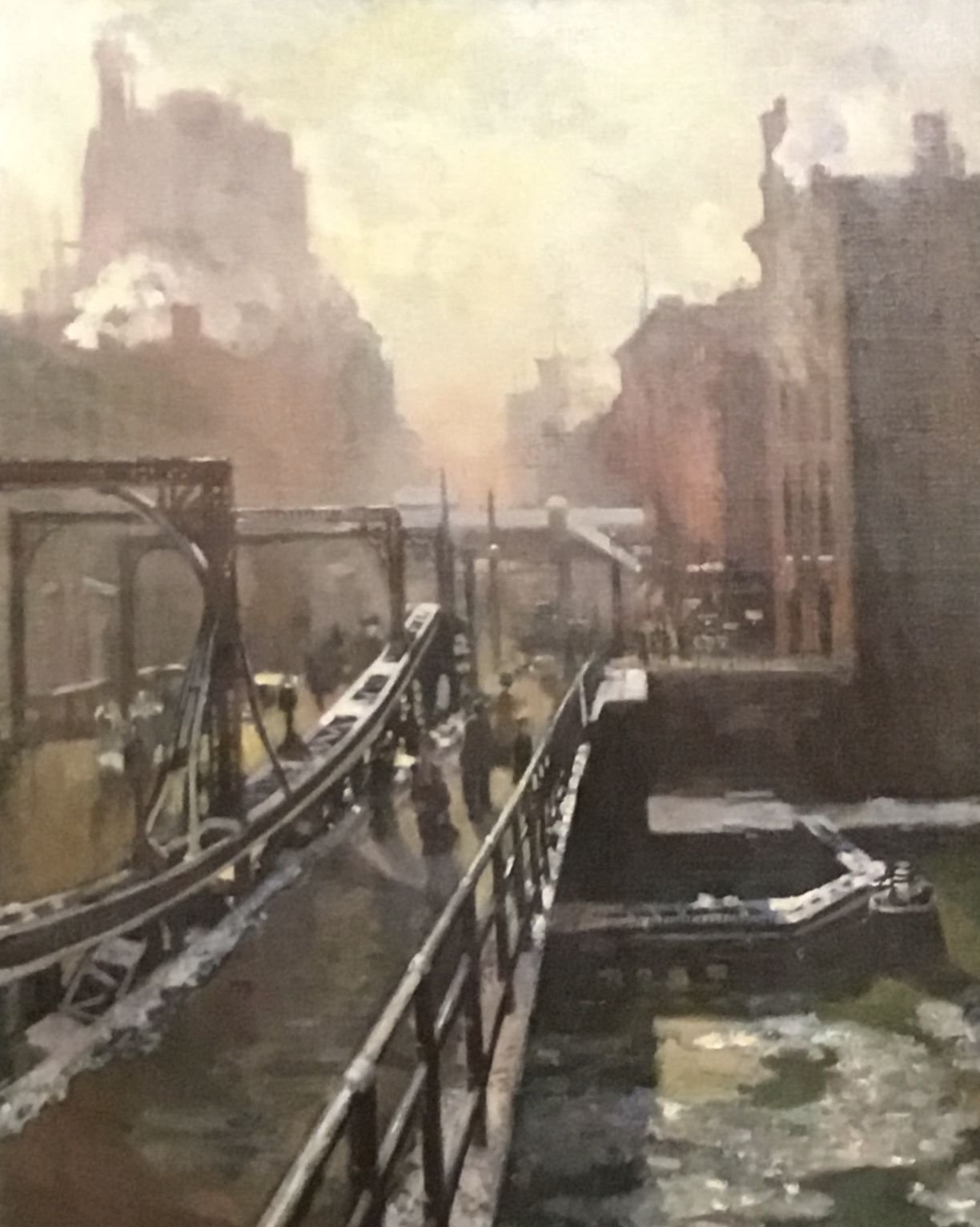
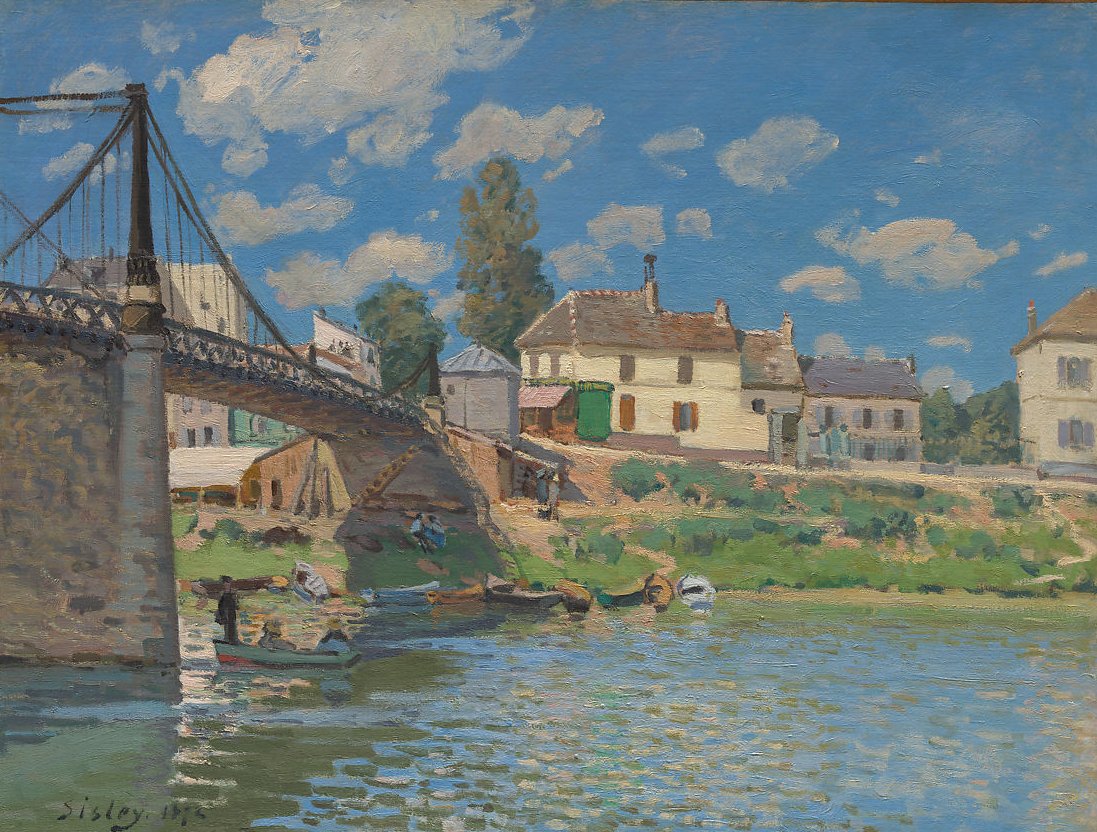
The Bridge at Villeneuve-la-Garenne by Alfred Sisley (1872)

Sisley completed a number of paintings featuring the village and just to the left of the previous painting, but out of view, is the bridge which crosses the river at Villeneuve-La-Garenne and this was the subject of Sisley’s 1872 painting, The Bridge at Villeneuve-la-Garenne. The cast-iron suspension bridge resting on stone abutments was built in 1844 to connect what had until then been a fishing village and small port with the Paris neighbourhood of Saint-Denis, on the other side of the river. The building of the bridge and the bridge itself was symbolic of French modernity, and the structure was depicted in a number of Sisley’s paintings of the 1870s and early 1880s. Sisley made the depiction somewhat livelier by including figures of holidaymakers on the riverbank and in a boat which is passing under the bridge.  Look how Sisley’s brushstrokes communicate the fleeting effect of sunlight on the water.

The Seine at Suresnes by Alfred Sisley (1877)

About six miles up-river from Villeneuve-La-Garenne is the town of Suresnes, a commune in the western suburbs of Paris, Île-de-France. In 1877 Sisley completed his painting entitled The Seine at Suresnes.  It is a typical work of Impressionism with its swirling clouds dominating his depiction of the sky.  His intention was to capture a fast-changing scene due to the approaching storm.  Look how he has depicted the river, no longer bathed in sunlight, now dimmed by the heavy clouds overhead.  Unlike many of Sisley’s best loved works which focus on tranquillity, this is more about doom-laden skies and what was to come to pass.  The painting was sold to fellow artist, Gustave Caillebotte, and along with Gustave’s other paintings he had amassed, it was later left to the French nation.

Canal de Loing by Alfred Sisley (1892)

With the canals from Briare and Orléans completed respectively in the second half of the seventeenth century, merchants started complaining about the poor navigability of the river Loing. The Duc d’Orléans ordered a survey and designs for the navigational route which would be part river and part canal.  The waterway was completed in 1723.  The Loing Canal is used by working barges and was the subject of many Sisley’s depictions.  In this painting we see a winding path, which follows the curve of the canal, alongside of which are poplar trees.  Our eyes, once we have taken in the house, follow the curve of the road and canal into the distance.  The inclusion of the winding road was one of Sisley’s favourite themes in which it plays a part in the perspective of the painting.  This painting, The Loing Canal, was offered to the Musée du Luxembourg after the painter died in 1899.  It was part of a gift from Sisley’s friends which was organised by Monet.

A Road in Seine et Marne by Alfred Sisley (1878)

Seine et Marne is a department in the Île-de-France region of northern France named after the rivers Seine and Marne and is on the eastern edge of the Ile de France.  It was to be Sisley’s countryside during the last twenty years of his life.  In 1880 he had moved to Veneux-Nadon, close to Moret-sur-Loing.  It was a “forced” move as Sisley had been evicted from his house in Sèvres for not paying his rent.  As some of his work prior to 1880 depicted scenes of Veneux-Nadon, it is clear that he had visited the area on a number of occasions.  This was an agriculturally rich and tranquil countryside with its woods and tiny hamlets.  It was a perfect venue for Sisley’s landscape work and allowed him to relax away from the chaos of Paris.  It worked for him as he produced many serene and beautiful paintings.

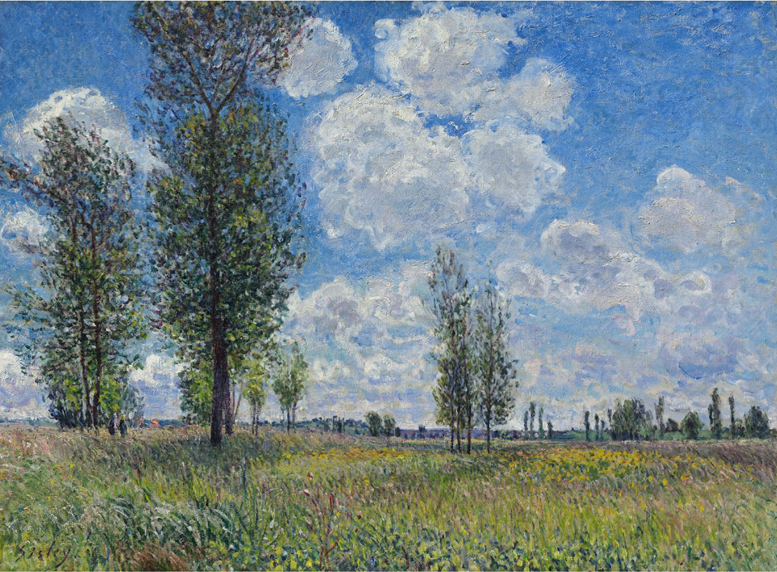
The Meadow at Veneux-Nadon by Alfred Sisley (1881)

Sisley’s painting, The Meadow at Veneux-Nadon, depicts the slender poplars with their delicate leaves and it leads our gaze into the depth of the picture space and gives it stability in this wide summer landscape. Through a juxtaposition of shimmering fields of colour and a reduction of motifs, Alfred Sisley lends an iridescent vitality and tension to the seemingly monotonous theme. Sisley exhibited the painting at the Seventh Impressionist Exhibition in 1882, in which the group focused on landscapes.

Le Bois des Roches Veneux Nadon, by Alfred Sisley (1880)

In his work, Le Bois des Roches Veneux Nadon, we see a windswept scene of a forest at the water’s edge . To the left we see a small rowing boat struggling in choppy waters.

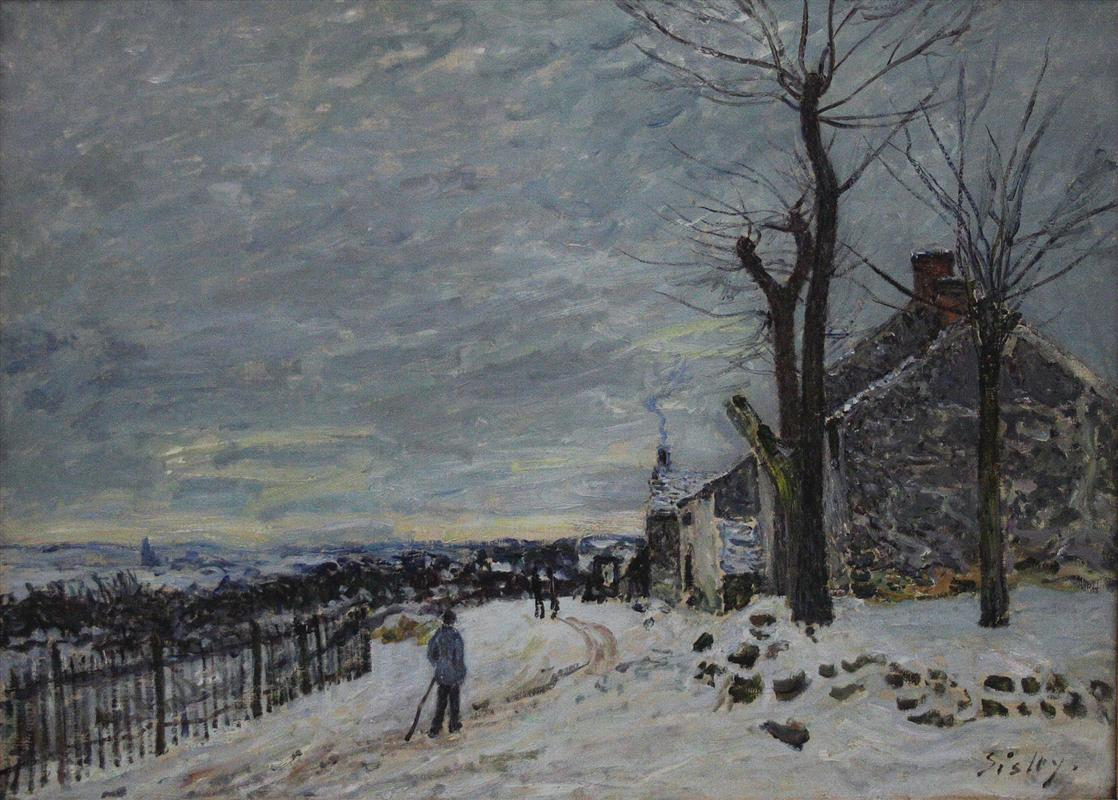
Snowy Weather at Veneux Nadon Alfred Sisley (1880)

This painting, Snowy Weather at Veneux Nadon, was completed during his first winter in Veneux- Narbon on the Loing in 1880. It is another of his snowscapes which this time is dominated by dark clouds with just a glimmer of the rising sun in the background. This was one of Sisley’s favourite depictions, often populated by workers heading for the mills, which were the village people’s primary source of employment. It is an atmospheric depiction of a cold early-morning scene and Sisley has used muted colours to ensure the contrast with the presence of the rising sun.

Veneux, August Afternoon by Alfred Sisley (1881)

Veneux, August Afternoon was painted by Alfred Sisley in 1881. Financially, it had not been a good year for him although he managed to afford to travel to the Isle of Wight in June. He had arranged for canvases to be sent to him on the island but they never arrived an he could not afford to pay for English canvases. When he arrived back in France in August he painted this work. It is a typical Sisley scene – quiet riverside setting with trees and picturesque sky. Our eyes are drawn to the creamy clouds in the upper left of the painting and then back down in a diagonal direction to the patch of sunlight we see falling on the pathway on the bottom right of the work.

Sailing Boats by Alfred Sisley (1885)

The painting Sailing Boats by Sisley depicts a scene of the boatyards at the riverside town of Saint-Mammès, sixty kilometres south-southeast of the French capital, at a point where the rivers Seine and Loing come together. Sisley has depicted a number of pleasure boats tied up next to a barge fitted with lifting gear. Sisley has used a familiar technique with the layout of his work – the subject is viewed head-on and the depiction is a series of wide horizontal bands, which, in this painting, is held together by the tall triangular shape of the lifting equipment. The scene is populated by a number of figures.

The Goose Girl by Alfred Sisley (1897)

Sisley’s favoured painting medium had always been oils but this late painting by him was a pastel. It is not known whether this pastel work was just a preliminary sketch that would later be used to complete the depiction in oils or whether Sisley was intrigued by the medium. Once again Sisley has used a winding path to give perspective to the depiction. The work is not simply a landscape but focuses on a girl looking after her flock of geese.

Alfred Sisley was born and spent most of his life in France, but retained British citizenship. In 1897, Sisley and his partner of over thirty years, Marie Eugénie Lescouezec, visited Britain and were finally married at the Cardiff Register Office on August 5th. On his return to France, in 1898, Sisley applied for French citizenship, but was refused. Later, a second application was made and on this occasion his application was supported by a police report, but Sisley became seriously ill and the process was halted. In October 1898 his wife died of cancer and four months later on January 29th 1899 Sisley died of throat cancer, aged 59. Sisley remained a British national until his death. He was buried with that of his wife at Moret-sur-Loing Cemetery.

Ralph Blakelock. Part 1.

The American Impressionist.

Ralph Blakelock

A blog I wrote some eleven years ago featured an artist who spent the last twenty years of his life in an asylum. He was Richard Dadd, the English Victorian painter.  Today I am looking at the life and works of an American painter, Ralph Albert Blakelock, a contemporary of Dadd, who was also incarcerated in an asylum during the last eighteen years of his life.

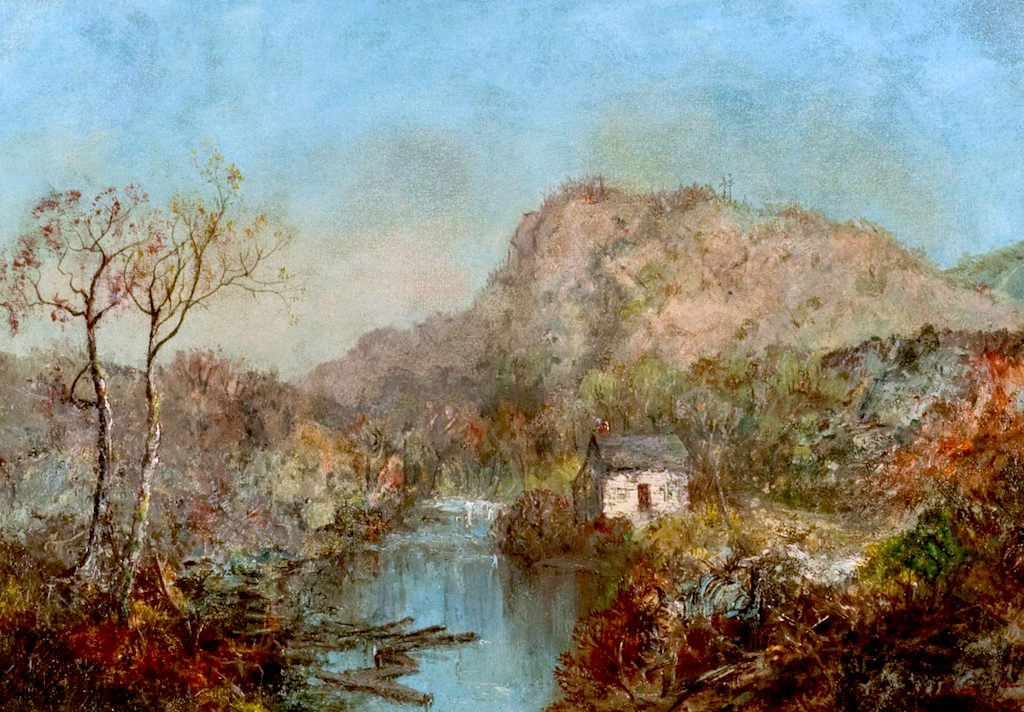
Woodland Cabin by Ralph Blakelock (1864)

The art of Ralph Albert Blakelock is termed as being of the Romanticism movement.  The Romantic movement, which emphasized emotion and imagination, emerged in response to the artistic disenchantment with the Enlightenment ideas of order and reason.  Blakelock was a painter known mainly for his landscape paintings related to the Tonalism movement.   Tonalism is, at times, used to describe American landscapes derived from the French Barbizon style, which accentuated mood and shadow.

Landscape by Ralph Blakelock (c.1865)

Ralph Blakelock was born on Christopher Street in New York City on October 15th, 1847.  He was the son of Ralph Albert and Caroline Blakelock. His father was an English immigrant carpenter, who would later serve as a police officer before becoming a homeopathic doctor. It was not Ralph’s father but his uncle James A. Johnson, a choirmaster who was to be Ralph’s cultural mentor. Ralph had connections with art through his uncle’s friendship with the great American landscape painters of the time, Frederic Church with and James Renwick Brevoort. Ralph had four brothers and four sisters. His father had hoped that Ralph would follow in his footsteps and study medicine and so it transpired that in 1864, seventeen-year-old Ralph began to study medicine at the Free Academy of New York.  However he gave up his studies at the academy after he had completed the third semester.

Hudson River Landscape by Ralph Blakelock (1867)

Blakelock ended his further education in 1866 and began to study art and paint landscapes full-time. To look for different landscapes to paint he made several sketching trips in upstate New York and New Hampshire. One of his first exhibition pieces was exhibited at the National Academy of Design in 1868, when he exhibited a view of the White Mountains.

 Morning – near Devil’s Den, White Mountains by Ralph Blakelock (1868)

The voyage of discovery for Blakelock proved to be central to his artistic vision and was to be an influence on his work for the rest of his life. Such cross-country trips had become popular with artists such as Albert Bierstadt and Thomas Moran but their journeys were part of expeditions funded by the US government, unlike the one Blakelock undertook on his one-man adventure. He wanted to “go West” and explore more of his country and whilst doing so, sketch and paint what he saw. 

House by the Stream by Ralph Blakelock (1869)

In 1869, thanks to his father’s financial backing, Blakelock began the first of two lengthy journeys to the western territories of the United States. His extensive travelling was done using the train, stagecoach, and horseback, and his trip took him to the states of Kansas, Colorado, Wyoming, Utah, and Nevada, finally arriving on the west coast and California. After spending time in that state, he travelled south into Mexico. It is thought that he arrived back home by sea in 1871. The voyage of discovery for Blakelock proved to be central to his artistic vision and was to be an influence on his work for the rest of his life.

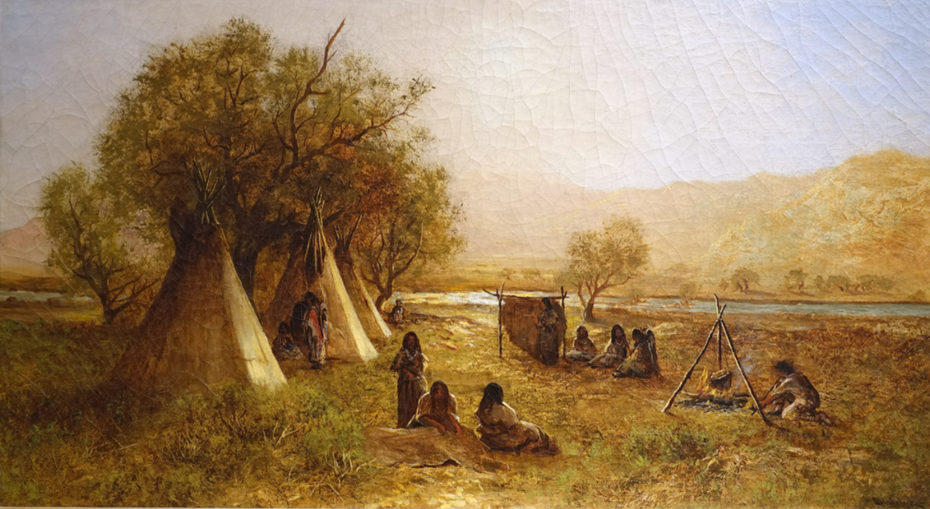
Cheyenne Encampment by Ralph Blakelock (1873)

A year later, in 1872, Blakelock embarked on a second western trip. Blakelock spent all his time sketching and painting and it was during this voyage of discovery that he became interested in one of his most lasting subjects for his work – the Native Americans. He painted tableaux of American Indian dancers, tented encampments and native Indian horseback riders Like artists who had journeyed west, there is no doubt that Blakelock was impressed by the vastness of the landscape. He spent time with various American Indian tribes and would often travel alone into the wilderness on horseback and spent time with tribes of the Great Sioux Nation.   It was a time when the Native Americans were still retaining many of their traditional practices despite the constant incursion on their lands by the white Americans from the East who were expanding  rapidly taking hold of the land belonging to the Native Indians.  Blakelock liked to depict Indian encampments in his paintings.  His paintings were not just about pretty scenes, they were a pictorial history of the time.  Mark Mitchell, the American writer and the Holcombe T. Green Curator of American Paintings and Sculpture at the Yale University Art Gallery,  wrote in his 2008 article Radical Color: Blakelock in Context about Blakelock’s work during his travels West:  He wrote:

“…they were documents of his experience and observations, but with time they became documents of his memory, as well as the memory of the nation at large…”

Sunshine in the Woods by Ralph Blakelock (1876)

Once Blakelock returned to New York after his wanderings in the West he rented his own studio and exhibited his work at the National Academy as well as the Society of American Artists and the Brooklyn Art Association. Initially his paintings followed the Hudson River School style

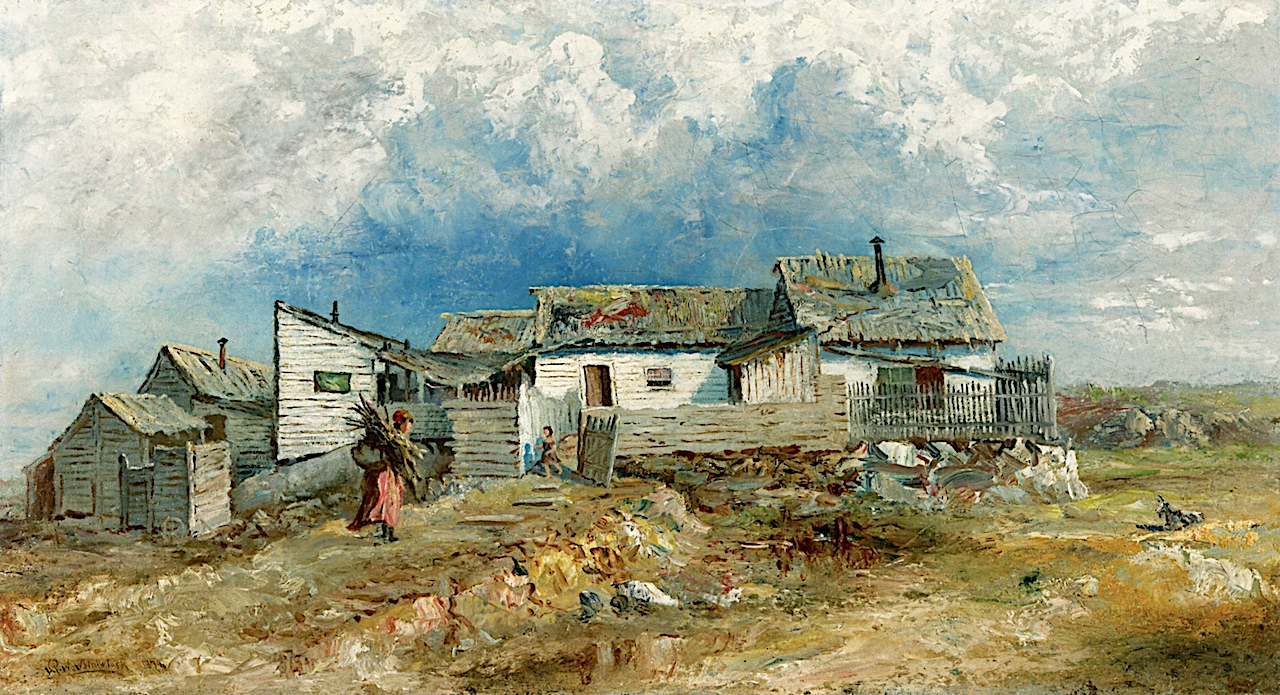
Shanties in Harlem by Ralph Blakestock (1874)

Now back on the East Coast, Blakelock began to concentrate on depictions of the northern edges of the outer city (what is now 55th Street and Central Park), which had yet to be developed.  Here he focused on the shanties which were starting to appear.  One such painting was his 1874 work entitled Shanties in Harlem.

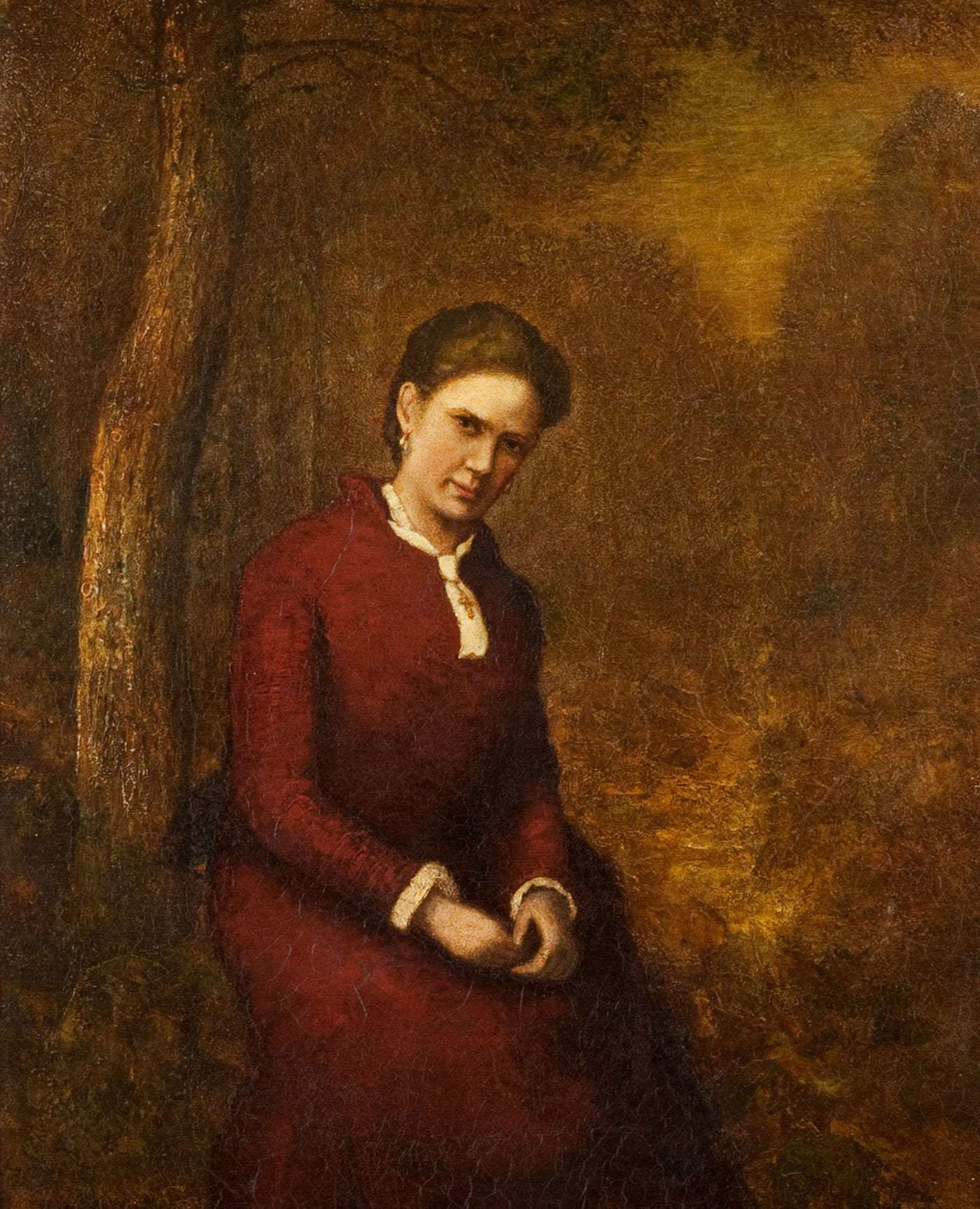
Portrait of Cora Bailey (Mrs. Ralph Blakelock) by Ralf Albert Blakelock

In 1877, Blakelock married Cora Rebecca Bailey and, soon after, the first of their nine children, Carl, was born.  It was probably at this time in Blakelock’s life that things started to go wrong.  Unfortunately for Blakelock the art critics did not look upon his work favourably and the public were reluctant to buy his paintings at the advertised price.  Coming into play was the dreaded balance of matching income with expenditure.  His income was decreasing as he was having to sell his work cheaply.  However, the increasing size of his family had to be housed and fed. He had to increase his rate of production of his paintings to boost his income.  In his book, The Unknown Night: The Madness and Genius of R. A. Blakelock, An American Painter, Glyn Vincent tells that Blakelock’s wife, Cora, in a letter to the art dealer, Robert Vose, who ran the Vose Gallery in Boston, wrote that her husband did just that.  She wrote:

“…His best work took a long time to complete and in the meantime he had to live. Pictures were painted to keep things going. He could paint a really good picture in less time than anyone else I ever saw…”

In 1880, his second child, Marian is born and in 1883, Blakelock moved into the prestigious Tenth Street Studio Building, in New York and had famous neighbours such as William Merritt Chase and Frederic Church. He took part in the 1884 Society of American Artists exhibition and this boosted his reputation with his work being hailed by the press as being among the best works on show.  Clarence Cook of the Tribune wrote:

“…it was the best work of his which we have seen, marked not only by rich coloring, but by the possession of a distinctive character…”

The year 1884 was the year of the birth of his third and fourth chiId, twins, Claire and Ralph and so it became a dire financial struggle and to support his new and rapidly growing family. Blakelock would sometimes take jobs as an art teacher and later would produce small paintings of birds, flowers, and landscapes on plaques at E. C. Meekers Art Novelty Shop in New Jersey while he and his family lived nearby in East Orange. 

A Waterfall, Moonlight by Ralph Blakelock (1886)

Despite the good press reviews of his work, Blakelock was still struggling financially.  One reason could be that to avoid paying dealers a commission for selling his work he sold his own paintings and although he saved money, he lost the power of marketing and advertising a dealer would have afforded him. In 1886, the popular journal, Harper’s Weekly, reviewing an exhibition at the National Academy of Design praised Blakelock’s painting entitled A Waterfall, Moonlight hailing it as the best landscape in the exhibition, and the art critic admitted that he was surprised to see the name of the artist having completed such a powerful landscape. The painting featured elements that are typical of Blakelock’s style, such as generalized and silhouetted forms, glowing moonlight, and thick paint.  The foliage that frames the edge of the canvas echoes the irregular contours of the tree so much that it gives the impression that the forms are almost able to interlock.

Brook by Moonlight by Ralph Blakelock (1891)

The year 1886 was also the year of the birth of Ralph’s fifth child, Mary, and, tragically, the year of the death of one of his twins, his two-year-old daughter Claire. In 1887 his sixth child, Louis was born. The financial stress on Blakelock continued to mount and cause him mental stress until March 1890, when it culminated in his first mental breakdown and he was taken by his brother to the Flatbush Insane Asylum.

Photograph of the Sherwood Building, Manhattan (c.1902)

Blakelock stayed in the asylum for a short time and on his release, a wealthy patron of his, the English-born textile firm owner, Catholina Lambert allowed Blakelock, his wife Cora, and their four children to come to his estate in Hawley, Pennsylvania, to convalesce. Having recuperated, he returned to New York, where Blakelock began working out of fellow artists’ studios and later president of the National Academy of Design, Harry Watrous’s studio in the Sherwood Building.  This building was at 58 West 57th Street, at the southeast corner with Sixth Avenue (Avenue of the Americas) in Midtown Manhattan, New York City. The building was constructed in 1879 as artists’ apartments. It was here that Blakelock painted his masterpiece Brook by Moonlight which is now part of the Toledo Museum of Art collection. Depicting moonlight, sunsets, and twilight were favourite depictions of Blakelock  It is said that they held a special attraction for Ralph Albert Blakelock for their poetic qualities and in this work he expressed his personal response to nature in this mysterious and haunting moonlit forest.

Sadly the life of Ralph Blakelock was going to take a turn for the worse…..

…….to be continued.

Alson Skinner Clark. Part 1.

Alson Skinner Clark

Alson Skinner Clark was an American Impressionist painter known for his landscape paintings and his murals, including at the Carthay Circle Theatre in Los Angeles and the First Trust and Savings Bank in Pasadena.  He was also an ardent photographer.  He was born on March 25th 1876 in Chicago, Illinois, to Alson Ellis Clark and Sarah Clark.  He had two brothers, Mancel and Edwin and a sister, Mary Emily, who died when young.  His father was not always a wealthy man as he came from an impoverished background.  He had served in the Civil War, and then moved to Chicago where he established a highly successful commodities business at the Chicago Board of Trade.  From then, his wealth increased and he was able to provide a comfortable lifestyle for his wife and family.

The Black Race by Alson Skinner Clark (1902)

Alson showed an early interest in art and was proving to be a gifted young painter.  In an 1956 interview for The Archives of American Art, a collection of primary resources documenting the history of the visual arts in the United States, his wife recalled her late husband’s early “artistic talent” saying:

“… I think the desire to draw was always extant with Alson Skinner Clark. When he was nine or ten years old, it made itself manifest—and obnoxious as well—to the his church-going parents, for during the long Sunday sermons he surreptitiously recorded the bonnets and bald pates in front of him in the only place available at the time—the frontispiece and blank rear pages of the family hymnals…”

His family supported and encouraged him to continue with his art by enrolling him in Saturday classes at the Art Institute of Chicago when he was just eleven years old. 

Breton Village, Rochefort-en-terre by Alson Skinner Clark (1903)

One of the perks of being part of a wealthy family was the ability to travel and in 1889 the Alson Clark and his family set off on a two-year trip around the world. For Alson it was his first taste of European art and no doubt instilled in the young man a love of both travel and painting. Back in America, Alson graduated from high school, and for a short period at the end of 1895 enrolled as a full-time student at The School of the Art Institute of Chicago.  The teaching of art at the Institute was based on the teachings at the French Academies and focused on drawing from casts and still-lifes before students were allowed to progress to drawing live models.  Alson was unhappy with the Institute’s system and after a quarrel with one of his teachers regarding the slow and arduous process of drawing from casts, Clark quit the Institute.

Despite his short but unhappy period at the Chicago Institute Alson was determined to carry on with his art and in 1896 moved to New York and studied under the tutelage of William Merritt Chase at the Art Students’ League of New York.  Despite being twenty-years-old, Alson’s mother would not let him live on his own in New York and so went with him bringing along his childhood friend Amelia Baker.  The three shared an apartment on Seventy-Seven Street and Columbus Avenue.  Alson’s mother Sarah justified this arrangement by saying:

“…For two years Mela [Amelia] and I have talked of spending a winter in New York, in Bohemian fashion, and have searched for a good reason for doing so, in vain till this time. Alson, however, came to the rescue in his desire to study art with a New York master, and made it seem a necessary thing to do…”

Early Nude by Alson Clark (1898)

When Chase opened his own school of art, Alson Clark, along with many other students, followed him.  Chase was a great influence on Alson, an influence which would remain with him for the years to come.   A painting completed by Alson, entitled Early Nude, which he completed in 1898 bears an inscription that Merritt Chase had also worked on the painting.

Mansion of Leroy de Chaumont near Watertown, New York by Alson Skinner Clark (1902)

For two summers Clark spent working en plein air at Merritt Chase’s school in Shinnecock, Long Island and it was the beginning of his love affair with plein air painting and his predisposition with the Impressionist style of painting.  In November 1898 Alson decided, like many other young aspiring artists, to leave America and travel to France to study at the famous French art academies.  The most popular art academy for visiting American artists was the Académie Julian.  However, the “rough and ready” Académie Julian was not for Alson, who commented that he found the working conditions “disgusting”.  Alson preferred to enrol at the newly opened Academia Carmen, which had been founded by James Abbott McNeill Whistler, where the business side of the school was handled by Whistler’s former model Carmen Rossi for whom, along with her musician husband, the school was named. Alson Clark was in awe of Whistler’s artistic talents and kept going to Whistler’s atelier on and off until it closed in 1901.  Alson would never to forget the teachings of Whistler.

Taking Paintings to the Salon, Paris, (c. 1905)

In March of 1899, Clark entered his first work in the Paris Salon. In a letter written the following month to his friend Amelia Baker, he described his experience:

“…Wednesday, Wilson and I went to the Salon to see the stuff carried in and all the awful things that went in—I never saw such a lot of bad painting. The wagons come up to the entrance and take their wads of pictures in and there are crowds of people watching the stuff enter. I have little hope that [my picture] will pass the jury but one can never tell as there is a great deal of “pull” in the Salon, and as I have not studied under any Frenchman I may be thrown out. I don’t care what happens although of course I would rather be in than out. Exhibitions are, after all, a farce…”

When his painting was rejected by the Salon jury, Clark feigned indifference stating:

“It doesn’t’ matter to me at all as I haven’t a reputation to make and there isn’t much honour in being in unless you get in squarely as only very few do.…”

The Violinist by Alson Clark (1901)

Despite his work being rejected by the jurists he never gave up trying to have one of his paintings was eventually accepted into a Salon exhibition for in 1901 his perseverance paid off with his painting, The Violinist being selected for that year’s Paris Salon exhibition.

Comfort Island Alexandria Bay, New York was built in 1883 by industrialist Alson E. Clark.

Whilst he had been living in America Alson Clark’s health was often very poor and was a frequent visitor to his doctor with stomach problems.  In 1901 whilst living in France he once again became ill and was advised he had to have his appendix removed.  In those days this was a serious operation and so he decided to return to America for the operation and set sail for New York on June 1st with surgery booked at a Chicago hospital that summer.  After the operation he recuperated at the family home on Comfort Island, one of the Thousand Islands in Alexandria Bay, New York.  Comfort Island, Alexandria Bay, New York was built in 1883 by his father Alson E. Clark and it is located on the St. Lawrence River in the Thousand Islands Region in what is known as Millionaire’s row.

Ile de la Cite, Paris by Alson Skinner Clark (c.1900)

In the Autumn of 1901 Alson rented a barn from the parents of his friend Amelia in Watertown a small, provincial city near Lake Ontario and the Canadian border and the closest city to Comfort Island.  This was the start of his career as a professional artist and the only one in Watertown. Now set up as a professional artist, he needed a model and he discovered that one of the local girls, Atta Medora McMullin, was willing to pose for him and her mother would act as her chaperone.  Soon love between artist and model blossomed but Alson had his doubts about being good husband material.  He wrote:

“…In the evening I would have liked to have seen Medora, but stayed home and wrote. I have no more business in marrying than the man in the moon for I am fickle and can’t help myself. It is a misfortune and not a fault.” Yet, just a few days later, he wrote, “In the afternoon she posed. I could not work as I wanted to tell her that I loved her but could not. We sat by the fire knowing each other’s minds…”

Landscape near Le Pouldu, France by Alson Skinner Clark (c.1900)

At the end of January 1902, Alson Clark professed his love to Medora and proposed marriage. She accepted.  Medora was to prove a very compassionate and supportive wife.  His first exhibition of his work was at Watertown and featured many paintings of Paris.  It was a success and he sold many works.  From there the exhibition moved to Chicago for Clark’s first major exhibition, at the Anderson Galleries.  Once again the exhibition was hailed as a great success and the Chicago Times declared:

“… Popular opinion has decided that it is a very promising display for a young artist…. Mr. Clark has a style of his own. It is suggestive of Japanese reminiscences, is refined and pleasantly frank…. The sentimental does not interfere with the boldness of using masses…”

From our Window, Paris by Alson Skinner Clark (1903)

Alson Skinner Clark and Atta Medora MacMullin wed on September 20th, 1902, and for their honeymoon they took a sea voyage to Europe on the S.S. Minnetonka.  On November 7th the couple moved into a Parisian apartment at 6, rue Victor Considérant.   Shortly after settling in, Alson’s friend, and fellow American artist, Frederick Carl Frieseke, moved in with them whilst waiting for the apartment above the Alsons to become available to rent.  Alson and Frieseke were good friends and Frieseke used to paint from the Clarks’ apartment balcony and would also occasionally use Medora as a model.  That winter Alson and Frederick painted continually so that they could build up a collection to put before the jurists at the Spring Salon.  They even split the cost of renting wagons to transport their work to the Salon.

Les Colliers (The Necklaces) by Alson Clark (1905)

Alson Clark continually acknowledged the debt he owed Whistler and wrote to him many times confirming such indebtedness.  In 1905 Alson completed a work entitled Les Colliers (the Necklaces) and the style of the work mirrored many of Whistler’s works.  It was simply Alson’s way of paying homage to Whistler’s portraiture.  In the painting we see the lady, modelled by Medora, dressed in a flowing gown with her back to us, standing beside an elegant mantlepiece.  In her hands she holds a pair of necklaces

The Coffee House by Alson Skinner Clark (1906)

One of Alson’s early industrial paintings is his atmospheric work entitled The Coffee House which he completed in 1906.  It is a depiction of Chicago on a cold winter day.  We see ice floating down the river which is overlooked by monstrous dark skyscrapers which are looming through the smoggy atmosphere.  As we look at the painting our eyes are drawn into the picture by the curved ironwork of the State Street Bridge, 

Arrival of the Normandy Train, Gare Saint-Lazare, by Claude Monet (1877)

This is a typical depiction of urban realism and it is suggested that Alson may remember seeing such scenes depicted in Monet’s paintings such as his 1877 work, Arrival of the Normandy Train, Gare Saint-Lazare, which highlight both the ephemeral nature of fog and smoke and the atmosphere’s effect upon the forms of the city.

………….to be continued.

Much of the information I used for this blog came from an article in CALIFORNIA ART CLUB NEWSLETTER entitled An American Impressionist by Deborah Epstein Solon Ph D.

Pierre Adolphe Valette

Self portrait by Pierre Adolphe Valette (1912)

I first came across the artist I am featuring in this blog through his famous English pupil, L.S.Lowry.  Today I want to explore the beautiful and very different paintings of the French artist Pierre Adolphe Valette.

Valette was born on October 13th 1876 in the family home on the rue de Roanne in the east-central French industrial town of Saint Etienne, some sixty kilometres south-west of the city of Lyon.  Saint-Etienne was a vibrant industrial centre similar to the English city of Manchester which would later become a home to Valette.  Valette’s father, Ferdinand, who was born close by in 1846, worked as an armourer at the firm of Claude Brondel and he and the family could be socially termed middle-class and were financially well-to-do.  In 1872, Adolphe’s father Ferdinand, when he was twenty-six, had married his wife, Madeleine, a dressmaker, an occupation she soon relinquished after marriage.

Pierre Adolphe Valette

Ferdinand and Madeleine had their first child, a son, Ferdinand Claude Marie in January 1873.  Their second child, Antoine Emile Edouard soon followed in September 1874 and the third child Pierre Adolphe, the subject of this blog, arrived in 1876.  The family was completed in June 1881 with the birth of their fourth child, and their only daughter, Marguerite Aglaée Nathalie. She was born with a slight mental and physical handicap and was looked after for forty-seven years by her mother.

Saint-Etienne,  École de dessin, renamed École régionale des arts industriels in 1884,

Adolphe Valette was brought up in St Etienne and like all the locals had to put up with the cold, damp and smog of the industrial pollution of this industrialised town.  The first French railway had arrived at St Etienne with its horse-drawn wagons in 1832 and twelve years later steam locomotives took their place.  Adolphe was enrolled by his father at the Ecole Régionale des Arts Industriels where he studied engraving.  It was a school, which as the name suggests, stressed the interaction between industry and the arts.  His father had hoped that Adolphe would learn all about metal engraving which could be used in the armoury sector, such as the engraving on weapons.  His studies also encompassed history and anatomy.  Valette received art tuition at Ecole Régionale des Arts Industriels from Jean Dablin, who was later become the founder of the Société des Arts du Forez’ of which Valette would become a member.  Adolphe Valette was influenced by Dablin’s choice of subjects such as works featuring industrial landscapes and coal mines.

A Lady Reading by Pierre Adolphe Valette

It has not been documented as to why Valette decided to leave St Etienne and move to Lyon.  It maybe he had exhausted the subject matter for his paintings or that he wanted to establish himself as an artist in the city of Lyon.  He worked hard in Lyon.  He worked as an engraver during the day and spent the evenings painting.  He attended evening art classes in the city and from September 1895 he was a student at the Ecole Municipale de Dessin de la Guillotière.  Whilst there he received numerous accolades for his work, receiving a silver medal for figure drawing and in the academic year of 1895/6 he came top of the class.  The following year, in a sketching competition, he received first prize, a rappel de médaille de Vermeil.  His consistency of performing well at the college demonstrated Valette’s artistic talent

Still life with flowers by Pierre Adolphe Valette (1917)

More and more awards came Valette’s way during his period at the Lyon academy.  Valette eventually left Lyon and travelled to Bordeaux.  Nobody has given a reason for this move as surely for a blossoming artist, Paris would have been the logical destination.  The Paris art scene was booming with the acceptance of the Impressionist movement.  Artists like Monet, Pissarro, Degas and Morisot were all selling their works. 

Matinée d’hiver, place Pey Berland à Bordeaux by Alfred Smith (c.1893)

Although Bordeaux was away from the great Impressionist upheavals seen in the French capital there was an influx of Impressionism by way of Pierre Cazaubon and the British painter, Bordeaux-born, Alfred Smith, whose father was of Welsh origin and whose mother was from Bordeaux. This painting above by Smith may be termed gloomy while others assert that it is atmospheric but as you will see later, Valette must have admired the work as it would influence his many works depicting the city of Manchester. Smith painted a series of works focused on views of European cities with pedestrian plying their way down wide boulevards with depictions of local transport such as cabs and trains.  They were true chronicles of everyday city life and Pierre Valette would complete similar works of the northern English city of Manchester in the early decades of the twentieth century.

Open Air Class by Pierre Adolphe Valette (1906)

Valette settled down well in Bordeaux and managed to get a job as an engraver and a professional draughtsman.  He also enrolled at the Ecole Municipale des Beaux-Arts et des Arts Décoratif, a very prestigious academy.  As before he did well at the academy and gained many prizes for his drawings and paintings.  One of his tutors at the Academy was Paul-François Quinsac, a painter of the French School known as Academic art, a specialist in mythological and allegorical subjects, figures and landscapes.  He was also a fashionable portrait painter loved by the Bordeaux upper classes.  Valette was also tutored by Charles Braquehaye in the art of drawing from a live model.  Valette continued to do well at the Academy.  The Academy gave out a number of scholarships to its best students so that they could support themselves whilst studying.  One of the most important scholarships was the Poirson scholarship named after Auguste Poirson who funded the award and bequeathed his vast collection of paintings to the Musée des Beaux-Arts de Bordeaux. 

Paris by Adolphe Valette

In 1903 Valette was awarded the scholarship, worth 400 Francs.  The money was to fund a trip to Japan to study Japanese art and prints and how it interacted with French Impressionism.  The four hundred franc award was not quite enough to fund the study trip but the Poirson scholarship administrators were told that Valette would fund the shortfall.  Little is known as to what happened next, except to say that Valette left the Academy that year, 1903, and because he could not raise the extra money for the trip to Japan, the scholarship money was never handed over to Valette.  That must have hurt but he was still determined to seek wider horizons in his search for a way to improve his artistic skills.   One may have thought Paris would be his destination but instead, he decided to travel to England.  Why England? Maybe it was the fact that in 1904, England and France had just jointly signed the Entente Cordiale, a series of formal political agreements that negotiated peace between England and France and there was a burgeoning admiration between the well-to-do of each nation.  It was also true that many French artists, such as Monet and Pissarro, because of the 1870-71 Franco-Prussian war, had travelled to England to study the works of Constable and Turner.

Plymouth Grove by Pierre Adolphe Valette (1909)

Having arrived in England in 1904 Valette enrolled on courses at the School of Art at Birkbeck College, London in April 1905.  However, his stay there was very short and he left the English capital and travelled north to Manchester.  It is thought that Valette went to Manchester with the intention to find work as an engraver and as an artist in a connection with this industrial north-west city.  Valette was not disappointed as he quickly found work at the Norbury, Natzio printing company and secured lodgings at Plymouth Grove in Victoria Park, Manchester.  The company was all about general and colour printing which at the time was ground-breaking technology.  The company specialised in posters and trade publicity.  Whilst there, Valette produced the company’s trade calendars which were exquisite and refined works, a sort of Japanese-style art.

Manchester Municipal School of Art

Besides working at the printing company, twenty-eight-year-old Valette enrolled as a student at the Manchester Municipal School of Art in 1905.  There were five hundred students enrolled at the school. Half attending day courses whilst the other half attended evening classes.  Valette, who had a full time job, enrolled in the life drawing and engraving evening classes.  The future famous English artist LS Lowry enrolled at the Manchester school the same year as Valette but he had to start in the preparatory classes whereas, because of his experience in art, Valette entered the higher classes of the school.

Portrait of John Henry Reynolds by Pierre Alphonse Valette (1919)

Valette proved himself to be an exceptional student, so much so that the head of the academy, Richard Glazier, suggested that Valette should apply for the post of Master of Painting and Drawing.  Glazier probably liked the idea of having a proven French artist on his staff as this would an international flavour to the academy.  Valette applied and in March 1906 he was awarded the post at annual salary of two hundred and twenty-five pounds.  One of Valette’s conditions when he accepted the post that he would be a “hands-on” tutor and would be able to paint alongside his students.  This was a French teaching style, painting by demonstration, and this was new to the United Kingdom. Valette’s knowledge of the French Impressionism movement and what was happening in the French studios allowed him to breathe fresh life into the teaching of art and, at the same time, circumvent the stuffy academic way of teaching the subject.  The director and secretary for the Manchester School of Art when Valette enrolled was John Henry Reynolds and in 1919 Valette completed a portrait of the man.

Drawing from Antiques class at Manchester Municipal School of Art

The famous English painter, L.S.Lowry, or to give him his full name, Laurence Stephen Lowry, enrolled in the evening classes at the Manchester Municipal School of Art in 1905 at the age of seventeen.  A few years on Lowry took part in the Drawing from Antiques course.  The School had a large hall containing many Renaissance classical statues of male and female nudes which gave the students the opportunity to learn and produce drawings of the classical poses.  Lowry produced a number of sketches which Valette appreciated and found the time to convince Lowry to continue with his art studies.  Lowry expressed great admiration for Valette, who taught him new techniques and showed him the potential of the urban landscape as a subject.  Of Valette Lowry described him as “a real teacher … a dedicated teacher”, and added:

“I cannot over-estimate the effect on me of the coming into this drab city of Adolphe Valette, full of French impressionists, aware of everything that was going on in Paris…”

Manchester Ship Canal by Adolphe Valette

What drew me to the artwork of Valette was his impressionist style paintings depicting urban scenes of Manchester often depicting its canals swathed in a smog-filled haze over the lights and dark ironwork of the industrial city.  His painting, His Manchester Ship Canal painting, depicted the barges on the canal and managed to capture the ever-changing effects of light, cloud and movement outdoors.

Albert Square, Manchester by Adolphe Valette (1910)

Valette’s 1910 painting entitled Albert Square is an atmospheric, smog-filled view of one of Manchester’s main squares.  We are viewing it from the southwest side and in the foreground we observe the dark figure of a man, wearing a cloth cap and knee-length coat.  He is plying his trade, pushing a handcart, his figure silhouetted against the wet cobbles. In the mid-ground we see a parked a hansom cab beneath the statue of Gladstone.  The horse feeds from a nose-bag as the driver manages to take a breather.  To the left of the scene, a group of figures congregate around a motorcar parked beneath the Albert Memorial and the statue of Oliver Heywood can be seen to the right.

India House, Manchester by Adolophe Valette (1912)

Valette’s 1912 painting, India House, depicts a secluded view, looking down the River Medlock in Manchester, as viewed from Oxford Bridge and looking in the direction of India House, the large office building which is situated on Whitworth Street. The upper part of the painting is a  framed view of an archway belonging to the railway viaduct spanning Oxford Road. At the centre of the work our eyes strain to see, through the haze, the materialising form of India House, with its numerous lit up windows reflected in the water below. On the left of the painting is what used to be the Refuge Assurance building which would later become the Palace Hotel.  On the river we can see two flat barges.

York Street leading to Charles Street, Manchester by Adolphe Valette (1913)

In 1913, Valette completed his painting entitled York Street leading to Charles Street, Manchester.  It is a typical Valette style work featuring a smog-ridden industrial scene, depicting York Street, Manchester, and looking towards an arched railway bridge spanning the street, over which we can see a steam train crossing.  In the right foreground we see two labourers shovelling a pile of coal on the road and to the right, a single motor car drives along the road to the left.  The pavements are full of people.  All around are tall blackened buildings each emitting tiny lights which struggle to penetrate the smoggy atmosphere.

Ferme Sanlaville, La Combe, Blace by Adolphe Valette

In 1920 Valette resigned from the Manchester Municipal School of Art owing to ill health but remained in Lancashire for eight more years, during which time he was involved in private art tuition.  In 1928 he returned to Paris, and later moved to Blacé en Beaujolais, where he painted portraits and country landscapes. He died there on April 18th, 1942, aged 65.

Although his work contained many colourful landscape scenes and a large number of beautifully crafted portraits.   I will always think of Pierre Adolphe Valette as the artist who depicted the smog-filled urban depictions of Manchester.

Arthur Hacker

Arthur Hacker

My featured artist today is the late Victorian painter Arthur Hacker.  He regularly exhibited his works at the Royal Academy, London and the New Gallery in Regents Street which closed as a gallery in 1910 and is now a fashion store.  His painting genres were many including works featuring contemporary drama, mythological and Biblical narratives, landscapes and still lifes.  Later he concentrated on portraiture which proved very lucrative.

Mr Charles Davies on The Traverser by Edward Hacker

Arthur Hacker was born on September 25th, 1858 in the North London district of St Pancras.  His father was Edward Hacker, a line engraver who specialised in animal and sporting prints. Edward Hacker worked for forty years for the Sporting Review. Having completed his normal schooling, eighteen-years-old, Arthur Hacker applied for and was accepted into the Royal Academy Schools in 1876 and after four years of artistic tuition graduated in 1880.  He then, like many artists of the time, travelled to Paris and trained in the atelier of Léon Bonnat. One of his fellow pupils at the Royal Academy Schools and at the atelier was Stanhope Forbes, the English artist who was a founding member of the influential Newlyn school of painters. Arthur was greatly influenced by French art, especially their plein air realism.

Her Daughter’s Legacy by Arthur Hacker

In 1881 he had his painting Her Daughter’s Legacy displayed at the Royal Academy and it received rave reviews.  An engraved version was used as an illustration for The Illustrated London News, on August 6th 1881.

A Heavy Burden by Arthur Hacker

Hacker completed a number of other paintings which depicted the harsh reality of peasant life.  One which particularly catches the eye is his painting, A Heavy Burden, in which we see a a man struggling to carry his sleeping son through fields whilst his daughter follows on behind clutching hold of a bunch of wildflowers in the folds of her apron, which she has managed to pick during their walk.

See the source image
Portrait of Arthur Hacker by Solomon J. Solomon (1884)

Once Hacker had completed his studies in Paris in 1884 he set off on a painting voyage of discovery through Spain and north Africa with his friend and fellow British painter, Solomon J. Solomon, who painted Hacker’s portrait when the two were in Tangiers.  This would be the first of many expeditions Hacker made to Africa.

By the Waters of Babylon by Arthur Hacker (1888)

In 1886, Arthur Hacker along with Stanhope Forbes and Philip Wilson Steer, joined The New English Art Club (NEAC).  It was founded in London as an exhibiting society by artists influenced by impressionism and whose work was rejected by the conservative Royal Academy and were looking for a new exhibition space.  Early members were James Abbott McNeill Whistler, Walter Sickert and Philip Steer. Others in the NEAC’s first show included Sir George Clausen, Stanhope Forbes and John Singer Sargent.

Pelagia and Philammon, 1887 by Arthur Hacker (1858-1919, United Kingdom) | Museum Quality Copies Arthur Hacker | ArtsDot.com
Pelagia and Philammon by Arthur Hacker (1887)

For most of us the name Charles Kingsley conjures up his famous children’s book, The Water Babies, which he published in 1863.  However, ten years earlier he published a novel entitled Hypatia which recounts the fictionalised account of the life of the female philosopher Hypatia. It was said to have been a favourite of Queen Victoria.  Also, within the tale is the young monk Philammon and his search for his sister Pelagia who has been living as a hermit in the desert.  In Hacker’s 1867 painting we see this poignant meeting of the siblings.  Pelagia is at the point of death, and Philammon administers the holy sacraments to her. Philammon is sitting by the body of his sister. A chalice can be seen by his side. In the background we see vultures aware of the oncoming death.

The Sea Maiden by Arthur Hacker (1897)

Another of Hacker’s paintings which featured a nude woman was his 1897 work entitled The Sea Maiden.

Arthur Hacker
Arthur Hacker, The Annunciation (1892)

Arthur Hacker also painted a number of religious works and one of his best known was his 1892 painting entitled The Annunciation which is now part of the Tate Britain collection.  The depiction presents the Biblical story of the Annunciation, as was recorded in the Gospel of James. In that particular account, Mary, while gathering water from a well, is visited by an angel, which she cannot see. It is said by some that it is Hacker’s most beautiful painting.

The angel tells Mary that she will have a baby and that he should be named Jesus. It is thought that during Hacker’s travels in Spain and North Africa he was influenced by the life amongst the native people and in this painting it could well be that the clothes we see Mary wearing replicates the Islamic dress Hacker will have seen during his travels.  The fabric enshrouds Mary almost makes her ghost-like.  Mary stands tall with such grace. she wears layers of soft, floating, light fabric. These robes lend her multiple identities. All at once she is a classical Grecian statue, a goddess, and a bride. She appears authoritative and ethereal, yet tragic and mournful.

In the work, the figure of Mary is both radiant and haunting and is framed in the centre of the painting.  Hovering behind Mary is an angel who has floated down from the sky.   Hacker has painted the angel so translucently that he almost disappears into the background.  In the angel’s hand the there is an offering of a lily. Historically, flowers are symbolic of the Virgin Mary’s and the lily’s’ white petals imply Mary’s chastity and the golden pollen of the flower symbolises her radiant soul.   On either side of her, Hacker has placed objects which help narrate the story. A large brown clay water jug is on the floor by her feet.  Behind her we see the twisted trunk and branches of an olive tree.

In front are steps and a low wall, which encircle the pool of water which she has come to, so as to fill her jug.  Mary seems detached from things around her.  She ignores them as she stares directly towards us, the viewer. Look how she looks out at us.  We are hypnotised by that penetrating stare.  Her eyes are dark and disconcerting and contrast with her small, white, veiled face.  She has a thoughtful and solemn countenance and her hands are resting against her heart.  She is now aware that something dramatic is taking place, something which will affect her life.

Infra-red photography shows that the painting originally included a woman wearing a headscarf sitting behind Mary.

The Temptation of Sir Percival by Arthur Hacker (1894)

One of Hacker’s well-known works is his Pre-Raphaelite-style painting The Temptation of Sir Percival. The 1894 painting depicts a scene from Thomas Malory’s 1480’s book Le Morte d’Arthur, recounting the story of King Arthur, Guinevere, Lancelot, Merlin and the Knights of the Round Table, including Sir Percival a knight of the Round Table who went on a quest to find the Holy Grail. During that mission, the devil in the form of a beautiful but predatory women tries but fails to seduce Sir Percival and get him drunk. Sir Percival however on looking at his sword he notices the handle and its shaft form a cross.  On seeing this, he crosses himself and the woman vanishes.

The Temptation of Sir Percival is now kept in the Leeds City Art Gallery collection.

Arthur Hacker RA, A Wet Night at Piccadilly Circus
A Wet Night at Piccadilly Circus by Arthur Hacker (1910)

Public taste in art changed around the 1890’s and their once-loved genre of historical subjects began to wane and this forced artists, of that genre, to think about diversifying.  Arthur Hacker had to change the subjects in his paintings but he was equal to the challenge.  One solution for Hacker was his decision to re-visit his earlier ideas which had still engaged public interest.  He once again experimented with misty, atmospheric depictions of the London streets, undoubtedly motivated by the work of the French Impressionists, and produced a wonderful painting, Wet Night, Piccadilly Circus which he completed in 1910 and submitted it as his diploma piece when he was promoted to the rank of Royal Academician.

Punting on the Thames by Arthur Hacker (1901)

For reasons of finance it was important for artists to judge the changing interests of the buyers of art.  They needed to know what could make them the most money.  Arthur Hacker, like John William Waterhouse, Frank Dicksee and others, decided that portraiture could be a wise financial strategy and they began to develop a flourishing portrait practice. Hacker carried out many portraiture commissions and amongst his sitters were politicians, army officers, high-ranking clergy, aldermen, headmasters, physicians and society women.

See the source image
Portrait of John Gordon Thomson by Arthur Hacker

An example of Arthur Hacker’s portraiture can be seen in his Portrait of John Gordon Thomson, who drew the central cartoons for Fun the Victorian weekly magazine a rival to the better-known Punch magazine.  Thomson was an artist who had his work exhibited at the Royal Academy and illustrated many books and magazines.

Sir Frank Short (1857–1945)
Sir Frank Short by Arthur Hacker (1918)

Another portrait by Arthur Hacker was his 1918 work depicting the British engraver Frank Short who was born at Wollaston, Worcestershire. He was the son of an engineer and trained to follow his father’s profession; his scientific background gave him a deep understanding of materials, and he made his own tools and invented new ones.

Portrait of the Artist’s Mother (Sophia Hacker) by Arthur Hacker (1907)

Another beautiful work of portraiture was his portrait of his mother in 1907. Albeit a very formal pose it still manages to remain both sophisticated and gentle in its depiction of the elderly lady.

Charlotte A. Ferguson of Largham, Donor of Victory Park
Charlotte A. Ferguson of Largham by Arthur Hacker

In 1902, Hacker built a new house at Heath End, Checkendon, Oxfordshire, and named it Hall Ingle.  He had commissioned a young architect Maxwell Ayrton to design the property and carried out the decorations himself. Arthur Hacker died in Kensington, London on November 12th 1919. He was sixty-one years old. He is buried in Brockwood Cemetery, Surrey.

The grave of Arthur Hacker