I ended my last blog, which looked at the life of Jozef Israels, around 1856 when he was living in the small fishing town of Zandvoort and spent much of his time sketching and painting scenes involving the local fishing community.
The Day Before Parting by Jozef Israels (c.1862)
Israels left the coastal area around 1858 and returned to Amsterdam where he remained until 1870. In 1860 he completed a work entitled De dag voor het schieden (The Day before the Parting), which can now be found in the Museum of Fine Arts in Boston. It is a beautiful soulful depiction. It is a depiction of sadness. But why the sadness? Is it like the paintings depicting families waiting for their fisherman husbands and fathers to return from the hazards of the sea? Actually it is not, it is about death. The setting is the interior of a cottage. In the dimly lit background there is a coffin which lies across two chairs. The wooden coffin is covered with a pall and is barely illuminated by a solitary candle.
Light streams into the room from the left and illuminates the two characters featured in the work. The lighting of the foreground is in stark contrast to the background. It was the artist’s clever use of chiaroscuro (the strong contrast of light and dark), which in some ways was a contrast between life and death. In the foreground we have the mother leaning against the chimney breast as she sits on a chair, besides her in the fire hearth lies an empty overturned wicker log basket. Her face is red from all the tears she has wept. She leans forward and rests her face on her right hand whilst her left hand clutches hold of a book, probably the bible and her thumb keeps the place of the passage she was reading. On the floor, at her feet, sits a young girl. She leans against her mother to get comfort. Her right hand lies across her mother’s knee. She stares at the coffin. Her left hand lies in her lap, grasping the loop of the cord attached to her toy cradle which lies by her side. This painting is not only a depiction of sorrow it is a depiction of poverty. The mother and daughter do not wear shoes despite the coldness of the red-tiled floor. The fireplace, with its blue surround tiles, is empty and so too is the wicker log basket indicating that they have no fuel for the fire. The large black chain over the fireplace which would hold pots or a kettle for food and drink hangs idly. Have they food?
This wonderful work of art received the gold medal when it was exhibited in Rotterdam in 1862 and that same year it was shown at the International Exhibition in London. Israels himself, some forty years later, admitted that this painting made his reputation. In 1906 he commented on the work:
“…I painted it in 1860 – I know it was then because it was the year before I was engaged. It was made ‘pour la gloire’. It was exhibited in Rotterdam in 1862 and got the Gold medal, the last year the medal was given…………………….There is good colour in that picture; I could do no better – some people say I cannot do now so well…”
Peasant Children by Jozef Israels
In May 1863 Jozef Israels married Aleida Schaap and the couple had two children, a daughter Mathilde Anna Israëls who was born in February 1864 and a son, Isaac Lazarus in February 1865. His son became a fine art painter and was associated with the Amsterdam Impressionism movement. At the time of his son’s birth Jozef Israel wrote about him saying:
“…With the help of the Lord, he will become a better painter than his father…”
Jozef Israels moved to The Hague in 1870 and here he began to associate himself with The Hague School of Painters. This group of artists were active between 1860 and 1890. For these artists reality was the key to their work, not idealised reality but depicting true reality, warts and all. The colours used by these artists was often gloomy and sombre and consisted mainly of various tints of grey, so much so they were often termed the Grey School. This only changed in the latter years of the School with the influence of the Barbizon painters and the early Impressionists who instilled a lighter and brighter palette.
In 1876, with a number of close artistic colleagues, Israels launched the Dutch Drawing Society (watercolours in those days were termed drawings)
The Cottage Madonna by Jozef Israels (1871)
During his lifetime, Jozef Israels was one of the most famous living Dutch artist and earned the nickname ‘the Dutch Millet.’ The two artists saw in the life of the poor and humble peasants a motive for expressing with peculiar intensity their wide human sympathy. Millet’s depictions of peasant life were much lighter in tone and were simply a look at peaceful rural life. For Israels it was different, his depictions of peasant life was very much more sombre and carried a message of hardship and despair. The French novelist and art critic, Louis Edmond Duranty who was a great supporter of the realist cause said Israels’ depiction of peasant life was painted with gloom and a sense of anguish.
Jozef Israëls primarily painted scenes from the lives of simple farm labourers or fishermen. Sometimes, as in my next painting, he singled out tragic moments in their lives. This next work of art really tugs at one’s heart strings. It is entitled Alone and can be found at the Mesdag Museum in The Hague. Hendrik Mesdag, a contemporary and great friend of Israels, was a leading artist of The Hague School and he and his wife, Sientje played an active role in The Hague art world. Hendrik Mesdeg was not just an artist, he was an avid art collector. His collection grew so much that, in 1877, he had a museum built to house it
Alone in the World by Jozef Israels, (1881)
The setting for the painting, Alone in the World, is the inside a sparsely furnished bedroom of a peasant’s cottage. There is an air of bleak despondency about the scene we see before us. A man sits on the side of a bed. His bony workman’s hands rest on his knees, his posture is unmoving. He is wracked by sadness as his wife has died despite all he had done for her. Her body lies in the half-light which streams in from the left of the painting on to the bed and also illuminates the table on which are a pitcher of water and an empty glass as well as the bed. The greyish colour of the dead woman’s skin makes her almost indistinguishable from that of her bedclothes.
It is interesting to note that Jozef Israels and Sientje Mesdeg talked about this work years after its completion and on a broader aspect of art. They considered the anecdotal aspect of art and whether genre paintings should tell a tale. They failed to agree. Sientje was adamant that there was never a need for art to tell a story, whereas Jozef Israels countered saying that a “felt” work is good even if badly delineated. There is no doubt that this work is a “felt” work as we, the observers, can understand the feelings of the man at a time of his great loss.
Convalescent Mother and Child by Jozef Israels (1871)
A painting I really like which combines the reality of illness and sentimentality is Israels 1871 work entitled Convalescent Mother and Child. In the painting we see a mother slumped in a chair, head lolled to one side, her knitting lies abandoned in her lap. Walking towards her is her barefooted young child struggling to carry a small table towards her. The child is trying to be a help to his sick mother. Look at the concentrated expression on the child as he makes a great effort to move the table towards her.
A Jewish Wedding by Jozef Israels (1903)
In later years his paintings were influenced by the works of Rembrandt and this next work of art, entitled The Jewish Wedding, is a fine example of this. Jozef Israels was a committed orthodox Jew and his mother had once hoped that he would become a Rabbi. He produced a number of paintings depicting Jewish ceremonies. Here before us we see bride and groom under the chupa in the ceremony of sanctification of the joining together of the couple in marriage, surrounded by family and wedding guests. The couple in the painting are depicted in bright sunlight which was a symbol of the happiness of the occasion.
We Grow Old. Jozef Israëls, 1878
Joseph Israels died in Scheveningen in August 1911. aged 87.
Today I am featuring an artist which many of you, like me, will have not heard of before. He, you will discover, had an artistic connection with my last featured artist, Francesco Hayez. He also had another thing in common with Hayez. He had a fervent belief in Risorgimento, the resurgence of a unified Italy. The artist in question is the Italian nineteenth century painters, Domenico Induno.
Domenico Induno, who had a younger brother Gerolamo, also a painter, was born in Milan in May 1815. He began working as an apprentice goldsmith to Luigi Cossa, who, in 1831, convinced by Domenico’s burgeoning artistic talent, persuaded him to enrol on an art course at the Brera Academy of Fine Arts in Milan. Whilst at the Brera he studied under the Lombard sculptor, Pompeo Marchesi and the Italian artist and professor of painting, Luigi Sabatelli. It was also at the Brera that Domenico Induno studied under Francesco Hayez who had been teaching at the establishment since 1822. Hayez was a great influence on Domenico and even allowed Domenico to have a studio in the Hayez residence. Hayez was also able to help Domenico to progress with his artistic career by introducing him to the leading Milanese art dealers and collectors.
The Chaste Susanna by Domenico Induno
It was through the influence of Hayez that Domenico initially concentrated on depictions of biblical stories and depictions of ancient history. Like Hayez, Domenico was a great believer in Risorgimento (Italian Unification) and he and his brother, Gerolamo, took part in the 1848 Cinque Giorante uprisings in Milan. (see the previous blog with regards Cinque Giorante). After the failure of the five day uprising and maybe because of their involvement, the brothers went into voluntary exile, initially travelling just across the Italian-Swiss border to Astano in Switzerland where they stayed with a fellow artist Angelo Trezzini and his sister Emilia, later to become Domenico’s wife. Trezzini had also been a student at the Brera Academy of Fine Arts from 1844 to 1846 and had served his apprenticeship in the same studio as the Induno brothers.
From Astano Domenico Induno moved to Florence but returned to Milan at the end of 1859. Domenico now concentrated on genre scenes with their powerful depictions of the everyday life of the common folk and the world of the lowly and poor. He began to participate regularly in the Brera exhibitions and those held by the branches of the Società Promotrice di Belle Arti in Florence, Turin and Genoa.
Pane e lacrime by Domenico Induno (1855)
One of his most beautiful and most moving paintings of this genre was one which he completed around 1854, entitled Pane e lagrime (Bread and Tears). It is a depiction of suffering and there is an emotional beauty about this work. Yes it is a depiction full of sentimentality and to some it would be denigrated as being mawkish and syrupy but for me it is a painting which depicts the reality of life for the less fortunate. The setting is a small stone-walled room. The woman, the mother of the child, is crying as she sits on the bed. The fire remains unlit and we can tell that the room is cold as on her knees is a muff or hand-warmer which she has been utilising in order to keep her hands warm. Look at her facial expression. It is one of unhappiness. It is one that makes us believe that she is almost about to give up on her life. She is distraught and despondent with her “lot in life”. She looks to a framed picture on the wall, probably a religious work. She is beseeching help from the subject of the painting although we are aware that none will be forthcoming. Before her stands her child clutching a piece of bread, probably the only food he or she has been given. The painting was bought by Francesco Hayez, who presented it to the Brera in 1854. The following year it was exhibited at the Exhibition Universelle of 1855 in Paris and in 1891 it appeared in the Induno brothers’ retrospective exhibition in Milan.
The Post Boy by Domenico Induno (1857)
Another of Domenico Induno’s paintings came up at the Christies London auction in June 2006 and realised £60K, well above its £18K-£25K estimate. The painting is entitled The Post Boy and we see the main character sitting and relaxing at a table outside a house or inn. In his left hand he holds his whip with which he controls his horse and carriage and tucked under his left arm is his bugle sounded when he and the post has arrived in town. In front of him are two young children, the elder of whom , a girl, is listening to his stories, whilst the younger hangs on to her apron. On the floor we see some small fowl pecking away at some food.
Domenico Induno was a firm advocate of the Risorgismento and the triumphant Unification of Italy, which finally happened in 1861 following the Spedizione dei Mille (Expedition of the Thousand). This expedition was lead by Giuseppe Garibaldi and with him were 1,000 men, mostly idealistic young northerners. His troops overthrew the Bourbon Kingdom of the Two Sicilies and by so doing, allowed southern Italy and Sicily to become united with the north. The Spedizione dei Mille was one of the most dramatic events of the Risorgimento. After this victory, the states of the Italian peninsula were united under king Victor Emmanuel II of the Savoy dynasty and he proclaimed all his territory to be the Kingdom of Italy. Many artists including the Induno brothers and Hayez pictorially depicted some of the defining moments of the struggle for unification
L’arrivo del Bollettino di Villafranca (The arrival of the bulletin of the peace of Villafranca) by Domenico Induno (1862)
Domenico Induno completed one such painting in 1862. It was entitled L’arrivo del Bollettino di Villafranca (The arrival of the bulletin of the peace of Villafranca) and can be found in the Museo del Risorgimento in Milan. The painting was hailed as a great success and was purchased by Vittorio Emanuele II, the king of the unified Italy. He bestowed on Domenico Induno an order of chivalry known as a Knight of the Order of Saints Maurice and Lazarus. There were a number of versions of the painting by Induno but all have one thing in common. It was all about the people. It was no grand history painting depicting the witnessing of the agreement between the two emperors. Induno had once again shown his desire to express the importance of the common people who had had to endure war and now could relax and enjoy peace. The setting is outside the door of an inn where the reading of the bulletin about the treaty is taking place. The ordinary people of Villafranca gather around to hear the news about the treaty and the ending of the conflict.
The Return of the Wounded Soldier by Domenico Induno (c.1854)
Another painting by Domenico Induno combines a genre work with a historical work about the fight for Risorgimento. It is entitled The Return of the Wounded Soldier and was completed around 1854. Induno depicts a soldier sitting slumped in a chair at the bedside of his wife. She, like him, does not seem to be in the best of health. A crucifix on a ribbo0n hangs above the bed head. Their young child stands forlornly by her mother’s bedside. Their home exudes an air of poverty. Paint is peeling off the walls. Light streams through the open window and illuminates the soldier’s red tunic. A woman anxiously looks out of the window maybe a doctor has been summoned and she awaits sight of his arrival. The war has taken its toll on the family and although the soldier has managed to survive the many battles, his and his family’s future looks bleak. This is a genre painting which has a strong element of realism. This is not a work of art glorifying the Risorgimento but one which pictorially narrates the suffering and the sacrifices made by the ordinary people during such a cause.
Domenico Induno died in Milan in November 1878 aged 63.
Ten days ago I had a holiday in search of some sun and hot weather and arrived in Rio. Besides the usual things to do like swim in the sea, visit Corcovado and Christ the Redeemer and take cable car journeys to the top of Sugar Loaf Mountain I went to the main art gallery in the city, Museu Nacional de Bellas Artes. One travel book said it held 18,000 works of art and sculpture whilst another put the figure at 20,000. Drawn in by those figures and having little or no knowledge about Brazilian art it was a destination I did not want to miss. The building housing this vast collection was in the centre of the city and when we walked in we were told the collection was on the second and third floor. Whether I am not good at counting but I would estimate the total number of artworks to be about 500 with about 200 sculptures so what happened to the others? There was room after room of empty white walls so maybe there was once a large collection but it has now disappeared. I am sure somebody will tell me where they all went. Before I show you some of the fine works which were on display I have another complaint! How many art galleries have you been to that have no shop or café? Well this was a first for me. I so wanted to buy some catalogues to find out about the works which were on display so I asked about the whereabouts of the shop only to be told that unfortunately there wasn’t one….unbelievable !!!!
In my next couple of blogs I am going to put those disappointments behind me and concentrate on what was good about the museum. There were many beautiful paintings on display including two monumental historical works by two different Brazilian painters, which were displayed along one wall of a very long room. The first work was by Victor Meirelles and was entitled Battle of Guararapes which he completed in 1879. It measured 494cms x 923cms and the other, which was even bigger was entitled, Battle of Avaí and was by the Brazilian artist Pedro Américo. This one measured 600cms x 1100cms. However today I want to concentrate on the art work of Victor Meirelles.
Victor Meirelles
Victor Meirelles de Lima was born in August 1832 in Nossa Senhora do Desterro, which is now known as Florianópolis, a town on the island of Santa Catarina, in southern Brazil. His parents, Antonio Meirelles de Lima and Maria da Conceição, were impoverished Portuguese immigrants.
He showed an early talent for art and in 1849, aged 17, he attended the Imperial Academy of Fine Arts in Rio de Janeiro. It was here that he specialised in genre and historical painting. This Academy was founded by the then present ruler of the United Kingdom of Portugal, Brazil, and the Algarves, Don João VI, around 1816. It was the main official institution of Brazilian academic art. It had come to fruition with the arrival of the Missão Artistica Francesca (French Artistic Mission), which arrived in Brazil in 1816 and had suggested the creation of an art academy which would be modelled on the French Académie des Beaux-Arts. It, like its French counterpart, would have graduation courses both for artists and craftsmen for such diverse activities modelling, decorating and carpentry. The leader of the mission and the instigator of this plan was Joachim Lebreton who had fallen foul of the post-French revolutionary leaders and had sort exile in Brazil. Like the French Academy the Imperial Academy of Fine Arts in Rio awarded as a prize to the best artists a travel scholarship.
Saint John the Baptist in Prison by Victor Meirelles (1852)
Victor Meirelles was a brilliant scholar and in 1852 won the travel scholarship to Europe with his painting São João Batista no Cárcere (St. John the Baptist in Prison) and in June 1853 he set off on his artistic journey. His first port of call was Le Havre and then after a brief stay in Paris headed to Rome.
His initial studies were at the Piazza Venezia studio of the Italian painter and author of books on art theory, Tommaso Minardi but Meirelles found his tuition too dogmatic and he felt artistically constrained and felt that he lacked the prospect of developing his own artistic ideas. He then moved to the studio of Nicola Consonni who was a member of Rome’s Guild of St. Luke. Again Meirelles found his mentor too strict but the one thing he did gain was the opportunity to improve his life drawing skills as Consonni gave his students drawing sessions with live models. The ability to master the art of figure drawing was a prerequisite to becoming a talented historical painter. Meirelles left Rome and moved to Florence where the museums were overflowing with the works of the great Italian Masters such as Titian, Tintoretto and Veronese and he spent much of his time copying their works. One of the stipulations of the Travel Prize was that he would regularly send back to Rio work he had completed as proof of his artistic progress and this he had done during his three-year European stay. The Brazilian government was so impressed with the work they received, that they granted him a further three year scholarship in Europe.
In 1856, Meirelles moved from Florence to Milan and then on to Paris where he studied at the ateliers of the French historical painter and portraitist, Léon Cogniet and the Paris-based Italian historical painter, André Gastaldi. Meirelles was a dedicated student whose whole life was devoted to learning about art and when his extended scholarship came to an end the Brazilian government on seeing the work he had sent to them agreed to a further two year scholarship extension. They were well aware that Meirelles was going to become one of Brazil’s finest painters.
First Mass in Brazil by Victor Meirelles (1861)
It was during this final scholarship extension that Meirelles painted his most famous work, Primeira Missa no Brasil, (The First Mass in Brazil), which was exhibited at the 1861 Paris Salon. In fact it was the first work by a Brazilian artist to appear at the Salon. It is now housed at the art museum in Rio. The painting depicts the official historic version of the discovery of Brazil as a heroic and peaceful event, celebrated in harmony by colonists and native Indians. Meirelles had based his depiction on some resources he found about the Brazilian Indian at the Sainte-Geneviève Library in Paris. In the work we see the monk Henrique de Coimbra celebrating mass on April 26, 1500. The painting made Meirelles’s name and has illustrated many history books, stamps, bank notes, catalogues and magazines. It is such an iconic work and is probably the best known painting in Brazil.
Dom Pedro II by Victor Meirelles (1864)
Following his artistic success with his painting, Meirelles returned to Brazil in 1861 as an artistic hero because of this painting. He was awarded the Imperial Ordem da Rosa (Knight of the Order of the Rose) by Emperor Dom Pedro II and he became one of the Emperor’s favourite painters, and in 1864 he completed a portrait of the Emperor.
Moema by Victor Meirelles (1866)
He was appointed Honorary Professor of the Academy, and shortly after promoted to Acting Teacher of the Imperial Academy of Fine Arts in Rio de Janeiro. He continued painting important historical works, which for many Brazilians pictorially recounted their history. In his 1866 work entitled Moema he highlighted the sad plight of the Brazilian indigenous population and their clashes with the Dutch and Portuguese colonists. It was a work of art which was known as Indianism which was the term used which refers to the idealisation of the indigenous people of Brazil,d who were sometimes portrayed as mythical national heroes. In nineteenth century Brazilian literature the indigenous people of the country were chosen to represent the new nation. Indianism was a form of Romanticism in Brazilian art.
Battle of Guararapes by Victor Meirelles (1879)
In 1875 Meirelles was commissioned to produce a historical work based on a seventeenth century battle between the Dutch colonizers and the Portugeuse/Brazilian army. He went to the area where the conflict had occurred in order to produce a topographical accurate background and began making preliminary sketches for his monumental historical work which became known as Batalha de Guararapes (Battle of Guararapes). Meirelles completed the work four years later. It was a depiction of the First Battle of Guararapes which took place in 1648 in the Guararapes Hills in the north-east of the country and was part of the Pemambucana Insurrection between the Dutch army who had colonized much of the area and the Portuguese army. However it was not the Portuguese army per se as the forces fighting the Dutch colonizing army were in fact considered the origin of the Brazilian Army, because it was the first time where whites, blacks and Indians joined forces to fight for Brazil, their land, instead of fighting for Portugal.
The painting had a surface area of 45 square metres, measuring 494cms x 923cms. I stood before this work and marvelled at the detail that went into it. It really is an awesome work of art.
Naval Battle of Riachuelo by Victor Meirelles (1883)
Being known as a strong supporter of the Empire and because of his loyalty to the national cause, Meirelles was also commissioned in 1868 by the Brazilian government to create an historical work which featured Brazil’s crucial naval victory during its war with Paraguay. The Battle of Riachuelo took place on the Paraná River in June 1865 and it was a turning point in the war between Paraguay and the Triple Alliance of Brazil, Argentina and Uruguay. The war which had begun in 1864 lasted six years. Meirelles travelled to the region of the conflict so as to gather impressions of the landscape and the military environment. He installed a workshop on the ship Brazil, which was the flagship of the Brazilian fleet, and remained on board for six months preparing sketches for the painting.
Everything was going well for Meirelles until on November 15, 1889, Marshal Deodoro da Fonseca headed a military coup which led to the downfall and exile of the sixty-eight year old Emperor Dom Pedro II . The Empire had fallen and was replaced by a Republic. As was the case with many French artists who had connections with the family of Louis XVI and Marie-Antoinette, they too quickly fell out of favour with the onset of the French Revolution. Whereas When Emperor Dom Pedro was ruler of Brazil his patronage of Victor Meirelles was a boon to the artist but when the Emperor was deposed artists connected with the Emperor and the court were cut adrift. Meirelles also lost his position at the Imperial Academy of Fine Arts, the spurious reason for his sacking was that he was too old. He was just fifty-seven years of age. Victor Meirelles de Lima died in Rio de Janeiro on February 23rd 1903 aged 70. It was a Sunday morning and the Carnival was in full swing but few mourned the passing of the once iconic artist.
Victor Meirelles Museum, Florianapolis
Today, besides his work which is on display at the Museu Nacional de Bellas Artes in Rio de Janeiro, there is a museum dedicated to him and his work in his birthplace, Florianapolis. The museum is in a house, built of stone masonry, bricks and stucco, fences which have openings with a wooden roof with tiles. It was acquired by the Union in 1947 and National Heritage and National Art in 1950 The works of Meirelles are exhibited on the upper floor whilst the ground floor contains works by contemporary artists. The mission of the Victor Meirelles Museum, set in its Museum Plan, is set out as:
“…To preserve, research, and the life and work of Victor Meirelles, and disseminate, promote and preserve the historical, artistic and cultural society, and also stimulate reflection and experimentation in the arts, heritage and contemporary thought, contributing to the expansion of access to the most different cultural events and for training and exercise of citizenship…”
It is good that the country that once hailed Meirelles as an iconic artist and then abandoned him have finally realised the contribution he made to the history and life of Brazil.
I was looking at the website of a person who had commented on one of my blogs and I was fascinated by a painting he had posted. I had to find out more about it and the artist who had painted it. The title of the work is At the Opera and the creator of the work was the nineteenth century English-born, American genre painter, Seymour Joseph Guy. Genre paintings are works, which depict one or more persons going about their every day life. They could be scenes in the kitchen, at the market or in a tavern and they are nearly always realistic depictions, lacking any sense of idealisation. They are “warts and all” depictions of life. Seymour Joseph Guy’s later works, which were often quite small “cabinet pieces”, concentrated mainly on depictions of children. His works were meticulous in detail.
Seymour Joseph Guy was born in 1824 in England, in the south London borough of Greenwich. His father was Frederick Bennett Guy who owned an inn as well as a number of commercial properties. His mother was Jane Delver Wilson. Seymour had an elder brother, Frederick Bennett Guy Jnr. and a younger brother, Charles Henry. When Seymour was five years old, his mother died and he and his brothers were brought up by their father. Four years later their father died and the executors of their late father’s will were John Locke who was the owner of the inn called the Spanish Galleon and a local cheese merchant and friend of Seymour’s father, John Hughes. It is the thought that the three orphaned boys came under the legal guardianship of one of these gentlemen. Seymour’s schooling was at a local school in Surrey and it was during these early informative years that he took an interest in art and he liked to spend time drawing dogs and horses. He enjoyed drawing so much that, when he was thirteen years old, he made it known that he would like to become an artist, or maybe a civil engineer. This choice of career did not go down well with his guardian who actively discouraged the teenager, going as far as stopping his pocket money so he couldn’t buy any pencils and sketchbooks and that he believed would force his charge to abandon his artistic plans. Seymour was not to be put off and despite his lack of pocket money; he managed to earn enough to buy his own drawing materials by becoming a part time sign-painter.
Open Your Mouth and Shut Your Eyes by Seymour Joseph Guy (c.1863)
Seymour Guy continued with his ambition to become a painter and in his late teenage years received some artistic tuition from Thomas Butterworth. Butterworth, who had served as a seaman in the Royal Navy during the Napoleonic wars period, lived in Greenwich and was a marine painter. His guardian decided that a good career for Seymour, and in line with his artistic ambitions, would be to become an engraver. However the cost of an apprenticeship to learn the engraving trade was prohibitive and this proposed profession had to be abandoned and instead his guardian arranged for Seymour to begin a seven-year apprenticeship at an oil and colour firm which oversaw the making of pigments, preparing binders, as well as combining the two skills in order to make paint either by hand-grinding them or using a steam driven machine. This was a valuable experience for Seymour as he learnt the intricacies and expertise of mixing various pigments which he would himself use in the future for his own paintings.
In 1845 Seymour’s legal guardian died. It was also a time, when having reached the age of twenty-one, the brothers’ late father’s estate was split between them. In Seymour’s case this also coincided with the end of his seven-year apprenticeship at the colour factory. Seymour Guy was twenty-one years of age and now had sufficient money to pursue his dream of becoming a professional painter. A friend offered to sponsor him to enable his entrance to the Royal Academy but instead he decided to work on his own and so he obtained a copying permit and took his easel and brushes to the British Museum where he copied some of the works of art. Understanding that working alone was not the answer to learning about art he also enrolled at the studio of the portrait and historical painter, Ambrosini Jerome, who had received a number of commissions from the English royal family. Seymour Guy was to work with Jerome for the next four years.
The Crossing Sweeper by Seymour Joseph Guy (c.1860’s)
In 1852, aged twenty-eight, Seymour married Anna Maria Barber, who was the daughter of William Barber, an engraver. The couple went on to have nine children, many of whom were used by Seymour as models for his genre paintings. Two years later in 1854, Seymour moved his family from London to New York and settled in Brooklyn. Here he set up his studio in Brooklyn Heights, played a leading role in the art life of the city and founded the Sketch Club and it was during these early times in Brooklyn that he met and became a close friend of another genre painter, John George Brown. Brown who was also English-born had left his home in Durham and immigrated to America in 1853. This close bond of friendship probably stemmed from them both being English born, and both genre painters who liked to concentrate on small-scale works which gave them the opportunity to demonstrate their intricate minute workmanship. In those early days in Brooklyn Seymour Guy also completed a number of portraits of leading local figures.
In 1861, the two friends, Seymour Guy and John Brown, decided to move their studios from Brooklyn to the more fashionable Manhattan. Seymour Guy had his studio on Broadway whilst John Brown moved into the Tenth Street Studio Building. Two years later Guy decided to leave his Broadway studio and move into the Tenth Street Studio Building. The Tenth Street Building, which was on 51 West 10th Street, between Fifth and Sixth Avenue, was constructed in 1857 and was the first modern facility designed exclusively to the needs of artists. Soon it became the hub of the New York art world and would remain so for the rest of the nineteenth century. It was to be the home for many famous American artists including Winslow Homer, Frederic Edwin Church, William Merritt Chase and Albert Bierstadt.
Summer Issue by Seymour Joseph Guy (1861)
The genre work of John Brown with its depiction of young children in rural settings influenced Seymour Guy for around about 1861 he too started to produce similar depictions. Around this time, the two artists made a number of ferry trips across the East River, to escape the manic setting of the big city, to the tranquil setting of Fort Lee in New Jersey. The two artists liked the peace and quiet so much that they decided to quit Manhattan and move home to the New Jersey countryside. Brown went in 1864 and Seymour Guy followed with his family two years later. Seymour Guy and his family lived the quiet existence in the country for seven years until in 1873 when they moved back to Manhattan where they remained for the rest of their life.
Seymour Joseph Guy died in 1910, aged 86, by which time his art was out of vogue and he was almost completely forgotten as an artist. During that first decade of the twentieth century Guy’s health had begun to fail and his role as an artist seemed simply to have acted as an elder statesman to younger artists who sought out his vast knowledge about the art and the craft of painting. One of the most complimentary eulogies to him following his death appeared in the Century Association’s annual journal, which stated:
“…He is remembered with deep affection by artists who came to him as to an older man of recognized position. He was most genial, cordial, and ready to place himself and the methods of his art at their disposal, rejoicing in their companionship and keeping himself young through participation in their pursuits. For twenty-two years he was of the rare artistic fellowship of The Century, though of late years, through the infirmities of age, seldom here…”
The Contest for the Bouquet. The Family of Robert Gordon in Their New York Dining-Room by Seymour Joseph Guy (1866)
In 1866 Seymour Guy completed a painting entitled The Contest for the Bouquet: The Family of Robert Gordon in Their New York Dining-Room, which is a combination of a group portrait and a genre work. It is a conversation piece sometimes referred to as a narrative painting. Seymour had received the commission from the head of the family, Robert Gordon, a British-born financier and an avid collector of American art, who was also a founding trustee of the New York Metropolitan Museum of Art. The commission was for the portrait of Gordon’s wife, Frances, and four of their children. In this charming family portrayal we see the three older children of Robert Gordon playfully fighting to gain hold of a small floral corsage. The elder boy, who is by far the tallest, holds the flowers aloft out of the reach of his sister whilst his brother stands on a chair to help him reach the “prize”. To the right we can see the youngest child sitting on her mother’s lap, clinging to her, in order to avoid her three siblings. The setting is the family dining room and appears to be around breakfast time as the three older children are already dressed in their school clothes.
The Story of Golden Locks by Seymour Joseph Guy
The final two paintings I am featuring were set in the same room. The painting The Story of Golden Locks by Seymour Guy was completed around 1870 and in it we see a young girl reading the story of Goldilocks to two young boys, probably her brothers. The storyteller is very animated and for the two young listeners it has probably turned the story telling into a somewhat nightmarish tale. Look at their faces. They are wide-eyed, unsure whether they want to hear more. Maybe the frightening shadow of the girl’s head on the curtain above their bed has added to their trepidation. On the chair next to the bed is the girl’s doll which lies in a drawer and this is thought to allude to the fact that the storyteller has finished with children’s toys and is transitioning between childhood and womanhood.
Making a Train by Seymour Joseph Guy (1867)
My final selected work by Seymour Guy was completed in 1867 and is entitled Making a Train. There is an innocence about this painting although I am sure its content, the semi-nudity of a female child, would be criticised as being too salacious if it had been exhibited now. In the same attic room as the setting for the previous work we see a young girl standing by her bed with a dress which has been lowered so that it drags along the ground like the train of a ball gown. She looks over her shoulder to see the finished effect. The painting is lit up by the light from an oil lamp which sits on a book on a wooden chair, to the right of the picture. Once again Guy is depicting this young girl as moving from childhood to womanhood. In the cabinet to the left of the picture we see a doll which has been put away. This is the end of the era of playing with toys. Now the interest is in fine clothing. Her small breasts are both an evocation of her child-like innocence but also the start of her journey towards being a young woman. In an era when realist painters liked to portray children as often sickly, dirty and poor street urchins many would have found favour with this work which depicts the young, clean, and healthy girl enjoying dressing-up. It is thought that Seymour Guy’s daughter Anna modelled for this work.
For a further and much more detailed look at the life of Seymour Joseph Guy have a look at the website below, from which I got most of my information:
Elizabeth Jane Gardner by William Bouguereau (1879)
The artist I am looking at today is the American, Elizabeth Jane Gardner. If you read my last blog, which was the conclusion of the life of the French Academic painter William Bouguerau, you will know that Gardner was his second wife. This is not a story about the wife of a famous painter dabbling with art. This is a story about the fighting spirit of an acclaimed painter – a great artist in her own right, although it has to be said that she was often criticised because much of her work resembled her husband’s genre pieces.
Elizabeth Jane Gardner was born in October 1837. Her birthplace was the town of Exeter in the American state of New Hampshire. It was here that she attended junior school. After completing her regular school education in 1853, she attended the Lasell Female Seminary at Auburndale Massachusetts. The college, which was founded in 1851, was named after its founder Edward Lasell, who was a great believer in female education. It was at this college that Elizabeth studied languages and art. She graduated in 1856 and for the next few years was a teacher of French at the newly opened Worcester School of Design and Fine Arts in Massachusetts.
Whilst she had been studying art at the Lasell Seminary she would often question the teaching she received but it dawned on her that the foundation of all good painting stemmed from the ability to master the art of drawing. It was probably during the time spent in her art classes there that she nurtured the desire to one day, go to Europe and live and study art in Paris, which was then, the capital of the art world and the Mecca for all European and American artists. This artistic ambition to savour French life and its art was probably delayed by the American Civil War and her dream was not realised until 1864, when she and her former art teacher at the Lasell Seminary, Imogene Robinson, set sail for France. They got themselves a flat in Paris and that summer obtained licenses as copyists at the Louvre and the Musée du Luxembourg. For the duration of that summer they fulfilled artistic commissions from America by copying paintings in the collection of the prestigious galleries which they also sold to the locals. However Elizabeth’s main reason for coming to Paris was to receive further artistic tuition at one of the prestigious art academies and so in the autumn she applied to enter L’École des Beaux-Arts, the foremost art institution. She was horrified that her application was rejected, not on the grounds of her ability but on the grounds of her sex. L’École des Beaux-Arts, like many art establishments at the time, had a male-only admissions policy and refused to admit females into their hallowed corridors. The banning of women from the L’École des Beaux-Arts was not lifted for another thirty-five years, in 1897.
Whether it was her and her American companion Imogene’s need to fulfil their initial aim for coming to France, to receive tuition from an established artist or whether it was the simple fact that the public art galleries were not heated and copying works of art in the cold establishments became less pleasant, the women gave up their commissioning work and in the winter of 1864 they looked for an artist who would provide them with some tuition. Established artists were happy to nurture and teach aspiring artists provided they could pay. The more the student was willing to pay the better the class of artist who would become their tutor. Elizabeth’s companion Imogene was in a much better financial situation than Elizabeth and was able to secure Thomas Couture as her mentor and tutor whereas Elizabeth who was not as well off settled for a lesser-known painter Jean-Baptiste-Ange Tissier, whose students were mostly women.
Portrait of Elizabeth Gardener Bouguereau by her husband William Bouguereau (1895)
Elizabeth Gardner was a resolute and determined character and was not going to be put off by red tape and sexist bureaucracy of the art academies and so devised a plan on how she would gain admission to one of the Parisian art schools. Before she had left the shores of America, she had been ill and had lost a lot of weight and had had to have her hair cropped short. Her figure had taken on a boyish appearance which part facilitated her ingenious plan. She decided to pose as a young lad but for a woman to walk the streets of Paris dressed as a male she had to have permission from the Paris Police Department! The law was passed on November 17th 1800 when Paris city chiefs had placed the order on the statute books that required women to seek permission from the police if they wanted to “dress like a man.” The order was issued at the end of the French Revolution when working-class Parisian women were demanding the right to wear pants in their fight for equal rights. Parisian women activists, during the Revolution, had also requested the right to wear trousers as a political gesture and like their male working-class revolutionaries became known as “sans-culottes” for wearing trousers instead of the silk-knee breeches preferred by the bourgeoisie. It was modified in 1892 and 1909 to allow women to wear trousers if they were “holding a bicycle handlebar or the reins of a horse”. Such an old fashioned law! Actually not, for it was only in January 2013 that the French Minister of Women’s Rights, Najat Vallaud-Belkacem, said that the ban was incompatible with modern French values and laws and although it had been ignored for many years it was only right that the law was officially repealed and so French officials invalidated the 213-year-old order that forbade women in Paris to dress like men and wear trousers. The French government had been opposed to women wearing trousers for it was a simple method of preventing women, who dressed as men, from gaining access to certain offices or occupations which were male-only domains.
The rear of the Gobelin Factory (c.1830)
Elizabeth’s plan worked, for in 1865, she successfully applied to the drawing school of the prestigious Gobelin Tapestry factory which was best known as a royal factory supplying the court of Louis XIV and later monarchs. At the beginning she was accepted as a young lad but after a while her fellow students and instructors realised that she was actually a young woman. Whether it was because of her outstanding drawing ability or her determined personality, one may never know, but despite the discovery of her sex, she was allowed to stay.
In the Académie Julien in Paris by Marie Bashkirtseff (1881)
One person, who was also impressed with her ability and strength of mind, was Rodolphe Julian. He had established the Académie Julian in 1868 as a private studio, a school for art students. The Académie Julian was a kind of feeder school for art students who wanted to later gain admission to the École des Beaux-Arts as well as offering independent training in arts. At that time, women were not allowed to enrol for study at the École des Beaux-Arts, but this new Académie Julian accepted both men and women, albeit they were trained separately, but most importantly, women participated in the same studies as men, which included access to classes which taught the basis of art – drawing and painting of nude models. The Académie Julian was particularly popular with aspiring American artists for it did not have an admission’s precursor of having to be able to speak French.
Whether it was beginners luck or just the fact that she had become a successful and talented artist but in 1868 she had two of her painting accepted by the Salon jury. To have a painting exhibited at the Salon was a great moment in the life of an aspiring painter. It was not just in recognition of their talent but it enhanced the value of their future works. Elizabeth was delighted and wrote home to her parents:
“…when the ex’n opened both of mine were hung in full view among foreign artists and raises the value of what I paint…”
Elizabeth Gardner’s works were often found in the annual Salon exhibitions and in the exhibition catalogues she, like many other artists whose works were on show, would often name the well know artists who had taught them. This was an attempt by artists to boost their status and their “artistic bloodline”. It is by looking at these catalogue entries that we know that Elizabeth received tuition from Hugues Merle, a contemporary and friend of Bouguereau from 1868 to 1874. The name of the artist, Jules-Joseph Lefebvre was added in catalogues in 1875 as was the name of William Bouguereau from 1877 onwards.
Moses in the Bullrushes by Elizabeth Jane Gardner (1878)
In 1878 Elizabeth Gardner put forward a religious painting for inclusion at that year’s Salon. It was entitled Moses in the Bulrushes. She had started the work the previous year and was pleased with its progress. In December 1877, she wrote about her progress with the work to her brother, John, who was back home in Exeter, New Hampshire:
“… I have advanced my picture of little Moses a good bit this month. The canvas is now covered and now comes what is to me the hardest part. I have always ideas enough for nice subjects but it is so hard to make the reality come up to the dream. I get sometimes quite frantic over it…”
The work was accepted by the Salon jurists and exhibited in 1878. The Arts critic of the American Register, a newspaper for expatriate Americans living in Paris wrote in the April 6th edition:
“…‘Miss E. J. Gardner has just completed her picture for the Salon, Moses in the Bulrushes. The subject is taken at the moment when Moses has just been placed amongst them, and his sister has parted the bulrushes to watch the approach of Pharaoh’s daughter, who is seen in the distance. The expression of anguish in the mother’s face is especially well rendered, and the coloring is remarkably fine…”
The fact that she had put forward a religious painting for inclusion at the Salon was a brave move as history and religious paintings were looked upon as the highest form of art genre. It was a genre that was also looked upon as being artistically, a male-only domain and female artists were often discouraged from attempting such works. However as we know, Elizabeth Gardner was a strong-minded person and never shied away from controversy if she believed her course of action was right. Her submission of this religious work entitled Moses in the Bullrushes, put her in direct competition with her male counterparts. It was also interesting to note that her take on the event portrayed was from a female perspective. She had depicted the two women, the mother of the baby and the Pharaoh’s daughter, as courageous women who were saving the life of the baby, Moses.
As the sale of her paintings increased with her popularity, so her financial situation improved. Things got even better in the late 1870’s when the renowned Paris art dealer Goupil began purchasing her work and in the 1880’s her work was so much in demand that the prestigious Knoedler art dealership of New York, was buying her Salon paintings, sight unseen. This art dealership had formerly been a subsidiary of the Parisian art dealers, Goupil & Cie.
Elizabeth had reached one of her most sought-after ambitions in 1868 – to have one of her paintings exhibited at the Paris Salon. However Elizabeth was not one to rest on her laurels and her next ambition was not only to have her work hung at the Salon exhibition but that it was deemed worthy of an award. She had to wait another nine years for that happening.
One of Elizabeth Gardner’s artistic mentors was William Bouguereau. Elizabeth and her companion Imogene were living in a flat in rue Nôtre-Dame des Champs in the Montparnasse district of Paris, the same street in which Bouguereau and his family resided. Elizabeth became known to the family and was on friendly terms with Bouguereau’s wife, Marie-Nelly. William Bouguereau and Elizabeth Gardner must have become quite close during this time as, eight months after the tragic death in childbirth of Bouguereau’s wife in April 1877, the grieving widower proposed marriage to Elizabeth. Elizabeth was happy to accept but Bouguereau’s mother and daughter Henriette were horrified. The daughter threatened to leave home and join a convent if a marriage took place but this threat was never tested as Bouguereau’s of the vociferous, sustained and obdurate opposition from his mother to the formalising of the partnership was enough to halt any proposed wedding plans. However the couple became engaged in 1879 and Elizabeth wrote about Bouguereau, their betrothal and her thoughts about his mother. In a letter she wrote:
“…And now about my engagement…. I am very fond of Mr Bougereau and he has given me every proof of his devotion to me. We neither of us wish to be married at present. I have long been accustomed to my freedom. I am beginning to attain a part of the success for which I have been struggling so long. He is ambitious for me as well as I for myself. As it is I can’t help working very much like him. I wish to paint by myself a while longer. He has a fretful mother who is now not young, 78 I think. She is of a peevish, tyrannical disposition and I know she made his first wife much trouble…”
Elizabeth and Bouguereau continued to work together and seemed happy or maybe just resigned, to accept a long drawn out courtship.
The Farmer’s Daughter by Elizabeth Jane Gardner (1878)
The realisation of Elizabeth’s ambition to be awarded a medal at the Salon came in 1887. By this time, the popularity of her work had surged and she had been inundated with commissions but her mind was focused on her Salon entries and in December 1886, she wrote to her brother John of her desire to achieve that ultimate success:
“…I must work to get a medal in Paris and not for money a while longer. All will come right in time I am confident if I work hard and am patient…”
In a letter to her sister Maria in January 1887, she again sounded both resolute and optimistic about her award prospects:
“…I am bound to get a medal some year…”
Finally in 1887 the Salon awarded her a medal (third class) for her work entitled The Farmer’s Daughter. The idea for the painting came to Elizabeth whilst she was on a painting trip in the countryside. Whilst out, the weather turned nasty and a downpour ensued. She took refuge from the rain by sheltering in a farmer’s barn and it was whilst there that she saw the farmer’s daughter feeding the hens and ducks. So impressed by what she saw, she decided to make a quick sketch of the scene which led to the finished prize-winning work. The painting is a depiction of unspoiled rural living and must have been seen as a breath of fresh air in comparison to paintings by the up-and-coming Impressionists depicting city scenes and the onset of modernity. Gardner’s tranquil scene would probably have made many people want to exit the city and sample the peacefulness and serenity of the countryside and was for the owner of such a painting, it was a reminder of how life was in simpler days.
The award she received for her work was the first and only medal that was ever bestowed on an American woman painter at the Paris Salon. She was ecstatic and on May 30th 1887, she wrote to her brother John back in America:
“…My pictures at this year’s Salon have just received the medal which I have waited for so many years. I hasten to write you by the first mail for I know you will All sympathize with me in my happiness. The jury voted me the honor by a very flattering majority – 30 voices out of 40 ….No American woman has ever received a medal here before. You will perhaps think I attach more importance than is reasonable to so small a thing, but it makes such a difference in my position here, all the difference between that of an officer and a private, and I hope it will be a good thing for the sale of my paintings. I made an extravagant risk in my large one this year. Monsieur Bouguereau is very happy at my success. He is as usual President of the Jury, it is his great impartiality which has so long kept him in office. He has always said that I must succeed through my own merit and not by his influence. I hope to send some photos soon….I have nearly a hundred letters of congratulation and dispatches to acknowledge today. I have begun by the dear ones at home…”
This work by Elizabeth was to receive further awards when it was exhibited in the Gallery of the United States at the Paris Exposition Universelle in 1889 where it was awarded a bronze medal. To understand how great an achievement this was, one has to remember she was up against some of the finest American painters such as Thomas Eakins, William Merritt Chase and John Singer Sargent.
The Imprudent Girl by Elizabeth Jane Gardner (1884)
The work was exhibited along with another of her works, the somewhat controversial, L’imprudente (The Imprudent Girl).
Elizabeth and William Bouguereau had been courting for seventeen years, unable to marry for fear of crossing Bouguereau’s mother who was adamant that the couple should not marry. However in 1896 his mother died aged 91 and the couple wasted no time in getting married. The colour of Elizabeth’s bridal gown was black and white because, as she explained, although it was her wedding day, she was still in mourning for Bouguereau’s mother. The groom was 71, and the bride 59 years of age. Elizabeth wrote home about their change in circumstances:
“… The old lady died on February 18th at the age of 91. Her devoted son who had borne with such affectionate patience all her peculiarities was quite afflicted by the change [in her health]. He had so long had the habit of subordinating every detail of his life to her desires, of which the first was to rule without opposition in his house…”
After marrying Bouguereau, Elizabeth almost stopped painting altogether and spent most of her time looking after her husband and his studio. When asked why she stopped painting she simply replied:
“…He was alone and needed me. I abandoned the brush…”
She did not resume her painting career until after his death nine years later and it was then that she signed all her works in her married name.
One other of Elizabeth Gardner’s painting of note was completed just before she married William. It was another religious painting entitled The Shepherd David and was based on a passage from the Old Testament story (1 Samuel 17:34):
“…And David said unto Saul, “Thy servant kept his father’s sheep, and there came a lion and a bear and took a lamb out of the flock…”
The work depicts David demonstrating his worthiness to fight Goliath when he tells the tale of how he, as a shepherd, battled with wild beasts which were menacing his flock. In the painting Elizabeth has shown the young David kneeling in triumph on a dead lion while at the same time grasping a lamb under his right arm. He looks upward towards the heavens, with his left arm raised in recognition that God had given him the strength to fight off the wild animals. Elizabeth was proud of the painting and wrote to her sister Maria in America that she full expected to see her painting receive full-page coverage as one of the best works of art in 1895 in Goupil’s, the esteemed Parisian art dealers, art directory.
Elizabeth and William worked happily together from their studio in rue Nôtre Dame des Champs and, even at the age of 78, Bouguereau took his new wife to Italy a country he hadn’t visited since 1850 when he had won the Prix de Rome prize and the stay at the Villa Medici. The couple would spend their summers away from the claustrophobic atmosphere of the French capital and return to the calming ambience of his birthplace, La Rochelle. It was here that William Bouguereau died of a heart attack on August 19th 1905, three months short of his eightieth birthday. His body was transported back to Paris and he was buried in the Cimetière de Montparnasse.
Art critics of the time often disapproved of Elizabeth’s painting style, saying that it copied too closely the style of her husband. However Elizabeth was unrepentant and was very proud of her work and in a 1910 interview stated:
“I know I am censured for not more boldly asserting my individuality, but I would rather be known as the best imitator of Bouguereau than be nobody!”
The similarity in style between works painted by her and her husband was probably a financially astute decision as she was well aware that this genre of art, the sentimental secular works, was very popular with the public both in France and even more so in America where clients could not get enough of her and her husband’s art.
Elizabeth Jane Gardner Bouguereau, a native of New Hampshire will be remembered as the feisty young woman who challenged the French art establishment. She was proud to be different and by so doing, signposted the way for many other women to challenge the stranglehold that males had on the world of art. Elizabeth died at her summer residence in St. Cloud, a western suburb of Paris in January 1922 aged 84 and was buried, like her husband William, in the Cimetière de Montparnasse in Paris.
If you are interested in the life and work of Bouguereau and Elizabeth Gardner I do suggest you buy the excellent book, Bouguereau by Fronia E. Wissman, an author who has written or contributed to a number of books about French artists.
Of my featured artist today, the Dutch Golden Age writer and poet Theodorus Schrevelius wrote in his 1648 book about the history of Haarlem entitled Harlemias:
“…There also have been many experienced women in the field of painting who are still renowned in our time, and who could compete with men. Among them, one excels exceptionally, Judith Leyster, called “the true Leading star in art…”
Judith Jans Leyster was born in Haarlem in July 1609. She was the eighth child of Jan Willemsz Leyster who was a cloth maker and owner of a local brewery, which was called Ley-ster (guide or leading star). It is thought that her initial artistic tuition came from Frans Pieter de Grebber. De Grebber, a member of the local painters’ guild, Haarlem Guild of St Luke, was a landscape artist and portraitist, who also designed tapestries. The reason for this belief is that the chronicler of life in Haarlem at that time, Samuel Ampzing, mentioned Judith Leyster in his 1628 book about life in Haarlem, Beschrijvinge ende Lof der stad Haelem in Holland. He commented that Leyster, then 19 years old, was a painter who had “good and keen insight”. It was interesting to note that he also made the comment: “Who has ever seen paintings by a daughter?” which alluded to the fact that it was very unusual for a female to become a professional painter and furthermore, in 1633, she was one of only two females in the 17th century who had been accepted as a master in the Haarlem Guild of St Luke. The first woman registered was Sara van Baabbergen, two years earlier.
It was around this time that Judith’s family left Haarlem and moved some forty kilometres to the southwest and went to live in Vreeland, a town close to the provincial capital Utrecht. Utrecht in the 1620’s was the home of the group of artists known as the Utrecht Caravaggists. These painters, such as Dirck van Baburen, Hendrick ter Brugghen, and Gerrit van Honthorst had spent time in Rome during the first two decades of the 17th century and, in the Italian capital, it was a time when Caravaggio’s art was exerting a tremendous influence on all who witnessed his works and by the early 1620s, his painterly style of chiaroscuro, was wowing the rest of Europe. Whether Judith Leyster mixed with these painters or just picked up on their style is in doubt as the family stayed in the Utrecht area less than twelve months, moving to Amsterdam in the autumn of 1629 but two years later Judith returned to her home town of Haarlem.
It is known that she met Frans Hals when she was in Haarlem but although many of Leyster’s work resembled Hals’ work, both in style and genre, art historians are not in agreement as to whether she was ever actually Hals’ pupil or simply an admirer. Leyster’s paintings were secular in nature and she never painted any religious works. Although she is known to have painted a couple of portraits she was, in the main, a genre painter, recording on canvas the life of everyday people. They were, generally speaking, joyous in their depiction and were extremely sought after by wealthy merchants.
Self Portrait by Judith Leyster (1835)
Her famous self-portrait was completed around 1630 when she was twenty-one years of age and could well have been her entrance piece for the Haarlem Guild of St Luke’s. In the work, she is at her easel, palette and an array of eighteen paint brushes in her left hand. Her right arm is propped against the back of her chair and a brush, held in her right hand is poised ready to carry on painting the work we see on her easel. She has turned towards us. She is relaxed and seems to have broken off from painting to say something to whoever is in her studio. The first things we notice are that the clothes she is wearing. These would not be the ones she would wear when she was painting. They are too good for such a messy job to be worn by somebody who is painting. Her skilful depiction of her clothes allude to her social status and her depiction of them is a fine example of the up-to-date female fashion. Also consider, would a painter working on a painting really be clutching all eighteen of their brushes at the same time? Of course not! This is more a painting in which Judith Leyster is intent on promoting herself. Through this self- portrait she is eager to reveal herself, her painterly skills and her social standing. In this one painting she is advertising her ability to paint a merry genre scene as seen by the painting of the violin player on the easel. This depiction of a musician was similar to the one depicted in her 1630 work entitled The Merry Company, which she completed around the same time as this self-portrait. Of course this being a self-portrait it has also highlighted her ability as a portraitist. It is interesting to note that when this painting was subjected to infrared photography it was found that the painting on the easel was Leyster’s own face and so one has to presume she originally intended that this painting would be a quirky “self-portrait within a self-portrait”, but presumably, Leyster on reflection, decided to have the painting on the easel represent another facet of her painterly skills – that of a genre painter. This was her most successful and profitable painting genre with its scenes of merrymakers. It was this type of work which was extremely popular with her clientele, who wanted to be reminded of the happy and enjoyable times of life. Although Leyster was proficiently skilled as a portrait artist the art market was already crowded with popular portraitist and so, probably for economic reasons, she decided to concentrate on her genre paintings.
Judith Leyster’s signature
Around 1629 she set up a studio on her own and started to add her own signature to her works. Her signature or moniker was an unusual and clever play on her surname “Leyster”. Lei-star in Dutch means “lode star” or “polestar” a star often used by sailors to navigate by and she was often referred to as a “leading star” in the art world, and so she used this play-on-words to create a special signature: a monogram of her initials with a shooting star. She must have been successful at selling her works of art as soon she had employed three apprentices. It is interesting to note that she had a falling out with Frans Hals who had “illegally” poached one of her apprentices and the whole matter ended up in court at which time Hals was made to apologise and make a payment to her for his action.
The Jolly Toper by Judith Leyster (1629)
Judith Leyster completed many genre pieces in which she portrayed people as being happy with their lot in life. Settings were often inside taverns but whereas with other Dutch artists who tended to portray the tavern dwellers with a moralistic tone around the evils of drink and the repercussions of becoming a heavy drinker, Leyster wanted to focus more on people enjoying themselves. A good example of that was her 1630 painting which is in Amsterdam’s Rijksmuseum entitled The Jolly Toper or The Merry Drinker which is considered to be one of her finest works.
The Merry Drinker by Frans Hals (c.1628)
However with this painting came the assertion by many critics that she was merely a copier of Frans Hals style of painting, such as her choice of subjects and her brushwork. Hals had completed his own painting The Merry Drinker in 1630 so I will leave you to decide whether there are more similarities between Leyster and Hal’s paintings other than the subject matter.
The Last Drop (The Gay Cavalier) by Judith Leyster (c.1639)
Although Leyster’s genre scenes would often focus on happiness and merriment with no moralistic judgement, she did occasionally focus on the darker side of life and a good example of this can be seen in her 1639 painting which is housed at the Philadelphia Museum of Art, entitled The Last Drop (The Gay Cavalier). It is a vanitas work, meaning it is a work of art which in some way symbolises the brevity of life. In the work we see two men dressed in festive clothing having an enjoyable time drinking and smoking. The fact that they are not just celebrating but are also dressed up for the occasion has led people to believe that this merriment is taking place on the Dutch holiday of vastelaovend, which we know as Shrove Tuesday, the day before the start of Lent. This was the day when people took advantage of the last day of merrymaking before the forty days of Lent abstinence and fasting. However it is not just the two revellers that Leyster has depicted in the drinking scene, for between them we see a skeleton. The skeleton holds an hour-glass in one bony hand and a skull and a lit candle in the other. The candle both casts a shadow on the seated drinker but at the same time lights up the cavalier’s face. The skull, burning candle and hour-glass are classic symbols of a vanitas painting which have the sobering effect of reminding us of the brevity of life and the inevitability of death. There is no interaction between the drinkers and the skeleton which is probably an indication that as they have imbibed so much alcohol the thought of death never crosses their mind. Look at the expression on the face of the cavalier dressed in red. It is one of blankness and stupidity which we have often witnessed when we look into a face of a drunkard. At that moment in time, he has no concern about his own mortality. One final comment about this work is that it is a good example of how Leyster utilised a style of painting which was associated with the Italian painter Caravaggio and his Dutch followers, the Utrecht Caravaggists, whom Leyster would have seen earlier in her career. It is known as tenebrism which is where the artist has depicted most of the figures engulfed in shadow but at the same time, have some of them dramatically illuminated by a shaft of light usually from an identifiable source, such as a candle as is the case in this painting, or from an unidentifiable source, off canvas.
A Boy and a Girl with a Cat and an Eel by Judith Leyster (c.1635)
On a lighter note I offer you another painting with a moral, but somewhat more humorous, which Judith Leyster completed around 1635 and is entitled A Boy and a Girl with a Cat and an Eel. It is a visual joke with a moralising tale. It is one of those paintings, typical of Dutch genre scenes, in which you have to look carefully at all who and what are depicted in the painting so as work out what is going on. See if you can fathom it out.
The two main characters are a boy and a girl. The boy has a cheeky smile on his face. He has enticed the cat to join them by waving a wriggling eel which he now holds aloft, having grabbed the cat. The little girl has now grabbed the tail of the cat, which in a state of shock and fear. It is desperate to get away from the pair of young tormentors and has extended its claws and about to scratch the boy’s arm in an attempt to escape his clutches. The young girl who has a face of an older woman, admonishingly wags her finger at us – so why is she so censorious? It is believed that she is smugly warning us against foolish and mischievous behaviour alluding to the Dutch saying: ‘He who plays with cats gets scratched’. In other words he who seeks trouble will find it. Although children are depicted in this moralising scene, it is more a warning to adults about their behaviour and many Dutch artists who painted genre scenes with a moral twist frequently used children to put over their moral message.
In the late 1630’s, a strange phenomenon occurred in the Netherlands, which had been brewing for a number of years. It became known as Tulpenwoede (tulip madness) which saw the price of tulip bulbs rocketing. It all began when some tulip contracts reached a level which was about 20 times the level of three months earlier. In one particular case a rare tulip known as Semper Augustus, which had been valued at around 1,000 guilders per bulb ten years earlier was fetching a price of 5,500 guilders per bulb in January 1637. This meant that one of these bulbs was worth the cost of a large Amsterdam house. Many people, who watched the rising value of the tulip bulb, wanted part of the action. People used their life savings and other assets were cashed in to get money to invest in these bulbs, all in the belief and expectation that the price of tulip bulbs would continue to rise and they would suddenly become rich. Alas as we have all seen when a thing is too good to be true, it usually is, and by the end of February 1637 the price of a tulip bulb had crashed and many people lost their savings.
Tulip by Judith Leyster from her Tulip Book
However the rising value of the tulip bulb came as a boon to floral artists for if people could not afford the actual tulips for their gardens or pots the next best thing was to have a painting of them and even better still would be to have a book full of beautiful depictions of different tulips. Judith Leyster realised that the public’s love of tulips could be advantageous for her and she produced her own book of tulips.
Flowers in a vase by Judith Leyster (1654)
In 1636 Judith Leyster married Jan Miense Molenaer, another genre painter, and the two of them set up a joint studio and art dealing business. They moved to Amsterdam as the opportunity to sell their works of art was better and there was also a greater stability in the art market. Judith went on to have five children and the role of mother and housekeeper meant that her art output declined. Until recently it was thought that her artistic output had all but ceased, that was until the run-up to a Judith Leyster retrospective at the Frans Hals Museum in Haarlem a number of years ago when a beautiful floral still life which she painted in 1654 surfaced. It had been hidden from public view in the collection of a private collector.
Judfith Leyster and her husband remained in Amsterdam for eleven years. They then moved to Heemstede in the province of North Holland, where in 1660, at age 50, Leyster died.
Four Figures at a Table by the le Nain Brothers (c.1643)
If I was an artist, which sadly I am not, I would always be sure to sign my name somewhere on my canvas after I had completed the work. It would be a matter of pride. It would be a matter of recognition even if it had not been the greatest work I had ever painted. Today I am going to look at a painting which does not have an individual signature upon it. It is not that it hasn’t been signed. It is just that the signature is a kind of joint one, one signifying collaboration and it makes me wonder why that has been done. Is it that the painting is a collaboration of three artists who each painted part of the work? Was a decision made by the three painters that none of them should take more praise and recognition than the other two? It is very strange. My trio of painters are three brothers. They are the Le Nain brothers. Louis who was born in 1593, Antoine was born in 1599, although some art historians put his and Antoine’s birth date as “circa 1600”and the youngest, Mathieu, was born in 1607 and between them they created many amazing genre and religious scenes as well as portraits. Only 15 dated works survive, all executed between 1641 and 1648 and simply signed “Le Nain” but without a Christian name.
Their mother was Jeanne Prévost and their father was Isaac Le Nain who held the important position of Sergent Royal au Grenier à Sel in Laon. The family were moderately prosperous and around 1615 had purchased a farm and some vineyards. Historical records show that the le Nain brothers received their first artistic education from an “artiste étranger” which could mean that their tutor was from out of town or it could mean that he was a foreigner. Unfortunately any of their early work, which had been kept in Laon like the fate of a lot art, would have been destroyed in the lead up to and during the French Revolution.
Sometime around 1629 the le Nain brothers moved to Saint Germain-des-Prés, a suburb of Paris and set up a studio, which because of its location, was outside the control and regulations of the Paris Guild. Their business soon became very successful and they received many commissions, especially for their portraiture. Surviving records show that in 1629, Antoine was admitted as master in the Corporation of Painters in Saint Germain and there is mention of a large commission he received from the Bureau de la Ville de Paris. It is also recorded that Mathieu received many religious painting commissions and that in 1633, he was appointed painter to the city of Paris. However the records mention little about the third brother, Louis.
All three brothers attended the initial meeting of the Académie Royale de Peinture et de Sculpture held in Paris on March 1st 1648 and were admitted to the Society as founder members. Sadly, two months later, both Antoine and Louis were dead. They died within two days of each other in May 1648, probably of some highly contagious disease. They are buried at the Saint Sulpice church in Paris, recently made famous for the church at the centre of the Da Vinci Code film.
There is another unusual fact about the brothers, or to be more precise, the surviving brother Mathieu. Within ten years of the death of his two siblings, Mathieu’s financial situation had vastly improved and his social standing in the community had also risen. Mathieu’s social pretensions also increased and soon he was referring to himself as Lord of La Jumelle, which was the name of his parents’ small family farm back in Laon. More was to follow as four years later Louis XIV awarded him the collar of the Order of St Michel, a form of knighthood. This honour was only usually bestowed on those of noble birth and not an unprivileged painter like Mathieu le Nain. So why did the king bestow this award on him? There is no definite answer to this although he had spent a lot of time as a military engineer which may have contributed to his “award for services in the armies of the King”. However what is more strange is that a year later the king took back the award but Mathieu refused to stop wearing the regalia and in 1666 he was imprisoned for the offence of sporting the symbols of office when he wasn’t entitled to. Historians have put forward the view that Mathieu had friends in “high places” which resulted in his initial award but he also had an equal number of enemies in the same high places and they persuaded the king to strip Mathieu of his honour.
Mathieu le Nain died in 1667 and was laid to rest with his brothers at the church of Saint Sulpice, Paris.
It has been difficult, if not impossible, to attribute certain works of art to certain brothers and the closest they have come is the belief that the small paintings on copper had been done by Antoine and the larger more austere peasant scenes have been done by Louis. However it is agreed that this is not a foolproof method of deciding which brother did which painting. It is also strange to note that because Mathieu lived on almost thirty years after his siblings died in 1648, any paintings with the le Nain signature after that date, could be attributed to him. However there has never been a painting signed “le Nain” later than 1647.
My Daily Art Display featured painting today is entitled Four Figures at a Table and was completed around 1643. This small (44cms x 33cms) oil on canvas work is housed in the National Gallery in London. The strong light emanates from the left of the scene and draws our attention to the darkness of the background in contrast to the pure white of the cloth and the cap worn by the mother. There is a feeling of serenity and composure about the setting. There is a sombre dignity to this painting of a peasant family at the meal table. Their clothes are of brownish-grey shades, which is in stark contrast to the white of the tablecloth. I have featured many Dutch and Flemish paintings depicting peasants and in most cases there is a certain amount of squalor and drunken revelry associated with the scene. Here it is quite different. Here before us the le Nain brothers have given us a scene of tranquil dignity. There is no sign of mockery with regards the characters depicted and there is no moralising symbolism. This is simply a painting which exudes the quiet composure of the less well off. Some art historians would have us believe that this is a portrayal of the Three Ages. The old woman, hand on table, with her careworn face and look of resignation in contrast to the young woman, maybe her daughter, who is seated to the left, clay jug in hand, with her fresh-looking face looking out at us questioningly and in the background the tiny girl staring out at us with wide-eyed fervour.
The under-painting
Strangely, when this painting was subjected to X-radiography in 1978 it was discovered that there was a bust-length portrait of a bearded man in a ruff wearing clothes which date back to the 1620’s, painted underneath the current work. The X-radiograph exposed the man’s face and details of his costume with exceptional clearness. The underlying portrait, seen when the canvas was turned through 90 degrees, was thickly painted in colours containing a high proportion of lead white. This colouration of the under-painting, in contrast to that of the final painting with its relatively thinly painted in colours containing little or no lead white, meant that it showed up strongly in the X-radiograph. Why the original work was painted over by the brothers is not known and will never be known but where there once was a fashionable and wealthy citizen looking out at us, he has been replaced by four, less wealthy people sat at their meal table.
The subject of their painting, peasants, was an unusual subject for French painters at the time, most of whom were fixated with mythological allegories, and the “heroic deeds” of the king. The paintings of peasant life by the three brothers have a realism unique in 17th-century French art. However poverty and how to treat the poor was intensely debated especially by the Catholic movement in Paris. It was much later, during the years preceding the French Revolution, that paintings of simple country life became popular. So which of the le Nain brothers painted this work? Or is this painting yet another collaboration by the three brothers? We will probably never know the answer to that question but we do know that it was well received by the French Academy in 1648.
After looking at the younger of the two brothers, Isack, yesterday I am switching my attention to the elder and more famous brother Adriaen van Ostade. Adriaen was born in Haarlem in 1610, eleven years before the birth of his brother Isack. He started off his artistic training at the age of seventeen under the watchful eye of Frans Hals, the Dutch Golden Age painter and great portraitist. Adriaen Brouwer, the Flemish genre painter was a fellow student of van Ostade. His father Jan Hendricks Ostade, a weaver by trade, came from Ostade near Eindhoven and although his sons were born in Haarlem they took Ostade as their family name.
At the age of twenty-two he registered as an artist in Utrecht. At this time Adriaen concentrated on genre painting incorporating village scenes which were very popular with people at that time. His scenes often depicted animated scenes of peasants partying and fighting in crowded inns and disorderly living rooms. It is interesting to note that his later paintings depict a more civilised community with people displaying much better behaviour and the interiors of the depicted dwellings began to look more orderly and appealing. He also started to add more outdoor scenes to his works and in general the atmosphere was lighter and more cheerful. He returned to Haarlem in 1634 and enrolled in the painter’s guild of the town, the Haarlem Guild of St Luke in which he was later to become its president in 1666 and 1667.In 1637 he joined the Haarlem Schutterij,a voluntary city guard, sometimes termed a citizen militia, the role of which was to protect the town or city from attack and act in case of revolt or fire. It is interesting to note that these militiamen were generally drawn from the wealthier families and this could mean that van Ostade was doing well with the sale of his art.
Adriaen was aged sixty-two in 1672 which was known as the rampjaar, the “disaster year” when his country was plunged into war and was invaded. He decided to leave Haarlem and so he packed up his belongings and headed for Lübeck. However on reaching Amsterdam he met an art collector, Konstantyn Sennepart who convinced van Ostade to stay and who offered him lodgings in his house.
We know that van Ostade was highly productive and it is believed that he completed over 800 paintings together with a further two hundred drawings and watercolours. Besides his own art, he taught young several aspiring artists at his workshop in Haarlem, such as his younger brother Isaack van Ostade, Cornelis Bega and it is believed that he also trained Jan Steen. Unlike many artists whose popularity only came after their death, Adriaen van Ostade attained considerable popularity during his lifetime and his style and work were often copied by other artists.
My Daily Art Display today features one of Adriaen van Ostade’s later paintings entitled Cottage Dooryard which he painted in 1673 and now hangs in the National Gallery of Art in Washington. Before us we see a peasant’s country cottage and its courtyard. Unlike the dwellings of the more wealthy, this courtyard has neither a manicured garden nor a paved yard. This is simply a dirt yard. At the centre of the painting we see the wife seated busily preparing mussels for the family dinner. She has already done the washing which we see hanging out on the line which is attached to the shed. On top of the shed we can see some carrots which are drying in the sun, and an old barrel. Also atop the shed we can see a pigeon coop and by the door there is a shelf which holds beehives. A mass of clinging vines cascade down from around the eves of the house and the inclusion of the vines is thought to indirectly refer to family unity Four of her children amuse themselves in the courtyard, two of them playing with their dog whilst another tends the baby. A hen pecks away happily at the ground searching for a morsel of food and the husband, leaning on the door jamb, looks on. Although this is a peasant scene, it is a dignified and poignant scene of family life and there is no sign of the bawdy scenes of van Ostade’s earlier genre paintings. It is a beautiful work of art and I love how van Ostade has incorporated great detail into the painting such as his depiction of the brickwork, the windows with their small glass panes and the floor of the yard



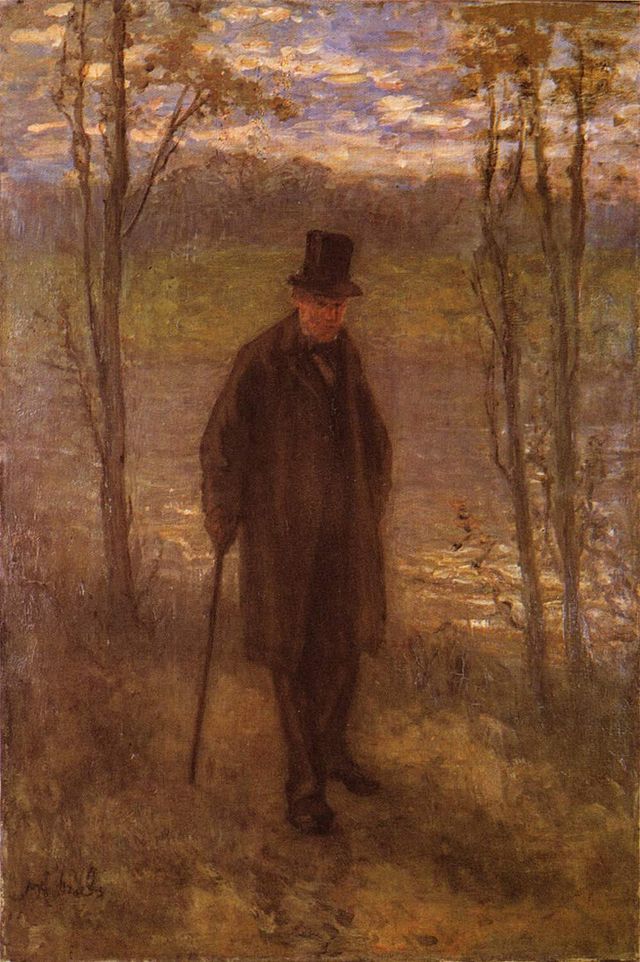


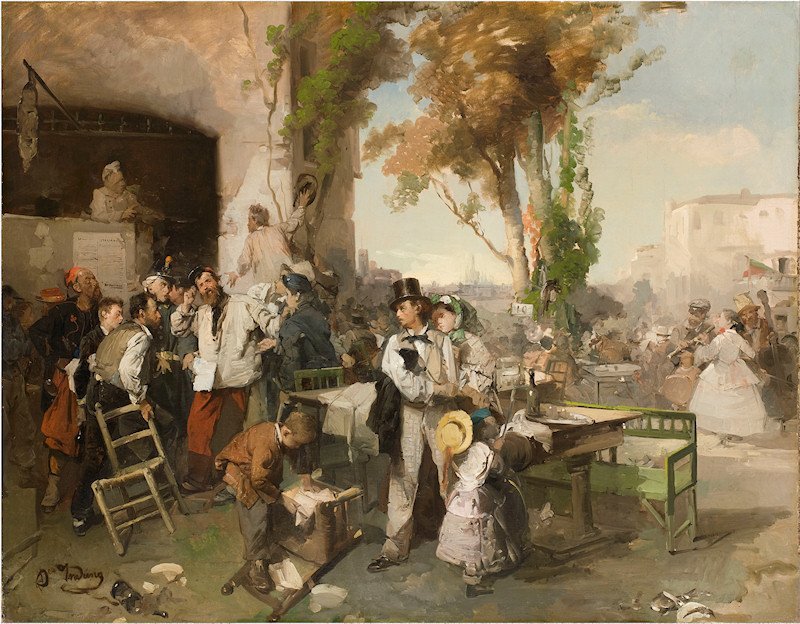
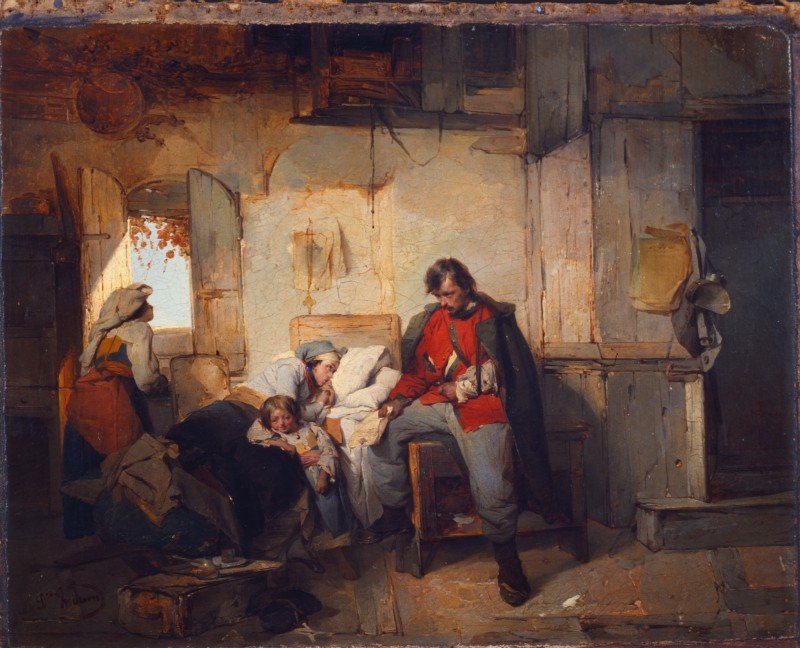


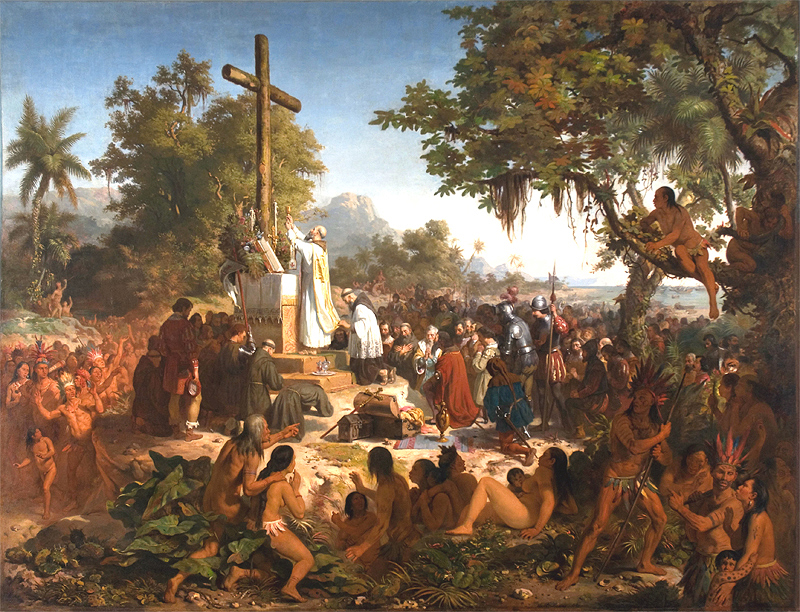
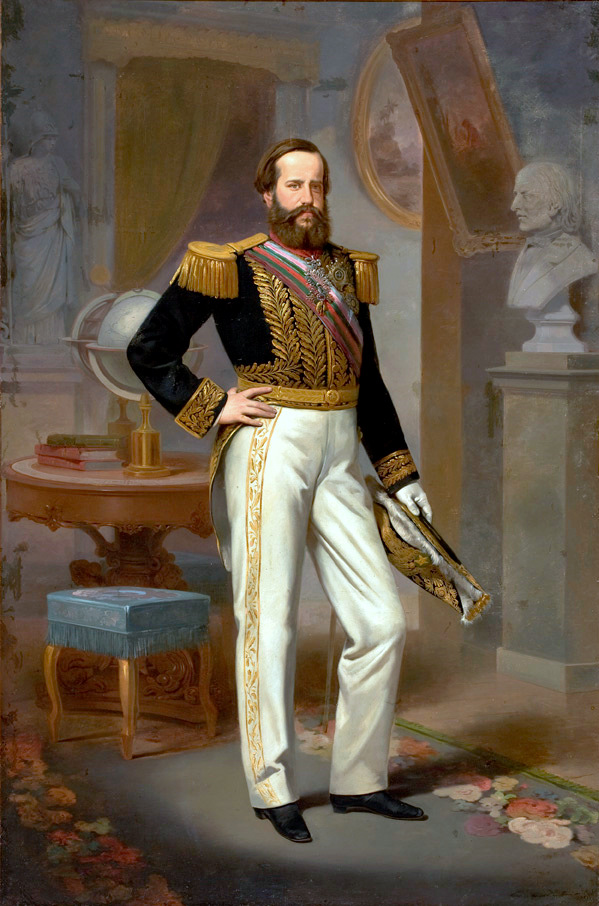
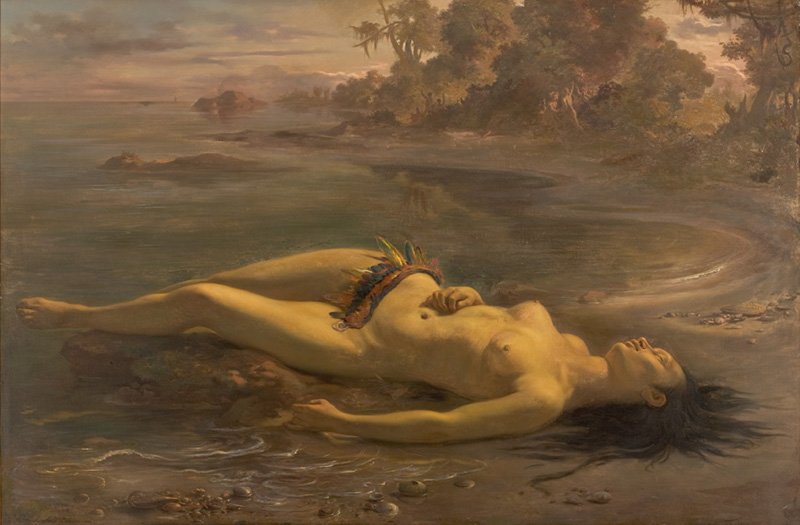
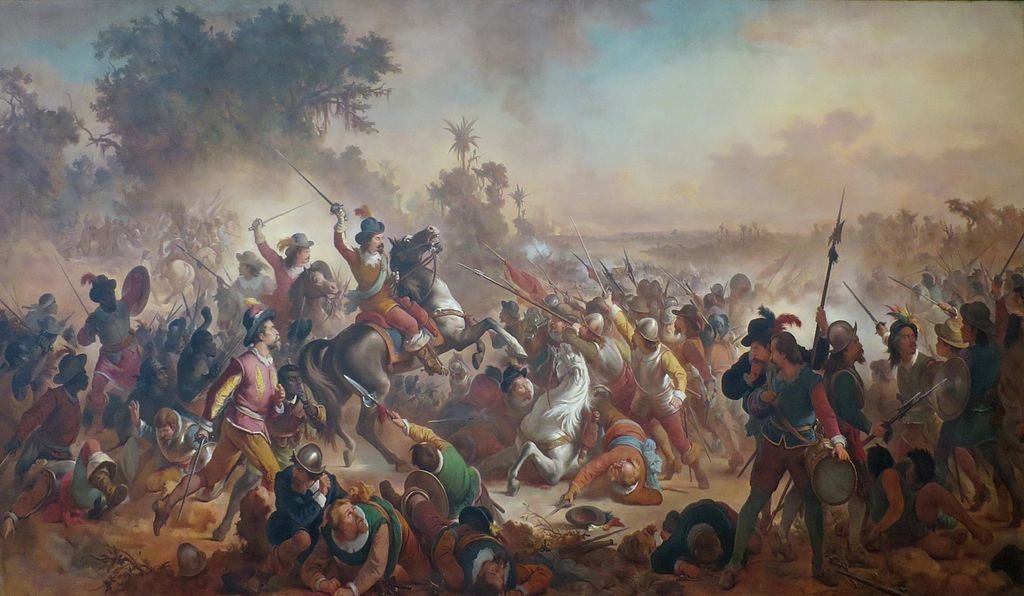

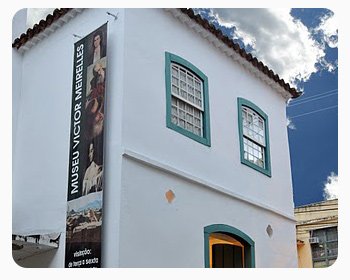

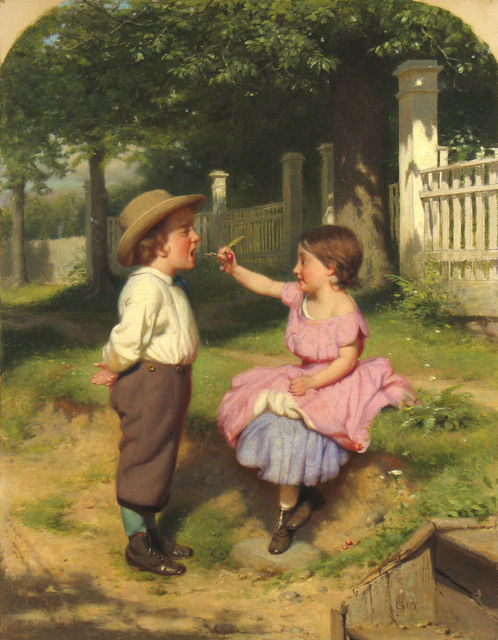
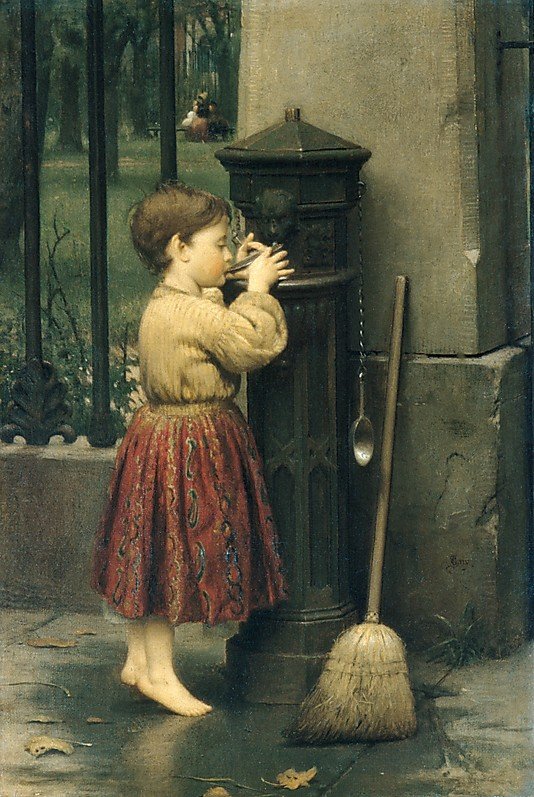
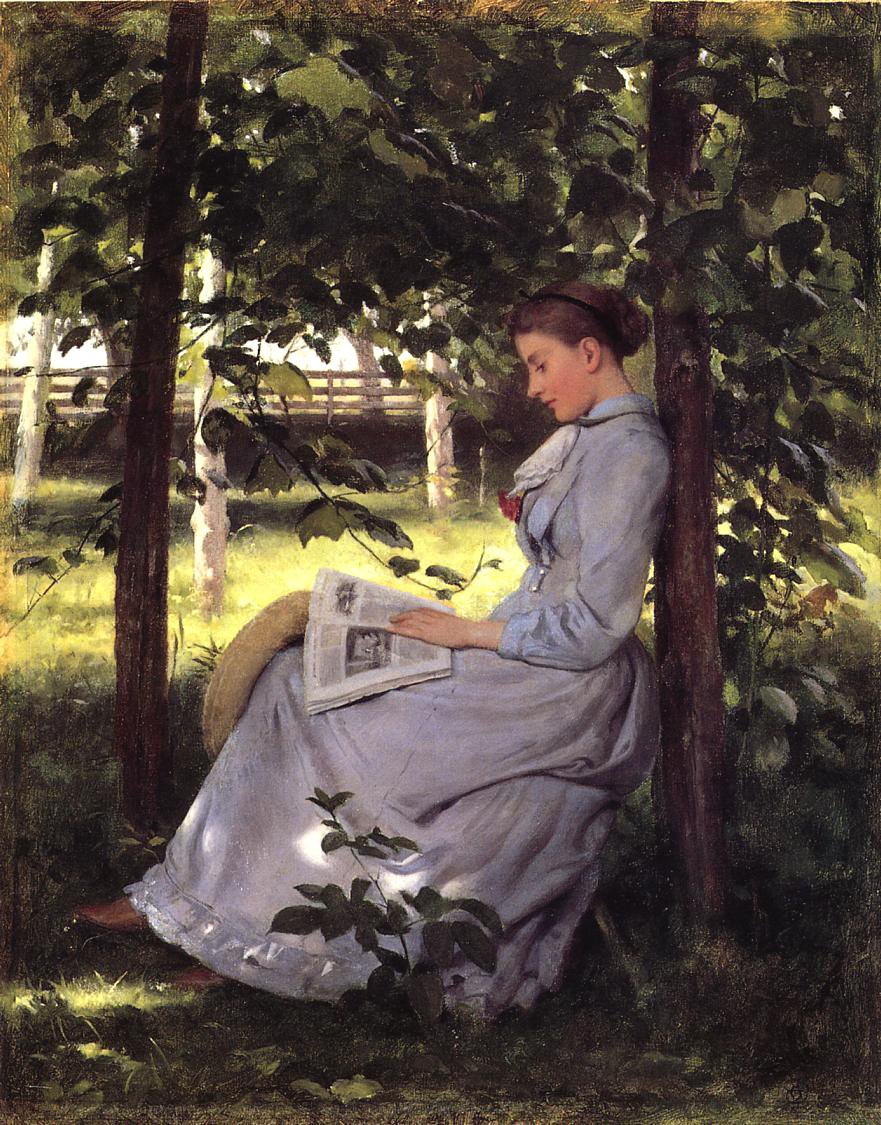


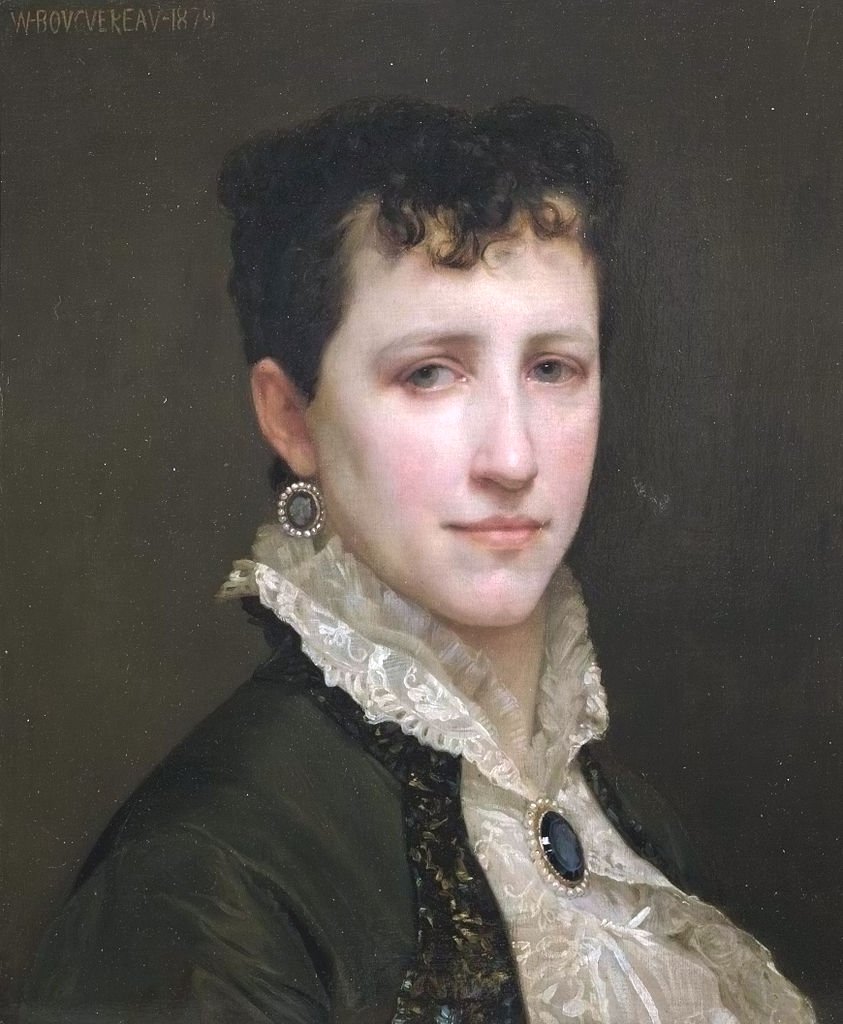

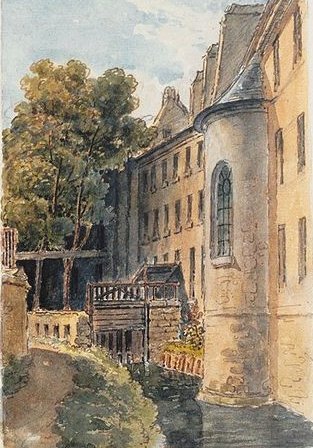
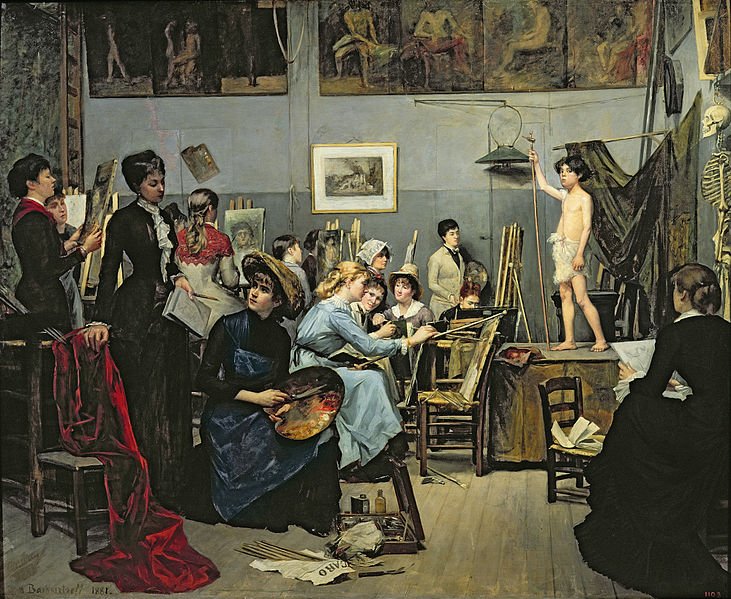
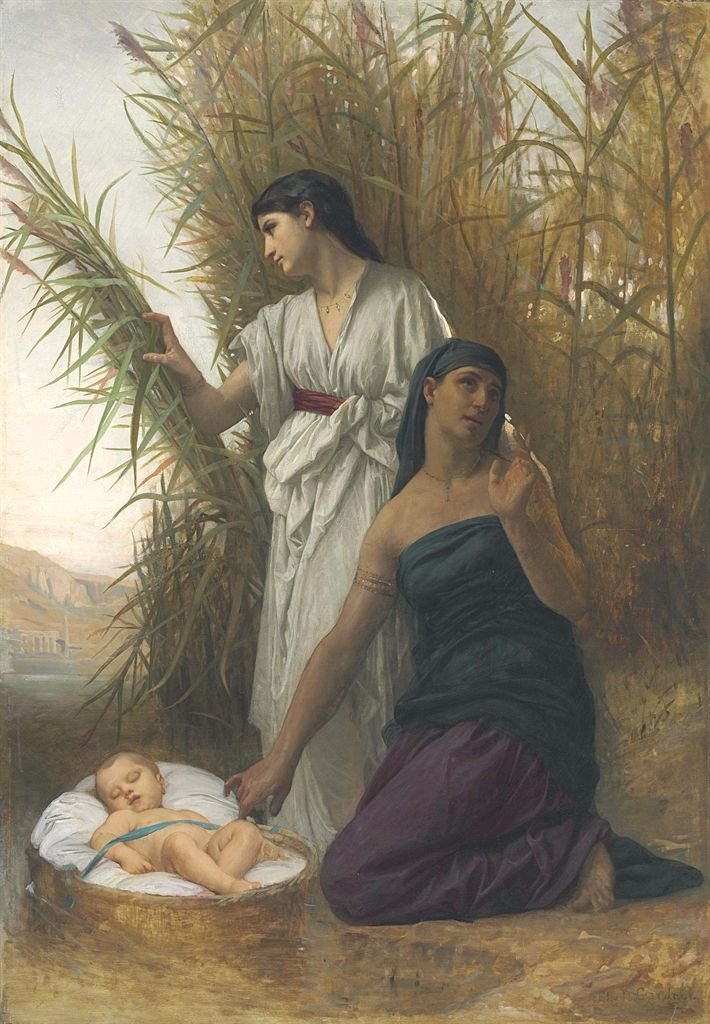
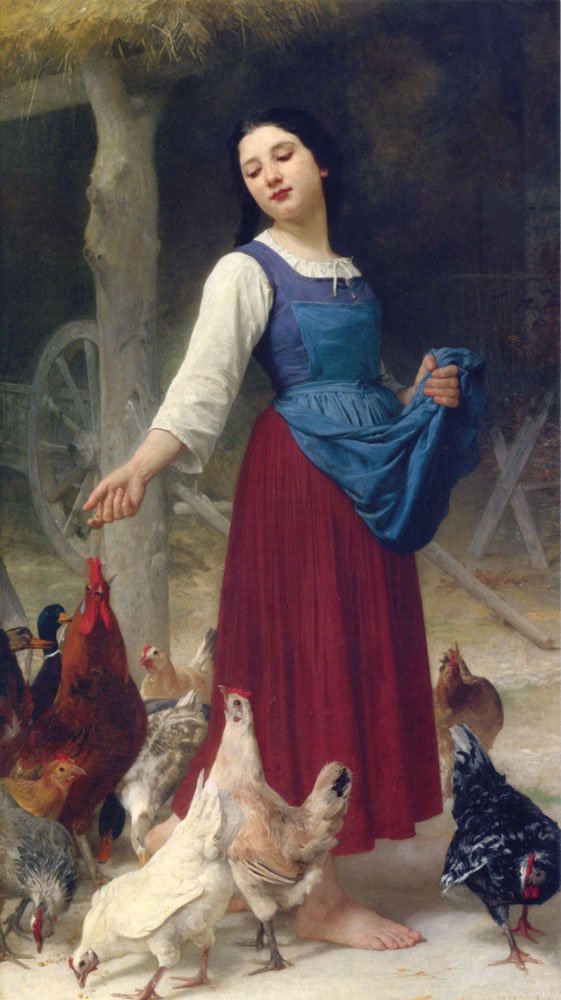
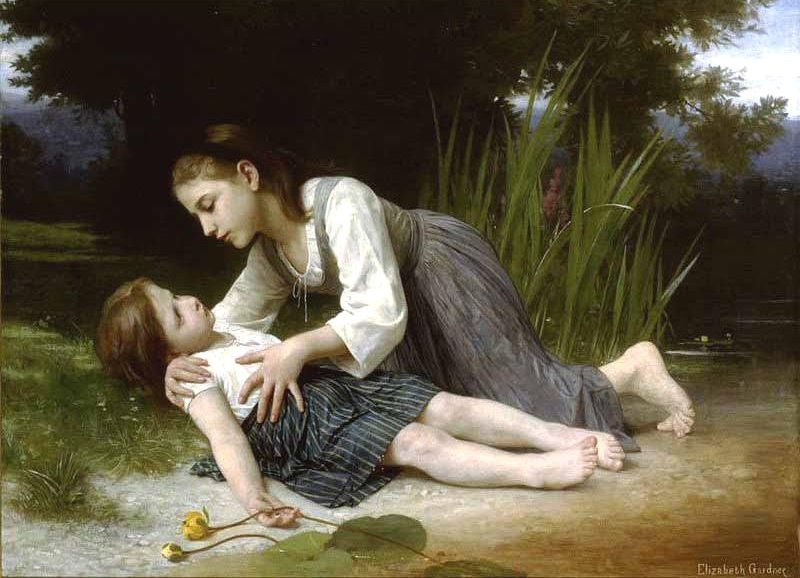


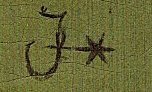


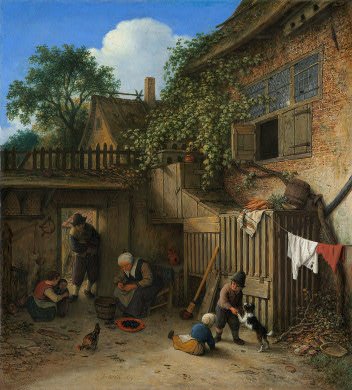
 my daily art display