Child with Doll by Henri Rousseau

Child with Doll by Henri Rousseau (1906)

I have to be very honest about my choice of painting for My Daily Art Display today.  I don’t like it.   I have looked at it for the last couple of hours as I write up some notes about it and it just has not won me over.   The painting, Child with Doll, is by the French artist, Henri Rousseau, which he completed in 1906 and can now be found in the Musée de l’Orangerie in Paris.    I have studied some of his other works, some of which I really liked but I have decided to stick with my original choice as maybe you will find it a pleasing work of art.

First, let me tell you a little about this French Post-Impressionist painter.  Henri Julien Félix Rousseau was born in Laval, a town in the Loire Valley in 1844.  His father Julien owned a number of tin-ware shops and the family lead a fairly prosperous lifestyle.   He went to the local elementary school at the age of five and all was well until 1851 when, due to some foolish speculation, his father lost his business and his home and was declared bankrupt.  In order that Henri could conclude his education uninterrupted he became a boarding pupil at his school.   Although he never gained academic greatness he won prizes for his drawings and his music.  In 1861, aged seventeen, he left school and joined his parents in Angers.   There he worked for a short time at a lawyer’s office.  However this came to an end when at the age of nineteen  he was accused of stealing 20 francs from his employer and to avoid legal retribution he ran away and took refuge in the army signing up for seven years.  However he did not escape the long arm of the law as in 1864 he was sent to gaol for one month, for his crime.

His father died in 1868 and Henri was released from his army service.  He returned to Paris and took up a government job so as to support his widowed mother.  In 1869, at the age of twenty-five he married his landlord’s fifteen year-old daughter, Clémence Boitard.  The couple had four children but sadly only one survived to adulthood.  In 1871 he was appointed a tax collector at the Paris Octroi, a government agency which collected taxes on goods being brought into the city.  It was not a very busy job and it is probably at this period in his life that he pursued his hobby, painting.  It was because of his official work that Rousseau received the nickname Douanier (tax collector) from his artist comrades.  It is thought that Rousseau did not become a serious artist until he was forty and was completely self-taught. 

Tragically his wife Clemence died in 1888 and this affected Rousseau badly.  Five years later Rousseau retired from the Paris Octroi and pursued his love of painting.   However, once he gave up his government employment, he relied on making money from his works of art and this just didn’t work out and soon he had financial troubles.  In 1889 he married for the second time.  His wife was Josephine Noury who sadly died after just four short years of marriage once again leaving the artist heartbroken. As the years passed his debts mounted and in 1907 he unwisely was duped into taking part in a bank fraud and was gaoled for his crime.  The sixty-three year old pleaded with the authorities to release him so that he could complete works of art for the upcoming exhibition of the Salon des Independents an annual event that he had been entering for many years.  He also told the court that unless he was freed from prison he would be unable to collect his pension and would forfeit it.  Rousseau seemed to have lost all sense of reality but with his artist friends, including Picasso, all giving glowing character references and admitting that Rousseau’s main crime was one of naiveté, the artist was released.

Henri Rousseau, Le Douanier, died in 1910 at the age of 66, from an infected leg wound.  A year later the Paris Salon organised an exhibition of his work.   Seven friends stood at his grave in the Cimetiere de Bagneux: the painters Paul Signac and Otiz de Zarate, Robert Delaunay and his wife Sonia Terk, the sculptor Brancusi, Rousseau’s landlord Armand Queval and Guillaume Apollinaire who wrote the epitaph Brancusi put on the tombstone.  It read:

We salute you Gentle Rousseau you can hear us.
Delaunay, his wife, Monsieur Queval and myself.
Let our luggage pass duty free through the gates of heaven.
We will bring you brushes paints and canvas.
That you may spend your sacred leisure in the
light and Truth of Painting.
As you once did my portrait facing the stars

And so we finally come to today’s painting Child with Doll which he painted when he was 62, four years before his death.  The child has obviously not been painted as she looks.  Rousseau has distorted the figure.  Her body is bloated.  Her face seems as if it has been compressed and her legs form a very awkward, if not a downright impossible posture.  It makes you wonder whether she is actually standing or maybe she was sitting and Rousseau had decided not to incorporate the chair into the painting.  This type of unusual pose was not altogether new to Rousseau’s paintings in fact it was almost his trademark.  The contrast in his colours in this painting is very stark.  Look how the red of the dress becomes much more noticeable against the cool blue of the background.  It is also interesting to note how he has given the girl’s dress a “spotted” pattern almost similar to the pattern of the flowers on the grass.  Each flower and each blade of grass has been lovingly painted.  The girl herself appears to have no neck as her head is pressed down into her body.  It doesn’t look like a young face. It is an almost round face which has more of an appearance of an adult although it does retain a child-like chubbiness.    She stares at us in a strange and disconcerting way.  However if we look at her hands they are child-like.  Her legs are strangely cut off by the tall grass.  It is believed that Rousseau had an aversion to painting feet.  She holds on tightly to her beloved doll which has turned a shade of grey, probably from constant handling.  It is a simplistic painting.  There is no need to look for interpretations or symbolism.  Rousseau was obsessed with the idea of  the “realism-genre”.    For me, with this painting, what you see is what you get and I didn’t get much but as beauty is in the eye of the beholder, I hope you enjoyed it.
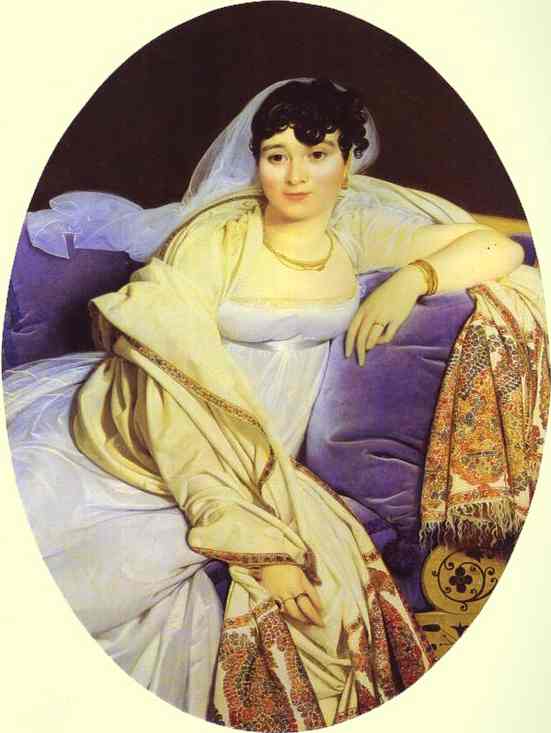
Mademoiselle Rivière by Ingres

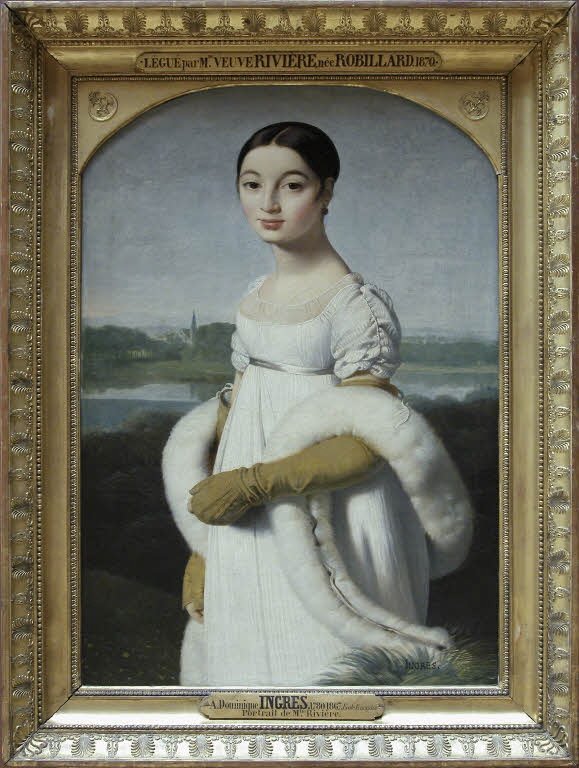
Mademoiselle Caroline Rivière by Ingres (1806)

My Daily Art Display today is a portrait of a fifteen year old French girl, Caroline Rivière, which was painted by French neo-classical artist Jean-Auguste-Dominique Ingres in 1806 and can be found hanging in the Louvre, Paris.  Regrettably the story attached to this painting of this youthful beauty has a sad ending, but more of that later.

Ingres was born in 1780, the son of a small time miniature-painter and sculptor, Josef Ingres, from whom he learnt the basics of art and music.  His formal academic life started at the Toulouse Academy of Art at the age of eleven and at the same time he kept up his musical training by taking violin lessons.   He went to Paris at the age of sixteen where he was a student of Antoine-Jean Gros at the studio of Jaques-Louis David.  In 1801 he won the Prix de Rome for his painting Ambassadors of Agamemnon.  The Prix de Rome was a scholarship, founded concurrently with the French Academy in Rome, that enabled prize-winning students at the Académie Royale de Peinture et de Sculpture in Paris to spend a period, usually 4 years, in Rome studying art, at the state’s expense.  Unfortunately for Ingres, because of the financial problems with the French economy, he was not awarded his trip to Rome until 1807.  It was during his stay in Paris from 1801 to 1807, before heading for Rome, that he completed his first portraits.  Some were of wealthy dignitaries such as the portrait,  Napoleon I on the Imperial Throne which hangs in the Musée de l’Armée, Paris  and some where of himself and his friends such as his  Self Portrait at the Age of 24, which is housed in the Musée Condé in Chantilly.                

Madame Rivière (1806)
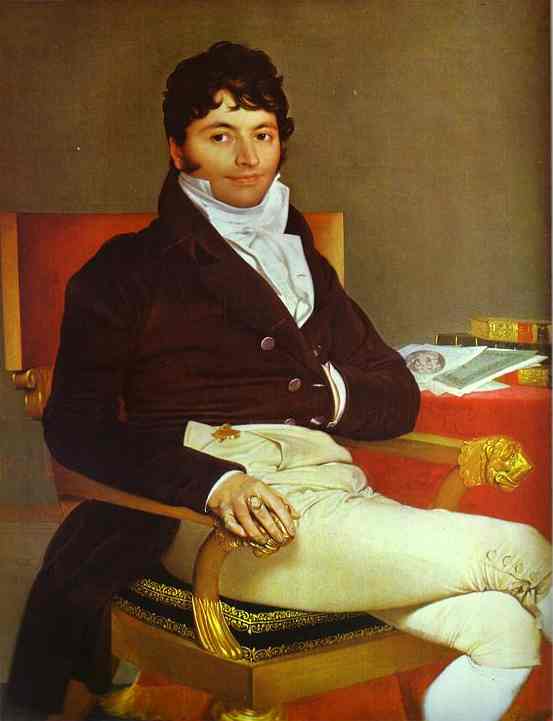
Monsieur Rivière (1806)

It was around this time that he was commissioned by a court official, Philibert Rivière, to commemorate himself, his wife, Marie-Francois and their fifthteen year old daughter Caroline.  Ingres at the time, had a passion for classical paintings with subjects based on history or Greek legends, but as he had to eke out a living, he painted portraits for clients and so accepted the commission.

 Ingres was fascinated by the young girl and was quoted as describing her as “ravishing”.   The portrait entitled Mademoiselle Rivière is My Daily Art Display for today.  It is a three-quarter length portrait.  Her young age is not immediately obvious to the viewer.  Look closer though and one can detect a childlike femininity.  She looks out at us in her virginal-white muslin dress with a large white ermine boa over her arms.  The bodice which was all the fashion at the time struggles to give an illusion of cleavage.  She appears to be quite self-conscious or maybe that is the expression she wanted to give to retain an air of respectability.  There is an overwhelming element of purity in Ingres’s depiction of her or is there?  This portrait is not completely devoid of sensuality. Look at the way Ingres has painted her full red lips, her bared neck and porcelain-like white skin which gives her slight and childlike body a sensuality of which she may not even have understood.  Her gloved arms give Caroline a hint of sophistication and she is at an age when she is neither child nor woman.  You could almost say she was the unfinished article.  

 However, it has to be remembered that her portrait was to hang next to those of her parents and therefore Ingres had to be careful on how he portrayed her.  She must come over as being an intelligent young lady of good breeding and most of all a credit to her parents who have lavished so much upon her.   This painting may be as much about her parents as it is of herself.  It may be a statement of the family wealth and the quality of life the three of them can afford to enjoy.

It was, along with the portraits of her father and mother, exhibited at the Paris Salon, the greatest annual art event in the Western world, in 1806.  The art world greeted this painting with mixed reviews; many disliked it for its “Gothicness” because of its linear precision and enamel-like finish.  It was also disapproved of because of its similarity to Early Netherlandish paintings and the French art critics of the time looked upon these painters from the Nertherlands as Les Primitifs Flamands.     Ingres’s also had many detractors who were critical of the painting saying that the proportions were not right.  They said that her head was too large, her neck was too long and curiously broad, her eyes were too far apart, which made her nose look flat and excessively long as it flows uninterrupted into her brow.  Although “puffed” botoxed lips are all the rage now, critics said that Ingres had made Caroline’s lower lip too fat which drew people’s attention to the lower part of her face which is petite in comparison to the span of her forehead.    The critics also deemed that there was a noticeable lack of definition to her shoulders. 

The background is secondary to the portrait itself and is a mainly bluish-white in colour featuring an Ile de France landscape with a distant town across the wide river.  There is freshness about the landscape and it must be presumed that Ingres wanted it to echo the fresh adolescence of his subject.

And so I return to the beginning when I said there was sadness to today’s painting.  Here we see in front of us a young girl, the daughter of a wealthy family, with everything to live for.  The sadness is that within a year of this painting being exhibited she was dead.

Landscape with Aeneas at Delos by Claude Lorrain

Landscape with Aeneas at Delos by Claude Lorrain (1672)

The featured artist in today’s My Daily Art Display is the French landscape painter of the Baroque era, Claude Lorrain.  The artist was born around 1604 in the town of Chamagne in the province of Lorraine, which at that time was an independent Duchy.  His actual name was Claude Gellée but was better known by the province in which he was born.  He was one of five children who came from a poor family and became an orphan when he was twelve years of age.  After the death of his parents he went to Freiburg to live with his elder brother Jean who was a woodcarver.

In his teens he travelled to Rome and Naples where he became an apprentice to the German Baroque landscape painter Goffredo Wals.  In his early twenties he moved to Rome and became a student of Agostino Tassi, the Italian landscape artist. Whilst in Rome he was commissioned by Cardinal Bentivoglio to produce two landscape paintings.  His works received great acclaim, which earned him patronage from Pope Urban VIII. Over the next ten years he became more and more successful and his fame as a landscape and seascape painter blossomed.  It was around this time that he became friends with the French artist Nicolas Poussin and together they would travel into the Italian countryside sketching the beautiful and breathtaking landscapes.

Claude Lorrain was, in the main, a landscape artist and he would often commission other artists to add figures into his paintings.  He often commented to his patrons that he was giving them an exquisite landscape and the figures in the painting were gratis !   Lorrain was concerned that some of his work may be copied and passed off as his and he wanted to ensure also he didn’t want to duplicate his work.  To circumvent these problems he decided to make tinted outline drawings of all his pictures he had sent to different countries.  He collated these in six paper books and on the back of each drawing he wrote the name of the purchaser.   These six volumes he named  Liber Veritatis (Book of Truth).  Many of his works were engraved and published and have always been popular with aspiring landscape artists.  Claude Lorrain although brought up in a poverty-stricken background, died a rich man in Rome in 1682.

Today’s painting, which was included in his Liber Veritatis and completed in 1672, is entitled Landscape with Aeneas at Delos.  During his last ten years, Lorrain painted six stories of Aeneas, the hero of Virgil’s epic poem Aeneid, which told of the legendary origins of Rome.   He was also very interested in Ovid’s  Metamorphoses  which also recounted the adventures of Aeneas.  In Book III, Ovid tells how Aeneas fled from the burning Troy:

“..  taking with him sacred images of the gods, his father Anchises (the bearded man in blue) and his son Ascanius (the child on the right) Aeneas (in short red cloak) set sail and reached with his friends the city of Apollo [Delos].   Anius [in white on the left], who ruled over men as king and served the sun god as his priest, received him in the temple and his home. He showed his city, the new-erected shrines and the two sacred trees [olive and palm] to which Latona had once clung when she gave birth to her children [Diana and Apollo]….”

This type of painting genre encompassing classical and biblical tales was very popular in the 17th century and often these stories were the motivational foundation for Grand History paintings.  Although the painting is based on a classical story, Lorrain’s emphasis is on the natural surroundings and the panoramic view of the seaport.  Even though the story plays a fundamental part in the work of art, the figures, as far as Lorrain was concerned were of less importance.  We look down on this setting.  We see a woman and child crossing a bridge over a stream.  Sheep graze unhindered under the shade of two tall trees.   Further into the picture we see a semi-enclosed harbour with its many boats.  In the far distance we can just make out the distant hills.  There is much to see in the painting and it is an invitation from Lorrain for us to take in all that is going on.  It is a very airy scene and is enhanced by the cool blueness of the sky with the puffy white clouds which almost fills the upper half of the painting.  There is a definite contrast in the colours Lorrain used in this painting.  By using light whites and blues in the background and darker browns and greens in the foreground the artist has created an impression of spatial depth.  There is also a sense of stability in this painting.  The vertical elongation brought on by the tall trees and the columns of the building is balanced by the horizontal lines of the land and sea

Do you like the painting?  The great English landscape artist John Constable was very impressed with the artist and of Lorrain and his landscape paintings, he commented:

” …he is the most perfect landscape painter the world ever saw”, and declared that in Claude’s landscape “all is lovely – all amiable – all is amenity and repose; the calm sunshine of the heart…”

The Marquise de Seignelay and Two of her Children by Pierre Mignard

The Marquise de Seignelay and Two of her Children by Pierre Mignard (1691)

Pierre and Nicolas Mignard were brothers and as aspiring artists.  Both studied under the French painter Simon Vouet in his Paris atelier.  Today, I am looking at the work of the younger brother Pierre who was born in Troyes in 1612.  He remained a pupil of Vouet until 1630 at which time he travelled to Italy and remained there for twenty-two years, residing, in the main,  in Rome although he did visit Venice and some of the northern Italian towns.  For this reason he was known as Mignard le Romain differentiating him from his older brother Nicolas, who was known as Mignard of Avignon.  Whilst there he built up his reputation as an artist and his fame spread.  Many of his works were exhibited in Rome.   In 1655 he married Anna Avolara, the beautiful daughter of an architect who subsequently posed for his Madonnas.  In 1658 he returned to France at the behest of Louis XIV who had inaugurated a system that relied upon the glory of arts for the exaltation of the monarchy and it was thought that Mignard could help with this royal scheme.

Mignard, now back in Paris, set about completing portraits of Louis and his family.  He was awarded the commission to decorate the Hôtel d’Eperon and the cupola of the Val-de-Grâce, the latter, said to be the largest frescoed surface in the world, comprising of two hundred colossal figures, representing Paradise.  However Mignard spent most of his time painting portraits and among his sitters were Molière and Descartes.   In 1690 his great rival Charles le Brun, the French painter and art theorist died and Mignard, at the age of eighty, succeeded to all his offices, and was solemnly received into the Academy, and in one session elected to all its degrees, including that of president.   The French Secretary of War, the Marquis de Louvers consulted him on the project of decorating the cupola of the Invalides.  The veteran painter saw an opportunity of crowning his career with an exceptional performance, but Louvois died, the work was delayed, and the artist lost all hope of realizing his last dream.   Mignard died, it may almost be said, with his brushes in his hand, at the age of eighty-two.   His last work is a picture in which he himself appears as “St. Luke painting the Blessed Virgin“.

My Daily Art Display today is Pierre Mignard’s oil on canvas portrait of Catherine-Thérèse de Matignon, the widow of statesman Jean-Baptiste Colbert de Seignelay and her two sons entitled The Marquise de Seignelay and Two of her Children, which he completed in 1691at the age of 79 and can be found in London’s National Gallery.

Catherine-Thérèse had been widowed a year when Mignard was commissioned to paint her portrait.  Her late husband had been head of the French Admiralty and this could have been  the reason for the aquatic mythology of this painting.  Mignard had little to do with the setting of the painting.  Catherine-Thérèse, the bereaving widow, instructed Mignard on how the painting should be and how she and her sons should be portrayed.  Neil McGregor the art history offers another theory about the aquatic nature of the portrait saying that it has little to do with her late husband’s employment but that she wanted to be depicted as the sea-nymph Thetis.   

The Marquise de Seignelay, of old Norman nobility,  had something else in common with sea-nymph Thetis, as she,  like the Greek goddess, was married off against her will to a “social inferior” as her husband was the son of a lowly draper.  Thesis was married off to the mortal Peleus against her wishes and he had to rape her to “beget” on her the great Achilles.   The story of Thetis tells how she descended into the crater of the volcano, Etna, which can be seen in the background of the painting, to obtain the armour made by the blacksmith and God of fire, Vulcan.   Catherine-Thérèse’s eldest son, the eight year old Marie-Jean-Baptiste de Seignelay, who stands on the right of the painting can be seen wearing this armour.  This was also close to the time that his mother had bought a military commission for her son.   Like Thetis and her beloved son Achilles, maybe this portrait is an affirmation that Catherine-Thérèse would go to any length to protect and help her son succeed.   We may also interpret this portrait as her wish to have it known that she was the power behind the throne (the marriage) and now that her husband was dead her loyalty and support would be transferred to her eldest son.  Was she thinking about the passage in Ovid’s Metamorphoses which said of Thetis:

“..O goddess of the waves, conceive: thou shalt be the mother of a youth who, when to manhood grown, shall outdo his father’s deeds and shall be called greater than he..”

On the left of the painting we have a small cupid offering the woman a valuable nautilus shell on a gold stem, which is overflowing with jewels and pearls.  It is thought that the cupid could be Catherine-Thérèse’s one-year old infant Théodore-Alexandre.  There is a quirkiness about this flamboyant portrait which spurns the dull reality of everyday life and supplants it with a dream-like fantasy.  The Marquise de Seignelay dominates the painting.  She stands looking directly at us.  She is adorned in an ultra-marine cloak and gold chemise.  It should be noted that the pigment ultramarine at the time was very expensive, more so than gold and for this reason it was seldom used in paintings and certainly not in such quantities.  The fact that it has been used in this portrait may be to confound rumours that the noble widow, Catherine-Thérèse, was almost bankrupt.  This combination of colours lends a sense of divinity to her figure.  She is clutching a locket on a string of pearls.  Her hair is decorated with pearls, seaweed and red coral, which contrast vividly with the colour of her cloak and which almost look like tiara fit for a monarch.  The painting has immediately transported her from the misery of widowhood in Paris to that of a mythical goddess in southern Italy.

A half century later, William Hogarth the English painter, who had an aversion for all things French said on being arrested as a suspected spy in Calais, said the French displayed:

“…….. their insolence with an affectation of politeness….”

Maybe Hogarth’s thought could be levelled at the Roman-trained Mignard’s depiction of a mother and her two sons but one should remember it was the widow dictated what she wanted the artist to portray.

Rinaldo and Armida by Nicolas Poussin

Rinaldo and Armida by Nicolas Poussin (1625)

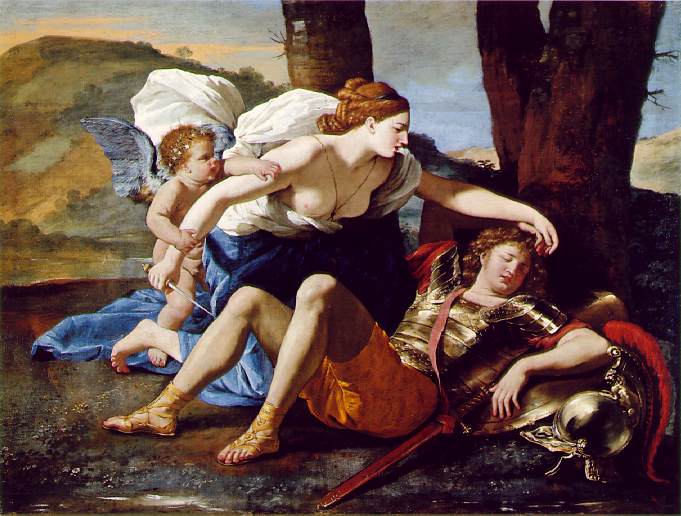
Looking at today’s painting I can see, stretched out on the ground, at the foot of a tree a soldier asleep.  His right arm is behind his head cushioning it against the hard ground.  His left arm rests across his shield and his thumb is just in contact with his unsheathed sword.  His helmet with the curved red feather lies on the ground nearby.  A woman kneeling by his side, leans over him, her left arm almost resting on his arm.  Look at the expression on her face.  It is a look of love and devotion.   There is gentleness to her demeanor.  She gives the impression that she does not want to disturb his sleep.  She just wants to gaze lovingly at him as he rests.   It is a very tender scene.

Or is it ??

Cupid restraining Armida

Look more closely.  Look at her right hand which is holding a dagger.  Now we begin to doubt the tenderness of this scene.  Her arm which holds her dagger is being feverishly dragged back by a small winged child who we believe to be Cupid, and who is the embodiment of love.  He is desperately trying to prevent the young woman from killing the soldier.   Look at the way Poussin has depicted the concentration in Cupid’s face as he struggles to control the woman and prevent her thrusting her dagger into the body of the sleeping man.

So what is it all about ?   Is it a scene of love or vengeance ?  Well, actually it is both.  Nicolas Poussin based his painting on the epic poem written by Torquato Tasso in 1580, entitled La Gerusalemme liberata (Jerusalem delivered).  The subject matter of this poem is the conflict between the Christian and Muslim forces and the siege of Jerusalem and within the main story he tells the story of Rinaldo, a Christian Crusader and Armida, a Saracen sorceress.  It is a poem which has inspired many operas from the likes of Handel, Gluck, Haydn, Rossini and Dvorak to name but a few.   It has motivated artists like Anthony van Dyke, Francois Boucher, Giovanni Tiepolo and Francesco Hayez to base their paintings on elements of this tale.

My featured artist today is the French Classical painter, Nicolas Poussin, and today’s painting is entitled simply Rinaldo and Armida which he painted in 1625 and hangs in the Dulwich Gallery, Lomdon.    Poussin painted a number of pictures illustrating the liaison between Rinaldo and Armida.  In the Pushkin Museum, Moscow, there is a painting featuring the two protaganists.  In this one , painted slightly later than the Dulwich picture, Armida has dropped her dagger and is about to lift Rinaldo up and carry him off with her to her island. A third picture, in the Gemäldegalerie, Berlin, represents the actual carrying off of Rinaldo by Armida and was painted by Poussin in 1637 for his friend and fellow artist, Jacques Stella.  The fourth picture, entitled The Companions of Rinaldo, can be found in New York’s Metropolitan Museum.

The painting is based on the story which which tells a largely fictionalized version of the First Crusade in which Christian knights battle Muslims in order to take Jerusalem. This scene involving Rinaldo and Armida is about hate turned into love. The subjects here are Rinaldo, a captain of the Christian army and the sorceress Armida who sides with the Muslims. To dissuade the armies Armida woos the men with her charms and turns them against each other, thus weakening the troop. Those who followed her were all turned into animals.  On seeing Rinaldo, Armida fell in love with him and kidnapped him. In her Garden of Pleasure and secret Palace she put him under a spell and he grew idle and became infatuated with the sorceress.

The translated verse below from Torquato Tasso’s La Gerusalemme liberata encapsulates what is happening in Poussin’s painting.

Now from the ambush the false sorceress flies,

And looms above him vengeance in her eyes.

But when she fixed those eyes on him to see

His calm face as he drew breath, soft and light,

His eyes that seemed to smile so charmingly,

 Though closed (if they now opened, what delight!)

She halts, transfixed and next him presently

Sits down to gaze, feeling her rage and spite

Stilled as she hangs above him, marvelling

As once Narcissus hung above her spring

Thus (who would credit it?) the slumbering heat

Hid in his eyes melted the ice that made

Her heart harder than adamant, and lo!

She was turned lover who was once his foe.

Napoleon Visiting the Plague-Stricken at Jaffa by Antoine-Jean Gros

Napoleon Visiting the Plague-Stricken at Jaffa by Antoine-Jean Gros (1804)

Baron Antoine-Jean Gros, also known as Jean-Antoine Gros was born in Paris in 1771.  His early artistic tuition, from the age of six, was carried out by his father and mother, who were both painters of miniatures.  He soon proved himself to be a talented student and at the age of fourteen he went to work at the studio of the French Neoclassical painter, Jaques-Louis David, and at the same time carried on his art studies at the Collège des Quatre-Nations, also known as Collège Mazarin, after its founder Cardinal Mazarin.  Gros admired David’s work and their artistic relationship blossomed and developed and Gros became one of David’s favourite pupils.  Gros, after time, moved away from the strict purity of neo-classicism and developed a love for the more colourful works of Rubens and the great Venetian Masters.

In 1791 his father died and Jean-Antoine was left to his own resources.  In 1792, despite failing to win an award at the grand prix, he was recommended by the École des Beaux Arts to carry out some portraiture of members of the National Convention, the constitutional and legislative assembly, which at that time, ruled France. He became disillusioned with the way the country was being governed and a year later, in 1793, at the age of twenty two, left Paris and travelled to Italy.  He lived first in Genoa where he eked out a living by painting and selling miniatures.  It was whilst living in Genoa that he met Joséphine de Beauharnais, the wife of Napoleon Bonaparte, and through her met the great French leader himself.

In 1796, Gros was with Napoleon’s army when the French managed to outflank the Austrian troops at the Battle of Arcole and he witnessed Bonaparte planting his beloved French tricolour on the bridge they had just captured.  He encapsulated this incident on canvas, entitled Bonaparte at the pont d’Acole.  Bonaparte was ecstatic at the way Gros had portrayed him at the scene of this great victory and immediately made him inspecteur aux revues, which permitted Gros to follow the army of Bonaparte and pictorially display future victories and, at the same time, select the artistic spoils of war which merited being taken back to the Louvre.  His battlefield paintings were well received by Bonaparte.    They were painted skilfully and with great flamboyance and style even if his portrayals strayed occasionally from the actual happenings.  That notwithstanding, his art work was truly exceptional and he became one of the most honoured and respected French painters of that time.  His work was sort out by the great and the good of the time and besides Bonaparte he carried out commissions for great rulers such as Louis XVIII and Charles X.

After the defeat and exile of Napoleon the Bourbons Dynasty in the guise of Louis XVIII returned to rule France.  Amongst the list of proscribed former revolutionaries who deposed Louis XVII during the French Revolution and who were to be executed was the artist Jaques-Louis David.  For that reason David decided to flee France and go to Belgium.  He refused to return to his homeland even though Louis XVIII offered him a full pardon.  Jean-Antoine Gros took over David’s studio and endeavoured to work in a more Neoclassical style but his later work was never to receive the acclaim his Napoleonic paintings achieved.

In 1835 Jean-Antoine Gros committed suicide, his body being found on the shores of the River Seine.  A suicide note was found on his body, saying that “tired of life, and betrayed by last faculties which rendered it bearable, he resolved to end it”

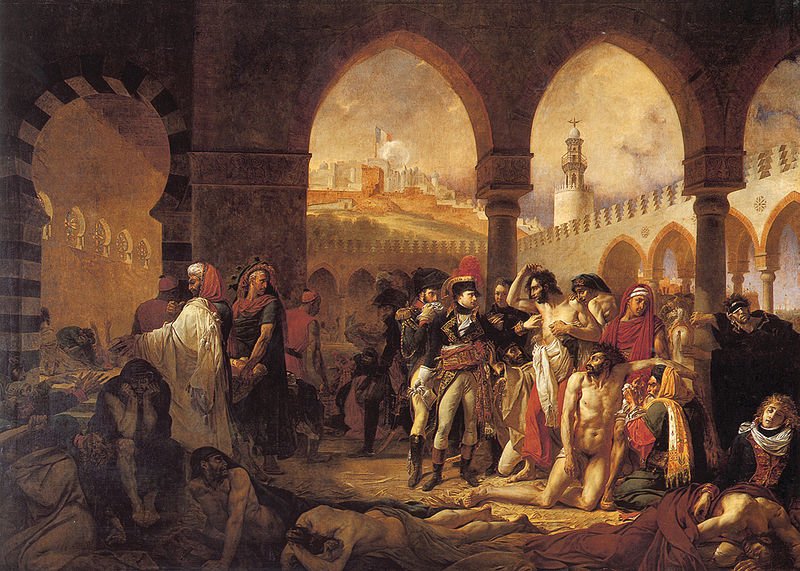
My Daily Art Display today is Jean-Antoine’s painting entitled Napoleon Visiting the Plague-Stricken at Jaffa which he completed in 1804 and can now be found in the Louvre.  The painting was commissioned by Napoleon Bonaparte himself, who wanted Gros to paint a picture,  pictorially recounting his visit to his sick troops at the military hospital, which had been temporarily set up in the courtyard of a mosque in Jaffa (now part of Tel Aviv, Israel).  Napoleon’s bloody battle and the subsequent sack of the town of Jaffa occurred in 1799.  Unfortunately for the victorious French army, their victory was closely followed by an outbreak of the bubonic plague, which was to kill far more French soldiers than died in the actual battle.

In the background one can see the breached walls of Jaffa and an over-sized French tricolour fluttering in the wind.   A pall of smoke from fires covers the whole area.   In the left middle ground we see an Arab man handing out bread to the sick whilst his servant waits behind him holding the bread basket.  Behind them we see two large black men carrying off, what is probably a dead body on a stretcher.  In front of Napoleon is a semi naked sick man being tended by an Arab physician.  To the far right we can see a blind man grappling with the pillar as he tries to gain an audience with Bonaparte.  Across the foreground we see bodies of the dying men prostrate on the ground.

Napoleon touching the sick

In the painting, Bonaparte was to be shown as a fearless man with no concern for his own health.  Gros’s painting depicts Bonaparte as he confronted the pestilence during his visit to his men who had contracted the plague.  Historians argue about the reasoning behind Bonaparte’s visit.  Was he there to decide whether to abandon his dying troops in this hell-hole in Jaffa, as some historians would have us believe he discussed with his medical team the mercy-killing of his sick men or was his reason more noble and he was simply there to boost the morale of his sick men?  Whatever the reason was for Napoleon’s to visit his troops, Gros managed to portray Napoleon in this painting as a brave and selfless man.  Look carefully at the painting and see how Napoleon is depicted bravely touching the plague sore on one of his men (is this not similar to the biblical story of Jesus touching the leper?)    Standing behind Bonaparte is one of his officers covering his mouth for fear of infection.  Gros knew how to show Napoleon in a positive light and this contrast between Napoleon and his officer brought home to observers the courage of their leader.   It was for the way Gros was able to manipulate a situation so as to show Bonaparte in the best light that Bonaparte favoured him over all his artistic contemporaries.  This painting, the first Napoleonic masterpiece, was shown at the 1804 Salon de Paris around the time of Napoleon’s proclamation as emperor and his coronation and it received great acclaim and launched Gros’s career.

Gericault and Delacroix were Gros’s greatest admirers and Delacroix said of Gros:

“….Pictures by Gros have this power of projecting me into that spiritual state which I consider to be the strongest emotion that the art of painting can inspire…”

The Gleaners by Jean-François Millet

The Gleaners by Jean-François Millet (1857)

My Daily Art Display for today starts off with a general knowledge question for you.  What or who  is a gleaner?  The reason I ask is because that is the title of today’s painting by Jean-François Millet.  Don’t know?  I must be honest I thought by looking at the picture a gleaner was somebody who cut the corn crops but actually that is not the case.  A gleaner is a person who collects left-over crops from farmer’s field after they have been harvested.  It was traditionally part of the natural cycle of the agricultural calendar undertaken by the poor, and was regarded as a right to unwanted leftovers. Although the practice of agricultural gleaning has gradually died away due to a number of historical factors (including industrialisation and the organisation of social welfare for the poor), there are nonetheless still people in the present day that we might understand to be gleaners.  Can you imagine what a back-breaking task this was for the poor and needy ?  Actually modern day gleaning is practiced by humanitarian groups who collect food from supermarkets that would otherwise be thrown away, and distribute the gleaned food to the poor and hungry.

The painting of peasant life which was one of Millet’s favourite  subjects was first shown in 1857 but the art critics gave it a very mixed reception.   The setting was the village of Barbizon on the edge of the Fontainebleau Forest on the outskirts of Paris, which attracted many en plein-air Impressionist painters of that time.  Many observers were a trifle uncomfortable with the subject, that of the very poor having to carry out such an arduous task.   The subject of works of art in those times was often dominated by the depiction of the rich in all their finery and many considered the depiction of poor country women in their ragged clothes grotesque and believed such representations should not be gracing galleries.  The difference in the social standing between the women and a landowner is highlighted by the large stacks of wheat which has been harvested and will earn the owner lots of money in comparison to the scavenging women who just want food to live.   The distaste of the subject is brought home by Griselda Pollock in her book Millet,saying,  that at the time, the French author and art critic Paul de Saint Victor commented:

“…His three gleaners have gigantic pretensions; they pose as the Three Fates of Poverty … their ugliness and their grossness unrelieved…”

If we look back in the Old Testament Bible we come across the tale of Ruth who was a gleaner but in the bible she is the personification of virtue and modesty but Millet’s gleaners are simply shown as women who, because of their desperate circumstances, are forced to act as gleaners to survive the hardships of life.

Millet’s three women are show in the field, presumably having been given permission by the landowner, scavenging for “forgotten” ears of corn which the harvesters had failed to collect.   We see them in the foreground, bent over double, scouring the ground before them for the elusive grains.  Each woman is shown at various stages of their task.  The woman furthest away is bending down to pick up the grain, the middle woman is picking up the grain and the nearest woman has just straightened up. 

The lone horse rider to the right, in the background, is probably the landowner’s overseer, who makes sure the harvesting operation runs smoothly and that the female gleaners only take what they are entitled to.  He has distanced himself from the workers, which reminds us of the social distinction between management and worker.  Millet, through the way he has depicted the scene has represented the class structure of a farming community.  His three women embody an animal force deeply absorbed by a painstaking task. The contrast between wealth and poverty, power and helplessness, male and female spheres is forcefully rendered by the artist.

The angled light from the sun illuminates the large haystacks and in some ways gives the three gleaners a kind of statuesque appearance highlighting their hands, shoulders and backs whilst enhancing the colours of their clothes and caps.

The Gleaners is an example of the Naturalism genre of painting.   Naturalism is the representation of the world with a minimum of abstraction or stylistic distortion.  It is characterised by convincing effects of light and surface texture and by the evocation of feelings and moods.  It is an approach to art in which the artist tries to represent objects as they are actually observed rather than in a conceptual format.

Have you a favourite painting you would like me to add to My Daily Art Display?   If so let me know what it is and why you like it.

Leaving for the Island of Cythera by Antoine Watteau

Pilgrimage to the Island of Cythera by Antoine Watteau (1717) Louvre

 After yesterdays disturbing painting I thought I would choose a more romantic offering for My Daily Art Display today.   Antoine Watteau, born in Valenciennes in 1684, was the greatest French painter of his era. He was the second son of a well-to-do roof tiler and unlike the early life of so many artists I have studied, his parents encouraged his love of painting but at the age of 18, his family stopped paying for his artistic apprenticeship in his home town and he was allowed to move to Paris to further his artistic schooling and earn a living.  He soon found work with local art dealers copying famous paintings.

Whilst in Paris he met the stage-set and costume designer Claude Gillot who based his art work  on themes from the Italian Commedia dell’arte,  a form of theatre that began in Italy in the mid-16th century characterized by masked “types”, the advent of the actress and improvised performances based on sketches or scenarios.  This type of theatre had been banned in France at the end of the seventeenth century when they had ridiculed King Louis XIV’s wife in a parody.  On the king’s death in 1715, this kind of theatre came back into fashion.

At the age of twenty five he won second place in the Royal Academy competition for the Prix de Rome.  Around this time Watteau concentrated a lot of his art depicting military subjects and landscapes.  In 1712, with his presentation piece, Les Jaloux (The Jealous), he became an associate member of the Academy.  Watteau formed a friendship with the wealthy banker and art collector Pierre Crozat whom he stayed with, in his country estate in Montmorency.  It was here that Watteau saw the banker’s magnificent collection of art works from some of the great Masters such as Titian and Veronese and the fêtes galantes themes of some of the paintings were to be an inspiration to the young Watteau.   Fêtes galantes is a French term referring to some of the celebrated pursuits of the idle, rich aristocrats in the 18th century—from 1715 until the 1770s. After the death of Louis XIV in 1715, the aristocrats of the French court abandoned the grandeur of Versailles for the more intimate townhouses of Paris where, elegantly attired, they could play and flirt and put on scenes from the Italian commedia dell’arte. The term translates from French literally as “gallant party”.  Watteau painted Musical Party which could well have been a depiction of his banker friend Crozat and his entourage enjoying themselves in the park at Montmorency.  In 1717 at the age of thirty-three Watteau became a full member of the Academy with his diploma piece Pilgrimage leaving for the Island of Cythera, which is My Daily Art Display offering for today.  The board of the Academy found it difficult to categorise the style of his painting and officially termed it as a fête galante and Watteau as a painter of fête galantes, which was to become an important new painting genre.  This painting, an allegory of courtship and falling in love, now hangs in the Louvre. 

The Charlottenburg version of Watteau's painting (1721)

A later variant of it ican be found n Friedrich II’s collection at Schloss Charlottenburg, Berlin.  In this latter painting, Watteau has added the masts of the boat and a statue of the goddess of Venus in the right foreground.

Cythera, now known as Kithira, is a mountainous island off the Peloponnesus and was said to be the birthplace of Aphrodite, the Greek goddess of love, who was also known as Cytherea (Lady of Cythera)  and is the location of her cult and shrine.  People who made a pilgrimage to the “island of love” did so filled with eager anticipation.   Watteau’s island is an island of love and his brightly coloured landscape add to the enchantment of the scene.  Cupids can be seen flying over the boat.

In the painting the scene is set in which lovers are shown on a luscious and densely vegetated island.  It is a dreamy vision.  Couples are dressed in their silken finery, which we can almost hear rustling as they move about.

The three couples

One couple is seated and seems to be unaware of their friend’s departure, completely engrossed in what was probably a flirtatious conversation. If we look at the couple in the middle we can see that the gentleman is helping the lady to stand whilst the man from the couple on the left has his arm around his lover’s waist urging her forward as she looks back at her friends, maybe encouraging them to hasten.  

There is some debate amongst art historians as to whether the title of the painting has the word “for” in it.  In other words are the people we see in the pictures “leaving for Cythera” or “leaving Cythera”.  The majority favour their leaving of the island of love.  The answer must lie in the people depicted in the painting and their expressions.  Are they full of joyful anticipation at heading for the island or somewhat despondent at leaving this paradise of love and happiness?   

The question still remains, so I will leave you to look and see what you think.

Auguste Rodin said of the painting in the Louvre:

“…What you first notice at the front of the picture is a group composed of a young maiden and her admirer. The man is wearing a cape embroidered with a pierced heart, a gracious symbol of the voyage that he wishes to embark upon. Her indifference to his entreaties is perhaps feigned. The pilgrim’s staff and the breviary of love are still lying on the ground.  To the left of this group is another couple. The maiden is accepting the hand of her lover, who is helping her to stand.  A little further is the third scene. The lover puts his arm around his beloved’s waist to encourage her to accompany him.   Now the lovers are going down to the shore, laughing as they head towards the ship; the men no longer need to beseech the maidens, who cling to their arms. Finally the pilgrims help their beloved on board the little ship, which is decked with blossom and fluttering pennons of red silk as it gently rocks like a golden dream upon the waves. The oarsmen are leaning on their oars, ready to row away. And already, little cupids, borne by zephyrs, fly overhead to guide the travellers towards the azure isle which lies on the horizon…”

A Roman Slave Market by Jean-Léon Gérôme

A Roman Slave Market by Jean Léon Gérome (c.1884)

For My Daily Art Display today I am moving away from landscape artists and their works and delving into the world of Academicism and Academic art.  The term “Academic Art” is associated particularly with the French Academy and its influence on the Paris Salons in the 19th century. Though Academic art can be meant to extend to all art influenced by the European Academies, it’s often meant to refer to artists influenced by the standards of the French Académie des Beaux Arts.   Academic Art was in fashion in Europe from the 17th to the 19th century. It practiced under the movements of Neoclassicism and Romanticism and more usually used to refer to art that followed these two movements, in the attempt to synthesize both of their styles.   Artists such as today’s featured artist, Jean-Léon Gérôme epitomize this style. Academic Art is often referred to as art pompier, or eclecticism.

Jean-Léon Gérôme was born in 1824 in Vésoul in the Haute Saône region of France.   His father was a goldsmith and did everything in his power to discourage his son from studying to become a painter but to no avail.  At the age of sixteen, Jean-Léon went to Paris and studied at the studio of the painter, Paul Delaroche where he inherited his highly finished academic style Delaroche closed his studio in 1843 and took Gérôme with him to Italy.  There they visited Rome, Florence and the Vatican but for Gérôme the place which impressed him the most was Pompeii and Herculaneum.  It was here that new excavations were taking place and frescoes and sculptures were being uncovered.  Inspired by these, Gérôme was later to establish, in 1848, the Néo-Grec (New Greek) group of artists.  Ill health forced him to return to Paris in 1844.  He attended the Académie des Beaux Arts and entered some of his paintings into the Prix de Rome but with only mixed fortune.  However his works of art were being noticed by the art critics and in 1847 his painting The Cock Fight, an academic exercise depicting a nude young man and a lightly draped girl with two fighting cocks and in the background the Bay of Naples, won him a medal at the Paris Salon.

Jean-Léon Gérôme travelled extensively and recorded all that he saw on his journeys especially those to Turkey and Egypt.   These visual notes he recorded, whether they were simple drawings or paintings gave him an abundance of material to use when he returned home to his studio in Paris and had the time and space to convert his material into large scale works.  As an artist he was highly successful and never lacked profitable commissions.  In 1860 he married the Marie Goupil, the daughter of Adolphe Goupil a wealthy and well-established art dealer and from that day forth Gérôme’s international popularity and recognition grew.

My Daily Art Display for today is Jean-Léon Gérôme’s oil on canvas painting entitled A Roman Slave Market which he completed around 1884.  In all Gérôme painted six slave market scenes set in either Rome or 19th century, Istanbul.  Today’s work of art was originally entitled Sale of Circassian Slave.  This beautiful painting depicts a naked female slave standing before the male bidders at an auction.  Gérôme found a novel slant on the common 19th century theme of the slave market by viewing the action from behind the podium.   The slave is seen from behind, as if through the eyes of the next slave who is waiting to be moved forward and be auctioned off.  What was controversial about this painting was the way in which he portrayed the leering crowd which undermined the notion that bodily perfection could be viewed with a pure and disinterested gaze

Jean-Léon Gérôme died in his atelier on 10 January 1904. He was found in front of a portrait of Rembrandt and close to his own painting “The Truth”.   At his own request, he was given a simple burial service without flowers.   But the requiem mass given in his memory was attended by a former president of the Republic, most prominent politicians, and many painters and writers. He was buried in the cemetery at Montmartre in front of the statue Sorrow that he had cast for his son Jean who had died before him in 1891.

Maybe the last words on Jean-Léon Gérôme should come from the Lorenz Eitner, the Stanford University Art History professor who wrote about Gérôme and his works of art in his book An Outline of 19th Century European Painting saying:

“… In the variety and sensationalism of his subjects Gérôme surpassed all his rivals at the Salon – murder in the Roman Senate and carnage in the gladiatorial arena, luscious nudity at the slave auction or the harem bath; Bonaparte contemplating the Sphinx – all served equally well for his carefully plotted picture-plays, graced with sex, spiced with gore and polished into waxwork life-likeness by a technique that his admirers took for realism….”

La Lecture, Deux Femmes aux Corsages Rouge et Rose by Renoir

La Lecture, Deux Femmes aux Corsages Rouge et Rose by Renoir (1918)

My Daily Art Display for today is a painting by the French Impressionist painter Pierre- August Renoir.  He was born in Limoges, France in 1841.  He came from a working class family.  His father Léonard was a tailor and his mother Marguerite was a dressmaker.  At the age of 14 he was apprenticed to a M. Levy a porcelain-painter and he worked in the local porcelain factory.  His ability to draw was soon noted and he was soon working in the department which painted designs on the finished fine china.   At the age of twenty one he began studying art in Paris where he met Alfred Sisley and Claude Monet.  He led a very frugal existence at this time and often could not afford to buy the paints he needed for his art work.  Renoir was twenty three years of age when he exhibited his first paintings at the Paris Salon.  His works were greeted with much acclaim at the first Impressionist exhibition in 1874

In 1881 Renoir set off on his travels visiting Algeria, Spain and Italy.  In Italy he visited Florence and Rome and saw the works of the great Masters, such as Titian and Raphael.  In the summer of 1883 Renoir spent the summer in Guernsey, with all its varied landscapes with its beeches, cliffs, bays, forests and mountains.  Whilst there, he created fifteen paintings of the island.  From there he moved back to mainland France and for a time settled down in the Montmartre district of Paris and it was whilst here that he met Suzanne Valadon who modeled for some of his paintings including The Bathers and Dance at Bougival.  Valadon also was a model for Toulouse-Lautrec before becoming a noted painter herself.

In 1890 Renoir married his lover, Aline Victorine Charigot, a model he had used in his painting Luncheon of the Boating Party and with whom he had already had a son, Pierre five years earlier.  His wife and children featured in many of his paintings as did their nursemaid Gabrielle Renard who as well as carrying out her domestic duties, often modeled for Renoir.

In 1907 due to the fact that he suffered badly from rheumatoid arthritis and to try and alleviate the symptoms he moved to the Cagnes-sur-Mer in the south of France.  Despite his arthritis he continued to paint until his death in 1919 at the age of 78, five years after the death of his wife Aline.

My Daily Art Display today is Renoir’s painting La Lecture, Deux Femmes aux Corsages Rouge et Rose which he completed in 1918 a year before he died.  This was by far his most successful of his large scale works.  It is a tender and harmonious portrait of two women as they sit serenely, completely absorbed in the words of a book they are reading.  They seem totally oblivious to what is happening around them, even unmindful of the artist himself.  The dark haired lady on the right is thought to be the erstwhile long serving maid Gabrielle Renard who had left the family five years earlier after looking after them for nineteen years.   The woman on the left maybe Andrée Heuschling, who was introduced to Renoir by Matisse, and who later married Renoir’s son, the film maker, Jean.

Finally, I will leave you with the words Théodore Duret, the French journalist, author and art critic,  who wrote of Renoir in his book,  Histoire des peintres impressionnistes:

“Renoir excels at portraits.  Not only does he catch the external features, but through them he pinpoints the model’s character and inner self.  I doubt whether any painter has ever interpreted women in a more seductive manner.  The deft and lively touches of Renoir’s brush are charming, supple and unrestrained, making flesh transparent and tinting the cheeks and lips with a perfect living hue.  Renoir’s women are enchantresses”