L’Absinthe by Edgar Degas

L'Absinthe by Edgar Degas (1876)

My Daily Art Display the other day featured one of the great American Realist artist Edward Hopper’s 1927  painting Automat and we looked at thetheme of loneliness and isolation in an urban environment.  Today I am featuring a painting, which may
have influenced Hopper.  It has had many titles but finally in 1893 the painting was simply called L’Absinthe.  It was painted in 1876 by the French painter and sculptor and one of the founders of Impressionism, Edgar Degas.

Degas was born Hilaire-Germain-Edgar De Gas.  Born in Paris in 1834, he was one of five
children of Augustine and Célestine De Gas.  His father was a banker and Edgar was brought up in a moderately wealthy family environment.  After the death of  his mother when he was five years old, he was brought up jointly by his father  and grandfather.  He began school life at the age of eleven and at about this time dropped the use of the ostentatious spelling of the family name for the surname he is known by now, Degas.  He finished his schooling at the age of nineteen and attained a baccalaureate in literature. When he left school he registered as a copyist in the Louvre.  However his father had planned for his son to study law and enrolled him in the Faculty of Law at the
University of Paris.   Edgar was very half-hearted about his father’s career choice and failed with his studies.   He had been always interested in art and in his teenage years wanted to eventually become a famous history painter and paint pictures depicting great moments in history. This art genre had achieved immense popularity in France in the
nineteenth century.  In 1855 he met the great French Neoclassical painter Ingres, who was his idol, and who offered Degas advice, which he was never to forget:

“..Draw lines, young man, and still more lines,
both from life and from memory, and you will become a good artist…”

He enrolled in the École des Beaux-Arts and a  year later journeyed to Italy where he stayed for three years, part of this  time was spent living with his aunt in Naples.
It was during this time that he studied the works of the great Italian  Renaissance painters, such as Michelangelo, Raphael and Titian.  He returned to France in 1859 and moved into
a Paris studio.  His painting genre  slowly changed from that of a history painter to one of a painter of  contemporary subjects.  He was still  copying paintings at the Louvre and it was said that in 1864, whilst working on a copy of Velazquez’s portrait  that he met another artist engaged in the same work.  The artist was Édouard Manet, who was a key figure  in the change-over from Realism to Impressionism and somebody who was to
influence Degas.

His painting career was  temporarily halted for two years with the outbreak of the Franco-Prussian War  in 1870.  Degas enlisted in the National  Guard and  his military duties gave him  little time for painting.  With the  conclusion of the war midway through 1871, his military life came to an end and  the next year he went New Orleans where his brother, René, and other relatives  lived.  He returned to Paris the  following year but sadly in 1874 his father died.  A careful scrutiny of his father’s estate  revealed that his brother René had amassed enormous business debts and Degas,  wanting to preserve the good name of the family, had little choice but to sell  his house and a large quantity of his art work to service the debt.  Having always lived a relatively wealthy  existence in which his art was mainly a hobby and for his own pleasure, Degas  suddenly found himself having to paint pictures to sell and by so doing, put  food on his table.  Art historians  believe it was during this time that Degas produced some of his greatest works.

It was also in this period of his  life that Degas came together with a group of like-minded artists and together  they put on independent exhibitions of their art works.  The first of their exhibitions was held in  1874 and it was dubbed an Impressionist Exhibition. However, Degas did not like  the label “Impressionists”, which the media had attached to his group of  painters.  Degas was a leading-light  within this group and proved to be a great organiser.

His financial situation had  improved by this time through the sale of his art and he developed a love for  collecting works of art of the old Masters such as El Greco as well as works by  his contemporaries, Manet, Pissarro and Cézanne.  Alas, with age came his dissatisfaction with life in general.  He became frustrated and disgruntled with  life and became very argumentative and his friends began to desert him.  Of Degas’ confrontational behaviour and loss  of his friends, Renoir once commented:

“…What a creature he was, that Degas!    All his friends had to leave him; I was one
of the last to go, but even I couldn’t stay till the end…”

Degas never married nor had any  children.  In many ways all he had was
his art and he lost that in the last few years of his life when his eyesight
started to fail.  He died in Paris in 1917  aged 83.

And so to the painting, L’Absinthe.  We see two figures, one a man, the other a
woman sitting at a table outside a café.  They are  positioned to the right of centre of the painting which was a style often favoured  by Degas.   The man wearing a hat looks scruffy, almost  tramp-like.  His gaze is away from the  woman and is fixed on something off the canvas, to the right of the  picture.  The woman is also wearing a hat  and is dressed more formally than the man.  She stares ahead with a blank expression, her arms hanging limply down  by her side.  On the table before her we  see a glass filled with a green coloured liquid – absinthe.  It is this drink which lends its name to the  painting.  This drink became very popular  in France around 1850 and became commonly known as the queen of poisons or la fée  verte (the green fairy).  It is anise-based  drink made from the wormwood herb and which is highly toxic and extremely addictive.  It can have an alcohol content as much as 80 per cent by volume, twice that of  spirits we buy today.   It was a latter day drug.   One critic condemned it saying:

“……Absinthe makes you crazy and criminal, provokes epilepsy and tuberculosis, and has killed thousands of French people.  It makes a ferocious beast of man, a martyr of woman, and a degenerate of the infant, it disorganizes and ruins the family and menaces the future of the country….”

In some ways although this painting depicts two people sitting at the same table, the theme is loneliness and social isolation and the consequences.  There is an air of desolation about the man and woman as they stare into space.   Degas invites us to join these regulars at this café.  Look how they sit side by side but there is no contact between them.  There is no animated conversation between them.  Degas is showing us that you can be together but still be alone.  Maybe they can gain some comfort from their individual loneliness.

She sits with her absinthe before her.  He is with his black coffee, probably trying to counteract the effects of too much absinthe.  In my mind, there is a feeling of isolation
permeating from this work.  In this case the isolation may be due to the fact that this pair are heavy drinkers and for that reason they are shunned by society.   Although this is a café scene, the painting could be classed as a portrait as both the man and the woman were known to the artist.  The woman, dressed up as a prostitute, was the famous French actress Ellen Andrée, who modelled for many of the Impressionist artists and the man was Marcellin Desboutin,  a painter and engraver who favoured the Bohemian lifestyle.  Degas wanted his two models to pose as absinthe addicts in front of his favourite café, the Café de la Nouvelle-Athènes,  which was situated in the Place Pigalle in Paris.  It was a popular meeting place for Degas and Impressionist painter friends such as Manet, and van Gogh and this quaint meeting place existed up until 2004.

The painting which now hangs in the Musée d’Orsay was first exhibited in 1876 but was not well received by the critics.  For them it was “ugly and disgusting”.  In 1892 when it came up for auction at Christie’s the lot was greeted with “boos and hisses” !    For
many critics the painting was looked upon as a blow to morality.  The English viewed French art with grave suspicion as to its morality and preferred paintings which were morally uplifting and incorporated a moral lesson.   George Moore the Irish writer and art critic of the time described the woman in the painting:

“…What a whore…”

and of the painting itself critically uttered:

“….the tale is not a pleasant one,  but it is a lesson….”

Ellen Andrée, the actress.

Amusingly once the painting had been exhibited Ellen Andrée became a larger than life figure and a succès de scandale, which only goes to confirm that there is no such thing as bad publicity.  The French government,  at the time, took a much dimmer view of the painting and the furore that had risen from it.  They tried to dampen down to the controversy by saying the green drink on the café table was simply green tea!!!

The Madwoman sometimes known as Hyena of Salpêtrière by Théodore Géricault

The Madwoman sometimes known as Hyena of Salpétrière.by Géricault (1823)

My Daily Art Display today is a painting by the French artist and pioneer of the Romantic Movement Théodore Géricault.  Many will be familiar with his two masterpieces, namely, Officer of the Hussars and The Raft of Medusa but today I am going to take a look at a rather disturbing portrait he completed in 1823 entitled The Madwoman or sometimes known as Hyena of Salpétrière.

But first, a little about the artist.   Théodore Géricault was born in 1791 in Rouen in the north west of France.  He began his art tuition under the tutelage of Carle Venet an expert painter of horses and the “sport of kings”.  He also spent time with the classical painter Piere-Narcisse Guérin who believed the young Géricault had great talent but lacked calmness and composure which was needed to become a first-rate painter.

He went on to study at The Louvre where he copied the paintings of the Masters, such as Rubens, Titian and Rembrandt.  He did this for almost six years and developed a love for their style of painting which he believed to be of much more importance in comparison to the new art genre Neoclassicism, which had begun to come to the fore at the end of the eighteenth century.  In 1816 he went to Italy and visited Florence, Rome and Naples and this trip was the start of his love affair with the art of Michelangelo.  Géricault’s first great success as an artist came in 1821 when he was thirty years of age and he exhibited The Charging Hussar at the Paris Salon. 

A Madwoman and Compulsive Gambler by Géricault

It was in 1821 and just three years before his death at the young age of thirty-three that he embarked on a series of ten portraits of the insane who were all patients of his friend Doctor Etienne-Jean Georget, the French psychiatrist who pioneered in psychiatric medicine and worked at the infamous Pitié-Salpêtrière Hospital in Paris.  They series of portraits were all of maniacs who had an obsession.  One was a person who stole children, one was a person who obsessed with gambling, one was a man who was obsessed with robbery, a kleptomaniac,  and the poor woman in our featured painting was obsessed with envy.  The name of the establishment derived from the fact that it had originally been a gunpowder factory and then later was converted to a dumping ground for the poor of Paris. It served as a prison for prostitutes, and a holding place for the mentally disabled, criminally insane and the poor.  Its other “claim to fame“was that it was infested by rats!

Portrait of a Kleptomaniac by Géricault

Of the ten portraits only five, including the one featured today, remain.  The Madwoman is housed at the Musée des Beaux Arts de Lyon.  In this painting Géricault has with compassion tried to capture and understand the image of mental illness.  Géricault, like many of his contemporaries, examined the influence of mental states on the human face and believed, as others did, that a face more accurately revealed character, especially in madness and at the moment of death. 

Let us look closely at the old woman in the painting.  She avoids our gaze as she looks downwards with slightly bulging eyes.  Her eyes are red-rimmed probably brought on by the amount of mental and physical pain she has had to endure.  Her mouth is tense.  You can see the anger in her face but angry with what?   Her case notes stated that she suffered from “envy obsessions” and maybe the slightest hint of a green tint to her face was the artist’s way to signify her obsession with envy.  Her expression was likened to that of a hyena and hence the subtitle of the painting Hyena of Salpétrière.

Gericault’s career was short-lived.  His love of horse riding was to be his downfall as after many riding accidents, which had weakened him, coupled with chronic lung infections, the young artist died after much suffering in Paris at the tender age of thirty-three. 

Géricault's tomb at Père Lachaise Cemetery, Paris

If you ever visit Paris you should, like I have done on many occasions, make the journey to the Père Lachaise Cemetery, which houses the graves and tombs of many famous people including that of Géricault, his bronze figure reclines, brush in hand, on top of his tomb.

Autumn by Jean-Baptiste Pillement

Autumn by Jean-Baptiste Pillement (1792)

On my journeys abroad I have always tried to visit the major public galleries, such as the Prado in Madrid, the Louvre in Paris and the Metropolitan Museum of Art in New York but I have never ever visited private galleries which I suppose could be termed “selling” galleries.  I have always thought I would feel slightly uncomfortable looking around the paintings knowing I had no intention of buying a work.  I did visit the Schiele Exhibition at the private Richard Nagy Gallery in London last week but that was advertised as an exhibition even though six of the paintings could have been bought by a viewer.  I was told the six on sale ranged between £280,000 and £3 million so that kind of put them out of my price range!  After leaving the gallery I was walking down Old Bond Street and happened upon another private gallery, Colnaghi, which according to the notice in the window had a small collection of Old Master Paintings.  I went in and asked if I could look around and they told me I could and I walked into their one main room which was probably about 20 metres square and hung on the walls were about twenty exquisite paintings.  I was the only person in the room and I could take my time to study these beautiful works of art.  The next time I return to London for a visit I will go to that Mayfair area and try and visit some of the other private galleries and see what other hidden gems are waiting to be discovered.

My featured artist today is Jean-Baptiste Pillement, the French artist, engraver and designer who was born in Lyon in 1728 and is best known for his Rococo style of painting and the engravings done after his drawings.  He was also well-known for his chinoiserie theme in many of his paintings and designs.  Chinoiserie being a French term for an artistic style which reflects Chinese influences.   His beautiful designs were used in porcelain and pottery as well as textile manufacture.  He became one of the most talented French landscape painters of the period.  His extensive travels throughout Europe gave him an opportunity to build a large portfolio of en plein-air drawings which he would later convert into beautiful landscape paintings.  Pillement was influenced by painters such as Francesco Zuccarelli, the great Italian Rococo painter, and Francois Boucher, the French painter and proponent of Rococo taste, who in the eighteenth century made pastoral paintings very popular.

When he was fifteen years old he moved to Paris and worked at the Gobelin factory which was a family run firm of dyers and manufacturers of tapestries.  Two years later he travelled to Spain to work as both a designer and painter and remained in the country for five years.  From there at the age of twenty-two he moved to Portugal and in 1754, aged twenty-six he travelled to London.  Whilst in England Pillement concentrated on landscape painting and soon he discovered a ready market for his quality works and the great English thespian, David Garrick became an avid collector of his work.

He left England in 1756 and journeyed around Europe.  He was employed as an artist at the Court of Marie Theresa and Francis I in Vienna.  In Warsaw he was commissioned to decorate the Royal Castle and the Ujazdowski Castle.  Wherever he went, whether it be St Petersburg, Milan or Rome he received lucrative commissions for his work and in Paris he worked for Marie Antoinette in the Petit Trianon.    In 1800 he returned to his birthplace, Lyon where he carried on painting, teaching at the local Academy and designing for the local silk industry.  Unfortunately for him the Rococo  genre was losing its popularity with the onset of the French Revolution and his commissions became less and less.  Due to his past association with matters royal, he was forced to seek refuge in the south of France, in the town of Pézenas. There he remained for ten years. It was during that time that he created some of his most admired works of art.  The last ten years of his life he spent in Lyon until his death in 1808, at the age of 80.

My Daily Art Display for today is a painting which I saw at the Colnaghi Gallery entitled  Autumn which Pillement completed in 1792.  This sun-drenched landscape has a feel of the 17th century Dutch Italianate paintings of Nicolaes Berchem and Jan Both and the French master of Arcadian landscape paintings, Claude Lorrain.  The romantic sensitivity of the painting probably emanates from his alpine travels and his contact with landscape painters such as Philippe de Loutherbourg.  Landscapes like this one by Pillement were very popular at the time, especially the sets of paintings showing the countryside during the different seasons.  Pillement painted a “companion” picture to go with today’s featured painting entitled Winter which was also present at the Colnaghi gallery.

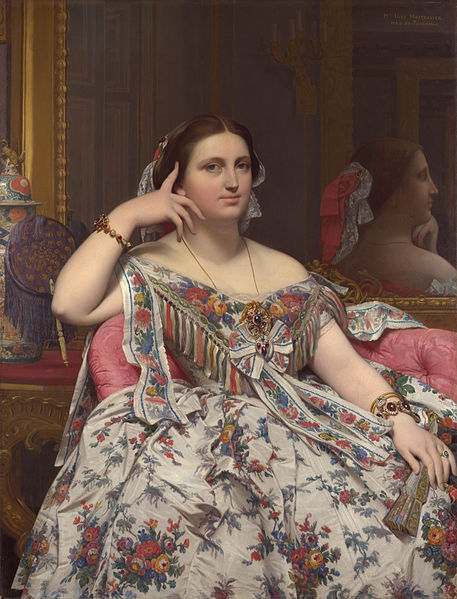
Madame Moitessier by Ingres

Madame Moitessier by Ingres (1856)

By now you will have realised that the paintings I like the most are ones that have a story behind them.  My Daily Art Display today has an intriguing tale attached to it which I will now share with you.  The painting is entitled Madame Moitessier and the artist who created this work of art was Jean-Auguste- Dominique Ingres.  This painting which was completed in 1856 is housed at the National Gallery in London.  It is the date which is interesting as Ingres initially started the painting in 1844!

Marie-Clothilde-Inès Moitessier, née de Foucauld, was the daughter of a civil servant.  Born in 1821 she married the wealthy banker, and one time importer of Cuban cigars,  Sigisbert Moitessier.  He was in his forties whilst she was just twenty-one years of age.  Two years later, her husband spoke to a friend of Ingres and asked him to speak to the artist about painting a portrait of  his new wife, Madame Montessiere.   Ingres refused the commission, as to him,  portraiture was a “low” form of art and he preferred to concentrate on “history paintings”.    However his friend Marcotte persevered with the Monsieur Moitessier’s request and finally Ingres agreed to meet the new wife.

Ingres was immediately struck and captivated by her beauty and agreed to paint her portrait.  Ingres then made his first mistake by suggesting that Moitessier should include her young daughter “la charmante Catherine” in the portrait.  If you look at preliminary sketches of this work, which can be seen at the Ingres Museum in Montauban, you can see the head of Catherine under her mother’s arm.  However by 1847 the young child had become so restless, couldn’t sit still for any lengthy period and finally rebelled against any artistic instructions and so, was  banished.

Ingres was a perfectionist.  Everything had to be just right with the work and over a period of time the clothes which Madame Montessier wore were changed to suit the artist and be of the latest fashion.  In the finished painting she wears the latest woven floral fabric with a crinoline, the stiffened petticoat, which had just come into fashion in 1855.  The lady also had little choice on what jewellery she should wear.  Ingres was the Master and told her what to wear and couched his suggestions in terms of flattery.  He was reported to have told her one day when discussing how she should adorn herself:

“……Since you are clearly beautiful all by yourself,  I am abandoning, after mature consideration, the projected grand headdress for a gala.  The portrait will be in even better taste and I fear that it would have distracted the eye too much at the expense of the head.  Same thing for the brooch at your breast;  the style is too old-fashioned and I beg you to replace it with a gold cameo.  However I am not against a long and simple chatelaine, which I could terminate with the pendant of the first one.  Please….bring on Monday your jewel chest, bracelets and the long pearl necklace……

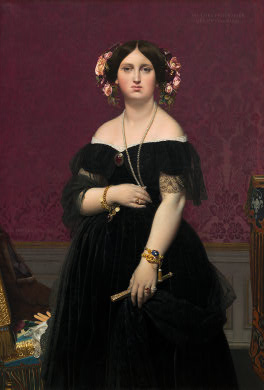
More bad luck for the commission was to follow as in 1849 Ingres’s wife died suddenly and the artist was devastated and didn’t paint for the next seven months.  In 1851, seven years after he started the painting of the seated Madam Moitessier, little progress had been made and the husband became restless at this lack of progress.  So that year, after constant cajoling and support from his friends and the demand of the sitter and her husband,  he went back to the easel.   Ingres started another painting of Moitessier’s wife, dressed in black, this time in a standing position.  He completed this at the end of 1851 and this work can now be found in the National Gallery of Art in Washington.

After completing the standing portrait of Madame Moitessier he reverted back to the one he had begun in 1844.  The lady is sitting in a rather strange pose.  Art historians believe that the pose of the lady, hand touching cheek, captured in Ingres’s painting,  was reminiscent of the fresco Hercules and Telephus from Herculaneum  which Ingres probably saw when he was there in 1814.  It is believed that Ingres had the sitter take up this pose but had to convince her husband that it was in keeping with Classical art and it made his wife look more learned and cultured.  The husband liked this idea as he was of the nouveau riche and liked the idea that the painting may have people believe they were more akin to nobility.  It is also quite amusing to read that Madame Moitessier had gained weight during her pregnancies and had demanded of Ingres that he should re-paint her arms and make them look thinner and thus more flattering!  This painting took over twelve years to complete and there are many preliminary drawings of it in existence. 

Why did it take him so long?   I have told you of some problems he encountered during this epic and I suppose we should also remember that he was 76 years of age when he finally completed the work and age may have played a large part in the agonisingly slowness in his progress.   Still, now we look at the finished article we must admire Ingres’s work. 

By now you will have realised that the paintings I like the most are ones that have a story behind them.  My Daily Art Display today has an intriguing tale attached to it which I will now share with you.  The painting is entitled Madame Moitessier and the artist who created this work of art was Jean-Auguste- Dominique Ingres.  This painting which was completed in 1856 is housed at the National Gallery in London.  It is the date which is interesting as Ingres initially started the painting in 1844!

Marie-Clothilde-Inès Moitessier, née de Foucauld, was the daughter of a civil servant.  Born in 1821 she married the wealthy banker, and one time importer of Cuban cigars Sigisbert Moitessier.  He was in his forties whilst she was just twenty-one years of age.  Two years later, her husband spoke to a friend of Ingres and asked him to speak to the artist about painting a portrait of  his new wife, Madame Montessiere.   Ingres refused the commission as to him portraiture was a “low” form of art and he preferred to concentrate on “history paintings”.    However his friend Marcotte persevered with the Monsieur Moitessier’s request and finally Ingres agreed to meet the new wife.

Ingres was immediately struck by her beauty and agreed to paint her portrait.  Ingres then made his first mistake by suggesting that Moitessier should include her young daughter “la charmante Catherine” in the portrait.  If you look at preliminary sketches of this work, which can be seen at the Ingres Museum in Montauban, you can see the head of Catherine under her mother’s arm.  However by 1847 the young child had become so restless, couldn’t sit still for any lengthy period and finally rebelled against any artistic instructions and was  banished.

Ingres was a perfectionist.  Everything had to be just right with the work and over a period of time the clothes which Madame Montessier wore were changed to suit the artist and be of the latest fashion.  In the finished painting she wears the latest woven floral fabric with a crinoline, the stiffened petticoat, which had just come into fashion in 1855.  The lady also had little choice on what jewellery she should wear.  Ingres was the Master and told her what to wear and couched his suggestions in terms of flattery.  He was reported to have told her one day when discussing how she should adorn herself:

“……Since you are clearly beautiful all by yourself, I am abandoning, after mature consideration, the projected grand headdress for a gala.  The portrait will be in even better taste and I fear that it would have distracted the eye too much at the expense of the head.  Same thing for the brooch at your breast;  the style is too old-fashioned and I beg you to replace it with a gold cameo.  However I am not against a long and simple chatelaine, which I could terminate with the pendant of the first one.  Please….bring on Monday your jewel chest, bracelets and the long pearl necklace……

Madame Moitessier by Ingres (1851)

More bad luck for the commission was to follow as in 1849 Ingres’s wife died suddenly and the artist was devastated and didn’t paint for the next seven months.  In 1851, seven years after he started the painting of the seated Madam Moitessier little progress had been made and the husband became restless at this lack of progress.  So that year after constant cajoling and support from his friends and the demand of the sitter that he produced something, Ingres started another painting of Moitessier’s wife, dressed in black, this time in a standing position.  He completed this at the end of 1851 and this work can now be found in the National Gallery of Art in Washington.

After completing the standing portrait of Madame Moitessier he reverted back to the one he had begun in 1844.  The lady is sitting in a rather strange pose.  Art historians believe that the pose of the lady, hand touching cheek, captured in Ingres’s painting was reminiscent of the fresco Hercules and Telephus from Herculaneum and which Ingres probably saw when he was there in 1814.  It is believed that Ingres had the sitter in this pose, and he had tgo convince her husband that it was in keeping with Classical art and it made his wife look more learned and cultured.  The husband liked this idea as he was of the nouveau riche and liked the idea that the painting may have people believe they were more akin to nobility.  It is also quite amusing to read that Madame Moitessier had gained weight during her pregnancies and had demanded of Ingres that he should re-paint her arms and make them look thinner and thus more flattering!  This painting took over twelve years to complete and there are many preliminary drawings of it in existence. 

Why did it take him so long?   I have told you of some problems he encountered during this epic and I suppose we should also remember that he was 76 years of age when he finally completed the work and age may have played a large part in the agonisingly slowness in his work. Still, now we look at the finished article and must admire Ingres’s work.

Reclining Girl by François Boucher

Reclining Girl by François Boucher (1751)

There is always some debate with regards paintings and nudity and what is appropriate and what is inappropriate and whether the depiction is merely erotic or crosses the line and becomes pornographic.  There has been much discussion about today’s painting in My Daily Art Display as to whether the female body is being treated as a person or as an object.

My featured artist today is François Boucher a French Rococo painter who was well known for his paintings of voluptuous females which also incorporated classical themes.  Some of his works of art were portraits of the famous Madame Pompadour but what made today’s work somewhat controversial was that his nude painting featured a fourteen year old girl.  Today’s oil on canvas picture entitled Reclining Girl was painted in 1751 and can be seen in the Wallraf-Richartz Museum in Cologne.  There is also a very similar painting featuring this girl, by the same artist, in a similar pose in the Alte Pinakothek in Munich.  So who is the girl and how did she come to pose naked for the artist?

The girl is Mary-Louise O’Murphy de Boisfaily who was born in Rouen in 1737.  She was the fifth daughter of an Irish army officer who, after her father’s retirement from military service, had taken up shoemaking to bring money into the household.  After her father died her mother took the family to live in Paris where she tried to find work for her daughters and made ends meet by trading second hand clothes.  Mary-Louise finally got work as a dancer at L’Opera and earned some money as a model.    It was around this time that she came into contact with Casanova the famous Venetian adventurer and womaniser and was he, according to his memoirs, who takes the credit for introducing the young girl to both Louis XV of France and the artist Boucher.  Art historians have said that the painting was simply a way of offering herself up to Louis XV as a prospective mistress.  It was almost an advert for her services and this is why, in some quarters, the painting was looked upon as being somewhat degrading and vulgar.   However whatever the intentions of Marie-Louise and Boucher were, it proved successful for she became one of Louis’s courtesans, albeit to start with, not one of his principal courtesans but one of his lower-echelon “companions”.  However through her guile and beauty she soon rose through the “ranks” and became one of the ruler’s favourites.  In 1754 she gave birth to Louis’s illegitimate daughter Agathe Louise de Saint-Antoine.  Marie-Louise remained a favourite of Louis and all would have remained well but she made the fatal error of attempting to oust Madame Pompadour as Louis’s favourite mistress and for that she paid the penalty – banishment from the royal court and at the tender age of 17 was married off to Comte de Beaufranchet.  The marriage did not last very long as her husband was killed in battle.   Marie-Louise married twice more, her last being at the age of sixty-one, to a man some thirty years older her junior but this partnership ended in divorce.  She died in 1814 at the age of 77.  If you want to read more about her life you can as her story was dramatised in the 1997 novel by Duncan Sprott entitled Our Lady of the Potatoes.

The painting is without doubt sexually provocative.   The girl, and we should remember she was barely fourteen years of age, is seen face down, lying naked, splayed on a chaise-longue.   I wonder whether the artist decided that because of her age he should not show her frontally naked.  Her face-down pose however does not detract from the sensuality of the painting and in some way may add to it.  We concentrate our view on the girl’s buttocks and her thighs which are wide apart.   This pose shows the willingness of the model to entertain any sexual overtures from a lover.  This was exactly the message she wanted to give Louis.   One notes the similarity between the curves of her body and the curves and creases of the pillow on which her right leg rests and which pushes upwards separating her thighs.   It is a sumptuous setting with the heavy velvet drapes and the silk bedding.

It is a painting you will either like and find it beautifully erotic or you will hate it and condemn it as just another form of pornography wrapped in the guise of a work of art.  It is simpy up to you as it is all in the eye of the beholder.

The Swing by Jean-Honoré Fragonard

The Swing by Jean-Honoré Fragonard (1767)

The Rococo style of art was characterised by lightness, grace, playfulness and intimacy and emerged out of France around the beginning of the 18th century and in the following century spread throughout Europe.  The actual word rococo is thought to have been used disapprovingly by a pupil of Jacques-Louis David who ridiculed the taste, which was in vogue in the mid-18th century.  He combined the artistic genres of rocaille, which prospered in the mid 16th century and was applied to works that depicted fancy rock-work and shell-work, and barocco (baroque) genre. 

The featured artist in My Daily Art Display is Jean-Honoré Fragonard, whose works are amongst the most complete embodiments of the Rococo spirit.   He has been described as the “fragrant essence” of the 18th century.  He was famous for the fluid grace and sensuous charm of his paintings and for the virtuosity of his technique.  The painting by Fragonard featured today is probably his most famous and is the oil on canvas work entitled The Swing which he completed in 1767 and which is now part of the Wallace Collection in London.

The story behind the painting is fascinating and well documented.  The French dramatist and songwriter Charles Collé tells how he met the painter Francois Doyen in 1767 who tells him that he has been approached by a “gentleman of the court” who had seen one of his religious paintings being exhibited in Paris.  The painter Doyen goes to meet the gentleman and relates to Collé what happened next:

“…I found him at his ‘pleasure house’ with his mistress.  He started by flattering me with courtesies and finished by avowing that he was dying with a desire to have me make a picture, the idea of which he was going to outline. I should like Madame (pointing to his mistress) on a swing that a bishop would set going. You will place me in such a way that I would be able to see the legs of the lovely girl, and better still, if you want enliven your picture a little more……. I confess, M. Doyen said to me, that this proposition, which I wouldn’t have expected, considering the character of the picture that led to it, perplexed me and left me speechless for a moment. I collected myself, however, enough to say to him almost at once: “Ah Monsieur, it is necessary to add to the essential idea of your picture by making Madame’s shoes fly into the air and having some cupids catch them.”

Doyen decided not to accept the commission but instead passed it on to Fragonard.  The identity of the patron is unknown, though he was at one time thought to have been the Baron de Saint-Julien, the Receiver General of the French Clergy, which would have explained the request to include a bishop pushing a the swing.  However Fragonard insisted on replacing the bishop with the more traditional figure of the cuckholded husband.  

So let us examine the picture.  We see a young woman on a swing.  She is swinging with gay, if somewhat thoughtless, abandon as the sunlight beams down upon her.  She is at the apex of her arc and suddenly her shoe has flown off.  She has achieved this position due to the help afforded to her by the naive cleric (or cuckholded husband), on the right, who we can see pulling the swing rope.  On the left, lying on the ground below the swing, semi-concealed in the shrubbery,  is a young attentive male courtier who is staring at the long and exposed legs of the young woman.  Her legs are parted and with the motion of the swing, her skirt is open.  Not only are her legs exposed but the young man is able to see under the many petticoats that she is wearing under her pink flowing dress.  She knows he is watching her every move and is obviously pleased by this attention.   He reaches out as if to try and touch her. 

Fragonard once again made free association of fanciful costumes and provided us with a slight bit of erotic suggestions.  This work by Fragonard is without doubt erotic but does not actually cross the line to be viewed as vulgar.  There is a joyful aspect to this painting.  However the painting received mixed reviews with the artist being criticised for the frivolity of the picture and that he should show “a little more self-respect”.    The artist was unmoved by such disparagement and truth be told the popularity of his work continued.   His commissions came in thick and fast, both from wealthy patrons and from the royal government.   The royal patronage came to an end with their downfall during the French Revolution of 1789 and a year later Fragonard returned to his native Provence.  Two years later, he went back to live in Paris.  He died there in 1806 aged 74.

Jean-Honoré Fragonard was born in Grasse, Provence and since 1926 the town has been the home of the very famous French Parfumerie Fragonard !!

Self-portrait at the Easel by Jean-Siméon Chardin

Self-portrait at the Easel by Chardin (c.1776)

Another day, another French painter.  Today I wanted to look at the French painter Jean-Baptiste-Siméon Chardin and My Daily Art Display for the day is his pastel on blue paper Self-portrait at the Easel which he painted around 1776.  It is currently housed in the Louvre, Paris.

Chardin, the son of a cabinet maker, was born in Paris, in 1699.  He lived on the Left Bank of the River Seine, close to the church of Saint Sulpice, which has, along with its “Rose Line”, recently gained notoriety because of the film The Da Vinci Code.    He studied art under the tutelage of the French History painters Pierre-Jacques Cazes and Noél-Nicolas Coypel and in 1724, aged twenty-five he became a master in the Acadèmie de Saint-Luc.  A year earlier, he entered into a marriage contract with Marguerie Saintard but it was not until eight years later that the couple married in 1731 and that year his son Jean-Pierre was born.  Two years later the couple had a daughter, Marguerite-Agnés.  Sadly his wife died in 1735 and two years later his daughter passed away.

In 1728 he presented two of his painting, The Ray, and The Buffet to the prestigious Acadèmie Royale de Peinture et de Sculpture and they were of such quality that he was accepted into this hallowed society.  For fifty years, he regularly attended the Society’s meetings and during which, served as counsellor, secretary and treasurer.  He consistently exhibited at the Salon each year and he proved to be a “dedicated academician.  Chardin earned money from his artistic talents in any way he could.  His paintings were not restricted to any single genre; it just depended on the whims of his clients. 

In 1744 he married for the second time.  His second wife was Françoise-Marguerite Pouget. The following year their daughter, Angèlique-Françoise, was born, but she died in 1746.  In 1752 Chardin was granted a pension of 500 livres by Louis XV.  Beginning in 1761, his responsibilities on behalf of the Salon, simultaneously arranging the exhibitions and acting as treasurer resulted in a slow-down in the productivity of his painting.   In 1763 his services to the Acadèmie were acknowledged with an extra 200 livres in pension. In 1765 he was unanimously elected associate member of the Acadèmie des Sciences, Belles-Lettres et Arts of Rouen, but there is no evidence that he left Paris to accept the honour. By 1770 Chardin was the ‘Premiere peintre du roi’, and his pension of 1,400 livres was the highest in the Academy.

Chardin rarely travelled far from his Left Bank home, just occasionally making the short trips to Versailles and Fontainebleau.   In 1757 he finally moved house as Louis XV granted him a studio and living quarters in the Louvre.  Five years later more tragedy was to enter his life with the death of his artist son, Jean-Pierre, who was found drowned in Venice.  The belief was that he had committed suicide.  Chardon carried on painting and his last known painting was dated 1776, just four years before his death in 1780 at the age of 80.

Chardon was secretive about his methods. No one saw him painting; he had no pupils or followers. He seems to have worked slowly, in a style that is evocative rather than literally descriptive. He made few, if any, preparatory drawings. His contemporaries observed that his still-life paintings, which on close inspection seemed to be just a flurry of strokes, were in fact paintings of a startling immediacy and naturalism.   He portrayed household and family routines and children at play in genre scenes with a touch that was tenderly true to life.  These were engraved and claimed the imagination of a wide public. The subject matter he chose for his paintings was unassuming.  They were also often small in size.  Chardin’s paintings are supremely colourful and his work has long been admired by artists and critics alike.

Throughout the eighteenth century there were two competing hierarchies of painting genres.  On one side, one had the history painting genre and on the other side there was the portraiture and still-life genre paintings.  Chardin,  who painted many still-lifes including many which featured food, never attempted portraiture until 1837 when, according to Nicolas Cochin’s 1737 book Essay on the Life of Chardin1737, wrote of Chardin:

‘….A remarkable occurrence led him to try his hand at this new genre.  Monsieur Avid, a portraitist, was a great friend.  He often asked Monsieur Chardin for advice, which he found beneficial.  However one day when Monsieur Chardin criticised him too keenly, Monsieur Avid sharply retorted: “Do you suppose that it is as easy to paint as your stuffed tongue and saveloys?”  Monsieur Chardin was extremely vexed at this remark…’

Today’s pastel, Self-portrait at the Easel by Chardin sees him standing at his easel.  He stands before us at a time when his eyesight was failing and his health was deteriorating.  He gives us an unflattering and unsentimental vision of himself.  It is, in some ways a disturbing sight.  His enormous prince-nez have slipped down to the end of his nose as he peers over them at us, his viewers.  His eyes do not sparkle.  They look tired and dull.  This was to be one of the last paintings from the artist who seems weary and aware of how the passing years have affected him both physically and mentally.  Although he had many successes in his life, he also experienced many tragedies and one can see that they have taken their toll on him.  His faded skin with its slight ruddy tinge has a look of roughness about it.  His lips have a slight upward turn to them as he forces himself to smile at us.  What is he thinking about?  Around his neck is a multi-coloured scarf, a mixture of warm reds balanced by cool blues and grays.  Such colours can also be seen in his well-worn coat and reflected in his face.

Unfortunately for Chardin, public taste in paintings changed in the mid 18th century and there was a desire to see historical paintings once again come to the fore.  This was not Chardin’s painting genre and he fell from favour with the Academy.  His pension was reduced and slowly his duties at the Academy shrank.  It was not until a hundred years later that the paintings of Chardin came back in vogue and his works are now coveted by the top museums and the wealthy collectors.  Chardin influenced many of the great artists that followed, such as Manet and Cezanne.   Henri Matisse ranked Chardin as one of his most admired painters.

Child with Doll by Henri Rousseau

Child with Doll by Henri Rousseau (1906)

I have to be very honest about my choice of painting for My Daily Art Display today.  I don’t like it.   I have looked at it for the last couple of hours as I write up some notes about it and it just has not won me over.   The painting, Child with Doll, is by the French artist, Henri Rousseau, which he completed in 1906 and can now be found in the Musée de l’Orangerie in Paris.    I have studied some of his other works, some of which I really liked but I have decided to stick with my original choice as maybe you will find it a pleasing work of art.

First, let me tell you a little about this French Post-Impressionist painter.  Henri Julien Félix Rousseau was born in Laval, a town in the Loire Valley in 1844.  His father Julien owned a number of tin-ware shops and the family lead a fairly prosperous lifestyle.   He went to the local elementary school at the age of five and all was well until 1851 when, due to some foolish speculation, his father lost his business and his home and was declared bankrupt.  In order that Henri could conclude his education uninterrupted he became a boarding pupil at his school.   Although he never gained academic greatness he won prizes for his drawings and his music.  In 1861, aged seventeen, he left school and joined his parents in Angers.   There he worked for a short time at a lawyer’s office.  However this came to an end when at the age of nineteen  he was accused of stealing 20 francs from his employer and to avoid legal retribution he ran away and took refuge in the army signing up for seven years.  However he did not escape the long arm of the law as in 1864 he was sent to gaol for one month, for his crime.

His father died in 1868 and Henri was released from his army service.  He returned to Paris and took up a government job so as to support his widowed mother.  In 1869, at the age of twenty-five he married his landlord’s fifteen year-old daughter, Clémence Boitard.  The couple had four children but sadly only one survived to adulthood.  In 1871 he was appointed a tax collector at the Paris Octroi, a government agency which collected taxes on goods being brought into the city.  It was not a very busy job and it is probably at this period in his life that he pursued his hobby, painting.  It was because of his official work that Rousseau received the nickname Douanier (tax collector) from his artist comrades.  It is thought that Rousseau did not become a serious artist until he was forty and was completely self-taught. 

Tragically his wife Clemence died in 1888 and this affected Rousseau badly.  Five years later Rousseau retired from the Paris Octroi and pursued his love of painting.   However, once he gave up his government employment, he relied on making money from his works of art and this just didn’t work out and soon he had financial troubles.  In 1889 he married for the second time.  His wife was Josephine Noury who sadly died after just four short years of marriage once again leaving the artist heartbroken. As the years passed his debts mounted and in 1907 he unwisely was duped into taking part in a bank fraud and was gaoled for his crime.  The sixty-three year old pleaded with the authorities to release him so that he could complete works of art for the upcoming exhibition of the Salon des Independents an annual event that he had been entering for many years.  He also told the court that unless he was freed from prison he would be unable to collect his pension and would forfeit it.  Rousseau seemed to have lost all sense of reality but with his artist friends, including Picasso, all giving glowing character references and admitting that Rousseau’s main crime was one of naiveté, the artist was released.

Henri Rousseau, Le Douanier, died in 1910 at the age of 66, from an infected leg wound.  A year later the Paris Salon organised an exhibition of his work.   Seven friends stood at his grave in the Cimetiere de Bagneux: the painters Paul Signac and Otiz de Zarate, Robert Delaunay and his wife Sonia Terk, the sculptor Brancusi, Rousseau’s landlord Armand Queval and Guillaume Apollinaire who wrote the epitaph Brancusi put on the tombstone.  It read:

We salute you Gentle Rousseau you can hear us.
Delaunay, his wife, Monsieur Queval and myself.
Let our luggage pass duty free through the gates of heaven.
We will bring you brushes paints and canvas.
That you may spend your sacred leisure in the
light and Truth of Painting.
As you once did my portrait facing the stars

And so we finally come to today’s painting Child with Doll which he painted when he was 62, four years before his death.  The child has obviously not been painted as she looks.  Rousseau has distorted the figure.  Her body is bloated.  Her face seems as if it has been compressed and her legs form a very awkward, if not a downright impossible posture.  It makes you wonder whether she is actually standing or maybe she was sitting and Rousseau had decided not to incorporate the chair into the painting.  This type of unusual pose was not altogether new to Rousseau’s paintings in fact it was almost his trademark.  The contrast in his colours in this painting is very stark.  Look how the red of the dress becomes much more noticeable against the cool blue of the background.  It is also interesting to note how he has given the girl’s dress a “spotted” pattern almost similar to the pattern of the flowers on the grass.  Each flower and each blade of grass has been lovingly painted.  The girl herself appears to have no neck as her head is pressed down into her body.  It doesn’t look like a young face. It is an almost round face which has more of an appearance of an adult although it does retain a child-like chubbiness.    She stares at us in a strange and disconcerting way.  However if we look at her hands they are child-like.  Her legs are strangely cut off by the tall grass.  It is believed that Rousseau had an aversion to painting feet.  She holds on tightly to her beloved doll which has turned a shade of grey, probably from constant handling.  It is a simplistic painting.  There is no need to look for interpretations or symbolism.  Rousseau was obsessed with the idea of  the “realism-genre”.    For me, with this painting, what you see is what you get and I didn’t get much but as beauty is in the eye of the beholder, I hope you enjoyed it.

Mademoiselle Rivière by Ingres

Mademoiselle Caroline Rivière by Ingres (1806)

My Daily Art Display today is a portrait of a fifteen year old French girl, Caroline Rivière, which was painted by French neo-classical artist Jean-Auguste-Dominique Ingres in 1806 and can be found hanging in the Louvre, Paris.  Regrettably the story attached to this painting of this youthful beauty has a sad ending, but more of that later.

Ingres was born in 1780, the son of a small time miniature-painter and sculptor, Josef Ingres, from whom he learnt the basics of art and music.  His formal academic life started at the Toulouse Academy of Art at the age of eleven and at the same time he kept up his musical training by taking violin lessons.   He went to Paris at the age of sixteen where he was a student of Antoine-Jean Gros at the studio of Jaques-Louis David.  In 1801 he won the Prix de Rome for his painting Ambassadors of Agamemnon.  The Prix de Rome was a scholarship, founded concurrently with the French Academy in Rome, that enabled prize-winning students at the Académie Royale de Peinture et de Sculpture in Paris to spend a period, usually 4 years, in Rome studying art, at the state’s expense.  Unfortunately for Ingres, because of the financial problems with the French economy, he was not awarded his trip to Rome until 1807.  It was during his stay in Paris from 1801 to 1807, before heading for Rome, that he completed his first portraits.  Some were of wealthy dignitaries such as the portrait,  Napoleon I on the Imperial Throne which hangs in the Musée de l’Armée, Paris  and some where of himself and his friends such as his  Self Portrait at the Age of 24, which is housed in the Musée Condé in Chantilly.                

Madame Rivière (1806)
Monsieur Rivière (1806)

It was around this time that he was commissioned by a court official, Philibert Rivière, to commemorate himself, his wife, Marie-Francois and their fifthteen year old daughter Caroline.  Ingres at the time, had a passion for classical paintings with subjects based on history or Greek legends, but as he had to eke out a living, he painted portraits for clients and so accepted the commission.

 Ingres was fascinated by the young girl and was quoted as describing her as “ravishing”.   The portrait entitled Mademoiselle Rivière is My Daily Art Display for today.  It is a three-quarter length portrait.  Her young age is not immediately obvious to the viewer.  Look closer though and one can detect a childlike femininity.  She looks out at us in her virginal-white muslin dress with a large white ermine boa over her arms.  The bodice which was all the fashion at the time struggles to give an illusion of cleavage.  She appears to be quite self-conscious or maybe that is the expression she wanted to give to retain an air of respectability.  There is an overwhelming element of purity in Ingres’s depiction of her or is there?  This portrait is not completely devoid of sensuality. Look at the way Ingres has painted her full red lips, her bared neck and porcelain-like white skin which gives her slight and childlike body a sensuality of which she may not even have understood.  Her gloved arms give Caroline a hint of sophistication and she is at an age when she is neither child nor woman.  You could almost say she was the unfinished article.  

 However, it has to be remembered that her portrait was to hang next to those of her parents and therefore Ingres had to be careful on how he portrayed her.  She must come over as being an intelligent young lady of good breeding and most of all a credit to her parents who have lavished so much upon her.   This painting may be as much about her parents as it is of herself.  It may be a statement of the family wealth and the quality of life the three of them can afford to enjoy.

It was, along with the portraits of her father and mother, exhibited at the Paris Salon, the greatest annual art event in the Western world, in 1806.  The art world greeted this painting with mixed reviews; many disliked it for its “Gothicness” because of its linear precision and enamel-like finish.  It was also disapproved of because of its similarity to Early Netherlandish paintings and the French art critics of the time looked upon these painters from the Nertherlands as Les Primitifs Flamands.     Ingres’s also had many detractors who were critical of the painting saying that the proportions were not right.  They said that her head was too large, her neck was too long and curiously broad, her eyes were too far apart, which made her nose look flat and excessively long as it flows uninterrupted into her brow.  Although “puffed” botoxed lips are all the rage now, critics said that Ingres had made Caroline’s lower lip too fat which drew people’s attention to the lower part of her face which is petite in comparison to the span of her forehead.    The critics also deemed that there was a noticeable lack of definition to her shoulders. 

The background is secondary to the portrait itself and is a mainly bluish-white in colour featuring an Ile de France landscape with a distant town across the wide river.  There is freshness about the landscape and it must be presumed that Ingres wanted it to echo the fresh adolescence of his subject.

And so I return to the beginning when I said there was sadness to today’s painting.  Here we see in front of us a young girl, the daughter of a wealthy family, with everything to live for.  The sadness is that within a year of this painting being exhibited she was dead.

Landscape with Aeneas at Delos by Claude Lorrain

Landscape with Aeneas at Delos by Claude Lorrain (1672)

The featured artist in today’s My Daily Art Display is the French landscape painter of the Baroque era, Claude Lorrain.  The artist was born around 1604 in the town of Chamagne in the province of Lorraine, which at that time was an independent Duchy.  His actual name was Claude Gellée but was better known by the province in which he was born.  He was one of five children who came from a poor family and became an orphan when he was twelve years of age.  After the death of his parents he went to Freiburg to live with his elder brother Jean who was a woodcarver.

In his teens he travelled to Rome and Naples where he became an apprentice to the German Baroque landscape painter Goffredo Wals.  In his early twenties he moved to Rome and became a student of Agostino Tassi, the Italian landscape artist. Whilst in Rome he was commissioned by Cardinal Bentivoglio to produce two landscape paintings.  His works received great acclaim, which earned him patronage from Pope Urban VIII. Over the next ten years he became more and more successful and his fame as a landscape and seascape painter blossomed.  It was around this time that he became friends with the French artist Nicolas Poussin and together they would travel into the Italian countryside sketching the beautiful and breathtaking landscapes.

Claude Lorrain was, in the main, a landscape artist and he would often commission other artists to add figures into his paintings.  He often commented to his patrons that he was giving them an exquisite landscape and the figures in the painting were gratis !   Lorrain was concerned that some of his work may be copied and passed off as his and he wanted to ensure also he didn’t want to duplicate his work.  To circumvent these problems he decided to make tinted outline drawings of all his pictures he had sent to different countries.  He collated these in six paper books and on the back of each drawing he wrote the name of the purchaser.   These six volumes he named  Liber Veritatis (Book of Truth).  Many of his works were engraved and published and have always been popular with aspiring landscape artists.  Claude Lorrain although brought up in a poverty-stricken background, died a rich man in Rome in 1682.

Today’s painting, which was included in his Liber Veritatis and completed in 1672, is entitled Landscape with Aeneas at Delos.  During his last ten years, Lorrain painted six stories of Aeneas, the hero of Virgil’s epic poem Aeneid, which told of the legendary origins of Rome.   He was also very interested in Ovid’s  Metamorphoses  which also recounted the adventures of Aeneas.  In Book III, Ovid tells how Aeneas fled from the burning Troy:

“..  taking with him sacred images of the gods, his father Anchises (the bearded man in blue) and his son Ascanius (the child on the right) Aeneas (in short red cloak) set sail and reached with his friends the city of Apollo [Delos].   Anius [in white on the left], who ruled over men as king and served the sun god as his priest, received him in the temple and his home. He showed his city, the new-erected shrines and the two sacred trees [olive and palm] to which Latona had once clung when she gave birth to her children [Diana and Apollo]….”

This type of painting genre encompassing classical and biblical tales was very popular in the 17th century and often these stories were the motivational foundation for Grand History paintings.  Although the painting is based on a classical story, Lorrain’s emphasis is on the natural surroundings and the panoramic view of the seaport.  Even though the story plays a fundamental part in the work of art, the figures, as far as Lorrain was concerned were of less importance.  We look down on this setting.  We see a woman and child crossing a bridge over a stream.  Sheep graze unhindered under the shade of two tall trees.   Further into the picture we see a semi-enclosed harbour with its many boats.  In the far distance we can just make out the distant hills.  There is much to see in the painting and it is an invitation from Lorrain for us to take in all that is going on.  It is a very airy scene and is enhanced by the cool blueness of the sky with the puffy white clouds which almost fills the upper half of the painting.  There is a definite contrast in the colours Lorrain used in this painting.  By using light whites and blues in the background and darker browns and greens in the foreground the artist has created an impression of spatial depth.  There is also a sense of stability in this painting.  The vertical elongation brought on by the tall trees and the columns of the building is balanced by the horizontal lines of the land and sea

Do you like the painting?  The great English landscape artist John Constable was very impressed with the artist and of Lorrain and his landscape paintings, he commented:

” …he is the most perfect landscape painter the world ever saw”, and declared that in Claude’s landscape “all is lovely – all amiable – all is amenity and repose; the calm sunshine of the heart…”