Mary Elizabeth Price

Mary Elizabeth Price

Mary Elizabeth Price, sometimes simply known as M. Elizabeth Price, was born on March 1st 1877 near the town of Martinsburg, West Virginia. Her parents, Reuben Moore Price and Caroline Cooper Paxson Price were Quakers, who lived in Shenandoah, Virginia. She was one of five children, having a sister, Alice Price, and three brothers, Frederick Newlin Price, Rueben Moore Price and Carroll Price. During her early days she lived in Virginnia but the family moved to the Shenandoah Valley and later to New Hope, Pennsylvania where she grew up.

Pennsylvania Museum and School of Industrial Art, Philadelphia. 

Art classrooms at the Pennsylvania Museum and School of Industrial Art, (c. 1891)

According to the Friends Intelligencer and Journal, Elizabeth graduated from her Literary Course at the Friends’ Central School in 1896, aged nineteen, and she enrolled at the Pennsylvania Museum and School of Industrial Art, a museum and teaching institution which later split into the Philadelphia Museum of Art and University of the Arts.

Pennsylvania Academy of the Fine Arts building

In 1904, having completed her course, she enrolled at the Pennsylvania Academy of the Fine Arts and studied under Hugh Breckenridge an artist and educator who advocated the artistic movements from impressionism to modernism. Another of her tutors was Daniel Garber, an American Impressionist landscape painter and member of the art colony at New Hope, Pennsylvania. Elizabeth also took private art lessons from William Langson Lathrop, an American Impressionist landscape painter and who founded the art colony in New Hope, Pennsylvania, where he was an influential founder of Pennsylvania Impressionism.

Picking Flowers by M Elizabeth Price (1916)

In 1917 Elizabeth moved to New York and took part in the “Baby Art School,” which was a pioneering programme funded by Mrs. Harry Payne Whitney (Gertrude Vanderbilt) and previously known as the Neighbourhood Art School of the Greenwich House. Children from nearby public schools were taught the fine arts of drawing, painting, sculpting, pottery, and wood carving. This idea was so successful that Carnegie Institute of Technology in Pittsburgh asked Elizabeth to stage an exhibition of the children’s work in the winter of 1919-1920, in conjunction with an art education campaign for teachers and supervisors in art.

Delphinium Pattern by M Elizabeth Price (1933)

When looking at Elizabeth Price’s work, her floral painting are the ones that are best remembered. She often painted on wooden panels coated with a mixture of gesso and red clay. Then, gold or silver leaf was applied over that, followed by the painted image in oils. One example of this is her 1933 painting entitled Delphinium Pattern.

Summer Bouquet by M Elizabeth Price (c.1933)

Another such work was Summer Bouquet which she completed around 1933.

Elizabeth Price joined a group of female artists known as the Philadelphia Ten. This group exhibited together between 1917 and 1945, at first annually in Philadelphia and later, with traveling exhibitions at major museums and galleries on the east coast and in the Midwest. All the members had studied art in the schools of Philadelphia, most having been graduate students at the Philadelphia School of Design for Women (now Moore College of Art and Design). The aim of the group was to move beyond the perception that they were merely hobbyists, as they were commonly viewed in the early 20th century, and be accepted as professional artists. Price regularly exhibited with the group from 1921 until their last exhibition in 1945.

Pumpkinseed Cottage on the bank of the Delaware Canal

Elizabeth, having been brought up on a farmstead in a rural area around Martinsburg, West Virginnia, had always hoped to one day leave the hustle and bustle of New York city life and return to the quieter countryside. Around 1927 she had finished her teaching contract in New York and decided it was time to make that move. She had fallen in love with Bucks County and the area around the town of New Hope and took up residence in an old stone house on the banks of the Delaware Canal. Her house was known as Pumpkinseed Cottage due to its bold yellow colour and diminutive size. She spent much of her time in her home with its studio. She also had a garden where she grew irises, mallows, peonies, lilies, delphiniums, poppies, hollyhocks, and gladioliflowers which often provided her the focus of her many floral paintings. She loved living here and said of it:

“…When I first saw the original cottage it was painted such a vivid yellow that I instinctively thought of a pumpkin; and it was so small that I named it Pumpkin Seed more in derision than anything else. But the quaintness of the name grew on us so that we’ve learned to love it…”

Christmas Card by M. Elizabeth Price. Inside Reads: Christmas Greetings! Card of her studio in the “Pumpkinseed” she and her brother, Fredric Newlin Price, occupied on the Canal Bank – near Rabbit Run Bridge, New Hope, Pennsylvania

She remained living here for the rest of her life with her brother, Fredric Newlin Price, who owned a house, farm, and property in the New Hope area. Whilst living here, she took the opportunity to give talks on art to the New Hope Women’s Club, where she often exhibited her works of art and at the same time encouraged and inspired local artists.

Cheerful Barge 269 by M Elizabeth Price

Although Elizabeth may be best remembered for her floral art works she painted many other genres. One such painting was entitled Cheerful Barge 269, which depicts a bright orange barge sliding by the canal waters on a sunny day. In the painting we see the blue water of the canal seemingly covered by fallen leaves from the trees along the canal banks but in fact what we see on the water is the reflection of the leaves which remain on the overhanging trees. In the foreground we can see sets of stones, alongside a wooden building, which create a path along the canal bank. Strangely, at the bottom right of the painting, we see a single tall red flower, and wonder what made the artist depict such a solitary item.

Bucks County Landscape by M Elizabeth Price

A Country Lane by M Elizabeth Price

Many of her paintings were inspired by what she saw during her walks in the surrounding countryside.

57th Street Window by M Elizabeth Price

Back when she was living and teaching in New York she produced her urban landscape work entitled 57th Street Window.

Bathing in Yardley, Pennsylvania by M Elizabeth Price

Pennsylvania Impressionism, which the artwork of Elizabeth Price emulated, was an American Impressionist movement of the first half of the 20th century. It was characterised by an interest in the quality of colour, light, and the time of day. It was centred in and around Bucks County, Pennsylvania, and particularly the town of New Hope. The movement is sometimes referred to as the “New Hope School” or the “Pennsylvania School” of landscape painting. It all began when landscape artist, William Langson Lathrop moved to New Hope in 1898 and founded a summer art school. The mill town, New Hope, was located along the Delaware River, about forty miles from Philadelphia and seventy miles from Manhattan. It was a landscape artist’s paradise with its spectacular rolling hills, the picturesque river, its tributaries, and the Delaware Canal. An example of this is her painting, Bathing in Yardley, which is a riverside town about 10 miles southeast of New Hope.

Frederick Price, M. Elizabeth Price, Rae Bredin and Alice Price Bredin aboard ship.

M. Elizabeth Price was an untiring promoter of the arts and shared her passion with her talented siblings. One brother, Frederic Newlin Price, owned the successful Ferargil Art Gallery in New York City; another brother, R. Moore Price, was an art dealer and an accomplished frame maker, while his wife, Elizabeth Freedley Price, was a painter; and her brother-in-law, Rae Sloan Bredin, was a member of the New Hope Group. M. Elizabeth Price distinguished herself for her development of women’s and children’s involvement in the arts.

Mary Elizabeth Price died in Trenton, New Jersey on February 19th, 1965 at Mercer Hospital. At the time of her death, she was a member of the Solebury Friends Meeting and, at the age of 87, had been the last living of the Price children. She was survived by her nieces and nephews. Elizabeth Price was buried in the Solebury Friends Meeting House cemetery, Bucks County, Pennsylvania.


Information for this blog was sourced from

Hellenica World

Art Now and Then

Invaluable

Michener Museum

George Edward Handel Lucas

My story today about an artist is a sad one. It is a tale of rags to riches and back to rags. My featured artist is George Edward Handel Lucas who because of artistic ability at a very young age was labelled by some as an artistic genius.

E G Handel Lucas self portrait painted on is 26th birthday (1887)

It all began at No.87 Church Street in Croydon on May 4th 1861 when George Edward Handel Lucas was born. He was the fifth child. His father, Edwin Newton Lucas, was a tailor and men’s outfitter by trade and had his shop on London Road. In 1875 the shop closed and his father ran his business from home. His father’s love of classical music, especially the works of George Frederick Handel led to his son’s middle name. This love of music led to his father’s second job, as for two evenings a week, he gave singing lessons at is house, in order to boost his income.

Autumn and Winter by EG Handel Lucas (1879)

Despite his business and his music tuition the large family found it difficult to make ends meet. In 1868, Handel Lucas was enrolled at Whitgift Middle School, which at that time provided education from the age of seven to fourteen for sons of the poor of the parish. Handel Lucas loved drawing and painting from an early age and at the age of fourteen he exhibited at the Royal Society of British Artists. He was the youngest person to have ever achieved that. Lucas left full-time schooling at the age of fourteen. He set himself up in a studio in a lean-to at his family’s Church Street home and could now finally concentrate on his art.

A Bird’s Nest and Flowers on a Mossy Bank by EG Handel Lucas (1879)

Handel Lucas’ favoured art genre was floral painting and still life. He would spend hours on his depiction of the minutiae of the flowers. Slowly his work became known and from the money he accumulated from their sale he would fund his artistic training. Lucas studied life drawing in the evenings at Heatherley School of Fine Art and for a short time studied at the St John’s Wood Art School.
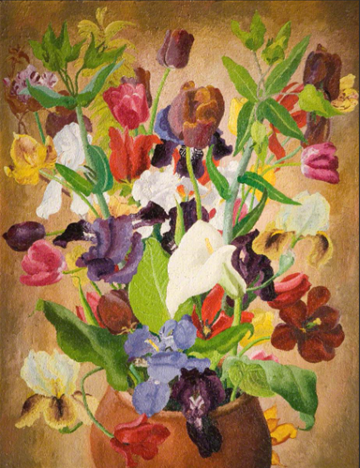
Roses from the Vicerage (1877)

In 1877, eighteen-year-old Lucas completed his painting entitled Roses from the Vicarage and he submitted it to the Royal Academy annual exhibition where it was sold on the opening day. The price realised was £30 which is the equivalent of £4500 in today’s money. Three years later, in December 1880, a reviewer wrote, in relation to the work that Lucas had exhibited at the Royal Academy:

“…I am not surprised to find that the critics are praising the works of that young artist, Mr. E. G. H. Lucas. I was certain when his `Roses’ was in the Royal Academy three years ago… that time was only needed for him to come to the front…”

Smarting from a Hard Hit by EG Handel Lucas

Lucas’ artistic output was small due to the time it took him to complete a painting.  His attention to detail was such that his completed works rarely took less than six months to complete and in many cases, very much longer.  He exhibited his work regularly from 1879 to 1891 at the Royal Academy annual exhibitions and often his work was positioned “on the line”, a rare privilege for an “outsider”. His work received many complimentary reviews in the press with one art critic stating:

“…Mr Handel Lucas… possesses in a more marked degree than any still life painter I have met with, that genius which a great writer has informed us is an infinite capacity for taking pains..”

“While the Cat’s Away the Mice will Play” by EG Handel Lucas (1881)

Soon he and his artwork became well known.   Although his still life floral works took him so long to complete they sold well, he decided to concentrate on figurative painting.  Although this was an idea which would increase his output he also knew there was still a demand for his floral paintings and such commissions brought in the money and were far more popular in comparison to his figurative works.  It was all about supply and demand.

In 1895, Lucas married Clare Mary Stunell and they went on to have two daughters, Elsie Cecil Lucas born in 1899 and Marie Newton Lucas in 1900.  These new additions added pressure on the family finances and the time he spent looking after his wife and children resulted on his output being as little as only two or three major paintings a year, and this in turn meant that their family income fell.

The artwork of Lucas with all its great attention to detail was adored by English art lovers in the last decade of the 1800s but at the beginning of the twentieth century the genre began to fall out of favour with the British public’s interest switching to Impressionism. Sales of Lucas’ work dwindled.

The Pears Annual

One light at the end of the tunnel for Lucas at this time was that the Pears Soap Company wanted to buy some of his paintings which they sought to incorporate in their well-liked annuals. Eventually they bought three of his paintings.

The Cause of Many Troubles by EG Handel Lucas (1903)

His painting entitled The Cause of Many Troubles was bought by Pears in 1903 and was published in 1906. It depicts such things as playing cards, dice, a tombola, a picture of a racehorse and a flagon of beer. All items reminded us of gambling and the imbibing of alcohol and the perils of such pastimes. A further reminder of what these “hobbies” could lead to was the pistol affixed to the wall, which some mired in gambling debts, believed was the only way out. The Pears Soap Company paid Lucas £106 for the painting (around £15,000 in today’s money). It was an extraordinary amount.

Some of Life’s Pleasures by EG Handel Lucas (c.1908)

The second painting the Pears Soap Company bought from Lucas was one entitled Of Such is the Kingdom of Heaven and they paid him another substantial amount, £150 and yet it was never used in their publications. The third of Lucas’ works they bought was his painting, Some of Life’s Pleasures and it could well have been the antidote for his The Cause of Many Troubles painting for this was all about harmless and fulfilling pastimes such as painting, reading and playing a musical instrument. This painting appeared in the Pears Annual in 1909. The company bought it for £81 a considerably lesser amount that the previous two purchases had achieved. Lucas had no recourse but to accept this lower amount as he was desperate to clear his debts.

View from Pompeii over the Gulf of Naples to Capri. by EG Handel Lucas (1888)

Lucas became desperate with worry with regards his mounting debts and lack of sales. In 1908, it just became too much for him and he suffered a nervous breakdown. To reduce costs the family left Croydon and moved to Brighton. It was here that Lucas and two local photographers set up a new photographic project and started a company called The Handeltype Syndicate Company and Lucas filed a patent for their new photographic process. Sadly for Lucas, after twelve months, their company failed and the three men, together with friends and family who had financially backed them, lost all their money.

Foes in the Guise of Friends by EG Handel Lucas (1913)

Another of Lucas’ paintings which advocated temperance and warned of the perils of drinking was his 1913 painting entitled Foes in the Guise of Friends. The painting’s title says it all. It was this painting that had not been completed and was unsold and had been used as a bargaining tool by Lucas with his landlady who had been demanding money for the rent. He had no money, the landlady didnt want the painting and the family were evicted.

Haymaking by EG Handel Lucas

Finally, Lucas found work in the south London district of Streatham where he and his family went to live. His friend asked him to design Christmas cards for his Christmas card business. Lucas never lost his love of photography and a printing process called Handelchrome which he invented. It involved transferring a photograph onto glass and painting it from behind and he intended to use this technique as an aid for his portrait work. Sadly, this invention like many of Lucas’ ideas came to nought and he struggled to match his income and his expenditure.

Two Vases of Flowers by EG Handel Lucas

In the 1920s Lucas completed a number of paintings but he was unable to achieve prices for them that he had done thirty years earlier.

The Stolen Nest by EG Handel Lucas (1927)

He did however have one success when he was commissioned to provide a number of paintings which were then used as illustrations for the Brooke Bond Tea calendar, one of which was entitled The Stolen Nest which was published in the 1929 calendar. It is set on the banks of the River Wandle, a right-bank tributary of the River Thames in south London.

Portrait of Jesse Ward by EG Lucas (1927)

One of his best portraits was of the founder of The Croydon Advertiser, Jesse Ward.

In 1936, Lucas received the devastating news that his wife had been knocked down and injured in a road traffic accident. He suffered a fatal heart attack and died on April 4th 1936, aged 74.


I will end this blog about Edward George Handel Lucas with the words of an art critic in the 1890s when he described Lucas’ art as:

“…When the present and succeeding generations have passed away, this little gem of the painter’s art will survive to prove that one man in Croydon, at least, knew how to paint, and could unite patent toil with Heaven Born genius…”


The majority of information for this blog came from an article written by David Morgan for the Inside Croydon website in December 2023.

Cedric Morris

Self portrait by Cedric Morris (1919)

Cedric Lockwood Morris was born on December 11th 1889 at Matcham Lodge, Sketty, Swansea.  He was the first-born child of George Lockwood Morris, an industrialist, iron founder and prominent rugby player who had played for Wales and his wife Wilhelmina (née Cory).  Both of Cedric’s mother and father hailed from well-to-do families who owned industrial businesses. Cedric had two sisters, Muriel who died in her teens and Nancy who was four years his junior. In 1947, when Cedric’s father, George, was eighty-eight, he succeeded to the baronetcy which had been created for his great grandfather. Sir John Morris, a copper and coal magnate.  This prestigious event came three months before he died and the baronetcy passed on to fifty-eight-year-old Cedric Morris, who became the 9th Baronet in November 1947. 
Cedric was sent away to St Cyprian’s School, Eastbourne, an English preparatory boarding school for boys, which trained pupils to proceed to leading public schools, and so providing a taster to boarding school life.  From here Cedric, aged thirteen, was enrolled at Charterhouse, an English public school.  He achieved very little academically at these schools and sat the examinations to enter the army, which he failed. In 1907, aged seventeen, Cedric, at his mother’s suggestion, travelled to Canada to work on a farm in Ontario.  That did not suit him and after a number of menial low-paid jobs he returned to Wales.  He briefly studied music at the Royal College of Music where he hoped to become a singer but again he failed in that venture.  In April 1914, at the age of twenty-four, he travelled to Paris and enrolled at the Académie Delacluse in the Montparnasse district of the French capital.  His stay in Paris was curtailed due to the outbreak of the First World War and he returned to England and joined the Artists’ Rifles, an active-duty volunteer reserve force of the British Army.  Many of those who joined were artists, actors, musicians and architects and its first headquarters was located at Burlington House. Its first commanders were the painters Henry Wyndham Phillips and Frederic Leighton. However like many of his previous aspirations, this came to naught, when he was medically discharged due to a childhood operation which affected his hearing and so he never made it to the Front.  However, Cedric who was an accomplished horseman, took up his next position as part of the  war effort when he joined the Remounts Service which was responsible for the provisioning and training horses and mules which were bound for the Front.  He worked under Cecil Aldin, a Remount Purchasing Officer who was also an amateur artist.  In 1916 the Remounts Service was taken over by the Army and became the Army Service Corps Remounts Service and as Cedric was a civilian he had to leave the organisation.

Frances Hodgkins by Cedric Morris (1917)

In 1917 Morris travelled to Zennor, a village in south-west Cornwall, close to St Ives, where he stayed for twelve months painting in watercolours and studying the plants and fauna of the area.  It was here that he met the New Zealand painter, Frances Hodgkins.

Cedric Morris (Man with Macaw) by Frances Hodgkins (1930)

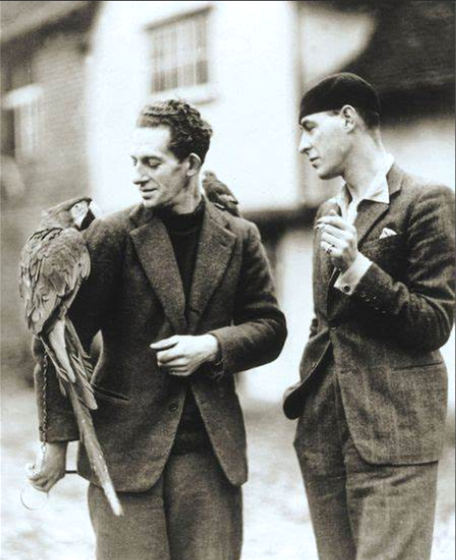
As well as his painting of her Frances painted one of him with a macaw in 1930.

Arthur Lett Haines

By the time of the Armistice and the end of the Great War on November 13th, 1918, Morris had left Cornwall and returned to London and it was on Armistice Day that he first met Arthur Lett Haines and fell in love with the painter and sculptor despite Haines living with his wife of two years, Gertrude Aimee Lincoln, an American and granddaughter of Abraham Lincoln.  Cedric Morris moved into the Lett Hains’ household in Carlyle Square, Chelsea and the trio had planned to move together to America.  However, the three-person tryst ended and Aimee moved alone to America.  With Aimee out of the picture, the two men travelled to Newlyn, Cornwall and set up home. Arthur Lett Haines, known by his middle-name Lett, was five years younger than Morris, being born on November 2nd 1894.  He was educated at St Paul’s School Public School, London and went on to serve in the British Army during the Great War.

Atelier Tapisseries, Djerba, Tunisia by Cedric Morris (1926)

Cedric Morris and Lett Haines moved to Cornwall to set up home in 1919 and at the same time they sub-let their London flat to Frances Hodgkins.  They moved houses a couple of times before settling in a house known as The Bowgie, which was a combination of a row of old cottages overlooking Newlyn harbour, and became a holiday home for the pair.  At Christmas 1920 they sold The Bowgie and moved to Paris. 

Cedric Morris and Lett Haines

The Paris that Morris and Lett Haines arrived at was said to have been a melting pot of artistic creativity. The pair would devote their evenings mingling in the cafes and bars in Montparnasse and mixed with such artistic luminaries as Marcel Duchamp, Peggy Guggenheim and the photographer, Man Ray.  The one thing that Cedric Morris had difficulty with whilst in Paris was his dislike of crowds and so he and Lett Haines would take every opportunity to escape the hubbub of city life and although living in Paris for the next five years, it was just a base they used as the two painters, along with friends, went off on their European travels. 

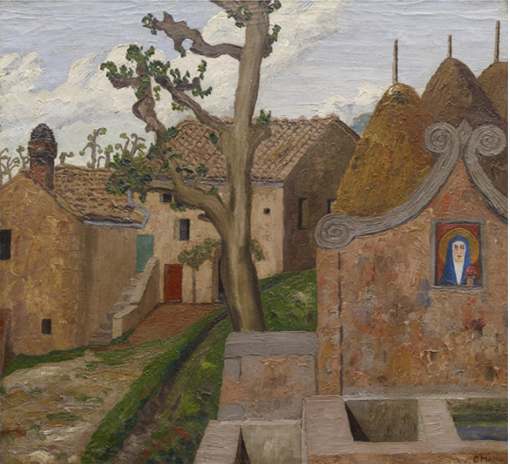
The Italian Hill Town by Cedric Morris (1922)

They went to North Africa in 1921, 1925 and 1926 and spent time in Germany in 1921 before journeying to Italy where they travelled the country for most of 1922.  Cedric held his first one-man exhibition at the Casa d’Arte Bragaglia in Rome which opened at the beginning of November 1922.  Casa d’Arte Bragaglia was an exhibition space for Futurist art and a meeting point for intellectuals and artists.  Unfortunately the exhibition opening coincided with Mussolini’s March on Rome, an organized mass demonstration and a coup d’état which resulted in Benito Mussolini’s National Fascist Party ascending to power in the Kingdom of Italy.  Futurist art was condemned by Mussolini and his Fascist followers and the exhibition was closed down.

Patisseries and a Croissant by Cedric Morris (c.1922)

Although living in Paris, Cedric Morris held the first of his two one-man exhibitions in London. The first was in June 1924. which was held at Gower Street, and organised by the Arts League of Service, a little-known cultural organisation founded in Britain in 1919 with the singular aim of bringing art and the ‘higher forms of entertainment’ to the masses. Cedric exhibited forty-four paintings and twelve drawings.

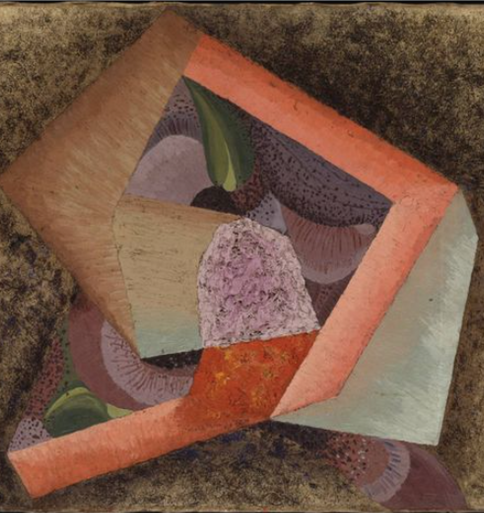
Experiment in Textures by Cedric Morris, (1923)

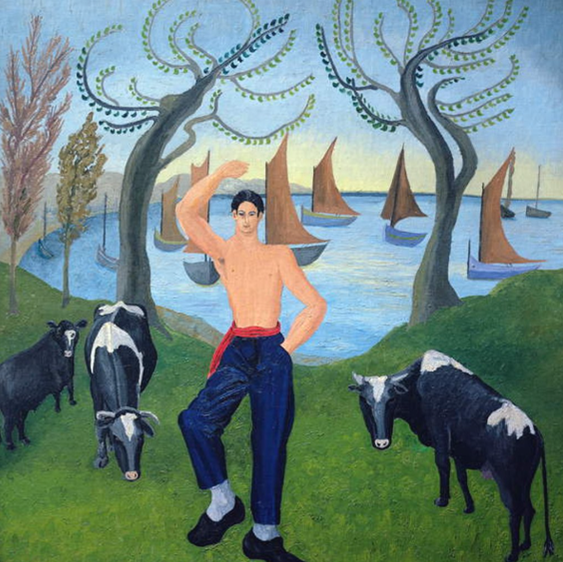
It was also in the 1920s that Morris dabbled with Abstract Art.

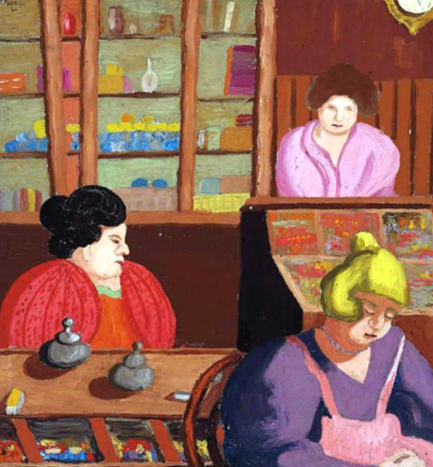
The Brothel by Cedric Morris (1922)

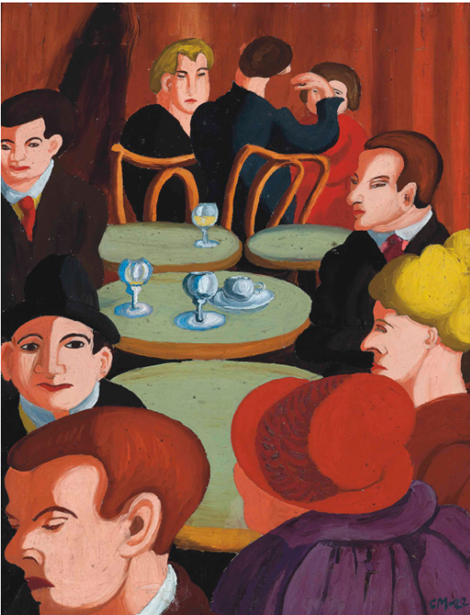
Cedric Morris and Lette Haines were great “people watchers” and Parisian streets, boulevards and bars were great places to study the locals. Morris took delight in recording the activities and idiosyncrasies of the people as we can see in the paintings he completed around that time. One example is his painting entitled The Brothel.

Les Bocks à Montparnasse (1922)

Another was his café scene for his painting entitled Les Bocks à Montparnasse.

The Entry of Moral Turpitude into New York Harbour by Cedric Morris (1926)

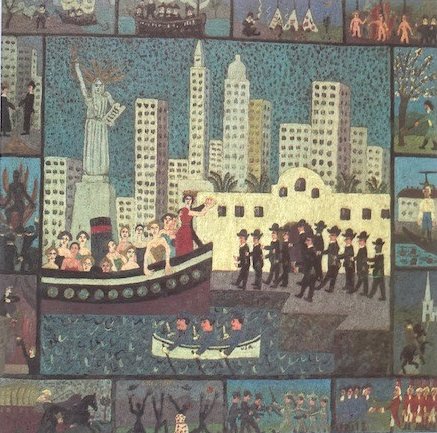
One of Cedric Morris’ unusual paintings around this time was one he completed in 1926, entitled The Entry of Moral Turpitude into New York Harbour, a painting bought by his friend, Vita Sackville-West. This painting’s compartmented depiction is unique in Morris’ work.  The idea for this depiction came about with the dramatic and scandalous case of the time when the United States immigration authorities refused to allow a titled Englishwoman to land and enter into New York after a sea passage from England.  The Immigration officials stated that their refusal was based on their belief that she was allegedly guilty of “moral turpitude”.  Moral turpitude refers to conduct that is considered contrary to community standards of justice, honesty, or good morals and so covers numerous types of misdemeanours.  In the case of the English women her misdemeanour was having been divorced by her husband and the man, also titled, travelling with her had been cited in the divorce case.  She and her companion are depicted in Morris’ painting standing at the bow of the ship wearing coronets.  Their transatlantic ship is being approached by uniformed officials in a boat marked “USA”.  On the quayside we see a group of men wearing black suits, large hats and white collars waiting for the ship’s arrival.  They are meant to be ministers of the church. 
A legal battle followed and their deportation order was eventually quashed.  The news of the case travelled back to England and the English Foreign Secretary at the time was asked if England should refuse entry to Britain of American divorcees.  The main painting is surrounded by fourteen smaller paintings that were meant to draw attention to contrasting impulses in America towards liberty and oppression, the latter being an obvious message in the main painting.  Other scenes depicted in the smaller peripheral paintings include Landing of Christopher Columbus, Landing of the Mayflower, fraternisation between colonists and American Indians, burning of witches, George Washington cutting down the cherry tree, assassination of Lincoln, to name but a few.  Cedric Morris, probably due to his sexuality, disliked and found offensive the more restrictive aspects of morality taught by the churches

Herbs, Salads and Seasoning by Marcel Boulestin, illustrated by Cedric Morris

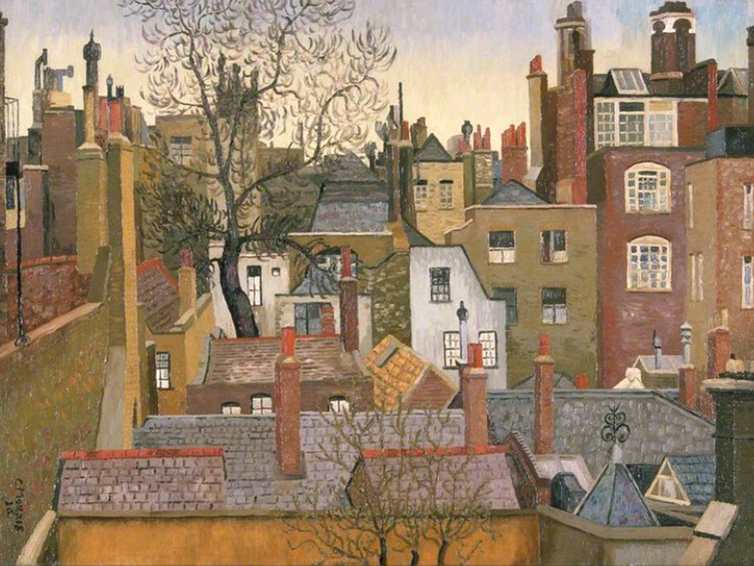
Probably because of Morris’ dislike of big cities, he and Lett Haines left Paris and returned to England, staying for a time in the late summer of 1926 with his sister Nancy who lived in the Dorset village of Corfe whilst at the same time they were searching out studio space in London.  At around this time he met Marcel Boulestin who had wanted an illustrator for his soon-to-be-published book, Herbs, Salads and Seasoning.  Cedric Morris accepted the commission to illustrate the book.

The Dancing Sailor by Cedric Morris (1925)

Morris eventually found a large studio in London which catered for all his needs.  It was at 32 Great Ormond Street and early in 1927 Cedric and Lett Haines moved in.  It seems strange that Morris should leave the over-crowded French capital because of the suffocating atmosphere and yet locate his studio in London but it is thought that Lett Haines had persuaded him to make the move to the English capital as it would be possible to launch Cedric into the British art scene.  The Great Ormond Street studio became a very popular meeting place and party venue for the great and the good of the Bloomsbury Set.  The Bloomsbury Set was a group of English writers, intellectuals, philosophers and artists in the first half of the 20th century which included Virginia Woolf, Vanessa Bell, Roger Fry, John Maynard Keynes, E. M. Forster and Lytton Strachey.

From a Bedroom Window at 45 Brook Street, W1 by Cedric Morris (1926)

Soon after settling down in London, Morris became a member of the Seven and Five Society, an art group of seven painters and five sculptors, including artist Ben Nicholson and sculptors Henry Moore and Barbara Hepworth.  Morris submitted many of his works to exhibitions but one of his greatest successes was at his one-man exhibition at Arthur Tooth & Sons Gallery in New Bond Street, an art gallery founded in London, in 1842 by Charles Tooth.  It was a great success with thirty-one of his thirty-nine painting selling at the private viewing and the remaining ones sold by the time the exhibition closed.

Pound Farm, Higham

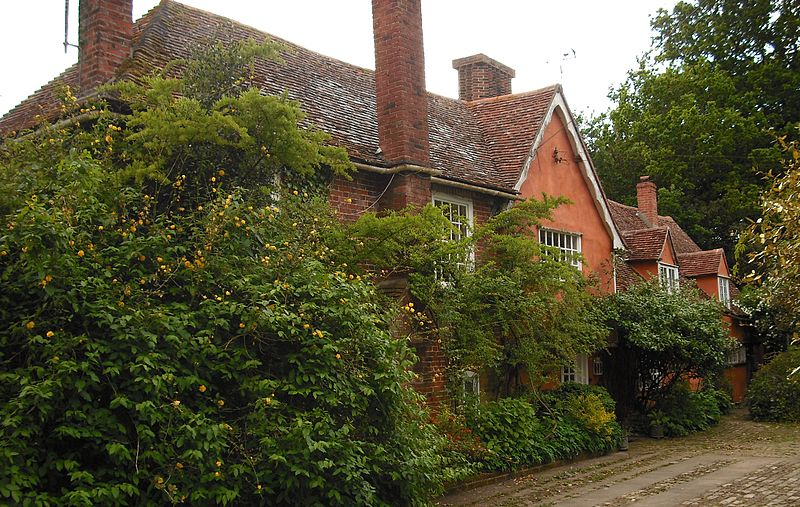
Not only was Cedric Morris a great artist who loved to paint, he also had another great love – a love of horticulture.  He was a true plantsman but living in London hindered that love and so he and Lett chose the country life in order to pursue Cedric’s passion for horticulture. And so, early in 1929, Cedric and Lett took the lease of Pound Farm, Higham, Suffolk, and in February 1930 they gave up their London studio. The farm was owned by the wealthy landlady and student, Mrs Vivien Doyle Jones. In 1932 their landlady died and bequeathed the farm to Cedric Morris. It was here that Morris lovingly created a memorable garden.

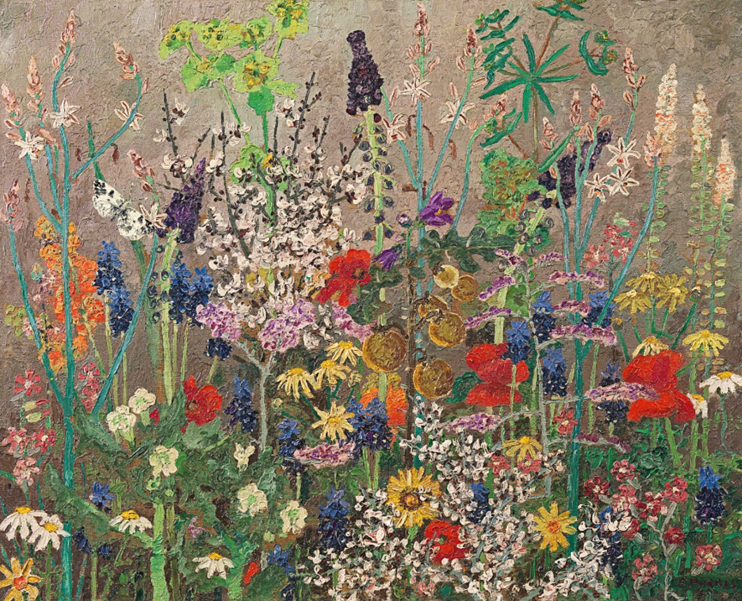
Flowers by Cedric Morris (c.1926)

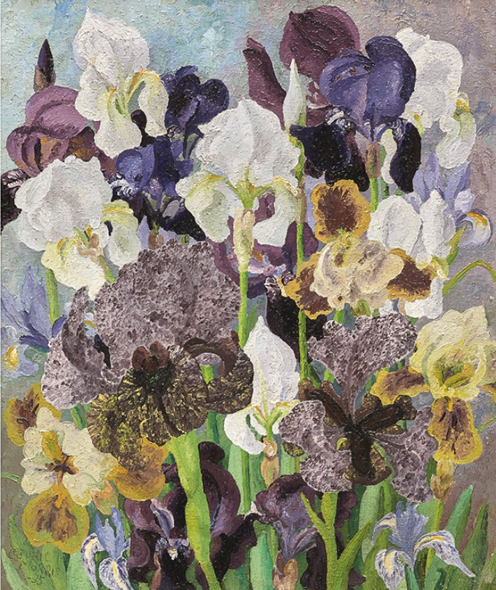
Morris had always been interested in floral painting and now, at Pound Farm, he found the ideal location. He also became a successful and well-known breeder of irises.

Irises and Tulips by Cedric Morris

Cedric Morris had a great passion and extensive knowledge of gardening and one of his favourite hobbies was breeding irises.  In his painting Irises and Tulips we see a colourful arrangement of irises and tulips and an impressive white Arum Lily along with two stems of the Great Yellow Gentian.  The tulips are shown as starting to collapse which hints at this painting being carried out in the early part of summer.

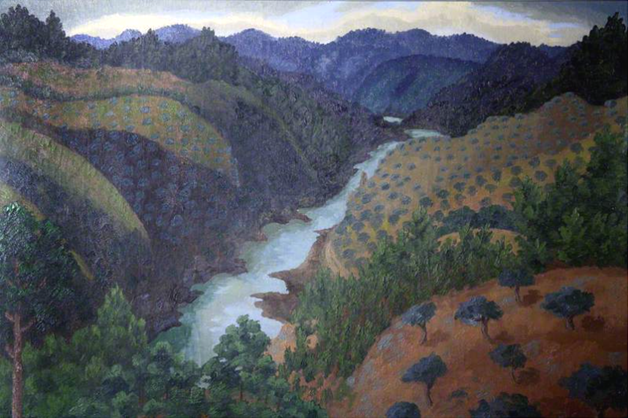
River Zezere, Portugal by Cedric Morris (1950)

Three miles to the south-west of Pound Farm was the small town of Dedham, which a century earlier, was the home of the great English painter, John Constable.  On April 12th 1937 Cedric Morris and Lett Haines opened the East Anglian School of Painting and Drawing in an old house in the centre of Dedham.  Lett-Haines taught theory, whilst Morris taught by encouragement and example.  It is interesting to note that the school was described in a prospectus as “an oasis of decency for artists outside the system”.  It was a great success from the very start and by the end of the year, it had sixty students. 
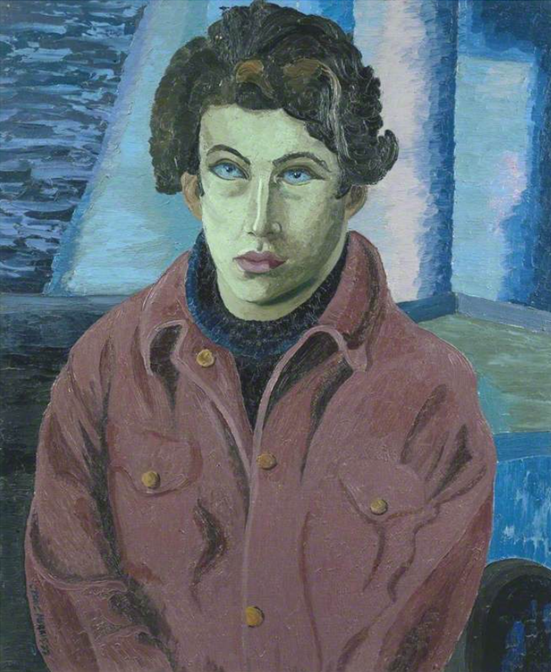
Lucian Freud by Cedric Morris (1941)

In 1939 a seventeen-year-old student by the name of Lucian Freud enrolled at the school, after he had spent a short time studying at the Central School of Art in London. 

May Flowering Irises. No.2. by Cedric Morris (1935)

In July 1939, disaster struck when the old Dedham house was destroyed by fire. Living nearby was the artist Alfred Munnings, who would become the President of the Royal Academy in 1944. He was one of England’s finest painters of horses, and an outspoken critic of Modernism which Cedric Morris practiced   He shed no tears when the Dedham art establishment of Morris and Lett Haines burnt to the ground and it was reported that he had his chauffer drive him around the burnt-out house, gloating at its destruction, and cheered loudly at the destruction of what he saw as an odious development in art . 

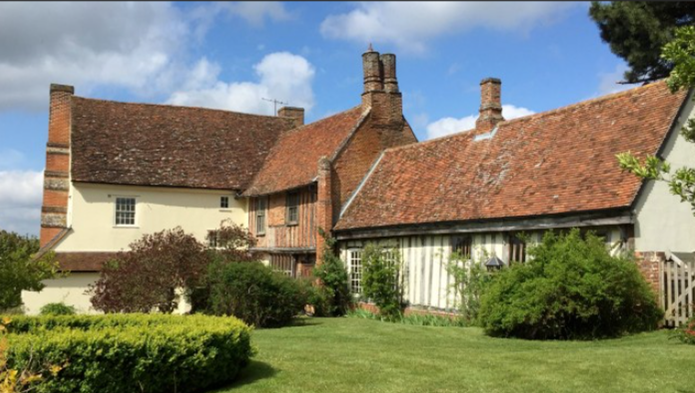
Benton End, the home to the East Anglian School of Painting and Drawing (Photo: Benton End House & Garden Trust)

Not to be deterred by this disaster, at the end of 1939, Morris and Lett Haines discovered Benton End, a rambling 16th-century house with gardens, on the outskirts of Hadleigh in Suffolk.  The large size of the place allowed the artists to live and run their school and also accommodate their students in one place, which hadn’t been possible at the previous venue.

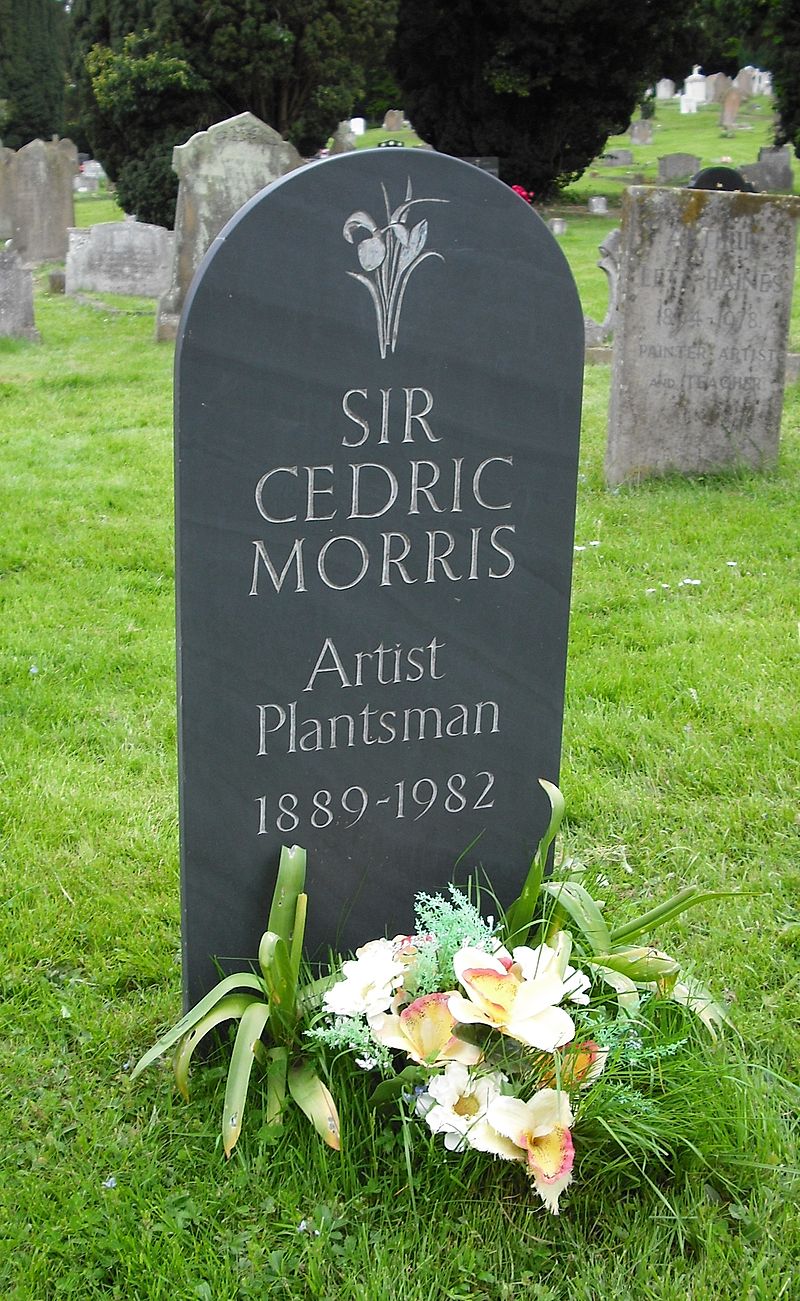
In 1946, Cedric Morris and Lett-Haines became founder members of Colchester Art Society and later Morris became the society’s president.  In 1947, on the death of his father, Cedric became Sir Cedric Lockwood Morris, 9th Baronet.  Deteriorating eyesight in the mid 1970s curtailed most of his art.  The Dedham school closed shortly after Lett Haines died on February 25th 1978, aged 84.

Cedric Morris continued to live at Benton End until his own death on February 8th 1982, aged 92.   The two are buried near each other at Hadleigh Cemetery in Hadleigh.  Morris’s gravestone, in front, and Lett-Haines, in back on the right.


The information for this blog came from the many websites about the life of Cedric Morris and Lett Haines as well as Richard Morphet’s Tate Gallery book on Cedric Morris, the great Welsh artist.
Clara Peeters – The Queen of Still Life paintings

I suppose painters challenge us with trompe l’oeil aspect of their depictions partly as a joke, as in the case of M C Escher and partly as an outward show of their technical brilliance. Trompe l’oeil (trick of the eye) is often incorporated in still life paintings and in many facets of a still life work we can appreciate the expertise of the artist.  The words still life derive from a Dutch word stilleven while the French prefer nature morte and Italian, natura morta meaning dead nature.  Still life paintings are those which depict inanimate objects, whether they be such things as musical instruments, kitchen utensils and tableware as well as portrayal of dead animals, foliage or musical instruments etc.  Often the inclusion of an inanimate object in a painting has a symbolic meaning whilst at other times it is simply art for art’s sake.

What Is Vanitas
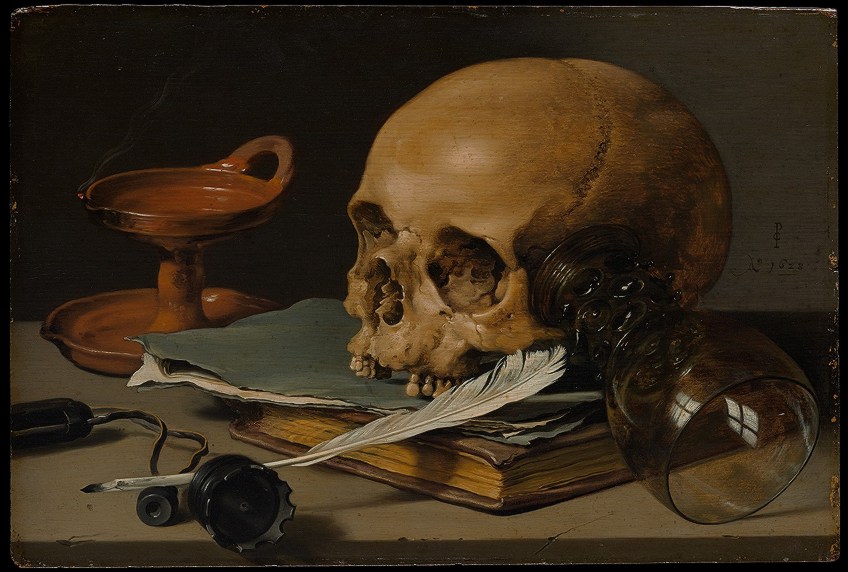
Vanitas Still Life with a Skull and a Quill (1628) by Pieter Claesz

The term memento mori, a Latin phrase meaning ‘remember you must die’ is often a term used when describing certain types of still life works.  Paintings, for example, which may include a portrait with a skull but other symbols commonly found are hour glasses or clocks, extinguished or guttering candles, fruit, and flowers.  Closely related to the memento mori picture is the vanitas still life.  I find the depiction of these inanimate objects fascinating and feel that they are completed by the most talented artists. 
Basket of Flowers by Balthasar van der Ast (1622)

Unlike me, the French Academy of the seventeenth century did not agree.  According to the French Academy their hierarchy of genres (or subject types) for art established in the seventeenth century, still life paintings were ranked at the bottom – fifth after history painting, portraiture, genre painting (scenes of everyday life) and landscape. It is thought that still life and landscape paintings were considered lowly because they did not involve human subject matter.

Still Life with Jug, Berkemeyer and Smoking Utensils_Pieter Claesz_17th century
Still Life with Jug, Berkemeyer and Smoking Utensils by Pieter Claesz (1640)

We know people buy portraiture to remember someone.  People buy landscapes and seascapes for their beauty and often to remind themselves of places they loved to visit.  Genre paintings were scenes of everyday life which often were also pictorial tales of morals and sometimes the realist genre paintings told of harsh times suffered by the less fortunate.  But who would buy still life paintings?  I suppose a beautiful flower arrangement depicted in a floral still life lights up a room but what about still life paintings which depict dead animals, food and expensive homeware?  Buyers of such work may believe that the painting reflects their affluence or hunting prowess.

The spoils of the chase guarded by a dog by Jan Fyt (c.1630)

When you look through the list of sixteenth and seventeenth still life painters, very few women’s names appear and yet there are a few.  The most obvious are the seventeenth century artists, Rachel Rausch with her floral still life works and Judith Leyster.   Today I want to look at the life and works of the greatest female still life painters, Clara Peeters.  She was by far the best-known female Flemish artist of this era and one of the few women artists who became a professional artist in seventeenth-century Europe, and she achieved that status despite constraints on women’s access to artistic training and membership in guilds.

Still Life Self portrait by Clara Peeters (c.1610)

Clara Peeters was born in Antwerp but when it comes to her date of birth there is some confusion.  It is known that a Clara Peeters, the daughter of Jean (Jan) Peeters was baptized on May 15th 1594 in the Church of St. Walburga, Antwerp and other records indicate that Clara Peeters and Henric Joosen were married in the same church on May 31st 1639.  So is that Clara Peeters the famous artist?  Although she is a major figure in the history of European still life painting, almost nothing is known about Clara Peeters’s life with certainty. Early researchers confused her with other women bearing the same relatively common name, ranging from an Antwerp heiress to an Amsterdam prostitute.  Also, we have to be wary of jumping to conclusions as Peeters was a very common name in Antwerp.

Still Life by Clara Peeters (1607)

Another factor which casts doubt on the birthdate of 1594 as her paintings, which were dated 1607, would mean she completed them she was just thirteen years of age and that is extremely unlikely so the conclusion is Clara was born in the 1580’s.

Still Life with Fish, a Candle, Artichokes, Crab, and Prawns by Clara Peeters (1611)

At a point in time when she was living in Amsterdam Clara Peeters produced one of her still life masterpieces in 1911.  It was entitled Still Life with Fish, a Candle, Artichokes, Crab, and Prawns.  Before us we see what looks like a wooden table upon which is a selection of seafood, such as boiled crabs and shrimp, several freshwater fish including two carp, a roach, several ide or orfe, and a northern pike.  Behind the food there is a dark glass goblet, a brass candlestick with an unlit but partially burnt out candle, a Rhenish stoneware jug, a copper strainer with a brass colander in which are two artichokes. 

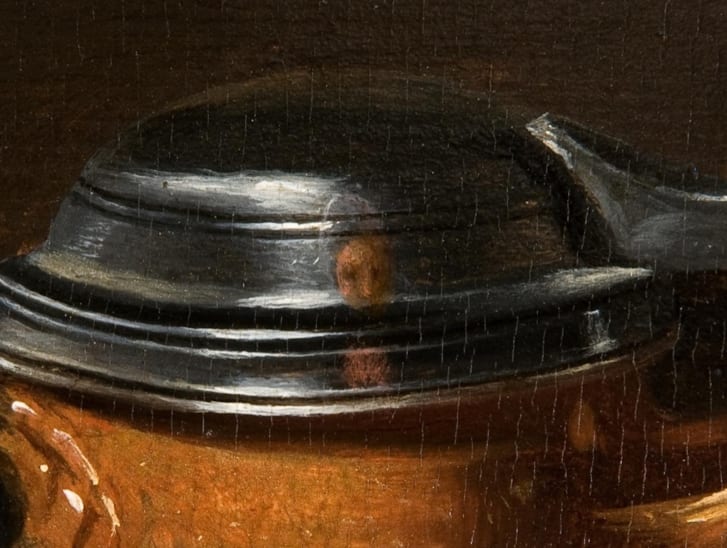
The reflected face

Although you will not see it in the main picture if you were able to take a close look at the lid of the jug you would see a reflection/self portrait of Clara wearing a large headpiece.  She, like a number of famous artists, included her own portrait in a number of her paintings.

Still Life with Sparrow Hawk, Fowl, Porcelain and Shells, zoomed in
Still life with Sparrow Hawk, Fowl, Porcelain and Shells by Clara Peeters (1611)

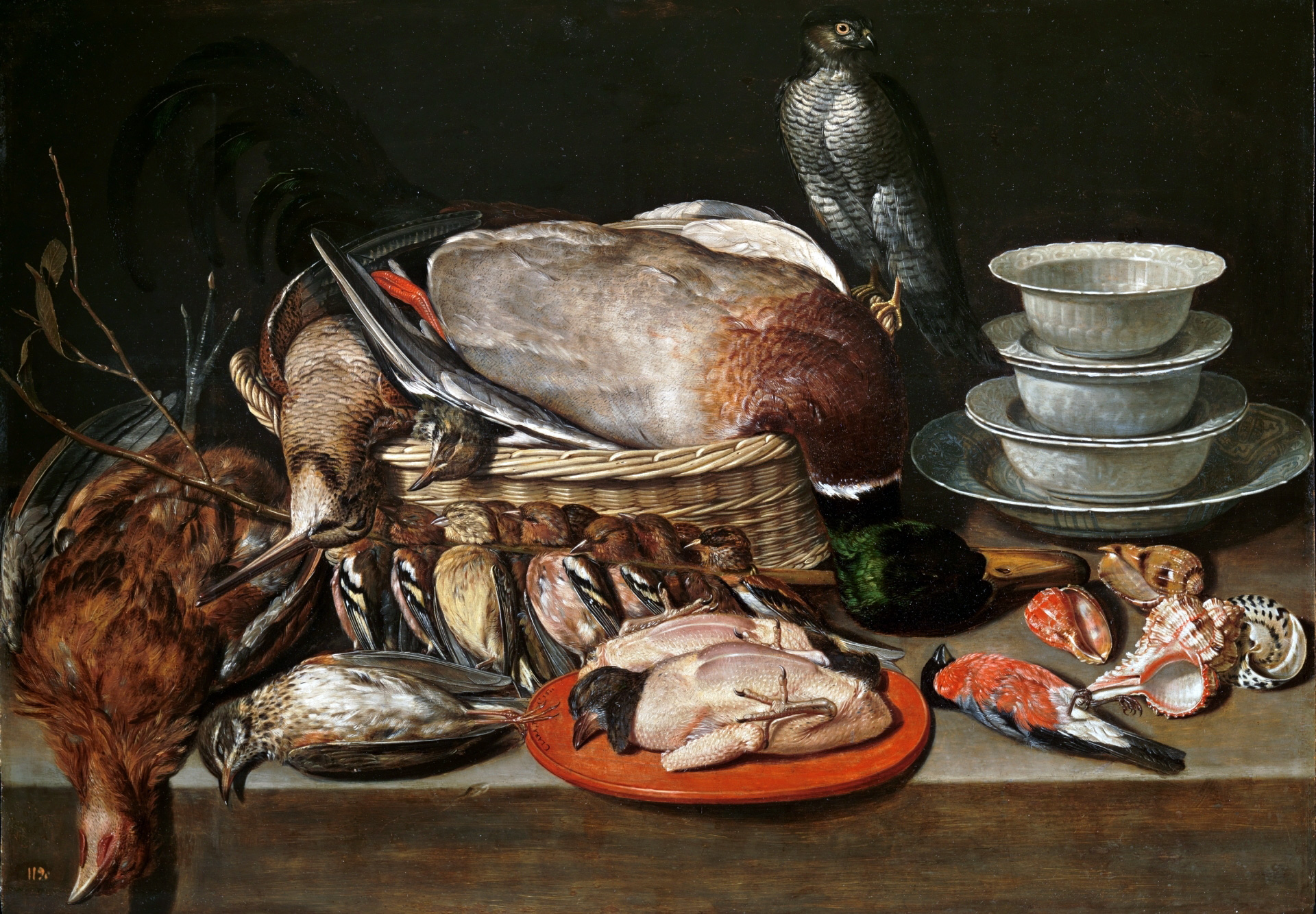
Another painting in the Prado collection by Clara Peeters is her 1611 work entitled Still Life with a Sparrow Hawk, Fowl, Porcelain and Shells and is thought to have been in the Spanish royal collection.  In this work we see a life-sized Eurasian sparrow hawk balanced on the edge of a wicker basket.  Due to its large size we believe it to be the female of the species.  Sparrow hawks would typically be used in the gardens surrounding a palace or a city, and not only by men but also by women and children learning the art of falconry.  Lying lifeless in the basket is a large mallard, and a woodcock.  At the left, with its head hanging from the table is a hen.  A dead thrush lies on the table.  The small red bird to the right is a common bullfinch.   The bullfinch often appeared in Clara’s still life paintings and this could well be because of its vivid red colouring and in this work contrasts well with the green head of the mallard.  Along the side of the wicker basket are a line of dead finches, hanging by their necks.    One question you might ask yourself is why have one live bird depicted among so many dead ones.  I think the reason is that the smaller dead birds could well be the prey of the living sparrow hawk.  Again in this painting, as it was in the previous one, note how Clara has contrasted the soft feathered bodies of the birds with the harder and finer surfaces of the shells and porcelain dishes.

Kraak bowl (c.1600)

The several plates and bowls of white kraak porcelain are stacked on top of a blue and white kraak plate, an item which appeared in a number of Peeters’ paintings.  In this painting the blue colour of this dish has faded and this is probably due to the cobalt-based pigment used.  Kraak ware or Kraak porcelain is a type of Chinese export porcelain produced mainly in the late Ming Dynasty, in the Wanli reign.   It was among the first Chinese export wares to arrive in Europe from the late sixteenth century via Portugal and Spain, and spread throughout the continent mainly through Habsburg networks.  It often featured in Dutch Golden Age paintings of still life subjects which included foreign luxuries.

Image result for still life with flowers, gilt goblet, almonds, dried fruits, sweets, biscuits, wine and a pewter flagon
Still life with flowers, a Silver Gilt Goblet, Dried Fruits, Sweetmeats, Bread Sticks, wine and a Pewter Flagon by Clara Peeters (1611)

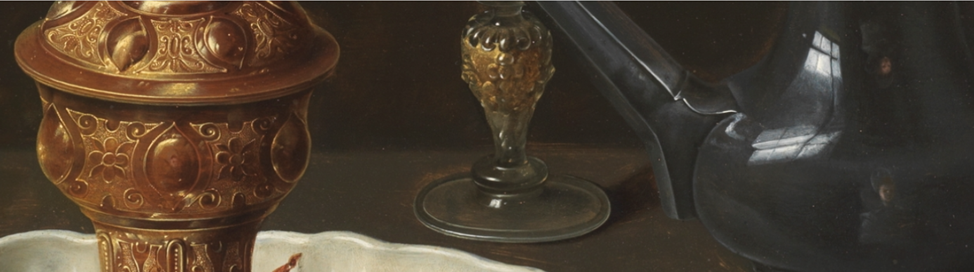
For the less squeamish but keeping to the subject of food I give you Clara Peeters’ 1621 painting entitled Table with Cloth, Salt Cellar, Gilt Standing Cup, Pie, Jug, Porcelain Plate with Olives and Cooked Fowl.  There are no dead animals on this table, just simple and tasty fare.  The arrangement of inanimate objects would appear random when in fact Peeters probably spent much time with the arrangement.  Firstly, she would want what was placed on the table to look like an everyday table set for a feast.  However, she would ensure that none of the objects blocked the view of another. The glass in the background containing the red wine is a fluted façon de Venise glass and was the type that was being manufactured in Antwerp by Italian glassblowers at the time. It is probable that the red wine had been imported from France, Italy or Spain. At the time of the painting much of food in the Dutch capital, such as wine, oil, salt, raisins and figs had come from Spain.  In this painting we see these fruits, together with almonds and sugar candy, in a large wide bowl known as a bianchi di Faenza vessel, a type of earthenware made in Faenza, an Italian city in the province of Ravenna, in the late sixteenth and early seventeenth centuries..

Reflections

Look carefully at the gilt goblet and the pewter flagon.  These are objects that appear in other of her still life paintings and also once again, she painted her self-portrait – three times in the raised parts of the goblet and four times in a vertical line on the pewter jug. This inclusion of herself portraits in some of her works is believed to be a form of a proclamation that she was a female painter and proud to be one in a profession dominated by men.

Clara Peeters - Still Life with Cheeses, Almonds and Pretzels.jpg
Still Life with Cheeses, Almonds and Pretzels by Clara Peeters (1615)

The Still Life with Cheeses, Almonds and Pretzels which she completed in 1615 is one of Clara Peeters’ best works and is part of the Mauritshuis collection. The depiction features a stone table top on which is a tin plate with three cheeses on it.  Above the cheeses is a smaller plate of butter shavings. In the foreground, on the left there are two pretzels, next to which is a knife with a beautifully decorated silver handle, three almonds and a blue-white plate of Wan Li porcelain filled with dried figs, almonds and raisins.  In the background we see a stoneware jar and a partially gilded lidded glass à la façon de Venise.  On the right side of the table there is also a sandwich and two raisins.  It is a meticulous depiction even down to small damages to some of the items and the hole in the cheese where a testing tube had been inserted.  As with all her still life works she has a remarkable ability to depict textures.  Look how she has depicted the crumbly nature of the dark green cheese and the softness of the shavings of butter as well as the reflective quality of the wine glass.  Her colour palette consists mainly of delicately harmonised yellow and reddish-brown shades and by doing this she has added warmth to the depiction but it is contrasted by the cool blue and white bowl at the right foreground.  The dark background and the way she has placed the objects in close proximity to each other offers a scene of intimacy.

The ornate knife

Look at the knife in the foreground that overhangs the edge of the table. The blade has an Antwerp mark, but more of interest is the ornate handle, which is decorated with ornaments and figures that signify love and marriage.  Although not clear in the picture, at the top a vignette of entangled hands with a burning heart and below it the allegorical figures of Faith and Temperance.  This type of knife, along with a matching fork in a pouch, was given as a wedding cutlery as a gift at weddings.  Even more interesting is the side of this bridal knife, on which Clara has put her name in the form of an engraved inscription, which is unusual as it is one of the few still lifes that she has signed her name in full, rather than her usual signature on her paintings “CLARA P”.    Maybe the reason for the full name on the knife handle was because it was her own wedding gift. However, whether she ever married is still unknown. 

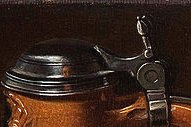
Face of Clara in the lid of the jug

Once again we see the added personal touch to this still life work for if you take a closer look you can uncover in the metal lid of the stone jug the reflection of a face with a white cap: this is Clara herself and as in other paintings by her this reflection appears to be a secondary “signature”.  This incorporation of a self portrait in a painting soon caught on and many other artists followed suit.

Florero (2)
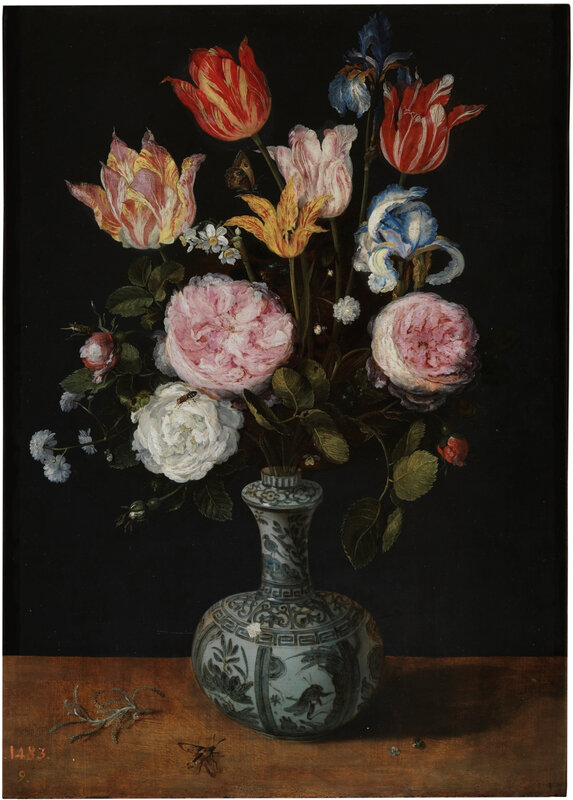
Vase of Flowers by Jan Brueghel the Elder (Jan Velvet Brueghel), 1609

Paintings depicting vases of flowers were very popular at the time.  One of the leading exponents was Jan Breughel the Elder.

Bouquet of Flowers by Clara Peeters (c.1612)

One of Clara Peeters’ floral still life paintings is in the Met Museum of New York. The painting depicts a luxurious bouquet of flowers in a roemer glass, which stands on a low stone shelf. The painting is awash with primary colours which make it stand out against a plain dark background.  The bunch is a mix of late spring and early summer blooms and include roses, tulips, narcissi, carnations, and irises. We see that some of the flowers have shed their petals which now lie on the pitted ledge.  Clara Peeters was an expert when it came to depicting reflective surfaces, an example of this is her depiction of the glass with its ornamented base and serrated foot. We see a butterfly perched on the stem of a fallen flower and in a way, this brings to life this still life work.

One has to presume that Clara Peeters’ choice of still life paintings is a result of the restrictions imposed on female artists. Female artists rarely followed an art education, certainly never being allowed to paint naked models, a must-do requirement if you wanted to become a history painter.  On the other hand, everyday objects were within reach of female painters.  Peeters’ still life artwork was in great demand with the buying public.  Already in the first half of the 17th century there was work by her in collections in the Northern Netherlands as well as her still lifes in the royal collection in Madrid. As was explained at the beginning of this blog the date of her birth is not precisely known.  It is the same for the date of her passing but it is presumed to be sometime after 1657.

Marianne North the botanical painter

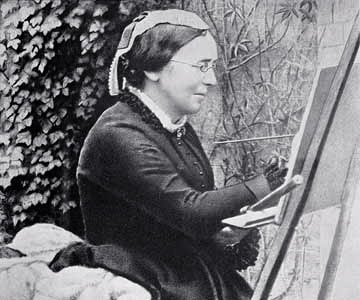
Marianne North     1830-1890
Marianne North
1830-1890

The artist I want to look at today could, I suppose, be labelled simply as a floral painter but in fact because of her desire for accuracy in floral detail she is often referred to as a botanical painter.  Even today, in the age of photography, botanical art still thrives and with so much destruction of habitats around the world, which nurtured rare flora, the necessity to record such species in detail is of paramount importance.  My featured artist today is the Victorian artist Marianne North.

The House at Hastings

Marianne North was born at Hastings Lodge in Hastings, England on October 24th 1830.  Her father Frederick North, an Old Harovian, was a wealthy landowner, local magistrate and, on a number of occasions, a Liberal Member of Parliament for Hastings.  His wife Janet (née Marjoribanks), was the daughter of Sir John Marjoribanks M.P., 1st Baronet of Lees in the County of Berwick.  She had been widowed when her first husband Robert Shuttleworth of Gawthorpe Hall in Lancashire died in a coaching accident 1818. She and her first husband had a daughter, Janet Shuttleworth.  Marianne North came from a long line of nobility and many of her ancestors’ portraits hung in the family dining room.  She was devoted to her father and in her autobiography, A Vision of Eden, she wrote of him:

“…My first recollections relate to my father.  He was from first to Last the one idol and friend of my life…”

Marianne had an elder brother, Charles and a younger sister, Catherine.  It is believed that she did not receive any formal education, except for a short period in a school in Norwich, which she hated.  Marianne was adamant that she taught herself all that was to be learnt, writing in her autobiography:

“…Walter Scott or Shakespeare gave me their versions of history, and Robinson Crusoe and some other old books my ideas of geography…”

Flowers of the Angel's Trumpet and humming birds, Brazil by Marianne North
Flowers of the Angel’s Trumpet and humming birds, Brazil by Marianne North

However the status and wealth of her father ensured that his children were well educated and often had the opportunity to mix with artists and musicians.  Marianne was said to have had a penchant for singing and as a child was given vocal lessons by Charlotte Helen Sainton-Dolby, the well-known English contralto, composer and singing teacher.  Unfortunately as a teenager her singing voice gave way and she began to concentrate on her other love – drawing and painting.  Life was good for Marianne.  As a young teenager, she had basked in a life of prosperity.  It was a privileged life.  Winters were spent at their Notting Hill house in London.  In the spring, they would move back to their large family home in Hastings.  During the summer months she and her family would either spend time on their farmhouse in Rougham, Norfolk, which had once been the laundry of Rougham Hall, once owned by her ancestors.  Alternatively, they would stay at Gawthorpe Hall in Lancashire which had been inherited by Marianne’s step-sister, Janet.  In the late summer of 1847 Marianne’s father took his family on a European tour which lasted almost three years.  Throughout this time Marianne studied flower painting, botany, and music.  On arrival back to London Marianne wanted to continue with her love of drawing and painting and it was arranged for her have some lessons in flower painting from a Dutch painter, Miss van Fowinkel and the English flower painter, Valentine Bartholemew, who had held the position of Flower Painter in Ordinary to the Queen from 1849 until his death thirty years later.

Marianne’s mother, Janet, who had increasingly become an invalid, died in January 1855.  The relationship between mother and daughter was nowhere as strong as the one between her and her father.  Marianne talked about her mother in her autobiography and commented:

“…On the 17th of January 1855 my mother died.  Her end had come gradually; for many weeks we felt it was coming.  She did not suffer, but enjoyed nothing, and her life was a dreary one.  She made me promise never to leave my father…”

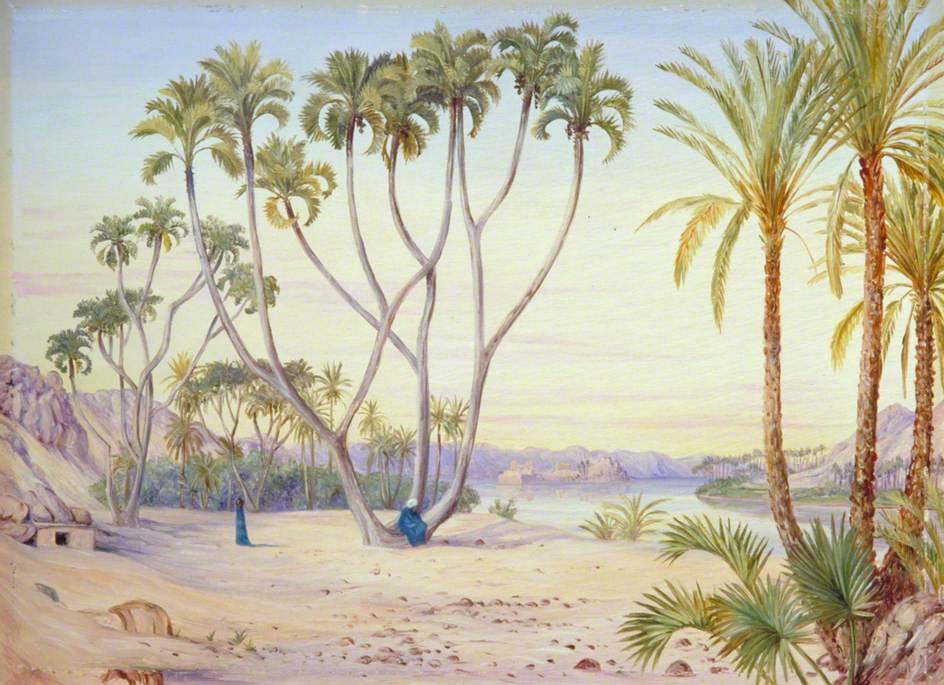
Doum and Date Palms on the Nile above Philae, Egypt by Marianne North (c. 1880)

With her mother gone, Marianne, aged twenty-four, took on the role as the lady of the house, looking after her father and the running of the household.   Her father, who had been the Liberal MP for Hastings on a number of occasions, would during the parliamentary recess take his two daughters off on long trips around Europe.     One of their favourite destinations was the valleys around the southern slopes of Mont Blanc and Monta Rosa.    By this time Marianne’s brother Charles had married and his father had given him the old house in Rougham. Marianne’s sister Catherine had married in 1864 and her father, Frederick North, narrowly lost his Hastings parliamentary seat by just nine votes at the General Election in July 1865 and this gave him the opportunity to set off on another voyage of discovery with Marianne travelling through Europe and the Mediterranean isles of Corfu and Cyprus before reaching Syria and Egypt.

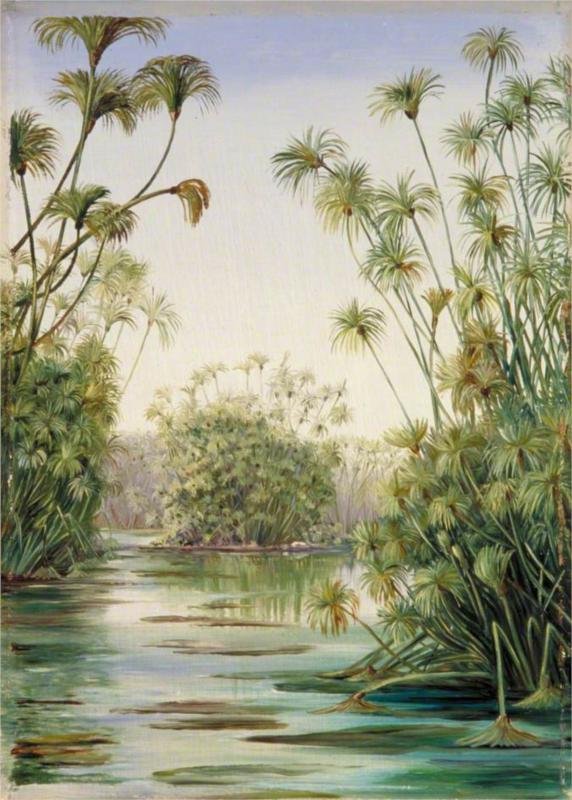
Papyrus Growing in the Ciane, Syracuse, Sicily by Marianne North (1870)

Three years after his defeat in the General Election Frederick North was re-elected as MP for Hastings in 1868.   Marianne’s father was sixty-eight years old and his health had begun to deteriorate but this did not stop him from taking a holiday to Southern Germany with Marianne.  However during their Bavarian sojourn, he became ill and Marianne was advised to take him back home to Hastings, which she did.  Frederick North died on October 29th.  Marianne was devastated for not only had she lost her father, she had lost her greatest friend.  She recalled his death in her autobiography, writing:

“…The last words in his mouth were, ‘Come and give me a kiss, Pop, I am only going to sleep’.  He never woke again and left me indeed alone…”

She recalled how much her father had meant to her and one can feel her deep sorrow.  She wrote:

“…For nearly forty years he had been my one friend and companion, and now I had to learn to live without him, and to fill up my life with other interests as I best might.  I wished to be alone, I could not bear to talk of him or anything else…”

The Aqueduct of Morro Velho, Brazil by Marianne North (1873)

Marianne North carried on with her two great loves, travelling and painting the flora she saw during those voyages of discovery.  In July 1871 she set off on a long journey which would last over two years.  She arrived in Canada, travelled on to the United States, and later the Caribbean island of Jamaica. From there, in 1872, she journeyed to Brazil where she spent much of her time drawing in a remote forest hut. She eventually returned to England in September 1873. Throughout her time on her travels she would be constantly sketching the flora of the area and the landscapes.

Roadside Scene under the Cocoanut Trees at Galle, Ceylon by Marianne North (c.1877)

In the spring of 1875 she was once again off on her travels.  This time she visited Tenerife, and later that year started her first round-the-world trip taking in the west coast of America, Japan, Borneo, Java, and Ceylon, and did not return home until March 1877.  Although she loved being in the house in Hastings and spent much time in the garden she had a wanderlust and in September 1878 this travel bug bit once again and she set off by ship to India, where she stayed for nearly six months,

Marianne North Gallery, Kew Gardens, London

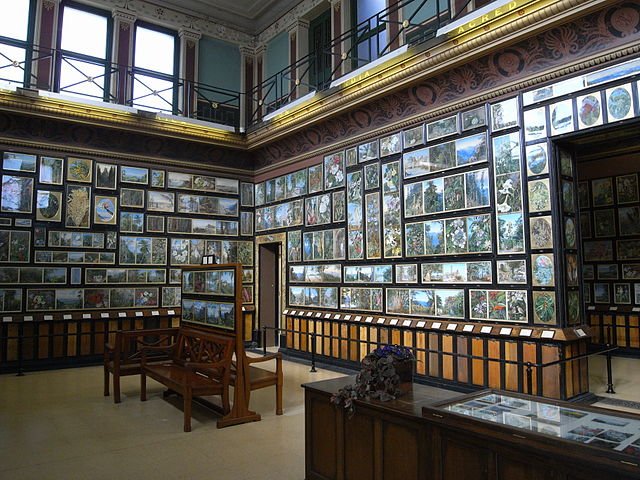
By this time Marianne had built up a large collection of drawings which she had completed during her extensive travels.  As they were so popular she held an exhibition of her work in a London gallery.  Having been overwhelmed by their popularity she came up with the idea that they should be housed in a permanent collection and with this in mind she approached Sir Joseph Hooker, the director of the Kew Botanical Gardens in London and offered to present them with her art works and to fund the building of a gallery to house them.  This was agreed and the architect James Fergusson submitted designs for the building and building work started in 1880.  Sir Joseph Hooker as well as being a director of Kew Gardens was a good friend of Charles Darwin and he was introduced to Marianne and it was on his suggestion that she should visit Australia, and New Zealand to discover and sketch the native flora and vegetation.  Marianne took up his suggestion and once again left her homeland and sailed to the antipodean.

Inside the Marianne North Gallery

On her return to England she set about arranging her paintings inside the newly completed gallery building at Kew and on July 9th 1882 it opened to the public as the Marianne North Gallery.

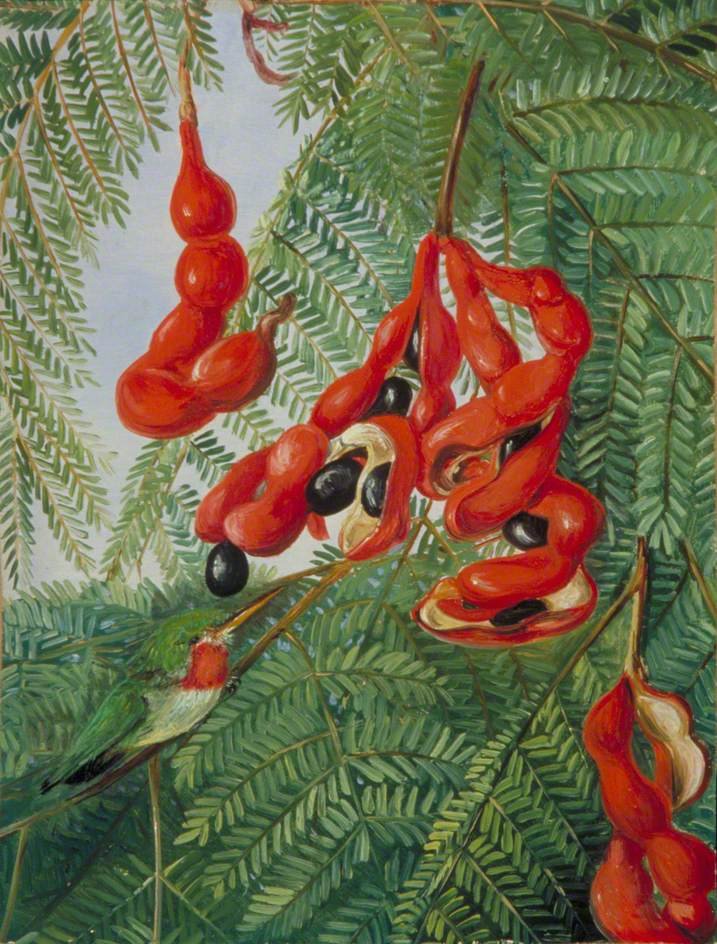
The Wild Tamarind of Jamaica with Scarlet Pod and Barbet by Marianne North (1872)

She resumed her travels visiting South Africa in 1883 and the following winter she was in the Seychelles.  All this travelling and having to endure constantly changing climatic conditions eventually affected her health and, during her later years, she was unable to live a pain-free existence.  She began to lose her hearing and in 1888 began to suffer from liver disease which finally claimed her life.  Marianne North died on August 30th 1890 aged 60.  Maybe it would be fitting to leave the last words to her sister Catherine who wrote about her sister:

“…The one strong and passionate feeling of her life had been her love for her father.  When he was taken away she threw her whole heart into painting and this gradually led her into those long toilsome journeys.  They no doubt shortened her life; but length of days had never been expected or desired by her, and I think she was glad, when her self-appointed task was done, to follow him whom she had faithfully loved…”

I have only been able to attach a few of Marianne’s numerous sketches and I am sure a visit to her gallery at Kew Gardens would be an amazing experience.  For those of you who might not be able to make that journey may I suggest you get hold of her autobiography, the book which I have been reading and from which I gleaned  most of the facts about this talented painter.   It was not an expensive book and well worth the money. It is called A Vision of Eden; The Life and Work of Marianne North.