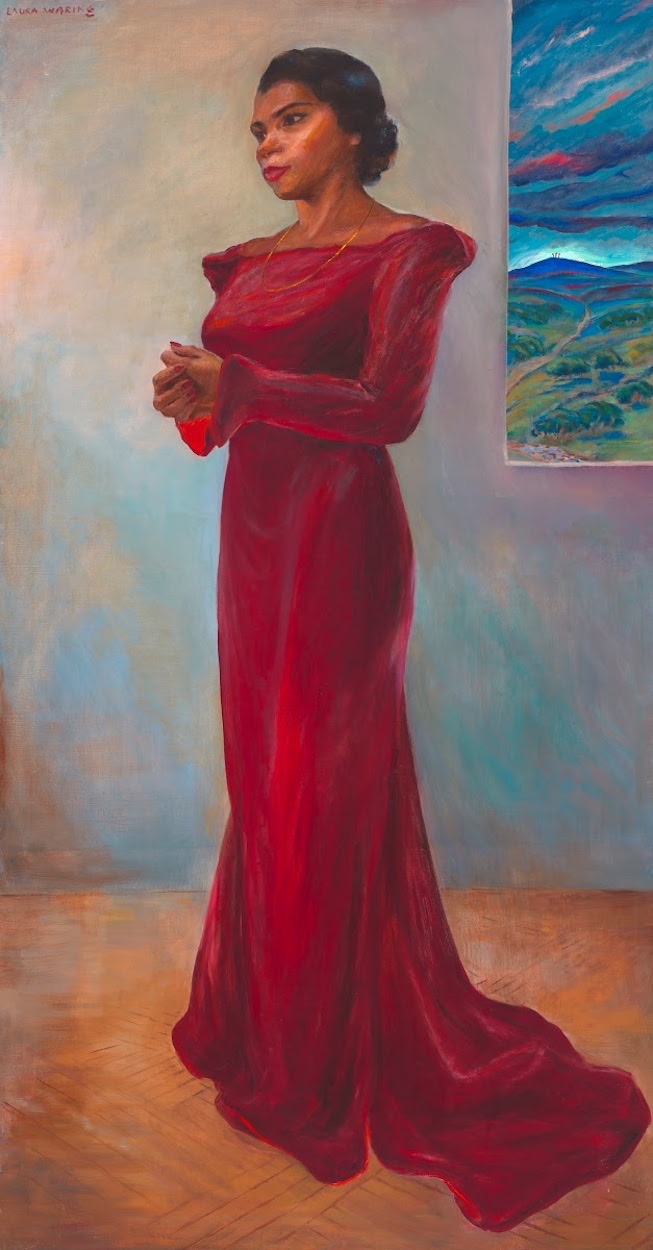
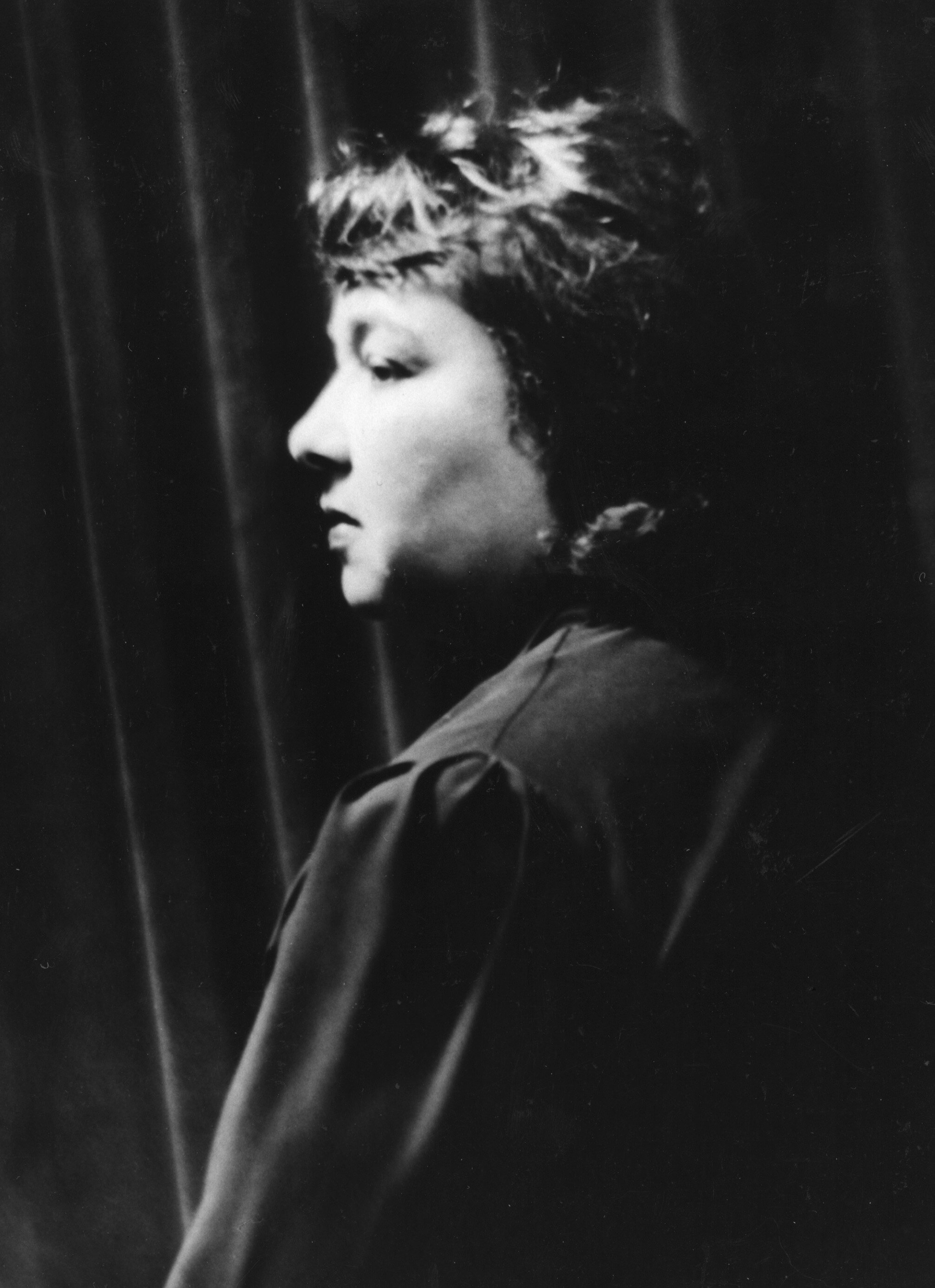
Louise Emerson Rönnebeck. Part 2.

Arnold and Louise settled down to living in the Colorado town of Denver in 1926. Soon the couple became active in the Denver art community and both were founding members of the Denver Artists Guild in 1928.  Whilst living in Denver during the 1920s and 1930s, they would regularly visit Santa Fe in New Mexico and when in Taos would be guests at Mabel Luhan’s Los Gallos compound.

The Rönnerbeck Family (1937)

The help Louise received from the WPA was just what she needed as her portrait commissions had dwindled due to the Depression and the little savings she had left from a family inheritance was quickly diminishing. Besides her portraiture she had always been interested in painting murals and accordingly she worked long and hard and entered a number of WPA competitions to win mural commissions in various US States. In all, she entered sixteen mural commission competitions for the Treasury Department Section of Painting and Sculpture,  a New Deal art project established on October 16, 1934, and administered by the Procurement Division of the United States Department of the Treasury.

The Fertile Land Remembers, oil on canvas mural by Louise Rönnebeck for the Worland, Wyoming Post Office, now in the Dick Cheney Federal Building, Casper, Wyoming, (1938)

In many of her submissions she focused on the power of women in striving for their goals but also depicted the plight of women and the children who were forced to work at a young age. In the end, she was awarded two commissions. In November 1937 she was invited to submit sketches for a mural that would decorate a wall in the post office of the Wyoming town of Worland. The Worland commission was for $570 and the artist was allowed 119 days for its completion. The organisers wrote Ronnebeck that the mural called for a “simple and vital design” based on a theme appropriate to the locale. Awarding Louise the Wyoming commission was a controversial decision as she was living in Colorado and many believed the commission should have gone to a Wyoming-based artist but the organisers stated bluntly that no Wyoming artist reached the standards they required. Louise commenced her oil on canvas mural entitled The Fertile Land Remembers in 1938. The mural depicts a white American couple with their child sitting in a wagon being pulled by two large oxen. These three figures, all looking towards us, are painted in a variety of rich colours whilst the native Indian horseback riders seen chasing buffalo are portrayed cloud-like figures in the sky above the wagon and are depicted in pale monochromatic luminous grey. None cast their eyes towards us. They are probably Cheyenne or Sioux, the forgotten people of Wyoming, who lived a nomadic lifestyle in order to pursue buffalo herds and were subdued and placed in reservations. Unlike the colourful people in the wagon being the present and future the pale grey figures are symbolic of the past. In the background we see the emerging elements of the white American future. Louise wrote about her thought process that went into the mural design:

“…The work is a romantic recollection of the covered wagon and the wild Indian and bison of the Old West, who still in retrospect hover over the irrigated fields and oil wells of the present. The covered wagon drawn by oxen is shown inexorably pressing through the galloping figures of a vanishing culture, whose form becomes shadowy and disappear into the past under the white man’s determination to open new lands. The landscapes on either side depict the present which was created by these pioneers. The way in which the idea is presented was suggested by the device of the double exposure used in many motion pictures to show the past and the present merging into one dramatic unit…”

Harvest by Louise Rönnebeck (1940)

Louise Rönnebeck’s second commission was for the post office and courthouse in the Colorado town of Grand Junction but which is now housed in the city’s Wayne N. Aspinwall Federal Building United States Courthouse. Louise won the opportunity to paint The Harvest through entering a contest anonymously, for fear of gender prejudice, and submitting a sample sketch. In 1940, with the enlargement of the Wayne N. Aspinall Federal Building, Rönnebeck’s mural was placed to embellish the postmaster’s office door pediment with its conspicuous V-shaped bottom. Her depiction represented the plight of the Native American Ute people who prior to the 1860s had lived in southwest Colorado for centuries and it was here that they had their seasonal hunting grounds. However, despite a Treaty which granted the Utes absolute and undisturbed use and occupation of their land, the lure of rich mineral deposits lured prospectors on to their land. The tribe was squeezed into an ever-smaller parcel of land by the incoming miners. The matter came to a head in 1881 when the Utes refused to leave the territory and were forced to the south-western border of Colorado. The six million acres of land once owned by the Utes was now up for grabs and settlers poured in establishing local industries such as orcharding in the form of growing peaches. In the foreground of Louise Rönnebeck’s large mural we see the harvesting of the peach crop by a young couple, modelled by Louise’s two children. To the left of the painting, we see settlers moving into the Ute’s land with their horses and to the right we see the result of this influx as the Ute people are forced out. This is a painting depicting a thriving local industry and acts as a counterpoint to the hard times of the Great Depression.

Unveiling of “missing” painting.

In a January 18th, 1992, article by Ginger Rice in Grand Junction’s Daily Sentinel, it describes the mural’s mysterious disappearance for more than twenty-five years. Workers removed the oil-on-canvas painting for conservation work, and it subsequently went missing. Fortunately, a General Services Administration building manager, Tim Gasparani, re-discovered the mural and in 1992, The Harvest finally returned to its original home.

The People vs Mary Elizabeth Smith. by Louise Emerson Rönnerbeck (1936)

In 1936, Louise Rönnerbeck completed a dramatic painting entitled The People vs Mary Elizabeth Smith. The depiction was based upon an emotional trial of an eighteen-year-old mother of a eight-month old child, Mary Elizabeth Smith, in January 1936. She, whom the press termed “the girl mother” had been accused of murdering her husband in the previous November. She had accused her estranged husband, nineteen-year-old Robert Dwight Smith, who was unemployed, as being abusive towards her. Just prior to the shooting he had petitioned the court to annul their three-year-old marriage which would result in their child being looked upon as being illegitimate. For Mary Elizabeth, this was too much to bear and so she took her brother’s hunting rifle, marched along to her sister-in-law’s house where her husband was staying and shot him. She told the police that she did not know why she did it. She just knew she had to protect her baby’s name. Her defence lawyers stated that having been deserted by her husband and struggling to bring up their son it had taken its toll on her mental health. Louise Rönnerbeck depicted the theatrical trial scene which she had witnessed.

The defence lawyer mitigated the actions of his client by reminding the jury of her personal history. Her father had deserted her leaving her mother to struggle to provide for her two children. Her own eight-month-old son, Rodney, born after a particular long and painful labour was the centre of her life. The courtroom was filled throughout the trial and the press feasted on the events. In his article, Jack Carberry of the Denver Post wrote:


“…”they met love, and in their ignorance of life, it engulfed them…”

Rönnebeck’s painting depicts the dramatic trial scene. In the witness box, at the centre of the legal proceedings, we see the frail reed-headed defendant, wearing a dark dress with a white collar, handkerchief in hand, as she grasps the side of the witness box. She is barely able to stand and is fully aware that if the all-male jury (at this time women were not allowed to be jury members) convicts her, she faces either the death penalty or life imprisonment. It was reported in the Denver Post that her testimony was one of child-like simplicity. On the left in the front row of the courtroom we see the girl’s mother holding her daughter’s infant son. She had come every day to offer support to her daughter. After Mary’s testimony it was reported that there was not one person in the courtroom who wasn’t crying, moved by the young woman’s simplistic testimony. Also in the scene we see the prosecutor waving the murder weapon and on a table to his right are the deceased bloodied shirt and trousers. The jury retired for five hours before returning and acquitting her for reasons of insanity.

The Children by Louise Emerson Rönnebeck (c.1935)

Following the end of World War II, Louise lectured at the University of Denver from 1945 to 1951 as well as providing some magazine illustrations. Her husband Arnold died of cancer on November 14th 1947, aged 62 and with her two children marrying, Arnold in 1950 and Ursula in 1953, she was left on her own. In 1954 she went to live in Bermuda where she and her family had spent many holidays. Here she taught art at the Bermuda High School for Girls between 1955 and 1959 and continued to paint. In the Autumn of 1973 she returned to Denver where she spent the rest of her life.

Louise Emerson Rönnebeck died in Denver on February 17th 1980, aged 78.


I collected information regarding the life and art of Louise Emerson Rönnerbeck from various sources. The main ones were:

Louise Emerson Ronnebeck

JStor: Louise Emerson Rönnebeck: A New Deal Artist of the American West
Betsy Fahlman. Woman’s Art Journal Vol. 22, No. 2 (Autumn, 2001 – Winter, 2002), pp. 12-18 (8 pages)

Living New Deal

Post Office Fans

Louise Emerson Rönnebeck. Part 1.

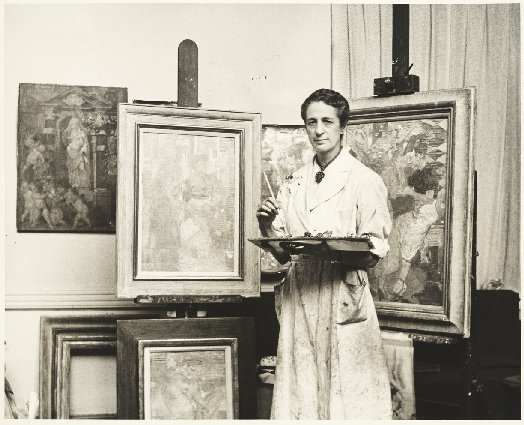
Louise at work (c.1930)

My featured artist today is Louise Emerson Rönnebeck, the twentieth century painter famous for her murals. Louise Emerson was born on August 25th 1901 in the Philadelphia suburb of Germantown but spent her childhood in New York. She was the third child of Mary Crawford Suplee and Harrington Emerson and had two elder sisters, Isabel Mary and Margaret Eleanor. Her father was the son of Edwin Emerson, a Professor of Political science and was an American efficiency engineer and business theorist, who founded the management consultancy firm, the Emerson Institute, in New York City in 1900.

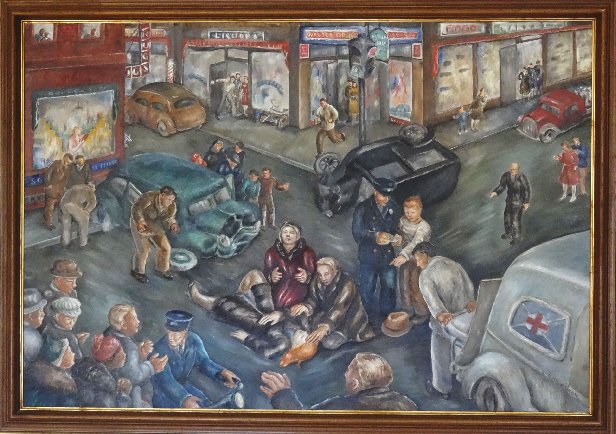
Car Accident at Aylard’s Corner (Denver) by Louise Emerson Rönnebeck ( 1937)

Having completed her regular schooling she attended Barnard College, Columbia University, which was then a private women’s liberal arts college in the New York City borough of Manhattan. In 1922 Louise Emerson graduated from Barnard College and, for the next three years, went on to study at the Art Students League of New York where she studied life drawing and anatomy with Canadian American painter, George Bridgman, sculpture with Leo Lentelli, the Italian sculptor and painting with Kenneth Hayes Miller. The latter had the greatest influence on her art and future career. Miller who taught at the Art Students League from 1911 until 1951 had among his students Edward Hopper and George Bellows.

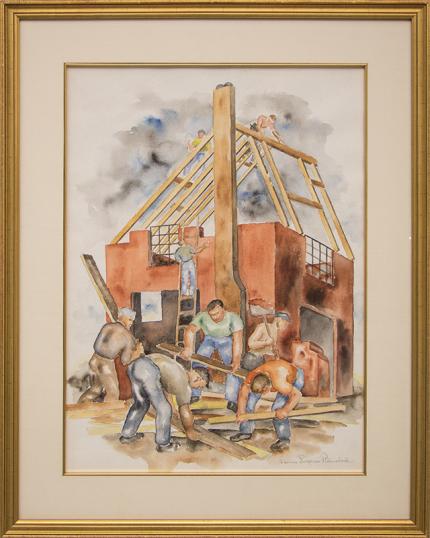
Building Boom by Louise Emerson Rönnebeck (1937)

During the summers of 1923 and 1924 Louise travelled to France and studied fresco painting at the Fontainebleau Schools which had been established in 1921. It was situated in Fontainebleau, thirty-five miles south-east of the centre of the French capital and consisted of two schools: The American Conservatory, and the School of Fine Arts. Here she studied under Paul-Albert Baudouin, a painter of genre, landscapes and decorative panels.

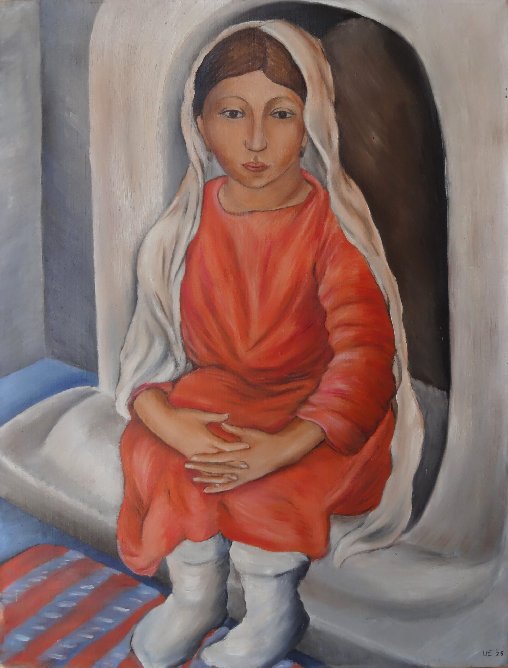
Taos Indian Child by Louise Emerson Rönnebeck (1925)

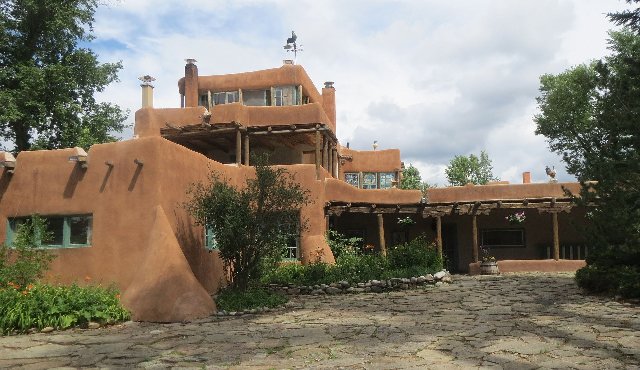
In the Summer of 1925, Louise did not carry on with her tradition of going to Paris to study at the American Conservatory and School of Fine Arts as she and her sister Isabel had been invited to stay at Taos in the New Mexico ranch home, Los Gallos, belonging to Mable Dodge Luhan. The ranch was located near the eastern edge of the town center of Taos. Luhan, the heiress of Charles Ganson, a wealthy banker, was an American patron of the arts, who was particularly associated with the Taos art colony. The ranch was a meeting place for many contemporary artists and writers and Louise Emerson distinctly remembered her visit there:

“…It was a marvellous place, all wild, strange, empty and romantic…”

Mabel Dodge Luhan Ranch House

Other guests at the ranch at the time were the writers D.H. Lawrence and his wife Frieda along with Aldous Huxley. Louise was a great admirer of Lawrence and so she and her sister decided to call on him, albeit they had not been invited by the writer. Louise remembers that visit well. Despite not having been invited, it was perfectly all right. He seemed only too happy to have someone who would listen to him. She remembered that he had a red beard and deep-set eyes which conveyed a surprising intensity. She said she was impressed with this wiry, frail, yet madly gifted person, who talked in a common, ugly voice. He and his wife Frieda seemed very Bohemian and avant-garde. Lawrence fought with his wife and they shouted at each other. Despite looking very ill, he baked his visitors bread, and Frieda made jam. Sensing she had been in the presence of a genius, it remained, as Louise recalled, that it had been one of the most memorable days of my life.

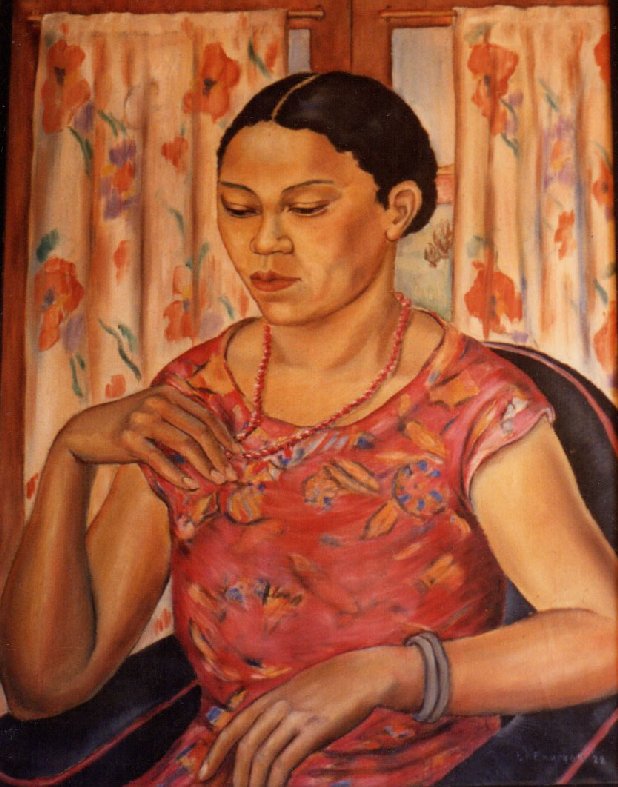
Roberta by Louise Emerson Rönnebeck (1928)

Another of the guests staying at the Taos ranch was Arnold Rönnebeck. He was a German-born American modernist artist and sculptor who had arrived in America two years earlier. He was a good friend of many of the avant-garde writers and artists he had met during his time in Berlin and Paris. In America he had become friends with artist Georgia O’Keefe and photographer Alfred Stieglitz and it was at one of the latter’s gallery, An American Place that Rönnebeck first exhibited some of his artwork in America. The gallery was on the seventeenth floor of a newly constructed skyscraper on Madison Avenue. Arnold was impressed by Louise and wrote about her to his New York friend Stieglitz about his first impressions of this young woman:

“…What a summer!  …. The one other person who is doing something about this country is a young girl from New York, Louise Emerson, a pupil of Kenneth Hayes Miller at the league. Still under the influence of Derain, but strong and powerful and with a very personal vision. She lives in one of Mabel’s cottages and is going very good watercolors and oil landscapes…”

Louise and Arnold Rönnebeck’s Wedding Photograph

Soon the friendship between Louise and Rönnebeck turned into love and in New York City, twenty-five-year-old Louise Emerson and Arnold Rönnebeck married despite him being sixteen years older than her. The marriage took place in March 1926 at the All Angels Episcopal Church on the Upper Westside of Manhattan and the reception after the ceremony took place in Louise’s parent’s home close by. Despite her marriage, Louise continued to use her maiden name professionally until 1931.

Arnold Rönnebeck working on his sculpture “Grief” in Omaha, Nebraska (1926)

The couple took an extended honeymoon travelling to Omaha, Santa Fe, and Los Angeles, places which Rönnebeck had to visit to finalise some painting and sculptural commissions and attend the one-man exhibitions of his work in San Diego and Los Angeles . After the honeymoon the couple settled in Denver where Arnold became director of the Denver Art Museum.

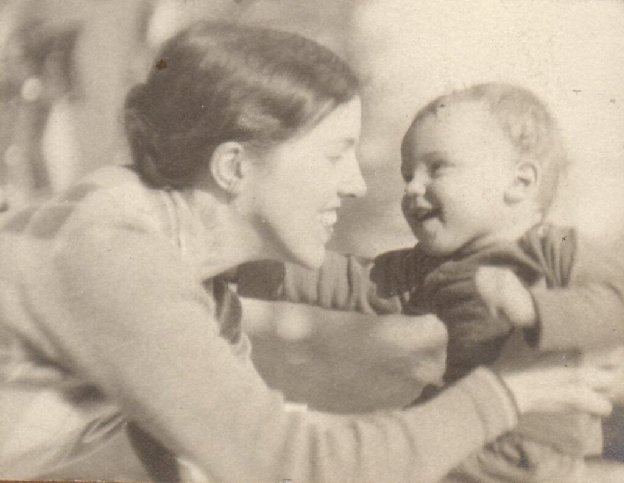
Louise with her son Arnold (1927)

Louise Ronnebeck gave birth to their first child, Arnold Emerson, in 1927 and two years later a second child Anna Maria Ursula was born. The Rönnebeck household with two young children and two working artists was somewhat chaotic and Louise had to balance looking after the family and carrying on with her art. Add to this mix, Louise was just starting her artistic career whereas her husband had passed the high-point of his career and since he arrived in America from Germany he had not reached the level of his European fame. Her struggle to manage all her tasks and family duties was highlighted in a 1946 Denver Post article, in which Louise was described as:

“…a four handed woman – – managing home and children on one side, and teaching and painting on the other…” 

In letters and interviews Louise talked about the struggle to have time to be a mother, wife and artist. In a letter to Edward B Rowan, a friend and arts administrator, teacher, artist, writer, lecturer, critic, and gallerist, dated February 1938, she wrote:

“…Being mother of two strenuous children, and the caretaker of a fairly large house, I have to budget my time carefully…”

… Between the children’s meal time, the mother rests while the artist works…”

Louise Emerson Rönnebeck

In a February 1930 article in the daily newspaper, Rocky Mountain News, entitled Denverite Out to Prove She Can be Mother and Artist by Margaret Smith, Louise was quoted as saying that she would never encourage her children to become artists as an artist’s life is both unsocial and confining. Although her husband missed the big city lifestyle, Louise was content with her new life in Denver and in a 1934 letter to her former teacher, Kenneth Hayes Miller, she wrote:

“…I have become very attached to life in the west. We rent a charming really spacious house almost in the country for very little money, take frequent weekends in the mountains, and the children are radiant and adorable persons. Arnold, however, misses bitterly the stimulation of a big city and longs very much for a change…”

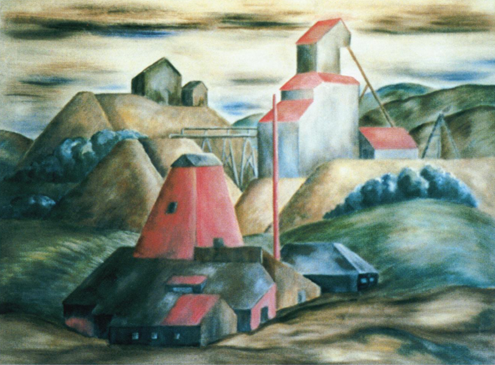
Colorado Minescape by Louise Emerson Rönnerbeck (c.1933)

Louise and Arnold had only been living in Denver for three years when the country was hit by the Great Depression and Louise knew that with their finances being in a poor state she and the family needed some help to survive. She turned to the WPA. The WPA was the Works Progress Administration, later known as the Work Projects Administration. This was an American New Deal agency that employed millions of jobseekers to carry out public works projects. The Federal Art Project was one of the five projects sponsored by the WPA, and the largest of the New Deal art projects. It was not solely created as some cultural activity, but as an assistance measure which would lead to artists and artisans being employed to create murals, easel paintings, sculpture, graphic art, posters, photography, theatre scenic design, and arts and crafts. One of the important things for the artists, besides earning money, was that commissions were essentially free of government pressure to control subject matter, interpretation, or style.

……….to be continued.


I collected information regarding the life and art of Louise Emerson Rönnerbeck from various sources. The main ones were:
Louise Emerson Ronnebeck

JStor: Louise Emerson Rönnebeck: A New Deal Artist of the American West
Betsy Fahlman. Woman’s Art Journal Vol. 22, No. 2 (Autumn, 2001 – Winter, 2002), pp. 12-18 (8 pages)

Living New Deal

Post Office Fans

Fourteenth Street School of Artists

“…I hope my work is recognizable as being by a woman, though I certainly would never deliberately make it feminine in any way, in subject or treatment.  But if I speak in a voice which is my own, it’s bound to be the voice of a woman…”

-Isabel Bishop

Isabel Bishop, 1959. Photo by Budd ( New York N.Y.). Archives of American Art, Smithsonian Institution.

The Ashcan School of painters was the artistic movement that depicted Urban Realism in America during the late 19th and early 20th century. A few decades later another group of American realist painters, who were also based in New York city, began to focus on everyday life in the city. For these artists, it was all about the bustling area which centred around 14th Street and Union Square in Lower Manhattan during the Depression era. They became known as the Fourteenth Street School of Artists. One of these artists was Isabel Bishop.

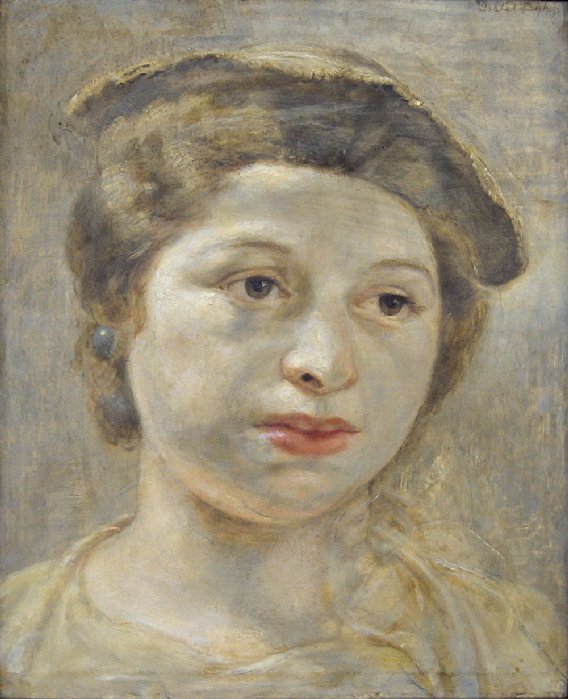
Female Head by Isabel Bishop

Isabel Bishop was the youngest of five children born on March 3rd 1902 in Cincinnati, Ohio, to John Renson Bishop and Anna Newbold Bishop. Her parents were descendants from East coast mercantile families but although they came from “old money” they were considered middle-class and often struggled financially. Isabel’s parents were both highly educated individuals. Her father was a Greek and Latin scholar and had a Ph.D in history. Her mother was a writer and an activist for women’s suffrage. The family frequently moved from town to town for financial reasons and to gain employment. Wherever they set up home, Isabel’s father, John, would find work at the local school where he often rose to become its principal and in some cases took ownership of the school.

Ice Cream Cones by Isabel Bishop

In 1887 the couple had their first children, twins, a boy and a girl, Mildred and Newbold and in 1890 another set of twins, once again a boy and a girl, was born, Remson and Anstice. This enlargement of the family caused financial hardship and her father had to continually look for better paying jobs. Isobel did not remember much about the two sets of twins as by the time she was born they were away at boarding school or college. According to Isabel her parents were very different in temperament. Her mother was a free spirit but very strong-willed and in her 1987 interview she recalls an incident that had repercussions on her father’s life:

“…It was hard on my father that she was strong. For one thing, in Detroit, Michigan, women were not supposed to be strong. She simply liked what she liked and that was it. One time she was asked to go down to the court and testify in some case. She went down, but she wouldn’t swear to be telling the truth. She was asked by the court why she wouldn’t and she said, “I don’t believe in God.” It was in the Detroit papers with the headline:


“SCHOOL PRINCIPAL’S WIFE DOESN’T BELIEVE IN GOD”


I really felt for my father. I mean, a school principal! His life was pretty impossible after that…”

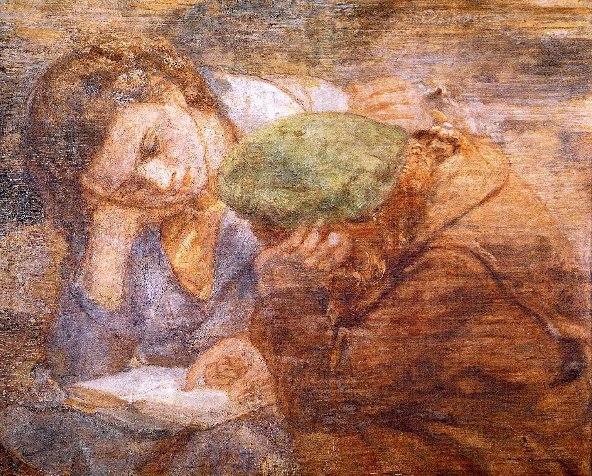
Two Girls with a Book by Isabel Bishop

Although born in Cincinatti Isobel and her parents moved to Detroit a year after she was born. In 1914, when she was twelve years of age, Isabel was enrolled in Saturday morning life drawing classes at the John Wicker Art School in Detroit. From there, at the age of sixteen, and once she had graduated from High School, she left Detroit and went to New York. It was here that she enrolled at the School of Applied Design for Women, where she studied illustration. In 1920, aged eighteen, Isabel, wanting to enhance her artistic knowledge and skills, attended the Art Students League where her first tutor was Max Weber, whom she disliked and who gave her a hard time. Later she was tutored by Kenneth Hayes Miller, another artist associated with the Fourteenth Street School who couldn’t be more different than Weber. Other tutors were Guy Pène du Bois, Robert Henri and Frank Vincent DuMond.

Portrait of Isabel Bishop by Guy Pene du Bois (1924)

According to Helen Yglesias’ 1989 biography Isabel Bishop, although Weber treated Isabel harshly and she felt intimidated by Robert Henri, in Kenneth Hayes Miller she found a mentor who, in her words, was “intellectually stimulating, not stultifying, a fascinating person who presented all sorts of new possibilities, new points of view.”

Isabel Bishop’s 9 West 14th Street Studio (no longer extant) highlighted in red, 14th Street, north side, west from Fifth Avenue. June 11, 1933.

Another friend she made at the Art Students League was Reginald Marsh, who made fleeting visits to the classes at the Art Students League whilst she was student there and this friendship led to her being witness to the working-class life of the city. In 1926, she went to live at 9 West Fourteenth Street, which was a short distance from where Marsh lived and it was in this vicinity that she kept her studio that overlooked Union Square at Broadway and East Fourteenth Street and remained there until 1982. From the windows of her studio she was able to witness the daily activities in Union Square. Fourteenth Street in the 20s and 30s was referred to as “The Poor Man’s Fifth Avenue.” It was a bustling center for bargain shopping and bawdy entertainment in the form of burlesque shows and movie theatres for everyday working-class New Yorkers. 

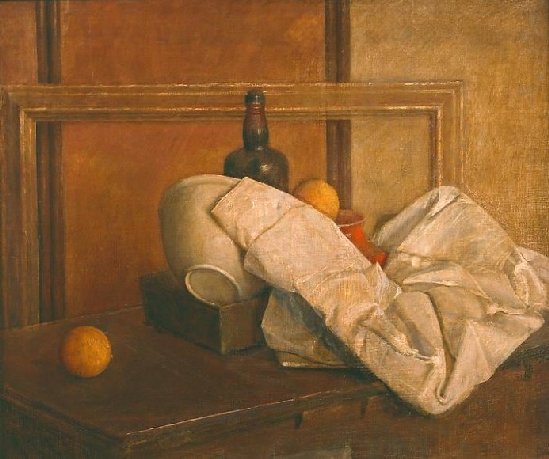
Still Life with Orange #1 by Isabel Bishop

Her friendship with fellow student, Reginald Marsh, encompassed many lunch or dinner dates when they discussed their day’s work. She affectionately recalled that they each paid for their own fifty cent meal and occasionally Marsh would take her to a Coney Island dance marathon or backstage at Minsky’s Burlesque. She recalled that it was great going with Reggie, and whilst there he would sketch the goings-on at the Burlesque show. She said that there were a number of occasions, the owner, Minsky bought Reggie’s work.

The Artist’s Table by Isabel Bishop

Isabel loved the area around Union Square and would regularly visit the Square itself, sketching for hours on end. She remembered those days saying:

“…I adored it. Drawing nourished my spirit; it was like eating. I got ideas there, for drawing is a way of finding out something, even though it might only be the discovery of a simple gesture…”

If she liked one of her sketches, she would turn it into an etching or make a painting from it. She soon became known for depicting urban life and was a leading member of the Fourteenth Street School of artists.

14th Street by Isabel Bishop

The Great Depression began in 1929 and nobody seemed to want to spend money buying the work of an unknown female artist, especially one who had not even had a solo show. Money was tight, people were losing their jobs and America had fallen into the grip of the worst depression in history and most Americans were worried about how they could survive the disaster that had befallen the nation. Isabel went from art gallery to art gallery hoping that they would accept her paintings but with little luck. It was a very depressing and frustrating time in Isabel’s life. A turning point came when Isabel met Alan Gruskin. Gruskin had hoped to become an artist, but while still a student realized that his talents were better suited to art administration than painting. On graduating from Harvard he worked at a New York gallery that specialized in the works of the Old Masters. He left there and returned home hoping to start a career as an author but that never came to fruition so he returned to Manhattan and, in 1932, opened the Midtown Galleries at 559 Fifth Avenue. He specialised in artwork by living American artists and in that year he staged a solo exhibition of Isabel’s paintings.

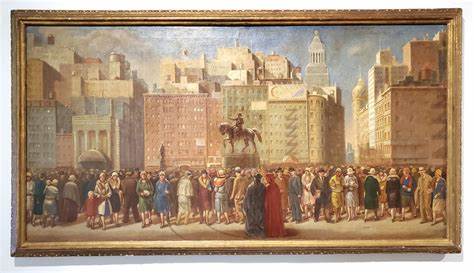
Dante and Virgil in Union Square by Isabel Bishop (1932)

Isabel Bishop’s paintings focused on the ordinary people of New York City, and in particular, those in her neighbourhood around Union Square and 14th Street. However, her 1932 painting entitled Dante and Virgil in Union Square was extraordinary with her inclusion of Dante, in the red cloak, and Virgil, with a laurel wreath on his head, which makes this work memorable. Isabel said she was motivated when she read the translation of Dante’s Inferno, the first part of Italian writer Dante Alighieri’s 14th-century narrative poem The Divine Comedy with its tales of life in the underworld. In her depiction, Isabel likened the hordes of poor souls that confronted Dante and Virgil in the various levels of hell with the hordes of human beings that daily passed through Union Square at rush hour. In the painting we see a crowd of people at Union Square, the equestrian statue of George Washington in the centre framed by the Union Square Savings Bank and other buildings in the background. It is a very busy scene a woman leading her child by the hand, pairs of women walking away from the crowd, and a number of working class men, portrayed in darker colours, facing into the Square seem completely unaware of the classical figures, who stand in the shadowed foreground of the sidewalk, as if embodying the evaluating gaze of another era.

At the Noon Hour by Isabel Bishop (1936)

In Ellen Wiley Todd 1993 book, The “New Woman” Revised: Painting and Gender Politics on Fourteenth Street, she describes the New Woman of the 1920s and 1930s as:
“…being a moderate sort, who hoped to capitalize on new job possibilities and to make herself attractive with the mass-produced products of the clothing and cosmetics industry…”

Hearn’s Department Store-Fourteenth Street Shoppers by Isabel Bishop (1927)

The entrance to Hearn’s Department Store was right across the street from Isabel Bishop’s studio and she realised that it was the perfect place to find and observe this “New Woman.” Isabel Bishop’s Hearn’s Department Store—Fourteenth Street Shoppers was completed in 1927, the same year that she enrolled in Kenneth Hayes Miller’s mural painting class at the Art Students League. It depicts the city’s middle-class shoppers who are wearing the latest fashions and who visit the shops around Union Square in order to pick up the latest bargains.

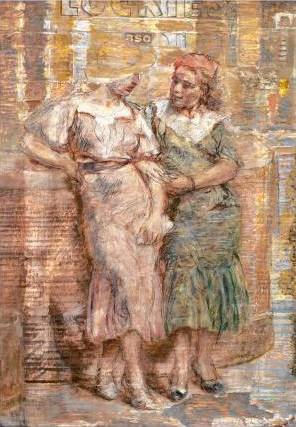
Two Girls by Isabel Bishop (1935)

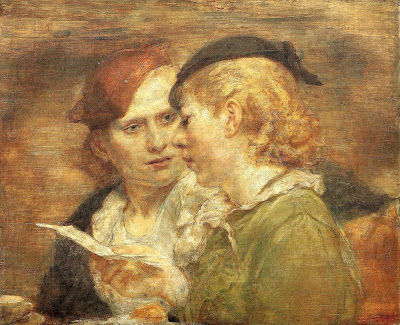
In 1935 Isabel completed her painting entitled Two Girls. It was yet another of her works which depicted young working women. In this painting we see a close-up of two smartly dressed figures seemingly engaged discussing the contents of a letter. Isabel used two models for this depiction and for this work she used Rose Riggens, a server at a restaurant where Isabel often had breakfast, and Riggens’ friend Anna Abbott. The work exudes both warmth and tranquillity which counters the dire economic circumstances of the Great Depression in the 1930s. This painting which took her twelve months to complete was one of Isobel Bishop’s most well-known works and was originally shown at the Midtown Galleries in New York. It is now part of the city’s Metropolitan Museum of Art.

Encounter by Isabel Bishop (1940)

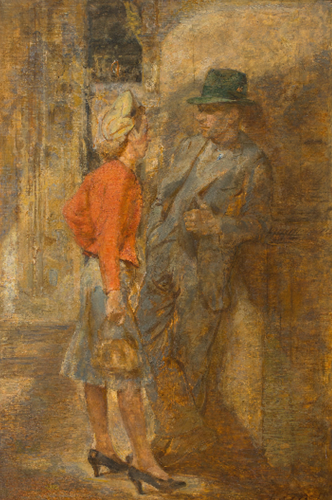
In her 1940 painting entitled Encounter we witness an exchange occurring between a man and a woman though the circumstance of this meeting remains unclear. From many of her paintings we can deduce that Isabel was an insightful observer of everyday activities of young women who visited offices and stores in her neighbourhood. Her works present working women as vivacious subjects for the American Art Scene, which centred on the daily lives of the city’s population. At a time of great unemployment Isabel found it easy to employ young unemployed clerical workers to pose for her. In this work, she depicts a young woman and her boyfriend, with whom she is having a rather stormy romance. The painting can be seen in the St Louis Art Museum.

Tidying Up by Isabel Bishop (1941)

In her 1941 painting Tidying Up, we see a woman, perhaps a secretary or salesperson, using a pocket mirror to check her teeth for lipstick smudges. Isabel liked to depict working-class women during their idle moments away from their jobs. She spent more than a decade depicting secretaries, salesclerks, and blue-collar workers who lived and often worked in and around Union Square. She favoured subjects of women who were simply going about their everyday lives, eating, talking, putting on makeup, and taking off their coats. It was these mundane actions along with facial expressions that Isabel Bishop believed divulged the character and temperament of the people she portrayed. This painting is part of the Indianapolis Museum of Art collection.

Girl Reading by Isabel Bishop (1935)

Bishop remained on Union Square, where she kept a studio until the end of her life. The area around Fourteenth Street and Union Square remained foremost as the subject matter for her paintings. She received many awards during her life and she was elected an associate member of the National Academy of Design in 1940 later in 1941 she was elevated to full Academician. She received a Benjamin Franklin Fellow at the Royal Society of Arts in London and was also elected a Member of the National Institute of Arts and Letters in 1944 and was the first woman to hold an executive position in the National Institute of Arts and Letters as vice-president. In 1979, she was awarded the Outstanding Achievement in the Arts Award presented to her by President Jimmy Carter.

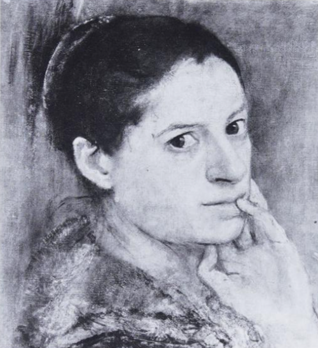
Self portrait by Isabel Bishop (1927)

Isabel Bishop died on February 19th 1988 two weeks before her eighty-sixth birthday.


Most of the information for this blog came from the following excellent websites:

The Art Story

incollect

Isabel Bishop

Hellenica World

Off the Grid

Oral history interview with Isabel Bishop,
1987 November 12-December 11

Annex Galleries

Reading and Art

Gertrude Horsford Fiske

Gertrude Horsford Fiske

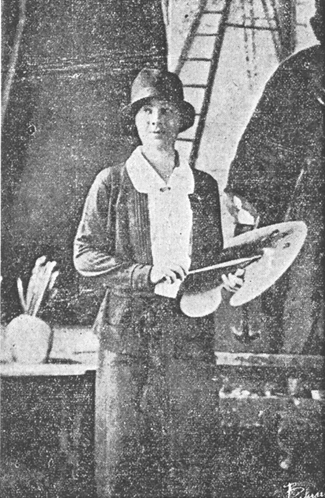
The artist I am looking at today is the nineteenth century American painter Gertrude Horsford Fiske who was famous for painting people, still life, and landscapes. Gertrude Fiske was born into an established New England family that can trace their family history way back to the Governor of Plymouth Colony, William Bradford an English Puritan Separatist originally from the West Riding of Yorkshire in Northern England who moved to Leiden in Holland in order to escape persecution from King James I of England, and then emigrated to the Plymouth Colony on the Mayflower in 1620. Gertrude, born in 1879, was one of six children born into a wealthy Boston family, her father being an eminent lawyer. She was educated in Boston’s best schools but during her teenage years she showed little interest in art as much of her free time was taken up with horse riding and golf. She proved herself to be an extremely skilled professional golfer.

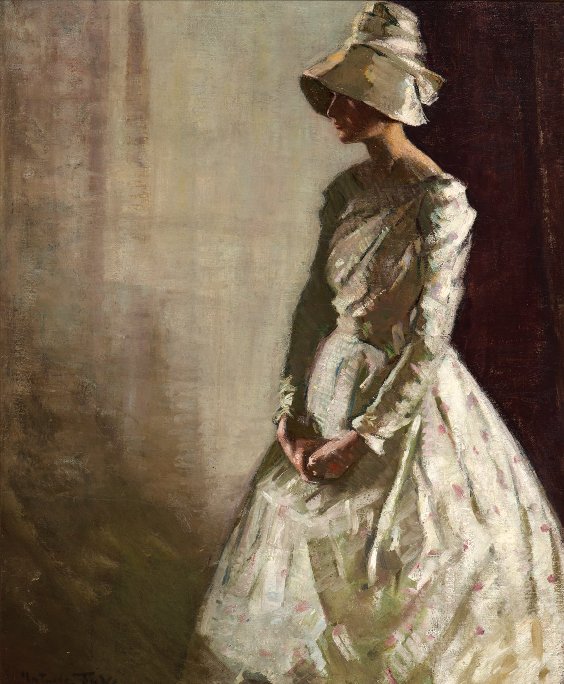
Woman in White by Gertrude Fiske

It was not until she was twenty-five years old that she took an interest in art and began to look at the possibility that her future could be as a professional artist. In 1904 she enrolled on a seven-year course at the School of the Museum of Fine Arts, Boston, (now the art school of Tufts University), where her tutors included Edmund C. Tarbell, an American Impressionist painter, Frank Weston Benson, known for his Realistic portraits, American Impressionist paintings, watercolours and etchings and Philip Leslie Hale, an American Impressionist artist, writer and teacher.

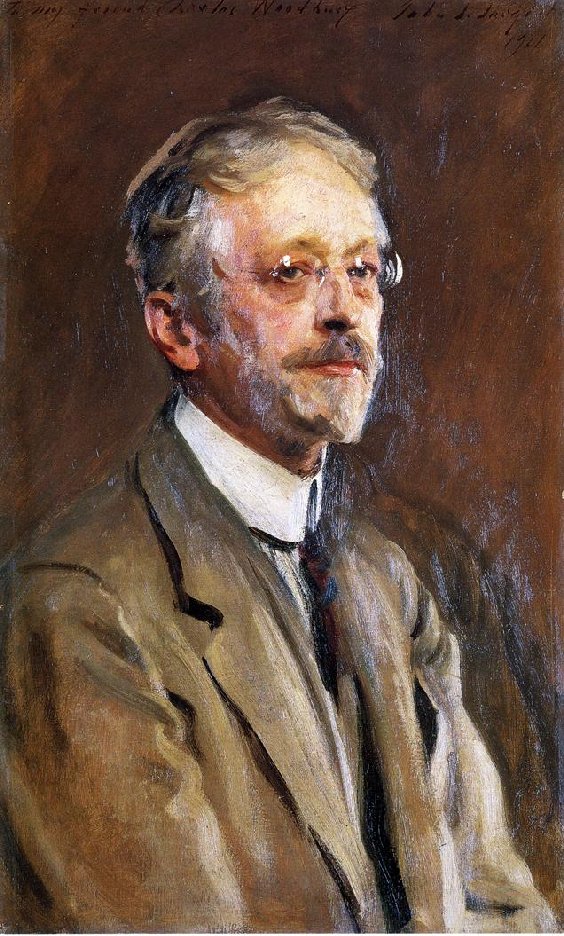
Charles Herbert Woodbury by John Singer Sargent (1921)


During the summers, she attended Charles Herbert Woodbury’s art classes in Ogunquit, Maine. Ogunquit was originally populated by The Abenaki indigenous people of the Northeastern Woodlands of Canada and the United States and in their language the name of the town means “beautiful place by the sea”. In the early years of the twentieth century, it had become a popular destination for artists who wanted to capture the landscape’s natural elegance.

Ogunquit Beach by Gertrude Fiske (1914)

Ogunquit Beach by Gertrude Fiske

Soon, a community of artists formed the Ogunquit Summer School of Drawing and Painting which was founded by Charles Woodbury. Woodbury was a great influence on Gertrude Fiske’s informative years and he encouraged her and her fellow students to “paint in verbs, not in nouns.” By this, he meant that his students should enter into the life of the things they painted. He wanted to inspire them to fresh, “active” seeing and expressive creativity and told them that in seascapes they did not draw what they saw of the wave – you draw what it does. The phrase implied that painting is perceptual and that realism is evidence of the felt and the seen and not just of what’s visible.

Bettina by Gertrude Fiske (1925)

Because of the family’s wealth, Fiske had the financial freedom to pursue her painting career and after she completed her time at the School of the Museum of Fine Arts, Boston in 1912, she spent time in France, continually sketching as she travelled. Her artistic style was a blend of the light-filled, classical, portrait style she had mastered under Edmund C. Tarbell with the freer, inventive, and colour-rich landscapes she had learnt during her summers spent at the Ogunquit school.

Nude in Interior by Gertrude Fiske (c.1922)

Gertrude Fiske painted a number of works featuring nudes. Her painting entitled Nude in Interior was completed around 1922. The subject of this work, the nude female, is shown posing for the artist, the image of whom we see in the background, reflected in a mirror. Gertrude often used this inclusion as a means to put over to the viewers the importance of the painter.

Bird of Paradise, Sleeping Nude by Gertrude Fiske (c.1916)

Another controversial nude work was her 1916 painting entitled Bird of Paradise, Sleeping Nude which received mixed reviews. It was praised for its honesty but more conservative critics said it was a scandalous depiction. Before us we see a foreshortened figure of a naked woman who appears supremely relaxed and unaware of us, the viewers. It is simply an honest depiction of a real woman.

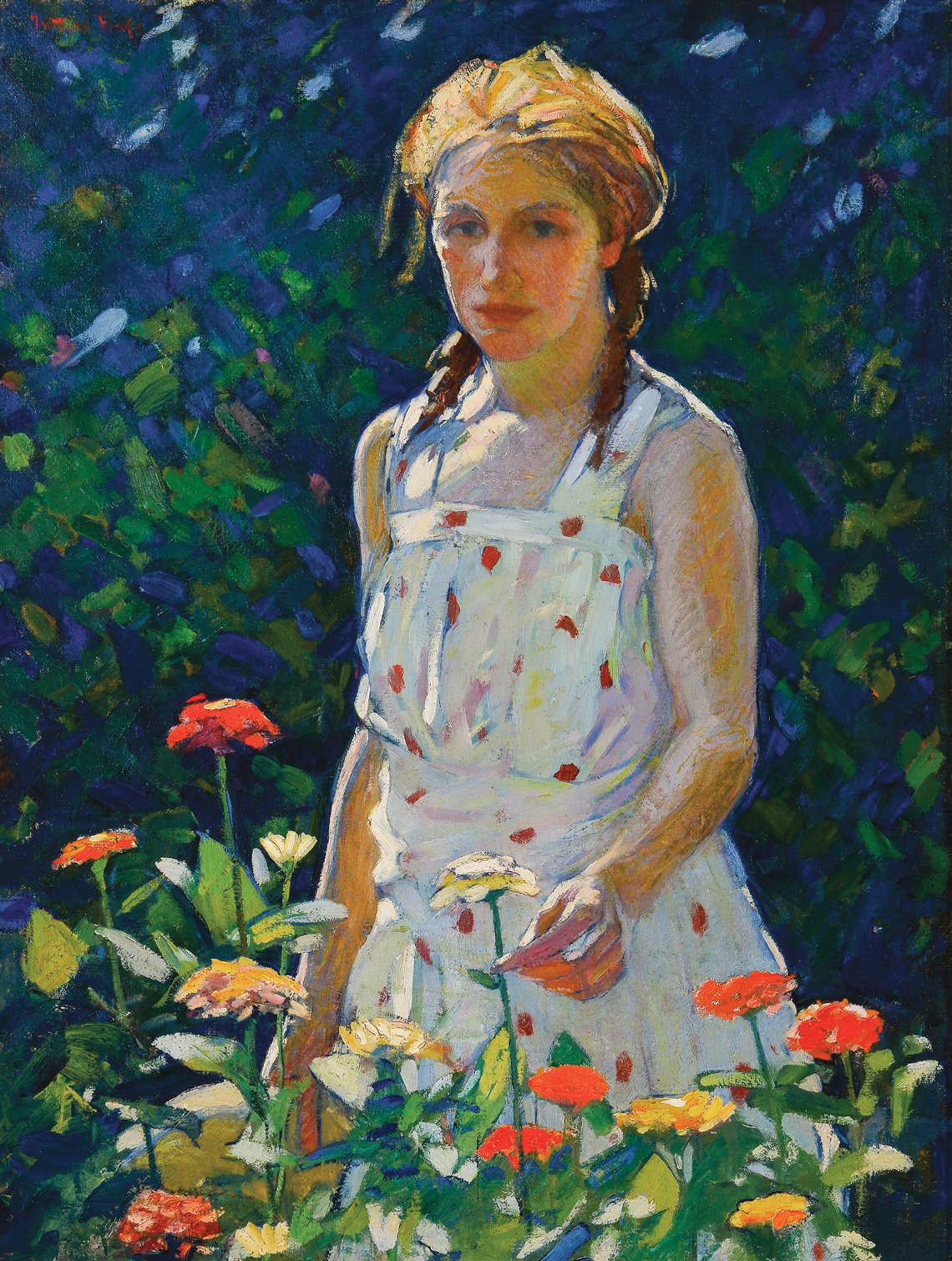
Zinnias by Gertrude Fiske (c.1920)

Gertrude returned to America but tragedy struck her family with the deaths of a sister, brother and mother around the time that the First World War was raging in Europe. Fiske then had to care for her aging father. However, despite the tragic losses and her new role as a carer she continued to be a prolific and much-admired painter. She kept a studio in Boston as well as at her family’s longtime home, Stadhaugh, in the town of Weston, fifteen miles west of Boston. It was at Stadhaugh that she worked in her studio which was located on the top floor of a converted barn. It had a picturesque setting overlooking woods and this vista served as the backdrop for several of her works.

By the Pond by Gertrude Fiske (c.1916)

In 1914, she, along with prominent painters of the day, including Edmund Tarbell, William Paxton and Frank Benson, helped create the Guild of Boston Artists. Its mission was to promote both emerging and established artists who lived in the region. The Guild developed a reputation for excellence in quality and presentation. Later, in 1917, Gertrude was part of setting up the Boston Society of Etchers and in 1918 Fiske became a member of the National Association of Women Artists.

Strollers by Gertrude Fiske (c.1926)

After the end of the First World War, America staged a rapidly growing industrial way of life and along with waves of immigration in the last quarter of the nineteenth century, elements of a new national consciousness arose in the United States. It was considered to be part of the colonial revival, which found expression in architecture, decorative arts, paintings, and all types of material life which represented an effort to regain a sense of an earlier time in America. Boston was in the forefront of colonial revivalism, and it was the Boston School of Painting, led by Edmund C. Tarbell, that is closely identified with the movement. Gertrude Fiske, who had spent seven years there as a full-time student at the School of the Museum of Fine Arts, Boston, was trained in this artistic dream of the future.

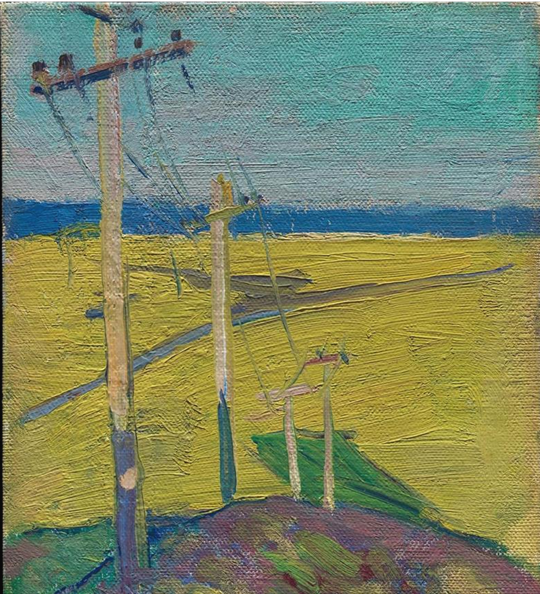
Wells, Maine by Gertrude Fiske


However Fiske was an independently minded and instead of blindly following social convention and the strong direction proposed by the Boston school with its more genteel mannerisms, she ploughed her own furrow and in her landscape depictions instead of removing signs of industry and technology from her work, she made a conscious decision to include them. A good example of this can be seen in her painting entitled Wells, Maine, in which she has retained depictions of a line of utility poles, with a secondary electrical line running across the painting. Her composition with utility poles set against the background of a seascape demonstrates the artist’s interest in juxtaposing signs of modernity with scenes more traditionally considered beautiful.

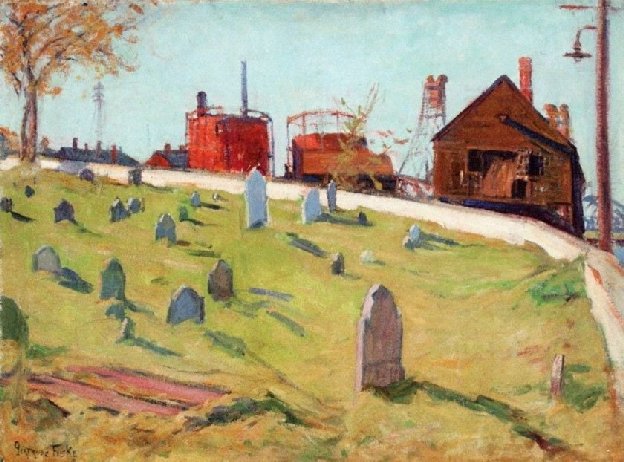
Portsmouth Burying Ground by Gertrude Fiske (c.1925)

Another example of Fiske’s urban landscape work is one she completed around 1932 entitled Portsmouth Burying Ground which depicts Portsmouth, New Hampshire’s oldest cemetery, known as the Point of Graves, which is situated on the banks of the Piscataqua River in the south end of town. This small historic cemetery dating to the 17th century was the final resting place for many of Portsmouth’s prominent residents. It is the oldest known surviving cemetery in Portsmouth, and one of the oldest in the state, which has about 125 gravestones. Whereas many landscape painters would have spent time amidst the beauty of the countryside Gertrude has chosen this discordant, working waterfront to position her easel to take in the surrounding land. Fiske confounded viewers of this work when she depicted the bright red gasometers and the Sheafe warehouse as a backdrop to the ancient burial ground.

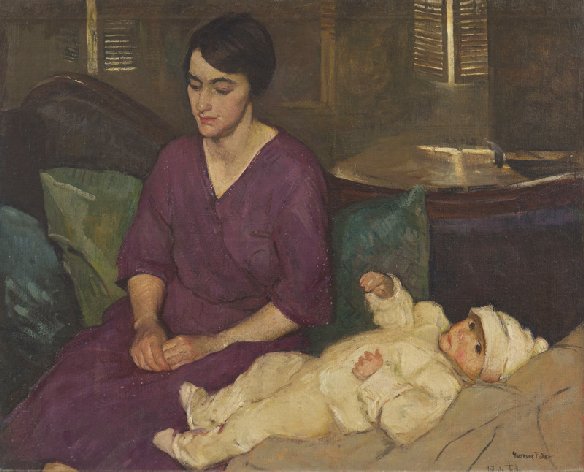
Portrait of William by Gertrude Fiske (1930)

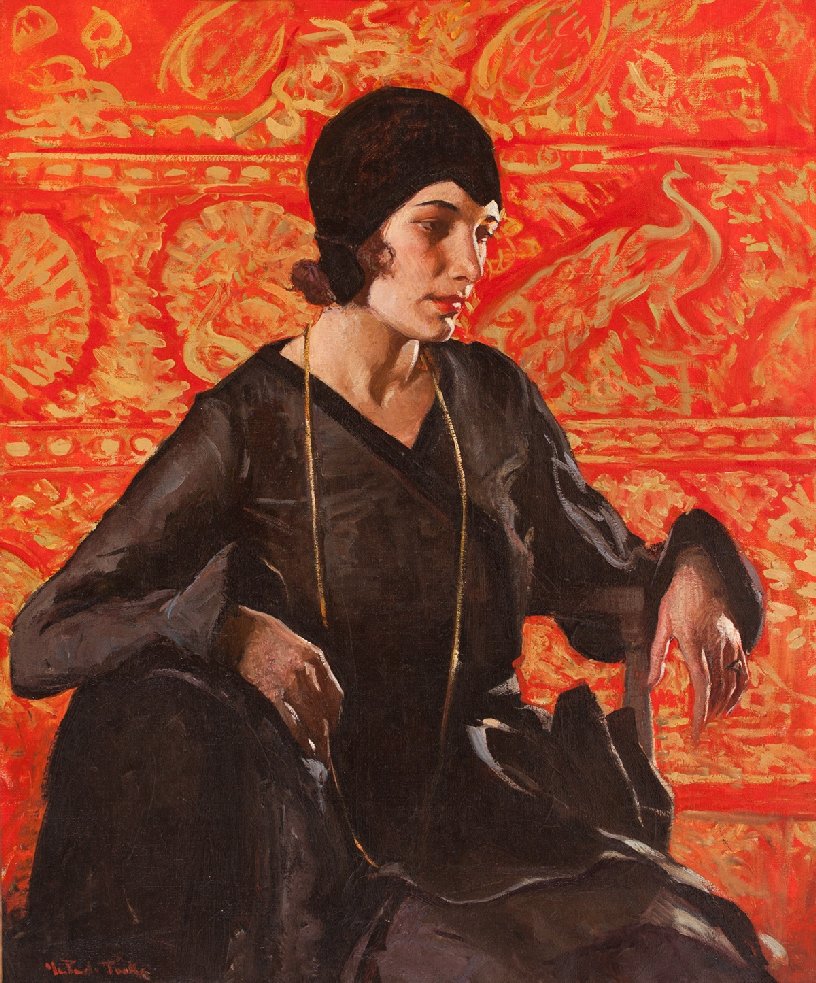
One of her best-known figurative works was one Gertrude completed in 1930 entitled Portrait of William which she exhibited at both the Boston Art Club’s Annual Winter Exhibition of Contemporary American Painting and at the National Academy of Design’s 105th Annual Exhibition. It is part figurative and part an interior depiction which was a popular concept favoured by many of the early Boston School teachers and yet she put her own mark on the composition by her use of colours, such as the juxtaposition of the green of the fabric on the pillows with the dotted Swiss cotton of the woman’s purple dress. She also adopts an unusual placement of figures and objects in the work.

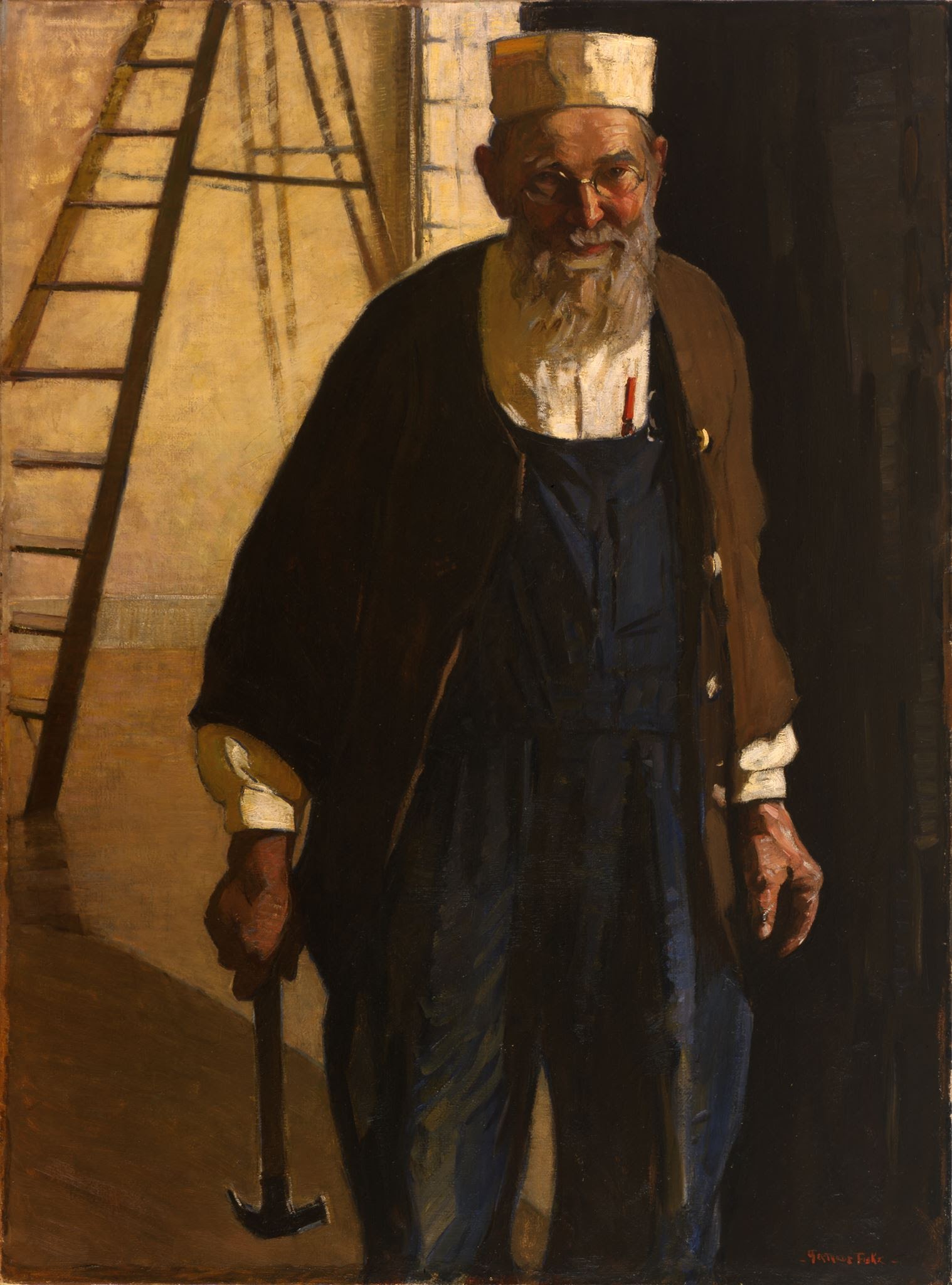
The Carpenter by Gertrude Fiske (1922)

Gertrude Fiske was appointed as the first woman ever to the Massachusetts State Art Commission in January 1930. She was also the the founder of the Concord Art Association. In an article in January 1930’s Boston Globe it was written that she had always had a strong artistic individuality of her own, and there is a note of personal distinction in all of her work—a virile note.

Fiske died in 1961 in Weston, Massachusetts aged 82.

Marie Laurencin. Part 3.

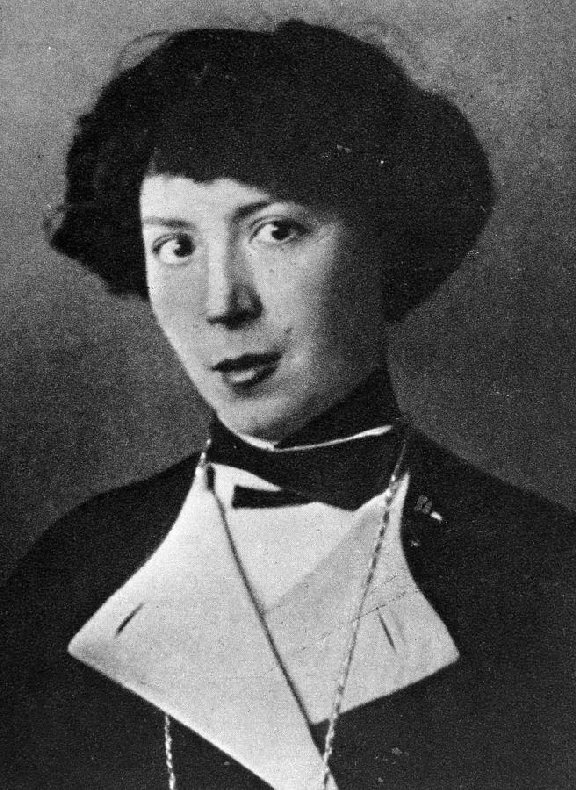
Marie Laurencin – a photograph by Granger (1913)

Marie Laurencin left Spain and returned to Düsseldorf via Switzerland in 1919. She was very unhappy with her life.  She was depressed and felt unstable with her marriage failing.   Laurençin filed for a divorce from her husband telling friends that the reason for the marital split was because her husband had become an alcoholic. In 1921 Laurençin returned to Paris, knowing that her marriage was finished and she divorced von Wätjen.   However, despite the divorce, they remained on good terms, and Marie kept in touch with van Wätjen’s until his death in 1942.

The Spanish Dancers by Marie Laurencin (1921)

Now having returned to the French capital Marie realised that she had been greatly affected by her separation from Paris which she looked upon as the unrivalled centre of artistic creativity. After her return, she developed a new style of painting which is reflected in her 1921 work, The Spanish Dancers.   Gone are the muted colours and the geometric patterns she had inherited from Cubism and these are replaced by light tones and undulating compositions. Once again, we note the coming together of the feminine world and the animal world, which became her favourite theme.  In the work we see three young women spinning around a small bounding dog, in front of a large grey horse. Marie has portrayed herself kneeling in the foreground wearing a pink tutu, which happens to be the only warm tone in the painting. Her hands are entwined with those of the young woman on the right, who is wearing a light grey dress with a light blue headscarf.  The woman on the left, wearing a light blue dress, is executing a dance step whilst holding a hat in place on her head.  Her eyes lead almost seamlessly into the large almond-shaped eye of the horse. The animals would appear to be the dancers’ confidantes in this strange setting.

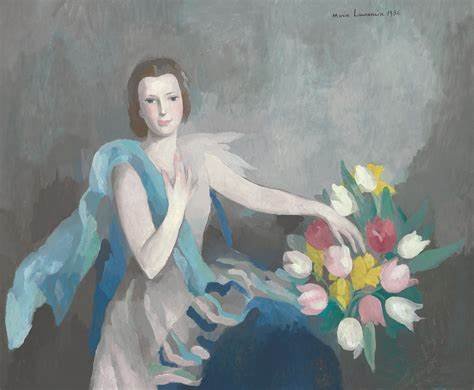
Femme aux tulipes by Marie Laurencin (1936)

Now back in Paris, Paul Rosenberg began to act as Marie Laurencin’s dealer which afforded her enhanced financial security and he also provided her with sound business advice.  Unfortunately, she did not always take Rosenberg’s advice and he was horrified to find that Marie often gave her work as a gift to those she liked. She also set higher prices for work which she found dull and often discounted some of her favourite works.  Curiously she often charged men double what she asked of women, and even charged brunettes more than blondes and furthermore she had a reputation for painting only children whom she liked.

Jeunesse by Marie Laurencin (c.1946)

In her private life, while Marie Laurençin had a succession of male lovers, she also had close female friendships and lesbian relationships. She became part of the female expatriate community in Paris that searched for both artistic and sexual liberation. Lesbianism, for many of these women, was a crucial element of their resistance to bourgeois social conventions.

Gertrude Stein at 27 rue de Fleurus with her portrait by Picasso on the wall, May 1930

Now, based in the French capital, Marie was alone.  The first American who befriended her and bought her paintings was Gertrude Stein, an American novelist, poet, playwright, and art collector who had been born in Pennsylvania.  She had moved to Paris in 1903 and made France her home for the remainder of her life. She hosted a Paris salon, where the leading figures of modernism in literature and art, such as Pablo Picasso, Ernest Hemingway, F. Scott Fitzgerald, Sinclair Lewis, Ezra Pound, Sherwood Anderson and Henri Matisse, would meet for conversation and inspiration.  Laurençin soon became part of the Stein salon on rue de Fleurus.  Marie remained in contact with Gertrude Stein and Alice B. Toklas until Stein’s death in 1946 and continued to see Toklas until her own death.

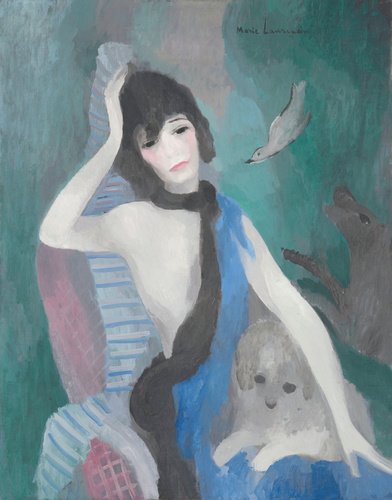
Portrait of Coco Chanel by Marie Laurencin (1923)

Laurencin held an exhibition of her work in 1921 at the Rosenberg Gallery in Paris. She had now built up her reputation as a talented portraitist, especially of celebrities, one of whom was Coco Chanel.  The commission to paint Chanel’s portrait came about in the autumn of 1923 when Marie Laurencin was working for Sergei Diaghilev’s Ballets Russes which was established in Paris, Monte-Carlo and London, and Marie was designing the costumes and sets for the ballet Les Biches [The Does]. At the same time, Coco Chanel was creating the costumes for the same company’s Le Train Bleu [The Blue Train] operetta .   At that time, Coco Chanel was both very rich and famous, and she commissioned Marie Laurencin to paint her portrait.  This was one of Laurencin’s early portrait commissions. Laurencin depicted Chanel face-on, seated in a relaxed, somewhat dreamy pose, with her head resting on her right arm. She appears relaxed and her eyes and mouth, neutral and expressionless, suggest that she is daydreaming or preoccupied by her thoughts. Marie Laurencin’s painting style was to incorporate animals in her works and here she depicts a white poodle sitting on the Coco Chanel’s knees. It is unclear where Chanel’s flesh ends and her dress begins; her pale outfit is accented with dark black and blue scarves, while the seat behind her is a textured pink and blue. On the right-hand side of the painting, we can see another dog leaping upwards towards a turtle dove which appears to be descending from the sky towards Coco Chanel, like the dove of the Holy Spirit, and thus Laurencin’s symbolising it as a sort of freedom. The colour palette is of a soft harmony of the colours – green, blue and pink, which is reinforced by the long black line of the scarf draped around the model’s neck.  The finished painting was so like Laurencin’s earlier works but did it capture the likeness of Coco Chanel.  The sitter did not think so and the artist did not deny it, but claimed that physical likeness was unimportant.  Chanel refused to pay for it and Laurencin was so annoyed by Chanel’s attitude that she refused to execute a second portrait and decided to keep the original herself.  Despite Chanel’s rejection of the painting, the success of Laurencin’s approach to portraiture was such that she continued to receive and execute portrait commissions in this style until the 1940s. The painting can now be found at the Musée de l’Orangerie in Paris.

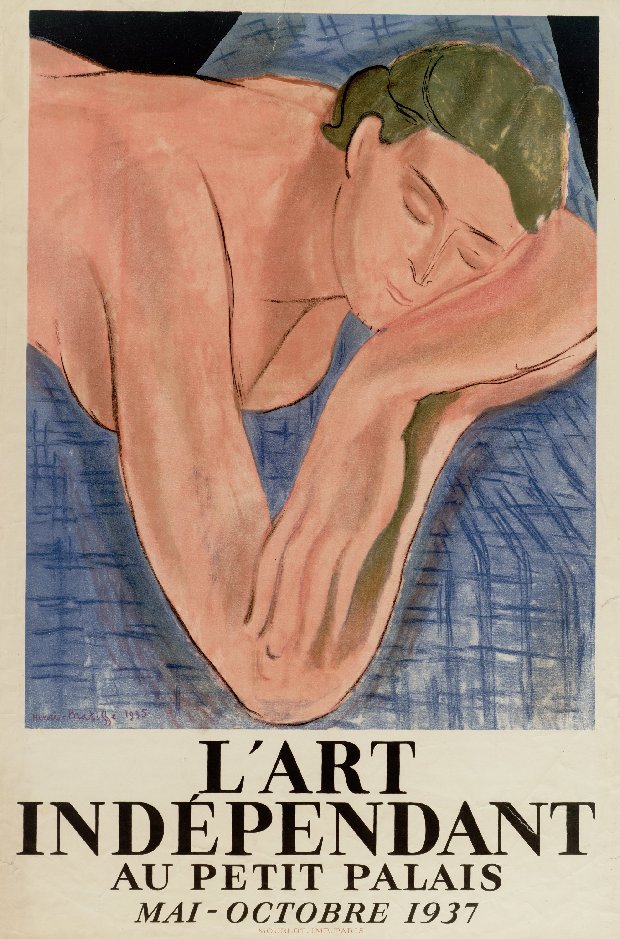
In 1931, Laurencin was one of the founding members of La Société des femmes artistes modernes, and took part in their annual exhibitions until the outbreak of World War II. During the period from 1932 to 1935, she tutored at the Villa Malakoff, a private art school.  In 1937, which art historians believe was the height of her career, a retrospective of Laurencin’s work was held in conjunction with the Great Exhibition of Independent Art Masters at the Petit Palais, which sought to promote the superiority of the contemporary French artistic school, extended to foreign artists “living or having lived in France for many years”. The year 1937 saw a change in Laurencin’s appearance when she finally acquired glasses, which changed her life considerably as she had been extremely short-sighted since childhood and had had difficulty negotiating staircases since the 1920s.

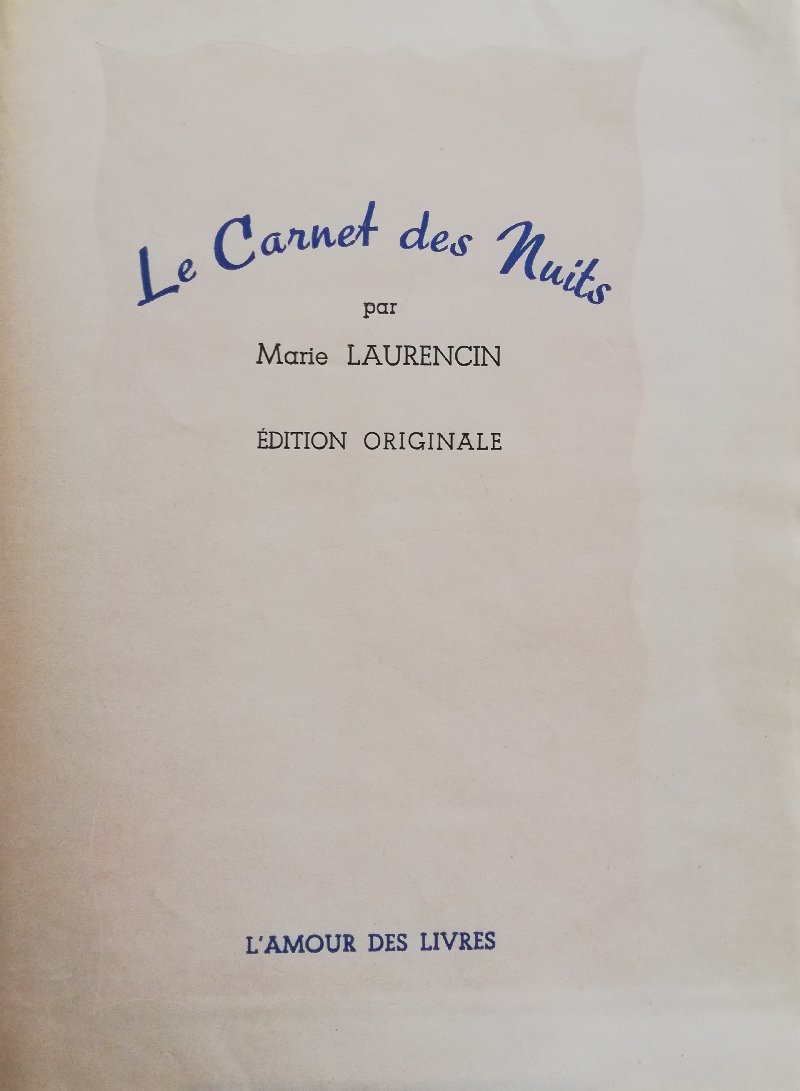
During World War II, Laurencin remained in Paris painting and working on designs for the ballet, and in 1942 she published Le Carnet des Nuits – a collection of poetry with short memoir pieces in prose.  Although Laurencin will be remembered as an artist and the grace and the elegance of her artworks; she is also the author of a diary, Le Carnet des Nuits, an important witness of her time. It tells of her early years she spent in Bateau-Lavoir.  Her writing is of the same delicate style used for her artworks. 

Head of a Woman by Marie Laurencin (1909)

In later years, Laurencin became withdrawn and increasingly isolated and sadly suffered from periods of depression and other health complaints, albeit, she continued to paint throughout this troubling passage of time. Her main companion was her maid, Suzanne Moreau, who had lived with her since 1925. Whether there was more to the mistress/servant relationship is unclear but it is thought that they were romantically linked.    In 1954, Laurencin made Moreau the beneficiary of her estate. It is thought this came about due to Laurencin’s legal struggle, resolved the following year, with tenants living in the apartment that she owned.

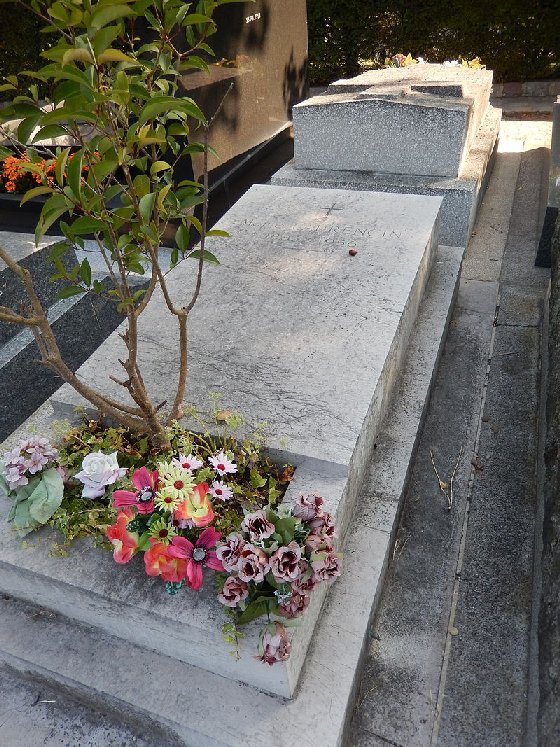
The tomb of Marie Laurencin in Père Lachaise Cemetery, Paris.

Laurencin died of a heart attack on June 8th, 1956, aged 72.  She was buried wearing a white dress in Père-Lachaise cemetery in Paris, as per her wishes, with Apollinaire’s love letters and a rose in her hand.


The main source of information for the three blogs about Marie Laurencin came from the excellent The Art Story website.

Marie Laurencin Part 2.

Marie Laurencin, Paris (c.1912.)

Marie Laurençin’s paintings dating from around 1910 have a strong flavour of cubism. However, she once again stated that although the experiments of cubism fascinated her, she was adamant that she would never become a cubist painter because she was not capable of it.

Bateau-Lavoir c. 1910

Laurençin spent a lot of time at Picasso’s open studio at the Bateau-Lavoir, (Laundry Boat) building at 13 Rue Ravignan at Place Emile Goudeau in Montmartre in the 18th arrondissement of Paris.  The building was so nicknamed as it was said to resemble the public clothes-washing boats moored on the Seine in the early years of the twentieth century. The ramshakle building was said to strain and groan when it was windy—just like the those laundry boats on the Seine. Here, Laurençin exhibited her work along with a group of artists known as the Bateau-Lavoir, which was the residence and meeting place for a group of outstanding artists and men of literature.  It was here that she met Max Jacob, the French poet, painter, writer, and critic, and André Derain, the French artist, painter, sculptor and co-founder of Fauvism.  She was also introduced to Gertrude Stein, the American novelist, poet, playwright, and art collector to whom she made her first sale in 1908.

Les jeunes filles (Jeune Femmes, The Young Girls) by Marie Laurençin (1911)

In 1911 Laurençin completed her painting entitled The Young Girls.  Marie Laurencin showed The Young Women at the Salon des Indépendants in Paris in 1911, alongside works by other artists painting in a similar style. The exhibition, which gave rise to the term “cubism”, caused a scandal but was also the breakthrough for Cubist art.  This work depicts four pale-skinned dark-eyed women with dark hair, independent of each other and yet overlapping.  They are all wearing  grey robes and stand against an abstracted pastoral backdrop. The female on the left is a violinist, playing music for the figure beside her, who dances. At the centre of the depiction we see a woman seated facing the dancer, but she turns her head to look back at us.  On the right, another woman appears in motion, carrying a bowl of fruit under her right arm and reaching down with her left hand to stroke the nose of a doe. All the limbs of the women have a fluidity which mirrors the drape of their dresses.   Their bodies are outlined with heavy black lines.  Laurençin has experimented with this depiction and artistic style. 

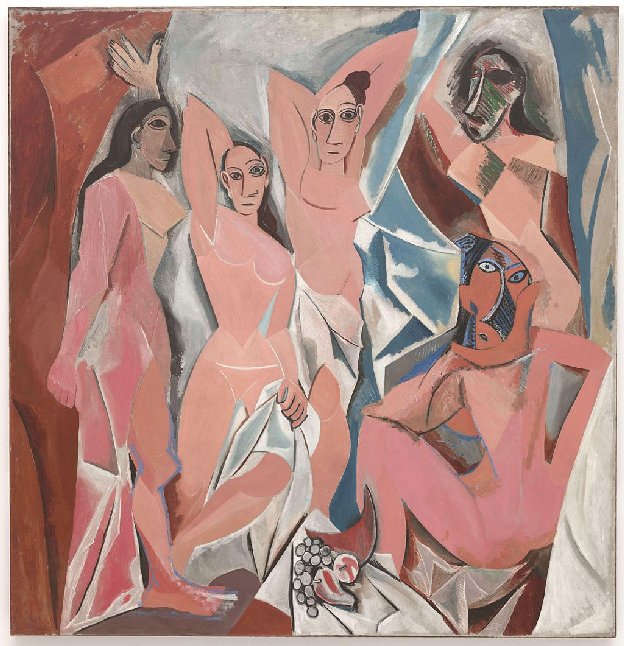
Les Demoiselles d’Avignon by Picasso (1907)

The posture of the four women with their flat, mask-like faces seems to have been influenced by her friend, Picasso’s 1907 painting Les Demoiselles d’Avignon.  In a way the work can be considered as a suggestion that the four women represent a fertile sphere of feminine creativity.  The presence of the doe is symbolic of femininity and naturalness that was a common theme in Laurencin’s work.  Critics believe the painting alludes to the of lesbian self-fashioning and as a celebration of an independent female realm.  The painting can be viewed at the Moderna Museet in Stockholm.

Portrait de jeune femme by Marie Laurencin

In 1913, Marie Laurençin’s mother died and this sad event coincided with her ending her relationship with Apollinaire, but this ending could have something to do with his reputation as a philanderer.   However, she would remain close to Apollinaire until his death, aged 38, in 1918. Her split from Apollinaire freed Laurencin of his Cubist influence, but at the same time, isolating her. On June 24th 1914, in Paris, Marie married Baron Otto van Wätjen, a German Impressionist and Modern painter whom she had first met as fellow students at the Académie Humbert.  

Marie Laurencin, Cecilia de Madrazo and the Dog, Coco by Marie Laurençin (1915)

In the Tate Britain, London, one can see the 1915 work by Laurençin entitled Marie Laurencin and Cecilia de Madrazo and the Dog, Coco.  Cecilia was an art collector friend of Maria.  Laurençin told a fellow artist that the painting was completed in 1915 while she and her husband were exiled in Madrid.  The girl wearing the hat is Cecilia de Madrazo, a young Spaniard, and the other figure is Marie herself wearing a pink dress with her dog poking up between them.  She had bought the dog from an English sailor at Malaga. Marie Laurencin was staying in Madrid with the Madrazos at the time.  Marie has depicted herself with short hair which covers her ears and forehead.  Although her skin is grey it is sharply in contrast with pink cheeks and lips and black eyes which are focused downwards.  Cecilia is fascinated by the dog.  She stares down at it and pushes a finger towards its very long snout. Cecilia’s skin is almost white, with pink lips and cheeks.  She is wearing a grey dress and has a white hat, with a large blue bow, atop her dark hair. The backdrop, almost without detail, is grey and there is a pink curtain at the right edge of the painting; the colour scheme is very limited, with Laurencin utilising only grey, pink, blue and very small amounts of beige. This painting is representative of Laurencin’s work, which has been both appreciated and criticised for its deliberately feminine aesthetic.  Marie’s palette concentrated on  pastel colours. The two figures depicted add a sense of peace and charm and they own the conventional female virtues of loveliness, sophistication and meekness. Laurencin’s unapologetic embrace of visual pleasure and the way she developed an aesthetic that acclaimed female softness, elegance and sweetness was itself a radical position. Laurencin’s painting has depicted such qualities as part of a creative process in which a masculine form is utterly unnecessary, and in a way it is a presentation of a work in which both artist and subject are female.   

The Fan by Marie Laurencin (1919)

In 1919 Laurencin completed her painting entitled The Fan and this, like the previous work, is part of the Tate Britain, London collection.  The painting was purchased by Gustav Kahnweiler, an art dealer, as a gift for his wife, Elly.  He and his wife amassed a modest art collection focused on Cubist paintings, sculptures, and works on paper. After the couple moved to England in the 1930s to escape Nazi persecution, Gustav and Elly loaned and gifted works from their collection to the Tate.  It is believed that the woman in the oval frame is Laurencin herself but the identity of the other woman is unknown.  The fan, which was a symbol of vanity, was one of Laurencin’s favourite accessories. The painting depicts a pink shelf that holds two images of women, one in a rectangular frame and the other in a round frame, against a pink and grey background. The portrait to the left, in the larger, rectangular frame, shows a woman and a dog in greyscale, accentuated by a pale blue ribbon, hat and curtains.  Next to it is an oval frame at the centre of the painting depicting a woman reputed to be Marie Laurencin herself, though it is unclear if this is a portrait or indeed a mirror. The lower right corner of the painting is dominated by the folds of a fan, painted in grey and white, that is cut off at the canvas’s edge.  Laurencin has cleverly depicted the fan in a position that could be seen as being held by someone who is staring at the two frames on the shelf.  The two portraits in the frames on the shelf are positioned such that the figures appear to look out towards us but also towards the person holding the fan.  There is an air of mystery about the depiction and the identities of the figures.  Some believe that the woman in the rectangular frame is Nicole Groult, a dressmaker with whom Laurencin is likely to have had a romantic relationship.

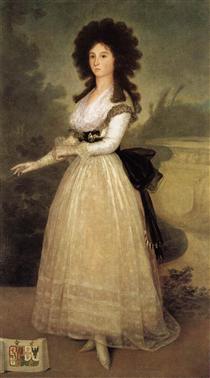
Dona Tadea Arias de Enriquez by Goya (1793)

Once married to Otto van Wätjen, Laurencin automatically lost her French citizenship and so took up German citizenship. She and her husband moved to neutral Spain at the beginning of the First World War in order to avoid France’s anti-German sentiment.  Here, Laurencin became involved with the Dada movement, editing the art and literary magazine 391, a Dada-affiliated arts and literary magazine created by Francis Picabia.  She also spent time looking closely at the work of Francisco Goya, whose dignified, dark-eyed women captivated her.

Simultaneous Windows on the City by Robert Delaunay (1912)

During this period in Spain she became great friends with Sonia Delaunay and Robert Delaunay, who had similarly left France to avoid the War.   Robert was an artist of the School of Paris movement, who, with his wife Sonia Delaunay and others, co-founded the Orphism art movement, noted for its use of strong colours and geometric shapes.

……to be continued.

Amélie Beaury-Saurel and Rodolphe Julian.

Amélie Beaury-Saurel

Amélie Beaury a French painter, was actually born in Barcelona on December 17th 1848.  Her family had previously lived in Spain and Corsica before moving to the Catalan city in 1845.  Her parents, Camille Georges Beaury and Irma Catalina Saurel owned a large carpet and tapestry factory with more than twenty looms, which they called Saurell, Beaury y Compañía. Amélie was their middle child.  She had an elder sister, Irmeta, also an artist, and a younger sibling, Dolores. Amélie later added “Saurel” to her name in recognition of her mother’s family who could trace their lineage to the Byzantine emperors of the 11th century.

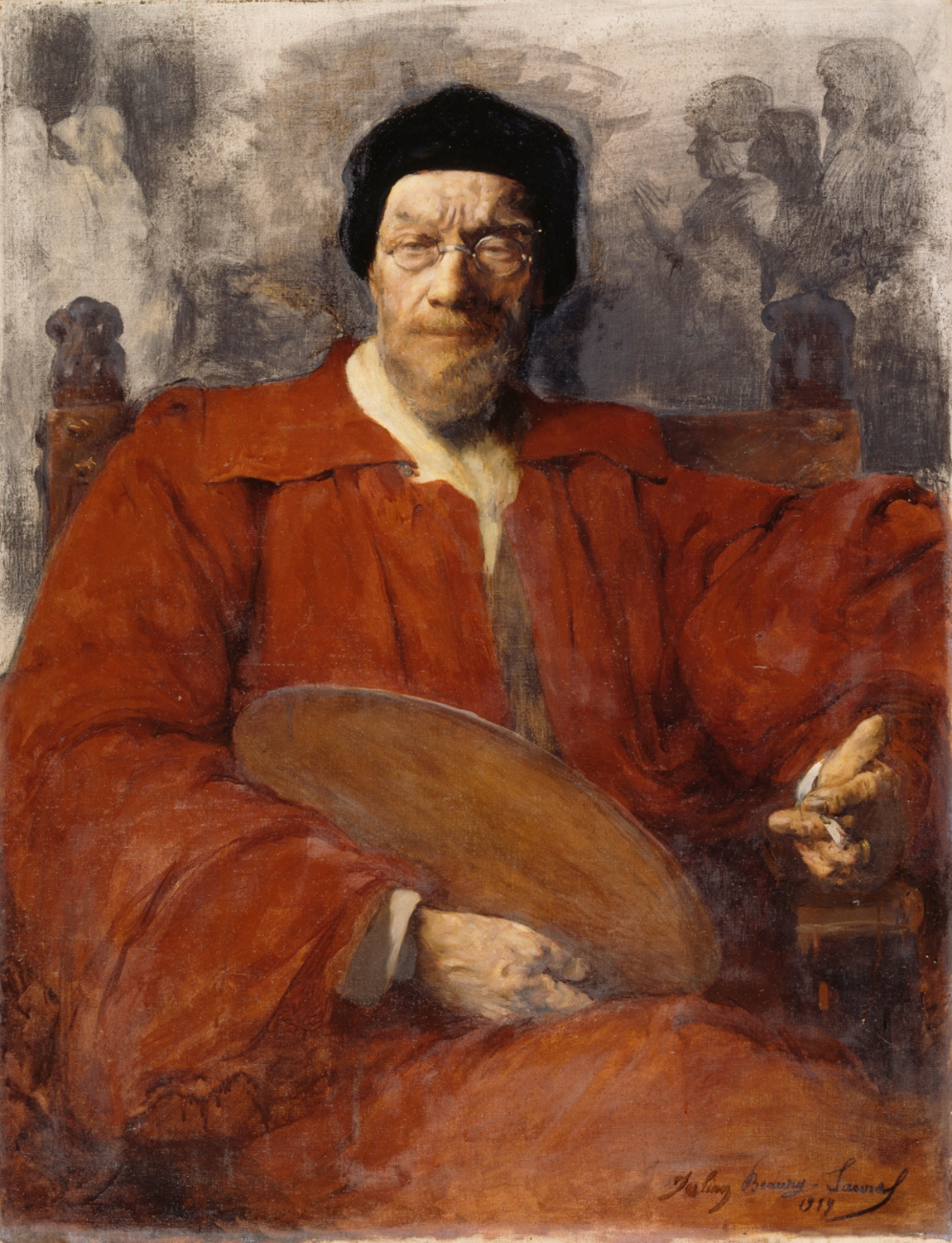
Portrait of the artist Jean-Paul Laurens by Amélie Beaury-Saurel (1919)

The happy family life was shattered in the late 1850s when Amélie’s father died and her mother decided to relocate with her three daughters to Paris.  Amélie recalled in an interview that she and her family lived in the French capital when she was ten years old and that her widowed mother, with little money, had to endure financial hardships.   Her mother instilled a love of art in her children and she would take them to the Louvre Museum to see the works of the Masters and encourage them to copy the works of the these great artists.

Portrait of Léonce Bénédite, curator of the Musée du Luxembourg,  by Amélie Beaury Saurel (1923)

Due to this family impoverishment, Amélie’s mother decided that her daughters should help with the financial burden and set about having them train as porcelain painting, a socially acceptable way of earning a living and eventually becoming financially independent. Amélie set to work as a painter of porcelainware but later said she considered what she was doing as commercial painting which in many ways damped down her creativity.  Her mother was very supportive of Amélie’s love of painting and, in 1874, initially paid for her nineteen-year-old daughter to study at the prestigious Académie Julian.  One of her first tutors was Pauline Coeffier, a French oil painter and pastelist, who specialized in the art of portraiture. Later many of the leading artists of the day would advise and tutor her, such as Tony Robert-Fleury, William Bouguereau, Jules Lefebvre, Benjamin-Constant, Jean-Paul Laurens and Pierre Auguste Cot.

Rodolphe Julian

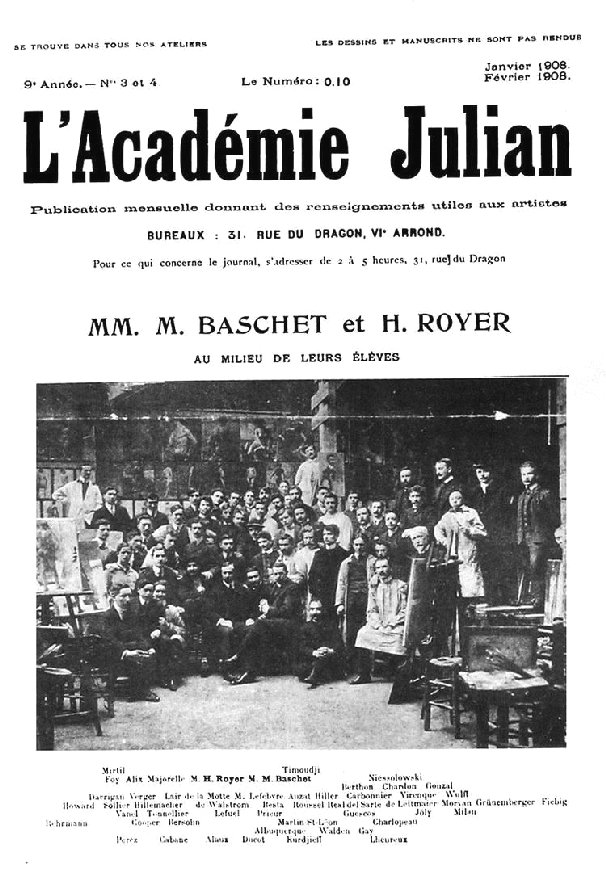
The Académie Julian was founded in 1868 by Rodolphe Julian. It was a private art school for painting and sculpture.  Paris was looked upon as the capital of the art world, and the centre of modern art.  This was one reason many young aspiring painters came to the French capital to discover all the latest trends in painting, like Impressionism and Post Impressionism, decorative art of various types, new forms of representational art such as expressionism, lithography and much more. Also with having a reputation as a forward-thinking art college the Académie Julian profited from the reputation of Paris.

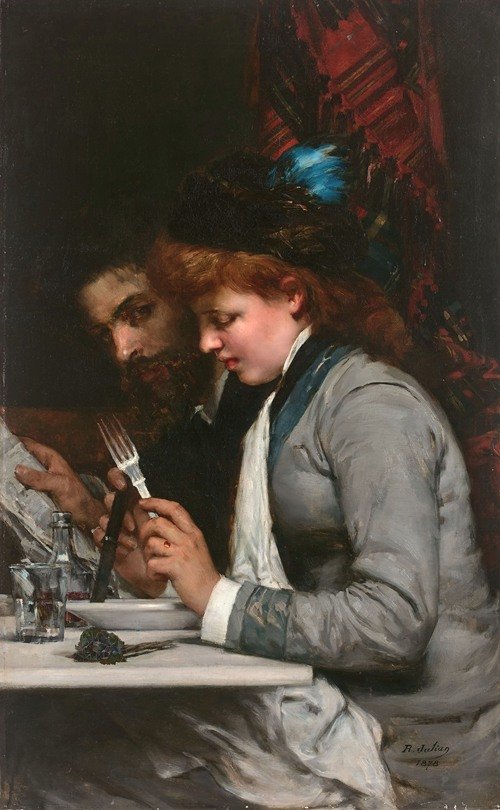
Chez Duval by Rodolphe Julian

Another reason for the popularity of Académie Julian was that it was the only art school in Paris to accept foreign students, many of whom struggled to pass the difficult French language exam, which was conditional on their acceptance into the Ecole des Beaux-Arts. Ambitious female painters were also barred from attending the official Ecole des Beaux-Arts until 1897 and even then, it was not considered suitable for women to study life drawing.  In contrast, Académie Julian was happy to offer them a full programme of education and training to women in fine art. They were offered the same classes as men, including the drawing of nude models. In fact, the Académie was one of the few schools to admit women to life-drawing classes. In fact, one of its four new branches was actually exclusively designed for female art students.

The Académie Julian was also regarded as a stepping stone to the prestigious École des Beaux-Arts by getting them prepared for the entrance exams and at the same time offered independent alternative education and training in arts.  Aspiring artists, both men and women, were welcome at the Académie Julian.   Men and women were trained separately, and women participated in the same studies as men, including drawing and painting of nude models.  The Académie Julian had no entrance requirements, was open from 8 a.m. until nightfall, and very soon became the most popular establishment of its type. Rodolphe Julian opened several branches throughout Paris, one of them especially for female artists, and by the 1880s the student population at these establishments reached six hundred.

Female Students at the Académie Julian in Paris, c. 1885

To ensure the success of the Académie, Rodolphe gathered together well-known and esteemed artists, such as Adolphe William Bouguereau, Jean-Paul Laurens, Tony Robert-Fleury, Jules Lefebvre and other foremost painters of that time trained in Academic art, to become tutors or visiting professors.  Académie Julian became recognised as a leading art establishment and its students were allowed to compete for the Prix de Rome, a prize awarded to promising young artists, and also show their work in the major Salons or art exhibitions.

So, who was Rudolphe Julian?

Rodolphe Julian was born in Lapalud, a commune in the Vaucluse department in the Provence-Alpes-Côte d’Azur region in southeastern France on June 13th 1839. He worked as an employee in a bookstore in Marseille but later moved to Paris, where he became a student of Léon Cogniet and Alexandre Cabanel, professor at the École des Beaux-Arts, albeit he never officially enrolled there.  Rodolphe was well aware of the struggles of artists who looked for artistic training once they had arrived in Paris and so, in 1863 he opened his own art school, Académie Julian.

Portrait of a Woman by Amélie Beaury-Saurel

Living in Paris, Amélie was determined to increase her knowledge of art and the Académie Julian offered her the best way of achieving that goal and eventually becoming a professional portrait artist.  However this course of action had to be funded so she approached Rodolphe Julian and proposed that in return to her helping out with the administrative and financial duties of the Académie, he would allow her to attend his classes free of charge.  He agreed. Rodolphe Julian had opened a women’s workshop in 1873 and in 1895 he put Amélie in charge of it.  As well as organising the workshop she had begun a very lucrative career as a portrait artist and received many commissions.

Académie by Amélie Beaury-Saurel (1890)

In 1890, Amelie completed one of her greatest paintings entitled Académie.  The title for the work refers to the art academy which at the time prohibited female painters from joining its ranks.  Her depiction conveys the compelling message to the viewer that she was not going to allow herself to be browbeaten by the male-dominated artistic establishment and she would not conform to their dictates.  The model in the painting exudes strength and determination as she stands grasping stalks of bamboo and stares out at us, challenging us.  It can be no coincidence that Amélie has depicted her model naked and this nude pose empathises the strong and defiant attitude women embraced as artists.

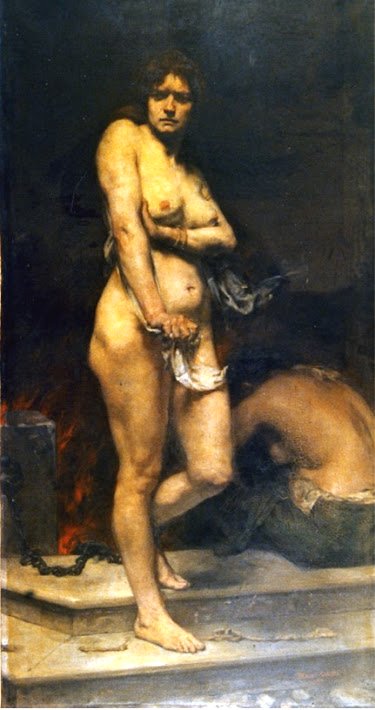
Deux vaincues (Two Defeated Women) by Amélie Beaury-Saurel (1892)

Two years later in 1892 Amelie produced another defiant depiction entitled Deux vaincues (Two Defeated Women).  It is looked upon as a rallying call to all female painters to be fearless as they travel through the unwelcoming and unforgiving world of art education and artistic professionalism and the many obstacles they had to overcome.  It was a plea to female artists to not allow themselves to be defeated in the face of the obstacles they would encounter.  The sketch depicts two women, both naked, chained to a wall.  Both face similar hardships but they have fared differently.  The one with her back to us is slumped forward in a defeated pose, while the other, in contrast, stands boldly upright, unrepentant and stares out defiantly.  The painting is a challenge to all women as to whether they give in or fight on. The work was exhibited at that year’s Salon.

 Portrait de Séverine by Amélie Beaury-Saurel (1893)

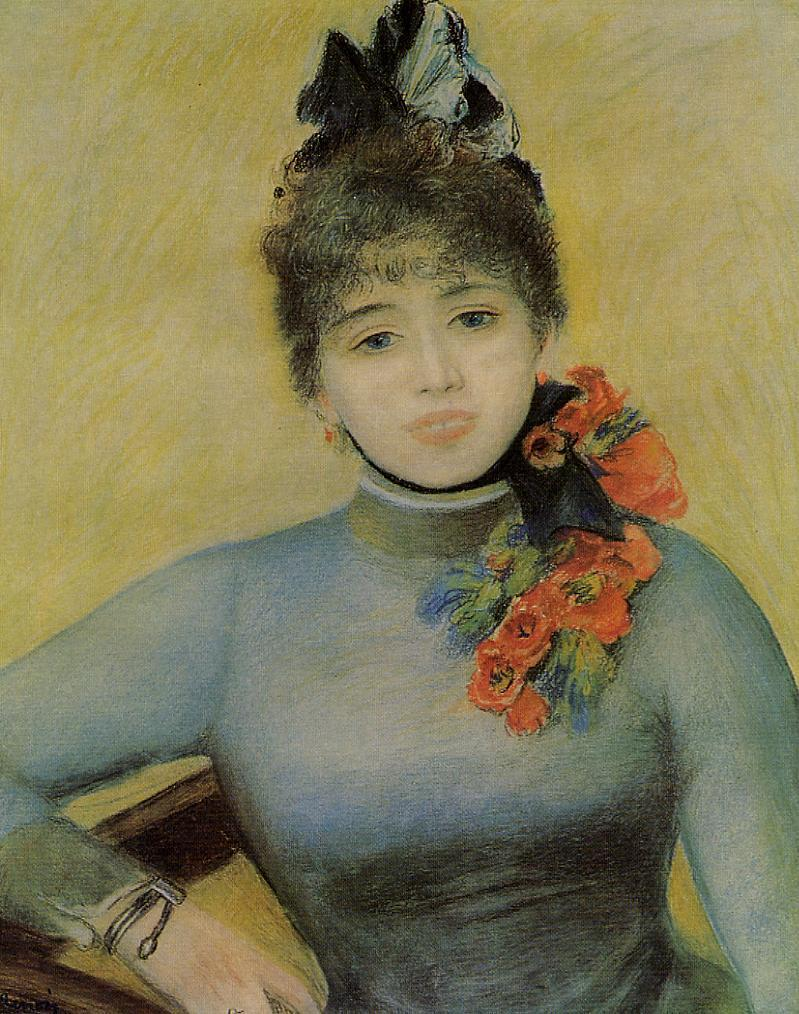
In 1893 Amelie completed a portrait of Caroline Rémy de Guebhard. She was a French journalist who held strong non-conformist views which labelled her as an anarchist, socialist, and communist.   She also was a great believer in feminist’s rights and opinions and this no doubt drew Amelie to paint the portrait.   Caroline Rémy de Guebhard would use the pen name Séverine, derived from the Latin severus which means “rigorous” or “brave”, for many of her newspaper articles.  When we look at the portrait, our eyes are immediately drawn to the vivid red flower on the sash of her dress.  The flower symbolizes Séverine’s leftist political views.  Look at her facial expression.  It is one that exudes strength, determination and tells you that this lady will not be moved.  Amelie’s ability as a great portraitist is borne out in this beautiful work.

Séverine by Renoir (c.1885)

A portrait of Caroline Rémy de Guebhard was also complted around 1885 by Renoir. It is in the permanent collection of the National Gallery of Washington.

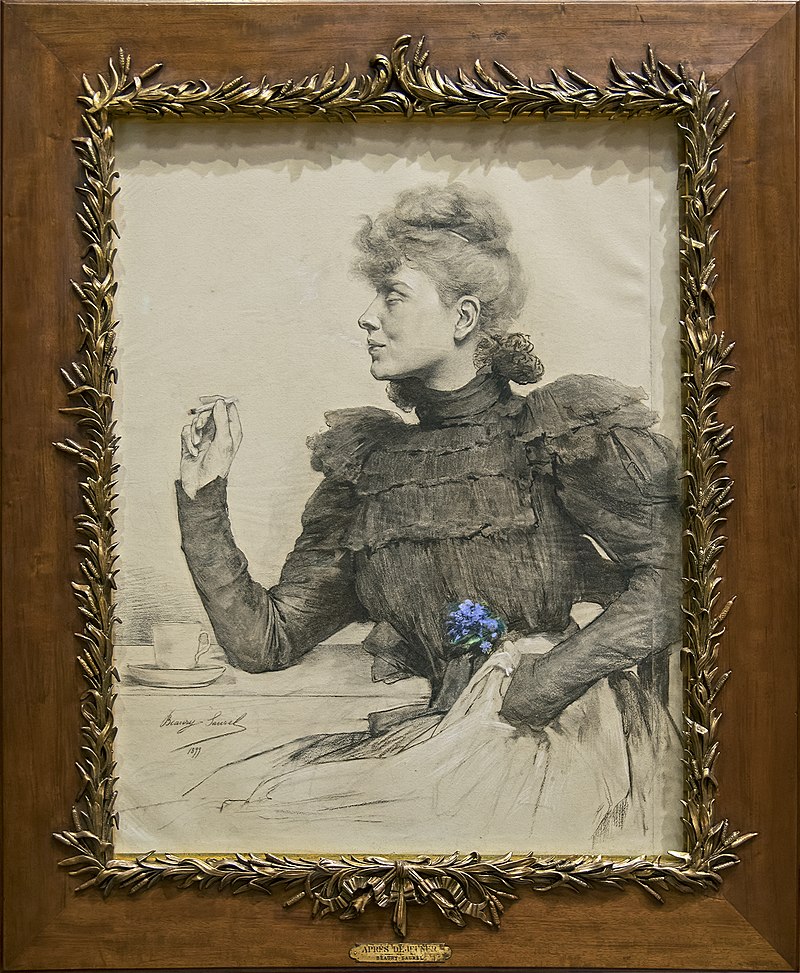
Dans le bleu by Amélie Beaury-Saurel (1894)

One of my favourite works by Amelie is her 1894 painting entitled Dans le bleu.  It is a pastel on canvas which depicts a young woman waking up in the morning and indulging in the gratification of smoking that first cigarette.  However that is not the point of the depiction.  It is all about feminist assertions. In this painting, we see a woman depicted in profile, boldly treating herself to the pleasures of escapism. It is a depiction of defiance as women at this time were not seen smoking, especially not in public.  It was a habit that was counter to the feminine conceptions of the time.  We should remember that Amélie Beaury-Saurel had dedicated a large part of her work to the female model and had always maintained the feminist cause.  She supported the right to arts education and artist status for women.  In 1894 when she was working on this painting her reputation in Paris as an artist was at its highest point and her paintings were exhibited all over the French capital.

The background of the work is very dark, predominantly blue and this allows the figure stand out in the work.   It is hard to know whether the scene takes place in a private dwelling such as a kitchen or a living room or whether the setting was in a public place, such as a café.  The woman in the depiction sits smoking a cigarette, chin in hand.  She appears to be daydreaming. She seems preoccupied as she watches the blue smoke unfurl from her lips, drifting upward. What is she thinking about?  Would she, like the smoke, like to drift away?  Some have suggested this might be a Beaury-Saurel self-portrait, as the model resembles the artist.  The depiction is simple and realistic and in no way staged.  Amelie’s depiction is all about everyday reality and is without any hint of idealization which would have weakened the work and it is this simplicity that has added to the beauty of the depiction and has expressed the woman’s femininity.

Our Girl Scouts by Amelie Beaury-Saurel

In this painting by Amelie, the seven women are represented in a compact group, around a table with a pile of books. On the left, holding his handlebars in his hand gloved, the Belgian cycling champion, Hélène Dutrieu; next to her, holding a paintbrush, the publisher Anna-Catherine Strebinger (Madame Henri Rochefort) who was also a student at the Académie Julian; then the collector Marguerite Roussel looks at the viewer; in the center, in professional attire and pointing to an article in a code, the lawyer Suzanne Grinberg, an eminent member of the French Union for the women’s suffrage, created in 1909; leaning on her, in the outfit that she had adopted to travel safely to the Middle East, archaeologist and explorer Jane Magre-Dieulafoy. Then comes the novelist and journalist Lucie Delarue-Mardrus and aviator Elise Deroche, First woman to obtain a pilot’s license.

After Lunch by Amelie Beaury-Saurel (1899)

In 1895, Amélie Beaury-Saurel, married Rodolphe Julian and he put her in charge of the women’s workshops which he had started in 1873.  Amélie managed the expenses for the women’s studio, served as an intermediary between instructors and students, and ran the women’s group but also continued her career as a portraitist. She earned a medal for her submissions to the 1885 Paris Salon and the bronze medal at the 1889 Exposition Universelle. 

Chateau Julian, Lapalud

Rodolphe Julian died on February 2nd 1907, aged 67, and two months later on April 10th, Amelie’s mother died.  Following the death of Julian, Amelie took on the role of director of the Académie Julian.  This was a mammoth task and so she received help from her nephews Gibert and Jacques Dupuis, the children of her sister Dolores.  Rodolphe Julian had bought a large house in the village of Lapalud, where he was born and on his death they were bequeathed to his nephews.  Amelie bought this large property from her nephews and transformed it to accommodate her family. It was called the “Mas” Julian.

Amélie Beaury-Saurel

During her last years, Amélie continued to paint but also fought for women’s rights and supported women artists and their fight against male-dominated art circles.  She participated in solidarity exhibitions for the benefit of institutions such as the Société des Artistes Français, the Société Nationale des Beaux- Arts or the Fraternité des Artistes.  Such commitment to the promotion of art and her endless creative activity were recognized in 1923, a year before her death, through her appointment as Chevalier de la Légiond’honneur.   

Amélie Beaury Saurel died on May 30th 1924 aged 75 at he Paris home which she had once shared with her late mother and sisters.


Information for this blog came from the ususal search engines plus:

Aware Women Artists

Elles-d-artistes blogspot

Musings on Art

Ville de Lapalud

Theresa Bernstein. Part 1.

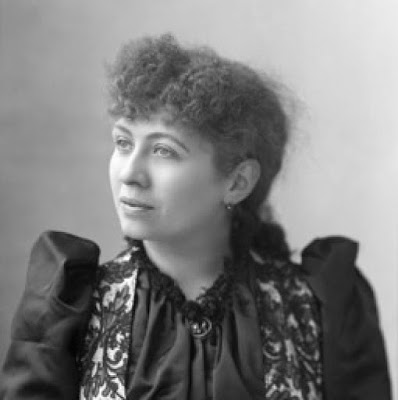
Theresa Bernstein (1890 -2002)

My blog today is all about a remarkable woman, not just for her art but for her amazing longevity, dying just a few months short of her 112th birthday. She is the American painter, Theresa Ferber Bernstein. 

Two miniature cameos (possibly self-portraits) by Theresa Bernstein (1907)

Theresa was born on March 1st 1890 in Krakow, a city in the Austro-Hungarian Empire, now Poland.  She was the only child of Isidore Bernstein and Anne Bernstein (née Ferber).  Her father was a Jewish textile merchant and her mother was a woman of Central European culture and learning who was a talented pianist.  In 1891 when Theresa was one year old the family left Krakow and emigrated to America and Philadelphia became Theresa’s first home.

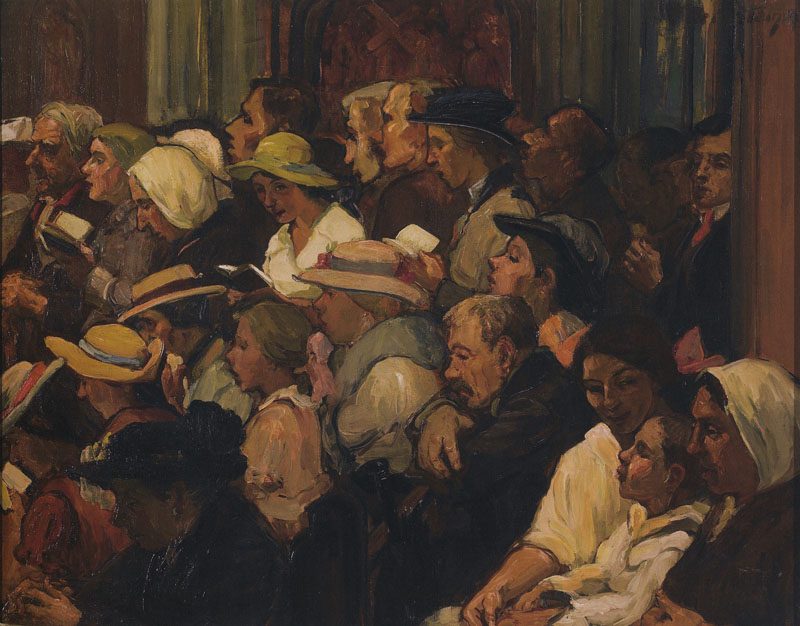
Polish Church, Easter Morning by Theresa Bernstein (1916)

As a young child, Theresa loved to draw and paint and later, whilst at high school, received some art training.  Bernstein graduated from the William D. Kelley School in Philadelphia in June 1907, at the age of 17. That same year, with her drawing of sprouting onions viewed through a green glass planter, she won a Board of Education scholarship to the Philadelphia School of Design for Women, now the Moore College of Art & Design,where she enrolled in the four-year Normal Art Course for training teachers. It was here that she studied under Elliott Daingerfield, Daniel Garber, Harriet Sartain, Henry B. Snell, and Samuel Murray. Her interest in art grew as she got older and she would attend some lectures at the Pennsylvania Academy of the Fine Arts. 

Daniel Garber’s Studio by Theresa Bernstein (1910)

Whilst studying at the Philadelphia School of Design for Women Theresa produced a painting 1n 1910 entitled Daniel Garber’s Studio which is a pictorial memory of her time there.

Dance Hall by Theresa Bernstein (1911)

The students would be taken on painting trips by their tutors and one such outing with William Daingerfield in 1911 was a summer stay at Blowing Rock, North Carolina, where she painted the first of her jazz-inspired works, entitled Dance Hall.

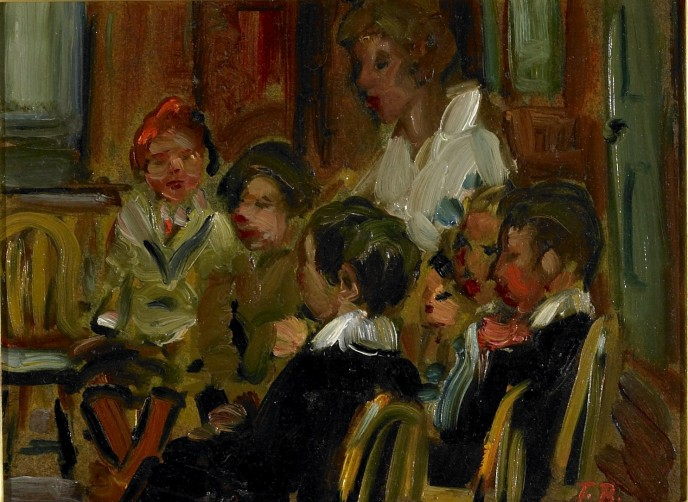
Kindergarten Class by Theresa Bernstein (1914)

She graduated from the Philadelphia School of Design for Women in 1911.  Theresa’s father’s business in Philadelphia had run into difficulties and so he along with his wife and daughter left the city and went to live in New York and that October Theresa began taking life and portraiture classes with William Merritt Chase at the Art Students League.  Besides her art education Theresa travelled on two occasions with her mother to Europe, where they visited relatives and visited a number of art galleries.  She greatly admired the work of the European Expressionist artists such as Wassily Kandinsky, Franz Marc, and Edvard Munch.

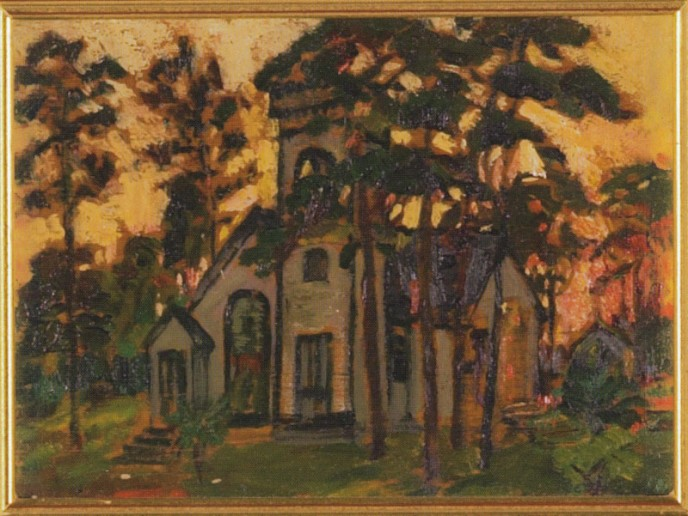
Colored Church, North Carolina by Theresa Bernstein (1911)

When back in New York, Theresa visited the Manhattan gallery of Alfred Stieglitz, the 291 Gallery, and in 1913 she attended the Armory Show which was organized by the Association of American Painters and Sculptors. Here she was able to view works by European modernists.  She had mixed feelings about what she saw and later stated that she couldn’t warm up to cubes and triangles—they didn’t have enough life force.

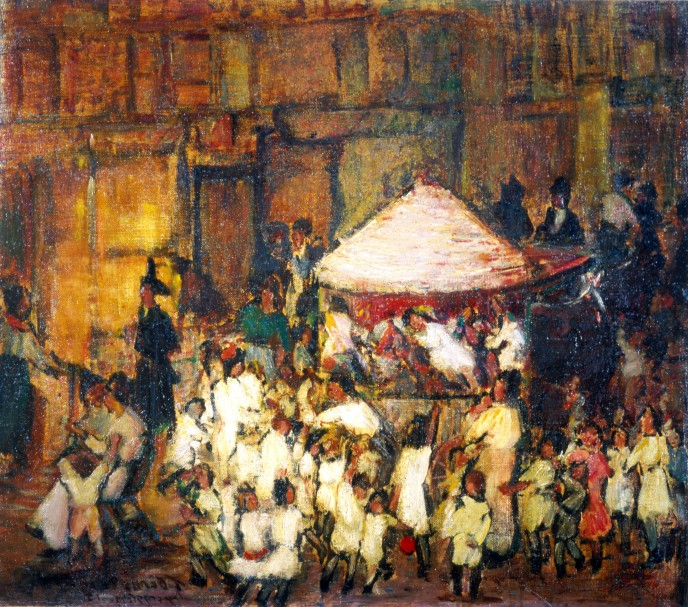
The Little Merry-go-Round by Theresa Bernstein (1913)

However, in 1913, a breakthrough occurred for Theresa when the National Academy of Design chose her painting, Open-Air Show for its annual exhibition. The work then went on to the Carnegie Institute and the Art Institute of Chicago, where it attracted the attention of English collector John Lane, who purchased it and became an enthusiastic supporter of Theresa.

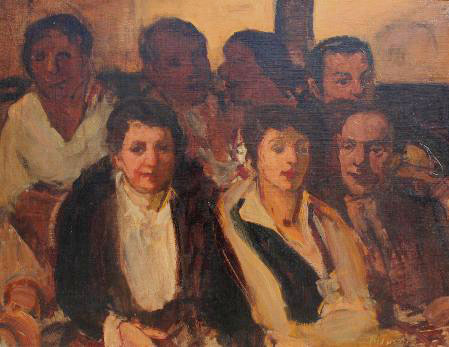
At the Movies by Theresa Bernstein (1913)

The American edition of the English magazine The Studio: An Illustrated Magazine of Fine and Applied Art, was titled The International Studio. It had its own editorial staff, and the content was different from that of the English edition, although many articles from it were reprinted. It was published in New York by John Lane & Company.  W. H. de B. Nelson, an intriguing figure in the early 20th-century American art scene, wrote in The International Studio praising Theresa Bernstein for her independence of her direction with regards to her art stating that it was an uncompromising offerings of this ambitious girl, commending her choice of subject matter–“democratic parks, unfashionable chapels, the five-cent subway.” He finished by saying that she was a woman painter who paints like a man. he was delighted by his comments.

Searchlights on the Hudson by Theresa Bernstein (1915)

One of her paintings exhibited at the Milch Galleries was Searchlights on the Hudson which she had completed in 1915.  Theresa had remembered seeing the unusual and spectacular sight of the Hudson River being illuminated by searchlights as a method of detection of enemy boats and dirigibles.

Waiting Room- Employment Office by Theresa Bernstein (1917)

Theresa, from an early age, was very observant.  She could leave a room and once outside accurately describe what had been inside and could even sketch what she had seen.  This excellent memory was of great help to her when she completed a painting in 1917 entitled Waiting Room – Employment Office.   Four years earlier, when she was thirteen years old, she had accompanied her mother to the employment office, where she was going to select a housemaid, Theresa remembered what the room in the office looked like and all the people waiting patiently to secure work.   It is an emotive recollection of that visit.

Street Workers by Theresa Bernstein (1915)

The Ashcan School was an informal art group that operated in the late 19th and early 20th centuries and included great artists such as Robert Henri, John Sloan, William James Glackens, George Luks, Everett Shinn, George Bellows, Jerome Myers.   This group was known for its works in the style of urban realism, which produced depictions of urban life of the lower-class New Yorkers, warts and all.  Although Theresa was never a formal member of the Ashcan School, she shared with it an enthusiasm for “modern” subject matter, to which she added a profoundly meaningful take on the way she saw her subjects.

In the Elevated by Theresa Bernstein (1916)

She embraced urbanism and popular culture with great passion.  Her depictions of urban life were varied and encompassed the like of  the cinema, trolley buses and the elevated trains, and places where the lower and lower-middle classes would congregate in the summer such as Coney Island. Her 1916 painting entitled In the Elevated depicts a passenger car on the Ninth Avenue Elevated railway, which Bernstein took between her parents’ apartment on West 94th Street and her studio on West 55th Street. This work by Bernstein encapsulates the experience of modern city folk who are placed in close physical proximity and yet remain psychologically isolated from one another.

Third Class Carriage by Honoré Daumier (1858)

The work reminds me of one of my favourite paintings by Honoré Daumier’s entitled Third Class Carriage which he completed around 1858.

The Readers by Theresa Bernstein (1914)

The New York Public Library was built on Fifth Avenue, between 70th and 71st Streets, in 1877 to much funfare and excitement and the first book was borrowed within ten minutes of the grand opening.  One of the regular visitors to this great institution was Theresa Bernstein who spent many happy hours there.  Whilst in the library she not only read the many books on offer but took the time to secretly sketch on scraps of paper and backs of envelopes the gesticulations and expressions of those around her.  It got to the point that she became such a frequent visitor and loved everything about it that she referred to it in her memoir as her “alma mater.”

Theresa’s 1914 painting The Readers, depicts the reading room of this newly opened library. We see five men seated on all sides of a banquette, in a pyramid shape at the centre of the composition. Their faces are softly lit by the glow of the reading lamp. It is fascinating to see that each of them has staked out the best spot in the reading room and settled in for the day.  The three men facing us seem very content and totally absorbed with their books. 

Graphite on paper study for The Readers by Theresa Bernstein (1914)

What is fascinating about this painting is the change of heart Theresa must have had between making the preliminary sketch for the work and how it finished up.  Theresa had a major change of heart as to the people present, as in the sketch one of the figures seated on the banquette, on the right, was a woman in a feathered hat. But in the painting, Bernstein replaced her with a man.  In the finished painting the only woman depicted is one who stands in the middle background, plainly dressed and deep in thought, her hand resting on her chin as she studies her book. It is possible that placing the solitary woman in the background of the painting, Bernstein may have been providing a symbolic commentary on gender inequality.   The Central Library was one of the few public places where women were able to sit uninterrupted and in comfort for hours, whilst delving into the world of books.

William Meyerowitz

Theresa’s life changed in 1917 when William Meyerowitz knocked on the door of her studio…………………………………………….

to be continued.

Laura Sylvia Gosse

Laura Sylvia Gosse (1881-1968)

For a number of years now, probably for centuries, many female artists have been discounted as hobby-painters or painting because art for many was like playing the piano, a social grace that every young woman should achieve.  It is even more annoying when a man and a woman work side by side and yet it is the reputation of the male artist that is remembered.  An example of this is looking at two Camden Town Group artists, one a founder, the other on the periphary as it was an all-male domain.  I am sure you have heard of Walter Sickert but what about his friend and contemporary, Laura Sylvia Gosse.  Sylvia who ?  Let me set the record straight.

The Artist’s Mother by Laura Sylvia Gosse

Sylvia Gosse was actually born Laura Sylvia Gosse but was always known by her Christian name, Sylvia.  She was born in London on February 14th 1881, the youngest of three children.  She had an elder sister, Teresa Emily and an elder brother, Philip Henry.  

Edmund Gosse by John Singer Sargent

Her father, Edmund Gosse was a poet, literary critic and librarian of the House of Lords.  Her mother was Ellen Gosse (née Epps), an artist in the Pre-Raphaelite circle who had studied under Ford Madox Brown, and whose sister, Laura Theresa, an aspiring artist, had married Lawrence Alma-Tadema.

Fountains at Pernes Les Fountaines, Provence by Laura Sylvia Gosse

Sylvia’s family home in Delamere Terrace was in the London borough of Paddington, and was always inundated with people from both the art and literary world with visitors such as the great writers of the time, such as Henry James, Thomas Hardy, Robert Louis Stevenson and Rudyard Kipling.  In early childhood, Sylvia loved to paint and draw and her favourite subject being her pets. At the age of thirteen, Gosse went to an art school in France, where she stayed for three years and she recounted that it was there that she felt she belonged.  She returned to England and studied at the St John’s Wood School of Art.  In 1906, aged fifteen, she enrolled at the Royal Academy Schools.

The Gossip by Laura Sylvia Gosse

One of the frequent visitors at the Grosse household was the artist Walter Sickert and it was during one of his visits that he began talking to Sylvia and looked at her artwork.  He was captivated by her work and obvious artistic talent and suggested she learn the art of etching.  Sylvia began to attend Sickert’s evening classes at the Westminster School of Art and in 1909 went as a pupil to his new art school, which he ran with Madeline Knox at 209 Hampstead Road, London.  Sickert’s dual role with Knox at the art school ended when Knox resigned following Sickert’s illness, and having had to run the school singlehandedly.  Sickert approached Sylvia Gosse, his pupil, to see if she would accept the position as associate director. 

Rowlandson House – Sunset by Walter Sickert (1911)

Walter Sickert rented Rowlandson House in Camden Town from 1910–14, during his time with the Camden Town Group. This summertime depiction of the building looks north up Hampstead Road from the back garden, the time of day nearing twilight, which Sickert has indicated by daubs of pink and mauve in the pale sky. The trees in the far background form the edge of Mornington Crescent Gardens. 

Walter Sickert by Sylvia Gosse (1923-25)

Sylvia was made co-director of the Rowlandson House School but did this position alongside Sickert put them on an equal footing?  As a woman in an artistic world which did not always value them, it became clear during her time at Rowlandson House, that her relationship with the Camden Town Group which she was ineligible to join, being a female, despite Sickert being its leader, was not even-handed.  According to Kathleen Fisher, Gosse’s biographer and friend, who wrote Conversations with Sylvia. Sylvia Gosse – Painter, 1881-1968, Sylvia Gosse taught the less-able students at Rowlandson House, as Sickert would grow bored and impatient and dismiss them. The School became known as the Sickert and Gosse School of Painting and Etching.  Silvia served as co-principal from 1910 until it closed in 1914 and during that period, she taught some of the classes and took over responsibility for the practical organisation and finances.  Sylvia Gosse had an independent income, and without her financial backing the school would have closed much sooner.

The school which Gosse and Sickert jointly ran until 1914 when it closed. During those years, Gosse’s own painting career also began to progress. Sylvia Gosse could be described as being slightly introverted (or was she just shy?) and was not known as a very sociable person.  One of her pupils, Marjorie Lilly recalled Sylvia, saying:

“…she might appear at Number 15 [Fitzroy Street] on At Home days, but rarely; being very shy, she always chose the most inconspicuous corner she could find, looking harassed and hunted, and hardly spoke…”

Despite this she was always very supportive of her fellow artists and completely dedicated to Sickert.

Chateau Dieppe by Layra Sylvia Gosse (c.1925)

La Place Saint Jacques by Laura Sylvia Gosse (c.1920)

Grande patisserie, Place Nationale, Dieppe, France by Laura Sylvia Gosse (1930)

Walter Sickert had always loved visiting France and would regularly travel to the Normandy coastal town of Dieppe.  Sylvia often accompanied Sickert on his travels, notably when he stayed in Dieppe, and she had a small cottage near his home.  Many of her paintings featured the French town.

Envermeu, France by Laura Sylvia Gosse (c.1920s)

The small town of Envermeu which lies ten kilometres east of Dieppe also featured in many of Sylvia’s paintings.

The Seamstress by Laura Sylvia Gosse

Many of the paintings of the Camden Town group focused on the subject of ordinary life, which often concentrated on the life of the poor and dispossessed, and how their life was one of boredom and squalor.  Gosse tended to focus more on the hard-working women, such as the seamstress and the printer.

The Printer by Laura Sylvia Gosse (c.1915)

Sylvia’s painting, The Printer, which she completed around 1915 shows a woman labouring at a press.

The Nurse by Laura Sylvia Gosse

In her painting, The Nurse, we see her approaching her patient.  In this depiction, we see her as she is reflected in a mirror above the sickbed.  This is not a depiction that beautifies the nursing profession it is simply one that shows us an unglamorous workaday appearance of a nurse tending the sick.

Mrs Alexandra Russell by Laura Sylvia Gosse

During the 1920s and 1930s Sylvia’s paintings were on display at many of best-known commercial galleries. She was elected to the Royal Society of British Artists in 1930 and continued to support Sickert loyally until his death in 1942.

In 1951 Sylvia bought a bungalow in Ore, a large village in the urban area of Hastings, in the county of East Sussex.  It was here that she planned to spend her last days painting, but alas, she suffered from cataracts, which made painting and sketching increasingly problematic.  However, it was her belief that every painter should die with a brush in their hand, so despite her severely reduced vision, she still managed to visit exhibitions and help inspire young artists. She died in the Buchanan Hospital, Hastings on June 6th 1968 at the age of 87.

Laura Wheeler Waring. Part 2.

Houses at Semur by Laura Wheeler Waring (1925)

Saint-Jean-Pied-de-Port by Laura Wheeler Waring (1925)

After her short stay in the south of France, Waring returned to Paris in the Spring of 1925 and continued her studies at the Académie de la Grande Chaumiére whilst staying in the Villa de Villiers in Neuilly-sur-Seine.  That year Laura completed her paintings, Houses at Semur, France and Saint-Jean-Pied-de-Port. Critics believed this was a turning point in her artistic style as we see her use of vivid colours in order to express vivid, brilliant atmospheric conditions. Both works enhanced her growing reputation.  The following year, she had works shown at the Corcoran Gallery in Washington, D.C., the Brooklyn Museum, and the Philadelphia Museum of Art. And her standing in the art world was such that she was asked to curate the Negro Art section at the Sesquicentennial Exposition in Philadelphia.  

On June 23rd, 1927, Laura Wheeler was married to the Philadelphian, Walter Waring, a public-school teacher, who was ten years her junior and who was then working as a professor at the all-Black Lincoln University. The couple had no children. That same year, Laura won a gold medal in the annual Harmon Foundation Salon in New York. Laura Waring was actively painting during the Harlem Renaissance.  The Harlem Renaissance was an influential movement in African American literary, artistic, and cultural history from 1918 to the mid-to-late 1930s. The movement was originally referred to as the New Negro Movement, which referred to Alain LeRoy Locke’s 1925 book, The New Negro, which was an anthology that sought to motivate an African-American culture based in pride and self-dependence.

She was also involved with the Harmon Foundation.  It was established in 1921 by wealthy real-estate developer and philanthropist William E. Harmon who was a native of the Midwest, and whose father was an officer in the 10th Cavalry Regiment.  The Foundation originally supported a number of good causes but is best known for having served as a large-scale patron of African-American art and by so doing, helped gain recognition for African-American artists who otherwise would have remained largely unknown.

In 1944 the Harmon Foundation, which was under the direction of Mary Beattie Brady, organized an exhibition Portraits of Outstanding Americans of Negro Origin.  The idea behind the exhibition was to try and counteract racial intolerance, ignorance and bigotry by illustrating the accomplishments of contemporary African Americans. The exhibition featured forty-two oil paintings of leaders in the fields of civil rights, law, education, medicine, the arts, and the military. Betsy Graves Reyneau, Laura Wheeler Waring, and Robert Savon Pious painted the portraits that became known as the Harmon Collection. US Vice President Henry A. Wallace presented the first portrait, which featured scientist George Washington Carver, to the Smithsonian in 1944. The Harmon Foundation donated most of this collection to the Smithsonian’s National Portrait Gallery in 1967.

Anna Washington Derry by Laura Wheeler Waring (1927)

Laura Wheeler Waring will always be remembered for her portraiture and her most acclaimed work was not of the prosperous and famous African Americans which I have highlighted below but of a poor laundress, Anna Washington Derry.  She was one of five children who had moved with her family from Maryland to the eastern Pennsylvanian town of Strodsburgh, a borough in Monroe County.  Monroe was home to a small free Black community who had arrived via the Underground Railroad, a network of secret routes and safe houses used by enslaved African Americans to escape into free states.

The beautiful realistic depiction of the old lady beautifully conveys the lady’s dignity and inner determination through her use of simple, brown-beige tones of her dress, her expressive face, her folded arms and hands.  In the town where she lived Derry was looked upon as that of a community matriarch who was fondly addressed locally as “Annie”. The portrait was unveiled in 1926 at an elite exhibition for Black Philadelphian professionals some of whom may not have identified with Waring’s “ordinary” subject. The art historian Amanda Lampel commented:

“…Although Derry’s portrait did not sell that day, the Philadelphia Tribune, the oldest continuously published African American newspaper in the United States, called it remarkable……… Compared to fellow contemporaries like Aaron Douglas, Waring was much more conservative in her painting style and subject matter. This was in keeping with the types of artists who won the prestigious Harmon Foundation award, which sought to spotlight the up-and-coming Black artists of the Harlem Renaissance. Most of the award winners painted more like Waring and less like Douglas…”

In 1927 Laura exhibited the portrait of Anna Washington Derry at New York’s Harmon Foundation where it received the First Award in Fine Art – Harmon Awards for Distinguished Achievement Among Negroes. From there it was exhibited at Les Galeries du Luxembourg in Paris and across America.  The depiction was often reproduced in magazines and journals. The exhibition had its premiere at the Smithsonian Institution on May 2nd, 1944.  For the next ten years, Portraits of Outstanding Americans of Negro Origin, exhibition, travelled to museums, historical societies, municipal auditoriums, and community centres around the United States.  The public response was overwhelmingly positive in every venue.

James Weldon Johnson by Laura Wheeler Waring

Laura Wheeler Waring will be most remembered for her portraits of successful, upper class Negroes and whites including James Weldon Johnson, the successful Broadway lyricist, poet, novelist, diplomat, and a key figure in the NAACP, National Association for the Advancement of Coloured People.  In 1900, he collaborated with his brother to produce “Lift Every Voice and Sing,” a song that later acquired the subtitle of “The Negro National Anthem.”

William Edward Burghardt Du Bois by Laura Wheeler Waring

Another sitter for Laura was William Edward Burghardt Du Bois (W.E.B. DuBois), who was the first African-American to earn a doctorate from Harvard University  He then became a professor of history, sociology, and economics at Atlanta University, and  co-founder of the National Association for the Advancement of Coloured People (NAACP), and founder and editor of the NAACP’s magazine The Crisis. Laura Waring had worked for Du Bois, creating several illustrations for The Crisis. Laura depicts Du Bois seated at a wooden desk or table, looking to the right. The spectacles he holds in his right hand, and the small paper he holds in his left, confirm his status as an intellectual and academic.

Marian Anderson by Laura Wheeler Waing (1947)

Many women were sitters for Laura’s portraits including Mary White Ovington, an American suffragist, journalist, and co-founder of the National Association for the Advancement of Coloured People (NAACP).  Another of her most famous female portraits was of  the opera singer, Marian Anderson.  This contralto singer, like many African American artists of the time, first achieved success in Europe. She was persuaded to return to America in 1935 and that year had a triumphant concert which secured her standing in the opera world.  In 1939 she became embroiled in a historic event when the Daughters of the American Revolution banned her appearance at its Constitution Hall because she was black. President Roosevelt’s wife, Eleanor, stepped into this controversial banning and arranged for her to take top billing at the Easter Sunday outdoor concert at the Lincoln Memorial, an event which drew in 75,000 opera fans as well as having the event broadcast to a radio audience of millions.

Jessie Redmon Fauset by Laura Wheeler Waring (1945)

Another female to have her portrait painted by Laura Wheeler Waring was Jessie Redmon Fauset, the first African American woman to be accepted into the chapter of Phi Beta Kappa at Cornell University, where she graduated with honours in 1905. Fauset then taught high school at M Street High School (now Dunbar High School) in Washington, D.C., until 1919  She then moved to New York City to serve as the literary editor of the NAACP’s official magazine, The Crisis. In that role, she worked alongside W. E. B. Du Bois to help usher in the Harlem Renaissance of the 1920s.

Alice Dunbar-Nelson by Laura Wheeler Waring (1927)

In the 1890s women formed national women’s club federations, most of which were dominated by upper-middle-class, educated, northern women. Few of these organizations were bi-racial, a legacy of the sometimes uneasy mid-nineteenth-century relationship between socially active African Americans and white women. Rising American prejudice led many white female activists to ban inclusion of their African American sisters. The black women’s club movement rose in answer in the late nineteenth century. The segregation of black women into distinct clubs produced vibrant organizations that promised racial uplift and civil rights for all blacks, as well as equal rights for women. Soon there followed another, more powerful group known as the National Association of Coloured Women in 1896. Women, including Laura Wheeler Waring and Alice Dunbar-Nelson, came together from a variety of backgrounds to combat negative stereotypes and fight for basic rights. Alice Dunbar-Nelson became the subject of Laura Wheeler Waring’s 1927 portrait. By the time the portrait was completed, Dunbar-Nelson was a prominent political activist and journalist and was much in demand as a public speaker. The depiction of her radiates her self-confidence and both artist and sitter were talented, intellectual women whose friendship helped advance the rights of both women and African Americans.

Waring died on February 3rd, 1948, aged 60, in her Philadelphia home after a long illness.  She was buried at Eden Cemetery in Collingdale, Pennsylvania. In 1949, Howard University Gallery of Art in Washington, D.C. held an exhibition of art in her honour.  Her paintings were also included in the 2015 exhibition We Speak: Black Artists in Philadelphia, 1920s-1970s at Philadelphia’s Woodmere Art Museum.

Laura Wheeler Waring (1887-1948)

There is no doubt that although Laura spent most of her life in America she always treasured her three stays in France which played an important role in her artistic progress. During those three periods on French soil she was able to engage in its culture, and associated with famous French, African, and African American intellectuals. Her scholarship, her study at the Academie de la Grande Chaumiere, and her solo exhibition in Paris gave her recognition in the United States in the form of awards, supervisory and teaching positions, and additional exhibitions.  Like many of her colleagues, Waring cherished the freedom she found abroad, declaring in her diary:

“…In my very busy seasons here to come I shall want to relive some of these moments of atmosphere. I record them so that I can never say “I wish I had enjoyed that more” or “I didn’t apprecate all that then but now—[.]” I can never say the above truthfully because am grateful every minute and even the least of things gives me a thrill. . . . The very feeling of freedom is a pleasure and the ride on the bus down will be a joy…”


Much of the information for this blog and many of my other blogs in the past has come from an excellent website entitled The Art Story.

Other sources were:
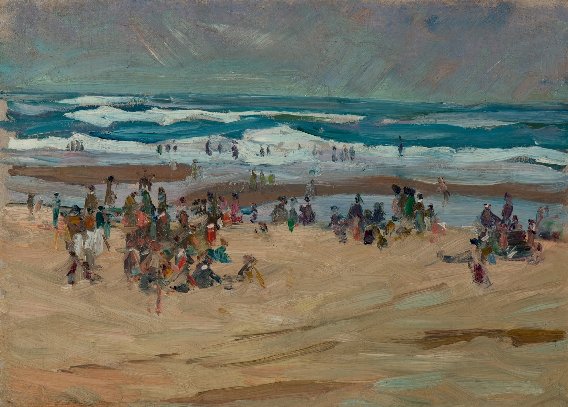
A CONSTANT STIMULUS AND INSPIRATION”: LAURA WHEELER WARING IN PARIS IN THE 1910s and 1920s by Theresa Lieninger-Miller

BLACKPAST

SPEEDWELL