Charles Beale by Mary Beale

Charles Beale by Mary Beale (c.1675)

For My Daily Art Display today, I am staying with an English artist but instead of a landscape painter and a man as was the case yesterday I am focusing on a lady artist, one of the most important portrait painters of 17th century England and who has been described as the first professional female English painter.  Her name is Mary Beale and the subject of today’s portrait painting is her husband Charles.

Mary Beale was born in 1633, in Barrow in the county of Suffolk.    Her father was the Reverend John Craddock, who was the local puritan rector.  He was an amateur painter and was acquainted with all the local artists, one of whom was Peter Lely, a portrait painter.  Although Mary Beale was never a pupil of Peter Lely there is no doubt that throughout her life she was influenced by his artistic style.  Her mother was Dorothy Brunton who sadly died when Mary was just ten years of age.

In 1652, at the age of eighteen, she married Charles Beale, a cloth merchant and amateur artist and she went to live with him in Covent Garden, London. The Beales had two sons who survived past childhood, Bartholomew and Charles.  Her husband, Charles became deputy clerk of the patents office in about 1660, by which time Mary had begun to study portraiture.   In 1664, the Beales moved away from London.  Charles had lost his job at the patents office and so they had a loss of income and they decided life would be cheaper in the country, so they moved to a farmhouse in Allbrook in Hampshire.  A second reason for the move was for their own safety as that year saw the onset of the Great Plague in London which was to kill a fifth of the population of London.

In 1670, Mary and her family, returned to London and she set up a studio in Pall Mall.  Here she painted many portraits of the aristocracy and local gentry.  Her husband, not only acted as her assistant, but looked after the business side of her artistic venture and her son Charles trained as an artist in his mother’s studio.  Her work was very popular and she received many commissions.   In her husband’s diary he recorded that in the 1670’s his wife received no fewer than 140 commissions for portraits.   Having returned to London she became reacquainted with Peter Lely who had been made the Court Artist to Charles II and many of Mary’s commissions were to paint copies of Lely’s works.

Mary Beale died in 1699, and was buried at St James’s, Piccadilly. Her husband died in 1705.  The Beales’ first child Bartholomew died when he was young.  Her second son also called Bartholomew studied portraiture but eventually gave up any thoughts of being a full time artist and took up medicine.  Her third son Charles jnr. became a painter specialising in miniatures.

The painting today, simply entitled Charles Beale, is a portrait of her husband.  She has portrayed him as a poet and clothed him accordingly in a style of unkempt abandon.  His disheveled state was that of the preserve of poetic and melancholic genius.  I love the informality of this painting with the sitter’s relaxed pose dressed in a brown gown underneath which we can see an open-necked chemise.  This portrait is in direct contrast to the portraiture norm when the sitter is expected to be shown in a strong courtly pose. This is a portrait that exudes casualness and familiarity which of course one expects of a husband’s portrait carried out by his loving wife.   This portrait has done away with the use of background drapery or Arcadian imagery which was so popular at the time and would no doubt have been included if this had been a commissioned work.  It is an engaging and intimate portrait.  The couple were very much in love and in his notebooks he always referred to his wife as his “Dearest and most Indefatigable Heart”.  There was great equality in their relationship and the fact that after losing his job he “worked” for his wife, which was acting against all contemporary notions of married life. Religious, social and medical teaching stressed the secondary role to be played by women, whose place was determined forever by Eve’s original Sin.   But Charles had no qualms about his position of apparent subservience.  Mary was a firm believer of equality between a husband and his wife and between man and woman outside of marriage.  She even put down her thoughts on the subject in 1660 when she wrote Essay on Friendship.  In Tabitha Barber’s book Mary Beale she quotes Mary’s thoughts on the subject of friendship and equality between husband and wife, writing:

“…This being the perfection of friendship that it supposes its professors equally, laying aside all distance, & so levelling the ground, that neither hath therein the advantage of other…”’

Regarding the relationship in marriage between husband and wife, Mary wrote:

“…In marriage, God had created Eve as ‘a wife and Friend but not a slave…”

Mary Beale painted numerous portraits of her husband Charles which is testament to the deep affection between them.

This painting presently hangs in a private collection.

Morpeth Bridge by Thomas Girtin

Morpeth Bridge by Thomas Girtin (1802)

I am returning today to an English Victorian artist whom I showcased back on June 25th.  The featured artist in My Daily Art Display today is one of the greatest watercolour painters of his time, Thomas Girtin, and the painting I am featuring today is a work he completed in 1802 entitled Morpeth Bridge.

Thomas Girtin was born in Southwark, London in 1775.  His father was a prosperous brush-maker but died when Thomas was still very young.  His mother remarried and her husband, a Mr Vaughn, was a pattern-draughtsman.   Girtin’s artistic training started when he was only eight years of age.  He took drawing lessons from Thomas Malton, a painter of topographical and architectural views.  Another of Malton’s pupils at the time was J M W Turner. It was around this time that he signed up to a seven year apprenticeship with Edward Daves, a watercolourist and mezzotint engraver.   In 1794 and 1795 Girtin and his friend Turner were put to work copying Dr Thomas Munro’s collection of J R Cozen’s drawings and colouring prints with watercolours and slowly but surely both young men learnt their trade.

When Girtin was nineteen years of age he exhibited his first work at the Royal Academy and soon his reputation as a watercolourist grew.  His style of watercolour painting was such that he has been recognised as being the originator of Romantic watercolour painting.  With fame came commissions and patronage and Girtin acquired two very wealthy patrons, Lady Sutherland and Sir George Beaumont, who played a crucial part in the creation of London’s National Gallery by making the first bequest of paintings to that institution.

In 1800, Girtin married Mary Ann Borrett, the sixteen year old daughter of a well-to-do City goldsmith, and set up home in St George’s Row, Hyde Park.  By 1801, his fame as an artist had spread and he was a prized houseguest at his patrons’ country houses.  His work was in such demand that he could charge 20 guineas for a painting.   In late 1801 to early 1802, he went to live in Paris. It was during his sojourn in Paris that he painted watercolours and made a series the pencil sketches which he engraved on his return to London. They were published as Twenty Views in Paris and its Environs after his death. In the spring and summer of 1802, Girtin produced what many believe was his greatest work, a 360 degree panorama of London, entitled the “Eidometropolis”.  It was 18 feet high and 108 feet in circumference.  It was hailed as his greatest masterpiece.

Sadly, his health was deteriorating and that November, Girtin died in his painting room; the cause was variously reported as asthma or “ossification of the heart.”  Girtin’s early death reportedly caused his friend Turner to remark, “Had Tom Girtin lived I should have starved”

Today’s painting, Morpeth Bridge was completed around 1802, the year of Girtin’s death.  He had travelled around Northumberland two years earlier and made a number of sketches of the countryside and towns.  In the painting, we see the bridge silhouetted against a starkly lit building.  Despite the gold and light brown hues of the buildings, there are dramatic contrasts of light and shade and the sky above is dark and threatening and there is an ominous, almost sinister, mood about the setting.  The great clouds which pass overhead dramatically darken some of the buildings and water.  There is just a hint of a break in the clouds where we catch a glimpse of blue sky which is reflected in the mirror-like surface of the still water and the arc of the bridge.   Girtin was able to convey drama and tension in his paintings by his clever depiction of light.

The painting hangs in the Laing Gallery in Newcastle upon Tyne.

Funeral at Bettws Church by David Cox

Funeral at Bettws Church by David Cox (1852)

We are now at the height of the summer holiday season and work at my Bed & Breakfast place is becoming more hectic and I am finding that I have less free time on my hands to devote to the blog.  I sometimes wonder whether my blog should have been entitled My Every Other Day Art Display!   Having said that I spent yesterday afternoon walking around Betwys y Coed, a small town in a very scenic area of North Wales, and it was during this walk that I came across a very old, 14th century church.  What was even more fascinating was its connection with an English mid-nineteenth century artist and a series of his painting.  The artist in question is David Cox and the oil painting, which he completed in 1852,  is entitled Funeral at Bettws Church.

David Cox was born in Birmingham in 1783.  His father was a simple blacksmith and the family lived in a poor area of the city and were, as we would euphemistically put it these days, “financially challenged”.  His first art tuition came from Joseph Barber, the English landscape painter, who as Birmingham’s first drawing master had set up an academy in the city to train aspiring artists.   Cox  eked out a small wage by working as a theatre scenery painter.  At the age of twenty-one, Cox went to live in London and continued his artistic training, this time under the tutelage of the English watercolourist, John Varley.  He made some visits to North Wales and started a job as a commercial artist; producing illustrations to accompany travel writer Thomas Roscoe’s two volumes of Wanderings and Excursions in Wales.

To survive financially, David Cox also took odd jobs in the art world’s Grub Street, as a scene painter, by selling views of London and the River Thames to booksellers at two guineas the dozen.  Grub Street was famous for its concentration of impoverished writers, artists and aspiring poets.   Its bohemian society was set amidst the impoverished neighborhood’s low-rent flophouses, brothels, and coffeehouses.   Cox also enhanced his income by teaching art, spending some time as a teacher at a boarding school for young ladies.  He even published a book on art.

He later moved south of the Thames and settled into life at Dulwich where he taught a number of art students.  Cox exhibited at the Royal Academy for the first time in 1805.  Four years after moving to London he married Mary Ragg who was the daughter of his landlady.  A year later in 1809, the couple had their first child, a son, David Jnr.  In 1814 to escape city life he and his family moved to rural Herefordshire and took up residence in the county town of Hereford where he taught at a girl’s school.  In the late 1820’s he travelled extensively through Western Europe and in 1827 the family moved back to London.  David Cox was now in his forties and had, by now, built up a reputation as a fine landscape painter and the sale of his works was increasing.

In 1841, Cox gave up teaching and moved back to his birthplace, Birmingham, this time to the small town of Harborne, a few miles south of the city.  It was throughout the 1840’ and 1850’s that David Cox would make annual pilgrimages to North Wales where he enjoyed the beautiful rugged scenery and revelled in the many opportunities the area gave him for his landscape subjects.  He fell in love with the Vale of Clwyd and the village of Betws-y-Coed in Conwy and his paintings of this area inspired the 19th Century Birmingham School of artists to follow in his footsteps.  Soon artists from around the country descended on this small Welsh village.   Many believe it was during this period that he completed some of his finest watercolours.  Suprisingly enough it was until the mid 1850’s that Cox started painting in oils.  David Cox died in Harborne in 1858, aged 75.

The sheer range of David Cox’s work is amazing and many considered him to be an equal to some of his more famous contemporaries such as Turner, Constable and Richard Bonnington.  Cox was noted for his skill in encapsulating in his paintings the unpredictable British weather, which was no more apparent than in North Wales.  He is probably best known for his many works associated with the small town of Betws y Coed which nestles at the edge of the Snowdonia National park and sits alongside the River Conwy.

With artists like Cox and their portrayal of the beautiful landscape around Betws y Coed, the village  began to draw in artists from many parts and it became both an artist’s colony and a favourite tourist spot.  Many of the artists flocked to Betws-y-Coed to learn more from David Cox, who made his home at the Royal Oak Hotel each summer.  He actually painted the original pub sign.   The surrounding area offered not only the remarkable scenery but it offered an insight into Welsh history as it was supposedly near the site of the massacre of the bards by King Edward I.

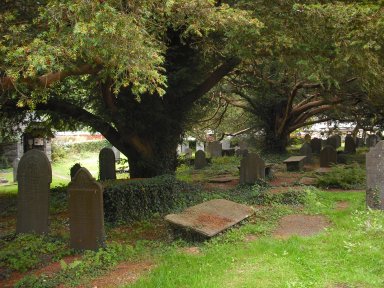
In the painting before us we see a group of mourners attending a funeral, standing outside the gates of St Michaels Church, Betwys y Coed.  The original church would have been built in the latter part of the Celtic Church era around the eighth and ninth century.  Nothing visible remains of that earliest ‘Bettws’ church which derives its name, Bettwys, meaning ‘Bede House’, as in rosary beads and thus meaning a “house of prayer”.   The whole church seems to have been rebuilt during the 14th–15th century This is still the oldest building in Betws y Coed today with parts surviving from the 14th or 15th century.  It was mostly rebuilt and enlarged, with the addition of a vestry and north transept in 1843.     However, even after enlargement, it still could not cope with the rising numbers of worshippers and it became redundant as a village church with the building of St Mary’s Church in 1873.   Although the church is now officially closed for regular public worship, a service is normally held on St Michael’s Day (29th September) and a candle-lit Carol Service at Christmas tide.  The Church houses an excellent quality 14th century stone effigy of Gruffydd ap Dafydd Goch – a close relative of the last Welsh Prince of Wales – Llewellyn ab Gruffydd.   A rustic oak pulpit has the date 1697 upon it, but some say that date is graffiti, and that the pulpit dates to an earlier period. The Church font is dated from the 13th century, although the pillar is from a later date.  In the churchyard there are many 18th century gravestones, some leaning against the church walls, and there are still even 17th century grave stones to be seen.

Many of the visitors to Betws-y-Coed in Victorian times were artists, and they were drawn to St Michael’s Church, which stands besides the river Conwy and was frequently the subject of paintings done by artists from the new artists’ colony,  which thrived in the second half of the nineteenth century.  Today’s featured oil painting by David Cox entitled Funeral at Bettws Church, which he painted in 1852, is a prime example. The painting is housed in the Bury Art Gallery.  In it we see the small church of St Michael in the background framed by two massive yew trees.  It is said to depict the funeral of the daughter of the landlord of the Royal Oak, where Cox used to stay.  The death of this young girl would have affected the whole village. The sunset setting of this painting makes it very atmospheric. Cox was not known for his symbolism but this is very symbolic, with the setting of the sun and little children gathering poppies – symbolic of death.

Welsh Funeral by David Cox

David Cox painted a number of similar paintings, one, a watercolour,  entitled The Welsh Funeral  (1848), which  is at Birmingham Art Gallery and there is the initial preparatory chalk sketch of the funeral painting at the Ashmolean Museum at Oxford.

The massive yew trees

One noticeable change to the vista now is the fact that the yew trees have grown and spread even more and when you stand at the gated entrance to the church and graveyard, it is now almost impossible to see the church between the two enormous trees.

Present day church

So my walking trip yesterday did have artistic connotations but is also the reason for no blog.  My thanks go to Anne Hammond who introduced me to this beautiful little church and its connection with today’s featured artist and who led our small party of intrepid walkers on this voyage of discovery.

Gathering on the Terrace at 47 Downshire Hill, Hampstead by Richard Carline

Gathering on the Terrace at 47 Downshire Hill, (1925) by Richard Carline

If you go back to My Daily Art Display for August 5th and the painting by Sir Stanley Spencer, you will find a mention of Richard Carline, as Spencer married his sister Hilda.   Richard Carline was born in Oxford into a family of artists.  It was an artistically talented family.  Richard Carline’s parents, George and Annie Carline were both artists who married in 1885 and had five children and the three youngest of these Sydney, Hilda and Richard all became respected painters.

Richard Carline’s works included landscapes and portraits, often of his contemporaries.  In 1913 Richard Carline enrolled at the Percyval Tudor-Hart’s Académie de Peinture et de Sculpture, in Paris.  Following a short period teaching, Carline served in World War I where he was appointed an Official War Artist.   Along with his brother he became well-known for his war pictures from the air.   In the 1920’s, the Carlines’ Hampstead home at Downshire Hill became a focus point for artists such as Henry Lamb, John Nash, Stanley Spencer and Mark Gertler who would have regular meetings there to discuss the arts.  It was during this time that Carline was clearly influenced by Stanley Spencer, transforming everyday scenes into something monumental.  Unlike Spencer, Carline achieved this without actually exaggerating figures or their gestures to the degree that Spencer did.  In 1924 he started a five year stint teaching at the Ruskin School of Drawing at Oxford.   His first solo exhibition came about in 1931 at the Goupil Gallery in London.  During the Second World War Carline supervised camouflage of factories and airfields. When the war was over, he was involved in helping to found the Hampstead Artists’ Council in 1944.   In 1946-47 he was appointed as the first Art Counsellor to UNESCO, and from 1955 to 1974 was chief examiner in art for the Cambridge Local Examinations Syndicate.   He also published a number of books including Pictures in the Post: the Story of the Picture Postcard, 1959;  Draw They Must, 1968; and Stanley Spencer at War, 1978.  The latter, I bought off eBay last week !!

Richard Carline died in 1980 aged 84.

The Carline family home, which George and Annie Carline bought in 1916, was 47 Downshire Hill in Hampstead, London and it was here that many artists would meet and discuss art, politics, religion and life in general.   One of the regular visitors, the Australian-born British painter, Henry Lamb,  described the artistic meetings as a veritable cercle pan-artistique.   Many of the group would embark on painting holidays together.

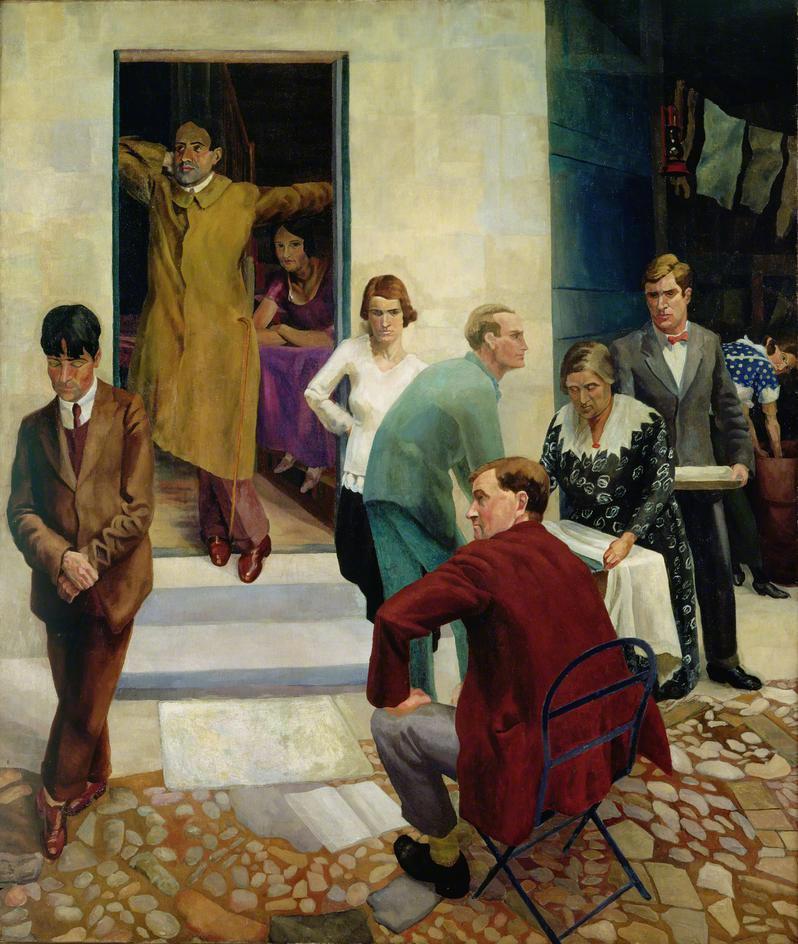
My Daily Art Display featured painting today by Richard Carline, entitled Gathering on the Terrace at 47 Downshire Hill, Hampstead,  shows one such meeting of the Downshire Hill Circle.  The painting was judged as one of Carline’s most impressive works.  Before us we have a group portrait. From left to right we have Stanley Spencer, James Wood, Kate Foster, Hilda Carline (later to become Mrs Stanley Spencer), Henry Lamb, Richard Hartley, Annie Carline and Sydney Carline.   Richard Carline was meticulous in his preparations for this work.  He painted an oil study of each of the group before slotting them into his group portrait.  His 1924 preparatory oil study of Stanley Spencer for this group portrait is also a stand-alone painting of his, entitled Study of Stanley Spencer.  Looking at the study one has to presume that he hadn’t  quite properly calculated the height of the preparatory study as he had to add Spencer’s shoes separately alongside the figure.

What enhances this group painting is the varied but individual characterization of each person.  This was not done by accident as Carline said his intention was to somehow convey the individuality of the people assembled at his parent’s house.  In his own words Carline described the group portrait:

“… [I] sought to convey the conflicting personalities gathered at our house – Stanley [Spencer] peering up and down as he expounded his views on this or that, James Wood hesitating in the doorway whether to come or go, Hilda absorbed in her own thoughts, Hartley sitting at ease, Lamb courteously attentive to my mother, with Sydney always helpful…”

This paintings, Gathering on the Terrace at 47 Downshire Hill, Hampstead , along with the Study of Stanley Spencer, are housed in the Ferens Art Gallery in Hull.  It is a gallery I have never visited but looking at their website it is one I will put down as a “must visit” location.

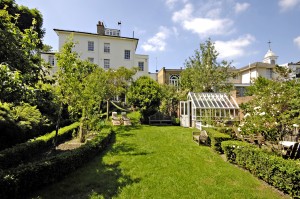
Finally, I always like to imagine what a place, depicted in a painting, looks like today.  I did this with my entry about Renoir’s boathouse in his painting Luncheon of the Boating Party which I featured in My Daily Art Display of August 2nd, so I wondered what the house at 47 Downshire Hill looks like today.  So below is a picture of it I found of it on the internet!

The present Downshire Hill house and garden

Cottages at Burghclere by Sir Stanley Spencer

Cottages at Burghclere by Sir Stanley Spencer (1930)

On August 5th I featured a painting by Stanley Spencer entitled Double Nude Portrait, which in some ways was a pictorial insight into his life at that time.  For many it was a shocking painting, to others it was a sad realisation as how tormented the artist must have been at that juncture in his life.  Today I am looking at another painting by Spencer,  which could not be more different and which I hope you will like.

For the last two days I have been on my travels visiting my elder daughter who lives in the Derbyshire Peak District and I decided that as I was relatively close to Compton Verney I would call there on my way back home as I knew there was a small exhibition of Stanley Spencer paintings in their galleries.  The title of the exhibition was Stanley Spencer and the English Garden and it is on until October 2nd.  If you get a chance you should try and get there as not only do you have a great selection of paintings, including the Stanley Spencer exhibition, you have the chance to walk around the magnificent grounds of Compton Verney.

Stanley Spencer had served as an orderly with the Royal Army Medical Corps during the First World War, stationed first at the Beaufort War Hospital in Bristol then at the age of 24 he went overseas and served the RAMC in Macedonia in the 68th Field Ambulance unit.  It was whilst there that he transferred into the infantry division of the Berkshire Regiment.  It was during that time that he witnessed horrendous suffering and lost many friends on the field of battle.

After the war Spencer received a commission from Mary and Louis Behrend to paint murals for the Sandham Memorial Chapel in Burghclere, which had been built as a memorial to Mary’s brother, Lieutenant Henry Willoughby Sandham, who had died at the end of World War I.    He started work on them in 1926 and did not complete the commission until 1932.  The featured painting does not come from the chapel but I will feature some of them at a later date but today’s painting is one which he painted in his spare time when he was at Burghclere.  In some ways I think it may have given Spencer a respite from the memorial paintings and the horrors of war which were relevant to those works.

My Daily Art Display painting for today is entitled Cottages at Burghclere which he painted in 1930 and is owned by the Fitzwilliam Museum in Cambridge but is now part of the Compton Verney exhibition.  In this beautiful painting we see two cottages, one with a thatched roof that is slightly bowed and mirrors the bowing of the side hedges separating it from the other, with its tile-cladded roof and its more modern horizontal wooden-slatted facade.  These two side by side dwellings serve as a contrast between old and new.  Both of the dwellings are almost buried by a profusion of shrubbery.  We have before our eyes a voluptuous excess of summer with gardens full of blooming flowers and bordered by lop-sided topiary.  The small compact gardens are fronted by white picket fences, which struggle to fend off the invading weeds and brambles, which press against them in their attempt to spill over into the manicured gardens.  On one side of the fence we see the dwellers have managed to tame the rampant weeds whilst on the other side of the fence line the weeds are mustering forces to lay siege once again.  It is almost man versus nature.

A white picket fence gate in the left foreground stands ajar as if inviting us in to this garden paradise.  The verdancy of the image is almost too much to behold as we look towards the wooded background.   Everything is so lush.  This painting is not of a vast garden with its beautifully manicured lawn which we are used to seeing around French chateaux of the Loire Valley.   This painting is of a small, full-to-the brim with flowers, Berkshire garden in front of its chocolate-box type of dwelling.  There is a snug homeliness about this picture.  There is a feeling of security and wellbeing about the setting.

We are all so used to seeing Spencer’s unusual figures in his religious paintings, which link biblical stories with his native Cookham.  We are also used to his paintings which hark back to the relationship with his two wives, but the garden pictures of Stanley Spencer which he painted throughout his life, have remained little known.   They celebrate all those things that Spencer thought of as quintessentially English and highlight the English love of their gardens.  For this reason I urge you to visit the exhibition before it closes.

The Times described this painting as:

“….the work of a Pre-Raphaelite who has looked at Cezanne..”

The Director of Compton Verney said of Spencer’s paintings:

“…Nothing in Spencer is without symbolism.  He was an inherently mystical person.  For him even the most modest garden was a self-contained vision of heaven…”

I will put it more simply and say that it is so easy to fall in love with the simplicity and beauty of Spencer’s garden paintings and I would love to hang one on my wall at home to remind me of the beauty that is the English countryside.

Head of a Man with Red Eyes by L S Lowry

Head of a Man with Red Eyes by L S Lowry (1938)

The other day I went over to Manchester and visited the Lowry Gallery at Salford Quays.  The Gallery was named after Laurence Stephen Lowry, best known simply as L.S.Lowry.  He was the Lancashire artist, who had a very distinctive type of art, often depicting people and places around his home town.  The small stick-like characters which were seen in the crowd scenes of his paintings were his trademark and were often described as matchstalk people.

The Matchstalk people of a Lowry painting

The term matchstalk men and matchstalk cats and dogs was further immortalised with the No. 1 hit song produced in late 1977 entitled Matchstalk men and Matchstalk cats and dogs.  The lyrics  of the song, telling the story of the artist Lowry, was performed by a duo, who went by the name of Brian and Michael.

The poignant lyrics summed up Lowry’s art:

He painted Salford’s smokey tops

On cardboard boxes from the shops

And parts of Ancoats where I used to play

I’m sure he once walked down our street

Cause he painted kids who had nowt on their feet

The clothes we wore had all seen better days.

Now they said his works of art were dull

No room, all round the walls are full

But Lowry didn’t care much anyway

They said he just paints cats and dogs

And matchstalk men in boots and clogs

And Lowry said that’s just the way they’ll stay

And he painted matchstalk men and matchstalk cats and dogs

He painted kids on the corner of the street with the sparking clogs

Now he takes his brush and he waits outside them factory gates

To paint his matchstalk men and matchstalk cats and dogs.

The Matchstalk people of a Lowry painting

Although I went to the Gallery expecting to see just a series of similar looking crowd scene paintings filled with strange looking, stick-like people, I was very pleased to see the exhibition showed far more than I was expecting.  Besides Lowry’s trade-mark paintings, there were a number of completely different works of art by Lowry, which I found amazing and two of which I will feature today and tomorrow.

The painting by Lowry which is My Daily Art Display painting of the day is entitled Head of a Man with Red Eyes, which he completed in 1938.  The 1930’s had been a period of his life which was very traumatic.  Lowry was an only child and was never to marry.  He lived with his mother and father, with his mother being, by far, the more dominant parent.  His mother had always wanted daughters and her son disappointed her and to make things worse her sister had given birth to three girls.  Lowry’s mother was very envious of her sister Mary and once commented that it was unfair that whilst Mary had three splendid daughters all she had was one clumsy boy.

In 1932 his father, aged 74, died of pneumonia.  Lowry’s relationship with his father had been somewhat cold and strained and although he called his father “Dad” there was a distinct lack of father-son rapport.   The death of his father did not bring out any palpable signs of overwhelming grief.  His main concern at the time was how the death of her husband would affect his mother.  The affect it had on his 73 year-old mother was terrible as she all but gave up on life and retired to bed where she remained for seven and a half years until her death.  Her demands on her son and his time were great and constant and for that lengthy period Lowry had to care for his mother, who would not agree to any outside help.

Not only did Lowry now have to be at his mother’s beck and call he discovered to his horror that his late father had run up a mass of debts.  The discovery of the alarming state of his father’s financial situation was only discovered when the creditors came knocking at the door.  It took Lowry a year to settle the outstanding debts.  Lowry’s health began to fail due to being over-tired with looking after his mother and at one point he had to go away for a few days on doctor’s orders.

Today’s painting probably was in some way a product of his physical and mental state.  He had suffered badly because of his all controlling mother who rarely showed him any love or affection and this painting was completed the year before she died.   It is the morning- mirror reflection of the face of a man staring out at us.   It looks like he has slept little during the night.  The healthy vigour is missing, drained completely away, leaving just strain and tension.  The physical discomfort we see in this face is the look of utter despair.  The gaze is both unsettling and intense.  Of this painting Lowry said:

 “…I was simply letting off steam.  I started a big self-portrait and then I thought ‘What’s the use of it.  I don’t want it and nobody will’.  I turned it into a grotesque head, I’m glad I did, I like it better than a self-portrait….”


Boy in a Yellow Jacket by L S Lowry (1935)

Lowry in the 1950’s commented again about his work and his equally disturbing 1935 painting Boy in a Yellow Jacket and came to the conclusion that it was painted during a harrowing period in his life.  He said of the period:

“…I think I reflected myself in those pictures.  That was the most difficult period of my life.  It was alright when he [his father] was alive, but after that it was very difficult because she was very exacting.  I was tied to my mother.  She was bedfast.  In 1932 to 1939 I was just letting off steam…”

The painting was bought by a Manchester man who only kept it for three weeks saying that he couldn’t live with such a disturbing picture.

Would you like to have it on your bedroom wall to see when you wake up?  Maybe a man should have it next to his bathroom mirror so that he can compare likenesses when he finally gets out of bed and thus be appreciative of his looks and be appreciative of what he has and realise that life could change for the worse !

The Martyr of Solway by John Everett Millais

The Martyr of Solway by Millais (1871)

I visited the Walker Gallery in Liverpool yesterday and I am never disappointed by the paintings on permanent show there.  It is such a diverse collection which cannot fail to please everybody who visits, no matter what their artistic proclivity.  My Daily Art Display today features a stunning painting by John Everett Millais entitled The Martyr of the Solway which he painted in 1871.

So who was the martyr of Solway and why was she killed in such a barbaric fashion?   The “Margaret” depicted by Millais was Margaret Wilson, who was born in 1667 in Glenvernoch in Wigtownshire.  She was a young and devout Presbyterian who was a member of the Covenanters, a Scottish Presbyterian movement of the 17th century in Scotland who signed the National Covenant in 1638 to confirm their opposition to the interference by the Stuart kings in the affairs of the Presbyterian Church of Scotland.  The Stuart kings embraced the belief of the Divine Right of the Monarch.   However, not only did they believe that God wished them to be the infallible rulers of their kingdom – they also believed that they were the spiritual heads of the Church of Scotland.    This latter belief was anathema to the Scots.   Their belief was quite simple – no man, not even a king, could be spiritual head of their church. Only Jesus Christ could be spiritual head of a Christian church.
The account of the martyrdom of the eighteen year old Margaret  Wilson and the events leading up to her death are set down in an account by the Rev.C.H.Dick’s  entitled Highways and Byways in Galloway and Carrick, which was published in 1916.  In it he wrote:
“….Upon the 11th of May,1685 came the wicked execution of two excellent women, Margaret McLachlan and Margaret Wilson, near Wigtown, in South West Scotland .  Margaret Wilson, eighteen, and her sister, Agnes, not yet thirteen years old, were the daughters of Gilbert Wilson, tenant of Glenvernoch in the parish of Penninghame. They conformed to Episcopacy. Adherents to the Covenants, the girls fell into the hands of the persecutors, and were imprisoned.

Upon their release, they left the district and wandered through Carrick, Galloway, and Nithsdale with their brothers and some other Covenanters. But on the death of King Charles, there was some slackening of the persecution, and the girls returned to Wigtown.

An acquaintance, Patrick Stuart, betrayed them. He proposed drinking the king’s health; this they modestly declined: upon which he went out, informed against them, brought in a party of soldiers, and seized them.   They were thrown in the thieves’ hole, and after they had been there some time, were removed to the prison where Margaret McLauchlan was.

Margaret Maclachlan was a woman of more than ordinary knowledge, discretion, and prudence, and for many years of singular piety and devotion: she would take none of the oaths now pressed upon women as well as men, neither would she desist from the duties she took to be incumbent upon her, hearing presbyterian ministers when providence gave opportunity, and joining with her Christian friends and acquaintances in prayer, and supplying her relations and acquaintances when in straits, though persecuted. It is a jest to suppose her guilty of rising in arms and rebellion, though indeed it was a part of her indictment. She was very roughly dealt with in prison, and was allowed neither fire nor bed although she was sixty-three years of age.

All the three prisoners were indicted “for rebellion, Bothwellbridge, Ayr’s Moss, and being present at twenty field-conventicles”.   None of them had ever been within many miles of Bothwell or Ayr’s Moss. Agnes Wilson could be but eight years of age at Ayr’s Moss, and her sister but about twelve or thirteen; and it was impossible they could have any access to those risings:

When the Abjuration Oath was put to them, they refused it, the assize found them guilty, and the sentence was that “upon the 11th instant, all the three should be tied to stakes fixed within the flood-mark in the water of Blednoch near Wigtown, where the sea flows at high water, there to be drowned”.

Gilbert Wilson secured the liberation of the younger girl under a bond of a hundred pounds sterling. The sentence was executed on Margaret Maclachlan and Margaret Wilson.  The two women were brought from Wigtown, with a numerous crowd of spectators. Major Windram with some soldiers guarded them. The old woman’s stake was a good way in beyond the other, and she was first despatched, in order to terrify the other to a compliance with such oaths and conditions as they required. But in vain, for she adhered to her principles with an unshaken steadfastness.

When the water was overflowing her fellow-martyr, some about Margaret Wilson asked her, what she thought of the other now struggling with the pangs of death. She answered, what do I see but Christ (in one of his members) wrestling there. Think you that we are the sufferers? No, it is Christ in us, for he sends none a warfare upon their own charges.

When Margaret Wilson was at the stake, she sang the 25th Psalm from verse 7th, downward a good way, and read the 8th chapter to the Romans with a great deal of cheerfulness, and then prayed.   While at prayer, the water covered her: but before she was quite dead, they pulled her up, and held her out of the water till she was recovered, and able to speak; and then by Major Windram’s orders, she was asked, if she would pray for the king.

She answered, ‘She wished the salvation of all men, and the damnation of none.’

One deeply affected by her words said, ‘Dear Margaret, say God save the king, say God save the king.’

She answered in the greatest steadiness and composure, ‘God save him, if he will, for it is his salvation I desire.’

Whereupon some of her relations near by, desirous to have her life spared, called out to Major Windram, ‘Sir, she hath said it, she hath said it.’

Whereupon the major came near, and offered her the abjuration, charging her instantly to swear it, otherwise return to the water.

Most deliberately she refused, and said, ‘ I will not, I am one of Christ’s children, let me go.’

Upon which she was thrust down again into the water.

The name of the man by whose information the women were arrested is well known, and his memory execrated still. One of his descendants getting into an altercation was thus taunted: ‘I wadna like to have had a forebear who betrayed the martyrs; I wadna be coomed o’ sic folk’.

The gravestone of Margaret Wilson

Margaret Wilson was buried in the churchyard at Wigtown.

X Ray picture of original painting

In the painting, we see the young woman with flame-coloured hair chained to the rocks.  She wears an open-necked blouse and tartan skirt.  She looks downward and to her left, her lips pursed.  Her eyes avoid our gaze and she seems lost in thought.  It is interesting to note that what we see in today’s painting is not we would have seen in Millais’ original completed work.  Art conservators have x-rayed the painting and found out that Millais had originally painted the upper torso of the young woman naked.  However when the painting was exhibited in 1871 there were strong puritanical views on nudity in paintings and Millais’ work offended Victorian sensibilities.  It was badly received and was the butt of many negatively critical reviews.

The Knight Errant (repainted version)

This had also happened a year earlier when Millais exhibited his work The Knight Errant in 1870 depicting a naked woman tied to a tree being rescued by a knight and which was roundly condemned for its nudity.  It could not be sold and had to be repainted.  Millais actually then cut out the canvas on which was her head and upper torso, added a new piece of canvas and re-painted the damsel in distress.   He did not clothe the naked woman but instead of her gaze being fixed on the knight, her upper torso was altered so that she was now  modestly turned away from him.   This in fact was Millais’ one and only painting of a nude woman.

For his painting of the Martyr of Solway, Millais realised that it was in his best interest to change the painting and deflect any further criticism so he re-painted the head and upper torso and the result was the clothed woman, as we see her today.

It is a most captivating painting.  I suppose in reality the calm and thoughtful face of the young woman as portrayed by Millais is unrealistic as I am sure the incoming tide must have been a terrifying experience and yet we see neither fear in her eyes nor her facial expression.  However this lack of facial contortion brought on by panic and trepidation allows us to observe the beautiful face of this young woman.

Clothed or naked – was Millais right in changing his original concept?  If Millais had painted the picture today one presumes he may not have had to clothe her upper torso but would that have added or detracted from the finished article?

The Return from Inkerman by Elizabeth Thompson

The Return from Inkerman by Elizabeth Thompson (1877)

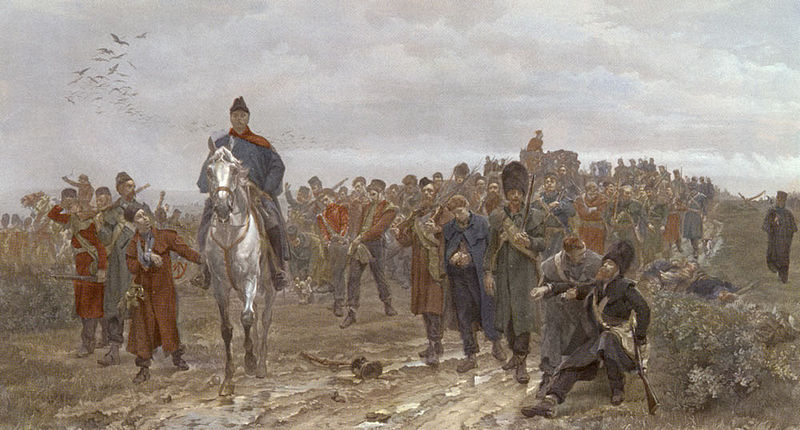
My Daily Art Display today is a war painting depicting the conclusion of the Battle of Inkerman and the British troops, or what was left of them marching back to camp.  The work of art was painted by Elizabeth Southerden Thompson, the British female painter, who had attained celebrity status with her history paintings, and especially those depicting military conflicts involving British troops.

She was born in Lausanne, Switzerland in 1846 and at the age of thirteen, when she and her family lived in Italy, began to receive art tuition.  In 1862 she travelled to London where she enrolled in the Female School of Art which along with the National School of Art coalesced into the Royal College of Art in 1869.    In 1869, with the family now living in Florence she enrolled in the Accademia di Belle Arti which was the top-rated academy for drawing in the whole of Europe.  Her favoured art genre at the outset of her painting career was that of religious art and it was not until she went to Paris at the age of twenty-eight that this was to change.   In Paris she came across the works of Jean-Louis Meissonier the French Classicist painter who was famed for his works of art depicting Napoleon and his armies and other military scenes.  She also saw works by the military painter Édouard Detaille, who had been a pupil of Meissonier.  She was so enthused with their military paintings that she decided that in future this was to be her choice of art genre.

In 1873 she completed a work entitled Missing which depicted two wounded French officers during the Franco-Prussian War and which was the first of her paintings to be accepted by the Royal Academy.  The following year she exhibited a painting which was to be one of her most popular and made her a nineteenth century celebrity.  It was entitled The Roll Call and it depicted a scene from the Crimean War in which we see a battalion of the Grenadier Guards, many of who were wounded and exhausted, gathered around for the roll call so as to ascertain who had and who had not survived the latest battle.  The painting was shown around the art capitals of Europe and in doing so her fame as an artist spread throughout the continent.

In 1877 she married a Tipperary man, Sir William Francis Butler, who was an officer in the British army and who rose in the ranks to finally become a lieutenant-general.  This army life of her husband afforded Elizabeth, now Lady Butler, the opportunity to travel with him throughout the British Empire.  The couple went on to have six children but the burden of motherhood did not prevent her from painting many more military scenes.

When her husband retired from the army in 1905 the couple retired to Bansha Castle in Tipperary.  Her husband died in 1910 but she remained at Bansha until she was seventy-six years of age at which time she went to live with her youngest daughter.  She died in 1933 just a month short of her eighty-seventh birthday.

The featured painting today is entitled The Return from Inkerman by Elizabeth Thompson which she completed in 1877.  This was the final work of her quartet of paintings she did between 1874 and 1877 depicting scenes from the Crimean War.  The painting depicts a ragged column of exhausted soldiers trudging back to camp, many of who are wounded and are only just able to stand up.  Their commanding officer on horseback rides at the head of the column.  The men try to keep their heads held high as they pass fallen comrades who lie at the side of the road.  Their tattered uniforms remind us of the ferocity of the battle which has just concluded.  The battle took place on the heights of Inkerman where the Russians had mounted a counter-attack on the British forces.   The weather had been terrible during the battle with driving rain interspersed with thick fog making the commanding of the troops difficult for both sides.  This battle was one of many bloody encounters which occurred during the siege on the Russian town of Sebastopol in November 1854 and was part of the Crimean War campaign.  It was a ferocious battle and cost the lives of 2,500 British and 12,000 Russian troops.   In her painting the troops depicted are mainly from the Coldstream Guards and the 20th East Devonshire regiment.

While she never witnessed actual warfare, she was in Egypt for some years in the 1880’s with her husband and many of her pictures were drawn accurately using models in some cases, or observing soldiers on manoeuvres or practicing charges at Aldershot. To help with her paintings, the soldiers even re-enacted the battle in their original uniforms worn throughout the campaign.

There is a great sense of realism to this painting.  In it we see the men and their suffering.  However in some quarters this realism was too much to bear.  As would be the case now, the public did not want to be reminded of such sufferings on the battlefield.  For most of the public and the hierarchy of the Royal Academy they preferred more uplifting depictions of victorious battles and acts of heroism which would lift people’s spirits.  Many artists pandered to such wishes but as the French master of military paintings, Édouard Detaille, commented:

“…L’Angleterre n’a guère qu’un peintre militaire; c’est une femme…”

(England has only one military painter; and it is a woman)

However Elizabeth Thompson would not change her style and defended it in her 1922 autobiography, writing:

“…I never painted for the glory of war, but to portray its pathos and heroism…”

However she still had many supporters of her painting style.  Wilfred Meynell, the Victorian biographer, wrote in his book The Life and Work of Lady Butler:

“…Lady Butler has done for the soldier in Art what Mr. Rudyard Kipling has done for him in Literature – she has taken the individual, separated him, seen him close, and let the world see him…..”

The Daily Telegraph of the day wrote of Elizabeth Thompson’s great ability as a female military artist, writing:

“…Miss E. Thompson, a young lady scarcely heard of hitherto, with a modest, sober, unobtrusive painting, but replete with vigour, with judgement, with skill, with expression, and with pathos – such expression as we marvel at in Hogarth for its variety, such pathos as we recognize under the rough or stiff militarism of Horace Vernet – has shown her sisters which way they should go, and has approved herself the valiant compeer even of most famous and most experienced veterans of the line. To the unselect many, to the general public, Miss Thompson is as new as the Albert Memorial at Kensington; and it is for that reason that we hail her appearance with this honest, manly Crimean picture, as full of genius as it is of industry. We say that this sign is a wholesome one; because in every work of art-excellence executed by a woman, and commanding public acceptance and applause, we see a manacle knocked off a woman’s wrist, and a shackle hacked off her ankle. We see her enlarged from wasting upon fruitless objects the sympathies which should be developed for the advantage of humanity. We see her endowed with a vocation which can be cultivated in her own home, without the risk of submission to any galling tyranny or more galling patronage…”

Eastward Ho and Home Again by Henry Nelson O’Neil

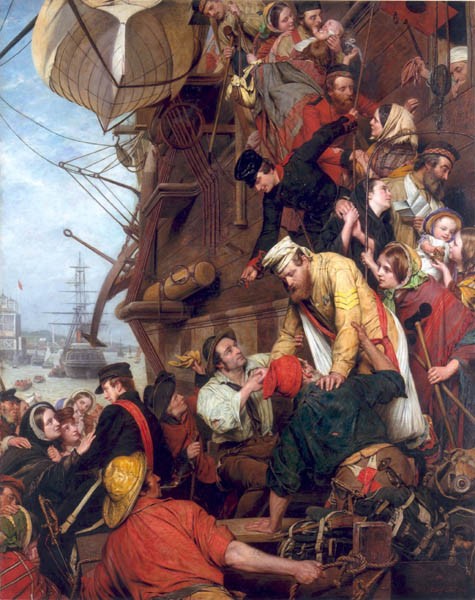
Today I am offering you two paintings by Victorian painter Henry Nelson O’Neil.   The reason for the joint display is that the works are connected and the story behind them is intertwined.

O’Neil was born in Russia to English parents in 1817.  He returned to England at the age of six and when he was nineteen years of age studied at the Royal Academy Schools.He was a historical painter, that is to say the subject matter in most of O’Neil’s paintings depicted a momentous moment in history.  At one time, the genre of  history painting was traditionally regarded as the highest form of Western painting and the works would fit into the most esteemed position in the pecking order of painting genres.   These historical works were thought of as corresponding to the epic in literature.

In the 1840’s O’Neil was a co-founder of The Clique, which was a group of like-minded young artists, based around the St John’s Wood area of London, who regularly met to peruse each other’s works and offer their own critiques.  The coming together of this group was in some ways an act of rebellion against the Royal Academy and in what they saw as its imposition of artistic restrictions.  This group wanted to add more realism to their work.  They wanted their works to have greater emotional intensity which at the time was frowned upon by the Academy establishment.   I had already mentioned this group when I looked at a painting by Richard Dadd (June 29th) another co-founder of The Clique.  This group of artists denounced the Pre-Raphaelite Brotherhood and their works and O’Neil was the most vociferous in his opposition to their art.  As with most things, The Clique eventually broke up but Henry O’Neil still believed in its principles and he continued to embrace highly emotional scenes in his works and this can be seen clearly in my two featured paintings today.

Eastward Ho by Henry O'Neil (1857)

The two works I am featuring today in My Daily Art Display are entitled Eastward Ho and Home Again.  The first was painted by O’Neil in 1857 and the latter completed the following year.  Eastward Ho focuses on the embarkation of British troops on a ship at Gravesend on their way to India to fight in the First War of Independence, known as the Indian Mutiny.    For the British people this was a just war and brought about a fierce feeling of patriotism amongst the people, who were shocked by India’s challenge to British rule and British supremacy on the sub-continent.  Sadly as in most conflict the populace are whipped up into a frenzy of righteousness by the media of the day and the young men and now young women on both sides go off to fight with a sense of belief that theirs is a just cause, their God is on their side and anyway it will all be over soon and it will be other people who will be killed, not them.  In this case they were fighting for their Empire.   The painting however was well received with the Illustrated London News describing the work and its popularity as:

“….a national epic. No wonder it is so popular that such crowds assemble around it, scanning every feature of the various actors, till at last they begin to imagine themselves present at, and participators in, the scene…”

The newspaper of the day, The Times, put it:

“….Hope and aspiration are busy among these departing soldiers, and if mothers and wives, and sisters and sweethearts, go down the side sorrowing, it is a sorrow in which there is no despair, and no stain of sin and frailty…..”

In the first painting, we see the soldiers boarding the ship bound for India and their loved ones bidding them emotional farewells.  It is a poignant scene for despite the bravado and sense of duty of the young men going off to fight their just cause with nothing but a rousing sense of duty, we observe their loved ones who are going to be left behind reluctantly letting their fighting men’s fingers slip from their grasp as they move down the gang plank.  For the men we can only see in their faces optimism and patriotism whilst in the faces of the women we see fear and a sense of foreboding.

Home Again by Henry O'Neil (1858)

O’Neil buoyed up by the success of Eastward Ho decided to work on a “follow-up” painting depicting the return of some of the fighting men to their loved ones a year on.  The soldiers are seen going down the gangway of their troop ship.  The main character appears to be the bearded soldier in khaki uniform with his Kilmarnock “pork-pie” cap under a white cotton Havelock, which was worn to afford the wearer’s neck protection from the blazinga nd merciless Indian sun.

However at this juncture not all the men returned and for many wives and girlfriends there was nobody to wait for on the quayside.  Sadly as we are only too aware of in our present time, some young fighting men who return are not the same men, physically or mentally, as those who went out, once full of optimism.   Although O’Neil wanted to be faithful to his beliefs of Realism painting he knew that for the painting to be well received he had to concentrate on the joyous return of the fortunate ones and play down the sadness of the bereaved and the portrayal of the badly injured.  He was applauded for the painting’s lack of, what the media termed,  overemotional sentimentality.  The Times of the day commented:

“…..The crowd round the picture delight to spell out the many stories it includes – its joyous reunitings, its agonies of bereavement; the latter kept judiciously down…..”

O’Neil’s follow-up work was another outstanding success and it was taken on tour around the country and it was estimated that almost sixty thousand people went to see it.  In 1860 the two paintings were exhibited side by side in Piccadilly, London where viewers had to pay six pence to view the two works.  Numerous prints of the two paintings were made and sold.

What fascinates me about the two paintings is that O’Neil has deliberately depicted some of the same people in both works.  Below I have highlighted two examples of this.  Maybe if you look closer you will find more examples of this.

The injured soldier being helped down the gangway (above left) and his wife waving him off (above right)

In another example below, the Chelsea Pensioner on the gangway waving goodbye to his son (below left) and again waving to him from the quay as he returns safely back home (below  right).

The paintings are beautiful examples of O’Neil’s work no matter what we think of his portrayal of war and those who go off to fight and I love the comparison between the emotions shown in the two works – joyous optimism that the men off to fight for their country against the somewhat muted return with its relief and sadness.

O’Neil fared well as an artist and managed to have almost a hundred paintings accepted into exhibitions at the Royal Academy, an establishment, although as a member of The Clique, he once criticised.   He was made an Associate of the Academy two years after exhibiting these two featured paintings.  O’Neil died in 1880 aged 63.

In some ways it is sad to note that nothing has changed in 150 years.  At the onset of battle campaigns the media focus on the adventure of war but now thankfully, despite the wishes of various governments,  they are not adverse to recording the devastating affect such wars have on individuakls and their families.

Found Drowned by George Frederic Watts

Found Drowned by George Frederic Watts (c.1850)

For the second consecutive day I want to present a painting to you which has a connection with a poem.  My Daily Art Display painting today is entitled Found Drowned and was painted by the Victorian painter George Frederic Watts in 1850.  It is almost certain that the idea for the painting came from Watts having read The Bridge of Sighs, the poem written by Thomas Hood just before his death in 1845.

Watts was born in London in 1817 and his Christian names came from the fact that he was born on the composer, George Frederic Handel’s birthday.  He was brought up in an impoverished household, did not attend school, being taught at home by his father.  Despite these early setbacks in life, he achieved acceptance into the Royal Academy when he was eighteen years of age.  In 1843 he won first prize in an artistic competition to design a mural for the Houses of Parliament and although this never came to fruition, the monetary value of the prize enabled him to travel to Italy.  He remained in Italy until 1847 at which time he returned to London.

On his return to London he made the acquaintance of Henry Prinseps, an amateur artist and director of the East India Company, along with his circle of friends and in 1850, Prinseps, his wife Sara, along with some of her sisters and Watts obtained a twenty-one year lease on Little Holland House which belonged to Henry Fox, 4th Baron Holland, and a friend of Watts.  The house, not only became a place for them to all live and entertain their friends, but it gave Watts a studio for his painting.

In 1864 Watts painted portraits of the Terry sisters, Kate Terry and her famous actress sister Ellen Terry.  Watts was besotted by Ellen and despite the fact that she was still a little way short of seventeen years of age and he was thirty years her senior, they married.  The marriage was doomed to failure and a year after the marriage she eloped with her lover forcing Watts to sue for divorce.

In the early 1870’s when the lease ran out on the Little Holland House, Watts acquired another house in London and also one in Freshwater on the Isle of Wight.  In 1877 his divorce with Ellen Terry finally came through and nine years later at the age of 69 Watts re-married, this time his bride was Mary Fraser-Tytler,  a Scottish designer and social reformer, some thirty-three years his junior!   In 1891 he bought land in Guilford, Surrey and they named the establishment Limnerslease, which was a combination of the words “limner” meaning artist and “leasen” meaning glean and by it they had built the Watts Gallery which was a museum dedicated to his work.  It was the first and only remaining purpose-built gallery in Britain devoted to a single artist.  It eventually opened in April 1904, shortly before the death of Watts.

So that is the story of today’s artist and so now let us study his poignant painting and understand why he should depict such a heart-rending scene.  When Watts returned to London from Italy he was traumatized by the extremes of riches and poverty that he could see all about him.  It moved him and he realised that through his art he could bring home the inequalities of life.

The background of the painting is the London skyline and we are viewing it from under Waterloo Bridge and in the distance we can just make out Hungeford Suspension Bridge.  Waterloo Bridge had been a common place for suicides with people throwing themselves off the structure into the Thames.  In the foreground Watts has painted a “fallen woman”, a reasonably common subject in Victorian paintings.  She has drowned and been washed up on the shores of the Thames. Was it an accident or had life proved just too much for her to bear?  In those days, female suicides caused by adulterous relationships or financial hardship, which then led to prostitution, were not uncommon happenings.   Her body is lit up and is in stark comparison to the darkened background.  Her dress still floats in the murky polluted waters.  She is lying on her back with her arms stretched out in a cruciform adding religious symbolism to the picture.  In her left hand she is clutching hold of a chain, attached to which is a heart-shaped locket and this again makes us believe that unrequited love may have had some bearing on the situation.  In the night sky we see a very bright pin-point of light which could be a star of the planet Venus and Watts probably added this as a symbol of hope that maybe there will be a better after-life for the dead woman.  Look at the young woman’s face.  It appears calm.  Maybe at last she is at peace with herself.

It is interesting to note that the title of the painting Found Drowned was legal phraseology often used by coroners when there is no conclusive evidence of suicide, such as a note, and thus the coroner’s report avoids the stigma attached to suicides, which would automatically rule out a Christian Burial.

I end today’s blog with the Thomas Hood’s poem Bridge of Sighs which it is believed was the basis of Watts’ painting.  Read it through and then look at the painting and see if you agree that there is a connection between the two.

One more Unfortunate,
Weary of breath,
Rashly importunate,
Gone to her death!

Take her up tenderly,
Lift her with care;
Fashion’d so slenderly
Young, and so fair!

Look at her garments
Clinging like cerements;
Whilst the wave constantly
Drips from her clothing;
Take her up instantly,
Loving, not loathing.

Touch her not scornfully;
Think of her mournfully,
Gently and humanly;
Not of the stains of her,
All that remains of her
Now is pure womanly.

Make no deep scrutiny
Into her mutiny
Rash and undutiful:
Past all dishonour,
Death has left on her
Only the beautiful.

Still, for all slips of hers,
One of Eve’s family—
Wipe those poor lips of hers
Oozing so clammily.

Loop up her tresses
Escaped from the comb,
Her fair auburn tresses;
Whilst wonderment guesses
Where was her home?

Who was her father?
Who was her mother?
Had she a sister?
Had she a brother?
Or was there a dearer one
Still, and a nearer one
Yet, than all other?

Alas! for the rarity
Of Christian charity
Under the sun!
O, it was pitiful!

Near a whole city full,
Home she had none.

Sisterly, brotherly,
Fatherly, motherly
Feelings had changed:
Love, by harsh evidence,
Thrown from its eminence;
Even God’s providence
Seeming estranged.

Where the lamps quiver
So far in the river,
With many a light
From window and casement,
From garret to basement,
She stood, with amazement,
Houseless by night.

The bleak wind of March
Made her tremble and shiver;
But not the dark arch,
Or the black flowing river:
Mad from life’s history,
Glad to death’s mystery,
Swift to be hurl’d—
Anywhere, anywhere
Out of the world!

In she plunged boldly—
No matter how coldly
The rough river ran—
Over the brink of it,
Picture it—think of it,
Dissolute Man!
Lave in it, drink of it,
Then, if you can!

Take her up tenderly,
Lift her with care;
Fashion’d so slenderly,
Young, and so fair!

Ere her limbs frigidly
Stiffen too rigidly,
Decently, kindly,
Smooth and compose them;
And her eyes, close them,
Staring so blindly!

Dreadfully staring
Thro’ muddy impurity,
As when with the daring
Last look of despairing
Fix’d on futurity.

Perishing gloomily,
Spurr’d by contumely,
Cold inhumanity,
Burning insanity,
Into her rest.—
Cross her hands humbly
As if praying dumbly,
Over her breast!

Owning her weakness,
Her evil behaviour,
And leaving, with meekness,
Her sins to her Saviour!