Gilbert Cannan and his Mill by Mark Gertler

Gilbert Cannan at his Mill by Mark Gertler (c.1916)

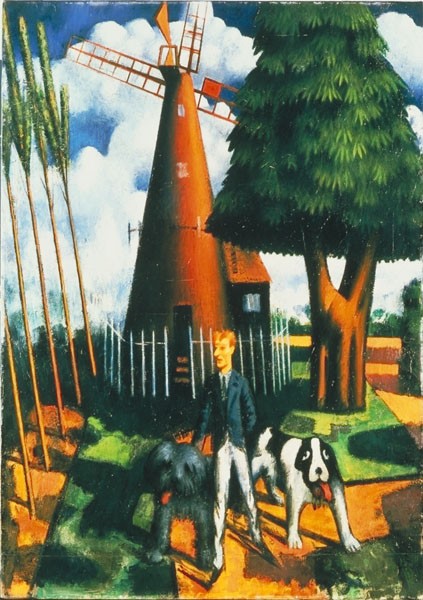
My Daily Art Display today is all about the artist and the person who is the subject of the painting.  The artist who painted today’s featured painting was Mark Gertler and the painting which he completed in 1916 is entitled Gilbert Cannan and his Mill.

Marks Gertler was born in Spitalfields, London in 1891.  He was the youngest of five children born to Jewish immigrants from Poland, Louis Gentler and Kate Berenbaum.  He had two older brothers and two older sisters.   At the age of one, his father took the family to his mother’s native city, Przemyśl in south-east Poland where they worked as innkeepers.  The business failed and one night in 1893, in desperation, Gertler’s father Louis, without telling anyone, left them all and went off to America to search for work.  He eventually sent word to his wife telling her that once he was settled she was to bring the children to live with him there.  It never happened as all his hopes of making a fortune ended in failure.  Louis Gertler returned to Britain, and had his family join him in London in 1896.  It was at this time that his son’s Polish name “Markz” was changed to Mark.

From a very early age Mark Gertler showed a talent for drawing. His first formal artistic tuition came when he enrolled in art classes at Regent Street Polytechnic in London.   Unfortunately because of the family’s dire financial circumstances he had to leave the course after just a year to try and earn some money as an apprentice with a stained glass maker.  However he still maintained his art tuition, attending evening classes at the Polytechnic.  In 1908 he entered a national art competition and was awarded third place.  Buoyed up with that success, but knowing the cost of art training, he applied for a scholarship from the Jewish Education Aid Society.  His application was successful and in 1908, aged seventeen, he enrolled on a three year course at the Slade School of Art.  It was whilst on this course that he met Paul Nash, Stanley Spencer and Charles Nevinson, all of whom would be leading artists in the twentieth century.  Whilst studying at the Slade, Gertler also met the aspiring painter Dora Carrington, the daughter of a Liverpool merchant.  Gertler fell in love with her and pursued her relentlessly for many years.  The story of his brief love affair with Dora was featured in the 1995 biographical film Carrington.  Unfortunately for Gertler his love was unrequited and at one point in this tempestuous relationship he threatened to commit suicide.

Gertler was fortunate enough , in these early days, to be patronized by Lady Ottoline Morrell, the English aristocrat and society hostess and it was through her that Gertler became acquainted with the Bloomsbury Group. He was also introduced to Walter Sickert, who at the time was the leader of the Camden Town Group. With all these new artistic and society connections it was not long before he was enjoying great success as a painter of society portraits.  Unfortunately Gertler had a very abrasive manner and was extremely temperamental.  This did not go down well with his clients and his popularity and that of his paintings waned sharply causing him some financial problems.

In 1914 Gertler visited the writer and the subject of today’s painting, Gilbert Cannan, who lived with his wife in their converted windmill at Cholesbury, Hertfordshire. They became great friends and over the next two years Gertler would be a regular visitor to the mill along with the likes of the writers Katherine Mansfield and D.H.Lawrence  The latter would feature Gertler as the sculptor Loerke in his celebrated novel Women in Love.  It was during one of his early visits that Gertler started his painting which he later entitled Gilbert Cannan and his Mill.

In 1920 when he was just twenty-nine years of age he was diagnosed with tuberculosis and this ailment resulted in many long stays in various sanatoriums.  Around this time, when his artistic career was in decline, he taught part-time at Westminster School of Art.  Gertler’s life began to unravel in the 1930’s.  A war with Germany was brewing.  His mother, whom he was very close to, had died.  The once love of his life Dora Carrington had committed suicide in 1933.    His exhibition at London’s Lefevre Gallery was ridiculed by the critics.  In 1936, no doubt as a result of these personal and professional setbacks, he attempted to commit suicide but failed.   Three years later, in 1939, aged forty-eight, he succeeded in ending his life by gassing himself at his studio in Hampstead.

The subject of today’s painting, as I have said was Gertler’s friend Gilbert Cannan.  Cannan, a novelist, was born in Manchester in 1884 of Scottish ancestry.  He was well educated studying at Manchester Grammar School and King’s College Cambridge.  After receiving his university degree he went into the legal profession.  This profession was not for him and after a brief dabble into the world of theatrics he turned all his efforts to writing.  He worked as a secretary to the Scottish author and dramatist J M Barrie who created the famous character Peter Pan.  Over time, Gilbert Cannan and Barrie’s wife Mary became lovers.  James Barrie and his wife were divorced in 1909 and the following year Mary Barrie and Cannan were married.

In the years before the First World War Gilbert Cannan became friendly with the Bloomsbury Group, a group of writers, intellectuals, philosophers and artists who, throughout the 20th century, held informal discussions in Bloomsbury, London,.   The group would also congregate at Cannan’s home which from 1916 was a converted mill at Cholesbury in Hertfordshire and it was during this time that he met Dora Carrington and Mark Gertler.  The mill we see in the painting was Cannan’s home and was a favourite place for his intellectual circle to meet.

The painting is a full-length portrait of Gilbert Cannan standing in front of the mill with his two dogs.  The large black dog on the right hand side of Cannan is a Newfoundland dog called Luath.  To the left hand side of Cannan is his large black and white St Bernard dog Porthos.  Porthos was originally owned by J.M.Barrie and was used as a model for the dog Nana, dog which served as the Darling children’s nurse in J.M.Barrie’s famous book, Peter Pan, or The Boy Who Wouldn’t Grow Up.

What is interesting and somewhat quirky about this painting is Gertler’s use of geometrical shapes such as cones and triangles.  This can be seen in the shape of the windmill and the foliage of the large tree to the right of it.  Even the way Cannan and his two dogs are portrayed has a triangular shape to it as does the way the tall poplar trees on the left of the work lean to the left against the side of the painting. This was a reflection of Gertler’s interest in the contemporary art which was popular at the time.  The bright colours used by Gertler were not realistic and reflects the anti-naturalistic modern style of the era.

I think I am drawn to this painting purely for its eccentricity and nonconformity and the way Gertler has added vibrancy to the work with his use of unrealistic colouring.  The painting can be seen at the Ashmolean Museum in Oxford and as I have said on a number of occasions you must add a visit to this wonderful establishment on your “to do” list.
Travelling Companions by Augustus Egg

Travelling Companions by Augustus Egg (1862)

Today I am once again featuring a Victorian painter.  His name is August Leopold Egg and he was born in London in 1816.  He was the third son of Joseph and Ann Egg.  His Swiss-born father, like his family before him, was a gunsmith and today one of his guns or rifles commands a high price at auction.

In 1834 Augustus studied art at the Sass Academy in London.  Henry Sass was an English artist and teacher of painting who founded this London art school and it provided training for those seeking to enter the Royal Academy.  Two years later, in 1836, the twenty-year old August Egg enrolled as a Probationer to the Royal Academy Schools.  The following year, he joined up with a number of fellow aspiring artists and formed a sketching club, known as The Clique.  This small grouping, which included the founder, Richard Dadd, also included Alfred Elmore, William Powell Frith, Henry Nelson O’Neil, John Phillip and Edward Matthew Ward.  The Clique was characterised by its denunciation of academic high art in favour of the simpler genre painting, and the group were influenced by the great English narrative painter William Hogarth and the Scottish historical painter David Wilkie.  For them, art was for public consumption and for the public to judge.  They believed that works of art should not be judged solely on how well they conformed to academic principles.

August Egg was at pain to combine popularity with moral and social activism in his paintings which was similar to how his friend, the writer Charles Dickens managed to do with his novels.   Egg and Dickens became great friends and  jointly founded the “Guild of Literature and Art”, which was a philanthropic organisation which provided welfare payments to struggling artists and writers.  Egg’s early works of art were mainly illustrations of literary subjects as well as historical incidents taken from the accounts of the seventeenth century diarist, Samuel Pepys.  He also showed great interest in Hogarth’s narrative works, which often had a moral theme such as Marriage à la Mode and The Rake’s Progress and it was probably these works that inspired Egg to complete his moral narrative painting, The Life and Death of Buckingham.  Many members of The Clique were vociferous critics of the Pre-Raphaelite Brotherhood because, to them, their art was deliberately unconventional, but Egg disagreed and became a great friend and admirer of William Holman Hunt.  In 1848 Egg completed his much lauded work entitled Queen Elizabeth discovers she is no longer young.  This won him critical acclaim and earned him the position of Associate Member of the Royal Academy (ARA).  In 1860 he was elected to the position of Royal Academician (RA).  That same year he married Esther Mary Brown.

August Egg was, besides being a talented artist, a great organiser and spent a much of his time organising exhibitions for his fellow artists.  In 1857 he was one of the organisers of the The Art Treasures of Great Britain exhibition, which was held in Manchester from  May to October of that year.  To this day, it is said to remain the largest art exhibition ever to be held in the Great Britain, possibly in the world with over 16,000 works on display. It was so popular that it attracted over 1.3 million visitors in the 142 days it was open, which at the time, was about four times the population of Manchester.

Egg loved the theatre and it was through this love that he became friends Charles Dickens and Wilkie Collins and at times they would all take part in amateur theatricals.  In 1849, Egg was elected to the Garrick Club, a gentleman’s club, which was named after the well-known thespian of the time David Garrick.  At the end of that year, Egg who often travelled extensively around the Mediterranean countries, set off on a journey to Switzerland and Italy and was accompanied by Dickens, who had just completed his novel Bleak House,  and his other writer friend, Wilkie Collins.  Egg’s health was never good and in his later years he tried to remedy this by living in the warmer climates of the Mediterranean countries.  He died in Algiers in 1863 of asthma aged 46.  He was always well loved and his friend, Charles Dickens, described him as:

“….always sweet-tempered, humorous, conscientious, thoroughly good, and thoroughly beloved…”

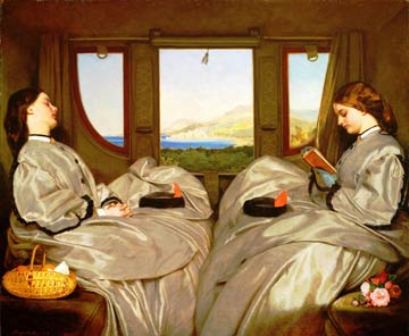
My featured painting today by August Egg is entitled Travelling Companions which he completed in 1862 and can now be found at the Birmingham Museum and Art Gallery.  This has a connection with Egg’s travels as the setting of the painting is a railway carriage and through the open window of the carriage one can just make out the shoreline of Menton, a popular health resort in Victorian days, which lies close to Monte Carlo on the French Riviera.   Look how the artist has cleverly depicted the motion of the carriage by painting the tassel attached to the window blind at an angle away from the vertical.  There are no other people in the carriage besides the two females which may have been an indication that in those days, males and females rode in segregated train carriages.  There is almost a perfect symmetry about the women in this painting as they sit across from each other in the carriage.  They wear almost identical billowing voluminous grey dresses.  Their hats rest on their laps.  Their faces are each framed with a mass of beautiful brunette hair and each wears a black choker around their neck.  At first glance, they almost look like mirror images of each other but once we look more closely, there are obvious differences.  One sits with a basket of fruit by her side, whilst the other has a bouquet of flowers next to her.  One reads whilst the other lays back with her eyes closed.  There is no interaction between the two females.  Neither seems to be interested in the other or what sights can be seen from the carriage window.  Did August Egg want us to take the painting on face value, that is, did he want us to just to accept that this is simply a painting of two women travelling in a railway carriage?   I did, but many do not see the painting in such simplistic terms.  Maybe it is because Egg had painted many moral narrative works that people looked for hidden meanings in this work.  I am not convinced, but let us look at some of the suggestions that have been put forward about how we should interpret what  we are looking at and then I will let you be the judge as whether they are too fanciful to believe or there is a modicum of truth in what they want us to accept as the true meaning behind the painting.

So, if you, like me, look on the painting as simply a depiction of two women travelling by train let me “muddy the waters” for the more I investigate this painting the more I am wondering whether I am missing something.  Is this simply a painting of two almost identical women on holiday travelling in a railway carriage?  Are we simply observing a young lady sleeping and a young lady reading?  First of all, are we looking at two separate women?  That would seem a silly question but some people would have us believe they are one and the same person and that the artist is portraying them in different moods.  Some again who believe in the “one woman” theory would have us believe that perhaps the waking woman is the product of the sleeping one: in other words, she is the dreamed projection of the other.  Another theory is that the one who sleeps is a portrait of inactivity and the one who reads is a portrait of activity – a pictorial depiction of “Industry and Idleness”.  I also read that Egg’s painting was a statement of past and future with the one woman with her eyes closed dreaming of the future whilst the other reads of the past?

And so the theories about the interpretation of this painting mount up but I suppose one has to remember that in Victorian times, tales with a moral were all the rage and Augustus Egg painted many pictures which told a moral tale, so is this yet another one?     

For people who like to add their own interpretation to a painting many feel the need to explore the sexual connotations in a scene and I read an article which does just that.  It is by far the most unusual interpretation (I initially intended to say “fanciful interpretation” of the painting but decided the word “fanciful”  sounded derogatory and that is not my intention).  The article I came across was on the website entitled Victorian Visual Culture and was written by Erika Franck as part of a degree course in Modern Literary studies.  She wrote:

“…Although Egg’s Travelling Companions (1862) is considered to be a reflection on railway travel and the way in which the different classes were segregated, one cannot ignore the sexual connotations that are evident in the painting. The painting displays two young ladies who appear to be identical, and yet upon closer inspection are not. It seems as though the girl on the left has been awakened sexually despite the fact that she is asleep. This can only be detected in comparison with the girl on the right. Firstly, the young lady on the right has flowers set beside her as opposed to the other lady who has a basket of fruit. The flowers convey the virginity and sexual virtue of the girl on the right whereas the fruit beside the girl on the left implies her virginity has been lost and her innocence has been replaced by sexual indulgence and consequently sexual maturity. This analogy continues as one studies the way in which the companion on the right has the curtain slightly drawn to shade her from the sunlight, as opposed to the lady on the left whose curtain allows the light to expose her fully. In addition, the companion on the left has removed her gloves and is thus further exposed physically. The hat of the lady on the left is positioned slightly to the left in contrast to her companion whose hat sits centrally upon her lap. Again it appears as though the girl on the left has exposed herself sexually in that she is less guarded than her sister. This notion is furthered when one considers the posture of the two companions. The one on the right seems more composed and is reading a book whereas the one on the left is leaning back exposing her neck, and is asleep. Although one could question that if this girl has been awoken sexually then why is she the one who is sleeping in the painting? However, it is possible to argue that this displays her overall lack of constraint and propriety that is portrayed by the other young lady. Even the hair of the companion on the left seems to have fallen out compared to the girl on the right whose hair is pinned back in a controlled manner. If one examines the shape of the carriage window in conjunction with the symmetry of the girls’ dresses one can observe there is a shape which resembles that of a chalice. This traditionally symbolizes the womb and fertility, thus accentuating the theme of sexual awakening. Therefore, Egg presents a young woman who appears to be sexually passive and another who is not. One can speculate that the two ladies are the same person and this consequently, would indicate that a transition from sexual unconsciousness to sexual enlightenment has occurred. However, if one is to argue that this picture depicts a girl who has fallen sexually in contrast to her companion, then this painting serves as a mere “freeze-frame”. It does not represent the consequences of the girl’s fall….”

I sometimes wonder whether I should write a book entitled My Interpretation of Great Paintings as I would be simply just one of many to offer an interpretation as to what I think we are looking at and as the artist is dead and cannot repudiate my suggestions, who is to say the hidden meanings I put forward are wrong !    Somebody once told me that if you want to write a successful biography of an artist you have to come up with at least one amazing, contentious even bizarre fact about the artist that nobody has ever heard before as that will get you the publicity needed to sell the book.   I wonder if the people who have interpreted Egg’s work were thinking along those lines !

On the Brink by Alfred Elmore

On the Brink by Alfred Elmore (1865)

Today I am featuring a work of narrative art.  Narrative art is one that tells a story and has been very popular in Western art.  It often depicts stories from the Bible, mythological tales and legends and were often pictorial recordings of great moments in history.  In the seventeenth century we began to see such narrative works in the paintings of subjects from everyday life, which were known as genre paintings.  They originated in the main in Holland with scenes of peasant life and drinking scenes in taverns.  In England in the sixteenth century the artist William Hogarth invented the Modern Moral Subject paintings which brilliantly brought to our attention and lampooned the manners and morals in his day.  I featured a set of these paintings in My Daily Art Display (May 4th to May 9th 2011).  Before I talk about today’s painting, I will briefly tell you a little about the life of Alfred Elmore.  In the meantime, I want you to look at the painting and see if you can surmise what is going on and why the artist chose the title of On the Brink.

Today featured work is a Victorian narrative painting by English painter of Irish birth, Alfred Elmore.  Elmore was a Victorian history and genre painter, who was born in Cork in Southern Ireland.  His father, John Richard Elmore was a retired surgeon from the British Army.   His family moved to London and Alfred attended the Royal Academy Schools in 1832.  Whilst at the Academy he briefly associated with a group of fellow art students who had just formed a sketching society which they called The Clique.  It was described as the first group of British artists to combine for greater strength and to announce that the great backward-looking tradition of the Academy was not relevant to the requirements of contemporary art.

In the late 1830’s Elmore studied at French atelier and then from 1840 to 1844 travelled extensively through Europe visiting Munich Venice, Bologna, and Florence and spent two years in Rome.  In 1844 he exhibited his work entitled Rienzi in the Forum at the Royal Academy and this led to him becoming an Associate of the Royal Academy (ARA) the following year.  He became a Royal Academician in 1857.  Elmore painted a number of literary subjects, especially depicting scenes from the plays of Shakespeare but many of his later works were historical narrative works, some of which were wholly anti-Catholic in spirit.  Elmore’s reputation was at its height in the 1850’s but he suffered a lapse into comparative obscurity during the latter portion of his life.  He died of cancer in 1881, aged sixty-five.

And so I return to today’s painting entitled On the Brink which Alfred Elmore painted in 1865 and was probably his best known work.  It is termed a moral genre painting which may give you a clue to what is happening in the painted scene.  What do you make of the title of the painting?  Have you any idea why Elmore would give the work such a name?  I suppose to discover the answers to these questions one has to first identify what we are looking at.  We are standing outside a house and looking through an open window into a room which is the venue for some sort of gaming.  A man leans out of the window and is talking to an unhappy-looking woman who is seated outside.  That is the scene and the man and the woman are the main characters.

This painting, which was exhibited at the Royal Academy in London in 1865, clearly embellishes the concerns Victorian people had about gambling, especially when it involved young women. The artist has created a striking sense of depth within the painting. There is a great contrast in the colours used for the interior and the exterior.   In the foreground we have the outside tranquillity and paleness of the moonlight which contrasts with the dazzling red and gold gaudiness of the hustle and bustle going on inside the room.   Look at the garish colours of the gaming room.  The red wallpaper is lit by a chandelier and candles, which are reflected in gilt mirrors around the walls. A throng of people lean over a gaming table, totally absorbed in the action, which contrasts with the sorrowful state of the woman in the foreground. If we look to the left background we can see a curtained-archway which leads to another well-lit gaming room full of people.  We are almost certain we know the setting for this painting for there is a one word inscription, Homburg, on the reverse of the canvas.  In 1842, the German town of Bad Homburg had a casino and spa and had attracted a wealthy and cosmopolitan clientele to its gaming tables, of which many were British.

The woman with a decision to make.

The young woman, we see before us, sits unhappily outside in the darkness of the evening. Her figure is illuminated by the white light coming from the moon. We can only see one side of her face which is deathly white whilst the other side is hidden in the darkness of the night.  Her clothes are of a rich quality and the height of fashion.  Our first clue as to what the painting is all about is the empty purse which dangles from her right hand and a torn gaming card which lies discarded at her feet. From these clues we now know why she is in such a state – she has lost all her money at the gaming tables which we can see through the open window behind her.

The seducer

Still we haven’t reconciled the title of the painting but if we look at the shadowy figure of a man leaning out of the window talking to her all will be resolved.  His figure, apart from his hands, is neither illuminated by the light from the room nor the moonlight.  The way the young man is depicted, almost devil-like, adds a certain air of foreboding and menace and we feel that he is not a good companion for this lady.  It is interesting to see how the artist compares this mismatch with the couple in the middle ground.  They are standing in the room directly behind the shadowy figure and face each other in a loving stance.

The title of the painting can be understood a little better if we look at the flowers which are next to the woman.  There are two types of flower.  One is a white lily which symbolises purity whilst the other is the purple passion flower.  In the Punch magazine in the May of the year the painting was exhibited, an anonymous poet had written, about the scene and what we were looking at:

E’s [for] Mr. Elmore. She’s tempted to sin;
She’s fair. Will the lily or the passion flower win?

According to the poet’s understanding of the painting, it was all about the choice faced by the unfortunate young female who had just gambled away all her money and was now being propositioned by an unseemly man.   The question she is on the brink of answering is, should she retain her virtue and face the consequences of her new found poverty, or does she earn the money she needs to repay her debts by submitting to the proposition of the young man who is offering money for her body.  As we look at her she is “on the brink” of making her decision.  So we now know that the title of the painting derives from the situation in which a young woman s ‘on the brink’ of responding to the blandishments of a seducer, who is depicted as a Satan-like figure, luridly bathed in red light, and whispering corrupting thoughts in her ear.

There were a number of Victorian paintings which depicted “fallen women” and I will look at another in a few days time.  This one by Elmore, which he exhibited at the Royal Academy in 1865, was to greatly enhance his reputation as a Victorian artist.

The painting is presently housed in the Fitzwilliam Museum, Cambridge.

Hogarth’s Studio in 1739 by Edward Matthew Ward

Hogarth’s Studio in 1739 by Edward Matthew Ward

One of the unexpected pleasures I get when I visit an art gallery to see a specific exhibition is that having observed the exhibition I always like to walk around and see the paintings in the gallery’s permanent collection and it is then that you unearth some gems.  When I visited the York Art Gallery to take in the William Etty exhibition I gave myself time to have a look at some of the gallery’s other paintings and it also gave me a reason to escape the clutches of the semi-naked live art performer (see My Daily Art Display of December 12th).  It was during this perusal of the works that I came across a painting by Edward Matthew Ward and it is his painting entitled Hogarth’s Studio in 1739 that I am featuring in today’s edition of My Daily Art Display.

Edward Matthew Ward was born in Pimlico, London in 1816 and has been classified as an English narrative painter.  Narrative paintings are an art form that tell a story. This is a long tradition in the world of art and probably dates back to the time of the ancient Egyptians. Popular trends in narrative painting have included history paintings which incorporates the likes of biblical, mythological, and historical themes and which were popular during the period of the Renaissance to the 18th century.  We have already seen in earlier blogs of mine the moralizing story series of William Hogarth’s  Marriage à la Mode ; and then in the 19th-century the narrative art turned more towards anecdotal and sentimental narratives, usually depicting domestic scenes.  In narrative paintings of the 19th century, the title became an important part of the artwork, often explaining the message.

Edward Ward’s parents encouraged his early interest in art and he was sent to a number of art schools, including that of John Cawse, the portraitist and history painter.   Ward was a very talented artist even at an early age and even  won an award from the Society of Arts at the age of 14.  At the age of eighteen he exhibited his first work at the Royal Academy and the following year, 1835, he enrolled as a student at the Royal Academy Schools.  At the age of twenty he set off from England and went to Rome where he remained for three years and it was whilst he was there that he achieved another artistic award.  This time it was a silver medal presented to him by the Rome Academy of St Luke for his work entitled Cimbaue and Giotto, which he sent back to London and which was exhibited in the 1839 R.A. exhibition. 

He returned to England in 1839 but on the way back Ward visited Munich to learn the technique of modern fresco painting.  The reason behind that was that he wanted to take part in the competition to decorate the Palace of Westminster.  In London, the old Houses of Parliament had been destroyed by fire in 1834 and the new Houses of Parliament at Westminster were built. Competitions were held for appropriate designs (‘cartoons’), with a number of leading artists commissioned to take part.   To organise and oversee this project, a Royal Commission had been appointed in 1841, the President of which was Queen Victoria’s new consort Prince Albert.   In all there were three annual competitions.  The competition rules were that each artist would submit a full sized cartoon (preparatory drawing) with specimens of fresco or other techniques suitable for murals.  The design of their submitted work had to be scenes from British History or Literature or personifications of abstract representations of Religion, Justice and the Spirit of Chivalry.  Ward submitted his cartoon entitled Boadicea in the 1843 competition, but it was unsuccessful.  However nine years later, in 1852, mainly because of his much admired historical works, he was commissioned to produce eight pictures for the corridors of the Palace of Westminster, on subjects drawn from the English Civil War.   These were to depict parallel episodes on the two sides in the Civil War.  Ward’s paintings depicted the opposed figures, as if confronting one another, across the corridor.  By now Ward’s work was becoming very popular and he was never short of commissions.

In 1843, the twenty-seven year old Ward met Henrietta Ward the eleven year old daughter of George Raphael Ward, the artist and printmaker and Mary Webb Ward the miniaturist.  Henrietta was besotted with Ward and despite the great age difference they eloped, with the help of Ward’s friend the author Wilkie Collins, and married in 1848 when she was just sixteen years of age.  Henrietta’s parents were devastated and angered by this turn of events and her mother never forgave her and in fact, disinherited her.  The couple went on to have eight children, one of whom, a son, Leslie, was later to become a portraitist and well-known caricaturist and cartoonist, who had many of his works printed in magazines, such as Vanity Fair.  Henrietta although kept busy with her large brood of children was also a noted historical painter and her paintings of children, for which she used her own as models, were also very popular.

Edward Ward was very much influenced by the work of the English narrative artist William Hogarth and during the 1860’s he would mimic Hogarth’s style in his works which depicted incidents from British history.  Ward’s life changed dramatically in the late 1870’s when he started to suffer from a painful and debilitating illness which caused him to have prolonged bouts of depression.  In January 1879, aged 62, Edward Matthew Ward committed suicide.

The featured painting in My Daily Art Display today is entitled Hogarth’s Studio in 1739.  Edward Ward completed this oil on canvas work in 1863.  The setting for this painting, as the title implies, is the studio of the great English painter William Hogarth.   Hogarth’s completed portrait of Captain Thomas Coram is seen on display.  Coram was a philanthropic sea captain who had established the Foundling Hospital in London, in 1741.  It was a children’s home established for the “education and maintenance of exposed and deserted young children.”  Although the word “hospital” is in the title of the painting, the establishment itself was not a medical facility.  It simply indicated that it was a place of “hospitality” to those children who had fallen on hard times.  The Foundling’s Hospital had a number of artistic connections.  William Hogarth, who was childless, had a long association with the Hospital and was a founding Governor. It was he who designed the children’s uniforms and the establishment’s coat of arms and Hogarth and his wife Jane fostered foundling children. Hogarth also decided to set up a permanent art exhibition in the new buildings, and encouraged other artists to produce work for the hospital. Many of Hogarth’s contemporaries, such as Gainsborough, Reynolds, Richard Wilson and Francis Hayman gave works to the establishment.

We see numerous children in the painting.   All in their best clothes having come from the Foundling Hospital to Hogarth’s studio, to see the painting.  To the left of the painting we see Hogarth’s wife, Jane standing at the table, slicing up the fruit cake.  The little boy standing by Mrs. Hogarth has no time for the painting which is on display; all he is concerned about are the cakes!  Hiding behind the painting we see the artist Hogarth and the subject of the work, Thomas Coram.   Look at the little girl who stands in front of the portrait peering up hesitantly at it, as if it is the real Captain Coram.  Another girl wearing a red-hooded cloak sits to the right of the painting.  She, we must presume, is crippled and unable to stand for long periods of time as her crutches lie on the floor next to her.  The girl to her right dressed in a sumptuous blue dress animatedly tells her all about the painting.  Take time and look at the wonderful facial expressions of the children.  I love how the artist has incorporated a multi-paneled window in the background and through it we catch a glimpse of a garden.  On the floor we see a globe and a book which Hogarth has used in his painting of the seafarer presumably symbolizing Coram’s travels and knowledge.

It is a beautiful painting and but for my visit to the Etty exhibition in the York Art Gallery, I may never have set eyes on the work.

Youth on the Prow, and Pleasure at the Helm by William Etty

Youth on the Prow, and Pleasure at the Helm' by William Etty. (1832)

In my last blog I told you about the William Etty art exhibition in York, entitled “William Etty: Art and Controversy and I ended his biography around 1807 at which time he had enrolled at the Royal Academy Schools where he studied under Henry Fuseli and received some private tuition from Sir Thomas Lawrence, a painter who influenced Etty’s early works.  So to continue with his life story…….

 In 1816 he made his first trip abroad and visited both Paris and Florence.  Here he studied the works of the Italian masters and soon he became a great follower and admirer of their art.  The subjects of his paintings are mainly classical and mythological, commonly depicting female nudes.

Six years later he made a longer European journey and spent a lot of time in Venice where he studied the Venetian masters and it was during this time he began to master the use of colour which can be seen throughout his paintings.  The sensual nature of his paintings scandalized the Victorian public of the day and Etty was often accused of being indecent.   Nineteenth century art was expected to elevate the mind of the viewer by offering a pure untainted vision of female beauty.  However Etty’s portrayal of flesh was seen as too life-like and sensuous.  His Diploma Piece Sleeping Nymph and Satyrs which he submitted to the Royal Academy following his election to Royal Academician in 1828 was criticized by the then Professor of Painting who described it as:

“…Objectionable and offensive with just a veneer of respectability…”

Etty however, was not deterred by the criticism as on the death of his uncle and wealthy benefactor in 1809 he had suddenly become financially independent and was able to choose his own subjects for his paintings and not be worried about the tongue lashings he regularly received from the art critics of the day.  He spent most of his later life living in London but would regularly escape the pressures of the city and go back to the tranquillity of his birthplace and the rural areas of Givendale and Pocklington where he was brought up.  It was during these times that he was inspired to paint completely different subjects and although he will probably just be remembered for his grand classical and mythological canvasses, and particularly for his paintings of nudes, he painted many small works of the Yorkshire landscapes and portraits of his friends and relatives.

In 1848, when his health started to deteriorate, he left London and returned to York.  His crowning glory came just before his death, when there was a major exhibition of his work at the Society of Arts in London, when 133 of his paintings were displayed.  Etty died a year later, in 1849 aged 62.  His remains are buried in the grounds of the nearby St. Olaves Church, York.  Unlike many artists, Etty did not die in poverty and left a considerable fortune of £17,000.

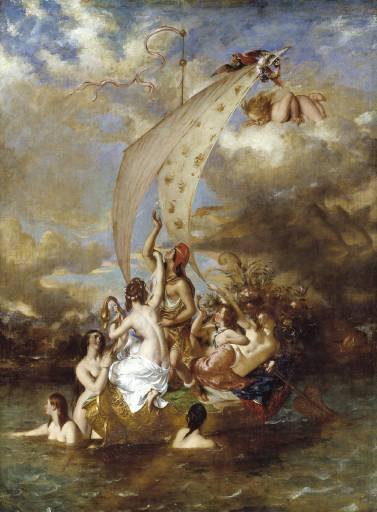
My Daily Art Display feature painting today is entitled Youth on the Prow, and Pleasure at the Helm, which he completed in 1832 and which, when not out on tour, is normally hung in the Tate Britain Gallery in London.  The title of the painting comes from a line from the 1757 Pindaric Ode by Thomas Gray entitled The Bard.

Fair laughs the morn and soft the zephyr blows,

While proudly riding o’er the azure realm

In gallant trim the gilded vessel goes;

Youth on the prow, and Pleasure at the helm;

Regardless of the sweeping whirlwind’s sway,

That, hushed in grim repose, expects his evening prey

This poem fascinated many Romantics of the time, like Etty, and he illustrates the line in the poem in this work of his.  Paying no attention to the rocking of the golden-prowed boat caused by the Zephyr’s sweeping whirlwind, the almost naked women, in a pyramidic formation, clamber to reach upwards, snatching at the “bubbles of pleasure as they float away.

Etty himself described the subject of the work in a letter to the art dealer C.W.Wass:

“…The view I took of it as a general allegory of Human Life, its empty vain pleasures – if not founded on the laws of Him who is the Rock of Ages…”

Art historians tend to believe the painting which shows the young women playing at catching bubbles despite the onset of a storm is all about Youth in its careless pursuit of pleasure is heedless of impending doom.

According to Leonard Robinson in his book, William Etty, the life and art, the painting was bought by Robert Vernon in 1832.  Later that year Vernon bought John Constable’s work, Valley Farm.  To house this new acquisition Vernon decided to move Etty’s painting to another position and replace it with Constable’s work.  Constable on hearing this wrote to his friend and fellow painter Charles Leslie:

“…My picture is to go into the place – where Etty’s bumboat is at present – his picture with its precious freight is to be brought down nearer to the nose…”

Vernon bequeathed the painting to the National gallery in 1847 and later in 1949 it was transferred to the Tate gallery in London.

As I walked around the main exhibition gallery the majority of the paintings by Etty all included nudes, mainly women but some men and I can see how nineteenth century people were shocked by the works.  Of course, for us today who are used to seeing semi-clad or naked women in our daily newspapers and television we are not shocked by the works of Etty and look with some amusement on the puritanical values of the Victorians.  Now we tend to concentrate on the beauty of his painted figures.  So does nothing shock us these days?   I would have said nothing shocks me any more with regards nudity and yet when I stepped from the exhibition gallery to the next door gallery there was a live art performance by an almost naked woman who cavorted and shouted at the few people who had been brave enough to sit on a chair at the edge of her “stage”.  Did I take my seat?  No, as there seemed to be an element of audience participation I just didn’t have the courage to place myself face to face with the naked female performer.   So maybe I can understand how the Victorian people were shocked by what they saw and maybe in another hundred years people will marvel at why I didn’t have the courage to go face to face with my almost naked female live art performer!

Candaules, King of Lydia, Shews his Wife by Stealth to Gyges, One of his Ministers, As She Goes to Bed by William Etty

Candaules, King of Lydia, Shews his Wife by Stealth to Gyges, One of his Ministers, As She Goes to Bed by William Etty.(1820)

A couple of weeks ago I travelled to York and visited the city’s art gallery which had a long-running exhibition of the works of William Etty.  William Etty was born and died in the city and therefore he is the pride and joy of the city’s artistic community.  However as we will see in this blog, Etty’s work was often very controversial.

William Etty’s father, Matthew, was a miller and his mother, Esther Calverley, was the sister of the Squire of Hayton,   Matthew was aged 28 and Esther just 17 when they fell in love in Hayton and then quickly married at All Saints Church, Pocklington, in July 1771. But Esther’s brother was highly disapproving of his young sister’s marriage, and as lord of the manor, who owned both the mill and the milling rights in Hayton, he promptly ejected Matthew and his new wife from the mill, which was their home, and the newlyweds were ‘run out of town’.

They moved to Pocklington and set up a bakery business, but it did not take off, which may have been due to the wider influence in Pocklington of the squire. The young couple moved briefly to Easington, then made a final switch to York, where their bakery was more successful and Etty’s father again took up flour milling. Alhough they were never particularly well off they produced a large family of ten children, born between 1772 and 1793.

William Etty was born in York in 1787, and grew up in the family bakery. He spent some years at a Pocklington boarding school but in 1798, aged eleven, his father arranged a seven year apprenticeship as a printer at the works of the Hull Packet newspaper.  Etty had shown an interest in art in his teenage years and fortunately, through the encouragement and financial support of his wealthy uncle, a successful London gold-lace merchant, he was later able to pursue a career as a painter.  His uncle invited Etty to London in 1806 and the following year, aged twenty, he enrolled at the Royal Academy Schools where he studied under Henry Fuseli and received some private tuition from Sir Thomas Lawrence, a painter who influenced Etty’s early works.  During this time he would visit the National Gallery in London and study the works of the old masters, especially the Italian masters of the Renaissance.  During his time at the Royal Academy he would take part in the Life classes and continued with those studies well after he had became an Academician and well after he had completed all the courses.  It was obvious that William Etty was fascinated by the male and female body and its portrayal.  I will end Etty’s biography here and conclude it in my next blog.

My Daily Art Display today is entitled Candaules, King of Lydia, Shews his Wife by Stealth to Gyges, One of his Ministers, As She Goes to Bed and was painted by Etty in 1820.  The work is based on a story from The Histories of Herodotus, one of the most influential works of history in Western literature.   The nine-volume work was written between 450BC to 420BC and records ancient traditions, politics, geography, and clashes of various cultures that were known around the Mediterranean and Western Asia at that time.  In the first volume there is the story of King Candaules who according to the tale bragged of his wife’s incredible beauty to his favourite bodyguard Gyges. “It appears you don’t believe me when I tell you how lovely my wife is,” said Candaules. “A man always believes his eyes better than his ears; so do as I tell you – contrive to see her naked.”

Gyges refused; he did not want to dishonour the Queen by seeing her nude body.   He also feared what the King might do to him if he did accept.  However Candaules was insistent and Gyges had no choice but to obey. Candaules detailed a plan by which Gyges would hide behind a door in the royal bedroom to observe the Queen disrobing before bed. Gyges would then leave the room while the Queen’s back was turned.  That night, the plan was executed. However, the Queen saw Gyges as he left the room, and recognized immediately that she had been betrayed and shamed by her own husband. She silently swore to have her revenge, and began to arrange her own plan. The next day, the Queen summoned Gyges to her chamber. Although he thought nothing of the routine request, she confronted him immediately with her knowledge of his misdeed and her husband’s. “One of you must die,” she declared. “Either my husband, the author of this wicked plot; or you, who have outraged propriety by seeing me naked.”  Gyges pleaded with the Queen not to force him to make this choice. She was relentless, and eventually he chose to betray the King so that he should live.

The Queen prepared for Gyges to kill Candaules by the same manner in which she was shamed. Gyges hid behind the door of the bedroom chamber with a knife provided by the Queen, and killed him in his sleep. Gyges married the Queen and became King, and father to the Memnad Dynasty.

Before us we have a scene from the start of the tale in which we see Gyges creeping stealthily into the bedroom to catch a glimpse of the naked queen.

Looking through comments made by art critics of the day I came across one who described the subject of the painting as:

“ an undeniably disagreeable, not to say objectionable subject…”

Other reviewers called it

“…offensive, reprobate and a disgraceful story with debase sensuality…”

So what do you think?  Beautiful or distasteful?

Ennui by Walter Richard Sickert

Ennui by Walter Sickert (c.1914)

Yesterday we looked at a painting by Robert Polhill Bevan and talked about the Camden Town Group of artists and its leading light the Munich-born Walter Sickert.  Today I want to look at the life of Sickert himself and at one of his best known paintings.

Walter Richard Sickert was born in Munich in 1860.  His father, Oswald Sickert, who was technically of Danish nationality, always considered himself German and did not speak Danish.  Oswald Sickert was a dramatic genre and landscape painter.  Walter’s mother was Eleanor Louise Moravia Sickert (née Henry) who was the illegitimate daughter of Richard Sheepshanks, the English astronomer, and his Irish lover.   Oswald and Eleanor had three children, two sons, Walter and Bernhard and a daughter Helena, who as Helena Swanick was to become a well-known suffragist and pacifist.  Walter Sickert’s parents had left Munich in 1851 and settled in London around the time of the Great Crystal Palace Exhibition.  At the age of ten, Walter was sent to the University College School in Hampstead, North West London and after a year he moved to the King’ College School at Wimbledon where he remained until the age of eighteen.  He applied to join the British Museum for a position in their department of coins and medals but was turned down.

Both Walter Sickert’s father, Oswald and his paternal grandfather, Johann were painters so one may have thought that Walter would follow their artistic trail but after his job application failure he decided to turn his attention to acting and his main ambition now was to become an actor.  In his early days he managed to play small parts in Sir Henry Irvine’s touring theatrical company using the pseudonym, Mr Nemo.   He soon realised that he was not going to make the grade as an actor and turned towards art.  He briefly attended the Slade in 1881 but left and began to work as an assistant to the American artist, James McNeill Whistler, who had been living in the English capital for a number of years.  Whilst working in Whistler’s studio, Whistler entrusted Sickert to travel to Paris with the painting, Portrait of the Artist’s Mother, which he had just completed and wanted to present it to the Paris Salon for their exhibition.   Whistler also gave Sickert two letters of introduction; one to Manet, but at the time Manet was seriously ill and could not see Sickert and one to Degas, whom he met.  Sickert was very impressed with Degas and his work and received much advice on his painting technique.  The works of Degas would greatly influence Sickert in the future.  Sickert was now twenty-three years of age and even at this young age he had already come upon the three greatest influences of his future artistic career, namely, the theatre, Whistler and Degas and the young Sickert from this point of his life, never looked back.  Whistler had instilled in Sickert the importance to constantly record what he saw and would often walk around with a copper plate and an etching needle in his pocket.  Sickert exhibited for the first time in 1884 at the Society of British Artists in London and signed himself simply as “pupil of Whistler”.  His early paintings were of life in London music halls highlighting the roles of the audience, musicians and actors, somewhat similar to Degas’ paintings of the dancers and café-concert entertainers.  There was an underlying sexual theme in a number of these paintings but it should be remembered that just as in Degas’ Paris,  female performers on London stages were looked upon as having similar morals to prostitutes of the London streets.

In 1885, aged twenty-five, he married the daughter of a Liberal politician and spent many of the ensuing summers in Dieppe. He also was a regular visitor to Venice. In 1893, with the help of James Whistler’s patronage, he opened an art school in London. He often exhibited his theatre and music hall-themed works at the New English Art Club, which had been founded in 1886 in opposition to the Royal Academy. He also took part in the exhibition of British Impressionists held in London in 1889.   One of his last trips to Venice was dogged by bad weather and Sickert’s desire to paint en plein air was dashed.  It is thought that the old adage “necessity is the mother of invention” happened for Sickert as he was forced to paint indoors  and it was at this point in time that he started to develop his own distinctive approach to the multiple figure tableau that would continue after he returned to England.  According to the author Robert Upstone in his 2009 book,  Sickert in Venice, Sickert would employ prostitutes to sit for his Venetian paintings, many of whom he would later have a physical relationship with.

Walter Sickert was fascinated with the under-belly of London life and based his studio in a working-class area of London.  In 1905 his studio could be found in Camden Town and this was to be the favoured location and meeting place for Post-Impressionist artists of the time.  It was here in 1911 that the Camden Town Group of artists was founded under Sickert’s leadership.  The list of artists who met there on a regular basis was like a Who’s Who of Post-Impressionists with the likes of August John, Lucien Pissarro, Henry Lamb and Wyndham Lewis just to name a few.  A couple of years later the Camden Town Group came together with the Vorticists, which was a short-lived modernist movement in British art and poetry along with other like minded artists’ associations which wanted to challenge the domination of the Royal Academy which they believed had become both unadventurous and conservative.  This newly founded artistic conglomerate was known simply as The London Group and still survives today.

Sickert became an associate of the Royal Academy in 1924 and an Academician ten years later.  Shortly afterwards, however,  he resigned in protest against the hostile attitude of the president toward the work of Jacob Epstein. Much of his later career was devoted to teaching and writing.  In 1941 Sickert was honoured with a one-man exhibition at the National Gallery in London. The next year he died in Bath, aged 82.

My Daily Art Display featured work today is entitled Ennui by Walter Sickert which he completed around 1914 and which can now be found in the Ashmoleon Museum in Oxford.  It was painted at Sickert’s London studio in Fitzroy Street.  The title of the painting is the French word for boredom and in the painting Sickert depicts a man and a woman, who despite being portrayed in close physical proximity, seem to have lost the art of communication, which in turn has led to a dislocated relationship.  One presumes it is a husband and wife but could also be a father and daughter but the sense of disarticulation is still the same.  They both gaze into space.  They face opposite directions.  Their thoughts are their own. Don’t you wonder what is passing through their minds?  Maybe they contemplate on what went wrong with their relationship and what would have been their future if they had never met.

On the chest of drawers which the woman is leaning against there is a bell jar which contains an array of stuffed birds.  Their entrapment under the glass dome is symbolic of the entrapment of the two humans in their relationship.  On the wall we see a painting which appears to be of a music hall diva and the melodrama which goes with her profession which of course is in complete contrast to the scene she looks down upon.  The model for the man in the painting was “Hubby” who was an old school friend of Sickert and who had fallen on hard times and whom Sickert gave shelter and kept in beer over a number of years.  The woman was Marie Hayes, a woman who had modelled for Sickert on a number of occasions

Virginia Woolf, who met Sickert in 1923 and 1933, argued that Sickert’s pictures could be classified as stories in their ability to stimulate and develop plots and dialogue. However Sickert disagreed saying that if the subject of a painting could be stated in words there would be no need to paint it.

So what do you think is going on in the painting?  I will leave you with Virginia Woolf’s description of what she saw in the painting:

“…the picture of the old publican, with his glass on the table before him and a cigar gone cold at his lips, looking out of his shrewd little pig’s eyes at the intolerable wastes of desolation in front of him. A fat woman lounges, her arm on a cheap yellow chest of drawers, behind him. It is all over with them, one feels. The accumulated weariness of innumerable days has discharged its burden on…”

Showing at Tattersalls by Robert Polhill Bevan

Showing at Tattersalls by Robert Bevan (1919)

The Camden Town Group was a group of English Post-Impressionist artists who were active between 1911 and 1913.  This hallowed group included Lucien Pissarro, the son of the French Impressionist, Camille Pissarro, Wyndham Lewis, Walter Sickert, Augustus John and today’s featured artist, just to name a few.  Their meeting place was usually at the Camden Town studio of the Munich-born painter, Walter Sickert, a leading light in the transition between Impressionism and Modernism.  My Daily Art Display featured artist of the day is Robert Polhill Bevan.

Bevan was born in Hove, near Brighton in 1865.  He was the fourth of six children of Richard Alexander Bevan and Laura Maria Polhill.  He was originally trained as an artist under Arthur Pearce.   As well as being a drawing teacher, Pearce had worked as an illustrator and had exhibited at the Royal Academy.  Later he would join the Royal Doulton pottery company where he became their chief designer.  When Bevan was twenty-three years of age he attended the Westminster School of Art and was tutored by the painter, Fred Brown, who would later move to the Slade School of Art and teach the likes of Augustus John and Wyndham Lewis.  After this initial training Bevan moved to Paris and studied art at the Académie Julian where he met some aspiring French artists, such as Édouard Villiers, Pierre Bonnard and Paul Sérusier and became great friends with another English artist, Eric Forbes-Robertson.  Whilst living in France Bevan and Forbes-Robertson visited the artist colony at Pont-Aven in Britanny.  Bevan was to visit this area many times over the years and became friends with Paul Gaugin and Renoir and art historians believe that judging from some of his early works he may have come into contact with Van Gogh. He returned to England in 1894 and settled in Exmoor, in the south-west of the country.  Three years later he met the Polish artist Stanislawa de Karlowska when he attended the wedding of his close friend Eric Forbes-Robertson in Jersey. At the end of 1897 Bevan and de Karlowska married in Warsaw where her parents lived and owned extensive land in the heart of the country.  Throughout the couples lifetime they would return there each summer to visit.  It was during his long summer stays in Poland that Bevan produced his most colourful paintings.  The influence of his friend Gaugin can be seen in these early works.   Their first child, Edith Halina, was born at the end of the following year.   Bevan and his wife left Devon in 1900 and moved to London and Stanislawa gave birth to their second child, a son Robert Alexander in 1901. In 1905 Bevan held his first solo exhibition but it did not receive the great acclaim he had hoped for from the art critics of the time and few of his paintings were sold.  Although very disheartened with the outcome of the exhibition he held his second exhibition three years later in 1908 and some of his paintings on display were in the pointillist style of Seurat and Signac, the first time he had used that technique.  (See My Daily Art Displays of October 21st and November 9th).  That year he exhibited five of his paintings at the first Allied Artists’ Association exhibition.  This organisation had been formed by a London journalist and art critic for The Sunday Times, and early champion of English Modern Art, Frank Rutter.  His main aim was to promote Modernist Art in Britain.  Artists could exhibit their works without them having to first be subjected to a selection jury, unlike the Royal Academy Exhibition.   It was an association very similar to one that was set up in Paris in the summer of 1884, called the Salon des Indépendants, another non-juried organisation, and which was, in some ways, in direct competition with the Paris Salon which like the Royal Academy had a jury to select paintings that were allowed to be shown. Soon after his exhibition he was invited to join the group of artists formed by Walter Sickert, entitled the Fitzroy Street Group and out of this group was spawned in 1911 The Camden Town Group.  In John Yeats social history book about The Camden Town Artists, he writes that Sickert advised Bevan about what subjects he should depict in his works.  Sickert told him:

 “…paint what really interests you and look around and see the beauty of everyday things…”

After this advice Bevan went off and completed a series of works depicting the horse cab trade in London and its steady but inevitable decline.  After this Bevan concentrated on pictorially recording what went on at horse sales, especially the ones which were held at Tattersall’s and it is one of those works which is My Daily Art Display featured painting for today.  The Camden Town Group relied on the goodwill of Arthur Clifton who ran the Carfax Gallery in London for he put on the groups exhibitions but after three exhibitions which failed to get critical acclaim and left many paintings unsold, Clifton declined to hold any more of their displays in his gallery although he would give space to some of the artists from the group.  This marked the beginning of the end for the Camden Town Group.

Robert Bevan continued painting.  His works often depicted London scenes or scenes of the countryside where he spent most of his summers.   Prior to the First World War he would spend the summers in his wife’s homeland of Poland but later they took their summer vacations around Devon and Somerset.

Bevan died in London in 1925, aged 60.  In 2008, the Tate put on a major retrospective exhibition of the Camden Town Group.

My Daily Art Display painting today is entitled Showing at Tattersalls and was painted by Robert Bevan in 1919.  Tattersalls is the major auctioneer of race horses in Great Britain and Eire.  It dates back to 1766 and was founded by Richard Tattersall who had once been stud groom to the second Duke of Kingston.  Originally it had been situated close to Hyde Park Corner in London but now is located in Newmarket, the home of horse racing.

I love this painting.  It is simple and yet pleasing to the eye.  Before us we see two horses being paraded in front of potential buyers.  We are there.  We are being allowed to watch the goings-on at the stables.  The figures themselves mostly have their backs to us which allows Bevan to do away with carefully crafted facial expressions and their long clothing gives them a straight up-and-down appearance.  Bevan has spent time in the detail of the horses and their musculature and the sinews are in harmony with the animals’ movements.  The chestnut horse stands out well against the red door of the building and the blue-tinted horse, similar to the colour of the coats of the handlers, contrasts well against the yellow coloured building.  This backdrop of the yellow-coloured buildings looks like the stables which are attached to the yard and adds lightness to the work.

The simplicity of this painting is charming and as I look at it I feel the urge to step forward into the arena before me and enjoy the thrill of the auction preview.  I came across this painting when I recently visited the Ashmolean Museum in Oxford.  I had gone there to view the Claude Lorrain exhibition and was absolutely staggered by what was on display at this museum.  Its collections of paintings were exceptional and I do urge everybody to try and visit it.  You will not be disappointed.

Finally I must pay tribute to a website from which I got a lot of information about the painting itself and have done my best not to plagiarise it too much.  The author of the blog, unlike me, is an artist and her interpretation of her painting is excellent.  It is a wonderful blog and well worth a visit.  It is called personalinterpretations and the website address is:

http://personalinterpretations.wordpress.com/

Her piece on this painting was in her blog of August 18th.

A Moonlight Effect by Paul Sandby

Landscape painting became the most inventive form of art in Britain during the late eighteenth and early nineteenth century.  Traditionally, paintings of the British landscape had been a way of showing off magnificent country houses, and were often commissioned by wealthy landowners to show off their estates and wealth.  However in the late eighteenth century the landscape became the subject of a more poetic vision. There was a growth in the urban middle-class and for them landscape art provided a romantic ideal of the landscape as the source of timeless values which could be enjoyed by anyone.  Landscape paintings were now being viewed as portraying idyllic places of rest and solace.  Landscape art in the 18th century did however have its detractors.  The Swiss-born artist Henry Fuseli, when once lecturing his art students, identified landscape art as a low branch of painting.  He described it:

“…the tame delineation of a given spot;   what is commonly called Views is  little more than topography; ….a kind of map-work”……”

My featured artist today would not have agreed with Fuseli’s description, as he was one of England’s great landscape artists.  His name is Paul Sandby.  Sandby was born in Nottingham in 1731.  His father Thomas was a framework knitter and he had a brother, also named Thomas, who was ten years older than him.  The boys had a comfortable upbringing and it is thought that they both received drawing tuition from Thomas Peat, a Nottingham-based land surveyor.  Both boys showed great aptitude and in 1747 Paul, then aged sixteen, left Nottingham to take up employment as a military draughtsman.  After the Battle of Culloden the English felt the need to map the Scottish landscape with detailed records of forts and castles and Paul Sandby was involved in the survey and from his office at Edinburgh Castle, where he worked as a mapmaker, he developed his landscape drawing technique.

After his work in Scotland he went on to paint much of Britain. In 1752, he, along with his brother, took up a post producing landscapes of the royal estates at Windsor.   Importantly in 1770, he travelled through Wales and was one of the first artists to paint landscapes of that country.  He popularised the area by not just exhibiting paintings but widely circulating printed images and developing an innovative print method, aquatint, a variant of etching, which echoes the washes of watercolour rather than relying on pure lines.   He returned to Wales in 1773 and toured the south of the country along with Sir Joseph Banks, the naturalist and botanist.  This sketching trip resulted in the 1775 publication of XII Views in South Wales.  A further twelve views were added the following year.

In 1757, Sandby  married Anne Stogden.   In 1768, the same year as his election as a Royal Academician, he was appointed chief drawing master to the Royal Military Academy at Woolwich, a position he held for over thirty years,.  His son Thomas Paul was eventually to succeed him in that post.

 Unfortunately for Sandby the public fell out of love with his fresh and uncomplicated natural style of paintings, which he embraced, and he was ultimately forced to petition the Royal Academy for financial support to supplement his modest pension. He died in 1809, his obituary describing him as the ‘father of modern landscape-painting in watercolours’.  He is buried in St George’s Burial Ground London.

Gainsborough praised Sandby as one of the first artists to paint what he termed “real views”, ones which were topographically accurate as opposed to idealised compositions.  There was a large gap between the topography and the ideal landscapes.  The topographer accurately recorded what he saw whereas the ideal landscape artist manipulatesd his landscape for aesthetic ends.  Paul Sandby endeavoured to bridge that gap.  He kept faith with his topographical skills but managed to bring expression and sensitivity to his work.  He did this by carefully choosing the viewpoint for the composition.  He also liked to incorporate realistic human figures in his works.  Throughout his career Sandby only ever used the medium of watercolour.

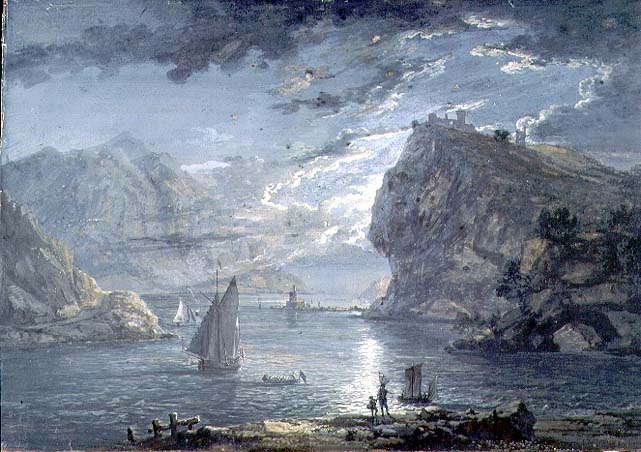
My Daily Art Display featured painting today is entitled A Moonlight Effect which Paul Sandby completed around 1790 and which can be found in the Nottingham City Museums and Galleries.  This is one of a number of paintings Sandby completed which depicted a place or a building as seen by moonlight.  In the 1770’s the early romantic painters, such as Joseph Wright of Derby and William Hodges, had taken a special interest in the portrayal of moonlight effects; and the image of the moon and of moonlight became one of the great romantic images.  For the romantic artist, who saw himself as alienated from society, the moon was often seen as an image of constancy and hope in a changing world, and it adequately depicted that longing and yearning or an unattainable perfection which lies at the heart of romanticism.

I love this painting with its silvery moonlight. 

Maybe you will have noticed that My Daily Art Display has not quite been a “daily” offering recently.  The reason for that is not because I am losing interest or having difficulty to find yet another painting, albeit it is getting harder.  The reason is that I have been trying to build up a reserve stockpile of blogs for when I am away on holiday in case I don’t have the time to research and compose a blog.  Today we are setting off to Hong Kong and Australia for a three-week break.  I am hoping I will still have access to the internet when I am away so that I can send out one of my “reserve” blogs, at least every other day.  I am hoping to take in a couple of art galleries when I am away and I am looking forward to seeing the depth of art on offer.


The Night of Enitharmon’s Joy by William Blake

The Night of Enitharmon’s Joy by William Blake (1794)

Today I am once again dipping my toe into the strange world of William Blake the 18th century painter, printer, book illustrator and poet.  I went through his life story in a couple of my earlier blogs (October 30th and November 1st) and if you haven’t read them I urge you to go to them now before you read about this painting as it may just give you a better understanding as to why an artist would depict such weird but wonderful scenes.  My Daily Art Display featured painting today has three titles.  It is usually known as The Night of Enitharmon’s Joy but is often referred to as The Triple Hecate or simply The Hecate.   It is a colour print finished in ink and watercolour on paper.   

If, like me, you have never heard of Enitharmon or Hecate, let me take you into Blake’s strange world of mythopoeia, his own fictional mythology.  We are all used to hearing tales of Greek and Roman mythology but William Blake made up his own mythology with its own characters.   I suppose he can be compared with Tolkien and his stories of Middle Earth or C S Lewis and his tales of Narnia.   For Blake, who all his life experienced visions of heavenly bodies whom he would communicate with, his mythological characters were real.

Enitharmon is a major female character in William Blake’s mythology and she plays a major role in some of his prophetic books.   In this work Blake portrays her as an androgynous Hecate, one with a combination of male and female characteristics, as can be seen in this coloured print.   Hecate is the goddess of witchcraft and you may have come across her in Shakespeare’s Macbeth.  She appeared to the three witches in the play, as they sat around their bubbling cauldron, she came to them demanding to know why she has been excluded from their meetings with Macbeth.   To William Blake she represents female domination and sexual restraints that limit the artistic imagination.  After her birth, Enitharmon asserts that women will rule the world, with Man being given Love and Women being given Pride. This would create within men a fear of female dominance that would in turn bring them under control of the females.

Do you remember the famous lines spoken by the three witches in Macbeth as they surrounded the cauldron?

“Fillet of a fenny snake,
In the cauldron boil and bake;
Eye of newt and toe of frog,
Wool of bat and tongue of dog,
Adder’s fork and blind-worm’s sting,
Lizard’s leg and owlet’s wing,
For a charm of powerful trouble,
Like a hell-broth boil and bubble.”

It is therefore not a coincidence that in Blake’s print we can see a frog or a toad, a bat and a snake?  The Night of Enitharmon’s Joy is a large colour print and is plate 5 of Europe, a book written by Blake in 1794 which has the opening line:

“..Now comes the night of Enitharmon’s joy!..”

 In the book, Enitharmon sets the trap of false religion which dominated Europe, for eighteen hundred years between the time of Christ’s birth and the French Revolution.  The night of Enitharmon’s joy is when she establishes her Woman’s World with its false religion of chastity and vengeance.   Blake used pen and ink to give strong outlines to the figures, and to draw locks of hair, the bat, and the donkey’s mane and rough coat. The owl has eyes which have been highlighted with a bright opaque red wash.  The figures have been given form and roundness by washes of intense but transparent colour.   The sky is dark as are the lichen-covered rocks in the left of the work.  A strange-looking evil winged spectre hovers above Enitharmon’s head as a large donkey to the left nibbles on what little vegetation can be found amongst the rocks.

This is yet another weird work by Blake and once again I hesitate to think what was constantly going through his mind as he conjured up these images.