Disappointed Love by Francis Danby

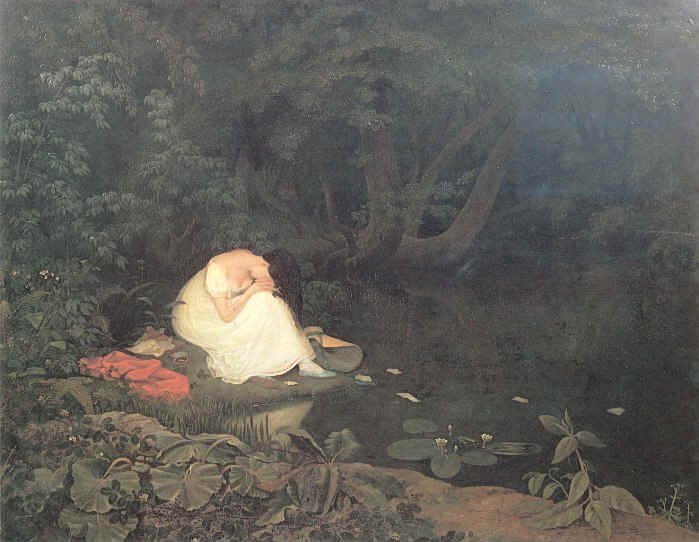
Disappointed Love by Francis Danby (1821)

Francis Danby was an English painter, born in 1793, in a small village near Waterford, Ireland, where his father owned a farm.  When he was fourteen years of age his father died and he along with his mother and twin brother moved to Dublin.  Whilst living in Dublin, Francis Danby enrolled at the Royal Dublin Society’s Schools of Drawing where he received artistic training.  It was at this establishment that he met the renowned Irish landscape painter James Arthur O’Connor and it was through his mentorship that Danby developed a love of landscape painting. Danby also struck up a friendship with another fellow student, George Petrie, and they along with O’Connor left Dublin in 1813 and travelled to London.  By all accounts the trip had not been well planned financially and their funds soon ran out and they had to head back to Ireland, on foot, but on the way they stopped off in Bristol.  It was in this city that Danby managed to supplement his meagre worth by painting watercolours of the local scenes and selling them to the locals.  At the same time as selling some of his work, he kept back what he considered to be his best paintings and sent them to various London exhibitions.

The works of Francis Danby, which were shown at various London sites, received favourable reviews and were soon in great demand.  It was whilst still living in Bristol around 1818 that Danby joined an informal association of artists based around Bristol, which had been founded by the English genre painter, Edward Bird, known as the Bristol School or Bristol School of Artists.  In 1821, Danby had a painting of his first exhibited at the Royal Academy.  It was entitled Disappointed in Love and is My Daily Art Display’s featured work today.  In 1824 Danby left Bristol and moved to London.  It was around this time that Danby gave up his naturalistic and topographically accurate landscapes and moved towards poetic landscape painting.  Poetic landscapes gave one the geography and architecture of landscapes from a subjective point of view, using elements of myth, fantasy or the picturesque. Claude Lorrain is usually looked upon as the originator of this style and this style of painting culminated in the Romantic landscape of the 19th century.   A Poetic Landscape presents us with an imaginary place and for that reason the artists did not have to worry about topographical accuracy and it allowed them the opportunity to transform the characteristic features of, for example, Italian geography and architecture, and turn them into mythical or pastoral fantasy. This painting genre allowed artists to exaggerate the shape and height of mountains, delete or redesign buildings and objects, insert dramatically placed trees or human figures, and throw strongly contrasted lighting effects over it all. The public liked this style of landscape painting and did not care about the topographical veracity of what they saw.  People, at the time, preferred this style to the topographical landscape with its dryly objective recording of what was actually there.

Another artistic genre Danby began to draw on was the large biblical scenes such as his 1825 painting The Delivery of Israel,  which was exhibited at the Royal Academy and which led to him being elected an Associate Member of the Royal Academy.  In the next two decades Francis Danby produced many large biblical and apocalyptic paintings which were to rival his contemporary and renowned “high priest” of apocalyptic art, John Martin.

Francis Darby, already an Associate Member of the Royal Academy was put up for election in 1829 to become a Royal Academician.  When the votes were counted, he was devastated to find he had lost out by one vote to John Constable,  who was elected instead of him.  This year, 1829, was an annus horriblis for Danby as this was also the year that his marriage to his wife Hannah failed and he took himself a mistress.  Hannah went off with another artist Paul Falconer Poole who had spent some time in the Danby household.  London Society was scandalised by the goings-on at Danby’s household and in 1830 he went into self-imposed exile in Paris along with his mistress.  From 1831 to 1836 Danby worked out of Geneva reverting back to his topographical watercolour landscape art work.
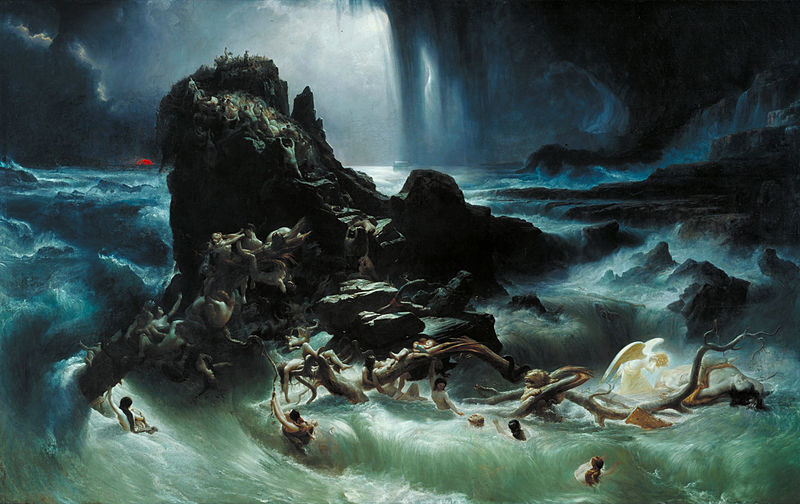
The Deluge by Francis Danby

In 1837 he returned to Paris and a year later went back to living in London.  It was in that year he produced his famous work, The Deluge, which re-established his reputation amongst the art community.  This massive canvas, measuring 2.85m x 4.52m, depicted an area of harsh and violent weather and writhing, diminutive bodies trying to save themselves from the stormy waters.  The painting put Danby briefly back in the limelight.  However for Danby,  life as an artist was becoming too much for him and in 1847, aged 54, he left London and went to live in Exmouth, Devon.

Whilst living in Devon Danby still found time to paint concentrating on landscapes and seascapes but he also took up boatbuilding.  Francis Danby died in Exmouth, in 1861, aged 67.  To the end of his life Danby constantly had money problems and was embittered that he never gained the recognition he deserved from the Royal Academy and was never elected as a Royal Academician.  The final straw came two days before he died when he learnt that his ex-wife’s husband, Paul Falconer Poole had been elected a Royal Academician !

My Daily Art Display painting for today is by Francis Danby which he completed in 1821 and is entitled Disappointed Love.  The painting was the first painting Francis Danby exhibited at the Royal Academy, and it became one of his best-known works. Before us, we see a heartbroken young woman who has just been jilted.  Her hands cover her face as she sits weeping on the bank of a  lily pond surrounded by dark and murky woodland.  The occasional small white flowers, dotted around, struggle to lift the dark green and browns of the undergrowth.  This gloomy undergrowth mirrors the depressed mind of the young girl.   Her long dark tresses hang down over her white dress.   On the ground beside her we see her discarded bonnet, her scarlet shawl , a miniature portrait of her lover and other letters which she has not yet destroyed.    Her sad figure dressed in white is reflected in the water and in some way it seems that the water is drawing her to it so that she can end her life and her misery, in an Ophelia-like fashion.  Floating on the surface of the pond are pieces of a letter which she has torn up and discarded.  Eric Adams wrote a biography in 1973 on Francis Danby entitled Francis Danby: varieties of poetic landscape and he believes the setting for the painting was on the banks of the River Frome on the outskirts of Bristol and that the model for the painting was a model at the Bristol Artists newly founded Life Academy.  There was a lot of criticism of the painting, not so much for the poetical nature of the work but for its technical faults, in particular the lack of proportion of the plants in the foreground.

When the painting was put forward to the Royal Academy jurists to see if it should be allowed in to the 1821 Exhibition it was not wholly loved.  An account of the jurist’s comments on seeing Danby’s painting was reported some twelve years later as:

“…An unknown artist about ten years ago sent a very badly painted picture for the exhibition.  The committee laughed, but were struck by “something” in it and gave it admission.  The subject was this.  It was a queer-coloured landscape and a strange doldrum figure of a girl was seated on a bank, leaning over a dingy duck-weed pool.  Over the stagnant smeary green, lay scattered the fragments of a letter she had torn to pieces, and she seemed considering whether to plump herself in upon it.  Now in this case, the Academicians judged by the same feelings that influence the public.  There was more “touching” invention in that than in the nine-tenth of the best pictures exhibited there the last we do not know how many years.  The artist is now eminent…”

To my mind it is a beautiful painting, full of pathos, and one cannot but feel sympathy for the young girl.  It was for this reason that I was surprised to read an anecdote about this painting and the depiction of the girl.  Apparently the Prime Minister at the time, Lord Palmerston, was being shown the painting by its owner, the wealthy Yorkshire cloth manufacturer, John Sheepshanks and commented that although he was impressed by the deep gloom of the scene, it was a shame that the girl was so ugly.  Sheepshanks replied:

“..Yes, one feels that the sooner she drowns herself the better…”

How unkind !

This painting along with the rest of his outstanding art collection was presented to the Victoria & Albert Museum

Hope by George Frederic Watts

Hope by George Frederic Watts (1886)

George Frederic Watts was a Victorian painter and sculptor who was closely associated in his later years with the Symbolism Movement.  Symbolism came about in the 1880’s but by the end of the century it had almost died away having been overshadowed by the birth and rise of Modernism.  The Symbolist movement was a reaction against the literal representation of objects and subjects, where instead there was an attempt to create more suggestive, metaphorical and evocative works.  Symbolic artists based their ideas on literature, where poets such as Baudelaire believed that ideas and emotions could be portrayed through sound and rhythm and not just through the meaning of words. Symbolist painter styles varied greatly but common themes included the mystical and the visionary. Symbolists also explored themes of death, debauchery, perversion and eroticism. Symbolism moved away from the naturalism of the impressionists and demonstrated a preference for emotions over intellect.

George Frederic Watts was born on February 23rd 1817 in Marylebone, London and his Christian names were those of the great musician George Frederic Handel who was born on that date some 132 years earlier.  His mother and father struggled financially and this was not helped by the poor health of his mother who was to die when George was very young.   His father was a piano maker and took it upon himself to educate his son at home.  Much emphasis was placed on a conservative Christian upbringing and a love for classical literature.  Unfortunately, as is so often the case, his father’s compelling desire to force his Christian views on his son, eventually made George turn completely away from organised religions.

At the age of ten, George had some informal tuition from William Behnes, a local sculptor where he practiced drawing from the sculptures.  This training proved a godsend as by the age of sixteen he was able to support himself from the sale of his portraits.  In 1835, aged eighteen years of age, George Watts enrolled at the Royal Academy Schools.  Although Watts never enjoyed his time at the establishment and would often fail to attend he did exhibit some of his works at the 1837 Royal Academy Exhibition.  It was whilst studying art that he met and became great friends with Alexander Constantine Ionides, an art patron and collector.  Ionides commissioned many paintings from Watts and became one of his earliest patrons.

By 1840 Watts had moved away from portraiture and concentrated on historical paintings.  In 1843, he entered the first competition to design murals for the new Houses of Parliament.  Entries were to be of a narrative genre which endorsed patriotism and thus would be appropriate to the new legislative building.   His entry, Caractacus Led in Triumph through the Streets of Rome, gained him first prize in the competition and the prize money helped fund his artistic study trip to Italy where he remained for four years.  During his stay in Italy he learnt the secrets of fresco painting and completed many large scale paintings depicting scenes from Romantic literature.  However, he never gave up on his other artistic loves, portraiture and landscape painting.

Watts returned to London in 1847 and once again entered the Houses of Parliament competition.  This was the fourth one organised by the monarch and the government.  Watts won the competition with his entry Alfred Inciting the Saxons to Encounter the Danes at Sea.   Watts suffered from bouts of depression and he expressed his personal struggle with the illness in a series of four paintings which evoked a social realism theme.  One of these works entitled Found Drowned was my featured painting in My Daily Art Display of July 4th 2011.  In 1851 he went to live with his friend Henry Thoby Prinsep and his wife Sara at Little Holland House.  He lived with them for the next twenty-four years and it undoubtedly provided Watts with a secure environment for him to work and relax and provide a safe haven away from the rigours of the real world.  Little Holland House was a favourite meeting place of the young Pre-Raphaelite artists and literary people like Tennyson and it gave Watts then ideal opportunity to paint portraits of the aspiring literary and artistic luminaries of the day.

In 1878 Watts took part in the 1878 Exposition Universelle in Paris and submitted nine paintings and one sculpture.  He became an instantaneous celebrity on the European art scene.  During the 1880’s,  he produced many symbolic paintings which displayed close links to the work of his friend, the Pre-Raphaelite artist Dante Gabriel Rossetti, and the other Pre-Raphaelite artists such as Edward Burne-Jones.

In 1886 at the age of 69 Watts re-married, to Mary Fraser-Tytler, a Scottish designer and potter who was some thirty three years his junior.   In 1891 he bought a house in Compton, near Guilford, in Surrey and in 1904 had a gallery built nearby which became known as the Watts Gallery and which was dedicated to his work.  The Watts Gallery is still a very popular venue for art lovers. George Frederic Watts died that year aged 87, shortly after the gallery opening.

Hope is looked upon as certainly the most influential, and outstanding if not most unusual of all George Frederic Watts’ paintings. This portrayal of the poignant musician has struck a chord with audiences and critics ever since it was first displayed at the Grosvenor Gallery in 1886.  In 1887 at the Royal Jubilee exhibition held in Manchester the painting took pride of place in the middle of an entire wall dedicated to Watts’ work.  Numerous reproductions were made of this painting and many who saw it were deeply affected by what they saw and Watts received many letters from people who were greatly moved by the emotional impact it had on them. In the painting Watts has personified Hope as a young woman seated on a globe, hunched over, appearing to be almost asleep.  She wears a blindfold which symbolises her blindness and to the mental state she embodies. What was it about this work that such an effect on people?  It has to be Watts’ portrayal of this hunched, isolated, blindfolded and barefoot woman who appears to be on the edge of despair.  So why the title Hope?   Maybe in this case it is not hope meaning one’s optimistic thoughts but more of a feeling of almost despair; a hoping against hope.   As we take in the picture of the girl bent over listening to the music from her lyre we wonder why Watts has chosen the title.  The bluish grey background induces a melancholy mood. One critic commented that the painting did not evoke a feeling of hope and should have been entitled Despair.  Maybe that was the reason that in another version of his painting he has added a single star to the background to symbolise hope.  The girl, Hope, bends her ear to catch the music from the last remaining string of her almost shattered lyre. It is the faintest of hope as symbolised in her musical instrument which now with just one string left for her to make music and once that has broken, all hope of her producing a musical sound has disappeared.

Did the painting appeal to those who had almost lost hope themselves and in some way empathised with the vulnerability of the woman in the painting?  Watts had always sought, through his paintings, to communicate his message to as many people as possible. Some would criticise this aspect as being somewhat patronizing but Watts was a great master of narrative paintings and this was probably the reason why his conventional patriotic works he put forward for the Houses of Parliament were so successful.  Watts was surprised by the critical acclaim and popularity of his painting and attempted to follow up his success with Hope with two other works entitled, Faith and Charity, the other two “theological virtues” but they neither received the critical acclaim that his Hope painting achieved nor were they as popular with the public.

This version of the painting can be found in the Tate Gallery, London.

The Sharples Family

My Daily Art Display today is not about a single painting but about a talented artistic family of English portrait painters.  This was a veritable dynasty of artists of the highest quality.  The head of the family was James Sharples who was born in Lancashire around 1751.  Originally his family had intended that James should study for the Catholic priesthood and he was sent to France for his initial training.   The theological path that his parents had wanted him to follow was not for James and he returned to England.    Instead James followed his chosen profession, that of an artist. At the age of twenty-eight, whilst living in Cambridge, he had four of his pictures accepted for the 1779 Royal Academy Exhibition.  Two years later he moved to Bath where he set himself up as a portrait painter and art teacher.

He and his first wife had a son, George.  Little is known of him but it is thought he could have also been an artist as in the 1815 Royal Academy Exhibition there was a painting by a “G Sharples of London”.  With his second wife James fathered a second son, Felix who eventually came to live with James and his third wife Ellen Wallace.  Ellen Wallace, who was of French extraction, lived in Bath and came from a Quaker family.   She was born in 1769 and was eighteen years younger than James.  They had met whilst she was attending one of his art classes.   James and Ellen Sharples married in 1787 and went on to have two children of their own, James Jnr. born in 1788 and Rolinda born in 1793, both of whom became artists.

George Washington by James Sharples (1796)

Around 1794 James, his wife Ellen and the three children, James, Felix and Rolinda set off for America.  It is thought that James believed that in America it would be possible to make a good living by painting portraits of the leading American figures of the time.  The sea voyage did not go to plan as their ship, according to Ellen Sharples’ diaries, was captured by a French privateer and James and the family were taken to Brest where they were kept prisoners for seven months.  The following year they were eventually released and continued on with their voyage to America, and eventually arrived in New York.   Sharples started working in New York and Philadelphia, which was the then seat of government and a place full of eminent people, including local and national politicians.  It is known that in the execution of his work Sharples  made us of an instrument known as a physiognotrace.  This was a device which was designed to trace a person’s profile in the form of a silhouette.

Slowly but surely, Sharples built up commissions for his portraiture.  The whole family then embarked on a painting tour of New England picking up lucrative commissions which often entailed making reasonably priced copies of his original portraits of American political leaders, such as George Washington, Thomas Jefferson, James Madison and John Adams.   Around 1797 when the family was living in Philadelphia, Ellen Sharples  began to draw portraits professionally.   At this time, there was a  great demand for reasonably priced copies and Ellen’s career of copying her husband’s original portraits on commission flourished and she could command virtually the same price for her miniatures as her husband charged for his mini-portraits. It was not just the mother and father who had artistic talents as their three children under their parents’ tutelage soon became accomplished artists in their own right and were soon able to contribute work for the family business.  Portraiture in America at that time was highly competitive not only because of home-grown American artists but more so from European painters who, like Sharples, had travelled to America in search of their fortune.   This intense competition made it necessary for artists to travel and look for clients rather than wait at home for clients to come knocking upon their doors.   James Sharples often had to drag his family from place to place in search of commissions.

James and Ellen Sharples soon built up reputations as talented portraitists who concentrated on small scale pastel portraits and whose work was in great demand and slowly but surely they became financially secure.  James Sharples died of heart trouble in 1811, aged 60 and Ellen and her two children, James and Rolinda returned to England.  Felix Sharples, who was at this time twenty-five years old, chose to stay in America, working as a portrait artist, where he died in 1830 aged 44.

Charles and Catherine Darwin by Ellen Sharples (1816)

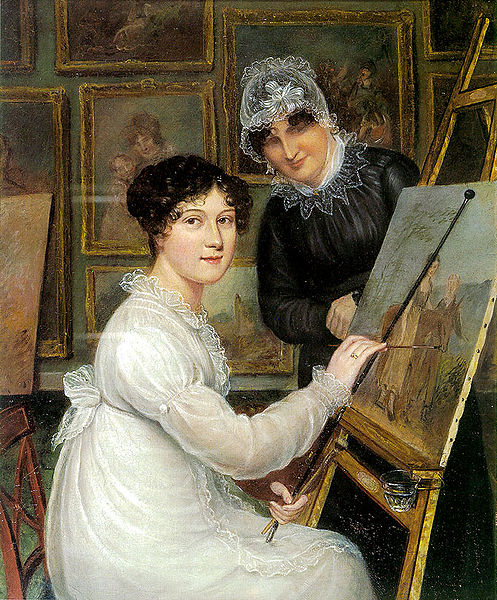
Ellen, along with James and Rolinda settled down in Clifton, just outside Bristol and the three of them set up a family business producing small-scale pastel portraits for clients. Rolinda Sharples began to work in oils and she moved away from being a miniaturist and ventured into the highly competitive world of full-scale portraiture and history paintings depicting groups of people.  Rolinda was elected an honorary member of the Society of British Artists in 1927 and was one of the first female artists to attempt multi-figure compositions, which formed part of the pictorial historical records of the time.

The Stoppage of The Bank by Rolinda Sharples (1831)

The painting above entitled The Stoppage of the Bank by Rolinda Sharples was completed in 1831.   The background to this painting relates to the happenings in 1825 when England had just recovered from the Napoleonic Wars and the country’s economy started to boom.   In the euphoria of this boom, even the most clear-headed of  bankers made risky loans ( a familiar story ??).  The bubble burst in April 1825 and the stock market crashed.   By the autumn a number of country banks had failed causing panic.   It was a financial catastrophe, which led to widespread ruin and misery for the unfortunate people who had all their capital invested in the failed banks.  This is the setting, which Rolinda Sharples illustrates in her painting.   The scene before us takes place in a fictional street, called Guinea Street but which had a great similarity to the real Corn Street in Bristol.   On the right of the painting is a bank whose closure is causing shock and consternation to the people waiting outside attempting to get their money.  Behind, we see the famous Dutch House which stood on the corner of Wine Street and High Street until destroyed in the Blitz. The church in the centre background is All Saints Church.  Rolinda Sharples used some artistic licence when she placed the church in that position, one presumes it was for artistic effect.

The Artist and her Mother by Rolinda Sharples (c.1820)

Both Rolinda and her brother James predeceased their mother.  Rolinda died of breast cancer in 1838, just forty-five years of age and James Jr. died of tuberculosis in 1839.  Ellen Sharples, the last of the Sharples family, died in 1849 aged 80.

Isabella by John Everett Millais

Lorenzo and Isabella by John Everett Millais (1849)

My favourite Pre-Raphaelite artist is, without doubt, John Everett Millais and I have featured a number of his paintings in previous blogs.  As you know, as I have mentioned it before, I like paintings with a story behind what is depicted by the artist and so merging my two favourite aspects of art I am delighted to present you with Millais’ painting entitled Isabella, also sometimes referred to as Lorenzo and Isabella or The Pot of Basil.  Some of you may know the story and poem behind this early work of art by the Pre-Raphaelite painter but for those who do not, let me lead you through the background of this work and to the medieval allegorical tale, Decameron, written around 1352 by Giovanni Boccaccio.   The word Decameron comes from the combination of two Greek words; déka meaning ‘ten’ and hēméra  meaning ‘days’ and thus decameron means ‘ten day event’.

The Decameron is set in Italy around the 1350’s at the time of the Black Death.  It tells of a group of ten people, seven young women and three young men who escape from the plague-ridden town of Florence and head into the hills of Fiesole and a deserted villa where they stay for a fortnight.  In order to while away the evenings, each one of the group had to tell a story on each night for ten days.  No story would be told on the one day set aside for the chores around the villa nor would a story be narrated on the holy days and thus in all ten stories would be told on the ten evenings making a total of 100 tales.  The stories are sometimes of a bawdy nature and range from the erotic to the tragic.   Each of the ten young people is made King or Queen of the company for one of the ten days in turn. This gives him or her, the right to choose a theme and a topic for the ten stories that day.

The painting I am featuring today is based on a story told by one of the young women, Filomena, on the fourth day and that days theme for all the stories was that they mus be tales of love that ends tragically.  She tells the story of Lisabetta and her three brothers who live a very rich life togetherthanks to the wealth they have inherited after the death of their father.  She has fallen in love with their manager Lorenzo and it was not long before they became lovers.  Her affair with Lorenzo was kept a secret from her brothers but, unbeknown to her, her eldest brother saw his sister sneak into Lorenzo’s bedchamber.  He was horrified as it was he and his brothers’ plan to marry her off to a wealthy nobleman and increase their own wealth.   He informed his brothers as to what he had witnessed and they hatched a plot to kill Lorenzo.  Days passed without incident until one day the brothers asked Lorenzo to accompany them on a trip, during which they murdered him and buried his body.  On returning home they told their sister that Lorenzo had been sent away on business.  A long time passes without any sign of Lorenzo and Lisabetta is heartbroken.  One night Lorenzo appears to her in a dream and shows her where he is buried. She goes there and disinters the body and brings away his head.  She takes the severed head wraps it in a fine napkin and buries it into a flower pot over which she plants basil, and other sweet herbs.  Each day she sheds tears over the pot which nourish the herbs.  Eventually the brothers get to hear about this pot of herbs, take it from her and discover the head of Lorenzo, which they re-bury.  Isabella is once again heartbroken, grows weak from sorrow and eventually dies of grief.

A narrative poem by John Keats, entitled, Isabella or the Pot of Basil, written in 1818, is adapted from this story in which the girl is  not now Lisabetta but Isabella.  When the painting was exhibited at the Royal Academy in 1849 the following stanzas from Keats’ poem was included in the catalogue:

Fair Isabel, poor simple Isabel!
Lorenzo, a young palmer in Love’s eye!
They could not in the self-same mansion dwell
Without some stir of heart, some malady;
They could not sit at meals but feel how well
It soothed each to be the other by.
These brethren having found by many signs
What love Lorenzo for their sister had,
And how she lov’d him too, each unconfines
His bitter thoughts to other, well nigh mad
That he, the servant of their trade designs
Should in their sister’s love be blithe and glad
When ’twas their plan to coax her by degrees
To some high noble and his olive trees.

To read the poem in full go to: http://www.bartleby.com/126/38.html

I stood before this painting a week ago when I visited the Walker Art Gallery in Liverpool and one could not help but be moved by this beautiful work of art.  The Pre-Raphaelite brotherhood members were fascinated by the poetry of Keats and Holman Hunt and Dante Rossetti intended to produce a series of etchings for book illustrations of Keats’s ‘Isabella’.   John Millais worked up his drawings into this large painting which he completed in 1849.  This was his first major painting and what is more remarkable is that he was only nineteen years of age.

The doomed lovers

The setting for the painting is a meal table around which sat a number of people including the three brothers, Isabella and Lorenzo.  The brothers have just found out about their sister’s affair with Lorenzo but have said nothing to her although they are already formulating a plan in their minds as to how to kill Lorenzo.  Isabella, wearing grey, sits at the right and is being handed a blood orange on a plate by her doomed lover, Lorenzo.   A cut blood orange is symbolic of the neck of someone who has just been decapitated and this alludes to the time in the future when Isabella will cut off the dead Lorenzo’s head after finding him buried. The sedate portrayal of mealtime is broken as we see Isabella’s eldest brother, hunched over, rocking forward on his chair as he furiously kicks out at a frightened dog while cracking a nut. His face is contorted in anger as he lashes out at the helpless animal.  Next to him sit his two brothers.  Their demeanour is much calmer and there is certain smugness about their expressions for they are aware of their brother’s plan to kill Lorenzo.  Observe the brother who holds up his glass of wine.  Observe how he is slyly and surreptitiously glancing at Lorenzo and Isabella.  He can see the look of desire in Lorenzo’s eyes as he studies his lover who has demurely avoided his penetrating gaze.

Millais has exaggerated the intensity of the painting by juxtaposing colours and tones.  Look at how Millais has contrasted the white towel draped over the arm of the servant, standing on the far right of the picture, with his black tunic.  The legs of this servant adorned in yellow stockings almost merges with the background colour of the floor and the marble base of the balustrade.

What I like about the work is how Millais has made each one of the diners different and each having very distinctive characteristics.  Common among Pre-Raphaelite works is Millais attention to detail.  Look at the plates on the table.  Each has an exquisite pattern.    Another distinctive Pre-Raphaelite feature is the inclusion of images and patterns within the image as a whole. Each of the majolica plates has a distorted picture glazed into its surface. Look too at the bench seat Isabella is sitting on.  See how Millais has gone to pains to depict the seat. The base of the bench on which Isabella sits contains an intricate carving depicting a kneeling figure, below which we see the letters PRB, which stand for Pre-Raphaelite Brotherhood.

Sketch of Dante Rossetti for the Lorenzo and Isabella painting (courtesy of George Landow)

The people sitting around the table were modelled by Millais’ friends.  The wife of his half-brother was the model for Isabella.   William Rossetti, Dante Rossetti’s brother, was Lorenzo, who sits next to Isabella; Dante Rossetti is the model for the man at the far end of the table on the right with a wine glass held to his mouth.    The older man on the right-hand side of the table dabbing his mouth with a serviette is none other than John William Millais, the artist’s father.   Walter Deverell, a fellow artist and student of Dante Rossetti and Frederic Stephens, an art critic, and one of the two ‘non-artistic’ members of the Pre-Raphaelite Brotherhood sat for the other two brothers who sit on the left hand side of the table.  Amusingly, the brother who kicks out at the dog is painted from memory of a John Harris, a person who had bullied John Millais when they were together at the Royal Academy Schools.

Millais has symbolised Lorenzo and Isabella’s love for each other by including a depiction of the white rose and passion flower entwined in the arch above their heads, and also by them sharing a blood orange.  We see the dog with its head on Isabella’s lap which is a sign of Lorenzo’s devotion for her and of course the fact that her brother aims a kick at the dog symbolises his feeling for Lorenzo.  In this painting we have no doubt that death will soon follow and of course we know it will be the death of Lorenzo.  Millais has included some symbols of death in the painting, for instance the brother holding up his glass of blood-red wine as he contemplates the end of Lorenzo.  Other symbols of death are the hawk, which perches on the back of an empty chair, pecking at a white feather which is a symbol of peace.  We see below the arm of the nearest brother a salt cellar lying on its side with the salt, which is considered a symbol of life, scattered on the tablecloth.  This spilt salt symbolises the spilt blood which will soon occur when the brothers kill Lorenzo.  Note how the salt is covered by the shadow of the brother’s forearm, thus implicating him in the heinous crime which is soon to happen.  Look at the right background and on the top of the balustrade we see a large pot containing basil and this may be the one in which Isabella will place Lorenzo’s severed head.   When you stand close up to the actual painting you can just make out designs on the majolica plates on the table.  On one there is the scene of David beheading Goliath whilst another shows Prometheus having his entrails pecked out by an eagle.  All of which is a reminder of the violence that is soon to follow.

The picture was sold to a tailor for £150 and a new suit.

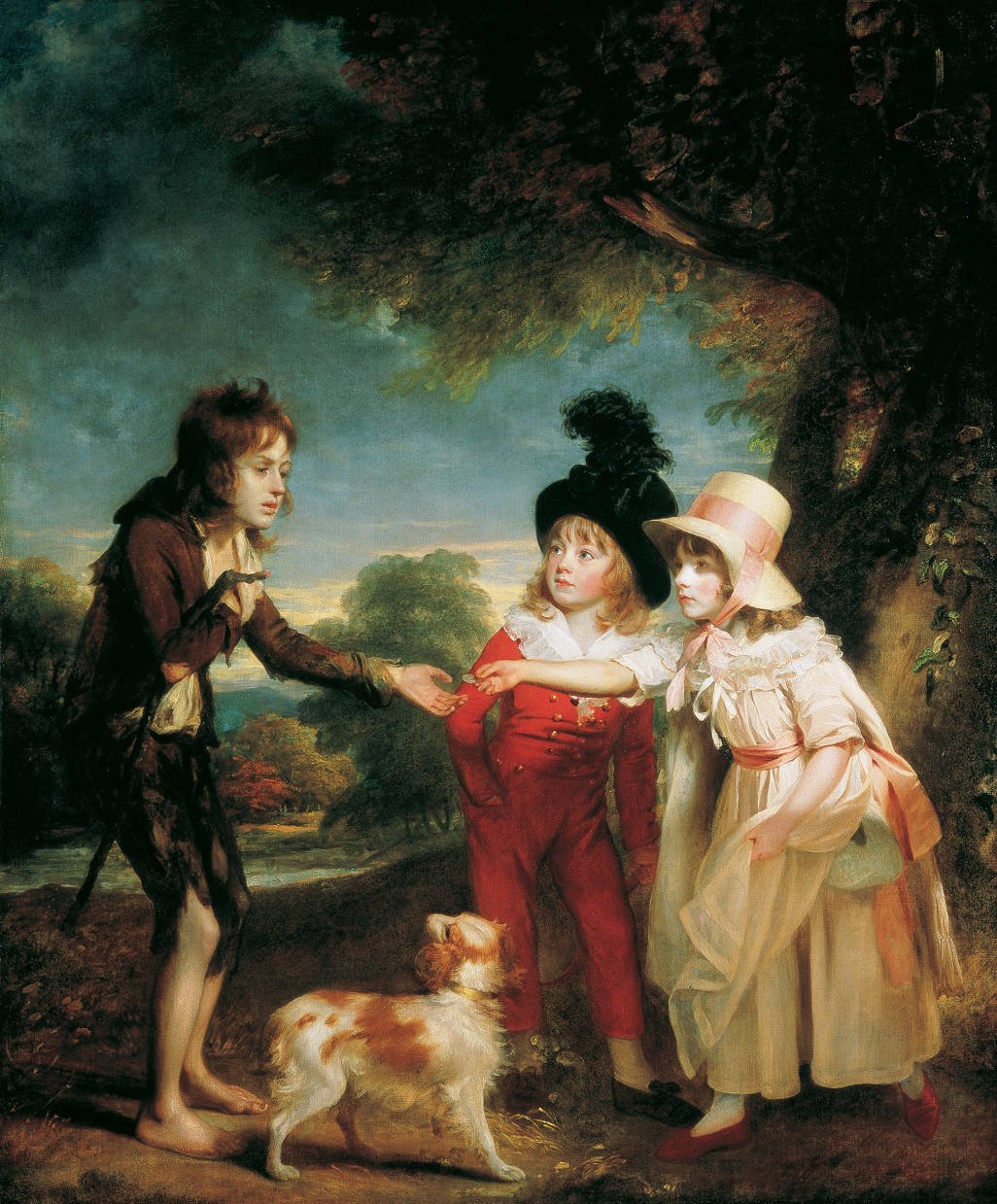
Portrait of Sir Francis Ford’s Children Giving a Coin to a Beggar Boy by Sir William Beechey

Portrait of Sir Francis Ford’s Children Giving a Coin to a Beggar Boy by Sir William Beechey (c.1793)

The artist I am featuring in My Daily Art Display today is the English portrait painter, Sir William Beechey.  William Beechey was born in Burford Oxfordshire in 1753.  He was the eldest of five children of William Beechey and Hannah Read who both came from Dublin.  Young William Beechey was not brought up by his mother and father but by his uncle Samuel Beechey who was a lawyer and it was his intention to have William study law and made arrangements for him to be articled to a solicitor in nearby Stow-on-the-Wold and later in London.  Whilst in London training to become a lawyer William made friends with some students from the Royal Academy Schools.  In 1772, despite the displeasure of his uncle, William managed to gain a release from the solicitor’s articles and achieved admission to the Royal Academy schools.

Some historical records of his life state that at around this time William Beechey married Mary Ann Jones and the  couple went on to have three daughters and two sons, one of whom was his son, Henry William Beechey who became an explorer and artist.  William Beechey first put forward paintings for inclusion at the Royal Academy Exhibition in 1776 and continued to submit works to their annual exhibitions for the next seven years.  At this time, most of his work consisted of what was then termed as “small portraiture”.

In 1772 he left London and moved to Norfolk, living in Norwich and for a short time, Great Yarmouth.  This move out of the capital city would appear to have been a strange one for London was an ideal place to sell his work but the author, William Roberts explained the reason for going to Norwich in his 1907 biography of the artist, entitled Sir William Beechey R.A.

 “…he was invited to spend a month in that city, where he found himself in the immediate receipt of so many commissions in that town and neighbourhood that he was induced to take up his abode there altogether…”

He was still submitting and having his works of art accepted  by the Royal Academy for their exhibitions but they received little mention.  However in 1788 he submitted two framed works which incorporated fifteen smaller portraits.  The Royal Academy jury, who decided on which paintings would be allowed to be exhibited at the Exhibition, rejected his two submissions because the R.A. rules stipulated that all paintings must be framed separately.  An art dealer Benjamin Vandergucht took the two works and exhibited them in his own gallery.  The phrase “there is no such thing as bad publicity” kicked in as the press heard about the R.A. rejection of Beechey’s works and wrote the story of the R.A.’s rebuff.  Beechey had managed to obtain free and excellent publicity for his art work.

Beechey had returned to live in London.  A number of his contemporary portraitist had died, such as Gainsborough or ceased painting, such as Joshua Reynolds and so there was a great demand for his portraiture.  It was at about this time that Beechey moved away from miniature portraiture and started to concentrate on life-sized portraits.  His first wife, Mary died in 1793 and that same year he remarried.  His second wife was a miniature painter, Anne Phyllis Jessop, a lady some eleven years his junior.  The couple went on to have eighteen children!  The final breakthrough for Beechey in his artistic career was receiving royal patronage which came in 1793.  King George III and his wife loved Beechey’s portraiture style.  In a round-about way, Beechey had the Royal Academy to thank for this for they rejected another of his works, a portrait of a courtier.  The nobleman was so incensed when he heard that his portrait was not to appear at the R.A. Exhibition that he took the painting and showed it to the king and queen.  They thought it was a magnificent work of art and a generation of royal patronage began and Beechey was made the queen’s portrait painter.   One will never know fully how this influenced the Royal Academy but by a strange coincidence the R.A. elected Beechey as an Associate of the Royal Academy that same year.  This was also the year that the R.A. conferred the same honour to his portraitist rival John Hoppner.

An art critic of the Monthly Mirror journal wrote about William Beechey’s work and that of his rivals of the time, John Hopper and Thomas Lawrence:

“…Beechey has fewer eccentricities than his competitors—for he never distorts his figures for the sake of extravagant attitude—he is less fantastic in his design and less exuberant in manner, in short, he has more nature than [Hoppner and Lawrence]. … Beechey, who is more fixed and determinate, both in his colouring and outline, studies only to be chaste…”

Beechey’s work was often described as being delicate and lacking extravagance and it was these very qualities that appealed to his patrons and clients who disliked the ostentation and flamboyance of his two main rivals.  It was also these virtues of Beechey that appealed to King George.  King George was vociferous in his praise of Beechey, much to the chagrin of John Hoppner.  William Beechey was elected as an Academician of the Royal Academy in 1798 and in that same year, on King George’s specific instructions, he exhibited his great and mammoth masterpiece, measuring 14ft x 17 feet, entitled His Majesty Reviewing the Third Dragoon Guards and the Tenth Light Dragoons in which he depicted King George reviewing his household troops.    Sadly this beautiful work of art was destroyed during the 1992 fire in Windsor Castle.  The king was so delighted with the work that in May 1798 he conferred a knighthood on Beechey.  The knighthood was the first such honour to go to an artist since Joshua Reynolds was knighted back in 1769.  Sir William Beechey’s artistic rivals were astounded by this royal award!  Beechey remained a favourite of King George III.

Sir William Beechey continued to exhibit work at the annual Royal Academy exhibitions until his death in January1839, aged 85.

The featured painting fo My Daily Art Display today is by Sir William Beechey and is entitled Portrait of Sir Francis Ford’s Children Giving a Coin to a Beggar Boy, which he completed around 1793 and is housed at the Tate Britain in London.  The beggar in the painting is not depicted as a dirty and scruffy sad-looking urchin as we have seen in works such as The Beggar Boy by Murillo (My Daily Art Display, January 25th 2011) as this would have upset the sensibilities of the Victorian public.  There were many portraits of beggars during the late 18th century, most of which could almost be considered as being “prettified” versions of reality.  Such pictures would be more likely to home in on, not the pathetic state of the begging child, but of the kindness of the charity givers.  So is this just another one of these charitable depictions.  Well actually I am not so sure but then maybe I am just a cynic. Why?

We have to suppose that  when a patron approaches an artist to paint a picture, they know what sort of painting they want.  They know not only who or what is to be depicted but they will make the decision as to how something or someone is to be portrayed.  They will know whether there is to be a certain reasoning behind the depiction other than what is visible at a first glance to the casual observer.  By now you must be used to looking at the paintings I have featured and together we have delved into the interpretations and symbolism of the works.  So now let us look a little closer at what William Beechey has painted and try and work out if there was a reason for such a portrayal.

The first thing to consider is who had commissioned the painting.  The client was Sir Francis Ford.  Ford was the heir of a Barbados planter of the third generation.  His family originally came from Devon. In 1793, he was elected as Member of Parliament for Newcastle-under-Lyme and the day he was elected he was given a baronetcy. He was now a member of William Pitt’s administration but was in favour of procrastination as far as the abolition of the slave trade was concerned.   He disagreed with the government over the slave trade question and did not seek re-election as an MP.

Besides being a politician he was a plantation owner with estates in Barbados and the Dutch colony of Essequibo.  Being a plantation owner he needed labour to work his estates and thus was a great advocate of slavery.  However in England in 1793, at the time of this painting, there was the start of a movement against slavery and a steady outcry with regards the terrible conditions of the plantation slaves, although it would be another forty years before slavery was abolished in the British Empire.

In the painting we see portraits of Thomas Ford’s son and daughter giving a coin to a beggar boy.  Could it be that Sir Francis Ford wanted to remind the people of Victorian England that there were beggars in their own country, who were in desperate need of food and lived in unacceptable conditions, and that the English public should show more concern about the fate of their own “home-grown” poor rather than worry about the living and working conditions of the plantation slaves in some far-off distant lands.  Could Sir Francis Ford be stating in a roundabout way that “only those without guilt have the right to cast the first stone”!  Was Thomas Ford using the artistic talents of Beechey as that of a spin doctor?

Sir Thomas Ford died in Barbados in 1801.

An Idyll by Maurice William Greiffenhagen

An Idyll by Maurice Grieffenhagen (1891)

My featured artist today with the Germanic sounding surname was actually a British painter and Royal Academician.  Maurice William Greiffenhagen was born in London in 1862. His parents were both Germans from the Northern Baltic region.  At the age of 16, after passing the entrance examination, he enrolled at the Royal Academy Schools in 1878, where he won their Armitage Prize.   On graduating, Grieffenhagen secured a job as an illustrator, designing posters and worked on illustrations for books, magazines and newspapers.  One of the books he illustrated was Rider Haggard’s much loved novel, King Solomon’s Mines.   He contributed many illustrations to magazines and newspapers such as the Lady’s Pictorial and the Daily Chronicle.  In his art, Greiffenhagen specialised in portraits and allegorical figures in the Pre-Raphaelite style and in 1891, at the age of 29, he completed the painting entitled An Idyll, which was to establish his artistic reputation. This painting, which can be found at the Walker Art Gallery, Liverpool is the work, which I am featuring in My Daily Art Display today.  The public loved the painting and it was an instant success.  Meanwhile, his continuing friendship with the author Rider Haggard led to him, in 1899,  illustrating another of his adventure books, She: A History of Adventure. 

In 1884 he began to exhibit works at the Royal Academy and this prestigious art establishment made him an Associate Member in 1916 and a Royal Academician in 1922.

Railway poster by Grieffenhagen

In 1909 he became a member of the Royal Society of Portrait Painters.  Grieffenhagen was a prolific illustrator and his ability to design posters which he had done in his early days came very handy when the London Midland & Scottish Railway commissioned travel posters from Royal Academicians and Associate Royal Academicians.   Greiffenhagen’s design The Gateway of the North depicting a mounted knight before a portcullis archway was by far the most successful of the series.

In his later career, Greiffenhagen concentrated on portraiture.   Between 1901 and 1912 he exhibited at many of the important international exhibitions including those held in Munich, Pittsburg and Venice. Greiffenhagen received gold medals at Munich in 1897  and in Dresden in 1901, and an honourable mention at Pittsburgh exhibition in 1907. In 1906, despite his home being in London, he took up the position of professor of painting at the Glasgow School of Art, and took charge of the Life Department.  Despite the long commute between home and the university he remained there until 1926.   Whilst living in Scotland, Greiffenhagen continued to paint and 93 of his works are housed in the collection of the Hunterian Museum and Art Gallery, University of Glasgow.

Greiffenhagen died from a heart attack in 1931 at his home in St John’s Wood at the age of 69.

An Idyll is set on a slope of pastureland.  It is a colourful work with the vibrant and warm red of the poppies surrounding the feet of the young couple.  The red contrasts well with the greens and blues he has used for the background.  Before us we see a young man, dressed as a shepherd in his animal skin clothing, holding in his arms a compliant young woman who is attired in modern dress. His skin is brown and weather-beaten whereas, in contrast, her skin is pale, almost a virginal white.  It is an unusual embrace as although the young man captures the young woman with some force, she seems not to reciprocate to the encirclement of his arms and instead just lies somewhat leadenly in his embrace.  Is this a sign that she is not enamoured by the young man’s sudden move or is it a fact that she finds herself in a powerless position.   Would you look at her facial expression and say that she is ecstatic with the young man’s advances or maybe somewhat coy?  Or would you surmise from her lack of response that she is just surrendering to the inevitable?  Maybe I am misjudging the artist, for one must remember that this painting was completed during Victorian times and the public and critics would not have been impressed if Grieffenhagen had shown the woman as being equally passionate.  Maybe that would have been a step too far!  Maybe we just need to use our own imagination as to what is going on and what is going to happen next.

It is believed that the models for the painting were personal friends of Grieffenhagen.  However he had a problem with them, for at the time of the first sittings they were merely an engaged couple but before Grieffenhagen had completed the painting, the pair married and the artist had great difficulty in getting them to pose for him once they were man and wife.  In the end he had to use two other models.  The author DH Lawrence refers to this painting in his novel The White Peacock.   Lawrence, the great chronicler of unbridled passion in human relationships, had a great love for the visual arts.  In 1929 he admitted:

“…all my life I have gone back to painting, because it gave me a form of delight that words can never give…”

To D H Lawrence, An Idyll was the epitome of passion. Blanche Jennings, a suffragette post clerk in Liverpool with whom Lawrence corresponded, had sent him a reproduction of this popular painting. Lawrence was fascinated by the picture and confessed in a 1908 letter to Jennings:

“…the painting moved me almost as much as if I had fallen in love myself…”

Are you as moved as D H Lawrence with this painting?  I started researching this painting a few days ago on February 14th – Valentine’s Day.  A coincidence ?

Girl with a White Dog by Lucian Freud

Girl with a White Dog by Lucian Freud (1950-51)

A few days ago I visited my two children in London and went on a few gallery visits.  I had managed to get tickets for my daughter and myself for the David Hockney Exhibition at the Royal Academy which was really a great experience and one which everybody should try and get to.  I will feature a painting from the exhibition later this week.  The other exhibition I had wanted to see and which had just opened was an exhibition of Lucian Freud’s Portraits which was being held at the National Portrait Gallery.  Unfortunately I could not get a ticket for the days I was in the capital so I have booked to go next month.  Today I am going to look at one of my favourite paintings of his entitled Girl with a White Dog, which he completed in 1951.  First let me tell you a little about Lucian’s early life and that of the sitter for this painting, his first wife, Kathleen Garman and look back on the famous, or maybe I should say, infamous Garman sisters.

Lucian Freud, who is the grandson of Sigmund Freud, the pioneer of psychoanalysis, was born in Berlin in 1922.  His father, Ernst Freud, an Austrian Jew, was an architect and his mother Lucie (née Brach) was the daughter of a grain merchant.  On the rise to power of Adolf Hitler in Germany in 1933, Lucian and his parents moved to Britain and lived in a house in St John’s Wood, London.  During his school years, he attended Dartington Hall Boarding School in Totnes Devon.    This was, at the time, an unusual seat of education.  It was a very progressive establishment in which there was a minimum of formal classroom activity and the children learnt by involvement in estate activities. From there he attended the Bryanston Independent School in Dorset.

In 1939 he became a British national and that year he enrolled at the Central School of Art and Design, which fifty years later would merge with the St Martins School of Art and become, as we know it today, the Central Saint Martins College of Arts and Design, which is widely regarded as one of the leading Art and Design institutions in the world.  His stay at the college was only brief as he moved on to the Cedric Morris’ East Anglican School of Painting and Drawing in Dedham.  This was a far more radical establishment which gave free rein to its students.  The school was destroyed by fire and a new location for the school was established in Benton End on the outskirts of Hadleigh in the county of Sussex.

Lucian Freud served as a merchant seaman in an Atlantic convoy in 1941 before being invalided out of service in 1942.  From 1942 to 1943 he attended Goldsmiths, University of London, an establishment which specialises in the arts, humanities and social sciences.  At the age of 24, Freud began his European travels, painting in France and Greece.  Some of his early work had already been published in the Horizon arts magazine and in 1944 the Alex Reid & Lefevre Gallery in London staged the first solo exhibition of his paintings.

In 1948 Lucian married Kitty Garman, the subject of today’s featured painting.   Kitty was the second illegitimate child of the distinguished British sculptor, Jacob Epstein’s and his lover Kathleen Garman.  Jacob Epstein and his wife Margaret (née Dunlop) did not have any children of their own but they looked after a young girl, Peggy Jean, the product of Jacob Epstein’s earlier affair with Dorothy (Meum) Lindsell Stewart.  Margaret Epstein and the young girl lived across London with Jacob, while Kathleen Garman lived with her younger sister, Helen, in an unheated studio in Bloomsbury and her and Jacob’s infant son, Theo.    Margaret Epstein was aware of her husband’s affair with Kathleen Garman and despite her husband’s numerous previous affairs with women which never lasted, she felt threatened by Kathleen.  She realised that Kathleen was more than a lover, she was almost a  parallel wife. From the beginning, Mrs Epstein disliked her intensely, realising  that she would be her greatest rival.   It came to a head in 1923 when according to Cressida Connolly in her book The Rare and the Beautiful: The Lives of the Garmans:

“…Mrs Epstein took Kathleen into a room and locked the door before producing a pearl-handled pistol from under her capacious skirts… and shot her. The bullet hit Kathleen just to the right of her left shoulder blade, whereupon Mrs Epstein panicked and ran out of the room, leaving the bloodied Kathleen to stagger out into the street alone…”

Jacob Epstein visited Kathleen in hospital and paid her medical bills. The bullet wound to her shoulder left  a large scar and Kathleen Garman was never afterwards able to wear sleeve-less dresses. To protect the reputation of Jacob Epstein, Kathleen Garman refused to press charges against his wife.

Despite this incident and the pleadings of his wife, Epstein refused to give up Kathleen, who remained in her one-room London studio as Epstein’s lover and bore him three illegitimate children; a son, Theo, in 1924, and two daughters,  Kitty in 1926 and Esther in 1929.  Epstein had another affair with one of his students, Isabel Nicholas, and this resulted in the birth of a son Jackie in 1934.  Isabel gave up her son to the Epsteins and he was also looked after by Margaret Epstein.   Kathleen Garman never knew about Epstein’s parallel affair with Isabel or about the boy Jackie until several years later.

The cramped conditions of the studio Kathleen Garman was living in proved unsuitable for bringing up young children and Kitty was sent to live with her maternal grandmother, Margaret (née Magill), in Herefordshire.  Esther, the youngest daughter was later dispatched to a family friend.   Kitty Garman stayed on with her grandmother Margaret when the household moved to South Harting, Sussex, and only went back to live with her mother in London when she was in her late teens.  She then enrolled at the Central School of Arts and Crafts to study painting under Bernard Meninsky. According to Kitty, her mother was constantly critical of her artistic efforts. Kitty recalled her mother’s attitude:

 “…I think she wanted her daughters to excel, but she didn’t want us to succeed, because she had to be the queen.   I was frightened of her because of her temper and she did say searingly sarcastic things…”

In 1949, Epstein’s wife, Margaret fractured her skull in a fall on the steps of her home and died.  This allowed Kathleen Garman to move into Epstein’s home in Hyde Park Gate.

By the early 1950’s Kitty Garman’s marriage to Lucian was in trouble and it ended abruptly after the artist’s affair with the society girl and writer Lady Caroline Blackwood was exposed.        Kitty Garman’s marriage to Lucian Freud ended in divorce in 1952 and Lady Caroline Blackwood became his second wife in 1957.  Shortly after the ending of her marriage to Lucian, Kitty was at a party where she met Wynne Godley, and economist, whom she married in 1955.

Lucian Michael Freud died aged 89 on July 20th 2011.  His first wife and sitter for today’s painting, Kathleen (Kitty) Eleonara Wishart (née Godley, née Freud) died aged 74 on January 11th 2011.

Kitty Garman, a brunette, was by all accounts, hauntingly beautiful and the subject of many paintings.  My Daily Art Display featured painting today is entitled Girl with a White Dog which Lucian Freud commenced in 1950 and  completed in 1951.  When not lent out to external exhibitions this work of art resides at the Tate Britain Gallery, London.  This is the last of the series of portraits of his first wife, Kitty, which Freud had started at the end of the 1940’s.  Kitty had given birth to Lucian and her first child, Annie in 1948 and their second child Annabel was born in 1952, the year the painting was purchased by the Tate.

One can only marvel at the way Freud has handled the contrast of the fabrics and textures.  On the one hand we have the smooth white hairs of the dog and on the other hand we have the fuller texture of the yellow dressing gown, which contrasts also with the smoothness of the  striped silk bedspread on which she sits.    In the painting we see Kitty Garman sitting curled up on what looks like a low settee dressed in a dressing gown with its long plaited and tasselled tie.   Lying next to her, with its head in her lap, is one of a pair of white bull terriers the couple were given as a wedding present.  Look at the wonderful amount of detail Freud has put into his depiction of the dog.  He would often use animals in his compositions and often they would feature both pet and owner.

Kitty left hand hangs down and her fingers rest on the settee and on one of the fingers  we can see her wedding ring.   Her right hand is pressed against the bathrobe, cupping her left breast.  Her right arm is strategically placed under her right breast with her wrist adding to its uplift and fullness.  Her expression is difficult to translate.  She seems somewhat frightened and concerned about something.  Her eyes are large and staring.  In some ways we feel a little uncomfortable when we look at her.  Her brow is narrow which adds to her look of anxiety and sadness.  It could well be that Freud’s liaison with Caroline Blackwood at the time of this painting was taking a toll on Kitty.  Is her look one of calmness or one of desolation?  I will let you decide.

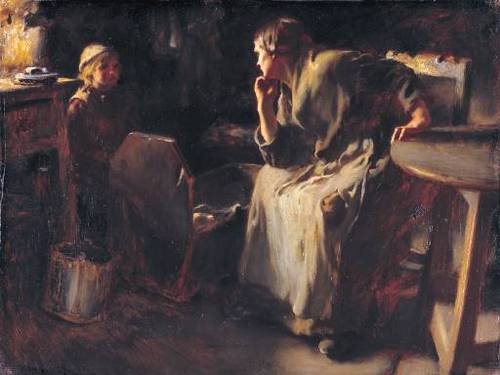
Hush and Hushed by Frank Holl

Hush by Frank Holl (1877)

I get great pleasure in “discovering” new artists.  Today I am going to look at the life of an artist I had never previously heard of and maybe he is somebody that you have never come across before.  In My Daily Art Display today I am going to look at two paintings by the English Victorian social realist painter and portraitist Frank Holl, entitled Hush and Hushed.

Frank Montague Holl was born in Kentish Town, London in 1845.  His father, Francis, was a well-known engraver and Academician.  His grandfather, William Holl, was also an engraver.  He was brought up in a political household.  His family were staunch Socialists and from an early age Holl was taught that he had a duty in life to transform society and improve it for the common people.   He started his schooling at the Heath Mount School in Hampstead and at the age of fifteen he enrolled as a probationer at the Royal Academy Schools.  He proved to be an exceptional student but much to the dismay of his tutors, Holl liked to add a touch of political content to his works of art.  At the age of seventeen he won a silver medal for his work and the following year was awarded a gold medal and a travel scholarship for his painting entitled The Lord gave, and the Lord hath taken away.  It was a painting that depicted a family bereavement and when it was exhibited at the Royal Academy in 1869, the then monarch, Queen Victoria attempted to buy the painting it but the original purchaser refused to sell it.  Two years later Holl painted another painting on the same theme entitled No Tidings from the Sea and on this occasion Queen Victoria purchased it for a 100 guineas.   Holl set off on his travel scholarship to Italy but the journey lasted only two months, at which time he wrote to the Royal Academy saying that he wanted to return home and concentrate on his social realism paintings based on the lower working-class life in England.

Holl started exhibiting his work in 1864 when he was nineteen years of age and from 1869 onwards he was a regular contributor to the Academy Exhibitions. Many of these works were depicting the plight of the less fortunate and their pitiful existence, such as No Tidings from the Sea (1871) and Leaving Home (1873).  When he completed his studies in 1869 he was employed by William Luson Thomas, a successful artist, wood engraver and social reformer, who had just founded a new weekly illustrated newspaper, called The Graphic, and was looking for a number of talented artists to illustrate it.  For the following five years, Holl produced a series of pictures that were used to illustrate stories in the magazine. Among his fellow workers were Luke Fildes (see The Doctor – My Daily Art Display, May 17th 2011) and Hubert von Herkomer (see Hard Times, My Daily Art Display July 25th 2011), who like him believed passionately in the cause for political and social change.  Often they would turn the engravings, which they had fashioned for the pages of The Graphic, into oil paintings.  These depictions of the real life lead by the “under-class” of the nation lead them to become known as the Social Realist Movement.  Although we may look upon these depictions of poverty as a welcome wake-up call to the nation, they were badly received by the Victorian establishment at the time.  They viewed the works as being disloyal.  The establishment and many of the people who had never suffered poverty wanted to turn a blind-eye to the suffering of the less fortunate.  Their motto was “out of sight, out of mind” and frowned upon these upstart young artists who wanted to drag the social differences which existed into the public forum.

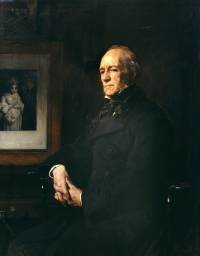
Samuel Cousins by Frank Holl (1879)

In 1879 Frank Holl had a breakthrough in his artistic career when he completed a portrait of his neighbor, the English mezzotint engraver, Samuel Cousins.  The critics loved it.  One wrote in a national newspaper:

“…Mr Frank Holl’s portrait of the renowned engraver Samuel Cousins R.A. is a superb work, glowing,  for all the austerity of its execution, with animation and intelligence…”

In another newspaper the art critic commented:

“…Mr Frank Holl’s half-length, seated of Mr Samuel Cousins, the engraver is one of the portraits of the year and does the young artist infinite credit…”

So was Samuel Cousins delighted with the finished work?  Actually, he wasn’t, saying, with an open show of vanity, that the painter had added to his years, and had made him appear too old.  However notwithstanding the sitter’s comments the painting lead to numerous lucrative commissions from wealthy patrons.  From that day on till the end of his life, Frank Holl never had to search out work, work searched him out.  His portraiture was mainly of men, often ones who were very famous such as Gladstone and Joseph Chamberlain.

In 1888 having sent a number of his paintings to the Royal Academy for their Summer Exhibition he travelled to Spain.  He had decided to spend a short period in Madrid and visit the Prado where he could study the works of the great Spanish master, Velasquez.  Shortly after returning home he suffered at heart attack and died suddenly on July 31st 1888, aged just 43.  His fame as an portrait artist lead to much work, in fact too much work, none of which he ever turned down.  Holl continually tried to find time to paint his social realist paintings as well as his lucrative portraiture work but to do this he found himself working every day of the week.  He once told his wife of the strain he was under, saying:

“…Hunger for work is always on me, and it is when I cannot satisfy this hunger that I get so worn out. If only I could banish my tormenting conscience for work; but that never lets me alone, and if I do nothing I feel of no use…”

After his death his daughter commented that her father continually suffered from the nervous strain of working with such distinguished men and that this strain, in her mind, contributed to her father’s premature death.

Hushed by Frank Holl (1877)

Today’s pair of paintings entitled Hush and Hushed were completed by Frank Holl in 1877 and are now housed in the Tate Britain Gallery in London.

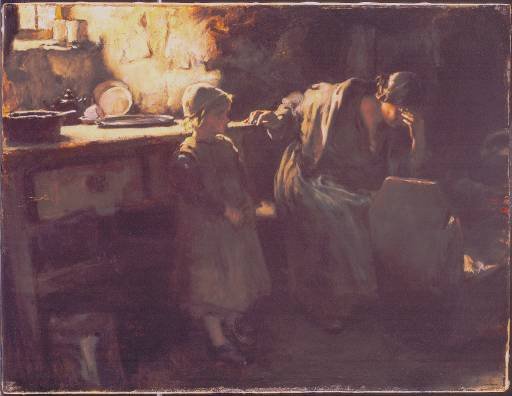
The setting for the two paintings is a room in a small dwelling.  It is a solemn setting and the somber colours used by Holl enhance the bleak and depressing mood.  One can tell by the sparse decor and bare walls that the occupants have little money.  The lives of such people was a constant source for Holl’s artistic works.  In the first of these paintings entitled Hush, we see before us a mother tenderly bending over the cradle of her sick child.   There is a distinct look of concern and apprehension in her face.  Whilst she looks into the cradle,  she whispers to her other child, who stands close by, to be quiet so as not wake the infant who has finally gone to sleep.  The young boy looks equally anxious about the situation.   It is a typical homely scene and there is no hint of what is to follow in the companion work, Hushed.

This second work is a follow-up scene in the same room and this time we see the devastated mother gazing sorrowfully into the empty cradle where once the baby had been but had now sadly passed away.   We see the mother with her hand covering her face in a sign of grief.  Her other child leans against a cupboard with his hands clasped in front of him.   He looks at his grieving mother but has no idea what to do to console her.

These are extremely moving works of art and in a way Holl has handled them without resorting to sentimentality.  The paintings were meant for people to understand the problems faced by those who were imprisoned by poverty and suffered the fates that accompanied such financial destitution. Infant mortality was high in 19th century and it is estimated 1 in 5 children died before their fifth birthday. Infant mortality had always been high and much of it could be because of the lack of sanitation and general hygiene especially amongst the poor. However in those days, the well-off were not immune to such early deaths, as it was also a period when consumption and cholera accounted for many young deaths.

Home from the Sea by Arthur Hughes

Home from the Sea by Arthur Hughes (1862)

For my work of art today, I am crossing the Channel from France and featuring an English Victorian artist who was associated with the Pre-Raphaelite Brotherhood.  His name is Arthur Hughes and he was born in London in 1832, the son of Edward and Amy Hughes.  When he was six years of age he attended the Archbishop Tenison’s Grammar School and it was here that he showed the first signs of his artistic talent.  In 1846, aged fourteen he enrolled in the School of Design at Somerset House where he studied under Alfred Stevens.  From there he enrolled in the Antique Schools at the Royal Academy and whilst a student there won a silver medal for a “Drawing from an Antique” competition.  In 1850 he exhibited his first work entitled Musidora, at the Royal Academy.  It was also in this year that he first encountered Alexander Munro, Ford Madox Brown and Dante Rossetti, all artists of the Pre-Raphaelite Brotherhood.  Hughes was soon converted to Pre-Raphaelitism adopting many of their ideas in his own work.  Hughes was also greatly influenced by the works of John Everett Millais although he never met him until two years later, in 1852, when they were both exhibiting paintings at the Academy with the same title, Ophelia !  The year 1850 was to prove a very significant year for Arthur Hughes for another reason – he met and fell in love with a woman, Tryphena Foord and eventually in 1855 they married.  It was a very long courtship period of over five years between their first meeting to their nuptials.  During this time Hughes completed many paintings which were both romantic but wistful, both sad but tender and the tone of these works could well have been as a result of his long wait to get married.  Tryphena was the model for many of his  paintings.  The couple had a long and happy life together and went on to have six children, two of whom are present in today’s featured work.  Many of his pictures were of ordinary scenes of life. They were painted with great delicacy and feeling and were often in greens and mauves.

In 1857 he joined in on a joint commission with Edward Burne-Jones, Rossetti, William Morris and others to paint murals on the walls of the Oxford Union Debating Hall which is now the Library.  It was this commission that influenced much of Hughes’ later works and can be seen by the way he softened his colours and added a mystical overtone similar to that seen in the works of Dante Rossetti.   Many of his subsequent works featured Arthurian legends and religious themes.  Besides his time spent on his paintings he also worked on book illustrations for many writers and poets including Keats, Tennyson, Christina Rossetti and Thomas Hughes whose  famous book was Tom Brown’s School Days.  Arthur Hughes was one of the leading illustrators of his time.  He also worked as an art examiner in London and later taught art at the Working Men’s College

He died in London in December 1915, almost a recluse.  During his lifetime he produced over seven hundred paintings and drawings and almost eight hundred book illustrations.  Friends of his would tell you that his main attributes were his modesty and self-effacement.  Like all of us, he had many disappointing times during his life.  He suffered a number of ill-merited rejections at the Royal Academy and despite all his artistic accomplishments, he was disappointed to never having been elected an Associate of the Royal Academy.  He is now regarded as being the best of the younger Pre-Raphaelite followers.

Study for A Mother's Grave by Arthur Hughes

My featured painting today is a very poignant one and is entitled Home from the Sea which he finally completed in 1862 and exhibited at the Academy the following year.  He actually started it six years earlier and the original title of the painting when first exhibited in 1857 was  A Mother’s Grave.   It is known, because of the existence of a study for the original work,  that in the original painting there was just the figure of the boy kneeling over his mother’s grave.   However, there was much criticism over the way Hughes had painted the boy and so he re-worked the painting, adding the figure of the girl.

The painting is set in the graveyard of the Old Chingford Church, Essex.  In the background we see the white walls of the church reflecting the brightness of the sun.  It is not however the church that our eyes immediately focus on but the figures in the foreground which are in shadow.  Before us we have a young sailor boy who has just returned home from a voyage at sea only to find out that his mother has died whilst he was away.  His hat and belongings, wrapped in a knapsack lie abandoned on the ground.  Kneeling besides him we see a girl, possibly his sister, also mourning the death of their mother.

The depiction of the girl was posed for by his daughter Tryphena.   She wears a  black funerary outfit.  Her facial expression is one of pain over her loss.  She kneels on the ground with her hands folded in front of her.  Her eyes are downcast and in some ways her mourning is both constrained  and controlled, possibly because she did not want to further add to the sadness of the boy who has prostrated himself on the ground.

We cannot see the facial expression of the young sailor boy who is still in his uniform. However, we see his hands are clasped in prayer as he prays for the soul of his mother.  This is not just a story of a boy’s loss of a parent but there are things in the painting which symbolise the transience of life and all things ephemeral, like the dog roses and the dandelion seeds as well as the spiders web which is wet with dew, and which can be seen in the tree branches above the girl’s head.  The sense of loss is also highlighted again by Hughes for if we look towards the church in the background we see a ewe searching desperately for her lamb which is hidden from her view by a tombstone.

The painting was exhibited at the Royal Academy in 1863 with the present title of Home from the Sea.  One cannot but be moved by this churchyard scene full of pathos as we empathize with the children’s suffering at their loss.

The painting itself, as well as the preliminary study, can be found at the Ashmolean Museum, Oxford.

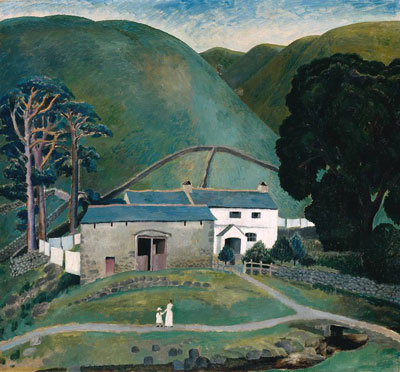
Farm at Watendlath by Dora Carrington

Farm at Watendlath by Dora Carrington (1921)

It often occurs that I stumble across and interesting subject for My Daily Art Display when I am researching another artist.  I came across today’s featured artist when I was delving into the life story of Mark Gertler and his painting Gilbert Cannan and his Mill in my last blog.  I should probably state up front that today’s blog is more about the artist and her fascinating social life than her featured painting.

Dora de Houghton Carrington was born in Hereford in 1893.  She was the second of the two daughters and fourth of the five children of Samuel Carrington and his wife, Charlotte de Houghton.  In 1902, aged 9, the family moved to Bedford and Dora attended the local girl’s high school.  The school’s ethos at the time was that the pupils should concentrate their studies on the Arts such as music and art with a healthy amount of sport thrown in rather than the normal but more commonplace subjects.  Dora showed an aptitude for drawing and her teachers persuaded her parents to pay for her to attend extra drawing classes in the afternoons.  One’s childhood often shapes the way we are in later life and the author Vanessa Curtis wrote about Dora’s differing relationship she had with her mother and father:

“…Although Carrington adored and revered her father, sketching him almost obsessively, she did not admire her fussy, martyr-like mother, who crammed the house with ornaments and devoted herself to charity work and religious causes….”

It is quite obvious that Dora’s mother had a suffocating influence on her children, especially her daughter.  Dora’s brother, Nicholas wrote of his mother extreme views on sex and  religion:

“..The first was extreme prudishness. Any mention of sex or the common bodily functions was unthinkable. We were not even expected to know that a woman was pregnant. Even a word like confined was kept to a whisper. The second was church-going and behaviour on Sunday. We all came to hate the whole atmosphere of a Sunday morning. The special clothes, the carrying of prayer books, the kneeling, standing and murmuring of litanies…”

In 1910, aged 17, she enrolled at the Slade School of Fine Art in London. There can be no doubt that once Dora Carrington was free of her home life and the puritanical views of her domineering mother, she rebelled.  She cut her hair to a bob which gave her a somewhat androgynous appearance. She entered into many intense and sometimes sexual relationships both with women and homosexual and heterosexual men.   She also decided that she wanted to be known simply by her father’s surname, “Carrington”.   Carrington fared well at the Slade and won several awards for her work.  One of her fellow students was Mark Gertler, who was totally besotted with Carrington and it was through him that Carrington met Lady Ottoline Morrell, the “society queen” and he introduced Carrington to the Bloomsbury Group, a group of writers, intellectuals, philosophers and artists.    Lady Ottoline and her husband Philip had a house in Bloomsbury, Central London and a country house in Garsington, Oxford where they would hold weekend parties for their friends, many of whom, like Stanley Spencer, Gertler and Carrington were aspiring artists.

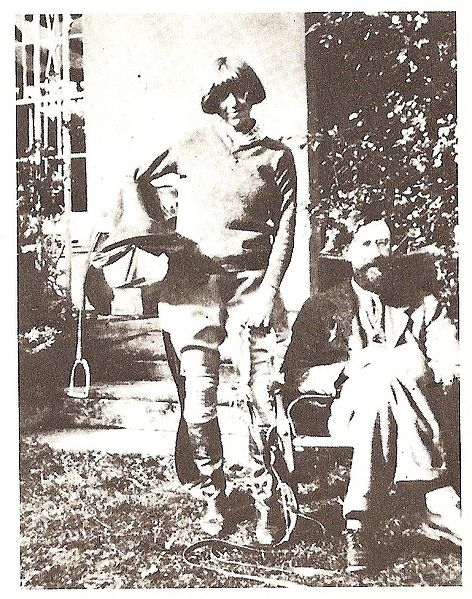
Carrington and Lytton Strachey

The Morrells were prominent pacifists and during World War I they invited conscientious objectors, such as the artist Duncan Grant and the writers Clive Bell and Lytton Strachey to take refuge at Garsington.  Carrington met Strachey, a writer and founder member of the Bloomsbury Group in 1915. Strachey was a homosexual but this did not stop Carrington falling in love with him.  This was a love that was to last almost twenty years.  Gertler felt no threat from Carrington’s love for the openly gay Strachey but in 1917 when Strachey bought a house and Carrington moved in with him, Gertler was devastated and realised that his love for Carrington was irrevocably unrequited and doomed.

Lytton Strachey and Ralph Partridge

Carrington’s father died in 1918 leaving her a small inheritance that allowed her to feel more independent.  That same year, Carrington was introduced to Ralph Partridge, a friend of her brother Noel.  Partridge like many men before him was besotted with Carrington, even though he was aware of Carrington’s love and devotion to Lytton Strachey.  Despite this knowledge, and knowing that Carrington would never give up Strachey, he married her in 1921 and along with Lytton Strachey, they bought and moved into Ham Spray House just outside the town of Hungerford.  It was here that they spent the rest of their lives.  It was a happy period for Carrington who carried on with her artwork and looking after the two men in her life.  Unfortunately, over time, Strachey suffered frequent bouts of illness and had to be cared for by Carrington.

Frances Partridge née Marshall

In 1926 Ralph Partridge started an affair with Frances Marshall, a writer friend and member of the Bloomsbury Group and went to live with her in London. His marriage with Carrington was all but over, but never in the eyes of the law.  Partridge did however still visit her most weekends.   Carringotn in the meantime had a number of extra-marital affairs with both males and females.  The most famous being her affair with Gerald Brenan, an army man and friend of her husband.  She also had a tempestuous love affair with Henrietta Bingham, the daughter of the American ambassador in London

In 1931 Strachey became seriously ill with stomach trouble and the doctors could not decide as to what was causing the illness.  By the end of that year doctors had given up hope of curing him.  In a fit of deep despair at the thought of losing her beloved friend she attempted to kill herself but was saved by her husband Partridge.  For the next month she watched as Strachey moved slowly towards death.  In January 1932 the end came for Strachey and, following an autopsy, it was discovered that he had been suffering from stomach cancer.  Carrington was devastated and her friends tried to rally round to support her but it was to no avail as in March 1932 she shot herself with a gun she had borrowed from a neighbour.  Her husband found her just before she died.  She died just a fortnight before her thirty-ninth birthday.

The painting I am featuring today entitled Farm at Watendlath was completed by Carrington in 1921. Newly-wed Carrington and her husband along with Lytton Strachey and some of their artist friends spent a summer holiday here that year.   One of their holiday companions was her future lover and friend of her husband, Gerald Brenan.  She would often return to spend other painting holidays around this area and she and her friends were frequent visitors to the farm which is near to Keswick in the Lake District.  The house we see in the painting faces Watendlath Beck, which flows from Watendlath Tarn into Derwentwater. A stuffed stag hanging inside was known as ‘Mr Wordsworth’  The two female figures we see in the painting are unknown and it has been suggested by some art historians that this depiction of female figures, dwarfed by a fertile and undulating landscape, relates to the artist’s sense of being overwhelmed by her own womanhood.  However, I find that interpretation hard to believe.

Her life story, in many ways, is tinged with sadness.  Her relationship with Lytton Strachey could not have fulfilled all her dreams and she would have constantly have had to compromise.  Yet, I am sure she had times of great joy and maybe we should look at this painting and remember that at the time she painted this, she had just married and she was at a place she loved with companions whose company she enjoyed and who in return where devoted to her.

The painting which can be found at the Tate Gallery London was presented to that establishment by her brother Noel Carrington in 1987.