Lady and Gentleman on Horseback by Aelbert Cuyp

Lady and Gentleman on Horseback by Aelbert Cuyp (c.1655)

Over time I suppose one gets to like different artists and different paintings and one’s favourites constantly change.  For me however,  I have always loved the work of Aelbert Cuyp and along with Pieter Bruegel the Elder, I would have him constantly in my top five favourite artists.  I love his landscapes (see March 12th) and his riverscapes (see Feb 8th) but for My Daily Art Display today I have chosen one of his portraits, entitled Lady and Gentleman on Horseback which he painted around 1655.

Aelbert Jacobsz Cuyp was born in Dordrecht in 1620. His father was Jacob Gerritsz Cuyp, a successful portrait painter in the city and his mother was Aertken Cornelisdr van Cooten.  Aelbert was unquestionably raised up in an artistic environment with his grandfather Gerrit Cuyp being an eminent glass painter and his uncle’s step brother Benjamin Gerritsz Cuyp was a well known painter of religious, peasants and tavern scenes.  It was his father who gave Aelbert his earliest artistic tuition.  Although Dordrecht was not known for being an important artistic centre, it was a wealthy city and proud of being the oldest city and principal city of Holland and of great mercantile importance.     Aelbert used to assist his father in his studio by supplying landscape backgrounds for portrait commissions.  It is uncertain whether Cuyp had ever been an apprentice of a landscape painter, but he soon abandoned his father’s style and subject matter and turned almost exclusively to landscapes and riverscapes.  He would only occasionally paint portraits in his mature period.

Aelbert, despite branching off on his own as a painter, continued to assist his father right up to the time of his father’s death in 1652.  It is thought that the landscape works of Jan van Goyen, which were known to Cuyp, may have been instrumental in his artistic style as were the works of the Utrecht painter Jan Both.  Cuyp also followed the example of Jan van Goyen in the way he travelled throughout Holland sketching and gaining inspiration for future works.

In 1658, aged thirty eight, he married Cornelia Bosman, a wealthy widow of Johan van de Corput, a naval officer and member of an important Dordrecht family.  Cornelia had three children from her previous marriage.  Following his marriage, Cuyp appears to have painted less frequently, and stopped painting altogether years before his death due to his civic and religious responsibilities he had assumed after his marriage.  He was very wealthy and there were no financial pressures on him to produce paintings for sale.    He was listed in the register of the dead on 7 November 1691, and buried in the Augustinian Church at Dordrecht.

Today’s work of art, Lady and Gentleman on Horseback, highlights the popularity of the Dutch patrician pastime of hunting in the second half of the seventeenth century and many similar paintings exist.  This is a large oil on canvas work measuring 123cms x 172cms and depicts a man and a woman, probably husband and wife, on horseback setting off for the hunt.   There have been many names put forward as to the identity of the sitters, the most popular being that the man is Adriaen Stevensz Snouck and the lady his wife, Erkenraad Berk.  The lady’s father, Matthijs, was an important patron of Aelbert Cuyp, which may account for the prominence in the painting of his daughter in her gorgeous blue dress, who we see sitting resplendently on the back of a white horse with its brilliant red and gold saddlecloth.   The couple had just married and it could well be that Cuyp was commissioned to paint this to commemorate the happy event.

The landscape in the background is filled with light, typical of the popular Italianate style of the time.  We see a building in the background which is more than likely a fanciful evocation of an ancient fortified chateau which Cuyp may have seen on his travels.   The two hunters have their dogs with them.  There are two types of dog on this hunt, the turfters which were used to track and follow the scent of deer and greyhounds, which we see in the middle-ground of the painting, being controlled by an attendant and which run after the deer and bring them to bay.

X-Ray Image of painting

When this painting was x-rayed there were some interesting differences to the finished article.  The man originally wore a hat and his hair was much shorter and was seen lying on his shoulders.  His attire was different.  He had originally been painted in a military tunic and cape which were adorned with braids and buttons that in all likelihood were golden in colour.  It was also thought that the overall colour of the man’s clothing was a brilliant red rather than drab brown we see in today’s painting.   If we look at the woman we see that originally she wore a hat which was of a different shape to the one she is wearing now and originally the hat had feathers at the back of it.  Her dress was more loosely fitting and cascaded down the right flank of her horse.  Such changes to the painting must mean that the patrons were dissatisfied with the original composition and the fact that there was more going on in the original painting probably was viewed as being too distracting from the formal character of the double portrait and thus had to be revised.

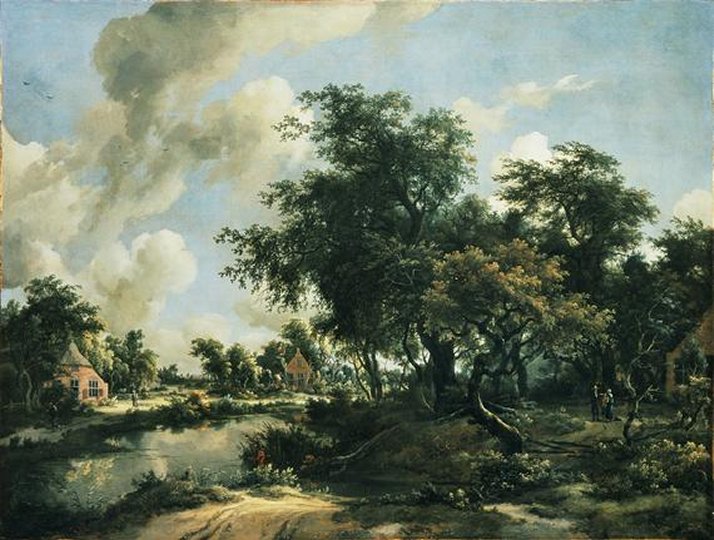
A Stormy Landscape by Meindert Hobbema

A Stormy Landscape by Hobbema (1663-5)

Meindert Hobbema was thought to have been born in 1638 in Amsterdam but there are varied opinions on this fact.  The name “Hobbema” was his own invention as his father’s name was Lubbert Meyndert.  He was the great landscape painter of the Dutch Golden Age.   The Dutch Golden age was that period in Dutch history which spanned the 17th century, at the time of, and following the Eighty Years War, which encompassed the struggle for Dutch independence. The newly formed Dutch Republic became the most prosperous nation in Europe, and led European trade, science, and art. The northern Netherlandish provinces that formed part of the new state had customarily been less significant as artistic centres in comparison with the Flemish cities in the south.  The war caused tremendous disruption and resulted in the break with the old monarchist and Catholic cultural traditions.  As a result, Dutch art needed to reinvent itself entirely, a task in which it was very largely successful and this re-birth was known as the Dutch Golden Age.

We know that Hobbema was active as an artist in Amsterdam and that he was a pupil of the great landscape painter Jacob van Ruisdael.  Some of Hobbema’s work showed a distinct similarity to his master’s work and as Ruisdael’s paintings were in great demand, a number of Hobbema’s works were passed off as being works of his master.  Strangely enough, in years to come when Hobbema’s flair as an artist and his artistic gift was established, the reverse would happen.

Hobbema married Eelije Vinck in 1668 who had been his serving maid.  One of the witnesses at the ceremony was Jacob Ruisdael.  The couple went on to have four children.   It was about this time that Hobbema started to work for the Customs & Excise in Amsterdam supervising the weighing and measuring of imported wine.  This was his full time job and from then on his artistic endeavours were reserved for his spare time.  The output of his paintings from then on decreased and was somewhat erratic.   In 1704 Eeltije died, and was buried in the pauper section of the Leiden cemetery at Amsterdam. Hobbema himself survived till December 1709, and he too was buried in a pauper’s grave in Amsterdam. It was a depressing fact of life that both van Ruisdael and Hobbema, looked upon as the two greatest Dutch landscape painters of the era, both died in poverty.  Like the two great Dutch painters Hals and Rembrandt some fifty years earlier, despite the demand for their works and the sale of their paintings, they too died penniless.   This sad fact has to be put down to either they let their paintings go too cheaply or simply their financial mismanagement which was brought on by them living a life they could not afford and as a result it was to prove to be their undoing.   

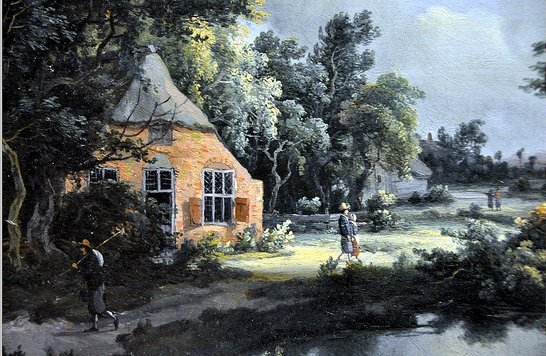
The Cottages and the passing walkers

Hobbema was a master painter when it came to painting woods and hedges, or mills and pools. This talent was derived from his life in the countryside, where day after day he might study the branching and foliage of trees, cottages and mills, under every variety of light, in every shade of transparency, during the various seasons.    His paintings had a characteristic rich texture to them.  Today’s featured painting entitled A Stormy Landscape, which he completed in 1665, is a prime example of his extraordinary talent as a landscape painter.  In it we can see his love of creating woodland scenes with various shaped trees which in turn gave him the opportunity to show off his talent in depicting illuminated clearings and patches of light randomly placed amongst the shaded areas caused by the massive trees and dense foliage.

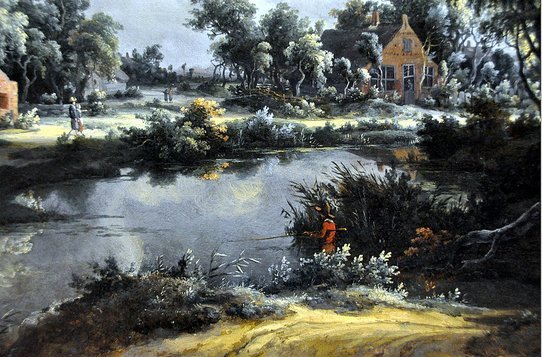
The Fisherman

In the foreground we have a fisherman with his line cast in the rippling waters of the river.  In total there are nine figures dotted around the rural scene, all quite small but put there by the artist for a specific reason, that of directing our eyes through the landscape.  There is no urgency in the movement of the water which adds to the tranquillity of the scene. To the man’s right we have a family strolling through the woods.  Across the river stand two cottages nestling under the cover of the large trees.  More people out for a stroll can be seen on that side of the river.   The heavy clouds shown to the left of the painting warn us of a storm approaching but this appears to be of little concern to our fisherman or the walkers.

This is a beautifully crafted work of art and one of Meindert Hobbema’s masterpieces. It has a soothing quality to it.  It is the type of picture you should look at when you feel stressed as its calm depiction of a country scene counteracts the stress of city life.  It has a calming effect and in some ways standing in front of it offers you a chance to relax.   Life alas can be hectic and I believe this painting offers one the perfect foil to our sometime chaotic existence.

Head of a Girl by Jan van Scorel

Head of a Young Girl by Jan van Scorel (c.1530-35)

As I have written in previous blogs, I am always pleased to discover a “new” artist, one that I had never come across before even though they may have been well known to many of you.  Today I have just such an artist.

I have always loved landscape paintings above all other genres of art but I am slowly coming to appreciate more and more a well executed portrait.  Today I have such a portrait.

I am always enchanted by a painting of a beautiful face such as the painting by Gerald Brockhurst, entitled Jeunesse Dorée (May 16th).  Today I have such a painting.

My Daily Art Display today is a painting by the Dutch painter Jan Van Scorel entitled simply Head of a Girl.

Jan van Sorel was born in 1495 in the small village of Schoorl, which lies 8kms north west of Alkmaar.   Like many people of the time his surname is derived from the name of his birthplace.  It is thought that he started his artistic journey of discovery in Haarlem studying under the likes of  Pieter Gerritsz van Roestraten, the Dutch Golden Age painter and Cornelis Buys also known as the Master of Alkmaar.  It is also known that around the end of 1518, when he was in his early twenties, he studied under Jan Gossaert in Utrecht and was probably through Gossaert’s recommendation that van Scorel began travelling through Europe.  He journeyed south from the Netherlands heading towards Italy, stopping off in a number of German towns including Nuremburg, where he met and stayed with Albrecht Dürer, before crossing the Alps into Austria.  Historical records show that he was registered in Venice between 1518 and 1522.  It was whilst he lived in Venice that he came across the works of Gorgione which were to have a great influence on his artistic career.

He left Venice with a group of Dutch pilgrims and set off on a pilgrimage passing through Malta, Rhodes and Cyprus before arriving at Holy Land and visiting Jerusalem and Bethlehem.  His Holy Land experiences were to feature in many of his later paintings.  Returning from the Holy Lands he headed for Rome and in 1522, aged twenty-seven,  he became the painter to the Vatican under the rule of Pope Adrian VI, the Dutch pontiff, who was a native of Utrecht, and who himself sat for a portrait by van Scorel.  He also became the curator of the vast collection of papal antiquities in the Belvedere and this allowed him to see the Vatican’s artistic treasures including the works of Michelangelo and Raphael and through this van Scorel gained great inspiration from their works of art.   In 1524 van Scorel returned to his homeland and settled in Utrecht where he remained for the rest of his life and where he continued to paint and teach art.  One of his students was the great Dutch artist Maarten van Heemskerck who is famous for his religious works and portraits.  Van Scorel died in Utrecht in 1562, aged 67.

Van Scorel was a highly educated man.  He spoke many languages and was not only a painter; he was also skilled as an engineer and architect.  His journey to Italy was to become an essential ritual for the next generation of Dutch and Flemish artists and their coming into contact with the Mannerist circles in Rome and Florence allowed them to introduce the style in their own country.  Van Scorel was considered by many as the artist who introduced High Italian Renaissance art to the Netherlands and was considered to be the leading Netherlandish Romanist of the time.  Romanism was the style of painting of a group of Netherlandish artists in the late 15th and early 16th century who began to visit Italy and started to incorporate Renaissance influences in their work. The greatest proponent of this style of art was Jan Gossaert.   The influence of Michelangelo and Raphael showed in their works in the way they would use classical imagery such as mythological scenes and nudes.

Four years after van Scorel’s death came The Iconoclasm, the Dutch name being Beeldenstorm, which literally translated means “storm of icons” and is the collective name for the destruction of catholic churches and possessions which had been raging in Europe for the past forty years but only came to Utrecht and the rest of the Netherlands between August and October 1566.   During this Protestant Beeldenstorm, hundreds of catholic churches, chapels, abbeys and cloisters in the Netherlands were totally destroyed by rampaging Protestant mobs along with all their contents such as, altars, icons,  chalices, paintings,and church books.  Unfortunately during this turbulent time of religious fanaticism, a large number of Van Scorel’s works were destroyed.  The Beeldenstorm marked the beginning of the revolution against the Spanish forces, which had occupied the Netherlnads and the Catholic Church which had asserted its authority over its people.

Unfortunately I have little to tell you about the painting itself.  Head of a Girl was painted by Jan van Scorel between 1530 and 1535 and now hangs in the Kunsthistoriches Museum in Vienna.  Before us we see just the head and neck of the girl.  She fills the painting and the plain background helps us to concentrate on her face.  There is no symbolism associated with this painting.  Nothing needs to be interpreted.  The title of the painting speaks for itself.  What you see is what you have – the face of a lovely young girl.  Her dark almond-shaped eyes avert our gaze as she peers to her left.  The light comes from her right hand side and the left side of her face is in shade.  She has a small mouth with full red lips.  Her red hair is plaited on top of her head.  I am taken by her gentle expression of contemplation.   I can almost detect a hint of sorrow in her gaze or maybe it is a look of acquiescence.  All in all, this young woman, whoever she may be, is truly beautiful and deserves to be in My Daily Art Display.

The Finding of Moses by Sir Lawrence Alma-Tadema

The Finding of Moses by Lawrence Alma-Tadema (1904)

My featured painter today is Sir Lawrence Alma-Tadema.  He was born Laurens Alma Tadema in 1836 in Dronrijp, a small West Frisian village in Northern Netherlands.  His father Pieter was the village notary and his mother,  Hinke Brouwer, the half sister of Pieter’s first wife.  To further his career and receive greater remuneration as a notary in a large town, Pieter moved his family to Leeuwarden.  The following year, when Laurens was only four years of age, his father died leaving his mother to bring up five young children.

His mother, who enjoyed art, decided that Laurens and his siblings should all have drawing lessons and she hired in a drawing master to teach the children.   His mother although pleased with Laurens’ artistic ability, wanted him to follow in the footsteps of his late father and study to become a lawyer.  Unfortunately, when he was fifteen years old he became seriously ill with consumption and his chance of survival seemed slight.  He spent months resting and recuperating at home and during this time he carried on with his art work.  Slowly but surely Laurens  regained his health and in 1852 abandoned any idea of a legal career and enrolled at the Royal Academy of Fine Arts in Antwerp, where he studied the works of the early Dutch and Flemish masters under the tutelage of the foremost Belgian Romantic painter of the time, Gustave Wappers.  Laurens’ art work flourished and he won a number of awards during his four years at the Academy.  In his last year at the Academy he began to work closely with Jan de Taeye, one of the professors , who oversaw courses on history and costumes of earlier periods and it was he who introduced Laurens to the world of the Merovingians.

Throughout his life Laurens Alma Tadema was fascinated by all things to do with the Merovingians, who ruled over the territory known as Francia and which roughly corresponded to ancient Gaul from the mid sixth to mid eighth century.  The Merovingian themes, for Laurens, were his favourite subject for his paintings and drawings up to the mid-1860s.     It is perhaps in this series of his paintings that we find the artist moved by the innermost feeling and the strongest mood of romance. However Laurens discovered that Merovingian subjects did not have a wide international charm, so he eventually replaced these themes to that of life in Ancient Egypt that were more popular with the buying public.

In 1858 he joined the studio of the Belgium artist and printmaker Henri Leys and it was whilst here that he, with help from Leys, completed his first major work entitled The Education of the children of Clovis which was exhibited at the Artistic Congress in Antwerp to great acclaim in 1861.  This painting and the sensation it created launched Laurens’ career and the work itself was purchased and given to King Leopold of Belgium.

The year 1863 turned out to be a very traumatic year for Alma-Tadema.  His mother passed away in the January and in the following September, he married Marie-Pauline Gressin, the daughter of Eugene Gressin, a journalist who had family ties to the Belgium nobility.  The couple spent their honeymoon in Italy, visiting the great art centres of Florence and Rome.  They also visited Naples and whilst there went to the ruins of the ancient city of Pompeii.  Laurens was fascinated by Pompeii and it was to become the inspiration for many of his later works.

The following year, 1864, Laurens was to meet a man who was to have a great influence on the rest of his artistic life.  He was Ernest Gambart, the Belgian-born English art publisher and dealer who dominated the London art world in the mid nineteenth century.  Gambart was very impressed with the art work of the young Alma-Tadema and commissioned twenty-four paintings from him, three of which he arranged to have exhibited in London.  Lauren’s career had by now taken off and his paintings were in great demand and his artistic standing had risen immensely to such a degree that in 1865 for his services to Art, he was named a knight of the Order of Leopold, the highest honour in Belgium.

He and his wife had three children, a son and two daughters but their only son died of smallpox at the tender age of six months.  Sadly his marriage lasted only six years as Marie-Pauline who had continual health problems died in 1869 of smallpox at the young age of thirty-two.  Laurens was devastated, became very depressed, and gave up all his art work for four months.  His sister Atje came to live with him so as to look after his children.   The health of Alma-Tadema was poor and on the advice of his art dealer friend Ernest Gambart, he travelled to England to seek medical advice.  Whilst in London Alma-Tadema was invited to the house of the Pre-Raphaelite painter Ford Madox Brown and it was there that he first met the seventeen year old would-be artist Laura Theresa Epps.  For Laurens, it was love at first sight.

Alma-Tadema returned home to Belgium.  However for a number of reasons he decided to relocate to London, where he was to spend the rest of his life.  The Franco-Prussian War had just started on the continent, his mentor Gambert believed he had a much more lucrative future if he established himself in London and of course Laurens could not forget his “young love”, Laura Epps and so he, Atje and the children went to live in London.  Once in London he quickly regained contact with Laura and offered to give her painting lessons.  It was at one of these lessons that Laurens proposed to Laura and after waiting a year, demanded by her father who had been concerned with the sixteen year age difference of the couple, they married in 1871.

As Gambert had predicted Alma-Tadema’s art work was a great success in London and soon he became one of the highest paid and wealthiest artists of his time.    Through his art work Alma-Tadema lived a prosperous life in Regent’s Park, London.  He became a Royal Academician, which to Laurens was his greatest achievement and was knighted.  In 1909 Alma-Tadema’s wife Laura died aged fifty-seven.  The artist was distraught that he had now out-lived both his wives.   Three years later in 1912, during a trip with his daughter Anna to the Kaiserhof Spa in the German town of Wiesbaden to undergo treatment for stomach ulcers, he became ill and died aged 76.  He was buried in the crypt of Saint Paul’s Cathedral in London.

However like many things his style of art, which had once been so popular had started to wane and during the last years of his life had completely gone out of fashion with the rise of Post-Impressionism and Cubism.  He became the forgotten man and it was not until the 1960’s that his art has become better appreciated and there was a revival of interest in Victorian paintings and Victorian art.

My Daily Art Display for today is the very large oil on canvas painting by Alma-Tadema entitled The Finding of Moses.  Maybe the painting does not follow true biblical lines; it is still a painstakingly painted account of an Old Testament scene.   The artist had travelled to Egypt in 1902 as guest of Sir John Aird to attend the opening of the Aswan Dam, which Aird’s company had just built.   Winston Churchill was another member of the party. Sir John commissioned the picture for £5,250, and Alma-Tadema worked on the canvas for two years.  He completed the work in 1904 and it depicts the Pharoah’s daughter in all her regal finery carried aloft by bare-chested slaves on mosaic-covered carrying poles while her olive-skinned handmaidens with their glossy dark braids and the fairer skinned strawberry blondes hoist the baby Moses in his lotus-edged carrying basket so that his new “mother” can gaze down at him.   She is at the centre of the painting and one reason for that maybe the fact that it was Aird’s own daughter who modeled for the Pharaoh’s daughter.   In her left hand she holds an ostrich feather fan and lotus leaves to keep her cool whilst in her right hand she holds a fox-tailed flail to ward off the flies.

The painting is awash with people and this allowed the artist to feature many of figures he had included in some of his earlier paintings.  It is amusing to note that according to Percy Standing’s biography of the artist, Alma-Tadema’s wife on seeing the painting commented that the infant Moses was two years old, and therefore need no longer be carried !

To have some idea of how his art work gained in value it is interesting to follow the provenance of this work.  Originally sold for £5,250 it failed to reach its reserve price at a Christie’s  auction in 1960, the highest bid being a mere £252!  Things changed and at the New York auction house, Christies in 1995 it was sold for £1.75 million, which, at that time, was a record for a Victorian painting.  However in November 2010 it once again came up for auction at Sotheby’s in New York with a pre-sale estimate of between $3 and $5 million.  After an eight minute battle between two telephone bidders it was sold for $35,922,500!!!!!!!!!!!!!!!

The Effects of Intemperance by Jan Steen

The Effects of Intemperance by Jan Steen (c.1665)

I have featured many paintings, mainly by Dutch or Flemish artists, which try and have an embedded moral message in their works of art.  Often it is about the dangers of drinking too much, which is a subject painters from our present time may find very topical.   My Daily Art Display today features one such 17th century painting entitled The Effects of Intemperance by the Dutch painter Jan Steen.

Jan Havickszoon Steen was born in 1626 in Leiden a town in the Netherlands and was a contemporary of the great Rembrandt van Rijn.  He received his artistic education from the German painter of the Dutch Golden Age, Niclaes Knupfer who gained a reputation for his historical and figurative scenes of Utrecht.  At the age of twenty-two Steen joined the Saint Lukes Guild of Painters in Leiden.  Steen then moved to The Hague where he lodged in the household of the prolific landscape painter Jan van Goyen.  Soon after, he married Margriet, the daughter of van Goyen.  Jan and his father-in-law worked together closely for the next five years.  Then he moved and went to live in Warmond and later Haarlem.  His wife died in 1669 and his father-in-law passed away a year later.  Steen returned to Leiden re-married and had two children and remained there until his death in 1679 at the age of  53.
So back to today’s featured painting which is a pictorial moral tale of the dangers of insobriety.  The painting illustrates well the Dutch proverb “De Wijn is een spotter” translated means: Wine is a mocker, in other words wine (or drinking it in excess) will make a fool of you.  Although we see the children misbehaving the onus of guilt is placed squarely on the shoulders of the adults.

The main character of the painting is a woman who we see sitting slumped on the steps of her house sleeping off the effects of having drunk too much alcohol.  The overturned flagon of wine lies on the floor and despite the noise and antics of the children she doesn’t wake.   She is being portrayed as the neglectful mother.  She is totally unaware of what is happening around her.  However, she is no peasant.  Look at her clothes.  These are not ragged and threadbare.  The fur-trimmed jacket, in fact, looks both expensive and stylish.  Maybe the moral of the tale is that an excess of alcohol can affect rich and poor alike.  Her comatose state is going to cause a disaster as we see that her lit pipe is just about to slide from her fingers on to her dress.  The hem of her dress rests perilously close to the rim of the small clay brazier by her side which she has been using to keep her pipe alight and soon her clothes will surely catch fire.  It should also be remembered that at this time in the Netherlands most houses were of wood construction and fire had become a great hazard of life for those living in these dwellings.

The child behind her is stealthily filching the purse from the pocket of her dress, watching her carefully in case she stirs.  Again we are reminded of the Dutch proverb which states “opportunity makes the thief”.  This painting, in some ways,  mirrors Pieter Bruegel’s Netherlandish Proverbs but on a smaller scale.    Look at the girl kneeling in front of the comatose woman. Maybe it is her eldest daughter.  She is offering the parrot a drink of wine from a glass.  The girl looks unsteady and her face is flushed.   Maybe she too has imbibed to excess.  Are we being reminded that the sins of the mother will be passed on to the child?

Next to the mother we see a boy clutching a bunch of roses.  He is throwing them to the pig which is busy snuffling around the legs of the woman in search of food.  We know of the biblical proverb “ Nether caste ye youre pearles before swine”  meaning that it is a worthless gesture of offering items of quality to those who aren’t cultured enough to appreciate them.  However the Dutch proverb doesn’t talk about pearls but instead – rose buds.  So what we are seeing in the painting is the rose-strewn pig, which simply symbolises how people waste what they have.

To the right of the mother we see three small children feeding a meat pie to the cat.  Again, this is highlighting the folly of waste.  It is interesting to note what is hanging above the drunken woman’s head.  It is a basket, in which there is a pair of crutches and a birch.  This is to be a reminder of what happens if you throw money away and mismanage your finances.  The crutch is a reminder of life as a beggar and the birch is a salutary warning of what happens if you are hauled to court because of bad debts.  Look back at My Daily Art Display of February 16th and Jan Steen’s painting entitled In Luxury, Look Out,  in which  the artist had depicted a similar scenario and the same moral tale that is being depicted by the artist in today’s painting.  In it we can see the same basket hanging above the miscreant.

Take a look at the background on the right hand side of the painting.  Here we see a man, maybe the husband of the drunken woman, sitting in the garden on a bench with a buxom young serving wench on his knee.  He is oblivious to what is going on around him and prefers to carouse with the young girl.

The Dutch painter and biographer of artists from the Dutch Golden Age, Arnold Houbraken, wrote about Jan Steen, recording that the household of Steen himself was both “riotous and disorganised” and that Steen, not being able to bring in enough money from his paintings ran an inn but Houbraken cynically pointed out that Steen’s best customer was himself!  However maybe the facts do not bear out the biographer’s assertions for Steen completed over 1400 pictures in a span of 30 years,  so could he possibly have had time to waste by drinking in his inn?  In yesterdays offering I spoke about artists liking to incorporate their own image into their paintings and Steen was no different.  He would even add his wife’s image into some of his bawdy pub scenes and she, rather than being flattered by her inclusion, would claim that her husband was always showing her as a “horny tart, a matchmaker or a drunken whore”!  It could be that she was the model for the drunken woman in today’s painting.

The chaos which reigns in this painting is similar to the themes in many of his household scenes and “a Steen household” is a Dutch phrase which means a household which is a badly managed and in total chaos.

The Art of Painting by Johannes Vermeer

The Art of Painting by by Johannes Vermeer (1667)

My Daily Art Display starts with a question.  Hands up if you have heard of Théopile Thoré sometimes known as  Théopile Thoré-Burger.  Not too many raised hands.  Second question – hands up if you have heard of Joannes Vermeer.   Hands are shooting up all over the place!   Did you know that but for the French journalist and art critic Théopile Thoré nobody may ever have discovered the artistry of our beloved painter from Delft?

Joannes Vermeer was a rather quiet man who enjoyed painting.  He did not push his work.  He did not need to sell his paintings to survive.  He just wanted to discover new painting techniques and liked to concentrate on how light and shadow could be best represented in paintings.  So here we have a man who didn’t paint profusely and during his time was not well known.  Dutch and Flemish art dealers obviously wanted to get their hands on works of art that they could sell at a profit and thus they were always seeking works of popular artists.  To them, the important thing was to know which artists were popular at the time and thus which paintings would make them the most money for them.   The only way they could find this out was by looking at sales registers and seeing which paintings were fetching the greatest amounts.  So, as Vermeer was not so well known at the time, art dealers who had bought his paintings were known to have erased his signature from the work and substitute it with the name of a more popular artist of the same painting genre and so the name of Vermeer as an artist faded.  That was until Étienne-Joseph-Théophile Thoré came onto the scene, almost two centuries after the death of Vermeer.

Joseph-Théophile Thoré was a French art critic and political journalist who founded the newspaper, La Vraie République,  which was later banned by the government as being subversive.  Thoré eventually had to leave France and went into exile to Brussels where he stayed for ten years until he was granted amnesty in 1859.  Whilst he was in Brussels he became interested in the work of the Dutch artists such as Frans Hals, Fabritius but especially in the works of Vermeer and was mystified at the lack of Vermeer paintings.  He had seen, and was extremely impressed with Vermeer’s painting View of Delft,  which he saw when he visited the Mauritshuis of The Hague and he could not understand why such a great artist was completely unknown at this time.   Thoré researched into Vermeer and his paintings and over time proved that many paintings which had been attributed to other Dutch artists were in fact works by Vermeer.

The painting featured in My Daily Art Display today is The Art of Painting, sometimes known as Painter in His Studio and was painted by Vermeer in 1667.   Until 1860 it was thought to be a painting by the Dutch artist Pieter de Hooch but thanks to the work of Thoré it was eventually attributed to Vermeer.  This painting is alleged to be the artist’s favourite.   He would never sell it even when times got hard.  It was only later, after his death that his widow, Catharina, bequeathed it to her mother to avoid it being taken by creditors. 

In this painting we see the Master at his best with an exquisite style of painting in the way he shows the various effects on the people and the objects of the light which streams through the window.   In the painting we see just two figures, the artist, who some art historians would have us believe is Vermeer himself.  However others disagree and point to the fact that a year after his death his widow referred to the painting as de Schilderkonst (the Art of Painting) rather than referring to it as “My Husband the Artist”.  The other person in the painting is the artist’s subject, a girl dressed as the Muse of History, Clio.  She is wearing a laurel wreath, holds a trumpet and carries a book by Thucydides, the Greek historian.   We know it is her because of Cesar Ripa’s 16th century book entitled Iconologia overo Descrittione Dell’imagini Universali cavate dall’Antichità et da altri luoghi , which was a highly influential book about Egyptian, Greek and Roman emblems and had been translated into Dutch in 1644.

There are other fascinating things about this painting.  We see a heavy curtain pulled to one side like a theatre curtain being drawn allowing us to see the actors on stage.  The addition of the drawn heavy and ornate curtain was a way in which Vermeer was able to achieve perspective.  You can see that the drawn curtain partially covers both the trumpet and map and some of the objects on the table.  Does he want us to come forward and draw the curtain further aside so we can see more?  The curtain is almost real to our eyes and maybe Vermeer learnt this trick when he read the tale of the famous contest of Greek antiquity held between two renowned painters Parrhasius and Zeuxis to see who was the finest. This story was cited by Plinius the Elder from a Greek source in his Naturalis historia, which he wrote in 77 AD.   Zeuxis had produced a still life, so convincing that birds flew down from the sky to peck at the painted grapes. Parrhasius then asked Zeuxis to pull aside the curtain from his painting. When it was discovered that the curtain was a painted one and not a real one, Zeuxis was forced to concede defeat, for while his work had managed to fool the eyes of birds, Parrhasius had deceived the eyes of a human being!

An empty chair stands below the curtain.  Maybe we are being invited to sit down and watch the artist at work.  On the back wall is a map of the Seven United Provinces of the Netherlands which was published in 1636.   Although we have come to accept that north is always at the top of our present day maps, in those days West was at the top of their maps, south was to the left hand-side and north was to the right-hand side.  Look and see how the artist has depicted the map with a heavy vertical crease down the middle and by doing this is highlighting the division between the Protestant Netherlands to the north (right-hand side) and the Habsburg-controlled Flemish Catholic provinces in the south (left-hand side).

Now take a look at the chandelier which is high up at the centre of the painting  It in some ways reminds us of the one shown in van Eyck’s Arnolfini Portrait.  We can see surmounted upon it the double headed eagle which was a symbol of the Catholic Habsburg dynasty of Austria, who had once ruled Holland.  Vermeer was believed to have been a Catholic and some art historians believe that he painted the chandelier without candles as a statement that in Protestant Holland, Catholicism had been suppressed (snuffed out like a candle).   Vermeer paints this chandelier majestically showing in detail the light and shade of the various arms depending on how the light from the window strikes them.  Chandeliers like this one are seen in many paintings and cynics say that they are only there so that artists can demonstrate their painting prowess at being able to show them with various shades of light.

One interesting note with regards its provenance.  In 1940 the painting was bought by Adolf Hitler for his personal collection for 1.65 million Reichsmark.  Fortunately in 1945 it was rescued from the depths of a salt mine where it had been hidden.  Today it can be seen in the Kunsthistoriches Museum in Vienna where it has hung since 1946.

It has been a long and interesting tale of a painting which I was fortunate enough to see when I visited Vienna late last year.  The Kunsthistoriches Museum in Vienna is definitely a place you should add to your “must visit” list.

The Anatomy Lesson of Doctor Tulp by Rembrandt

The Anatomy Lesson of Doctor Tulp by Rembrandt (1632)

A few days ago I featured Rembrandt’s painting Bathsheba at her toilet and to me the interest in the painting was three-fold.  The picture itself, the story of Bathsheba and her moral dilemma and the story behind Hendrickje Stoffels, who was the artist’s model for Bathsheba.   Today’s featured painting is fascinating to me because of what is going on in the painting and of course I just love looking  at Rembrandt’s stunning work of art.

The featured painting today in My Daily Art Display is Rembrandt’s The Anatomy Lesson of Doctor Tulp which he painted in 1632 and now hangs in the Mauritshuis in The Hague.  Rembrandt who was born in 1606 began work as a professional portraitist when he was about twenty five years of age.

We see before us a group of eight men standing around a corpse which is lying on a table.  All are well dressed , which would immediately signify to us that these are gentlemen of some standing.  The man dressed in black, wearing the wide brimmed hat is Doctor Nicolaes Tulp, a Dutch surgeon and, at the time of the painting, was the official City Anatomist of Amsterdam.  The seven men around him who look on and listen intently to what he is saying are members of the Amsterdam Guild of Surgeons and it is more than likely that Rembrandt was commissioned to paint this picture by the Guild so that it could be hung in their offices.   Almost twenty-five years later Rembrandt was commissioned again by the Guild to do a similar painting featuring Tulp’s successor and it was entitled The Anatomy Lesson of Dr Jan Deijman

The law at the time stipulated that the City Anatomist was only allowed to carry out one dissection of a body in a year and furthermore the body must be of a criminal who had been executed for his crimes.  Such anatomy lectures would usually only be carried out in winter time when temperatures were lower as there was no electricity in those days to refrigerate corpses and sometimes this experimentation and these talks would go on for several days.  It is interesting to note that sexual equality had not reached Amsterdam at this time as it would not be for another hundred years that a female body could be dissected ! 

There is hardly any visible background to this painting although I believe if you look at the painting itself you can just make out a stone archway.  Everything retreats into shadows

The lifeless body shown in today’s painting is that of  Aris Kindt, aka Adriaan Adriaanszoon.  It is stiff and still in sharp contrast to the animated observers.  He was a violent criminal and his crime had been one of armed robbery and was sentenced to death by hanging.  His recent demise is seen in the way Rembrandt has partially shaded his face insinuating that umbra mortis, the shadow of death, had started to set in.  In some way the dead body is what we focus upon, probably for its gruesome element, but also by the way the artist has given it a powerful brightness.  The face has an evil look about it or is that just “in our mind” because we are aware that he was an executed criminal.  Although this is an anatomical lecture there is one person missing, namely, the Preparator who was the person whose task was to prepare the body for the lesson.  This was considered somewhat of a menial and bloody task, which the likes of Doctor Tulp would not be expected to carry out.  Tulp was a lecturer and an educator and if you look to the right of the painting you can see an anatomical text book lying open on a lecturn.

Our eyes then move to Doctor Tulp and his onlookers.  The thirty-nine year old Tulp leads the experiment.  His hat remains on his head to signify his standing within the group of men.  The onlookers included just two doctors, the rest being made up of leading citizens who would pay handsomely for the privilege of  being included in this type of official group portrait.    They are all dressed in their finest clothes as if it was a social event.   In reality, that is exactly what it was – a social event of the Guild of  Surgeons and at such events members of the Guild could invite guests or admit paying citizens.   Look at their facial expressions, what do you see?  Fascinated interest or an unease at what they are witnessing for remember the dissection of a human body was not fully accepted for another century.    Note how Rembrandt has positioned them randomly on different levels.  Some looking up, some looking down and some stare straight out at us.  This is very different to the way artists used to paint  Group Portraits in the 17th century when the people stood in rigid symmetry with similar postures to ensure that no one person looked more important than the others.  For us the viewer,  we experience a moral dilemma regarding the experimentation of an executed person for the medical reasons.  However the seven people attending the anatomical experiment are in no doubt with regards its legality and watch avidly as Doctor Tulp, using forceps he is holding in his right hand, raises the muscle and tendons of the dead man’s arm so as to demonstrate the interaction and control they have on the movement of the hand and at the same time we see Tulp with his left hand manipulating his own fingers to demonstrate to his audience the amazing action they are witnessing.  It is not known how Rembrandt  gained the anatomical knowledge but maybe he copied it from textbooks.  Rembrandt has cleverly caught Tulp’s dramatic gesture.  It reminds me of a magician who looks out at his audience with a sense of pride after he has completed his trick and maybe, for some of his on-lookers, that is exactly what Tulp has done.

In the top left hand corner of the painting we can just make out the artist’s signature (unfortunately, not very clear in my attached picture).  He has signed it :

Rembrandt  f[ecit]

This was his usual signature, in fact it is the earliest painting of his that has been signed just using his christian name as normally he signed his works just with his initials:

RHL

which stood for Rembrandt Harmenszoon of Leiden.  Maybe the artist believed he was now famous enough to just be known as “Rembrandt” which of course is how we know him today.

There is an interesting  footnote to this piece.  In 2006 a group of researchers re-enacted this scene with a male cadaver and in so doing revealed many anatomical discrepancies in the way the left arm had been depicted in the painting in comparison to how it was in reality.  Notwithstanding this, I hope you will agree with me that this is an excellent work of art.

Young Man with a Skull (Vanitas) by Frans Hals

Young Man with a Skull (Vanitas) by Frans Hals (c.1628)

Frans Hals was born in Antwerp around 1582.  His family were forced to leave their home and flee to Haarlem during the siege of Antwerp by Spanish troops.  Hals studied under the Mannerist painter, Karel van Mander.  In 1609 he became a member of the city’s painter’s union and society, the Haarlem Guild of St Luke and began to earn a living by working for the town council as an art restorer.  Hals married twice.  His first wife Annetje Hamensdochter Abeel died in 1616 during childbirth.  A year later he married Lysbeth Reyniers, the young daughter of a fishmonger, who he had employed to look after his children from his first marriage.  Hals and his second wife went on to have a further eight children.  Unlike his fellow artists of the time he demanded that his patrons came to him rather than for him to leave his family and travel the country to seek out patronage and make his fortune.   Frans Hals died in Haarlem in 1666, aged 84 with very little to show financially for his artistic career.  He had been penniless on many occasions and had often been taken to court by his creditors.  Left destitute, the municipality had little choice but to subsidise him for the last two years of his life. 

My Daily Art Display today is the oil on canvas painting entitled Young Man Handling a Skull (Vanitas) painted by Frans Hals between 1626 and 1628.  On first sight we immediately think of the scene from Shakespeare’s play Hamlet when Hamlet was seen contemplating the skull of Yorick in the graveyard of Elsinore.  For many actors and playgoers this scene is a lasting favourite and remains one of the most memorable images of the melancholy Prince.  The play was first performed in 1600 so maybe Hals based his painting on that very scene.  However art historians would have us believe otherwise, and believe it is much more likely to be a Dutch Vanitas allegory.  Vanitas paintings feature an object (or objects) which symbolises our own mortality and the fact that life is short and reminds us of the transient nature of all our earthly pleasures and achievements.  The Vanitas paintings are meant as a warning and ask us, the viewers, notwithstanding our age, to think about death .  The inclusion of a skull  in a painting was a  typical motif of a Vanitas painting. 

However this is more than just a Vanitas painting.  In front of us we have a boy holding a skull.  His rosy cheeks, similar in colour to his lips, give him a youthful appearance.  His right hand reaches towards us as he gestures. See how the artist has skilfully foreshortened his hand in such a way that it seems to be bursting out of the canvas towards us.   In his left hand is the skull, glowing in comparison to the darkness of the boy’s palm and clothes.  The light comes from the left hand side of the painting causing a dark shadow on one side of the boy’s face.

The painter was famous for his style.  He worked quickly, often painting “wet on wet”.  Wet-on-wet is a painting technique in which layers of wet paint are applied to previous layers of wet paint. This technique requires a fast way of working, because the art work has to be finished before the first layers have dried.   This technique results in vibrant swirls of semi-blended colour.  Van Gogh admired this technique and wrote:

….eyes, nose, mouth done with a single stroke of the brush without any retouching whatever,,,,, To paint in one rush, as much as possible in one rush…..I think a great lesson taught by the old Dutch masters is the following:  to consider drawing and colour [as one]….”

This is an interesting portrait.  There is a beautiful simplicity about it but let us not overlook the skill of the artist who has given us such a work of art.

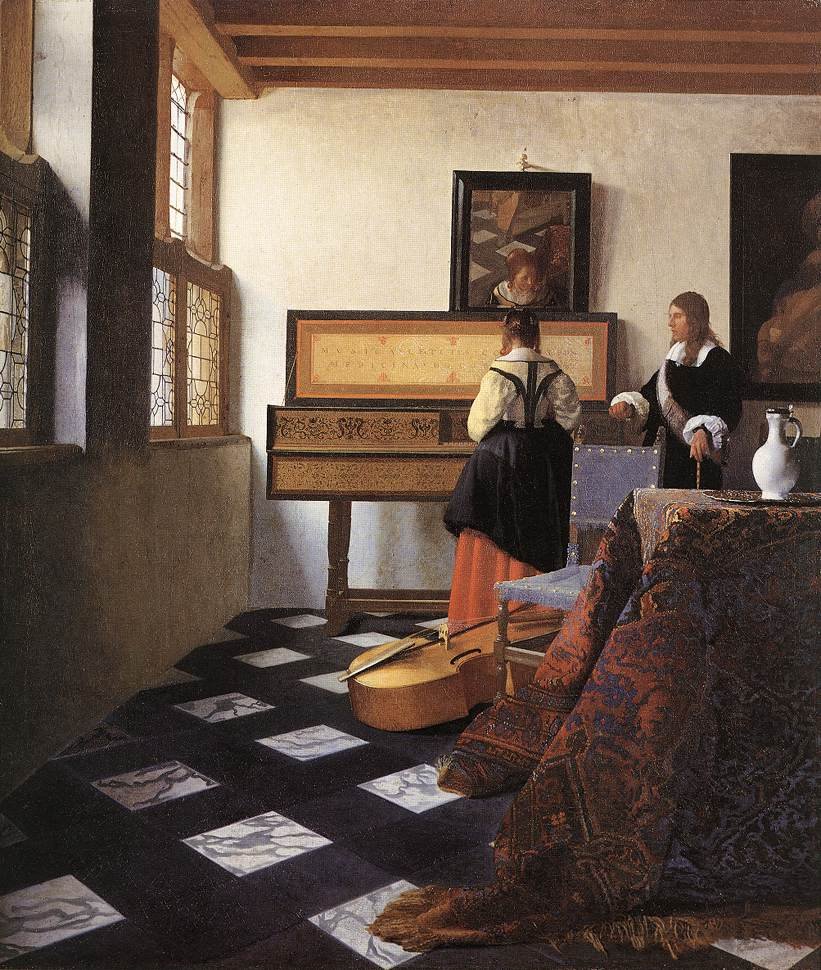
A Lady at the Virginals with a Gentleman by Johannes Vermeer

A Lady at the Virginals with a Gentleman by Johannes Vermeer (c. 1664)

The Dulwich Picture Gallery has had an unusual but ingenious idea for their two hundredth birthday celebrations.  They wanted to do something which would reflect the importance of the building and the beauty of their collection as well as reflect Gallery’s unique place in the history of museums in England and the world.  They have what they term the “Masterpiece a Month”.  It features  just one sensational work of art at a time, one a month, each a work of genius presiding as a kind of high altarpiece at the end of the main gallery.  These great works of art would be looked upon as a series of the most beautiful birthday cards for the Gallery.  To achieve this dream the director of the Dulwich Picture Gallery had to approach famous institutions and curators of private collections and ask to borrow one of their great paintings.

Today’s painting for today’s My Daily Art Display was the featured painting for March at the Dulwich Picture Gallery which was on display when I visited last week and is from a private collection – the Royal Collection of Her Majesty Queen Elizabeth II.  It had been acquired for the collection by George III in 1762.  It is Johannes Vermeer’s A Lady at the Virginals with a Gentleman, sometimes known as The Music Lesson.    Vermeer completed this oil on canvas work circa 1664.  When King George III acquired the painting it was thought to have been painted by Frans van Mieris the Elder due to a misinterpretation of the signature and this error was not rectified for another century when in 1866 the well-known art critic and Vermeer scholar, Théopile Thoré, conclusively proved the work of art to have been painted by the great Dutch artist Vermeer.  The artist’s signature, IV Meer (IVM in monogram), is along the lower edge of the frame on the extreme right.  More writing can be seen on the underside of the lid of the virginals:

MUSICA LETITIAE CO[ME]S /MEDICINA DOLORS[IS]

which translated means

“Music – companion of happiness / medicine for grief”

Porcelain pitcher

So what can we observe in this painting.  Light streams in through the windows on the left and fills the room.  The light emphasizes the texture of the objects such as the pile of the Oriental table covering, the small white porcelain pitcher on a silver plate and the brass studs on the blue chair.  Vermeer often depicted white porcelain jugs in his works of art. They usually contained wine, which was supposed to act as a love potion and help men seduce women.

The painting is characterised by the meticulous use of perspective which draws our eyes to the rear of the room where the figures are placed.  There is a young woman with her back to us, seated at the virginals, a keyboard instrument of the harpsichord family.  The instrument and the inscription are similar to those made by Andres Ruckers of Antwerp in the early part of the 17th century.  As we look at the painting, our eyes follow the line of perspective towards the people and we become aware of a table jutting out into our line of sight and on which is a multicoloured Oriental carpet covering.  Just behind it is a chair covered with a light-blue fabric and on the floor lies a discarded honey-coloured viola da gamba, which was one of a family of bowed, fretted string instruments which first came to prominence in the 15th century and was used mainly in the Renaissance and Baroque period. 

Detail of man and woman at the Virginals

However all the activity is at the back of the room.  Vermeer has used the colour black and this immediately grabs our attention.  The colour is used to outline the virginals.  It is also used to frame the picture on the wall and this colour is utilised by Vermeer on the back of the lady to draw the tailored lines of her bodice and acts as a stark contrast with the inlay that embellishes the front of the instrument, the red of the lady’s dress and light-blue of the chair.  The most startling use of black is in the patterned floor design.

We, the viewers, have been moved back by this use of perspective.  We almost feel we are interlopers or eavesdroppers on this private scene.  Take a look at the mirror on the wall.  We see the reflection of the woman’s face and shoulders as she turns towards the man. Her reflection is slightly out of focus and diminished in scale reflecting the optical effects of a mirror which is a sign of Vermeer’s observational skills.  However some art historians believe that this could also be due to the fact that Vermeer may have used a camera obscura.     We can also see part of the table and the legs of the artist’s easel and a box which we assume contained the artist’s paints (or the camera obscura?).    From this we pick up the inference that Vermeer is part of this scene although, like us, he is standing back from the space occupied by the two main proponents. 

On the back wall,  to the right of the mirror is the painting Roman Charity (Cimon and Pero) by Dirk van Baburen.  It was known that this painting was at one time owned by Maria Thins, the mother-in-law of Vermeer.

Who are these two people?  Teacher and pupil?  Lovers sharing a musical interlude?   Simply fellow musicians?   Who knows what their relationship is but as there are two musical instruments in the room and an empty chair we can deduce that they are fellow musicians and he is listening to her playing and who knows, maybe he is accompanying her playing with a song.  Observe the man’s facial expression.  It is a rapt and loving expression and I am hazarding a guess that there is “love in the air”.   The association between music and love as a theme was often used by Dutch 17th century artists.  The fact that we have two instruments in this picture probably signifies that at one time this was a musical duet and this represents the emotions of the two people.

If you needed to have another reason for visiting the Dulwich Picture Gallery other than to view their magnificent permanent display then this bi-centennial idea of having one additional masterpiece per month is a winner.  The next Masterpiece a Month will be in April and is The Vision of Saint John by El Greco.

River Landscape with Horseman and Peasants by Aelbert Cuyp

River Landscape with Horseman and Peasants by Aelbert Cuypt (Late 1650's)

 My Daily Art Display today is a return to landscape painting and a revisiting of the Dutch artist Aelbert Cuyp.  The last time I offered you a painting by this great artist was over a month ago (February 8th) when I talked about a seascape of his.  Today I want to look at one of his many landscapes entitled River Landscape with Horseman and Peasants, which he completed in the late 1650’s and can now be found in the National Gallery, London.

This talented Dutch Italianate painter was born in 1620 in Dordrecht, a city in the Netherlands. He is one of the country’s most important landscape painters of 17th century.  This was the time of the Dutch Golden Age – a time when the local trade, science and art were recognized throughout the world.   Looking at a number of Cuyp’s landscape paintings, it is thought he may have spent time in Italy or he may simply have mixed with other Dutch Italianate landscape painters who had made the artistic pilgrimage. Throughout the 17th century a steady flow of Dutch painters made the difficult and strenuous journey to Italy, which was recognized as the “home of art.”   Here artists of other nationalities studied the great masters of the Renaissance and the contemporary painters of the Baroque genre.   The Dutch at this time  were enchanted with Italy  and landscapes of the Italian countryside.  They loved everything about the country.

Cuyp painted still lives, animals, portraits, and landscapes and worked in two distinct styles. In his early twenties he came under the influence of other artists and he tended to paint naturalistic, diagonal compositions that show a good sense of space and an almost monochromatic yellowish-gray colour. It wasn’t until he was in his thirties and forties that he exhibited a more individualistic style.  This was considered his best period.   Cuyp’s paintings are sunny and lively in atmosphere, profound in tonalities, simple in outline, well-balanced in composition, and notable for the large, rich foreground masses. His palette tends largely to yellow, pinkish red, warm browns, and olive green rather than blue and silver grey.

Today’s painting by Cuyp is looked upon as one of the greatest 17th century Dutch landscape paintings.   It is also believed to be the largest surviving landscapes of the Dordrecht artist and I believe one of his most beautiful. This river landscape with its distant mountain and town across the river is not topographically accurate.  It is not a painting of an actual location but a work of art which encompasses an evocation of an idyllic pastoral land bathed in sunlight, populated by a hunter, an elegant rider and some peasants tending the sheep and cattle. 

The elegantly dressed horseman surveys his animals and the peasants who are in charge of herding them.  This harks back to the feudal past and it is probable that the painting was for some rich landowner or member of the nobility who liked to be reminded of those “happy” days.  It is a very serene setting.  However, in the foreground to the left we spot a huntsman crouched down behind the reeds taking aim at the ducks, which are on the water, unaware of their coming fate.  Very soon the tranquility of the scene will be shattered by the deafening sound of gun fire.

Look how the riverbank is suffused in soft sunlight.  It lights up the animals and people as well as the fauna.  The cows cool themselves by resting quietly under the shadow of the trees.  The characteristic of this light is symptomatic of the Dutch Italianate artist’s approach to landscape painting where the artist turned to the Italian campagna for their subject matter with their glorious tonal control, mastery of colour and magical handling of light.  These Dutch Italianate artists would trek across the mountains to Italy and spend many days sketching the sun drenched Italian landscapes which were so different to the flat openness of their homeland with its often cloudy skies.   Cuyp’s landscape is truly remarkable.  It was painted at a time when the taste of wealthy Dutch patrons combined with the artist’s imagination and the influence of Italy and the important cultural elements of the Netherlands came together.  This actual painting was acquired by the Earl of Bute in the mid 18th century and it lead to other British collectors wanting to get hold of the artist’s work.

Is this not the type of spring day we dream of after coming through the cold of a prolonged winter?   Could you not lie back on the river bank and let the sun gently kiss your skin.   Can you see why the Dutch wanted to buy this little piece of heaven ?