Marie Laurencin Part 2.

Marie Laurencin, Paris (c.1912.)

Marie Laurençin’s paintings dating from around 1910 have a strong flavour of cubism. However, she once again stated that although the experiments of cubism fascinated her, she was adamant that she would never become a cubist painter because she was not capable of it.

Bateau-Lavoir c. 1910

Laurençin spent a lot of time at Picasso’s open studio at the Bateau-Lavoir, (Laundry Boat) building at 13 Rue Ravignan at Place Emile Goudeau in Montmartre in the 18th arrondissement of Paris.  The building was so nicknamed as it was said to resemble the public clothes-washing boats moored on the Seine in the early years of the twentieth century. The ramshakle building was said to strain and groan when it was windy—just like the those laundry boats on the Seine. Here, Laurençin exhibited her work along with a group of artists known as the Bateau-Lavoir, which was the residence and meeting place for a group of outstanding artists and men of literature.  It was here that she met Max Jacob, the French poet, painter, writer, and critic, and André Derain, the French artist, painter, sculptor and co-founder of Fauvism.  She was also introduced to Gertrude Stein, the American novelist, poet, playwright, and art collector to whom she made her first sale in 1908.

Les jeunes filles (Jeune Femmes, The Young Girls) by Marie Laurençin (1911)

In 1911 Laurençin completed her painting entitled The Young Girls.  Marie Laurencin showed The Young Women at the Salon des Indépendants in Paris in 1911, alongside works by other artists painting in a similar style. The exhibition, which gave rise to the term “cubism”, caused a scandal but was also the breakthrough for Cubist art.  This work depicts four pale-skinned dark-eyed women with dark hair, independent of each other and yet overlapping.  They are all wearing  grey robes and stand against an abstracted pastoral backdrop. The female on the left is a violinist, playing music for the figure beside her, who dances. At the centre of the depiction we see a woman seated facing the dancer, but she turns her head to look back at us.  On the right, another woman appears in motion, carrying a bowl of fruit under her right arm and reaching down with her left hand to stroke the nose of a doe. All the limbs of the women have a fluidity which mirrors the drape of their dresses.   Their bodies are outlined with heavy black lines.  Laurençin has experimented with this depiction and artistic style. 
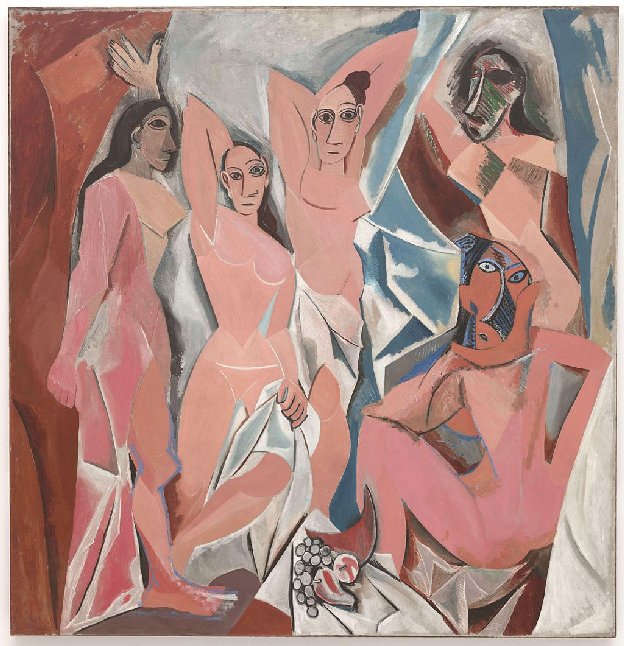
Les Demoiselles d’Avignon by Picasso (1907)

The posture of the four women with their flat, mask-like faces seems to have been influenced by her friend, Picasso’s 1907 painting Les Demoiselles d’Avignon.  In a way the work can be considered as a suggestion that the four women represent a fertile sphere of feminine creativity.  The presence of the doe is symbolic of femininity and naturalness that was a common theme in Laurencin’s work.  Critics believe the painting alludes to the of lesbian self-fashioning and as a celebration of an independent female realm.  The painting can be viewed at the Moderna Museet in Stockholm.

Portrait de jeune femme by Marie Laurencin

In 1913, Marie Laurençin’s mother died and this sad event coincided with her ending her relationship with Apollinaire, but this ending could have something to do with his reputation as a philanderer.   However, she would remain close to Apollinaire until his death, aged 38, in 1918. Her split from Apollinaire freed Laurencin of his Cubist influence, but at the same time, isolating her. On June 24th 1914, in Paris, Marie married Baron Otto van Wätjen, a German Impressionist and Modern painter whom she had first met as fellow students at the Académie Humbert.  

Marie Laurencin, Cecilia de Madrazo and the Dog, Coco by Marie Laurençin (1915)

In the Tate Britain, London, one can see the 1915 work by Laurençin entitled Marie Laurencin and Cecilia de Madrazo and the Dog, Coco.  Cecilia was an art collector friend of Maria.  Laurençin told a fellow artist that the painting was completed in 1915 while she and her husband were exiled in Madrid.  The girl wearing the hat is Cecilia de Madrazo, a young Spaniard, and the other figure is Marie herself wearing a pink dress with her dog poking up between them.  She had bought the dog from an English sailor at Malaga. Marie Laurencin was staying in Madrid with the Madrazos at the time.  Marie has depicted herself with short hair which covers her ears and forehead.  Although her skin is grey it is sharply in contrast with pink cheeks and lips and black eyes which are focused downwards.  Cecilia is fascinated by the dog.  She stares down at it and pushes a finger towards its very long snout. Cecilia’s skin is almost white, with pink lips and cheeks.  She is wearing a grey dress and has a white hat, with a large blue bow, atop her dark hair. The backdrop, almost without detail, is grey and there is a pink curtain at the right edge of the painting; the colour scheme is very limited, with Laurencin utilising only grey, pink, blue and very small amounts of beige. This painting is representative of Laurencin’s work, which has been both appreciated and criticised for its deliberately feminine aesthetic.  Marie’s palette concentrated on  pastel colours. The two figures depicted add a sense of peace and charm and they own the conventional female virtues of loveliness, sophistication and meekness. Laurencin’s unapologetic embrace of visual pleasure and the way she developed an aesthetic that acclaimed female softness, elegance and sweetness was itself a radical position. Laurencin’s painting has depicted such qualities as part of a creative process in which a masculine form is utterly unnecessary, and in a way it is a presentation of a work in which both artist and subject are female.   

The Fan by Marie Laurencin (1919)

In 1919 Laurencin completed her painting entitled The Fan and this, like the previous work, is part of the Tate Britain, London collection.  The painting was purchased by Gustav Kahnweiler, an art dealer, as a gift for his wife, Elly.  He and his wife amassed a modest art collection focused on Cubist paintings, sculptures, and works on paper. After the couple moved to England in the 1930s to escape Nazi persecution, Gustav and Elly loaned and gifted works from their collection to the Tate.  It is believed that the woman in the oval frame is Laurencin herself but the identity of the other woman is unknown.  The fan, which was a symbol of vanity, was one of Laurencin’s favourite accessories. The painting depicts a pink shelf that holds two images of women, one in a rectangular frame and the other in a round frame, against a pink and grey background. The portrait to the left, in the larger, rectangular frame, shows a woman and a dog in greyscale, accentuated by a pale blue ribbon, hat and curtains.  Next to it is an oval frame at the centre of the painting depicting a woman reputed to be Marie Laurencin herself, though it is unclear if this is a portrait or indeed a mirror. The lower right corner of the painting is dominated by the folds of a fan, painted in grey and white, that is cut off at the canvas’s edge.  Laurencin has cleverly depicted the fan in a position that could be seen as being held by someone who is staring at the two frames on the shelf.  The two portraits in the frames on the shelf are positioned such that the figures appear to look out towards us but also towards the person holding the fan.  There is an air of mystery about the depiction and the identities of the figures.  Some believe that the woman in the rectangular frame is Nicole Groult, a dressmaker with whom Laurencin is likely to have had a romantic relationship.
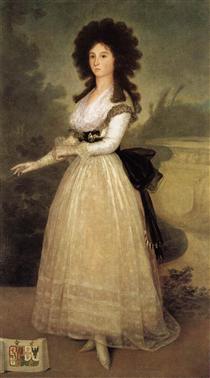
Dona Tadea Arias de Enriquez by Goya (1793)

Once married to Otto van Wätjen, Laurencin automatically lost her French citizenship and so took up German citizenship. She and her husband moved to neutral Spain at the beginning of the First World War in order to avoid France’s anti-German sentiment.  Here, Laurencin became involved with the Dada movement, editing the art and literary magazine 391, a Dada-affiliated arts and literary magazine created by Francis Picabia.  She also spent time looking closely at the work of Francisco Goya, whose dignified, dark-eyed women captivated her.

Simultaneous Windows on the City by Robert Delaunay (1912)

During this period in Spain she became great friends with Sonia Delaunay and Robert Delaunay, who had similarly left France to avoid the War.   Robert was an artist of the School of Paris movement, who, with his wife Sonia Delaunay and others, co-founded the Orphism art movement, noted for its use of strong colours and geometric shapes.

……to be continued.

Nettie Blanche Lazzell

Blanche Lazell during her time at the Art Student League, New York

Cornelius Carhart Lazzell, a direct descendent of pioneers who settled in Monongolia County, West Virginnia, after the American Revolutionary War, married Mary Prudence Pope and the couple went on to have ten children, three sons and seven daughters.  The ninth child was Nettie Blanche Lazzell who was born on October 10th 1878 and it is she who is the subject of today’s blog. 

The Lazzell family, who were devout Methodists, lived on a large farmstead near Maidsville, West Virginia, which lies close to the Pennsylvania border.  The town was thought to have been named Maidsville on account of there being a large proportion of “old maids” among the first settlers !  Her education during her early days was at the one-room schoolhouse on the property where students from the first through to eighth grades were taught from October through February.

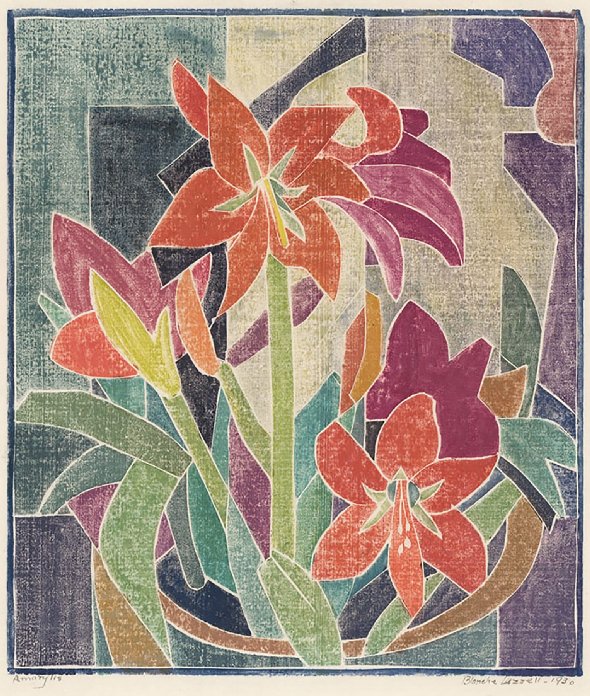
Amarylis by Blanche Lazzell (1930)

In 1891, when Blanche was just twelve years old, her mother died, aged 48. In her early teens Blanche experienced hearing problems and became partially deaf and it was not until a year later that a Baltimore doctor was able to remedy her illness.  In 1893, at the age of fifteen, Blanche enrolled at the West Virginia Conference Seminary, which is now the West Virginia Wesleyan College.  From there, in 1899, she transferred to the South Carolina Co-Educational Institute in Edgefield. Once she graduated from the Institute, she became a teacher at the Red Oaks School in Ramsey, South Carolina. In spring of 1900, she returned to her Maidsville home, where she tutored her younger sister, Bessie.   In 1901, she studied art at West Virginia University and did well, receiving a degree in art history and the fine arts in 1905.  She continued to study at WVU on a part time basis until 1909, allowing her to broaden her knowledge of art and twice substituting as a painting teacher.

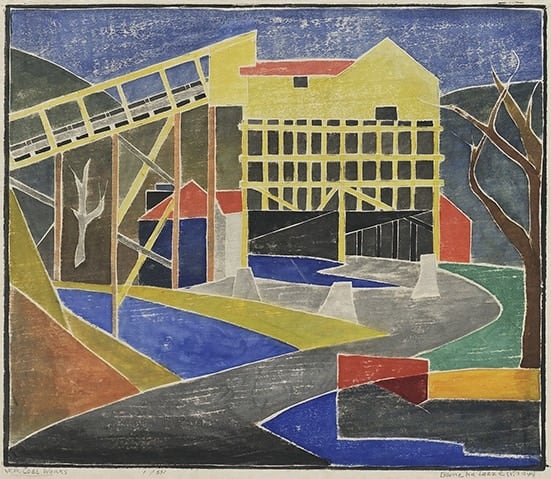
West Virginnia Coal Works by Blanche Lazzell (1949)

In 1908, at the age of thirty, she moved to New York and enrolled at the Art Students League.  The League had been formed in 1875 to provide more variety and flexibility in education for artists than it was felt the National Academy of Design provided. This breakaway group of art students included many women, many of whom, in the late 1890s and early 1900s, took on key roles. In Marian Wardle’s book: American Women Modernists: The Legacy of Robert Henri, 1910-1945. She recounts the words of the American artist Edith Dimmock regarding the atmosphere at the Art League:

“…In a room innocent of ventilation, the job was to draw Venus (just the head) and her colleagues. We were not allowed to hitch bodies to the heads——yet. The dead white plaster of Paris was a perfect inducer of eye-strain and was called “The Antique.” One was supposed to work from “The Antique” for two years. The advantage of “The Antique” was that all these gods and athletes were such excellent models: there never was the twitch of an iron-bound muscle. Venus never batted her hard-boiled egg eye, and the Discus-thrower never wearied. They were also cheap models and did not have to be paid union rates…”

During her time at the Art League Blanche studied under Kenyon Cox and William Merritt Chase and one of her fellow students was Georgia O’Keeffe. 

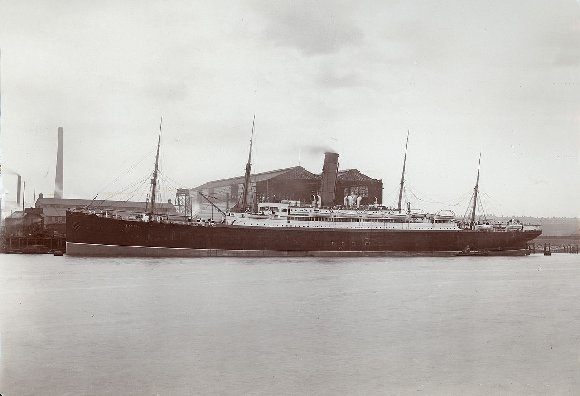
SS. Ivernia

On July 3rd 1912, Lazzell set sail on an American Travel Club cruise on the Cunard liner SS Ivernia, crossing the Atlantic and arriving in England. From there Blanche visited the Netherlands, Belgium and Italy.  She was fascinated by the architecture of the various churches she visited.   

Sailboat by Blanche Lazzell

In August she left the tour party and travelled to Paris.  She then stayed in a pension in Montparnasse on the Left Bank.  She moved into the Students’ Hostel on Boulevard Saint-Michel, one of the two major streets in the Latin Quarter of Paris, running alongside the Luxembourg Gardens.  During her stay in the French capital, she took lessons at the Académie de la Grande Chaumière, Académie Julian, and Académie Delécluse.  She eventually established herself at the Académie Moderne where her tutors were the post-impressionist painters Charles Guérin and David Rosen.  Of all the art tuition she received in Paris she was the most contented with the ideas and techniques behind the Parisian avant-garde art, a genre which pushed the boundaries of ideas and creativity, which she learnt about at the Académie Moderne.

The Monongahela River at Morgantown by Blanche Lazzell (1939)

Blanche returned to America on the White Star passenger liner, SS Arabic, at the end of September 1913.  On her return to America Blanche went to live with her younger sister Bessie in Morgantown.  During her European travels Blanche built up a portfolio of sketches and paintings enough for her to have a solo exhibition in December 1914.  To make ends meet, she rented a studio in town and taught art as well as selling her hand-painted chinaware.

Byrdcliffe Artist Colony

Byrdcliffe Artist Colony

In the summer of 1917, Blanche spent time at the Byrdcliffe Arts Colony, an artists’ colony just outside Woodstock, New York.  The Byrdcliffe Art Colony was founded by Jane Byrd McCall and Ralph Radcliffe Whitehead and colleagues, Bolton Brown, an artist and Hervey White, a writer.  The name of the colony came from an amalgamation of Jane and Ralph’s middle names.  It was founded in 1902 and the complex was formed of a number of Arts and Crafts cottages.  It was there that visual artists, poets, and musicians found their muses and spent time creating works of art, music and poetry. In later times famous people, such as Bob Dylan, writer Thomas Mann, and even famous actors, Helen Hayes, and Chevy Chase, spent time at Byrdcliffe.  Blanche studied under the Belgian-born artist William Schumaker who whilst in Paris had come into contact with European avant-garde artists.  On his return to America he brought with him modernist principles.  The term modernism in art was a rejection of history and conservative values such as realistic depiction of subjects; it was an innovation and experimentation with form, that is to say, the shapes, colours and lines that make up the work have a tendency towards abstraction.  From 1913 to 1931, Schumaker was artist-in-residence at the artists’ colony at Byrdcliffe.

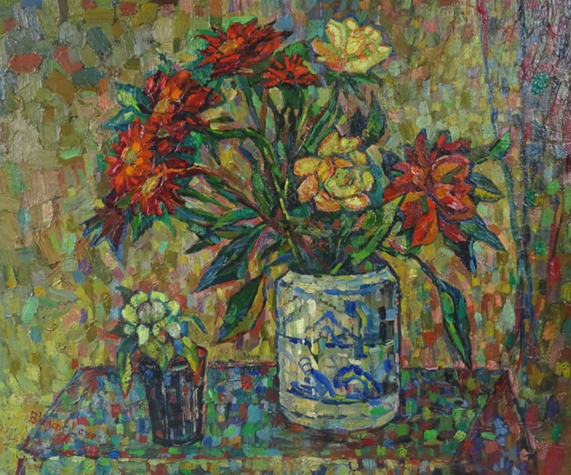
Still Life by Blanche Lazzell

In 1918 Blanche Lazzell left Morganstown and moved permanently to Provincetown, which is situated on the northern tip of Cape Cod, Massachusetts, a place she had previously visited in 1915.   She made the town her summer base while wintering back in Morganstown and Manhatten. 

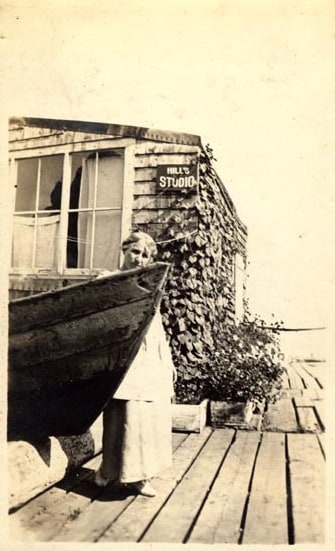
Blanche Lazzell outside her Fish House studio, Princetown

She purchased an old fish house which overlooked the harbour of Provincetown and converted it into her studio.  She immersed herself into the local art scene and became a member of the Provincetown Art Association and the Sail Loft Club, Provincetown’s women’s art club.  She also became involved with the Provincetown Printers, a group of artists, most of whom were women, who created art using woodblock printing techniques.  It was a refuge for artists and a lively hub of experimentation and innovation. It became known as Princetown Print.  It was a white-line woodcut print, but it differed from woodcut printing as rather than creating separate woodblocks for each colour, one block was made and painted. Small groves between the elements of the design created the white line. In the main the artists often used soft colours, so that the finished product sometimes had the appearance of watercolour paintings.  Recalling her first summer at Provincetown, Blanche Lazzell fondly remembered her time there saying:

“…Hundreds of American artists who had been living in Europe before the first World War flocked to Provincetown. This quaint old seaport town, famous for the first landing place of the Pilgrims, was already an art colony…To be in Provincetown for the first time, in those days, under ordinary conditions was delightful enough, but that summer of 1915, when the whole scene, everything and everybody was new, it was glorious indeed–”

Untitled Abstract work by Blanche Lazzell

Lazzell returned to Paris in 1923 and studied with both Fernand Léger, Andre Lhote and Albert Gleizes, who was said to be one of the founders of cubism. By 1925, Blanche had mastered the static and shuffled planes of Synthetic Cubism, to which she added her own distinctive colour palette and elegant receptivity. Blanche defined Cubism as:

“… the organization of flat planes of colour, with an interplay of space, instead of perspective…”

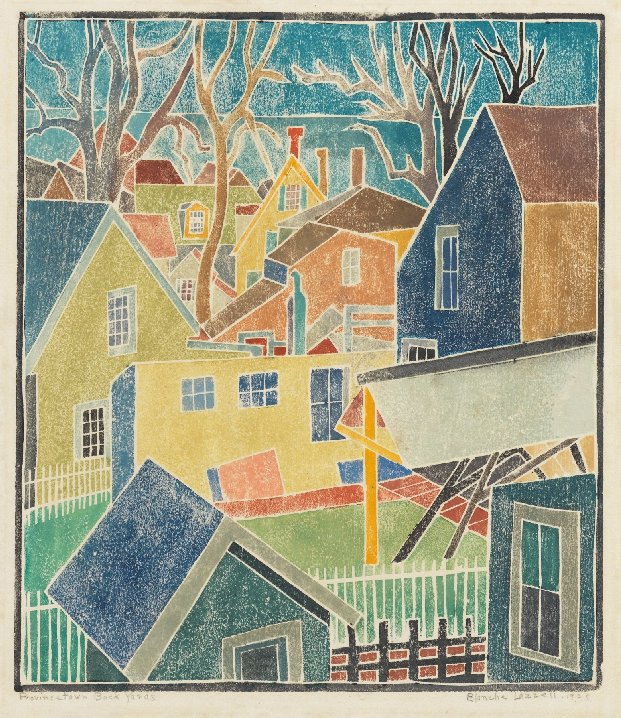
Princetown Backyards by Blanche Lazzell

This was a style which was excellently suited to her woodcuts and often mirrored the angular patterns of the Provincetown houses, rooftops, and wharves which are depicted in many of her woodcut prints.  It is also interesting to note that Lazzell was a passionate gardener, and images of flowers often featured in her work but even these images, although based on direct observation, were changed into recurrent interactions of abstracted shapes.

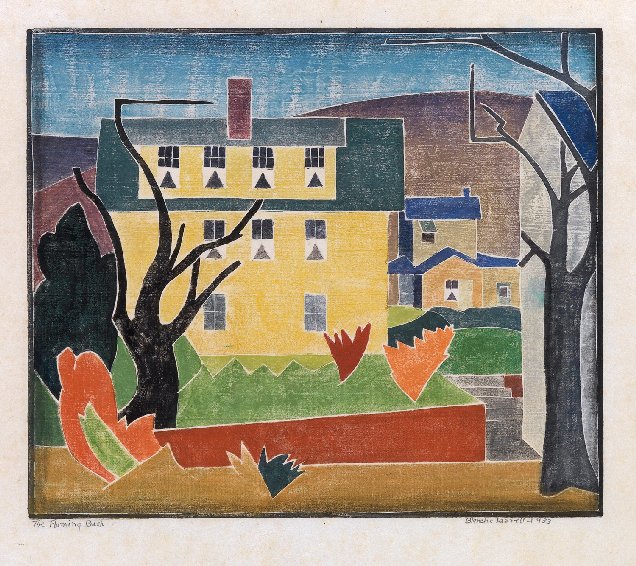
The Flaming Bush by Blanche Lazzell (1933) At auction it realized $87,500.

Blanche’s younger sister Bessie gave birth to a son, in August 1924 and Blanche decided to return to Morganstown to help her.  Lazzell also became a mentor and role model for her niece, Frances Reed, the daughter of her sister Myrtle.   Blanche eventually returned to Princeton in 1926 and one of her first tasks was to pull down her previous studio, the Fish House, as it was getting too cold in the winter months due to the numerous drafts.

The Violet Jug by Blanche Lazzell

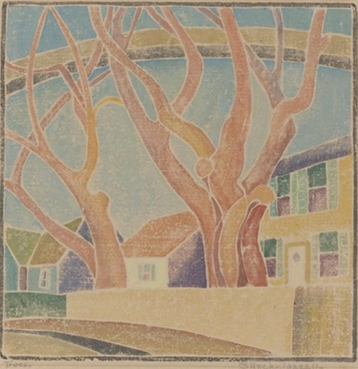
Trees by Blanche Lazzell (c.1930)

In 1928 she was invited to be on the board of directors of the international art group, Société Anonyme. Lazzell later joined the New York Society of Women Artists and the Society of Independent Artists. In the 1930s, Blanche took part in an exhibition called Fifty Prints of the Year where she exhibited her compositions The Violet Jug and Trees.

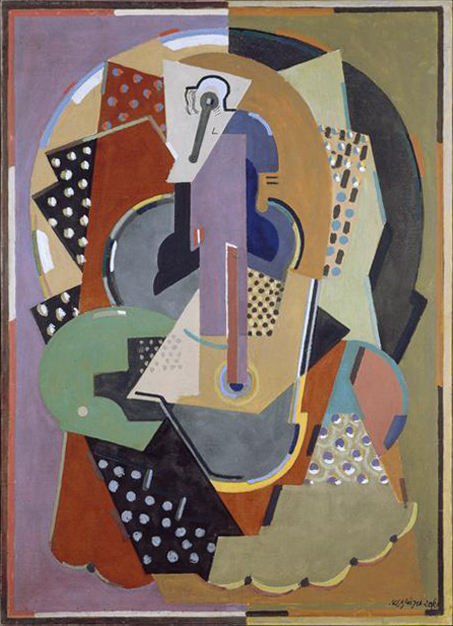
Ecuyère (Horsewoman) by Albert Gleizes (c.1923)

Around the same time she produced a number of pure abstract compositions which shows the influence of Albert Gleizes.

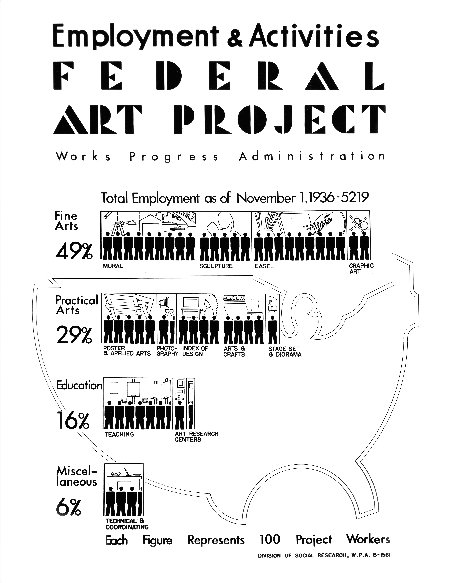
In 1934, America was in the midst of the Great Depression and Blanche Lazzell was one of two West Virginian artists who received Federal Art Project grants through the Works Progress Administration.  This was due to the American government which hired hundreds of artists who collectively created more than 100,000 paintings and murals and over 18,000 sculptures to be found in municipal buildings, schools, and hospitals in all of the 48 states. President Franklin Roosevelt sought to put as many unemployed Americans as possible back to work and to buoy the morale of the citizens. Some of the 20th century’s greatest visual artists were employed by the FAP, along with many nascent Abstract Expressionists.

Blanche Lazzell on her porch of her Provincetown studio, 1942

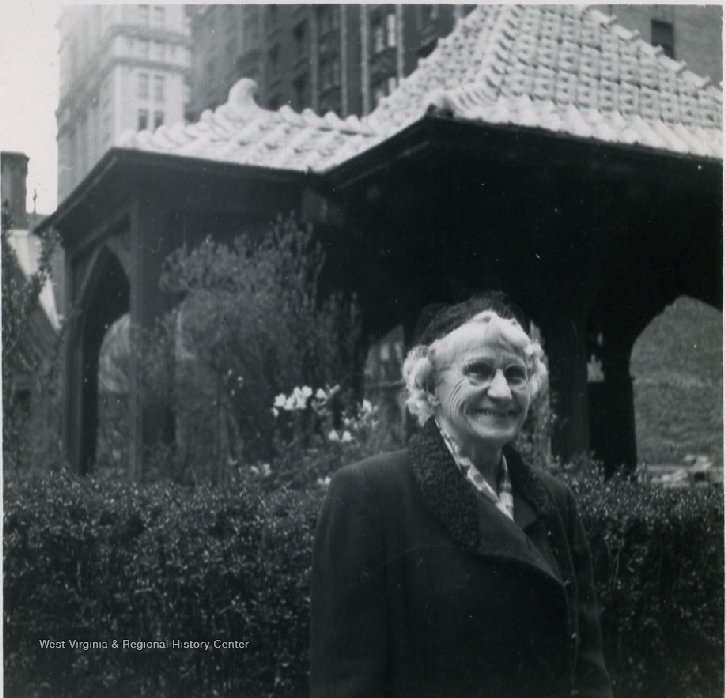
Blanche Lazzell outside Little Church around the Corner, New York

In May 1956, Blanche Lazzell’s health began to fail and she was taken to a hospital with a suspected stroke.  Lazzell died on June 1st 1956 and she is buried next to her father in Bethel Cemetery in Maidsville.  She was aged 77.

I and the Village and The Birthday by Marc Chagall

I and the Village by Marc Chagall (1911)

Having just completed my four part look at the quartet of Scottish Colourists I am turning to a painter from the same era but one who could not be more different in style.  For my blog today I want to look at the early life of and two fascinating paintings by the Russian-Jewish artist, Marc Chagall.  He was a painter of poetic, surreal images that to him, represented a topsy-turvy world, combining fantasy and spirituality with a modernist style

house
Chagall’s family home in Vitebsk

 Marc Chagall, a name he did not use until 1915 when he arrived in Paris,  was born Moishe Segal on the 7th of July 1887 in the small Jewish shetl of Liozna part of the town of Vitebsk, which was in the Russian Empire but now is situated in Belarus.   He was the eldest of nine children born into a Hasidic Jewish family.  His parents led a simple yet spartan life.  His mother Feige-Ite ran a small grocery shop from their home.  His grandfather worked as a teacher and a cantor in a local synagogue and had secured a position for Marc Chagall’s father as a clerk at a wholesale herring merchants but in Marc Chagall’s autobiography, My Life, he criticised his grandfather for his father’s placement and derided the job description of “clerk”.  He wrote:

“…My grandfather, a teacher of religion, could think of nothing better than to place my father – his eldest son, still a child – as a clerk with a firm of herring wholesalers, and his youngest son with a barber. No, my father was not a clerk, but, for thirty-two years, a plain workman. He lifted heavy barrels, and my heart used to twist like a Turkish pretzel as I watched him carrying those loads and stirring the little herrings with his frozen hands……Sometimes my father’s clothes would glisten with herring brine. The light played above him, besides him. But his face, now yellow, now clear, would sometimes break into a wan smile…”

 Chagall would always remember those early days of hardship and how hard his father worked to provide for his family.  In his 1922 autobiography, My Life, Chagall recalled those difficult times:

 “…Day after day, winter and summer, at six o’clock in the morning, my father got up and went off to the synagogue. There he said his usual prayer for some dead man or other. On his return he made ready the samovar, drank some tea and went to work. Hellish work, the work of a galley-slave. Why try to hide it? How tell about it? No word will ever ease my father’s lot… There was always plenty of butter and cheese on our table. Buttered bread, like an eternal symbol, was never out of my childish hands…”

 As a young child, Chagall went to the local heder, an elementary Jewish school in which children were taught to read the Torah and other books in Hebrew. Later he transferred to the local secular secondary school and it was here that young Chagall started to show an interest in art.  The fact that he, as a Jew, was allowed to go to the local secular school was in itself rather unusual as according to government dictates at the time, Jewish children were not allowed to study at secular schools.  In 1906 when Marc was nineteen years of age and with help from his mother, and despite his father’s protests, he enrolled at a private school of drawing, Artist Pen’s School of Drawing and Painting run by Yethuda Pen.  Yethuda Pen was a talented Jewish artist and art teacher and one of the outstanding figures of the Jewish Renaissance in Russian and Belarusian art.   Chagall remembers the day he first cast his eyes on the school and how it impressed him.  He recounted the time in his autobiography:

“…I learned about Pen when I was riding on a streetcar.  It was crossing the Cathedral Square and I saw a banner – white letters on blue: Artist Pen’s School. ‘What a cultured city is our Vitebsk,’ I thought...”

Later, in 1921, Chagall told his former tutor, Penn, about the day he first entered the college, accompanied by his mother, for an interview for a place on Penn’s art course and how nervous he was.  He wrote:

 “…I recall how, as a boy, I climbed the steps of your studio. And the tremor with which I awaited you: you were to decide my fate in my mother’s presence. I know how many other young boys in Vitebsk and the entire gubernia [administrative district] had their fates decided by you. For dozens of years your studio was the first to lure people in town… You have trained a vast generation of Jewish artists…”

He remained only a few months at Penn’s art school and in 1907 with little money, he left Vitebsk and headed for Saint Petersburg.  Chagall had already seen and felt the full force of the anti-Semitic Russian laws in his home town but they paled into insignificance compared to the discriminatory policies against Jews in Saint Petersburg.  However for Chagall these legal hardships and the fact that he had little money to live on, was of little consequence as he was now able to immerse himself in the whirlpool of artistic life.  These were also revolutionary times and the revolutionary mood of the Russian people against their Tsarist ruler could be seen in every-day life, through avant-garde magazines and art exhibitions which pioneered new and modern western art.  The art world was waking up to the new art of the French Fauves, the German Expressionists and the Italian Futurists.  This was an exciting time for the young Russian artist, Chagall, and this new art would greatly influence him.  Although he absorbed this new art and knew about the various artistic groupings, he was his own man and he wanted to stand alone and create his own unique artistic style.  The one thing Chagall was determined about was that he would never ever forget his childhood background and the people of Vitebsk.  He would never forget his family’s or his poor but happy upbringing and the family’s lowly status.  He would never forget the hand to mouth existence and the importance of the land and the farms that provided food for its people.  He would never forget the onion-shaped cupolas of the churches, the wooden houses with the grass roofs which helped insulate them.  His home town of Vitebsk was tattooed on his very heart and he would always remember it in his art with great affection.

Whilst living in St Petersburg Marc Chagall earned a living by working at the editorial office of the Russian-Jewish periodical, Voskhod.   He also carried on with his artistic studies first at the school of the Society for the Encouragement of Art Society of Art Supporters where he studied under the Russian painter and stage designer Nikolai Roerich and the following year he enrolled as a student at the Yelizaveta Zvantseva’s School of Drawing and Painting where one of his teachers was the great Russian artist and costume designer Leon Bakst.  Bakst had lived in Paris from 1893 to 1897, where he studied at the Académie Julian, and he would eventually persuade Chagall to head for the French capital, the then art capital of the world,  so as to best continue his artistic studies.

Bella Rosenfeldcourtesy of http://www.marcchagallart.net/
Bella Rosenfeld

In 1909, Chagall met Bella Rosenfeld who lived in his home town and had been visiting friends in St. Petersburg.   It was love at first sight and within a short time they had become engaged.   Although both Marc and Bella were from Vitebsk, their social worlds could not have been more different and for that reason Bella’s parents were very unhappy with the liaison.  Bella’s parents, Shmule and Alta Rosenfeld were extremely wealthy and ran a very successful jewellery business back in Vitebsk and had managed to put Bella through the best education culminating at the University of Moscow.  She was particularly interested in the workings of the theatre and in art, and whilst studying at university, she contributed articles to a Moscow newspaper.  Chagall’s love for Bella, who became his wife in 1915, was deep and enduring and in his autobiography he wrote with passion about his true love:

“… Her silence is mine, her eyes mine. It is as if she knows everything about my childhood, my present, my future, as if she can see right through me; as if she has always watched over me, somewhere next to me, though I saw her for the very first time. I knew this is she, my wife. Her pale colouring, her eyes. How big and round and black they are! They are my eyes, my soul…”

In 1910, Chagall held his first solo exhibition, which was in the editorial office of the St Petersburg avant-garde magazine Apollon.  One of the visitors to the exhibition was Maxim Vinaver, a lawyer and deputy of the State Duma.  Vinaver, who was one of the outstanding figures in Russian Jewry of his time. He played a distinguished role as a Jewish communal leader, as well as one of the leaders of the Liberal Cadet Party. He was always a champion of the Jewish cause and as a deputy in the Russian Duma, Vinaver organized the Society to Secure Equality for the Jews in Russia.  Impressed by the talent of Chagall, he became his patron and gave him a monetary scholarship and with this financial assistance Chagall was able to go to Paris to carry on his artistic studies.  It was on arriving in the French capital that Moishe Segal adopted the French-sounding pseudonym, Marc Chagall.

I will leave the life story of Marc Chagall at this stage of his life and return to it in a later blog but for now I want to look at two of his paintings.  The first painting, and one of his most famous, is entitled I and the Village, which he completed in 1911, whilst living in Paris.  It is currently housed in the Museum of Modern Art in New York.

The painting on first sight is, like many of his works, unfathomable and one has to look carefully at all the elements depicted to try and understand what was going on in Chagall’s mind as he put brush to canvas.  It is a dream-like image with many overlapping elements.  This lively composition and the geometrical structures, such as lines, angles, triangles, circles, and squares clearly displays aspects of Cubism.  Some would have us believe that Chagall’s assortment of large and small circular forms are meant to depict the sun’s revolution within our solar system as well as the earth’s revolution around the sun, and the moon’s revolution around the earth. The moon being in the lower left of the painting is causing an eclipse of the sun.  However, maybe like me, this cosmic interpretation of the painting is possibly a step too far!

It is a collage of various objects.  It portrays the artist’s memories of the Hasidic Community of Vitebsk in which he was brought up, a peasant community, which relied heavily on the land and their animals for food. There are human and animal elements in the work which are both fragmented and randomly assembled to produce an abstract composition. The colours Chagall uses are vibrant and he has produced a severe contrast between the red, the green and the blue which he has liberally used.

Let us look more closely at the work and see if we can unravel the meaning of some of its elements.  If you look at the top right hand corner of the work you can make out a small town.  There is a church with its onion-shaped cupola and some brightly coloured houses some of which are upside down.   This inclusion, as he did in many of his works, is probably Chagall’s home town of Vitebsk and the fact that some of the houses are upturned could well be his way of illustrating that it is his town as visualised by him in his dream.  In front of the row of houses is man dressed in black with a scythe over his shoulder, presumably returning home after a hard day’s work in the fields.  In front of him is an upturned woman.   The woman, according to some descriptions is playing a violin.  However although people playing violins feature in many of Chagall’s works I beg to differ as far as this woman is concerned.  I have studied pictures of the painting, inverted it to see her better, and have concluded she is simply a peasant woman swinging her arms as if dancing.  I will let you decide.  This dream-like depiction of the peasant woman whether a violinist or a dancer could be a reference to the importance that music and dance played for entertainment for the people of Chagall’s erstwhile small Jewish community.

eye contact
Eye contact

The two main elements of the painting are, on the right, a green-faced man wearing a cap and on the left an animal.   The green colour of his face is an example of Fauvism where the colour used is not the one we would normally associate with in reality.  On the left is the head of an animal, possibly a horse or goat or cow.  On its cheek Chagall has painted an image of smaller goat or cow being milked.  If you look carefully you will see Chagall has drawn a line between the eye of the man and the eye of the animal and this probably refers to the close relationship, the inter-dependence between a peasant and his animal – a kind of “seeing eye to eye”, understanding the important relationship between man and beast.  The man, who wears a cross around his neck,  clutches hold of a small flowering branch, the seeds from which seem to be scattering, which could allude to the sowing of seed in the ground.

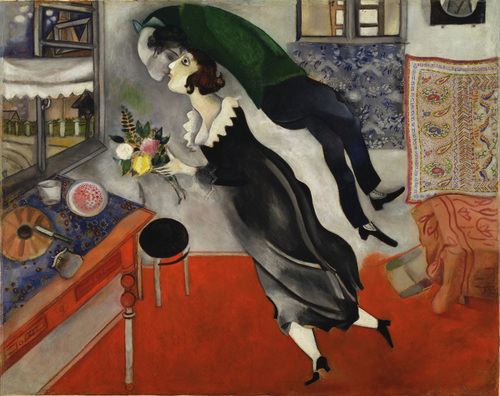
The Birthday by Marc Chagall (1915)

The reason why I chose Chagall for my blog today was because it was Valentine’s Day and I wanted to feature a painting which in some ways was the essence of true love between two people.  I could have gone for The Kiss by Gustave Klimt or Francesco Hayer or some other erotic and sensuous painting but I came across the painting by Chagall entitled Birthday and in a way it said everything to me about the love between two people.   Chagall painted the picture in 1915,  the year he married his beloved Bella Rosenfeld.  For Chagall his relationship with her was everything he could have wanted and I believe the couple in the painting are Marc and Bella.

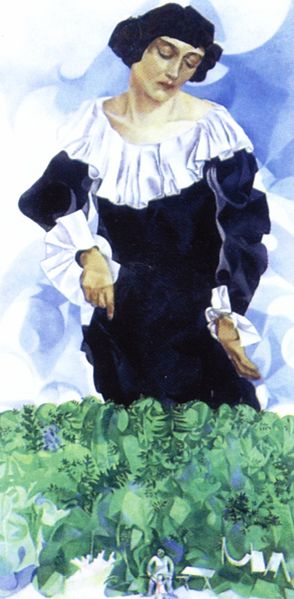
Bella with White Collar by Marc Chagall (1917)

Chagall painted Bella in many of his works and I believe this is one of them.  The painting depicts the man and the woman.  Although the woman’s face is clearly defined the man’s face is somewhat of a blur.   In the work we see them both seemingly elevated by their love for each other.  For them it was possible to float above the reality of the world and just enjoy each other’s company.  Look at the feet of the man and the woman.   They seem to be pointing in opposite directions.   Maybe he has given her the bunch of flowers and has walked past her but realises that the flowers without a kiss is not enough and so he literally bends over backwards to please his loved one by offering up a kiss.  She holds the flowers that he has given her and purses her lips in readiness for his kiss but he has walked past her.  However before disappointment can set in he returns, lips ready to kiss his beloved girl!  What could be more romantic?  However there is much more to this work of art than the two lovers.  Look at the amount of detail Chagall has put into the painting.  See how he has depicted the seeds of the watermelon which lies on the counter, the exotically detailed Indian blanket which lies on the bed and the blue lace fabric which hangs below the window.

I end by wishing you all a Happy Valentine’s Day and hope that your loved one manages to bend over backwards for you !!!

The photo of Chagall’s home and Bella Rosenfeld were courtesy of http://www.marcchagallart.net/

La Lecture by Pablo Picasso

La Lecture by Pablo Picasso (1932)

Check your finances.  Have you a little spare money to buy yourself a painting ?  I know of a bargain to be had on February 8th.  It was only painted seventy nine years ago.  It is highly colourful.  Lots of yellows and greens and I am sure it would blend nicely with the colour of your lounge carpet or the fabric of your settee.  So how much spare cash have you got ?  Is that all ?  Sadly you will need a little more than that as you will probably have to come up with at least £18 million and some reckon the final figure could triple that.

My Daily Art Display offering today and the painting in question, which is due to come up at the Sotheby’s Impressionist and Modern Art Evening Sale in London this coming Saturday, is Pablo Picasso’s La Lecture.   The thing that fascinates me the most about this painting is the background story.  It was completed by Picasso in January 1932 in time for his exhibition at the Kunsthaus in Zurich,  entitled Picasso by Picasso: His first Museum Exhibition 1932, and is a portrait of his muse, Marie-Thérèse Walter, who it is said transformed the life of this great Modernist artist. This painting was among a series from the beginning of 1932, which introduced this young woman as an extraordinary presence in Picasso’s life and his art.

The story goes that the then forty five year old artist introduced himself to the seventeen year old girl outside a Paris Metro station.  On recounting the tale of the meeting, Marie-Thérèse said she remembered Picasso’s words as they came face to face:

“…I knew nothing – either of life or of Picasso… I had gone to do some shopping at the Galeries Lafayette, and Picasso saw me leaving the Metro. He simply took me by the arm and said, ‘I am Picasso! You and I are going to do great things together’…”

Today, I am sure we would think this bold introduction of the Spanish artist was simply a very cheesy chat-up line and would nowadays probably get a middle-aged man a slap in the face!   However for that forty-five year old man standing outside the Metro station in 1927 those words and his possible charm won over the young girl.  For in that year Marie Thérèse Walter became the secret lover of Pablo Ruiz Picasso and their relationship lasted eight years despite the artist still living with and still married, if unhappily, to his wife Olga Khokhlova, a Russian-Ukrainian dancer whom he  met whilst she was on tour with Diaghilev.

Their liaison was a closely guarded secret for many years for two main reasons.  Firstly, because of Picasso’s marriage to Olga and secondly, because of Marie-Thérèse’s age.  Their secret liaisons took place in a chateau  he had bought at Boisgeloupe, near Gisors.  His studio here was much larger than the one he had in Paris and it enabled him to create monumental plaster busts of Marie-Thérèse that were later depicted in several paintings.

La Lecture belonged to a group of paintings, painted by Picasso in January 1932 in anticipation of the major retrospective he was planning that June.  Today’s painting is Picasso’s depiction of Marie-Therese and it was the first time that she had appeared in one of his works.  Earlier paintings of his showed her features implanted discreetly in the background and it was this unconcealed portrayal of his mistress which led his wife to realise that there was another woman in her husband’s life.

Picasso’s lover and muse’s potent mix of physical attractiveness and at the same time her sexual naivety had an intoxicating effect on him and his rapturous desire for her brought about a number of compositions that are amongst the most sought after of his long career.  In 1935, Marie Thérèse Walter had a daughter with Picasso, Maria de la Concepión, called Maya.  Sadly for Maria-Thérèse, a year later in 1936, Picasso switched his affections to a new love, Dora Maar a woman he met when he was painting Guernica.  Marie-Thérèse left Picasso and took their daughter to live in Paris. 

Picasso died in April 1973 and four years later in October 1977, Marie-Thérèse committed suicide by hanging herself.  For the young seventeen year old who first met the Spanish painter life with him was almost certainly exciting and fulfilling but alas, like Picasso’s wife Olga, she was to suffer the humiliation and sadness caused by her lover’s unfaithfulness but for Marie-Thérèse life was just never the same again and life was not worth living without her elderly lover.