Madame Récamier by Jacques-Louis David, Francois Gérard and Magritte

My Daily Art Display today is about one woman and three paintings.  The woman in question was Jeanne-Francois Julie Adélaïde Bernard Récamier and she was a celebrated French beauty and some would say she was the most beautiful and graceful woman of her day.   Add brains, confidence and charms to this exquisite loveliness and you have as they said, the perfect woman.

She was born in Lyons in 1777.  Her father Bernard was a banker and when she was young she and her father moved to Paris.   At the tender age of fifteen she married Jacques Récamier a wealthy banker, some thirty years her senior.  Her residence in Paris was a place of rest for the distinguished men of the day. She was the perfect hostess.  She was witty, a great conversationalist and a natural beauty and the soirées she held at her salon attracted the most important politicians and literary figures.   Invitations to her salon were much in demand, as to be a guest at her house guaranteed one the best of food and drink and the company of the “great and good”.   The fact that you attended one of her gatherings meant that you had achieved social respectability.   She entertained the likes of Lucien Napoleon, the young brother of Napoleon Bonaparte, and painters such as Gustave Moreau and Jacques-Louis David.  Madame Récamier, who had a sweet disposition and was unspoiled by the constant homage she received, was extremely well liked.  Strangely, there was never a hint of scandal regarding all the men that came to visit her.

All was going well until her husband was ruined financially through the policies of  Emperor Napoleon whom he had bankrolled and because of this the visitors to her salon were sympathetic to her and her husband and her house became a home for people who wanted Napoleon’s reign to come to an end.  This led to the Récamiers being forced into exile on the orders of Bonaparte and they fled to Italy for their own safety.   Madame Récamier did not return to France until the fall of Napoleon in 1815.  Husband and wife returned to Paris and she re-opened her salon but further financial setbacks befell them in 1819 and she had to move to a small apartment and despite the downsizing she still was inundated with eminent writers and statesmen.

Even in old age and with little money Madame Récamier retained her popularity.  Her health began to fail and she became almost blind but despite that she never lost her attraction.  Juliette Récamier died of cholera in 1849 aged 72 and is buried in the Cimitière de Montmartre.

Madame Récamier by Jacques-Louis David (1800)

Let us look now at the first of my three paintings and for this we must go back to the year 1800 when the artist Jacques-Louis David, a frequent visitor to her salon, was asked to paint a portrait of Madame Récamier.   The painter who favoured the Neoclassical style was looked upon as the pre-eminent painter of his day.  He had the young twenty-three year old lady bedecked in a white empire-line sleeveless dress like a modern version of a vestal virgin.  We view her from a distance and so her face looks quite small.  It is thought that David wanted his painting to be not just a mere portrait but an ideal of feminine elegance and charm.  Her antique pose, the bare décor and light dress all epitomize his neoclassical ideals.  She is shown in an almost bare space with the exception of the Pompeian furniture.  She reclines on a French empire méridienne sofa, looking slightly backwards over her right shoulder.  We know that David never finished the painting, which may account for the bareness of the canvas.  Besides the sofa there is just a stool and candelabra shown in the painting.  There is an austere minimalism to this painting.

Madame Récamier became impatient with David and the slowness of his work and, unbeknown to him, commissioned one of his pupils, Francois Gérard, to paint her portrait instead.  David, when he heard about this new commission was furious and said to Madame Récamier:

“….Women have their whims, and so do artists; allow me to satisfy mine by keeping this portrait….”

The painting never left David’s atelier until it was finally exhibited at the Louvre in 1826.

Madame Récamier by Francois Gérard (1802)

And so to the second of my three paintings; the one Madame Récamier commissioned Gérard to paint in 1802.  Besides the fact that she thought David was taking too long to complete the painting, she was also unhappy with what she saw on his canvas.  She thought his depiction of her was too low-key and was displeased with his portrayal of her in a Neoclassical style.

Gérard was by no means a novice painter.  In fact he was looked upon as one of the most popular portraitists of the day.  Her instructions to him were quite simple.  She wanted to be painted in a more natural setting.  She wanted a more close-up portrait which would emphasise her natural curvaceous beauty and she wanted her complexion to be somehow echoed in the colour of the background.  She must have been delighted with the finished painting.  The red curtain which acts as a backdrop compliments the sitter giving her flesh a rosy tint.  Look how the slight twist of her body, the low neckline of her Empire dress which only just cover her breasts and her bare feet exude a seductive yet charming air.  There is an erotic charisma about her demeanour.  However, it was not looked upon as erotic at the time.  It was said to be just an intimate and thoughtful pose.  Gérard’s version was not a type of Neoclassical painting.  He has followed more closely the Romanticism movement of the late 18th century.

Perspective: Madame Récamier by David by Magritte

So finally and briefly let us look at the third painting of Madame Récamier.   During the late 1940s and early 1950s, the Surrealist painter René Magritte made a series of “Perspective” paintings based on well-known works by the French artists François Gérard, Jacques Louis David, and Édouard Manet, in which he substituted coffins for the figures represented in the original paintings.  This 1951 irreverent work of art by Magritte, entitled Perspective: Madame Récamier by David is almost identical to the painting by Jacques-Louis David with the one big exception – where Madame Récamier reclined seductively; Magritte substituted her body with a coffin.    The only reminder we have of the lady is her white gown which we see cascading to the floor.

I will let you decide which painting you prefer and will close with one final piece of useful (useless?) information.  The next time you go into a furniture shop looking for a sofa and the haughty salesperson talks to you about possibly purchasing a récamier you will know what he is talking about as the piece of furniture we see Madame Récamier reclining on in Jacques-Louis David’s painting was named after her!!
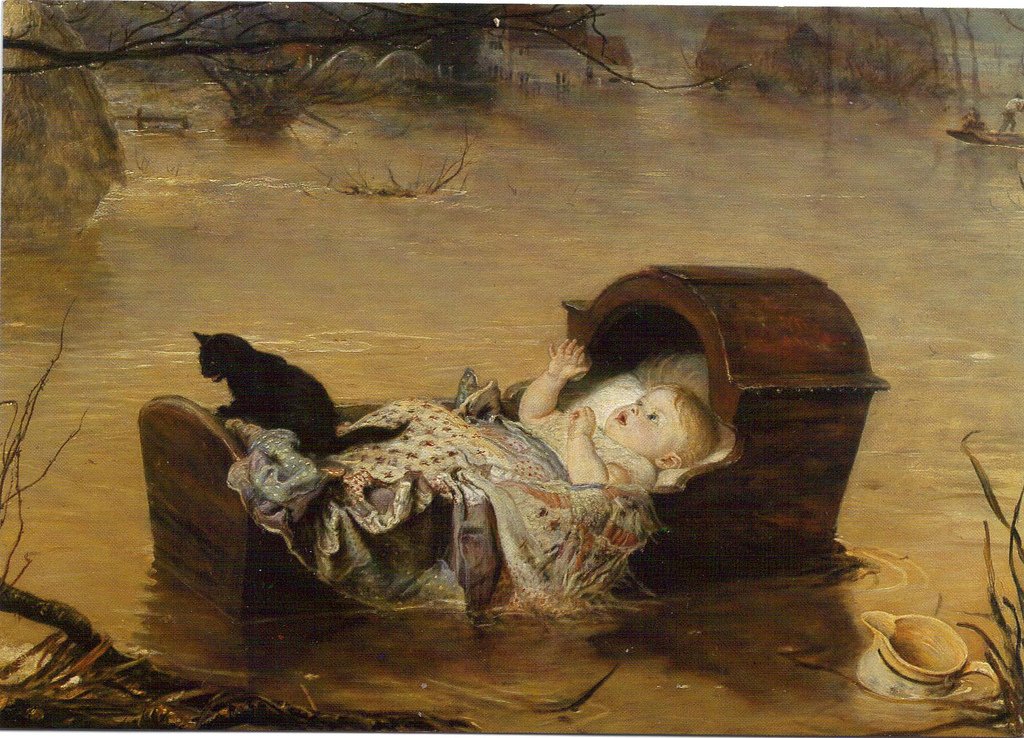

A Flood by John Everett Millais

A Flood by Millais (1870)

I begin My Daily Art Display today with an extract from The Illustrated London News newspaper telling of the disastrous flooding which occurred in Sheffield on Saturday March 19th 1864

The Illustrated London News
Saturday, March 19, 1864

“… In arguably the greatest tragedy ever to befall Sheffield — indeed one of Britain’s worst disasters, in terms of loss of life — almost 250 people perished, possibly more, when a reservoir dam burst in the hills a few miles from the town, shortly before midnight on the night of 11th March 1864. The entire reservoir is said to have emptied in only 47 minutes, as in excess of a hundred million cubic feet of water (between 600 and 700 million gallons, or — as noted in one of the articles — two million tons weight) crashed down the Loxley and lower river valleys, destroying almost everything in its path and inflicting terrible damage to property and livelihoods in its wake. …..”

John Everett Millais painted The Flood in 1870.  It is believed that he was motivated to paint his flood scene by the tragic events which occurred  in Sheffield in March 1864 when a dam collapsed in the middle of the night and the ensuing flood killed hundreds of villagers who lived downstream of the dam.    Among the many local newspaper reports there was one telling of a baby, still in its cradle, being swept away in the swift flowing waters.

In the painting, we see the baby wide awake with little idea of what is happening around him or her.  The baby just looks upwards and seems mesmerised by the raindrops which cling to the thin branches of a tree.   The wide-eyed and open-mouthed expression of the baby would in normal circumstances cause us to smile at the child’s inquisitiveness but unlike the baby, we are only too aware of its fate.  On the other hand, the black cat, which is sharing the ride on the cradle, is conscious of the peril and it too is also open-mouthed as it howls in fear of its life.   A household jug floats alongside the cradle reminding us of the devastating affect the raging water had as it swept unchecked in and out of the small impoverished village dwellings.

In the background on the left we can see a bridge almost submerged by the flood water and further to the right there is a house on the river bank and we can observe the water level has already reached the height of the ground floor windows.  To the right in the background men in a boat can be seen drifting quickly and uncontrollably on the tide of muddy water.

The painting hangs in the Manchester Art Gallery and it was intetersting to hear various comments from people as they studied the painting.  Some thought, as they looked at the smiling baby, that it was a charming picture whilst others tended to focus on the event itself and the probable drowning of the young child and found the painting rather disturbing.

You see, it is all in the eye of the beholder !

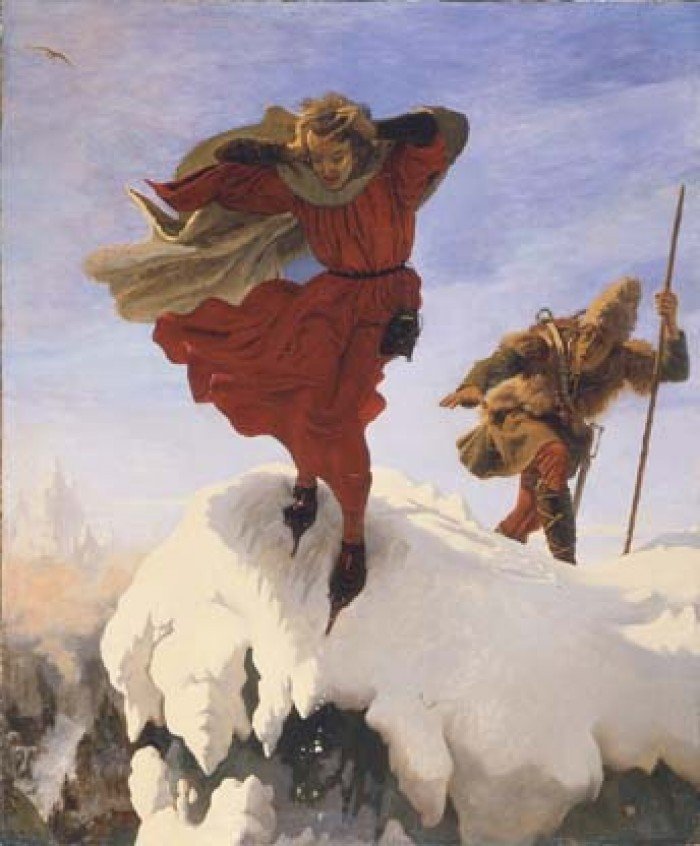
Manfred on the Jungfrau by Ford Madox Brown

Manfred on the Jungfrau by Ford Madox Brown (1842)

My Daily Art Display today once again has a connection with a number of blogs I have done earlier.  On July 14th I showcased The Funeral of Shelley by Fournier and one of the mourners at this event was the English Romantic poet Lord Byron who is centre stage in today’s offering.  On June 15th I featured the artists Ford Madox Brown and today he is once again the artist who painted today’s work. Finally, this is yet another work of art which has a connection with a poem.  My Daily Art Display painting today is entitled Manfred on the Jungfrau and is by the English painter Ford Madox Brown.

Ford Madox Brown, although his parents were English, was born in Calais in 1821.   His father, Ford Brown was a ship’s purser in the navy and his mother, Caroline Madox, came from an old Kentish family.  He initially studied art in Belgium, in Bruges, Ghent and Antwerp.  One of his teachers was the Belgian painter Gustave Wappers.  Madox Brown also spent time in France and Italy before coming to England in 1845.  He married his first wife Elisabeth Bromley in 1841, who was his cousin, and they went on to have a daughter, Lucy.   In that same year he had his first painting exhibited at the Royal Academy.   In the winter of 1845 he travelled to Switzerland and Rome.  During his time in the Italian capital he visited the studios of a group of German Romantic painters who had been sarcastically termed the Nazarenes as they would go around dressed in flowing robes and wearing their hair long, in a biblical-like style.  The aim of their artistic style was simply to add a kind of honesty and spirituality to their paintings which they believed had been missing from contemporary works of art and in some ways it was a reaction against Neoclassicism and the rigidity of Academicism.  Their philosophies would influence the Pre-Raphaelite movement

In 1846 Elizabeth Bromley died of consumption.  Five years later Madox Brown married for the second time, this time to Emma Hill.  The couple already at that time had a two-year old daughter, Catherine.  In 1848 he met, for the first time, Daniel Rossetti and Holman Hunt, two of the founders of the Pre-Raphaelite Brotherhood.  Ford Madox Brown was never a member of the Pre Raphaelite Brotherhood although he was closely associated with the group of artists and in fact Rossetti approached him and asked to be allowed to work under his tutelage at his studio.   Madox Brown had a varied career but although he was highly thought of by his contemporaries, he never achieved popular success.  Madox Brown painted many historical pictures and for most of the 1880’s he worked on subjects of local social history for Manchester Town Hall.   Ford Madox Brown died in 1893, three years after the death of his wife Emma.

So what has the painting to do with Lord Byron?   The Manfred of the painting’s title was the central character and romantic hero in Lord Byron’ famous dramatic poem Manfred and the painting depicts a scene from the poem.   The twenty-four year old poet, Lord Byron, had returned to London after a long period of travelling around Portugal, the Mediterranean and Aegean Sea Europe, in 1812 and had the first two parts of a four-part narrative poem published.  They were hailed by the literary critics as masterpieces and Byron became an overnight success and a leader of the social and literary circles of London.  However his fall from grace came shortly after with his well publicized affair with the married socialite Caroline Lamb, who famously said of Byron that he was “mad, bad and dangerous to know”.   The affair, which lasted six months, was broken off by Byron but his spurned lover continued to pursue him.   Byron turned his affections to Annabella Millbank.  She was so different in character to Caroline Lamb.  She was from a wealthy family, very well educated and a somewhat prim religious woman with very strict morals.  After two years of being pursued by Byron she agreed to marry him in 1814.  The marriage was doomed to failure because of the complete difference in their characters.

In 1815, Byron’s financial situation was dire as he refused to sell his work as he fervently believed the sums offered were too small.  He struggled to sell property to bolster his finances and he became depressed with life in general.  He drank heavily and became violent towards his wife.  His wife actually believed he was going mad.   Byron had an affair with a chorus girl that year despite his wife being pregnant with their first child, a daughter Ada, who was born in the December of 1815.  His then turned to his half sister, Augusta Leigh, the daughter from Byron’s father’s first wife, for friendship but this led to what many believe was an incestuous relationship.    Finally the marriage split asunder and the couple separated in January 1816.  The separation was bitter amidst rumours of marital violence, adultery with an actress and incest, all of which scandalised the public.  Incest at the time was a very serious offence and it is believed that Byron’s hasty departure from the country that year was because of his fear of prosecution.

So what has all this to do with today’s painting?  Whilst Byron, who was now living at the Villa Diodati in Switzerland, toured the Bernese Alps he wrote most of his great dramatic narrative poem Manfred.  The poem recounts the tale of this Alpine nobleman who had an incestuous relationship with his sister, Astarte, and who not being able to come to terms with this relationship, committed suicide.  Manfred is wracked with guilt blaming himself for her death and conjures up seven spirits from whom he seeks forgetfulness so as the death of his sister would cease to haunt him.  They cannot help and he himself attempts suicide and one of these attempts is portrayed in Ford Madox Brown’s painting in which we see Manfred about to hurl himself off the top of the mountain, the Jungfrau.  The poem tells of this time:

“..And you, ye crags upon whose extreme edge
I stand, and on the torrent’s brink beneath
Behold the tall pines dwindled as to shrubs
In dizziness of distance, when a leap,
A stir, a motion, even a breath, would bring
My breast upon its rocky bosom’s bed
To rest for ever – wherefore do I pause?
…Thou winged and cloud-cleaving minister,
Whose happy flight is highest into heaven,
Well may’st thou swoop so near me…
…How beautiful is all this visible world!
How glorious in its action and itself!…”

 His suicide attempt fails as a fur-clad chamois hunter, whom we see in the painting standing behind Manfred, rescues him before he can leap to his death.  In the painting, Madox Brown depicts the tormented Manfred holding his head in his hands with his face contorted with anguish as he prepares to end his life.  His red robes, which flutter violently in the mountain wind, contrast starkly with the clear blue sky.  In the background to the left we can just make out a castle, which to me, resembles Neuschwanstein, the Disney-like edifice which we see on so many pictures and postcards.

It cannot be just coincidental that Byron having had an incestuous affair with his step sister should write a poetic story about another incestuous relationship and its dire consequences and many believe that his poem was about himself and his earlier relationship which scandalised society.

I had hoped to see the painting yesterday when I visited the Manchester Art Gallery but alas it has been taken down for some restoration work in preparation for the forthcoming Ford Madox Brown exhibition which will be held in this gallery in September.  I will return then and cast my eye over Manfred and his tortured state of mind.

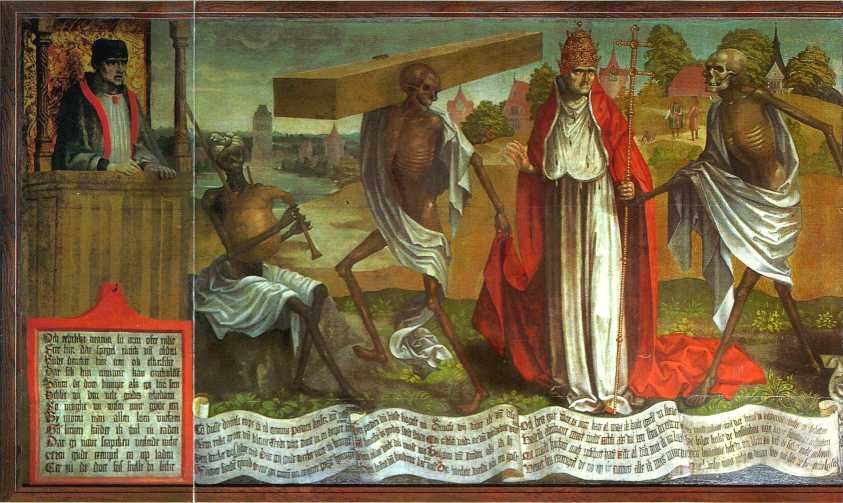
Dance of Death by Bernt Notke

Dance of Death by Bernt Notke (1463-66)

Often when I research a painting for my Daily Art Display I am amazed by the complexity of the history of the painting or the biography of the artist and I find myself being sucked deeper and deeper into the story behind the work of art.  The deeper I go the more I realize how difficult it will be to précis what I have found so that the blog does not become too boring and burdensome.  My featured work of art today is an example of this complexity but, to be honest, the more complex a painting becomes the more interested I become and the more I need to dig deeper into the story.  I hope that the story behind My Daily Art Display today does not cross the line which separates intrigue and tedium.

My featured artist today is Bernt Notke.  He was born around 1435 in Lassan, the German town near to the Baltic Sea coast, close to the border with Poland.  He was a painter, sculptor and woodcarver and was considered to be one of the most important exponents of his work in the whole of Northern Europe during his lifetime.  Today I am looking at his enormous tempera on linen Dance of Death frieze which he completed in 1466 and part of which can be seen in Tallinn at the St Nicholas Church Art Museum of Estonia.

Dance of Death paintings were quite common in the late Medieval times up to the beginning of the 16th century and they were painted to remind people that no matter how rich or poor they were, or no matter how powerful they were, death would take them all.  In those days,  epidemics, such as the Black Death, were both recurrent and numerous and they would kill millions of people.  The Hundred Years War between 1337 and 1453 alone claimed three million lives.  The devastation caused by such events enabled people to understand only too well the meaning of these paintings.  They were artistic expressions of the everyday fears of people with the subject of death.  The character “Death” in these works was viewed not as a destroyer but as a messenger of God summoning his people to the world beyond the grave.

The title Dance of Death varied slightly from country to country.  For example, it was known as Danse Macabre in France, Danza de la Muerte in Spain and Totentanz in German but all had the same meaning.  We have come across this type of thing before when we have looked at Vanitas paintings.  Vanitas being the Latin word for emptiness and corresponds in this case more to the word “meaningless” – the meaningless of earthly life.  Vanitas works were to be a stark reminder to us of the transience of life and the inevitability of death. Such paintings would usually incorporate objects which would in some way remind us of death such as a skull or skeleton, or an almost burnt-out candle, watches or hour glasses which symbolized time passing and in still life vanitas paintings rotting food could also be used as a symbol of decay.

Normally the Dance of Death paintings or frescoes were painted on the walls of cloisters or on walls within some churches.  In general we would see Death depicted as an emaciated corpse or skeleton paired with a person from a particular social class as they carry out their dance of death.  Below each pair there would be a verse, the first part of which would be spoken by Death addressing his victim often in cynical and sarcastic terms.  This is then followed by the victims reply as he or she begs for their life.

The join between two fragments of the painting

In the featured work today we see just the surviving part of Notke’s Dance of Death.  His original work was 30 metres in length but this only remaining fragment is only 7.5 metres in length.  The fragment  can be viewed today at the church museum in Tallinn and actually comprises of two pieces, one 6.4 metres long and a much smaller piece approximately 1.15metres long which incorporates the king, and which were joined together in 1843.  However if you look carefully at the join you can see that the background doesn’t run smoothly from one side to another nor does the hand of the devil attach itself to any part of the body of the king, so is there something missing or is it a case that the joining of the two pieces was not carried out correctly?   Further restoration work on this painting was carried out in Moscow in 1962.

Preacher, Musician and Pope

In the painting, we see on the far left the preacher in his pulpit reprimanding his congregation.  Next to the pulpit we see “death” seated playing what looks like bagpipes and I must say in this case “death” looks a little like ET !    Why the bagpipes?   The thought behind this is that bagpipes are known to be able to “wake the dead”.   The inclusion of this musician does add to the sense of macabre and of course he is the musician who will play as the characters to the right of him perform the Dance of Death.    Moving to the right we see another figure of “death” balancing a coffin on his shoulder with his right hand,  whilst at the same time his left hand grasps the clothing of the pope as he begins to lead him in the dance.   To the right of the pope we observe  another figure of “death”.  His right hand is grasping the left wrist of the pope whilst his left hand, which is behind him, holds the Emperor’s wrist.  This interconnection between earthly figures and the figures of “death” continues along the line as they start to dance.  In the surviving part of the painting we have five people facing out at us.  They are the pope, the empress, the emperor, the cardinal and the king and between each we see “death” in the form of a skeleton.

Empress and Cardinal with verses

As I stated earlier, in Dance of Death works a two part verse is often written below each character.  The first part of the eight-line verse is made up of words from the living person begging for his or her life and the second part is the eight-line reply from Death, the last line of which being and introduction to the next mortal along the chain.  An example of this is the verse below the Empress which when translated is:

I know, Death means me!
I was never terrified so greatly!
I thought he was not in his right mind,
after all, I am young and also an empress.
I thought I had a lot of power,
I had not thought of him
or that anybody could do something against me.
Oh, let me live on, this I implore you!

And Death replies:

Empress, highly presumptuous,
methinks you have forgotten me.
Fall in! It is now time.
You thought I should let you off?
No way! And were you ever so much,
You must participate in this play,
And you others, everybody —
Hold on! Follow me, Mr Cardinal!

The Cardinal now says his piece:

Have mercy on me, Lord, [when it] shall happen.
I can in no way escape it.
[When] I look in front or behind me,
I feel Death by me at all times.
What will the high rank avail me
[the rank] that I had? I must leave it
and become more unworthy at once
than an unclean, stinking dog.

And Death replies:

You were in status equal to
an apostle of God on earth,
in order to strengthen the Christian belief
with words and other good works.
But you have, with great haughtiness,
been riding your high horse.
Therefore you most mourn so much more now!
Now step here in front you too, Mr King!

And so it goes on along the line of mortals, all wanting to plead their case only to be refused by the inflexibility of Death.

On display in the St Nicholas’s Church art Museum in Tallinn

I would love to go and see this painting and sad to say I was in Tallinn about six years ago but knew nothing about this great work of art.  If you ever go to Tallinn make sure you add this painting to your “must

The Miraculous Draught of the Fishes by Konrad Witz

The Miraculous Draught of the Fishes by Konrad Witz (1444)

From yesterday’s late nineteenth century Swedish painter Sven Richard Bergh I am going back in time, almost five centuries, for today’s featured artist.  My Daily Art Display today looks at an exquisite painting by the 15th century German-born early Renaissance artist Konrad Witz.

Witz was born in Rottweil is now a german town some fifty kilometres north of the Swiss border and is part of the federal state of Baden-Württemburg, in south-west Germany    It was, at the time when Witz was born in 1400, a freie Reichsstadt (Free Imperial City) and formally ruled by the Emperor of the Holy Roman Empire until 1463.  At that time the town joined the Swiss Confederation where it remained until 1802 and the onset of the Napoleonic Wars when it reverted to part of the Wurttemburg dukedom.  Witz although born in Germany always considered himself to be Swiss.

Through historical records we know that a certain “Master Konrad of Rottweil” joined the painter’s guild in Basle in 1434 and in the same year Witz was granted citizenship of Basle, the Swiss town along with the city of Geneva where Witz spent most of his life.  His style of painting lends one to believe that at some time he received training in the Flemish and Netherlandish painting styles.  Witz is noted as one of the first painters to incorporate realistic landscapes into religious paintings, an example of which we will see in today’s featured painting.

My Daily Art Display featured work today is part of an altarpiece by Konrad Witz entitled The Miraculous Draught of the Fishes which he completed in 1444 two years before he died.  Art historians believe that this beautiful work is amongst the high points of Early Renaissance painting.  Because of hinge marks on the frame of the painting, we know it to be the left exterior wing of the altarpiece commissioned by Bishop Francois de Mies for the high altar of the chapel of Notre Dame des Maccabées of the Cathedral of Saint Peter in Geneva, which belongs to the Swiss Reformed Church.  The right hand exterior wing depicted the release of St Peter from prison but sadly the central panel is lost.   The interior wings of the triptych depict, on one side, the Adoration of the Magi and on the other Saint Peter’s presentation of the donor, Bishop Francois to the Virgin and Child.  Fortunately the wings survived the Protestant Iconoclasm, the collective name for the destruction of catholic churches and possessions which had been raging in Europe since the early sixteenth century and hit Geneva in 1535.  During this Protestant Iconoclasm, hundreds of catholic churches, chapels, abbeys and cloisters in the Netherlands were totally destroyed by rampaging Protestant mobs along with all their contents such as, altars, icons, chalices, paintings, and church books.  The painting is signed and dated 1444 on the original lower frame.

It is by far the most famous of Witz’s works and is sometimes looked upon as the first “real” landscape painting, a painting in which one can recognise a certain landscape as compared with “an idealised landscape” where it is a composite of many places morphed into one idealised picture.  In today’s painting we are standing on the north-west shore of Lac Lehman (Lake Geneva), near Geneva and looking across to the south-east.  We can see the Saleve mountains in the background and included in the scene is the recognisable peak of Mont Blanc.  In the middle ground on the right we can see a pointed jetty and across the water is the staccato line of a breakwater.  Although Witz has given us a true landscape the characters and the scene before us are an amalgam of ideas and the exact subject of the painting is somewhat blurred.

Although the landscape has been identified as Lake Geneva the figures in the painting are all part of biblical stories which obviously took place in the Holy Land.   One reason for this could be that Witz met with his sponsor of the altar, the Bishop of Geneva, François de Mies, during the Ecumenical Council held in Basle.  It was at this Council that it was decided to the elect Amadeus VIII of Savoy to the throne Pontifical under the name of Felix V.   He was to become the last of the Antipopes.  It could be reasoned that by transposing geographically the biblical scene to the land of the pontiff was therefore more of political move that an artistic impulse.

There are three biblical stories going on within this one painting.  Firstly, we have the man who was to become the first pope, Saint Peter, unsuccessfully trying to walk on water.  (Matthew 14:22-26).  Secondly we see Saint Peter, this time in the boat with some of his fellow disciples, fishing which reminds us of the parable of the fishes (Luke 5:1-11).   Lastly, the painting reminds us of the story of the resurrected Christ on the shores of the sea of Tiberius appearing to his disciples as they were in a boat fishing.

This is a beautifully executed painting.  Remember that this is an early 15th century painting.  Look how the artist has skilfully depicted the water with its reflected shadows of the buildings and jettylook at the mirrored reflections of the people in the boat.  Observe the transparency of the water in the foreground as we see the legs of Saint Peter splayed apart as he walks in the shallows having failed to master the “walking upon the water”.

This oil on panel work of art could be seen at Musée d’Art Histoire in Geveva.  I say “could” as it has been taken down for some restoration work to be carried out upon it and will not be re-hung until March 2012.

Nordic Summer Evening by Sven Berg

Nordic Summer Evening by Richard Bergh (1900)

I chose today’s painting for My Daily Art Display as it reminded me of the painting I featured on June 9th, Mr and Mrs Clark and Percy by David Hockney.  Today’s painting is by the Swedish painter Sven Richard Bergh and is entitled Nordic Summer Evening which he completed in 1900.

Berg was born in Stockholm at the end of 1858.  He was the son of the Johan Edvard Bergh, who formerly spent time as a lawyer before devoting his life to his landscape painting and becoming an art teacher.  His mother was also an artist and so their son was introduced to art at a very early age.  The family were wealthy and mixed with the cultural elite of Stockholm.  Sven Berg studied at the Royal Swedish Academy of Arts in Stockholm.  He travelled on many occasions to France, often to escape the exacting academicism of that art establishment, where he visited the artist’s colony at Grez-sur-Loing just south of Fontainebleau.  The colony was modelled on another famous Parisian artist colony at Barbizon, which was set up some thirty years earlier.  Grez-sur-Loing was the home of en plein air painters and artists from around the world descended on this colony.  The 1880’s saw the arrival in the colony of many Scandanavian artists.   It was whilst in France that Berg was strongly influenced by the French en plein air method of painting and the French Symbolist movement.  Berg became an established portrait painter but was equally praised for his landscape works. In the 1890’s he was in the forefront of Swedish Romanticism movement in art.   He went on to set up an art academy and wrote many books on the subject of art.  He became director of the National Museum of Art in Stockholm in 1915.  He died in 1919 aged 60.

In the featured painting today we see a man and a woman standing on a terrace.  They have turned away from us and are looking out over a stretch of water which has a calm mirror-like aspect.  It is sunset and we see the last of the evening’s orange light on the surface of the water and the forest in the background.  The sunlight adds a bluish tinge to the balustrade of the terrace.  This is typical of Nordic light paintings.  “Nordic Light” was used to describe Scandinavian landscape painting in the late 19th and early 20th century.   We see a boat tied up on the pier.  There is a feeling of sexual tension between the two characters as they stand well apart and avoid each other’s gaze.

The setting for the painting is Ekholmsnäs Manor and we are looking over Kyrkviken, the narrow sea inlet, towards the island of Lidingö, part of the Stockholm archipelago.   The people in the painting were Berg’s close friends.  The man, who was of “royal blood” as well as being a well known artist and patron to many artists, was the Duke of Narke, Prince Eugen Napoleon Nicolaus of Sweden and Norway and the youngest son of King Oscar II of Sweden and Norway.  The woman in the painting was the singer Karin Pyk.

Head of a Girl by Jan van Scorel

Head of a Young Girl by Jan van Scorel (c.1530-35)

As I have written in previous blogs, I am always pleased to discover a “new” artist, one that I had never come across before even though they may have been well known to many of you.  Today I have just such an artist.

I have always loved landscape paintings above all other genres of art but I am slowly coming to appreciate more and more a well executed portrait.  Today I have such a portrait.

I am always enchanted by a painting of a beautiful face such as the painting by Gerald Brockhurst, entitled Jeunesse Dorée (May 16th).  Today I have such a painting.

My Daily Art Display today is a painting by the Dutch painter Jan Van Scorel entitled simply Head of a Girl.

Jan van Sorel was born in 1495 in the small village of Schoorl, which lies 8kms north west of Alkmaar.   Like many people of the time his surname is derived from the name of his birthplace.  It is thought that he started his artistic journey of discovery in Haarlem studying under the likes of  Pieter Gerritsz van Roestraten, the Dutch Golden Age painter and Cornelis Buys also known as the Master of Alkmaar.  It is also known that around the end of 1518, when he was in his early twenties, he studied under Jan Gossaert in Utrecht and was probably through Gossaert’s recommendation that van Scorel began travelling through Europe.  He journeyed south from the Netherlands heading towards Italy, stopping off in a number of German towns including Nuremburg, where he met and stayed with Albrecht Dürer, before crossing the Alps into Austria.  Historical records show that he was registered in Venice between 1518 and 1522.  It was whilst he lived in Venice that he came across the works of Gorgione which were to have a great influence on his artistic career.

He left Venice with a group of Dutch pilgrims and set off on a pilgrimage passing through Malta, Rhodes and Cyprus before arriving at Holy Land and visiting Jerusalem and Bethlehem.  His Holy Land experiences were to feature in many of his later paintings.  Returning from the Holy Lands he headed for Rome and in 1522, aged twenty-seven,  he became the painter to the Vatican under the rule of Pope Adrian VI, the Dutch pontiff, who was a native of Utrecht, and who himself sat for a portrait by van Scorel.  He also became the curator of the vast collection of papal antiquities in the Belvedere and this allowed him to see the Vatican’s artistic treasures including the works of Michelangelo and Raphael and through this van Scorel gained great inspiration from their works of art.   In 1524 van Scorel returned to his homeland and settled in Utrecht where he remained for the rest of his life and where he continued to paint and teach art.  One of his students was the great Dutch artist Maarten van Heemskerck who is famous for his religious works and portraits.  Van Scorel died in Utrecht in 1562, aged 67.

Van Scorel was a highly educated man.  He spoke many languages and was not only a painter; he was also skilled as an engineer and architect.  His journey to Italy was to become an essential ritual for the next generation of Dutch and Flemish artists and their coming into contact with the Mannerist circles in Rome and Florence allowed them to introduce the style in their own country.  Van Scorel was considered by many as the artist who introduced High Italian Renaissance art to the Netherlands and was considered to be the leading Netherlandish Romanist of the time.  Romanism was the style of painting of a group of Netherlandish artists in the late 15th and early 16th century who began to visit Italy and started to incorporate Renaissance influences in their work. The greatest proponent of this style of art was Jan Gossaert.   The influence of Michelangelo and Raphael showed in their works in the way they would use classical imagery such as mythological scenes and nudes.

Four years after van Scorel’s death came The Iconoclasm, the Dutch name being Beeldenstorm, which literally translated means “storm of icons” and is the collective name for the destruction of catholic churches and possessions which had been raging in Europe for the past forty years but only came to Utrecht and the rest of the Netherlands between August and October 1566.   During this Protestant Beeldenstorm, hundreds of catholic churches, chapels, abbeys and cloisters in the Netherlands were totally destroyed by rampaging Protestant mobs along with all their contents such as, altars, icons,  chalices, paintings,and church books.  Unfortunately during this turbulent time of religious fanaticism, a large number of Van Scorel’s works were destroyed.  The Beeldenstorm marked the beginning of the revolution against the Spanish forces, which had occupied the Netherlnads and the Catholic Church which had asserted its authority over its people.

Unfortunately I have little to tell you about the painting itself.  Head of a Girl was painted by Jan van Scorel between 1530 and 1535 and now hangs in the Kunsthistoriches Museum in Vienna.  Before us we see just the head and neck of the girl.  She fills the painting and the plain background helps us to concentrate on her face.  There is no symbolism associated with this painting.  Nothing needs to be interpreted.  The title of the painting speaks for itself.  What you see is what you have – the face of a lovely young girl.  Her dark almond-shaped eyes avert our gaze as she peers to her left.  The light comes from her right hand side and the left side of her face is in shade.  She has a small mouth with full red lips.  Her red hair is plaited on top of her head.  I am taken by her gentle expression of contemplation.   I can almost detect a hint of sorrow in her gaze or maybe it is a look of acquiescence.  All in all, this young woman, whoever she may be, is truly beautiful and deserves to be in My Daily Art Display.

Feast of the Rose Garlands by Albrecht Dürer

Feast of the Rose Garlands by Albrecht Dürer ( 1506)

My Daily Art Display today features a painting by an artist who is hailed as the one of the greatest painters of the Late Gothic and Early Renaissance period.  He was the Nuremburg painter Albrecht Dürer.  Today’s painting is entitled Feast of the Rose Garlands and was completed by Dürer in 1506 and now hangs in the National Gallery in Prague at the Sternberg Palace.  In France, this painting is known as La Vierge de la fête du rosaire (The Virgin of the Feast of the Rosary).   The work of art is considered to be a milestone piece in the transition between the late 15th century Gothic/Medievalism and the start of the 16th century Renaissance.

Dürer had returned to Italy for the second time in 1505 and the following year settled in Venice.   He was approached by some German merchants from the emigrant German community who had settled around the commercial centre of Venice, known as Fondaco dei Tedeschi.  They wanted a single panel altarpiece for their chapel in the Church of San Bartolomeo.  The people who commissioned the painting were very precise as to what should be depicted in the altarpiece.  It was to be the gathering of the Brotherhood of the Rosary, an association founded in Strasbourg in 1474 by the German priest Jakob Sprenger and a source of worship for the German citizens who lived in Venice.   The painting is highly colourful and littered with various people, so let me introduce you to some of the characters Dürer included in his work, probably under instruction of the commissioners of the painting.  The preparatory work for the panel took Dürer three months to complete and comprised of twenty-one pen and ink preliminary sketches which followed the Venetian painting tradition.  Besides these, Dürer completed a number of small drawings of the characters he was going to incorporate into the work, some of whom were real whilst others were imaginary.

The central figure in the painting is the Virgin Mary, who is enthroned in a field,  holding the Christ child.  The positioning of the Virgin and Child along with her worshipers outdoors probably has to do with Dürer’s fascination with Italian Humanism, which emphasized the importance of humans in the natural world and this painting is similar to other Humanistic paintings of saints and humans seen occupying similar landscapes.  Above the Virgin we can see two flying angels who hold aloft a highly ornate royal crown adorned with clusters of pearls and other gems.  The back of the throne is covered with a green drape and an ornate badachin, a canopy, which is held aloft by a ribbon held by two flying Bellini-like cherubim.  At the feet of the Virgin we can see another angel playing the lute.  The Virgin is in the process of handing out rose garlands to two sets of worshippers which approach her from opposite sides in two symmetrical rows.

To the left are representatives of the clergy with the Pope at their head, while on the right are the representatives of secular power.  The religious worshipper on the left of the painting are led by a kneeling Pope Sixtus IV, his papal tiara on the ground by his side,  and his inclusion in the painting probably stemmed from the fact that he had approved of the German Brotherhood of the Rosary in 1474.  He is about to be crowned by the Christ child.

The procession of lay worshippers on the right is led by the German emperor-designate Maximillian I, with his imperial crown by his side, who is being crowned by the Virgin Mary herself.  These two men were the looked upon as the supreme authorities of the Catholic world.   To the left of the Virgin Mary we see Saint Dominic of Guzman, the Spanish cleric and founder of the Dominicans in 1216 and the Confraternity of the Rosary in 1218.  In the painting, along with a number of angels he is handing out crowns of flowers to the faithful, as a symbolic blessing.   Amongst the religious grouping on the left of the painting we have the patriarch of Venice, Antonio Soriana, hands clasped before him.  Next to him Dürer has painted Burkard von Speyer, who was at the time of the painting, the chaplain of the church of San Bartolomeo.

The Artist

If we look across to the right hand side of the painting we see a typical German Alpine landscape in the background and the line of lay people who wait to pay homage to the Virgin and child.  However one of the first people our eyes alight upon is the artist himself.   Dürer often liked to include himself within crowd scenes of his paintings (look back at the featured Dürer painting, The Martyrdom of the Ten Thousand, on April 25th).  Here we see him, standing before a tree, framed by long blonde hair, dressed in a heavy luxurious fur cloak with hooped sleeves, which immediately makes him stand out amongst the other people in the painting.  Look how he is the only one of the many characters to look directly out at us.   He can be seen holding a cartouche, or oblong scroll, in his hand.  On the scroll are the words:

EXEGIT QUINQUE MESTRI SPATIO ALBERTUS DURER GERMANUS MDVI.

(`Albrecht Dürer, a German, produced it within the span of five months. 1506.’)

By him are Leonhard Vilt of Regensburg, a printer who lived in the city and who founded the Brotherhood of the Rosary in Venice and further towards the foreground in the far right of the painting we have Hieronymus of Augsburg who was the architect and building master and who holds a builder’s square denoting his profession.  It was he who designed the new Fondaco dei Tedeschi after the original building of 1228 had been completely destroyed by fire.

This altarpiece remained in the church of San Bartolomeo in Venice until 1606.   It was then acquired, after long negotiations, for 900 ducats by the Holy Roman Emperor Rudolph II. Archive records show it took four men to bring the packaged painting to the emperor’s residence in Prague.   Hidden away during the invasion of the Swedish troops, the painting which had already been badly damaged was returned to its “home” in 1635.  It underwent the first of many restorations in 1662, all of which instead of enhancing the work, damaged it even further.    In 1782, it was sold in an auction for one florin.   Over the years it was bought by various art collectors and was finally purchased by the Czechoslovakian state in 1930.

This colourful work by Dürer is in the great Venetian artistic tradition with its colour blending achieving deep and rich reds, blues and greens and maybe was the perfect answer to his many critics who had earlier stated that although there was no doubting Durer’s ability to produce magnificent engravings and woodcuts, he lacked the ability to handle colours and produce a fine painting.   The painting was well received and it drew crowds of visitors from all over Europe.   At the time, it was looked upon as one of the artistic highlights of Venice and Dürer’s status as master of Renaissance painting was incontrovertible.

The Funeral of Shelley by Louis Édouard Fournier

The Funeral of Shelley by Louis Édouard Fournier (1889)

The painting I am featuring in My Daily Art Display today interests me on three counts.  Firstly, I stood in front of the original two days ago when I visited the Walker Gallery in Liverpool.   Secondly, I made many trips on ships to La Spezia in Italy and suffered the ferocity of the storms in the Gulf of Genoa as well as spending many afternoons with glasses of chilled wine on the beachfronts at Lerici and Viareggio, which is the setting for the painting.  Last but not least, our country is currently embroiled in newspaper scandals and journalistic wrongdoings and I am reminded of the cynical journalistic saying that one doesn’t want to let truth ruin a good story.  When I look at today’s painting and realise how Fournier has not let the truth interfere with his pictorial rendition of the story of Shelley’s funeral.  He has depicted the setting not based on true happenings but what in his mind made a “good painting”.  The painting, which hangs in the Liverpool Walker Gallery, is entitled The Funeral of Shelley and the artist, Louis Édouard Fournier which he completed  in 1889 and which was to become one of his most famous works.

Firstly, let me give you a brief outline on the life and death of the famous poet.   Percy Bysshe Shelley, born in 1792, the eldest of six children, was to become one of the greatest English Romantic poets of all time.  His fame was further enhanced by his close friendship with his fellow giants of the poetic world, John Keats and Lord Byron.  Shelley continually courted scandal and would have been a great asset and a target for the current tabloid press and paparazzi.  He endured an unhappy existence at Eton College where he was continually ostracised by his fellow students. He performed poorly but still managed to be accepted at the University College Oxford.  His tenure there was curtailed after just a year when he was expelled for publishing a controversial pamphlet entitled The Necessity for Atheism.

Four months after his expulsion from the university, which destroyed his relationship with his father, he eloped and married a sixteen year-old schoolgirl Harriet Westbrook.  Although the couple had a daughter, Ianthe, the marriage was a disaster, mainly due to Shelley’s attitude to life and to his wife.  After three years of marriage, Shelley abandoned his pregnant wife and ran away with another young girl, Mary Wollstonecraft Godwin, the sixteen year old daughter of William Godwin, one of the forefathers of the anarchist movemen,t and her stepsister Claire Clairmont.  The three travelled to France and eventually settled in Switzerland.

In 1816 Shelley’s first wife drowned herself in the Serpentine in Hyde Park London and three months later Mary Godwin became the second Mrs Shelley.  Two years later the Shelleys left England and went to live in Italy.  They moved around the country and for the next three years lived in a number of Italian cities including Rome and Venice and finally settled in Pisa.

In July 1822 Shelley travelled from Lerici in his 20ft schooner, Don Juan to Livorno to meet up with his friend and author,Leigh Hunt, who had just arrived in Italy in order to discuss a new literary project they were launching.  The seven hour trip was made in good weather and Shelley, his ex-Royal Navy friend, Edward Williams and a young deckhand Charles Vivian made Livorno safely.  However their return journey proved very different as the boat was hit by a violent storm three hours into the voyage.  The sailing ship sank and the reason for this is still a matter of conjecture.  Possibly the small vessel was undermanned and unable to cope with the adverse weather, possibly poor navigational and seamanship decisions were made by those on board or maybe it was down to a poor boat design.  Notwithstanding all these suppositions, the boat was engulfed by large seas and sank fifteen miles off Viareggio and all on board drowned, their bodies were found washed ashore ten days later.   Italian quarantine regulations stipulated cremation of such bodies and thus Shelley’s body was cremated on the beach at Viareggio.

So now let us look at Fournier’s painting.  The setting is a bleak windswept beach on what looks like a dull overcast and gray day and by the way the people are dressed in heavy coats, an extremely cold day.  The centre of the painting is taken up by a lit funeral pyre atop of which, lying on his back as if asleep, is the peaceful-looking dead poet.   There are a number of mourners or helpers in the background but standing near the burning pyre we see three men and just to the left of this group is a woman on her knees in prayer.  A coach can be observed in the background.   The woman is Shelley’s widow Mary and the three men, from left to right, are his friends and fellow authors, Edward John Trelawney, Leigh Hunt and Lord Byron.  So before us we have a true pictorial account of the cremation of Shelley on the cold windswept Viareggio beach, or do we?

Actually, we don’t.   Fournier has used a great deal of “artistic licence” to create a very moving painting but factually it is incorrect on a number of counts and we know this from the writings of Edward Trelawney who attended the cremation.  The day of Shelley’s cremation was a hot humid summer day with clear blue skies and little wind and not the cold windswept one as Fournier has depicted.  Shelley was cremated on the beach at Viareggio but the depiction of him lying on top of the burning pyre almost as if asleep is false as his body had been in the water for ten days.  It was bloated and a lot of his flesh had been eaten away from those parts of his body which had not been still covered by his clothes.  It was known that Mary Shelley was not present at the cremation, as was the English custom, for health reasons.  For Shelley’s wife Mary, life had not been easy.  Her mother died ten days after giving birth to her and she herself lost three of her four children with childhood illness and in fact at the time of Shelley’s drowning she was still recovering from a miscarriage which almost ended her own life.   Edward Trelawney in his book, ‘Recollections of the Last Days of Shelley and Byron’ wrote that Leigh Hunt never moved out of the carriage and Lord Byron was so shocked by the sight of the body and because of the oppressive high temperature of the day withdrew and went swimming in the sea.

Shelley had in many English circles made himself very unpopular with his subversive and atheistic views and utterings and his death at the time was not greeted with universal sorrow.  In the conservative newspaper of the time, The Courier, his demise was reported with some sarcasm stating:

“….Shelley, the writer of some infidel poetry, has been drowned, now he knows whether there is a God or not….”

In the course of looking at numerous paintings I have seen many idealised landscapes which are made up of various settings morphed into one beautiful location.  We have seen portraits which have been altered to flatter the sitter so I suppose we should not condemn Fournier out of hand for his depiction of the Shelley’s funeral as his soul aim was to create a moving and poignant pictorial account of that special day and this I believe he has achieved.

The Martyr of Solway by John Everett Millais

The Martyr of Solway by Millais (1871)

I visited the Walker Gallery in Liverpool yesterday and I am never disappointed by the paintings on permanent show there.  It is such a diverse collection which cannot fail to please everybody who visits, no matter what their artistic proclivity.  My Daily Art Display today features a stunning painting by John Everett Millais entitled The Martyr of the Solway which he painted in 1871.

So who was the martyr of Solway and why was she killed in such a barbaric fashion?   The “Margaret” depicted by Millais was Margaret Wilson, who was born in 1667 in Glenvernoch in Wigtownshire.  She was a young and devout Presbyterian who was a member of the Covenanters, a Scottish Presbyterian movement of the 17th century in Scotland who signed the National Covenant in 1638 to confirm their opposition to the interference by the Stuart kings in the affairs of the Presbyterian Church of Scotland.  The Stuart kings embraced the belief of the Divine Right of the Monarch.   However, not only did they believe that God wished them to be the infallible rulers of their kingdom – they also believed that they were the spiritual heads of the Church of Scotland.    This latter belief was anathema to the Scots.   Their belief was quite simple – no man, not even a king, could be spiritual head of their church. Only Jesus Christ could be spiritual head of a Christian church.
The account of the martyrdom of the eighteen year old Margaret  Wilson and the events leading up to her death are set down in an account by the Rev.C.H.Dick’s  entitled Highways and Byways in Galloway and Carrick, which was published in 1916.  In it he wrote:
“….Upon the 11th of May,1685 came the wicked execution of two excellent women, Margaret McLachlan and Margaret Wilson, near Wigtown, in South West Scotland .  Margaret Wilson, eighteen, and her sister, Agnes, not yet thirteen years old, were the daughters of Gilbert Wilson, tenant of Glenvernoch in the parish of Penninghame. They conformed to Episcopacy. Adherents to the Covenants, the girls fell into the hands of the persecutors, and were imprisoned.

Upon their release, they left the district and wandered through Carrick, Galloway, and Nithsdale with their brothers and some other Covenanters. But on the death of King Charles, there was some slackening of the persecution, and the girls returned to Wigtown.

An acquaintance, Patrick Stuart, betrayed them. He proposed drinking the king’s health; this they modestly declined: upon which he went out, informed against them, brought in a party of soldiers, and seized them.   They were thrown in the thieves’ hole, and after they had been there some time, were removed to the prison where Margaret McLauchlan was.

Margaret Maclachlan was a woman of more than ordinary knowledge, discretion, and prudence, and for many years of singular piety and devotion: she would take none of the oaths now pressed upon women as well as men, neither would she desist from the duties she took to be incumbent upon her, hearing presbyterian ministers when providence gave opportunity, and joining with her Christian friends and acquaintances in prayer, and supplying her relations and acquaintances when in straits, though persecuted. It is a jest to suppose her guilty of rising in arms and rebellion, though indeed it was a part of her indictment. She was very roughly dealt with in prison, and was allowed neither fire nor bed although she was sixty-three years of age.

All the three prisoners were indicted “for rebellion, Bothwellbridge, Ayr’s Moss, and being present at twenty field-conventicles”.   None of them had ever been within many miles of Bothwell or Ayr’s Moss. Agnes Wilson could be but eight years of age at Ayr’s Moss, and her sister but about twelve or thirteen; and it was impossible they could have any access to those risings:

When the Abjuration Oath was put to them, they refused it, the assize found them guilty, and the sentence was that “upon the 11th instant, all the three should be tied to stakes fixed within the flood-mark in the water of Blednoch near Wigtown, where the sea flows at high water, there to be drowned”.

Gilbert Wilson secured the liberation of the younger girl under a bond of a hundred pounds sterling. The sentence was executed on Margaret Maclachlan and Margaret Wilson.  The two women were brought from Wigtown, with a numerous crowd of spectators. Major Windram with some soldiers guarded them. The old woman’s stake was a good way in beyond the other, and she was first despatched, in order to terrify the other to a compliance with such oaths and conditions as they required. But in vain, for she adhered to her principles with an unshaken steadfastness.

When the water was overflowing her fellow-martyr, some about Margaret Wilson asked her, what she thought of the other now struggling with the pangs of death. She answered, what do I see but Christ (in one of his members) wrestling there. Think you that we are the sufferers? No, it is Christ in us, for he sends none a warfare upon their own charges.

When Margaret Wilson was at the stake, she sang the 25th Psalm from verse 7th, downward a good way, and read the 8th chapter to the Romans with a great deal of cheerfulness, and then prayed.   While at prayer, the water covered her: but before she was quite dead, they pulled her up, and held her out of the water till she was recovered, and able to speak; and then by Major Windram’s orders, she was asked, if she would pray for the king.

She answered, ‘She wished the salvation of all men, and the damnation of none.’

One deeply affected by her words said, ‘Dear Margaret, say God save the king, say God save the king.’

She answered in the greatest steadiness and composure, ‘God save him, if he will, for it is his salvation I desire.’

Whereupon some of her relations near by, desirous to have her life spared, called out to Major Windram, ‘Sir, she hath said it, she hath said it.’

Whereupon the major came near, and offered her the abjuration, charging her instantly to swear it, otherwise return to the water.

Most deliberately she refused, and said, ‘ I will not, I am one of Christ’s children, let me go.’

Upon which she was thrust down again into the water.

The name of the man by whose information the women were arrested is well known, and his memory execrated still. One of his descendants getting into an altercation was thus taunted: ‘I wadna like to have had a forebear who betrayed the martyrs; I wadna be coomed o’ sic folk’.

The gravestone of Margaret Wilson

Margaret Wilson was buried in the churchyard at Wigtown.

X Ray picture of original painting

In the painting, we see the young woman with flame-coloured hair chained to the rocks.  She wears an open-necked blouse and tartan skirt.  She looks downward and to her left, her lips pursed.  Her eyes avoid our gaze and she seems lost in thought.  It is interesting to note that what we see in today’s painting is not we would have seen in Millais’ original completed work.  Art conservators have x-rayed the painting and found out that Millais had originally painted the upper torso of the young woman naked.  However when the painting was exhibited in 1871 there were strong puritanical views on nudity in paintings and Millais’ work offended Victorian sensibilities.  It was badly received and was the butt of many negatively critical reviews.

The Knight Errant (repainted version)

This had also happened a year earlier when Millais exhibited his work The Knight Errant in 1870 depicting a naked woman tied to a tree being rescued by a knight and which was roundly condemned for its nudity.  It could not be sold and had to be repainted.  Millais actually then cut out the canvas on which was her head and upper torso, added a new piece of canvas and re-painted the damsel in distress.   He did not clothe the naked woman but instead of her gaze being fixed on the knight, her upper torso was altered so that she was now  modestly turned away from him.   This in fact was Millais’ one and only painting of a nude woman.

For his painting of the Martyr of Solway, Millais realised that it was in his best interest to change the painting and deflect any further criticism so he re-painted the head and upper torso and the result was the clothed woman, as we see her today.

It is a most captivating painting.  I suppose in reality the calm and thoughtful face of the young woman as portrayed by Millais is unrealistic as I am sure the incoming tide must have been a terrifying experience and yet we see neither fear in her eyes nor her facial expression.  However this lack of facial contortion brought on by panic and trepidation allows us to observe the beautiful face of this young woman.

Clothed or naked – was Millais right in changing his original concept?  If Millais had painted the picture today one presumes he may not have had to clothe her upper torso but would that have added or detracted from the finished article?