Elijah in the Desert by Washington Allston

Elijah in the Desert by Washington Allston (1818)

Today my featured artist was considered to be the first American Romantic landscape painter.  Washington Allston was born on the family plantation in Georgetown, South Carolina in 1779.    His father, William Allston, was a captain in the army and who died shortly after the Battle of Cowpens in the American Revolutionary War when Washington was only two years of age.  After his father’s death, his mother, Rachel re-married, this time to the son of a wealthy shipping merchant Doctor Henry Flag.  Washington Allston graduated from Harvard in 1800 and for a short period settled down in Charleston, South Carolina.  A year later he went to England and was accepted into the Royal Academy of Art in London.  At that time Benjamin West, the Anglo-American painter was president of the Academy and Washington learnt much from the “Master”.

He spent the next decade travelling around Europe visiting all the major art galleries and museums. He met and became great friends with the English Romantic poet Samuel Taylor Coleridge whose portrait he painted and now hangs in London’s National Portrait Gallery.   In 1809, aged thirty, he married Ann Channing, the daughter of the great American Unitarian preacher William Ellery Channing.  After further travels around Europe the couple settled down in London where his artistic career blossomed and he won many prizes for his paintings.   Besides being a great artist, Washington Allston was an accomplished writer and many of his books were published.  His first major work of art, which established him as a great artist was painted in 1814, entitled Dead Man Revived by Touching the Bones of the Prophet Elisha.  Sadly, in 1815, after just six years of marriage, his wife Ann died.  Her death devastated Washington and he beacme homesick for his country of birth.  He moved back to America in 1818 and went to live in Cambridge, Massachusetts.  He remained there for the rest of his life, dying in 1843 at the age of 63.  He is buried in Harvard Square, in “the Old Burying Ground” between the First Parish Church and Christ Church.

Samuel Taylor Coleridge said of his friend:

“…I consider him a man of high and rare genius, whether I contemplate him in character of a Poet, a Painter or a Philosophic Analyst…”

My Daily Art Display for today is a painting which Washington Allston completed in 1818 and which now hangs in the Museum of Fine Arts in Boston.  It is entitled Elijah in the Desert.  The subject of this painting comes from the Old Testament (1Kings 17:1-7) story in which God ordered the prophet Elijah into the desert and where he managed to stay alive with the help of the ravens who fed him with bread and meat.  The painting vividly depicts the vast and unwelcoming landscape of the wilderness, using a sober palette of browns, grays and steely blues.  The prophet Elijah, dressed in rags can be seen on his hands and knees pitifully crawling to reach a piece of meat the raven has just dropped on the ground in front of him.  It is a poignant and distressing depiction.  The size of the tiny figure of the prophet against this eerie setting adds to a sense of wretchedness and rejection and the observer experiences the tragedy of Elijah’s circumstances.

The painting was owned by Mrs Samuel and Miss Alice Hooper, who donated it to the “yet to be built” Boston museum.  It was actually the first painting which was acquired for the museum and entered the collection in 1870.  Of Washington Allston and his painting, the donors said:

“..We thought we couldn’t better testify our interest in this new art movement [American Romanticism] at home than by adding a really fine Allston to our public collection..”The donors went on to suggest that the museum, when completed, should be named after the artist but in the end it was simply known as the Museum of Fine Arts but a western suburb of Boston was named Allston..

This great American artist not only gained fame with his works of art but was a much heralded poet and author.   His works were appreciated and loved by many including the great English novelist Charles Dickins, who called him “a fine specimen of old genius.  

Great praise indeed.

Girl with Peaches by Valentin Serov

Girl with Peaches by Valentin Serov (1887)

Valentin Alexandrovich Serov was born in St Petersburg in 1865 and was to become one of the foremost portrait artists of his time.  He was the only-child of Alexander, who was an operatic composer and mother Valentina, who was also a musical composer.  He was  brought up in a musical and artistic household.  At the age of six his father died and his mother and he went to live in Munich and later Paris, which was then considered the centre of the Art world.  It was here that once again Serov came into contact with the great Russian artist Ilya Repin who took over the art tutelage of Serov.   He also studied art at the St Petersburg Academy of Arts.  Serov was very interested in the Realism genre of art and was greatly influenced by what he saw in the major galleries and museums of his home country and those of Western Europe.

On returning to Moscow from Paris, he and his mother were invited by Savva Mamontov to settle at Abramtsevo, an estate located north of Moscow, on the Vorya River.  This estate had  become a center for the Slavophile movement ,  an intellectual movement originating from 19th century that wanted the Russian Empire to be developed upon values and institutions derived from its early history.  The property was originally owned by the Russian author Sergei Akaskov.  On his death the property was purchased by the wealthy railroad tycoon and patron of the arts, Savva Mamontov.  Through his efforts, Abramtsevo became a centre for Russian folk art and during the 1870’s and 1880’s the estate was to be home for many artists who tried to reignite the interest, through their paintings, in medieval Russian art.  Workshops were set up on the estate and production of furniture, ceramics and silks, ablaze with traditional Russian imagery and themes, were produced.   It was during his time here that Serov came into contact with the cream of Russia’s artistic and cultural talent.

During his time at the Abramtsevo Colony, Valentin Serov met and painted the portrait of Vera Mamontov, the twelve year old daughter of Savva Mamontov and it is that portrait entitled, Girl with Peaches, which is My Daily Art Display painting for today.  It is said that this painting launched Russian Impressionism.  Serov exhibited this painting at the Academy of Fine Arts, St Petersburg and received great acclaim and it is now looked upon as one of his greatest works. The painting which hangs in the Tretyakov Gallery in Moscow is a more relaxed study and is breathtakingly beautiful.  Serov pieces together fragments of the interior scene and still-life.  The light pours in through the window and dissolves the contours of the objects.  Serov uses warm tones for the girl which in some way contrasts with the colder tones of the space.  The black eyes of the girl look out at us,  thoughtful but slightly impatient.

During the 1880’s Serov travelled abroad and came into contact with French Impressionism and the Impressionist painters such as Degas.  Due to his family background and the popularity of his paintings, Serov never struggled financially.  He was the foremost portraiture artist of his time and his subjects included the Czar.  In 1887 he married Olga Trubnikova and their children featured in many of his portraits, such as the picture-portrait Children (1899), which show his sons Yury and Sasha.   In 1905, on his fortieth birthday, he was elected as an academic of the St Petersburg Academy of Fine Arts. 

Sadly his life was cut short at the tender age of 46 when he died of a heart attack.   The reason he never achieved the fame similar to a number of his Western European artistic contemporaries is probably because of where he lived and spent most of his life.

The Gleaners by Jean-François Millet

The Gleaners by Jean-François Millet (1857)

My Daily Art Display for today starts off with a general knowledge question for you.  What or who  is a gleaner?  The reason I ask is because that is the title of today’s painting by Jean-François Millet.  Don’t know?  I must be honest I thought by looking at the picture a gleaner was somebody who cut the corn crops but actually that is not the case.  A gleaner is a person who collects left-over crops from farmer’s field after they have been harvested.  It was traditionally part of the natural cycle of the agricultural calendar undertaken by the poor, and was regarded as a right to unwanted leftovers. Although the practice of agricultural gleaning has gradually died away due to a number of historical factors (including industrialisation and the organisation of social welfare for the poor), there are nonetheless still people in the present day that we might understand to be gleaners.  Can you imagine what a back-breaking task this was for the poor and needy ?  Actually modern day gleaning is practiced by humanitarian groups who collect food from supermarkets that would otherwise be thrown away, and distribute the gleaned food to the poor and hungry.

The painting of peasant life which was one of Millet’s favourite  subjects was first shown in 1857 but the art critics gave it a very mixed reception.   The setting was the village of Barbizon on the edge of the Fontainebleau Forest on the outskirts of Paris, which attracted many en plein-air Impressionist painters of that time.  Many observers were a trifle uncomfortable with the subject, that of the very poor having to carry out such an arduous task.   The subject of works of art in those times was often dominated by the depiction of the rich in all their finery and many considered the depiction of poor country women in their ragged clothes grotesque and believed such representations should not be gracing galleries.  The difference in the social standing between the women and a landowner is highlighted by the large stacks of wheat which has been harvested and will earn the owner lots of money in comparison to the scavenging women who just want food to live.   The distaste of the subject is brought home by Griselda Pollock in her book Millet,saying,  that at the time, the French author and art critic Paul de Saint Victor commented:

“…His three gleaners have gigantic pretensions; they pose as the Three Fates of Poverty … their ugliness and their grossness unrelieved…”

If we look back in the Old Testament Bible we come across the tale of Ruth who was a gleaner but in the bible she is the personification of virtue and modesty but Millet’s gleaners are simply shown as women who, because of their desperate circumstances, are forced to act as gleaners to survive the hardships of life.

Millet’s three women are show in the field, presumably having been given permission by the landowner, scavenging for “forgotten” ears of corn which the harvesters had failed to collect.   We see them in the foreground, bent over double, scouring the ground before them for the elusive grains.  Each woman is shown at various stages of their task.  The woman furthest away is bending down to pick up the grain, the middle woman is picking up the grain and the nearest woman has just straightened up. 

The lone horse rider to the right, in the background, is probably the landowner’s overseer, who makes sure the harvesting operation runs smoothly and that the female gleaners only take what they are entitled to.  He has distanced himself from the workers, which reminds us of the social distinction between management and worker.  Millet, through the way he has depicted the scene has represented the class structure of a farming community.  His three women embody an animal force deeply absorbed by a painstaking task. The contrast between wealth and poverty, power and helplessness, male and female spheres is forcefully rendered by the artist.

The angled light from the sun illuminates the large haystacks and in some ways gives the three gleaners a kind of statuesque appearance highlighting their hands, shoulders and backs whilst enhancing the colours of their clothes and caps.

The Gleaners is an example of the Naturalism genre of painting.   Naturalism is the representation of the world with a minimum of abstraction or stylistic distortion.  It is characterised by convincing effects of light and surface texture and by the evocation of feelings and moods.  It is an approach to art in which the artist tries to represent objects as they are actually observed rather than in a conceptual format.

Have you a favourite painting you would like me to add to My Daily Art Display?   If so let me know what it is and why you like it.

Leaving for the Island of Cythera by Antoine Watteau

Pilgrimage to the Island of Cythera by Antoine Watteau (1717) Louvre

 After yesterdays disturbing painting I thought I would choose a more romantic offering for My Daily Art Display today.   Antoine Watteau, born in Valenciennes in 1684, was the greatest French painter of his era. He was the second son of a well-to-do roof tiler and unlike the early life of so many artists I have studied, his parents encouraged his love of painting but at the age of 18, his family stopped paying for his artistic apprenticeship in his home town and he was allowed to move to Paris to further his artistic schooling and earn a living.  He soon found work with local art dealers copying famous paintings.

Whilst in Paris he met the stage-set and costume designer Claude Gillot who based his art work  on themes from the Italian Commedia dell’arte,  a form of theatre that began in Italy in the mid-16th century characterized by masked “types”, the advent of the actress and improvised performances based on sketches or scenarios.  This type of theatre had been banned in France at the end of the seventeenth century when they had ridiculed King Louis XIV’s wife in a parody.  On the king’s death in 1715, this kind of theatre came back into fashion.

At the age of twenty five he won second place in the Royal Academy competition for the Prix de Rome.  Around this time Watteau concentrated a lot of his art depicting military subjects and landscapes.  In 1712, with his presentation piece, Les Jaloux (The Jealous), he became an associate member of the Academy.  Watteau formed a friendship with the wealthy banker and art collector Pierre Crozat whom he stayed with, in his country estate in Montmorency.  It was here that Watteau saw the banker’s magnificent collection of art works from some of the great Masters such as Titian and Veronese and the fêtes galantes themes of some of the paintings were to be an inspiration to the young Watteau.   Fêtes galantes is a French term referring to some of the celebrated pursuits of the idle, rich aristocrats in the 18th century—from 1715 until the 1770s. After the death of Louis XIV in 1715, the aristocrats of the French court abandoned the grandeur of Versailles for the more intimate townhouses of Paris where, elegantly attired, they could play and flirt and put on scenes from the Italian commedia dell’arte. The term translates from French literally as “gallant party”.  Watteau painted Musical Party which could well have been a depiction of his banker friend Crozat and his entourage enjoying themselves in the park at Montmorency.  In 1717 at the age of thirty-three Watteau became a full member of the Academy with his diploma piece Pilgrimage leaving for the Island of Cythera, which is My Daily Art Display offering for today.  The board of the Academy found it difficult to categorise the style of his painting and officially termed it as a fête galante and Watteau as a painter of fête galantes, which was to become an important new painting genre.  This painting, an allegory of courtship and falling in love, now hangs in the Louvre. 

The Charlottenburg version of Watteau's painting (1721)

A later variant of it ican be found n Friedrich II’s collection at Schloss Charlottenburg, Berlin.  In this latter painting, Watteau has added the masts of the boat and a statue of the goddess of Venus in the right foreground.

Cythera, now known as Kithira, is a mountainous island off the Peloponnesus and was said to be the birthplace of Aphrodite, the Greek goddess of love, who was also known as Cytherea (Lady of Cythera)  and is the location of her cult and shrine.  People who made a pilgrimage to the “island of love” did so filled with eager anticipation.   Watteau’s island is an island of love and his brightly coloured landscape add to the enchantment of the scene.  Cupids can be seen flying over the boat.

In the painting the scene is set in which lovers are shown on a luscious and densely vegetated island.  It is a dreamy vision.  Couples are dressed in their silken finery, which we can almost hear rustling as they move about.

The three couples

One couple is seated and seems to be unaware of their friend’s departure, completely engrossed in what was probably a flirtatious conversation. If we look at the couple in the middle we can see that the gentleman is helping the lady to stand whilst the man from the couple on the left has his arm around his lover’s waist urging her forward as she looks back at her friends, maybe encouraging them to hasten.  

There is some debate amongst art historians as to whether the title of the painting has the word “for” in it.  In other words are the people we see in the pictures “leaving for Cythera” or “leaving Cythera”.  The majority favour their leaving of the island of love.  The answer must lie in the people depicted in the painting and their expressions.  Are they full of joyful anticipation at heading for the island or somewhat despondent at leaving this paradise of love and happiness?   

The question still remains, so I will leave you to look and see what you think.

Auguste Rodin said of the painting in the Louvre:

“…What you first notice at the front of the picture is a group composed of a young maiden and her admirer. The man is wearing a cape embroidered with a pierced heart, a gracious symbol of the voyage that he wishes to embark upon. Her indifference to his entreaties is perhaps feigned. The pilgrim’s staff and the breviary of love are still lying on the ground.  To the left of this group is another couple. The maiden is accepting the hand of her lover, who is helping her to stand.  A little further is the third scene. The lover puts his arm around his beloved’s waist to encourage her to accompany him.   Now the lovers are going down to the shore, laughing as they head towards the ship; the men no longer need to beseech the maidens, who cling to their arms. Finally the pilgrims help their beloved on board the little ship, which is decked with blossom and fluttering pennons of red silk as it gently rocks like a golden dream upon the waves. The oarsmen are leaning on their oars, ready to row away. And already, little cupids, borne by zephyrs, fly overhead to guide the travellers towards the azure isle which lies on the horizon…”

Afternoon in the Alps by Giovanni Segantini

Afternoon in the Alps by Giovanni Segantini (1893)

Giovanni Segantini was born in 1858 in Arco in the autonomous province of Trentino, Italy.  He had a troubled upbringing with his mother dying when he was just five years old and two years later he was abandoned by his father.  He was a delicate but imaginative child who was influenced by his early surroundings.  As an orphan he was brought up in a reform school where he was taught the trade of a cobbler.   He remained at the institution until the age of  fifteen.  He also spent some of his early childhood herding sheep in the high Alpine pastureland and whilst there he started sketching his surrounding areas.  After a nomadic lifestyle in and around the Arco area he spent some time working for his step-brother in his grocery store.  In 1874, after he had accumulated a little money he travelled to Milan where he settled down and attended art classes at the Brera.  After some time he was able to earn a living by teaching art and selling some of his own portraiture.  He met and married Luigia Bugatti in 1877 and the couple had four children.

His first painting was entitled The Choir of Sant Antonio and it was commended by local art lovers for its authoritative quality. The family moved to Pusiano, Brianza, an area in the foothills of the Italian Alps in 1880.  He was now back in an area geographically similar to his birthplace.  He was happy here and settled down to studying the surrounding area and painting life in the mountains.  In 1886 he left his family and went to live in Savognin in the Swiss canton of Graubünden where he remained until 1894.  He died of peritonitis in 1889 at the age of 31 at Schafberg near Pontresina whilst completing his last work of art entitled Alpentriptychon.

My Daily Art Display today is Seganti’s painting entitled Afternoon in the Alps, an oil on canvas work he completed in 1893.   The painting depicts a shepherdess with her flock of sheep in a high Alpine pasture.  She leans her back against a misshapen and gnarled tree trunk, her straw bonnet tilted forward to protect her eyes from the strong mountain sunlight.  We cannot see her eyes, which may be closed as she takes a well-earned nap.  In one hand she grasps her herding stick whilst the fingers of the other hand lay limply downwards encouraging one of her flock to believe it may be holding a morsel of food.  The rest of the flock search furiously for what little vegetation is on offer.  Note how almost every blade of grass of this pasture has been painted separately.  It is not the lush green grass of a clover-filled lowland meadow that would have been found further down the mountain but a more yellowy, burnt scrubland interspersed with rocks an area which, in winter, would be permanently covered with snow and during summer months is open to the burning effects of the sun.

The Body of the Dead Christ in the Tomb by Hans Holbein the Younger

Just over a fortnight ago an elderly relative of a friend of mine died.  Last week I went to the funeral service and just prior to the ceremony I was asked if I would like to view the body lying in the coffin before the lid was closed.  I said that I would like to pay my last respects to the deceased.   I was somewhat prepared for what I might see but when you gaze down at the lifeless body it still comes as a shock.  Notwithstanding how well the funeral home people have prepared and dressed the body, the viewing of the deceased is still a harrowing experience.

The Body of the Dead Christ in the Tomb by Hans Holbein the Younger (1521)

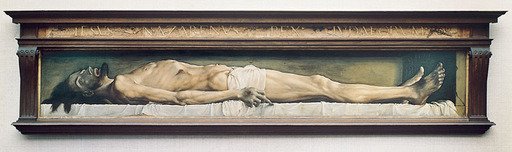
The other day I came across a painting by Hans Holbein the Younger, which reminded me acutely of my experience and I decided to make it My Daily Art Display for today.  The oil and tempera on limewood painting, which can be found in the Kunstmuseum in Basle, is entitled The Body of the Dead Christ in the Tomb and Holbein completed it in 1521.  The painting is lifelike in size, measuring 2 metres long and just 31 centimetres high (79 inches x 12 inches) and depicts the dead Christ lying stretched and unnaturally thin in a wooden tomb.  The dimensions of the painting create a disturbing effect.  The painting has an almost claustrophobic shape.  Many artists, such as Caravaggio, Delacroix, Titian and van der Weyden have painted The Entombment but looking at Holbein’s portrait of the dead Christ is probably as shocking a picture as one is ever likely to come across.  Grunewald’s Isenheim Altarpiece showing the ravaged and distorted body of Christ on the cross and The Deposition, his lowering to the ground, shows the strain on the body of Christ which one can barely imagine but Holbein’s Christ lying before us, dead in his tomb, is both intense and overwhelming.

One has to wonder what Holbein intended for this piece of art of such unusual dimensions.  Was it meant to be a free-standing painting or maybe it was to be a predella below an altarpiece?

Borne above the painting by angels holding the instruments of the Passion is an inscription in brush on paper:

                           “IESVS NAZARENVS REX IUDAEORUM”

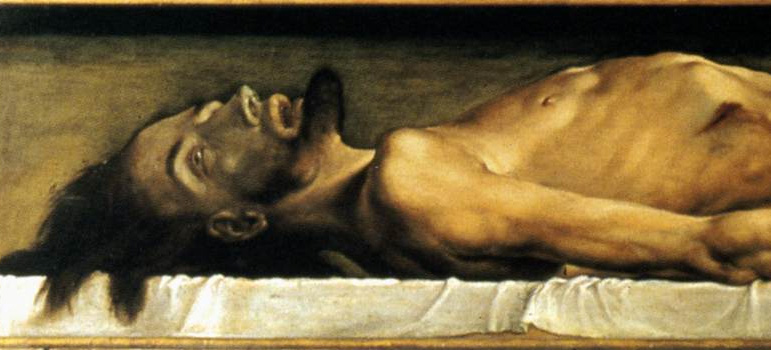
There is a stark realism about the painting and I can only imagine that to stand in front of this life-sized work of art must be both awe-inspiring and shocking.  I am told that when you look at the painting, it is as if the tomb has been set into the wall of the gallery because Holbein has created a three-dimensional illusion.  The physical depiction of the body is realistic.  It is said that Holbein used a body dragged out of the Rhine as his model.  Looking at the body of the dead Christ is just like the experience I had a week ago when I gazed at the dead person, albeit she was clothed, but her hands, wrist and face were uncovered and discoloured.  Every physical feature of death is portrayed in this painting.  The body of Christ has the marks of the crucifixion.  We look in horror at the blood-caked wounds in the back of his hand and his feet, where the nails had penetrated.  We see the wound in his side which had been penetrated by the lance.  All the wounds are turning a gray-green and becoming swollen, due to the onset of gangrene.  Surprisingly, there are no marks on Christ’s forehead from the crown of thorns.

Details of the upper body


Details of the lower body

Let us look at some of the detailed work this great artist has given to this painting.  The blackened feet of Christ lie almost to the end of the stone-walled enclosure.  The bones of his body push against the flesh like spikes emphasising the hollowness of his ribcage.  String-like muscles press against the lifeless yellow skin.   Look carefully at the face of Christ which is slightly tilted towards us.  The hair of Christ spills over the stone block which has been covered with a white shroud.   His beard points upwards towards the low roof of this wooden box-like tomb.  His right hand balances on the edge of the dishevelled shroud.  All but his middle finger is curled inward and we can almost feel the pain the dying Christ felt as his life ebbed away.   His bony middle finger points, to what we do not know.  Except for the deathly pallor we may believe he is still alive.  His eyes and mouth are open.  We could be forgiven in thinking we are at the bedside of a dying man who looks heavenwards as he exhales for the last time.  Why did Holbein paint the dead Christ with his mouth and eyes open?  Could it be that Holbein is reminding us that even in death Christ nonetheless sees and speaks?  Is it to remind us that even from the decay of the tomb Christ did rise again on the third day?  In the fifteenth and sixteenth century, works of art similar to this, intensified the imagination of the observer with regards to the suffering Christ had to endure and by doing so giving an intensity to people’s meditations on Christ’s Passion.

This panel painting has attracted fascination and praise since it was created.   The Russian author Fyodor Dostoyevsky was wholly captivated by the work.  It is said that in 1867, his wife had to drag her husband away from the panel lest its grip on him induce an epileptic fit.

Lovers in an Upstairs Room from Utamakura by Kitagawa Utamaro

Lovers from the series Poems of the Pillow by Kitgawa Utamaro (1788)

My featured artist in My Daily Art Display today is Kitagawa Utamaro the Japanese printmaker and painter.  Utamaro was born in Edo, which is the former name of the present day Tokyo, in 1753.  Details of his early life are rather vague.  His original name was Kitagawa Ichitaro.  He was the son of a tea-house owner and when he was still a young child he became the pupil of the Japanese folklore artist, Toriyama Sekien, in whose house he lived whilst he was growing up.  As was the practice in Japan in those days, as he became older, he changed his name.  He changed it to Ichitaro Yusuke.  Although it is known that he married there are no records of the couple having children. 

His first professional work of art was published in 1775, under his (pseudonym) Toyoaki, it was for a cover of a Kabuki playbook.  After this he produced a number of actor and warrior prints and also some theatre programmes.  In 1781 he changed his pseudonym to Utamaro and began a series of woodblock prints of women.  Ten years on, Utamaro concentrated all his artistic efforts on making half length single portraits of women rather than women in groups, which had become popular with other ukiyo-e, woodblock print, artists.  His career really took off in 1793 and he went on to produce a number of very famous series featuring women of the Yoshiwara, the Askasen district of Edo, where male and female prostitution flourished.  In 1804 at the height of his success he encountered legal problems because of his prints relating to a banned historical novel.  His prints entitled Hideyoshi and His Five Concubines depicted the wife and concubines of a past military ruler, Toyotomi Hideyoshi, and they were considered a great insult.  He was imprisoned for a short time and it is believed that this incarceration and his fall from favour devastated him and ended his artistic career.   He died in Edo two years later in 1806, aged 53.

Utamaro produced in excess of two thousand prints and is considered to be one of the greatest Japanese wood block print artists of his time and along with achieving a national reputation during his lifetime, his reputation has remained undiminished since and his work is known worldwide.

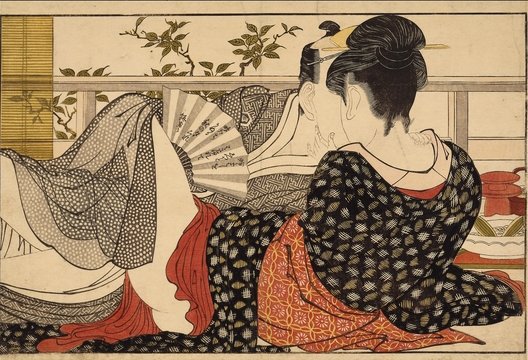
Today’s offering Lovers in an Upstairs Room from Utamakura (Poem of the Pillow) was completed in 1788 and is a masterpiece of erotic art.  Viewed slightly from below with two large human forms filling the picture.   Utamaro avoided the stereotypical “in your face” scene of lovers making love, which was popular at the time and instead went for a more subtle and restrained happening which nonetheless exudes an air of eroticism.  The lovers are not naked but this, in a way, adds to the eroticism as we are left to imagine what is happening.

Close up of the lovers

Before us we see the two lovers in bed.  The woman has her back to us and we can see the slender fingers of her left hand adoringly touching her lover’s face as his hand rests on her  shoulder.  Our attention is drawn to the nape of the woman’s neck.  Her jet-black hair is held high and the whiteness of her skin is exposed which is in stark contrast to the vivid red of her under-kimono.  Look at the minute lines that make up her hairline. Note how the fabric, which only partly covers the entwined limbs, is transparent adding sensuousness to this love-making scene.  Their faces are close together, maybe even touching.  They stare into each other’s eyes.  We can just see part of his right eye fixed in an intense gaze, which one feels is one of love and desire. 

Today’s  woodblock print is the frontispiece from The Utamakura  – Poem of the Pillow, a comprehensive and beautifully illustrated study of traditional Japanese erotic art produced by Utamaro and his long-time friend and publisher Tsutaya Jüsaburö.  Utamaro’s depiction of courtesans and their lovers in many cases failed to portray the life of misery some of the women had to endure.  Their poverty, their controlled oppression and the diseases which came with the nature of their work were rarely presented in his glamorised works and because of that they have received a certain amount of criticism in recent times.

This work of art I believe is one of the most sensuous I have come across, even though it is not of a sexually graphic nature.  Does this not prove that the semi-naked body is more beguiling and seductive than a body devoid of clothes ?

The Jewish Cemetery by Jacob van Ruisdael

The Jewish Cemetery by Jacob van Ruisdael (c.1660)

When I come to think about the painting I am going to use for My Daily Art Display I like to try and find one by an artist I haven’t featured before.  I also like to showcase an artist I had not heard of previously so that when I research his or her life it is a learning curve for me.  Today, however My Daily Art Display is a three-fold repeat which limits what I can say, without being accused of repeating myself.

 Firstly I have offered you a painting by Jan van Ruisdael before (January 9th) but I will not apologise for that as he is an amazing painter and has completed many superb works of art.   Secondly, the painting today is a Vanitas-type painting, a type of painting, which I talked about when I offered you the Still Life of Food and Drink by Willem Heda on February 11th, and lastly this painting resembles in many ways the painting by Arnold Böcklin which I gave you on January 5th.  Having said all that, I have to tell you that when I was looking through some art books for my next presentation I was immediately taken aback by the strength of this painting and the aura that emanates from it.

My Daily Art Display today is The Jewish Cemetery by Jacob van Ruisdael which he completed around 1660 and now hangs in the Gemäldegalerie Alter Meister in Dresden with a larger version in the Detroit Institute of Arts.  This is a Vanitas genre painting, which is a type of painting that depicts an object or collection of objects symbolizing the brevity of life and the transience of all earthly pleasures and achievements.  In other words it is a painting which reminds us that we are not immortal and notwithstanding how rich or powerful we are –  we will all die sooner or later.

There is a definite melancholic and depressing feeling about this painting.  There is also that sense of foreboding which was present in Arthur Böcklin Island of the Dead which I gave you on January 5th.  The ruins, the graves and the dark skies set the mood of the painting.  Ruisdael had this uncanny talent to be able create such feelings in how and what he depicts.   This is a painting of the Portugeuse-Jewish Cemetery at Ouderkerk on the Amstel River close to Amsterdam, however to be absolutely accurate, I must tell you that only some of the elements in the painting actually exist such as the three large tombs shown in the mid-ground, but that’s about it !  

The backdrop to the cemetery bears no similarity to the place at Ouderkerk.  There are no ruins overlooking the actual cemetery.  The ruins Ruisdael painted were the remains of the Egmond Castle which is situated near Alkmaar some thirty miles away.   There is no river running through the cemetery but Ruysdael just used it to portray the fact that the water like time rushes away from us.  The landscape, the river and the “added-in” ruins were just figments of Ruysdael’s imagination but one has to admit they do lend themselves well to the atmosphere he wanted to project.   

The three large tombs in the middle ground, which immediately catch one’s eye, the dead beech tree in the right foreground and the broken tree trunk overhanging the fast flowing river all indicate allegorically the fast approach of death.  However, Ruisdael does offer us a glimmer of hope in the way we can see a shaft of light penetrating the black clouds.  We can also see a rainbow and if we look carefully there are signs of flourishing growth amongst the dead trees, so he is telling us there may be a better life still to come after death.   Art historians have interpreted this painting simply as a reminder that man lives in a transient world and that despite being beset by sinful temptations there is always hope for salvation and deliverance.

La Mariée by Marc Chagall

La Mariée by Marc Chagall (1912)

Last night I was watching the old rom-com film Notting Hill.  I had seen it before but sometimes when you watch a film a second or third time one notices new things about it.  Last night I noticed the Marc Chagall painting La Mariée that Julie Roberts gave Hugh Grant so I thought I would make it the subject of My Daily Art Display today.

Reading some of the press releases at the time regarding the film I note that the choice of painting was that of the film’s screenwriter, Richard Curtis, who was a fan of Chagall and he wanted one that depicted a yearning for something that is lost.  However to include such a picture, or a copy of it, in the film the producers had to get permission from the owner of the original, a private collector in Japan and the Design and Artists Copyright Society.  Agreement was reached but one proviso which was stipulated was that after filming the copy of the painting used in the film had to be destroyed !

Marc Chagall, a Russian Jew, was born in Vitebsk in Belarus in 1887 to a poor Jewish family and was eldest of nine children.  After finishing at school he decided to study art, much to his father’s annoyance.  He went to St Petersburg and studied art under Leon Bakst, the Russian painter, set and costume designer.   In 1910 he moved to Paris and joined an avant-garde group which included Modigliani, Robert Delauney and Fernand Léger and soon became one of the most successful artists of the twentieth century.  His works were unique and distinctive and he worked in many mediums besides fine art painting.  He illustrated books and worked with ceramics and stained glass, producing windows for the cathedrals at Metz and Reims as well as windows for the United Nations.

He was a pioneer of Modernism and one of the precursors of Surrealism.  Chagall achieved recognition and with it came affluence.  The art historian Michael Lewis said that Chagall was “the last survivor of the first generation of European Modernists and for decades had also been respected as the world’s pre-eminent Jewish artist”.

He visited his homeland Russia on a number of occasions and set up and became the director of the Free Academy of Art in his home town of Vitebsk.  He returned to France in 1922 and remained there except for the war years in the 1940’s when he fled to America.  Chagall was very affected by the Nazi atrocities during that time and some of his paintings depicted the horror of the Nazi rise of power and the ensuing martyrdom of the Jewish people.

Chagall died in Saint Paul de Vence in 1985, just two months short of his ninety-eighth birthday.

Today’s painting; La Mairée features a young woman in her bright vivid red wedding dress clutching her bouquet of flowers.  Her long white veil covers her head and reaches down to her feet.  In contrast, the background is a mixture of blues and grays. The background, coloured as it is, evokes the darkness of night and in some ways a feeling of sorrowfulness and gloom whereas the colours used with the bride suggest a sense of elation and happiness.   It is this dissimilarity of the background colours and the colours of her dress which also projects the image of the woman towards us.  She is being presented to us, the observers, by the man in such a noticeable and confident way that makes us believe that she is our bride and we are the groom.

To the right of the woman is a goat playing a cello.  This strange combination of an animal playing a musical instrument was often used by 20th century European artists.  A fish leaps high and looks as if it is conducting the music.  A table floats above the fish.  To the right of the goat we can see a man playing what looks like a clarinet.  The man hovering above the woman, presents her to us and as he adjusts her veil.  If we look carefully to the right of the picture we can just make out a church.   I suppose this was a requirement for a “wedding picture” but the way it has been squeezed into the painting makes me wonder if this was added by Chagall as an afterthought.

In Luxury, Look Out by Jan Steen

In luxury Look out by Jan Steen (1663)

The first ever painting of My Daily Art Display was the Netherlandish Proverbs by Pieter Bruegel the Elder and today’s painting has many similarities to that great work of art.

My Daily Art Display for today is entitled In Weelde Siet Tot, (In Luxury, Look Out) painted by the Dutch artist Jan Steen in 1663.  Steen was born in 1626 in Leiden, Netherlands and came from an affluent Catholic family who ran a brewery and tavern named the Red Halbert.  After he passed through the local grammar school he settled down to an artistic education in Utrecht under the German-born, Dutch Golden Age painter, Nicolaes Knupfer.  In 1648 Steen, with his friend Gabriel Metsu, founded the painters’ Guild of St Luke at Leiden.  A year later he became an assistant to the Dutch landscape painter Jan van Goyen who was also his landlord.  In 1649 Steen married van Goyen’s daughter Margriet and this couple went on to have eight children.

Jan Steen’s favourite theme for his paintings was ordinary daily life.  The scenes he painted were often lively and chaotic and the Dutch to this day often use the phrase “A Jan Steen household” meaning a chaotic and messy household.  His paintings of household chaos were supposed to act as a warning to observers that life needed to be more organised and orderly.  Today’s painting is one of these typical works of art of Jan Steen – chaotic, messy and full of hidden meanings.

In today’s painting Steen interprets the moralistic truths of Dutch genre painting as a humorist in which realistic actions and educational advice are confused.  Steen has illustrated in his painting various examples of overindulgence and recklessness in a degenerate household.  Many of the individual scenes within this painting allude to Dutch proverbs and sayings, similar to Bruegel’s Proverbs painting.  The housewife sitting left of centre in a respectable dress, who is probably the head of the household, has fallen asleep at the table and unbeknown to her, chaos has broken out around her.  Asleep with tiredness or asleep through inebriation ?

In the painting we have a plain room in a house which has fallen into complete chaos.  We can see four adults, an adolescent, three children, a baby, a pig, a monkey and a dog.  A young woman faces us with a glass of red wine in her left hand placing it on the crotch of the man sitting next to her.  Her low-cut neckline would be more customary on a barmaid or a prostitute.  The man next to her is distracted by a woman and an older gentleman, who is reciting to him from the book he holds.  The older man is standing slightly hunched over his book and has a duck on his shoulder which is staring at another young man as he plays a violin and at the same time is watching a young girl stealing a coin from a purse.  The woman sleeps on despite the chaos and does not hear the bowl crashing to the floor knocking over the pewter tankard.  Next to her is a small boy with a pipe, possibly blowing smoke at her in order to wake her up and alert her to the fact that the dog standing on the table is eating their meat pie.  The baby sitting at the table turns around and stares at the barrel spilling beer onto the floor.  Why is the beer pouring out of the barrel ?  Look at the pig on the right of the painting and see what he has in its mouth – the beer barrel tap !  The pig with its teeth clenched around the tap is nuzzling a rose on the floor which has fallen from the stem of roses in the man’s hand.  Scattered across the floor is the man’s hat, his pipe a number of pretzels.  Couple these with the large amounts of alcohol on show one could not be blamed for thinking the setting for this painting is a tavern or brothel.  However because of the presence of children, the kitchen to the right of the scene and the purse above the violinist one has to revert to the belief that this is simply a room in somebody’s house.

In the foreground at the right there is a slate leaning against a step and it is inscribed with the first part of a Dutch proverb:  In weelde siet tot, which translated means “In Luxury, Look Out”.  The ending of the proverb, (not inscribed on the plate) is “and fear the rod”.  Translated it means “beware the punishment which follows excess as fortunes often change especially through bad management”.  Maybe as a reminder of such consequences the artist has painted a basket hanging from the ceiling, in which one can see, precariously hanging out of it, crutches and a sword.  On the floor we see playing cards littering the floor while at the top right we see a monkey stopping a clock.  Maybe the stopping of the clock stopped the passage of time, giving the artist time to record the proliferation of chaos !  This is a large painting, 1.5m across and would have taken the artists weeks, maybe months to sketch in all the characters.

As the woman sleeps....


Total and utter chaos !  But should we read more into the painting?  Take for instance the sleeping woman and the child furtively stealing money from the purse in the cupboard.  Could this mean that if one is not resolute and in control of what is happening around one, then poverty will follow?   This is indicated by the flat purses hanging on the wall above the woman’s head and which appear to be empty and devoid of coins.  The dog being allowed to get on the table and eat the food of the humans underscores the negligence of the adults and sets out a bad example to the children.  Moralists traditionally likened dogs licking pots to children being brought up badly.  

What of the pig ?   There is a Dutch proverb which says “The pig runs off with the tap” meaning “the party is drinking with abandon”. 

The snuffling pig

The pig nuzzling the rose was a reminder of another proverb.   “Throwing roses before the swine” meaning wastefulness.  The monkey stopping the clock reminds us of the saying “In folly, time is forgotten”.  A “quacking” duck symbolizes nonsensical banter.  The duck on the man’s shoulder therefore probably alludes to his conversation being futile banter during which they have chosen to ignore the chaos around them.

Hanging basket

Will the occupants of this room receive what they deserve for their lack of attention ?  The artist hints that they may receive their “come uppance” by in the way he drew a basket hanging from the ceiling above their heads – a kind of Sword of Damocles !  The content of this hanging basket is full of items which suggest poverty and disease.  There are crutches, a leper’s rattle and switches which were used to lash petty criminals.

This painting by Jan Steen is a real but comical distortion of a Dutch family household, living in chaotic conditions and may act as a warning to observers of the folly and the consequences of such a lifestyle.  If you live in chaotic conditions maybe you should go out and buy yourself a print of this painting and hang it on the wall to remind yourself and your housemates of the dire consequences of living in such disarray.