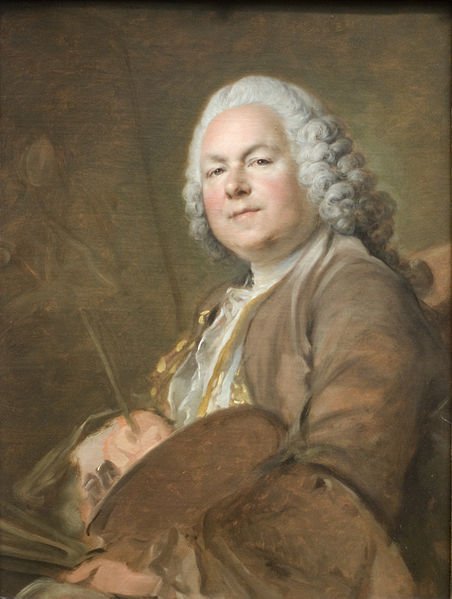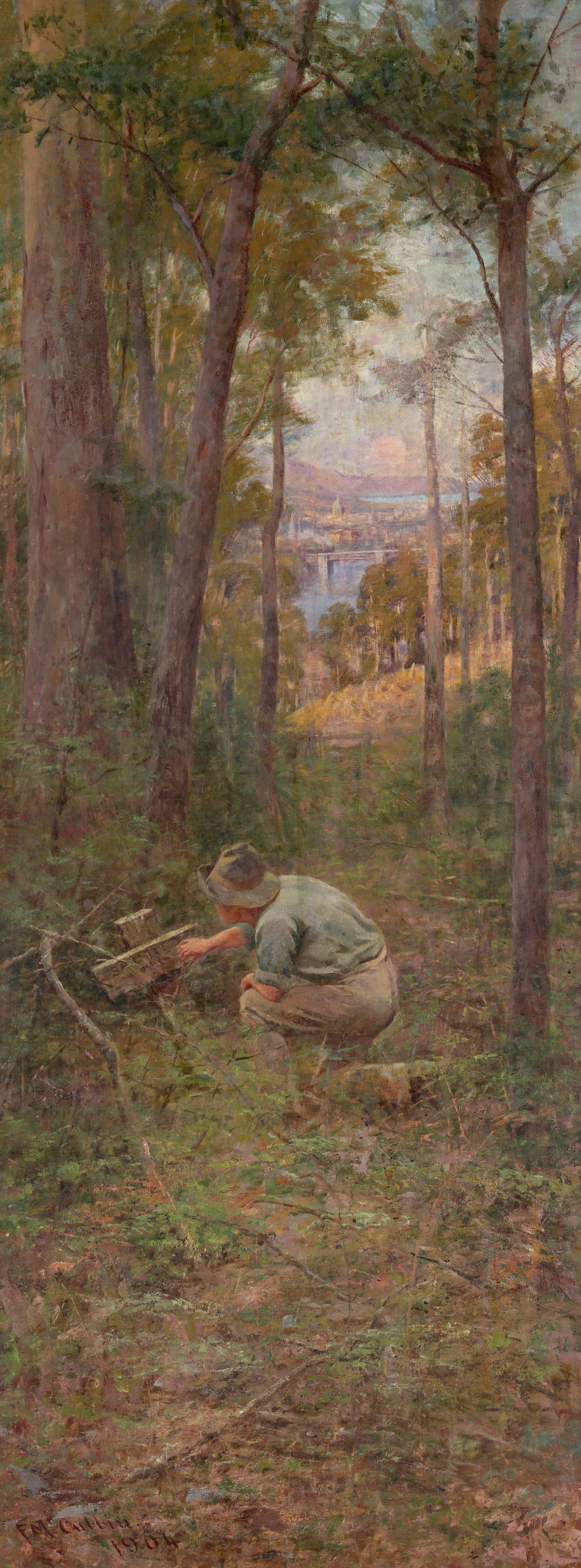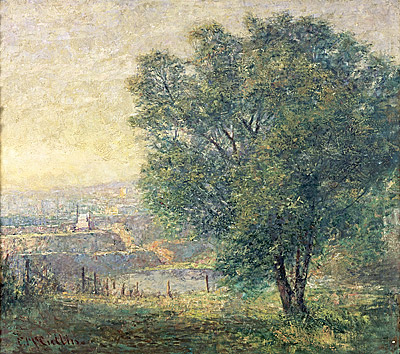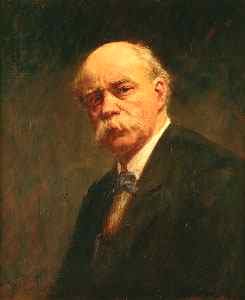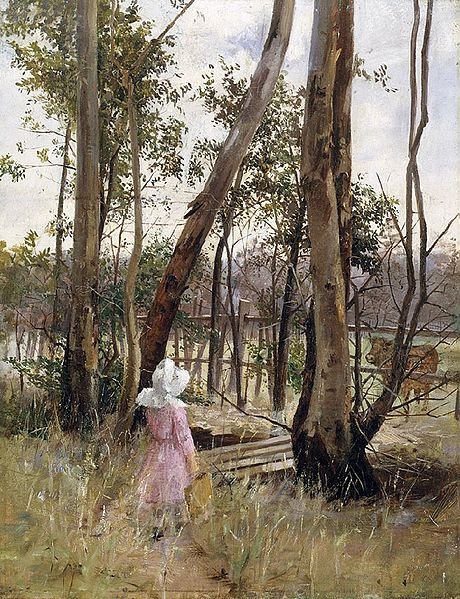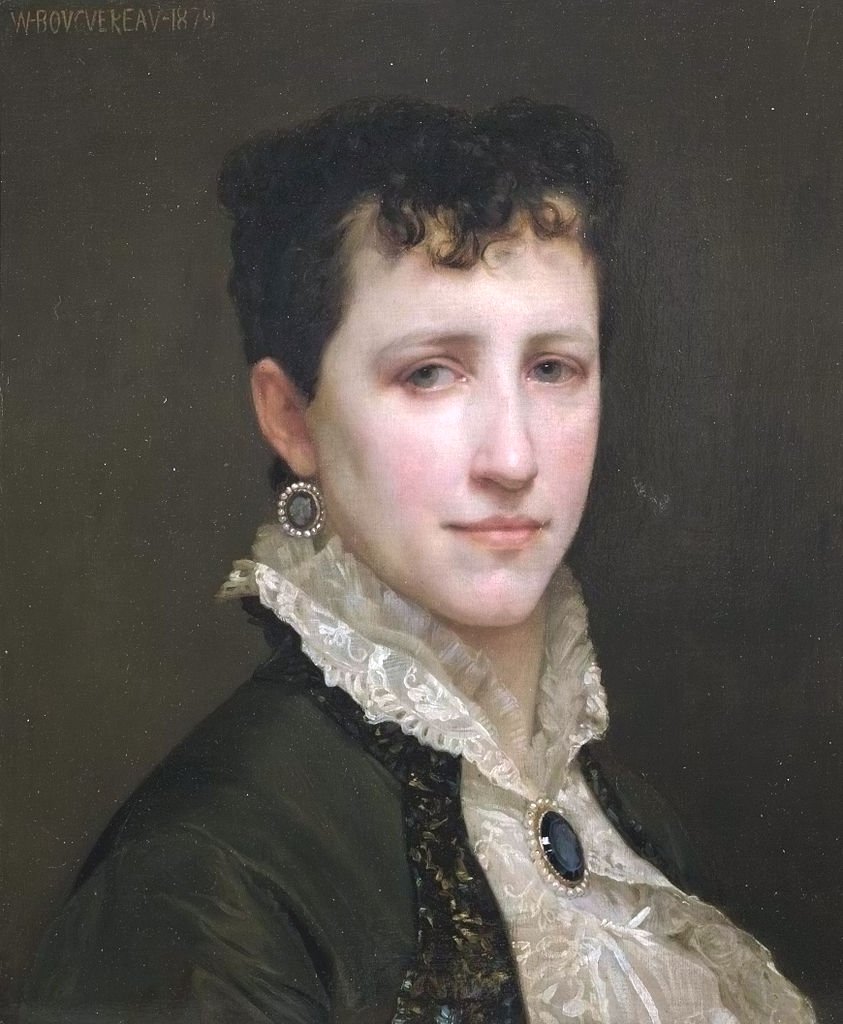
Elizabeth Jane Gardner – the resolute and tenacious artist.

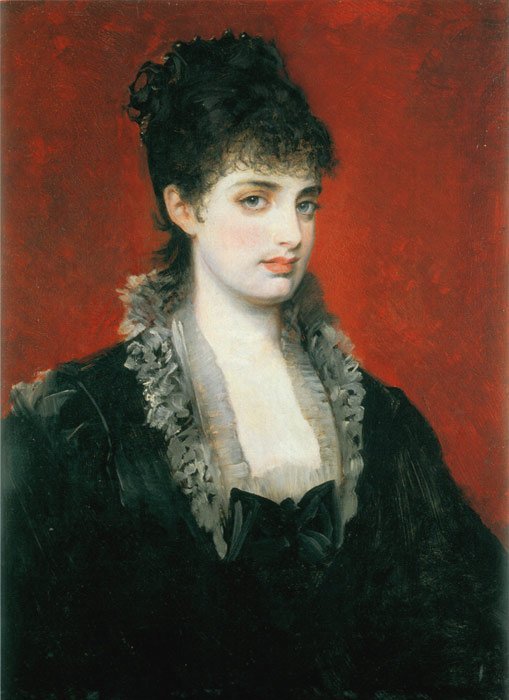
Elizabeth Jane Gardner by William Bouguereau (1879)

The artist I am looking at today is the American, Elizabeth Jane Gardner.  If you read my last blog, which was the conclusion of the life of the French Academic painter William Bouguerau, you will know that Gardner was his second wife.  This is not a story about the wife of a famous painter dabbling with art.  This is a story about the fighting spirit of an acclaimed painter – a great artist in her own right, although it has to be said that she was often criticised because much of her work resembled her husband’s genre pieces.

Elizabeth Jane Gardner was born in October 1837.  Her birthplace was the town of Exeter in the American state of New Hampshire.  It was here that she attended junior school.  After completing her regular school education in 1853, she attended the Lasell Female Seminary at Auburndale Massachusetts.  The college, which was founded in 1851, was named after its founder Edward Lasell, who was a great believer in female education.  It was at this college that Elizabeth studied languages and art.  She graduated in 1856 and for the next few years was a teacher of French at the newly opened Worcester School of Design and Fine Arts in Massachusetts.

Whilst she had been studying art at the Lasell Seminary she would often question the teaching she received but it dawned on her that the foundation of all good painting stemmed from the ability to master the art of drawing.  It was probably during the time spent in her art classes there that she nurtured the desire to one day, go to Europe and live and study art in Paris, which was then, the capital of the art world and the Mecca for all European and American artists.  This artistic ambition to savour French life and its art was probably delayed by the American Civil War and her dream was not realised until 1864, when she and her former art teacher at the Lasell Seminary, Imogene Robinson, set sail for France.  They got themselves a flat in Paris and that summer obtained licenses as copyists at the Louvre and the Musée du Luxembourg.  For the duration of that summer they fulfilled artistic commissions from America by copying paintings in the collection of the prestigious galleries which they also sold to the locals.  However Elizabeth’s main reason for coming to Paris was to receive further artistic tuition at one of the prestigious art academies and so in the autumn she applied to enter L’École des Beaux-Arts, the foremost art institution.  She was horrified that her application was rejected, not on the grounds of her ability but on the grounds of her sex.  L’École des Beaux-Arts, like many art establishments at the time, had a male-only admissions policy and refused to admit females into their hallowed corridors.  The banning of women from the L’École des Beaux-Arts was not lifted for another thirty-five years, in 1897.

Whether it was her and her American companion Imogene’s need to fulfil their initial aim for coming to France, to receive tuition from an established artist or whether it was the simple fact that the public art galleries were not heated and copying works of art in the cold establishments became less pleasant, the women gave up their commissioning work and in the winter of 1864 they looked for an artist who would provide them with some tuition.   Established artists were happy to nurture and teach aspiring artists provided they could pay.  The more the student was willing to pay the better the class of artist who would become their tutor.  Elizabeth’s companion Imogene was in a much better financial situation than Elizabeth and was able to secure Thomas Couture as her mentor and tutor whereas Elizabeth who was not as well off settled for a lesser-known painter Jean-Baptiste-Ange Tissier, whose students were mostly women.

Portrait of Elizabeth Gardener Bouguereau by her husband William Bouguereau (1895)

Elizabeth Gardner was a resolute and determined character and was not going to be put off by red tape and sexist bureaucracy of the art academies and so devised a plan on how she would gain admission to one of the Parisian art schools.   Before she had left the shores of America, she had been ill and had lost a lot of weight and had had to have her hair cropped short.  Her figure had taken on a boyish appearance which part facilitated her ingenious plan. She decided to pose as a young lad but for a woman to walk the streets of Paris dressed as a male she had to have permission from the Paris Police Department!  The law was passed on November 17th 1800 when Paris city chiefs had placed the order on the statute books that required women to seek permission from the police if they wanted to “dress like a man.”   The order was issued at the end of the French Revolution when working-class Parisian women were demanding the right to wear pants in their fight for equal rights.  Parisian women activists, during the Revolution, had also requested the right to wear trousers as a political gesture and like their male working-class revolutionaries became known as “sans-culottes” for wearing trousers instead of the silk-knee breeches preferred by the bourgeoisie. It was modified in 1892 and 1909 to allow women to wear trousers if they were “holding a bicycle handlebar or the reins of a horse”.  Such an old fashioned law!  Actually not, for it was only in January 2013 that the French Minister of Women’s Rights, Najat Vallaud-Belkacem, said that the ban was incompatible with modern French values and laws and although it had been ignored for many years it was only right that the law was officially repealed and so French officials invalidated the 213-year-old order that forbade women in Paris to dress like men and wear trousers.  The French government had been opposed to women wearing trousers for it was a simple method of preventing women, who dressed as men, from gaining access to certain offices or occupations which were male-only domains.
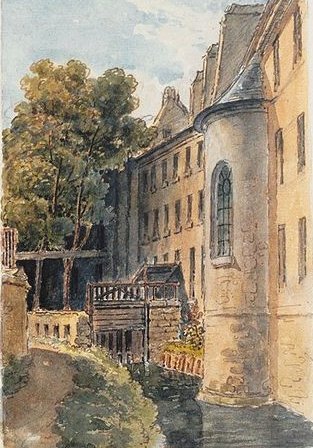
The rear of the Gobelin Factory (c.1830)

Elizabeth’s plan worked, for in 1865, she successfully applied to the drawing school of the prestigious Gobelin Tapestry factory which was best known as a royal factory supplying the court of Louis XIV and later monarchs.  At the beginning she was accepted as a young lad but after a while her fellow students and instructors realised that she was actually a young woman.  Whether it was because of her outstanding drawing ability or her determined personality, one may never know, but despite the discovery of her sex, she was allowed to stay.
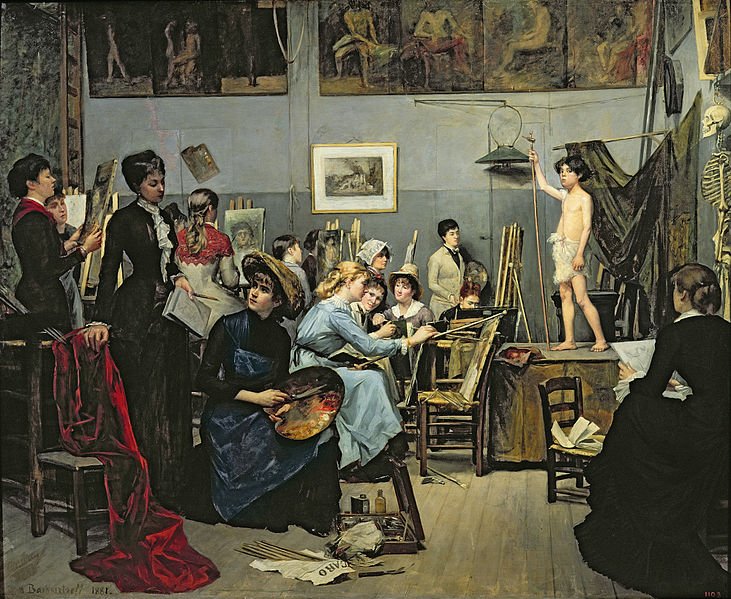
In the Académie Julien in Paris by Marie Bashkirtseff (1881)

One person, who was also impressed with her ability and strength of mind, was Rodolphe Julian.  He had established the Académie Julian in 1868 as a private studio, a school for art students. The Académie Julian was a kind of feeder school for art students who wanted to later gain admission to the École des Beaux-Arts as well as offering independent training in arts. At that time, women were not allowed to enrol for study at the École des Beaux-Arts, but this new Académie Julian accepted both men and women, albeit they were trained separately, but most importantly, women participated in the same studies as men, which included access to classes which taught the basis of art – drawing and painting of nude models.  The Académie Julian was particularly popular with aspiring American artists for it did not have an admission’s precursor of having to be able to speak French.

Whether it was beginners luck or just the fact that she had become a successful and talented artist but in 1868 she had two of her painting accepted by the Salon jury.  To have a painting exhibited at the Salon was a great moment in the life of an aspiring painter.  It was not just in recognition of their talent but it enhanced the value of their future works.  Elizabeth was delighted and wrote home to her parents:

“…when the ex’n opened both of mine were hung in full view among foreign artists and raises the value of what I paint…” 

Elizabeth Gardner’s works were often found in the annual Salon exhibitions and in the exhibition catalogues she, like many other artists whose works were on show, would often name the well know artists who had taught them.   This was an attempt by artists to boost their status and their “artistic bloodline”.  It is by looking at these catalogue entries that we know that Elizabeth received tuition from Hugues Merle, a contemporary and friend of Bouguereau from 1868 to 1874.  The name of the artist, Jules-Joseph Lefebvre was added in catalogues in 1875 as was the name of William Bouguereau from 1877 onwards.
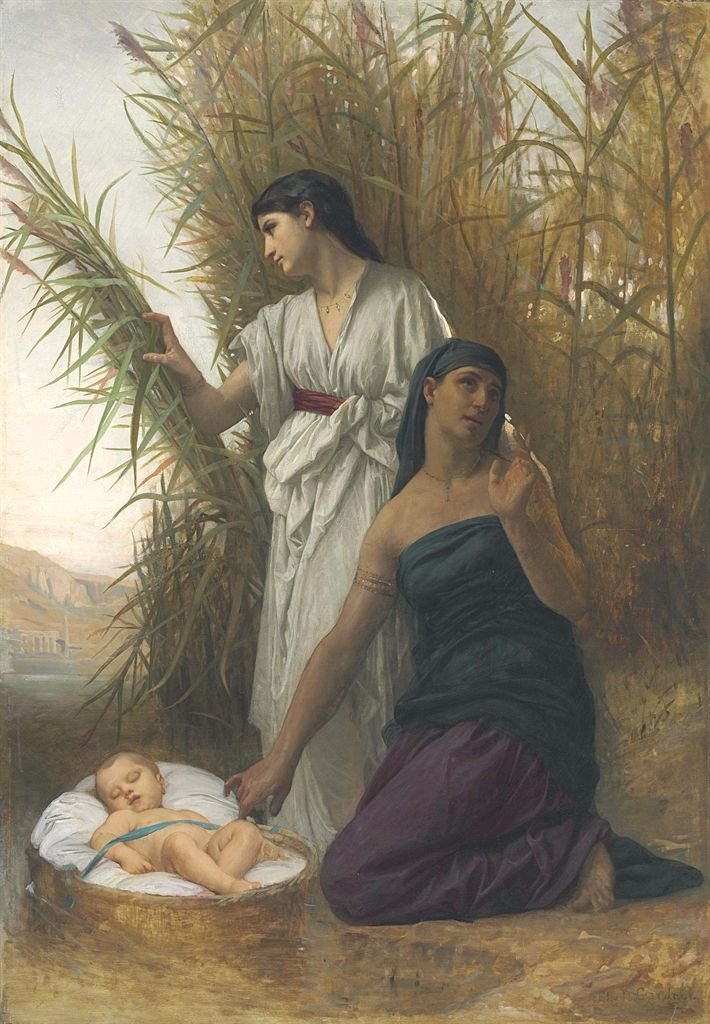
Moses in the Bullrushes by Elizabeth Jane Gardner (1878)

In 1878 Elizabeth Gardner put forward a religious painting for inclusion at that year’s Salon.  It was entitled Moses in the Bulrushes.  She had started the work the previous year and was pleased with its progress.  In December 1877, she wrote about her progress with the work to her brother, John, who was back home in Exeter, New Hampshire:

“… I have advanced my picture of little Moses a good bit this month. The canvas is now covered and now comes what is to me the hardest part. I have always ideas enough for nice subjects but it is so hard to make the reality come up to the dream. I get sometimes quite frantic over it…” 

The work was accepted by the Salon jurists and exhibited in 1878.  The Arts critic of the American Register, a newspaper for expatriate Americans living in Paris wrote in the April 6th edition:

“…‘Miss E. J. Gardner has just completed her picture for the Salon, Moses in the Bulrushes. The subject is taken at the moment when Moses has just been placed amongst them, and his sister has parted the bulrushes to watch the approach of Pharaoh’s daughter, who is seen in the distance. The expression of anguish in the mother’s face is especially well rendered, and the coloring is remarkably fine…” 

The fact that she had put forward a religious painting for inclusion at the Salon was a brave move as history and religious paintings were looked upon as the highest form of art genre.  It was a genre that was also looked upon as being artistically, a male-only domain and female artists were often discouraged from attempting such works.  However as we know, Elizabeth Gardner was a strong-minded person and never shied away from controversy if she believed her course of action was right.  Her submission of this religious work entitled Moses in the Bullrushes, put her in direct competition with her male counterparts.  It was also interesting to note that her take on the event portrayed was from a female perspective.  She had depicted the two women, the mother of the baby and the Pharaoh’s daughter, as courageous women who were saving the life of the baby, Moses.

As the sale of her paintings increased with her popularity, so her financial situation improved.  Things got even better in the late 1870’s when the renowned Paris art dealer Goupil began purchasing her work and in the 1880’s her work was so much in demand that the prestigious Knoedler art dealership of New York, was buying her Salon paintings, sight unseen.  This art dealership had formerly been a subsidiary of the Parisian art dealers, Goupil & Cie.

Elizabeth had reached one of her most sought-after ambitions in 1868 – to have one of her paintings exhibited at the Paris Salon.  However Elizabeth was not one to rest on her laurels and her next ambition was not only to have her work hung at the Salon exhibition but that it was deemed worthy of an award.   She had to wait another nine years for that happening.

One of Elizabeth Gardner’s artistic mentors was William Bouguereau.  Elizabeth and her companion Imogene were living in a flat in rue Nôtre-Dame des Champs in the Montparnasse district of Paris, the same street in which Bouguereau and his family resided.  Elizabeth became known to the family and was on friendly terms with Bouguereau’s wife, Marie-Nelly. William Bouguereau and Elizabeth Gardner must have become quite close during this time as, eight months after the tragic death in childbirth of Bouguereau’s wife in April 1877, the grieving widower proposed marriage to Elizabeth.  Elizabeth was happy to accept but Bouguereau’s mother and daughter Henriette were horrified.  The daughter threatened to leave home and join a convent if a marriage took place but this threat was never tested as Bouguereau’s of the vociferous, sustained and obdurate opposition from his mother to the formalising of the partnership was enough to halt any proposed wedding plans.   However the couple became engaged in 1879 and Elizabeth wrote about Bouguereau, their betrothal and her thoughts about his mother.   In a letter she wrote:

“…And now about my engagement…. I am very fond of Mr Bougereau and he has given me every proof of his devotion to me.   We neither of us wish to be married at present.  I have long been accustomed to my freedom.  I am beginning to attain a part of the success for which I have been struggling so long.   He is ambitious for me as well as I for myself.  As it is I can’t help working very much like him.  I wish to paint by myself a while longer.  He has a fretful mother who is now not young, 78 I think.  She is of a peevish, tyrannical disposition and I know she made his first wife much trouble…” 

Elizabeth and Bouguereau continued to work together and seemed happy or maybe just resigned, to accept a long drawn out courtship.
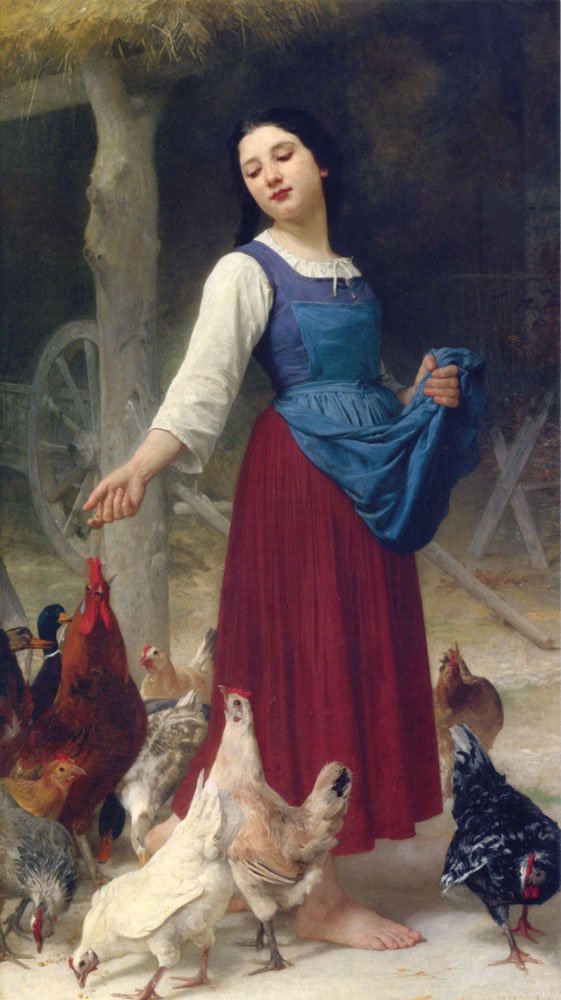
The Farmer's Daughter by Elizabeth Jane Gardner (1878)
The Farmer’s Daughter by Elizabeth Jane Gardner (1878)

The realisation of Elizabeth’s ambition to be awarded a medal at the Salon came in 1887.   By this time, the popularity of her work had surged and she had been inundated with commissions but her mind was focused on her Salon entries and in December 1886, she wrote to her brother John of her desire to achieve that ultimate success:

“…I must work to get a medal in Paris and not for money a while longer.   All will come right in time I am confident if I work hard and am patient…”

In a letter to her sister Maria in January 1887, she again sounded both resolute and optimistic about her award prospects:

“…I am bound to get a medal some year…”

Finally in 1887 the Salon awarded her a medal (third class) for her work entitled The Farmer’s Daughter.  The idea for the painting came to Elizabeth whilst she was on a painting trip in the countryside.  Whilst out, the weather turned nasty and a downpour ensued.  She took refuge from the rain by sheltering in a farmer’s barn and it was whilst there that she saw the farmer’s daughter feeding the hens and ducks.  So impressed by what she saw, she decided to make a quick sketch of the scene which led to the finished prize-winning work.  The painting is a depiction of unspoiled rural living and must have been seen as a breath of fresh air in comparison to paintings by the up-and-coming Impressionists depicting city scenes and the onset of modernity.  Gardner’s tranquil scene would probably have made many people want to exit the city and sample the peacefulness and serenity of the countryside and was for the owner of such a painting, it was a reminder of how life was in simpler days.

The award she received for her work was the first and only medal that was ever bestowed on an American woman painter at the Paris Salon.  She was ecstatic and on May 30th 1887, she wrote to her brother John back in America:

“…My pictures at this year’s Salon have just received the medal which I have waited for so many years. I hasten to write you by the first mail for I know you will All sympathize with me in my happiness. The jury voted me the honor by a very flattering majority – 30 voices out of 40 ….No American woman has ever received a medal here before. You will perhaps think I attach more importance than is reasonable to so small a thing, but it makes such a difference in my position here, all the difference between that of an officer and a private, and I hope it will be a good thing for the sale of my paintings. I made an extravagant risk in my large one this year. Monsieur Bouguereau is very happy at my success. He is as usual President of the Jury, it is his great impartiality which has so long kept him in office. He has always said that I must succeed through my own merit and not by his influence. I hope to send some photos soon….I have nearly a hundred letters of congratulation and dispatches to acknowledge today. I have begun by the dear ones at home…”

This work by Elizabeth was to receive further awards when it was exhibited in the Gallery of the United States at the Paris Exposition Universelle in 1889 where it was awarded a bronze medal.   To understand how great an achievement this was, one has to remember she was up against some of the finest American painters such as Thomas Eakins, William Merritt Chase and John Singer Sargent.
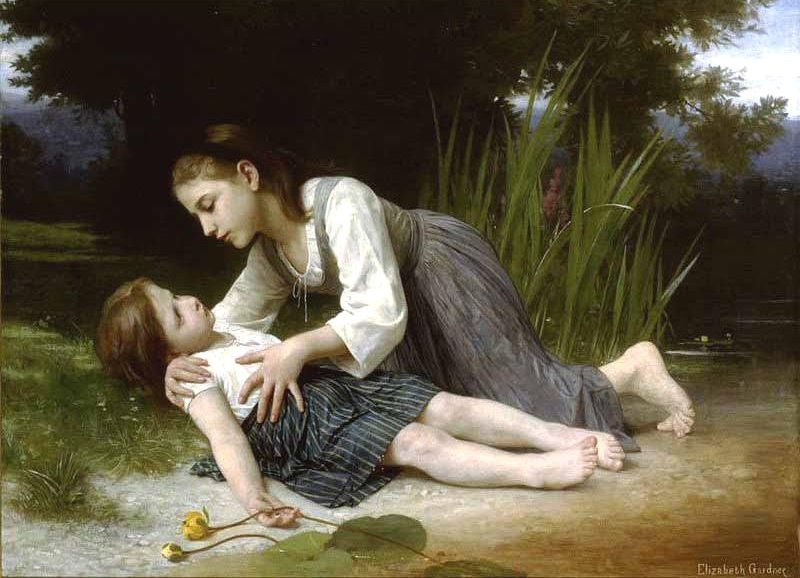
The Imprudent Girl by Elizabeth Jane Gardner (1884)

The work was exhibited along with another of her works, the somewhat controversial, L’imprudente (The Imprudent Girl).

Elizabeth and William Bouguereau had been courting for seventeen years, unable to marry for fear of crossing Bouguereau’s mother who was adamant that the couple should not marry.  However in 1896 his mother died aged 91 and the couple wasted no time in getting married. The colour of Elizabeth’s bridal gown was black and white because, as she explained, although it was her wedding day, she was still in mourning for Bouguereau’s mother.   The groom was 71, and the bride 59 years of age.  Elizabeth wrote home about their change in circumstances:

“… The old lady died on February 18th at the age of 91.  Her devoted son who had borne with such affectionate patience all her peculiarities was quite afflicted by the change [in her health].  He had so long had the habit of subordinating every detail of his life to her desires, of which the first was to rule without opposition in his house…”

After marrying Bouguereau, Elizabeth almost stopped painting altogether and spent most of her time looking after her husband and his studio.  When asked why she stopped painting she simply replied:

“…He was alone and needed me. I abandoned the brush…” 

She did not resume her painting career until after his death nine years later and it was then that she signed all her works in her married name.

The Shepherd David by Elizabeth Jane Gardner (1895)One other of Elizabeth Gardner’s painting of note was completed just before she married William.  It was another religious painting entitled The Shepherd David and was based on a passage from the Old Testament story (1 Samuel 17:34):

“…And David said unto Saul, “Thy servant kept his father’s sheep, and there came a lion and a bear and took a lamb out of the flock…”

The work depicts David demonstrating his worthiness to fight Goliath when he tells the tale of how he, as a shepherd, battled with wild beasts which were menacing his flock. In the painting Elizabeth has shown the young David kneeling in triumph on a dead lion while at the same time grasping a lamb under his right arm.   He looks upward towards the heavens, with his left arm raised in recognition that God had given him the strength to fight off the wild animals.  Elizabeth was proud of the painting and wrote to her sister Maria in America that she full expected to see her painting receive full-page coverage as one of the best works of art in 1895 in Goupil’s, the esteemed Parisian art dealers, art directory.

Elizabeth and William worked happily together from their studio in rue Nôtre Dame des Champs and, even at the age of 78, Bouguereau took his new wife to Italy a country he hadn’t visited since 1850 when he had won the Prix de Rome prize and the stay at the Villa Medici.  The couple would spend their summers away from the claustrophobic atmosphere of the French capital and return to the calming ambience of his birthplace, La Rochelle.  It was here that William Bouguereau died of a heart attack on August 19th 1905, three months short of his eightieth birthday.  His body was transported back to Paris and he was buried in the Cimetière de Montparnasse.

Art critics of the time often disapproved of Elizabeth’s painting style, saying that it copied too closely the style of her husband.  However Elizabeth was unrepentant and was very proud of her work and in a 1910 interview stated:

“I know I am censured for not more boldly asserting my individuality, but I would rather be known as the best imitator of Bouguereau than be nobody!”

The similarity in style between works painted by her and her husband was probably a financially astute decision as she was well aware that this genre of art, the sentimental secular works, was very popular with the public both in France and even more so in America where clients could not get enough of her and her husband’s art.

Elizabeth Jane Gardner Bouguereau, a native of New Hampshire will be remembered as the feisty young woman who challenged the French art establishment.  She was proud to be different and by so doing, signposted the way for many other women to challenge the stranglehold that males had on the world of art.   Elizabeth died at her summer residence in St. Cloud, a western suburb of Paris in January 1922 aged 84 and was buried, like her husband William, in the Cimetière de Montparnasse in Paris.

If you are interested in the life and work of Bouguereau and Elizabeth Gardner I do suggest you buy the excellent book,  Bouguereau  by Fronia E. Wissman, an author who has written or contributed to a number of books about French artists.

Adolphe-William Bouguerau. Part 3. A change of genre

Rest in Harvest by William Bouguereau (1865)

This is my third and final look at the life and works of the Classical French artist, Adolphe-William Bouguereau.  In Part 1, I looked at his History painting Dante and Virgil and in Part 2 looked at one of his many religious works, The Flagellation of Christ. Today I want to look at a completely different type of work he began to paint at the start of the 1850’s.  Why, if his classical History paintings were so successful, did he want a change of artistic genre?  The simple answer has to be money.  The commissions he once received from the church for his monumental religious works and the private commissions for his large History paintings had dwindled and he had a growing family to support.  He needed to increase his income.

In my last blog I looked at Bougereau’s early life.  I had reached the stage when through the financial backing of his aunt and money he had accrued by painting small portraits of the parishioners, who attended his curate uncle, Eugène’s church, he could head to the art capital of the world, Paris, and continue his studies.  The year was 1846 and Bouguereau was almost twenty-one years of age.  Through the recommendation of his former tutor at L’École Municipale de Dessin et de Peinture in Bordeaux, Jean-Paul Alaux, he was accepted into the studio of François-Edouard Picot at Paris’ École des Beaux Arts.  Picot’s reputation had been built on his mythological, religious and historical paintings and so was the ideal mentor to Bouguereau who had always admired the academic History works of art. His enrolment at the prestigious art school was a dream come true for Bouguereau as such an acceptance into this celebrated art establishment was the ultimate goal of all aspiring artists and it was the beginning of becoming accepted by the official artistic fraternity.

His artistic training at L’École des Beaux Arts was the standard academic type with its rigid tenets regarding the importance of draughtsmanship, life drawing, technical proficiency and ultimately the training to become a classic History painter and Academic portraitist.  Many artists found the strict regimentation of the tuition too authoritarian and suffocating but Bouguereau was a true believer in the academic training and remained so all his life.  In 1850, at his third attempt, Bouguereau was awarded one of the two Premier Grand Prix de Rome for the best Historical painting.  It was entitled Zénobie Retrouvée par les Bergers sur les Bords de l’Araxe  (Zenobia Discovered by Shepherds on the Bank of the River Araxes).  His prize was a three year stay at the Villa Medici, the French Academy in Rome, during which time he also had the opportunity to travel around Italy and its countryside and studied and made copies of the works of the great Renaissance masters.

Fraternal Love by Bouguereau (1851)

One of Bouguereau’s first paintings which saw a change in his style was completed in 1851 and was entitled Fraternal Love which can be found in the Museum of Fine Arts in Boston.  What immediately comes to mind when you look at the scene before you?   Is it a religious or secular work?   We know that Bouguereau was a very religious man and had painted many religious works so is this simply another one?  Is this the Virgin Mary with the blonde-haired Christ Child and maybe St John?  And yet the title is a secular one with no reference to members of the Holy Family.  So let us just contemplate what we are looking at.  We see a mother and her two boys.  The younger child, who sits on his mother’s lap, holds his elder brother’s face between his chubby hands and kisses him.  The mother looks down lovingly at this demonstrative display of filial love.  She is wearing a blue dress which of course makes us immediately think of the colour blue which we see in most portrayals of the Virgin Mary.

The painting was purchased by the Boston merchant and avid art collector, Thomas Wigglesworth and at the time when he purchased the painting it was known as Madonna and Child with John the Baptist but one must remember that Bouguereau’s gave the painting the secular title of Fraternal Love and by doing so transformed the painting from a religious one into a secular genre scene and by doing so enhanced its selling prospect as there were now far more buyers who would purchase a secularized Virgin Mary than the very religious portrayal of her in Christmas Nativity scenes.

Madonna and Child with St John the Baptist by William Bouguereau (1882)

However Bouguereau did paint religious works featuring the Virgin Mary and the Christ Child and it is interesting to compare the secular painting, Fraternal Love, with the one he painted thirty years later, in 1882, entitled Madonna and Child with St John the Baptist, which is housed in the Herbert F Johnson Museum of Art at Cornell University, Ithaca, New York.  The Christ Child in this religious work still has the curly blonde hair and John the Baptist the curly dark hair which we saw in the Fraternal Love painting.  Once again we see the close connection between the two children.  The setting for this painting, in comparison with his secular work, has a more formal setting.  It is an inside setting unlike the outside scene of Fraternal Love.  In this work the Virgin Mary is seated on a white marble throne which almost takes up the full width of the work.  Behind the throne is beautiful ornate tapestry.  The inclusion of such details adds a sense of traditional art of the great Masters which he must have witnessed during his time in Italy.  The painting is a depiction of tenderness between mother and child.  Look at the pose of the Christ child as he looks down at his friend, John the Baptist.  Even at this early age, one recognises a close bond of friendship between the two.  It has to be more than just a mere coincidence that Bouguereau has depicted the Christ child with his arms fully extended outwards in a fashion that reminds us of the crucifixion that will come in the future.

In 1854 Bouguereau returned to Paris.  Two years later, in 1856, aged 31, he married Marie-Nelly Monchablon.  The couple went on to have three sons, Georges, Adolphe-Paul and William-Maurice and two daughters, Henriette and Jeanne-Léontine.   Sadly his younger daughter, Jeanne-Léontine, died in 1866 when she was just five years old, Georges died in July 1875,  aged sixteen, but the saddest of all was that his forty-year old wife Nelly died giving birth to their fifth child, William-Maurice, in 1877 and he died a seven months later.

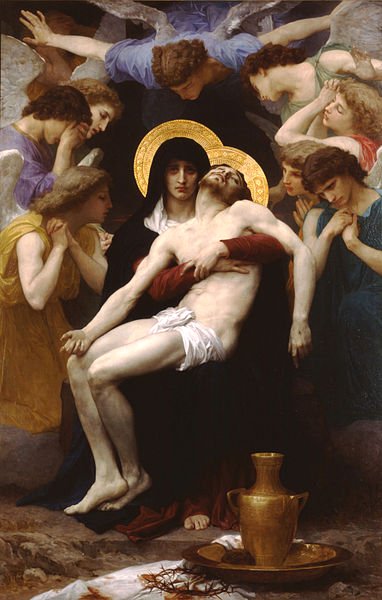
Pieta by Bouguereau (1876)

Two of Bouguereau’s greatest works derived from the sorrow he suffered at the death of family members.  In both works he has utilised religious themes to present to the world his grief and feeling of loss.  His 1876 work entitled Pietà was thought to be based upon the Virgin and Christ of Michelangelo’s marble Pietà. Bouguereau completed the painting shortly after the death of his son Georges.

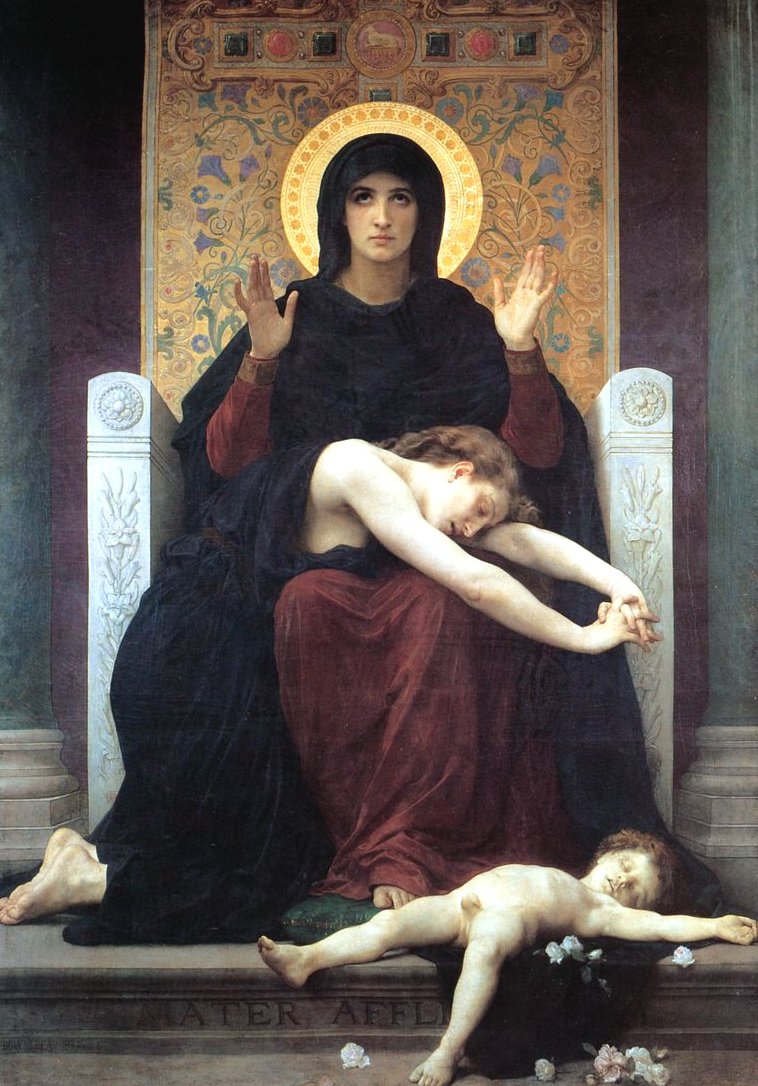
Vierge Consolatrice - The Virgin of Consolation by William Bouguereau (1875)
Vierge Consolatrice – The Virgin of Consolation by William Bouguereau (1875)

In 1877 Bouguereau dedicated a painting to his late wife Nelly who died in childbirth and his youngest William-Maurice who was seven months old when he too passed away.  It was entitled Vierge Consolatrice (Virgin of Consolation).  In the work we see the black-clad Virgin of Consolation, once again sitting on a white marble throne behind which is a large colourful tapestry.  Lying across her lap is a young woman who grieves utterly inconsolable at the death of her child, the body of whom we see lying naked at the Virgin’s feet.  The Virgin has raised her hands in prayer.   She is the intermediary between the mother and heaven.  At first glance one would be forgiven if we looked upon this work as being merely an over-sentimental painting but understanding the circumstances surrounding it, one becomes more understanding and less cynical.  It is thought that Bouguereau, who was a staunch Catholic, gained some solace from this work after the death of his wife and baby.

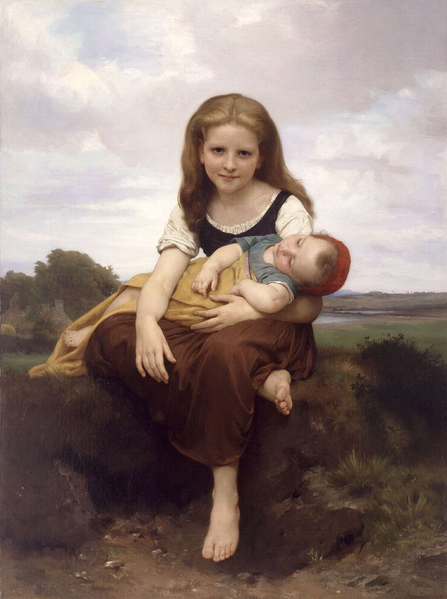
The Elder Sister by William Bouguereau (1869)

In 1869, before the tragic and untimely deaths of his wife and three children, Bouguereau painted a portrait of two children and used his twelve-year old daughter Henriette and her newly born brother Adolphe-Paul as models.   The work was entitled La soeur aînée (The Elder Sister) and hangs in the permanent collection of the Museum of Fine Arts in Houston.  According to the museum, this is one of the highlights of their collection and was an anonymous gift from a lady in memory of her father.  We see Henriette sitting, perched on a rock, cradling a sleeping infant on her lap.  The capped head of the baby lolls slightly in sleep.  Henriette looks directly out at us and smiles.  She, although bare-footed, wears clean clothes.  Her skin is without a single blemish.   Even at such an early age, one knows that she will grow up to become an exquisite beauty.  The painting has a tranquil countryside setting.  Everything is “just perfect” in the depiction of the children and the background.  This portrayal strays from realism.  It is more an idealised depiction.  Bouguereau has cleverly used a various mix of colours and merged them in such a way to create an image which has a softness to it.  There is an earthiness about the work.  The colour of Henriette’s frock/tunic clothes is the brown of the ground.  It seems to almost merge in with the colour of the foreground.

For Bouguereau, the 1870’s were a very sad time in his life with the deaths of his wife and three of his children.  The only high point for him during that decade was his election to the Académie des Beaux-Arts de l’Institut de France.  Throughout his life Bouguereau was a staunch defender of the Academy and all that it stood for and the honour of being elected to become a member of the institute was one he cherished.  He wrote:

“…To become a member of the Institut…is the only public distinction I ever really wanted…” 

The Bohemian by William Bouguereau (1890)

In 1890, Bouguerau completed  a work entitled The Bohemian which is sometimes referred to as Consuelo.   The young girl depicted in the painting almost fills the whole canvas.   She is a young gypsy girl and we see her seated on a stone bench on the Quai de Tournelle, which lies on the left Bank of the Seine.  In the background, across the river, we see Notre Dame cathedral and in the mid-ground we can just make out the Pont de l’Archevêché which straddles the Seine and links up the Left Bank with the Île de la Cité.  The girl looks out at us with a somewhat forlorn expression.  One cannot help but be moved by her dejected appearance.  Her clothes are shabby but the thickness of the fabric serves the purpose of keeping her warm.  Her dress is a dull grey but her multi-coloured shawl lightens up her appearance.   Her feet are uncovered which leads us to believe she is a beggar.  This assertion is further enforced as we see on her lap a violin which is the tool of her trade – begging for money.  This is not simply a painting about poverty.  In this work Bouguereau not only condemns the humiliation brought about by poverty but lauds those who strive to free themselves from destitution by virtues of their own endeavours.

One interesting aspect of this work is that we know it was changed by the artist.  How do we know that?  There is a photograph of this painting when it was “initially completed” by Bouguereau in 1889.  Bouguereau had decided to employ the photographers, Braun & Clement to photograph his complete collection of unsold works.  The photograph of The Bohemian showed a wall of bare stone behind the girl, which completely cut off any view of the River Seine or the bridge spanning it to the Île de la Cité.   It is thought that having not sold the painting that year a prospective buyer in 1890 asked for a “better” background to be added to the scene.   Bouguereau complied with the request and repainted part of the work.  There is also sign that the “8” and the “9” had been altered and over-painted with the numerals “9” and “0”, changing the completion date from 1889 to 1890.

The Young Shepherdess by Bouguereau (1885(Bouguereau painted many works featuring peasant girls.  This was an extremely popular subject in 19th century paintings.  For French artists of the time, including William Bouguereau the country peasant was somebody who lived a simple and honest life and got by through their laudable work ethic.  For the city dwellers who had not rubbed shoulders with a peasant they formed their visual understanding of who peasants were from the shepherds and shepherdesses with their multi-coloured clothes whom they saw depicted in Italian opera and theatre.  Bouguereau’s depiction of peasants was almost all of women and girls.  The setting for his portrayals of them and what they wore was often the same –  simple white blouses, overdresses of muted colours and thick material, set off by multi-coloured and multi-patterned shawls.  The female peasant was depicted bare-footed and  standing, seated or lying in some country scene such as a field or wood.  Bouguereau tended to steer clear of any other countryside indicators such as farming equipment or farm animals such as grazing sheep or cows.

Bouguereau, like all artists, needed to sell his work.  His clients were often middle and upper-middle class Parisians and the one thing the buyers did not want to be reminded of was the inequalities of life.  They did not want to be made to feel guilty about the social realities of their life and those of the peasant classes.   Unlike some of his contemporaries who were social realist painters and wanted to “accuse” through the depiction of the lower classes in their paintings highlighting how they suffered under an unjust economic system, Bouguereau’s depiction of peasant girls was all about their beauty, and little to do with any resentment or  condemnation of the class system.  His depiction of the peasant class was often very moving if, on occasions, heart-rending, but the peasants were never depicted as being threatening.   An artist and contemporary of Bouguereau, René Ménard,  wrote of Bouguereau’s depiction of the female peasants:

“… Rusticity is not with this painter and instinctive sentiment, and he paints a patched petticoat he yet suggests an exquisitely clean figure:  the naked feet he gives peasant-women seem to be made rather for elegant boots than for rude sabots; and, in a word, it is as if the princesses transformed into rustics by the magic wand in fairy tales had come to be models for his pictures, rather than the fat-cheeked lasses whose skin is scorched by the sun and whose shoulders are accustomed to heavy burdens…” 

After the death of his wife Nelly in 1877, Bouguereau lived in his house in Paris with his mother and two surviving children, Henriette and Adolphe-Paul and had taken up a post as professor at the Académie Julian in Paris.   This was a more liberal art establishment which allowed women to attend classes.  He was well thought of by his students, especially the women who idolised him.   The female artists were very appreciative of his training method and the skill he used when working with them in a lead-up to them establishing professional artistic careers.   Many of his female students were Americans and one in particular, Elizabeth Jane Gardner, fell under his spell.  She, as well as being a student of Bouguereau, was also friendly with his late wife.   Elizabeth was twelve years younger than Bouguereau.  Between teacher and student, there developed a mutual admiration which turned to love.  He told his mother and daughter Henriette that he intended to marry Gardner.  The only rock blocking this path of true love was Bouguereau’s mother.  She was a very religious person who had never been happy with the way her son had depicted so many nude figures in his classical works.  When it came to Bouguereau falling for another woman after his wife’s death, she was vociferous in her opposition to Bouguereau and Gardner marrying or living under the same roof as her and his children and so the pair’s courtship had to become more discreet and lasted almost twenty years until Bouguereau’s mother died.  Shortly after her death, in 1896, the couple married.  He was 71 and she was 59.

His daughter Henriette also married around that time, and Bouguereau was happy with her choice of husband.  However in 1900, tragedy was to strike again with his son Adolphe-Paul, who was a lawyer,  suddenly dying.  He was just thirty years old.  Bouguereau was devastated and it precipitated a deterioration of his health.  Despite this, he continued to paint and exhibit his works at the Salon.  He contracted a heart disease which although he fought hard to survive, he died a few months short of his eightieth birthday, in August 1905 at his home in rue Verdière in La Rochelle, the town where he was born.

Near the end of his life he described his love of his art:

“…Each day I go to my studio full of joy; in the evening when obliged to stop because of darkness I can scarcely wait for the next morning to come if I cannot give myself to my dear painting I am miserable…” 

Bouguereau was a workaholic.  He once sent a letter to his first wife in which he wrote:

“…When I cannot work, I am unhappy…”

And in a diary entry he wrote:

“…I rise every day at seven and breakfast then paint all day, with a light lunch at three which doesn’t interrupt my work…” 

He was always a firm believer in Academic art and Academic teaching.  He never wavered and he was often ridiculed for this view of how art should be.  La peinture bouguereauté was the derisory term given to French Salon artists and to students who painted badly!

During his lifetime he painted eight hundred and twenty-six paintings. To many people, Bouguereau was one of the greatest classical painters of his time, and some even compared him to Raphael.   However along with his admirers he had his fair share of detractors who criticized him. One such group of artists were the Impressionists who were hell-bent to rid themselves of  the shackles of traditional schools of painting. To them artists like Bouguereau were a regressive influence and hindered their move towards a new style of art.  To many people Bouguereau’s art was overburdened with sentimentality and that it was over-romanticizing.  To some, however, his art is full of beauty, compassion and piety.  I will leave you to decide which view you subscribe to.

As usual I have collated lots of information from the internet and reference books but most of the information was gleaned from an excellent book I treated myself to and which is yet another addition to my collection.  If you are interested in Bouguereau and his work I do suggest you buy it.  It is not expensive but is a true gem.  The title is Bouguereau and is by Fronia E. Wissman, an author who has written or contributed to a number of books about French artists.

Adolphe-William Bouguereau. Part 2 – The painter of Religious Scenes and his painting The Flagellation of Christ

Photograph of William Bouguereau (c.1870)

My blog today looks at another of Bouguereau’s great history paintings.  This is one of his religious works and has all the ferocity of his painting Dante and Virgil, which I featured in my last blog.  Whether you are a lover of religious historic paintings or not, I defy you to be unmoved by the beauty of this work.  Bouguereau was a devout catholic and looked upon his religious paintings as a form of his worship of both God and mankind.  Bouguereau’s religious belief can be plainly seen in his religious works.  The painting I am featuring today is entitled The Flagellation of Christ, which he completed in 1880. Before I discuss the painting let me tell you a little about his life.

Adolphe-William Bouguereau was born in the French Atlantic coastal town of La Rochelle in November 1825.  His father was Theodore Bouguereau, a seller of wine and olive oil.  His father struggled to make much money from his business and because of the financial hardship and family tensions William was sent to live with his uncle Eugène Bouguereau, who was curate in the town of Montagne, some twenty kilometres from Bordeaux.   This enforced move to his uncles was to prove highly fortuitous for the young boy as it was his uncle who introduced him to the world of Roman and Greek mythology and had him read the stories from the Old and New Testaments.  At the age of thirteen, William’s uncle arranged for him to attend the high school at Pons where he attended his first drawing classes under the guidance of Louis Sage, a young classical painter who had once studied under Ingres.   He remained at the school for three years.  In 1841, he eventually moved to Bordeaux where his father had set up his business and once again William was with his family.  William joined in his father’s business but at the same time, in 1842, he was allowed to enrol on a two-year part-time course at the city’s École Municipale de Dessin et de Peinture.  Here he studied under  Jean-Paul Alaux, the French landscape painter and lithographer.  He could not attend full-time because of his promise to help his father during the day, and so, he only attended art classes in the early morning and in the late evening.  Despite being a part-time student he excelled in what he did and in 1844 he won first prize for the best History painting with his depiction of Saint Roch.     Following this award William Bouguerau realised that his future was indelibly tied to art.  To earn some money for himself he designed lithographic labels for jars of jams and other preserves.

Bouguereau realised that to progress with his art he needed to be in Paris which was, at that time, considered the capital of the art world.   However to live in the French capital required money, a commodity he lacked.  His father’s business was not successful enough for him to give his son the money but fortunately for William, his uncle Eugène, the curate, once again proved to be his salvation.  He arranged for William to paint portraits of his parishioners for a fixed fee and after months of portraiture he had amassed nine hundred francs.  A similar sum was given to him by his aunt and he was all set to head to Paris.

The Flagellation of Christ by William Bouguereau (1880)

In my third and final blog about Bouguereau I will finish his life story but for today I want to focus on another of his great History paintings, his religious work entitled The Flagellation of Christ.   He exhibited this work at the 1880 Paris Salon.  It is a monumental work measuring 390 x 210 cms (almost 13ft high and 7ft wide).  One can easily imagine how it stood out from all the other works on show at the exhibition. This is acknowledged as being one of Bouguereau’s greatest religious works.  In this painting, Bouguereau has depicted Christ, tied to a column.  Christ’s body hangs down almost lifelessly with his feet dragging on the ground.  His head droops backwards.  His eyes are blank and unfocused. He is utterly powerless.  He can do little to stop the ferocious onslaught.  Unlike Bouguereau’s painting Dante and Virgil which I featured in the last blog, he has made no attempt to exaggerate the musculature in his portrayal of Christ’s body.  The body of Christ is that of a normal human being.  It is just like ours and in doing this Bouguereau has allowed us more easily to empathise with Christ’s suffering and pain.

A look of concern
A look of concern

We see Christ’s tormentors, two men, who stand on either side of him, arms raised in mid swing with their knotted rope whips airborne.  In the right foreground we see a third man kneeling.  He is in the process of tying up birch branches which will be used later to flagellate their prisoner.  Look at his facial expression.  It is one of concern.  It appears that maybe he is not convinced that what he sees before him is justified.  It is if he is beginning to question his part in the flogging.    In the background an inquisitive crowd gather to witness the flogging.  This is not a leering and jeering crowd we have seen in many of the crowd scenes in Northern Renaissance works.  This group of people cannot be likened to the snarling mob we have seen in earlier Passion of Christ depictions.

A child looks on
A child looks on

An old man in the crowd, maybe the father, lifts a baby aloft for him or her to get a better view.  There is little sign of compassion on the faces of the crowd.  Maybe they have accepted the charges that have been laid against Christ and feel that he needed to be punished.  However there is one exception.

Look closely at the far left of the background.  We see a young boy in a long green tunic who has turned away in horror of what is happening and has burrowed his head in the clothing of the woman who has wrapped her arm around him in a comforting gesture.  Maybe it is his mother.  Maybe she is horrified by what her young son has witnessed and is trying belatedly to protect him.  In the mid-background, there is a man wearing a white vest and grey headband.  He grips a sheath of birch branches and is readying himself to take part in the flogging.  There are a number of examples where the artist has decided to insert his own image into a work and Bouguereau has done the same in this painting.

The artist looks on
The artist looks on

Look at the face in the background to the right of the man wearing the white top and head band.  There, gazing between the spectators is a man with red hair and a red beard.  His brow is furrowed signifying his unease of what he sees before him.  This is believed to be the face of the artist himself.  He, like us, looks on at the terrible scene.

The size of the work almost certainly precluded the sale of it to a private individual and in 1881 Bouguereau gave it to the Society of Friends of the Arts in his home town of La Rochelle.  This majestic work can now be found at the Baptistery of La Rochelle Cathedral, France. 

Bouguereau never lost his love of Greek and Roman mythology which he had been brought up on from early age by his uncle Eugène.   As I said earlier, Bouguereau was a very religious man and religious imagery was a persistent theme in his paintings.   Often his religious works focused on sad and moving events and it is believed they mirrored the anguish and suffering he endured with the loss of loved ones in his own life, which I will talk about  next time.

Adolphe-William Bouguereau. Part 1 – The History Painter and his painting, Dante and Virgil

Self Portrait by William Bouguereau (1879)

In my next three blogs I want to look at the life and some of the works of one of the greatest and most prolific nineteenth century French painters, Adolphe-William Bouguereau.   At a time when many of his contemporaries were railing against academic art, Bouguereau was a staunch supporter of it.  He was a pure traditionalist.  So why did he support the establishment’s stance on art and the establishment’s method of training aspiring artists when many of his contemporaries were vociferous in their condemnation of all that the art establishment stood for?  To answer that question, one must look at the way art was taught in France or more precisely in the case of Bouguereau,  how it was taught in Paris which was then considered the art capital of the world.  Artistic training in that city was centred on the government-sponsored art school, the École nationale supérieure des Beaux-Arts, which was founded in the mid seventeenth century as the Académie des Beaux-Arts and once it had become independent from the government in 1863 changed its name to L’École des Beaux-Arts.

Viila Medici, the French Academy in Rome

It was here that young men (women were not admitted until 1898) were taught how to draw.   The actual teaching of putting paint on canvas was carried out in private studios which were often run by the professors of the school.   Artistic training was thorough and aspiring artists had to reach high standards before they were allowed to proceed with the course.  They would also have to enter work into a number of in-house competitions.  The most prestigious award being the Prix de Rome, which was given to the artist who submitted the best History painting.  Bouguereau won the coveted Prix de Rome in 1850, with his painting  Zenobia Found by Shepherds on the Banks of the Araxes. His reward was the chance to attend the Villa Medici, which was the French Academy in Rome, and remain there for four years.  During that time the student would have the opportunity to study the classical art of the Italian Renaissance masters.  The reason why the French art establishment believed that this was so important was their belief that no artist had ever achieved the level of excellence attained by the likes of Raphael, Titian or Michelangelo.  In their opinion, every aspiring artist was duty bound to emulate this type of art.

The Parisian art establishment which oversaw the running of L’École des Beaux-Arts issued artists with an official list detailing which genre of paintings they considered more important than others.  This hierarchy of genres was headed by History painting and the reason for that was that it somehow represented all the artistic skills the young artists had been taught during their passage through the Academy system. History paintings were generally very large works, and thus were nearly always destined to be hung in public places such as in churches, or the spacious rooms of government buildings or on gallery walls. History paintings delved into the world of classical, mythological, literary and religious events which had taken place in bygone days. Within this top-placed genre there was the allegorical works which, through their depiction, carried symbolic messages about good and evil. It was in these works that the depiction of nude figures, were considered acceptable and it was from years of studying the human figure in life drawing classes at the Academy that the aspiring artists were able to skilfully show off what they had been taught.

Once an artist had trained at the academy, he and later she, had to face up to the fact that to survive they had to sell their work.  In the past the government, the church and the wealthy aristocracy were the buyers of art works but it soon became obvious that their commissioning power was becoming limited and the new buyers of art were the Parisian people of middle and upper-class standing who had the money and wanted to fill their grand houses with fine art.  So where could these new buyers get their hands on fine works of art?  Parisian art dealers such as Paul Durand-Ruel and Adolphe Goupil did not become buyers and sellers of art until the mid nineteenth century.  Before then the most prestigious way of selling your paintings was to get them accepted at the Paris Salon’s annual exhibition.  Simply referred to as the Salon, it began in 1725 as the official art exhibition of the Académie des Beaux-Arts. These were massive exhibitions in which artist’s works, once they had passed the scrutiny of the Salon jurists, were exhibited floor-to-ceiling and on every available inch of wall space.   Potential buyers were then able to see, in one space, the art work that was on offer.  One can therefore realise that for a work to sell, not only had it to be pleasing on the eye of a potential buyer but it had to have been hung in a prominent position at the Salon exhibition.  The advantage the History painters had over others was the monumental size of their works which often dwarfed their “competition” and therefore were always placed in a prominent position.  

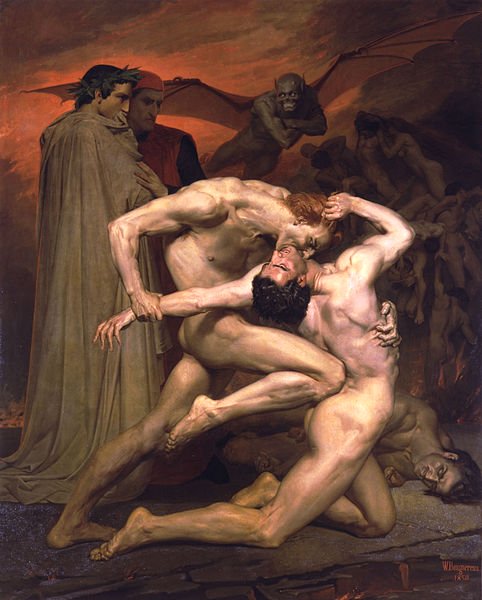
Dante And Virgil by William Bouguereau (1850)

In my next two blogs I want to look at two monumental history painting completed by Bouguereau, one secular, the other religious, but both follow the artistic traditions laid down by the Academy.   Today I am featuring the secular work, entitled Dante and Virgil in Hell, which is housed at the Musée d’Orsay in Paris.  This is a truly breathtaking work and is a prime example of classic art with so much attention paid to the musculature of the human body.  The first thing that strikes one about this painting is its unfettered ferocity, which has the effect of either you wanting to turn away from it in shock or you stare at it in a mesmeric state.

The setting for the work comes from Dante Alghieri’s 14th century epic poem, The Divine Comedy, which recounts the journey made by Dante through Hell along with his guide the ancient Roman poet, Virgil.  The poem tells us that Hell is made up of nine concentric circles within the bowels of Earth.  Each of the circles houses people who have committed certain types of sin.  Bouguereau’s painting depicts the two travellers arriving at the Eighth Circle of Hell.  This is the Circle which houses the deceased falsifiers.   This Circle, nicknamed Malebolge (evil pouches) is unlike the other Circles for it is surrounded by a wall of dull iron-coloured stone, and the valley itself is divided into ten secondary circles or pouches.  The setting for Bouguereau’s work is the tenth pouch of the eighth Circle of hell. We see Dante and Virgil watching a fight between two damned souls. 

So who are the two main characters depicted fighting in the painting and why are they condemned to stay in this Circle of Hell, which is the home of alchemists, counterfeiters, perjurers, and imposters?  Dante Alghieri would have known about the two men.  One is Capocchio, a heretic and alchemist from Sienna who was put to death by public burning at the stake in August 1293.  The other is Gianni Schicchi who is condemned to Hell for impersonating Buoso Donati and making his will highly favourable to himself.  The story goes that after the wealthy Florentine, Buoso Donati, died in 1299; his relatives conducted a frenetic search for his will.  The will was eventually found but to the relatives’ horror Donati had left most of his money and possessions to the local monks. The relatives then turn to the scheming but ingenious Gianni Schicchi, who has the gift of mimicry, to help them find a solution and save their inheritance.   Schicchi has no love for the money-grabbing relatives but however agrees to impersonate Buoso Donati, as nobody, other than the relatives, knows of his death.  Schicchi successfully passes himself off as the deceased Donati and changes the will.  The irony is that Schicchi, in changing the will, ends up giving himself most of the possessions belonging to the dead man.  The relatives were powerless to do anything as they were involved in the deception!   This usurping the identity of a Donati in order to fraudulently claim his inheritance has condemned him to the Eighth Circle of Hell.

The bite to the throat

The foreground of the painting is well lit and like the powerful light almost acts as a spotlight which has picked out the two fighting adversaries, Schicchi and Capocchio, in the foreground,.  Capocchio, the heretic and alchemist is attacked and bitten on the throat by Gianni Schicchi, the usurper.  He acts like a vampire.  In the background shadows we see Dante and Virgil standing together.  Virgil is dressed in a red cloak and hat and Dante is dressed in grey.  Virgil looks down at the fighters but Dante has covered his mouth in horror at what he sees before him.  However Dante’s eyes are not fixed on the fighting but at something to the right, out of picture.  So what is he looking at?   Maybe it is more naked writhing bodies similar to those which we see below the winged demon.  

Dante and Virgil the onlookers

Virgil has taken hold of Dante and wants him to move on away from this horrific scene.  Hovering above them is a flying demon which we see depicted against the fiery red background of Hell. 

The smiling flying demon

The demon has a wide smile as he sees the men below tearing each other apart.  On the floor by the fighting couple we see a man wracked in pain, the punishment for his past sins. 

Nails dig into flesh and draw blood

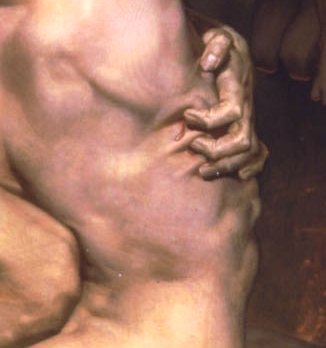
Look carefully how Bouguereau has embellished the muscle structure of the two men.  Look how the distortion of the bodies in their over-elaborate poses has added an animal-like ferocity to the painting.  I particularly like the way Bouguereau has exaggerated the depiction of Schicchi’s violent stretching of Capocchio’s skin, his finger nails starting to draw blood whilst his knee, which has slammed into Capocchio’s back, bends his victim’s spine.

The 19th century French art critic and poet Théophile Gautier was very complimentary about Bouguereau’s painting, saying:

“…Gianni Schicchi throws himself at Capocchio, his rival, with a strange fury, and Monsieur Bouguereau depicts magnificently through muscles, nerves, tendons and teeth, the struggle between the two combatants. There is bitterness and strength in this canvas – strength, a rare quality!..” 

It is a magnificent work of art albeit a very disturbing one.   In my next blog I will feature another of Bouguereau’s history paintings, a religious one, which like today’s work has an undeniable feel of savagery, which makes the viewer nervously unsettled by what they see before them.

Hans Makart

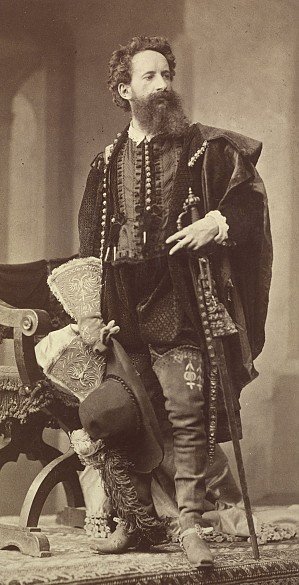
Hans Makart in Renaissance costume (1879) Photogrphed by Ludwig Angerer
Hans Makart in Renaissance costume (1879)
Photogrphed by Ludwig Angerer

The artist I am featuring in My Daily Art Display today is the Austrian academic history painter Hans Makart.  He was an artist who was so loved by the high society of Vienna that he attained an almost cult-like status.  He was born Johann Evangelist Ferdinand Apolinaris Makart in Salzburg in May 1840.  His mother was Mary Catherine Rüssemayr and his father was John Makart, who was the chamberlain at the Mirabell Palace in Salzburg.  He must have shown some artistic talent as a youngster for he enrolled at the Vienna Academy of Fine Arts in 1858.   His tutor was the Austrian painter of genre pieces and landscapes, Johann Fischbach.  However, his tenure at this famous art establishment was short lived as his tutors found that he lacked the talent to become an academic painter.  Hans Makart was not to be put off by the comments of his former tutors as he still retained a great self-belief in his artistic ability.  In 1860 Makart moved from Vienna to Munich and in 1861 enrolled at the Akademie der Bildenden Künste München, also known as the Munich Academy and, for four years,  studied under the tutelage of the German painter and Munich Academician, Karl von Piloty.  During those four years he also found time to visit London, Paris and Rome.

His artistic “break” came in 1868 but the lead up to his opportunity began ten years earlier.   The inner city of Vienna in 1857 was ringed by its 13th century city walls. However in that year the emperor, Franz Josef, decreed that the walls should be demolished and in their place a wide thoroughfare was to be built, which would circle the inner city.  This large-scale building project was financed, in part, by the sale to private individuals, of land alongside the proposed boulevard, which had not been set aside for public buildings or parks.  The work started in 1858 and was completed seven years later. It became known as the Ringstraße and soon buildings, both private and public, were erected along the tree-lined boulevard.   People loved their new boulevard and would take the opportunity to stroll along the Ringstraße.  This love of promenading by the citizens of Vienna was captured in Theodore Zasche’s work entitled The Ringstrasse, Vienna.

Moderne Amoretten (Modern Cupids) by Hans Makart (1868)

One of the first public buildings erected along the Ringstraße was the Vienna Künstlerhaus which was completed and opened in September 1868 and became home to the Austrian Artists’ Society.   To mark its opening it held an art exhibition and Hans Markt was invited to submit some of his work.  One of the paintings he sent was a very large triptych entitled Moderne Amoretten (Modern Cupids).  It was such a large work that he even sent written instructions and drawings as how it was to be hung to achieve the best visual result.  All three paintings were bought by Count Johann Palffy who later commissioned more work from Makart, including a portrait of his wife.  A few months after the end of the exhibition Emperor Franz Joseph, who had already acquired some of Makart’s works, invited him to return to Vienna and in return for doing so, he was provided with a large studio, for his art work, which had once been a foundry.

Hans Makart's Studio before the Auction by Rudolf Ritter von Alt (1855)
Hans Makart’s Studio before the Auction by Rudolf Ritter von Alt (1855)

Makart filled the place with sculpture, ornate furniture, musical instruments and flowers, all of which he used as a backdrop to his historical works and for his staged elaborate and opulent interiors which he incorporated as backgrounds for some of his portraiture.  Before long the former foundry was not just a simple, if large, artist’s studio, but a Salon and it was here he would invite his friends, models and patrons. He entertained everybody notwithstanding whether they were nobility or bourgeoisie.  The social class of his guests mattered little to him, all he wanted from them was their adoration of him as an artist.  It was simply his showroom for marketing his paintings. The visitors were merely his admiring audience and soon he became the talk of the Viennese high society.  He had become a cult hero and he loved every minute of it.  He had become the leading artistic figure of Viennese society.

Makart did not shy away from controversy.  He saw nothing controversial in his art work and in fact he realised that controversy could work in his favour.   Alexander Klee, a curator at Vienna’s Belvedere museum commented on this aspect of Makart’s art, saying:

“…Part of the scandal came from erotic features in his paintings.  Adults kissing, loose-fitting clothing, an uncovered ankle, monks receiving sexual favours, gold backgrounds inspired by church paintings with nudes in the forefront, depictions of sex and crime – these were all scandalous and sometimes almost blasphemous compositions…”

The Entry of Charles V into Antwerp by Hans Makart (1878)

One such painting which caused ructions was one Makart completed in 1878 entitled The Entry of Charles V into Antwerp.  In the work we see Charles V, the ruler of the Holy Roman Empire, depicted arriving in Antwerp in 1525.  Makart has depicted the triumphal procession surrounded by beautiful scantily-clad virgins.  Art critics of the time questioned why such nudity should appear in a modern historical scene and suggested that their inclusion was simply a tawdry way Makart had used to be noticed.  In the United States, the painting fell afoul of the Comstock Law, a law named after Anthony Comstock, the United States Postal Inspector and politician dedicated to the strict ideas of  Victorian morality which made illegal the delivery or transportation of “obscene, lewd, or lascivious” material .   As we know, there is no such thing as bad publicity and despite prints of the painting being banned in America, the Americans were desperate to see the work and make their own judgement and of course the painting, in a round-about way, secured Makart’s fame in that country.

However maybe the critics were overly harsh about Makart’s inclusion of semi naked women in the historical painting as Albrecht Dürer in his book, Journal of a Voyage to the Netherlands wrote:

“…I gave a sou for a little book describing the entry into Antwerp where the king received a costly triumph.  The city gates were ornamented in the most costly manner; there was music and great rejoicing, and beautiful maidens whose like I have seldom seen…” 

And in 1526 Dürer wrote to his friend with regards the scene, writing:

“…I looked at these young women very attentively and closely, and without shame, because I am a painter…”

One presumes Makart was aware of Dürer’s comments as he included him in the crowd scene in his work!

Death of Cleopatra by Hans Makart (1875)

Another historical painting Makart completed in 1875 was sold at auction this year for 757,300 Euros.  It was his work entitled Death of Cleopatra.  The painting depicts the dramatic moment immediately after the snake has plunged its poisonous fangs into Cleopatra’s breast.   The portrayal of the dying queen derives its intensity from the contrast between the depiction of Cleopatra’s luxurious silk garments along with her glittering gold jewellery that adorn her body and the pale opaqueness of her skin.  We see the blue tinge on her right breast at the point where the asp has struck.   The sitter for this painting was a friend of Makart, Charlotte Wolter, a Viennese actress.  Gabriel Frodl, who was once director of the Belvedere in Vienna, describes how Makart set the scene:

“…In this manner, the painter conveys an erotic-lascivious mood, further emphasised by the palpable vulnerability of the body, doomed to die among the now insignificant luxury of its surroundings…”

Makart’s artistic work had now branched out in many directions.  He not only created works of art on canvas but also designed costumes and furniture and conceived elegant interior designs for upper-class residences and his work became known as Makartstil (Makart-style).  In 1879, just before his fortieth birthday, he was commissioned to organise a pageant and parade as part of the Silver Wedding Anniversary celebrations of the marriage of Emperor Franz Josef and his wife, Elizabeth of Bavaria.

Hans Makart at the Parade

It was a great success and Makart took this as an opportunity of self-aggrandisement for besides designing the costumes for the people on the floats, cars and carriages and the scenic settings for the various floats he designed a float specifically for artists, which would head the parade and this would be headed by Makart himself on a white horse.   It is no wonder that this parade later became known as the Makart-parade.  The Makart-styled parade was such a success with the Viennese people been given the opportunity to dress up in beautiful historical costumes and be “transported” back to bygone times.  Such was the triumph of this parade and pageant that annual parades followed.

Portrait of Anna von Waldberg by Hans Makart (1883)

One could not end a blog about Makart and his paintings if one did not delve into his portraiture.  Many men sat for their portraits but it is Makart’s sensual and seductive portraits of upper-class females which were his best.  One such painting was his 1883 Portrait of Anna von Waldberg which he completed a year before her death.  In the painting we see her wearing a black bustle-era evening dress with its low-cut neckline.  The design was less conservative but incorporates a black bow as a modesty piece hiding the lady’s cleavage.

The Five Senses by Hans Makart (1872-79)

The final work of Makart which I am featuring is his famous; some would say his infamous, five-panel oil painting entitled Die Füunf Sinne (The Five Senses) which he completed in around 1879.    It is a study in the nude, depicting five different views of his ideal female form under the guise of the five senses: the senses of smelling, seeing, hearing, feeling and tasting.  Each of the five senses is represented by the action of the female nude.

1990 Austrian Postage Stamp

Hans Makart died in October 1884, aged 44.  He was buried in an honorary grave in Vienna’s Central Cemetery.  The Austrian postal service has issued a number of stamps honouring his memory, the most recent being in 1990 to commemorate the 150th anniversary of his birth.

Honoré Daumier – Lithographs and Caricatures

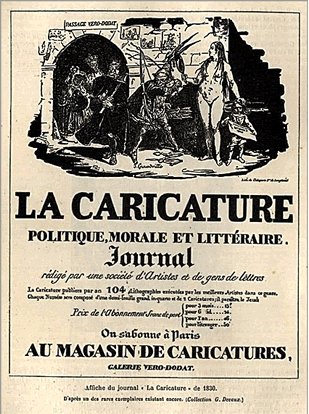
1830 issue of La Caricature

In my blog today I want to look at some of Honoré Daumier’s political and satirical caricatures and lithographs.  To get some idea as to why he came to satirise the ruling classes of his day I think it is worthwhile looking at the French history of Daumier’s time to find the answers.

The French Revolution began almost twenty years before Daumier’s birth in 1789 with the storming of the Bastille and the fall of the French monarchy.  The majority of upper-class and bourgeoisie Parisians who had managed to survive the slaughter, found themselves imprisoned.  In September 1792 the ruling body known as the National Convention had declared France a republic and took control of the country.  This ruling group was split into two major factions: the Moderates known as the Girondins and the Radicals known as the Jacobins but in Paris itself there was third and far more dangerous faction known as the sans-culottes, (those without breeches).  This group of radical left-wing partisans came from the lower classes and were typically urban labourers.  They were easily identifiable as they wore full-length working-class pants rather than the knee-length culottes which was the French name given to silk knee-length breeches worn by the moderate bourgeois revolutionaries of the National Convention.  The sans-culottes strove for popular democracy, affordable food but most of all they wanted to ensure that a counter-revolution would never come to fruition.  This fear of a counter-revolution was to have a bloody consequence as the sans-culottes were aware that there were a large number of political prisoners in gaols, the number of which they believed was greater than the free Parisians, and, in their mind, they viewed them as counter revolutionaries and a threat to the spirit of the Revolution.  Their decision to rid themselves of this threat was precipitated by rumours that the Prussian army was going to invade the country and when it got to Paris would be sympathetic to the imprisoned counter-revolutionaries.   The sans-culottes were now desperate to prevent the freeing of the prisoners and so on September 3rd and 4th of 1792 they stormed the prisons and within a few days had killed thousands of them.  Men and women, aristocrats and clergy were butchered.  The bloodbath became known as the September Massacre.  A year later, Louis XVI and his wife Marie Antoinette were beheaded.

As is often the case violence begets violence and in 1794 the leaders of the sans-culottes had themselves been executed by the Jacobins under Robespierre.  Robespierre was now a leader of the Convention and ruled through terror but by 1794 he was considered by many to have gone too far and eventually fell from grace.  He was arrested by the deputies in the National Convention and was executed in July 1794.  A new grouping known as The Directory was formed in 1795 with the intention of making France a republic.  For four years the Directory tried to please all the people but they themselves were still divided between those who wanted life to go back to the Pre-Revolution days and those who still wanted the bloodshed to continue and rid the country of the upper classes.

In October 1799 Napoleon Bonaparte arrived back in Paris from his battlefield heroics in Egypt.   The time was right for change.  Popular opinion was divided but all seemed to hate the Directory and so Bonaparte struck and his successful coup in November 1799 led him to become the new French ruler.  In December 1804 he was crowned Napoleon I, Emperor of the French by Pope Pius VII.   Bonaparte reign as leader lasted until his defeat at Waterloo in June 1815, after which he was exiled to St Helena where he died six years later.

On Bonaparte’s departure, France was once again under monarchist rule – this time it was the House of Bourbon and Louis XVIII.  On Louis death in 1824 his younger brother Charles X, who had been living in exile in London, returned to France and took up the reins of power.   Soon after coming to power Charles’ government passed a series of laws which strengthened the power of both the nobility and clergy.

Charles’ rule was of a dictatorial nature.  His was an absolute monarchy in which he exercised ultimate governing authority as the head of the country and his powers could not be limited by the country’s constitution or law. As an absolute monarch he was the supreme judicial authority and as such he could condemn men to death without the right of appeal.   Charles wielded his unlimited authority to reassert the power of the Catholic Church in the country.  He also sought to restrict the freedom of the press but most contentiously he passed laws which would compensate the families of the nobles who had had their property destroyed during the Revolution.  His popularity slowly but surely waned with the French people.  The “straw that broke the camel’s back” came about when Charles set forth what is now known as the July Ordinances which laid down a raft of new laws, one of which was to exclude the commercial middle-class from future elections.   Furthermore most businessmen were banned from running as candidates for the Chamber of Deputies, membership of which for many was a position that afforded them the ultimate in social prestige. Bankers were far from happy with this Ordinance and took their revenge by refusing to lend money, and business owners shuttered their factories and work places, which culminated in workers being callously turned out onto the streets where they were left to fend for themselves.   Naturally, the unemployed felt badly done by and decided that the only course of action left to them was to take to the streets in protest.  The July Revolution of 1830 had started.  It lasted three days and eventually forced Charles to flee to exile in England.  However rule by a monarch survived and Louis-Philippe became king of the French.   The downfall of Charles came to fruition, not only because of the workers protesting on the streets but because of the power wielded by the upper middle class society, the bourgeoisie, the bankers, railroad barons, mine and forest owners as well as wealthy merchants and so during Louis-Philippe’s eighteen year reign the power of the French bourgeoisie grew more powerful and became very close to the king.

However as years passed it was clear that not everybody was happy with Louis-Philippe’s monarchy and his government and many reform movements came in to being wanting more equality for the working classes.  In 1846 France suffered a financial crisis and it was also a year when the harvest was disappointing.  In 1847 the country descended into an economic depression and the peasant farmer workers began to rebel against their poor living standard.  It was not just the rural areas that were suffering as a third of Parisians were out of work.  Louis-Philippe and his government sought to silence the masses by banning political rallies but this only served to further incense the populace and the people took to the streets of Paris.  The military fired on the angry crowd and over fifty were killed.  Barricades were erected and shops, cars and omnibuses were set alight.  It was over for Louis Philipe and so, like his predecessor Charles X, the people had ousted him, forcing him to flee to exile in England.  The monarchy had once again fallen and the Second Republic of France was born.

It was in the middle of all this that Honoré Daumier was born in Marseille in February 1808.   He came from a working-class household.   When he was twelve years old the family moved to Paris.  His father was a glazier and picture-framer but gave it all up in his quest to become a successful playwright, alas to no avail.  The family was now short of money and Honoré had to supplement the family income by working as an errand boy at the law courts and as a clerk in a bookshop.  He had developed a love of sketching and would often spend time at the Louvre copying the Masters.   He secured some informal artistic training from a friend of his father, the painter, Alexandre Lenoir.  Later he attended life-classes and at the age of seventeen he became an apprentice at the studio of Zepherin Belliard, the lithographer and portraitist and it was his love and skill at lithography which would shape Daumier’s future.

Daumier being from a working-class background was a staunch republican and so was delighted with the July Revolution of 1830 and the overthrow of Charles X but was bitterly disappointed to find that instead of the formation of a Republic, the monarchy would continue with the arrival of King Louis-Philippe as the successor to Charles X.  His hope of a Republic had been dashed.   Daumier decided to fight the monarchy in the only way he could.  He would use the power of the political and satirical caricature to criticise the monarchy.  This was quite a dangerous form of dissent and many artists shied away from such a blatant form of criticism.  Daumier joined the newly founded Parisian satirical, anti-monarchist, illustrated newspaper Le Caricature.  The four-page weekly journal, with two or three lithographs usually in the form of political caricatures, was one of the first French satirical newspapers and was founded in November 1830 by the anti-royalist, Charles Philipon, five months after the July Revolution.

Gargantua by Honoré Daumier (1831)

Probably the most famous of Daumier’s caricatures was one he completed in 1831, entitled Gargantua.   The name Gargantua derives from Rabelais’ 16th century series of novels, which tells of the adventures of two giants, Gargantua and his son Pantagruel.   It was one of the first major political lithographs completed by Daumier. In the work, we see King Louis-Philippe seated on his high throne, which is actually a giant commode!  It is an unflattering caricature of the monarch but this pear-shaped head was Daumier’s constant caricature depiction of Louis-Philippe.  From the king’s mouth runs a stepping board to the ground on which the servants carry the sacks of money which, on reaching the top, tip into the king’s mouth.  Daumier is portraying the king as a devourer of his subjects’ hard-earned money.

In the bottom right of the work we see taxpayers who have been rounded up and told to empty their pockets into the baskets.  Look at the man who is just putting his money into the basket.  He is dressed in rags.  Sitting on the floor in the very right of the foreground is an emaciated-looking woman clutching her baby.  By depicting such people Daumier is highlighting that it is the lower class poor people who are giving money to the already-rich king.  Above the heads of the poor tax-givers we see the windmills and buildings of a port.  The sun is shining on this landscape and presumably Daumier is reminding his viewers that the economy was on track despite the way the king had an ever-demanding tax regime.

Look at the secondary scene by the feet of the king where we see well-dressed men with their tricorn hats.  They are standing under the steep walkway and are availing themselves of any coins which may fall from the servants’ baskets as they stagger upwards towards the king’s mouth.  Under the king’s commode/throne we see papers fluttering down and its is Daumier’s somewhat unsavoury way of showing the king “issuing” documents granting honours and privileges to the chosen few below, who are carrying their symbol of their status – their tricorn hats and who eagerly await to collect their privileges.  In the left of the painting we see these people from upper-middle class who have collected their documents of privileges running off towards the National Assembly.

The caricature appeared in the December 15th 1831 edition of La Caricature and was displayed in the window of La Caricature office in the Gallery Vero – Dodat to attract onlookers.  The ruling powers were horrified with this pictorial assault on royal power.  Louis-Philippe immediately reintroduced press censorship. Orders were given by the king’s government via the courts that all the copies of the caricature were to be seized and the lithographic stone broken.   The proprietor of the journal, Charles Philipon, was fined and Daumier was gaoled in August 1832 and not released until February 1833.  To raise money to pay the fines, Philipon, in August 1832,  immediately retaliated by launching the L’Association Mensuelle Liphographique, sometimes referred to as L’Association pour la Liberté de la Presse which published a monthly large format supplement which was distributed to regular subscribers.

The Legislative Belly by Honoré Daumier (1834)

Many of the issue would include a number of Daumier’s caricatures.  The first of these was entitled:

Le Ventre législatif

Aspects des bancs ministériels de la chamber improstituée de 1834

 The Legislative Belly

(Aspects of the Ministerial Benches of the Improstituted Chamber of 1834)

In it we see a meeting of some of the National Legislature.  There are thirty-five members shown in the work, all of who, at some time, had been unflatteringly caricatured separately by Daumier. These were members of the Centre Right faction of Louis-Philippe’s legislature.  One can see by the way Daumier has portrayed them that he has an extreme dislike of them and what they stand for.  He has depicted them as bloated and uninspiring, figures who struggle to keep awake.   Daumier is wishing to portray them as the embodiment of idleness, conceit and corruption as this was how he viewed the monarchy and its supporters.

Rue Transnonain le 15 avril 1834 by Honoré Daumier (1834)

The third and final Daumier work I am looking at is not a caricature but a lithograph which he completed in 1834 and once again highlights the artist’s interest in politics and the cause of the ordinary people as they struggled to survive.   It is entitled Rue Transnonain le 15 avril 1834.  This work was like many of his others in as much as Daumier wanted to put across, through his art his discontentment with what he believed was social injustice. Through his art work he wanted to remind people, if it was needed, that they should not have to put up with their lot in life.  The background story to this work was that Louis-Philippe’s government had just passed a law which would seriously curtail the power of the unions.  Louis-Philippe, although outwardly indicating that he would maintain the ideals which were held dearly by those revolutionists at the end of the eighteenth century, said that he would look after the lower classes.  Despite this promise his government still favoured the wealthy classes when it came to offering business contracts.  This we saw was highlighted in Daumier’s Gargantua caricature.  The rich got richer and these wealthy businessmen treated their workers badly and for these downtrodden people, their union was their only hope of improved conditions.  The workers could see that the curtailment of the union powers by this new proposed legislation was going to have dire consequences on their working life and living conditions and so they rose up against it.

In April 1834 the insurrections and public disorder began in Paris, part of which was centred around Rue Transnonain in the Parisian working class district of St. Martin,.  The house at number 12 Rue Transnonain was close to a barricade set up by the protesters and, according to the soldiers of the civil guard, who were trying to quell the uprising, a shot was fired at them from a window in that building and a civil guard was killed  The civil guard reacted swiftly and murderously.  They forced their way into the building and indiscriminately fired on the inhabitants. Nineteen people, men, women and children, were slaughtered.

If we look at the lithograph we are aware that there is a somewhat restrained brutality about this work.  We are not shown the actual killings but just witnessing the bloody aftermath.  It is as if we have just opened the door of the bedroom and are greeted with this dreadful sight.  There is a deathly stillness of what we see before us.  The main focal point of this lithograph is a man slumped against his bed, tangled up in the sheets of his bed.  He is dressed in his white night shirt which is stained with blood and he still has his nightcap on his head.  His attire gives us the impression that he had been asleep when the civil guard burst into the room, all guns blazing.  It is not until you look more closely at the slumped figure that you realise his inert body is lying on top of a dead child.  Blood is coming from a wound in the child’s head.  Cast your eyes to the left of the lithograph and in the shadows you can just make out another body of a woman lying on the ground and in the right foreground, on the floor by the bed, we see the head of an elderly man, yet another victim.  From the choice of bodies, Daumier has depicted he is highlighting the fact that neither the elderly, nor a child nor a woman escaped the massacre.

We have to admire Daumier’s skill in the way he has made us search the lithograph for more victims of this massacre.  Each one we find adds to the horror.  There is a matter-of-fact element to Daumier’s depiction.  Daumier had been quite clever with this lithograph.  The king and the government were not alluded to nor openly blamed in the work.  It was just a pictorial statement of facts of what happened on the night of April 14th 1834.   It was simply a piece of journalism.  People who looked upon the work were then allowed to make up their minds about what they saw before them and decide who to blame.  Baron Haussmann in his radical remodelling of Paris in the 1860’s and 1870’s merged Rue Transnonain with the larger Rue Beaubourg and the street name Rue Transnonain was deleted and with it the reminder of the atrocities which occurred on the night of April 14th 1834.

My apologies for the length of the blog but I thought it was important to give you a feel for what was happening in France which lead to the staunch Republican views of Honoré Daumier.  To all historians I just hope I have presented the French history facts correctly !!!

Jean-Marc Nattier

Jean-Marc Nattier by Louis Tocqué (c.1742) Toqué was taught by Nattier in the 1720's and married Nattier's daughter Marie in 1747.
Jean-Marc Nattier by Louis Tocqué (c.1742)Toqué was taught by Nattier in the 1720’s and married Nattier’s daughter Marie in 1747. 

The career you decide on as a teenager is often a logical follow-on from what one or both your parents did or what they were interested in.  There are cases when parents are disappointed that their children don’t follow their career footsteps, no matter how much they try to cajole them.  Musicians beget musicians, lawyers, beget lawyers and of course artists beget artists.   The father, mother and godfather of the painter featured in my blog today were all artists and so one should not be surprised to find that their sons became interested in all things artistic.  Of course to be interested in art and be good at art are two completely different things but my featured painter today was one of France’s most talented 18th century historical painter and portraitist.  He was Jean-Marc Nattier. 

Nattier was born in Paris in March 1685.  He was the second son of Marc Nattier a portrait painter and Marie Nattier (née Courtois) who was a miniaturist.  His father and his godfather were his first art tutors.  His godfather was Jean Jouvenet, a history painter, who specialised in religious scenes.  When he was fifteen years of age his father arranged for him to enrol in the drawing classes at the Académie royale de peinture et de sculpture of Paris and soon the establishment recognised the artistic talent of  Jean-Marc for in 1700 he was awarded the Premier Prix de Dessin.

The Wedding by Proxy of Marie de' Medici to King Henry IV by Rubens (1622-1625) Part of the Marie de' Medici cycle
The Wedding by Proxy of Marie de’ Medici to King Henry IV by Rubens (1622-1625)
Part of the Marie de’ Medici cycle

Nattier’s father had a royal licence to reproduce Rubens’s famous cycle of paintings known as the History of Marie de’ Medici, which was, at that time, housed in the Le Galerie du Palais du Luxembourg, Paris.  It is now housed in the Louvre.   Before he died, he arranged for the licence to be taken over by Jean-Marc and his brother, another artist,  Jean-Baptiste Nattier.  Nattier and his brother spent much time making drawings of this cycle of paintings.  The cycle consisted of twenty four monumental allegorical paintings of the French dowager Queen by the Flemish painter Peter Paul Rubens who began painting them in 1622 and which took him two years to complete.  It was a set of narrative paintings, commissioned by Maria de’ Medici, the widow of Henry IV of France, who, on her husband’s death, took control of the country until their thirteen year old son Louis XIII reached the age of thirteen.   Twenty-one of these works tell the story of her life, her struggles and triumphs as a widow, mother and ruler.  The other three paintings were portraits of her and her parents, Francesco I de’ Medici the Grand Duke of Tuscany and Joanna, Archduchess of Austria.  It was presumably in her mind that such a set of paintings about her would immortalize her in French history. Jean-MarcNattier, over time, made a series of drawings of this cycle of paintings which were turned into engravings by the leading engravers of the time.  The drawings appeared in 1710 under the title La Galerie du Palais du Luxembourg and  proved extremely popular.  Jean-Marc Nattier’s artistic ability was now recognised. 

Portrait of Tsar Peter by Jean-Marc Nattier (1717)

Through the good auspices of his uncle, Jean Jouvenet, Jean-Marc Nattier was offered the chance to visit Rome and study at the prestigious Académie de France à Rome.  Unlike his elder brother, John-Baptiste, however, he declined the offer and instead of heading to Italy, remained in Paris to further his career.  

Catherine I of Russia by Jean-Marc Nattier (1717)

In 1717, Nattier, at the age of thirty-two, travelled to Amsterdam where he was commissioned to paint portraits of the visiting Russian Tsar, Peter the Great and his second wife, the Tsarina, Catherine. Both portraits are housed at the Hermitage in St Petersburg.

Battle of Poltava by Jean-Marc Nattier (1717)

The Tsar, obviously pleased with the portraits then commissioned Nattier to produce two historical paintings depicting the 1709 Battle of Poltava and the 1708 Battle of Lesnaya, two of the major conflicts between Russia and Sweden in the Great Northern War which he completed in 1717. 

The Tsar was delighted with the history paintings and invited him to come to Russia and work at the Russian court but the Frenchman declined the offer and returned to the French capital.  Nattier remained in Paris for the rest of his life . 

Perseus Petrifies Phineas and his Companions with the head of Medusa by Jean-Marc Nattier (1718)

Nattier’s work between 1715 and 1720 focused on historical paintings such as his Great Northern War paintings (above) and he was received into the Académie Royale as a history painter on the strength of these works and in particular one he completed in 1718 entitled Perseus Petrifies Phineas and his Companions with the head of Medusa.   The painting is based on Book V of Ovid’s Metamorphoses,  which tells the tale of  Andromeda, who was betrothed to her uncle, Phineas, until Perseus rescued her from the sea monster, Cetus,  and in return for saving her life she agreed to marry him instead.    At their wedding celebrations Phineas and his followers burst in and attacked Perseus and the wedding guests.  Andromeda came to his aid but he was heavily outnumbered.  Perseus then unveils his ultimate weapon, the severed head of the gorgon, Medusa, that petrifies all those who look at it.  Perseus thus transforms all his attackers into statues and utters the words to Phineas:

“…You shall not suffer by the sword.  Rather I will cause you to be an enduring monument through the ages and you will always be seen in my father-in-laws palace, so that my wife may find solace in the statue of her intended…”  

Phineas tried to avert his eyes but it was too late.  His neck hardened, the tears on his cheek were turned to stone and he was turned into marble.  In Nattier’s painting we see the intruders on the left already turned to stone whilst those in the right foreground try to avert their eyes from the Medusa’s severed head which is being held aloft by Perseus.  Throughout the painting we see the bright flashes of highly polished armour.  There are also the gleaming  silver salvers and decorative pitchers which lie on the floor in the foreground that were being used for the wedding feast.  These random reflections catch our eye and have our gaze dart around the painting.  This attention-dispersing effect is known as the papillotage

Nattier’s was forced to move from historical paintings to the more lucrative genre of portraiture around 1720 when he, and numerous French citizens, lost most of their money they had invested in the government’s Mississippi Company, set up by Louis XIV’s financial adviser, the Scotsman, John Law.  The collapse of the company became known as the Mississippi Bubble.  Nattier was in a state of financial ruin and urgently needed to recoup his lost money and the most lucrative art genre was portraiture, although this form of art came low down in the academic hierarchy of genres.   Artists of the time who made money from their portraiture were frowned upon by the art establishment who considered that the portraitists had lost all artistic credibility.  Nattier was loathed to give up on his favoured genre of history painting, which he knew the art academies of 17th century Europe considered the highest intellectual achievement for an artist.   He was extremely unhappy that he was about to sell his soul for the financial gain of portraiture but “needs must”.   However to retain some artistic credibility he decided that his portraiture would revive the genre of allegorical portraiture and by depicting his sitters as characters from Greek and Roman mythology, history or biblical tales then he was not completely abandoning history painting.  Initially his portraiture clientele came from the Parisian bourgeoise but later in the 1730’s he began to work on portraits of the ladies of the Royal court and in the 1740’s he was commissioned to paint portraits of the Royal family of Louis XV.  

Henriette of France as Flora by Jean-Marc Nattier (1742)

Females liked this type of portraiture as artists could then depict them in roles outside their normally constrained and often boring professions, and elevate their status to that of Goddesses.  Nattier realised that with a little help from props and artificial settings the finished painting moved a tad closer to the much vaunted and more credible history painting genre.  His finished works pleased the female courtiers as besides elevating them to the status of Goddesses he would cleverly beautify his sitters without losing their true likeness.  Examples of this allegorical portraiture can be seen in his 1742 painting entitled Henriette of France as Flora.  The painting had been commissioned by Henriette’s mother, Maria Leczinska, the wife of Louis XV.  Nattier had transposed the princess into the mythological figure of the Roman goddess of flowers and the season of spring, Flora. 

Marie Adelaide of France by Jean-Marc Nattier (1745)

Three years later in 1745 he completed another allegorical portrait for Maria Leczinska.  This time it was a portrait of another of her daughters, Marie Adelaide, which was entitled Marie Adelaide of France as Diana.  Diana was the Roman goddess of hunting and in the painting we see Marie Adelaide sitting on the ground, one hand wrapped around her bow whilst the other hand withdraws an arrow from its quiver.  Both the paintings of Louis XV’s daughters can now be seen at the Uffizi Gallery in Florence.

Portrait of Queen Marie Leszczyńska by Jean-Marc Nattier (1748)

In 1748 Nattier received a commission to paint Louis XV’s wife, Maria Leszczynska, who was the daughter of the former King of Poland.  Louis and Maria’s marriage was an arranged one and fifteen year old Louis and twenty-one year old Maria met for the first time on the eve of their wedding.   It started off as a very happy marriage and the couple went on to have ten children.   There were complications with the birth of the last child, Princess Louise, in 1737 and from that time on the couples sex life was at an end and they slept in separate rooms.   It was around this juncture in their married life that Louis  began to have a series of love affairs including his famous one with Madame de Pompadour.   The portrait by Nattier of the Queen was a change of portraiture style.  This was not the usual allegorical portrait that he had been carrying out over the last twenty years, but a simple depiction of a forty-five year old married woman.  Marie had asked that she be depicted in habit de ville (day dress).   She wanted simplicity and that is exactly what Nattier gave her.  We see her seated with her left hand on top of an open bible which makes us aware of her strong religious beliefs.  She looks relaxed and at ease with herself.  She was a homely-type of person and Nattier has depicted her just so.  There is a natural quality about this work which must have pleased the queen.

Jean-Marc Nattier had married Marie-Madeleine de la Roche in 1724 and the couple went on to have four children, one of whom, Marie, married Louis Tocqué in 1747.  Tocqué who was only ten years younger than his father-in-law and had at one time been a student of his and they were colleagues at the Académie Royale.  Louis Tocqué and Jean-Marc Nattier were two of the most celebrated portraitists of the 18th century.

Self-Portrait with his Family, by Jean-Marc Nattier

Nattier completed a family portrait of himself, his wife and their four children which depicts them well dressed and quite affluent looking.  The painting would have been from the 1730’s when Nattier had started to recover from his financial losses a decade before.  

Jean-Marc Nattier’s health deteriorated in 1762 and he was forced to stop painting.   The popularity of his work had started to wane in the last decade of his life and he died a poor man.  

Jean-Marc Nattier  died in Paris in November 1766, aged 81.

The Three Portraits of Ria Munk by Gustav Klimt

I suppose the most challenging and distressing period of one’s life is when somebody close to us, somebody we love, dies.  It is both a traumatic and painful time when suddenly we feel the loss of someone we loved.  Later, we want to cling to memories of the dead person.  We want to remember them forever.  We do not want to ever forget that person who had so touched our lives.   How do we do that?   Within days of our loved one dying, we are offered the chance to see the deceased one last time as they lay in rest in the funeral parlour.   I have done that on a number of occasions and regretted it.  I probably did it more out of duty than out of a desire to see the body of the dead person.  The face of the deceased I looked down upon was not the way I wanted to remember them.  It makes no difference how well the mortician has waved his or her magic wand over the deceased, the face of the person is pallid and lifeless and only our mental capacity and power of imagination can change that image.  Ultimately, our fondest recollection of the deceased person is almost always through photographs, which sadly, like our recollections, fade over time.  Even after photography became the medium of remembrance, a painting of a person acted as an aide-mémoire and in today’s blog I want to look at how one family wanted to remember their deceased daughter. 

Ria Munck on her Deathbed by Gustave Klimt (1912)
Ria Munk on her Deathbed by Gustav Klimt (1912)

My blog today is about a mother’s love for her dead daughter and her desire to hold on to her memories of her beautiful girl through a posthumous painting.   The mother in question was Aranka Pulitzer Munk.  She was the niece of Joseph Pulitzer, the man who, through the  provisions in his will, set up the Pulitzer Prize for Journalism.   Aranka married Alexander Munk, a wealthy Polish industrialist in 1882 and the couple went on to have three daughters, Lili, Maria (Ria) and Lola.  The daughter that is featured in today’s blog is the second-born girl, Ria, who was born in November 1887.  Ria was an extremely beautiful young woman and in 1911, when she was twenty-four years old, she had become the lover of the forty-year old German poet and writer Hanns Heinz Ewers.  This was never going to be a good match for Ewers reputation as a libertine was well known and wherever he went, scandals followed.  However maybe it was this that drew Ria to the latter-day “bad boy” character.  They eventually became betrothed and despite Ria entering this arrangement with a sizeable dowry, Ewers called it off.  According to the book Gustave Klimt by Jane Rogoyska and Patrick Bade, Ewers wrote Ria a letter that December, in which he described her as “a hopeless romantic and out of touch with reality”.     As one can imagine, Ria was devastated and could not come to terms with the break-up and at noon on December 28th she took a gun and shot herself through the heart. 

Whereas now, the tabloid papers would be full of the scandalous story of the suicide of the daughter of a wealthy family, the suicide of Ria Munk was of little import in the local press.  On the contrary, Viennese society looked upon suicide following a broken relationship as almost the norm.  There was even a sense of romanticism about it, similar to cases of death at the end of a duel which was fought over someone’s honour.  The Viennese society seemed to be in awe of the pomp and ceremony of grand funeral processions which followed on from such deaths.  The famous Austrian writer and journalist, Stefan Zweig  summed it up in his 1943 autobiography, The World of Yesterday, when he wrote:

“…‘In Vienna, even funerals found enthusiastic audiences and it was the ambition of every true Viennese to have a lovely corpse, with a majestic procession and many followers; even his death converted the genuine Viennese into a spectacle for others. In this receptivity for all that was colourful festive and resounding, in this pleasure in the theatrical, whether it was on the stage or in reality, both as theatre and as a mirror of life, the whole city was at one…” 

That may in the case but one can only imagine the devastation and heartbreak felt by her parents.  Her mother, Aranka, decided that she wanted a posthumous portrait painted of her daughter.  Aranka’s sister was Serena Lederer (neé Pulitzer) and she was one of Gustav Klimt’s main patrons and he had painted her portrait in 1899 and a portrait of her daughter, Portrait of Elisabeth Bachofen-Echt in 1916.  Serena Lederer and her husband August had built up the largest collection of the Austrian artist’s works and so it was logical for Aranka to ask her sister to speak to Klimt about the portrait commission, Klimt was, at that time, the most sought after portraitist in Vienna.  It was also around this time in Viennese society that the death-mask portrait and the death-bed portrait had grown to become in vogue with city’s privileged classes, and so following the tragedy of her daughter’s suicide, Aranka Munk decided that she would commission a death-bed portrait of her beloved Ria and arranged, through her sister, to have Klimt  paint it. 

Presumably with the help of photographs, Klimt completed the death-bed portrait of Ria Munk in 1912 and it was entitled Ria Munk am Totenbett (Ria Munk I),   Ria Munk on her Deathbed (Ria Munk I).  The background of the work is dark blue and is in stark contrast to the red carnations which form part of the garland of flowers, which frame Ria’s beautiful face.   Looking at the work we see Ria lying peacefully with her head on a white pillow.  Surrounding the pillow there are some white carnations.  There is no indication that Ria has died a violent death.   This painting is all about Ria’s beauty.  Her chest is covered in orange, red and purple fabric, which hide from us the bullet wound.  She is at peace.  Klimt has painted her with pink cheeks. As yet her facial features have not begun to sink into her skull.   Her mouth is partly open which make us think that she is just asleep.    She is surrounded by flowers and many people draw a similarity to Klimt’s depiction of her and the depiction of the tragic heroine in John Everett Millais’ 1852 painting, Ophelia.   It is a lovely portrait which exudes an aura of peace and serenity but there was also something about it that made her parents to reject it.  Aranka Munk decided the work, although beautiful, was too death-like and too distressful to behold.   Aranka then belatedly decided that she wanted the aide-mémoire of her daughter to be a painting of how she remembered her when she was alive.  She wanted to evoke memories of her daughter’s vivaciousness and exuberance, rather than the peaceful but solemn one of Ria, depicted by Klimt as she lay on her death bed and so, according to Erich Lederer, Serena Lederer’s son, Klimt was again commissioned to paint a second portrait of Ria.  In 1913, Aranka gave Klimt some more photographs of her daughter and asked him for another portrait, one that would encapsulate her beauty and her joie de vivre. 

Die Tänzerin (Ria Munk II) by Gustave Klimt (1916)
Die Tänzerin (Ria Munk II) by Gustav Klimt (1916)

There are some questions about this second portrait that remain unanswered.    The one fact we do know was whatever the artist gave Aranka, she rejected it.   Why did she reject it?   Was the painting above the one Klimt handed over to Aranka Munk?  If we look at the painting which bears the title Ria Munk II, then it is not difficult to see why a mother would be horrified and subsequently reject such a semi-naked portrait of her late daughter.   However we are not sure that the portrait we see before us was the painting Klimt gave her, in fact we can almost be certain that it was not.  Would Klimt really believe that a grieving mother would welcome such a semi-nude depiction of her daughter?  Although we have no way of knowing what Klimt’s second portrait of Ria Munk, which he gave to Aranka looked like, what we do know is that it was rejected by her.  Another fact we know about this second commission from Ria’s mother was that Klimt struggled with it.  We know this from a postcard he sent to his life-long friend, the Viennese fashion designer Emilie Flöge, in 1913.  He wrote of his problem with the commission:

“…the Munk portrait… wouldn’t come together! Can’t make it a likeness!…”

Following Aranka’s rejection of the painting, Klimt took it back to his studio, and altered it.  The altered and finished version is more erotic and depicts a bare-breasted portrait of a dancer.  It is now beleived that the dancer could have been Johanna Jusl, who was not only a dancer with the Vienna Hofoper but was also one of Klimt’s models.  His amended version, which we see above, depicts a lady, bare-breasted and exuding an overt sensuality, which one presumes would not have been present in the painting he offered Aranka Munk.   She stands in a full-frontal pose but her head is coyly turned away. Her cheeks have a faint rose tinge to them.  The elongated horizontal shape of her eyes gives her an oriental look.  There is a delicate tinge of light blue on her face and neck which confers upon her a ghost-like appearance. Next to her is a table upon which there is a vase of poppies.  Behind her, to the right, there is a vast floral display whilst in the left of the work we see oriental figures portrayed on a green background.  Her highly colourful and garish patterned  dress, which is open to her waist exposing her breasts, seems to become one with the background.  Below the hem of the dress we catch sight of lace-edged black pantaloons below which we see her shapely white-stocking legs and high-heeled shoes with their decorative bows.  There is a definite oriental-feel to this work and we know Klimt was fascinated by orientalism.  In Frank Whitford’s 1990 book, Klimt, he tells the story of a young aspiring artist, Egon Schiele, visiting Klimt’s studio in the Vienna district of Heitzing and how Schiele describes the studio as being dominated by Far Eastern Art and artefacts as well as Japanese woodblock prints.  Klimt had also a large collection of kimonos, a large red Japanese suit of armour and a number of exquisite Chinese costumes.  So was Klimt’s love of orientalism unusual?  In 1923, Anton Faistauer, a Viennese painter wrote a book entitled ‘Neue Malerei in Osterreich’ and in it he discussed  Klimt and orientalism, he wrote:

“…for Europeans Klimt is an outsider… (and) it would be better not to compare him at all to western ways. He is incomprehensible to the West, to the French and Germans, and his art, for now, is rejected there… He is conceivable only in Vienna, better still in Budapest or Constantinople. His spirit is entirely oriental. Eroticism plays a dominant role in his art, and his taste for women is rather Turkish… He is inspired by the decorations of Persian vases and oriental carpets, and especially delights in the gold and silver of his canvases…” 

The work, with the title Die Tänzerin (Ria Munk II) – The Dancer (Ria Munk II), the title originating from Erich Lederer, remained in Klimt’s studio and he never sold it.  It is now part of the collection of the Neue Galerie in New York. 

Frauenbildnis (Ria Munk III) by Gustave Klimt (1918)
Frauenbildnis (Ria Munk III) by Gustav Klimt (1918)

The third portrait of Ria Munk, entitled Frauenbildnis ( Ria Munk III), which Klimt began around 1917, was one of the largest and greatest full-length female portraits by him.  It was, like a number of Klimt’s  later works found in his studio, unfinished, when he died in February 1918.  The woman in the painting, with her pink cheeks and dark eyes is standing sideways on but is turning to face us, the viewer.  Unlike the previous portrait, there is demureness in the way she holds her robe closed.  She seems totally at ease.  There is an aura of self-confidence about the young lady.  She proffers us a dreamy smile.  There is no hint of seductiveness about her expression that we saw in the earlier portrait. As was the case in many of his earlier full length female portraits of women from Vienna’s high society such as Portrait of Adele Bloch Bauer II (1912), Portrait of Eugenia (Mäda) Primavesi (c.1914) and Friedericke Maria Beer (1916), he once again morphs his subject into a highly colourful and decorative background.   The background of this work consists of a multitude of flowers such as roses and tulips, floral patterns and oriental-looking designs. The painting is incomplete, especially with regards the dress and the foreground, which we see are just traces of the charcoal preliminary sketch.

Shortly after Klimt’s death, and because her daughter’s portrait had been commissioned by Aranka Munk, it was given to her.  Aranka, who had divorced her husband in 1913, was now living in the summer at her lakeside villa at Bad Aussee in the Austrian state of Styria and it was here that she kept this third portrait of her daughter Ria.  It remained there until 1941.  Aranka, being Jewish, was then forced to sell part of the property to neighbours in 1941.   The Gestapo later seized her remaining property, and her apartment in Vienna, in 1942.    Aranka was deported to Lodz in German-occupied Poland in October 1941 and was put to death on November 26th, a day before her 79th birthday. Her daughter, Lola, was also sent to a concentration camp, at Chelmno, Poland, where she died in September 1942.

The year the villa and its contents were seized by the National Socialists, the Frauenbildnis ( Ria Munk III), portrait passed into the hands of the art collector and dealer William Gurlitt.  In 1953 the Frauenbildnis painting was among a number of important paintings that Gurlitt sold to the Neue Galerie der Stadt Linz, which in 2003 became known as the Lentos Museum. The painting subsequently remained in the Lentos Museum, Linz until June 2009.  It was then, after years of legal challenges that Linz city council finally voted to return the Klimt painting to its rightful owners and it was thus given up by the Lentos Museum to Aranka Munk’s descendents, who were living in Europe and America.  The following year, June 2010, the descendents put the work in Christie’s London auction where it sold for £18.8 million. 

Whilst I was working on this blog news broke out about a $1 billion art hoard discovery at a Munich apartment of an 80-year-old recluse, Cornelius Gurlitt.

Does the surname ring a bell ??????

Frederick McCubbin. Part 3 – The later years and The Pioneer

The Pioneer by Frederick McCubbin (1904)

In my last two blogs I have looked at the life of the Australian painter, Frederick McCubbin.   I looked at how he started painting and how, in his twenties, he became an accomplished artist who had begun to exhibit some of his work.  I talked about the influence some of his tutors had on his art, such as Eugène von Guérard, Thomas Clark and George Folingsby and how he had been influenced by his contemporary artistic friends, Tom Roberts, Arthur Streeton and Charles Conder.   However in this third and final blog about McCubbin I want to introduce you to another person who was to have such a great sway on his life and inspire him to even greater things. The person in question was Annie Lucy Moriarty who he had met in 1884 at an artist’s picnic which was being held in Blackburn, an eastern suburb of Melbourne. 

Annie Lucy Moriarty was ten years younger than McCubbin.  She was born in August 1865 in Melbourne but came from an Irish family who had immigrated to Australia from County Clare.  She was described as a striking young lady with long dark brown hair and soft smiling brown eyes.  However it was not just her exquisite looks that attracted McCubbin.  It was her intelligence, her vivaciousness and her “full of life” attitude which appealed to Frederick.  She was always very supportive of Frederick. She was frugal and had a great organisational skill, all of which would be qualities needed to support her artist husband and their large family.  Frederick and Annie courted for four years and at the end of their courtship, on March 5th 1889, they were married in the Jesuit church of St Ignatius, Richmond, an inner suburb of Melbourne.  McCubbin’s friend and fellow artist Tom Roberts was the couple’s best man.  At the time of the wedding Frederick was thirty-four years old and Annie was twenty-four.  The happy couple would, during the next seventeen years, go on to have seven children, four boys, Louis Frederick, Alexander, Hugh Montgomery and John (Sydney) and three girls, Mary, Nora Sheila and Kathleen.  Mary sadly died a week before her third birthday when she fell out of her push chair and hit her head on the cobbled street.  The first-born child, Louis, named after his father’s friend and fellow artist,  Louis Abrahams, was born in March 1890 and became an artist in his own right and would later become Director of the Art Gallery of South Australia and their last-born child was Kathleen who arrived in November 1906 when her father had reached the grand-old age of 50.  One can just imagine what a spirited household it was and an insight into the McCubbin happy family life was given by Frederick’s youngest daughter’s 1988 book Autumn Memories: A McCubbin Family Album, by Kathleen Mangan (née McCubbin).  In it she wrote:

“…The McCubbins were a lively and ebullient family, each one of them with their own distinct characters. Louis, the eldest, was ‘conscientious and good natured’, ‘the most responsible member of the family’. Alexander was ‘emotional and creative’, with dark complexion and hair. Hugh was ‘practical and serious’, while Sydney was ‘an inventor, with a head full of crazy ideas, who liked to laugh a lot’ and was called ‘Ginger’ because of his hair. Sheila was ‘sensitive, creative and kind hearted, an artist who did not always defend herself against the harshness of the world…”

Frederick and Annie were extremely happy and this was commented on by his friend Arthur Stretton in a letter, dated December 1896, to Tom Roberts in which he recalls a visit he made to the McCubbin’s New Street house in the Melbourne suburb of Brighton:

“…I walked over to the Proff McCubbin’s yesterday & had tea with him in his garden—Mrs Proff in a harmonious yellow gown—all the little Proffs buzzing round—the garden of fruit trees & the haystack—The Prof[f] is a married man very happily & securely married…”

“The Proff” was the nickname Frederick McCubbin had been given by his friends during his student days at the School of Design, National Gallery of Victoria, because of his frequent bouts of philosophising, while Tom Roberts was nicknamed ‘Bulldog’. 

On the Wallaby Track by Frederick McCubbin (1896)

Around this time McCubbin focused a lot of his work on people’s struggle for survival.  His paintings were both narrative and social realism works, which told of the struggle new immigrants, had in order to gain a foothold in society. 

Mother and Son - detail from On the Wallaby Track painting by McCubbin
Mother and Son – detail from On the Wallaby Track painting by McCubbin

One such painting was entitled On the Wallaby Track, which he completed in 1896.  Around this period in the history of Melbourne there was the only too familiar story of “boom and bust”.  By 1880 the population of the city was two hundred and eighty thousand.  Because of the vastness of the wilderness around the city, it was continually expanding outwards which meant that the area of the city made it one of the largest in the world.  Trains and trams criss-crossed the city.  Everybody wanted to live in this prosperous area and within ten years the population had almost doubled.  Speculators made their fortune on land deals and the banks were lending money out willy-nilly, some would say irresponsibly as if there was no tomorrow and as we have recently found to our own cost, the good life doesn’t last forever.  The Melbourne “boom” had to end and indeed it did in 1891 when a dramatic financial crash hit the economy.  Thousands of people who had invested unwisely lost their savings, businesses collapsed and throughout the 1890’s it was thought that the Melbourne unemployment was around 20%. 

The title of the painting derives from the term “on the wallaby” or “on the wallaby track” which fifty years earlier, referred to routes migrant workers took through outlying areas in search of seasonal work.  These were the underclass of society, who sought casual work on farms, travelling about on foot, carrying their swag, their bundle of personal belongings, on his back.  These were the swagmenWhen the financial crash hit Melbourne more and more people had lost their jobs and were searching for employment and it was not unusual to see the swagman “on the wallaby”.  In this painting we see a swagman brewing some tea in a billy can over an open fire.  His wife, with their baby, lies on the ground, propped up against a large tree.  She is exhausted after the long journey during which she had the added burden of having to carry their baby. 

The setting for the painting was the forest area close to the Melbourne suburb of Brighton where McCubbin and his family lived.   Of all the artists McCubbin studied, his favoured landscape painter and the one who influenced him the most was the French artist, John-Baptiste Corot and it is believed that there are traces of the Frenchman’s style in this painting.   Frederick’s wife, Annie, posed for the painting and the baby, who lies asleep across her legs, was Frederic’s son, John who had been born the same year as the painting was completed.  The swagman was modelled by Frederick’s brother-in-law, Michael Moriarty.

Down on his luck by Frederick McCubbin (1889)

Another of McCubbin’s works I really like is one entitled Down on His Luck, which he completed in 1899.  The setting for the work was their Box Hill Artist’s camp and in the work we see a very despondent, down-on-his-luck gold prospector sitting by his camp fire.  McCubbin’s friend and fellow artist Louis Abrahams posed for the painting.  The prospector sits on a fallen tree and stares into the fire.  His search for gold had proved fruitless and he is ready to “throw in the towel”. 

In Jane Clark and Bridget Whitelaw’s 1985 book Golden Summers: Heidelberg and Beyond they quote an 1889 review of this work in which the art critic had written about the character we see before us:

The face tells of hardships, keen and blighting in their influence, but there is a nonchalant and slightly cynical expression, which proclaims the absence of all self-pity…”

The National Gallery of Victoria in its description of the painting believed that the work was of great cultural importance and they wrote:

“… For city workers, living and working in crowded, dirty conditions, McCubbin’s image of the prospector offered an alternative to the oppressive poverty experienced in the slums of Melbourne. Although the bushman is ‘down on his luck’, he has a certain nobility. He is his own man, independent of the demands of a ‘boss’, he breathes the fresh air of the bush and is free to make his own decisions…” 

The McCubbin family had moved about around the Melbourne suburbs.  They started married life in a rented property in Hawthorn.  As the family expanded there was a need to move to a larger house and so, at the end of 1893, with Annie pregnant for the fourth time, they moved to a larger rented place in Blackburn.  Shortly after the tragic death of their daughter Mary, the family moved to an even larger property in Brighton.   Annie McCubbin was taken ill with bronchitis in 1900 and this quickly deteriorated into pneumonia and it was on her doctor’s advice that Frederick, that summer, during the Christmas holiday break, took his wife and family away from the polluted atmosphere of Melbourne city life to a small town of Woodened, forty miles north west of Melbourne, where they rented a cottage for a few weeks.  Here his wife was able to reap the benefit of the clearer, cleaner air of the Mount Macedon area.

One day, whilst the couple relaxed and explored the area near to the summit of Mount Macedon, they came across an idyllic old-fashioned cottage with its red gabled roof and attic windows, which at the time was known as “Dillon’s Summer Residence”.  They fell in love with it and its four acres of land and before the end of 1901 they had bought it for five hundred pounds.  For them, this was a dream come true and, from that day on, they lovingly referred to their first owned home as Fontainebleau.  The one problem they had with this purchase was that it was too far for Frederick to commute by train on a daily basis to the National Gallery of Victoria in Melbourne, where he was Master of the School of Design, and so he spent weekends and holidays at Fontainebleau but during the week he went to live at The Rose of Australia hotel which was being managed by his mother and his two sisters Wilhelmina and Helen. 

Above Fontainebleau in the bush land of Mount Macedon, there was the estate of Ard Choille, (Gaelic words meaning high wood), which was also the war cry of the 16th century Clan McGregor.  It was here that his neighbour William Peter McGregor had built his Ard Choille estate, which was laid out like one of the great estates of Scotland, with its man-made lakes trout amd salmon hatcheries.  McGregor had raised deer, pigs and goats as well as importing the finest highland bulls from Scotland and to look after all this he had a number of cottages built for his workers.  Frederick McCubbin loved the setting of his new home and the surrounding area and it was here in 1904, on the bush lands of Mount Macedon, just a little above his home that he produced one of his greatest works, The PioneerMcCubbin painted the work en plein air.   The setting for the work is a view of land, Ard Choille thatwas once owned by William Peter McGregor, who died in 1899. 

Left-hand panel of The Pioneer by McCubbin

The man in the left hand panel of the work, presumably the husband of the lady in the foreground, is making some tea on the open fire.  Behind him we see the covered wagon that the couple have travelled in during their search for their piece of land.  The decision has now been made.  This is their land.  In the foreground, the wife sits on the ground.  She is lost in thought.  I wonder if she is contemplating their move.  Has she some reservations about moving to this unconquered God-forsaken territory?  Is she worried about the isolation?  Frederick’s wife Annie, who was thirty-nine at the time, was the model for the wife in the painting and Patrick Watson, a local gardener was the model for the husband.  The baby in the painting was Frederick and Annie’s fifth child John (Sydney) who had been born in June 1896, the year that the painting was completed. 

Middle panel of The Pioneer by McCubbin

In the middle panel of the triptych, the setting is still the forest area of the bush but instead of the covered wagon in the background we now have a small whitewash cottage with smoke emanating from the chimney.  The scene is a step forward in time for the two intrepid colonists.  They have staked their claim on the land and built themselves a cottage. The cottage in the painting was one which was actually on McCubbin’s neighbour’s property.  It was the cottage which belonged to McGregor’s manager, who looked after the estate’s prize bulls.  Although we have jumped ahead in time, the three characters we see in this middle panel are the same ones who featured in the left hand panel – the free selector, his wife and son.  The free selectorin this painting was modelled by James Edward, a professional commercial artist, who was known to McCubbin.   He is sitting on a tree, which he has just felled, and the area seems more open, highlighting the clearance work the free selector had accomplished.  Annie McCubbin once again modelled for the free selector’s wife and as a sign of the passage of time, the baby we saw in the left hand panel has now grown to a young boy which we see her holding.  The boy was modelled by Jimmy Watson, the nephew of Patrick Watson who posed for the husband in the left-hand panel.  The wife in this middle section seems more relaxed and maybe all her worries she had when we saw her in the lefthand panel have now proved to be unfounded.  There is a very relaxed and contented aura about the depiction seen in this middle panel.  The couple had come to the bush, seen it and conquered it. 

Right-hand panel of The Pioneer by McCubbin

The right hand panel of the triptych is more of a mystery.  Time once gain has passed since the depiction in the middle panel.  In this painting there is just a solitary figure kneeling before a wooden cross in the ground.  Patrick Watson once again modelled for this figure.  It seems as if he is touching it lovingly.  McCubbin would never explain the meaning of this last panel so it is up to us to form our own ideas.  Could it be the son we saw being cradled by his mother in the first two panels returning to his mother’s or father’s grave or it could it be earlier in time and it is the free selector we saw in the other panels come to pay his respects to his late wife.   All we do know is that a lot of time has passed since the depiction in the middle panel for where there was once a solitary cottage in the background, there is now a vista of a city to be seen through the trees.  The minute cityscape had not been in the original work when it was exhibited in his one-man show in 1904.  The painting did not sell and McCubbin’s friend, Walter Withers suggested to McCubbin that if he painted a view of Melbourne in the background of the right-hand panel then it may find a buyer.  

Melbourne - detail from McCubbin's painting The Pioneer
Melbourne – detail from McCubbin’s painting The Pioneer

McCubbin added the view of Melbourne and, sure enough, the painting sold.  The buyer was the National Gallery of Victoria.  The fascinating fact for me about this work is that to paint it outdoors, McCubbin had to dig a trench in his garden, into which he lowered the huge canvas. 

In May 1907, a year after his last child, Kathleen, was born, McCubbin set off on a trip to England where it gave him a chance to be reunited with his brother James.  James, who was a ship’s purser, was killed eight years later in May 1915 whilst serving on the passenger liner, S.S.Lusitania, when it was torpedoed by German U-Boats.  Frederick also met up with his artist friend Tom Roberts who was based in London and the two of them toured the city’s art galleries.  McCubbin was impressed with what he saw, especially the works of Turner which would influence his later works.  He returned home in November.  A month after returning to Melbourne, whilst still retaining their family home of Fontainebleau, he rented Carlesberg, a colonial-style house in South Yarra which had a vast garden which culminated at the banks of the Yarra River.

The lime tree (Yarra River from Kensington Road, South Yarra) by Frederick McCubbin (1917)

McCubbin continued to paint either at his home in South Yarra or at Fontainebleau as well as retaining his position as Drawing Master at Melbourne’s National Gallery.  However at the end of 1916 his health began to fail, due to frequent asthmatic attacks and he had to take a six month leave of absence from the Gallery.   This bout of ill health did not stop him painting and his last paintings which he completed in 1917 was The Lime Tree (Yarra River from Kensington Road, South Yarra).  Kathleen McCubbin wrote about the painting and the setting for the work.  She wrote:

“…I always remember the name of this work as The Lime Tree and it really has a lot of sentimental value for me because it was painted from the side verandah of our house in South Yarra, overlooking the quarry. That has all disappeared now. In those times there were quarries beside the Yarra and an old stone crusher in Richmond, opposite our place. This particular painting is also of very great sentimental value for me because it was the last painting my father ever painted and it was not long after its completion that he died...”

In Andrew Mackenzie’s 1990 biography of McCubbin, entitled Frederick McCubbin 1855-1917: ‘The Proff’ and his art, he quotes Kathleen Mangan (née McCubbin) reminiscences:

“…I remember coming home from school and I used to walk up Rockley Road with school friends and take the short cut across to our place, across the paddocks. I would see my father sitting on the verandah in his dressing-gown and black velvet beret, which he always put on when he went outside at that stage of his life, and he would be painting this picture of The Lime Tree. He was really in very poor health at that time, but he persisted and he kept on painting it until it was finished. This was the last painting he ever painted, and it was sold. I remember it being sold to Thomas Lothian, the publisher, but then he sold it and I lost track of it…”

Frederick McCubbin died on December 20th 1917 of a heart attack, thought to have been brought on by his frequent asthmatic attacks and pneumonia.  He was just 62 years of age.  Frederick’s wife of twenty-eight years, Annie, was devastated at her loss and their daughter Kathleen remembered her mother during that sad time and wrote:

“…She was pale and listless and sat around for a good part of the day, just staring into space. She was truly lost without him…”

I hope you have enjoyed my last three blogs charting the life of this great Australian artist and that I have somehow enticed you to visit the Australia exhibition at London’s Royal Academy where you will be able to stand before the amazing painting, The Pioneer.

I have used many sources to put these blogs together but the two main ones which give you a much fuller look at McCubbin’s life were:

Artist’s Footsteps:

http://www.artistsfootsteps.com/html/McCubbin_biography.htm

and

Happy beyond Life by Anne Gray:

http://nga.gov.au/Exhibition/MCCUBBIN/pdf/MCCUBBIN_ESSAY.pdf

Frederick McCubbin. Part 2 – The Box Hill Artists’ Camp and the 9 by 5 Art Exhibition

F.McCubbin, SelfPortrait (1913)

When I left off Frederick McCubbin’s life story in my last blog the year was 1884 and he was twenty-nine years of age and attending the National Gallery of Victoria School of Art.  His original tutor at this establishment had been Eugène von Guérard, but on his retirement at the end of 1881, the Master of the School of Art was George Folingsby.  Folingsby had been born in Wicklow, Ireland and had studied art in New York and Munich and had won many medals for his works in America and Europe.   He was eventually persuaded to come to Australia by the trustees of the National Gallery of Victoria by offering him a lucrative painting commission and the post as examiner of art teachers.  Later, in June 1882 he accepted the post of ‘Master in the School of Painting’ at the National Gallery School and that September, Folingsby became director of the National Gallery.  Folingsby would go on to have a great influence on McCubbin’s art. 

One of Frederick McCubbin’s closest friends at the time was fellow artist Tom Roberts whom he had met whilst studying at the School of Design, National Gallery of Victoria in 1874.  Roberts was also to influence McCubbin’s art for he had been brought up close to Studley Park in the Kew suburb of Melbourne and he and McCubbin would often go exploring the area and would paint en plein air in this beautiful and wild part of the country.  However painting plein air was not everybody’s favoured style. McCubbin’s tutor Folingsby had been strictly a studio painter and saw no merit in plein air painting.  He never stopped his students working in the open air but was adamantly against such a practice and in James MacDonald’s book, The art of Frederick McCubbin, he quotes Folingsby’s as saying:

“…the man who paints landscape in the open air is a fool…”  

McCubbin and Roberts were apart for four years between 1881 and 1885 when the latter went to London and enrolled on a three-year course at the Royal Academy Schools in July 1881.  Whilst away from Australia, Roberts had also taken the chance to travel around Europe visiting Spain and Venice.  On Tom Roberts’ return to Melbourne in April 1885 the two friends resumed their friendship.  It was also a time when the two artists decided to continue with their great artistic love of outdoor painting and between them they hatched a plan to set up an artist’s camp in the wilderness where the surroundings would become their artistic inspiration and so, in the summer of 1885/6, their plan came to fruition. 

Obstruction, Box Hill by Jane Sutherland (1887)

The site they chose for their camp was Box Hill some nine miles east of Melbourne and there in the paddock of land owned by David Houston at Damper Creek they pitched their tents.  Although their camp was in the “bush”, less than a mile away there was a nearby railway station, which had opened three years earlier, and it made the journey from Melbourne easy and soon a number of other young artists joined Roberts and McCubbin’s weekend and summer camps.  One such visitor was Jane Sutherland, the New York-born Australian landscape painter and pioneer of the plein air painting movement in Australia.  She was to become a vociferous champion of female artists and fought hard to have them accepted and for them to have equal professional standing with their male colleagues. Whilst at the Box Hill Artists’ camp Roberts and McCubbin produced numerous works although Roberts was by far the most prolific. So, what was it like at this artists’ camp?  There is a letter in the archives of the National Gallery of Victoria from a Mme. Nancy Elmhurst Goode, a visitor to the camp, who describes what she saw:

“…In the vicinity of the Homestead belonging to the Houstons was a patch of wild bush, tall young saplings with the sun glistening on their leaves and streamers of bark swaying, groups of tea–tree, dogwood and tall dry grasses. A fire was lighted and we were invited to share an alfresco lunch, The Don (Abrahams) earnestly frying eggs on a piece of tin, the Prof (McCubbin) busy with billy tea, and the Bulldog (Roberts) joyously cutting bread and butter and taking full command…”

The Artists' Camp by Tom Roberts (1886)
The Artists’ Camp by Tom Roberts (1886)

Tom Roberts captured life at the camp in his painting entitled The Artists’ Camp, which he completed in 1886 and can now be found in the National Gallery of Victoria.  In the work we see Frederick McCubbin seated by their tent drinking his billy tea while Louis Abrahams is bending over the camp fire grilling chops.  There is a relaxed and intimate atmosphere about the scene and we cannot doubt the happy camaraderie that was felt between the artists. 

Lost by Frederick McCubbin (1886)

One notable work produced by McCubbin during this time was entitled Lost, sometimes referred to as The Lost Child.     The painting by McCubbin is based on a true event of a twelve-year old girl, Clara Crosbie, being lost in the bush.   The Argus newspaper reported the incident in May 1885:

“…In the almost trackless wilds of the Lilydale district, intersected by reedy ferns, like an Indian swamp, Clara Crosbie, a girl of 12, was lost nearly a month ago … A town-bred girl of warm affections and quick impulses, she pined in the unaccustomed solitudes of the bush, and she resolved to find her way, though she did not know her way home…”

Clara Crosbie was found alive after being lost in the bush for three weeks.

The young girl we see in the painting, although she has lost her way home, seems fixated by the mistletoe she has collected and which is now held in her apron.  There is no sense of fear about her demeanour.   Maybe she has yet to realise that she is lost and is still fascinated by the wilderness all around her.  I particularly like the way McCubbin has depicted the peeling bark on the trees.  There is a light and airiness about the depicted location which gives one no sense of foreboding about the possibility of having got oneself lost.     The girl in McCubbin’s painting was his younger sister, Mary Anne, affectionately known as “Dolly”.  This is a beautiful work of art which brings out the ingenuousness and vulnerability of the young girl who finds herself alone in the wilderness.   People who viewed the work were reminded of the dangers of straying into the bush and becoming disorientated and in some ways reinforced the belief of people, who had left their home back in Britain, that life in colonial Australia was a challenge.

Moyes Bay, Beaumaris by Frederick McCubbin (1887)

All the time the two were together McCubbin was learning from Roberts especially when it came down to the effect the changing light had on the landscape, à la Impressionism.   The following summer (1886/7) McCubbin, Roberts along with two other young artists, Louis Abrahams and Arthur Streeton, rented a cottage near Mentone, a small town  which lay about fifteen miles south-east of Melbourne.  This was a small picturesque coastal town, which had derived its name from the French Riviera seaside resort of Menton.  It was here in 1887 that McCubbin completed his beautiful work Moyes Bay, Beaumaris, sometimes known as The Shore, which is now housed in the Art Gallery of Western Australia in Perth.  The site of the painting was often referred to as Moysey’s Bay after James Bickford Moysey and his wife Susannah, who, in 1845, were the first European settlers at Beaumaris, (named after the North Wales coastal town, close to where I live).  When the painting was exhibited the art review of the October 7th 1887 edition of the Melbourne newspaper, The Argus, commented:

“…There is a breezy out-of-door feeling about Mr McCubbin’s ‘The Shore’, the tone of the picture strikes us as not warm enough for the season indicated by the attire of the figures. Although the work is impressionist in its general character, the execution of the broken rock, shingle, herbage, and pools of water in the foreground betokens attention to detail…”

Despite the “Impressionist” tag it was given the reviewer is quick to draw our attention to the detail McCubbin has incorporated into his painting.   It is full of features, such as the rock pools and the various sea grasses, which we see in the foreground, as well as the well-crafted reflection of the two main characters depicted in the painting, the woman and the boy.

Windy and Wet by Arthur Streeton (1889)

In 1889 this band of artistic friends decided to hold an exhibition of their work.  Many put their names down as willing to exhibit but as the date of the exhibition neared, many potential contributors dropped out.  This then put pressure on the main protagonists, Tom Roberts, Arthur Streeton, and Charles Conder who between them exhibited almost 150 pieces.   Frederick McCubbin, was a minor contributor putting forward five of his works for the exhibition. The majority of the works were plein air landscapes but there were also a few cityscapes, still-lifes, portraits and genre pieces.  The month before the exhibition opened was chaotic with Roberts, Streeton and Conder having to hurriedly complete more works to fill the gaps caused by the withdrawal of some of the other artists.  The problem of course was that July in Victoria was a wet period of the year and so many of the exhibited works had a “rainy” feel about them, such as Charles Conder’s aptly named work, Windy and Wet.

The 9 by 5 Impression Exhibition catalogue cover

The location of the exhibition was the Buxton Rooms gallery in Swanston Street, Melbourne and the title given to the exhibition, which opened on August 17th, was the 9 by 5 Impression Exhibition.  There were 182 paintings in all on display.  The title of the exhibition derived from the size of the works (9 inches x 5 inches), which were exhibited, most of which had been painted on cedar cigar-box lids. On the title page of the catalogue was a quotation from the French painter, Jean-Léon Gérôme:

“…When you draw, form is the important thing; but in painting, the first thing to look for is the general impression of colour…”

In the catalogue accompanying the exhibition, the cover of which was designed by Charles Conder, there was an explanation of the style of the work on show:

“…An effect is only momentary … Two half-hours are never alike … it has been the object of the artists to render faithfully, and thus obtain the first record of effects widely differing, and often of very fleeting character…” 

All the oil sketches on display had been swiftly painted en plein air.   What the artists had been aspiring to was a ‘truth to nature’ feel about their works.  They had initially made quick sketches and then added the oil paints and this they believed would encapsulate instantaneous impressions of what they observed.  In some cases they had an unfinished appearance about them but the artists involved maintained they were simply impressions but were completed works.  The public loved what they saw but the press critics were divided.   The art critic of the The Evening Standard was enthused by what she saw and urged people to attend, saying:

“…These daring young Impressionists, who are making an effort to engage amateur art-lovers by presenting, for the first time in Australia, a series of their ‘impressions’, aim at conveying in their pictures a broad effect of tone and colour without the eye being attracted by detail. Some of the ‘impressions’ were caught and painted in a quarter of an hour…Persons interested in art should not fail to visit it. If they have no other satisfaction it will be again to have ocular demonstration of what an artist’s ‘impression’ means…”

However more critical of what he saw was James Smith, the leading art critic of the time and the art critic of The Argus newspaper.  Not only that but he was also a trustee of the National Gallery of Victoria. His vehement and vociferous condemnation of the works on show was brought about because of his belief that they were unfinished works and he was affronted by the artists involved for trying to pass them of as the finished product.  Of them and the artists, he wrote:

“… The modern impressionist asks you to see pictures in splashes of colours, in slap-dash brushwork, and in sleight-of-hand methods of execution leading to the proposition of pictorial conundrums, which would baffle solution if there were no label or catalogue. In an exhibition of paintings you naturally look for pictures, instead of which the impressionist presents you with a varied assortment of palettes. Of the 180 exhibits catalogued on the present occasion, something like four-fifths are a pain the eye. Some of them look like faded pictures seen through several mediums of thick gauze; others suggest that a paint-pot has been accidentally upset over a panel of nine inches by five; others resemble the first essays of a small boy, who has just been apprenticed to a house-painter…”

There is the old saying that there is no such thing as bad publicity and the artists decided to use James Smith’s statement to their own advantage and even had it posted at the entrance to the exhibition.  It worked just as they had hoped as people poured in to see these so-called “slap-dash” works that had been so heavily criticised.  Furthermore the artists wrote an open letter to the editor of The Argus defending themselves and their exhibition work, in which they ended up by saying:

“…It is better to give our own idea than to get a merely superficial effect, which is apt to be a repetition of what others have done before us, and may shelter us in a safe mediocrity, which, while it will not attract condemnation, could never help towards the development of what we believe will be a great school of painting in Australia…”

The 9 by 5 exhibition which caused such controversy and so many diverse views is now looked upon as one of the most famous exhibitions in the history of Australian art.   It was also around this time that McCubbin decided to focus his attention on the Australian bush and the struggle that pioneer settlers had in establishing a home on this virgin territory.  In my third and final blog about Frederick McCubbin I will conclude his life story and look at some of his works featuring the pioneering spirit including his most famous painting, the triptych, simply entitled The Pioneer.

     …………………….to be continued.