Alexandre Cabanel. Part 2 – the Prix de Rome and his return to Paris

I had reached the part in Alexandre Cabanel’s life story with him staying in the Villa Medici in Rome studying art, gifted to him as a reward for coming the “Second –First prize” winner in the Prix de Rome competition.  For Cabanel,  life in Rome was all about his art and very little to do with the outside distractions of the Eternal city.  He had admitted to his close friend Alfred Bruyas that he was lonely and just had his art as company.

Triumph of Galatea by Raphael (Villa Farnesina) (1514)

One of the requirements of the artists, who had been awarded the Prix de Rome scholarship to further their studies at the Villa Medici, was that they would submit work for examination annually and those artists who were history painters would also make copies of ancient sculptures and the Old Masters.  Cabanel had already done this sort of thing before coming to Rome when he would copy works of art by Velazquez, and Titian which he saw at the Louvre.  Cabanel was a great lover of the works of Raphael and took the opportunity, whilst in Rome, to copy Raphael’s frescoes which adorned the Villa Farnesina in the Trastevere district of the city.  At this time in his life, Raphael was Cabanel’s favourite artist of the past.

Orestes by Alexandre Cabanel (1846)

As a history painter Cabanel had to study and draw life-sized figures from nature.  They also had to present, on an annual basis, one finished drawing based on a work by an Old Master, and one drawing from the antique. The works of art that the student produced were first exhibited at the Villa Medici in the April. Their work was then sent back to Paris in the May to be judged at the Institute and following that they were exhibited to the public in the autumn.    In 1846, Cabanel’s submission was entitled Orestes, who was the son of Clytemnestra and Agamemnon and who was the subject of many Ancient Greek plays and appeared in many stories by Homer.  Much to Cabanel’s horror his painting was severely criticised by the judges of the Academy who said it was an oversized and inept composition.  The painting is housed in the Musée Fabre in Montpellier.

The Fallen Angel by Alexandre Cabanel (1847)

The next year, 1847, stung by the criticism but not deterred, Cabanel submitted a work entitled The Fallen Angel which is also part of the Musée Fabre collection.  Cabanel’s inspiration for this work was John Milton’s 1667 epic poem Paradise Lost and the fallen angels, Moloch, Belial, Mulciber, Mammon and Beelzebub.  In the work we see the “fallen” angel – fallen from grace and banished by God.  It is a classic portrayal of a naked man by an academic artist with the crafted way he depicts the musculature of the figure.  The angel has both arms raised and his fingers of his two hands interlocked hiding most of his face.  Despite this shielding of his facial expression, it does not hide from us his feelings as we can judge his mood by what we see in his eyes.  There is a look of vengeance and anger in his eyes.  He knows someone will pay for his ejection from the side of God.  He retains his pride but thinks about retribution. The subject shocked the exhibition jurists as no students had ever submitted from Rome a painting which featured the Devil.  This was a history painting submission and certain rules had to be followed and the jurists and academics who examined the work criticised it for bordering on a style of Romanticism.  In her book on Cabanel, Procès verbaux de l’Académie des Beaux-Arts (Minutes of the Academy of Fine Arts), Sybille Bellamy-Brown quoted the Academics’ remarks about the painting.  They stated:

“…The movement is wrong, the draughtsmanship imprecise, the execution deficient…”

Once again Cabanel was distraught at not being able to understand their criticism.  He wrote of his feelings with regards the criticism to his friend Alfred Bruyas, especially as he had worked tirelessly on the painting:

“…That’s my reward for all the trouble I gave myself not to submit an average piece of work…”

John the Baptist by Alexandre Cabanel (1849)

In 1849, his annual submission was a religious work entitled John the Baptist ,which like the other two works can be found at the Musée Fabre in Montpellier.  In this work we see John the Baptist preaching in the wilderness, surrounded on either side by his followers, both old and young.    To the left of the painting we see a staff planted firmly in the ground.  It takes the form of a cross and from the cross flutters a banner on which is written Agnus Dei, (Lamb of God).  The depiction is a dramatic one and, finally for Cabanel, it was well received by the Académie members back in Paris.  Cabanel, as a winner of the Prix de Rome, also had the right to be admitted to the Salon and works he submitted for inclusion at the Salons did not have to be scrutinised by the Salon jurists.  This work featured in the 1850 Salon and at the end of the exhibition was bought by the French State.

The Death of Moses by Alexandre Cabanel (1850)

In his final year, 1850, his annual painting submission was The Death of Moses.  Set in the wilderness, the painting depicts Moses dying in the presence of God whilst in the background we see the Promised Land that the Lord said he would never see due to his lack of belief in the Lord.   Angels surround the dying Moses and comfort him.  The inspiration for such a depiction almost certainly came from the works of art by Michelangelo and Raphael which Cabanel had seen during his five-year sojourn in Rome.   For Cabanel, this was a major work of art and one, which in the beginning, began to worry him as to whether he could deliver the finished product.  His self-doubt can be seen in a passage from a letter he wrote to his brother:

 “…I have imposed upon myself a large, very difficult, formidable task, since I seek to represent the image of the Eternal Master of the sky and the earth—to represent God—and next to Him, one of His most sublime creatures, deified in some way by His contact. This should give you an idea of my all-absorbing preoccupations. Still, this terrible task advances, but not without cruel mishaps. I know that that’s how it is on the path where my instincts have led me, and which is undoubtedly the most beautiful of all the arts, but one has to be strong and love it passionately in order to handle the obstacles one encounters…”

Cabanel left Rome and returned to Montpellier in 1851 and later that year returned to Paris.  He submitted his painting, The Death of Moses to the 1852 Salon and it received rapturous reviews.  The well respected and influential journalist and art critic of the time, Théophile Gautier, wrote in La Presse littéraire of May 16th 1852:

“…The Salon painting that most directly follows on from elevated, serious, profound art, whose prototypes are Michelangelo and Raphael is The Death of Moses by Monsieur Cabanel, Prix de Rome winner in 1845.  In his case, his stay at Rome, which sometimes can be detrimental to young artists, has indeed been profitable.  One can see how he has eaten the bread of angels and nourished himself on the marrow of lions…”

This was praise indeed and coming from such an influential source, Cabanel’s career in Paris could not have begun any better.
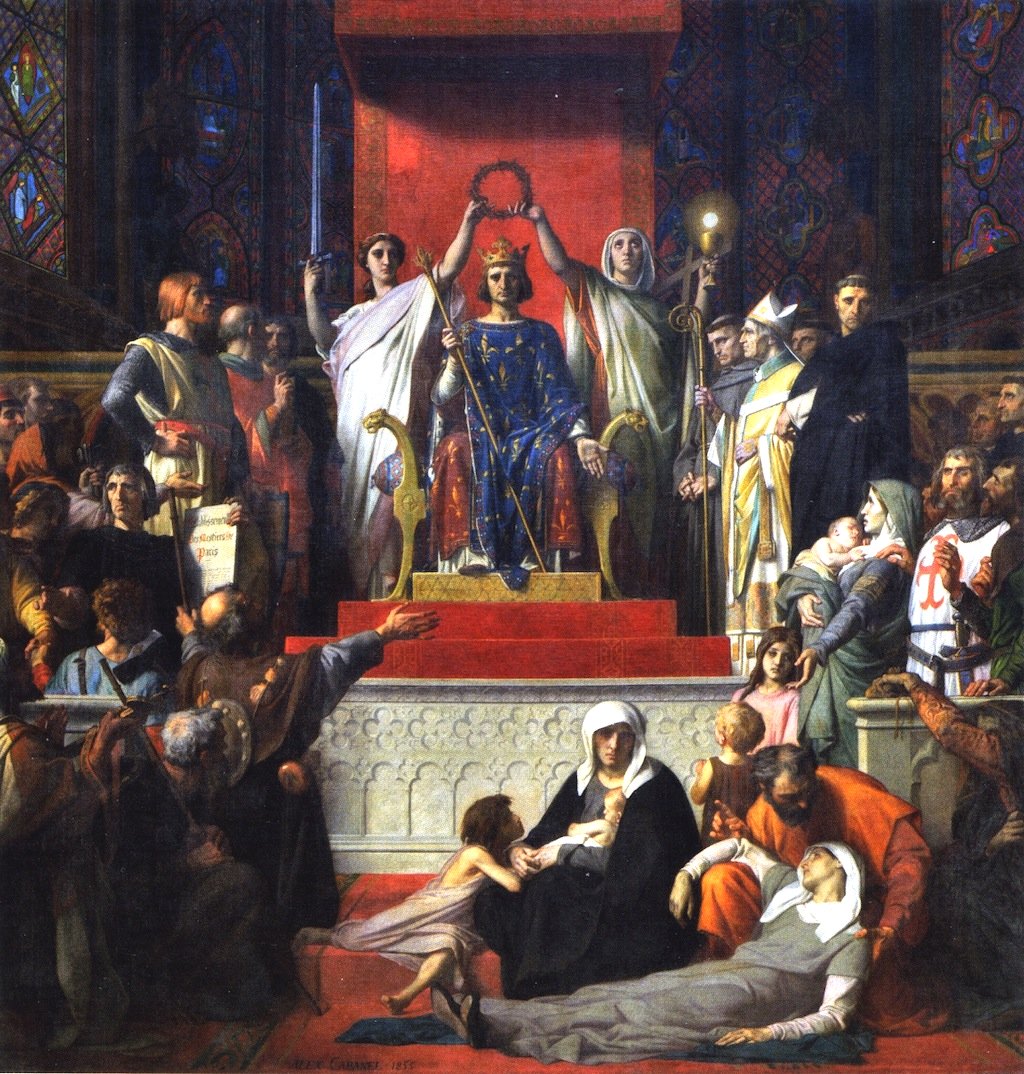
The Glorification of St. Louis by Alexandre Cabanel (c.1853-55)

In 1855 the World Exhibition came to Paris for the first time.  It went on to be held in the French capital on four other occasions.  The Exposition Universelle, as it was known in France, was an international Exhibition held on the Champs-Élysées from May to November.  Part of this World Fair would be dedicated to exhibits of fine art and Cabanel quickly realised to have his paintings exhibited at such an event would gain him world-wide notoriety.  He submitted two of his works of art.  The first one was entitled The Glorifcation of Saint Louis which had been commissioned by the French state for the Gothic chapel of Sainte-Chapelle at the royal Chateau de Vincennes.  The chapel and the subject of the painting were connected as it was at this chapel that Louis IX’s relics of the Crown of Thorns were initially kept.  Cabanel also had an ulterior motive for painting this picture as it now established a connection between himself and the reigning monarch Napoleon III.  Cabanel knew that his future success would be assured if his art went hand in hand with a good working relationship with the monarchy.

Christian Martyr by Alexandre Cabanel (1855)

The second work of Cabanel which appeared at the Exposition Universelle was entitled Christian Martyr.  Although the title would lead one to believe this was yet another work depicting the killing of a martyr it didn’t for it shows a group of Christians, at dusk, lifting the body of a martyred female believer from a boat up to a group of fellow believers above who are ready to carry her into a burial chamber.   The woman dressed in a dark yellow tunic lies lifelessly in the arms of the men who are lifting her up.  Her head lolls downwards and her face has the grey-green pallor of death.  It is a moving depiction and we see an elder standing behind the group of rescuers, with his arms outstretched in prayer for the soul of the martyr.  The man to the right of the scene leans against the parapet anxiously searching into the distance for the approach of the authorities.

The two paintings were also exhibited at the Salon of 1855 and The Christian Martyr painting was subsequently purchased by the Societé des Arts et des Sciences at Carcassonne for its Musée des Beaux Arts.

In my next blog I will continue to look at the life of Cabanel, his portraiture and one of his most famous works, The Birth of Venus.

 —————————————————————

 I gleaned most of my information for this blog and the next ones about Cabanel from a great book I came across entitled Alexandre Cabanel – The Tradition of Beauty which was published to coincide with La tradition du beau exhibition of Cabanel’s paintings, which was held at the Wallraf-Richartz Museum in Cologne in 2011 and the Musée Fabre in Montpellier in 2010.

I also came across an excellent website which goes into much greater detail about Cabanel and is well worth a visit.  It is:

Stephen Gjertson Galleries

http://stephengjertsongalleries.com/?page_id=2851

Alexandre Cabanel. Part 1 – The early days and Rome
Self portrait by Alexandre Cabanel (1852)

My featured artist today, Alexandre Cabanel, was one of the most well respected Academic artists of the nineteenth century.  In my next couple of blogs I will look at this remarkable artist and some of his paintings.  His works of art varied from portraiture to historical, classical and religious scenes all executed in an academic style.  The term Academic art, also referred to as academicism or eclecticism, is traditionally used to describe the style of art which was championed by the European academies of art, notably the Académie des Beaux-Arts.  For Cabanel, Academic art was the true art and during his lifetime he would clash with Impressionist painters and their artistic style.  Cabanel was also well known for his décorations d’intériur.

 Alexandre Cabanel was born in September 1823 in Montpellier, France.   He was the ninth child of Pierre-Jean Cabanel and Marie Anne Jean Cabanel.  Even at a young age he showed an early artistic talent and when he was eleven years of age he attended the drawing classes at the Montpellier’s free École des Beaux-Arts, which was run by the French genre painter Charles François Matet.  Matet  was also curator of the Musée Fabre in Montpellier.   Cabanel earned himself some money whilst studying by making copies of artworks which were housed in the city’s Musée Fabre which he then sold.   In 1836, thanks to Matet’s recommendation, the Montpellier council awarded Cabanel his first art scholarship to allow him to study in Paris.

 Three years later Cabanel’s artistic talent was recognised as being so good that he was awarded a second scholarship to return to Paris.  The scholarship was a blessing as his father, who was a cabinet maker, could not have afforded to send him to the French capital.    Alexandre did go, thanks to the municipal two-year grant and in the October of 1840, a month after his seventeenth birthday, Alexandre Cabanel enrolled at the School of Painting at the École des Beaux-Arts in Paris as a pupil of François-Edouard Picot .  Picot was a well established painter who had studied under Jacques Louis-David and had tried to continue David’s artistic style, that of neoclassical values, to which, in his own works, Picot often added a more romantic flavour.

 For Cabanel the École des Beaux-Arts was not just an establishment which taught art it was a place where he was able to study literature, history and religion.  Cabanel received a good, well-rounded education and he thrived on the learning that was offered to him and in a way, it helped him convert his knowledge into visual imagery that would play a part in his future works of art. When his two-year scholarship came to an end in the summer of 1841 his mentor Picot wrote to the Montpellier authorities pleading on Cabanel’s behalf, for a further scholarship for his protégé and in return he would gain employment for Cabanel in the form of a major commission in the Hôtel de Ville in Paris.

Agony in the garden by Alexandre Cabanel (1844)

In 1843 aged nineteen, Cabanel exhibited his first work of art at that year’s Salon.  It was entitled Agony in the Garden, which is currently housed in the Musée des Beaux-Arts de Valenciennes.  In this work Cabanel has placed the Christ figure off-centre.  Behind him are a group of his persecutors.

 All the time Cabanel was attending L’École des Beaux-Arts he had one aim – to have a painting of his accepted into the establishment’s coveted Prix de Rome competition, in which the winning work of art enabled the artist to receive a scholarship for them to study for a number of  years at the Villa Medici in Rome.  There were also Prix de Rome scholarships for the best proponents of architecture, sculpture, music and engraving.

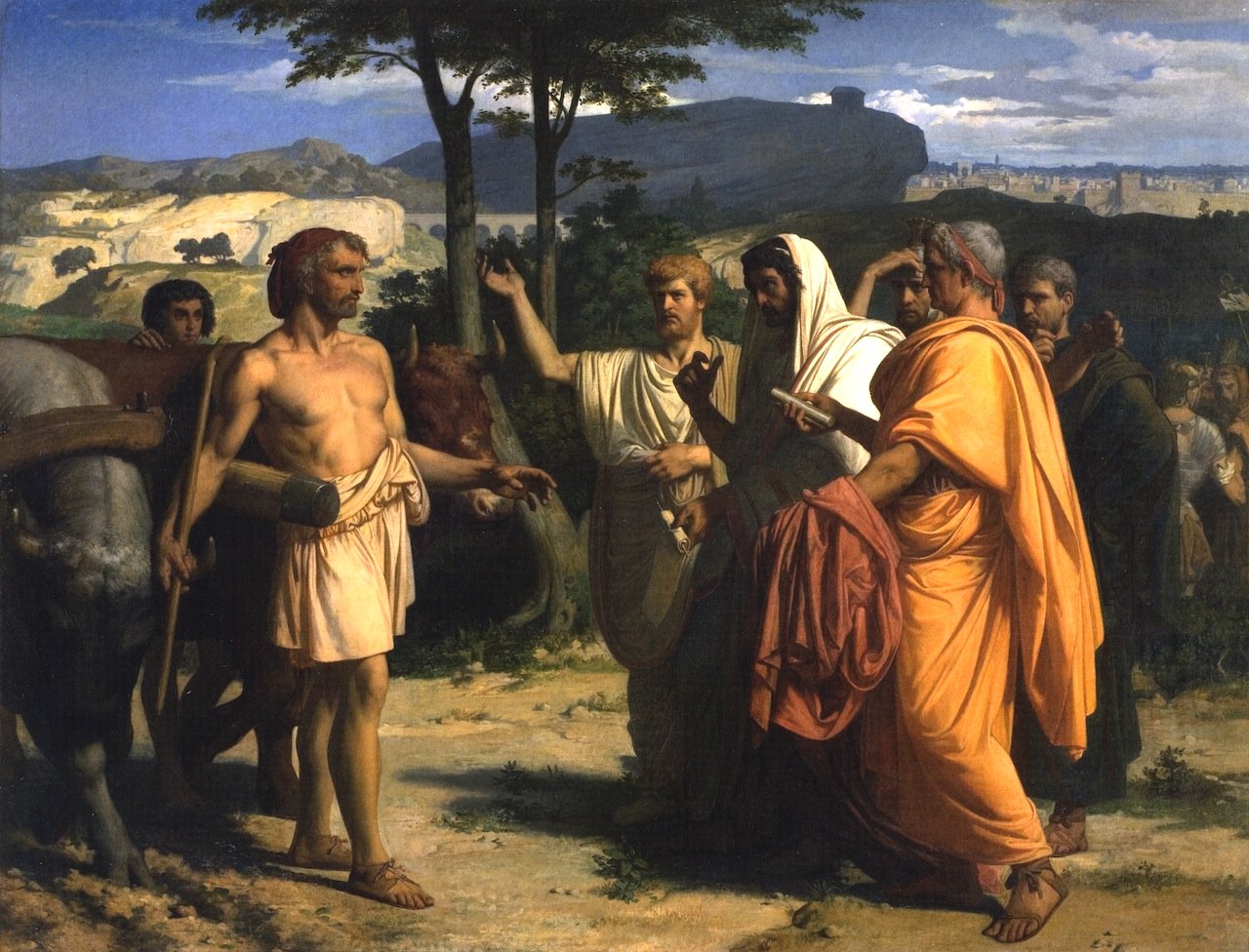
Envoys of the Senate offer the Dictatorship to Cincinnatus by Alexandre Cabanel (1844)

In 1843 he managed to reach the preliminary round of the competition with his work entitled Odysseus is Recognised by his Servant and buoyed up by that minor success he entered the competition again in 1844 this time with his painting, Envoys of the Senate offer the Dictatorship to Cincinnatus but he was only awarded sixth place.

The Mocking of Christ by Alexandre Cabanel (1845)

Better luck came in the 1845 competition when his work The Mocking of Christ, sometimes referred to as Christ at the Praetorium,  was judged and was awarded second place, with a fellow student of Picot, François-Léon Bénouville taking the top prize.   However second prize would not get the artist to Rome but the permanent Secretary to the Académie des Beaux-Arts, Désiré Raoul-Rochette, pleaded Cabanel’s case to be allowed to go to the Villa Medici as no Grand Prize for Music had been awarded that year.  A lot of wrangling followed between Rochette and Jean Victor Schnetz,  who was director at the Villa Medici, and who was against awarding Cabanel a scholarship.  In the end Schnetz backed down and Cabanel was granted a simple scholarship to go to Rome, which was to last for five years and the Prix de Rome second prize given to Cabanel was converted into a “Second First Grand Prize”.  All winners of the Prix de Rome received a financial allowance to cover the cost of their trip to Rome plus they were given a sum of money to cover their personal expenses and those they incurred during the production of their work. They also received free room and board.  The artists who came to the Villa Medici were allowed considerable freedom to paint subjects of their own choosing, but throughout their tenure they were all required to complete certain projects.  This allowed the French government, which had funded the scholarships, a way of assessing the progress of the Prix de Rome winning artists.  For the artists it was also a chance to bring their work to the attention of the members of the Academy, who also judged their annual submissions to see if their artistic ability had progressed.

 In January 1846 Cabanel set off for Rome.  It was early on in his stay at the Villa Medici that he met a fellow Montpellier citizen, Alfred Bruyas, who was enjoying the delights of the Grand Tour.   Bruyas was the son of a wealthy banker.  He was formerly taught art and would like to have become a professional painter despite his father’s wishes that he should embrace the world of finance and become partner in his father’s bank.  Bruyas loved art and loved to paint but soon realised he would never become a great artist and so concentrated on becoming an avid and discerning collector of art and a patron of the arts.  Many of his friends were artists such as Gustave Courbet.

Alfred Bruyas by Alexandre Cabanel (1846)

Bruyas supported Cabanel in these early days and in 1846, as a kind of repayment , Cabanel painted Bruyas’ portrait which now hangs in the Musée Fabre in Montpellier.  In the painting, Bruyas is depicted as a gentleman-traveller , dressed in his velvet-collared frock coat with a fashionable yellow waistcoat and pink and white cravat.  He is standing on the terrace of the Villa Borghese in Rome.  Bruyas and Cabanel became great friends during their short time together and Cabanel became very depressed when his friend left Rome in the summer of 1846.  Cabanel  would write to Bruyas telling him of his feeling of great loss when the latter had left the Eternal City.  In one letter, he wrote:

 “…Several times of an evening, I have put down on paper details from my present life so as to send them to you in letters.  On re-reading them, however, even I found them joyless and full of sorrow that I burned them…”

 For many aspiring artists who went to live in Rome they loved the liveliness of the Italian capital with all it had to offer but ,according to Cabanel, all Rome offered him was the chance to paint and copy the works of the Italian Masters.  He cut a lonely figure which was summed up in a letter he wrote to Bruyas in 1847.  In it he wrote that all he had left for consolation was his art :

 “…I have been leading a rather an orderly life, one completely devoted to art.  I have remained as untouched, as pure as Rome’s vestal virgins of days gone by……………….What’s more, I am weary of chasing after happiness that turns out to be an illusion, what’s the use?  Especially when I believe that I have long found it in my art for instance; I devote myself to it with complete freedom just as one devotes oneself to love or poetry…”


La Chiaruccia by Alexandre Cabanel (1848)

In 1848 Cabanel completed three amazing paintings for Bruyas, all of which are now in the Musée Fabre in Montpellier.  They were to be hung together in the form of a triptych.  The first was a painting of an Italian lady in traditional country peasant costume.  It is entitled La Chiarrucia.  The woman who modelled for this work also sat for many of the artists who lived and studied at the Villa Medici.

A Thinker, a Young Roman Monk by Alexandre Cabanel (1848)

The second of his three works, which was to be placed between the other two,  was entitled Un penseur, jeune moine romain,  (A Thinker, a Young Roman Monk)  and depicts a Franciscan monk lost in thought among the ruins of the Forum.

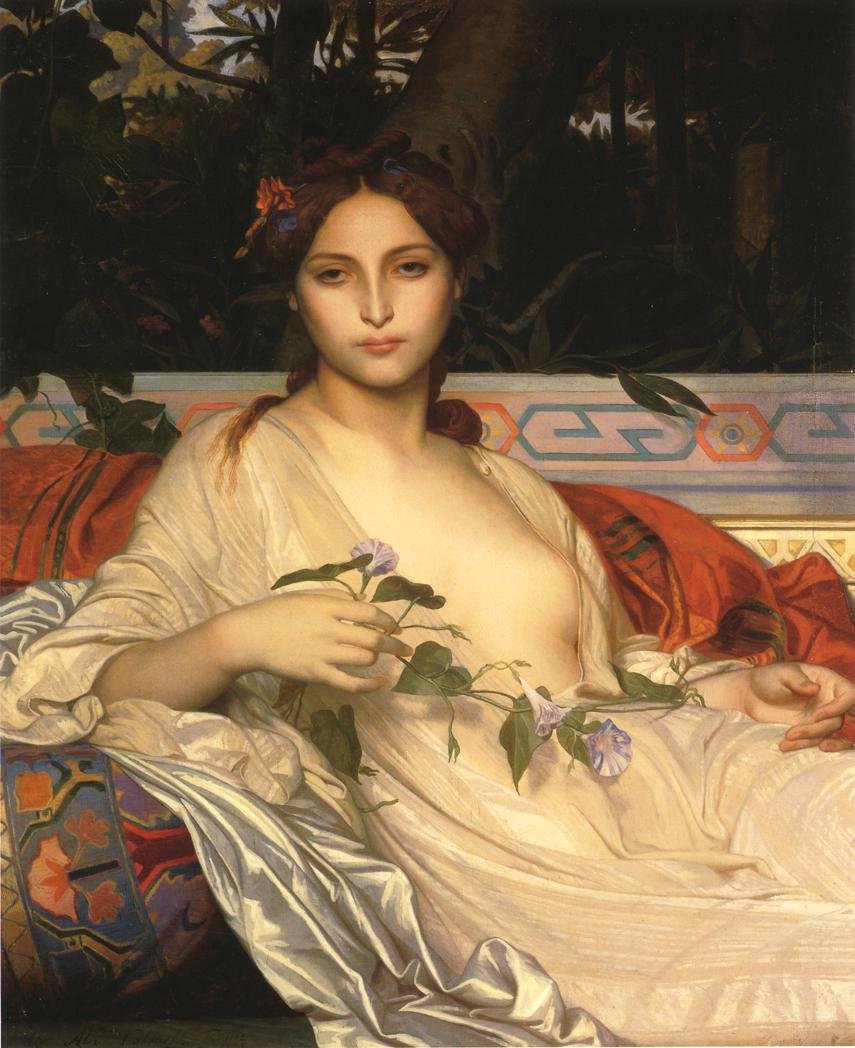
Albaydé by Alexandre Cabanel (1848)

The third, and my favourite, was simply entitled Albaydé.  The character of the title comes from Victor Hugo’s poem Fragments of a Serpent, which was one from a 1829 collection of poems known as Orientalia. The scene would appear to be a harem .  Cabanel has depicted the young woman, an Oriental courtesan, through the lustful eyes of the poet as she lies back languorously and looks out at us seductively with half closed eyes.  The beauty of this woman emanates from her eyes which I saw described as doe-like.  Her silken robe is open to the waist exposing the curve of her breasts.  She clutches a periwinkle vine which lies across her thighs.  It is a very sensuous depiction and she and La Chiaruccia ,either side of the monk, must have made for quite a formidable combination on Bruyas’ wall.

In my next blog I continue with Alexandre Cabanel’s life story and look at more of his exquisite paintings.

————————————————-

I gleaned most of my information for this blog and the next ones on Cabanel from a great book I came across entitled Alexandre Cabanel – The Tradition of Beauty which was published to coincide with La tradition du beau exhibition of Cabanel’s paintings, which was held at the Wallraf-Richartz Museum in Cologne in 2011 and the Musée Fabre in Montpellier in 2010.

Ary Scheffer

Self portrait by Ary Scheffer (1795)

I have often mentioned in previous blogs that the subject for a blog frequently comes from something I have stumbled upon whilst researching another blog.  Today’s blog is all about the Dutch painter Ary Scheffer who had a connection with the artist I talked about in the last two blogs, Théodore Géricault, but more of that connection later as I first want to look at the life of the Dutchman who was a leading Romantic painter.

Ary Scheffer came from an artistic background.  His father was Johann- Bernhard Scheffer a portraitist who originally hailed from Hamburg but from his early teenage years lived in the Netherlands.  He had married Cornellia Lamme, another artist who concentrated on miniature portraits.  Ary Scheffer’s maternal grandfather was Arie Lamme the Dutch landscape painter.  The couple, who lived in Dordrecht,  had three sons, Ary, the eldest, was born in February 1795, his brother Karel Arnold Scheffer who was born in 1796, went on to become a journalist and writer and their youngest, Hendrik, who also became an artist, was born in September 1798.

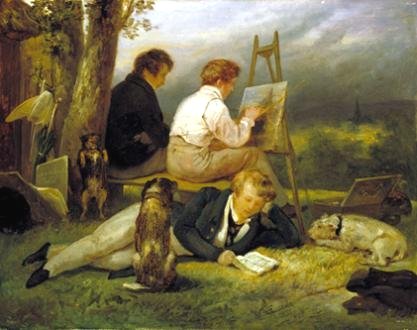
The Three Brothers Scheffer in a Landscape by Ary Scheffer (1824)

Ary Scheffer was given his first artistic tuition by his parents but when he was eleven years of age his parents enrolled him at the Stadstekenacademie in Amsterdam on a three year art course.   During that time he put forward one of his paintings, Hanibal Searing to Avenge the Death of his Brother Hasdrubal, in the first Exhibition of Living Masters in Amsterdam in 1808.

The painting is now in the Dordrecht Museum along with a number of his other works which are hung in the Ary Scheffer Room.  That same year, his father became the court painter of Louis Bonaparte, who ruled over the Kingdom of Holland, a position bestowed on him by his brother, Napoleon Bonaparte.  Ary’s father only held the position for a year as in 1809 he died.  Following the death of her husband, Cornelia Scheffer moved to Paris with her three sons where Ary and his brother Hendrik became pupils at the studio of the French painter, Pierre Guérin.   Ary and Hendrik were in good company at the studio as two of their fellow pupils would become the figureheads of the French Romantic movement in art, Eugène Delacroix and Théodore Géricault.

Ary Scheffer later attended the École des Beaux-Arts in Paris and from 1812 for the next thirty five years exhibited works at the annual Salons.  Along with Delacroix and Géricault, Ary Scheffer is recognised as one of the great painters of the Romantic school.  Following the end of the Revolution and the fall of Napoleon Bonaparte the French bourgeoisie once again came to prominence and along with the State were the main patrons of the Arts.   Scheffer’s work was very popular and at the end of each Salon his paintings would be snapped up by eager buyers.

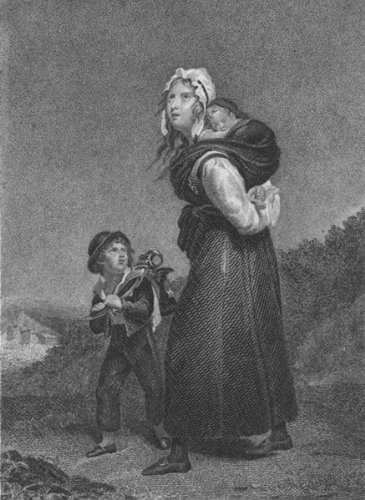
The Soldier's Widow by Ary Scheffer
The Soldier’s Widow by Ary Scheffer

In the 1822 Salon he exhibited his very sentimental painting Soldier’s Widow which was very popular and although the whereabouts of the painting is unknown there are a number of monochrome prints of the work.

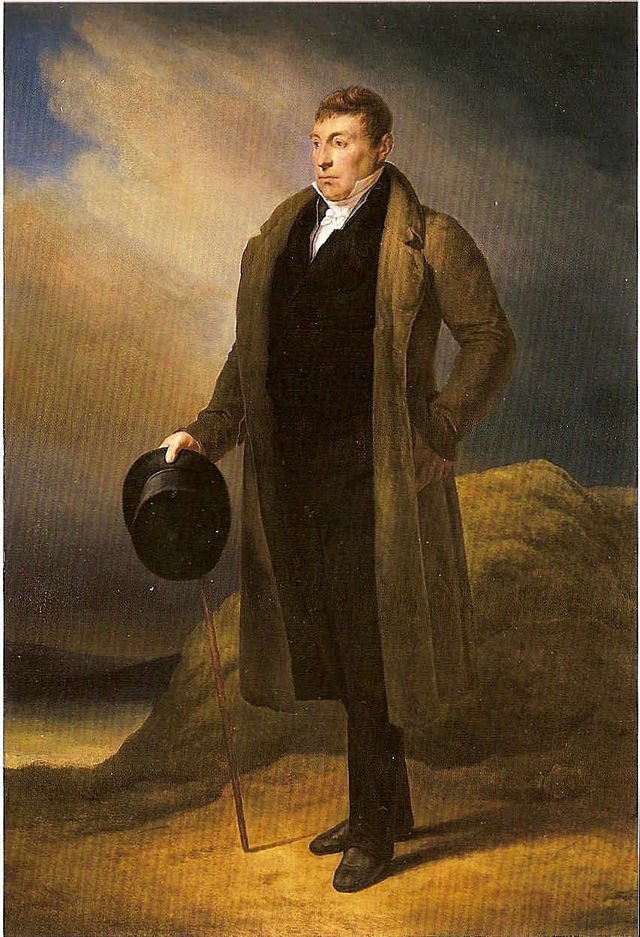
General Lafayette by Ari Scheffer (1823)

Ary Scheffer was also an excellent portraitist and in 1823 he completed probably one of the best portraits. It was of General Lafayette, the French aristocrat and military officer.  It was a full-length standing portrait that was the most popular image of Lafayette as an older man, who had once been a general in the American Revolution War (1775-83) against the British and a close friend of George Washington.  Lafayette was a popular subject for prints in the first half of the 19th century.  He was a hero to both the French and the Americans; he was the first foreign dignitary to address a joint session of the U.S. Congress and in 1824, on the occasion of Lafayette’s celebrated tour of the United States, Ary Scheffer presented his painting to the U.S. House of Representatives. It has hung to the left of the Speaker’s rostrum since the opening of the current House Chamber in 1858.  Lafayette would later figure in the French Revolution in 1789 and in the July Revolution of 1830 which led to Louis-Philippe becoming ruler of the French nation.  This painting, entitled Gilbert de Motier, Marquis de Lafayette, is now part of the collection of the US House of Representatives in Washington.

When Louis-Philippe came to power in 1830 it marked the zenith of Scheffer’s artistic career.  Scheffer, before the July revolution, had been giving drawing lessons to Louis-Philippe’s children and a great friendship between artist and his pupils blossomed.  Once Louis-Philippe came to power after the 1830 Revolution, Scheffer attained an influential position within the court. Louis-Philippe became the patron of the artist and the Orleans family bought many of Scheffer’s paintings. Scheffer received numerous lucrative commissions for the Musée Historique at Versailles, which Louis-Philippe founded in 1837 and which was situated in the wings of the Palace of Versailles.   The gallery which is one hundred and twenty metres long houses and also includes extensive tables that illustrate the major military events of the history of France.

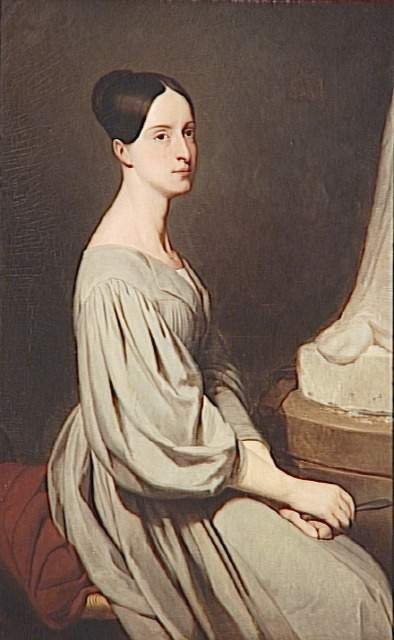
Princess Marie d'Orléans by Ary Scheffer (1831)
Princess Marie d’Orléans by Ary Scheffer (1831)

Ary Scheffer also completed a number of Royal portraits including one in 1831 of Princess Marie of Orléans the third child and second daughter of Louis-Philippe and his wife Maria Amalia of the Two Sicilies.  She later became the wife of Duke Alexander of Württenberg.  She was the most talented artist of all the Royal children and was constantly encouraged to pursue her love of art and sculpture by Ari Scheffer.  Sadly she died of tuberculosis when she was just twenty-five years old.

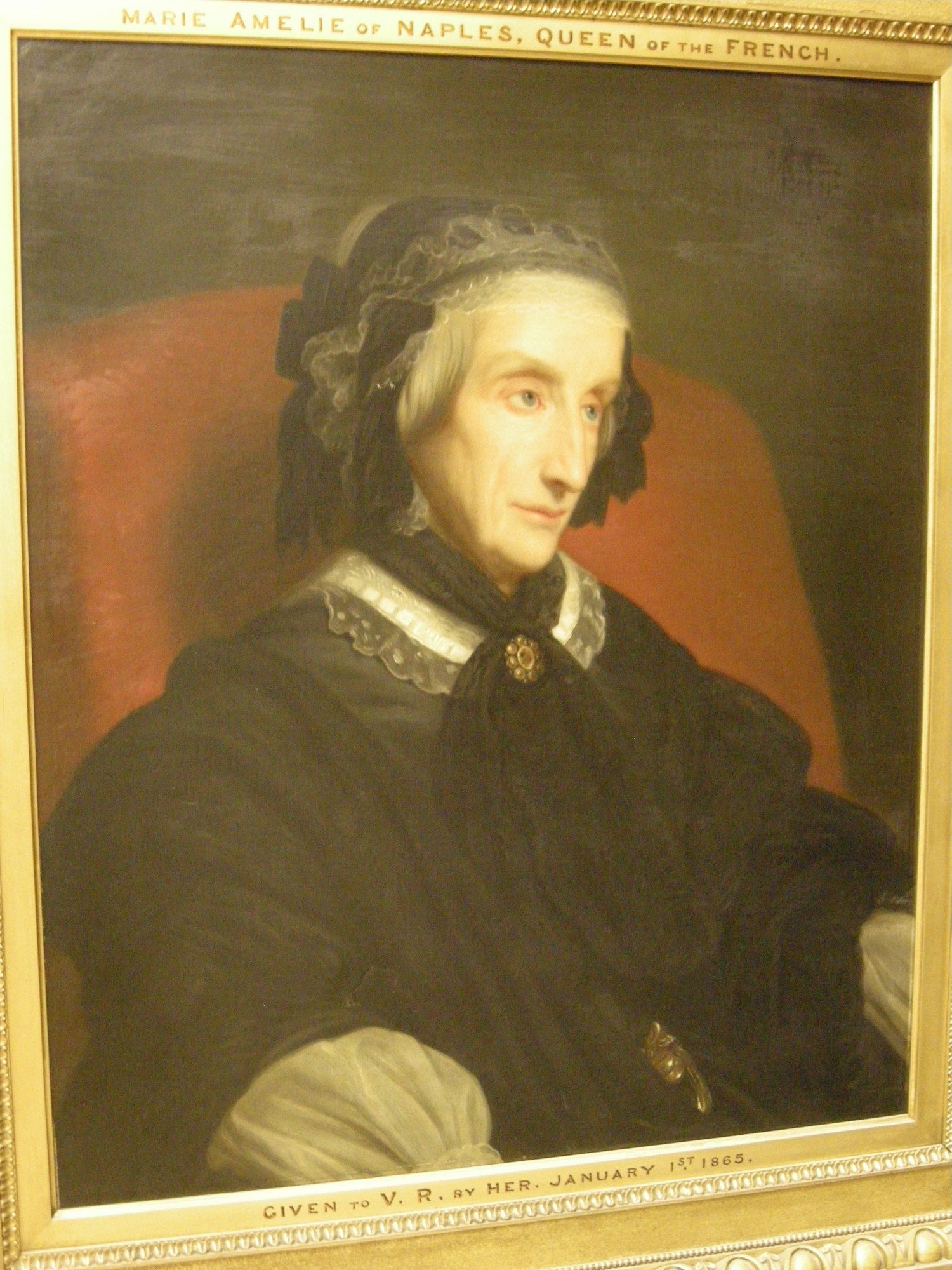
Marie Amélie of Naples, Queen of the French by Ary Scheffer (1857)

Another member of the he French Royal Family who featured in one of Scheffer’s portraits was Marie-Amalia, the niece of Marie-Antoinette and the wife of Louis-Philippe.  Louis-Philippe had reigned as the French monarch from 1830 when he came to power following the July Revolution and ruled for eighteen years but was deposed in the February 1848 Revolution which resulted in he and his wife, Marie-Amalia living a life in exile in England.

Claremont
Claremont

The couple lived at Claremont, a stately home owned by Leopold of the Belgians, but lent out to Queen Victoria.  In 1850 Louis-Philippe died but his widow remained at Claremont for the rest of her life.   Ary Scheffer visited Claremont in 1857 at which time he completed the portrait of the ex-Queen.   In it we see a frail seventy-five year old lady in mourning.

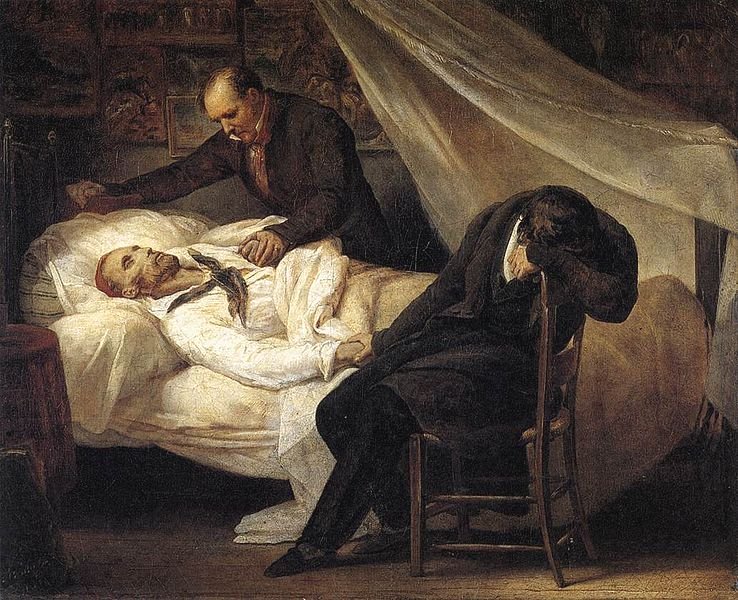
Death of Géricault by Ary Scheffer (1824)

What persuaded me to feature Ary Scheffer was when I was looking at the death of Théodore Géricault at the young age of thirty-two; I came across a painting entitled The Death of Géricault by today’s featured artist, Ary Scheffer.  It is beautiful work of art which highlights the French Romanticism style, which was so popular at the time.  Look at the man sitting on the chair who was presumably one of Géricault’s close friends.   Look at the way Scheffer has depicted him.  He grasps Géricault’s limp wrist with his right hand whilst he buries his head on his left hand which lies across the back of the chair which he is sitting on.  It is almost a scene from an old silent Hollywood movie or part of an amateur dramatics production.  The physician holds Géricault’s left hand which lies almost lifeless over his heart.  Look at Géricault’s face.  It is sunken.  It is almost skull-like.   In my last blog I featured Géricault’s last self-portrait which was a very disturbing depiction and somebody commented that it could not have been that bad but what we see in Scheffer’s painting is very close to that self-portrait.  This was the end for the great artist.

Théodore Géricault and Monomania

Self Portrait by Théodore Géricault

In my last blog I looked at some works by Théodore Géricault.  I examined his paintings which featured horses and the military and his masterpiece The Raft of the Medusa which I had examined in detail in my blog of June 10th 2011.  I finally looked at a highly erotic work which he painted for his own delectation around about the same time of the Medusa work.  In this blog I want to look at what I consider as his finest works, a series of portraits of men and women who had serious mental issues.

Raft of the Medusa by Théodore Géricault (1819)

Having completed The Raft of the Medusa around 1819 he exhibited it at that year’s Salon under the title Scène de Naufrage (Scene of Shipwreck).  It was hailed as the star piece of that year’s Salon and was well received by the French public including Louis XVIII himself, who had sponsored the exhibition.  Such was the fame of this work that Géricault was invited to London in June 1820 to exhibit the painting at William Bullock’s Egyptian Hall in Piccadilly.  It drew in crowds from all over the country and by the time the exhibition ended at the end of 1820, more than forty thousand people had come to view the masterpiece and as Géricault had negotiated a fee based on the number of people who paid to see his work it is thought that he walked away with twenty thousand francs and so it was just as well the French government would not countenance the purchase of the work when the 1819 Salon closed!

A year later, at the end of 1821, Géricault left London and returned to Paris.  It was at this time that he embarked on a series of ten portraits of people who were suffering from what is termed monomaniaMonomania is an exaggerated or obsessive enthusiasm for or preoccupation with one thing.  It is a type of partial insanity.  The word was first used by the French psychiatrist Jean Étienne Esquirol around 1810 and was a notion typified by the presence of an expansive fixed idea in which the person’s mind was diseased and deranged in some aspects but otherwise normal in others. So why would Géricault focus on this type of person and who commissioned the ten small works?

The man who commissioned the paintings is known to be Étienne-Jean Georget.  Georget was an intern at Salpêtrière, the women’s asylum in Paris, and later the medical supervisor at a private asylum in Ivry.  As to how the two men met is still up for debate amongst art historians.  One theory is that Géricault was treated by the psychiatrist.  He had been suffering from depression accompanied by paranoid delusions which culminated in a nervous breakdown around 1819.  Another possibility was that the two met during one of Géricault’s visits to the hospital morgue where he would go to acquire dissected limbs which he often used in his preliminary studies for major works, such as his Raft of the Medusa painting.  It could have been that Georget had commissioned the work as he believed such an artistic task would help Géricault recover from his own mental dark period.  When Géricault completed the work he gave them to the psychiatrist as a way of expressing his thanks.  Some art historians however believe that it was a simple commission, the result of which would help Georget in his studies into monomania.  However it should not be forgotten that Géricault had an intense interest in the causes and results of mental instability for his grandfather and one of his uncles had died insane. At the time Géricault was formulating his painting The Raft of the Medusa, which featured a group of men adrift on a raft after the sinking of their vessel Medusa, he knew that the key to success would be an authentic depiction of the terrified and dying seamen.   Géricault portrayed the men on the raft as dead or dying, desperately trying to signal for help.  To achieve a sense of realism he had contacted a variety of medical specialists. His principal concern had been to gain access to human bodies in various states of putrefaction, to ensure the genuineness of the finished painting and it could have been that he also talked to the likes of Georget about the psychological trauma suffered by the victims of the Medusa shipwreck.  It is known that he interviewed the surgeon, Henry Savigny, who had been serving on the vessel when the shipwreck occurred and the doctor, at the time, had been putting down in print his experiences and the way it mentally affected the stricken crew members.

Whatever the circumstances were we know the five paintings I am going to feature initially belonged to Georget.  He, like Géricault died when he was in his early thirties.   I mention five works and yet one of Géricault’s early biographers, Charles Clément, talked of there being ten portraits.  However, only five remain.  So did the missing five feature five other mental patients?  What is currently believed is that Georget had asked Géricault to paint a further five works featuring the same five people at a later time so as to highlight the change in their appearance.  For Georget this was the study of physiognomy, an art of judging character from the face and phrenology, which would link the external form of the cranium as indication of mental faculties.  Simply put it was the assessment of a person’s character or personality from his or her outer appearance.  We have no names as to the sitters, just the monomania that is afflicting each of them.  In his book On Madness, published in 1820, Georget is most definite that madness can be seen in the face of the afflicted.  He wrote:

“…In general the idiot’s face is stupid, without meaning; the face of the manic patient is as agitated as his spirit, often distorted and cramped; the moron’s facial characteristics are dejected and without expression; the facial characteristics of the melancholic are pinched, marked by pain or extreme agitation; the monomaniacal king has a proud, inflated expression; the religious fanatic is mild, he exhorts by casting his eyes at the heavens or fixing them on the earth; the anxious patient pleads, glancing sideways, etc…”

Certainly harsh and in some ways unfeeling words from the psychiatrist and are in complete contrast to the sympathetic way Géricault depicted the sitters.

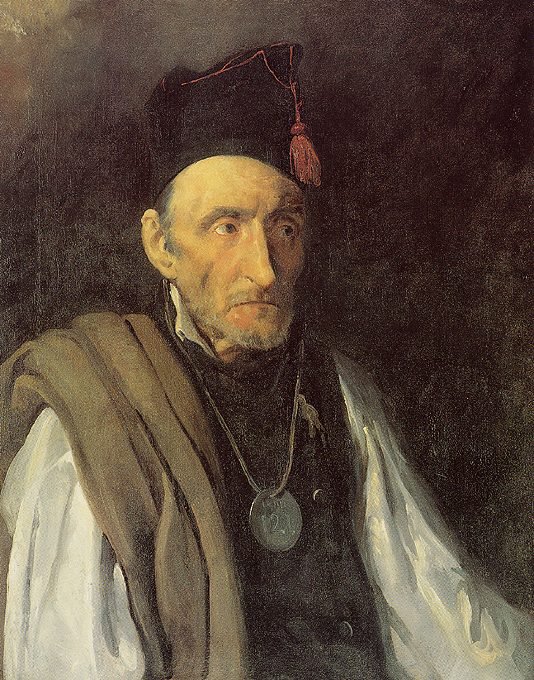
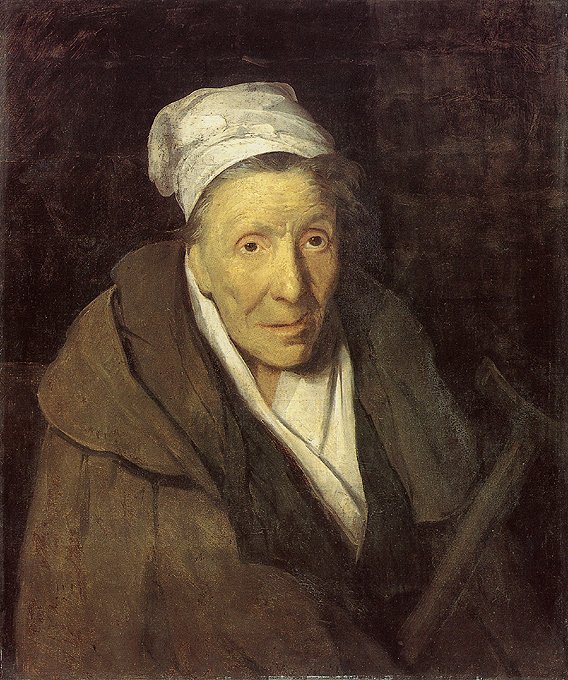
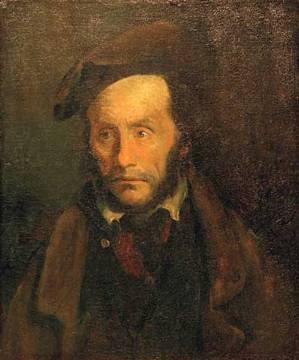
The five surviving portraits are entitled Portrait of a  Man Suffering from Delusions of Military Command;    A Kleptomaniac;  Portrait of a Woman Suffering from Obsessive Envy;     A Woman Addicted to Gambling and A Child Snatcher.  It seems likely that the featured women were inmates of the women’s hospital Salpêtrière, while the men were chosen from the many male inmates of the male asylums of Charenton and Bicȇtre.

Portrait of a Woman suffering from obsessive envy by Théodore Géricault (1822)

The first of the five I am featuring Portrait of a Woman Suffering from Obsessive Envy, which is housed in the Musée des Beaux-Arts in Lyons.  She avopids our gaze.  Her eyes are red-rimmed.  She has suffered and is probably still suffering.  Her case notes stated that she suffered from “envy obsessions” and maybe the slightest hint of a green tint to her face was the artist’s way to signify her obsession with envy.

Portrait of a Man suffering from Delusions of Military Command by Théodore Géricault (1822)

Next we have a man who suffers from delusions of grandeur and the portrait is entitled A Man Suffering from Delusions of Military Command which is in the Museum Oskar Reinhart in Winterthur in Switzerland.  The man in this particular portrait believed he was Napoleon and maybe Géricault believed that it was not just his sitter who had delusions of grandeur but it was targeted at the man himself, Napoleon, who may also suffered a similar delusional belief in himself as the head of the French Empire.  One needs to remember my previous blog when I featured some of Géricault’s military paintings.  Maybe now, like many French people after the defeat of Napoleon, he had misgivings about the glory of battle.  It is a very sympathetic portrayal of the old man and there is an air of sadness about his demeanour.  He looks like a defeated man and could well be an allegory for a defeated nation.

Portrait of a Kleptomaniac by Théodore Géricault (1822)

My third offering is the painting entitled Portrait of a Kleptomaniac which is housed in the Museum of Fine Arts in Ghent.  It is a strange depiction.  Just by looking at him we know there is something wrong in his life both physically and mentally.  He is dishevelled.  His sallow skin tone alerts us to him being ill.  His beard is unkempt and his hair is uncombed and messy.  Look at his face.  Look at the redness of his left cheek which looks swollen as if he has been involved in a fight.  He stares out at us, or maybe past us, but we have no idea what he is thinking. It is an empty gaze.  Géricault probably had no idea what his sitter was thinking but he made sure he captured every small detail about the man and maybe he wants us to decide on what has brought this man to the asylum.

Portrait of a Woman suffering from an  Obsessive Gambling disorder  by Théodore Géricault (1822)
Portrait of a Woman suffering from an Obsessive Gambling Disorder by Théodore Géricault (1822)

The fourth painting is entitled A Woman suffering from and Obsessive Gambling Disorder and can be found at the Louvre in Paris.  The old woman in the painting avoids stares out at us but it is a blank stare.  One has no idea what she is thinking.  She is lost in her own world, a world she is resigned to but does not enjoy.   Her eyes are red-rimmed probably brought on by the amount of mental and physical pain she has had to endure.  Her mouth is tense.  You can see in her facial expression that she is disturbed by something but with what?

Portrait of a Child Snatcher by Théodore Géricault (1822)

The final portrait by Géricault is entitled A Child Snatcher.  Before us we have a man who looks distinctly unhappy with his lot in life.   He is dressed in old brown clothes and has a dishevelled look about him.  His face is haggard.  His life has not been easy.  The dark background give us the distinct impression that this man lives in a world of isolation.  It is as if, as a resident of a mental institution, he has been cut adrift by society.  He avoids our gaze and looks to the side in a somewhat shifty manner.  Although we would compartmentalize this type of portrait as one of realism there is an element of romanticism in the way Géricault does not want us to judge the sitter.  Looking at the man we would not know his crime but the title of Child Snatcher tells us all we need to know about a man who in the present day would be probably be classed as a paedophile.

Last self portrait by Théodore Géicault (c. 1823 - 1824)
Last self portrait by Théodore Géicault (c. 1823 – 1824)

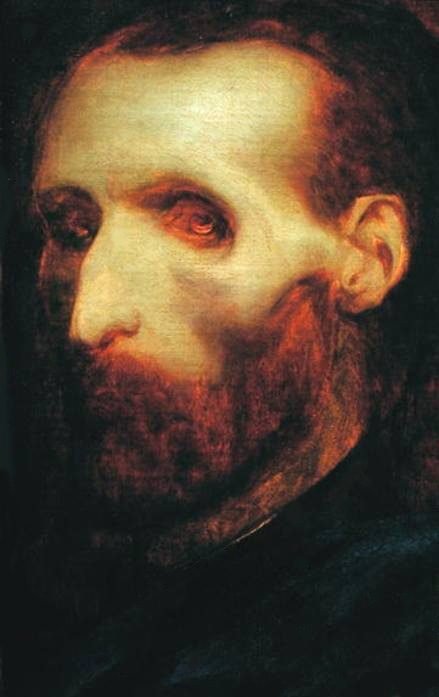
If you think that the five portraits were very disturbing and yet very real, I will leave you with one other shocking portrait.  It is the last self-portrait by Géricault, which he completed when close to death.  What a terrible sight it must have been as he looked in the mirror as he worked on his own portrait.  Remember this was a young man in his early thirties.

 The five existing portraits were discovered unframed and unstretched by Louis Viardot , the husband of the famous  French mezzo-soprano, Pauline Viardot .  Viardot was an artist himself, and a great admirer of Gericault, and so he recognised the style of the works as that of Géricault.  Géricault’s biographer Charles Clément researched the origin of the works and found that they had all belonged to a certain Dr Lacheze, to whom they had been bequeathed by another medical man, the psychiatrist Dr Etienne Georget.

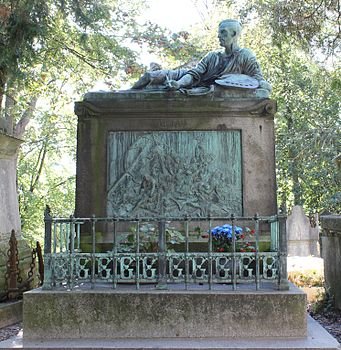
Théodore Géricault's tomb at Père-Lachaise cemetery in Paris
Théodore Géricault’s tomb at Père-Lachaise cemetery in Paris

Théodore Géricault died in January 1824, aged 32 and is buried in the Père-Lachaise Cemetery in Paris.  This series of portraits featuring mentally disturbed people was completed by an artist who also suffered depression during his later life.  In 1810, he wrote to his best friend, Pierre-Joseph Dedreux-Dorcy:

 “…Now I am disoriented and confused. I try in vain to find support; nothing seems solid, everything escapes me, deceives me. Our earthly hopes and desires are only vain fancies, our successes mere mirages that we try to grasp…”

Whereas Dr Georget was more clinical and some would say somewhat cold-hearted about his desire to have the portraits of these people we can see in the way Géricault depicted them with sympathy and even empathy.

Théodore Géricault – horses, military and the erotic

Théodore Géricault by Alexandre Colin (1816)

In the last few blogs I have talked about paintings which, at the time, shocked the establishment. In this blog I will be looking at a painting by one of the great French artists that, no doubt, would have shocked the nation of art lovers if it had ever been exhibited but in fact it only surfaced 170 years after its completion. The artist in question is Théodore Géricault, who is looked upon as one of the early leaders of the Romantic Movement and who went on to inspire another great artist of the Romantic Movement, Eugene Delacroix. The painting that probably would have astonished the art world, if it had been exhibited, was entitled Three Lovers and was completed around 1820 when Géricault was twenty-nine years of age. He must have been working on this painting at the same time that he was painting his great 1819 masterpiece The Raft of the Medusa (see My Daily Art Display of June 10th 2011).

Raft of the Medusa by Théodore Géricault (1819)

Théodore Géricault was born in Rouen, France in September 1791. His family were of the upper middle class bracket. When Géricault was four years old the family moved from Rouen to Paris. He received the normal education as a child and teenager but showed little interest in his studies at the lycée. During his early life Géricault had two great passions in life – art and horses and loved to go horse riding a pastime which would literally be the death of him. When he was seventeen years of age his mother died and he received a sizeable inheritance.

In 1808, aged seventeen years of age, he enrolled at the studio of Carle Vernet, who was best known for his paintings of horses. Two years later, in 1810, he moved to the studio of Pierre-Narcisse Guérin, a much admired classical painter where he received a much enhanced academic training in art. After just six months working with Guérin, Géricault left the studio to concentrate on copying the great works housed at the Louvre. He did this for three years.

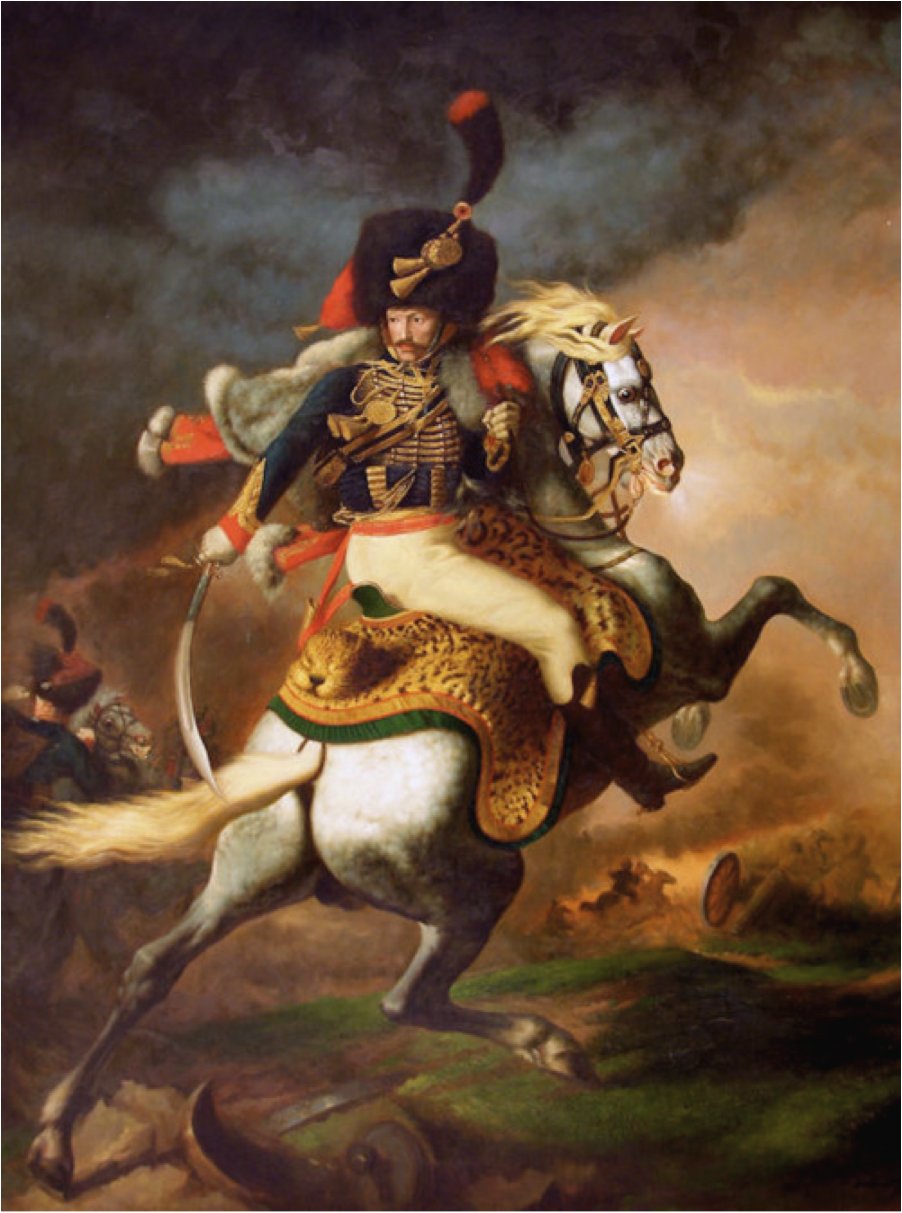
Charging Chasseur by Théodore Géricault (1812)

In 1812 he entered a painting into the Salon. It was originally entitled Equestrian Portrait of M.D***, later to be changed to The Charging Chasseur. It was a depiction of a mounted Napoleonic cavalry officer who is ready to attack the enemy. The chasseur sits astride his grey stallion, sword in hand, raring to go into battle. The horse, with flying mane and foaming mouth, enforces the animal’s aggressive passion. This was a true war-horse. This was what was good about war – bravery of man and animal and ultimate victory. The painting met with critical acclaim. Everybody loves a winner !

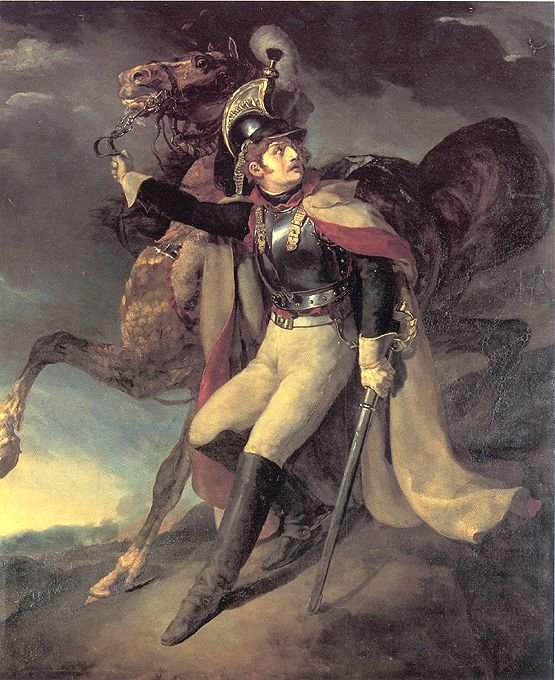
Wounded Cuirassier leaving the Field of Battle  by Théodore Géricault (1814)
Wounded Cuirassier leaving the Field of Battle by Théodore Géricault (1814)

Two years later, in 1814, buoyed by this success, Géricault once again exhibited The Charging Chasseur along with a newly completed work at that year’s Salon, entitled The Wounded Cuirassier leaving the field of Battle but to his amazement and annoyance the art critics were critical and the public were dismissive of his effort. So, why the change of heart amongst the critics and the public? Géricault loved the subject of horses and horsemanship and during the Napoleonic era such subject matter proved irresistible to him and the French public. For Géricault, his love was to depict the powerful combination of a rider dressed in his magnificent uniform and the sheer animal power of his horse. However, this was not the normal depiction seen in academic battle paintings where the artist focused on a mass of soldiers led into battle by a famous general. These were paintings depicting victorious battles. However, in The Wounded Cuirassier leaving the field of Battle we see a depiction of a single anonymous wounded soldier with his battle-weary mount limping from the battlefield. This was definitely not what the establishment and the art critics wanted to see. Maybe Géricault’s biographer, the nineteenth century art historian, Charles Clément, summed it up perfectly when he wrote of the difference between the two works:

“…In 1812 success was still in the air, whilst in 1814 everyone knew they were facing defeat…….The echoes of the cries of distress from our suffering armies on the plains of Russia resounded through the lands. Hearts were full of fear and terror. It is this universal feeling which Géricault expressed in his painting and explored in the Wounded Cuirassier…..He painted two pictures, the first about glory and the other about faded glory…”

In 1816 with a desire to win a three-year paid scholarship in Rome he competed for the Prix de Rome. However his work just got him to the semi final stage before his offering was eliminated. Still with a desire to go to Italy he decided to fund himself. He stayed in Italy visiting Florence, Rome and Naples before returning to Paris a year later. It was during this period in Paris (1818-19) that he set about painting his famous work The Raft of the Medusa. This was an enormous work of art which measured approximately 4.9m x 7.2m (16ft x 23ft). It was also during this time that he decided to paint, for himself, a small highly erotic work entitled Three Lovers.

Three Lovers by Théodore Géricault (1817-20)

Three Lovers which is now housed in the Paul Getty Museum in Santa Monica measured just 22.5cms x 29.8cms (9 inches x 12 inches). The picture is dominated by a large bed that is framed by furniture and a large curtain which is partly drawn to the side. In some ways it is as if we were theatre-goers and we are looking at a stage with the theatre curtain pulled to one side for us to enjoy the performance, and what a performance!

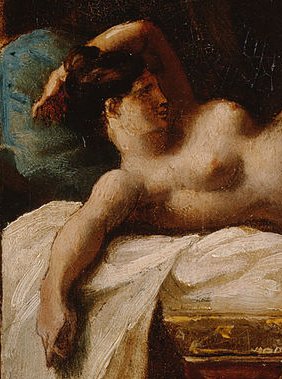
Sated
Sated

At one end of the bed we see a dark haired woman lying somewhat lethargically against some blue pillows. She is naked from the waist up and her arms are spread wide exposing her rounded breasts. She looks closely at a pair of lovers who are making love. By her expression we feel that she is sated, probably having already had her turn of lovemaking with the man who is now pleasuring himself with the blonde woman at the opposite end of the bed. She is now happy to watch as the pair make love. She has now taken on the role as voyeur. The blonde and the man are locked in an intimate embrace. She half kneels on the bed between his thighs. Although he is almost hidden from view his naked legs would suggest he is lying semi-naked beneath his lover. The blonde woman is not naked but her white dress is pulled up to her waist by the man’s encircling arm which exposes her naked thigh and buttock. The way in which she has positioned herself on top of the man and the way she has her arms tightly wrapped around his neck exhibits her obvious arousal.

The stocking
The stocking

Géricault has depicted the blonde woman’s stocking down at her ankle which adds to the erotic nature of the painting.

It is a highly erotic work of art and because of the nature of the depiction Géricault would almost certainly have painted it for himself. He would never have intended it to be exhibited as he would have known full well that it would have been condemned by both critics and public for its dubious morality in a society which strongly adhered to religious and moral values and which condemned sexual excesses and misbehaviour. Of course having said all that it could well be that such erotic encounters did take place between prostitutes and their customers despite people pretending such excesses did not occur. Maybe Géricault was reminding himself of what did happen in dimly lit rooms where passions prevailed over civic respectability.

Cézanne, Jas de Bouffan and the peasant workers

Paul Cézanne aged 22

Four years ago I visited the Courtauld Gallery in London to see the Cezanne exhibition which featured three of his five Card Players paintings. I was fascinated by the figures depicted in these works of art, the same fascination the artist must have had for these rustic characters as they featured in many of his paintings. From around 1887, Cézanne began to paint single figures again and, in his early works, he would used his wife and son as models, later he would get some of the peasant workers to model for him at the family’s estate, Le Jas de Bouffan, (“home of the winds” in the language of Provencal). In this blog I want to have a look at some of his paintings which featured these peasants and the estate where it all happened.

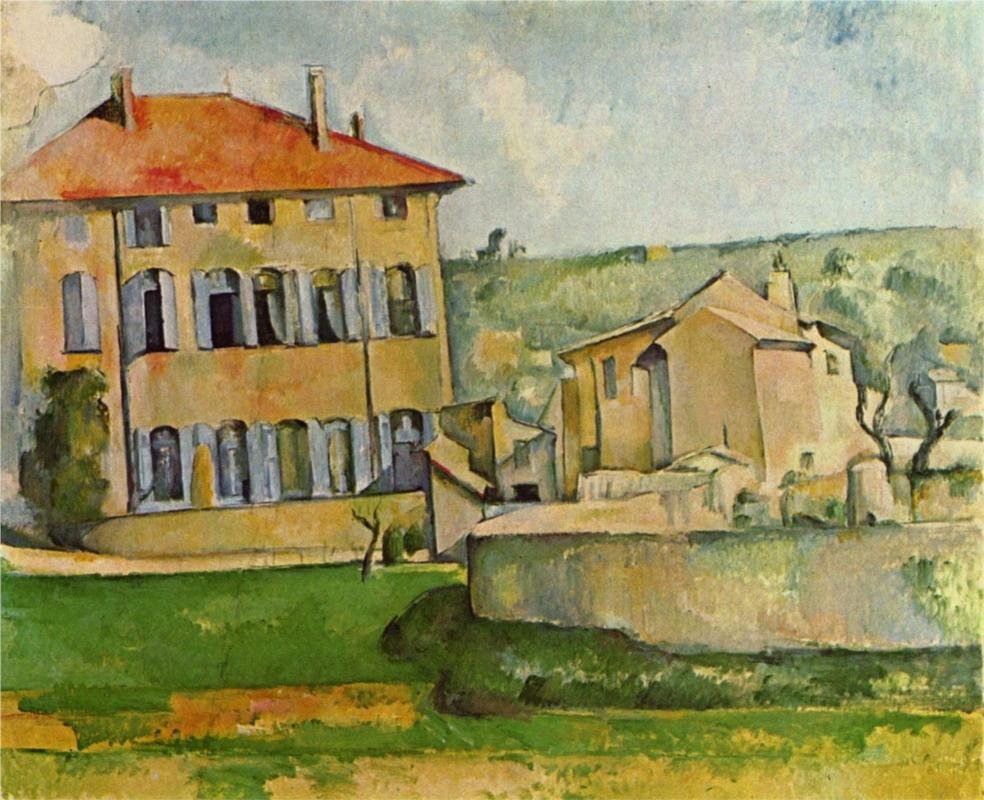
The House and Farm at Jas de bouffan by Cézanne (1887)

Paul Cézanne’s father, Louis-Auguste Cézanne, was a banker and in September 1859, when Cézanne was twenty years old, his father acquired the Le Jas de Bouffan estate from its then present owner, Gabriel Joursin, who was heavily in debt to the bank. It was a spectacularly beautiful estate, located on the outskirts of Aix-en-Provence, with its long avenue, lined with chestnut trees, leading to the large manor house. The family moved into the large estate house, which was run-down, some of the rooms were in such poor condition that they could not be lived in and were permanently locked up. Initially the family just lived on the first floor with the ground floor rooms set aside for storage. Cézanne, who much to his father’s dismay, wanted to become a professional artist but had placated his father by agreeing to study law at the Law faculty at Aix. His father allowed him to paint murals on the high walls of the grand salon on the ground floor, a room which he was eventually allowed to turn it into his temporary studio.

Spring, Summer, Autumn, Winter by Cézanne (1860-2)

It could have been that as the surface of the walls was in such a poor condition his father allowed his son to exercise his artistic ability on them. Cézanne decorated the walls with four large panels of the Seasons. The odd thing about his four murals was that he signed them, not with his own name, but with the name “INGRES” and added the date 1811 on the bottom left of the panel representing Winter. So, why sign the painting “Ingres” and why the date, which was almost fifty years in the past? It is thought that the young Cézanne wanted to prove to his father that he was as good an artist as the legendary Ingres and the date probably referred to Ingres’ famous work Jupiter and Thétis, which Ingres completed in 1811 and was in the collection of Cézanne’s local museum, Musée Granet, in Aix-en Provence.

The Artist's Father, Reading L'Événement by Cézanne (1866)
The Artist’s Father, Reading L’Événement by Cézanne (1866)

In all, between 1860 and 1870, Cézanne painted twelve large works of art directly on to the walls of the large salon and which remained in situ until 1912. One of these works was entitled The Artist’s Father, Reading “L’Événement” which can be seen at the National Gallery of Art, Washington. Cézanne completed the work in 1866 and depicts Louis-Auguste Cézanne reading the newspaper L’Evénement. The newspaper is a reference to Cézanne’s great friend from his childhood days, the novelist Émile Zola, who was one of the people who urged Cézanne to overcome his father’s demands to have him study law and instead, go to Paris and study art. Zola had become the art critic for the L’Evénement in 1866. It was certainly not the paper Cézanne’s father would have read !

The House of the Jas de Bouffan by Cézanne (1874)

Although often working in his indoor studio, Cézanne also enjoyed painting en plein air in the vast grounds of the estate, which contained a farm, as well as a number of vineyards. He painted a number of views of the manor house, one of which was completed around 1874 and was entitled The House of the Jas de Bouffan. In this work we see the great old ochre-coloured building, with its ivy- clad walls nestled amongst a thriving mix of tall, well-established trees and greenery. It is a beautiful sunlit scene which captures the myriad of visual wonders offered up by nature. Cézanne despite moving around the country, including Paris, where he exhibited works at the first Impressionism exhibition in April 1874, often returned to Jas de Bouffan to relax and paint. The roof of the house had to be replaced in the early 1880’s and it was then that Cézanne’s father made a little studio in the attic for his son. In 1886 when his father died, Cézanne came into a large inheritance which included the family’s beloved estate. This was the same year he married his lover and artist’s model of seventeen years, Hortense. In September 1899, two years after the death of his mother, Cézanne and his two sisters sold Jas de Bouffan to Louis Granel, an agricultural engineer.

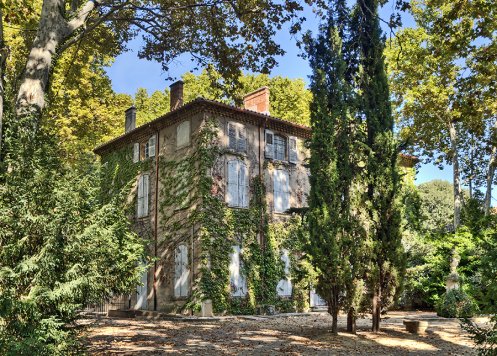
House in the Jas de Bouffan

Much later, the house and a portion of the grounds were sold to the city of Aix. The house has been open to the public since 2006 for visits in connection with the tours organized by the Office de Tourisme with regards to the life of Cézanne.

Man in Blue Smock by Cézanne (1897)

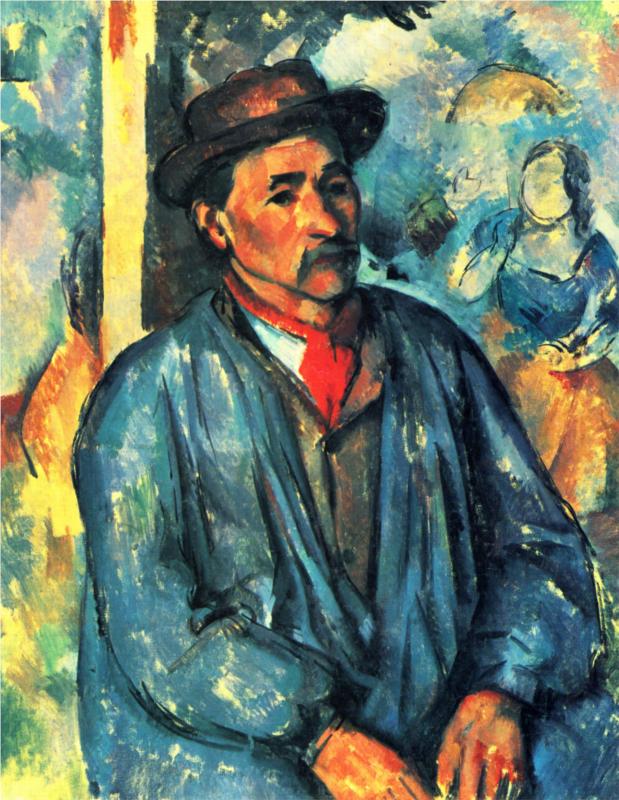
As I wrote before, in the late 1880’s Cézanne began to concentrate once again on single portraits and used his wife Hortense and son Paul as models. Later, in the 1890’s he started to paint a number of pictures which featured some of the workers of the estate. Using actual peasant workers that he knew added that little bit extra realism to the depictions. One such work was entitled Man in a Blue Smock which he completed around 1897 which is now housed in the Kimbell Art Museum, Fort Worth. The worker who sat for Cézanne in this painting was also one of the models used for the famous Card Players series. It is an interesting work which needs to be carefully studied. The man, with a large moustache, shows little expression as he sits before Cézanne, the artist and his boss! It appears that he has been asked to put on a painter’s blue smock over his ordinary working clothes, which includes a red bandanna

The painting of the peasant is awash with muted blues and browns but the red used for the bandanna, the man’s cheeks and the backs of the hands draw our eyes to these very points in the painting. The background of the work is predominately filled with pastel colours but what is most interesting is what is behind the left shoulder of the main character. One can make out a faceless lady carrying a parasol. The museum curator believes that this faceless woman perhaps suggests some mute dialogue between opposite sexes, differing social classes, or even between the artist’s earliest and most fully evolved efforts as a painter. This latter reason falls in well with the fact that the lady with the parasol is a copy of one of Cézanne’s first works which he completed in 1859, when he was twenty years of age, and which can now be found in the Musée Granet in Aix.

Seated Peasant by Cézanne (c.1896)

Another painting featuring one of his peasant workers is entitled Seated Peasant which he completed around 1896 and is part of the Annenberg Collection at the Metropolitan Museum of Art in New York The peasant in the painting is young and is seated cross-legged on a cane chair. The setting for the painting is inside one of the rooms in the big house. It is “L-shaped” in design. The background is once again a simple plastered wall with its dado rail. Cézanne has restricted his palette to a small number of colours – greys, blues, browns, yellows and grey greens which are only replaced by the odd small splash of purple and red. Although there is a similarity between him and the peasants in the various Card Players works he has never been identified as being in any of those five famous paintings. The man seems lost in thought. His mouth is drawn down on each side giving his facial expression an air of melancholia. He wears a baggy dark brown coat over a grey jacket and a yellow waistcoat or vest. He wears striped trousers. Look at the way Cézanne has painted his hand which rest on his thigh. It is very large in comparison to the rest of his body and could almost be described it as being “ham-fisted”. As in some other portraits by Cézanne, he has introduced a still-life element into the work. On the floor in the bottom left of the painting he has added two green-bound books, two small boxes, a small bottle and a stick all of which have been placed on a cloth. Only the artist knows why he included these inanimate objects into this portrait! Maybe he was asserting his ability to paint still-life objects.

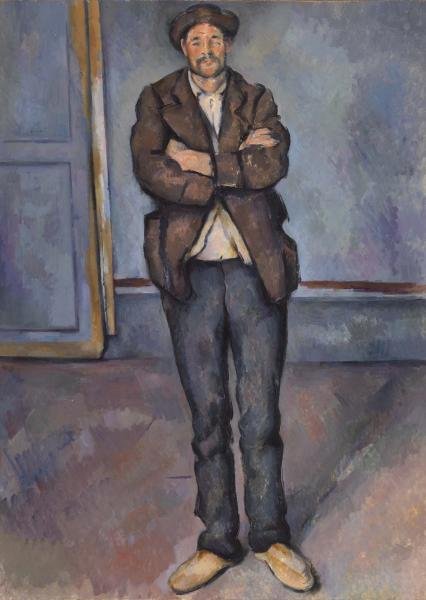
Peasant Standing with Arms Crossed (Paysan debout, les bras croisés) by Cézanne (1895)

Around the same time, Cézanne painted another portrait of a peasant in a standing position. It looks very much like the setting for the portrait was in the same room as the previous work. It was entitled Paysan debout, les bras croisés, (Peasant Standing with Arms Crossed) and was completed around 1896.

Peasant by Cézanne (c.1891)

My final work I am showcasing is a head and shoulder depiction simply entitled Le paysan (Peasant) which Cézanne completed around 1891. Again we have this peasant with a most unhappy countenance as he stares downwards. Again his mouth is turned down in an expression of sadness. One has to believe that this is the pose Cézanne wanted his sitter to exhibit. Was the artist trying, by this posed facial expression of his sitter, to get over to us that the life of a peasant was not a happy one. Maybe Cézanne want us to empathize with the man. Maybe Cézanne was determined to depict the inequalities of life in this portrait. Once again the background is plain and in no way detracts from the sitter. The work is a mass of greys and blues but the careful splashes of red on the peasant’s face make us focus on the man’s expression and by doing so poses the question to us as to what we think about is his lot in life.

Sarah Siddons

Sarah Siddons by J. Dickinson

The subject of my blog today is not an artist, although many would term her a theatrical artist, and in fact she was looked upon as one of the greatest English tragic actors of the eighteenth century. She was a Shakespearean actor of great renown and particularly famous for her interpretations of Lady Macbeth. She was a lady who was so popular that her portrait was painted a number of times by leading portraitists of the time. Let me introduce you to Sarae Kemble, later known as Sarah Siddons.

Sarae Kemble was born in the Welsh town of Brecon in July 1755. She was the eldest of twelve children of Roger Kemble and his wife Sarah Ward. Her father, who was a theatre manager, managed a troupe of travelling actors, the Warwickshire Company of Comedians. Sarah was fortunate to be the eldest child as her mother made sure that she received a good education and insisted on her attending school at the various towns the troupe of actors performed but this did not preclude her from making many appearances on the stage when she was still just a small child.

During her teenage years she fell in love with William Siddons, who was one of her father’s troupe of actors. However, like most parents, Sarah’s mother and father baulked at her liaison with Siddons as they had already received an offer of marriage from a local squire. Sarah would not agree to such a relationship and held out until she was eighteen and eventually in November of 1773 she married her beloved William Siddons in Trinity Church, Coventry. A year later, in 1774, she appeared as Belvidra in the English Restoration play, a tragedy, written by Thomas Otway, called Venice Preserv’d, which was first performed in 1680. Sarah Siddons’ performance was hailed a great success and the excellent revues of her depiction of her character came to the attention of the veteran actor of the time, David Garrick. She was invited to appear at the prestigious Theatre Royal, Drury Lane but whether it was nerves or whether she had still yet polished her acting ability, her performances were slated and, to her shame and horror, the theatre dispensed of her services.

It may have all been for the best as she spent the next six years travelling around the country with touring companies, honing her skill as an actor, all the time enhancing her reputation and finally she was invited back to the scene of her early disasters, Theatre Royal Drury Lane, where she was hailed as a theatrical genius for her portrayal of Isabella in David Garrick’s adaptation of Thomas Southerne’s play, Isabella or The Fatal Marriage.

Mrs. Siddons as the Tragic Muse by Sir Joshua Reynolds

It was around this time, in 1784 that she sat for Sir Joshua Reynolds who depicted her as the Tragic Muse, Melepoméne, in his famous portrait, Mrs Siddons as The Tragic Muse. The name Melpoméne comes from the Greek word melpo or melpomai, which means “to celebrate with dance and song. She is a Greek and Roman mythological character who was one of nine muses of the arts. She started off as the Muse of Song but later became the Muse of Tragedy. Reynolds was himself a great fan of the actor and was also a lover of all things classical and decided to combine his two loves in one single portrait. Reynolds was so overwhelmed by the actress that it was said that when she first visited him, he led her by the hand into his studio uttering:

“…Ascend upon your undisputed throne, and graciously bestow upon me some great idea of the Tragic Muse…”.

Further evidence of his devotion to the twenty-eight year old actor was that he signed his name on the gold embroidery at the hem of her dress. He explained this pictorial inclusion to the sitter saying:

“…I have resolved to go down to posterity on the hem of your garment…”

In the portrait we see Sarah Siddons seated in her throne chair with the allegories of Pity and Terror standing behind her and who merge into the brown background. Her body is towards us whilst her head and face are in profile. Her facial expression is one of concern. She looks troubled and in two minds as Pain and Terror influence her thought process. Despite this, she exudes an air of sophistication and dignity. Her dress is a mass of subtle colours, ochres and light and dark browns. Look at the beautiful and skilful way Reynolds has depicted the folds of the heavy fabric dress.

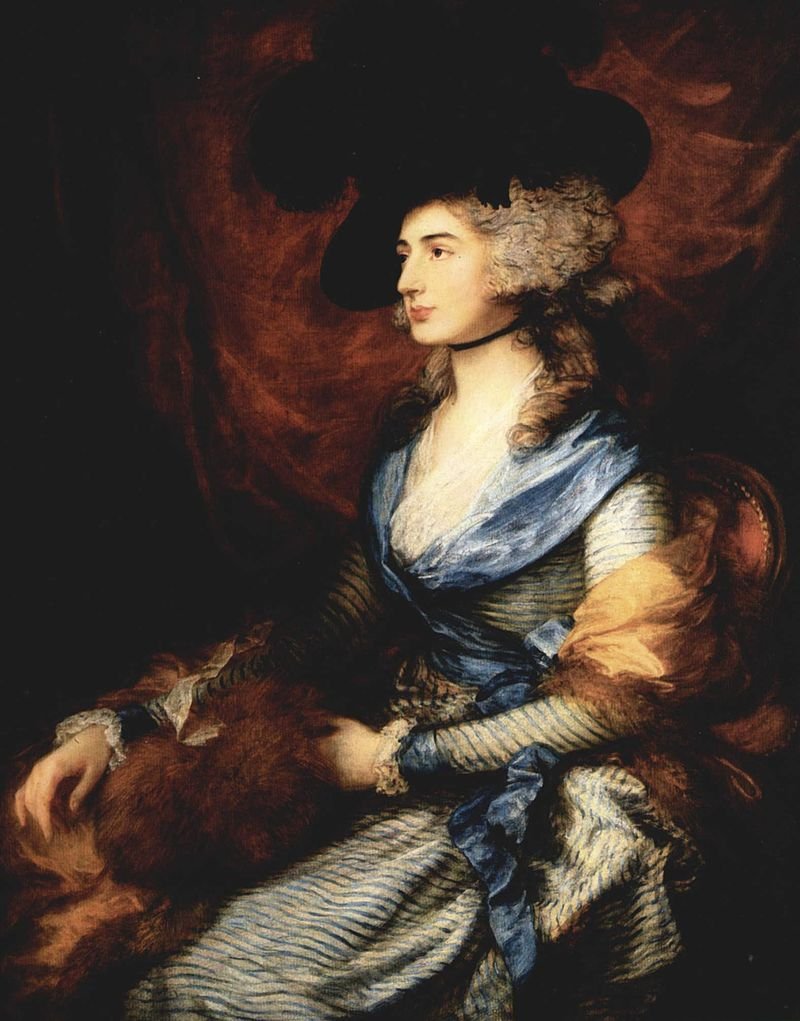
Sarah Siddons by Thomas Gainsborough

A year later, in 1785, another portrait of Sarah Siddons was completed. The artist was Thomas Gainsborough and the tile of the work was simply Sarah Siddons. It has been recorded that Gainsborough struggled with the portrait of Siddons especially when it came to her nose and her right hand which rests on the arm of the chair. It took him many attempts to get them right as has been revealed in the pentimenti. The word, pentimento (pentimenti is the plural), comes from the Italian word pentirsi, which means to repent or change your mind and pentimento is a change made by the artist during the process of painting. Such changes are concealed beneath  subsequent paint layers and often, if the final layer of paint has become transparent over a long period of time, an earlier layer of paint can be detected. Other ways of detecting such changes is with infra-red reflectograms and X-rays. Gainsborough himself commented about the difficulty he had with portraying her long nose when he uttered:

“…Confound the nose, there’s no end to it…”

Another well known artist, Sir Thomas Lawrence, painted a portrait of Sarah Siddons in 1804 when she was forty-nine years of age and nearing the end of her theatrical career.

Sir Thomas Lawrence knew Sarah Siddons and her family well. His portraits of her were probably more about Siddons the woman rather than Siddons the actor or one of Siddon’s many female characters she had played on stage. Thomas Lawrence and Siddons had first met in Bath in 1777 when she was twenty-two and on tour with a theatrical production. He was just eight years of age. Lawrence was a kind of child prodigy, an accomplished artist even at that age and had the ability to recite poetry, the two achievements which his father used to extract money from the passing public. At her first meeting with young Thomas Lawrence, Siddons never realised how he would affect her later  life and that of her family.

In 1787, just before his eighteenth birthday, Thomas Lawrence arrived in London. He met up again with Sarah Siddons, who was by now a cultural icon at the high-point of her theatrical career. Lawrence began consecutive relationships with two of her daughters, Maria and Sarah. Sadly they both died in their twenties. Sarah Siddons was by now separated from her husband William. Siddons herself was also in love with Thomas Lawrence, her daughters’ charming and alluring suitor, and he painted many portraits of her.

Mrs Siddons by Sir Thomas Lawrence (1804)

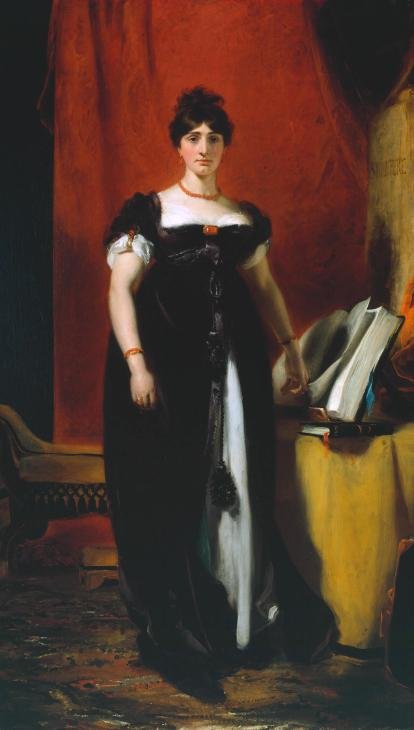
In his 1804 portrait entitled Mrs Siddons, we do not see her portrayed as an actor playing one of her many roles but at one of her many recitals when she would, with an actor’s panache, read from one of the plays which had made her so famous. In this portrait we see Sarah standing next to a table. On the table is a small lectern, on which are scripts of plays by Thomas Otway and Shakespeare.

Mrs Siddons as Mrs Haller in ‘The Stranger’ by Sir Tomas Lawrence

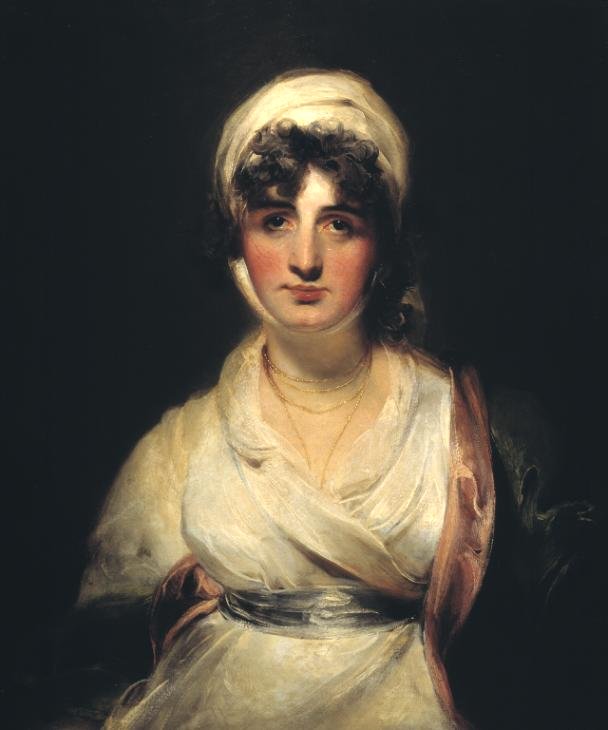
Lawrence had completed an earlier painting of Sarah Siddons in 1797 entitled Sarah Siddons (possibly as Mrs Haller) in ‘The Stranger’ , a play written by August Friedrich Ferdinand von Kotzebue the German dramatist and writer. The role she played was of the adulteress, Mrs Haller. In the portrait we see the sadness in Sarah Siddon’s expression which could well be the feelings expressed by the character in the play or it could be the unhappiness of her own life which would have been well known to Lawrence.  At last we may be seeing the real Sarah Siddons.

Sarah Siddons was a tall woman with strikingly beautiful features. Her most famous role was that of Lady Macbeth in the Shakespeare play, Macbeth. The way in which she played the part of Macbeth’s wife was legendry for the emotions she expressed when murder was on her mind. She was so good in the role, she made it her own. Audiences were spellbound by her performances.

Statue of Sarah Siddons,_Paddington_Green

Sarah Siddons gave up acting in 1812. She died in London in 1831 a month before her 76th birthday and was interred in Saint Mary’s Cemetery at Paddington Green. There is a statue of her on Paddington Green.

John Singer Sargent and Virginie Amélie Avegno Gautreau

In my last blog I featured a painting by Theodore Roussel entitled The Reading Girl which was at the time both controversial and newsworthy, only going to prove the old adage that there is no such thing as bad publicity.  My blog today follows a similar theme, a controversial painting which had major repercussions on the artist and his career.

Self portrait by John Singer Sargent (1907)

My featured artist is John Singer Sargent.   He came from a very wealthy family.   His grandfather was Winthrop Sargent IV, who had descended from one of the oldest colonial families.  Due to a failed merchant-shipping business in Gloucester, Massachusetts, he moved his family to Philadelphia.  It was in that city that John Singer Sargent’s father, Fitzwilliam Sargent became an eye surgeon.  In 1850, Fitzwilliam Sargent married Mary Newbold Singer who was the daughter of a successful local merchant. In 1853 Mary gave birth to their first child, a daughter, who sadly died a year later.   Sargent’s mother suffered a nervous breakdown after the death of her daughter and her husband decided that it would be better for his wife’s health to move away from Philadelphia and the sad memories and take up residency in Europe.  Initially Sargent’s father’s idea was for he and his wife to stay in Europe just a short time until she was better but their life away from America extended and soon they became expatriates.  He and his wife based themselves in Paris but they would often travel and stay in Florence, Rome, or Nice in the winters and in the summers they would journey to the Alps were the climate was much cooler and more pleasant.   Their son John was born in January 1856 whilst they were in Florence.

Because of the nomadic lifestyle of the family and because of his determination not to stay in school, John Singer Sargent did not receive formal schooling and was taught at home by his father and mother.  He proved to be an excellent pupil excelling in languages and the arts.  Art played a great part in his early life as his mother was a talented amateur artist and his father was a talented medical illustrator.  Following more additions to the family and because his wife wanted to remain in Europe, John Singer Sargent’s father eventually resigned his post at the Willis Eye Hospital in Philadelphia and acquiesced to his wife’s wishes for the family to remain in Europe.

John Singer Sargent soon developed a love of art and his father had him enrol at the Accademia di Bella Arti in Florence during the winter of 1873/4.  In 1876, at the age of eighteen, Sargent passed the entrance exam to the École des Beaux-Arts in Paris.  Here he studied anatomy and perspective and spent time in the Paris museums copying the works of art of the masters. In those early days at the art academy Sargent was schooled as a French artist.  It was the era of French Impressionism and he was greatly influenced by the work of the Impressionist movement.  He was also a lover of the works of art by the Spanish painter, Velazquez and the Dutch master Frans Hals.

Portrait of Carolus-Duran by John Singer Sargent (1879)

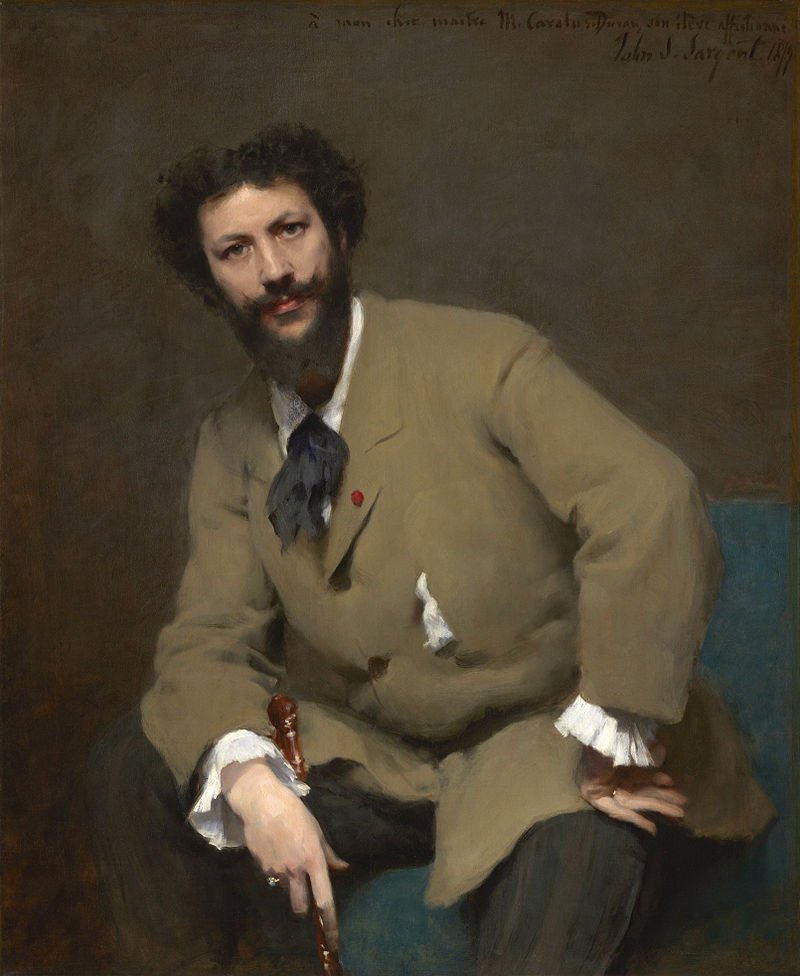
However nearer to home he was inspired by his art tutor, the French painter, Carolus-Duran, a portrait of whom he completed in 1879.     John Singer Sargent’s reputation as a great artist and portraitist grew rapidly and in Paris he was the toast of artistic circles.  Everything he did was loved by the critics and the public.  The Parisians loved him.  He could do no wrong.  Well actually he could and did and through one painting, a portrait of a lady, his fall from grace was rapid and final and caused him to exile himself from Paris and France and take refuge in England.  So what happened?  The answer to this question is examined in this very blog.

The lady whose portrait caused such a stir was Virginie Amélie Avegno Gautreau.  Virginie Amélie Avegno was born in New Orleans in January 1859.  She was the daughter of a white Creole family.  Her father was Major Anatole Placide Avengo, a Confederate army soldier and her mother was Marie Virginie de Ternant who came from a wealthy Louisiana plantation owning family.  Her father was killed during the American Civil War at the Battle of Shiloh in 1862.  Five years later in 1867 her widowed mother took her eight year old daughter to live and be educated in Paris and as a teenager was introduced into high French society.

Virginie Amélie Avegno blossomed into a beautiful woman.  She was a pale-skinned brunette.  She was renowned for her great beauty and was accepted into Parisian society circles.  She dazzled all who met her with her exquisite clothing and undeniable beauty.  She mastered the art of make-up to enhance her looks and was known for her heavy use of chalky lavender powder which was dusted on her face and body affording her a very distinctive pallor.  Her beauty was unique.  She had a long nose which was somewhat longer than the accepted norm, her forehead was also too high and yet these physical characteristics never detracted from her hourglass figure and the seductive way she would walk when entering a room of people.

In his 2011 book The Greater Journey: Americans in Paris, David McCullough quotes an American art student named Edward Simmons who wrote about seeing Virginie and how the sight of her was unforgettable:

“…She walked as Virgil speaks of a goddess—sliding—and seemed to take no steps. Her head and neck undulated like that of a young doe, and something about her gave you the impression of infinite proportion, infinite grace, and infinite balance. Every artist wanted to make her in marble or paint…”

As always beauty as well as bringing out admirers, brings about jealousy and many of her detractors labelled her an arriviste, one who has attained a high position but has not attained general acceptance or respect.  I suppose we would liken her to one of the nouveau-riche looked down on by the “old establishment rich”

A mother’s most fervent wish is to see her daughters marry successfully which often translates into having their daughters marry a wealthy man.  Virginie’s mother must have been well pleased when her daughter married a wealthy French banker, Pierre Gautreau, and her daughter now had two of the greatest assets of life, beauty and a wealthy husband who held a great status in Parisian society.

John Singer Sargent met Virginie Gautreau at a social gathering around 1881.  He was smitten by her beauty and elegance; some say he soon became obsessed with her.  Having met her he wanted just one thing from life – to paint her portrait and have it exhibited at the Paris Salon so all could admire “his lady”.  Sargent had been inundated with portraiture commissions but on this occasion it was he who approached his desired sitter to ask if she would acquiesce to become the subject of his portrait.  Sargent realised that Gautreau was both part of high class Paris society and a renowned beauty and thus a portrait of her by him at the Salon would bring great kudos and he probably realised that if he portrayed her seductively it would cause a sensation similar to Manet’s Olympia at the 1865 Salon.  Sargent had unfortunately not realised how sensational it would turn out.

Watercolour figure study of Madame Gautreau  by John Singer Sargent (c.1883) Harvard Art Museum
Watercolour figure study of Madame Gautreau
by John Singer Sargent (c.1883)
Harvard Art Museum

After some help from colleagues Sargent persuaded Virginie Amélie Avegno Gautreau to sit for him.  For months on end he would complete many line drawings of her head in profile.  He would complete studies of her in pencil and watercolour, sometimes simply relaxing on a chaise-longue in a low-cut evening dress or depicted her in oil painting sketches drinking a champagne toast. In the summer of 1883, he stayed at the Gautreaus’ country estate in Brittany but admitted to his friend the writer, Vernon Lee, that he was still struggling to do justice to this un-paintable beauty.  He was also now having doubts as to whether it would be accepted into the 1884 Salon by the Salon jury.

In the winter of 1883, Sargent moved his Paris residence which had been on the Left Bank to a new studio across the Seine in the fashionable Parc Monceau neighbourhood and it was here that he completed his full-length portrait of Gautreau.  It was a nerve-wracking time for Sargent as he had suffered a loss of self-confidence in his artistic ability in respect to the depiction of his beloved beauty.  Despite his worries, the painting was finally completed in 1884 and the Salon jury accepted it into the 1884 Salon. This was the sixth year in a row that the Salon had accepted works by Sargent. Before the Salon opened there was already a frenzied excitement about the portrait.  Gautreau had talked wildly and incessantly to her friends and acquaintances about the painting, even though she had never seen the finished work.

Madam *** by John Singer Sargent as exhibited at 1884 Salon
Madam *** by John Singer Sargent
as exhibited at 1884 Salon

In the painting, Gautreau is seen dressed in a long black satin skirt with its sultry low-cut black velvet bodice.  Against the deep black of the dress and the plain dark background, the deathly blue-white of her powdered skin was even more eccentric and noticeable.   Her shoulders are bare with the exception of two narrow jewelled straps. Gautreau posture is one in which both her shoulders are held back, her body faces us and yet her head is angled to the left, which fully highlights her stunning profile.   Her left arm rests on her hip with her hand gripping the material of her dress.   Her right hangs down in a twisted manner s her fingers grasp the top of the table.  The result of this distorted pose was to create tension in the neck and arm but it also highlighted the subject’s graceful curves.   Her hair is pinned up high on her head atop of which is a tiara.  Sargent must have “designed” this un-natural pose presumably because he believed it brought a haughty sensuality to his sitter, for remember, besides wanting to do justice to his sitter’s beauty he also wanted this work to have a sensational affect when it was exhibited.  It was probably this thought of sensationalism that made him make the cardinal error which was to damn him.   During one of Gautreau’s sittings the thin strap of her dress had slipped from her right shoulder and as she was about to re-adjust it when Sargent told her to leave it down it was and he decided to make the portrait even more sultry by portraying Gautreau’s right shoulder bare.  The die was cast and the painting with the strapless shoulder went on exhibition under the title Portrait of Madame *** although most Parisians were aware that it was the portrait of Virginie Amélie Avegno Gautreau.

Even though the Salon had just opened the picture was condemned for what was termed the sitters’ “flagrant insufficiency” of clothing.  Little was said about the other aspects of the work, it was all about the seductive pose and dress (or undress) of the sitter.  The Paris public could not stop talking about Sargent’s portrait of Gautreau.  It was fast becoming a scandal of epic proportions.  The painting received many critical reviews.  Some objected to the portrait on the grounds that they disliked Madame Gautreau’s décolletage, others criticised what they termed the repulsive colour of her skin.  Few however were less harsh and stated that they liked the modern approach to the portrait and congratulated Sargent on is courageous approach.  It is difficult to understand the furore over the suggestiveness of the black dress when paintings of nudes littered the walls of the Salon but of course they would normally have biblical or mythological connotations to them which made blatant nudity acceptable.  Maybe it was the haughty pose of the arriviste with her heavily powdered features which was too much for the critics and public alike. Gautreau herself was humiliated by the whole affair and her mother, Madame Avegno, who was also horrified with publicity surrounding the portrait, demanded Sargent remove it from the Salon. He defended the portrait, telling the irate mother that it was a truthful likeness of the pose of her daughter and the clothes she wore.

John Singer Sargent in his studio with with his painting Madame X

Sargent had scandalised Paris society and he was widely criticised in Paris art circles for being improper.  For Sargent the criticism of the work and of him as an artist was almost impossible to bear.  He had been living and working in Paris for ten years and during that period he had received nothing but praise for his work and the commissions had poured in on the back of such praise.  The criticism of the portrait went beyond a simple poor review.  He was being mocked by the Paris public for what he later stated was the best painting he had ever completed.  For him the work was a true masterpiece but it would take a long time before the world acknowledged that fact.  Sargent hung the work first in his Paris studio and later in his studio in London and from 1905 onwards he allowed it to be seen at various international exhibitions.

Madame X by John Singer Sargent (c.1884) with the position of the strap of dress altered
Madame X by John Singer Sargent (c.1884)
with the position of the strap of dress altered

Sargent repainted the fallen strap on Guitreau’s right shoulder, re-titled it Madame X and eventually sold the work to the Metropolitan Museum of Art in New York in 1916 where it is housed today.  An unfinished second version of the same pose is in the Tate Gallery London.

Sargent found the criticism unjustified and shortly after the 1884 Salon, in the May, at the age of 28, he left Paris disillusioned by the incident and disappointed by the fall off of sales of his paintings and moved to London where he remained for the rest of his life England.  Although his long-term career as a portraitist in France was over, he once again thrived artistically in the English capital and some say that it was here that he reached the pinnacle of his fame.  In those days to have you portrait done by Sargent was looked upon as having it painted by the best portraitist of the time.

John Singer Sargent      (1856 - 1925)
John Singer Sargent
(1856 – 1925)

He died in London in 1925, aged 69.

Théodore Roussel and Hetty Pettigrew

 Theodore Roussel  Self Portrait (1901)
Theodore Roussel
Self Portrait (1901)

I went to the Summer Exhibition at the Royal Academy one afternoon, a couple of weeks ago and frankly I was a little disappointed in the majority of the works.  Yes they were quirky and often bizarre but I like beauty in paintings.  Maybe part of the problem was that in the morning I had just visited the National Portrait Gallery and perused their permanent collection as well as the BP 2014 Awards exhibition.  There were so many beautiful works of art.  There was a “chalk and cheese” difference between the paintings I stood before at the Portrait Gallery and those in the many rooms housing the Royal Academy’s summer exhibition.  You see, I like to stand back from a work of art and be amazed at what I see before me.    I especially like to be stunned by the beauty depicted by the artist whether it is a landscape or a portrait.  I am never impressed by a few random blobs of colour on a canvas and to be told to just imagine something.  Yes, I do need to be led by the nose and have everything explained to me through a realistic depiction.   The artist I am featuring today was also an admirer of beauty, to be more precise, feminine beauty and I was utterly seduced by a painting he completed featuring his lover, a work which the establishment at the time found a little too much to countenance.  Today I am going to look at the life of Théodore Casimir Roussel, and explore some of his paintings and prints and feature his sitter, studio assistant and lover, Hetty Pettigrew who featured in many of his works.

Roussel was born in the French town of Lorient in Brittany in March 1847 and was educated in France.   He was called to arms by his country during the Franco-Prussian War of 1870 but in 1878 he moved to England and settled in London. Two years later he married an English lady, Frances Amelia Smithson Bull.  Roussel had always loved to sketch and paint and was, for the most part, self taught.  When he settled in the English capital he managed to secure studio space in Chelsea with two English artists, George Percy Jacomb-Hood and Thomas Henry.  A couple of years after working in his Chelsea studio, Roussel began to exhibit some of his paintings.  His breakthrough came in 1885 when he was introduced to one of his neighbours, the successful artist, James McNeil Whistler, who had seen Roussel’s paintings and had been very impressed by the standard of his work.  Despite Whistler being thirteen years older than Roussel, it was not long before the two became firm friends, probably because some of their works of art centred around the same subject matter – London and the Thames river.  They also shared similar artistic tastes and had similar views with regards the art establishment.  Roussel now became one of Whistler’s London circle of friends which included Walter Sickert, Paul Maitland and Wilson Steer.  Like Whistler, Théodore Roussel became a member of the Royal Society of British Artists in 1887 but both resigned from the Society the following year.

Blue Thames End of a Summer Afternoon Chelsea by Théodore Roussel (1889)

Some of Roussel’s early work, when he was in London, depicted the river Thames around Chelsea.  One such painting was Blue Thames.  End of a Summer Afternoon, Chelsea  received excellent reviews when it was exhibited at the London Impressionist exhibition.  In December 1888 he exhibited seven such oil paintings of “Impressions of the Thames and Chelsea” at the London Impressionist Exhibition at the Goupil Gallery.

The Thames at Hurlingham by Théodore Roussel

Another work featuring the Thames is a work Roussel completed later in his career was a work entitled The Thames at Hurlingham.  This atmospheric work has all the characteristics of a Whistler painting.  When Roussel made preliminary sketches for this work he was probably in the grounds of the famous Hurlingham Club, one of Britain’s greatest private members’ club which borders the Thames at Fulham.  In the painting we are treated to the merest glimpse of the river and the house on the opposite bank as we peer between the two mature lime trees whose size has cast the bank in deep shadow.

The Reading Girl by Théodore Roussel         (1886–7)
The Reading Girl by Théodore Roussel
(1886–7)

However my lead in to this blog was all about Roussel’s depictions of female beauty and one particular painting which had caught my attention and so let me feature this absolute gem.  The painting I am referring to was completed by Roussel in 1887 and was entitled The Reading Girl.  It measures 152 x 161cms (60 x 64 inches) and now hangs in the Tate Britain in London and I urge you to feast your eyes on this beautiful work.

 Roussel decided to by-pass the Royal Academy and exhibited this work in April 1887 at The New English Art Club, which had been founded in London in 1885 as an alternate venue to the Royal Academy for artists to exhibit their works.    Maybe the reason for the painting being accepted into the exhibition was that this art club was, at that time, promoting the French style of painting.  Maybe another reason for Roussel’s decision not to submit it to the Royal Academy was that he was well aware that the Royal Academy would be very critical of his depiction of a nude woman, not as a mythological, classical or historical character, but simply as a present day female.  This was Roussel pushing the boundaries.  This was a step too far for many and the art critic for the Spectator newspaper in the April 16th edition of the journal wrote a highly critical article.  He wrote:

 “…Our imagination fails to conceive any adequate reason for a picture of this sort.  It is realism of the worst kind, the artist’s eye seeing only the vulgar outside of his model, and reproducing that callously and brutally.  No human being, we should imagine, could take any pleasure in such a picture as this;  it is a degradation of Art…”

 It could well be that Roussel was making a stand with regards female nudity and would have been well aware of the furore which followed Edouard Manet exhibiting his famous but rebellious nude work, Olympia, at the Paris Salon twenty-two years earlier (see My Daily Art Display October 12th 2011).

 What I suppose strikes you at first glance is how relaxed the sitter is for the artist, how comfortable and at ease she was to sit before Roussel without any vestiges of clothing.  The female is Harriet (Hetty) Selina Pettigrew, a nineteen year old professional model, Roussel’s studio assistant and possibly a student of his.  She was born in 1867 in Portsmouth, one of twelve children, nine brothers and three sisters.  She was Roussel’s favourite model and also modelled along with her sisters Rose and Lily, for James McNeil Whistler, John Everett Millais and other Pre-Raphaelite artists. Hetty had met Roussel in 1884 and from becoming his model, then, despite Roussel being married, became his mistress and gave birth to their daughter, Iris around 1900.   When Roussel’s wife died, instead of legalising his relationship with Hetty and their child, he married Ethel Melville, the widow of the Scottish watercolour painter, Arthur Melville. Once Roussel re-married in 1914,  Hetty never sat for him again. Their close bond was over.

 Look how Roussel has used an almost black background so that nothing detracts from the female form.  This is not a pulchritudinous depiction of a classical woman à la Rubens.  This is simply a modern beautifully proportioned young woman.  Hanging from the back of her chair is a kimono which harks back to Roussel and Whistler’s love of all things Japanese which were sweeping through Europe.  The female reads a newspaper giving the impression that before us, we have a well educated young woman.  This is no Rococo-style air-head !!  The art critic Frederick Wedmore’s view of the painting was completely at odds to that of the Spectator’s art critic.  Of the painting he compared the work with many previous classics and wrote in the Art Journal of 1909:

 “…the most health-suggesting, health-breathing of Courbets, with the most rosily robust of Caro Delvaille’s (Le Sommeil fleuri), with the dreamiest Henner, with the slimmest and least material of Raphael Collin’s (Floréal)… a high masterpiece… austere in its performance, restful in its effect…”

Eva Mongi-Vollmer an art historian and curator at the Städel Museum in Frankfurt commented on the pose of the woman in Roussel’s painting in her book, Naked!Woman views. Painters intentions departure to modernity.  She wrote:

 “…It is the reading of an intellectual, modern woman who is not sexually available, despite the nudity…”


Study From the Nude of a Girl Lying Down by Théodore Roussel (1890)

Another of Roussel’s works which is believed to have featured Hetty is Study From the Nude of a Girl Lying Down, a drypoint completed around 1890 which is part of the collection at the Art Institute of Chicago with a print of it held at the British Museum.

Chiaroscuro, A Profile, the Golden Scarf by Théodore Roussel (1900)

My third and final featured work by Théodore Roussel which featured Hetty is Chiaroscuro, A Profile, the Golden Scarf, which he completed around 1900.

Théodore Roussel died at St Leonards on Sea, a coastal town in East Sussex in 1926, aged 79.

C R W Nevinson. Part 2 New York

Portrait of C R W Nevinson by  Ronald Ossory Dunlop
Portrait of C R W Nevinson by Ronald Ossory Dunlop

In my last blog I looked at the early life of Christopher Richard Wynne Nevinson and featured some of his paintings which depicted the horrors of the First World War.  Today I want to conclude his life story and look at some of his other works of art which had nothing to do with war but which I find have their own beauty.

Nevinson had been taken ill in 1912 and was moved to Buxton to convalesce and it was whilst partaking of the healing waters at the Hydro that he met Kathleen Knowlman who had accompanied her father to the health resort.  With the outbreak of war in 1914, Nevinson, being a conscientious objector, had joined the Royal Army Medical Corps in November 1915.  It was in this capacity that he had helped tend the wounded who had been brought home from the Front.  He was stationed at the Third General Hospital in London but was always aware that soon he would be called to leave the relative safety of England and travel to France.  Fully realising his possible death at the Front he decided that he should be married before he met his fate !  On November 1st 1915 he married Kathleen Knowlman.  It turned out that he was never sent to the front as he was invalided out of the army following bouts of pericarditis and rheumatic fever which he contracted in January 1916 which left him crippled and for a time he began to think he would never walk again.  He recalled the time in his 1935 autobiography, Paint and Prejudice:

“…I was now crippled completely. I began to think I should never walk again. Everything was tried on me while I lay helpless on my bed…”

Temples of New York by C R W Nevinson (1919) Drypoint. Trinity Church facade from the back, which faces Wall Street
Temples of New York by C R W Nevinson (1919)
Drypoint. Trinity Church facade from the back, which faces Wall Street

With the ending of the First World War in 1918, the public’s desire for his war paintings and their harrowing depictions of the suffering of the troops waned. Maybe people just wanted to forget about the previous four years and did not want to be reminded of the brutality of war.   For Nevinson, his favoured and once much appreciated subject matter had dried up and he had to make a decision as what to do next.   Paul Nash, a contemporary of Nevinson and also a war artist, summed up the war artists’ dilemma when he talked about the ‘struggles of a war artist without a war’.   At the end of the war, Nevinson went to Paris looking for new inspiration but soon tired of the French capital, a place he had visited as a child with his mother.  In the spring of 1919, he decided to visit America and in particular New York.  He had received an invitation from David Keppel to visit the American city to stage an exhibition of his War prints.  David Keppel who with his father, Frederick Keppel, were print publishers and owned a four-storey gallery on 4 East 39th Street in Manhattan.  They had exhibited many of Nevinson’s war prints which proved very popular with the American public.

Nevinson was made very welcome on his arrival and according to David Boyd Haycock in his 2009 book about the artist, A Crisis of Brilliance, relates how Nevinson was welcomed as a ‘war hero and victimised genius of modern European art, come to discover the USA and reveal it to itself ‘   Nevinson, on his arrival in New York, was taken aback by the city’s architecture, so much so when questioned by a local journalist of how he liked the city he commented that he loved the buildings so much he believed the city had been built for him.  Nevinson would roam around the city constantly sketching and after a month long stay in America, he returned to London and converted his sketches into paintings.   On his return to London he was to receive sad family news.  Whilst he was in America his wife had given birth to a son, Anthony Christopher Wynne on 21st May 1919. His mother, Margaret, recorded that the child only lived for fifteen days, which, as she put it, had been “just enough time to get fond of him.”   Nevinson later wrote in his autobiography:

“…On my arrival in London I was met by my mother, who told me my son was dead…”

 And he later added in a somewhat morbid fashion:

“…I am glad I have not been responsible for bringing any human life into this world…”

The Soul of the Soulless City (New York - an Abstraction) by C R W Nevinson (1920)
The Soul of the Soulless City (New York – an Abstraction) by C R W Nevinson (1920)

One of Nevinson’s depictions of  New York, which he completed back in London in 1920 before he returned to America that October to set up his second exhibition of work at Frederick Keppel & Co, New York gallery, was entitled The Soul of the Soulless City (‘New York – an Abstraction’).  The painting depicts an idealised view of a section of the elevated railway which ran through Manhattan. It was an unusual work with a narrow chromatic range reliant mainly on shades of greys and browns with just merest hint of blue for the skies between the tops of the skyscrapers.  The way he has depicted the skyscrapers with their complex faceting harks back to Picasso and Braque’s cubism of a decade earlier.  There is something very powerful and impressive about the way Nevinson has depicted the railway line receding dramatically into a cluster skyscraper blocks.  There is a sense of speed about the disappearing railway track.  Nevinson, was associated with Filippo Tommaso Marinetti  and his concept of futurism, who wanted  to revolutionize culture including art and make it more modern. The new ideology of Futurism was an art form which stressed modernity, and the virtues of technology, machinery, and speed and we can see in this work that Nevinson was a great believer of the ideals of futurism.

When the work was first exhibited at the Bourgeois Galleries in New York it was entitled New York – an Abstraction.  It was not received well.  According to David Cohen in his 1999 The Rising City Urban Themes in the Art and Writings of C.R.W.Nevinson’, C.R.W.Nevinson The Twentieth Century, one critic went as far as to dub the painting  “inhuman, metallic and hard”.  Later when he exhibited the work in London in 1925 at the Faculty of Arts Exhibition, Grosvenor House, London, it was given the title of The Soul of the Soulless City and this change was almost certainly made by Nevinson himself and although it has been likened to Karl Marx’s comment on religion being the “heart of the heartless world”, it could also be because Nevinson had fallen out of love with the American city.

New York, Night by C R W Nevinson (c.1920)

Another work by Nevinson with New York as its subject is New York, Night which he completed somewhere between 1919 and 1920.  This work which was completed around the same time as the previous work and was painted at the time when Nevinson was still in love with New York.   There can be no doubt about his initial love affair with New York for Nevinson was quoted by David Cohen in his 1999 book, C.R.W. Nevinson, The Twentieth Century:

 “…New York, being the Venice of this epoch, has triumphed, thanks to its engineers and architects, as successfully as the Venetians did in their time..Where the Venetian drove stakes into his sandbanks to overcome nature, the American has pegged his city to the sky. No sight can be more exhilarating and beautiful than this triumph of man…”

 The painting depicts the busy harbour of New York at night.  It is a view I have witnessed many times from the bridge of a ship as the city’s skyscrapers loom large ahead as we enter the port.   In the painting we see the giant buildings through the smoke and steam emanating from the funnels of the small tugs and ferries which ply their way up and down the Hudson River.  It is a mystical and atmospheric scene.  It is a scene depicting industry.  This is a scene of modernity, loved by the futurists.  In the foreground we see jibs of cranes busily working on the loading and unloading of cargo vessels berthed at Brooklyn, across the river from Manhattan.

Looking through Brooklyn Bridge by C R W Nevinson (1920)

Nevinson built up a collection of prints of Manhattan, another of which is the drypoint print entitled Looking through Brooklyn Bridge.  This work and another entitled Under Brooklyn Bridge are housed in the British Museum and were part of a set of ten drypoints of the city of New York which were commissioned by Frederick Keppel.  Whenever I visit New York I always take time to walk across this bridge and never fail to be enthralled by the views on offer when crossing from Brooklyn to Manhattan.  What first strikes you about this work is how the bridge is the central “character” as it dwarfs the people we see walking across it.  In the background, through the mist, we see the colossal skyscrapers of Manhattan looming before us.  In the evening light they lack colour and are just presented as grey giants.  It is a cold depiction.  There is no warmth about it.  It is an inhospitable scene and the mist which gives a haziness to the skyscrapers also gives a feeling that the air may also be polluted.  The people are wrapped up in warm clothes and the wooden walk way looks wet as if the rain has been beating down on the massive structure.  The man in the foreground holds an umbrella but probably due to the strong winds, dare not open it to protect himself. Nevinson has managed to convey the massive structure as a monument to the permanence of the new Industrial time and it contrasts with the temporary nature of the people, who appear on it as mere shadows as they hurry from one side to the other.

Like a lot of artists, Nevinson did not take criticism and rejection well and his love for New York and America disappeared.  Not only were his paintings attracting criticism, he himself was also becoming disliked for his ill-conceived outbursts.  He often suffered periods of depression and would often be volatile.  He had an unfortunate habit of bragging and publicly aired embellished claims of his war experiences, which people found hard to accept and together with his depressive and temperamental personality, he became an unpopular figure on the New York art scene.   Whether it was because of the poor reviews or his growing dislike for the people around him, he decided to leave America.

So who was to blame for Nevinson’s falling out of love with America and the Americans.  Maybe the answer lies in the 1920 catalogue introduction to an exhibition of Nevinson’s work by the art critic Lewis Hind.  Of Nevinson he wrote:

“…It is something, at the age of thirty one, to be among the most discussed, most successful, most promising, most admired and most hated British artists…”

In Julian Freeman’s biography on Nevinson he talked about the artist’s mental state during the last couple of decades of his life:

“…From 1920 until 1940 they carried his strident, maverick diatribes, aimed at society at large, and at the establishment in all its forms… and the variety, salacity, and often uncompromising savagery of his egocentric articles remains enormously entertaining. However, his autobiography is marked and marred by a strong undercurrent of confrontational right-wing xenophobia, and some of his private correspondence in the Imperial War Museum in London is explicitly racist: true signs of the times to which he was such a conspicuous contributor…”

I will leave the last word to the artist himself who, in his 1937 autobiography,  Paint and Prejudice,  wrote:

“…My prices have always been humble, but it has been possible up to the present to lead the life of a millionaire. Far from being a starving artist, a great deal of my time has been taken up in refusing food and drink, affairs with exquisite women, and wonderful offers of travel or hospitality. But I have always been driven mad by the itch to paint. Painting has caused me unspeakable sorrows and humiliations, and I frankly loathe the professional side of my life. I am indifferent to fame, as it only causes envy or downright insult. I know the necessity of publicity in order to sell pictures, because the public would never hear of you or know what you were doing unless you told them of it. But publicity is a dangerous weapon, double-edged, often causing unnecessary hostility and capable of putting you into the most undignified positions. Until of late I have had to fight an entirely lone hand. When I exhibited at the Royal Academy it was a revelation to me how well the publicity was done through the dignity of an institution rather than through the wits of an individual. But I suppose that now I shall always remain the lone wolf. I have been misrepresented so much by those who write on art that the pack will never accept me. Incidentally, because I painted I have earned something like thirty thousand pounds for the critics, curators, or parasites of art. Ninety per cent of their writings has consisted of telling the public not to buy my pictures and of charging me with every form of charlatanism, incompetency, ignorance, madness, degeneracy, and decadence. It is useless to deny that this has had its effect..”

A Winter Landscape by C R W Nevinson (1926)

His post-war career was not so distinguished.  He never achieved the adulation that was bestowed on him due to his war paintings.  Christopher Richard Wynne Nevinson died in October 1946 aged 57.