Fred Elwell. Part 3 – Landscapes and Mrs Elwell

Fred Elwell by Dame Laura Knight

As far as art was concerned, Fred Elwell was a master of many art genres.  In my last blog I looked at his superb portraiture and in this blog I want to feature some of his landscape paintings as well as introducing you to his wife, another landscape painter.

In telling his life story I had reached the year 1896.  Fred Elwell had returned from Paris and had tried to forge himself a successful career in London but it had not worked out for the twenty-six year old artist and in this year he had been rescued by his father who brought him back to the family home in the East Yorkshire town of Beverley.  Although Elwell had left England and studied in Antwerp and Paris he had always made many trips back home to Beverley.  He had returned for good to the beauty of Yorkshire, not as a student painter but now as an accomplished artist and he was pleased to test himself and his artistic skills by setting out to paint the magnificent local landscape and some of the fine local buildings.

Beverley Minster from the Hall Garth by Fred Elwell (1900)

One such painting, which he completed in 1900, was of Beverley Minster and was entitled Beverley Minster from the Hall Garth.

His year in London and his struggle to survive had taken a toll on him so the first thing the family had wanted him to do was to relax and enjoy the tranquillity of the Yorkshire countryside.  Elwell also enjoyed the freedom offered by sailing and he would often take a small boat and cruise along Beverley Beck which joined the River Hull.  Many like-minded painters would do the same as the clarity of light and the beautiful countryside including the East Riding flatlands surrounding the river was an idyllic setting for landscape artists.  On occasion he would tie up the boat alongside a jetty and would welcome visitors to look at his artwork and, by so doing, would often receive commissions.  Elwell’s love of landscape painting coincided with the English public’s change of attitude of what they wanted to see in a work of art.  Depictions of city life were becoming less popular, displaced by depictions of the tranquillity of the countryside.  This was a period when people wanted to “go back to nature”.  They worked in cities but hankered for the fresh air of the countryside.  They wanted to soak up country life by sailing along inland waterways or get themselves horse-drawn caravans and lose themselves in the peacefulness and serenity of the rural areas.

In 1899, Elwell set himself up in a studio in Wood Lane in the centre of Beverley.  It had once been home to the local theatre and later a meeting house for the local Quakers and it was in that year that Elwell launched his first solo exhibition.  It was a great success for here was the local boy making good.  Locals flocked to see their “own son” and what he had achieved.

One day in 1904 Fred Elwell had a visitor to his studio. The visitor introduced himself as George Alfred Holmes.  Holmes, an oil broker, was a well respected member of the Beverley community.  He asked Elwell whether he could paint a portrait of his wife, Mary.  Mary Dawson Bishop, the daughter of a wealthy shipping merchant, was born in Liverpool in 1874.  Her father died when she was very young and the family moved to Manchester.    Her late father’s wealth ensured that Mary received the best education that money could buy and she was educated at Ellerslie College, which was described as a ‘fairly exclusive school’, and the college would undoubtedly have provided instruction in painting and drawing.  In 1896 she married George Holmes.

A pen and ink sketch of a canoe-yawl by George Holmes

Elwell agreed and made many visits to the home of George and Mary Holmes and soon the three became good friends.  Holmes and Elwell had one thing in common, they both loved boats.  Holmes was a founder member of the local Humber Yawl Club and Fred Elwell owned his own boat.  It was a small twenty-two foot sailing houseboat which had the strange name of Callathumpian.  This too was a canoe-yawl but had been adapted with a large deckhouse.  George and Mary would often visit Fred on his boat and go for days out sailing the boat along the many tributaries and canals.
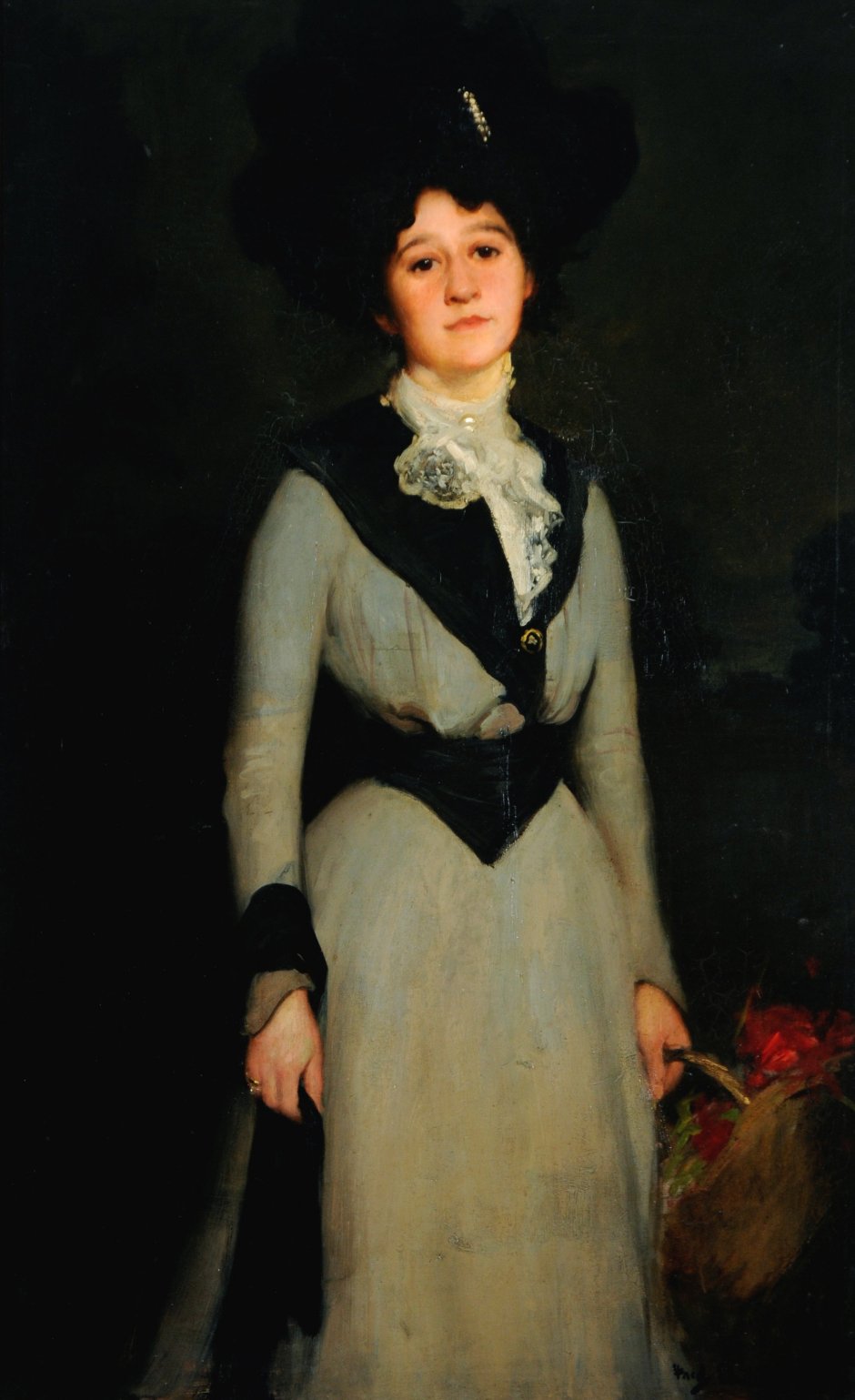
Mary Dawson Holmes by Fred Elwell (1904)

Elwell completed the Portrait of Mary Dawson Holmes in 1904 and had it exhibited at the Royal Academy that year.  It is an exquisite work of portraiture with the sitter depicted as a lady of gracious sophistication.  Her clothes are reminiscent of the French fashion of the time.   She wears a tight-fitting dress finished off with a fine white lace collar.  Her head is tilted slightly to one side.  She holds an upright stance.  She has dark almond-shaped eyes.  Look at her expression.  It gives little away.  What do you make of it?  Is there an unwillingness, a reticence to pose or is this reserve due to her modesty or shyness?

Detail from Les Parapluies by Renoir (1880-6)

The way she stands and the fact that she is holding a basket is the reason why many people have compared the painting with one of Renoir’s ladies depicted in his painting of 1886, Les Parapluies, which Elwell may have seen.

Mary and Fred Elwell also some had a common interest – art, for she was a talented painter and he encouraged her to submit some of her work to the Royal Academy for inclusion at their annual exhibition.  She had two works accepted and Fred also had his portrait of her included at the same exhibition.   It is believed that Fred, George and his wife Mary would often travel to Europe, visiting Venice and Switzerland where Fred Elwell and Mary Holmes would take the opportunity to sketch and paint the local landscapes.

In 1910 George and Mary bought their dream home in Beverley.  It was known as Bar House.  It was a house that afforded the occupants beautiful views of the surrounding areas.  It even had its own tower from where one could watch the local racehorses training on the Gallop around Westwood, close to Beverley racecourse.  Sadly the joy of moving to their beautiful home was tinged with sadness as shortly after taking up residence her husband George became ill, so much so, he had to retire from his Hull shipping business.  As his health deteriorated he had to give up his beloved sailing.  Mary and Fred’s became more distressed with George’s health as he became more and more incapacitated.   His illness eventually was diagnosed as being terminal.  Knowing he was dying George spoke privately to Fred and asked him to look after his wife once he had died.  George Holmes died in August 1913, aged just 58.

Fred Elwell and Mary Dawson Holmes married on October 1st 1914, two months after the start of World War I.

 ……………………… to be continued

  Fred Elwell was a multi-talented painter and in this blog I want to feature some of his landscape works and those of his wife, Mary.
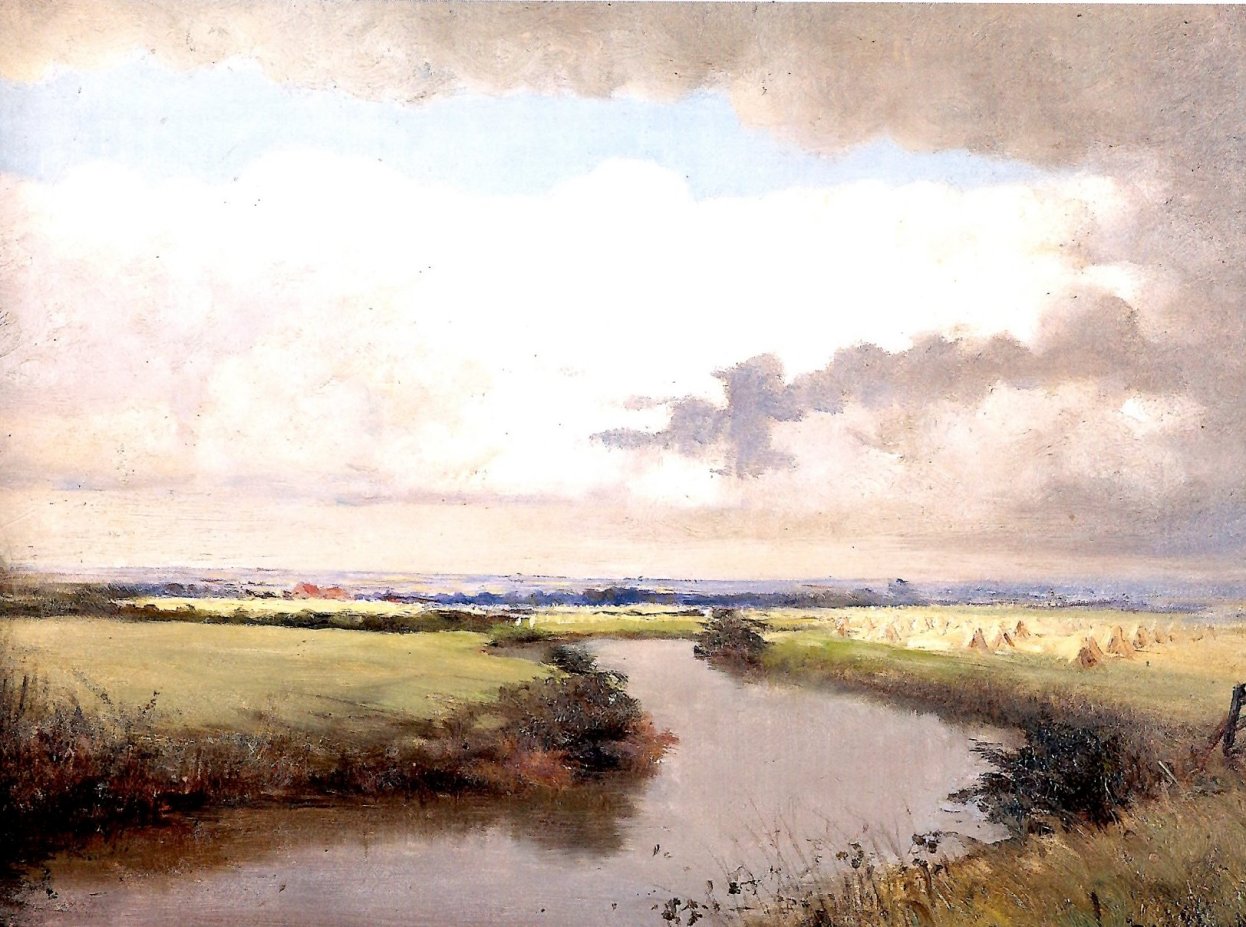
Upper Reaches of the River Hull by Fred Elwell (c.1905)

One of his early landscape works was Upper Reaches of the River Hull which he painted in 1905.   The work now hangs in the Beverley Art Gallery.  Its original owner was John Brown of Beverley who was a local tailor and provided suits for Elwell and could well have taken the painting in part payment for tailored clothing.  It is a beautiful work of art and features Elwell’s favourite area, the flatlands on either side of the River Hull, which he would have seen so many times from his boat.  Harvest is over and the stooks of corn sit up proudly in the newly harvested cornfield.

Corsican Landscape by Fred Elwell (1927)

The next painting was completed by Fred in 1927 and entitled, Corsican Landscape.   This landscape work, which has a distinct feel of Impressionism, depicts a farm in the centre ground along with grazing cattle and a few figures, all of which are surrounded by a mountain range which, on the left hand side, have been partially lost in shadow.  I particularly like the colours Elwell has given to his tall trees ranging from green and golds to the black-shaded ones which have lost the light of the sun.
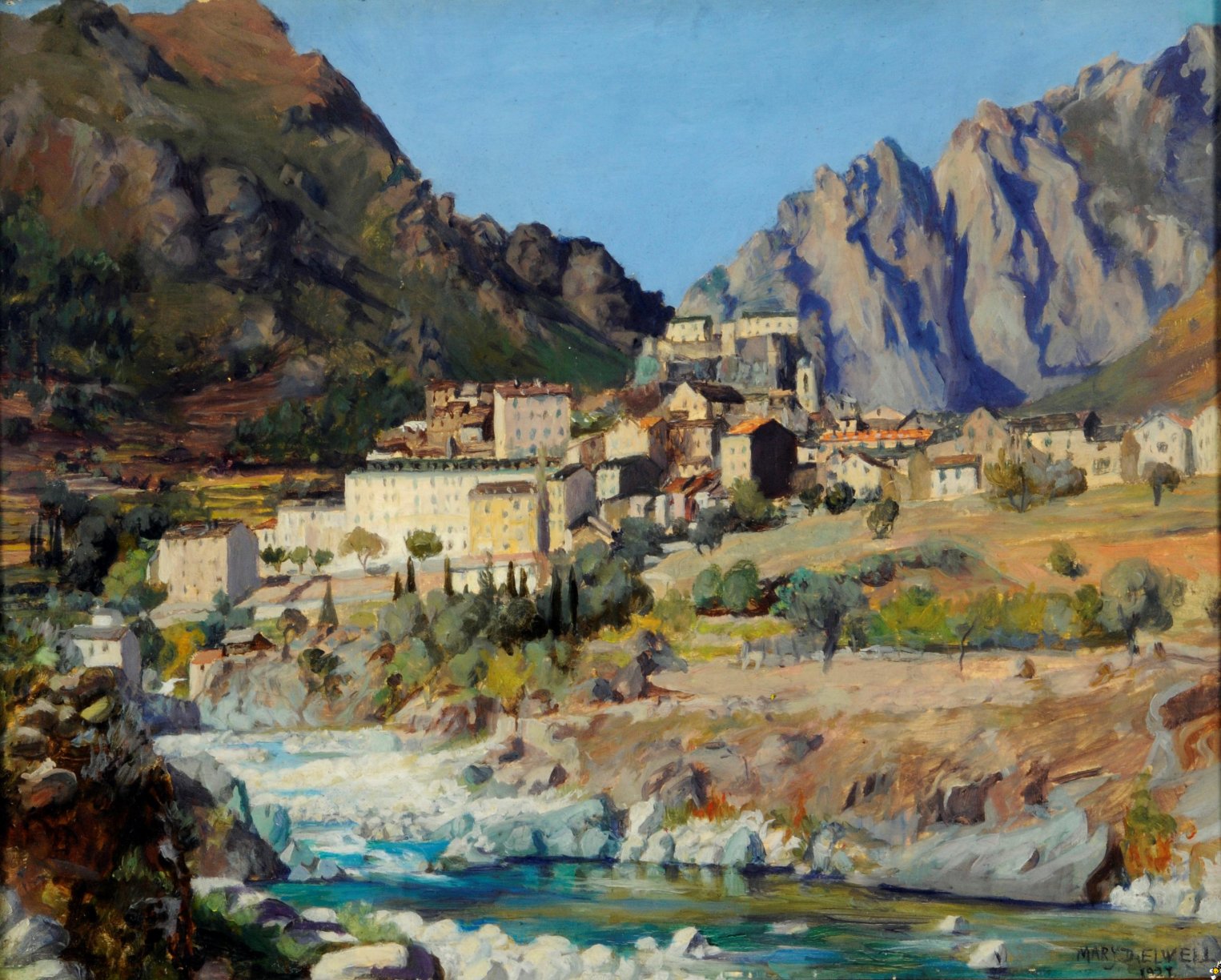
Corte Corsica by Mary Dawson Elwell

Mary Elwell completed a painting, around the same time depicting and probably during the same holiday, of the Corsican landscape, entitled Corte, Corsica.   It is a depiction of the hillside town of Corte, in northern Corsica.  Again, like Elwell’s Corsican landscape, the town is in the centre ground, surrounded by mountains.  The buildings are painted white and yellow with red terracotta roofs.  In the foreground we see a river cascading down a shallow waterfall.  The contrast between the blue of the water and the whiteness of the boulders it flows over adds to the beauty of the work.
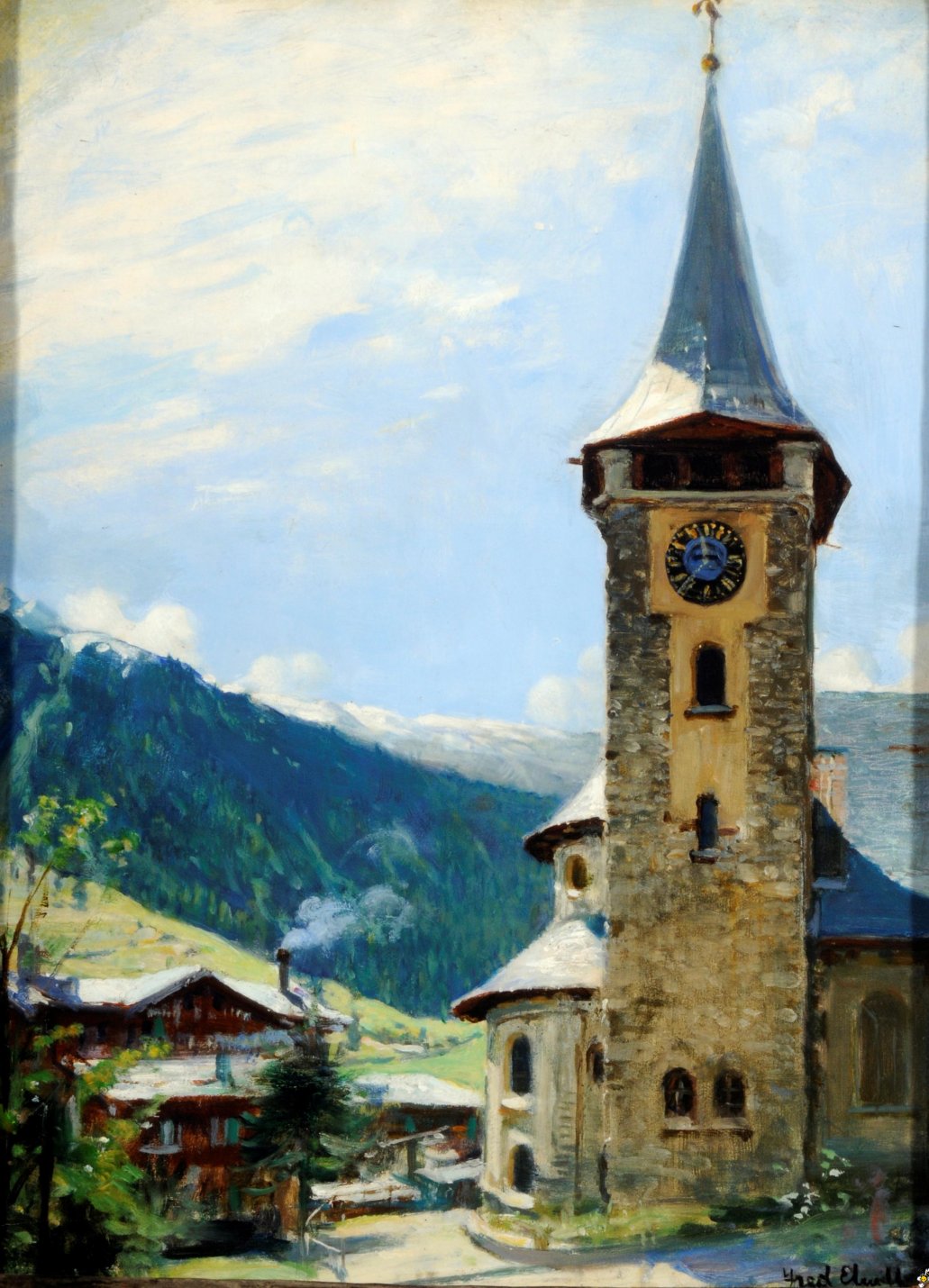
Zermatt by Fred Elwell (c.1938)

Another foreign landscape work by Fred Elwell was completed in 1937, entitled Zermatt.  The oil on wood panel painting is a typical Swiss-style landscape dominated by the church and its tower on the right, with the clock showing seven o’clock.  On the left we can see some chalets which disappear down the hillside.  In the background we have mountains, some in full sunlight others in full shade.  Fred and Mary Elwell loved this Swiss Alpine region and spent many happy journeys between 1937 and 1939 in the surrounding region completing a number of works in the region of Zermatt and the Matterhorn. On the outbreak of World War II they had to make a hasty retreat back to England.

Pigs in Barn by Fred Elwell (1937)

One amusing anecdote accompanies this work.  Elwell did not sell it to a dealer or art lover for a vast sum of money.  He sold it to a neighbouring pig farmer, a Mr Symmons and all Elwell wanted in return was a number of photographs of the Symmons’ pigs !!  These he used in another work he completed that year, entitled Pigs in Barn.
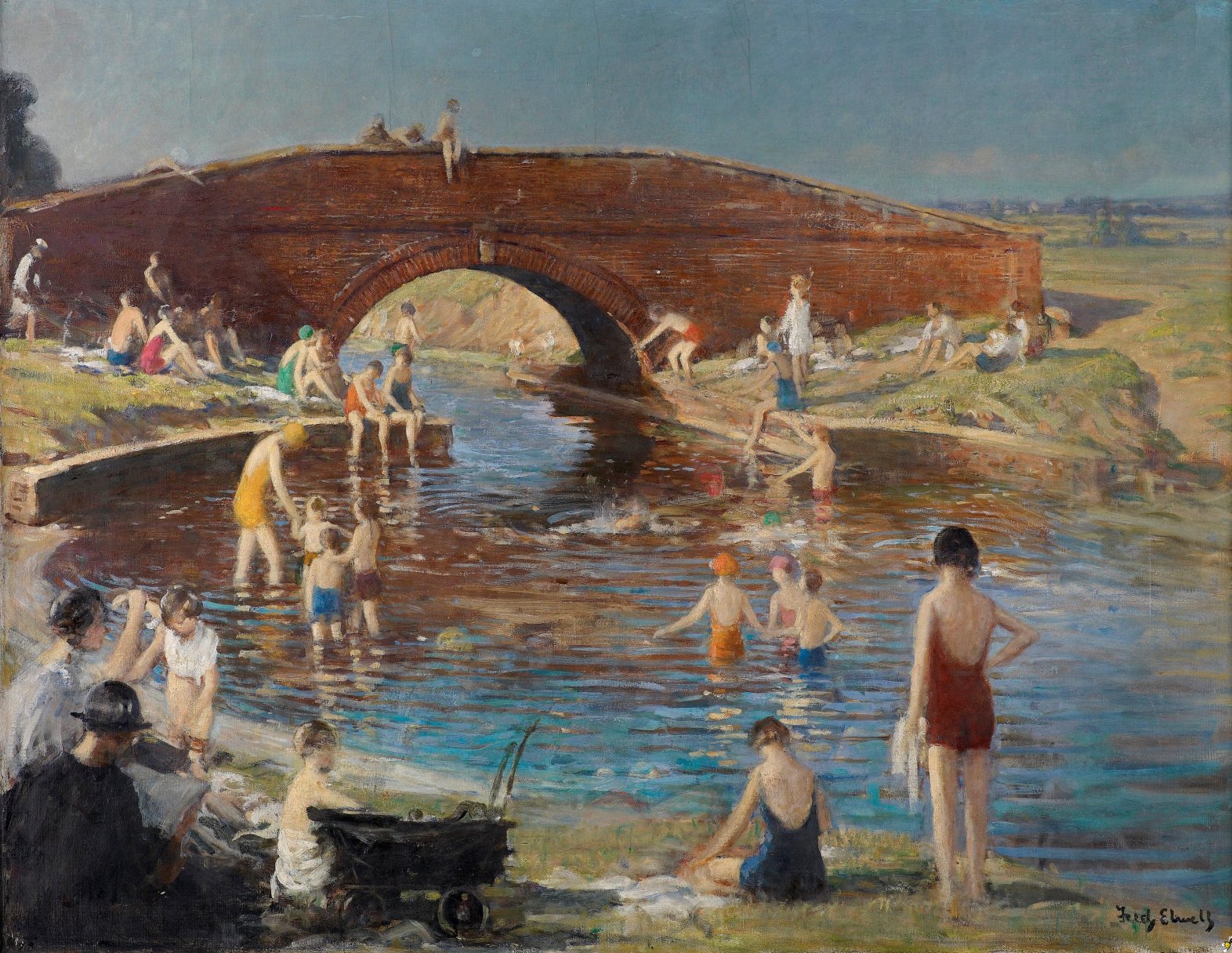
Brick Bridge, Swinemoor by Fred Elwell (c.1943)

The next work by Fred Elwell probably brought back fond memories of his childhood.  It is entitled Brick Bridge and features a brick-built bridge which straddles the Barmston Drain.  In Fred Elwell’s days this was a favourite place for Beverley folks to come and enjoy a swim on a hot summer’s day.  The picture was painted in 1943 during the Second World War and was the only place the people from Beverley could go for a swim as troops had commandeered the local swimming pool.  Again there is a hint of Elwell’s use of Impressionistic techniques with dabs of various colour representing reflections on rippled water and also the blurring effect of some of the features as if we are looking at the scene through the hazy atmosphere of a summer afternoon.
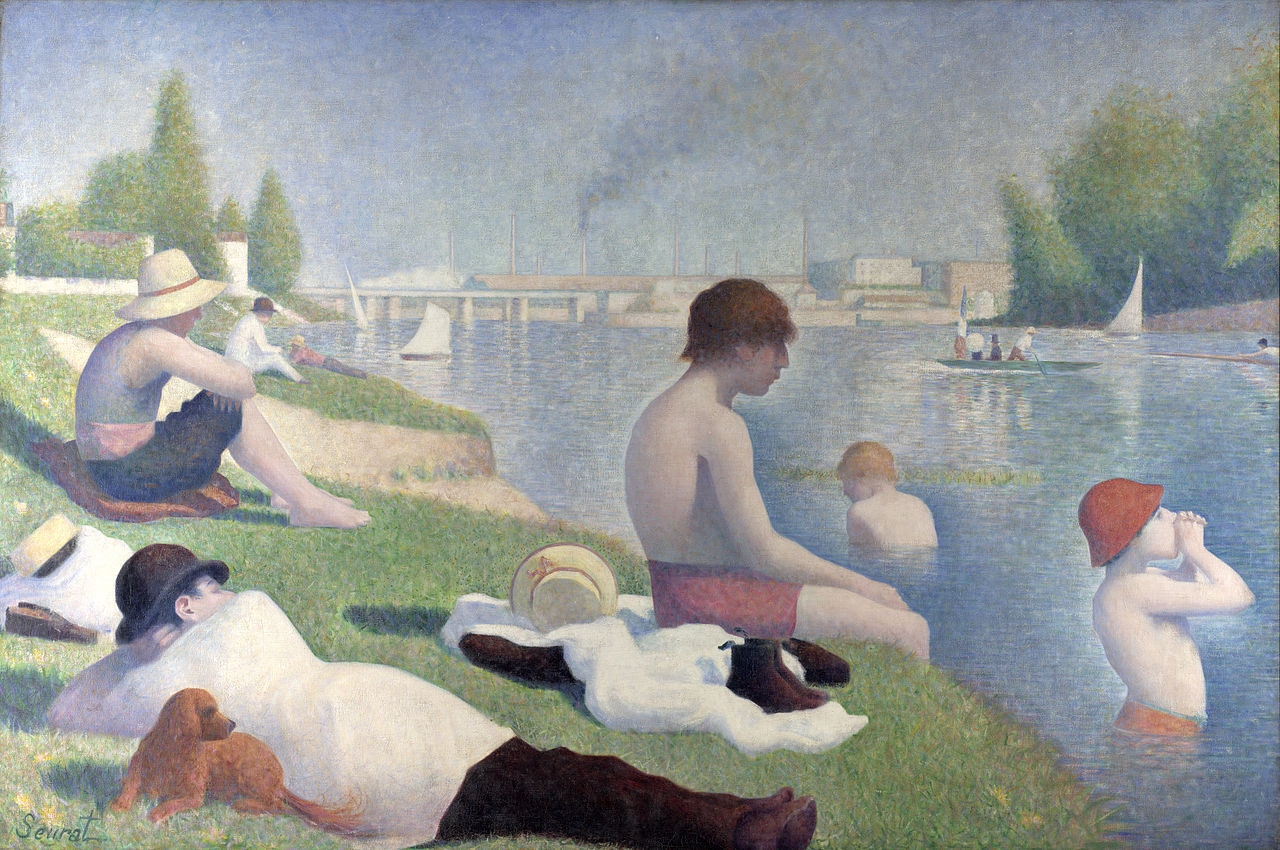
Bathers at Asnières by Georges Seurat (1884)

The painting by Elwell could well have been influenced by the work of the French artist, Georges Seurat, Bathers at Asnières which like Elwell’s work has people relaxing on the riverbank as well as in the water and in the background is the horizontal structure of a bridge crossing the water which in both paintings creates a horizontal axis. In the case of Elwell’s work the bridge almost hides the horizon from our view whereas in Seurat’s work our eyes leave the bathers in the foreground and follow the river towards the bridge and the industry on the far side of it.

In my next blog I will be complete the life story of  Fred Elwell and take a look at some of his genre paintings.

Once again let me recommend an excellent book on the life and works of Fred Elwell.  Most of the information for this blog was gleaned from this book which I bought in Harrogate.  It is entitled Fred Elwell RA – A Life in Art by Wendy Loncaster & Malcolm Shields.

Fred Elwell. Part 2. Portraiture

In my second look at the life and works of Fred Elwell I want to concentrate on his masterful portraiture.

In the last blog I left Fred Elwell studying in Paris with his friend Claude Rivas.  The year was 1892.   They had found themselves some rooms and had enrolled at the Académie Julian under the tutorship of William-Adolphe Bouguereau.  Bouguereau was far more than just a teacher of art at the Academy, he was a fierce defender of the academic method of teaching art.  He was also the chairman of the selection panel of the Paris Salon and thus had, with the other jurists, the power to accept or refuse submitted entries for the annual exhibitions and the jurists’ refusal to accept non-academic art angered many such as Paul Cézanne, Manet and Whistler.

Self Portrait by Fred Elwell (1933)

Life at Académie Julian was an exciting time for aspiring artists and many travelled great distances to be part of the Academy’s chosen few.  The artists were made to work hard and it also developed their competitive nature by offering a number of annual prizes.  Fred Elwell blossomed under this heavy workload and managed to win a number of these prizes during his stay.  Friendships were born at this Paris academy and Fred developed long term and special friendships with two other English artists, Richard Jack and the Lincoln-born, William Tom Warrener.  Warrener was nine years old than Elwell and had already established himself as a painter.   He was also a great social animal and spent much time in the bars of Montmartre and the Moulin Rouge nightclub which had come into being in October 1889, in the Jardin de Paris, at the foot of the Montmartre hill.  Warrener had become friends with Toulouse-Lautrec and, like Lautrec, had been commissioned to design a number of advertising posters for the Moulin Rouge.

Elwell would often visit Warrener at his apartment on rue Ravignon and would see the walls of his rooms covered with paintings he had done of the nightlife of the Moulin Rouge.  It was during one of those visits that Elwell was introduced to the actress, Léonie, who was one of Warrener’s models and Elwell managed to persuade her to also become his model (see Part 1 of my Fred Elwell blog where I have included Elwell’s painting of her, Léonie’s Toilet).

Elwell’s stay in Paris coincided with La Belle Époque.  This period from the late 1870’s to the start of World War I was one of optimism.  It was the golden age.  For France, this was a period of stability and peace squeezed between the Franco-Prussian War of 1870, quickly followed by the brutality of the Paris Commune and the Great War of 1914. It was a time of peace and prosperity.  It was time of joy and many took the opportunity to visit clubs and theatres and Elwell, who worked and studied hard during the day, managed to sample the night life in the evening and late into the night and it was during his stay in Paris that he developed the love of pipe-smoking, a habit which stayed with him for most of his life.  Another facet of Paris life which Elwell took to was what we now term as café culture which he continued to follow when he returned to England.  However, life in Paris had its downside for Elwell, as with most wannabe artists the burden of financial problems was ever present and Elwell’s financial predicament, despite the odd help from his father, was the same, so much so that he had to give his beloved portrait of Léonie to his landlord in lieu of rent.

Whilst he studied at the Académie Julian, Fred would often go back to Beverley to recharge his batteries and sample the delights of home comforts.  Elwell finally left Paris in 1895 deciding to live and work in London, although he still exhibited his works at the city’s Salon des Artistes Français (Paris Salon).  Elwell was determined to get some of his paintings excepted by the Royal Academy in London and believed he would be able to fund his London life through commissions.  Unfortunately for Elwell many artists had the same thought and the contest for painting commissions was ruthless.  Elwell realised that the streets of London were not paved with gold and soon he became very despondent with his lack of success.  It is thought his despondency led to a nervous breakdown.  His father rushed down to London to support his son and eventually convinced him to return home to Beverley

………..to be continued.

Florence by Fred Elwell (c.1902)

Fred Elwell was a master of many painting genres and the paintings I am featuring today deal with his skilful portraiture. The first portrait, Florence, is one Elwell completed around 1902.  It features his twelve year old niece Florence Elwell.  Florence had been brought up by Fred’s mother and father after she came to live with them at their Park Villa home, close to the racecourse in Beverley, following the death of her parents.  She looks a little moody and frustrated at having to sit for her uncle and pouts with annoyance.  There were more joyous things to do for a twelve-year old including mixing with the racing fraternity who would often congregate at her uncle’s home during Beverley horse-racing events.  It is believed that Fred Elwell completed the portrait in just one hour.

Portrait of a Small Boy by Fred Elwell (1917)

My next featured work is also of a youngster and is entitled Portrait of a Small Boy which Elwell completed in 1917.  Before us we see an immaculately dressed young boy in a white suit holding his hat in his right hand and his beloved yacht in the other.  His short white socks show signs of falling down towards his shiny black leather sandals.  The portrait must have been a challenging task for Elwell as boys of his age are reluctant to stand still and the crumpled look of his white suit is an indication of much movement.   It was so challenging that after he had completed the painting, Elwell swore that he would never paint the portrait of a child again.

Seated Nude in the Studio by Fred Elwell (1935)

As I mentioned in the first part of the Fred Elwell story, the first time he was allowed to paint live nudes was when he moved to Antwerp.  One of his best works of a female nude was completed in 1935 and was simply entitled Seated Nude in Studio and can be found at the East Riding of Yorkshire Council Museum.  The lady depicted in this work is seated on a stool and is depicted in graceful semi-profile.  Her blue dressing gown lies besides her. In the background there is some dark furniture which contrasts with the radiant flesh tints of the lady.  It is a quirky set-up as she sits before a painting on an easel as if she is the artist admiring her own work.

In a Bar by Fred Elwell (1943)

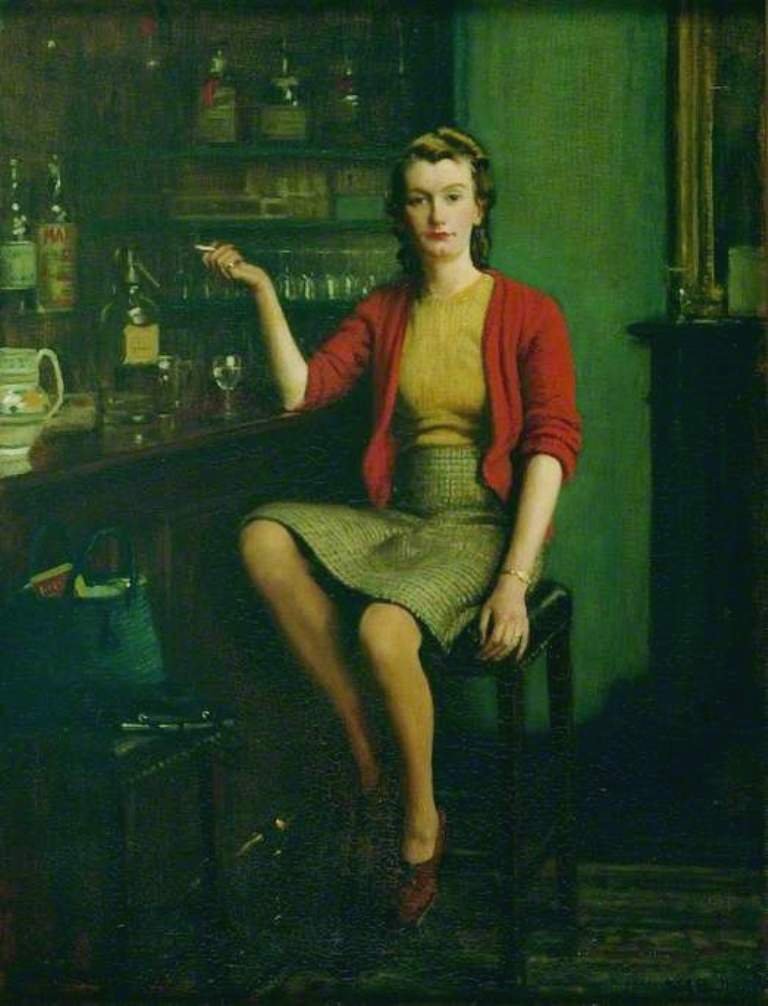
Another female portrait by Elwell which I really like is entitled In a Bar which he completed in 1943 and was exhibited at the Royal Academy that year.  In the work we see the model sitting at the bar, cigarette in hand with a glass of gin and tonic on the bar beside her.  There is an air of casual indifference about the way she poses, a somewhat challenging facial expression which challenges us to query her drinking and smoking habit.    This is twenty-eight year old Muriel Fox a favourite model of Fred Elwell and believed to be the lady who posed nude for him in the previous work.  Muriel was a cook at the Beverley Westwood Hospital and would often call into the Beverley Arms Hotel on her way home from work. This bar was later known as Elwell’s Bar.  She was a well-known regular at this hostelry and this was “her stool”.   There is great poise in her expression as she stares out at us.  As was the fashion in the 1940’s her cheeks were applied with  a liberal amount of rouge and her hairstyle , tightly waved, was the fashion of the day.   It was rumoured that she had recently given birth to her daughter and baby and basket had been placed out of sight behind the bar.

A Man with a Pint by Fred Elwell (1932)

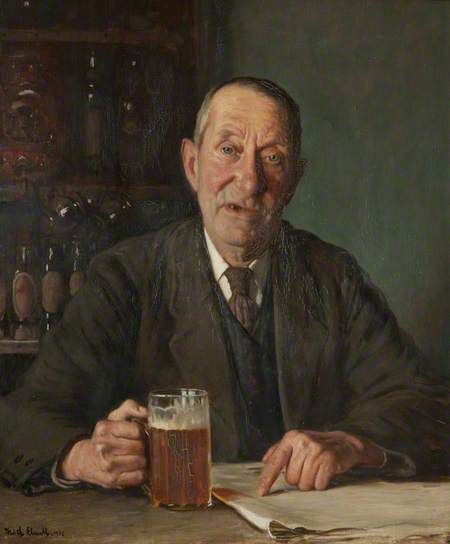
My next offering is a male portrait and it is a real gem.  The work is entitled A Man with a Pint and was completed by Elwell in 1932 and exhibited at the Royal Academy a year later.  The painting depicts and elderly man tightly clasping his pint of beer whilst pointing at something in the newspaper which he had been reading.   He has a red face and a bulbous nose.  There is something very comical about the portrait.  The public loved this portrait and the art journal, The Artist, maintained that Elwell “belonged to the School whose purpose is Life”.  This portrait is a wonderful realist depiction.  Elwell has chosen his sitter, not for his handsome qualities but for his down-to-earth demeanour.  This is a depiction of man, like the many elderly men, who love to spend the time with their pint in a welcoming hostelry.

Portrait of George Monkman, Mace Bearer of Beverley by Fred Elwell (1890)

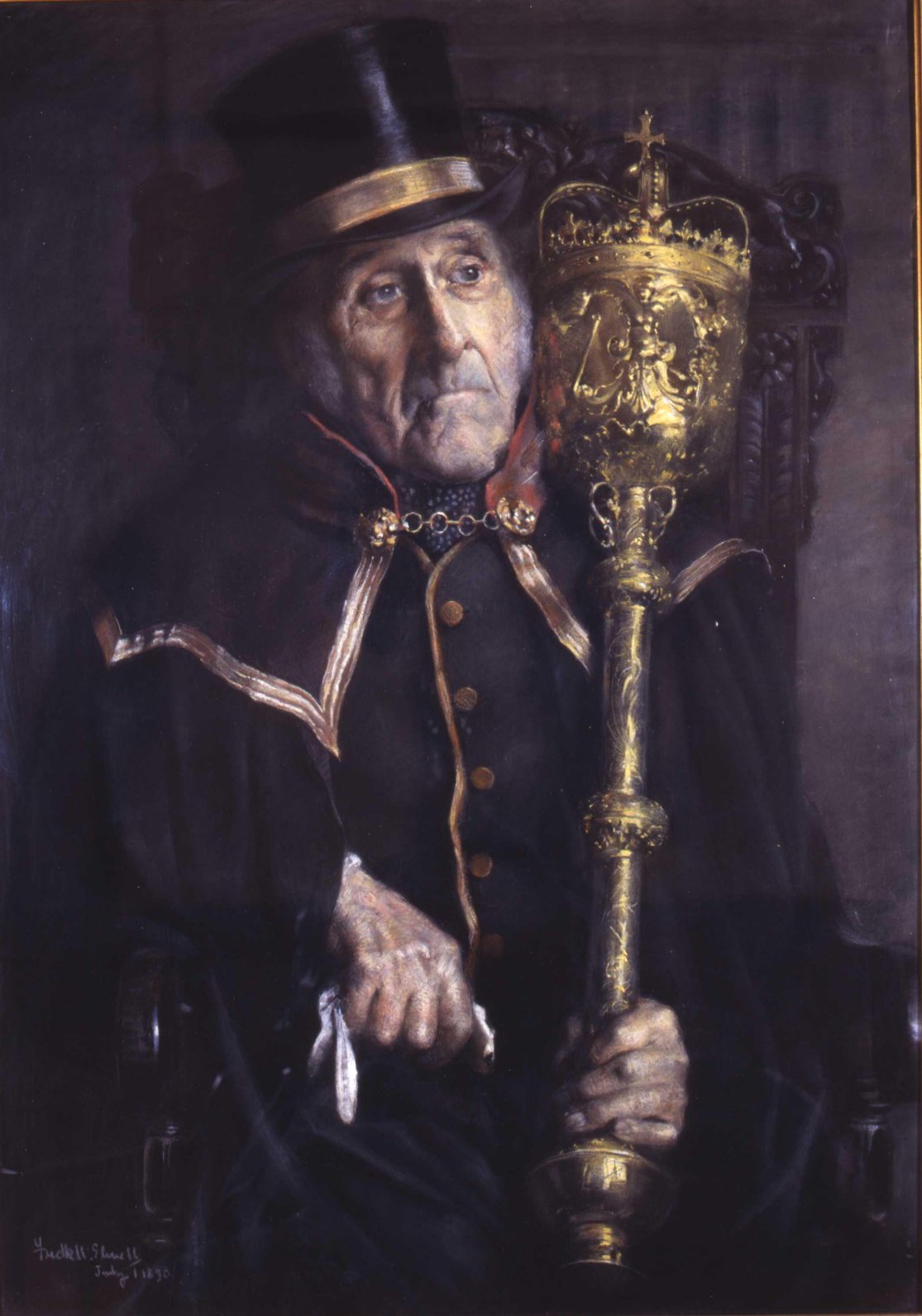
The next portrait is also of an elderly man but in this instance he is not an unknown character but a member of the local Beverley Council.  He is the official mace bearer that the town rolls out on official occasions.  His name is George Monkman and the title of the pastel painting is Portrait of George Monkman, Mace Bearer of Beverley.  This was painted by the twenty-year old Elwell in July 1890 during the time he was attending the Antwerp Academy and, like many of Elwell’s works, is housed in the East Riding of Yorkshire Council Museum.  Before us sits a grey-haired sad-faced man in top hat and dark gold rimmed livery.  He sits in a high-backed chair. Look how the light shines on both the man’s face and the gilt mace.  It is a great study of character and is a testament to Elwell’s ability in the way he has depicted the demeanour  of the man, who looks old and tired but still proud of his position as the mace bearer.  The frailty of the man, who was eighty-four years old at the time, is brought home by the way Elwell has got him to hold the large ornamental mace with his left hand grasping on to the weighty implement as he holds it against his body.  Elwell remembered the portrait well, stating that to keep the sitter happy he had to ply him with brandy.  Sadly a fortnight after the portrait was completed Monkman died.  Elwell completed an identical portrait in oils thirty years later in 1921.

Canon Fisher and his Wife by Fred Elwell (1905)

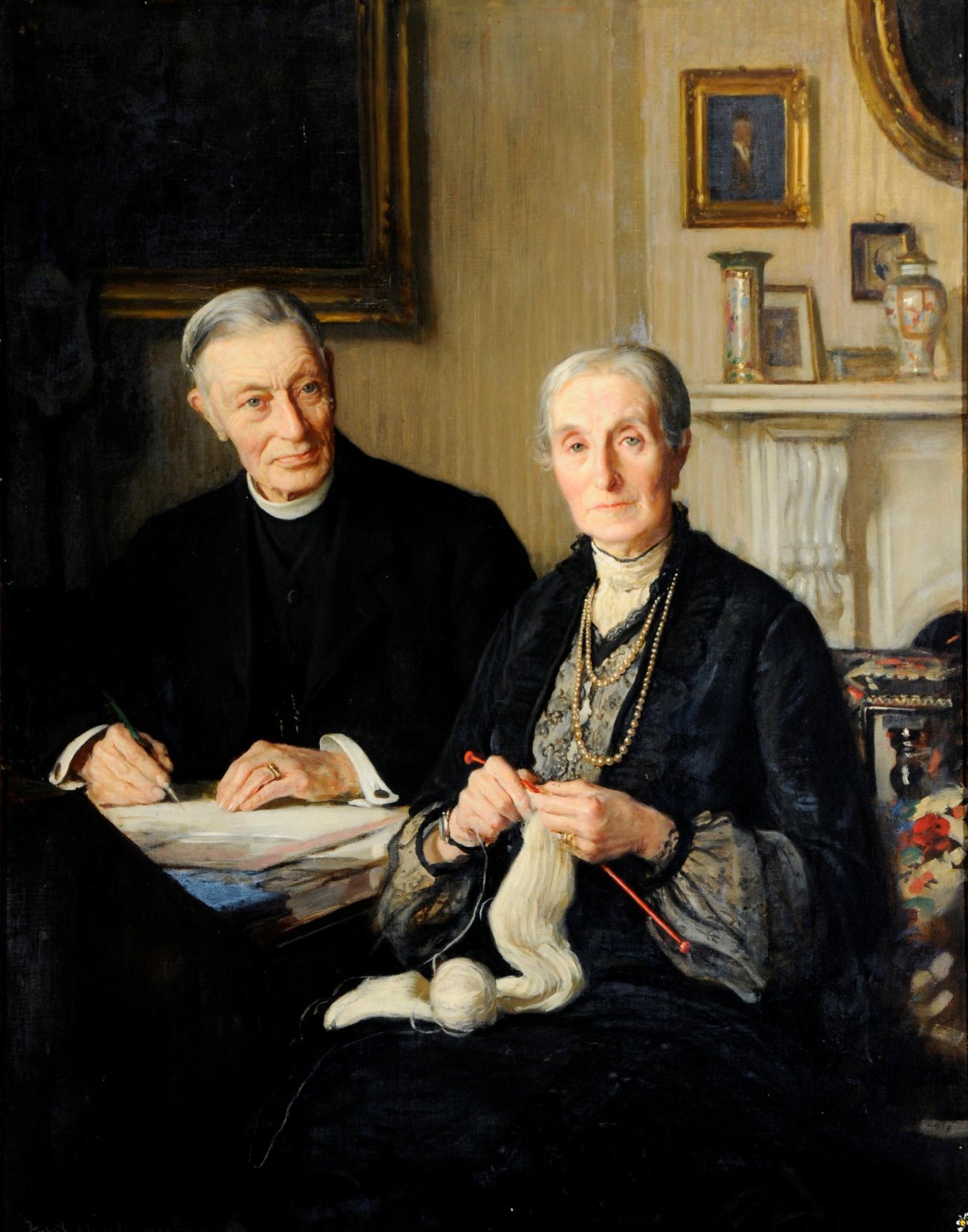
 The final work of portraiture by Fred Elwell is entitled Canon Fisher and his Wife which he completed around 1905 and exhibited at the Royal Academy in 1929.  Before us we see an intimate dining room scene featuring the Reverend Robert Fisher and his wife Charlotte.  It is thought that painting had been commissioned to mark the retirement of the Canon paid for by his loyal parishioners and was one of Elwell’s first portraiture commissions.  The portrayal oozes warmth and there is an aura of affection and kind-heartedness surrounding the couple.   Robert Fisher sits at the table writing which probably alludes to the fact that he wrote a number of books on subjects such as plants, flowers and Yorkshire villages.  His wife sits by his side and works on her knitting.  The Canon retired from his position at St Mary’s Church in Beverley in 1905.

In my next blog I will be continue with Fred Elwell’s life story and look at more of his paintings.

Most of the information for this blog was gleaned from the excellent book I bought in Harrogate, Fred Elwell RA – A Life in Art by Wendy Loncaster & Malcolm Shields.  It is a beautiful book and well worth buying.
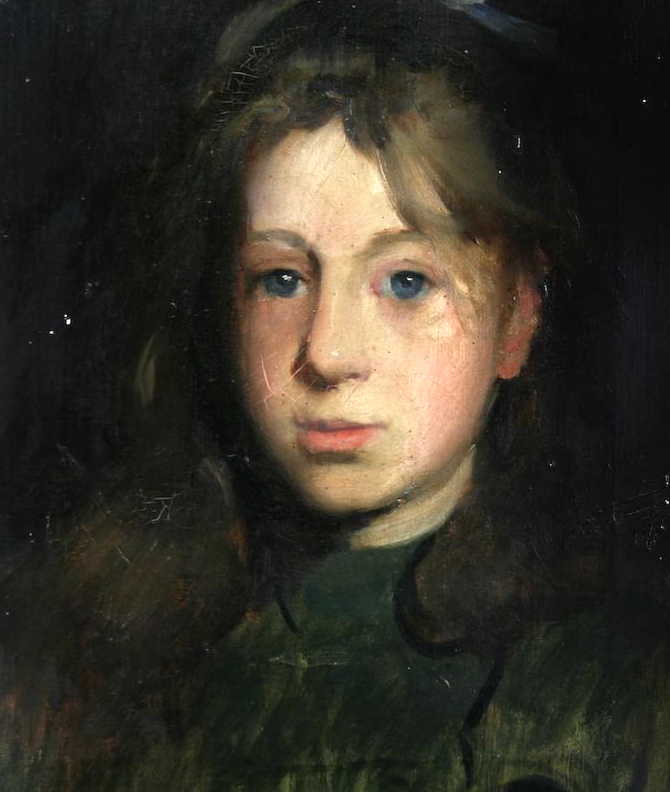
Frederick William Elwell. Part 1. The early days.

Self Portrait by Fred Elwell (1933)

When I look back on the four and half years of doing this blog I see my early entries were quite short but appeared nearly three or four times a week.  Nowadays due to other commitments and my being sucked into the life of artists the blogs are longer and often in multiple parts.  My last three blogs looked at the life of the American genre painter, William Sidney Mount and today I start a multiple-part blog on a home-grown nineteenth century English painter Frederick William Elwell, who many of you, like me, may have up to now, been unheard of.  In a way you have to thank my wife for this look at Frederick Elwell as she persuaded me to go with her to Yorkshire for a big three-day cooking event in Harrogate and I managed to slide out of the culinary arena and visit some small local galleries in this beautiful town, where I came across a book on Frederick William Elwell.

Frederick William Elwell was born at St Mary’s Cottage in the small Yorkshire market town of Beverley in on June 29th 1870.  His father, James Edward Elwell, was a well-known and well-established wood carver who played a prominent role in Beverley society.  In 1900 he was a member of the town council and mayor of Beverley. And when he held the position of Chairman of the Library Committee, he organised the first exhibition of paintings in 1910. The exhibition featured a selection of art which the town had loaned from local collectors.  It also included a large selection of works by his son Fred.

Fred Elwell’s schooling began with his attendance at Beverley Grammar School but in 1878 the education establishment had to close temporarily and Fred’s parents had to decide where their son should next be schooled.  The family were already aware that their eight year old son was talented at drawing and his father trained him in draughtsmanship and so his father decided to look for some scholarly opening which would allow Fred to further train in art and maybe later architecture as well as attain an all-round education.   The decision was made to send Fred to Lincoln to live with his two aunts, and by doing so, it would allow him to attend Lincoln Grammar School and at the same time afford him the chance to enrol in evening art classes at the nearby Lincoln School of Art on Lindum Hill.  Fred’s two aunts were a formidable pair of Victorian ladies.  One was the principal of the Lincoln Training College for Women whilst the other acted as its secretary

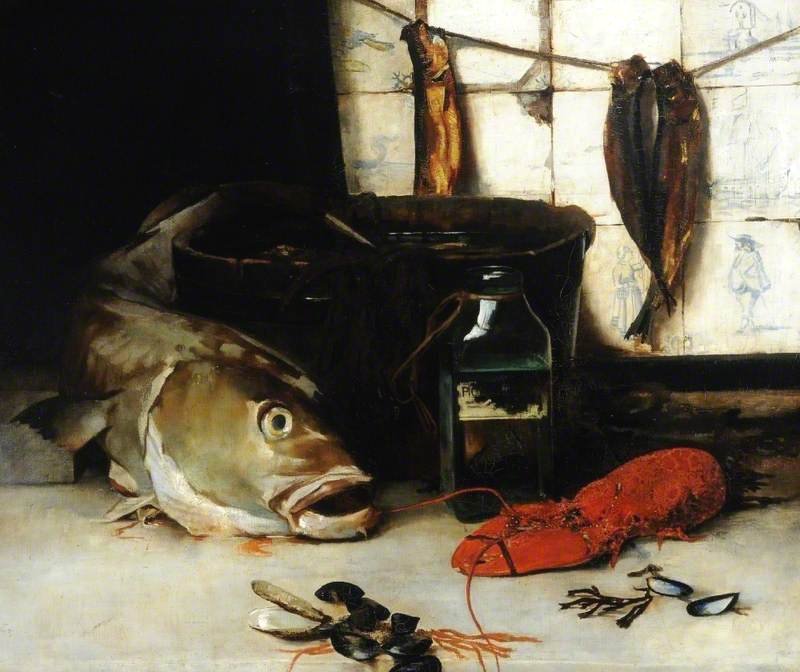
Still Life with Fish by Fred Elwell (1897)

Elwell proved to be a talented scholar and although his father wanted his son’s career path to head towards architecture Fred was in love with painting.  He was so good that he was awarded the Gibney Scholarship, named after Rev. J.S.Gibney the canon of Lincoln Cathedral who with others founded then Lincoln School of Art in 1863, and this allowed him to continue on with a three year course in art.  In 1887, aged seventeen, Fred Elwell won the Queen’s bronze medal in the National Art School’s competition for his painting, Still Life with Fish.  This painting by the seventeen year old Elwell shows the dawning of a great artist in the way he depicts different textures in the painting, such as the shiny reflective glass bottle in contrast to the dull matt finish of the red lobster.  On the wall in the background he has depicted fading Delft tiles. The head of the codfish, with its mouth open, is well illuminated against a dark background.  Its body is curved and the head turns to the right whilst its tale disappears into the darkness.  The curve of the fish is, in some way, countered by the dried herrings which hang in front of the tiles with their tales curving towards the left, balancing out the body position of the cod.  Elwell has used the old artist’s trick of depicting depth by incorporating the edge of the marble shelf in the foreground of the painting.  This picture is housed in the East Riding of Yorkshire Council Museum.

  The head of the college at the time of Fred Ewell was Alfred George Webster and he was a great admirer of the French Impressionism movement which had come to being in the early 1860s in Paris and it was Webster who taught the Impressionist technique to his students.  This introduction of Impressionist techniques to students, including Ewell, was strongly opposed by the Royal Academy.

In 1889, at the age of nineteen, Fred Ewell left the Lincoln Art College and followed the path of many aspiring painters of the time and, financed by his father, Fred travelled to Belgium where he enrolled at the prestigious Royal Academy of Fine Arts in Antwerp which had been founded in 1663 by David Teniers the Younger.  Fred Elwell and a fellow student Claude Rivaz shared a city studio on the Rue des Aveugles.   For many this establishment was considered the most important training academy for those artists who wanted to hone their artistic skills and follow classical Academic training.  Many great artists, such as Van Gogh, Lawrence Alma-Tadema and Ford Madox Brown at one time studied at this establishment.  It was here that the students would learn more about the great Masters of art and in fact the Academy itself housed many works by the old Masters.  Fred Elwell’s tutor at the Academy was the landscape and portrait painter, Piet Van Havermaert.  Havermaert pressed his students hard and would not suffer any slackers, once telling his students:

“… Always remember that for the money your father pays to keep you here, he could keep four pigs…”

Havermaert was a hard task master and pushed his students to the limit demanding more and more from them.

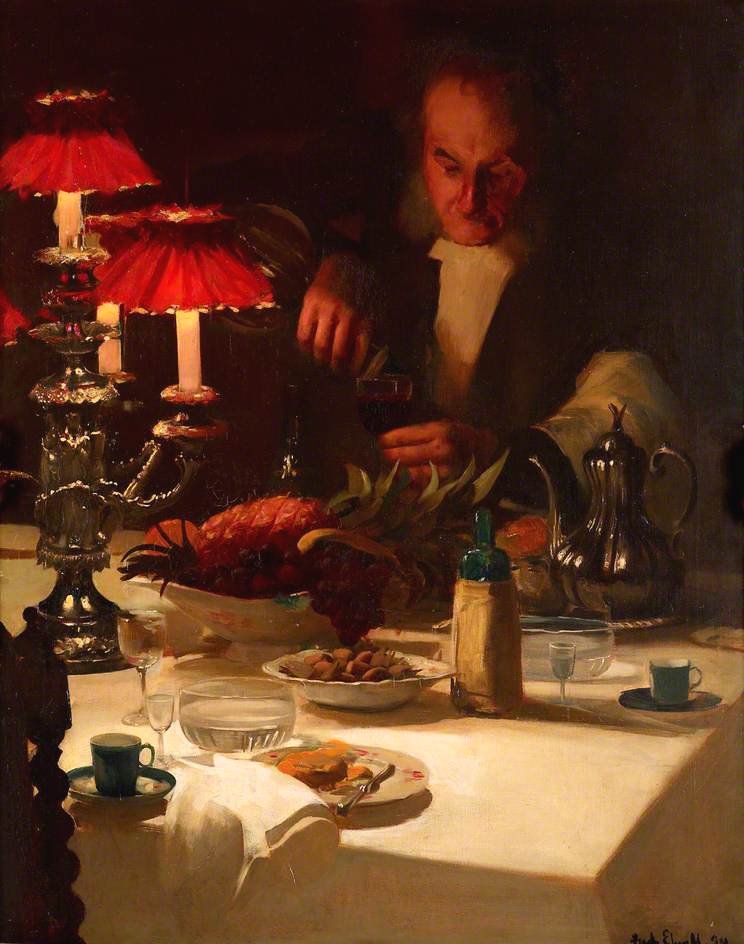
The Butler takes a Glass of Port by Fred Elwell (1890)

Elwell flourished under this strict teaching regime and during his final year at the Academy produced a genre piece which harked back to the typical type of art that was so popular in the Low Countries in the seventeenth century.  It was entitled The Butler takes a Glass of Port.  The title is a play on words, meaning, on one hand, the partaking of a drink but, on the other hand, meaning “stealing” a drink.  The scene is set in a dining room and we see the butler, emerging from the shadows.  He had just finished serving his master and guests at the dining table and has come to arrange the clearance of the plates.  However he has decided to help himself to a small glass of his Master’s port.  Look at the miscreant.  Look how his face is lit on the side by the candlelight.  This use of light was very popular with the Dutch genre painters of the past and Elwell, even at the young age of twenty, managed to master the art of dramatic lighting.  Look at the butler’s expression of anticipation as he pours himself a drink.  His nose has been given a reddish tinge suggesting that he and alcohol were old friends.  It is amusing to note that the painting’s alternative title, another double-entendre, was All Things come to the Man who Waits !  It was at the Royal Academy of Fine Arts in Antwerp that Elwell began to perfect his skill in portraiture and still life through  the influence of the work of 17th century Dutch and Flemish artists.

This Academy was also a stopping off place for art students who headed for the artistic academies of Paris, a route that Fred Elwell and his friend Claude Riaz, followed in 1892.  The two young artist found themselves some rooms in rue de Campagne Première, on the left-bank, in the city’s 14th arrondissement of Montparnasse.  Elwell was fascinated with the French capital and soon built up a large collection of sketches of all that he saw of Paris life.  Elwell enrolled at the Académie Julian and was fortunate to be tutored by a giant among artists, William-Adolphe Bouguereau.  It was whilst study at the Academy that Fred Elwell started his training in life drawing using living models .  He was never given the opportunity to sketch nude men and women whilst studying at Lincoln, probably because of the presence of the cathedral in the city, the Academy thought life classes were somewhat inappropriate.  Out of this training came one of Elwell’s finest early paintings entitled Dolls or Léonie’s Toilet.

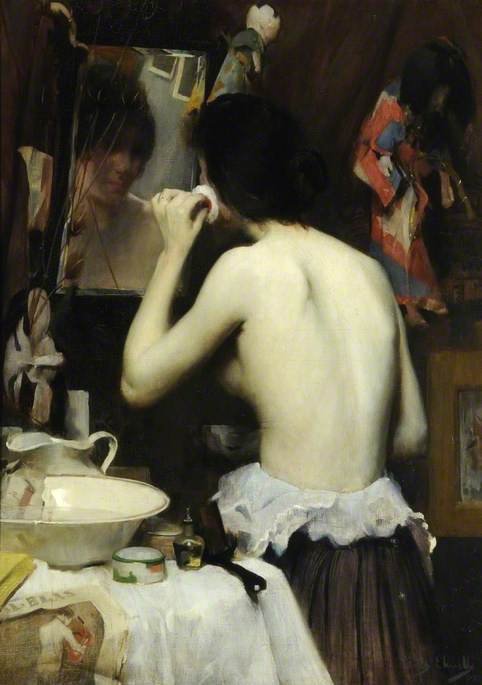
Leonie's Toilet by Fred Elwell (1894)
Leonie’s Toilet by Fred Elwell (1894)

Léonie’s Toilet was completed by Elwell in 1894.   Fred Elwell was introduced to the sitter of this painting, Léonie, by Thomas Warrener who was a friend of his from Lincoln, who, like Elwell, had studied at the Lincoln Art College.  Warrener then attended the Slade School of Art before moving to Paris and the Académie Julian where the two friends met up once again.  Léonie was also a model for some of Warrener’s paintings.   To the left of the painting in the foreground is the washbasin, draped over which is the newspaper famed for its gossip, Gil Blas, which leads us to believe Elwell was interested in the comings and goings in French society.  The periodical often serialised French novels as well as being known for its opinionated arts and theatre criticism.  Another hint of Parisian life in the 1890’s is the two Japanese dolls hanging from the mirror. Japonisme was sweeping through Europe in the second half of the nineteenth century.  It was the term used to describe the influence of Japanese art and fashion on Western culture, and was particularly used to refer to Japanese influence on European Art and Impressionism.  This painting’s original title was Dolls, referring to the dolls seen in the work.  Sibylle Cole in her 1980 book, FREDERICK  W. ELWELL, R.A. 1879-1958.  A Monograph with eight selected prints in colour  describes the skill of Elwell in the way he has painted the naked back of Léonie.  She highlighted the way in which he used a wide range of whites and lovely soft edges where she says “the light leaks into the background”.  There is an interesting story behind this work.  Elwell, like all struggling artists, had to part with his beloved depiction of Léonie, giving it to his landlord as payment for his rent.  Fifty years later the artist James Bateman R.A. was walking down Kings Road in Chelsea when he saw the painting of Léonie in an antiques shop.  He bought it and gave it to the seventy year old painter.   Elwell was delighted to have Léonie back with him !

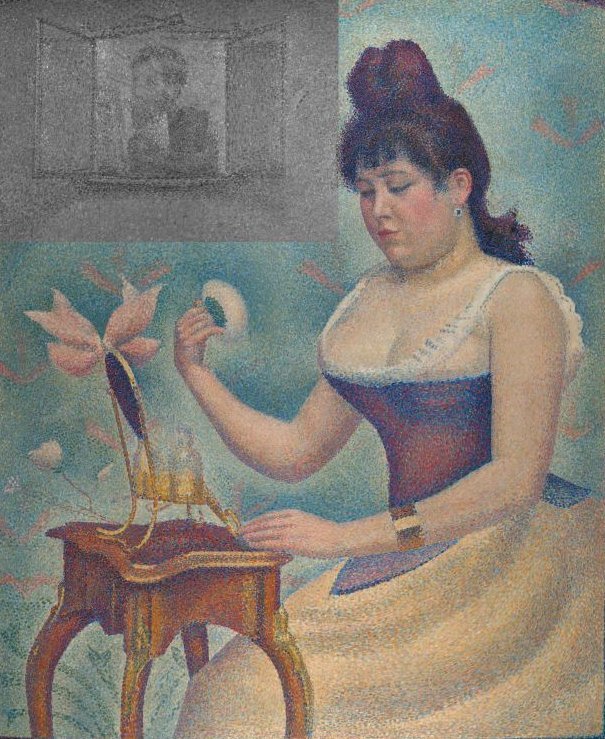
Young Woman Powdering Herself by Georges Seurat (1890)

The subject, a girl powdering her face, may have come to Elwell after seeing Georges Seurat’s 1890 work, Young Woman Powdering Herself, a painting depicting Seurat’s secret lover, a working-class woman, Madeleine Knobloch.  The painting was exhibited at the Société des Artistes Indépendants in 1892, the year Elwell arrived in the French capital.

Man with a Pipe by Paul Cezanne (1892)

My final offering in today’s blog could well have derived from a Cezanne painting Elwell may have seen, one which was painted by Cezanne in 1892 entitled Man with a Pipe, a depiction of a peasant relaxing, staring out at us with his pipe in his mouth.  

Old Man with a Pipe by Fred Elwell (1898)

Fred Elwell completed a work in 1898 which was entitled Old Man with a Pipe and depicts a gardener, with pipe in mouth, which projects towards us.  It is a somewhat cut-off painting with the man’s right fist which grasps the handle of the rake and his left elbow, almost cut out of the lower part of the composition

 In my next blog I will continue with Elwell’s life story and look at some more of his beautiful works of art.

 Most of the information for this blog was gleaned from the excellent book I bought in Harrogate, Fred Elwell RA – A Life in Art by Wendy Loncaster & Malcolm Shields.  It is a beautiful book and well worth buying.

William Sidney Mount. Part 3, More of his genre paintings

Caught Napping- (Boys Caught Napping in a Field) by William S Mount (1848)

This is Part 3 of my blog featuring the nineteenth century American genre painter and portraitist, William Sidney Mount.  In my first blog about this great painter I looked at his genre works which featured his great love of music and musicians.  My second blog featured some of his early biblical works and his portraiture and in this last offering I am reverting to his love of genre painting and some of his best known works of art.  In the first part of this trilogy I talked about the “heyday” of genre style paintings from the Low Countries in the seventeenth and eighteenth century.  They often featured taverns and interiors of homes and were often dark and looked at the life of the peasant classes with a degree of sombreness.  Mount’s genre paintings on the other hand, were more light and joyful.

 William Mount had entered the National Academy of Design in New York in 1829 and during his time there his studies incorporated the study of European paintings and engravings as well as the study of classical statuary.  Whilst he was studying at the Academy he was living with his uncle, Micah Hawkins, who was an amateur poet, and owned a tavern and grocery shop in New York.  Micah’s greatest love was the theatre and he would produce plays in which he would combine music and storytelling and the finished opus would have political and national connotations.  His nephew William was influenced by this and the American life theme and social comment  featured in many of his works of art.

 William Mount completed his studies in 1829 and returned home to Long Island where he set about building up a portfolio of paintings which included portraits of relatives and some of the workers on the family farmstead.  In 1832 he was elected to the Academy and for the next thirty-three years exhibited there regularly.   William Mount was very aware of the class structure in his country.  He could see the social gap between the urban citizens and those who worked the land.  Towns expanded and became cities and those who worked and lived in these cities became wealthier than their poor relations that remained in the countryside to work the land.  With financial wealth came cultural wealth and soon the division between the urban dwellers and the country folk became more obvious.

The Sportsman's Last Visit by William S Mount (1835)
The Sportsman’s Last Visit by William S Mount (1835)

The painting by Mount, which best looks at this cultural difference, was one he completed in 1835, entitled The Sportsman’s Last Visit.  In the depiction we see Mount has contrasted the genteel elegance of the city gentleman, dressed immaculately in black, who sits next to the lady and engages her in conversation.  She demurely, but coquettishly, looks away from him supposedly concentrating on a piece of fabric which she has been working on.  There is a slight smile on her lips indicating that she is enjoying the man’s attention. She completely ignores the man whom we see standing on the right hand side. He is scratching his head, perplexed by what he is witnessing.  He is a local country boy.  He has none of the airs and graces of the city gentleman but he cannot understand why the lady should favour the city gentleman over him.  Mount often painted scenes from rural life with loving depictions but in this one he was hinting at things were about to change.  If money was to be made, maybe city life was the way to do it.   On an artistic note I love how Mount has cleverly used the ceiling beams to demonstrate a feeling of depth in the painting.

California News by William S Mount (1850)

Another of Mount’s painting which recorded changing time, was entitled California News which he completed in 1850.,  This was in the middle of the chaotic California Gold Rush In the picture we see a local man, with the New York Daily Tribune newspaper in his hands, reading aloud about the gold rush in California.  Local people stand around agog with excitement but what is more interesting is the picture above the door which depicts a couple of pigs which is probably a reminder that many who raced across country to make their fortune were simple pig farmers who struggled to eke out a living wage for their family.

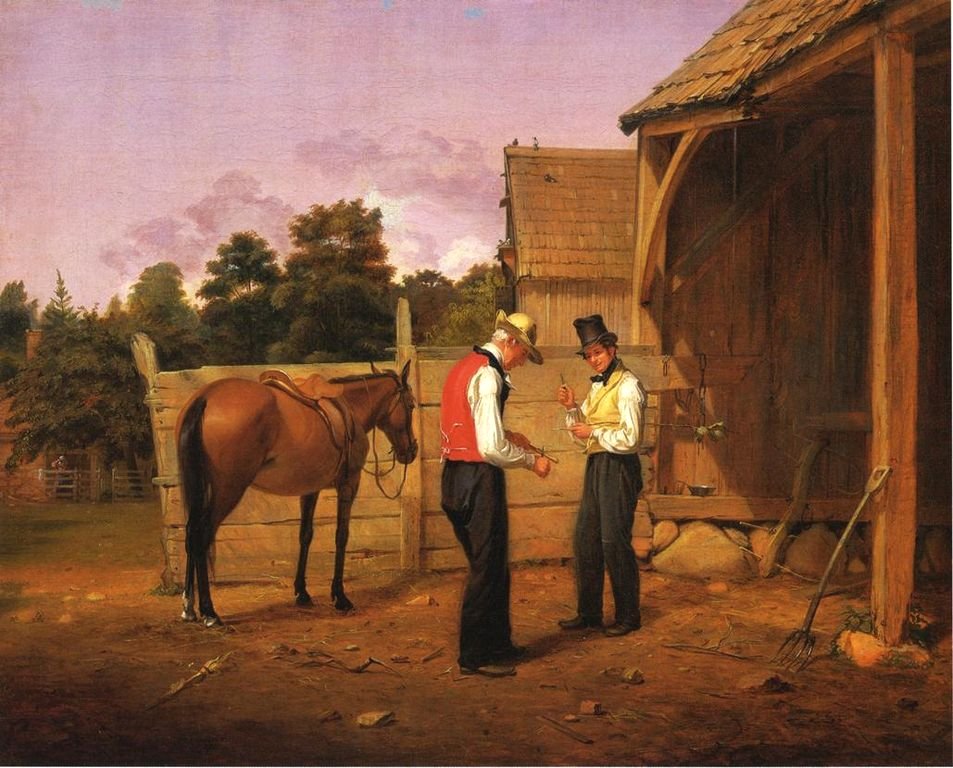
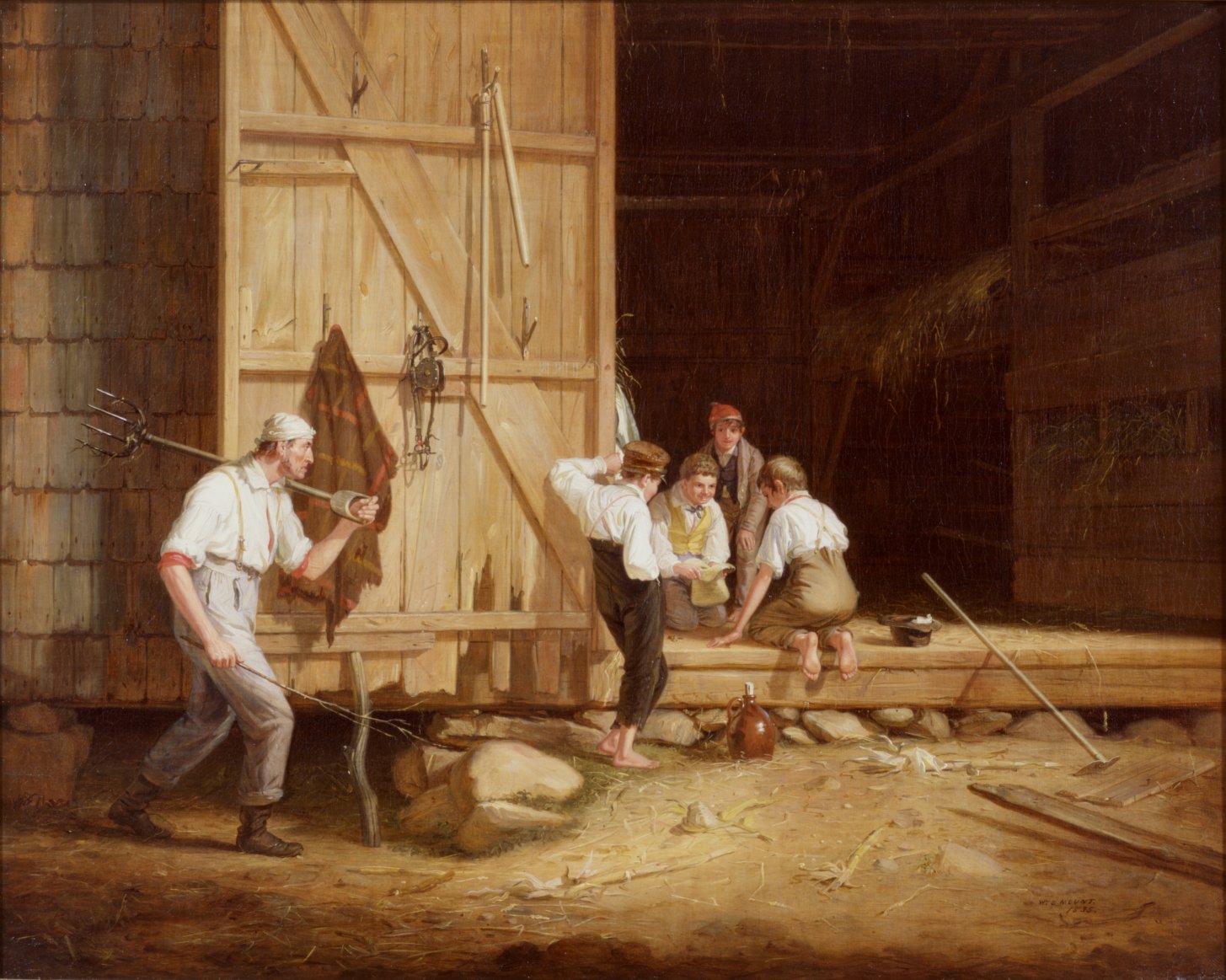
 In 1834, William Mount met Luman Reed.   Luman Reed, who was born in 1784, was a farmer’s son from upstate New York.  He made a fortune in the wholesale grocery business in New York City and through his love of paintings, built up one of America’s most important collections of paintings, concentrating on American art of his own time.  He became patrons to such American artists as Asher Durand, Thomas Cole and George Flagg, just to name a few.  Luman Reed liked the works of William Mount and bought two of his paintings, Bargaining for a Horse and The Truant Gamblers (Undutiful Boys).


Bargaining for a Horse by William Sidney Mount (1835)

The painting, Bargaining for a Horse, which he completed in 1835, is probably one of the best known and best loved of William Mount’s works of Art.  The original title for the painting was Farmers Bargaining but when the painting was published as an engraving five years later the title was changed to Bargaining for a Horse.  When Luman Reed received the completed painting he was delighted and commented that this was “a new era of the fine arts of the country”.  There was a political connotation to this work by Mount as the phrase “horse trading” referred to a promise of material benefit in return for political support.  Mount’s original title for the painting did not so much allude to that colloquialism but the changed title in 1840 made it more apparent to all those who viewed the work.

 Look at the two men.  There is no eye contact between the seller and the buyer.  Both concentrate on the whittling of the wood almost as if the sale is of little importance.  Maybe the concentration they have given to the wood carving gives them time to think about their next step in the bargaining process.  It is a beautifully composed work which has been skilfully painted.   It is a painting which combines humour, warmth, and razor sharp observation.

 Luman Reed was delighted with his painting and wrote to William Mount in November 1835:

 “…This is a new era of fine arts in this Country, we have native talent and it is coming out as rapidly as is necessary.  Your picture of the ‘Bargain’ is the wonder and delight of everyone that sees it…”

The Truant Gamblers (Undutiful Boys) by William S Mount (1835.)

A month later Mount wrote to Luman Reed telling him of the other painting he had completed for him.  He wrote:

 “…You will receive with this letter a picture: ‘Undutiful Boys’.   Boys hustling coppers on the barn floor……….My price for the picture ‘Undutiful Boys’ two hundred and twenty dollars.  I hope the picture will meet your approbation…”

 A week later Luman Reed wrote back  to Mount:

 “… I yesterday received your much awaited letter of the 4th Instant with your beautiful Picture of the ‘Undutiful Boys’.  To say that this picture is satisfactory is not enough, and the least I can say is that it pleases me exceedingly.  It is a beautiful specimen of art.   The interior is far superior to any thing of the kind I have seen, it is all good and therefore I need not particularize, the price is perfectly satisfactory and the money is ready for you any day you want it.  I pride myself on having now two of your Pictures and what I consider your best productions and hope yet to have more but it is no more than fair that others should be gratified too and I must wait until you execute some other commissions…”

 In the painting we see a group of young boys who have decided to abandon their farming chores and, instead, decided to spend some time gambling for pennies.  Happy with their decision to forego work, what they do not realise is that the farmer is approaching, pitchfork and switch in his hands and punishment is imminent.  This type of genre painting featuring life on the farm was popular in those days as life was changing from an agrarian one to an industrial one and rural life soon became somewhere to relax and enjoy and for people like Luman Reed who was brought up in the Hudson River town of Coxsackie and later moved to the hustle and bustle of New York City, paintings depicting life on the farm may have brought him fond memories of his childhood days.  For him this painting was a nostalgic one

At the Well by William S Mount

In 1837 William Mount left New York City and returned home to Stony Brook and Setauket on Long Island and remained there for the rest of his life with just the odd trips back to New York.  He was content to paint rural scenes and the characters who worked on the farmsteads.   He maintained his portraiture work as this was a good source of income.  Unlike a number of his contemporaries he showed no inclination to travel to Europe to experience artistic life in London, Paris or Rome.  Mount fully captivated the rich European artistic legacy that was imported to the United States. It was through engravings, books and copies of European masterpieces, that Mount received a complete schooling in the academic tradition of art and by doing so became America’s first great genre painter.  He lived quite a sheltered life and unlike his brothers, he never married.
When we look at his works of art we are struck by the amount of detail in them.  Mount loved detail and worked painstakingly slow to ensure no detail was omitted from the finished work and this resulted in a small number of completed works, believed to be no more than two hundred completed in the thirty years that he painted.

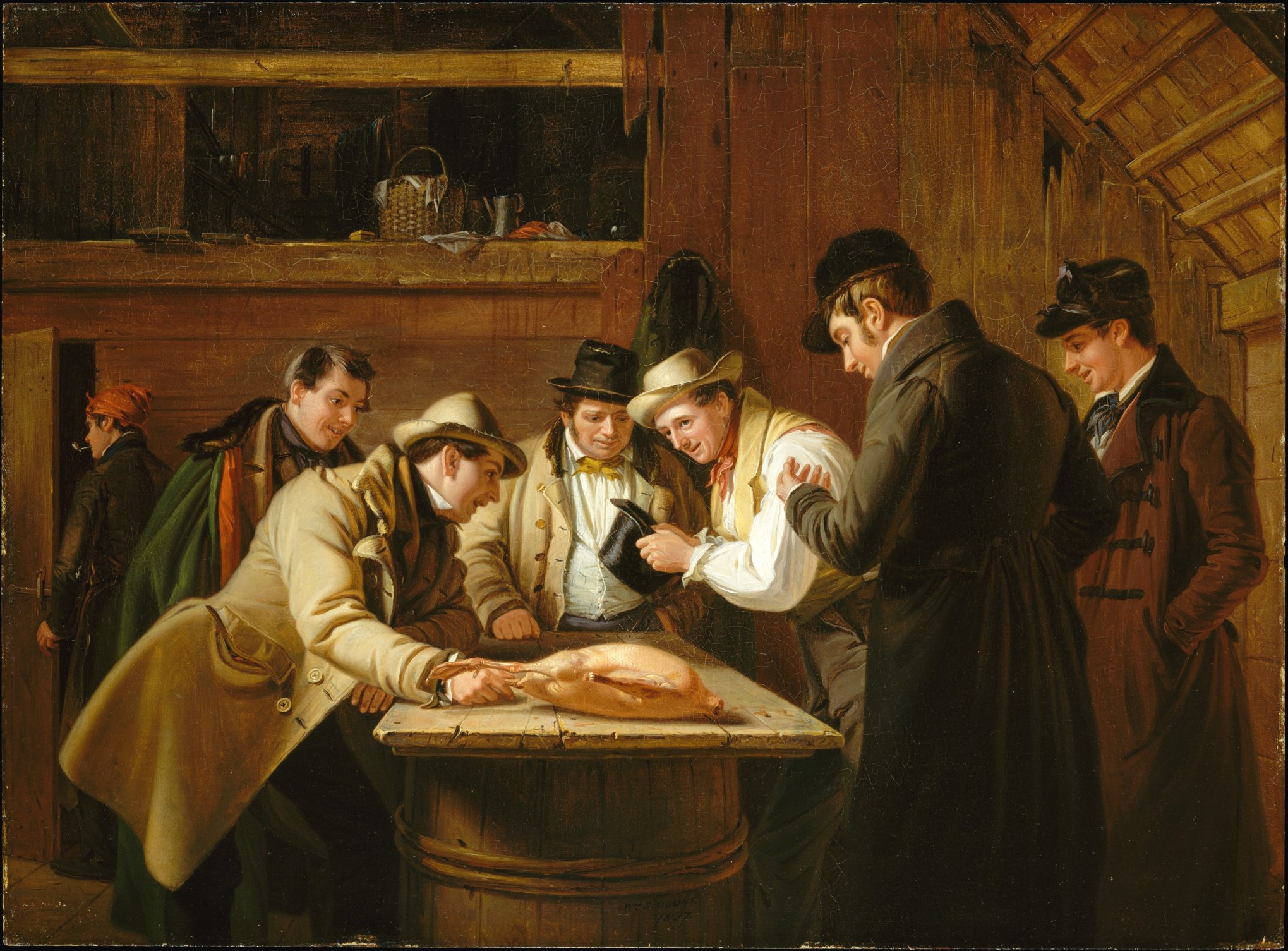
The Raffle (Raffling for the Goose) by William S Mount (1837)

My last featured painting is one of my favourites.  It is entitled The Raffle (Raffling the Goose) which William Mount completed in 1837 and is now housed in the Metropolitan Museum of Art, New York.  In this work, like a number of his other paintings Mount liked to highlight the social and political issues of the time.  Before us we see six men gathered around a table eagerly awaiting the result of an impromptu lottery to see who had won the plump goose which lies in front of them.  If you look carefully at the table you will see signs of blood which indicate the bird had recently been killed and plucked.  Such lotteries were common in the rural communities of Long Island around this time.  The year 1837 was a year of hardship for Americans.  The Panic of 1837, as it was known, was the financial crisis in the United States that touched off a major recession that lasted until the mid-1840’s. Profits, prices and wages went down while unemployment went up.  Mount alluded to food shortages during this hard time in this painting and what people had to do to survive and put food on the family table.  Mount worked on the painting through the winter of 1836 and completed it early in 1837.  Mount exhibited the painting that year at the National Academy of Design Spring Exhibition.

In the first part of this William S Mount trilogy I talked about his inventive nature and how he had invented a violin/fiddle which produced a larger volume of noise.  In about 1860 Mount designed a portable studio and home on wheels which was drawn by horses. It afforded him the opportunity to drive himself around the area and paint en plein air.   He spent much time during his last years in this unique conveyance, but sadly, due to ill health, his painting days were almost over.

The Grave of William Sidney Mount, Caroline Church of Brookhaven, East Setauket, New York.

William Sidney Mount died on November 19th 1868, at Setauket and is buried in the Presbyterian Church Cemetery.

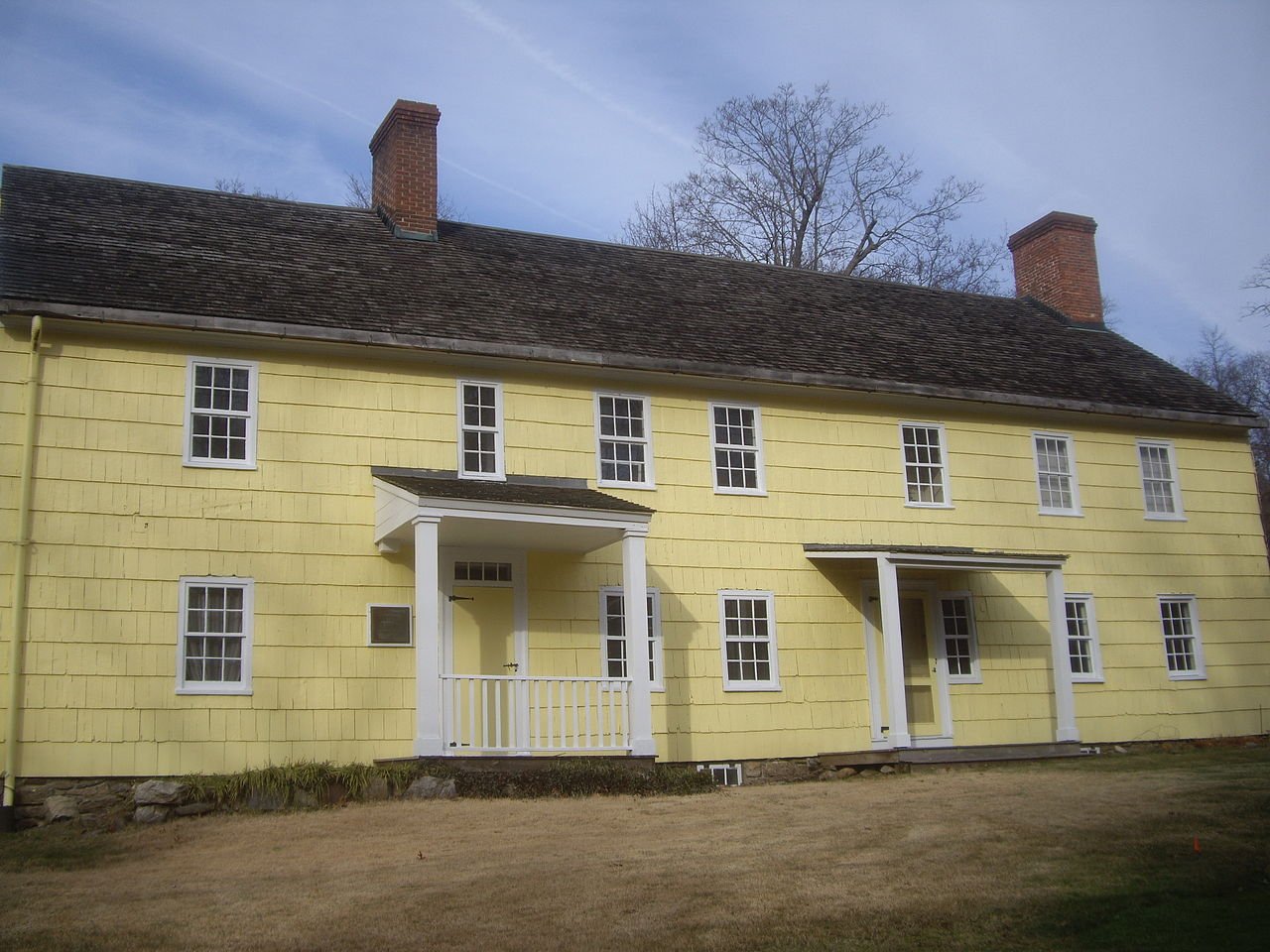
William Sydney Mount House, Stony Brook, NY

His home and studio, now known as The William Sidney Mount House is one of America’s National Treasures.   One of the local elementary schools in The Three Village Central School District, a district in Long Island so named from the older, original “Three Villages” of Setauket, Stony Brook and Old Field, is named after the artist.

There were so many paintings I could have included but these are just a few of my favourites.  Besides the usual internet sources I gleaned a lot of my information from an old book I just bought entitled William Sidney Mount by Alfred Frankenstein.  The William Sidney Mount House at Stony Brook, Long Island houses numerous works of art by William Sidney Mount and I would be interested to hear from anybody who has visited the museum.

William Sidney Mount. Part 2 – The Portraitist, and some of his early historical works

Self portrait by William S Mount (1832)

In my last blog I looked at the early life of William Sidney Mount, hailed as the first American genre artist.  I looked at his love for music and how he depicted song and dance in his paintings.  Today I want to carry on with his life story and take a look at his early works and his portraiture.

 William had been working for his brother, Henry Smith Mount, at his sign writing business in Setauket and enjoyed it.  At first he found the work interesting and challenging but later found the painting of signs somewhat restrictive.  He gave up working for his brother and moved to New York to live with his uncle Micah Hawkins, who operated a tavern and grocery store in New York City.  His uncle was also a composer, playwright, and poet.  Micah combined music and storytelling into his theatrical productions which often delved into what was happening in politics and much of these ideas were to influence his nephew and his paintings.

  It was also around this time that William Mount visited his first art gallery, the American Academy in New York and in 1826 he enrolled at the newly opened National Academy of Design, an artistic establishment founded by a number of young painters such as Asher Durand, Thomas Cole, and Samuel Morse.  In those early years William Mount’s art was all about portraits and historical scenes.  William remained at the Academy for a year before returning home.

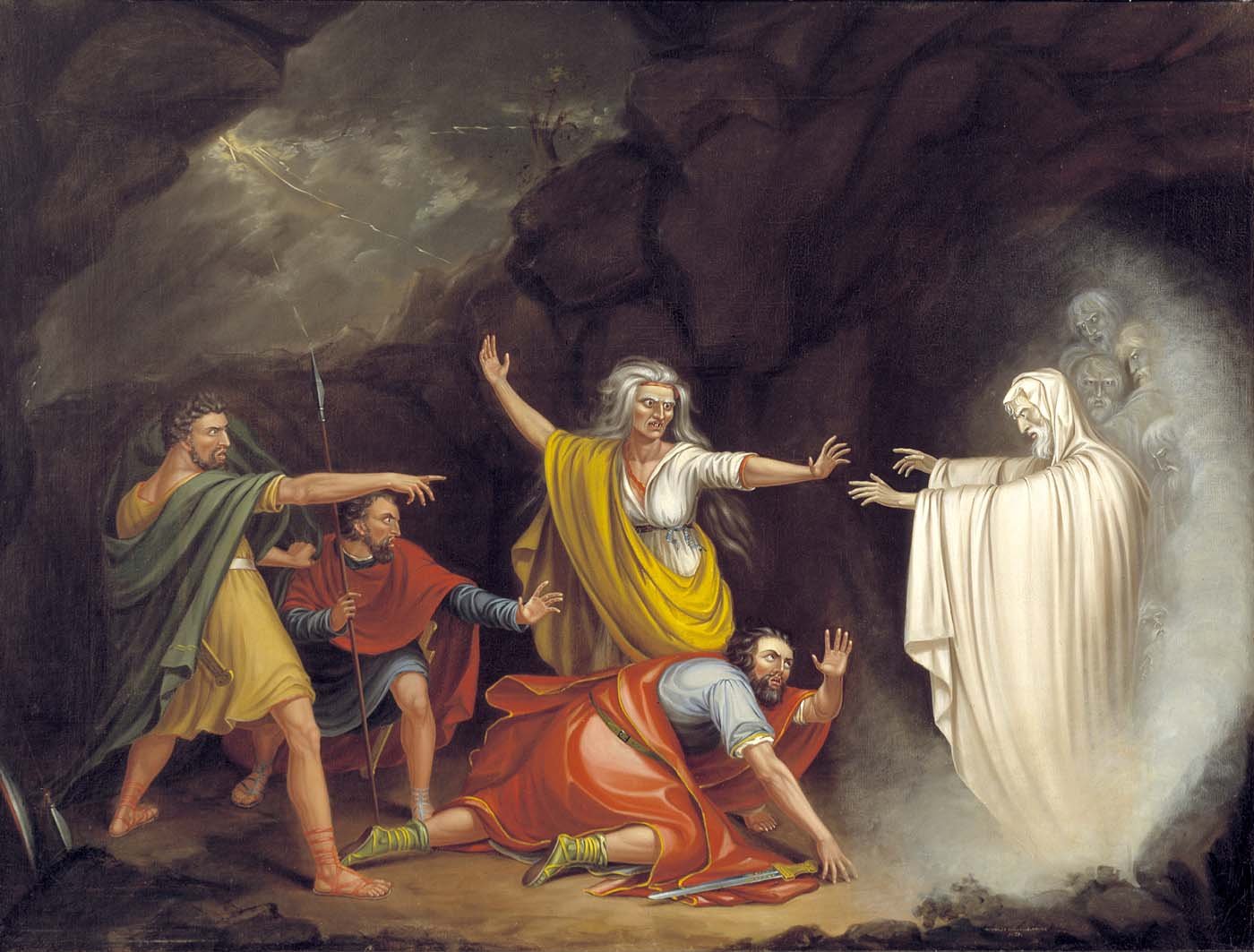
Saul and the Witch of Endor by William S. Mount (1828)

One of his early works was entitled Saul and the Witch of Endor, which he completed in 1828 and can now be found in the Smithsonian American Art Museum in Washington.   The painting depicts a passage from the Old Testament book of Samuel which tells of Saul and his battle with the Philistines.

 “… The Philistines assembled and came and set up camp at Shunem, while Saul gathered all Israel and set up camp at Gilboa. When Saul saw the Philistine army, he was afraid; terror filled his heart.  He inquired of the Lord, but the Lord did not answer him by dreams or Urim or prophets.  Saul then said to his attendants, “Find me a woman who is a medium, so I may go and inquire of her.

‘There is one in Endor,’ they said…”

 Saul seeks help from the oracle from Endor prior to him going into battle with the Philistines.  She summons the spirit of the prophet Samuel so that Saul could ask for his guidance.  In the painting we see Saul and his three companions cower in fear as the ghostly apparition approaches them.

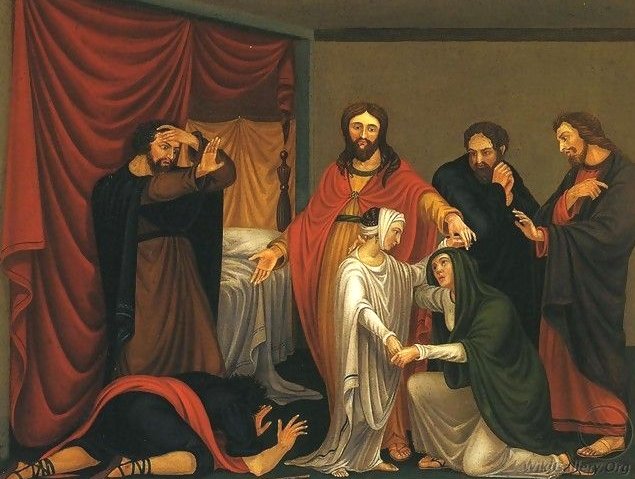
Christ Raising the Daughter of Jairus by William S Mount (1828)

In that same year he produced another biblical work based on Matthew’s Gospel (Matthew 9:23-26).  It was entitled Raising of Jairus’ Daughter.  The subject of this biblical work had been depicted many times before by great artists such as Veronese.  The bible relates the story:

“…When Jesus entered the synagogue leader’s house and saw the noisy crowd and people playing pipes, he said, “Go away. The girl is not dead but asleep.” But they laughed at him   After the crowd had been put outside, he went in and took the girl by the hand, and she got up.   News of this spread through all that region…”

William’s brother Henry was so impressed with the finished painting that he persuaded his brother to submit it at the annual National Academy exhibition.  It was well praised by the Academy professors.  William was now living at his brother’s place on Nassau Street, Lower Manhatten and had a studio in the attic.  He enjoyed painting historical and biblical works but the sales of which were not bringing in enough money so he reverted to portraiture which was always a guaranteed way of raising income.

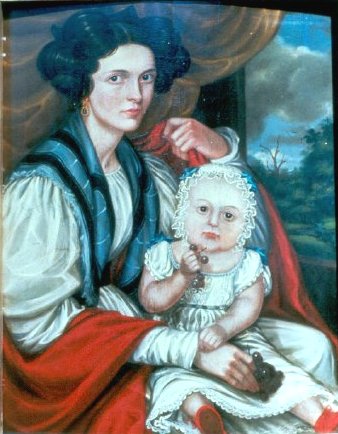
Ruth Hawkins Mount Seabury and Son Charles Edward by William S Mount (1828)

One of his early works of portraiture was a family portrait entitled Ruth Hawkins Mount Seabury and Son Charles Edward,  which he completed in 1828.  It depicts his nineteen year old sister Ruth Hawkins Mount and her infant son Charles Edward Seabury, the first of her seven children.

Ruth Mount Seabury by William S Mount (1831)

William Mount completed a portrait of his sister, Ruth in 1831.

I suppose if you are looking for people to sit for you for a portrait, you turn firstly to your family and in 1828 he completed a portrait of his eldest brother, and his former employer, Henry Smith Mount.

Portrait of Henry Smith Mount by William S Mount (1831)

Three years later, in 1831, Henry Smith Mount was the subject of another of his younger brother’s portraits.  This portrait of his eldest brother (by five years) is a masterful portrait.  He has depicted his brother as a man of great self-confidence, a man who comes across as a thoughtful academic and yet, a man who by his facial expression, seems stern and somewhat menacing, as he stares out at us, lost in his own thoughts.

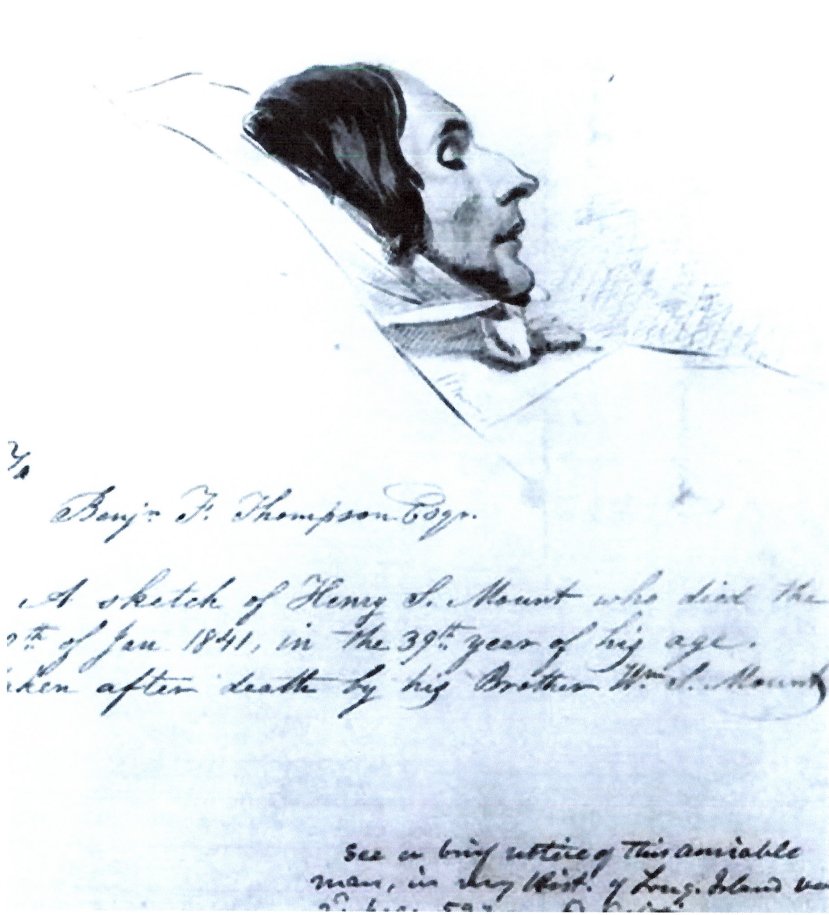
Henry Smith Mount on his deathbed by William S Mount (1841)

Thirteen years on he completed another depiction of his brother, Henry.  The circumstances surrounding this watercolour were much sadder as this was completed in January 1841 and the setting was Henry’s deathbed.  Henry was just thirty nine years of age.

Shepherd Alonzo Mount by William S Mount (1847)

In 1847 William Mount painted a portrait of his other brother, Shepherd Alonzo Mount.

Portrait of Jedediah Williamson by William S Mount (c. 1837)

The next example of William Mount’s portraiture is one he completed in 1837 and was entitled Portrait of Jedediah Williamson.  It is a depiction of a ten year old boy commissioned by his family.  It is a full frontal depiction of the young lad and Mount has carefully and with great skill portrayed the boy’s facial features.  It is a very peaceful depiction of the boy as he looks out into the distance.  The family would have been very pleased to have received the work from Mount and it is recorded that they paid him fifteen dollars for the painting.  However there is a sad twist to this portrayal as this is a “mourning painting” or as Mount referred to them, “a painting after death”.  The boy had died and this portrait was in honour of him and may have given the family a modicum of comfort during the sadness of their great loss.  These “mourning paintings” were very popular at the time and artists found they could achieve a steady income from paintings which, for relatives, served as a reminder of a loved one who had passed away. One should remember that between 1861 and 1865 over 350,000 Americans died during the American Civil War, the families of many just had an artist’s painting to remind them of their lost son or daughter.

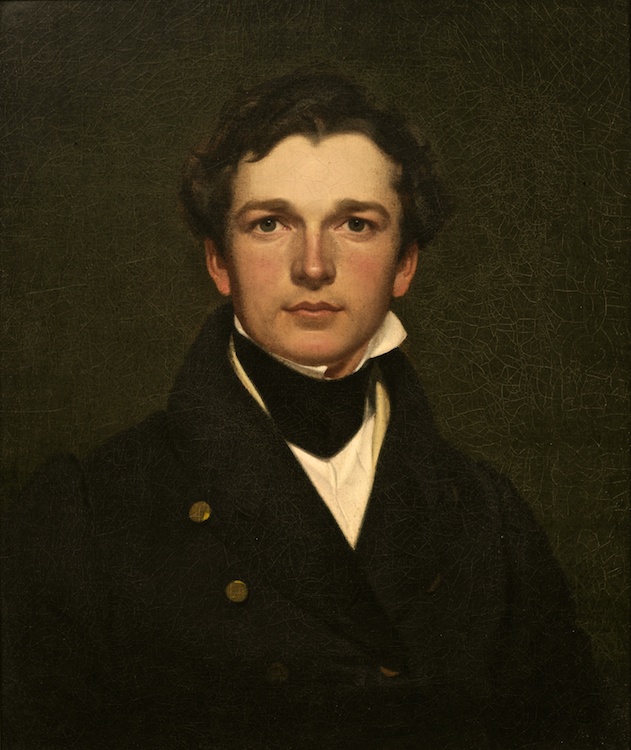
Portrait of Reuben Merrill by William S Mount (1832)

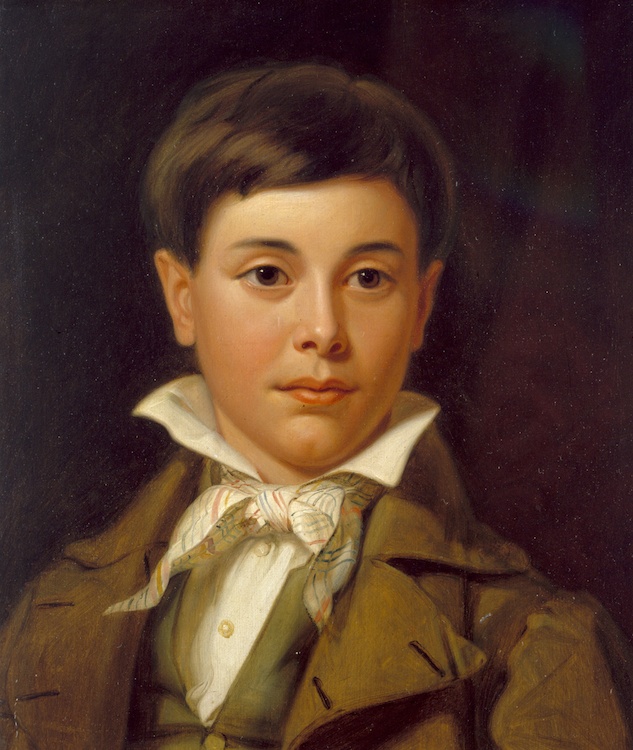
Another interesting portrait by William Mount was one entitled Portrait of Reuben Merrill.  It was one of Mount’s early works which he completed in 1832.  The question, which is yet to be resolved, is who is Reuben?  Some believe he was a gardener whilst others say he was a simple field worker on the farm owned by William’s sister, Ruth and her husband, Charles Saltonstall Seabury.  The fact that he identity of the sitter used by Mount is somewhat of a mystery is not uncommon as a number of the sitters in Mount’s portraits are unknown.  There is warmth about how Mount has depicted this man.  His face is weather beaten from all the outside work but he has compassionate eyes, which leads us to believe that although he was just a poor and simple labourer, there was some sort of warm connection between him and the artist which probably testifies to the fact that he was a hard worker and appreciated by his employers.

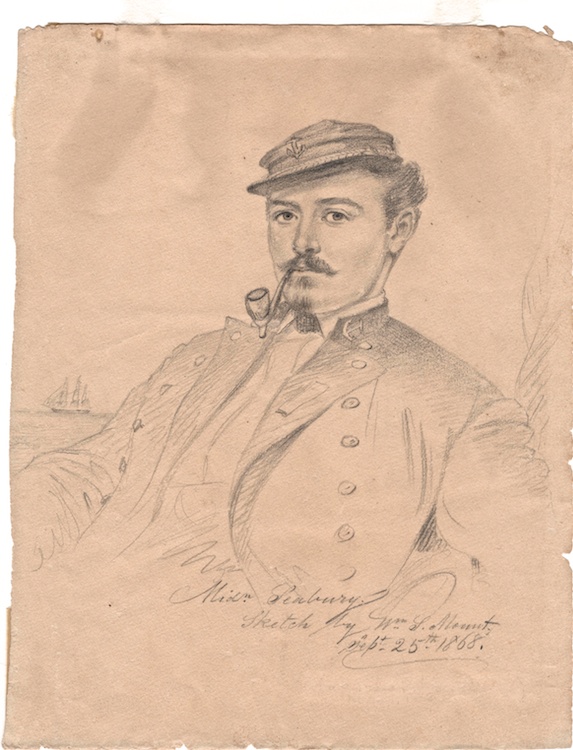
Portrait of Midshipman Seabury by William S Mount (1868)

My last example of Mount’s portraiture was also thought to have been his last artistic work.  It was completed in September 1868, less than two months before Mount’s death, and was a pencil sketch of his nineteen year old nephew Samuel Seabury.  Samuel was one of seven children.  His mother was Ruth Hawkins Mount Seabury, William Sidney Mount’s younger sister, and his father was Charles Saltonhall Seabury.   At the time of the portrait, Samuel Seabury was a midshipman in the navy, and the ship in the left hand background is a reminder of his profession.

In my next blog I will take my final look at William Sidney Mount and his work and I will feature some of his excellent non-musical genre work.

William Sidney Mount. Part 1. The Music Man

William Sidney Mount

Genre art is defined as the pictorial representation of scenes or events from everyday life.  They often depict settings such as a marketplace or tavern or simply everyday occurrences in houses or in the street.  They can be either realistic depictions or imagined ones which may have been romanticised by the artist.  These works of art have one or more persons in the depiction carrying on with their everyday life notwithstanding how unglamorous it may be.  When one thinks of genre paintings one immediately thinks of the seventeenth century art of the Low Countries, the art of the Golden Age, and of the art of Gerard Dou, Gerard te Borch, Pieter de Hooch and Jan Steen just to name a few.  I love this type of art and today I am focusing on another artist who was renowned for his genre works of art.  He however was not from Europe but from America.  He was the nineteenth century American genre artist and portraitist, often looked upon as one of the first American genre painter, the great William S. Mount.  In this blog, I will look at his early life, ponder over his connection with music and showcase some of his works which were influenced by his love of music.

William Sidney Mount was born on November 26th 1807 in Setauket , a small town on the northern side of Long Island, New York. He was the son of Thomas Shepherd Mount and Julia Ann Hawkins.  He was the fourth of five children with three older brothers, Henry Smith Mount, Shepherd Alonzo Mount and Robert Nelson Mount and a younger sister, Ruth Hawkins Mount.  His maternal grandfather was Jonas Hawkins, an American Patriot and a member of the notorious Culper Spy Ring during the American Revolution, whose task it was to send messages to General Washington about the activities of the British Army in New York City which was the British headquarters and base of operations.

Portrait of William Sydney Mount by Charles Loring Elliott. (1848)

William recalled those very early traumatic days as an infant, presumably told to him by his relatives.  According to him he was literally left for dead.  He wrote:

“…The first and most remarkable event of my life occurred when I was about 6 or 7 months old.  I was taken from my Mother (she being very sick) to be brought up by hand – I soon declined for want of proper or abundant nourishment and after several days [was] considered dead by my kind nurse and tenderly laid away as so.  My Father’ sister being sent for to make further arrangements concerning me observed signs of life and immediately commenced nourishing me…”

Due to his mother’s poor health his grandmother played an important role in his upbringing.  In October 1814, a month before William’s seventh birthday, his father died and his mother took him and his four siblings to live on the Stony Brook farmstead owned by her family.  For the next ten years William and his brothers worked on the farm.  It was whilst living at the farmstead that, through his uncle, Micah Hawkins, who had a passion for music and the theatre that William and his siblings developed a love for music, especially the playing of the fiddle which William would often play at barn dances.

Cradle of Harmony
Cradle of Harmony

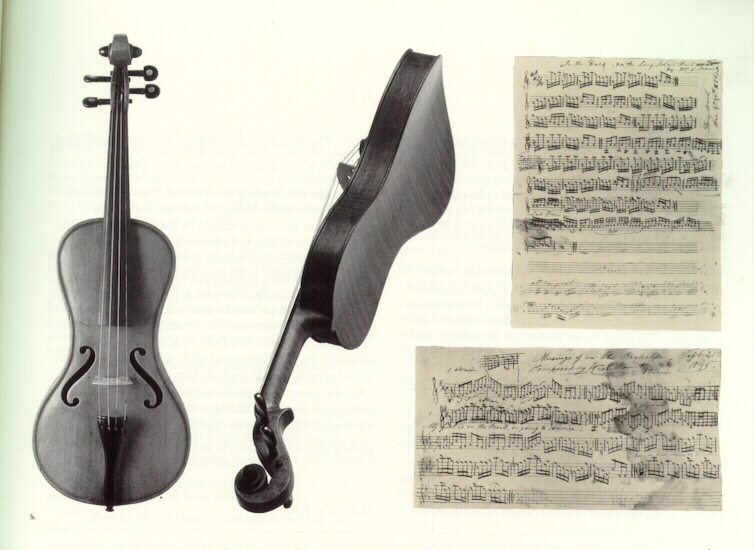
Barn dances were very popular with the farming communities but for them to be a success they needed a good fiddler and one such expert was young William Mount.  Barn dances were raucous and merry events and it could be difficult to hear the lone fiddler amongst the “whooping and hollering” of the dancers and so William decided to invent and instrument which could supply loud music.   In 1852 he designed a violin with a hollow back to make it sound louder than a normal violin and he patented it and called it The Cradle of  Harmony.

 However it was his younger brother Robert, the only one of the family who was not attracted to art who would turn out to be the accomplished musician and dance instructor.  Music however played a part in William Mount’s art as many of his paintings were a blend of music and art.

William Mount worked on the family farm at Stony Brook until 1824, when, at the age of seventeen, he was apprenticed to his older brother Henry, who was a sign and ornamental painter in New York City. It was also around this time that his other brother, Shepherd, became a fellow apprentice. From these small artistic beginnings, all three brothers soon became painters. William, who had taken up drawing seriously when he was eighteen years old studied for a short time with the leading American portraitist of the time, Henry Inman.  However William’s studies with Inman came to an end due to lack of tuition money and his own poor health and he returned home to Setauket in 1827.

Dancing on the Barn Floor by William S Mount (1831)

The painting entitled Dancing on the Barn Floor, which he completed in 1831, was one of Mount’s earliest successes and combines his love of music with his talent as an artist.  The painting is a perfect example of how his studies in perspective influenced him. The converging lines at the centre of the painting are textbook examples of how students were taught to organize their canvases.  The painting is housed in the Long Island Museum of American Art, located in Stony Brook, New York.

Catching the Tune by William Sidney Mount (1866)

Another work by Mount which focused on music was his painting entitled Catching the Tune, which he completed in 1866William wrote in his diary that the tune the musician was playing in this painting was Possum Up a Gum Tree, a title still known today and attached to more than one distinct tune in the South and Midwest.  All three men as well as the women onlookers are white. However, what is interesting is that a a study sketch that Mount did for this painting depicts the musicians’ faces with a subtle increase in African features.

The Banjo Player by William S Mount (1856)

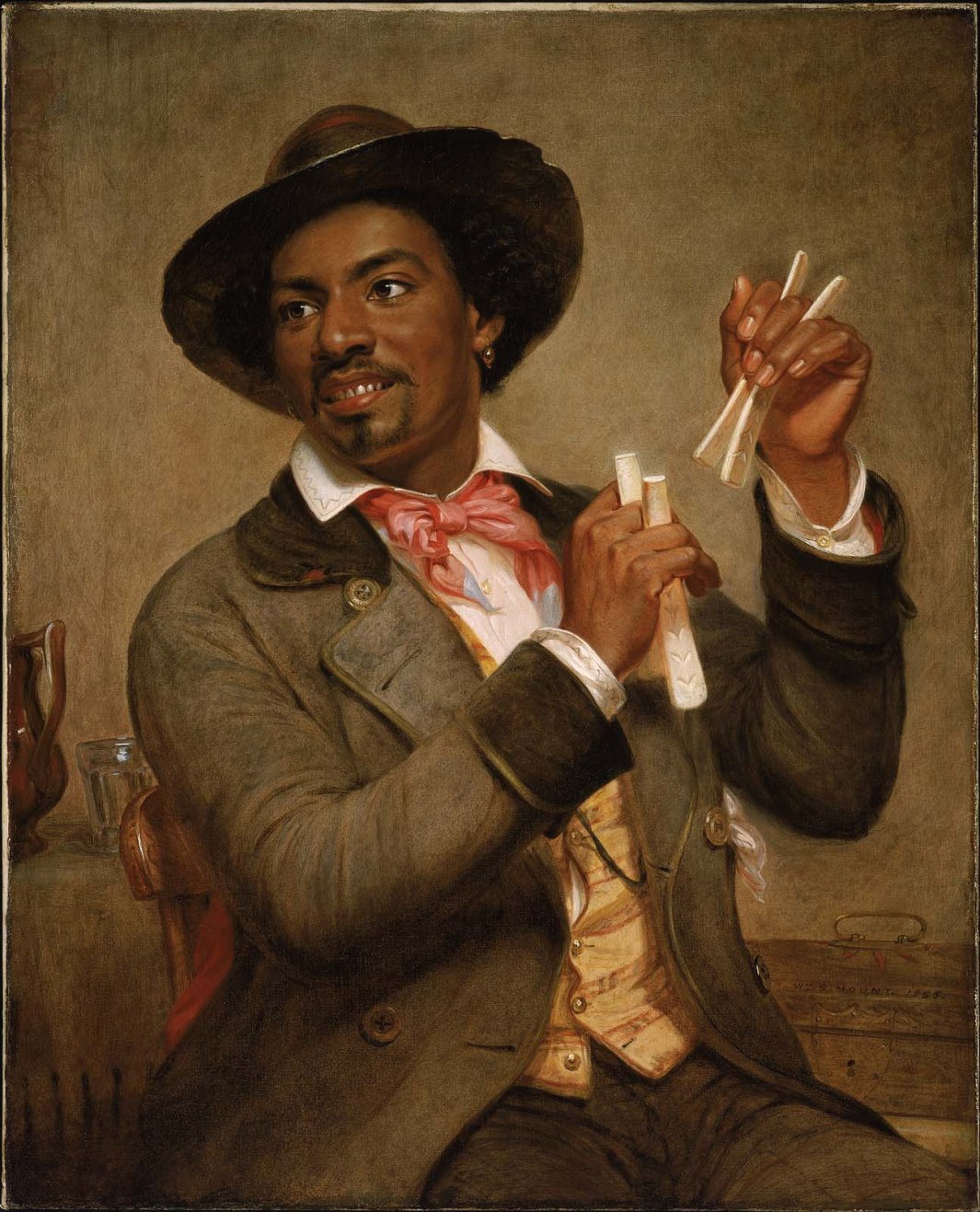
Probably two of his most famous works of art are a combination of portraiture and genre painting.   He completed both in 1856 featuring African American musicians.  They were entitled The Bone Player and The Banjo Player and both had been commissioned by William Schaus.  Schaus was the New York city agent for the European firm of the printers Goupil & Company, who had asked for two pictures of African-American musicians, to be lithographed for the European market.   One should remember that the time Mount completed these works was just five years before the outbreak of the American Civil War and feelings regarding slavery was about to split the country.  Mount was not known as an abolitionist but he was an artist who was in tune with the feelings of the African-American folk and his art always depicted the black man with dignity and sensitivity notwithstanding whether they were portrayed at work or at play.  His art made it very clear that everybody, black and white, should be judged for their own worth and not by the colour of their skin.  There was a simplicity about the two portraits.  It was all about enjoyment.

The Bone Player by William Mount (1856)

By entitling the painting The Bone Player, Mount points out that the work of art is all about the musical skill of the man and not the man himself.   The two sets of bones, one in each hand, are made of wood or bone and are clicked together.  This instrument has always been connected with African-American minstrels, and was easily recognised as such by folks on both sides of the Atlantic.  There was a good market in Europe for this type of work with all its mystic and exoticism.  In some ways Mount’s depiction of the African-American in both portraits was neutral and he left it up to the purchaser of the works how they wanted to interpret what they saw in the painting and this neutrality made the works appealing to Americans from both the North and the South.

Dance of the Haymakers by William S Mount (1845)

A painting by William S Mount which brings out the joy of barn dancing is one he completed in 1845, entitled Dance of the Haymakers.  It is said that Mount was inspired to paint this scene when he heard the song Shep Jones’ Hornpipe, composed by his neighbour Shep Jones who can be seen depicted in the painting as the fiddler.

The description of the work was outlined in a letter from William Mount to William Schaus of Goupil, Vibert & Company written on April 16th 1849.  Mount wrote:

“…[The depiction] represents a barnfloor scene, opening upon a fiddler, two Long Islanders, dancing with great energy, and an old man listening with his fancy evidently touched by the performance at the right, and on the out side of the barn, a negro boy is adding to the excitement and noise by drumming on the door, evidently delighted with the ‘concord of sweet music’ which he thinks he produces.  The noise of the clog hoppers, the music, and the loud laughter of the lookers on, is enough to arouse the village Parson.  The last and not least, a cat watching a dog from ma hollow beneath the door sill, is marvellous for its life and finish, quite equal to the celebrated master pieces of the kind in the Dutch school…

In my next blog I will carry on the story of William S Mount’s life and look at his wonderful portraiture and some more of his genre paintings.

Natalia Goncharova and Rayonism

Natalia Goncharova       1881 - 1962
Natalia Goncharova
1881 – 1962

In my blog today I want to look at the life of the avant-garde Russian painter, stage designer and printmaker, Natal’ya (Sergeevna) Goncharova.   Natalia was born in Russia on her father’s estate in the Tula governate in June 1881.  She was the daughter of Sergey Mikhaylovich Goncharov, a renowned architect and mathematician, and her mother was Yekaterina Il’icha Belyayeva.  However, in her early infant days she grew up in her grandmother’s home at Ladyzhino, near Kaluga. When she was ten years old, the family moved to Moscow and she attended the Fourth Gymnasium for Girls in Moscow and in 1898, when she was seventeen years old she decided to study sculpture and enrolled at the Moscow School of Painting, Sculpture and Architecture as a sculpture student where her tutor was Paolo Troubetskoy.  It was at this establishment in 1900 that she met and became friends with fellow student, Mikhail Larionov.  He had enrolled at the Moscow School of Painting, Sculpture and Architecture at the same time as Goncharova, studying painting under Isaac Levitan and Valentin Serov.  Larionov was a student with very contentious and provocative views and was suspended from the academy on three occasions for his deep-seated opinions.   He and Goncharova became lifelong friends and he was to have a great influence on her.  It was Larionov who persuaded Goncharova to switch from studying sculpture to concentrate on studying painting.

Natalya Goncharova by Laborov

Goncharova’s early work concentrated on the medium of pastels and her first works were showcased at the Diaghilev’s Russian Art Exhibition, which was held in Paris in 1906 at the Salon d’Automne and a year later her first paintings were shown at the Moskovskoye Tovarishchestvo Khudozhnikov (Moscow Association of Artists) of which she was a member.  At this time, her friend Larionov’s painting style was that of Impressionism and Natalya, for a time, also became interested in the style which had become so popular in France.  In 1908 she took part in the Golden Fleece exhibition and it was during this show that she became more aware of a modern style of art with the works of Bonnard, Matisse, Gaugin and Toulouse-Lautrec.  The influence of these painters made Goncharova rethink her artistic style.

Gardening by Natalya Goncharova (1908)

In 1909 she completed a work of art, which highlighted her much-loved topic that of Russian peasants hard at work on the land.  The painting, which is currently housed at the Tate Liverpool, is entitled Gardening.  It is a painting, which is typical of her depictions of peasant life and was made around the time of her stay on a family estate in rural Russia.  Of this style of painting and her patriotism, she explained:

‘…If I extol the art of my country, then it is because I think that it … should occupy a more honourable place than it has done hitherto…”

In the painting we immediately sense her love for colour and her depiction of the peasants is a somewhat stylistic portrayal.  The display caption at the Tate describes the way she has portrayed the subjects shown in the paintings as:

 “…Her statuesque peasants, with their thickset bodies and massive limbs, are imbued with a heroic grandeur…”

 Her subsequent works were so colourful that they were likened to the work of the Fauves, which was an avant-garde movement that thrived in France during the first decade of the twentieth century, led by the likes of Matisse and Derain, these artists were the first to split from the Impressionism.

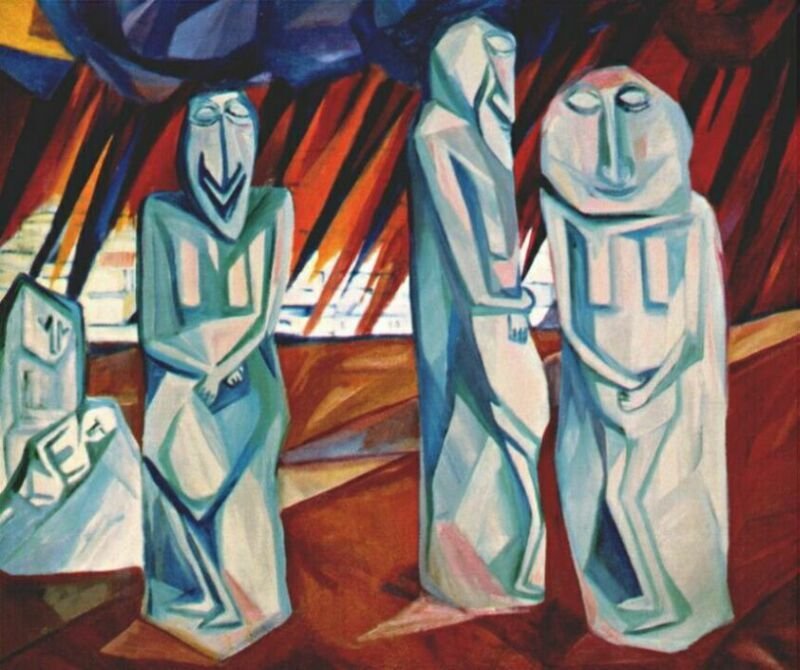
Pillars of Salt by Natalia Goncharova (1908)

  In 1910, Goncharova became one of the founder members of the Jack of Diamonds group, sometimes referred to as Knave of Diamonds.  This group of painters was deemed to be the first group of Russian avant-garde artists and it was Mikhail Larionov who came up with the group’s name.   This collection of painters came from both Moscow and nearby provinces and most of them, including Goncharova, had studied at the Moscow School of Painting, Sculpture and Architecture.  They were all influenced by the works of Cezanne, Van Gogh, Gauguin and Matisse.  Once again we see a group of artists coming together with the common idea that they would discard the links with traditional art, and discard the knowledge that they were taught at their alma mater. For them, it was all about change and new artistic ideas.  Goncharova exhibited a number of her works in the group’s first exhibition in December 1910.  Their art was not loved by everybody, in fact it horrified some.  The influential Russian artist, art critic, historian criticised the group of young artists for having gone too far in overthrowing accepted artistic ideals.  Many other critics and members of the public declared that many of the works of art shown at the exhibition were in bad taste, gauche and lacked artistic elegance and some were even criticised as being too violent.

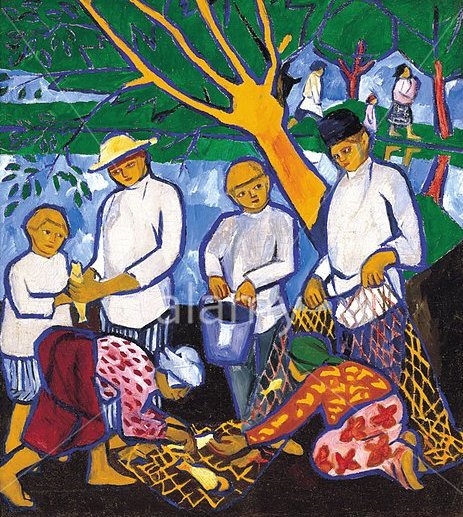
Fishing by Natalia Goncharova (1909)

She exhibited another example of her Primitivist style art at the 1912 Jack of Diamond exhibition.  It had been completed a couple of years earlier and was entitled Fishing.  Again the style is similar to her painting Gardening and is part of the Carmen Thyssen-Bornemisza Collection and is housed in the Thyssen-Bornemisza in Madrid.

The Evangelists by Natalia Goncharova (1911)

 Another one of the paintings which Goncharova exhibited was entitled The Evangelists and this was among her first mature works devoted to a religious subject.   In her 1962 book, The Russian Experiment in Art 1863-1922, art historian, Camilla Gray, the daughter-in-law of Sergei Prokoviev, wrote:

“...The depiction is typical of Russian iconic paintings and so is a combination of old and new influences in Russian art. Perhaps one of the most impressive aspects of these four paintings is their effective use of color, line, and composition to create a strong rhythmic whole. Goncharova manipulates these elements with such understanding and perception that when one looks at the four authors of the Gospels there are no distractions and no weak points — only strength and security in a modern interpretation of tradition and native style. Both line and color become here “expressive entities in their own right” and convey the sense of calm spirituality and wisdom treasured by icon painters. However, what the Neo-primitivists of Goncharova’s time might have treasured most was an almost childish “directness and simplicity” characteristic of folk art which they tried to imitate in their works. Today, the four paintings of the Evangelists may be admired for many reasons, and regardless of the basis for the viewer’s appreciation, they definitely are an integral part of the Russian avant-garde movement…”

This religious work by Goncharova was heavily criticised for its primitive depiction and the critics believed no religious work should be associated with a group known as The Donkey’s Tail as it was bordering on blasphemy and so it was removed from the exhibition.

Peacock in Bright Sunlight (Egyptian style) by Natalia Goncharova (1911)

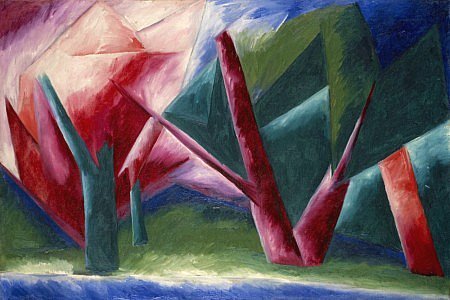
Natalia Gonchorova produced a series of paintings in 1911 that became known as the Peacocks.  They were highly colourful and were influenced by Larionov and his new style of work at the time which was termed Rayonism or Luchism (luch being the Russian word for “ray”) which was a type of abstract or semi-abstract painting.  The Rayonists sought an art that floated beyond abstraction, outside of time and space, and to break the barriers between the artist and the public. They derived the name from the use of dynamic rays of contrasting colour, representing lines of reflected light — crossing of reflected rays from various objects.  .The painting seen above is an example of this and is entitled Peacock in Bright Sunlight (Egyptian style) which can be found in the Tretyakov Museum in Moscow.  The museum’s description of the work states:

“…The works in question combine the laws of Ancient Egyptian art and traditions of Russian folk art. The figure of peacock is transformed into an expressive sign. The bird’s chiselled head and elegant neck are shown in profile, whereas the magnificent tail is spread in front, as prescribed by Ancient Egyptian art. Between them is a green oval providing a background for the neck, head and body. The peacock seems to be examining its own tail in surprise, the tail resembling a grand architectural structure. It resembles at the same time the Coliseum, an arched iconostasis, a rainbow and palette. Unlike the artists of Art Nouveau, who associated peacock feathers with elegant luxury, Goncharova interprets this motif as primordial power, expressed in colours. The image of peacock seems to embody the ancient symbol of immortality…”

All was not well within the Jack of Diamond group as a rigorous debate took place between, on one side, David Burliuk, who was a fervent supporter and strongly supportive of Western art, and on the other side, Natalia Goncharova and Larionov, who favoured Russian themes. The two parties could not agree a compromise and so the Russian artists split into two camps. In the one corner was David Burliuk with his supporters, such as Alexi von Jawlensky and Wassily Kandinsky, who favoured the art which was influenced by Western painters.  In the other corner was the more traditional camp, including Goncharova and Larionov, who believed that a modern Russian art should address the question of national artistic traditions and therefore they disassociated themselves from the Jack of Diamonds on the grounds that Burliuk was a “decadent Munich follower” while the others, known as Cézanne-ists, were conservative and eclectic..

Sunset Over the Adriatic by the ficticious Genoese painter  Joachim Raphale Baronali
Sunset Over the Adriatic by the ficticious Genoese painter Joachim Raphale Baronali

A year later in 1911 the more radical artists in the group, including Goncharova and Larionov, broke away and formed a new artist’s group which Larionov launched as Osliny khvost (the Donkey’s Tail), in order to promote avant-garde art inspired exclusively by Russian themes.  The name, The Donkey’s Tail, derived from a famous Parisian hoax in which the art critic, Roland Dorgelès and Fréderic Gérard, proprietor of the Montmartre café, Le Lapin Agile, had painted a lurid red and blue seascape by tying a paintbrush to a donkey’s tail. The work was exhibited as Sunset Over the Adriatic under the name of Joachim Raphale Baronali at the Salon des Indépendants of 1910 apparently without comment.

Frédé and his donkey artist Lolo

That year, Ilya Repin recounted the incident of the donkey’s tail in his review of Izdebsky’s International Exhibition and used the term as a critical epithet for the modernist work on show. Shortly afterwards, the Russian press satirized the Knave of Diamonds exhibition by publishing a cartoon of a donkey painting with its tail, with the cynical caption:

“…Off home already after looking round just one hall. Don’t be shy. Get your sixty kopeks worth and next year come again. Then we will change the name and under the sign of ‘the Donkey’s Tail’ we will show you the way we paint our pictures...”

In adopting this name for his group, Larionov beat the critics with their own stick.  Other artists to join the group were Marc Chagal and Kazimir Malevich.  The group, however, was only short-lived, disbanding at the end of 1912 having only managing to stage one exhibition in the March of 1912.  Goncharova submitted over fifty works of art to this exhibition.

The Cyclist by Natalia Goncharova

Goncharova continued with her Rayonist works of art but unlike her friend Larionov her paintings depicted distinguishable objects or people, whereas Larionov’s paintings became more pure abstract. One of her most famous works of that period was one entitled The Cyclist in which her depiction cleverly captures the energy of the man on his bike as he passes by.  The blurred background adds to the sense of speed and movement.

Goncharova and Larionov were fervent believers of Rayonism, so much so they issued a joint manifesto in 1913 of what Rayonism meant to them.  The manifesto entitled Rayonists and Futurists, The Manifesto, began with:

“…We, rayonists and futurists, do not wish to speak about new or old art, and even less about modern Western art. We leave the old art to die and leave the “new” art to do battle with it; and incidentally, apart from a battle and a very easy one, the “new” art cannot advance anything of its own. It is useful to put manure on barren ground, but this dirty work does not interest us. People shout about enemies closing in on them, but in fact, these enemies are, in any case, their closest friends. Their argument with old art long since departed is nothing but a resurrection of the dead, a boring, decadent love of paltriness and a stupid desire to march at the head of contemporary, philistine interests. We are not declaring any war, for where can we find an opponent our equal? The future is behind us. All the same we will crush in our advance all those who undermine us and all those who stand aside. We don’t need popularization—our art will, in any case, take its full place in life—that’s a matter of time……..”

The American art historian, Camilla Gray, in her book gave her definition of Rayonism as:

“…[as an art style which] encompasses all existing styles and forms of the art of the past, as they, like life, are simply points of departure for a Rayonist perception and construction of a picture…”

Larionov and Goncharova started to believe that light was the indispensable source of our sensory appreciation of the world and believed that for any object to be observed it had to be lit up and the Rayonist style was to incorporate rays of light that then allows us to view a particular scene. Their manifesto explained:

 “…In fact, we do not sense the object as such. We perceive a sum of rays proceeding from a source of light; these are reflected from the object and enter our field of vision…”

The Forest by Natalia Goncharova (c.1913)

In March 1913 Goncharova’s friend Larionov organised an exhibition entitled Mishen (Target) to introduce the Donkey’s Tail group of painters to the Moscow art critics and public.  One of the paintings Goncharova exhibited at the show was entitled La Forêt (The Forest) which is now part of the National Gallery of Scotland collection.  Although this is looked upon as an example of Goncharova’s Rayonist style with its coloured rays shooting out in different directions, it offers up the thought that Goncharova was more influenced by the Cubist style when she painted this work.  The shapes she has used in the depiction of trees in this work was replicated in a number of her works around this time.  It is a truly fascinating work.


The Forest by Natalia Goncharova (c.1913)

Goncharova went on to design ballet costumes and sets for ballets in Geneva and in 1914 she and Larionov moved to Paris to work alongside the great Russian ballet impresario, Sergei Diaghliev, during which time they designed a number of stage sets for Diaghilev’s Ballets Russes.  Goncharova still found time to carry on painting and exhibited works at the Salon d’Automne, Salon des Tuileries and the Salon des Indépendants.

Goncharova was quite a controversial character.  She was a woman that did not “toe the line” of convention.  It was said that she would sometimes appear topless in public, with symbols painted on her body. In a sense, their use of odd, possibly meaningless symbols united the masses with the past Symbolist aesthetic. In John Bowlt’s 1990 article in the Art Journal entitled Natalia Goncharova and Futurist Theatre, he commented on her bizarre behaviour writing:

“…in private relations and behavior, Goncharova enjoyed a license that only actresses and gypsies were permitted, and perhaps because of this dubious social reputation rather than as the result of any apparent innuendos in her paintings, she was said to traverse the ‘boundary of decency’ and to ‘hurt your eyes…”

According to Mary Charmot who wrote an article in 1955 for the Burlington Magazine entitled The Early Work of Goncharova and Larionov, Diaghliev was full of praise for this unconventional painter who had brought life to his ballets.  He talked of her, saying:

“…The most celebrated of these advanced painters is a woman. [. . .] This woman has all Saint Petersburg and all Moscow at her feet. And you will be interested to know that she has imitators not only of her paintings but of her person. She has started a fashion of nightdress-frocks in black and white, blue and orange. But that is nothing. She has painted flowers on her face. And soon the nobility and Bohemia will be driving out in sledges, with horses and houses drawn and painted on their cheeks, foreheads and necks…”

Project poster for the ballet by Manuel de Falla, El amor brujo by Natalia Goncharova (1935)

Goncharova and Larionov had lived together shortly after their first meeting in 1900 as fellow students at the Moscow School of Painting, Sculpture and Architecture and they stayed together as an unmarried couple for more than fifty years.  She and Larionov became French citizens in 1939 and in 1955 the two artists married.  The reason for marrying so late in their romantic relationship was believed to be so that their paintings would revert to the surviving partner.  In the latter years Larionov and Goncharova suffered financially.   Goncharova suffered badly with arthritis in her hands and it is said that to carry on painting she had to tie the paint brushes to her wrist.  Goncharova died in Paris, in October 1962 and Larionov died two years later.

So what happened to their works of art?  The story goes that when the couple had both died, most of their collections were inherited by another Russian émigré, Alexandra Tomilina, who had met Larionov in the 1930’s when she was his student, and later became his mistress.   After Goncharova died in 1962, Larionov married Tomilina in order that she would inherit all the paintings, which by this time was numbered in the thousands, and by doing so the two artists would continue to be remembered and therefore it would safeguard both artists’ legacies.  Sadly Tomilina had always viewed Goncharova as a love rival and so hated her, so much so that she gave away, destroyed or disposed of many of Goncharova’s works. Tomalina’s old age became one of a life of poverty and so, desperate to pay off her debts, contacted the Soviet authorities and offered them all the remaining artworks if they would financially support her for the rest of her life.  This they agreed to.  When Tomilina died in 1987, her ashes were buried in Goncharova and Larionov’s double grave

Picking Apples by Natalia Goncharova (1909)

After her death, Goncharova was almost forgotten as a painter in the West. Why?  Maybe it was because she painted in many styles — Cubism, Futurism, Neo-Primitivism, Rayism, and  also maybe because she worked in many forms, from oil painting to textile design. This lack of recognition was all to change in 2007 when her work, Picking Apples, which she completed in 1909, was sold at Christie’s Modern and Impressionist sale in London for £4.9 million ($9.8 million), a record for a female artist, only to be bested a year later when her painting, The Flowers, sold for £5.53 million ($10.8 million).

The Flowers by Natalia Goncharova (1912)

Goncharova’s life, like her art, was very colourful.  She was unconventional and actually fell foul of the law on a number of occasions.  She was tried for pornography after a show of nude paintings in 1910 and as I mentioned earlier, her religious paintings were forcibly removed from several exhibitions and for a time were banned by the Holy Synod.

Maria Luise Katharina Breslau

Self portrait by Louise Breslau (1891)

In my recent blogs looking at the life of Marie Bashkirtseff, I talked about the time she spent studying art at the Académie Julian in Paris and her rivalry with her fellow artist Louise Breslau.  Despite the wealthy lifestyle of Bashkirtseff she was still constantly jealous of Breslau, who she perceived as her rival at the academy.  She was also very jealous of Breslau’s friendship with contemporary artists such as Edgar Degas.  So today, I thought I should dedicate this blog to her rival, and look at the life and works of the German-born artist, Louise Breslau.

Two young girls sitting on a banquette by Louise Breslau (1896)

Maria Luise Katharina Breslau, who would later be known simply as Louise Catherine Breslau,  was born in Munich in December 1856 but spent much of her early life in Zurich. She was born into a prosperous middle-class family.   Louise had three younger sisters Marie-Henrietta, Emma and Bernadette.  Her father was an eminent obstetrician and gynaecologist and in 1858 he and his family moved to Zurich where he took up a position as head physician in obstetrics and gynaecology at the University Hospital of Zurich.

Louise suffered badly from asthma when she was young and was often confined to her bed and it was due to this enforced confinement, that to pass the time and counter loneliness, she immersed herself in reading and also developed a love of sketching.

La fille à l'orange by Louise Breslau (1897)
La fille à l’orange by Louise Breslau (1897)

In 1866, When Louise was nine years old, her father died of staph infection which he contracted during the execution of a postmortem examination. Louise, even though still very young, was tasked with helping her mother to bring up her three younger sisters.  When her health worsened, she spent some time in a convent near to Lake Constance where with its warmer climate it was hoped that her health would improve.   It was during her stay at the convent that she became more interested in art and she continued to sketch and paint during her teenage years.  Her love of art and her artistic ability became apparent to her mother who persuaded Louise to attend the drawing classes of the local Swiss portrait painter, Eduard Pfyffer.  She excelled under his tuition but after a while she believed that she had learnt all she could from Pfyffer and she wanted her art to be more than just a pleasing hobby.  All young ladies of a certain class, besides learning about domestic skills, were also encouraged to be able to play a musical instrument and be able to paint or sketch.   However, Louise wanted art not to be just a pleasant pastime, she wanted to become a professional artist and to achieve this she knew she had to leave Switzerland, move to the European capital of art, Paris, and enrol at a specialist art academy.   In 1876 she went to Paris but like many other female artists who wanted the best art training that Paris could offer, she was disappointed with the ruling of the prestigious Académie des Beaux-Arts that only male artists would be allowed to enter their hallowed establishment.  This sexist ruling did not change until 1897.  So, like Bashkirtseff, she enrolled at the Académie Julian who catered for aspiring female painters.

Children reading by Louise Breslau

Her fellow students at the Académie Julian included the Ukrainian artist, Marie Bashkirtseff, Madeleine Zillhardt, the French painter, Sophie Schäppi who, like Louise, had come to Paris from Switzerland and the Irish painter, Sarah Purser.  Louise excelled at the academy and was looked upon by her tutors as one of their best students and this fact did not lie well with Marie Bashkirtseff who was inordinately jealous of her fellow student. In 1879, Louise Breslau, Sophie Schäppi and the singer Maria Fuller moved into a large apartment in the Avenue des Thermes and that same year Breslau had her painting entitled Tout passé accepted at the Paris Salon.  This was a great achievement not only for Louise but also for the female atelier of Académie Julian.

Les amies by Louise Breslau (1881)

Two years later, in 1881, she received an honourable mention at that year’s Salon for her triple portrait entitled, Les amies (Portrait of Friends).  In it we see her friends Maria Feller on the left, Sophie Schäppi in the centre and Louise on the right, with a white dog sitting on top of the scarlet tablecloth.  It is a painting in which we see the three females in a reflective mood.  The painting is now housed in the Musée d’Art et d’Histoire, Geneva.  Louise Breslau was now acknowledged as an up-and-coming artist.  She opened her own studio and soon started to receive numerous commissions for her work from the wealthy of Paris society.

Le thé à cinq heures by Louise Breslau (1883)

In 1883 she was commissioned by the owner of the French newspaper Le Figaro to paint a portrait of his daughter.   She completed the commission and exhibited the painting entitled Isabelle de Rodays at the 1883 Salon.  She also exhibited another of her works, Five O’clock Tea at that year’s Salon and this can now be found at the Berne Kunstmuseum.

Chez soi by Louise Breslau (1885)

In 1885 Louis Breslau completed another great work entitled Chez Soi which is a portrayal of her mother and sister in an interior setting.  The dog sits at the feet of her mother and this genre piece exudes an air of silent contemplation.  The painting resides in the Musée d’Orsay in Paris.

Contre Jour (Louise Breslau and Madeleine Zillhardt) by Louise Breslau

The friendship between Breslau and Madeleine Zillhardt would last a lifetime and she would appear in many of her paintings.  After a brief affair in 1886 with the sculptor Jean Carriès, whom she met through Jules Breton, Louise Breslau chose to share her life with Madeleine Zillhardt and in 1902 the two women moved to a studio in Neuilly-sur-Seine where they set up home.

Jean Carries in his Atelier by Louise Breslau

She eventually became the third woman artist, and the first foreign woman artist to be bestowed France’s Legion of Honour award.  During World War I Breslau, although by this time a naturalised Swiss citizen, and Zillhardt, remained at their home at Neuilly. Breslau showed her patriotism towards her new country, France, by drawing numerous portraits of French soldiers and nurses on their way to the Front. Louise was sixty-two years of age when the war ended and she began to withdraw from public view and was contented to stay at home and sit in her garden, painting flowers but she still loved to entertain her friends.

Louise Catherine Breslau died in May 1927, aged 70 after suffering from a long and debilitating illness.   Most of her estate went to her good friend and long-time companion Madeleine Zillhardt.  As per her wishes Louise Breslau’s body was taken to the small Swiss town of Baden where she was buried next to her mother.

Unlike Bashkirtseff, who died at the age of 25, Breslau had many years to forge her artistic reputation.  Bashkirtseff sadly knew, when she was told that she was dying, that she would never have the time to be able to build up such an artistic reputation as Breslau but of course Bashkirtseff will always be remembered for her diaries.  The works of art of Louise Breslau were very popular when she was alive but sadly, after she died, she was almost forgotten.

Marie Bashkirtseff. Part 2 her later life and diaries

Marie Bashkirtseff (1858 - 1884)
Marie Bashkirtseff (1858 – 1884)

In my previous blog I concentrated on the portraiture of Marie Bashkirtseff but she will probably be remembered best for other genres

One painting by Marie Bashkirtseff which came about during her time at the Académie Julian was one commissioned by the founder of the establishment, Rodolphe Julian.  He asked her to paint a canvas depicting the artists at work in his academy.  The finished canvas was entitled L’Atelier Julian and is now looked upon as one of Bashkirtseff’s finest works.  Initially Marie was not impressed by the commission but could see the benefit for herself, writing in her diary:

“…As for the subject, it does not fascinate me, but it may be very amusing, and then Julian is so taken with it, and so convinced… A woman’s studio has never been painted.  Besides, as it would be an advertisement for him, he would do all in the world to give me the wonderful notoriety he speaks about…”

Atelier Julian (In the Studio) by Marie Bashkirtseff (1881)

The painting portrays the light and airy studio at the Académie Julian where Bashkirtseff and her fellow students would work.  L’atelier Julian is a quite large oil on canvas work measuring 154 x 186cms and is currently housed in the Dnepropetrovsk State Art Museum.  It is a fascinating work featuring sixteen students all taking part in a life-drawing session. The studio looks well organised, although small in size, but that maybe due to the number of people crammed into the room.  As an observer, we firstly focus on the woman seated at the centre of the work.  She wears a bright blue dress.  In her hands are a small brush and a maulstick.  She is working on a painting of the young nude model, who is holding a staff whilst standing on the raised dais so that he can be seen clearly by all the female studentsIf we look past this lady we see one of her colleagues staring out at us.  Maybe someone is entering the room to join this artistic group.  Our eyes now leave the lady in blue and we start to scan the rest of the room.  It is a hubbub of activity.  Some of the females are concentrating intently on their canvases whilst others partake in chit-chat. The two females in the foreground, one seated, one standing, engage in conversation.  The lady standing rests her hand on a wine-coloured velvet drape which has been laid over the back of the chair.  Look at the drape.  See how Bashkirtsteff has showcased her artistic ability in the way she has depicted the elaborate folds of the material.  Many artists in the past and in the present time like to show off their artistic skills in this way.  This large and multi-faceted work was exhibited to great acclaim at the 1881 Salon.

Following a visit to Russia in 1882 to visit her relatives she returned to Paris.  She had not been feeling well and decided to visit her doctor.  In Dormer Creston’s 1937 biography on the artist entitled Fountains of Youth – The Life of Marie Bashkirtseff, he quoted her diary entries:

“…At the doctor’s.  For the first time, I had the courage to say: Monsieur, I am becoming deaf.  It can be borne, but there will be a veil between me and the rest of the world…” 

Later that year her health deteriorated further and she noted in her dairy after visiting the physician that the news was not good:

“…I am consumptive, he told me so to-day…”

Despite her failing health she carried on with her art.  She punished herself by working long hours almost as if she realised her time was almost up and none should be wasted.  It was in 1882 that she met the French painter Jules Bastien-Lepage.  He was ten years older than Marie but he became her confidante and mentor and her greatest inspiration.  It has often been mooted that the two became very close romantically.  He persuaded her to look beyond her wealthy lifestyle and observe and depict in her paintings those who were less financially fortunate than herself.  She listened to Bastien-Lepage and soon the subjects of her work changed.  Her works soon depicted the lower classes and street scenes.  This was such a turn-around for a young woman who had only known the life of affluence.

The Meeting by Marie Bashkirtseff (1884)

One of her best loved paintings featuring the “real world” is entitled The Meeting which she completed in 1884 and was exhibited at that year’s Salon.  It is now housed at the Musée d’Orsay in Paris.   It was an enormous success, both with the press and public alike.  However, much to Bashkirtseff’s annoyance, her painting was not awarded a medal.  In her diary she wrote of her frustration and disappointment:

 “…I am exceedingly indignant because, after all, works that are really rather poor have received prizes…..There is nothing more to be done. I am a worthless creature, humiliated, finished…”

 Marie believed that being awarded a medal by the Salon jurists would help to immortalise her and that, to her, was of the utmost importance as, at this time, she knew her life was coming to an end.  She desperately did not want to die before her artistic talent was recognised.  She dreaded being forgotten.

 In this next work, Marie Bashkirtseff copies the Naturalist style of her friend and mentor, Jules Bastien-Lepage.   Lepage’s naturalism focused mainly on the countryside but Bashkirtseff decided to follow his style of naturalism or realism but concentrate on an urban setting.  In some ways the work is a genre scene, a depiction of everyday life.  Before us are six young boys, who stand in a circle fascinated with what the tallest boy has in his hand, although it is not visible to us.  Whatever it is, it has them deep in discussion.  Some still wear their school smocks.  The shabbiness of their clothes and shoes marks them as coming from poor working-class families and the setting is a run-down working class area.  We see, behind the group of boys, the old wooden fence with the graffiti and the torn posters all inferring that the setting is one of poverty.

 Bashkirtseff’s choice of depicting working-class schoolchildren in this painting may have come about as it was the subject of schooling which had become a great topic of conversation in the early 1880’s with Jules Ferry, a member of the French government at the time, establishing the law that saw the arrival of free, compulsory, secular education.  However other art critics would have us believe that the depiction of the boys was simply a bourgeois stereotype that people like Bashkirtseff would adopt.   Again some people wanted to look for a message in the painting, a message that may only be there in their eyes.  The feminists pointed to the fact that the group are all males and further suggest that the young girl walking away alone is symbolic of the feminist movement and their desire for better integration in society.  In the book, Overcoming All Obstacles:  The Women of the Académie Julian by Gabriel Weisberg and Jane Becker, the writers wrote about the painting and its lack of recognition by the Salon jurists:

 “…While painters at the Salon designated her for a medal, the jury passed on her submission. The public complained.  While Robert-Fleury was encouraging her to include passages of draped figures (to show off her virtuosity in that skill), Marie refused, not finding drapery fitting to her modern street boys.  Again the critics noted her sincerity of execution, freshness of facture, and realism in taking up the subject. While the work did not receive a medal, it was bought by the state, and several engravings and lithographs were made after it…”

Autumn by Marie Bashkirtseff (1883)

 Although I stated earlier that Bashkirtseff wanted to focus on urban portrayals, my next offering of her work is a beautiful painting entitled Autumn, which moves towards a landscape work.  The setting is a rutted tree-lined road which runs parallel to the river.  Through the trees we see an arched stone bridge which straddles the waterway.  The time must be late summer or maybe early autumn as many of the trees have shed their bronze-tinted leaves while others cling to the branches and retain their summer colour.  To the side of the road is a pavement.  Look at the details Marie has depicted of the sidewalk.  The fallen bench straddles the pavement and the road.  The crumbling stonework of the pavement is clearly visible and which is now home for the fallen, windswept leaves and what looks like an abandoned newspaper lies in the gutter close to the fallen bench.  Beside the pavement we see a stretch of garden fencing which has seen better days.  This is an example of Naturalism in art, a style Marie Bashkirtseff had adopted due to the influence of her close friend, Jules Bastien-Lepage.  The painting is devoid of people and this fact alone means we are not distracted from the artist’s detailed depiction of the area.  It also avoids the work of art being focused on people and the depiction of them may turn the painting into a work of Social Realism with the landscape being looked upon as merely a background to a story within the work.  The colours used by the artist set the scene for a certain time of year and also a certain time of day.  One can imagine the lighting of the scene would be different at another time of day and obviously it would be a far different depiction if this had been mid-winter.

 In a diary entry for May 1884, she wrote:

 “…What is the use of lying or pretending?  Yes, it is clear that I have the desire, if not the hope, of staying on this earth by whatever means possible.  If I don’t die young, I hope to become a great artist.  If I do, I want my journal to be published…”  

Marie Bashkirtseff's mausoleum  in Cimetière de Passy, Paris
Marie Bashkirtseff’s mausoleum in Cimetière de Passy, Paris

Four months after this entry, on October 31st 1884, Marie Bashkirtseff died of consumption (pulmonary tuberculosis) in Paris.  She was just twenty-five years old and for her, she sadly believed she had achieved little.

Inside of Marie Bashkirtseff's mausoleum
Inside of Marie Bashkirtseff’s mausoleum

She was buried in Cimetière de Passy in a large mausoleum, designed as a full-sized artist’s studio and has now become a French Heritage site. The inside of Marie Bashkirtseff’s mausoleum we see in the central background a copy of Marie’s bust which was sculpted by her friend the sculptor René de Saint Marceaux.  Behind the sculpture hanging on the wall is one of Marie Bashkirtseff’s last and unfinished paintings entitled Women Saints. At either side, on pedestals are busts of her parents Sadly almost two hundred of her works were destroyed or looted during the Second World War.  However her journal was published by her family in 1887.  Sadly it was an abridged version which had been heavily censored by her relatives who thought a lot of the contents about them were unflattering seeing to it that a good deal of material was critical and unflattering to the family and unfit for the reading public.  Having said that however, the diary stands as one of the great diaries of its time.  It was not until some years later, with the discovery of Marie’s original manuscript in the Bibliothèque nationale de France that it was realised that the diaries published by the family had been heavily edited.   An unabridged edition of the complete journal, based on the original manuscript, has been published in French in 16 volumes, and excerpts from the years 1873–76 have been translated into English under the title I Am the Most Interesting Book of All.

The diaries were started by a girl of fourteen and they began as a simple coming-of-age journal but later developed into an often sad account of how life conspired against her and her fight to survive.

I will leave you with an entry in her diary when she talks about how people may remember her.  She wrote:

“…If I do not die young I hope to live as great artist; but if I die young, I intend to have my journal, which cannot fail to be interesting, published. Similarly: “When I am dead, my life, which appears to me a remarkable one, will be read. (The only thing wanting is that it should have been different)…”

Marie Bashkirtseff. Part 1 The portraitist and feminist

Photograph of twenty year old Marie Bashkirtseff (1878)

I had been researching the life of Jules Bastien-Lepage for a future blog when I came across the fascinating story of a Ukranian lady, a friend of his, who during her very short life excelled as a painter, a sculptor and a diarist.  It was her talent as a diarist and her personal diary which led to her notoriety.  I have split her lifestory, as short as it was, between two blogs, so come with me and explore the life of Maria Konstantinovna Bashkirtseva who became better known as Marie Bashkirtseff and her portraiture.

 Marie Bashkirtseff was born in November 1858 at Gavrontsi, a beautiful country estate close to the provincial town of Poltava in southern Ukraine.  Her father was Konstantin Bashkirtseff and her mother Mariia Babanina, who was a lady, fiercely proud of her Tartar heritage.   The family were wealthy and were looked upon as being of the petite noblesse social class, which was a termed used to describe the lesser nobility of France, especially rural landowners of noble ancestry.  A year later Marie’s brother Paul was born.  Marie was a studious and very intelligent child, speaking Russian and French fluently and even when young she exhibited a dynamic personality.  Her parents split up in 1859 and her mother took her and her brother back to her parents’ home in Tcherniakovka. 


The Umbrella by Marie Bashkirtseff  (1883)
The Umbrella by Marie Bashkirtseff (1883)

In May 1870, when Marie was eleven years old, her grandfather, Stepan Babanin, her brother Paul, and a motley collection of other family members, along with the family physician, Doctor Walitsky, left Tcherniakovka for good and embarked on a voyage of discovery around Russia and Europe.  The extensive journey lasted almost two years until the weary travellers settled down in a villa situated in the foothills of the Mediterranean Alps overlooking the coastal resort of Nice.  It was at this idyllic setting that fourteen year old Marie started to dabble with her artwork and also started to write her diary.  This diary which was eventually published in 1887, three years after her death, was to become a best seller.  In it she would write about her life on the Côte d’Azur with her extended family, her teenage infatuations, her dreams for the future and her loves.  She had a fixed idea of what her diary would be all about, writing:

 “…If I don’t live enough to be illustrious, this diary will be interesting for naturalists; the life of a woman is always curious, day by day, without affectation, as if nobody in the world should ever read it and at the same time with the intention of being read; I’m sure that you will find me pleasant… and I mean everything. Otherwise, what’s the point in writing? Apart from this, you will see that I say everything…”

Portrait of Mme X by Marie Bashkirtseff (c.1884)

 Marie Bashkirtseff received a well rounded education.  She was home-tutored with the family employing governesses and private tutors and she studied a number of languages including English, German, Italian, Greek and Latin.  She was well versed in history, mythology and literature and it was that knowledge that found its way onto the pages of her diary.   She also developed a great love of music and singing.   She was an accomplished pianist, played the harp and was a talented singer and she hoped that one day she would become a professional mezzo-soprano.   This plan for her future was to be dashed after a severe bout of laryngitis which irrevocably affected her vocal chords.  She was devastated at this turn of events, once musing in her diary about what could have been:

 “…My God!  What a beautiful voice I had!  It was powerful, dramatic, captivating; it gave chills in the back. And now I have nothing, not even a voice to speak with!…”

 With music being a thing of the past, Marie needed another outlet for her exuberance and it came in 1877,  when, aged nineteen,  she decided to embark on a career as an artist.  For this to happen she decided that Nice was not the place to be and insisted that the whole family should move to the European capital of art, Paris, for it was here she believed she would receive the best art tuition and be able to study the paintings of the Masters.  The family opposed the move, not because they didn’t want to move to the capital but because of Marie’s fragile health.  They believed that the warm climate of Nice was more suitable for Marie than the colder, damper climate of Paris.  It was not because of their wish to stay warm and enjoy the sunny climate of the south but it was because Marie had been diagnosed with irreversible tuberculosis and doctors had warned against such a move.  However the dominant and forceful character of Marie won the day and that year they left the south of France and moved north.

Portrait of a Woman by Marie Bashkirtseff (1882)

The Parisian establishment, which was in the forefront of art tuition, was the École des Beaux-Arts but this was not an option for Marie as, at that time, women were not allowed to enrol for study at that academy.  Marie then chose to enrol at the Académie Julian, which was the only academy at the time which accepted female students, albeit the men and women trained separately.  However the training for females was similar, even allowing women to participate in life drawing classes with nude models, which was frowned upon by other art establishments.  It was founded by Rodolphe Julian in 1868.  It was a private studio school for art students, which, as well as training aspiring male artists to pass the exams to enter the hallowed and prestigious École des Beaux-Arts,  it also offered independent training in arts to wannabe female painters.  Whilst there Marie received excellent artistic training under the tutelage of the likes of Rodolphe Julian, Tony Robert-Fleury, Gustave Boulanger, and Jules-Joseph Lefebvre.  She revelled in this world of art and even the glamour of her social life took a back seat as she commented in her diary:

 “…as for me, although feeling pleased of being in the ballroom, I’ve been thinking all the time in a pastel painted this morning with which I wasn’t satisfied…

 Marie was a perfectionist in all that she did and was highly competitive.  This latter characteristic manifested itself in her fierce competition with her fellow student, the Swiss-born painter, Louise Catherine Breslau.  They both exhibited works at the Paris Salons and Marie’s competitive nature soon turned to jealousy, jealous of the artistic ability of her fellow student.  She looked upon Breslau as a competitor in the race to be recognised by the art critics and the public.  Breslau was two years older than Bashkirtseff  but was to outlive her by more than forty years and so was able to consolidate her reputation within the art world.

Parisienne, Portrait of Irma by Marie Bashkirtseff (1882)

Marie Bashkirtseff, besides her dedication to painting, developed another love whilst living in Paris.  She was drawn to the feminist movement .  Hubertine Auclert had founded the feminist movement known as Le Droit des Femmes in 1876, the year before Marie had arrived in Paris.  It was a movement that supported women’s right to have the vote.  Marie, using the pseudonym, Pauline Orell, applied her innate ability as a writer to produce articles in support of feminism.  She had some of her writings published in La Citoyenne, a bi-monthly feminist newspaper first published Hubertine Auclert in Paris in 1881.  In the March 1881 edition an article by Baskirtseff appeared which linked her artistic career with that of the plight of women.  She cynically wrote:

 “…I will not surprise anyone by saying that women are excluded from the School of Fine Arts as they are almost everywhere.  Yet we admit them to the School of Medicine, why not at the École des Beaux-Arts.  Perhaps one fears scandals that would cause the element in this female comedies environment…” 

Jeune Femme Lisant la Question du Divorce d'Alexandre Dumas (Portrait of a Young Woman Reading) by Marie Bashkirtseff (1880)
Jeune Femme Lisant la Question du Divorce d’Alexandre Dumas (Portrait of a Young Woman Reading) by Marie Bashkirtseff (1880)

In 1880 , Marie Bashkirtseff submitted a beautiful work of portraiture to the Salon.  It was entitled Jeune femme lisant la Question du Divorce d’Alexandre Dumas (Portrait of a young woman reading).  It was not simply a portrait of a young woman,  it was a work of art with a message.  We see before us a portrait of a beautiful and stylish young woman who is totally engrossed in reading her book, The Divorce Question by Alexandre Dumas.  The sitter for this portrait is thought to be Marie’s cousin, Dina Babanine, who two years after Marie’s death would marry and become the Countess Toulouse-Lautrec.  There is a feminist statement behind this depiction.  There is the message that beautiful women have intelligence.  The title of the painting tells us the title of the book she is reading.  It was the 1880 work by the well-known author, Alexandre Dumas, who was discussing divorce and the French laws appertaining to the subject.  It was a controversial book and in some ways a ground-breaking one.  The serious and intellectual nature of the book was a statement that women do not, as believed by many, especially men, only read frothy romantic novels.   The artist was also making a statement regarding the important position of women in society.  In this case, it was about her aspirations for female independence.  The right to divorce and break free from an abusive relationship, the same right as men to be trained to become an artist, the women’s right to vote.  It was simply her belief regarding the right of women to be equal to men.

Portrait de la Comtesse Dina de Toulouse-Lautrec, by Marie Bashkirtseff (1883)

Dina Babanin featured in another of Bashkirtseff’s works.  It was a work in pastels, simply entitled Dina Babanine and was completed in 1883.   Dina was Marie’s cousin and also a close life-long friend.  Her early upbringing was in total contrast to that of Marie.  Dina and her brother had been brought up in a very disruptive household.  Her father had his marriage to their mother annulled making his children illegitimate.  This beautifully crafted portrait depicts the beauty of Marie’s cousin.  She wears a pale blue décolleté peignoir with a wide delicate white collar.  Her face, neck and chest have been depicted using delicately blended light tones which enhance the youthful beauty of the sitter.  Her full lips are pressed together but it is her eyes that catch our attention.  They are dark blue in colour.  She does not quite focus upon us.  There is a feeling that she has lost her power of concentration and there is a blankness about her stare.  Like all inquisitive and discerning observers we search for imperfections of her beauty but they are hard to find.  Maybe we comment upon the slight cleft of her chin.  Maybe we remark upon the flatness of her nose.  However we cannot but acknowledge her overall beauty.  Look at the composition.  It is all about the female.  There is no jewellery, no flowers attached to her simple but revealing dress with its plunging neckline.  The artist wanted nothing to divert our attention from her cousin’s beauty and in that she has unquestionably succeeded.

In my next blog I will conclude her life story, look at some of her most famous paintings and reveal more about her diary.