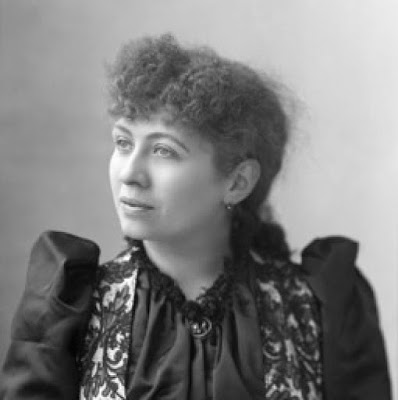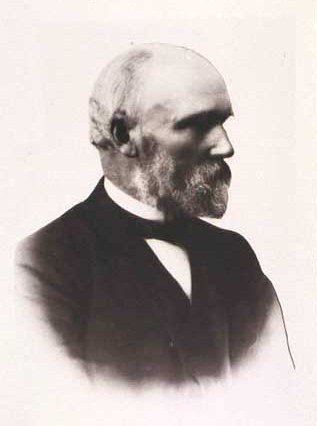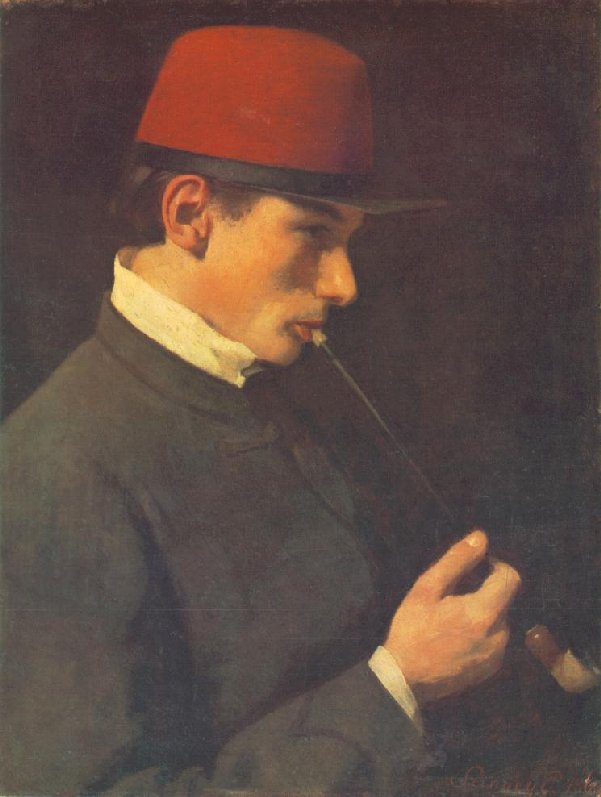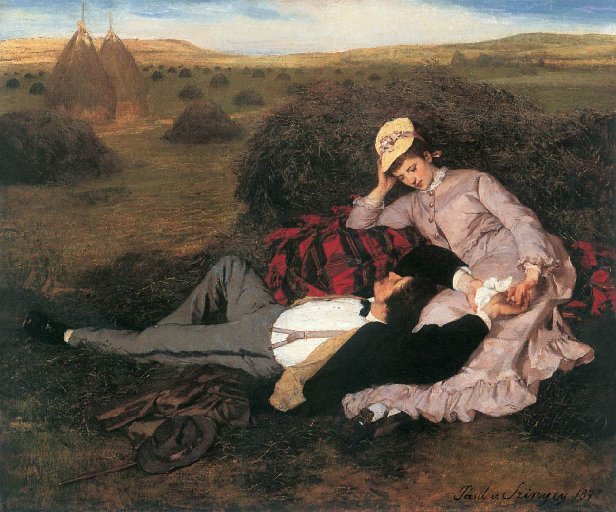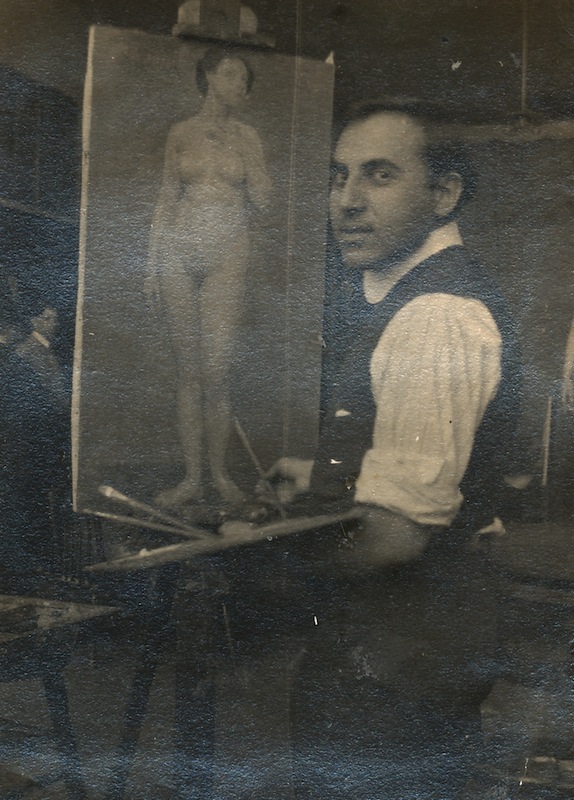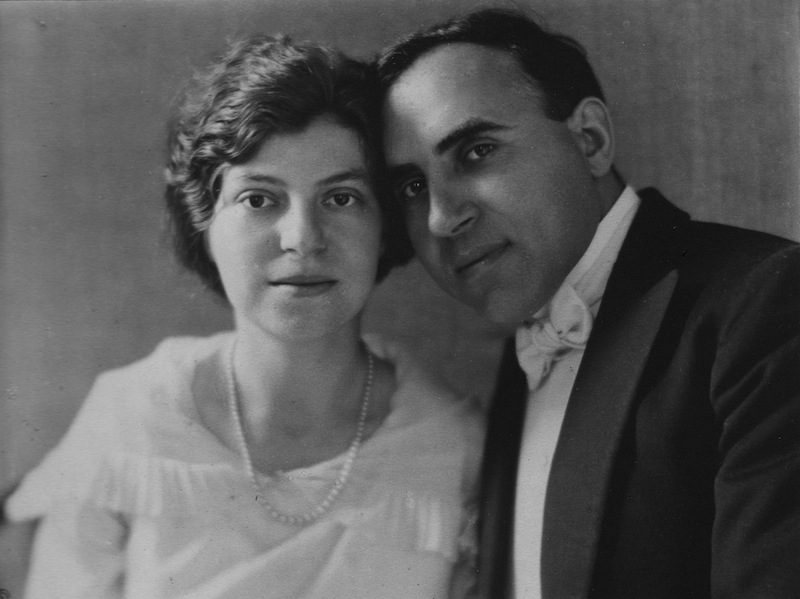
Jean-Baptiste Armand Guillaumin

Jean-Baptiste Armand Guillaumin, the French impressionist painter and lithographer, was born on February 16th 1841 in Paris.  He was brought up in a working-class family, the grandson of Jean Joseph Guillaumin who was a notary by trade.  He was sent to school in Moulins, where his family came from, and this period in central France, made him take note of the beautiful surroundings and the mountainous landscape which stimulated his interest in art and it was also in Moulins that he first met Eugéne Murer, a pastry chef, author, self-taught painter and collector of impressionist paintings, who became his life-long friend.

Farms in Janville by Armand Guillaumin (1878)

By 1857, at the age of sixteen, Guillaumin returned to Paris and began working as a clerk in his uncle’s lingerie shop awhile also studying art under the sculptor Louis Caillouet.  His interest in art and the time he spent studying it caused friction with his family and he left to hold a position in the French government railways. He then continued his art training at the Académie Suisse where he trained to draw from the models, in the mornings and evenings.  It was here that he first met with Courbet, and began more lasting friendships with painters such as Cézanne, Pissarro and Francisco Oller, a Puerto Rican Impressionist painter.

Garden in Janville in June by Armand Guillaumin (1886)

Now friendly with the artists associated with the Anonymous Society of Painters, Sculptors, Engravers, (later dubbed The Impressionists) he was able to exhibit with them at the first Salon des Refusés in 1863 and their first joint Impressionist Exhibitions in 1874 at the former studio of the photographer Nadar (at 35 Boulevard des Capucines) in Paris, and in total he submitted work to six of their eight annual exhibitions.  Still young, the art critics of the time judged him to be an accomplished draughtsman who completed amazing mature compositions.  He developed connections with Emile Zola and his circle of friends and was greatly influenced by the artwork of Manet and Courbet.

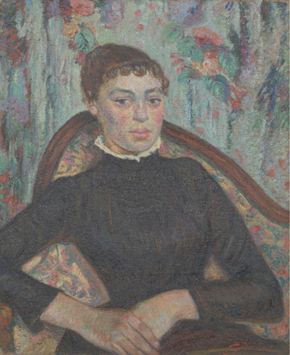
Portrait of a Young Woman by Armand Guillaumin (1876)

One of the problems Guillaumin soon encountered was financial as he had no private income to turn to and so he had to continue holding down a job to survive.  This situation was further exacerbated with the advent of the Franco-Prussian War in 1870.  Once the War and the Paris Commune fighting had ended there was some hope for Guillaumin who had managed to have himself included with the popular Impressionist movement.  Guillaumin and fellow Impressionist, Cézanne had met up with Dr Paul-Ferdinand Gachet, a French physician most famous for treating the painter Vincent van Gogh during his last weeks in Auvers-sur-Oise, and he bought a number of their works.  Guillaumin also sold a number of his works to his friend, Eugéne Murer who had recently established a successful café in Paris. Guillaumin and Cézanne began sharing a studio but both found themselves in precarious financial positions despite the sales of their work to Gachet and Murer who continued to be close friends of the pair.

Cottages in a Landscape by Armand Guillaumin (1896)

At the start of the 1880s the Impressionist group was beginning to break apart and it split into two camps.  One headed by Pissarro and the other by Degas.  Gaugin had vociferously supported Pissarro and he had allied himself with Guillaumin.  Although not initially supportive of the Impressionist group having misgivings about what its intentions were, Renoir and Monet joined the Impressionist Exhibition of 1882 with Guillaumin, Gauguin and Pissarro as well as Sisley, Morisot, Vignon and Caillebotte.  However, Degas was noticeably absent.

Moulins en Hollandee by Armand Guillaumin (1904)

It was somewhat surprising that Paul Gaugin, known for his irrational behaviour towards his fellow painters, continued to befriend Guillaumin and keep him in the Impressionist group despite its continued disintegration.  It was through Gaugin, that Guillaumin met many new young artists who had arrived on the Paris art scene such as the Symbolist painter, Odile Redon, and the Pointillists, Georges Seurat and Paul Signac. In the mid 1880s Guillaumin’ s studio had become a meeting place for the young group of painters.  By 1885, new styles of painting had come to the fore and this resulted in further rifts between the old guard of Impressionism resulting in the disintegration of the Impressionist Group. The other factor for the break-up of the Group was its leading man, Gaugin, became more and more temperamental and intolerant and was destroying the Movement from the inside.  Guillaumin decided it was time for him to exit the movement which he had been part of from the very start.  Guillaumin’s reputation had grown over the last decade and Paul Adam wrote in La Revue Contemporaine:

“…I was not aware of any other painter who has so correctly noted the corresponding values of the lights of the firmament and of the ground…. their unification in colour appears to be perfect…”

Again, Felix Feneon, the French art critic, gallery director, and writer reiterated this, writing about the same show Immense Skies and commented on Guillaumin’s work:

“… superheated skies where clouds jostle each other in a battle of greens and purples, of mauves and of yellows…”

Vue de Port by Armand Guillaumin (1880)

t was in 1886 that Guillaumin married.  His wife was his cousin Marie-Joséphine Charreton, a schoolteacher, who was able to support him financially.  They settled down at 13 quai d’Anjou in the Saint-Sulpice area of the 6th arrondissement of Paris. It had previously been the studio of the painter Charles-François Daubigny. Guillaumin’s relationship with Pissarro eventually ended with the latter beginning to concentrate on experimentation with pointillism while Guillaumin became progressively interested in romantic art. Guillaumin’s relationship with Gaugin also in due course ended as the latter being constantly away on his travels.

Agay Bay by Armand Guillaumin (1910)

From 1875 to 1880, Guillaumin was a frequent guest of Dr Gachet at Auvers, at a time when he was travelling in that area searching for views of the rural scenery of the Yonne valley to paint and, later, the Creuse valley and the countryside around the farming village of Crozant, where he spent most of his life. Around 1887 Guillaumin became a good friend and mentor to Vincent Van Gogh, who was twelve years his junior. Vincent’s letter to fellow painter Ermil Bernard in December 1887 shows how highly he thought of Guillaumin:

“… I believe that, as a man, Guillaumin has sounder ideas than the others [the Impressionists], and that if we were all like him we’d produce more good things and would have less time and inclination to be at each other’s throats.

Again in a letter to his brother Theo in June 1888, Van Gogh writes about a visit he made to Guillaumin’s house and how he was inspired by him:

“…Wasn’t it pleasant at Guillaumin’s last winter — finding the landing and even the stairs, not to mention the studio — chock-full of canvases? You understand since then that I have a certain ambition, not about the number of canvases, but that these canvases as a whole should, after all, represent a real labour on your part as well as mine…”

Neige by Armand Guillaumin (1876)

In the last decade of the nineteenth century Guillaumin’s circle of artist friends was dwindling.  Vincent van Gogh died in July 1890 and his brother Theo, the art dealer, died in the January of the following year.  Gaugin and Cézanne had left Paris and Guillaumin and Pissarro’s views on art had diverged so much that their friendship had gradually faded.  Despite all this Guillaumin’s life was to change rapidly when won he won the sum of 100,000 francs (about 400,000 euros in today’s money) in a state lottery.  This completely changed his life.  He no longer had to rely on commissions.  He no longer had to exude a subservience towards patrons.  He was now able to paint what he liked and strive for his own artistic goals.

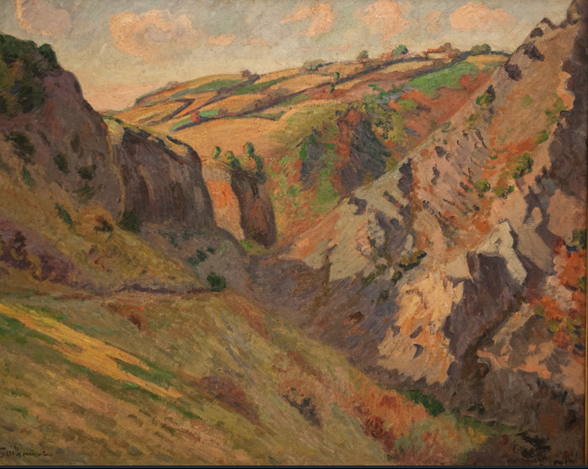
Caves Prunal near Pontgibaud by Armand Guillaumin

With this newly found wealth Guillaumin set off travelling around France capturing on his canvases the beautiful views of the countryside, mountains and the coast, often during sunrise and sunset.  His continuous journeying around was brought to an end with the onset of The Great War of 1914.  Once the war came to an end he once again set off on his travels but by then he was seventy-seven and he, like his artistic output, was declining.   In 1926 a retrospective exhibition was held at the Salon d’Automne.  He died at the Chateau de Grignon in Orly, Val-de-Marne, just south of Paris, on June 26th 1927 aged 86. He was the last survivor of the Impressionist Group.

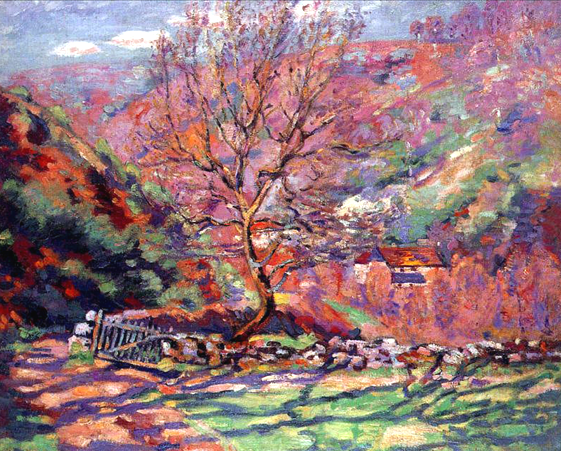
Crozant, Solitude by Armand Guillaumin (1915)

Guillaumin’s paintings are renowned  for their intense colours and can be found in major museums around the world. Most of all he is best remembered for his landscapes of Paris, the Creuse département, and the area around Les Adrets-de-l’Estérel near the Mediterranean coast in the Provence-Alpes-Côte d’Azur region of France. Guillaumin became known as the leader of the École de Crozant, a disparate group of painters who came to portray the landscape in the region of the Creuse around the village of Crozant.

Paysage à Crozant (1917)

One such depiction is entitled Landscape in Crozant, is part of the Art Institute of Chicago collection.

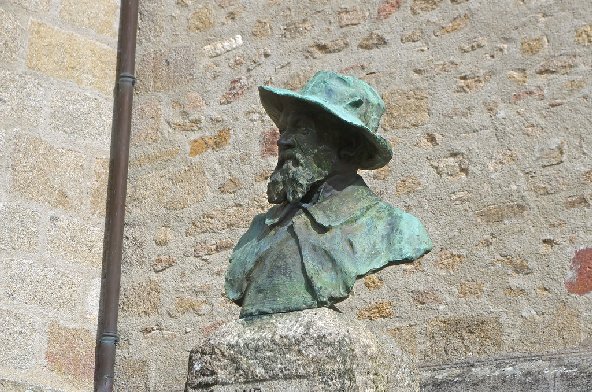
His bust is in the square near the village church in Crozant.

Walasse Ting

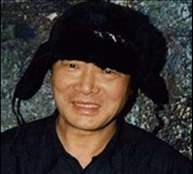
Walasse Ting (1929-2010)

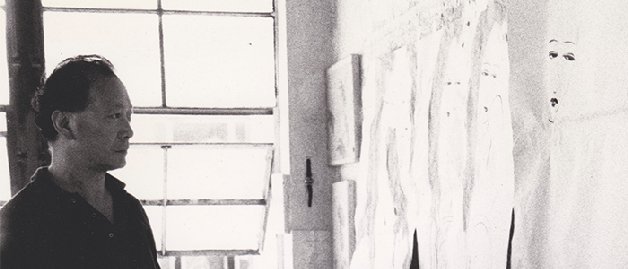
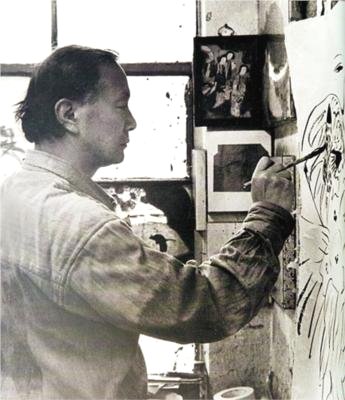
Walasse Ting at work in his studio

I have just returned from another stay in the Algarve where I could finally see some sun and experience warm weather.  Whenever I visit the Algarve, I always visit the Art Catto gallery in Loule which I have often written about.  This time I not only got a chance to return to the excellent small gallery in the centre of town,but take up their invitation to the opening of an exhibition at the Conrad Hotel in Quinta do Lago.

Conrad Hotel, Quinta do Lago, Algarve

The Conrad Hotel is, to say the least, a spectacularly lavish hotel, and the entrance foyer rooms where fine places to exhibit the expensive works of Walasse Ting.  Seven years after his death, Walasse Ting’s has been given a place as a giant of 20th century paintings. He is such a captivating figure and the art he has produced over his 50-year career reveals many influences.   Today, his artwork is in public collections which include MOMA, New York; Guggenheim Museum, New York; National Gallery of Chicago, Chicago; Tate Modern Museum, London; Centre Pompidou, Paris; Hong Kong Museum of Art, and the Shanghai Art Museum. 

Beautiful Ladies by Walasse Ting

Many devoted private collectors also own his artwork. The latter group is growing especially fast, thanks in part to the rise of China as an economic and cultural force.  From the very early works, Walasse Ting’s paintings have charmed viewers with his use of vivid colours and light-hearted mood.

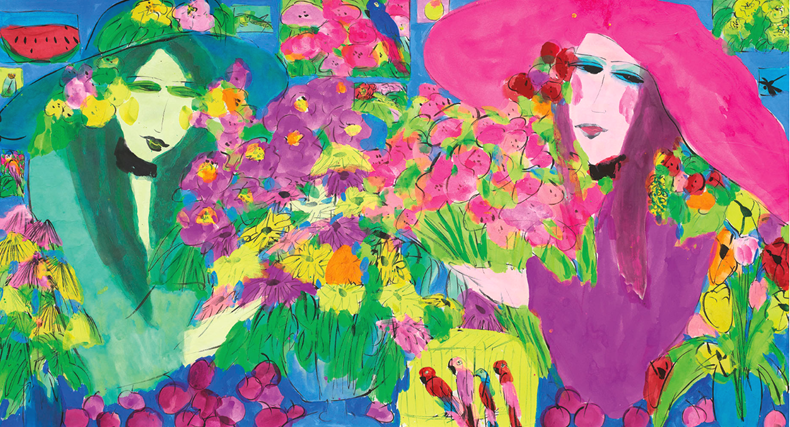
Ladies with Parrots by Walasse Ting

Walassi Ting is a Chinese artist who was born in Wuxi, China in 1929 but in fact was raised in Shanghai.  Ting is primarily a self-taught painter, sculptor, graphic artist, lithographer and poet, who began his life as an artist at a very young age. Ting studied at the Shanghai Art Academy before he left China in 1946 and after living briefly in Hong Kong set sail for France in 1950.   Times were hard for the young aspiring artist continually battling against poverty.  His stay in Paris coincided with the rise of the avant-garde artistic group known as CoBRA.   The word Cobra is derived from the French names of the cities of Copenhagen, Brussels and Amsterdam.

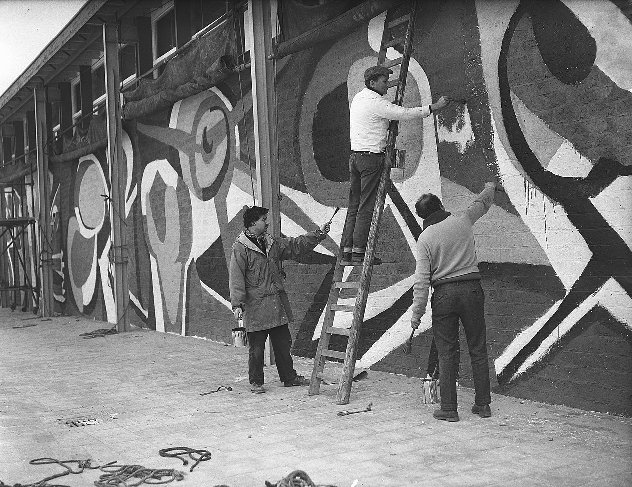
CoBra member Karel Appel working on a mural in Rotterdam for the Manifestation E55

The artists had founded the CoBRA group during a major international conference held in Paris in 1948 and they came from these three European capitals.  Ting became acquainted with all the members of the avant-garde group, most notably Pierre Alechinsky and Asger Jorn.

Women with Flowers by Walasse Ting

Walassi Ting left Paris and arrived in New York in 1959 and participated in the Pop Art and Abstract Expressionism movement where his closest associates were artists Sam Francis and Joan Mitchell, members of the second generation of Abstract Expressionist painters.  He sold many paintings which often featured bold dripping strokes.  It was just over a decade later in 1970 that Walassi Ting created a distinctive style using calligraphic brushstrokes to define outlines and filling flat areas of colour with vivid paint. After 15 years of abstract painting, Walasse Ting’s interest in the body and his exploration of sexuality led him back to figuration in the 1970’s.  Like the colour master, Gauguin, Ting made a number of journeys to Tahiti continually on the lookout for the exotic colours that he loved. The subject of his paintings often contained women, cats, birds and peacocks. 

Kiss me, Kiss me by Walasse Ting

Ting embraced sexual desire through his art, as he conveyed his inner emotions through the fluent and expressive brushstrokes as he captured the alluring beauties set against a background of uncontrolled vibrant acrylic colours that break free into a dreamscape of sensual pleasure. In his 1974 acrylic on paper work entitled Kiss Me, Kiss Me, the title of the work and the bare-breasted model conjure up the emotions of sexual passion.   The work comprises of flat planes of colour and simplified lines, and the woman exposes herself to us, and is drenched in a tumult of multicoloured drips as if she was incorporated into an abstract expressionist canvas.

Come Talk to Us by Walasse Ting

In the summer of 1976 Ting produced his acrylic on canvas work entitled Come Talk to Us which depicted two half-length female figures who stare at a plant-like bouquet of colours at the centre of the image, an image which divides the image in two. The mirror-image like effect creates a sense of calm and balance, and the dabs of green, blue, and red paint trickle slowly along the canvas, exuding a melancholic beauty like that of gazing through a window on a rainy day. The title of the painting, Come Talk to Us, questions the viewer and echoes a lonely yet tantalizing longing. Ting has once again used the depiction of his figures to express the feelings inspired in him by objects of beauty.  Ting explained:

“…When I see a beautiful woman [and] I see flowers, its beauty makes me feel intangible, melancholy, love, refreshed, different, and reborn. I want to use different colours to express my inner feelings and emotions in my paintings.”

Eat me, I’m a Fish b y Walasse Ting

His 1978 work, with the strange title, Eat Me, I’m a Fish, Ting has splattered the paint over the entire canvas giving it the impression of a faint effervescence. This oblong depiction of the woman suggests the shape of a fish and the title boldly summons the viewer to come and consume its imagery, once again arousing the viewer’s culture’s sexual drive. The figure transects the diagonal of the picture plane while a cyan blue rectangle slices off the upper right quadrant of the image, giving the impression of a window.  Eat Me, I’m a Fish is Walasse Ting’s vivid interpretation of everyday life, and yet the composition is an obvious reference to Édouard Manet’s masterpiece Olympia. This painting could be thought of as Ting’s homage to a modern master, reinterpreting the essence of this classic painting and challenging the earlier artist’s greatness.

At the Conrad exhibition, many of his paintings were watercolours on rice paper.  They were both delicate and ornate, rendered with detail and repetitive patterns.

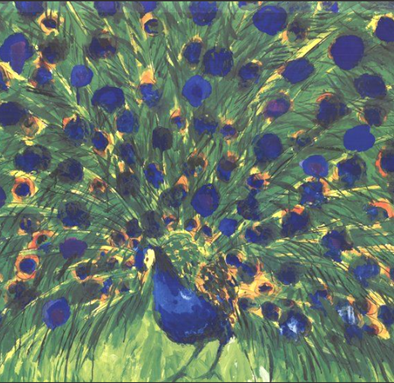
Peacock by Walasse Ting

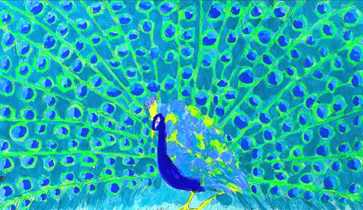
Peacock II by Walasse Ting

Ting frequently depicted cats, flowers and birds as in his painting, Peacock, in which the ‘eyes’ of the bird’s plumage radiate outwards across the large surface of the painting, creating a striking wallpaper of electric blue, yellow and green. The controlled circles, tightly arranged, create an arresting optical vibration.

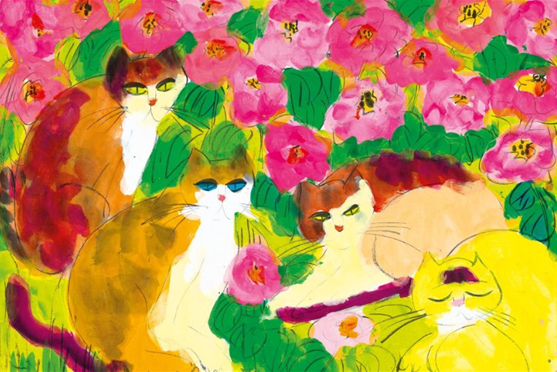
Cat Series by Walasse Ting

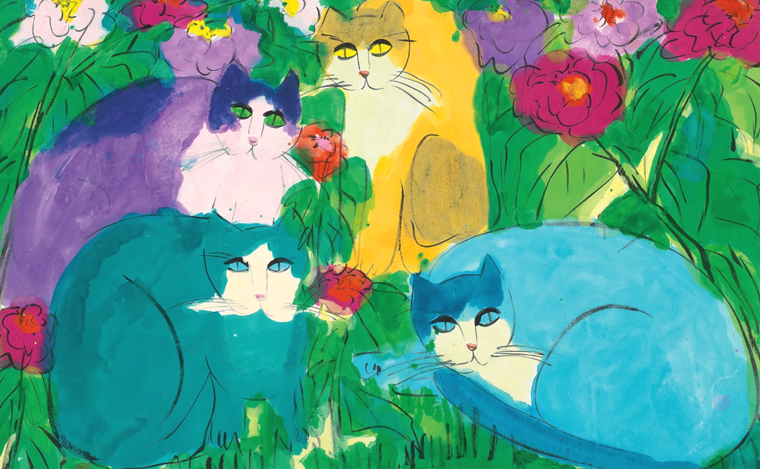
Cat Series by Walasse Ting

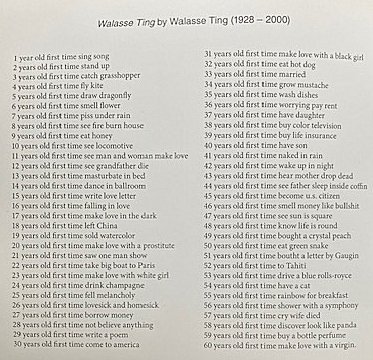
One very unusual thing at the exhibition was a display board giving a brief bio. by Ting himself It was also in the exhibition brochure. That is not strange in itself but what was unusual and some may say inappropriate, was his summary of his life “achievements”, year by year.

In the mid-1980s, he set up a studio in Amsterdam and in 2001 he permanently settled in that city. He was unable to create after a stroke in 2002. Ting died on May 17, 2010, at the age of 81 in New York.

Amélie Beaury-Saurel and Rodolphe Julian.

Amélie Beaury-Saurel

Amélie Beaury a French painter, was actually born in Barcelona on December 17th 1848.  Her family had previously lived in Spain and Corsica before moving to the Catalan city in 1845.  Her parents, Camille Georges Beaury and Irma Catalina Saurel owned a large carpet and tapestry factory with more than twenty looms, which they called Saurell, Beaury y Compañía. Amélie was their middle child.  She had an elder sister, Irmeta, also an artist, and a younger sibling, Dolores. Amélie later added “Saurel” to her name in recognition of her mother’s family who could trace their lineage to the Byzantine emperors of the 11th century.

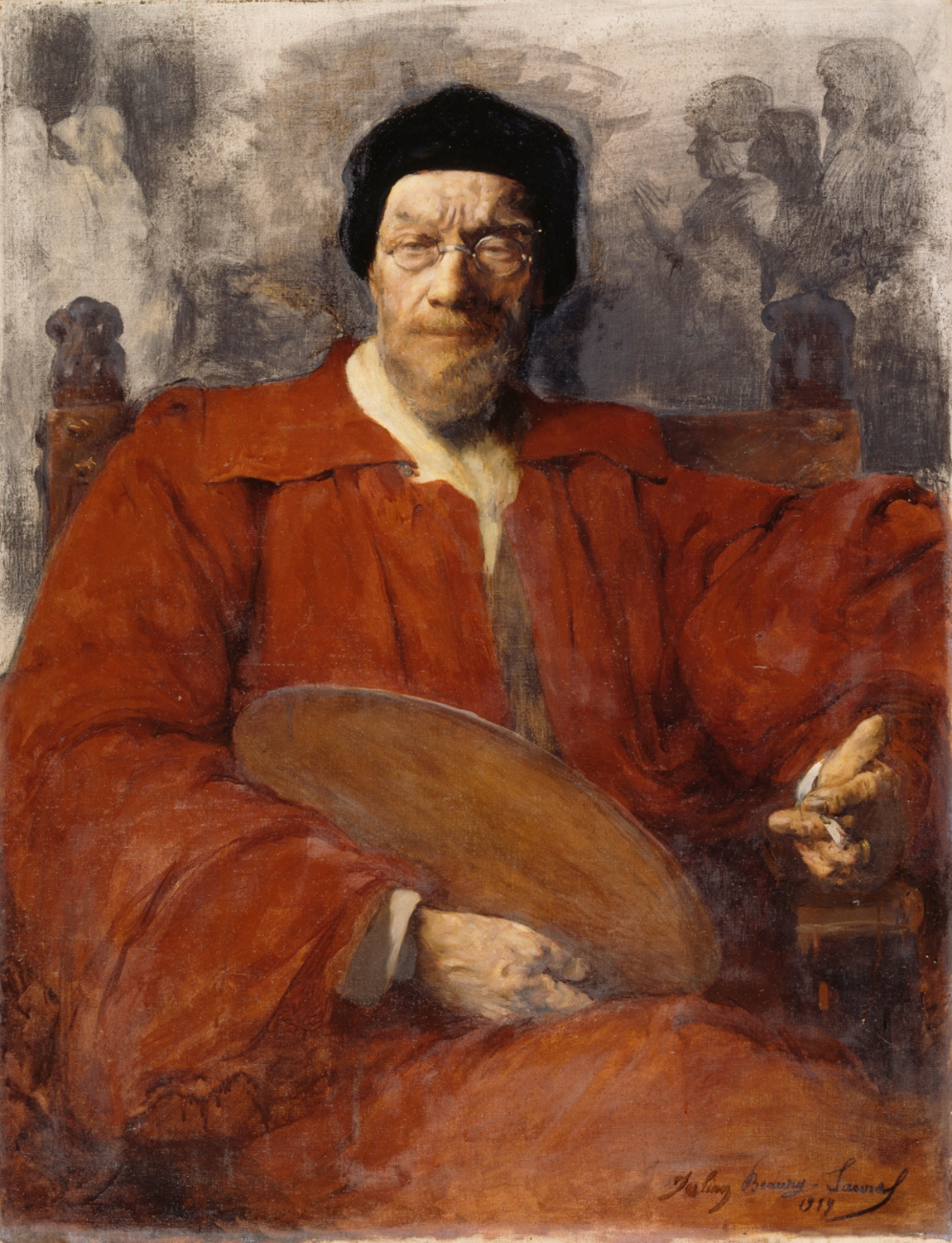
Portrait of the artist Jean-Paul Laurens by Amélie Beaury-Saurel (1919)

The happy family life was shattered in the late 1850s when Amélie’s father died and her mother decided to relocate with her three daughters to Paris.  Amélie recalled in an interview that she and her family lived in the French capital when she was ten years old and that her widowed mother, with little money, had to endure financial hardships.   Her mother instilled a love of art in her children and she would take them to the Louvre Museum to see the works of the Masters and encourage them to copy the works of the these great artists.

Portrait of Léonce Bénédite, curator of the Musée du Luxembourg,  by Amélie Beaury Saurel (1923)

Due to this family impoverishment, Amélie’s mother decided that her daughters should help with the financial burden and set about having them train as porcelain painting, a socially acceptable way of earning a living and eventually becoming financially independent. Amélie set to work as a painter of porcelainware but later said she considered what she was doing as commercial painting which in many ways damped down her creativity.  Her mother was very supportive of Amélie’s love of painting and, in 1874, initially paid for her nineteen-year-old daughter to study at the prestigious Académie Julian.  One of her first tutors was Pauline Coeffier, a French oil painter and pastelist, who specialized in the art of portraiture. Later many of the leading artists of the day would advise and tutor her, such as Tony Robert-Fleury, William Bouguereau, Jules Lefebvre, Benjamin-Constant, Jean-Paul Laurens and Pierre Auguste Cot.

Rodolphe Julian

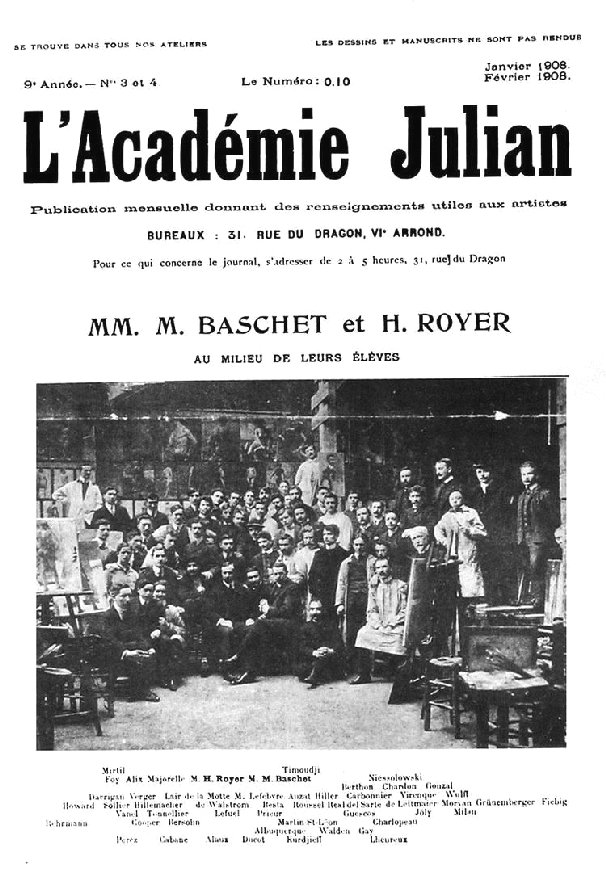
The Académie Julian was founded in 1868 by Rodolphe Julian. It was a private art school for painting and sculpture.  Paris was looked upon as the capital of the art world, and the centre of modern art.  This was one reason many young aspiring painters came to the French capital to discover all the latest trends in painting, like Impressionism and Post Impressionism, decorative art of various types, new forms of representational art such as expressionism, lithography and much more. Also with having a reputation as a forward-thinking art college the Académie Julian profited from the reputation of Paris.

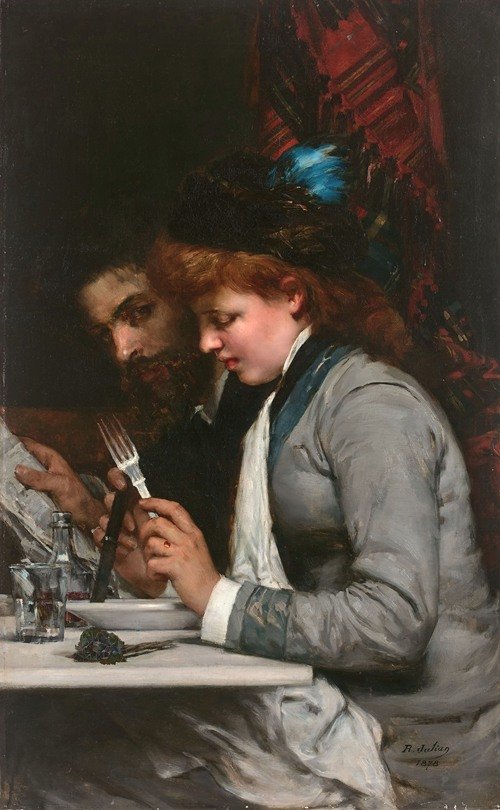
Chez Duval by Rodolphe Julian

Another reason for the popularity of Académie Julian was that it was the only art school in Paris to accept foreign students, many of whom struggled to pass the difficult French language exam, which was conditional on their acceptance into the Ecole des Beaux-Arts. Ambitious female painters were also barred from attending the official Ecole des Beaux-Arts until 1897 and even then, it was not considered suitable for women to study life drawing.  In contrast, Académie Julian was happy to offer them a full programme of education and training to women in fine art. They were offered the same classes as men, including the drawing of nude models. In fact, the Académie was one of the few schools to admit women to life-drawing classes. In fact, one of its four new branches was actually exclusively designed for female art students.

The Académie Julian was also regarded as a stepping stone to the prestigious École des Beaux-Arts by getting them prepared for the entrance exams and at the same time offered independent alternative education and training in arts.  Aspiring artists, both men and women, were welcome at the Académie Julian.   Men and women were trained separately, and women participated in the same studies as men, including drawing and painting of nude models.  The Académie Julian had no entrance requirements, was open from 8 a.m. until nightfall, and very soon became the most popular establishment of its type. Rodolphe Julian opened several branches throughout Paris, one of them especially for female artists, and by the 1880s the student population at these establishments reached six hundred.

Female Students at the Académie Julian in Paris, c. 1885

To ensure the success of the Académie, Rodolphe gathered together well-known and esteemed artists, such as Adolphe William Bouguereau, Jean-Paul Laurens, Tony Robert-Fleury, Jules Lefebvre and other foremost painters of that time trained in Academic art, to become tutors or visiting professors.  Académie Julian became recognised as a leading art establishment and its students were allowed to compete for the Prix de Rome, a prize awarded to promising young artists, and also show their work in the major Salons or art exhibitions.

So, who was Rudolphe Julian?

Rodolphe Julian was born in Lapalud, a commune in the Vaucluse department in the Provence-Alpes-Côte d’Azur region in southeastern France on June 13th 1839. He worked as an employee in a bookstore in Marseille but later moved to Paris, where he became a student of Léon Cogniet and Alexandre Cabanel, professor at the École des Beaux-Arts, albeit he never officially enrolled there.  Rodolphe was well aware of the struggles of artists who looked for artistic training once they had arrived in Paris and so, in 1863 he opened his own art school, Académie Julian.

Portrait of a Woman by Amélie Beaury-Saurel

Living in Paris, Amélie was determined to increase her knowledge of art and the Académie Julian offered her the best way of achieving that goal and eventually becoming a professional portrait artist.  However this course of action had to be funded so she approached Rodolphe Julian and proposed that in return to her helping out with the administrative and financial duties of the Académie, he would allow her to attend his classes free of charge.  He agreed. Rodolphe Julian had opened a women’s workshop in 1873 and in 1895 he put Amélie in charge of it.  As well as organising the workshop she had begun a very lucrative career as a portrait artist and received many commissions.

Académie by Amélie Beaury-Saurel (1890)

In 1890, Amelie completed one of her greatest paintings entitled Académie.  The title for the work refers to the art academy which at the time prohibited female painters from joining its ranks.  Her depiction conveys the compelling message to the viewer that she was not going to allow herself to be browbeaten by the male-dominated artistic establishment and she would not conform to their dictates.  The model in the painting exudes strength and determination as she stands grasping stalks of bamboo and stares out at us, challenging us.  It can be no coincidence that Amélie has depicted her model naked and this nude pose empathises the strong and defiant attitude women embraced as artists.

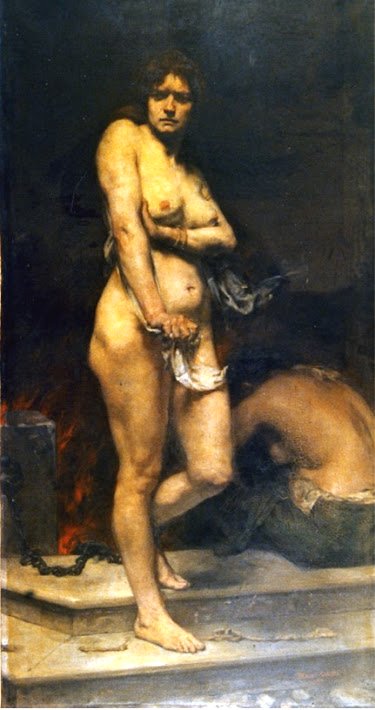
Deux vaincues (Two Defeated Women) by Amélie Beaury-Saurel (1892)

Two years later in 1892 Amelie produced another defiant depiction entitled Deux vaincues (Two Defeated Women).  It is looked upon as a rallying call to all female painters to be fearless as they travel through the unwelcoming and unforgiving world of art education and artistic professionalism and the many obstacles they had to overcome.  It was a plea to female artists to not allow themselves to be defeated in the face of the obstacles they would encounter.  The sketch depicts two women, both naked, chained to a wall.  Both face similar hardships but they have fared differently.  The one with her back to us is slumped forward in a defeated pose, while the other, in contrast, stands boldly upright, unrepentant and stares out defiantly.  The painting is a challenge to all women as to whether they give in or fight on. The work was exhibited at that year’s Salon.

 Portrait de Séverine by Amélie Beaury-Saurel (1893)

In 1893 Amelie completed a portrait of Caroline Rémy de Guebhard. She was a French journalist who held strong non-conformist views which labelled her as an anarchist, socialist, and communist.   She also was a great believer in feminist’s rights and opinions and this no doubt drew Amelie to paint the portrait.   Caroline Rémy de Guebhard would use the pen name Séverine, derived from the Latin severus which means “rigorous” or “brave”, for many of her newspaper articles.  When we look at the portrait, our eyes are immediately drawn to the vivid red flower on the sash of her dress.  The flower symbolizes Séverine’s leftist political views.  Look at her facial expression.  It is one that exudes strength, determination and tells you that this lady will not be moved.  Amelie’s ability as a great portraitist is borne out in this beautiful work.

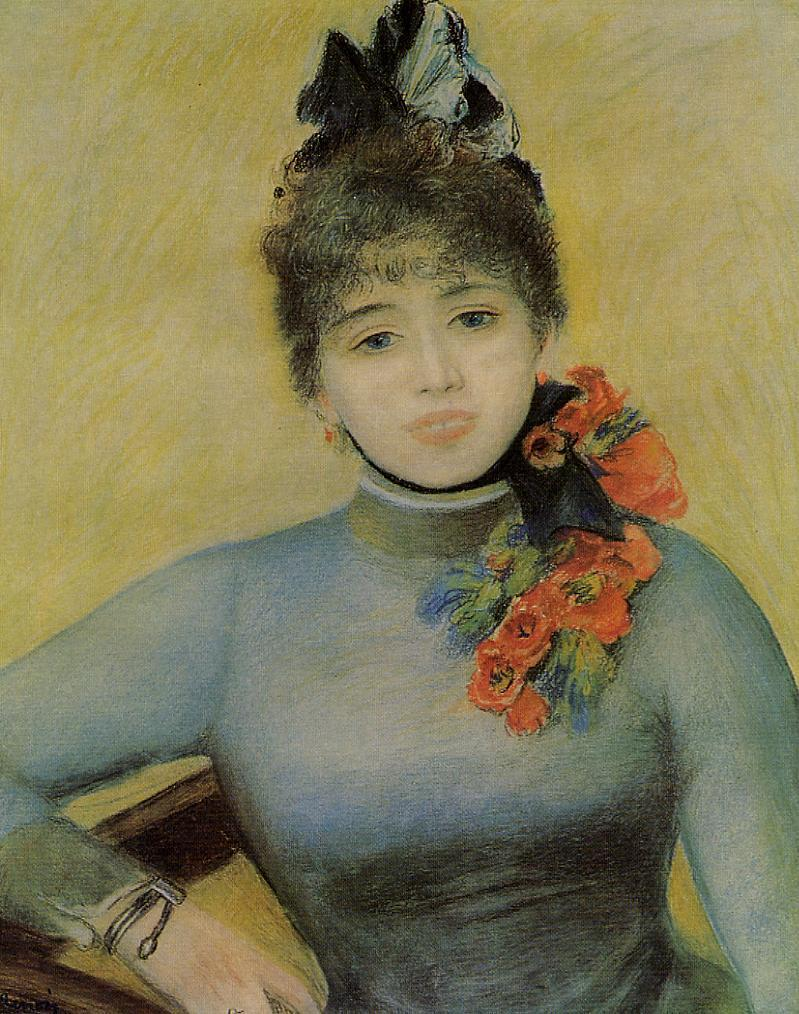
Séverine by Renoir (c.1885)

A portrait of Caroline Rémy de Guebhard was also complted around 1885 by Renoir. It is in the permanent collection of the National Gallery of Washington.

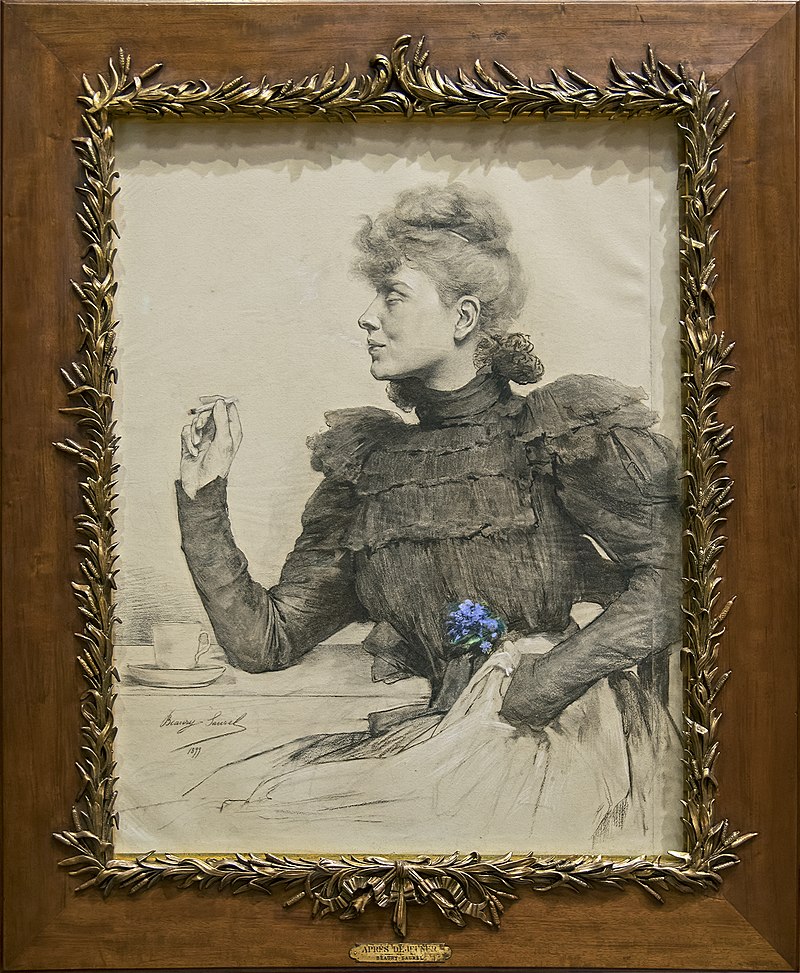
Dans le bleu by Amélie Beaury-Saurel (1894)

One of my favourite works by Amelie is her 1894 painting entitled Dans le bleu.  It is a pastel on canvas which depicts a young woman waking up in the morning and indulging in the gratification of smoking that first cigarette.  However that is not the point of the depiction.  It is all about feminist assertions. In this painting, we see a woman depicted in profile, boldly treating herself to the pleasures of escapism. It is a depiction of defiance as women at this time were not seen smoking, especially not in public.  It was a habit that was counter to the feminine conceptions of the time.  We should remember that Amélie Beaury-Saurel had dedicated a large part of her work to the female model and had always maintained the feminist cause.  She supported the right to arts education and artist status for women.  In 1894 when she was working on this painting her reputation in Paris as an artist was at its highest point and her paintings were exhibited all over the French capital.

The background of the work is very dark, predominantly blue and this allows the figure stand out in the work.   It is hard to know whether the scene takes place in a private dwelling such as a kitchen or a living room or whether the setting was in a public place, such as a café.  The woman in the depiction sits smoking a cigarette, chin in hand.  She appears to be daydreaming. She seems preoccupied as she watches the blue smoke unfurl from her lips, drifting upward. What is she thinking about?  Would she, like the smoke, like to drift away?  Some have suggested this might be a Beaury-Saurel self-portrait, as the model resembles the artist.  The depiction is simple and realistic and in no way staged.  Amelie’s depiction is all about everyday reality and is without any hint of idealization which would have weakened the work and it is this simplicity that has added to the beauty of the depiction and has expressed the woman’s femininity.

Our Girl Scouts by Amelie Beaury-Saurel

In this painting by Amelie, the seven women are represented in a compact group, around a table with a pile of books. On the left, holding his handlebars in his hand gloved, the Belgian cycling champion, Hélène Dutrieu; next to her, holding a paintbrush, the publisher Anna-Catherine Strebinger (Madame Henri Rochefort) who was also a student at the Académie Julian; then the collector Marguerite Roussel looks at the viewer; in the center, in professional attire and pointing to an article in a code, the lawyer Suzanne Grinberg, an eminent member of the French Union for the women’s suffrage, created in 1909; leaning on her, in the outfit that she had adopted to travel safely to the Middle East, archaeologist and explorer Jane Magre-Dieulafoy. Then comes the novelist and journalist Lucie Delarue-Mardrus and aviator Elise Deroche, First woman to obtain a pilot’s license.

After Lunch by Amelie Beaury-Saurel (1899)

In 1895, Amélie Beaury-Saurel, married Rodolphe Julian and he put her in charge of the women’s workshops which he had started in 1873.  Amélie managed the expenses for the women’s studio, served as an intermediary between instructors and students, and ran the women’s group but also continued her career as a portraitist. She earned a medal for her submissions to the 1885 Paris Salon and the bronze medal at the 1889 Exposition Universelle. 

Chateau Julian, Lapalud

Rodolphe Julian died on February 2nd 1907, aged 67, and two months later on April 10th, Amelie’s mother died.  Following the death of Julian, Amelie took on the role of director of the Académie Julian.  This was a mammoth task and so she received help from her nephews Gibert and Jacques Dupuis, the children of her sister Dolores.  Rodolphe Julian had bought a large house in the village of Lapalud, where he was born and on his death they were bequeathed to his nephews.  Amelie bought this large property from her nephews and transformed it to accommodate her family. It was called the “Mas” Julian.

Amélie Beaury-Saurel

During her last years, Amélie continued to paint but also fought for women’s rights and supported women artists and their fight against male-dominated art circles.  She participated in solidarity exhibitions for the benefit of institutions such as the Société des Artistes Français, the Société Nationale des Beaux- Arts or the Fraternité des Artistes.  Such commitment to the promotion of art and her endless creative activity were recognized in 1923, a year before her death, through her appointment as Chevalier de la Légiond’honneur.   

Amélie Beaury Saurel died on May 30th 1924 aged 75 at he Paris home which she had once shared with her late mother and sisters.


Information for this blog came from the ususal search engines plus:

Aware Women Artists

Elles-d-artistes blogspot

Musings on Art

Ville de Lapalud

The Funen Painters. Part 2.

Following the last blog regarding the early members of the Funen artists, this blog looks at some of the younger members and how they were often connected.

Peter Syrak Hansen

One of the leading figures of the Funen painters was Peter Syrak Hansen and it was his home and workshop, Mesterhuset, which became a cultural meeting place for the Funen painters. Syrak Hansen was born in Swanninge, a Danish village on South Funen, on September 10th 1853. He trained as a decorative painter at the Academy of Fine Arts in Copenhagen under George Hinkler.

The Double Portrait of Count Preben Bille-Braheand his second wife Johanne Caroline neé Falbe by Christoffer Eckersberg (1817)

After qualifying Syrak received many decorative work commissions in South Funen’s to decorate manor houses and churches. He was also given funds by the prominent and wealthy art collector and art patron, Count Bille-Brahe of Hvedholm, and continued his artistic studies in Germany, Austria and France, where he concentrated on studying church decorations. Following his European travels, he later settled down as a master painter and decorative painter in Faaborg in southern Funen and based himself in the building, which became known as the Mesterhuset. He bought Mesterhuset, situated at Lagonis Minde 7 in 1875, and he became a sought-after decorative painter working primarily in churches and manor houses on South Funen.

Sonnige Strandansicht by Peter Syrak Hansen

Syrak Hansen became so busy with all the commissions he received he had to look for some help and he hired a journeyman painter. The painter was Fritz Syberg who worked with Syrak in his workshop from 1882. It was here that Fritz Syberg got to know his future wives, Anna and Marie Hansen.

Faarborg Harbour by Karl Schou (1917)

Syrak Hansen married Marie Birgitte née Rasmussen and he and his wife had five children.  Marie Hansen, the eldest, was born in 1865 and became a parliamentary stenographer whose first husband was the painter Karl Schou. Schou was born in Copenhagen in 1870. After normal schooling he became a student at Valdemar Sichelkow’s painting school from 1884 to 1886 and then studied under Malthe Engelsted at The National Drawing Teacher Course, Copenhagen from 1886 to 1887, Finally he attended  Kristian Zahrtmann’s School from 1887 to 1900. During those three years at Zahrtmann’s school he became friends with the Funen painters.

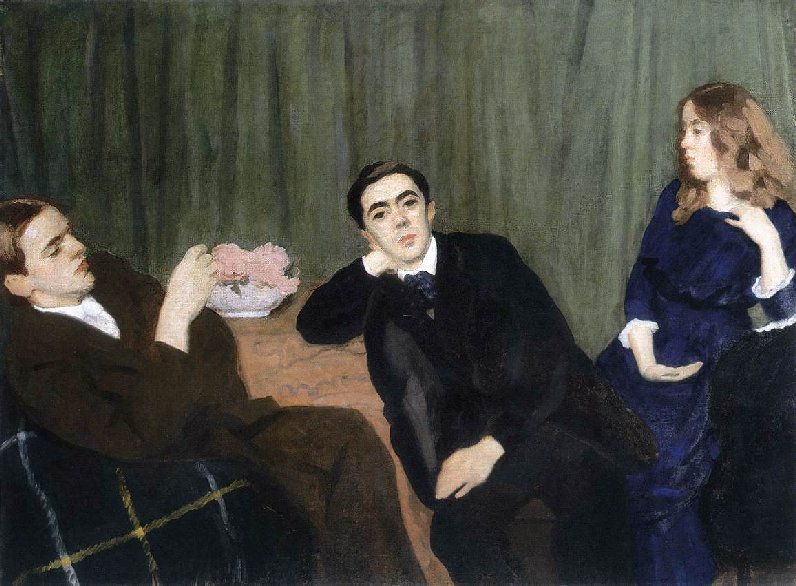
Three persons in conversation at an evening party by Hans Nikolaj Syrak Hansen (1903)

A year after the birth of their first child, Marie Hansen gave birth to their first son, Hans Nikolaj Syrak Hansen who became apprenticed to his father. Hans attended Zahrtmann’s School in Copenhagen from about 1885 to the spring of 1887, but he had to give up his art studies and return home in order to take over the painting company from his father in 1891.

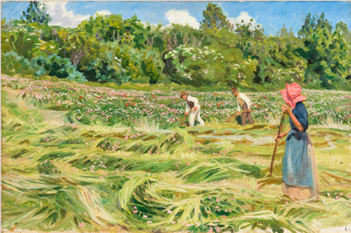
The Hay on the Meadow, South Funen by Peter Hansen

Syrak and Marie Hansen’s third child, their second son, Peter Marius Hansen was born on May 13th 1868. He attended the Copenhagen Technical School before studying under Kristian Zahrtmann at the Kunstnernes Frie Studieskoler between 1884 and 1890. 

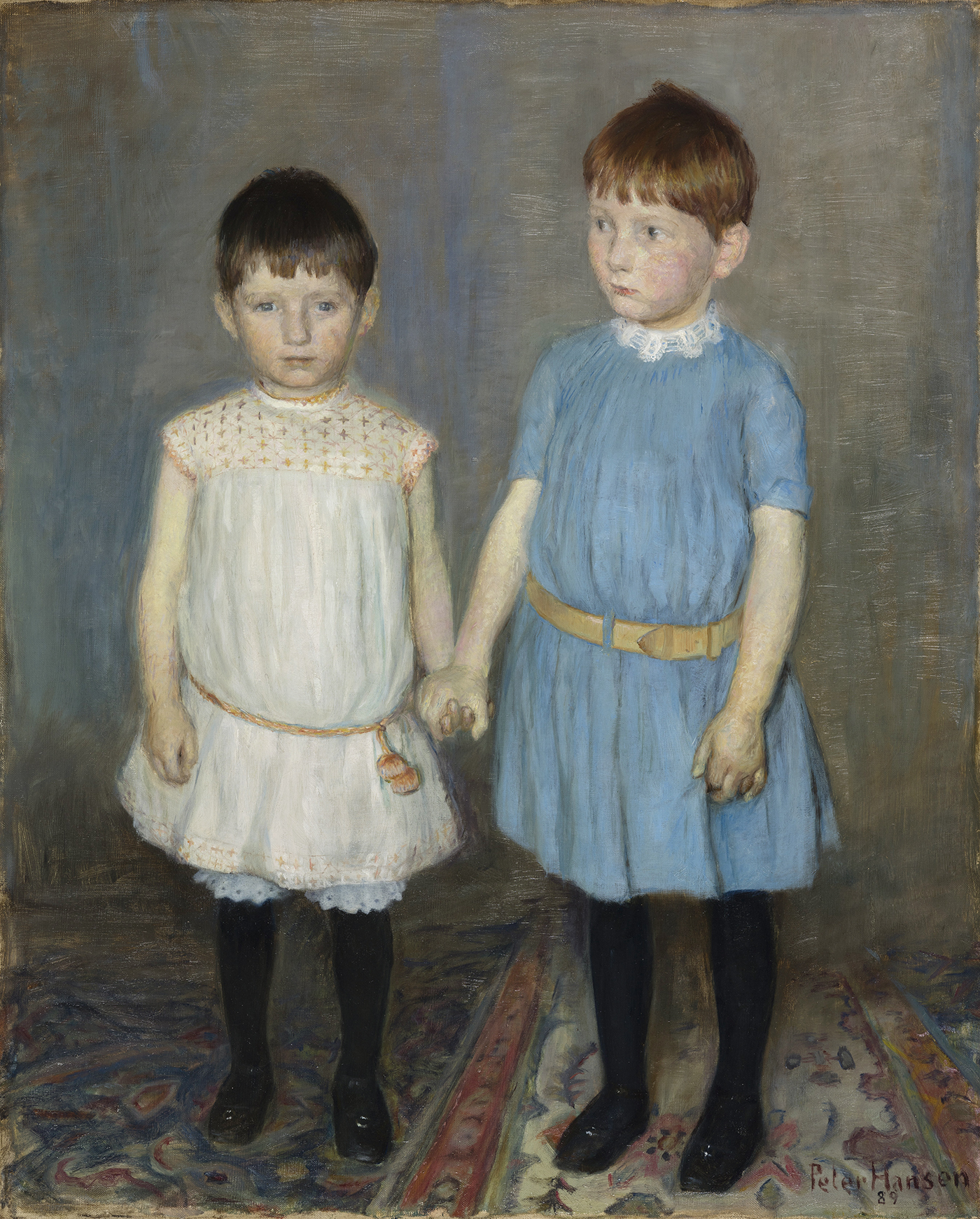
Double portrait of two children. The artist’s stepdaughters by Peter Hansen (1889)

Peter Hansen married Elisa Nikoline, who had previously been married to an engineer, Ludvig Conrad Neckelmann, whom she divorced. In 1898, shortly after the divorce, Peter and Elise married. Ludvig and his wife, Elisa, had had two daughters, Marie Christine and Elizabeth and Peter completed a double portrait of his stepchildren.

By the window. Double portrait of the artist’s daughter, Elena and stepdaughter, Marie Christine by Peter Hansen (1902)

Peter and Elisa went on to have their own two daughters, Elena Italia in 1899 and Anna Margrethe in 1906. In 1902 Hansen completed a double portrait of his twenty-year-old elder stepdaughter, Marie Christine and his own three-year-old child Elena Italia.

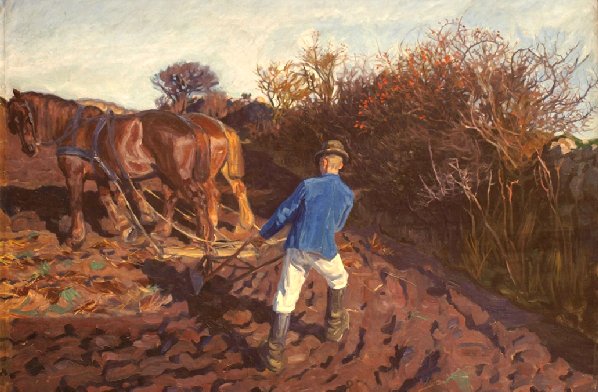
The Ploughman Turns by Peter Hansen (1902)

Peter Marius Hansen belonged to the group of Danish painters who were called the Funen Painters, since they came from and mainly worked on the island of Funen.  One of the important qualities Peter displayed was his respect for the steadily, busily working human being and he made it a key motif in his art. For him the Peasant was the epitome of this ideal, when he would depict local Danish farmers and the mountain farmers from around the Danish artists’ colony in the Italian village of Cività d’Antino in Abruzzi.

Fritz Syberg self portrait (1910)

Christian Friedrich Wilhelm Heinrich Syberg, generally known as Fritz Syberg, was born on July 28th 1862, in Faaborg.  He came from a poor background and was first apprenticed as a house painter under Syrak Hansen.  From there, in 1882, he attended the Copenhagen Technical School where Holger Grønvold taught him drawing. In the Spring of 1884 he enrolled for a short period at the Danish Academy but then attended the Kunstnernes Frie Studieskoler  where he became one of the first Fynboerne, along with Peter Hansen, Johannes Larsen, and Poul S. Christiansen to study under Kristian Zahrtmann.

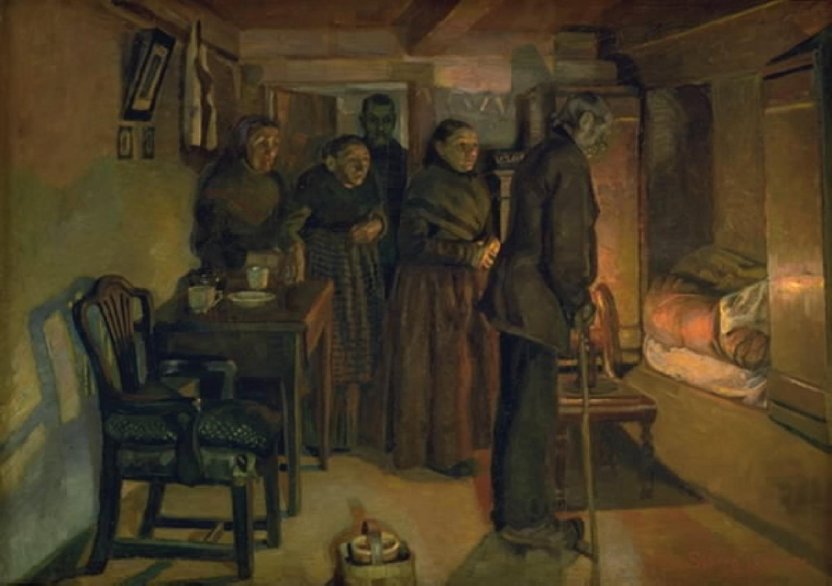
Dodsfald (Death) by Fritz Syberg (1881)

In the early 1890s may of Syberg’s paintings were dark and this can be seen in his 1892 work entitled Dodsfald (Death) which depicts his mother, Johanne Marie, on her death bed in 1881 in the Fåborg’s poorhouse.

Fritz Syberg “Jeg vil synge dem alle, alle!, sagde Moderen” (1898). Illustration for Hans Christian Andersen’s Historien om en moder. (I will sing them all, all of them!, said the mother) (1898). Illustration for Hans Christian Andersen’s The Story of a Mother by Fritz Syberg

In addition to the sale of his paintings, Syberg accepted many book illustration commissions, the most famous being his depictions for Hans Christian Andersen’s tragic tale, The Story of a Mother, which no doubt, Syberg could relate to his own childhood.  These depictions became one of the most celebrated collections of illustrations in Denmark’s history.

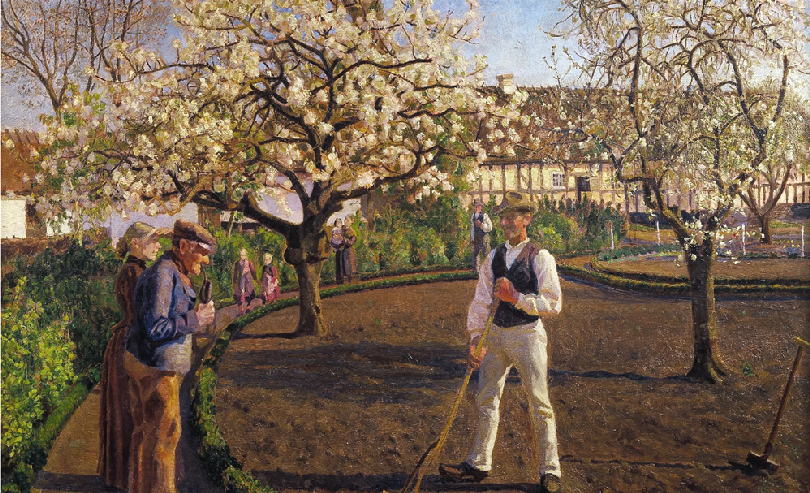
Spring by Fritz Syberg

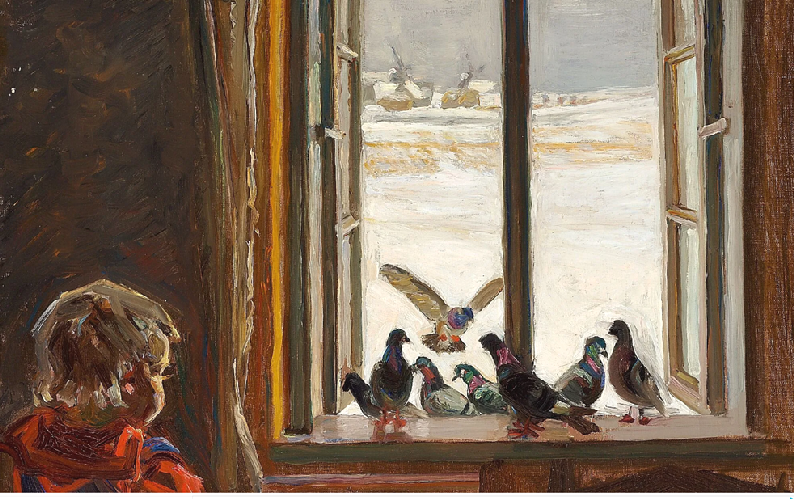
Watching Birds on the Windowsill by Fritz Syberg

Having struck up a close friendship with Syrak Hansen’s daughter Anna whilst working as Syrak’s apprentice, their friendship turned to love and the couple married in 1894. The couple went on to have seven children.   In the 1890s and the early decade of the twentieth century Fritz Syberg made a number of trips to other European countries such as Italy, The Netherlands, Germany and France, sometimes with his family.. 

Anna Syberg by her husband Fritz Syberg (1896)

Syrak and Marie Brigitte Hansen had their fourth child, a second daughter, Anna Louise Birgitte Hansen in January 1870 and she, like her brother Peter, became part of the Funen painters. Anna Syberg grew up amidst a very colourful and energetic artistic environment that differed from ordinary middle-class conventions. Her father, Peter Syrak Hansen, was a master painter, and a renowned figure in the town of Faaborg.  Fortunately for Anna, her parents believed that education was of prime importance to both their daughters as well as their sons.

Crocus, Hyacinths and Tulips by Anna Syberg (1898)

Anna loved to learn and one of her favourite pastimes was decorative painting.  In 1884 she enrolled on a two-year course at a technical school in Faaborg, and in 1889 she was receiving tuition in Copenhagen from the sculptor Ludvig Brandstrup and the painter Karl Jensen. Her artistic education was topped off when she received singing lessons, learnt to play the piano to a high standard and learnt to sing lieder and Danish songs.

Wild Roses by Anna Syberg (1898)

Anna Syberg became a key figure in the Funen Painters artists’ colony.  Her paintings, other than a few figure scenes, depicted flowers and plants, often in the vases and pots around her home, or in her garden and ones she saw when out walking in the countryside. She worked mainly in watercolours, using multiple layers that would often include sketched lines of pencil, transparent layers of watercolour and black ink contours ensuring the depiction of the floral was of the utmost accuracy.

Grapes in the Greenhouse by Anna Syberg (1903)

The subject of her depictions were often of stage-managed as she experimented with the floral arrangements.  In many of her works she would often let the depiction of her flowers and plants extend beyond the edge of the paper in a form of dynamic cropping.  Her floral painting were neither symbolic nor botanical studies.  In Anna Syberg’s pictures, flowers are not charged with symbolic significance, nor are they stringently restrained botanical studies with all its scientific accuracy. In her works, Anna Syberg portrays the simple beauty of the flowers, a testament to their beauty. In 1894 Anna Hansen married Fritz Syberg.

Fritz and Anna Syberg

So this life as a Funen painter amongst family and friends was to be part of much loved idyllic lifestyle for Anna Syberg.  What could possibly interrupt this peaceful and fulfilling way of life?   And yet………..

At the turn of the century in Denmark, like many other European countries and those across the other side of the Atlantic, the stature of women in art, and even in life itself, was continually being questioned by men.  For many men, including even some fellow artists, women simply painted as a hobby or to add to their social graces but for women in the early 1900s practicing art was problematic.  For Anna it was one thing to be a talented artist, it was another thing to have the same respect bestowed upon her for her work as that of the men.  Things came to a head in Faarborg when the town got their own museum and paintings had to be selected for display in the museum.

Mads Rasmussen

Mads Rasmussen, an important businessman in Faaborg, and his wife Kristine, held a party one evening and among the guests were the Funen Painters’ inner circle including amongst others Fritz Syberg, Peter Hansen and Jens Birkholm. Together with Johannes Larsen they were all to become part of the Museum’s purchasing committee which, in turn, came to act as the steering group for the Museum’s acquisitions, their curation and the fixtures and fittings for the gallery.  It was very unusual that the “money man” would let a group of artists dictate as to what works were to fill the gallery.

Artists hanging their works in the galleries of Faaborg Museum, May 1915. From the left: Peter Hansen, Peter Tom-Petersen, Johannes Larsen, Astrid Noack, Nicolaus Lützhøft, Christian Ernlund, Carl Petersen og Fritz Syberg.

Here was the problem – the purchasing committee for Faaborg Museum, made up of the Funen painters, were all  male artists from the group, and they didn’t believe in the quality of the works produced by the female members of the group. In the minutes of the meetings of the purchasing group, comments were recorded stating that

“…At the negotiations, Peter Hansen and Birkholm wanted to be recorded in the minutes that they voted against the acceptance of Mrs. A.(Alhed) Larsen and Miss Christine Larsen’s works. Peter Hansen also against Mrs. Syberg…”

Also in the minutes, Peter Hansen, Anna’s elder brother, noted:

“…AS (Anna Syberg) and the other ladies had no significance for Danish art…”

Gallery at the Faarborg Museum

No reasoning was ever recorded as to why they thought so little of the works of the female Funen painters but the damage was done.   Presumably, one has to recognise that at that time there was generally a reluctance for women to be able to produce an artistic work. The one thing to remember also is that flower painting traditionally had a lower rank in the art world and this could have been in the minds of the male purchasing committee.

Anna was horrified that her own brother would critique her work so harshly and the rift between siblings became bitter.  She wrote to her brother Peter:

“…Where you create yourself. You voted against me at the Faaborg Museum based on high idealistic notions of safeguarding the best interests of art in Denmark. “You did not want to hide from me”, you wrote that I and the other ladies had no significance for Danish art…”

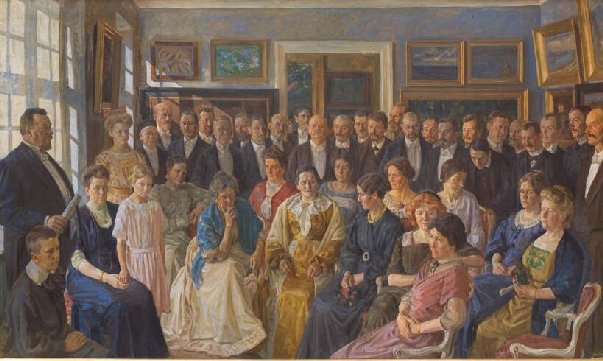
Faaborg Museum Inauguration (1910) by Peter Hansen

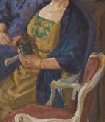
Anna Syberg is not in the picture of the artist group Fynbomalerne, despite her being a central part of the group. She should have supposedly sat on the empty chair in the bottom right corner.

The empty chair.

During the heated exchanges between Anna and Peter, he was working on a painting depicting the inauguration of the Faarborg Museum. The depiction was supposed to pay tribute to a group of artists who were both well-known and acclaimed painters. Anna Syberg’s outburst of anger over the words of her brother and members of the purchasing committee came while her brother was working on the painting, and it is believed that he deliberately chose not to paint his sister as part of the group and yet, to rub salt into the wounds, he provocatively indicated her absence with the empty chair, despite her being present at the inauguration and was said to have sat tanned and dressed in festive clothes with a large hat in the front row of the group. All the other female artists in the group are in the painting.

Anna Syberg (née Hansen) 1870-1914

Anne Syberg died on July 4th 1914 following a failed operation to treat a gallbladder infection.  She was just forty-four years of age.  Sadly the recognition she deserved as a gifted artist never came until after her death.  In 1915 a retrospective of her art was held and it was a success, and sales were high, including Faaborg Museum which purchased sixteen of her works. quite central in the country. After her death, Fritz Syberg married Anna’s elder sister Marie who he had known since the days of working for is father-in-law.

In 1873 Syrak Hansen’s youngest child, Poul Gerhardt, was born.  He did not follow his siblings into the world of art. He was married to Dagmar and the couple had two children: Helga and Louise.  Poul is believed to have died at the young age of 33 in 1906.


I could not have put together the two blogs about the Funen painters without the information I gleaned from various websites:

The Beauty of the Moment

Faarborg Museum

DR

The Hirschsprung Collection

arkivdk

The Funen Painters (Fynboerne)

The term Artists’ Colonies defines gatherings of artists in towns, villages and rural areas, who have assembled at places of natural beauty and where the cost of living is less than that of city life.  In the latter part of the nineteenth century, art colonies began to spring up as village movements with thousands of professional artists taking part in a mass exodus away from urban centres and heading for the idyllic countryside where they resided for varying lengths of time in artistic communities. Art colonies appeared on both sides of the Atlantic, forming on both the East and West coasts of America.  Many were also established in Europe such as Barbizon on the outskirts of Paris, Pont Aven in Brittany, Worpswede in Germany, Giverny in the northern French department of Eure, Lamorna and St Ives in Cornwall and the Newlyn School to name just a few.  Denmark had two important art colonies.  One was in Skagen in the north of the country, which I have written about on a number of occasions and the other was on the Danish Island of Funen.  In the following blogs I want to look at the Funen Art Colony and the artists who founded it and others who came later and were part of this artistic movement.

Self portrait by Kristian Zahrtmann (1915)

The Royal Danish Academy of Fine Arts was founded in 1754 and was the dominating force in the teaching of art to aspiring painters in that country.  In the first half of the nineteenth century during the era of the great Danish painting, Christoffer Eckersberg “ruled”, and the period became known as the Golden Age of Danish Painting.  At the centre of this movement was Copenhagen which although it had experienced fires, bombardment and national bankruptcy, the arts took on a new period of inspiration brought about by Romanticism, the dominant intellectual movement of German-speaking countries in the late 18th and early 19th centuries.  However, many artists began to rebel against the outdated way art was taught at the Academy and its policies. They wanted an alternative and this came in the form of  the Kunstnernes Frie Studieskoler, (Artists Studio School) an art school established in Copenhagen in 1882.  It became the central institution of the Modern Breakthrough in Danish art, the name given to the strong movement of naturalism and debating literature of Scandinavia which replaced Romanticism near the end of the 19th century.  Laurits Tuxen became the school’s first director and Peder Severin Krøyer one of its teachers.

The Funen Painters

One hundred years ago an exhibition took place when the Faaborg Museum building opened its doors back in 1915, the Funen artists curated their own work, as the Museum had been conceived and built solely to show their ‘home-grown’ art. In 1915 gallery convention required that paintings were hung closely together and so there was space for the 366 paintings, sculptures and drawings, which had been purchased by the Museum from 1910-15. The entrepreneur Mads Rasmussen had the idea for a museum to showcase work by the Funen artists and he set up a purchasing committee composed of artists which had free rein to select work

The Funen Painters group, similar to other artists’ colonies in the late 1800s, searched for an alternative to city life by setting up a colony which was not just about painting but also a new lifestyle. Their aim was to connect their art with the countryside and the everyday life of the rural community which they believed created an overall vision for a ‘lifestyle’ reflecting their artistic ideals.

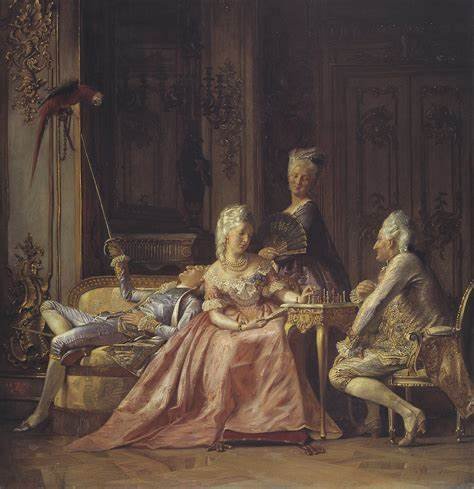
An oil painting recreating the frivolous court of Christian VII by Kristian Zahrtmann

In 1884 a preparatory class was added to the Kunstnernes Frie Studieskoler and in 1885 Kristian Zahrtmann became the head and, under him, it developed into an independent department.  Zahrtmann’s school became more avant-garde and innovative, due to his calls for radical experiments and strong use of colours.  By 1893 the preparatory class, which under his leadership,  turned into an independent department. He had some two hundred students from the Scandinavian countries and because of his stature as a teacher, the school was often simply referred to as “Zahrtmann’s School“.

A Family under Lamplight by Kristian Zahrtmann (1890)

Many of Zahrtmann’s students formed a group of painters who became known as Fynboerne (Funen Painters) due to their attachment to the island of Funen. His students included Peter Hansen, Fritz Syberg, Poul S. Christiansen, Johannes Larsen and Oluf Hartmann; and modern painters Karl Isakson; Edvard Weie, Harald Giersing and Olaf Rude. Zahrtmann travelled through Europe many times and his favourite country was Italy.

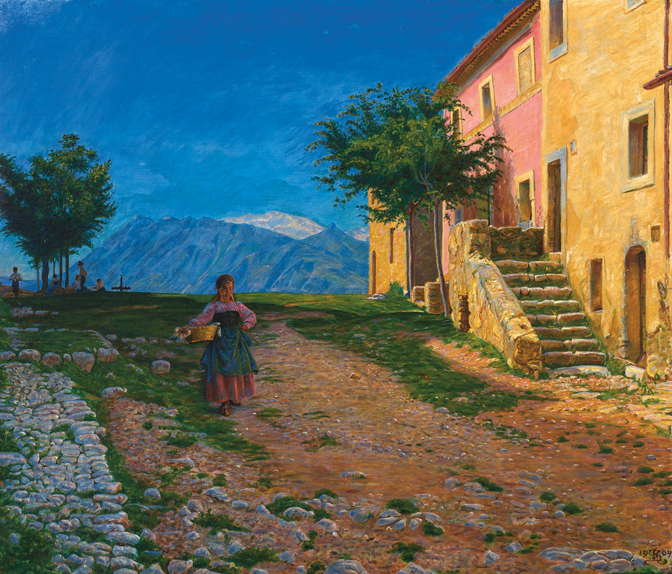
Piazza Santa Maria i Civita d´Antino by Kristian Zahrtmann (1904)

In June 1883, which was a very hot summer in Europe, Kristian Zahrtmann, travelled to the mountain town of Civita D’Antino in Italy, in search of cool temperatures as well as his love of good wine, and on the first afternoon in the town he decided that here was the ideal place for his summer painting school. His enduring fondness for Civita D’Antino lasted nearly 30 years and between 1890 and 1911 he spent every summer in the town living with the Cerroni family and gathering friends and students in an annual artist colony. He was named an honorary citizen of the town in 1902. This culminated in a vast production of portraits, landscapes, and scenes depicting an idyllic daily lifestyle around the mountain communit. His paintings are distinguished particularly by their realism and bold colour.

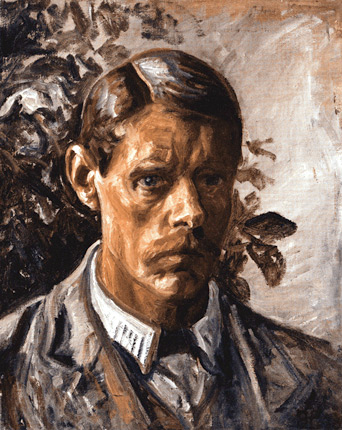
Johannes Larson, self portrait (1910)

Winter Day at the Zoo by Johannes Larson (1891)

One of the leading members of the Funen painters’ group was Johannes Larsen who was born in Kerteminde on the island of Funen on December 27th 1867. He was the son of Jeppe Andreas Larsen, a merchant and Vilhelmine Christine Bless.  During the 1880s, after regular schooling, Johannes studied art at the Free School in Copenhagen under Kristian Zahrtmann. It was whilst studying here that he met a number of aspiring painters who lived on Funen, notably Fritz Syberg and Peter Marius Hansen both of whom came from the southern port of Faaborg.  It was the coming together of these young artists that morphed into the Funen Painters group (Fynboerne).  Later they would create an art colony which would galvanise many Danish and Swedish artists to paint and exhibit their work.

Summer Sunshine and Wind by Johannes Larsen (1899)

After completing his studies with Kristian Zahrtmann, Johannes Larsen returned back home to his native Funen town of Kerteminde where he continued to paint working in oils, watercolour, woodcuts and drawing.  His depictions featured landscapes and other open-air scenes, and often included birds.  He received many commissions to illustrate books and paint large paintings for public buildings

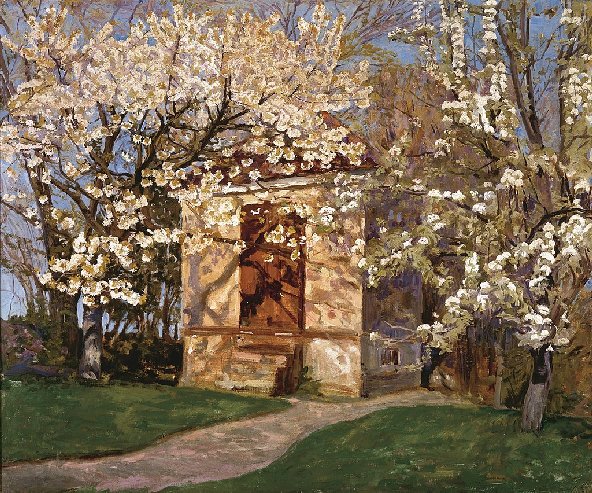
The Garden House with Blossoming Cherries by Alhed Maria Larsen (c.1920s)

In 1898, Johannes married the painter Alhed Maria Warberg.  She played a central role within the Funen Painters group and would often have the role as hostess at their events.

Alhed Larsen

Alhed Larsen was born on April 7th 1872.  She was the second eldest of eight children, Laura Maria and Albrecht Christopher Warberg.  She had six sisters and one brother.   Her father was the estate manager for a very large farmstead, Erikshåb, and he had an office help, a teacher for the children and six servants.  Alhed grew up in well-to-do circumstances on the estate.  It was said that the seven sisters would often shock the bourgeoisie neighbours by walking around the streets of the town without wearing gloves and by using newfangled bicycles !  Many young painters would gather at the farmstead and soon Alhed began to learn to paint and was guided by the painter, Fritz Syberg.  Later it was the task of her husband, Johannes Larsen to take the role of her artistic mentor.  Peter Hansen joined the group along with his sister Anna and Maria and Johannes’ sister Christine and it was Alhed who had the role of unifying these painters of Funen.

Beach Leaves in the Window, Båxhult by Alhed Larson (1927)

When she was seventeen, Alhed went to Copenhagen and lived with her maternal uncle, the sculptor, Ludvig Brandstrup.  Between 1890 and 1893. In 1893, Alhed worked at the Royal Porcelain Factory with underglaze painting, at the same time as she received drawing lessons from her maternal uncle.  In late 1893 she travelled to Italy with the Brandstrup family and during that long holiday she managed to master the Italian language.  Back home at Erikshåb she formed a close and romantic relationship with Johannes Larsen but her parents were not happy with the prospect of their daughter marrying an impoverished artist.  She finally overcame her parent’s reluctance to have Larson as their son-in-law and in 1898 the couple married and settled in Kerteminde. Three years after the wedding the couple had a new home built on Møllebakken, on the coastal slope on the outskirts of the town.   Alhed decided that she was not satisfied with simply being the wife of an artist and decided that she wanted to become a professional artist as well.

Rhododendrons by Alhed Larson

Alhed Larsen’s artwork primarily depicted flowers, still life, interiors and window views. In 1917, Alhed and Johannes’ house was expanded with a large studio added, spacious enough for each to have their own studio space.

Møllebakken home of Alhed and Johannes Larson

Between 1901 and 1902, the couple built their home on Møllebakken in Kerteminde. Their home became the gathering place in summer months for many painters, particularly younger artists from Zahrtmann’s school.

Landscape with birds by Johannes Larsen (1946)

The Funen painters guiding principle was to encourage plein air painting, not just sketching but painting, notwithstanding the weather. Following this principle led to paintings having a fresh purity and energy which was missing from studio painting. Their works were appreciated by the public and became very popular, so much so that the Symbolist painters of the time attacked their style and in 1907 in the midst of a newspaper debate on Danish art, the Symbolists derogatively called them “farmer painters”.  Instead of being browbeaten by this tirade the artist gained greater recognition.

Birds flying over a landscape by Johannes Larson (1929?)

A turning point for the group came in 1910 when businessman Mads Rasmussen, who operated a successful cooperative canning factory in Faaborg, proposed to help the group by creating a museum next to his canning factory at Møllebakken in Kerteminde. which would promote and exhibit Funish Art. This made it possible for the public to view and buy their paintings which gave the Funen artists financial support. Johannes and Alhed Larsen lived almost their entire lives at Møllebakken.

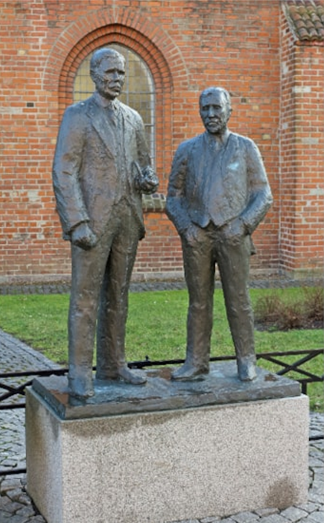
In the autumn of 2006, a sculpture by the city’s two great artists, Johannes Larsen (1867-1961) and Fritz Syberg (1862-1939), was unveiled on Nordre Kirkerist, Kerteminde, next to the parish church, executed by local sculptor Bjørn Nordahl.

Johannes Larsen is looked upon as one of the greatest painters of birds and a knowledgeable pictorial storyteller of nature. His knowledge, his role as a conservationist and his beautiful artwork earned him an honorary membership of the Danish Society for Nature Conservation. At the age of 92, he was named president of the Wildlife Foundation established by the prime minister’s department.

………to be continued.

Hungarian Artists. Part 2.

In this blog I am looking at the lives and works of a talented Hungarian family of painters.

Károly Ferenczy

Károly Ferenczy is considered one of the most important pioneers of Hungarian Modernism,    He was the son of Ida Graenzenstein and the Austrian railway construction official Karel Freund, who moved to Budapest with the construction company. Ferenczy was born in Vienna on February 8th 1862 and soon after his birth, his mother died.

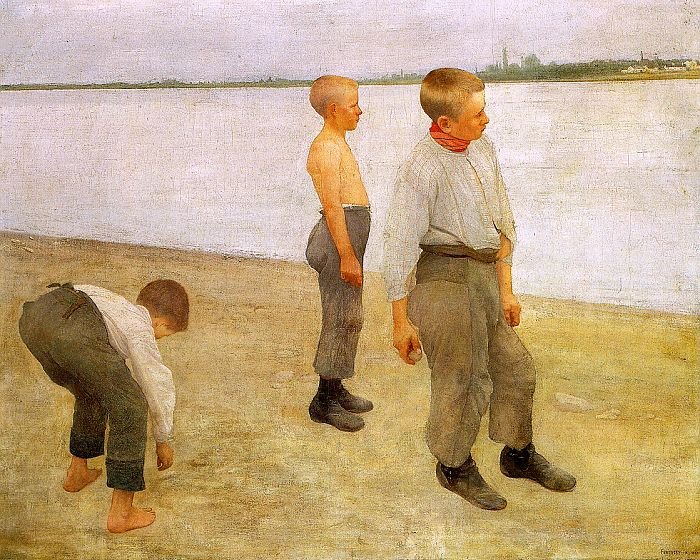
Boys throwing Stones by Károly Ferenczy (1890)

Boys Throwing Stones was a major work completed by Ferenczy in 1890, whilst he was living in the River Danube town of Szentendre, having returned from Paris and his studies at the Académie Julian.  The setting is a barren landscape which had a sense of melancholia to the work and adds a gloomy backdrop to the three boys throwing stones into the river.  There is not one bright spot of colour and it is the shades of the pearly grey which he used for the water that lightens the rest of the dull earthly colours.

In Front of the Posters by Károly Ferenczy (1891)

Károly Ferenczy first studied law and completed his economics degree at the University of Vienna. In 1885 Ferencszy married a fellow artist and distant cousin, Olga Fialka who was twelve years older than him.  She studied painting under Jan Matejko in Kraków and went on to study under August Eisenmenger in Vienna. She was known for her paintings and book illustrations.

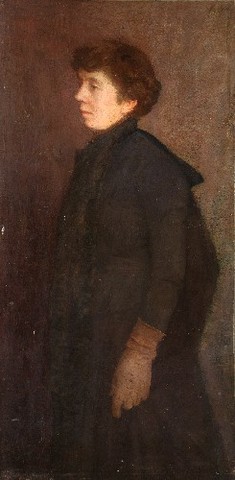
Portrait of Artist’s Wife by Károly Ferenczy (1891)

After she married Károly Ferenczy, the couple went on to have three children. With the birth of the children, Fialka turned her attention away from her art and focused on looking after the family.  The couple’s first child Valér Ferenczy, who was born in 1885, became a painter and printmaker. In 1890 Olga gave birth to twins, Béni Ferenczy, who went on to became a famous sculptor and Noémi Ferenczy, who became an equally well-known textile artist.

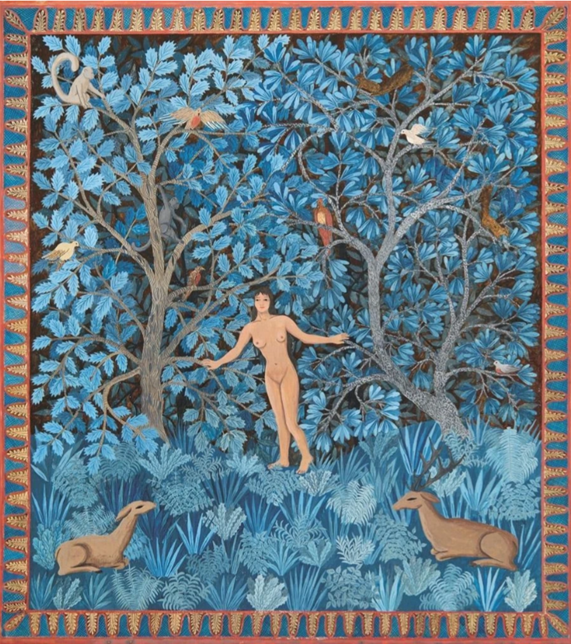
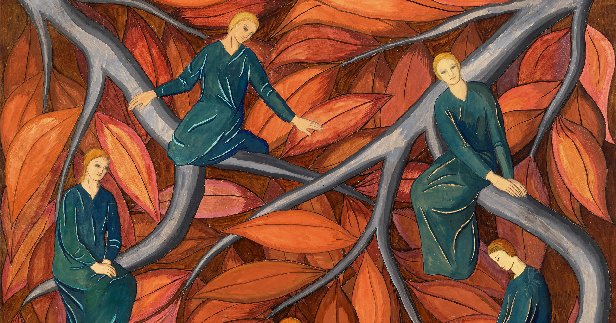
Triple Portrait by Károly Ferenczy (1911)

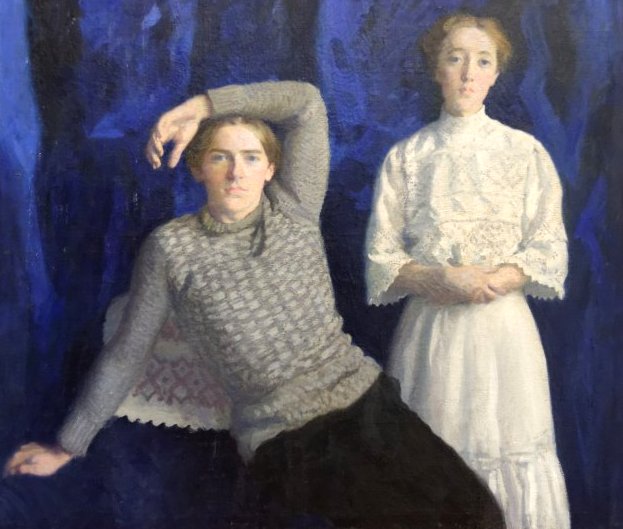
Károly Ferenczy‘s three children, his son Valér, painter and graphic artist, and the twins Béni , painter and graphic artist and Noémi, a painter who established tapestry in Hungary.

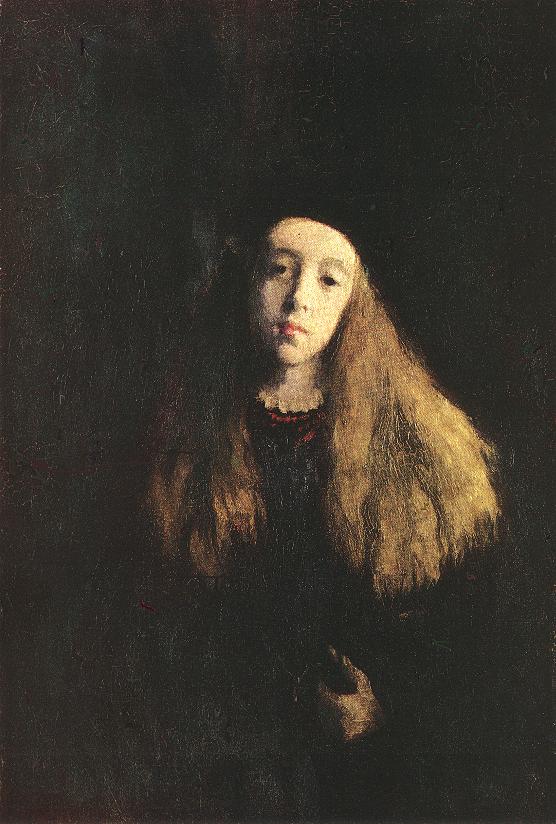
Noémi with Let-down Hair by Károly Ferenczy (1903)

In 1885 Károly enrolled at the Art Academy of Naples (Accademia di Belle Arti), but the following year moved to Munich. Ferenczy studied art in Budapest at the Academy of Fine Arts where his Hungarian tutors were Bertalan Székely the history and portrait painter who worked in the Romantic and Academic styles. and Gyula Benczúr who specialized in portraits and historical scenes. Benczúr is now looked upon as the greatest Hungarian masters of “historicism”, a term used to encompass artistic styles that draw their inspiration from recreating historic styles or imitating the work of historic artists and artisans. Ferencszy was living in Hungry at a period when the country was undergoing a cultural renaissance, and Ferenczy became part of a generation of artists eager to explore new artistic ideas and break away from academic conventions.

Birdsong by Károly Ferenczy (1893)

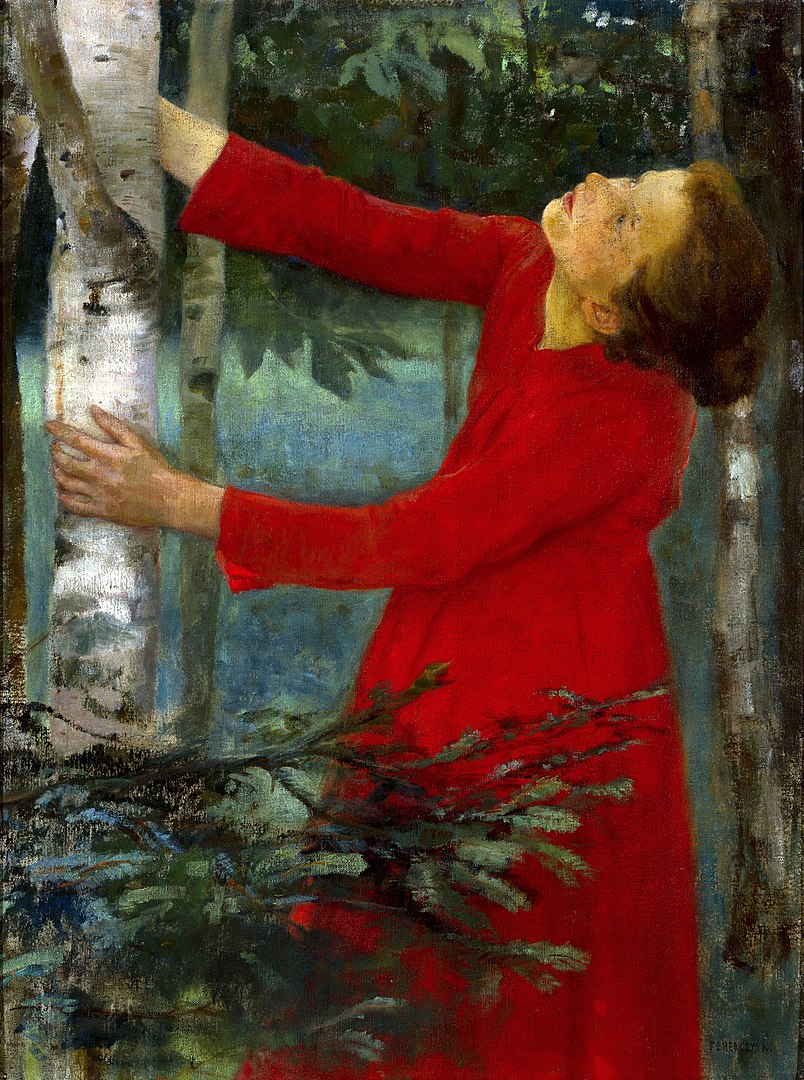
Károly Ferenczy became interested in plein air painting when he was studying in Munich.  One of is most famous works at that time was entitled Birdsong which he completed in 1893.   Unlike other realist depiction Ferenczy’s depiction is free from details. The random appearance of impressionism in details of nature and capturing atmospheres, lights and colours hastily painted could not be more unusual for him.   He spent much time working out the composition of the work and the solitary figure in the depiction is a woman, dressed in red, embracing the trunk of the tree, gazing upwards as she listens to the melodic tones of a bird in full song.  The forest is symbolized by white trunks of birch-trees and the green of the leaves.

On the Hill Top by Károly Ferenczy (1901)

In 1889, at the age of twenty-seven, Ferenczy travelled to Munich, where he first came aware of western European artistic styles such as Impressionism and the plein air works of the Barbizon School artists.  It was the works of this latter group which led Ferencszy to explore plein air painting and the effects of light on the landscape. His greatest influences were that of the French painters, particularly Édouard Manet and Camille Pissarro, and they stimulated his change of artistic direction towards a more liberated and expressive style.

Gardeners by Károly Ferenczy (1891)

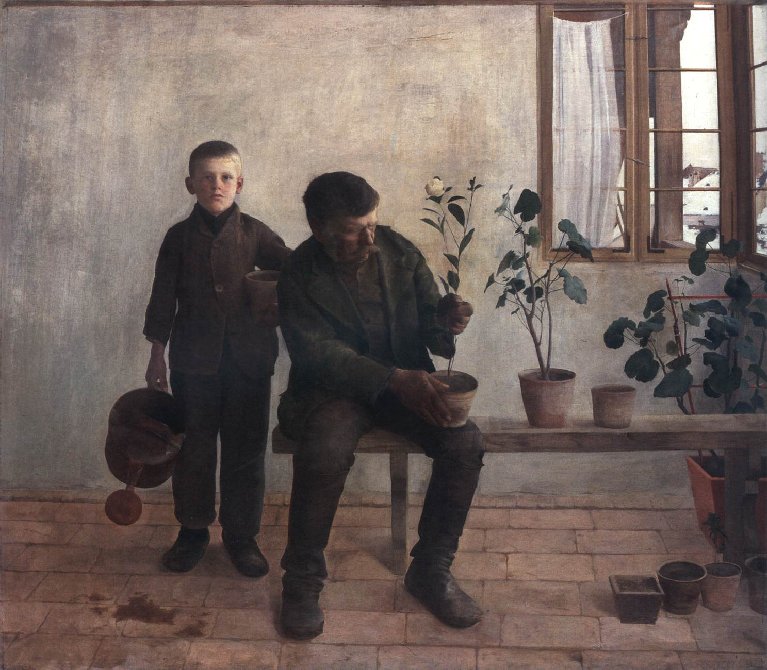
Ferenczy completed Gardeners whilst living at Szentendre. The way he puts the painting together with the use of lighting, colours and details follow the ethos of Naturalism. It is typical of him to see that the space is limited. There are two figures, one of the old gardener and the other the young boy who is standing next to him in front of a light background. How Ferenczy managed the arrangement of his two figures and the balance between light and dark colours demonstrate his appreciation of decoration which were a constant throughout his career as a painter.  Gardeners is considered to be a major picture of Ferenczy’s early period and highlights his skills as an artist at the beginning of his career.

Simon Hollósy. Self-portrait, 1916

Between 1893 and 1896 he lived in Munich with his family. There he joined the circle of Simon Hollósy, a Hungarian painter who, as a young man, had moved to the German city because there was no academy of fine arts in Hungary at that time.  However, he was critical of the way art was taught at the German Academy which was strongly based on copying classical models. He left the Munich Academy and set up his own private school where he gave free classes.  His way of teaching art appealed to many young talents who were interested in realistic portrayal of their subjects.  Simon Hollósy was persuaded by some of his friends and pupils to re-locate his class in the summer of 1896 to Nagybánya, which is now Baia Mare, Romania.  He agreed and it was that new location that led to the founding of the Nagybánya artists’ colony, of which, Károly Ferenczy was one of the founding members. Nagybánya was an idyllic rural location and was the perfect place for plein air painting. It was the artists at this colony who played an important role in introducing Impressionism and Post-impressionism.

Sermon on the Mount by Károly Ferenczy (1896)

In his later years, Ferenczy painted subjects ranging from portraits, to nudes, and Biblical scenes.  Ferenczy was highly productive, and he worked in a variety of materials and genres. In November 2011, a major retrospective exhibition opened for six months at the Hungarian National Gallery, featuring nearly 150 paintings and 80 prints and drawings, together with about 50 documents (photographs, letters, catalogues and books) related to his art and life. Sadly, Károly Ferenczy’s life and prolific career were cut short by illness. He succumbed to pneumonia on March 18th, 1917, at the age of 55.

Béni Ferenczy  by his mother, Olga Fialka (1892)

Károly Ferenczy was just one part of a talented artistic family.  In 1885 he married Olga Fialka, who on her mother’s side was a relative of his, whom he met for the second time in 1884.  Olga had developed a love of art as a teenager and had family support for her desire to become a professional artist.  She studied art in Krakow under Jan Matejko, a Polish painter, and leading 19th-century exponent of history painting, known for his depictions of events from Polish history.  She then went to Vienna and attended the Academy of Fine Arts under the tutelage of August Eisenmenger, a portrait and historical painter. 

The Fialka Family by Olga Fialka (1874)

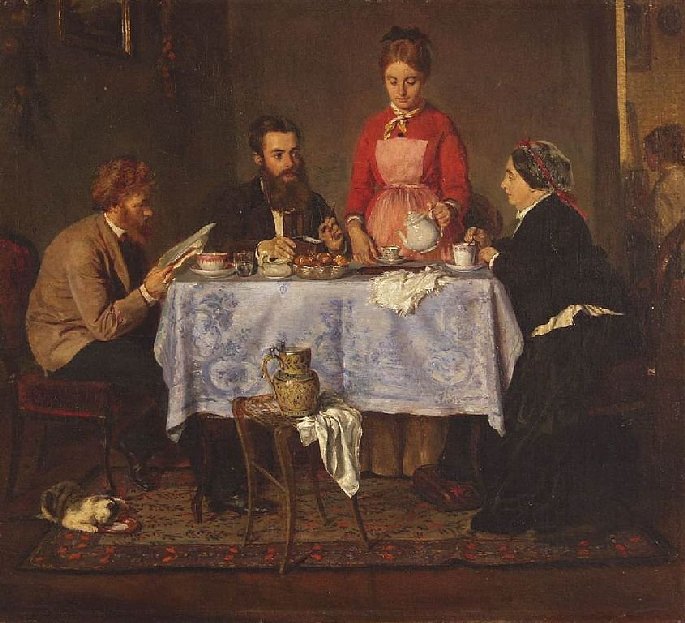
In the painting entitled The Fialka Family, Olga depicts her family taking coffee in a simple, bourgeois interior. At the head of the table is her mother, Karoline, and beside her stands her younger sister, Milada von Fialka. One of the two male family members is perhaps Károly Fialka.  If you look carefully at the right background, you can just make out a woman painting and this is thought to be Olga herself. The picture is a combination of the common interior genre and the group portrait. What differentiates this work from other contemporary genre painting of the time is that the interrelationship of the four figures comes not from a purported story line, but from a simple everyday conversation between family members and does not have the sense of a rigid group portrait. One can believe that Olga has simply conjured up a snapshot of an everyday scene.

Self Portrait by Valér Ferenczy

Valér Ferenczy was born on November 22nd 1885 in Kremnica, Slovakia.  He was the eldest son of Károly Ferenczy and Olga Fialka Ferenczy.  The family moved to Baia Mare in 1898, where Valér began his artistic tuition given to him by his parents in his father’s studio.  Between 1896 and 1901 he was enrolled at the Hollósy School in Baia Mare.  Between 1902 and 1906 he attended the drawing and painting courses held in the Free School of Painting and at the same time he also travelled abroad and attended various European academies of art.  In 1903 he studied at the Munich Academy before going on to the private school of the German secessionist painter, Lovis Corinth, in Berlin through 1904 and 1905.  From Munich he travelled to Paris where he attended the Colarossi School and later the Julian Academy in 1906.Between 1911 and 1912 he returned home and studied at the Hungarian Academy of Fine Arts.

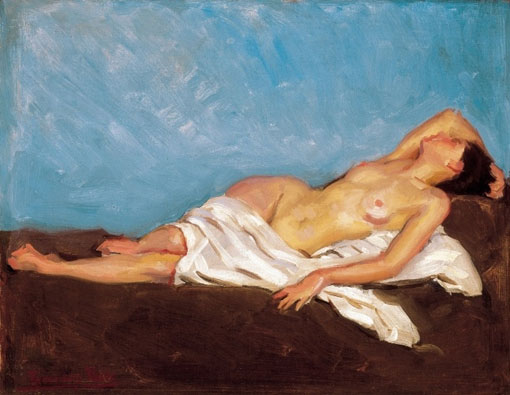
Nude by Valér Ferenczy

In 1914 Valér returned to the French capital to study the technique of engraving with Orville Houghton Peets, the American painter and printmaker.

The Artist’s Mother by Valér Ferenczy

Valér applied for and was granted Romanian citizenship in 1919 and two years later married painter Eta Sárossy in 1921.

Valér Ferenczy died in Budapest on December 23rd 1954, aged 69.

Eta Sárossy in her studio (1923)

Her father was Barnabás Sárosi, who was a sergeant in the Imperial and Royal 15th Hussar Regiment, and her mother Maria (Irma) was from Moldova. She grew up in Szilágysomlyó and graduated from high school there. From 1920 she studied painting at the free school in Baia Mare, for three years. 

Fire Flowers by Eta Sárossy

Young Man with a Tennis Racket by Eta Sárossy (1933)

Eta’s marriage to Valér ended in 1929 and she remarried the following year.  She regularly exhibited her work and was a founding member of the National Salon. Initially she painted landscapes, then studied portrait painting with the Hungarian painter, Oszkar Glatz, at the Hungarian Academy of Fine Arts.

Béni Ferenczy by Kaoly Ferenczy (1912)

On June 18th 1890 Karoly Ferenczy’s wife Olga gave birth to twins, Béni and Noémi. Béni was the second son of Karoly and Olga Ferenczy. As a young man, Béni followed in the footsteps of his elder brother Valér and father Karoly and went to study art in both Munich and Paris.  During his stay in the French capital, he studied under both the French sculptor, Antoine Bourdelle at the Académie de la Grande Chaumière, and the Ukranian sculptor Alexander Archipenko, a resident in La Ruche, an artist’s residence in the Montparnasse district of Paris.

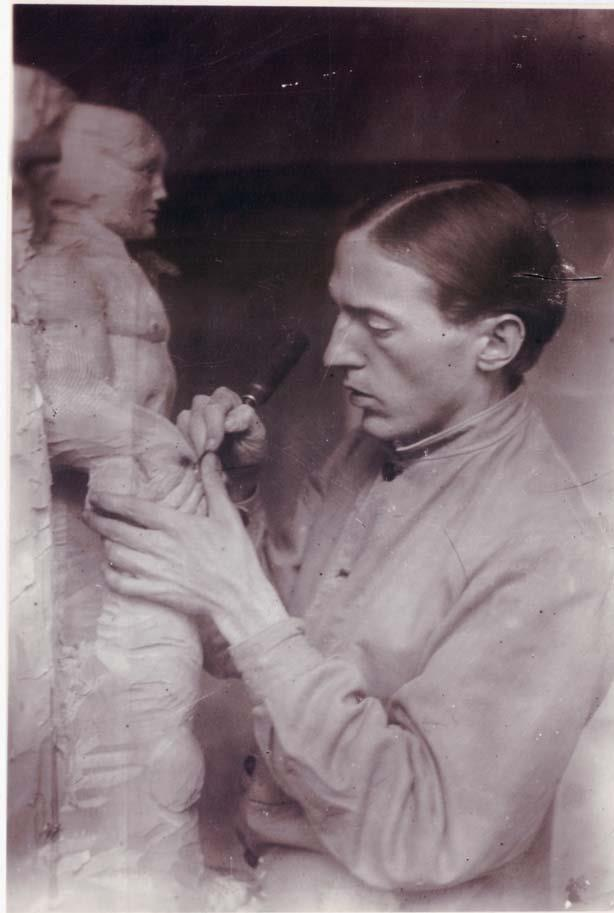
ni Ferenczy carving his statue Hercules. (Nagybánya, 1916)

Once he had completed his studies abroad, he returned to Hungary and lived in Budapest.  Béni was swept up by the short-lived (March to August 1919) Hungarian Commune described as a “genuine, grandiose, albeit unfinished revolution”.  He played his part in it by becoming one of the leading artists to instigate a reform of the national art scene and the setting up of a new art programme for the Hungarian nation.  After the fall of the Hungarian Commune in 1919 which only lasted 133 days, Béni exiled himself to Nagybánya in annexed Transylvania, and from there, in 1921, travelled via Czechoslovakia to Vienna and that summer he settled down in the Austrian capital.

Danae by Béni Ferenczy (1934)

The Pair by Béni Ferenczy

Béni arrived in Vienna in 1921 and married an Austrian lady and the couple had a son and daughter. He and his wife went to live in Berlin and Potsdam but found the cost of living too high and so returned to Vienna. His marriage ended in divorce and in 1932, he moved to Moscow, where he married a second time.  His bride was Erzsi (Elizabeth), a Hungarian, who had also spent her childhood in Nagybánya. From Moscow they moved to Vienna in 1936 and on to Budapest in 1938. Erzsi, beautiful, strong, full-bodied, and full of life, became the model for many of his sculptures, drawings and watercolours. Erzsi became his close companion, an inspiration for his work.  After her husband’s death in 1967, Erzsi Ferenczy worked to preserve his work and memory.  

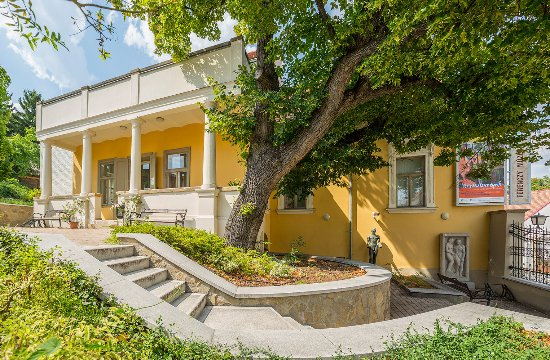
The Ferenczy Museum in Szentendre

In 1972, Erzsi Ferenczy founded the Ferenczy Museum in Szentendre, with a large art collection that included works by each member of the family. In 1993, Erzsi established the Ferenczy Family Foundation. She died in 2000 at the age of 96.

Béni and Noémi Ferenczy

Noémi and her twin brother Béni were born to Karoly and Olga Ferenczy on June 18th 1890. Noémi, like her twin brother, first began to practice art in her father’s studio and often visited the artists’ colony in Baia Mare.  In 1911 she went to Paris and learned tapestry weaving at the Manufacture des Gobelins but was largely self-taught. Contrary to common practice, she not only designed her creations, but also made them herself. She wove her paintings on cardboard using woollen yarns that she had dyed with plant paint. Her first works were designed and woven in Baia Mare, where she exhibited for the first time in 1916 at the Ernst Museum in a joint exhibition with her father Károly and her brother Béni.  The title of the exhibition was Károly Ferenczy and his children.

State of Innocence by Noémi Ferenczy

At the age of 23, however, she started working on an early masterpiece entitled Teremtés (Creation). She chose to remain responsible for the creative process from the beginning to the end, from the numerous pencil drawings, colour sketches and cartoons, to the weaving itself.

She recalled the inspiration for this tapestry:

“… My mother and I travelled a great deal and once we went to Chartres, the cathedral of those famous 13th century glass paintings.  Brilliant in the shafts of light, the beautiful, artistic glass paintings were spellbinding.  This was where I first felt the uncontrollably inspiring force of the desire to create, which has not abandoned me throughout my career.  Creation is my first truly large-scale work.  But even that stemmed from the magic of Chartres…”

In 1920, Following the collapse of the Hungarian Commune the year before, Noémi Ferenczy moved back to Nagybánya/Baia Mare, which had become part of Romania. There she helped organise a general workers’ strike, for which she was arrested and spent a few weeks in prison. She remained active in the Communist movement, taking part at the Fifth Congress of the Communist International in Moscow in 1924.

Her works were regularly displayed in Hungary, as well as in Romania and abroad. In 1932 she moved to Budapest. By this time, her style had changed: her compositions became more monumental, with fewer, but larger figures.  From 1945 she taught at the Hungarian Academy of Applied Arts. She received the Kossuth Prize in 1948 and the title of Meritorious Artist in 1952. She died on December 20th 1957, aged 67, in Budapest, and is buried in Kerepesi Cemetery.

The Hungarian Artists. Part 1.

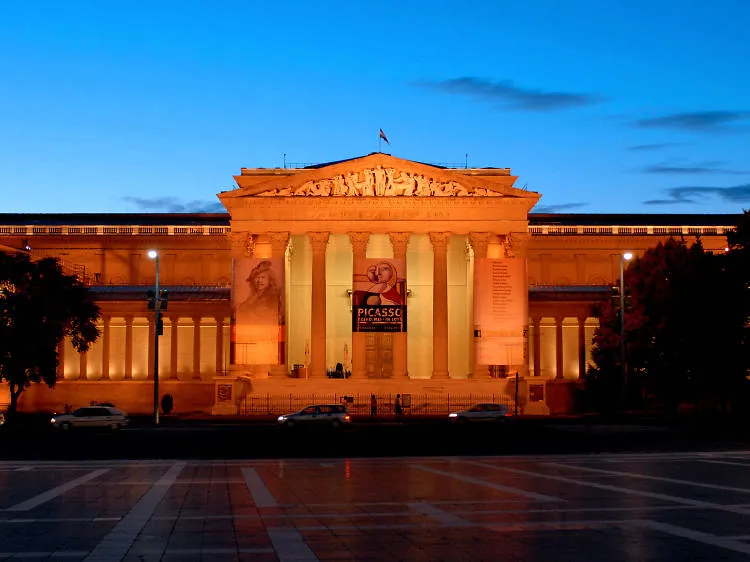
Museum Of Fine Arts Budapest

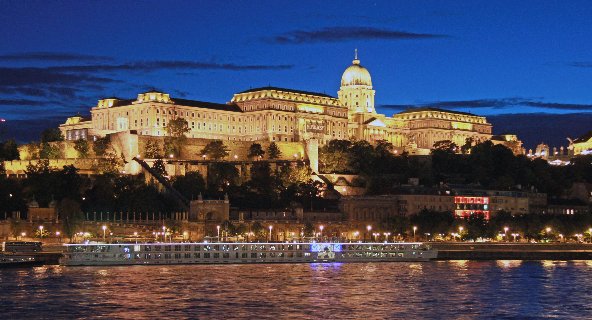
Buda Castle

I visited the Hungarian city of Budapest the other week and decided to visit some of its art museums.  The two main establishments are the Szépművészeti Múzeum, the Museum of Fine Arts on the Pest side of the city and the Hungarian National Gallery on the Buda side of the city which is located inside the royal palace of Buda Castle, and the vast collection there traces the country’s creative history from medieval triptychs through to post-1945 art and sculpture.  In the following blogs I want to look at the works of art of the Hungarian painters which feature predominantly in these collections.

Self portrait by Viktor Madarász

Viktor Madarász was born on December 4th 1830 in the small village of Csetnek, (today: Štítnik, Slovakia) in what is now middle-eastern Slovakia.  He came from a once noble family.  His father, András was an iron manufacturer and craftsman. Originally, his parents wanted Viktor to have a career in law and so he went to study in Bratislava.  The majority of Hungary had been under Ottoman rule from 1541 and 1699 at which time the Habsburg monarchy defeated the Ottoman forces and took control over Hungary. 

In 1848, when the Hungarian Revolution began, Madarász left college to join the struggle for independence. Despite being only seventeen, which was too young to join the army, he was accepted and participated in numerous battles and became a Second Lieutenant.  The revolution failed and for Madarász the experience was traumatic and one which he never forgot. He dedicated his art to the idea of Hungarian independence from Habsburg rule for the Hungarian people and recalled pictorially the heroic and tragic memories of this time in the history of Hungary.

Kuruck and Labanc by Viktor Madarász

One of his early historical paintings was entitled Kuruc and Labanc which depicted two brothers fighting on opposite sides of the Hungarian Revolution. The Kuruck was a group of armed anti-Habsburg grouping that wanted to rid Hungary of the Habsburg rule and the word “kuruck” is used in both a positive sense to mean “patriotic” and in a negative sense to mean “chauvinistic.” The term Labanc was designated to those Hungarians who advocated cooperating with the outside powers, the Habsburgs, and is almost always used in a negative sense to mean “disloyal” or “traitorous”. The painting was well received by the critics.

Thököly’s Dream (The Dream of an Exile) by Viktor Madarász (1856)

Dózsa’s People by Viktor Madarász

After the war of independence, the uprising had been defeated, and Madarász lived in exile and after hiding out briefly, returned on foot to his family’s home in Pécs.  Once back home he continued with his legal studies but also enrolled in art lessons from a local artist. In 1853, he enrolled for preparatory work at the Academy of Fine Arts, Vienna but was disheartened with the old-conservative atmosphere there, and he went to the private school of Ferdinand Georg Waldmüller, who was looked upon as a bold innovator at the time. In 1856, Viktor Madarász moved to Paris where he studied in the studios of Léon Cogniet and at the École des Beaux Arts.

The Mourning of László Hunyadi by Viktor Madarász (1859)

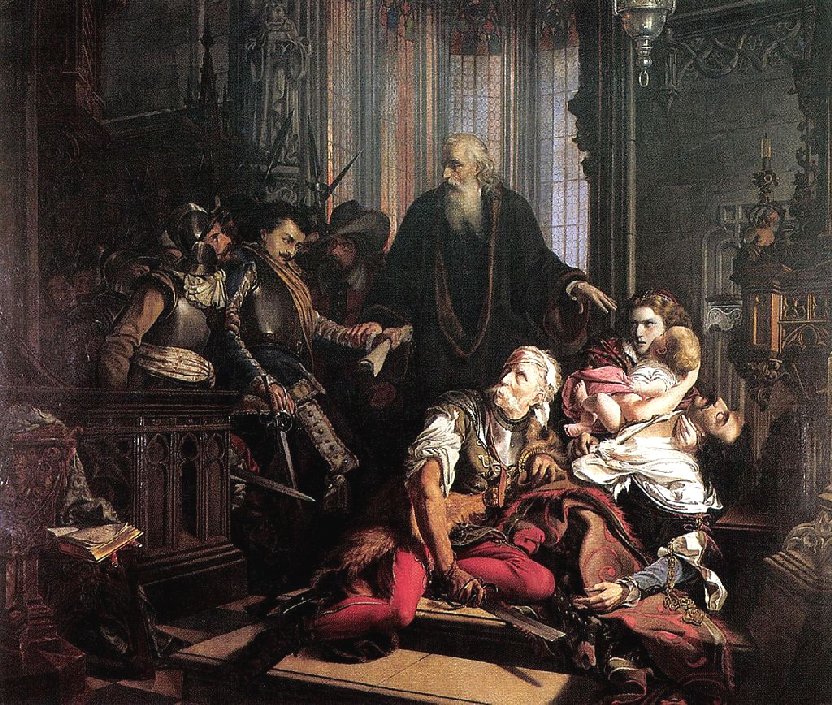
One of Madarász most popular works and considered the main work of his life, is part of the Hungarian National Gallery collection. It is entitled The Mourning of László Hunyadi and was completed by Madardsz in 1859 whilst he was living in Paris. It is a major work of romanticism. The painting depicts the altar of the Church of Mary Magdalene in Buda, before which is the body of László Hunyadi. László Hunyadi, the son of János Hunyadi, who had defeated the Ottomans and became a national hero, was ordered to be killed by Vladislav V. Young Hunyadi enjoyed widespread popularity among the Hungarians, so he was seen as a threat to the seventeen-year-old, inexperienced King Vladislav V, the only son of the Habsburg German King Albert II.   The king, fearing the popularity of Hunyadi, ordered his execution and he was beheaded on March 16th 1457.  In this depiction we see two women kneeling at the feet of Hunyadi.  One was his mother, Erzébet Szilágyi, the other was his bride, Maria Gara.  This painting by Madarasz was believed to be an anti-Habsburg political statement during a time of the Habsburg oppression of the Hungarian people.  The work of art became a symbol of the failed Hungarian Revolution and National self-sacrifice.  The painting was thought of as the Hungarian Pieta following the iconography of the Lamentation of Christ, in which Christ’s torso was removed from the cross and his friends mourned over his body and so in a way Madarasz’s painting offered a promise that like Christ, the Hungarian nation would rise again. 

Zrínyi and Frangepán in Bécsújhely Prison by Viktor Madarász (1864)

Another painting in the Hungarian National Gallery by Madarász was his 1864 historical work entitled Zrínyi and Frangepán in Bécsújhely Prison. When the painting was first exhibited in 1866 people flocked to see it.  The painting depicts two men, Péter Zrínyi, the Ban (local ruler) of Croatia, and the Hungarian Count Ferenc Frangepán, sitting facing each other across a table in the Bécsújhely prison.  Guards and imperial officials can be seen in the background.  Both had been implicated in the Wesselényi Conspiracy, a plot among Croatian and Hungarian nobles to oust the Habsburg Monarchy from Croatia and Hungary.  The two men are saying their last farewells to each other before they were both executed.

Self portrait by Pal Szinyei Merse (1897)

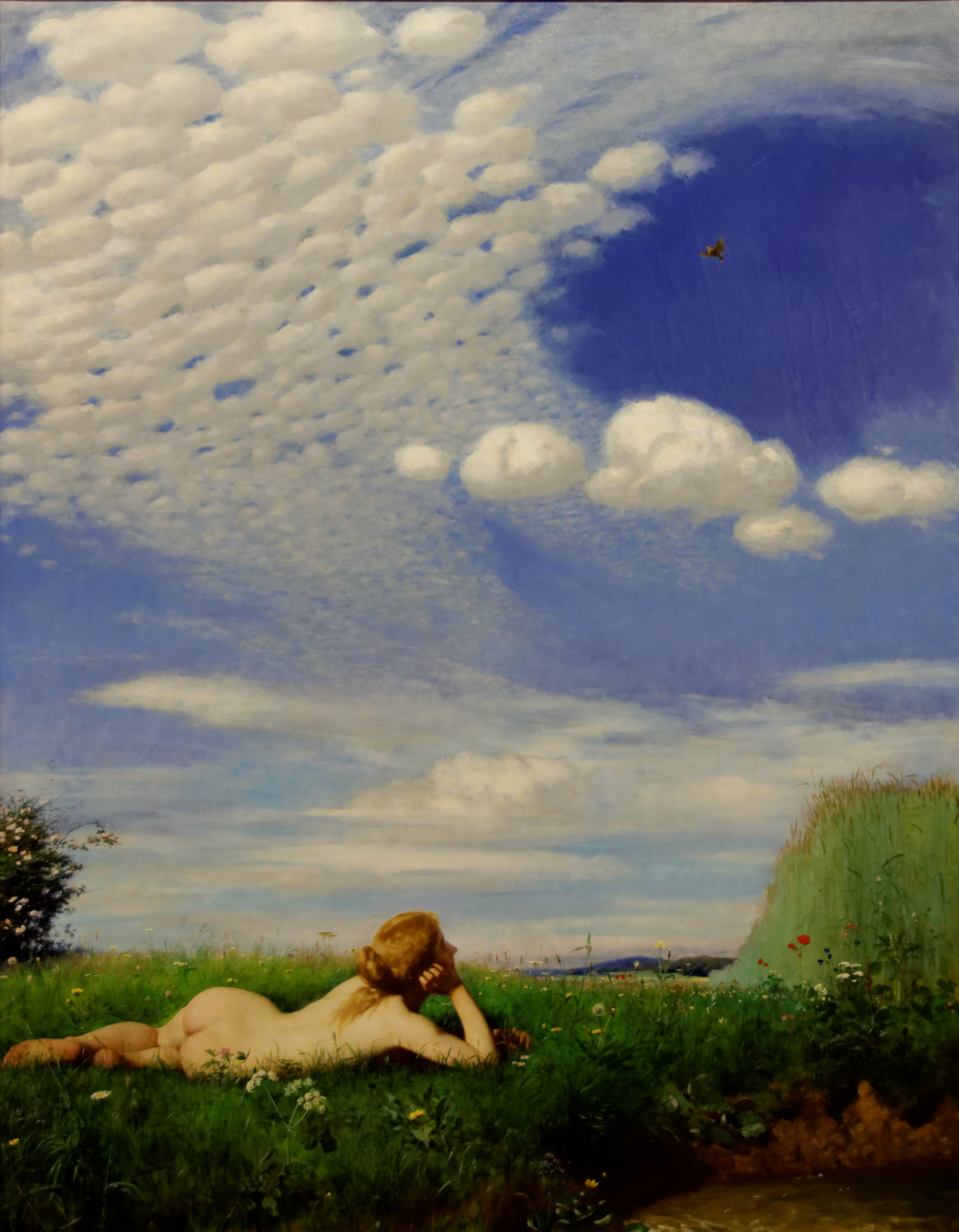
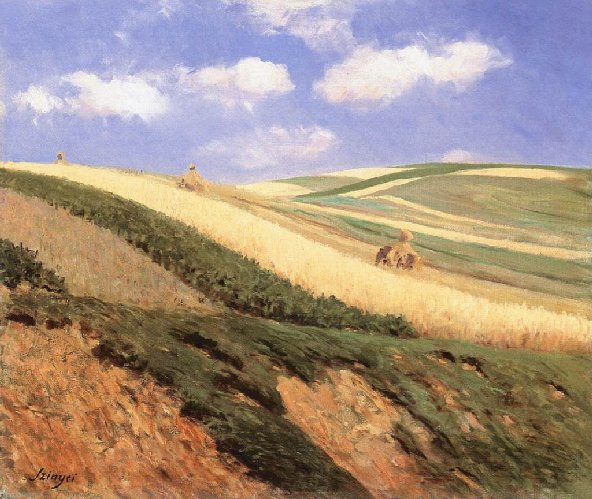
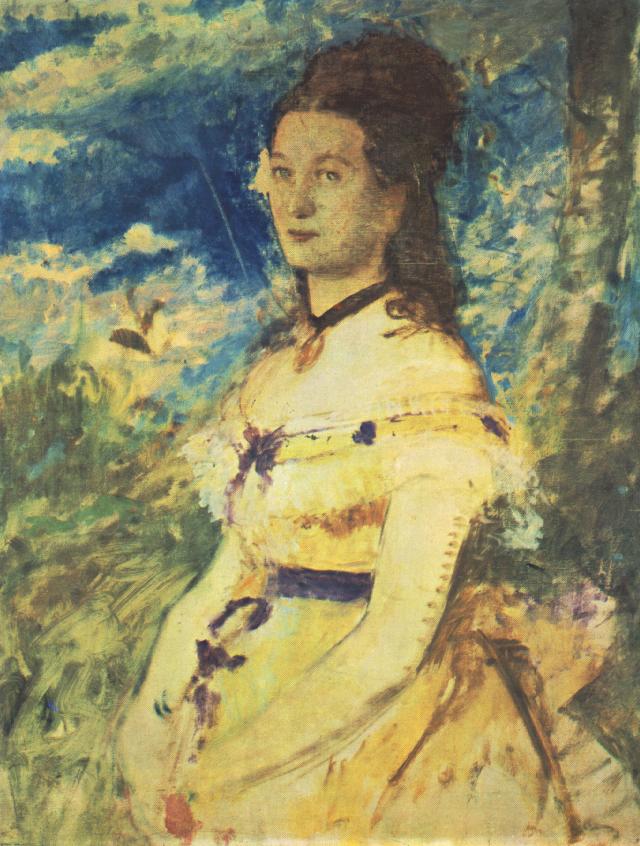
The second artist I am showcasing is Pál Szinyei Merse. Pál Szinyei Merse was an outstanding master of nineteenth-century Hungarian painting and one of the most influential figures in Hungarian art. He was born on July 4th 1845 in Szinyeújfalu, a village and municipality in the Prešov District of eastern Slovakia..  He was the third of eight children of Félix Szinyei Merse and Valéria Jekelfalussy and came from a noble family which had 700 years of history, but by the 19th century the family wealth had dwindled, and yet, Pál, because of his art, never ever had problems making ends meet. 

Winter by Pal Szinyei Merse (c.1905)

After the death of his grandfather in 1850, the family moved to the mansion in the east Slovakian town of Jernye (now Jarovnice). His father graduated in law from Košice and became ambassador to the town of Sibiu during the 1839/40 Parliament, and was appointed Alispan, an office held by the most prestigious and generally wealthiest of the commoners and in 1871 became the High Sheriff.  His father was a great supporter of his son and his artistic ambitions, and his mother was a lover of literature and music, who brought considerable wealth into their marriage.

Skylark by Pál Szinyei Merse.(1882)

From 1856 Pál studied at the Catholic high school in Prešov and remained there until he reached the sixth grade. He remained a private student until 1859, and, in the autumn of 1861, he studied in Oradea, where he graduated in the summer of 1863. Pál Szinyei started to become interested in painting and took it more seriously during his high school years and received tuition from Lajos Mezey a local artist from Oradea.

The Field by Pál Szinyei Merse (1909)

In 1864, thanks to the support of his parents, he enrolled at the Academy of Fine Arts in Munich, where he studied under the Hungarian artist, Alexander von Wagner, and later, from 1867 to 1869, his tutor was Karl von Piloty, the German historical painter.  Another famous artist he met whilst attending the Academy was Wilhelm Leibl, who introduced Pál to plein-air painting. After seeing a major art exhibition in 1869, Pál was anxious to get to work on his own and decided to leave the Academy. Pál Szinyei Merse was a ground-breaking pioneer and the first true colourist in the history of Hungarian painting. 

On October 15, 1873, Pál Szinyei Merse married the love of his life, Zsófia Probstner, the twenty-year-old daughter of the owner of the Lublo bath. They went on to have six children, a son, Laszlo Paul Felix and five daughters, Sophie, Mary, Valeria, Elisabeth and Adrienne.

Picnic in May by Pál Szinyei Merse (1873)

In 1873 Pál Szinyei Merse completed the painting entitled Picnic in May and although it was ridiculed by his contemporaries it is now looked upon as one of the finest Hungarian paintings.

In his autobiography Pál wrote about the painting, saying :

“…I painted myself into the picture prone, minching away, with my back to the spectator. I must admit I was thinking of the critics who would dislike my picture…”

Lady in Violet by Pál Szinyei Merse (1874)

Probably one of his most famous works was painted a year later, 1874, and is entitle Lady in Violet. It is seen on many posters around Budapest advertising the Hungarian National Gallery. It has become the Hungarian Mona Lisa and is one of the most well-known painting to this day.The painting depicts the artist’s wife, Zsófia, who was pregnant at the time, resting in the garden of their manor house in Jernye. She is wearing a taffeta bustle dress which was very popular in those days. The artist started the painting using complementary colours and then created a new colour harmony by juxtaposing yellow, violet and green. While he was in Munich he had bought the high-quality violet paint from Richard Wurm, a paint merchant and a mutual friend of both Pál Szinyei Merse and the Swiss Symbolist painter, Arnold Böcklin. It was Böcklin who encouraged Pál to use colour vigorously.

The Artist’s Wife Dressed in Yellow by Pál Szinyei Merse (1875)

The painting of his wife, which was never finished, was painted a year after his painting, Lady in Violet.

Portrait of Zsigmond Szinyei Merse by Pál Szinyei Merse (1866)

His family featured in many of his painting, such as his 1866 painting, Portrait of Zsigmond Szinyei Merse which he completed while spending his summer in Jernye. It is a depiction of his younger brother Zsigmond with a red cap, lost in thought as he plays a chibouk.

Portrait of Ninon Szinyei Merse by Pál Szinyei Merse (1870)

Pál Szinyei was working in Hungary during the French-Prussian war and painted several pictures of members of his family in a naturalist style. This portrait of his elder sister is one of them.

Portrait of Artist’s wife by Pál Szinyei Merse (1880)

Lovers by Pál Szinyei Merse (1869)

One of Szinvei’s favourite themes was outdoors parties and the enjoyment of periods of relaxation.  His 1869 painting entitled Lovers depicts two people relaxing in a rural setting, on a hillside during the early summer.  The artist has used pale colours which he has used harmoniously and this muted colouration evokes a lyrical aspect to the scene.  It is a scene of great intimacy as we see the couple lock eyes whilst their fingers tenderly intertwine and set in an almost dream-like countryside background.

…….to be continued

Theresa Bernstein. Part 2.

William Merowitz in his studio.

John Weichsel was the founder of the People’s Art Guild in 1915.  It was to be an alternative to the system of traditional fine art galleries. The Guild would set up exhibitions in various unconventional spaces and by doing so, the Guild brought avant-garde art into the immigrant settlement houses and tenements of the Lower East Side with the goal of exposing a new set of people to modern art and at the same time, providing artists with direct contact to new markets. One of the helpers at the Guild was William Meyerowitz.

Theresa and William’s Wedding Photograph (1919)

Meyerowitz called on Theresa at her studio and asked if she could offer some of her paintings for a benefit show with the Guild.  From this initial meeting a friendship developed which blossomed into romance and finally on February 7th 1919 the couple married in Philadelphia.

The Studio (54th West 74th Street) by William Meyerowitz (1935)

William Meyerowtiz was born in Ekaterinoslav, now Dnipro in Eastern Ukraine, on July 15, 1887.   He and his father had immigrated to New York City in 1908, and they settled in the Lower East Side. William studied etching at the National Academy of Design and was also a talented singer and while he was a student he sang in the chorus of the Metropolitan Opera. Later, he rented a studio in the same building as the 291 gallery run by Alfred Stieglitz.

Portrait of the Artist by Theresa Bernstein (1920)

Their marriage took an early blow when their baby daughter died of pneumonia. and from that tragedy, they remained childless. Despite this tragic occurrence the couple lived a happy and contented life. In her 1986 biography of her husband, William Meyerowitz, The Artist Speaks. Theresa Bernstein Meyerowitz wrote:

“…In the Autumn evenings, we used to take a little table from the studio and place it in front of the fireplace. William would split some logs and light the fire. … We would have cozy conversations about our work, our friends, ourselves and they were precious evenings we spent together. We never tired of each other’s company. . . . From the day we met, our life was one absorbing conversation...”

The Immigrants by Theresa Bernstein (1923)

In 1891, Theresa Bernstein had been an immigrant entering America with her mother and father when she was just one-year-old. Thirty-two years later she completed a painting entitled The Immigrants, depicting the deck of the Cunard liner, Aquitania and the plight of immigrants heading for the “promised land”.  The centre point of this depiction is a young mother and her baby and maybe Theresa wanted, through this painting, to recall what it would have been like for her mother making that sea passage across the Atlantic.  The young woman is surrounded by her fellow immigrants.  She seems to be lost in her thoughts.  What are her thoughts?  Behind her right shoulder is a young man hovering nearby.  Could she be thinking of a new relationship, a new romance?  Behind her left shoulder is a group of children with their mother.  Maybe the young woman daydreaming about a happy family life with numerous children.  This is a depiction which directs our thoughts on the vulnerability, change and challenge which affect this young woman but at the same time offers a glimmer of hope with regards her possible new beginning.

The Milliners by Theresa Bernstein (1921)

Bernstein’s 1921 painting entitled The Milliners is typical of many of her figurative works depicting a large group of people.  Look back at some of her multi-figured paintings: the job-seekers in a crowded waiting room (Waiting Room – Employment Office), people crowded into a train on the elevated railway (In the Elevated), and many others depicting beach scenes at Coney Island or audiences at the music hall or theatre.   Theresa was Jewish and although this 1918 painting, The Milliners, could not be termed Jewish, it was personal to Theresa as her sister-in-law worked in the millinery industry, a typical “vocation” that was both immigrant and Jewish. 

View through window (The Milliners)

In the painting we see a group of female workers, engaged in the fastidious and creative labour of creating hats. It depicts six women gathered around a table which is brimming with accessories.  The depiction is a close-up of the women and this view emphasizes the cramped nature of the space that the women are working in but it also offers us a close look at their individual features.  The setting is probably a room in a city tenement apartment.  If you look carefully at the upper left, you can just make out a window, windowsill and through this space we can just make out the metal fire escape which was common in this type of building.

Mother and Mother-in-law

This is also a depiction of Theresa’s beloved family.  Theresa’s mother is the woman we see depicted at the upper left of the group, with greying hair, talking to Theresa’s mother-in-law, whose hands hide the delicate threads she is working with, head bowed as if in prayer. On either side of the mothers are two of Theresa Bernstein’s sisters-in-law, Bessie and Sophie, who was actually  a milliner herself. One of them, dressed in black, has placed a newly made black hat on her head and is admiringly viewing the result in a hand-held mirror.  Her sister, dressed in bright yellow, watches as her sibling vainly gazes lovingly at her reflection.  She holds a black hat which has two large flame-like yellow feathers attached to it.  In the lower right of the group, diametrically opposite her mother, is Minna, Theresa’s third sister-in-law, dressed in a white dress and they are testament to two generations of milliners.  The final member of this working group of women sitting on the far right, dressed in green, is Katie.  She is the only one to be looking out us.  Maybe she is silently inviting us into this intimate circle.  Katie was the family housekeeper and Theresa’s much-loved confidante.

Katie by Theresa Bernstein (1917)

Katie, the Bernstein’s housekeeper was the subject of Theresa’s portrait in 1917. Although Theresa thought of her as a friend and part of the family. For Katie, her role in the Bernstein household was somewhere between an employee and a sister to Theresa.  Bernstein did not choose sitters for their glamour or their social status, her choice of subjects was based upon people she liked.  In this portrait which uses earth tones we see Katie wearing a heavy shabby coat.  She is pinching the lapels tightly together.  On her head is a hat, with the haloed brim positioned at a jaunty angle allowing the feathers, attached to it, to cascade downwards.

Woman with a Parrot by Theresa Bernstein (c.1917)

Elsa Baroness von Freytag-Loringhoven the German-born avant-garde visual artist and poet, who was active in Greenwich Village, New York, from 1913 to 1923, where her radical self-displays came to embody a living Dada. She was considered one of the most controversial and radical women artists of the era.  Theresa Bernstein painted several striking portraits of this Dada artist, poet, model, and muse, whom she befriended in New York’s Greenwich Village. Was it the sitter’s uncompromising attitude to life which attracted Bernstein for she too was equally radical in her own time, as she established her own path as a Jewish immigrant and a female artist in the male-dominated art market.  In this painting entitled Woman with a Parrot which she completed around 1917, we see the baroness gracefully poised against a plain background; her back is partially exposed, and she holds a red parrot.

The Cribbage Players by Theresa Bernstein (1927)

The New York Society of Women Artists (NYSWA) was founded in 1925 and devoted itself to avant-garde women artists.  Theresa Bernstein was one of the earliest members and and took part in this and other women artists’ groups throughout her career.  Theresa was acutely sensitive to the discrimination against her within the profession because she was a woman and for that reason, she would often use only her first initial when exhibiting, especially at the National Academy of Design. She was both disillusioned and disappointed with never having been nominated to the Academy. She would often amusingly recount an anecdote about the male artistic preserve, the Salmagundi Club of New York City. (It only began to admit women in the 1970s.) Her story goes that a delegation from the club visited her studio at one point in search of a Mr. Bernstein. At first Theresa believed that they were looking for her father. After some amusing banter, it soon became apparent that they wished to offer “Mr. Bernstein” a membership in the club and they stalked off in a mood when they found out that the painter of the canvases, they so admired, was in fact Theresa Bernstein.

Metropolitan Opera by Theresa Bernstein (1924)

Metropolitan Opera by Theresa Bernstein

Toscanini at Carnegie Hall (1930)

Two subjects that fascinated Theresa Bernstein and were often depicted in her works of art were her love of music which she had got from her husband and the depiction of crowds and both these elements can be seen in her depiction of musical events at the Metropolitan Opera House and Carnegie Hall,

The Music Lover by Theresa Bernstein (1913)

Theresa Bernstein died at Mount Sinai Hospital in Manhattan on February 12th 2002, sixteen days before her 112th birthday, although it is thought she may have been older, but she had never been forthcoming regarding her birthdate!  Her husband William Meyerowitz had dies in 1981.  She will always be remembered as one of the first to paint in the Realist style.

Music Lovers by Theresa Bernstein (1934)

I will leave the last words on this wonderful artist to Patricia M Burnham, lecturer in American studies and art history at the University of Texas, who wrote an article about Theresa Bernstein in the Woman’s Art Journal, Vol. 9, No. 2 (Autumn, 1988 – Winter, 1989).  She wrote:

“…Her work has not gone unrecognized. Each decade of her 80-year career has been marked by gallery representation and one-woman shows. Her early work especially generated considerable excitement among reviewers and critics.  But she has never gained the national reputation one might have expected nor are her works to be found in a large number of major art museums.  Happily, Theresa Bernstein is now being rediscovered.  Along with many other women artists, she has been a beneficiary of the women’s movement and feminist art scholarship.20 Art historians taking another look at early-20th-century American art are beginning to recognize her achievements.   Yet to come is a full evaluation of her work that will reveal the weaknesses among the strengths, the particulars among the universals, the womanly among the human and ultimately provide a meaningful synthesis worthy of its subject…”

Theresa Bernstein. Part 1.

Theresa Bernstein (1890 -2002)

My blog today is all about a remarkable woman, not just for her art but for her amazing longevity, dying just a few months short of her 112th birthday. She is the American painter, Theresa Ferber Bernstein. 

Two miniature cameos (possibly self-portraits) by Theresa Bernstein (1907)

Theresa was born on March 1st 1890 in Krakow, a city in the Austro-Hungarian Empire, now Poland.  She was the only child of Isidore Bernstein and Anne Bernstein (née Ferber).  Her father was a Jewish textile merchant and her mother was a woman of Central European culture and learning who was a talented pianist.  In 1891 when Theresa was one year old the family left Krakow and emigrated to America and Philadelphia became Theresa’s first home.

Polish Church, Easter Morning by Theresa Bernstein (1916)

As a young child, Theresa loved to draw and paint and later, whilst at high school, received some art training.  Bernstein graduated from the William D. Kelley School in Philadelphia in June 1907, at the age of 17. That same year, with her drawing of sprouting onions viewed through a green glass planter, she won a Board of Education scholarship to the Philadelphia School of Design for Women, now the Moore College of Art & Design,where she enrolled in the four-year Normal Art Course for training teachers. It was here that she studied under Elliott Daingerfield, Daniel Garber, Harriet Sartain, Henry B. Snell, and Samuel Murray. Her interest in art grew as she got older and she would attend some lectures at the Pennsylvania Academy of the Fine Arts. 

Daniel Garber’s Studio by Theresa Bernstein (1910)

Whilst studying at the Philadelphia School of Design for Women Theresa produced a painting 1n 1910 entitled Daniel Garber’s Studio which is a pictorial memory of her time there.

Dance Hall by Theresa Bernstein (1911)

The students would be taken on painting trips by their tutors and one such outing with William Daingerfield in 1911 was a summer stay at Blowing Rock, North Carolina, where she painted the first of her jazz-inspired works, entitled Dance Hall.

Kindergarten Class by Theresa Bernstein (1914)

She graduated from the Philadelphia School of Design for Women in 1911.  Theresa’s father’s business in Philadelphia had run into difficulties and so he along with his wife and daughter left the city and went to live in New York and that October Theresa began taking life and portraiture classes with William Merritt Chase at the Art Students League.  Besides her art education Theresa travelled on two occasions with her mother to Europe, where they visited relatives and visited a number of art galleries.  She greatly admired the work of the European Expressionist artists such as Wassily Kandinsky, Franz Marc, and Edvard Munch.

Colored Church, North Carolina by Theresa Bernstein (1911)

When back in New York, Theresa visited the Manhattan gallery of Alfred Stieglitz, the 291 Gallery, and in 1913 she attended the Armory Show which was organized by the Association of American Painters and Sculptors. Here she was able to view works by European modernists.  She had mixed feelings about what she saw and later stated that she couldn’t warm up to cubes and triangles—they didn’t have enough life force.

The Little Merry-go-Round by Theresa Bernstein (1913)

However, in 1913, a breakthrough occurred for Theresa when the National Academy of Design chose her painting, Open-Air Show for its annual exhibition. The work then went on to the Carnegie Institute and the Art Institute of Chicago, where it attracted the attention of English collector John Lane, who purchased it and became an enthusiastic supporter of Theresa.

At the Movies by Theresa Bernstein (1913)

The American edition of the English magazine The Studio: An Illustrated Magazine of Fine and Applied Art, was titled The International Studio. It had its own editorial staff, and the content was different from that of the English edition, although many articles from it were reprinted. It was published in New York by John Lane & Company.  W. H. de B. Nelson, an intriguing figure in the early 20th-century American art scene, wrote in The International Studio praising Theresa Bernstein for her independence of her direction with regards to her art stating that it was an uncompromising offerings of this ambitious girl, commending her choice of subject matter–“democratic parks, unfashionable chapels, the five-cent subway.” He finished by saying that she was a woman painter who paints like a man. he was delighted by his comments.

Searchlights on the Hudson by Theresa Bernstein (1915)

One of her paintings exhibited at the Milch Galleries was Searchlights on the Hudson which she had completed in 1915.  Theresa had remembered seeing the unusual and spectacular sight of the Hudson River being illuminated by searchlights as a method of detection of enemy boats and dirigibles.

Waiting Room- Employment Office by Theresa Bernstein (1917)

Theresa, from an early age, was very observant.  She could leave a room and once outside accurately describe what had been inside and could even sketch what she had seen.  This excellent memory was of great help to her when she completed a painting in 1917 entitled Waiting Room – Employment Office.   Four years earlier, when she was thirteen years old, she had accompanied her mother to the employment office, where she was going to select a housemaid, Theresa remembered what the room in the office looked like and all the people waiting patiently to secure work.   It is an emotive recollection of that visit.

Street Workers by Theresa Bernstein (1915)

The Ashcan School was an informal art group that operated in the late 19th and early 20th centuries and included great artists such as Robert Henri, John Sloan, William James Glackens, George Luks, Everett Shinn, George Bellows, Jerome Myers.   This group was known for its works in the style of urban realism, which produced depictions of urban life of the lower-class New Yorkers, warts and all.  Although Theresa was never a formal member of the Ashcan School, she shared with it an enthusiasm for “modern” subject matter, to which she added a profoundly meaningful take on the way she saw her subjects.

In the Elevated by Theresa Bernstein (1916)

She embraced urbanism and popular culture with great passion.  Her depictions of urban life were varied and encompassed the like of  the cinema, trolley buses and the elevated trains, and places where the lower and lower-middle classes would congregate in the summer such as Coney Island. Her 1916 painting entitled In the Elevated depicts a passenger car on the Ninth Avenue Elevated railway, which Bernstein took between her parents’ apartment on West 94th Street and her studio on West 55th Street. This work by Bernstein encapsulates the experience of modern city folk who are placed in close physical proximity and yet remain psychologically isolated from one another.

Third Class Carriage by Honoré Daumier (1858)

The work reminds me of one of my favourite paintings by Honoré Daumier’s entitled Third Class Carriage which he completed around 1858.

The Readers by Theresa Bernstein (1914)

The New York Public Library was built on Fifth Avenue, between 70th and 71st Streets, in 1877 to much funfare and excitement and the first book was borrowed within ten minutes of the grand opening.  One of the regular visitors to this great institution was Theresa Bernstein who spent many happy hours there.  Whilst in the library she not only read the many books on offer but took the time to secretly sketch on scraps of paper and backs of envelopes the gesticulations and expressions of those around her.  It got to the point that she became such a frequent visitor and loved everything about it that she referred to it in her memoir as her “alma mater.”

Theresa’s 1914 painting The Readers, depicts the reading room of this newly opened library. We see five men seated on all sides of a banquette, in a pyramid shape at the centre of the composition. Their faces are softly lit by the glow of the reading lamp. It is fascinating to see that each of them has staked out the best spot in the reading room and settled in for the day.  The three men facing us seem very content and totally absorbed with their books. 

Graphite on paper study for The Readers by Theresa Bernstein (1914)

What is fascinating about this painting is the change of heart Theresa must have had between making the preliminary sketch for the work and how it finished up.  Theresa had a major change of heart as to the people present, as in the sketch one of the figures seated on the banquette, on the right, was a woman in a feathered hat. But in the painting, Bernstein replaced her with a man.  In the finished painting the only woman depicted is one who stands in the middle background, plainly dressed and deep in thought, her hand resting on her chin as she studies her book. It is possible that placing the solitary woman in the background of the painting, Bernstein may have been providing a symbolic commentary on gender inequality.   The Central Library was one of the few public places where women were able to sit uninterrupted and in comfort for hours, whilst delving into the world of books.

William Meyerowitz

Theresa’s life changed in 1917 when William Meyerowitz knocked on the door of her studio…………………………………………….

to be continued.

Anna Richards Brewster. Part 2.

During the three-year period between 1901 and 1904 Anna, her father and young brother went on several painting trips.  They travelled through Europe to Norway as well as taking a couple of trips around the east coast of America.   Anna and her father, the painter, William Trost Richards, had joint exhibitions of their work in New York, Boston and Washington at which twenty of her works she had completed in Clovelly were displayed.
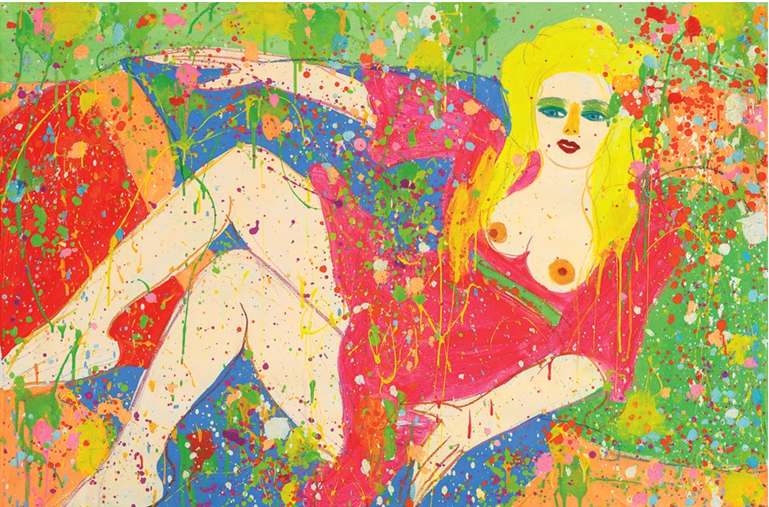
In 1904 whilst Anna was enjoying a trip back home in Boston she got news that her elderly friend and patron, Mr Kemp-Welch, had died.  During her stay in America, she went to New York to visit her brother Herbert who was a professor of Botany at Barnard College, Columbia University.  Whilst with her brother she met his roommate a professor of English literature, William Tenney Brewster.   From that first meeting with him the pair spent many hours together during Anna’s two-week American vacation.  She eventually sailed back to England but the pair corresponded regularly.  Their friendship blossomed and in January 1905, William proposed marriage to Anna.
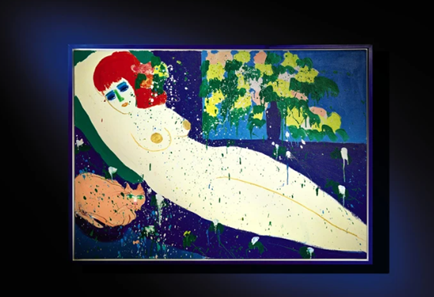
William Trost Richards in his Newport Studio by Anna Richards Brewster (1892)

Anna didn’t accept right away as she had a lot to think about.  She wanted to carry on being a professional artist and she was concerned that marriage would interfere with that as it had done to so many female painters who had chosen married life over the role of a professional painter.  In March, after much soul searching, Anna agreed to marry William and they were married on July 18th 1905 at the Parish Church of St Luke in Chelsea and she became Mrs Anna Richards Brewster.  The couple went on honeymoon and for the first part of it her father and brother, Herbert, accompanied them.

Landscape with Wild Flowers by Anna Richards Brewster (1901)

Anna and William decided that they must live in New York because of his teaching post and they settled on a plan to rent two apartments on the same floor of a building on the upper west side of New York, one for them and the other for her father and brother.  The plan was to share meals and staff and one room in the second apartment would be set up as a studio for Anna and her father.  The plan never came to fruition as in the Autumn of 1905, her father, William Trost Richards had a heart attack, whilst working on a large painting in his Newport studio on a large painting, and died.
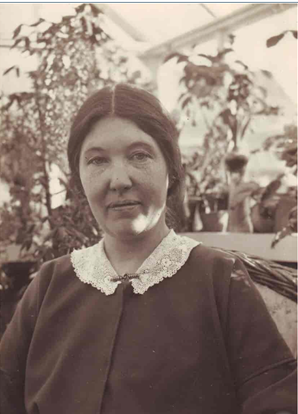
Anna’s worries about her dual role as a wife and a professional artist proved unfounded as her husband pushed her to continue painting and exhibiting her work even while her life and interests were changing.   Anna was content with how her life had evolved and wrote to her friend Annie Winsor in 1906 telling her about her new sense of purpose:

“…The sense of permanency of its being ‘the real thing’ as it were, in marriage is a comfort and a struggle to me and I like the problems of life becoming less shadowy and unreal than they are to a single person. I have always felt irresponsible a spectator before; but now at last I am in the arena…”

Anna Richards Brewster with her three-year-old son Herbert (1908)

William Tenney Brewster with his son Herbert (1909)

In 1906 Anna gave birth to her first child, a boy, and she and her husband named him Herbert, presumably after her brother.  It proved to be a complicated birth and at one point the lives of mother and baby were in peril.  In June 1906 in a letter to Annie Winsor, Anna described the traumatic birth and her proud husband:

“…It was a capable doctor who saved us — and indeed it was all they could do to save the little hoy’s life…. The boy is doing well now…. he is his father’s son — Dick [i.e. William Tenney Brewster] is delighted with and about him. He was charming and spontaneously devoted all the time — I think it is the profoundest experience he has ever had. I didn’t suppose he would care so much so soon….. I’m sorry that the child is rather a ticklish one to take care of, being excessively sensitive to heat and cold — his circulation is bad. It is so hard to get one’s experience with babies: for experience is won through mistakes: and mistakes are disastrous with babies…”
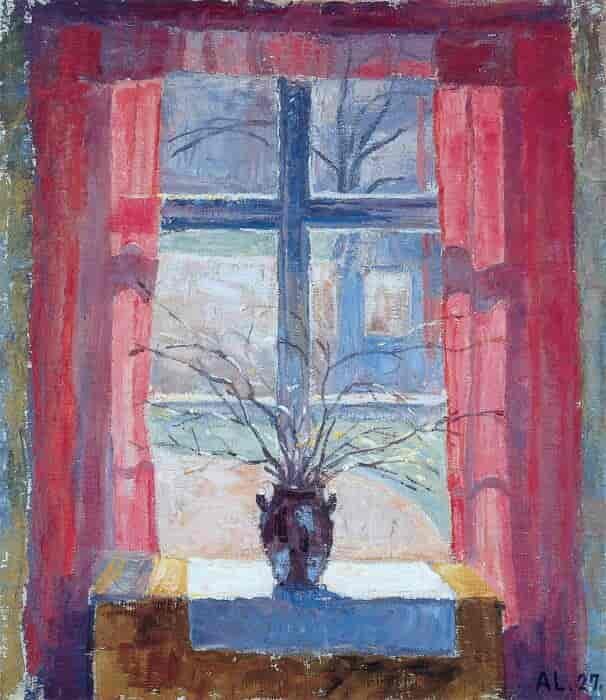
From the letter we can deduce that the baby’s health was an issue which would later haunt them. The early years with baby Herbert were talked about by Edith Price, Anna’s niece, in a May 1986 interview with Susan Brewster McClatchy.

“…Of course they spoiled him dreadfully. … He was the wonder of wonders and she had ideas she had gotten from some German child health expert at the time, that you let them run around naked…. Anyway, he was such a poor, puny, one-foot-in-the-grave little baby that mother [Anna’s sister Nelly] said. “He’s off to an awfully bad start.” Well, the German exercises did him good and he became quite a sturdy little boy…”

Once again we get the feeling that all was not right with baby Herbert.

Campfire Long Pond ME by Anna Richards Brewster

Lily Pond Matunuck Rhode Island by Anna Richards Brewster (1915)

When Anna’s father died he left Anna and her husband a property on Cedar Swamp Pond in Matunuck, Rhode Island, as a wedding present. There they built a small summer camp, and it was here that the couple would spend the next thirty summers.

Palma Majorca by Anna Richards Brewster (1932)

Meanwhile, Anna’s best friend Annie Winsor, an educator, was living with her uncle William Ware, who owned a boarding house in New York.  She taught at the Brearley School, an all-girls private school in New York City, located on the Upper East Side.  Her uncle had also invited Annie’s distant cousin, Joseph Allen to come and live with them.  Joseph, a Harvard graduate, had been teaching at Cornell and in 1897 began teaching at the City College of New York.  Annie and Joseph’s friendship turned to love and the couple were engaged in 1899 and married the following year.  The couple had three children by 1905 and decided that New York was not an ideal place to bring up children and so they moved to White Plains, a town in Westchester County, a northern suburb of New York. Unfortunately Annie found the schooling there was below her standard and decided to home-school her children and from this she also began to teach the children of her neighbours.  In 1907, buoyed by the success of teaching the neighbourhood children she founded the Roger Ascham School, a progressive, co-education school that included all grades from first to high school.  Later the school relocated to the nearby town of Scarsdale.

Autumn Path by Anna Richards Brewster (1915)

Anna Richards Brewster and her husband William decided, for the same reason as Annie and her husband, that New York city life was not the place to raise their son Herbert and they too moved to Scarsdale and built themselves a house.  Anna immersed herself in the Scarsdale community, founding the Scarsdale Art Association, and helped to found the Scarsdale Women’s Club.  She also became a trustee of her friend Annie Winsor Allen’s Roger Ashcam School in 1909.  Despite the upheaval of bringing up her son, looking after her husband and the issues around re-location she still managed to exhibit works at the Pennsylvania Academy of Fine Arts

Butler Road, Scarsdale, New York by Anna Richards Brewster

In January 1910, a month before the completion of their new house in Fenmore Road, Scarsdale, their son Herbert was taken seriously ill and tragically passed away.  The cause of death was believed to have been complications from a bout of pneumonia.  Anna and her husband William were devastated. Edith Price, Anna Richards Brewster’s niece, remembered that sad time in an 1986 interview:

“…The house that was to be for their boy was being built through the Winter of 1909 and early months of 1910, but in February there was no child. It was a beautiful house. . . . I saw it first in 1913 , when I went alone to visit. It was overwhelmingly haunted, for me, and always remained so. . . . The little presence that their love and lasting loneliness had caused to dwell there was inescapable…”

Twenty years later Edith revisited the house and recalled that visit:

“…I slept in the nursery, whose pictures I had secretly copied many years before. . . . Anna had meant to paint fairytale scenes in a high dado all around the room. Instead there were pictures of a three-year-old hoy — in the snow on Riverside Drive, in the woods at Cedar Swamp.  It must have helped many dark hours – painting them – trying to hold him from slipping away. I wonder what WTB [Anna’s husband] did with those paintings. I would dearly love to have one. I wonder if he destroyed them…”

The paintings were never found.

The outward appearance of Anna and her husband after the death of their son was one of resignation and yet they seemed to have recovered but I am sure inwardly their minds were in utter turmoil, but life still had to go on. 

No. 9 Fenemore Road, Scarsdale in Early Autumn by Anna Richards Brewster

In February 1910 the construction of their new house was completed and they moved in.  Anne returned to her painting but only showed her work infrequently.  The couple still spent the summers at their cottage in Matunuck, Rhode Island.  William carried on lecturing but every seven years Barnard College allowed him to take a year’s sabbatical and during those twelve months he and Anna would travel. 


Camogli [Italy by Anna Richards Brewster (1933)

Portofino by Anna Richards Brewster

Their European journeys took them to the Lake Como area of Italy and Camogli, a seaside town close to Sorrento and towns such as Portofino on what is now known as the Italian Riviera.

Via Dolorosa, Jerusalem by Anna Richards Brewster

Outside the Jaffa Gate, Jerusalem by Anna Richards Brewster

A Market In Biskra, Algeria by Anna Richards Brewster

They also travelled to the Middle East and North Africa and Anna recorded their journey through her paintings.

In 1919 William Brewster was due to take another one-year sabbatical and he and his wife had once again planned to travel abroad but their plans changed when he was offered and accepted a position with the University Union in Paris.  He was tasked with converting this private club for wealthy American military officers to a civilian educational establishment now that World War I was almost over.  Consequently, Anna and William decided to rent out their Scarsdale property and she would take up residence at the Metropolitan Club in New York City while her husband found an apartment tor them in Paris.

However, the plan and his position within the organisation ended badly probably due to the directors not willing to go along with William’s revolutionary ideas.  He had wanted to integrate the American students with the French and this would include finding them housing in French homes. Even more distasteful to the directors was William’s plan to provide scholarships for middle-class Americans and to open the programme to women students.  William’s post was severed. However, their Scarsdale home had been rented out and so Anna had to spend the next year living in New York City.

Ardsley Road Bridge by Anna Richards Brewster

Besides depicting the various places she and William visited abroad she completed numerous sketches of rural Scarsdale before it became industrialised which she often used to complete finished works.  Her husband recalled her interest in their neighbourhood, he wrote:

“…She sketched deftly, accurately and rapidly and thus in more than sixty active years, made thousands of sketches all drawn and coloured on the spot… From such sketches she often made larger and more finished pictures…”

Anna received many painting commissions including a portrait commission to paint the portraits of eight professors at Columbia University and closer to home she was also asked to paint a portrait of the founder of the Scarsdale library.

First exhibition of the Scarsdale Art Society

Throughout the 1930s, Anna and her husband would take many trips to Europe, especially Italy, a country they both loved.  Anna tirelessly sketched during these journeys of discovery.  In 1938, Anna founded the Scarsdale Art Association and for many years she would offer to tutor members at her house. 

Tucson Arizona by Anna Richards Brewster (1940)

Anna Brewster’s painting of Tucson comes from a group of works found in her studio at the time of her death in 1952. It was one of a select number of pieces that her husband, William Tenney Brewster, included in a privately published book in 1954 titled A Book of Sketches by Anna Richards Brewster.

In 1950 Anna’s health began to deteriorate and her sight became very limited causing her to stop painting.  On May 23rd 1952 she suffered a stroke and on August 21st 1952 Anna Richards Brewster died, aged 82.

In the book of Anna’s sketches that her husband published in 1954, he described his wife’s style and innate talent.  He wrote:

“…She could do about anything in oil, watereolor, paistel, pen and ink and pencil: from portraits to miniatures; from actual gardens to charming assemblages of flowers; from comic skits to wholly sober and serene representations of people and places.   As her father said, ‘She could have had wide success if she had chosen one line and developed a speciality but she preferred to express her wide range of sympathies.’ . . . Of the various forms that I have spoken of, by far the most characteristic are the oil sketches. They are the most numerous; the two thousand that she left at the time of her death are hardly half of what she made in sixty years. . . . She painted very rapidly, with little reliance on the eraser or paint rag and was able to find something interesting anywhere. Her gear was the simplest. I never knew her to tote an easel or stretched canvas. … A small box with a block of canvas about seven inches by five sufficed . . . for larger sketches, a box about nine by thirteen was the thing. The larger sketches are more numerous and more detailed than the smaller, but neither kind occupied more than a single sitting or was continued after an interruption. A sketch in the morning and another in the afternoon would be not uncommon…”


Some of the information was gleaned from the usual search engines but most came from a 2008 book entitled Anna Richards Brewster, American Impressionist which was a collection of essays edited by Judith Kafka Maxwell with contributions from Wanda Corn, Leigh Culver, Judith Kafka Maxwell, Susan Brewster McClatchy and Kirsten Swinth.