Hilda Rix Nicholas. Part 2. Morocco and many family tragedies

Morocco, marketplace with pile of oranges by Hilda Rix Nichols painted during one of her two trips to Tangier

It would have been almost impossible to actually paint plein air in oils in the chaotic marketplaces, so Hilda resorted to completing many outdoor pencil and crayon sketches and then later fashioned a completed work when she returned to her hotel.  Her painting style had changed and was now more in line with the Post Impressionists.  An example of this is her work entitled Morocco Marketplace with the Pile of Oranges.  It is a good example of the changes that her style underwent in Morocco. Now she is painting with flowing brush strokes in thick slabs of impasto, a technique used in painting, where paint is laid on an area of the surface in very thick layers, usually thick enough that the brush or painting-knife strokes are visible. The scene is framed by buildings in the background and strewn across the foreground we see a large pile of oranges. The mountain women are wearing red striped skirts and bright haiks, the large pieces of cotton, silk, or wool cloth worn as an outer garment by some Moroccan women.   

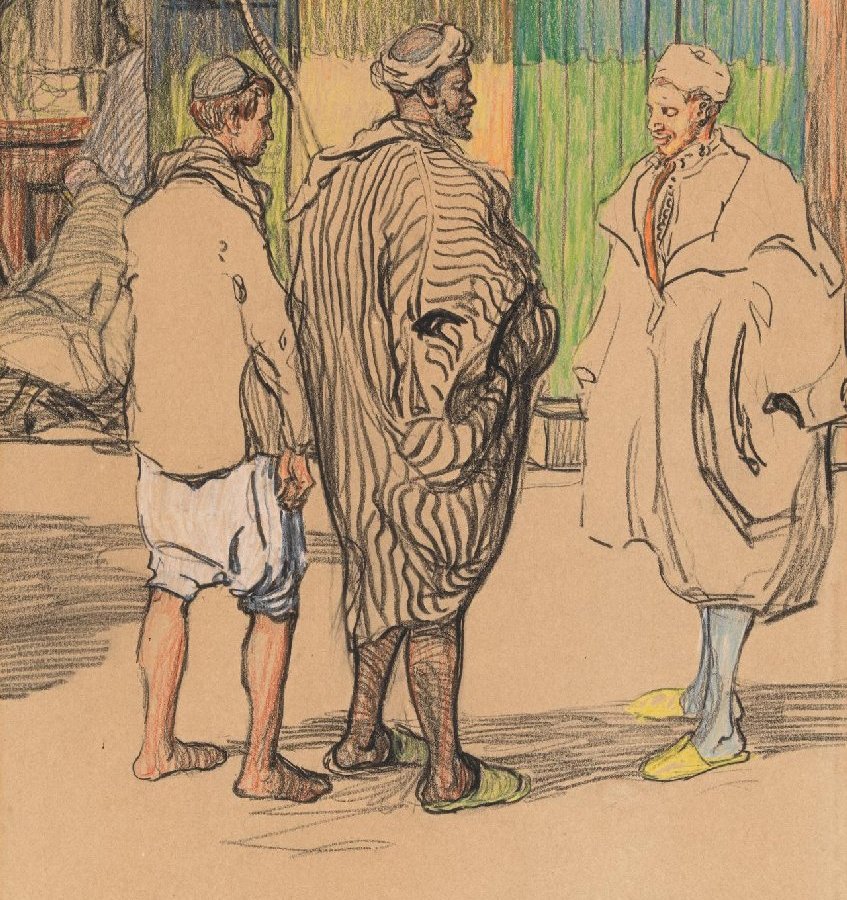
                            Men in the Marketplace by Hilda Rix (1914)

In 1914 she completed her painting entitled Men in the Market Place, Tangier.   It is set during the late afternoon once all the shops had closed and in front of us are a group of men deep in conversation.  She has cleverly used a much-reduced palette of pale blues, creams, browns, and yellows.  We do not see the facial feature of the men as they are bathed in a dark grey shadow whilst the buildings behind them are bathed in late afternoon light.  Hilda wrote a letter home describing how she had to endure the strong sunlight coming from the low sun.  She wrote:

“…’The sun has sunken down in a daffodil bed – feeling he has well earned his rest. (But I have a bone to pick with him – he burnt my arms while sketching till they positively hurt – next time I’ll fool him & put gloves over them). The Moors have turned around from their haggling & marketing, gossiping & dreaming & murmuring to face the setting sun, their lips moving in prayer, their eyes beautiful to look upon – The pale yellow light giving a weird pallidness to the sheet of faces …”

                                                       Grande Marché, Tangier by Hilda Rix (1916)

Hilda completed a pastel drawing, Grand Marche, Tangier, which she later copied in oils.  When it was exhibited in her show at Paris’ Galerie J. Chaine and Simonson in 1912 it was much admired and was bought by the French government for the collection of the Musée du Luxembourg.  Centre stage in the depiction we see two women wearing red-and-white-striped cotton dresses or skirts, covered by white robes.  Their legs are bare and they wear red shoes and socks. One of them pulls her white robe tighter across her upper body. The other, who has her back turned to the viewer, is carrying something on her back, which could be her young child.  The art critics for the French edition of the New York Herald was impressed by Hilda Rix’s realist art, stating that in his opinion the figures in her compositions must surely have been sketched and later added to the finished work.  He further commented:

“…’This artist has the ability to make lifelike images in remarkable compositions bringing outstanding realism and accurate impressions that capture the ‘types’ to be found among the Moroccan people…”

Not everybody loved the painting as the art critic of The Sydney Morning Herald commented that:

“…the drawing and colour are eccentric, after the post-impressionist manner” and described the central figure as “grotesque in its want of finish…”

 Moroccan Market Scene by Hilda Rix Nicholas (crayon and pastel on paper)

The paintings which she did during her periods in North Africa led art historians to compartmentalise her as an Orientalist, a term which referred to the depiction of people or places in present-day Greece, Turkey, North Africa or the Middle East, by painters from the West.  In addition to displaying the results of her trip at the Salon, she also had her Tangier works exhibited in 1913 and 1914 at the Société des Peintres Orientalistes Français, an art society which staged not only Orientalist paintings, but also encouraged the travel of French artists in the Far East. Her work was illustrated in the Notre Gazette, reflecting her emerging status as an important artist, and there were many column inches in the French about her exhibitions.

                           Moroccan Loggia by Hilda Rix Nicholas (1912-1914)

Her colourful paintings featuring life in Morocco highlighted the powerful North African light and concentrated on the people and their colourful clothing and sometimes the local architecture.  It could be levied against her that many of her depictions were idealised versions of life in Morocco and steered clear of the more squalid aspects of the poverty that pervades the area and yet in Jeanette Hoorn’s 2012 biography, Hilda Rix Nicholas and Elsie Rix’s Moroccan Idyll : Art and Orientalism, she takes the opposite view, writing:

“…She did not seek out or embellish her pictures with the “orientalist” stereotypes that she had learned while growing up in Melbourne…In her writing and painting, she actively campaigned against what she saw as the fakery of “orientalism”. Her pastel drawings and oils strive to present an accurate account of the dress, manners and appearance of her subjects…”

Hoorn believed that Rix and her sister were, to a significant extent, counter-orientalist as they endeavoured to portray everyday life in Tangier as they found it, rather than presenting generalised views of the orient.  Rix adopted a counter-orientalist position in lectures and articles upon her return to Australia.   There were some that viewed her North African depictions as being somewhat abstract and flat and that could well be due to the influence Matisse had on her. 

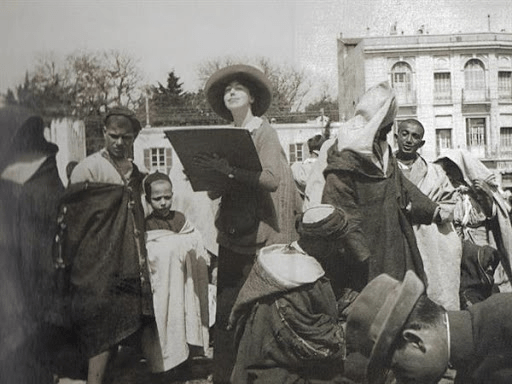
                             Hilda Rix painting in Tangier market place (1914)

Matisse returned to Morocco in October of that year while it was two years later that Rix returned to North Africa, this time accompanied by her sister, who also sketched and wrote but whose main function was to be company for her sister and provide assistance and protection from enquiring bystanders while Hilda painted.  Hilda was surrounded by spectators as she sketched and painted and her audience would, on occasions, halt the flow of the traffic

                                         The Arab Sheep Market Tangier by Hilda Rix Nicholas (1914)

Another of her works from her second trip to Morocco was her 1914 painting entitled The Arab Sheep Market, Tangier.   The searing North African sunlight illuminates the whitewashed buildings and the textured garments worn by the shepherds.  Hilda Rix has used a striking palette of pinks, purples and oranges which is an acknowledgement of the Fauvism style of painting.  Sadly, a house fire claimed many works from her African series of paintings.

                                Grandmère by Hilda Rix Nicholas (1914)

Hilda and Elise returned to France in 1914. Around this time, whilst she was in her studio at Étaples, she completed a work entitled Grandmère.  It is a plein air work which shows an elderly peasant woman in a beautiful garden setting affording the work a luminously colourful background.  Many of Hilda’s paintings were bought by the French government, exhibited in the Salon and the Société des Peintres Orientalistes Français, and she was elected an Associate of the Société Nationale des Beaux-Arts. 

                                           Hilda with her mother and sister during European trip.

Hilda still had studios in Paris and one for the summer months spent in Étaples.  The summer of 1914 she was at Étaples but the outbreak of World War I on July 28th 1914 resulted in Hilda, along with her sister Eliseand her mother evacuating to London.  If that upheaval was not enough, Hilda had to endure a number of family tragedies.  Her mother had been taken unwell during the Channel crossing and was admitted to hospital on arrival in England.  Although Hilda’s mother was not fully recovered, she left hospital and went to recuperate at a nursing home.  At the same time as the mother was extremely ill, Hilda’s sister Elise contracted typhoid and died on September 2nd 1914, aged 37.  Hilda kept the death of her sister a secret from her mother who she believed was too ill to receive such sad news.   Her mother slowly recovered and was later told of the death of her daughter.  For the next eighteen months Hilda Rix painted few paintings presumably because she spent all her time looking after her mother and was too tired to concentrate on her paintings.  She remembered the time saying:

“… I could scarcely put one foot in front of the other and walked like an old thing…”

 Finally, in March 1916 Hilda’s mother, Elizabeth died.

Hilda and Matson after the marriage

Enter onto the scene, Major George Matson Nicholas, a soldier from Melbourne.   George, usually referred to as Matson, was the eldest of six brothers.  Before he enlisted in the Australian army in April 1915, he had been a schoolteacher.  He fought at the Battle of Gallipoli and was wounded.  Once recovered he was sent to France where he was awarded a Distinguished Service Order at Pozieres, single-handedly capturing an enemy machine gun post.   His regiment was based in Étaples, and according to Hilda’s stories, he found her paintings which she had left behind when she had had to quickly abandon her Étaples studios.  Then, during his leave he travelled to London in pursuit of Hilda. They met in September 1916, love blossomed between the two, and on October 7th 1916 they married in St Saviour’s, Warwick Avenue in London.   

Major George Matson Nicholas charcoal and pastel drawing by Hilda Rix Nicholas drew this portrait of her new husband two days after their wedding on October 9th 1916

Two days after the wedding Hilda completed a sketch of her husband. Three days after the wedding Major George Matson Nicholas returned to the front and assumed command of the 24th Battalion,  He was shot and killed in action at the Normandy town of Flers on the Western Front on November 14th, aged 39.

                                           These Gave the World Away by Hilda Rix Nicholas, (1917)

Hilda was devastated and in a diary entry she wrote that she had lost the will to live.  In her grief Hilda Rix Nicholas painted morbid images, symbolic of death and sacrifice in war which contrast markedly with the light and life of her French and Moroccan works.  One such work was entitled These gave the world away which she completed in 1917.

                                               Central panel of Pro Humanitate by Hilda Rix Nicholas (1917)

Another of her war paintings was Pro Humanitate, the central panel of a triptych. It clearly depicts the futility of war and more personally for Hilda, the tragedy of her short marriage to Nicholas.  The work comprised of three panels.  The left-hand panel depicted an outdoor scene with a happy couple standing on top of a hill contemplating their future together; the central panel depicts a soldier husband giving his life for the cause of humanity.  Hilda Rix has depicted the soldier at the moment of his death with arms outstretched in a crucifixion pose.  The right-hand panel of the triptych portrays the heartbroken wife grieving and is watched over by the shadowy figure of her lost hero.  Rix Nicholas offered her triptych Pro Humanitate, which depicted Australian soldiers, to the  Australian War Memorial, which was building a collection of art commemorating the war, but it was rejected; the acquisitions committee described it as “of too intimate a character for inclusion in a public collection.
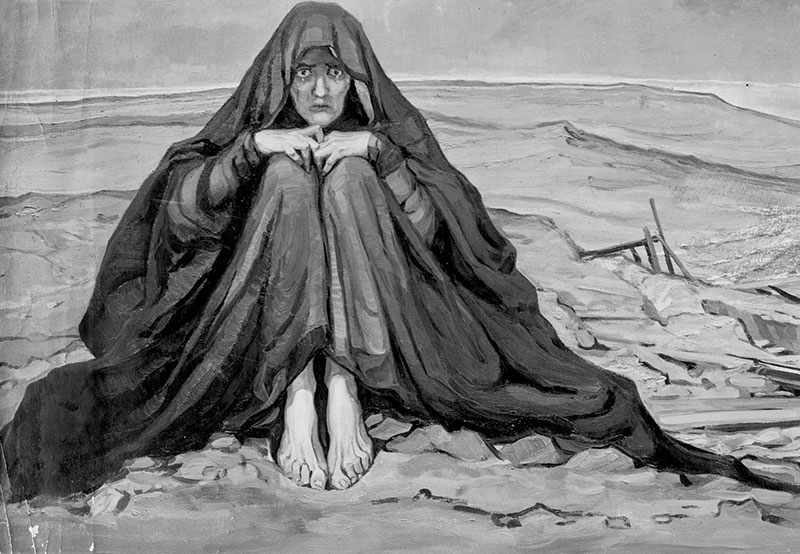
                                                           Desolation by Hilda Rix Nicholas (c.1917)

She painted a strange and moving painting around 1917 entitled Desolation.  This work depicts an emaciated woman crying.  She is shrouded in a black cloak and is squatted down staring at us.  The setting is a battle-scarred landscape which lacks any vegetation.   The National Gallery of Australia holds a charcoal drawing made as a study for the work.  In a review, the Arts correspondent for the Sydney Morning Herald, wrote:

“…Desolation is almost gruesome in the grim delineation of the figure typifying all the widowed world in one lone woman. There she sits, lost in an awful reverie, over the stricken battlefield.  The work is an epitome of wasteful ruin …”

Sadly, both Desolation and Pro Humanitate were destroyed in a fire.

…………………………….to be continued.

Hilda Rix Nicholas. Part 1.

                          Hilda Rix Nicholas (circa 1910)

The other day, I was looking through a list of famous nineteenth and twentieth Australian artists.  The compiler of the list believed that the greatestAustralian painters were Sidney Nolan, Peter Booth, Arthur Boyd, John Brack, Tom Roberts, Russel Drysdale, Frederick McCubbin, and John Olsen. I had heard of a number of these but what surprised me about the list was that it contained no female artists and so I decided to focus this blog on one such painter.

                                   Henry Finch Rix

Emily Hilda Rix Nicholas was born on September 1st 1884, in the Australian city of Ballarat, some twenty-five miles north west of Melbourne.  Her father, Henry Finch Rix was born in Woolwich, Kent on January 12th  1848, and her mother, Elizabeth Sutton, was born in Manchester, England in 1853.  They had both emigrated as children with their families in the middle of the nineteenth century and the pair met and married in 1876. The couple had their first child, Elsie Bertha in 1877 and Hilda was born seven years later.  Henry Rix was a mathematics teacher, an amateur poet and talented sportsman.  He was a teacher at Bendigo, Ballarat and at Carlton. After a brief stint teaching in Ballarat, he was a mathematics master at Wesley College Melbourne for ten years between 1874 and 1884. He played for Carlton’s Australian Rules team and later became Inspector of Schools.  In the book, A History of State Education in Victoria, Henry Rix was described as:

“…Of the men who have labored and passed away since 1900, Mr. H. F. Rix deserves to be especially remembered. Working under the result system, he foresaw the new day and strove to make it possible. His enthusiasm, his industry, his initiative, his research, and his sympathy made him a great inspector and a leader in educational reforms…”

Henry’s wife, Elizabeth, as well as being an accomplished singer, helped run a successful music business in Ballarat.  She played an active part in the Austral Salon, a non-profit organization founded by a small group of women journalists in Melbourne in 1890 as a club for women writers. It then developed into a club whose aim was to introduce aspiring young musicians to an interested audience.  She was also a talented amateur painter and had her own studio in Melbourne’s Flinders Street.  Hilda and her sister Elsie being brought up in a musical household both learnt musical instruments and would perform at local shows.  Elsie, like her mother, had a beautiful voice and performed at the Austral Salon.  Hilda, as a small child, developed a love of drawing and painting and she and her sister would often design advertising posters for events at the Austral Salon.

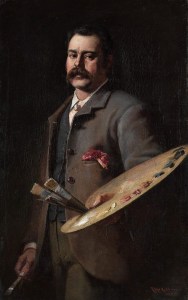
                      Frederick McCubbin -Self-portrait, (1886)

Hilda attended Merton Hall High School, now Melbourne Girls Grammar School and although she was not an exceptional student she did excel in art under the tutelage of a Mr Mather. On leaving Merton Hall in 1902, eighteen-year-old Hilda enrolled on a three-year course at the National Gallery of Victoria Art School where one of her teachers was the foremost Australian Impressionist, Frederick McCubbin.  Notwithstanding his standing in the art world, Hilda was critical of McCubban’s teaching style which she referred to as being “vague persuasions”.  However her biographer John Pigot, in his 2000 book, Hilda Rix Nicholas: Her Life and Art, writes that the creativity of individuals rather than imitating the style of any one school of painting; he (McCubban) modelled the importance of nationalistic ideas and subjects that would become so prominent in her later painting and McCubban’s work emphasised the painting’s subject over technical considerations.

                                                 An early sketch by Rix Nichols

Hilda Rix’s work was so good that, although still a student, she had some of her drawings shown at annual exhibitions at the Victorian Artists’ Society and the Austral Salon.   To earn herself some money she worked as a professional illustrator submitting her work for inclusion in textbooks and periodicals.  Hilda was always with pencil and sketch pad and in her early days would persuade extended family members to sit for her whilst she sketched their portraits.  Studies in two sketchbooks from her early years in Melbourne are now held at the National Library of Australia and in 2012 one of Rix’s early sketchbooks survives and pages from it were reproduced in Karen Johnson’s book, In Search of Beauty: Hilda Rix Nicholas’ Sketchbook Art

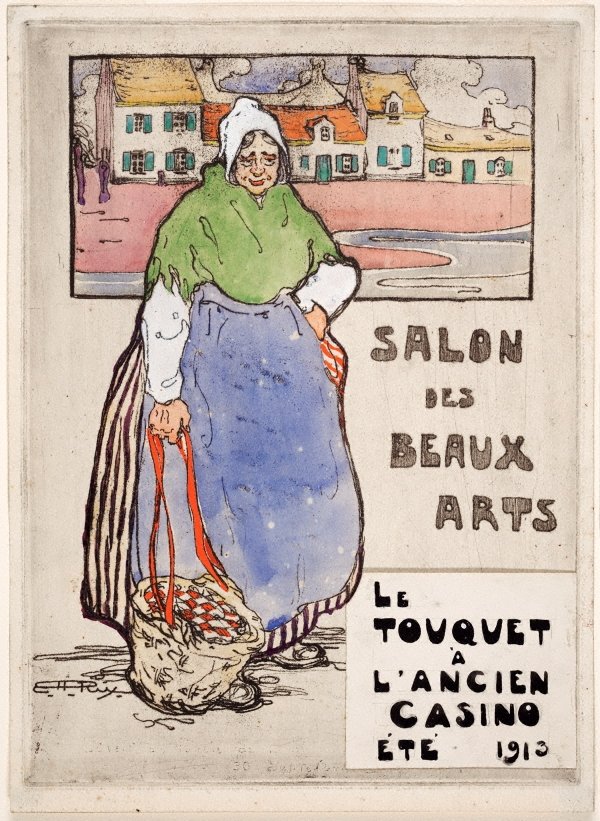
                                         Poster for the Salon des Beaux Arts (1913) by Hilda Rix

For most would-be artists who lived away from Europe such as Americans and Australians the Holy Grail was to visit and study art in Paris and London.  Hilda’s father Henry decided to offer her a chance to sample the European art world and, in 1906, planned a family trip to England which, being as he was an educator, would also afford him the opportunity to study British education reforms.  All his plans came to nought as Henry died that year, on February 27th aged just fifty-eight.  His death at such a relatively young age precluded his widow from receiving a pension.  After many discussions the family managed to cobble together money from an inheritance, money earnt from their rental income from their home, and finally money Hilda and her mother raised by selling off their many works of art and  they were able to set sail for England early in 1907.

                             John Hassall in his studio, 1909

For Hilda, going to Europe to study art was only part of the solution to her improving her artistic skills, she needed to find a good teacher who was willing to tutor her.  Before she left Australia, she spoke to Arthur Streeton, the Australian landscape painter who was the leading member of the Heidelberg School, which was also referred to as Australian Impressionism.  He suggested that on arrival in London she contacted John Hassall, an English illustrator, who, in 1901, had opened his own New Art School and School of Poster Design in Kensington.  When Hassall looked at Hilda’s work he was impressed by its quality and agreed to mentor her.  She remained with him until the end of 1907 at which time, she, her mother and sister left England and travelled to Paris and rented an apartment in Montparnasse

                                                                 The Ferry by Emanuel Phillips Fox

In Paris Hilda made many friends who were involved in the art world, such as fellow Australian, Emanuel Phillips Fox.  Fox had arrived in Paris in 1896 and enrolled at the Académie Julian, where he gained first prize in his year for design.  The following year he trained at the École des Beaux-Arts where two of his tutors were William-Adolphe Bouguereau and Jean-Léon Gérôme, who were considered the greatest artists of their time. He returned to Australia in 1890 but returned to London after receiving a commission to paint a scene of the landing of Captain Cook in Australia, which had the strange caveat that he must paint the work abroad.

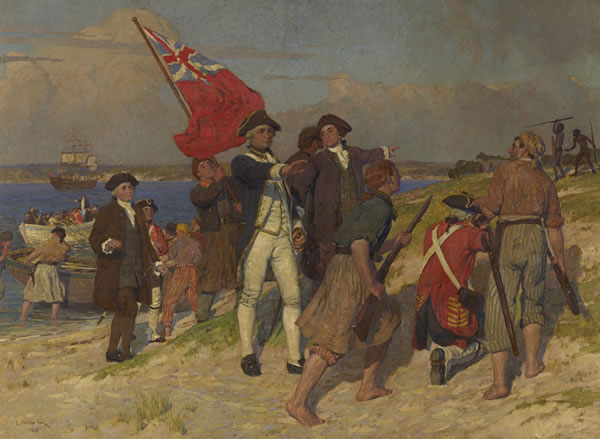
               The Landing of Captain Cook at Botany Bay 1770 (1902) by Emanuel Phillips Fox

The 1902  painting, The Landing of Captain Cook at Botany Bay, 1770,  depicts a wholly European perspective on the inauguration of relations between the British visitors and the local Aboriginal men of Botany Bay. In a post-Federation display of nationalistic projection, it shows Captain Cook stepping onto Australian land as part of a shore party, heroically interceding between the threatening local men who brandish spears and his own marines who aim to shoot them. 

                      Portrait of Ethel Carrick, c.1912. 

Hilda Rix also met Fox’s wife, Ethel, an English-born Impressionist and Post-Impressionist painter.

In Paris Hilda enrolled at the Académie Delécluse, operated by academic painter Auguste Joseph Delécluse.  It was an atelier-style art school which was very supportive of women artists, and, in fact, it allotted more space to women students than to men.  Men and women were trained separately, and it had two studios for women and only one for men.  It was an extremely popular place to learn, especially among English and American women artists. At the height of its popularity, it was one of the four best-known ateliers in Paris.  From this artistic establishment, Hilda moved to the Académie de la Grande Chaumière, where one of teachers was the Swiss-born illustrator Théophile Steinlen.  She also studied at Académie Colarossi. It was around this time that Henri Matisse had a studio in the French capital and, as was the case with other professional artists, he also sometimes attended Colarossi’s to gain access to their models which he could use, free of charge, for his work.  Matisse would also open the door of his studio to aspiring artists whom he would offer tuition and have them experiment with the techniques of Post Impressionism.  It could well be that this is where Hilda first met Matisse.

Retour de la chasse by Hilda Rix Nicholas, (1911)

Whilst living in Paris, the family would travel to Italy and other parts of France including Étaples, the fishing port in the Pas-de-Calais department in northern France which was so popular with artists.  In 1909 Hilda Rix met and became very friendly with a Dutch architecture student Wim Brat.  Their initial love ended when Hilda realised how her fiancé was a “mother’s boy” and was completely dominated by her, a woman who strongly disapproved of Hilda.  Inevitably, Hilda broke off the engagement.  Notwithstanding this personal setback, Hilda continued with her painting and exhibited her work at the 1911 Paris Salon.  The painting, Return of the Hunt, was completed by Hilda in 1911 and depicts a woman on horseback in chocolate brown leather gloves with a large hare slung over her back.

                                                                     Three friends by Hilda Rix (1912)

Hilda Rix, accompanied by her sister and mother, took up residence in the rural art colony of Étaples the summer of 1910.  Here she met Henry Ossawa Tanner, a well-established American artist in France, who was viewed as one of the leaders of the Étaples artists’ colony and a member of the art organization, the Société Artistique de Picardie.  It was not just France and Italy which seduced artists, many started to cross the Mediterranean to paint and sketch in North Africa.  Hilda Rix made two painting trips to the African continent.   The first was in January 1912 when she travelled with a group of artists, including Henry Ossawa Tanner, and his wife, who were visiting Morocco via Madrid, Cordoba, and finally Algeciras, they had hoped to take a boat to Tangiers but the weather was too bad, which forced the travellers to Gibraltar for what proved a rough crossing to the Moroccan port.

Morocco, marketplace with pile of oranges by Hilda Rix painted during one of her two trips to Tangier

Tanner being an African American and Rix being a female made them unconventional and exceptional travel and work companions on this journey.  They stayed in Tangier and the northern port town of Tétouan.  Matisse and Hilda Rix stayed in the Grand Hôtel Villa de France for most of February and March. They both painted views from the windows of their rooms at the hotel.   Both of them worked on portraits and would use the same models and utilised an unused room in the hotel which the owner allocated to them.  The room became a temporary studio space. 

                                                          Hamido sleeps by Hilda Rix Nicholas (1914)

An example of the similar portraiture was Hilda’s painting, Hamido Sleeps and Matisse’s work, Moroccan Amido.  In both cases the young model was a stable-hand at their Tangiers hotel.

Moroccan Amido by Matisse (1912)

In Matisse’s painting the young man stands easily and naturally, his slim long-legged form is emphasised by the narrow canvas format the artist has used.  In the painting, Matisse captures the dark skin, the bright white shirt, the pure colours of the waistcoat and short trousers.

                                               Through the arch to the sea by Hilda Rix Nichols (1914)

Hilda loved Tangier and spent hours sketching and painting in the open-air markets.  She wrote home about how she loved Tangier and its market, writing:

“…Picture me in this market-place – I spend nearly every day there for it fascinates me completely – have done 16 drawings and two oil things so far – Am feeling thoroughly at home now so am going to take out my big oil box – wanted to get used to people and things first – Oh how I do love it all! … Oh the sun is shining I must out to work…”

                                       Hilda Rix painting in Moroccan marketplace

Hilda Rix was fascinated by the buying and selling in the marketplace as well as the multitude of colours of the clothes worn by the people.  In a letter home, dated February 12th 1912, she wrote:

“…”See how most of them are covering their faces – They have mostly cream draperies & perhaps orange waistcoats and little tight mauve green trousers – (tight at ankle) – Some may be wonderfully dressed under[neath]…”.

In a postcard she sent home a week later she wrote:

“…’Picture me in this market-place – I spend nearly every day there for it fascinates me absolutely – Have done 16 drawings and two oil things so far – Am feeling thoroughly at home now so am going to take out my big oil box – wanted to get used to people and things first – Oh I do love it all! …”

…………………..to be continued.

John Pototschnik. The living rural artist.

Of the 850+ blogs I have done in the last ten years, I think only three have been about living artists.  Maybe I was concerned that they would be upset with what I had written or maybe they would be unhappy if I had been inaccurate, although I try to get facts from various sources to avoid errors.  My featured artist today is a person who commented how he liked one of my blogs and when I looked at his blog/website and some of his artwork I decided that he would make for an ideal subject.  I wrote to him and he was happy for me to do a small bio on his life and art, so let me introduce you to John Pototschnik, pronounced Poe-toe-sh-nic.  John is a Signature member of the Oil Painters of America and a Master Signature Emeritus member of the Outdoor Painters Society. He is recognized in “Who’s Who in American Art” and “Who’s Who in the Southwest.” In addition, his work has appeared in multiple artist magazines and books.  He’s also the author of a best-selling book: Limited Palette Unlimited Color published by Streamline Publishing. 

John was born in England, in the Cornish coastal town of  St. Ives, on November 14th 1945.  His father was Ernest Felix Pototschnik, a native of Kansas whilst his mother, Patricia Mary Pototschnik (née Symons) was born in Trewartha, Lelant in Cornwall. She was Ernest’s second wife.  Ernest’s first wife died during the birth of their son Ernest Francis.   John’s father was a member of the US Army which was stationed in England during the Second World War and he met Patricia when he attended a local dance.  John’s mother once told him that she remembered that first meeting saying she was especially attracted to Ernest because of his short stature, the way he carried himself, and the American uniform. The couple soon fell in love and were married in St Ives on February 12th 1945.  John was their eldest child and he has a sister, Patsy Ann.

                                              At the Edge of Town by John Pototschnik (24 x 30ins)
The sound of an approaching train can be heard in the distance. There has been a brief, early afternoon shower. The mailman has yet to deliver the day’s mail and pick up the letter in the box addressed to a dear friend. Children are just getting out of school and will soon arrive home on the school bus. (Location: Kansas) https://www.pototschnik.com/paintings/at-the-edge-of-town/

Around 1946 Ernest Pototschnik was discharged from the army, and returned to America where he purchased a home in Wichita, Kansas, prior to his wife and John travelling across the Atlantic on the Queen Mary some months later to join him.  The family relocated to Wichita, Kansas and remained there for the next twenty-two years.  John attended the Blessed Sacrament Catholic School in Wichita and then enrolled at the city’s Chaplain Kapaun Memorial High School.  At school John enjoyed draughtsmanship and biology.  He liked to sketch especially aircraft and racing cars. As a youth, his parents were comfortable with him going off on his own, exploring the neighbourhood.  He even went door-to-door selling his mother’s cookies or collecting money for his paper route.  John also often spent time with his father on hunting trips.  He believes this freedom to roam was how he built up his love of small American towns.

After graduating from High School in 1963, he went to the Pittsburg State Teacher’s College in Pittsburg, Kansas for one year.  During his early life at home there had been no exposure to art and the possibility of becoming an artist was never in consideration.  However, it was during the time at the College that John had the first thoughts about art being a definite possibility in his future.   He remembered purchasing the Famous Artist School correspondence course but admitted that he never completed it.  He explained that there was just no time for this extra-curricular study as life was filled with college work, athletics, and an after-school job. He said that he had little time for anything else.

                                                 Be Still My Soul by John Pototschnik (30 x 40ins)
A time of reflection, contemplation, and dreams comes easily in the peacefulness of the country. The soft light and gentle breeze refresh the soul. (Location: Georgia. Private collection).  Last year, this work was awarded the Silver Medal at the Oil Painters of America 27th Annual National Juried Exhibition of Traditional Oils, which was held at the Steamboat Art Museum in Steamboat Springs, CO. Of the more than 2,000 entries, only about one-tenth of those were selected for the exhibition.

In June 1964, John enrolled at Wichita State University and embarked on a four-year Bachelor of Fine Arts degree with a major in Advertising Design.  During his university days he worked for a number of graphic design and illustration companies.  One of the companies was Oblinger-Smith Planning Consultants where he worked as a graphic designer and, it was here, that through a work colleague he met Marcia who in October 1971 became Mrs Marcia Pototschnik.  His love of airplanes also had him sign up for the USAF College Reserve Officer Training Corp (ROTC). Upon graduation from college, I was guaranteed an Air Force commission and on leaving university in June 1968, John spent the next four years working for the United States Air Force stationed at El Segundo, California where he worked as an Internal/Public Information Officer working in community relations and edited the base newspaper.

                           For a Moment, All the World Was Right by John Pototschnik (30 x 40 ins)
For a Moment, All the World Was Right – It’s a busy world, full of noise, stress and worry, but for the young playmates, for this time in their life, all in the world is right. Being with friends, loved by their parents, feeling safe and protected…that is their reality. They are content and happy. (Location: New Hampshire. Private Collection)

Following completion of his time in the military in June 1972, he moved to Dallas and set about establishing a freelance illustration career although he proudly states he had his first paying job when he was ten years old, mowing lawns in the summer, raking leaves in the autumn and shovelling snow in the winter and at fifteen earned money as a part-time dish-washer at a local department store and during his first year of college days he was a consummate hamburger-flipper!  For the next ten years of his life he worked as an illustrator for all the major advertising agencies and design studios.  Of this decade as an illustrator he said he enjoyed the time:

“…I very much enjoyed working as a freelance illustrator. There was a great variety of work and its associated challenges. Being able to meet those challenges and satisfy a client was very rewarding. I also liked seeing my work in print. It also afforded me the opportunity to work in a number of media: pencil, pen/ink, watercolour, and acrylic. It also trained me to work under pressure and to meet tight deadlines…”

But all good things had to come to an end and for John the graphic design jobs were very time consuming and he said that his life revolved around long working hours and frequent bouts of little sleep.  This lifestyle of constant pressure and ever-demanding deadlines could not go on forever and so in 1982 John made the decision to leave the world of illustration and graphic design and turn his mind to the world of Fine Arts.

                                             Meeting of the Lines -by John Pototschnik (20×20 ins)
Many train lines congregate in this small agricultural town. The area bristles with activity. The sounds of the grain industry and rumble of the trains are heard throughout the town and are enchanting to young boys. (Location: Kansas. Private collection)

However, it was not just himself he had to consider as now he had a wife and two sons, Jonathan in 1975 and two years later a second son, Andrew.  But what did his wife think of his decision to quit his lucrative graphic designer career.  John comments:

“…Marcia has always been supportive of my art career regardless of the direction I decided to take it. She is a woman of common sense and has never been materialistic, in that she needed things to make her happy. She loved being a mother and homemaker…”

One can see how the decision to enter the world of Fine Artist was a financial gamble and he spoke about the decision:

“…Many well-known illustrators were leaving the field and moving into the fine arts in the 1970’s.  It was something I had always wanted to do but was told from the very beginning, “You’ll never make a living as a fine artist”. So, I chose to work in the commercial art side of the business. Seeing other illustrators make the leap encouraged me to do the same…”

               Plein air oil painting, Wylie Church by John Pototschnik (16″ x 12″)
When John heard about a plan to tear down the original St. Anthony’s Catholic Church, he worked hard, along with a committee, to save the structure and even wrote a letter appealing to the Bishop. Not only did the tiny church remain, but it is now immortalized in one of his paintings.

The switch to Fine Arts from being an illustrator and graphic designer was a massive change in John’s life and he was aware of the perils of this transition, saying:

“…Change is always a gamble. Fortunately, I was pretty naïve concerning what it would take to succeed, and to the realities of the fine art business. I thought the transition would be smooth and easy. I would just start painting different subjects, charge the same prices I was getting as an illustrator, and begin calling myself a fine artist. The only part of that that worked out was that I was painting different subjects. Galleries recognized my work as being illustrative, and nothing sold at my illustration prices.  Fortunately, the transition was eased somewhat by a friend who suggested I paint a series of paintings showing that the oil industry and wildlife could co-exist in the same area. If I did the paintings, he agreed to help me find six corporate sponsors that would purchase the paintings and their accompanying prints. That project worked well as it gave me time to begin working in oil, painting en plein air, developing my work, and funding my first year in the fine arts. Actually, there was not much thought given to financial success. I just figured one way or another this would work. However, it did take seven years to return to the level of income I was making as an illustrator…”

                                                        Rural Hideaway by John Pototschnik (25 x 28 ins)
Where does the road lead? Does it lead to a beautifully secluded little house in this gentle, non-threatening, peaceful environment? The question invites wonderful speculation and the viewer can visualize themselves walking that road to discovery. (Location: Georgia. Private collection)

So how did the change of artistic direction go for John?  He recalled those early day struggles:

“…Yes, there was a definite struggle. I did not realize it when I set my mind on becoming a fine artist, but fine art was beginning all over again. It is not a continuation of an illustration career; it’s starting a new career. I grew the career by doing lots of small paintings (5”x7” – 8” x 10”). These sold at very reasonable prices. I sold a lot of them, which helped grow a collector base. Then I began writing a monthly newsletter in order to stay in contact with the collectors.  Determining the price structure for my paintings is interesting in itself: As stated earlier, I began using illustration prices for the paintings…nothing sold. I then cut the prices in half…nothing sold. I cut the prices in half again…I then began selling just about everything. That’s why those early paintings were so reasonable…”

                                      Saturday Afternoon Game by John Pototschnik (16 x 20 ins)
School is over for the week. Classmates and neighbourhood friends enjoy a game of basketball at this small town American home. Location: Kansas)
https://www.pototschnik.com/paintings/saturday-afternoon-game/

John has painted in many mediums but his favourite is oils as it dries much slower than acrylic and thus affords him the chance to manipulate and correct his work until it is just right.  He also is pleased by the way oils has substance and retains brushstrokes.  When I asked John about his depictions being predominantly rural, he commented:

“…Much of what I paint are deeply felt impressions formed during my childhood. I grew up in the 1950s. It was a totally different time. I grew up in small neighbourhoods, small houses, small towns, near the country. My parents and grandparents had flourishing vegetable gardens. My mom made homemade cookies which I sold door to door. I had newspaper routes in which I delivered morning and evening newspapers door to door. I was free to ride my bicycle all around town and visit my friends. All these things, and much more, are in my work…”

His finished works are often the result of plein air painting which he enjoys but he says that about 99% of the plein air work is just for learning how to get a good handle on understanding nature. Some of those studies are used as a starting point for larger studio works. Less frequently, they are completed compositions unless they are for an art show or plein air competition, then, I will do larger completed works on location.

                                                   Land of Abundance by John Pototschnik (35 x 65)
Holmes County in the state of Ohio is an Amish community. Retaining many of the old world ways, eschewing many of the modern world’s technology and conveniences, the typical means of transportation is the horse and buggy. The magnificently kempt structures and fields are an endless source of inspiration for me. (Location: Ohio)
https://www.pototschnik.com/paintings/land-of-abundance/

In so many of the artists I have looked at over the years many depict realist situations, such as the poverty of the peasants and the back-breaking labour they had to endure and so I asked John why he has not also painted those often harrowing depictions.  He replied:

“…. I’ve never experienced personally the realities and hardships of actual farm life. I’ve been around farms, mainly as a child, so to this day have a more romanticized view. As an adult, I’m not unaware of the reality. I just choose to depict something that is somewhere between Realism and Idealism…”

He is also aware of the taste of the buying public.  Do they want paintings depicting hard-hitting realism on the walls of their house or would they rather have idealised rural beauty adorning their lounges and dining rooms?  John believes the latter is the case and the sale of his works of art bears out that assumption.

I asked him which of the great artists of the past he admired most.  He was most definite with his reply:

“…My favourite expressions of art are found in the Barbizon and Naturalism schools. Breton and Millet are certainly two of my favourites, but there are many more from that era, painting in that genre. There are so many artist’s works, past and present that I greatly admire, so I will say that the 1800s is my absolute favourite period in art history…”

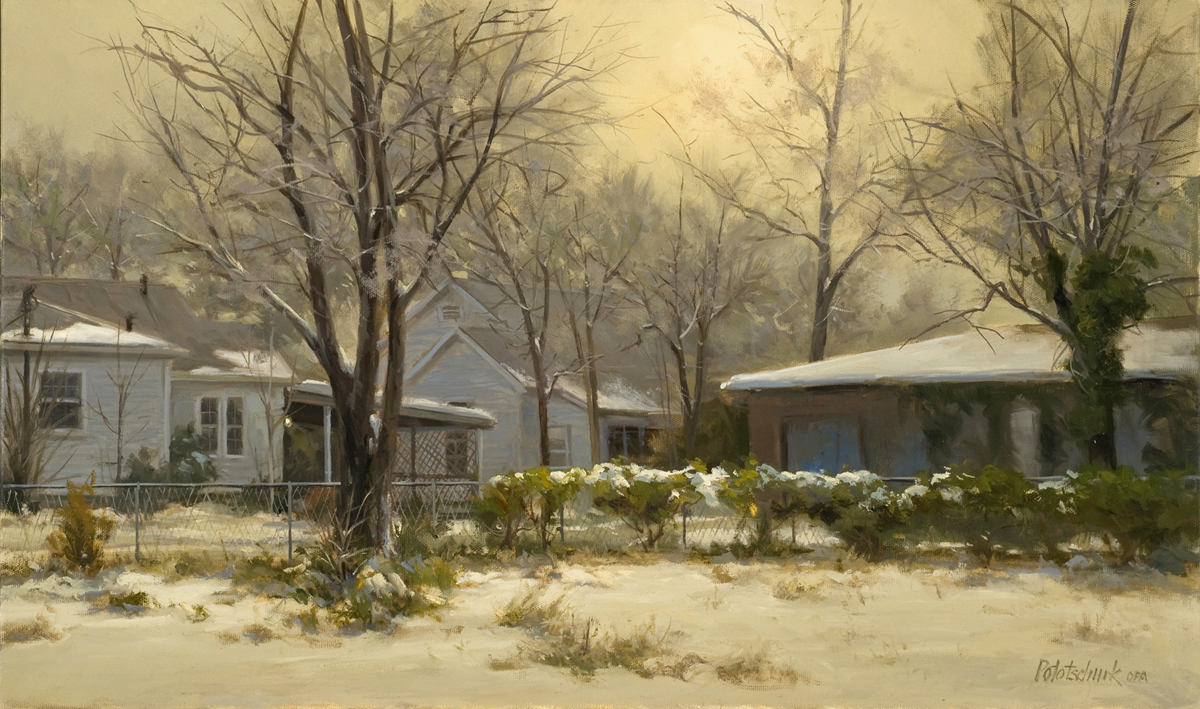
                                                      Staying Home by John Pototschnik (16 x 27ins)
A few inches of snow on a day of bitterly cold temperatures comes to a close. The porch light comes on. It’s just too cold to go out tonight, We’re staying home where it’s warm. (Location: Texas)
https://www.pototschnik.com/paintings/staying-home/

He said he loved the works of Camille Corot, Charles-Francois Daubigny, Jean-Francois Millet.  In their paintings he saw a great sensitivity to people and nature. They have the ability to express all nature’s subtleties in such a unified, calming, peaceful way which he found very appealing. Only what is necessary is stated, nothing is overworked.  He also liked the Naturalism of the art of Stanhope Forbes, Jules Bastien-Lepage, Leon Lhermitte, Pascal-Adolphe-Jean Dagnan-Bouveret, Charles Sprague Pearce, Frank Bramley, Jules-Alexis Muenier, George Clausen, Gari Melchers, and Jules Breton. He liked how the Naturalists works are highly refined, almost photographic. Subjects are of common folks in everyday situations, people of the land, usually depicted in rural settings. I find all this extremely appealing, especially the high degree of finish.  Finally, he said that he loved the work of the Russian Itinerants, such as Arkhipov, Kramskov, Levitan, Perov, Repin, Svetoslavsky and how their paintings are gritty, earthy, bold, and emotionally powerful.  He summed it up by saying:

“…The common thread running through all the work I most love is a sense of the real. Subjects are of common folk doing common tasks. They are not idealized. Small towns, cottages, rural landscapes, and people going about their daily lives in that environment predominate. All of the above artists speak of the reality and truth of everyday life, there is no pretentiousness. I feel each artist has approached their work and subject with humility and is therefore able to capture the soul and spirit of the subject with great sensitivity…”

                              Remembering Murphy Grocery by John Pototschnik (14″ x 24″ – Oil}
John could often be found with his easel painting on the side of the road. His painting of the old Murphy Grocery Store at FM 544 and Murphy Road evokes nostalgia in many who remember the store. He has sold many prints of the painting and the original hangs in the Smith Public Library today.

I finally asked John on his views for Fine Art in the future and the up and coming aspiring artists. How will the future compare with the past?  He replied:

“…I’m not sure what the future holds for the fine art of painting. There will always be a place for beautiful things, things that elevate, but whether individual hand-crafted paintings will have as much value and importance to future generations as they have had in the past, I don’t know.

Lack of art education, shortened attention span, ever expanding technology, increased desire for the latest and greatest thing…and a new generation that has had little exposure to fine art… could greatly affect how fine art is valued in the future.  

That being said, among serious art students, there seems to be a real move toward realism, and even classicism. Non-objective art among many is seen as empty and devoid of substance. They want more. Ateliers, teaching solid drawing and painting principles, have sprung up around the world. The Art Renewal Center is a strong influence in promoting a return to representational art. Also, the current plein air movement in the United States has encouraged a huge number of amateur artists to pick up their brushes and go outdoors. The negative side of the plein air movement is that people seem to think if a work is done in plein air, it must be good. What I see is a lot of poorly executed, poorly composed, and poorly drawn works. When these works are promoted in magazines and social media, one is led to believe the work is good and that anyone can be an artist. Doing something quickly is better than doing something thoughtfully and carefully seems to be the driving force.  

Painting workshops are very helpful in providing for an artist’s livelihood. Unfortunately, many that are teaching should not be teaching because their work is of poor quality. Also, not every good artist is a good teacher. I recommend choosing one’s instructor carefully.  

Finally, I disagree with students taking one workshop after another, jumping from one instructor to the next. Over and over again, I see this happening but see no improvement in the students work. It seems it’s more about saying I studied with so-and-so, than actually seriously applying what is taught…”

John has received many awards for his art and in 2018 the Art Renewal Center, the largest online association with 50,000 of the greatest works in history, recognized him as a Living Master (ARCLM). The requirements for Living Master status are extensive with the main caveat being, “The artist has dedicated themselves to becoming a realist artist with the wish to express our shared humanity through the visual arts.”


To find out more about John Pototschnik have a look at his website:

https://www.pototschnik.com/about/

Fern Isabel Coppedge. Part 2.

                                                      The Coal Barge by Fern Isabel Coppedge

One of Fern Coppedge’s later paintings, The Coal Barge, which she completed around 1940, featured the Delaware Canal.  The sixty-mile canal and the coal barges, which ploughed their way down its length, were an important means of transporting anthracite coal from north-eastern Pennsylvania to Philadelphia.  This barge trade lasted a hundred years and started in 1932 and in its heyday, over three thousand mule drawn boats travelled up and down this waterway carrying more than one million tons of coal every year.  This mode of transport became obsolete with the transporting of coal by rail.  This depiction of the canal and towpaths was a favourite depiction of many artists at the time.  There was a connection between Fern and the mules, which were used to tow the barges, as her studio was in a barn which once housed the working animals.

                                            Evening Local, New Hope by Fern Isabel Coppedge (C.1930)

In 1933 Fern completed a painting entitled Evening Local, New Hope which originally had the title, Five O’clock Train, which pictorially presents historical documentation of the schoolhouses which were in the New Hope-Solebury School District.  The painting depicts New Hope Elementary School which can be seen on the hill off West Mechanic Street in New Hope.  The building is no longer a school but is now the home of the New Hope Jewish congregation Kehilat NaHanar known locally as the “Little Shul by the River.”

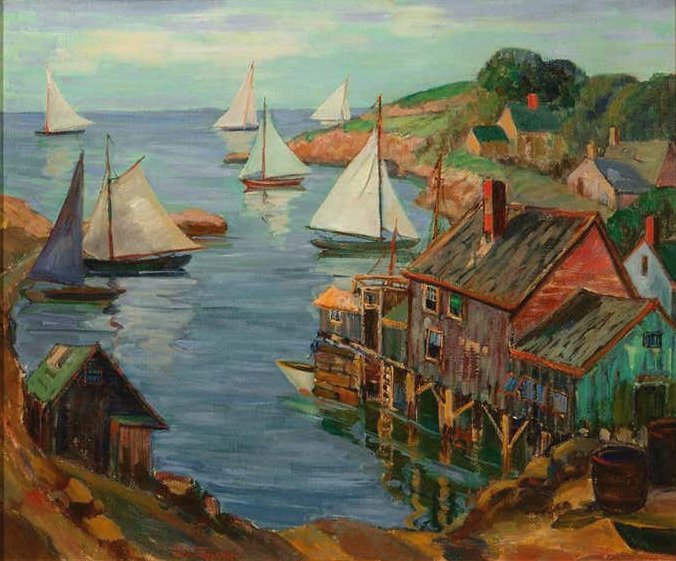
                                                         The Opalescent Sea by Fern Isabel Coppedge

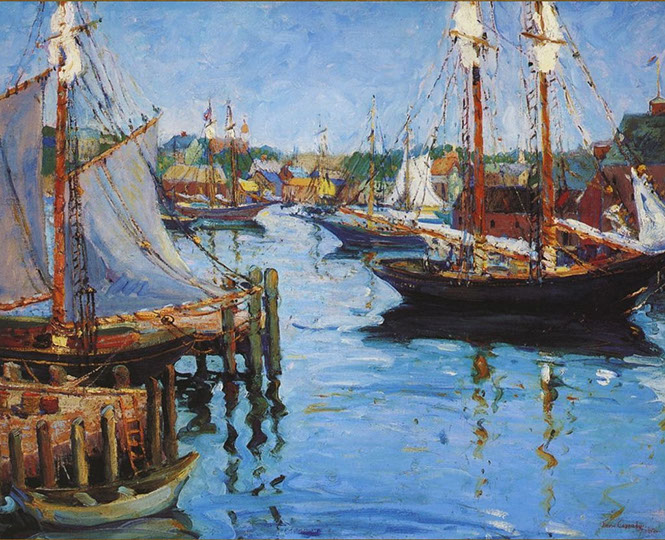
Coppedge divided her time between her Boxwood home in Lumberville, her studio in the coastal town of Gloucester where she often spent summers, and a studio in Philadelphia which she used during exhibitions.  In 1916 Fern spoke about her plein air painting at the Massachusetts fishing town of Cape Ann, Gloucester, and how she had many ardent onlookers.  She wrote:

“…In the waters shown in my paintings, there were a number of lobster traps. The fishermen were so much interested in the development of the picture of this familiar scene that in order to have an excuse to see it they would bring me a freshly boiled lobster, and the old sea captains would entertain me with thrilling stories of stormy nights spent in their little fishing schooners on the Newfoundland Banks and the Georges…”

                                       The Philadelphia Ten.
                             Fern Coppedge, back row on left)

In 1922 Fern was accepted into the all-women art society known as the Philadelphia Ten and exhibited regularly with them through to 1935.   They were an exclusive and progressive group of female artists and sculptors who ignored society rules of the time by working and exhibiting together. 

Coppedge once talked about her favoured methodology of painting and how she favoured working plein air to capture the essence of nature, notwithstanding inclement weather conditions:

“…I may erase most of my sketch, but after I have it the way I want it in charcoal, then I work over the entire canvas with a large brush. I use thin paint in trying to get the right value. I test different spots to see whether the scene should be painted rich or pale. Then I proceed with the actual painting using paint right from the tube. I hold the brush at arm’s length and paint from the spine. That gives relaxation…”

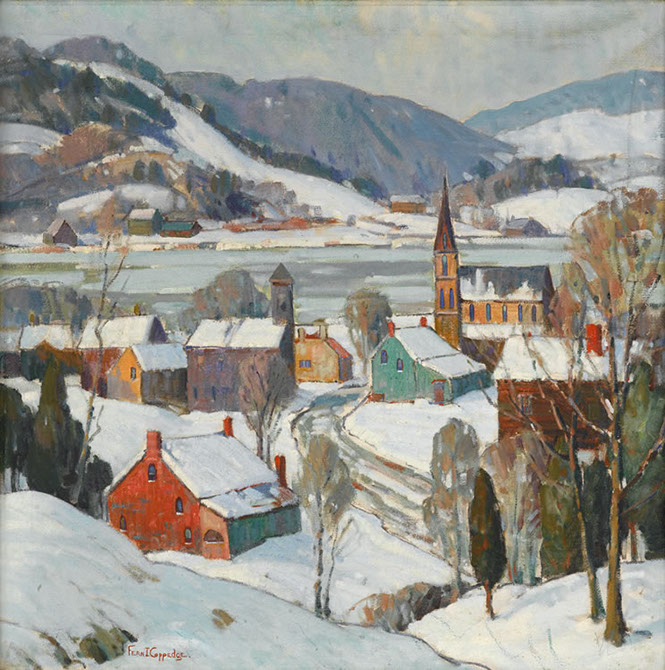
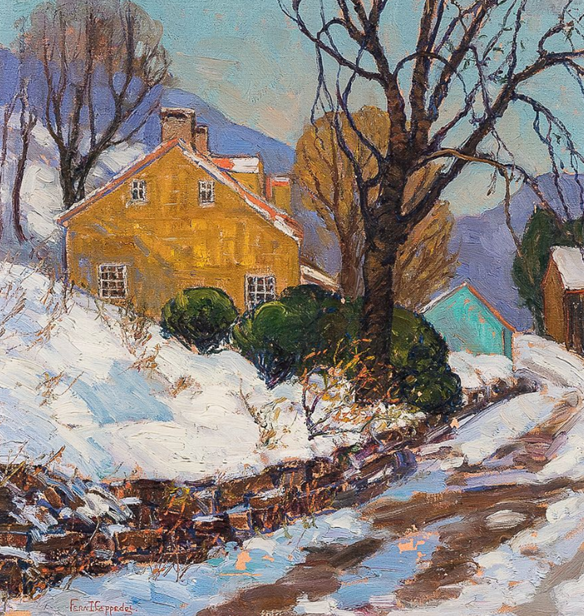
                                            Winter Solitude, Lambertville by Fern Isabel Coppedge

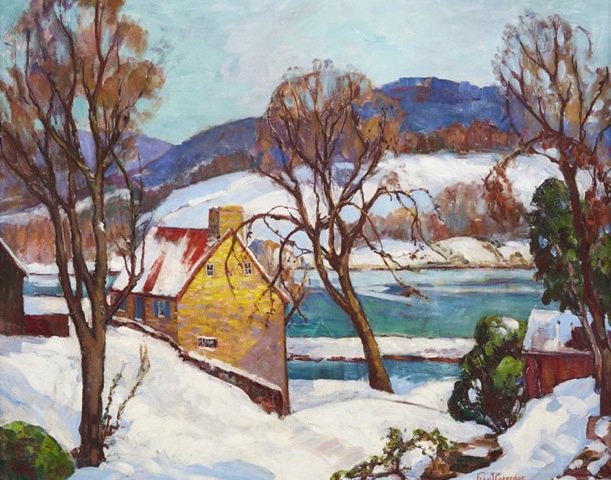
Pennsylvania Impressionism was an American Impressionist movement of the first half of the 20th century that was centred in and around Bucks County, Pennsylvania, particularly the town of New Hope. The movement is sometimes referred to as the “New Hope School” or the “Pennsylvania School” of landscape painting. Fern Coppedge was the only female member of The New Hope School.  She was part of that art movement and devoted numerous pictures to her Bucks County environment especially her winter scenes and she would suffer for her art with her plein air painting in the sub-zero conditions.   She was fascinated with the beauty of the snow.  There is no doubt that the extreme cold winters challenged her devotion to plein air painting.   She tried to get round this and carry on painting as long as she could by removing the back seat of her car to paint from an enclosed warm area. In cold windy conditions she would often tie her canvases to trees to fight off the wind and would wear her unfashionable but fit-for-purpose bearskin coat.  It was said by a local art critic for The New Hope magazine in November 1933:

“…We remember seeing Mrs. Coppedge trudging through the deep snow wrapped in a bearskin coat, her sketching materials slung over her shoulder, her blue eyes sparkling with the joy of life…”.

                                              Carversville by Fern Isabel Coppedge

There was a difference between her paintings and the other New Hope Impressionists.  Unlike other New Hope Impressionists, Fern Coppedge looked at the landscape scenes she was to paint with different eyes than them.    Of course, the first thing she acknowledged was what the eyes saw or the true photographic image.  However, she would also want an input from her imagination and how the scene felt like to her, and it was this power of imagination that led her to paint scenes with colours and tones which did not exist in reality.

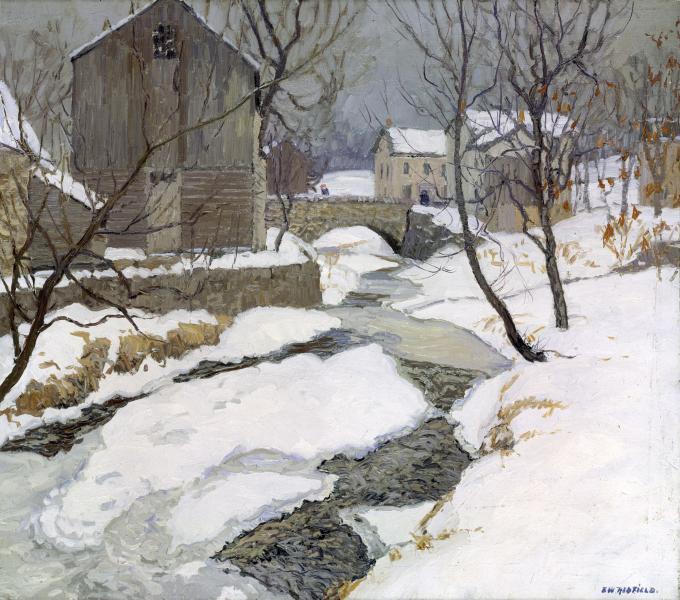
       The Brook at Carversville by Edward Redfield (ca. 1923), (Smithsonian American Art Museum)

An example of her differing style can be seen if you compare her depiction of Carversville with the depiction of the same place by her fellow New Hope School artist, Edward Redfield.

Often her scenes would not be topographically correct.  Again, it was down to her power of imagination which countered reality and the finished result was an idealised version of the scene which was all about pleasing the artist.  In her mind, the depiction was a battle between what was actually there in front of her against what she imagined should be there.  Instead of depicting building using true brown and grey colours, Fern preferred to use pink and turquoise to, as if by magic, brighten facades. A travesty of art ?  Maybe we should think of how nowadays we adjust photographs, using photo editing packages, to achieve, not a true result, but a result we find more pleasing !  The fact her paintings sold so well is testament that the buying public had no problem with her idealisation or colour shifts.

                                                 Back Road to Pipersville by Fern Isabel Coppedge

Fern joined “The Philadelphia Ten” in 1922 and exhibited regularly with them for the next thirteen through 1935. The Philadelphia Ten, which was founded in 1917, was both a unique and forward-thinking group of women artists and sculptors who ignored the rules of society and the art world by working and exhibiting together for almost thirty years. Their work was varied and included both urban and rural landscapes, portraiture, still life, and a variety of representational and myth-inspired sculpture.  The group of local female artists started with eleven founding members, who were all alumnae of either the Pennsylvania Academy of the Arts and the Philadelphia School of Design for Women (known today as Moore College of Art and Design), but over the years the membership rose to thirty artists, twenty three who were painters and seven who were sculptors.

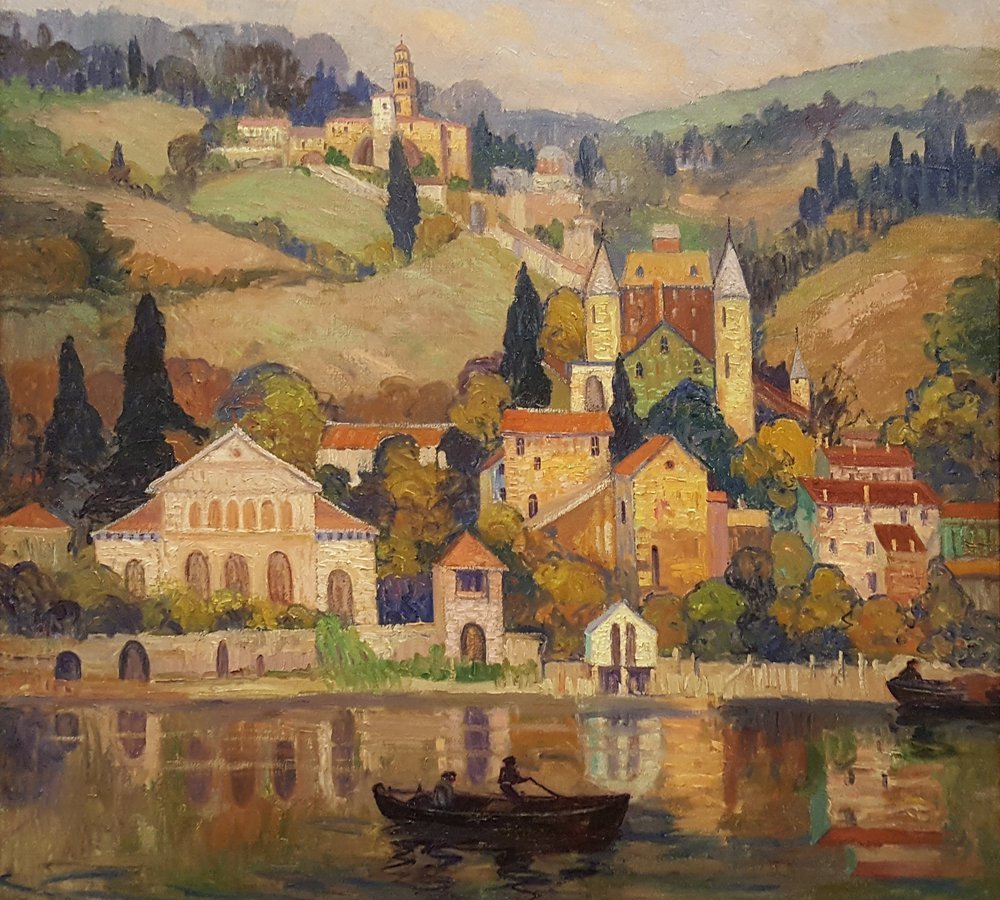
                                               The Golden Arno by Fern Isabel Coppedge (c. 1926)

In the summer of 1925, Coppedge travelled to Italy and immersed herself in painting local scenes.  She stayed in the city of Florence, which was a base for her travels around Tuscany, ever recording pictorially the beauty of the Tuscan landscape.  It is thought that during her time in Tuscany Fern was inspired to change her painting style.  She began to simplify the natural elements she saw before her, often flattening them and she also became much more audacious when it came to her colour choices.  One of my favourite works from this period is Coppedge’s painting entitled The Golden Arno.  She had sketched views of the great Italian river as it passed through Tuscany and the painting was completed back in her home studio.  Coppedge talked about this painting and how it came about:

“…From my hotel, overlooking the Arno in Florence—looking from the balcony window—I saw the Arno River flowing gently like molten gold. It was late afternoon, and lazy Italian boatmen floated past in the dark, sturdy barges, wending their way down the river. Along the opposite bank were charming old stucco houses in colours of pale and rusty yellow, rose, pink, and old red. Tiled roofs, arched doorways and deeply recessed windows, balconies, towers and turrets against the background of cypress trees—all mirrored in the waters of the Arno. Church towers and ancient castle walls patterned against the hills inspired me and thrilled me with an irresistible desire to put on canvas my impressions…”

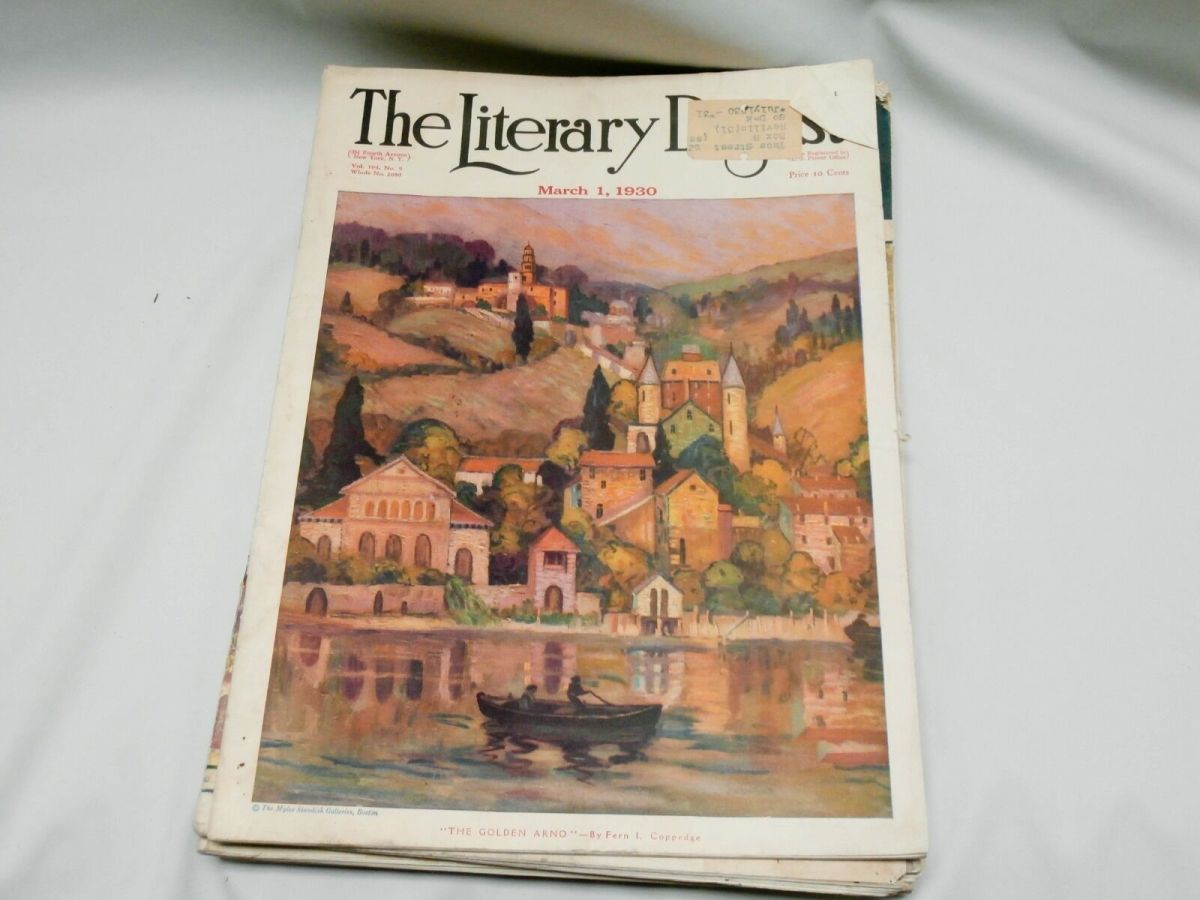
         The Literary Digest March 1st 1930 edition with Fern Coppedge’s picture on the front cover

In 1926, the painting of the Arno was included in an exhibition of The Philadelphia Ten.  It received great praise from both viewers and art critics. The painting was later exhibited in exhibitions in New York, Boston, and Philadelphia, and it is now regarded as one of her best works. It was also reproduced on the cover of The Literary Digest in March of 1930. The painting was acquired by her local high school, mostly likely after the school opened in 1931.  Around 1934, Fern stopped exhibiting with The Philadelphia Ten and instead focused on exhibiting at her studio,

                                                  Lamplighters Cottage by Fern Isabel Coppedge (1928)

During her artistic career she received several awards including the Shillard Medal in Philadelphia, a Gold Medal from the Exposition of Women’s Achievements, another Gold Medal from the Plastics Club of Philadelphia, and the Kansas City H.O. Dean Prize for Landscape.

Coppedge died at her New Hope home on April 21st, 1951 at the age of 67.  Her husband, Robert W. Coppedge, died in New Hope, Pennsylvania in 1948. The Coppedges, who were married in 1904, remained husband and wife for 44 years.  Fern Coppedge was one of America’s most prolific painters, having completed over five thousand works during her lifetime.  I will leave the last word on Fern Coppedge and her paintings to Arthur Edward Bye, an American landscape architect born in the Netherlands who grew up in Pennsylvania who said:

“…Man and his activities seem pleasantly remote but not absent in her landscapes. She fills them with houses and churches, lanes, bridges, and canals. They have therefore, that suggestion of human life, coloured with brightness, exuberant, which best answers the needs of most of us…”


Most of the information for this blog came from the website Pennsylvania through the eyes of Fern I Coppedge.

Fern Isobel Coppedge. Part 1

Fern Isabel Coppedge in her studio

My featured artist today was one of the Pennsylvania Impressionists, an artistic movement of the first half of the 20th century that was centred in and around Bucks County, Pennsylvania, particularly the town of New Hope. Often the movement was referred to as the New Hope School or the Pennsylvania School of Landscape Painting.  Leading artists of the movement taught at the Pennsylvania Academy of the Fine Arts in Philadelphia. There was a difference between Pennsylvania Impressionism and Impressionism practiced in other parts of America as, with the former, the personification of their art was the thick brushwork and the way they almost had a dedicated concentration on landscape painting.  Today’s artist was one of the great American painters of her time and although she has been tagged with the term, Impressionism, Fern Isabel Coppedge has of late been labelled as a follower of Colourism,  which is a painting style characteristic for its use of intense colour, and for making colour itself the main compositional language in the resultant work of art.  Thus, her paintings are looked upon as part Impressionism part Colourism, which is a painting style characteristic for its use of intense colour, and for making colour itself the main compositional language in the resultant work of art. Coppedge’s paintings offered up her bold and unorthodox use of bright vibrant colours similar to Fauvism, which is also characterised by strong colours and fierce brushwork.

Gloucester Harbour by Fern Isabel Coppedge

Let me introduce you to the nineteenth century American painter, Fern Isabel Coppedge, a landscape artist, who was famed for her depiction of the villages and farms of Bucks County, Pennsylvania, often blanketed with snow, as well as her harbour scenes of Gloucester, Massachusetts, where she spent her summers.

Fern (Kuns) Coppedge, Dessie (Kuns) Garst, George Dilling Kuns, Margaret Effa Kuns, Vada Dilling Kuns, Maria (Dilling) Kuns, John L. Kuns, Mary (Kuns) Klepinger

Fern Isabel Kuns was born on July 18th 1883 in the small town of Cerro Gordo which lies about twelve miles east of the central Illinois city of Decatur.  Her parents were John Leslie Kuns and Maria Anna Dilling.  Fern was one of six children.  She had four sisters, Margaret Effa, Dessie, Vada, and Maria and one brother, George Dilling.  Sadly, the first-born of John and Maria’s family was a boy, Joseph, who died in 1873 aged ten. 

Home of Fern Kuns and Family in McPherson, Kansas (c.1900)

Her father had a small farm which he had inherited from his father, but was constantly struggling to make ends meet, so much so that in 1886, when Fern was aged three, he had to sell the farm, at a loss, so as to feed the family and pay for their education.  John and his family moved west to California in the hope of finding work but nought came of it, although Fern’s eldest sister Margaret, nine years Fern’s senior, said that life in California was the best year of her childhood.  When potential opportunities did not work out for their father, they headed back east and arrived in Kansas. In 1889, the Kuns’ finally settled in McPherson, Kansas and occupied a house on the campus of McPherson College.

Watercolour by Margaret Effa Kuns (c.1935)

When Fern was thirteen years old, she went back west to Palo Alto in California where her sister Margaret Effa was studying at Leland Stanford University.  Fern,  still too young to leave the school system, enrolled at the Pasadena High school.  During her stay in California she enjoyed the company of her elder sister, Margaret Effa, and was fascinated watching her painting in a watercolour class.  This was what first instance which eventually made Fern fall in love with painting and drawing.  Effa encouraged her sister’s newly found love of art and would take her to museums to study famous paintings.

An early insight of Fern’s early work can be gleaned by a comment she once made about her art and her unusual views of the use of colours.  She said:

“…People used to think me queer when I was a little girl because I saw deep purples and reds and violets in a field of snow. I used to be hurt over it until I gave up trying to understand people and concentrated on my love and understanding of landscapes…”

Robert William Coppedge

In 1900, at the age of seventeen, Fern Kuns went back to Kansas and, upon her return to the Midwest, she studied at McPherson College and later the University of Kansas.   Shortly after her return to Kansas, she met her future husband, Missouri-born, Robert William Coppedge, a high school science teacher, botanist, and amateur artist.  On January 2nd, 1904, Fern Kuns and Robert Coppedge were married in her parents’ home in McPherson, and the ceremony was followed by a four-course wedding breakfast. Fern and her husband moved east to the Kansas state capital, Topeka.  Robert continued with his teaching profession whilst Fern continued with her love of painting and four years later, when they moved to Illinois, she attended the Art Institute of Chicago from 1908 to 1910. 

Back Road to Pipersvill by Fern Isabel Coppedge

From Chicago she moved to New York, where she enrolled at the Arts Student League.  She studied with the artist, muralist and illustrator, Frank Vincent DuMond and the Impressionist painter, William Merritt Chase.  In 1917, Fern spent time studying at the prestigious Pennsylvania Academy of Fine Arts, where one of her tutors was the Pennsylvania artist and art teacher, Daniel Garber and that year she had some of her artwork accepted into that year’s annual exhibition.  In that summer she studied at the Art Students League summer school in Woodstock where winter painting specialist, John Fabian Carlson, was director.  Carlson was one of the great interpreters of the wooded landscape and was a great influence on Fern Coppedge.

Pigeon Cove by Fern Isabel Coppedge (c.1930)

In 1917 Fern visited Pennsylvania for the first time. She immediately fell in love with its picturesque-wooded hills and the many old-fashioned Bucks County towns which reminded her a little of her home state, Kansas. She remained in Pennsylvania for over thirty years and went on to own homes in Philadelphia, and the Bucks County towns of Lumberville, where she purchased a home and art studio in 1920, which she named Boxwood, sometimes referred to as The Boxwood Studios. 

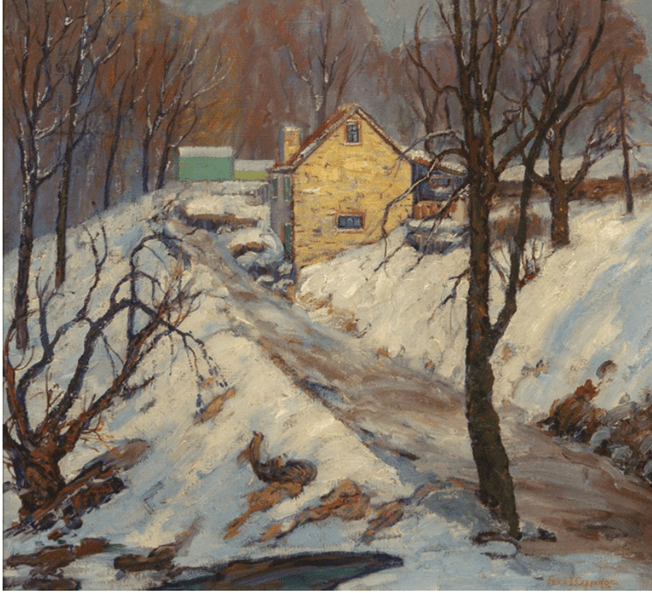
Lumberville in Winter by Fern Isabel Coppedge

In her painting,  Lumberville in Winter, we see depicted a yellow building which is believed to be her first Boxwood studio which had once been a Quaker meeting house dating to the 1700s and is featured in several other works by the artist.  The small two-storey building would feature in many more of her paintings.  Living close to her in the small village of Cuttalossa was her former tutor, Daniel Garber.

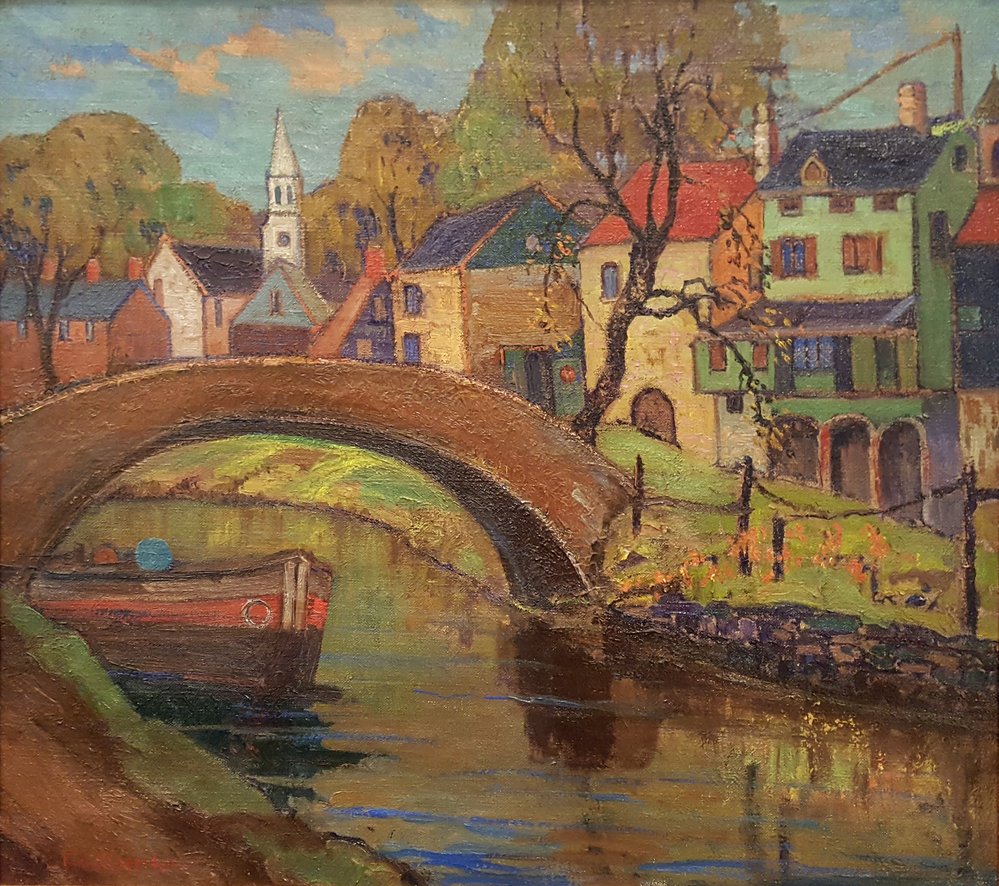
October by Fern Isabel Coppedge (after restoration work)

There is an interesting story about Fern Coppedge’s painting entitled October.   In May, 2011, a man with a small but pleasant oil painting entitled October, fresh from a New Jersey estate, walked up to the owner of a hot dog stand in North Carolina, Alison Bledsoe.  The hot dog lady, looked at the dirty landscape of a bridge, some yellow leafed trees, and some brightly coloured houses. She was not quite sure if the interesting painting was worth buying, but as it was not expensive she purchased it.   Seven months later, on December 4, 2011, Les and Sue Fox of West Highland Art Auction Brokers and authors of The Art Hunters’ Handbook, in cooperation with Alasdair Nichol of Freeman’s Auctioneers, sold the professionally cleaned New Hope, Pennsylvania bridge scene by Fern Isabel Coppedge for $29,800 at auction. 

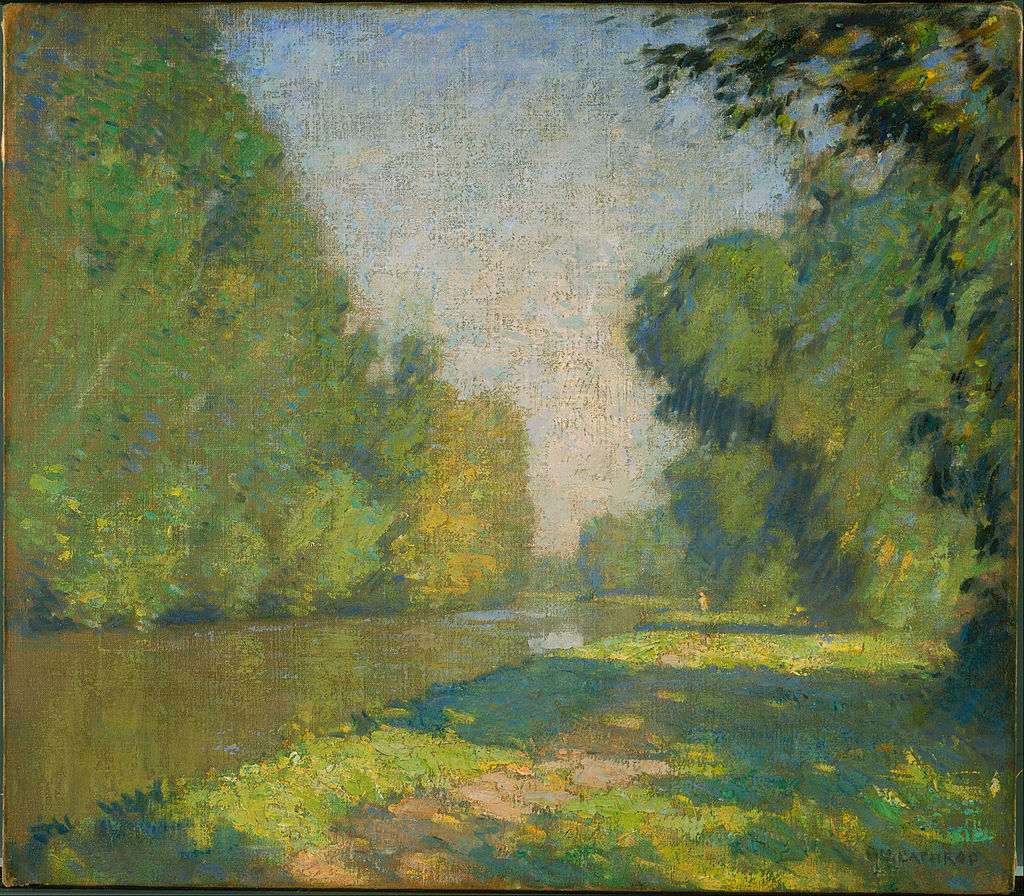
The Tow Path by William Langson Lathrop
Landscape painter William Langson Lathrop (1859-1938) moved to New Hope in 1898, where he founded a summer art school, which became known as The New Hope School

Nine years later, in 1929, Fern Coppedge moved seven miles down-river to the small town of New Hope.  It  was a  town located along the route of the Old York Road, the former main highway between Philadelphia and New York City.  At the time when George Washington crossed the Delaware in 1776, it was known as Coryell’s Ferry, after the owner of the ferry business, and got its current name after a fire destroyed several mills in 1790. It was said that once the mills were rebuilt, there was a “new hope” for this small town on the Delaware river.  The town would later be joined by a bridge to Lambertville, on the New Jersey side. Artist William Langston Lathrop and his family moved to New Hope in 1898 and founded an art school and he is now considered the father of The New Hope School

Snow And Sunshine by Fern Isabel Coppedge

Fern Coppedge lived on North Main Street in the centre of New Hope, in an early American style stone house and studio which she had built and was designed by architect Henry T. MacNeill in 1929.  This too was named Boxwood !   Over the years Fern Coppedge painted a number of pictures of her Boxwood home, at which she held many exhibitions of her work.  In 1907 Daniel Garber, who had once tutored Fern at the Pennsylvania Academy of Fine Arts in the early 1900’s,  joined the early group of American Impressionists who would evolve into The New Hope School of Pennsylvania Impressionists. Fern became a member of the group and at the time she was the only female member of the New Hope School. Members of the New Hope School lived and painted in a number of Bucks County towns near New Hope, including Lumberville and Carversville. But the “New Hope School” name stuck and that is what these talented artists who followed in the footsteps of the French Impressionists are now called.

………………………to be continued.


Most of the information for this blog came from the website Pennsylvania through the eyes of Fern I Coppedge.

Frederick Childe Hassam – The American Impressionist.

Frederick Childe Hassam

Today I am looking at the life of the nineteenth century American painter, and an important illustrator during the “golden age” of American illustration in the 1880s and 1890s.  He was a leading American Impressionist, although he baulked at that “title”.   Let me introduce you to Frederick Childe Hassam.

Self portrait

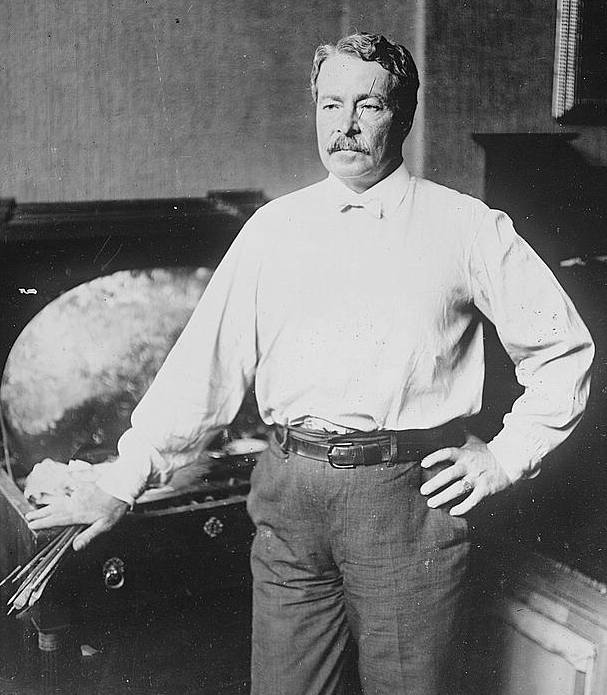
Frederick Childe Hassam was born on October 17th 1859 in the family home on Olney Street on Meeting House Hill, Dorchester, the upper middle-class suburb of Boston.  He was the son of Frederick Fitch Hassam and Rosa Delia Hassam (née Hawthorne) who hailed from Maine.  His father, a Boston merchant and hardware store owner, collected Americana well before this hobby became a popular pastime and he passed this interest in history along to his son.  Hassam was educated at Dorchester’s Meeting House Hill School and Dorchester High School, where he studied French, German, Latin and Greek while playing several sports.  Childe had his first lessons in drawing and watercolour whilst a pupil at the Mather public school in Dorchester, although his parents showed little interest in his art.

The Evening Star, by Childe Hassam, pastel on tan paper, (1891)

The family’s fortunes changed dramatically on November 9th 1872 with the sudden outbreak of fire in the basement of a commercial warehouse in the city.  The fire burnt for twelve hours and in that time had destroyed 65 acres of Boston’s downtown, 776 buildings and much of the financial district, including Childe Hassam’s father’s business.  For financial reasons, Childe had to drop out of high school without qualifying, and get a job, so as to help his family in their time of dwindling finances.  His father arranged for his son to work in the accounting department of publisher Little Brown & Company, but his lack of ability to work with figures soon ended that career.  Childe had talked to his parents about his love of painting and sketching and eventually persuaded his father to allow him to take up an artistic career.   Childe Hassam managed to secure a position as an apprentice wood engraver with George Johnson.  In a short time, Childe had proved himself to be an accomplished draughtsman producing designs for commercial engravings such as images for letterheads and newspapers.

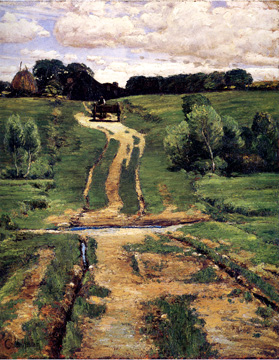
A Back Road, by Childe Hassam, (1884)

It was around 1879 that Hassam began painting in oil but his favourite medium was watercolours.  Childe Hassam’s initial formal art studies began in 1878 when he joined the Boston Art Club.  The institution was founded in 1854 by local artists in order to instigate a democratic organization where there would be a collaboration in the promotion, selling and education of art.  From there he enrolled at the Lowell Institute in Boston which ran classes in freehand practical design.

Old House, Nantucket by Childe Hassam (1882)

In 1882, Childe Hassam took part in his first public group exhibition at the Boston Art Club.  Other artists at the Boston Art Club, at that time were nationally prominent painters such as William Merritt Chase, Robert Henri, Winslow Homer, Maurice Prendergast, and John Singer Sargent.  Following his success at this exhibition Childe Hassam submitted some of his watercolour paintings for his first solo exhibition held at the William & Everett Gallery in Boston.

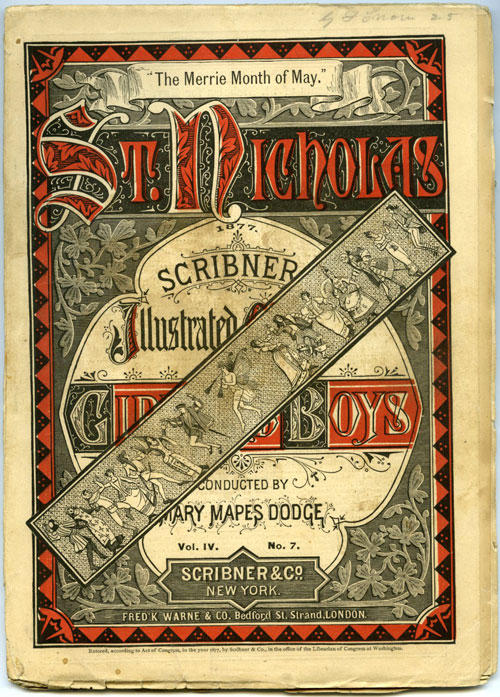
Childe Hassam illustration for St Nicholas Children’s magazine

In 1882, Hassam became a freelance illustrator and founded his first studio. His illustration forte was his illustration of children’s stories for magazines such as Harper’s Weekly, Scribner’s Monthly magazine, and The Century. He continued to develop his technique while he attended the drawing classes at the Lowell Institute, which was a division of MIT, and at the Boston Art Club, where he took life painting classes. 

New signature

The following year, his friend Celia Thaxter convinced him to drop his first name, Frederick, and thereafter he was known simply as “Childe Hassam”. He also began to add a crescent symbol in front of his signature.

Gate of the Alhambra by Childe Hassam (1883)

Because of his formal art training was limited he was advised that he should travel to Europe and enhance his artistic knowledge.  The advice came from fellow Boston Art Club member, Edmund Henry Garrett, an American illustrator, bookplate-maker, and author as well as a highly respected painter, who was renowned for his illustrations of the legends of King Arthur.  Garrett persuaded Hassam to accompany him to Europe in the summer of 1883.  The two travelled extensively through Great Britain, The Netherlands, France, Italy, Switzerland, and Spain and during their journey they would study the Old Masters at various museums and create watercolours of the various European landscapes.  While in Paris he was very much influenced by the painterly brushstrokes and pure colours of the Impressionists and it was noticeable that around this time his palette brightened and he discovered a love for depicting city subjects which would stay with him all his life.  In all, Childe Hassam completed sixty-seven watercolours and these were exhibited at his second one-man exhibition in 1884.

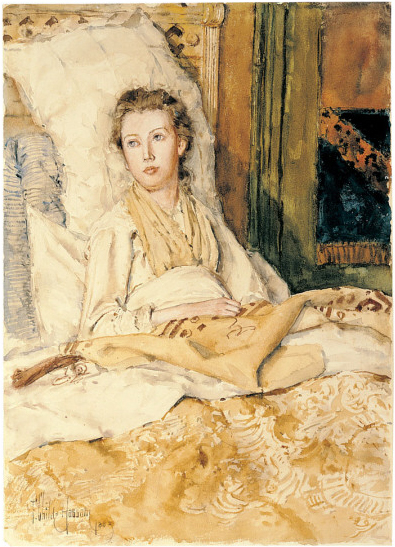
Maude Sewing by Childe Hassam (1883)

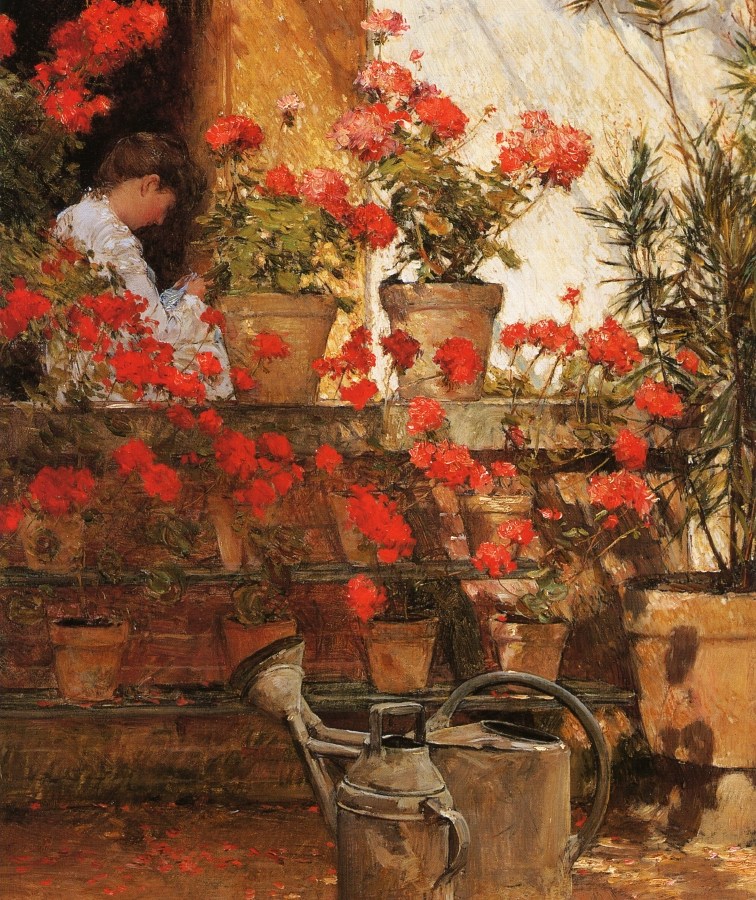
After a long courtship, Hassam married Montreal-born Kathleen Maude Doan in February 1884 and during their lifetime together, she organised the Hassam household, arranged all her husband’s travel itineraries and looked after the other domestic tasks. She featured in a number of his paintings including his 1888 work, Geraniums, which he presented at the Salon exhibition that year.

Paris Scene by Childe Hassam (1887)

During the early 1880s, the couple lived in Boston, and Hassam became one of a small number of American artists to paint watercolours of urban street scenes.  Although he believed that his paintings had improved, he decided to return to Paris and seek further artistic tuition.  In 1886 he and Maud arrived at the French capital for the start of their three year stay and Hassam attended classes at the Académie Julian, where he studied under the influential instructors Gustave Boulanger and Jules-Joseph Lefebvre.   To make ends meet Hassam would send his oil and watercolour painting back to Boston to be sold.  The money he received for them was enough for he and Maud to afford to stay in Paris. During his time in Europe, he continued to prefer mundane street and horse scenes, shunning some of the other depictions favoured by the Impressionists, such as opera, cabaret, theatre, and boating. 

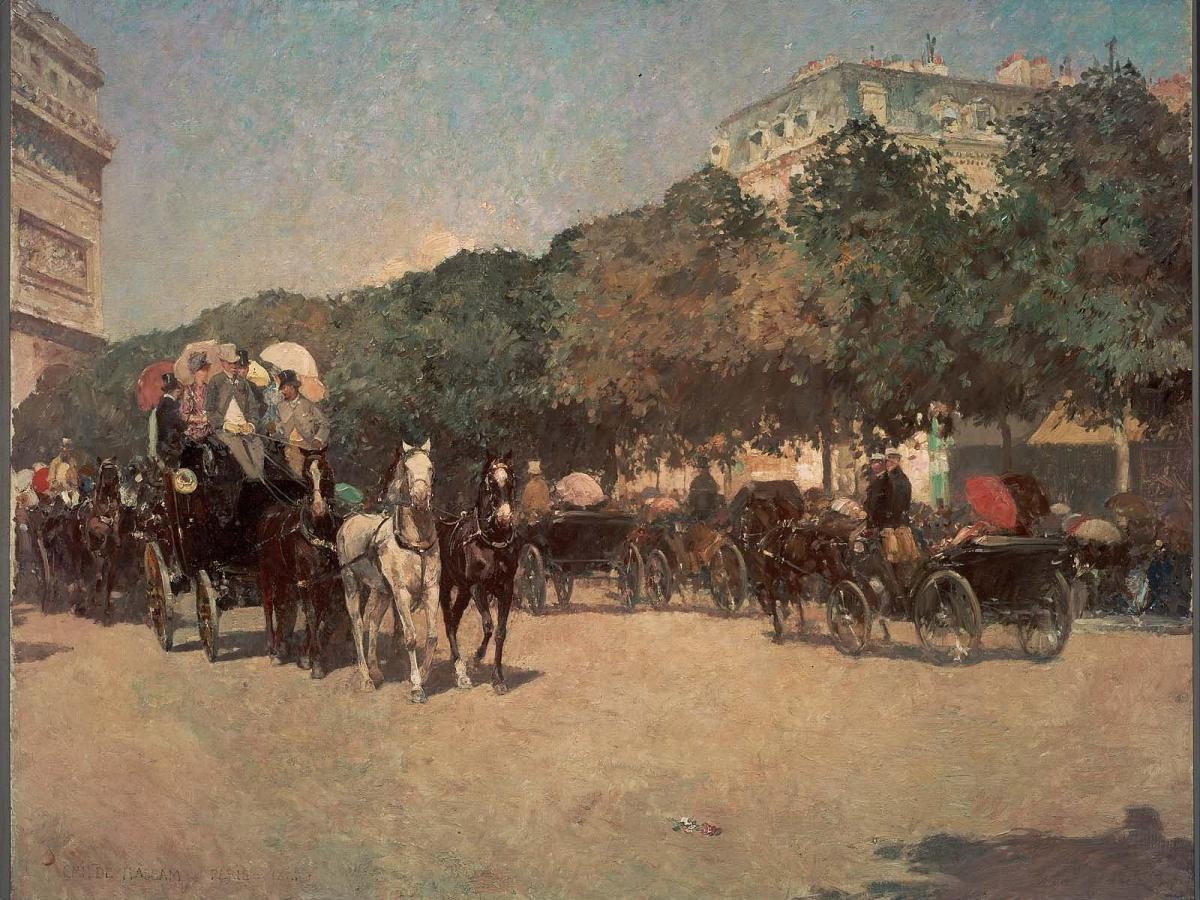
Le Jour de Grand Prix Day by Childe Hassam (1887)

In 1887 he completed his painting Le Jour de Grand Prix Day which now hangs in the Museum of Fine Arts, Boston.  Whereas he normally painted using a darker more tonal palette, in this work he used light colours to encapsulate the impression of a bright sunny day.  The setting was the journey to Longchamp in the Bois de Boulogne and the Grand Prix de Paris horse race which was held annually in June at the Longchamp track.  The affluent racegoers bedecked in their finery can be seen riding atop the horse-driven coaches which travel along the tree-lined avenue Bois de Boulogne, which is now Avenue Foch.  In the top left of the painting we catch a glimpse of Arc de Triomphe.  A slightly larger version of the painting, which is in the New Britain Museum of American Art collection, was exhibited at the Paris Salon of 1888.  Of the painting Childe Hassam said;

“…I am painting sunlight. . . a ‘four in hand’ and the crowds of fiacres filled with the well-dressed women who go to the ‘Grand Prix…”

Geraniums by Childe Hassam (1888)

He also liked to paint garden and “flower girl” scenes, some of which included a depiction of his wife, Maude, an example of which is his 1889 painting entitled Geraniums which he presented at the Salon exhibition that year. During his three-year stay in the French capital he managed to exhibit at all three Salon exhibitions.

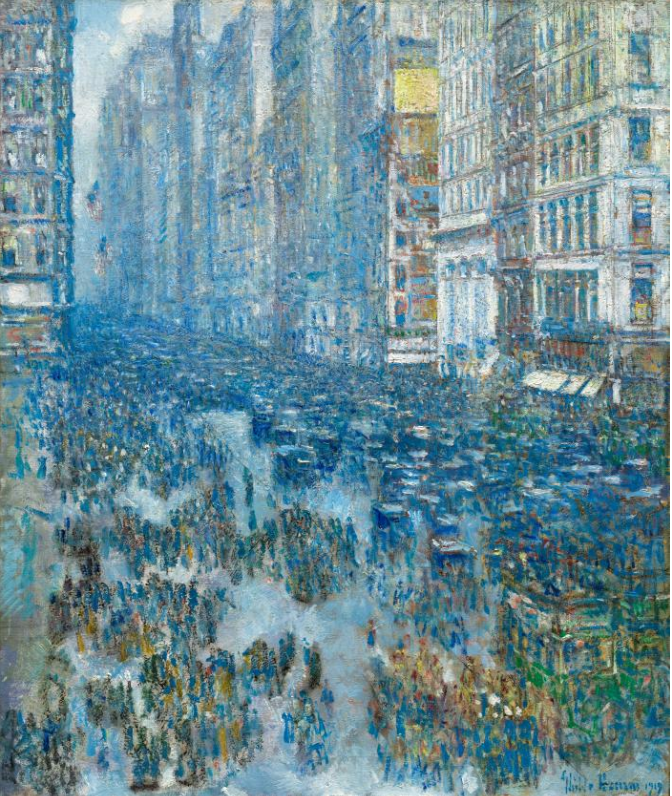
Fifth Avenue Winter by Childe Hassam (1915)

The couple returned to America in 1889 and went to live in a New York City studio apartment a studio apartment at Fifth Avenue and Seventeenth Street.  Hassam began making paintings and etchings of New York city. Hassam saw the city as a place of similar beauty and excitement to Paris especially in the fashionable neighbourhoods along Fifth Avenue and at Washington Square.  It was from this apartment window that Hassam painted the view outside.  His 1915 painting entitled Fifth Avenue Winter depicts the bustling Manhattan thoroughfare which was quickly becoming a popular shopping district around the time he made this work. His composition features flecks of colour and blurred forms to depict reflected light and rapid movement. The accelerated pace of modern city life is evoked by the depiction of the street full of streaming traffic, including two green double-decker buses at lower right.  The fashionable street was the route taken at that time by horse-drawn carriages and trolley buses. It was one of his favourite paintings and he exhibited it several times. The work now hangs in the Cleveland Museum of Art.

Fifth Avenue in Winter by Childe Hassam (c.1892)

Around 1892, Hassam painted a view of the busy thoroughfare in Winter.  The work entitled Fifth Avenue in Winter now hangs at Pittsburgh’s Carnegie Museum of Art

End of the Trolley Line, Oak Park, Illinois by Frederick Childe Hassam (c 1893),

Childe Hassam and his wife lived in New York for the rest of their lives.  He would work on his illustrations in his studio and when, weather permitting, he would go out and paint landscapes en plein air.  Not long after settling in the city, Childe Hassam became involved in the setting up of The New York Watercolour Club in 1890 and became its first president.  The organisation, unlike the American Watercolor Society, accepted both men and women into its ranks and the Club’s first exhibition was held that year.  The organisation’s exhibitions were jury-selected affairs and thus the standard of the works on show was much higher than other artistic societies.  The New York Watercolor Club’s exhibitions were held in the building which was constructed as the result of the founding of the American Fine Arts Society at 215 West 57th Street in 1889. Other art organizations headquartered in the building were the American Federation of Arts, American Watercolor Society, Artists’ Aid Society, Mural Painters, and the Art Students League of New York. Its galleries also held National Academy of Design, Architectural exhibitions.

Washington Arch, Spring by Childe Hassam. (1893)

Hassam’s painting Washington Arch, Spring which he completed in 1893 is an example of why he was termed an Impressionist and also highlights his love of cityscapes and ones which depict the hustle and bustle of life on  the tree-lined avenue settings which were often seen in French Impressionist paintings.  The marble Roman triumphal arch is situated in Washington Square Park, in the Greenwich Village neighbourhood of Lower Manhattan, New York City.  The depiction of the Stanford White designed arch reminded Hassam’s of the Arc de Triomphe in Paris. Hassam lived just north of the Square, and so he was able to watch the various stages of its construction, transitioning from first a temporary wood and plaster structure, to the eventual beautiful marble structure which was completed in 1892. The depiction is unusual in a way as the Arch which is at the end of Fifth Avenue is partially blocked by trees.  In the work, Hassam included several pedestrians along with a street cleaner and a horse-drawn carriage.

Celia Thaxter’s Garden, Isles of Shoals, Maine by Childe Hassam (1890)

At the beginning of the 1890’s Childe Hassam focused a number of his paintings with floral depictions and many were set in the gardens of his friend, the New England poet, Celia Laighton Thaxter who lived with her father at his Appledore Hotel on the Isles of Shoals, a group of small islands and tidal ledges situated approximately 6 miles off the east coast of the United States, straddling the border of the states of Maine and New Hampshire.  He painted images from Appledore Island.  He said that he found the rocks and the sea are the few things that do not change and that they are wonderfully beautiful.

Coast Scene, Isles of Shoals by Childe Hassam (1901)

Among them is the 1901 view Coast Scene, Isles of Shoals, the first painting by Childe Hassam to enter the collection of the Metropolitan Museum.  The oil painting is done in luminous colours, and depicts the remote Isles of Shoals off the rocky shoreline of New England, which was a favourite haunt of Childe Hassam at the end of the 19th century and where he painted a series of similar coastal scenes.  Childe Hassam liked to journey out of the city and he loved to visit places such as Newport, Portsmouth, Old Lyme, Gloucester, and other New England and this urge to free himself from the bustling city made him decide to buy a summer residence.

Old House, East Hampton, L.I. by Childe Hassam (1919)

Childe and Maude Hassam first visited East Hampton in 1898 at the invitation of his friend and fellow artist Gaines Ruger Donoho. During the next two decades the couple returned to Long Island during the spring and autumn as the guest of New York businessman Henry Pomroy. In 1919, Hassam and his wife Maude purchased Willow Bend, an eighteenth-century shingled cottage at 48 Egypt Lane. The house was sold to the Hassams by Donoho’s widow who lived next door. Childe Hassam moved into “Willow Bend” in May of 1920 and remained in the house until that October. This became their annual routine which they would maintain for the rest of his life.  While in East Hampton, Hassam sought inspiration from his surroundings and found beauty in the local architecture, the uneven coastline, and the wild landscape of eastern Long Island. During his six month stays in East Hampton, Hassam produced a series of works that focused on his home and its surrounding landscape.  Though Hassam rejected being associated with French Impressionists, there is an obvious influence seen in his painting Old House, East Hampton, a typical East Hampton clapboard home, with its rich colours and quick brushstrokes.

Just Off the Avenue Fifty Third Street, May 1916 by Childe Hassam (1916)

Hassam’s interest in flag subjects dates back to his time spent in Paris from 1886 to 1889. Inspired by the flags and banners displayed on Bastille Day in the area where he lived.   Just Off the Avenue, Fifty-third Street, May 1916 is the first work in the flag series that Hassam painted during the First World War. The sun-dappled street, trees and façades of the grand brownstones are painted in a vibrant palette characteristic of Hassam’s technique at the height of his abilities. In the work. We see a refined residential street in New York, a favoured subject of the artist.  Hassam depicts decorations for the patriotic parade that took place along Fifth Avenue and he has immersed the viewer in an atmosphere of nationalistic pride.

Allies Day, May by Childe Hassam (1917)

During the First World War Childe Hassam created his famous images of flags of the United States and its allies which some scholars have characterized as Hassam’s contribution to the war effort.  One such painting was his 1917 work entitled Allies Day, May.

October Sundown, Newport by Childe Hassam (1901)

In 1920 Hassam received what he deemed to be the greatest honour of his career when he was elected to The American Academy of Arts and Letters.  The Academy is an honour society of the country’s 250 leading architects, artists, composers, and writers. Each year it elects new members as vacancies occur.  When Childe Hassam died, he bequeathed several hundred artworks to the Academy.

Frederick Childe Hassam died in East Hampton, Long Island on August 27th 1935, aged 75.  His wife Maude passed away eleven years later on October 13th 1946.  She was 84.  

The Red Rose Girls. Part 5. The latter years.

Front cover illustration of The Ladies Home Journal by Jessie Wilcox Smith

Jessie Willcox Smith rented a small studio space at 1334 Chestnut Street, in downtown Philadelphia.  The studio, although cramped and barely room enough for one artist, was in an ideal place for Jessie, as it was close to her job at Ladies Home Journal.

Violet Oakley and her family had returned from their European travels and relocated to Philadelphia to seek medical treatment for her father, Arthur Oakley.  She and her sister Hester rented a studio further down the street at number 1523, in the Love Building.   It was a three-room skylight space on the third floor.   It was a much larger space in comparison that of Jessie’s studio apartment.  The sisters managed to spruce up the space by furnishing it with items lent to them by their mother.  The walls of the studio were covered with prints of paintings by the Old Masters.  Hester Oakley, who was not particularly interested in art was concentrating on her writing and did not need a spacious studio and so vacated the premises, leaving her sister to find new tenants.  Eventually Hester’s place was taken up by Elizabeth Shippen Green, Jessie Willcox Smith, and Jessie Dodd, all fellow students of Violet at the Drexler Institute.

Living together, the ladies soon began working together on commissions.   Jessie Smith and Violet Oakley, with Howard Pyle acting as their mentor, began work on illustrations for a new edition of Evangeline, A Tale of Acadie, an epic poem by the American poet Henry Wadsworth Longfellow, which was first published in 1847.  The epic poem describes the betrothal of a fictional Acadian girl named Evangeline Bellefontaine to her beloved, Gabriel Lajeunesse.  The story tells of how the lovers are separated when the British deported the Acadians from Acadie in the Great Upheaval. The poem then follows Evangeline journey across America as she spends years in a search for him. Finally, Evangeline settles in Philadelphia and, as an old woman, works as a Sister of Mercy among the poor. While tending the dying during an epidemic she finds Gabriel among the sick, and he dies in her arms.  The commission was completed and the book was published in 1897.   Howard Pyle was delighted with the finished illustrations by Jessie and Violet saying:

“…There is a singular delight in beholding the lucid thoughts of a pupil growing into form and colour; the teacher enjoys a singular pleasure in beholding his instruction growing into definite shape.  Nevertheless, I venture to think that the drawings possess both grace and beauty…”

Illustration by Jessie Wilcox Smith for Maud Goodwin’s book The Head of the Hundred.

The illustrations that Smith and Oakley did for the book were a great success and this resulted in a number of new commissions including a commission for Jessie Smith to provide illustrations for a romantic novel, The Head of a Hundred by Maud Wilder Goodwin which was first published in 1897.  Violet Oakley meanwhile provided illustrative covers for The Century magazine and Collier’s Illustrated Weekly

The three women became part of Philadelphia’s vibrant artistic community and became founder members of The Plastic Club.   The art educator Emily Sartain founded the Plastic Club. Its raison d’être was as an arts organization for women to promote collaboration and exhibit members’ works.  It was partly in response to the Philadelphia Sketch Club, which was an exclusively male arts club.

Photograph shows Green, Oakley, and Smith seated, each holding a rose, while Cozens holds a watering can over their heads, pretending to water them. Handwritten identification on verso: The Red Roses; Elizabeth Shippen Green, Violet Oakley, Jessie Willcox Smith, Henrietta Cozens; with Violet Oakley’s poster in the background for first exhibition at the Plastic Club.  Photograph taken at 1523 Chestnut Street, when they planned to move to “The Red Rose”, Villanova.

Jessie Dodd finally left the shared apartment as she was struggling to gain commissions, unlike the other three women.  She became very despondent and in 1899 she gave up artistic career and returned home to Ohio leaving just Violet Oakley, Jessie Wilcox Smith, and Elizabeth Shippen Green living at the Love Building.  The relationship between the three ladies was what was termed a “sympathetic companionship” but in fact was what we would now term a romantic friendship.  There was nothing scandalous about their relationship as in nineteenth century America romantic friendships was deemed a normal part of a woman’s life. The three women were very supportive of each other and shared their triumphs and failures.  There came a time when they had to decide the course their future would take.  Howard Pyle had warned them that combining an artistic career with marriage was not a viable option in an age when a woman was expected to manage a household, function as a hostess and bear children and of course in the minds of Jessie, Violet and Elizabeth, the words of Howard Pyle were sacrosanct.  Jessie Smith was very definite about her views on this subject, saying:

“…A woman’s sphere is as sharply defined as a man’s.  If she elects to be a housewife and mother – that is her sphere and no other.  Circumstances may, but volition should not, lead her from it.  If on the other hand she elects to go into business or the arts, she must sacrifice motherhood in order to fill successfully her chosen sphere…”

Elizabeth Shippen Green ink on paper illustration, Climbing the Steps.

Jessie Smith and Elizabeth Green were both busy working for The Ladies’ Home Journal and were soon being inundated with commissions resulting in that they could leave their staff jobs and work on a freelance basis.  Elizabeth Shippen Green was submitting a number of pen-and-ink drawings many of which appeared on the covers of the St Nicholas and The Scholar’s Magazine as well as appearing alongside short stories published in Curtis Publishing Company’s Saturday Evening Post.  One of the latter was reproduced in a volume published in London under the title:  The Studio’s 1900-1901 Modern Pen Drawings: European and American.  Her drawings featured in the volume alongside works by the renowned illustrators of the time, Edwin Austin Abbey, Maxwell Parrish, and her teacher Howard Pyle.  The editor, Charles Holme, wrote:

“…Miss Elizabeth Shippen Green though a newcomer, draws with force and has a nice regard for the decorative effect of lines and black masses…”

Madonna and Magi sketch for stained glass panel, by Violet Oakley (1902)

In 1900 Violet Oakley received a commission to paint two murals and create five stained-glass windows and an altarpiece in mosaic for All Angels Church in New York’s Upper West Side. The year 1900 was both a happy and unhappy year for Violet Oakley.  Her sister Heather had married her long-time friend Stanley Ward in 1898 and in 1900 the couple had their first child.  Birth and death are mechanisms of population balance and 1n 1900 Violet’s father Arthur died after a long and debilitating illness.

The three artists remained at their studio on Chestnut Avenue and whilst the winters were tolerable the heat and humidity of New York in the summer months was oppressive so much so that during the summer of 1900 they rented apartments in the Low dormitory on the Bryn Mawr College campus.  Jessie and Elizabeth even won a commission to illustrate the 1901 calendar for the college.

The Red Rose Inn , Villanova, Pennsylvania

In the Autumn of 1900, at the end of their summer stay at Bryn Mawr college, the three friends first visited the Red Rose Inn which was situated in the Philadelphia suburb of Villanova.  The friends had spent many a happy hour leafing through the pages of England Country Life magazines and hankered for a country lifestyle.  Violet Oakley in her handwritten autobiography remembered the time.  She wrote:

“…We became enamoured of the idea of living in the midst of beauty and order of such Gardens as those of England:  of having a country estate; of escaping from work in city studios…”


Red Rose Studio

On one of their last days at the college campus they drove out to Villanova to see the Red Rose Inn.  The inn had been in the local news for many years as the owner, Frederick Phillips, was rumoured to be turning it into an artist’s colony and subdivide the eight hundred plus acres into a number of building lots.  Unfortunately for Phillips he was not the sole owner and his co-owning siblings baulked on his expensive plans to renovate and build on the land as were his near neighbours who christened his plans, Phillip’s Whim.  The die was cast when Frederick Phillips died and his siblings wanted to sell the property.  It was eventually sold to the American banker, Anthony J Drexel for $200,000. 

After a lot of legal wrangling the three artists managed to arrange to rent the Inn and, in the Spring of 1901, they gave in their notice terminating the lease on the 1523 Chestnut Street studio and moved out.  They moved into the Inn in the late Spring of 1901 and with them came another female, their friend, forty-three-year-old Henrietta Cozens.  Henrietta, the daughter of a cotton broker, was not an artist but her role was to be responsible for managing the property, overseeing all the domestic chores, and looking after the upkeep of the gardens.  The monthly outgoings for the three artists had suddenly increased from the mere $125 per month they paid to the landlord for their studio in the Love Building to $500 per month for the rent for the Rose Inn and the wages of the servants and cook.  An although the three artists subsidised Henrietta’s share of the costs it was a financially binding situation and one which needed the three artists to remain together and so once again, they vowed to remain together and never marry.  It was this new home of theirs that led to Howard Pyle calling them The Red Rose Girls.

Bryn Mawr College 1902 calendar – illustration by Elizabeth Shippen Green

In February 1902, the three artists were offered their own three-woman show.  It was an exhibition of a variety of their work. It comprised of their book illustrations and Jessie Wilcox Smith’s designs for the Bryn Mawr calendars.   Elizabeth Green showed her illustrations for Harper’s Magazine and the Saturday Evening Post as well as her calendar illustrations.  Violet Oakley’s offerings for the exhibition comprised of two covers she completed for Collier’s Weekly, some charcoal drawings and her designs for the All Angels’ stained-glass windows and chancel decorations.  The exhibition was a great success and was an important step in the careers of the three artists.

The 1914 advert illustrated by  Jessie Willcox Smith for Procter Gamble Ivory Soap.  

At the exhibition Jessie Wilcox Smith submitted thirty of her illustrations some of which were advertisements for Procter & Gamble.

All good things have to come to an end and their time at The Red Rose Inn ended on January 25th 1906 when the three women were served with an eviction notice:

“…Anthony J. Drexel having leased to you the premises in Lower Merion Township, Montgomery County, Pennsylvania, known as the Red Rose Inn, by lease the terms of which expire on May 1st 1906, subject to three months’ notice, and the said Anthony J Drexel and Margarita, his wife, having granted, assigned and conveyed to me the said premises, with the lease, you and each of you are hereby notified and required to quit and deliver up to me possessions of the said premises, which you now hold as tenant under me, at the expiration of the said lease, namely the first day of May A.D. 1906 as I desire to have such possession…

Signed Henry S Kerbaugh…”

Cogslea, photographed by Elizabeth Shippen Green in 1907

Thanks to the benevolence of Dr. George Woodward, a wealthy relative of Elizabeth Shippen Green, the three artists managed to rent a renovated stone-walled house, adjacent barn, and carriage house at Hill Farm, located on Woodward’s estate at Cresheim Creek in Mt. Airy, some ten miles north of Philadelphia.  The three women named their new home Cogslea (C for Henrietta Cozens, O for Violet Oakley, G for Elizabeth Green and S for Jessie Smith) and “lea” for the sloping land of the new estate.

Photograph of Huger Elliot posing for Elizabeth Shippen Green at Cogslea

In 1909, Elizabeth Green’s mother died and the following March, her father Jasper Green passed away.  More change was to come in 1910.  Elizabeth Shippen Green had built up a friendship for a couple of years with Huger Elliott, a graduate of Columbia University’s school of architecture and the Ecole des Beaux Arts in Paris.  He was looking for more than just a friendship with Elizabeth, albeit the couple had become engaged, but Elizabeth was hesitant about their future considering she had, along with her two friends, “signed a pledge” to keep men out of their lives and just live for their art.  In October 1910, Huger Elliot visited Elizabeth at Cogslea and gave her an ultimatum – marry me now or break off the engagement!  One can only imagine the state of Elizabeth’s mind at this turn of events.   She had to try and think rationally.  She was now thirty-nine years of age and been with her friends for thirteen years and a decision to marry Elliot would violate their “agreement”.  On the other hand, she knew her friends were financially secure and had been given numerous commissions.  She also realised that the dynamics of the household were changing.  Jessie Smith and Henrietta Cozens, who were close in age, were becoming inseparable and both had a quiet temperament and an unbending sense of decorum which was polar opposite to Elizabeth’s exuberance.  Her other friend and housemate, Violet Oakley, was engrossed in her religion and impassioned about her dream of a utopian society and her aspiration to elevate the morals of the country though her art.  Maybe the deciding factor was that Elizabeth more than just liked Huger.  She made the decision to marry Huger Elliot and leave Cogslea and her friends.  Violet, Jessie, and Henrietta were stunned by her decision., Henrietta Cozens declared:

“…How can she love anyone more than she loves us?…”

Elizabeth Shippen Green and Huger Elliot on their honeymoon in Germany  in 1911

The die was cast and On June 3rd 1911 Elizabeth Shippen Green married Huger Elliott at Cogslea.   The couple left Cogslea that evening and went to stay in Philadelphia prior to their honeymoon in Germany.  Unfortunately for Elizabeth being in Philadelphia she saw the front page of the June 4th edition of the Philadelphia Press which announced:

“…Trio of Artist Friends Broken by Cupid…”

which went on to state:

“…a note of sadness was felt when the realization came that the trio of artists who had lived and worked together so long would be depleted by the absence of Mrs Elliott…”

 The Chestnut Hill Herald was even more sensational in its coverage stating that a heartbroken Violet Oakley broke down completely whilst trying to change Elizabeth’s mind.     After their honeymoon, Elizabeth and her husband Huger settled in Cambridge Massachusetts.  From 1912 to 1920 Huger was supervisor of educational work and director of the department of design at the Boston Museum of Fine Arts. For the next five years, he served as president of the Pennsylvania Museum and School of Industrial Art in Philadelphia. He was the Director of educational work in the Metropolitan Museum of Art in New Nork from 1925 to 1941, when he retired.  It was not until two years later, in July 1913, that Elizabeth was reunited with Violet, Jessie and Henrietta when she and her husband returned to Cogslea for a visit. 

Violet Oakley was desperate to have a much larger studio to accomodate her massive murals and so she decided to buy Cogslea for herself and to achieve that she had to sell all her assets.  Jessie Wilcox and Henrietta Cozens moved out of Cogslea, bought a quarter of the estate land, and built a house on it for themselves.  The Red Rose Girls had finally been separated.

Jessie Wilcox Smith died on May 3rd 1935, aged 71.

Elizabeth Shippen Green Elliott died on May 29th 1954, aged 82.  Her husband Huger had died of a heart attack on November 13th 1948, aged 71.

Violet Oakley was the last of the Red Rose Girls to die.  She passed away on February 25th 1961, aged 86.


The Red Rose Girls. Part 4. Howard Pyle.

Howard Pyle

The story of The Rose Girls could not be told without talking about the American illustrator and author, primarily of books for young people, Howard Pyle, who gave the The Rose Girls soubriquet to the three young ladies he was mentoring.  He was a man of great talent and a patriotic missionary of Americanism and his illustrations were held in high esteem on both sides of the Atlantic..

The Coming of Lancaster by Howard Pyle (1908).  Illustration from The Scabbard by James Branch Cabell, and illustrated by Howard Pyle which appeared in Harper’s Monthly Magazine, May 1908 and is a fictional retelling of the story of King Richard II of England, who was deposed by his cousin Henry who belonged to the Lancaster branch of British royalty

Howard Pyle was born in Wilmington, Delaware on March 5th 1853.   He was the son and eldest child of Quakers, William Pyle and Margaret Churchman Painter, an amateur artist.  Pyle remembered his childhood, with fondness, as being an idyllic time that was centred around the family’s wonderful old stone house and its garden, which he remembered as being filled with profuse blooms and hidden wonders. Mainly thanks to his mother, Pyle developed a love of reading and like many children of his age he loved the tales of Daniel Defoe’s,such as Robinson Crusoe, the Grimm’s Fairy Tales, and mystical stories from the Arabian Nights. all of which fired up his young imagination. He attended the Friend’s School in Wilmington followed by schooling at a small private institution. He was not a top student, and it was said that he wasted too much time daydreaming. His one love was art and he spent much of his free time drawing.  He also developed a love of writing his own stories.   Although it was the wish of Pyle’s parents that their son should attend college, Howard Pyle had other ideas about his future, which he saw as being a professional artist or writer.  Knowing that their son was never going to go to university his parents, especially his mother, decided to encourage him to study art.
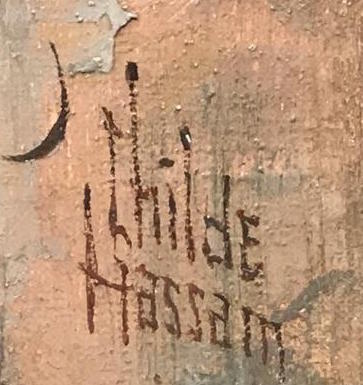
The Mermaid by Howard Pyle (1910)

He studied for three years at the studio of Francis Van der Wielen in Philadelphia.  Van der Wielen was a Dutch artist who in 1872 had taught sixteen-year-old Cecilia Beaux.  Besides a few art lessons later at the Art Students League of New York, these three years tutoring by van der Wielen were Howard Pyle’s only formal training. Because of problems with his father’s leather business, Howard Pyle had to spend many years helping out in the family business. The artistic breakthrough for Howard Pyle came in 1876 when his mother sent an essay and sketches he had done while on holiday with his father on Chincoteague Island to Scribner’s Magazine.  The editor accepted the article and illustrations and told Pyle they were so good that they were being published in the November issue of the magazine.  Furthermore, the editor invited Howard Pyle to come to New York and work for the magazine as a writer and illustrator.

A Wolf Had Not Been Seen at Salem for Thirty Years by Howard Pyle.  Illustration for “The Salem Wolf”  a short story written and illustrated by Howard Pyle for Harper’s Monthly magazine, December 1909.  

Howard Pyle was now living in New York city in a small rented room at 250 West 38th Street (between Seventh and Eighth Avenues) and it was not long before he sold his first painting to Harpers Weekly, a magazine that would continue to buy his work for many years in the future. The publisher of Harper’s Weekly had assembled an exceptional group of professionals who were knowledgeable about illustration and trained in the newest methods of printing, and the House of Harper became an informal training ground for the likes of Howard Pyle to learn every aspect of the publishing process.  It was soon after settling in New York that Howard Pyle knew that he wanted to write and illustrate books for children. Pyle had both a wonderful imagination and he also was able to recollect stories from his childhood.  He set about putting those memories on paper and at the same time illustrated his prose.  He submitted many of his stories and illustrations to the St Nicholas magazine, a popular monthly American children’s magazine, founded by Scribner’s in 1873.    

An Attack on a Galleon, a 1905 illustration for the story, The Fate of a Treasure Town by Howard Pyle which appeared in the December edition of Harper’s Monthly magazine.

He drew upon his vivid childhood memories to contribute stories to the St. Nicholas magazine, and he read and studied many of the old folktales that he’d loved as a child, extending his reading to include less familiar tales from many nations. These folktales and the romances of his boyhood would become the central core of his work over his lifetime; and although he is primarily remembered today for his contributions to illustration, he was a writer of some skill. Indeed, he has been compared to Hans Christian Andersen in the way his unique voice and imagination shaped his traditional folklore and fantasy material.

St Nicholas magazine cover. May 1875

According to Ian Schoenherr’s blog on Howard Pyle, one of the first magazine covers to feature an illustration by Howard Pyle is the May 1877 cover of St. Nicholas, Scribner’s Illustrated Magazine for Girls & Boys.  Pyle actually only designed the long rectangular illustration which runs diagonally across the cover.  In the magazine the publisher explained the illustration:

“…The beautiful tablet by Mr. Pyle, which adorns our cover this month, tells a true story in its own lively fashion. Its quaint costumes of successive centuries, showing how May-day rejoicings have been kept up from age to age, will send some of you a-Maying in encyclopedias and year-books, but it gives its real meaning at a glance – which is, that through all time people have welcomed the first coming of the spring. “Merrie May,” meaning pleasant May (for in old times “merry” simply meant pleasant), was as fresh and beautiful ages ago as it is to-day; and in one way or another the thought at the bottom of all the rejoicing is ever that of the old carol:


“A garland gay I’ve brought you here,

And at your door I stand;

It’s but a sprout, but it’s well budded out.

The work of our Lord’s hand.”

Howard Pyle remained in New York until 1879 at which time he returned home to Wilmington, by which time he had established a reputation as a leading writer and illustrator of children’s books. 

The Merry Adventures of Robin Hood of Great Renown in Nottinghamshire, published in 1883, is thought to have been Pyle’s first children’s book.  He wrote, illustrated and designed the book himself.  In all, he went on to do many more books for this audience including Pepper and Salt, The Wonder Clock and four volumes of the Legends of King Arthur

He completed Legend and Stories of King Arthur in 1903.  The book contains a compilation of various stories, adapted by Pyle, regarding the legendary King Arthur of Britain and select Knights of the Round Table. Pyle’s novel begins with King Arthur in his youth and continues through numerous tales of bravery, romance, battle, and knighthood.
The 1902 illustration by Howard Pyle “There is a time to fight, and that time has now come” for The Story of a Great-Grandfather by George Hibbard which appeared in Scribner’s Magazine January 1903

Howard Pyle believed that book illustration was the fundamental basis from which to produce painters.  His ideas with regards illustration were revolutionary and at odds with many of the beliefs of the day. Pyle was adamant that artists needed, to get beyond the stiff figures of the studio life class and let their figures and scenes come from the imagination rather than from a frozen pose.

For Pyle, the overall design of the book was of paramount importance and he helped his students learn how to incorporate their illustrations into the finished article. Pyle made it clear to his students that the role of the illustrator was to compliment and enhance the text in personal ways rather than merely mimic what the text expressed. Through his many books and his teaching, the influence of Howard Pyle on children’s literature is acknowledged by readers and artists to this day.

Howard Pyle working on mural depicting Battle of Nashville in his Franklin Street studio (c.1905).

Pyle decided to do something about giving art students a firmer foundation in illustrative art by offering his services to the Pennsylvania Academy of Fine Art as their Instructor of Illustration.  His offer was politely refused and he was told that the Academy school was for painters and sculptors and was a school for the fine arts only.  Pyle, having been rebuffed by the Academy, was not to be deterred and made  the  same  offer  to  the  Drexel  Institute.  His offer was promptly  accepted  and within  a short  time there  began  to appear  in the magazines new names of illustrators who had been students of Pyle.  Sensing that the Drexel Institute was the better option when it came to illustrative art, many of the Pennsylvania Academy students left and enrolled at the Drexel Institute.  The director of the Pennsylvania Academy, Harrison Morris, realised he had been wrong to rebuff Pyle’s offer, and asked him to come and teach at the Academy and name his own salary.  Pyle’s short reply was to the point:

“…He who will not when he may, when he will, he shall have nay…”

Howard Pyle commenced teaching at the Drexler Institute in October 1894. The catalogue of the Department of Fine and Applied Arts (1894-1895) announced:

“…A Course in Practical Illustration in Black and White, under the direction of Mr. Pyle.  The course will begin with a series of lectures illustrated before the class by Mr. Pyle. The lectures will be followed by systematic lessons in Composition and Practical Illustration, including Technique, Drawing from the Costumed Model, the Elaboration of Groups, treatment of Historical and other subjects with reference to their use in Illustrations.  The students’ work will be carefully examined and criticized by Mr. Pyle…”

Within Howard Pyle’s first class that October, there were thirty-nine students, including three young people destined to become outstanding leaders in the field of illustration:  Maxfield Parrish, Jessie Willcox Smith, and Elizabeth Shippen Green.  Three years later, in 1897, Violet Oakley joined the class.

………..to be continued.


Most of the information I used for this blog came from an excellent book by Alice A. Carter entitled The Red Rose Girls, An Uncommon Story of Art and Love.


On a more personal note, it is ten years to the day that I started My Daily Art Display blog and this is 830th “edition”.  It started as a one-a-day blog but they were shorter blogs and I was finding I was putting too much pressure on myself to meet deadlines so I now do just one a week but have increased the number of words.  I do enjoy writing them and hopefully will carry on a little while longer.

The Red Rose Girls. Part 3. Jessie Willcox Smith.

The third of the Red Rose Girls was Jessie Willcox Smith.  She became one of the most prominent female illustrators in the United States, during the celebrated ‘Golden Age of Illustration‘.  Jessie was the eldest of the trio, born in the Mount Airy neighbourhood of Philadelphia, on September 6th 1863, the youngest of four children.  She was the youngest daughter of Charles Henry Smith, an investment broker, and Katherine DeWitt Willcox Smith.  Her father’s profession as an “investment broker” is often questioned as although there was an investment brokerage called Charles H. Smith in Philadelphia there is no record of it being run by anybody from Jessie Smith’s family.  In the 1880 city census, Jessie’s father’s occupation was detailed as a machinery salesman.  Jessie’s family was a middle-class family who always managed to make ends meet.  Her family originally came from New York and only moved to Philadelphia just prior to Jessie’s birth.  Despite not being part of the elite Philadelphia society, her family could trace their routes back to an old New England lineage.  Jessie, like her siblings, were instructed in the conventional social graces which were considered a necessity for progression in Victorian society.   It should be noted that there were no artists within the family and so as a youngster, painting and drawing were not of great importance to her.  Instead her enjoyment was gained from music and reading.  Jessie attended the Quaker Friends Central School in Philadelphia and when she was sixteen, she was sent to Cincinnati, Ohio to live with her cousins and finish her education.
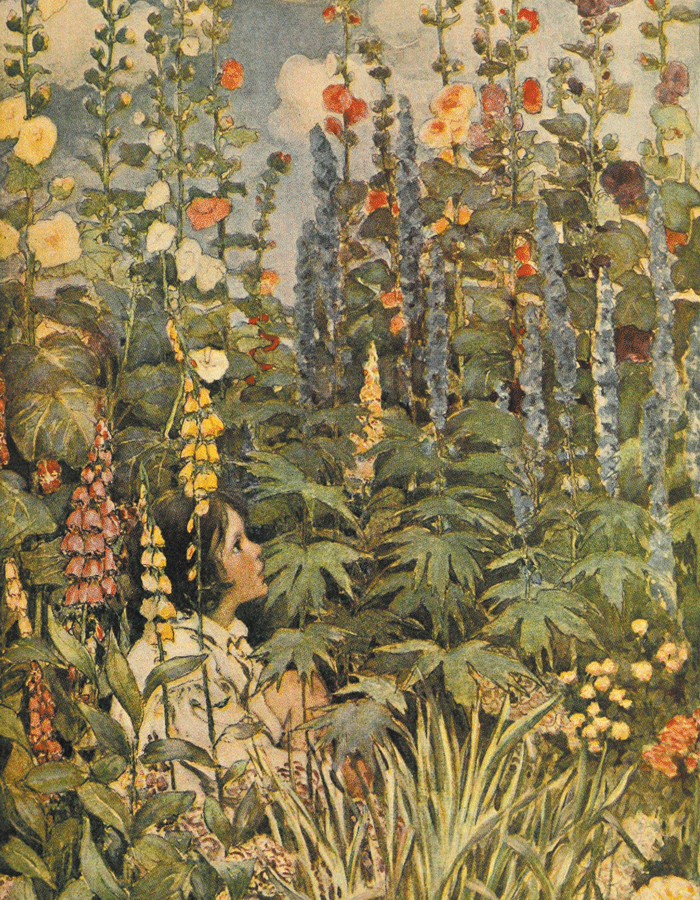
The Princess and the Goblin, by George McDonald, illustrated by Jessie Willcox Smith, (1920)

On completion of her education, instead of returning to the family in Philadelphia, she remained in Cincinnati to look for a job.  Jessie had always been fond of children and managed to secure a position as a kindergarten teacher which would fulfil her need for money whilst doing a job she loved.  However, the belief that all young children are angelic was soon dispelled and she found her charges obstreperous and ill-mannered and soon realised that teaching at a kindergarten was not for her.  One of her friends was interested in art and soon she had managed to inveigle Jessie into the pastime and soon she showed a certain amount of promise as a budding artist.  She remembered this change of direction writing:

“…I knew I wanted to do something with children but never thought of painting them, until an artist friend saw a sketch I had made and insisted I should stop teaching (at which I was an utter failure) and go to art school – which I did…”

John Rogers figurine

Jessie Smith returned to Philadelphia to look for some artistic training and initially wanted to study sculpture.  At the time there was a popular small table-top sculptures called Rogers Group which were relatively inexpensive, mass-produced figurines in the latter 19th which graced the parlours of homes in the United States.  These figurines, often selling for as little as $15 a piece were affordable to the middle class.  They were sculpted in more affordable plaster and painted the colour of putty to hide dust.  She did try her hand at sculpture but soon realised it needed a certain talent, one which she was lacking.  She wrote:

“…my career as a sculptor was brief for my clay had bubbles in it and burst when it was being fired. ‘Heavens’ I decided, ‘ being a sculptor is too expensive!  I will be a painter…’ ”

An illustration by Jessie Wilcox Smith from A Child’s Garden of Verses is a book written by Robert Louis Stevenson

However, Jessie realised that to become a painter she needed formal artistic training and it was difficult for that to happen for a woman in 1884.  It was the age-old story.  Men who wanted to train to become professional artists had academies and teachers to support them but for women, up until the 1850’s, there were few institutions which catered for women and anyway, it was generally thought to be totally ill-advised for a woman to contemplate or prepare for a professional career, art or otherwise.  Life was mapped out for women.  Acquire certain accomplishments which would attract a man, marry that man and give him children, and then be educated at home in the skills needed to look after one’s husband and children.  For women of the middle and upper-class who were interested in art, then a private tutor could be hired but studying in mixed life-drawing classes was deemed unsuitable for women as was sketching nude statuary.

Edwin Forrest House, formerly the home of the Philadelphia School of Design for Women.

Despite this, twenty-one-year-old Jessie Willcox Smith, on October 2nd 1884, enrolled at The Philadelphia School of Design for Women, which was housed in a fashionable Philadelphia neighbourhood in an imposing mansion that had once been the home of actor, Edwin Forrest.  The School had begun when Sarah Worthington King Peter, the wife of the British consul in Philadelphia, established an industrial arts school in her home in 1848 so as to teach a trade to women, who were without a means of supporting themselves.  It was not in direct competition with the Pennsylvania Academy as its emphasis was on decorative pattern and ornament and until 1886 steered clear of controversial life-drawing classes.  After a year at the School of Design, Jessie hankered for more than it could offer her.  She wanted to study the techniques associated with Fine Art and so decided that she had to enrol at the Pennsylvania Academy of the Fine Arts. 

Thomas Eakins, circa 1882

She managed to persuade her parents to fund her tuition and in 1885 she enrolled in the class of the brilliant but controversial painter, Thomas Eakins.  Master and student were so different.  Jessie Willcox Smith was a conservative and shy young woman whilst her tutor was brash, carefree and provocative and cared little for the Academy’s attempt to reign him in.  Eakins represented an outrageous departure from the social norms which had structured Jessie Smith’s life.   Many complaints had been levelled at Eakins and his teaching methods especially those regarding female students.  The following year, 1886, forty-one-year-old Eakins was sacked by the Academy.   It is interesting to note that although there is no doubt her artistic ability flourished under the tutelage of Eakins she viewed him with disdain, once confiding in a friend that she thought he was a “madman”.  Jessie did attend Eakins’ life-drawing classes but of the life models used, once declared:

“…I always wished there were children in the life classes, the men and women were so flabby and fat…”

After Eakins was dismissed from the Academy, he held private classes at his studio and many of his former students attended them, but not Jessie.  She presumably did not agree with Eakins’ way of teaching and decided to remain at the Academy and study under Thomas Anshutz and James B. Kelly, two of Eakins’ former students.

Jessie Willcox Smith graduated from the Academy in June 1888.  She looked back on her time at the Academy with a certain amount of disappointment.  Although her technique had improved, she had hoped to be part of an artistic community in which artistic collaboration would be present but instead she found dissention, scandal and in the wake of the Eakins’ scandal, institutionalized isolation.  Jessie talked very little about her time at the Academy.  It had been a turbulent time and she had hated conflict as it unnerved her and made her extremely distressed.  This desperation to avoid any kind of conflict in her personal and professional life revealed itself in her idealistic and often blissful paintings.  Jessie wanted to believe life was just a period of happiness.

Illustration by Jessie Wilcox Smith for the book of verse, The Seven Ages of Childhood

In 1909 a book of verse entitled The Seven Ages of Childhood by Carolyn Wells with accompanying  illustrations by Jessie Wilcox was published.

After graduation, Jessie became interested in illustration and in 1889 took a job with the advertising department of Ladies’ Home Journal, one of the leading American women’s magazines.   In 1894, nearly six years after graduating, she learned that Howard Pyle, the noted illustrator, was starting a School of Illustration at the Drexel Institute and she was accepted into the inaugural class along with Violet Oakley and Elizabeth Shippen Green.

Jessie Wilcox Smith, cover for Good Housekeeping Magazine. May 1921.

Her illustrations appeared on the covers of Good Housekeeping  resulting in most people becoming familiar with her art. For over 15 years she painted the covers for one of America’s most popular magazines. Month after month, from December of 1917 through March of 1933, a new Jessie Willcox Smith image was on the newsstands and in countless homes.

The Red Rose Girls were finally together.  In my next blog I will look at their time at the Drexel Institute with Howard Pyle and their life together.

……………………to be continued


Most of the information I used for this blog came from an excellent book by Alice A. Carter entitled The Red Rose Girls, An Uncommon Story of Art and Love.

Jules Breton. Part 3. Rural Life and Religious Ceremonies.

Breton Peasant Woman Holding a Taper by Jules Breton (1869)

Besides his rural works of art, Jules Breton will also be remembered for his religious paintings.  One simple work was his 1869 painting entitled Breton Peasant Woman Holding a Taper, which can be seen at the Brooklyn Museum.  It is an intimate portrayal of an elderly lady in Breton costume.  Jules Breton made the background plain and dark so that her white headdress and the starched folds of her collar stand out.   In one hand she holds the long thin candle whilst the other hand clasps her rosary beads.  France may have been reeling from revolutions and turmoil with even worse to come but Breton was happy to focus on regional dress and religious tradition.  Since 1994, the painting has been housed at the Musée des Beaux-Arts in Quimper

The Pardon in Kergoat by Jules Breton (1891).

One of his greatest religious works was his multi-figured depiction entitled The Pardon at the Chapel of Kergoat in Quéméneven.  A pardon occurs on the feast of the patron saint of a church or chapel, at which an indulgence is granted. Hence use of the word “pardon”. Pardons only occur in the traditionally Breton language speaking Western part of Brittany.   This “pardon” at the Chapel of Kergoat was one of the most popular pardons because of the virtues of the waters from the nearby fountain. The Chapelle Notre-Dame de Kergoat is a 16th century chapel in the hamlet Kergoat, in the commune Quéménéven, Finistère, in north-western France. People came from all over Cornouaille, as shown by the presence of people from the Bigouden area.  Jules Breton was moved by the number of beggars and the passion of the pilgrims.  His portrayal of the event lets us imagine the movement of this procession as it goes around the monumental chapel. 

Le pardon de Notre-Dame-des-Portes à Châteauneuf-du-Faou by Paul Sérusier (1894)

He, like many other artists such as Gaugin, Pascal Dagnan-Bouveret and the Pont-Aven School painter, Paul Sérusier, depicted similar scenes of devotion.

The Blessing of the Wheats in Artois by Jules Breton (1857)

Another religious procession featured in one of Jules Breton’s paintings.  It was his 1857 work The Blessing of the Wheats in Artois which he presented at the Salon that year and was awarded a second-class medal.  It was also the year that Jean-François Millet had his famous painting, The Gleaners, exhibited at the Salon.  Jules Breton’s painting was bought that year by the French State for the Luxembourg Museum.  The procession we see in the painting is a procession of the Rogations.  Rogation Days are days set aside to observe a change in the seasons. Rogation Days are tied to the spring planting. There is one Major Rogation, which falls on April 25, and three Minor Rogations, which are celebrated on the Monday, Tuesday, and Wednesday immediately before Ascension Thursday.  Around Jules Breton’s village of Courrières, the girls in their communion dresses, the clergy, and the local notables walk the countryside to attract the blessing of heaven to the coming crops. This painting reminds us of the important place of Christianity in French rural life.

Les Premières Communiantes à Courrières by Jules Breton (circa 1860,)

Jules Breton was the self-proclaimed “peasant who paints peasants.”   During his career, he would paint many pictures that focused on the religious traditions of rural communities, especially those in the towns and villages of Brittany and his birthplace and current home, Courrières.   One of the earliest paintings to study the theme of communicants, people who receive or are entitled to receive Communion, was his 1860 work, Les Premières Communiantes à Courrières which hangs in the Musée du Petit Palais, Paris.  This work depicts the ceremony of First Holy Communion being held in the village of Courrières, a ceremony during which a person, around the age of eight, first receives the Eucharist.  The young girls who are about to receive the sacrament usually wear beautiful white dresses.

Les Premières Communiantes à Courrières by Jules Breton (circa 1884,)

In 1884, twenty-four years after Breton completed Les Premières Communiantes à Courrières, he was given a commission by one of his patrons, Samuel Putnam Avery, to complete another work depicting the First Communion ceremony and offered him 50,000 francs for its completion.  He gave the artist freedom to choose a depiction of the ceremony.  Avery was a great supporter and fan of Breton’s work and in a letter from May 4th, 1882, after Breton had accepted the commission, he thanked him saying:

“…I have so much confidence in your genius I am convinced that you will create a masterpiece, and want to leave you free to do what interests you most…”

Breton set to work in the summer of 1883 making numerous sketches for the finished commission.  Avery became impatient as over a year had passed since the commission had been agreed upon and in November Breton wrote once more to Avery saying that the work was nearing completion and that he intended to submit it to the 1884 Salon.  Breton has depicted a much broader view of the Communion ceremony.  The setting is a Spring morning and the mauve lilac is in full bloom.  The “ruralness” of the depiction is enhanced by the inclusion of birds fluttering over the thatched roofs of the whitewashed cottages.  The bright sunlight shines down upon the procession and lights up the virginal white diaphanous veils of the young girls as they slowly walk through the village towards the church of Courrières.  The painting was hailed a great success and the art critic for the Art Journal who wrote about the 1884 Salon said:

“…Les communiantes is perhaps the finest work in the exhibition… In the detail, the characterization, the perfect technique, the harmonious and varied coloration, and above all in the feeling, this picture is especially fine…”

The work was the culmination of numerous sketches that Breton had taken.   

Élodie with a Sunshade, Baie de Douarnenez by Jules Breton (1871),

After the Salon closed, Avery purchased the painting for 50,000 francs, and then promptly sold it to the American art collector, Mary Jane Sexton Morgan, the widow of Charles Morgan, an American railroad and shipping magnate.  She paid $12,000 for the painting. Charles de Kay, a writer on art wrote in the Magazine of Art:

“…What the most fabulous art dealer, what the most self-important artist asked, she paid without wincing…

Mary died in 1885 and the following year at the auction of her collection in May 1886, the work was purchased by Donald Smith, Lord Strathcona, president of the Bank of Montreal, for $45,000, the highest price ever paid for a work by a living artist at the time.

La Communiante by Bastien-Lepage (1875)

Jules Breton’s decision to submit his work to the Salon jurists was not really a gamble as the Salon had shown a love for this type of depiction.  Bastien-Lepage’s La Communiante was favourably received by the Salon jurists in 1875.  In that work, the young girl at her First Holy Communion ceremony sits in front of us. Her hands are joined on her lap in a touch of reverence.  She fixes us with a steady gaze. Her eyes and hair are the only dark details of the canvas. The only colour is that on the face, wrists and arms which are covered under light gauze.  The rest of the work is bathed in tones of white and grey.

La première Communion à l’eglise de la Trinité by Henri Gretrix (1877)

Two years later, in 1877, the French artist Henri Gervex, had his painting, La première Communion à l’eglise de la Trinité, accepted into the 1877 Salon. 

Rolla by Henri Gervex (1878)

The interesting fact about Gervex and the Salon was his works later turned to more lascivious depictions of nude or semi-nude women and the submission of his painting, Rolla, to the Salon jurists of the 1878 Salon was rejected, on the grounds that it was too risqué and they wanted to avoid the furore which occurred with Manet’s 1865 Salon painting, Olympia, which was accepted into the exhibition but subsequently was condemned by many conservative critics as being “immoral” and “vulgar .

Summer by Jules Breton (1891),

Besides being a talented artist, Jules Breton was a poet and in 1880, had his poem Jeanne published.  His poetry was so good that it was awarded the Montyon Prize by the Académie Française.  However, he had little time to dedicate to his poetry as the demand for his artwork was escalating and he was now attracting considerable interest from the ever-expanding and lucrative market in America.

Last Flowers by Jules Breton (1890)

Samuel Putnam Avery was a critical part in exposing American audiences to European Art in the second half of the nineteenth century, importing major works by Ernest Meissonier, Charles-François Daubigny and William Bouguereau, among others, and he provided Breton with many sales and commissions on behalf of collectors.  The American public liked Breton’s depiction of rural labourers as one art historian, Madeleine Fiddell-Beaufort put it in her 1982 book, Jules Breton and the French Rural Tradition:

“…they [the Americans] appeared to exist in a harmonious and classless society that was appealing in a country that prided itself on a democratic tradition…”

The Weeders by Jules Breton (1860)

The American market was also aware of Breton’s awards from the various Salons and realised that buying his works was a real investment.  Two examples of his work that went to America can be seen in the Joslyn Art Museum in Omaha.  The Weeders was completed in 1860.  The painting impeccably demonstrates Breton’s Academic approach to painting.  The depiction is a delicate blend of realistic observation and a romantic sentiment. Breton has managed to beautifully capture the delicate mauves and roses of the twilight sky and added the simplicity of these stooped figures, Breton has managed to convert the activity of common field labour into a less harsh scene, almost one of graceful contemplation.

The Vintage at Chateau Lagrange by Jules Breton (1864)

Another of his works at the museum is his 1864 work, The Vintage at Chateau Lagrange.  The setting of the work is not Brittany where a number of his paintings were set. The painting depicts a festival being held in the Médoc district of southern France just north of Bordeaux.  Breton decided to travel to the southern parts of France where he believed lay the “sublime landscapes with inhabitants embodying extraordinary beauty.”  It was fortuitous that Breton was invited by Count Charles Tenneguy Duchâtel, the owner of Chateau Legrange winery to visit him and paint a picture depicting the grape harvest at his estate.  The setting was ideal for Breton but the adverse weather on his first visit necessitated a second visit to complete his sketches.  The painting was then completed in his Paris studio.  It is interesting to note Breton’s portrayal of the grape pickers.  They seem well-dressed and happy and their work has afforded them a distinctly classical quality and the hard-working process of picking the grapes from the vine has been depicted as a noble task rather than a tiring and arduous chore by poorly dressed and unhappy peasants.  Could it be that the Count wanted the painting to depict his workers as well dressed, well fed, happy people who were pleased to serve him?

Planatation d’un Calvaire by Jules Breton (1858)

In his painting, Planatation d’un Calvaire, Jules Breton recounts an event, which he witnessed in his youth.   Before us, we see a group of monks carrying on a stretcher the statue of Christ that will be fixed to the wooden cross.  In the background of the painting, we can see the cross being erected in the grounds of the churchyard.   In front of monks, three young girls wear the symbols of the Passion (the crown of thorns, the nails, and the spear). Finally, behind them, comes the priest, the children’s choir and the parishioners who close the march. The group moves forward in a slow procession towards the great cross, which is in the process of being erected in the background.  Breton, through this depiction, reminds himself of the fervor and recollection of this village community. The palette he has used is dominated by grey and beige, and is warmed by colourful tones of yellow, red and blue.  Breton’s wife, Élodie de Vigne, is represented twice in this painting. She is both the character of the mother holding her two children by the hand and that of the girl in white carrying a cushion on which rests the crown of thorns.

Young Women Going to a Procession by Jules Breton (c 1890),

In 1861 Jules Breton was named Chevalier de la Légion d’Honneur.  In 1867 he exhibited ten paintings at the Exposition Universelle and was given a first-place medal. In 1872 he was given the Medal of Honour at the Salon. Jules continued exhibiting at the Salons and was promoted from Officer to Commander of the Légion d’Honneur in 1885, and in 1886 he was elected as a member of the Insitut de France. In 1889-1900 he was also a jury member of the Salon. Towards the end of his career his works often focused on a single figure within the composition.

Jules Breton died in Paris on July 5th 1906, aged 79.  His wife Elodie died three years later on July 30th 1909, aged 73.

If you have enjoyed reading about Jules Breton, I can thoroughly recommend you try and read his 1890 autobiography entitled The Life of an Artist which gives you an insight into the great man’s life and his thoughts.